EP4261663A1 - Dispositif électronique personnalisé inférant une entrée utilisateur et son procédé de commande - Google Patents
Dispositif électronique personnalisé inférant une entrée utilisateur et son procédé de commande Download PDFInfo
- Publication number
- EP4261663A1 EP4261663A1 EP21919860.3A EP21919860A EP4261663A1 EP 4261663 A1 EP4261663 A1 EP 4261663A1 EP 21919860 A EP21919860 A EP 21919860A EP 4261663 A1 EP4261663 A1 EP 4261663A1
- Authority
- EP
- European Patent Office
- Prior art keywords
- touch
- electronic device
- artificial intelligence
- intelligence model
- training data
- Prior art date
- Legal status (The legal status is an assumption and is not a legal conclusion. Google has not performed a legal analysis and makes no representation as to the accuracy of the status listed.)
- Pending
Links
Images





Classifications
-
- G—PHYSICS
- G06—COMPUTING OR CALCULATING; COUNTING
- G06F—ELECTRIC DIGITAL DATA PROCESSING
- G06F3/00—Input arrangements for transferring data to be processed into a form capable of being handled by the computer; Output arrangements for transferring data from processing unit to output unit, e.g. interface arrangements
- G06F3/01—Input arrangements or combined input and output arrangements for interaction between user and computer
- G06F3/048—Interaction techniques based on graphical user interfaces [GUI]
- G06F3/0487—Interaction techniques based on graphical user interfaces [GUI] using specific features provided by the input device, e.g. functions controlled by the rotation of a mouse with dual sensing arrangements, or of the nature of the input device, e.g. tap gestures based on pressure sensed by a digitiser
- G06F3/0488—Interaction techniques based on graphical user interfaces [GUI] using specific features provided by the input device, e.g. functions controlled by the rotation of a mouse with dual sensing arrangements, or of the nature of the input device, e.g. tap gestures based on pressure sensed by a digitiser using a touch-screen or digitiser, e.g. input of commands through traced gestures
- G06F3/04883—Interaction techniques based on graphical user interfaces [GUI] using specific features provided by the input device, e.g. functions controlled by the rotation of a mouse with dual sensing arrangements, or of the nature of the input device, e.g. tap gestures based on pressure sensed by a digitiser using a touch-screen or digitiser, e.g. input of commands through traced gestures for inputting data by handwriting, e.g. gesture or text
-
- G—PHYSICS
- G06—COMPUTING OR CALCULATING; COUNTING
- G06F—ELECTRIC DIGITAL DATA PROCESSING
- G06F3/00—Input arrangements for transferring data to be processed into a form capable of being handled by the computer; Output arrangements for transferring data from processing unit to output unit, e.g. interface arrangements
- G06F3/01—Input arrangements or combined input and output arrangements for interaction between user and computer
- G06F3/03—Arrangements for converting the position or the displacement of a member into a coded form
- G06F3/041—Digitisers, e.g. for touch screens or touch pads, characterised by the transducing means
- G06F3/0416—Control or interface arrangements specially adapted for digitisers
-
- G—PHYSICS
- G06—COMPUTING OR CALCULATING; COUNTING
- G06F—ELECTRIC DIGITAL DATA PROCESSING
- G06F3/00—Input arrangements for transferring data to be processed into a form capable of being handled by the computer; Output arrangements for transferring data from processing unit to output unit, e.g. interface arrangements
- G06F3/01—Input arrangements or combined input and output arrangements for interaction between user and computer
- G06F3/03—Arrangements for converting the position or the displacement of a member into a coded form
- G06F3/041—Digitisers, e.g. for touch screens or touch pads, characterised by the transducing means
- G06F3/0414—Digitisers, e.g. for touch screens or touch pads, characterised by the transducing means using force sensing means to determine a position
-
- G—PHYSICS
- G06—COMPUTING OR CALCULATING; COUNTING
- G06N—COMPUTING ARRANGEMENTS BASED ON SPECIFIC COMPUTATIONAL MODELS
- G06N20/00—Machine learning
Definitions
- Embodiments of the present disclosure relate to an electronic device for inferring a user input, and a method of controlling the electronic device.
- the electronic device may provide a satisfactory experience to a user by accurately identifying the user's touch input. Recently, methods for accurately identifying a user's touch input by using an artificial intelligence system are being considered for a more satisfactory user experience.
- An artificial intelligence (Al) system is a computer system that implements humanlevel intelligence, and allows a machine to learn by itself, make decisions, and become smarter, unlike an existing rule-based smart system. As the AI system is more frequently used, the recognition rate of the AI system is improved and accurately understands a user's preference, and accordingly, the existing rule-based smart systems have gradually been replaced with deep-learning-based AI systems.
- the AI technology includes machine learning (deep learning) and element technologies utilizing machine learning.
- the machine learning is an algorithm technology that classifies/learns features of input data by itself
- the element technologies are technologies that utilize machine learning algorithms such as deep learning, and cover technical fields such as linguistic understanding, visual understanding, inference/prediction, knowledge representation, operation control, and the like.
- Linguistic understanding is a technique for recognizing, and applying/processing human languages/character systems, and includes natural language processing, machine translation, a dialogue system, question answering, speech recognition/synthesis, etc.
- Visual understanding is a technique for recognizing and processing an object in the same manner as a human visual system, and includes object recognition, object tracking, image search, human detection, scene understanding, space understanding, image enhancement, etc.
- Inference/prediction is a technique for determining information for logical inference and prediction, and includes knowledge/probability-based reasoning, optimization prediction, preference-based planning, recommendation, etc.
- Knowledge representation is a technique for automatically processing human experience information into knowledge data, and includes knowledge establishment (data creation/classification), knowledge management (data utilization), etc.
- Operation control is a technique for controlling autonomous driving of a vehicle and motion of a robot, and includes motion control (e.g., navigation, collision, driving), manipulation control (e.g., action control), etc.
- Embodiments of the present disclosure provide an electronic device for accurately inferring a user input by using artificial intelligence technology and performing an operation corresponding to the user input, and a method of controlling the electronic device.
- a method, performed by an electronic device, of performing an operation corresponding to a user input by using an artificial intelligence model disclosed as a technical unit for achieving the above-described technical objects may include obtaining touch data related to a touch input of a user, identifying a first training data set similar to the touch data from among a plurality of pre-stored training data sets, training the artificial intelligence model by using the first training data set, identifying a type of a user input that is input to the electronic device, by using the trained artificial intelligence model, and performing an operation corresponding to the identified type of the user input.
- An electronic device for performing an operation corresponding to a user input by using an artificial intelligence model disclosed as a technical unit for achieving the above-described technical objects may include a memory, a user input unit configured to obtain touch data by receiving a touch input of a user, and a processor configured to obtain touch data related to a touch input of a user, identify a first training data set similar to the touch data from among a plurality of pre-stored training data sets, train the artificial intelligence model by using the first training data set, identify a type of a user input that is input to the electronic device, by using the trained artificial intelligence model, and control the electronic device to perform an operation corresponding to the identified type of the user input.
- a recording medium disclosed as a technical unit for achieving the above-described technical objects may have recorded thereon a program for causing a computer to execute at least one of embodiments of the disclosed method.
- An application stored in a recording medium disclosed as a technical unit for achieving the above-described technical objects may be to execute at least one function according to embodiments of the disclosed method.
- a computer program product as a technical unit for achieving the above-described technical objects may include a computer-readable storage medium having recorded thereon a program to be executed by a computer.
- 'part' or 'portion' used in the present specification may refer to a hardware component such as a processor or a circuit, and/or a software component executable by a hardware component such as a processor, and according to embodiments, a plurality of 'parts' or 'portions' may be implemented as one unit or element, or one 'part' or 'portion' may include a plurality of elements.
- a hardware component such as a processor or a circuit
- a software component executable by a hardware component such as a processor
- a plurality of 'parts' or 'portions' may be implemented as one unit or element, or one 'part' or 'portion' may include a plurality of elements.
- Some embodiments of the present disclosure may be represented by functional block components and various processing operations. Some or all of the functional blocks may be implemented by any number of hardware and/or software elements that perform particular functions.
- the functional blocks of the present disclosure may be embodied by at least one microprocessor or by circuit components for a certain function.
- the functional blocks of the present disclosure may be implemented by using various programming or scripting languages.
- the functional blocks may be implemented by using various algorithms executable by one or more processors.
- the present disclosure may employ known technologies for electronic settings, signal processing, and/or data processing. Terms such as “mechanism”, “element”, “unit”, or “component” are used in a broad sense and are not limited to mechanical or physical components.
- connection lines or connection members between components illustrated in the drawings are merely exemplary of functional connections and/or physical or circuit connections. Various alternative or additional functional connections, physical connections, or circuit connections between components may be present in a practical device.
- an artificial intelligence model may be used to infer or predict a user input, for identifying a user input.
- Inference/prediction is a technique for determining information for logical inference and prediction, and includes knowledge/probability-based reasoning, optimization prediction, preference-based planning, recommendation, etc.
- the processor may include one or more processors.
- the one or more processors may be a general-purpose processor, such as a central processing unit (CPU), an application processor (AP), or a digital signal processor (DSP), a dedicated graphics processor, such as a graphics processing unit (GPU) or a vision processing unit (VPU), or a dedicated artificial intelligence processor, such as a neural processing unit (NPU).
- the one or more processors perform control to process input data according to predefined operation rules or an artificial intelligence model stored in the memory.
- the dedicated artificial intelligence processor may be designed with a hardware structure specialized for processing a particular artificial intelligence model.
- the processor may perform preprocessing of converting data applied to the artificial intelligence model into a form suitable for application to the artificial intelligence model.
- the artificial intelligence model may be generated via a training process.
- being generated via a training process may mean that predefined operation rules or artificial intelligence model set to perform desired characteristics (or purposes), is generated by training a basic artificial intelligence model by using a learning algorithm that utilizes a large amount of training data.
- the training process may be performed by a device itself on which artificial intelligence according to the present disclosure is performed, or by a separate server and/or system.
- learning algorithms may include, for example, and without limitation, supervised learning, unsupervised learning, semisupervised learning, reinforcement learning, or the like, but are not limited thereto.
- the artificial intelligence model may include a plurality of neural network layers.
- Each of the neural network layers has a plurality of weight values, and performs a neural network arithmetic operation via an arithmetic operation between an arithmetic operation result of a previous layer and the plurality of weight values.
- a plurality of weight values in each of the neural network layers may be optimized by a result of training the artificial intelligence model. For example, the plurality of weight values may be refined to reduce or minimize a loss or cost value obtained by the artificial intelligence model during the training process.
- the artificial neural network may include, for example, a deep neural network (DNN) and may include, for example, a convolutional neural network (CNN), a deep neural network (DNN), a recurrent neural network (RNN), a restricted Boltzmann machine (RBM), a deep belief network (DBN), a bidirectional recurrent deep neural network (BRDNN), deep Q-networks (DQN), or the like, but is not limited thereto.
- DNN deep neural network
- CNN convolutional neural network
- DNN deep neural network
- RNN restricted Boltzmann machine
- DNN deep belief network
- BNN bidirectional recurrent deep neural network
- DQN deep Q-networks
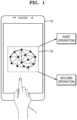
- FIG. 1 is a diagram illustrating an example in which an electronic device performs an operation corresponding to a received user input.
- an electronic device 10 may include a mobile device (e.g., a smart phone, a tablet personal computer (PC), etc.) including an artificial intelligence model, and a computing device such as a general-purpose PC.
- the electronic device 10 may include a mobile device (e.g., a smart phone, a tablet PC, etc.) capable of transmitting and receiving data to and from a server including an artificial intelligence model through a network, and a computing device such as a general-purpose PC.
- a plurality of artificial intelligence models may be used in the disclosed embodiments according to the purpose and use.
- the plurality of artificial intelligence models used in the disclosed embodiments may include a first artificial intelligence model configured to obtain a feature vector from touch data received from a user for initial setting, a second artificial intelligence model configured to obtain a feature vector from air pressure data related to a change in the air pressure inside the electronic device caused by a touch input of the user, a third artificial intelligence model configured to calculate the similarity between the feature vector of the touch data and a feature vector obtained from each of pieces of touch data included in a plurality of training data sets, a fourth artificial intelligence model configured to calculate the similarity between the feature vector of the air pressure data and a feature vector obtained from each of pieces of air pressure data included in the plurality of training data sets, and a fifth artificial intelligence model configured to identify the type of a user input.
- the first artificial intelligence model and the second artificial intelligence model may be configured as one artificial intelligence model
- the third artificial intelligence model and the fourth artificial intelligence model may be configured as one artificial intelligence model
- the first to fifth artificial intelligence models may be configured as one artificial intelligence model. That is, the artificial intelligence model used in the disclosed embodiments may be implemented in various embodiments according to the manufacturer of the electronic device or the user of the electronic device, and is not limited by the above examples.
- the artificial intelligence model used in the disclosed embodiments may exist in the form of at least one processor.
- at least one of the electronic device 10 and a server 20 may include an artificial intelligence model in the form of a processor configured to obtain a feature vector of at least one of touch data and air pressure data.
- the electronic device 10 may include an artificial intelligence model in the form of a processor configured to identify a user input.
- the processor may include at least one general-purpose processor (e.g., a CPU or an AP) and at least one processor designed to perform a function of identifying a user input.
- the processor may execute at least one command to identify a user input and generate a control signal for performing an operation corresponding to the identified user input.
- the electronic device 10 may receive an input from a user 1.
- the electronic device 10 may receive an input from the user 1 through a touch screen.
- the user input may include, but is not limited to, an input of touching a partial region of the touch screen for a short time period (hereinafter, referred to as a normal touch), an input of touching a partial region of the touch screen for a long time period (hereinafter, referred to as a long touch), an input of strongly pressing a partial region of the touch screen (hereinafter, referred to as a force touch), an input of touching a partial region of the touch screen and dragging (hereinafter, referred to as a drag).
- a normal touch an input of touching a partial region of the touch screen for a short time period
- a long touch an input of touching a partial region of the touch screen for a long time period
- a force touch an input of strongly pressing a partial region of the touch screen
- dragging hereinafter, referred to as a drag
- the electronic device 10 may identify the type of a user input by using an artificial intelligence model 19. For example, the electronic device 10 may identify the type a user input received through the touch screen, as a normal touch, a long touch, a force touch, or a drag, by using the artificial intelligence model 19. Also, the electronic device 10 may identify the type of a user input, as a long-touch-and-drag or a force-touch-and-drag, by using the artificial intelligence model 19. According to an embodiment, the electronic device 10 may identify the type of an input received from the user by using a personalized artificial intelligence model.
- the electronic device 10 may perform an operation corresponding to the identified type of the user input.
- the electronic device 10 may perform an operation of selecting an object corresponding to a region in which the touch is input.
- the electronic device 10 may perform an operation of displaying a pop-up screen for performing an additional operation on an object located in a region in which the touch is input.
- the electronic device 10 may provide a user interface that provides a shortcut function.
- the electronic device 10 may provide a user interface that provides a function of moving the location of an object.
- the electronic device 10 may provide a user interface for controlling a certain function of the electronic device.
- the electronic device 10 may provide a user interface for adjusting the brightness of a display.
- the electronic device 10 may provide a user interface for adjusting the intensity of an output sound.
- the artificial intelligence model 19 built in the electronic device 10 may be a personalized artificial intelligence model obtained through training based on training data similar to touch data received from the user.
- the electronic device 10 may train the artificial intelligence model 19 by identifying a training data set similar to the touch data from among a plurality of pre-stored training data sets.
- the electronic device 10 may train the artificial intelligence model 19 by using the server 20.
- the artificial intelligence model 19 to be trained may be an artificial intelligence model for initial setting.
- the electronic device 10 may update the artificial intelligence model 19 based on a result of the type of a user input identified by using the artificial intelligence model 19.
- the electronic device may accurately perform an operation thereof intended by the user, by identifying the type of a user input. Also, the electronic device may provide a user interface in place of a physical key, by identifying various types of user input. In addition, the electronic device may identify a force touch even without including a sensor in the art configured to identify a force touch (hereinafter, referred to as a force touch sensor). Because the force touch sensor increases the thickness and weight of the electronic device, the electronic device according to an embodiment of the present disclosure may be made thinner and lighter than electronic devices in the art.
- FIG. 2 is a flowchart of a method, performed by an electronic device, of performing an operation corresponding to a user input by using an artificial intelligence model, according to an embodiment.
- the electronic device 10 may receive a touch input from a user.
- the electronic device 10 may obtain touch data related to a region in which the touch input of the user is received through the touch screen, at a preset time interval.
- the touch data refers to data indicating the time point and region of the touch input of the user being received through the touch screen of the electronic device 10.
- the electronic device 10 may obtain air pressure data related to a change in the air pressure inside the electronic device 10 caused by the touch input of the user.
- the electronic device 10 may obtain user touch data by using an interface.
- the electronic device 10 may obtain the touch data of the user through an interface for receiving an input of the user regarding personal information of the user (e.g., the age, gender, etc. of the user).
- personal information of the user e.g., the age, gender, etc. of the user.
- the electronic device 10 may obtain the user touch data through an interface for receiving a user input for initial setting.
- the electronic device 10 may obtain touch data for a normal touch, a long touch, a force touch, and a drag, through an interface requesting, from the user, a touch input such as a normal touch, a long touch, a force touch, and a drag.
- the electronic device 10 may display the interface requesting, from the user, a touch input such as a normal touch, a long touch, a force touch, or a drag, on a certain position on the touch screen.
- the electronic device 10 may display a text or output a voice, for requesting the user to make a normal touch, a long touch, a force touch, or a drag on a circular indicator displayed at a certain position on the touch screen.
- the electronic device 10 may output, as a text or a voice, a guide for a touch input of the user (e.g., a guide for designating a finger for the touch input, a guide for designating a part of a finger for the touch input).
- the electronic device 10 may output feedback corresponding to the degree of reception of the touch input from the user (e.g., feedback outputting a voice, feedback outputting a vibration, or feedback changing the color of an indicator).
- the electronic device 10 may output the indicator in a color corresponding to the type of the received touch input (e.g., blue for a normal touch, yellow for a long touch, and red for a force touch).
- the electronic device 10 may store the obtained touch data in a memory.
- the electronic device 10 may store the touch data received from the user together with the type of the touch input requested from the user.
- the electronic device 10 may transmit the obtained touch data to the server 20.
- the electronic device 10 may transmit, to the server 20, the touch data received from the user together with the type of the touch input requested from the user.
- the electronic device 10 may identify training data similar to the input data of the user.
- the electronic device 10 may identify a first training data set similar to the touch data, from among a plurality of pre-stored training data sets.
- the training data set refers to a group of touch data and/or air pressure data classified as being similar to the touch data according to a predefined criterion, in order to obtain a personalized artificial intelligence model for identifying the type of a user input.
- the plurality of pre-stored training data sets may have been classified based on at least one of the age, gender, and finger sizes of the user, and a feature vector.
- the electronic device 10 may select training data similar to the input data of the user, based on personal information received from the user, such as the age and gender of the user.
- the electronic device 10 may identify the first training data set by using an artificial intelligence model to compare the touch data with touch data included in each of the plurality of pre-stored training data sets.
- the artificial intelligence model may be an artificial intelligence model for initial setting.
- the artificial intelligence model for initial setting may be a general-purpose artificial intelligence model that has been trained to identify the type of a user input and a training data set similar to input data of a user, based on a plurality of pre-stored training data sets.
- the electronic device 10 may identify training data similar to the input data of the user by using the artificial intelligence model to compare a touch region image representing the region in which the user input is received, with a touch region image included in the training data.
- the electronic device 10 may identify the first training data set by comparing the area of the region in which the touch input is received, which is included in the touch data, with the area of a region in which a touch input is received, which is included in each of the plurality of training data sets.
- the electronic device 10 may identify the first training data set, based on a result of comparing a time point at which the touch input is received, which is included in the touch data, with a time point at which a touch input is received, which is included in each of the plurality of training data sets.
- the electronic device 10 may identify the first training data set, based on a result of comparing feature data obtained by inputting the touch data to an artificial intelligence model, with feature data of each of the plurality of training data set.
- the feature data may include a feature map of the touch data, a feature vector of the touch data, and a probability value that the touch data corresponds to a type.
- the electronic device 10 may identify the first training data set by using air pressure data together with the touch data.
- the electronic device 10 may identify the first training data set, based on a result of comparing at least one feature data obtained by applying the touch data and the air pressure data to at least one artificial intelligence model, with feature data of each of the plurality of training data sets.
- the feature data may include a feature map of the touch data, a feature vector of the touch data, and a probability value that the touch data corresponds to a type.
- the electronic device 10 may identify the first training data set, based on a result of comparing a first feature vector obtained by applying the touch data and the air pressure data to one artificial intelligence model, with a second feature vector of each of the plurality of training data sets.
- the electronic device 10 may identify the first training data set, based on a result of comparing feature vectors obtained by applying the touch data and the air pressure data to separate artificial intelligence models, respectively, with the feature vector of each of the plurality of training data sets.
- the electronic device 10 may identify the first training data set by using the server 20.
- the electronic device 10 may request the server 20 to select the first training data set from among a plurality of training data sets stored in the server 20.
- the server 20 may select the first training data set from among the plurality of training data sets, in response to the request of the electronic device 10.
- the method of identifying the first training data set described above may be inferentially applied, and thus, redundant descriptions thereof are omitted.
- the electronic device 10 may identify the first training data set by receiving information about the first training data set identified by the server 20.
- the information about the first training data set may include identification information indicating the first training data set from among the plurality of training data sets.
- the information about the first training data set may include data constituting the first training data set.
- the electronic device 10 may transmit, to the server 20, at least one of the touch data and the first feature vector of the touch data.
- the electronic device 10 may identify the first training data set by receiving, from the server 20, information (e.g., identification information of the first training data set) about the first training data set identified by the server 20 using at least one of the touch data and the first feature vector.
- the electronic device 10 may identify the first training data set by receiving, from the server 20, data constituting the first training data set.
- the electronic device 10 may obtain a personalized artificial intelligence model by training at least one artificial intelligence model based on the identified training data set.
- the electronic device 10 may train the artificial intelligence model by using a training data set read out from the memory of the electronic device 10.
- the electronic device 10 may train the artificial intelligence model by using a training data set received from the server 20.
- the electronic device 10 may train, based on the training data set identified in operation S220, an artificial intelligence model that has not been trained based on training data.
- the electronic device 10 may train an artificial intelligence model for initial setting, based on the training data set identified in operation S220.
- the artificial intelligence model for initial setting may be a general-purpose artificial intelligence model trained based on at least some of the plurality of training data sets.
- the electronic device 10 may obtain one personalized artificial intelligence model by training one artificial intelligence model, based on a training data set including training data for touch data and air pressure data.
- the electronic device 10 may obtain two or more personalized artificial intelligence models by training separate artificial intelligence models based on training data for touch data and training data for air pressure data, respectively.
- the electronic device 10 may obtain a first personalized artificial intelligence model and a second personalized artificial intelligence model by training a first artificial intelligence model based on first training data for touch data included in the first training data set, and training a second artificial intelligence model based on second training data for air pressure data included in the first training data set.
- the electronic device 10 may obtain a personalized artificial intelligence model by receiving an artificial intelligence model trained by the server 20, and replacing the artificial intelligence model built in the electronic device 10 with the received artificial intelligence model.
- the electronic device 10 may obtain a personalized artificial intelligence model by receiving parameters of an artificial intelligence model trained by the server 20, and updating the artificial intelligence model built in the electronic device 10 by using the received parameters.
- a method, performed by the server 20 of training an the artificial intelligence model may be inferred from the above-described method, performed by the electronic device 10, of training the artificial intelligence model, and thus, redundant descriptions thereof are omitted.
- the electronic device 10 may identify the first artificial intelligence model corresponding to the first training data set, from among the plurality of artificial intelligence models corresponding to the plurality of training data sets, respectively.
- the plurality of artificial intelligence models may be pre-trained based on training data sets corresponding to the plurality of artificial intelligence models, respectively.
- the plurality of artificial intelligence models may be stored in the memory of the electronic device 10, or may stored in a database (DB) of the server 20.
- the electronic device 10 may obtain a personalized artificial intelligence model by replacing the artificial intelligence model built in the electronic device 10 with the first artificial intelligence model.
- the electronic device 10 may replace the artificial intelligence model built in the electronic device 10 by reading out the first artificial intelligence model from the memory.
- the electronic device 10 may replace the artificial intelligence model built in the electronic device 10 with the first artificial intelligence model received from the server 20.
- the electronic device 10 may receive a user input.
- the electronic device 10 may receive, through the touch screen, the user input such as a normal touch, long touch, force touch, or a drag, for performing a certain operation.
- the electronic device 10 may obtain touch data related to a region in which the touch input of the user is received through the touch screen, at a preset time interval.
- the electronic device 10 may obtain air pressure data related to a change in the air pressure inside the electronic device 10 caused by the touch input of the user.
- the electronic device 10 may identify the received user input by using the trained artificial intelligence model.
- the electronic device 10 may identify the type of the user input by applying the user input received in operation S240 to the artificial intelligence model trained in operation S230. For example, the electronic device 10 may identify the type the user input received through the touch screen, as a normal touch, a long touch, a force touch, or a drag, by using the artificial intelligence model 19.
- the electronic device 10 may identify the type of the user input by applying touch data and air pressure data obtained from the user input, to the artificial intelligence model. For example, the electronic device 10 may apply at least one of the touch data and the air pressure data to the artificial intelligence model to obtain a probability value that the user input corresponds to a certain type, and identify the type of the user input, based on the obtained probability value. In detail, the electronic device 10 may obtain probability values that the user input corresponds a normal touch, a long touch, a force touch, and a drag, respectively, by using the artificial intelligence model, and identify the type of the user input corresponding to the highest probability value among the obtained probability values.
- the electronic device 10 may identify the type of the user input by using probability values obtained by applying the touch data and the air pressure data obtained from the user input, to one artificial intelligence model.
- the electronic device 10 may identify the type of the user input by applying weight values to probability values obtained by applying the touch data and the air pressure data to separate artificial intelligence models, respectively. For example, the electronic device 10 may apply weight values to a first probability value obtained by applying the touch data to a first artificial intelligence model, and a second probability value obtained by applying the air pressure data to a second artificial intelligence model, respectively. The electronic device 10 may identify the type of the user input corresponding to the higher value among the first probability value and the second probability value to which the weight values are applied.
- the electronic device 10 may perform an operation corresponding to the type of the user input identified in operation S250.
- the electronic device 10 may provide a user interface in which the operation corresponding to the type of the user input is executed, based on a region in which the touch input of the user is received in operation S240, and the type of the user input identified in operation 250.
- the electronic device 10 may perform an operation of selecting an object corresponding to the region in which the touch is input through the touch screen.
- the electronic device 10 may perform an operation of displaying a pop-up screen for performing an additional operation on an object located in the region in which the touch is input.
- the electronic device 10 may perform an operation of providing a shortcut function.
- the electronic device 10 may perform an operation of providing a page displaying detailed information such as the amount of memory occupied by the application.
- the electronic device 10 may provide a user interface for changing content being displayed on the touch screen of the electronic device 10.
- the electronic device 10 may provide a user interface such that content being displayed on the touch screen is moved upward.
- the electronic device 10 may provide a user interface such that photos included in a second folder are displayed.
- the electronic device 10 may perform an operation of controlling a hardware function of the electronic device 10.
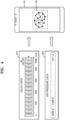
- FIG. 3 is a diagram for describing a method, performed by an electronic device, of obtaining at least one of touch data and air pressure data from a user input, according to an embodiment.
- the electronic device 10 may receive a touch input from the user 1 through the touch screen.
- the electronic device 10 may obtain at least one of touch data 310 and air pressure data 320 while receiving the touch input from the user 1.
- the electronic device 10 may obtain the touch data 310 related to a region 300 in which the touch input of the user is received through the touch screen, at a preset time interval.
- the electronic device 10 may obtain the touch data 310 of X frames, by segmenting the touch screen into MxN regions and scanning each of the regions at a certain time interval T ms (1/T Hz).
- the electronic device 10 may obtain the touch data 310 from each of the regions by measuring a microcurrent flowing through the finger of the user or an electric field value of an electrode corresponding to the region in which the input of the user is received, and normalizing the measured microcurrent or electric field value into a real number between 0 and 1.
- the electronic device 10 may group a certain number of pieces of touch data 310 into one set.
- the electronic device 10 may group, into one set, the touch data 310 of X frames segmented into MxN regions, which is obtained every T ms.
- the electronic device 10 may obtain the air pressure data 320 related to a change in the air pressure inside the electronic device 10 caused by the touch input of the user.
- the inside of the electronic device 10 may be sealed to support a waterproof function.
- the electronic device 10 may obtain the air pressure data 320 by measuring the air pressure inside the electronic device 10, which is changed by the touch input of the user pressing the electronic device 10, at a preset time interval by using an air pressure sensor.
- the electronic device 10 may obtain the air pressure data 320 whenever the touch data 310 is obtained.
- the electronic device 10 may group, into one set, pieces of air pressure data 320 respectively corresponding to pieces of touch data 310 grouped into one set.
- the electronic device 10 may group, into one set, the pieces of air pressure data 320 respectively corresponding the pieces of touch data 310 of the X frames obtained every T ms.
- the electronic device 10 may store the obtained touch data and air pressure data, in the memory of the electronic device 10. Also, the electronic device 10 may transmit the touch data and the air pressure data to the server 20.
- FIG. 4 is a diagram for describing a method, performed by an electronic device, of applying at least one of touch data and air pressure data to an artificial intelligence model, according to an embodiment.
- the electronic device 10 may apply, to the artificial intelligence model 19, at least one of touch data 410 and air pressure data 420 obtained from a touch screen having received a user input.
- the artificial intelligence model 19 may include an artificial intelligence model for initial setting that is trained to identify a training data set similar to the user input, based on the at least one of the touch data 410 and the air pressure data 420.
- the artificial intelligence model 19 may be a general-purpose artificial intelligence model trained, at least some of a plurality of training data sets, to identify the type of a user input.
- the artificial intelligence model 19 may include an artificial intelligence model trained to obtain, through a convolutional layer, feature data from input data.
- the electronic device 10 may perform preprocessing of converting the input touch data 410 and air pressure data 420 into data in a format applicable to the convolutional layer.
- the electronic device 10 may store the preprocessed touch data and air pressure data, in the memory of the electronic device 10.
- the electronic device 10 may transmit the preprocessed touch data and air pressure data to the server 20.
- the electronic device 10 may input the preprocessed touch data and air pressure data to the artificial intelligence model 19.
- the electronic device 10 may apply the touch data 410 and the air pressure data 420 to one artificial intelligence model.
- the electronic device 10 may apply the touch data 410 and air pressure data 420 to a first artificial intelligence model.
- the electronic device 10 may apply the touch data 410 and the air pressure data 420 to separate artificial intelligence models, respectively.
- the electronic device 10 may apply the touch data 410 to a first artificial intelligence model, and apply the air pressure data 420 to a second artificial intelligence model.
- FIG. 5 is a diagram for describing a method, performed by an electronic device, of obtaining feature data from touch data applied to an artificial intelligence model, according to an embodiment.
- the electronic device 10 may obtain feature data 530 of touch data 510 from the artificial intelligence model 19 by applying the touch data 510 to the artificial intelligence model 19.
- the electronic device 10 may obtain probability values 533 that a feature map 531, a feature vector 532, and the feature data 530 of the touch data 510 output from the artificial intelligence model 19 correspond to respective types of touch input.
- the artificial intelligence model 19 may include a feature extraction model pre-trained to obtain the feature data 530 of the touch data 510.
- the feature extraction model may be an artificial intelligence model generated separately from the artificial intelligence model of FIG. 10 for identifying training data and the artificial intelligence model of FIG. 11 for identifying the type of a user input.
- the feature extraction model may exchange data with the artificial intelligence model of FIG.
- the feature extraction model may exchange data with the artificial intelligence model of FIG. 11 for identifying the type of a user input in order to perform an operation corresponding to the user input.
- the artificial intelligence model 19 may configure the touch data 510 as convolutional layers.
- the artificial intelligence model 19 may obtain the feature map 531 of the touch data 510, from the convolutional layers.
- the artificial intelligence model 19 may obtain the feature vector 532 from the feature map 531 by performing vectorization or pooling on the feature map 531.
- the artificial intelligence model 19 may obtain the probability values 533 that the touch input of the user corresponds to the respective types of touch input, by fully connecting the feature vector 532.
- the artificial intelligence model 19 may obtain the probability values 533 that the touch input of the user corresponds to the respective types of touch input such as a normal touch, a long touch, a force touch, or a drag.
- the artificial intelligence model 19 may output the feature data 530 of the touch data 510 to the electronic device 10.
- the artificial intelligence model 19 may output, to the electronic device 10, as the feature data 530, at least one of the feature map 531 of the touch data 510, the feature vector 532 of the touch data 510, and the probability values 533 that the touch data 510 corresponds to the respective types of touch input.
- the electronic device 10 may store the feature data 530 output from the artificial intelligence model 19, in the memory.
- the electronic device 10 may transmit, to the server 20, the feature data 530 output from the artificial intelligence model 19.
- FIG. 6 is a diagram for describing a method, performed by an electronic device, of preprocessing touch data applied to an artificial intelligence model, according to an embodiment.
- the electronic device 10 may perform preprocessing on touch data 610 and apply a result of the preprocessing to the artificial intelligence model 19.
- the electronic device 10 may perform preprocessing on the touch data 610 to be in a format applicable to the convolutional layers of the artificial intelligence model 19.
- the preprocessing performed by the electronic device 10 may be performed by the electronic device 10 applying the touch data 610 to the artificial intelligence model 19.
- the electronic device 10 may obtain touch data sets by segmenting the touch data 610 based on a preset time period.
- the obtained touch data set may include touch data for one type of user input.
- the electronic device 10 may segment the touch data 610 based on a time point between touch inputs at which no touch input is received.
- the electronic device 10 may obtain a touch region image representing a region on the touch screen in which a touch input of the user is received.
- the electronic device 10 may obtain a touch region image set 611 corresponding to each of the touch data sets segmented based on the preset time period, as a result of the preprocessing.
- the electronic device 10 may apply the touch region image set 611 to the artificial intelligence model 19.
- the electronic device 10 may obtain a matrix corresponding to the touch data 610, as a result of preprocessing the touch data 610.
- the electronic device 10 may obtain the matrix corresponding to the touch data 610 by applying 1 to a region in which a touch input of the user is received, and 0 to a region in which a touch input of the user is not received, in the touch data 610.
- the electronic device 10 may obtain the matrix corresponding to the touch data 610 by converting, into an element of the matrix, each of regions having a real number between 0 and 1 obtained by normalizing a microcurrent or electric field value measured according to a touch input of the user.
- the electronic device 10 may obtain an MxN matrix from the touch data 610 segmented into MxN regions.
- the electronic device may obtain matrices 613 corresponding to the respective touch data sets, as a result of the preprocessing.
- the electronic device 10 may apply the matrices 613 to the artificial intelligence model 19.
- FIG. 7 is a diagram for describing a method, performed by an electronic device, of obtaining feature data from air pressure data to be applied to an artificial intelligence model, according to an embodiment.
- the electronic device 10 may obtain feature data 730 of air pressure data 720 from the artificial intelligence model 19 by applying the air pressure data 720 to the artificial intelligence model 19.
- the electronic device 10 may obtain probability values 733 that a feature map 731, a feature vector 732, and the feature data 730 of the air pressure data 720 output from the artificial intelligence model 19 correspond to respective types of touch input.
- the artificial intelligence model 19 may configure the air pressure data 720 as convolutional layers.
- the artificial intelligence model 19 may obtain the feature map 731 of the air pressure data 720, from the convolutional layers.
- the artificial intelligence model 19 may obtain the feature vector 732 from the feature map 731 by performing vectorization or pooling on the feature map 731.
- the artificial intelligence model 19 may obtain the probability values 733 that the touch input of the user corresponds to the respective types of touch input, by fully connecting the feature vector 732.
- the artificial intelligence model 19 may obtain the probability values 733 that the touch input of the user corresponds to the respective types of touch input such as a normal touch, a long touch, a force touch, or a drag.
- the artificial intelligence model 19 may output the feature data 730 of the air pressure data 720 to the electronic device 10.
- the artificial intelligence model 19 may output, to the electronic device 10, as the feature data 730, at least one of the feature map 731 of the air pressure data 720, the feature vector 732 of the air pressure data 720, and the probability values 733 that the air pressure data 720 corresponds to the respective types of touch input.
- the electronic device 10 may store the feature data 730 output from the artificial intelligence model 19, in the memory.
- the electronic device 10 may transmit, to the server 20, the feature data 730 output from the artificial intelligence model 19.
- FIGS. 8 and 9 are diagrams for describing a method, performed by an electronic device, of preprocessing air pressure data applied to an artificial intelligence model, according to an embodiment.
- the electronic device 10 may perform preprocessing on air pressure data 820 or 920 and apply a result of the preprocessing to the artificial intelligence model 19.
- the electronic device 10 may perform preprocessing on the air pressure data 820 or 920 to obtain preprocessed data 830 or 930.
- the electronic device 10 may perform preprocessing on the air pressure data 820 or 920 to be in a format applicable to the convolutional layers of the artificial intelligence model 19.
- the preprocessing performed by the electronic device 10 may be performed by the electronic device 10 applying the air pressure data 820 or 920 to the artificial intelligence model 19.
- the electronic device 10 may obtain matrices 850 corresponding to the air pressure data 820, by performing preprocessing on the air pressure data 820.
- the electronic device 10 may obtain, from the air pressure data 820, a change value in an internal air pressure value of the electronic device 10 in a preset time period. For example, the electronic device 10 may obtain the difference between an air pressure value 831 at a first time point and an air pressure value 832 at a second time point.
- the electronic device 10 may obtain the matrices 850 from change values in the air pressure inside the electronic device 10. For example, the electronic device 10 may obtain a matrix corresponding to the second time point and having the difference between the air pressure value 832 at the second time point and the air pressure value 831 at the first time point. Also, the electronic device 10 may obtain a matrix corresponding to the first time point having a value of 0.
- the electronic device 10 may obtain matrices 950 by performing preprocessing on the air pressure data 920.
- the electronic device 10 may obtain, from the air pressure data 920, a change value in the air pressure inside the electronic device 10 in a preset time period. For example, the electronic device 10 may obtain the difference between an air pressure value at a time point at which a touch input is received, and an air pressure value at a time point at which no touch input is received. In detail, the electronic device 10 may obtain the difference between an air pressure value 931 at a first time point at which no touch input is received, and an air pressure value 932 at a second time point at which a touch input is received.
- the electronic device 10 may obtain the matrices 950 from change values in the air pressure inside the electronic device 10.
- the electronic device 10 may obtain the matrices 950 having the differences between air pressure values at time points at which touch inputs are received, and the air pressure value at the time point at which no touch input is received.
- the electronic device 10 may obtain a matrix having the difference between the air pressure value 931 at the first time point at which no touch input is received, and the air pressure value 932 at the second time point at which the touch input is received.
- the electronic device 10 may apply the obtained matrices 850 or 950 to the artificial intelligence model 19.
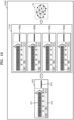
- FIG. 10 is a diagram for describing a method, performed by any one of an electronic device or a server, of identifying a training data set similar to user input data and training an artificial intelligence model by using the identified training data, according to an embodiment.
- the electronic device 10 may obtain input data 1010 of the user and compare the input data 1010 with a plurality of training data sets 1020a, 1020b, 1020c, and 1020d pre-stored in a memory 17, to select a first training data set similar to the input data 1010 from the plurality of training data sets 1020a, 1020b, 1020c, and 1020d.
- the electronic device 10 may compare touch data 1011 included in the input data 1010 with touch data included in each of the plurality of training data sets 1020a, 1020b, 1020c, and 1020d, to select the first training data set including touch data similar to the touch data 1011.
- the electronic device 10 may compare the touch data 1011 corresponding to respective types of touch input included in the input data 1010 with the touch data corresponding to respective types of touch input included each of the plurality of training data sets 1020a, 1020b, 1020c, and 1020d, to select the first training data set including the touch data similar to the touch data 1011.
- the electronic device 10 may compare touch data of the user that is input as a force touch with touch data for a force touch included in each of the plurality of training data sets 1020a, 1020b, 1020c, and 1020d, to select the first training data set.
- the electronic device 10 may compare touch data of the user that is input as a long touch with touch data for a long touch included in each of the plurality of training data sets 1020a, 1020b, 1020c, and 1020d, to select the first training data set.
- the electronic device 10 may compare a touch region image obtained from the touch data 1011 with a touch region image obtained from the touch data included in each of the plurality of training data sets 1020a, 1020b, 1020c, and 1020d, select a first training data set including touch data similar to the touch data 1011.
- the electronic device 10 may select the first training data set, based on a result of comparing the shape (e.g., an edge) of a region in which a touch input included in the touch data 1011 is received, with the shape of a region in which a touch input included in each of the plurality of training data sets 1020a, 1020b, 1020c, and 1020d is received.
- the electronic device 10 may select a first training data set including touch data similar to the touch data 1011, by comparing the area of the region in which the touch input included in the touch data 1011 is received, with the area of the region in which the touch input included in each of the plurality of training data sets 1020a, 1020b, 1020c, and 1020d is received. In this case, the electronic device 10 may select the first training data set, based on a result of comparing the maximum areas of the regions with each other.
- the electronic device 10 may identify a first training data set including touch data similar to the touch data 1011, by a result of comparing a time point at which the touch input included in the touch data 1011 is received, with a time point at which the touch input included in each of the plurality of training data sets 1020a, 1020b, 1020c, and 1020d is received.
- the electronic device 10 may identify a first training data set, based on a result of comparing feature data of the touch data 1011 with feature data of each of the plurality of training data sets 1020a, 1020b, 1020c, and 1020d.
- the feature data may include a feature map of the touch data, a feature vector of the touch data, and probability values that the touch data corresponds to respective types.
- the electronic device 10 may obtain a first feature vector 1015 of the touch data 1011 by applying the touch data 1011 to an artificial intelligence model.
- the electronic device 10 may apply, to the artificial intelligence model, a second feature vector of each of the plurality of training data sets 1020a, 1020b, 1020c, and 1020d and the first feature vector 1015, to identify correlations between the first feature vector 1015 and the second feature vectors.
- the electronic device 10 may identify the first training data set corresponding to the second feature vector having the highest correlation with the first feature vector 1015.
- the electronic device 10 may identify the first training data set, based on a result of comparing a representative value (e.g., an average, a median, or a mode) of the first feature vector 1015 with a representative value (e.g. an average, a median, or a mode) of each of the second feature vectors.
- a representative value e.g., an average, a median, or a mode
- a representative value e.g. an average, a median, or a mode
- the electronic device 10 may identify a training data set similar to user input data from among the plurality of training data sets 1020a, 1020b, 1020c, and 1020d, by using air pressure data together with touch data.
- the electronic device 10 may identify a training data set similar to the user input data, based on a result of comparing the first feature vector 1015 obtained by applying the touch data 1011 and air pressure data 1013 to one artificial intelligence model, with the second feature vector of each of the plurality of training data sets 1020a, 1020b, 1020c, and 1020d.
- the electronic device 10 may identify the training data set similar to the user input data, based on a result of comparing a first feature vector obtained by concatenating the touch data with the air pressure data and applying a result of the concatenating to the artificial intelligence model, with the second feature vectors, or based on a result of comparing a first feature vector obtained by alternately arranging the touch data and the air pressure data and applying a result of the arranging to the artificial intelligence model, with the second feature vectors.
- the electronic device 10 may identify a training data set similar to the user input data, based on a result of comparing feature vectors obtained by applying the touch data 1011 and air pressure data 1013 to separate artificial intelligence models, respectively, with feature vectors of touch data and air pressure data included in each of the plurality of training data sets 1020a, 1020b, 1020c, and 1020d.
- the electronic device 10 may obtain a first feature vector by applying the touch data 1011 to a first artificial intelligence model. Also, the electronic device 10 may obtain a third feature vector by applying the air pressure data 1013 to a second artificial intelligence model. The electronic device 10 may compare the first feature vector with second feature vectors obtained from pieces of touch data included in the plurality of training data sets 1020a, 1020b, 1020c, and 1020d, to identify a first training data set corresponding to the second feature vector having the highest correlation with the first feature vector.
- the electronic device 10 may compare the third feature vector with fourth feature vectors obtained from pieces of air pressure data included in the plurality of training data sets 1020a, 1020b, 1020c, and 1020d, to identify a second training data set corresponding to the fourth feature vector having the highest correlation with the third feature vector.
- the electronic device may identify a training data set to be used to train an artificial intelligence model, from among the first training data set and the second training data set, by using weight values.
- the electronic device 10 may identify a first training data set similar to user input data, from among the plurality of training data sets 1020a, 1020b, 1020c, and 1020d.
- the electronic device 10 may identify a first artificial intelligence model corresponding to the first training data set, from among a plurality of artificial intelligence models corresponding to the plurality of training data sets 1020a, 1020b, 1020c, and 1020d, respectively.
- Each of the plurality of artificial intelligence models may be pre-trained based on each of the training data sets 1020a, 1020b, 1020c, and 1020d classified based on training data collected from various users having various touch input characteristics (e.g., age, gender, race, weight, or frequently used finger).
- the electronic device 10 may transmit input data 1010 of the user to the server 20.
- the server 20 may select the first training data set similar to the input data 1010 from among the plurality of training data sets 1020a, 1020b, 1020c, and 1020d pre-stored in a DB 27, by comparing the input data 1010 with the plurality of training data sets 1020a., 1020b, 1020c, and 1020d.
- a method, performed by the server 20, of identifying a training data set may be inferred from the method, performed by the electronic device 10, of identifying a training data set, and thus, redundant descriptions thereof are omitted.
- a method, performed by the server 20, of identifying a first artificial intelligence model corresponding to a first training data set may be inferred from the method, performed by the electronic device 10, of identifying a first artificial intelligence model, and thus, redundant descriptions thereof are omitted.
- the electronic device 10 may train the artificial intelligence model 19 based on a training data set similar to user input data.
- the electronic device 10 may train, based on the training data set similar to the user input data, an artificial intelligence model that has not been trained based on training data.
- the electronic device 10 may train an artificial intelligence model for initial setting, based on the training data set similar to the user input data.
- the artificial intelligence model for initial setting may be a general-purpose artificial intelligence model trained based on at least some of the plurality of training data sets.
- the electronic device 10 may obtain one personalized artificial intelligence model by training one artificial intelligence model, based on a training data set including training data for touch data and air pressure data.
- the electronic device 10 may obtain two or more personalized artificial intelligence models by training separate artificial intelligence models based on training data for touch data and training data for air pressure data, respectively.
- the electronic device 10 may obtain a first personalized artificial intelligence model and a second personalized artificial intelligence model by training a first artificial intelligence model based on first training data for touch data included in the first training data set, and training a second artificial intelligence model based on second training data for air pressure data included in the first training data set.
- the electronic device 10 may obtain a personalized artificial intelligence model by reading out, from a memory, a first artificial intelligence model corresponding to a first training data set among a plurality of artificial intelligence models that are pre-trained based on the plurality of training data sets, respectively, and replacing the artificial intelligence model built in the electronic device 10 with the first artificial intelligence model read out.
- the server 20 may train an artificial intelligence model based on a training data set similar to user input data.
- a method, performed by the server 20, of identifying training data may be inferred from the method, performed by the electronic device 10, of identifying training data, and thus, redundant descriptions thereof are omitted.
- the electronic device 10 may obtain a personalized artificial intelligence model by receiving an artificial intelligence model trained by the server 20, and replacing the artificial intelligence model built in the electronic device 10 with the received artificial intelligence model.
- the electronic device 10 may obtain a personalized artificial intelligence model by receiving parameters of an artificial intelligence model trained by the server 20, and updating the artificial intelligence model built in the electronic device 10 by using the received parameters.
- the electronic device 10 may obtain a personalized artificial intelligence model by receiving, from the server 20, a first artificial intelligence model corresponding to a first training data set among a plurality of artificial intelligence models that are pre-trained based on the plurality of training data sets, respectively, and replacing the artificial intelligence model built in the electronic device 10 with the received first artificial intelligence model.
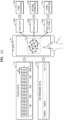
- FIG. 11 is a diagram for describing a method, performed by an electronic device, of identifying the type of a user input by using an artificial intelligence model, and performing an operation corresponding to the identified type, according to an embodiment.
- the electronic device 10 may receive, from the user 1, a touch input for performing a certain operation.
- the electronic device 10 may receive a touch input of the user 1, such as a normal touch, a long touch, a force touch, or a drag, for performing a certain operation such as an operation of selecting an object corresponding to a region in which a touch is input through the touch screen, an operation of displaying a pop-up screen for performing an additional operation on an object located in a region in which a touch is input, an operation of providing a shortcut functional, an operation of providing a function of moving the position of an object, or an operation of controlling a hardware function of the electronic device 10.
- a touch input of the user 1 such as a normal touch, a long touch, a force touch, or a drag
- a certain operation such as an operation of selecting an object corresponding to a region in which a touch is input through the touch screen, an operation of displaying a pop-up screen for performing an additional operation on an object located in a region in which a touch
- the electronic device 10 may obtain touch data 1110 and air pressure data 1120 from the touch input received from the user 1. For example, the electronic device 10 may obtain the touch data 1110 related to a region in which the touch input of the user is received through the touch screen, at a preset time interval. Also, while obtaining the touch data 1110, the electronic device 10 may obtain the air pressure data 1120 related to a change in the air pressure inside the electronic device 10 caused by the touch input of the user 1.
- the electronic device 10 may identify the type of the user input by applying at least one of the touch data 1110 and the air pressure data 1120 to the artificial intelligence model 19. For example, the electronic device 10 may identify, from probability values that the the user input corresponds to a long touch 1150a, a force touch 1150b, and a force-touch-and-drag 1150c, respectively, the type of the user input as a type such as the long touch 1150a, the force touch 1150b, or the force-touch-and-drag 1150c.
- the electronic device 10 may apply at least one of the touch data 1110 and the air pressure data 1120 to one artificial intelligence model, to identify the type of the user input by using probability values output from the artificial intelligence model.
- the electronic device 10 may perform an operation corresponding to the identified type of the user input.
- the electronic device 10 may perform a first operation 1170a in response to the user input being identified as the long touch 1150a.
- the electronic device 10 may perform an operation of displaying a pop-up screen for performing an additional operation on an object located in the region in which the touch is input.
- the electronic device 10 may perform a second operation 1170b in response to the user input being identified as the force touch 1150b.
- the electronic device 10 may perform an operation of providing a shortcut function.
- the electronic device 10 may perform a third operation 1170c in response to the user input being identified as the force-touch-and-drag 1150c.
- the electronic device 10 may perform an operation of adjusting the brightness of the display.
- the electronic device 10 may perform an operation of adjusting the intensity of an output sound.
- FIG. 12 is a diagram for describing a method, performed by an electronic device, of identifying the type of a user input by using an artificial intelligence model, and performing an operation corresponding to the identified type, according to an embodiment.
- the electronic device 10 may receive, from the user 1, a touch input for performing a certain operation.
- the electronic device 10 may obtain touch data 1210 and air pressure data 1220 from the touch input received from the user 1.
- the electronic device 10 may identify the type of the user input by applying weight values to probability values obtained by applying the touch data and the air pressure data to separate artificial intelligence models, respectively.
- the electronic device 10 may apply a first weight value w a to a first probability value obtained by applying the touch data 1210 to a first artificial intelligence model 19a, and apply a second weight value w b to a second probability value obtained by applying the air pressure data 1220 to a second artificial intelligence model 19b.
- the electronic device 10 may identify the type of the user input corresponding to the higher value among the first probability value and the second probability value to which the weight values w a and w b are applied, respectively.
- the electronic device 10 may perform an operation 1270 corresponding to the identified type of the user input.
- the weight values w a and w b applied to the respective probability values may be determined based on the similarity between input data of the user and a training data set.
- the first weight value w a may be determined based on the similarity between the touch data obtained in operation S210 of FIG. 2 and the touch data of the training data set identified in operation S220 of FIG. 2 . For example, when the similarity is 90 %, the first weight value w a may be 0.9.
- the second weight value w b may be determined based on the similarity between the air pressure data obtained in operation S210 of FIG. 2 and the air pressure data of the training data set identified in operation S220 of FIG. 2 . For example, when the similarity is 60 %, the second weight value w b may be 0.6.
- the similarity between the input data of the user and the training data set may be obtained from the correlation between a feature vector obtained from the input data of the user and a feature vector of the training data set.
- the first probability value obtained by applying the touch data 1210 to the first artificial intelligence model 19a may include a first long-touch probability value that the touch input of the user corresponds to a long touch, and a first force-touch probability value that the touch input of the user corresponds to a force touch.
- the second probability value obtained by applying the air pressure data 1220 to the second artificial intelligence model 19b may include a second long-touch probability value that the touch input of the user corresponds to a long touch, and a second force-touch probability value that the touch input of the user corresponds to a force touch.
- the weight value w a applied to the first probability value may include a first weight value w 1 applied to the first long-touch probability value, and a second weight value w 2 applied to the first force-touch probability value.
- the weight value w b applied to the second probability value may include a third weight value w 3 applied to the second long-touch probability value, and a fourth weight value w 4 applied to the second force-touch probability value.
- the weight values may be determined such that the sum of the first weight value w 1 and the second weight value w 2 is 1, and the sum of the third weight value w 3 and the fourth weight value w 4 is 1.
- the electronic device 10 may determine a weight value w a applied to the first probability value as 1, and determine a weight value w b applied to the second probability value as 0.
- the electronic device 10 may determine the first weight value w 1 and the second weight value w 2 as the same value (e.g., 0.5).
- the electronic device 10 may identify the type of the user input corresponding to the higher value among the sum of the first long-touch probability value to which the first weight value w 1 is applied and the second long-touch probability value to which the third weight value w 3 is applied, and the sum of the first force-touch probability value to which the second weight value w 2 is applied and the second force-touch probability value to which the fourth weight value w 4 is applied.
- the weight values w a , w b , w 1 , w 2 , w 3 , and w 4 applied to the probability values, respectively, may be preset by a designer of the artificial intelligence model.
- the weight values w a , w b , w 1 , w 2 , w 3 , and w 4 may be set to appropriate values determined by the designer of the artificial intelligence model through experiments.
- the weight values w a , w b , w 1 , w 2 , w 3 , and w 4 from which optimal probability values may be obtained may be preset.
- the weight values w a , w b , w 1 , w 2 , w 3 , and w 4 may be adjusted to appropriate values.
- the weight values w a , w b , w 1 , w 2 , w 3 , and w 4 are not limited to the above-described examples, and may be determined according to various methods as values for obtaining optimal probability values.
- the second artificial intelligence model 19b may output a probability value that the touch input of the user corresponds to a force touch, according to the difference between a maximum and a minimum of the air pressure inside the electronic device 10 caused by the touch input of the user, by using the function of Equation 1.
- p sigmoid max b ⁇ min b
- b denotes an air pressure value
- p denotes a probability value that the touch input of the user corresponds to a force touch
- p denotes a result value by a sigmoid function and may be a value between 0 and 1.
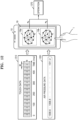
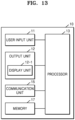
- FIG. 13 is a block diagram of an electronic device according to an embodiment.
- the electronic device 10 may include a user input unit 11, an output unit 12, a processor 13, a communication unit 15, and the memory 17. However, all components illustrated in FIG. 13 are not essential components of the electronic device 10. The electronic device 10 may be implemented by more or less components than the components illustrated in FIG. 13 .
- the user input unit 11 refers to a unit via which the user inputs data for controlling the electronic device 10.
- the user input unit 11 may be, but is not limited to, a touch screen, a key pad, a dome switch, a touch pad (e.g., a touch-type capacitive touch pad, a pressure-type resistive overlay touch pad, an infrared sensor-type touch pad, a surface acoustic wave conduction touch pad, an integration-type tension measurement touch pad, a piezoelectric effect-type touch pad), a jog wheel, a jog switch, etc.
- a touch screen e.g., a touch-type capacitive touch pad, a pressure-type resistive overlay touch pad, an infrared sensor-type touch pad, a surface acoustic wave conduction touch pad, an integration-type tension measurement touch pad, a piezoelectric effect-type touch pad
- a jog wheel e.g., a jog wheel
- the user input unit 11 may receive a user input necessary for the electronic device 10 to perform the embodiments described above with reference to FIGS. 1 to 12 .
- the output unit 12 outputs information processed by the electronic device 10.
- the output unit 12 may output information related to the embodiments described above with reference to FIGS. 1 to 12 .
- the output unit 12 may include a display unit 12-1 configured to display an object, a user interface, and a result of performing an operation corresponding to an input of the user.
- the processor 13 controls the overall operation of the electronic device 10.
- the processor 13 may execute at least one instruction stored in the memory 17 to control the overall operation of the user input unit 11, the output unit 12, the communication unit 15, the memory 17, etc.
- the processor 13 may execute an instruction stored in a user input data obtaining module 17a to control the electronic device 10 to obtain at least one of touch data and air pressure data from a touch input received from the user.
- a user input data obtaining module 17a to control the electronic device 10 to obtain at least one of touch data and air pressure data from a touch input received from the user.
- the processor 13 may execute an instruction stored in a training data set identification module 17b to control the electronic device 10 to identify a training data set similar to input data of the user from among a plurality of pre-stored training data sets.
- a training data set identification module 17b to control the electronic device 10 to identify a training data set similar to input data of the user from among a plurality of pre-stored training data sets.
- the processor 13 may execute an instruction stored in an artificial intelligence training module 17c to train an artificial intelligence model based on a training data set similar to input data of the user.
- the processor 13 may execute the instruction stored in an artificial intelligence training module 17c to select an artificial intelligence model trained based on a training data set similar to input data of the user.
- the processor 13 may execute an instruction stored in a user input type identification module 17d to identify the type of a user input received from the user.
- a user input type identification module 17d to identify the type of a user input received from the user.
- the processor 13 may execute an instruction stored in an operation execution module 17e to control the electronic device 10 to perform an operation corresponding to the identified type of the user input.
- an operation execution module 17e to control the electronic device 10 to perform an operation corresponding to the identified type of the user input.
- the processor 13 may be at least one general-purpose processor.
- the processor 13 may include at least one processor manufactured to perform a function of an artificial intelligence model.
- the processor 13 may execute a series of instructions to cause an artificial intelligence model to learn new training data.
- the processor 13 may executing a software module stored in the memory 17 to perform the function of the artificial intelligence model described above with reference to FIGS. 1 to 12 .
- the communication unit 15 may include one or more components configured to allow the electronic device 10 to communicate with another device (not shown) and the server 20.
- the other device (not shown) may be the same computing device as the electronic device 10, but is not limited thereto.
- the memory 17 may store at least one instruction and at least one program for the processor 13 to perform processing and control, and may store data input to or output from the electronic device 10.
- the memory 17 may include at least one of a memory that temporarily stores data, such as random-access memory (RAM) or static RAM (SRAM), and a data storage that non-temporarily stores data, such as flash memory-type storage medium, a hard disk-type storage medium, a multimedia card micro-type storage medium, a card-type memory (e.g., SD or XD memory), read-only memory (ROM), electrically erasable programmable ROM (EEPROM), programmable RAM (PROM), magnetic memory, a magnetic disk, or an optical disk.
- RAM random-access memory
- SRAM static RAM
- FIG. 14 is a block diagram illustrating software modules of a memory included in an electronic device according to an embodiment.
- the memory 17 is a software module including instructions for the electronic device 10 to perform the embodiments described above with reference to FIGS. 1 to 12 , and and may include the user input data obtaining module 17a, the training data set identification module 17b, the artificial intelligence training module 17c, the user input type identification module 17d, and the operation execution module 17e.
- the electronic device 10 may perform an operation corresponding to an input of the user by more or less software modules than those illustrated in FIG. 14 .
- the electronic device 10 may obtain at least one of touch data and air pressure data from a touch input received from the user.
- touch data For example, as the processor 13 executes an instruction included in the user input data obtaining module 17a, the electronic device 10 may obtain at least one of touch data and air pressure data from a touch input received from the user.
- FIGS. 1 to 12 The descriptions of the embodiments provided above with reference to FIGS. 1 to 12 will be omitted.
- the electronic device 10 may select a training data set similar to input data of the user from among a plurality of pre-stored training data sets.
- the descriptions of the embodiments provided above with reference to FIGS. 1 to 12 will be omitted.
- the electronic device 10 may train an artificial intelligence model based on a training data set similar to input data of the user, or identify an artificial intelligence model trained based on the training data set similar to input data of the user.
- the descriptions of the embodiments provided above with reference to FIGS. 1 to 12 will be omitted.
- the electronic device 10 may identify the type of a user input received from the user.
- the descriptions of the embodiments provided above with reference to FIGS. 1 to 12 will be omitted.
- the electronic device 10 may perform an operation corresponding to the identified type of the user input.
- the descriptions of the embodiments provided above with reference to FIGS. 1 to 12 will be omitted.
- FIG. 15 is a block diagram of a server according to an embodiment.
- a server 20 may include a communication unit 25, a memory 26, a DB 27, and a processor 23.
- the communication unit 25 may include one or more components configured to allow the server 20 to communicate with the electronic device 10.
- the memory 26 may store at least one instruction and at least one program for the processor 23 to perform processing and control, and may store data input to or output from the server 20.
- the DB 27 may store data received from the electronic device 10.
- the DB 27 may store a plurality of training data sets to be used to train an artificial intelligence model.
- the processor 23 controls the overall operation of the server 20.
- the processor 23 may execute programs stored in the memory 26 of the server 20 to control the overall operation of the DB 27 and the communication unit 25.
- the processor 23 may execute programs to perform the operations of the server 20 described above with reference to FIGS. 1 to 12 .
- the processor 23 may execute an instruction stored in a training data set identification module 27a to identify a training data set similar to input data of the user from among a plurality of pre-stored training data sets.
- a training data set identification module 27a to identify a training data set similar to input data of the user from among a plurality of pre-stored training data sets.
- the processor 23 may execute an instruction included in an artificial intelligence training module 27b to train an artificial intelligence model based on a training data set similar to input data of the user.
- the processor 23 may execute the instruction stored in an artificial intelligence training module 27b to select an artificial intelligence model trained based on a training data set similar to input data of the user.
- FIG. 16 is a block diagram illustrating software modules of a memory included in a server, according to an embodiment.
- the memory 26 is a software module for the server 20 to perform the embodiments described above with reference to FIGS. 1 to 12 , and may include the training data set identification module 27a and the artificial intelligence training module 27b. However, the server 20 may operate by more or less software modules than those illustrated in FIG. 16 .
- the server 20 may select a training data set similar to input data of the user from among a plurality of pre-stored training data sets.
- the descriptions of the embodiments provided above with reference to FIGS. 1 to 12 will be omitted.
- the server 20 may train an artificial intelligence model based on a training data set similar to input data of the user, or identify an artificial intelligence model trained based on the training data set similar to input data of the user.
- the descriptions of the embodiments provided above with reference to FIGS. 1 to 12 will be omitted.
- a machine-readable storage medium may be provided in the form of a non-transitory storage medium.
- the term 'non-transitory storage medium' refers to a tangible device and does not include a signal (e.g., an electromagnetic wave), and the term 'non-transitory storage medium' does not distinguish between a case where data is stored in a storage medium semi-permanently and a case where data is stored temporarily.
- the non-transitory storage medium may include a buffer in which data is temporarily stored.
- the methods according to various embodiments disclosed herein may be included in a computer program product and then provided.
- the computer program products may be traded as commodities between sellers and buyers.
- the computer program product may be distributed in the form of a machine-readable storage medium (e.g., a compact disc ROM (CD-ROM)), or may be distributed online (e.g., downloaded or uploaded) through an application store (e.g., Play Store TM ) or directly between two user devices (e.g., smart phones).
- an application store e.g., Play Store TM
- at least a portion of the computer program product e.g., a downloadable app
Landscapes
- Engineering & Computer Science (AREA)
- Theoretical Computer Science (AREA)
- General Engineering & Computer Science (AREA)
- Physics & Mathematics (AREA)
- General Physics & Mathematics (AREA)
- Software Systems (AREA)
- Human Computer Interaction (AREA)
- Artificial Intelligence (AREA)
- Data Mining & Analysis (AREA)
- Evolutionary Computation (AREA)
- Medical Informatics (AREA)
- Computer Vision & Pattern Recognition (AREA)
- Computing Systems (AREA)
- Mathematical Physics (AREA)
- User Interface Of Digital Computer (AREA)
Applications Claiming Priority (2)
| Application Number | Priority Date | Filing Date | Title |
|---|---|---|---|
| KR1020210004241A KR20220102042A (ko) | 2021-01-12 | 2021-01-12 | 사용자 입력을 추론하는 사용자 맞춤형 전자 장치 및 이를 제어하는 방법 |
| PCT/KR2021/016889 WO2022154236A1 (fr) | 2021-01-12 | 2021-11-17 | Dispositif électronique personnalisé inférant une entrée utilisateur et son procédé de commande |
Publications (2)
| Publication Number | Publication Date |
|---|---|
| EP4261663A1 true EP4261663A1 (fr) | 2023-10-18 |
| EP4261663A4 EP4261663A4 (fr) | 2024-06-05 |
Family
ID=82447449
Family Applications (1)
| Application Number | Title | Priority Date | Filing Date |
|---|---|---|---|
| EP21919860.3A Pending EP4261663A4 (fr) | 2021-01-12 | 2021-11-17 | Dispositif électronique personnalisé inférant une entrée utilisateur et son procédé de commande |
Country Status (4)
| Country | Link |
|---|---|
| US (1) | US20230359348A1 (fr) |
| EP (1) | EP4261663A4 (fr) |
| KR (1) | KR20220102042A (fr) |
| WO (1) | WO2022154236A1 (fr) |
Cited By (2)
| Publication number | Priority date | Publication date | Assignee | Title |
|---|---|---|---|---|
| EP4099142B1 (fr) * | 2021-04-19 | 2026-01-21 | Samsung Electronics Co., Ltd. | Dispositif électronique et son procédé de fonctionnement |
| US12596471B2 (en) | 2020-08-21 | 2026-04-07 | Samsung Electronics Co., Ltd. | Device and method with trained neural network to identify touch input |
Families Citing this family (3)
| Publication number | Priority date | Publication date | Assignee | Title |
|---|---|---|---|---|
| WO2024039219A1 (fr) | 2022-08-19 | 2024-02-22 | 삼성전자 주식회사 | Dispositif électronique et procédé de détermination d'un modèle d'apprentissage pour l'entraînement d'un dispositif électronique |
| EP4610792A4 (fr) * | 2022-12-20 | 2026-01-21 | Samsung Electronics Co Ltd | Procédé et dispositif électronique pour identifier un mouvement d'entrée |
| US12366955B2 (en) * | 2023-10-30 | 2025-07-22 | Sunia Pte. Ltd. | Recognition system for recognizing multiple inputs of gestures, handwriting symbols and virtual keys on touch screen |
Family Cites Families (10)
| Publication number | Priority date | Publication date | Assignee | Title |
|---|---|---|---|---|
| EP2180435A4 (fr) * | 2007-08-22 | 2011-01-05 | Fujitsu Ltd | Appareil de prédiction de propriétés de composé, procédé de prédiction de propriétés et programme pour exécuter le procédé |
| US20110007023A1 (en) * | 2009-07-09 | 2011-01-13 | Sony Ericsson Mobile Communications Ab | Display device, touch screen device comprising the display device, mobile device and method for sensing a force on a display device |
| KR101809892B1 (ko) * | 2016-03-29 | 2017-12-20 | 휴먼플러스(주) | 컴퓨터를 포함한 스마트 디바이스 및 그것의 동작 방법 |
| US10261685B2 (en) * | 2016-12-29 | 2019-04-16 | Google Llc | Multi-task machine learning for predicted touch interpretations |
| KR102280581B1 (ko) * | 2017-03-21 | 2021-07-22 | 엘지전자 주식회사 | 이동 단말기 및 그 제어 방법 |
| CN107734089A (zh) * | 2017-09-29 | 2018-02-23 | 努比亚技术有限公司 | 压力触控屏及具有该压力触控屏的移动终端 |
| KR102077669B1 (ko) * | 2018-03-06 | 2020-02-14 | 네이버랩스 주식회사 | 사용자의 터치 인터랙션과 연관된 센싱 데이터를 처리하는 방법 및 장치 |
| WO2019182378A1 (fr) * | 2018-03-21 | 2019-09-26 | Lg Electronics Inc. | Serveur d'intelligence artificielle |
| US11455383B2 (en) * | 2019-04-30 | 2022-09-27 | TruU, Inc. | Supervised and unsupervised techniques for motion classification |
| KR20190104101A (ko) * | 2019-08-19 | 2019-09-06 | 엘지전자 주식회사 | 전자 장치의 터치 스크린에서 오류 터치를 판정하는 방법, 장치 및 시스템 |
-
2021
- 2021-01-12 KR KR1020210004241A patent/KR20220102042A/ko active Pending
- 2021-11-17 WO PCT/KR2021/016889 patent/WO2022154236A1/fr not_active Ceased
- 2021-11-17 EP EP21919860.3A patent/EP4261663A4/fr active Pending
-
2023
- 2023-07-12 US US18/221,288 patent/US20230359348A1/en active Granted
Cited By (2)
| Publication number | Priority date | Publication date | Assignee | Title |
|---|---|---|---|---|
| US12596471B2 (en) | 2020-08-21 | 2026-04-07 | Samsung Electronics Co., Ltd. | Device and method with trained neural network to identify touch input |
| EP4099142B1 (fr) * | 2021-04-19 | 2026-01-21 | Samsung Electronics Co., Ltd. | Dispositif électronique et son procédé de fonctionnement |
Also Published As
| Publication number | Publication date |
|---|---|
| WO2022154236A1 (fr) | 2022-07-21 |
| US20230359348A1 (en) | 2023-11-09 |
| KR20220102042A (ko) | 2022-07-19 |
| EP4261663A4 (fr) | 2024-06-05 |
Similar Documents
| Publication | Publication Date | Title |
|---|---|---|
| US20230359348A1 (en) | Personalized electronic device inferring user input, and method for controlling same | |
| EP3886037B1 (fr) | Appareil et procédé de traitement d'image pour transformation de style | |
| EP3669537B1 (fr) | Dispositif électronique produisant une image en rapport avec un texte et son procédé de fonctionnement | |
| KR102532749B1 (ko) | 약한 지도 학습에 기초한 뉴럴 네트워크의 계층적 학습 방법 및 장치 | |
| KR102520627B1 (ko) | 상품을 추천하는 디바이스 및 방법 | |
| EP3820369B1 (fr) | Dispositif électronique et procédé d'obtention d'informations émotionnelles | |
| KR102473447B1 (ko) | 인공지능 모델을 이용하여 사용자 음성을 변조하기 위한 전자 장치 및 이의 제어 방법 | |
| KR102474246B1 (ko) | 복수 개의 전자 디바이스를 이용하여 신경망 모델을 처리하는 방법 및 시스템 | |
| KR102606287B1 (ko) | 애플리케이션의 번역 정보를 제공하는 디바이스 및 방법 | |
| KR102548732B1 (ko) | 신경망 학습 방법 및 이를 적용한 장치 | |
| EP4303805A1 (fr) | Dispositif électronique pour améliorer la qualité d'image et procédé pour améliorer la qualité d'image à l'aide de celui-ci | |
| KR20190113119A (ko) | 합성곱 신경망을 위한 주의집중 값 계산 방법 | |
| Halvardsson et al. | Interpretation of swedish sign language using convolutional neural networks and transfer learning | |
| KR102474245B1 (ko) | 스와이프 입력에 기초하여 입력 문자를 판단하는 시스템 및 방법 | |
| KR102384878B1 (ko) | 동영상을 필터링하는 방법 및 장치 | |
| KR20210090368A (ko) | 인공지능 모델 생성 플랫폼 제공 시스템을 이용한 인공지능 모델 생성 방법 | |
| KR20190096752A (ko) | 컨텐츠에 대한 텍스트 코멘트를 생성하는 방법 및 전자 장치 | |
| US11468270B2 (en) | Electronic device and feedback information acquisition method therefor | |
| KR20180102987A (ko) | 전자 장치, 이의 제어 방법 및 비일시적인 컴퓨터 판독가능 기록매체 | |
| KR102464906B1 (ko) | 패션 상품을 추천하는 전자 장치, 서버 및 그 동작 방법 | |
| KR20220155027A (ko) | 인공지능 모델을 생성하는 전자 장치 및 이를 이용한 인공지능 모델을 생성하는 방법 | |
| KR20230100518A (ko) | 전자 장치, 전자 장치의 제어 방법 및 프로그램이 기록된 기록매체 | |
| US20240394837A1 (en) | Method for correcting image by device and device therefor | |
| US11645036B2 (en) | Electronic device and operating method for providing feedback information in response to user input | |
| KR20200084395A (ko) | 영상에서 오브젝트를 인식하는 전자 장치 및 그 동작 방법 |
Legal Events
| Date | Code | Title | Description |
|---|---|---|---|
| STAA | Information on the status of an ep patent application or granted ep patent |
Free format text: STATUS: THE INTERNATIONAL PUBLICATION HAS BEEN MADE |
|
| PUAI | Public reference made under article 153(3) epc to a published international application that has entered the european phase |
Free format text: ORIGINAL CODE: 0009012 |
|
| STAA | Information on the status of an ep patent application or granted ep patent |
Free format text: STATUS: REQUEST FOR EXAMINATION WAS MADE |
|
| 17P | Request for examination filed |
Effective date: 20230712 |
|
| AK | Designated contracting states |
Kind code of ref document: A1 Designated state(s): AL AT BE BG CH CY CZ DE DK EE ES FI FR GB GR HR HU IE IS IT LI LT LU LV MC MK MT NL NO PL PT RO RS SE SI SK SM TR |
|
| DAV | Request for validation of the european patent (deleted) | ||
| DAX | Request for extension of the european patent (deleted) | ||
| A4 | Supplementary search report drawn up and despatched |
Effective date: 20240507 |
|
| RIC1 | Information provided on ipc code assigned before grant |
Ipc: G06N 20/00 20190101ALI20240430BHEP Ipc: G06F 3/041 20060101AFI20240430BHEP |
|
| STAA | Information on the status of an ep patent application or granted ep patent |
Free format text: STATUS: EXAMINATION IS IN PROGRESS |
|
| 17Q | First examination report despatched |
Effective date: 20260205 |