EP4259626B1 - Process for the preparation 4-(3,5-difluorophenyl)-n-[3-(6-methylpyrimidin-4-yl)-3- azabicyclo[3.2.1]octan-8-yl]-6,7-dihydro-5h-[1,2,4]triazolo[1,5-a]pyrimidin-2-amine - Google Patents
Process for the preparation 4-(3,5-difluorophenyl)-n-[3-(6-methylpyrimidin-4-yl)-3- azabicyclo[3.2.1]octan-8-yl]-6,7-dihydro-5h-[1,2,4]triazolo[1,5-a]pyrimidin-2-amine Download PDFInfo
- Publication number
- EP4259626B1 EP4259626B1 EP21835211.0A EP21835211A EP4259626B1 EP 4259626 B1 EP4259626 B1 EP 4259626B1 EP 21835211 A EP21835211 A EP 21835211A EP 4259626 B1 EP4259626 B1 EP 4259626B1
- Authority
- EP
- European Patent Office
- Prior art keywords
- compound
- formation
- reaction
- base
- process according
- Prior art date
- Legal status (The legal status is an assumption and is not a legal conclusion. Google has not performed a legal analysis and makes no representation as to the accuracy of the status listed.)
- Active
Links
Classifications
-
- C—CHEMISTRY; METALLURGY
- C07—ORGANIC CHEMISTRY
- C07D—HETEROCYCLIC COMPOUNDS
- C07D487/00—Heterocyclic compounds containing nitrogen atoms as the only ring hetero atoms in the condensed system, not provided for by groups C07D451/00 - C07D477/00
- C07D487/02—Heterocyclic compounds containing nitrogen atoms as the only ring hetero atoms in the condensed system, not provided for by groups C07D451/00 - C07D477/00 in which the condensed system contains two hetero rings
-
- C—CHEMISTRY; METALLURGY
- C07—ORGANIC CHEMISTRY
- C07D—HETEROCYCLIC COMPOUNDS
- C07D487/00—Heterocyclic compounds containing nitrogen atoms as the only ring hetero atoms in the condensed system, not provided for by groups C07D451/00 - C07D477/00
- C07D487/02—Heterocyclic compounds containing nitrogen atoms as the only ring hetero atoms in the condensed system, not provided for by groups C07D451/00 - C07D477/00 in which the condensed system contains two hetero rings
- C07D487/04—Ortho-condensed systems
-
- A—HUMAN NECESSITIES
- A61—MEDICAL OR VETERINARY SCIENCE; HYGIENE
- A61K—PREPARATIONS FOR MEDICAL, DENTAL OR TOILETRY PURPOSES
- A61K31/00—Medicinal preparations containing organic active ingredients
- A61K31/33—Heterocyclic compounds
- A61K31/395—Heterocyclic compounds having nitrogen as a ring hetero atom, e.g. guanethidine or rifamycins
- A61K31/495—Heterocyclic compounds having nitrogen as a ring hetero atom, e.g. guanethidine or rifamycins having six-membered rings with two or more nitrogen atoms as the only ring heteroatoms, e.g. piperazine or tetrazines
- A61K31/505—Pyrimidines; Hydrogenated pyrimidines, e.g. trimethoprim
- A61K31/519—Pyrimidines; Hydrogenated pyrimidines, e.g. trimethoprim ortho- or peri-condensed with heterocyclic rings
-
- A—HUMAN NECESSITIES
- A61—MEDICAL OR VETERINARY SCIENCE; HYGIENE
- A61P—SPECIFIC THERAPEUTIC ACTIVITY OF CHEMICAL COMPOUNDS OR MEDICINAL PREPARATIONS
- A61P25/00—Drugs for disorders of the nervous system
- A61P25/28—Drugs for disorders of the nervous system for treating neurodegenerative disorders of the central nervous system, e.g. nootropic agents, cognition enhancers, drugs for treating Alzheimer's disease or other forms of dementia
-
- B—PERFORMING OPERATIONS; TRANSPORTING
- B01—PHYSICAL OR CHEMICAL PROCESSES OR APPARATUS IN GENERAL
- B01J—CHEMICAL OR PHYSICAL PROCESSES, e.g. CATALYSIS OR COLLOID CHEMISTRY; THEIR RELEVANT APPARATUS
- B01J31/00—Catalysts comprising hydrides, coordination complexes or organic compounds
- B01J31/02—Catalysts comprising hydrides, coordination complexes or organic compounds containing organic compounds or metal hydrides
- B01J31/04—Catalysts comprising hydrides, coordination complexes or organic compounds containing organic compounds or metal hydrides containing carboxylic acids or their salts
Definitions
- the present invention relates to intermediates useful in a process for the preparation of a compound (I), or pharmaceutically acceptable salt thereof, which is a modulator of ⁇ -secretase and may be useful for prophylaxis and treatment of a disease associated with the deposition of ⁇ -amyloid in the brain, in particular Alzheimer's disease, and other diseases such as cerebral amyloid angiopathy, hereditary cerebral hemorrhage with amyloidosis, Dutch-type (HCHWA-D), multi-infarct dementia, dementia pugilistica and Down syndrome.
- a disease associated with the deposition of ⁇ -amyloid in the brain in particular Alzheimer's disease, and other diseases such as cerebral amyloid angiopathy, hereditary cerebral hemorrhage with amyloidosis, Dutch-type (HCHWA-D), multi-infarct dementia, dementia pugilistica and Down syndrome.
- one object of this invention therefore is to find an efficient synthetic approach, which can address some or all of above issues and be applied on a technical scale.
- One aspect of the present disclosure relates to a process for the preparation of compound (I), or pharmaceutically acceptable salt thereof.
- Another aspect of the present invention relates to novel processes for the preparation of compound (III) and compound (IV):
- composition comprising compound (I); and a pharmaceutically acceptable carrier, excipient, diluent, adjuvant, vehicle or a combination thereof.
- compound (I) for the treatment or prophylaxis of a disease associated with the deposition of ⁇ -amyloid in the brain in particular Alzheimer's disease, or a disease selected from cerebral amyloid angiopathy, hereditary cerebral hemorrhage with amyloidosis, Dutch-type (HCHWA-D), multi-infarct dementia, dementia pugilistica and Down syndrome.
- a disease associated with the deposition of ⁇ -amyloid in the brain in particular Alzheimer's disease, or a disease selected from cerebral amyloid angiopathy, hereditary cerebral hemorrhage with amyloidosis, Dutch-type (HCHWA-D), multi-infarct dementia, dementia pugilistica and Down syndrome.
- compound (I) for the treatment or prophylaxis of a disease associated with the deposition of ⁇ -amyloid in the brain, in particular Alzheimer's disease, or a disease selected from cerebral amyloid angiopathy, hereditary cerebral hemorrhage with amyloidosis, Dutch-type (HCHWA-D), multi-infarct dementia, dementia pugilistica and Down syndrome.
- a disease associated with the deposition of ⁇ -amyloid in the brain in particular Alzheimer's disease, or a disease selected from cerebral amyloid angiopathy, hereditary cerebral hemorrhage with amyloidosis, Dutch-type (HCHWA-D), multi-infarct dementia, dementia pugilistica and Down syndrome.
- compound (I) or the pharmaceutical composition for the manufacture of a medicament for the treatment or prophylaxis of a disease associated with the deposition of ⁇ -amyloid in the brain in particular Alzheimer's disease, or a disease selected from cerebral amyloid angiopathy, hereditary cerebral hemorrhage with amyloidosis, Dutch-type (HCHWA-D), multi-infarct dementia, dementia pugilistica and Down syndrome.
- a disease associated with the deposition of ⁇ -amyloid in the brain in particular Alzheimer's disease, or a disease selected from cerebral amyloid angiopathy, hereditary cerebral hemorrhage with amyloidosis, Dutch-type (HCHWA-D), multi-infarct dementia, dementia pugilistica and Down syndrome.
- a method for the treatment or prophylaxis of a disease associated with the deposition of ⁇ -amyloid in the brain in particular Alzheimer's disease, or a disease selected from cerebral amyloid angiopathy, hereditary cerebral hemorrhage with amyloidosis, Dutch-type (HCHWA-D), multi-infarct dementia, dementia pugilistica and Down syndrome, which method comprises administering a therapeutically effective amount of compound (I) or the pharmaceutical composition disclosed herein.
- pharmaceutically acceptable salt refers to conventional acid-addition salts or base-addition salts that retain the biological effectiveness and properties of the compounds of formula I and are formed from suitable non-toxic organic or inorganic acids or organic or inorganic bases.
- Acid-addition salts include for example those derived from inorganic acids such as hydrochloric acid, hydrobromic acid, hydroiodic acid, sulfuric acid, sulfamic acid, phosphoric acid and nitric acid, and those derived from organic acids such as p-toluenesulfonic acid, salicylic acid, methanesulfonic acid, oxalic acid, succinic acid, citric acid, malic acid, lactic acid, fumaric acid, and the like.
- Base-addition salts include those derived from ammonium, potassium, sodium and, quaternary ammonium hydroxides, such as for example, tetramethyl ammonium hydroxide.
- the chemical modification of a pharmaceutical compound into a salt is a technique well known to pharmaceutical chemists in order to obtain improved physical and chemical stability, hygroscopicity, flowability and solubility of compounds. It is for example described in Bastin R.J., et al., Organic Process Research & Development 2000, 4, 427-435 ; or in Ansel, H., et al., In: Pharmaceutical Dosage Forms and Drug Delivery Systems, 6th ed. (1995), pp. 196 and 1456-1457 .
- the present invention provides innovative processes as outlined in the schemes 1 to 2.
- the synthesis comprises the following steps:
- Step a) the formation of compound (III),
- Compound (III) is synthesized in the presence of a suitable solvent, and a suitable base.
- the suitable solvent is selected from DCM and THF; preferably, the solvent is THF.
- the suitable base is selected from KOAc, NaOAc and NaH; preferably, the suitable base is NaH.
- Step b) the formation of compound (IV), via alkylation reaction from compound (III) and 3,5-difluoroaniline;
- Compound (IV) is synthesized in a suitable solvent with a suitable base.
- the suitable solvent is selected from 2-MeTHF, DCM and THF; preferably, the solvent is THF.
- the suitable base is selected from NaHMDS, K 2 CO 3 , KOH, NaOH, NaH and LiHMDS; preferably, the base is LiHMDS.
- the suitable equivalent of the suitable base is from 1.0 eq. to 2.5 eq.; preferably, the equivalent is selected from about 1.0 eq., about 1.2 eq., about 1.5 eq., about 2.0 eq. and about 2.5 eq.; more preferably, the equivalent is about 2.0 eq.
- the suitable equivalent of 3,5-difluoroaniline is from 1.0 eq. to 2.5 eq.; preferably, the equivalent is selected from about 1.0 eq., about 1.2 eq., about 1.5 eq., about 2.0 eq. and about 2.5 eq.; more preferably, the equivalent is about 2.5 eq..
- the reaction is performed at -20 ⁇ 70 °C, 10 ⁇ 70 °C, preferably at 25 ⁇ 30 °C.
- the temperature system designed in present invention gives high yield and good purge effect for impurities.
- Step c) the formation of compound (VI), via the reaction of compound (IV) and compound (V)
- Compound (VI) is synthesized in the presence of the compound (V) with a suitable amount of base.
- the suitable amount of compound (V) is 1.7 eq. ⁇ 2.26 eq.; preferably, the equivalent is about 1.7 equivalent.
- the suitable base is selected from NaOH, Na 2 CO 3 , Cs 2 CO 3 and potassium carbonate; preferably, the base is potassium carbonate.
- the suitable amount of base is 2.0 eq. ⁇ 3.0 eq.; preferably, the amount is about 2.06 equivalent.
- Step d) the formation of compound (VII), via the de-protection reaction of compound (VI);
- Compound (VII) in this step is synthesized via de-protection reaction in the presence of a suitable volume of acid.
- the suitable acid is selected from HBr, TFA and HCl; preferably, the acid is HCl; more preferably, the acid is HCl (36.5% wt.) in water.
- the suitable volume of acid used in de-protection reaction is 1 V to 2 V; preferably, the volume is about 2 V.
- Step e the formation of compound (VIII), via the internal Mitsunobu cyclization reaction of compound (VII).
- Compound (VIII) is cyclization in the presence of DEAD, PPh 3 with a suitable volume of solvent.
- the suitable solvent is selected from DMSO, NMP, and DMF; preferably, the solvent is DMF.
- the suitable volume of solvent is from 5 V to 10 V; preferably the volume is about 5 V.
- the synthesis comprises the following steps:
- Step f) the formation of compound (IX),
- the suitable solvent is selected from MeTHF and THF; preferably, the solvent is THF.
- the suitable base is selected from KOAc, NaOAc, NaOH, KOH, K 2 CO 3 and Na 2 CO 3 ; preferably, the suitable base is K 2 CO 3 .
- the reaction is performed at 0 °C ⁇ 70 °C, preferably at 20 °C ⁇ 30 °C, more preferably at 20 °C ⁇ 25 °C.
- Dimer was detected while diboromopropane or dichloropropane was employed as alkylation reagent, which are unsuitable for large scale manufacture due to poor selectivity.
- 1-chloro-3-iodo-propane was employed to provide compound (IX), which can be controlled well to avoid the dimer impurity in large-scale manufacture.
- Step g) the formation of compound (VIII), via telescope alkylation reaction from compound (IX) and 3,5-difluoroaniline.
- Compound (VIII) is synthesized in a suitable solvent with a suitable base.
- the suitable solvent is selected from 2-MeTHF, DCM and THF; preferably, the solvent is 2-MeTHF.
- the suitable base is selected from NaHMDS, K 2 CO 3 , KOH, NaOH, NaH and LiHMDS; preferably, the base is LiHMDS.
- the suitable equivalent of base is from 1.0 eq to 3.75 eq; preferably, the equivalent is 1.0 eq, 1.2 eq, 1.5 eq or 3.75 eq; more preferably, the equivalent is 3.75 eq.
- the suitable equivalent of 3,5-difluoroaniline is from 1.0 eq to 1.5 eq, preferably, the equivalent is selected from 1.0 eq, 1.2 eq and 1.5 eq; preferably, the equivalent is 1.2 eq.
- the reaction is performed at - 20 °C ⁇ 70 °C, preferably at 0 °C ⁇ 25 °C, more preferably first at 0 °C ⁇ 5 °C, then at 20 °C ⁇ 25 °C.
- step g) can be run for 2 stages, which are telescoped without solid isolation.
- the temperature for step g) of present invention gives high yield and good purge effect for impurities.
- Step h the formation of compound (I), via Buchwald cross coupling reaction of compound (VIII) and compound (X) (prepared according to the process described in WO 2019141832 ).
- Step h) A detailed description of Step h) is as following: Compound (I) in this step is synthesized via Buchwald cross coupling reaction in the presence of a suitable catalyst, base and ligand in a suitable solvent. The compound (I) is purified through recrystallization which was performed in a suitable solvent.
- the suitable catalyst used in cross coupling reaction is selected from Pd 2 (dba 3 ) ⁇ CHCl 3 , Pd(OAc) 2 ; preferably, the catalyst is Pd 2 (dba 3 ) ⁇ CHCl 3 .
- the suitable base used in cross coupling reaction is selected from Na 2 CO 3 , K 2 CO 3 , NaHCO 3 , KHCO 3 , NaOH, KOH and NaOtBu; preferably, the base is NaOtBu.
- the suitable solvent used in cross coupling reaction is selected from IPAc, EtOAc, MTBE, toluene, THF and 2-MeTHF; preferably, the solvent is 2-MeTHF.
- the cross coupling reaction is performed in a suitable solvent at 20 °C ⁇ 80 °C, preferably at 70 °C ⁇ 75 °C.
- the ligand is selected from BrettPhos, AdCyBrettPhos, tBuBrettPhos, AdBrettPhos, RocPhos, tBuXphos, BippyPhos, Me 4 tBuXphos and Me 3 MeOtBuXphos, preferably, the ligand is tBuXphos.
- the recrystallization is performed in a suitable solvent at 20 °C ⁇ 80 °C, preferably at 70 °C ⁇ 75 °C; wherein the suitable solvent is selected from heptane, hexane and petroleum ether; preferably, the solvent is heptane; more preferably, the solvent is n-heptane.
- the pH of the solution was adjusted to 3 ⁇ 8; preferably, the pH of the solution was first adjusted to 3 ⁇ 4 to get a clear solution and then to 7 ⁇ 8.
- the recrystallization condition in this invention can produce high yield product with good purge effect for impurities and excess residual solvent.
- the resulting cake was slurried with water and stirred for 2 hours at 20 °C ⁇ 25 °C.
- the crude solid was collected via filter and rinsed with water (200 mL).
- the resulting cake was diluted with MeOH (400 mL) and DCM (1L) in a 2 L reactor.
- Charcoal (20 g) was added to the suspension and was heated to 60 °C ⁇ 65 °C with stirring for 2 hours, then cooled to 20 °C ⁇ 25 °C.
- the suspension was filtered through celite, rinsed with MeOH/DCM (4:10, 100 mL).
- the filtrate was concentrated and the residual was diluted with 2-MeTHF (500 mL), heated to 60 °C ⁇ 65 °C and stirred for 30 min.
- Heptane (1500 mL) was added dropwise to the resulting mixture at 60 °C ⁇ 65 °C, then allowed cooled to 60 °C ⁇ 65 °C and stirred for 10 hours.
- the crude was collected via filter and rinsed with heptane (200 mL), then the cake was diluted with water (160 ml) and adjust pH to 3-4 with HCl (36.5% wt., 129 mL).
- NaOH (1M, 568 mL
- adjust pH back to 7-8 the resulting mixture was stirred at 1 hours at 20 °C ⁇ 25 °C.
Landscapes
- Chemical & Material Sciences (AREA)
- Organic Chemistry (AREA)
- Health & Medical Sciences (AREA)
- Engineering & Computer Science (AREA)
- Bioinformatics & Cheminformatics (AREA)
- Biomedical Technology (AREA)
- Life Sciences & Earth Sciences (AREA)
- Animal Behavior & Ethology (AREA)
- General Health & Medical Sciences (AREA)
- Public Health (AREA)
- Veterinary Medicine (AREA)
- Pharmacology & Pharmacy (AREA)
- Medicinal Chemistry (AREA)
- Chemical Kinetics & Catalysis (AREA)
- Neurosurgery (AREA)
- Neurology (AREA)
- Hospice & Palliative Care (AREA)
- Psychiatry (AREA)
- Epidemiology (AREA)
- General Chemical & Material Sciences (AREA)
- Nuclear Medicine, Radiotherapy & Molecular Imaging (AREA)
- Materials Engineering (AREA)
- Nitrogen Condensed Heterocyclic Rings (AREA)
- Pharmaceuticals Containing Other Organic And Inorganic Compounds (AREA)
Description
- The present invention relates to intermediates useful in a process for the preparation of a compound (I),

- The synthetic approach of compound (I) was disclosed in Ratni et al., "Discovery of RO7185876, a Highly Potent [gamma]-Secretase Modulator (GSM) as a Potential Treatment for Alzheimer's Disease", ACS MEDICINAL CHEMISTRY LETTERS, vol. 11, no. 6, 11 June 2020, pages 1257-1268,
WO2018060300 , andWO2018065340 . However, the current processes are not suitable for large-scale production due to the following issues: - (a) seven linear synthesis steps with very low yield, e.g., 19.8% for producing

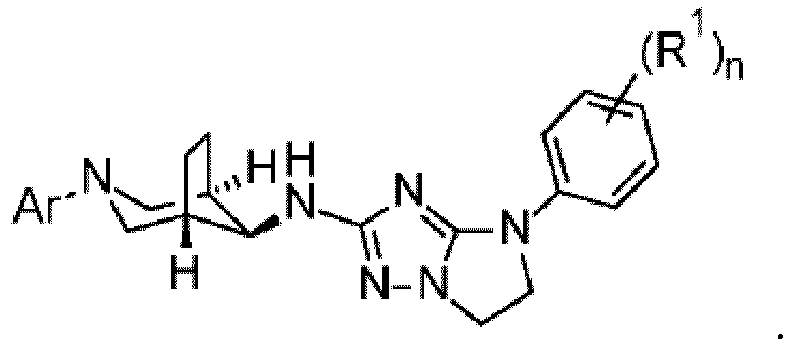
- (b) column purification with tedious work up process for all of the intermediates, such as: intermediates

- (c) safety concern with toxic reagent of hydrazine.
- (d) use of high loading of expensive catalyst Pd (20%) which could result higher cost for large scale API production and complicated process to remove the catalyst.
- (e) high cost with HPLC separation.
- (f) safety, repeatability, and scalability concerns for the newly form tri-azole ring during large-scale production.
- Based on the issues above, one object of this invention therefore is to find an efficient synthetic approach, which can address some or all of above issues and be applied on a technical scale.
- One aspect of the present disclosure relates to a process for the preparation of compound (I),

- Another aspect of the present invention relates to novel processes for the preparation of compound (III) and compound (IV):


- The advantages of the process of the present invention include, but not limited to, one or more of the following:
- (a) Totally new process with less steps;
- (b) Safe and robust for scale up, no tri-azole ring formation step;
- (c) Practice work up process, no column purification.
- Provided herein is a pharmaceutical composition comprising compound (I); and a pharmaceutically acceptable carrier, excipient, diluent, adjuvant, vehicle or a combination thereof.
- Provided herein is compound (I) for the treatment or prophylaxis of a disease associated with the deposition of β-amyloid in the brain, in particular Alzheimer's disease, or a disease selected from cerebral amyloid angiopathy, hereditary cerebral hemorrhage with amyloidosis, Dutch-type (HCHWA-D), multi-infarct dementia, dementia pugilistica and Down syndrome.
- Provided herein is the use of compound (I) for the treatment or prophylaxis of a disease associated with the deposition of β-amyloid in the brain, in particular Alzheimer's disease, or a disease selected from cerebral amyloid angiopathy, hereditary cerebral hemorrhage with amyloidosis, Dutch-type (HCHWA-D), multi-infarct dementia, dementia pugilistica and Down syndrome.
- Provided herein is the use of compound (I) or the pharmaceutical composition for the manufacture of a medicament for the treatment or prophylaxis of a disease associated with the deposition of β-amyloid in the brain, in particular Alzheimer's disease, or a disease selected from cerebral amyloid angiopathy, hereditary cerebral hemorrhage with amyloidosis, Dutch-type (HCHWA-D), multi-infarct dementia, dementia pugilistica and Down syndrome.
- Provided herein is a method for the treatment or prophylaxis of a disease associated with the deposition of β-amyloid in the brain, in particular Alzheimer's disease, or a disease selected from cerebral amyloid angiopathy, hereditary cerebral hemorrhage with amyloidosis, Dutch-type (HCHWA-D), multi-infarct dementia, dementia pugilistica and Down syndrome, which method comprises administering a therapeutically effective amount of compound (I) or the pharmaceutical composition disclosed herein.
- The term "pharmaceutically acceptable salt" refers to conventional acid-addition salts or base-addition salts that retain the biological effectiveness and properties of the compounds of formula I and are formed from suitable non-toxic organic or inorganic acids or organic or inorganic bases. Acid-addition salts include for example those derived from inorganic acids such as hydrochloric acid, hydrobromic acid, hydroiodic acid, sulfuric acid, sulfamic acid, phosphoric acid and nitric acid, and those derived from organic acids such as p-toluenesulfonic acid, salicylic acid, methanesulfonic acid, oxalic acid, succinic acid, citric acid, malic acid, lactic acid, fumaric acid, and the like. Base-addition salts include those derived from ammonium, potassium, sodium and, quaternary ammonium hydroxides, such as for example, tetramethyl ammonium hydroxide. The chemical modification of a pharmaceutical compound into a salt is a technique well known to pharmaceutical chemists in order to obtain improved physical and chemical stability, hygroscopicity, flowability and solubility of compounds. It is for example described in Bastin R.J., et al., Organic Process Research & Development 2000, 4, 427-435; or in Ansel, H., et al., In: Pharmaceutical Dosage Forms and Drug Delivery Systems, 6th ed. (1995), pp. 196 and 1456-1457.
-
- API
- Active Pharmaceutical Ingredient
- (Boc)2O
- Di-tert-butyl dicarbonate
- DCM
- Dichloromethane
- DEAD
- Diethyl azodicarboxylate
- DIPEA
- N,N-Diisopropylethylamine
- DMF
- Dimethylformamide
- DMSO
- Dimethyl sulfoxide
- Eq.
- Equivalent
- EtOAc or EA
- Ethyl acetate
- EtOH
- Ethanol
- IPA
- Isopropanol
- IPAc
- Isopropyl acetate
- K2CO3
- Potassium carbonate
- KOAc
- Potassium acetate
- KOH
- Potassium Hydroxide
- Pd2(dba)3
- Tris(dibenzylideneacetone)dipalladium(0)
- Pd(OAc)2
- Palladium(II) acetate
- LiHMDS
- Lithium bis(trimethylsilyl)amide
- 2-MeTHF
- 2-Methyltetrahydrofuran
- MeOH
- Methanol
- MOM
- Methoxymethyl
- MgSO4
- Magnesium sulfate
- MTBE
- Methyl tert-butyl ether
- NaH
- Sodium hydrid
- NaHMDS
- Sodium bis(trimethylsilyl)amide
- NaOAc
- Sodium acetate
- NaOtBu
- Sodium tert-butanol
- NH4Cl
- Ammonium Chloride
- NMP
- N-Methyl-2-pyrrolidone
- PPh3
- Triphenyl phosphine
- SEM
- 2-(Trimethylsilyl)ethoxymethyl
- tBuOH
- tert-Butanol
- TEA
- Triethylamine
- THF
- Tetrohydrofuran
- TFA
- Trifluoroacetic acid
- v/v
- Volume ratio
- wt. %
- Weight percentage
- The present invention provides innovative processes as outlined in the schemes 1 to 2.

- The synthesis comprises the following steps:
- step a) the formation of compound (III),

- via the reaction of compound (II)

- and MOMChloride;
- via the reaction of compound (II)
- step b) the formation of compound (IV),

- step c) the formation of compound (VI),


- step d) the formation of compound (VII),

- Step e) the formation of compound (VIII),

- A detailed description of Steps a) to e) is as follows:
Step a) the formation of compound (III),
- via the reaction of compound (II),


- and MOMChloride.
- Compound (III) is synthesized in the presence of a suitable solvent, and a suitable base.
- The suitable solvent is selected from DCM and THF; preferably, the solvent is THF.
- The suitable base is selected from KOAc, NaOAc and NaH; preferably, the suitable base is NaH.
- Step b) the formation of compound (IV),

- Compound (IV) is synthesized in a suitable solvent with a suitable base.
- The suitable solvent is selected from 2-MeTHF, DCM and THF; preferably, the solvent is THF.
- The suitable base is selected from NaHMDS, K2CO3, KOH, NaOH, NaH and LiHMDS; preferably, the base is LiHMDS.
- The suitable equivalent of the suitable base is from 1.0 eq. to 2.5 eq.; preferably, the equivalent is selected from about 1.0 eq., about 1.2 eq., about 1.5 eq., about 2.0 eq. and about 2.5 eq.; more preferably, the equivalent is about 2.0 eq.
- The suitable equivalent of 3,5-difluoroaniline is from 1.0 eq. to 2.5 eq.; preferably, the equivalent is selected from about 1.0 eq., about 1.2 eq., about 1.5 eq., about 2.0 eq. and about 2.5 eq.; more preferably, the equivalent is about 2.5 eq..
- The reaction is performed at -20 ~ 70 °C, 10 ~ 70 °C, preferably at 25 ~ 30 °C.
- The temperature system designed in present invention gives high yield and good purge effect for impurities.
- Step c) the formation of compound (VI),


- Compound (VI) is synthesized in the presence of the compound (V) with a suitable amount of base.
- The suitable amount of compound (V) is 1.7 eq. ~ 2.26 eq.; preferably, the equivalent is about 1.7 equivalent.
- The suitable base is selected from NaOH, Na2CO3, Cs2CO3 and potassium carbonate; preferably, the base is potassium carbonate.
- The suitable amount of base is 2.0 eq. ~ 3.0 eq.; preferably, the amount is about 2.06 equivalent.
- Step d) the formation of compound (VII),

- Compound (VII) in this step is synthesized via de-protection reaction in the presence of a suitable volume of acid.
- The suitable acid is selected from HBr, TFA and HCl; preferably, the acid is HCl; more preferably, the acid is HCl (36.5% wt.) in water.
- The suitable volume of acid used in de-protection reaction is 1 V to 2 V; preferably, the volume is about 2 V.
- Step e) the formation of compound (VIII),

- Compound (VIII) is cyclization in the presence of DEAD, PPh3 with a suitable volume of solvent.
- The suitable solvent is selected from DMSO, NMP, and DMF; preferably, the solvent is DMF.
- The suitable volume of solvent is from 5 V to 10 V; preferably the volume is about 5 V.

- The synthesis comprises the following steps:
- step f) the formation of compound (IX),

- via the reaction of compound (II),

- and 1-chloro-3-iodo-propane.
- via the reaction of compound (II),
- step g) the formation of compound (VIII),
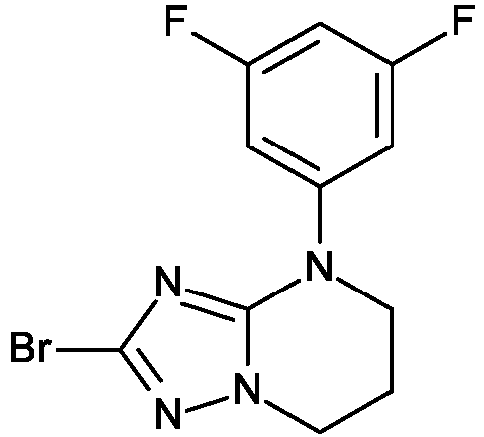

- via telescope alkylation reaction from compound (IX) and 3,5-difluoroaniline.
- A detailed description of Steps f)-g) is as follows:
Step f) the formation of compound (IX),
- via the reaction of compound (II),

- and 1-chloro-3-iodo-propane

- Compound of formula (IX) is synthesized in the presence of a suitable solvent with a suitable base.
- The suitable solvent is selected from MeTHF and THF; preferably, the solvent is THF.
- The suitable base is selected from KOAc, NaOAc, NaOH, KOH, K2CO3 and Na2CO3; preferably, the suitable base is K2CO3.
- The reaction is performed at 0 °C ~ 70 °C, preferably at 20 °C ~ 30 °C, more preferably at 20 °C ~ 25 °C.
- Dimer

- Step g) the formation of compound (VIII),
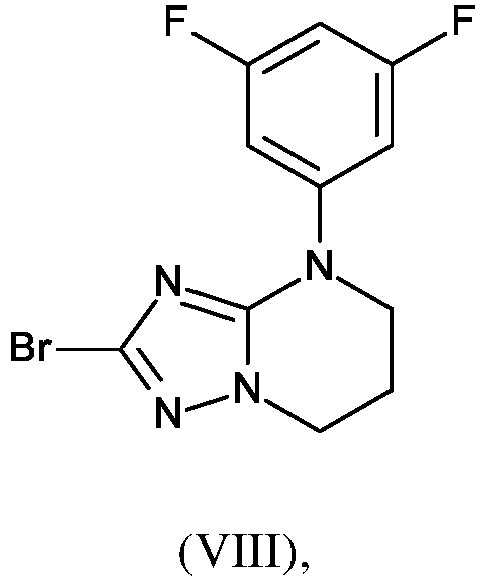
- Compound (VIII) is synthesized in a suitable solvent with a suitable base.
- The suitable solvent is selected from 2-MeTHF, DCM and THF; preferably, the solvent is 2-MeTHF.
- The suitable base is selected from NaHMDS, K2CO3, KOH, NaOH, NaH and LiHMDS; preferably, the base is LiHMDS.
- The suitable equivalent of base is from 1.0 eq to 3.75 eq; preferably, the equivalent is 1.0 eq, 1.2 eq, 1.5 eq or 3.75 eq; more preferably, the equivalent is 3.75 eq.
- The suitable equivalent of 3,5-difluoroaniline is from 1.0 eq to 1.5 eq, preferably, the equivalent is selected from 1.0 eq, 1.2 eq and 1.5 eq; preferably, the equivalent is 1.2 eq.
- The reaction is performed at - 20 °C ~ 70 °C, preferably at 0 °C ~ 25 °C, more preferably first at 0 °C ~ 5 °C, then at 20 °C ~ 25 °C.
- Temperature is critical for the whole process in terms of cyclization. In present invention, step g) can be run for 2 stages, which are telescoped without solid isolation. The temperature for step g) of present invention gives high yield and good purge effect for impurities.

- Step h) the formation of compound (I),

WO 2019141832 ). - A detailed description of Step h) is as following:
Compound (I) in this step is synthesized via Buchwald cross coupling reaction in the presence of a suitable catalyst, base and ligand in a suitable solvent. The compound (I) is purified through recrystallization which was performed in a suitable solvent. - The suitable catalyst used in cross coupling reaction is selected from Pd2(dba3)·CHCl3, Pd(OAc)2; preferably, the catalyst is Pd2(dba3)·CHCl3.
- The suitable base used in cross coupling reaction is selected from Na2CO3, K2CO3, NaHCO3, KHCO3, NaOH, KOH and NaOtBu; preferably, the base is NaOtBu.
- The suitable solvent used in cross coupling reaction is selected from IPAc, EtOAc, MTBE, toluene, THF and 2-MeTHF; preferably, the solvent is 2-MeTHF.
- The cross coupling reaction is performed in a suitable solvent at 20 °C ~ 80 °C, preferably at 70 °C ~ 75 °C.
- The ligand is selected from BrettPhos, AdCyBrettPhos, tBuBrettPhos, AdBrettPhos, RocPhos, tBuXphos, BippyPhos, Me4tBuXphos and Me3MeOtBuXphos, preferably, the ligand is tBuXphos.
- The recrystallization is performed in a suitable solvent at 20 °C ~ 80 °C, preferably at 70 °C ~ 75 °C; wherein the suitable solvent is selected from heptane, hexane and petroleum ether; preferably, the solvent is heptane; more preferably, the solvent is n-heptane.
- For recrystallization, the pH of the solution was adjusted to 3 ~ 8; preferably, the pH of the solution was first adjusted to 3 ~ 4 to get a clear solution and then to 7 ~ 8.
- The recrystallization condition in this invention can produce high yield product with good purge effect for impurities and excess residual solvent.
- The invention will be better understood by reference to the following examples. They should not, however, be construed as limiting the scope of the invention.
-

- To a THF (3.5 L) solution of NaH (125 g, 3.11 mol, 1.1 eq.) in a 10 L glass-lined reactor was charged with 3, 5-dibromo-1H-1, 2,4-triazole (641 g, 2.83 mol) in portions slowly at 0 ~ 5 °C. After being stirred for 1 hours at 0 ~ 5 °C, the MOMchloride (275 g, 3.40 mol) was added dropwise to the mixture at 0 °C.The mixture was stirred at 20 ~ 25 °C for 16 hours. Ice water (6.5 kg, 10 v) was added dropwise to quench the reaction mixture at 0 ~ 5 °C and then extracted with EA (6.5 L) 3 times. The combined organic layer was washed with water (6.5 kg) and 20% wt NaCl aqueous solution (6.5 kg), then concentrated to afford compound (III) (613 kg, 80% yield, 99.4% purity).
- Compound (III): 1H NMR (400 MHz, CDCl3) δ = 5.44 (s, 2H), 3.47 (s, 3H).
[M+H]+ = 269.8 -

- To an anhydrous THF (3 L) solution of compound (III) (613 g, 2.3 mol) in 10 L glass-lined reactor was charged with 3,5-difluoroaniline (741 g, 5.75 mol, 2.5 eq.) at 20 ~ 25 °C. After being stirred for 30 min and cooled to 0 ~ 5 °C, LiHMDS (1M in THF, 4.6 L, 4.6 mol, 2.0 eq.) was added dropwise at 0 ~ 5 °C. The reaction mixture was allowed warm to 25 ~ 30 °C with stirring for another 16 hours. Saturated aqueous NH4Cl solution (6.1 kg, 10 v) was added dropwise to the reaction mixture to quench the reaction at 0 ~ 5 °C and then extracted with EA (6.5 L) 3 times. The combined organic layer was washed with water (6.5 kg) and 20 % wt NaCl aqueous solution (6.5 kg), then concentrated under vacuum. Petroleum (3.2 kg) was added to the reaction mixture, and then slurred for 1 h at 20 ~ 25 °C. The solid was separated via filtration and was washed with petroleum (1 kg). The filtrate was dried in vacuum oven (30 mmHg, 40 °C) for 32 hours to afford compound (IV) (541 g, 75% yield, 98.8% purity).
- Compound (IV): 1H NMR (400 MHz, DMSO-d6) δ = 7.14 - 7.11 (t, 1H), 6.94 (s, 1H), 5.40 (s, 2H), 3.46 (s, 1H).
[M+H]+ = 320.8 - A series of studies were carried out to demonstrate the impact of reaction temperature, which showed that 25 ~ 30 °C is the best condition for the alkylation reaction. In addition, 2.0 equivalent of LiHMDS and 2.5 equivalent of 3,5-difluoroaniline provide better result.
Test No. LiHMDS 3,5-Difluoroaniline temperature Remaining Compound (III) 1 2.0 eq. 2.5 eq. 25 °C ~ 30°C 0.9% 2 1.5 eq. 1.5 eq. 5 °C ~ 10°C 13.6% 3 2.0 eq. 2.0 eq. 5 °C ~ 10°C 7.1% 4 2.0 eq. 2.0 eq. 25 °C ~ 30°C 5.2% -

- To a DMF (4000 mL) solution of compound (IV) (843 g, 2.64 mol) in 10 L glass-lined reactor was charged with K2CO3 (750 g, 5.43 mol, 2.06 eq.) and 2-(3-Bromopropoxy)tetrahydropyran (1000 g, 4.48 mol, 1.7 eq.) at 20 ~ 25 °C and stirred for 16 hours. The resulting reaction mixture was cooled to 0 ~ 5 °C. Water (3 kg) was added to the reaction mixture and then extracted with EA (6.5 L) 3 times. The combined organic layers were washed with water (6.5 kg) and 20% wt NaCl aqueous solution (6.5 kg), then concentrated to afford compound (VI) (1.51 kg, 100% yield, 94.0% purity) as brown oil, the oil was be used in the next step without further purification.
- Compound (VI): 1H NMR (400 MHz, DMSO-d6) δ = 6.54 - 6.47 (dd, 2H), 5.02 (s, 1H), 4.60-4.58 (d, 2H), 3.97-3.81 (m, 5H), 3.64-3.45 (m, 3H), 3.36 (s, 3H), 1.99 - 1.56 (m, 13H).
-

- To a 20 L glass-lined reactor was charged with compound (VI) (1510 g), methanol (6000 mL), hydrochloride acid (2.4 L) and water (2.4 L) at 20 ~ 25 °C, then the mixture was heated to 70 ~ 75 °C and stirred for 5 hours. The resulting reaction mixture was cooled to at 20 ~ 25 °C, concentrate to remove the methanol, and then adjusted the residue to pH = 8 ~ 9 with 4N aq. NaOH (6.9 L). The resulting reaction mixture was extracted with EA (15 L) twice. The combined organic layers was washed with brine with 20 % wt NaCl aqueous solution (20 L), dried through Mg2SO4, concentrated to remove the solvent. To the resulting reaction mixture was added EA (2 L), then heated to 50 ~ 55 °C, then heptane (6 L) was added dropwise to the reaction mixture, and then cooled to 20 ~ 25 °C during 6 h and stirred for another 1h. The solid was separated via filter and washed with EA/Heptane (1/3, 500 mL), and dried in vacuum (30 mmHg, 40 °C) for 16 hours to afford compound (VII) (621 g, 70% yield, 99.0% purity) as white solid.
- Compound (VII): 1H NMR: (400 MHz, CDCl3) δ ppm: 12.17-10.22 (s, 1H), 6.90-6.88 (dd, 2H), 6.66-6.60 (t, 1H), 4.03-3.99 (t, 2H), 3.71-3.68 (d, 2H), 1.88-1.85 (t, 2H).
-

- Compound (VIII): 1H NMR (400 MHz, DMSO-d6) δ = 7.39-7.34 (m, 2H), 6.97-6.92 (m, 1H), 4.11-4.08 (m, 2H), 3.85-3.83 (m, 2H), 2.26-2.20 (m, 2H).
-

- To a 250 mL reactor were charged 3,5-dibromo-1H-1,2,4-triazole (10 g, 44.1 mmol, Eq: 1); THF (88 g, 100 ml.); potassium carbonate (12.2 g, 88.2 mmol, Eq: 2.0) and 1-chloro-3-iodopropane (11 g, 53.8 mmol, Eq: 1.22). The mixture was stirred for 16 hours at 20 °C ~ 25 °C. Water (100 mL) was added to the reaction mixture and then extracted with EA (100 mL). The combined organic layers were washed with 20 % wt NaCl aqueous solution (50 mL), dried through Mg2SO4, then concentrated to remove the solvent to afford compound (IX). The crude will used for next step without further purification.
-

- To a 250 mL reactor were charged 3,5-dibromo-1H-1,2,4-triazole (35 g, 154 mmol, Eq: 1); THF (88 g, 350 ml; potassium carbonate (42.6 g, 309 mmol, Eq: 2.0) and 1-chloro-3-iodopropane (31.5 g, 154 mmol, Eq: 1) at 20 °C ~ 25 °C and stirring for 48 hours. Water (300 mL) was added to the reaction mixture and then extracted with 2-MeTHF (150 mL). The combined organic layers were washed with 20 % wt NaCl aqueous solution (150 mL), dried through Mg2SO4, then concentrated to remove the solvent to afford compound (IX) (54.5 g, 78.94% purity GC-MS, 91.9% yield). The crude will used for next step without further purification.
-

- To a 2 L reactor were charged 3,5-dibromo-1H-1,2,4-triazole (110 g, 475 mmol, Eq: 1); THF (880 g, 1 L); potassium carbonate (134 g, 950 mmol, Eq: 2.0) and 1-chloro-3-iodopropane (129 g, 618 mmol, Eq: 1.3) at 20 °C ~ 25 °C and stirring for 48 hours. Water (550 mL) was added to the reaction mixture and then separated, then the organic layer was washed with 20 % wt NaCl aqueous solution (225 mL), dried through Mg2SO4, then concentrated to remove the solvent to afford compound (IX) (165 g, 81 % purity (GC-MS), 92.7 % yield). The crude will used for next step without further purification.
-

- To a 500 mL glass-lined reactor was charged with 3,5-difluoroaniline (5.79 g, 44.9 mmol, 1.2 eq.) , compound (IX) (14 g, 37.4 mmol, 1.0 eq.) and 2-MeTHF (140 mL) at 20 °C ~25 °C. After being stirred for 30 min and cooled to 0 ~ 5 °C, LiHMDS (1M in THF, 140 mL, 140 mmol, 3.75 eq.) was added dropwise at 0 °C ~ 5 °C. The reaction mixture was allowed warm to 20 °C ~ 25 °C with stirring for another 1 hours. Saturated aqueous NH4Cl solution (200 mL, 10 v) was added dropwise to the reaction mixture to quench the reaction at 20 ~ 25 °C and then 20 % wt NaCl aqueous solution (100 mL) was added to the reaction at 20 ~ 25 °C and stirred for 1 hours. The resulting mixture was extracted with EA (200 mL). The combined organic layer was washed with 20 % wt NaCl aqueous solution (100 mL), dried through Mg2SO4, then concentrated to remove the solvent. To the resulting reaction mixture was added EA (50 mL), then heated to 50 °C ~ 55 °C, then heptane (150 mL) was added dropwise to the reaction mixture, and then cooled to 20 °C ~ 25 °C during 6 h and stirred for another 1h. The solid was separated via filter and washed with EA/Heptane (1/3, 10 mL), and dried in vacuum oven (30 mmHg, 40 °C) for 32 hours to afford compound (IV) (8 g, 67.2 % yield, 99.0 % purity) as grey solid.
- Compound (VIII): 1H NMR (400 MHz, DMSO-d6) δ =7.39-7.34 (m, 2H), 6.97-6.92 (m, 1H), 4.11-4.08 (m, 2H), 3.85-3.83 (m, 2H), 2.26-2.20 (m, 2H).
- A series of studies were carried out to demonstrate the impact of reaction temperature and equivalent of aniline compound (IXa), which showed that 0 °C ~ 25 °C and 1.2 eq of compound (IXa) are the best condition for this cyclization reaction:

Test # Aniline compound (IXa) Base Temperature Result 1 1.0 eq. LiHMDS (3 eq.) 0 °C ~ 5 °C 64% Conversion 2 1.2 eq. LiHMDS (3 eq.) 0 °C ~ 5 °C, then 20 °C ~ 25 °C 81% Conversion 3 1.5 eq. LiHMDS (3 eq.) 0 °C ~ 5 °C 100% Conversion, byproducts formed 4 1.2 eq. LiHMDS (2.5 eq.) 0 °C ~ 5 °C 91% Conversion, byproducts formed 5 1.2 eq. LiHMDS (4.0 eq.) 0 °C ~ 5 °C 100% Conversion, byproducts formed 7 1.2 eq. NaHMDS (3.0 eq.) - 20 °C ~-10 °C 69% Conversion 8 1.2 eq. NaHMDS (3.0 eq.) 0 °C ~ 5 °C 96% Conversion, byproducts formed 9 1.2 eq. NaHMDS (3.0 eq.) 20 °C ~ 25 °C 100% Conversion, byproducts formed 10 1.2 eq. NaHMDS (3.6 eq.) 0 °C ~ 5 °C then 20 °C ~ 25 °C 100% Conversion, byproducts formed -
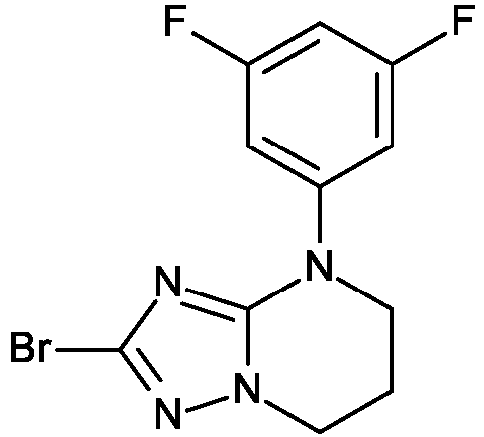
- To a 3 L glass-lined reactor was charged with 3,5-difluoroaniline (69.6 g, 529 mmol, 1.2 eq.) , compound (IX) (165 g, 441 mmol, 1.0 eq.) and 2-MeTHF (825 mL) at 20 °C ~ 25 °C. After being stirred for 30 min and cooled to 0-5 °C, LiHMDS (1.9 M in THF, 835 mL, 1.59 mol, 3.6 eq.) was added dropwise at 0 °C ~ 5 °C. The reaction mixture was allowed warm to 20 °C ~25 °C with stirring for another 1 hours. Saturated aqueous NH4Cl solution (2 L, 10 v) was added dropwise to the reaction mixture to quench the reaction at 20-25 °C and then 20 % wt NaCl aqueous solution (1 L) was added to the reaction at 20-25 °C and stirred for 1 hours. The resulting mixture was extracted with EA (2000 mL). The combined organic layer was washed with 20 % wt NaCl aqueous solution (1 L), dried through Mg2SO4, then concentrated to remove the solvent. To the resulting reaction mixture was added EA (500 mL), then heated to 50 °C ~ 55 °C, then heptane (1.5 L) was added dropwise to the reaction mixture, and then cooled to 20 °C ~ 25 °C during 6 h and stirred for another 1h. The solid was separated via filter and washed with EA/Heptane (1/1, 100 mL), and dried in vacuum oven (30 mmHg, 40 °C) for 32 hours to afford compound (IV) (94 g, 67.7 % yield, 98.8 % purity) as grey solid.
- Compound (VIII): 1H NMR (400 MHz, DMSO-d6) δ =7.39-7.34 (m, 2H), 6.97-6.92 (m, 1H), 4.11-4.08 (m, 2H), 3.85-3.83 (m, 2H), 2.26-2.20 (m, 2H).
-

- To a 50 mL One-neck flask was charged with NaOtBu (1.2 g, 12.4 mmol, Eq: 4), 2-MeTHF (10.2 g, 120 ml, 10 V), (1R,5S,8S)-3-(6-methylpyrimidin-4-yl)-3-azabicyclo[3.2.1]octan-8-amine dihydrochloride (1.06 mg, 3.42 mmol, Eq: 1.1) in one portion under N2 at 20 °C ~25 °C. And then, to the resulting mixture were charged compound (VIII) (1 g, 3.11 mmol, Eq: 1); Pd2dba3·CHCl3 (32.2 mg, 31 µmol, Eq: 0.01) and tBuXphos (26.4 mg, 62.2 µmol, Eq: 0.02) at 20 °C ~25 °C. The resulting mixture was heated to ~75 °C and stirred for 2 hours. The resulting mixture was cooled to 20 °C ~ 25 °C, water (10 mL) and MeOH (10 mL) was added, and then extracted with 2-MeTHF (25 mL) twice. The combined organic layer was filter through MCC pad, then concentrated to remove solvents. To the residual was added 2-MeTHF (5 mL), and then the reaction mixture was heated to 20 °C ~ 25 °C. Hpetane (15 mL) was added dropwise to the reaction mixture, then cooled to 20 °C ~ 25 °C and stirred for another 10 hours. The product was collected via filter and washed with heptane (2 ml), and dried in vacuum oven (30 mmHg, 40 °C) for 16 hours to afford compound (IV) (1.1 g, 77.5 % yield, 98.8 % purity).
- Compound (VI): 1H NMR (400 MHz, DMSO-d6) δ ppm 8.35 (s, 1 H), 7.45 (dd,J = 10.6, 2.0 Hz, 2 H), 6.78 - 6.86 (m, 1 H), 6.63 (s, 1 H), 5.84 (d,J = 4.1 Hz, 1 H), 3.96 - 4.41 (m, 2 H), 3.93 (t,J = 6.0 Hz, 2 H), 3.75 - 3.81 (m, 2 H), 3.54 (d,J = 4.1 Hz, 1 H), 2.96 (br d,J = 12.1 Hz, 2 H), 2.44 (br s, 2 H), 2.25 (s, 3 H), 2.19 (quin,J = 5.8 Hz, 2 H), 1.83 - 1.88 (m, 2 H), 1.27 - 1.33 (m, 2 H).
- 13C NMR (101 MHz, DMSO-d6) δ ppm 21.85 (s, 1 C), 24.20 (s, 1 C), 25.74 (s, 2 C), 38.73 (s, 2 C), 43.86 (s, 1 C), 45.64 (s, 1 C), 50.63 (s, 2 C), 62.08 (s, 1 C), 97.20 (t, J = 26.41 Hz, 1 C), 101.92 (s, 1 C), 102.81 (d, J = 29.34 Hz, 2 C), 145.80 (t, J = 13.94 Hz, 1 C), 149.51 (s, 1 C), 157.61 (s, 1 C), 160.39 (s, 1 C), 162.79 (dd, J = 242.09, 16.14 Hz, 2 C), 163.20 (s, 1 C), 164.75 (s, 1 C)
- 19F NMR ( 376 MHz, DMSO-d6) δ=-110.00-1110.13 (m, 2F)
- [α]D25 = 0.199 °
- HRMS: calculated 453.225 [C23H26F2N8+H]+ , found 453.2354 [M+H]+
-

- To a 250 mL One-neck flask was charged with NaOtBu (12 g, 124 mmol, Eq: 4), 2-MeTHF (102 g, 120 ml, 10 V), (1R,5S,8S)-3-(6-methylpyrimidin-4-yl)-3-azabicyclo[3.2.1]octan-8-amine dihydrochloride (10.7 g, 34.2 mmol, Eq: 1.1) in one portion under N2 at 20 °C ~ 25 °C. And then, to the resulting mixture were charged compound (VIII) (10 g, 31.1 mmol, Eq: 1); Pd2dba3·CHCl3 (322 mg, 311 µmol, Eq: 0.01) and tBuXphos (264 mg, 622 µmol, Eq: 0.02) at 20 °C ~ 25 °C. The resulting mixture was heated to 75 °C and stirred for 2 hours. The resulting mixture was cooled to 20 °C ~ 25 °C, water (100 mL) and MeOH (100 mL) was added, and then extracted with 2-MeTHF (250 mL) twice. The combined organic layer was filter through MCC (Microcrystalline Cellulose) pad, then concentrated to remove solvents. To the residual was added 2-MeTHF (50 mL), and then the reaction mixture was heated to 20 °C ~ 25 °C. Heptane (150 mL) was added dropwise to the reaction mixture, then cooled to 20 °C ~ 25 °C and stirred for another 10 hours. The product was collected via filter and washed with heptane (20), and dried in vacuum oven (30 mmHg, 40 °C) for 16 hours to afford compound (I) (12 g, 85 % yield, 98.1 % purity).
- Compound (I): 1H NMR (400 MHz, DMSO-d6) δ ppm 8.35 (s, 1 H), 7.45 (dd, J = 10.6, 2.0 Hz, 2 H), 6.78 - 6.86 (m, 1 H), 6.63 (s, 1 H), 5.84 (d, J = 4.1 Hz, 1 H), 3.96 - 4.41 (m, 2 H), 3.93 (t, J = 6.0 Hz, 2 H), 3.75 - 3.81 (m, 2 H), 3.54 (d,J = 4.1 Hz, 1 H), 2.96 (br d, J = 12.1 Hz, 2 H), 2.44 (br s, 2 H), 2.25 (s, 3 H), 2.19 (quin, J = 5.8 Hz, 2 H), 1.83 - 1.88 (m, 2 H), 1.27 - 1.33 (m, 2 H).
- 13C NMR (101 MHz, DMSO-d6) δ ppm 21.85 (s, 1 C), 24.20 (s, 1 C), 25.74 (s, 2 C), 38.73 (s, 2 C), 43.86 (s, 1 C), 45.64 (s, 1 C), 50.63 (s, 2 C), 62.08 (s, 1 C), 97.20 (t, J = 26.41 Hz, 1 C), 101.92 (s, 1 C), 102.81 (d, J = 29.34 Hz, 2 C), 145.80 (t, J = 13.94 Hz, 1 C), 149.51 (s, 1 C), 157.61 (s, 1 C), 160.39 (s, 1 C), 162.79 (dd, J = 242.09, 16.14 Hz, 2 C), 163.20 (s, 1 C), 164.75 (s, 1 C)
- 19F NMR ( 376 MHz, DMSO-d6) δ =-110.00-1110.13 (m, 2F)
- [α]D25 = 0.199°
- HRMS: calculated 453.225 [C23H26F2N8+H]+, found 453.2354 [M+H]+
-

- To a 5 L 3-neck flask was charged with NaOtBu (191 g, 1.99 mol, Eq: 4), 2-MeTHF (1.6 L, 10 V), (1R,5S,8S)-3-(6-methylpyrimidin-4-yl)-3-azabicyclo[3.2.1]octan-8-amine dihydrochloride (171 g, 547 mmol, Eq: 1.1) in one portion under N2 at 20 °C ~ 25 °C. And then, to the resulting mixture were charged compound (VIII) (160 g, 498 mmol, Eq: 1); Pd2(dbas)·CHCl3 (4.56 g, 4.98 mmol, Eq: 0.01) and tBuXphos (4.23 g, 9.95 mmol, Eq: 0.02) at 20 °C ~ 25 °C. The resulting mixture was heated to 70 °C ~ 75 °C and stirred for 2 hours. To the resulting mixture was added heptane (1.6 L) and then cooled to 20 °C ~ 25 °C. The crude solid was collected via filter and rinsed with Hep/2-MeTHF (1:1, 150 mL). The resulting cake was slurried with water and stirred for 2 hours at 20 °C ~ 25 °C. The crude solid was collected via filter and rinsed with water (200 mL). The resulting cake was diluted with MeOH (400 mL) and DCM (1L) in a 2 L reactor. Charcoal (20 g) was added to the suspension and was heated to 60 °C ~ 65 °C with stirring for 2 hours, then cooled to 20 °C ~ 25 °C. The suspension was filtered through celite, rinsed with MeOH/DCM (4:10, 100 mL). The filtrate was concentrated and the residual was diluted with 2-MeTHF (500 mL), heated to 60 °C ~ 65 °C and stirred for 30 min. Heptane (1500 mL) was added dropwise to the resulting mixture at 60 °C ~ 65 °C, then allowed cooled to 60 °C ~ 65 °C and stirred for 10 hours. The crude was collected via filter and rinsed with heptane (200 mL), then the cake was diluted with water (160 ml) and adjust pH to 3-4 with HCl (36.5% wt., 129 mL). To the resulting reaction mixture was added NaOH (1M, 568 mL), adjust pH back to 7-8, the resulting mixture was stirred at 1 hours at 20 °C ~ 25 °C. The product was collected via filter and washed with heptane (20), and dried in vacuum oven (30 mmHg, 40 °C) for 16 hours to afford compound (I) (200 g, 87.9 % yield, 98.98 % purity).
- Compound (I): 1H NMR (400 MHz, DMSO-d6) δ ppm 8.35 (s, 1 H), 7.45 (dd, J = 10.6, 2.0 Hz, 2 H), 6.78 - 6.86 (m, 1 H), 6.63 (s, 1 H), 5.84 (d, J = 4.1 Hz, 1 H), 3.96 - 4.41 (m, 2 H), 3.93 (t, J = 6.0 Hz, 2 H), 3.75 - 3.81 (m, 2 H), 3.54 (d, J = 4.1 Hz, 1 H), 2.96 (br d, J = 12.1 Hz, 2 H), 2.44 (br s, 2 H), 2.25 (s, 3 H), 2.19 (quin, J = 5.8 Hz, 2 H), 1.83 - 1.88 (m, 2 H), 1.27 - 1.33 (m, 2 H).
- 13C NMR (101 MHz, DMSO-d6) δ ppm 21.85 (s, 1 C), 24.20 (s, 1 C), 25.74 (s, 2 C), 38.73 (s, 2 C), 43.86 (s, 1 C), 45.64 (s, 1 C), 50.63 (s, 2 C), 62.08 (s, 1 C), 97.20 (t, J = 26.41 Hz, 1 C), 101.92 (s, 1 C), 102.81 (d, J = 29.34 Hz, 2 C), 145.80 (t, J = 13.94 Hz, 1 C), 149.51 (s, 1 C), 157.61 (s, 1 C), 160.39 (s, 1 C), 162.79 (dd, J = 242.09, 16.14 Hz, 2 C), 163.20 (s, 1 C), 164.75 (s, 1 C)
- 19F NMR (376 MHz, DMSO-d6) δ=-110.00-1110.13 (m, 2F)
- [α,]D25 = 0.199 °
- HRMS: calculated 453.225 [C23H26F2N8+H]+ , found 453.2354 [M+H]+
Claims (14)
- A process for the preparation of a compound (VIII),
 step a) the formation of compound (III),
 via the reaction of compound (II)
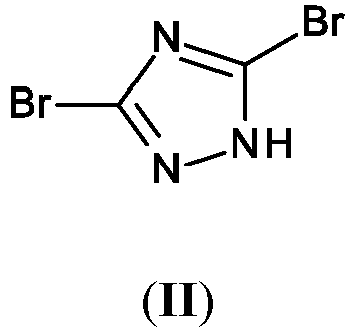 and MOMChloride;step b) the formation of compound (IV),
 step c) the formation of compound (VI),

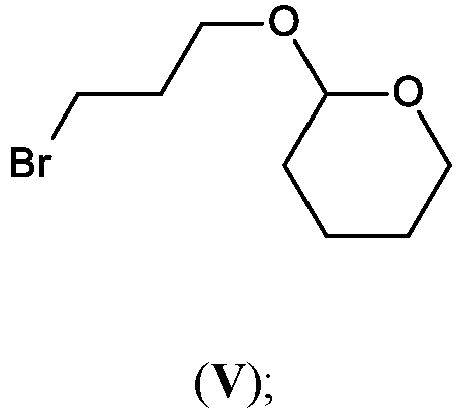 step d) the formation of compound (VII),
 Step e) the formation of compound (VIII),

- The process according to claim 1, characterized in that the formation of compound (III) in step a) is performed in the presence of a base, wherein the base is selected from KOAc, NaOAc and NaH.
- The process according to claim 1 or 2, characterized in that the formation of compound (IV) in step b) is performed in the presence of a base, wherein the base is selected from NaHMDS, K2CO3, KOH, NaOH, NaH and LiHMDS.
- The process according to any one of claims 1 to 3, characterized in that equivalent of 3,5-difluoroaniline is from 1.0 eq. to 2.5 eq.
- The process according to any one of claims 1 to 4, characterized in that the formation of compound (IV) in step b) is performed at -20 ~ 70 °C.
- The process according to any one of claims 1 to 5, characterized in that the formation of compound (VI) in step c) is performed in the presence of a base, wherein the base is selected from NaOH, Na2CO3, Cs2CO3 and potassium carbonate.
- The process according to any one of claims 1 to 6, characterized in that equivalent of compound (V) is from 1.7 eq. to 2.26 eq.
- The process according to any one of claims 1 to 7, characterized in that the formation of compound (VII) in step d) is performed in the presence of an acid, wherein the acid is selected from HBr, TFA and HCl.
- A process for the preparation of a compound (VIII),
 step f) the formation of compound (IX),
 via the reaction of compound (II),
 and 1-chloro-3-iodo-propane, andstep g) the formation of compound (VIII),

- The process according to claim 9, characterized in that the formation of compound (IX) in step f) is performed in the presence of a base, wherein the base is selected from KOAc, NaOAc, NaOH, KOH, K2CO3 and Na2CO3.
- The process according to claim 9 or10, characterized in that the formation of compound (IX) in step f) is performed at 0 ~ 70 °C.
- The process according to any one of claims 9 to 11, characterized in that the formation of compound (VIII) in step g) is performed in the presence of a base, wherein the base is selected from NaHMDS, K2CO3, KOH, NaOH, NaH and LiHMDS.
- The process according to any one of claims 9 to 12, characterized in that equivalent of 3,5-difluoroaniline is from 1.0 eq to 1.5 eq.
- The process according to any one of claims 9 to 13, characterized in that the formation of compound (VIII) in step g) is performed at -20 ~ 70 °C.
Applications Claiming Priority (2)
| Application Number | Priority Date | Filing Date | Title |
|---|---|---|---|
| CN2020135294 | 2020-12-10 | ||
| PCT/EP2021/084734 WO2022122800A1 (en) | 2020-12-10 | 2021-12-08 | Process for the preparation 4-(3,5-difluorophenyl)-n-[3-(6-methylpyrimidin-4-yl)-3- azabicyclo[3.2.1]octan-8-yl]-6,7-dihydro-5h-[1,2,4]triazolo[1,5-a]pyrimidin-2-amine |
Publications (3)
| Publication Number | Publication Date |
|---|---|
| EP4259626A1 EP4259626A1 (en) | 2023-10-18 |
| EP4259626C0 EP4259626C0 (en) | 2025-01-29 |
| EP4259626B1 true EP4259626B1 (en) | 2025-01-29 |
Family
ID=79171263
Family Applications (1)
| Application Number | Title | Priority Date | Filing Date |
|---|---|---|---|
| EP21835211.0A Active EP4259626B1 (en) | 2020-12-10 | 2021-12-08 | Process for the preparation 4-(3,5-difluorophenyl)-n-[3-(6-methylpyrimidin-4-yl)-3- azabicyclo[3.2.1]octan-8-yl]-6,7-dihydro-5h-[1,2,4]triazolo[1,5-a]pyrimidin-2-amine |
Country Status (13)
| Country | Link |
|---|---|
| US (1) | US20240025911A1 (en) |
| EP (1) | EP4259626B1 (en) |
| JP (1) | JP7837977B2 (en) |
| KR (1) | KR20230118099A (en) |
| CN (1) | CN116568298A (en) |
| AR (1) | AR124195A1 (en) |
| AU (1) | AU2021393922A1 (en) |
| BR (1) | BR112023011020A2 (en) |
| CA (1) | CA3202551A1 (en) |
| IL (1) | IL303354A (en) |
| MX (1) | MX2023006712A (en) |
| TW (1) | TW202237613A (en) |
| WO (1) | WO2022122800A1 (en) |
Family Cites Families (5)
| Publication number | Priority date | Publication date | Assignee | Title |
|---|---|---|---|---|
| US20110190269A1 (en) * | 2010-02-01 | 2011-08-04 | Karlheinz Baumann | Gamma secretase modulators |
| AR109829A1 (en) | 2016-09-29 | 2019-01-30 | Hoffmann La Roche | BRIDGED PIPERIDINE DERIVATIVES |
| EP3523304B1 (en) | 2016-10-04 | 2021-01-27 | H. Hoffnabb-La Roche Ag | Bicyclic heteroaryl derivatives |
| US11319314B2 (en) * | 2016-11-08 | 2022-05-03 | Hoffmann-La Roche Inc. | Phenoxytriazoles |
| US11370802B2 (en) | 2018-01-22 | 2022-06-28 | Hoffmann-La Roche, Inc. | Triazolo-azepine derivatives |
-
2021
- 2021-12-08 EP EP21835211.0A patent/EP4259626B1/en active Active
- 2021-12-08 CA CA3202551A patent/CA3202551A1/en active Pending
- 2021-12-08 KR KR1020237019262A patent/KR20230118099A/en active Pending
- 2021-12-08 WO PCT/EP2021/084734 patent/WO2022122800A1/en not_active Ceased
- 2021-12-08 BR BR112023011020A patent/BR112023011020A2/en not_active Application Discontinuation
- 2021-12-08 IL IL303354A patent/IL303354A/en unknown
- 2021-12-08 JP JP2023535379A patent/JP7837977B2/en active Active
- 2021-12-08 MX MX2023006712A patent/MX2023006712A/en unknown
- 2021-12-08 CN CN202180082474.3A patent/CN116568298A/en active Pending
- 2021-12-08 US US18/256,629 patent/US20240025911A1/en active Pending
- 2021-12-08 AU AU2021393922A patent/AU2021393922A1/en not_active Abandoned
- 2021-12-09 TW TW110146011A patent/TW202237613A/en unknown
- 2021-12-09 AR ARP210103411A patent/AR124195A1/en not_active Application Discontinuation
Also Published As
| Publication number | Publication date |
|---|---|
| AU2021393922A9 (en) | 2024-02-08 |
| MX2023006712A (en) | 2023-06-20 |
| CN116568298A (en) | 2023-08-08 |
| KR20230118099A (en) | 2023-08-10 |
| WO2022122800A1 (en) | 2022-06-16 |
| US20240025911A1 (en) | 2024-01-25 |
| AR124195A1 (en) | 2023-02-22 |
| BR112023011020A2 (en) | 2024-01-30 |
| CA3202551A1 (en) | 2022-06-16 |
| JP2023553941A (en) | 2023-12-26 |
| TW202237613A (en) | 2022-10-01 |
| JP7837977B2 (en) | 2026-03-31 |
| EP4259626C0 (en) | 2025-01-29 |
| EP4259626A1 (en) | 2023-10-18 |
| AU2021393922A1 (en) | 2023-06-15 |
| IL303354A (en) | 2023-08-01 |
Similar Documents
| Publication | Publication Date | Title |
|---|---|---|
| US10710998B2 (en) | Compound and process | |
| WO2020112941A2 (en) | Solid state forms of lumateperone salts and processes for preparation of lumateperone and salts thereof | |
| EP2609099A2 (en) | Sitagliptin, salts and polymorphs thereof | |
| KR20200057705A (en) | Improved method for preparing ribociclib and salts thereof | |
| EA038078B1 (en) | Intermediates useful for the synthesis of a selective inhibitor against protein kinase and processes for preparing the same | |
| US12435093B2 (en) | Free base crystals | |
| EP3902779B1 (en) | Process for the preparation exo-tert-butyl n-(3-azabicyclo[3.2.1]octan-8-yl)carbamate | |
| WO2024251227A1 (en) | Preparation method for formamide compounds | |
| JP7837977B2 (en) | Method for the preparation of 4-(3,5-difluorophenyl)-N-[3-(6-methylpyrimidine-4-yl)-3-azabicyclo[3.2.1]octan-8-yl]-6,7-dihydro-5H-[1,2,4]triazolo[1,5-a]pyrimidine-2-amine | |
| JP7379381B2 (en) | Intermediates and processes for the manufacture of linagliptin and its salts | |
| US20240018143A1 (en) | Process for the preparation of (9s)-n-[3-(6-methylpyrimidin-4-yl)-3-azabicyclo[3.2.1]octan-8-yl]-9-(2,3,4-trifluorophenyl)-6,7,8,9-tetrahydro-5h-[1,2,4]triazolo[1,5-a]azepin-2-amine and its solid form | |
| KR102897231B1 (en) | Method for preparing tofacitinib and its intermediates | |
| EP3931197B1 (en) | Process for the preparation of (6s)-3-[(4s)-4-cyano-2-oxo-pyrrolidin-1-yl]-6-methyl-n-(3,4,5-trifluorophenyl)-6,7-dihydro-4h-pyrazolo[1,5-a]pyrazine-5-carboxamide | |
| CN119859139A (en) | Solid form of An Luoti% dihydrochloride and method for producing same | |
| CN122003413A (en) | Crystalline polymorph form a of JAK inhibitor and process for preparing the same | |
| HK40088634A (en) | Process for the preparation 4-(3,5-difluorophenyl)-n-[3-(6-methylpyrimidin-4-yl) -3-azabicycl [3.2.1]octan-8-yl]-6,7-dihydro-5h-[1,2,4] triazolo[1,5-a]pyrimidin-2-amine |
Legal Events
| Date | Code | Title | Description |
|---|---|---|---|
| STAA | Information on the status of an ep patent application or granted ep patent |
Free format text: STATUS: UNKNOWN |
|
| STAA | Information on the status of an ep patent application or granted ep patent |
Free format text: STATUS: THE INTERNATIONAL PUBLICATION HAS BEEN MADE |
|
| PUAI | Public reference made under article 153(3) epc to a published international application that has entered the european phase |
Free format text: ORIGINAL CODE: 0009012 |
|
| STAA | Information on the status of an ep patent application or granted ep patent |
Free format text: STATUS: REQUEST FOR EXAMINATION WAS MADE |
|
| 17P | Request for examination filed |
Effective date: 20230710 |
|
| AK | Designated contracting states |
Kind code of ref document: A1 Designated state(s): AL AT BE BG CH CY CZ DE DK EE ES FI FR GB GR HR HU IE IS IT LI LT LU LV MC MK MT NL NO PL PT RO RS SE SI SK SM TR |
|
| DAV | Request for validation of the european patent (deleted) | ||
| DAX | Request for extension of the european patent (deleted) | ||
| GRAP | Despatch of communication of intention to grant a patent |
Free format text: ORIGINAL CODE: EPIDOSNIGR1 |
|
| STAA | Information on the status of an ep patent application or granted ep patent |
Free format text: STATUS: GRANT OF PATENT IS INTENDED |
|
| INTG | Intention to grant announced |
Effective date: 20240813 |
|
| GRAS | Grant fee paid |
Free format text: ORIGINAL CODE: EPIDOSNIGR3 |
|
| GRAA | (expected) grant |
Free format text: ORIGINAL CODE: 0009210 |
|
| STAA | Information on the status of an ep patent application or granted ep patent |
Free format text: STATUS: THE PATENT HAS BEEN GRANTED |
|
| AK | Designated contracting states |
Kind code of ref document: B1 Designated state(s): AL AT BE BG CH CY CZ DE DK EE ES FI FR GB GR HR HU IE IS IT LI LT LU LV MC MK MT NL NO PL PT RO RS SE SI SK SM TR |
|
| REG | Reference to a national code |
Ref country code: GB Ref legal event code: FG4D |
|
| REG | Reference to a national code |
Ref country code: CH Ref legal event code: EP |
|
| REG | Reference to a national code |
Ref country code: DE Ref legal event code: R096 Ref document number: 602021025592 Country of ref document: DE |
|
| REG | Reference to a national code |
Ref country code: IE Ref legal event code: FG4D |
|
| U01 | Request for unitary effect filed |
Effective date: 20250129 |
|
| U07 | Unitary effect registered |
Designated state(s): AT BE BG DE DK EE FI FR IT LT LU LV MT NL PT RO SE SI Effective date: 20250204 |
|
| PG25 | Lapsed in a contracting state [announced via postgrant information from national office to epo] |
Ref country code: RS Free format text: LAPSE BECAUSE OF FAILURE TO SUBMIT A TRANSLATION OF THE DESCRIPTION OR TO PAY THE FEE WITHIN THE PRESCRIBED TIME-LIMIT Effective date: 20250429 |
|
| PG25 | Lapsed in a contracting state [announced via postgrant information from national office to epo] |
Ref country code: PL Free format text: LAPSE BECAUSE OF FAILURE TO SUBMIT A TRANSLATION OF THE DESCRIPTION OR TO PAY THE FEE WITHIN THE PRESCRIBED TIME-LIMIT Effective date: 20250129 |
|
| PG25 | Lapsed in a contracting state [announced via postgrant information from national office to epo] |
Ref country code: ES Free format text: LAPSE BECAUSE OF FAILURE TO SUBMIT A TRANSLATION OF THE DESCRIPTION OR TO PAY THE FEE WITHIN THE PRESCRIBED TIME-LIMIT Effective date: 20250129 |
|
| PG25 | Lapsed in a contracting state [announced via postgrant information from national office to epo] |
Ref country code: IS Free format text: LAPSE BECAUSE OF FAILURE TO SUBMIT A TRANSLATION OF THE DESCRIPTION OR TO PAY THE FEE WITHIN THE PRESCRIBED TIME-LIMIT Effective date: 20250529 Ref country code: NO Free format text: LAPSE BECAUSE OF FAILURE TO SUBMIT A TRANSLATION OF THE DESCRIPTION OR TO PAY THE FEE WITHIN THE PRESCRIBED TIME-LIMIT Effective date: 20250429 |
|
| PG25 | Lapsed in a contracting state [announced via postgrant information from national office to epo] |
Ref country code: HR Free format text: LAPSE BECAUSE OF FAILURE TO SUBMIT A TRANSLATION OF THE DESCRIPTION OR TO PAY THE FEE WITHIN THE PRESCRIBED TIME-LIMIT Effective date: 20250129 |
|
| PG25 | Lapsed in a contracting state [announced via postgrant information from national office to epo] |
Ref country code: GR Free format text: LAPSE BECAUSE OF FAILURE TO SUBMIT A TRANSLATION OF THE DESCRIPTION OR TO PAY THE FEE WITHIN THE PRESCRIBED TIME-LIMIT Effective date: 20250430 |
|
| PG25 | Lapsed in a contracting state [announced via postgrant information from national office to epo] |
Ref country code: SM Free format text: LAPSE BECAUSE OF FAILURE TO SUBMIT A TRANSLATION OF THE DESCRIPTION OR TO PAY THE FEE WITHIN THE PRESCRIBED TIME-LIMIT Effective date: 20250129 |
|
| PG25 | Lapsed in a contracting state [announced via postgrant information from national office to epo] |
Ref country code: CZ Free format text: LAPSE BECAUSE OF FAILURE TO SUBMIT A TRANSLATION OF THE DESCRIPTION OR TO PAY THE FEE WITHIN THE PRESCRIBED TIME-LIMIT Effective date: 20250129 |
|
| PG25 | Lapsed in a contracting state [announced via postgrant information from national office to epo] |
Ref country code: SK Free format text: LAPSE BECAUSE OF FAILURE TO SUBMIT A TRANSLATION OF THE DESCRIPTION OR TO PAY THE FEE WITHIN THE PRESCRIBED TIME-LIMIT Effective date: 20250129 |
|
| PLBE | No opposition filed within time limit |
Free format text: ORIGINAL CODE: 0009261 |
|
| STAA | Information on the status of an ep patent application or granted ep patent |
Free format text: STATUS: NO OPPOSITION FILED WITHIN TIME LIMIT |
|
| REG | Reference to a national code |
Ref country code: CH Ref legal event code: L10 Free format text: ST27 STATUS EVENT CODE: U-0-0-L10-L00 (AS PROVIDED BY THE NATIONAL OFFICE) Effective date: 20251210 |
|
| U20 | Renewal fee for the european patent with unitary effect paid |
Year of fee payment: 5 Effective date: 20251119 |
|
| REG | Reference to a national code |
Ref country code: CH Ref legal event code: U11 Free format text: ST27 STATUS EVENT CODE: U-0-0-U10-U11 (AS PROVIDED BY THE NATIONAL OFFICE) Effective date: 20260101 |
|
| 26N | No opposition filed |
Effective date: 20251030 |
|
| PGFP | Annual fee paid to national office [announced via postgrant information from national office to epo] |
Ref country code: GB Payment date: 20251119 Year of fee payment: 5 |
|
| PGFP | Annual fee paid to national office [announced via postgrant information from national office to epo] |
Ref country code: CH Payment date: 20260101 Year of fee payment: 5 |
|
| PG25 | Lapsed in a contracting state [announced via postgrant information from national office to epo] |
Ref country code: MC Free format text: LAPSE BECAUSE OF FAILURE TO SUBMIT A TRANSLATION OF THE DESCRIPTION OR TO PAY THE FEE WITHIN THE PRESCRIBED TIME-LIMIT Effective date: 20250129 |
|
| U1H | Name or address of the proprietor changed after the registration of the unitary effect |
Owner name: F. HOFFMANN-LA ROCHE AG; CH |