WO2018065340A1 - Bicyclic heteroaryl derivatives - Google Patents
Bicyclic heteroaryl derivatives Download PDFInfo
- Publication number
- WO2018065340A1 WO2018065340A1 PCT/EP2017/074927 EP2017074927W WO2018065340A1 WO 2018065340 A1 WO2018065340 A1 WO 2018065340A1 EP 2017074927 W EP2017074927 W EP 2017074927W WO 2018065340 A1 WO2018065340 A1 WO 2018065340A1
- Authority
- WO
- WIPO (PCT)
- Prior art keywords
- triazolo
- dihydro
- phenyl
- amine
- pyrimidin
- Prior art date
- Legal status (The legal status is an assumption and is not a legal conclusion. Google has not performed a legal analysis and makes no representation as to the accuracy of the status listed.)
- Ceased
Links
- 0 **1C=CC(N2c3nc(Br)n[n]3CCCC2)=CC=C1 Chemical compound **1C=CC(N2c3nc(Br)n[n]3CCCC2)=CC=C1 0.000 description 1
- COIAEWHGNXKXCB-UHFFFAOYSA-N COc(cc(cc1)Nc2n[n](CCCCN3c(cc4F)ccc4F)c3n2)c1-[n]1cnc(C(F)(F)F)c1 Chemical compound COc(cc(cc1)Nc2n[n](CCCCN3c(cc4F)ccc4F)c3n2)c1-[n]1cnc(C(F)(F)F)c1 COIAEWHGNXKXCB-UHFFFAOYSA-N 0.000 description 1
- PGYISXMNPACXJW-UHFFFAOYSA-N COc(cc(cc1)Nc2n[n](CCCN3c(cc4F)ccc4F)c3n2)c1-[n](cn1)nc1Cl Chemical compound COc(cc(cc1)Nc2n[n](CCCN3c(cc4F)ccc4F)c3n2)c1-[n](cn1)nc1Cl PGYISXMNPACXJW-UHFFFAOYSA-N 0.000 description 1
- WZZLZXYXCLFWAE-UHFFFAOYSA-N Cc(nc1)n[n]1-c(ccc(Nc1n[n](CCCN2c3cccc(F)c3)c2n1)c1)c1OC Chemical compound Cc(nc1)n[n]1-c(ccc(Nc1n[n](CCCN2c3cccc(F)c3)c2n1)c1)c1OC WZZLZXYXCLFWAE-UHFFFAOYSA-N 0.000 description 1
- OJFJJSWLHYSIKZ-UHFFFAOYSA-N Cc1ncc(-c(cc2)ccc2Nc2n[n](CCCN3c(cc4F)ccc4F)c3n2)[o]1 Chemical compound Cc1ncc(-c(cc2)ccc2Nc2n[n](CCCN3c(cc4F)ccc4F)c3n2)[o]1 OJFJJSWLHYSIKZ-UHFFFAOYSA-N 0.000 description 1
- JBQKOVOYONIICB-UHFFFAOYSA-N N#Cc(cc(cc1)Nc2n[n](CCCN3c(cc4)ccc4F)c3n2)c1-[n]1cnc(Cl)c1 Chemical compound N#Cc(cc(cc1)Nc2n[n](CCCN3c(cc4)ccc4F)c3n2)c1-[n]1cnc(Cl)c1 JBQKOVOYONIICB-UHFFFAOYSA-N 0.000 description 1
Classifications
-
- C—CHEMISTRY; METALLURGY
- C07—ORGANIC CHEMISTRY
- C07D—HETEROCYCLIC COMPOUNDS
- C07D487/00—Heterocyclic compounds containing nitrogen atoms as the only ring hetero atoms in the condensed system, not provided for by groups C07D451/00 - C07D477/00
- C07D487/02—Heterocyclic compounds containing nitrogen atoms as the only ring hetero atoms in the condensed system, not provided for by groups C07D451/00 - C07D477/00 in which the condensed system contains two hetero rings
- C07D487/04—Ortho-condensed systems
-
- A—HUMAN NECESSITIES
- A61—MEDICAL OR VETERINARY SCIENCE; HYGIENE
- A61P—SPECIFIC THERAPEUTIC ACTIVITY OF CHEMICAL COMPOUNDS OR MEDICINAL PREPARATIONS
- A61P25/00—Drugs for disorders of the nervous system
- A61P25/28—Drugs for disorders of the nervous system for treating neurodegenerative disorders of the central nervous system, e.g. nootropic agents, cognition enhancers, drugs for treating Alzheimer's disease or other forms of dementia
Definitions
- the present invention relates to a compound of formula I,
- R 1 is hydrogen, lower alkyl, lower alkyl substituted by halogen, halogen, lower alkoxy or lower alkoxy substituted by halogen;
- R 1 may be different if n is 2 or 3;
- R is hydrogen, lower alkyl, lower alkyl substituted by halogen, halogen, CN, lower alkoxy or lower alkoxy substituted by halogen;
- X is CH or N
- m 1 , 2 or 3 ;
- n 1 , 2 or 3 ;
- -( ) m is -(CH 2 ) m -;
- Ar is a five membered heteroaryl group, selected from
- R is hydrogen, methyl or chloro
- R 4 is hydrogen or methyl
- R 5 is F, CI, CHF 2 or CF 3 ; or to pharmaceutically active acid addition salts thereof.
- the present compounds of formula I are modulators of ⁇ - secretase, they may be useful for the treatment or prevention of a disease associated with the deposition of ⁇ -amyloid in the brain, in particular Alzheimer's disease, and other diseases such as cerebral amyloid angiopathy, hereditary cerebral hemorrhage with amyloidosis, Dutch-type (HCHWA-D), multi-infarct dementia, dementia pugilistica and Down syndrome.
- a disease associated with the deposition of ⁇ -amyloid in the brain in particular Alzheimer's disease, and other diseases such as cerebral amyloid angiopathy, hereditary cerebral hemorrhage with amyloidosis, Dutch-type (HCHWA-D), multi-infarct dementia, dementia pugilistica and Down syndrome.
- AD Alzheimer's disease
- AD Alzheimer's disease
- the amyloid plaques are mainly composed of amyloid peptides ( ⁇ peptides) which originate from the ⁇ -Amyloid Precursor Protein (APP) by a series of proteolytic cleavage steps.
- ⁇ peptides amyloid peptides
- APP ⁇ -Amyloid Precursor Protein
- Several forms of APP have been identified of which the most abundant are proteins of 695, 751 and 770 amino acids length. They all arise from a single gene through differential splicing.
- the ⁇ peptides are derived from the same domain of the APP.
- ⁇ peptides are produced from APP through the sequential action of two proteolytic enzymes termed ⁇ - and ⁇ -secretase.
- ⁇ -Secretase cleaves first in the extracellular domain of APP just outside of the trans-membrane domain (TM) to produce a C-terminal fragment of APP (CTF 5) containing the TM- and cytoplasmatic domain.
- ⁇ is the substrate for ⁇ -secretase which cleaves at several adjacent positions within the TM to produce the ⁇ peptides and the cytoplasmic fragment.
- Various proteolytic cleavages mediated by ⁇ -secretase result in ⁇ peptides of different chain length, e.g. ⁇ 38, ⁇ 40 and ⁇ 42. The latter one is regarded to be the more pathogenic amyloid peptide because of its strong tendency to form neurotoxic aggregates.
- the ⁇ -secretase is a typical aspartyl protease.
- the ⁇ -secretase is a high molecular weight complex that consists of four essential subunits: Presenilin (PS, including PS1 and PS2), nicastrin, anterior pharynx defective 1 (APH-1), and presenilin enhancer 2 (PEN-2).
- Presenilin PS, including PS1 and PS2
- nicastrin nicastrin
- anterior pharynx defective 1 APH-1
- PEN-2 presenilin enhancer 2
- the presenilins are bearing the catalytic site and represent a group of atypical aspartyl proteases which cleave their substrates within the TM of and which are themselves polytopic membrane proteins.
- the other essential components of ⁇ -secretase , nicastrin and the products of the aphl and pen-2 genes are believed to be responsible for substrate recognition and recruitment.
- Proven substrates for ⁇ -secretase are APP and the proteins of the Notch receptor family, however, ⁇ - secretase has a loose substrate specificity and many further membrane proteins unrelated to APP and Notch have been reported to be cleaved by the ⁇ -secretase in vitro.
- ⁇ -secretase activity is absolutely required for the production of ⁇ peptides. This has been shown both by genetic means, i.e., ablation of the presenilin genes and by low-molecular- weight inhibitory compounds. According to the amyloid cascade hypothesis for AD the production and deposition of ⁇ is the ultimate cause for the disease. Therefore, it was believed that selective and potent inhibition of ⁇ -secretase might be useful for the prevention and treatment of AD.
- An alternative mode of treatment is the modulation of the ⁇ -secretase activity which results in a selective reduction of the ⁇ 42 production. This will lead in an increase of shorter ⁇ isoforms, such as ⁇ 38, ⁇ 37 or others, which have no or reduced capability for aggregation and plaque formation, and are not or less neurotoxic.
- Compounds which show this effect on modulating ⁇ -secretase activity include certain non-steroidal anti-inflammatory drugs (NSAIDs) and related analogues (Weggen et al., Nature, 414 (2001) 212-16).
- the compounds of this invention will be useful for the treatment or prevention of a disease associated with the deposition of ⁇ -amyloid in the brain, in particular Alzheimer's disease, and other diseases such as cerebral amyloid angiopathy, hereditary cerebral hemorrhage with amyloidosis, Dutch-type (HCHWA-D), multi-infarct dementia, dementia pugilistica and Down syndrome.
- a disease associated with the deposition of ⁇ -amyloid in the brain in particular Alzheimer's disease, and other diseases such as cerebral amyloid angiopathy, hereditary cerebral hemorrhage with amyloidosis, Dutch-type (HCHWA-D), multi-infarct dementia, dementia pugilistica and Down syndrome.
- lower alkyl denotes a saturated straight- or branched-chain group containing from 1 to 7 carbon atoms, for example, methyl, ethyl, propyl, isopropyl, n- butyl, i-butyl, 2-butyl, t-butyl and the like.
- Preferred alkyl groups are groups with 1 - 4 carbon atoms.
- lower alkyl substituted by halogen denotes an alkyl group as defined above, wherein at least one hydrogen atom is replaced by halogen, for example CF 3 , CHF 2 , CH 2 F, CHFCF 3 , CH 2 CHF 2 , CH 2 CH 2 F, CH 2 C(CH 3 ) 2 CF 3 , CH 2 CF 2 CF 3 , CH(CF 3 ) 2 , CH 2 CF 3 , (CH 2 ) 2 CF 3 , (CH 2 ) 3 CF 3 , CH(CH 3 )CF 3 , CF 2 CF 3 , and the like.
- the preferred group is CF 3 .
- lower alkoxy denotes a lower alkyl group as defined above, which group is connected via an O atom.
- lower alkoxy substituted by halogen denotes a lower alkoxy group as defined above, wherein at least one hydrogen atom is replaced by halogen.
- halogen denotes chlorine, iodine, fluorine and bromine.
- pharmaceutically acceptable acid addition salts embraces salts with inorganic and organic acids, such as hydrochloric acid, nitric acid, sulfuric acid, phosphoric acid, citric acid, formic acid, fumaric acid, maleic acid, acetic acid, succinic acid, tartaric acid, methane- sulfonic acid, p-toluenesulfonic acid and the like.
- Objects of the present invention are compounds of formula I, the use of such compounds for the preparation of medicaments for the treatment of Alzheimer's disease, cerebral amyloid angiopathy, hereditary cerebral hemorrhage with amyloidosis, Dutch-type (HCHWA-D), multi- infarct dementia, dementia pugilistica or Down syndrome, their manufacture and medicaments based on a compound of formula I in accordance with the invention.
- Further objects of the present invention are all forms of optically pure enantiomers, racemates or diastereometric mixtures for compounds of formula I.
- One object of the present invention is a compound of formula 1-1,
- R 1 is hydrogen, lower alkyl, lower alkyl substituted by halogen, halogen, lower alkoxy or lower alkoxy substituted by halogen;
- R 1 may be different if n is 2 or 3;
- R is hydrogen, lower alkyl, lower alkyl substituted by halogen, halogen, CN, lower alkoxy or lower alkoxy substituted by halogen;
- X is CH or N
- m 1 , 2 or 3 ;
- n 1 , 2 or 3 ;
- R is hydrogen, methyl or chloro
- R 4 is hydrogen or methyl
- -( ) m is -(CH 2 ) m -;
- One further object of the present invention is a compound of formula 1-2,
- R 1 is hydrogen, lower alkyl, lower alkyl substituted by halogen, halogen, lower alkoxy or lower alkoxy substituted by halogen;
- R 1 may be different if n is 2 or 3;
- R is hydrogen, lower alkyl, lower alkyl substituted by halogen, halogen, CN, lower alkoxy or lower alkoxy substituted by halogen;
- X is CH or N
- m 1 , 2 or 3 ;
- n 1 , 2 or 3 ;
- R 5 is F, Cl, CHF 2 or CF 3 ;
- -( ) m is -(CH 2 ) m -;
- One object of the present invention is a compound of formula 1-3,
- R 1 is hydrogen, lower alkyl, lower alkyl substituted by halogen, halogen, lower alkoxy or lower alkoxy substituted by halogen;
- R 1 may be different if n is 2 or 3;
- R is hydrogen, lower alkyl, lower alkyl substituted by halogen, halogen, CN, lower alkoxy or lower alkoxy substituted by halogen;
- X is CH or N
- m 1 , 2 or 3 ;
- n 1 , 2 or 3 ;
- -( ) m is -(CH 2 ) m - or a pharmaceutically active acid addition salt thereof, for example the following compounds 4-(3,4-difluorophenyl)-N-[3-methoxy-4-(2-methyloxazol-5-yl)phenyl]-6,7-dihydro-5H- [ 1 ,2,4] triazolo [ 1 ,5 -a]pyrimidin-2-amine
- One object of the present invention is a compound of formula 1-4,
- R 1 is hydrogen, lower alkyl, lower alkyl substituted by halogen, halogen, lower alkoxy or lower alkoxy substituted by halogen;
- R 1 may be different if n is 2 or 3;
- R is hydrogen, lower alkyl, lower alkyl substituted by halogen, halogen, CN, lower alkoxy or lower alkoxy substituted by halogen;
- X is CH or N
- m 1 , 2 or 3 ;
- n 1 , 2 or 3 ;
- -( ) m is -(CH 2 ) m - or a pharmaceutically active acid addition salt thereof, for example the following compound 4-(3,4-difluorophenyl)-N-[3-methoxy-4-(l-methylpyrazol-4-yl)phenyl]-6,7-dihydro-5H- [ 1 ,2,4] triazolo [ 1 ,5 -a]pyrimidin-2-amine.
- One object of the present invention is a compound of formula 1-5,
- R 1 is hydrogen, lower alkyl, lower alkyl substituted by halogen, halogen, lower alkoxy or lower alkoxy substituted by halogen;
- R 1 may be different if n is 2 or 3;
- R is hydrogen, lower alkyl, lower alkyl substituted by halogen, halogen, CN, lower alkoxy or lower alkoxy substituted by halogen;
- X is CH or N
- m 1 , 2 or 3 ;
- n 1 , 2 or 3 ;
- -( ) m is -(CH 2 ) m - or a pharmaceutically active acid addition salt thereof, for example the following compound 4-(3,4-difluorophenyl)-N-[3-methoxy-4-(3-methyl-lH-pyrazol-5-yl)phenyl]-6,7-dihydro-5H- [ 1 ,2,4] triazolo [ 1 ,5 -a]pyrimidin-2-amine.
- One object of the present invention is a compound of formula 1-6,
- R 1 is hydrogen, lower alkyl, lower alkyl substituted by halogen, halogen, lower alkoxy or lower alkoxy substituted by halogen;
- R 1 may be different if n is 2 or 3;
- R is hydrogen, lower alkyl, lower alkyl substituted by halogen, halogen, CN, lower alkoxy or lower alkoxy substituted by halogen;
- X is CH or N
- m 1 , 2 or 3 ;
- n 1 , 2 or 3 ;
- -( ) m is -(CH 2 ) m - or a pharmaceutically active acid addition salt thereof, for example the following compound
- R 1 is hydrogen, lower alkyl, lower alkyl substituted by halogen, halogen, lower alkoxy or lower alkoxy substituted by halogen;
- R 1 may be different if n is 2 or 3;
- R is hydrogen, lower alkyl, lower alkyl substituted by halogen, halogen, CN, lower alkoxy or lower alkoxy substituted by halogen;
- X is CH or N;
- n 1 , 2 or 3 ;
- Ar is a five membered heteroaryl group, selected from
- R is hydrogen, methyl or chloro
- R 4 is hydrogen or methyl
- R 5 is F, CI, CHF 2 or CF 3 ;
- heterocycles halides are either commercial available, known in the literature so they can be prepared by methods known in the art or alternatively could be prepared as described in the specification.
- Human neuroglioma H4 cells overexpressing human APP695 with the Swedish double mutation (K595N/M596L) were plated at 30,000 cells/well/100 ⁇ in 96-well plates in IMDM media containing 10% FCS, 0.2 mg/1 Hygromycin B and incubated at 37°C, 5% C0 2 .
- compounds are a diluted in media and 50 ⁇ is added as 1.5-fold concentrate to achieve the final concentration.
- Compound incubation is performed for 24 hr.
- Final doses typically range from 4 ⁇ down to 0.0013 ⁇ in half-log steps resulting in a eight point dose response curve.
- the supernatant was subjected to quantification of secreted ⁇ 42 by the means of an AlphaLisa assay kit (Human Amyloid beta 1-42 Kit: Cat# AL203C, Perkin Elmer). 20 ⁇ of the cell culture supernatant was transferred to an assay plate. Then 10 ⁇ of a mixture of the AlphaLisa coupled capture antibody and the biotinylated detection antibody was added and incubated for 3 hours at room temperature while softly shaking the assay plate. After a further addition of 20 ⁇ of the Donor beads the assay plate was incubated for 30 min at room temperature and constant shaking without exposure to direct light. The assay plate was then read on a Paradigm AlphaLisa Reader using the build-in program with excitation at 680 nm and emission at 570 nm.
- the measured signals were then used to calculate IC 50 values for inhibition of ⁇ 42 secretion by nonlinear regression fit analysis using XLfit 5.3 software (IDBS).
- Example No. EC 50 A 42 Example No. EC 50 A 42
- the compounds of formula I and the pharmaceutically acceptable salts of the compounds of formula I can be used as medicaments, e.g. in the form of pharmaceutical preparations.
- the pharmaceutical preparations can be administered orally, e.g. in the form of tablets, coated tablets, dragees, hard and soft gelatine capsules, solutions, emulsions or suspensions.
- the administration can, however, also be effected rectally, e.g. in the form of suppositories, parenterally, e.g. in the form of injection solutions.
- the administration can also be effected topically, e.g. transdermal administration, or in form of eye drops or ear drops.
- the compounds of formula I can be processed with pharmaceutically inert, inorganic or organic carriers for the production of pharmaceutical preparations.
- Lactose, corn starch or derivatives thereof, talc, stearic acids or its salts and the like can be used, for example, as such carriers for tablets, coated tablets, dragees and hard gelatine capsules.
- Suitable carriers for soft gelatine capsules are, for example, vegetable oils, waxes, fats, semi-solid and liquid polyols and the like. Depending on the nature of the active substance no carriers are, however, usually required in the case of soft gelatine capsules.
- Suitable carriers for the production of solutions and syrups are, for example, water, polyols, glycerol, vegetable oil and the like.
- Suitable carriers for suppositories are, for example, natural or hardened oils, waxes, fats, semi-liquid or liquid polyols and the like.
- the pharmaceutical preparations can, moreover, contain preservatives, solubilizers, stabilizers, wetting agents, emulsifiers, sweeteners, colorants, flavorants, salts for varying the osmotic pressure, buffers, masking agents or antioxidants. They can also contain still other therapeutically valuable substances.
- Medicaments containing a compound of formula I or a pharmaceutically acceptable salt thereof and a therapeutically inert carrier are also an object of the present invention, as is a process for their production, which comprises bringing one or more compounds of formula I and/or pharmaceutically acceptable acid addition salts and, if desired, one or more other therapeutically valuable substances into a galenical administration form together with one or more therapeutically inert carriers.
- pharmaceutically acceptable salts are useful in the control or prevention of illnesses based on the inhibition of ⁇ 42 secretion, such as of Alzheimer's disease.
- the dosage can vary within wide limits and will, of course, have to be adjusted to the individual requirements in each particular case.
- the dosage for adults can vary from about 0.01 mg to about 1000 mg per day of a compound of general formula I or of the corresponding amount of a pharmaceutically acceptable salt thereof.
- the daily dosage may be administered as single dose or in divided doses and, in addition, the upper limit can also be exceeded when this is found to be indicated.
- Solvent A Water 0.01% Formic Acid
- Solvent B acetonitrile (MeCN)
- TBME methyl-tert-butylether
- Step 1 3,4-Difluoroaniline (3.00 g, 23.20 mmol) and diphenyl cyanocarbonimidate (5.53 g, 23.20 mmol) were dissolved in 2-propanol (64.00 mL). The reaction mixture was stirred at RT overnight. The crude was evaporated in vacuo and purified by column chromatography
- Step 2 A solution of 2-(2-bromoethoxy)tetrahydro-2H-pyran (5.74 g, 4.15 mL, 27.40 mmol), (Z)-phenyl N'-cyano-N-(3,4-difluorophenyl)carbarnimidate (5.00 g, 18.30 mmol) and K 2 CO 3 (5.06 g, 36.60 mmol) in DMF (180 mL) was heated at 85°C overnight.
- 2-(2-bromoethoxy)tetrahydro-2H-pyran 5.74 g, 4.15 mL, 27.40 mmol
- (Z)-phenyl N'-cyano-N-(3,4-difluorophenyl)carbarnimidate 5.00 g, 18.30 mmol
- K 2 CO 3 5.06 g, 36.60 mmol
- Step 3 To a solution of (Z)-Phenyl N'-cyano-N-(3,4-difluorophenyl)-N-(2-((tetrahydro-2H- pyran-2-yl)oxy)ethyl) carbamimidate (1.75 g, 4.36 mmol) in methanol (12 mL) was added hydrazine hydrate 25% in H 2 0 (873 mg, 864.00 ⁇ , 4.36 mmol).
- Step 4 The crude of N3-(3,4-difluorophenyl)-N3-(2-((tetrahydro-2H-pyran-2-yl)oxy)ethyl)-4H- l,2,4-triazole-3,5-diamine (1.79 g, 5.27 mmol) was dissolved in a mixture of aqueous HCl 2M (9 mL) an methanol (43 mL). The reaction mixture was stirred at RT for 1 hour and concentrated in vacuo. The residue was diluted with EtOAc and washed with an aqueous NaHC0 3 solution.
- Step 5 To a THF (4 mL) solution of 2-((5-Amino-4H-l,2,4-triazol-3-yl)(3,4-difluorophenyl) amino)ethanol (50.00 mg, 196 ⁇ ) and triphenylphosphine (154 mg, 588 ⁇ ) was added DEAD (70 mg, 64 ⁇ , 392 ⁇ ) the reaction was stirred at RT for 24 hours. The reaction was stirred for further 7 hours at 50°C and then one extra amount of triphenylphosphine (154 mg, 588 ⁇ ), DEAD (70 mg, 64 ⁇ , 392 ⁇ ) and THF (4 mL) were added. The reaction mixture was left to stir at RT overnight.
- Step 6 tert-B tyl nitrile (232 mg, 268 ⁇ , 2.0 mmol) and cupric bromide (452 mg, 96 ⁇ , 2.0 mmol) were combined in CH 3 CN (40 mL) and stirred at 60°C before a solution of 4-(3,4- difluorophenyl)-5,6-dihydro-4H-imidazo[l,2-b][l,2,4]triazol-2-amine (140 mg, 590 ⁇ ) in CH 3 CN (40 mL) was added drop wise. The reaction mixture was stirred at 75°C for 2 hours, concentrated in vacuo, diluted with 1M HC1 and extracted three times with EtOAc.
- Step 1 3,4-Difluoroaniline (3.00 g, 23.20 mmol) and diphenyl cyanocarbonimidate (5.53 g, 23.20 mmol) were dissolved in 2-propanol (64.00 mL). The reaction mixture was stirred at RT overnight. The crude was evaporated in vacuo and purified by column chromatography
- Step 2 A solution of (Z)-phenyl N'-cyano-N-(3,4-difluorophenyl)carbamimidate (17.69 g, 64.70 mmol), 2-(3-bromopropoxy)tetrahydro-2H-pyran (22.80 g, 17.10 mL, 97.10 mmol) and K 2 CO 3 (17.90 g, 129.00 mmol) in DMF (200 mL) was heated overnight at 85°C.
- Step 3 To a solution of of (Z)-phenyl N'-cyano-N-(3,4-difluorophenyl)-N-(3-((tetrahydro-2H- pyran-2-yl)oxy)propyl)carbamimidate (10.20 g, 24.60 mmol) in MeOH (70 mL) was added hydrazine hydrate 25% in water (4.92 g, 4.87 mL, 24.60 mmol).
- Step 4 To a solution of N3-(3,4-difluorophenyl)-N3-(3-((tetrahydro-2H-pyran-2-yl)oxy)propyl)- 4H-l,2,4-triazole-3,5-diamine (6.75 g, 19.10 mmol) in MeOH (150 mL) followed by addition of aqueous HC1 2M (30 mL). The reaction mixture was stirred at RT for 90 minutes and
- Step 5 To a solution of 3-((5-amino-4H-l,2,4-triazol-3-yl)(3,4-difluorophenyl)amino) propan-1- ol (4.55 g, 16.90 mmol) in DMF (90 mL) at -15/-20°C, was added triphenylphosphine (6.65 g, 25.30 mmol). The mixture was stirred at -15/-20°C for 15 minutes, then at -30°C, DEAD (4.55 g, 4.10 ml, 25.30 mmol) was added drop wise over of 20 minutes. The mixture was stirred at -30°C for 90 minutes.
- Step 6 To a black solution of ieri-butyl nitrite (1.01 g, 1.17 mL, 8.86 mmol) and cupric bromide (1.98 g, 420 ⁇ , 8.86 mmol) in CH 3 CN (150 mL) at 60°C, 4-(3,4-difluorophenyl)-4,5,6,7- tetrahydro-[l,2,4]triazolo[l,5-a]pyrimidin-2-amine (1.63 g, 5.90 mmol,) in 50 mL CH 3 CN was added drop wise. After addition, the reaction mixture was heated to 75°C and stirred for 30 minutes. The reaction mixture was concentrated in vacuo, diluted with 2 mL of 1M HC1 and extracted 3 times with EtOAc. The organic layers were dried over sodium sulfate and
- Step 1 3,4-Difluoroaniline (3.00 g, 23.20 mmol) and diphenyl cyanocarbonimidate (5.53 g, 23.20 mmol) were dissolved in 2-propanol (64.00 mL). The reaction mixture was stirred at RT overnight. The crude was evaporated in vacuo and purified by column chromatography
- Step 2 A solution of (Z)-phenyl N'-cyano-N-(3,4-difluorophenyl)carbamimidate (10.0 g, 36.6 mmol), 2-(3-bromobutoxy)tetrahydro-2H-pyran (13.30 g, 54.90 mmol) and K 2 C0 3 (10.10 g, 73.20 mmol) in DMF (350 mL) was heated overnight at 85°C.
- Step 3 To a solution of 3-cyano-l-(3,4-difluorophenyl)-2-phenyl-l-(4-tetrahydropyran-2- yloxybutyl)isourea (5.29 g, 12.30 mmol) in MeOH (40 mL) was added hydrazine hydrate 25% in water (2.47 g, 2.44 mL, 12.30 mmol).
- Step 4 To a solution of N3-(3,4-difluorophenyl)-N3-(3-tetrahydropyran-2-yloxybutyl)-4H- 1,2,4- triazole-3,5-diamine (3.50 g, 9.53 mmol) in MeOH (85 mL) was added an aqueous HC1 2M solution (17 mL). The reaction mixture was stirred at RT for 90 minutes and concentrated in vacuo. The residue was diluted with EtOAc and washed with an aqueous NaHC0 3 solution.
- Step 5 At 0°C, cyanomethylenetrimethylphosphorane 0.5 M in THF (8.47 mL, 4.24 mmol) was added drop wise within 15 minutes to a solution of 4-((5-amino-4H-l,2,4-triazol-3-yl)(3,4- difluorophenyl)amino)butan-l-ol (1.00 g, 3.53 mmol) in THF (120 mL) at 0°C and stirred at RT overnight. The mixture was concentrated under vacuo, and the crude diluted with EtOAc and washed with water. The organic layer was dried over sodium sulfate, filtered and evaporated in vacuo.
- Step 6 To a black solution of tert-buiyl nitrite (115 mg, 0.13 mL, 1.01 mmol) and cupric bromide (225 mg, 47.7 ⁇ , 1.01 mmol) in CH 3 CN (15 mL) at 60°C, 4-(3,4-difluorophenyl)- 5,6,7, 8-tetrahydro-[l,2,4]triazolo[l,5-a][l,3]diazepin-2-amine (178 mg, 0.671 mmol,) in 25 mL CH 3 CN was added drop wise. After addition, the reaction mixture was heated to 75 °C and stirred for 30 minutes.
Landscapes
- Chemical & Material Sciences (AREA)
- Organic Chemistry (AREA)
- Health & Medical Sciences (AREA)
- Engineering & Computer Science (AREA)
- Bioinformatics & Cheminformatics (AREA)
- Biomedical Technology (AREA)
- Neurology (AREA)
- Neurosurgery (AREA)
- General Chemical & Material Sciences (AREA)
- Life Sciences & Earth Sciences (AREA)
- Psychiatry (AREA)
- Medicinal Chemistry (AREA)
- Nuclear Medicine, Radiotherapy & Molecular Imaging (AREA)
- Hospice & Palliative Care (AREA)
- Pharmacology & Pharmacy (AREA)
- Chemical Kinetics & Catalysis (AREA)
- Animal Behavior & Ethology (AREA)
- General Health & Medical Sciences (AREA)
- Public Health (AREA)
- Veterinary Medicine (AREA)
- Nitrogen Condensed Heterocyclic Rings (AREA)
- Pharmaceuticals Containing Other Organic And Inorganic Compounds (AREA)
Abstract
The present invention relates to a compound of formula (I), wherein R1 is hydrogen, lower alkyl, lower alkyl substituted by halogen, halogen, lower alkoxy or lower alkoxy substituted by halogen; and R1 may be different if n is 2 or 3; R2 is hydrogen, lower alkyl, lower alkyl substituted by halogen, halogen, CN, lower alkoxy or lower alkoxy substituted by halogen; X is CH or N; m is 1, 2 or 3; -( )m is –(CH2)m-; n is 1, 2 or 3; Ar is a five membered heteroaryl group, selected from formula (A), (B), (C), (D), (E) or (F), wherein R3 is hydrogen, methyl or chloro; R4 is hydrogen or methyl; R5 is F, Cl, CHF2 or CF3; or to pharmaceutically active acid addition salts thereof. The compounds may be used for the treatment of Alzheimer's disease, cerebral amyloid angiopathy, hereditary cerebral hemorrhage with amyloidosis, Dutch-type (HCHWA-D), multi-infarct dementia, dementia pugilistica or Down syndrome.
Description
Bicyclic heteroaryl derivatives
The present invention relates to a compound of formula I,

R1 is hydrogen, lower alkyl, lower alkyl substituted by halogen, halogen, lower alkoxy or lower alkoxy substituted by halogen;
and R1 may be different if n is 2 or 3;
R is hydrogen, lower alkyl, lower alkyl substituted by halogen, halogen, CN, lower alkoxy or lower alkoxy substituted by halogen;
X is CH or N;
m is 1 , 2 or 3 ;
n is 1 , 2 or 3 ;
-( )m is -(CH2)m-;
Ar is a five membered heteroaryl group, selected from

R is hydrogen, methyl or chloro;
R4 is hydrogen or methyl;
R5 is F, CI, CHF2 or CF3;
or to pharmaceutically active acid addition salts thereof.
Now it has been found that the present compounds of formula I are modulators of γ- secretase, they may be useful for the treatment or prevention of a disease associated with the deposition of β-amyloid in the brain, in particular Alzheimer's disease, and other diseases such as cerebral amyloid angiopathy, hereditary cerebral hemorrhage with amyloidosis, Dutch-type (HCHWA-D), multi-infarct dementia, dementia pugilistica and Down syndrome.
Alzheimer's disease (AD) is the most common cause of dementia in later life.
Pathologically, AD is characterized by the deposition of amyloid in extracellular plaques and intracellular neurofibrillary tangles in the brain. The amyloid plaques are mainly composed of amyloid peptides (Αβ peptides) which originate from the β-Amyloid Precursor Protein (APP) by a series of proteolytic cleavage steps. Several forms of APP have been identified of which the most abundant are proteins of 695, 751 and 770 amino acids length. They all arise from a single gene through differential splicing. The Αβ peptides are derived from the same domain of the APP.
Αβ peptides are produced from APP through the sequential action of two proteolytic enzymes termed β- and γ-secretase. β-Secretase cleaves first in the extracellular domain of APP just outside of the trans-membrane domain (TM) to produce a C-terminal fragment of APP (CTF 5) containing the TM- and cytoplasmatic domain. ΟΤΡβ is the substrate for γ-secretase which cleaves at several adjacent positions within the TM to produce the Αβ peptides and the cytoplasmic fragment. Various proteolytic cleavages mediated by γ-secretase result in Αβ peptides of different chain length, e.g. Αβ38, Αβ40 and Αβ42. The latter one is regarded to be the more pathogenic amyloid peptide because of its strong tendency to form neurotoxic aggregates.
The β-secretase is a typical aspartyl protease. The γ-secretase is a high molecular weight complex that consists of four essential subunits: Presenilin (PS, including PS1 and PS2), nicastrin, anterior pharynx defective 1 (APH-1), and presenilin enhancer 2 (PEN-2). The atomic structure of human γ-secretase at 3.4 A resolution has been published (X. Bai, C. Yan, G. Yang, P. Lu, D. Ma, L. Sun, R. Zhou, S. H. W. Scheres, Y. Shi, Nature 2015, 525, pages 212 - 217. The presenilins are bearing the catalytic site and represent a group of atypical aspartyl proteases which cleave their substrates within the TM of and which are themselves polytopic membrane proteins. The other essential components of γ-secretase , nicastrin and the products of the aphl
and pen-2 genes are believed to be responsible for substrate recognition and recruitment. Proven substrates for γ-secretase are APP and the proteins of the Notch receptor family, however, γ- secretase has a loose substrate specificity and many further membrane proteins unrelated to APP and Notch have been reported to be cleaved by the γ-secretase in vitro.
The γ-secretase activity is absolutely required for the production of Αβ peptides. This has been shown both by genetic means, i.e., ablation of the presenilin genes and by low-molecular- weight inhibitory compounds. According to the amyloid cascade hypothesis for AD the production and deposition of Αβ is the ultimate cause for the disease. Therefore, it was believed that selective and potent inhibition of γ-secretase might be useful for the prevention and treatment of AD.
An alternative mode of treatment is the modulation of the γ-secretase activity which results in a selective reduction of the Αβ42 production. This will lead in an increase of shorter Αβ isoforms, such as Αβ38, Αβ37 or others, which have no or reduced capability for aggregation and plaque formation, and are not or less neurotoxic. Compounds which show this effect on modulating γ-secretase activity include certain non-steroidal anti-inflammatory drugs (NSAIDs) and related analogues (Weggen et al., Nature, 414 (2001) 212-16).
Thus, the compounds of this invention will be useful for the treatment or prevention of a disease associated with the deposition of β-amyloid in the brain, in particular Alzheimer's disease, and other diseases such as cerebral amyloid angiopathy, hereditary cerebral hemorrhage with amyloidosis, Dutch-type (HCHWA-D), multi-infarct dementia, dementia pugilistica and Down syndrome.
Numerous documents describe the current knowledge on γ-secretase modulation, for example the following publications:
Morihara et al, J. Neurochem., 83 (2002) 1009-12
Jantzen et al, J.Neuroscience, 22 (2002) 226-54
Takahashi et al, J. Biol. Chem., 278 (2003) 18644-70
Beher et al, J. Biol. Chem. 279 (2004) 43419-26
Lleo et al, Nature Med. 10 (2004) 1065-6
Kukar et al, Nature Med. 11 (2005) 545-50
Perretto et al, J. Med. Chem. 48 (2005) 5705-20
Clarke et al, J. Biol. Chem. 281 (2006) 31279-89
Stock et al, Bioorg. Med. Chem. Lett. 16 (2006) 2219-2223
Narlawar et al, J. Med. Chem. 49 (2006) 7588-91
Ebke et al, J. Biol. Chem., 286 (2011) 37181-86
Oehlich, Gijsen et al, J. Med. Chem., 54 (2011), 669 - 698
Li et al., Biochemistry, 52, (2013), 3197 - 3216
Hall et al, Progress in Med. Chem., 53 (2014) 101-145
Bursavich et al, J. Med. Chem., 59 (2016) DOI: 10.1021/acs.jmedchem.5b01960
The following definitions for compounds of formula I are used:
As used herein, the term "lower alkyl" denotes a saturated straight- or branched-chain group containing from 1 to 7 carbon atoms, for example, methyl, ethyl, propyl, isopropyl, n- butyl, i-butyl, 2-butyl, t-butyl and the like. Preferred alkyl groups are groups with 1 - 4 carbon atoms.
As used herein, the term "lower alkyl substituted by halogen" denotes an alkyl group as defined above, wherein at least one hydrogen atom is replaced by halogen, for example CF3, CHF2, CH2F, CHFCF3, CH2CHF2, CH2CH2F, CH2C(CH3)2CF3, CH2CF2CF3, CH(CF3)2, CH2CF3, (CH2)2CF3, (CH2)3CF3, CH(CH3)CF3, CF2CF3, and the like. The preferred group is CF3.
The term "lower alkoxy" denotes a lower alkyl group as defined above, which group is connected via an O atom.
The term "lower alkoxy substituted by halogen" denotes a lower alkoxy group as defined above, wherein at least one hydrogen atom is replaced by halogen.
The term "halogen" denotes chlorine, iodine, fluorine and bromine.
The term "pharmaceutically acceptable acid addition salts" embraces salts with inorganic and organic acids, such as hydrochloric acid, nitric acid, sulfuric acid, phosphoric acid, citric acid, formic acid, fumaric acid, maleic acid, acetic acid, succinic acid, tartaric acid, methane- sulfonic acid, p-toluenesulfonic acid and the like.
Objects of the present invention are compounds of formula I, the use of such compounds for the preparation of medicaments for the treatment of Alzheimer's disease, cerebral amyloid angiopathy, hereditary cerebral hemorrhage with amyloidosis, Dutch-type (HCHWA-D), multi- infarct dementia, dementia pugilistica or Down syndrome, their manufacture and medicaments based on a compound of formula I in accordance with the invention.
Further objects of the present invention are all forms of optically pure enantiomers, racemates or diastereometric mixtures for compounds of formula I.
One object of the present invention is a compound of formula 1-1,

R1 is hydrogen, lower alkyl, lower alkyl substituted by halogen, halogen, lower alkoxy or lower alkoxy substituted by halogen;
and R1 may be different if n is 2 or 3;
R is hydrogen, lower alkyl, lower alkyl substituted by halogen, halogen, CN, lower alkoxy or lower alkoxy substituted by halogen;
X is CH or N;
m is 1 , 2 or 3 ;
n is 1 , 2 or 3 ;
R is hydrogen, methyl or chloro;
R4 is hydrogen or methyl;
-( )m is -(CH2)m-;
or a pharmaceutically active acid addition salt thereof, for example the following compounds
N-[3-(difluoromethoxy)-4-(3-methyl-l,2,4-triazol-l-yl)phenyl]-4-(3,4-difluorophenyl)-6,7- dihydro-5H-[l,2,4]triazolo[l,5-a]pyrimidin-2-amine
4-(3,4-difluorophenyl)-N-[3-methoxy-4-(3-methyl-l,2,4-triazol-l-yl)phenyl]-6,7-dihydro-5H- [ 1 ,2,4] triazolo [ 1 ,5 -a]pyrimidin-2-amine
4-(3,4-difluorophenyl)-N-[3-methoxy-4-(3-methyl-l,2,4-triazol-l-yl)phenyl]-5,6,7,8-tetrahydro- [l,2,4]triazolo[l,5-a][l,3]diazepin-2-amine
4-(3,4-difluorophenyl)-N-[3-fluoro-4-(3-methyl-l,2,4-triazol-l-yl)phenyl]-6,7-dihydro-5H-
[ 1 ,2,4] triazolo [ 1 ,5 -a]pyrimidin-2-amine
N-[4-(3-chloro-l,2,4-triazol-l-yl)-3-methoxy-phenyl]-4-(3,4-difluorophenyl)-6,7-dihydro-5H- [ 1 ,2,4] triazolo [ 1 ,5 -a]pyrimidin-2-amine
4-(3,4-difluorophenyl)-N-[3-fluoro-4-(5-methyl-l,2,4-triazol-l-yl)phenyl]-6,7-dihydro-5H- [ 1 ,2,4] triazolo [ 1 ,5 -a]pyrimidin-2-amine
4-(3,4-difluorophenyl)-N-[3-fluoro-4-(l,2,4-triazol-l-yl)phenyl]-6,7-dihydro-5H- [ 1 ,2,4] triazolo [ 1 ,5 -a]pyrimidin-2-amine
N-[3-methoxy-4-(3-methyl-l,2,4-triazol-l-yl)phenyl]-4-(2,3,4-trifluorophenyl)-6,7-dihydro-5H- [ 1 ,2,4] triazolo [ 1 ,5 -a]pyrimidin-2-amine
N-[4-(3-chloro-l,2,4-triazol-l-yl)-3-fluoro-phenyl]-4-(3,4-difluorophenyl)-6,7-dihydro-5H- [ 1 ,2,4] triazolo [ 1 ,5 -a]pyrimidin-2-amine
4- (3 ,4-difluorophenyl)-N- [4-(3 -methyl- 1 ,2,4-triazol- 1 -yl)phenyl] -6,7-dihydro-5H- [ 1 ,2,4] triazolo [ 1 ,5 -a]pyrimidin-2-amine
5- [[4-(3,4-difluorophenyl)-6,7-dihydro-5H-[l,2,4]triazolo[l,5-a]pyrimidin-2-yl]amino]-2-(3- methyl- 1 ,2,4-triazol- 1 -yl)benzonitrile
4-(3-fluorophenyl)-N-[3-methoxy-4-(3-methyl-l,2,4-triazol-l-yl)phenyl]-6,7-dihydro-5H- [ 1 ,2,4] triazolo [ 1 ,5 -a]pyrimidin-2-amine
4-(4-fluorophenyl)-N-[3-methoxy-4-(3-methyl-l,2,4-triazol-l-yl)phenyl]-6,7-dihydro-5H- [ 1 ,2,4] triazolo [ 1 ,5 -a]pyrimidin-2-amine
N-[3-(difluoromethoxy)-4-(3-methyl-l,2,4-triazol-l-yl)phenyl]-4-(4-fluorophenyl)-6,7-dihydro- 5H-[l,2,4]triazolo[l,5-a]pyrimidin-2-amine
4-(3,5-difluorophenyl)-N-[3-methoxy-4-(3-methyl-l,2,4-triazol-l-yl)phenyl]-6,7-dihydro-5H- [ 1 ,2,4] triazolo [ 1 ,5 -a]pyrimidin-2-amine or
N-[3-methoxy-4-(3-methyl-l,2,4-triazol-l-yl)phenyl]-4-phenyl-6,7-dihydro-5H- [ 1 ,2,4] triazolo [ 1 ,5 -a]pyrimidin-2-amine.
One further object of the present invention is a compound of formula 1-2,

R1 is hydrogen, lower alkyl, lower alkyl substituted by halogen, halogen, lower alkoxy or lower alkoxy substituted by halogen;
and R1 may be different if n is 2 or 3;
R is hydrogen, lower alkyl, lower alkyl substituted by halogen, halogen, CN, lower alkoxy or lower alkoxy substituted by halogen;
X is CH or N;
m is 1 , 2 or 3 ;
n is 1 , 2 or 3 ;
R5 is F, Cl, CHF2 or CF3;
-( )m is -(CH2)m-;
or a pharmaceutically active acid addition salt thereof, for example the following compounds
4-(3,4-difluorophenyl)-N-[3-methoxy-4-[4-(trifluoromethyl)imidazol-l-yl]phenyl]-6,7-dihydro-
5H-[l,2,4]triazolo[l,5-a]pyrimidin-2-amine
N-[6-(4-chloroimidazol-l-yl)-5-methoxy-3-pyridyl]-4-(3,4-difluorophenyl)-6,7-dihydro-5H- [ 1 ,2,4] triazolo [ 1 ,5 -a]pyrimidin-2-amine
N-[4-(4-chloroimidazol-l-yl)-3-methoxy-phenyl]-4-(3,4-difluorophenyl)-6,7-dihydro-5H- [ 1 ,2,4] triazolo [ 1 ,5 -a]pyrimidin-2-amine
N-[4-(4-chloroimidazol-l-yl)-3-methoxy-phenyl]-4-(3,4-difluorophenyl)-5,6,7,8-tetrahydro- [l,2,4]triazolo[l,5-a][l,3]diazepin-2-amine
4-(3,4-difluorophenyl)-N-[3-methoxy-4-[4-(trifluoromethyl)imidazol-l-yl]phenyl]-5,6,7,8- tetrahydro-[l,2,4]triazolo[l,5-a][l,3]diazepin-2-amine
N-[4-(4-chloroimidazol-l-yl)-3-methoxy-phenyl]-4-(2,3,4-trifluorophenyl)-6,7-dihydro-5H- [ 1 ,2,4] triazolo [ 1 ,5 -a]pyrimidin-2-amine
N-[4-(4-chloroimidazol-l-yl)-3-fluoro-phenyl]-4-(3,4-difluorophenyl)-6,7-dihydro-5H- [ 1 ,2,4] triazolo [ 1 ,5 -a]pyrimidin-2-amine
N-[4 4-cMoroimidazol-l-yl)phenyl]-4-(3,4-difluorophenyl)-6,7-dihydro-5H-[l,2,4]triazolo[l,5- a]pyrimidin-2-amine
2-(4-chloroimidazol-l-yl)-5-[[4-(3,4-difluorophenyl)-6,7-dihydro-5H-[l,2,4]triazolo[l,5- a]pyrimidin-2-yl]amino]benzonitrile
2-[4-(difluoromethyl)imidazol-l-yl]-5-[[4-(3,4-difluorophenyl)-6,7-dihydro-5H- [ 1 ,2,4] triazolo [ 1 ,5 -a]pyrimidin-2-yl] amino]benzonitrile
N-[3-chloro-4-(4-chloroimidazol-l-yl)phenyl]-4-(3,4-difluorophenyl)-6,7-dihydro-5H- [ 1 ,2,4] triazolo [ 1 ,5 -a]pyrimidin-2-amine
N-[4-(4-chloroimidazol-l-yl)-3-methoxy-phenyl]-4-(3-fluorophenyl)-6,7-dihydro-5H- [ 1 ,2,4] triazolo [ 1 ,5 -a]pyrimidin-2-amine
N-[4-(4-chloroimidazol-l-yl)-3-methoxy-phenyl]-4-(4-fluorophenyl)-6,7-dihydro-5H- [ 1 ,2,4] triazolo [ 1 ,5 -a]pyrimidin-2-amine
2-(4-chloroimidazol-l-yl)-5-[[4-(4-fluorophenyl)-6,7-dihydro-5H-[l,2,4]triazolo[l,5- a]pyrimidin-2-yl]amino]benzonitrile
N-[4-(4-chloroimidazol-l-yl)-3-fluoro-phenyl]-4-(4-fluorophenyl)-6,7-dihydro-5H- [ 1 ,2,4] triazolo [ 1 ,5 -a]pyrimidin-2-amine
N-[6-(4-chloroimidazol-l-yl)-5-methoxy-3-pyridyl]-4-(4-fluorophenyl)-6,7-dihydro-5H- [ 1 ,2,4] triazolo [ 1 ,5 -a]pyrimidin-2-amine
4-(3,4-difluorophenyl)-N-[4-(4-fluoroimidazol-l-yl)-3-methoxy-phenyl]-6,7-dihydro-5H- [ 1 ,2,4] triazolo [ 1 ,5 -a]pyrimidin-2-amine
N-[4-(4-chloroimidazol-l-yl)-3-methoxy-phenyl]-4-(3,5-difluorophenyl)-6,7-dihydro-5H- [ 1 ,2,4] triazolo [ 1 ,5 -a]pyrimidin-2-amine
N-[4-(4-chloroimidazol-l-yl)-3-methoxy-phenyl]-4-[4-(trifluoromethyl)phenyl]-5,6- dihydroimidazo [ 1 ,2-b] [ 1 ,2,4] triazol-2-amine
N-[4-(4-chloroimidazol-l-yl)-3-methoxy-phenyl]-4-(2,3,4-trifluorophenyl)-5,6- dihydroimidazo [ 1 ,2-b] [ 1 ,2,4] triazol-2-amine or
N- [4-(4-chloroimidazol- 1 -yl)-3-methoxy-phenyl] -4-(3 ,4-difluorophenyl)-5 ,6- dihydroimidazo [ 1 ,2-b] [ 1 ,2,4] triazol-2-amine.
One object of the present invention is a compound of formula 1-3,
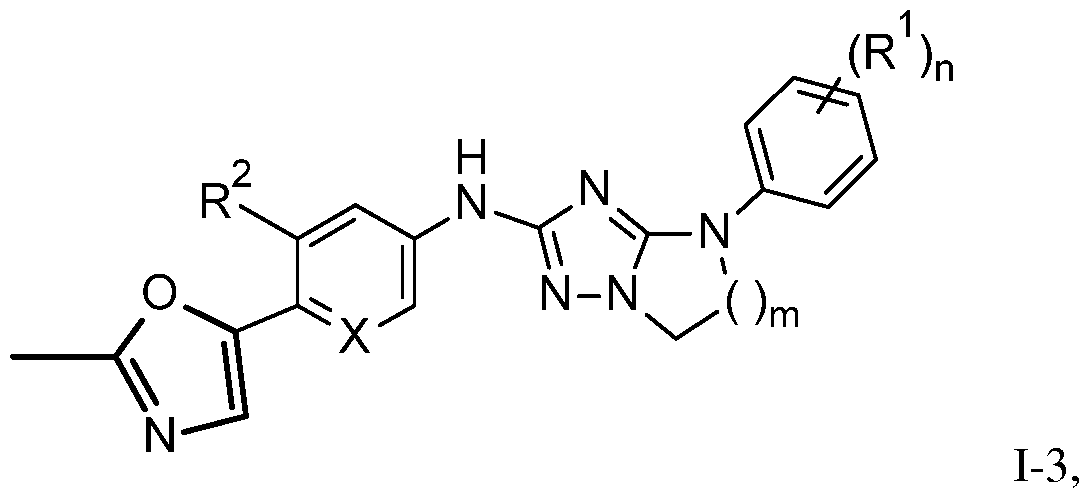
R1 is hydrogen, lower alkyl, lower alkyl substituted by halogen, halogen, lower alkoxy or lower alkoxy substituted by halogen;
and R1 may be different if n is 2 or 3;
R is hydrogen, lower alkyl, lower alkyl substituted by halogen, halogen, CN, lower alkoxy or lower alkoxy substituted by halogen;
X is CH or N;
m is 1 , 2 or 3 ;
n is 1 , 2 or 3 ;
-( )m is -(CH2)m- or a pharmaceutically active acid addition salt thereof, for example the following compounds 4-(3,4-difluorophenyl)-N-[3-methoxy-4-(2-methyloxazol-5-yl)phenyl]-6,7-dihydro-5H- [ 1 ,2,4] triazolo [ 1 ,5 -a]pyrimidin-2-amine
4-(3,4-difluorophenyl)-N-[3-methoxy-4-(2-methyloxazol-5-yl)phenyl]-5,6,7,8-tetrahydro- [l,2,4]triazolo[l,5-a][l,3]diazepin-2-amine
N-[3-methoxy-4-(2-methyloxazol-5-yl)phenyl]-4-(2,3,4-trifluorophenyl)-6,7-dihydro-5H- [ 1 ,2,4] triazolo [ 1 ,5 -a]pyrimidin-2-amine
4-(3,4-difluorophenyl)-N-[3-fluoro-4-(2-methyloxazol-5-yl)phenyl]-6,7-dihydro-5H- [ 1 ,2,4] triazolo [ 1 ,5 -a]pyrimidin-2-amine
4- (3,4-difluorophenyl)-N-[4-(2-methyloxazol-5-yl)phenyl]-6,7-dihydro-5H-[l,2,4]triazolo[l,5- a]pyrimidin-2-amine
5- [[4-(3,4-difluorophenyl)-6,7-dihydro-5H-[l,2,4]triazolo[l,5-a]pyrimidin-2-yl]amino]-2-(2-
methyloxazol-5-yl)benzonitrile
N-[5-fluoro-6-(2-methyloxazol-5-yl)-3-pyridyl]-4-(4-fluorophenyl)-6,7-dihydro-5H- [ 1 ,2,4] triazolo [ 1 ,5 -a]pyrimidin-2-amine or
4-(4-fluorophenyl)-N-[3-methoxy-4-(2-methyloxazol-5-yl)phenyl]-6,7-dihydro-5H- [ 1 ,2,4] triazolo [ 1 ,5 -a]pyrimidin-2-amine.
One object of the present invention is a compound of formula 1-4,

R1 is hydrogen, lower alkyl, lower alkyl substituted by halogen, halogen, lower alkoxy or lower alkoxy substituted by halogen;
and R1 may be different if n is 2 or 3;
R is hydrogen, lower alkyl, lower alkyl substituted by halogen, halogen, CN, lower alkoxy or lower alkoxy substituted by halogen;
X is CH or N;
m is 1 , 2 or 3 ;
n is 1 , 2 or 3 ;
-( )m is -(CH2)m- or a pharmaceutically active acid addition salt thereof, for example the following compound 4-(3,4-difluorophenyl)-N-[3-methoxy-4-(l-methylpyrazol-4-yl)phenyl]-6,7-dihydro-5H- [ 1 ,2,4] triazolo [ 1 ,5 -a]pyrimidin-2-amine.
One object of the present invention is a compound of formula 1-5,
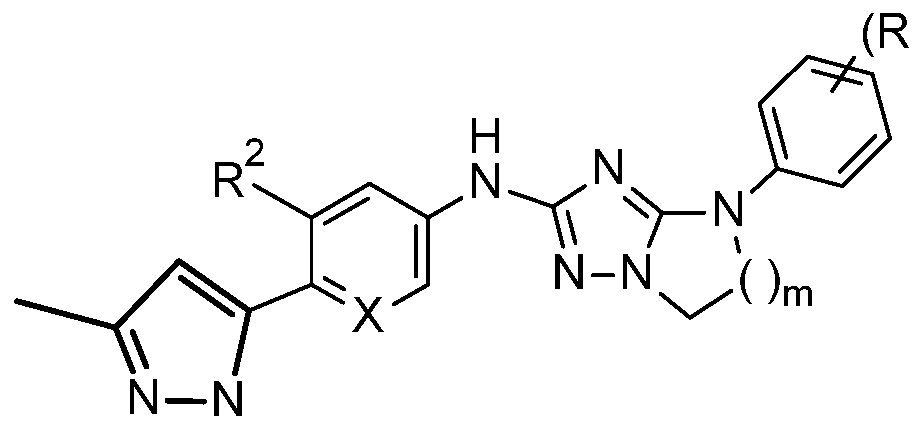
R1 is hydrogen, lower alkyl, lower alkyl substituted by halogen, halogen, lower alkoxy or lower alkoxy substituted by halogen;
and R1 may be different if n is 2 or 3;
R is hydrogen, lower alkyl, lower alkyl substituted by halogen, halogen, CN, lower alkoxy or lower alkoxy substituted by halogen;
X is CH or N;
m is 1 , 2 or 3 ;
n is 1 , 2 or 3 ;
-( )m is -(CH2)m- or a pharmaceutically active acid addition salt thereof, for example the following compound 4-(3,4-difluorophenyl)-N-[3-methoxy-4-(3-methyl-lH-pyrazol-5-yl)phenyl]-6,7-dihydro-5H- [ 1 ,2,4] triazolo [ 1 ,5 -a]pyrimidin-2-amine.
One object of the present invention is a compound of formula 1-6,

and R1 may be different if n is 2 or 3;
R is hydrogen, lower alkyl, lower alkyl substituted by halogen, halogen, CN, lower alkoxy or lower alkoxy substituted by halogen;
X is CH or N;
m is 1 , 2 or 3 ;
n is 1 , 2 or 3 ;
-( )m is -(CH2)m- or a pharmaceutically active acid addition salt thereof, for example the following compound
4-(3,4-difluorophenyl)-N-[4-(4-methyltriazol-l-yl)phenyl]-6,7-dihydro-5H-[l,2,4]triazolo[l,5- a]pyrimidin-2-amine.
Further objects of the present invention are compounds of formulas

R1 is hydrogen, lower alkyl, lower alkyl substituted by halogen, halogen, lower alkoxy or lower alkoxy substituted by halogen;
and R1 may be different if n is 2 or 3;
R is hydrogen, lower alkyl, lower alkyl substituted by halogen, halogen, CN, lower alkoxy or lower alkoxy substituted by halogen;
X is CH or N;
n is 1 , 2 or 3 ;
Ar is a five membered heteroaryl group, selected from

R is hydrogen, methyl or chloro;
R4 is hydrogen or methyl;
R5 is F, CI, CHF2 or CF3;
or pharmaceutically active acid addition salts thereof.
The present compounds of formula I and their pharmaceutically acceptable salts can be prepared by methods known in the art, for example, by processes described below, which processes comprise
a) reacting a compound of formula 9

with a compound of formula 10-b

to a compound of formula I

wherein the substituents have the meaning as described above, and,
if desired, converting the compounds obtained into pharmaceutically acceptable acid addition salts;
In more detail, compounds of formula I and their intermediates may be prepared by schemes 1 - 3 and by the description of 48 specific examples.
General synthesis schemes
General Synthesis of derivatives of type la with m = 1
Scheme 1
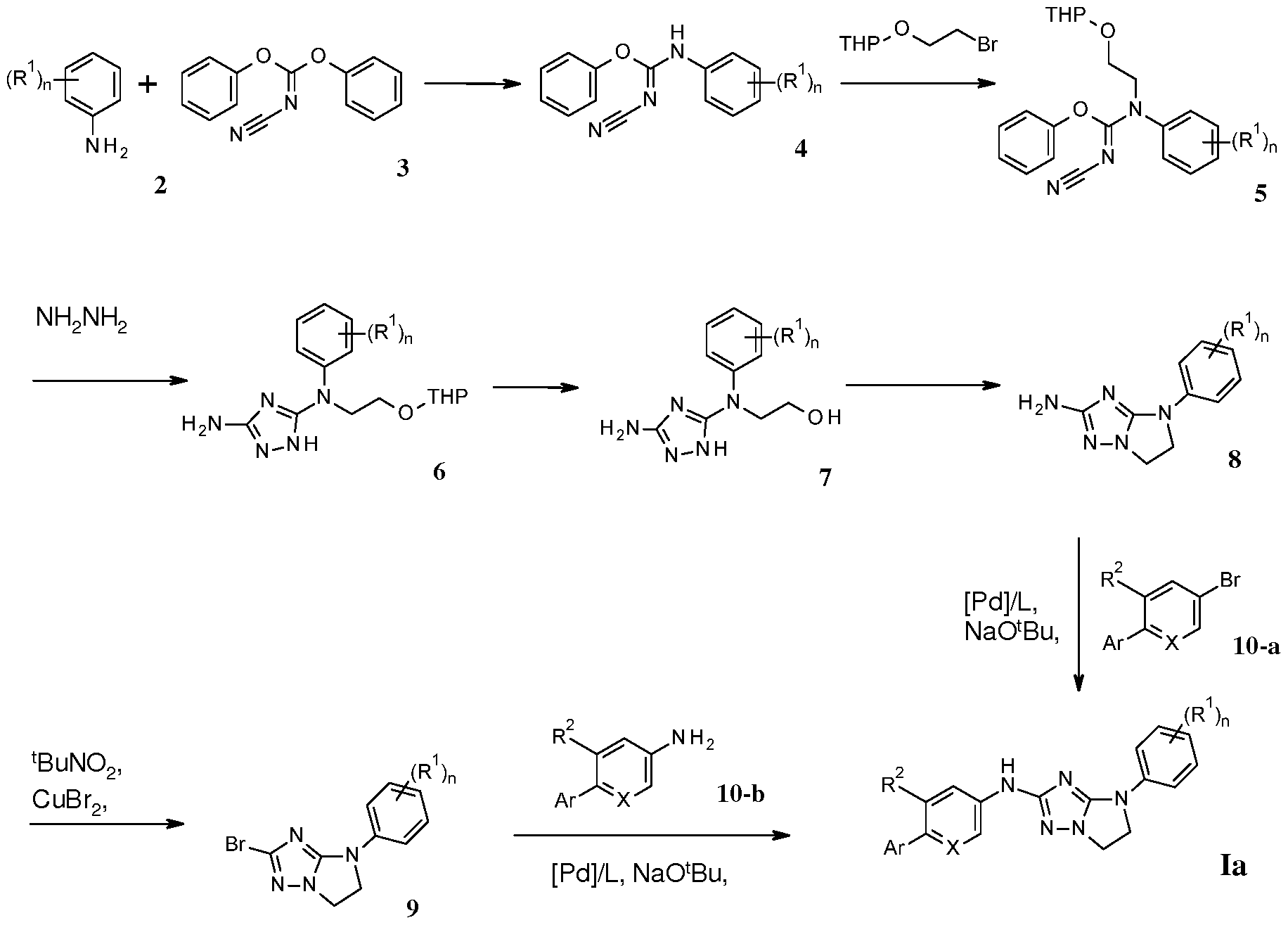
The preparation of derivatives of general formula la with (m =1), where made according to the scheme 1. The synthesis of target compounds commenced by the nucleophilic addition of a commercially available substituted anilines 2 onto the diphenyl cyanocarbonimidate 3 leading to the intermediates 4 in a good yield. Upon N-alkylation with an electrophile [2-(2- bromoethoxy)tetrahydropyran] containing a protected alcohol moiety the compounds 5 were
obtained. Upon reaction with hydrazine the corresponding triazoles 6 were obtained.
Deprotection of the alcohol protected by tetrahydropyran (THP) group under standard acidic conditions afforded 7 in nearly quantitative yield, the alcohol precursor for the Mitsunobu reaction forming 8. A Buchwald coupling of 8 with a bromo derivatives of formula 10-a gave final compounds la. Alternatively, a Sandmeyer reaction with 8 led to the versatiles
intermediates bromotriazole 9, which can easily undergo a Buchwald type reaction with different anilines of type 10-b affording also final products of formula la.
General Synthesis of derivatives of type lb with m = 2
Scheme 2

The preparation of derivatives of general formula lb with (m =2), where made according to the scheme 2. The synthesis of target compounds commenced by the nucleophilic addition of a commercially available substituted anilines 2 onto the diphenyl cyanocarbonimidate 3 leading to the intermediates 4 in a good yield. Upon N-alkylation with an electrophile [2-(3-
bromopropoxy)tetrahydropyran] containing a protected alcohol moiety the compounds 11 were obtained. Upon reaction with hydrazine the corresponding triazoles 12 were obtained.
Deprotection of the alcohol protected by tetrahydropyran (THP) group under standard acidic conditions afforded 13 in nearly quantitative yield, the alcohol precursor for the Mitsunobu reaction forming 14. A Buchwald coupling of 14 with a bromo derivatives of formula 10-a gave final compounds lb. Alternatively, a Sandmeyer reaction of 14 led to the versatiles intermediates bromotriazole 15, which can easily undergo a Buchwald type reaction with different anilines of type 10-b affording also final products of formula lb.
General Synthesis of derivatives of type Ic with
Scheme 3

The preparation of derivatives of general formula Ic with (m =3), where made according to the scheme 3. The synthesis of target compounds commenced by the nucleophilic addition of a
commercially available substituted anilines 2 onto the diphenyl cyanocarbonimidate 3 leading to the intermediates 4 in a good yield. Upon N-alkylation with an electrophile [2-(4- bromobutoxy)tetrahydropyran] containing a protected alcohol moiety the compounds 16 were obtained. Upon reaction with hydrazine the corresponding triazoles 17 were obtained.
Deprotection of the alcohol protected by tetrahydropyran (THP) group under standard acidic conditions afforded 18 in nearly quantitative yield, the alcohol precursor for the Mitsunobu reaction forming 19. A Buchwald coupling of 19 with a bromo derivatives of formula 10-a gave final compounds Ic. Alternatively, a Sandmeyer reaction of 19 led to the versatiles intermediates bromotriazole 20, which can easily undergo a Buchwald type reaction with different anilines of type 10-b affording final products of formula Ic.
The heterocycles halides are either commercial available, known in the literature so they can be prepared by methods known in the art or alternatively could be prepared as described in the specification.
The compounds were investigated in accordance with the test given hereinafter.
Description of γ-secretase assay
Cellular γ-secretase assay
Human neuroglioma H4 cells overexpressing human APP695 with the Swedish double mutation (K595N/M596L) were plated at 30,000 cells/well/100 μΐ in 96-well plates in IMDM media containing 10% FCS, 0.2 mg/1 Hygromycin B and incubated at 37°C, 5% C02 .
3-4 hr post plating, compounds are a diluted in media and 50 μΐ is added as 1.5-fold concentrate to achieve the final concentration. Compound incubation is performed for 24 hr. Final doses typically range from 4 μΜ down to 0.0013 μΜ in half-log steps resulting in a eight point dose response curve.
Appropriate controls using vehicle only and reference compound were applied to this assay. The final concentration of Me2SO was 0.4%.
After incubation at 37°C, 5% C02, the supernatant was subjected to quantification of secreted Αβ42 by the means of an AlphaLisa assay kit (Human Amyloid beta 1-42 Kit: Cat# AL203C, Perkin Elmer). 20 μΐ of the cell culture supernatant was transferred to an assay plate. Then 10 μΐ of a mixture of the AlphaLisa coupled capture antibody and the biotinylated detection
antibody was added and incubated for 3 hours at room temperature while softly shaking the assay plate. After a further addition of 20 μΐ of the Donor beads the assay plate was incubated for 30 min at room temperature and constant shaking without exposure to direct light. The assay plate was then read on a Paradigm AlphaLisa Reader using the build-in program with excitation at 680 nm and emission at 570 nm.
The measured signals were then used to calculate IC50 values for inhibition of Αβ42 secretion by nonlinear regression fit analysis using XLfit 5.3 software (IDBS).
The table below shows the data for all compounds for the inhibition of Αβ42 secretion
(nM):
Example No. EC50 A 42 Example No. EC50 A 42
(uM) (nM)
1 0.0166 26 0.0238
2 0.0142 27 0.0202
3 0.0370 28 0.1373
4 0.0143 29 0.0561
5 0.0214 30 0.0251
6 0.0083 31 0.0304
7 0.0132 32 0.0141
8 0.0358 33 0.0352
9 0.0224 34 0.0100
10 0.0619 35 0.0210
11 0.0345 36 0.0399
12 0.0298 37 0.0342
13 0.0248 38 0.0138
14 0.0899 39 0.0175
15 0.0144 40 0.0203
16 0.0329 41 0.0142
17 0.0130 42 0.0074
18 0.0225 43 0.0126
19 0.0204 44 0.0654
20 0.0289 45 0.0300
21 0.1016 46 0.0404
22 0.0198 47 0.0521
23 0.0312 48 0.0947
24 0.009
25 0.0585
The compounds of formula I and the pharmaceutically acceptable salts of the compounds of formula I can be used as medicaments, e.g. in the form of pharmaceutical preparations. The pharmaceutical preparations can be administered orally, e.g. in the form of tablets, coated tablets, dragees, hard and soft gelatine capsules, solutions, emulsions or suspensions. The administration can, however, also be effected rectally, e.g. in the form of suppositories, parenterally, e.g. in the form of injection solutions.The administration can also be effected topically, e.g. transdermal administration, or in form of eye drops or ear drops.
The compounds of formula I can be processed with pharmaceutically inert, inorganic or organic carriers for the production of pharmaceutical preparations. Lactose, corn starch or derivatives thereof, talc, stearic acids or its salts and the like can be used, for example, as such carriers for tablets, coated tablets, dragees and hard gelatine capsules. Suitable carriers for soft gelatine capsules are, for example, vegetable oils, waxes, fats, semi-solid and liquid polyols and the like. Depending on the nature of the active substance no carriers are, however, usually required in the case of soft gelatine capsules. Suitable carriers for the production of solutions and syrups are, for example, water, polyols, glycerol, vegetable oil and the like. Suitable carriers for suppositories are, for example, natural or hardened oils, waxes, fats, semi-liquid or liquid polyols and the like.
The pharmaceutical preparations can, moreover, contain preservatives, solubilizers, stabilizers, wetting agents, emulsifiers, sweeteners, colorants, flavorants, salts for varying the osmotic pressure, buffers, masking agents or antioxidants. They can also contain still other therapeutically valuable substances.
Medicaments containing a compound of formula I or a pharmaceutically acceptable salt thereof and a therapeutically inert carrier are also an object of the present invention, as is a
process for their production, which comprises bringing one or more compounds of formula I and/or pharmaceutically acceptable acid addition salts and, if desired, one or more other therapeutically valuable substances into a galenical administration form together with one or more therapeutically inert carriers.
In accordance with the invention compounds of formula I as well as their
pharmaceutically acceptable salts are useful in the control or prevention of illnesses based on the inhibition of Αβ42 secretion, such as of Alzheimer's disease.
The dosage can vary within wide limits and will, of course, have to be adjusted to the individual requirements in each particular case. In the case of oral administration the dosage for adults can vary from about 0.01 mg to about 1000 mg per day of a compound of general formula I or of the corresponding amount of a pharmaceutically acceptable salt thereof. The daily dosage may be administered as single dose or in divided doses and, in addition, the upper limit can also be exceeded when this is found to be indicated.
Tablet Formulation (Wet Granulation)
Item Ingredients mg/tablet
5 25 100 500
1. Compound of formula I 5 25 100 500
2. Lactose Anhydrous DTG 125 105 30 150
3. Sta-Rx 1500 6 6 6 30
4. Microcrystalline Cellulose 30 30 30 150
5. Magnesium Stearate 1 1 1 1
Total 167 167 167 831
Manufacturing Procedure
1. Mix items 1, 2, 3 and 4 and granulate with purified water.
2. Dry the granules at 50°C.
3. Pass the granules through suitable milling equipment.
4. Add item 5 and mix for three minutes; compress on a suitable press.
Capsule Formulation
Item Ingredients mg/capsuli e
5 25 100 500
1. Compound of formula I 5 25 100 500
2. Hydrous Lactose 159 123 148 —
3. Corn Starch 25 35 40 70
4. Talc 10 15 10 25
5. Magnesium Stearate 1 2 2 5
Total 200 200 300 600
Manufacturing Procedure
1. Mix items 1, 2 and 3 in a suitable mixer for 30 minutes.
2. Add items 4 and 5 and mix for 3 minutes.
3. Fill into a suitable capsule.
Experimental Part
The following examples are provided for illustration of the invention. They should not be considered as limiting the scope of the invention, but merely as being representative thereof.
General
Analytical methods
HPLC (method LCMS_fastgradient)
Column: Agilent Zorbax Eclipse Plus CI 8, Rapid Resolution HT, 2.1x30 mm, 1.8μπι, Part.no. 959731-902
Solvent A: Water 0.01% Formic Acid; Solvent B: acetonitrile (MeCN)
Gradients:
Time [min] Flow Rate [ml/min] %A %B
Initial 0.8 97 3
0.2 1.0 97 3
1.7 1.0 3 97
2.0 1.0 3 97
2.1 1.0 97 3
Abbreviations
The following abbreviations were used in the experimental part:
THF = tetrahydrofurane;
TBME = methyl-tert-butylether;
DMF = dimethylformamide;
TLC = thin layer chromatography;
RT = room temperature, 20-25°C.
Preparation of intermediates Intermediates of type 9 (according to scheme 1)

Intermediate 9-1:
2- romo-4-(3,4-difluorophenyl)-5,6-dihydroimidazo[l,2-b][l,2,4]triazole

Step 1: 3,4-Difluoroaniline (3.00 g, 23.20 mmol) and diphenyl cyanocarbonimidate (5.53 g, 23.20 mmol) were dissolved in 2-propanol (64.00 mL). The reaction mixture was stirred at RT overnight. The crude was evaporated in vacuo and purified by column chromatography
(Hept:EtOAc 100:0 to 50:50) to afford (Z)-phenyl N'-cyano-N-(3,4-difluorophenyl)
carbamimidate as a white solid (5.00 g, 79%). MS (ES+) m/z: 27 '4.1 [M+H]+.
Step 2: A solution of 2-(2-bromoethoxy)tetrahydro-2H-pyran (5.74 g, 4.15 mL, 27.40 mmol), (Z)-phenyl N'-cyano-N-(3,4-difluorophenyl)carbarnimidate (5.00 g, 18.30 mmol) and K2CO3 (5.06 g, 36.60 mmol) in DMF (180 mL) was heated at 85°C overnight. An extra amount of 2-(2- bromoethoxy)tetrahydro-2H-pyran (5.74 g, 4.15 mL, 27.40 mmol) and K2C03 (5.06 g, 36.60 mmol) were added and the reaction stirred at 100°C for a further 8 hours and then at 75 °C overnight. The reaction mixture was cooled down to RT, poured onto a saturated aqueous solution of NH4CI and the product extracted three times with EtOAc. The organic layers were
combined, washed with water and then with brine, dried over sodium sulfate, filtered and evaporated in vacuo. The residue was then purified by column chromatography using
(Hept:EtOAc 100:0 to 70:30) to afford (Z)-phenyl N'-cyano-N-(3,4-difluorophenyl)-N-(2- ((tetrahydro-2H-pyran-2-yl)oxy)ethyl)carbamimidate as a yellow oil (1.75 g, 24%). MS (ES+) m/z: 402.2 [M+H]+.
Step 3: To a solution of (Z)-Phenyl N'-cyano-N-(3,4-difluorophenyl)-N-(2-((tetrahydro-2H- pyran-2-yl)oxy)ethyl) carbamimidate (1.75 g, 4.36 mmol) in methanol (12 mL) was added hydrazine hydrate 25% in H20 (873 mg, 864.00 μΐ, 4.36 mmol). The reaction mixture was stirred at 35°C for 1 hour and then evaporated in vacuo to give N3-(3,4-Difluorophenyl)-N3-(2- ((tetrahydro-2H-pyran-2-yl)oxy)ethyl)-4H-l,2,4-triazole-3, 5 -diamine (1.79 g, 91%) which was used directly for the next step without further purification. (1.79 g, 91%). MS (ES+) m/z: 340.2 [M+H]+.
Step 4: The crude of N3-(3,4-difluorophenyl)-N3-(2-((tetrahydro-2H-pyran-2-yl)oxy)ethyl)-4H- l,2,4-triazole-3,5-diamine (1.79 g, 5.27 mmol) was dissolved in a mixture of aqueous HCl 2M (9 mL) an methanol (43 mL). The reaction mixture was stirred at RT for 1 hour and concentrated in vacuo. The residue was diluted with EtOAc and washed with an aqueous NaHC03 solution. The organic layer was dried Na2S04 and the product purified by combiflash chromatography (CH2Cl2:MeOH 100:0 to 90:10) to afford 2-((5-Amino-4H-l,2,4-triazol-3-yl)(3,4- difluorophenyl)amino)ethanol as a white solid (0.39 g, 29%). MS (ES+) m/z: 256.2 [M+H]+.
Step 5: To a THF (4 mL) solution of 2-((5-Amino-4H-l,2,4-triazol-3-yl)(3,4-difluorophenyl) amino)ethanol (50.00 mg, 196 μπιοΐ) and triphenylphosphine (154 mg, 588 μπιοΐ) was added DEAD (70 mg, 64 μΐ, 392 μπιοΐ) the reaction was stirred at RT for 24 hours. The reaction was stirred for further 7 hours at 50°C and then one extra amount of triphenylphosphine (154 mg, 588 μπιοΐ), DEAD (70 mg, 64 μΐ, 392 μπιοΐ) and THF (4 mL) were added. The reaction mixture was left to stir at RT overnight. The mixture was diluted with EtOAc and washed three times with water and brine; the organic phase was dried over sodium sulfate, filtered and evaporated in vacuo. The crude was purified using combiflash chromatography (CH2Cl2:MeOH 100:0 to
90: 10) to afford 4-(3,4-difluorophenyl)-5,6-dihydro-4H-imidazo[l,2-b][l,2,4]triazol-2-amine as a white solid (7.2 mg, 15%). MS (ES+) m/z: 238.1 [M+H]+.
Step 6: tert-B tyl nitrile (232 mg, 268 μΐ, 2.0 mmol) and cupric bromide (452 mg, 96 μΐ, 2.0 mmol) were combined in CH3CN (40 mL) and stirred at 60°C before a solution of 4-(3,4- difluorophenyl)-5,6-dihydro-4H-imidazo[l,2-b][l,2,4]triazol-2-amine (140 mg, 590 μπιοΐ) in CH3CN (40 mL) was added drop wise. The reaction mixture was stirred at 75°C for 2 hours, concentrated in vacuo, diluted with 1M HC1 and extracted three times with EtOAc. The combined organic layer was dried over sodium sulfate, filtered and evaporated in vacuo. The crude was purified by combiflash chromatography (Hept:EtOAc 100:0 to 50:50) to afford 2- bromo-4-(3,4-difluorophenyl)-5,6-dihydro-4H-imidazo[l,2-b][l,2,4]triazole (0.12 g, 69%) as an off-white solid. MS (ES+) m/z: 301.0 and 303.0 [M+H]+. (Br isotopes).
Intermediate 9-2:
2-bromo-4-[4-(trifluoromethyl)phenyl]-5,6-dihydroimidazo[l,2-b][l,2,4]triazole

In analogy to the preparation of the intermediate 9-1, starting from 4-(trifluoromethyl)aniline was prepared 0.12 g of the intermediate 2-bromo-4-[4-(trifluoromethyl)phenyl]-5,6-dihydro imidazo[l,2-b][l,2,4]triazole (9-2) as a white solid. MS (ES+) m/z: 333.0 and 335.0 [M+H]+. (Br isotopes)
Intermediate 9-3:
2-bromo-4-(2,3?4-trifluorophenyl)-5,6-dihydroimidazo[l,2-b][l,2,4]triazole

In analogy to the preparation of the intermediate 9-1, starting from 2,3,4-trifluoroaniline was prepared 0.12 g of the intermediate 2-bromo-4-(2,3,4-trifluorophenyl)-5,6-dihydroimidazo[l,2- b][l,2,4]triazole (9-3) as a white solid. MS (ES+) m/z: 319.0 and 321.0 [M+H]+. (Br isotopes)
Intermediates of type 15

Intermediate 15-1:
2-bromo-4-(3,4-difluorophenyl)-6,7-dihydro-5H-[l,2,4]triazolo[l,5-a]pyrimidine

Step 1: 3,4-Difluoroaniline (3.00 g, 23.20 mmol) and diphenyl cyanocarbonimidate (5.53 g, 23.20 mmol) were dissolved in 2-propanol (64.00 mL). The reaction mixture was stirred at RT overnight. The crude was evaporated in vacuo and purified by column chromatography
(Hept:EtOAc 100:0 to 50:50) to afford (Z)-phenyl N'-cyano-N-(3,4-difluorophenyl)
carbamimidate as a white solid (5.00 g, 79%). MS (ES+) m/z: 27 '4.1 [M+H]+.
Step 2: A solution of (Z)-phenyl N'-cyano-N-(3,4-difluorophenyl)carbamimidate (17.69 g, 64.70 mmol), 2-(3-bromopropoxy)tetrahydro-2H-pyran (22.80 g, 17.10 mL, 97.10 mmol) and K2CO3 (17.90 g, 129.00 mmol) in DMF (200 mL) was heated overnight at 85°C. The reaction mixture was concentrated in vacuo and the residue was purified by column chromatography (Hept:EtOAc 90: 10 to 50:50) to give 3-cyano-l-(3,4-difluorophenyl)-2-phenyl-l-(3-tetrahydropyran-2- yloxypropyl)isourea as a white solid (26.90 g, 49%). MS (ES+) m/z: 416.2 [M+H]+.
Step 3: To a solution of of (Z)-phenyl N'-cyano-N-(3,4-difluorophenyl)-N-(3-((tetrahydro-2H- pyran-2-yl)oxy)propyl)carbamimidate (10.20 g, 24.60 mmol) in MeOH (70 mL) was added hydrazine hydrate 25% in water (4.92 g, 4.87 mL, 24.60 mmol). The reaction mixture was stirred at RT overnight, evaporated and purified by column chromatography (CH2Cl2:MeOH 99: 1 to
92.5:7.5) to afford N3-(3,4-difluorophenyl)-N3-(3-tetrahydropyran-2-yloxypropyl)-4H-l,2,4- triazole-3,5-diamine as a colourless foam (8.68 g, 78%). MS (ES+) m/z: 354.2 [M+H]+.
Step 4: To a solution of N3-(3,4-difluorophenyl)-N3-(3-((tetrahydro-2H-pyran-2-yl)oxy)propyl)- 4H-l,2,4-triazole-3,5-diamine (6.75 g, 19.10 mmol) in MeOH (150 mL) followed by addition of aqueous HC1 2M (30 mL). The reaction mixture was stirred at RT for 90 minutes and
concentrated in vacuo. The residue was diluted with EtOAc and washed with an aqueous NaHC03 solution. The organic layer was dried on Na2SC"4 and the product purified by combiflash chromatography to afford 3-(N-(5-Amino-4H-l,2,4-triazol-3-yl)-3,4-difluoro- anilino)propan-l-ol as a white solid (5.14 g, 95%). MS (ES+) m/z: 270.1 [M+H]+.
Step 5: To a solution of 3-((5-amino-4H-l,2,4-triazol-3-yl)(3,4-difluorophenyl)amino) propan-1- ol (4.55 g, 16.90 mmol) in DMF (90 mL) at -15/-20°C, was added triphenylphosphine (6.65 g, 25.30 mmol). The mixture was stirred at -15/-20°C for 15 minutes, then at -30°C, DEAD (4.55 g, 4.10 ml, 25.30 mmol) was added drop wise over of 20 minutes. The mixture was stirred at -30°C for 90 minutes. Water was added to the reaction mixture and then concentrated under vacuo, and the product extracted with EtOAc. The combined organic layers were washed once with brine, dried over sodium sulfate, filtered and evaporated in vacuo. The crude was purified using silica chromatography (CH2Cl2:MeOH 99:1 to 96:4) to afford 4-(3,4-difluorophenyl)-6,7-dihydro-5H- [l,2,4]triazolo[l,5-a]pyrimidin-2-amine as a white solid (3.41 g, 80%). MS (ES+) m/z: 252.1 [M+H]+.
Step 6: To a black solution of ieri-butyl nitrite (1.01 g, 1.17 mL, 8.86 mmol) and cupric bromide (1.98 g, 420 μΐ, 8.86 mmol) in CH3CN (150 mL) at 60°C, 4-(3,4-difluorophenyl)-4,5,6,7- tetrahydro-[l,2,4]triazolo[l,5-a]pyrimidin-2-amine (1.63 g, 5.90 mmol,) in 50 mL CH3CN was added drop wise. After addition, the reaction mixture was heated to 75°C and stirred for 30 minutes. The reaction mixture was concentrated in vacuo, diluted with 2 mL of 1M HC1 and extracted 3 times with EtOAc. The organic layers were dried over sodium sulfate and
concentrated. The crude was purified by chromatography (CH2Cl2:MeOH 99.5:0.5) to afford 2- bromo-4-(3,4-difluorophenyl)-6,7-dihydro-5H-[l,2,4]triazolo[l,5-a]pyrimidine as a light yellow solid (1.86 g, 82%). MS (ES+) m/z: 315.0 and 317.0 [M+H]+. (Br isotopes).
Intermediate 15-2:
2-bromo-4-(3,5-difluorophenyl)-6,7-dihydro-5H-[l,2,4]triazolo[l,5-a]pyrimidine

In analogy to the preparation of the intermediate 15-1, starting from 3,5-difluoroaniline was prepared 234 mg of the intermediate 2-bromo-4-(3,5-difluorophenyl)-6,7-dihydro-5H- [l,2,4]triazlo[l,5-a]pyrimidine (15-2) as a white solid. MS (ES+) m/z: 315.0 and 317.0 [M+H]+. (Br isotopes).
Intermediate 15-3:
2-bromo-4- 3-fluoro-4-methyl-phenyl)-6,7-dihydro-5H-[l,2,4]triazolo[l,5-a]pyrimidine

In analogy to the preparation of the intermediate 15-1, starting from 3-fluoro-4-methyl-aniline was prepared 662 mg of the intermediate 2-bromo-4-(3-fluoro-4-methyl-phenyl)-6,7-dihydro- 5H-[l,2,4]triazolo[l,5-a]pyrimidine (15-3) as a light yellow oil. MS (ES+) m/z: 311.0 and 313.0 [M+H]+. (Br isotopes).
Intermediate 15-4:
2-bromo-4-(2,3?4-trifluorophenyl)-6,7-dihydro-5H-[l,2,4]triazolo[l,5-a]pyrimidine

In analogy to the preparation of the intermediate 15-1, starting from 2,3,4-trifluoroaniline was prepared 134 mg of the intermediate 2-bromo-4-(2,3,4-trifluorophenyl)-6,7-dihydro-5H-
[l,2,4]triazolo[l,5-a]pyrimidine (15-4) as a light brown solid. MS (ES+) m/z: 333.0 and 335.0 [M+H]+. (Br isotopes).
Intermediate 15-5:
2-bromo-4- 3-fluorophenyl)-6,7-dihydro-5H-[l,2,4]triazolo[l,5-a]pyrimidine

In analogy to the preparation of the intermediate 15-1, starting from 3-fluoroaniline was prepared 210 mg of the intermediate 2-bromo-4-(3-fluorophenyl)-6,7-dihydro-5H-[l,2,4]triazolo[l,5- a]pyrimidine (15-5) as a light yellow solid. MS (ES+) m/z: 297.0 and 299.0 [M+H]+. (Br isotopes).
Intermediate 15-6:
2-bromo-4-(4-fluorophenyl)-6,7-dihydro-5H-[l,2,4]triazolo[l,5-a]pyrimidine

In analogy to the preparation of the intermediate 15-1, starting from 4-fluoroaniline was prepared 1.11 g of the intermediate 2-bromo-4-(4-fluorophenyl)-6,7-dihydro-5H-[l,2,4]triazolo[l,5- a]pyrimidine (15-6) as a light yellow solid. MS (ES+) m/z: 297.0 and 299.0 [M+H]+. (Br isotopes).
Intermediate 15-7:
2-bromo-4-phenyl-6,7-dihydro-5H-[l,2,4]triazolo[l,5-a]pyrimidine

Intermediates of type 20

Intermediate 20-1:
2-bromo-4-(3,4-difluorophenyl)-5,6,7,8-tetrahydro-[l,2,4]triazolo[l,5-a][l,3]diazepine

Step 1: 3,4-Difluoroaniline (3.00 g, 23.20 mmol) and diphenyl cyanocarbonimidate (5.53 g, 23.20 mmol) were dissolved in 2-propanol (64.00 mL). The reaction mixture was stirred at RT overnight. The crude was evaporated in vacuo and purified by column chromatography
(Hept:EtOAc 100:0 to 50:50) to afford (Z)-phenyl N'-cyano-N-(3,4-difluorophenyl)
carbamimidate as a white solid (5.00 g, 79%). MS (ES+) m/z: 274.1 [M+H]+.
Step 2: A solution of (Z)-phenyl N'-cyano-N-(3,4-difluorophenyl)carbamimidate (10.0 g, 36.6 mmol), 2-(3-bromobutoxy)tetrahydro-2H-pyran (13.30 g, 54.90 mmol) and K2C03 (10.10 g, 73.20 mmol) in DMF (350 mL) was heated overnight at 85°C. The reaction mixture was concentrated in vacuo and the residue was purified by column chromatography (Hept:EtOAc 90: 10 to 50:50) to give 3-cyano-l-(3,4-difluorophenyl)-2-phenyl-l-(4-tetrahydropyran-2- yloxybutyl)isourea as a colorless oil (5.31 g, 34%). MS (ES+) m/z: 430.2 [M+H]+.
Step 3: To a solution of 3-cyano-l-(3,4-difluorophenyl)-2-phenyl-l-(4-tetrahydropyran-2- yloxybutyl)isourea (5.29 g, 12.30 mmol) in MeOH (40 mL) was added hydrazine hydrate 25% in water (2.47 g, 2.44 mL, 12.30 mmol). The reaction mixture was stirred at RT for 7 hours,
evaporated and purified by column chromatography (CH2Cl2:MeOH 99:1 to 92.5:7.5) to afford N3-(3,4-difluorophenyl)-N3-(3-tetrahydropyran-2-yloxybutyl)-4H-l,2,4-triazole-3,5-diamine as a colourless oil (3.54 g, 78%). MS (ES+) m/z: 368.2 [M+H]+.
Step 4: To a solution of N3-(3,4-difluorophenyl)-N3-(3-tetrahydropyran-2-yloxybutyl)-4H- 1,2,4- triazole-3,5-diamine (3.50 g, 9.53 mmol) in MeOH (85 mL) was added an aqueous HC1 2M solution (17 mL). The reaction mixture was stirred at RT for 90 minutes and concentrated in vacuo. The residue was diluted with EtOAc and washed with an aqueous NaHC03 solution. The organic layer was dried on Na2SC"4 and the product purified by combiflash chromatography to afford 4-(N-(5-amino-4H-l,2,4-triazol-3-yl)-3,4-difluoro-anilino)butan-l-ol as a white solid (2.51 g, 93%). MS (ES+) m/z: 284.1 [M+H]+.
Step 5: At 0°C, cyanomethylenetrimethylphosphorane 0.5 M in THF (8.47 mL, 4.24 mmol) was added drop wise within 15 minutes to a solution of 4-((5-amino-4H-l,2,4-triazol-3-yl)(3,4- difluorophenyl)amino)butan-l-ol (1.00 g, 3.53 mmol) in THF (120 mL) at 0°C and stirred at RT overnight. The mixture was concentrated under vacuo, and the crude diluted with EtOAc and washed with water. The organic layer was dried over sodium sulfate, filtered and evaporated in vacuo. The crude was purified using silica chromatography (CH2Cl2:MeOH 99:1 to 96:4) to afford 4-(3,4-difluorophenyl)-5,6,7,8-tetrahydro-[l,2,4]triazolo[l,5-a][l,3]diazepin-2-amine as a white solid (0.2 g, 21%). MS (ES+) m/z: 266.1 [M+H]+.
Step 6: To a black solution of tert-buiyl nitrite (115 mg, 0.13 mL, 1.01 mmol) and cupric bromide (225 mg, 47.7 μΐ, 1.01 mmol) in CH3CN (15 mL) at 60°C, 4-(3,4-difluorophenyl)- 5,6,7, 8-tetrahydro-[l,2,4]triazolo[l,5-a][l,3]diazepin-2-amine (178 mg, 0.671 mmol,) in 25 mL CH3CN was added drop wise. After addition, the reaction mixture was heated to 75 °C and stirred for 30 minutes. The reaction mixture was concentrated in vacuo, diluted with 2 mL of 1M HC1 and extracted 3 times with EtOAc. The organic layers were dried over sodium sulfate and concentrated. The crude was purified by chromatography (CH2Cl2:MeOH 99.5:0.5) to afford 2- bromo-4-(3,4-difluorophenyl)-5,6,7,8-tetrahydro-[l,2,4]triazolo[l,5-a][l,3]diazepine as a light yellow oil (0.13 g, 58%). MS (ES+) m/z: 329.0 and 331.0 [M+H]+. (Br isotopes).
General procedure 1: Buchwald coupling reaction
To a solution of an intermediate 8, 9, 14, 15, 19 or 20 in 1,4-dioxane was added 1.5 equivalent of an intermediate 10. The reaction mixture was degased and a Pd(OAc)2 (0.2 eq.), Xantphos (0.25 eq.) and cesium carbonate (2.0 eq.) were added. The reaction mixture was heated at 100°C until completion of the reaction (usually between 0.5 and 8 hours) and concentrated under vacuo. A purification was done either by column chromatography or reverse phase preparative HPLC to afford the desired product.
Example 1
N-[3-(difluoromethoxy)-4-(3-niethyl-l,2,4-triazol-l-yl)phenyl]-4-(3,4-difluorophenyl)-6,7- dihydro-5H-[l,2,4]triazolo[l,5-a]pyrimidin-2-aniine

Using the general procedure 1, from 2-bromo-4-(3,4-difluorophenyl)-6,7-dihydro-5H- [l,2,4]triazolo[l,5-a]pyrimidine (15-1) and 3-(difluoromethoxy)-4-(3-methyl-l,2,4-triazol-l- yl)aniline was prepared 80 mg of the title compound as a light yellow solid. MS (ES+) m/z: 475.2 [(M+H)+].
Example 2
4-(3,4-difluorophenyl)-N-[3-methoxy-4-(3-methyl-l,2,4-triazol-l-yl)phenyl]-6,7-dihydro-
5H-[l,2,4]triazolo[l,5-a]pyrimidin-2-amine

Using the general procedure 1 , from 2-bromo-4-(3,4-difluorophenyl)-6,7-dihydro-5H- [l,2,4]triazolo[l,5-a]pyrimidine (15-1) and 3-methoxy-4-(3-methyl-l,2,4-triazol-l-yl)aniline was prepared 61 mg of the title compound as a light yellow solid. MS (ES+) m/z: 439.2 [(M+H)+].
Example 3
4-(3,4-difluorophenyl)-N-[3-methoxy-4-[4-(trifluoromethyl)imidazol-l-yl]phi
dihydro-5H-[l,2,4]triazolo[l,5-a]pyrimidin-2-amine

Using the general procedure 1 , from 2-bromo-4-(3,4-difluorophenyl)-6,7-dihydro-5H- [l,2,4]triazolo[l,5-a]pyrimidine (15-1) and 3-methoxy-4-[4-(trifluoromethyl)imidazol-l-yl] aniline was prepared 62 mg of the title compound as a white solid. MS (ES+) m/z: 492.2 t(M+H)+].
Example 4
4-(3,4-difluorophenyl)-N-[3-methoxy-4-(2-methyloxazol-5-yl)phenyl]-6,7-dihydro-5H-
[l,2,4]triazolo[l,5-a]pyrimidin-2-amine

Using the general procedure 1 , from 2-bromo-4-(3,4-difluorophenyl)-6,7-dihydro-5H- [l,2,4]triazolo[l,5-a]pyrimidine (15-1) and 3-methoxy-4-(2-methyloxazol-5-yl)aniline was prepared 35 mg of the title compound as a light yellow solid. MS (ES+) m/z: 438.4 [(M+H)+].
Example 5
N-[6-(4-chloroimidazol-l-yl)-5-methoxy-3-pyridyl]-4-(3,4-difluorophenyl)-6,7-dihydro-5H-
[l,2,4]triazolo[l,5-a]pyrimidin-2-amine

Using the general procedure 1 , from 4-(3,4-difluorophenyl)-6,7-dihydro-5H-[l,2,4]triazolo[l ,5- a]pyrimidin-2-amine (described as precursor of 15-1) and 5-bromo-2-(4-chloroimidazol-l-yl)-3- methoxy-pyridine was prepared 16 mg of the title compound as a white solid. MS (ES+) m/z: 459.1 [(M+H)+].
Example 6
N-[4-(4-chloroimidazol-l-yl)-3-methoxy-phenyl]-4-(3,4-difluorophenyl)-6,7-dihydro-5H-
[l,2,4]triazolo[l,5-a]pyrimidin-2-amine

Using the general procedure 1 , from 2-bromo-4-(3,4-difluorophenyl)-6,7-dihydro-5H- [l,2,4]triazolo[l,5-a]pyrimidine (15-1) and 4-(4-chloroimidazol-l-yl)-3-methoxy-aniline was prepared 10 mg of the title compound as a white solid. MS (ES+) m/z: 458.1 [(M+H)+].
Example 7
4-(3,4-difluorophenyl)-N-[3-methoxy-4-(2-methyloxazol-5-yl)phenyl]-5,6,7,8-tetrahydro-
[l,2,4]triazolo[l,5-a][l,3]diazepin-2-amine

Using the general procedure 1 , from 2-bromo-4-(3,4-difluorophenyl)-5,6,7,8-tetrahydro- [l,2,4]triazolo[l,5-a] [l,3]diazepine (20-1) and 3-methoxy-4-(2-methyloxazol-5-yl)aniline was prepared 7.5 mg of the title compound as a white solid. MS (ES+) m/z: 453.2 [(M+H)+].
Example 8
4-(3,4-difluorophenyl)-N-[3-methoxy-4-(3-methyl-l,2,4-triazol-l-yl)phenyl]-5,6,7,8- tetrahydro-[l,2,4]triazolo[l,5-a][l,3]diazepin-2-amine

Using the general procedure 1 , from 2-bromo-4-(3,4-difluorophenyl)-5,6,7,8-tetrahydro- [l,2,4]triazolo[l,5-a] [l,3]diazepine (20-1) and 3-methoxy-4-(3-methyl-l,2,4-triazol-l-yl)aniline was prepared 11 mg of the title compound as a white solid. MS (ES+) m/z: 453.3 [(M+H)+].
Example 9
N-[4-(4-chloroimidazol-l-yl)-3-methoxy-phenyl]-4-(3,4-difluorophenyl)-5,6,7,8-tetrahydro-
[l,2,4]triazolo[l,5-a][l,3]diazepin-2-amine

Using the general procedure 1 , from 2-bromo-4-(3,4-difluorophenyl)-5,6,7,8-tetrahydro- [l,2,4]triazolo[l,5-a] [l,3]diazepine (20-1) and 4-(4-chloroimidazol-l-yl)-3-methoxy-aniline was prepared 7 mg of the title compound as a white solid. MS (ES+) m/z: 472.1 [(M+H)+].
Example 10
4-(3,4-difluorophenyl)-N-[3-methoxy-4-[4-(trifluoromethyl)imidazol-l-yl]phenyl]-5,6,7,8- tetrahydro-[l,2,4]triazolo[l,5-a][l,3]diazepin-2-amine

[(M+H)+].
Example 11
4-(3,4-difluorophenyl)-N-[3-fluoro-4-(3-methyl-l,2,4-triazol-l-yl)phenyl]-6,7-dihydro-5H-
[l,2,4]triazolo[l,5-a]pyrimidin-2-amine

Using the general procedure 1 , from 2-bromo-4-(3,4-difluorophenyl)-6,7-dihydro-5H- [l,2,4]triazolo[l,5-a]pyrimidine (15-1) and 3-fluoro-4-(3-methyl-l,2,4-triazol-l-yl)aniline was prepared 16 mg of the title compound as a white solid. MS (ES+) m/z: 427.3 [(M+H)+].
Example 12
N-[4-(3-chloro-l,2,4-triazol-l-yl)-3-methoxy-phenyl]-4-(3,4-difluorophenyl)-6,7-dihydro-
5H-[l,2,4]triazolo[l,5-a]pyrimidin-2-amine

Using the general procedure 1 , from 2-bromo-4-(3,4-difluorophenyl)-6,7-dihydro-5H- [l,2,4]triazolo[l,5-a]pyrimidine (15-1) and 4-(3-chloro-l ,2,4-triazol-l-yl)-3-methoxy-aniline was prepared 9 mg of the title compound as a white solid. MS (ES+) m/z: 459.1 [(M+H)+].
Example 13
4-(3,4-difluorophenyl)-N-[3-fluoro-4-(5-methyl-l,2,4-triazol-l-yl)phenyl]-6,7-dihyd
[l,2,4]triazolo[l,5-a]pyrimidin-2-amine

Using the general procedure 1 , from 2-bromo-4-(3,4-difluorophenyl)-6,7-dihydro-5H- [l,2,4]triazolo[l,5-a]pyrimidine (15-1) and 3-fluoro-4-(5-methyl-l,2,4-triazol-l-yl)aniline was prepared 6 mg of the title compound as a white solid. MS (ES+) m/z: 427.2 [(M+H)+].
Example 14
4-(3,4-difluorophenyl)-N-[3-fluoro-4-(l,2,4-triazol-l-yl)phenyl]-6,7-dihydro-5H- [l,2,4]triazolo[l,5-a]pyrimidin-2-amine
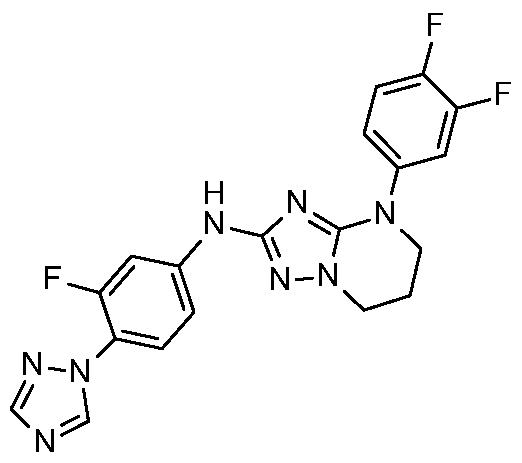
Using the general procedure 1 , from 2-bromo-4-(3,4-difluorophenyl)-6,7-dihydro-5H- [l,2,4]triazolo[l,5-a]pyrimidine (15-1) and 3-fluoro-4-(l,2,4-triazol-l-yl)aniline was prepared 4 mg of the title compound as a white solid. MS (ES+) m/z: 413.1 [(M+H)+].
Example 15
N-[3-methoxy-4-(2-methyloxazol-5-yl)phenyl]-4-(2,3?4-trifluorophenyl)-6,7-dihydro-5H-
[l,2,4]triazolo[l,5-a]pyrimidin-2-amine

Using the general procedure 1 , from 2-bromo-4-(2,3,4-trifluorophenyl)-6,7-dihydro-5H- [l,2,4]triazolo[l,5-a]pyrimidine (15-4) and 3-methoxy-4-(2-methyloxazol-5-yl)aniline was prepared 10 mg of the title compound as a white solid. MS (ES+) m/z: 457.3 [(M+H)+].
Example 16
N-[3-methoxy-4-(3-methyl-l,2,4-triazol-l-yl)phenyl]-4-(2,3?4-trifluorophenyl)-6,7-dihydro-
5H-[l,2,4]triazolo[l,5-a]pyrimidin-2-amine

Using the general procedure 1 , from 2-bromo-4-(2,3,4-trifluorophenyl)-6,7-dihydro-5H- [l,2,4]triazolo[l,5-a]pyrimidine (15-4) and 3-methoxy-4-(3-methyl-l,2,4-triazol-l-yl)aniline was prepared 10 mg of the title compound as a white solid. MS (ES+) m/z: 457.2 [(M+H)+].
Example 17
N-[4-(4-chloroimidazol-l-yl)-3-methoxy-phenyl]-4-(2,3?4-trifluorophenyl)-6,7-dihydro-5H-
[l,2,4]triazolo[l,5-a]pyrimidin-2-amine

Using the general procedure 1 , from 2-bromo-4-(2,3,4-trifluorophenyl)-6,7-dihydro-5H- [l,2,4]triazolo[l,5-a]pyrimidine (15-4) and 4-(4-chloroimidazol-l-yl)-3-methoxy-aniline was prepared 7 mg of the title compound as a white solid. MS (ES+) m/z: 476.1 [(M+H)+].
Example 18
N-[4-(4-chloroimidazol-l-yl)-3-fluoro-phenyl]-4-(3,4-difluorophenyl)-6,7-dihydro-5H-
[l,2,4]triazolo[l,5-a]pyrimidin-2-amine

Using the general procedure 1 , from 2-bromo-4-(3,4-difluorophenyl)-6,7-dihydro-5H- [l,2,4]triazolo[l,5-a]pyrimidine (15-1) and 4-(4-chloroimidazol-l-yl)-3-fluoro-aniline was prepared 11 mg of the title compound as a white solid. MS (ES+) m/z: 446.1 [(M+H)+].
Example 19
4-(3,4-difluorophenyl)-N-[3-fluoro-4-(2-methyloxazol-5-yl)phenyl]-6,7-dihydro-5H-
[l,2,4]triazolo[l,5-a]pyrimidin-2-amine
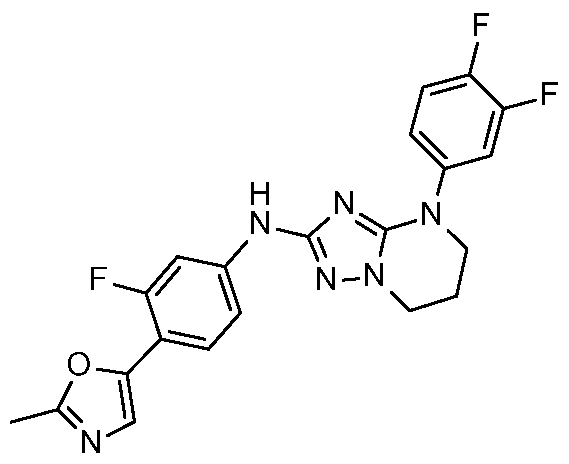
Using the general procedure 1 , from 4-(3,4-difluorophenyl)-6,7-dihydro-5H-[l,2,4]triazolo[l ,5- a]pyrimidin-2-arnine (precursor of 15-1) and 5-(4-bromo-2-fluoro-phenyl)-2-methyl-oxazole was prepared 16 mg of the title compound as a white solid. MS (ES+) m/z: 427.2 [(M+H)+].
Example 20
4-(3,4-difluorophenyl)-N-[3-methoxy-4-(l-methylpyrazol-4-yl)phenyl]-6,7-dihyd
[l,2,4]triazolo[l,5-a]pyrimidin-2-amine
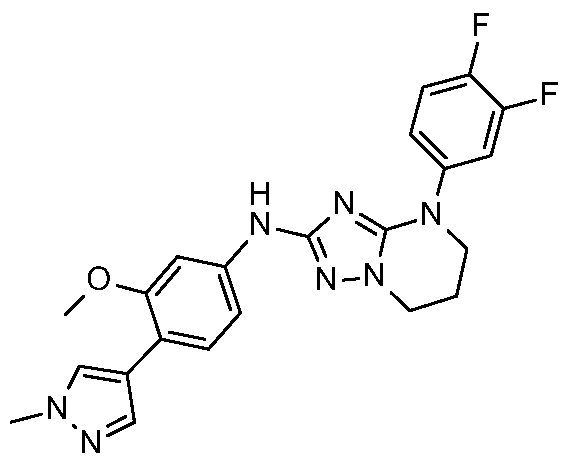
Using the general procedure 1 , from 2-bromo-4-(3,4-difluorophenyl)-6,7-dihydro-5H- [l,2,4]triazolo[l,5-a]pyrimidine (15-1) and 3-methoxy-4-(l-methylpyrazol-4-yl)aniline was prepared 11 mg of the title compound as a white solid. MS (ES+) m/z: 438.2 [(M+H)+].
Example 21
N-[4-(3-chloro-l,2,4-triazol-l-yl)-3-fluoro-phenyl]-4-(3,4-difluorophenyl)-6,7-dihydro-5H-
[l,2,4]triazolo[l,5-a]pyrimidin-2-amine

Using the general procedure 1 , from 2-bromo-4-(3,4-difluorophenyl)-6,7-dihydro-5H- [l,2,4]triazolo[l,5-a]pyrimidine (15-1) and 4-(3-chloro-l ,2,4-triazol-l-yl)-3-fluoro-aniline was prepared 6 mg of the title compound as a white solid. MS (ES+) m/z: 447.2 [(M+H)+].
Example 22
4-(3,4-difluorophenyl)-N-[4-(2-methyloxazol-5-yl)phenyl]-6,7-dihydro-5H- [l,2,4]triazolo[l,5-a]pyrimidin-2-amine

Using the general procedure 1 , from 2-bromo-4-(3,4-difluorophenyl)-6,7-dihydro-5H- [l,2,4]triazolo[l,5-a]pyrimidine (15-1) and 4-(2-methyloxazol-5-yl)aniline was prepared 6 mg of the title compound as a white solid. MS (ES+) m/z: 409.2 [(M+H)+].
Example 23
N-[4-(4-chloroimidazol-l-yl)phenyl]-4-(3,4-difluorophenyl)-6,7-dihydro-5H- [l,2,4]triazolo[l,5-a]pyrimidin-2-amine

Using the general procedure 1 , from 4-(3,4-difluorophenyl)-6,7-dihydro-5H-[l,2,4]triazolo[l ,5- a]pyrimidin-2-arnine (precursor of 15-1) and l-(4-bromophenyl)-4-chloro-imidazole was prepared 12 mg of the title compound as a white solid. MS (ES+) m/z: 428.2 [(M+H)+].
Example 24
2-(4-chloroimidazol-l-yl)-5-[[4-(3,4-difluorophenyl)-6,7-dihydro-5H-[l,2,4]triazolo[l,5- a]pyrimidin-2-yl]amino]benzonitrile

Using the general procedure 1 , from 4-(3,4-difluorophenyl)-6,7-dihydro-5H-[l,2,4]triazolo[l ,5- a]pyrimidin-2-amine (precursor of 15-1) and 5-bromo-2-(4-chloroimidazol-l-yl)benzonitrile was prepared 20 mg of the title compound as a white solid. MS (ES+) m/z: 453.2 [(M+H)+].
Example 25
4-(3,4-difluorophenyl)-N-[3-methoxy-4-(3-methyl-lH-pyrazol-5-yl)phenyl]-6,7-dihydro-5H-
[l,2,4]triazolo[l,5-a]pyrimidin-2-amine

Using the general procedure 1 , from 4-(3,4-difluorophenyl)-6,7-dihydro-5H-[l,2,4]triazolo[l ,5- a]pyrimidin-2-arnine (precursor of 15-1) and 5-(4-bromo-2-methoxy-phenyl)-3-methyl-lH- pyrazole was prepared 11 mg of the title compound as a white solid. MS (ES+) m/z: 438.3
[(M+H)+].
Example 26
2-[4-(difluoromethyl)imidazol-l-yl]-5-[[4-(3,4-difluorophenyl)-6,7-dihydro-5H- [l,2,4]triazolo[l,5-a]pyrimidin-2-yl]amino]benzonitrile

Using the general procedure 1 , from 4-(3,4-difluorophenyl)-6,7-dihydro-5H-[l,2,4]triazolo[l ,5- a]pyrimidin-2-amine (precursor of 15-1) and 5-bromo-2-[4-(difluoromethyl)imidazol-l- yl]benzonitrile was prepared 25 mg of the title compound as a white solid. MS (ES+) m/z: 469.2 t(M+H)+].
Example 27
5-[[4-(3,4-difluorophenyl)-6,7-dihydro-5H-[l,2,4]triazolo[l,5-a]pyrimidin-2-yl]amino]-2-(2- methyloxazol-5-yl)benzonitrile

Using the general procedure 1 , from 4-(3,4-difluorophenyl)-6,7-dihydro-5H-[l,2,4]triazolo[l ,5- a]pyrimidin-2-arnine (precursor of 15-1) and 5-bromo-2-(2-methyloxazol-5-yl)benzonitrile was prepared 4 mg of the title compound as a white solid. MS (ES+) m/z: 434.2 [(M+H)+].
Example 28
N-[3-chloro-4-(4-chloroimidazol-l-yl)phenyl]-4-(3,4-difluorophenyl)-6,7-dihydro-5H-
[l,2,4]triazolo[l,5-a]pyrimidin-2-amine

Using the general procedure 1 , from 4-(3,4-difluorophenyl)-6,7-dihydro-5H-[l,2,4]triazolo[l ,5- a]pyrimidin-2-amine (precursor of 15-1) and l-(4-bromo-2-chloro-phenyl)-4-chloro-imidazole was prepared 23 mg of the title compound as a white solid. MS (ES+) m/z: 462.3 [(M+H)+].
Example 29
4-(3,4-difluorophenyl)-N-[4-(3-methyl-l,2,4-triazol-l-yl)phenyl]-6,7-dihydro-5H- [l,2,4]triazolo[l,5-a]pyrimidin-2-amine

Using the general procedure 1 , from 2-bromo-4-(3,4-difluorophenyl)-6,7-dihydro-5H- [l,2,4]triazolo[l,5-a]pyrimidine (15-1) and 4-(3 -methyl- l,2,4-triazol-l-yl)aniline was prepared 8 mg of the title compound as a white solid. MS (ES+) m/z: 409.2 [(M+H)+].
Example 30
5-[[4-(3,4-difluorophenyl)-6,7-dihydro-5H-[l,2,4]triazolo[l,5-a]pyrimidin-2-yl]amino]-2-(3- methyl- 1 ,2,4-triazol- 1 -y l)benzonitrile

Using the general procedure 1 , from 2-bromo-4-(3,4-difluorophenyl)-6,7-dihydro-5H- [l,2,4]triazolo[l,5-a]pyrimidine (15-1) and 5-amino-2-(3-methyl-l ,2,4-triazol-l-yl)benzonitrile was prepared 10 mg of the title compound as a white solid. MS (ES+) m/z: 434.3 [(M+H)+].
Example 31
4-(3-fluorophenyl)-N-[3-methoxy-4-(3-methyl-l,2,4-triazol-l-yl)phenyl]-6,7-dihydro-5H-
[l,2,4]triazolo[l,5-a]pyrimidin-2-amine

Using the general procedure 1 , from 2-bromo-4-(3-fluorophenyl)-6,7-dihydro-5H- [l,2,4]triazolo[l,5-a]pyrimidine (15-5) and 3-methoxy-4-(3-methyl-l,2,4-triazol-l-yl)aniline was prepared 23 mg of the title compound as a white solid. MS (ES+) m/z: 421.2 [(M+H)+].
Example 32
N-[4-(4-chloroimidazol-l-yl)-3-methoxy-phenyl]-4-(3-fluorophenyl)-6,7-dihydro-5H-
[l,2,4]triazolo[l,5-a]pyrimidin-2-amine
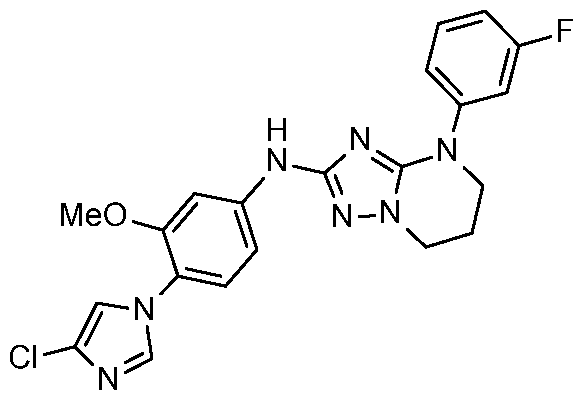
Using the general procedure 1 , from 2-bromo-4-(3-fluorophenyl)-6,7-dihydro-5H- [l,2,4]triazolo[l,5-a]pyrimidine (15-5) and 4-(4-chloroimidazol-l-yl)-3-methoxy-aniline was prepared 29 mg of the title compound as a white solid. MS (ES+) m/z: 440.2 [(M+H)+].
Example 33
4-(4-fluorophenyl)-N-[3-methoxy-4-(3-methyl-l,2,4-triazol-l-yl)phenyl]-6,7-dihydro-5H-
[l,2,4]triazolo[l,5-a]pyrimidin-2-amine

Using the general procedure 1 , from 2-bromo-4-(4-fluorophenyl)-6,7-dihydro-5H- [l,2,4]triazolo[l,5-a]pyrimidine (15-6) and 3-methoxy-4-(3-methyl-l,2,4-triazol-l-yl)aniline was prepared 21 mg of the title compound as a white solid. MS (ES+) m/z: 421.2 [(M+H)+].
Example 33
4-(4-fluorophenyl)-N-[3-methoxy-4-(3-methyl-l,2,4-triazol-l-yl)phenyl]-6,7-dihyd]
[l,2,4]triazolo[l,5-a]pyrimidin-2-amine

Using the general procedure 1 , from 2-bromo-4-(4-fluorophenyl)-6,7-dihydro-5H- [l,2,4]triazolo[l,5-a]pyrimidine (15-6) and 3-methoxy-4-(3-methyl-l,2,4-triazol-l-yl)aniline was prepared 21 mg of the title compound as a white solid. MS (ES+) m/z: 421.2 [(M+H)+].
Example 34
N-[4-(4-chloroimidazol-l-yl)-3-methoxy-phenyl]-4-(4-fluorophenyl)-6,7-dihydro-5H-
[l,2,4]triazolo[l,5-a]pyrimidin-2-amine

Using the general procedure 1 , from 2-bromo-4-(4-fluorophenyl)-6,7-dihydro-5H- [l,2,4]triazolo[l,5-a]pyrimidine (15-6) and 4-(4-chloroimidazol-l-yl)-3-methoxy-aniline was prepared 34 mg of the title compound as a white solid. MS (ES+) m/z: 440.1 [(M+H)+].
Example 35
2-(4-chloroimidazol-l-yl)-5-[[4-(4-fluorophenyl)-6,7-dihydro-5H-[l,2,4]triazolo[l,5- a]pyrimidin-2-yl]amino]benzonitrile

Using the general procedure 1 , from 2-bromo-4-(4-fluorophenyl)-6,7-dihydro-5H- [l,2,4]triazolo[l,5-a]pyrimidine (precursor of 15-6) and 5-bromo-2-(4-chloroimidazol-l- yl)benzonitrile was prepared 36 mg of the title compound as a white solid. MS (ES+) m/z: 435.2 t(M+H)+].
Example 36
N-[4-(4-chloroimidazol-l-yl)-3-fluoro-phenyl]-4-(4-fluorophenyl)-6,7-dihydro-5H- [l,2,4]triazolo[l,5-a]pyrimidin-2-amine

Using the general procedure 1 , from 2-bromo-4-(4-fluorophenyl)-6,7-dihydro-5H- [l,2,4]triazolo[l,5-a]pyrimidine (15-6) and 4-(4-chloroimidazol-l-yl)-3-fluoro-aniline was prepared 36 mg of the title compound as a white solid. MS (ES+) m/z: 428.2 [(M+H)+].
Example 37
N-[3-(difluoromethoxy)-4-(3-methyl-l,2,4-triazol-l-yl)phenyl]-4-(4-fluorophi
dihydro-5H-[l,2,4]triazolo[l,5-a]pyrimidin-2-amine

Using the general procedure 1 , from 2-bromo-4-(4-fluorophenyl)-6,7-dihydro-5H- [l,2,4]triazolo[l,5-a]pyrimidine (15-6) and 3-(difluoromethoxy)-4-(3-methyl-l,2,4-triazol-l- yl)aniline was prepared 30 mg of the title compound as a white solid. MS (ES+) m/z: 457.2 t(M+H)+].
Example 38
N-[6-(4-chloroimidazol-l-yl)-5-methoxy-3-pyridyl]-4-(4-fluorophenyl)-6,7-dihydro-5H-
[l,2,4]triazolo[l,5-a]pyrimidin-2-amine

Using the general procedure 1 , from 2-bromo-4-(4-fluorophenyl)-6,7-dihydro-5H- [l,2,4]triazolo[l,5-a]pyrimidine (15-6) and 6-(4-chloroimidazol-l-yl)-5-methoxy-pyridin-3- amine was prepared 23 mg of the title compound as a white solid. MS (ES+) m/z: 441.2
[(M+H)+].
Example 39
N-[5-fluoro-6-(2-methyloxazol-5-yl)-3-pyridyl]-4-(4-fluorophenyl)-6,7-dihydro-5H- [l,2,4]triazolo[l,5-a]pyrimidin-2-amine
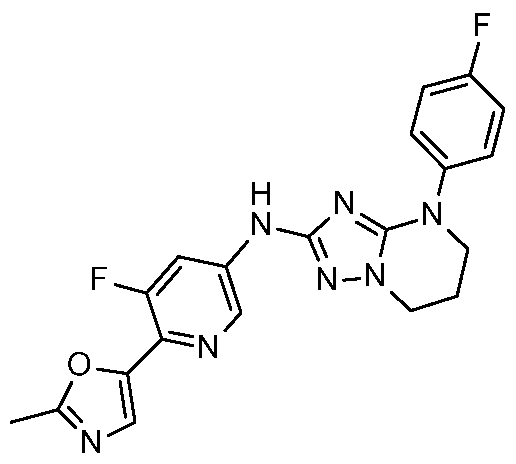
Using the general procedure 1 , from 2-bromo-4-(4-fluorophenyl)-6,7-dihydro-5H- [l,2,4]triazolo[l,5-a]pyrimidine (precursor of 15-6) and 5-(5-bromo-3-fluoro-2-pyridyl)-2- methyl-oxazole was prepared 15 mg of the title compound as a white solid. MS (ES+) m/z: 409.2 t(M+H)+].
Example 40
4-(3,4-difluorophenyl)-N-[4-(4-fluoroimidazol-l-yl)-3-methoxy-phenyl]-6,7-dihydro-5H-
[l,2,4]triazolo[l,5-a]pyrimidin-2-amine
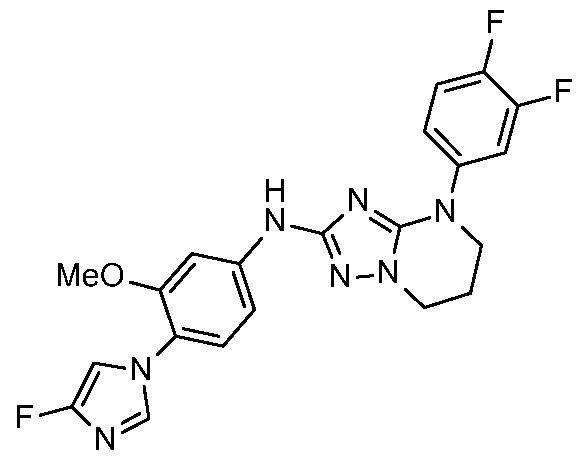
Using the general procedure 1 , from 2-bromo-4-(3,4-difluorophenyl)-6,7-dihydro-5H- [l,2,4]triazolo[l,5-a]pyrimidine (15-1) and 4-(4-fluoroimidazol-l-yl)-3-methoxy-aniline was prepared 24 mg of the title compound as a white solid. MS (ES+) m/z: 442.2 [(M+H)+].
Example 41
4-(3,5-difluorophenyl)-N-[3-methoxy-4-(3-methyl-l,2,4-triazol-l-yl)phenyl]-6,7-dihydro-
5H-[l,2,4]triazolo[l,5-a]pyrimidin-2-amine
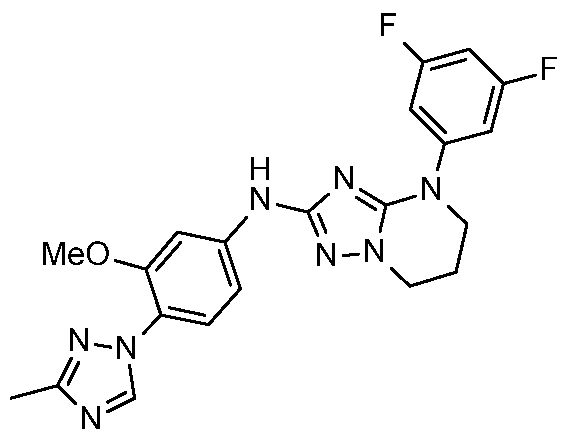
Using the general procedure 1 , from 2-bromo-4-(3,5-difluorophenyl)-6,7-dihydro-5H- [l,2,4]triazolo[l,5-a]pyrimidine (15-2) and 3-methoxy-4-(3-methyl-l,2,4-triazol-l-yl)aniline was prepared 16 mg of the title compound as a white solid. MS (ES+) m/z: 439.2 [(M+H)+].
Example 42
N-[4-(4-chloroimidazol-l-yl)-3-methoxy-phenyl]-4-(3,5-difluorophenyl)-6,7-dihydro-5H-
[l,2,4]triazolo[l,5-a]pyrimidin-2-amine

Using the general procedure 1 , from 2-bromo-4-(3,5-difluorophenyl)-6,7-dihydro-5H- [l,2,4]triazolo[l,5-a]pyrimidine (15-2) and 4-(4-chloroimidazol-l-yl)-3-methoxy-aniline was prepared 15 mg of the title compound as a white solid. MS (ES+) m/z: 458.2 [(M+H)+].
Example 43
4-(4-fluorophenyl)-N-[3-methoxy-4-(2-methyloxazol-5-yl)phenyl]-6,7-dihyd]
[l,2,4]triazolo[l,5-a]pyrimidin-2-amine

Using the general procedure 1 , from 2-bromo-4-(4-fluorophenyl)-6,7-dihydro-5H- [l,2,4]triazolo[l,5-a]pyrimidine (15-6) and 3-methoxy-4-(2-methyloxazol-5-yl)aniline was prepared 13 mg of the title compound as a white solid. MS (ES+) m/z: 421.2 [(M+H)+].
Example 44
N-[4-(4-chloroimidazol-l-yl)-3-methoxy-phenyl]-4-[4-(trifluoromethyl)phenyl]-5,6- dihydroimidazo[l,2-b][l,2,4]triazol-2-amine

Using the general procedure 1 , from 2-bromo-4-[4-(trifluoromethyl)phenyl]-5,6- dihydroimidazo[l,2-b][l ,2,4]triazole (9-2) and 4-(4-chloroimidazol-l-yl)-3-methoxy-aniline was prepared 17 mg of the title compound as a white solid. MS (ES+) m/z: 476.2 [(M+H)+].
Example 45
N-[4-(4-chloroimidazol-l-yl)-3-methoxy-phenyl]-4-(2,3?4-trifluorophi
dihydroimidazo[l,2-b][l,2,4]triazol-2-amine

Using the general procedure 1 , from 2-bromo-4-(2,3,4-trifluorophenyl)-5,6-dihydroimidazo[l ,2- b][l ,2,4]triazole (9-3) and 4-(4-chloroimidazol-l-yl)-3-methoxy-aniline was prepared 32 mg of the title compound as a white solid. MS (ES+) m/z: 462.2 [(M+H)+].
Example 46
N-[4-(4-chloroimidazol-l-yl)-3-methoxy-phenyl]-4-(3,4-difluorophi
dihydroimidazo[l,2-b][l,2,4]triazol-2-amine

Example 47
4-(3,4-difluorophenyl)-N-[4-(4-methyltriazol-l-yl)phenyl]-6,7-dihydro-5H- [l,2,4]triazolo[l,5-a]pyrimidin-2-amine

Using the general procedure 1 , from 2-bromo-4-(3,4-difluorophenyl)-6,7-dihydro-5H- [l,2,4]triazolo[l,5-a]pyrimidine (15-1) and 4-(4-methyltriazol-l-yl)aniline was prepared 20 mg of the title compound as a white solid. MS (ES+) m/z: 409.2 [(M+H)+].
Example 48
N-[3-methoxy-4-(3-methyl-l,2,4-triazol-l-yl)phenyl]-4-phenyl-6,7-dihydro-5H- [l,2,4]triazolo[l,5-a]pyrimidin-2-amine

Using the general procedure 1 , from 2-bromo-4-phenyl-6,7-dihydro-5H-[l ,2,4]triazolo[l,5- a]pyrimidine (15-7) and 3-methoxy-4-(3-methyl-l,2,4-triazol-l-yl)aniline was prepared 11 the title compound as a white solid. MS (ES+) m/z: 403.1 [(M+H)+].
Claims
1. A compound of formula I

R1 is hydrogen, lower alkyl, lower alkyl substituted by halogen, halogen, lower alkoxy or lower alkoxy substituted by halogen;
and R1 may be different if n is 2 or 3;
R is hydrogen, lower alkyl, lower alkyl substituted by halogen, halogen, CN, lower alkoxy or lower alkoxy substituted by halogen;
X is CH or N;
m is 1 , 2 or 3 ;
-( )m is -(CH2)m-;
n is 1 , 2 or 3 ;
Ar is a five membered heteroaryl group, selected from

R is hydrogen, methyl or chloro;
R4 is hydrogen or methyl;
R5 is F, CI, CHF2 or CF3; or a pharmaceutically active acid addition salt thereof.
2. A compound of formula 1-1 according to claim 1,

R1 is hydrogen, lower alkyl, lower alkyl substituted by halogen, halogen, lower alkoxy or lower alkoxy substituted by halogen;
and R1 may be different if n is 2 or 3;
R is hydrogen, lower alkyl, lower alkyl substituted by halogen, halogen, CN, lower alkoxy or lower alkoxy substituted by halogen;
X is CH or N;
m is 1 , 2 or 3 ;
n is 1 , 2 or 3 ;
R is hydrogen, methyl or chloro;
R4 is hydrogen or methyl;
-( )m is -(CH2)m-; or a pharmaceutically active acid addition salt thereof.
3. A compound of formula 1-1 according to claim 2, which compounds are
N-[3-(difluoromethoxy)-4-(3-methyl-l,2,4-triazol-l-yl)phenyl]-4-(3,4-difluorophenyl)-6,7- dihydro-5H-[l,2,4]triazolo[l,5-a]pyrimidin-2-amine
4-(3,4-difluorophenyl)-N-[3-methoxy-4-(3-methyl-l,2,4-triazol-l-yl)phenyl]-6,7-dihydro-5H- [ 1 ,2,4] triazolo [ 1 ,5 -a]pyrimidin-2-amine
4-(3,4-difluorophenyl)-N-[3-methoxy-4-(3-methyl-l,2,4-triazol-l-yl)phenyl]-5,6,7,8-tetrahydro- [l,2,4]triazolo[l,5-a][l,3]diazepin-2-amine
4-(3,4-difluorophenyl)-N-[3-fluoro-4-(3-methyl-l,2,4-triazol-l-yl)phenyl]-6,7-dihydro-5H- [ 1 ,2,4] triazolo [ 1 ,5 -a]pyrimidin-2-amine
N-[4-(3-chloro-l,2,4-triazol-l-yl)-3-methoxy-phenyl]-4-(3,4-difluorophenyl)-6,7-dihydro-5H-
[ 1 ,2,4] triazolo [ 1 ,5 -a]pyrimidin-2-amine
4-(3,4-difluorophenyl)-N-[3-fluoro-4-(5-methyl-l,2,4-triazol-l-yl)phenyl]-6,7-dihydro-5H- [ 1 ,2,4] triazolo [ 1 ,5 -a]pyrimidin-2-amine
4-(3,4-difluorophenyl)-N-[3-fluoro-4-(l,2,4-triazol-l-yl)phenyl]-6,7-dihydro-5H- [ 1 ,2,4] triazolo [ 1 ,5 -a]pyrimidin-2-amine
N-[3-methoxy-4-(3-methyl-l,2,4-triazol-l-yl)phenyl]-4-(2,3,4-trifluorophenyl)-6,7-dihydro-5H- [ 1 ,2,4] triazolo [ 1 ,5 -a]pyrimidin-2-amine
N-[4-(3-chloro-l,2,4-triazol-l-yl)-3-fluoro-phenyl]-4-(3,4-difluorophenyl)-6,7-dihydro-5H- [ 1 ,2,4] triazolo [ 1 ,5 -a]pyrimidin-2-amine
4- (3 ,4-difluorophenyl)-N- [4-(3 -methyl- 1 ,2,4-triazol- 1 -yl)phenyl] -6,7-dihydro-5H- [ 1 ,2,4] triazolo [ 1 ,5 -a]pyrimidin-2-amine
5- [[4-(3,4-difluorophenyl)-6,7-dihydro-5H-[l,2,4]triazolo[l,5-a]pyrimidin-2-yl]amino]-2-(3- methyl- 1 ,2,4-triazol- 1 -yl)benzonitrile
4-(3-fluorophenyl)-N-[3-methoxy-4-(3-methyl-l,2,4-triazol-l-yl)phenyl]-6,7-dihydro-5H- [ 1 ,2,4] triazolo [ 1 ,5 -a]pyrimidin-2-amine
4-(4-fluorophenyl)-N-[3-methoxy-4-(3-methyl-l,2,4-triazol-l-yl)phenyl]-6,7-dihydro-5H- [ 1 ,2,4] triazolo [ 1 ,5 -a]pyrimidin-2-amine
N-[3-(difluoromethoxy)-4-(3-methyl-l,2,4-triazol-l-yl)phenyl]-4-(4-fluorophenyl)-6,7-dihydro- 5H-[l,2,4]triazolo[l,5-a]pyrimidin-2-amine
4-(3,5-difluorophenyl)-N-[3-methoxy-4-(3-methyl-l,2,4-triazol-l-yl)phenyl]-6,7-dihydro-5H- [ 1 ,2,4] triazolo [ 1 ,5 -a]pyrimidin-2-amine or
N-[3-methoxy-4-(3-methyl-l,2,4-triazol-l-yl)phenyl]-4-phenyl-6,7-dihydro-5H- [ 1 ,2,4] triazolo [ 1 ,5 -a]pyrimidin-2-amine.
4. A compound of formula 1-2 according to claim 1 ,

and R1 may be different if n is 2 or 3;
R is hydrogen, lower alkyl, lower alkyl substituted by halogen, halogen, CN, lower alkoxy or lower alkoxy substituted by halogen;
X is CH or N;
m is 1 , 2 or 3 ;
n is 1 , 2 or 3 ;
R5 is F, Cl, CHF2 or CF3;
-( )m is -(CH2)m-;
or a pharmaceutically active acid addition salt thereof.
5. A compound of formula 1-2 according to claim 4, which compounds are
4-(3,4-difluorophenyl)-N-[3-methoxy-4-[4-(trifluoromethyl)imidazol-l-yl]phenyl]-6,7-dihydro- 5H-[l,2,4]triazolo[l,5-a]pyrimidin-2-amine
N-[6-(4-chloroimidazol-l-yl)-5-methoxy-3-pyridyl]-4-(3,4-difluorophenyl)-6,7-dihydro-5H- [ 1 ,2,4] triazolo [ 1 ,5 -a]pyrimidin-2-amine
N-[4-(4-chloroimidazol-l-yl)-3-methoxy-phenyl]-4-(3,4-difluorophenyl)-6,7-dihydro-5H- [ 1 ,2,4] triazolo [ 1 ,5 -a]pyrimidin-2-amine
N-[4-(4-chloroimidazol-l-yl)-3-methoxy-phenyl]-4-(3,4-difluorophenyl)-5,6,7,8-tetrahydro- [l,2,4]triazolo[l,5-a][l,3]diazepin-2-amine
4-(3,4-difluorophenyl)-N-[3-methoxy-4-[4-(trifluoromethyl)imidazol-l-yl]phenyl]-5,6,7,8- tetrahydro-[l,2,4]triazolo[l,5-a][l,3]diazepin-2-amine
N-[4-(4-chloroimidazol-l-yl)-3-methoxy-phenyl]-4-(2,3,4-trifluorophenyl)-6,7-dihydro-5H- [ 1 ,2,4] triazolo [ 1 ,5 -a]pyrimidin-2-amine
N-[4-(4-chloroimidazol-l-yl)-3-fluoro-phenyl]-4-(3,4-difluorophenyl)-6,7-dihydro-5H- [ 1 ,2,4] triazolo [ 1 ,5 -a]pyrimidin-2-amine
N-[4-(4-chloroimidazol-l-yl)phenyl]-4-(3,4-difluorophenyl)-6,7-dihydro-5H-[l,2,4]triazolo[l,5- a]pyrimidin-2-amine
2-(4-chloroimidazol-l-yl)-5-[[4-(3,4-difluorophenyl)-6,7-dihydro-5H-[l,2,4]triazolo[l,5- a]pyrimidin-2-yl]amino]benzonitrile
2-[4-(difluoromethyl)imidazol-l-yl]-5-[[4-(3,4-difluorophenyl)-6,7-dihydro-5H- [ 1 ,2,4] triazolo [ 1 ,5 -a]pyrimidin-2-yl] amino]benzonitrile
N-[3-chloro-4-(4-chloroimidazol-l-yl)phenyl]-4-(3,4-difluorophenyl)-6,7-dihydro-5H- [ 1 ,2,4] triazolo [ 1 ,5 -a]pyrimidin-2-amine
N-[4-(4-chloroimidazol-l-yl)-3-methoxy-phenyl]-4-(3-fluorophenyl)-6,7-dihydro-5H- [ 1 ,2,4] triazolo [ 1 ,5 -a]pyrimidin-2-amine
N-[4-(4-chloroimidazol-l-yl)-3-methoxy-phenyl]-4-(4-fluorophenyl)-6,7-dihydro-5H- [ 1 ,2,4] triazolo [ 1 ,5 -a]pyrimidin-2-amine
2 4-chloroimidazol-l-yl)-5-[[4-(4-fluorophenyl)-6,7-dihydro-5H-[l,2,4]triazolo[l,5- a]pyrimidin-2-yl]amino]benzonitrile
N-[4-(4-chloroimidazol-l-yl)-3-fluoro-phenyl]-4-(4-fluorophenyl)-6,7-dihydro-5H- [ 1 ,2,4] triazolo [ 1 ,5 -a]pyrimidin-2-amine
N-[6-(4-chloroimidazol-l-yl)-5-methoxy-3-pyridyl]-4-(4-fluorophenyl)-6,7-dihydro-5H- [ 1 ,2,4] triazolo [ 1 ,5 -a]pyrimidin-2-amine
4-(3,4-difluorophenyl)-N-[4-(4-fluoroimidazol-l-yl)-3-methoxy-phenyl]-6,7-dihydro-5H- [ 1 ,2,4] triazolo [ 1 ,5 -a]pyrimidin-2-amine
N-[4-(4-chloroimidazol-l-yl)-3-methoxy-phenyl]-4-(3,5-difluorophenyl)-6,7-dihydro-5H- [ 1 ,2,4] triazolo [ 1 ,5 -a]pyrimidin-2-amine
N-[4-(4-chloroimidazol-l-yl)-3-methoxy-phenyl]-4-[4-(trifluoromethyl)phenyl]-5,6- dihydroimidazo [ 1 ,2-b] [ 1 ,2,4] triazol-2-amine
N-[4-(4-chloroimidazol-l-yl)-3-methoxy-phenyl]-4-(2,3,4-trifluorophenyl)-5,6- dihydroimidazo [ 1 ,2-b] [ 1 ,2,4] triazol-2-amine or
N- [4-(4-chloroimidazol- 1 -yl)-3-methoxy-phenyl] -4-(3 ,4-difluorophenyl)-5 ,6- dihydroimidazo [ 1 ,2-b] [ 1 ,2,4] triazol-2-amine.
6. A compound of formula 1-3 according to claim 1 ,

R1 is hydrogen, lower alkyl, lower alkyl substituted by halogen, halogen, lower alkoxy or lower alkoxy substituted by halogen;
and R1 may be different if n is 2 or 3;
R is hydrogen, lower alkyl, lower alkyl substituted by halogen, halogen, CN, lower alkoxy or lower alkoxy substituted by halogen;
X is CH or N;
m is 1 , 2 or 3 ;
n is 1 , 2 or 3 ;
-( )m is -(CH2)m-;
or a pharmaceutically active acid addition salt thereof.
7. A compound of formula 1-3 according to claim 6, which compounds are
4-(3,4-difluorophenyl)-N-[3-methoxy-4-(2-methyloxazol-5-yl)phenyl]-6,7-dihydro-5H- [ 1 ,2,4] triazolo [ 1 ,5 -a]pyrimidin-2-amine
4-(3,4-difluorophenyl)-N-[3-methoxy-4-(2-methyloxazol-5-yl)phenyl]-5,6,7,8-tetrahydro- [l,2,4]triazolo[l,5-a][l,3]diazepin-2-amine
N-[3-methoxy-4-(2-methyloxazol-5-yl)phenyl]-4-(2,3,4-trifluorophenyl)-6,7-dihydro-5H- [ 1 ,2,4] triazolo [ 1 ,5 -a]pyrimidin-2-amine
4-(3,4-difluorophenyl)-N-[3-fluoro-4-(2-methyloxazol-5-yl)phenyl]-6,7-dihydro-5H- [ 1 ,2,4] triazolo [ 1 ,5 -a]pyrimidin-2-amine
4- (3,4-difluorophenyl)-N-[4-(2-methyloxazol-5-yl)phenyl]-6,7-dihydro-5H-[l,2,4]triazolo[l,5- a]pyrimidin-2-amine
5- [[4-(3,4-difluorophenyl)-6,7-dihydro-5H-[l,2,4]triazolo[l,5-a]pyrimidin-2-yl]amino]-2-(2-
methyloxazol-5-yl)benzonitrile
N-[5-fluoro-6-(2-methyloxazol-5-yl)-3-pyridyl]-4-(4-fluorophenyl)-6,7-dihydro-5H- [ 1 ,2,4] triazolo [ 1 ,5 -a]pyrimidin-2-amine or
4-(4-fluorophenyl)-N-[3-methoxy-4-(2-methyloxazol-5-yl)phenyl]-6,7-dihydro-5H- [ 1 ,2,4] triazolo [ 1 ,5 -a]pyrimidin-2-amine.
8. A compound of formula 1-4 according to claim 1,
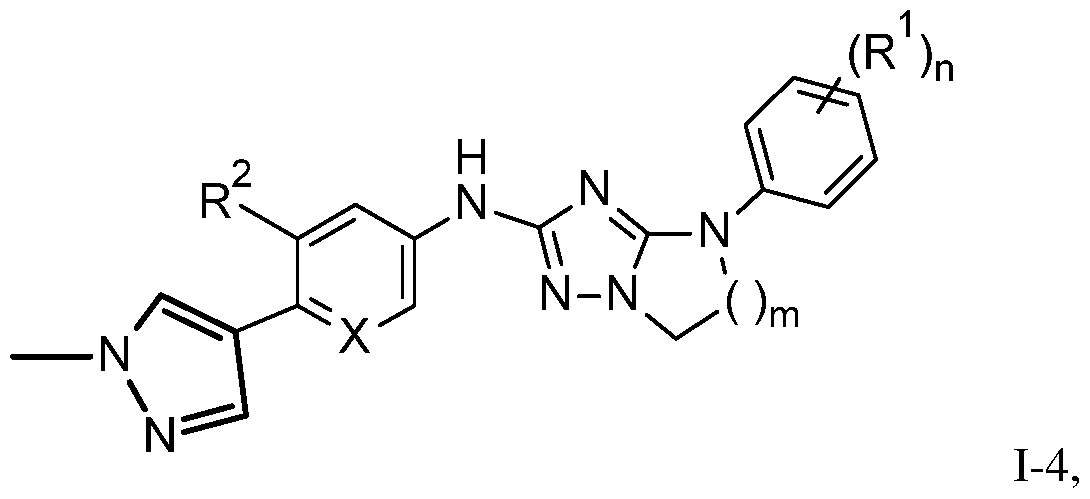
R1 is hydrogen, lower alkyl, lower alkyl substituted by halogen, halogen, lower alkoxy or lower alkoxy substituted by halogen;
and R1 may be different if n is 2 or 3;
R is hydrogen, lower alkyl, lower alkyl substituted by halogen, halogen, CN, lower alkoxy or lower alkoxy substituted by halogen;
X is CH or N;
m is 1 , 2 or 3 ;
n is 1 , 2 or 3 ;
-( )m is -(CH2)m-;
or a pharmaceutically active acid addition salt thereof.
9. A compound of formula 1-4 according to claim 8, which compound is
4-(3,4-difluorophenyl)-N-[3-methoxy-4-(l-methylpyrazol-4-yl)phenyl]-6,7-dihydro-5H- [ 1 ,2,4] triazolo [ 1 ,5 -a]pyrimidin-2-amine.
10. A compound of formula 1-5 according to claim 1,

R1 is hydrogen, lower alkyl, lower alkyl substituted by halogen, halogen, lower alkoxy or lower alkoxy substituted by halogen;
and R1 may be different if n is 2 or 3;
R is hydrogen, lower alkyl, lower alkyl substituted by halogen, halogen, CN, lower alkoxy or lower alkoxy substituted by halogen;
X is CH or N;
m is 1 , 2 or 3 ;
n is 1 , 2 or 3 ;
-( )m is -(CH2)m-;
or a pharmaceutically active acid addition salt thereof.
11. A compound of formula 1-5 according to claim 10, which compound is
4-(3,4-difluorophenyl)-N-[3-methoxy-4-(3-methyl-lH-pyrazol-5-yl)phenyl]-6,7-dihydro-5H- [ 1 ,2,4] triazolo [ 1 ,5 -a]pyrimidin-2-amine.
12. A compound of formula 1-6 according to claim 1,

and R1 may be different if n is 2 or 3;
is hydrogen, lower alkyl, lower alkyl substituted by halogen, halogen, CN, lower alkoxy or lower alkoxy substituted by halogen;
X is CH or N;
m is 1 , 2 or 3 ;
n is 1 , 2 or 3 ;
-( ) ':m is -(CH2)m-;
or a pharmaceutically active acid addition salt thereof.
13. A compound of formula 1-6 according to claim 12,
4-(3,4-difluorophenyl)-N-[4-(4-methyltriazol-l-yl)phenyl]-6,7-dihydro-5H-[l,2,4]triazolo[l,5- a]pyrimidin-2-amine.
14. A process for preparing a compound of formula I as defined in any one of claims 1 - 13, which process comprises
a) reacting a compound of formula 9
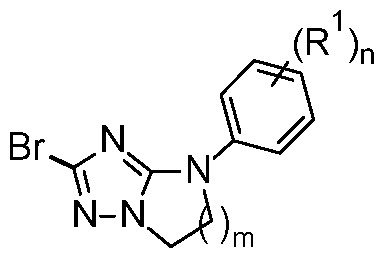
with a compound of formula 10-b

to a compound of formula I

wherein the substituents have the meaning as described above, and,
if desired, converting the compounds obtained into pharmaceutically acceptable acid addition salts;
15. A compound according to any one of claims 1 - 13, whenever prepared by a process as claimed in claim 14.
16. A medicament containing one or more compounds as claimed in any one of claims 1 - 13 and pharmaceutically acceptable excipients.
17. A medicament according to claim 16 for the treatment of Alzheimer's disease, cerebral amyloid angiopathy, hereditary cerebral hemorrhage with amyloidosis, Dutch-type (HCHWA-D), multi-infarct dementia, dementia pugilistica or Down syndrome.
18. The use of a compound in any one of claims 1 - 13 for the manufacture of medicaments for the treatment of Alzheimer's disease, cerebral amyloid angiopathy, hereditary cerebral hemorrhage with amyloidosis, Dutch-type (HCHWA-D), multi-infarct dementia, dementia pugilistica or Down syndrome.
19. A compound according to any one of claims 1 - 13 for use as therapeutically active substance.
20. The use of a compound in any one of claims 1 - 13 for the treatment of Alzheimer's disease, cerebral amyloid angiopathy, hereditary cerebral hemorrhage with amyloidosis, Dutch- type (HCHWA-D), multi-infarct dementia, dementia pugilistica or Down syndrome.
21. A compound according to any one of claims 1 - 13 for the treatment of Alzheimer's disease, cerebral amyloid angiopathy, hereditary cerebral hemorrhage with amyloidosis, Dutch- type (HCHWA-D), multi-infarct dementia, dementia pugilistica or Down syndrome.
22. A method for the treatment of Alzheimer's disease, cerebral amyloid angiopathy, hereditary cerebral hemorrhage with amyloidosis, Dutch-type (HCHWA-D), multi-infarct
dementia, dementia pugilistica or Down syndrome, which method comprises administering an effective amount of a compound as defined in any one of claims 1 - 13.
23. The invention as hereinbefore described.
***
Priority Applications (4)
| Application Number | Priority Date | Filing Date | Title |
|---|---|---|---|
| US16/339,345 US10647721B2 (en) | 2016-10-04 | 2017-10-02 | Bicyclic heteroaryl derivatives |
| JP2019516113A JP6956175B2 (en) | 2016-10-04 | 2017-10-02 | Bicyclic heteroaryl derivative |
| EP17784594.8A EP3523304B1 (en) | 2016-10-04 | 2017-10-02 | Bicyclic heteroaryl derivatives |
| CN201780046901.6A CN109476670B (en) | 2016-10-04 | 2017-10-02 | Bicyclic Heteroaryl Derivatives |
Applications Claiming Priority (2)
| Application Number | Priority Date | Filing Date | Title |
|---|---|---|---|
| EP16192237 | 2016-10-04 | ||
| EP16192237.2 | 2016-10-04 |
Publications (1)
| Publication Number | Publication Date |
|---|---|
| WO2018065340A1 true WO2018065340A1 (en) | 2018-04-12 |
Family
ID=57047127
Family Applications (1)
| Application Number | Title | Priority Date | Filing Date |
|---|---|---|---|
| PCT/EP2017/074927 Ceased WO2018065340A1 (en) | 2016-10-04 | 2017-10-02 | Bicyclic heteroaryl derivatives |
Country Status (5)
| Country | Link |
|---|---|
| US (1) | US10647721B2 (en) |
| EP (1) | EP3523304B1 (en) |
| JP (1) | JP6956175B2 (en) |
| CN (1) | CN109476670B (en) |
| WO (1) | WO2018065340A1 (en) |
Cited By (6)
| Publication number | Priority date | Publication date | Assignee | Title |
|---|---|---|---|---|
| US20190194183A1 (en) * | 2016-06-27 | 2019-06-27 | Hoffmann-La Roche Inc. | Triazolopyridines |
| WO2020072602A1 (en) | 2018-10-02 | 2020-04-09 | Frequency Therapeutics, Inc. | Pharmaceutical compositions comprising otic therapeutic agents and related methods |
| WO2020210388A1 (en) | 2019-04-08 | 2020-10-15 | Frequency Therapeutics, Inc. | Combination of chir99021 and valproic acid for treating hearing loss |
| WO2022122800A1 (en) | 2020-12-10 | 2022-06-16 | F. Hoffmann-La Roche Ag | Process for the preparation 4-(3,5-difluorophenyl)-n-[3-(6-methylpyrimidin-4-yl)-3- azabicyclo[3.2.1]octan-8-yl]-6,7-dihydro-5h-[1,2,4]triazolo[1,5-a]pyrimidin-2-amine |
| EP4556466A4 (en) * | 2022-08-08 | 2025-11-19 | Beyang Therapeutics Co Ltd | PROTEIN TYROSINE KINASE INTAKERS AND THEIR MEDICINAL USE |
| WO2026146201A1 (en) | 2025-01-03 | 2026-07-09 | AlzeCure Pharma AB | New compounds and uses |
Citations (3)
| Publication number | Priority date | Publication date | Assignee | Title |
|---|---|---|---|---|
| WO2011092272A1 (en) * | 2010-02-01 | 2011-08-04 | F. Hoffmann-La Roche Ag | Gamma secretase modulaters |
| WO2011101304A2 (en) * | 2010-02-17 | 2011-08-25 | F. Hoffmann-La Roche Ag | Piperidine derivatives |
| WO2012116965A1 (en) * | 2011-03-02 | 2012-09-07 | F. Hoffmann-La Roche Ag | Bridged piperidine derivatives |
Family Cites Families (13)
| Publication number | Priority date | Publication date | Assignee | Title |
|---|---|---|---|---|
| AU2007282535B9 (en) | 2006-08-08 | 2013-06-20 | Chugai Seiyaku Kabushiki Kaisha | Pyrimidine derivative as PI3K inhibitor and use thereof |
| CN101675045B (en) * | 2007-05-11 | 2012-11-28 | 弗·哈夫曼-拉罗切有限公司 | Hetarylanilines as modulators for amyloid beta |
| EP2229375A1 (en) | 2007-12-06 | 2010-09-22 | Schering Corporation | Gamma secretase modulators |
| EP2268636A1 (en) | 2007-12-11 | 2011-01-05 | Schering Corporation | Gamma secretase modulators |
| US8246273B2 (en) | 2009-07-20 | 2012-08-21 | Wilson Michael W N | Assemblage and method for undersea laying of pipeline from a ship spool |
| PH12012501381A1 (en) | 2010-01-15 | 2012-10-22 | Janssen Pharmaceuticals Inc | Novel substituted bicyclic triazole derivatives as gamma secretase modulators |
| EP2687528A1 (en) * | 2012-07-17 | 2014-01-22 | Ares Trading S.A. | Fused triazole derivatives as gamma secretase modulators |
| ES2644367T3 (en) | 2013-08-09 | 2017-11-28 | Grünenthal GmbH | New substituted condensed pyrimidine compounds |
| US9824250B2 (en) | 2013-11-04 | 2017-11-21 | Trimble Inc. | Location information within an area defined by a grid of radio-frequency tag circuits |
| WO2015109109A1 (en) | 2014-01-15 | 2015-07-23 | Forum Pharmaceuticals Inc. | Fused morpholinopyrimidines and methods of use thereof |
| WO2015153709A1 (en) | 2014-04-02 | 2015-10-08 | Bristol-Myers Squibb Company | Difluoromethoxy compound with low bioactivation potential for the reduction of beta-amyloid production |
| WO2017042114A1 (en) | 2015-09-09 | 2017-03-16 | F. Hoffmann-La Roche Ag | Bridged piperidine derivatives |
| CN109415369B (en) | 2016-07-08 | 2021-12-07 | 豪夫迈·罗氏有限公司 | Fused pyrimidine derivatives |
-
2017
- 2017-10-02 EP EP17784594.8A patent/EP3523304B1/en active Active
- 2017-10-02 JP JP2019516113A patent/JP6956175B2/en active Active
- 2017-10-02 US US16/339,345 patent/US10647721B2/en active Active
- 2017-10-02 WO PCT/EP2017/074927 patent/WO2018065340A1/en not_active Ceased
- 2017-10-02 CN CN201780046901.6A patent/CN109476670B/en active Active
Patent Citations (3)
| Publication number | Priority date | Publication date | Assignee | Title |
|---|---|---|---|---|
| WO2011092272A1 (en) * | 2010-02-01 | 2011-08-04 | F. Hoffmann-La Roche Ag | Gamma secretase modulaters |
| WO2011101304A2 (en) * | 2010-02-17 | 2011-08-25 | F. Hoffmann-La Roche Ag | Piperidine derivatives |
| WO2012116965A1 (en) * | 2011-03-02 | 2012-09-07 | F. Hoffmann-La Roche Ag | Bridged piperidine derivatives |
Non-Patent Citations (18)
| Title |
|---|
| BEHER ET AL., J. BIOL. CHEM., vol. 279, 2004, pages 43419 - 26 |
| BURSAVICH ET AL., J. MED. CHEM., vol. 59, 2016 |
| CLARKE ET AL., J. BIOL. CHEM., vol. 281, 2006, pages 31279 - 89 |
| EBKE ET AL., J. BIOL. CHEM., vol. 286, 2011, pages 37181 - 86 |
| HALL ET AL., PROGRESS IN MED. CHEM., vol. 53, 2014, pages 101 - 145 |
| JANTZEN ET AL., J.NEUROSCIENCE, vol. 22, 2002, pages 226 - 54 |
| KUKAR ET AL., NATURE MED., vol. 11, 2005, pages 545 - 50 |
| LI ET AL., BIOCHEMISTRY, vol. 52, 2013, pages 3197 - 3216 |
| LLEO ET AL., NATURE MED., vol. 10, 2004, pages 1065 - 6 |
| MORIHARA ET AL., J. NEUROCHEM., vol. 83, 2002, pages 1009 - 12 |
| NARLAWAR ET AL., J. MED. CHEM., vol. 49, 2006, pages 7588 - 91 |
| OEHLICH, GIJSEN ET AL., J. MED. CHEM., vol. 54, 2011, pages 669 - 698 |
| PERRETTO ET AL., J. MED. CHEM., vol. 48, 2005, pages 5705 - 20 |
| STOCK ET AL., BIOORG. MED. CHEM. LETT., vol. 16, 2006, pages 2219 - 2223 |
| TAKAHASHI ET AL., J. BIOL. CHEM., vol. 278, 2003, pages 18644 - 70 |
| ULRIKA YNGVE ET AL: "Triazolopyrimidinones as [gamma]-secretase modulators: structure-activity relationship, modulator profile, and in vivo profiling", MEDCHEMCOMM, vol. 4, no. 2, 1 January 2013 (2013-01-01), United Kingdom, pages 422, XP055431124, ISSN: 2040-2503, DOI: 10.1039/c2md20312j * |
| WEGGEN ET AL., NATURE, vol. 414, 2001, pages 212 - 16 |
| X. BAI; C. YAN; G. YANG; P. LU; D. MA; L. SUN; R. ZHOU; S. H. W. SCHERES; Y. SHI, NATURE, vol. 525, 2015, pages 212 - 217 |
Cited By (8)
| Publication number | Priority date | Publication date | Assignee | Title |
|---|---|---|---|---|
| US20190194183A1 (en) * | 2016-06-27 | 2019-06-27 | Hoffmann-La Roche Inc. | Triazolopyridines |
| US10875854B2 (en) * | 2016-06-27 | 2020-12-29 | Hoffmann-La Roche Inc. | Triazolopyridines |
| WO2020072602A1 (en) | 2018-10-02 | 2020-04-09 | Frequency Therapeutics, Inc. | Pharmaceutical compositions comprising otic therapeutic agents and related methods |
| WO2020072601A1 (en) | 2018-10-02 | 2020-04-09 | Frequency Therapeutics, Inc. | Pharmaceutical compositions comprising otic therapeutic agents and related methods |
| WO2020210388A1 (en) | 2019-04-08 | 2020-10-15 | Frequency Therapeutics, Inc. | Combination of chir99021 and valproic acid for treating hearing loss |
| WO2022122800A1 (en) | 2020-12-10 | 2022-06-16 | F. Hoffmann-La Roche Ag | Process for the preparation 4-(3,5-difluorophenyl)-n-[3-(6-methylpyrimidin-4-yl)-3- azabicyclo[3.2.1]octan-8-yl]-6,7-dihydro-5h-[1,2,4]triazolo[1,5-a]pyrimidin-2-amine |
| EP4556466A4 (en) * | 2022-08-08 | 2025-11-19 | Beyang Therapeutics Co Ltd | PROTEIN TYROSINE KINASE INTAKERS AND THEIR MEDICINAL USE |
| WO2026146201A1 (en) | 2025-01-03 | 2026-07-09 | AlzeCure Pharma AB | New compounds and uses |
Also Published As
| Publication number | Publication date |
|---|---|
| EP3523304B1 (en) | 2021-01-27 |
| US10647721B2 (en) | 2020-05-12 |
| CN109476670B (en) | 2022-06-28 |
| CN109476670A (en) | 2019-03-15 |
| JP2019529464A (en) | 2019-10-17 |
| EP3523304A1 (en) | 2019-08-14 |
| JP6956175B2 (en) | 2021-11-02 |
| US20190233427A1 (en) | 2019-08-01 |
Similar Documents
| Publication | Publication Date | Title |
|---|---|---|
| EP3519418B1 (en) | Bridged piperidine derivatives | |
| EP3523304B1 (en) | Bicyclic heteroaryl derivatives | |
| EP3535266B1 (en) | Bicyclic heteroaryl derivatives | |
| EP3347363B1 (en) | N-(3-azabicyclo[3.2.1]octan-8-yl)-8-(4-phenyl)-5,6,7,8-tetrahydro-[1,2,4]triazolo[l,5-a]pyridin-2-amine derivatives as gamma-secretase modulators for treating alzheimer's disease | |
| AU2019395774B2 (en) | 7-phenoxy-N-(3-azabicyclo[3.2.1]octan-8-yl)-6,7-dihydro-5H-pyrrolo[1,2-b][1,2,4]triazol-2-amine derivatives and related compounds as gamma-secretase modulators for the treatment of Alzheimer's disease | |
| JP2013518082A (en) | γ-secretase modulator | |
| IL293107A (en) | Adenosine receptor antagonist compounds | |
| EP3475279B1 (en) | Triazolopyridines as gamma-secretase modulators | |
| EP3728262B1 (en) | Triazolo-azepine derivatives | |
| HK1262487A1 (en) | Bicyclic heteroaryl derivatives | |
| HK1262487B (en) | Bicyclic heteroaryl derivatives | |
| HK40002502A (en) | Bridged piperidine derivatives | |
| HK40002502B (en) | Bridged piperidine derivatives |
Legal Events
| Date | Code | Title | Description |
|---|---|---|---|
| 121 | Ep: the epo has been informed by wipo that ep was designated in this application |
Ref document number: 17784594 Country of ref document: EP Kind code of ref document: A1 |
|
| ENP | Entry into the national phase |
Ref document number: 2019516113 Country of ref document: JP Kind code of ref document: A |
|
| NENP | Non-entry into the national phase |
Ref country code: DE |
|
| ENP | Entry into the national phase |
Ref document number: 2017784594 Country of ref document: EP Effective date: 20190506 |