EP4258419A1 - Battery, electrical device, and battery preparation method and device - Google Patents
Battery, electrical device, and battery preparation method and device Download PDFInfo
- Publication number
- EP4258419A1 EP4258419A1 EP22719499.0A EP22719499A EP4258419A1 EP 4258419 A1 EP4258419 A1 EP 4258419A1 EP 22719499 A EP22719499 A EP 22719499A EP 4258419 A1 EP4258419 A1 EP 4258419A1
- Authority
- EP
- European Patent Office
- Prior art keywords
- battery
- thermal management
- battery cell
- wall
- flow channel
- Prior art date
- Legal status (The legal status is an assumption and is not a legal conclusion. Google has not performed a legal analysis and makes no representation as to the accuracy of the status listed.)
- Granted
Links
Images



Classifications
-
- H—ELECTRICITY
- H01—ELECTRIC ELEMENTS
- H01M—PROCESSES OR MEANS, e.g. BATTERIES, FOR THE DIRECT CONVERSION OF CHEMICAL ENERGY INTO ELECTRICAL ENERGY
- H01M10/00—Secondary cells; Manufacture thereof
- H01M10/60—Heating or cooling; Temperature control
- H01M10/65—Means for temperature control structurally associated with the cells
- H01M10/656—Means for temperature control structurally associated with the cells characterised by the type of heat-exchange fluid
- H01M10/6567—Liquids
- H01M10/6568—Liquids characterised by flow circuits, e.g. loops, located externally to the cells or cell casings
-
- H—ELECTRICITY
- H01—ELECTRIC ELEMENTS
- H01M—PROCESSES OR MEANS, e.g. BATTERIES, FOR THE DIRECT CONVERSION OF CHEMICAL ENERGY INTO ELECTRICAL ENERGY
- H01M10/00—Secondary cells; Manufacture thereof
- H01M10/60—Heating or cooling; Temperature control
- H01M10/65—Means for temperature control structurally associated with the cells
- H01M10/651—Means for temperature control structurally associated with the cells characterised by parameters specified by a numeric value or mathematical formula, e.g. ratios, sizes or concentrations
-
- H—ELECTRICITY
- H01—ELECTRIC ELEMENTS
- H01M—PROCESSES OR MEANS, e.g. BATTERIES, FOR THE DIRECT CONVERSION OF CHEMICAL ENERGY INTO ELECTRICAL ENERGY
- H01M10/00—Secondary cells; Manufacture thereof
- H01M10/60—Heating or cooling; Temperature control
- H01M10/61—Types of temperature control
- H01M10/613—Cooling or keeping cold
-
- H—ELECTRICITY
- H01—ELECTRIC ELEMENTS
- H01M—PROCESSES OR MEANS, e.g. BATTERIES, FOR THE DIRECT CONVERSION OF CHEMICAL ENERGY INTO ELECTRICAL ENERGY
- H01M10/00—Secondary cells; Manufacture thereof
- H01M10/60—Heating or cooling; Temperature control
- H01M10/65—Means for temperature control structurally associated with the cells
- H01M10/655—Solid structures for heat exchange or heat conduction
- H01M10/6554—Rods or plates
-
- H—ELECTRICITY
- H01—ELECTRIC ELEMENTS
- H01M—PROCESSES OR MEANS, e.g. BATTERIES, FOR THE DIRECT CONVERSION OF CHEMICAL ENERGY INTO ELECTRICAL ENERGY
- H01M10/00—Secondary cells; Manufacture thereof
- H01M10/60—Heating or cooling; Temperature control
- H01M10/65—Means for temperature control structurally associated with the cells
- H01M10/655—Solid structures for heat exchange or heat conduction
- H01M10/6554—Rods or plates
- H01M10/6555—Rods or plates arranged between the cells
-
- H—ELECTRICITY
- H01—ELECTRIC ELEMENTS
- H01M—PROCESSES OR MEANS, e.g. BATTERIES, FOR THE DIRECT CONVERSION OF CHEMICAL ENERGY INTO ELECTRICAL ENERGY
- H01M10/00—Secondary cells; Manufacture thereof
- H01M10/60—Heating or cooling; Temperature control
- H01M10/65—Means for temperature control structurally associated with the cells
- H01M10/655—Solid structures for heat exchange or heat conduction
- H01M10/6556—Solid parts with flow channel passages or pipes for heat exchange
-
- H—ELECTRICITY
- H01—ELECTRIC ELEMENTS
- H01M—PROCESSES OR MEANS, e.g. BATTERIES, FOR THE DIRECT CONVERSION OF CHEMICAL ENERGY INTO ELECTRICAL ENERGY
- H01M10/00—Secondary cells; Manufacture thereof
- H01M10/60—Heating or cooling; Temperature control
- H01M10/65—Means for temperature control structurally associated with the cells
- H01M10/655—Solid structures for heat exchange or heat conduction
- H01M10/6556—Solid parts with flow channel passages or pipes for heat exchange
- H01M10/6557—Solid parts with flow channel passages or pipes for heat exchange arranged between the cells
-
- H—ELECTRICITY
- H01—ELECTRIC ELEMENTS
- H01M—PROCESSES OR MEANS, e.g. BATTERIES, FOR THE DIRECT CONVERSION OF CHEMICAL ENERGY INTO ELECTRICAL ENERGY
- H01M50/00—Constructional details or processes of manufacture of the non-active parts of electrochemical cells other than fuel cells, e.g. hybrid cells
- H01M50/20—Mountings; Secondary casings or frames; Racks, modules or packs; Suspension devices; Shock absorbers; Transport or carrying devices; Holders
- H01M50/204—Racks, modules or packs for multiple batteries or multiple cells
- H01M50/207—Racks, modules or packs for multiple batteries or multiple cells characterised by their shape
- H01M50/209—Racks, modules or packs for multiple batteries or multiple cells characterised by their shape adapted for prismatic or rectangular cells
-
- H—ELECTRICITY
- H01—ELECTRIC ELEMENTS
- H01M—PROCESSES OR MEANS, e.g. BATTERIES, FOR THE DIRECT CONVERSION OF CHEMICAL ENERGY INTO ELECTRICAL ENERGY
- H01M50/00—Constructional details or processes of manufacture of the non-active parts of electrochemical cells other than fuel cells, e.g. hybrid cells
- H01M50/50—Current conducting connections for cells or batteries
- H01M50/502—Interconnectors for connecting terminals of adjacent batteries; Interconnectors for connecting cells outside a battery casing
- H01M50/507—Interconnectors for connecting terminals of adjacent batteries; Interconnectors for connecting cells outside a battery casing comprising an arrangement of two or more busbars within a container structure, e.g. busbar modules
-
- H—ELECTRICITY
- H01—ELECTRIC ELEMENTS
- H01M—PROCESSES OR MEANS, e.g. BATTERIES, FOR THE DIRECT CONVERSION OF CHEMICAL ENERGY INTO ELECTRICAL ENERGY
- H01M10/00—Secondary cells; Manufacture thereof
- H01M10/60—Heating or cooling; Temperature control
- H01M10/62—Heating or cooling; Temperature control specially adapted for specific applications
- H01M10/625—Vehicles
-
- H—ELECTRICITY
- H01—ELECTRIC ELEMENTS
- H01M—PROCESSES OR MEANS, e.g. BATTERIES, FOR THE DIRECT CONVERSION OF CHEMICAL ENERGY INTO ELECTRICAL ENERGY
- H01M10/00—Secondary cells; Manufacture thereof
- H01M10/60—Heating or cooling; Temperature control
- H01M10/64—Heating or cooling; Temperature control characterised by the shape of the cells
- H01M10/647—Prismatic or flat cells, e.g. pouch cells
-
- H—ELECTRICITY
- H01—ELECTRIC ELEMENTS
- H01M—PROCESSES OR MEANS, e.g. BATTERIES, FOR THE DIRECT CONVERSION OF CHEMICAL ENERGY INTO ELECTRICAL ENERGY
- H01M2220/00—Batteries for particular applications
- H01M2220/20—Batteries in motive systems, e.g. vehicle, ship, plane
-
- Y—GENERAL TAGGING OF NEW TECHNOLOGICAL DEVELOPMENTS; GENERAL TAGGING OF CROSS-SECTIONAL TECHNOLOGIES SPANNING OVER SEVERAL SECTIONS OF THE IPC; TECHNICAL SUBJECTS COVERED BY FORMER USPC CROSS-REFERENCE ART COLLECTIONS [XRACs] AND DIGESTS
- Y02—TECHNOLOGIES OR APPLICATIONS FOR MITIGATION OR ADAPTATION AGAINST CLIMATE CHANGE
- Y02E—REDUCTION OF GREENHOUSE GAS [GHG] EMISSIONS, RELATED TO ENERGY GENERATION, TRANSMISSION OR DISTRIBUTION
- Y02E60/00—Enabling technologies; Technologies with a potential or indirect contribution to GHG emissions mitigation
- Y02E60/10—Energy storage using batteries
Definitions
- the present application relates to the field of battery technologies, and in particular, to a battery, a power consumption device, and a method and device for producing a battery.
- the energy density of the battery is an important parameter in performances of the battery; however, other performance parameters of the battery need to be considered when improving the energy density of the battery. Thus, how to improve performances of the battery is one urgent technical problem to be solved in the battery technology.
- the present application provides a battery, a power consumption device, and a method and device for producing a battery, which may improve the energy density of the battery while ensuring the thermal management in the battery, thereby improving performances of the battery.
- a battery including: a plurality of battery cells arranged along a first direction; and a thermal management component extending along the first direction and being connected to a first wall of each battery cell of the plurality of battery cells, the first wall being a wall with a largest surface area of the battery cell; the thermal management component including a flow channel for accommodating a fluid to adjust a temperature of the battery cell; a second direction being perpendicular to the first wall; where, a size of the flow channel in the second direction is W, and a capacity Q of the battery cell and the size W of the flow channel satisfy: 1.0Ah/mm ⁇ Q/W ⁇ 400Ah/mm.
- the thermal management component is disposed in the battery to be connected to the first wall with a largest surface area of each battery cell of the plurality of battery cells that are arranged in a column along the first direction; and the size W of the flow channel of the thermal management component in the second direction and the capacity Q of the battery cell satisfy 1.0Ah/mm ⁇ Q/W ⁇ 400Ah/mm.
- the use of the above thermal management component may also ensure the thermal management in the battery.
- a technical solution of an embodiment of the present application may improve the energy density of the battery while ensuring the thermal management in the battery, thereby improving performances of the battery.
- a size D of the battery cell along the second direction and a size H of the thermal management component along a third direction satisfy: 0.03 ⁇ D/H ⁇ 5.5, and the third size is perpendicular to the first direction and the second direction.
- sizes of the thermal management components may be flexibly set for battery cells of different sizes, which not only meets the requirement of the energy density but also well prevents thermal diffusion between battery cells.
- a size H of the thermal management component along the third direction is 15mm ⁇ 300mm. In this way, space, strength and thermal management may be taken into account to ensure performances of the battery.
- the size W of the flow channel is 0.8mm ⁇ 50mm. In this way, space, strength and thermal management may be taken into account to ensure performances of the battery.
- the thermal management component includes a first thermally conductive plate and a second thermally conductive plate disposed oppositely along the second direction; where, a flow channel is disposed between the first thermally conductive plate and the second thermally conductive plate, and the flow channel is configured to accommodate a fluid to adjust the temperature of the battery cell.
- the thermal management component further includes a stiffener, disposed between the first thermally conductive plate and the second thermally conductive plate; and the stiffener, the first thermally conductive plate and the second thermally conductive plate form the flow channel. In this way, the structural strength of the thermal management component may be enhanced.
- an angle between the stiffener and the first thermally conductive plate or the second thermally conductive plate is an acute angle.
- the thermal management component may have a larger compression space, thereby providing more expansion space for the battery cell.
- the battery cell includes two first walls disposed opposite to each other in the second direction and two second walls disposed oppositely in the first direction, where in the first direction, the second walls of two adjacent battery cells face each other.
- the first wall with the large area is used to connect to the thermal management component, which facilitates the thermal exchange of the battery cells and ensures performances of the battery.
- the battery includes a plurality of the battery cells arranged in a plurality of columns along the first direction and a plurality of the thermal management components, where the plurality of columns of the battery cells and the plurality of the thermal management components are alternately disposed in the second direction.
- the plurality of columns of battery cells and the plurality of thermal management components are connected to each other to form a whole, and are accommodated in the box, which may not only effectively perform the thermal management on each column of battery cells, but also ensure the overall structural strength of the battery, thereby improving performances of the battery.
- the thermal management component and the first wall are bonded. In this way, the strength of the connection between the thermal management component and the first wall is increased.
- a power consumption device including the battery in the above first aspect or any possible implementation manner of the first aspect, the battery being configured to provide electric energy.
- a method for producing battery including: providing a plurality of battery cells arranged along a first direction; and providing a thermal management component extending along the first direction and being connected to a first wall of each battery cell of the plurality of battery cells, the first wall being a wall with a largest surface area of the battery cell; the thermal management component including a flow channel for accommodating a fluid to adjust a temperature of the battery cell; a second direction being perpendicular to the first wall; where, a size of the flow channel in the second direction is W, and a capacity Q of the battery cell and the size W of the flow channel satisfy: 1.0Ah/mm ⁇ Q/W ⁇ 400Ah/mm.
- a device for producing a battery including a module for executing the method provided in the above third aspect.
- the thermal management component is disposed in the battery to be connected to the first wall with a largest surface area of each battery cell of the plurality of battery cells that are arranged in a column along the first direction; and the size W of the flow channel of the thermal management component in the second direction and the capacity Q of the battery cell satisfy 1.0Ah/mm ⁇ Q/W ⁇ 400Ah/mm.
- the use of the above thermal management component may also ensure the thermal management in the battery.
- a technical solution of an embodiment of the present application may improve the energy density of the battery while ensuring the thermal management in the battery, thereby improving performances of the battery.
- a plurality of means more than two; and orientations or positional relationships indicated by terms such as “up”, “down”, “left”, “right”, “inside”, and “outside” are merely for convenience of describing the present application and for simplifying the description, rather than for indicating or implying that an apparatus or element indicated must have a specific orientation, and must be constructed and operated in a specific orientation, which thus may not be understood as a limitation the present application.
- first”, “second”, and “third” are only intended for the purpose of description, and shall not be understood as an indication or implication of relative importance.
- “Vertical” is not strictly vertical, but within an allowable range of error.
- Parallel is not strictly parallel, but within an allowable range of error.
- the term "and/or" is only an association relation describing associated objects, which means that there may be three relations.
- a and/or B may represent three situations: A exists alone, both A and B exist, and B exists alone.
- the character "/" in the present application generally indicates that the associated objects before and after the character are in an "or" relation.
- battery cells may include lithium-ion secondary batteries, lithium-ion primary batteries, lithium-sulfur batteries, sodium/lithium-ion batteries, sodium-ion batteries or magnesium-ion batteries, etc., which are not limited by the embodiments of the present application.
- the battery cells may be cylindrical, flat, and cuboid or in another shape, which is not limited by the embodiments of the present application.
- the battery cells are generally divided into three types according to the way of packaging: cylindrical battery cells, prismatic battery cells and pouch battery cells, which are not limited by the embodiments of the present application.
- the battery mentioned in the embodiment of the present application refers to a single physical module that includes one or more battery cells to provide a higher voltage and capacity.
- the battery mentioned in the present application may include a battery pack, etc.
- the battery generally includes a box body for enclosing one or more battery cells. The box may prevent liquid or other foreign matters from affecting the charging or discharging of the battery cells.
- the battery cells includes an electrode assembly and an electrolytic solution, and the electrode assembly is composed of a positive electrode plate, a negative electrode plate and a separator.
- the operation of the battery cells mainly relies on the movement of metal ions between the positive electrode sheet and the negative electrode sheet.
- the positive electrode sheet includes a positive electrode current collector and a positive electrode active material layer.
- the positive electrode active material layer is coated on a surface of the positive electrode current collector, and the current collector not coated with the positive electrode active material layer protrudes from the current collector coated with the positive electrode active material layer and is used as a positive electrode tab.
- the material of the positive electrode current collector may be aluminum, and the positive electrode active material may be lithium cobalt oxides, lithium iron phosphate, ternary lithium, lithium manganate, or the like.
- the negative electrode sheet includes a negative electrode current collector and a negative electrode active material layer. The negative electrode active material layer is coated on a surface of the negative electrode current collector, and the current collector not coated with the negative electrode active material layer protrudes from the current collector coated with the negative electrode active material layer and serves as a negative electrode tab.
- a material of the negative electrode current collector may be copper, and a negative electrode active material may be carbon, silicon, or the like.
- a material of the isolation film may be polypropylene (PP) or polyethylene (PE), etc.
- the electrode assembly may be a winding structure or a laminated structure, and the embodiments of the present application are not limited thereto.
- the battery may include a plurality of battery cells, where the plurality of battery cells may be in series connection, parallel connection or series-parallel connection.
- the series-parallel connection refers to a combination of series connection and parallel connection.
- a plurality of battery cells may be first connected in series, in parallel or in series and parallel to form a battery module, and then a plurality of battery modules are connected in series, in parallel or in series and parallel to form a battery. That is, a plurality of battery cells may directly form a battery, or may first form a battery module, and then battery modules form a battery.
- the battery is further provided in a power consumption device to provide electrical energy for the power consumption device.
- a thermal management component is disposed in the battery to be connected to a first wall with a largest surface area of each battery cell of the plurality of battery cells that are arranged in a column along a first direction, where the thermal management component includes a flow channel; and in the second direction, a size W of the flow channel of the thermal management component and a capacity Q of the battery cell satisfy 1.0Ah/mm ⁇ Q/W ⁇ 400Ah/mm.
- the use of the above thermal management component may also ensure the thermal diffusion between battery cells.
- a technical solution of an embodiment of the present application may improve the energy density of the battery while ensuring the thermal management in the battery, thereby improving performances of the battery.
- the technical solutions described in the embodiments of the present application are all applicable to various apparatuses using batteries, such as mobile phones, portable devices, notebook computers, electromobiles, electronic toys, electric tools, electric vehicles, ships and spacecrafts.
- the spacecrafts include airplanes, rockets, space shuttles, spaceships, etc.
- FIG. 1 it is a schematic structural diagram of a vehicle 1 according to an embodiment of the present application.
- the vehicle 1 may be a fuel vehicle, a gas vehicle or a new-energy vehicle.
- the new-energy vehicle may be a full electric vehicle, a hybrid vehicle or an extended-range vehicle, or the like.
- a motor 40, a controller 30 and a battery 10 may be disposed inside the vehicle 1, and the controller 30 is configured to control the battery 10 to supply power to the motor 40.
- the battery 10 may be provided at the bottom or the head or the tail of the vehicle 1.
- the battery 10 may be configured to supply power to the vehicle 1.
- the battery 10 may be used as an operation power supply of the vehicle 1 and is used for a circuit system of the vehicle 1, for example, for a working power demand of the vehicle 1 during startup, navigation and running.
- the battery 10 may be used not only as an operation power source of the vehicle 1, but also as a driving power source of the vehicle 1, replacing or partially replacing fuel or natural gas to provide driving power for the vehicle 1.
- the battery 10 may include a plurality of battery cells.
- FIG. 2 it is a schematic structural diagram of a battery 10 according to an embodiment of the present application.
- the battery 10 may include a plurality of battery cells 20.
- the battery 10 may further include a box 11 with a hollow structure inside, and the plurality of battery cells 20 are accommodated in the box 11.
- the plurality of battery cells 20 are connected in series or in parallel or in a hybrid and are then placed in the box body 11.
- the battery 10 may also include other structures, which will not be described in detail herein.
- the battery 10 may also include a bus component.
- the bus component is configured to implement the electrical connection between the plurality of battery cells 20, such as parallel connection, series connection or series-parallel connection.
- the bus component may implement the electrical connection between the battery cells 20 by connecting electrode terminals of the battery cells 20.
- the bus component may be fixed to the electrode terminals of the battery cells 20 by means of welding. Electric energy of the plurality of battery cells 20 may be further led out through an electrically conductive mechanism passing through the box body.
- the electrically conductive mechanism may also belong to the bus component.
- the number of the battery cells 20 may be set as any value.
- the plurality of battery cells 20 may be connected in series, in parallel or in series and parallel to implement larger capacity or power. Since there may be many battery cells 20 included in each battery 10, the battery cells 20 may be disposed in groups for convenience of installation, and each group of battery cells 20 constitutes a battery module. The number of the battery cells 20 included in the battery module is not limited and may be set as required.
- the battery may include a plurality of battery modules, and these battery modules may be connected in series, in parallel or in series and parallel.
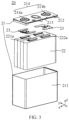
- FIG. 3 is a schematic structural diagram of a battery cell 20 according to an embodiment of the present application.
- the battery cell 20 includes one or more electrode assemblies 22, a housing 211 and a cover plate 212.
- the housing 211 and the cover plate 212 form a shell or a battery 21.
- a wall of the housing 211 and the cover plate 212 are both referred to as a wall of the battery cell 20, where for the cuboid battery cell 20, the wall of the housing 211 includes a bottom wall and four side walls.
- the housing 211 is shaped according to the combined shape of the one or more electrode assemblies 22.
- the housing 211 may be a hollow cuboid or cube or cylinder, and one surface of the housing 211 has a hole such that the one or more electrode assemblies 22 may be placed in the housing 211.
- one plane of the housing 211 is an opening surface, i.e., the plane does not have a wall, so that the inside and outside of the housing 211 are in communication with each other.
- an end face of the housing 211 is an opening surface, i.e., the end face does not have a wall, so that the inside and outside of the housing 211 are in communication with each other.
- the cover plate 212 covers the hole and is connected to the housing 211 to form a closed chamber in which the electrode assembly 22 is placed.
- the housing 211 is filled with an electrolyte, such as an electrolytic solution.
- the battery cell 20 may further include two electrode terminals 214, and the two electrode terminals 214 may be provided on the cover plate 212.
- the cover plate 212 is generally in the shape of a flat plate, and the two electrode terminals 214 are fixed on a flat plate surface of the cover plate 212.
- the two electrode terminals 214 are a positive electrode terminal 214a and a negative electrode terminal 214b, respectively.
- Each electrode terminal 214 is correspondingly provided with a connection member 23 also called a current collecting member 23, which is located between the cover plate 212 and the electrode assembly 22 and configured to electrically connect the electrode assembly 22 to the electrode terminal 214.
- each electrode assembly 22 has a first electrode tab 221a and a second electrode tab 222a.
- the first electrode tab 221a and the second electrode tab 222a have opposite polarities.
- the first electrode tab 221a is a positive electrode tab
- the second electrode tab 222a is a negative electrode tab.
- the first electrode tab 221a of the one or more electrode assemblies 22 is connected to one electrode terminal through one connecting member 23, and the second electrode tab 222a of the one or more electrode assemblies 22 is connected to the other electrode terminal through the other connecting member 23.
- the positive electrode terminal 214a is connected to the positive electrode tab via one connecting member 23, and the negative electrode terminal 214b is connected to the negative electrode tab via the other connecting member 23.
- the battery cell 20 there may be a single or a plurality of electrode assemblies 22. As shown in FIG. 4 , there are four independent electrode assemblies 22 in the battery cell 20.
- a pressure relief mechanism 213 may also be disposed on the battery cell 20.
- the pressure relief mechanism 213 is configured to be actuated when an internal pressure or temperature of the battery cell 20 reaches a threshold, to relieve the internal pressure or temperature.
- the pressure relief mechanism 213 may be in various possible pressure relief structures, which is not limited in the embodiment of the present application.
- the pressure relief mechanism 213 may be a temperature-sensitive pressure relief mechanism configured to be capable of being melted when the internal temperature of the battery cell 20 provided with the pressure relief mechanism 213 reaches a threshold; and/or the pressure relief mechanism 213 may be a pressure-sensitive pressure relief mechanism configured to be capable of being fractured when an internal gas pressure of the battery cell 20 provided with the pressure relief mechanism 213 reaches a threshold.
- FIG. 4 is a schematic structural diagram of a battery in an embodiment of the present application.
- the battery 10 includes a plurality of battery cells 20 and thermal management components 101 arranged along a first direction.
- the thermal management component 101 extends along the first direction and is connected to the first wall 20a of each battery cell 20 of the plurality of battery cells 20, and the first wall 20a is a wall with a largest surface area of the battery cell 20.
- the thermal management component 101 includes a flow channel 104 for accommodating a fluid to adjust a temperature of the battery cell 20, and a second direction is perpendicular to the first wall 20a.
- a size of the flow channel 104 in the second direction is W, and the capacity Q of the battery cell and the size W of the flow channel satisfy: 1.0Ah/mm ⁇ Q/W ⁇ 400Ah/mm.
- the flow channel 104 may be formed by a pair of thermally conductive plates in the thermal management component 101, and the size W of the flow channel along the second direction may be a distance between inner walls of the thermally conductive plates along the second direction.
- the thermal management component 101 is a water cooling plate
- the fluid may flow in a circulating manner to achieve a better temperature adjustment effect.
- the fluid may be water, a mixture of water and ethylene glycol, refrigerant or air.
- FIG. 5 is a schematic structural diagram of a battery according to an embodiment of the application.
- the thermal management component 101 and the plurality of battery cells 20 all extend along the first direction, that is, the x direction, and the thermal management component 101 is connected to the first wall 20a of each battery cell 20, that is, the first wall 20a faces the thermal management component 101.
- the heat of the battery cell 20 may be transferred to the thermal management component 101 and taken away through the fluid in the flow channel 104, so as to control the temperature of the battery cell 20, for example, to achieve cooling of the battery cell 20.
- a length of the thermal management component 101 is equal to the sum of lengths of all the battery cells 20 in the same column, so that the battery cells 20 may be sufficiently cooled while reducing the occupation space of the thermal management component 101.
- the length of the thermal management component 101 may be less than or equal to the sum of the lengths of all the battery cells 20, which may be specifically set according to actual needs. This is not limited in the embodiment of the present application.
- the size W of the flow channel 104 of the thermal management component 101 and the capacity Q of the battery cell 20 satisfy 1.0Ah/mm ⁇ Q/W ⁇ 400Ah/mm.
- the size W of the flow channel 104 is smaller at this time, the volume of the fluid that may flow in the flow channel 104 is smaller, and cannot cool the battery cells 20 in time. In this way, when a temperature of a certain battery cell 20 is too high, since the battery cell 20 is not cooled in time, the heat of the battery cell 20 is diffused to the adjacent battery cells 20, causing that the temperature of the adjacent battery cells 20 is too high, an abnormality occurs, and performances of the entire battery 10 is affected.
- the size W of the flow channel 104 is larger at this time, and the volume of the fluid that may flow in the flow channel 104 is larger, which may sufficiently cool the battery cell 20.
- the flow channel 104 with a larger size results in a larger occupation space of the thermal management component 101, which cannot ensure the energy density of the battery 10; and at the same time, the thermal management component 101 with a large volume also results in an increase in cost.
- the thermal management component 101 is connected to the first wall 20a with a largest surface area of each battery cell 20 of the plurality of battery cells 20 that are arranged in the same column along the first direction; and at the same time the size W of the flow channel 104 and the capacity Q of the battery cell 20 satisfy: 1.0Ah/mm ⁇ Q/W ⁇ 400Ah/mm.
- the use of the above thermal management component may also ensure the thermal management in the battery.
- a technical solution of an embodiment of the present application may improve the energy density of the battery while ensuring the thermal management in the battery, thereby improving performances of the battery.
- FIG. 6 is a schematic structural diagram of a battery cell connected to a thermal management component according to an embodiment of the present application.
- FIG. 7 is a cross-sectional view taken along a direction A-A in FIG. 6 .
- FIG. 8 is an enlarged schematic diagram of a region B in FIG. 7 .
- a size D of the battery cell 20 along the second direction and the size H of the thermal management component 101 along the third direction satisfy: 0.03 ⁇ D/H ⁇ 5.5, and the third direction is perpendicular to the first direction and the second direction.
- the size D of the battery cell 20 along the second direction may be a thickness D of the battery cell 20.
- the thickness D of the battery cell 20 is related to the capacity Q of the battery cell 20. The larger the thickness D is, the larger the capacity Q is.
- the size H of the thermal management component 101 along the third direction may be a height H of the thermal management component 101 along the z direction; and the larger H is, the larger the volume of the thermal management component 101 is, the larger the occupation space is, and at the same time the stronger the thermal management ability is.
- the thermal management component 101 is a water cooling plate
- the larger H is, the stronger the cooling ability for the battery cell 20 is, and the more effectively the heat of the battery cell 20 may be prevented from diffusing to the adjacent battery cells 20.
- the size H of the thermal management component 101 along the third direction is larger, which may sufficiently meet the requirement of preventing the heat of the battery cells 20 from diffusing, but it is difficult to meet the requirement of the energy density of the battery 10.
- the thermal management component 101 with a larger volume also results in a reduction in production costs.
- the size H of the thermal management component 101 along the third direction is 15 mm ⁇ 300 mm.
- the thermal management component 101 may satisfy the requirements of both strength and performances of thermal management.
- the size W of the flow channel 104 is 0.8 mm ⁇ 50 mm. In this way, the requirements of both strength and thermal management may be satisfied.
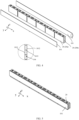
- the thermal management component 101 includes a first thermally conductive plate 1011 and a second thermally conductive plate 1012 disposed oppositely along second direction; where, a flow channel 104 is disposed between the first thermally conductive plate 1011 and the second thermally conductive plate 1012, and the flow channel 104 is configured to accommodate a fluid to adjust the temperature of the battery cell 20.
- the first thermally conductive plate 1011 and the second thermally conductive plate 1012 extend along the first direction and are disposed oppositely along the second direction. In this way, along the second direction, a cavity between the first thermally conductive plate 10011 and the second thermally conductive plate 1012 forms the flow channel 104.
- the thermal management component 101 further includes a stiffener 1013, disposed between the first thermally conductive plate 1011 and the second thermally conductive plate 1012; and the stiffener 1013, the first thermally conductive plate 1011 and the second thermally conductive plate 1012 form the flow channel 104. In this way, the structural strength 101 of the thermal management component may be enhanced.
- the number of stiffeners 1013 is one, so that one or two flow channels 104 may be formed between the first thermally conductive plate 1011 and the second thermally conductive plate 1012.
- the stiffener 1013 is a cantilever with one end connected to the thermally conductive plate. At this time, only one flow channel 104 is formed.
- the stiffener 1013 is connected to the first thermally conductive plate 1011 and the second thermally conductive plate 1012, two flow channels 104 are formed.
- the number of the stiffeners 1013 may be specifically set according to requirements, which is not limited in this embodiment of the present application.
- different flow channels 104 may be independent of each other, and may also be connected through an adapter.
- the stiffener 1013 extends along the first direction, and an angle between the stiffener and the first thermally conductive plate 1011 or the second thermally conductive plate 1012 is a right angle.
- the thermal management component 101 may bear a larger pressure.
- the angle between the stiffener 1013 and the first thermally conductive plate 1011 or the second thermally conductive plate 1012 is an acute angle.
- the thermal management component 101 may have a larger compression space in the second direction, and may provide more expansion space for the battery cell 20.
- the battery cell 20 includes two first walls 20a disposed opposite to each other in the second direction and two second walls 20b disposed opposite to each other in the first direction, where in the first direction, the second walls 20b of two adjacent battery cells 20 face each other.
- the battery cell 20 includes a first wall 20a, a second wall 20b and third walls; the first wall 20a, the second wall 20b and the third walls are adjacent to each other, where a surface area of the first wall 20a is larger than that of the second wall 20b, one of the third walls is disposed away from the bottom of the box as the top surface of the battery cell, and the other is disposed toward the bottom of the box as the bottom surface of the battery cell.
- FIG. 9 is a schematic structural diagram of a battery according to an embodiment of the present application.
- the battery 10 includes a plurality of the battery cells 20 arranged in a plurality of columns along the first direction and a plurality of the thermal management components 101, where the plurality of columns of the battery cells 20 and the plurality of the thermal management components 101 are alternately disposed in the second direction.
- the battery 10 includes a box 11, a plurality of columns of battery cells 20 and a plurality of thermal management components 101, a pipe 103 and a current collector 102.
- the current collector 102 and the pipe 103 are disposed at both ends of the thermal management component 101 along the first direction, and the fluid is transported to the current collector 102 through the pipe 103, and then collected by the current collector 102 and transported to the thermal management component 101, so as to cool the battery cell 20.
- the plurality of columns of battery cells 20 and the plurality of thermal management components 101 are alternately disposed in the second direction, where along the second direction, they may be arranged in the manner of battery cell-thermal management component-battery cell, or may be arranged in the manner of thermal management component-battery-cell-thermal management component.
- the number of columns of battery cells 20 is N
- the number of thermal management components 101 is N-1.
- the energy density of the battery 10 arranged in this manner is higher.
- the number of columns of battery cells 20 is N
- the number of thermal management components 101 is N+1. Thermal management performances of the battery 10 arranged in this manner are better, and it is faster to cool the battery cell 20.
- Both of the above two arrangement manners may cool the battery cell 20 in time on the premise of ensuring the energy density of the battery 10, and effectively prevent the heat of the battery cells 20 from diffusing to the adjacent battery cells 20.
- the battery 10 may also be arranged in the manner of thermal management component-battery cell-battery cell-thermal management component, as long as cooling or heating of the first wall 20a of the battery cell 20 may be achieved, which is not limited in the embodiments of the present application.
- the thermal management component 101 and the first wall 20a are bonded. In this way, the fixing strength between the thermal management component 101 and the first wall 20a is increased.
- the thermal management component 101 may also be clamped between the battery cells 20 in adjacent columns or between side walls of the box 11 and the battery cell 20 by abutting against the first wall 20a.
- An embodiment of the present application further provides a power consumption device, which may include the battery 10 in the above embodiments.
- the power consumption device may be a vehicle 1, a ship or a spacecraft, etc., but this is not limited by the embodiment of the present application.
- the battery 10 and the power consumption device of the embodiment of the present application are described above, and a method and a device for producing a battery of the embodiments of the present application will be described below.
- a method and a device for producing a battery of the embodiments of the present application will be described below.
- FIG. 10 shows a schematic flowchart of a method 300 for producing a battery according to an embodiment of the present application. As shown in FIG. 10 , the method 300 may include:
- FIG. 11 is a schematic block diagram of a device 400 for producing a battery according to an embodiment of the present application.
- the device 400 for producing the battery may include: a first provision module 410 and a second provision module 420.
- the first provision module 410 is configured to provide a plurality of battery cells 20 arranged along a first direction.
- the second provision module 420 is configured to provide a thermal management component 101 extending along the first direction and connected to a first wall 20a of each battery cell 20 of the plurality of battery cells 20, the first wall 20a being the wall with a largest surface area of the battery cell 20; the thermal management component includes a flow channel 104 for accommodating a fluid to adjust a temperature of the battery cell 20; a second direction is perpendicular to the first wall; where, a size of the flow channel 104 in the second direction is W, and a capacity Q of the battery cell 20 and the size W of the flow channel 104 satisfy: 1.0 Ah / mm ⁇ Q / W ⁇ 400 Ah / mm .
Landscapes
- Chemical & Material Sciences (AREA)
- Chemical Kinetics & Catalysis (AREA)
- Electrochemistry (AREA)
- General Chemical & Material Sciences (AREA)
- Engineering & Computer Science (AREA)
- Manufacturing & Machinery (AREA)
- Physics & Mathematics (AREA)
- Algebra (AREA)
- General Physics & Mathematics (AREA)
- Mathematical Analysis (AREA)
- Mathematical Optimization (AREA)
- Pure & Applied Mathematics (AREA)
- Secondary Cells (AREA)
- Battery Mounting, Suspending (AREA)
Abstract
Description
- The present application relates to the field of battery technologies, and in particular, to a battery, a power consumption device, and a method and device for producing a battery.
- With the increasing environmental pollution, the new energy industry has attracted more and more attention. In the new energy industry, the battery technology is an important factor related to their development.
- The energy density of the battery is an important parameter in performances of the battery; however, other performance parameters of the battery need to be considered when improving the energy density of the battery. Thus, how to improve performances of the battery is one urgent technical problem to be solved in the battery technology.
- The present application provides a battery, a power consumption device, and a method and device for producing a battery, which may improve the energy density of the battery while ensuring the thermal management in the battery, thereby improving performances of the battery.
- In a first aspect, a battery is provided, including: a plurality of battery cells arranged along a first direction; and a thermal management component extending along the first direction and being connected to a first wall of each battery cell of the plurality of battery cells, the first wall being a wall with a largest surface area of the battery cell; the thermal management component including a flow channel for accommodating a fluid to adjust a temperature of the battery cell; a second direction being perpendicular to the first wall; where, a size of the flow channel in the second direction is W, and a capacity Q of the battery cell and the size W of the flow channel satisfy: 1.0Ah/mm≤Q/W≤400Ah/mm.
- In the embodiment of the present application, the thermal management component is disposed in the battery to be connected to the first wall with a largest surface area of each battery cell of the plurality of battery cells that are arranged in a column along the first direction; and the size W of the flow channel of the thermal management component in the second direction and the capacity Q of the battery cell satisfy 1.0Ah/mm^Q/W^400Ah/mm. In this way, there is no need to dispose a beam and other structures in the middle of a battery box, which may largely improve the space utilization rate inside the battery, thereby improving the energy density of the battery; and at the same time, the use of the above thermal management component may also ensure the thermal management in the battery. Thus, a technical solution of an embodiment of the present application may improve the energy density of the battery while ensuring the thermal management in the battery, thereby improving performances of the battery.
- In a possible implementation manner, a size D of the battery cell along the second direction and a size H of the thermal management component along a third direction satisfy: 0.03≤D/H≤5.5, and the third size is perpendicular to the first direction and the second direction. In this way, sizes of the thermal management components may be flexibly set for battery cells of different sizes, which not only meets the requirement of the energy density but also well prevents thermal diffusion between battery cells.
- In a possible implementation manner, a size H of the thermal management component along the third direction is 15mm~300mm. In this way, space, strength and thermal management may be taken into account to ensure performances of the battery.
- In a possible implementation manner, the size W of the flow channel is 0.8mm~50mm. In this way, space, strength and thermal management may be taken into account to ensure performances of the battery.
- In a possible implementation manner, the thermal management component includes a first thermally conductive plate and a second thermally conductive plate disposed oppositely along the second direction; where, a flow channel is disposed between the first thermally conductive plate and the second thermally conductive plate, and the flow channel is configured to accommodate a fluid to adjust the temperature of the battery cell.
- In a possible implementation manner, the thermal management component further includes a stiffener, disposed between the first thermally conductive plate and the second thermally conductive plate; and the stiffener, the first thermally conductive plate and the second thermally conductive plate form the flow channel. In this way, the structural strength of the thermal management component may be enhanced.
- In a possible implementation manner, an angle between the stiffener and the first thermally conductive plate or the second thermally conductive plate is an acute angle. In this way, in the second direction, the thermal management component may have a larger compression space, thereby providing more expansion space for the battery cell.
- In a possible implementation manner, the battery cell includes two first walls disposed opposite to each other in the second direction and two second walls disposed oppositely in the first direction, where in the first direction, the second walls of two adjacent battery cells face each other. In this way, the first wall with the large area is used to connect to the thermal management component, which facilitates the thermal exchange of the battery cells and ensures performances of the battery.
- In a possible implementation manner, the battery includes a plurality of the battery cells arranged in a plurality of columns along the first direction and a plurality of the thermal management components, where the plurality of columns of the battery cells and the plurality of the thermal management components are alternately disposed in the second direction. In this way, the plurality of columns of battery cells and the plurality of thermal management components are connected to each other to form a whole, and are accommodated in the box, which may not only effectively perform the thermal management on each column of battery cells, but also ensure the overall structural strength of the battery, thereby improving performances of the battery.
- In a possible implementation manner, the thermal management component and the first wall are bonded. In this way, the strength of the connection between the thermal management component and the first wall is increased.
- In a second aspect, a power consumption device is provided, including the battery in the above first aspect or any possible implementation manner of the first aspect, the battery being configured to provide electric energy.
- In a third aspect, a method for producing battery is provided, including: providing a plurality of battery cells arranged along a first direction; and providing a thermal management component extending along the first direction and being connected to a first wall of each battery cell of the plurality of battery cells, the first wall being a wall with a largest surface area of the battery cell; the thermal management component including a flow channel for accommodating a fluid to adjust a temperature of the battery cell; a second direction being perpendicular to the first wall; where, a size of the flow channel in the second direction is W, and a capacity Q of the battery cell and the size W of the flow channel satisfy: 1.0Ah/mm^Q/W^ 400Ah/mm.
- In a fourth aspect, a device for producing a battery is provided, including a module for executing the method provided in the above third aspect.
- In the technical solution of the embodiment of the present application, the thermal management component is disposed in the battery to be connected to the first wall with a largest surface area of each battery cell of the plurality of battery cells that are arranged in a column along the first direction; and the size W of the flow channel of the thermal management component in the second direction and the capacity Q of the battery cell satisfy 1.0Ah/mm≤Q/W≤400Ah/mm. In this way, there is no need to dispose a beam and other structures in the middle of a battery box, which may largely improve the space utilization rate inside the battery, thereby improving the energy density of the battery; and at the same time, the use of the above thermal management component may also ensure the thermal management in the battery. Thus, a technical solution of an embodiment of the present application may improve the energy density of the battery while ensuring the thermal management in the battery, thereby improving performances of the battery.
- In order to illustrate the technical solution in the embodiments of the present application more clearly, brief description will be made below to the drawings required in the embodiments of the present application, and apparently, the drawings described below are some embodiments of the present application only, and other drawings could be obtained based on these drawings by those ordinary skilled in this art without creative efforts.
-
FIG. 1 is a schematic diagram of a vehicle according to an embodiment of the present application; -
FIG. 2 is a schematic diagram of a battery according to an embodiment of the present application; -
FIG. 3 is a schematic diagram of a battery cell according to an embodiment of the present application; -
FIG. 4 is a schematic diagram of a battery according to an embodiment of the present application; -
FIG. 5 is a schematic diagram of a battery according to an embodiment of the present application; -
FIG. 6 is a schematic diagram of a battery cell connected to a thermal management component according to an embodiment of the present application; -
FIG. 7 is a cross-sectional view taken along a direction A-A inFIG. 6 ; -
FIG. 8 is an enlarged schematic diagram of a region B inFIG. 7 ; -
FIG. 9 is a schematic diagram of a battery according to an embodiment of the present application; -
FIG. 10 is a schematic diagram of a method for producing a battery according to an embodiment of the present application; and -
FIG. 11 is a schematic diagram of a device for producing a battery according to an embodiment of the present application. - In the drawings, the drawings are not drawn to actual scale.
- Embodiments of the present application will be further described below in detail with reference to the drawings and embodiments. The detailed description of the following embodiments and the accompanying drawings are used to exemplarily illustrate principles of the present application, but cannot be used to limit the scope of the present application, that is, the present application is not limited to the described embodiments.
- In the depiction of the present application, it is noted that unless otherwise defined, all technological and scientific terms used have the same meanings as those commonly understood by those skilled in the art to which the present application belongs. The terms used are merely for the purpose of describing specific embodiments, but are not intended to limit the present application. The terms "including" and "having" and any variations thereof in the specification and the claims of the present application as well as the brief description of the drawings described above are intended to cover non-exclusive inclusion. "A plurality of" means more than two; and orientations or positional relationships indicated by terms such as "up", "down", "left", "right", "inside", and "outside" are merely for convenience of describing the present application and for simplifying the description, rather than for indicating or implying that an apparatus or element indicated must have a specific orientation, and must be constructed and operated in a specific orientation, which thus may not be understood as a limitation the present application. In addition, the terms "first", "second", and "third" are only intended for the purpose of description, and shall not be understood as an indication or implication of relative importance. "Vertical" is not strictly vertical, but within an allowable range of error. "Parallel" is not strictly parallel, but within an allowable range of error.
- The phrase "embodiments" referred to in the present application means that the descriptions of specific features, structures, and characteristics in combination with the embodiments are included in at least an embodiment of the present application. Such phrases appearing in all locations of the specification are neither necessarily a same embodiment nor an independent or alternative embodiment that is mutually exclusive from another embodiment. Those skilled in the art understand, in explicit and implicit manners, that an embodiment described in the present application may be combined with another embodiment.
- The terms representing directions in the following description are all directions shown in the drawings, and limit the specific structure of the present application. In the description of the present application, it should be further noted that unless otherwise explicitly specified and defined, the terms "mounting", "connecting" and "connection" should be understood in a broad sense; for example, they may be a fixed connection, a detachable connection, or an integrated connection; may be a direct connection and may also be an indirect connection through an intermediate medium, or may be communication between the interiors of two elements. Those of ordinary skill in the art may appreciate the specific meanings of the foregoing terms in the present application according to specific circumstances.
- In the present application, the term "and/or" is only an association relation describing associated objects, which means that there may be three relations. For example, A and/or B may represent three situations: A exists alone, both A and B exist, and B exists alone. In addition, the character "/" in the present application generally indicates that the associated objects before and after the character are in an "or" relation.
- In the present application, battery cells may include lithium-ion secondary batteries, lithium-ion primary batteries, lithium-sulfur batteries, sodium/lithium-ion batteries, sodium-ion batteries or magnesium-ion batteries, etc., which are not limited by the embodiments of the present application. The battery cells may be cylindrical, flat, and cuboid or in another shape, which is not limited by the embodiments of the present application. The battery cells are generally divided into three types according to the way of packaging: cylindrical battery cells, prismatic battery cells and pouch battery cells, which are not limited by the embodiments of the present application.
- The battery mentioned in the embodiment of the present application refers to a single physical module that includes one or more battery cells to provide a higher voltage and capacity. For example, the battery mentioned in the present application may include a battery pack, etc. The battery generally includes a box body for enclosing one or more battery cells. The box may prevent liquid or other foreign matters from affecting the charging or discharging of the battery cells.
- The battery cells includes an electrode assembly and an electrolytic solution, and the electrode assembly is composed of a positive electrode plate, a negative electrode plate and a separator. The operation of the battery cells mainly relies on the movement of metal ions between the positive electrode sheet and the negative electrode sheet. The positive electrode sheet includes a positive electrode current collector and a positive electrode active material layer. The positive electrode active material layer is coated on a surface of the positive electrode current collector, and the current collector not coated with the positive electrode active material layer protrudes from the current collector coated with the positive electrode active material layer and is used as a positive electrode tab. In an example of a lithium-ion battery, the material of the positive electrode current collector may be aluminum, and the positive electrode active material may be lithium cobalt oxides, lithium iron phosphate, ternary lithium, lithium manganate, or the like. The negative electrode sheet includes a negative electrode current collector and a negative electrode active material layer. The negative electrode active material layer is coated on a surface of the negative electrode current collector, and the current collector not coated with the negative electrode active material layer protrudes from the current collector coated with the negative electrode active material layer and serves as a negative electrode tab. A material of the negative electrode current collector may be copper, and a negative electrode active material may be carbon, silicon, or the like. In order to ensure that no fusing occurs when a large current passes through, there are a plurality of positive electrode tabs which are stacked together, and there are a plurality of negative electrode tabs which are stacked together. A material of the isolation film may be polypropylene (PP) or polyethylene (PE), etc. In addition, the electrode assembly may be a winding structure or a laminated structure, and the embodiments of the present application are not limited thereto.
- In order to meet different power demands, the battery may include a plurality of battery cells, where the plurality of battery cells may be in series connection, parallel connection or series-parallel connection. The series-parallel connection refers to a combination of series connection and parallel connection. Optionally, a plurality of battery cells may be first connected in series, in parallel or in series and parallel to form a battery module, and then a plurality of battery modules are connected in series, in parallel or in series and parallel to form a battery. That is, a plurality of battery cells may directly form a battery, or may first form a battery module, and then battery modules form a battery. The battery is further provided in a power consumption device to provide electrical energy for the power consumption device.
- With the development of the battery technology, it is necessary to consider design factors in multiple aspects simultaneously, such as energy density, cycle life, discharge capacity, C-rate, safety, etc. Among them, when an internal space of the battery is fixed, improving the utilization rate of the internal space of the battery is an effective means to improve the energy density of the battery. However, while improving the utilization rate of the internal space of the battery, other parameters of the battery, such as the thermal management of the battery, must also be considered.
- During the use of the battery cell, a large amount of heat will be generated. When the heat cannot be dissipated in time, the heat will accumulate and superimpose, resulting in thermal runaway and safety accidents, such as smoke, fire, and explosion. At the same time, long-term severe temperature unevenness will greatly reduce the service life of the battery. In addition, when the temperature is very low, the discharge efficiency of the battery is very low, and it is even difficult to start at a low temperature, which affects the normal use of the battery. Therefore, how to ensure the thermal management requirement of the battery is crucial.
- In view of this, the embodiment of the present application providing a technical solution: a thermal management component is disposed in the battery to be connected to a first wall with a largest surface area of each battery cell of the plurality of battery cells that are arranged in a column along a first direction, where the thermal management component includes a flow channel; and in the second direction, a size W of the flow channel of the thermal management component and a capacity Q of the battery cell satisfy 1.0Ah/mm≤Q/W≤400Ah/mm. In this way, there is no need to dispose a beam and other structures in the middle of a battery box, which may largely improve the space utilization rate inside the battery, thereby improving the energy density of the battery. At the same time, the use of the above thermal management component may also ensure the thermal diffusion between battery cells. Thus, a technical solution of an embodiment of the present application may improve the energy density of the battery while ensuring the thermal management in the battery, thereby improving performances of the battery.
- The technical solutions described in the embodiments of the present application are all applicable to various apparatuses using batteries, such as mobile phones, portable devices, notebook computers, electromobiles, electronic toys, electric tools, electric vehicles, ships and spacecrafts. For example, the spacecrafts include airplanes, rockets, space shuttles, spaceships, etc.
- It should be understood that the technical solutions described in the embodiments of the present application are not only applicable to the devices described above, but also applicable to all devices using batteries. However, for brief description, the following embodiments are all described by an example of an electric vehicle.
- For example, as shown in
FIG. 1 , it is a schematic structural diagram of avehicle 1 according to an embodiment of the present application. Thevehicle 1 may be a fuel vehicle, a gas vehicle or a new-energy vehicle. The new-energy vehicle may be a full electric vehicle, a hybrid vehicle or an extended-range vehicle, or the like. Amotor 40, acontroller 30 and abattery 10 may be disposed inside thevehicle 1, and thecontroller 30 is configured to control thebattery 10 to supply power to themotor 40. For example, thebattery 10 may be provided at the bottom or the head or the tail of thevehicle 1. Thebattery 10 may be configured to supply power to thevehicle 1. For example, thebattery 10 may be used as an operation power supply of thevehicle 1 and is used for a circuit system of thevehicle 1, for example, for a working power demand of thevehicle 1 during startup, navigation and running. In another embodiment of the present application, thebattery 10 may be used not only as an operation power source of thevehicle 1, but also as a driving power source of thevehicle 1, replacing or partially replacing fuel or natural gas to provide driving power for thevehicle 1. - In order to satisfy different power demands, the
battery 10 may include a plurality of battery cells. For example, as shown inFIG. 2 , it is a schematic structural diagram of abattery 10 according to an embodiment of the present application. Thebattery 10 may include a plurality ofbattery cells 20. Thebattery 10 may further include abox 11 with a hollow structure inside, and the plurality ofbattery cells 20 are accommodated in thebox 11. For example, the plurality ofbattery cells 20 are connected in series or in parallel or in a hybrid and are then placed in thebox body 11. - Alternatively, the
battery 10 may also include other structures, which will not be described in detail herein. For example, thebattery 10 may also include a bus component. The bus component is configured to implement the electrical connection between the plurality ofbattery cells 20, such as parallel connection, series connection or series-parallel connection. Specifically, the bus component may implement the electrical connection between thebattery cells 20 by connecting electrode terminals of thebattery cells 20. Further, the bus component may be fixed to the electrode terminals of thebattery cells 20 by means of welding. Electric energy of the plurality ofbattery cells 20 may be further led out through an electrically conductive mechanism passing through the box body. Optionally, the electrically conductive mechanism may also belong to the bus component. - According to different power requirements, the number of the
battery cells 20 may be set as any value. The plurality ofbattery cells 20 may be connected in series, in parallel or in series and parallel to implement larger capacity or power. Since there may bemany battery cells 20 included in eachbattery 10, thebattery cells 20 may be disposed in groups for convenience of installation, and each group ofbattery cells 20 constitutes a battery module. The number of thebattery cells 20 included in the battery module is not limited and may be set as required. The battery may include a plurality of battery modules, and these battery modules may be connected in series, in parallel or in series and parallel. -
FIG. 3 is a schematic structural diagram of abattery cell 20 according to an embodiment of the present application. Thebattery cell 20 includes one ormore electrode assemblies 22, ahousing 211 and acover plate 212. Thehousing 211 and thecover plate 212 form a shell or abattery 21. A wall of thehousing 211 and thecover plate 212 are both referred to as a wall of thebattery cell 20, where for thecuboid battery cell 20, the wall of thehousing 211 includes a bottom wall and four side walls. Thehousing 211 is shaped according to the combined shape of the one ormore electrode assemblies 22. For example, thehousing 211 may be a hollow cuboid or cube or cylinder, and one surface of thehousing 211 has a hole such that the one ormore electrode assemblies 22 may be placed in thehousing 211. For example, when thehousing 211 is a hollow cuboid or cube, one plane of thehousing 211 is an opening surface, i.e., the plane does not have a wall, so that the inside and outside of thehousing 211 are in communication with each other. When thehousing 211 is a hollow cylinder, an end face of thehousing 211 is an opening surface, i.e., the end face does not have a wall, so that the inside and outside of thehousing 211 are in communication with each other. Thecover plate 212 covers the hole and is connected to thehousing 211 to form a closed chamber in which theelectrode assembly 22 is placed. Thehousing 211 is filled with an electrolyte, such as an electrolytic solution. - The
battery cell 20 may further include twoelectrode terminals 214, and the twoelectrode terminals 214 may be provided on thecover plate 212. Thecover plate 212 is generally in the shape of a flat plate, and the twoelectrode terminals 214 are fixed on a flat plate surface of thecover plate 212. The twoelectrode terminals 214 are apositive electrode terminal 214a and anegative electrode terminal 214b, respectively. Eachelectrode terminal 214 is correspondingly provided with aconnection member 23 also called a current collectingmember 23, which is located between thecover plate 212 and theelectrode assembly 22 and configured to electrically connect theelectrode assembly 22 to theelectrode terminal 214. - As shown in
FIG. 3 , eachelectrode assembly 22 has afirst electrode tab 221a and asecond electrode tab 222a. Thefirst electrode tab 221a and thesecond electrode tab 222a have opposite polarities. For example, when thefirst electrode tab 221a is a positive electrode tab, thesecond electrode tab 222a is a negative electrode tab. Thefirst electrode tab 221a of the one ormore electrode assemblies 22 is connected to one electrode terminal through one connectingmember 23, and thesecond electrode tab 222a of the one ormore electrode assemblies 22 is connected to the other electrode terminal through the other connectingmember 23. For example, thepositive electrode terminal 214a is connected to the positive electrode tab via one connectingmember 23, and thenegative electrode terminal 214b is connected to the negative electrode tab via the other connectingmember 23. - In the
battery cell 20, according to actual usage requirements, there may be a single or a plurality ofelectrode assemblies 22. As shown inFIG. 4 , there are fourindependent electrode assemblies 22 in thebattery cell 20. - A
pressure relief mechanism 213 may also be disposed on thebattery cell 20. Thepressure relief mechanism 213 is configured to be actuated when an internal pressure or temperature of thebattery cell 20 reaches a threshold, to relieve the internal pressure or temperature. - The
pressure relief mechanism 213 may be in various possible pressure relief structures, which is not limited in the embodiment of the present application. For example, thepressure relief mechanism 213 may be a temperature-sensitive pressure relief mechanism configured to be capable of being melted when the internal temperature of thebattery cell 20 provided with thepressure relief mechanism 213 reaches a threshold; and/or thepressure relief mechanism 213 may be a pressure-sensitive pressure relief mechanism configured to be capable of being fractured when an internal gas pressure of thebattery cell 20 provided with thepressure relief mechanism 213 reaches a threshold. -
FIG. 4 is a schematic structural diagram of a battery in an embodiment of the present application. As shown inFIG. 4 , thebattery 10 includes a plurality ofbattery cells 20 andthermal management components 101 arranged along a first direction. Thethermal management component 101 extends along the first direction and is connected to thefirst wall 20a of eachbattery cell 20 of the plurality ofbattery cells 20, and thefirst wall 20a is a wall with a largest surface area of thebattery cell 20. Thethermal management component 101 includes aflow channel 104 for accommodating a fluid to adjust a temperature of thebattery cell 20, and a second direction is perpendicular to thefirst wall 20a. A size of theflow channel 104 in the second direction is W, and the capacity Q of the battery cell and the size W of the flow channel satisfy: 1.0Ah/mm≤Q/W≤400Ah/mm. - The
flow channel 104 may be formed by a pair of thermally conductive plates in thethermal management component 101, and the size W of the flow channel along the second direction may be a distance between inner walls of the thermally conductive plates along the second direction. The larger the size W of theflow channel 104 is, the larger the capacity of theflow channel 104 is, the larger a volume of the fluid that may flow in theflow channel 104 is, and faster the heat transfers between thebattery cells 20 and thethermal management component 101. For example, when thethermal management component 101 is a water cooling plate, the larger the size W of theflow channel 104 is, the faster the heat of thebattery cells 20 is dissipated, and thus the cooling of thebattery cells 20 is faster, which may prevent the heat of thebattery cell 20 from diffusing to theadjacent battery cells 20. Optionally, the fluid may flow in a circulating manner to achieve a better temperature adjustment effect. Optionally, the fluid may be water, a mixture of water and ethylene glycol, refrigerant or air. -
FIG. 5 is a schematic structural diagram of a battery according to an embodiment of the application. As shown inFIG. 5 , thethermal management component 101 and the plurality ofbattery cells 20 all extend along the first direction, that is, the x direction, and thethermal management component 101 is connected to thefirst wall 20a of eachbattery cell 20, that is, thefirst wall 20a faces thethermal management component 101. In this way, the heat of thebattery cell 20 may be transferred to thethermal management component 101 and taken away through the fluid in theflow channel 104, so as to control the temperature of thebattery cell 20, for example, to achieve cooling of thebattery cell 20. - Optionally, along the first direction, a length of the
thermal management component 101 is equal to the sum of lengths of all thebattery cells 20 in the same column, so that thebattery cells 20 may be sufficiently cooled while reducing the occupation space of thethermal management component 101. In other embodiments, the length of thethermal management component 101 may be less than or equal to the sum of the lengths of all thebattery cells 20, which may be specifically set according to actual needs. This is not limited in the embodiment of the present application. - The size W of the
flow channel 104 of thethermal management component 101 and the capacity Q of thebattery cell 20 satisfy 1.0Ah/mm≤Q/W≤400Ah/mm. By rapidly cooling down thebattery cell 20 whose temperature is too high, the heat of thebattery cell 20 may be prevented from diffusing and transferred to theadjacent battery cells 20, which causes the temperature of theadjacent battery cells 20 to be too high. - When Q/W>400Ah/mm, the size W of the
flow channel 104 is smaller at this time, the volume of the fluid that may flow in theflow channel 104 is smaller, and cannot cool thebattery cells 20 in time. In this way, when a temperature of acertain battery cell 20 is too high, since thebattery cell 20 is not cooled in time, the heat of thebattery cell 20 is diffused to theadjacent battery cells 20, causing that the temperature of theadjacent battery cells 20 is too high, an abnormality occurs, and performances of theentire battery 10 is affected. - When Q/W<1.0Ah/mm, the size W of the
flow channel 104 is larger at this time, and the volume of the fluid that may flow in theflow channel 104 is larger, which may sufficiently cool thebattery cell 20. However, theflow channel 104 with a larger size results in a larger occupation space of thethermal management component 101, which cannot ensure the energy density of thebattery 10; and at the same time, thethermal management component 101 with a large volume also results in an increase in cost. - In the embodiment of the present application, the
thermal management component 101 is connected to thefirst wall 20a with a largest surface area of eachbattery cell 20 of the plurality ofbattery cells 20 that are arranged in the same column along the first direction; and at the same time the size W of theflow channel 104 and the capacity Q of thebattery cell 20 satisfy: 1.0Ah/mm≤Q/W≤400Ah/mm. There is no need to dispose a beam and other structures in the middle of a battery box, which may largely improve the space utilization rate inside the battery, thereby improving the energy density of the battery. At the same time, the use of the above thermal management component may also ensure the thermal management in the battery. Thus, a technical solution of an embodiment of the present application may improve the energy density of the battery while ensuring the thermal management in the battery, thereby improving performances of the battery. -
FIG. 6 is a schematic structural diagram of a battery cell connected to a thermal management component according to an embodiment of the present application.FIG. 7 is a cross-sectional view taken along a direction A-A inFIG. 6 .FIG. 8 is an enlarged schematic diagram of a region B inFIG. 7 . Optionally, in an embodiment of the present application, with reference toFIGS. 6 to 8 , a size D of thebattery cell 20 along the second direction and the size H of thethermal management component 101 along the third direction satisfy: 0.03≤D/H≤ 5.5, and the third direction is perpendicular to the first direction and the second direction. - The size D of the
battery cell 20 along the second direction may be a thickness D of thebattery cell 20. The thickness D of thebattery cell 20 is related to the capacity Q of thebattery cell 20. The larger the thickness D is, the larger the capacity Q is. - The size H of the
thermal management component 101 along the third direction may be a height H of thethermal management component 101 along the z direction; and the larger H is, the larger the volume of thethermal management component 101 is, the larger the occupation space is, and at the same time the stronger the thermal management ability is. For example, when thethermal management component 101 is a water cooling plate, the larger H is, the stronger the cooling ability for thebattery cell 20 is, and the more effectively the heat of thebattery cell 20 may be prevented from diffusing to theadjacent battery cells 20. - When D/H<0.03, the size H of the
thermal management component 101 along the third direction is larger, which may sufficiently meet the requirement of preventing the heat of thebattery cells 20 from diffusing, but it is difficult to meet the requirement of the energy density of thebattery 10. At the same time, thethermal management component 101 with a larger volume also results in a reduction in production costs. - When D/H>5.5, it is difficult for the
thermal management component 101 to meet the thermal management requirement for thebattery cells 20, that is, the heat of thebattery cell 20 cannot be dissipated in time, thus causing the heat to diffuse to theadjacent battery cells 20, resulting in an abnormal temperature ofother battery cells 20, thereby affecting performances of thebattery 10. - Optionally, in an embodiment of the present application, the size H of the
thermal management component 101 along the third direction is 15 mm~300 mm. In this way, thethermal management component 101 may satisfy the requirements of both strength and performances of thermal management. - Optionally, in an embodiment of the present application, the size W of the
flow channel 104 is 0.8 mm~50 mm. In this way, the requirements of both strength and thermal management may be satisfied. - Optionally, in an implementation of the present application, the
thermal management component 101 includes a first thermallyconductive plate 1011 and a second thermallyconductive plate 1012 disposed oppositely along second direction; where, aflow channel 104 is disposed between the first thermallyconductive plate 1011 and the second thermallyconductive plate 1012, and theflow channel 104 is configured to accommodate a fluid to adjust the temperature of thebattery cell 20. - The first thermally
conductive plate 1011 and the second thermallyconductive plate 1012 extend along the first direction and are disposed oppositely along the second direction. In this way, along the second direction, a cavity between the first thermally conductive plate 10011 and the second thermallyconductive plate 1012 forms theflow channel 104. - Optionally, in an embodiment of the present application, the
thermal management component 101 further includes astiffener 1013, disposed between the first thermallyconductive plate 1011 and the second thermallyconductive plate 1012; and thestiffener 1013, the first thermallyconductive plate 1011 and the second thermallyconductive plate 1012 form theflow channel 104. In this way, thestructural strength 101 of the thermal management component may be enhanced. - Optionally, the number of
stiffeners 1013 is one, so that one or twoflow channels 104 may be formed between the first thermallyconductive plate 1011 and the second thermallyconductive plate 1012. When thestiffener 1013 is only connected to the first thermallyconductive plate 1011 or the second thermallyconductive plate 1012, thestiffener 1013 is a cantilever with one end connected to the thermally conductive plate. At this time, only oneflow channel 104 is formed. When thestiffener 1013 is connected to the first thermallyconductive plate 1011 and the second thermallyconductive plate 1012, twoflow channels 104 are formed. The number of thestiffeners 1013 may be specifically set according to requirements, which is not limited in this embodiment of the present application. - Optionally, when the number of the
flow channels 104 is multiple,different flow channels 104 may be independent of each other, and may also be connected through an adapter. - Optionally, the
stiffener 1013 extends along the first direction, and an angle between the stiffener and the first thermallyconductive plate 1011 or the second thermallyconductive plate 1012 is a right angle. In this case, thethermal management component 101 may bear a larger pressure. - Optionally, in an embodiment of the present application, the angle between the
stiffener 1013 and the first thermallyconductive plate 1011 or the second thermallyconductive plate 1012 is an acute angle. In this way, thethermal management component 101 may have a larger compression space in the second direction, and may provide more expansion space for thebattery cell 20. - Optionally, in an embodiment of the present application, the
battery cell 20 includes twofirst walls 20a disposed opposite to each other in the second direction and twosecond walls 20b disposed opposite to each other in the first direction, where in the first direction, thesecond walls 20b of twoadjacent battery cells 20 face each other. For example, thebattery cell 20 includes afirst wall 20a, asecond wall 20b and third walls; thefirst wall 20a, thesecond wall 20b and the third walls are adjacent to each other, where a surface area of thefirst wall 20a is larger than that of thesecond wall 20b, one of the third walls is disposed away from the bottom of the box as the top surface of the battery cell, and the other is disposed toward the bottom of the box as the bottom surface of the battery cell. -
FIG. 9 is a schematic structural diagram of a battery according to an embodiment of the present application. Optionally, in an embodiment of the present application, as shown inFIG. 9 , thebattery 10 includes a plurality of thebattery cells 20 arranged in a plurality of columns along the first direction and a plurality of thethermal management components 101, where the plurality of columns of thebattery cells 20 and the plurality of thethermal management components 101 are alternately disposed in the second direction. - The
battery 10 includes abox 11, a plurality of columns ofbattery cells 20 and a plurality ofthermal management components 101, apipe 103 and acurrent collector 102. Thecurrent collector 102 and thepipe 103 are disposed at both ends of thethermal management component 101 along the first direction, and the fluid is transported to thecurrent collector 102 through thepipe 103, and then collected by thecurrent collector 102 and transported to thethermal management component 101, so as to cool thebattery cell 20. - The plurality of columns of
battery cells 20 and the plurality ofthermal management components 101 are alternately disposed in the second direction, where along the second direction, they may be arranged in the manner of battery cell-thermal management component-battery cell, or may be arranged in the manner of thermal management component-battery-cell-thermal management component. In the former arrangement manner, the number of columns ofbattery cells 20 is N, and the number ofthermal management components 101 is N-1. The energy density of thebattery 10 arranged in this manner is higher. In the latter arrangement manner, the number of columns ofbattery cells 20 is N, and the number ofthermal management components 101 is N+1. Thermal management performances of thebattery 10 arranged in this manner are better, and it is faster to cool thebattery cell 20. Both of the above two arrangement manners may cool thebattery cell 20 in time on the premise of ensuring the energy density of thebattery 10, and effectively prevent the heat of thebattery cells 20 from diffusing to theadjacent battery cells 20. - Optionally, in the
battery 10, it may also be arranged in the manner of thermal management component-battery cell-battery cell-thermal management component, as long as cooling or heating of thefirst wall 20a of thebattery cell 20 may be achieved, which is not limited in the embodiments of the present application. - Optionally, in an embodiment of the present application, the
thermal management component 101 and thefirst wall 20a are bonded. In this way, the fixing strength between thethermal management component 101 and thefirst wall 20a is increased. - Optionally, the
thermal management component 101 may also be clamped between thebattery cells 20 in adjacent columns or between side walls of thebox 11 and thebattery cell 20 by abutting against thefirst wall 20a. - It should be understood that the relevant parts in each embodiment of the present application may be referred to each other, and for the sake of brevity, details are not described herein again.
- An embodiment of the present application further provides a power consumption device, which may include the
battery 10 in the above embodiments. Optionally, the power consumption device may be avehicle 1, a ship or a spacecraft, etc., but this is not limited by the embodiment of the present application. - The
battery 10 and the power consumption device of the embodiment of the present application are described above, and a method and a device for producing a battery of the embodiments of the present application will be described below. For the parts that are not described in detail, reference is made to the foregoing embodiments. -
FIG. 10 shows a schematic flowchart of amethod 300 for producing a battery according to an embodiment of the present application. As shown inFIG. 10 , themethod 300 may include: - 310, providing a plurality of
battery cells 20 arranged along a first direction; and - 320, providing a
thermal management component 101 extending along the first direction and being connected to afirst wall 20a of eachbattery cell 20 of the plurality ofbattery cells 20, thefirst wall 20a being a wall with a largest surface area of thebattery cell 20; the thermal management component includeing aflow channel 104 for accommodating a fluid to adjust a temperature of thebattery cell 20; a second direction being perpendicular to the first wall; where, a size of theflow channel 104 in the second direction is W, and a capacity Q of thebattery cell 20 and the size W of theflow channel 104 satisfy: 1.0Ah/mm≤Q/W≤400Ah/mm. -
FIG. 11 is a schematic block diagram of adevice 400 for producing a battery according to an embodiment of the present application. As shown inFIG. 11 , thedevice 400 for producing the battery may include: afirst provision module 410 and asecond provision module 420. - The
first provision module 410 is configured to provide a plurality ofbattery cells 20 arranged along a first direction. - The
second provision module 420 is configured to provide athermal management component 101 extending along the first direction and connected to afirst wall 20a of eachbattery cell 20 of the plurality ofbattery cells 20, thefirst wall 20a being the wall with a largest surface area of thebattery cell 20; the thermal management component includes aflow channel 104 for accommodating a fluid to adjust a temperature of thebattery cell 20; a second direction is perpendicular to the first wall; where, a size of theflow channel 104 in the second direction is W, and a capacity Q of thebattery cell 20 and the size W of theflow channel 104 satisfy:
- The embodiments of present application are explained in the following. The embodiments described below are exemplary and intended to be used to only explain the present application, and may not be understood as limiting the present application.
- Using a combination manner of two columns of
battery cells 20 and twothermal management components 101, a thermal diffusion test of thebattery 10 is performed according to GB3 8031-2020, and test results are shown in Table 1.Table 1 Thermal diffusion test of battery cells and thermal management components with different specifications (Q/Ah) (D/mm) (H/mm) (W/mm) Q/W D/H Thermal diffusion or not 280 88 260 50 5.6 0.3385 No 280 88 260 6 46.6667 0.3385 No 280 88 102 6 46.6667 0.8627 No 280 88 102 3 93.3333 0.8627 No 280 88 102 0.8 350.0000 0.8627 No 280 88 30 6 46.6667 2.9333 No 280 88 13 0.6 466.6667 6.7692 YES 248 66.5 80 2 124.0000 0.8313 No 248 66.5 102 0.8 310.0000 0.6520 No 169 70 102 3 56.3333 0.6863 No 70 28.5 102 2 35.0000 0.2794 No 180 79 80 2 90.0000 0.9875 No 117 33.2 102 0.8 146.2500 0.3255 No 5 12.5 50 3 1.6667 0.2500 No 5 12.5 150 3 1.6667 0.0833 No 5 12.5 102 0.8 6.2500 0.1225 No - Although the present application is already described with reference to the preferred embodiments, various improvements may be made to the present application and the components therein may be replaced with equivalents without departing from the scope of the present application. In particular, as long as there is no structural conflict, various technical features mentioned in the various embodiments may be combined in any manner. The present application is not limited to the specific embodiments disclosed herein, and comprises all technical solutions falling within the scope of the claims.
Claims (13)
- A battery (10), comprising:a plurality of battery cells (20) arranged along a first direction; anda thermal management component (101) extending along the first direction and being connected to a first wall (20a) of each battery cell (20) of the plurality of battery cells (20), the first wall (20a) being a wall with a largest surface area of the battery cell (20); the thermal management component (101) comprising a flow channel (104) for accommodating a fluid to adjust a temperature of the battery cell (20); a second direction being perpendicular to the first wall (20a);wherein, a size of the flow channel (104) in the second direction is W, and a capacity Q of the battery cell (20) and the size W of the flow channel (104) satisfy:

- The battery (10) according to claim 1, wherein a size D of the battery cell (20) along the second direction and a size H of the thermal management component (101) along a third direction satisfy: 0.03≤D/H≤5.5, and the third direction is perpendicular to the first direction and the second direction.
- The battery (10) according to claim 2, wherein the size H of the thermal management component (101) along the third direction is 15mm~300mm.
- The battery (10) according to any one of claims 1 to 3, wherein the size W of the flow channel (104) is 0.8 mm~50 mm.
- The battery (10) according to any one of claims 1 to 4, wherein the thermal management component (101) comprises a first thermally conductive plate (1011) and a second thermally conductive plate (1012) disposed oppositely along the second direction;
wherein, a flow channel (104) is disposed between the first thermally conductive plate (1011) and the second thermally conductive plate (1012), and the flow channel (104) is configured to accommodate a fluid to adjust the temperature of the battery cell (20). - The battery (10) according to claim 5, wherein the thermal management component (101) further comprises a stiffener (1013), disposed between the first thermally conductive plate (1011) and the second thermally conductive plate (1012); and the stiffener (1013), the first thermally conductive plate (1011) and the second thermally conductive plate (1012) form the flow channel (104).
- The battery (10) according to claim 6, wherein an angle between the stiffener (1013) and the first thermally conductive plate (1011) or the second thermally conductive plate (1012) is an acute angle.
- The battery (10) according to any one of claims 1 to 7, wherein the battery cell (20) comprises two first walls (20a) disposed opposite to each other in the second direction and two second walls (20b) disposed oppositely in the first direction, wherein in the first direction, the second walls (20b) of two adjacent battery cells (20) face each other.
- The battery (10) according to any one of claims 1 to 8, wherein the battery comprises a plurality of the battery cells (20) arranged in a plurality of columns along the first direction and a plurality of the thermal management components (101), wherein the plurality of columns of the battery cells (20) and the plurality of the thermal management components (101) are alternately disposed in the second direction.
- The battery (10) according to any one of claims 1 to 9, wherein the thermal management component (101) and the first wall (20a) are bonded.
- A power consumption device, comprising: the battery (10) according to any one of claims 1 to 10, the battery (10) being configured to provide electric energy.
- A method (300) for producing a battery, comprising:providing (310) a plurality of battery cells (20) arranged along a first direction; andproviding (320) a thermal management component (101) extending along the first direction and being connected to a first wall (20a) of each battery cell (20) of the plurality of battery cells (20), the first wall (20a) being a wall with a largest surface area of the battery cell (20); the thermal management component (101) comprising a flow channel (104) for accommodating a fluid to adjust a temperature of the battery cell (20); a second direction being perpendicular to the first wall (20a);wherein, a size of the flow channel (104) in the second direction is W, and a capacity Q of the battery cell (20) and the size W of the flow channel (104) satisfy:

- A device (400) for producing a battery, comprising:a first provision module (410) for providing a plurality of battery cells (20) arranged along a first direction; anda second provision module (420) for providing a thermal management component (101) extending along the first direction and being connected to a first wall (20a) of each battery cell (20) of the plurality of battery cells (20), the first wall (20a) being a wall with a largest surface area of the battery cell (20); the thermal management component (101) comprising a flow channel (104) for accommodating a fluid to adjust a temperature of the battery cell (20); a second direction being perpendicular to the first wall (20a);wherein, a size of the flow channel (104) in the second direction is W, and a capacity Q of the battery cell (20) and the size W of the flow channel (104) satisfy:

Applications Claiming Priority (1)
| Application Number | Priority Date | Filing Date | Title |
|---|---|---|---|
| PCT/CN2022/077147 WO2023155207A1 (en) | 2022-02-21 | 2022-02-21 | Battery, electrical device, and battery preparation method and device |
Publications (3)
| Publication Number | Publication Date |
|---|---|
| EP4258419A1 true EP4258419A1 (en) | 2023-10-11 |
| EP4258419A4 EP4258419A4 (en) | 2023-10-11 |
| EP4258419B1 EP4258419B1 (en) | 2025-08-13 |
Family
ID=87574605
Family Applications (1)
| Application Number | Title | Priority Date | Filing Date |
|---|---|---|---|
| EP22719499.0A Active EP4258419B1 (en) | 2022-02-21 | 2022-02-21 | Battery, electrical device, and battery preparation method and device |
Country Status (6)
| Country | Link |
|---|---|
| US (1) | US20230268588A1 (en) |
| EP (1) | EP4258419B1 (en) |
| JP (1) | JP7601871B2 (en) |
| KR (1) | KR102832072B1 (en) |
| CN (1) | CN116615830B (en) |
| WO (1) | WO2023155207A1 (en) |
Families Citing this family (2)
| Publication number | Priority date | Publication date | Assignee | Title |
|---|---|---|---|---|
| CN116998032A (en) * | 2022-03-04 | 2023-11-03 | 宁德时代新能源科技股份有限公司 | A positive electrode plate, secondary battery, battery module, battery pack and electrical device |
| US20250196664A1 (en) * | 2023-12-18 | 2025-06-19 | GM Global Technology Operations LLC | Battery cell can insert |
Family Cites Families (17)
| Publication number | Priority date | Publication date | Assignee | Title |
|---|---|---|---|---|
| US6565836B2 (en) * | 1997-01-31 | 2003-05-20 | Ovonic Battery Company, Inc. | Very low emission hybrid electric vehicle incorporating an integrated propulsion system including a hydrogen powered internal combustion engine and a high power Ni-MH battery pack |
| JP4837155B2 (en) * | 1998-11-27 | 2011-12-14 | パナソニック株式会社 | Storage battery |
| JP2006244756A (en) * | 2005-03-01 | 2006-09-14 | Nec Lamilion Energy Ltd | Film-clad electrical device and film-clad electrical device assembly |
| WO2011076936A1 (en) * | 2009-12-23 | 2011-06-30 | Magna Steyr Fahrzeugtechnik Ag & Co Kg | Accumulator with voltage-generating cells and a shell-shaped intermediate element arranged between said cells |
| JP5659622B2 (en) * | 2010-08-19 | 2015-01-28 | 株式会社デンソー | Battery pack |
| US9196939B2 (en) * | 2011-11-02 | 2015-11-24 | GM Global Technology Operations LLC | Method for thermal management and mitigation of thermal propagation for batteries using a graphene coated polymer barrier substrate |
| KR102321512B1 (en) * | 2014-09-11 | 2021-11-04 | 현대모비스 주식회사 | Water-cooled battery cooling apparatus using water-cooled battery module |
| KR101816974B1 (en) * | 2014-11-17 | 2018-02-21 | 주식회사 엘지화학 | Cooling plate for secondary battery and secondary battery module comprising the same |
| KR102399509B1 (en) * | 2017-03-30 | 2022-05-18 | 삼성에스디아이 주식회사 | Battery module |
| CN108879023B (en) * | 2018-07-13 | 2023-11-14 | 山东大学 | A thermal management system for electric vehicle battery packs coupled with air and coolant |
| CN209249567U (en) * | 2018-12-30 | 2019-08-13 | 宁德时代新能源科技股份有限公司 | A battery module |
| CN209447945U (en) * | 2018-12-30 | 2019-09-27 | 宁德时代新能源科技股份有限公司 | A kind of battery pack |
| US10480627B1 (en) * | 2019-02-05 | 2019-11-19 | David H. Vroom | Sliding support mechanism with improved reliability and serviceability |
| CN209496928U (en) * | 2019-04-12 | 2019-10-15 | 宁德时代新能源科技股份有限公司 | A battery module |
| CN209896153U (en) * | 2019-11-18 | 2020-01-03 | 比亚迪股份有限公司 | A battery pack and electric vehicle |
| CN111009629B (en) * | 2019-11-18 | 2022-02-08 | 比亚迪股份有限公司 | Battery pack and electric vehicle |
| CN217182265U (en) * | 2022-02-21 | 2022-08-12 | 宁德时代新能源科技股份有限公司 | Battery and electric equipment |
-
2022
- 2022-02-21 WO PCT/CN2022/077147 patent/WO2023155207A1/en not_active Ceased
- 2022-02-21 EP EP22719499.0A patent/EP4258419B1/en active Active
- 2022-02-21 CN CN202280005752.XA patent/CN116615830B/en active Active
- 2022-02-21 KR KR1020227016222A patent/KR102832072B1/en active Active
- 2022-02-21 JP JP2022529360A patent/JP7601871B2/en active Active
-
2023
- 2023-02-22 US US18/112,603 patent/US20230268588A1/en active Pending
Also Published As
| Publication number | Publication date |
|---|---|
| JP7601871B2 (en) | 2024-12-17 |
| KR102832072B1 (en) | 2025-07-08 |
| CN116615830A (en) | 2023-08-18 |
| CN116615830B (en) | 2024-08-16 |
| JP2024510854A (en) | 2024-03-12 |
| WO2023155207A1 (en) | 2023-08-24 |
| EP4258419B1 (en) | 2025-08-13 |
| US20230268588A1 (en) | 2023-08-24 |
| KR20230126174A (en) | 2023-08-29 |
Similar Documents
| Publication | Publication Date | Title |
|---|---|---|
| CN216872113U (en) | Batteries and Electrical Equipment | |
| CN216872114U (en) | Batteries and Electrical Equipment | |
| CN217182265U (en) | Battery and electric equipment | |
| EP4481930A1 (en) | Battery and electric device | |
| US12183908B2 (en) | Battery, power consumption device, and method and device for producing battery | |
| US11862776B2 (en) | Battery, power consumption device, and method and device for producing battery | |
| EP4258441A1 (en) | Battery, electric device, and battery preparation method and device | |
| EP4266464B1 (en) | Battery, power consumption device, and method and device for producing battery | |
| EP4258445A1 (en) | Battery, electrical device, and method and device for preparing battery | |
| US12218330B2 (en) | Battery, power consumption device, and method and device for producing battery | |
| US20230268588A1 (en) | Battery, power consumption device, and method and device for producing battery | |
| EP4468485A1 (en) | Battery cell, battery module, battery, and power-consuming apparatus | |
| US12308463B2 (en) | Battery, power consumption device, and method and device for producing battery | |
| EP4379914A1 (en) | Battery, electric device, and method and device for preparing battery | |
| EP4258437A1 (en) | Battery, electric device, and battery preparation method and device |
Legal Events
| Date | Code | Title | Description |
|---|---|---|---|
| STAA | Information on the status of an ep patent application or granted ep patent |
Free format text: STATUS: UNKNOWN |
|
| STAA | Information on the status of an ep patent application or granted ep patent |
Free format text: STATUS: THE INTERNATIONAL PUBLICATION HAS BEEN MADE |
|
| PUAI | Public reference made under article 153(3) epc to a published international application that has entered the european phase |
Free format text: ORIGINAL CODE: 0009012 |
|
| STAA | Information on the status of an ep patent application or granted ep patent |
Free format text: STATUS: REQUEST FOR EXAMINATION WAS MADE |
|
| 17P | Request for examination filed |
Effective date: 20220509 |
|
| A4 | Supplementary search report drawn up and despatched |
Effective date: 20230801 |
|
| AK | Designated contracting states |
Kind code of ref document: A1 Designated state(s): AL AT BE BG CH CY CZ DE DK EE ES FI FR GB GR HR HU IE IS IT LI LT LU LV MC MK MT NL NO PL PT RO RS SE SI SK SM TR |
|
| RAP1 | Party data changed (applicant data changed or rights of an application transferred) |
Owner name: CONTEMPORARY AMPEREX TECHNOLOGY(HONG KONG) LIMITED |
|
| GRAP | Despatch of communication of intention to grant a patent |
Free format text: ORIGINAL CODE: EPIDOSNIGR1 |
|
| STAA | Information on the status of an ep patent application or granted ep patent |
Free format text: STATUS: GRANT OF PATENT IS INTENDED |
|
| INTG | Intention to grant announced |
Effective date: 20250319 |
|
| DAV | Request for validation of the european patent (deleted) | ||
| DAX | Request for extension of the european patent (deleted) | ||
| GRAS | Grant fee paid |
Free format text: ORIGINAL CODE: EPIDOSNIGR3 |
|
| GRAA | (expected) grant |
Free format text: ORIGINAL CODE: 0009210 |
|
| STAA | Information on the status of an ep patent application or granted ep patent |
Free format text: STATUS: THE PATENT HAS BEEN GRANTED |
|
| P01 | Opt-out of the competence of the unified patent court (upc) registered |
Free format text: CASE NUMBER: APP_28861/2025 Effective date: 20250617 |
|
| AK | Designated contracting states |
Kind code of ref document: B1 Designated state(s): AL AT BE BG CH CY CZ DE DK EE ES FI FR GB GR HR HU IE IS IT LI LT LU LV MC MK MT NL NO PL PT RO RS SE SI SK SM TR |
|
| REG | Reference to a national code |
Ref country code: GB Ref legal event code: FG4D |
|
| REG | Reference to a national code |
Ref country code: CH Ref legal event code: EP |
|
| REG | Reference to a national code |
Ref country code: DE Ref legal event code: R096 Ref document number: 602022019408 Country of ref document: DE |
|
| REG | Reference to a national code |
Ref country code: IE Ref legal event code: FG4D |
|
| REG | Reference to a national code |
Ref country code: NL Ref legal event code: MP Effective date: 20250813 |
|
| PG25 | Lapsed in a contracting state [announced via postgrant information from national office to epo] |
Ref country code: IS Free format text: LAPSE BECAUSE OF FAILURE TO SUBMIT A TRANSLATION OF THE DESCRIPTION OR TO PAY THE FEE WITHIN THE PRESCRIBED TIME-LIMIT Effective date: 20251213 |
|
| PG25 | Lapsed in a contracting state [announced via postgrant information from national office to epo] |
Ref country code: NO Free format text: LAPSE BECAUSE OF FAILURE TO SUBMIT A TRANSLATION OF THE DESCRIPTION OR TO PAY THE FEE WITHIN THE PRESCRIBED TIME-LIMIT Effective date: 20251113 |
|
| REG | Reference to a national code |
Ref country code: LT Ref legal event code: MG9D |
|
| PG25 | Lapsed in a contracting state [announced via postgrant information from national office to epo] |
Ref country code: PT Free format text: LAPSE BECAUSE OF FAILURE TO SUBMIT A TRANSLATION OF THE DESCRIPTION OR TO PAY THE FEE WITHIN THE PRESCRIBED TIME-LIMIT Effective date: 20251215 |
|
| PG25 | Lapsed in a contracting state [announced via postgrant information from national office to epo] |
Ref country code: FI Free format text: LAPSE BECAUSE OF FAILURE TO SUBMIT A TRANSLATION OF THE DESCRIPTION OR TO PAY THE FEE WITHIN THE PRESCRIBED TIME-LIMIT Effective date: 20250813 |
|
| PG25 | Lapsed in a contracting state [announced via postgrant information from national office to epo] |
Ref country code: HR Free format text: LAPSE BECAUSE OF FAILURE TO SUBMIT A TRANSLATION OF THE DESCRIPTION OR TO PAY THE FEE WITHIN THE PRESCRIBED TIME-LIMIT Effective date: 20250813 Ref country code: NL Free format text: LAPSE BECAUSE OF FAILURE TO SUBMIT A TRANSLATION OF THE DESCRIPTION OR TO PAY THE FEE WITHIN THE PRESCRIBED TIME-LIMIT Effective date: 20250813 |
|
| PG25 | Lapsed in a contracting state [announced via postgrant information from national office to epo] |
Ref country code: GR Free format text: LAPSE BECAUSE OF FAILURE TO SUBMIT A TRANSLATION OF THE DESCRIPTION OR TO PAY THE FEE WITHIN THE PRESCRIBED TIME-LIMIT Effective date: 20251114 |
|
| PG25 | Lapsed in a contracting state [announced via postgrant information from national office to epo] |
Ref country code: SE Free format text: LAPSE BECAUSE OF FAILURE TO SUBMIT A TRANSLATION OF THE DESCRIPTION OR TO PAY THE FEE WITHIN THE PRESCRIBED TIME-LIMIT Effective date: 20250813 |
|
| PG25 | Lapsed in a contracting state [announced via postgrant information from national office to epo] |
Ref country code: LV Free format text: LAPSE BECAUSE OF FAILURE TO SUBMIT A TRANSLATION OF THE DESCRIPTION OR TO PAY THE FEE WITHIN THE PRESCRIBED TIME-LIMIT Effective date: 20250813 |
|
| PG25 | Lapsed in a contracting state [announced via postgrant information from national office to epo] |
Ref country code: BG Free format text: LAPSE BECAUSE OF FAILURE TO SUBMIT A TRANSLATION OF THE DESCRIPTION OR TO PAY THE FEE WITHIN THE PRESCRIBED TIME-LIMIT Effective date: 20250813 Ref country code: PL Free format text: LAPSE BECAUSE OF FAILURE TO SUBMIT A TRANSLATION OF THE DESCRIPTION OR TO PAY THE FEE WITHIN THE PRESCRIBED TIME-LIMIT Effective date: 20250813 |
|
| PG25 | Lapsed in a contracting state [announced via postgrant information from national office to epo] |
Ref country code: RS Free format text: LAPSE BECAUSE OF FAILURE TO SUBMIT A TRANSLATION OF THE DESCRIPTION OR TO PAY THE FEE WITHIN THE PRESCRIBED TIME-LIMIT Effective date: 20251113 |
|
| PG25 | Lapsed in a contracting state [announced via postgrant information from national office to epo] |
Ref country code: ES Free format text: LAPSE BECAUSE OF FAILURE TO SUBMIT A TRANSLATION OF THE DESCRIPTION OR TO PAY THE FEE WITHIN THE PRESCRIBED TIME-LIMIT Effective date: 20250813 |
|
| REG | Reference to a national code |
Ref country code: AT Ref legal event code: MK05 Ref document number: 1825719 Country of ref document: AT Kind code of ref document: T Effective date: 20250813 |
|
| PGFP | Annual fee paid to national office [announced via postgrant information from national office to epo] |
Ref country code: HU Payment date: 20260211 Year of fee payment: 5 |
|
| PG25 | Lapsed in a contracting state [announced via postgrant information from national office to epo] |
Ref country code: SM Free format text: LAPSE BECAUSE OF FAILURE TO SUBMIT A TRANSLATION OF THE DESCRIPTION OR TO PAY THE FEE WITHIN THE PRESCRIBED TIME-LIMIT Effective date: 20250813 |
|
| PGFP | Annual fee paid to national office [announced via postgrant information from national office to epo] |
Ref country code: GB Payment date: 20260224 Year of fee payment: 5 |
|
| PG25 | Lapsed in a contracting state [announced via postgrant information from national office to epo] |
Ref country code: DK Free format text: LAPSE BECAUSE OF FAILURE TO SUBMIT A TRANSLATION OF THE DESCRIPTION OR TO PAY THE FEE WITHIN THE PRESCRIBED TIME-LIMIT Effective date: 20250813 |
|
| PGFP | Annual fee paid to national office [announced via postgrant information from national office to epo] |
Ref country code: DE Payment date: 20260223 Year of fee payment: 5 |
|
| PG25 | Lapsed in a contracting state [announced via postgrant information from national office to epo] |
Ref country code: AT Free format text: LAPSE BECAUSE OF FAILURE TO SUBMIT A TRANSLATION OF THE DESCRIPTION OR TO PAY THE FEE WITHIN THE PRESCRIBED TIME-LIMIT Effective date: 20250813 |
|
| PG25 | Lapsed in a contracting state [announced via postgrant information from national office to epo] |
Ref country code: IT Free format text: LAPSE BECAUSE OF FAILURE TO SUBMIT A TRANSLATION OF THE DESCRIPTION OR TO PAY THE FEE WITHIN THE PRESCRIBED TIME-LIMIT Effective date: 20250813 |
|
| PGFP | Annual fee paid to national office [announced via postgrant information from national office to epo] |
Ref country code: FR Payment date: 20260224 Year of fee payment: 5 |
|
| PG25 | Lapsed in a contracting state [announced via postgrant information from national office to epo] |
Ref country code: CZ Free format text: LAPSE BECAUSE OF FAILURE TO SUBMIT A TRANSLATION OF THE DESCRIPTION OR TO PAY THE FEE WITHIN THE PRESCRIBED TIME-LIMIT Effective date: 20250813 |
|
| PG25 | Lapsed in a contracting state [announced via postgrant information from national office to epo] |
Ref country code: EE Free format text: LAPSE BECAUSE OF FAILURE TO SUBMIT A TRANSLATION OF THE DESCRIPTION OR TO PAY THE FEE WITHIN THE PRESCRIBED TIME-LIMIT Effective date: 20250813 Ref country code: SK Free format text: LAPSE BECAUSE OF FAILURE TO SUBMIT A TRANSLATION OF THE DESCRIPTION OR TO PAY THE FEE WITHIN THE PRESCRIBED TIME-LIMIT Effective date: 20250813 |