EP4258104A1 - Verfahren und vorrichtung zur übertragung von modelldaten - Google Patents
Verfahren und vorrichtung zur übertragung von modelldaten Download PDFInfo
- Publication number
- EP4258104A1 EP4258104A1 EP20967882.0A EP20967882A EP4258104A1 EP 4258104 A1 EP4258104 A1 EP 4258104A1 EP 20967882 A EP20967882 A EP 20967882A EP 4258104 A1 EP4258104 A1 EP 4258104A1
- Authority
- EP
- European Patent Office
- Prior art keywords
- model data
- information
- quantized
- quantization
- training
- Prior art date
- Legal status (The legal status is an assumption and is not a legal conclusion. Google has not performed a legal analysis and makes no representation as to the accuracy of the status listed.)
- Pending
Links
Images




Classifications
-
- G—PHYSICS
- G06—COMPUTING OR CALCULATING; COUNTING
- G06N—COMPUTING ARRANGEMENTS BASED ON SPECIFIC COMPUTATIONAL MODELS
- G06N3/00—Computing arrangements based on biological models
- G06N3/02—Neural networks
- G06N3/08—Learning methods
- G06N3/098—Distributed learning, e.g. federated learning
-
- G—PHYSICS
- G06—COMPUTING OR CALCULATING; COUNTING
- G06N—COMPUTING ARRANGEMENTS BASED ON SPECIFIC COMPUTATIONAL MODELS
- G06N3/00—Computing arrangements based on biological models
- G06N3/02—Neural networks
- G06N3/04—Architecture, e.g. interconnection topology
- G06N3/0495—Quantised networks; Sparse networks; Compressed networks
-
- G—PHYSICS
- G06—COMPUTING OR CALCULATING; COUNTING
- G06F—ELECTRIC DIGITAL DATA PROCESSING
- G06F8/00—Arrangements for software engineering
- G06F8/60—Software deployment
- G06F8/65—Updates
-
- G—PHYSICS
- G06—COMPUTING OR CALCULATING; COUNTING
- G06N—COMPUTING ARRANGEMENTS BASED ON SPECIFIC COMPUTATIONAL MODELS
- G06N3/00—Computing arrangements based on biological models
- G06N3/02—Neural networks
- G06N3/04—Architecture, e.g. interconnection topology
- G06N3/044—Recurrent networks, e.g. Hopfield networks
-
- G—PHYSICS
- G06—COMPUTING OR CALCULATING; COUNTING
- G06N—COMPUTING ARRANGEMENTS BASED ON SPECIFIC COMPUTATIONAL MODELS
- G06N3/00—Computing arrangements based on biological models
- G06N3/02—Neural networks
- G06N3/04—Architecture, e.g. interconnection topology
- G06N3/0464—Convolutional networks [CNN, ConvNet]
Definitions
- This application relates to the communication field, and more specifically, to a model data sending method and an apparatus.
- Federated learning is an encrypted distributed machine learning technology. It can fully utilize data and computing capabilities of participants, enabling a plurality of parties to build a common and robust machine learning model without sharing data.
- federated learning can resolve key problems such as data ownership, data privacy, data access rights, and heterogeneous data access.
- a model may be trained in a federated learning manner.
- Horizontal federated learning is a key branch of federated learning.
- a horizontal federation includes a coordinator and several participants. The participants are responsible for model training using local data, and the coordinator is responsible for aggregating models of all participants.
- a model quantization technology can alleviate a problem of a large quantity of model parameters and high memory usage, and may be applied to a horizontal federated learning process to reduce communication overheads.
- quantization causes a quantization error, and may cause an accuracy loss of a finally trained model.
- a quantized model in federated learning is still for model training, and quantization errors of a plurality of rounds and a plurality of users are continuously accumulated.
- This application provides a model data sending method and an apparatus, to reduce an accuracy loss of model data.
- a model data sending method includes: A first device determines second information based on first information, where the second information is used by a second device to quantize first model data, the first information includes an evaluation loss corresponding to a current round of training, the second information includes a quantization error threshold, and the first model data is model data that is after the current round of training; the first device sends the second information to the second device; and the first device receives a first message sent by the second device, where the first message includes quantized first model data and first quantization configuration information.
- the first device may determine the quantization error threshold based on the evaluation loss, information about an accuracy requirement of the second device for model training, and communication sensitivity information, so that a quantization error corresponding to a quantization manner used by the second device is less than the quantization error threshold, and accumulation of multi-round multi-user quantization errors in federated learning training can be controlled, thereby reducing an accuracy loss of model data.
- the first information further includes information about an accuracy requirement of the second device for model training and communication sensitivity information.
- the method further includes: The first device receives a second message sent by the second device, where the second message includes information about the accuracy requirement and the communication sensitivity information.
- the method before that a first device determines second information based on first information, the method further includes: The first device determines a proportion of quantifiable layers in second model data based on third information, where the third information includes an evaluation loss corresponding to a previous round of training, the information about the accuracy requirement, and the communication sensitivity information, and the second model data is model data that is before the current round of training; the first device quantizes the second model data based on the proportion of the quantifiable layers, to obtain quantized second model data; and the first device sends a third message to the second device, where the third message includes the quantized second model data and second quantization configuration information, and the third message is used by the second device to train the second model data to obtain the first model data.
- a model data sending method includes: A second device receives second information sent by a first device, where the second information is used by the second device to quantize first model data, the second information includes a quantization error threshold, and the first model data is model data that is after a current round of training; the second device quantizes the first model data based on the second information; and the second device sends a first message to the first device, where the first message includes quantized first model data and first quantization configuration information.
- the second device quantizes the first model data based on the second information includes: The second device quantizes the first model data in a first quantization manner; the second device determines a first quantization error based on quantized first model data and the first model data that is before the quantization; and if the first quantization error is less than the quantization error threshold, the second device determines to use the first quantization manner to quantize the first model data.
- the method before that a second device receives second information sent by a first device, the method further includes: The second device receives a third message sent by the first device, where the third message includes quantized second model data and second quantization configuration information, and the second model data is model data that is before the current round of training; the second device performs dequantization parsing based on the quantized second model data and the second quantization configuration information to obtain the second model data; and the second device trains the second model data, to obtain the first model data.
- a first device receives a fourth message sent by a second device, where the fourth message includes a first quantization error and first information, the first quantization error is determined after the second device quantizes first model data in a first quantization manner, the first information includes an evaluation loss corresponding to a current round of training, and the first model data is model data that is after the current round of training; the first device determines, based on the first quantization error and the first information, whether the second device is allowed to send quantized first model data; and the first device sends indication information to the second device, where the indication information indicates whether the second device is allowed to send the quantized first model data.
- the first device determines, based on the evaluation loss corresponding to the current round of training and the first quantization error determined after the second device quantizes the first model data, and indicates whether the second device can send the quantized first model data, so that excessive accumulation of the first quantization error of the second device can be avoided, thereby reducing an accuracy loss of model data.
- the first device determines, based on the first quantization error and the first information, whether the second device is allowed to send quantized first model data includes: The first device determines a proportion of quantifiable second devices based on the first information; and the first device determines, based on the proportion of the quantifiable second devices, the first quantization error, and a threshold for a quantity of consecutive quantization times, whether the second device is allowed to send the quantized first model data.
- the first device determines, based on the evaluation loss corresponding to the current round of training, the first quantization error determined after the second device quantizes the first model data, and the threshold for the quantity of consecutive quantization times, and indicates whether the second device can send the quantized first model data, so that the second device can be prevented from performing quantization for a quantity of times exceeding the threshold for the quantity of consecutive quantization times, to reduce an accuracy loss of model data.
- the first information further includes information about an accuracy requirement of the second device for model training and communication sensitivity information.
- the method before that a first device receives a fourth message sent by a second device, the method further includes: The first device receives a second message sent by the second device, where the second message includes information about the accuracy requirement and the communication sensitivity information.
- the method before that a first device receives a fourth message sent by a second device, the method further includes: The first device determines a proportion of quantifiable layers in second model data based on third information, where the third information includes an evaluation loss corresponding to a previous round of training, the information about the accuracy requirement, and the communication sensitivity information, and the second model data is model data that is before the current round of training; the first device quantizes the second model data based on the proportion of the quantifiable layers, to obtain quantized second model data; and the first device sends a third message to the second device, where the third message includes the quantized second model data and second quantization configuration information, and the third message is used by the second device to train the second model data to obtain the first model data.
- a second device quantizes first model data in a first quantization manner, where the first model data is model data that is after a current round of training; the second device determines a first quantization error based on quantized first model data and the first model data that is before the quantization; and the second device sends a fourth message to a first device, where the fourth message includes the first quantization error and first information, the fourth message is used by the first device to determine whether the second device is allowed to send the quantized first model data, and the first information includes an evaluation loss corresponding to the current round of training; the second device receives indication information sent by the first device, where the indication information indicates whether the second device is allowed to send the quantized first model data; and the second device determines, based on the indication information, whether to send the quantized first model data to the first device.
- that the second device determines, based on the indication information, whether to send the quantized first model data to the first device includes: If the indication information indicates that the second device is allowed to send the quantized first model data, the second device sends the quantized first model data and third quantization configuration information to the first device; or if the indication information indicates that the second device is not allowed to send the quantized first model data, the second device sends the first model data that is unquantized.
- the method before that a second device quantizes first model data in a first quantization manner, the method further includes: The second device receives a third message sent by the first device, where the third message includes quantized second model data and second quantization configuration information, and the second model data is model data that is before the current round of training; the second device performs dequantization parsing based on the quantized second model data and the second quantization configuration information to obtain the second model data; and the second device trains the second model data, to obtain the first model data.
- a first device determines a proportion of quantifiable layers in second model data based on third information, where the third information includes an evaluation loss corresponding to a previous round of training, information about an accuracy requirement of a second device for model training, and communication sensitivity information, and the second model data is model data that is before a current round of training; the first device quantizes the second model data based on the proportion of the quantifiable layers, to obtain quantized second model data; and the first device sends a third message to the second device, where the third message includes the quantized second model data and second quantization configuration information, and the third message is used by the second device to train the second model data.
- the first device quantizes the second model data based on the proportion of the quantifiable layers includes: The first device quantizes each layer of data in the second model data; the first device determines a quantization error corresponding to each layer of data and a compression amount contributed by each layer of data; the first device determines the quantifiable layers in the second model data based on the proportion of the quantifiable layers, the quantization error corresponding to each layer of data, and/or the compression amount contributed by each layer of data; and the first device obtains the quantized second model data, where data corresponding to the quantifiable layers in the quantized second model data is quantized, and data corresponding to an unquantifiable layer in the quantized second model data is not quantized.
- the first device performs hierarchical quantization on a model delivered to the second device, so that accumulation of multi-round quantization errors can be controlled, thereby reducing an accuracy loss of model data when a transmission amount is reduced.
- a communication apparatus includes a unit configured to implement a function of the method in any one of the first aspect to the fifth aspect or the possible implementations of the first aspect to the fifth aspect.
- a communication chip includes a processor and a communication interface.
- the processor is configured to read instructions to perform the method in any one of the first aspect to the fifth aspect or the possible implementations of the first aspect to the fifth aspect.
- a communication device includes a processor and a transceiver.
- the transceiver is configured to: receive computer code or instructions, and transmit the computer code or the instructions to the processor, and the processor runs the computer code or the instructions, to perform the method in any one of the first aspect to the fifth aspect or the possible implementations of the first aspect to the fifth aspect.
- a computer-readable storage medium stores a computer program; and when the computer program is run on a computer, the computer is enabled to perform the method in any one of the first aspect to the fifth aspect or the possible implementations of the first aspect to the fifth aspect.
- GSM global system for mobile communications
- CDMA code division multiple access
- WCDMA wideband code division multiple access
- general packet radio service general packet radio service, GPRS
- LTE long term evolution
- LTE frequency division duplex frequency division duplex
- TDD time division duplex
- UMTS universal mobile telecommunications system
- WiMAX worldwide interoperability for microwave access
- WiMAX future 5th generation
- 5G future 5th generation
- 5G new radio
- the terminal device in embodiments of this application may also be referred to as user equipment, an access terminal, a subscriber unit, a subscriber station, a mobile station, a remote station, a remote terminal, a mobile device, a user terminal, a terminal, a wireless communication device, a user agent, a user apparatus, or the like.
- the terminal device may be a cellular phone, a cordless phone, a session initiation protocol (session initiation protocol, SIP) phone, a wireless local loop (wireless local loop, WLL) station, a personal digital assistant (personal digital assistant, PDA), a handheld device having a wireless communication function, a computing device, another processing device connected to a wireless modem, a vehicle-mounted device, a wearable device, a terminal device in a future 5G network, or a terminal device in a future evolved public land mobile network (public land mobile network, PLMN).
- SIP session initiation protocol
- WLL wireless local loop
- PDA personal digital assistant
- PLMN public land mobile network
- a network device in the embodiments of this application may be a device configured to communicate with a terminal device.
- the network device may be a base transceiver station (base transceiver station, BTS) in a global system for mobile communications (global system of mobile communication, GSM) or a code division multiple access (code division multiple access, CDMA) system, or may be a NodeB (NodeB, NB) in a wideband code division multiple access (wideband code division multiple access, WCDMA) system, or may be an evolved NodeB (evolutional NodeB, eNB or eNodeB) in an LTE system, or may be a radio controller in a scenario of a cloud radio access network (cloud radio access network, CRAN).
- BTS base transceiver station
- GSM global system of mobile communication
- CDMA code division multiple access
- NodeB NodeB
- WCDMA wideband code division multiple access
- evolutional NodeB, eNB or eNodeB evolved NodeB
- the network device may be a relay node, an access point, a vehicle-mounted device, a wearable device, a network device in a future 5G network, a network device in a future evolved PLMN network, or the like. This is not limited in the embodiments of this application.
- Federated learning is an encrypted distributed machine learning technology. It can fully utilize data and computing capabilities of participants, enabling a plurality of parties to build a common and robust machine learning model without sharing data.
- federated learning can resolve key problems such as data ownership, data privacy, data access rights, and heterogeneous data access.
- a model may be trained in a federated learning manner.
- Horizontal federated learning is a key branch of federated learning.
- a horizontal federation includes a coordinator and several participants. The participants are responsible for model training using local data, and the coordinator is responsible for aggregating models of all participants.
- FIG. 1 is a schematic diagram of a system architecture in which horizontal federated learning is applied in a user equipment (user equipment, UE)-radio access network (radio access network, RAN) scenario.
- a horizontal federated learning procedure is generally divided into the following four steps: (1) A coordinator sends a model to each participant. This step is referred to as model delivery. (2) Each participant uses its own dataset to train the model. (3) Each participant sends a trained model parameter to the coordinator. This step is referred to as model uploading.
- the coordinator aggregates the model parameters received from the participants, for example, using a federated averaging algorithm, and then updates the model. The foregoing process is repeated until the model is converged, a maximum quantity of times is reached, or a maximum quantity of training times is reached.
- the model parameter uploaded by the UE may be a model weight file, that is, a model weight obtained after one or more times of training are performed locally. Transmission forms of the model parameters are aggregated at the coordinator.
- a participant and a coordinator usually agree on a default model parameter transmission form in advance. After completing local model training, the participant transmits a model parameter in an agreed form, so that the coordinator performs aggregation.
- a model quantization technology can alleviate a problem of a large quantity of model parameters and high memory usage, and may be applied to a horizontal federated learning process to reduce communication overheads.
- FIG. 2 is a schematic diagram of model quantization (quantization for short).
- a main principle is to compress an original network by reducing a quantity of bits required to represent a neural network weight.
- a deep learning model parameter is a 32-bit floating-point type.
- a model quantization method may convert a weight of the 32-bit floating-point type into 16 bits, 8 bits, 4 bits, 2 bits, or even 1 bit, to greatly reduce a size of storage space occupied by the network.
- a model obtained through processing by using the model quantization method needs to be dequantized and parsed to a proper format, and then can be used for model retraining or model inference.
- model quantization technology in federated learning is briefly described.
- the model quantization technology is used to compress transmitted model data, to reduce an amount of data transmitted in federated learning training. For example, if 8-bit quantization is used, a single data transmission amount may be reduced to about 1/4 in original 32-bit quantization.
- Federated learning involves model uploading and model delivery. Therefore, there are two types of model quantization: quantization of an uploaded model and quantization of a delivered model.
- Quantization causes a quantization error, and may cause an accuracy loss of a finally trained model.
- a quantized model in federated learning is still for model training, and quantization errors of a plurality of rounds and a plurality of users are continuously accumulated.
- the RAN allocates an uplink resource based on an uplink channel condition of the UE, and determines a method for quantizing a model uploaded by the UE. Model data uploaded by each UE is quantized. A purpose of quantization is to reduce a parameter transmission amount.
- the RAN independently performs, based only on the uplink channel condition, a method for quantizing a parameter uploaded by the UE, without considering accumulation of multi-round multi-user quantization errors in quantization in federated learning training. This may cause a great accuracy loss, and cannot achieve a compromise between the accuracy loss and transmission amount reduction.
- embodiments of this application provide a model data sending method, to reduce an accuracy loss of model data.
- a system architecture to which embodiments of this application are applied is mainly a UE-RAN system architecture defined by the 3rd generation partnership project (3rd generation partnership project, 3GPP).
- 3rd generation partnership project 3rd generation partnership project, 3GPP.
- horizontal federation is performed between a plurality of UEs.
- UE is a participant in a horizontal federation process
- a RAN is a coordinator in the horizontal federation process.
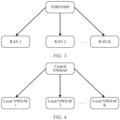
- this application may also be extended to another system architecture, for example, horizontal federated learning in a RAN-network management scenario shown in FIG. 3 , where network management may be an element management system (element management system, EMS) or a network management system (network management system, NMS), or horizontal federated learning in an enabler of network automation (enabler of network automation, eNA) architecture shown in FIG. 4 , where a local network data analytics function (network data analytics function, NWDAF) is a participant in a horizontal federated process, and a central network data analytics function is a coordinator in the horizontal federated process.
- NWDAF network data analytics function
- the UE and the RAN in this application support artificial intelligence (artificial intelligence, AI) model training.
- the element management system manages one or more network elements of a specific type.
- the network management system is configured to manage communication between network elements.
- the NWDAF is responsible for network data analytics and AI model training.
- FIG. 5 shows a model data sending method provided in an embodiment of this application.
- the method is applied to federated learning.
- the method includes the following steps.
- a second device sends a registration message to a first device, where the registration message may be referred to as a second message, and the second message includes information about the second device.
- the second message may include model accuracy requirement (accuracy requirement) information and communication sensitivity (communication sensitivity) information of the second device.
- the first device may be a radio access network device, and the second device may be a terminal device; the first device may be an element management system/network management system, and the second device may be a radio access network device; the first device may be a central network data analytics function, and the second device may be a local network data analytics function; or the like. This is not limited in this embodiment of this application.
- An accuracy requirement is an accuracy expectation of a terminal device for a model trained through federated learning. For example, an expected accuracy rate of the trained model can reach 99%, which may be considered as a high accuracy requirement, and an 80% accuracy rate may be considered as a low accuracy requirement.
- a function of the accuracy requirement is to help a RAN determine how many UEs can be allowed to perform a quantization operation. For example, when most UEs have lower accuracy requirements, more UEs may be allowed to perform quantization; when most UEs have higher accuracy requirements, fewer UEs may be allowed to perform quantization.
- Communication sensitivity refers to a degree of convenience of the UE for uploading a model, and is affected by a plurality of factors such as a channel condition and a local uploading capability of the UE.
- a function of the communication sensitivity is to help a RAN determine how many UEs are allowed to perform a quantization operation. If most UEs have high communication sensitivity, more UEs may be allowed to perform quantization.
- the first device receives the second message sent by the second device, and selects, based on the second message, the second device to participate in model training.
- the first device sends a third message to the second device participating in a current round of training, where the third message includes second model data and a model name that are before the current round of training, and is used by the second device to train the second model data that is before the current round of training, to obtain trained first model data.
- the first device determines a proportion of quantifiable layers in the second model data based on third information.
- the third information includes evaluation loss information of a previous round of training, information about an accuracy requirement of the second device for a model, and communication sensitivity information. For example, when an evaluation loss in a previous round is high, an accuracy requirement of the second device is low, and communication sensitivity of the second device is high, the first device determines a large proportion of quantifiable layers in the second model data; or when an evaluation loss in a previous round is low, an accuracy requirement of the second device is high, and communication sensitivity of the second device is low, the first device determines a small proportion of quantifiable layers in the second model data.
- neural network is an artificial neural network, and is a mathematical model or a computing model that simulates a structure and a function of a biological neural network.
- the neural network is for estimating or approximating a function, and may complete functions such as classification and regression.
- Common neural networks include a convolutional neural network, a recursive neural network, and the like.
- the first device pre-quantizes each layer of data in the second model data.
- the first device may determine a quantization error corresponding to each layer of data and a compression amount contributed by each layer of data.
- the first device may determine the quantifiable layers in the second model data based on the determined proportion of the quantifiable layers. For example, if the second model data has a total of six layers, and it is determined that the proportion of the quantifiable layers is 1/2, the first device may determine any three layers as the quantifiable layers.
- the first device may determine the quantifiable layers in the second model data based on the determined proportion of the quantifiable layers and the quantization error corresponding to each layer of data. Specifically, the first device may determine a layer with a small quantization error as a quantifiable layer based on the proportion of the quantifiable layers.
- the first device may determine the quantifiable layers in the second model data based on the determined proportion of the quantifiable layers and the compression amount contributed by each layer of data. Specifically, the first device may determine a layer with a large contributed compression amount as a quantifiable layer based on the proportion of the quantifiable layers.
- the first device may determine the quantifiable layers in the second model data based on the determined proportion of the quantifiable layers, the quantization error corresponding to each layer of data, and the compression amount contributed by each layer of data.
- the first device obtains quantized second model data, where data corresponding to the quantifiable layers in the quantized second model data is quantized, and data corresponding to an unquantifiable layer in the quantized second model data is not quantized.
- Model data in the third message may be the quantized second model data, and the third message includes second quantization configuration information.
- the second quantization configuration information is a quantization solution of the second model data, and may include information such as a quantity of quantized bits of each layer, an offset value of each layer, and a scaling factor. The information may help the second device obtain the second model data through dequantization parsing.
- a radio access network device performs hierarchical quantization on a model delivered to a terminal device, so that accumulation of multi-round quantization errors can be controlled, thereby reducing an accuracy loss of model data when a transmission amount is reduced.
- the second model data that is sent by the first device to the second device and that is before the current round of training may be unquantized, or may be quantized by layer. This is not limited in this application.
- the second device receives the third message sent by the first device, and trains the second model data by using local data.
- the second device performs dequantization parsing on the quantized second model data based on the second quantization configuration information, to obtain the second model data. Then, the second device trains the second model data, to obtain the trained first model data.
- the second device sends a fifth message to the first device, where the fifth message includes first information, and the first information includes evaluation loss information corresponding to the current round of training.
- the fifth message further includes a model name, a model parameter file size, an amount of data in the current round of training, and the like.
- the first device receives the fifth message sent by the second device, and the first device determines second information based on the first information in the fifth message.
- the second information may be a quantization error threshold, and the second information is used by the second device to quantize the first model data.
- the first device may determine the quantization error threshold based on an evaluation loss corresponding to the current round of training.
- the first device may determine a total evaluation loss based on evaluation losses that correspond to the current round of training and that are in fifth messages sent by a plurality of second devices.
- the total evaluation loss may describe a status of the current round of training.
- the total evaluation loss may help the RAN determine a proportion of second devices that can be allowed to perform quantization. For example, when the total evaluation loss is high, for example, a magnitude of 10 -2 , it indicates that training is not converged.
- a quantization error tolerance is high, where quantization may also be considered as playing a role of regularization, a large quantity of second devices may be allowed to perform quantization, and the quantization error threshold may be a large value.
- the total evaluation loss is low, for example, a magnitude of 10 -5 , training is close to convergence or has been converged, and is sensitive to an error caused by quantization.
- a proportion of second devices that perform quantization needs to be controlled or reduced, and the quantization error threshold may be a small value.
- the first device may determine the quantization error threshold based on the evaluation loss corresponding to the current round of training, the information about the accuracy requirement of the second device for model training, and the communication sensitivity information. In other words, the first device determines the quantization error threshold through comprehensive consideration. For example, when the total evaluation loss is high, and each second device has a low accuracy requirement and high communication sensitivity, more second devices need to be allowed to perform quantization, and the quantization error threshold may be a large value. When the total evaluation loss is low, and each second device has a high accuracy requirement and low communication sensitivity, the proportion of second devices that perform quantization needs to be reduced, and the quantization error value may be a small value.
- the quantization error threshold may be initialized to a specific value, for example, a quantization error corresponding to a second device in the first round of training.
- the first device sends the second information to the second device.
- the first device notifies the second device of the determined quantization error threshold, so that the second device quantizes, based on the quantization threshold, the first model data that is after the current round of training.
- the second device receives the second information sent by the first device.
- the quantization error threshold is a value. Quantization can be performed only when a quantization error of pre-quantization performed by the second device in a specific manner is less than the value, and quantized model data is uploaded. For example, the quantization error threshold is 0.01. If the quantization error of pre-quantization performed by the second device is 0.1, quantization cannot be performed; or if the quantization error is 0.001, quantization can be performed.
- Pre-quantization means that the second device performs quantization in advance in one or more quantization manners, to obtain a model error before and after the quantization.
- An error criterion may be a mean square error or the like.
- the second device quantizes the first model data based on the second information.
- the second device pre-quantizes the first model data in a first quantization manner, and determines a first quantization error based on quantized first model data and the first model data that is before the quantization. If the first quantization error is less than the quantization error threshold, the second device determines to use the first quantization manner to quantize the first model data. If the first quantization error is greater than or equal to the quantization error threshold, the second device determines not to use the first quantization manner to quantize the first model data. It should be understood that the second device may quantize the first model data in a plurality of quantization manners. When a quantization error corresponding to a specific quantization manner is less than the quantization error threshold, the second device may quantize the first model data in the quantization manner. If a quantization error corresponding to any quantization manner used by the second device is greater than or equal to the quantization error threshold, the second device does not quantize the first model data.
- the second device sends a first message to the first device, where the first message includes the quantized first model data and first quantization configuration information, and the first quantization configuration information is used by the first device to perform dequantization parsing on the quantized first model data.
- the first quantization configuration information includes a quantity of quantized bits of the model data, uniform quantization or non-uniform quantization, a quantized zero point, an offset value, a scaling factor, and the like.
- the first device receives the first message sent by the second device, and performs dequantization parsing on the quantized first model data in the first message, to obtain model data that facilitates subsequent model aggregation, for example, obtain 32-bit floating-point model data through parsing.
- the first device After the first device collects model parameter files uploaded by all second devices participating in the current round of training or after a maximum time limit is reached, the first device aggregates, by using an aggregation algorithm such as a federated averaging algorithm, the parameter files uploaded by the second devices, to update a model parameter.
- an aggregation algorithm such as a federated averaging algorithm
- the first device determines whether a training stop condition is met. If the training stop condition is not met, step 503 is returned to perform a next round of training and aggregation procedure. Otherwise, the current procedure ends.
- the first device may determine the quantization error threshold based on the evaluation loss, information about an accuracy requirement of the second device for model training, and communication sensitivity information, so that a quantization error corresponding to a quantization manner used by the second device is less than the quantization error threshold, and accumulation of multi-round multi-user quantization errors in FL training can be controlled, thereby reducing an accuracy loss of model data.
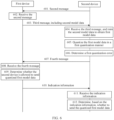
- FIG. 6 shows another model data sending method provided in an embodiment of this application.
- the method is applied to federated learning.
- the method includes the following steps.
- a second device sends a registration message to a first device, where the registration message may be referred to as a second message, and the second message includes information about the second device.
- the second message may include model accuracy requirement (accuracy requirement) information and communication sensitivity (communication sensitivity) information of the second device.
- the first device may be a radio access network device, and the second device may be a terminal device; the first device may be an element management system/network management system, and the second device may be a radio access network device; the first device may be a central network data analytics function, and the second device may be a local network data analytics function; or the like. This is not limited in this embodiment of this application.
- the first device receives the second message sent by the second device, and selects, based on the second message, the second device to participate in model training.
- the first device sends a third message to the second device participating in a current round of training, where the third message includes second model data and a model name that are before the current round of training, and is used by the second device to train the second model data that is before the current round of training, to obtain trained first model data.
- the first device may determine a proportion of quantifiable layers in the second model data based on third information.
- the third information includes evaluation loss information of a previous round of training, information about an accuracy requirement of the second device for a model, and communication sensitivity information. For example, when an evaluation loss in a previous round is high, an accuracy requirement of the second device is low, and communication sensitivity of the second device is high, the first device determines a large proportion of quantifiable layers in the second model data; or when an evaluation loss in a previous round is low, an accuracy requirement of the second device is high, and communication sensitivity of the second device is low, the first device determines a small proportion of quantifiable layers in the second model data.
- neural network is an artificial neural network, and is a mathematical model or a computing model that simulates a structure and a function of a biological neural network.
- the neural network is for estimating or approximating a function, and may complete functions such as classification and regression.
- Common neural networks include a convolutional neural network, a recursive neural network, and the like.
- the first device pre-quantizes each layer of data in the second model data.
- the first device may determine a quantization error corresponding to each layer of data and a compression amount contributed by each layer of data.
- the first device may determine the quantifiable layers in the second model data based on the determined proportion of the quantifiable layers. For example, if the second model data has a total of six layers, and it is determined that the proportion of the quantifiable layers is 1/2, the first device may determine any three layers as the quantifiable layers.
- the first device may determine the quantifiable layers in the second model data based on the determined proportion of the quantifiable layers and the quantization error corresponding to each layer of data. Specifically, the first device may determine a layer with a small quantization error as a quantifiable layer based on the proportion of the quantifiable layers.
- the first device may determine the quantifiable layers in the second model data based on the determined proportion of the quantifiable layers and the compression amount contributed by each layer of data. Specifically, the first device may determine a layer with a large contributed compression amount as a quantifiable layer based on the proportion of the quantifiable layers.
- the first device may determine the quantifiable layers in the second model data based on the determined proportion of the quantifiable layers, the quantization error corresponding to each layer of data, and the compression amount contributed by each layer of data.
- the first device obtains quantized second model data, where data corresponding to the quantifiable layers in the quantized second model data is quantized, and data corresponding to an unquantifiable layer in the quantized second model data is not quantized.
- Model data in the third message may be the quantized second model data, and the third message includes second quantization configuration information.
- the second quantization configuration information is a quantization solution of the second model data, and may include information such as a quantity of quantized bits of each layer, an offset value of each layer, and a scaling factor. The information may help the second device obtain the second model data through dequantization parsing.
- a radio access network device performs hierarchical quantization on a model delivered to a terminal device, so that accumulation of multi-round quantization errors can be controlled, thereby reducing an accuracy loss of model data when a transmission amount is reduced.
- the second model data that is sent by the first device to the second device and that is before the current round of training may be unquantized, or may be quantized by layer. This is not limited in this application.
- the second device receives the third message sent by the first device, and trains the second model data by using local data.
- the second device performs dequantization parsing on the quantized second model data based on the second quantization configuration information, to obtain the second model data. Then, the second device trains the second model data, to obtain the first model data that is after the current round of training.
- the second device quantizes the first model data in a first quantization manner.
- the second device determines a first quantization error based on quantized first model data and the first model data that is before the quantization.
- the second device sends a fourth message to the first device, where the fourth message includes the first quantization error and first information, the first information includes an evaluation loss corresponding to the current round of training, and the fourth message is used by the first device to determine whether the second device is allowed to send the quantized first model data.
- the first device receives the fourth message sent by the second device.
- the first device determines, based on the first quantization error and the first information, whether the second device is allowed to send the quantized first model data.
- the first device determines a proportion of quantifiable second devices based on evaluation losses that correspond to the current round of training and that are sent by different second devices. Specifically, a total evaluation loss is calculated based on the evaluation losses corresponding to the different second devices, and the total evaluation loss may describe a status of the current round of training. For example, when the total evaluation loss is high, it indicates that training is far from been converged, a quantization error tolerance is high, and the proportion of the quantifiable second devices is correspondingly high.
- the first device determines a proportion of quantifiable second devices based on evaluation losses that correspond to the current round of training and that are sent by different second devices, the information about the accuracy requirement of the second device for model training, and the communication sensitivity information. For example, when the total evaluation loss corresponding to the current round of training is high, an accuracy requirement of the second device is low, and communication sensitivity of the second device is high, the first device determines a large proportion of quantifiable second devices. When the total evaluation loss corresponding to the current round of training is low, an accuracy requirement of the second device is high, and communication sensitivity of the second device is low, the first device determines a small proportion of quantifiable second devices.
- the first device may determine, based on the proportion of the quantifiable second devices and the first quantization error, whether the second device is allowed to send the quantized first model data. Specifically, first quantization errors sent by different second devices are sorted in ascending order, and a second device with a small first quantization error value is determined, based on the proportion of the quantifiable second devices, as a device that is allowed to send the quantized first model data.
- the first device determines, based on the evaluation loss corresponding to the current round of training and the first quantization error determined after the second device quantizes the first model data, and indicates whether the second device can send the quantized first model data, so that excessive accumulation of the first quantization error of the second device can be avoided, thereby reducing an accuracy loss of model data.
- the first device may determine, based on the proportion of the quantifiable second devices, the first quantization error, and a threshold for a quantity of consecutive quantization times, whether the second device is allowed to send the quantized first model data. Specifically, first quantization errors sent by different second devices are sorted in ascending order, a second device with a small first quantization error value is selected based on the proportion of the quantifiable second devices, screening is performed based on the preset threshold for the quantity of consecutive quantization times, a second device whose quantity of consecutive quantization times exceeds the threshold is screened out, and a second device with a small first quantization error value and whose quantity of consecutive quantization times does not exceed the threshold is determined as a device that is allowed to send the quantized first model data. If no sufficient second devices are found, the proportion of the quantifiable second devices may be reduced until sufficient second devices are found.
- the first device determines, based on the evaluation loss corresponding to the current round of training, the first quantization error determined after the second device quantizes the first model data, and the threshold for the quantity of consecutive quantization times, and indicates whether the second device can send the quantized first model data, so that the second device can be prevented from performing quantization for a quantity of times exceeding the threshold for the quantity of consecutive quantization times, to reduce an accuracy loss of model data.
- the first device sends indication information to the second device, where the indication information indicates whether the second device is allowed to send the quantized first model data.
- the second device receives the indication information sent by the first device.
- the second device determines, based on the indication information, whether to send the quantized first model data to the first device.
- the second device sends the quantized first model data and third quantization configuration information to the first device; or if the indication information indicates that the second device is not allowed to send the quantized first model data, the second device sends the first model data that is unquantized.
- the third quantization configuration information is used by the first device to perform dequantization parsing on the quantized first model data.
- the third quantization configuration information includes a quantity of quantized bits of the first model data, uniform quantization or non-uniform quantization, a quantized zero point, an offset value, a scaling factor, and the like.
- dequantization parsing is performed on the quantized first model data, to obtain model data that facilitates subsequent model aggregation, for example, obtain 32-bit floating-point model data through parsing. If the first device receives the first model data that is unquantized and that is sent by the second device, dequantization parsing does not need to be performed.
- the first device After the first device collects model parameter files uploaded by all second devices participating in the current round of training or after a maximum time limit is reached, the first device aggregates, by using an aggregation algorithm such as a federated averaging algorithm, the parameter files uploaded by the second devices, to update a model parameter.
- an aggregation algorithm such as a federated averaging algorithm
- the first device determines whether a training stop condition is met. If the training stop condition is not met, step 603 is returned to perform a next round of training and aggregation procedure. Otherwise, the current procedure ends.
- FIG. 7 shows another model data sending method provided in an embodiment of this application.
- the method may be applied to federated learning.
- the method includes the following steps.
- a second device sends a registration message to a first device, where the registration message may be referred to as a second message, and the second message includes information about the second device.
- the second message may include model accuracy requirement (accuracy requirement) information and communication sensitivity (communication sensitivity) information of the second device.
- the first device may be a radio access network device, and the second device may be a terminal device; the first device may be an element management system/network management system, and the second device may be a radio access network device; the first device may be a central network data analytics function, and the second device may be a local network data analytics function; or the like. This is not limited in this embodiment of this application.
- the first device receives the second message sent by the second device, and selects, based on the second message, the second device to participate in model training.
- the first device sends a third message to the second device participating in a current round of training, where the third message includes quantized second model data and second quantization configuration information, the second model data is model data that is before the current round of training, and the third message is used by the second device to train the second model data to obtain trained first model data.
- the second quantization configuration information is a quantization solution of the second model data, and may include information such as a quantity of quantized bits of each layer, an offset value of each layer, and a scaling factor. The information may help the second device obtain the second model data through dequantization parsing.
- the first device may determine a proportion of quantifiable layers in the second model data based on third information.
- the third information includes evaluation loss information of a previous round of training, information about an accuracy requirement of the second device for a model, and communication sensitivity information. For example, when an evaluation loss in a previous round is high, an accuracy requirement of the second device is low, and communication sensitivity of the second device is high, the first device determines a large proportion of quantifiable layers in the second model data; or when an evaluation loss in a previous round is low, an accuracy requirement of the second device is high, and communication sensitivity of the second device is low, the first device determines a small proportion of quantifiable layers in the second model data.
- neural network is an artificial neural network, and is a mathematical model or a computing model that simulates a structure and a function of a biological neural network.
- the neural network is for estimating or approximating a function, and may complete functions such as classification and regression.
- Common neural networks include a convolutional neural network, a recursive neural network, and the like.
- the first device pre-quantizes each layer of data in the second model data.
- the first device may determine a quantization error corresponding to each layer of data and a compression amount contributed by each layer of data.
- the first device may determine the quantifiable layers in the second model data based on the determined proportion of the quantifiable layers. For example, if the second model data has a total of six layers, and it is determined that the proportion of the quantifiable layers is 1/2, the first device may determine any three layers as the quantifiable layers.
- the first device may determine the quantifiable layers in the second model data based on the determined proportion of the quantifiable layers and the quantization error corresponding to each layer of data. Specifically, the first device may determine a layer with a small quantization error as a quantifiable layer based on the proportion of the quantifiable layers.
- the first device may determine the quantifiable layers in the second model data based on the determined proportion of the quantifiable layers and the compression amount contributed by each layer of data. Specifically, the first device may determine a layer with a large contributed compression amount as a quantifiable layer based on the proportion of the quantifiable layers.
- the first device may determine the quantifiable layers in the second model data based on the determined proportion of the quantifiable layers, the quantization error corresponding to each layer of data, and the compression amount contributed by each layer of data.
- the first device obtains quantized second model data, where data corresponding to the quantifiable layers in the quantized second model data is quantized, and data corresponding to an unquantifiable layer in the quantized second model data is not quantized.
- the first device performs hierarchical quantization on a model delivered to the second device, so that accumulation of multi-round quantization errors can be controlled, thereby reducing an accuracy loss of model data when a transmission amount is reduced.
- the second model data that is sent by the first device to the second device and that is before the current round of training may alternatively be unquantized. This is not limited in this application.
- FIG. 8 is a schematic block diagram of the communication apparatus 800 according to this embodiment of this application.
- the communication apparatus 800 includes:
- the transceiver unit 820 is further configured to receive a first message sent by the second device, where the first message includes quantized first model data and first quantization configuration information.
- the first information further includes information about an accuracy requirement of the second device for model training and communication sensitivity information.
- the transceiver unit 820 is further configured to receive a second message sent by the second device, where the second message includes information about the accuracy requirement and the communication sensitivity information.
- the processing unit 810 is further configured to determine a proportion of quantifiable layers in second model data based on third information, where the third information includes an evaluation loss corresponding to a previous round of training, the information about the accuracy requirement, and the communication sensitivity information, and the second model data is model data that is before the current round of training.
- the processing unit 810 is further configured to quantize the second model data based on the proportion of the quantifiable layers, to obtain quantized second model data.
- the transceiver unit 820 is further configured to send a third message to the second device, where the third message includes the quantized second model data and second quantization configuration information, and the third message is used by the second device to train the second model data to obtain the first model data.
- FIG. 9 is a schematic block diagram of the communication apparatus 900 according to this embodiment of this application.
- the communication apparatus 900 includes:
- the transceiver unit 910 is further configured to send a first message to the first device, where the first message includes quantized first model data and first quantization configuration information.
- the processing unit 920 is specifically configured to: quantize the first model data in a first quantization manner; determine a first quantization error based on quantized first model data and the first model data that is before the quantization; and if the first quantization error is less than the quantization error threshold, determine to use the first quantization manner to quantize the first model data.
- the transceiver unit 910 is further configured to receive a third message sent by the first device, where the third message includes quantized second model data and second quantization configuration information, and the second model data is model data that is before the current round of training.
- the processing unit 920 is further configured to perform dequantization parsing based on the quantized second model data and the second quantization configuration information to obtain the second model data.
- the processing unit 920 is further configured to train the second model data, to obtain the first model data.
- FIG. 10 is a schematic block diagram of the communication apparatus 1000 according to this embodiment of this application.
- the communication apparatus 1000 includes:
- the transceiver unit 1010 is further configured to send indication information to the second device, where the indication information indicates whether the second device is allowed to send the quantized first model data.
- the processing unit 1020 is specifically configured to: determine a proportion of quantifiable second devices based on the first information; and determine, based on the proportion of the quantifiable second devices, the first quantization error, and a threshold for a quantity of consecutive quantization times, whether the second device is allowed to send the quantized first model data.
- the first information further includes information about an accuracy requirement of the second device for model training and communication sensitivity information.
- the transceiver unit 1010 is further configured to receive a second message sent by the second device, where the second message includes information about the accuracy requirement and the communication sensitivity information.
- the processing unit 1020 is further configured to determine a proportion of quantifiable layers in second model data based on third information, where the third information includes an evaluation loss corresponding to a previous round of training, the information about the accuracy requirement, and the communication sensitivity information, and the second model data is model data that is before the current round of training.
- the processing unit 1020 is further configured to quantize the second model data based on the proportion of the quantifiable layers, to obtain quantized second model data.
- the transceiver unit 1010 is further configured to send a third message to the second device, where the third message includes the quantized second model data and second quantization configuration information, and the third message is used by the second device to train the second model data to obtain the first model data.
- FIG. 11 is a schematic block diagram of the communication apparatus 1100 according to this embodiment of this application.
- the communication apparatus 1100 includes:
- the transceiver unit 1120 is further configured to receive indication information sent by the first device, where the indication information indicates whether the second device is allowed to send the quantized first model data.
- the processing unit 1110 is further configured to determine, based on the indication information, whether to send the quantized first model data to the first device.
- the processing unit 1110 is specifically configured to: if the indication information indicates that the second device is allowed to send the quantized first model data, send the quantized first model data and third quantization configuration information to the first device; or if the indication information indicates that the second device is not allowed to send the quantized first model data, send the first model data that is unquantized.
- the transceiver unit 1120 is further configured to receive a third message sent by the first device, where the third message includes quantized second model data and second quantization configuration information, and the second model data is model data that is before the current round of training.
- the processing unit 1110 is further configured to perform dequantization parsing based on the quantized second model data and the second quantization configuration information to obtain the second model data.
- the processing unit 1110 is further configured to train the second model data, to obtain the first model data.
- FIG. 12 is a schematic block diagram of the communication apparatus 1200 according to this embodiment of this application.
- the communication apparatus 1200 includes: a processing unit 1210, configured to determine a proportion of quantifiable layers in second model data based on third information, where the third information includes an evaluation loss corresponding to a previous round of training, information about an accuracy requirement of a second device for model training, and communication sensitivity information, and the second model data is model data that is before a current round of training, where
- the processing unit 1210 is further configured to quantize the second model data based on the proportion of the quantifiable layers, to obtain quantized second model data; and a transceiver unit 1220, configured to send a third message to the second device, where the third message includes the quantized second model data and second quantization configuration information, and the third message is used by the second device to train the second model data.
- the processing unit 1210 is specifically configured to: quantize each layer of data in the second model data; determine a quantization error corresponding to each layer of data and a compression amount contributed by each layer of data; determine the quantifiable layers in the second model data based on the proportion of the quantifiable layers, the quantization error corresponding to each layer of data, and/or the compression amount contributed by each layer of data; and obtain the quantized second model data, where data corresponding to the quantifiable layers in the quantized second model data is quantized, and data corresponding to an unquantifiable layer in the quantized second model data is not quantized.
- FIG. 13 is a schematic block diagram of the communication device 1300 according to this embodiment of this application.
- the communication device 1300 includes: a processor 1310 and a transceiver 1320, where the transceiver 1320 is configured to: receive computer code or instructions, and transmit the computer code or the instructions to the processor, and the processor 1310 runs the computer code or the instructions, to implement the methods in embodiments of this application.
- the foregoing processor may be an integrated circuit chip, and has a signal processing capability.
- steps in the foregoing method embodiments can be implemented by using a hardware integrated logical circuit in the processor, or by using instructions in a form of software.
- the foregoing processor may be a general purpose processor, a digital signal processor (digital signal processor, DSP), an application-specific integrated circuit (application specific integrated circuit, ASIC), a field programmable gate array (field programmable gate array, FPGA) or another programmable logic device, a discrete gate or transistor logic device, or a discrete hardware component. It may implement or perform the methods, the steps, and logical block diagrams that are disclosed in embodiments of this application.
- the general-purpose processor may be a microprocessor, or the processor may be any conventional processor or the like. Steps of the methods disclosed with reference to embodiments of this application may be directly executed and accomplished by a hardware decoding processor, or may be executed and accomplished by using a combination of hardware and software modules in the decoding processor.
- a software module may be located in a mature storage medium in the art, such as a random access memory, a flash memory, a read-only memory, a programmable read-only memory, an electrically erasable programmable memory, or a register. The storage medium is located in the memory, and the processor reads a message in the memory and completes the steps in the foregoing method in combination with hardware of the processor.
- An embodiment of this application further provides a computer-readable storage medium.
- the computer-readable storage medium stores a computer program used to implement the method in the foregoing method embodiments.
- the computer program is run on a computer, the computer is enabled to implement the method in the foregoing method embodiments.
- a and/or B may represent the following three cases: Only A exists, both A and B exist, and only B exists.
- the character "/" in this specification generally indicates an "or” relationship between the associated objects.
- the term "at least one” in this application may represent "one" and "two or more”. For example, at least one of A, B, and C may indicate the following seven cases: Only A exists, only B exists, only C exists, both A and B exist, both A and C exist, both C and B exist, and A, B, and C exist.
- the disclosed system, apparatus and method may be implemented in other manners.
- the described apparatus embodiment is merely an example.
- division into the units is merely logical function division and may be other division in actual implementation.
- a plurality of units or components may be combined or integrated into another system, or some features may be ignored or not performed.
- the displayed or discussed mutual couplings or direct couplings or communication connections may be implemented by using some interfaces.
- the indirect couplings or communication connections between the apparatuses or units may be implemented in electronic, mechanical, or other forms.
- the units described as separate parts may or may not be physically separate, and parts displayed as units may or may not be physical units, may be located in one position, or may be distributed on a plurality of network units. Some or all of the units may be selected based on actual requirements to achieve the objectives of the solutions of embodiments.
- function units in embodiments of this application may be integrated into one processing unit, or each of the units may exist alone physically, or two or more units are integrated into one unit.
- the functions When the functions are implemented in the form of a software functional unit and sold or used as an independent product, the functions may be stored in a computer-readable storage medium. Based on such an understanding, the technical solutions of this application essentially, or the part contributing to the conventional technology, or a part of the technical solutions may be implemented in a form of a software product.
- the computer software product is stored in a storage medium, and includes several instructions for instructing a computer device (which may be a personal computer, a server, a network device, or the like) to perform all or a part of the steps of the methods described in embodiments of this application.
- the foregoing storage medium includes any medium that can store program code, such as a USB flash drive, a removable hard disk, a read-only memory (Read-Only Memory, ROM), a random access memory (Random Access Memory, RAM), a magnetic disk, or an optical disc.
- program code such as a USB flash drive, a removable hard disk, a read-only memory (Read-Only Memory, ROM), a random access memory (Random Access Memory, RAM), a magnetic disk, or an optical disc.
Landscapes
- Engineering & Computer Science (AREA)
- Theoretical Computer Science (AREA)
- Physics & Mathematics (AREA)
- Data Mining & Analysis (AREA)
- General Health & Medical Sciences (AREA)
- Biomedical Technology (AREA)
- Biophysics (AREA)
- Computational Linguistics (AREA)
- Life Sciences & Earth Sciences (AREA)
- Evolutionary Computation (AREA)
- Artificial Intelligence (AREA)
- Molecular Biology (AREA)
- Computing Systems (AREA)
- General Engineering & Computer Science (AREA)
- General Physics & Mathematics (AREA)
- Mathematical Physics (AREA)
- Software Systems (AREA)
- Health & Medical Sciences (AREA)
- Compression, Expansion, Code Conversion, And Decoders (AREA)
Applications Claiming Priority (1)
| Application Number | Priority Date | Filing Date | Title |
|---|---|---|---|
| PCT/CN2020/142454 WO2022141544A1 (zh) | 2020-12-31 | 2020-12-31 | 模型数据发送的方法和装置 |
Publications (2)
| Publication Number | Publication Date |
|---|---|
| EP4258104A1 true EP4258104A1 (de) | 2023-10-11 |
| EP4258104A4 EP4258104A4 (de) | 2024-02-07 |
Family
ID=82260158
Family Applications (1)
| Application Number | Title | Priority Date | Filing Date |
|---|---|---|---|
| EP20967882.0A Pending EP4258104A4 (de) | 2020-12-31 | 2020-12-31 | Verfahren und vorrichtung zur übertragung von modelldaten |
Country Status (4)
| Country | Link |
|---|---|
| US (1) | US20230351207A1 (de) |
| EP (1) | EP4258104A4 (de) |
| CN (1) | CN116569185B (de) |
| WO (1) | WO2022141544A1 (de) |
Families Citing this family (2)
| Publication number | Priority date | Publication date | Assignee | Title |
|---|---|---|---|---|
| CN119744520A (zh) * | 2022-08-25 | 2025-04-01 | 华为技术有限公司 | 信息传输方法、装置、芯片、芯片模组及存储介质 |
| WO2024234267A1 (zh) * | 2023-05-15 | 2024-11-21 | Oppo广东移动通信有限公司 | 通信方法和设备 |
Family Cites Families (8)
| Publication number | Priority date | Publication date | Assignee | Title |
|---|---|---|---|---|
| US10235638B2 (en) * | 2014-10-09 | 2019-03-19 | Splunk Inc. | Adaptive key performance indicator thresholds |
| US11270187B2 (en) * | 2017-11-07 | 2022-03-08 | Samsung Electronics Co., Ltd | Method and apparatus for learning low-precision neural network that combines weight quantization and activation quantization |
| US11755901B2 (en) * | 2017-12-28 | 2023-09-12 | Intel Corporation | Dynamic quantization of neural networks |
| CN110309847B (zh) * | 2019-04-26 | 2021-09-17 | 深圳前海微众银行股份有限公司 | 一种模型压缩方法及装置 |
| CN110262819B (zh) * | 2019-06-04 | 2021-02-26 | 深圳前海微众银行股份有限公司 | 一种联邦学习的模型参数更新方法及装置 |
| US11676028B2 (en) * | 2019-06-12 | 2023-06-13 | Shanghai Cambricon Information Technology Co., Ltd | Neural network quantization parameter determination method and related products |
| CN111401552B (zh) * | 2020-03-11 | 2023-04-07 | 浙江大学 | 基于调整批量大小与梯度压缩率的联邦学习方法和系统 |
| CN111611610B (zh) * | 2020-04-12 | 2023-05-30 | 西安电子科技大学 | 联邦学习信息处理方法、系统、存储介质、程序、终端 |
-
2020
- 2020-12-31 CN CN202080106610.3A patent/CN116569185B/zh active Active
- 2020-12-31 EP EP20967882.0A patent/EP4258104A4/de active Pending
- 2020-12-31 WO PCT/CN2020/142454 patent/WO2022141544A1/zh not_active Ceased
-
2023
- 2023-06-29 US US18/343,879 patent/US20230351207A1/en active Pending
Also Published As
| Publication number | Publication date |
|---|---|
| EP4258104A4 (de) | 2024-02-07 |
| WO2022141544A1 (zh) | 2022-07-07 |
| CN116569185A (zh) | 2023-08-08 |
| US20230351207A1 (en) | 2023-11-02 |
| CN116569185B (zh) | 2025-11-14 |
Similar Documents
| Publication | Publication Date | Title |
|---|---|---|
| US20230246759A1 (en) | Method and apparatus for processing channel state information, and terminal | |
| CN114745712A (zh) | 基于终端能力的处理方法、装置、终端及网络设备 | |
| EP3553980B1 (de) | Verfahren zur übertragung von daten, endgerätevorrichtung und netzwerkvorrichtung | |
| US20230351207A1 (en) | Model data sending method and apparatus | |
| US20230244911A1 (en) | Neural network information transmission method and apparatus, communication device, and storage medium | |
| CN116010072A (zh) | 机器学习模型的训练方法和装置 | |
| US20240080788A1 (en) | Information transmission method, lightweight processing method, and related communication apparatus | |
| CN116195293B (zh) | 从用户装备接收干扰和噪声功率波动报告 | |
| EP4340505A1 (de) | Verfahren und vorrichtung für bericht über kanalzustandsinformationen (csi) | |
| CN117616714A (zh) | Csi反馈方案的更新方法、装置、设备及存储介质 | |
| CN117882426A (zh) | Csi上报方法、装置、设备及系统 | |
| CN116097712A (zh) | 报告干扰和噪声功率波动 | |
| EP3592060B1 (de) | Ressourcenzuteilungsverfahren, bestimmungsverfahren und vorrichtung | |
| WO2024036526A1 (zh) | 一种模型调度方法和装置 | |
| CN117459961A (zh) | 一种通信方法、装置及系统 | |
| CN111385902B (zh) | 数据调度方法及装置 | |
| CN115379397A (zh) | 数据处理方法、装置、设备及存储介质 | |
| EP3668160B1 (de) | Signalmeldeverfahren und endgerätevorrichtung | |
| CN113079523B (zh) | 上行数据压缩udc的配置方法、装置、基站及终端 | |
| EP4539534A1 (de) | Ressourcenplanungsverfahren und kommunikationsvorrichtung | |
| CN117859366A (zh) | 通信方法、装置、设备、存储介质、芯片及程序产品 | |
| CN111654872B (zh) | 一种信息处理方法、装置、设备及计算机可读存储介质 | |
| US20250373372A1 (en) | Traffic-Dependent Discarding and Data Throttling Mechanisms | |
| EP4568332A1 (de) | Datenübertragungsverfahren und -vorrichtung sowie vorrichtung, speichermedium und system | |
| WO2025076740A1 (zh) | 信息处理方法及装置、终端设备、网络设备 |
Legal Events
| Date | Code | Title | Description |
|---|---|---|---|
| STAA | Information on the status of an ep patent application or granted ep patent |
Free format text: STATUS: THE INTERNATIONAL PUBLICATION HAS BEEN MADE |
|
| PUAI | Public reference made under article 153(3) epc to a published international application that has entered the european phase |
Free format text: ORIGINAL CODE: 0009012 |
|
| STAA | Information on the status of an ep patent application or granted ep patent |
Free format text: STATUS: REQUEST FOR EXAMINATION WAS MADE |
|
| 17P | Request for examination filed |
Effective date: 20230704 |
|
| AK | Designated contracting states |
Kind code of ref document: A1 Designated state(s): AL AT BE BG CH CY CZ DE DK EE ES FI FR GB GR HR HU IE IS IT LI LT LU LV MC MK MT NL NO PL PT RO RS SE SI SK SM TR |
|
| A4 | Supplementary search report drawn up and despatched |
Effective date: 20240108 |
|
| RIC1 | Information provided on ipc code assigned before grant |
Ipc: G06N 3/0464 20230101ALN20240102BHEP Ipc: G06N 3/044 20230101ALN20240102BHEP Ipc: G06N 3/098 20230101ALI20240102BHEP Ipc: G06N 3/0495 20230101ALI20240102BHEP Ipc: H04W 72/50 20230101ALI20240102BHEP Ipc: G06N 20/00 20190101ALI20240102BHEP Ipc: G06F 8/65 20180101AFI20240102BHEP |
|
| DAV | Request for validation of the european patent (deleted) | ||
| DAX | Request for extension of the european patent (deleted) |