EP4255810B1 - Spacecraft provided with low and high thrust propulsion system - Google Patents
Spacecraft provided with low and high thrust propulsion system Download PDFInfo
- Publication number
- EP4255810B1 EP4255810B1 EP21824029.9A EP21824029A EP4255810B1 EP 4255810 B1 EP4255810 B1 EP 4255810B1 EP 21824029 A EP21824029 A EP 21824029A EP 4255810 B1 EP4255810 B1 EP 4255810B1
- Authority
- EP
- European Patent Office
- Prior art keywords
- water
- gaseous
- high thrust
- storage tank
- thrust
- Prior art date
- Legal status (The legal status is an assumption and is not a legal conclusion. Google has not performed a legal analysis and makes no representation as to the accuracy of the status listed.)
- Active
Links
Images
Classifications
-
- B—PERFORMING OPERATIONS; TRANSPORTING
- B64—AIRCRAFT; AVIATION; COSMONAUTICS
- B64G—COSMONAUTICS; VEHICLES OR EQUIPMENT THEREFOR
- B64G1/00—Cosmonautic vehicles
- B64G1/22—Parts of, or equipment specially adapted for fitting in or to, cosmonautic vehicles
- B64G1/40—Arrangements or adaptations of propulsion systems
- B64G1/402—Propellant tanks; Feeding propellants
- B64G1/4021—Tank construction; Details thereof
-
- B—PERFORMING OPERATIONS; TRANSPORTING
- B64—AIRCRAFT; AVIATION; COSMONAUTICS
- B64G—COSMONAUTICS; VEHICLES OR EQUIPMENT THEREFOR
- B64G1/00—Cosmonautic vehicles
- B64G1/22—Parts of, or equipment specially adapted for fitting in or to, cosmonautic vehicles
- B64G1/24—Guiding or controlling apparatus, e.g. for attitude control
- B64G1/244—Spacecraft control systems
-
- B—PERFORMING OPERATIONS; TRANSPORTING
- B64—AIRCRAFT; AVIATION; COSMONAUTICS
- B64G—COSMONAUTICS; VEHICLES OR EQUIPMENT THEREFOR
- B64G1/00—Cosmonautic vehicles
- B64G1/22—Parts of, or equipment specially adapted for fitting in or to, cosmonautic vehicles
- B64G1/40—Arrangements or adaptations of propulsion systems
- B64G1/401—Liquid propellant rocket engines
-
- B—PERFORMING OPERATIONS; TRANSPORTING
- B64—AIRCRAFT; AVIATION; COSMONAUTICS
- B64G—COSMONAUTICS; VEHICLES OR EQUIPMENT THEREFOR
- B64G1/00—Cosmonautic vehicles
- B64G1/22—Parts of, or equipment specially adapted for fitting in or to, cosmonautic vehicles
- B64G1/40—Arrangements or adaptations of propulsion systems
- B64G1/402—Propellant tanks; Feeding propellants
-
- F—MECHANICAL ENGINEERING; LIGHTING; HEATING; WEAPONS; BLASTING
- F02—COMBUSTION ENGINES; HOT-GAS OR COMBUSTION-PRODUCT ENGINE PLANTS
- F02K—JET-PROPULSION PLANTS
- F02K9/00—Rocket-engine plants, i.e. plants carrying both fuel and oxidant therefor; Control thereof
- F02K9/42—Rocket-engine plants, i.e. plants carrying both fuel and oxidant therefor; Control thereof using liquid or gaseous propellants
- F02K9/425—Propellants
-
- F—MECHANICAL ENGINEERING; LIGHTING; HEATING; WEAPONS; BLASTING
- F02—COMBUSTION ENGINES; HOT-GAS OR COMBUSTION-PRODUCT ENGINE PLANTS
- F02K—JET-PROPULSION PLANTS
- F02K9/00—Rocket-engine plants, i.e. plants carrying both fuel and oxidant therefor; Control thereof
- F02K9/42—Rocket-engine plants, i.e. plants carrying both fuel and oxidant therefor; Control thereof using liquid or gaseous propellants
- F02K9/60—Constructional parts; Details not otherwise provided for
- F02K9/605—Reservoirs
-
- F—MECHANICAL ENGINEERING; LIGHTING; HEATING; WEAPONS; BLASTING
- F02—COMBUSTION ENGINES; HOT-GAS OR COMBUSTION-PRODUCT ENGINE PLANTS
- F02K—JET-PROPULSION PLANTS
- F02K9/00—Rocket-engine plants, i.e. plants carrying both fuel and oxidant therefor; Control thereof
- F02K9/42—Rocket-engine plants, i.e. plants carrying both fuel and oxidant therefor; Control thereof using liquid or gaseous propellants
- F02K9/60—Constructional parts; Details not otherwise provided for
- F02K9/62—Combustion or thrust chambers
-
- F—MECHANICAL ENGINEERING; LIGHTING; HEATING; WEAPONS; BLASTING
- F02—COMBUSTION ENGINES; HOT-GAS OR COMBUSTION-PRODUCT ENGINE PLANTS
- F02K—JET-PROPULSION PLANTS
- F02K9/00—Rocket-engine plants, i.e. plants carrying both fuel and oxidant therefor; Control thereof
- F02K9/80—Rocket-engine plants, i.e. plants carrying both fuel and oxidant therefor; Control thereof characterised by thrust or thrust vector control
- F02K9/88—Rocket-engine plants, i.e. plants carrying both fuel and oxidant therefor; Control thereof characterised by thrust or thrust vector control using auxiliary rocket nozzles
-
- Y—GENERAL TAGGING OF NEW TECHNOLOGICAL DEVELOPMENTS; GENERAL TAGGING OF CROSS-SECTIONAL TECHNOLOGIES SPANNING OVER SEVERAL SECTIONS OF THE IPC; TECHNICAL SUBJECTS COVERED BY FORMER USPC CROSS-REFERENCE ART COLLECTIONS [XRACs] AND DIGESTS
- Y02—TECHNOLOGIES OR APPLICATIONS FOR MITIGATION OR ADAPTATION AGAINST CLIMATE CHANGE
- Y02E—REDUCTION OF GREENHOUSE GAS [GHG] EMISSIONS, RELATED TO ENERGY GENERATION, TRANSMISSION OR DISTRIBUTION
- Y02E60/00—Enabling technologies; Technologies with a potential or indirect contribution to GHG emissions mitigation
- Y02E60/30—Hydrogen technology
- Y02E60/36—Hydrogen production from non-carbon containing sources, e.g. by water electrolysis
Definitions
- the present invention relates to a spacecraft provided with a low and high thrust propulsion system also known as dual-mode.
- Said spacecraft is a satellite.
- the investment increase has allowed the development of technologies for the miniaturization of the propulsion systems which allow to create reduced dimension satellite platforms.
- Advantages are obtained, such as, for example, a reduction of the satellite cost, with the same functions performed, and a time reduction in designing, manufacturing and launching satellites that are always up to date from a technological point of view.
- a nanosatellite is launched into orbit in about 2-3 years from the start of the design, while large satellites also require tens of years for their design and launch.
- Nanosatellites require new propulsion systems, small and powerful enough to be suitable to perform requested manoeuvres.
- a satellite needs propulsion systems, basically: 1) for attitude and control manoeuvres (RCS - Reaction Control System), in order to control satellite attitude and repositioning; 2) for orbit change manoeuvres (Delta-V), to enter operational orbit or to de-orbit at the end of service life, both natural and on demand; and 3) for other manoeuvres which can be considered a combination of the previous ones.
- RCS - Reaction Control System attitude and control manoeuvres
- Delta-V orbit change manoeuvres
- attitude and control manoeuvres require low thrust, and the orbit change normally requires high thrust.
- EP 3348671 A1 discloses a space propulsion system comprising in a spacecraft a reservoir containing liquid water and a drive unit including a regulating valve for sucking liquid water from the reservoir, a water splitting device for splitting the liquid water into gaseous hydrogen and gaseous oxygen, a combustion chamber, in which the gaseous hydrogen reacts with the gaseous oxygen, and an exhaust nozzle from the combustion chamber.
- EP 3246559 A1 describes a space propulsion system similar to that one of EP 3348671 A1 .
- US 2004/245406 A1 describes a microthruster that comprises a reaction chamber to provide a propellant plume which is directed from a nozzle to the exterior of a spacecraft to provide thrust.
- the monopropellant used can be water.
- the vapor exiting the vaporization chamber is sent through respective Delta-V thruster valves to two Delta-V thrusters, each of which includes a pre-heater, a Delta-V thruster thermal insulator and a nozzle.
- the vapor exiting the vaporization chamber is sent through respective RCS thruster valves to four RCS thrusters, each comprising a pre-heater, an RCS thruster thermal insulator and an RCS nozzle.
- the thrust provided by a Delta-V thruster is 4.0 mN
- the thrust provided by an RCS thruster is 2.0 mN.
- AQUARIUS demonstrates the convenience of using a single propellant, namely water, to produce low thrust and high thrust.
- the high thrust produced by the AQUARIUS Delta-V thruster is quite low with the consequence that the orbit change manoeuvres are very slow and the satellite spends part of its life in an inactive way.
- An object of the present invention is to provide a single propulsion system which is so versatile as to be able to perform both low thrust and high thrust manoeuvres.
- Another object of the invention is to create a propulsion system that is so compact that it can also be installed on nanosatellites.
- a further object is to provide a propulsion system which uses a single propellant at least as its primary energy source.
- Another object is to provide a low and high thrust propulsion system that is particularly efficient in high thrust and can conveniently use, directly or indirectly, water as the only propellant.
- the present invention provides a spacecraft as defined in claim 1.
- the propulsion system aims to use only liquid water to feed both high thrust thrusters and low thrust thrusters.
- the high thrust thrusters may use water electrolysis and combustion of hydrogen and oxygen Alternatively, another hydrogen / oxygen creation system, such as the microwave one, can be used.
- the low thrust thrusters employ expansion of water vapor which may be obtained by heating the water itself.
- Two lines may depart from the liquid water reservoir, one for high thrust and one for low thrust.
- the high thrust line may provide that:
- the low thrust line provides that:
- the propulsion system comprises a high thrust propulsion part and a low thrust propulsion part.
- the high thrust propulsion part has a thruster comprising a water reservoir 1 for containing liquid water, a water splitting device 2 for splitting the liquid water into gaseous hydrogen and gaseous oxygen and storing them in a gaseous hydrogen storage tank 3 and in a gaseous oxygen storage tank 4, respectively, and a high thrust chamber 5 with nozzle 6 for discharging the combustion products.
- the splitting device could be a water electrolyser that electrolyses water into gaseous hydrogen and gaseous oxygen, or a water microwave splitting device for splitting water into gaseous hydrogen and gaseous oxygen, or another device.
- the hydrogen storage tank 3 and the oxygen storage tank 4 they could be reduced to a single one in which hydrogen and oxygen are mixed and fed into the combustion chamber already mixed.
- the accumulation of gaseous hydrogen and gaseous oxygen, premixed or not, is inside the water splitting device 2.
- Another configuration could be that without any storage tank: this solution assumes that the splitting of water, instantaneous and / or continuous, by means of an electrolyser or microwave device, or different device, produces enough hydrogen and oxygen to be able to perform punctual and / or continuous thrusts, as needed by a mission, and to not require accumulation of the gases produced, either internally or externally to the water splitting device, before entering the combustion chamber.
- the low thrust propulsion part of the propulsion system includes a supply line 10 of liquid water from reservoir 1 and a plurality of water derivations in branches 11-1n, where n indicates the total number of branches.
- Each branch 11-1n has a regulation valve 21-2n, a vaporization chamber 31-3n and an expansion nozzle 41-4n downstream of the vaporization chamber 31-3n.
- the low thrust propulsion part has at least four vaporization chambers, although six vaporization chambers with seven flow control valves are shown in the block diagram of Fig. 1 .
- high thrust chambers are those able to provide thrusts of about 0.1 N, as order of magnitude, and more.
- the thruster according to the invention is able to provide thrusts also up to 10 N or more.
- the vaporization chambers of the low thrust propulsion part according to the invention are characterized by thrusts about 0.001 N, as order of magnitude, or less; usually there are thrusts in the range of 1-10 mN.
- the high thrust chamber can work at high pressures, even, as order of magnitude, about 5,000 kPa.
- Low thrust chambers work at low pressures, even, as order of magnitude, below 100 kPa.
- the high thrust chamber can have dimensions of the order of one centimeter (nozzle excluded).
- a chamber of 10x10 mm (diameter x height) can give a thrust of 1-5 N.
- the low thrust chambers can have dimensions of the order of millimeters, nozzle included. Chambers of 8x8x2 mm (length x width x height) can provide thrusts in the range of 1-25 mN.
- the high thrust chamber is made of metal materials, such as steel, titanium, tungsten.
- the low thrust chambers can also be on silicon wafers.
- the propellant is unique: liquid water. It is used on the same spacecraft to obtain: 1) high thrust through water splitting into gaseous hydrogen and gaseous oxygen, hydrogen and oxygen combustion and discharge of combustion products through an exhaust nozzle 6; and 2) low thrust by vaporizing water and making it expand in the expansion nozzle 41-4n.
- liquid water is
Landscapes
- Engineering & Computer Science (AREA)
- Combustion & Propulsion (AREA)
- Chemical & Material Sciences (AREA)
- Remote Sensing (AREA)
- Mechanical Engineering (AREA)
- General Engineering & Computer Science (AREA)
- Aviation & Aerospace Engineering (AREA)
- Plasma & Fusion (AREA)
- Physics & Mathematics (AREA)
- Automation & Control Theory (AREA)
- Radar, Positioning & Navigation (AREA)
- Electrolytic Production Of Non-Metals, Compounds, Apparatuses Therefor (AREA)
- Control Of Position, Course, Altitude, Or Attitude Of Moving Bodies (AREA)
- Details Of Aerials (AREA)
- Vehicle Body Suspensions (AREA)
- Jet Pumps And Other Pumps (AREA)
- Filling Or Discharging Of Gas Storage Vessels (AREA)
Description
- The present invention relates to a spacecraft provided with a low and high thrust propulsion system also known as dual-mode. Said spacecraft is a satellite.
- In recent times, investments have been increasing for the launch of new satellites, usually in constellations, to obtain global and instant connection and observation.
- The investment increase has allowed the development of technologies for the miniaturization of the propulsion systems which allow to create reduced dimension satellite platforms. Advantages are obtained, such as, for example, a reduction of the satellite cost, with the same functions performed, and a time reduction in designing, manufacturing and launching satellites that are always up to date from a technological point of view. In fact, a nanosatellite is launched into orbit in about 2-3 years from the start of the design, while large satellites also require tens of years for their design and launch.
- Nanosatellites require new propulsion systems, small and powerful enough to be suitable to perform requested manoeuvres.
- A satellite needs propulsion systems, basically: 1) for attitude and control manoeuvres (RCS - Reaction Control System), in order to control satellite attitude and repositioning; 2) for orbit change manoeuvres (Delta-V), to enter operational orbit or to de-orbit at the end of service life, both natural and on demand; and 3) for other manoeuvres which can be considered a combination of the previous ones.
- These manoeuvres need two types of thrust power. The attitude and control manoeuvres require low thrust, and the orbit change normally requires high thrust.
- Currently, on miniaturized satellites, low thrust manoeuvres generally use electric propulsion systems, and high thrust manoeuvres request an addition of another propulsion system with a consequent complication in terms of weight increase, reduction of volumes available for paying load, cost increase, reliability reduction, etc.
- If a second propulsion system is not added, it is necessary to carry out the manoeuvres at high thrust by means of the low thrust propulsion system, with a result of a substantial increase in the time required to complete the manoeuvres and a significant reduction in the useful life of the satellite.
-
EP 3348671 A1 discloses a space propulsion system comprising in a spacecraft a reservoir containing liquid water and a drive unit including a regulating valve for sucking liquid water from the reservoir, a water splitting device for splitting the liquid water into gaseous hydrogen and gaseous oxygen, a combustion chamber, in which the gaseous hydrogen reacts with the gaseous oxygen, and an exhaust nozzle from the combustion chamber. - Further,
EP 3246559 A1 describes a space propulsion system similar to that one ofEP 3348671 A1 . -
US 2004/245406 A1 describes a microthruster that comprises a reaction chamber to provide a propellant plume which is directed from a nozzle to the exterior of a spacecraft to provide thrust. The monopropellant used can be water. - Fundamental Ground Experiment of a Water Resistojet Propulsion System: AQUARIUS Installed on a 6U CubeSat: EQUULEUS, by Jun ASAKAWA et al. (Trans. JSASS Aerospace Tech. Japan, Vol. 16, No. 5, pp. 427-431, 2018) describes the AQUARIUS thrust generation process, which uses water as a propellant. Liquid water is contained in a bladder inside a pressurizing tank. The water leaving the bladder passes through regulation valves into a vaporization chamber equipped with a drain valve and pressure sensors. For a first part, the vapor exiting the vaporization chamber is sent through respective Delta-V thruster valves to two Delta-V thrusters, each of which includes a pre-heater, a Delta-V thruster thermal insulator and a nozzle. For a second part, the vapor exiting the vaporization chamber is sent through respective RCS thruster valves to four RCS thrusters, each comprising a pre-heater, an RCS thruster thermal insulator and an RCS nozzle. In the same document one can read that the thrust provided by a Delta-V thruster is 4.0 mN, while the thrust provided by an RCS thruster is 2.0 mN. AQUARIUS demonstrates the convenience of using a single propellant, namely water, to produce low thrust and high thrust. However, the high thrust produced by the AQUARIUS Delta-V thruster is quite low with the consequence that the orbit change manoeuvres are very slow and the satellite spends part of its life in an inactive way.
- The same applicant filed the international patent application
WO 2019/021234 which describes a space propulsion system, comprising a liquid water reservoir, an electrolytic device for splitting water into oxygen and hydrogen, a combustion chamber into which the hydrogen and oxygen are injected for their combustion, and a supersonic nozzle for the discharge of the combustion products. Such a propulsion system provides a thrust of orders of magnitude higher than that obtained by the AQUARIUS Delta-V thrusters while maintaining the same dimensions. - An object of the present invention is to provide a single propulsion system which is so versatile as to be able to perform both low thrust and high thrust manoeuvres.
- Another object of the invention is to create a propulsion system that is so compact that it can also be installed on nanosatellites.
- A further object is to provide a propulsion system which uses a single propellant at least as its primary energy source.
- Finally, another object is to provide a low and high thrust propulsion system that is particularly efficient in high thrust and can conveniently use, directly or indirectly, water as the only propellant.
- The present invention provides a spacecraft as defined in
claim 1. - The propulsion system, according to the present invention, aims to use only liquid water to feed both high thrust thrusters and low thrust thrusters. The high thrust thrusters may use water electrolysis and combustion of hydrogen and oxygen Alternatively, another hydrogen / oxygen creation system, such as the microwave one, can be used. The low thrust thrusters employ expansion of water vapor which may be obtained by heating the water itself.
- Two lines may depart from the liquid water reservoir, one for high thrust and one for low thrust.
- The high thrust line may provide that:
- an electrolyser or other system, e. g. a microwave system, through the electricity taken from solar panels, or potentially even from batteries or other sources, break the hydrogen-oxygen bonds of the water, thus producing gaseous hydrogen and gaseous oxygen;
- the gases are accumulated or not in external or internal storage tanks of the electrolyser or other hydrogen-oxygen production system;
- the gases are introduced into the thrust chamber, premixed or not, in order to trigger their combustion through catalytic material and / or spark and / or resistance by heating and / or combination of these solutions;
- the hot gases from the combustion are expanded in an exhaust nozzle to obtain the desired thrust;
- there is the presence of valves and sensors necessary for the correct functioning of the system.
- The low thrust line provides that:
- the water enters the thrust chamber and, through an electric resistance, is heated to the state of steam;
- the steam is made to expand in the relative exhaust nozzle to obtain the low thrust necessary for the required manoeuvre;
- there is the presence of valves and sensors necessary for the correct operation of the system.
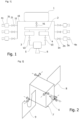
- The objects and features of the present invention will become most clear from the description of a spacecraft provided with a low and high thrust propulsion system, with reference to the attached figures in which:
-
Fig. 1
Fig. 1 is an illustrative block diagram of the propulsion system according to the present invention; and -
Fig. 2
Fig.2 is a partially cut-away schematic perspective view of a satellite equipped with the propulsion system inFig. 1 . - Referring to
Fig. 1 , the propulsion system according to the present invention comprises a high thrust propulsion part and a low thrust propulsion part. - The high thrust propulsion part has a thruster comprising a
water reservoir 1 for containing liquid water, awater splitting device 2 for splitting the liquid water into gaseous hydrogen and gaseous oxygen and storing them in a gaseoushydrogen storage tank 3 and in a gaseous oxygen storage tank 4, respectively, and ahigh thrust chamber 5 withnozzle 6 for discharging the combustion products. The splitting device could be a water electrolyser that electrolyses water into gaseous hydrogen and gaseous oxygen, or a water microwave splitting device for splitting water into gaseous hydrogen and gaseous oxygen, or another device. As for thehydrogen storage tank 3 and the oxygen storage tank 4, they could be reduced to a single one in which hydrogen and oxygen are mixed and fed into the combustion chamber already mixed. - Alternatively, the accumulation of gaseous hydrogen and gaseous oxygen, premixed or not, is inside the
water splitting device 2. - Another configuration could be that without any storage tank: this solution assumes that the splitting of water, instantaneous and / or continuous, by means of an electrolyser or microwave device, or different device, produces enough hydrogen and oxygen to be able to perform punctual and / or continuous thrusts, as needed by a mission, and to not require accumulation of the gases produced, either internally or externally to the water splitting device, before entering the combustion chamber.
- The low thrust propulsion part of the propulsion system includes a
supply line 10 of liquid water fromreservoir 1 and a plurality of water derivations in branches 11-1n, where n indicates the total number of branches. Each branch 11-1n has a regulation valve 21-2n, a vaporization chamber 31-3n and an expansion nozzle 41-4n downstream of the vaporization chamber 31-3n. - It is preferable that the low thrust propulsion part has at least four vaporization chambers, although six vaporization chambers with seven flow control valves are shown in the block diagram of
Fig. 1 . - The presence of at least one electronic board is required to control the operation of the space propulsion system and interaction with the other satellite systems, such as an on-board computer with mission specifications.
- Usually, indicated as high thrust chambers are those able to provide thrusts of about 0.1 N, as order of magnitude, and more. The thruster according to the invention is able to provide thrusts also up to 10 N or more.
- The vaporization chambers of the low thrust propulsion part according to the invention are characterized by thrusts about 0.001 N, as order of magnitude, or less; usually there are thrusts in the range of 1-10 mN.
- The high thrust chamber can work at high pressures, even, as order of magnitude, about 5,000 kPa.
- Low thrust chambers work at low pressures, even, as order of magnitude, below 100 kPa.
- The high thrust chamber can have dimensions of the order of one centimeter (nozzle excluded). A chamber of 10x10 mm (diameter x height) can give a thrust of 1-5 N.
- The low thrust chambers can have dimensions of the order of millimeters, nozzle included. Chambers of 8x8x2 mm (length x width x height) can provide thrusts in the range of 1-25 mN.
- The high thrust chamber is made of metal materials, such as steel, titanium, tungsten. The low thrust chambers can also be on silicon wafers.
- A global dimension of the low and high thrust space propulsion system, excluding the water reservoir, can be envisaged, with dimensions around 100×100×40-45mm (length x width x height) and a weight of around 400 g.
- The advantages of the present invention are understood. Although in different physical and chemical forms, the propellant is unique: liquid water. It is used on the same spacecraft to obtain: 1) high thrust through water splitting into gaseous hydrogen and gaseous oxygen, hydrogen and oxygen combustion and discharge of combustion products through an
exhaust nozzle 6; and 2) low thrust by vaporizing water and making it expand in the expansion nozzle 41-4n. -
Fig. 2 is a partially cut-away schematic perspective view of a satellite equipped with the propulsion system ofFig. 1 . The satellite has a substantiallyprismatic body 7 withsolar panels solar panel 8 is partially cut to show a pair of low thrust nozzles placed mutually orthogonal on two vertices of one face of theprismatic body 7, and on two consecutive vertices of the opposite face of theprismatic body 7. Thedischarge nozzle 6 is shown schematically in a position orthogonal to one face ofprismatic body 7 of the satellite. - In conclusion and to summarize, the choice of using water as an optimal propellant for a low-high thrust system is based on several considerations. In summary, liquid water is
- economic;
- non-toxic;
- not corrosive;
- easily storable and manageable, which further simplifies the processes and the cost of use;
- characterized by a high density, and this allows compact systems;
- hydrogen / oxygen carrier, which are the chemical couple with the highest performance (high thrust and high specific impulse);
- hydrogen / oxygen carrier without being brought to the cryogenic state, and therefore does not involve significant design, economic and management complications;
- versatile and modular.
Claims (7)
- A spacecraft provided with a low and high thrust propulsion system, including at least one water reservoir (1) containing liquid water and a high thrust propulsion part, whereinthe high thrust propulsion part comprises at least one high thrust thruster including a regulating valve (V1) for sucking liquid water from the at least one water reservoir (1), a water splitting device (2) for splitting the liquid water into gaseous hydrogen and gaseous oxygen, a combustion chamber (5) in which the gaseous hydrogen reacts with the gaseous oxygen and an exhaust nozzle (6) for discharging the combustion products from the combustion chamber (5), characterised in that the spacecraft further includes a low thrust propulsion part, whereinthe low thrust propulsion part comprises a liquid water supply line (10) and a plurality of liquid water outlets in a plurality of branches (11-1n) individually including a regulating valve (21-2n), a vaporization chamber (31-3n) and an expansion nozzle (41-4n) downstream of the vaporization chamber (31-3n).
- The spacecraft according to claim 1, wherein the high thrust thruster comprises an electrolyser adapted to split the liquid water into gaseous hydrogen and gaseous oxygen.
- The spacecraft according to claim 1, wherein the high thrust thruster comprises a microwave device adapted to split the liquid water into gaseous hydrogen and gaseous oxygen.
- The spacecraft according to claim 1, wherein at least one gaseous hydrogen storage tank (3) and at least one gaseous oxygen storage tank (4) are provided between the water splitting device (2) and the combustion chamber (5).
- The spacecraft according to claim 1, wherein at least one storage tank for premixed hydrogen and oxygen gaseous is provided between the water splitting device (2) and the combustion chamber (5).
- The spacecraft according to any one of claims 2 and 3, wherein a gaseous hydrogen storage tank and a gaseous oxygen storage tank are provided inside the water splitting device (2).
- The spacecraft according to claim 1, wherein no gaseous hydrogen storage tank and no gaseous oxygen storage tank are provided.
Applications Claiming Priority (2)
| Application Number | Priority Date | Filing Date | Title |
|---|---|---|---|
| IT102020000030011A IT202000030011A1 (en) | 2020-12-04 | 2020-12-04 | LOW AND HIGH THRUSH SPACE PROPULSION SYSTEM |
| PCT/IB2021/061166 WO2022118208A1 (en) | 2020-12-04 | 2021-12-01 | Spacecraft provided with low and high thrust propulsion system |
Publications (3)
| Publication Number | Publication Date |
|---|---|
| EP4255810A1 EP4255810A1 (en) | 2023-10-11 |
| EP4255810B1 true EP4255810B1 (en) | 2025-04-09 |
| EP4255810C0 EP4255810C0 (en) | 2025-04-09 |
Family
ID=74669394
Family Applications (1)
| Application Number | Title | Priority Date | Filing Date |
|---|---|---|---|
| EP21824029.9A Active EP4255810B1 (en) | 2020-12-04 | 2021-12-01 | Spacecraft provided with low and high thrust propulsion system |
Country Status (9)
| Country | Link |
|---|---|
| US (1) | US12325536B2 (en) |
| EP (1) | EP4255810B1 (en) |
| JP (1) | JP2023553194A (en) |
| CN (1) | CN116529473B (en) |
| CA (1) | CA3198453A1 (en) |
| ES (1) | ES3030493T3 (en) |
| IL (1) | IL303049B1 (en) |
| IT (1) | IT202000030011A1 (en) |
| WO (1) | WO2022118208A1 (en) |
Families Citing this family (1)
| Publication number | Priority date | Publication date | Assignee | Title |
|---|---|---|---|---|
| IT202300010134A1 (en) * | 2023-05-19 | 2024-11-19 | Interactive Fully Electrical Vehicles S R L | Aircraft for personal use, or drone, with a system for generating directional and/or thrust jets using electromagnetic injectors powered by common rail and a jet generation system used therein |
Family Cites Families (16)
| Publication number | Priority date | Publication date | Assignee | Title |
|---|---|---|---|---|
| US4345729A (en) * | 1979-08-16 | 1982-08-24 | The Secretary Of State For Defence In Her Britannic Majesty's Government Of The United Kingdom Of Great Britain And Northern Ireland | Thrust units |
| US4265721A (en) * | 1980-05-05 | 1981-05-05 | Hackmyer Saul A | Commercial hydrogen gas production by electrolysis of water while being subjected to microwave energy |
| US6892525B2 (en) * | 2003-06-06 | 2005-05-17 | Honeywell International Inc. | Micropump-based microthruster |
| CN1804386A (en) * | 2005-12-28 | 2006-07-19 | 清华大学 | Minisize propeller with electrolyzing water function |
| FR2929339B1 (en) * | 2008-03-27 | 2012-10-05 | Snpe Materiaux Energetiques | METHOD AND DEVICES FOR PYROTECHNIC PROPULSION WITH PUSH MODULATION, SPACE ENGINE COMPRISING SUCH A DEVICE |
| JP2009262770A (en) * | 2008-04-25 | 2009-11-12 | Ihi Aerospace Co Ltd | Propulsion device for space craft |
| KR101009498B1 (en) * | 2009-04-06 | 2011-01-19 | 한국과학기술원 | Hydrogen-oxygen binary propellant rocket engine and its propulsion method |
| KR101069553B1 (en) * | 2009-05-11 | 2011-10-05 | 한국과학기술원 | Bipropellant rocket engine using Heat of hydrogen peroxide decomposition and propulsion method thereof |
| US8572948B1 (en) * | 2010-10-15 | 2013-11-05 | Florida Turbine Technologies, Inc. | Rocket engine propulsion system |
| KR101625483B1 (en) * | 2015-07-21 | 2016-05-31 | 국방과학연구소 | Hydrogen oxygen bipropellant propulsion system for attitude control |
| US11181076B2 (en) * | 2016-03-03 | 2021-11-23 | Kevin Michael Weldon | Rocket engine bipropellant supply system including an electrolyzer |
| DE102016208730A1 (en) * | 2016-05-20 | 2017-11-23 | Airbus Ds Gmbh | Rocket propulsion system and method of operating a rocket propulsion system |
| DE102016208729A1 (en) * | 2016-05-20 | 2017-11-23 | Airbus Ds Gmbh | A method of operating a rocket propulsion system and rocket propulsion system |
| EP3348671B1 (en) * | 2017-01-13 | 2021-04-21 | Airbus Defence and Space GmbH | Space craft having a fuel production apparatus |
| IT201700087235A1 (en) * | 2017-07-28 | 2019-01-28 | Angelo Minotti | Space propulsion system |
| CN111502940B (en) * | 2020-04-29 | 2021-09-24 | 武汉大学 | A microwave air plasma water vapor jet propulsion device |
-
2020
- 2020-12-04 IT IT102020000030011A patent/IT202000030011A1/en unknown
-
2021
- 2021-12-01 CN CN202180081009.8A patent/CN116529473B/en active Active
- 2021-12-01 EP EP21824029.9A patent/EP4255810B1/en active Active
- 2021-12-01 CA CA3198453A patent/CA3198453A1/en active Pending
- 2021-12-01 US US18/254,811 patent/US12325536B2/en active Active
- 2021-12-01 ES ES21824029T patent/ES3030493T3/en active Active
- 2021-12-01 WO PCT/IB2021/061166 patent/WO2022118208A1/en not_active Ceased
- 2021-12-01 JP JP2023557842A patent/JP2023553194A/en active Pending
- 2021-12-01 IL IL303049A patent/IL303049B1/en unknown
Also Published As
| Publication number | Publication date |
|---|---|
| ES3030493T3 (en) | 2025-06-30 |
| CN116529473B (en) | 2026-04-24 |
| CN116529473A (en) | 2023-08-01 |
| CA3198453A1 (en) | 2022-06-09 |
| EP4255810A1 (en) | 2023-10-11 |
| JP2023553194A (en) | 2023-12-20 |
| IL303049B1 (en) | 2026-04-01 |
| IL303049A (en) | 2023-07-01 |
| IT202000030011A1 (en) | 2022-06-04 |
| US20240002073A1 (en) | 2024-01-04 |
| US12325536B2 (en) | 2025-06-10 |
| WO2022118208A1 (en) | 2022-06-09 |
| EP4255810C0 (en) | 2025-04-09 |
Similar Documents
| Publication | Publication Date | Title |
|---|---|---|
| EP0620895B1 (en) | Satellite propulsion and power system | |
| US11181076B2 (en) | Rocket engine bipropellant supply system including an electrolyzer | |
| US6314718B1 (en) | Reduced toxicity fuel satellite propulsion system including fuel cell reformer with alcohols such as methanol | |
| US6581882B2 (en) | Low-thrust cryogenic propulsion module | |
| EP0242196B1 (en) | Thrusters | |
| US10654592B2 (en) | Integration of fuel cell with cryogenic source for cooling and reactant | |
| US12442350B2 (en) | Small satellite propulsion system utilizing liquid propellant ullage vapor | |
| EP4255810B1 (en) | Spacecraft provided with low and high thrust propulsion system | |
| US11897636B2 (en) | Rocket propulsion system, method, and spacecraft | |
| US11346306B1 (en) | Chemical and cold gas propellant systems and methods | |
| KR20250073319A (en) | Rocket propulsion systems, their operation, and space vehicles | |
| Murashko et al. | State of the art and prospects of electric propulsion in Russia | |
| JPH01500531A (en) | Complex spacecraft control system | |
| Jones et al. | Space station propulsion | |
| JP4815601B2 (en) | Electric thermal rocket propulsion device | |
| BURKE et al. | NASA's space tug and hydrogen oxygen auxiliary propulsion | |
| Kuan et al. | Development of a High Test Hydrogen Peroxide (HTP) Micro-Thruster | |
| Culver | Optimum LOX usage by LANTR-powered LTV | |
| Ruixiang et al. | The Reliable and Intelligent Propulsion Pressurization System of the Long March 7 Launch Vehicle | |
| MORANO et al. | Design, operation, and critical issues of the US Space Station Freedom propulsion system | |
| Valentian et al. | Applications of Low Cost Cryogenic Propulsion to New Launchers and Planetary Missions Concepts | |
| Rossettini et al. | Advanced Hybrid Propellant for a Moon Orbiter Thruster | |
| Malloy et al. | A conceptual study of the use of a particle bed reactor nuclear propulsion module for the orbital maneuvering vehicle | |
| Bader | Potential propellant storage and feed systems for space station resistojet propulsion options | |
| Arikawa et al. | Wideband Inter-Networking engineering test and Demonstration Satellite Propulsion System and Engineering-Model Test Results |
Legal Events
| Date | Code | Title | Description |
|---|---|---|---|
| STAA | Information on the status of an ep patent application or granted ep patent |
Free format text: STATUS: UNKNOWN |
|
| STAA | Information on the status of an ep patent application or granted ep patent |
Free format text: STATUS: THE INTERNATIONAL PUBLICATION HAS BEEN MADE |
|
| PUAI | Public reference made under article 153(3) epc to a published international application that has entered the european phase |
Free format text: ORIGINAL CODE: 0009012 |
|
| STAA | Information on the status of an ep patent application or granted ep patent |
Free format text: STATUS: REQUEST FOR EXAMINATION WAS MADE |
|
| 17P | Request for examination filed |
Effective date: 20230516 |
|
| AK | Designated contracting states |
Kind code of ref document: A1 Designated state(s): AL AT BE BG CH CY CZ DE DK EE ES FI FR GB GR HR HU IE IS IT LI LT LU LV MC MK MT NL NO PL PT RO RS SE SI SK SM TR |
|
| DAV | Request for validation of the european patent (deleted) | ||
| DAX | Request for extension of the european patent (deleted) | ||
| GRAP | Despatch of communication of intention to grant a patent |
Free format text: ORIGINAL CODE: EPIDOSNIGR1 |
|
| STAA | Information on the status of an ep patent application or granted ep patent |
Free format text: STATUS: GRANT OF PATENT IS INTENDED |
|
| RIC1 | Information provided on ipc code assigned before grant |
Ipc: B64G 1/24 20060101ALN20241113BHEP Ipc: F02K 9/88 20060101ALI20241113BHEP Ipc: F02K 9/42 20060101ALI20241113BHEP Ipc: B64G 1/40 20060101AFI20241113BHEP |
|
| INTG | Intention to grant announced |
Effective date: 20241205 |
|
| GRAS | Grant fee paid |
Free format text: ORIGINAL CODE: EPIDOSNIGR3 |
|
| GRAA | (expected) grant |
Free format text: ORIGINAL CODE: 0009210 |
|
| STAA | Information on the status of an ep patent application or granted ep patent |
Free format text: STATUS: THE PATENT HAS BEEN GRANTED |
|
| AK | Designated contracting states |
Kind code of ref document: B1 Designated state(s): AL AT BE BG CH CY CZ DE DK EE ES FI FR GB GR HR HU IE IS IT LI LT LU LV MC MK MT NL NO PL PT RO RS SE SI SK SM TR |
|
| REG | Reference to a national code |
Ref country code: GB Ref legal event code: FG4D |
|
| REG | Reference to a national code |
Ref country code: CH Ref legal event code: EP |
|
| REG | Reference to a national code |
Ref country code: IE Ref legal event code: FG4D |
|
| U01 | Request for unitary effect filed |
Effective date: 20250415 |
|
| U07 | Unitary effect registered |
Designated state(s): AT BE BG DE DK EE FI FR IT LT LU LV MT NL PT RO SE SI Effective date: 20250422 |
|
| REG | Reference to a national code |
Ref country code: ES Ref legal event code: FG2A Ref document number: 3030493 Country of ref document: ES Kind code of ref document: T3 Effective date: 20250630 |
|
| PG25 | Lapsed in a contracting state [announced via postgrant information from national office to epo] |
Ref country code: GR Free format text: LAPSE BECAUSE OF FAILURE TO SUBMIT A TRANSLATION OF THE DESCRIPTION OR TO PAY THE FEE WITHIN THE PRESCRIBED TIME-LIMIT Effective date: 20250710 Ref country code: NO Free format text: LAPSE BECAUSE OF FAILURE TO SUBMIT A TRANSLATION OF THE DESCRIPTION OR TO PAY THE FEE WITHIN THE PRESCRIBED TIME-LIMIT Effective date: 20250709 |
|
| PG25 | Lapsed in a contracting state [announced via postgrant information from national office to epo] |
Ref country code: PL Free format text: LAPSE BECAUSE OF FAILURE TO SUBMIT A TRANSLATION OF THE DESCRIPTION OR TO PAY THE FEE WITHIN THE PRESCRIBED TIME-LIMIT Effective date: 20250409 |
|
| PG25 | Lapsed in a contracting state [announced via postgrant information from national office to epo] |
Ref country code: HR Free format text: LAPSE BECAUSE OF FAILURE TO SUBMIT A TRANSLATION OF THE DESCRIPTION OR TO PAY THE FEE WITHIN THE PRESCRIBED TIME-LIMIT Effective date: 20250409 |
|
| PG25 | Lapsed in a contracting state [announced via postgrant information from national office to epo] |
Ref country code: RS Free format text: LAPSE BECAUSE OF FAILURE TO SUBMIT A TRANSLATION OF THE DESCRIPTION OR TO PAY THE FEE WITHIN THE PRESCRIBED TIME-LIMIT Effective date: 20250709 |
|
| PG25 | Lapsed in a contracting state [announced via postgrant information from national office to epo] |
Ref country code: IS Free format text: LAPSE BECAUSE OF FAILURE TO SUBMIT A TRANSLATION OF THE DESCRIPTION OR TO PAY THE FEE WITHIN THE PRESCRIBED TIME-LIMIT Effective date: 20250809 |
|
| REG | Reference to a national code |
Ref country code: CH Ref legal event code: U11 Free format text: ST27 STATUS EVENT CODE: U-0-0-U10-U11 (AS PROVIDED BY THE NATIONAL OFFICE) Effective date: 20260101 |
|
| PGFP | Annual fee paid to national office [announced via postgrant information from national office to epo] |
Ref country code: GB Payment date: 20251223 Year of fee payment: 5 |
|
| PGFP | Annual fee paid to national office [announced via postgrant information from national office to epo] |
Ref country code: MC Payment date: 20251219 Year of fee payment: 5 |
|
| PG25 | Lapsed in a contracting state [announced via postgrant information from national office to epo] |
Ref country code: SM Free format text: LAPSE BECAUSE OF FAILURE TO SUBMIT A TRANSLATION OF THE DESCRIPTION OR TO PAY THE FEE WITHIN THE PRESCRIBED TIME-LIMIT Effective date: 20250409 |
|
| PG25 | Lapsed in a contracting state [announced via postgrant information from national office to epo] |
Ref country code: CZ Free format text: LAPSE BECAUSE OF FAILURE TO SUBMIT A TRANSLATION OF THE DESCRIPTION OR TO PAY THE FEE WITHIN THE PRESCRIBED TIME-LIMIT Effective date: 20250409 |
|
| PGFP | Annual fee paid to national office [announced via postgrant information from national office to epo] |
Ref country code: IE Payment date: 20251218 Year of fee payment: 5 |
|
| PG25 | Lapsed in a contracting state [announced via postgrant information from national office to epo] |
Ref country code: SK Free format text: LAPSE BECAUSE OF FAILURE TO SUBMIT A TRANSLATION OF THE DESCRIPTION OR TO PAY THE FEE WITHIN THE PRESCRIBED TIME-LIMIT Effective date: 20250409 |
|
| U20 | Renewal fee for the european patent with unitary effect paid |
Year of fee payment: 5 Effective date: 20251223 |
|
| PLBE | No opposition filed within time limit |
Free format text: ORIGINAL CODE: 0009261 |
|
| STAA | Information on the status of an ep patent application or granted ep patent |
Free format text: STATUS: NO OPPOSITION FILED WITHIN TIME LIMIT |
|
| REG | Reference to a national code |
Ref country code: CH Ref legal event code: L10 Free format text: ST27 STATUS EVENT CODE: U-0-0-L10-L00 (AS PROVIDED BY THE NATIONAL OFFICE) Effective date: 20260218 |
|
| 26N | No opposition filed |
Effective date: 20260112 |
|
| PGFP | Annual fee paid to national office [announced via postgrant information from national office to epo] |
Ref country code: ES Payment date: 20260122 Year of fee payment: 5 |
|
| PGFP | Annual fee paid to national office [announced via postgrant information from national office to epo] |
Ref country code: CH Payment date: 20260101 Year of fee payment: 5 |