EP4255770B1 - Seat with power pitch easy entry having lower disc actuator - Google Patents
Seat with power pitch easy entry having lower disc actuator Download PDFInfo
- Publication number
- EP4255770B1 EP4255770B1 EP22707967.0A EP22707967A EP4255770B1 EP 4255770 B1 EP4255770 B1 EP 4255770B1 EP 22707967 A EP22707967 A EP 22707967A EP 4255770 B1 EP4255770 B1 EP 4255770B1
- Authority
- EP
- European Patent Office
- Prior art keywords
- cam
- pinion
- actuator
- actuator lever
- seat cushion
- Prior art date
- Legal status (The legal status is an assumption and is not a legal conclusion. Google has not performed a legal analysis and makes no representation as to the accuracy of the status listed.)
- Active
Links
Images









Classifications
-
- B—PERFORMING OPERATIONS; TRANSPORTING
- B60—VEHICLES IN GENERAL
- B60N—SEATS SPECIALLY ADAPTED FOR VEHICLES; VEHICLE PASSENGER ACCOMMODATION NOT OTHERWISE PROVIDED FOR
- B60N2/00—Seats specially adapted for vehicles; Arrangement or mounting of seats in vehicles
- B60N2/02—Seats specially adapted for vehicles; Arrangement or mounting of seats in vehicles the seat or part thereof being movable, e.g. adjustable
- B60N2/04—Seats specially adapted for vehicles; Arrangement or mounting of seats in vehicles the seat or part thereof being movable, e.g. adjustable the whole seat being movable
- B60N2/12—Seats specially adapted for vehicles; Arrangement or mounting of seats in vehicles the seat or part thereof being movable, e.g. adjustable the whole seat being movable slidable and tiltable
-
- B—PERFORMING OPERATIONS; TRANSPORTING
- B60—VEHICLES IN GENERAL
- B60N—SEATS SPECIALLY ADAPTED FOR VEHICLES; VEHICLE PASSENGER ACCOMMODATION NOT OTHERWISE PROVIDED FOR
- B60N2/00—Seats specially adapted for vehicles; Arrangement or mounting of seats in vehicles
- B60N2/02—Seats specially adapted for vehicles; Arrangement or mounting of seats in vehicles the seat or part thereof being movable, e.g. adjustable
- B60N2/0224—Non-manual adjustments, e.g. with electrical operation
- B60N2/02246—Electric motors therefor
-
- B—PERFORMING OPERATIONS; TRANSPORTING
- B60—VEHICLES IN GENERAL
- B60N—SEATS SPECIALLY ADAPTED FOR VEHICLES; VEHICLE PASSENGER ACCOMMODATION NOT OTHERWISE PROVIDED FOR
- B60N2/00—Seats specially adapted for vehicles; Arrangement or mounting of seats in vehicles
- B60N2/02—Seats specially adapted for vehicles; Arrangement or mounting of seats in vehicles the seat or part thereof being movable, e.g. adjustable
- B60N2/0224—Non-manual adjustments, e.g. with electrical operation
- B60N2/02246—Electric motors therefor
- B60N2/02253—Electric motors therefor characterised by the transmission between the electric motor and the seat or seat parts
-
- B—PERFORMING OPERATIONS; TRANSPORTING
- B60—VEHICLES IN GENERAL
- B60N—SEATS SPECIALLY ADAPTED FOR VEHICLES; VEHICLE PASSENGER ACCOMMODATION NOT OTHERWISE PROVIDED FOR
- B60N2/00—Seats specially adapted for vehicles; Arrangement or mounting of seats in vehicles
- B60N2/90—Details or parts not otherwise provided for
- B60N2/919—Positioning and locking mechanisms
- B60N2002/924—Positioning and locking mechanisms using electric or hydraulic energy
Definitions
- the present invention relates to a pitch assembly for a vehicle seat. More particularly, the invention relates to a vehicle seat with a pitch assembly wherein the pitch assembly is configured to automatically reposition the vehicle seat between two positions.
- Vehicle seats adapted to be mounted to a floor of an automotive vehicle for movement between a plurality of positions are known in the art.
- Typical vehicle seats include a seat cushion for supporting an occupant in the automotive vehicle and a seat back pivotally coupled to the seat cushion.
- the vehicle seats also typically include a seat base adapted for mounting the vehicle seat within the automotive vehicle.
- At least one link extends longitudinally between a first end rotatably coupled to the seat cushion at a first pivot point and a second end rotatably coupled to the seat base at a second pivot point.
- the vehicle seat is positioned in a design position for use by an occupant of the vehicle.
- certain known vehicle seats are pivotable between the design position and a pitched forward position. The pitched forward position increases the available space behind the vehicle seat for improved ingress/egress by the occupant.
- Disc mechanisms are typically operatively coupled between the seat cushion and the seat base and configured to allow rotation of the seat cushion relative to the seat base when in an unlocked condition. In addition, the disc mechanisms prevent pivoting of the seat cushion towards the pitched forward position when in a locked condition.
- Certain vehicle seats include a drive motor operatively coupled to the vehicle seat and configured to pivot the vehicle seat between the design position and the pitched forward position.
- a drive motor operatively coupled to the vehicle seat and configured to pivot the vehicle seat between the design position and the pitched forward position.
- PCT Publication WO 2021/163659 A1 discloses a vehicle seat having a drive motor linked to a drive pinion that is meshingly engaged with a pitch sector for pivoting the vehicle seat between the design position and the pitched forward position.
- the vehicle seat includes opposing disc mechanisms configured to prevent pivoting of the vehicle seat when in the locked condition and configured to allow pivoting of the vehicle seat when in an unlocked condition.
- the vehicle seat includes an actuation assembly configured to reposition the disc mechanisms between the locked and unlocked conditions.
- actuation assembly to unlock and relock the disc mechanisms in combination with a drive motor configured to rotate the drive pinion adds cost and complexity. It is desirable to eliminate the actuation assembly to reduce the cost of the vehicle seat. It is further desirable to reposition the disc mechanisms to the unlocked condition prior to the vehicle seat being pivoted between the design and pitched forward positions. Further, it is desirable to optionally reposition the disc mechanisms to the locked condition when the vehicle seat is pivoted to the pitched forward position. It is also desirable to reposition the disc mechanisms to the locked condition when the vehicle seat is returned to the design position from the pitched forward position.
- WO 2020/018986 A1 discloses a power drive mechanism for an automotive seat with an integrated latch release and manual override.
- a vehicle seat with a pitch assembly comprising a drive pinion having a slot, a pinion actuator having a key positioned within the slot, a cam fixedly coupled to the pinion actuator by a drive shaft, a drive motor operatively coupled to the drive shaft and configured to rotate the drive shaft, and an actuator lever operatively coupled to the cam and operatively coupled to a disc mechanism.
- the drive motor rotates the drive shaft causing the cam to move the actuator lever to an actuated position causing the disc mechanism to be unlocked prior to the key engaging with the slot. Additional rotation of the drive shaft after the key is engaged with the slot rotates the drive pinion causing the vehicle seat to be pivoted between a first and second position.
- FIGS 1-23 illustrate a vehicle seat (12) with a pitch assembly 10, 10' for use in an automotive vehicle according to embodiments described herein.
- Directional references employed or shown in the description, figures, or claims, such as top, bottom, upper, lower, upward, downward, lengthwise, widthwise, left, right, and the like, are relative terms employed for ease of description and are not intended to limit the scope of the invention in any respect.
- like numerals indicate like or corresponding parts throughout the several views.
- each of the disc mechanisms 28 is operatively coupled between the respective front links 24 and the seat base 18.
- the cross tube 30 ( Figure 1 ) is operatively coupled to the opposing disc mechanisms 28 through the lower pivots 34.
- the disc mechanisms 28 can be operatively coupled between the front or rear links 24, 26 and the seat cushion 16 or the seat base 18 at any of the rotatable connections within the linkage assembly 22 without altering the scope of the invention.
- a release lever 28a is operatively coupled to each of the disc mechanisms 28.
- the pitch sector 32 is fixedly coupled to the lower end of the front links 24 on an outboard side of the vehicle seat 12, as shown in Figure 3 .
- the pitch sector 32 has a radial center aligned with an axis of rotation of the lower pivots 34.
- a plurality of gear teeth 42 extend around at least a portion of an outer periphery of the pitch sector 32. It is to be appreciated that the pitch sector 32 can be fixedly coupled to the front link on either of the outboard side or an inboard side of the vehicle seat 12 without varying the scope of the invention. Further, it is to be appreciated that the pitch sector 32 can be fixedly coupled to other locations on the seat cushion 16 or to other locations in the linkage assembly 22 without altering the scope of the invention.
- the pitch assembly 10 includes a drive pinion 43, a gear strap 46, an attachment screw 48, a drive shaft 51, a lateral washer 52, an outer bushing 53, a pinion actuator 56, a drive motor 58, a shaft bearing 60, a bracket 62, a cam 64, an inner bushing 66, a spring screw 68, a medial washer 70, an actuator lever 72, a pivot bolt 74, a pivot spacer 75, a weld nut 78, a spring pin 80, a return spring 82, and a rivet 84.
- Operatively coupled to the pitch assembly 10 is a cable assembly 86, secondary cable assemblies 86', and a splitter 86a.
- the cable assembly 86 and the secondary cable assemblies 86' include Bowden cables 88, 88' and cable conduits 90, 90'.
- gear teeth 92 extending around an outer periphery of the drive pinion 43 are meshingly engaged with the gear teeth 42 on the pitch sector 32.
- the drive pinon 43 is rotationally coupled to a boss 18a protruding laterally from the seat base 18.
- the gear teeth 92 of the drive pinion 43 are retained in meshing engagement with the gear teeth 42 of the pitch sector 32 by the gear strap 46.
- the gear strap 46 is an elongated bracket having an upper portion 46a offset from a lower portion 46b.
- the offset between the upper and lower portions 46a, 46b is sized and shaped such that the gear strap 46 can be simultaneously coupled to both the pitch sector 32 and the drive pinion 43.
- each of the upper and lower portions 46a, 46b include a hole 46c, 46d sized and shaped to align with the axis of rotation of the pitch sector 32 and the drive pinion 43, respectively.
- the attachment screw 48 rotationally couples the gear strap 46 to the drive shaft 51.
- the attachment screw 48 includes a threaded shaft 48a extending from a screw head 48b.
- the threaded shaft 48a is sized and shaped to meshingly engage with a lateral aperture 51a that extends axially from a lateral end 51b of the drive shaft 51.
- the threaded shaft 48a is sized and shaped to pass through the lower hole 46d in the gear strap 46, through a hole 52a in the lateral washer 52, through a hole 53a in the outer bushing 53, and through an aperture 56a in the pinion actuator 56.
- the attachment screw 48, the lateral washer 52, the outer bushing 53, the gear strap 46, the drive pinion 43, the pinion actuator 56, and the drive shaft 51 are sized and shaped such that the attachment screw 48 is fixedly coupled to the drive shaft 51 while rotationally coupling the drive pinion 43 to the gear strap 46.
- the drive shaft 51 is operatively coupled to the drive motor 58 with the drive motor 58 being fixedly coupled to the seat base 18.
- the drive motor 58 is configured to rotate the drive shaft 51 in a forward direction 96 and a reverse direction 96' (shown in Figure 5 ) as is generally known in the art.
- a wiring harness (not shown) is electrically connected to the drive motor 58 to selectively provide power to the drive motor 58.
- a medial end 51c ( Figure 7 ) of the drive shaft 51 is rotationally coupled to the shaft bearing 60 that is supported and contained by the bracket 62.
- the drive shaft 51 has a generally cylindrical elongated shape with an external spline 51d extending around an outer periphery of the drive shaft 51 between the lateral and medial ends 51b, 51c.
- the lateral end 51b of the drive shaft 51 is configured to matingly engage with the aperture 56a in the pinion actuator 56 so that the pinion actuator 56 rotates with the drive shaft 51.
- the medial end 51c of the drive shaft 51 is configured to matingly engage with an aperture 64a in the cam 64 so that the cam 64 also rotates with the drive shaft 51.
- Each of the shaft bearing 60 and the inner bushing 66 includes a passageway 60a, 66a extending axially therethrough which are sized and shaped such that the medial end 51c of the drive shaft 51 can be passed through both the shaft bearing 60 and the inner bushing 66.
- the medial end 51c of the drive shaft 51 is passed through the passageway 60a in the shaft bearing 60 and through the passageway 66a in the inner bushing 66 prior to fixedly coupling the cam 64 to the drive shaft 51.
- the inner bushing 66 is spaced between the shaft bearing 60 and the cam 64.
- the cam 64 is fixedly coupled to the drive shaft 51 by the spring screw 68.
- the spring screw 68 includes a threaded shaft 68a extending from a stud portion 68b.
- the threaded shaft 68a is inserted through a hole 70a extending axially through the medial washer 70, into the aperture 64a in the cam 64, and into a medial aperture 51e in the drive shaft 51.
- the threaded shaft 68a of the spring screw 68 is fixedly coupled to medial aperture 51e in the drive shaft 51.
- the hole 70a extending axially through the medial washer 70 is sized and shaped such that the threaded shaft 68a of the spring screw 68 can be inserted through the hole 70a.
- the bracket 62 includes a central portion 62a extending at generally a right angle from an upper portion 62b and includes a bracket tab 62c extending at generally a right angle from the central portion 62a.
- the upper portion 62b and the bracket tab 62c are generally parallel to each other.
- the central portion 62a of the bracket 62 includes a C-shaped slot 62d configured to matingly engage with a portion of an outer periphery of the shaft bearing 60. Referring to Figures 5 and 7 , the shaft bearing 60 is slid into the C-shaped slot 62d such that the bracket 62 supports and contains the shaft bearing 60.
- the cam 64 is spaced apart from the bracket 62 when the shaft bearing 60 is assembled with the C-shaped slot 62d.
- the drive shaft 51 and the attached cam 64 can freely rotate with respect to the bracket 62 due to the inclusion of the shaft bearing 60 and the inner bushing 66.
- the cam 64 rotates about a primary axis 98 passing axially through the drive shaft 51 and the pinion actuator 56, as best shown in Figure 5 .
- the primary axis 98 defines a common axis of rotation for the drive shaft 51, the pinion actuator 56, the drive pinion 43, and the cam 64.
- spaced apart mounting holes 62g, 62g' extend between opposing surfaces of the upper portion 62b of the bracket 62.
- mechanical fasteners 100 are inserted through holes (not shown) in the seat base 18 and into the respective mounting holes 62g, 62g' in the bracket 62 to fixedly couple the bracket 62 to the seat base 18.
- the bracket 62 can be fixedly coupled to or integrally formed with the seat base 18 or another component of the vehicle seat 12 without departing from the scope of the invention.
- the central portion 62a of the bracket 62 includes an offset portion 62a' having a central hole 62e for mounting the actuator lever 72 to the bracket 62.
- the actuator lever 72 is a generally L-shaped bracket with upper and lower portions 72a, 72b projecting from a central portion 72c.
- the upper portion 72a extends at approximately a right angle from the lower portion 72b. Further, the upper portion 72a is offset laterally from the lower portion 72b.
- a pivot hole 72d extends laterally through the central portion 72c of the actuator lever 72.
- a mounting hole 72e extends laterally through the upper portion 72a of the actuator lever 72.
- the pivot bolt 74 rotationally couples the actuator arm to the bracket 62.
- the pivot bolt 74 includes a threaded shaft 74a extending from a stud portion 74b which projects from a bolt head 74c.
- the pivot bolt 74 is configured such that the threaded shaft 74a and the stud portion 74b will pass through the pivot hole 72d in the actuator lever 72.
- the stud portion 74b and the pivot hole 72d are sized and shaped such that the actuator lever 72 is rotationally coupled to the stud portion 74b when assembled.
- the threaded shaft 74a is passed through the pivot hole 72d in the actuator lever 72, through a hole 75a extending axially through the pivot spacer 75, through the central hole 62e in the bracket 62 and meshingly engaged with a threaded hole 78a in the weld nut 78.
- the weld nut 78 is fixedly coupled to the bracket 62 by a weld.
- the actuator lever 72 includes a boss 72f extending from one side of the upper portion 72a of the actuator lever 72.
- the boss 72f includes a cam follower 72g forming a distal end of the boss 72f.
- the cam follower 72g is configured to frictionally engage with a cam profile 64b extending at least partially along an outer perimeter of the cam 64.
- the spring pin 80 is fixedly coupled to the mounting hole 72e in the actuator lever 72.
- the spring pin 80 has a generally cylindrical shape with a base 80a configured to be fixedly coupled to the mounting hole 72e in the actuator lever 72.
- the spring pin 80 is shown fixedly coupled to the actuator lever 72 in Figure 5 .
- the return spring 82 is operatively coupled between the spring pin 80 and the spring screw 68.
- the return spring 82 is a coil spring having a coiled portion 82a extending between opposing spring ends 82b, 82c. Each of the spring ends 82b, 82c includes a C-shaped loop portion.
- the spring ends 82b, 82c are looped around the respective spring screw 68 and spring pin 80 during assembly.
- the return spring 82 spring-biases the upper portion 72a of the actuator lever 72 towards the cam 64 (arrow 134) such that the cam follower 72g is frictionally engaged with the cam profile 64b.
- the cam profile 64b includes a trigger point 104 defining a transition between the home portion 64c and the dwell portion 64d, a release point 106 defining a transition between the dwell portion 64d and the release portion 64e, and an end point 108 defining a distal end of the release portion 64e.
- An imaginary line extending between the trigger point 104 and the primary axis 98 defines an actuated angle 114.
- the trigger point 104 is spaced apart from the primary axis 98 by a radial distance 124.
- An imaginary line extending between the release point 106 and the primary axis 98 defines a release angle 116.
- the release point 106 is spaced apart from the primary axis 98 by a radial distance 126.
- an imaginary line extending between the end point 108 and the primary axis 98 defines an end angle 118.
- the end point 108 is spaced apart from the primary axis 98 by a radial distance 128.
- the radial distances 122 and 128 are less than the radial distances 124 and 126.
- the angular distance between the home angle 112 and the actuated angle 114 defines an unlatch angle 120.
- the angular distance between the release angle 116 and the end angle 118 defines a return unlatch angle 120'.
- the pinion actuator 56 has a generally cylindrical shape extending between lateral and medial ends 56b, 56c.
- a lateral portion 56d extends from a medial portion 56e of the pinion actuator 56 with the lateral portion 56d having an outer diameter smaller than an outer diameter of the medial portion 56e.
- Extending from the lateral portion 56d of the pinion actuator 56 are opposing keys 56g, 56g'. The opposing keys 56g, 56g' adjoin the medial portion 56e of the pinion actuator 56.
- the aperture 56a extends axially through the pinion actuator 56 between the lateral and medial ends 56b, 56c.
- the lateral end 51a of the drive shaft 51 and the aperture 56a in the pinion actuator 56 are configured such that the drive shaft 51 matingly engages with the aperture 56a in the pinion actuator 56 when assembled.
- the lateral portion 56d of the pinion actuator 56 is configured to fit within the slot 43a in the drive pinion 43, as best depicted in Figure 11 .
- the slot 43a includes a central portion 43b and opposing wing portions 43c, 43d extending from the central portion 43b.
- the central portion 43b has generally cylindrical shape.
- Each of the opposing wing portions 43c, 43d includes an end wall 43e extending between opposing side walls 43g, 43g'.
- each of the end walls 43e has a curved shape with the opposing side walls 43g, 43g' being generally parallel to each other.
- the shape of the wing portions 43c, 43d can include alternate geometries without varying the scope of the invention.
- the opposing side walls 43g, 43g' of the wing portions 43c, 43d adjoin the central portion 43b forming a single elongated slot 43a.
- each key 56g, 56g' includes an end wall 56k adjoining the opposing side walls 56h, 56h'.
- the end wall 56k of each key 56g, 56g' has a curved shape and is offset from the respective end wall 43e of the slot 43a when assembled.
- the end walls 56k of each key 56g, 56g' can be sized and shaped to matingly engage with the respective end wall 43e of the slot 43a without altering the scope of the invention.
- a lateral distance between the opposing side walls 56h, 56h' of the keys 56g, 56g' is less than a lateral distance between the opposing side walls 43g, 43g' of the slot 43a.
- the pinion actuator 56 engages the drive pinion 43 when one of the side walls 56h, 56h' of the keys 56g, 56g' frictionally engage with the adjacent side walls 43g, 43g' of the slot 43a.
- the relative motion of the pinion actuator 56 with respect to the drive pinion 43 is further described below.
- the unlatch angle 120 of the cam profile 64b (shown in Figure 9 ) is selected to be less than the dwell angle 130 of the pinion actuator 56 with respect to the slot 43a in the drive pinion 43 to ensure that the disc mechanisms 28 are repositioned to the unlocked condition prior to the pinion actuator 56 engaging with the drive pinion 43.
- Figure 13 shows the pinion actuator 56 rotated such that the keys 56g, 56g' frictionally engage with the adjacent side walls 43g, 43g' of the slot 43a in the drive pinion 43.
- a base portion 84a of the rivet 84 is fixedly coupled with a rivet slot 72h in an upper edge of the lower portion 72b of the actuator lever 72.
- the rivet 84 is a nail head rivet having a nail head 84b extending from the base portion 84a.
- the cable conduit 90 includes a conduit connector 90d and a splitter connector 90e fixedly coupled to the respective proximal and distal ends 90b, 90c of the cable conduit 90.
- a connector slot 90f extends around an outer periphery of the conduit connector 90d.
- the connector slot 90f is configured to matingly engage with a cable slot 62h in the bracket tab 62c.
- the connector slot 90f in the conduit connector 90d is inserted into the cable slot 62h to fixedly couple the conduit connector 90d to the bracket tab 62c.
- the splitter connector 90e is fixedly coupled to the splitter 86a.
- each of the secondary cable assemblies 86' include a secondary Bowden cable 88' passing longitudinally through a passageway (not shown) in the respective secondary conduit 90' between proximal and distal ends 90b', 90c' of the secondary conduit 90'.
- the proximal end 90b' of the secondary conduits 90' are fixedly coupled to the splitter 86a.
- the distal end 90c' of the secondary conduits 90' are fixedly coupled to a respective mounting connector 90g'.
- Each of the mounting connectors 90g' is fixedly coupled to a hole 18b passing through a respective bracket 18c extending from the seat base 18.
- a proximal end 88b' of both secondary Bowden cables 88' are operatively coupled to the distal end 88d of the Bowden cable 88 through the splitter 86a as is generally known in the art.
- a distal end 88d' of each secondary Bowden cable 88' is fixedly coupled to a respective lever connector 88c'.
- the lever connectors 88c' are configured to fixedly couple with a stud 28b projecting from a lower portion of the respective release lever 28a.
- the cable assembly 86 can be operatively coupled to a single disc mechanism 28 without varying the scope of the invention. In this case, the distal end 88d of the Bowden cable 88 is fixedly coupled to a lever connector 88c'.
- the lever connector 88c' is fixedly coupled to the stud 28b projecting from the lower portion of a single release lever 28a.
- the synchronous release of both disc mechanisms 28 is achieved through the operative connection of the cross tube 30 between the disc mechanisms 28, as is well known in the art.
- the vehicle seat 12 is typically retained in the design position ( Figure 3 ) during use by the occupant. However, the vehicle seat 12 can be selectively pivoted to the pitched forward position ( Figure 4 ) when ingress/egress behind the vehicle seat 12 is desired. Further, the vehicle seat 12 can be selectively pivoted back to the design position when the occupant desires to use the vehicle seat 12.
- the vehicle seat 12 includes disc mechanisms 28 operatively coupled between the seat cushion 16 and the seat base 18 configured to prevent rotation of the seat cushion 16 relative to the seat base 18 when the disc mechanisms 28 are in the locked condition.
- the seat cushion 16 is pivotable with respect to the seat base 18 when the disc mechanisms 28 are repositioned to an unlocked condition.
- each disc mechanism 28 is configured such that applying tension to the secondary Bowden cable 88' in the direction of arrow 132 rotates the release lever 28a and repositions the disc mechanism 28 to the unlocked condition. While the disc mechanisms 28 are in the unlocked condition and the pinion actuator 56 is coupled to the drive pinion 43, rotation of the drive pinion 43 causes the pitch sector 32 to rotate which results in the seat cushion 16 pivoting between the design position shown in Figure 3 and the pitched forward position shown in Figure 4 .
- the disc mechanisms 28 are spring biased such that when tension (arrow 132) is removed from the secondary Bowden cables 88' and from the release levers 28a, the disc mechanisms 28 are biased towards the locked condition.
- the disc mechanisms 28 are configured such that the disc mechanisms 28 are repositioned to the locked condition only when the disc mechanisms 28 are aligned with a locking position (not shown).
- the disc mechanisms 28 have a locking position (not shown) corresponding to the seat cushion 16 being in the design position. Thus, the disc mechanisms 28 are retained in the unlocked condition while the seat cushion 16 is pivoted away from the locking position (not shown) regardless of whether or not tension is applied to the secondary Bowden cables 88'.
- the disc mechanisms 28 can include additional locking positions corresponding to alternate seat cushion 16 positions, such as the pitched forward position as a non-limiting example, without altering the scope of the invention. It is to be appreciated that in the embodiments wherein the disc mechanisms 28 include a plurality of locking positions, the disc mechanisms 28 can be repositioned to the locked condition when the disc mechanisms 28 are aligned with any one of the plurality of locking positions without varying the scope of the invention.
- Figures 8 through 15 illustrate the movements of the various components of the pitch assembly 10 as the pitch assembly 10 repositions the disc mechanisms 28 to the unlocked condition prior to the pitch assembly 10 repositioning the vehicle seat 12 to the pitched forward position.
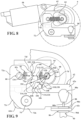
- Figures 8 through 11 illustrate details of the pitch assembly 10 in a design position with the seat cushion 16 in the design position and the disc mechanisms 28 in the locked condition.
- the cam follower 72g is shown frictionally engaged with the cam profile 64b with the contact point 102 of the cam follower 72g aligned with the home position 110 of the cam profile 64b.
- the spring bias (arrow 134) within the return spring 82 keeps the cam follower 72g in frictional engagement with the cam profile 64b.
- the lower portion 72b of the actuator lever 72 is positioned in an unactuated position wherein tension is absent within the Bowden cable 88. As a result, tension is also absent in the secondary Bowden cables 88'.
- the disc mechanisms 28 are in the locked condition since the seat cushion 16 is in the design position and tension is absent in the Bowden cables 88, 88'.
- the keys 56g, 56g' projecting from the pinion actuator 56 are spaced apart from the side walls 43g, 43g' of the slot 43a in the drive pinion 43 when the cam follower 72g is engaged with the home position 110 of the cam profile 64b.
- the pinion actuator 56 is decoupled from the drive pinion 43 when the cam follower 72g is engaged with the home position 110.
- the gear strap 46 retains the drive pinion 43 in meshing engagement with the pitch sector 32 as depicted in Figure 1 .
- the seat cushion 16 is retained in the design position while the disc mechanisms 28 are in the locked condition.
- the pinion actuator 56 and the attached drive shaft 51 are free to rotate within the slot 43a of the drive pinion 43 within the dwell angle 130 in both clockwise and counterclockwise directions (as viewed in Figure 11 ) prior to the pinion actuator 56 engaging with the drive pinion 43.
- the contact point 102 between the cam follower 72g and cam 64 is repositioned along the cam profile 64b towards the end point 108.
- the cam follower 72g is displaced away from the primary axis 98 of the cam 64 when the cam 64 is rotated in the clockwise direction 96a bringing the trigger point 104 into alignment with the cam follower 72g.
- the displacement of the cam follower 72g causes the actuator lever 72 to rotate counterclockwise (arrow 136) to an actuated position which pulls the proximal end 88b of the Bowden cable 88 towards the cam 64 (arrow 138).
- the counterclockwise rotation (arrow 136) of the actuator lever 72 applies tension to the Bowden cable 88.
- the Bowden cable 88 transfers the applied tension to the secondary Bowden cables 88'.
- the release levers 28a rotate in response to tension being applied to the Bowden cables 88, 88' and reposition the disc mechanisms 28 to the unlocked condition.
- the disc mechanisms 28 are repositioned to the unlocked condition while the pinion actuator 56 is disengaged from the drive pinion 43.
- the dwell portion 64d of the cam profile 64b is configured to retain the actuator lever 72 in the actuated position shown in Figure 12 while the dwell portion 64d is in frictional contact with the cam follower 72g.
- Additional forward rotation 96 of the drive shaft 51 rotates the pinion actuator 56 counterclockwise (arrow 96b) and causes the keys 56g, 56g' to frictionally engage with the slot 43a, as shown in Figure 13 .
- the pinion actuator 56 is coupled to the drive pinion 43 as long as the keys 56g, 56g' are frictionally engaged with the slot 43a.
- forward torque (arrow 140) is applied to the drive pinion 43 by the keys 56g, 56g' in response to the rotation of the pinion actuator 56.
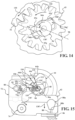
- additional forward rotation 96 of the drive shaft 51 causes the drive pinion 43 to rotate in a counterclockwise direction, as illustrated by arrow 142 in Figure 14 .
- the pitch sector 32 rotates in a clockwise direction 144 as viewed in Figure 14 in response to the counterclockwise rotation 142 of the drive pinion 43.
- the clockwise rotation 144 of the pitch sector 32 rotates the seat cushion 16 towards the pitched forward position.
- the dwell portion 64d of the cam profile 64b between the trigger point 104 and the release point 106 is configured such that the actuator lever 72 is held in the actuated position until the pinion actuator 56 couples with the drive pinion 43 and the drive pinion 43 is rotated at least a predetermined number of degrees to ensure that the seat cushion 16 is pivoted away from the design position.
- the contact point 102 between the cam follower 72g and the cam 64 is moved along the cam profile 64b past the release point 106 and into release portion 64e of the cam profile 64b.
- the cam follower 72g is moved closer to the primary axis 98 in response to the radial distance decreasing between the release point 106 and the end point 108.
- the actuator lever 72 is rotated in a clockwise direction 136' towards the unactuated position in response to the radial distance decreasing between the contact point 102 and the primary axis 98.
- the clockwise rotation 136' of the actuator lever 72 repositions the proximal end 88b of the Bowden cable 88 away from the cam 64, as illustrated by arrow 138' in Figure 15 .
- This removes the tension in the Bowden cables 88, 88' which also removes the tension applied to the release levers 28a by the Bowden cables 88, 88'.
- the disc mechanisms 28 are spring biased towards the locked condition such that the disc mechanisms 28 are relocked when the disc mechanisms 28 are aligned with a locking position.
- the disc mechanisms 28 include a single locking position corresponding to the seat cushion 16 being in the design position. Thus, the disc mechanisms 28 are retained in the unlocked condition while the seat cushion 16 is pivoted away from the design location.
- the disc mechanisms 28 can include additional locking positions, including a locking position corresponding to the pitched forward position, without varying the scope of the invention. If the disc mechanisms 28 include a locking location corresponding the pitched forward location, the disc mechanisms 28 will automatically relock when the seat cushion 16 is pivoted to the pitched forward position since the tension has been removed from the Bowden cables 88, 88'.
- the drive motor 58 continues to rotate the drive shaft 51 in the forward direction 96 until the seat cushion 16 is pivoted to the pitched forward position. As is generally known in the art, the drive motor 58 terminates rotation of the drive shaft 51 once the seat cushion 16 is pivoted to the pitched forward position. It is to be appreciated that when the seat cushion 16 arrives in the pitched forward position, the drive motor 58 optionally reverses rotational direction to disengage the pinion actuator 56 and the drive pinion 32 ( Figure 11 ) without varying the scope of the invention.
- the rotation of the pinion actuator 56 in the clockwise direction 96b' disengages the keys 56g, 56g' from the slot 43a.
- the keys 56g, 56g' will engage with the slot 43a after the pinion actuator 56 is rotated through the reverse dwell angle 130'.
- the drive pinion 43 is stationary while the pinion actuator 56 is decoupled from the drive pinion 43.
- the actuator lever 72 is rotated in the counterclockwise direction 136 as the release point 106 of the cam profile 64b is brought into contact with the cam follower 72g by the counterclockwise rotation 96a' of the cam 64.
- the counterclockwise rotation 136 of the actuator lever 72 pulls the proximal end 88b of the Bowden cable 88 towards the cam 64 in the direction of arrow 138.
- the rotation of the actuator lever 72 applies tension to the Bowden cables 88, 88' which apply tension to the release levers 28a.
- the release levers 28a are rotated by the tension in the respective Bowden cable 88' which ensures that the disc mechanisms 28 are in the unlocked condition prior to the pinion actuator 56 engaging with the drive pinion 43.
- the actuator lever 72 is retained in the actuated position while the cam 64 is rotated counterclockwise 96a' and the contact point 102 is engaged with the dwell portion 64d of the cam profile 64b.
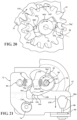
- the keys apply reverse torque 140' to the drive pinion 43 as the pinion actuator 56 is rotated in the clockwise direction 96b' after the pinion actuator 56 engages with the drive pinion 43, as illustrated in Figure 20 .
- Additional rotation of the pinion actuator 56 in the clockwise direction 96b' rotates the drive pinion 43 in the clockwise direction 142' which also rotates the pitch sector 32 in the counterclockwise direction 144'.
- the vehicle seat 12 is pivoted towards the design position from the pitch forward position by the rotation of the pitch sector 32 in the counterclockwise direction 144'.
- the counterclockwise rotation 96a' of the cam 64 brings trigger point 104 into contact with the cam follower 72g.
- the cam follower 72g is repositioned closer to the primary axis 98 as the contact point 102 with the cam follower 72g is moved toward the home position 110 along the cam profile 64b.
- FIG. 22 and 23 A second embodiment of the pitch assembly 10' is shown in Figures 22 and 23 .
- Elements in Figures 22 and 23 that are the same as those used above in Figures 1 through 21 have the same reference numbers for simplicity, while prime notations indicate similar elements. Only significant differences in relation to the embodiment shown in Figures 1-21 are highlighted below. The differences substantially involve the pitch assembly 10' retaining the disc mechanisms 28 in the unlocked condition while the vehicle seat 12 is rotated away from the design position.
- the cam profile 64b' includes an end point 108' spaced apart from the primary axis 98 by a radial distance 128' with an imaginary line extending between the end point 108' and the primary axis 98 defining an end angle 118'.
- the radial distance 122 is selected to be less than the radial distances 124' and 128'.
- the radial distance 124' is approximately the same as the radial distance 128'.
- the cam profile 64b' extending between the home position 110 and the trigger point 104' defines a home portion 64c' of the cam profile 64b'.
- Figures 22 and 23 illustrate the movements of various components of the pitch assembly 10' as the pitch assembly 10' repositions the vehicle seat 12 from the design position to the pitched forward position.
- the cam follower 72g is frictionally engaged with the home position 110 of the cam profile 64b' when the vehicle seat 12 is in the design position.
- the drive motor 58 rotates the cam 64' in the clockwise direction 96a as viewed in Figure 22 .
- the contact point 102 between the cam follower 72g and the cam profile 64b' glides along the cam profile 64b' towards the trigger point 104' as the cam 64' rotates in the clockwise direction 96a.
- the distance between the cam follower 72g and the primary axis 98 increases as the contact point 102 moves towards the trigger point 104'.
- the movement of the cam follower 72g away from the primary axis 98 causes the actuator lever 72 to rotate in the counterclockwise direction 136 around the pivot bolt 74.
- Rotating the actuator lever 72 in the counterclockwise direction 136 to an actuated position pulls the proximal end 88b of the Bowden cable 88 towards the cam 64' (arrow 138 in Figure 22 ).
- the movement of the Bowden cable 88 towards the cam 64' applies tension to the Bowden cable 88.
- the applied tension in the Bowden cable 88 is transferred to the secondary Bowden cables 88' and to the respective release lever 28a on the disc mechanisms 28.
- the release levers 28a reposition the disc mechanisms 28 to the unlocked condition in response to the tension in the Bowden cables 88, 88'.
- the actuator lever 72 is retained in the actuated position while the contact point 102 between the cam follower 72g and the cam profile 64b' is within the dwell portion 64d' of the cam profile 64b'.
- the cam 64' can be rotated in the clockwise direction 96a almost a full rotation of the cam 64' while maintaining the actuator lever 72 in the actuated position.
- the contact point 102 between the cam follower 72g and the cam 64' can be rotated past the maximum dwell point 108a in response to clockwise rotation 96a of the cam 64' without varying the scope of the invention.
- the actuator lever 72 will be repositioned to the unactuated position while the contact point 102 is between the maximum dwell point 108a and the trigger point 104' in response to clockwise rotation 96a of the cam 64'.
- the cam 64' can be rotated multiple revolutions in certain embodiments without altering the scope of the invention.
- the return process is described in reference to Figure 23 .
- the contact point 102 between the cam follower 72g and the cam 64' is positioned along the dwell portion 64d' of the cam profile 64b' while the vehicle seat 12 is in the pitched forward position.
- the actuator lever 72 is retained in the actuated position with tension applied to the Bowden cables 88, 88'.
- the tension in the Bowden cables 88, 88' retains the disc mechanisms 28 in the unlocked condition.
- the drive motor 58 rotates the cam 64' in the counterclockwise direction 96a'.
- the actuator lever 72 is retained in the actuated position during the counterclockwise rotation 96a' of the cam 64' while the contact point 102 is engaged with the dwell portion 64d' of the cam profile 64b'.
- the actuator lever 72 rotates in a clockwise direction 136' to the unactuated position in response to the counterclockwise rotation 96a' of the cam 64' when the contact point 102 is engaged with the home portion 64c' of the cam profile 64b'.
- the proximal end of the Bowden cable 88 is moved away from the cam 64' (arrow 138') by the actuator lever 72 rotating in the clockwise direction 136'. Tension is removed from the Bowden cables 88, 88' when the actuator lever 72 returns to the unactuated position.
- the pitch assembly 10, 10' of the present invention includes a cam 64, 64' configured to rotate an actuator lever 72 and reposition disc mechanisms 28 to the unlocked condition.
- the pitch assembly 10, 10' includes a pinion actuator 56 that is configured to engage with the drive pinion 43 after the disc mechanisms 28 are repositioned to the unlocked condition by the rotation of the cam 64, 64'.
- the drive pinion 43 is operatively coupled to the vehicle seat 12 and configured to rotate the vehicle seat 12 between the design position and the pitched forward position.
- a drive motor 58 is operatively coupled to both the cam 64, 64' and the pinion actuator 56 to simultaneously rotate the cam 64, 64' and the pinion actuator 56.
- the pitch assembly 10, 10' of the present invention has a reduced cost over the known systems since the actuation assembly configured to unlock the disc mechanisms 28 has been eliminated. Further, the pitch assembly 10 of the present invention includes a relocking function to allow the disc mechanisms 28 to relock when the vehicle seat 12 is pivoted to the pitched forward position. In addition, the second embodiment of the pitch assembly 10' includes a hold open function wherein the disc mechanisms 28 are retained in the unlocked condition while the vehicle seat 12 is pivoted away from the design position.
Landscapes
- Engineering & Computer Science (AREA)
- Aviation & Aerospace Engineering (AREA)
- Transportation (AREA)
- Mechanical Engineering (AREA)
- Chairs For Special Purposes, Such As Reclining Chairs (AREA)
- Lock And Its Accessories (AREA)
Description
- The present invention relates to a pitch assembly for a vehicle seat. More particularly, the invention relates to a vehicle seat with a pitch assembly wherein the pitch assembly is configured to automatically reposition the vehicle seat between two positions.
- Vehicle seats adapted to be mounted to a floor of an automotive vehicle for movement between a plurality of positions are known in the art. Typical vehicle seats include a seat cushion for supporting an occupant in the automotive vehicle and a seat back pivotally coupled to the seat cushion. The vehicle seats also typically include a seat base adapted for mounting the vehicle seat within the automotive vehicle. At least one link extends longitudinally between a first end rotatably coupled to the seat cushion at a first pivot point and a second end rotatably coupled to the seat base at a second pivot point.
- The vehicle seat is positioned in a design position for use by an occupant of the vehicle. In order to provide easy entry into a space behind the vehicle seat, certain known vehicle seats are pivotable between the design position and a pitched forward position. The pitched forward position increases the available space behind the vehicle seat for improved ingress/egress by the occupant.
- Disc mechanisms are typically operatively coupled between the seat cushion and the seat base and configured to allow rotation of the seat cushion relative to the seat base when in an unlocked condition. In addition, the disc mechanisms prevent pivoting of the seat cushion towards the pitched forward position when in a locked condition.
- Certain vehicle seats include a drive motor operatively coupled to the vehicle seat and configured to pivot the vehicle seat between the design position and the pitched forward position. For example,
PCT Publication WO 2021/163659 A1 discloses a vehicle seat having a drive motor linked to a drive pinion that is meshingly engaged with a pitch sector for pivoting the vehicle seat between the design position and the pitched forward position. The vehicle seat includes opposing disc mechanisms configured to prevent pivoting of the vehicle seat when in the locked condition and configured to allow pivoting of the vehicle seat when in an unlocked condition. In addition, the vehicle seat includes an actuation assembly configured to reposition the disc mechanisms between the locked and unlocked conditions. - The use of an actuation assembly to unlock and relock the disc mechanisms in combination with a drive motor configured to rotate the drive pinion adds cost and complexity. It is desirable to eliminate the actuation assembly to reduce the cost of the vehicle seat. It is further desirable to reposition the disc mechanisms to the unlocked condition prior to the vehicle seat being pivoted between the design and pitched forward positions. Further, it is desirable to optionally reposition the disc mechanisms to the locked condition when the vehicle seat is pivoted to the pitched forward position. It is also desirable to reposition the disc mechanisms to the locked condition when the vehicle seat is returned to the design position from the pitched forward position.
WO 2020/018986 A1 discloses a power drive mechanism for an automotive seat with an integrated latch release and manual override. - According to the invention, there is provided a vehicle seat with a pitch assembly the pitch assembly comprising a drive pinion having a slot, a pinion actuator having a key positioned within the slot, a cam fixedly coupled to the pinion actuator by a drive shaft, a drive motor operatively coupled to the drive shaft and configured to rotate the drive shaft, and an actuator lever operatively coupled to the cam and operatively coupled to a disc mechanism. The drive motor rotates the drive shaft causing the cam to move the actuator lever to an actuated position causing the disc mechanism to be unlocked prior to the key engaging with the slot. Additional rotation of the drive shaft after the key is engaged with the slot rotates the drive pinion causing the vehicle seat to be pivoted between a first and second position.
- Advantages of the present invention will be readily appreciated as the same becomes better understood by reference to the following detailed description when considered in connection with the accompanying drawings wherein:
-
Figure 1 is a perspective view of a portion of a vehicle seat having a pitch assembly according to one embodiment of the present invention; -
Figure 2 is a left side view of the vehicle seat ofFigure 1 in a design position; -
Figure 3 is a right side view of the vehicle seat ofFigure 2 in the design position; -
Figure 4 is a right side view of the vehicle seat ofFigure 3 pivoted to a pitched forward position; -
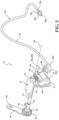
Figure 5 is a perspective view of the pitch assembly ofFigure 1 with the drive motor omitted; -
Figure 6 is an enlarged rear perspective view of a portion of the vehicle seat ofFigure 1 with the vehicle seat in the design position; -
Figure 7 is an exploded perspective view of the pitch assembly ofFigure 5 ; -
Figure 8 is left side view of the pitch assembly ofFigure 5 including the drive motor with the pitch assembly in a design position; -
Figure 9 is an enlarged left side view of portion 9 of the pitch assembly ofFigure 8 with the pitch assembly in the design position; -
Figure 10 is right side view of the pitch assembly ofFigure 8 with the pitch assembly in the design position; -
Figure 11 is an enlarged right side view of portion 11 of the pitch assembly ofFigure 10 showing a pinion actuator decoupled from a drive pinion; -
Figure 12 is a left side view of the pitch assembly ofFigure 9 , showing the cam partially rotated with the actuator lever rotated to an actuated position; -
Figure 13 is a right side view of the pitch assembly ofFigure 11 , showing the pinion actuator engaged with the drive pinion; -
Figure 14 is a right side view of the pitch assembly ofFigure 13 , showing the pinion actuator, the drive pinion, and the pitch sector partially rotated; -
Figure 15 is left side view of the pitch assembly ofFigure 12 , showing the cam partially rotated and the actuator lever in an unactuated position; -
Figure 16 is a left side view of the pitch assembly ofFigure 15 , showing the cam partially rotated and the actuator lever in the unactuated position; -
Figure 17 is a right side view of the pitch assembly ofFigure 14 , showing the pinion actuator being rotated in the clockwise direction; -
Figure 18 is a left side view of the pitch assembly ofFigure 16 , showing the cam partially rotated with the actuator lever in the actuated position; -
Figure 19 is a right side view of the pitch assembly ofFigure 17 , showing the pinion actuator partially rotated in the clockwise direction; -
Figure 20 is a right side view of the pitch assembly ofFigure 19 , showing the pinion actuator and the drive pinion partially rotated in the clockwise direction; -
Figure 21 is a left side view of the pitch assembly ofFigure 18 , showing the cam in the design position with the actuator lever in the unactuated position; -
Figure 22 is a left side view of the pitch assembly ofFigure 9 , showing the cam in the design position and the actuator lever in the unactuated position according to a second embodiment of the present invention; and -
Figure 23 is a left side view of the pitch assembly ofFigure 22 , showing the cam partially rotated with the actuator lever in the actuated position. -
Figures 1-23 illustrate a vehicle seat (12) with apitch assembly 10, 10' for use in an automotive vehicle according to embodiments described herein. Directional references employed or shown in the description, figures, or claims, such as top, bottom, upper, lower, upward, downward, lengthwise, widthwise, left, right, and the like, are relative terms employed for ease of description and are not intended to limit the scope of the invention in any respect. Referring to the Figures, like numerals indicate like or corresponding parts throughout the several views. - As depicted in
Figures 1 through 6 , thepitch assembly 10 is configured to be attached to thevehicle seat 12. Thevehicle seat 12 includes aseat back 14, aseat cushion 16, aseat base 18, a pair ofadjuster assemblies 20, alinkage assembly 22 with opposing front andrear links opposing disc mechanisms 28, across tube 30, and apitch sector 32. Theseat back 14 is rotatably coupled to theseat cushion 16. Thelinkage assembly 22 pivotably couples theseat cushion 16 to theseat base 18. In addition, theseat base 18 is transposable fore and aft along the pair ofadjuster assemblies 20. It is to be appreciated thatcertain vehicle seats 12 lack theadjuster assemblies 20 shown inFigure 1 without departing from the scope of the present invention. - As best shown in
Figures 2 and3 , thelinkage assembly 22 is a four-bar linkage having laterally spaced apartfront links 24 and opposing laterally spaced apartrear links 26. Each of thefront links 24 has a lower end rotationally coupled to a front portion of theseat base 18 by alower pivot 34 and an upper end rotationally coupled to a front portion of theseat cushion 16 by anupper pivot 36. In addition, each of therear links 26 has a lower end rotationally coupled to a rear portion of theseat base 18 by alower pivot 38 and an upper end rotationally coupled to a rear portion of theseat cushion 16 by anupper pivot 40. Each one of thefront links 24 and each one of therear links 26 are substantially the same. However, it is to be appreciated that thelinkage assembly 22 can include any suitable number of links or link pairs without varying the scope of the invention. - Referring to
Figures 2 and3 , each of thedisc mechanisms 28 is operatively coupled between the respectivefront links 24 and theseat base 18. The cross tube 30 (Figure 1 ) is operatively coupled to the opposingdisc mechanisms 28 through the lower pivots 34. In addition, it is to be appreciated that thedisc mechanisms 28 can be operatively coupled between the front orrear links seat cushion 16 or theseat base 18 at any of the rotatable connections within thelinkage assembly 22 without altering the scope of the invention. Depicted inFigure 6 , arelease lever 28a is operatively coupled to each of thedisc mechanisms 28. - The
pitch sector 32 is fixedly coupled to the lower end of thefront links 24 on an outboard side of thevehicle seat 12, as shown inFigure 3 . Thepitch sector 32 has a radial center aligned with an axis of rotation of the lower pivots 34. A plurality ofgear teeth 42 extend around at least a portion of an outer periphery of thepitch sector 32. It is to be appreciated that thepitch sector 32 can be fixedly coupled to the front link on either of the outboard side or an inboard side of thevehicle seat 12 without varying the scope of the invention. Further, it is to be appreciated that thepitch sector 32 can be fixedly coupled to other locations on theseat cushion 16 or to other locations in thelinkage assembly 22 without altering the scope of the invention. - Referring to
Figures 1-10 , thepitch assembly 10 includes adrive pinion 43, agear strap 46, anattachment screw 48, adrive shaft 51, alateral washer 52, anouter bushing 53, apinion actuator 56, adrive motor 58, ashaft bearing 60, abracket 62, acam 64, aninner bushing 66, aspring screw 68, amedial washer 70, anactuator lever 72, apivot bolt 74, apivot spacer 75, aweld nut 78, aspring pin 80, areturn spring 82, and arivet 84. Operatively coupled to thepitch assembly 10 is acable assembly 86, secondary cable assemblies 86', and asplitter 86a. Thecable assembly 86 and the secondary cable assemblies 86' includeBowden cables 88, 88' andcable conduits 90, 90'. - Depicted in
Figure 1 ,gear teeth 92 extending around an outer periphery of thedrive pinion 43 are meshingly engaged with thegear teeth 42 on thepitch sector 32. In addition, thedrive pinon 43 is rotationally coupled to aboss 18a protruding laterally from theseat base 18. Thegear teeth 92 of thedrive pinion 43 are retained in meshing engagement with thegear teeth 42 of thepitch sector 32 by thegear strap 46. Referring toFigures 1 and7 , thegear strap 46 is an elongated bracket having an upper portion 46a offset from alower portion 46b. The offset between the upper andlower portions 46a, 46b is sized and shaped such that thegear strap 46 can be simultaneously coupled to both thepitch sector 32 and thedrive pinion 43. More specifically, each of the upper andlower portions 46a, 46b include ahole pitch sector 32 and thedrive pinion 43, respectively. - The
gear strap 46 is rotationally coupled at an upper end to thepitch sector 32 by amechanical fastener 94, as depicted inFigure 1 . Themechanical fastener 94 extends through theupper hole 46c in thegear strap 46 and couples the upper portion 46a of thegear strap 46 to thepitch sector 32. One or more washers and/or bushings can be included between themechanical fastener 94 and thepitch sector 32 so thepitch sector 32 is rotatable relative to thegear strap 46. - Referring to
Figure 7 , theattachment screw 48 rotationally couples thegear strap 46 to thedrive shaft 51. Theattachment screw 48 includes a threadedshaft 48a extending from ascrew head 48b. The threadedshaft 48a is sized and shaped to meshingly engage with alateral aperture 51a that extends axially from alateral end 51b of thedrive shaft 51. In addition, the threadedshaft 48a is sized and shaped to pass through thelower hole 46d in thegear strap 46, through ahole 52a in thelateral washer 52, through ahole 53a in theouter bushing 53, and through anaperture 56a in thepinion actuator 56. Referring toFigures 5 and7 , thepinion actuator 56 is fixedly coupled to thelateral end 51b of thedrive shaft 51. Further, thepinion actuator 56 is inserted into aslot 43a in thedrive pinion 43. As depicted inFigure 5 , thedrive pinion 43 is selectively operatively coupled to thelateral end 51b (Figure 7 ) of thedrive shaft 51 via thepinion actuator 56. The interaction between thepinion actuator 56 and thedrive pinion 43 is further described below. - The threaded
shaft 48a of theattachment screw 48, shown inFigure 7 , is passed through thehole 52a in thelateral washer 52 and through thehole 53a in theouter bushing 53 such that thelateral washer 52 is spaced between thescrew head 48b of theattachment screw 48 and theouter bushing 53. In addition, the threadedshaft 48a is passed through thelower hole 46d in thegear strap 46, inserted into theaperture 56a in thepinion actuator 56, and fixedly coupled to thelateral aperture 51a in thedrive shaft 51. As such, thegear strap 46 is spaced between theouter bushing 53 and thedrive pinion 43 when theattachment screw 48 is assembled with thedrive shaft 51. Theattachment screw 48, thelateral washer 52, theouter bushing 53, thegear strap 46, thedrive pinion 43, thepinion actuator 56, and thedrive shaft 51 are sized and shaped such that theattachment screw 48 is fixedly coupled to thedrive shaft 51 while rotationally coupling thedrive pinion 43 to thegear strap 46. - Referring to
Figure 1 , thedrive shaft 51 is operatively coupled to thedrive motor 58 with thedrive motor 58 being fixedly coupled to theseat base 18. Thedrive motor 58 is configured to rotate thedrive shaft 51 in aforward direction 96 and a reverse direction 96' (shown inFigure 5 ) as is generally known in the art. In addition, a wiring harness (not shown) is electrically connected to thedrive motor 58 to selectively provide power to thedrive motor 58. - A medial end 51c (
Figure 7 ) of thedrive shaft 51 is rotationally coupled to the shaft bearing 60 that is supported and contained by thebracket 62. Thedrive shaft 51 has a generally cylindrical elongated shape with anexternal spline 51d extending around an outer periphery of thedrive shaft 51 between the lateral andmedial ends 51b, 51c. Thelateral end 51b of thedrive shaft 51 is configured to matingly engage with theaperture 56a in thepinion actuator 56 so that thepinion actuator 56 rotates with thedrive shaft 51. In addition, the medial end 51c of thedrive shaft 51 is configured to matingly engage with anaperture 64a in thecam 64 so that thecam 64 also rotates with thedrive shaft 51. Each of theshaft bearing 60 and theinner bushing 66 includes apassageway drive shaft 51 can be passed through both theshaft bearing 60 and theinner bushing 66. Referring toFigures 5 and7 , the medial end 51c of thedrive shaft 51 is passed through thepassageway 60a in theshaft bearing 60 and through thepassageway 66a in theinner bushing 66 prior to fixedly coupling thecam 64 to thedrive shaft 51. Theinner bushing 66 is spaced between theshaft bearing 60 and thecam 64. - The
cam 64 is fixedly coupled to thedrive shaft 51 by thespring screw 68. Thespring screw 68 includes a threadedshaft 68a extending from astud portion 68b. The threadedshaft 68a is inserted through ahole 70a extending axially through themedial washer 70, into theaperture 64a in thecam 64, and into a medial aperture 51e in thedrive shaft 51. The threadedshaft 68a of thespring screw 68 is fixedly coupled to medial aperture 51e in thedrive shaft 51. Thehole 70a extending axially through themedial washer 70 is sized and shaped such that the threadedshaft 68a of thespring screw 68 can be inserted through thehole 70a. Further, the threadedshaft 68a of thespring screw 68 is sized and shaped such that the threadedshaft 68a can matingly engage with the medial aperture 51e extending axially from the medial end 51c of thedrive shaft 51. It is to be appreciated that the medial end 51c of thedrive shaft 51 can be positioned flush with a medial side of thecam 64 or recessed in thecam aperture 64a without varying the scope of the invention. While not shown in the Figures, thecam aperture 64a can include an internal stop and/or the medial end 51c of thedrive shaft 51 can include an external stop such that thecam 64 is positioned at a predetermined location on thedrive shaft 51 without varying the scope of the invention. - As depicted in
Figure 7 , thebracket 62 includes acentral portion 62a extending at generally a right angle from anupper portion 62b and includes abracket tab 62c extending at generally a right angle from thecentral portion 62a. Theupper portion 62b and thebracket tab 62c are generally parallel to each other. Thecentral portion 62a of thebracket 62 includes a C-shapedslot 62d configured to matingly engage with a portion of an outer periphery of theshaft bearing 60. Referring toFigures 5 and7 , the shaft bearing 60 is slid into the C-shapedslot 62d such that thebracket 62 supports and contains theshaft bearing 60. Thecam 64 is spaced apart from thebracket 62 when the shaft bearing 60 is assembled with the C-shapedslot 62d. Thedrive shaft 51 and the attachedcam 64 can freely rotate with respect to thebracket 62 due to the inclusion of theshaft bearing 60 and theinner bushing 66. Thecam 64 rotates about aprimary axis 98 passing axially through thedrive shaft 51 and thepinion actuator 56, as best shown inFigure 5 . Theprimary axis 98 defines a common axis of rotation for thedrive shaft 51, thepinion actuator 56, thedrive pinion 43, and thecam 64. - As shown in
Figures 5 and7 , spaced apart mountingholes upper portion 62b of thebracket 62. Depicted inFigure 1 ,mechanical fasteners 100 are inserted through holes (not shown) in theseat base 18 and into the respective mountingholes bracket 62 to fixedly couple thebracket 62 to theseat base 18. It is to be appreciated that thebracket 62 can be fixedly coupled to or integrally formed with theseat base 18 or another component of thevehicle seat 12 without departing from the scope of the invention. - Referring to
Figure 7 , thecentral portion 62a of thebracket 62 includes an offsetportion 62a' having acentral hole 62e for mounting theactuator lever 72 to thebracket 62. Theactuator lever 72 is a generally L-shaped bracket with upper andlower portions central portion 72c. Theupper portion 72a extends at approximately a right angle from thelower portion 72b. Further, theupper portion 72a is offset laterally from thelower portion 72b. Apivot hole 72d extends laterally through thecentral portion 72c of theactuator lever 72. In addition, a mountinghole 72e extends laterally through theupper portion 72a of theactuator lever 72. - The
pivot bolt 74 rotationally couples the actuator arm to thebracket 62. Thepivot bolt 74 includes a threadedshaft 74a extending from astud portion 74b which projects from abolt head 74c. Thepivot bolt 74 is configured such that the threadedshaft 74a and thestud portion 74b will pass through thepivot hole 72d in theactuator lever 72. Thestud portion 74b and thepivot hole 72d are sized and shaped such that theactuator lever 72 is rotationally coupled to thestud portion 74b when assembled. The threadedshaft 74a is passed through thepivot hole 72d in theactuator lever 72, through a hole 75a extending axially through thepivot spacer 75, through thecentral hole 62e in thebracket 62 and meshingly engaged with a threadedhole 78a in theweld nut 78. In certain embodiments theweld nut 78 is fixedly coupled to thebracket 62 by a weld. - As shown in
Figure 9 , theactuator lever 72 includes a boss 72f extending from one side of theupper portion 72a of theactuator lever 72. The boss 72f includes acam follower 72g forming a distal end of the boss 72f. As illustrated inFigure 9 , thecam follower 72g is configured to frictionally engage with acam profile 64b extending at least partially along an outer perimeter of thecam 64. - Referring to
Figure 7 , thespring pin 80 is fixedly coupled to the mountinghole 72e in theactuator lever 72. Thespring pin 80 has a generally cylindrical shape with abase 80a configured to be fixedly coupled to the mountinghole 72e in theactuator lever 72. Thespring pin 80 is shown fixedly coupled to theactuator lever 72 inFigure 5 . In addition, thereturn spring 82 is operatively coupled between thespring pin 80 and thespring screw 68. As depicted inFigures 7 and9 , thereturn spring 82 is a coil spring having a coiledportion 82a extending between opposing spring ends 82b, 82c. Each of the spring ends 82b, 82c includes a C-shaped loop portion. The spring ends 82b, 82c are looped around therespective spring screw 68 andspring pin 80 during assembly. Thereturn spring 82 spring-biases theupper portion 72a of theactuator lever 72 towards the cam 64 (arrow 134) such that thecam follower 72g is frictionally engaged with thecam profile 64b. - The
cam profile 64b shown inFigure 9 includes ahome portion 64c, adwell portion 64d, and arelease portion 64e. Acontact point 102 between the center of thecam follower 72g and thecam profile 64b when thepitch assembly 10 is in the design position defines ahome position 110 of thecam profile 64b. An imaginary line extending between thehome position 110 and theprimary axis 98 of thecam 64 defines ahome angle 112 of thecam profile 64b. Thehome position 110 is spaced apart from theprimary axis 98 by a radial distance 122. Thecam profile 64b includes atrigger point 104 defining a transition between thehome portion 64c and thedwell portion 64d, arelease point 106 defining a transition between thedwell portion 64d and therelease portion 64e, and anend point 108 defining a distal end of therelease portion 64e. An imaginary line extending between thetrigger point 104 and theprimary axis 98 defines an actuatedangle 114. Thetrigger point 104 is spaced apart from theprimary axis 98 by a radial distance 124. An imaginary line extending between therelease point 106 and theprimary axis 98 defines arelease angle 116. Therelease point 106 is spaced apart from theprimary axis 98 by a radial distance 126. Further, an imaginary line extending between theend point 108 and theprimary axis 98 defines anend angle 118. Theend point 108 is spaced apart from theprimary axis 98 by a radial distance 128. The radial distances 122 and 128 are less than the radial distances 124 and 126. The angular distance between thehome angle 112 and the actuatedangle 114 defines anunlatch angle 120. Similarly, the angular distance between therelease angle 116 and theend angle 118 defines a return unlatch angle 120'. - Additional details of the
pinion actuator 56 and thedrive pinion 43 are described in more detail with reference toFigures 7 ,10, and 11 . Referring toFigures 7 and10 , thepinion actuator 56 has a generally cylindrical shape extending between lateral andmedial ends lateral portion 56d extends from amedial portion 56e of thepinion actuator 56 with thelateral portion 56d having an outer diameter smaller than an outer diameter of themedial portion 56e. Extending from thelateral portion 56d of thepinion actuator 56 are opposingkeys keys medial portion 56e of thepinion actuator 56. Theaperture 56a extends axially through thepinion actuator 56 between the lateral andmedial ends lateral end 51a of thedrive shaft 51 and theaperture 56a in thepinion actuator 56 are configured such that thedrive shaft 51 matingly engages with theaperture 56a in thepinion actuator 56 when assembled. - The
lateral portion 56d of thepinion actuator 56 is configured to fit within theslot 43a in thedrive pinion 43, as best depicted inFigure 11 . Theslot 43a includes acentral portion 43b and opposingwing portions central portion 43b. Thecentral portion 43b has generally cylindrical shape. Each of the opposingwing portions end wall 43e extending between opposingside walls Figure 11 , each of theend walls 43e has a curved shape with the opposingside walls wing portions side walls wing portions central portion 43b forming a singleelongated slot 43a. - The
central portion 43b of theslot 43a and thelateral portion 56d of thepinion actuator 56 are sized and shaped such that thelateral portion 56d of thepinion actuator 56 matingly engages withcentral portion 43b of theslot 43a. Further, each of thekeys keys respective wing portions slot 43a when thelateral portion 56d of thepinion actuator 56 is inserted into thecentral portion 43b of theslot 43a. Each key 56g, 56g' includes opposingside walls lateral portion 56d of thepinion actuator 56. In addition, each key 56g, 56g' includes anend wall 56k adjoining the opposingside walls Figure 11 , theend wall 56k of each key 56g, 56g' has a curved shape and is offset from therespective end wall 43e of theslot 43a when assembled. However, it is to be appreciated that theend walls 56k of each key 56g, 56g' can be sized and shaped to matingly engage with therespective end wall 43e of theslot 43a without altering the scope of the invention. - As also illustrated in
Figure 11 , a lateral distance between the opposingside walls keys side walls slot 43a. As such, when thepinion actuator 56 is in the design position shown inFigure 11 , thepinion actuator 56 is rotatable relative to thedrive pinion 43 within adwell angle 130 without thepinion actuator 56 coupling with thedrive pinion 43. Thedwell angle 130 comprises a predetermined number of degrees before thepinion actuator 56 is coupled to thedrive pinion 43 when rotated from the design position. Thepinion actuator 56 engages thedrive pinion 43 when one of theside walls keys adjacent side walls slot 43a. The relative motion of thepinion actuator 56 with respect to thedrive pinion 43 is further described below. In addition, theunlatch angle 120 of thecam profile 64b (shown inFigure 9 ) is selected to be less than thedwell angle 130 of thepinion actuator 56 with respect to theslot 43a in thedrive pinion 43 to ensure that thedisc mechanisms 28 are repositioned to the unlocked condition prior to thepinion actuator 56 engaging with thedrive pinion 43. -
Figure 13 shows thepinion actuator 56 rotated such that thekeys adjacent side walls slot 43a in thedrive pinion 43. When thepinion actuator 56 is engaged with thedrive pinion 43 and thedrive shaft 51 rotational direction is reversed, thepinion actuator 56 is rotatable within a reverse dwell angle 130' without thepinion actuator 56 engaging with theslot 43a in thedrive pinion 43. - Also shown in
Figure 7 , abase portion 84a of therivet 84 is fixedly coupled with arivet slot 72h in an upper edge of thelower portion 72b of theactuator lever 72. Therivet 84 is a nail head rivet having a nail head 84b extending from thebase portion 84a. - The
cable assembly 86 is operatively coupled to bothdisc mechanisms 28 through asplitter 86a and secondary cable assemblies 86' as is generally known in the art. Referring toFigures 5 through 7 , theBowden cable 88 of thecable assembly 86 passes through apassageway 90a in thecable conduit 90 between proximal anddistal ends cable conduit 90. Arivet connector 88a is fixedly coupled to aproximal end 88b of theBowden cable 88. Further, asplitter connector 88c is fixedly coupled to adistal end 88d of theBowden cable 88. Therivet connector 88a is configured be fixedly coupled with the nail head 84b of therivet 84.Figure 5 depicts therivet connector 88a of theBowden cable 88 fixedly coupled to therivet 84. - The
cable conduit 90 includes aconduit connector 90d and asplitter connector 90e fixedly coupled to the respective proximal anddistal ends cable conduit 90. Aconnector slot 90f extends around an outer periphery of theconduit connector 90d. Theconnector slot 90f is configured to matingly engage with acable slot 62h in thebracket tab 62c. Theconnector slot 90f in theconduit connector 90d is inserted into thecable slot 62h to fixedly couple theconduit connector 90d to thebracket tab 62c. In addition, thesplitter connector 90e is fixedly coupled to thesplitter 86a. - Referring to
Figure 6 , each of the secondary cable assemblies 86' include a secondary Bowden cable 88' passing longitudinally through a passageway (not shown) in the respective secondary conduit 90' between proximal anddistal ends 90b', 90c' of the secondary conduit 90'. Theproximal end 90b' of the secondary conduits 90' are fixedly coupled to thesplitter 86a. Thedistal end 90c' of the secondary conduits 90' are fixedly coupled to arespective mounting connector 90g'. Each of the mountingconnectors 90g' is fixedly coupled to ahole 18b passing through arespective bracket 18c extending from theseat base 18. In addition, aproximal end 88b' of both secondary Bowden cables 88' are operatively coupled to thedistal end 88d of theBowden cable 88 through thesplitter 86a as is generally known in the art. Further, adistal end 88d' of each secondary Bowden cable 88' is fixedly coupled to arespective lever connector 88c'. Thelever connectors 88c' are configured to fixedly couple with astud 28b projecting from a lower portion of therespective release lever 28a. Alternatively, thecable assembly 86 can be operatively coupled to asingle disc mechanism 28 without varying the scope of the invention. In this case, thedistal end 88d of theBowden cable 88 is fixedly coupled to alever connector 88c'. Thelever connector 88c' is fixedly coupled to thestud 28b projecting from the lower portion of asingle release lever 28a. The synchronous release of bothdisc mechanisms 28 is achieved through the operative connection of thecross tube 30 between thedisc mechanisms 28, as is well known in the art. - The
vehicle seat 12 is typically retained in the design position (Figure 3 ) during use by the occupant. However, thevehicle seat 12 can be selectively pivoted to the pitched forward position (Figure 4 ) when ingress/egress behind thevehicle seat 12 is desired. Further, thevehicle seat 12 can be selectively pivoted back to the design position when the occupant desires to use thevehicle seat 12. Thevehicle seat 12 includesdisc mechanisms 28 operatively coupled between theseat cushion 16 and theseat base 18 configured to prevent rotation of theseat cushion 16 relative to theseat base 18 when thedisc mechanisms 28 are in the locked condition. Theseat cushion 16 is pivotable with respect to theseat base 18 when thedisc mechanisms 28 are repositioned to an unlocked condition. - The
pitch assembly 10 is operatively coupled to thevehicle seat 12 and is configured to reposition thedisc mechanisms 28 to the unlocked condition prior to thepitch assembly 10 pivoting thevehicle seat 12 to the pitched forward position. In addition, thepitch assembly 10 is configured to allow thedisc mechanisms 28 to relock in the pitch forward position. Further, thepitch assembly 10 is configured to reposition thedisc mechanisms 28 to the unlocked condition prior to thepitch assembly 10 pivoting thevehicle seat 12 from the pitched forward position to the design position. Also, thepitch assembly 10 is configured to allow thedisc mechanisms 28 to relock in the design position. It is to be appreciated that thepitch assembly 10 and thevehicle seat 12 can be configured such that thepitch assembly 10 pivots thevehicle seat 12 between one or more selectable positions, such as the design position, the pitched forward position, and other generally known positions such as a stowed position (not shown), a reclined position (not shown), and the like without varying the scope of the invention. - The process of pivoting the
vehicle seat 12 to the pitched forward position from the design position is further described with respect toFigures 1- 21 . Thevehicle seat 12 is initially in the design position for use by an occupant. Referring toFigure 6 , eachdisc mechanism 28 is configured such that applying tension to the secondary Bowden cable 88' in the direction ofarrow 132 rotates therelease lever 28a and repositions thedisc mechanism 28 to the unlocked condition. While thedisc mechanisms 28 are in the unlocked condition and thepinion actuator 56 is coupled to thedrive pinion 43, rotation of thedrive pinion 43 causes thepitch sector 32 to rotate which results in theseat cushion 16 pivoting between the design position shown inFigure 3 and the pitched forward position shown inFigure 4 . Thedisc mechanisms 28 are spring biased such that when tension (arrow 132) is removed from the secondary Bowden cables 88' and from the release levers 28a, thedisc mechanisms 28 are biased towards the locked condition. Thedisc mechanisms 28 are configured such that thedisc mechanisms 28 are repositioned to the locked condition only when thedisc mechanisms 28 are aligned with a locking position (not shown). Thedisc mechanisms 28 have a locking position (not shown) corresponding to theseat cushion 16 being in the design position. Thus, thedisc mechanisms 28 are retained in the unlocked condition while theseat cushion 16 is pivoted away from the locking position (not shown) regardless of whether or not tension is applied to the secondary Bowden cables 88'. It is to be appreciated that thedisc mechanisms 28 can include additional locking positions corresponding toalternate seat cushion 16 positions, such as the pitched forward position as a non-limiting example, without altering the scope of the invention. It is to be appreciated that in the embodiments wherein thedisc mechanisms 28 include a plurality of locking positions, thedisc mechanisms 28 can be repositioned to the locked condition when thedisc mechanisms 28 are aligned with any one of the plurality of locking positions without varying the scope of the invention. -
Figures 8 through 15 illustrate the movements of the various components of thepitch assembly 10 as thepitch assembly 10 repositions thedisc mechanisms 28 to the unlocked condition prior to thepitch assembly 10 repositioning thevehicle seat 12 to the pitched forward position.Figures 8 through 11 illustrate details of thepitch assembly 10 in a design position with theseat cushion 16 in the design position and thedisc mechanisms 28 in the locked condition. - Referring to
Figures 8 and 9 , thecam follower 72g is shown frictionally engaged with thecam profile 64b with thecontact point 102 of thecam follower 72g aligned with thehome position 110 of thecam profile 64b. The spring bias (arrow 134) within thereturn spring 82 keeps thecam follower 72g in frictional engagement with thecam profile 64b. Thelower portion 72b of theactuator lever 72 is positioned in an unactuated position wherein tension is absent within theBowden cable 88. As a result, tension is also absent in the secondary Bowden cables 88'. Thedisc mechanisms 28 are in the locked condition since theseat cushion 16 is in the design position and tension is absent in theBowden cables 88, 88'. - As shown in
Figures 10 and 11 , thekeys pinion actuator 56 are spaced apart from theside walls slot 43a in thedrive pinion 43 when thecam follower 72g is engaged with thehome position 110 of thecam profile 64b. As such, thepinion actuator 56 is decoupled from thedrive pinion 43 when thecam follower 72g is engaged with thehome position 110. In addition, thegear strap 46 retains thedrive pinion 43 in meshing engagement with thepitch sector 32 as depicted inFigure 1 . Theseat cushion 16 is retained in the design position while thedisc mechanisms 28 are in the locked condition. Thepinion actuator 56 and the attacheddrive shaft 51 are free to rotate within theslot 43a of thedrive pinion 43 within thedwell angle 130 in both clockwise and counterclockwise directions (as viewed inFigure 11 ) prior to thepinion actuator 56 engaging with thedrive pinion 43. - Referring to
Figures 12 and 13 , when thepitch assembly 10 is actuated to reposition theseat cushion 16 towards the pitched forward position, thedrive motor 58 rotates thedrive shaft 51 in the forward direction 96 (Figure 5 ). Both thecam 64 and thepinion actuator 56 rotate with thedrive shaft 51 since thedrive shaft 51 is fixedly coupled to thecam 64 and thepinion actuator 56. However, since thepinion actuator 56 and thecam 64 are fixedly coupled to the respective lateral andmedial ends 51b, 51c of thedrive shaft 51, theforward direction 96 is portrayed asclockwise rotation 96a of thecam 64 as viewed inFigure 12 andcounterclockwise rotation 96b of thepinion actuator 56 as viewed inFigure 13 . - Referring to
Figure 12 , as thedrive motor 58 rotates thecam 64 in theclockwise direction 96a, thecontact point 102 between thecam follower 72g andcam 64 is repositioned along thecam profile 64b towards theend point 108. Thecam follower 72g is displaced away from theprimary axis 98 of thecam 64 when thecam 64 is rotated in theclockwise direction 96a bringing thetrigger point 104 into alignment with thecam follower 72g. The displacement of thecam follower 72g causes theactuator lever 72 to rotate counterclockwise (arrow 136) to an actuated position which pulls theproximal end 88b of theBowden cable 88 towards the cam 64 (arrow 138). The counterclockwise rotation (arrow 136) of theactuator lever 72 applies tension to theBowden cable 88. TheBowden cable 88 transfers the applied tension to the secondary Bowden cables 88'. The release levers 28a rotate in response to tension being applied to theBowden cables 88, 88' and reposition thedisc mechanisms 28 to the unlocked condition. - Since the
unlatch angle 120 of thecam profile 64b is selected to be less than thedwell angle 130, thedisc mechanisms 28 are repositioned to the unlocked condition while thepinion actuator 56 is disengaged from thedrive pinion 43. Thedwell portion 64d of thecam profile 64b is configured to retain theactuator lever 72 in the actuated position shown inFigure 12 while thedwell portion 64d is in frictional contact with thecam follower 72g. -
Additional forward rotation 96 of thedrive shaft 51 rotates thepinion actuator 56 counterclockwise (arrow 96b) and causes thekeys slot 43a, as shown inFigure 13 . Thepinion actuator 56 is coupled to thedrive pinion 43 as long as thekeys slot 43a. When thepinion actuator 56 is engaged with thedrive pinion 43, forward torque (arrow 140) is applied to thedrive pinion 43 by thekeys pinion actuator 56. After thepinion actuator 56 is coupled to thedrive pinion 43, additionalforward rotation 96 of thedrive shaft 51 causes thedrive pinion 43 to rotate in a counterclockwise direction, as illustrated byarrow 142 inFigure 14 . Thepitch sector 32 rotates in aclockwise direction 144 as viewed inFigure 14 in response to thecounterclockwise rotation 142 of thedrive pinion 43. Theclockwise rotation 144 of thepitch sector 32 rotates theseat cushion 16 towards the pitched forward position. - Referring to
Figure 15 , thedwell portion 64d of thecam profile 64b between thetrigger point 104 and therelease point 106 is configured such that theactuator lever 72 is held in the actuated position until thepinion actuator 56 couples with thedrive pinion 43 and thedrive pinion 43 is rotated at least a predetermined number of degrees to ensure that theseat cushion 16 is pivoted away from the design position. - As the
cam 64 is rotated in theclockwise direction 96a, thecontact point 102 between thecam follower 72g and thecam 64 is moved along thecam profile 64b past therelease point 106 and intorelease portion 64e of thecam profile 64b. Thecam follower 72g is moved closer to theprimary axis 98 in response to the radial distance decreasing between therelease point 106 and theend point 108. Theactuator lever 72 is rotated in a clockwise direction 136' towards the unactuated position in response to the radial distance decreasing between thecontact point 102 and theprimary axis 98. The clockwise rotation 136' of theactuator lever 72 repositions theproximal end 88b of theBowden cable 88 away from thecam 64, as illustrated by arrow 138' inFigure 15 . This removes the tension in theBowden cables 88, 88' which also removes the tension applied to the release levers 28a by theBowden cables 88, 88'. Thedisc mechanisms 28 are spring biased towards the locked condition such that thedisc mechanisms 28 are relocked when thedisc mechanisms 28 are aligned with a locking position. In the embodiment shown inFigure 15 , thedisc mechanisms 28 include a single locking position corresponding to theseat cushion 16 being in the design position. Thus, thedisc mechanisms 28 are retained in the unlocked condition while theseat cushion 16 is pivoted away from the design location. It is to be appreciated that thedisc mechanisms 28 can include additional locking positions, including a locking position corresponding to the pitched forward position, without varying the scope of the invention. If thedisc mechanisms 28 include a locking location corresponding the pitched forward location, thedisc mechanisms 28 will automatically relock when theseat cushion 16 is pivoted to the pitched forward position since the tension has been removed from theBowden cables 88, 88'. - The
drive motor 58 continues to rotate thedrive shaft 51 in theforward direction 96 until theseat cushion 16 is pivoted to the pitched forward position. As is generally known in the art, thedrive motor 58 terminates rotation of thedrive shaft 51 once theseat cushion 16 is pivoted to the pitched forward position. It is to be appreciated that when theseat cushion 16 arrives in the pitched forward position, thedrive motor 58 optionally reverses rotational direction to disengage thepinion actuator 56 and the drive pinion 32 (Figure 11 ) without varying the scope of the invention. - The process of pivoting the
vehicle seat 12 from the pitched forward position towards the design position is further described with respect toFigures 16-21 . When theseat cushion 16 is in the pitched forward position and a return operation is initiated, the rotational movements of thecam 64, thepinion actuator 56, thedrive pinion 43, and thepitch sector 32 are reversed to reposition theseat cushion 16 from the pitched forward position to the design position. When the return operation is initiated, thedrive shaft 51 is rotated in a reverse direction 96' which rotates thecam 64 in acounterclockwise direction 96a' and rotates thepinion actuator 56 in aclockwise direction 96b', as shown inFigures 16 and 17 respectively. The rotation of thepinion actuator 56 in theclockwise direction 96b' disengages thekeys slot 43a. Thekeys slot 43a after thepinion actuator 56 is rotated through the reverse dwell angle 130'. Thedrive pinion 43 is stationary while thepinion actuator 56 is decoupled from thedrive pinion 43. - As illustrated in
Figures 16 and18 , theactuator lever 72 is rotated in thecounterclockwise direction 136 as therelease point 106 of thecam profile 64b is brought into contact with thecam follower 72g by thecounterclockwise rotation 96a' of thecam 64. Thecounterclockwise rotation 136 of theactuator lever 72 pulls theproximal end 88b of theBowden cable 88 towards thecam 64 in the direction ofarrow 138. The rotation of theactuator lever 72 applies tension to theBowden cables 88, 88' which apply tension to the release levers 28a. The release levers 28a are rotated by the tension in the respective Bowden cable 88' which ensures that thedisc mechanisms 28 are in the unlocked condition prior to thepinion actuator 56 engaging with thedrive pinion 43. Theactuator lever 72 is retained in the actuated position while thecam 64 is rotated counterclockwise 96a' and thecontact point 102 is engaged with thedwell portion 64d of thecam profile 64b. - Additional rotation of the
drive shaft 51 in the reverse direction 96' by thedrive motor 58 causes thekeys side walls slot 43a in thedrive pinion 43, as shown inFigure 19 . More specifically, the reverse dwell angle 130' is configured to be greater than the return unlatch angle 120' to ensure that thedisc mechanisms 28 are in the unlocked condition prior to thepinion actuator 56 engaging with thedrive pinion 43. It is to be appreciated that the return unlatch angle 120' can be approximately the same as theunlatch angle 120 if thepinion actuator 56 is returned to the disengaged condition (Figure 11 ) with respect to thedrive pinion 43 when theseat cushion 16 arrives in the pitched forward position, without varying the scope of the invention. - The keys apply reverse torque 140' to the
drive pinion 43 as thepinion actuator 56 is rotated in theclockwise direction 96b' after thepinion actuator 56 engages with thedrive pinion 43, as illustrated inFigure 20 . Additional rotation of thepinion actuator 56 in theclockwise direction 96b' rotates thedrive pinion 43 in the clockwise direction 142' which also rotates thepitch sector 32 in the counterclockwise direction 144'. Thevehicle seat 12 is pivoted towards the design position from the pitch forward position by the rotation of thepitch sector 32 in the counterclockwise direction 144'. - Referring to
Figure 21 , prior to theseat cushion 16 arriving in the design position, thecounterclockwise rotation 96a' of thecam 64 bringstrigger point 104 into contact with thecam follower 72g. As thecam 64 is further rotated in thecounterclockwise direction 96a', thecam follower 72g is repositioned closer to theprimary axis 98 as thecontact point 102 with thecam follower 72g is moved toward thehome position 110 along thecam profile 64b. This results in theactuator lever 72 rotating in the clockwise direction 136' to the unactuated position and moves theproximal end 88b of theBowden cable 88 away from the cam 64 (arrow 138'). Rotating theactuator lever 72 to the unactuated position removes tension from theBowden cables 88, 88' which also removes tension from the release levers 28a. The spring bias in thedisc mechanisms 28 urge thedisc mechanisms 28 towards the locked condition. However, thedisc mechanisms 28 will be retained in the unlocked condition until thedisc mechanisms 28 rotationally align with the locking position (not shown) corresponding to theseat cushion 16 positioned in the design position. - The
drive motor 58 terminates rotation of thedrive shaft 51 in the reverse direction 96' when thevehicle seat 12 is returned to the design position. Once theseat cushion 16 arrives at the design position with thedisc mechanisms 28 rotationally aligning with the locking position (not shown), thedisc mechanisms 28 will automatically be repositioned to the locked condition. It is to be appreciated that when thevehicle seat 12 is placed into the design position, thepinion actuator 56 can be retained in the engaged condition with thedrive pinion 43 when thedrive motor 58 terminates rotation of thedrive shaft 51. Alternatively, thedrive motor 58 can reverse rotation of thedrive shaft 51 to return thepinon actuator 56 to the disengaged condition shown inFigure 11 without altering the scope of the invention. - A second embodiment of the pitch assembly 10' is shown in
Figures 22 and 23 . Elements inFigures 22 and 23 that are the same as those used above inFigures 1 through 21 have the same reference numbers for simplicity, while prime notations indicate similar elements. Only significant differences in relation to the embodiment shown inFigures 1-21 are highlighted below. The differences substantially involve the pitch assembly 10' retaining thedisc mechanisms 28 in the unlocked condition while thevehicle seat 12 is rotated away from the design position. - Referring to
Figure 22 , the pitch assembly 10' includes a cam 64' having acam profile 64b' that is altered from thecam profile 64b in the first embodiment. More specifically, thecam profile 64b' includes ahome position 110 spaced apart from theprimary axis 98 by a radial distance 122 with an imaginary line extending between thehome position 110 and theprimary axis 98 defining ahome angle 112. In addition, thecam profile 64b' includes a trigger point 104' spaced apart from theprimary axis 98 by a radial distance 124' with an imaginary line extending between the trigger point 104' and theprimary axis 98 defining an actuated angle 114'. Further, thecam profile 64b' includes an end point 108' spaced apart from theprimary axis 98 by a radial distance 128' with an imaginary line extending between the end point 108' and theprimary axis 98 defining an end angle 118'. The radial distance 122 is selected to be less than the radial distances 124' and 128'. In addition, the radial distance 124' is approximately the same as the radial distance 128'. Thecam profile 64b' extending between thehome position 110 and the trigger point 104' defines ahome portion 64c' of thecam profile 64b'. Further, thecam profile 64b' extending between the trigger point 104' and the end point 108' defines adwell portion 64d' of thecam profile 64b'. A relative angle between thehome angle 112 and the actuated angle 114' defines anunlatch angle 120 of the cam 64'. Theunlatch angle 120 of the cam 64' is preferably less than thedwell angle 130 and the reverse dwell angle 130' between thepinion actuator 56 and theslot 43a in thedrive pinion 43. -
Figures 22 and 23 illustrate the movements of various components of the pitch assembly 10' as the pitch assembly 10' repositions thevehicle seat 12 from the design position to the pitched forward position. Thecam follower 72g is frictionally engaged with thehome position 110 of thecam profile 64b' when thevehicle seat 12 is in the design position. Upon command from the occupant, thedrive motor 58 rotates the cam 64' in theclockwise direction 96a as viewed inFigure 22 . Thecontact point 102 between thecam follower 72g and thecam profile 64b' glides along thecam profile 64b' towards the trigger point 104' as the cam 64' rotates in theclockwise direction 96a. The distance between thecam follower 72g and theprimary axis 98 increases as thecontact point 102 moves towards the trigger point 104'. The movement of thecam follower 72g away from theprimary axis 98 causes theactuator lever 72 to rotate in thecounterclockwise direction 136 around thepivot bolt 74. Rotating theactuator lever 72 in thecounterclockwise direction 136 to an actuated position (shown inFigure 23 ) pulls theproximal end 88b of theBowden cable 88 towards the cam 64' (arrow 138 inFigure 22 ). The movement of theBowden cable 88 towards the cam 64' (arrow 138) applies tension to theBowden cable 88. The applied tension in theBowden cable 88 is transferred to the secondary Bowden cables 88' and to therespective release lever 28a on thedisc mechanisms 28. The release levers 28a reposition thedisc mechanisms 28 to the unlocked condition in response to the tension in theBowden cables 88, 88'. - The
actuator lever 72 is retained in the actuated position while thecontact point 102 between thecam follower 72g and thecam profile 64b' is within thedwell portion 64d' of thecam profile 64b'. As illustrated by amaximum dwell point 108a shown inFigure 22 , the cam 64' can be rotated in theclockwise direction 96a almost a full rotation of the cam 64' while maintaining theactuator lever 72 in the actuated position. It is to be appreciated that thecontact point 102 between thecam follower 72g and the cam 64' can be rotated past themaximum dwell point 108a in response toclockwise rotation 96a of the cam 64' without varying the scope of the invention. However, theactuator lever 72 will be repositioned to the unactuated position while thecontact point 102 is between themaximum dwell point 108a and the trigger point 104' in response toclockwise rotation 96a of the cam 64'. Thus, the cam 64' can be rotated multiple revolutions in certain embodiments without altering the scope of the invention. - The return process is described in reference to
Figure 23 . Thecontact point 102 between thecam follower 72g and the cam 64' is positioned along thedwell portion 64d' of thecam profile 64b' while thevehicle seat 12 is in the pitched forward position. Theactuator lever 72 is retained in the actuated position with tension applied to theBowden cables 88, 88'. The tension in theBowden cables 88, 88' retains thedisc mechanisms 28 in the unlocked condition. - Upon command from the occupant, the
drive motor 58 rotates the cam 64' in thecounterclockwise direction 96a'. Theactuator lever 72 is retained in the actuated position during thecounterclockwise rotation 96a' of the cam 64' while thecontact point 102 is engaged with thedwell portion 64d' of thecam profile 64b'. Theactuator lever 72 rotates in a clockwise direction 136' to the unactuated position in response to thecounterclockwise rotation 96a' of the cam 64' when thecontact point 102 is engaged with thehome portion 64c' of thecam profile 64b'. The proximal end of theBowden cable 88 is moved away from the cam 64' (arrow 138') by theactuator lever 72 rotating in the clockwise direction 136'. Tension is removed from theBowden cables 88, 88' when theactuator lever 72 returns to the unactuated position. - Tension is also removed from the release levers 28a when tension is removed from the
Bowden cables 88, 88'. Thedisc mechanisms 28 are repositioned to the locked condition when thedisc mechanisms 28 are rotated to the locking position corresponding to thevehicle seat 12 being pivoted to the design position and tension is absent from the release levers 28a. - As discussed above, the
pitch assembly 10, 10' of the present invention includes acam 64, 64' configured to rotate anactuator lever 72 and repositiondisc mechanisms 28 to the unlocked condition. In addition, thepitch assembly 10, 10' includes apinion actuator 56 that is configured to engage with thedrive pinion 43 after thedisc mechanisms 28 are repositioned to the unlocked condition by the rotation of thecam 64, 64'. Further, thedrive pinion 43 is operatively coupled to thevehicle seat 12 and configured to rotate thevehicle seat 12 between the design position and the pitched forward position. Adrive motor 58 is operatively coupled to both thecam 64, 64' and thepinion actuator 56 to simultaneously rotate thecam 64, 64' and thepinion actuator 56. Thepitch assembly 10, 10' of the present invention has a reduced cost over the known systems since the actuation assembly configured to unlock thedisc mechanisms 28 has been eliminated. Further, thepitch assembly 10 of the present invention includes a relocking function to allow thedisc mechanisms 28 to relock when thevehicle seat 12 is pivoted to the pitched forward position. In addition, the second embodiment of the pitch assembly 10' includes a hold open function wherein thedisc mechanisms 28 are retained in the unlocked condition while thevehicle seat 12 is pivoted away from the design position. - The invention has been described in an illustrative manner, and it is to be understood that the terminology, which has been used, is intended to be in the nature of words of description rather than of limitation. Many modifications and variations of the present invention are possible in light of the above teachings. It is, therefore, to be understood that within the scope of the appended claims, the invention may be practiced other than as specifically described.
Claims (14)
- A vehicle seat (12) with a pitch assembly (10, 10'),the vehicle seat (12) including a seat cushion (16) pivotably coupled to a seat base (18), a pitch sector (32) operatively coupled to the seat cushion (16) and configured to pivot the seat cushion (16) relative to the seat base (18), a disc mechanism (28) operatively coupled between the seat cushion (16) and the seat base (18) and configured to be repositionable between a locked condition preventing pivoting of the seat cushion (16) relative to the seat base (18) and an unlocked condition wherein the seat cushion (16) is pivotable relative to the seat base (18) between a first position and a second position, andthe pitch assembly (10, 10') comprising:a drive pinion (43) meshingly engaged to the pitch sector (32) and including a slot (43a);a pinion actuator (56) having a key (56g, 56g') positioned within the slot (43a) with the key (56g, 56g') rotatable within the slot (43a) between an engaged condition wherein the key (56g, 56g') engages with the slot (43a) causing the drive pinion (43) to rotate with the pinion actuator (56) and a disengaged condition wherein the key (56g, 56g') is disengaged from the slot (43a) decoupling the drive pinion (43) from the pinion actuator (56);a cam (64) having a cam profile (64b);a drive shaft (51) fixedly coupled to the pinion actuator (56) and fixedly coupled to the cam (64) such that the pinion actuator (56), the drive shaft (51), and the cam (64) have a common axis of rotation (98);a drive motor (58) operatively coupled to the drive shaft (51) and configured to selectively rotate the drive shaft (51) in a forward direction;an actuator lever (72) having a cam follower (72g), the cam follower (72g) being retained in frictional engagement with the cam profile (64b), the actuator lever (72) rotatable between an unactuated position corresponding to the cam follower (72g) being frictionally engaged with a first portion of the cam profile (64b) and an actuated position corresponding to the cam follower (72g) being frictionally engaged with a second portion of the cam profile (64b), the actuator lever (72) operatively coupled to the disc mechanism (28) such that the disc mechanism (28) is in the unlocked condition when the actuator lever (72) is in the actuated position and wherein the disc mechanism (28) is repositionable towards the locked condition when the actuator lever (72) is in the unactuated position;wherein when the seat cushion (16) is in the first position and the drive motor (58) rotates the drive shaft (51) in the forward direction, the cam (64) is rotated in the forward direction causing the actuator lever (72) to pivot to the actuated position and causing the disc mechanism (28) to be repositioned to the unlocked condition prior to the key (56g, 56g') engaging with the slot (43a) in the drive pinion (43); andwherein additional rotation of the drive shaft (51) in the forward direction after the key (56g, 56g') engages with the slot (43a) rotates the drive pinion (43) causing the pitch sector (32) to pivot the seat cushion (16) between the first position and the second position.
- The vehicle seat (12) with the pitch assembly (10, 10') as set forth in claim 1, wherein:a radial distance between the cam profile (64b) and the axis of rotation (98) is less within the first portion than within the second portion of the cam profile (64b); andthe actuator lever (72) being rotated to the unactuated position when the cam follower (72g) is in frictional contact with the first portion of the cam profile (64b);preferably wherein the cam follower (72g) of the actuator lever (72) is spring biased towards the cam (64);and more preferably wherein the slot (43a) includes opposing side walls (43g, 43g'); and the pinion actuator (56) is coupled to the drive pinion (43) when the key (56g, 56g') frictionally engages with one of the opposing side walls (43g, 43g').
- The vehicle seat (12) with the pitch assembly (10, 10') as set forth in claim 2, wherein:
a return spring (82) operatively coupled between the actuator lever (72) and the cam (64) biases the actuator lever (72) towards the cam (64). - The vehicle seat (12) with the pitch assembly (10, 10') as set forth in claim 3, the disc mechanism (28) further including a release lever (28a) operatively coupled to the actuator lever (72) by a Bowden cable (88), wherein when the actuator lever (72) is rotated the to the actuated position, tension is applied to the Bowden cable (88) causing the release lever (28a) to reposition the disc mechanism (28) to the unlocked condition.
- The vehicle seat (12) with the pitch assembly (10, 10') as set forth in claim 4, the disc mechanism (28) configured to be repositionable to the locked condition corresponding to the first position of the seat cushion (16);wherein the disc mechanism (28) is automatically repositioned to the locked condition when the actuator lever (72) is in the unactuated position and the seat cushion (16) is in the first position; andwherein the disc mechanism (28) is retained in the unlocked condition after the actuator lever (72) rotates from the actuated position to the unactuated position while the seat cushion (16) is pivoted away from the first position.
- The vehicle seat (12) with the pitch assembly (10, 10') as set forth in claim 5, wherein:
when the cam follower (72g) is in frictional contact with the second portion of the cam profile (64b) with the actuator lever (72) in the actuated position and the disc mechanism (28) is in the unlocked condition, rotation of the drive shaft (51) in a reverse direction by the drive motor (58) causes the drive pinion (43) to rotate in the reverse direction after the key (56g, 56g') is engaged with the slot (43a) and causes the pitch sector (32) to pivot the seat cushion (16) towards the first position. - The vehicle seat (12) with the pitch assembly (10, 10') as set forth in claim 6, wherein:
when the cam follower (72g) is in frictional contact with the second portion of the cam profile (64b) and the drive shaft (51) is rotated in the reverse direction by the drive motor (58) bringing the cam follower (72g) into contact with the first portion of the cam profile (64b), the actuator lever (72) is rotated to the unactuated position allowing the disc mechanism (28) to be repositioned to the locked condition. - The vehicle seat (12) with the pitch assembly (10, 10') as set forth in claim 7, wherein:
when the actuator lever (72) is in the unactuated position with the cam follower (72g) in frictional contact with the first portion of the cam profile (64b) and the drive shaft (51) is rotated in the reverse direction by the drive motor (58), the disc mechanism (28) automatically relocks when the seat cushion (16) is pivoted to the first position. - The vehicle seat (12) with the pitch assembly (10, 10') as set forth in claim 8, wherein:
when the drive shaft (51) is being rotated by the drive motor (58) in the reverse direction and the seat cushion (16) is pivoted to the first position, the drive motor (58) rotates the drive shaft (51) in the forward direction causing the key (56g, 56g') to disengage from the slot (43a). - The vehicle seat (12) with the pitch assembly (10, 10') as set forth in claim 9, the cam profile (64b) further including a third portion; andeach of the first, second, and third portions of the cam profile (64b) being different portions with the radial distance between the cam profile (64b) and the axis of rotation (98) of the second portion being greater than the radial distance between the cam profile (64b) and the axis of rotation (98) for the first and third portions;wherein when the cam follower (72g) is frictionally engaged with the third portion of the cam profile (64b), the actuator lever (72) is positioned in the unactuated position.
- The vehicle seat (12) with the pitch assembly (10, 10') as set forth in claim 6, wherein the disc mechanism (28) is configured to be repositionable to the locked condition corresponding to the second position of the seat cushion (16); andwherein the disc mechanism (28) is repositioned to the locked condition after the actuator lever (72) rotates from the actuated position to the unactuated position and the seat cushion (16) is pivoted to the second position;or wherein: the pinion actuator (56) includes a second key (56g, 56g') spaced apart from the key (56g, 56g'); the slot (43a) being an elongated slot (43a) extending through the axis of rotation (98) of the drive pinion (43); and the second key (56g, 56g') being positioned within the slot (43a);or the actuator lever (72) is rotationally coupled to a bracket; and the cam (64) is rotationally coupled to the bracket.
- The vehicle seat (12) with the pitch assembly (10, 10') as set forth in claim 7, wherein the first position of the seat cushion (16) is a design position and the second position is a pitched forward position.
- The vehicle seat (12) with the pitch assembly (10, 10') as set forth in claim 10,
wherein:when the seat cushion (16) is in the second position and the actuator lever (72) is in the unactuated position with the cam follower (72g) in frictional contact with the third portion of the cam profile (64b), and the drive shaft (51) is rotated in the reverse direction by the drive motor (58), the rotation of the cam (64) in the reverse direction reposition the actuator lever (72) to the actuated position causing the disc mechanism (28) to be in the unlocked condition while the key (56g, 56g') of the pinion actuator (56) is disengaged from the slot (43a) in the drive pinion (43); andadditional rotation of the drive shaft (51) in the reverse direction after the actuator lever (72) is repositioned to the actuated position causes the key (56g, 56g') to engage with the slot (43a) coupling the pinion actuator (56) to the drive pinion (43) such that the drive pinion (43) rotates with the pinion actuator (56) causing the pitch sector (32) to pivot the seat cushion (16) from the second position and towards the first position. - The vehicle seat (12) as set forth in claim 1, wherein:the cam profile (64b) being configured such that the actuator lever (72) is retained in the actuated position when the seat cushion (16) is in the pitched forward position;or wherein the cam profile (64b) being configured such that the actuator lever (72) is rotated to the unactuated position when the seat cushion (16) is in the pitched forward position;or wherein the cam profile (64b) being configured such that the actuator lever (72) is in the actuated position prior to the key (56g, 56g') engaging with the slot (43a) and coupling the pinion actuator (56) to the drive pinion (43) when the seat cushion (16) is in the pitched forward position and the drive shaft (51) is rotated in a reverse direction.
Applications Claiming Priority (2)
| Application Number | Priority Date | Filing Date | Title |
|---|---|---|---|
| US202163148674P | 2021-02-12 | 2021-02-12 | |
| PCT/US2022/016322 WO2022174147A1 (en) | 2021-02-12 | 2022-02-14 | Seat with power pitch easy entry having lower disc actuator |
Publications (2)
| Publication Number | Publication Date |
|---|---|
| EP4255770A1 EP4255770A1 (en) | 2023-10-11 |
| EP4255770B1 true EP4255770B1 (en) | 2025-01-01 |
Family
ID=80628999
Family Applications (1)
| Application Number | Title | Priority Date | Filing Date |
|---|---|---|---|
| EP22707967.0A Active EP4255770B1 (en) | 2021-02-12 | 2022-02-14 | Seat with power pitch easy entry having lower disc actuator |
Country Status (4)
| Country | Link |
|---|---|
| US (1) | US12459404B2 (en) |
| EP (1) | EP4255770B1 (en) |
| CA (1) | CA3207807A1 (en) |
| WO (1) | WO2022174147A1 (en) |
Families Citing this family (1)
| Publication number | Priority date | Publication date | Assignee | Title |
|---|---|---|---|---|
| KR20240033943A (en) * | 2022-09-06 | 2024-03-13 | 현대자동차주식회사 | Apparatus for tilting seat cushion of vehicle |
Family Cites Families (20)
| Publication number | Priority date | Publication date | Assignee | Title |
|---|---|---|---|---|
| US3853373A (en) * | 1973-09-12 | 1974-12-10 | Gen Motors Corp | Easy-enter vehicle seat |
| FR2288645A1 (en) * | 1974-02-20 | 1976-05-21 | Peugeot & Renault | FOLDING BACK SEAT FOR VEHICLE |
| DE10328176B3 (en) | 2003-06-18 | 2005-03-17 | Keiper Gmbh & Co. Kg | Vehicle seat, in particular motor vehicle seat |
| DE102008050468B3 (en) | 2008-10-04 | 2010-04-22 | Keiper Gmbh & Co. Kg | Vehicle seat, particularly motor vehicle seat, comprises basis, oscillation and seat cushion which is hinged at linkage, where front foot is attached at basis, where guide is hinged at front foot, and seat cushion is hinged at backrest |
| JP5347635B2 (en) * | 2009-03-27 | 2013-11-20 | アイシン精機株式会社 | Seat adjustment device and vehicle seat device provided with the seat adjustment device |
| EP2565070B1 (en) | 2011-08-01 | 2020-09-23 | Faurecia Automotive Seating, Inc. | Power fold with lock for vehicle seat |
| JP6230590B2 (en) | 2013-02-15 | 2017-11-15 | テイ・エス テック株式会社 | Vehicle seat |
| JP6324811B2 (en) * | 2014-05-26 | 2018-05-16 | トヨタ紡織株式会社 | Vehicle seat |
| JP6607142B2 (en) * | 2016-05-18 | 2019-11-20 | トヨタ紡織株式会社 | Seat drive device |
| WO2018046433A1 (en) | 2016-09-08 | 2018-03-15 | Adient Luxembourg Holding S.à.r.l. | Vehicle seat |
| JP2018193007A (en) * | 2017-05-19 | 2018-12-06 | トヨタ紡織株式会社 | Sliding device |
| CN107472089B (en) * | 2017-08-11 | 2019-04-23 | 延锋安道拓座椅有限公司 | A kind of unlock turnover mechanism of single motor driving and its application |
| US10589642B2 (en) * | 2017-11-15 | 2020-03-17 | Brose Fahrzeugteile Gmbh & Co. Kommanditgesellschaft, Coburg | Easy-entry vehicle seat |
| US10618444B2 (en) * | 2018-01-25 | 2020-04-14 | Ford Global Technologies, Llc | Sector arm and latch assembly |
| WO2020018986A1 (en) * | 2018-07-20 | 2020-01-23 | Magna Seating Inc. | Power drive mechanism with integrated latch release and manual override |
| DE102019103476B4 (en) * | 2018-12-07 | 2024-02-01 | Keiper Seating Mechanisms Co., Ltd. | LENGTH ADJUSTER FOR A VEHICLE SEAT, AND VEHICLE SEAT |
| US10857910B2 (en) * | 2018-12-17 | 2020-12-08 | Lear Corporation | Vehicle seating system |
| JP7116687B2 (en) * | 2019-01-08 | 2022-08-10 | トヨタ紡織株式会社 | Vehicle seat device |
| US12090895B2 (en) * | 2020-02-14 | 2024-09-17 | Magna Seating Inc. | Seat assembly with power easy entry having concentric motion |
| US11338704B2 (en) * | 2020-07-29 | 2022-05-24 | Faurecia Automotive Seating, Llc | Easy entry latch for vehicle seat |
-
2022
- 2022-02-14 WO PCT/US2022/016322 patent/WO2022174147A1/en not_active Ceased
- 2022-02-14 US US18/277,103 patent/US12459404B2/en active Active
- 2022-02-14 CA CA3207807A patent/CA3207807A1/en active Pending
- 2022-02-14 EP EP22707967.0A patent/EP4255770B1/en active Active
Also Published As
| Publication number | Publication date |
|---|---|
| EP4255770A1 (en) | 2023-10-11 |
| CA3207807A1 (en) | 2022-08-18 |
| WO2022174147A1 (en) | 2022-08-18 |
| US12459404B2 (en) | 2025-11-04 |
| US20240123873A1 (en) | 2024-04-18 |
| CN116897112A (en) | 2023-10-17 |
Similar Documents
| Publication | Publication Date | Title |
|---|---|---|
| EP1049602B1 (en) | Rotary recliner control mechanism for multifunction vehicle seal applications | |
| US6250704B1 (en) | Release mechanism for fold and flip seat assembly | |
| US8960800B2 (en) | Fold and tumble release mechanism | |
| US20110156462A1 (en) | Recliner Assembly For A Vehicle Seat | |
| EP1606137B1 (en) | Seat back recliner for vehicles | |
| EP0856428B1 (en) | Linear recliner with easy entry memory feature | |
| US7325876B2 (en) | Seat assembly with seat back lockout | |
| US5979986A (en) | Linear seat recliner with easy entry memory feature | |
| EP4126589B1 (en) | Seat assembly with override condition | |
| EP4255770B1 (en) | Seat with power pitch easy entry having lower disc actuator | |
| US20050184549A1 (en) | Reversible seat assembly | |
| US12319187B2 (en) | Remote handle assembly with modular pulley arrangement | |
| CN101336174A (en) | Accessories for vehicle seats | |
| CN116897112B (en) | Including a seat with a power pitch easy-entry device featuring a lower disc actuator. | |
| US11353913B2 (en) | Handle interlock utilizing seat back rotation | |
| WO2025179096A1 (en) | Motor module for power latch assemblies |
Legal Events
| Date | Code | Title | Description |
|---|---|---|---|
| STAA | Information on the status of an ep patent application or granted ep patent |
Free format text: STATUS: UNKNOWN |
|
| STAA | Information on the status of an ep patent application or granted ep patent |
Free format text: STATUS: THE INTERNATIONAL PUBLICATION HAS BEEN MADE |
|
| PUAI | Public reference made under article 153(3) epc to a published international application that has entered the european phase |
Free format text: ORIGINAL CODE: 0009012 |
|
| STAA | Information on the status of an ep patent application or granted ep patent |
Free format text: STATUS: REQUEST FOR EXAMINATION WAS MADE |
|
| 17P | Request for examination filed |
Effective date: 20230703 |
|
| AK | Designated contracting states |
Kind code of ref document: A1 Designated state(s): AL AT BE BG CH CY CZ DE DK EE ES FI FR GB GR HR HU IE IS IT LI LT LU LV MC MK MT NL NO PL PT RO RS SE SI SK SM TR |
|
| DAV | Request for validation of the european patent (deleted) | ||
| DAX | Request for extension of the european patent (deleted) | ||
| P01 | Opt-out of the competence of the unified patent court (upc) registered |
Effective date: 20240506 |
|
| GRAP | Despatch of communication of intention to grant a patent |
Free format text: ORIGINAL CODE: EPIDOSNIGR1 |
|
| STAA | Information on the status of an ep patent application or granted ep patent |
Free format text: STATUS: GRANT OF PATENT IS INTENDED |
|
| INTG | Intention to grant announced |
Effective date: 20240726 |
|
| GRAS | Grant fee paid |
Free format text: ORIGINAL CODE: EPIDOSNIGR3 |
|
| GRAA | (expected) grant |
Free format text: ORIGINAL CODE: 0009210 |
|
| STAA | Information on the status of an ep patent application or granted ep patent |
Free format text: STATUS: THE PATENT HAS BEEN GRANTED |
|
| AK | Designated contracting states |
Kind code of ref document: B1 Designated state(s): AL AT BE BG CH CY CZ DE DK EE ES FI FR GB GR HR HU IE IS IT LI LT LU LV MC MK MT NL NO PL PT RO RS SE SI SK SM TR |
|
| REG | Reference to a national code |
Ref country code: GB Ref legal event code: FG4D |
|
| REG | Reference to a national code |
Ref country code: CH Ref legal event code: EP |
|
| REG | Reference to a national code |
Ref country code: DE Ref legal event code: R096 Ref document number: 602022009369 Country of ref document: DE |
|
| REG | Reference to a national code |
Ref country code: IE Ref legal event code: FG4D |
|
| PGFP | Annual fee paid to national office [announced via postgrant information from national office to epo] |
Ref country code: AT Payment date: 20250417 Year of fee payment: 4 |
|
| REG | Reference to a national code |
Ref country code: LT Ref legal event code: MG9D |
|
| REG | Reference to a national code |
Ref country code: NL Ref legal event code: MP Effective date: 20250101 |
|
| REG | Reference to a national code |
Ref country code: AT Ref legal event code: MK05 Ref document number: 1755925 Country of ref document: AT Kind code of ref document: T Effective date: 20250101 |
|
| PG25 | Lapsed in a contracting state [announced via postgrant information from national office to epo] |
Ref country code: NL Free format text: LAPSE BECAUSE OF FAILURE TO SUBMIT A TRANSLATION OF THE DESCRIPTION OR TO PAY THE FEE WITHIN THE PRESCRIBED TIME-LIMIT Effective date: 20250101 |
|
| PG25 | Lapsed in a contracting state [announced via postgrant information from national office to epo] |
Ref country code: FI Free format text: LAPSE BECAUSE OF FAILURE TO SUBMIT A TRANSLATION OF THE DESCRIPTION OR TO PAY THE FEE WITHIN THE PRESCRIBED TIME-LIMIT Effective date: 20250101 |
|
| PG25 | Lapsed in a contracting state [announced via postgrant information from national office to epo] |
Ref country code: PL Free format text: LAPSE BECAUSE OF FAILURE TO SUBMIT A TRANSLATION OF THE DESCRIPTION OR TO PAY THE FEE WITHIN THE PRESCRIBED TIME-LIMIT Effective date: 20250101 |
|
| PG25 | Lapsed in a contracting state [announced via postgrant information from national office to epo] |
Ref country code: ES Free format text: LAPSE BECAUSE OF FAILURE TO SUBMIT A TRANSLATION OF THE DESCRIPTION OR TO PAY THE FEE WITHIN THE PRESCRIBED TIME-LIMIT Effective date: 20250101 |
|
| PG25 | Lapsed in a contracting state [announced via postgrant information from national office to epo] |
Ref country code: IS Free format text: LAPSE BECAUSE OF FAILURE TO SUBMIT A TRANSLATION OF THE DESCRIPTION OR TO PAY THE FEE WITHIN THE PRESCRIBED TIME-LIMIT Effective date: 20250501 Ref country code: NO Free format text: LAPSE BECAUSE OF FAILURE TO SUBMIT A TRANSLATION OF THE DESCRIPTION OR TO PAY THE FEE WITHIN THE PRESCRIBED TIME-LIMIT Effective date: 20250401 |
|
| PG25 | Lapsed in a contracting state [announced via postgrant information from national office to epo] |
Ref country code: HR Free format text: LAPSE BECAUSE OF FAILURE TO SUBMIT A TRANSLATION OF THE DESCRIPTION OR TO PAY THE FEE WITHIN THE PRESCRIBED TIME-LIMIT Effective date: 20250101 |
|
| PG25 | Lapsed in a contracting state [announced via postgrant information from national office to epo] |
Ref country code: LV Free format text: LAPSE BECAUSE OF FAILURE TO SUBMIT A TRANSLATION OF THE DESCRIPTION OR TO PAY THE FEE WITHIN THE PRESCRIBED TIME-LIMIT Effective date: 20250101 Ref country code: PT Free format text: LAPSE BECAUSE OF FAILURE TO SUBMIT A TRANSLATION OF THE DESCRIPTION OR TO PAY THE FEE WITHIN THE PRESCRIBED TIME-LIMIT Effective date: 20250502 |
|
| PG25 | Lapsed in a contracting state [announced via postgrant information from national office to epo] |
Ref country code: GR Free format text: LAPSE BECAUSE OF FAILURE TO SUBMIT A TRANSLATION OF THE DESCRIPTION OR TO PAY THE FEE WITHIN THE PRESCRIBED TIME-LIMIT Effective date: 20250402 Ref country code: BG Free format text: LAPSE BECAUSE OF FAILURE TO SUBMIT A TRANSLATION OF THE DESCRIPTION OR TO PAY THE FEE WITHIN THE PRESCRIBED TIME-LIMIT Effective date: 20250101 |
|
| PG25 | Lapsed in a contracting state [announced via postgrant information from national office to epo] |
Ref country code: AT Free format text: LAPSE BECAUSE OF FAILURE TO SUBMIT A TRANSLATION OF THE DESCRIPTION OR TO PAY THE FEE WITHIN THE PRESCRIBED TIME-LIMIT Effective date: 20250101 |
|
| PG25 | Lapsed in a contracting state [announced via postgrant information from national office to epo] |
Ref country code: CZ Free format text: LAPSE BECAUSE OF FAILURE TO SUBMIT A TRANSLATION OF THE DESCRIPTION OR TO PAY THE FEE WITHIN THE PRESCRIBED TIME-LIMIT Effective date: 20250101 |
|
| PG25 | Lapsed in a contracting state [announced via postgrant information from national office to epo] |
Ref country code: SE Free format text: LAPSE BECAUSE OF FAILURE TO SUBMIT A TRANSLATION OF THE DESCRIPTION OR TO PAY THE FEE WITHIN THE PRESCRIBED TIME-LIMIT Effective date: 20250101 |
|
| REG | Reference to a national code |
Ref country code: CH Ref legal event code: PL |
|
| REG | Reference to a national code |
Ref country code: DE Ref legal event code: R097 Ref document number: 602022009369 Country of ref document: DE |
|
| PG25 | Lapsed in a contracting state [announced via postgrant information from national office to epo] |
Ref country code: SM Free format text: LAPSE BECAUSE OF FAILURE TO SUBMIT A TRANSLATION OF THE DESCRIPTION OR TO PAY THE FEE WITHIN THE PRESCRIBED TIME-LIMIT Effective date: 20250101 |
|
| PG25 | Lapsed in a contracting state [announced via postgrant information from national office to epo] |
Ref country code: DK Free format text: LAPSE BECAUSE OF FAILURE TO SUBMIT A TRANSLATION OF THE DESCRIPTION OR TO PAY THE FEE WITHIN THE PRESCRIBED TIME-LIMIT Effective date: 20250101 |
|
| PG25 | Lapsed in a contracting state [announced via postgrant information from national office to epo] |
Ref country code: MC Free format text: LAPSE BECAUSE OF FAILURE TO SUBMIT A TRANSLATION OF THE DESCRIPTION OR TO PAY THE FEE WITHIN THE PRESCRIBED TIME-LIMIT Effective date: 20250101 |
|
| PG25 | Lapsed in a contracting state [announced via postgrant information from national office to epo] |
Ref country code: LU Free format text: LAPSE BECAUSE OF NON-PAYMENT OF DUE FEES Effective date: 20250214 Ref country code: IT Free format text: LAPSE BECAUSE OF FAILURE TO SUBMIT A TRANSLATION OF THE DESCRIPTION OR TO PAY THE FEE WITHIN THE PRESCRIBED TIME-LIMIT Effective date: 20250101 |
|
| PG25 | Lapsed in a contracting state [announced via postgrant information from national office to epo] |
Ref country code: CH Free format text: LAPSE BECAUSE OF NON-PAYMENT OF DUE FEES Effective date: 20250228 |
|
| PG25 | Lapsed in a contracting state [announced via postgrant information from national office to epo] |
Ref country code: EE Free format text: LAPSE BECAUSE OF FAILURE TO SUBMIT A TRANSLATION OF THE DESCRIPTION OR TO PAY THE FEE WITHIN THE PRESCRIBED TIME-LIMIT Effective date: 20250101 |
|
| PG25 | Lapsed in a contracting state [announced via postgrant information from national office to epo] |
Ref country code: RO Free format text: LAPSE BECAUSE OF FAILURE TO SUBMIT A TRANSLATION OF THE DESCRIPTION OR TO PAY THE FEE WITHIN THE PRESCRIBED TIME-LIMIT Effective date: 20250101 |
|
| PG25 | Lapsed in a contracting state [announced via postgrant information from national office to epo] |
Ref country code: SK Free format text: LAPSE BECAUSE OF FAILURE TO SUBMIT A TRANSLATION OF THE DESCRIPTION OR TO PAY THE FEE WITHIN THE PRESCRIBED TIME-LIMIT Effective date: 20250101 |
|
| PLBE | No opposition filed within time limit |
Free format text: ORIGINAL CODE: 0009261 |
|
| STAA | Information on the status of an ep patent application or granted ep patent |
Free format text: STATUS: NO OPPOSITION FILED WITHIN TIME LIMIT |
|
| REG | Reference to a national code |
Ref country code: BE Ref legal event code: MM Effective date: 20250228 |
|
| 26N | No opposition filed |
Effective date: 20251002 |
|
| PGFP | Annual fee paid to national office [announced via postgrant information from national office to epo] |
Ref country code: FR Payment date: 20251208 Year of fee payment: 5 |
|
| PG25 | Lapsed in a contracting state [announced via postgrant information from national office to epo] |
Ref country code: BE Free format text: LAPSE BECAUSE OF NON-PAYMENT OF DUE FEES Effective date: 20250228 |
|
| PG25 | Lapsed in a contracting state [announced via postgrant information from national office to epo] |
Ref country code: IE Free format text: LAPSE BECAUSE OF NON-PAYMENT OF DUE FEES Effective date: 20250214 |
|
| PGFP | Annual fee paid to national office [announced via postgrant information from national office to epo] |
Ref country code: DE Payment date: 20251224 Year of fee payment: 5 |