EP4254537A1 - Electrochemical device and electronic device - Google Patents
Electrochemical device and electronic device Download PDFInfo
- Publication number
- EP4254537A1 EP4254537A1 EP20962931.0A EP20962931A EP4254537A1 EP 4254537 A1 EP4254537 A1 EP 4254537A1 EP 20962931 A EP20962931 A EP 20962931A EP 4254537 A1 EP4254537 A1 EP 4254537A1
- Authority
- EP
- European Patent Office
- Prior art keywords
- insulation layer
- electrochemical apparatus
- binder
- lithium
- current collector
- Prior art date
- Legal status (The legal status is an assumption and is not a legal conclusion. Google has not performed a legal analysis and makes no representation as to the accuracy of the status listed.)
- Pending
Links
- 238000009413 insulation Methods 0.000 claims abstract description 173
- 239000011230 binding agent Substances 0.000 claims abstract description 75
- 239000010954 inorganic particle Substances 0.000 claims abstract description 39
- 239000003792 electrolyte Substances 0.000 claims abstract description 26
- 230000008961 swelling Effects 0.000 claims abstract description 21
- 239000011149 active material Substances 0.000 claims abstract description 20
- -1 polypropylene Polymers 0.000 claims description 25
- 239000000178 monomer Substances 0.000 claims description 21
- HRPVXLWXLXDGHG-UHFFFAOYSA-N Acrylamide Chemical compound NC(=O)C=C HRPVXLWXLXDGHG-UHFFFAOYSA-N 0.000 claims description 20
- NLHHRLWOUZZQLW-UHFFFAOYSA-N Acrylonitrile Chemical compound C=CC#N NLHHRLWOUZZQLW-UHFFFAOYSA-N 0.000 claims description 20
- NIXOWILDQLNWCW-UHFFFAOYSA-M Acrylate Chemical compound [O-]C(=O)C=C NIXOWILDQLNWCW-UHFFFAOYSA-M 0.000 claims description 9
- 229920000642 polymer Polymers 0.000 claims description 8
- TWNQGVIAIRXVLR-UHFFFAOYSA-N oxo(oxoalumanyloxy)alumane Chemical compound O=[Al]O[Al]=O TWNQGVIAIRXVLR-UHFFFAOYSA-N 0.000 claims description 7
- 238000006116 polymerization reaction Methods 0.000 claims description 7
- TZCXTZWJZNENPQ-UHFFFAOYSA-L barium sulfate Chemical compound [Ba+2].[O-]S([O-])(=O)=O TZCXTZWJZNENPQ-UHFFFAOYSA-L 0.000 claims description 6
- 229910001593 boehmite Inorganic materials 0.000 claims description 6
- FAHBNUUHRFUEAI-UHFFFAOYSA-M hydroxidooxidoaluminium Chemical compound O[Al]=O FAHBNUUHRFUEAI-UHFFFAOYSA-M 0.000 claims description 6
- 239000001768 carboxy methyl cellulose Substances 0.000 claims description 5
- OSGAYBCDTDRGGQ-UHFFFAOYSA-L calcium sulfate Chemical compound [Ca+2].[O-]S([O-])(=O)=O OSGAYBCDTDRGGQ-UHFFFAOYSA-L 0.000 claims description 4
- 229920000058 polyacrylate Polymers 0.000 claims description 4
- 229910001648 diaspore Inorganic materials 0.000 claims description 3
- 229920002134 Carboxymethyl cellulose Polymers 0.000 claims description 2
- 239000004743 Polypropylene Substances 0.000 claims description 2
- 239000000378 calcium silicate Substances 0.000 claims description 2
- 229910052918 calcium silicate Inorganic materials 0.000 claims description 2
- OYACROKNLOSFPA-UHFFFAOYSA-N calcium;dioxido(oxo)silane Chemical compound [Ca+2].[O-][Si]([O-])=O OYACROKNLOSFPA-UHFFFAOYSA-N 0.000 claims description 2
- 235000010948 carboxy methyl cellulose Nutrition 0.000 claims description 2
- 239000008112 carboxymethyl-cellulose Substances 0.000 claims description 2
- 229920001155 polypropylene Polymers 0.000 claims description 2
- 150000003839 salts Chemical class 0.000 claims description 2
- 230000001351 cycling effect Effects 0.000 abstract description 3
- 239000010410 layer Substances 0.000 description 182
- 238000002360 preparation method Methods 0.000 description 66
- HBBGRARXTFLTSG-UHFFFAOYSA-N Lithium ion Chemical compound [Li+] HBBGRARXTFLTSG-UHFFFAOYSA-N 0.000 description 64
- 229910001416 lithium ion Inorganic materials 0.000 description 64
- 238000012360 testing method Methods 0.000 description 60
- 239000002002 slurry Substances 0.000 description 55
- 230000000052 comparative effect Effects 0.000 description 17
- 239000007774 positive electrode material Substances 0.000 description 15
- PQUXFUBNSYCQAL-UHFFFAOYSA-N 1-(2,3-difluorophenyl)ethanone Chemical compound CC(=O)C1=CC=CC(F)=C1F PQUXFUBNSYCQAL-UHFFFAOYSA-N 0.000 description 13
- 229940047670 sodium acrylate Drugs 0.000 description 13
- 238000000034 method Methods 0.000 description 12
- 239000002033 PVDF binder Substances 0.000 description 11
- 239000002313 adhesive film Substances 0.000 description 11
- 239000011888 foil Substances 0.000 description 11
- 239000002245 particle Substances 0.000 description 11
- 229920002981 polyvinylidene fluoride Polymers 0.000 description 11
- SECXISVLQFMRJM-UHFFFAOYSA-N N-Methylpyrrolidone Chemical compound CN1CCCC1=O SECXISVLQFMRJM-UHFFFAOYSA-N 0.000 description 10
- 239000007773 negative electrode material Substances 0.000 description 10
- 229910052782 aluminium Inorganic materials 0.000 description 9
- XAGFODPZIPBFFR-UHFFFAOYSA-N aluminium Chemical compound [Al] XAGFODPZIPBFFR-UHFFFAOYSA-N 0.000 description 9
- 238000010586 diagram Methods 0.000 description 9
- 239000007787 solid Substances 0.000 description 9
- XLYOFNOQVPJJNP-UHFFFAOYSA-N water Chemical compound O XLYOFNOQVPJJNP-UHFFFAOYSA-N 0.000 description 9
- 238000006243 chemical reaction Methods 0.000 description 8
- 239000011248 coating agent Substances 0.000 description 8
- 238000000576 coating method Methods 0.000 description 8
- 239000000758 substrate Substances 0.000 description 8
- OKTJSMMVPCPJKN-UHFFFAOYSA-N Carbon Chemical compound [C] OKTJSMMVPCPJKN-UHFFFAOYSA-N 0.000 description 7
- 229940048053 acrylate Drugs 0.000 description 7
- 229910000625 lithium cobalt oxide Inorganic materials 0.000 description 7
- BFZPBUKRYWOWDV-UHFFFAOYSA-N lithium;oxido(oxo)cobalt Chemical compound [Li+].[O-][Co]=O BFZPBUKRYWOWDV-UHFFFAOYSA-N 0.000 description 7
- 239000000243 solution Substances 0.000 description 7
- 239000002904 solvent Substances 0.000 description 7
- 239000003999 initiator Substances 0.000 description 6
- 238000003860 storage Methods 0.000 description 6
- OIFBSDVPJOWBCH-UHFFFAOYSA-N Diethyl carbonate Chemical compound CCOC(=O)OCC OIFBSDVPJOWBCH-UHFFFAOYSA-N 0.000 description 5
- KMTRUDSVKNLOMY-UHFFFAOYSA-N Ethylene carbonate Chemical compound O=C1OCCO1 KMTRUDSVKNLOMY-UHFFFAOYSA-N 0.000 description 5
- 239000008367 deionised water Substances 0.000 description 5
- 229910021641 deionized water Inorganic materials 0.000 description 5
- 239000001257 hydrogen Substances 0.000 description 5
- 229910052739 hydrogen Inorganic materials 0.000 description 5
- 230000008569 process Effects 0.000 description 5
- IJGRMHOSHXDMSA-UHFFFAOYSA-N Atomic nitrogen Chemical compound N#N IJGRMHOSHXDMSA-UHFFFAOYSA-N 0.000 description 4
- RYGMFSIKBFXOCR-UHFFFAOYSA-N Copper Chemical compound [Cu] RYGMFSIKBFXOCR-UHFFFAOYSA-N 0.000 description 4
- WHXSMMKQMYFTQS-UHFFFAOYSA-N Lithium Chemical compound [Li] WHXSMMKQMYFTQS-UHFFFAOYSA-N 0.000 description 4
- 229910000831 Steel Inorganic materials 0.000 description 4
- ROOXNKNUYICQNP-UHFFFAOYSA-N ammonium persulfate Chemical compound [NH4+].[NH4+].[O-]S(=O)(=O)OOS([O-])(=O)=O ROOXNKNUYICQNP-UHFFFAOYSA-N 0.000 description 4
- 239000002041 carbon nanotube Substances 0.000 description 4
- 229910021393 carbon nanotube Inorganic materials 0.000 description 4
- 239000011889 copper foil Substances 0.000 description 4
- 239000012153 distilled water Substances 0.000 description 4
- FKRCODPIKNYEAC-UHFFFAOYSA-N ethyl propionate Chemical compound CCOC(=O)CC FKRCODPIKNYEAC-UHFFFAOYSA-N 0.000 description 4
- 229910052744 lithium Inorganic materials 0.000 description 4
- 229910003002 lithium salt Inorganic materials 0.000 description 4
- 159000000002 lithium salts Chemical class 0.000 description 4
- VNWKTOKETHGBQD-UHFFFAOYSA-N methane Chemical compound C VNWKTOKETHGBQD-UHFFFAOYSA-N 0.000 description 4
- 239000000203 mixture Substances 0.000 description 4
- 239000003960 organic solvent Substances 0.000 description 4
- 239000010959 steel Substances 0.000 description 4
- WEVYAHXRMPXWCK-UHFFFAOYSA-N Acetonitrile Chemical compound CC#N WEVYAHXRMPXWCK-UHFFFAOYSA-N 0.000 description 3
- XEKOWRVHYACXOJ-UHFFFAOYSA-N Ethyl acetate Chemical compound CCOC(C)=O XEKOWRVHYACXOJ-UHFFFAOYSA-N 0.000 description 3
- 229910001290 LiPF6 Inorganic materials 0.000 description 3
- ZMXDDKWLCZADIW-UHFFFAOYSA-N N,N-Dimethylformamide Chemical compound CN(C)C=O ZMXDDKWLCZADIW-UHFFFAOYSA-N 0.000 description 3
- DPXJVFZANSGRMM-UHFFFAOYSA-N acetic acid;2,3,4,5,6-pentahydroxyhexanal;sodium Chemical compound [Na].CC(O)=O.OCC(O)C(O)C(O)C(O)C=O DPXJVFZANSGRMM-UHFFFAOYSA-N 0.000 description 3
- 238000005524 ceramic coating Methods 0.000 description 3
- IEJIGPNLZYLLBP-UHFFFAOYSA-N dimethyl carbonate Chemical compound COC(=O)OC IEJIGPNLZYLLBP-UHFFFAOYSA-N 0.000 description 3
- JBTWLSYIZRCDFO-UHFFFAOYSA-N ethyl methyl carbonate Chemical compound CCOC(=O)OC JBTWLSYIZRCDFO-UHFFFAOYSA-N 0.000 description 3
- 238000007654 immersion Methods 0.000 description 3
- RUOJZAUFBMNUDX-UHFFFAOYSA-N propylene carbonate Chemical compound CC1COC(=O)O1 RUOJZAUFBMNUDX-UHFFFAOYSA-N 0.000 description 3
- 235000019812 sodium carboxymethyl cellulose Nutrition 0.000 description 3
- 229920001027 sodium carboxymethylcellulose Polymers 0.000 description 3
- 229920003048 styrene butadiene rubber Polymers 0.000 description 3
- 238000004804 winding Methods 0.000 description 3
- ZZXUZKXVROWEIF-UHFFFAOYSA-N 1,2-butylene carbonate Chemical compound CCC1COC(=O)O1 ZZXUZKXVROWEIF-UHFFFAOYSA-N 0.000 description 2
- YEJRWHAVMIAJKC-UHFFFAOYSA-N 4-Butyrolactone Chemical compound O=C1CCCO1 YEJRWHAVMIAJKC-UHFFFAOYSA-N 0.000 description 2
- BJWMSGRKJIOCNR-UHFFFAOYSA-N 4-ethenyl-1,3-dioxolan-2-one Chemical compound C=CC1COC(=O)O1 BJWMSGRKJIOCNR-UHFFFAOYSA-N 0.000 description 2
- SBLRHMKNNHXPHG-UHFFFAOYSA-N 4-fluoro-1,3-dioxolan-2-one Chemical compound FC1COC(=O)O1 SBLRHMKNNHXPHG-UHFFFAOYSA-N 0.000 description 2
- OZJPLYNZGCXSJM-UHFFFAOYSA-N 5-valerolactone Chemical compound O=C1CCCCO1 OZJPLYNZGCXSJM-UHFFFAOYSA-N 0.000 description 2
- 229910000838 Al alloy Inorganic materials 0.000 description 2
- XTHFKEDIFFGKHM-UHFFFAOYSA-N Dimethoxyethane Chemical compound COCCOC XTHFKEDIFFGKHM-UHFFFAOYSA-N 0.000 description 2
- ZHNUHDYFZUAESO-UHFFFAOYSA-N Formamide Chemical compound NC=O ZHNUHDYFZUAESO-UHFFFAOYSA-N 0.000 description 2
- WYURNTSHIVDZCO-UHFFFAOYSA-N Tetrahydrofuran Chemical compound C1CCOC1 WYURNTSHIVDZCO-UHFFFAOYSA-N 0.000 description 2
- RTAQQCXQSZGOHL-UHFFFAOYSA-N Titanium Chemical compound [Ti] RTAQQCXQSZGOHL-UHFFFAOYSA-N 0.000 description 2
- 239000012670 alkaline solution Substances 0.000 description 2
- 229910001870 ammonium persulfate Inorganic materials 0.000 description 2
- 239000003125 aqueous solvent Substances 0.000 description 2
- 239000012298 atmosphere Substances 0.000 description 2
- QVGXLLKOCUKJST-UHFFFAOYSA-N atomic oxygen Chemical compound [O] QVGXLLKOCUKJST-UHFFFAOYSA-N 0.000 description 2
- 239000000919 ceramic Substances 0.000 description 2
- 239000007795 chemical reaction product Substances 0.000 description 2
- 239000002131 composite material Substances 0.000 description 2
- 150000001875 compounds Chemical class 0.000 description 2
- VUPKGFBOKBGHFZ-UHFFFAOYSA-N dipropyl carbonate Chemical compound CCCOC(=O)OCCC VUPKGFBOKBGHFZ-UHFFFAOYSA-N 0.000 description 2
- 238000009826 distribution Methods 0.000 description 2
- RTZKZFJDLAIYFH-UHFFFAOYSA-N ether Substances CCOCC RTZKZFJDLAIYFH-UHFFFAOYSA-N 0.000 description 2
- 238000005227 gel permeation chromatography Methods 0.000 description 2
- 229910002804 graphite Inorganic materials 0.000 description 2
- 239000010439 graphite Substances 0.000 description 2
- 238000007756 gravure coating Methods 0.000 description 2
- 230000006872 improvement Effects 0.000 description 2
- 239000011244 liquid electrolyte Substances 0.000 description 2
- GELKBWJHTRAYNV-UHFFFAOYSA-K lithium iron phosphate Chemical compound [Li+].[Fe+2].[O-]P([O-])([O-])=O GELKBWJHTRAYNV-UHFFFAOYSA-K 0.000 description 2
- 239000000463 material Substances 0.000 description 2
- 238000005259 measurement Methods 0.000 description 2
- TZIHFWKZFHZASV-UHFFFAOYSA-N methyl formate Chemical compound COC=O TZIHFWKZFHZASV-UHFFFAOYSA-N 0.000 description 2
- KKQAVHGECIBFRQ-UHFFFAOYSA-N methyl propyl carbonate Chemical compound CCCOC(=O)OC KKQAVHGECIBFRQ-UHFFFAOYSA-N 0.000 description 2
- 238000006386 neutralization reaction Methods 0.000 description 2
- 229910052757 nitrogen Inorganic materials 0.000 description 2
- 239000001301 oxygen Substances 0.000 description 2
- 229910052760 oxygen Inorganic materials 0.000 description 2
- 239000002244 precipitate Substances 0.000 description 2
- YKYONYBAUNKHLG-UHFFFAOYSA-N propyl acetate Chemical compound CCCOC(C)=O YKYONYBAUNKHLG-UHFFFAOYSA-N 0.000 description 2
- 239000000126 substance Substances 0.000 description 2
- JYVXNLLUYHCIIH-UHFFFAOYSA-N (+/-)-mevalonolactone Natural products CC1(O)CCOC(=O)C1 JYVXNLLUYHCIIH-UHFFFAOYSA-N 0.000 description 1
- LZDKZFUFMNSQCJ-UHFFFAOYSA-N 1,2-diethoxyethane Chemical compound CCOCCOCC LZDKZFUFMNSQCJ-UHFFFAOYSA-N 0.000 description 1
- CYSGHNMQYZDMIA-UHFFFAOYSA-N 1,3-Dimethyl-2-imidazolidinon Chemical compound CN1CCN(C)C1=O CYSGHNMQYZDMIA-UHFFFAOYSA-N 0.000 description 1
- DURPTKYDGMDSBL-UHFFFAOYSA-N 1-butoxybutane Chemical compound CCCCOCCCC DURPTKYDGMDSBL-UHFFFAOYSA-N 0.000 description 1
- UHOPWFKONJYLCF-UHFFFAOYSA-N 2-(2-sulfanylethyl)isoindole-1,3-dione Chemical compound C1=CC=C2C(=O)N(CCS)C(=O)C2=C1 UHOPWFKONJYLCF-UHFFFAOYSA-N 0.000 description 1
- YEVQZPWSVWZAOB-UHFFFAOYSA-N 2-(bromomethyl)-1-iodo-4-(trifluoromethyl)benzene Chemical compound FC(F)(F)C1=CC=C(I)C(CBr)=C1 YEVQZPWSVWZAOB-UHFFFAOYSA-N 0.000 description 1
- JWUJQDFVADABEY-UHFFFAOYSA-N 2-methyltetrahydrofuran Chemical compound CC1CCCO1 JWUJQDFVADABEY-UHFFFAOYSA-N 0.000 description 1
- PPDFQRAASCRJAH-UHFFFAOYSA-N 2-methylthiolane 1,1-dioxide Chemical compound CC1CCCS1(=O)=O PPDFQRAASCRJAH-UHFFFAOYSA-N 0.000 description 1
- VUZHZBFVQSUQDP-UHFFFAOYSA-N 4,4,5,5-tetrafluoro-1,3-dioxolan-2-one Chemical compound FC1(F)OC(=O)OC1(F)F VUZHZBFVQSUQDP-UHFFFAOYSA-N 0.000 description 1
- CRJXZTRTJWAKMU-UHFFFAOYSA-N 4,4,5-trifluoro-1,3-dioxolan-2-one Chemical compound FC1OC(=O)OC1(F)F CRJXZTRTJWAKMU-UHFFFAOYSA-N 0.000 description 1
- YWBGDZJPAROAIO-UHFFFAOYSA-N 4,4,5-trifluoro-5-methyl-1,3-dioxolan-2-one Chemical compound CC1(F)OC(=O)OC1(F)F YWBGDZJPAROAIO-UHFFFAOYSA-N 0.000 description 1
- ZTTYKFSKZIRTDP-UHFFFAOYSA-N 4,4-difluoro-1,3-dioxolan-2-one Chemical compound FC1(F)COC(=O)O1 ZTTYKFSKZIRTDP-UHFFFAOYSA-N 0.000 description 1
- DSMUTQTWFHVVGQ-UHFFFAOYSA-N 4,5-difluoro-1,3-dioxolan-2-one Chemical compound FC1OC(=O)OC1F DSMUTQTWFHVVGQ-UHFFFAOYSA-N 0.000 description 1
- AQJSPWIJMNBRJR-UHFFFAOYSA-N 4,5-difluoro-4-methyl-1,3-dioxolan-2-one Chemical compound CC1(F)OC(=O)OC1F AQJSPWIJMNBRJR-UHFFFAOYSA-N 0.000 description 1
- GKZFQPGIDVGTLZ-UHFFFAOYSA-N 4-(trifluoromethyl)-1,3-dioxolan-2-one Chemical compound FC(F)(F)C1COC(=O)O1 GKZFQPGIDVGTLZ-UHFFFAOYSA-N 0.000 description 1
- PYKQXOJJRYRIHH-UHFFFAOYSA-N 4-fluoro-4-methyl-1,3-dioxolan-2-one Chemical compound CC1(F)COC(=O)O1 PYKQXOJJRYRIHH-UHFFFAOYSA-N 0.000 description 1
- LECKFEZRJJNBNI-UHFFFAOYSA-N 4-fluoro-5-methyl-1,3-dioxolan-2-one Chemical compound CC1OC(=O)OC1F LECKFEZRJJNBNI-UHFFFAOYSA-N 0.000 description 1
- WXNUAYPPBQAQLR-UHFFFAOYSA-N B([O-])(F)F.[Li+] Chemical compound B([O-])(F)F.[Li+] WXNUAYPPBQAQLR-UHFFFAOYSA-N 0.000 description 1
- IAZDPXIOMUYVGZ-WFGJKAKNSA-N Dimethyl sulfoxide Chemical group [2H]C([2H])([2H])S(=O)C([2H])([2H])[2H] IAZDPXIOMUYVGZ-WFGJKAKNSA-N 0.000 description 1
- UFHFLCQGNIYNRP-UHFFFAOYSA-N Hydrogen Chemical compound [H][H] UFHFLCQGNIYNRP-UHFFFAOYSA-N 0.000 description 1
- 229910015044 LiB Inorganic materials 0.000 description 1
- 229910013188 LiBOB Inorganic materials 0.000 description 1
- 229910013375 LiC Inorganic materials 0.000 description 1
- 229910000552 LiCF3SO3 Inorganic materials 0.000 description 1
- 229910013406 LiN(SO2CF3)2 Inorganic materials 0.000 description 1
- 229910012576 LiSiF6 Inorganic materials 0.000 description 1
- PWHULOQIROXLJO-UHFFFAOYSA-N Manganese Chemical compound [Mn] PWHULOQIROXLJO-UHFFFAOYSA-N 0.000 description 1
- RJUFJBKOKNCXHH-UHFFFAOYSA-N Methyl propionate Chemical compound CCC(=O)OC RJUFJBKOKNCXHH-UHFFFAOYSA-N 0.000 description 1
- 229910019142 PO4 Inorganic materials 0.000 description 1
- 229920002319 Poly(methyl acrylate) Polymers 0.000 description 1
- 239000004698 Polyethylene Substances 0.000 description 1
- XBDQKXXYIPTUBI-UHFFFAOYSA-M Propionate Chemical compound CCC([O-])=O XBDQKXXYIPTUBI-UHFFFAOYSA-M 0.000 description 1
- JYVXNLLUYHCIIH-ZCFIWIBFSA-N R-mevalonolactone, (-)- Chemical compound C[C@@]1(O)CCOC(=O)C1 JYVXNLLUYHCIIH-ZCFIWIBFSA-N 0.000 description 1
- XUIMIQQOPSSXEZ-UHFFFAOYSA-N Silicon Chemical compound [Si] XUIMIQQOPSSXEZ-UHFFFAOYSA-N 0.000 description 1
- HMDDXIMCDZRSNE-UHFFFAOYSA-N [C].[Si] Chemical compound [C].[Si] HMDDXIMCDZRSNE-UHFFFAOYSA-N 0.000 description 1
- PFYQFCKUASLJLL-UHFFFAOYSA-N [Co].[Ni].[Li] Chemical compound [Co].[Ni].[Li] PFYQFCKUASLJLL-UHFFFAOYSA-N 0.000 description 1
- HFCVPDYCRZVZDF-UHFFFAOYSA-N [Li+].[Co+2].[Ni+2].[O-][Mn]([O-])(=O)=O Chemical compound [Li+].[Co+2].[Ni+2].[O-][Mn]([O-])(=O)=O HFCVPDYCRZVZDF-UHFFFAOYSA-N 0.000 description 1
- KXKVLQRXCPHEJC-UHFFFAOYSA-N acetic acid trimethyl ester Natural products COC(C)=O KXKVLQRXCPHEJC-UHFFFAOYSA-N 0.000 description 1
- 229940117913 acrylamide Drugs 0.000 description 1
- 239000000853 adhesive Substances 0.000 description 1
- 230000001070 adhesive effect Effects 0.000 description 1
- 239000012300 argon atmosphere Substances 0.000 description 1
- 229910021383 artificial graphite Inorganic materials 0.000 description 1
- 239000003990 capacitor Substances 0.000 description 1
- 238000005520 cutting process Methods 0.000 description 1
- SBZXBUIDTXKZTM-UHFFFAOYSA-N diglyme Chemical compound COCCOCCOC SBZXBUIDTXKZTM-UHFFFAOYSA-N 0.000 description 1
- IAZDPXIOMUYVGZ-UHFFFAOYSA-N dimethyl sulfoxide Natural products CS(C)=O IAZDPXIOMUYVGZ-UHFFFAOYSA-N 0.000 description 1
- SNQXJPARXFUULZ-UHFFFAOYSA-N dioxolane Chemical compound C1COOC1 SNQXJPARXFUULZ-UHFFFAOYSA-N 0.000 description 1
- 239000002270 dispersing agent Substances 0.000 description 1
- 238000004090 dissolution Methods 0.000 description 1
- 238000001035 drying Methods 0.000 description 1
- 230000000694 effects Effects 0.000 description 1
- 238000004146 energy storage Methods 0.000 description 1
- 238000005516 engineering process Methods 0.000 description 1
- BVWQQMASDVGFGI-UHFFFAOYSA-N ethene propyl hydrogen carbonate Chemical compound C(CC)OC(O)=O.C=C BVWQQMASDVGFGI-UHFFFAOYSA-N 0.000 description 1
- KLKFAASOGCDTDT-UHFFFAOYSA-N ethoxymethoxyethane Chemical compound CCOCOCC KLKFAASOGCDTDT-UHFFFAOYSA-N 0.000 description 1
- 238000011156 evaluation Methods 0.000 description 1
- 239000011245 gel electrolyte Substances 0.000 description 1
- 229910021385 hard carbon Inorganic materials 0.000 description 1
- 239000011810 insulating material Substances 0.000 description 1
- 239000004973 liquid crystal related substance Substances 0.000 description 1
- 229910001540 lithium hexafluoroarsenate(V) Inorganic materials 0.000 description 1
- MHCFAGZWMAWTNR-UHFFFAOYSA-M lithium perchlorate Chemical compound [Li+].[O-]Cl(=O)(=O)=O MHCFAGZWMAWTNR-UHFFFAOYSA-M 0.000 description 1
- 229910001486 lithium perchlorate Inorganic materials 0.000 description 1
- 229910001496 lithium tetrafluoroborate Inorganic materials 0.000 description 1
- QSZMZKBZAYQGRS-UHFFFAOYSA-N lithium;bis(trifluoromethylsulfonyl)azanide Chemical compound [Li+].FC(F)(F)S(=O)(=O)[N-]S(=O)(=O)C(F)(F)F QSZMZKBZAYQGRS-UHFFFAOYSA-N 0.000 description 1
- DVATZODUVBMYHN-UHFFFAOYSA-K lithium;iron(2+);manganese(2+);phosphate Chemical compound [Li+].[Mn+2].[Fe+2].[O-]P([O-])([O-])=O DVATZODUVBMYHN-UHFFFAOYSA-K 0.000 description 1
- LBSANEJBGMCTBH-UHFFFAOYSA-N manganate Chemical compound [O-][Mn]([O-])(=O)=O LBSANEJBGMCTBH-UHFFFAOYSA-N 0.000 description 1
- 229910052748 manganese Inorganic materials 0.000 description 1
- 239000011572 manganese Substances 0.000 description 1
- 229910021645 metal ion Inorganic materials 0.000 description 1
- 229940017219 methyl propionate Drugs 0.000 description 1
- 229940057061 mevalonolactone Drugs 0.000 description 1
- 238000012986 modification Methods 0.000 description 1
- 230000004048 modification Effects 0.000 description 1
- 229910021382 natural graphite Inorganic materials 0.000 description 1
- GHZRKQCHJFHJPX-UHFFFAOYSA-N oxacycloundecan-2-one Chemical compound O=C1CCCCCCCCCO1 GHZRKQCHJFHJPX-UHFFFAOYSA-N 0.000 description 1
- 238000004806 packaging method and process Methods 0.000 description 1
- 239000010452 phosphate Substances 0.000 description 1
- 239000004033 plastic Substances 0.000 description 1
- 229920003023 plastic Polymers 0.000 description 1
- 229920001495 poly(sodium acrylate) polymer Polymers 0.000 description 1
- 229920002401 polyacrylamide Polymers 0.000 description 1
- 229920000573 polyethylene Polymers 0.000 description 1
- 239000011148 porous material Substances 0.000 description 1
- 238000003825 pressing Methods 0.000 description 1
- 230000002265 prevention Effects 0.000 description 1
- 238000011160 research Methods 0.000 description 1
- 238000007789 sealing Methods 0.000 description 1
- 238000000926 separation method Methods 0.000 description 1
- 238000007493 shaping process Methods 0.000 description 1
- 229910052710 silicon Inorganic materials 0.000 description 1
- 239000010703 silicon Substances 0.000 description 1
- 239000002356 single layer Substances 0.000 description 1
- NNMHYFLPFNGQFZ-UHFFFAOYSA-M sodium polyacrylate Chemical compound [Na+].[O-]C(=O)C=C NNMHYFLPFNGQFZ-UHFFFAOYSA-M 0.000 description 1
- 229910021384 soft carbon Inorganic materials 0.000 description 1
- 239000007784 solid electrolyte Substances 0.000 description 1
- HXJUTPCZVOIRIF-UHFFFAOYSA-N sulfolane Chemical compound O=S1(=O)CCCC1 HXJUTPCZVOIRIF-UHFFFAOYSA-N 0.000 description 1
- AKEJUJNQAAGONA-UHFFFAOYSA-N sulfur trioxide Inorganic materials O=S(=O)=O AKEJUJNQAAGONA-UHFFFAOYSA-N 0.000 description 1
- WMOVHXAZOJBABW-UHFFFAOYSA-N tert-butyl acetate Chemical compound CC(=O)OC(C)(C)C WMOVHXAZOJBABW-UHFFFAOYSA-N 0.000 description 1
- 238000010998 test method Methods 0.000 description 1
- ZUHZGEOKBKGPSW-UHFFFAOYSA-N tetraglyme Chemical compound COCCOCCOCCOCCOC ZUHZGEOKBKGPSW-UHFFFAOYSA-N 0.000 description 1
- YLQBMQCUIZJEEH-UHFFFAOYSA-N tetrahydrofuran Natural products C=1C=COC=1 YLQBMQCUIZJEEH-UHFFFAOYSA-N 0.000 description 1
- 230000008719 thickening Effects 0.000 description 1
- DQWPFSLDHJDLRL-UHFFFAOYSA-N triethyl phosphate Chemical compound CCOP(=O)(OCC)OCC DQWPFSLDHJDLRL-UHFFFAOYSA-N 0.000 description 1
- WVLBCYQITXONBZ-UHFFFAOYSA-N trimethyl phosphate Chemical compound COP(=O)(OC)OC WVLBCYQITXONBZ-UHFFFAOYSA-N 0.000 description 1
- PAPBSGBWRJIAAV-UHFFFAOYSA-N ε-Caprolactone Chemical compound O=C1CCCCCO1 PAPBSGBWRJIAAV-UHFFFAOYSA-N 0.000 description 1
Images


Classifications
-
- H—ELECTRICITY
- H01—ELECTRIC ELEMENTS
- H01M—PROCESSES OR MEANS, e.g. BATTERIES, FOR THE DIRECT CONVERSION OF CHEMICAL ENERGY INTO ELECTRICAL ENERGY
- H01M4/00—Electrodes
- H01M4/02—Electrodes composed of, or comprising, active material
- H01M4/64—Carriers or collectors
- H01M4/66—Selection of materials
- H01M4/665—Composites
- H01M4/667—Composites in the form of layers, e.g. coatings
-
- H—ELECTRICITY
- H01—ELECTRIC ELEMENTS
- H01M—PROCESSES OR MEANS, e.g. BATTERIES, FOR THE DIRECT CONVERSION OF CHEMICAL ENERGY INTO ELECTRICAL ENERGY
- H01M10/00—Secondary cells; Manufacture thereof
- H01M10/05—Accumulators with non-aqueous electrolyte
- H01M10/052—Li-accumulators
- H01M10/0525—Rocking-chair batteries, i.e. batteries with lithium insertion or intercalation in both electrodes; Lithium-ion batteries
-
- H—ELECTRICITY
- H01—ELECTRIC ELEMENTS
- H01M—PROCESSES OR MEANS, e.g. BATTERIES, FOR THE DIRECT CONVERSION OF CHEMICAL ENERGY INTO ELECTRICAL ENERGY
- H01M10/00—Secondary cells; Manufacture thereof
- H01M10/42—Methods or arrangements for servicing or maintenance of secondary cells or secondary half-cells
- H01M10/4235—Safety or regulating additives or arrangements in electrodes, separators or electrolyte
-
- H—ELECTRICITY
- H01—ELECTRIC ELEMENTS
- H01M—PROCESSES OR MEANS, e.g. BATTERIES, FOR THE DIRECT CONVERSION OF CHEMICAL ENERGY INTO ELECTRICAL ENERGY
- H01M4/00—Electrodes
- H01M4/02—Electrodes composed of, or comprising, active material
- H01M4/04—Processes of manufacture in general
- H01M4/0402—Methods of deposition of the material
- H01M4/0404—Methods of deposition of the material by coating on electrode collectors
-
- H—ELECTRICITY
- H01—ELECTRIC ELEMENTS
- H01M—PROCESSES OR MEANS, e.g. BATTERIES, FOR THE DIRECT CONVERSION OF CHEMICAL ENERGY INTO ELECTRICAL ENERGY
- H01M4/00—Electrodes
- H01M4/02—Electrodes composed of, or comprising, active material
- H01M4/13—Electrodes for accumulators with non-aqueous electrolyte, e.g. for lithium-accumulators; Processes of manufacture thereof
-
- H—ELECTRICITY
- H01—ELECTRIC ELEMENTS
- H01M—PROCESSES OR MEANS, e.g. BATTERIES, FOR THE DIRECT CONVERSION OF CHEMICAL ENERGY INTO ELECTRICAL ENERGY
- H01M4/00—Electrodes
- H01M4/02—Electrodes composed of, or comprising, active material
- H01M4/62—Selection of inactive substances as ingredients for active masses, e.g. binders, fillers
- H01M4/621—Binders
- H01M4/622—Binders being polymers
-
- H—ELECTRICITY
- H01—ELECTRIC ELEMENTS
- H01M—PROCESSES OR MEANS, e.g. BATTERIES, FOR THE DIRECT CONVERSION OF CHEMICAL ENERGY INTO ELECTRICAL ENERGY
- H01M4/00—Electrodes
- H01M4/02—Electrodes composed of, or comprising, active material
- H01M4/64—Carriers or collectors
- H01M4/66—Selection of materials
- H01M4/665—Composites
- H01M4/666—Composites in the form of mixed materials
-
- H—ELECTRICITY
- H01—ELECTRIC ELEMENTS
- H01M—PROCESSES OR MEANS, e.g. BATTERIES, FOR THE DIRECT CONVERSION OF CHEMICAL ENERGY INTO ELECTRICAL ENERGY
- H01M4/00—Electrodes
- H01M4/02—Electrodes composed of, or comprising, active material
- H01M2004/021—Physical characteristics, e.g. porosity, surface area
-
- Y—GENERAL TAGGING OF NEW TECHNOLOGICAL DEVELOPMENTS; GENERAL TAGGING OF CROSS-SECTIONAL TECHNOLOGIES SPANNING OVER SEVERAL SECTIONS OF THE IPC; TECHNICAL SUBJECTS COVERED BY FORMER USPC CROSS-REFERENCE ART COLLECTIONS [XRACs] AND DIGESTS
- Y02—TECHNOLOGIES OR APPLICATIONS FOR MITIGATION OR ADAPTATION AGAINST CLIMATE CHANGE
- Y02E—REDUCTION OF GREENHOUSE GAS [GHG] EMISSIONS, RELATED TO ENERGY GENERATION, TRANSMISSION OR DISTRIBUTION
- Y02E60/00—Enabling technologies; Technologies with a potential or indirect contribution to GHG emissions mitigation
- Y02E60/10—Energy storage using batteries
-
- Y—GENERAL TAGGING OF NEW TECHNOLOGICAL DEVELOPMENTS; GENERAL TAGGING OF CROSS-SECTIONAL TECHNOLOGIES SPANNING OVER SEVERAL SECTIONS OF THE IPC; TECHNICAL SUBJECTS COVERED BY FORMER USPC CROSS-REFERENCE ART COLLECTIONS [XRACs] AND DIGESTS
- Y02—TECHNOLOGIES OR APPLICATIONS FOR MITIGATION OR ADAPTATION AGAINST CLIMATE CHANGE
- Y02P—CLIMATE CHANGE MITIGATION TECHNOLOGIES IN THE PRODUCTION OR PROCESSING OF GOODS
- Y02P70/00—Climate change mitigation technologies in the production process for final industrial or consumer products
- Y02P70/50—Manufacturing or production processes characterised by the final manufactured product
Definitions
- This application relates to the field of electrochemical technologies, and specifically, to an electrochemical apparatus and an electronic apparatus.
- Lithium-ion batteries are characterized by high specific energy, a high operating voltage, a low self-discharge rate, a small size, a light weight, and the like, and therefore are widely used in various fields such as electrical energy storage, portable electronic devices, and electric vehicles.
- a lithium-ion battery typically includes an electrode and a separator.
- the electrode includes a positive electrode and a negative electrode.
- the separator is sandwiched between the positive electrode and the negative electrode.
- the electrode usually includes a current collector, an active material layer, and an insulation layer.
- the insulation layer is typically provided in a region provided with no active material layer on a surface of the current collector, so as to improve overall insulation performance of the electrode.
- the inventors have found through research that, in an existing lithium-ion battery, an insulation layer has a high swelling rate in an electrolyte due to impact of material composition of the insulation layer. Therefore, performance of the lithium-ion battery needs to be improved.
- This application is intended to provide an electrochemical apparatus and an electronic apparatus, to reduce a swelling rate of an insulation layer of an electrochemical apparatus in an electrolyte, thereby improving performance of the electrochemical apparatus.
- a first aspect of this application provides an electrochemical apparatus.
- the electrochemical apparatus includes an electrode.
- the electrode includes a current collector.
- the current collector includes a coated region provided with an active material and an uncoated region provided with no active material.
- the uncoated region is at least partially provided with an insulation layer.
- the insulation layer includes a binder and inorganic particles. A swelling rate of the insulation layer is not higher than 8% after the insulation layer is immersed in an electrolyte at 85°C for 24h.
- a region provided with an active material on a surface of the current collector of the electrode may be referred to as a coated region, and a region provided with no active material on the surface of the current collector is referred to as an uncoated region.
- the uncoated region is at least partially provided with the insulation layer, and different arrangement manners may be used, for example, including but not limited to: providing the insulation layer on two sides of the electrode in a length direction, providing the insulation layer on a starting end side of the electrode, or providing the insulation layer on a terminating end side of the electrode.
- the foregoing arrangement manners may be used alone or in combination.
- the starting end and the terminating end may be a starting end and a terminating end of a winding structure in a lithium-ion battery with the winding structure.
- the electrode in this application may include a positive electrode and a negative electrode.
- the insulation layer may be provided in an uncoated region on a surface of a positive-electrode current collector in the positive electrode, or may be provided in an uncoated region on a surface of a negative-electrode current collector in the negative electrode.
- the swelling rate of the insulation layer in this application is not higher than 8% after the insulation layer is immersed in the electrolyte at 85°C for 24h. This indicates that the insulation layer in this application has good resistance to swelling in an electrolyte, thereby reducing a thickness growth rate of a lithium-ion battery, and improving performance of the lithium-ion battery.
- the binder may include at least one of polypropylene, polyacrylate, acrylonitrile multipolymer, or carboxymethyl cellulose salt.
- the binder is added, so that viscosity of the insulation layer can be improved, thereby improving adhesion between the insulation layer and the current collector.
- the binder may include a polymer formed by polymerization of at least one of monomer acrylonitrile, acrylate, acrylamide, or acrylic ester.
- the binder may include a polymer formed by polymerization of at least one of the monomer acrylonitrile, the acrylate, or the acrylamide.
- the binder in this application may be an aqueous binder.
- Metal ions in the acrylate can replace some hydrogen ions, improving hydrophilicity of the binder and alleviating swelling of the binder in the electrolyte while maintaining relatively high adhesion of the binder.
- hydrogen ions can easily acquire electrons to form hydrogen. Therefore, after hydrogen ions are reduced, swelling of the lithium-ion battery caused by excessive hydrogen ions can be further prevented.
- a mass percentage of the acrylonitrile is 25% to 70%
- a mass percentage of the acrylate is 10% to 60%
- a mass percentage of the acrylamide is 10% to 60%
- a mass percentage of the acrylic ester is 0% to 10%.
- a swelling rate of the binder in the electrolyte is 0% to 5%. This indicates that the insulation layer in this application has good resistance to swelling in an electrolyte.
- a weight-average molecular weight of the binder is 100000 to 2000000, preferably, 300000 to 800000.
- a weight-average molecular weight of the binder is excessively large, a thickening effect of the binder is enhanced, leading to excessively high viscosity and poor fluidity of a slurry, which may lead to incomplete coating of an insulation layer slurry.
- the weight-average molecular weight of the binder is excessively small, viscosity of a slurry is excessively low, and film forming property of the slurry is poor, also leading to incomplete coating of an insulation layer slurry.
- the insulation layer slurry forms a film with a uniform thickness on a surface of a substrate of the current collector to form the insulation layer, improving adhesion between the insulation layer and the current collector.
- a mass percentage of the binder is 2% to 50%, and a mass percentage of the inorganic particles is 50% to 98%.
- the percentage of the binder is excessively low, for example, less than 2%, the insulation layer has poor film forming property, which is not conducive to improvement of a cover rate of the insulation layer.
- the percentage of the binder is excessively high, for example, greater than 50%, the binder has high viscosity, intensifying shrinkage of the insulation layer during drying and film forming.
- the substrate for example, an aluminum foil
- Shrinkage rates of the insulation layer and the substrate vary greatly. As a result, a large area of the insulation layer falls off the substrate of the current collector.
- the percentages of the binder and the inorganic particles are controlled within the foregoing ranges, thereby helping improve adhesion between the insulation layer and the current collector.
- a cover rate of the insulation layer is not less than 95%.
- the inorganic particles include at least one of boehmite, diaspore, aluminum oxide, barium sulfate, calcium sulfate, or calcium silicate, preferably, at least one of boehmite or aluminum oxide.
- the inorganic particles are added, so that strength and insulation performance of the insulation layer can be improved.
- D v 99 of the inorganic particles is 0.01 ⁇ m to 9.9 ⁇ m.
- D v 99 of the inorganic particles is preferably not greater than a thickness of the insulation layer; otherwise, an aluminum foil is likely to be damaged during cold pressing, forming concave and convex points that have a thickness greater than a target thickness of the insulation layer.
- D v 99 indicates a particle size in volume-based particle size distribution, where particle sizes of 99% of particles are not greater than this particle size.
- a thickness of the insulation layer is 0.02 ⁇ m to 10 ⁇ m.
- the thickness of the insulation layer is excessively small, for example, less than 0.02 ⁇ m, strength of the insulation layer is excessively low, affecting insulation performance.
- the thickness of the insulation layer is excessively large, for example, greater than 10 ⁇ m, a relative percentage of an active material in the electrode is reduced, affecting energy density of the lithium-ion battery.
- adhesion between the insulation layer and the current collector is not less than 201 N/m. It can be learned that, in this application, good adhesion is achieved between the insulation layer and the current collector, thereby reducing a thickness growth rate and an internal resistance growth rate of the lithium-ion battery.
- the electrochemical apparatus stored at 85°C for 24h or 60°C for 30 days satisfies at least one of the following:
- a preparation method for the binder in this application is not particularly limited. Any preparation method commonly known to persons skilled in the art may be used. For example, the following preparation method may be used.
- Distilled water is added to a reactor and stirred. Nitrogen is injected to remove oxygen. At least one of the foregoing components such as the acrylonitrile, the acrylate, the acrylamide, and the acrylic ester is added at different mass ratios. A resulting mixture is heated to approximately 65°C in an inert atmosphere and kept at a constant temperature. Then an initiator is added to initiate a reaction. The process ends after the reaction is performed for approximately 20h.
- an initiator is not particularly limited, provided that monomer polymerization can be initiated.
- the initiator may be a 20% ammonium persulfate solution.
- an amount of distilled water and initiator to be added is not particularly limited, provided that an added monomer can have a polymerization reaction.
- an alkaline solution may be added to a precipitate formed in the reaction for neutralization, to obtain a pH value of 6.5 to 9.
- a reaction product may be filtered, washed, dried, crushed, sieved, and the like.
- the electrode in this application may be provided with an active material layer on one surface, or may be provided with an active material layer on each of two surfaces.
- the insulation layer in this application may be provided on at least one surface of the electrode.
- the insulation layer may be provided on one surface of the electrode, or may be provided on two surfaces of the electrode.
- the positive-electrode current collector is not particularly limited, and may be any positive-electrode current collector commonly known in the art, for example, an aluminum foil, an aluminum alloy foil, or a composite current collector.
- a positive-electrode active material layer includes a positive-electrode active material.
- the positive-electrode active material is not particularly limited, and any positive-electrode active material commonly known in the art may be used.
- the positive-electrode active material may include at least one of lithium nickel cobalt manganate (811, 622, 523, 111), lithium nickel cobalt aluminate, lithium iron phosphate, a lithium-rich manganese-based material, lithium cobalt oxide, lithium manganate oxide, lithium iron manganese phosphate, or lithium titanate.
- the negative-electrode current collector is not particularly limited, and any negative-electrode current collector commonly known in the art may be used, for example, a copper foil, an aluminum foil, an aluminum alloy foil, or a composite current collector.
- a negative-electrode active material layer includes a negative-electrode active material.
- the negative-electrode active material is not particularly limited, and any negative-electrode active material commonly known in the art may be used.
- the negative-electrode active material may include at least one of artificial graphite, natural graphite, carbonaceous mesophase spherule, soft carbon, hard carbon, silicon, silicon carbon, lithium titanate, or the like.
- the lithium-ion battery in this application further includes an electrolyte.
- the electrolyte may be one or more selected from a group consisting of a gel electrolyte, a solid electrolyte, and a liquid electrolyte.
- the liquid electrolyte includes a lithium salt and a non-aqueous solvent.
- the lithium salt is one or more selected from a group consisting of LiPF 6 , LiBF 4 , LiAsF 6 , LiClO 4 , LiB(C 6 H 5 ) 4 , LiCH 3 SO 3 , LiCF 3 SO 3 , LiN(SO 2 CF 3 ) 2 , LiC(SO 2 CF 3 ) 3 , LiSiF 6 , LiBOB, and lithium difluoroborate.
- LiPF 6 may be selected as the lithium salt because LiPF 6 can provide high ionic conductivity and improve cycling performance.
- the non-aqueous solvent may be a carbonate compound, a carboxylate compound, an ether compound, another organic solvent, or a combination thereof.
- the carbonate compound may be a linear carbonate compound, a cyclic carbonate compound, a fluorocarbonate compound, or a combination thereof.
- linear carbonate compound is dimethyl carbonate (DMC), diethyl carbonate (DEC), dipropyl carbonate (DPC), methyl propyl carbonate (MPC), ethylene propyl carbonate (EPC), methyl ethyl carbonate (MEC), or a combination thereof.
- cyclic carbonate compound is ethylene carbonate (EC), propylene carbonate (PC), butylene carbonate (BC), vinyl ethylene carbonate (VEC), or a combination thereof.
- fluorocarbonate compound is fluoroethylene carbonate (FEC), 1,2-difluoroethylene carbonate, 1,1-difluoroethylene carbonate, 1,1,2-trifluoroethylene carbonate, 1,1,2,2-tetrafluoroethylene carbonate, 1-fluoro-2-methylethylene carbonate, 1-fluoro-1-methylethylene carbonate, 1,2-difluoro-1-methylethylene carbonate, 1,1,2-trifluoro-2-methylethylene carbonate, trifluoromethylethylene carbonate, or a combination thereof.
- FEC fluoroethylene carbonate
- carboxylate compound is methyl formate, methyl acetate, ethyl acetate, n-propyl acetate, tert-butyl acetate, methyl propionate, ethyl propionate, propyl propionate, ⁇ -butyrolactone, decanolide, valerolactone, mevalonolactone, caprolactone, or a combination thereof.
- ether compound is dibutyl ether, tetraglyme, diglyme, 1,2-dimethoxyethane, 1,2-diethoxyethane, ethoxymethoxy ethane, 2-methyltetrahydrofuran, tetrahydrofuran, or a combination thereof.
- An instance of the another organic solvent is dimethyl sulfoxide, 1,2-dioxolane, sulfolane, methyl-sulfolane, 1,3-dimethyl-2-imidazolidinone, N-methyl-2-pyrrolidone, formamide, dimethylformamide, acetonitrile, trimethyl phosphate, triethyl phosphate, trioctyl phosphate, phosphate ester, or a combination thereof.
- the positive electrode may include the insulation layer in this application
- the negative electrode may include the insulation layer in this application
- both the positive electrode and the negative electrode may include the insulation layer in this application.
- a second aspect of this application provides an electronic apparatus including the electrochemical apparatus according to the first aspect.
- the electronic apparatus in this application is not particularly limited, and may be any electronic apparatus known in the prior art.
- the electronic apparatus may include but is not limited to a notebook computer, a pen-input computer, a mobile computer, an electronic book player, a portable telephone, a portable fax machine, a portable copier, a portable printer, a stereo headset, a video recorder, a liquid crystal television, a portable cleaner, a portable CD player, a mini-disc, a transceiver, an electronic notepad, a calculator, a memory card, a portable recorder, a radio, a standby power source, a motor, an automobile, a motorcycle, a power-assisted bicycle, a bicycle, a lighting appliance, a toy, a game console, a clock, an electric tool, a flash lamp, a camera, a large household battery, a lithium-ion capacitor, and the like.
- a process of preparing the electrochemical apparatus is commonly known to persons skilled in the art, and is not particularly limited in this application.
- the electrochemical apparatus may be prepared in the following process: A positive electrode and a negative electrode are stacked with a separator, and are put into a housing after undergoing operations such as winding and folding as required. An electrolyte is injected into the housing, and the housing is sealed.
- the separator in use is the foregoing separator provided in this application.
- an overcurrent prevention element, a guide plate, and the like may be placed in the housing to prevent pressure increase, overcharge, and overdischarge in the electrochemical apparatus.
- the electrochemical apparatus includes an electrode.
- the electrode includes a current collector.
- the current collector includes a coated region provided with an active material and an uncoated region provided with no active material.
- the uncoated region is at least partially provided with an insulation layer.
- the insulation layer includes a binder and inorganic particles. A swelling rate of the insulation layer is not higher than 8% after the insulation layer is immersed in electrolyte at 85°C for 24h, ensuring sufficient adhesion between the insulation layer and the current collector, and thus reducing a swelling rate and an internal resistance growth rate of the electrochemical apparatus during cycling.
- FIG. 1 is a schematic structural diagram (top view) of an electrode plate according to an embodiment of this application.
- the electrode plate is usually rectangular.
- uncoated regions that is, regions provided with no active material layer 1
- a current collector 3 is exposed from the uncoated regions.
- insulation layers 2 may be provided in the uncoated regions, and specifically, may be provided on the two sides of the electrode plate in the length direction. Certainly, an insulation layer 2 may alternatively be provided only on one side of the electrode in the length direction.
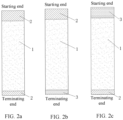
- FIG. 2a to FIG. 2c are schematic structural diagrams (top views) of electrode plates according to other three embodiments of this application respectively. Uncoated regions may also be provided at a starting end and a terminating end of the electrode plate. As shown in FIG. 2a , insulation layers 2 may be provided on a starting end side and a terminating end side of the electrode plate. Alternatively, as shown in FIG. 2b or FIG. 2c , an insulation layer 2 may be provided only on one of the starting end side and the terminating end side of the electrode.
- FIG.3 is a schematic structural diagram (top view) of an electrode plate according to still another embodiment of this application. Uncoated regions may be provided on two sides of the electrode plate in a length direction and at a starting end and a terminating end of the electrode plate. As shown in FIG. 3 , insulation layers 2 may be provided on the two sides of the positive electrode plate in the length direction and at the starting end and the terminating end of the positive electrode.
- FIG. 4 shows a relationship between adhesion and a stroke in an adhesion test.
- a lithium-ion battery In an environment at 25 ⁇ 3°C, a lithium-ion battery was charged to a designed full-charge voltage at a constant current of 0.5C, and then charged to 0.025C constantly at the full-charge voltage. An initial thickness of the lithium-ion battery was measured, and was denoted as T0. An initial internal resistance was denoted as IMP0. The lithium-ion battery was put into an 85 ⁇ 3°C high-temperature furnace, and was taken out every 4h (hour). A thickness of the lithium-ion battery was measured each time before a temperature of the lithium-ion battery drops to 80°C.
- T0 ⁇ 4h hot test T0 ⁇ 8h hot test
- T0 ⁇ 24h hot test T0 ⁇ 24h hot test
- Internal resistances at 4h, 8h, ..., and 24h were sequentially denoted as IMP0 ⁇ 4h hot test, IMP0 ⁇ 8h hot test, ..., and IMP0 ⁇ 24h hot test.
- thicknesses at 4h, 8h, ..., and 24h were sequentially denoted as T0 ⁇ 4h cold test, T0 ⁇ 8h cold test, ..., and T0 ⁇ 24h cold test.
- An internal resistance of the lithium-ion battery was measured every 4h.
- Internal resistances at 4h, 8h, ..., and 24h were sequentially denoted as IMP0 ⁇ 4h cold test, IMP0 ⁇ 8h cold test, ..., and IMP0 ⁇ 24h cold test.
- a lithium-ion battery In an environment at 25 ⁇ 3°C, a lithium-ion battery was charged to a designed full-charge voltage at a constant current of 0.5C, and then charged to 0.025C constantly at the full-charge voltage. An initial thickness of the lithium-ion battery was measured, and was denoted as T0. An initial internal resistance was denoted as IMP0. The lithium-ion battery was put into a 60 ⁇ 3°C high-temperature furnace, and was taken out every 5d (day). A thickness of the lithium-ion battery was measured each time before a temperature of the lithium-ion battery drops to 55°C.
- T0 ⁇ 5d hot test T0 ⁇ 10d hot test
- T0 ⁇ 30d hot test Internal resistances at 5d, 10d, ..., and 30d were sequentially denoted as IMP0 ⁇ 5d hot test, IMP0 ⁇ 10d hot test, ..., and IMP0 ⁇ 30d hot test.
- IMP0 ⁇ 5d hot test IMP0 ⁇ 10d hot test
- IMP0 ⁇ 30d hot test After the temperature of the lithium-ion battery drops to an ambient temperature 25 ⁇ 3°C, a thickness of the lithium-ion battery was measured every 5d.
- thicknesses at 5d, 10d, ..., and 30d were sequentially denoted as T0 ⁇ 5d cold test, T0 ⁇ 10d cold test, ..., and T0 ⁇ 30d cold test.
- An internal resistance of the lithium-ion battery was measured every 5d.
- Internal resistances at 5d, 10d, ..., and 30d were sequentially denoted as IMP0 ⁇ 5d cold test, IMP0 ⁇ 10d cold test, ..., and IMP0 ⁇ 30d cold test.
- IMP0 ⁇ 5d cold test IMP0 ⁇ 10d cold test
- IMP0 ⁇ 30d cold test IMP0 ⁇ 30d cold test.
- a thickness of a lithium-ion battery was measured by using a PPG battery thickness gauge. Pressure per unit area on the test board was set to 25 kg/m 2 .
- a ratio of a hot-test thickness or a cold-test thickness of a lithium-ion battery during storage to an initial thickness of the lithium-ion battery was calculated, and 100% was subtracted from the ratio.
- a hot-test thickness growth rate at the 4 th hour was equal to a hot-test thickness at the 4 th hour (namely, T0 ⁇ 4h hot test)/t0 - 100%.
- a ratio of a hot-test internal resistance or a cold-test internal resistance a lithium-ion battery during storage to an initial internal resistance of the lithium-ion battery was calculated, and 100% was subtracted from the ratio.
- a hot-test internal resistance growth rate on the 5 th day was equal to a hot-test internal resistance on the 5 th day (namely, IMP0 ⁇ 5d hot test)/IMP0 - 100%.
- a weight-average molecular weight of a binder in an insulation layer was measured by using the gel permeation chromatography (GPC) method.
- the weight-average molecular weight is an average molecular weight based on mass statistics.
- Adhesion between an insulation layer and a current collector was tested by using a Gotech tensile machine and a 90°-angle method.
- An electrode plate with an insulation layer in a finished lithium-ion battery was cut into strip samples of 20 mm ⁇ 60 mm, and lengths and widths of the samples could be adjusted proportionally according to actual situations.
- an insulation layer surface at one end of the sample was bonded to a steel plate by using a double-sided adhesive, where a length of the insulation layer surface bonded was not less than 40 mm.
- the steel plate was fastened to a corresponding position of the Gotech tensile machine, another end of the sample that was not bonded to the steel plate was lifted, and the electrode plate sample was clamped into a collet by using a connector or clamped directly into the clip.
- a spatial included angle between the lifted sample and the steel plate was 90°.
- the collet pulled the electrode plate at a speed of 5 mm/min so that the insulation layer was separated from the current collector, and a final average tensile force tested in a stable range was denoted as adhesion between the insulation layer and the current collector.
- adhesion between the insulation layer and the current collector As shown in FIG. 4 , it is required that a ratio of a standard deviation to an average value of adhesion data in the stable range not exceed 10%.
- D v 99 of inorganic particles was tested by using a laser particle size analyzer.
- D v 99 indicates a particle size in volume-based particle size distribution, where particle sizes of 99% of particles are not greater than this particle size.
- W1 indicates the mass of the adhesive film sample before immersion in the electrolyte
- W2 indicates the mass of the adhesive film sample after immersion in the electrolyte
- a plurality of samples with approximately the same thickness may be selected during the test, each sample is measured a plurality of times, for example, three times, and then an average value is calculated.
- Distilled water was added to a reactor and stirred. Nitrogen was injected to remove oxygen. After 2h, the following monomers were added to the reactor at a mass ratio of 45:45:10: acrylonitrile, sodium acrylate, and acrylamide. A resulting mixture was heated to 65°C in an inert atmosphere and kept at a constant temperature. Then a 20% ammonium persulfate solution was added as an initiator to initiate a reaction. A precipitate was taken out after the reaction was performed for 22h. An alkaline solution was added for neutralization until a pH value was 6.5 to 9. A mass ratio of the distilled water, the monomers, and the initiator was 89.5:10:0.5. After the reaction was completed, a reaction product was filtered, washed, dried, crushed, sieved, and the like to obtain a binder.
- the prepared binder and inorganic particles boehmite were dispersed in deionized water and evenly stirred until the slurry had a stable viscosity, to obtain an insulation layer slurry with a solid content of 30%.
- a mass ratio of the binder to the inorganic particles was 50:50.
- a weight-average molecular weight of the binder was 500000.
- D v 99 of the inorganic particles was 3 ⁇ m.
- Positive-electrode active materials lithium cobalt oxide (LCO), polyvinylidene fluoride (PVDF), conductive carbon black, and carbon nanotubes were mixed at a mass ratio of 97:1.5:0.8:0.7. Then N-methylpyrrolidone (NMP) was added as a solvent, to prepare a slurry with a solid content of 75%, and the slurry was evenly stirred. The slurry was evenly applied onto a current collector aluminum foil and dried at 90°C to obtain an active material layer with a thickness of 100 ⁇ m.
- NMP N-methylpyrrolidone
- the prepared insulation layer slurry was applied to a region uncoated with an active material layer on a surface of the aluminum foil to obtain an insulation layer with a thickness of 6 ⁇ m, where a cover rate of the insulation layer was 95%.
- Inorganic particles accounted for 50% of a total mass of the insulation layer, and a binder accounted for 50% of the total mass of the insulation layer.
- the foregoing steps were repeated on another surface of the positive electrode plate to obtain a positive electrode plate coated with positive-electrode active material layers on both sides.
- the positive electrode plate was cut into a size of 74 mm ⁇ 867 mm, and a tab was welded thereto for later use.
- Negative-electrode active materials graphite, styrene-butadiene rubber, and sodium carboxymethyl cellulose were mixed at a weight ratio of 97.5:1.3:1.2.
- Deionized water was added as a solvent, to prepare a slurry with a solid content of 70%, and the slurry was evenly stirred.
- the slurry was evenly applied onto a negative-electrode current collector copper foil, dried at 110°C, and cold pressed to obtain a negative electrode plate coated with a negative-electrode active material layer on a single side, where a thickness of the negative-electrode active material layer was 150 ⁇ m.
- Aluminum oxide and polyacrylate were mixed at a mass ratio of 90:10 and dissolved in deionized water to obtain a ceramic slurry with a solid content of 50%. Then the ceramic slurry was evenly applied onto one side of a porous substrate (a polyethylene substrate with a thickness of 7 ⁇ m, an average pore diameter of 0.073 ⁇ m, and a porosity of 26%) by using the micro-gravure coating method, and dried to obtain a double-layer structure of a ceramic coating and the porous substrate. A thickness of the ceramic coating was 50 ⁇ m.
- PVDF Polyvinylidene fluoride
- polyacrylate was mixed at a mass ratio of 96:4 and dissolved in deionized water to obtain a polymer slurry with a solid content of 50%. Then the polymer slurry was evenly applied onto two surfaces of the double-layer structure of the ceramic coating and the porous substrate by using the micro-gravure coating method, and dried to obtain a separator. A thickness of a single-layer coating formed by the polymer slurry was 2 ⁇ m.
- the positive electrode plate, the separator, and the negative electrode plate prepared above were stacked in sequence, so that the separator was sandwiched between the positive and negative electrode plates for separation, and were then wound into an electrode assembly.
- the electrode assembly was placed into an aluminum-plastic packaging bag, and was dehydrated at 80°C, and the prepared electrolyte was injected. After steps such as vacuum sealing, standing, chemical conversion, and shaping, a lithium-ion battery was obtained.
- This example was the same as Example 1 except that in ⁇ preparation of insulation layer slurry>, inorganic particles accounted for 85% of a total mass of an insulation layer, and a binder accounted for 15% of the total mass of the insulation layer; and that in ⁇ preparation of positive electrode plate including insulation layer>, a cover rate of the insulation layer was 98%.
- Example 2 This example was the same as Example 1 except that in ⁇ preparation of insulation layer slurry>, inorganic particles accounted for 98% of a total mass of an insulation layer, and a binder accounted for 2% of the total mass of the insulation layer.
- This example was the same as Example 2 except that diaspore was used as inorganic particles in ⁇ preparation of insulation layer slurry>.
- This example was the same as Example 2 except that aluminum oxide (Al 2 O 3 ) was used as inorganic particles in ⁇ preparation of insulation layer slurry>.
- This example was the same as Example 2 except that barium sulfate was used as inorganic particles in ⁇ preparation of insulation layer slurry>.
- This example was the same as Example 2 except that polymethyl acrylate was used as a binder in ⁇ preparation of insulation layer slurry>.
- This example was the same as Example 2 except that acrylonitrile multipolymer was used as a binder in ⁇ preparation of insulation layer slurry>.
- This example was the same as Example 2 except that sodium carboxymethyl cellulose was used as a binder in ⁇ preparation of insulation layer slurry>.
- This example was the same as Example 2 except that sodium polyacrylate was used as a binder in ⁇ preparation of insulation layer slurry>.
- This example was the same as Example 2 except that polyacrylamide was used as a binder in ⁇ preparation of insulation layer slurry>.
- This example was the same as Example 2 except that acrylamide and sodium acrylate at a mass ratio of 40:60 were used as monomers in ⁇ preparation of binder>.
- This example was the same as Example 2 except that acrylonitrile and acrylamide at a mass ratio of 40:60 were used as monomers in ⁇ preparation of binder>.
- This example was the same as Example 2 except that acrylonitrile and sodium acrylate at a mass ratio of 40:60 were used as monomers in ⁇ preparation of binder>.
- This example was the same as Example 2 except that acrylonitrile, sodium acrylate, acrylamide, and acrylate at a mass ratio of 27:60:10:3 were used as monomers in ⁇ preparation of binder>.
- This example was the same as Example 2 except that acrylonitrile, sodium acrylate, and acrylamide at a mass ratio of 30:60: 10 were used as monomers in ⁇ preparation of binder>.
- This example was the same as Example 2 except that acrylonitrile, sodium acrylate, and acrylamide at a mass ratio of 30:10:60 were used as monomers in ⁇ preparation of binder>.
- This example was the same as Example 2 except that acrylonitrile, sodium acrylate, and acrylamide at a mass ratio of 70:10:20 were used as monomers in ⁇ preparation of binder>.
- This example was the same as Example 2 except that a weight-average molecular weight of a binder was 100000 in ⁇ preparation of binder>.
- This example was the same as Example 2 except that in ⁇ preparation of binder>, a weight-average molecular weight of a binder was 1000000; and that in ⁇ preparation of positive electrode plate including insulation layer>, a cover rate of the insulation layer was 99%.
- This example was the same as Example 2 except that in ⁇ preparation of binder>, a weight-average molecular weight of a binder was 2000000; and that in ⁇ preparation of positive electrode plate including insulation layer>, a cover rate of the insulation layer was 99%.
- This example was the same as Example 1 except that acrylamide and sodium acrylate at a mass ratio of 40:60 were used as monomers in ⁇ preparation of insulation layer slurry>.
- This example was the same as Example 3 except that acrylamide and sodium acrylate at a mass ratio of 40:60 were used as monomers in ⁇ preparation of insulation layer slurry>.
- This example was the same as Example 19 except that acrylamide and sodium acrylate at a mass ratio of 40:60 were used as monomers in ⁇ preparation of insulation layer slurry>.
- This example was the same as Example 2 except that in ⁇ preparation of insulation layer slurry>, D v 99 of inorganic particles was 0.01 ⁇ m; and that in ⁇ preparation of positive electrode plate including insulation layer>, a thickness of the insulation layer was 0.02 ⁇ m.
- This example was the same as Example 2 except that in ⁇ preparation of insulation layer slurry>, D v 99 of inorganic particles was 1.0 ⁇ m; and that in ⁇ preparation of positive electrode plate including insulation layer>, a thickness of the insulation layer was 1.0 ⁇ m.
- This example was the same as Example 2 except that in ⁇ preparation of insulation layer slurry>, D v 99 of inorganic particles was 3.0 ⁇ m; and that in ⁇ preparation of positive electrode plate including insulation layer>, a thickness of the insulation layer was 3.5 ⁇ m.
- This example was the same as Example 2 except that in ⁇ preparation of insulation layer slurry>, D v 99 of inorganic particles was 5.0 ⁇ m; and that in ⁇ preparation of positive electrode plate including insulation layer>, a thickness of the insulation layer was 6.0 ⁇ m.
- This example was the same as Example 2 except that in ⁇ preparation of insulation layer slurry>, D v 99 of inorganic particles was 7.0 ⁇ m; and that in ⁇ preparation of positive electrode plate including insulation layer>, a thickness of the insulation layer was 8.0 ⁇ m.
- This example was the same as Example 2 except that in ⁇ preparation of insulation layer slurry>, D v 99 of inorganic particles was 9.9 ⁇ m; and that in ⁇ preparation of positive electrode plate including insulation layer>, a thickness of the insulation layer was 10.0 ⁇ m.
- This example was the same as Example 2 except ⁇ preparation of positive electrode plate> and ⁇ preparation of negative electrode plate>.
- Positive-electrode active materials lithium cobalt oxide (LCO), polyvinylidene fluoride (PVDF), conductive carbon black, and carbon nanotubes were mixed at a mass ratio of 97:1.5:0.8:0.7. Then N-methylpyrrolidone (NMP) was added as a solvent, to prepare a slurry with a solid content of 75%, and the slurry was evenly stirred. The slurry was evenly applied onto a current collector aluminum foil, dried at 90°C, and cold pressed to obtain a positive electrode plate coated with a positive-electrode active material layer on a single side, where a thickness of the positive-electrode active material layer was 100 ⁇ m.
- NMP N-methylpyrrolidone
- the positive electrode plate was cut into a size of 74 mm ⁇ 867 mm, and a tab was welded thereto for later use.
- An insulation layer slurry was prepared by using the same method in Example 2.
- Negative-electrode active materials graphite, styrene-butadiene rubber, and sodium carboxymethyl cellulose were mixed at a weight ratio of 97.5:1.3:1.2.
- Deionized water was added as a solvent, to prepare a slurry with a solid content of 70%, and the slurry was evenly stirred.
- the slurry was evenly applied onto a negative-electrode current collector copper foil and dried at 110°C to obtain a negative-electrode active material layer with a thickness of 150 ⁇ m.
- the prepared insulation layer slurry was applied to a region uncoated with an active material layer on a surface of the copper foil to obtain an insulation layer with a thickness of 6 ⁇ m. These steps were also completed on a rear side of the negative electrode plate by using the same method, to obtain a negative electrode plate coated on both sides. After the coating was completed, the negative electrode plate was cut into a sheet with a size of 76 mm ⁇ 851 mm, and a tab was welded thereto for later use.
- This example was the same as Example 2 except that both a positive electrode plate and a negative electrode plate were provided with an insulation layer with a thickness of 6 ⁇ m.
- This example was the same as Example 2 except the ⁇ preparation of positive electrode plate>.
- Positive-electrode active materials lithium iron phosphate, PVDF, conductive carbon black, and carbon nanotubes were mixed at a mass ratio of 96.8:2:0.7:0.5. Then N-methylpyrrolidone (NMP) was added as a solvent, to prepare a slurry A with a solid content of 75%, and the slurry was evenly stirred. The slurry A was evenly applied onto one surface of a current collector aluminum foil with a thickness of 12 ⁇ m and dried at 90°C to obtain a first active layer with a thickness of 50 ⁇ m.
- NMP N-methylpyrrolidone
- the prepared insulation layer slurry was applied to a region uncoated with the first active layer on the surface of the aluminum foil to obtain an insulation layer with a thickness of 6 ⁇ m.
- a binder accounted for 15% of total mass of the insulation layer, and inorganic particles accounted for 85% of the total mass of the insulation layer.
- Positive-electrode active materials lithium cobalt oxide (LCO), polyvinylidene fluoride (PVDF), conductive carbon black, and carbon nanotubes were mixed at a mass ratio of 97:1.5:0.8:0.7. Then N-methylpyrrolidone (NMP) was added as a solvent, to prepare a slurry B with a solid content of 75%, and the slurry was evenly stirred. The slurry B was evenly applied onto the first active layer and dried at 90°C to obtain a second active layer with a thickness of 50 ⁇ m. The first active layer and the second active layer jointly formed a positive-electrode active material layer of the positive electrode plate.
- NMP N-methylpyrrolidone
- the positive electrode plate was cut into a size of 74 mm ⁇ 867 mm, and a tab was welded thereto for later use.
- This example was the same as Example 2 except that in ⁇ preparation of positive electrode plate>, polyvinylidene fluoride (PVDF) was used as a binder, and a weight-average molecular weight of the binder was 700000.
- PVDF polyvinylidene fluoride
- This example was the same as Example 2 except that in ⁇ preparation of positive electrode plate>, styrene-butadiene rubber was used as a binder, and aluminum oxide was used as inorganic particles.
- This example was the same as Example 2 except that a weight-average molecular weight of a binder was 50000 in ⁇ preparation of binder>.
- This example was the same as Example 2 except that a weight-average molecular weight of a binder was 3000000 in ⁇ preparation of binder>.
- This example was the same as Example 2 except that acrylonitrile, sodium acrylate, and acrylamide at a mass ratio of 10:75:15 were used as monomers in ⁇ preparation of binder>.
- This example was the same as Example 2 except that acrylonitrile, sodium acrylate, and acrylamide at a mass ratio of 80:5:15 were used as monomers in ⁇ preparation of binder>.
- This example was the same as Example 2 except that in ⁇ preparation of positive electrode plate>, D v 99 of inorganic particles boehmite was 11 ⁇ m, and a thickness of an insulation layer was 12 ⁇ m.
- This example was the same as Example 2 except that in ⁇ preparation of positive electrode plate>, D v 99 of inorganic particles boehmite was 0.007 ⁇ m, and a thickness of an insulation layer was 0.009 ⁇ m.
- D v 99 of the inorganic particles and the thickness of the insulation layer usually affect the adhesion between the insulation layer and the current collector. It can be learned from Examples 25 to 30 and Comparative Examples 7 and 8 that, provided that the D v 99 of the inorganic particles and the thickness of the insulation layer are within the ranges in this application, the adhesion between the insulation layer and the current collector can be improved, and the thickness growth rate of the lithium-ion battery and the internal resistance growth rate of the lithium-ion battery can be reduced.
- the thickness growth rate of the lithium-ion battery and the internal resistance growth rate of the lithium-ion battery can be reduced when the positive electrode plate and/or the negative electrode plate of the lithium-ion battery include the insulation layer in this application.
Landscapes
- Chemical & Material Sciences (AREA)
- Chemical Kinetics & Catalysis (AREA)
- Electrochemistry (AREA)
- General Chemical & Material Sciences (AREA)
- Engineering & Computer Science (AREA)
- Materials Engineering (AREA)
- Composite Materials (AREA)
- Manufacturing & Machinery (AREA)
- Secondary Cells (AREA)
- Battery Electrode And Active Subsutance (AREA)
Abstract
Description
- This application relates to the field of electrochemical technologies, and specifically, to an electrochemical apparatus and an electronic apparatus.
- Lithium-ion batteries are characterized by high specific energy, a high operating voltage, a low self-discharge rate, a small size, a light weight, and the like, and therefore are widely used in various fields such as electrical energy storage, portable electronic devices, and electric vehicles.
- A lithium-ion battery typically includes an electrode and a separator. The electrode includes a positive electrode and a negative electrode. The separator is sandwiched between the positive electrode and the negative electrode. The electrode usually includes a current collector, an active material layer, and an insulation layer. The insulation layer is typically provided in a region provided with no active material layer on a surface of the current collector, so as to improve overall insulation performance of the electrode. The inventors have found through research that, in an existing lithium-ion battery, an insulation layer has a high swelling rate in an electrolyte due to impact of material composition of the insulation layer. Therefore, performance of the lithium-ion battery needs to be improved.
- This application is intended to provide an electrochemical apparatus and an electronic apparatus, to reduce a swelling rate of an insulation layer of an electrochemical apparatus in an electrolyte, thereby improving performance of the electrochemical apparatus.
- It should be noted that, in the following description, an example in which a lithium-ion battery is used as an electrochemical apparatus is used to explain this application. However, the electrochemical apparatus in this application is not limited to the lithium-ion battery.
- Specific technical solutions are as follows:
A first aspect of this application provides an electrochemical apparatus. The electrochemical apparatus includes an electrode. The electrode includes a current collector. The current collector includes a coated region provided with an active material and an uncoated region provided with no active material. The uncoated region is at least partially provided with an insulation layer. The insulation layer includes a binder and inorganic particles. A swelling rate of the insulation layer is not higher than 8% after the insulation layer is immersed in an electrolyte at 85°C for 24h. - In the electrochemical apparatus in this application, a region provided with an active material on a surface of the current collector of the electrode may be referred to as a coated region, and a region provided with no active material on the surface of the current collector is referred to as an uncoated region. The uncoated region is at least partially provided with the insulation layer, and different arrangement manners may be used, for example, including but not limited to: providing the insulation layer on two sides of the electrode in a length direction, providing the insulation layer on a starting end side of the electrode, or providing the insulation layer on a terminating end side of the electrode. The foregoing arrangement manners may be used alone or in combination. The starting end and the terminating end may be a starting end and a terminating end of a winding structure in a lithium-ion battery with the winding structure.
- The electrode in this application may include a positive electrode and a negative electrode. The insulation layer may be provided in an uncoated region on a surface of a positive-electrode current collector in the positive electrode, or may be provided in an uncoated region on a surface of a negative-electrode current collector in the negative electrode.
- The swelling rate of the insulation layer in this application is not higher than 8% after the insulation layer is immersed in the electrolyte at 85°C for 24h. This indicates that the insulation layer in this application has good resistance to swelling in an electrolyte, thereby reducing a thickness growth rate of a lithium-ion battery, and improving performance of the lithium-ion battery.
- In an embodiment of this application, the binder may include at least one of polypropylene, polyacrylate, acrylonitrile multipolymer, or carboxymethyl cellulose salt. The binder is added, so that viscosity of the insulation layer can be improved, thereby improving adhesion between the insulation layer and the current collector.
- In an embodiment of this application, the binder may include a polymer formed by polymerization of at least one of monomer acrylonitrile, acrylate, acrylamide, or acrylic ester. Preferably, the binder may include a polymer formed by polymerization of at least one of the monomer acrylonitrile, the acrylate, or the acrylamide.
- The binder in this application may be an aqueous binder. Metal ions in the acrylate can replace some hydrogen ions, improving hydrophilicity of the binder and alleviating swelling of the binder in the electrolyte while maintaining relatively high adhesion of the binder. In addition, hydrogen ions can easily acquire electrons to form hydrogen. Therefore, after hydrogen ions are reduced, swelling of the lithium-ion battery caused by excessive hydrogen ions can be further prevented.
- In an embodiment of this application, based on total mass of the polymer, a mass percentage of the acrylonitrile is 25% to 70%, a mass percentage of the acrylate is 10% to 60%, a mass percentage of the acrylamide is 10% to 60%, and a mass percentage of the acrylic ester is 0% to 10%. Without being limited to any theory, by controlling the mass percentages of the acrylonitrile, the acrylate, the acrylamide, and the acrylic ester within the foregoing ranges, a binder with desired adhesion can be obtained, thereby improving adhesion between the insulation layer and the current collector.
- In an embodiment of this application, a swelling rate of the binder in the electrolyte is 0% to 5%. This indicates that the insulation layer in this application has good resistance to swelling in an electrolyte.
- In an embodiment of this application, a weight-average molecular weight of the binder is 100000 to 2000000, preferably, 300000 to 800000. Without being limited to any theory, when the weight-average molecular weight of the binder is excessively large, a thickening effect of the binder is enhanced, leading to excessively high viscosity and poor fluidity of a slurry, which may lead to incomplete coating of an insulation layer slurry. When the weight-average molecular weight of the binder is excessively small, viscosity of a slurry is excessively low, and film forming property of the slurry is poor, also leading to incomplete coating of an insulation layer slurry. Without being limited to any theory, by controlling the weight-average molecular weight of the binder within the foregoing range, the insulation layer slurry forms a film with a uniform thickness on a surface of a substrate of the current collector to form the insulation layer, improving adhesion between the insulation layer and the current collector.
- In an embodiment of this application, based on total mass of the insulation layer, a mass percentage of the binder is 2% to 50%, and a mass percentage of the inorganic particles is 50% to 98%. Without being limited to any theory, when the percentage of the binder is excessively low, for example, less than 2%, the insulation layer has poor film forming property, which is not conducive to improvement of a cover rate of the insulation layer. When the percentage of the binder is excessively high, for example, greater than 50%, the binder has high viscosity, intensifying shrinkage of the insulation layer during drying and film forming. However, the substrate (for example, an aluminum foil) of the current collector basically does not shrink. Shrinkage rates of the insulation layer and the substrate vary greatly. As a result, a large area of the insulation layer falls off the substrate of the current collector. The percentages of the binder and the inorganic particles are controlled within the foregoing ranges, thereby helping improve adhesion between the insulation layer and the current collector.
- In an embodiment of this application, a cover rate of the insulation layer is not less than 95%. By controlling the cover rate of the insulation layer to be not less than 95%, the electrode can have better insulation performance.
- In an embodiment of this application, the inorganic particles include at least one of boehmite, diaspore, aluminum oxide, barium sulfate, calcium sulfate, or calcium silicate, preferably, at least one of boehmite or aluminum oxide. The inorganic particles are added, so that strength and insulation performance of the insulation layer can be improved.
- In an embodiment of this application, Dv99 of the inorganic particles is 0.01 µm to 9.9 µm. Dv99 of the inorganic particles is preferably not greater than a thickness of the insulation layer; otherwise, an aluminum foil is likely to be damaged during cold pressing, forming concave and convex points that have a thickness greater than a target thickness of the insulation layer. In this application, Dv99 indicates a particle size in volume-based particle size distribution, where particle sizes of 99% of particles are not greater than this particle size.
- In an embodiment of this application, a thickness of the insulation layer is 0.02 µm to 10 µm. Without being limited to any theory, when the thickness of the insulation layer is excessively small, for example, less than 0.02 µm, strength of the insulation layer is excessively low, affecting insulation performance. When the thickness of the insulation layer is excessively large, for example, greater than 10 µm, a relative percentage of an active material in the electrode is reduced, affecting energy density of the lithium-ion battery. By controlling the thickness of the insulation layer within the foregoing range, the insulation layer can have desired strength and insulation performance.
- In an embodiment of this application, adhesion between the insulation layer and the current collector is not less than 201 N/m. It can be learned that, in this application, good adhesion is achieved between the insulation layer and the current collector, thereby reducing a thickness growth rate and an internal resistance growth rate of the lithium-ion battery.
- In an embodiment of this application, compared with an electrochemical apparatus of the same specifications without the insulation layer and stored at 85°C for 24h or 60°C for 30 days, the electrochemical apparatus stored at 85°C for 24h or 60°C for 30 days satisfies at least one of the following:
- (a) a difference between thickness growth rates of the electrochemical apparatuses being within ±8%; or
- (b) a difference between internal resistance growth rates of the electrochemical apparatuses being within ±8%. It can be learned that, compared with an existing electrochemical apparatus, the electrochemical apparatus in this application has a lower thickness growth rate, a lower internal resistance growth rate, and better performance.
- A preparation method for the binder in this application is not particularly limited. Any preparation method commonly known to persons skilled in the art may be used. For example, the following preparation method may be used.
- Distilled water is added to a reactor and stirred. Nitrogen is injected to remove oxygen. At least one of the foregoing components such as the acrylonitrile, the acrylate, the acrylamide, and the acrylic ester is added at different mass ratios. A resulting mixture is heated to approximately 65°C in an inert atmosphere and kept at a constant temperature. Then an initiator is added to initiate a reaction. The process ends after the reaction is performed for approximately 20h.
- In this application, an initiator is not particularly limited, provided that monomer polymerization can be initiated. For example, the initiator may be a 20% ammonium persulfate solution. In this application, an amount of distilled water and initiator to be added is not particularly limited, provided that an added monomer can have a polymerization reaction. After the reaction is completed, an alkaline solution may be added to a precipitate formed in the reaction for neutralization, to obtain a pH value of 6.5 to 9. Alternatively, a reaction product may be filtered, washed, dried, crushed, sieved, and the like.
- Persons skilled in the art should understand that the electrode in this application may be provided with an active material layer on one surface, or may be provided with an active material layer on each of two surfaces. The insulation layer in this application may be provided on at least one surface of the electrode. For example, the insulation layer may be provided on one surface of the electrode, or may be provided on two surfaces of the electrode.
- In the positive electrode in this application, the positive-electrode current collector is not particularly limited, and may be any positive-electrode current collector commonly known in the art, for example, an aluminum foil, an aluminum alloy foil, or a composite current collector. A positive-electrode active material layer includes a positive-electrode active material. The positive-electrode active material is not particularly limited, and any positive-electrode active material commonly known in the art may be used. For example, the positive-electrode active material may include at least one of lithium nickel cobalt manganate (811, 622, 523, 111), lithium nickel cobalt aluminate, lithium iron phosphate, a lithium-rich manganese-based material, lithium cobalt oxide, lithium manganate oxide, lithium iron manganese phosphate, or lithium titanate.
- In the negative electrode in this application, the negative-electrode current collector is not particularly limited, and any negative-electrode current collector commonly known in the art may be used, for example, a copper foil, an aluminum foil, an aluminum alloy foil, or a composite current collector. A negative-electrode active material layer includes a negative-electrode active material. The negative-electrode active material is not particularly limited, and any negative-electrode active material commonly known in the art may be used. For example, the negative-electrode active material may include at least one of artificial graphite, natural graphite, carbonaceous mesophase spherule, soft carbon, hard carbon, silicon, silicon carbon, lithium titanate, or the like.
- The lithium-ion battery in this application further includes an electrolyte. The electrolyte may be one or more selected from a group consisting of a gel electrolyte, a solid electrolyte, and a liquid electrolyte. The liquid electrolyte includes a lithium salt and a non-aqueous solvent.
- In some embodiments of this application, the lithium salt is one or more selected from a group consisting of LiPF6, LiBF4, LiAsF6, LiClO4, LiB(C6H5)4, LiCH3SO3, LiCF3SO3, LiN(SO2CF3)2, LiC(SO2CF3)3, LiSiF6, LiBOB, and lithium difluoroborate. For example, LiPF6 may be selected as the lithium salt because LiPF6 can provide high ionic conductivity and improve cycling performance. The non-aqueous solvent may be a carbonate compound, a carboxylate compound, an ether compound, another organic solvent, or a combination thereof. The carbonate compound may be a linear carbonate compound, a cyclic carbonate compound, a fluorocarbonate compound, or a combination thereof.
- An instance of the linear carbonate compound is dimethyl carbonate (DMC), diethyl carbonate (DEC), dipropyl carbonate (DPC), methyl propyl carbonate (MPC), ethylene propyl carbonate (EPC), methyl ethyl carbonate (MEC), or a combination thereof. An example of the cyclic carbonate compound is ethylene carbonate (EC), propylene carbonate (PC), butylene carbonate (BC), vinyl ethylene carbonate (VEC), or a combination thereof. An instance of the fluorocarbonate compound is fluoroethylene carbonate (FEC), 1,2-difluoroethylene carbonate, 1,1-difluoroethylene carbonate, 1,1,2-trifluoroethylene carbonate, 1,1,2,2-tetrafluoroethylene carbonate, 1-fluoro-2-methylethylene carbonate, 1-fluoro-1-methylethylene carbonate, 1,2-difluoro-1-methylethylene carbonate, 1,1,2-trifluoro-2-methylethylene carbonate, trifluoromethylethylene carbonate, or a combination thereof.
- An instance of the carboxylate compound is methyl formate, methyl acetate, ethyl acetate, n-propyl acetate, tert-butyl acetate, methyl propionate, ethyl propionate, propyl propionate, γ-butyrolactone, decanolide, valerolactone, mevalonolactone, caprolactone, or a combination thereof.
- An instance of the ether compound is dibutyl ether, tetraglyme, diglyme, 1,2-dimethoxyethane, 1,2-diethoxyethane, ethoxymethoxy ethane, 2-methyltetrahydrofuran, tetrahydrofuran, or a combination thereof.
- An instance of the another organic solvent is dimethyl sulfoxide, 1,2-dioxolane, sulfolane, methyl-sulfolane, 1,3-dimethyl-2-imidazolidinone, N-methyl-2-pyrrolidone, formamide, dimethylformamide, acetonitrile, trimethyl phosphate, triethyl phosphate, trioctyl phosphate, phosphate ester, or a combination thereof.
- In the electrochemical apparatus in this application, the positive electrode may include the insulation layer in this application, the negative electrode may include the insulation layer in this application, or both the positive electrode and the negative electrode may include the insulation layer in this application.
- A second aspect of this application provides an electronic apparatus including the electrochemical apparatus according to the first aspect.
- The electronic apparatus in this application is not particularly limited, and may be any electronic apparatus known in the prior art. In some embodiments, the electronic apparatus may include but is not limited to a notebook computer, a pen-input computer, a mobile computer, an electronic book player, a portable telephone, a portable fax machine, a portable copier, a portable printer, a stereo headset, a video recorder, a liquid crystal television, a portable cleaner, a portable CD player, a mini-disc, a transceiver, an electronic notepad, a calculator, a memory card, a portable recorder, a radio, a standby power source, a motor, an automobile, a motorcycle, a power-assisted bicycle, a bicycle, a lighting appliance, a toy, a game console, a clock, an electric tool, a flash lamp, a camera, a large household battery, a lithium-ion capacitor, and the like.
- A process of preparing the electrochemical apparatus is commonly known to persons skilled in the art, and is not particularly limited in this application. For example, the electrochemical apparatus may be prepared in the following process: A positive electrode and a negative electrode are stacked with a separator, and are put into a housing after undergoing operations such as winding and folding as required. An electrolyte is injected into the housing, and the housing is sealed. The separator in use is the foregoing separator provided in this application. In addition, if necessary, an overcurrent prevention element, a guide plate, and the like may be placed in the housing to prevent pressure increase, overcharge, and overdischarge in the electrochemical apparatus.
- This application provides an electrochemical apparatus and an electronic apparatus. The electrochemical apparatus includes an electrode. The electrode includes a current collector. The current collector includes a coated region provided with an active material and an uncoated region provided with no active material. The uncoated region is at least partially provided with an insulation layer. The insulation layer includes a binder and inorganic particles. A swelling rate of the insulation layer is not higher than 8% after the insulation layer is immersed in electrolyte at 85°C for 24h, ensuring sufficient adhesion between the insulation layer and the current collector, and thus reducing a swelling rate and an internal resistance growth rate of the electrochemical apparatus during cycling.
- To describe the technical solutions in this application and the prior art more clearly, the following briefly describes the accompanying drawings required for describing the embodiments and the prior art. Apparently, the accompanying drawings in the following description show merely some embodiments of this application.
-
FIG. 1 is a schematic structural diagram of an electrode plate according to an embodiment of this application; -
FIG. 2a is a schematic structural diagram of an electrode plate according to another embodiment of this application; -
FIG. 2b is a schematic structural diagram of an electrode plate according to still another embodiment of this application; -
FIG. 2c is a schematic structural diagram of an electrode plate according to still another embodiment of this application; -
FIG. 3 is a schematic structural diagram of an electrode plate according to still another embodiment of this application; and -
FIG. 4 is a schematic diagram showing a relationship between adhesion and a stroke in an adhesion test. - Reference signs: 1. active material layer; 2. insulation layer; and 3. current collector.
- To make the objectives, technical solutions, and advantages of this application more comprehensible, the following describes this application in detail with reference to accompanying drawings and embodiments. Apparently, the described embodiments are merely some rather than all of the embodiments of this application. All other technical solutions obtained by persons of ordinary skill in the art based on the embodiments of this application fall within the protection scope of this application.
- It should be noted that, in the specific embodiments of this application, an example in which a lithium-ion battery is used as an electrochemical apparatus is used to explain this application. However, the electrochemical apparatus in this application is not limited to the lithium-ion battery.
-
FIG. 1 is a schematic structural diagram (top view) of an electrode plate according to an embodiment of this application. The electrode plate is usually rectangular. As shown inFIG. 1 , uncoated regions, that is, regions provided with noactive material layer 1, may be provided on two sides of the electrode plate in a length direction. Acurrent collector 3 is exposed from the uncoated regions. InFIG. 1 , insulation layers 2 may be provided in the uncoated regions, and specifically, may be provided on the two sides of the electrode plate in the length direction. Certainly, aninsulation layer 2 may alternatively be provided only on one side of the electrode in the length direction. -
FIG. 2a to FIG. 2c are schematic structural diagrams (top views) of electrode plates according to other three embodiments of this application respectively. Uncoated regions may also be provided at a starting end and a terminating end of the electrode plate. As shown inFIG. 2a , insulation layers 2 may be provided on a starting end side and a terminating end side of the electrode plate. Alternatively, as shown inFIG. 2b or FIG. 2c , aninsulation layer 2 may be provided only on one of the starting end side and the terminating end side of the electrode. -
FIG.3 is a schematic structural diagram (top view) of an electrode plate according to still another embodiment of this application. Uncoated regions may be provided on two sides of the electrode plate in a length direction and at a starting end and a terminating end of the electrode plate. As shown inFIG. 3 , insulation layers 2 may be provided on the two sides of the positive electrode plate in the length direction and at the starting end and the terminating end of the positive electrode. -
FIG. 4 shows a relationship between adhesion and a stroke in an adhesion test. - The following describes the embodiments of this application more specifically by using examples and comparative examples. Various tests and evaluations were performed according to the following methods. In addition, unless otherwise specified, "portions" and "%" are based on mass.
-
- (1) In an environment at (25±3)°C, an electrode plate with an insulation layer was detached from a finished lithium-ion battery. If another coating is provided on another side of the electrode plate, the coating needs to be removed by using a physical or chemical method without damaging a current collector or the insulation layer, to obtain an electrode plate sample.
- (2) Thicknesses of at least 10 different points on the current collector of the electrode plate sample were measured by using a ten-thousandth micrometer, and an average value of the thicknesses of all the test points was denoted as T0.
- (3) An electrolyte on a surface of the electrode plate sample was removed by using dust-free paper. Then thicknesses of at least 10 different points on the electrode plate sample were measured by using the ten-thousandth micrometer, an average value of the thicknesses of all the test points was denoted as T1.
- (4) The electrode plate sample was immersed in dimethyl carbonate (DMC), stored at 85°C for 24h, and then taken out. Then DMC on the surface of the electrode plate sample was removed by using dust-free paper at (25±3)°C. Thicknesses of 10 different points on the electrode plate sample were measured by using the ten-thousandth micrometer, and an average value of the thicknesses of all the test points was denoted as T2.
- (5) A swelling rate E of the electrode plate sample was calculated by using the following formula:

- It is required that an interval between a time at which the electrode plate sample was taken out from the 85°C environment and a time when the thickness test was completed does not exceed 20 min.
- In an environment at 25±3°C, a lithium-ion battery was charged to a designed full-charge voltage at a constant current of 0.5C, and then charged to 0.025C constantly at the full-charge voltage. An initial thickness of the lithium-ion battery was measured, and was denoted as T0. An initial internal resistance was denoted as IMP0. The lithium-ion battery was put into an 85±3°C high-temperature furnace, and was taken out every 4h (hour). A thickness of the lithium-ion battery was measured each time before a temperature of the lithium-ion battery drops to 80°C. Then thicknesses at 4h, 8h, ..., and 24h were sequentially denoted as T0→4h hot test, T0→8h hot test, ..., and T0→24h hot test. Internal resistances at 4h, 8h, ..., and 24h were sequentially denoted as IMP0→4h hot test, IMP0→8h hot test, ..., and IMP0→24h hot test. After the temperature of the lithium-ion battery drops to an ambient temperature 25±3°C, a thickness of the lithium-ion battery was measured every 4h. Then thicknesses at 4h, 8h, ..., and 24h were sequentially denoted as T0→4h cold test, T0→8h cold test, ..., and T0→24h cold test. An internal resistance of the lithium-ion battery was measured every 4h. Internal resistances at 4h, 8h, ..., and 24h were sequentially denoted as IMP0→4h cold test, IMP0→8h cold test, ..., and IMP0→24h cold test. Each time a thickness of the lithium-ion battery was measured at the ambient temperature, the lithium-ion battery was put into the 85±3°C high-temperature furnace again. After 4h, the lithium-ion battery was taken out again for thickness measurement. This process repeats until 24h elapsed.
- In an environment at 25±3°C, a lithium-ion battery was charged to a designed full-charge voltage at a constant current of 0.5C, and then charged to 0.025C constantly at the full-charge voltage. An initial thickness of the lithium-ion battery was measured, and was denoted as T0. An initial internal resistance was denoted as IMP0. The lithium-ion battery was put into a 60±3°C high-temperature furnace, and was taken out every 5d (day). A thickness of the lithium-ion battery was measured each time before a temperature of the lithium-ion battery drops to 55°C. Then thicknesses at 5d, 10d, ..., and 30d were sequentially denoted as T0→5d hot test, T0→10d hot test, ..., and T0→30d hot test. Internal resistances at 5d, 10d, ..., and 30d were sequentially denoted as IMP0→5d hot test, IMP0→10d hot test, ..., and IMP0→30d hot test. After the temperature of the lithium-ion battery drops to an ambient temperature 25±3°C, a thickness of the lithium-ion battery was measured every 5d. Then thicknesses at 5d, 10d, ..., and 30d were sequentially denoted as T0→5d cold test, T0→10d cold test, ..., and T0→30d cold test. An internal resistance of the lithium-ion battery was measured every 5d. Internal resistances at 5d, 10d, ..., and 30d were sequentially denoted as IMP0→5d cold test, IMP0→10d cold test, ..., and IMP0→30d cold test. Each time a thickness of the lithium-ion battery was measured at the ambient temperature, the lithium-ion battery was put into the 60±3°C high-temperature furnace again. After 5d, the lithium-ion battery was taken out again for thickness measurement. This process repeats until 30d elapsed.
- A thickness of a lithium-ion battery was measured by using a PPG battery thickness gauge. Pressure per unit area on the test board was set to 25 kg/m2.
- Internal resistance test for a lithium-ion battery:
An alternating-current internal resistance of a lithium-ion battery was measured by using a resistance meter at a sinusoidal 1000 Hz wave. - Under the foregoing two storage conditions, a ratio of a hot-test thickness or a cold-test thickness of a lithium-ion battery during storage to an initial thickness of the lithium-ion battery was calculated, and 100% was subtracted from the ratio. For example, a hot-test thickness growth rate at the 4th hour was equal to a hot-test thickness at the 4th hour (namely, T0→4h hot test)/t0 - 100%.
- Under the foregoing two storage conditions, a ratio of a hot-test internal resistance or a cold-test internal resistance a lithium-ion battery during storage to an initial internal resistance of the lithium-ion battery was calculated, and 100% was subtracted from the ratio. For example, a hot-test internal resistance growth rate on the 5th day was equal to a hot-test internal resistance on the 5th day (namely, IMP0→5d hot test)/IMP0 - 100%.
- A weight-average molecular weight of a binder in an insulation layer was measured by using the gel permeation chromatography (GPC) method. In this application, the weight-average molecular weight is an average molecular weight based on mass statistics.
- Adhesion between an insulation layer and a current collector was tested by using a Gotech tensile machine and a 90°-angle method. An electrode plate with an insulation layer in a finished lithium-ion battery was cut into strip samples of 20 mm × 60 mm, and lengths and widths of the samples could be adjusted proportionally according to actual situations. In a length direction of the sample, an insulation layer surface at one end of the sample was bonded to a steel plate by using a double-sided adhesive, where a length of the insulation layer surface bonded was not less than 40 mm. Then the steel plate was fastened to a corresponding position of the Gotech tensile machine, another end of the sample that was not bonded to the steel plate was lifted, and the electrode plate sample was clamped into a collet by using a connector or clamped directly into the clip. A spatial included angle between the lifted sample and the steel plate was 90°. The collet pulled the electrode plate at a speed of 5 mm/min so that the insulation layer was separated from the current collector, and a final average tensile force tested in a stable range was denoted as adhesion between the insulation layer and the current collector. As shown in
FIG. 4 , it is required that a ratio of a standard deviation to an average value of adhesion data in the stable range not exceed 10%. -
- (1) An electrode plate coated with an insulation layer was cut to obtain an electrode plate sample coated with an insulation layer. An area of a surface coated with the insulation layer was denoted as S1.
- (2) A current collector area uncoated with an insulating material (that is, an uncoated area) on a surface of the electrode plate sample in (1) that was coated with an insulation layer was measured by using a CCD microscope with a resolution of 0.02 µm, and the current collector area was denoted as S2.
- (3) A cover rate B of the insulation layer was calculated according to the following formula: B = (S1 - S2)/
S 1 × 100%. - Dv99 of inorganic particles was tested by using a laser particle size analyzer. Dv99 indicates a particle size in volume-based particle size distribution, where particle sizes of 99% of particles are not greater than this particle size.
-
- (1) In an environment at (25±3)°C, an electrode plate coated with an insulation layer was detached from a finished battery cell. An electrolyte remaining on a surface of the electrode plate was removed by using dust-free paper.
- (2) The electrode plate coated with the insulation layer underwent plasma cutting, to obtain a cross section of the electrode plate.
- (3) The cross section of the electrode plate obtained in (2) was observed by using a SEM, and a thickness of an insulating coating on a single surface was tested, with adjacent test points spaced 2 mm to 3 mm a part. At least 15 different points were tested, and an average value of thicknesses of all the test points was recorded as a thickness of the insulation layer.
- A dispersant containing a binder was dried at 80°C to form an adhesive film with a thickness of 2 mm to 3 mm. Then the adhesive film was cut to obtain an adhesive film sample with a mass of 1 g to 2 g. A mass of the adhesive film sample before immersion in an electrolyte was weighed and denoted as W1. At 60°C, the adhesive film sample was immersed in an electrolyte for 7 days (a mass ratio of the electrolyte to the adhesive film sample was 50:1, and a mass ratio between components of the electrolyte was as follows: ethylene carbonate:propylene carbonate:diethyl carbonate:ethyl propionate = 30:10:30:30). Then a solvent on a surface of the adhesive film sample was removed, and a mass of the adhesive film sample after swelling was weighed and denoted as W2. A swelling rate ΔW1 of the adhesive film sample is calculated by using the following formula:

- In the formula, W1 indicates the mass of the adhesive film sample before immersion in the electrolyte, and W2 indicates the mass of the adhesive film sample after immersion in the electrolyte.
- To ensure reliability of test results, a plurality of samples with approximately the same thickness may be selected during the test, each sample is measured a plurality of times, for example, three times, and then an average value is calculated.
- Distilled water was added to a reactor and stirred. Nitrogen was injected to remove oxygen. After 2h, the following monomers were added to the reactor at a mass ratio of 45:45:10: acrylonitrile, sodium acrylate, and acrylamide. A resulting mixture was heated to 65°C in an inert atmosphere and kept at a constant temperature. Then a 20% ammonium persulfate solution was added as an initiator to initiate a reaction. A precipitate was taken out after the reaction was performed for 22h. An alkaline solution was added for neutralization until a pH value was 6.5 to 9. A mass ratio of the distilled water, the monomers, and the initiator was 89.5:10:0.5. After the reaction was completed, a reaction product was filtered, washed, dried, crushed, sieved, and the like to obtain a binder.
- The prepared binder and inorganic particles boehmite were dispersed in deionized water and evenly stirred until the slurry had a stable viscosity, to obtain an insulation layer slurry with a solid content of 30%. A mass ratio of the binder to the inorganic particles was 50:50. A weight-average molecular weight of the binder was 500000. Dv99 of the inorganic particles was 3 µm.
- Positive-electrode active materials lithium cobalt oxide (LCO), polyvinylidene fluoride (PVDF), conductive carbon black, and carbon nanotubes were mixed at a mass ratio of 97:1.5:0.8:0.7. Then N-methylpyrrolidone (NMP) was added as a solvent, to prepare a slurry with a solid content of 75%, and the slurry was evenly stirred. The slurry was evenly applied onto a current collector aluminum foil and dried at 90°C to obtain an active material layer with a thickness of 100 µm.
- The prepared insulation layer slurry was applied to a region uncoated with an active material layer on a surface of the aluminum foil to obtain an insulation layer with a thickness of 6 µm, where a cover rate of the insulation layer was 95%. Inorganic particles accounted for 50% of a total mass of the insulation layer, and a binder accounted for 50% of the total mass of the insulation layer. Then the foregoing steps were repeated on another surface of the positive electrode plate to obtain a positive electrode plate coated with positive-electrode active material layers on both sides. The positive electrode plate was cut into a size of 74 mm × 867 mm, and a tab was welded thereto for later use.
- Negative-electrode active materials graphite, styrene-butadiene rubber, and sodium carboxymethyl cellulose were mixed at a weight ratio of 97.5:1.3:1.2. Deionized water was added as a solvent, to prepare a slurry with a solid content of 70%, and the slurry was evenly stirred. The slurry was evenly applied onto a negative-electrode current collector copper foil, dried at 110°C, and cold pressed to obtain a negative electrode plate coated with a negative-electrode active material layer on a single side, where a thickness of the negative-electrode active material layer was 150 µm.
- After the foregoing steps were completed, these steps were also completed on a rear side of the negative electrode plate by using the same method, to obtain a negative electrode plate coated on both sides. After the coating was completed, the negative electrode plate was cut into a sheet with a size of 76 mm × 851 mm, and a tab was welded thereto for later use.
- In a dry argon atmosphere, organic solvents ethylene carbonate, ethyl methyl carbonate, and diethyl carbonate were mixed at a mass ratio of EC:EMC:DEC = 30:50:20 to obtain an organic solution. Then lithium salt lithium hexafluorophosphate was added to the organic solvents for dissolution. The mixture was evenly mixed to obtain an electrolyte with a lithium salt concentration of 1.15 mol/L.
- Aluminum oxide and polyacrylate were mixed at a mass ratio of 90:10 and dissolved in deionized water to obtain a ceramic slurry with a solid content of 50%. Then the ceramic slurry was evenly applied onto one side of a porous substrate (a polyethylene substrate with a thickness of 7 µm, an average pore diameter of 0.073 µm, and a porosity of 26%) by using the micro-gravure coating method, and dried to obtain a double-layer structure of a ceramic coating and the porous substrate. A thickness of the ceramic coating was 50 µm.
- Polyvinylidene fluoride (PVDF) and polyacrylate were mixed at a mass ratio of 96:4 and dissolved in deionized water to obtain a polymer slurry with a solid content of 50%. Then the polymer slurry was evenly applied onto two surfaces of the double-layer structure of the ceramic coating and the porous substrate by using the micro-gravure coating method, and dried to obtain a separator. A thickness of a single-layer coating formed by the polymer slurry was 2 µm.
- The positive electrode plate, the separator, and the negative electrode plate prepared above were stacked in sequence, so that the separator was sandwiched between the positive and negative electrode plates for separation, and were then wound into an electrode assembly. The electrode assembly was placed into an aluminum-plastic packaging bag, and was dehydrated at 80°C, and the prepared electrolyte was injected. After steps such as vacuum sealing, standing, chemical conversion, and shaping, a lithium-ion battery was obtained.
- This example was the same as Example 1 except that in <preparation of insulation layer slurry>, inorganic particles accounted for 85% of a total mass of an insulation layer, and a binder accounted for 15% of the total mass of the insulation layer; and that in <preparation of positive electrode plate including insulation layer>, a cover rate of the insulation layer was 98%.
- This example was the same as Example 1 except that in <preparation of insulation layer slurry>, inorganic particles accounted for 98% of a total mass of an insulation layer, and a binder accounted for 2% of the total mass of the insulation layer.
- This example was the same as Example 2 except that diaspore was used as inorganic particles in <preparation of insulation layer slurry>.
- This example was the same as Example 2 except that aluminum oxide (Al2O3) was used as inorganic particles in <preparation of insulation layer slurry>.
- This example was the same as Example 2 except that barium sulfate was used as inorganic particles in <preparation of insulation layer slurry>.
- This example was the same as Example 2 except that polymethyl acrylate was used as a binder in <preparation of insulation layer slurry>.
- This example was the same as Example 2 except that acrylonitrile multipolymer was used as a binder in <preparation of insulation layer slurry>.
- This example was the same as Example 2 except that sodium carboxymethyl cellulose was used as a binder in <preparation of insulation layer slurry>.
- This example was the same as Example 2 except that sodium polyacrylate was used as a binder in <preparation of insulation layer slurry>.
- This example was the same as Example 2 except that polyacrylamide was used as a binder in <preparation of insulation layer slurry>.
- This example was the same as Example 2 except that acrylamide and sodium acrylate at a mass ratio of 40:60 were used as monomers in <preparation of binder>.
- This example was the same as Example 2 except that acrylonitrile and acrylamide at a mass ratio of 40:60 were used as monomers in <preparation of binder>.
- This example was the same as Example 2 except that acrylonitrile and sodium acrylate at a mass ratio of 40:60 were used as monomers in <preparation of binder>.
- This example was the same as Example 2 except that acrylonitrile, sodium acrylate, acrylamide, and acrylate at a mass ratio of 27:60:10:3 were used as monomers in <preparation of binder>.
- This example was the same as Example 2 except that acrylonitrile, sodium acrylate, and acrylamide at a mass ratio of 30:60: 10 were used as monomers in <preparation of binder>.
- This example was the same as Example 2 except that acrylonitrile, sodium acrylate, and acrylamide at a mass ratio of 30:10:60 were used as monomers in <preparation of binder>.
- This example was the same as Example 2 except that acrylonitrile, sodium acrylate, and acrylamide at a mass ratio of 70:10:20 were used as monomers in <preparation of binder>.
- This example was the same as Example 2 except that a weight-average molecular weight of a binder was 100000 in <preparation of binder>.
- This example was the same as Example 2 except that in <preparation of binder>, a weight-average molecular weight of a binder was 1000000; and that in <preparation of positive electrode plate including insulation layer>, a cover rate of the insulation layer was 99%.
- This example was the same as Example 2 except that in <preparation of binder>, a weight-average molecular weight of a binder was 2000000; and that in <preparation of positive electrode plate including insulation layer>, a cover rate of the insulation layer was 99%.
- This example was the same as Example 1 except that acrylamide and sodium acrylate at a mass ratio of 40:60 were used as monomers in <preparation of insulation layer slurry>.
- This example was the same as Example 3 except that acrylamide and sodium acrylate at a mass ratio of 40:60 were used as monomers in <preparation of insulation layer slurry>.
- This example was the same as Example 19 except that acrylamide and sodium acrylate at a mass ratio of 40:60 were used as monomers in <preparation of insulation layer slurry>.
- This example was the same as Example 2 except that in <preparation of insulation layer slurry>, Dv99 of inorganic particles was 0.01 µm; and that in <preparation of positive electrode plate including insulation layer>, a thickness of the insulation layer was 0.02 µm.
- This example was the same as Example 2 except that in <preparation of insulation layer slurry>, Dv99 of inorganic particles was 1.0 µm; and that in <preparation of positive electrode plate including insulation layer>, a thickness of the insulation layer was 1.0 µm.
- This example was the same as Example 2 except that in <preparation of insulation layer slurry>, Dv99 of inorganic particles was 3.0 µm; and that in <preparation of positive electrode plate including insulation layer>, a thickness of the insulation layer was 3.5 µm.
- This example was the same as Example 2 except that in <preparation of insulation layer slurry>, Dv99 of inorganic particles was 5.0 µm; and that in <preparation of positive electrode plate including insulation layer>, a thickness of the insulation layer was 6.0 µm.
- This example was the same as Example 2 except that in <preparation of insulation layer slurry>, Dv99 of inorganic particles was 7.0 µm; and that in <preparation of positive electrode plate including insulation layer>, a thickness of the insulation layer was 8.0 µm.
- This example was the same as Example 2 except that in <preparation of insulation layer slurry>, Dv99 of inorganic particles was 9.9 µm; and that in <preparation of positive electrode plate including insulation layer>, a thickness of the insulation layer was 10.0 µm.
- This example was the same as Example 2 except <preparation of positive electrode plate> and <preparation of negative electrode plate>.
- Positive-electrode active materials lithium cobalt oxide (LCO), polyvinylidene fluoride (PVDF), conductive carbon black, and carbon nanotubes were mixed at a mass ratio of 97:1.5:0.8:0.7. Then N-methylpyrrolidone (NMP) was added as a solvent, to prepare a slurry with a solid content of 75%, and the slurry was evenly stirred. The slurry was evenly applied onto a current collector aluminum foil, dried at 90°C, and cold pressed to obtain a positive electrode plate coated with a positive-electrode active material layer on a single side, where a thickness of the positive-electrode active material layer was 100 µm. Then the foregoing steps were repeated on another surface of the positive electrode plate to obtain a positive electrode plate coated with positive-electrode active material layers on both sides. The positive electrode plate was cut into a size of 74 mm × 867 mm, and a tab was welded thereto for later use.
- An insulation layer slurry was prepared by using the same method in Example 2.
- Negative-electrode active materials graphite, styrene-butadiene rubber, and sodium carboxymethyl cellulose were mixed at a weight ratio of 97.5:1.3:1.2. Deionized water was added as a solvent, to prepare a slurry with a solid content of 70%, and the slurry was evenly stirred. The slurry was evenly applied onto a negative-electrode current collector copper foil and dried at 110°C to obtain a negative-electrode active material layer with a thickness of 150 µm.
- The prepared insulation layer slurry was applied to a region uncoated with an active material layer on a surface of the copper foil to obtain an insulation layer with a thickness of 6 µm. These steps were also completed on a rear side of the negative electrode plate by using the same method, to obtain a negative electrode plate coated on both sides. After the coating was completed, the negative electrode plate was cut into a sheet with a size of 76 mm × 851 mm, and a tab was welded thereto for later use.
- This example was the same as Example 2 except that both a positive electrode plate and a negative electrode plate were provided with an insulation layer with a thickness of 6 µm.
- This example was the same as Example 2 except the <preparation of positive electrode plate>.
- Positive-electrode active materials lithium iron phosphate, PVDF, conductive carbon black, and carbon nanotubes were mixed at a mass ratio of 96.8:2:0.7:0.5. Then N-methylpyrrolidone (NMP) was added as a solvent, to prepare a slurry A with a solid content of 75%, and the slurry was evenly stirred. The slurry A was evenly applied onto one surface of a current collector aluminum foil with a thickness of 12 µm and dried at 90°C to obtain a first active layer with a thickness of 50 µm.
- The prepared insulation layer slurry was applied to a region uncoated with the first active layer on the surface of the aluminum foil to obtain an insulation layer with a thickness of 6 µm. A binder accounted for 15% of total mass of the insulation layer, and inorganic particles accounted for 85% of the total mass of the insulation layer.
- Positive-electrode active materials lithium cobalt oxide (LCO), polyvinylidene fluoride (PVDF), conductive carbon black, and carbon nanotubes were mixed at a mass ratio of 97:1.5:0.8:0.7. Then N-methylpyrrolidone (NMP) was added as a solvent, to prepare a slurry B with a solid content of 75%, and the slurry was evenly stirred. The slurry B was evenly applied onto the first active layer and dried at 90°C to obtain a second active layer with a thickness of 50 µm. The first active layer and the second active layer jointly formed a positive-electrode active material layer of the positive electrode plate. Then the foregoing steps were repeated on another surface of the positive electrode plate to obtain a positive electrode plate coated with positive-electrode active material layers on both sides. The positive electrode plate was cut into a size of 74 mm × 867 mm, and a tab was welded thereto for later use.
- This example was the same as Example 2 except that in <preparation of positive electrode plate>, polyvinylidene fluoride (PVDF) was used as a binder, and a weight-average molecular weight of the binder was 700000.
- This example was the same as Example 2 except that in <preparation of positive electrode plate>, styrene-butadiene rubber was used as a binder, and aluminum oxide was used as inorganic particles.
- This example was the same as Example 2 except that a weight-average molecular weight of a binder was 50000 in <preparation of binder>.
- This example was the same as Example 2 except that a weight-average molecular weight of a binder was 3000000 in <preparation of binder>.
- This example was the same as Example 2 except that acrylonitrile, sodium acrylate, and acrylamide at a mass ratio of 10:75:15 were used as monomers in <preparation of binder>.
- This example was the same as Example 2 except that acrylonitrile, sodium acrylate, and acrylamide at a mass ratio of 80:5:15 were used as monomers in <preparation of binder>.
- This example was the same as Example 2 except that in <preparation of positive electrode plate>, Dv99 of inorganic particles boehmite was 11 µm, and a thickness of an insulation layer was 12 µm.
- This example was the same as Example 2 except that in <preparation of positive electrode plate>, Dv99 of inorganic particles boehmite was 0.007 µm, and a thickness of an insulation layer was 0.009 µm.
- Preparation parameters and test results of the examples and comparative examples are shown in Table 1 to Table 3.


Table 2 Preparation parameters and test results of Examples 25 to 30 and Comparative Examples 7 and 8 Dv99 of inorganic particles (µm) Thickness of insulation layer (µm) Swelling rate of insulation layer (%) Adhesion between insulation layer and current collector (N/m) Thickness growth rate of lithium-ion battery (%) Internal resistance growth rate of lithium-ion battery (%) Example 25 0.01 0.02 5 350 5 5 Example 26 1.0 1.0 5 350 5 5 Example 27 3.0 3.5 5 350 5 5 Example 28 5.0 6.0 5 350 5 5 Example 29 7.0 8.0 5 350 5 5 Example 30 9.9 10.0 5 350 5 5 Comparative Example 7 11 12 5 180 7 7 Comparative Example 8 0.007 0.009 5 150 8 8 
- It can be learned from Examples 1 to 33 and Comparative Examples 1 to 8 that, in the lithium-ion battery with the insulation layer in this application, the adhesion between the insulation layer and the current collector is significantly improved. Especially in Examples 20 and 21, the adhesion between the insulation layer and the current collector reaches 400 N/m.
- It can be further learned from Examples 1 to 33 and Comparative Examples 1 to 8 that, in the lithium-ion battery with the insulation layer in this application, the thickness growth rate of the lithium-ion battery and the internal resistance growth rate of the lithium-ion battery are significantly reduced.
- It can be learned from Examples 1, 3, and 19 and Comparative Examples 22 to 24 that, when the percentage of the binder, the weight-average molecular weight of the binder, the inorganic particles, and the percentage of the inorganic particles are the same, the binder formed by polymerization of the three monomers acrylonitrile, sodium acrylate, and acrylamide has a higher viscosity than a binder formed by polymerization of two of the monomers.
- Dv99 of the inorganic particles and the thickness of the insulation layer usually affect the adhesion between the insulation layer and the current collector. It can be learned from Examples 25 to 30 and Comparative Examples 7 and 8 that, provided that the Dv99 of the inorganic particles and the thickness of the insulation layer are within the ranges in this application, the adhesion between the insulation layer and the current collector can be improved, and the thickness growth rate of the lithium-ion battery and the internal resistance growth rate of the lithium-ion battery can be reduced.
- It can be learned from Examples 31 to 33 that the thickness growth rate of the lithium-ion battery and the internal resistance growth rate of the lithium-ion battery can be reduced when the positive electrode plate and/or the negative electrode plate of the lithium-ion battery include the insulation layer in this application.
- The foregoing descriptions are merely preferable embodiments of this application, but are not intended to limit this application. Any modification, equivalent replacement, or improvement made without departing from the spirit and principle of this application shall fall within the protection scope of this application.
Claims (14)
- An electrochemical apparatus, comprising an electrode, wherein the electrode comprises a current collector, the current collector comprises a coated region provided with an active material and an uncoated region provided with no active material, the uncoated region is at least partially provided with an insulation layer, the insulation layer comprises a binder and inorganic particles, and a swelling rate of the insulation layer is not higher than 8% after the insulation layer is immersed in an electrolyte at 85°C for 24h.
- The electrochemical apparatus according to claim 1, wherein the binder comprises at least one of polypropylene, polyacrylate, acrylonitrile multipolymer, or carboxymethyl cellulose salt.
- The electrochemical apparatus according to claim 1, wherein the binder comprises a polymer obtained by polymerization of at least one of monomer acrylonitrile, acrylate, acrylamide, or acrylic ester.
- The electrochemical apparatus according to claim 3, wherein based on total mass of the polymer, a mass percentage of the acrylonitrile is 25% to 70%, a mass percentage of the acrylate is 10% to 60%, a mass percentage of the acrylamide is 10% to 60%, and a mass percentage of the acrylic ester is 0% to 10%.
- The electrochemical apparatus according to claim 1, wherein a swelling rate of the binder in the electrolyte is 0% to 5%.
- The electrochemical apparatus according to claim 1, wherein a weight-average molecular weight of the binder is 100000 to 2000000.
- The electrochemical apparatus according to claim 1, wherein based on total mass of the insulation layer, a mass percentage of the binder is 2% to 50%, and a mass percentage of the inorganic particles is 50% to 98%.
- The electrochemical apparatus according to claim 1, wherein a cover rate of the insulation layer is not less than 95%.
- The electrochemical apparatus according to claim 1, wherein the inorganic particles comprise at least one of boehmite, diaspore, aluminum oxide, barium sulfate, calcium sulfate, or calcium silicate.
- The electrochemical apparatus according to claim 1, wherein Dv99 of the inorganic particles is 0.01 µm to 9.9 µm.
- The electrochemical apparatus according to claim 1, wherein a thickness of the insulation layer is 0.02 µm to 10 µm.
- The electrochemical apparatus according to claim 1, wherein adhesion between the insulation layer and the current collector is not less than 201 N/m.
- The electrochemical apparatus according to claim 1, wherein compared with an electrochemical apparatus of the same specifications without the insulation layer and stored at 85°C for 24h or 60°C for 30 days, the electrochemical apparatus stored at 85°C for 24h or 60°C for 30 days satisfies at least one of the following characteristics:(a) a difference between thickness growth rates of the electrochemical apparatuses being within ±8%; or(b) a difference between internal resistance growth rates of the electrochemical apparatuses being within ±8%.
- An electronic apparatus, comprising the electrochemical apparatus according to any one of claims 1 to 13.
Applications Claiming Priority (1)
| Application Number | Priority Date | Filing Date | Title |
|---|---|---|---|
| PCT/CN2020/132347 WO2022110041A1 (en) | 2020-11-27 | 2020-11-27 | Electrochemical device and electronic device |
Publications (2)
| Publication Number | Publication Date |
|---|---|
| EP4254537A1 true EP4254537A1 (en) | 2023-10-04 |
| EP4254537A4 EP4254537A4 (en) | 2024-12-11 |
Family
ID=78648201
Family Applications (1)
| Application Number | Title | Priority Date | Filing Date |
|---|---|---|---|
| EP20962931.0A Pending EP4254537A4 (en) | 2020-11-27 | 2020-11-27 | ELECTROCHEMICAL DEVICE AND ELECTRONIC DEVICE |
Country Status (4)
| Country | Link |
|---|---|
| US (1) | US20230307649A1 (en) |
| EP (1) | EP4254537A4 (en) |
| CN (1) | CN113711396B (en) |
| WO (1) | WO2022110041A1 (en) |
Families Citing this family (6)
| Publication number | Priority date | Publication date | Assignee | Title |
|---|---|---|---|---|
| CN114464895B (en) * | 2022-01-12 | 2025-12-09 | 力神(青岛)新能源有限公司 | Preparation method and application of square laminated lithium ion battery capable of improving stress |
| EP4503171A4 (en) * | 2022-03-31 | 2025-06-11 | Ningde Amperex Technology Limited | ELECTROCHEMICAL DEVICE, MODULE AND ELECTRONIC DEVICE |
| CN116802851A (en) * | 2022-03-31 | 2023-09-22 | 宁德新能源科技有限公司 | Electrochemical devices and electronic devices |
| CN115425174B (en) | 2022-10-08 | 2024-06-25 | 厦门海辰储能科技股份有限公司 | Electrode sheet and electrochemical device |
| KR102739044B1 (en) * | 2023-10-25 | 2024-12-09 | 주식회사 한솔케미칼 | Composition for coating non-coated portions of batteries, method for coating non-coated portions of batteries using the same, and electrode comprising the composition for coating non-coated portions of batteries |
| KR20260045959A (en) * | 2024-09-27 | 2026-04-06 | 주식회사 엔켐 | Secondary battery comprising water-based slurry composition and coating layer formed therefrom |
Family Cites Families (11)
| Publication number | Priority date | Publication date | Assignee | Title |
|---|---|---|---|---|
| JPH1131513A (en) * | 1997-05-13 | 1999-02-02 | Sony Corp | Non-aqueous electrolyte secondary battery |
| CN100367559C (en) * | 2004-09-03 | 2008-02-06 | 松下电器产业株式会社 | Lithium-ion secondary battery |
| JP5361753B2 (en) * | 2009-01-21 | 2013-12-04 | ユニチカ株式会社 | Secondary battery electrode binder, electrode and secondary battery |
| WO2015080305A1 (en) * | 2013-11-27 | 2015-06-04 | 주식회사 엘지화학 | Electrode assembly and electrochemical device including same |
| JP2017157471A (en) * | 2016-03-03 | 2017-09-07 | 株式会社Gsユアサ | Electrode and method of manufacturing electrode |
| WO2018016626A1 (en) * | 2016-07-22 | 2018-01-25 | 三菱ケミカル株式会社 | Porous base material, porous electrode, carbon fiber paper, method for manufacturing carbon fiber paper, and method for manufacturing porous base material |
| CN106220779B (en) * | 2016-08-17 | 2018-08-31 | 四川茵地乐科技有限公司 | Acrylonitrile copolymer binder and its application in lithium ion battery |
| JP6965859B2 (en) * | 2018-09-20 | 2021-11-10 | トヨタ自動車株式会社 | Electrode manufacturing method |
| JP7268442B2 (en) * | 2019-03-28 | 2023-05-08 | 株式会社Gsユアサ | Electrode manufacturing method and electrode |
| CN111326699B (en) * | 2019-08-14 | 2021-11-09 | 宁德时代新能源科技股份有限公司 | Secondary battery |
| CN111139002B (en) * | 2019-12-30 | 2021-10-08 | 宣城研一新能源科技有限公司 | Water-soluble adhesive for lithium ion battery, preparation method of water-soluble adhesive, electrode plate and battery |
-
2020
- 2020-11-27 CN CN202080024655.6A patent/CN113711396B/en active Active
- 2020-11-27 EP EP20962931.0A patent/EP4254537A4/en active Pending
- 2020-11-27 WO PCT/CN2020/132347 patent/WO2022110041A1/en not_active Ceased
-
2023
- 2023-05-30 US US18/325,371 patent/US20230307649A1/en active Pending
Also Published As
| Publication number | Publication date |
|---|---|
| CN113711396A (en) | 2021-11-26 |
| US20230307649A1 (en) | 2023-09-28 |
| WO2022110041A1 (en) | 2022-06-02 |
| EP4254537A4 (en) | 2024-12-11 |
| CN113711396B (en) | 2022-12-27 |
Similar Documents
| Publication | Publication Date | Title |
|---|---|---|
| US20230307649A1 (en) | Electrochemical apparatus and electronic apparatus | |
| CN113659105B (en) | Electrochemical device and electronic device | |
| WO2022041259A1 (en) | Secondary battery and preparation method therefor, and battery module, battery pack and device comprising secondary battery | |
| EP2549577B1 (en) | Lithium secondary battery using ionic liquid | |
| CN113066961B (en) | Negative electrode sheet, electrochemical device, and electronic device | |
| EP4213231A1 (en) | Electrochemical device, electronic device and electrochemical device manufacturing method | |
| CN114430018B (en) | Electrochemical device and electronic device including the same | |
| EP4207426A1 (en) | Electrochemical device and electronic apparatus | |
| EP4421898A1 (en) | Positive electrode plate, secondary battery, and electric apparatus | |
| CN113632273A (en) | Electrochemical device and electronic device | |
| CN113366673A (en) | Electrochemical device and electronic device | |
| US20230231145A1 (en) | Electrochemical apparatus and electronic apparatus | |
| WO2022141508A1 (en) | Electrochemical device and electronic device | |
| CN117693837A (en) | A secondary battery and electronic device | |
| CN113078288B (en) | Electrochemical device and electronic device | |
| CN116154101A (en) | Electrochemical devices and electronic devices | |
| EP4738453A1 (en) | Electrode assembly, electrochemical device and electric device | |
| US20250158128A1 (en) | Electrochemical device and electronic device including same | |
| CN116325266A (en) | A kind of electrochemical device and electronic device | |
| KR102530195B1 (en) | Method for manufacturing negative electrode for secondary battery | |
| EP4084127B1 (en) | Electrochemical device and electronic equipment | |
| EP4207384A1 (en) | Electrochemical device and electronic device comprising electrochemical device | |
| CN114188504A (en) | Electrochemical device and electronic device | |
| EP4668365A1 (en) | Secondary battery and electronic apparatus | |
| KR102724678B1 (en) | Negative electrode and secondary battery comprising the same |
Legal Events
| Date | Code | Title | Description |
|---|---|---|---|
| STAA | Information on the status of an ep patent application or granted ep patent |
Free format text: STATUS: THE INTERNATIONAL PUBLICATION HAS BEEN MADE |
|
| PUAI | Public reference made under article 153(3) epc to a published international application that has entered the european phase |
Free format text: ORIGINAL CODE: 0009012 |
|
| STAA | Information on the status of an ep patent application or granted ep patent |
Free format text: STATUS: REQUEST FOR EXAMINATION WAS MADE |
|
| 17P | Request for examination filed |
Effective date: 20230627 |
|
| AK | Designated contracting states |
Kind code of ref document: A1 Designated state(s): AL AT BE BG CH CY CZ DE DK EE ES FI FR GB GR HR HU IE IS IT LI LT LU LV MC MK MT NL NO PL PT RO RS SE SI SK SM TR |
|
| DAV | Request for validation of the european patent (deleted) | ||
| DAX | Request for extension of the european patent (deleted) | ||
| REG | Reference to a national code |
Ref country code: DE Ref legal event code: R079 Free format text: PREVIOUS MAIN CLASS: H01M0004130000 Ipc: H01M0010420000 |
|
| A4 | Supplementary search report drawn up and despatched |
Effective date: 20241113 |
|
| RIC1 | Information provided on ipc code assigned before grant |
Ipc: H01M 4/62 20060101ALI20241107BHEP Ipc: H01M 4/66 20060101ALI20241107BHEP Ipc: H01M 4/13 20100101ALI20241107BHEP Ipc: H01M 4/04 20060101ALI20241107BHEP Ipc: H01M 10/42 20060101AFI20241107BHEP |