EP4254261B1 - Verfahren, vorrichtung und system zur diagnose von schaufelfehlern und speichermedium - Google Patents
Verfahren, vorrichtung und system zur diagnose von schaufelfehlern und speichermedium Download PDFInfo
- Publication number
- EP4254261B1 EP4254261B1 EP21912969.9A EP21912969A EP4254261B1 EP 4254261 B1 EP4254261 B1 EP 4254261B1 EP 21912969 A EP21912969 A EP 21912969A EP 4254261 B1 EP4254261 B1 EP 4254261B1
- Authority
- EP
- European Patent Office
- Prior art keywords
- audio
- blade
- wind noise
- blade rotation
- fault diagnosis
- Prior art date
- Legal status (The legal status is an assumption and is not a legal conclusion. Google has not performed a legal analysis and makes no representation as to the accuracy of the status listed.)
- Active
Links
Images



Classifications
-
- G—PHYSICS
- G01—MEASURING; TESTING
- G01M—TESTING STATIC OR DYNAMIC BALANCE OF MACHINES OR STRUCTURES; TESTING OF STRUCTURES OR APPARATUS, NOT OTHERWISE PROVIDED FOR
- G01M13/00—Testing of machine parts
-
- F—MECHANICAL ENGINEERING; LIGHTING; HEATING; WEAPONS; BLASTING
- F03—MACHINES OR ENGINES FOR LIQUIDS; WIND, SPRING, OR WEIGHT MOTORS; PRODUCING MECHANICAL POWER OR A REACTIVE PROPULSIVE THRUST, NOT OTHERWISE PROVIDED FOR
- F03D—WIND MOTORS
- F03D17/00—Monitoring or testing of wind motors, e.g. diagnostics
- F03D17/005—Monitoring or testing of wind motors, e.g. diagnostics using computation methods, e.g. neural networks
-
- F—MECHANICAL ENGINEERING; LIGHTING; HEATING; WEAPONS; BLASTING
- F03—MACHINES OR ENGINES FOR LIQUIDS; WIND, SPRING, OR WEIGHT MOTORS; PRODUCING MECHANICAL POWER OR A REACTIVE PROPULSIVE THRUST, NOT OTHERWISE PROVIDED FOR
- F03D—WIND MOTORS
- F03D17/00—Monitoring or testing of wind motors, e.g. diagnostics
- F03D17/009—Monitoring or testing of wind motors, e.g. diagnostics characterised by the purpose
- F03D17/024—Monitoring or testing of wind motors, e.g. diagnostics characterised by the purpose for monitoring sound or acoustic signals
-
- F—MECHANICAL ENGINEERING; LIGHTING; HEATING; WEAPONS; BLASTING
- F03—MACHINES OR ENGINES FOR LIQUIDS; WIND, SPRING, OR WEIGHT MOTORS; PRODUCING MECHANICAL POWER OR A REACTIVE PROPULSIVE THRUST, NOT OTHERWISE PROVIDED FOR
- F03D—WIND MOTORS
- F03D17/00—Monitoring or testing of wind motors, e.g. diagnostics
- F03D17/027—Monitoring or testing of wind motors, e.g. diagnostics characterised by the component being monitored or tested
- F03D17/028—Blades
-
- G—PHYSICS
- G01—MEASURING; TESTING
- G01H—MEASUREMENT OF MECHANICAL VIBRATIONS OR ULTRASONIC, SONIC OR INFRASONIC WAVES
- G01H15/00—Measuring mechanical or acoustic impedance
-
- G—PHYSICS
- G01—MEASURING; TESTING
- G01H—MEASUREMENT OF MECHANICAL VIBRATIONS OR ULTRASONIC, SONIC OR INFRASONIC WAVES
- G01H3/00—Measuring characteristics of vibrations by using a detector in a fluid
- G01H3/04—Frequency
- G01H3/08—Analysing frequencies present in complex vibrations, e.g. comparing harmonics present
-
- G—PHYSICS
- G01—MEASURING; TESTING
- G01M—TESTING STATIC OR DYNAMIC BALANCE OF MACHINES OR STRUCTURES; TESTING OF STRUCTURES OR APPARATUS, NOT OTHERWISE PROVIDED FOR
- G01M5/00—Investigating the elasticity of structures, e.g. deflection of bridges or air-craft wings
- G01M5/0016—Investigating the elasticity of structures, e.g. deflection of bridges or air-craft wings of aircraft wings or blades
-
- G—PHYSICS
- G01—MEASURING; TESTING
- G01M—TESTING STATIC OR DYNAMIC BALANCE OF MACHINES OR STRUCTURES; TESTING OF STRUCTURES OR APPARATUS, NOT OTHERWISE PROVIDED FOR
- G01M5/00—Investigating the elasticity of structures, e.g. deflection of bridges or air-craft wings
- G01M5/0066—Investigating the elasticity of structures, e.g. deflection of bridges or air-craft wings by exciting or detecting vibration or acceleration
-
- G—PHYSICS
- G01—MEASURING; TESTING
- G01M—TESTING STATIC OR DYNAMIC BALANCE OF MACHINES OR STRUCTURES; TESTING OF STRUCTURES OR APPARATUS, NOT OTHERWISE PROVIDED FOR
- G01M99/00—Subject matter not provided for in other groups of this subclass
- G01M99/005—Testing of complete machines, e.g. washing-machines or mobile phones
-
- G—PHYSICS
- G06—COMPUTING OR CALCULATING; COUNTING
- G06F—ELECTRIC DIGITAL DATA PROCESSING
- G06F18/00—Pattern recognition
- G06F18/10—Pre-processing; Data cleansing
-
- G—PHYSICS
- G06—COMPUTING OR CALCULATING; COUNTING
- G06F—ELECTRIC DIGITAL DATA PROCESSING
- G06F18/00—Pattern recognition
- G06F18/20—Analysing
- G06F18/24—Classification techniques
- G06F18/241—Classification techniques relating to the classification model, e.g. parametric or non-parametric approaches
- G06F18/2413—Classification techniques relating to the classification model, e.g. parametric or non-parametric approaches based on distances to training or reference patterns
- G06F18/24147—Distances to closest patterns, e.g. nearest neighbour classification
-
- F—MECHANICAL ENGINEERING; LIGHTING; HEATING; WEAPONS; BLASTING
- F05—INDEXING SCHEMES RELATING TO ENGINES OR PUMPS IN VARIOUS SUBCLASSES OF CLASSES F01-F04
- F05B—INDEXING SCHEME RELATING TO WIND, SPRING, WEIGHT, INERTIA OR LIKE MOTORS, TO MACHINES OR ENGINES FOR LIQUIDS COVERED BY SUBCLASSES F03B, F03D AND F03G
- F05B2260/00—Function
- F05B2260/80—Diagnostics
-
- F—MECHANICAL ENGINEERING; LIGHTING; HEATING; WEAPONS; BLASTING
- F05—INDEXING SCHEMES RELATING TO ENGINES OR PUMPS IN VARIOUS SUBCLASSES OF CLASSES F01-F04
- F05B—INDEXING SCHEME RELATING TO WIND, SPRING, WEIGHT, INERTIA OR LIKE MOTORS, TO MACHINES OR ENGINES FOR LIQUIDS COVERED BY SUBCLASSES F03B, F03D AND F03G
- F05B2260/00—Function
- F05B2260/84—Modelling or simulation
-
- G—PHYSICS
- G06—COMPUTING OR CALCULATING; COUNTING
- G06F—ELECTRIC DIGITAL DATA PROCESSING
- G06F2218/00—Aspects of pattern recognition specially adapted for signal processing
- G06F2218/02—Preprocessing
- G06F2218/04—Denoising
-
- G—PHYSICS
- G06—COMPUTING OR CALCULATING; COUNTING
- G06F—ELECTRIC DIGITAL DATA PROCESSING
- G06F2218/00—Aspects of pattern recognition specially adapted for signal processing
- G06F2218/08—Feature extraction
-
- G—PHYSICS
- G06—COMPUTING OR CALCULATING; COUNTING
- G06F—ELECTRIC DIGITAL DATA PROCESSING
- G06F2218/00—Aspects of pattern recognition specially adapted for signal processing
- G06F2218/12—Classification; Matching
-
- Y—GENERAL TAGGING OF NEW TECHNOLOGICAL DEVELOPMENTS; GENERAL TAGGING OF CROSS-SECTIONAL TECHNOLOGIES SPANNING OVER SEVERAL SECTIONS OF THE IPC; TECHNICAL SUBJECTS COVERED BY FORMER USPC CROSS-REFERENCE ART COLLECTIONS [XRACs] AND DIGESTS
- Y02—TECHNOLOGIES OR APPLICATIONS FOR MITIGATION OR ADAPTATION AGAINST CLIMATE CHANGE
- Y02E—REDUCTION OF GREENHOUSE GAS [GHG] EMISSIONS, RELATED TO ENERGY GENERATION, TRANSMISSION OR DISTRIBUTION
- Y02E10/00—Energy generation through renewable energy sources
- Y02E10/70—Wind energy
- Y02E10/72—Wind turbines with rotation axis in wind direction
Definitions
- the present application generally relates to a technical field of wind power generation, and more particularly to a blade fault diagnosis method, apparatus and system, and a storage medium.
- the blades of the wind turbine generator system will make sounds when rotating. Under a condition that a blade is damaged or defected, the blade rotation audio will change. Therefore, when monitoring the status of the blades of the wind turbine generator system, an implementation is that collecting the blade rotation audio, and then judging, based on the audio signal, whether the blades of the wind turbine generator system are faulty.
- the inventor found that the change of the audio signal is small when the blade is faulty, and the audio signals of different blades have subtle differences, which may lead to the misdiagnosis of the existing method for diagnosing whether the blade is faulty through the audio.
- the embodiments of the present application provide a blade fault diagnosis method, apparatus and system, and a storage medium, which can diagnose whether a corresponding blade is faulty respectively according to the audio segments of different blades, thereby improving the accuracy of the diagnosis results.
- an embodiment of the present application provides a blade fault diagnosis method, including: acquiring a blade rotation audio collected by an audio collection device during operation of a wind turbine generator system; preprocessing the blade rotation audio based on a wind noise filtering algorithm to obtain a blade rotation audio filtered out of wind noise; dividing the blade rotation audio filtered out of wind noise to obtain audio segments corresponding to blades of the wind turbine generator system respectively; diagnosing, based on the audio segments, whether the blades each corresponding to one of the audio segments are faulty.
- dividing the blade rotation audio filtered out of wind noise to obtain the audio segments corresponding to the blades respectively includes: processing, by a short-time Fourier transform, the blade rotation audio filtered out of wind noise to obtain a first feature value, wherein the first feature value is configured to characterize a frequency domain feature of the blade rotation audio filtered out of wind noise; inputting the first feature value to a blade recognition model to obtain dividing time points of the blade rotation audio filtered out of wind noise, wherein the blade recognition model is a pre-trained model configured to identify switching time points of rotation sounds of different blades according to the first feature value; dividing the blade rotation audio filtered out of wind noise according to the dividing time points to obtain the audio segments corresponding to the blades respectively.
- diagnosing, based on the audio segments, whether the blades each corresponding to one of the audio segments are faulty includes: processing each of the audio segments by a Fourier transform to obtain a second feature value of each of the audio segments, wherein the second feature value is configured to characterize a frequency domain feature of each of the audio segments; inputting the second feature value of each of the audio segments to a blade fault diagnosis model to obtain a first fault diagnosis result of each of the blades, wherein the blade fault diagnosis model is a pre-trained model configured to identify whether a blade corresponding to the audio segment is faulty according to the second feature value of the audio segment.
- diagnosing, based on the audio segments, whether the blades each corresponding to one of the audio segments are faulty includes: counting durations of the audio segments corresponding to the blades respectively; obtaining a second fault diagnosis result by judging whether there is a faulty blade according to whether a difference between durations of every two audio segments exceeds a preset threshold value; judging, by combining the first fault diagnosis result of each of the blades and the second fault diagnosis result, whether there is a faulty blade.
- the method further includes: acquiring an environmental parameter of the wind turbine generator system, wherein the environmental parameter is configured to indicate a season and/or weather; determining, among a plurality of candidate fault diagnosis models configured to identify different fault types respectively, a model configured to identify a fault type corresponding to the environmental parameter, so as to determine a fault diagnosis model for use.
- acquiring the blade rotation audio collected by the audio collection device during the operation of the wind turbine generator system includes acquiring blade rotation audios collected at a plurality of locations; preprocessing the blade rotation audio based on the wind noise filtering algorithm to obtain the blade rotation audio filtered out of wind noise includes processing each of the blade rotation audios respectively based on the wind noise filtering algorithm to obtain a plurality of blade rotation audios filtered out of wind noise; after the plurality of blade rotation audios filtered out of wind noise are obtained, the method further includes calculating a wind noise parameter of each of the plurality of blade rotation audios filtered out of wind noise respectively by a wind noise recognition model, wherein the wind noise parameter is configured to represent a wind noise level in the audio, and the wind noise recognition model is a pre-trained model configured to evaluate the wind noise parameter of the audio; dividing the blade rotation audio filtered out of wind noise to obtain the audio segments corresponding to the blades respectively includes selecting, according to the wind noise parameter and among the plurality of blade rotation audios filtered out of wind noise,
- calculating the wind noise parameter of each of the plurality of blade rotation audios filtered out of wind noise respectively by the wind noise recognition model includes: processing each of the plurality of blade rotation audios filtered out of wind noise by a Fourier transform to obtain a third feature value of each of the plurality of blade rotation audios filtered out of wind noise, and the third feature value is configured to characterize a frequency domain feature of a corresponding blade rotation audio filtered out of wind noise; inputting the third feature value of each of the plurality of blade rotation audios filtered out of wind noise to the wind noise recognition model to obtain the wind noise parameter of each of the plurality of blade rotation audios filtered out of wind noise.
- an embodiment of the present application provides a blade fault diagnosis apparatus, including: an acquisition module configured to acquire a blade rotation audio collected by an audio collection device during an operation of a wind turbine generator system; a preprocessing module configured to preprocess the blade rotation audio based on a wind noise filtering algorithm to obtain a blade rotation audio filtered out of wind noise; a dividing module configured to divide the blade rotation audio filtered out of wind noise to obtain audio segments corresponding to blades of the wind turbine generator system respectively; a diagnosis module configured to diagnose, based on the audio segments, whether the blades each corresponding to one of the audio segments are faulty.
- dividing the blade rotation audio filtered out of wind noise to obtain the audio segments corresponding to the blades respectively includes: processing, by a short-time Fourier transform, the blade rotation audio filtered out of wind noise to obtain a first feature value, wherein the first feature value is configured to characterize a frequency domain feature of the blade rotation audio filtered out of wind noise; inputting the first feature value to a blade recognition model to obtain dividing time points of the blade rotation audio filtered out of wind noise, wherein the blade recognition model is a pre-trained model configured to identify switching time points of rotation sounds of different blades according to the first feature value; dividing the blade rotation audio filtered out of wind noise according to the dividing time points to obtain the audio segments corresponding to the blades respectively.
- diagnosing, based on the audio segments, whether the blades each corresponding to one of the audio segments are faulty includes: processing each of the audio segments by a Fourier transform to obtain a second feature value of each of the audio segments, wherein the second feature value is configured to characterize a frequency domain feature of each of the audio segments; inputting the second feature value of each of the audio segments to a blade fault diagnosis model to obtain a first fault diagnosis result of each of the blades, wherein the blade fault diagnosis model is a pre-trained model configured to identify whether a blade corresponding to the audio segment is faulty according to the second feature value of the audio segment.
- diagnosing, based on the audio segments, whether the blades each corresponding to one of the audio segments are faulty includes: counting durations of the audio segments corresponding to the blades respectively; obtaining a second fault diagnosis result by judging whether there is a faulty blade according to whether a difference between durations of every two audio segments exceeds a preset threshold value; judging, by combining the first fault diagnosis result of each of the blades and the second fault diagnosis result, whether there is a faulty blade.
- the method further includes: acquiring an environmental parameter of the wind turbine generator system, wherein the environmental parameter is configured to indicate a season and/or weather; determining, among a plurality of candidate fault diagnosis models configured to identify different fault types respectively, a model configured to identify a fault type corresponding to the environmental parameter, so as to determine a fault diagnosis model for use.
- acquiring the blade rotation audio collected by the audio collection device during the operation of the wind turbine generator system includes acquiring blade rotation audios collected at a plurality of locations; preprocessing the blade rotation audio based on the wind noise filtering algorithm to obtain the blade rotation audio filtered out of wind noise includes processing each of the blade rotation audios respectively based on the wind noise filtering algorithm to obtain a plurality of blade rotation audios filtered out of wind noise; after the plurality of blade rotation audios filtered out of wind noise are obtained, the method further includes calculating a wind noise parameter of each of the plurality of blade rotation audios filtered out of wind noise respectively by a wind noise recognition model, wherein the wind noise parameter is configured to represent a wind noise level in the audio, and the wind noise recognition model is a pre-trained model configured to evaluate the wind noise parameter of the audio; dividing the blade rotation audio filtered out of wind noise to obtain the audio segments corresponding to the blades respectively includes selecting, according to the wind noise parameter and among the plurality of blade rotation audios filtered out of wind noise,
- calculating the wind noise parameter of each of the plurality of blade rotation audios filtered out of wind noise respectively by the wind noise recognition model includes: processing each of the plurality of blade rotation audios filtered out of wind noise by a Fourier transform to obtain a third feature value of each of the plurality of blade rotation audios filtered out of wind noise, and the third feature value is configured to characterize a frequency domain feature of a corresponding blade rotation audio filtered out of wind noise; inputting the third feature value of each of the plurality of blade rotation audios filtered out of wind noise to the wind noise recognition model to obtain the wind noise parameter of each of the plurality of blade rotation audios filtered out of wind noise.
- an embodiment of the present application provides a blade fault diagnosis system, including: an audio collection device including a plurality of audio sensors, wherein at least one of the audio sensors is disposed at a prevailing wind direction position or a lee wind direction position of a tower barrel of a wind turbine generator system; a processor disposed inside of the tower barrel and connected to the audio sensors, wherein the processor is configured to: receive a blade rotation audio collected by the audio sensors; preprocess the blade rotation audio based on a wind noise filtering algorithm to obtain a blade rotation audio filtered out of wind noise; divide the blade rotation audio filtered out of wind noise to obtain audio segments corresponding to blades of the wind turbine generator system respectively; diagnose, based on the audio segments, whether the blades each corresponding to one of the audio segments are faulty.
- the system further includes a server connected to the processor, wherein the server is configured to acquire the results of the processor diagnosing whether the blades are faulty, and to prompt under a condition that the blades are faulty.
- an embodiment of the present application provides a storage medium having computer program instructions stored thereon, wherein the computer program instructions, when executed by a processor, implement the blade fault diagnosis method of the embodiment of the present application.
- the wind noise filtering algorithm can be applied to the blade rotation audio to obtain the blade rotation audio filtered out of wind noise, so as to remove the interference of wind noise in the blade rotation audio, and obtain the audio with more accurate and stronger blade rotation sound. Then, the blade rotation audio filtered out of wind noise is divided to obtain the audio segments corresponding to the blades, and based on the audio segments, it is diagnosed whether the blades each corresponding to one of the audio segments are faulty. Therefore, it can be diagnosed whether a corresponding blade is faulty respectively according to the audio segments of different blades, thereby improving the accuracy of the diagnosis results.
- the embodiments of the present application provide a blade fault diagnosis method, apparatus and system, and a storage medium.
- Fig. 1 is a schematic structural diagram of an example of a blade fault diagnosis system provided by an embodiment of the present application.
- the system includes an audio collection device 110 and a processor 120, wherein the audio collection device 110 includes at least one audio sensor 111.
- At least one audio sensor 111 is disposed at a prevailing wind direction position or a lee wind direction position of a tower barrel of a wind turbine generator system.
- the audio sensor 111 is configured to collect the blade rotation audio signal of the wind turbine generator system.
- the blades of the wind turbine generator system will make sounds when rotating, and under a condition that a blade is faulty, the blade rotation sound will change. Therefore, the audio signal collected by the audio sensor 111 can be used to diagnose the blade fault.
- the audio sensor 111 may be a sound pickup.
- the audio collection device 110 may include a signal processing module.
- the signal processing module of the audio collection device 110 may be configured to convert the blade rotation audio signal collected by the audio sensor 111 to the blade rotation audio, and exemplary, may be further configured to preprocess the blade rotation audio.
- the audio sensor 111 of the audio collection device 110 may be disposed on the outer wall of the tower barrel of the wind turbine generator system, and other hardware parts of the audio collection device 110 may be disposed inside of the tower barrel of the wind turbine generator system.
- the hardware inside of the tower barrel may communicate with the audio sensor 111 through wired communication or wireless communication.
- the hardware of the audio collection device 110 inside the tower barrel may be connected to the audio sensor 111 through a fiber optic communication cable to receive the audio signals collected by the audio sensor 111.
- Fig. 2 is a schematic installation diagram of example audio sensors.
- the audio sensor 111of Fig. 1 may include an audio sensor 141 and an audio sensor 142 of Fig. 2 .
- the audio sensor 141 is disposed at the position of the prevailing wind direction 151 of the tower barrel 130 of the wind turbine generator system ( Fig. 2 illustrates a cross section view of the tower barrel 130 of the wind turbine generator system 130).
- the audio sensor 142 is disposed above a tower barrel door 131 of the wind turbine generator system, that is, in a direction having an angle 90° from the prevailing wind direction 151 or the lee wind direction 152.
- the audio sensors may be disposed on the external tower wall at the bottom of the tower barrel of the wind turbine generator system in a fixed way such as magnetic suction.
- the audio sensor is disposed at the prevailing wind direction position or the lee wind direction position, because the wind speed at the prevailing wind direction and the lee wind direction is small, and the wind noise is relatively small. Therefore, the interference of the wind noise to the collected blade rotation audio is small, and the fault diagnosis results are more accurate. Comparison is made with respect to the audio sensor disposed in the generator room of the wind turbine generator system, or the audio sensor disposed above the tower barrel door at the bottom of the tower barrel. Under a condition that the audio sensor is disposed near the generator room, the wind speed is large, and the influence of the wind noise to the collected audio is large, it is difficult to record a clear blade rotation audio.
- the audio sensor is disposed above the tower barrel door (in a direction having an angle 90° from the prevailing wind direction), because that the tower barrel door is the area with the fastest wind speed in the wind flow field, the influence of the wind noise to the collected audio is large.
- the wind speed at the prevailing wind direction or the lee wind direction in the wind flow field is small, and the influence of the wind noise to the collected audio is relatively small, so that the relatively clear blade rotation audio can be collected.
- At least one audio sensor 111 is disposed at the prevailing wind direction position or the lee wind direction position on the tower barrel of the wind turbine generator system.
- the remaining audio sensors 111 may be disposed in other positions, for example, may be disposed at a position having an angle 90° from the prevailing wind direction.
- two or more audio sensors 111 may be distributed evenly around the perimeter of the tower barrel of the wind turbine generator system, and it is ensured that at least one audio sensor 111 is disposed at the prevailing wind direction position or the lee wind direction position.
- two or more audio sensors 111 may be disposed on the same cross section of the tower barrel or on different cross sections of the tower barrel.
- the processor 120 may be disposed inside of the tower barrel of the wind turbine generator system and connected to the audio sensors 111.
- the processor 120 is configured to: receive a blade rotation audio collected by the audio sensors 111; preprocess the blade rotation audio based on a wind noise filtering algorithm to obtain a blade rotation audio filtered out of wind noise; divide the blade rotation audio filtered out of wind noise to obtain audio segments corresponding to blades of the wind turbine generator system respectively; diagnose, based on the audio segments, whether the blades each corresponding to one of the audio segments are faulty.
- the processor 120 may perform programs, so as to achieve diagnosing whether the blades are faulty based on the blade rotation audio.
- the system further includes a server connected to the processor 120.
- the server is configured to acquire the results of the processor 120 diagnosing whether the blades are faulty, and to prompt under a condition that the blades are faulty.
- the server may be disposed in a central control room of the wind field, and may communicate with the processor 120 disposed in the tower barrel of the wind turbine generator system via a switch.
- An embodiment of the present application further provides a blade fault diagnosis method, which can be performed by the processor in the blade fault diagnosis system provided by the embodiment of the present application.
- the part not detailed described in the steps performed by the processor in the blade fault diagnosis system provided by the embodiment of the present application can refer to the description of the blade fault diagnosis method provided by the embodiment of the present application.
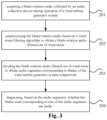
- Fig. 3 is a schematic flowchart of a blade fault diagnosis method provided by an embodiment of the present application. As shown in Fig. 3 , the method includes step 201 to step 204.
- Step 201 acquiring a blade rotation audio collected by an audio collection device during operation of a wind turbine generator system.
- the audio collection device can be configured to collect the blade rotation audio. During the operation of the wind turbine generator system, the blades will make sounds when rotating, and the blade rotation audio can be generated from the sound signal collected by the audio collection device.
- the audio collection device may communicate with the executing party of the blade fault diagnosis method provided by the embodiment of the present application through wired communication (for example, through an optical fiber communication cable) or wireless communication, so as to transmit the blade rotation audio collected by the audio collection device to the executing party.
- the executing party of the blade fault diagnosis method may be a server disposed in the central control room, or the executing party may also be the processor 120 of the blade fault diagnosis system of the embodiment shown in Fig. 1 .
- the processor 120 may also be disposed inside of the tower barrel of the wind turbine generator system, and after performing the blade fault diagnosis method provided by the embodiment of the present application to obtain the blade fault diagnosis results, the processor 120 may transmit the blade fault diagnosis results to the server.
- the collection duration may be a preset duration. For example, it is preconfigured that the blade rotation audio is collected for 1 minute every time.
- Step 202 preprocessing the blade rotation audio based on a wind noise filtering algorithm to obtain a blade rotation audio filtered out of wind noise.
- the wind noise filtering algorithm is configured to filter out the wind noise in the blade rotation audio. Because the audio collection device is in the wind field, the collected audio includes wind noise, that is, noise from wind. In order to obtain a clear blade rotation audio, the wind noise in the blade rotation audio can be eliminated through the wind noise filtering algorithm.
- the wind noise filtering algorithm may be a Kalman filtering algorithm, a median value filtering algorithm, an arithmetic average filtering algorithm, a sliding average filtering algorithm and the like, which is not limited in the embodiments of the present application.
- the frequency of the wind noise can be counted according to the recording of historically collected audio, and the frequency filter of the audio may be designed, so as to reduce the components of the partial frequency band in the blade rotation audio.
- the blade rotation audio is converted to the frequency domain through the Fourier transform, and then a designed frequency filter (wind noise filtering algorithm) is used in the frequency domain. Therefore, the components of the frequency band where the wind noise is located may be reduced, and the blade rotation audio filtered out of wind noise may be obtained.
- a designed frequency filter wind noise filtering algorithm
- Step 203 dividing the blade rotation audio filtered out of wind noise to obtain audio segments corresponding to blades of the wind turbine generator system respectively.
- the rotation sound intensity (the unit can be decibels) of each of the blades may have a process from small to large and then to small. Therefore, this characteristic may be used to divide the blade rotation audio to obtain the audio segments corresponding to the blades respectively. In the audio segments corresponding to the blades respectively, the blade sound intensity is the main component of the audio intensity in the audio segments. By dividing the blade rotation audio, the accuracy of blade fault diagnosis can be improved.
- the step 203 of dividing the blade rotation audio filtered out of wind noise to obtain audio segments corresponding to blades of the wind turbine generator system respectively may include the following step 2031 to step 2033.
- Step 2031 processing, by a short-time Fourier transform, the blade rotation audio filtered out of wind noise to obtain a first feature value.
- the first feature value is configured to characterize a frequency domain feature of the blade rotation audio filtered out of wind noise.
- the short-time Fourier transform may use a fixed window function, and then move the window function to calculate the power spectrum at different times, that is, to obtain the first feature value.
- the window length of the window function used by the short-time Fourier transform may be a preset value. For example, a Fourier transform is performed on the blade rotation audio in a window of 10s. The frequency domain feature of the audio within each window may be better obtained through the short-time Fourier transform, so that the results of identifying the dividing time points based on the results of the short-time Fourier transform may be more accurate.
- Step 2032 inputting the first feature value to a blade recognition model to obtain dividing time points of the blade rotation audio filtered out of wind noise.
- the first feature value is input to the blade recognition model.
- the blade recognition model is a pre-trained model configured to identify switching time points of rotation sounds of different blades according to the first feature value.
- the blade recognition model may be a machine learning based algorithm model, such as a model based on support vector machine (SVM), or a k nearest neighbor algorithm, or a convolutional neural network (CNN) model, which is not limited by the embodiments of the present application.
- SVM support vector machine
- CNN convolutional neural network
- Support vector machine is a supervised learning method. It is a generalized linear classifier (generalized linear classifier) that can perform binary classification of data. Its decision boundary is the maximum-margin hyperplane for solving the learning sample. Supervised learning is the process of using a set of known categories to adjust the parameters of the classifier to achieve the required performance.
- the hyperplane is a linear subspace with codimension equal to one in n-dimensional Euclidean space, that is, it must be a (n-1) dimension.
- Step 2033 dividing the blade rotation audio filtered out of wind noise according to the dividing time points to obtain the audio segments corresponding to the blades respectively.
- the output results of the blade recognition model may be the dividing time points, and the audio segments corresponding to the blades respectively can be captured from the blade rotation audio based on the dividing time points.
- the audio segments corresponding to the blades respectively in a rotation cycle can be captured, that is, the number of the audio segments is the same as the number of the blades in the wind turbine generator system.
- the dividing time points may be 1s, 2. 1s, 3.08s, and 4.13s.
- the audio segments obtained by dividing the blade rotation audio may include an audio segment 1 within 1 ⁇ 2.1s, an audio segment 2 within 2.1 ⁇ 3.08s, and an audio segment 3 within 3.08 ⁇ 4.13s.
- each audio segment cannot be distinguished from which actual blade it corresponds to, and the audio segments corresponding to different blades can be distinguished by different identifications.
- the audio segment 1 corresponds to a blade 1
- the audio segment 2 corresponds to a blade 2
- the audio segment 3 corresponds to a blade 3.
- Step 204 diagnosing, based on the audio segments, whether the blades each corresponding to one of the audio segments are faulty.
- each audio segment is the rotation sound of the corresponding blade, based on the characteristics of the audio segments in the time domain and/or the frequency domain, it may be diagnosed whether the blades each corresponding to one of the audio segments are faulty. Under a condition that the blade is faulty, such as fracture, icing and the like, the rotation sound will change, resulting in the change of the sound intensity and frequency. Therefore, through the analysis of the audio segment, the blade can be identified whether it is faulty.
- the step 204 of diagnosing, based on the audio segments, whether the blades each corresponding to one of the audio segments are faulty may include the following step 2041 to step 2042.
- Step 2041 processing each of the audio segments by a Fourier transform to obtain a second feature value of each of the audio segments, wherein the second feature value is configured to characterize a frequency domain feature of each of the audio segments.
- the amplitude of the audio segment at each frequency may be obtained, namely the second feature value, which can represent the frequency domain feature of the audio segment.
- the amplitude of each frequency represents the signal power of the audio segment at the corresponding frequency.
- Step 2042 inputting the second feature value of each of the audio segments to a blade fault diagnosis model to obtain a first fault diagnosis result of each of the blades.
- the blade fault diagnosis model is a pre-trained model configured to identify whether a blade corresponding to the audio segment is faulty according to the second feature value of the audio segment.
- the blade fault diagnosis model may also be a machine learning based algorithm model, such as a model based on support vector machine (SVM), or a k nearest neighbor algorithm.
- SVM support vector machine
- fault diagnosis can be performed based on the correlation of the durations of the audio segments of the blades.
- the durations of the audio segments of the blades should be similar.
- the corresponding blade rotation sound may become larger, that is, the sound intensity may become larger. Therefore, when dividing the blade rotation audio according to the sound intensity, the duration of the corresponding blade will increase, the durations of other blades will reduce, and the difference between the durations may become larger.
- step 204 may also include the following step 2043 to step 2044.
- Step 2043 counting durations of the audio segments corresponding to the blades respectively.
- Step 2044 obtaining a second fault diagnosis result by judging whether there is a faulty blade according to whether a difference between durations of every two audio segments exceeds a preset threshold value.
- a duration threshold value (a preset threshold value) can be preset. Under a condition that the duration difference of any two audio segments exceeds the preset threshold value, there is a faulty blade in the wind turbine generator system.
- step 2042 and step 2044 it is judged, by combining the first fault diagnosis result of each of the blades and the second fault diagnosis result, whether there is a faulty blade.
- the first fault diagnosis result is a result of the fault diagnosis performed independently through the blade fault recognition model according to each of the audio segments. For each of the audio segments corresponding to the blades respectively, a corresponding first fault diagnosis result may be obtained. For example, whether a corresponding blade is faulty or not faulty may be represented through the status values 0 and 1 respectively.
- the second fault diagnosis result is a result of judging whether there is a faulty blade according to whether the durations of the audio segments are consistent.
- the blades may fail due to environmental reasons. For example, lightning is prone to in summer, and the wind speed in autumn is relatively large, which are easy to lead to the blade fault such as blade fracture. Further, the blades may be covered with ice in winter, and so on.
- different blade fault diagnosis models can be trained according to different fault types, and then the applied blade fault diagnosis model can be selected according to different environments, so as to perform fault diagnosis on the collected blade rotation audio.
- an environmental parameter of the wind turbine generator system is acquired, wherein the environmental parameter is configured to indicate a season and/or weather.
- a model configured to identify a fault type corresponding to the environmental parameter is selected, so as to determine a fault diagnosis model for use. That is, each environmental parameter corresponds to one fault type, so that the blade fault diagnosis model of the corresponding fault type is selected for fault diagnosis.
- the wind noise filtering algorithm can be applied to the blade rotation audio to obtain the blade rotation audio filtered out of wind noise, so as to remove the interference of wind noise in the blade rotation audio, and obtain the audio with more accurate and stronger blade rotation sound. Then, the blade rotation audio filtered out of wind noise is divided to obtain the audio segments corresponding to the blades, and based on the audio segments, it is diagnosed whether the blades each corresponding to one of the audio segments are faulty. Therefore, it can be diagnosed whether a corresponding blade is faulty respectively according to the audio segments of different blades, thereby improving the accuracy of the diagnosis results.
- the audio collection device may acquire the blade rotation audios collected at a plurality of locations, may select a blade rotation audio with the least wind noise and the best audio quality among the blade rotation audios collected at the plurality of locations, and then may perform the following steps 203 and 204.
- the step 201 of acquiring the blade rotation audio collected by the audio collection device during the operation of the wind turbine generator system may include acquiring blade rotation audios collected at a plurality of locations.
- the step 202 of preprocessing the blade rotation audio based on the wind noise filtering algorithm to obtain the blade rotation audio filtered out of wind noise may include processing each of the blade rotation audios respectively based on the wind noise filtering algorithm to obtain a plurality of blade rotation audios filtered out of wind noise.
- a wind noise parameter of each of the plurality of blade rotation audios filtered out of wind noise may be respectively calculated by a wind noise recognition model.
- the wind noise recognition model is a pre-trained model configured to evaluate the wind noise parameter of the audio.
- the wind noise recognition model may also be a machine learning based algorithm model, such as a SVM model, or a k nearest neighbor algorithm, or a CNN algorithm, which is not limited by the embodiments of the present application.
- a blade rotation audio filtered out of wind noise with a minimum wind noise is selected and divided to obtain the audio segments corresponding to the blades respectively. Therefore, the blade rotation audio filtered out of wind noise with the minimum wind noise can be selected, which can increase the usable probability of the blade rotation audio, and improve the real-time performance of the blade fault diagnosis method.
- each of the plurality of blade rotation audios filtered out of wind noise is processed by a Fourier transform to obtain a third feature value of each of the plurality of blade rotation audios filtered out of wind noise.
- the third feature value is configured to characterize a frequency domain feature of a corresponding blade rotation audio filtered out of wind noise. Then, the third feature value of each of the plurality of blade rotation audios filtered out of wind noise is input to the wind noise recognition model to obtain the wind noise parameter of each of the plurality of blade rotation audios filtered out of wind noise.
- the blade fault diagnosis model, the wind noise recognition model and the blade recognition model described in the embodiments of the present application may be trained machine learning based models, such as SVM models.
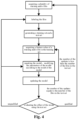
- An example model training method is shown in Fig. 4 .
- the following takes training the blade recognition model as an example to illustrate the process of the training method shown in Fig. 4 . It should be noted that other models described in the embodiments of the present application may also be trained based on the training method shown in Fig. 4 .
- each of the training audio files is a blade rotation audio collected by a preset duration (such as 10s).
- a preset duration such as 10s.
- a waveform diagram of the sound intensity of the blade rotation audio may be illustrated. Because the blade will rotate away from the sensor, then rotate near to the sensor and then rotate away from the sensor, accordingly, the sound intensity of the blade rotation audio is from small to big, and then to small. Therefore, according to the sound intensity, the blade rotation audio may be divided.
- the wind turbine generator system usually has three blades, then, the blade rotation audio is divided into three audio segments, which corresponds to a rotation cycle.
- the labels may be 1s, 2.1s, 3.08s, and 4.13s.
- the audio segments obtained by dividing the blade rotation audio 1 may include an audio segment 1 within 1 ⁇ 2.1s, an audio segment 2 within 2.1 ⁇ 3.08s, and an audio segment 3 within 3.08 ⁇ 4.13s. It should be noted that each audio segment cannot be distinguished from which actual blade it corresponds to, and the audio segments corresponding to different blades can be distinguished by different identifications. For example, the audio segment 1 corresponds to a blade 1, and the audio segment 2 corresponds to a blade 2.
- a part of the blade rotation audios labeled with the dividing time points is used as the training set, and the other part is used as the test set.
- One blade rotation audio in the training set is obtained each time, the dividing time points are identified through the blade recognition model.
- the results obtained by the model are compared with the labels.
- the parameters of the model are modified according to a preset parameter modification algorithm, and the updated model is used to identify a next training audio file in the training set again.
- the model is used to identify the test set, and the recognition accuracy is evaluated. If the accuracy is qualified, a plurality of additional new blade rotation audios may be used to generate a training set and a test set, the model may be further corrected, and a final model may be obtained after multiple corrections. If the accuracy is unqualified, the labels on the file may be adjusted, and the current training set is continued to be used to retrain the model until the accuracy is qualified.
- Fig. 5 is a schematic flowchart of an example of identifying wind noise in a blade rotation audio by a wind noise recognition model.
- a blade rotation audio is read for data preprocessing, such as preprocessing by a wind noise filtering algorithm.
- the blade rotation audio is processed by a Fourier transform to obtain a feature value.
- a wind noise parameter is calculated by a wind noise recognition model based on the feature value of the blade rotation audio. The greater the wind noise, the greater the wind noise parameter, and the smaller the wind noise, the smaller the wind noise parameter. Under a condition that the wind noise parameter exceeds a threshold value, the wind noise is too large, and the corresponding blade rotation audio can be abandoned for fault diagnosis.
- a blade rotation audio with a minimum wind noise parameter can be selected as the audio for diagnosing the blade fault.
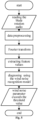
- Fig. 6 is a schematic flowchart of an example of dividing a blade rotation audio by a blade recognition model.
- a blade rotation audio is read for data preprocessing, using algorithms such as denoising.
- the blade rotation audio is processed by a short-time Fourier transform according to a preset window length to obtain a first feature value.
- the first feature value may be a sequence composed of amplitudes corresponding to a plurality of frequencies.
- the first feature value is input into the blade recognition model, and the blade recognition model will output the dividing time points of the blade.
- the blade rotation audio may be divided based on the dividing time points, and the audio segments corresponding to the blades respectively in a rotation cycle can be captured.
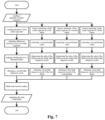
- Fig. 7 is a schematic flowchart of an example of diagnosing blade faults by a blade fault diagnosis model.
- the audio segments may be diagnosed respectively by the blade fault diagnosis model, and the states of the blades may be determined.
- each of the audio segments may be processed by a Fourier transform respectively to obtain a second feature value of each of the audio segments.
- the second feature value of each of the audio segments is input into a corresponding blade fault diagnosis model to obtain a fault diagnosis result of the corresponding audio segment.
- normal may be represented by 0
- abnormal may be represented by 1.
- the state of the corresponding blade may be represented by the output 0 or 1.
- a second fault diagnosis result may be obtained by judging whether there is a faulty blade according to the durations of the audio segments. For example, under a condition that the difference between the duration of the audio segment 1 and the duration of the audio segment 2 is 0.1s (which is less than the threshold value of 0.2s), and the difference between the duration of the audio segment 1 and the duration of the audio segment 3 is 0.4s and the difference between the duration of the audio segment 2 and the duration of the audio segment 3 is 0.3s (which are greater than the threshold of value of 0.2s), the states of the audio segment 1 and the audio segment 2 are consistent, and the state of the audio segment 3 is inconsistent. Furthermore, the blade state decision maker can determine the state of the blade and output it by combining the first fault diagnosis result of each of the blades and the consistency detection results of the audio durations (the second fault diagnosis results).
- a schematic flowchart of a blade fault diagnosis model provided by an embodiment of the present application is shown in Fig. 8 .
- the blade fault diagnosis system may wait for other devices of the wind turbine generator system to start.
- the blade fault diagnosis system may communicate with the server disposed in the central control room of the wind field. Under a condition that the connection fails, the blade fault diagnosis system may wait for a further delay. Under a condition that the connection is successful, the blade fault diagnosis system may load the initialization file for initialization configuration.
- the initialization configuration may include configurations of the number of the audio sensors, the duration for audio data collection, and the duration for audio data storage.
- the audio sensors may transmit the real-time acquired audio data to the blade fault diagnosis system. Then, it is determined whether there is a wind noise through the wind noise recognition model. Under a condition that there is a wind noise, it is filtered through the wind noise filtering algorithm, and then it is further determined whether there is a wind noise through the wind noise recognition model. Under a condition that there is still a wind noise, a state value of the fault diagnosis result is returned, that is, the blade is not identified. Under a condition that no wind noise is identified by the wind noise recognition model, according to the wind noise parameter obtained by the wind noise recognition model and among a plurality of blade rotation audios, a blade rotation audio with a minimum wind noise can be selected.
- the selected blade rotation audio is divided through the blade recognition algorithm to obtain the audio segments corresponding to the blades respectively.
- whether there is a faulty blade can be diagnosed by the fault diagnosis algorithm as shown in Fig. 7 .
- a state value of the fault diagnosis result may be returned, that is, there is a faulty blade, and the blade rotation audio file of the faulty blade can be saved for record.
- a state value can be returned, that is, the blades are normal.
- the real-time flow data collected by the audio sensor can be obtained again, and then the fault diagnosis can be performed to realize the effect of real-time monitoring of the blades.
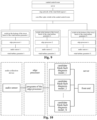
- the present application also provides an embodiment of another blade fault diagnosis system, as shown in Fig. 9 , in a wind field (wind field 1), there are a plurality of wind turbine generators.
- Each of the wind turbine generators is provided with an audio sensor, and the audio sensor is configured to collect the sound signal of the blades of the wind turbine generator when rotating, and transmit the sound signal to an edge processor.
- the edge processor may be disposed inside of the tower barrel of the wind turbine generator.
- the edge processor may process the sound signal collected by the audio sensor into audio to obtain the blade rotation audio, and may obtain the diagnosis result through the blade fault diagnosis method provided in any embodiment of Figs. 3 to 8 .
- the blade fault diagnosis result may be transmitted to the core fiber optic switch in the central control room in the ring network of the wind field region 1 though the switch at the bottom of the tower barrel of the wind turbine generator and though cables, and then transmitted to the server in the central control room.
- the server can display the display interface of the WEB front end, display the blade fault diagnosis situation through the interface program, and transmit an alarm prompt when there is faulty blade.
- FIG. 10 Another schematic diagram of a blade fault diagnosis system provided by the embodiment of the present application is shown in Fig. 10 .
- the server may be configured with a plurality of candidate fault diagnosis models, may select a corresponding blade fault diagnosis model based on the environmental parameter selected by the user at the front end, and may inform the edge processor.
- the programs of the edge processor may be configured to perform fault diagnosis according to the blade fault diagnosis model selected by the server.
- the edge processor of each of the wind turbine generators may include an audio processing unit that can be configured to collect real-time audio flow data, perform fault diagnosis, save fault data (which can include fault diagnosis results and fault audio), and communicate with the server.
- data can be cached. Under a condition that there is a faulty blade, the fault data may be saved. After obtaining the fault diagnosis results, the data stored in the cache may be uploaded to the server host computer.
- the edge processor may also be controlled by the server host computer. For example, the edge processor may be initialized according to the server to configure the number of the audio sensors, the data storage duration, the data maximum cache space and the like.
- the edge processor may also receive the selection of the blade fault diagnosis model by the server according to the environmental parameter.
- the algorithm programs of the server in the central control room can be provided with functions such as connection state verification of the wind turbine generator system, blade state communication of the wind turbine generator system, control configuration file distribution, fault data reception and the like.
- the WEB front end interface of the server in the central control room can be provided with functions such as connection state display of the wind turbine generator system, blade state display of the wind turbine generator system, fault data playback of the wind turbine generator system and the like.
- the state of the blades of the wind turbine generator system may be monitored by real-time data processing of the audio.
- the advantages are that it is not affected by light; it can also monitor in real-time at night; it is not affected by fog weather; and it can effectively monitor the state of the blades for a long time. Therefore, abnormal sound problem of the blade caused by the blade's own leading edge corrosion, lightning strike, fracture, crack and other reasons may be identified in the first time, and then timely maintenance may be performed, which can avoid the blade major failure loss caused by the blade cumulative failure.
- An embodiment of the present application further provides a blade fault diagnosis apparatus, which can be used to perform the blade fault diagnosis method provided by the embodiment of the present application.
- the part not detailed described in the blade fault diagnosis apparatus provided by the embodiment of the present application can refer to the description of the blade fault diagnosis method provided by the embodiment of the present application, and will not be repeated here.
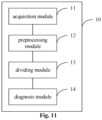
- the blade fault diagnosis apparatus 10 includes an acquisition module 11, a preprocessing module 12, a dividing module 13, and a diagnosis module 14.
- the acquisition module 11 is configured to acquire a blade rotation audio collected by an audio collection device during an operation of a wind turbine generator system.
- the preprocessing module 12 is configured to preprocess the blade rotation audio based on a wind noise filtering algorithm to obtain a blade rotation audio filtered out of wind noise.
- the dividing module 13 is configured to divide the blade rotation audio filtered out of wind noise to obtain audio segments corresponding to blades of the wind turbine generator system respectively.
- the diagnosis module 14 is configured to diagnose, based on the audio segments, whether the blades each corresponding to one of the audio segments are faulty.
- the dividing module 13 is further configured to: process, by a short-time Fourier transform, the blade rotation audio filtered out of wind noise to obtain a first feature value, wherein the first feature value is configured to characterize a frequency domain feature of the blade rotation audio filtered out of wind noise; input the first feature value to a blade recognition model to obtain dividing time points of the blade rotation audio filtered out of wind noise, wherein the blade recognition model is a pre-trained model configured to identify switching time points of rotation sounds of different blades according to the first feature value; divide the blade rotation audio filtered out of wind noise according to the dividing time points to obtain the audio segments corresponding to the blades respectively.
- the diagnosis module 14 is further configured to: process each of the audio segments by a Fourier transform to obtain a second feature value of each of the audio segments, wherein the second feature value is configured to characterize a frequency domain feature of each of the audio segments; input the second feature value of each of the audio segments to a blade fault diagnosis model to obtain a first fault diagnosis result of each of the blades, wherein the blade fault diagnosis model is a pre-trained model configured to identify whether a blade corresponding to the audio segment is faulty according to the second feature value of the audio segment.
- the diagnosis module 14 is further configured to: count durations of the audio segments corresponding to the blades respectively; obtain a second fault diagnosis result by judging whether there is a faulty blade according to whether a difference between durations of every two audio segments exceeds a preset threshold value; judge, by combining the first fault diagnosis result of each of the blades and the second fault diagnosis result, whether there is a faulty blade.
- the blade fault diagnosis apparatus 10 further includes:
- the acquisition module 11 is further configured to acquire blade rotation audios collected at a plurality of locations.
- the blade fault diagnosis apparatus 10 is further configured to process each of the blade rotation audios respectively based on the wind noise filtering algorithm to obtain a plurality of blade rotation audios filtered out of wind noise.
- the apparatus further includes a calculation unit configured to calculate, after the plurality of blade rotation audios filtered out of wind noise are obtained, a wind noise parameter of each of the plurality of blade rotation audios filtered out of wind noise respectively by a wind noise recognition model, wherein the wind noise parameter is configured to represent a wind noise level in the audio, and the wind noise recognition model is a pre-trained model configured to evaluate the wind noise parameter of the audio.
- the dividing module 13 is further configured to select, according to the wind noise parameter and among the plurality of blade rotation audios filtered out of wind noise, a blade rotation audio filtered out of wind noise with a minimum wind noise, and divide the blade rotation audio filtered out of wind noise with the minimum wind noise to obtain the audio segments corresponding to the blades respectively.
- the calculation unit is further configured to: process each of the plurality of blade rotation audios filtered out of wind noise by a Fourier transform to obtain a third feature value of each of the plurality of blade rotation audios filtered out of wind noise, and the third feature value is configured to characterize a frequency domain feature of a corresponding blade rotation audio filtered out of wind noise; input the third feature value of each of the plurality of blade rotation audios filtered out of wind noise to the wind noise recognition model to obtain the wind noise parameter of each of the plurality of blade rotation audios filtered out of wind noise.
- the wind noise filtering algorithm can be applied to the blade rotation audio to obtain the blade rotation audio filtered out of wind noise, so as to remove the interference of wind noise in the blade rotation audio, and obtain the audio with more accurate and stronger blade rotation sound. Then, the blade rotation audio filtered out of wind noise is divided to obtain the audio segments corresponding to the blades, and based on the audio segments, it is diagnosed whether the blades each corresponding to one of the audio segments are faulty. Therefore, it can be diagnosed whether a corresponding blade is faulty respectively according to the audio segments of different blades, thereby improving the accuracy of the diagnosis results.
- An embodiment of the present application provides a storage medium having computer program instructions stored thereon, wherein the computer program instructions, when executed by a processor, implement the blade fault diagnosis method provided by the embodiment of the present application.
- the functional blocks shown in the structural views described above may be implemented as hardware, software, firmware, or a combination thereof.
- hardware When implemented as hardware, it may be, for example, an electronic circuit, an application specific integrated circuit (ASIC), appropriate firmware, plugins, function cards, etc.
- ASIC application specific integrated circuit
- elements of the present application are programs or code segments for performing required tasks.
- the programs or code segments may be stored in a machine-readable medium, or transmitted on a transmission medium or a communication link through a data signal carried in a carrier wave.
- the "machine-readable medium” may include any medium that can store or transmit information.
- Examples of the machine-readable medium include an electronic circuit, a semiconductor memory device, a ROM, a flash memory, an erasable ROM (EROM), a floppy disk, a CD-ROM, an optical disk, a hard disk, a fiber optic medium, a radio frequency (RF) link, and so on.
- the code segments may be downloaded via a computer network such as the Internet, intranet, and so on.
- Such a processor may be, but not limited to, a general purpose processor, a special purpose processor, an application specific processor, or a field programmable logic circuit. It will also be understood that each block of the block diagrams and/or flowcharts, and combinations of blocks of the block diagrams and/or flowcharts, can also be implemented by special purpose hardware for performing specified functions or actions, or can be implemented by a combination of special purpose hardware and computer instructions.
Landscapes
- Engineering & Computer Science (AREA)
- Physics & Mathematics (AREA)
- General Physics & Mathematics (AREA)
- Life Sciences & Earth Sciences (AREA)
- General Engineering & Computer Science (AREA)
- Theoretical Computer Science (AREA)
- Mechanical Engineering (AREA)
- Sustainable Development (AREA)
- Combustion & Propulsion (AREA)
- Chemical & Material Sciences (AREA)
- Sustainable Energy (AREA)
- Evolutionary Computation (AREA)
- Data Mining & Analysis (AREA)
- Artificial Intelligence (AREA)
- Bioinformatics & Cheminformatics (AREA)
- Evolutionary Biology (AREA)
- Bioinformatics & Computational Biology (AREA)
- Computer Vision & Pattern Recognition (AREA)
- Acoustics & Sound (AREA)
- Aviation & Aerospace Engineering (AREA)
- Measurement Of Mechanical Vibrations Or Ultrasonic Waves (AREA)
- Testing Of Devices, Machine Parts, Or Other Structures Thereof (AREA)
- Investigating Or Analyzing Materials By The Use Of Ultrasonic Waves (AREA)
- Excavating Of Shafts Or Tunnels (AREA)
- Polyurethanes Or Polyureas (AREA)
Claims (7)
- Verfahren zur Diagnose von Schaufelfehlern, umfassend:Erfassen (201) eines Schaufelrotationsaudios, das von einer Audiosammelvorrichtung (110) während des Vorgangs eines Windturbinen-Generatorsystems gesammelt wird;Vorverarbeiten (202) des Schaufelrotationsaudios basierend auf einem Algorithmus zur Filterung von Windgeräuschen, um ein aus einem Windgeräusch gefiltertes Schaufelrotationsaudio zu erhalten;Unterteilen (203) des aus dem Windgeräusch herausgefilterten Schaufelrotationsaudios, um Audiosegmente zu erhalten, die jeweils Schaufeln des Windturbinen-Generatorsystems entsprechen;Diagnostizieren (204), basierend auf den Audiosegmenten, ob die Schaufeln, die jeweils einem der Audiosegmente entsprechen, fehlerhaft sind,wobei das Diagnostizieren (204), basierend auf den Audiosegmenten, ob die Schaufeln, die jeweils einem der Audiosegmente entsprechen, fehlerhaft sind, Folgendes umfasst:Verarbeiten jedes der Audiosegmente durch eine Fouriertransformation, um einen zweiten Merkmalswert jedes der Audiosegmente zu erhalten, wobei der zweite Merkmalswert konfiguriert ist, um ein Frequenzbereichsmerkmal jedes der Audiosegmente zu charakterisieren;Eingeben des zweiten Merkmalswertes jedes der Audiosegmente in ein Schaufelfehlerdiagnosemodell, um ein erstes Fehlerdiagnoseergebnis jeder der Schaufeln zu erhalten, wobei das Schaufelfehlerdiagnosemodell ein vortrainiertes Modell ist, das konfiguriert ist, um zu identifizieren, ob eine dem Audiosegment entsprechende Schaufel gemäß dem zweiten Merkmalswert des Audiosegments fehlerhaft ist;Zählen von Dauern der Audiosegmente, die jeweils den Schaufeln entsprechen;Erhalten eines zweiten Fehlerdiagnoseergebnisses durch Beurteilen, ob eine fehlerhafte Schaufel vorhanden ist, je nachdem, ob eine Differenz zwischen Dauern von jeweils zwei Audiosegmenten einen voreingestellten Schwellenwert überschreitet; undBeurteilen, durch Kombinieren des ersten Fehlerdiagnoseergebnisses jeder der Schaufeln und des zweiten Fehlerdiagnoseergebnisses, ob eine fehlerhafte Schaufel vorhanden ist.
- Verfahren zur Diagnose von Schaufelfehlern nach Anspruch 1, wobei das Aufteilen (203) des aus dem Windgeräusch gefilterten Schaufelrotationsaudios zum Erhalten der den Schaufeln entsprechenden Audiosegmente jeweils Folgendes umfasst:Verarbeiten des aus dem Windgeräusch herausgefilterten Schaufelrotationsaudios durch eine Kurzzeit-Fouriertransformation, um einen ersten Merkmalswert zu erhalten, wobei der erste Merkmalswert konfiguriert ist, um ein Frequenzbereichsmerkmal des aus dem Windgeräusch herausgefilterten Schaufelrotationsaudios zu charakterisieren;Eingeben des ersten Merkmalswerts in ein Schaufelerkerkennungsmodell, um Teilungszeitpunkte des aus einem Windgeräusch herausgefilterten Schaufelrotationsaudios zu erhalten, wobei das Schaufelerkerkennungsmodell ein vortrainiertes Modell ist, das konfiguriert ist, um Schaltzeitpunkte von Rotationsgeräuschen verschiedener Schaufeln gemäß dem ersten Merkmalswert zu identifizieren;Unterteilen des aus dem Windgeräusch herausgefilterten Schaufelrotationsaudios entsprechend Unterteilungszeitpunkten, um die den jeweiligen Schaufeln entsprechenden Audiosegmente zu erhalten.
- Verfahren zur Diagnose von Schaufelfehlern nach Anspruch 1, wobei das Verfahren vor dem Diagnostizieren (204), basierend auf den Audiosegmenten, ob die Schaufeln, die jeweils einem der Audiosegmente entsprechen, fehlerhaft sind, ferner umfasst:Erfassen eines Umgebungsparameters des Windturbinen-Generatorsystems, wobei der Umgebungsparameter so konfiguriert ist, dass er eine Jahreszeit und/oder das Wetter anzeigt;Bestimmen, unter einer Vielzahl von Kandidaten-Fehlerdiagnosemodellen, die konfiguriert sind, um jeweils verschiedene Fehlertypen zu identifizieren, eines Modells, das konfiguriert ist, um einen Fehlertyp entsprechend dem Umgebungsparameter zu identifizieren, um so ein Fehlerdiagnosemodell zur Verwendung zu bestimmen.
- Verfahren zur Diagnose von Schaufelfehlern nach einem der Ansprüche 1 bis 3, wobei das Erfassen (201) des von der Audiosammelvorrichtung (110) während des Vorgangs des Windturbinen-Generatorsystems gesammelten Schaufelrotationsaudios Erfassen der an einer Vielzahl von Positionen gesammelten Schaufelrotationsaudios umfasst;wobei das Vorverarbeiten (202) des Schaufelrotationsaudios basierend auf dem Algorithmus zur Filterung von Windgeräuschen, um das aus dem Windgeräusch gefilterte Schaufelrotationsaudio zu erhalten, das Verarbeiten jedes der Schaufelrotationsaudios jeweils basierend auf dem Algorithmus zur Filterung von Windgeräuschen umfasst, um eine Vielzahl von aus dem Windgeräusch herausgefilterten Schaufelrotationsaudios zu erhalten;wobei, nachdem die Vielzahl von aus einem Windgeräusch herausgefilterten Schaufelrotationsaudios erhalten wurde, das Verfahren ferner Berechnen eines Windgeräuschparameters jedes der Vielzahl von aus dem Windgeräusch herausgefilterten Schaufelrotationsaudios durch ein Windgeräusch-Erkennungsmodell umfasst, wobei der Windgeräuschparameter so konfiguriert ist, dass er einen Windgeräuschpegel in dem Audio darstellt, und das Windgeräusch-Erkennungsmodell ein vortrainiertes Modell ist, das so konfiguriert ist, dass es den Windgeräuschparameter des Audios auswertet;wobei das Teilen (203) des aus dem Windgeräusch herausgefilterten Schaufelrotationsaudios, um die den Schaufeln jeweils entsprechenden Audiosegmente zu erhalten, das Auswählen, gemäß dem Windgeräuschparameter und unter der Vielzahl von aus dem Windgeräusch herausgefilterten Schaufelrotationsaudios, eines aus dem Windgeräusch herausgefilterten Schaufelrotationsaudios mit einem minimalen Windgeräusch, und das Teilen des aus dem Windgeräusch herausgefilterten Schaufelrotationsaudios mit dem minimalen Windgeräusch, um die den Schaufeln jeweils entsprechenden Audiosegmente zu erhalten, umfasst.
- Verfahren zur Diagnose von Schaufelfehlern nach Anspruch 4, wobei das Berechnen des Windgeräuschparameters für jedes der Vielzahl von Schaufelrotationsaudios, die jeweils durch das Windgeräusch-Erkennungsmodell aus dem Windgeräusch herausgefiltert wurden, umfasst:Verarbeiten jedes der Vielzahl von aus dem Windgeräusch herausgefilterten Schaufelrotationsaudios durch eine Fouriertransformation, um einen dritten Merkmalswert jedes der Vielzahl von aus dem Windgeräusch herausgefilterten Schaufelrotationsaudios zu erhalten, wobei der dritte Merkmalswert konfiguriert ist, um ein Frequenzbereichsmerkmal eines entsprechenden aus dem Windgeräusch herausgefilterten Schaufelrotationsaudios zu charakterisieren;Eingeben des dritten Merkmalswertes jedes der Vielzahl von aus dem Windgeräusch herausgefilterten Schaufelrotationsaudios in das Windgeräusch-Erkennungsmodell, um den Windgeräuschparameter jedes der Vielzahl von aus dem Windgeräusch herausgefilterten Schaufelrotationsaudios zu erhalten.
- System zur Diagnose von Schaufelfehlern, das Folgendes umfasst:eine Audiosammelvorrichtung (110), die eine Vielzahl von Audiosensoren (111) umfasst, wobei mindestens einer der Audiosensoren (111) an einer Position der vorherrschenden Windrichtung oder einer Position der Leewindrichtung eines Turmzylinders eines Windturbinen-Generatorsystems angeordnet ist;einen Prozessor (120), der im Inneren des Turmzylinders angeordnet und mit den Audiosensoren (111) verbunden ist, wobei der Prozessor (120) konfiguriert ist zum: Empfangen (201) eines von den Audiosensoren (111) gesammelten Schaufelrotationsaudios; Vorverarbeiten (202) des Schaufelrotationsaudios basierend auf einem Algorithmus zur Filterung von Windgeräuschen, um ein aus einem Windgeräusch gefiltertes Schaufelrotationsaudio zu erhalten; Teilen (203) des aus dem Windgeräusch herausgefilterten Schaufelrotationaudios, um Audiosegmente zu erhalten, die jeweils Schaufeln des Windturbinen-Generatorsystems entsprechen; Diagnostizieren (204), basierend auf den Audiosegmenten, ob die Schaufeln, die jeweils einem der Audiosegmente entsprechen, fehlerhaft sind,wobei der Prozessor (120) ferner konfiguriert ist zum:Verarbeiten jedes der Audiosegmente durch eine Fouriertransformation, um einen zweiten Merkmalswert jedes der Audiosegmente zu erhalten, wobei der zweite Merkmalswert konfiguriert ist, um ein Frequenzbereichsmerkmal jedes der Audiosegmente zu charakterisieren;Eingeben des zweiten Merkmalswertes jedes der Audiosegmente in ein Schaufelfehlerdiagnosemodell, um ein erstes Fehlerdiagnoseergebnis jeder der Schaufeln zu erhalten, wobei das Schaufelfehlerdiagnosemodell ein vortrainiertes Modell ist, das konfiguriert ist, um zu identifizieren, ob eine dem Audiosegment entsprechende Schaufel gemäß dem zweiten Merkmalswert des Audiosegments fehlerhaft ist;Zählen von Dauern der Audiosegmente, die jeweils den Schaufeln entsprechen;Erhalten eines zweiten Fehlerdiagnoseergebnisses durch Beurteilen, ob eine fehlerhafte Schaufel vorhanden ist, je nachdem, ob eine Differenz zwischen Dauern von jeweils zwei Audiosegmenten einen voreingestellten Schwellenwert überschreitet; undBeurteilen, durch Kombinieren des ersten Fehlerdiagnoseergebnisses jeder der Schaufeln und des zweiten Fehlerdiagnoseergebnisses, ob eine fehlerhafte Schaufel vorhanden ist.
- Speichermedium mit darauf gespeicherten Computerprogrammanweisungen, wobei die Computerprogrammanweisungen, wenn sie von einem Prozessor (120) ausgeführt werden, das Verfahren zur Diagnose von Schaufelfehlern nach einem der Ansprüche 1 bis 5 implementieren.
Applications Claiming Priority (2)
| Application Number | Priority Date | Filing Date | Title |
|---|---|---|---|
| CN202011622722.2A CN114764570B (zh) | 2020-12-30 | 2020-12-30 | 叶片故障诊断方法、装置、系统及存储介质 |
| PCT/CN2021/103439 WO2022142213A1 (zh) | 2020-12-30 | 2021-06-30 | 叶片故障诊断方法、装置、系统及存储介质 |
Publications (4)
| Publication Number | Publication Date |
|---|---|
| EP4254261A1 EP4254261A1 (de) | 2023-10-04 |
| EP4254261A4 EP4254261A4 (de) | 2024-05-29 |
| EP4254261C0 EP4254261C0 (de) | 2025-06-11 |
| EP4254261B1 true EP4254261B1 (de) | 2025-06-11 |
Family
ID=82260162
Family Applications (1)
| Application Number | Title | Priority Date | Filing Date |
|---|---|---|---|
| EP21912969.9A Active EP4254261B1 (de) | 2020-12-30 | 2021-06-30 | Verfahren, vorrichtung und system zur diagnose von schaufelfehlern und speichermedium |
Country Status (8)
| Country | Link |
|---|---|
| US (1) | US20240052810A1 (de) |
| EP (1) | EP4254261B1 (de) |
| KR (1) | KR20230113384A (de) |
| CN (1) | CN114764570B (de) |
| AU (1) | AU2021415086B2 (de) |
| CA (1) | CA3203703A1 (de) |
| ES (1) | ES3033736T3 (de) |
| WO (1) | WO2022142213A1 (de) |
Families Citing this family (9)
| Publication number | Priority date | Publication date | Assignee | Title |
|---|---|---|---|---|
| CN115560961A (zh) * | 2022-08-15 | 2023-01-03 | 浙江运达风电股份有限公司 | 一种风电机组叶片故障诊断系统与方法 |
| CN116398378B (zh) * | 2023-04-18 | 2024-04-19 | 中国长江三峡集团有限公司 | 一种风电机组叶片多维状态监测装置及方法 |
| CN116928037A (zh) * | 2023-06-26 | 2023-10-24 | 福州数据技术研究院有限公司 | 一种基于孪生网络的风机叶片异常检测方法及存储介质 |
| AT527429A2 (de) * | 2023-07-17 | 2025-02-15 | Brantner Env Group Gmbh | Verfahren und Vorrichtung zur Überwachung eines Arbeitsprozesses |
| CN117759490B (zh) * | 2023-12-11 | 2025-02-14 | 华润电力技术研究院有限公司 | 一种风电机组叶片故障监测方法及系统 |
| CN118887962A (zh) * | 2024-08-06 | 2024-11-01 | 大唐华银(湖南)新能源有限公司 | 基于声纹识别的风电叶片监测方法、装置、设备及介质 |
| CN118998005B (zh) * | 2024-10-23 | 2025-03-07 | 南昌工程学院 | 一种基于声纹信号的风机叶片故障诊断方法 |
| CN119267119B (zh) * | 2024-11-22 | 2025-04-01 | 江苏华电灌云风力发电有限公司 | 一种风电机组的故障诊断与处理系统 |
| CN119933954B (zh) * | 2025-01-06 | 2025-11-07 | 华能国际电力股份有限公司安徽风电分公司 | 一种基于svd-ssa-lstm的风电机组故障诊断方法及系统 |
Citations (1)
| Publication number | Priority date | Publication date | Assignee | Title |
|---|---|---|---|---|
| CN110792563A (zh) * | 2019-11-04 | 2020-02-14 | 北京天泽智云科技有限公司 | 基于卷积生成对抗网络的风电机组叶片故障音频监测方法 |
Family Cites Families (13)
| Publication number | Priority date | Publication date | Assignee | Title |
|---|---|---|---|---|
| US5448645A (en) * | 1994-02-28 | 1995-09-05 | Raymond Guerci International, Inc. | Active fan blade noise cancellation system |
| US9447778B2 (en) * | 2011-11-02 | 2016-09-20 | Vestas Wind Systems A/S | Methods and systems for detecting sensor fault modes |
| CN104101652B (zh) * | 2014-07-10 | 2017-02-15 | 南京航空航天大学 | 一种基于音频信号的风电叶片损伤监测方法及监测系统 |
| CN105179179B (zh) * | 2015-07-15 | 2018-09-04 | 北京汉能华科技股份有限公司 | 一种风力发电机组的全状态监测方法和系统 |
| CN105508149B (zh) * | 2015-12-31 | 2018-12-07 | 北京金风科创风电设备有限公司 | 用于风力发电机组的故障检测方法及装置 |
| CN106596123B (zh) * | 2016-11-22 | 2020-03-27 | 东软集团股份有限公司 | 设备故障诊断的方法、装置及系统 |
| KR102118340B1 (ko) * | 2018-11-22 | 2020-06-03 | 고려대학교 세종산학협력단 | 소리 정보를 이용한 변압기 고장 진단 방법 |
| CN110853636B (zh) * | 2019-10-15 | 2022-04-15 | 北京雷石天地电子技术有限公司 | 一种基于k最近邻算法生成逐字歌词文件的系统与方法 |
| CN110838302B (zh) * | 2019-11-15 | 2022-02-11 | 北京天泽智云科技有限公司 | 基于信号能量尖峰识别的音频分割方法 |
| CN111306008B (zh) * | 2019-12-31 | 2022-03-11 | 远景智能国际私人投资有限公司 | 风机叶片的检测方法、装置、设备及存储介质 |
| CN111161756B (zh) * | 2020-02-13 | 2022-05-31 | 北京天泽智云科技有限公司 | 风机叶片扫风声音信号中异常哨声轮廓的提取及识别方法 |
| CN111306010B (zh) * | 2020-04-17 | 2022-03-29 | 北京天泽智云科技有限公司 | 风机叶片雷击损伤检测方法及系统 |
| CN112067701B (zh) * | 2020-09-07 | 2024-02-02 | 国电电力新疆新能源开发有限公司 | 基于声学诊断的风机叶片远程听诊方法 |
-
2020
- 2020-12-30 CN CN202011622722.2A patent/CN114764570B/zh active Active
-
2021
- 2021-06-30 CA CA3203703A patent/CA3203703A1/en active Pending
- 2021-06-30 KR KR1020237022434A patent/KR20230113384A/ko active Pending
- 2021-06-30 ES ES21912969T patent/ES3033736T3/es active Active
- 2021-06-30 WO PCT/CN2021/103439 patent/WO2022142213A1/zh not_active Ceased
- 2021-06-30 AU AU2021415086A patent/AU2021415086B2/en active Active
- 2021-06-30 US US18/260,075 patent/US20240052810A1/en active Pending
- 2021-06-30 EP EP21912969.9A patent/EP4254261B1/de active Active
Patent Citations (1)
| Publication number | Priority date | Publication date | Assignee | Title |
|---|---|---|---|---|
| CN110792563A (zh) * | 2019-11-04 | 2020-02-14 | 北京天泽智云科技有限公司 | 基于卷积生成对抗网络的风电机组叶片故障音频监测方法 |
Also Published As
| Publication number | Publication date |
|---|---|
| CN114764570B (zh) | 2025-12-19 |
| KR20230113384A (ko) | 2023-07-28 |
| CN114764570A (zh) | 2022-07-19 |
| EP4254261C0 (de) | 2025-06-11 |
| CA3203703A1 (en) | 2022-07-07 |
| US20240052810A1 (en) | 2024-02-15 |
| WO2022142213A1 (zh) | 2022-07-07 |
| AU2021415086A1 (en) | 2023-07-20 |
| AU2021415086B2 (en) | 2024-05-09 |
| EP4254261A4 (de) | 2024-05-29 |
| EP4254261A1 (de) | 2023-10-04 |
| ES3033736T3 (en) | 2025-08-07 |
Similar Documents
| Publication | Publication Date | Title |
|---|---|---|
| EP4254261B1 (de) | Verfahren, vorrichtung und system zur diagnose von schaufelfehlern und speichermedium | |
| CN111306008B (zh) | 风机叶片的检测方法、装置、设备及存储介质 | |
| CN111400961B (zh) | 风力发电机组叶片故障判断方法及装置 | |
| CN119179963A (zh) | 一种智能工业设备状态监测装置及其方法 | |
| CN110160765A (zh) | 一种基于声音或振动信号的冲击特征识别方法及系统 | |
| CN119164655A (zh) | 核电电动转动设备轴承早期故障在线监测与智能诊断方法 | |
| CN112782421B (zh) | 一种基于音频的转速识别方法 | |
| CN115640503A (zh) | 风电机组叶片异常检测方法和装置 | |
| CN119989112A (zh) | 基于多传感器数据融合的水轮机异常检测与故障诊断方法 | |
| CN115467787A (zh) | 一种基于音频分析的电机状态检测系统及方法 | |
| CN116907029A (zh) | 检测室外机内风扇异常的方法、控制装置以及空调室外机 | |
| CN116699400A (zh) | 一种发电机转子短路故障监测系统、方法及可读存储介质 | |
| CN111456915A (zh) | 风机机舱内部部件的故障诊断装置及方法 | |
| CN113935351B (zh) | 一种非接触式振动频率检测与正反转识别的系统 | |
| CN119616797B (zh) | 基于信号处理及声纹识别算法的海上风机叶片监测系统 | |
| CN119829995A (zh) | 水轮发电机超高频局放特征信号快速提取方法及装置 | |
| CN119150020A (zh) | 滑动轴承故障诊断模型的构建方法、系统、设备和介质 | |
| CN117789768A (zh) | 一种风机叶片异常声音监测方法、系统、设备及介质 | |
| CN118538239A (zh) | 一种风电机组的故障检测方法、系统、设备及存储介质 | |
| Zeng et al. | A CNN-BiLSTM-Based Evaluation Model for Steady-State Bearing Fault Diagnosis Method | |
| CN121306180A (zh) | 水轮机组故障诊断方法、系统、设备及产品 | |
| CN121273558A (zh) | 一种ai驱动的海上风电塔筒振动监测方法及装置 | |
| CN119210338A (zh) | 一种基于改进粒子群算法的光伏发电故障检测方法、装置 | |
| CN120974248A (zh) | 设备故障诊断方法、装置、模型训练方法、设备及介质 | |
| CN121167633A (zh) | 一种基于帕塞瓦尔定理的频域特征跟踪基线计算方法 |
Legal Events
| Date | Code | Title | Description |
|---|---|---|---|
| STAA | Information on the status of an ep patent application or granted ep patent |
Free format text: STATUS: THE INTERNATIONAL PUBLICATION HAS BEEN MADE |
|
| PUAI | Public reference made under article 153(3) epc to a published international application that has entered the european phase |
Free format text: ORIGINAL CODE: 0009012 |
|
| STAA | Information on the status of an ep patent application or granted ep patent |
Free format text: STATUS: REQUEST FOR EXAMINATION WAS MADE |
|
| 17P | Request for examination filed |
Effective date: 20230630 |
|
| AK | Designated contracting states |
Kind code of ref document: A1 Designated state(s): AL AT BE BG CH CY CZ DE DK EE ES FI FR GB GR HR HU IE IS IT LI LT LU LV MC MK MT NL NO PL PT RO RS SE SI SK SM TR |
|
| DAV | Request for validation of the european patent (deleted) | ||
| DAX | Request for extension of the european patent (deleted) | ||
| REG | Reference to a national code |
Ref country code: DE Free format text: PREVIOUS MAIN CLASS: G06K0009000000 Ref country code: DE Ref legal event code: R079 Ref document number: 602021032277 Country of ref document: DE Free format text: PREVIOUS MAIN CLASS: G06K0009000000 Ipc: G01M0013000000 |
|
| A4 | Supplementary search report drawn up and despatched |
Effective date: 20240426 |
|
| RIC1 | Information provided on ipc code assigned before grant |
Ipc: G06F 18/2413 20230101ALI20240422BHEP Ipc: G01M 5/00 20060101ALI20240422BHEP Ipc: G01H 3/08 20060101ALI20240422BHEP Ipc: F03D 17/00 20160101ALI20240422BHEP Ipc: G01M 13/00 20190101AFI20240422BHEP |
|
| STAA | Information on the status of an ep patent application or granted ep patent |
Free format text: STATUS: EXAMINATION IS IN PROGRESS |
|
| 17Q | First examination report despatched |
Effective date: 20241104 |
|
| GRAP | Despatch of communication of intention to grant a patent |
Free format text: ORIGINAL CODE: EPIDOSNIGR1 |
|
| STAA | Information on the status of an ep patent application or granted ep patent |
Free format text: STATUS: GRANT OF PATENT IS INTENDED |
|
| GRAS | Grant fee paid |
Free format text: ORIGINAL CODE: EPIDOSNIGR3 |
|
| GRAA | (expected) grant |
Free format text: ORIGINAL CODE: 0009210 |
|
| STAA | Information on the status of an ep patent application or granted ep patent |
Free format text: STATUS: THE PATENT HAS BEEN GRANTED |
|
| INTG | Intention to grant announced |
Effective date: 20250416 |
|
| AK | Designated contracting states |
Kind code of ref document: B1 Designated state(s): AL AT BE BG CH CY CZ DE DK EE ES FI FR GB GR HR HU IE IS IT LI LT LU LV MC MK MT NL NO PL PT RO RS SE SI SK SM TR |
|
| REG | Reference to a national code |
Ref country code: GB Ref legal event code: FG4D |
|
| REG | Reference to a national code |
Ref country code: CH Ref legal event code: EP |
|
| REG | Reference to a national code |
Ref country code: DE Ref legal event code: R096 Ref document number: 602021032277 Country of ref document: DE |
|
| REG | Reference to a national code |
Ref country code: IE Ref legal event code: FG4D |
|
| U01 | Request for unitary effect filed |
Effective date: 20250702 |
|
| U07 | Unitary effect registered |
Designated state(s): AT BE BG DE DK EE FI FR IT LT LU LV MT NL PT RO SE SI Effective date: 20250708 |
|
| REG | Reference to a national code |
Ref country code: ES Ref legal event code: FG2A Ref document number: 3033736 Country of ref document: ES Kind code of ref document: T3 Effective date: 20250807 |
|
| U20 | Renewal fee for the european patent with unitary effect paid |
Year of fee payment: 5 Effective date: 20250723 |
|
| PGFP | Annual fee paid to national office [announced via postgrant information from national office to epo] |
Ref country code: ES Payment date: 20250710 Year of fee payment: 5 |
|
| PG25 | Lapsed in a contracting state [announced via postgrant information from national office to epo] |
Ref country code: NO Free format text: LAPSE BECAUSE OF FAILURE TO SUBMIT A TRANSLATION OF THE DESCRIPTION OR TO PAY THE FEE WITHIN THE PRESCRIBED TIME-LIMIT Effective date: 20250911 Ref country code: GR Free format text: LAPSE BECAUSE OF FAILURE TO SUBMIT A TRANSLATION OF THE DESCRIPTION OR TO PAY THE FEE WITHIN THE PRESCRIBED TIME-LIMIT Effective date: 20250912 |
|
| PGFP | Annual fee paid to national office [announced via postgrant information from national office to epo] |
Ref country code: TR Payment date: 20250707 Year of fee payment: 5 |
|
| PG25 | Lapsed in a contracting state [announced via postgrant information from national office to epo] |
Ref country code: HR Free format text: LAPSE BECAUSE OF FAILURE TO SUBMIT A TRANSLATION OF THE DESCRIPTION OR TO PAY THE FEE WITHIN THE PRESCRIBED TIME-LIMIT Effective date: 20250611 |
|
| PG25 | Lapsed in a contracting state [announced via postgrant information from national office to epo] |
Ref country code: RS Free format text: LAPSE BECAUSE OF FAILURE TO SUBMIT A TRANSLATION OF THE DESCRIPTION OR TO PAY THE FEE WITHIN THE PRESCRIBED TIME-LIMIT Effective date: 20250911 |
|
| PG25 | Lapsed in a contracting state [announced via postgrant information from national office to epo] |
Ref country code: IS Free format text: LAPSE BECAUSE OF FAILURE TO SUBMIT A TRANSLATION OF THE DESCRIPTION OR TO PAY THE FEE WITHIN THE PRESCRIBED TIME-LIMIT Effective date: 20251011 |
|
| PG25 | Lapsed in a contracting state [announced via postgrant information from national office to epo] |
Ref country code: SM Free format text: LAPSE BECAUSE OF FAILURE TO SUBMIT A TRANSLATION OF THE DESCRIPTION OR TO PAY THE FEE WITHIN THE PRESCRIBED TIME-LIMIT Effective date: 20250611 |
|
| PG25 | Lapsed in a contracting state [announced via postgrant information from national office to epo] |
Ref country code: CZ Free format text: LAPSE BECAUSE OF FAILURE TO SUBMIT A TRANSLATION OF THE DESCRIPTION OR TO PAY THE FEE WITHIN THE PRESCRIBED TIME-LIMIT Effective date: 20250611 |
|
| PG25 | Lapsed in a contracting state [announced via postgrant information from national office to epo] |
Ref country code: PL Free format text: LAPSE BECAUSE OF FAILURE TO SUBMIT A TRANSLATION OF THE DESCRIPTION OR TO PAY THE FEE WITHIN THE PRESCRIBED TIME-LIMIT Effective date: 20250611 |
|
| PG25 | Lapsed in a contracting state [announced via postgrant information from national office to epo] |
Ref country code: SK Free format text: LAPSE BECAUSE OF FAILURE TO SUBMIT A TRANSLATION OF THE DESCRIPTION OR TO PAY THE FEE WITHIN THE PRESCRIBED TIME-LIMIT Effective date: 20250611 |
|
| REG | Reference to a national code |
Ref country code: CH Ref legal event code: H13 Free format text: ST27 STATUS EVENT CODE: U-0-0-H10-H13 (AS PROVIDED BY THE NATIONAL OFFICE) Effective date: 20260127 |