EP4254124B1 - Betrieb einer innerhalb einer arena navigierenden drohne - Google Patents
Betrieb einer innerhalb einer arena navigierenden drohne Download PDFInfo
- Publication number
- EP4254124B1 EP4254124B1 EP22164904.9A EP22164904A EP4254124B1 EP 4254124 B1 EP4254124 B1 EP 4254124B1 EP 22164904 A EP22164904 A EP 22164904A EP 4254124 B1 EP4254124 B1 EP 4254124B1
- Authority
- EP
- European Patent Office
- Prior art keywords
- drone
- impact
- virtual
- arena
- navigation
- Prior art date
- Legal status (The legal status is an assumption and is not a legal conclusion. Google has not performed a legal analysis and makes no representation as to the accuracy of the status listed.)
- Active
Links
Images




Classifications
-
- A—HUMAN NECESSITIES
- A63—SPORTS; GAMES; AMUSEMENTS
- A63H—TOYS, e.g. TOPS, DOLLS, HOOPS OR BUILDING BLOCKS
- A63H27/00—Toy aircraft; Other flying toys
- A63H27/12—Helicopters ; Flying tops
-
- G—PHYSICS
- G05—CONTROLLING; REGULATING
- G05D—SYSTEMS FOR CONTROLLING OR REGULATING NON-ELECTRIC VARIABLES
- G05D1/00—Control of position, course, altitude or attitude of land, water, air or space vehicles, e.g. using automatic pilots
- G05D1/40—Control within particular dimensions
- G05D1/46—Control of position or course in three dimensions [3D]
-
- G—PHYSICS
- G05—CONTROLLING; REGULATING
- G05D—SYSTEMS FOR CONTROLLING OR REGULATING NON-ELECTRIC VARIABLES
- G05D1/00—Control of position, course, altitude or attitude of land, water, air or space vehicles, e.g. using automatic pilots
- G05D1/10—Simultaneous control of position or course in three dimensions
- G05D1/101—Simultaneous control of position or course in three dimensions specially adapted for aircraft
- G05D1/102—Simultaneous control of position or course in three dimensions specially adapted for aircraft specially adapted for vertical take-off of aircraft
-
- A—HUMAN NECESSITIES
- A63—SPORTS; GAMES; AMUSEMENTS
- A63B—APPARATUS FOR PHYSICAL TRAINING, GYMNASTICS, SWIMMING, CLIMBING, OR FENCING; BALL GAMES; TRAINING EQUIPMENT
- A63B43/00—Balls with special arrangements
-
- A—HUMAN NECESSITIES
- A63—SPORTS; GAMES; AMUSEMENTS
- A63B—APPARATUS FOR PHYSICAL TRAINING, GYMNASTICS, SWIMMING, CLIMBING, OR FENCING; BALL GAMES; TRAINING EQUIPMENT
- A63B59/00—Bats, rackets, or the like, not covered by groups A63B49/00 - A63B57/00
-
- A—HUMAN NECESSITIES
- A63—SPORTS; GAMES; AMUSEMENTS
- A63B—APPARATUS FOR PHYSICAL TRAINING, GYMNASTICS, SWIMMING, CLIMBING, OR FENCING; BALL GAMES; TRAINING EQUIPMENT
- A63B60/00—Details or accessories of golf clubs, bats, rackets or the like
- A63B60/0081—Substantially flexible shafts; Hinged shafts
-
- A—HUMAN NECESSITIES
- A63—SPORTS; GAMES; AMUSEMENTS
- A63B—APPARATUS FOR PHYSICAL TRAINING, GYMNASTICS, SWIMMING, CLIMBING, OR FENCING; BALL GAMES; TRAINING EQUIPMENT
- A63B67/00—Sporting games or accessories therefor, not provided for in groups A63B1/00 - A63B65/00
- A63B67/002—Games using balls, not otherwise provided for
-
- G—PHYSICS
- G05—CONTROLLING; REGULATING
- G05D—SYSTEMS FOR CONTROLLING OR REGULATING NON-ELECTRIC VARIABLES
- G05D1/00—Control of position, course, altitude or attitude of land, water, air or space vehicles, e.g. using automatic pilots
- G05D1/20—Control system inputs
- G05D1/22—Command input arrangements
- G05D1/229—Command input data, e.g. waypoints
-
- G—PHYSICS
- G05—CONTROLLING; REGULATING
- G05D—SYSTEMS FOR CONTROLLING OR REGULATING NON-ELECTRIC VARIABLES
- G05D1/00—Control of position, course, altitude or attitude of land, water, air or space vehicles, e.g. using automatic pilots
- G05D1/40—Control within particular dimensions
- G05D1/46—Control of position or course in three dimensions [3D]
- G05D1/467—Control of position or course in three dimensions [3D] for movement inside a confined volume, e.g. indoor flying
-
- G—PHYSICS
- G05—CONTROLLING; REGULATING
- G05D—SYSTEMS FOR CONTROLLING OR REGULATING NON-ELECTRIC VARIABLES
- G05D1/00—Control of position, course, altitude or attitude of land, water, air or space vehicles, e.g. using automatic pilots
- G05D1/60—Intended control result
- G05D1/656—Interaction with payloads or external entities
-
- G—PHYSICS
- G05—CONTROLLING; REGULATING
- G05D—SYSTEMS FOR CONTROLLING OR REGULATING NON-ELECTRIC VARIABLES
- G05D2105/00—Specific applications of the controlled vehicles
- G05D2105/60—Specific applications of the controlled vehicles for sport or gaming activities
-
- G—PHYSICS
- G05—CONTROLLING; REGULATING
- G05D—SYSTEMS FOR CONTROLLING OR REGULATING NON-ELECTRIC VARIABLES
- G05D2107/00—Specific environments of the controlled vehicles
- G05D2107/20—Land use
- G05D2107/24—Sports fields, e.g. golf courses
-
- G—PHYSICS
- G05—CONTROLLING; REGULATING
- G05D—SYSTEMS FOR CONTROLLING OR REGULATING NON-ELECTRIC VARIABLES
- G05D2109/00—Types of controlled vehicles
- G05D2109/20—Aircraft, e.g. drones
-
- G—PHYSICS
- G05—CONTROLLING; REGULATING
- G05D—SYSTEMS FOR CONTROLLING OR REGULATING NON-ELECTRIC VARIABLES
- G05D2109/00—Types of controlled vehicles
- G05D2109/20—Aircraft, e.g. drones
- G05D2109/25—Rotorcrafts
Definitions
- the present invention relates to a method, preferably a computer implemented method, for operating a drone navigating within an arena delimited by boundaries.
- the present invention further relates to a system comprising a drone configured for navigating in an arena delimited by boundaries and a batting instrument configured for hitting the drone to induce a new trajectory to the drone.
- UAVs Unmanned aerial vehicles
- drones have become increasingly popular in recent times. These drones can be controlled manually by the user or can fly autonomously according to a pre-programmed flight path. Because of these features, drones can be used in a variety of situations from work to recreation. For example, drones may be used to deliver objects from a warehouse to a purchaser's residence. Drones may also be flown for fun, such as in parks or backyards.
- the existing drones are generally programmed for obstacle avoidance while flying to prevent any impact with an object.
- the trajectory of the drone is calculated and updated on a regular basis to bypass any potential obstacle placed on the trajectory.
- some existing drones are equipped with physical protections such as bumpers that are designed to sustain physical impacts with solid objects.
- these drones react passively when they impact an object. In other words, they just bounce off the solid object without any additional information being generated by the computer systems.
- the invention concerns a method, preferably a computer implemented method, for operating a drone navigating within an arena delimited by boundaries, the navigation of the drone in the arena being ruled by a navigation program setting the navigation parameters of the drone to ensure the drone follows a calculated trajectory,
- the invention concerns a computer program comprising instructions which, when the program is executed by a computer, cause the computer to carry out the method according to the present invention.
- the invention in another aspect, relates to a computer system, for instance a computer processing unit, comprising means for carrying out the method of according to the present invention.
- the invention in another aspect, relates to a system comprising a drone configured for navigating in an arena delimited by boundaries and a batting instrument configured for hitting the drone, the navigation of the drone in the arena being ruled by the navigation parameters of the drone to ensure the drone follows a calculated trajectory,
- the invention relates to a batting instrument configured for hitting a drone to induce a new trajectory to the drone.
- the invention related to a batting instrument configured for being used in a system according to the present invention.
- the invention relates to a drone configured for being hit by a batting instrument to induce a new trajectory to the drone.
- the invention related to a drone configured for being used in a system according to the present invention.
- the present invention concerns a new category of active gaming that allows players to physically interact with a flying ball.
- the ball is preferably composed of a drone and a protective cage built around the drone. From here on, when using 'drone' or 'ball' we refer to the combined drone and cage.
- the drone flies within an arena named geofenced area that constitutes the playing arena, or arena.
- the invention relates to a game that is played using a physical flying ball, with players wielding physical bats inside an arena.
- the arena or field can be a space, indoors or outdoors.
- the limits or boundaries of the arena that is to say its walls, floor, and ceiling for instance, can be physical boundaries or virtual boundaries or a combination of both. They are preferably virtual surfaces defined by a set of coordinates in space.
- the drone is programmed to react when it flies into a boundary as though it is bouncing off a physical object.
- the present invention is used, for instance a game is played, without the need for the users or players to see the boundaries of the arena.
- the players can visualize the virtual walls of the arena simply by observing the behavior of the drone as it bounces off of them.
- players strike the drone with a batting accessory to change the direction of its flight.
- a batting accessory to change the direction of its flight.
- bats we will refer to the batting accessories as bats.
- the drone is used as a ball and there is a need that the drone mimics the behavior of a ball when colliding with an object, either virtual or physical object.
- the present invention concerns a method, preferably a computer implemented method, for operating a drone navigating within an arena delimited by boundaries, the navigation of the drone in the arena being ruled by a navigation program setting the navigation parameters of the drone to ensure the drone follows a calculated trajectory,
- the navigation of the drone in the arena is ruled or controlled by navigation parameters to ensure the drone follows a calculated trajectory within the arena.
- the boundaries can be walls, either virtual wall or physical wall, or both.
- the navigation parameters of the drone relate to all the parameters that shall be taken into account to define the motion or displacement or flight of the drone in the arena.
- the navigation parameters comprises the orientation of the drone, the speed of the drone, the acceleration or deceleration of the drone.
- the drone can be hit or be hit by objects, either virtual object or physical object.
- the aim of the present invention is to set or adapt the navigation parameters of the drone depending on the object impacting the drone during the flight.
- the present invention offers at least two setups to adapt the navigation parameters of the drone depending on the object.
- the adjustment of the navigation parameter namely the implementation of the setup, can be done after an impact or before an impact between an object and the drone.
- the goal is to adapt the navigation parameters of the drone to an impact with a virtual object.
- the goal is to adapt the navigation parameters of the drone to an impact with a physical object (real object). Therefore, the present invention allows to adapt the navigation parameters of the drone depending on the type of or kind of object impacting or likely to impact the drone.
- the overall goal is to have the drone mimicking the behavior of a ball, notably the rebound of a ball to mimic a ball bouncing off a wall, the wall being a physical object or a virtual object.
- the present invention allows to configure the navigation program of the drone to simulate or mimic an impact between the drone and an object, either virtual or physical.
- the point is to compute a calculated trajectory which mimics an impact with an object.
- the impact is processed as an instruction to calculate a trajectory of the drone which takes into account or considers the impact.
- the existing navigation system for drones which are configured for having the drone crossing a series of points defining a trajectory in a sequential manner without simulating an impact.
- the existing drone are configured for avoiding obstacle whereas in the present invention the point is to take into account an obstacle as a new instruction to calculate a trajectory mimicking an impact with the obstacle.
- the very fey existing drones that comprises protection to protect them when they hit a real object, these drones react passively when they impact an object, and do not generate a new trajectory instruction based on the position and direction of the impact.
- the virtual impact setup comprises the steps of
- Sets of predetermined trajectories are calculated similar to the way a computer game calculates predetermined behaviors of virtual objects in a virtual space.
- these trajectory sets are based on the current position, trajectory, and speed of the ball within the arena and relative to any virtual objects therein.
- virtual impact setup comprises the steps of
- a waypoint target is calculated as the point where the current trajectory of the drone intersects the surface or the ground or a virtual wall of a virtual arena or another virtual object in the arena.
- a waypoint target is calculated as the point where the current trajectory of the drone intersects the surface or the ground or a virtual wall of a virtual arena or another virtual object in the arena.
- the drone changes its orientation and increases thrust to come to a stop at the waypoint and fly away from the virtual object. It does this to mimic a ball bouncing off a wall and for instance to give the impression that it has bounced off the invisible walls of the arena.
- the real impact setup comprises the steps of
- the object is a physical object.
- the physical impact disrupts the flight of the drone.
- the drone must stabilise its flight, but instead of stabilising its flight to continue its previous trajectory the drone must stabilise into the new trajectory defined by the direction of the impact vector.
- the impact vector depends on on the position where the drone is struck, the angle of the impact, and the intensity of the impact.
- the real mode setup or mode must simultaneously re-establish stable flight and make course corrections to start flying smoothly on the new trajectory as quickly as possible.
- the cage, drone, and batting accessories are designed to minimize and dissipate impact energy so as to protect the drone. This in turn limits the amount of physical momentum that can be transferred to the ball (drone + cage), and the ball would only travel a short distance.
- the drone uses its propulsion system to continue along the full length of the computed trajectory regardless of the intensity of the impact.
- the setting step comprises implementing a hybrid impact setup in the navigation program for adjusting the navigation parameters of the drone when the object impacting the drone is a physical object whose position is predetermined, the hybrid mode comprising the step of
- the hybrid impact setup is relevant when the object hitting the drone is both a virtual and a physical object.
- a virtual floor or a virtual wall of the arena corresponds to the physical floor of the playing space where the game takes place.
- the drone hits the floor, there is both a physical impact and a virtual one.
- the navigation parameters of the drone must be set or adapted. For instance, the drone will change orientation and slow down to reduce its impact speed and ensure the impact does not cause damage to the drone.
- the drone will also adjust its pre-impact orientation such that the physical forces of the impact will rotate the drone into an optimal post-impact orientation. This will allow the drone to fly away from the waypoint with minimum instability after impact and give the most fluid rebound effect.
- Hybrid waypoints When Hybrid waypoints are used the system can be configured to either ignore the impact vector generated by the physical shock and continue on to the next pre-calculated waypoint, or integrate the impact vector to determine the next waypoint. Both options have advantages for certain game modes. Hybrid waypoints can also be used in any scenario where the drone is impacting a physical surface known to the system. For example, when playing indoors hybrid waypoints can be used on the walls and ceiling of the indoor space.
- the sensors on the drone detect the physical forces generated by the physical impact. This information can be used to generate an impact vector like in the real mode. Depending on the type of game being played it may be desirable to ignore this information and have the drone continue along the predictable pre-calculated trajectory like it would after a purely virtual impact.
- the information from the impact vector can also be desirable to use the information from the impact vector to generate a new trajectory set. If the physical surface the drone is impacting is uneven, then the new trajectory generated from the impact vector can be significantly different to the pre-calculated trajectory from the virtual impact. From the players perspective this would make it hard to predict the next trajectory after impact. In some game modes this uncertainty can be desirable.
- the increased thrust required to stop the drone midair and make the sudden change in trajectory uses a significant amount of the energy stored in the drone's battery.
- the drone only needs to reduce its speed sufficiently to avoid a destructive physical impact. Then, as the drone impacts the physical surface it is brought to a stop and part of the drone's kinetic energy is momentarily stored in the elastic deformation of the drone cage. This energy helps the drone move away onto its new trajectory and reduces the amount of energy required from the battery.
- the setting step comprises implementing the virtual impact setup after each impact between the drone and a physical object.
- This allows to update the set of trajectories calculated for virtual impact setup depending on the impact of the drone with a physical object. If the drone impacts a physical object for example when it is struck by a player's bat, there is a need to modify or update the set of trajectories that were calculated before the impact of the drone with the physical object.
- a new set of trajectories are calculating, preferably with corresponding virtual and or hybrid waypoints.
- the virtual objects are chosen among virtual boundaries of the arena, virtual drones, virtual obstacles, and computer-generated virtual opponents.
- the physical objects are chosen among physical boundaries of the arena such as wall, drones, batting accessories configured for striking a drone, the players (i.e. users) themselves, and physical obstacles placed in the arena.
- the invention further relates to a system comprising a drone configured for navigating in an arena delimited by boundaries and a batting instrument configured for hitting the drone, the navigation of the drone in the arena being ruled by the navigation parameters of the drone to ensure the drone follows a calculated trajectory,
- the invention concerns a drone mounted in a cage to protect the drone upon impact with the physical object or with the batting accessory.
- the drone is preferably a multirotor unmanned aerial system (UAS).
- an inner frame carries the motors, electronics and battery.
- the frame maintains all the components of the drone together.
- the arms of the drone can have a modular length to accept greater impacts without deteriorating the propellers. It will also maintain the propellers at two different levels.
- the inner frame of the drone is configured to deform reversibly on impact, to dissipate at least some of the impact energy and reduce the chance of deteriorating the drone.
- Onboard sensors such as (but not limited to) the accelerometer, magnetometer, and gyroscope are used to detect the drone's interaction with the objects, either virtual or physical, such as players or other as physical shocks.
- an external cage protects the inner frame from impacts, and the players from the spinning propellers of the drone.
- the frame has attaching points to the cage.
- the cage's main goal is to protect the frame, the propellers and the electronics that reside inside of it from any impact. It is preferably made out of lightweight and resistant material such as ABS plastic. It is preferably composed of multiple smaller replaceable parts. It also preferably has some freedom in rotation with the frame (semi-gyroscopic) to allow more stable impacts on the ground.
- drone is covered in a plurality of light sources to allow for visual displays in low light environments.
- the drone comprises motor controllers such as electronic speed controllers that are going to convert the signal from the CPU into the signals to control the motors.
- Motors are for instance brushless motors.
- the computer system comprises a computer processing unit CPU or processor to run the processes or calculations.
- the rotors control, wireless communications, 3D positioning, LED control processes will be scheduled in this processors' threads.
- the CPU preferably has command over the navigation and positioning components. Thus it will determine the position, detect collisions and calculate the future trajectories with the inputs of navigation component and positioning components. Then the CPU can send control signals to the motor controllers so that the drone can adapt its trajectory.
- the drone is preferably equipped with a positioning system to allow it to determine its position within the arena.
- the positioning system comprises antennas to communicate/measure the distances and angles needed to triangulate or trilaterate the drone's position in the arena.
- the CPU will use the positioning values and determine the change of course that will be sent to the motor controllers.
- the navigation component for instance comprises the sensors needed to get the drone's yaw, roll and pitch. These values are preferably sent to the CPU, which will compute and check if the drone is in the correct course and detect when collisions occur.
- the drone further comprises a motion module controlling the displacement of the drone in the arena
- the computer system is configured for commanding the motion module and setting the navigation parameters of the drone depending on the operating mode, preferably depending on the impact setup.
- the motion module comprises several units involved in the control of the flight behaviour of the drone.
- the motion module comprises some components chosen from the list comprising the motor, the motor controllers, the navigation component, the positioning component.
- the invention in another aspect of the present invention, relates to batting accessory or bat comprises a flexible portion configured for being deformable in a reversible manner upon impact with the drone.
- the bat is flexible or comprises a flexible portion.
- the rigidity and weight of the bat is calibrated to allow a player to strike the drone at full force without damaging it. To achieve this the bats flex and absorb a significant proportion of the impact energy.
- the batting accessories or bat can be made in any other form so long as the impact energy delivered to the drone remains non-destructive.
- the handle that the players use to grasp the bat also serves to house the batteries and the electronic components of the bat.
- a flexible inner core protrudes from the handle.
- Light sources can be mounted on the inner core and can be used to illuminate the bat in different colours and with different lighting effects.
- the inner core is protected with a transparent or translucent outer shell that serves to protect the inner core and the light sources and spread the impact energy over a wider surface area.
- the outer shell could also serve to diffuse the light from the light sources.
- the batting accessory comprises an electronic module configured for track the movements of the batting accessory.
- the electronic module comprises electronics components including but not limited to wireless communication components, processors, accelerometers and other sensors, and haptic feedback motors. These components are used for tasks such as but not limited to gesture recognition, communicating wirelessly with the drone, and controlling the lighting effects on the bats.
- the electronic module allows to track the movements of the batting accessory such that when the player makes specific gestures the batting accessory activates predetermined complex behaviors of the drone. In other words, it means the bats use motion tracking for special features.
- the present invention allows for the use of other accessories for controlling the drone (i.e. the ball) such as but not limited to gesture control gloves.
- other accessories for controlling the drone i.e. the ball
- a layer of augmented reality will be added with AR goggles or other augmented reality viewing devices.
- an augmented reality device for example a mobile phone
- the virtual impact method gives the illusion that the drone is physically bouncing off of the virtual objects.
- the present invention comprises game sound effects and noise cancellation.
- the game generates 3D soundscapes with sound effects corresponding to players inputs and the drone's physical and virtual interactions or impacts. For example, when the drone bounces off the virtual arena walls, a bounce sound can be generated. A player wearing headphones will hear the sound as though it is emanating from the position of the virtual impact. In some cases, for instance for some game modes, it may be desirable to hide the noise of the drone's motors. The player's headphones can do this using noise cancellation. Thus the noise from the motors can be masked and when desired alternative sounds can be played as the ball accelerates.
- computational means can be replaced by "computation module” or "computation unit”.
- the present invention is used in a game where the drone is used as a ball.
- This is an example of active gaming that allows players to physically interact with a flying ball.
- the ball is composed of a drone and a protective cage built around the drone.
- the drone flies within a geofenced area that constitutes the playing field, or arena.
- Players strike the drone with a batting accessory to change the direction of its flight.
- the present example relates to an active gaming that allows players to physically interact with a flying ball.
- the ball is composed of a drone and a protective cage built around the drone. From here on, when using 'drone' or 'ball' we refer to the combined drone and cage.
- the drone flies within a geofenced area that constitutes the playing field, or arena.
- Players strike the drone with semi rigid batting accessories to change the direction of its flight.
- players would go into a physical space such as a sports field and place the drone on the ground. They would then define the position and the physical limits of the arena around them, select the number of players, and choose the game mode they wish to play, for instance by using a software (not described herein).
- the ball would then take off and hover until struck with a bat or until struck with a virtual wall. Once struck the ball will fly until it is struck again, or it bounces off either a physical object such as the ground or a player, or it bounces off a virtual object such as the arena wall.
- drone 1 or ball An example of drone 1 or ball is represented in figures 2 to 4 .
- the drone 1 is a multirotor unmanned aerial system (UAS).
- the drone comprises an inner frame 2 which carries the motors, electronics and battery.
- the frame 2 comprises four arms each equipped with a propeller 5.
- An external cage 3 protects the inner frame 2 from impacts, and the players from the spinning propellers 5 of the drone 1.
- the cage 3 is made out ABS plastic. It is composed of multiple smaller replaceable parts. It also has some freedom in rotation with the frame (semi-gyroscopic) to allow more stable impacts on the ground.
- Onboard computer systems 7 comprises on board sensors 9 the accelerometer, magnetometer, and gyroscope are used to detect the drone's interaction with the players and the environment such as physical shocks.
- the onboard computer systems 7 further comprises a positioning system 8 to allow it to determine its position within the arena and navigation component 9.
- the computer system further comprises a motor controllers 11 to control the motors of the propellers 5.
- All the processes will be running on a Computer Processing Unit CPU, namely a processor 10.
- the rotors control, wireless communications, 3D positioning, LED control processes will be scheduled in this processors' threads. It has command over the navigation and positioning components. Thus, it will determine the position, detect collisions and calculate the future trajectories with the inputs of (104) and (105). Then the CPU will send four control signals to the motor controllers so that the drone can adapt its trajectory.
- the drone 1 is connected to a computing device 12, for instance a smartphone, a game accessory, a game controller.
- the game controller is an application (for example running on a mobile phone or laptop). It is the main link between the users and the drone 1 itself. Any high level commands like choosing a game, adding players, starting and stopping a match, resetting the score and emergency stops will be preferably sent through the computing device.
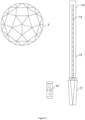
- Figure 5 represents the drone 1 and a bat before impact while figure 6 represents the bat 13 during a physical impact with the drone 1.
- the bat 13 comprises a flexible inner core 14 embedded in a transparent outer shell 15.
- the bat 13 further comprise an electronic module 16 with electronic components mounted in the bat 13.
- the handle 17 that the players use to grasp the bat 13 also serves to house the batteries and the electronic module 16 of the bat 13.
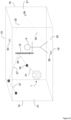
- Figure 7 represents a first game situation where the drone 1 flies in an arena 18.
- the arena 18 is 3 D space, namely a volume, delimited by boundaries 19.
- the boundaries 19 comprises a physical floor 20, namely the ground floor, whereas the other boundaries of the volume are virtual boundaries, such as the side walls 21 and the ceiling 22.
- the navigation program comprises virtual setup corresponding to virtual impact on the virtual boundaries, i.e. the side walls 21 and the ceiling 22.
- the navigation program also comprises hybrid set up corresponding to impact on the ground floor 20.
- the drone 1 navigates along a first trajectory 23 to reach a first waypoint 24, the waypoint 24 (i.e. virtual waypoint) corresponding to a virtual impact with the sidewall 21. After a bounce or rebound on the sidewall 21, the drone flies along a second trajectory 25 toward a second waypoint 26 placed on the ceiling 22. The drone 1 bounces on the ceiling 22 at the waypoint 26 and flies along a third trajectory 27 to reach a third waypoint 28 on the sidewall 21. Then, after a rebound on the side wall at the third waypoint, the drone 1 flies toward a hybrid waypoint 29 along a fourth trajectory 30 placed on the floor 19.
- the waypoint 24 i.e. virtual waypoint
- the drone 1 calculates all the trajectories (set of trajectories) in dedicated navigation program and adjusts the navigation parameters of the drone 1 to mimics the rebounds at each way points.
- Figure 8 represents a second game situation where the drone flies in the same arena than the first game situation. Contrary to the first game situation represented in figure 7 , this second game situation comprises a player P handling a bat 13.
- the drone 1 navigates along a first trajectory 31 to reach a first waypoint 31, the waypoint 31 (i.e. virtual waypoint) corresponding to a virtual impact with the sidewall 21. After a bounce or rebound on the sidewall 21, the drone flies along a target trajectory 33 toward a target waypoint 34 placed on the ceiling 22. However, the drone will not reach this target waypoint 34 : the target trajectory 33 is disrupted by the user striking the drone 1.
- the physical impact of the bat changes the navigation program that initially comprised an initial set of trajectories 35 to reach the subsequent initial virtual waypoints 36 on the side wall 21 and on the ground 22.
- the drone 1 bounces on the bat 13 which triggers the calculation of a new set of trajectories 37 to reach the new virtual waypoints 38 at the ceiling 22 and on the side wall 21.
Landscapes
- Engineering & Computer Science (AREA)
- Health & Medical Sciences (AREA)
- General Health & Medical Sciences (AREA)
- Physical Education & Sports Medicine (AREA)
- Aviation & Aerospace Engineering (AREA)
- Radar, Positioning & Navigation (AREA)
- Remote Sensing (AREA)
- Physics & Mathematics (AREA)
- General Physics & Mathematics (AREA)
- Automation & Control Theory (AREA)
- Control Of Position, Course, Altitude, Or Attitude Of Moving Bodies (AREA)
- Toys (AREA)
Claims (15)
- Verfahren zum Betreiben einer Drohne (1), die in einer durch Grenzen (19) abgegrenzten Arena (18) navigiert, wobei die Navigation der Drohne (1) in der Arena (18) durch ein Navigationsprogramm geregelt wird, das die Navigationsparameter der Drohne (1) festlegt, um sicherzustellen, dass die Drohne (1) einer berechneten Trajektorie folgt,wobei das Verfahren einen Schritt zur Einstellung des Navigationsprogramms umfasst, um die Navigationsparameter der Drohne (1) an einen Aufprall zwischen der Drohne (1) und einem in der Arena (18) platzierten Objekt anzupassen,wobei das Verfahren dadurch gekennzeichnet ist, dass die Einstellung der Navigationsparameter der Drohne (1) im Navigationsprogramm vom Objekt abhängt, das die Drohne (1) trifft,wobei der Einstellschritt umfasst:- Implementieren einer virtuellen Aufprallkonfiguration im Navigationsprogramm, um die Navigationsparameter der Drohne (1) an einen Aufprall zwischen der Drohne (1) und einem virtuellen Objekt anzupassen, und- Implementieren einer realen Aufprallkonfiguration im Navigationsprogramm, um die Navigationsparameter der Drohne (1) an einen Aufprall zwischen der Drohne (1) und einem physischen Objekt (13) anzupassen.
- Verfahren nach Anspruch 1, wobei die virtuelle Aufprallkonfiguration die Schritte umfasst:- Bestimmen der Position des genannten virtuellen Objekts, das in der Arena (18) platziert ist;- Berechnen eines Trajektoriensatz, das mehrere Trajektorien der Drohne (1) innerhalb der Arena (18) basierend auf der Position der Drohne (1) relativ zur Position des genannten virtuellen Objekts umfasst;- Verschieben der Drohne (1) in der Arena, um einer der Trajektorien aus dem Trajektorien-Set zu folgen.
- Verfahren nach den Ansprüchen 1 oder 2, wobei die virtuelle Aufprallkonfiguration die Schritte umfasst:- Berechnen eines Wegpunktziels als den Punkt, an dem die Trajektorie der Drohne (1) die Position eines virtuellen Objekts kreuzt;- Anpassung der Navigationsparameter der Drohne (1) progressiv, während sich die Drohne (1) dem Wegpunktziel nähert, um die Drohne (1) am Wegpunktziel zu stoppen und sich vom virtuellen Objekt am Wegpunkt zu entfernen.
- Verfahren nach einem der Ansprüche 1 bis 3, wobei die reale Aufprallkonfiguration die Schritte umfasst:- Stabilisierung der Drohne (1) nach dem Aufprall mit dem physischen Objekt (13);- Berechnung einer neuen Trajektorie, die durch die Richtung eines Aufprallvektors des physischen Objekts (13) definiert ist;- Anpassung der Navigationsparameter der Drohne (1), um die Drohne (1) in die neue Trajektorie zu stabilisieren, sodass die Drohne (1) entlang der genannten neuen Trajektorie bewegt wird.
- Verfahren nach einem der Ansprüche 1 bis 4, wobei der Einstellschritt das Implementieren einer hybriden Aufprallkonfiguration im Navigationsprogramm umfasst, um die Navigationsparameter der Drohne (1) anzupassen, wenn das Objekt, das die Drohne (1) trifft, ein physisches Objekt ist, dessen Position vorbestimmt ist. Der Hybridmodus umfasst den Schritt:- Berechnung eines hybriden Wegpunktziels als den Punkt, an dem die Trajektorie der Drohne (1) die Position des physischen Objekts kreuzt;- Berechnung einer Vor-Aufprall-Orientierung und einer Nach-Aufprall-Orientierung der Drohne basierend auf den physikalischen Kräften, die auf die Drohne beim Aufprall mit dem physischen Objekt wirken, sodass die physikalischen Kräfte auf die Drohne (1) beim Aufprall die Drohne von der Vor-Aufprall-Orientierung in eine Nach-Aufprall-Orientierung drehen;- Anpassung der Navigationsparameter der Drohne (1) progressiv, während sich die Drohne (1) dem hybriden Wegpunktziel nähert, um die Drohne (1) in die Vor-Aufprall-Orientierung zu positionieren.
- Verfahren nach einem der Ansprüche 1 bis 5, wobei der Einstellschritt das Implementieren der virtuellen Aufprallkonfiguration nach jedem Aufprall zwischen der Drohne (1) und einem physischen Objekt (13) umfasst.
- Verfahren nach einem der Ansprüche 1 bis 6, wobei die virtuellen Objekte aus virtuellen Grenzen der Arena, virtuellen Drohnen, virtuellen Hindernissen und computergenerierten virtuellen Gegnern ausgewählt werden.
- Verfahren nach einem der Ansprüche 1 bis 7, wobei die physischen Objekte aus physischen Grenzen der Arena, wie eine Wand, Drohnen, Schlagzubehör (13), das zum Schlagen einer Drohne konfiguriert ist, die Spieler selbst und in der Arena platzierte physische Hindernisse ausgewählt werden.
- Computerprogramm, vorzugsweise ein Drohnen-Navigationsprogramm, das Anweisungen enthält, die, wenn das Programm von einem Computer ausgeführt wird, den Computer dazu veranlassen, das Verfahren nach einem der Ansprüche 1 bis 8 auszuführen.
- Computersystem, beispielsweise eine Recheneinheit, das Mittel zum Ausführen des Verfahrens nach einem der Ansprüche 1 bis 8 umfasst.
- System, das eine Drohne (1) umfasst, die für die Navigation in einer durch Grenzen (19) abgegrenzten Arena (18) konfiguriert ist, und ein Schlaginstrument (13), das zum Schlagen der Drohne (1) konfiguriert ist, wobei die Navigation der Drohne (1) in der Arena (18) durch die Navigationsparameter der Drohne (1) geregelt wird, um sicherzustellen, dass die Drohne (1) einer berechneten Trajektorie folgt,
dadurch gekennzeichnet, dass das System weiterhin umfasst:- ein Computersystem (6), das dafür konfiguriert ist, die Navigationsparameter der Drohne (1) festzulegen, wenn ein Aufprall zwischen der Drohne (1) und einem in der Arena (18) platzierten Objekt auftritt;- das Computersystem (6) ist dafür konfiguriert, die Navigationsparameter der Drohne (1) gemäß einer bestimmten Konfiguration einzustellen, abhängig von dem Objekt, das die Drohne trifft;- die bestimmte Konfiguration wird ausgewählt aus einer virtuellen Aufprallkonfiguration, um die Navigationsparameter der Drohne (1) an einen Aufprall zwischen der Drohne (1) und einem virtuellen Objekt anzupassen, und einer realen Aufprallkonfiguration, um die Navigationsparameter der Drohne (1) an einen Aufprall zwischen der Drohne (1) und einem physischen Objekt anzupassen;- die genannte reale Aufprallkonfiguration umfasst ein Schlaginstrument (13), das so eingerichtet ist, die Navigationsparameter der Drohne (1) an einen Aufprall zwischen der Drohne und dem Schlaginstrument (13) anzupassen. - System nach Anspruch 11, wobei die Drohne (1) ferner ein Bewegungsmodul umfasst, das die Bewegung der Drohne (1) in der Arena (18) steuert, und das Computersystem dafür konfiguriert ist, das Bewegungsmodul zu steuern und die Navigationsparameter der Drohne (1) abhängig vom Betriebsmodus einzustellen.
- System nach den Ansprüchen 11 oder 12, wobei die Drohne (1) in einem Käfig (3) montiert ist, um die Drohne (1) beim Aufprall mit dem physischen Objekt oder mit dem Schlagzubehör (13) zu schützen.
- System nach einem der Ansprüche 11 bis 13, wobei das Schlagzubehör (13) einen flexiblen Teil (14) umfasst, der so konfiguriert ist, dass er bei einem Aufprall mit der Drohne (1) reversibel verformbar ist.
- System nach einem der Ansprüche 11 bis 14, wobei das Schlagzubehör (13) ein elektronisches Modul (16) umfasst, das dafür konfiguriert ist, die Bewegungen des Schlagzubehörs (13) zu verfolgen.
Priority Applications (5)
| Application Number | Priority Date | Filing Date | Title |
|---|---|---|---|
| EP22164904.9A EP4254124B1 (de) | 2022-03-29 | 2022-03-29 | Betrieb einer innerhalb einer arena navigierenden drohne |
| JP2024557596A JP2025513741A (ja) | 2022-03-29 | 2023-03-28 | アリーナ内を航行するドローンの操作 |
| US18/852,136 US20250205612A1 (en) | 2022-03-29 | 2023-03-28 | Operating a Drone Navigating Within an Arena |
| PCT/EP2023/058014 WO2023186903A1 (en) | 2022-03-29 | 2023-03-28 | Operating a drone navigating within an arena |
| KR1020247036086A KR20250002299A (ko) | 2022-03-29 | 2023-03-28 | 아레나 내에서 내비게이팅하는 드론의 운영 |
Applications Claiming Priority (1)
| Application Number | Priority Date | Filing Date | Title |
|---|---|---|---|
| EP22164904.9A EP4254124B1 (de) | 2022-03-29 | 2022-03-29 | Betrieb einer innerhalb einer arena navigierenden drohne |
Publications (3)
| Publication Number | Publication Date |
|---|---|
| EP4254124A1 EP4254124A1 (de) | 2023-10-04 |
| EP4254124B1 true EP4254124B1 (de) | 2024-11-27 |
| EP4254124C0 EP4254124C0 (de) | 2024-11-27 |
Family
ID=80979070
Family Applications (1)
| Application Number | Title | Priority Date | Filing Date |
|---|---|---|---|
| EP22164904.9A Active EP4254124B1 (de) | 2022-03-29 | 2022-03-29 | Betrieb einer innerhalb einer arena navigierenden drohne |
Country Status (5)
| Country | Link |
|---|---|
| US (1) | US20250205612A1 (de) |
| EP (1) | EP4254124B1 (de) |
| JP (1) | JP2025513741A (de) |
| KR (1) | KR20250002299A (de) |
| WO (1) | WO2023186903A1 (de) |
Family Cites Families (13)
| Publication number | Priority date | Publication date | Assignee | Title |
|---|---|---|---|---|
| US9101812B2 (en) * | 2011-10-25 | 2015-08-11 | Aquimo, Llc | Method and system to analyze sports motions using motion sensors of a mobile device |
| US9011192B2 (en) * | 2013-06-01 | 2015-04-21 | Dan Kevin Canobbio | Gravity-slowing self propelling game device |
| WO2017047832A1 (ko) * | 2015-09-14 | 2017-03-23 | 엘지전자 주식회사 | 이동 단말기 및 그 제어방법 |
| US10664002B2 (en) * | 2016-10-27 | 2020-05-26 | Fluidity Technologies Inc. | Multi-degrees-of-freedom hand held controller |
| US10904427B2 (en) * | 2017-09-29 | 2021-01-26 | Blueprint Reality Inc. | Coordinated cinematic drone |
| US20210031082A1 (en) * | 2018-02-09 | 2021-02-04 | Young Cheon CHA | Three-dimensional target system for ball game sports |
| US20190317529A1 (en) * | 2018-04-11 | 2019-10-17 | Teal Drones, Inc. | Virtual force system for a drone |
| US11749124B2 (en) * | 2018-06-12 | 2023-09-05 | Skydio, Inc. | User interaction with an autonomous unmanned aerial vehicle |
| GB201906420D0 (en) * | 2019-05-07 | 2019-06-19 | Farley Adam | Virtual augmented and mixed reality systems with physical feedback |
| JP2021046058A (ja) * | 2019-09-18 | 2021-03-25 | ソニー株式会社 | 無人航空機、制御方法、およびプログラム |
| WO2021067536A1 (en) * | 2019-10-01 | 2021-04-08 | Centurion Vr, Inc. | Accessory for virtual reality simulation |
| US11599107B2 (en) * | 2019-12-09 | 2023-03-07 | Fluidity Technologies Inc. | Apparatus, methods and systems for remote or onboard control of flights |
| US20230399124A1 (en) * | 2020-10-28 | 2023-12-14 | The Regents Of The University Of California | Design methods and motion control algorithms for impact-resilient mobile robots |
-
2022
- 2022-03-29 EP EP22164904.9A patent/EP4254124B1/de active Active
-
2023
- 2023-03-28 US US18/852,136 patent/US20250205612A1/en active Pending
- 2023-03-28 JP JP2024557596A patent/JP2025513741A/ja active Pending
- 2023-03-28 WO PCT/EP2023/058014 patent/WO2023186903A1/en not_active Ceased
- 2023-03-28 KR KR1020247036086A patent/KR20250002299A/ko active Pending
Also Published As
| Publication number | Publication date |
|---|---|
| KR20250002299A (ko) | 2025-01-07 |
| WO2023186903A4 (en) | 2023-11-23 |
| EP4254124A1 (de) | 2023-10-04 |
| WO2023186903A1 (en) | 2023-10-05 |
| US20250205612A1 (en) | 2025-06-26 |
| JP2025513741A (ja) | 2025-04-30 |
| EP4254124C0 (de) | 2024-11-27 |
Similar Documents
| Publication | Publication Date | Title |
|---|---|---|
| US10507916B2 (en) | Unmanned aerial vehicles and related methods and systems | |
| CN106029185B (zh) | 检测表面上的投射物击中的设备、系统和方法 | |
| US10336469B2 (en) | Unmanned aerial vehicle movement via environmental interactions | |
| US10286330B2 (en) | Apparatus and method for arial game playing | |
| KR100758138B1 (ko) | 목표 지향 사용자 인터페이스 | |
| US10416669B2 (en) | Mechanical effects by way of software or real world engagement | |
| US20180093171A1 (en) | Unmanned aerial vehicle movement via environmental airflow | |
| US7001272B2 (en) | Video game device, video game method, video game program, and video game system | |
| KR101793189B1 (ko) | 하나 이상의 모바일 컴퓨팅 디바이스들을 갖는 로봇 시스템의 통합 | |
| KR101519525B1 (ko) | 멀티콥터 형 비행로봇을 이용한 비행 전투 게임 시스템 및 이를 이용한 비행 전투 게임 방법 | |
| JP7648284B2 (ja) | 仮想オブジェクト制御方法、仮想オブジェクト制御装置、コンピュータ機器、及びコンピュータプログラム | |
| US20210031082A1 (en) | Three-dimensional target system for ball game sports | |
| US20170197146A1 (en) | Remote control with relative directional sense to a controlled object | |
| US20080194337A1 (en) | Hunting Game Having Human And Electromechanical Players | |
| RU2709562C1 (ru) | Способ управления дроном и система для его осуществления | |
| KR102159089B1 (ko) | 드론 스포츠용 드론 장치 | |
| EP4254124B1 (de) | Betrieb einer innerhalb einer arena navigierenden drohne | |
| KR20200014581A (ko) | 드론을 이용한 아케이드 게임 시스템 | |
| JP6711537B2 (ja) | 方法、システム、および車両 | |
| Sargent et al. | The importance of fast vision in winning the first micro-robot world cup soccer tournament | |
| KR102874317B1 (ko) | 곤충로봇 게임 시스템 | |
| US20250090921A1 (en) | Moving targets route simulator quarterback game | |
| KR102682562B1 (ko) | 볼 게임을 위한 드론, 그 동작 방법, 및 이를 위한 플랫폼 | |
| KR20200079093A (ko) | 스포츠용 볼 | |
| KR20260025611A (ko) | 드론사격훈련시스템 |
Legal Events
| Date | Code | Title | Description |
|---|---|---|---|
| PUAI | Public reference made under article 153(3) epc to a published international application that has entered the european phase |
Free format text: ORIGINAL CODE: 0009012 |
|
| STAA | Information on the status of an ep patent application or granted ep patent |
Free format text: STATUS: THE APPLICATION HAS BEEN PUBLISHED |
|
| AK | Designated contracting states |
Kind code of ref document: A1 Designated state(s): AL AT BE BG CH CY CZ DE DK EE ES FI FR GB GR HR HU IE IS IT LI LT LU LV MC MK MT NL NO PL PT RO RS SE SI SK SM TR |
|
| STAA | Information on the status of an ep patent application or granted ep patent |
Free format text: STATUS: REQUEST FOR EXAMINATION WAS MADE |
|
| 17P | Request for examination filed |
Effective date: 20240326 |
|
| RAP3 | Party data changed (applicant data changed or rights of an application transferred) |
Owner name: POTHULA, ANURAAG VIJAY KUMAR Owner name: OLIVEIRA PAREDES, STEPHANE Owner name: STERN, ISAAC ALFRED |
|
| RBV | Designated contracting states (corrected) |
Designated state(s): AL AT BE BG CH CY CZ DE DK EE ES FI FR GB GR HR HU IE IS IT LI LT LU LV MC MK MT NL NO PL PT RO RS SE SI SK SM TR |
|
| RIN1 | Information on inventor provided before grant (corrected) |
Inventor name: POTHULA, ANURAAG VIJAY KUMAR Inventor name: OLIVEIRA PAREDES, STEPHANE Inventor name: STERN, ISAAC ALFRED |
|
| REG | Reference to a national code |
Ref country code: DE Ref legal event code: R079 Free format text: PREVIOUS MAIN CLASS: G05D0001100000 Ipc: G05D0001000000 Ref country code: DE Ref legal event code: R079 Ref document number: 602022008057 Country of ref document: DE Free format text: PREVIOUS MAIN CLASS: G05D0001100000 Ipc: G05D0001000000 |
|
| GRAP | Despatch of communication of intention to grant a patent |
Free format text: ORIGINAL CODE: EPIDOSNIGR1 |
|
| STAA | Information on the status of an ep patent application or granted ep patent |
Free format text: STATUS: GRANT OF PATENT IS INTENDED |
|
| RIC1 | Information provided on ipc code assigned before grant |
Ipc: A63B 67/00 20060101ALI20240530BHEP Ipc: A63B 60/00 20150101ALI20240530BHEP Ipc: A63B 59/00 20150101ALI20240530BHEP Ipc: A63B 43/00 20060101ALI20240530BHEP Ipc: G05D 1/00 20060101AFI20240530BHEP |
|
| INTG | Intention to grant announced |
Effective date: 20240625 |
|
| GRAS | Grant fee paid |
Free format text: ORIGINAL CODE: EPIDOSNIGR3 |
|
| GRAA | (expected) grant |
Free format text: ORIGINAL CODE: 0009210 |
|
| STAA | Information on the status of an ep patent application or granted ep patent |
Free format text: STATUS: THE PATENT HAS BEEN GRANTED |
|
| AK | Designated contracting states |
Kind code of ref document: B1 Designated state(s): AL AT BE BG CH CY CZ DE DK EE ES FI FR GB GR HR HU IE IS IT LI LT LU LV MC MK MT NL NO PL PT RO RS SE SI SK SM TR |
|
| REG | Reference to a national code |
Ref country code: GB Ref legal event code: FG4D |
|
| REG | Reference to a national code |
Ref country code: CH Ref legal event code: EP |
|
| REG | Reference to a national code |
Ref country code: DE Ref legal event code: R096 Ref document number: 602022008057 Country of ref document: DE |
|
| REG | Reference to a national code |
Ref country code: IE Ref legal event code: FG4D |
|
| U01 | Request for unitary effect filed |
Effective date: 20241127 |
|
| U07 | Unitary effect registered |
Designated state(s): AT BE BG DE DK EE FI FR IT LT LU LV MT NL PT RO SE SI Effective date: 20250108 |
|
| PG25 | Lapsed in a contracting state [announced via postgrant information from national office to epo] |
Ref country code: HR Free format text: LAPSE BECAUSE OF FAILURE TO SUBMIT A TRANSLATION OF THE DESCRIPTION OR TO PAY THE FEE WITHIN THE PRESCRIBED TIME-LIMIT Effective date: 20241127 Ref country code: IS Free format text: LAPSE BECAUSE OF FAILURE TO SUBMIT A TRANSLATION OF THE DESCRIPTION OR TO PAY THE FEE WITHIN THE PRESCRIBED TIME-LIMIT Effective date: 20250327 |
|
| PG25 | Lapsed in a contracting state [announced via postgrant information from national office to epo] |
Ref country code: ES Free format text: LAPSE BECAUSE OF FAILURE TO SUBMIT A TRANSLATION OF THE DESCRIPTION OR TO PAY THE FEE WITHIN THE PRESCRIBED TIME-LIMIT Effective date: 20241127 |
|
| PG25 | Lapsed in a contracting state [announced via postgrant information from national office to epo] |
Ref country code: NO Free format text: LAPSE BECAUSE OF FAILURE TO SUBMIT A TRANSLATION OF THE DESCRIPTION OR TO PAY THE FEE WITHIN THE PRESCRIBED TIME-LIMIT Effective date: 20250227 |
|
| PG25 | Lapsed in a contracting state [announced via postgrant information from national office to epo] |
Ref country code: GR Free format text: LAPSE BECAUSE OF FAILURE TO SUBMIT A TRANSLATION OF THE DESCRIPTION OR TO PAY THE FEE WITHIN THE PRESCRIBED TIME-LIMIT Effective date: 20250228 |
|
| PG25 | Lapsed in a contracting state [announced via postgrant information from national office to epo] |
Ref country code: PL Free format text: LAPSE BECAUSE OF FAILURE TO SUBMIT A TRANSLATION OF THE DESCRIPTION OR TO PAY THE FEE WITHIN THE PRESCRIBED TIME-LIMIT Effective date: 20241127 |
|
| PG25 | Lapsed in a contracting state [announced via postgrant information from national office to epo] |
Ref country code: RS Free format text: LAPSE BECAUSE OF FAILURE TO SUBMIT A TRANSLATION OF THE DESCRIPTION OR TO PAY THE FEE WITHIN THE PRESCRIBED TIME-LIMIT Effective date: 20250227 |
|
| U21 | Renewal fee for the european patent with unitary effect paid with additional fee |
Year of fee payment: 4 Effective date: 20250527 |
|
| PG25 | Lapsed in a contracting state [announced via postgrant information from national office to epo] |
Ref country code: SM Free format text: LAPSE BECAUSE OF FAILURE TO SUBMIT A TRANSLATION OF THE DESCRIPTION OR TO PAY THE FEE WITHIN THE PRESCRIBED TIME-LIMIT Effective date: 20241127 |
|
| PGFP | Annual fee paid to national office [announced via postgrant information from national office to epo] |
Ref country code: CH Payment date: 20250401 Year of fee payment: 4 |
|
| PG25 | Lapsed in a contracting state [announced via postgrant information from national office to epo] |
Ref country code: SK Free format text: LAPSE BECAUSE OF FAILURE TO SUBMIT A TRANSLATION OF THE DESCRIPTION OR TO PAY THE FEE WITHIN THE PRESCRIBED TIME-LIMIT Effective date: 20241127 |
|
| PG25 | Lapsed in a contracting state [announced via postgrant information from national office to epo] |
Ref country code: CZ Free format text: LAPSE BECAUSE OF FAILURE TO SUBMIT A TRANSLATION OF THE DESCRIPTION OR TO PAY THE FEE WITHIN THE PRESCRIBED TIME-LIMIT Effective date: 20241127 |
|
| PLBE | No opposition filed within time limit |
Free format text: ORIGINAL CODE: 0009261 |
|
| STAA | Information on the status of an ep patent application or granted ep patent |
Free format text: STATUS: NO OPPOSITION FILED WITHIN TIME LIMIT |
|
| PG25 | Lapsed in a contracting state [announced via postgrant information from national office to epo] |
Ref country code: MC Free format text: LAPSE BECAUSE OF FAILURE TO SUBMIT A TRANSLATION OF THE DESCRIPTION OR TO PAY THE FEE WITHIN THE PRESCRIBED TIME-LIMIT Effective date: 20241127 |
|
| 26N | No opposition filed |
Effective date: 20250828 |
|
| PG25 | Lapsed in a contracting state [announced via postgrant information from national office to epo] |
Ref country code: IE Free format text: LAPSE BECAUSE OF NON-PAYMENT OF DUE FEES Effective date: 20250329 |