EP4253974A1 - Battery capacity estimation method, electronic apparatus and storage medium - Google Patents
Battery capacity estimation method, electronic apparatus and storage medium Download PDFInfo
- Publication number
- EP4253974A1 EP4253974A1 EP20962935.1A EP20962935A EP4253974A1 EP 4253974 A1 EP4253974 A1 EP 4253974A1 EP 20962935 A EP20962935 A EP 20962935A EP 4253974 A1 EP4253974 A1 EP 4253974A1
- Authority
- EP
- European Patent Office
- Prior art keywords
- features
- charging
- cycle numbers
- battery
- under different
- Prior art date
- Legal status (The legal status is an assumption and is not a legal conclusion. Google has not performed a legal analysis and makes no representation as to the accuracy of the status listed.)
- Granted
Links
Images




Classifications
-
- G—PHYSICS
- G01—MEASURING; TESTING
- G01R—MEASURING ELECTRIC VARIABLES; MEASURING MAGNETIC VARIABLES
- G01R31/00—Arrangements for testing electric properties; Arrangements for locating electric faults; Arrangements for electrical testing characterised by what is being tested not provided for elsewhere
- G01R31/36—Arrangements for testing, measuring or monitoring the electrical condition of accumulators or electric batteries, e.g. capacity or state of charge [SoC]
- G01R31/382—Arrangements for monitoring battery or accumulator variables, e.g. SoC
- G01R31/3842—Arrangements for monitoring battery or accumulator variables, e.g. SoC combining voltage and current measurements
-
- H—ELECTRICITY
- H02—GENERATION; CONVERSION OR DISTRIBUTION OF ELECTRIC POWER
- H02J—ELECTRIC POWER NETWORKS; CIRCUIT ARRANGEMENTS OR SYSTEMS FOR SUPPLYING OR DISTRIBUTING ELECTRIC POWER; SYSTEMS FOR STORING ELECTRIC ENERGY
- H02J7/00—Circuit arrangements for charging or discharging batteries or for supplying loads from batteries
- H02J7/90—Regulation of charging or discharging current or voltage
- H02J7/92—Regulation of charging or discharging current or voltage with prioritisation of loads or sources
-
- G—PHYSICS
- G01—MEASURING; TESTING
- G01R—MEASURING ELECTRIC VARIABLES; MEASURING MAGNETIC VARIABLES
- G01R31/00—Arrangements for testing electric properties; Arrangements for locating electric faults; Arrangements for electrical testing characterised by what is being tested not provided for elsewhere
- G01R31/36—Arrangements for testing, measuring or monitoring the electrical condition of accumulators or electric batteries, e.g. capacity or state of charge [SoC]
- G01R31/367—Software therefor, e.g. for battery testing using modelling or look-up tables
-
- G—PHYSICS
- G01—MEASURING; TESTING
- G01R—MEASURING ELECTRIC VARIABLES; MEASURING MAGNETIC VARIABLES
- G01R31/00—Arrangements for testing electric properties; Arrangements for locating electric faults; Arrangements for electrical testing characterised by what is being tested not provided for elsewhere
- G01R31/36—Arrangements for testing, measuring or monitoring the electrical condition of accumulators or electric batteries, e.g. capacity or state of charge [SoC]
- G01R31/3644—Constructional arrangements
- G01R31/3648—Constructional arrangements comprising digital calculation means, e.g. for performing an algorithm
-
- G—PHYSICS
- G01—MEASURING; TESTING
- G01R—MEASURING ELECTRIC VARIABLES; MEASURING MAGNETIC VARIABLES
- G01R31/00—Arrangements for testing electric properties; Arrangements for locating electric faults; Arrangements for electrical testing characterised by what is being tested not provided for elsewhere
- G01R31/36—Arrangements for testing, measuring or monitoring the electrical condition of accumulators or electric batteries, e.g. capacity or state of charge [SoC]
- G01R31/385—Arrangements for measuring battery or accumulator variables
- G01R31/387—Determining ampere-hour charge capacity or SoC
-
- G—PHYSICS
- G01—MEASURING; TESTING
- G01R—MEASURING ELECTRIC VARIABLES; MEASURING MAGNETIC VARIABLES
- G01R31/00—Arrangements for testing electric properties; Arrangements for locating electric faults; Arrangements for electrical testing characterised by what is being tested not provided for elsewhere
- G01R31/36—Arrangements for testing, measuring or monitoring the electrical condition of accumulators or electric batteries, e.g. capacity or state of charge [SoC]
- G01R31/385—Arrangements for measuring battery or accumulator variables
- G01R31/387—Determining ampere-hour charge capacity or SoC
- G01R31/388—Determining ampere-hour charge capacity or SoC involving voltage measurements
-
- H—ELECTRICITY
- H01—ELECTRIC ELEMENTS
- H01M—PROCESSES OR MEANS, e.g. BATTERIES, FOR THE DIRECT CONVERSION OF CHEMICAL ENERGY INTO ELECTRICAL ENERGY
- H01M10/00—Secondary cells; Manufacture thereof
- H01M10/42—Methods or arrangements for servicing or maintenance of secondary cells or secondary half-cells
- H01M10/425—Structural combination with electronic components, e.g. electronic circuits integrated to the outside of the casing
-
- H—ELECTRICITY
- H01—ELECTRIC ELEMENTS
- H01M—PROCESSES OR MEANS, e.g. BATTERIES, FOR THE DIRECT CONVERSION OF CHEMICAL ENERGY INTO ELECTRICAL ENERGY
- H01M10/00—Secondary cells; Manufacture thereof
- H01M10/42—Methods or arrangements for servicing or maintenance of secondary cells or secondary half-cells
- H01M10/425—Structural combination with electronic components, e.g. electronic circuits integrated to the outside of the casing
- H01M10/4257—Smart batteries, e.g. electronic circuits inside the housing of the cells or batteries
-
- H—ELECTRICITY
- H01—ELECTRIC ELEMENTS
- H01M—PROCESSES OR MEANS, e.g. BATTERIES, FOR THE DIRECT CONVERSION OF CHEMICAL ENERGY INTO ELECTRICAL ENERGY
- H01M10/00—Secondary cells; Manufacture thereof
- H01M10/42—Methods or arrangements for servicing or maintenance of secondary cells or secondary half-cells
- H01M10/44—Methods for charging or discharging
-
- H—ELECTRICITY
- H01—ELECTRIC ELEMENTS
- H01M—PROCESSES OR MEANS, e.g. BATTERIES, FOR THE DIRECT CONVERSION OF CHEMICAL ENERGY INTO ELECTRICAL ENERGY
- H01M10/00—Secondary cells; Manufacture thereof
- H01M10/42—Methods or arrangements for servicing or maintenance of secondary cells or secondary half-cells
- H01M10/48—Accumulators combined with arrangements for measuring, testing or indicating the condition of cells, e.g. the level or density of the electrolyte
-
- H—ELECTRICITY
- H02—GENERATION; CONVERSION OR DISTRIBUTION OF ELECTRIC POWER
- H02J—ELECTRIC POWER NETWORKS; CIRCUIT ARRANGEMENTS OR SYSTEMS FOR SUPPLYING OR DISTRIBUTING ELECTRIC POWER; SYSTEMS FOR STORING ELECTRIC ENERGY
- H02J7/00—Circuit arrangements for charging or discharging batteries or for supplying loads from batteries
- H02J7/80—Circuit arrangements for charging or discharging batteries or for supplying loads from batteries including monitoring or indicating arrangements
- H02J7/82—Control of state of charge [SOC]
-
- H—ELECTRICITY
- H01—ELECTRIC ELEMENTS
- H01M—PROCESSES OR MEANS, e.g. BATTERIES, FOR THE DIRECT CONVERSION OF CHEMICAL ENERGY INTO ELECTRICAL ENERGY
- H01M10/00—Secondary cells; Manufacture thereof
- H01M10/42—Methods or arrangements for servicing or maintenance of secondary cells or secondary half-cells
- H01M10/425—Structural combination with electronic components, e.g. electronic circuits integrated to the outside of the casing
- H01M2010/4271—Battery management systems including electronic circuits, e.g. control of current or voltage to keep battery in healthy state, cell balancing
-
- H—ELECTRICITY
- H01—ELECTRIC ELEMENTS
- H01M—PROCESSES OR MEANS, e.g. BATTERIES, FOR THE DIRECT CONVERSION OF CHEMICAL ENERGY INTO ELECTRICAL ENERGY
- H01M10/00—Secondary cells; Manufacture thereof
- H01M10/42—Methods or arrangements for servicing or maintenance of secondary cells or secondary half-cells
- H01M10/425—Structural combination with electronic components, e.g. electronic circuits integrated to the outside of the casing
- H01M2010/4278—Systems for data transfer from batteries, e.g. transfer of battery parameters to a controller, data transferred between battery controller and main controller
-
- H—ELECTRICITY
- H02—GENERATION; CONVERSION OR DISTRIBUTION OF ELECTRIC POWER
- H02J—ELECTRIC POWER NETWORKS; CIRCUIT ARRANGEMENTS OR SYSTEMS FOR SUPPLYING OR DISTRIBUTING ELECTRIC POWER; SYSTEMS FOR STORING ELECTRIC ENERGY
- H02J7/00—Circuit arrangements for charging or discharging batteries or for supplying loads from batteries
- H02J7/90—Regulation of charging or discharging current or voltage
- H02J7/933—Regulation of charging or discharging current or voltage the cycle being controlled or terminated in response to electric parameters
-
- Y—GENERAL TAGGING OF NEW TECHNOLOGICAL DEVELOPMENTS; GENERAL TAGGING OF CROSS-SECTIONAL TECHNOLOGIES SPANNING OVER SEVERAL SECTIONS OF THE IPC; TECHNICAL SUBJECTS COVERED BY FORMER USPC CROSS-REFERENCE ART COLLECTIONS [XRACs] AND DIGESTS
- Y02—TECHNOLOGIES OR APPLICATIONS FOR MITIGATION OR ADAPTATION AGAINST CLIMATE CHANGE
- Y02E—REDUCTION OF GREENHOUSE GAS [GHG] EMISSIONS, RELATED TO ENERGY GENERATION, TRANSMISSION OR DISTRIBUTION
- Y02E60/00—Enabling technologies; Technologies with a potential or indirect contribution to GHG emissions mitigation
- Y02E60/10—Energy storage using batteries
Definitions
- This application relates to the field of battery technology, and in particular to a method for battery capacity estimation, an electronic apparatus, and a storage medium.
- the accuracy of battery capacity estimation for lithium-ion batteries is high at the early stage of use. However, with the aging of the cells of lithium-ion batteries, the accuracy of battery capacity estimation decreases continuously, which may lead to a jump change in the capacity displayed by an electronic apparatus and may even cause the electronic apparatus to shut down directly when the displayed capacity is 20% to 30%. At present, battery capacity can be estimated by using complete experimental cycling data. Although this method can improve the accuracy of battery capacity estimation, it requires a large amount of data and may take a large amount of time.
- An embodiment of this application provides a method for battery capacity estimation.
- the method includes: obtaining a charging current, charging voltage, and charging time of a battery being estimated and a charging voltage interval; determining a charging current interval and a charging time interval based on the charging current, the charging voltage, and the charging time, where the charging current interval and the charging time interval correspond to the charging voltage interval; obtaining training features for model training, where the training features include training electrochemical features and training time domain features; determining actual features of the battery being estimated based on the charging voltage interval, the charging current interval, the charging time interval, and the training features, where the actual features include actual electrochemical features and actual time domain features; and estimating, based on the model and the actual features, an actual capacity of the battery being estimated.
- the model is a Gaussian process regression model.
- a difference between a maximum charging voltage and a minimum charging voltage in the charging voltage interval is less than or equal to 0.1 volts.
- the determining actual features of the battery being estimated based on the charging voltage interval, the charging current interval, the charging time interval, and the training features includes:
- the method prior to the obtaining training features for model training, the method further includes:
- the total training electrochemical features include activation energy increment, throughput, and charging time length;
- the total training time domain features include peak value, maximum value, mean value, variance, root mean square value, peak factor, kurtosis, kurtosis factor, waveform factor, pulse factor, margin factor, minimum value, and skewness factor.
- the method prior to the determining the training features based on the first total features under different cycle numbers, the method further includes:
- the method further includes:
- the obtaining first features by which the initial parameters are generated includes:
- An embodiment of this application provides an electronic apparatus, where the electronic apparatus includes:
- An embodiment of this application provides a storage medium having at least one computer instruction stored thereon, where the instruction is loaded by a processor to execute the method for battery capacity estimation according to any one of the above.
- the method for battery capacity estimation, electronic apparatus, and storage medium provided in embodiments of this application reduce the amount of data required and shorten the estimation time by using less data to implement capacity estimation for the battery being estimated via a Gaussian process regression model based on the test electrochemical features and test time domain features generated based on the charging voltage interval of the battery being estimated, the charging current interval corresponding to the charging voltage interval, and the charging time interval corresponding to the charging voltage interval.
- FIG. 1 is a schematic diagram of an electronic apparatus according to an embodiment of this application.
- the electronic apparatus 100 includes but is not limited to a memory 11, at least one processor 12, a battery 13 being estimated, an analog-to-digital converter 14, and a timer 15. These components may be connected to each other via a bus or connected directly.
- FIG. 1 is only an example for description of the electronic apparatus 100.
- the electronic apparatus 100 may instead include more or fewer components or have a different configuration of components.
- the electronic apparatus 100 may be an electric motorcycle, an electric bicycle, an electric car, a cell phone, a tablet, a digital assistant, a personal computer, or any other suitable rechargeable device.
- the battery 13 being estimated is a rechargeable battery for providing electrical power to the electronic apparatus 100.
- the battery 13 being estimated may be a lead-acid battery, a nickel-cadmium battery, a nickel-metal hydride battery, a lithium-ion polymer battery, a lithium polymer battery, and a lithium iron phosphate battery, or the like.
- the battery 13 being estimated is logically connected to the processor 12 via a battery management system (BMS), so that functions such as charging and discharging are realized via the battery management system.
- BMS battery management system
- the battery management system may be connected to a power conversion system (PCS) via CAN or RS485 for communication.
- PCS power conversion system
- the battery 13 being estimated includes a cell, and the battery being estimated may be charged repeatedly in a cyclable rechargeable manner.
- the analog-to-digital converter 14 is configured to measure a charging voltage and a charging current of the cell of the battery 13 being estimated during a charging process.
- the timer 15 is configured to record a charging time of the cell of the battery 13 being estimated during a charging process.
- the electronic apparatus 100 may also include other apparatuses such as a pressure sensor, a light sensor, a gyroscope, a hygrometer, and an infrared sensor.
- FIG. 2 is a flowchart of a method for battery capacity estimation according to an embodiment of this application.
- the method for battery capacity estimation is applied to a battery being estimated.
- the method for battery capacity estimation includes the following steps: S21: Obtain a charging current, charging voltage, and charging time of a battery being estimated and a charging voltage interval.
- the charging current and the charging voltage may be obtained by the analog-to-digital converter.
- the charging time may be obtained by the timer.
- the charging current, charging voltage and charging time are a charging current, charging voltage and charging time of the battery being estimated in a constant current charging phase.
- the charging voltage interval is a value pre-set by a user, and the charging voltage interval is stored in the electronic apparatus.
- the charging voltage interval is [3.85, 3.95] or may be other values, depending on the specific needs. If the charging voltage interval is [3.85, 3.95], a maximum charging voltage is 3.95 volts and a minimum charging voltage is 3.85 volts. In this embodiment, a difference between a maximum charging voltage and a minimum charging voltage in the charging voltage interval is less than or equal to 0.1 volts.
- S22 Determine a charging current interval and a charging time interval based on the charging current, the charging voltage, and the charging time, where the charging current interval and the charging time interval correspond to the charging voltage interval.
- the voltage of the battery being estimated keeps increasing during the constant current charging phase, so determining a charging current interval and a charging time interval based on the charging current, the charging voltage, and the charging time may be intercepting data of a charging current interval and a charging time interval from the data of the charging current, the charging voltage, and the charging time.
- the model is a Gaussian process regression model.
- the method for battery capacity estimation further includes: S31: Determine total training features under different cycle numbers based on charging currents, charging voltages, and charging times of a standard battery under different cycle numbers and the charging voltage interval, where the total training features include total training electrochemical features and total training time domain features.
- the determining total training features under different cycle numbers based on charging currents, charging voltages, and charging times of a standard battery under different cycle numbers and the charging voltage interval includes: b1: Obtain the charging currents, charging voltages, and charging times of the standard battery under different cycle numbers.
- each cycle number refers to a complete charge and discharge cycle.
- the cycle number is in the interval [20,200] or may be other values, depending on the specific needs.
- the charging currents, charging voltages, and charging times under different cycle numbers of the standard battery may be stored in the electronic apparatus or in an external device. Then, the obtaining charging currents, charging voltages, and charging times of the standard battery under different cycle numbers may be obtaining the charging currents, charging voltages, and charging times of the standard battery under different cycle numbers from within the electronic apparatus, or obtaining the charging currents, charging voltages, and charging times of the standard battery under different cycle numbers from the external device.
- the calculating a charged capacity of the standard battery based on a charging current in the charging current interval of the standard battery and a charging time in the charging time interval of the standard battery includes calculating the charged capacity of the standard battery using a Coulomb integration method.
- the calculating capacity increment values based on charging voltages within the charging voltage interval of the standard battery and charged capacities corresponding to the charging voltages is differentiating charging voltages in the charging voltage interval of the standard battery and charged capacities corresponding to the charging voltages to calculate the capacity increment values.
- the capacity increment curves of the standard battery under different cycle numbers are plotted in the same coordinate system based on the charging voltages in the charging voltage interval of the standard battery and the capacity increment values.
- different capacity increment curves represent different cycle numbers.
- the horizontal coordinate of the capacity increment curves of the standard battery under different cycle numbers is the charging voltage; the vertical coordinate of the capacity increment curves of the standard battery under different cycle numbers is the capacity increment value.
- the method further includes: performing moving filtering and Gaussian filtering on the capacity increment curves of the standard battery under different cycle numbers.
- the total training electrochemical features include activation energy increment, throughput, and charging time length; the total training time domain features include peak value, maximum value, mean value, variance, root mean square value, peak factor, kurtosis, kurtosis factor, waveform factor, pulse factor, margin factor, minimum value, and skewness factor.
- E S represents activation energy increments under different cycle numbers
- T V 1 represents minimum charging times in charging time intervals of the standard battery under different cycle numbers
- T Vn represents maximum charging times in charging time intervals of the standard battery under different cycle numbers
- V represents charging voltages in charging voltage intervals of the standard battery under different cycle numbers
- t represents charging times in charging time intervals of the standard battery under different cycle numbers.
- a h represents throughputs under different cycle numbers; T V 1 represents minimum charging times in charging time intervals of the standard battery under different cycle numbers; T Vn represents maximum charging times in charging time intervals of the standard battery under different cycle numbers; I represents charging currents in charging current intervals of the standard battery under different cycle numbers; t represents charging times in charging time intervals of the standard battery under different cycle numbers.
- ⁇ T represents charging time lengths under different cycle numbers
- T Vn represents maximum charging times in charging time intervals of the standard battery under different cycle numbers
- T V 1 represents minimum charging times in charging time intervals of the standard battery under different cycle numbers.
- Peak max (
- Peak represents peak values under different cycle numbers;
- dQ / dV represents capacity increment values of the standard battery under different cycle numbers.
- Max max ( dQ / dV ).
- Max represents maximum values under different cycle numbers
- dQ / dV represents capacity increment values of the standard battery under different cycle numbers.
- Mean represents mean values under different cycle numbers; n represents numbers of charging voltage samples in charging voltage intervals of the standard battery under different cycle numbers; i represents the i -th sample; dQ i / dV i represents the i -th capacity increment values of the standard battery under different cycle numbers.
- Var represents variances under different cycle numbers; n represents numbers of charging voltage samples in charging voltage intervals of the standard battery under different cycle numbers; i represents the i -th sample; dQ i / dV i represents the i -th capacity increment values of the standard battery under different cycle numbers; Mean represents mean values under different cycle numbers.
- Rms represents root mean square values under different cycle numbers; n represents numbers of charging voltage samples in charging voltage intervals of the standard battery under different cycle numbers; i represents the i -th sample; dQ i / dV i represents the i -th capacity increment values of the standard battery under different cycle numbers.
- CF represents peak factors under different cycle numbers; Peak represents maximum values under different cycle numbers; Rms represents root mean square values under different cycle numbers.
- Kur represents kurtoses under different cycle numbers; n represents numbers of charging voltage samples in charging voltage intervals of the standard battery under different cycle numbers; i represents the i -th sample; dQ i / dV i represents the i -th capacity increment values of the standard battery under different cycle numbers.
- KF Kur Rms 4 .
- KF represents kurtosis factors under different cycle numbers
- Kur represents kurtoses under different cycle numbers
- Rms represents root mean square values under different cycle numbers.
- FF represents waveform factors under different cycle numbers; Rms represents root mean square values under different cycle numbers; Mean represents mean values under different cycle numbers.
- IF represents pulse factors under different cycle numbers; Peak represents maximum values under different cycle numbers; Mean represents mean values under different cycle numbers.
- MF represents margin factors under different cycle numbers; Peak represents maximum values under different cycle numbers; n represents numbers of charging voltage samples in charging voltage intervals of the standard battery under different cycle numbers; i represents the i -th sample; dQ i / dV i represents the i -th capacity increment values of the standard battery under different cycle numbers.
- Min min(
- Min represents minimum values under different cycle numbers
- dQ / dV represents capacity increment values of the standard battery under different cycle numbers.
- SF represents skewness factors under different cycle numbers.
- n represents numbers of charging voltage samples in charging voltage intervals of the standard battery under different cycle numbers;
- i represents the i -th sample;
- dQ i / dV i represents the i -th capacity increment values of the standard battery under different cycle numbers;
- Mean represents mean values under different cycle numbers.
- S32 Determine first total features under different cycle numbers, where the first total features under different cycle numbers are total training features under different cycle numbers whose linear dependencies on actual capacities of the standard battery under different cycle numbers are greater than a predetermined value.
- the actual capacity may be an actual capacity calculated by another system within the electronic apparatus, or may be an actual capacity calculated by another apparatus outside the electronic apparatus, or may be an actual capacity calculated by this method using any method known.
- the predetermined value may be 0.8 or other values depending on the specific needs.
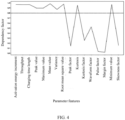
- FIG. 4 shows linear dependencies of the activation energy increment, throughput, charging time length, peak value, maximum value, mean value, variance, root mean square value, peak factor, kurtosis, kurtosis factor, waveform factor, pulse factor, margin factor, minimum value, and skewness factor.
- the linear dependencies of the activation energy increment, throughput, charging time length, peak value, maximum value, mean value, variance, root mean square value, kurtosis, and minimum value are greater than 0.8.
- the first total features under different cycle numbers that is, the total training features under different cycle numbers with linear dependencies on actual capacities of the standard battery under different cycle numbers greater than the predetermined value, include features of the activation energy increment, throughput, charging time length, peak value, maximum value, mean value, variance, root mean square value, kurtosis, and minimum value under different cycle numbers.
- the method for battery capacity estimation further includes: transforming the total training features under different cycle numbers into second total features under different cycle numbers using principal component analysis (Principal Component Analysis, PCA).
- Principal component analysis Principal Component Analysis
- the determining the training features based on the first total features under different cycle numbers includes:
- the method for battery capacity estimation further includes: training the model using the training features.
- the method for battery capacity estimation further includes: standardizing the training features to form first eigenvectors under different cycle numbers.
- the training the model using the training features includes:
- the first preset quantity may be any value in the interval [15, 20] or other values, depending on the specific needs.
- ⁇ represents an observed value of interference by noise, which is normally distributed with a mean value of 0 and a variance of ⁇ n 2 .
- the set formed by observed values of y obeys a Gaussian distribution, that is, a priori distribution model y ⁇ N ⁇ , Var x + ⁇ n 2 I .
- Var ( x ) is a covariance matrix of n ⁇ n
- a stochastic gradient descent method is used to iteratively update the parameter ⁇ in the likelihood function to obtain optimal parameter to train the model.
- ⁇ represents parameters of the model
- x represents training data
- Var ( x ) represents a n ⁇ n covariance matrix
- ⁇ represents the variance of noise
- I represents a unit matrix
- K represents a kernel function
- n represents the number of data in a training set.
- the method for battery capacity estimation further includes: S51: Obtain initial parameters generated in training the model using charging currents, charging voltages, and charging times of a standard battery under different cycle numbers.
- the initial parameters are initial parameters generated in training the model using the first eigenvectors selected.
- S53 Replace least dependent features among the first features with second features determined by using charging currents, charging voltages, and charging times of the battery being estimated in actual use under different cycle numbers, where the second features include second electrochemical features and second time domain features.
- the obtaining first features by which the initial parameters are generated includes: obtaining first features by which the initial parameters are generated under a first quantity of cycle numbers.
- the first quantity is the randomly selected first preset quantity.
- the first features are features with linear dependencies greater than the predetermined value that have gone through principal component analysis. Types of the first features are, for example, the activation energy increment, charging time length, peak value, maximum value, mean value, variance, root mean square value, and kurtosis.
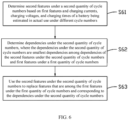
- the replacing least dependent features among the first features with second features determined by using charging currents, charging voltages, and charging times of the battery being estimated in actual use under different cycle numbers includes: S61: Determine second features under a second quantity of cycle numbers based on the first features and the charging currents, charging voltages, and charging times of the battery being estimated in actual use under different cycle numbers.
- the determining second features under a second quantity of cycle numbers based on the first features and the charging currents, charging voltages, and charging times of the battery being estimated in actual use under different cycle numbers includes:
- the calculating charged capacities of the battery being estimated under different cycle numbers based on charging currents in the charging current intervals of the battery being estimated under different cycle numbers and charging times in the charging time intervals of the battery being estimated under different cycle numbers includes calculating the charged capacities of the battery being estimated under different cycle numbers using the Coulomb integration method.
- g4 Calculate capacity increment values based on charging voltages within the charging voltage interval of the battery being estimated and charged capacities corresponding to the charging voltages.
- the calculating capacity increment values based on charging voltages within the charging voltage interval of the battery being estimated under different cycle numbers and charged capacities corresponding to charging voltages is differentiating charging voltages in charging voltage intervals of the battery being estimated under different cycle numbers and charged capacities corresponding to the charging voltages to calculate the capacity increment values.
- g5 Plot capacity increment curves of the battery being estimated under different cycle numbers based on charging voltages in the charging voltage intervals of the battery being estimated under different cycle numbers and the capacity increment values.
- the capacity increment curves of the battery being estimated under different cycle numbers are plotted in the same coordinate system based on charging voltages in the charging voltage intervals of the battery being estimated under different cycle numbers and the capacity increment values.
- the horizontal coordinate of the capacity increment curves of the battery being estimated under different cycle numbers is the charging voltage; the vertical coordinate of the capacity increment curves of the battery being estimated under different cycle numbers is the capacity increment value.
- g6 Determine third features under different cycle numbers based on the first features, the capacity increment curves of the battery being estimated under different cycle numbers and the charging current intervals and charging time intervals of the battery being estimated under different cycle numbers, where the third features include third electrochemical features and third time domain features.
- the third features are of the same types as the first features.
- the first features include activation energy increment, charging time length, peak value, maximum value, mean value, variance, root mean square value, and kurtosis. Then, activation energy increments, charging time lengths, peak values, maximum values, mean values, variances, root mean square values, and kurtoses under different cycle numbers are calculated based on the capacity increment curves of the battery being estimated under different cycle numbers and the charging current intervals and charging time intervals of the battery being estimated under different cycle numbers.
- g7 Select randomly second features under a second preset quantity of cycle numbers from the third features under the cycle numbers.
- the second preset quantity is less than the first preset quantity.
- the method for battery capacity estimation further includes: standardizing the second features under the second quantity of cycle numbers to form second eigenvectors under the second quantity of cycle numbers.
- the determining dependencies under the second quantity of cycle numbers, where the dependencies under the second quantity of cycle numbers are small dependencies among dependencies of the second features under the second quantity of cycle numbers and the first features under the first quantity of cycle numbers includes:
- the first quantity is M and the second quantity is K.
- the dependencies are arranged into a matrix r 11 ⁇ r 1 M ⁇ ⁇ ⁇ r 1 M ⁇ r KM .
- h3 Calculate a total value of each column in the matrix.
- r 11 ...r 1 M is column 1 and r 1 M ... r KM is column K.
- the calculating a total value of each column in the matrix may include, for example, calculating a total value r 1 of column 1, calculating a total value r 2 column 2 , .., and calculating a total value r K of column K.
- h4 Determine the second quantity of smallest values among the total values.
- the determining the second quantity of smallest values among the total values includes:
- the total values sorted are 8, 7.5, 7.3, ..., 5.6, 5.3, 4.9, and the second quantity is 3. Then the second quantity of smallest values are 5.6, 5.3, and 4.9.
- h5 Determine smallest dependencies under the second quantity of cycle numbers based on the second quantity of smallest values.
- the second quantity of smallest values are the total value of column 1, the total value of column 5, and the total value of column 8.
- the smallest dependencies under the second quantity of cycle numbers are a dependency under the 1st cycle number, a dependency under the 5th cycle number, and a dependency under the 8th cycle number among the first quantity of cycle numbers.
- S63 Use the second features under the second quantity of cycle numbers to replace features that are among the first features under the first quantity of cycle numbers and corresponding to the dependencies under the second quantity of cycle numbers.
- the model is trained with the updated first features under the first quantity of cycle numbers to update the initial parameters and thus obtain the model trained, where the updated first features under the first quantity of cycle numbers are input variables of the model, and actual capacities corresponding to the updated first features under the first quantity of cycle numbers are output variables of the model.
- S24 Determine actual features of the battery being estimated based on the charging voltage interval, the charging current interval, the charging time interval, and the training features.
- the determining actual features of the battery being estimated based on the charging voltage interval, the charging current interval, the charging time interval, and the training features includes: S71: Determine a charged capacity of the battery being estimated based on a charging current in the charging current interval and a charging time in the charging time interval.
- the determining a charged capacity of the battery being estimated based on a charging current in the charging current interval and a charging time in the charging time interval includes determining the charged capacity of the battery being estimated using the Coulomb integration method.
- S72 Determine a capacity increment value based on a charging voltage in the charging voltage interval and the charged capacity.
- the determining a capacity increment value based on a charging voltage in the charging voltage interval and the charged capacity is determining the capacity increment value by differentiating charging voltages in the charging voltage interval and charged capacities corresponding to the charging voltages.
- S73 Determine the actual features of the battery being estimated based on a charging current in the charging current interval, a charging voltage in the charging voltage interval, a charging time in the charging time interval, the capacity increment value, and the training features.
- types of the actual features of the battery being estimated are the same as the types of the training features.
- S25 Estimate, based on the model and the actual features, an actual capacity of the battery being estimated.
- the actual features are input to a posterior distribution model of the model trained to output an estimated mean value and an estimated confidence interval of the actual capacity of the battery being estimated.
- both the estimated mean value and estimated confidence interval of the actual capacity of the battery being estimated are output. Therefore, the confidence level of the estimated mean value can be determined, providing more information for the determination of the actual capacity of the battery being estimated.
- the actual capacity of the battery being estimated is estimated based on the data corresponding to the charging voltage interval, the actual features, and the model.
- the capacity of the battery being estimated can be estimated using a model with the use of a small amount of data, reducing the amount of data required and shortening the estimation time.
- to train the model only training features generated from the data of a standard battery under different cycle numbers corresponding to a charging voltage interval need to be used, reducing the amount of training data and shortening the training time.
- the model can be updated as needed during actual use, which can improve the accuracy of estimation of the capacity of the battery being estimated.
- the memory 11 may be an internal memory of the electronic apparatus, that is, a memory built in the electronic apparatus. In other embodiments, the memory 11 may instead be an external memory of the electronic apparatus, that is, a memory externally connected to the electronic apparatus.
- the memory 11 stores program code and various data and completes high-speed and automatic access to the program or data during operation of the electronic apparatus.
- the memory 11 may include a random access memory and may also include a non-volatile memory such as a hard disk, memory, plug-in hard disk, smart media card (Smart Media Card, SMC), secure digital (Secure Digital, SD) card, flash card (Flash Card), or at least one disk memory device, flash memory device, or other volatile solid state memory device.
- a non-volatile memory such as a hard disk, memory, plug-in hard disk, smart media card (Smart Media Card, SMC), secure digital (Secure Digital, SD) card, flash card (Flash Card), or at least one disk memory device, flash memory device, or other volatile solid state memory device.
- the processor 12 may be a central processing unit (Central Processing Unit, CPU) or other general-purpose processor, a digital signal processor (Digital Signal Processor, DSP), an application-specific integrated circuit (Application Specific Integrated Circuit, ASIC), a field-programmable gate array (Field-Programmable Gate Array, FPGA) or other programmable logic device, a discrete gate or transistor logic device, a discrete hardware component, or the like.
- the general-purpose processor may be a microprocessor or any other conventional processor or the like.
- the processor 12 may also be one or more of CPU and MCU (Microcontroller Unit, Microprocessor).
- the processor 12 includes a CPU 121 and an MCU 122.
- the CPU 121 is used to control and process all applications of the electronic apparatus 100.
- the CPU 121 includes at least one MCU 122.
- the MCU 122 is used to process a management program of the battery 13 to achieve management functions, for example, estimation of the capacity of the battery 13.
- the program code and various data in the memory 11 may be stored in a computer-readable storage medium. Based on such an understanding, in this application, all or some of the processes in the method of the above embodiments, for example, the steps in the method for battery capacity estimation, may also be accomplished by a computer program instructing relevant hardware.
- the computer program may be stored in a computer readable storage medium, and the computer program, when executed by the MCU, can implement the steps of the above method embodiments.
- the computer program includes computer program code.
- the computer program code may be in the form of source code, object code, or an executable file or in some intermediate forms or the like.
- the computer-readable medium may include any entity or means capable of carrying the computer program code, a recording medium, a USB flash drive, a removable hard disk, a magnetic disk, an optical disc, a computer memory, a read-only memory (ROM, Read-Only Memory), or the like.
- the memory 11 is one or more of ROM, RAM (Random Access Memory, random access memory), or FLASH (flash memory).
- the memory 11 may include a ROM 111, a RAM 112 and a FLASH 113.
- the ROM 111 may be used to store an algorithm program of the method for battery capacity estimation. Permanent data may also be stored in the ROM 111.
- the permanent data may include important information such as identity, password, and the like.
- the algorithm program and the permanent data share a storage space in the ROM 111.
- the storage space in the ROM 111 is managed in a partitioning manner.
- the RAM 112 may be used for storing functions and variables of the method for battery capacity estimation.
- the FLASH 113 may be used to store the algorithm program, functions and variables of the method for battery capacity estimation.
- module division described above is a logical functional division, and other division manners may be used in actual implementation.
- function modules in the embodiments of this application may be integrated into one processing unit, or each of the modules may exist alone physically, or two or more modules may be integrated into one unit.
- the integrated module may be implemented either in the form of hardware or in the form of hardware plus software function modules.
Landscapes
- Engineering & Computer Science (AREA)
- Physics & Mathematics (AREA)
- General Physics & Mathematics (AREA)
- Manufacturing & Machinery (AREA)
- Chemical & Material Sciences (AREA)
- Chemical Kinetics & Catalysis (AREA)
- Electrochemistry (AREA)
- General Chemical & Material Sciences (AREA)
- Power Engineering (AREA)
- Microelectronics & Electronic Packaging (AREA)
- Secondary Cells (AREA)
- Charge And Discharge Circuits For Batteries Or The Like (AREA)
Abstract
Description
- This application relates to the field of battery technology, and in particular to a method for battery capacity estimation, an electronic apparatus, and a storage medium.
- The accuracy of battery capacity estimation for lithium-ion batteries is high at the early stage of use. However, with the aging of the cells of lithium-ion batteries, the accuracy of battery capacity estimation decreases continuously, which may lead to a jump change in the capacity displayed by an electronic apparatus and may even cause the electronic apparatus to shut down directly when the displayed capacity is 20% to 30%. At present, battery capacity can be estimated by using complete experimental cycling data. Although this method can improve the accuracy of battery capacity estimation, it requires a large amount of data and may take a large amount of time.
- In view of this, it is necessary to provide a method for battery capacity estimation, an electronic apparatus, and a storage medium that can reduce the amount of data required and shorten the estimation time.
- An embodiment of this application provides a method for battery capacity estimation. The method includes: obtaining a charging current, charging voltage, and charging time of a battery being estimated and a charging voltage interval; determining a charging current interval and a charging time interval based on the charging current, the charging voltage, and the charging time, where the charging current interval and the charging time interval correspond to the charging voltage interval; obtaining training features for model training, where the training features include training electrochemical features and training time domain features; determining actual features of the battery being estimated based on the charging voltage interval, the charging current interval, the charging time interval, and the training features, where the actual features include actual electrochemical features and actual time domain features; and estimating, based on the model and the actual features, an actual capacity of the battery being estimated.
- According to some embodiments of this application, the model is a Gaussian process regression model.
- According to some embodiments of this application, a difference between a maximum charging voltage and a minimum charging voltage in the charging voltage interval is less than or equal to 0.1 volts.
- According to some embodiments of this application, the determining actual features of the battery being estimated based on the charging voltage interval, the charging current interval, the charging time interval, and the training features includes:
- determining a charged capacity of the battery being estimated based on a charging current in the charging current interval and a charging time in the charging time interval;
- determining a capacity increment value based on a charging voltage in the charging voltage interval and the charged capacity; and
- determining actual features of the battery being estimated based on a charging current in the charging current interval, a charging voltage in the charging voltage interval, a charging time in the charging time interval, the capacity increment value, and the training features.
- According to some embodiments of this application, prior to the obtaining training features for model training, the method further includes:
- determining total training features under different cycle numbers based on charging currents, charging voltages, and charging times of a standard battery under different cycle numbers and the charging voltage interval, where the total training features include total training electrochemical features and total training time domain features;
- determining first total features under different cycle numbers, where the first total features under different cycle numbers are total training features under different cycle numbers whose linear dependencies on actual capacities of the standard battery under different cycle numbers are greater than a predetermined value; and
- determining the training features based on the first total features under different cycle numbers.
- According to some embodiments of this application, the total training electrochemical features include activation energy increment, throughput, and charging time length; the total training time domain features include peak value, maximum value, mean value, variance, root mean square value, peak factor, kurtosis, kurtosis factor, waveform factor, pulse factor, margin factor, minimum value, and skewness factor.
- According to some embodiments of this application, prior to the determining the training features based on the first total features under different cycle numbers, the method further includes:
- transforming the total training features under different cycle numbers into second total features under different cycle numbers using principal component analysis;
- the determining the training features based on the first total features under different cycle numbers includes:
- determining common features between the first total features under different cycle numbers and the second total features under different cycle numbers as third total features under different cycle numbers; and
- determining the training features for model training to be the third total features.
- According to some embodiments of this application, the method further includes:
- obtaining initial parameters generated in training the model using charging currents, charging voltages, and charging times of a standard battery under different cycle numbers;
- obtaining first features by which the initial parameters are generated, where the first features include first electrochemical features and first time domain features;
- replacing least dependent features among the first features with second features determined by using charging currents, charging voltages, and charging times of the battery being estimated in actual use under different cycle numbers, where the second features include second electrochemical features and second time domain features; and
- updating the initial parameters with the updated first features to obtain the model trained.
- According to some embodiments of this application, the obtaining first features by which the initial parameters are generated includes:
- obtaining first features by which the initial parameters are generated under a first quantity of cycle numbers;
- the replacing least dependent features among the first features with second features determined by using charging currents, charging voltages, and charging times of the battery being estimated in actual use under different cycle numbers includes:
- determining second features under a second quantity of cycle numbers based on the first features and the charging currents, charging voltages, and charging times of the battery being estimated in actual use under different cycle numbers;
- determining dependencies under the second quantity of cycle numbers, where the dependencies under the second quantity of cycle numbers are smallest dependencies among dependencies of the second features under the second quantity of cycle numbers and the first features under the first quantity of cycle numbers; and
- using the second features under the second quantity of cycle numbers to replace features that are among the first features under the first quantity of cycle numbers and corresponding to the dependencies under the second quantity of cycle numbers.
- An embodiment of this application provides an electronic apparatus, where the electronic apparatus includes:
- a battery;
- a processor; and
- a memory, where the memory stores a plurality of program modules, and the plurality of program modules are loaded by the processor to execute the method for battery capacity estimation according to any one of the above.
- An embodiment of this application provides a storage medium having at least one computer instruction stored thereon, where the instruction is loaded by a processor to execute the method for battery capacity estimation according to any one of the above.
- The method for battery capacity estimation, electronic apparatus, and storage medium provided in embodiments of this application reduce the amount of data required and shorten the estimation time by using less data to implement capacity estimation for the battery being estimated via a Gaussian process regression model based on the test electrochemical features and test time domain features generated based on the charging voltage interval of the battery being estimated, the charging current interval corresponding to the charging voltage interval, and the charging time interval corresponding to the charging voltage interval.
-
-
FIG. 1 is a schematic diagram of an electronic apparatus according to an embodiment of this application. -
FIG. 2 is a flowchart of a method for battery capacity estimation according to an embodiment of this application. -
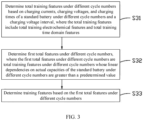
FIG. 3 is a flowchart of determining training features in the method for battery capacity estimation inFIG. 2 . -
FIG. 4 is a curve chart showing linear dependencies of total training features under different cycle numbers on actual capacities of a standard battery under different cycle numbers. -
FIG. 5 is a flowchart of obtaining a trained model by updating initial parameters in the method for battery capacity estimation inFIG. 2 . -
FIG. 6 is a flowchart of replacing least dependent features among first features with second features determined by using charging currents, charging voltages, and charging times of a battery being estimated in actual use under different cycle numbers as inFIG. 5 . -
FIG. 7 is a flowchart of determining actual features of the battery being estimated based on a charging voltage interval, a charging current interval, a charging time interval, and training features as inFIG. 2 . -
Electronic apparatus 100 Memory 11 Processor 12 Battery being estimated 13 Analog-to- digital converter 14 Timer 15 - The following clearly and completely describes technical solutions in some embodiments of this application with reference to the accompanying drawings in some embodiments of this application. Apparently, the described embodiments are only some but not all of the embodiments of this application.
- All other embodiments obtained by persons of ordinary skill in the art based on the embodiments of this application without creative efforts shall fall within the protection scope of this application.
- Referring to
FIG. 1, FIG. 1 is a schematic diagram of an electronic apparatus according to an embodiment of this application. Theelectronic apparatus 100 includes but is not limited to amemory 11, at least oneprocessor 12, abattery 13 being estimated, an analog-to-digital converter 14, and atimer 15. These components may be connected to each other via a bus or connected directly. - It should be noted that
FIG. 1 is only an example for description of theelectronic apparatus 100. In other embodiments, theelectronic apparatus 100 may instead include more or fewer components or have a different configuration of components. Theelectronic apparatus 100 may be an electric motorcycle, an electric bicycle, an electric car, a cell phone, a tablet, a digital assistant, a personal computer, or any other suitable rechargeable device. - In one embodiment, the
battery 13 being estimated is a rechargeable battery for providing electrical power to theelectronic apparatus 100. For example, thebattery 13 being estimated may be a lead-acid battery, a nickel-cadmium battery, a nickel-metal hydride battery, a lithium-ion polymer battery, a lithium polymer battery, and a lithium iron phosphate battery, or the like. Thebattery 13 being estimated is logically connected to theprocessor 12 via a battery management system (BMS), so that functions such as charging and discharging are realized via the battery management system. The battery management system may be connected to a power conversion system (PCS) via CAN or RS485 for communication. Thebattery 13 being estimated includes a cell, and the battery being estimated may be charged repeatedly in a cyclable rechargeable manner. - In this embodiment, the analog-to-
digital converter 14 is configured to measure a charging voltage and a charging current of the cell of thebattery 13 being estimated during a charging process. Thetimer 15 is configured to record a charging time of the cell of thebattery 13 being estimated during a charging process. It can be understood that theelectronic apparatus 100 may also include other apparatuses such as a pressure sensor, a light sensor, a gyroscope, a hygrometer, and an infrared sensor. - Referring to
FIG. 2, FIG. 2 is a flowchart of a method for battery capacity estimation according to an embodiment of this application. The method for battery capacity estimation is applied to a battery being estimated. The method for battery capacity estimation includes the following steps:
S21: Obtain a charging current, charging voltage, and charging time of a battery being estimated and a charging voltage interval. - In this embodiment, the charging current and the charging voltage may be obtained by the analog-to-digital converter. The charging time may be obtained by the timer. The charging current, charging voltage and charging time are a charging current, charging voltage and charging time of the battery being estimated in a constant current charging phase. The charging voltage interval is a value pre-set by a user, and the charging voltage interval is stored in the electronic apparatus. Preferably, the charging voltage interval is [3.85, 3.95] or may be other values, depending on the specific needs. If the charging voltage interval is [3.85, 3.95], a maximum charging voltage is 3.95 volts and a minimum charging voltage is 3.85 volts. In this embodiment, a difference between a maximum charging voltage and a minimum charging voltage in the charging voltage interval is less than or equal to 0.1 volts.
- S22: Determine a charging current interval and a charging time interval based on the charging current, the charging voltage, and the charging time, where the charging current interval and the charging time interval correspond to the charging voltage interval.
- In this embodiment, the voltage of the battery being estimated keeps increasing during the constant current charging phase, so determining a charging current interval and a charging time interval based on the charging current, the charging voltage, and the charging time may be intercepting data of a charging current interval and a charging time interval from the data of the charging current, the charging voltage, and the charging time.
- S23: Obtain training features for model training, where the training features include training electrochemical features and training time domain features.
- The model is a Gaussian process regression model. As shown in
FIG. 3 , prior to the obtaining training features for model training, the method for battery capacity estimation further includes:
S31: Determine total training features under different cycle numbers based on charging currents, charging voltages, and charging times of a standard battery under different cycle numbers and the charging voltage interval, where the total training features include total training electrochemical features and total training time domain features. - The determining total training features under different cycle numbers based on charging currents, charging voltages, and charging times of a standard battery under different cycle numbers and the charging voltage interval includes:
b1: Obtain the charging currents, charging voltages, and charging times of the standard battery under different cycle numbers. - In this embodiment, each cycle number refers to a complete charge and discharge cycle. Preferably, the cycle number is in the interval [20,200] or may be other values, depending on the specific needs.
- The charging currents, charging voltages, and charging times under different cycle numbers of the standard battery may be stored in the electronic apparatus or in an external device. Then, the obtaining charging currents, charging voltages, and charging times of the standard battery under different cycle numbers may be obtaining the charging currents, charging voltages, and charging times of the standard battery under different cycle numbers from within the electronic apparatus, or obtaining the charging currents, charging voltages, and charging times of the standard battery under different cycle numbers from the external device.
- b2: Determine charging current intervals and charging time intervals of the standard battery under different cycle numbers corresponding to the charging voltage interval based on the charging currents, charging voltages, and charging times of the standard battery under different cycle numbers.
- b3: Calculate charged capacities of the standard battery based on charging currents in the charging current intervals of the standard battery and charging times in the charging time intervals of the standard battery.
- In this embodiment, the calculating a charged capacity of the standard battery based on a charging current in the charging current interval of the standard battery and a charging time in the charging time interval of the standard battery includes calculating the charged capacity of the standard battery using a Coulomb integration method.
- b4: Calculate capacity increment values based on charging voltages within the charging voltage interval of the standard battery and charged capacities corresponding to the charging voltages.
- In this embodiment, the calculating capacity increment values based on charging voltages within the charging voltage interval of the standard battery and charged capacities corresponding to the charging voltages is differentiating charging voltages in the charging voltage interval of the standard battery and charged capacities corresponding to the charging voltages to calculate the capacity increment values.
- b5: Plot capacity increment curves of the standard battery under different cycle numbers based on the charging voltages in the charging voltage interval of the standard battery and the capacity increment values.
- In this embodiment, the capacity increment curves of the standard battery under different cycle numbers are plotted in the same coordinate system based on the charging voltages in the charging voltage interval of the standard battery and the capacity increment values. Here, different capacity increment curves represent different cycle numbers. The horizontal coordinate of the capacity increment curves of the standard battery under different cycle numbers is the charging voltage; the vertical coordinate of the capacity increment curves of the standard battery under different cycle numbers is the capacity increment value.
- b6: Determine total training features under different cycle numbers based on the capacity increment curves of the standard battery under different cycle numbers and the charging current intervals and charging time intervals of the standard battery under different cycle numbers.
- In this embodiment, prior to the determining total training features under different cycle numbers based on the capacity increment curves of the standard battery under different cycle numbers and the charging current intervals and charging time intervals of the standard battery under different cycle numbers, the method further includes: performing moving filtering and Gaussian filtering on the capacity increment curves of the standard battery under different cycle numbers.
- The total training electrochemical features include activation energy increment, throughput, and charging time length; the total training time domain features include peak value, maximum value, mean value, variance, root mean square value, peak factor, kurtosis, kurtosis factor, waveform factor, pulse factor, margin factor, minimum value, and skewness factor.
- In this embodiment, activation energy increments under different cycle numbers are determined according to equation

- In this embodiment, throughputs under different cycle numbers are determined according to equation

- In this embodiment, charging time lengths under different cycle numbers are determined according to equation ΔT = TVn - T V1. Here, ΔT represents charging time lengths under different cycle numbers; TVn represents maximum charging times in charging time intervals of the standard battery under different cycle numbers; T V1 represents minimum charging times in charging time intervals of the standard battery under different cycle numbers.
- In this embodiment, peak values under different cycle numbers are determined according to equation Peak = max(|dQ/dV|). Here, Peak represents peak values under different cycle numbers; dQ/dV represents capacity increment values of the standard battery under different cycle numbers.
- In this embodiment, maximum values under different cycle numbers are determined according to equation Max = max(dQ/dV). Here, Max represents maximum values under different cycle numbers; dQ/dV represents capacity increment values of the standard battery under different cycle numbers.
- In this embodiment, mean values under different cycle numbers are determined according to equation

- In this embodiment, variances under different cycle numbers are determined according to equation

- In this embodiment, root mean square values under different cycle numbers are determined according to equation

- In this embodiment, peak factors under different cycle numbers are determined according to equation

- In this embodiment, kurtosis values under different cycle numbers are determined according to equation

- In this embodiment, kurtosis factors under different cycle numbers are determined according to equation

- In this embodiment, waveform factors under different cycle numbers are determined according to equation

- In this embodiment, pulse factors under different cycle numbers are determined according to equation

- In this embodiment, margin factors under different cycle numbers are determined according to equation

- In this embodiment, minimum values under different cycle numbers are determined according to equation Min = min(|dQ/dV|). Here, Min represents minimum values under different cycle numbers; dQ/dV represents capacity increment values of the standard battery under different cycle numbers.
- In this embodiment, skewness factors under different cycle numbers are determined according to equation

- S32: Determine first total features under different cycle numbers, where the first total features under different cycle numbers are total training features under different cycle numbers whose linear dependencies on actual capacities of the standard battery under different cycle numbers are greater than a predetermined value.
- In this embodiment, the actual capacity may be an actual capacity calculated by another system within the electronic apparatus, or may be an actual capacity calculated by another apparatus outside the electronic apparatus, or may be an actual capacity calculated by this method using any method known.
- In this embodiment, linear dependencies of the total training features under different cycle numbers on the actual capacities of the standard battery under different cycle numbers are determined according to equation rk =

X represents a mean value of the k-th feature under all cycle numbers; Yi represents an actual capacity of the k-th feature under the i-th cycle number;Y represents a mean value of actual capacities of the k-th feature under all cycle numbers. - Preferably, the predetermined value may be 0.8 or other values depending on the specific needs.
- As shown in
FIG. 4, FIG. 4 shows linear dependencies of the activation energy increment, throughput, charging time length, peak value, maximum value, mean value, variance, root mean square value, peak factor, kurtosis, kurtosis factor, waveform factor, pulse factor, margin factor, minimum value, and skewness factor. Here, the linear dependencies of the activation energy increment, throughput, charging time length, peak value, maximum value, mean value, variance, root mean square value, kurtosis, and minimum value are greater than 0.8. Then, the first total features under different cycle numbers, that is, the total training features under different cycle numbers with linear dependencies on actual capacities of the standard battery under different cycle numbers greater than the predetermined value, include features of the activation energy increment, throughput, charging time length, peak value, maximum value, mean value, variance, root mean square value, kurtosis, and minimum value under different cycle numbers. - S33: Determine the training features based on the first total features under different cycle numbers.
- In this embodiment, prior to the determining the training features based on the first total features under different cycle numbers, the method for battery capacity estimation further includes:
transforming the total training features under different cycle numbers into second total features under different cycle numbers using principal component analysis (Principal Component Analysis, PCA). - The determining the training features based on the first total features under different cycle numbers includes:
- c1: Determine common features between the first total features under different cycle numbers and the second total features under different cycle numbers as third total features under different cycle numbers.
- c2: Determine the training features for model training to be the third total features.
- In this embodiment, the method for battery capacity estimation further includes:
training the model using the training features. - In this embodiment, prior to the training the model using the training features, the method for battery capacity estimation further includes:
standardizing the training features to form first eigenvectors under different cycle numbers. - The training the model using the training features includes:
- d1: Select randomly first eigenvectors under a first preset quantity of cycles from first eigenvectors under the different cycle numbers.
- d2: Train the model using the first eigenvectors selected to obtain initial parameters of the model, where the first eigenvectors selected are input variables of the model, and actual capacities corresponding to the first eigenvectors selected are output variables of the model.
- Preferably, the first preset quantity may be any value in the interval [15, 20] or other values, depending on the specific needs. Preferably, a covariance function of the model is a linear kernel function K(x,y) = θ 2 xTy or other functions, depending on the specific needs.
- In this embodiment, with a given input y = f(x) + ε,

- Here, ε represents an observed value of interference by noise, which is normally distributed with a mean value of 0 and a variance of

- The set formed by observed values of y obeys a Gaussian distribution, that is, a priori distribution model

- Here, Var(x) is a covariance matrix of n × n, and the (i,j)-th element is a linear kernel function, that is,

- In this embodiment, a stochastic gradient descent method is used to iteratively update the parameter θ in the likelihood function to obtain optimal parameter to train the model. The likelihood function has the following form:

- Here, θ represents parameters of the model; x represents training data; Var(x) represents a n × n covariance matrix; σ represents the variance of noise; I represents a unit matrix; K represents a kernel function; and n represents the number of data in a training set. In this embodiment, if x represents the first eigenvectors selected, θ represents initial parameters of the model.
- According to theorems and priori distribution models obtained, corresponding posterior distribution models can be obtained as f'~g(m(X), K(X)),



- Here, X and x represent different inputs; K represents the kernel function; σ represents the variance of noise; I represents the unit matrix; and y represents the output value.
- As shown in
FIG. 5 , to adjust model parameters, the method for battery capacity estimation further includes:
S51: Obtain initial parameters generated in training the model using charging currents, charging voltages, and charging times of a standard battery under different cycle numbers. - The initial parameters are initial parameters generated in training the model using the first eigenvectors selected.
- S52: Obtain first features by which the initial parameters are generated, where the first features include first electrochemical features and first time domain features.
- S53: Replace least dependent features among the first features with second features determined by using charging currents, charging voltages, and charging times of the battery being estimated in actual use under different cycle numbers, where the second features include second electrochemical features and second time domain features.
- The obtaining first features by which the initial parameters are generated includes: obtaining first features by which the initial parameters are generated under a first quantity of cycle numbers. In this embodiment, the first quantity is the randomly selected first preset quantity. The first features are features with linear dependencies greater than the predetermined value that have gone through principal component analysis. Types of the first features are, for example, the activation energy increment, charging time length, peak value, maximum value, mean value, variance, root mean square value, and kurtosis.
- As shown in
FIG. 6 , the replacing least dependent features among the first features with second features determined by using charging currents, charging voltages, and charging times of the battery being estimated in actual use under different cycle numbers includes:
S61: Determine second features under a second quantity of cycle numbers based on the first features and the charging currents, charging voltages, and charging times of the battery being estimated in actual use under different cycle numbers. - The determining second features under a second quantity of cycle numbers based on the first features and the charging currents, charging voltages, and charging times of the battery being estimated in actual use under different cycle numbers includes:
- g1: Obtain the charging currents, charging voltages, and charging times of the battery being estimated in actual use under different cycle numbers.
- g2: Determine charging current intervals and charging time intervals of the battery being estimated in actual use under different cycle numbers corresponding to the charging voltage interval based on the charging currents, charging voltages, and charging times of the battery being estimated in actual use under different cycle numbers.
- g3: Calculate charged capacities of the battery being estimated under different cycle numbers based on charging currents in the charging current intervals of the battery being estimated under different cycle numbers and charging times in the charging time intervals of the battery being estimated under different cycle numbers.
- In this embodiment, the calculating charged capacities of the battery being estimated under different cycle numbers based on charging currents in the charging current intervals of the battery being estimated under different cycle numbers and charging times in the charging time intervals of the battery being estimated under different cycle numbers includes calculating the charged capacities of the battery being estimated under different cycle numbers using the Coulomb integration method.
- g4: Calculate capacity increment values based on charging voltages within the charging voltage interval of the battery being estimated and charged capacities corresponding to the charging voltages.
- In this embodiment, the calculating capacity increment values based on charging voltages within the charging voltage interval of the battery being estimated under different cycle numbers and charged capacities corresponding to charging voltages is differentiating charging voltages in charging voltage intervals of the battery being estimated under different cycle numbers and charged capacities corresponding to the charging voltages to calculate the capacity increment values.
- g5: Plot capacity increment curves of the battery being estimated under different cycle numbers based on charging voltages in the charging voltage intervals of the battery being estimated under different cycle numbers and the capacity increment values.
- In this embodiment, the capacity increment curves of the battery being estimated under different cycle numbers are plotted in the same coordinate system based on charging voltages in the charging voltage intervals of the battery being estimated under different cycle numbers and the capacity increment values. The horizontal coordinate of the capacity increment curves of the battery being estimated under different cycle numbers is the charging voltage; the vertical coordinate of the capacity increment curves of the battery being estimated under different cycle numbers is the capacity increment value.
- g6: Determine third features under different cycle numbers based on the first features, the capacity increment curves of the battery being estimated under different cycle numbers and the charging current intervals and charging time intervals of the battery being estimated under different cycle numbers, where the third features include third electrochemical features and third time domain features.
- In this embodiment, the third features are of the same types as the first features. For example, the first features include activation energy increment, charging time length, peak value, maximum value, mean value, variance, root mean square value, and kurtosis. Then, activation energy increments, charging time lengths, peak values, maximum values, mean values, variances, root mean square values, and kurtoses under different cycle numbers are calculated based on the capacity increment curves of the battery being estimated under different cycle numbers and the charging current intervals and charging time intervals of the battery being estimated under different cycle numbers.
- g7: Select randomly second features under a second preset quantity of cycle numbers from the third features under the cycle numbers.
- In this embodiment, the second preset quantity is less than the first preset quantity.
- S62: Determine dependencies under the second quantity of cycle numbers, where the dependencies under the second quantity of cycle numbers are smallest dependencies among dependencies of the second features under the second quantity of cycle numbers and the first features under the first quantity of cycle numbers.
- In this embodiment, prior to the determining dependencies under the second quantity of cycle numbers, where the dependencies under the second quantity of cycle numbers are smallest dependencies among dependencies of the second features under the second quantity of cycle numbers and the first features under the first quantity of cycle numbers, the method for battery capacity estimation further includes:
standardizing the second features under the second quantity of cycle numbers to form second eigenvectors under the second quantity of cycle numbers. - In this embodiment, the determining dependencies under the second quantity of cycle numbers, where the dependencies under the second quantity of cycle numbers are small dependencies among dependencies of the second features under the second quantity of cycle numbers and the first features under the first quantity of cycle numbers includes:
- h1: Determine the dependencies of the second eigenvectors under each cycle number and the first eigenvectors under each cycle number according to equation

p represents a mean value of the i-th second eigenvector under all cycle numbers. Qi represents value of the i-th first eigenvector under the b-th cycle number.Q represents a mean value of the i-th first eigenvector under all cycle numbers. - h2: Arrange the dependencies into a matrix with the second quantity of rows and the first quantity of columns.
- For example, the first quantity is M and the second quantity is K. Then, the dependencies are arranged into a
matrix 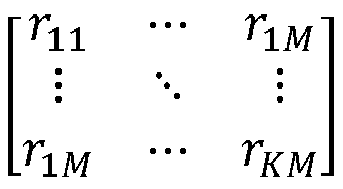
- h3: Calculate a total value of each column in the matrix.
- In this embodiment, r 11 ...r 1M is column 1 and r 1M ...rKM is column K. The calculating a total value of each column in the matrix may include, for example, calculating a total value r 1 of column 1, calculating a total value r 2 column 2 , .., and calculating a total value rK of column K. The calculating a total value r 1 of column 1 may be, for example, calculating the total value r 1 of column 1 according to equation r 1 = r 11+r 12 + ... +r 1M , where r 1 is the total value of column 1, r 11 is a dependency at row 1 column 1, r 12 is a dependency at row 2 column 1, and r 1M is a dependency at row M column 1.
- h4: Determine the second quantity of smallest values among the total values.
- The determining the second quantity of smallest values among the total values includes:
- I1: Sort the total values in a preset order, where the preset order includes an ascending or a descending order.
- I2: Determine the second quantity of smallest values among the total values based on the total values sorted.
- For example, the total values sorted are 8, 7.5, 7.3, ..., 5.6, 5.3, 4.9, and the second quantity is 3. Then the second quantity of smallest values are 5.6, 5.3, and 4.9.
- h5: Determine smallest dependencies under the second quantity of cycle numbers based on the second quantity of smallest values.
- For example, the second quantity of smallest values are the total value of column 1, the total value of column 5, and the total value of column 8. Then the smallest dependencies under the second quantity of cycle numbers are a dependency under the 1st cycle number, a dependency under the 5th cycle number, and a dependency under the 8th cycle number among the first quantity of cycle numbers.
- S63: Use the second features under the second quantity of cycle numbers to replace features that are among the first features under the first quantity of cycle numbers and corresponding to the dependencies under the second quantity of cycle numbers.
- S54: Update the initial parameters with the updated first features to obtain the model trained.
- In this embodiment, the model is trained with the updated first features under the first quantity of cycle numbers to update the initial parameters and thus obtain the model trained, where the updated first features under the first quantity of cycle numbers are input variables of the model, and actual capacities corresponding to the updated first features under the first quantity of cycle numbers are output variables of the model. S24: Determine actual features of the battery being estimated based on the charging voltage interval, the charging current interval, the charging time interval, and the training features.
- As shown in
FIG. 7 , the determining actual features of the battery being estimated based on the charging voltage interval, the charging current interval, the charging time interval, and the training features includes:
S71: Determine a charged capacity of the battery being estimated based on a charging current in the charging current interval and a charging time in the charging time interval. - In this embodiment, the determining a charged capacity of the battery being estimated based on a charging current in the charging current interval and a charging time in the charging time interval includes determining the charged capacity of the battery being estimated using the Coulomb integration method.
- S72: Determine a capacity increment value based on a charging voltage in the charging voltage interval and the charged capacity.
- In this embodiment, the determining a capacity increment value based on a charging voltage in the charging voltage interval and the charged capacity is determining the capacity increment value by differentiating charging voltages in the charging voltage interval and charged capacities corresponding to the charging voltages.
- S73: Determine the actual features of the battery being estimated based on a charging current in the charging current interval, a charging voltage in the charging voltage interval, a charging time in the charging time interval, the capacity increment value, and the training features.
- In this embodiment, types of the actual features of the battery being estimated are the same as the types of the training features.
- S25: Estimate, based on the model and the actual features, an actual capacity of the battery being estimated.
- In this embodiment, the actual features are input to a posterior distribution model of the model trained to output an estimated mean value and an estimated confidence interval of the actual capacity of the battery being estimated. In this application, both the estimated mean value and estimated confidence interval of the actual capacity of the battery being estimated are output. Therefore, the confidence level of the estimated mean value can be determined, providing more information for the determination of the actual capacity of the battery being estimated.
- According to this application, the actual capacity of the battery being estimated is estimated based on the data corresponding to the charging voltage interval, the actual features, and the model. Thus, the capacity of the battery being estimated can be estimated using a model with the use of a small amount of data, reducing the amount of data required and shortening the estimation time. Besides, to train the model, only training features generated from the data of a standard battery under different cycle numbers corresponding to a charging voltage interval need to be used, reducing the amount of training data and shortening the training time. In addition, the model can be updated as needed during actual use, which can improve the accuracy of estimation of the capacity of the battery being estimated.
- Referring still to
FIG. 1 , in this embodiment, thememory 11 may be an internal memory of the electronic apparatus, that is, a memory built in the electronic apparatus. In other embodiments, thememory 11 may instead be an external memory of the electronic apparatus, that is, a memory externally connected to the electronic apparatus. - In some embodiments, the
memory 11 stores program code and various data and completes high-speed and automatic access to the program or data during operation of the electronic apparatus. - The
memory 11 may include a random access memory and may also include a non-volatile memory such as a hard disk, memory, plug-in hard disk, smart media card (Smart Media Card, SMC), secure digital (Secure Digital, SD) card, flash card (Flash Card), or at least one disk memory device, flash memory device, or other volatile solid state memory device. - In one embodiment, the
processor 12 may be a central processing unit (Central Processing Unit, CPU) or other general-purpose processor, a digital signal processor (Digital Signal Processor, DSP), an application-specific integrated circuit (Application Specific Integrated Circuit, ASIC), a field-programmable gate array (Field-Programmable Gate Array, FPGA) or other programmable logic device, a discrete gate or transistor logic device, a discrete hardware component, or the like. The general-purpose processor may be a microprocessor or any other conventional processor or the like. In an embodiment, theprocessor 12 may also be one or more of CPU and MCU (Microcontroller Unit, Microprocessor). In this embodiment, theprocessor 12 includes aCPU 121 and an MCU 122. TheCPU 121 is used to control and process all applications of theelectronic apparatus 100. TheCPU 121 includes at least one MCU 122. The MCU 122 is used to process a management program of thebattery 13 to achieve management functions, for example, estimation of the capacity of thebattery 13. - When realized in form of a software functional unit and sold or used as a separate product, the program code and various data in the
memory 11 may be stored in a computer-readable storage medium. Based on such an understanding, in this application, all or some of the processes in the method of the above embodiments, for example, the steps in the method for battery capacity estimation, may also be accomplished by a computer program instructing relevant hardware. The computer program may be stored in a computer readable storage medium, and the computer program, when executed by the MCU, can implement the steps of the above method embodiments. The computer program includes computer program code. The computer program code may be in the form of source code, object code, or an executable file or in some intermediate forms or the like. The computer-readable medium may include any entity or means capable of carrying the computer program code, a recording medium, a USB flash drive, a removable hard disk, a magnetic disk, an optical disc, a computer memory, a read-only memory (ROM, Read-Only Memory), or the like. In an embodiment, thememory 11 is one or more of ROM, RAM (Random Access Memory, random access memory), or FLASH (flash memory). In this embodiment, thememory 11 may include aROM 111, aRAM 112 and aFLASH 113. TheROM 111 may be used to store an algorithm program of the method for battery capacity estimation. Permanent data may also be stored in theROM 111. The permanent data may include important information such as identity, password, and the like. The algorithm program and the permanent data share a storage space in theROM 111. The storage space in theROM 111 is managed in a partitioning manner. TheRAM 112 may be used for storing functions and variables of the method for battery capacity estimation. TheFLASH 113 may be used to store the algorithm program, functions and variables of the method for battery capacity estimation. - It can be understood that the module division described above is a logical functional division, and other division manners may be used in actual implementation. In addition, function modules in the embodiments of this application may be integrated into one processing unit, or each of the modules may exist alone physically, or two or more modules may be integrated into one unit. The integrated module may be implemented either in the form of hardware or in the form of hardware plus software function modules.
- It is apparent to those skilled in the art that this application is not limited to the details of the above illustrative embodiments and that this application can be implemented in other specific forms without departing from the spirit or essential features of this application. Therefore, from whatever point of view, the above embodiments of this application should be regarded as illustrative and non-limiting, and the scope of this application is defined by the appended claims but not the above descriptions, and thus all variations falling within the meaning and scope of equivalent elements of the claims of this application are intended to be incorporated into this application.
- It is apparent to those skilled in the art that this application is not limited to the details of the above illustrative embodiments and that this application can be implemented in other specific forms without departing from the spirit or essential features of this application. Therefore, from whatever point of view, the above embodiments of this application should be regarded as illustrative and non-limiting, and the scope of this application is defined by the appended claims but not the above descriptions, and thus all variations falling within the meaning and scope of equivalent elements of the claims of this application are intended to be incorporated into this application.
Claims (12)
- A method for battery capacity estimation, wherein the method comprises:obtaining a charging current, charging voltage, and charging time of a battery being estimated and a charging voltage interval;determining a charging current interval and a charging time interval based on the charging current, the charging voltage, and the charging time, wherein the charging current interval and the charging time interval correspond to the charging voltage interval;obtaining training features for model training, wherein the training features comprise training electrochemical features and training time domain features;determining actual features of the battery being estimated based on the charging voltage interval, the charging current interval, the charging time interval, and the training features, wherein the actual features comprise actual electrochemical features and actual time domain features; andestimating, based on the model and the actual features, an actual capacity of the battery being estimated.
- The method for battery capacity estimation according to claim 1, wherein the model is a Gaussian process regression model.
- The method for battery capacity estimation according to claim 1, wherein a difference between a maximum charging voltage and a minimum charging voltage in the charging voltage interval is less than or equal to 0.1 volts.
- The method for battery capacity estimation according to claim 1, wherein the determining actual features of the battery being estimated based on the charging voltage interval, the charging current interval, the charging time interval, and the training features comprises:determining a charged capacity of the battery being estimated based on a charging current in the charging current interval and a charging time in the charging time interval;determining a capacity increment value based on a charging voltage in the charging voltage interval and the charged capacity; anddetermining actual features of the battery being estimated based on a charging current in the charging current interval, a charging voltage in the charging voltage interval, a charging time in the charging time interval, the capacity increment value, and the training features.
- The method of battery capacity estimation according to claim 1, wherein prior to the obtaining training features for model training, the method further comprises:determining total training features under different cycle numbers based on charging currents, charging voltages, and charging times of a standard battery under different cycle numbers and the charging voltage interval, wherein the total training features comprise total training electrochemical features and total training time domain features;determining first total features under different cycle numbers, wherein the first total features under different cycle numbers are total training features under different cycle numbers whose linear dependencies on actual capacities of the standard battery under different cycle numbers are greater than a predetermined value; anddetermining the training features based on the first total features under different cycle numbers.
- The method of battery capacity estimation according to claim 5, wherein the total training electrochemical features comprise activation energy increment, throughput, and charging time length; the total training time domain features comprise peak value, maximum value, mean value, variance, root mean square value, peak factor, kurtosis, kurtosis factor, waveform factor, pulse factor, margin factor, minimum value, and skewness factor.
- The method of battery capacity estimation according to claim 5, wherein prior to the determining the training features based on the first total features under different cycle numbers, the method further comprises:transforming the total training features under different cycle numbers into second total features under different cycle numbers using principal component analysis; andthe determining the training features based on the first total features under different cycle numbers comprises:determining common features between the first total features under different cycle numbers and the second total features under different cycle numbers as third total features under different cycle numbers; anddetermining the training features for model training to be the third total features.
- The method for battery capacity estimation according to claim 1, wherein the method further comprises:obtaining initial parameters generated in training the model using charging currents, charging voltages, and charging times of a standard battery under different cycle numbers;obtaining first features by which the initial parameters are generated, wherein the first features comprise first electrochemical features and first time domain features;replacing least dependent features among the first features with second features determined by using charging currents, charging voltages, and charging times of the battery being estimated in actual use under different cycle numbers, wherein the second features comprise second electrochemical features and second time domain features; andupdating the initial parameters with the updated first features to obtain the model trained.
- The method for battery capacity estimation according to claim 8, wherein:
the obtaining the first features by which the initial parameters are generated comprises:obtaining first features by which the initial parameters are generated under a first quantity of cycle numbers;the replacing least dependent features among the first features with second features determined by using charging currents, charging voltages, and charging times of the battery being estimated in actual use under different cycle numbers comprises:determining second features under a second quantity of cycle numbers based on the first features and the charging currents, charging voltages, and charging times of the battery being estimated in actual use under different cycle numbers;determining dependencies under the second quantity of cycle numbers, wherein the dependencies under the second quantity of cycle numbers are smallest dependencies among dependencies of the second features under the second quantity of cycle numbers and the first features under the first quantity of cycle numbers; andusing the second features under the second quantity of cycle numbers to replace features that are among the first features under the first quantity of cycle numbers and corresponding to the dependencies under the second quantity of cycle numbers. - An electronic apparatus, wherein the electronic apparatus comprises:a battery;a processor; anda memory, wherein the memory stores a plurality of program modules, and the plurality of program modules are loaded by the processor to execute the method for battery capacity estimation according to any one of claims 1 to 9.
- The electronic apparatus according to claim 10, wherein:the battery is a lithium-ion polymer battery;the processor is one or more of CPU and MCU;the memory is one or more of ROM, RAM, and FLASH.
- A storage medium, having at least one computer instruction stored thereon, wherein the instruction is loaded by a processor to execute the method for battery capacity estimation according to any one of claims 1 to 9.
Applications Claiming Priority (1)
| Application Number | Priority Date | Filing Date | Title |
|---|---|---|---|
| PCT/CN2020/132355 WO2022110045A1 (en) | 2020-11-27 | 2020-11-27 | Battery capacity estimation method, electronic apparatus and storage medium |
Publications (4)
| Publication Number | Publication Date |
|---|---|
| EP4253974A1 true EP4253974A1 (en) | 2023-10-04 |
| EP4253974A4 EP4253974A4 (en) | 2024-02-21 |
| EP4253974C0 EP4253974C0 (en) | 2026-03-18 |
| EP4253974B1 EP4253974B1 (en) | 2026-03-18 |
Family
ID=78648202
Family Applications (1)
| Application Number | Title | Priority Date | Filing Date |
|---|---|---|---|
| EP20962935.1A Active EP4253974B1 (en) | 2020-11-27 | 2020-11-27 | Battery capacity estimation method, electronic apparatus and storage medium |
Country Status (4)
| Country | Link |
|---|---|
| US (1) | US12411177B2 (en) |
| EP (1) | EP4253974B1 (en) |
| CN (1) | CN113711458B (en) |
| WO (1) | WO2022110045A1 (en) |
Cited By (1)
| Publication number | Priority date | Publication date | Assignee | Title |
|---|---|---|---|---|
| TWI913106B (en) * | 2025-02-06 | 2026-01-21 | 儲盈科技股份有限公司 | Method for detecting outlier battery cell groups in real-time energy storage systems |
Families Citing this family (7)
| Publication number | Priority date | Publication date | Assignee | Title |
|---|---|---|---|---|
| WO2021226797A1 (en) * | 2020-05-11 | 2021-11-18 | 东莞新能德科技有限公司 | Battery capacity estimation method, electronic device and storage medium |
| US11888340B2 (en) * | 2020-12-04 | 2024-01-30 | Schneider Electric It Corporation | Method to enhance the life of a lithium battery |
| KR102929634B1 (en) * | 2020-12-24 | 2026-02-23 | 주식회사 엘지에너지솔루션 | Battery management apparatus and method of the same |
| CN115114843A (en) * | 2022-04-24 | 2022-09-27 | 腾讯科技(深圳)有限公司 | Battery capacity prediction method, related device, equipment and storage medium |
| CN114740366A (en) * | 2022-05-07 | 2022-07-12 | 东软睿驰汽车技术(沈阳)有限公司 | Method and device for determining SOC (state of charge) of battery cell in battery pack |
| CN119064783A (en) * | 2023-05-30 | 2024-12-03 | 厦门稀土材料研究所 | A data-driven method for predicting energy storage battery capacity |
| CN117129880B (en) * | 2023-10-26 | 2024-02-09 | 通号通信信息集团有限公司 | A method for estimating available capacity and assessing health status of lead-acid batteries |
Family Cites Families (11)
| Publication number | Priority date | Publication date | Assignee | Title |
|---|---|---|---|---|
| CN104656021B (en) * | 2013-11-19 | 2018-05-01 | 维谛技术有限公司 | The predictor method and device of a kind of remaining battery capacity |
| CN103778280B (en) * | 2014-01-08 | 2016-07-06 | 上海交通大学 | There is the lithium ion battery residual life Forecasting Methodology of model active more New Policy |
| KR102241683B1 (en) * | 2014-07-30 | 2021-04-19 | 삼성전자주식회사 | Method and apparatus for estimating state of battery |
| KR101982120B1 (en) * | 2018-08-31 | 2019-05-24 | 주식회사 민테크 | Method for estimating state of health of energy storage device |
| CN109031153B (en) | 2018-10-16 | 2020-01-24 | 北京交通大学 | Online health state estimation method for lithium ion battery |
| CN110146822B (en) * | 2019-04-25 | 2020-07-28 | 同济大学 | Vehicle power battery capacity online estimation method based on constant-current charging process |
| CN110398697B (en) * | 2019-07-23 | 2021-06-25 | 北京工业大学 | A Lithium Ion State-of-Health Estimation Method Based on Charging Process |
| CN110320473B (en) * | 2019-07-26 | 2021-05-11 | 上海理工大学 | A capacity estimation method for automotive lithium battery based on Kalman filter and fuzzy logic |
| CN110703112A (en) | 2019-10-14 | 2020-01-17 | 重庆大学 | An online estimation method of battery pack state based on local charging data |
| CN111103544B (en) * | 2019-12-26 | 2021-12-21 | 江苏大学 | Lithium ion battery remaining service life prediction method based on long-time and short-time memory LSTM and particle filter PF |
| CN111579993B (en) * | 2020-05-21 | 2021-05-28 | 北京航空航天大学 | An online estimation method of lithium battery capacity based on convolutional neural network |
-
2020
- 2020-11-27 CN CN202080025619.1A patent/CN113711458B/en active Active
- 2020-11-27 WO PCT/CN2020/132355 patent/WO2022110045A1/en not_active Ceased
- 2020-11-27 EP EP20962935.1A patent/EP4253974B1/en active Active
-
2023
- 2023-05-30 US US18/325,333 patent/US12411177B2/en active Active
Cited By (1)
| Publication number | Priority date | Publication date | Assignee | Title |
|---|---|---|---|---|
| TWI913106B (en) * | 2025-02-06 | 2026-01-21 | 儲盈科技股份有限公司 | Method for detecting outlier battery cell groups in real-time energy storage systems |
Also Published As
| Publication number | Publication date |
|---|---|
| CN113711458B (en) | 2025-04-29 |
| US12411177B2 (en) | 2025-09-09 |
| EP4253974A4 (en) | 2024-02-21 |
| WO2022110045A1 (en) | 2022-06-02 |
| EP4253974C0 (en) | 2026-03-18 |
| CN113711458A (en) | 2021-11-26 |
| US20230305069A1 (en) | 2023-09-28 |
| EP4253974B1 (en) | 2026-03-18 |
Similar Documents
| Publication | Publication Date | Title |
|---|---|---|
| US12411177B2 (en) | Method for battery capacity estimation, electronic apparatus, and storage medium | |
| Tao et al. | Data-based health indicator extraction for battery SOH estimation via deep learning | |
| Huang et al. | A model-based state-of-charge estimation method for series-connected lithium-ion battery pack considering fast-varying cell temperature | |
| CN114072684A (en) | Characterization of rechargeable batteries on the server side | |
| CN109991554B (en) | Battery electric quantity detection method and device and terminal equipment | |
| KR102343967B1 (en) | Method and apparatus for estimating state of battery | |
| KR101402802B1 (en) | Cell balancing apparatus and method using voltage change behavior of battery cell | |
| US20210173012A1 (en) | Method and system for estimation of open circuit voltage of a battery cell | |
| CN112622693A (en) | Battery management method and device and vehicle | |
| CN111812515A (en) | Estimation of state of charge of lithium-ion battery based on XGboost model | |
| US12438384B2 (en) | Cell stabilizing method and system of energy storage system (ESS) | |
| KR20100019256A (en) | Apparatus and method for cell balancing based on battery's voltage variation pattern | |
| CN104607395A (en) | lithium ion battery sorting method | |
| CN114415041B (en) | Battery remaining capacity estimation method, device and terminal equipment | |
| Li et al. | Bandwidth based electrical-analogue battery modeling for battery modules | |
| KR20230028017A (en) | A model-based state-of-charge estimation device for lithium-ion batteries that is robust to time-varying load current situations and method thereof | |
| CN115270454A (en) | Battery life prediction method and related equipment | |
| CN113300016A (en) | Battery charging and discharging control method and device | |
| Sepasi et al. | SOC estimation for aged lithium-ion batteries using model adaptive extended Kalman filter | |
| Ngo et al. | State-of-charge estimation of lithium-ion battery integrated in electrical vehicle using a long short-term memory network | |
| EP4270714A1 (en) | Charging method, electronic device, and storage medium | |
| Li et al. | Exploring the hysteresis effect of Li-ion batteries: a machine learning based approach | |
| Marušić et al. | Efficient method of identifying a Li-ion battery model for an electric vehicle | |
| EP4550618A1 (en) | Method and device for controlling battery charging | |
| Tong et al. | Comprehensive battery equivalent circuit based model for battery management application |
Legal Events
| Date | Code | Title | Description |
|---|---|---|---|
| STAA | Information on the status of an ep patent application or granted ep patent |
Free format text: STATUS: THE INTERNATIONAL PUBLICATION HAS BEEN MADE |
|
| PUAI | Public reference made under article 153(3) epc to a published international application that has entered the european phase |
Free format text: ORIGINAL CODE: 0009012 |
|
| STAA | Information on the status of an ep patent application or granted ep patent |
Free format text: STATUS: REQUEST FOR EXAMINATION WAS MADE |
|
| 17P | Request for examination filed |
Effective date: 20230627 |
|
| AK | Designated contracting states |
Kind code of ref document: A1 Designated state(s): AL AT BE BG CH CY CZ DE DK EE ES FI FR GB GR HR HU IE IS IT LI LT LU LV MC MK MT NL NO PL PT RO RS SE SI SK SM TR |
|
| A4 | Supplementary search report drawn up and despatched |
Effective date: 20240118 |
|
| RIC1 | Information provided on ipc code assigned before grant |
Ipc: G01R 31/388 20190101ALI20240112BHEP Ipc: G01R 31/3842 20190101ALI20240112BHEP Ipc: G01R 31/387 20190101ALI20240112BHEP Ipc: G01R 31/382 20190101AFI20240112BHEP |
|
| DAV | Request for validation of the european patent (deleted) | ||
| DAX | Request for extension of the european patent (deleted) | ||
| REG | Reference to a national code |
Ref country code: DE Ref legal event code: R079 Ref document number: 602020069047 Country of ref document: DE Free format text: PREVIOUS MAIN CLASS: G01R0031382000 Ipc: H02J0007000000 |
|
| GRAP | Despatch of communication of intention to grant a patent |
Free format text: ORIGINAL CODE: EPIDOSNIGR1 |
|
| STAA | Information on the status of an ep patent application or granted ep patent |
Free format text: STATUS: GRANT OF PATENT IS INTENDED |
|
| RIC1 | Information provided on ipc code assigned before grant |
Ipc: H02J 7/00 20060101AFI20251006BHEP Ipc: G01R 31/3842 20190101ALI20251006BHEP Ipc: G01R 31/388 20190101ALI20251006BHEP |
|
| INTG | Intention to grant announced |
Effective date: 20251021 |
|
| GRAS | Grant fee paid |
Free format text: ORIGINAL CODE: EPIDOSNIGR3 |
|
| GRAA | (expected) grant |
Free format text: ORIGINAL CODE: 0009210 |
|
| STAA | Information on the status of an ep patent application or granted ep patent |
Free format text: STATUS: THE PATENT HAS BEEN GRANTED |
|
| AK | Designated contracting states |
Kind code of ref document: B1 Designated state(s): AL AT BE BG CH CY CZ DE DK EE ES FI FR GB GR HR HU IE IS IT LI LT LU LV MC MK MT NL NO PL PT RO RS SE SI SK SM TR |
|
| REG | Reference to a national code |
Ref country code: CH Ref legal event code: F10 Free format text: ST27 STATUS EVENT CODE: U-0-0-F10-F00 (AS PROVIDED BY THE NATIONAL OFFICE) Effective date: 20260318 Ref country code: GB Ref legal event code: FG4D |
|
| REG | Reference to a national code |
Ref country code: IE Ref legal event code: FG4D |
|
| REG | Reference to a national code |
Ref country code: DE Ref legal event code: R096 Ref document number: 602020069047 Country of ref document: DE |