EP4253783A1 - Meshing clutch mechanism and two-speed transmission - Google Patents
Meshing clutch mechanism and two-speed transmission Download PDFInfo
- Publication number
- EP4253783A1 EP4253783A1 EP21897684.3A EP21897684A EP4253783A1 EP 4253783 A1 EP4253783 A1 EP 4253783A1 EP 21897684 A EP21897684 A EP 21897684A EP 4253783 A1 EP4253783 A1 EP 4253783A1
- Authority
- EP
- European Patent Office
- Prior art keywords
- meshing
- gear
- clutch
- cam
- clutch mechanism
- Prior art date
- Legal status (The legal status is an assumption and is not a legal conclusion. Google has not performed a legal analysis and makes no representation as to the accuracy of the status listed.)
- Withdrawn
Links
Images




Classifications
-
- F—MECHANICAL ENGINEERING; LIGHTING; HEATING; WEAPONS; BLASTING
- F16—ENGINEERING ELEMENTS AND UNITS; GENERAL MEASURES FOR PRODUCING AND MAINTAINING EFFECTIVE FUNCTIONING OF MACHINES OR INSTALLATIONS; THERMAL INSULATION IN GENERAL
- F16D—COUPLINGS FOR TRANSMITTING ROTATION; CLUTCHES; BRAKES
- F16D23/00—Details of mechanically-actuated clutches not specific for one distinct type
- F16D23/12—Mechanical clutch-actuating mechanisms arranged outside the clutch as such
- F16D23/14—Clutch-actuating sleeves or bearings; Actuating members directly connected to clutch-actuating sleeves or bearings
-
- F—MECHANICAL ENGINEERING; LIGHTING; HEATING; WEAPONS; BLASTING
- F16—ENGINEERING ELEMENTS AND UNITS; GENERAL MEASURES FOR PRODUCING AND MAINTAINING EFFECTIVE FUNCTIONING OF MACHINES OR INSTALLATIONS; THERMAL INSULATION IN GENERAL
- F16D—COUPLINGS FOR TRANSMITTING ROTATION; CLUTCHES; BRAKES
- F16D11/00—Clutches in which the members have interengaging parts
- F16D11/14—Clutches in which the members have interengaging parts with clutching members movable only axially
-
- F—MECHANICAL ENGINEERING; LIGHTING; HEATING; WEAPONS; BLASTING
- F16—ENGINEERING ELEMENTS AND UNITS; GENERAL MEASURES FOR PRODUCING AND MAINTAINING EFFECTIVE FUNCTIONING OF MACHINES OR INSTALLATIONS; THERMAL INSULATION IN GENERAL
- F16D—COUPLINGS FOR TRANSMITTING ROTATION; CLUTCHES; BRAKES
- F16D13/00—Friction clutches
- F16D13/22—Friction clutches with axially-movable clutching members
- F16D13/38—Friction clutches with axially-movable clutching members with flat clutching surfaces, e.g. discs
-
- F—MECHANICAL ENGINEERING; LIGHTING; HEATING; WEAPONS; BLASTING
- F16—ENGINEERING ELEMENTS AND UNITS; GENERAL MEASURES FOR PRODUCING AND MAINTAINING EFFECTIVE FUNCTIONING OF MACHINES OR INSTALLATIONS; THERMAL INSULATION IN GENERAL
- F16H—GEARING
- F16H3/00—Toothed gearings for conveying rotary motion with variable gear ratio or for reversing rotary motion
- F16H3/44—Toothed gearings for conveying rotary motion with variable gear ratio or for reversing rotary motion using gears having orbital motion
- F16H3/46—Gearings having only two central gears, connected by orbital gears
-
- F—MECHANICAL ENGINEERING; LIGHTING; HEATING; WEAPONS; BLASTING
- F16—ENGINEERING ELEMENTS AND UNITS; GENERAL MEASURES FOR PRODUCING AND MAINTAINING EFFECTIVE FUNCTIONING OF MACHINES OR INSTALLATIONS; THERMAL INSULATION IN GENERAL
- F16H—GEARING
- F16H3/00—Toothed gearings for conveying rotary motion with variable gear ratio or for reversing rotary motion
- F16H3/44—Toothed gearings for conveying rotary motion with variable gear ratio or for reversing rotary motion using gears having orbital motion
- F16H3/62—Gearings having three or more central gears
- F16H3/64—Gearings having three or more central gears composed of a number of gear trains, the drive always passing through all the trains, each train having not more than one connection for driving another train
-
- B—PERFORMING OPERATIONS; TRANSPORTING
- B60—VEHICLES IN GENERAL
- B60K—ARRANGEMENT OR MOUNTING OF PROPULSION UNITS OR OF TRANSMISSIONS IN VEHICLES; ARRANGEMENT OR MOUNTING OF PLURAL DIVERSE PRIME-MOVERS IN VEHICLES; AUXILIARY DRIVES FOR VEHICLES; INSTRUMENTATION OR DASHBOARDS FOR VEHICLES; ARRANGEMENTS IN CONNECTION WITH COOLING, AIR INTAKE, GAS EXHAUST OR FUEL SUPPLY OF PROPULSION UNITS IN VEHICLES
- B60K1/00—Arrangement or mounting of electrical propulsion units
- B60K2001/001—Arrangement or mounting of electrical propulsion units one motor mounted on a propulsion axle for rotating right and left wheels of this axle
-
- B—PERFORMING OPERATIONS; TRANSPORTING
- B60—VEHICLES IN GENERAL
- B60Y—INDEXING SCHEME RELATING TO ASPECTS CROSS-CUTTING VEHICLE TECHNOLOGY
- B60Y2200/00—Type of vehicle
- B60Y2200/90—Vehicles comprising electric prime movers
- B60Y2200/91—Electric vehicles
-
- B—PERFORMING OPERATIONS; TRANSPORTING
- B60—VEHICLES IN GENERAL
- B60Y—INDEXING SCHEME RELATING TO ASPECTS CROSS-CUTTING VEHICLE TECHNOLOGY
- B60Y2400/00—Special features of vehicle units
- B60Y2400/40—Actuators for moving a controlled member
- B60Y2400/405—Electric motors actuators
-
- B—PERFORMING OPERATIONS; TRANSPORTING
- B60—VEHICLES IN GENERAL
- B60Y—INDEXING SCHEME RELATING TO ASPECTS CROSS-CUTTING VEHICLE TECHNOLOGY
- B60Y2400/00—Special features of vehicle units
- B60Y2400/42—Clutches or brakes
- B60Y2400/424—Friction clutches
- B60Y2400/4244—Friction clutches of wet type, e.g. using multiple lamellae
-
- F—MECHANICAL ENGINEERING; LIGHTING; HEATING; WEAPONS; BLASTING
- F16—ENGINEERING ELEMENTS AND UNITS; GENERAL MEASURES FOR PRODUCING AND MAINTAINING EFFECTIVE FUNCTIONING OF MACHINES OR INSTALLATIONS; THERMAL INSULATION IN GENERAL
- F16D—COUPLINGS FOR TRANSMITTING ROTATION; CLUTCHES; BRAKES
- F16D23/00—Details of mechanically-actuated clutches not specific for one distinct type
- F16D23/12—Mechanical clutch-actuating mechanisms arranged outside the clutch as such
- F16D2023/123—Clutch actuation by cams, ramps or ball-screw mechanisms
-
- F—MECHANICAL ENGINEERING; LIGHTING; HEATING; WEAPONS; BLASTING
- F16—ENGINEERING ELEMENTS AND UNITS; GENERAL MEASURES FOR PRODUCING AND MAINTAINING EFFECTIVE FUNCTIONING OF MACHINES OR INSTALLATIONS; THERMAL INSULATION IN GENERAL
- F16H—GEARING
- F16H61/00—Control functions within control units of change-speed- or reversing-gearings for conveying rotary motion ; Control of exclusively fluid gearing, friction gearing, gearings with endless flexible members or other particular types of gearing
- F16H61/26—Generation or transmission of movements for final actuating mechanisms
- F16H61/28—Generation or transmission of movements for final actuating mechanisms with at least one movement of the final actuating mechanism being caused by a non-mechanical force, e.g. power-assisted
- F16H2061/2869—Cam or crank gearing
-
- F—MECHANICAL ENGINEERING; LIGHTING; HEATING; WEAPONS; BLASTING
- F16—ENGINEERING ELEMENTS AND UNITS; GENERAL MEASURES FOR PRODUCING AND MAINTAINING EFFECTIVE FUNCTIONING OF MACHINES OR INSTALLATIONS; THERMAL INSULATION IN GENERAL
- F16H—GEARING
- F16H63/00—Control outputs from the control unit to change-speed- or reversing-gearings for conveying rotary motion or to other devices than the final output mechanism
- F16H63/02—Final output mechanisms therefor; Actuating means for the final output mechanisms
- F16H63/30—Constructional features of the final output mechanisms
- F16H2063/3093—Final output elements, i.e. the final elements to establish gear ratio, e.g. coupling sleeves or other means establishing coupling to shaft
-
- F—MECHANICAL ENGINEERING; LIGHTING; HEATING; WEAPONS; BLASTING
- F16—ENGINEERING ELEMENTS AND UNITS; GENERAL MEASURES FOR PRODUCING AND MAINTAINING EFFECTIVE FUNCTIONING OF MACHINES OR INSTALLATIONS; THERMAL INSULATION IN GENERAL
- F16H—GEARING
- F16H2200/00—Transmissions for multiple ratios
- F16H2200/0021—Transmissions for multiple ratios specially adapted for electric vehicles
-
- F—MECHANICAL ENGINEERING; LIGHTING; HEATING; WEAPONS; BLASTING
- F16—ENGINEERING ELEMENTS AND UNITS; GENERAL MEASURES FOR PRODUCING AND MAINTAINING EFFECTIVE FUNCTIONING OF MACHINES OR INSTALLATIONS; THERMAL INSULATION IN GENERAL
- F16H—GEARING
- F16H2200/00—Transmissions for multiple ratios
- F16H2200/003—Transmissions for multiple ratios characterised by the number of forward speeds
- F16H2200/0034—Transmissions for multiple ratios characterised by the number of forward speeds the gear ratios comprising two forward speeds
-
- F—MECHANICAL ENGINEERING; LIGHTING; HEATING; WEAPONS; BLASTING
- F16—ENGINEERING ELEMENTS AND UNITS; GENERAL MEASURES FOR PRODUCING AND MAINTAINING EFFECTIVE FUNCTIONING OF MACHINES OR INSTALLATIONS; THERMAL INSULATION IN GENERAL
- F16H—GEARING
- F16H2200/00—Transmissions for multiple ratios
- F16H2200/20—Transmissions using gears with orbital motion
- F16H2200/2002—Transmissions using gears with orbital motion characterised by the number of sets of orbital gears
- F16H2200/2005—Transmissions using gears with orbital motion characterised by the number of sets of orbital gears with one sets of orbital gears
-
- F—MECHANICAL ENGINEERING; LIGHTING; HEATING; WEAPONS; BLASTING
- F16—ENGINEERING ELEMENTS AND UNITS; GENERAL MEASURES FOR PRODUCING AND MAINTAINING EFFECTIVE FUNCTIONING OF MACHINES OR INSTALLATIONS; THERMAL INSULATION IN GENERAL
- F16H—GEARING
- F16H2200/00—Transmissions for multiple ratios
- F16H2200/20—Transmissions using gears with orbital motion
- F16H2200/2002—Transmissions using gears with orbital motion characterised by the number of sets of orbital gears
- F16H2200/201—Transmissions using gears with orbital motion characterised by the number of sets of orbital gears with three sets of orbital gears
-
- F—MECHANICAL ENGINEERING; LIGHTING; HEATING; WEAPONS; BLASTING
- F16—ENGINEERING ELEMENTS AND UNITS; GENERAL MEASURES FOR PRODUCING AND MAINTAINING EFFECTIVE FUNCTIONING OF MACHINES OR INSTALLATIONS; THERMAL INSULATION IN GENERAL
- F16H—GEARING
- F16H2200/00—Transmissions for multiple ratios
- F16H2200/20—Transmissions using gears with orbital motion
- F16H2200/203—Transmissions using gears with orbital motion characterised by the engaging friction means not of the freewheel type, e.g. friction clutches or brakes
- F16H2200/2033—Transmissions using gears with orbital motion characterised by the engaging friction means not of the freewheel type, e.g. friction clutches or brakes with one engaging means
-
- F—MECHANICAL ENGINEERING; LIGHTING; HEATING; WEAPONS; BLASTING
- F16—ENGINEERING ELEMENTS AND UNITS; GENERAL MEASURES FOR PRODUCING AND MAINTAINING EFFECTIVE FUNCTIONING OF MACHINES OR INSTALLATIONS; THERMAL INSULATION IN GENERAL
- F16H—GEARING
- F16H2200/00—Transmissions for multiple ratios
- F16H2200/20—Transmissions using gears with orbital motion
- F16H2200/203—Transmissions using gears with orbital motion characterised by the engaging friction means not of the freewheel type, e.g. friction clutches or brakes
- F16H2200/2035—Transmissions using gears with orbital motion characterised by the engaging friction means not of the freewheel type, e.g. friction clutches or brakes with two engaging means
-
- F—MECHANICAL ENGINEERING; LIGHTING; HEATING; WEAPONS; BLASTING
- F16—ENGINEERING ELEMENTS AND UNITS; GENERAL MEASURES FOR PRODUCING AND MAINTAINING EFFECTIVE FUNCTIONING OF MACHINES OR INSTALLATIONS; THERMAL INSULATION IN GENERAL
- F16H—GEARING
- F16H2200/00—Transmissions for multiple ratios
- F16H2200/20—Transmissions using gears with orbital motion
- F16H2200/203—Transmissions using gears with orbital motion characterised by the engaging friction means not of the freewheel type, e.g. friction clutches or brakes
- F16H2200/2064—Transmissions using gears with orbital motion characterised by the engaging friction means not of the freewheel type, e.g. friction clutches or brakes using at least one positive clutch, e.g. dog clutch
-
- F—MECHANICAL ENGINEERING; LIGHTING; HEATING; WEAPONS; BLASTING
- F16—ENGINEERING ELEMENTS AND UNITS; GENERAL MEASURES FOR PRODUCING AND MAINTAINING EFFECTIVE FUNCTIONING OF MACHINES OR INSTALLATIONS; THERMAL INSULATION IN GENERAL
- F16H—GEARING
- F16H2200/00—Transmissions for multiple ratios
- F16H2200/20—Transmissions using gears with orbital motion
- F16H2200/203—Transmissions using gears with orbital motion characterised by the engaging friction means not of the freewheel type, e.g. friction clutches or brakes
- F16H2200/2066—Transmissions using gears with orbital motion characterised by the engaging friction means not of the freewheel type, e.g. friction clutches or brakes using one freewheel mechanism
-
- F—MECHANICAL ENGINEERING; LIGHTING; HEATING; WEAPONS; BLASTING
- F16—ENGINEERING ELEMENTS AND UNITS; GENERAL MEASURES FOR PRODUCING AND MAINTAINING EFFECTIVE FUNCTIONING OF MACHINES OR INSTALLATIONS; THERMAL INSULATION IN GENERAL
- F16H—GEARING
- F16H2200/00—Transmissions for multiple ratios
- F16H2200/20—Transmissions using gears with orbital motion
- F16H2200/2079—Transmissions using gears with orbital motion using freewheel type mechanisms, e.g. freewheel clutches
- F16H2200/2082—Transmissions using gears with orbital motion using freewheel type mechanisms, e.g. freewheel clutches one freewheel mechanisms
-
- F—MECHANICAL ENGINEERING; LIGHTING; HEATING; WEAPONS; BLASTING
- F16—ENGINEERING ELEMENTS AND UNITS; GENERAL MEASURES FOR PRODUCING AND MAINTAINING EFFECTIVE FUNCTIONING OF MACHINES OR INSTALLATIONS; THERMAL INSULATION IN GENERAL
- F16H—GEARING
- F16H2200/00—Transmissions for multiple ratios
- F16H2200/20—Transmissions using gears with orbital motion
- F16H2200/2094—Transmissions using gears with orbital motion using positive clutches, e.g. dog clutches
-
- F—MECHANICAL ENGINEERING; LIGHTING; HEATING; WEAPONS; BLASTING
- F16—ENGINEERING ELEMENTS AND UNITS; GENERAL MEASURES FOR PRODUCING AND MAINTAINING EFFECTIVE FUNCTIONING OF MACHINES OR INSTALLATIONS; THERMAL INSULATION IN GENERAL
- F16H—GEARING
- F16H3/00—Toothed gearings for conveying rotary motion with variable gear ratio or for reversing rotary motion
- F16H3/02—Toothed gearings for conveying rotary motion with variable gear ratio or for reversing rotary motion without gears having orbital motion
- F16H3/08—Toothed gearings for conveying rotary motion with variable gear ratio or for reversing rotary motion without gears having orbital motion exclusively or essentially with continuously meshing gears, that can be disengaged from their shafts
- F16H3/087—Toothed gearings for conveying rotary motion with variable gear ratio or for reversing rotary motion without gears having orbital motion exclusively or essentially with continuously meshing gears, that can be disengaged from their shafts characterised by the disposition of the gears
- F16H3/089—Toothed gearings for conveying rotary motion with variable gear ratio or for reversing rotary motion without gears having orbital motion exclusively or essentially with continuously meshing gears, that can be disengaged from their shafts characterised by the disposition of the gears all of the meshing gears being supported by a pair of parallel shafts, one being the input shaft and the other the output shaft, there being no countershaft involved
-
- F—MECHANICAL ENGINEERING; LIGHTING; HEATING; WEAPONS; BLASTING
- F16—ENGINEERING ELEMENTS AND UNITS; GENERAL MEASURES FOR PRODUCING AND MAINTAINING EFFECTIVE FUNCTIONING OF MACHINES OR INSTALLATIONS; THERMAL INSULATION IN GENERAL
- F16H—GEARING
- F16H3/00—Toothed gearings for conveying rotary motion with variable gear ratio or for reversing rotary motion
- F16H3/02—Toothed gearings for conveying rotary motion with variable gear ratio or for reversing rotary motion without gears having orbital motion
- F16H3/08—Toothed gearings for conveying rotary motion with variable gear ratio or for reversing rotary motion without gears having orbital motion exclusively or essentially with continuously meshing gears, that can be disengaged from their shafts
- F16H3/10—Toothed gearings for conveying rotary motion with variable gear ratio or for reversing rotary motion without gears having orbital motion exclusively or essentially with continuously meshing gears, that can be disengaged from their shafts with one or more one-way clutches as an essential feature
-
- F—MECHANICAL ENGINEERING; LIGHTING; HEATING; WEAPONS; BLASTING
- F16—ENGINEERING ELEMENTS AND UNITS; GENERAL MEASURES FOR PRODUCING AND MAINTAINING EFFECTIVE FUNCTIONING OF MACHINES OR INSTALLATIONS; THERMAL INSULATION IN GENERAL
- F16H—GEARING
- F16H3/00—Toothed gearings for conveying rotary motion with variable gear ratio or for reversing rotary motion
- F16H3/44—Toothed gearings for conveying rotary motion with variable gear ratio or for reversing rotary motion using gears having orbital motion
- F16H3/46—Gearings having only two central gears, connected by orbital gears
- F16H3/48—Gearings having only two central gears, connected by orbital gears with single orbital gears or pairs of rigidly-connected orbital gears
- F16H3/52—Gearings having only two central gears, connected by orbital gears with single orbital gears or pairs of rigidly-connected orbital gears comprising orbital spur gears
- F16H3/54—Gearings having only two central gears, connected by orbital gears with single orbital gears or pairs of rigidly-connected orbital gears comprising orbital spur gears one of the central gears being internally toothed and the other externally toothed
-
- F—MECHANICAL ENGINEERING; LIGHTING; HEATING; WEAPONS; BLASTING
- F16—ENGINEERING ELEMENTS AND UNITS; GENERAL MEASURES FOR PRODUCING AND MAINTAINING EFFECTIVE FUNCTIONING OF MACHINES OR INSTALLATIONS; THERMAL INSULATION IN GENERAL
- F16H—GEARING
- F16H61/00—Control functions within control units of change-speed- or reversing-gearings for conveying rotary motion ; Control of exclusively fluid gearing, friction gearing, gearings with endless flexible members or other particular types of gearing
- F16H61/26—Generation or transmission of movements for final actuating mechanisms
- F16H61/28—Generation or transmission of movements for final actuating mechanisms with at least one movement of the final actuating mechanism being caused by a non-mechanical force, e.g. power-assisted
- F16H61/32—Electric motors , actuators or related electrical control means therefor
Definitions
- the present invention relates to a drive mechanism, in particular, a meshing clutch mechanism and a two-speed transmission.
- a conventional two-speed transmission as disclosed in Patent document 1 is proposed.
- the two-speed transmission in order to reduce the number and the weight of components, keeps rotational speed of a motor using a planetary gear unit at a constant speed or a reduced speed.
- a problem that toque interruption is occurred according to requirement to once remove driving force in gear shifting.
- a two-speed transmission as disclosed in Patent document 2 is proposed.
- the two-speed transmission assigns energization and non-energization of an electromagnetic coil to a low-speed stage and a high-speed stage, thereby improving electric power consumption efficiency.
- an arrangement of a one-way clutch prevents torque interruption at the low-speed to reduce shift shock sensible by a driver.
- torque in a reverse direction is not transmitted at the low-speed stage owing to the arrangement of the one-way clutch in the two-speed transmission.
- a problem to be solved is that the torque interruption is occurred at the time of gear shifting or the torque in the reverse direction (hereinafter, referred to as coasting torque) is not transmitted at the low-speed stage in the two-speed transmission using the one-way clutch at the low speed to prevent torque interruption.
- a meshing clutch mechanism in order to easily switch between a one-way clutch function and a two-way clutch function of a first and a second meshing clutches, is characterized by comprising a rotor being provided with a first meshing clutch and being rotatably supported, the first meshing clutch having a tooth face to transmit positive torque and a tooth face to transmit negative torque, the tooth face to transmit negative torque angled to release meshing according to the negative torque; a sleeve being provided with a second meshing clutch to mesh with the first meshing clutch and a first cam for the meshing, being urged so as to release the meshing, and engaging with a clutch hub in a rotational direction and being supported on the clutch hub movably in an axial direction, the clutch hub being fixed on a case, a retaining member urging the sleeve to keep a releasing position between the first and the second meshing clutches, a cam ring being provided with a second cam engaging with the first cam and being configured to convert
- the present invention in order to transmit torque in a reverse direction at a low-speed stage, is characterized by a two-step transmission using the meshing clutch mechanism, comprising a sun gear that receives rotation input, an internal gear meshing with the sun gear through a planet pinion and forming the rotor, a planet carrier being supported rotatably relatively to the internal gear, rotatably supporting the planet pinion, and being provided with a drive pinion for output, a fiction clutch mechanism interposed between the internal gear and the planet carrier to adjust connection between the internal gear and the planet carrier according to fastening, and a clutch actuator that adjusts frictional torque of the connection according to fastening control of the friction clutch mechanism.
- the meshing clutch mechanism according to the present invention easily switches between a one-way clutch function and a two-way clutch function of the first and the second meshing clutches.
- the two-speed transmission according to the present invention allows torque transmission in both directions of driving and coasting at the time of a low-speed stage.
- reverse torque transmission is allowed at the time of reversing and energy regenerating.
- the one-way clutch function no torque interruption is occurred at the time of gear shifting to an upper stage.
- the smooth gear shifting is enabled.
- no loss due to drag torque is occurred in the meshing clutch mechanism at the low-speed stage unlike a friction clutch and efficiency is improved.
- the meshing clutch mechanism of the present invention is realized as follows in order to easily switch between a one-way clutch function and a two-way clutch function of a first and a second meshing clutches.
- the meshing clutch mechanism is realized by comprising a rotor being provided with a first meshing clutch and being rotatably supported, the first meshing clutch having a tooth face to transmit positive torque and a tooth face to transmit the negative torque, the tooth face to transmit negative torque angled to release meshing according to the negative torque, a sleeve being provided with a second meshing clutch to mesh with the first meshing clutch and a first cam for the meshing, being urged so as to release the meshing, and engaging with a clutch hub in a rotational direction and being supported by the clutch hub movably in an axial direction, the clutch hub being fixed on a case, a retaining member urging the sleeve to keep a releasing position between the first and the second meshing clutches, a cam ring being provided with a second cam engaging with the first cam and being configured to convert movement in the rotational direction into movement in the axial direction to be transmitted to the sleeve and lock the meshing according to cooperation of the first and the second cams,
- the meshing clutch mechanism may be realized by comprising a rotor being provided with a first meshing clutch and being rotatably fitted and supported to a torque transmission shaft being provided with a clutch hub, the first meshing clutch having a tooth face to transmit positive torque and a tooth face to transmit the negative torque, the tooth face to transmit negative torque angled to release meshing according to the negative torque, a sleeve being provided with a second meshing clutch to mesh with the first meshing clutch, being urged so as to release the meshing, and engaging with the clutch hub in a rotational direction and being supported by the clutch hub movably in an axial direction, a retaining member urging the sleeve to keep a releasing position of the meshing between the first and the second meshing clutches, a cam member being rotatably fitted to the clutch hub and being supported by the clutch hub movably in the axial direction, being provided with a first cam for the meshing, being arranged adjacent to the sleeve so as to be rotatable relatively
- a two-speed transmission of the present invention in order to prevent torque interruption at the time of gear shifting and transmit reverse torque at a low-speed, is a two-speed transmission using the meshing clutch mechanism and is realized by comprising a sun gear that receives rotation input, an internal gear meshing with the sun gear through a planet pinion and forming the rotor, a planet carrier being supported rotatably relatively to the internal gear, rotatably supporting the planet pinion, and being provided with a drive pinion for output, a fiction clutch mechanism being interposed between the internal gear and the planet carrier to adjust connection between the internal gear and the planet carrier according to fastening, and a clutch actuator that adjusts frictional torque of the connection according to fastening control of the friction clutch mechanism.
- the two-step transmission using the meshing clutch mechanism may be realized by comprising a sun gear that receives rotation input through a sun gear shaft, a third sun gear shaft being rotatably supported to the sun gear shaft and being provided with a third sun gear and a drive pinion for output, a planet pinion being integrally provided with a first gear meshing with the sun gear and a second gear meshing with the third sun gear, a planet carrier rotatably supporting the planet pinion and forming the rotor, a fiction clutch mechanism being interposed between the third sun gear shaft and the planet carrier to adjust connection between the third sun gear shaft and the planet carrier according to fastening, and a clutch actuator that adjusts frictional torque of the connection according to the fastening of the friction clutch mechanism.
- the two-step transmission using the meshing clutch mechanism may be realized by that the rotation input to the sun gear is performed through a drive gear and a driven gear from a motor.
- the two-speed transmission using the meshing clutch mechanism may be realized by further comprising a pressing force adjustment means between the clutch actuator and the friction clutch mechanism to conduct the fastening, wherein the pressing force adjustment means comprises a first differential gear and a second differential gear being supported rotatably relatively to each other and being different from each other in number of teeth, a torque cam that converts relative rotation between the first differential gear and the second differential gear into axial thrust, a clutch pinion meshing with the first differential gear and the second differential gear and receiving rotation input from the clutch actuator, and a pressing member that receives the axial thrust converted by the torque cam to conduct the fastening.
- the pressing force adjustment means comprises a first differential gear and a second differential gear being supported rotatably relatively to each other and being different from each other in number of teeth, a torque cam that converts relative rotation between the first differential gear and the second differential gear into axial thrust, a clutch pinion meshing with the first differential gear and the second differential gear and receiving rotation input from the clutch actuator, and a pressing member that receives the
- the two-speed transmission using the meshing clutch mechanism may be realized by further comprising a pressing force adjustment means between the clutch actuator and the friction clutch mechanism to conduct the fastening, wherein the pressing force adjustment means comprises a first differential gear and a second differential gear being supported rotatably relatively to each other and being different from each other in number of teeth, a torque cam that converts relative rotation between the first differential gear and the second differential gear into axial thrust, a clutch pinion meshing with the first differential gear and the second differential gear and receiving rotation input from the clutch actuator, an elastic body generating pressing force for the fastening, and a pressing force adjustment body that receives the pressing force of the elastic body to conduct the fastening and receives the axial thrust converted by the torque cam to reduce the pressing force of the elastic member.
- the pressing force adjustment means comprises a first differential gear and a second differential gear being supported rotatably relatively to each other and being different from each other in number of teeth, a torque cam that converts relative rotation between the first differential gear and the second differential gear into axial thrust, a
- a two-speed transmission using the meshing clutch mechanism may be realized by comprising an input shaft being provided with a low-speed drive gear and a high-speed drive gear and being configured to receive rotation input, an output shaft being provided with a low-speed driven gear meshing with the low-speed drive gear, a high-speed driven gear meshing with the high-speed drive gear, and a drive pinion for output, the input shaft or the output shaft forming the torque transmission shaft, in a case of the input shaft forming the torque transmission shaft, the low-speed drive gear forming the rotor and the low-speed driven gear being fixed to the output shaft, in a case of the output shaft forming the torque transmission shaft, the low-speed driven gear forming the rotor and the low-speed drive gear being fixed to the input shaft, a friction clutch mechanism that adjusts connection between the input shaft and the high-speed drive gear being provided rotatably on the input shaft or that adjusts connection between the output shaft and the high-speed driven gear being provided rotatably on the output shaft, and a clutch actuator that
- the two-speed transmission using the meshing clutch mechanism may be realized by further comprising a pressing force adjustment means between the clutch actuator and the friction clutch mechanism to conduct the fastening, wherein the pressing force adjustment means comprises an elastic body that generates pressing force for the fastening, and a pressing force adjustment member being connected to the clutch actuator and being configured to receive the pressing force of the elastic body to conduct the fastening, wherein the clutch actuator drives the pressing force adjustment member to adjust the pressing force of the elastic body.
- the two-step transmission using the meshing clutch mechanism may be realized by comprising a sun gear that receives rotation input, an internal gear meshing with the sun gear through a planet pinion and forming the rotor, a planet carrier being supported rotatably relatively to the internal gear and rotatably supporting the planet pinion, a fiction clutch mechanism being interposed between the internal gear and the planet carrier to adjust connection between the internal gear and the planet carrier according to fastening, a clutch actuator that adjusts frictional torque of the connection according to fastening control of the friction clutch mechanism, and an output shaft being connected to the planet carrier and being arranged so as to be protruded outside.
- the two-step transmission using the meshing clutch mechanism may be realized by comprising a sun gear that receives rotation input, a third sun gear being provided with an output shaft being arranged so as to be protruded outside, a planet pinion being integrally provided with a first gear meshing with the sun gear and a second gear meshing with the third sun gear, a planet carrier rotatably supporting the planet pinion forming the rotor, a fiction clutch mechanism being interposed between the sun gear and the planet carrier to adjust connection between the sun gear and the planet carrier according to fastening, and a clutch actuator that adjusts frictional torque of the connection according to the fastening of the friction clutch mechanism.
- the two-speed transmission using the meshing clutch mechanism may be realized by further comprising a sensor that detects a slip of the friction clutch mechanism, and a controller that controls the clutch actuator according to the detected slip.
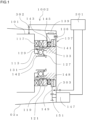
- FIG. 1 is a schematic skeleton sectional view of a meshing clutch mechanism with partial omission according to the embodiment 1.
- FIG. 2 is a development sectional view of essential part of a first and a second meshing clutches in a circumferential direction.
- FIG. 3 is a development sectional view of the essential part in the circumferential direction in a state that the first and the second meshing clutches are separated.
- FIG. 4 is a development sectional view of essential part of a first and a second cams in the circumferential direction.
- FIG. 5 is a development sectional view of the essential part in the circumferential direction at the time of the first and the second cams operating.
- FIG. 1 is a schematic skeleton sectional view of a meshing clutch mechanism with partial omission according to the embodiment 1.
- FIG. 2 is a development sectional view of essential part of a first and a second meshing clutches in a circumferential direction.
- FIG. 3 is a development sectional view of
- FIG. 6 is a development sectional view of essential part of a first and a second cams formed by a ball cam in the circumferential direction.
- FIG. 7 is a development sectional view of the essential part in the circumferential direction at the time of the first and the second cams formed by the ball cam operating.
- a first meshing clutch mechanism 1002 being the meshing clutch mechanism illustrated in FIG. 1 is provided with a first rotor 101 being a rotor, a first sleeve 121 being a sleeve, a retaining member 139, a cam ring 148, and a cam actuator 147.
- the first meshing clutch mechanism 1002 is provided with a first clutch hub 133 as a clutch hub provided on a clutch holder 137, a first meshing clutch 117 and a second meshing clutch 119.
- the clutch holder 137 is fixed to a case 02a using a fastening member 136 such as a bolt and a nut.
- the first clutch hub 133 has a base portion integrally connected on an inner peripheral side of the clutch holder 137.
- the first clutch hub 133 is extended toward the first rotor 101 in an axial direction.
- splines are formed for example.
- the first meshing clutch 117 is fastened or integrally formed to the first rotor 101.
- a first boss 142 is provided so as to be extended to an inner diametral portion of the first clutch hub 133 in the axial direction.
- the first boss 142 is rotatably supported on the inner diametral portion of the first clutch hub 133 through a bearing 131 such as a ball bearing.
- the bearing 131 has an inner race and an outer race, the inner race axially positioned and fixed on the first boss 142 and the outer race on the first clutch hub 133.
- the positioning and fixing is performed by a boss-fastening member 127 and a hub-fastening member 129 such as stopper rings attached to the first boss 142 and the first clutch hub 133.
- the first sleeve 121 is provided with a second meshing clutch 119 that meshes with the first meshing clutch 117 and a first cam 143 for the meshing.
- the first sleeve 121 is urged so as to release the meshing of the second meshing clutch 119 with the first meshing clutch 117.
- the first sleeve 121 engages with and axially movably supported on the first clutch hub 133 as a clutch hub fixed on the case 02a in a rotational direction.
- the second meshing clutch 119 is provided on one side face of the first sleeve 121.
- the second meshing clutch 119 is arranged so as to meshably face the first meshing clutch 117.
- the second meshing clutch 119 engages with an outer periphery of the first clutch hub 133 together with the first sleeve 121.
- the first sleeve 121 is provided with a first cam 143 on the other side face.
- the first sleeve 121 is supported on the case 02a by the retaining member 139 such as a tension coil spring.
- the retaining member 139 functions to urge the first sleeve 121 and retain the first and the second meshing clutches 117 and 119 on a position releasing the first and the second meshing clutches as mentioned above.
- the retaining member 139 may have a structure using a check ball or the like.
- the cam ring 148 is provided with a second cam 145 engaging with the first cam 143. With cooperation of the first and the second cams 143 and 145, the cam ring is configured to convert movement in the rotational direction into movement in the axial direction to be transmitted to the first sleeve 121 and lock the meshing, the locking releasable by rotationally driving the cam ring.
- the cam ring 148 is rotatably supported on an outer periphery of the base portion of the clutch holder 137.
- the second cam 145 is provided on one side face of the cam ring 148.
- the second cam 145 meshes with or faces the first cam 143.
- a bearing 141 is interposed between the clutch holder 137 and the other side face of the cam ring. The bearing 141 is to receive axial force generated at the cam ring 148 with respect to the clutch holder 137.
- the cam ring 148 has an outer peripheral portion to which a rotated means 149 such as a circular or sector gear is fixed.
- the rotated means 149 has concavo-convex grooves or the like as a detected means.
- the grooves or the like are detected by a side sensor 303 and a detected signal is input to a controller 301.
- the cam ring 148 is configured to be rotationally driven by the cam actuator 147 such as an electric motor.
- the cam actuator 147 is fastened and fixed to the case 02a using bolts and nuts or the like.
- the cam actuator 147 has an output shaft to which a drive pinion 151 is attached in the case 02a.
- the drive pinion 151 meshes with the rotated means 149.
- the first and the second meshing clutches 117 and 119 have tooth faces to transmit positive torque and tooth faces to transmit negative torque, the tooth faces to transmit negative torque angled to release the meshing according to the negative torque.
- the tooth faces 123 and 125 of the first and the second meshing clutches 117 and 119 are to transmit positive torque such as driving torque, and the tooth faces 123 and 125 are substantially parallel to or slightly angled to a rotational axis.
- the tooth faces 120 and 122 of the first and the second meshing clutches 117 and 119 are to transmit negative torque such as reverse torque relative to the driving torque (hereinafter, referred to as coasting torque).
- the tooth faces 120 and 122 has pressure angles (angles relative to the rotational axis) larger than friction angles.
- FIG. 4 is a development sectional view of essential part in the circumferential direction.
- FIG. 5 is a development sectional view of the essential part in the circumferential direction at the time of the first and the second cams operating.
- FIG. 4 is a drawing when concavities and convexities of the first cam 143 and the second cam 145 mesh with each other
- FIG. 5 is a drawing when the convexities 126 of the first cam 143 abut against convex flats 128 of the second cam 145.
- the cam operation works as illustrated FIG. 5 .
- the first cam 143 and the second cam 145 separate away from each other along cam slopes.
- the convexities 126 of the first cam 143 and the convex flats 128 of the second cam 145 are positioned to contact with each other.
- the cam operation works by controlling the cam actuator 147 using the controller 301 illustrated in FIG. 1 .
- the cam actuator 147 drives the drive pinion 151 to rotate the rotated means 149.
- the cam ring 148 rotates to work the cam operation.
- the cam actuator 147 is driven and controlled as the controller 301 receives a shift command.
- the cam ring 148 is rotationally driven through the drive pinion 151 and the rotated means 149.
- the sensor 303 detects a phase of the rotated means 149 and sends it to the controller 301. Through the sending, the cam ring 148 takes a given phase.
- the tooth faces 120 to transmit the coasting torque are brought into contact with the tooth faces 122 to receive the coasting torque.
- the first and the second meshing clutches 117 and 119 generate thrust in a direction separating away from each other according to operation of the pressure angles.
- the first cam convexities 126 In the first sleeve 121 having the second meshing clutch 119, the first cam convexities 126, however, abut against the second cam convex flats 128. Accordingly, the first sleeve 121 cannot moves in a separating direction. Further, the first rotor 101 having the first meshing clutch 117 is fixed by the bearing 131, the boss-fastening member 127, and the hub-fastening member 129 in the axial direction and cannot move in the axial direction.
- the meshing between the first and the second meshing clutches 117 and 119 is kept during the application of the coasting torque.
- the first meshing clutch mechanism 1002 is allowed to transmit torque in both directions of the driving and the coasting as mentioned above.
- the function is referred to as the two-way clutch function. According to the two-way clutch function is obtained, the first and the second cams 143 and 145 form a lock means.
- rotational phases of the convexities 126 of the first cam 143 match those of concave flats 130 of the second cam 145 as illustrated in FIG. 4 by, for example, returning rotational position of the cam ring 148 with the driving of the cam actuator 147.
- the meshing between the first and the second meshing clutches is kept.
- the first sleeve 121 moves on the first clutch hub 133 in the axial direction to release the first and the second meshing clutches 117 and 119. With this movement, the meshing between the first and the second meshing clutches 117 and 119 is released.
- the retaining member 139 retains the first sleeve 121 on a releasing position of the first and the second meshing clutches 117 and 119. In this way, the first meshing clutch mechanism 1002 obtains the one-way clutch function.
- FIG. 6 is a development sectional view of essential part of a first and a second cams formed by a ball cam in the circumferential direction.
- FIG. 7 is a development sectional view of the essential part in the circumferential direction at the time of the first and the second cams formed by the ball cam operating.
- a firs cam groove 2143 composing the first cam is formed on a first cam member 121b and a second cam groove 2145 composing the second cam is formed on a cam ring 148b.
- a rolling body 2112 is engaged and arranged.
- the rolling body 2112 is retained by a retainer 135.
- the rolling body 2112 forms the first cam together with the first cam groove 2143 and the second cam together with the second come groove 2145.
- the cam ring 148b therefore, rotates according to the driving of the cam actuator 147 similarly to the above so that the rolling body 2112 runs on the first and the second cam grooves 2143 and 2145 as illustrated in FIG. 6 , thereby working cam operation similarly to the above.
- Rotational phases of the first and the second com grooves 2143 and 2145 are matched as illustrated in FIG. 5 by, for example, returning the rotational position of the cam ring 148b with the driving of the cam actuator 147, so that the restriction of the movement of the first sleeve 121 in the axial direction due to the cam operation is released.
- This modification reduces load of the cam actuator 147 that drives the cam ring 148b.
- the tooth faces 123 and 125 of the first and the second meshing clutches 117 and 119 to receive the driving torque have the pressure angles similar to those of the tooth faces 120 and 122 to receive the coasting torque. Namely, the pressure angles of the tooth faces 123 and 125 may be more than the friction angles relative to the rotational axis. This is because that the axial movement of the first sleeve 121 can be blocked by the cam operation of the cam ring 148.
- the present embodiment easily switches the meshing clutch mechanism 1002 between the one-way clutch function and the two-way clutch function with the simple mechanism. Further, since the meshing clutches are used for the torque transmission, the torque transmission is secured and has large quantity torque.
- FIG. 8 is a schematic skeleton sectional view of a meshing clutch mechanism with partial omission according to the embodiment 2. It should be noted that components being identical or corresponding to those of the embodiment 1 are represented with the same reference numerals to omit duplicate explanation.
- a second meshing clutch mechanism 2002 being a meshing clutch mechanism according to the embodiment 2 is provided with a second rotor 2101 being a rotor, a second sleeve 2121 as a sleeve, a cam member 2126, a second cam ring 2148 being a cam ring, and a cam actuator 147. Further, the second meshing clutch mechanism 2002 is provided with a second clutch hub 2133, a first and a second meshing clutches 117 and 119.
- the second rotor 2101 is provided integrally with the first meshing clutch 117.
- the second rotor 2101 is configured to be fitted and supported rotatably to a torque transmission shaft 2102 through a bearing 2254.
- the torque transmission shaft 2102 is provided with the second clutch hub 2133 being a clutch hub.
- the second sleeve 2121 is provided with the second meshing clutch 119 configured to mesh with the first meshing clutch 117.
- the second sleeve 2121 is urged by a retaining member 2155 so as to release meshing between the first and the second meshing clutches 117 and 119 similar to the embodiment 1.
- the retaining member 2155 of the second embodiment is configured to have a ball protruded and urged by a coil spring, and a slanted face.
- the ball protruded and urged by the coil spring is supported by a hole of a second clutch hub 2133 in a radial direction.
- the slanted face is formed on an inner periphery of the second meshing clutch 119.
- the second sleeve 2121 is engaged with the second clutch hub 2133 in a rotational direction using spline-fitting or the like and is supported movably in an axial direction.
- the cam member 2126 is provided with a first cam 2123 to lock the meshing.
- the cam member 2126 is fitted relatively rotatably to and axially movably supported on the second clutch hub 2133.
- the cam member 2126 is arranged adjacent to the second sleeve 2121 through a bearing 2141 so as to be allowed to rotate relatively to and transmit axial force to the second sleeve.
- a cam-member-rotation preventing means 2151 engaging with a case 02b is provided on an outer diametral portion of the cam member 2126.
- the cam member 2126 un-rotatably engages with the case 02b using the cam-member-rotation preventing means 2151 and is only movable in the axial direction.
- the second cam ring 2148 is provided with a second cam 124 that engages with the first cam 2123.
- the structures of the first cam 2123 and the second cam 124 are the same as of the first cam 143 and the second cam 145 of the embodiment 1 and are configured as illustrated in FIGs. 4-7 .
- the second cam ring 2148 is arranged to face the cam member 2126 and is rotatable relatively to the second clutch hub 2133.
- the second cam ring 2148 is prevented from moving away from the cam member 2126 in the axial direction using a stopper ring 108 through a bearing 106.
- the stopper ring 108 is positioned on the second clutch hub 2133 using a second hub fastening member 110 such as c-clip.
- the stopper ring 108 may be formed integrally with the second clutch hub 2133.
- the second cam ring 2148 causes the first and the second cams 2123 and 124 to cooperate with each other and convert movement in the rotational direction into movement in the axial direction.
- the converted movement in the axial direction is transmitted to the cam member 2126. It is configured that the cam member 2126 moves with this transmission to lock the meshing releasably by rotationally driving.
- the second cam ring 2148 is provided with a rotated means 2149 similar to the embodiment 1, and is configured to be connected with the cam actuator 147 through a drive pinion 151.
- the second cam ring 2148 is configured to be rotationally driven by the cam actuator 147.
- the torque transmission shaft 2102 is rotatably supported by the case 02b through bearings 2252 and 2255.
- the second clutch hub 2133 is fixed to or formed integrally with the torque transmission shaft 2102.
- the second rotor 2101 is rotatably supported by the torque transmission shaft 2102 through a bearing 2254.
- the first clutch hub 133 of the embodiment 1 is fixed to the case 02a and is stationary.
- the second clutch hub 2133 of the embodiment 2 is fastened and fixed to the torque transmission shaft 2102 to rotate integrally with the torque transmission shaft.
- the second sleeve 2121 does not move in a direction to release the second meshing clutch 119 from the first meshing clutch 117. Further, an end portion 183 of the second rotor 2101 having the first meshing clutch 117 contacts with a transmission member 185 of the torque transmission shaft 2101 and accordingly does not move in the axial direction. The connection between the first and the second meshing clutch 117 and 119 is, therefore, kept.
- axial thrust is generated on the second sleeve 2121.
- the axial thrust is transmitted to the torque transmission shaft 2102 via the second clutch hub 2133 through the stopper ring 108 and the second hub fastening member 110 using the bearing 106 and 2141.
- axial force or reaction force of the first meshing clutch 117 is transmitted to the torque transmission shaft 2102 via the second rotor 2101, the end portion 183, and the transmission member 185 and is absorbed as internal force of the torque transmission shaft 2102. Accordingly, load caused by the thrust of the first and the second meshing clutches 117 and 119 is not applied to the bearings 2252 and 2255 supporting the torque transmission shaft 2102 to the case 02b, and rotational loss and abrasion are not promoted.
- the second cam ring 2148 is rotated, thereby to switch between the one-way clutch function and the two-way clutch function of the second meshing clutch mechanism 2002.
- a controller 301 when a controller 301 receives a shift command, the cam actuator 147 is driven so that a sensor 303 detects the phase of the second cam ring 2148 similar to the embodiment 1.
- the detecting signal is sent to the controller 301, whereby the cam ring 148 takes a given phase.
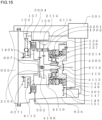
- FIG. 9 is a schematic skeleton sectional view of a two-speed transmission with partial omission according to the embodiment 3.
- the embodiment 3 configures a two-speed transmission using the first meshing clutch mechanism 1002 of the embodiment 1.
- Components being identical or corresponding to those of the embodiment 1 are, therefore, represented with the same reference numerals to omit duplicate explanation.
- the two-speed transmission of the embodiment 3 inputs power of a motor 005 being a driving source to a first sun gear 107 being a sun gear through a first sun gear shaft 105. It is configured that the power after gear shifting is transmitted to a differential 001 being another member through a first drive pinion 102 being a drive pinion for output.
- the other member is not particularly limited thereto, and may be one other than the differential 001.
- the two-speed transmission is provided with an internal gear 101 rotatably relatively to a case 02c. Between the internal gear 101 and a first planet carrier 113, it is configured to adjust frictional torque for connection using a friction clutch mechanism.
- a friction clutch mechanism As the friction clutch mechanism, a first friction clutch mechanism 1004 or a second friction clutch mechanism 2004 explained later is used.
- the two-speed transmission of the embodiment 3 is generally provided with the first planet carrier 113 being a planet carrier, the first friction clutch mechanism 1004 or the second friction clutch mechanism 2004 being the friction clutch mechanism, a clutch actuator 159 and the like, in addition to a first meshing clutch mechanism 1002, the first sun gear 107 being a sun gear, and the internal gear 101.
- the first sun gear 107 is configured to receive rotation input as mentioned above.
- the internal gear 101 meshes with the first sun gear 107 through a first planet pinion 111 being a planet pinion, and corresponds to the first rotor 101 of the first embodiment.
- the first planet carrier 113 is supported rotatably relatively to the internal gear 101, and rotatably supports the first planet pinion 111.
- One side portion of the first planet carrier 113 is rotatably supported to a first boss portion 142 through a bearing 142a.
- the output shaft 1112 is fitted to and is relatively rotatably supported with a first sun gear shaft 105.
- the output shaft 1112 is provided integrally with the first drive pinion 102 being a drive pinion for output.
- the first friction clutch mechanism 1004 or the second friction clutch mechanism 2004 is interposed between the internal gear 101 and the first planet carrier 113 and is configured to be fastened to adjust the connection between the internal gear 101 and the first planet carrier 113.
- the clutch actuator 159 is configured to adjust the frictional torque of the connection of the friction clutch mechanism according to fastening control of the first friction clutch mechanism 1004 or the second friction clutch mechanism 2004.
- first friction clutch mechanism 1004 and the second friction clutch mechanism 2004 will be explained in the embodiment 4.
- the first sun gear shaft 105 is connected with a fastening member 103 such as spline or key to a motor shaft 007 of the motor 005 on one end side.
- the one end side of the first sun gear shaft 105 is supported by a bearing 114 to a shaft-support housing on the case 02c.
- An interspace between the one end side of the first sun gear shaft 105 and the case 02c is sealed with a packing 116.
- the firs sun gear 107 is connected to a fastening means 109 such as spline or key or is integrally formed on the other end side of the first sun gear shaft 105.
- the internal gear 101 has an annulus gear 156 meshing with the first planet pinion 111.
- the first planet pinion 111 is arranged between the internal gear 101 and the first sun gear 107 and meshes with the both gears. Torque transmitted to the first sun gear 107 is, therefore, transmitted to the internal gear 101 through the first planet pinion 111.
- One side portion of the internal gear 101 is provided with the first boss portion 142.
- the other side portion of the internal gear 101 is provided with a first clutch housing 155 for the first friction clutch mechanism 1004.
- the torque transmitted to the internal gear 101 is amplified greater than the input torque into the first sun gear 107 according to the connection of the first meshing clutch mechanism 1002.
- the amplified torque is transmitted to the first planet carrier 113 to drive the first drive pinion 102.
- the rotation of the first drive pinion 102 is reduced relatively to of the first sun gear 107 that is input rotation and the two-speed transmission is in the low-speed stage.
- the first friction clutch mechanism 1004 is composed of the first clutch housing 155, a first friction clutch hub 140 provided on the first planet carrier 113, first and second friction members 153 and 154, and a pressing force adjustment means.
- the first friction members 153 are configured to contact with the second friction member(s) 154 on both sides or one side.
- the first friction members 153 engage with the first friction clutch hub 140 in a rotational direction at inner diametral portions.
- the second friction members 154 engage with the first clutch housing 155 in the rotational direction at outer diametral portions.
- the first clutch housing 155 has a means to receive pressing force applied to the first and the second friction members 153 and 154.
- the pressing force adjustment means is provided with a series of a first differential gear set 0171 including a pressing member 175, a first and a second differential gears 171 and 169, and a torque cam 162.
- the pressing member 175 has an outer diametral portion contacting with the first friction members 153 or the second friction members 154 to apply pressing force to the first and the second friction members 153 and 154.
- An inner diametral portion of the pressing member 175 is arranged rotatably relatively to a gear-set support 113a provided to the first planet carrier 113.
- a bearing 173, the first and the second differential gears 171 and 169, and a bearing 167 is arranged in the axial direction.
- Respective opposing faces of the first and the second differential gears 171 and 169 have a plurality of grooves having a depth tilted in a circumferential direction.
- a rolling body 161 engages with each groove to form the torque cam 162.
- the torque cam 162 has a function to convert relatively rotational torque of the first and the second differential gears 171 and 169 into axial thrust.
- a first fixing member 165 is fastened and fixed to the gear-set support 113a using a fastening member 168.
- the first fixing member 165 supports the bearing 167 that receives thrust reaction force generated by the torque cam 162 of the second differential gear 169.
- the first differential gear set 0171 is configured to be driven by a clutch pinion 157 meshing with the first and the second differential gears 171 and 169.
- the clutch pinion 157 is configured to be rotationally driven by the clutch actuator 159.
- the clutch pinion 157 is attached to an output shaft of the clutch actuator 159 being an electric motor or the like.
- the clutch actuator 159 is fastened and fixed on the case 02c.
- the first and the second differential gears 171 and 169 When the first differential gear set 0171 is driven by the clutch actuator 159 in a given direction, the first and the second differential gears 171 and 169, therefore, relatively rotate while rotating. With this relative rotation, the rolling body 161 moves on the tilted face of the torque cam 162, and thrust is generated the first and the second differential gears 171 and 169 in a direction moving away from each other. This thrust presses the first and the second friction members 153 and 154 via the bearing 173 and the pressing member 175 to generate the frictional torque.
- the first friction clutch mechanism 1004 generates the frictional torque to fasten between the internal gear 101 and the first planet carrier 113. With the frictional torque, the first sun gear 107, the internal gear 101, and the first planet carrier 113 rotate together. When the clutch actuator 159 drives the clutch pinion 157 in a reverse rotational direction, the frictional torque of the first friction clutch mechanism 1004 is disappeared.
- the first friction clutch mechanism 1004 is released, the internal gear 101 is connected to the case 02c using the first meshing clutch mechanism 1002, and the first sun gear 107 is rotated using the motor 005 in a forward direction.
- the internal gear 101 is stopped and accordingly the first planet pinion 111 revolves together with the first planet carrier 113 at a lower angular velocity than of the first sun gear 107 while rotating.
- the first planet carrier 113 and the first drive pinion 102 therefore, rotate at a low-speed and with higher torque than the first sun gear 107, and the two-speed transmission of the present embodiment is in a state of the low-speed stage.
- a tooth face 123 (see FIG. 2 and FIG. 3 ) of the first meshing clutch 117 is, therefore, set so as to be a tooth face that receives torque in a reverse rotational direction relative to a forward rotational torque of the first sun gear 107.
- the tooth faces 123 and 125 are set as drive tooth faces that receive driving torque relative to the torque in the reverse rotational direction
- tooth faces 120 and 122 are set as coast tooth faces that receive coasting torque.
- Gear shifting from the low-speed stage to the high-speed stage makes the first meshing clutch mechanism 1002 be in the state of the one-way clutch function.
- the cam ring 148 is rotationally driven using a cam actuator 147 similarly to the embodiment 1. With this rotationally driving, the phases of the first cam convexities 126 of the first sleeve 121 and the second cam concave flats 130 of the cam ring 148 match each other as illustrated in FIG. 4 of the embodiment 1. With this matching, the sleeve 121 is allowed to move in the axial direction until the first cam convexities 126 and the second cam concave flats 130 mesh with each other. This exhibits the one-way clutch function of the first meshing clutch mechanism 1002.
- the first differential gear set 0171 is driven by the clutch actuator 159 in a given direction, to fasten the first friction clutch mechanism 1004.
- frictional connection is performed between the internal gear 101 and the first planet carrier 113 by the first friction clutch mechanism 1004.
- the first meshing clutch 117 starts rotating in the same direction as the first sun gear 107.
- the coasting torque is applied to the coast tooth faces 120 and 122 of the first and the second meshing clutches 117 and 119.
- the second meshing clutch 119 moves backward in the axial direction according to the one-way clutch function of the first meshing clutch mechanism 1002, so that the connection between the first and the second meshing clutches 117 and 119 is automatically released.
- the two-speed transmission is smoothly shifted to the high-speed stage without interruption of driving force.
- Shifting-down from the high-speed stage to the low-speed stage is performed by releasing the first friction clutch mechanism 1004.
- the rotation of the motor 005 is increased along with this releasing until the rotation of the internal gear 101 is mostly stopped or slightly reversed.
- the cam ring 148 is rotationally driven by the cam actuator 147.
- the first cam convexities 126 disengage from the second cam concave flats 130.
- the first cam convexities 126 contact with the second cam convex flats 128. This shifts the two-speed transmission down to the low-speed stage.
- the driving of the clutch actuator 159 is stopped at a point of time when the frictional torque of the first friction clutch mechanism 1004 is reduced until the first and the second friction members 153 and 154 start minutely slipping, to fix the frictional torque of the first friction clutch mechanism 1004.
- the first friction clutch mechanism 1004 is fastened and driven in a direction to increase frictional force to the extent not to hinder increase of rotation of the motor 005 explained later.
- the rotation of the motor 005 is increased until the rotation of the internal gear 101 is stopped or is slightly reversed.
- the first meshing clutch mechanism 1002 is fastened, and the first friction clutch mechanism 1004 is released simultaneously with the fastening of the first meshing clutch mechanism 1002 or after the fastening as soon as possible.
- Normal control of the first friction clutch mechanism 1004 is as follows.
- the first friction clutch mechanism 1004 is rotationally driven by the clutch actuator 159 in a direction to be fastened from a releasing position. With this rotationally driving, it is deemed to start pressing of the first and the second friction clutches 153 and 155 is started at a point of time when load is caused on the clutch actuator 159.
- the first friction clutch mechanism 1004 is deemed to be fastened with ⁇ X rotations from the point of time of the pressing start. The ⁇ X rotations are determined through tests in advance.
- the releasing of the first friction clutch mechanism 1004 is performed by reversely rotating the clutch actuator 159 by ⁇ X+a.
- the connection of the first meshing clutch mechanism 1004 for performing the shift-down needs to be performed when the rotation of the first meshing clutch 117 is stopped or minutely reversed.
- a sensor 302 detects the rotation of the internal gear 101 and sends it to a controller 301.
- the controller 301 receiving the sending determines rotational condition of the first meshing clutch 117. With this determination, the cam actuator 147 is driven in a direction to fasten the first meshing clutch mechanism 1002. If the seamless shift-down is performed, it is required to detect a minute slip between the first and the second friction clutches 153 and 154.
- Effect of the embodiment 3 is as follows.
- the shift-up to the high-speed stage is allowed to be the seamless and smooth gear shifting by making the first meshing clutch mechanism 1002 be in the one-way clutch function and fastening the first friction clutch mechanism 1004.
- the first meshing clutch mechanism 1002 has the two-way clutch function with the locking of the one-way clutch function, the torque transmission is allowed in the reverse direction relative to the normal driving in a regeneration mode of the driving motor 005 at the low-speed stage or at the time of backward driving of the vehicle.
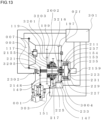
- embodiment 3 may employ a second or a third friction clutch mechanism 2004 or 3004 explained in the embodiment 4 and embodiment 8 illustrated in FIG. 10 and FIG. 14 instead of the first friction clutch mechanism 1004 of FIG. 9 .
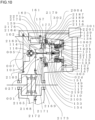
- FIG. 10 is a schematic skeleton sectional view of a two-speed transmission with partial omission according to the embodiment 4.
- the embodiment 4 configures a two-speed transmission using the first meshing clutch mechanism 1002 of the embodiment 1.
- the two-speed transmission of the embodiment 4 is similar to the two-speed transmission of the embodiment 3.
- Components being identical or corresponding to those of the embodiments 1 and 3 are, therefore, represented with the same reference numerals to omit duplicate explanation.
- the embodiment 4 does not use the internal gear 101 of the embodiment 3. It is configured that a first meshing clutch mechanism 1002 connects and releases between a second planet carrier 2113 and a case 02d. A second friction clutch mechanism 2004 is configured to connect and release between the second planet carrier 2113 and a third sun gear shaft 3105.
- the two-speed transmission of the embodiment 4 is generally provided with a second sun gear 2192 as a sun gear, a third sun gear shaft 3105, a second planet pinion 2201 as a planet pinion, the second planet carrier 2113 as a planet carrier, a second friction clutch mechanism 2004 as a friction clutch mechanism, and a clutch actuator 159 in addition to the first meshing clutch mechanism 1002.
- the second sun gear 2192 is configured to receive rotation input from a motor 005 using the third sun gear shaft 3105 as a sun gear shaft.
- the third sun gear shaft 3105 is fitted and is rotatably supported to a second sun gear shaft 2105 as a sun gear shaft.
- the third sun gear shaft 3105 is provided with a third sun gear 2110 and a drive pinion 2164 for output.
- the second sun gear shaft 2105 corresponds to the first sun gear shaft 105 of the embodiment 3.
- the second planet pinion 2201 is provided integrally with a first and a second gears 2114 and 1226.
- the first gear 2114 meshes with the second sun gear 2192.
- the second gear 2116 meshes with the third sun gear 3105.
- the second gear 2116 is set to have the less number of teeth than of the first gear 2114.
- the second planet carrier 2113 rotatably supports the second planet pinion 2201.
- the second planet carrier 2113 corresponds to the first rotor 101 of the embodiment 1.
- the second friction clutch mechanism 2004 is interposed between the second planet carrier 2113 and the third sun gear shaft 3105 and is configured to be fastened to adjust connection between the second planet carrier 2113 and the third sun gear shaft 3105.
- the clutch actuator 159 is configured to adjust frictional torque of the connection according to fastening control of the second friction clutch mechanism 2004.
- Input to the two-speed transmission of the embodiment 4 illustrated in FIG. 10 is performed to the second sun gear shaft 2105.
- the second sun gear shaft 2105 is connected to a motor shaft 007 of the motor 005 on one end side similarly to the embodiment 3.
- the other end side of the second sun gear shaft 2105 is rotatably supported to a second boss 2214 of the second planet carrier 2113 through a bearing 115.
- the third sun gear shaft 3105 is provided integrally with a second friction clutch hub 140b.
- the second friction clutch hub 140b is configured to engage with inner diametral portions of first friction members 153 in a rotational direction.
- the third sun gear shaft 3105 is provided integrally with a first drive pinion 102 as a drive pinion for output.
- the first drive pinion 102 is configured to drive other members such as a differential 001.
- the third sun gear shaft 3105 is supported on an outer periphery of the second sun gear shaft 2105 through bearings 2163 and 2164.
- the second planet pinion 2201 is rotatably supported to the second planet carrier 2113 through a bearing 191.
- the second planet carrier 2113 is provided with a second clutch housing 2187 on one side portion.
- the second clutch housing 2187 is configured to engage with outer diametral portions of second friction members 154 in the rotational direction.
- the second clutch housing 2187 has a means to receive pressing force applied to the first and the second friction members 153 and 154.
- the other side portion of the second planet carrier 2113 is provided integrally with the second boss 2214.
- the second boss 2214 is rotatably supported to an inner diametral portion of a first clutch hub 133 of a clutch holder 137 of a clutch holder 137 through a bearing 131.
- the first friction clutch mechanism 1004 explained with FIG. 9 is configured that the pressing force adjustment means is provided with the series of the first differential gear set 0171 including the pressing member 175, the first and the second differential gears 171 and 169, and the torque cam 162 as mentioned above.
- the torque cam 162 generates the thrust according to the driving of the clutch actuator 159, to press the first and the second friction members 153 and 154 by the pressing member 175.
- a pressing force adjustment means is provided with an elastic body177.
- the elastic body 177 is configured to apply the pressing force to the first and the second friction members 153 and 154. It is configured that axial thrust generated at a torque cam 2271 cancels out the pressing force of the elastic body 177, to reduce or disappear the frictional torque of the second friction clutch mechanism 2004.
- the second friction clutch mechanism 2004 supports and engages an outer periphery of the second friction member 154 with the second clutch housing 2187 in the rotational direction.
- the second clutch housing 2187 has a means to receive pressing force of the first and the second friction members 153 and 154.
- the second friction members 154 at the outer peripheral portions engages with the second clutch housing 2187 in the rotational direction.
- the first friction members 153 contact with the second friction members 154 on one side or both sides, and engages with the second friction clutch hub 140b in the rotational direction at the inner diametral portions.
- the pressing force adjustment means applies or adjusts the pressing force to the first and the second friction member 153 and 154.
- the pressing force adjustment means is provided with a first pressing force adjustment member 2189 as a pressing force adjustment member.
- the first pressing force adjustment member 2189 is configured to contact with any one of the first and the second friction members 153 and 154 and adjust the pressing force between the friction members.
- the pressing force adjustment member 2189 is provided integrally with a gear-set support 2176 being a hollow shaft.
- a second differential gear set 0271 is arranged on the gear-set support 2176.
- the second differential gear set 0271 corresponds to the first differential gear set 0171 of the embodiment 3.
- the second differential gear set 0271 is provided with the elastic body 177.
- the elastic body 177 contacts with the first pressing force adjustment member 2189. It is configured that the elastic body 177 presses the first pressing force adjustment member 2189 and the pressing force is generated on the first and the second friction members 153 and 154 for the fastening. It is configured that reaction force of the elastic body 177 is received by a reaction force member 2173.
- the reaction force member 2173 is fixed to the second clutch housing 2187 using a fastening member 2179.
- An inner diametral portion of the reaction force member 2173 contacts a bearing 2169 and is arrayed with a third and a fourth differential gears 2171 and 2172, and a bearing 2170 in an axial direction.
- a torque cam 2271 is configured between the third and the fourth differential gears 2171 and 2172 similar to the embodiment 3.
- the bearing 2170 is configured that axial force is received by a second fixing member 2168.
- the second fixing member 2168 is fixed to the gear-set support 2176 with a fastening member 2165.
- the second differential gear set 0271 is driven by the clutch actuator 159 through a clutch pinion 157.
- the generated axial thrust is transmitted to the gear-set support 2176 of the first pressing force adjustment member 2189.
- the gear-set support 2176 moves so as to separate the bearings 2170 and 2169 away from each other.
- the first pressing force adjustment member 2189 moves together with that movement. With the movement of the first pressing force adjustment member 2189, the pressing force of the elastic body 177 is reduced. With this reduction, the friction torque of the second friction clutch mechanism 2004 is reduced or disappeared.
- Operation of the two-speed transmission of the embodiment 4 is the same as of the two-speed transmission of the embodiment 3 basically.
- the low-speed stage fixes the rotation of the second planet carrier 2113 on the case 02d side according to the first meshing clutch mechanism 1002 mentioned above.
- the second planet pinion 2201 only rotates without revolving. Accordingly, the rotation of the second sun gear 2192 is transmitted to the third sun gear 2110 having the relatively larger number of the teeth. Rotating speed of the third sun gear 2110 is, therefore, lower than rotating speed of the second sun gear 2192 performing input rotation, and the first drive pinion 102 is driven at that speed.
- the driving state is the low-speed stage.
- the second planet carrier 2113 receives the torque in the reverse direction relative to the second sun gear 2192.
- the meshing of the first and the second meshing clutches 117 and 119 therefore, becomes similarly to that of the embodiment 3 as explained in the embodiment 3.
- the second friction clutch mechanism 2004 of the embodiment 4 may be configured by the first friction clutch mechanism 1004 of the embodiment 3 as mentioned above.
- the second clutch housing 2187 is replaced with the first clutch housing 155 of the embodiment 3 illustrated in FIG. 9 .
- the pressing member 175 of the embodiment 3 is assembled into the replaced first clutch housing 155.
- the pressing member 175 is a component instead of the first pressing force adjustment member 2189, the elastic body 177, and the reaction force member 2173.
- the first friction clutch mechanism 1004 with this arrangement may connect and release between the second planet carrier 2113 and the third sun gear shaft 3105.
- the embodiment 4 freely selects the reduction ratio including 2. Further, it is low-cost with no internal gear.
- FIG. 11 is a schematic skeleton sectional view of a two-speed transmission with partial omission according to the embodiment 5.
- the embodiment 5 configures a two-speed transmission using the first meshing clutch mechanism 1002 of the embodiment 1.
- the means to receive the power of the motor 005 of the embodiment 3 is changed, and the second friction clutch mechanism 2004 of the embodiment 4 is employed as a friction clutch mechanism.
- Main parts of components being identical or corresponding to those of the embodiments 1, 3, and 4 are, therefore, represented with the same reference numerals or the same reference numerals in the 4000s to omit duplicate explanation.
- the two-speed transmission of the embodiment 5 is different from the two-speed transmission of the embodiment 3 in the following respects.
- the two-speed transmission of the embodiment 5 performs rotation input from a motor 005 to a first sun gear 107 as a sun gear by a drive gear 2103 of a motor shaft 007 and a driven gear 2104 of a fourth sun gear shaft 4105.
- the drive gear 2103 is fixed to the motor shaft 007.
- the drive gear 2103 meshes with the driven gear 2104 fixed to the fourth sun gear shaft 4105 as a sun gear shaft.
- the fourth sun gear shaft 4105 is rotatably supported by a bearing 114 on a case 02e.
- the first sun gear 107 engages with the fourth sun gear shaft 4105 by a fastening means 4106 such as splines or is formed integrally with the fourth sun gear shaft.
- An interspace between an internal gear 101 and a first planet carrier 113 is configured to be connected and released by the second friction clutch mechanism 2004 of the embodiment 4 similar to the embodiment 3.
- the second friction clutch mechanism 2004 may be replaced with the first friction clutch mechanism 1004 of the embodiment 3.
- the first meshing clutch mechanism 1002 connects or releases between the internal gear 101 and the case 02e.
- the structure, function, and control of the gear shifting are the same as of the embodiments 3 and 4 mentioned above.
- Characteristics of the embodiment 5 relative to the embodiments 3 and 4 are as follows.
- a gear train comprising the drive gear 2103 and the driven gear 2104 is interposed into a path to input the driving force contrary to the embodiments 3 and 4.
- a reduction or an acceleration gear ratio of the gear train is changed, thereby freely changing input rotation to the first sun gear 107. Accordingly, choices of the reduction gear ratio of the two-speed transmission of the embodiment 5 are increased. Further, a center distance between the motor shaft 007 and the differential 001 or the like is expanded to increase a degree of freedom in layout.
- FIG. 12 is a schematic skeleton sectional view of a two-speed transmission with partial omission according to the embodiment 6.
- a two-speed transmission of the embodiment 6 employs the input structure of the embodiment 5 for the structure of the embodiment 4.
- Main parts of components being identical or corresponding to those of the embodiments 4 and 5 are, therefore, represented with the same reference numerals to omit duplicate explanation.
- the rotation input structure from the motor 005 to the second sun gear shaft 2105 is the coaxial linear structure whereas in the embodiment 6 it is configured similarly to the embodiment 5.
- a driven gear 2104 of the second sun gear shaft 2105 meshes with a drive gear 2103 of a motor shaft 007 of the motor 005.
- the embodiment 6 provides the same effects as the embodiment 5 relative to the structure of the embodiment 4.
- FIG. 13 is a schematic skeleton sectional view of a two-speed transmission with partial omission according to the embodiment 7.
- the embodiment 7 configures a two-speed transmission using the second meshing clutch mechanism 2002 of the embodiment 2.
- Components being identical or corresponding to those of the embodiment 2 are, therefore, represented with the same reference numerals to omit duplicate explanation.
- the two-speed transmission of the embodiment 7 is generally provided with an input shaft 3203 and an output shaft 3205, a low-speed and a high-speed drive gears 199 and 197, a low-speed and a high-speed driven gears 3201 and 211, a third friction clutch mechanism 3004 as a friction clutch mechanism, and a clutch actuator 2159 in addition to the second meshing clutch mechanism 2002.
- the input shaft 3203 is provided integrally with the low-speed drive gear 199 and the high-speed drive gear 197 and is configured to receive rotational input from a motor 005.
- the output shaft 3205 is configured to have the low-speed driven gear 3201 meshing with the low-speed drive gear 199, the high-speed driven gear 211 meshing with the high-speed drive gear 197, and a second drive pinion 221 as a drive pinion for output.
- the output shaft 3205 forms the torque transmission shaft 2102 of the embodiment 2.
- the input shaft 3203 may, however, form a torque transmission shaft corresponding to the torque transmission shaft 2102.
- the torque transmission shaft in this case means that it rotatably supports a rotor having the first meshing clutch 117 so as to be fitted thereto and is provided with a second clutch hub 2133 and does not intend output.
- the low-speed driven gear 3201 forms the second rotor 2101 of the embodiment 2 and the low-speed drive gear 199 is fixed to the input shaft 3203.
- the input shaft 3203 forms the torque transmission shaft 2102 of the embodiment 2, it is, however, configured that the low-speed drive gear 199 forms the second rotor 2101 of the embodiment 2 and the low-speed driven gear 3201 is fixed to the output shaft.
- the high-speed driven gear 211 is rotatably provided on the output shaft 3205.
- the third friction clutch mechanism 3004 is provided between the output shaft 3205 and the high-speed driven gear 211.
- the third friction clutch mechanism 3004 is configured to adjust connection between the output shaft 3205 and the high-speed driven gear 211.
- the high-speed drive gear 197 is rotatably supported on the input shaft 3203, and the third friction clutch mechanism 3004 is provided between the high-speed drive gear 197 and the input shaft 3203.
- the third friction clutch mechanism 3004 is configured to adjust connection between the input shaft 3203 and the high-speed drive gear 197.
- the clutch actuator 2159 is driven to control fastening the third friction clutch mechanism 3004. It is configured that the frictional torque of the connection is adjusted with this fastening control.
- a pressing force adjustment means is provided for conducting fastening between the clutch actuator 2159 and the third friction clutch mechanism 3004.
- the pressing force adjustment means is provided with an elastic body 227 and a second pressing force adjustment member 231.
- the elastic body 227 is configured by, for example, a disk spring.
- the elastic body 227 is configured to generate pressing force to fasten the third friction clutch mechanism 3004.
- the second pressing force adjustment member 231 receives the pressing force of the elastic body 227 to conduct the fastening.
- the second pressing force adjustment member 231 is a component connected to the clutch actuator 2159 side.
- the clutch actuator 2159 is configured to drive the second pressing force adjustment member 231 to adjust the pressing force of the elastic body 227.
- the clutch actuator 2159 is a component being, for example, a hydraulic cylinder, an air cylinder, a solenoid or the like.
- the clutch actuator 2159 is configured that an output shaft such as piston rod is driven in an axial direction.
- An electric motor may be, however, used to rotate a ball screw and linearly move a ball nut.
- Input to the two-speed transmission of the embodiment 7 illustrated in FIG. 13 is performed to the input shaft 3203.
- the input shaft 3203 is rotatably supported on the case 02f.
- the input shaft 3203 is coaxially arranged on and is integrally connected to a motor shaft 007 of the motor 005.
- the input shaft 3203 is provided integrally with the low-speed drive gear 199 and the high-speed drive gear 197 as mentioned above.
- the output shaft 3205 is arranged in parallel with respect to the input shaft 3203.
- the output shaft 3205 is provided integrally with the second drive pinion 221.
- the second drive pinion 221 is a component to transit power after gear shifting to another member such as differential 001.
- the low-speed driven gear 3201 and the high-speed driven gear 211 are rotatably supported on the output shaft 3205.
- the low-speed driven gear 3201 is rotatably supported on the input shaft 3203.
- the low-speed driven gear 3201 meshes with the low-speed drive gear 199 of the input shaft 3203 to form a low-speed gear train.
- the low-speed driven gear 3201 has the first meshing clutch 117 of the second meshing clutch mechanism 2002.
- the high-speed driven gear 211 meshes with the high-speed drive gear 197 of the input shaft 3203 to form a high-speed gear train.
- Two gear trains are configured by the low-speed gear train and the high-speed gear train.
- the high-speed driven gear 211 is fitted and arranged rotatably on the output shaft 3205.
- the high-speed driven gear 211 has a third boss 3216.
- the third boss 3216 is rotatably supported on the case 02f through a bearing 225 and is positioned and fixed in the axial direction.
- the two-speed transmission of the present embodiment 7 illustrated in FIG. 13 performs torque transmission through the second meshing clutch mechanism 2002 of the embodiment 2 at the low-speed stage, and through the third friction clutch mechanism 3004 at the high-speed stage, and performs gear shifting with cooperation of both the mechanisms similarly to the other embodiments.
- the second meshing clutch mechanism 2002 is configured to connect and release between the low-speed driven gear 3201 and the output shaft 3205.
- the third friction clutch mechanism 3004 is configured to connect and release between the high-speed driven gear 211 and the output shaft 3205.
- first or the second friction clutch mechanisms 1004 or 2004 may be used instead of the third friction clutch mechanism 3004.
- the third friction clutch mechanism 3004 is provided with a third clutch housing 237, a third clutch hub 233, first and second friction members 153 and 154, and a pressing force adjustment means.
- the third clutch housing 237 is connected integrally with the third boss 3216 of the higher-driven gear 211.
- the third clutch housing 237 is rotatably supported and axially positioned on the third boss 3216 with interposition of the bearing 225.
- the third clutch housing 237 has a means to receive pressing force to the first and the second friction members 153 and 154.
- the third clutch hub 233 is provided on its inner peripheral portion with a shaft portion passing through an inner diametral portion of the third boss 3216, and the shaft portion is rotatably supported on the third boss 3216 with a bearing 217.
- the shaft portion of the third clutch hub 233 is connected integrally with the output shaft 3205.
- the first friction member 153 engages with an outer peripheral portion of the third clutch hub 233 in a rotational direction.
- the second friction member 154 engages with an inner peripheral portion of the third clutch housing 237 in the rotational direction.
- the second friction members 154 are components contacting the first friction members 153 on one side or both sides.
- the second pressing force adjustment member 231 is a component contacting the first or the second friction member 153 or 154 to adjust the pressing force applied to the first and the second friction members 153 and 154.
- the elastic body 227 is a component to urge the second pressing force adjustment member 231 and apply axial force to press the first and the second friction members 153 and 154. It is configured that reaction force of the elastic body 227 is received by a fastening member 229 fixed on the third clutch housing 237.
- An inner diametral portion of the second pressing force adjustment member 231 is rotatably supported by a bearing 223.
- the bearing 223 is connected to a piston rod of the clutch actuator 2159 through a pressure reduction member 235.
- the pressure reduction member 235 is a component integrally with an inner race of the bearing 223.
- the clutch actuator 2159 drives the inner diametral portion of the second pressing force adjustment member 231 through the pressure reduction member 235 and the bearing 223 in the axial direction. It is configured to recoverablly apply axial force in a direction reducing the pressing force of the elastic body 227 with that driving.
- the two-speed transmission of the embodiment 7 becomes in the low-speed stage by connecting the low-speed driven gear 3201 and the output shaft 3205 according to a two-way clutch function of the second meshing clutch mechanism 2002.
- a rotational phase of the second cam ring 2148 of the second meshing clutch mechanism 2002 is shifted to put the second meshing clutch mechanism 2002 into a one-way clutch function, and the third friction clutch mechanism 3004 is connected to shift up to the high-speed stage.
- Shift-down is performed as mentioned in the other embodiments. Namely, the fastening of the third friction clutch mechanism 3004 is released. The rotation of the motor 005 is steeply increased until the first meshing clutch 117 is synchronized with or slightly exceeds the rotation of the second meshing clutch 119. At that point of time, the cam actuator 147 drives the cam ring 2148, to mesh the first and the second meshing clutches 117 and 119 with each other.
- Seamless shift-down is performed as mentioned above. Namely, the frictional torque of the third friction clutch mechanism 3004 is reduced. With this reduction, a minute slip is detected between the first and the second friction members 153 and 154. The minute slip is detected by detecting rotational speed of the second drive pinion 221 using a rotation detecting means 2302 as a sensor and calculating the same by comparison with the number of rotation of the motor 005, for example. At a moment when the minute slip is generated, fastening force of the third friction clutch mechanism 3004 is fixed. In particular, the actuator 2159 is stopped, and the number of rotation of the motor 005 is steeply increased until the first meshing clutch 117 is synchronized with or slightly exceeds the second meshing clutch 119. At that time, the first and the second meshing clutches 117 and 119 mesh with each other, and the third friction clutch mechanism 3004 is released at the same time.
- the embodiment 7 is an example that the second meshing clutch mechanism 2002 and the third friction clutch mechanism 3004 are arranged on the output shaft 3205, the second meshing clutch mechanism 2002 and the third friction clutch mechanism 3004 may be altered as (2)-(4) compared with the following layout (1).
- the third friction clutch mechanism 3004 may be configured by the other clutch such as hydraulic pressure, air pressure, or electromagnetic clutch.
- the transmission gear performs the biaxial meshing, so that the gear ratio is freely chosen for both the high-speed stage and the low-speed stage.
- the basic structure is that one gear train is added to a single gear train of a normal two-axis reduction gear for an electric vehicle to modify the single gear train into the gears in the two lines only. Accordingly, it involves little change against the two-axis reduction gear for an electric vehicle in the basic structure and the appearance form, is simple in structure, is lightweight, and is advantageous for mounting on a vehicle.
- FIG. 14 is a schematic skeleton sectional view of a two-speed transmission with partial omission according to the embodiment 8.
- a two-speed transmission of the embodiment 8 is basically configured in the same way as the embodiment 3. Components being identical or corresponding to those of the embodiment 3 are, therefore, explained with the main same reference numerals to omit duplicate explanation.
- the embodiment 8 is configured to be provided with a second output shaft 3112 as an output shaft connected to a first planet carrier 113 and arranged so as to be protruded outside.
- a first sun gear 107 is fastened to or integrally formed on a motor shaft 007.
- One side portion of the first planet carrier 113 is provided with a second output shaft 3112.
- the second output shaft 3112 passes through an inner diametral portion of a first clutch hub 133 of a first meshing clutch mechanism 1002 and a case 02g, to be arranged so as to be protruded outside. It is configured that an exterior member is allowed to be connected to the second output shaft 3112.
- the other side portion of the first planet carrier 113 is separated from a portion being a hollow output shaft 1112 in the embodiment 3, and the output shaft 1112 is configured as a hollow shaft not to directly perform output.
- the first sun gear 107 is connected to the hollow shaft 1112, and the hollow shaft 1112 is connected and fixed to the motor shaft 007.
- the two-speed transmission of the embodiment 3 is suitable for the layout in which the motor 005 is horizontally mounted on the vehicle whereas the layout of the embodiment 8 is suitable for a layout in which the motor 005 is vertically mounted.
- FIG. 15 is a schematic skeleton sectional view of a two-speed transmission with partial omission according to the embodiment 9.
- a two-speed transmission of the embodiment 9 is basically configured in the same way as the embodiment 4. Components being identical or corresponding to those of the embodiment 4 are, therefore, explaned with the main same reference numerals to omit duplicate explanation.
- the embodiment 9 is provided with a third sun gear output shaft 4205 and an extended output shaft 4114 as an output shaft connected to a third sun gear 4110 and arranged so as to be protruded outside.
- positions of a first gear 2114 and a second sun gear 4108 and positions of a second gear 2116 and a third sun gear 4110 are reversed in an axial direction compared with the two-speed transmission of the embodiment 4.
- the second sun gear 4108 is fastened or integrally formed on a motor shaft 007.
- the third sun gear 4110 is provided with the third sun gear output shaft 4205 and the extended output shaft 4114 as an output shaft.
- the extended output shaft 4114 is configured to be formed by extension of the third sun gear output shaft 4205.
- the third sun gear output shaft 4205 corresponds to the third sun gear shaft 3105 of the embodiment 4.
- the third sun gear output shaft 4205 is rotatably supported on a second boss 2214 of a second planet carrier 4113 through a bearing 115.
- the extended output shaft 4114 passes through a case 02h and is arranged so as to be protruded outside. It is configured that an exterior member is allowed to be connected to the extended output shaft 4114.
- the second sun gear 4108 is connected to a hollow shaft 2105, and the hollow shaft 2105 is fixed to the motor shaft 007.
- the hollow shaft 2105 corresponds to the second sun gear shaft 2105 of the embodiment 4.
- the second sun gear shaft 2105 of the embodiment 4 is used as the hollow shaft 2105 and is directly connected to the motor shaft 007.
- the second sun gear 4108 in the embodiment 9 is provided integrally with the second friction clutch hub 140b in the embodiment 4.
- the second friction clutch mechanism 2004 of the embodiment 9 is configured to control fastening between the second planet pinion 2201 and the second sun gear 4108.
- the second friction clutch mechanism 2004 may be replaced with the first friction clutch mechanism 1004.
- the embodiment 9 is effective on an electric vehicle with a vertical mounted motor similarly to the embodiment 8.
- torque transmission in the high-speed stage in the two-speed transmissions of the embodiments 3-9 is implemented by the first, the second, or the third friction clutch mechanisms 1004, 2004, and 3004, it may be modified as follows.
Landscapes
- Engineering & Computer Science (AREA)
- General Engineering & Computer Science (AREA)
- Mechanical Engineering (AREA)
- Mechanical Operated Clutches (AREA)
Abstract
Description
- The present invention relates to a drive mechanism, in particular, a meshing clutch mechanism and a two-speed transmission.
- A conventional two-speed transmission as disclosed in
Patent document 1 is proposed. The two-speed transmission, in order to reduce the number and the weight of components, keeps rotational speed of a motor using a planetary gear unit at a constant speed or a reduced speed. There is, however, a problem that toque interruption is occurred according to requirement to once remove driving force in gear shifting. On the other hand, a two-speed transmission as disclosed inPatent document 2 is proposed. The two-speed transmission assigns energization and non-energization of an electromagnetic coil to a low-speed stage and a high-speed stage, thereby improving electric power consumption efficiency. Further, an arrangement of a one-way clutch prevents torque interruption at the low-speed to reduce shift shock sensible by a driver. There is, however, a problem that torque in a reverse direction is not transmitted at the low-speed stage owing to the arrangement of the one-way clutch in the two-speed transmission. -
- PATENT DOCUMENT 1:
JP 2016-017632 A - PATENT DOCUMENT 2:
JP 6545921 B - A problem to be solved is that the torque interruption is occurred at the time of gear shifting or the torque in the reverse direction (hereinafter, referred to as coasting torque) is not transmitted at the low-speed stage in the two-speed transmission using the one-way clutch at the low speed to prevent torque interruption.
- A meshing clutch mechanism according to the present invention, in order to easily switch between a one-way clutch function and a two-way clutch function of a first and a second meshing clutches, is characterized by comprising a rotor being provided with a first meshing clutch and being rotatably supported, the first meshing clutch having a tooth face to transmit positive torque and a tooth face to transmit negative torque, the tooth face to transmit negative torque angled to release meshing according to the negative torque; a sleeve being provided with a second meshing clutch to mesh with the first meshing clutch and a first cam for the meshing, being urged so as to release the meshing, and engaging with a clutch hub in a rotational direction and being supported on the clutch hub movably in an axial direction, the clutch hub being fixed on a case, a retaining member urging the sleeve to keep a releasing position between the first and the second meshing clutches, a cam ring being provided with a second cam engaging with the first cam and being configured to convert movement in the rotational direction into movement in the axial direction to be transmitted to the sleeve and lock the meshing according to cooperation of the first and the second cams, the locking releasable by rotationally driving the cam ring, and a cam actuator that rotationally drives the cam ring.
- The present invention, in order to transmit torque in a reverse direction at a low-speed stage, is characterized by a two-step transmission using the meshing clutch mechanism, comprising a sun gear that receives rotation input, an internal gear meshing with the sun gear through a planet pinion and forming the rotor, a planet carrier being supported rotatably relatively to the internal gear, rotatably supporting the planet pinion, and being provided with a drive pinion for output, a fiction clutch mechanism interposed between the internal gear and the planet carrier to adjust connection between the internal gear and the planet carrier according to fastening, and a clutch actuator that adjusts frictional torque of the connection according to fastening control of the friction clutch mechanism.
- The meshing clutch mechanism according to the present invention easily switches between a one-way clutch function and a two-way clutch function of the first and the second meshing clutches.
- The two-speed transmission according to the present invention allows torque transmission in both directions of driving and coasting at the time of a low-speed stage. In a case of used to an electric vehicle, reverse torque transmission is allowed at the time of reversing and energy regenerating. With the one-way clutch function, no torque interruption is occurred at the time of gear shifting to an upper stage. The smooth gear shifting is enabled. At the time of activity at the upper stage, no loss due to drag torque is occurred in the meshing clutch mechanism at the low-speed stage unlike a friction clutch and efficiency is improved.
-
- [
FIG. 1 ] It is a schematic skeleton sectional view of a meshing clutch mechanism with partial omission according to anembodiment 1. - [
FIG. 2 ] It is a development sectional view of essential part of a first and a second meshing clutches in a circumferential direction according to theembodiment 1. - [
FIG. 3 ] It is a development sectional view of the essential part in the circumferential direction in a state that the first and the second meshing clutches are separated according to theembodiment 1. - [
FIG. 4 ] It is a development sectional view of essential part of a first and a second cams in the circumferential direction according to theembodiment 1. - [
FIG. 5 ] It is a development sectional view of the essential part in the circumferential direction at the time of the first and the second cams operating according to theembodiment 1. - [
FIG. 6 ] It is a development sectional view of essential part of a first and a second cams formed by a ball cam in the circumferential direction according to theembodiment 1. - [
FIG. 7 ] It is a development sectional view of the essential part in the circumferential direction at the time of the first and the second cams formed by the ball cam operating according to theembodiment 1. - [
FIG. 8 ] It is a schematic skeleton sectional view of a meshing clutch mechanism with partial omission according to anembodiment 2. - [
FIG. 9 ] It is a schematic skeleton sectional view of a two-speed transmission with partial omission according to anembodiment 3. - [
FIG. 10 ] It is a schematic skeleton sectional view of a two-speed transmission with partial omission according to anembodiment 4. - [
FIG. 11 ] It is a schematic skeleton sectional view of a two-speed transmission with partial omission according to anembodiment 5. - [
FIG. 12 ] It is a schematic skeleton sectional view of a two-speed transmission with partial omission according to anembodiment 6. - [
FIG. 13 ] It is a schematic skeleton sectional view of a two-speed transmission with partial omission according to anembodiment 7. - [
FIG. 14 ] It is a schematic skeleton sectional view of a two-speed transmission with partial omission according to anembodiment 8. - [
FIG. 15 ] It is a schematic skeleton sectional view of a two-speed transmission with partial omission according to anembodiment 9. - The meshing clutch mechanism of the present invention is realized as follows in order to easily switch between a one-way clutch function and a two-way clutch function of a first and a second meshing clutches.
- The meshing clutch mechanism is realized by comprising a rotor being provided with a first meshing clutch and being rotatably supported, the first meshing clutch having a tooth face to transmit positive torque and a tooth face to transmit the negative torque, the tooth face to transmit negative torque angled to release meshing according to the negative torque, a sleeve being provided with a second meshing clutch to mesh with the first meshing clutch and a first cam for the meshing, being urged so as to release the meshing, and engaging with a clutch hub in a rotational direction and being supported by the clutch hub movably in an axial direction, the clutch hub being fixed on a case, a retaining member urging the sleeve to keep a releasing position between the first and the second meshing clutches, a cam ring being provided with a second cam engaging with the first cam and being configured to convert movement in the rotational direction into movement in the axial direction to be transmitted to the sleeve and lock the meshing according to cooperation of the first and the second cams, the locking releasable by rotationally driving the cam ring, and a cam actuator that rotationally drives the cam ring.
- The meshing clutch mechanism may be realized by comprising a rotor being provided with a first meshing clutch and being rotatably fitted and supported to a torque transmission shaft being provided with a clutch hub, the first meshing clutch having a tooth face to transmit positive torque and a tooth face to transmit the negative torque, the tooth face to transmit negative torque angled to release meshing according to the negative torque, a sleeve being provided with a second meshing clutch to mesh with the first meshing clutch, being urged so as to release the meshing, and engaging with the clutch hub in a rotational direction and being supported by the clutch hub movably in an axial direction, a retaining member urging the sleeve to keep a releasing position of the meshing between the first and the second meshing clutches, a cam member being rotatably fitted to the clutch hub and being supported by the clutch hub movably in the axial direction, being provided with a first cam for the meshing, being arranged adjacent to the sleeve so as to be rotatable relatively to the sleeve and transmit an axial force to the sleeve, and un-rotatably engaging with a case, a cam ring being provided with a second cam engaging with the first cam, being arranged to face the cam member, being supported rotatably relatively to the clutch hub, and being prevented from separating movement relative to the cam member in the axial direction, to convert movement in the rotational direction into movement in the axial direction to be transmitted to the cam member and lock the meshing according to cooperation of the first and the second cams, the locking releasable by rotationally driving the cam ring, and a cam actuator that rotationally drives the cam ring.
- A two-speed transmission of the present invention, in order to prevent torque interruption at the time of gear shifting and transmit reverse torque at a low-speed, is a two-speed transmission using the meshing clutch mechanism and is realized by comprising a sun gear that receives rotation input, an internal gear meshing with the sun gear through a planet pinion and forming the rotor, a planet carrier being supported rotatably relatively to the internal gear, rotatably supporting the planet pinion, and being provided with a drive pinion for output, a fiction clutch mechanism being interposed between the internal gear and the planet carrier to adjust connection between the internal gear and the planet carrier according to fastening, and a clutch actuator that adjusts frictional torque of the connection according to fastening control of the friction clutch mechanism.
- The two-step transmission using the meshing clutch mechanism may be realized by comprising a sun gear that receives rotation input through a sun gear shaft, a third sun gear shaft being rotatably supported to the sun gear shaft and being provided with a third sun gear and a drive pinion for output, a planet pinion being integrally provided with a first gear meshing with the sun gear and a second gear meshing with the third sun gear, a planet carrier rotatably supporting the planet pinion and forming the rotor, a fiction clutch mechanism being interposed between the third sun gear shaft and the planet carrier to adjust connection between the third sun gear shaft and the planet carrier according to fastening, and a clutch actuator that adjusts frictional torque of the connection according to the fastening of the friction clutch mechanism.
- The two-step transmission using the meshing clutch mechanism may be realized by that the rotation input to the sun gear is performed through a drive gear and a driven gear from a motor.
- The two-speed transmission using the meshing clutch mechanism may be realized by further comprising a pressing force adjustment means between the clutch actuator and the friction clutch mechanism to conduct the fastening, wherein the pressing force adjustment means comprises a first differential gear and a second differential gear being supported rotatably relatively to each other and being different from each other in number of teeth, a torque cam that converts relative rotation between the first differential gear and the second differential gear into axial thrust, a clutch pinion meshing with the first differential gear and the second differential gear and receiving rotation input from the clutch actuator, and a pressing member that receives the axial thrust converted by the torque cam to conduct the fastening.
- The two-speed transmission using the meshing clutch mechanism may be realized by further comprising a pressing force adjustment means between the clutch actuator and the friction clutch mechanism to conduct the fastening, wherein the pressing force adjustment means comprises a first differential gear and a second differential gear being supported rotatably relatively to each other and being different from each other in number of teeth, a torque cam that converts relative rotation between the first differential gear and the second differential gear into axial thrust, a clutch pinion meshing with the first differential gear and the second differential gear and receiving rotation input from the clutch actuator, an elastic body generating pressing force for the fastening, and a pressing force adjustment body that receives the pressing force of the elastic body to conduct the fastening and receives the axial thrust converted by the torque cam to reduce the pressing force of the elastic member.
- A two-speed transmission using the meshing clutch mechanism may be realized by comprising an input shaft being provided with a low-speed drive gear and a high-speed drive gear and being configured to receive rotation input, an output shaft being provided with a low-speed driven gear meshing with the low-speed drive gear, a high-speed driven gear meshing with the high-speed drive gear, and a drive pinion for output, the input shaft or the output shaft forming the torque transmission shaft, in a case of the input shaft forming the torque transmission shaft, the low-speed drive gear forming the rotor and the low-speed driven gear being fixed to the output shaft, in a case of the output shaft forming the torque transmission shaft, the low-speed driven gear forming the rotor and the low-speed drive gear being fixed to the input shaft, a friction clutch mechanism that adjusts connection between the input shaft and the high-speed drive gear being provided rotatably on the input shaft or that adjusts connection between the output shaft and the high-speed driven gear being provided rotatably on the output shaft, and a clutch actuator that adjusts frictional torque of the connection according to fastening control of the friction clutch mechanism.
- The two-speed transmission using the meshing clutch mechanism may be realized by further comprising a pressing force adjustment means between the clutch actuator and the friction clutch mechanism to conduct the fastening, wherein the pressing force adjustment means comprises an elastic body that generates pressing force for the fastening, and a pressing force adjustment member being connected to the clutch actuator and being configured to receive the pressing force of the elastic body to conduct the fastening, wherein the clutch actuator drives the pressing force adjustment member to adjust the pressing force of the elastic body.
- The two-step transmission using the meshing clutch mechanism may be realized by comprising a sun gear that receives rotation input, an internal gear meshing with the sun gear through a planet pinion and forming the rotor, a planet carrier being supported rotatably relatively to the internal gear and rotatably supporting the planet pinion, a fiction clutch mechanism being interposed between the internal gear and the planet carrier to adjust connection between the internal gear and the planet carrier according to fastening, a clutch actuator that adjusts frictional torque of the connection according to fastening control of the friction clutch mechanism, and an output shaft being connected to the planet carrier and being arranged so as to be protruded outside.
- The two-step transmission using the meshing clutch mechanism may be realized by comprising a sun gear that receives rotation input, a third sun gear being provided with an output shaft being arranged so as to be protruded outside, a planet pinion being integrally provided with a first gear meshing with the sun gear and a second gear meshing with the third sun gear, a planet carrier rotatably supporting the planet pinion forming the rotor, a fiction clutch mechanism being interposed between the sun gear and the planet carrier to adjust connection between the sun gear and the planet carrier according to fastening, and a clutch actuator that adjusts frictional torque of the connection according to the fastening of the friction clutch mechanism.
- The two-speed transmission using the meshing clutch mechanism may be realized by further comprising a sensor that detects a slip of the friction clutch mechanism, and a controller that controls the clutch actuator according to the detected slip.
-
FIG. 1 is a schematic skeleton sectional view of a meshing clutch mechanism with partial omission according to theembodiment 1.FIG. 2 is a development sectional view of essential part of a first and a second meshing clutches in a circumferential direction.FIG. 3 is a development sectional view of the essential part in the circumferential direction in a state that the first and the second meshing clutches are separated.FIG. 4 is a development sectional view of essential part of a first and a second cams in the circumferential direction.FIG. 5 is a development sectional view of the essential part in the circumferential direction at the time of the first and the second cams operating.FIG. 6 is a development sectional view of essential part of a first and a second cams formed by a ball cam in the circumferential direction.FIG. 7 is a development sectional view of the essential part in the circumferential direction at the time of the first and the second cams formed by the ball cam operating. - A first
meshing clutch mechanism 1002 being the meshing clutch mechanism illustrated inFIG. 1 is provided with afirst rotor 101 being a rotor, afirst sleeve 121 being a sleeve, aretaining member 139, acam ring 148, and acam actuator 147. The first meshingclutch mechanism 1002 is provided with afirst clutch hub 133 as a clutch hub provided on aclutch holder 137, afirst meshing clutch 117 and asecond meshing clutch 119. - The
clutch holder 137 is fixed to a case 02a using afastening member 136 such as a bolt and a nut. The firstclutch hub 133 has a base portion integrally connected on an inner peripheral side of theclutch holder 137. The firstclutch hub 133 is extended toward thefirst rotor 101 in an axial direction. On an outer peripheral face of the firstclutch hub 133, splines are formed for example. - The
first meshing clutch 117 is fastened or integrally formed to thefirst rotor 101. On an inner peripheral side of thefirst rotor 101, afirst boss 142 is provided so as to be extended to an inner diametral portion of the firstclutch hub 133 in the axial direction. Thefirst boss 142 is rotatably supported on the inner diametral portion of the firstclutch hub 133 through abearing 131 such as a ball bearing. Thebearing 131 has an inner race and an outer race, the inner race axially positioned and fixed on thefirst boss 142 and the outer race on the firstclutch hub 133. The positioning and fixing is performed by a boss-fastening member 127 and a hub-fasteningmember 129 such as stopper rings attached to thefirst boss 142 and the firstclutch hub 133. - The
first sleeve 121 is provided with asecond meshing clutch 119 that meshes with thefirst meshing clutch 117 and afirst cam 143 for the meshing. Thefirst sleeve 121 is urged so as to release the meshing of thesecond meshing clutch 119 with thefirst meshing clutch 117. Thefirst sleeve 121 engages with and axially movably supported on the firstclutch hub 133 as a clutch hub fixed on the case 02a in a rotational direction. - For more details, the
second meshing clutch 119 is provided on one side face of thefirst sleeve 121. Thesecond meshing clutch 119 is arranged so as to meshably face thefirst meshing clutch 117. Thesecond meshing clutch 119 engages with an outer periphery of the firstclutch hub 133 together with thefirst sleeve 121. Thefirst sleeve 121 is provided with afirst cam 143 on the other side face. - The
first sleeve 121 is supported on the case 02a by the retainingmember 139 such as a tension coil spring. The retainingmember 139 functions to urge thefirst sleeve 121 and retain the first and thesecond meshing clutches member 139 may have a structure using a check ball or the like. - The
cam ring 148 is provided with asecond cam 145 engaging with thefirst cam 143. With cooperation of the first and thesecond cams first sleeve 121 and lock the meshing, the locking releasable by rotationally driving the cam ring. - The
cam ring 148 is rotatably supported on an outer periphery of the base portion of theclutch holder 137. On one side face of thecam ring 148, thesecond cam 145 is provided. Thesecond cam 145 meshes with or faces thefirst cam 143. On the other side face of thecam ring 148, a bearing 141 is interposed between theclutch holder 137 and the other side face of the cam ring. The bearing 141 is to receive axial force generated at thecam ring 148 with respect to theclutch holder 137. - The
cam ring 148 has an outer peripheral portion to which a rotated means 149 such as a circular or sector gear is fixed. The rotated means 149 has concavo-convex grooves or the like as a detected means. The grooves or the like are detected by aside sensor 303 and a detected signal is input to acontroller 301. - The
cam ring 148 is configured to be rotationally driven by thecam actuator 147 such as an electric motor. Thecam actuator 147 is fastened and fixed to the case 02a using bolts and nuts or the like. Thecam actuator 147 has an output shaft to which adrive pinion 151 is attached in the case 02a. Thedrive pinion 151 meshes with the rotated means 149. - Here, as illustrated in
FIGs. 2 and 3 , the first and thesecond meshing clutches - The tooth faces 123 and 125 of the first and the
second meshing clutches - The tooth faces 120 and 122 of the first and the
second meshing clutches -
FIG. 4 is a development sectional view of essential part in the circumferential direction.FIG. 5 is a development sectional view of the essential part in the circumferential direction at the time of the first and the second cams operating.FIG. 4 is a drawing when concavities and convexities of thefirst cam 143 and thesecond cam 145 mesh with each other, andFIG. 5 is a drawing when the convexities 126 of thefirst cam 143 abut againstconvex flats 128 of thesecond cam 145. - When forcibly retaining a state in which the
first meshing clutch 117 and thesecond meshing clutch 119 mesh with each other, the cam operation works as illustratedFIG. 5 . Namely, thefirst cam 143 and thesecond cam 145 separate away from each other along cam slopes. The convexities 126 of thefirst cam 143 and theconvex flats 128 of thesecond cam 145 are positioned to contact with each other. The cam operation works by controlling thecam actuator 147 using thecontroller 301 illustrated inFIG. 1 . With the control of thecontroller 301, thecam actuator 147 drives thedrive pinion 151 to rotate the rotated means 149. With the rotation of the rotated means 149, thecam ring 148 rotates to work the cam operation. - In this case, the
cam actuator 147 is driven and controlled as thecontroller 301 receives a shift command. With the driving and controlling, thecam ring 148 is rotationally driven through thedrive pinion 151 and the rotated means 149. At this time, thesensor 303 detects a phase of the rotated means 149 and sends it to thecontroller 301. Through the sending, thecam ring 148 takes a given phase. - When the coasting torque is applied between the first and the
second meshing clutches second meshing clutches - In the
first sleeve 121 having thesecond meshing clutch 119, the first cam convexities 126, however, abut against the second camconvex flats 128. Accordingly, thefirst sleeve 121 cannot moves in a separating direction. Further, thefirst rotor 101 having thefirst meshing clutch 117 is fixed by thebearing 131, the boss-fastening member 127, and the hub-fasteningmember 129 in the axial direction and cannot move in the axial direction. - Accordingly, the meshing between the first and the
second meshing clutches clutch mechanism 1002 is allowed to transmit torque in both directions of the driving and the coasting as mentioned above. Hereinafter, the function is referred to as the two-way clutch function. According to the two-way clutch function is obtained, the first and thesecond cams - On the other hand, rotational phases of the convexities 126 of the
first cam 143 match those ofconcave flats 130 of thesecond cam 145 as illustrated inFIG. 4 by, for example, returning rotational position of thecam ring 148 with the driving of thecam actuator 147. This releases the restriction of the movement of thefirst sleeve 121 in the axial direction due to the cam operation. In this state, when applying driving torque to the first and thesecond meshing clutches - In contrast, when applying coasting torque to the
second meshing clutch 119, thefirst sleeve 121 moves on the firstclutch hub 133 in the axial direction to release the first and thesecond meshing clutches second meshing clutches member 139 retains thefirst sleeve 121 on a releasing position of the first and thesecond meshing clutches clutch mechanism 1002 obtains the one-way clutch function. -
FIG. 6 is a development sectional view of essential part of a first and a second cams formed by a ball cam in the circumferential direction.FIG. 7 is a development sectional view of the essential part in the circumferential direction at the time of the first and the second cams formed by the ball cam operating. - As illustrated in
FIGs. 6 and 7 , a firs cam groove 2143 composing the first cam is formed on a first cam member 121b and asecond cam groove 2145 composing the second cam is formed on a cam ring 148b. Between the first cam groove 2143 and thesecond cam groove 2145, a rollingbody 2112 is engaged and arranged. The rollingbody 2112 is retained by aretainer 135. The rollingbody 2112 forms the first cam together with the first cam groove 2143 and the second cam together with thesecond come groove 2145. - The cam ring 148b, therefore, rotates according to the driving of the
cam actuator 147 similarly to the above so that the rollingbody 2112 runs on the first and thesecond cam grooves 2143 and 2145 as illustrated inFIG. 6 , thereby working cam operation similarly to the above. Rotational phases of the first and thesecond com grooves 2143 and 2145 are matched as illustrated inFIG. 5 by, for example, returning the rotational position of the cam ring 148b with the driving of thecam actuator 147, so that the restriction of the movement of thefirst sleeve 121 in the axial direction due to the cam operation is released. - This modification reduces load of the
cam actuator 147 that drives the cam ring 148b. - The tooth faces 123 and 125 of the first and the
second meshing clutches first sleeve 121 can be blocked by the cam operation of thecam ring 148. - In this way, the present embodiment easily switches the meshing
clutch mechanism 1002 between the one-way clutch function and the two-way clutch function with the simple mechanism. Further, since the meshing clutches are used for the torque transmission, the torque transmission is secured and has large quantity torque. -
FIG. 8 is a schematic skeleton sectional view of a meshing clutch mechanism with partial omission according to theembodiment 2. It should be noted that components being identical or corresponding to those of theembodiment 1 are represented with the same reference numerals to omit duplicate explanation. - As illustrated in
FIG. 8 , a secondmeshing clutch mechanism 2002 being a meshing clutch mechanism according to theembodiment 2 is provided with asecond rotor 2101 being a rotor, a second sleeve 2121 as a sleeve, acam member 2126, asecond cam ring 2148 being a cam ring, and acam actuator 147. Further, the secondmeshing clutch mechanism 2002 is provided with a second clutch hub 2133, a first and asecond meshing clutches - The
second rotor 2101 is provided integrally with thefirst meshing clutch 117. Thesecond rotor 2101 is configured to be fitted and supported rotatably to atorque transmission shaft 2102 through a bearing 2254. Thetorque transmission shaft 2102 is provided with the second clutch hub 2133 being a clutch hub. - The second sleeve 2121 is provided with the
second meshing clutch 119 configured to mesh with thefirst meshing clutch 117. The second sleeve 2121 is urged by a retainingmember 2155 so as to release meshing between the first and thesecond meshing clutches embodiment 1. The retainingmember 2155 of the second embodiment is configured to have a ball protruded and urged by a coil spring, and a slanted face. The ball protruded and urged by the coil spring is supported by a hole of a second clutch hub 2133 in a radial direction. The slanted face is formed on an inner periphery of thesecond meshing clutch 119. It is configured that the ball protruded and urged by the coil spring resiliently contacts the slanted face. The second sleeve 2121 is engaged with the second clutch hub 2133 in a rotational direction using spline-fitting or the like and is supported movably in an axial direction. - The
cam member 2126 is provided with a first cam 2123 to lock the meshing. Thecam member 2126 is fitted relatively rotatably to and axially movably supported on the second clutch hub 2133. Thecam member 2126 is arranged adjacent to the second sleeve 2121 through a bearing 2141 so as to be allowed to rotate relatively to and transmit axial force to the second sleeve. On an outer diametral portion of thecam member 2126, a cam-member-rotation preventing means 2151 engaging with a case 02b is provided. Thecam member 2126 un-rotatably engages with the case 02b using the cam-member-rotation preventing means 2151 and is only movable in the axial direction. - The
second cam ring 2148 is provided with a second cam 124 that engages with the first cam 2123. The structures of the first cam 2123 and the second cam 124 are the same as of thefirst cam 143 and thesecond cam 145 of theembodiment 1 and are configured as illustrated inFIGs. 4-7 . - The
second cam ring 2148 is arranged to face thecam member 2126 and is rotatable relatively to the second clutch hub 2133. Thesecond cam ring 2148 is prevented from moving away from thecam member 2126 in the axial direction using astopper ring 108 through abearing 106. Thestopper ring 108 is positioned on the second clutch hub 2133 using a secondhub fastening member 110 such as c-clip. Thestopper ring 108 may be formed integrally with the second clutch hub 2133. Thesecond cam ring 2148 causes the first and the second cams 2123 and 124 to cooperate with each other and convert movement in the rotational direction into movement in the axial direction. The converted movement in the axial direction is transmitted to thecam member 2126. It is configured that thecam member 2126 moves with this transmission to lock the meshing releasably by rotationally driving. - Even in the
embodiment 2, thesecond cam ring 2148 is provided with a rotated means 2149 similar to theembodiment 1, and is configured to be connected with thecam actuator 147 through adrive pinion 151. Thesecond cam ring 2148 is configured to be rotationally driven by thecam actuator 147. - The
torque transmission shaft 2102 is rotatably supported by the case 02b through bearings 2252 and 2255. The second clutch hub 2133 is fixed to or formed integrally with thetorque transmission shaft 2102. Thesecond rotor 2101 is rotatably supported by thetorque transmission shaft 2102 through a bearing 2254. - The first
clutch hub 133 of theembodiment 1 is fixed to the case 02a and is stationary. In contrast, the second clutch hub 2133 of theembodiment 2 is fastened and fixed to thetorque transmission shaft 2102 to rotate integrally with the torque transmission shaft. - As
FIG. 5 mentioned in theembodiment 1, when the cam operation works in the state that the first and thesecond meshing clutches second meshing clutch 119 with thefirst meshing clutch 117 is not released. - Namely, even when coasting torque acts between the first and the
second meshing clutches first meshing clutch 117. Further, anend portion 183 of thesecond rotor 2101 having the first meshing clutch 117 contacts with atransmission member 185 of thetorque transmission shaft 2101 and accordingly does not move in the axial direction. The connection between the first and thesecond meshing clutch - If the coasting torque is generated between the first and the
second meshing clutches torque transmission shaft 2102 via the second clutch hub 2133 through thestopper ring 108 and the secondhub fastening member 110 using thebearing 106 and 2141. Further, axial force or reaction force of thefirst meshing clutch 117 is transmitted to thetorque transmission shaft 2102 via thesecond rotor 2101, theend portion 183, and thetransmission member 185 and is absorbed as internal force of thetorque transmission shaft 2102. Accordingly, load caused by the thrust of the first and thesecond meshing clutches torque transmission shaft 2102 to the case 02b, and rotational loss and abrasion are not promoted. - As mentioned in the
embodiment 1, in a case that thesecond cam ring 2148 is rotated to put the first cam convexities 126 and the second camconcave flats 130 in the same phase positions, when the coasting torque acts on the first and thesecond meshing clutches second meshing clutches member 2155 urges thesecond sleeve 2102 to retain a releasing position of thesecond meshing clutch 119. - As mentioned above, according to the
embodiment 2, thesecond cam ring 2148 is rotated, thereby to switch between the one-way clutch function and the two-way clutch function of the secondmeshing clutch mechanism 2002. - It should be noted that, when a
controller 301 receives a shift command, thecam actuator 147 is driven so that asensor 303 detects the phase of thesecond cam ring 2148 similar to theembodiment 1. The detecting signal is sent to thecontroller 301, whereby thecam ring 148 takes a given phase. -
FIG. 9 is a schematic skeleton sectional view of a two-speed transmission with partial omission according to theembodiment 3. - As illustrated in
FIG. 9 , theembodiment 3 configures a two-speed transmission using the first meshingclutch mechanism 1002 of theembodiment 1. Components being identical or corresponding to those of theembodiment 1 are, therefore, represented with the same reference numerals to omit duplicate explanation. - The two-speed transmission of the
embodiment 3 inputs power of amotor 005 being a driving source to afirst sun gear 107 being a sun gear through a firstsun gear shaft 105. It is configured that the power after gear shifting is transmitted to a differential 001 being another member through afirst drive pinion 102 being a drive pinion for output. The other member is not particularly limited thereto, and may be one other than the differential 001. - The two-speed transmission is provided with an
internal gear 101 rotatably relatively to a case 02c. Between theinternal gear 101 and afirst planet carrier 113, it is configured to adjust frictional torque for connection using a friction clutch mechanism. As the friction clutch mechanism, a first friction clutch mechanism 1004 or a secondfriction clutch mechanism 2004 explained later is used. - The two-speed transmission of the
embodiment 3 is generally provided with thefirst planet carrier 113 being a planet carrier, the first friction clutch mechanism 1004 or the secondfriction clutch mechanism 2004 being the friction clutch mechanism, aclutch actuator 159 and the like, in addition to a first meshingclutch mechanism 1002, thefirst sun gear 107 being a sun gear, and theinternal gear 101. - The
first sun gear 107 is configured to receive rotation input as mentioned above. - The
internal gear 101 meshes with thefirst sun gear 107 through a first planet pinion 111 being a planet pinion, and corresponds to thefirst rotor 101 of the first embodiment. - The
first planet carrier 113 is supported rotatably relatively to theinternal gear 101, and rotatably supports the first planet pinion 111. One side portion of thefirst planet carrier 113 is rotatably supported to afirst boss portion 142 through a bearing 142a. - Another side portion of the
first planet carrier 113 is provided with a gear-set support 113a and a hollow output shaft 1112. The output shaft 1112 is fitted to and is relatively rotatably supported with a firstsun gear shaft 105. The output shaft 1112 is provided integrally with thefirst drive pinion 102 being a drive pinion for output. - The first friction clutch mechanism 1004 or the second
friction clutch mechanism 2004 is interposed between theinternal gear 101 and thefirst planet carrier 113 and is configured to be fastened to adjust the connection between theinternal gear 101 and thefirst planet carrier 113. - The
clutch actuator 159 is configured to adjust the frictional torque of the connection of the friction clutch mechanism according to fastening control of the first friction clutch mechanism 1004 or the secondfriction clutch mechanism 2004. In the following explanation, explanation is given using the first friction clutch mechanism 1004 and the secondfriction clutch mechanism 2004 will be explained in theembodiment 4. - Input to the two-step transmission of the
embodiment 3 illustrated inFIG.9 is performed to the firstsun gear shaft 105. The firstsun gear shaft 105 is connected with afastening member 103 such as spline or key to amotor shaft 007 of themotor 005 on one end side. The one end side of the firstsun gear shaft 105 is supported by a bearing 114 to a shaft-support housing on the case 02c. An interspace between the one end side of the firstsun gear shaft 105 and the case 02c is sealed with a packing 116. Thefirs sun gear 107 is connected to a fastening means 109 such as spline or key or is integrally formed on the other end side of the firstsun gear shaft 105. - The
internal gear 101 has an annulus gear 156 meshing with the first planet pinion 111. The first planet pinion 111 is arranged between theinternal gear 101 and thefirst sun gear 107 and meshes with the both gears. Torque transmitted to thefirst sun gear 107 is, therefore, transmitted to theinternal gear 101 through the first planet pinion 111. One side portion of theinternal gear 101 is provided with thefirst boss portion 142. The other side portion of theinternal gear 101 is provided with a firstclutch housing 155 for the first friction clutch mechanism 1004. - The torque transmitted to the
internal gear 101 is amplified greater than the input torque into thefirst sun gear 107 according to the connection of the first meshingclutch mechanism 1002. The amplified torque is transmitted to thefirst planet carrier 113 to drive thefirst drive pinion 102. At this time, the rotation of thefirst drive pinion 102 is reduced relatively to of thefirst sun gear 107 that is input rotation and the two-speed transmission is in the low-speed stage. - When releasing the
first meshing clutch 1002 and connecting the first friction clutch mechanism 1004, the torque transmitted to theinternal gear 101 is transmitted to thefirst planet carrier 113 through the first friction clutch mechanism 1004. With this transmission, thefirst drive pinion 102 is driven. - At this time, the rotations of the
first sun gear 107 and thefirst drive pinion 102 are the same as each other and the two-speed transmission is in the high-speed stage. - Members bearing the transmission function of the two-speed transmission of the
embodiment 3 are mainly realized by the first meshingclutch mechanism 1002 and the first friction clutch mechanism 1004. - As illustrated in
FIG. 9 , the first friction clutch mechanism 1004 is composed of the firstclutch housing 155, a first frictionclutch hub 140 provided on thefirst planet carrier 113, first andsecond friction members 153 and 154, and a pressing force adjustment means. - The
first friction members 153 are configured to contact with the second friction member(s) 154 on both sides or one side. Thefirst friction members 153 engage with the first frictionclutch hub 140 in a rotational direction at inner diametral portions. The second friction members 154 engage with the firstclutch housing 155 in the rotational direction at outer diametral portions. The firstclutch housing 155 has a means to receive pressing force applied to the first and thesecond friction members 153 and 154. - The pressing force adjustment means is provided with a series of a first differential gear set 0171 including a pressing member 175, a first and a second
differential gears 171 and 169, and atorque cam 162. - The pressing member 175 has an outer diametral portion contacting with the
first friction members 153 or the second friction members 154 to apply pressing force to the first and thesecond friction members 153 and 154. An inner diametral portion of the pressing member 175 is arranged rotatably relatively to a gear-set support 113a provided to thefirst planet carrier 113. On the gear-set support 113a, abearing 173, the first and the seconddifferential gears 171 and 169, and abearing 167 is arranged in the axial direction. Respective opposing faces of the first and the seconddifferential gears 171 and 169 have a plurality of grooves having a depth tilted in a circumferential direction. A rollingbody 161 engages with each groove to form thetorque cam 162. Thetorque cam 162 has a function to convert relatively rotational torque of the first and the seconddifferential gears 171 and 169 into axial thrust. - A first fixing
member 165 is fastened and fixed to the gear-set support 113a using a fastening member 168. Thefirst fixing member 165 supports the bearing 167 that receives thrust reaction force generated by thetorque cam 162 of the seconddifferential gear 169. - The first differential gear set 0171 is configured to be driven by a
clutch pinion 157 meshing with the first and the seconddifferential gears 171 and 169. Theclutch pinion 157 is configured to be rotationally driven by theclutch actuator 159. Theclutch pinion 157 is attached to an output shaft of theclutch actuator 159 being an electric motor or the like. Theclutch actuator 159 is fastened and fixed on the case 02c. - When the first differential gear set 0171 is driven by the
clutch actuator 159 in a given direction, the first and the seconddifferential gears 171 and 169, therefore, relatively rotate while rotating. With this relative rotation, the rollingbody 161 moves on the tilted face of thetorque cam 162, and thrust is generated the first and the seconddifferential gears 171 and 169 in a direction moving away from each other. This thrust presses the first and thesecond friction members 153 and 154 via thebearing 173 and the pressing member 175 to generate the frictional torque. - Namely, the first friction clutch mechanism 1004 generates the frictional torque to fasten between the
internal gear 101 and thefirst planet carrier 113. With the frictional torque, thefirst sun gear 107, theinternal gear 101, and thefirst planet carrier 113 rotate together. When theclutch actuator 159 drives theclutch pinion 157 in a reverse rotational direction, the frictional torque of the first friction clutch mechanism 1004 is disappeared. - In contrast, the first friction clutch mechanism 1004 is released, the
internal gear 101 is connected to the case 02c using the first meshingclutch mechanism 1002, and thefirst sun gear 107 is rotated using themotor 005 in a forward direction. - In this state, the
internal gear 101 is stopped and accordingly the first planet pinion 111 revolves together with thefirst planet carrier 113 at a lower angular velocity than of thefirst sun gear 107 while rotating. Thefirst planet carrier 113 and thefirst drive pinion 102, therefore, rotate at a low-speed and with higher torque than thefirst sun gear 107, and the two-speed transmission of the present embodiment is in a state of the low-speed stage. - In the low-speed stage, the coasting torque in the reverse direction relative to the torque of the
first sun gear 107 is applied from the first planet pinion 111 to thefirst meshing clutch 117 of theinternal gear 101. In the case of theembodiment 3, a tooth face 123 (seeFIG. 2 and FIG. 3 ) of thefirst meshing clutch 117 is, therefore, set so as to be a tooth face that receives torque in a reverse rotational direction relative to a forward rotational torque of thefirst sun gear 107. Namely, the tooth faces 123 and 125 are set as drive tooth faces that receive driving torque relative to the torque in the reverse rotational direction, and tooth faces 120 and 122 are set as coast tooth faces that receive coasting torque. - When the torque in the reverse direction relative to the forward rotational torque to the
first sun gear 107 is applied, the torque is applied to the coast tooth faces 120 and 122 of the first and thesecond meshing clutches second meshing clutches - At this time, similar to the
embodiment 1 ofFIG. 1 to FIG. 5 , when thecam ring 148 is in a rotational phase in which first cam convexities 126 contact with second camconvex flats 128, thesleeve 121 receiving the axial thrust is blocked to move by thecam ring 148. The two-way clutch function of the first meshingclutch mechanism 1002, therefore, works similarly to theembodiment 1. Accordingly, even when the coasting torque is applied to thefirst sun gear 107, the meshing of the first and thesecond meshing clutches - Gear shifting from the low-speed stage to the high-speed stage makes the first meshing
clutch mechanism 1002 be in the state of the one-way clutch function. Namely, thecam ring 148 is rotationally driven using acam actuator 147 similarly to theembodiment 1. With this rotationally driving, the phases of the first cam convexities 126 of thefirst sleeve 121 and the second camconcave flats 130 of thecam ring 148 match each other as illustrated inFIG. 4 of theembodiment 1. With this matching, thesleeve 121 is allowed to move in the axial direction until the first cam convexities 126 and the second camconcave flats 130 mesh with each other. This exhibits the one-way clutch function of the first meshingclutch mechanism 1002. - At the same time, the first differential gear set 0171 is driven by the
clutch actuator 159 in a given direction, to fasten the first friction clutch mechanism 1004. With this fastening, frictional connection is performed between theinternal gear 101 and thefirst planet carrier 113 by the first friction clutch mechanism 1004. With this frictional engagement, the first meshing clutch 117 starts rotating in the same direction as thefirst sun gear 107. With this rotation, the coasting torque is applied to the coast tooth faces 120 and 122 of the first and thesecond meshing clutches second meshing clutch 119 moves backward in the axial direction according to the one-way clutch function of the first meshingclutch mechanism 1002, so that the connection between the first and thesecond meshing clutches - Shifting-down from the high-speed stage to the low-speed stage is performed by releasing the first friction clutch mechanism 1004. The rotation of the
motor 005 is increased along with this releasing until the rotation of theinternal gear 101 is mostly stopped or slightly reversed. In this stage, thecam ring 148 is rotationally driven by thecam actuator 147. With this rotationally driving, the first cam convexities 126 disengage from the second camconcave flats 130. At the same time, the first cam convexities 126 contact with the second camconvex flats 128. This shifts the two-speed transmission down to the low-speed stage. - In a vehicle or the like having the two-speed transmission of the present invention, in a case that shifting-down needs to be performed while keeping the driving force of the
first drive pinion 102 at the time of climbing, seamless shift-down is enabled while keeping the driving force as follows. - Namely, the driving of the
clutch actuator 159 is stopped at a point of time when the frictional torque of the first friction clutch mechanism 1004 is reduced until the first and thesecond friction members 153 and 154 start minutely slipping, to fix the frictional torque of the first friction clutch mechanism 1004. Instead of the fixing of the frictional torque, the first friction clutch mechanism 1004 is fastened and driven in a direction to increase frictional force to the extent not to hinder increase of rotation of themotor 005 explained later. The rotation of themotor 005 is increased until the rotation of theinternal gear 101 is stopped or is slightly reversed. The firstmeshing clutch mechanism 1002 is fastened, and the first friction clutch mechanism 1004 is released simultaneously with the fastening of the first meshingclutch mechanism 1002 or after the fastening as soon as possible. - Normal control of the first friction clutch mechanism 1004 is as follows. The first friction clutch mechanism 1004 is rotationally driven by the
clutch actuator 159 in a direction to be fastened from a releasing position. With this rotationally driving, it is deemed to start pressing of the first and thesecond friction clutches clutch actuator 159. The first friction clutch mechanism 1004 is deemed to be fastened with ΔX rotations from the point of time of the pressing start. The ΔX rotations are determined through tests in advance. - The releasing of the first friction clutch mechanism 1004 is performed by reversely rotating the
clutch actuator 159 by ΔX+a. - The connection of the first meshing clutch mechanism 1004 for performing the shift-down needs to be performed when the rotation of the
first meshing clutch 117 is stopped or minutely reversed. For this, asensor 302 detects the rotation of theinternal gear 101 and sends it to acontroller 301. Thecontroller 301 receiving the sending determines rotational condition of thefirst meshing clutch 117. With this determination, thecam actuator 147 is driven in a direction to fasten the first meshingclutch mechanism 1002. If the seamless shift-down is performed, it is required to detect a minute slip between the first and thesecond friction clutches 153 and 154. - Effect of the
embodiment 3 is as follows. The shift-up to the high-speed stage is allowed to be the seamless and smooth gear shifting by making the first meshingclutch mechanism 1002 be in the one-way clutch function and fastening the first friction clutch mechanism 1004. Moreover, since the first meshingclutch mechanism 1002 has the two-way clutch function with the locking of the one-way clutch function, the torque transmission is allowed in the reverse direction relative to the normal driving in a regeneration mode of the drivingmotor 005 at the low-speed stage or at the time of backward driving of the vehicle. - In addition, the
embodiment 3 may employ a second or a third frictionclutch mechanism embodiment 4 andembodiment 8 illustrated inFIG. 10 andFIG. 14 instead of the first friction clutch mechanism 1004 ofFIG. 9 . -
FIG. 10 is a schematic skeleton sectional view of a two-speed transmission with partial omission according to theembodiment 4. - As illustrated in
FIG. 10 , theembodiment 4 configures a two-speed transmission using the first meshingclutch mechanism 1002 of theembodiment 1. The two-speed transmission of theembodiment 4 is similar to the two-speed transmission of theembodiment 3. Components being identical or corresponding to those of theembodiments - Major differences between the two-speed transmission of the
embodiment 4 and the two-speed transmission of theembodiment 3 are as follows. Theembodiment 4 does not use theinternal gear 101 of theembodiment 3. It is configured that a first meshingclutch mechanism 1002 connects and releases between asecond planet carrier 2113 and a case 02d. A secondfriction clutch mechanism 2004 is configured to connect and release between thesecond planet carrier 2113 and a thirdsun gear shaft 3105. - The two-speed transmission of the
embodiment 4 is generally provided with a second sun gear 2192 as a sun gear, a thirdsun gear shaft 3105, a second planet pinion 2201 as a planet pinion, thesecond planet carrier 2113 as a planet carrier, a secondfriction clutch mechanism 2004 as a friction clutch mechanism, and aclutch actuator 159 in addition to the first meshingclutch mechanism 1002. - The second sun gear 2192 is configured to receive rotation input from a
motor 005 using the thirdsun gear shaft 3105 as a sun gear shaft. - The third
sun gear shaft 3105 is fitted and is rotatably supported to a secondsun gear shaft 2105 as a sun gear shaft. The thirdsun gear shaft 3105 is provided with a third sun gear 2110 and a drive pinion 2164 for output. In addition, the secondsun gear shaft 2105 corresponds to the firstsun gear shaft 105 of theembodiment 3. - The second planet pinion 2201 is provided integrally with a first and a second gears 2114 and 1226. The first gear 2114 meshes with the second sun gear 2192. The
second gear 2116 meshes with thethird sun gear 3105. Thesecond gear 2116 is set to have the less number of teeth than of the first gear 2114. - The
second planet carrier 2113 rotatably supports the second planet pinion 2201. In addition, thesecond planet carrier 2113 corresponds to thefirst rotor 101 of theembodiment 1. - The second
friction clutch mechanism 2004 is interposed between thesecond planet carrier 2113 and the thirdsun gear shaft 3105 and is configured to be fastened to adjust connection between thesecond planet carrier 2113 and the thirdsun gear shaft 3105. - The
clutch actuator 159 is configured to adjust frictional torque of the connection according to fastening control of the secondfriction clutch mechanism 2004. - Input to the two-speed transmission of the
embodiment 4 illustrated inFIG. 10 is performed to the secondsun gear shaft 2105. The secondsun gear shaft 2105 is connected to amotor shaft 007 of themotor 005 on one end side similarly to theembodiment 3. The other end side of the secondsun gear shaft 2105 is rotatably supported to a second boss 2214 of thesecond planet carrier 2113 through abearing 115. - The third
sun gear shaft 3105 is provided integrally with a second friction clutch hub 140b. The second friction clutch hub 140b is configured to engage with inner diametral portions offirst friction members 153 in a rotational direction. The thirdsun gear shaft 3105 is provided integrally with afirst drive pinion 102 as a drive pinion for output. Thefirst drive pinion 102 is configured to drive other members such as a differential 001. The thirdsun gear shaft 3105 is supported on an outer periphery of the secondsun gear shaft 2105 through bearings 2163 and 2164. - The second planet pinion 2201 is rotatably supported to the
second planet carrier 2113 through a bearing 191. Thesecond planet carrier 2113 is provided with a secondclutch housing 2187 on one side portion. The secondclutch housing 2187 is configured to engage with outer diametral portions of second friction members 154 in the rotational direction. The secondclutch housing 2187 has a means to receive pressing force applied to the first and thesecond friction members 153 and 154. The other side portion of thesecond planet carrier 2113 is provided integrally with the second boss 2214. The second boss 2214 is rotatably supported to an inner diametral portion of a firstclutch hub 133 of aclutch holder 137 of aclutch holder 137 through abearing 131. - Here, differences between the second
friction clutch mechanism 2004 and the first friction clutch mechanism 1004 will be explained. - The first friction clutch mechanism 1004 explained with
FIG. 9 is configured that the pressing force adjustment means is provided with the series of the first differential gear set 0171 including the pressing member 175, the first and the seconddifferential gears 171 and 169, and thetorque cam 162 as mentioned above. Thetorque cam 162 generates the thrust according to the driving of theclutch actuator 159, to press the first and thesecond friction members 153 and 154 by the pressing member 175. - In contrast, in the second
friction clutch mechanism 2004, a pressing force adjustment means is provided with an elastic body177. Theelastic body 177 is configured to apply the pressing force to the first and thesecond friction members 153 and 154. It is configured that axial thrust generated at a torque cam 2271 cancels out the pressing force of theelastic body 177, to reduce or disappear the frictional torque of the secondfriction clutch mechanism 2004. - The second
friction clutch mechanism 2004 supports and engages an outer periphery of the second friction member 154 with the secondclutch housing 2187 in the rotational direction. The secondclutch housing 2187 has a means to receive pressing force of the first and thesecond friction members 153 and 154. The second friction members 154 at the outer peripheral portions engages with the secondclutch housing 2187 in the rotational direction. Thefirst friction members 153 contact with the second friction members 154 on one side or both sides, and engages with the second friction clutch hub 140b in the rotational direction at the inner diametral portions. - The pressing force adjustment means applies or adjusts the pressing force to the first and the
second friction member 153 and 154. The pressing force adjustment means is provided with a first pressingforce adjustment member 2189 as a pressing force adjustment member. The first pressingforce adjustment member 2189 is configured to contact with any one of the first and thesecond friction members 153 and 154 and adjust the pressing force between the friction members. The pressingforce adjustment member 2189 is provided integrally with a gear-set support 2176 being a hollow shaft. A seconddifferential gear set 0271 is arranged on the gear-set support 2176. The seconddifferential gear set 0271 corresponds to the first differential gear set 0171 of theembodiment 3. - The second
differential gear set 0271 is provided with theelastic body 177. Theelastic body 177 contacts with the first pressingforce adjustment member 2189. It is configured that theelastic body 177 presses the first pressingforce adjustment member 2189 and the pressing force is generated on the first and thesecond friction members 153 and 154 for the fastening. It is configured that reaction force of theelastic body 177 is received by areaction force member 2173. Thereaction force member 2173 is fixed to the secondclutch housing 2187 using afastening member 2179. - An inner diametral portion of the
reaction force member 2173 contacts a bearing 2169 and is arrayed with a third and a fourth differential gears 2171 and 2172, and abearing 2170 in an axial direction. A torque cam 2271 is configured between the third and the fourth differential gears 2171 and 2172 similar to theembodiment 3. Thebearing 2170 is configured that axial force is received by a second fixing member 2168. The second fixing member 2168 is fixed to the gear-set support 2176 with a fastening member 2165. - The second
differential gear set 0271 is driven by theclutch actuator 159 through aclutch pinion 157. When the seconddifferential gear set 0271 is driven in a direction generating thrust of the torque cam 2271, the generated axial thrust is transmitted to the gear-set support 2176 of the first pressingforce adjustment member 2189. With this transmission, the gear-set support 2176 moves so as to separate thebearings 2170 and 2169 away from each other. The first pressingforce adjustment member 2189 moves together with that movement. With the movement of the first pressingforce adjustment member 2189, the pressing force of theelastic body 177 is reduced. With this reduction, the friction torque of the secondfriction clutch mechanism 2004 is reduced or disappeared. - Operation of the two-speed transmission of the
embodiment 4 is the same as of the two-speed transmission of theembodiment 3 basically. The low-speed stage fixes the rotation of thesecond planet carrier 2113 on the case 02d side according to the first meshingclutch mechanism 1002 mentioned above. In this state, the second planet pinion 2201 only rotates without revolving. Accordingly, the rotation of the second sun gear 2192 is transmitted to the third sun gear 2110 having the relatively larger number of the teeth. Rotating speed of the third sun gear 2110 is, therefore, lower than rotating speed of the second sun gear 2192 performing input rotation, and thefirst drive pinion 102 is driven at that speed. The driving state is the low-speed stage. At the low-speed stage, thesecond planet carrier 2113 receives the torque in the reverse direction relative to the second sun gear 2192. The meshing of the first and thesecond meshing clutches embodiment 3 as explained in theembodiment 3. - Shifting from the low-speed stage to the high-speed stage rotates the
cam ring 148 using thecam actuator 147 similarly to theembodiment 3. This rotation makes the first meshingclutch mechanism 1002 fixing the rotation of thesecond planet carrier 2113 be in the one-way clutch function. Theclutch actuator 159 drives the first and the second differential gear sets 0171 and 0271 through theclutch pinion 157. With this driving, the secondfriction clutch mechanism 2004 connects the rotations between thesecond planet carrier 2113 and the thirdsun gear shaft 3105. With this connection, relative rotation among the second planet pinion 2201, the second sun gear 2192 having input rotating speed and the third sun gear 2110 is fixed. With this fixing, the rotation of the second sun gear 2192 is not reduced to be transmitted to the thirdsun gear shaft 3105 and it becomes the high-speed stage. - Shifting down from the high-speed stage to the low-speed stage is the same as of the
embodiment 3. Connection between the thirdsun gear shaft 3105 and thesecond planet carrier 2113 is released by operation of the secondfriction clutch mechanism 2004. Alternatively, coupling force or torque of the secondfriction clutch mechanism 2004 is reduced until the first and thesecond friction members 153 and 154 start minutely slipping. At that point of time, the rotation of themotor 005 is increased until the rotation of thesecond planet carrier 2113 is stopped or is slightly reversed. In this stage, thecam ring 148 is rotated to work first cam convexities 126 and second camconvex flats 128. With this working, the first and thesecond meshing clutches clutch mechanism 1002 keep meshing. - In addition, the second
friction clutch mechanism 2004 of theembodiment 4 may be configured by the first friction clutch mechanism 1004 of theembodiment 3 as mentioned above. In this case, the secondclutch housing 2187 is replaced with the firstclutch housing 155 of theembodiment 3 illustrated inFIG. 9 . The pressing member 175 of theembodiment 3 is assembled into the replaced firstclutch housing 155. The pressing member 175 is a component instead of the first pressingforce adjustment member 2189, theelastic body 177, and thereaction force member 2173. The first friction clutch mechanism 1004 with this arrangement may connect and release between thesecond planet carrier 2113 and the thirdsun gear shaft 3105. - Differences of the
embodiment 4 with respect to theembodiment 3 in effect are as follows. In the case that theinternal gear 101 and the first planet pinion 111 being a single planet pinion are used as theembodiment 3, a reduction ratio of the low-speed stage is greater than 2 and is hard to be made close to 2. - In contrast, the
embodiment 4 freely selects the reduction ratio including 2. Further, it is low-cost with no internal gear. -
FIG. 11 is a schematic skeleton sectional view of a two-speed transmission with partial omission according to theembodiment 5. - As illustrated in
FIG. 11 , theembodiment 5 configures a two-speed transmission using the first meshingclutch mechanism 1002 of theembodiment 1. In the two-speed transmission of theembodiment 5, the means to receive the power of themotor 005 of theembodiment 3 is changed, and the secondfriction clutch mechanism 2004 of theembodiment 4 is employed as a friction clutch mechanism. Main parts of components being identical or corresponding to those of theembodiments - The two-speed transmission of the
embodiment 5 is different from the two-speed transmission of theembodiment 3 in the following respects. The two-speed transmission of theembodiment 5 performs rotation input from amotor 005 to afirst sun gear 107 as a sun gear by adrive gear 2103 of amotor shaft 007 and a drivengear 2104 of a fourth sun gear shaft 4105. - As illustrated in
FIG. 11 , thedrive gear 2103 is fixed to themotor shaft 007. Thedrive gear 2103 meshes with the drivengear 2104 fixed to the fourth sun gear shaft 4105 as a sun gear shaft. The fourth sun gear shaft 4105 is rotatably supported by a bearing 114 on a case 02e. Thefirst sun gear 107 engages with the fourth sun gear shaft 4105 by a fastening means 4106 such as splines or is formed integrally with the fourth sun gear shaft. - An interspace between an
internal gear 101 and afirst planet carrier 113 is configured to be connected and released by the secondfriction clutch mechanism 2004 of theembodiment 4 similar to theembodiment 3. The secondfriction clutch mechanism 2004 may be replaced with the first friction clutch mechanism 1004 of theembodiment 3. - At the time of gear shifting, the first meshing
clutch mechanism 1002 connects or releases between theinternal gear 101 and the case 02e. The structure, function, and control of the gear shifting are the same as of theembodiments - Characteristics of the
embodiment 5 relative to theembodiments drive gear 2103 and the drivengear 2104 is interposed into a path to input the driving force contrary to theembodiments first sun gear 107. Accordingly, choices of the reduction gear ratio of the two-speed transmission of theembodiment 5 are increased. Further, a center distance between themotor shaft 007 and the differential 001 or the like is expanded to increase a degree of freedom in layout. -
FIG. 12 is a schematic skeleton sectional view of a two-speed transmission with partial omission according to theembodiment 6. - As illustrated in
FIG. 12 , a two-speed transmission of theembodiment 6 employs the input structure of theembodiment 5 for the structure of theembodiment 4. Main parts of components being identical or corresponding to those of theembodiments - Namely, in the
embodiment 4 the rotation input structure from themotor 005 to the secondsun gear shaft 2105 is the coaxial linear structure whereas in theembodiment 6 it is configured similarly to theembodiment 5. A drivengear 2104 of the secondsun gear shaft 2105 meshes with adrive gear 2103 of amotor shaft 007 of themotor 005. With this, theembodiment 6 provides the same effects as theembodiment 5 relative to the structure of theembodiment 4. -
FIG. 13 is a schematic skeleton sectional view of a two-speed transmission with partial omission according to theembodiment 7. - As illustrated in
FIG. 13 , theembodiment 7 configures a two-speed transmission using the secondmeshing clutch mechanism 2002 of theembodiment 2. Components being identical or corresponding to those of theembodiment 2 are, therefore, represented with the same reference numerals to omit duplicate explanation. - The two-speed transmission of the
embodiment 7 is generally provided with aninput shaft 3203 and anoutput shaft 3205, a low-speed and a high-speed drive gears 199 and 197, a low-speed and a high-speed driven gears 3201 and 211, a third frictionclutch mechanism 3004 as a friction clutch mechanism, and a clutch actuator 2159 in addition to the secondmeshing clutch mechanism 2002. - The
input shaft 3203 is provided integrally with the low-speed drive gear 199 and the high-speed drive gear 197 and is configured to receive rotational input from amotor 005. - The
output shaft 3205 is configured to have the low-speed driven gear 3201 meshing with the low-speed drive gear 199, the high-speed driven gear 211 meshing with the high-speed drive gear 197, and a second drive pinion 221 as a drive pinion for output. - The
output shaft 3205 forms thetorque transmission shaft 2102 of theembodiment 2. Theinput shaft 3203 may, however, form a torque transmission shaft corresponding to thetorque transmission shaft 2102. The torque transmission shaft in this case means that it rotatably supports a rotor having thefirst meshing clutch 117 so as to be fitted thereto and is provided with a second clutch hub 2133 and does not intend output. - In the
embodiment 7, since theoutput shaft 3205 forms thetorque transmission shaft 2102 of theembodiment 2, the low-speed driven gear 3201 forms thesecond rotor 2101 of theembodiment 2 and the low-speed drive gear 199 is fixed to theinput shaft 3203. - In a case that the
input shaft 3203 forms thetorque transmission shaft 2102 of theembodiment 2, it is, however, configured that the low-speed drive gear 199 forms thesecond rotor 2101 of theembodiment 2 and the low-speed driven gear 3201 is fixed to the output shaft. - The high-speed driven gear 211 is rotatably provided on the
output shaft 3205. The third frictionclutch mechanism 3004 is provided between theoutput shaft 3205 and the high-speed driven gear 211. The third frictionclutch mechanism 3004 is configured to adjust connection between theoutput shaft 3205 and the high-speed driven gear 211. - It may be, however, configured that the high-
speed drive gear 197 is rotatably supported on theinput shaft 3203, and the third frictionclutch mechanism 3004 is provided between the high-speed drive gear 197 and theinput shaft 3203. In this case, the third frictionclutch mechanism 3004 is configured to adjust connection between theinput shaft 3203 and the high-speed drive gear 197. - The clutch actuator 2159 is driven to control fastening the third friction
clutch mechanism 3004. It is configured that the frictional torque of the connection is adjusted with this fastening control. - A pressing force adjustment means is provided for conducting fastening between the clutch actuator 2159 and the third friction
clutch mechanism 3004. - The pressing force adjustment means is provided with an
elastic body 227 and a second pressing force adjustment member 231. Theelastic body 227 is configured by, for example, a disk spring. Theelastic body 227 is configured to generate pressing force to fasten the third frictionclutch mechanism 3004. The second pressing force adjustment member 231 receives the pressing force of theelastic body 227 to conduct the fastening. The second pressing force adjustment member 231 is a component connected to the clutch actuator 2159 side. - The clutch actuator 2159 is configured to drive the second pressing force adjustment member 231 to adjust the pressing force of the
elastic body 227. The clutch actuator 2159 is a component being, for example, a hydraulic cylinder, an air cylinder, a solenoid or the like. The clutch actuator 2159 is configured that an output shaft such as piston rod is driven in an axial direction. An electric motor may be, however, used to rotate a ball screw and linearly move a ball nut. - Input to the two-speed transmission of the
embodiment 7 illustrated inFIG. 13 is performed to theinput shaft 3203. Theinput shaft 3203 is rotatably supported on the case 02f. Theinput shaft 3203 is coaxially arranged on and is integrally connected to amotor shaft 007 of themotor 005. Theinput shaft 3203 is provided integrally with the low-speed drive gear 199 and the high-speed drive gear 197 as mentioned above. - The
output shaft 3205 is arranged in parallel with respect to theinput shaft 3203. Theoutput shaft 3205 is provided integrally with the second drive pinion 221. The second drive pinion 221 is a component to transit power after gear shifting to another member such asdifferential 001. - The low-speed driven gear 3201 and the high-speed driven gear 211 are rotatably supported on the
output shaft 3205. - The low-speed driven gear 3201 is rotatably supported on the
input shaft 3203. The low-speed driven gear 3201 meshes with the low-speed drive gear 199 of theinput shaft 3203 to form a low-speed gear train. The low-speed driven gear 3201 has thefirst meshing clutch 117 of the secondmeshing clutch mechanism 2002. - The high-speed driven gear 211 meshes with the high-
speed drive gear 197 of theinput shaft 3203 to form a high-speed gear train. Two gear trains are configured by the low-speed gear train and the high-speed gear train. - The high-speed driven gear 211 is fitted and arranged rotatably on the
output shaft 3205. The high-speed driven gear 211 has a third boss 3216. The third boss 3216 is rotatably supported on the case 02f through abearing 225 and is positioned and fixed in the axial direction. - The two-speed transmission of the
present embodiment 7 illustrated inFIG. 13 performs torque transmission through the secondmeshing clutch mechanism 2002 of theembodiment 2 at the low-speed stage, and through the third frictionclutch mechanism 3004 at the high-speed stage, and performs gear shifting with cooperation of both the mechanisms similarly to the other embodiments. - The second
meshing clutch mechanism 2002 is configured to connect and release between the low-speed driven gear 3201 and theoutput shaft 3205. - The third friction
clutch mechanism 3004 is configured to connect and release between the high-speed driven gear 211 and theoutput shaft 3205. - In addition, the first or the second friction
clutch mechanisms 1004 or 2004 may be used instead of the third frictionclutch mechanism 3004. - As illustrated in
FIG. 13 , the third frictionclutch mechanism 3004 is provided with a third clutch housing 237, a third clutch hub 233, first andsecond friction members 153 and 154, and a pressing force adjustment means. - The third clutch housing 237 is connected integrally with the third boss 3216 of the higher-driven gear 211. The third clutch housing 237 is rotatably supported and axially positioned on the third boss 3216 with interposition of the
bearing 225. The third clutch housing 237 has a means to receive pressing force to the first and thesecond friction members 153 and 154. - The third clutch hub 233 is provided on its inner peripheral portion with a shaft portion passing through an inner diametral portion of the third boss 3216, and the shaft portion is rotatably supported on the third boss 3216 with a
bearing 217. The shaft portion of the third clutch hub 233 is connected integrally with theoutput shaft 3205. - The
first friction member 153 engages with an outer peripheral portion of the third clutch hub 233 in a rotational direction. The second friction member 154 engages with an inner peripheral portion of the third clutch housing 237 in the rotational direction. The second friction members 154 are components contacting thefirst friction members 153 on one side or both sides. - The second pressing force adjustment member 231 is a component contacting the first or the
second friction member 153 or 154 to adjust the pressing force applied to the first and thesecond friction members 153 and 154. - The
elastic body 227 is a component to urge the second pressing force adjustment member 231 and apply axial force to press the first and thesecond friction members 153 and 154. It is configured that reaction force of theelastic body 227 is received by afastening member 229 fixed on the third clutch housing 237. - An inner diametral portion of the second pressing force adjustment member 231 is rotatably supported by a
bearing 223. Thebearing 223 is connected to a piston rod of the clutch actuator 2159 through a pressure reduction member 235. The pressure reduction member 235 is a component integrally with an inner race of thebearing 223. The clutch actuator 2159 drives the inner diametral portion of the second pressing force adjustment member 231 through the pressure reduction member 235 and thebearing 223 in the axial direction. It is configured to recoverablly apply axial force in a direction reducing the pressing force of theelastic body 227 with that driving. - The two-speed transmission of the
embodiment 7 becomes in the low-speed stage by connecting the low-speed driven gear 3201 and theoutput shaft 3205 according to a two-way clutch function of the secondmeshing clutch mechanism 2002. A rotational phase of thesecond cam ring 2148 of the secondmeshing clutch mechanism 2002 is shifted to put the secondmeshing clutch mechanism 2002 into a one-way clutch function, and the third frictionclutch mechanism 3004 is connected to shift up to the high-speed stage. - Shift-down is performed as mentioned in the other embodiments. Namely, the fastening of the third friction
clutch mechanism 3004 is released. The rotation of themotor 005 is steeply increased until thefirst meshing clutch 117 is synchronized with or slightly exceeds the rotation of thesecond meshing clutch 119. At that point of time, thecam actuator 147 drives thecam ring 2148, to mesh the first and thesecond meshing clutches - Seamless shift-down is performed as mentioned above. Namely, the frictional torque of the third friction
clutch mechanism 3004 is reduced. With this reduction, a minute slip is detected between the first and thesecond friction members 153 and 154. The minute slip is detected by detecting rotational speed of the second drive pinion 221 using a rotation detecting means 2302 as a sensor and calculating the same by comparison with the number of rotation of themotor 005, for example. At a moment when the minute slip is generated, fastening force of the third frictionclutch mechanism 3004 is fixed. In particular, the actuator 2159 is stopped, and the number of rotation of themotor 005 is steeply increased until thefirst meshing clutch 117 is synchronized with or slightly exceeds thesecond meshing clutch 119. At that time, the first and thesecond meshing clutches clutch mechanism 3004 is released at the same time. - Although the
embodiment 7 is an example that the secondmeshing clutch mechanism 2002 and the third frictionclutch mechanism 3004 are arranged on theoutput shaft 3205, the secondmeshing clutch mechanism 2002 and the third frictionclutch mechanism 3004 may be altered as (2)-(4) compared with the following layout (1). - (1) Layout mentioned above in the
embodiment 7, in which the secondmeshing clutch mechanism 2002 and the third frictionclutch mechanism 3004 are provided on theoutput shaft 3205. - (2) Layout in which the
second meshing clutch 2002 is provided on theoutput shaft 3205 and the third frictionclutch mechanism 3004 is provided on theinput shaft 3203. - (3) Layout in which the third friction
clutch mechanism 3004 is provided on theoutput shaft 3205 and the secondmeshing clutch mechanism 2002 on theinput shaft 3203. - (4) Layout in which the second
meshing clutch mechanism 2002 and the third frictionclutch mechanism 3004 are provided on theinput shaft 3203. - Further, the third friction
clutch mechanism 3004 may be configured by the other clutch such as hydraulic pressure, air pressure, or electromagnetic clutch. - In the
embodiment 7, the transmission gear performs the biaxial meshing, so that the gear ratio is freely chosen for both the high-speed stage and the low-speed stage. Further, the basic structure is that one gear train is added to a single gear train of a normal two-axis reduction gear for an electric vehicle to modify the single gear train into the gears in the two lines only. Accordingly, it involves little change against the two-axis reduction gear for an electric vehicle in the basic structure and the appearance form, is simple in structure, is lightweight, and is advantageous for mounting on a vehicle. -
FIG. 14 is a schematic skeleton sectional view of a two-speed transmission with partial omission according to theembodiment 8. - As illustrated in
FIG. 14 , a two-speed transmission of theembodiment 8 is basically configured in the same way as theembodiment 3. Components being identical or corresponding to those of theembodiment 3 are, therefore, explained with the main same reference numerals to omit duplicate explanation. - On the other hand, the
embodiment 8 is configured to be provided with asecond output shaft 3112 as an output shaft connected to afirst planet carrier 113 and arranged so as to be protruded outside. - Namely, a
first sun gear 107 is fastened to or integrally formed on amotor shaft 007. One side portion of thefirst planet carrier 113 is provided with asecond output shaft 3112. Thesecond output shaft 3112 passes through an inner diametral portion of a firstclutch hub 133 of a first meshingclutch mechanism 1002 and acase 02g, to be arranged so as to be protruded outside. It is configured that an exterior member is allowed to be connected to thesecond output shaft 3112. - The other side portion of the
first planet carrier 113 is separated from a portion being a hollow output shaft 1112 in theembodiment 3, and the output shaft 1112 is configured as a hollow shaft not to directly perform output. Thefirst sun gear 107 is connected to the hollow shaft 1112, and the hollow shaft 1112 is connected and fixed to themotor shaft 007. - The others are the same as of the
embodiment 3 in basic structure and function. - Difference of the two-speed transmission of the
embodiment 8 used in an electric vehicle with respect to theembodiment 3 is as follows. Namely, the two-speed transmission of theembodiment 3 is suitable for the layout in which themotor 005 is horizontally mounted on the vehicle whereas the layout of theembodiment 8 is suitable for a layout in which themotor 005 is vertically mounted. -
FIG. 15 is a schematic skeleton sectional view of a two-speed transmission with partial omission according to theembodiment 9. - As illustrated in
FIG. 15 , a two-speed transmission of theembodiment 9 is basically configured in the same way as theembodiment 4. Components being identical or corresponding to those of theembodiment 4 are, therefore, explaned with the main same reference numerals to omit duplicate explanation. - On the other hand, the
embodiment 9 is provided with a third sun gear output shaft 4205 and an extended output shaft 4114 as an output shaft connected to athird sun gear 4110 and arranged so as to be protruded outside. - In the two-speed transmission of the
embodiment 9, positions of a first gear 2114 and a second sun gear 4108 and positions of asecond gear 2116 and athird sun gear 4110 are reversed in an axial direction compared with the two-speed transmission of theembodiment 4. - The second sun gear 4108 is fastened or integrally formed on a
motor shaft 007. Thethird sun gear 4110 is provided with the third sun gear output shaft 4205 and the extended output shaft 4114 as an output shaft. The extended output shaft 4114 is configured to be formed by extension of the third sun gear output shaft 4205. The third sun gear output shaft 4205 corresponds to the thirdsun gear shaft 3105 of theembodiment 4. The third sun gear output shaft 4205 is rotatably supported on a second boss 2214 of a second planet carrier 4113 through abearing 115. The extended output shaft 4114 passes through a case 02h and is arranged so as to be protruded outside. It is configured that an exterior member is allowed to be connected to the extended output shaft 4114. - The second sun gear 4108 is connected to a
hollow shaft 2105, and thehollow shaft 2105 is fixed to themotor shaft 007. Thehollow shaft 2105 corresponds to the secondsun gear shaft 2105 of theembodiment 4. The secondsun gear shaft 2105 of theembodiment 4 is used as thehollow shaft 2105 and is directly connected to themotor shaft 007. - The second sun gear 4108 in the
embodiment 9 is provided integrally with the second friction clutch hub 140b in theembodiment 4. The secondfriction clutch mechanism 2004 of theembodiment 9 is configured to control fastening between the second planet pinion 2201 and the second sun gear 4108. - Even in the two-speed transmission of the
embodiment 9, the secondfriction clutch mechanism 2004 may be replaced with the first friction clutch mechanism 1004. Theembodiment 9 is effective on an electric vehicle with a vertical mounted motor similarly to theembodiment 8. - Although the torque transmission in the high-speed stage in the two-speed transmissions of the embodiments 3-9 is implemented by the first, the second, or the third friction
clutch mechanisms - (1) Thrust is generated by a worm wheel and a torque cam instead of the first and the second differential gear set 0171 or 0271 to press the first and the
second friction members 153 and 154. - (2) Using a hydraulic clutch or an electromagnetic clutch.
-
- 001
- Differential gear
- 101
- First rotor, Internal gear (rotor)
- 102, 221
- Drive pinion for output
- 107
- First sun gear (sun gear)
- 111
- First planet pinion (planet pinion)
- 113
- First planet carrier (planet carrier)
- 117
- First meshing clutch
- 119
- Second meshing clutch
- 120, 122
- Tooth face to transmit negative torque
- 123, 125
- Tooth face to transmit positive torque
- 121
- First sleeve (sleeve)
- 124
- Second cam
- 133
- First clutch hub (clutch hub)
- 139, 2155
- Retaining member
- 143
- First cam
- 145
- Second cam
- 147
- Cam actuator
- 148
- Cam ring
- 153
- First friction member
- 154
- Second friction member
- 157
- Clutch pinion
- 159
- Clutch actuator
- 162
- Torque cam
- 169
- Second differential gear
- 171
- First differential gear
- 175
- Pressing member
- 177
- Elastic body
- 197
- High-speed drive gear
- 199
- Low-speed drive gear
- 211
- High-speed driven gear
- 227
- Elastic body
- 231
- Second pressing force adjustment member (Pressing force adjustment member)
- 301
- Controller
- 302, 303
- Sensor
- 1002
- First meshing clutch mechanism
- 1004
- First friction clutch mechanism (Friction clutch mechanism)
- 2002
- Second meshing clutch mechanism
- 2004
- Second friction clutch mechanism (friction clutch mechanism)
- 2101
- Second rotor (rotor)
- 2102
- Torque transmission shaft
- 2103
- Drive gear
- 2104
- Driven gear
- 2105
- Second sun gear shaft (sun gear shaft)
- 2113
- Second planet carrier (planet carrier)
- 2114
- First gear
- 2116
- Second gear
- 2121
- Second sleeve (sleeve)
- 2126
- Cam member
- 2133
- Second clutch hub (clutch hub)
- 2123
- First cam
- 2126
- Cam member
- 2133
- Second clutch hub (clutch hub)
- 2148
- Second cam ring (can ring)
- 2159
- Clutch actuator
- 2171
- First differential gear
- 2172
- Second differential gear
- 2189
- First pressing force adjustment member (pressing force adjustment member)
- 2201
- Second planet pinion (planet pinion)
- 2302
- Rotation detecting means (sensor)
- 3004
- Third friction clutch mechanism (friction clutch mechanism)
- 3105
- Third sun gear shaft
- 3112
- Second output shaft (output shaft)
- 3201
- Low-speed driven gear
- 3203
- Input shaft
- 3205
- Output shaft
- 4108
- Second sun gear (sun gear)
- 4110
- Third sun gear
- 4113
- Second planet carrier (planet carrier)
- 4114
- Extended output shaft (output shaft)
- 4205
- Third sun gear output shaft (output shaft)
Claims (12)
- A meshing clutch mechanism, comprising:a rotor being provided with a first meshing clutch and being rotatably supported, the first meshing clutch having a tooth face to transmit positive torque and a tooth face to transmit negative torque, the tooth face to transmit negative torque angled to release meshing according to the negative torque;a sleeve being provided with a second meshing clutch to mesh with the first meshing clutch and a first cam for the meshing, being urged so as to release the meshing, and engaging with a clutch hub in a rotational direction and being supported on the clutch hub movably in an axial direction, the clutch hub being fixed on a case;a retaining member urging the sleeve to keep a releasing position between the first and the second meshing clutches;a cam ring being provided with a second cam engaging with the first cam and being configured to convert movement in the rotational direction into movement in the axial direction to be transmitted to the sleeve and lock the meshing according to cooperation of the first and the second cams, the locking releasable by rotationally driving the cam ring; anda cam actuator that rotationally drives the cam ring.
- A meshing clutch mechanism, comprising:a rotor being provided with a first meshing clutch and being rotatably fitted and supported to a torque transmission shaft being provided with a clutch hub, the first meshing clutch having a tooth face to transmit positive torque and a tooth face to transmit negative torque, the tooth face to transmit negative torque angled to release meshing according to the negative torque;a sleeve being provided with a second meshing clutch to mesh with the first meshing clutch, being urged so as to release the meshing, and engaging with the clutch hub in a rotational direction and being supported by the clutch hub movably in an axial direction;a retaining member urging the sleeve to keep a releasing position between the first and the second meshing clutches;a cam member being rotatably fitted to the clutch hub and being supported by the clutch hub movably in the axial direction, being provided with a first cam for the meshing, being arranged adjacent to the sleeve so as to be rotatable relatively to the sleeve and transmit axial force to the sleeve, and un-rotatably engaging with a case;a cam ring being provided with a second cam engaging with the first cam, being arranged to face the cam member, being supported rotatably relatively to the clutch hub, and being prevented from separating movement relative to the cam member in the axial direction, to convert movement in the rotational direction into movement in the axial direction to be transmitted to the cam member and lock the meshing according to cooperation of the first and the second cams, the locking releasable by rotationally driving the cam ring; anda cam actuator that rotationally drives the cam ring.
- A two-step transmission using the meshing clutch mechanism according to claim 1, comprising:a sun gear that receives rotation input;an internal gear meshing with the sun gear through a planet pinion and forming the rotor;a planet carrier being supported rotatably relatively to the internal gear, rotatably supporting the planet pinion, and being provided with a drive pinion for output;a fiction clutch mechanism interposed between the internal gear and the planet carrier to adjust connection between the internal gear and the planet carrier according to fastening; anda clutch actuator that adjusts frictional torque of the connection according to fastening control of the friction clutch mechanism.
- A two-step transmission using the meshing clutch mechanism according to claim 1, comprising:a sun gear that receives rotation input through a sun gear shaft;a third sun gear shaft being rotatably supported to the sun gear shaft and being provided with a third sun gear and a drive pinion for output;a planet pinion being integrally provided with a first gear meshing with the sun gear and a second gear meshing with the third sun gear;a planet carrier rotatably supporting the planet pinion to form the rotor;a fiction clutch mechanism interposed between the third sun gear shaft and the planet carrier to adjust connection between the third sun gear shaft and the planet carrier according to fastening; anda clutch actuator that adjusts frictional torque of the connection according to the fastening of the friction clutch mechanism.
- The two-speed transmission according to claim 3 or 4, wherein
the rotation input to the sun gear is performed through a drive gear and a driven gear from a motor. - The two-speed transmission according to any one of claims 3-5, further comprising:a pressing force adjustment means between the clutch actuator and the friction clutch mechanism to conduct the fastening, whereinthe pressing force adjustment means comprises:a first differential gear and a second differential gear being supported rotatably relatively to each other and being different from each other in number of teeth;a torque cam that converts relative rotation between the first differential gear and the second differential gear into axial thrust;a clutch pinion meshing with the first differential gear and the second differential gear and receiving rotation input from the clutch actuator; anda pressing member that receives the axial thrust converted by the torque cam to conduct the fastening.
- The two-speed transmission according to any one of claims 3-5, further comprising:a pressing force adjustment means between the clutch actuator and the friction clutch mechanism to conduct the fastening, whereinthe pressing force adjustment means comprises:a first differential gear and a second differential gear being supported rotatably relatively to each other and being different from each other in number of teeth;a torque cam that converts relative rotation between the first differential gear and the second differential gear into axial thrust;a clutch pinion meshing with the first differential gear and the second differential gear and receiving rotation input from the clutch actuator;an elastic body generating pressing force for the fastening; anda pressing force adjustment member that receives the pressing force of the elastic body to conduct the fastening and receives the axial thrust converted by the torque cam to reduce the pressing force of the elastic body.
- A two-speed transmission using the meshing clutch mechanism according to claim 2, comprising:an input shaft being provided with a low-speed drive gear and a high-speed drive gear and being configured to receive rotation input;an output shaft being provided with a low speed driven gear meshing with the low-speed drive gear, a high-speed driven gear meshing with the high-speed drive gear, and a drive pinion for output;the input shaft or the output shaft forming the torque transmission shaft;in a case of the input shaft forming the torque transmission shaft, the low-speed drive gear forming the rotor and the low-speed driven gear being fixed to the output shaft;in a case of the output shaft forming the torque transmission shaft, the low-speed driven gear being the rotor and the low-speed drive gear being fixed to the input shaft;a friction clutch mechanism that adjusts connection between the input shaft and the high-speed drive gear provided rotatably on the input shaft or that adjusts connection between the output shaft and the high-speed driven gear provided rotatably on the output shaft; anda clutch actuator that adjusts frictional torque of the connection according to fastening control of the friction clutch mechanism.
- The two-speed transmission according to claim 8, further comprising:a pressing force adjustment means between the clutch actuator and the friction clutch mechanism to conduct the fastening, whereinthe pressing force adjustment means comprises:an elastic body that generates pressing force for the fastening; anda pressing force adjustment member connected to the clutch actuator and configured to receive the pressing force of the elastic body to conduct the fastening, whereinthe clutch actuator drives the pressing force adjustment member to adjust the pressing force of the elastic body.
- A two-step transmission using the meshing clutch mechanism according to claim 1, comprising:a sun gear that receives rotation input;an internal gear meshing with the sun gear through a planet pinion and forming the rotor;a planet carrier supported rotatably relatively to the internal gear and rotatably supporting the planet pinion;a fiction clutch mechanism interposed between the internal gear and the planet carrier to adjust connection between the internal gear and the planet carrier according to fastening;a clutch actuator that adjusts frictional torque of the connection according to fastening control of the friction clutch mechanism; andan output shaft connected to the planet carrier and arranged so as to be protruded outside.
- A two-step transmission using the meshing clutch mechanism according to claim 1, comprising:a sun gear that receives rotation input;a third sun gear being provided with an output shaft arranged so as to be protruded outside;a planet pinion being integrally provided with a first gear meshing with the sun gear and a second gear meshing with the third sun gear;a planet carrier rotatably supporting the planet pinion and forming the rotor;a fiction clutch mechanism interposed between the sun gear and the planet carrier to adjust connection between the sun gear and the planet carrier according to fastening; anda clutch actuator that adjusts frictional torque of the connection according to the fastening of the friction clutch mechanism.
- The two-speed transmission according to any one of claims 3-11, further comprising:a sensor that detects a slip of the friction clutch mechanism; anda controller that controls the clutch actuator according to the detected slip.
Applications Claiming Priority (2)
| Application Number | Priority Date | Filing Date | Title |
|---|---|---|---|
| JP2020206327 | 2020-11-26 | ||
| PCT/JP2021/040922 WO2022113709A1 (en) | 2020-11-26 | 2021-11-08 | Meshing clutch mechanism and two-speed transmission |
Publications (2)
| Publication Number | Publication Date |
|---|---|
| EP4253783A1 true EP4253783A1 (en) | 2023-10-04 |
| EP4253783A4 EP4253783A4 (en) | 2024-11-20 |
Family
ID=81755802
Family Applications (1)
| Application Number | Title | Priority Date | Filing Date |
|---|---|---|---|
| EP21897684.3A Withdrawn EP4253783A4 (en) | 2020-11-26 | 2021-11-08 | INTERMEDIATE CLUTCH MECHANISM AND TWO-SPEED TRANSMISSION |
Country Status (5)
| Country | Link |
|---|---|
| US (1) | US12060911B2 (en) |
| EP (1) | EP4253783A4 (en) |
| JP (1) | JPWO2022113709A1 (en) |
| CN (1) | CN116583682A (en) |
| WO (1) | WO2022113709A1 (en) |
Families Citing this family (2)
| Publication number | Priority date | Publication date | Assignee | Title |
|---|---|---|---|---|
| DE102023116916A1 (en) * | 2023-06-27 | 2025-01-02 | Bayerische Motoren Werke Aktiengesellschaft | Transmission for a motor vehicle and motor vehicle with such a transmission |
| CN118912184B (en) * | 2024-10-11 | 2025-11-18 | 吉林大学 | Two-speed transmission for electric vehicles using a dual planetary compound gear system |
Family Cites Families (26)
| Publication number | Priority date | Publication date | Assignee | Title |
|---|---|---|---|---|
| FR672998A (en) * | 1928-04-14 | 1930-01-09 | Improvements to gear change mechanisms | |
| DE1150592B (en) * | 1961-08-02 | 1963-06-20 | Fichtel & Sachs Ag | Two-speed transmission hub for bicycles or the like. |
| US4057134A (en) * | 1976-05-28 | 1977-11-08 | Borg-Warner Corporation | Automatic clutch wear adjuster |
| US6290044B1 (en) * | 2000-04-03 | 2001-09-18 | General Motors Corporation | Selectable one-way clutch assembly |
| US6505721B1 (en) * | 2000-05-25 | 2003-01-14 | Means Industries, Inc. | Planar one-way clutch |
| US6615965B2 (en) * | 2001-05-18 | 2003-09-09 | Epx, L.P. | Planar over-running clutch and method |
| JP4799816B2 (en) * | 2001-06-05 | 2011-10-26 | ヴァレオ | Locking device with transmission gear |
| JP2004308784A (en) * | 2003-04-07 | 2004-11-04 | Ntn Corp | Clutch unit for preventing reverse rotation, and system for preventing reverse travel |
| JP2005003011A (en) * | 2003-06-09 | 2005-01-06 | Ntn Corp | 2-way clutch unit |
| JP2005054829A (en) * | 2003-08-07 | 2005-03-03 | Fuji Heavy Ind Ltd | Power transmission device and center differential device |
| JP2007170632A (en) * | 2005-12-26 | 2007-07-05 | Hitachi Ltd | Clutch mechanism that does not interfere with fluctuations in the axial position of the rotating shaft |
| JP5023030B2 (en) * | 2008-09-16 | 2012-09-12 | Gknドライブラインジャパン株式会社 | Friction clutch fastening mechanism and differential device including the mechanism |
| FR2952677B1 (en) * | 2009-11-18 | 2011-12-09 | Snecma | DEVICE FOR CHANGING THE TRANSMISSION RATIO BETWEEN A TURBINE SHAFT AND A STARTER-GENERATOR SHAFT OF AN AIRCRAFT ENGINE |
| CN102562860B (en) * | 2010-12-30 | 2016-09-28 | 洪涛 | Spatial-wedging pressing mechanism and the combination type friction drive wheel with this mechanism |
| JP2013245736A (en) * | 2012-05-24 | 2013-12-09 | Aisin Seiki Co Ltd | Transmission for electric vehicle |
| DE102014206985A1 (en) * | 2013-04-19 | 2014-10-23 | Schaeffler Technologies Gmbh & Co. Kg | clutch actuator |
| US9109634B2 (en) * | 2013-10-22 | 2015-08-18 | E-Aam Driveline Systems Ab | Actuator with face dog clutch |
| KR20160005209A (en) | 2014-07-04 | 2016-01-14 | 현대자동차주식회사 | Two-speed transmission for vehicle |
| JP6058597B2 (en) * | 2014-08-12 | 2017-01-11 | オリジン電気株式会社 | Free type two-way clutch using pin |
| DE102014113937B3 (en) * | 2014-09-25 | 2016-03-03 | Gkn Driveline Bruneck Ag | Coupling arrangement and drive arrangement with a clutch arrangement |
| JP6213449B2 (en) * | 2014-11-28 | 2017-10-18 | マツダ株式会社 | Vehicle drive device |
| JP2016187981A (en) * | 2015-03-30 | 2016-11-04 | Ntn株式会社 | Differential limiting device of four-wheel drive vehicle |
| KR101744808B1 (en) * | 2015-06-19 | 2017-06-20 | 현대자동차 주식회사 | Transmission system of hybrid eclectirc vehicle |
| CN112204271B (en) | 2018-06-02 | 2023-09-26 | 有能沛思株式会社 | Two-stage transmission for electric vehicles |
| EP3805607A4 (en) | 2018-06-02 | 2022-03-02 | Unipres Corporation | TWO-STAGE TRANSMISSION FOR ELECTRIC VEHICLE |
| JP7024659B2 (en) * | 2018-08-09 | 2022-02-24 | トヨタ自動車株式会社 | Four-wheel drive vehicle |
-
2021
- 2021-11-08 CN CN202180079326.6A patent/CN116583682A/en not_active Withdrawn
- 2021-11-08 WO PCT/JP2021/040922 patent/WO2022113709A1/en not_active Ceased
- 2021-11-08 JP JP2022565192A patent/JPWO2022113709A1/ja active Pending
- 2021-11-08 EP EP21897684.3A patent/EP4253783A4/en not_active Withdrawn
- 2021-11-08 US US18/039,119 patent/US12060911B2/en active Active
Also Published As
| Publication number | Publication date |
|---|---|
| EP4253783A4 (en) | 2024-11-20 |
| US20240003390A1 (en) | 2024-01-04 |
| JPWO2022113709A1 (en) | 2022-06-02 |
| CN116583682A (en) | 2023-08-11 |
| WO2022113709A1 (en) | 2022-06-02 |
| US12060911B2 (en) | 2024-08-13 |
Similar Documents
| Publication | Publication Date | Title |
|---|---|---|
| US5024638A (en) | Actuator for a frictional engaging device | |
| US7097584B2 (en) | Synchronization device for a dual clutch gearbox based on at least one planetary gear set, and corresponding dual clutch gearbox | |
| KR20020070482A (en) | Transmission devices, for ground vehicles and more particularly for motors-cars | |
| KR102662019B1 (en) | Drive path switching device and two-speed transmission | |
| US8469855B2 (en) | Two-speed transmission module with passive automatic shifting | |
| US20030089569A1 (en) | Trasmission devices, for ground vehicles and more particularly for molor-cars | |
| JPS62215150A (en) | Gearing | |
| JPS5814583B2 (en) | Automotive drive unit | |
| JP3509441B2 (en) | Planetary gear mechanism | |
| US12060911B2 (en) | Meshing clutch mechanism and two-speed transmission | |
| JPS642823B2 (en) | ||
| GB2464702A (en) | Transmission system with gear elements having hydraulic damping | |
| JP2013044406A (en) | Electric transmission and drive device for electric vehicle | |
| KR20230026430A (en) | Power transmission path shifter and 2-speed gearbox | |
| WO2021110154A1 (en) | Intelligent self-adaptive automatic transmission | |
| JPH01312266A (en) | Toroidal continuously variable transmission | |
| JP2023041927A (en) | Power transmission path switching device | |
| US5928104A (en) | Supporting structure for one-way clutch | |
| JP2022146837A (en) | Meshing clutch mechanism, frictional clutch mechanism, and two-level shift device | |
| KR101467058B1 (en) | Transmission apparatus preventing a torque drop during shifting | |
| JP2022031042A (en) | Friction clutch | |
| JP3814870B2 (en) | Hydraulic servo device for vehicle power transmission device | |
| RU2300032C1 (en) | Continuously variable transmission, reverse mechanism, variator, and gear ratio controller | |
| JP7750416B2 (en) | Two-speed transmission, method for learning μ-V characteristics of said two-speed transmission, and method for controlling speed change of said two-speed transmission | |
| JP3001486B2 (en) | Gear type transmission |
Legal Events
| Date | Code | Title | Description |
|---|---|---|---|
| STAA | Information on the status of an ep patent application or granted ep patent |
Free format text: STATUS: THE INTERNATIONAL PUBLICATION HAS BEEN MADE |
|
| PUAI | Public reference made under article 153(3) epc to a published international application that has entered the european phase |
Free format text: ORIGINAL CODE: 0009012 |
|
| STAA | Information on the status of an ep patent application or granted ep patent |
Free format text: STATUS: REQUEST FOR EXAMINATION WAS MADE |
|
| 17P | Request for examination filed |
Effective date: 20230615 |
|
| AK | Designated contracting states |
Kind code of ref document: A1 Designated state(s): AL AT BE BG CH CY CZ DE DK EE ES FI FR GB GR HR HU IE IS IT LI LT LU LV MC MK MT NL NO PL PT RO RS SE SI SK SM TR |
|
| DAV | Request for validation of the european patent (deleted) | ||
| DAX | Request for extension of the european patent (deleted) | ||
| A4 | Supplementary search report drawn up and despatched |
Effective date: 20241022 |
|
| RIC1 | Information provided on ipc code assigned before grant |
Ipc: F16D 11/14 20060101ALI20241016BHEP Ipc: F16H 3/44 20060101ALI20241016BHEP Ipc: F16H 3/091 20060101ALI20241016BHEP Ipc: F16D 23/12 20060101ALI20241016BHEP Ipc: F16D 43/206 20060101ALI20241016BHEP Ipc: F16D 28/00 20060101AFI20241016BHEP |
|
| STAA | Information on the status of an ep patent application or granted ep patent |
Free format text: STATUS: THE APPLICATION IS DEEMED TO BE WITHDRAWN |
|
| 18D | Application deemed to be withdrawn |
Effective date: 20250513 |