EP4252843A1 - Compound having inhibitory action against excessive mitochondrial divisions - Google Patents
Compound having inhibitory action against excessive mitochondrial divisions Download PDFInfo
- Publication number
- EP4252843A1 EP4252843A1 EP21898159.5A EP21898159A EP4252843A1 EP 4252843 A1 EP4252843 A1 EP 4252843A1 EP 21898159 A EP21898159 A EP 21898159A EP 4252843 A1 EP4252843 A1 EP 4252843A1
- Authority
- EP
- European Patent Office
- Prior art keywords
- optionally substituted
- compound
- mmol
- substituted lower
- pharmaceutically acceptable
- Prior art date
- Legal status (The legal status is an assumption and is not a legal conclusion. Google has not performed a legal analysis and makes no representation as to the accuracy of the status listed.)
- Pending
Links
- 150000001875 compounds Chemical class 0.000 title claims abstract description 195
- 230000002438 mitochondrial effect Effects 0.000 title claims abstract description 41
- 230000002401 inhibitory effect Effects 0.000 title description 23
- 125000000217 alkyl group Chemical group 0.000 claims abstract description 56
- 150000003839 salts Chemical class 0.000 claims abstract description 54
- 239000012453 solvate Substances 0.000 claims abstract description 46
- 239000000651 prodrug Substances 0.000 claims abstract description 43
- 229940002612 prodrug Drugs 0.000 claims abstract description 43
- 229910052739 hydrogen Inorganic materials 0.000 claims abstract description 38
- 239000001257 hydrogen Substances 0.000 claims abstract description 38
- 150000002431 hydrogen Chemical group 0.000 claims abstract description 25
- IJGRMHOSHXDMSA-UHFFFAOYSA-N nitrogen Substances N#N IJGRMHOSHXDMSA-UHFFFAOYSA-N 0.000 claims abstract description 25
- 229910052799 carbon Inorganic materials 0.000 claims abstract description 24
- 125000000753 cycloalkyl group Chemical group 0.000 claims abstract description 23
- 125000000449 nitro group Chemical group [O-][N+](*)=O 0.000 claims abstract description 20
- OKTJSMMVPCPJKN-UHFFFAOYSA-N Carbon Chemical group [C] OKTJSMMVPCPJKN-UHFFFAOYSA-N 0.000 claims abstract description 19
- QVGXLLKOCUKJST-UHFFFAOYSA-N atomic oxygen Chemical group [O] QVGXLLKOCUKJST-UHFFFAOYSA-N 0.000 claims abstract description 18
- 229910052757 nitrogen Inorganic materials 0.000 claims abstract description 18
- 229910052760 oxygen Chemical group 0.000 claims abstract description 18
- 239000001301 oxygen Chemical group 0.000 claims abstract description 18
- 201000010099 disease Diseases 0.000 claims abstract description 15
- 208000037265 diseases, disorders, signs and symptoms Diseases 0.000 claims abstract description 15
- 125000004093 cyano group Chemical group *C#N 0.000 claims abstract description 9
- 229910052736 halogen Inorganic materials 0.000 claims abstract description 9
- 150000002367 halogens Chemical group 0.000 claims abstract description 9
- QJGQUHMNIGDVPM-UHFFFAOYSA-N nitrogen group Chemical group [N] QJGQUHMNIGDVPM-UHFFFAOYSA-N 0.000 claims abstract description 7
- 125000002887 hydroxy group Chemical group [H]O* 0.000 claims abstract 2
- -1 alkynylamide Chemical compound 0.000 claims description 138
- 125000001424 substituent group Chemical group 0.000 claims description 89
- 125000002915 carbonyl group Chemical group [*:2]C([*:1])=O 0.000 claims description 39
- 150000003857 carboxamides Chemical class 0.000 claims description 33
- 125000001072 heteroaryl group Chemical group 0.000 claims description 26
- 125000003710 aryl alkyl group Chemical group 0.000 claims description 25
- 125000004446 heteroarylalkyl group Chemical group 0.000 claims description 24
- 125000000592 heterocycloalkyl group Chemical group 0.000 claims description 19
- 125000003107 substituted aryl group Chemical group 0.000 claims description 17
- 239000008194 pharmaceutical composition Substances 0.000 claims description 15
- 125000002924 primary amino group Chemical group [H]N([H])* 0.000 claims description 14
- 208000002249 Diabetes Complications Diseases 0.000 claims description 11
- UFHFLCQGNIYNRP-UHFFFAOYSA-N Hydrogen Chemical compound [H][H] UFHFLCQGNIYNRP-UHFFFAOYSA-N 0.000 claims description 11
- 125000003545 alkoxy group Chemical group 0.000 claims description 11
- 125000001160 methoxycarbonyl group Chemical group [H]C([H])([H])OC(*)=O 0.000 claims description 9
- 125000004453 alkoxycarbonyl group Chemical group 0.000 claims description 8
- BUIKMFCMUJNGDU-UHFFFAOYSA-N 2-chloro-2-fluoroacetamide Chemical compound NC(=O)C(F)Cl BUIKMFCMUJNGDU-UHFFFAOYSA-N 0.000 claims description 7
- YYYYGCMMBVVYLF-UHFFFAOYSA-N 4-sulfonyltriazole Chemical compound O=S(=O)=C1C=NN=N1 YYYYGCMMBVVYLF-UHFFFAOYSA-N 0.000 claims description 7
- VXIVSQZSERGHQP-UHFFFAOYSA-N chloroacetamide Chemical compound NC(=O)CCl VXIVSQZSERGHQP-UHFFFAOYSA-N 0.000 claims description 7
- AFOSIXZFDONLBT-UHFFFAOYSA-N divinyl sulfone Chemical compound C=CS(=O)(=O)C=C AFOSIXZFDONLBT-UHFFFAOYSA-N 0.000 claims description 7
- JOXWSDNHLSQKCC-UHFFFAOYSA-N ethenesulfonamide Chemical compound NS(=O)(=O)C=C JOXWSDNHLSQKCC-UHFFFAOYSA-N 0.000 claims description 7
- 230000004770 neurodegeneration Effects 0.000 claims description 7
- 208000015122 neurodegenerative disease Diseases 0.000 claims description 7
- OBTWBSRJZRCYQV-UHFFFAOYSA-N sulfuryl difluoride Chemical compound FS(F)(=O)=O OBTWBSRJZRCYQV-UHFFFAOYSA-N 0.000 claims description 7
- 125000005931 tert-butyloxycarbonyl group Chemical group [H]C([H])([H])C(OC(*)=O)(C([H])([H])[H])C([H])([H])[H] 0.000 claims description 7
- HRPVXLWXLXDGHG-UHFFFAOYSA-N Acrylamide Chemical compound NC(=O)C=C HRPVXLWXLXDGHG-UHFFFAOYSA-N 0.000 claims description 6
- 206010007558 Cardiac failure chronic Diseases 0.000 claims description 6
- YZCKVEUIGOORGS-OUBTZVSYSA-N Deuterium Chemical class [2H] YZCKVEUIGOORGS-OUBTZVSYSA-N 0.000 claims description 6
- 206010012655 Diabetic complications Diseases 0.000 claims description 6
- 125000004414 alkyl thio group Chemical group 0.000 claims description 6
- 150000001732 carboxylic acid derivatives Chemical class 0.000 claims description 6
- 229910052805 deuterium Inorganic materials 0.000 claims description 6
- 208000022559 Inflammatory bowel disease Diseases 0.000 claims description 5
- 206010002026 amyotrophic lateral sclerosis Diseases 0.000 claims description 5
- 125000004435 hydrogen atom Chemical group [H]* 0.000 claims description 5
- 125000005415 substituted alkoxy group Chemical group 0.000 claims description 2
- XEKOWRVHYACXOJ-UHFFFAOYSA-N Ethyl acetate Chemical compound CCOC(C)=O XEKOWRVHYACXOJ-UHFFFAOYSA-N 0.000 description 253
- OKKJLVBELUTLKV-UHFFFAOYSA-N Methanol Chemical class OC OKKJLVBELUTLKV-UHFFFAOYSA-N 0.000 description 97
- HEDRZPFGACZZDS-MICDWDOJSA-N Trichloro(2H)methane Chemical compound [2H]C(Cl)(Cl)Cl HEDRZPFGACZZDS-MICDWDOJSA-N 0.000 description 94
- 239000000203 mixture Substances 0.000 description 84
- XLYOFNOQVPJJNP-UHFFFAOYSA-N water Substances O XLYOFNOQVPJJNP-UHFFFAOYSA-N 0.000 description 82
- 238000006243 chemical reaction Methods 0.000 description 66
- VLKZOEOYAKHREP-UHFFFAOYSA-N n-Hexane Chemical compound CCCCCC VLKZOEOYAKHREP-UHFFFAOYSA-N 0.000 description 63
- 239000000243 solution Substances 0.000 description 63
- HEDRZPFGACZZDS-UHFFFAOYSA-N Chloroform Chemical compound ClC(Cl)Cl HEDRZPFGACZZDS-UHFFFAOYSA-N 0.000 description 60
- 230000002829 reductive effect Effects 0.000 description 59
- 238000005160 1H NMR spectroscopy Methods 0.000 description 57
- WEVYAHXRMPXWCK-UHFFFAOYSA-N Acetonitrile Chemical compound CC#N WEVYAHXRMPXWCK-UHFFFAOYSA-N 0.000 description 55
- CSNNHWWHGAXBCP-UHFFFAOYSA-L Magnesium sulfate Chemical compound [Mg+2].[O-][S+2]([O-])([O-])[O-] CSNNHWWHGAXBCP-UHFFFAOYSA-L 0.000 description 54
- 239000002609 medium Substances 0.000 description 51
- ZMANZCXQSJIPKH-UHFFFAOYSA-N Triethylamine Chemical compound CCN(CC)CC ZMANZCXQSJIPKH-UHFFFAOYSA-N 0.000 description 50
- 238000004440 column chromatography Methods 0.000 description 46
- 239000011734 sodium Substances 0.000 description 45
- 239000012044 organic layer Substances 0.000 description 44
- 239000012300 argon atmosphere Substances 0.000 description 42
- 239000007787 solid Substances 0.000 description 42
- KFZMGEQAYNKOFK-UHFFFAOYSA-N Isopropanol Chemical compound CC(C)O KFZMGEQAYNKOFK-UHFFFAOYSA-N 0.000 description 41
- ZMXDDKWLCZADIW-UHFFFAOYSA-N N,N-Dimethylformamide Chemical compound CN(C)C=O ZMXDDKWLCZADIW-UHFFFAOYSA-N 0.000 description 39
- 102000004183 Synaptosomal-Associated Protein 25 Human genes 0.000 description 38
- 108010057722 Synaptosomal-Associated Protein 25 Proteins 0.000 description 38
- 239000010410 layer Substances 0.000 description 34
- HPALAKNZSZLMCH-UHFFFAOYSA-M sodium;chloride;hydrate Chemical class O.[Na+].[Cl-] HPALAKNZSZLMCH-UHFFFAOYSA-M 0.000 description 34
- LMDZBCPBFSXMTL-UHFFFAOYSA-N 1-ethyl-3-(3-dimethylaminopropyl)carbodiimide Chemical compound CCN=C=NCCCN(C)C LMDZBCPBFSXMTL-UHFFFAOYSA-N 0.000 description 29
- WYURNTSHIVDZCO-UHFFFAOYSA-N Tetrahydrofuran Chemical compound C1CCOC1 WYURNTSHIVDZCO-UHFFFAOYSA-N 0.000 description 28
- 210000003470 mitochondria Anatomy 0.000 description 28
- 229910052943 magnesium sulfate Inorganic materials 0.000 description 27
- 235000019341 magnesium sulphate Nutrition 0.000 description 27
- LFQSCWFLJHTTHZ-UHFFFAOYSA-N Ethanol Chemical compound CCO LFQSCWFLJHTTHZ-UHFFFAOYSA-N 0.000 description 26
- HEMHJVSKTPXQMS-UHFFFAOYSA-M Sodium hydroxide Chemical compound [OH-].[Na+] HEMHJVSKTPXQMS-UHFFFAOYSA-M 0.000 description 24
- YMWUJEATGCHHMB-UHFFFAOYSA-N Dichloromethane Chemical compound ClCCl YMWUJEATGCHHMB-UHFFFAOYSA-N 0.000 description 23
- KJEBULYHNRNJTE-DHZHZOJOSA-N Cinalong Chemical compound COCCOC(=O)C1=C(C)NC(C)=C(C(=O)OC\C=C\C=2C=CC=CC=2)C1C1=CC=CC([N+]([O-])=O)=C1 KJEBULYHNRNJTE-DHZHZOJOSA-N 0.000 description 22
- YXFVVABEGXRONW-UHFFFAOYSA-N Toluene Chemical compound CC1=CC=CC=C1 YXFVVABEGXRONW-UHFFFAOYSA-N 0.000 description 21
- 210000004027 cell Anatomy 0.000 description 21
- IAZDPXIOMUYVGZ-WFGJKAKNSA-N Dimethyl sulfoxide Chemical compound [2H]C([2H])([2H])S(=O)C([2H])([2H])[2H] IAZDPXIOMUYVGZ-WFGJKAKNSA-N 0.000 description 20
- 238000000034 method Methods 0.000 description 20
- KDLHZDBZIXYQEI-UHFFFAOYSA-N Palladium Chemical compound [Pd] KDLHZDBZIXYQEI-UHFFFAOYSA-N 0.000 description 18
- HUMNYLRZRPPJDN-UHFFFAOYSA-N benzaldehyde Chemical compound O=CC1=CC=CC=C1 HUMNYLRZRPPJDN-UHFFFAOYSA-N 0.000 description 18
- 229960003020 cilnidipine Drugs 0.000 description 18
- VEXZGXHMUGYJMC-UHFFFAOYSA-N Hydrochloric acid Chemical compound Cl VEXZGXHMUGYJMC-UHFFFAOYSA-N 0.000 description 17
- 239000003921 oil Substances 0.000 description 17
- 235000019198 oils Nutrition 0.000 description 17
- USHAGKDGDHPEEY-UHFFFAOYSA-L potassium persulfate Chemical compound [K+].[K+].[O-]S(=O)(=O)OOS([O-])(=O)=O USHAGKDGDHPEEY-UHFFFAOYSA-L 0.000 description 17
- 239000002904 solvent Substances 0.000 description 17
- IAZDPXIOMUYVGZ-UHFFFAOYSA-N Dimethylsulphoxide Chemical compound CS(C)=O IAZDPXIOMUYVGZ-UHFFFAOYSA-N 0.000 description 16
- 238000001914 filtration Methods 0.000 description 16
- FPGGTKZVZWFYPV-UHFFFAOYSA-M tetrabutylammonium fluoride Chemical compound [F-].CCCC[N+](CCCC)(CCCC)CCCC FPGGTKZVZWFYPV-UHFFFAOYSA-M 0.000 description 16
- QTBSBXVTEAMEQO-UHFFFAOYSA-N Acetic acid Chemical compound CC(O)=O QTBSBXVTEAMEQO-UHFFFAOYSA-N 0.000 description 14
- 206010021143 Hypoxia Diseases 0.000 description 14
- 229940125782 compound 2 Drugs 0.000 description 13
- 230000000638 stimulation Effects 0.000 description 13
- 210000004413 cardiac myocyte Anatomy 0.000 description 12
- 238000001816 cooling Methods 0.000 description 12
- NPZTUJOABDZTLV-UHFFFAOYSA-N hydroxybenzotriazole Substances O=C1C=CC=C2NNN=C12 NPZTUJOABDZTLV-UHFFFAOYSA-N 0.000 description 12
- ZFMPYNNTMNAVDN-UHFFFAOYSA-N 2-methoxyethyl 2,4-dimethyl-5-oxo-6h-benzo[c][2,7]naphthyridine-1-carboxylate Chemical compound C12=CC=CC=C2NC(=O)C2=C1C(C(=O)OCCOC)=C(C)N=C2C ZFMPYNNTMNAVDN-UHFFFAOYSA-N 0.000 description 11
- 239000002585 base Substances 0.000 description 11
- QGZKDVFQNNGYKY-UHFFFAOYSA-N Ammonia Chemical compound N QGZKDVFQNNGYKY-UHFFFAOYSA-N 0.000 description 10
- 125000003118 aryl group Chemical group 0.000 description 10
- 230000007954 hypoxia Effects 0.000 description 10
- 125000002496 methyl group Chemical group [H]C([H])([H])* 0.000 description 10
- XEEYBQQBJWHFJM-UHFFFAOYSA-N Iron Chemical compound [Fe] XEEYBQQBJWHFJM-UHFFFAOYSA-N 0.000 description 9
- KWYUFKZDYYNOTN-UHFFFAOYSA-M Potassium hydroxide Chemical compound [OH-].[K+] KWYUFKZDYYNOTN-UHFFFAOYSA-M 0.000 description 9
- VYPSYNLAJGMNEJ-UHFFFAOYSA-N Silicium dioxide Chemical compound O=[Si]=O VYPSYNLAJGMNEJ-UHFFFAOYSA-N 0.000 description 9
- PMZURENOXWZQFD-UHFFFAOYSA-L Sodium Sulfate Chemical compound [Na+].[Na+].[O-]S([O-])(=O)=O PMZURENOXWZQFD-UHFFFAOYSA-L 0.000 description 9
- 238000006482 condensation reaction Methods 0.000 description 9
- 230000007959 normoxia Effects 0.000 description 9
- QNGNSVIICDLXHT-UHFFFAOYSA-N para-ethylbenzaldehyde Natural products CCC1=CC=C(C=O)C=C1 QNGNSVIICDLXHT-UHFFFAOYSA-N 0.000 description 9
- 229910000104 sodium hydride Inorganic materials 0.000 description 9
- 229910052938 sodium sulfate Inorganic materials 0.000 description 9
- 235000011152 sodium sulphate Nutrition 0.000 description 9
- 238000003756 stirring Methods 0.000 description 9
- 238000012360 testing method Methods 0.000 description 9
- XJOLYWNYMOPRKQ-WAYWQWQTSA-N 2-methoxyethyl (z)-3-aminobut-2-enoate Chemical compound COCCOC(=O)\C=C(\C)N XJOLYWNYMOPRKQ-WAYWQWQTSA-N 0.000 description 8
- USFZMSVCRYTOJT-UHFFFAOYSA-N Ammonium acetate Chemical compound N.CC(O)=O USFZMSVCRYTOJT-UHFFFAOYSA-N 0.000 description 8
- RTZKZFJDLAIYFH-UHFFFAOYSA-N Diethyl ether Chemical compound CCOCC RTZKZFJDLAIYFH-UHFFFAOYSA-N 0.000 description 8
- ROSDSFDQCJNGOL-UHFFFAOYSA-N Dimethylamine Chemical group CNC ROSDSFDQCJNGOL-UHFFFAOYSA-N 0.000 description 8
- JGFZNNIVVJXRND-UHFFFAOYSA-N N,N-Diisopropylethylamine (DIPEA) Chemical compound CCN(C(C)C)C(C)C JGFZNNIVVJXRND-UHFFFAOYSA-N 0.000 description 8
- 241000700159 Rattus Species 0.000 description 8
- KEAYESYHFKHZAL-UHFFFAOYSA-N Sodium Chemical compound [Na] KEAYESYHFKHZAL-UHFFFAOYSA-N 0.000 description 8
- 230000000694 effects Effects 0.000 description 8
- 238000010992 reflux Methods 0.000 description 8
- 239000012312 sodium hydride Substances 0.000 description 8
- 239000005695 Ammonium acetate Substances 0.000 description 7
- 101150006098 Dnm1l gene Proteins 0.000 description 7
- 235000019257 ammonium acetate Nutrition 0.000 description 7
- 229940043376 ammonium acetate Drugs 0.000 description 7
- 125000004432 carbon atom Chemical group C* 0.000 description 7
- 125000001495 ethyl group Chemical group [H]C([H])([H])C([H])([H])* 0.000 description 7
- 125000004356 hydroxy functional group Chemical group O* 0.000 description 7
- KQZLRWGGWXJPOS-NLFPWZOASA-N 1-[(1R)-1-(2,4-dichlorophenyl)ethyl]-6-[(4S,5R)-4-[(2S)-2-(hydroxymethyl)pyrrolidin-1-yl]-5-methylcyclohexen-1-yl]pyrazolo[3,4-b]pyrazine-3-carbonitrile Chemical compound ClC1=C(C=CC(=C1)Cl)[C@@H](C)N1N=C(C=2C1=NC(=CN=2)C1=CC[C@@H]([C@@H](C1)C)N1[C@@H](CCC1)CO)C#N KQZLRWGGWXJPOS-NLFPWZOASA-N 0.000 description 6
- HZNVUJQVZSTENZ-UHFFFAOYSA-N 2,3-dichloro-5,6-dicyano-1,4-benzoquinone Chemical compound ClC1=C(Cl)C(=O)C(C#N)=C(C#N)C1=O HZNVUJQVZSTENZ-UHFFFAOYSA-N 0.000 description 6
- VHYFNPMBLIVWCW-UHFFFAOYSA-N 4-Dimethylaminopyridine Chemical compound CN(C)C1=CC=NC=C1 VHYFNPMBLIVWCW-UHFFFAOYSA-N 0.000 description 6
- WVDDGKGOMKODPV-UHFFFAOYSA-N Benzyl alcohol Chemical compound OCC1=CC=CC=C1 WVDDGKGOMKODPV-UHFFFAOYSA-N 0.000 description 6
- BHPQYMZQTOCNFJ-UHFFFAOYSA-N Calcium cation Chemical compound [Ca+2] BHPQYMZQTOCNFJ-UHFFFAOYSA-N 0.000 description 6
- WCUXLLCKKVVCTQ-UHFFFAOYSA-M Potassium chloride Chemical compound [Cl-].[K+] WCUXLLCKKVVCTQ-UHFFFAOYSA-M 0.000 description 6
- 230000032683 aging Effects 0.000 description 6
- 239000012298 atmosphere Substances 0.000 description 6
- WGQKYBSKWIADBV-UHFFFAOYSA-N benzylamine Chemical compound NCC1=CC=CC=C1 WGQKYBSKWIADBV-UHFFFAOYSA-N 0.000 description 6
- 230000015572 biosynthetic process Effects 0.000 description 6
- 229910001424 calcium ion Inorganic materials 0.000 description 6
- 239000003795 chemical substances by application Substances 0.000 description 6
- 238000001035 drying Methods 0.000 description 6
- 238000002073 fluorescence micrograph Methods 0.000 description 6
- 239000007924 injection Substances 0.000 description 6
- 238000002347 injection Methods 0.000 description 6
- 125000002950 monocyclic group Chemical group 0.000 description 6
- 239000007800 oxidant agent Substances 0.000 description 6
- 229910052763 palladium Inorganic materials 0.000 description 6
- DTQVDTLACAAQTR-UHFFFAOYSA-N trifluoroacetic acid Substances OC(=O)C(F)(F)F DTQVDTLACAAQTR-UHFFFAOYSA-N 0.000 description 6
- SZUVGFMDDVSKSI-WIFOCOSTSA-N (1s,2s,3s,5r)-1-(carboxymethyl)-3,5-bis[(4-phenoxyphenyl)methyl-propylcarbamoyl]cyclopentane-1,2-dicarboxylic acid Chemical compound O=C([C@@H]1[C@@H]([C@](CC(O)=O)([C@H](C(=O)N(CCC)CC=2C=CC(OC=3C=CC=CC=3)=CC=2)C1)C(O)=O)C(O)=O)N(CCC)CC(C=C1)=CC=C1OC1=CC=CC=C1 SZUVGFMDDVSKSI-WIFOCOSTSA-N 0.000 description 5
- WWTBZEKOSBFBEM-SPWPXUSOSA-N (2s)-2-[[2-benzyl-3-[hydroxy-[(1r)-2-phenyl-1-(phenylmethoxycarbonylamino)ethyl]phosphoryl]propanoyl]amino]-3-(1h-indol-3-yl)propanoic acid Chemical compound N([C@@H](CC=1C2=CC=CC=C2NC=1)C(=O)O)C(=O)C(CP(O)(=O)[C@H](CC=1C=CC=CC=1)NC(=O)OCC=1C=CC=CC=1)CC1=CC=CC=C1 WWTBZEKOSBFBEM-SPWPXUSOSA-N 0.000 description 5
- XFRBXZCBOYNMJP-UHFFFAOYSA-N 2,2,6-trimethyl-1,3-dioxin-4-one Chemical compound CC1=CC(=O)OC(C)(C)O1 XFRBXZCBOYNMJP-UHFFFAOYSA-N 0.000 description 5
- AKBHYCHPWZPGAH-UHFFFAOYSA-N 2-[3-[(3-chloro-4-methylphenyl)methoxy]azetidine-1-carbonyl]-7-oxa-5-azaspiro[3.4]octan-6-one Chemical compound CC1=C(Cl)C=C(COC2CN(C2)C(=O)C2CC3(C2)COC(=O)N3)C=C1 AKBHYCHPWZPGAH-UHFFFAOYSA-N 0.000 description 5
- WGABOZPQOOZAOI-UHFFFAOYSA-N 2-[4-[[(3,5-dimethoxy-4-methylbenzoyl)-(3-phenylpropyl)amino]methyl]phenyl]acetic acid Chemical compound COC1=C(C)C(OC)=CC(C(=O)N(CCCC=2C=CC=CC=2)CC=2C=CC(CC(O)=O)=CC=2)=C1 WGABOZPQOOZAOI-UHFFFAOYSA-N 0.000 description 5
- SWJVFAOGXDGTCX-UHFFFAOYSA-N 2-cyanoethyl 3-oxobutanoate Chemical compound CC(=O)CC(=O)OCCC#N SWJVFAOGXDGTCX-UHFFFAOYSA-N 0.000 description 5
- QBWKPGNFQQJGFY-QLFBSQMISA-N 3-[(1r)-1-[(2r,6s)-2,6-dimethylmorpholin-4-yl]ethyl]-n-[6-methyl-3-(1h-pyrazol-4-yl)imidazo[1,2-a]pyrazin-8-yl]-1,2-thiazol-5-amine Chemical compound N1([C@H](C)C2=NSC(NC=3C4=NC=C(N4C=C(C)N=3)C3=CNN=C3)=C2)C[C@H](C)O[C@H](C)C1 QBWKPGNFQQJGFY-QLFBSQMISA-N 0.000 description 5
- 102100026189 Beta-galactosidase Human genes 0.000 description 5
- 108090000312 Calcium Channels Proteins 0.000 description 5
- 102000003922 Calcium Channels Human genes 0.000 description 5
- LNUFLCYMSVYYNW-ZPJMAFJPSA-N [(2r,3r,4s,5r,6r)-2-[(2r,3r,4s,5r,6r)-6-[(2r,3r,4s,5r,6r)-6-[(2r,3r,4s,5r,6r)-6-[[(3s,5s,8r,9s,10s,13r,14s,17r)-10,13-dimethyl-17-[(2r)-6-methylheptan-2-yl]-2,3,4,5,6,7,8,9,11,12,14,15,16,17-tetradecahydro-1h-cyclopenta[a]phenanthren-3-yl]oxy]-4,5-disulfo Chemical compound O([C@@H]1[C@@H](COS(O)(=O)=O)O[C@@H]([C@@H]([C@H]1OS(O)(=O)=O)OS(O)(=O)=O)O[C@@H]1[C@@H](COS(O)(=O)=O)O[C@@H]([C@@H]([C@H]1OS(O)(=O)=O)OS(O)(=O)=O)O[C@@H]1[C@@H](COS(O)(=O)=O)O[C@H]([C@@H]([C@H]1OS(O)(=O)=O)OS(O)(=O)=O)O[C@@H]1C[C@@H]2CC[C@H]3[C@@H]4CC[C@@H]([C@]4(CC[C@@H]3[C@@]2(C)CC1)C)[C@H](C)CCCC(C)C)[C@H]1O[C@H](COS(O)(=O)=O)[C@@H](OS(O)(=O)=O)[C@H](OS(O)(=O)=O)[C@H]1OS(O)(=O)=O LNUFLCYMSVYYNW-ZPJMAFJPSA-N 0.000 description 5
- DGYIJVNZSDYBOE-UHFFFAOYSA-N [CH2]C1=CC=NC=C1 Chemical group [CH2]C1=CC=NC=C1 DGYIJVNZSDYBOE-UHFFFAOYSA-N 0.000 description 5
- 230000009471 action Effects 0.000 description 5
- 108010005774 beta-Galactosidase Proteins 0.000 description 5
- TXCXBDPBAAWPAS-UHFFFAOYSA-N bis(2-methoxyethyl) 2,6-dimethyl-4-(2-nitrophenyl)-1,4-dihydropyridine-3,5-dicarboxylate Chemical compound COCCOC(=O)C1=C(C)NC(C)=C(C1c1ccccc1[N+]([O-])=O)C(=O)OCCOC TXCXBDPBAAWPAS-UHFFFAOYSA-N 0.000 description 5
- 229940126543 compound 14 Drugs 0.000 description 5
- 229940126212 compound 17a Drugs 0.000 description 5
- 229940126208 compound 22 Drugs 0.000 description 5
- 229940125846 compound 25 Drugs 0.000 description 5
- 229940126115 compound 4f Drugs 0.000 description 5
- 239000012043 crude product Substances 0.000 description 5
- 238000010790 dilution Methods 0.000 description 5
- 239000012895 dilution Substances 0.000 description 5
- 230000004927 fusion Effects 0.000 description 5
- 125000005842 heteroatom Chemical group 0.000 description 5
- 238000006460 hydrolysis reaction Methods 0.000 description 5
- 238000005259 measurement Methods 0.000 description 5
- 239000007858 starting material Substances 0.000 description 5
- IWZSHWBGHQBIML-ZGGLMWTQSA-N (3S,8S,10R,13S,14S,17S)-17-isoquinolin-7-yl-N,N,10,13-tetramethyl-2,3,4,7,8,9,11,12,14,15,16,17-dodecahydro-1H-cyclopenta[a]phenanthren-3-amine Chemical compound CN(C)[C@H]1CC[C@]2(C)C3CC[C@@]4(C)[C@@H](CC[C@@H]4c4ccc5ccncc5c4)[C@@H]3CC=C2C1 IWZSHWBGHQBIML-ZGGLMWTQSA-N 0.000 description 4
- WZZBNLYBHUDSHF-DHLKQENFSA-N 1-[(3s,4s)-4-[8-(2-chloro-4-pyrimidin-2-yloxyphenyl)-7-fluoro-2-methylimidazo[4,5-c]quinolin-1-yl]-3-fluoropiperidin-1-yl]-2-hydroxyethanone Chemical compound CC1=NC2=CN=C3C=C(F)C(C=4C(=CC(OC=5N=CC=CN=5)=CC=4)Cl)=CC3=C2N1[C@H]1CCN(C(=O)CO)C[C@@H]1F WZZBNLYBHUDSHF-DHLKQENFSA-N 0.000 description 4
- CJLZUKCACMUYFP-GOSISDBHSA-N 2-[(5R)-4-[2-[3-(3-methylbutanoyloxy)phenyl]acetyl]-8-(trifluoromethyl)-1,2,3,5-tetrahydropyrido[2,3-e][1,4]diazepin-5-yl]acetic acid Chemical compound CC(C)CC(=O)OC1=CC=CC(CC(=O)N2[C@@H](C3=CC=C(N=C3NCC2)C(F)(F)F)CC(O)=O)=C1 CJLZUKCACMUYFP-GOSISDBHSA-N 0.000 description 4
- CMWKITSNTDAEDT-UHFFFAOYSA-N 2-nitrobenzaldehyde Chemical compound [O-][N+](=O)C1=CC=CC=C1C=O CMWKITSNTDAEDT-UHFFFAOYSA-N 0.000 description 4
- QOSSAOTZNIDXMA-UHFFFAOYSA-N Dicylcohexylcarbodiimide Chemical compound C1CCCCC1N=C=NC1CCCCC1 QOSSAOTZNIDXMA-UHFFFAOYSA-N 0.000 description 4
- ZAFNJMIOTHYJRJ-UHFFFAOYSA-N Diisopropyl ether Chemical compound CC(C)OC(C)C ZAFNJMIOTHYJRJ-UHFFFAOYSA-N 0.000 description 4
- RRSNDVCODIMOFX-MPKOGUQCSA-N Fc1c(Cl)cccc1[C@H]1[C@@H](NC2(CCCCC2)[C@@]11C(=O)Nc2cc(Cl)ccc12)C(=O)Nc1ccc(cc1)C(=O)NCCCCCc1cccc2C(=O)N(Cc12)C1CCC(=O)NC1=O Chemical compound Fc1c(Cl)cccc1[C@H]1[C@@H](NC2(CCCCC2)[C@@]11C(=O)Nc2cc(Cl)ccc12)C(=O)Nc1ccc(cc1)C(=O)NCCCCCc1cccc2C(=O)N(Cc12)C1CCC(=O)NC1=O RRSNDVCODIMOFX-MPKOGUQCSA-N 0.000 description 4
- 239000002253 acid Substances 0.000 description 4
- 239000000654 additive Substances 0.000 description 4
- 150000001412 amines Chemical group 0.000 description 4
- 229910021529 ammonia Inorganic materials 0.000 description 4
- XRWSZZJLZRKHHD-WVWIJVSJSA-N asunaprevir Chemical compound O=C([C@@H]1C[C@H](CN1C(=O)[C@@H](NC(=O)OC(C)(C)C)C(C)(C)C)OC1=NC=C(C2=CC=C(Cl)C=C21)OC)N[C@]1(C(=O)NS(=O)(=O)C2CC2)C[C@H]1C=C XRWSZZJLZRKHHD-WVWIJVSJSA-N 0.000 description 4
- 239000011203 carbon fibre reinforced carbon Substances 0.000 description 4
- PFKFTWBEEFSNDU-UHFFFAOYSA-N carbonyldiimidazole Chemical compound C1=CN=CN1C(=O)N1C=CN=C1 PFKFTWBEEFSNDU-UHFFFAOYSA-N 0.000 description 4
- 239000003054 catalyst Substances 0.000 description 4
- 239000003638 chemical reducing agent Substances 0.000 description 4
- 229940125904 compound 1 Drugs 0.000 description 4
- 229940125961 compound 24 Drugs 0.000 description 4
- 229940125877 compound 31 Drugs 0.000 description 4
- 239000003814 drug Substances 0.000 description 4
- 230000001146 hypoxic effect Effects 0.000 description 4
- 238000010191 image analysis Methods 0.000 description 4
- 125000001449 isopropyl group Chemical group [H]C([H])([H])C([H])(*)C([H])([H])[H] 0.000 description 4
- 239000000463 material Substances 0.000 description 4
- 238000001000 micrograph Methods 0.000 description 4
- 238000007254 oxidation reaction Methods 0.000 description 4
- 102000004169 proteins and genes Human genes 0.000 description 4
- 108090000623 proteins and genes Proteins 0.000 description 4
- 208000024891 symptom Diseases 0.000 description 4
- 235000007586 terpenes Nutrition 0.000 description 4
- 238000005406 washing Methods 0.000 description 4
- UAOUIVVJBYDFKD-XKCDOFEDSA-N (1R,9R,10S,11R,12R,15S,18S,21R)-10,11,21-trihydroxy-8,8-dimethyl-14-methylidene-4-(prop-2-enylamino)-20-oxa-5-thia-3-azahexacyclo[9.7.2.112,15.01,9.02,6.012,18]henicosa-2(6),3-dien-13-one Chemical compound C([C@@H]1[C@@H](O)[C@@]23C(C1=C)=O)C[C@H]2[C@]12C(N=C(NCC=C)S4)=C4CC(C)(C)[C@H]1[C@H](O)[C@]3(O)OC2 UAOUIVVJBYDFKD-XKCDOFEDSA-N 0.000 description 3
- ABJSOROVZZKJGI-OCYUSGCXSA-N (1r,2r,4r)-2-(4-bromophenyl)-n-[(4-chlorophenyl)-(2-fluoropyridin-4-yl)methyl]-4-morpholin-4-ylcyclohexane-1-carboxamide Chemical compound C1=NC(F)=CC(C(NC(=O)[C@H]2[C@@H](C[C@@H](CC2)N2CCOCC2)C=2C=CC(Br)=CC=2)C=2C=CC(Cl)=CC=2)=C1 ABJSOROVZZKJGI-OCYUSGCXSA-N 0.000 description 3
- FANCTJAFZSYTIS-IQUVVAJASA-N (1r,3s,5z)-5-[(2e)-2-[(1r,3as,7ar)-7a-methyl-1-[(2r)-4-(phenylsulfonimidoyl)butan-2-yl]-2,3,3a,5,6,7-hexahydro-1h-inden-4-ylidene]ethylidene]-4-methylidenecyclohexane-1,3-diol Chemical compound C([C@@H](C)[C@@H]1[C@]2(CCCC(/[C@@H]2CC1)=C\C=C\1C([C@@H](O)C[C@H](O)C/1)=C)C)CS(=N)(=O)C1=CC=CC=C1 FANCTJAFZSYTIS-IQUVVAJASA-N 0.000 description 3
- DAAXYQZSKBPJOX-FQEVSTJZSA-N (2S)-2-amino-3-[4-[5-[3-(4-hydroxyphenyl)-4-methoxyphenyl]-1,2,4-oxadiazol-3-yl]phenyl]propanoic acid Chemical compound COC1=C(C=C(C=C1)C2=NC(=NO2)C3=CC=C(C=C3)C[C@@H](C(=O)O)N)C4=CC=C(C=C4)O DAAXYQZSKBPJOX-FQEVSTJZSA-N 0.000 description 3
- GHYOCDFICYLMRF-UTIIJYGPSA-N (2S,3R)-N-[(2S)-3-(cyclopenten-1-yl)-1-[(2R)-2-methyloxiran-2-yl]-1-oxopropan-2-yl]-3-hydroxy-3-(4-methoxyphenyl)-2-[[(2S)-2-[(2-morpholin-4-ylacetyl)amino]propanoyl]amino]propanamide Chemical compound C1(=CCCC1)C[C@@H](C(=O)[C@@]1(OC1)C)NC([C@H]([C@@H](C1=CC=C(C=C1)OC)O)NC([C@H](C)NC(CN1CCOCC1)=O)=O)=O GHYOCDFICYLMRF-UTIIJYGPSA-N 0.000 description 3
- TWYYFYNJOJGNFP-CUXYNZQBSA-N (2s,4r,5s,6s)-2-[(4s,5r)-4-acetyloxy-5-methyl-3-methylidene-6-phenylhexyl]-2-carbamoyl-4-[[(e,4s,6s)-4,6-dimethyloct-2-enoyl]oxymethyl]-5-hydroxy-1,3-dioxane-4,5,6-tricarboxylic acid Chemical compound O1[C@H](C(O)=O)[C@](C(O)=O)(O)[C@](COC(=O)/C=C/[C@@H](C)C[C@@H](C)CC)(C(O)=O)O[C@]1(C(N)=O)CCC(=C)[C@@H](OC(C)=O)[C@H](C)CC1=CC=CC=C1 TWYYFYNJOJGNFP-CUXYNZQBSA-N 0.000 description 3
- QFLWZFQWSBQYPS-AWRAUJHKSA-N (3S)-3-[[(2S)-2-[[(2S)-2-[5-[(3aS,6aR)-2-oxo-1,3,3a,4,6,6a-hexahydrothieno[3,4-d]imidazol-4-yl]pentanoylamino]-3-methylbutanoyl]amino]-3-(4-hydroxyphenyl)propanoyl]amino]-4-[1-bis(4-chlorophenoxy)phosphorylbutylamino]-4-oxobutanoic acid Chemical compound CCCC(NC(=O)[C@H](CC(O)=O)NC(=O)[C@H](Cc1ccc(O)cc1)NC(=O)[C@@H](NC(=O)CCCCC1SC[C@@H]2NC(=O)N[C@H]12)C(C)C)P(=O)(Oc1ccc(Cl)cc1)Oc1ccc(Cl)cc1 QFLWZFQWSBQYPS-AWRAUJHKSA-N 0.000 description 3
- MNIPVWXWSPXERA-IDNZQHFXSA-N (6r,7r)-1-[(4s,5r)-4-acetyloxy-5-methyl-3-methylidene-6-phenylhexyl]-4,7-dihydroxy-6-(11-phenoxyundecanoyloxy)-2,8-dioxabicyclo[3.2.1]octane-3,4,5-tricarboxylic acid Chemical compound C([C@@H](C)[C@H](OC(C)=O)C(=C)CCC12[C@@H]([C@@H](OC(=O)CCCCCCCCCCOC=3C=CC=CC=3)C(O1)(C(O)=O)C(O)(C(O2)C(O)=O)C(O)=O)O)C1=CC=CC=C1 MNIPVWXWSPXERA-IDNZQHFXSA-N 0.000 description 3
- QOLHWXNSCZGWHK-BWBORTOCSA-N (6r,7r)-1-[(4s,5r)-4-acetyloxy-5-methyl-3-methylidene-6-phenylhexyl]-4,7-dihydroxy-6-(11-phenoxyundecylcarbamoyloxy)-2,8-dioxabicyclo[3.2.1]octane-3,4,5-tricarboxylic acid Chemical compound C([C@@H](C)[C@H](OC(C)=O)C(=C)CCC12[C@@H]([C@@H](OC(=O)NCCCCCCCCCCCOC=3C=CC=CC=3)C(O1)(C(O)=O)C(O)(C(O2)C(O)=O)C(O)=O)O)C1=CC=CC=C1 QOLHWXNSCZGWHK-BWBORTOCSA-N 0.000 description 3
- DPRJPRMZJGWLHY-HNGSOEQISA-N (e,3r,5s)-7-[5-(4-fluorophenyl)-3-propan-2-yl-1-pyrazin-2-ylpyrazol-4-yl]-3,5-dihydroxyhept-6-enoic acid Chemical compound OC(=O)C[C@H](O)C[C@H](O)/C=C/C=1C(C(C)C)=NN(C=2N=CC=NC=2)C=1C1=CC=C(F)C=C1 DPRJPRMZJGWLHY-HNGSOEQISA-N 0.000 description 3
- RYHBNJHYFVUHQT-UHFFFAOYSA-N 1,4-Dioxane Chemical compound C1COCCO1 RYHBNJHYFVUHQT-UHFFFAOYSA-N 0.000 description 3
- MQCWAZZXJIMORI-UHFFFAOYSA-N 2,7-naphthyridine-1-carboxylic acid Chemical compound C1=NC=C2C(C(=O)O)=NC=CC2=C1 MQCWAZZXJIMORI-UHFFFAOYSA-N 0.000 description 3
- YSUIQYOGTINQIN-UZFYAQMZSA-N 2-amino-9-[(1S,6R,8R,9S,10R,15R,17R,18R)-8-(6-aminopurin-9-yl)-9,18-difluoro-3,12-dihydroxy-3,12-bis(sulfanylidene)-2,4,7,11,13,16-hexaoxa-3lambda5,12lambda5-diphosphatricyclo[13.2.1.06,10]octadecan-17-yl]-1H-purin-6-one Chemical compound NC1=NC2=C(N=CN2[C@@H]2O[C@@H]3COP(S)(=O)O[C@@H]4[C@@H](COP(S)(=O)O[C@@H]2[C@@H]3F)O[C@H]([C@H]4F)N2C=NC3=C2N=CN=C3N)C(=O)N1 YSUIQYOGTINQIN-UZFYAQMZSA-N 0.000 description 3
- TVTJUIAKQFIXCE-HUKYDQBMSA-N 2-amino-9-[(2R,3S,4S,5R)-4-fluoro-3-hydroxy-5-(hydroxymethyl)oxolan-2-yl]-7-prop-2-ynyl-1H-purine-6,8-dione Chemical compound NC=1NC(C=2N(C(N(C=2N=1)[C@@H]1O[C@@H]([C@H]([C@H]1O)F)CO)=O)CC#C)=O TVTJUIAKQFIXCE-HUKYDQBMSA-N 0.000 description 3
- QLVGHFBUSGYCCG-UHFFFAOYSA-N 2-amino-n-(1-cyano-2-phenylethyl)acetamide Chemical compound NCC(=O)NC(C#N)CC1=CC=CC=C1 QLVGHFBUSGYCCG-UHFFFAOYSA-N 0.000 description 3
- QTKRICXKOUIGOK-WAYWQWQTSA-N 2-cyanoethyl (z)-3-aminobut-2-enoate Chemical compound C\C(N)=C\C(=O)OCCC#N QTKRICXKOUIGOK-WAYWQWQTSA-N 0.000 description 3
- JURFPUSNTWSSPJ-UHFFFAOYSA-N 3-pyridin-4-ylpropan-1-amine Chemical compound NCCCC1=CC=NC=C1 JURFPUSNTWSSPJ-UHFFFAOYSA-N 0.000 description 3
- CSCPPACGZOOCGX-UHFFFAOYSA-N Acetone Chemical compound CC(C)=O CSCPPACGZOOCGX-UHFFFAOYSA-N 0.000 description 3
- BQXUPNKLZNSUMC-YUQWMIPFSA-N CCN(CCCCCOCC(=O)N[C@H](C(=O)N1C[C@H](O)C[C@H]1C(=O)N[C@@H](C)c1ccc(cc1)-c1scnc1C)C(C)(C)C)CCOc1ccc(cc1)C(=O)c1c(sc2cc(O)ccc12)-c1ccc(O)cc1 Chemical compound CCN(CCCCCOCC(=O)N[C@H](C(=O)N1C[C@H](O)C[C@H]1C(=O)N[C@@H](C)c1ccc(cc1)-c1scnc1C)C(C)(C)C)CCOc1ccc(cc1)C(=O)c1c(sc2cc(O)ccc12)-c1ccc(O)cc1 BQXUPNKLZNSUMC-YUQWMIPFSA-N 0.000 description 3
- 208000024172 Cardiovascular disease Diseases 0.000 description 3
- 229940126639 Compound 33 Drugs 0.000 description 3
- 229940126650 Compound 3f Drugs 0.000 description 3
- 229940126559 Compound 4e Drugs 0.000 description 3
- 238000005481 NMR spectroscopy Methods 0.000 description 3
- ZNSPHKJFQDEABI-NZQKXSOJSA-N Nc1nc(O[C@H](c2ccc(Cl)cc2-c2ccccc2)C(F)(F)F)cc(n1)N1CCC2(CN[C@@H](C2)C(O)=O)CC1 Chemical compound Nc1nc(O[C@H](c2ccc(Cl)cc2-c2ccccc2)C(F)(F)F)cc(n1)N1CCC2(CN[C@@H](C2)C(O)=O)CC1 ZNSPHKJFQDEABI-NZQKXSOJSA-N 0.000 description 3
- DNIAPMSPPWPWGF-UHFFFAOYSA-N Propylene glycol Chemical compound CC(O)CO DNIAPMSPPWPWGF-UHFFFAOYSA-N 0.000 description 3
- PNUZDKCDAWUEGK-CYZMBNFOSA-N Sitafloxacin Chemical compound C([C@H]1N)N(C=2C(=C3C(C(C(C(O)=O)=CN3[C@H]3[C@H](C3)F)=O)=CC=2F)Cl)CC11CC1 PNUZDKCDAWUEGK-CYZMBNFOSA-N 0.000 description 3
- QYTDEUPAUMOIOP-UHFFFAOYSA-N TEMPO Chemical group CC1(C)CCCC(C)(C)N1[O] QYTDEUPAUMOIOP-UHFFFAOYSA-N 0.000 description 3
- LJOOWESTVASNOG-UFJKPHDISA-N [(1s,3r,4ar,7s,8s,8as)-3-hydroxy-8-[2-[(4r)-4-hydroxy-6-oxooxan-2-yl]ethyl]-7-methyl-1,2,3,4,4a,7,8,8a-octahydronaphthalen-1-yl] (2s)-2-methylbutanoate Chemical compound C([C@H]1[C@@H](C)C=C[C@H]2C[C@@H](O)C[C@@H]([C@H]12)OC(=O)[C@@H](C)CC)CC1C[C@@H](O)CC(=O)O1 LJOOWESTVASNOG-UFJKPHDISA-N 0.000 description 3
- SMNRFWMNPDABKZ-WVALLCKVSA-N [[(2R,3S,4R,5S)-5-(2,6-dioxo-3H-pyridin-3-yl)-3,4-dihydroxyoxolan-2-yl]methoxy-hydroxyphosphoryl] [[[(2R,3S,4S,5R,6R)-4-fluoro-3,5-dihydroxy-6-(hydroxymethyl)oxan-2-yl]oxy-hydroxyphosphoryl]oxy-hydroxyphosphoryl] hydrogen phosphate Chemical compound OC[C@H]1O[C@H](OP(O)(=O)OP(O)(=O)OP(O)(=O)OP(O)(=O)OC[C@H]2O[C@H]([C@H](O)[C@@H]2O)C2C=CC(=O)NC2=O)[C@H](O)[C@@H](F)[C@@H]1O SMNRFWMNPDABKZ-WVALLCKVSA-N 0.000 description 3
- 230000002159 abnormal effect Effects 0.000 description 3
- GCPWJFKTWGFEHH-UHFFFAOYSA-N acetoacetamide Chemical compound CC(=O)CC(N)=O GCPWJFKTWGFEHH-UHFFFAOYSA-N 0.000 description 3
- 239000004480 active ingredient Substances 0.000 description 3
- 230000000996 additive effect Effects 0.000 description 3
- 125000004448 alkyl carbonyl group Chemical group 0.000 description 3
- 229940127088 antihypertensive drug Drugs 0.000 description 3
- 125000001797 benzyl group Chemical group [H]C1=C([H])C([H])=C(C([H])=C1[H])C([H])([H])* 0.000 description 3
- 125000002619 bicyclic group Chemical group 0.000 description 3
- XMPZTFVPEKAKFH-UHFFFAOYSA-P ceric ammonium nitrate Chemical compound [NH4+].[NH4+].[Ce+4].[O-][N+]([O-])=O.[O-][N+]([O-])=O.[O-][N+]([O-])=O.[O-][N+]([O-])=O.[O-][N+]([O-])=O.[O-][N+]([O-])=O XMPZTFVPEKAKFH-UHFFFAOYSA-P 0.000 description 3
- 230000009918 complex formation Effects 0.000 description 3
- 229940125797 compound 12 Drugs 0.000 description 3
- 229940125876 compound 15a Drugs 0.000 description 3
- 229940125851 compound 27 Drugs 0.000 description 3
- 229940127204 compound 29 Drugs 0.000 description 3
- 229940125796 compound 3d Drugs 0.000 description 3
- 229940125898 compound 5 Drugs 0.000 description 3
- 125000004122 cyclic group Chemical group 0.000 description 3
- 230000001120 cytoprotective effect Effects 0.000 description 3
- 231100000135 cytotoxicity Toxicity 0.000 description 3
- 230000003013 cytotoxicity Effects 0.000 description 3
- 125000005265 dialkylamine group Chemical group 0.000 description 3
- 229940079593 drug Drugs 0.000 description 3
- 125000003754 ethoxycarbonyl group Chemical group C(=O)(OCC)* 0.000 description 3
- 239000000706 filtrate Substances 0.000 description 3
- 125000001153 fluoro group Chemical group F* 0.000 description 3
- 230000003834 intracellular effect Effects 0.000 description 3
- 229910052742 iron Inorganic materials 0.000 description 3
- 239000000644 isotonic solution Substances 0.000 description 3
- 125000000842 isoxazolyl group Chemical group 0.000 description 3
- 208000010125 myocardial infarction Diseases 0.000 description 3
- MUJNAWXXOJRNGK-UHFFFAOYSA-N n-[3-(6-methyl-1,2,3,4-tetrahydrocarbazol-9-yl)propyl]cyclohexanamine Chemical compound C1=2CCCCC=2C2=CC(C)=CC=C2N1CCCNC1CCCCC1 MUJNAWXXOJRNGK-UHFFFAOYSA-N 0.000 description 3
- YRCHYHRCBXNYNU-UHFFFAOYSA-N n-[[3-fluoro-4-[2-[5-[(2-methoxyethylamino)methyl]pyridin-2-yl]thieno[3,2-b]pyridin-7-yl]oxyphenyl]carbamothioyl]-2-(4-fluorophenyl)acetamide Chemical compound N1=CC(CNCCOC)=CC=C1C1=CC2=NC=CC(OC=3C(=CC(NC(=S)NC(=O)CC=4C=CC(F)=CC=4)=CC=3)F)=C2S1 YRCHYHRCBXNYNU-UHFFFAOYSA-N 0.000 description 3
- 125000001997 phenyl group Chemical group [H]C1=C([H])C([H])=C(*)C([H])=C1[H] 0.000 description 3
- 239000013641 positive control Substances 0.000 description 3
- 239000001103 potassium chloride Substances 0.000 description 3
- 235000011164 potassium chloride Nutrition 0.000 description 3
- 230000003389 potentiating effect Effects 0.000 description 3
- 238000002360 preparation method Methods 0.000 description 3
- 230000002265 prevention Effects 0.000 description 3
- 230000008569 process Effects 0.000 description 3
- 125000004076 pyridyl group Chemical group 0.000 description 3
- 239000011541 reaction mixture Substances 0.000 description 3
- 238000006722 reduction reaction Methods 0.000 description 3
- 238000000926 separation method Methods 0.000 description 3
- 239000000741 silica gel Substances 0.000 description 3
- 229910002027 silica gel Inorganic materials 0.000 description 3
- DVWOYOSIEJRHKW-UIRZNSHLSA-M sodium (2S)-2-[[(2S)-2-[[(4,4-difluorocyclohexyl)-phenylmethoxy]carbonylamino]-4-methylpentanoyl]amino]-1-hydroxy-3-[(3S)-2-oxopyrrolidin-3-yl]propane-1-sulfonate Chemical compound FC1(CCC(CC1)C(OC(=O)N[C@H](C(=O)N[C@H](C(S(=O)(=O)[O-])O)C[C@H]1C(NCC1)=O)CC(C)C)C1=CC=CC=C1)F.[Na+] DVWOYOSIEJRHKW-UIRZNSHLSA-M 0.000 description 3
- 229910052717 sulfur Chemical group 0.000 description 3
- 125000000999 tert-butyl group Chemical group [H]C([H])([H])C(*)(C([H])([H])[H])C([H])([H])[H] 0.000 description 3
- YLQBMQCUIZJEEH-UHFFFAOYSA-N tetrahydrofuran Natural products C=1C=COC=1 YLQBMQCUIZJEEH-UHFFFAOYSA-N 0.000 description 3
- 230000001225 therapeutic effect Effects 0.000 description 3
- 239000003981 vehicle Substances 0.000 description 3
- SLTBMTIRYMGWLX-XMMPIXPASA-N (2r)-2-[(4-chloroanilino)carbamoylamino]-3-(1h-indol-3-yl)-n-(2-phenylethyl)propanamide Chemical compound C1=CC(Cl)=CC=C1NNC(=O)N[C@@H](C(=O)NCCC=1C=CC=CC=1)CC1=CNC2=CC=CC=C12 SLTBMTIRYMGWLX-XMMPIXPASA-N 0.000 description 2
- PNHBRYIAJCYNDA-VQCQRNETSA-N (4r)-6-[2-[2-ethyl-4-(4-fluorophenyl)-6-phenylpyridin-3-yl]ethyl]-4-hydroxyoxan-2-one Chemical compound C([C@H](O)C1)C(=O)OC1CCC=1C(CC)=NC(C=2C=CC=CC=2)=CC=1C1=CC=C(F)C=C1 PNHBRYIAJCYNDA-VQCQRNETSA-N 0.000 description 2
- VIMMECPCYZXUCI-MIMFYIINSA-N (4s,6r)-6-[(1e)-4,4-bis(4-fluorophenyl)-3-(1-methyltetrazol-5-yl)buta-1,3-dienyl]-4-hydroxyoxan-2-one Chemical compound CN1N=NN=C1C(\C=C\[C@@H]1OC(=O)C[C@@H](O)C1)=C(C=1C=CC(F)=CC=1)C1=CC=C(F)C=C1 VIMMECPCYZXUCI-MIMFYIINSA-N 0.000 description 2
- BDNKZNFMNDZQMI-UHFFFAOYSA-N 1,3-diisopropylcarbodiimide Chemical compound CC(C)N=C=NC(C)C BDNKZNFMNDZQMI-UHFFFAOYSA-N 0.000 description 2
- WORJRXHJTUTINR-UHFFFAOYSA-N 1,4-dioxane;hydron;chloride Chemical compound Cl.C1COCCO1 WORJRXHJTUTINR-UHFFFAOYSA-N 0.000 description 2
- ASOKPJOREAFHNY-UHFFFAOYSA-N 1-Hydroxybenzotriazole Chemical compound C1=CC=C2N(O)N=NC2=C1 ASOKPJOREAFHNY-UHFFFAOYSA-N 0.000 description 2
- FPIRBHDGWMWJEP-UHFFFAOYSA-N 1-hydroxy-7-azabenzotriazole Chemical compound C1=CN=C2N(O)N=NC2=C1 FPIRBHDGWMWJEP-UHFFFAOYSA-N 0.000 description 2
- HZAXFHJVJLSVMW-UHFFFAOYSA-N 2-Aminoethan-1-ol Chemical class NCCO HZAXFHJVJLSVMW-UHFFFAOYSA-N 0.000 description 2
- RUVJFMSQTCEAAB-UHFFFAOYSA-M 2-[3-[5,6-dichloro-1,3-bis[[4-(chloromethyl)phenyl]methyl]benzimidazol-2-ylidene]prop-1-enyl]-3-methyl-1,3-benzoxazol-3-ium;chloride Chemical compound [Cl-].O1C2=CC=CC=C2[N+](C)=C1C=CC=C(N(C1=CC(Cl)=C(Cl)C=C11)CC=2C=CC(CCl)=CC=2)N1CC1=CC=C(CCl)C=C1 RUVJFMSQTCEAAB-UHFFFAOYSA-M 0.000 description 2
- JKMHFZQWWAIEOD-UHFFFAOYSA-N 2-[4-(2-hydroxyethyl)piperazin-1-yl]ethanesulfonic acid Chemical compound OCC[NH+]1CCN(CCS([O-])(=O)=O)CC1 JKMHFZQWWAIEOD-UHFFFAOYSA-N 0.000 description 2
- PLHCSZRZWOWUBW-UHFFFAOYSA-N 2-methoxyethyl 3-oxobutanoate Chemical compound COCCOC(=O)CC(C)=O PLHCSZRZWOWUBW-UHFFFAOYSA-N 0.000 description 2
- 125000004200 2-methoxyethyl group Chemical group [H]C([H])([H])OC([H])([H])C([H])([H])* 0.000 description 2
- IDLHTECVNDEOIY-UHFFFAOYSA-N 2-pyridin-4-ylethanamine Chemical compound NCCC1=CC=NC=C1 IDLHTECVNDEOIY-UHFFFAOYSA-N 0.000 description 2
- WSGYTJNNHPZFKR-UHFFFAOYSA-N 3-hydroxypropanenitrile Chemical compound OCCC#N WSGYTJNNHPZFKR-UHFFFAOYSA-N 0.000 description 2
- BMTZEAOGFDXDAD-UHFFFAOYSA-M 4-(4,6-dimethoxy-1,3,5-triazin-2-yl)-4-methylmorpholin-4-ium;chloride Chemical compound [Cl-].COC1=NC(OC)=NC([N+]2(C)CCOCC2)=N1 BMTZEAOGFDXDAD-UHFFFAOYSA-M 0.000 description 2
- 229960000549 4-dimethylaminophenol Drugs 0.000 description 2
- VNBIHYKGEFLWDP-UHFFFAOYSA-N 5-(2-methoxyethoxycarbonyl)-2,6-dimethyl-4-(2-nitrophenyl)-1,4-dihydropyridine-3-carboxylic acid Chemical compound COCCOC(=O)C1=C(C)NC(C)=C(C(O)=O)C1C1=CC=CC=C1[N+]([O-])=O VNBIHYKGEFLWDP-UHFFFAOYSA-N 0.000 description 2
- IYDMEFVGWAWYJA-UHFFFAOYSA-N CC1=C(C=2C3=C(NC(C=2C(=N1)C)=O)C=CC=C3)C(=O)O Chemical compound CC1=C(C=2C3=C(NC(C=2C(=N1)C)=O)C=CC=C3)C(=O)O IYDMEFVGWAWYJA-UHFFFAOYSA-N 0.000 description 2
- OYPRJOBELJOOCE-UHFFFAOYSA-N Calcium Chemical class [Ca] OYPRJOBELJOOCE-UHFFFAOYSA-N 0.000 description 2
- FBPFZTCFMRRESA-KVTDHHQDSA-N D-Mannitol Chemical compound OC[C@@H](O)[C@@H](O)[C@H](O)[C@H](O)CO FBPFZTCFMRRESA-KVTDHHQDSA-N 0.000 description 2
- XTHFKEDIFFGKHM-UHFFFAOYSA-N Dimethoxyethane Chemical compound COCCOC XTHFKEDIFFGKHM-UHFFFAOYSA-N 0.000 description 2
- 239000006144 Dulbecco’s modified Eagle's medium Substances 0.000 description 2
- 102100024827 Dynamin-1-like protein Human genes 0.000 description 2
- 101710109538 Dynamin-1-like protein Proteins 0.000 description 2
- 102000013366 Filamin Human genes 0.000 description 2
- 108060002900 Filamin Proteins 0.000 description 2
- 239000007995 HEPES buffer Substances 0.000 description 2
- 206010019280 Heart failures Diseases 0.000 description 2
- BAVYZALUXZFZLV-UHFFFAOYSA-N Methylamine Chemical compound NC BAVYZALUXZFZLV-UHFFFAOYSA-N 0.000 description 2
- ZMXDDKWLCZADIW-YYWVXINBSA-N N,N-dimethylformamide-d7 Chemical compound [2H]C(=O)N(C([2H])([2H])[2H])C([2H])([2H])[2H] ZMXDDKWLCZADIW-YYWVXINBSA-N 0.000 description 2
- NQTADLQHYWFPDB-UHFFFAOYSA-N N-Hydroxysuccinimide Chemical compound ON1C(=O)CCC1=O NQTADLQHYWFPDB-UHFFFAOYSA-N 0.000 description 2
- SECXISVLQFMRJM-UHFFFAOYSA-N N-Methylpyrrolidone Chemical compound CN1CCCC1=O SECXISVLQFMRJM-UHFFFAOYSA-N 0.000 description 2
- ISWSIDIOOBJBQZ-UHFFFAOYSA-N Phenol Chemical compound OC1=CC=CC=C1 ISWSIDIOOBJBQZ-UHFFFAOYSA-N 0.000 description 2
- JUJWROOIHBZHMG-UHFFFAOYSA-N Pyridine Chemical compound C1=CC=NC=C1 JUJWROOIHBZHMG-UHFFFAOYSA-N 0.000 description 2
- 229940125907 SJ995973 Drugs 0.000 description 2
- UIIMBOGNXHQVGW-UHFFFAOYSA-M Sodium bicarbonate Chemical compound [Na+].OC([O-])=O UIIMBOGNXHQVGW-UHFFFAOYSA-M 0.000 description 2
- FAPWRFPIFSIZLT-UHFFFAOYSA-M Sodium chloride Chemical compound [Na+].[Cl-] FAPWRFPIFSIZLT-UHFFFAOYSA-M 0.000 description 2
- NINIDFKCEFEMDL-UHFFFAOYSA-N Sulfur Chemical group [S] NINIDFKCEFEMDL-UHFFFAOYSA-N 0.000 description 2
- DKGAVHZHDRPRBM-UHFFFAOYSA-N Tert-Butanol Chemical compound CC(C)(C)O DKGAVHZHDRPRBM-UHFFFAOYSA-N 0.000 description 2
- 229910021626 Tin(II) chloride Inorganic materials 0.000 description 2
- DSVGQVZAZSZEEX-UHFFFAOYSA-N [C].[Pt] Chemical compound [C].[Pt] DSVGQVZAZSZEEX-UHFFFAOYSA-N 0.000 description 2
- 230000002411 adverse Effects 0.000 description 2
- 230000008485 antagonism Effects 0.000 description 2
- 235000019445 benzyl alcohol Nutrition 0.000 description 2
- SESFRYSPDFLNCH-UHFFFAOYSA-N benzyl benzoate Chemical compound C=1C=CC=CC=1C(=O)OCC1=CC=CC=C1 SESFRYSPDFLNCH-UHFFFAOYSA-N 0.000 description 2
- YHNUDLCUIKMNSN-UHFFFAOYSA-N bis(1,2,4-triazol-1-yl)methanone Chemical compound C1=NC=NN1C(=O)N1C=NC=N1 YHNUDLCUIKMNSN-UHFFFAOYSA-N 0.000 description 2
- 230000037396 body weight Effects 0.000 description 2
- OSVHLUXLWQLPIY-KBAYOESNSA-N butyl 2-[(6aR,9R,10aR)-1-hydroxy-9-(hydroxymethyl)-6,6-dimethyl-6a,7,8,9,10,10a-hexahydrobenzo[c]chromen-3-yl]-2-methylpropanoate Chemical compound C(CCC)OC(C(C)(C)C1=CC(=C2[C@H]3[C@H](C(OC2=C1)(C)C)CC[C@H](C3)CO)O)=O OSVHLUXLWQLPIY-KBAYOESNSA-N 0.000 description 2
- 239000011575 calcium Chemical class 0.000 description 2
- 229910052791 calcium Inorganic materials 0.000 description 2
- 125000003917 carbamoyl group Chemical group [H]N([H])C(*)=O 0.000 description 2
- 125000003178 carboxy group Chemical group [H]OC(*)=O 0.000 description 2
- 230000000747 cardiac effect Effects 0.000 description 2
- 230000032677 cell aging Effects 0.000 description 2
- 125000001309 chloro group Chemical group Cl* 0.000 description 2
- 229940125872 compound 4d Drugs 0.000 description 2
- 238000012258 culturing Methods 0.000 description 2
- 238000001514 detection method Methods 0.000 description 2
- 125000005432 dialkylcarboxamide group Chemical group 0.000 description 2
- 230000008034 disappearance Effects 0.000 description 2
- 230000006806 disease prevention Effects 0.000 description 2
- 229940000406 drug candidate Drugs 0.000 description 2
- 238000007876 drug discovery Methods 0.000 description 2
- 230000000550 effect on aging Effects 0.000 description 2
- 230000005284 excitation Effects 0.000 description 2
- 230000006870 function Effects 0.000 description 2
- 125000002541 furyl group Chemical group 0.000 description 2
- 239000001963 growth medium Substances 0.000 description 2
- KUCDOJMOTMEEOF-UHFFFAOYSA-N gtpl6345 Chemical compound C1=CC(OC)=CC=C1N1C(=O)C(SC=2C3=C4NCCOC4=CN=2)=C3N=C1 KUCDOJMOTMEEOF-UHFFFAOYSA-N 0.000 description 2
- 125000005179 haloacetyl group Chemical group 0.000 description 2
- 150000004677 hydrates Chemical class 0.000 description 2
- ORTFAQDWJHRMNX-UHFFFAOYSA-N hydroxidooxidocarbon(.) Chemical group O[C]=O ORTFAQDWJHRMNX-UHFFFAOYSA-N 0.000 description 2
- 239000000815 hypotonic solution Substances 0.000 description 2
- 125000002883 imidazolyl group Chemical group 0.000 description 2
- 239000012535 impurity Substances 0.000 description 2
- 238000001727 in vivo Methods 0.000 description 2
- 239000003112 inhibitor Substances 0.000 description 2
- 230000005764 inhibitory process Effects 0.000 description 2
- 230000003993 interaction Effects 0.000 description 2
- INQOMBQAUSQDDS-UHFFFAOYSA-N iodomethane Chemical compound IC INQOMBQAUSQDDS-UHFFFAOYSA-N 0.000 description 2
- 125000000959 isobutyl group Chemical group [H]C([H])([H])C([H])(C([H])([H])[H])C([H])([H])* 0.000 description 2
- 150000002576 ketones Chemical class 0.000 description 2
- 238000002843 lactate dehydrogenase assay Methods 0.000 description 2
- 239000007788 liquid Substances 0.000 description 2
- UKVIEHSSVKSQBA-UHFFFAOYSA-N methane;palladium Chemical compound C.[Pd] UKVIEHSSVKSQBA-UHFFFAOYSA-N 0.000 description 2
- 125000000956 methoxy group Chemical group [H]C([H])([H])O* 0.000 description 2
- 230000002107 myocardial effect Effects 0.000 description 2
- SWAJJKROCOJICG-UHFFFAOYSA-N n-(4-methoxyphenyl)-3-oxobutanamide Chemical compound COC1=CC=C(NC(=O)CC(C)=O)C=C1 SWAJJKROCOJICG-UHFFFAOYSA-N 0.000 description 2
- XZMHJYWMCRQSSI-UHFFFAOYSA-N n-[5-[2-(3-acetylanilino)-1,3-thiazol-4-yl]-4-methyl-1,3-thiazol-2-yl]benzamide Chemical compound CC(=O)C1=CC=CC(NC=2SC=C(N=2)C2=C(N=C(NC(=O)C=3C=CC=CC=3)S2)C)=C1 XZMHJYWMCRQSSI-UHFFFAOYSA-N 0.000 description 2
- 125000004123 n-propyl group Chemical group [H]C([H])([H])C([H])([H])C([H])([H])* 0.000 description 2
- 239000013642 negative control Substances 0.000 description 2
- 229910000510 noble metal Inorganic materials 0.000 description 2
- 210000003463 organelle Anatomy 0.000 description 2
- CTSLXHKWHWQRSH-UHFFFAOYSA-N oxalyl chloride Chemical compound ClC(=O)C(Cl)=O CTSLXHKWHWQRSH-UHFFFAOYSA-N 0.000 description 2
- 125000002971 oxazolyl group Chemical group 0.000 description 2
- 229940021222 peritoneal dialysis isotonic solution Drugs 0.000 description 2
- 239000002504 physiological saline solution Substances 0.000 description 2
- 125000003367 polycyclic group Chemical group 0.000 description 2
- BDERNNFJNOPAEC-UHFFFAOYSA-N propan-1-ol Chemical compound CCCO BDERNNFJNOPAEC-UHFFFAOYSA-N 0.000 description 2
- 230000000069 prophylactic effect Effects 0.000 description 2
- 229940080818 propionamide Drugs 0.000 description 2
- TXQWFIVRZNOPCK-UHFFFAOYSA-N pyridin-4-ylmethanamine Chemical compound NCC1=CC=NC=C1 TXQWFIVRZNOPCK-UHFFFAOYSA-N 0.000 description 2
- 125000000714 pyrimidinyl group Chemical group 0.000 description 2
- 125000000719 pyrrolidinyl group Chemical group 0.000 description 2
- 238000003908 quality control method Methods 0.000 description 2
- 229920006395 saturated elastomer Polymers 0.000 description 2
- 239000000377 silicon dioxide Substances 0.000 description 2
- 229910052708 sodium Inorganic materials 0.000 description 2
- 239000003381 stabilizer Substances 0.000 description 2
- 235000011150 stannous chloride Nutrition 0.000 description 2
- 230000003068 static effect Effects 0.000 description 2
- 239000000126 substance Substances 0.000 description 2
- 238000006467 substitution reaction Methods 0.000 description 2
- 239000011593 sulfur Chemical group 0.000 description 2
- 125000001544 thienyl group Chemical group 0.000 description 2
- AXZWODMDQAVCJE-UHFFFAOYSA-L tin(II) chloride (anhydrous) Chemical compound [Cl-].[Cl-].[Sn+2] AXZWODMDQAVCJE-UHFFFAOYSA-L 0.000 description 2
- VZCYOOQTPOCHFL-UHFFFAOYSA-N trans-butenedioic acid Natural products OC(=O)C=CC(O)=O VZCYOOQTPOCHFL-UHFFFAOYSA-N 0.000 description 2
- 125000002023 trifluoromethyl group Chemical group FC(F)(F)* 0.000 description 2
- SCYULBFZEHDVBN-UHFFFAOYSA-N 1,1-Dichloroethane Chemical compound CC(Cl)Cl SCYULBFZEHDVBN-UHFFFAOYSA-N 0.000 description 1
- CYSGHNMQYZDMIA-UHFFFAOYSA-N 1,3-Dimethyl-2-imidazolidinon Chemical compound CN1CCN(C)C1=O CYSGHNMQYZDMIA-UHFFFAOYSA-N 0.000 description 1
- YNGDWRXWKFWCJY-UHFFFAOYSA-N 1,4-Dihydropyridine Chemical compound C1C=CNC=C1 YNGDWRXWKFWCJY-UHFFFAOYSA-N 0.000 description 1
- PJUPKRYGDFTMTM-UHFFFAOYSA-N 1-hydroxybenzotriazole;hydrate Chemical compound O.C1=CC=C2N(O)N=NC2=C1 PJUPKRYGDFTMTM-UHFFFAOYSA-N 0.000 description 1
- YBYIRNPNPLQARY-UHFFFAOYSA-N 1H-indene Natural products C1=CC=C2CC=CC2=C1 YBYIRNPNPLQARY-UHFFFAOYSA-N 0.000 description 1
- VZSRBBMJRBPUNF-UHFFFAOYSA-N 2-(2,3-dihydro-1H-inden-2-ylamino)-N-[3-oxo-3-(2,4,6,7-tetrahydrotriazolo[4,5-c]pyridin-5-yl)propyl]pyrimidine-5-carboxamide Chemical compound C1C(CC2=CC=CC=C12)NC1=NC=C(C=N1)C(=O)NCCC(N1CC2=C(CC1)NN=N2)=O VZSRBBMJRBPUNF-UHFFFAOYSA-N 0.000 description 1
- XXZCIYUJYUESMD-UHFFFAOYSA-N 2-[4-[2-(2,3-dihydro-1H-inden-2-ylamino)pyrimidin-5-yl]-3-(morpholin-4-ylmethyl)pyrazol-1-yl]-1-(2,4,6,7-tetrahydrotriazolo[4,5-c]pyridin-5-yl)ethanone Chemical compound C1C(CC2=CC=CC=C12)NC1=NC=C(C=N1)C=1C(=NN(C=1)CC(=O)N1CC2=C(CC1)NN=N2)CN1CCOCC1 XXZCIYUJYUESMD-UHFFFAOYSA-N 0.000 description 1
- 125000000022 2-aminoethyl group Chemical group [H]C([*])([H])C([H])([H])N([H])[H] 0.000 description 1
- 125000000954 2-hydroxyethyl group Chemical group [H]C([*])([H])C([H])([H])O[H] 0.000 description 1
- 125000000094 2-phenylethyl group Chemical group [H]C1=C([H])C([H])=C(C([H])=C1[H])C([H])([H])C([H])([H])* 0.000 description 1
- ZETIVVHRRQLWFW-UHFFFAOYSA-N 3-nitrobenzaldehyde Chemical compound [O-][N+](=O)C1=CC=CC(C=O)=C1 ZETIVVHRRQLWFW-UHFFFAOYSA-N 0.000 description 1
- NXTNASSYJUXJDV-UHFFFAOYSA-N 3-nitrobenzoyl chloride Chemical compound [O-][N+](=O)C1=CC=CC(C(Cl)=O)=C1 NXTNASSYJUXJDV-UHFFFAOYSA-N 0.000 description 1
- IUUMZDBFMMUVCI-UHFFFAOYSA-N 3-o-(2-cyanoethyl) 5-o-(2-methoxyethyl) 2,6-dimethyl-4-(3-nitrophenyl)-1,4-dihydropyridine-3,5-dicarboxylate Chemical compound COCCOC(=O)C1=C(C)NC(C)=C(C(=O)OCCC#N)C1C1=CC=CC([N+]([O-])=O)=C1 IUUMZDBFMMUVCI-UHFFFAOYSA-N 0.000 description 1
- MTLIBDLYSVXMIM-UHFFFAOYSA-N 5-(2-methoxyethoxycarbonyl)-2,6-dimethyl-4-(3-nitrophenyl)-1,4-dihydropyridine-3-carboxylic acid Chemical compound COCCOC(=O)C1=C(C)NC(C)=C(C(O)=O)C1C1=CC=CC([N+]([O-])=O)=C1 MTLIBDLYSVXMIM-UHFFFAOYSA-N 0.000 description 1
- IKHGUXGNUITLKF-UHFFFAOYSA-N Acetaldehyde Chemical compound CC=O IKHGUXGNUITLKF-UHFFFAOYSA-N 0.000 description 1
- DLFVBJFMPXGRIB-UHFFFAOYSA-N Acetamide Chemical compound CC(N)=O DLFVBJFMPXGRIB-UHFFFAOYSA-N 0.000 description 1
- QTBSBXVTEAMEQO-UHFFFAOYSA-M Acetate Chemical compound CC([O-])=O QTBSBXVTEAMEQO-UHFFFAOYSA-M 0.000 description 1
- 102000007469 Actins Human genes 0.000 description 1
- 108010085238 Actins Proteins 0.000 description 1
- QGZKDVFQNNGYKY-UHFFFAOYSA-O Ammonium Chemical class [NH4+] QGZKDVFQNNGYKY-UHFFFAOYSA-O 0.000 description 1
- VHUUQVKOLVNVRT-UHFFFAOYSA-N Ammonium hydroxide Chemical compound [NH4+].[OH-] VHUUQVKOLVNVRT-UHFFFAOYSA-N 0.000 description 1
- WKBOTKDWSSQWDR-UHFFFAOYSA-N Bromine atom Chemical group [Br] WKBOTKDWSSQWDR-UHFFFAOYSA-N 0.000 description 1
- MIMWLPFQIKVCAF-UHFFFAOYSA-N CC(NC(C)=C(C1C(C=CC=C2)=C2[N+]([O-])=O)C(OCCOC)=O)=C1C(OCCC#N)=O Chemical compound CC(NC(C)=C(C1C(C=CC=C2)=C2[N+]([O-])=O)C(OCCOC)=O)=C1C(OCCC#N)=O MIMWLPFQIKVCAF-UHFFFAOYSA-N 0.000 description 1
- GUKPDFDJAIOQJP-UHFFFAOYSA-N CC(NC(C)=C(C1C2=CC=CC=C2)C(OCCOC)=O)=C1C(NC1=CC(C(OCCC#N)=O)=CC=C1)=O Chemical compound CC(NC(C)=C(C1C2=CC=CC=C2)C(OCCOC)=O)=C1C(NC1=CC(C(OCCC#N)=O)=CC=C1)=O GUKPDFDJAIOQJP-UHFFFAOYSA-N 0.000 description 1
- 229940127291 Calcium channel antagonist Drugs 0.000 description 1
- 208000031229 Cardiomyopathies Diseases 0.000 description 1
- 206010008111 Cerebral haemorrhage Diseases 0.000 description 1
- KRKNYBCHXYNGOX-UHFFFAOYSA-K Citrate Chemical compound [O-]C(=O)CC(O)(CC([O-])=O)C([O-])=O KRKNYBCHXYNGOX-UHFFFAOYSA-K 0.000 description 1
- FBPFZTCFMRRESA-FSIIMWSLSA-N D-Glucitol Natural products OC[C@H](O)[C@H](O)[C@@H](O)[C@H](O)CO FBPFZTCFMRRESA-FSIIMWSLSA-N 0.000 description 1
- FBPFZTCFMRRESA-JGWLITMVSA-N D-glucitol Chemical compound OC[C@H](O)[C@@H](O)[C@H](O)[C@H](O)CO FBPFZTCFMRRESA-JGWLITMVSA-N 0.000 description 1
- WQZGKKKJIJFFOK-QTVWNMPRSA-N D-mannopyranose Chemical compound OC[C@H]1OC(O)[C@@H](O)[C@@H](O)[C@@H]1O WQZGKKKJIJFFOK-QTVWNMPRSA-N 0.000 description 1
- 101710088194 Dehydrogenase Proteins 0.000 description 1
- FEWJPZIEWOKRBE-JCYAYHJZSA-N Dextrotartaric acid Chemical compound OC(=O)[C@H](O)[C@@H](O)C(O)=O FEWJPZIEWOKRBE-JCYAYHJZSA-N 0.000 description 1
- PIICEJLVQHRZGT-UHFFFAOYSA-N Ethylenediamine Chemical class NCCN PIICEJLVQHRZGT-UHFFFAOYSA-N 0.000 description 1
- 235000004694 Eucalyptus leucoxylon Nutrition 0.000 description 1
- 244000166102 Eucalyptus leucoxylon Species 0.000 description 1
- VZCYOOQTPOCHFL-OWOJBTEDSA-N Fumaric acid Chemical compound OC(=O)\C=C\C(O)=O VZCYOOQTPOCHFL-OWOJBTEDSA-N 0.000 description 1
- 102000030782 GTP binding Human genes 0.000 description 1
- 108091000058 GTP-Binding Proteins 0.000 description 1
- WQZGKKKJIJFFOK-GASJEMHNSA-N Glucose Natural products OC[C@H]1OC(O)[C@H](O)[C@@H](O)[C@@H]1O WQZGKKKJIJFFOK-GASJEMHNSA-N 0.000 description 1
- CPELXLSAUQHCOX-UHFFFAOYSA-N Hydrogen bromide Chemical compound Br CPELXLSAUQHCOX-UHFFFAOYSA-N 0.000 description 1
- 206010020751 Hypersensitivity Diseases 0.000 description 1
- DGAQECJNVWCQMB-PUAWFVPOSA-M Ilexoside XXIX Chemical class C[C@@H]1CC[C@@]2(CC[C@@]3(C(=CC[C@H]4[C@]3(CC[C@@H]5[C@@]4(CC[C@@H](C5(C)C)OS(=O)(=O)[O-])C)C)[C@@H]2[C@]1(C)O)C)C(=O)O[C@H]6[C@@H]([C@H]([C@@H]([C@H](O6)CO)O)O)O.[Na+] DGAQECJNVWCQMB-PUAWFVPOSA-M 0.000 description 1
- 206010061216 Infarction Diseases 0.000 description 1
- 229910002567 K2S2O8 Inorganic materials 0.000 description 1
- 102000004016 L-Type Calcium Channels Human genes 0.000 description 1
- 108090000420 L-Type Calcium Channels Proteins 0.000 description 1
- 231100000416 LDH assay Toxicity 0.000 description 1
- WHXSMMKQMYFTQS-UHFFFAOYSA-N Lithium Chemical class [Li] WHXSMMKQMYFTQS-UHFFFAOYSA-N 0.000 description 1
- FYYHWMGAXLPEAU-UHFFFAOYSA-N Magnesium Chemical class [Mg] FYYHWMGAXLPEAU-UHFFFAOYSA-N 0.000 description 1
- AFVFQIVMOAPDHO-UHFFFAOYSA-N Methanesulfonic acid Chemical compound CS(O)(=O)=O AFVFQIVMOAPDHO-UHFFFAOYSA-N 0.000 description 1
- 241000699666 Mus <mouse, genus> Species 0.000 description 1
- 241000699670 Mus sp. Species 0.000 description 1
- 102000004129 N-Type Calcium Channels Human genes 0.000 description 1
- 108090000699 N-Type Calcium Channels Proteins 0.000 description 1
- NIPNSKYNPDTRPC-UHFFFAOYSA-N N-[2-oxo-2-(2,4,6,7-tetrahydrotriazolo[4,5-c]pyridin-5-yl)ethyl]-2-[[3-(trifluoromethoxy)phenyl]methylamino]pyrimidine-5-carboxamide Chemical compound O=C(CNC(=O)C=1C=NC(=NC=1)NCC1=CC(=CC=C1)OC(F)(F)F)N1CC2=C(CC1)NN=N2 NIPNSKYNPDTRPC-UHFFFAOYSA-N 0.000 description 1
- ZTBYBJSWAICLDH-UHFFFAOYSA-N NC1=CC=CC(C(OCCC#N)=O)=C1 Chemical compound NC1=CC=CC(C(OCCC#N)=O)=C1 ZTBYBJSWAICLDH-UHFFFAOYSA-N 0.000 description 1
- 229910002651 NO3 Inorganic materials 0.000 description 1
- 206010028980 Neoplasm Diseases 0.000 description 1
- 206010029260 Neuroblastoma Diseases 0.000 description 1
- NHNBFGGVMKEFGY-UHFFFAOYSA-N Nitrate Chemical compound [O-][N+]([O-])=O NHNBFGGVMKEFGY-UHFFFAOYSA-N 0.000 description 1
- CTQNGGLPUBDAKN-UHFFFAOYSA-N O-Xylene Chemical compound CC1=CC=CC=C1C CTQNGGLPUBDAKN-UHFFFAOYSA-N 0.000 description 1
- MUBZPKHOEPUJKR-UHFFFAOYSA-N Oxalic acid Chemical compound OC(=O)C(O)=O MUBZPKHOEPUJKR-UHFFFAOYSA-N 0.000 description 1
- 229910019142 PO4 Inorganic materials 0.000 description 1
- 239000002202 Polyethylene glycol Substances 0.000 description 1
- ZLMJMSJWJFRBEC-UHFFFAOYSA-N Potassium Chemical class [K] ZLMJMSJWJFRBEC-UHFFFAOYSA-N 0.000 description 1
- HCBIBCJNVBAKAB-UHFFFAOYSA-N Procaine hydrochloride Chemical compound Cl.CCN(CC)CCOC(=O)C1=CC=C(N)C=C1 HCBIBCJNVBAKAB-UHFFFAOYSA-N 0.000 description 1
- UIIMBOGNXHQVGW-DEQYMQKBSA-M Sodium bicarbonate-14C Chemical compound [Na+].O[14C]([O-])=O UIIMBOGNXHQVGW-DEQYMQKBSA-M 0.000 description 1
- QAOWNCQODCNURD-UHFFFAOYSA-L Sulfate Chemical compound [O-]S([O-])(=O)=O QAOWNCQODCNURD-UHFFFAOYSA-L 0.000 description 1
- GSEJCLTVZPLZKY-UHFFFAOYSA-N Triethanolamine Chemical compound OCCN(CCO)CCO GSEJCLTVZPLZKY-UHFFFAOYSA-N 0.000 description 1
- 206010000059 abdominal discomfort Diseases 0.000 description 1
- 230000001594 aberrant effect Effects 0.000 description 1
- 230000005856 abnormality Effects 0.000 description 1
- WDJHALXBUFZDSR-UHFFFAOYSA-M acetoacetate Chemical compound CC(=O)CC([O-])=O WDJHALXBUFZDSR-UHFFFAOYSA-M 0.000 description 1
- 230000002378 acidificating effect Effects 0.000 description 1
- 150000007513 acids Chemical class 0.000 description 1
- 150000003926 acrylamides Chemical class 0.000 description 1
- 230000004913 activation Effects 0.000 description 1
- 239000002671 adjuvant Substances 0.000 description 1
- 150000001298 alcohols Chemical class 0.000 description 1
- 239000003513 alkali Substances 0.000 description 1
- 150000001447 alkali salts Chemical class 0.000 description 1
- 125000005055 alkyl alkoxy group Chemical group 0.000 description 1
- 125000003282 alkyl amino group Chemical group 0.000 description 1
- 125000005431 alkyl carboxamide group Chemical group 0.000 description 1
- 229910052782 aluminium Inorganic materials 0.000 description 1
- XAGFODPZIPBFFR-UHFFFAOYSA-N aluminium Chemical class [Al] XAGFODPZIPBFFR-UHFFFAOYSA-N 0.000 description 1
- 150000001413 amino acids Chemical class 0.000 description 1
- 125000004202 aminomethyl group Chemical group [H]N([H])C([H])([H])* 0.000 description 1
- 239000003708 ampul Substances 0.000 description 1
- 230000000202 analgesic effect Effects 0.000 description 1
- 230000003276 anti-hypertensive effect Effects 0.000 description 1
- 239000002246 antineoplastic agent Substances 0.000 description 1
- 229940041181 antineoplastic drug Drugs 0.000 description 1
- 239000003963 antioxidant agent Substances 0.000 description 1
- 230000003078 antioxidant effect Effects 0.000 description 1
- 238000013459 approach Methods 0.000 description 1
- 239000007864 aqueous solution Substances 0.000 description 1
- 238000005899 aromatization reaction Methods 0.000 description 1
- 206010003119 arrhythmia Diseases 0.000 description 1
- 230000006793 arrhythmia Effects 0.000 description 1
- 125000004566 azetidin-1-yl group Chemical group N1(CCC1)* 0.000 description 1
- 125000004266 aziridin-1-yl group Chemical group [H]C1([H])N(*)C1([H])[H] 0.000 description 1
- 125000004069 aziridinyl group Chemical group 0.000 description 1
- XDHNQDDQEHDUTM-JQWOJBOSSA-N bafilomycin A1 Chemical compound CO[C@H]1\C=C\C=C(C)\C[C@H](C)[C@H](O)[C@H](C)\C=C(/C)\C=C(OC)\C(=O)O[C@@H]1[C@@H](C)[C@@H](O)[C@H](C)[C@]1(O)O[C@H](C(C)C)[C@@H](C)[C@H](O)C1 XDHNQDDQEHDUTM-JQWOJBOSSA-N 0.000 description 1
- XDHNQDDQEHDUTM-ZGOPVUMHSA-N bafilomycin A1 Natural products CO[C@H]1C=CC=C(C)C[C@H](C)[C@H](O)[C@H](C)C=C(C)C=C(OC)C(=O)O[C@@H]1[C@@H](C)[C@@H](O)[C@H](C)[C@]1(O)O[C@H](C(C)C)[C@@H](C)[C@H](O)C1 XDHNQDDQEHDUTM-ZGOPVUMHSA-N 0.000 description 1
- XDHNQDDQEHDUTM-UHFFFAOYSA-N bafliomycin A1 Natural products COC1C=CC=C(C)CC(C)C(O)C(C)C=C(C)C=C(OC)C(=O)OC1C(C)C(O)C(C)C1(O)OC(C(C)C)C(C)C(O)C1 XDHNQDDQEHDUTM-UHFFFAOYSA-N 0.000 description 1
- 230000008901 benefit Effects 0.000 description 1
- 125000003785 benzimidazolyl group Chemical group N1=C(NC2=C1C=CC=C2)* 0.000 description 1
- 125000001164 benzothiazolyl group Chemical group S1C(=NC2=C1C=CC=C2)* 0.000 description 1
- 229960002903 benzyl benzoate Drugs 0.000 description 1
- AGEZXYOZHKGVCM-UHFFFAOYSA-N benzyl bromide Chemical compound BrCC1=CC=CC=C1 AGEZXYOZHKGVCM-UHFFFAOYSA-N 0.000 description 1
- 125000005293 bicycloalkoxy group Chemical group 0.000 description 1
- 239000011230 binding agent Substances 0.000 description 1
- 239000004305 biphenyl Substances 0.000 description 1
- 235000010290 biphenyl Nutrition 0.000 description 1
- 125000006267 biphenyl group Chemical group 0.000 description 1
- UCNLGMKWFOOEFY-UHFFFAOYSA-N bis(2-cyanoethyl) 2,6-dimethyl-4-(2-nitrophenyl)-1,4-dihydropyridine-3,5-dicarboxylate Chemical compound N#CCCOC(=O)C1=C(C)NC(C)=C(C(=O)OCCC#N)C1C1=CC=CC=C1[N+]([O-])=O UCNLGMKWFOOEFY-UHFFFAOYSA-N 0.000 description 1
- GDTBXPJZTBHREO-UHFFFAOYSA-N bromine Chemical group BrBr GDTBXPJZTBHREO-UHFFFAOYSA-N 0.000 description 1
- 229910052794 bromium Inorganic materials 0.000 description 1
- 125000001246 bromo group Chemical group Br* 0.000 description 1
- 239000000872 buffer Substances 0.000 description 1
- 239000000480 calcium channel blocker Substances 0.000 description 1
- 230000008061 calcium-channel-blocking effect Effects 0.000 description 1
- 230000002213 calciumantagonistic effect Effects 0.000 description 1
- 150000001721 carbon Chemical group 0.000 description 1
- CREMABGTGYGIQB-UHFFFAOYSA-N carbon carbon Chemical compound C.C CREMABGTGYGIQB-UHFFFAOYSA-N 0.000 description 1
- 239000000969 carrier Substances 0.000 description 1
- 206010008118 cerebral infarction Diseases 0.000 description 1
- 208000026106 cerebrovascular disease Diseases 0.000 description 1
- 230000008859 change Effects 0.000 description 1
- 125000003636 chemical group Chemical group 0.000 description 1
- 239000000460 chlorine Substances 0.000 description 1
- 229910052801 chlorine Inorganic materials 0.000 description 1
- 238000010276 construction Methods 0.000 description 1
- 239000013078 crystal Substances 0.000 description 1
- 125000000392 cycloalkenyl group Chemical group 0.000 description 1
- 125000006310 cycloalkyl amino group Chemical group 0.000 description 1
- 125000006254 cycloalkyl carbonyl group Chemical group 0.000 description 1
- 125000005112 cycloalkylalkoxy group Chemical group 0.000 description 1
- 125000001047 cyclobutenyl group Chemical group C1(=CCC1)* 0.000 description 1
- 125000001995 cyclobutyl group Chemical group [H]C1([H])C([H])([H])C([H])(*)C1([H])[H] 0.000 description 1
- 125000001162 cycloheptenyl group Chemical group C1(=CCCCCC1)* 0.000 description 1
- 125000000582 cycloheptyl group Chemical group [H]C1([H])C([H])([H])C([H])([H])C([H])([H])C([H])(*)C([H])([H])C1([H])[H] 0.000 description 1
- 125000000596 cyclohexenyl group Chemical group C1(=CCCCC1)* 0.000 description 1
- 125000000113 cyclohexyl group Chemical group [H]C1([H])C([H])([H])C([H])([H])C([H])(*)C([H])([H])C1([H])[H] 0.000 description 1
- 125000002433 cyclopentenyl group Chemical group C1(=CCCC1)* 0.000 description 1
- 125000001511 cyclopentyl group Chemical group [H]C1([H])C([H])([H])C([H])([H])C([H])(*)C1([H])[H] 0.000 description 1
- 125000000298 cyclopropenyl group Chemical group [H]C1=C([H])C1([H])* 0.000 description 1
- 125000001559 cyclopropyl group Chemical group [H]C1([H])C([H])([H])C1([H])* 0.000 description 1
- 210000004292 cytoskeleton Anatomy 0.000 description 1
- 231100000433 cytotoxic Toxicity 0.000 description 1
- 230000001472 cytotoxic effect Effects 0.000 description 1
- 230000001419 dependent effect Effects 0.000 description 1
- 238000001212 derivatisation Methods 0.000 description 1
- 238000003745 diagnosis Methods 0.000 description 1
- HPNMFZURTQLUMO-UHFFFAOYSA-N diethylamine Chemical compound CCNCC HPNMFZURTQLUMO-UHFFFAOYSA-N 0.000 description 1
- XHFGWHUWQXTGAT-UHFFFAOYSA-N dimethylamine hydrochloride Natural products CNC(C)C XHFGWHUWQXTGAT-UHFFFAOYSA-N 0.000 description 1
- 125000002147 dimethylamino group Chemical group [H]C([H])([H])N(*)C([H])([H])[H] 0.000 description 1
- IQDGSYLLQPDQDV-UHFFFAOYSA-N dimethylazanium;chloride Chemical compound Cl.CNC IQDGSYLLQPDQDV-UHFFFAOYSA-N 0.000 description 1
- 125000005982 diphenylmethyl group Chemical group [H]C1=C([H])C([H])=C(C([H])=C1[H])C([H])(*)C1=C([H])C([H])=C([H])C([H])=C1[H] 0.000 description 1
- 239000012153 distilled water Substances 0.000 description 1
- 208000002173 dizziness Diseases 0.000 description 1
- 239000002552 dosage form Substances 0.000 description 1
- 238000009510 drug design Methods 0.000 description 1
- 238000009509 drug development Methods 0.000 description 1
- 230000004064 dysfunction Effects 0.000 description 1
- 239000003995 emulsifying agent Substances 0.000 description 1
- 230000037149 energy metabolism Effects 0.000 description 1
- 238000005516 engineering process Methods 0.000 description 1
- 230000002708 enhancing effect Effects 0.000 description 1
- 150000002148 esters Chemical class 0.000 description 1
- 150000002170 ethers Chemical class 0.000 description 1
- 210000003527 eukaryotic cell Anatomy 0.000 description 1
- 238000011156 evaluation Methods 0.000 description 1
- 230000005713 exacerbation Effects 0.000 description 1
- 230000004992 fission Effects 0.000 description 1
- 239000000796 flavoring agent Substances 0.000 description 1
- 238000000799 fluorescence microscopy Methods 0.000 description 1
- 239000007850 fluorescent dye Substances 0.000 description 1
- 235000013355 food flavoring agent Nutrition 0.000 description 1
- 238000009472 formulation Methods 0.000 description 1
- 239000012634 fragment Substances 0.000 description 1
- 239000012458 free base Substances 0.000 description 1
- 239000008103 glucose Substances 0.000 description 1
- 238000010438 heat treatment Methods 0.000 description 1
- 125000004051 hexyl group Chemical group [H]C([H])([H])C([H])([H])C([H])([H])C([H])([H])C([H])([H])C([H])([H])* 0.000 description 1
- 150000002430 hydrocarbons Chemical group 0.000 description 1
- XMBWDFGMSWQBCA-UHFFFAOYSA-N hydrogen iodide Chemical compound I XMBWDFGMSWQBCA-UHFFFAOYSA-N 0.000 description 1
- 125000004029 hydroxymethyl group Chemical group [H]OC([H])([H])* 0.000 description 1
- 125000003454 indenyl group Chemical group C1(C=CC2=CC=CC=C12)* 0.000 description 1
- 230000001939 inductive effect Effects 0.000 description 1
- 230000007574 infarction Effects 0.000 description 1
- 230000004941 influx Effects 0.000 description 1
- 229910052500 inorganic mineral Inorganic materials 0.000 description 1
- 238000003402 intramolecular cyclocondensation reaction Methods 0.000 description 1
- 238000010255 intramuscular injection Methods 0.000 description 1
- 239000007927 intramuscular injection Substances 0.000 description 1
- 239000007928 intraperitoneal injection Substances 0.000 description 1
- 238000010253 intravenous injection Methods 0.000 description 1
- PNDPGZBMCMUPRI-UHFFFAOYSA-N iodine Chemical group II PNDPGZBMCMUPRI-UHFFFAOYSA-N 0.000 description 1
- WFKAJVHLWXSISD-UHFFFAOYSA-N isobutyramide Chemical compound CC(C)C(N)=O WFKAJVHLWXSISD-UHFFFAOYSA-N 0.000 description 1
- 125000001972 isopentyl group Chemical group [H]C([H])([H])C([H])(C([H])([H])[H])C([H])([H])C([H])([H])* 0.000 description 1
- 125000001786 isothiazolyl group Chemical group 0.000 description 1
- 229910052744 lithium Chemical class 0.000 description 1
- NCBZRJODKRCREW-UHFFFAOYSA-N m-anisidine Chemical compound COC1=CC=CC(N)=C1 NCBZRJODKRCREW-UHFFFAOYSA-N 0.000 description 1
- 239000011777 magnesium Chemical class 0.000 description 1
- 229910052749 magnesium Inorganic materials 0.000 description 1
- 229940049920 malate Drugs 0.000 description 1
- VZCYOOQTPOCHFL-UPHRSURJSA-N maleic acid Chemical compound OC(=O)\C=C/C(O)=O VZCYOOQTPOCHFL-UPHRSURJSA-N 0.000 description 1
- BJEPYKJPYRNKOW-UHFFFAOYSA-N malic acid Chemical compound OC(=O)C(O)CC(O)=O BJEPYKJPYRNKOW-UHFFFAOYSA-N 0.000 description 1
- IWYDHOAUDWTVEP-UHFFFAOYSA-M mandelate Chemical compound [O-]C(=O)C(O)C1=CC=CC=C1 IWYDHOAUDWTVEP-UHFFFAOYSA-M 0.000 description 1
- 235000010355 mannitol Nutrition 0.000 description 1
- 239000003550 marker Substances 0.000 description 1
- 238000004949 mass spectrometry Methods 0.000 description 1
- 108010082117 matrigel Proteins 0.000 description 1
- 230000007246 mechanism Effects 0.000 description 1
- 230000028161 membrane depolarization Effects 0.000 description 1
- DZNKOAWEHDKBEP-UHFFFAOYSA-N methyl 2-[6-[bis(2-methoxy-2-oxoethyl)amino]-5-[2-[2-[bis(2-methoxy-2-oxoethyl)amino]-5-methylphenoxy]ethoxy]-1-benzofuran-2-yl]-1,3-oxazole-5-carboxylate Chemical compound COC(=O)CN(CC(=O)OC)C1=CC=C(C)C=C1OCCOC(C(=C1)N(CC(=O)OC)CC(=O)OC)=CC2=C1OC(C=1OC(=CN=1)C(=O)OC)=C2 DZNKOAWEHDKBEP-UHFFFAOYSA-N 0.000 description 1
- 125000004674 methylcarbonyl group Chemical group CC(=O)* 0.000 description 1
- 230000003278 mimic effect Effects 0.000 description 1
- 235000010755 mineral Nutrition 0.000 description 1
- 239000011707 mineral Substances 0.000 description 1
- 239000012046 mixed solvent Substances 0.000 description 1
- 230000002969 morbid Effects 0.000 description 1
- 125000004573 morpholin-4-yl group Chemical group N1(CCOCC1)* 0.000 description 1
- PSHKMPUSSFXUIA-UHFFFAOYSA-N n,n-dimethylpyridin-2-amine Chemical compound CN(C)C1=CC=CC=N1 PSHKMPUSSFXUIA-UHFFFAOYSA-N 0.000 description 1
- CYZJVFQRXSTWHE-UHFFFAOYSA-N n-(3-methoxyphenyl)-3-oxobutanamide Chemical compound COC1=CC=CC(NC(=O)CC(C)=O)=C1 CYZJVFQRXSTWHE-UHFFFAOYSA-N 0.000 description 1
- KOHNUEXAOQRRPI-UHFFFAOYSA-N n-benzyl-3-oxobutanamide Chemical compound CC(=O)CC(=O)NCC1=CC=CC=C1 KOHNUEXAOQRRPI-UHFFFAOYSA-N 0.000 description 1
- 125000001624 naphthyl group Chemical group 0.000 description 1
- 125000004433 nitrogen atom Chemical group N* 0.000 description 1
- 229910000069 nitrogen hydride Inorganic materials 0.000 description 1
- 239000012457 nonaqueous media Substances 0.000 description 1
- 239000002736 nonionic surfactant Substances 0.000 description 1
- 231100000501 nonneurotoxic Toxicity 0.000 description 1
- 150000007524 organic acids Chemical class 0.000 description 1
- 239000003960 organic solvent Substances 0.000 description 1
- 238000007243 oxidative cyclization reaction Methods 0.000 description 1
- 230000010627 oxidative phosphorylation Effects 0.000 description 1
- 238000007911 parenteral administration Methods 0.000 description 1
- 125000001147 pentyl group Chemical group C(CCCC)* 0.000 description 1
- 230000004526 pharmaceutical effect Effects 0.000 description 1
- 239000000546 pharmaceutical excipient Substances 0.000 description 1
- 125000005561 phenanthryl group Chemical group 0.000 description 1
- ZUOUZKKEUPVFJK-UHFFFAOYSA-N phenylbenzene Natural products C1=CC=CC=C1C1=CC=CC=C1 ZUOUZKKEUPVFJK-UHFFFAOYSA-N 0.000 description 1
- NBIIXXVUZAFLBC-UHFFFAOYSA-K phosphate Chemical compound [O-]P([O-])([O-])=O NBIIXXVUZAFLBC-UHFFFAOYSA-K 0.000 description 1
- 239000010452 phosphate Substances 0.000 description 1
- 239000008363 phosphate buffer Substances 0.000 description 1
- 125000004193 piperazinyl group Chemical group 0.000 description 1
- 125000003386 piperidinyl group Chemical group 0.000 description 1
- 239000002798 polar solvent Substances 0.000 description 1
- 229920001223 polyethylene glycol Polymers 0.000 description 1
- 239000000244 polyoxyethylene sorbitan monooleate Substances 0.000 description 1
- 235000010482 polyoxyethylene sorbitan monooleate Nutrition 0.000 description 1
- 229920001184 polypeptide Polymers 0.000 description 1
- 229920000053 polysorbate 80 Polymers 0.000 description 1
- 229940068968 polysorbate 80 Drugs 0.000 description 1
- 239000011591 potassium Chemical class 0.000 description 1
- 229910052700 potassium Inorganic materials 0.000 description 1
- NTTOTNSKUYCDAV-UHFFFAOYSA-N potassium hydride Chemical compound [KH] NTTOTNSKUYCDAV-UHFFFAOYSA-N 0.000 description 1
- 229910000105 potassium hydride Inorganic materials 0.000 description 1
- 239000003755 preservative agent Substances 0.000 description 1
- 229960001309 procaine hydrochloride Drugs 0.000 description 1
- 102000004196 processed proteins & peptides Human genes 0.000 description 1
- 108090000765 processed proteins & peptides Proteins 0.000 description 1
- 239000000047 product Substances 0.000 description 1
- 230000002685 pulmonary effect Effects 0.000 description 1
- 238000000746 purification Methods 0.000 description 1
- 125000000561 purinyl group Chemical group N1=C(N=C2N=CNC2=C1)* 0.000 description 1
- 125000004309 pyranyl group Chemical group O1C(C=CC=C1)* 0.000 description 1
- UMJSCPRVCHMLSP-UHFFFAOYSA-N pyridine Natural products COC1=CC=CN=C1 UMJSCPRVCHMLSP-UHFFFAOYSA-N 0.000 description 1
- 125000005344 pyridylmethyl group Chemical group [H]C1=C([H])C([H])=C([H])C(=N1)C([H])([H])* 0.000 description 1
- 238000011002 quantification Methods 0.000 description 1
- 125000002943 quinolinyl group Chemical group N1=C(C=CC2=CC=CC=C12)* 0.000 description 1
- 230000008085 renal dysfunction Effects 0.000 description 1
- 238000012552 review Methods 0.000 description 1
- TZSZZENYCISATO-WIOPSUGQSA-N rodatristat Chemical compound CCOC(=O)[C@@H]1CC2(CN1)CCN(CC2)c1cc(O[C@H](c2ccc(Cl)cc2-c2ccccc2)C(F)(F)F)nc(N)n1 TZSZZENYCISATO-WIOPSUGQSA-N 0.000 description 1
- 239000000523 sample Substances 0.000 description 1
- 239000012679 serum free medium Substances 0.000 description 1
- 235000011803 sesame oil Nutrition 0.000 description 1
- 239000008159 sesame oil Substances 0.000 description 1
- 150000003384 small molecules Chemical class 0.000 description 1
- 239000007974 sodium acetate buffer Substances 0.000 description 1
- 235000017557 sodium bicarbonate Nutrition 0.000 description 1
- 229910000030 sodium bicarbonate Inorganic materials 0.000 description 1
- 239000011780 sodium chloride Substances 0.000 description 1
- 238000007614 solvation Methods 0.000 description 1
- 229960002920 sorbitol Drugs 0.000 description 1
- 235000012424 soybean oil Nutrition 0.000 description 1
- 239000003549 soybean oil Substances 0.000 description 1
- 239000008174 sterile solution Substances 0.000 description 1
- 239000008223 sterile water Substances 0.000 description 1
- 238000010254 subcutaneous injection Methods 0.000 description 1
- 239000007929 subcutaneous injection Substances 0.000 description 1
- KDYFGRWQOYBRFD-UHFFFAOYSA-L succinate(2-) Chemical compound [O-]C(=O)CCC([O-])=O KDYFGRWQOYBRFD-UHFFFAOYSA-L 0.000 description 1
- 150000005846 sugar alcohols Polymers 0.000 description 1
- 125000004434 sulfur atom Chemical group 0.000 description 1
- 239000006228 supernatant Substances 0.000 description 1
- 239000004094 surface-active agent Substances 0.000 description 1
- 239000000375 suspending agent Substances 0.000 description 1
- 239000000725 suspension Substances 0.000 description 1
- 230000002459 sustained effect Effects 0.000 description 1
- 230000008685 targeting Effects 0.000 description 1
- 229940095064 tartrate Drugs 0.000 description 1
- YGIRNXMYJLWFLH-UHFFFAOYSA-N tert-butyl 3-aminobenzoate Chemical compound CC(C)(C)OC(=O)C1=CC=CC(N)=C1 YGIRNXMYJLWFLH-UHFFFAOYSA-N 0.000 description 1
- 125000003718 tetrahydrofuranyl group Chemical group 0.000 description 1
- 125000001412 tetrahydropyranyl group Chemical group 0.000 description 1
- 229940124597 therapeutic agent Drugs 0.000 description 1
- 125000001113 thiadiazolyl group Chemical group 0.000 description 1
- 125000000335 thiazolyl group Chemical group 0.000 description 1
- 125000005302 thiazolylmethyl group Chemical group [H]C1=C([H])N=C(S1)C([H])([H])* 0.000 description 1
- 125000005301 thienylmethyl group Chemical group [H]C1=C([H])C([H])=C(S1)C([H])([H])* 0.000 description 1
- 125000005505 thiomorpholino group Chemical group 0.000 description 1
- JOXIMZWYDAKGHI-UHFFFAOYSA-N toluene-4-sulfonic acid Chemical compound CC1=CC=C(S(O)(=O)=O)C=C1 JOXIMZWYDAKGHI-UHFFFAOYSA-N 0.000 description 1
- 125000002221 trityl group Chemical group [H]C1=C([H])C([H])=C([H])C([H])=C1C([*])(C1=C(C(=C(C(=C1[H])[H])[H])[H])[H])C1=C([H])C([H])=C([H])C([H])=C1[H] 0.000 description 1
- 235000015112 vegetable and seed oil Nutrition 0.000 description 1
- 239000008158 vegetable oil Substances 0.000 description 1
- 239000008096 xylene Substances 0.000 description 1
Images


Classifications
-
- C—CHEMISTRY; METALLURGY
- C07—ORGANIC CHEMISTRY
- C07D—HETEROCYCLIC COMPOUNDS
- C07D213/00—Heterocyclic compounds containing six-membered rings, not condensed with other rings, with one nitrogen atom as the only ring hetero atom and three or more double bonds between ring members or between ring members and non-ring members
- C07D213/02—Heterocyclic compounds containing six-membered rings, not condensed with other rings, with one nitrogen atom as the only ring hetero atom and three or more double bonds between ring members or between ring members and non-ring members having three double bonds between ring members or between ring members and non-ring members
- C07D213/04—Heterocyclic compounds containing six-membered rings, not condensed with other rings, with one nitrogen atom as the only ring hetero atom and three or more double bonds between ring members or between ring members and non-ring members having three double bonds between ring members or between ring members and non-ring members having no bond between the ring nitrogen atom and a non-ring member or having only hydrogen or carbon atoms directly attached to the ring nitrogen atom
- C07D213/60—Heterocyclic compounds containing six-membered rings, not condensed with other rings, with one nitrogen atom as the only ring hetero atom and three or more double bonds between ring members or between ring members and non-ring members having three double bonds between ring members or between ring members and non-ring members having no bond between the ring nitrogen atom and a non-ring member or having only hydrogen or carbon atoms directly attached to the ring nitrogen atom with hetero atoms or with carbon atoms having three bonds to hetero atoms with at the most one bond to halogen, e.g. ester or nitrile radicals, directly attached to ring carbon atoms
- C07D213/78—Carbon atoms having three bonds to hetero atoms, with at the most one bond to halogen, e.g. ester or nitrile radicals
- C07D213/81—Amides; Imides
- C07D213/82—Amides; Imides in position 3
-
- A—HUMAN NECESSITIES
- A61—MEDICAL OR VETERINARY SCIENCE; HYGIENE
- A61P—SPECIFIC THERAPEUTIC ACTIVITY OF CHEMICAL COMPOUNDS OR MEDICINAL PREPARATIONS
- A61P1/00—Drugs for disorders of the alimentary tract or the digestive system
- A61P1/04—Drugs for disorders of the alimentary tract or the digestive system for ulcers, gastritis or reflux esophagitis, e.g. antacids, inhibitors of acid secretion, mucosal protectants
-
- A—HUMAN NECESSITIES
- A61—MEDICAL OR VETERINARY SCIENCE; HYGIENE
- A61P—SPECIFIC THERAPEUTIC ACTIVITY OF CHEMICAL COMPOUNDS OR MEDICINAL PREPARATIONS
- A61P43/00—Drugs for specific purposes, not provided for in groups A61P1/00-A61P41/00
-
- C—CHEMISTRY; METALLURGY
- C07—ORGANIC CHEMISTRY
- C07D—HETEROCYCLIC COMPOUNDS
- C07D211/00—Heterocyclic compounds containing hydrogenated pyridine rings, not condensed with other rings
- C07D211/04—Heterocyclic compounds containing hydrogenated pyridine rings, not condensed with other rings with only hydrogen or carbon atoms directly attached to the ring nitrogen atom
- C07D211/80—Heterocyclic compounds containing hydrogenated pyridine rings, not condensed with other rings with only hydrogen or carbon atoms directly attached to the ring nitrogen atom having two double bonds between ring members or between ring members and non-ring members
- C07D211/84—Heterocyclic compounds containing hydrogenated pyridine rings, not condensed with other rings with only hydrogen or carbon atoms directly attached to the ring nitrogen atom having two double bonds between ring members or between ring members and non-ring members with hetero atoms or with carbon atoms having three bonds to hetero atoms, with at the most one bond to halogen directly attached to ring carbon atoms
- C07D211/90—Carbon atoms having three bonds to hetero atoms with at the most one bond to halogen
-
- C—CHEMISTRY; METALLURGY
- C07—ORGANIC CHEMISTRY
- C07D—HETEROCYCLIC COMPOUNDS
- C07D213/00—Heterocyclic compounds containing six-membered rings, not condensed with other rings, with one nitrogen atom as the only ring hetero atom and three or more double bonds between ring members or between ring members and non-ring members
- C07D213/02—Heterocyclic compounds containing six-membered rings, not condensed with other rings, with one nitrogen atom as the only ring hetero atom and three or more double bonds between ring members or between ring members and non-ring members having three double bonds between ring members or between ring members and non-ring members
- C07D213/04—Heterocyclic compounds containing six-membered rings, not condensed with other rings, with one nitrogen atom as the only ring hetero atom and three or more double bonds between ring members or between ring members and non-ring members having three double bonds between ring members or between ring members and non-ring members having no bond between the ring nitrogen atom and a non-ring member or having only hydrogen or carbon atoms directly attached to the ring nitrogen atom
- C07D213/60—Heterocyclic compounds containing six-membered rings, not condensed with other rings, with one nitrogen atom as the only ring hetero atom and three or more double bonds between ring members or between ring members and non-ring members having three double bonds between ring members or between ring members and non-ring members having no bond between the ring nitrogen atom and a non-ring member or having only hydrogen or carbon atoms directly attached to the ring nitrogen atom with hetero atoms or with carbon atoms having three bonds to hetero atoms with at the most one bond to halogen, e.g. ester or nitrile radicals, directly attached to ring carbon atoms
- C07D213/78—Carbon atoms having three bonds to hetero atoms, with at the most one bond to halogen, e.g. ester or nitrile radicals
- C07D213/79—Acids; Esters
- C07D213/80—Acids; Esters in position 3
-
- C—CHEMISTRY; METALLURGY
- C07—ORGANIC CHEMISTRY
- C07D—HETEROCYCLIC COMPOUNDS
- C07D471/00—Heterocyclic compounds containing nitrogen atoms as the only ring hetero atoms in the condensed system, at least one ring being a six-membered ring with one nitrogen atom, not provided for by groups C07D451/00 - C07D463/00
- C07D471/02—Heterocyclic compounds containing nitrogen atoms as the only ring hetero atoms in the condensed system, at least one ring being a six-membered ring with one nitrogen atom, not provided for by groups C07D451/00 - C07D463/00 in which the condensed system contains two hetero rings
- C07D471/04—Ortho-condensed systems
Definitions
- the present invention relates to novel compounds with an inhibitory effect on mitochondrial hyperfission. Specifically, the present invention relates to compounds that exhibit the inhibitory effect on mitochondrial hyperfission through inhibition of dynamin-related protein 1 (Drp1)-filamin complex formation, and pharmaceutical compositions comprising the same.
- Drp1 dynamin-related protein 1
- Mitochondria are organelles found in almost all eukaryotic cells, and take principally part in ATP generation as a result of oxidative phosphorylation that occurs in electron transport system. Mitochondria are dynamic organelles that change their morphology and/or structure by repeating division and fusion (Non-Patent Document 1). Mitochondria in healthy mature cardiomyocytes are static, and rarely divide or fuse. However, once mitochondria are in morbid state, they undergo violent division or fusion. Similar to neurodegenerative diseases, dysfunction of mitochondrial dynamics is thought to cause the onset and progression of cardiovascular diseases (Non-Patent Document 2).
- Non-Patent Document 3 abnormal mitochondrial division or fusion induces abnormality of energy metabolism in the infarct focus after myocardial infarction, which causes chronic heart failure.
- Drp1 Dynamin-Related Protein 1
- Drp1 in the cells combines Filamin to form a Drp1-filamin complex, further forms a Drp1-filamin-actin complex to activate Drp1, and promotes mitochondrial division (Non-Patent Document 5).
- Cilnidipine a dihydropyridine-based calcium antagonist represented by formula (A1): , has been shown to inhibit formation of the Drp1-filamin complex as a mitochondria-related action (Non-Patent Document 6).
- Cilnidipine was demonstrated to inhibit the Drp1 complex formation, and a pharmaceutical composition comprising cilnidipine and so on, as an active ingredient, has been disclosed, which is useful for the treatment or prevention of diseases caused by mitochondrial hyperfission, such as heart failure and diabetic complications (Patent Document 1).
- an inhibitor of a Drp1-filamin complex formation comprising a cilnidipine derivative as an active ingredient has been disclosed (Patent Document 2).
- cilnidipine is widely prescribed as an antihypertension drug since it functions to block the L-type calcium channel and the N-type calcium channel. Cilnidipine is featured by its longer lastingness of the antihypertension activity as compared with other antihypertension drugs, and therefore, cilnidipine is valuable as a therapeutic agent for cardiovascular diseases including heart failure, arrhythmia, and the like (Patent Document 3, 4 and 5). It has also been reported that cilnidipine is useful for the treatment or prevention of cerebral infarction and cerebral hemorrhage in addition to the commonly used antihypertensive treatment (e.g., Patent Document 6) and for the treatment or prevention of renal dysfunction (Patent Document 7), aiming at its calcium antagonistic action. Furthermore, cilnidipine has also been reported to have an effect of reducing the side effects of anticancer drugs (Patent Document 8).
- a drug candidate compound has one main action and no other action, in view of the common process for drug development in which the efficacy of a drug candidate compound is confirmed and the adverse events thereof are identified.
- cilnidipine that has been found to exhibit the inhibitory effect on the formation of Drp1-filamin complex, has a calcium channel inhibitory effect, and this effect renders it approved as a drug agent for an antihypertension drug.
- Some of the derivatives of cilnidipine described in Patent Documents 1 and 2 have not only an inhibitory effect on the formation of Drp1-filamin complex, but also a calcium channel inhibitory effect.
- the present inventors succeeded in separating the inhibitory effect on the formation of the Drp1-filamin complex from the calcium channel inhibitory effect, so as to accomplish the present invention.
- the present inventors synthesized various derivatives of cilnidipine by modifying the chemical structure thereof, and discovered specific compounds which attenuate the calcium channel inhibitory effect, and which have a potent inhibitory effect on mitochondrial hyperfission based on inhibitory effect on the formation of Drp1-filamin complex.
- the present invention encompasses the following aspects:
- the compounds of the present invention have a superior Drp1-dependent inhibitory effect on mitochondrial hyperfission, compared to the approved drug, cilnidipine, and are expected to exert a higher therapeutic effect on diseases caused by mitochondrial hyperfission, such as chronic heart failure, amyotrophic lateral sclerosis, neurodegenerative diseases, inflammatory bowel disease, or diabetes or diabetic complications.
- the present invention provides a compound represented by formula (1): wherein
- lower alkyl in “optionally substituted lower alkyl” means a straight or branched hydrocarbon chain group which consists of carbon atoms and hydrogen atoms, which does not contain any unsaturation, which contains 1 to 10, or 1 to 8, or 1 to 6, or 1 to 3 carbon atoms, and which connected to the remainder of the molecule by a single bond.
- lower alkyl groups include, but are not limited to, alkyl groups such as methyl, ethyl, n-propyl, isopropyl, isobutyl, 3-methyl-1-pentyl, 4-methyl-1-pentyl, 3,3-dimethyl-1-butyl, t-butyl, pentyl, isopentyl and hexyl.
- Preferred substituents are methyl, ethyl, n-propyl and isopropyl.
- Alkyl groups may be optionally substituted with one or more substituents, in which the substituents are as defined below.
- lower cycloalkyl in “optionally substituted lower cycloalkyl” means a nonaromatic monocyclic or polycyclic group containing carbon atoms and hydrogen atoms.
- a lower cycloalkyl group may contain one or more carbon-carbon double bonds in the ring, so long as the presence of the carbon-carbon double bonds does not render the ring aromatic.
- lower cycloalkyl groups include, but are not limited to, C3 to C7 fully saturated cycloalkyl groups such as cyclopropyl, cyclobutyl, cyclopentyl, cyclohexyl, cycloheptyl; saturated cyclic terpenes and bicyclic terpenes and C3 to C7 cycloalkenyl groups such as cyclopropenyl, cyclobutenyl, cyclopentenyl, cyclohexenyl, cycloheptenyl; and unsaturated cyclic terpenes and bicyclic terpenes.
- C3 to C7 fully saturated cycloalkyl groups such as cyclopropyl, cyclobutyl, cyclopentyl, cyclohexyl, cycloheptyl
- saturated cyclic terpenes and bicyclic terpenes and C3 to C7 cycloalkenyl groups
- a lower cycloalkyl group may be unsubstituted or substituted with one or two suitable substituents, in which the substituents are as defined below.
- cycloalkyl groups are monocyclic or bicyclic cyclic groups.
- lower heterocycloalkyl in “optionally substituted lower heterocycloalkyl” means a nonaromatic monocyclic or polycyclic group containing carbon atoms and hydrogen atoms as well as at least one heteroatom, preferably 1 to 4 heteroatoms selected from nitrogen, oxygen, and sulfur.
- a lower heterocycloalkyl group may contain one or more carbon-carbon double bonds or carbon-heteroatom double bonds in the ring, unless the presence of such carbon-carbon or carbon-heteroatom double bond renders the ring aromatic.
- heterocycloalkyl groups include, but are not limited to, aziridinyl, pyrrolidinyl, pyrrolidino, piperidinyl, piperazino, piperazinyl, piperazino, morpholinyl, morpholino, thiomorpholinyl, thiomorpholino, tetrahydrofuranyl, tetrahydrothiofuranyl, tetrahydropyranyl, and pyranyl.
- a lower heterocycloalkyl group may be unsubstituted or substituted with one or two suitable substituents.
- a heterocycloalkyl group is a monocyclic or bicyclic group, and more preferably it is a monocyclic group that contains 2 to 6 carbon atoms and 1 to 3 heteroatoms.
- a lower heterocycloalkyl group may be optionally substituted with one or more substituents, in which the substituents are as defined below.
- lower alkoxy in “optionally substituted lower alkoxy” means an -O-alkyl group in alkyl as defined above.
- optionally substituted lower alkoxy include, but are not limited to, a lower alkylalkoxy, a lower cycloalkylalkoxy, and a lower bicycloalkoxy.
- halogen means chloro, bromo, iodo or fluoro.
- aryl in “optionally substituted aryl” means an aromatic group, which contains 6 to 18, or 6 to 10, or 6, 7 or 8 carbon atoms, which contains 1, 2 or 3 aromatic nuclei, and which may be optionally fused.
- aryl include, but are not limited to, phenyl, naphthyl, diphenyl, indenyl, phenanthryl.
- An aryl group may be optionally substituted with one or more substituents, in which the substituents are as defined below.
- arylalkyl in “optionally substituted arylalkyl” means a lower alkyl group substituted with an aryl group as defined above.
- arylalkyl means benzyl, diphenylmethyl, trityl, or phenethyl group.
- heteroaryl in “optionally substituted heteroaryl” means a stable 3- to 15-membered aromatic ring group which consists of a carbon atom and 1 to 5 heteroatoms selected from the group consisting of nitrogen, oxygen and sulfur.
- the heteroaryl group is a 3- to 10-membered, or a 5- or 6-membered aromatic ring group.
- a heteroaryl may be monocyclic, bicyclic or tricyclic ring systems, and may contain a fused ring system, in which the nitrogen, carbon or sulfur atom in the heteroaryl group may be optionally oxidized, or the nitrogen atom may be optionally quaternized.
- heteroaryls include, but are not limited to, benzimidazolyl, benzothiazolyl, furanyl, pyronyl, thiophenyl, pyridinyl, bipyridinyl, pyrimidinyl, isothiazolyl, isoxazolyl, imidazolyl, indonyl, purinyl, quinolinyl, thiadiazolyl.
- heteroaryl means pyridyl, pyrimidyl, furyl, thienyl, imidazolyl or thiazolyl.
- Preferred heteroaryls also include aziridin-1-yl, azetidin-1-yl, pyrrolidinyl, piperidinyl, piperazinyl, morpholino.
- a Heteroaryl group may be optionally substituted with one or more substituents, in which the substituents are as defined below.
- heteroarylalkyl means a lower alkyl group substituted with a heteroaryl group as defined above.
- heteroarylalkyl include, but are not limited to, pyridylmethyl, 2-(pyridyl)ethyl, 3-(pyridyl)propyl, pyridin-4-ylmethyl, pyrimidylmethyl, 2-(pyrimidyl)ethyl, 3-(pyrimidyl)propyl, furylmethyl, 2-(furyl)ethyl, 3-(furyl)propyl, thienylmethyl, 2-(thienyl)ethyl, 3-(thienyl)propyl, imidazolylmethyl, 2-(imidazolyl)ethyl, 3-(imidazolyl)propyl, thiazolylmethyl, 2-(thiazolyl)ethyl, or 3-(thiazolyl)propyl).
- carbonyl in “optionally substituted carbonyl” means a group in which -C(O)- is attached with a substituent
- optionally substituted carbonyl includes, for example, a carboxy: -COOH in which OH is substituted, an alkylcarbonyl: -C(O)-alkyl group, or an "alkoxycarbonyl”: -C(O)O-alkyl group.
- Preferred "optionally substituted carbonyls" include a lower alkylalkoxycarbonyl, a lower cycloalkylalkoxycarbonyl, a lower bicycloalkylalkoxycarbonyl, a lower alkylcarbonyl, a lower cycloalkylcarbonyl and a lower bicycloalkylcarbonyl.
- carboxamide in “optionally substituted carboxamide” means a group in which -C(O)N- may be attached with a substituent, and includes, for example, carboxamide: -C(O)NH 2 , an alkylcarboxamide: -C(O)NH-alkyl group, and -C(O)N-(alkyl group)(alkyl group).
- Preferred “carboxamides” include, but are not limited to, carboxamide, methylcarboxamide, and dimethylcarboxamide.
- the term "optionally substituted amino” includes amino, a lower alkylamino, a lower cycloalkylamino, a lower bicycloalkylamino and the like. More specific examples include, but are not limited to, dimethylamino, ethanolamino.
- covalent substituent is synonymous with a covalent bond-forming group, and means a group which reacts with a target protein or the like to provide a compound irreversibly inhibiting or enhancing a function of the protein.
- Covalent substituents have the advantage in exerting potent and sustained pharmaceutical effects by irreversibly binding to target proteins. Reviews of covalent substituents have been described in in vivo targeting endogenous proteins with reactive small molecules, Naoya Shindo, Akio Ojida, Handbook of In Vivo Chemistry in Mice. From Lab to Living System, Tanaka, K., Vong, K. Eds.
- examples of covalent substituents include, but are not limited to, acrylamides, alkynylamides, chloroacetamides, chlorofluoroacetamides, vinylsulfones, vinylsulfonamides, sulfonylfluorides, sulfonyltriazoles, sulfonyloxyfluorides, bicyclobutaneketones, bicyclobutanamides, bicyclobutanesulfone, and bicyclobutanesulfonamide.
- substitution of covalent substituents is optional and not required.
- a compound substituted with any covalent substituent has only one covalent substituent.
- the covalent substituent may be substituted with only one substituent of R 1 to R 6 substituents.
- a substituent may be substituted at an arbitrary, substitutable position (involved in carbon atoms and heteroatoms), and the substituent may be further substituted with one or more substituents selected from the group consisting of a halogen (fluoro, chloro, bromo); an alkoxy, preferably methoxy; an alkylcarbonyl, preferably methylcarbonyl; an alkoxycarbonyl, preferably methoxycarbonyl and ethoxycarbonyl; hydroxycarbonyl; an optionally substituted methyl such as trifluoromethyl; cyano; nitro, methanesulfonyl; isobutyl; tert-butyl; ethanone; acetamidomethyl (-CH2-NH-CO-CH3); oxazolyl or isoxazolyl substituted optionally with a C1 to C3 alkyl (such as methyl); pyridyl;
- the above substituents are selected from the group consisting of fluoro, chloro, bromo, methoxy, methylcarbonyl, methoxycarbonyl, hydroxycarbonyl, ethoxycarbonyl, an optionally substituted methyl such as trifluoromethyl, cyano, nitro, methanesulfonyl, pyridine, tert-butyl, acetamidomethyl (-CH2-NH-CO-CH3), oxazolyl or isoxazolyl substituted optionally with a C1 to C3 alkyl (such as methyl), phenyl, O-(CH2)2-N-(CH2-CH3)2, N-acetamide, dimethylamine, isopropyl, N-propionamide, haloacetyl, cyano, formyl and a ketone.
- fluoro chloro, bromo, methoxy, methylcarbonyl, methoxycarbonyl, hydroxycarbonyl, ethoxycarbon
- the compounds of the present invention may be in the form of salts, preferably pharmaceutically acceptable salts, solvates or prodrugs.
- the present invention provides a compound, or a pharmaceutically acceptable salt, a solvate, or a prodrug thereof, wherein the compound is represented by formula (2): wherein R 1 , R 1 ', R 2 , R 3 , R 4 , R 5 , R 6 and X are the same as defined in formula (1).
- the present invention provides a compound, or a pharmaceutically acceptable salt, a solvate, or a prodrug thereof, wherein the compound is represented by formula (3): wherein R 1 , R 1 ', R 2 , R 3 , R 4 , R 5 , R 6 , X and a broken line are the same as defined in formula (1).
- the present invention provides a compound represented by formula (1): wherein
- the present invention provides a compound represented by formula (2): wherein
- preferred compounds are represented by formula (2-2): wherein R 21 is an optionally substituted lower alkyl, an optionally substituted arylalkyl, an optionally substituted heteroarylalkyl, an optionally substituted carboxamide, an optionally substituted carbonyl, or a covalent substituent; or a pharmaceutically acceptable salt, a solvate, or a prodrug thereof; or wherein R 22 is independently an optionally substituted carbonyl, preferably an optionally substituted carboxylic acid, an optionally substituted alkoxycarbonyl, in particular an optionally substituted methoxycarbonyl, or an optionally substituted tert-butoxycarbonyl, more preferably these substituents R 22 are located in the meta position; or a pharmaceutically acceptable salt, a solvate, or a prodrug thereof.
- the present invention provides a compound represented by formula (3): wherein
- preferred compounds are represented by formula (3-2): further preferred compounds are represented by formula (3-2'): or formula (3-2"): wherein R 20 is independently an optionally substituted carbonyl, preferably an optionally substituted carboxylic acid, an optionally substituted alkoxycarbonyl, in particular an optionally substituted methoxycarbonyl, or an optionally substituted tert-butoxycarbonyl, more preferably these substituents R 20 are located in the meta position; or a pharmaceutically acceptable salt, a solvate, or a prodrug thereof.
- R 20 is independently an optionally substituted carbonyl, preferably an optionally substituted carboxylic acid, an optionally substituted alkoxycarbonyl, in particular an optionally substituted methoxycarbonyl, or an optionally substituted tert-butoxycarbonyl, more preferably these substituents R 20 are located in the meta position; or a pharmaceutically acceptable salt, a solvate, or a prodrug thereof.
- the compounds of the present invention are preferably those wherein R 1 and R 1 ' are each independently selected from the group consisting of hydrogen or an optionally substituted lower alkyl, and more preferably those wherein R 1 and R 1 ' are each independently selected from the group consisting of hydrogen, methyl, benzyl, and 4-pyridylmethyl, or pharmaceutically acceptable salts, solvates, or prodrugs thereof.
- the compounds of the present invention are those wherein R 2 is preferably selected from the group consisting of hydrogen and an optionally substituted lower alkyl, and more preferably selected from the group consisting of methyl, ethyl, benzyl, pyridin-4-ylmethyl, 2-(pyridin-4-yl)ethyl, and 3-(pyridin-4-yl)propyl, or pharmaceutically acceptable salts, solvates, or prodrugs thereof.
- the compounds of the present invention are preferably those wherein R 3 or R 4 is each independently selected from the group consisting of hydrogen, an optionally substituted lower alkyl, amino, and nitro, and more preferably those wherein R 3 or R 4 is each independently selected from the group consisting of hydrogen, methyl, ethyl, amino, and nitro, or pharmaceutically acceptable salts, solvates, or prodrugs thereof. Even more preferably, R 3 or R 4 is a group that can serve as the basis for covalent substituents.
- the compounds of the present invention are preferably those in which R 5 or R 6 is each independently selected from the group consisting of hydrogen and an optionally substituted lower alkyl, and more preferably those in which R 5 or R 6 is each independently selected from the group consisting of hydrogen, methyl, ethyl, hydroxymethyl, aminomethyl, 2-hydroxyethyl, and 2-aminoethyl, or pharmaceutically acceptable salts, solvates, or prodrugs thereof. Even more preferably, R 5 or R 6 is a group that can serve as the basis for covalent substituents.
- a compound of the present invention wherein R 1 , R 1 ', R 2 , R 3 , R 4 , R 5 and R 6 are each of the preferred groups, or a pharmaceutically acceptable salt, a solvate, or a prodrug thereof is provided.
- pharmaceutically acceptable salt means a salt that, when administered to a subject, affords (directly or indirectly) a compound described herein.
- the preparation of the salt may be carried out by methods known in the art.
- the "pharmaceutically acceptable salt” when administered to humans, is physiologically tolerable, and typically affords a molecular part that does not create any allergic reactions or any similar untoward reactions (such as upset stomach, dizziness, and the like).
- salts of the compounds provided herein are synthesized from the parent compounds, which contain a basic or acidic moiety, according to conventional chemical methods.
- such salts are prepared by reacting the free acid or free base forms of these compounds with appropriate bases or acids in stoichiometric amounts, for example, in water or an organic solvent, or a mixture thereof.
- non-aqueous media such as ether, ethyl acetate, ethanol, isopropanol or acetonitrile are preferred.
- acid addition salts include mineral acid addition salts (such as hydrochloride, hydrobromide, hydroiodide, sulfate, nitrate, phosphate), and organic acid addition salts such as acetate, maleate, fumarate, citrate, oxalate, succinate, tartrate, malate, mandelate, methanesulfonate and p-toluenesulfonate.
- mineral acid addition salts such as hydrochloride, hydrobromide, hydroiodide, sulfate, nitrate, phosphate
- organic acid addition salts such as acetate, maleate, fumarate, citrate, oxalate, succinate, tartrate, malate, mandelate, methanesulfonate and p-toluenesulfonate.
- alkali addition salts include inorganic salts (such as salts of sodium, potassium, calcium, ammonium, magnesium, aluminum, and lithium), and organic alkali salts (such as salts of ethylenediamine, ethanolamine, N,N-dialkyleneethanolamine, triethanolamine, glucamine, and a basic amino acid).
- inorganic salts such as salts of sodium, potassium, calcium, ammonium, magnesium, aluminum, and lithium
- organic alkali salts such as salts of ethylenediamine, ethanolamine, N,N-dialkyleneethanolamine, triethanolamine, glucamine, and a basic amino acid.
- solvate means any form of the active compound of the present invention to which another molecule (most likely it would be a polar solvent) is attached via a non-covalent bond.
- examples of such solvates include hydrates and alcoholates such as methanolates.
- the compounds of the present invention are either free compounds or solvates (such as hydrates), they may be in crystalline forms, and both forms should be within the scope of the present invention.
- solvates are pharmaceutically acceptable solvates.
- the solvate is a hydrate.
- prodrug means a chemical compound that is subjected to chemical derivatization such as substitution or addition of a further chemical group so as to alter any of physicochemical properties thereof, for example, solubility or bioavailability toward pharmaceutical use.
- examples of the prodrug include ester and ether derivatives of an active compound which, when administered to a subject, afford the active compound itself.
- Examples of the well-known methods for preparing prodrugs of a given active compound are known to those skilled in the art, and may be found in, for example, Krogsgaard-Larsen et al., Textbook of Drug design and Discovery, Taylor & Francis (April 2002 ).
- salts, solvates and prodrugs can be carried out by methods known in the art. It should be understood that non-pharmaceutically acceptable salts, solvates or prodrugs are also within the scope of the present invention as they may be useful in the preparation of pharmaceutically acceptable salts, solvates or prodrugs.
- the compound represented by general formula (IV) can be obtained by subjecting three components of a benzaldehyde of general formula (I), a compound of general formula (II), and a compound of general formula (III) to a condensation reaction.
- This reaction can be carried out in a suitable solvent at a suitable temperature.
- Any solvent may be used as long as it does not adversely affect the reaction. Examples include acetonitrile, methanol, ethanol, n-propyl alcohol, 2-propyl alcohol, t-butyl alcohol, acetone, N,N'-dimethylformamide, dimethyl sulfoxide, tetrahydrofuran, diethyl ether, dioxane, ethyl acetate, toluene, methylene chloride, dichloroethane, chloroform, N,N'-dimethylacetamide, 1,3-dimethyl-2-imidazolidinone, 1-methyl-2-pyrrolidinone, 1,2-dimethoxyethane, xylene, and a mixed solvent thereof.
- This reaction preferably proceeds at 0 to 100°C, in particular at room temperature to 80°C.
- This reaction can be carried out in a suitable solvent in the presence or absence of a suitable base at a suitable temperature.
- a suitable base examples include sodium hydroxide, potassium hydroxide, ammonia, triethylamine, diisopropylethylamine, tetra-n-butylammonium fluoride and the like.
- This reaction preferably proceeds at -20 to 100°C, in particular at 0 to 80°C.
- This reaction can be carried out in a suitable solvent in the presence of a suitable condensing agent, in the presence or absence of a suitable additive, in the presence or absence of a suitable base, at a suitable temperature.
- condensing agent examples include N,N'-dicyclohexylcarbodiimide, N,N'-diisopropylcarbodiimide, 1-ethyl-3-(3-dimethylaminopropyl)carbodiimide, N,N'-carbonyldiimidazole, 1,1'-carbonyldi(1,2,4-triazole), 4-(4,6-dimethoxy-1,3,5-triazin-2-yl)-4-methylmorpholinium chloride n-hydrate (where n is any number), O-(7-azabenzotriazol-1-yl)-N,N,N',N'-tetramethyluronium hexafluorophosphate, ⁇ (1-cyano-2-ethoxy-2-oxoethylidene)amino)oxy ⁇ -4-morpholinomethylene ⁇ dimethylammonium hexafluorophosphate, and the like.
- additives examples include 1-hydroxybenzotriazole, 1-hydroxy-7-azabenzotriazole, N-hydroxysuccinimide and the like.
- This reaction preferably proceeds at -20 to 100°C, in particular at 0 to 80°C.
- This reaction can be carried out in a suitable solvent in the presence of a suitable oxidizing agent at a suitable temperature.
- oxidizing agent examples include 2,3-dichloro-5,6-dicyano-p-benzoquinone, diammonium cerium (IV) nitrate, potassium peroxodisulfate, 2,2,6,6-tetramethylpiperidine 1-oxyl, and the like.
- This reaction preferably proceeds at 0 to 100°C, in particular at room temperature to 80°C.
- the compounds of the present invention can be prepared according to Reaction Scheme II below.
- Reaction Scheme II wherein R 3 to R 6 are the same as defined in Reaction Scheme (1).
- a compound of general formula (IV) can be subjected to an oxidation reaction to convert to a compound of general formula (IX).
- This reaction can be carried out in a suitable solvent in the presence of a suitable oxidizing agent at a suitable temperature.
- oxidizing agent examples include 2,3-dichloro-5,6-dicyano-p-benzoquinone, diammonium cerium (IV) nitrate, potassium peroxodisulfate, 2,2,6,6-tetramethylpiperidine 1-oxyl, and the like.
- This reaction preferably proceeds at 0 to 100°C, in particular at room temperature to 80°C.
- This reaction can be carried out in a suitable solvent in the presence of a suitable base at a suitable temperature.
- Examples of the base include sodium hydroxide, potassium hydroxide, ammonia, triethylamine, diisopropylethylamine, tetra-n-butylammonium fluoride and the like.
- This reaction preferably proceeds at -20 to 100°C, in particular at 0 to 80°C.
- the compound of general formula (XIII) can be obtained by subjecting three components of an acetoacetate of general formula (XI), a benzaldehyde with a nitro group of general formula (XII), and ammonium acetate to a condensation reaction.
- This reaction can be carried out in a suitable solvent at a suitable temperature.
- This reaction preferably proceeds at 0 to 100°C, in particular at room temperature to 80°C.
- the compound of general formula (XIII) can be subjected to an oxidation reaction to obtain a compound of general formula (XIV).
- This reaction can be carried out in a suitable solvent in the presence of a suitable oxidizing agent at a suitable temperature.
- oxidizing agent examples include 2,3-dichloro-5,6-dicyano-p-benzoquinone, diammonium cerium (IV) nitrate, potassium peroxodisulfate, 2,2,6,6-tetramethylpiperidine 1-oxyl, and the like.
- This reaction preferably proceeds at 0 to 100°C, in particular at room temperature to 80°C.
- a compound of general formula (XV) can be obtained by subjecting the nitro group of the compound of general formula (XIV) to a reductive reaction, as well as cyclizing intramolecularly.
- This reaction can be carried out in a suitable solvent in the presence or absence of a suitable reducing agent, in the presence or absence of a suitable catalyst, in the presence or absence of hydrogen, under a suitable pressure, at a suitable temperature.
- iron, tin(II) chloride, palladium carbon, platinum carbon, noble metal catalysts, and the like can be used as the reducing agent.
- This reaction proceeds preferably at normal pressure to 10 atm, in particular at normal pressure to 3 atm.
- This reaction preferably proceeds at 0 to 100°C, in particular at room temperature to 80°C.
- the compound of general formula (XV) can be also obtained by subjecting the nitro group of the compound of general formula (XIII) to a reductive reaction, as well as cyclizing intramolecularly and aromatizing at the same time.
- This reaction can be carried out in a suitable solvent in the presence or absence of a suitable reducing agent, in the presence or absence of a suitable catalyst, in the presence or absence of hydrogen, under a suitable pressure, at a suitable temperature.
- iron, tin(II) chloride, palladium carbon, platinum carbon, noble metal catalysts, and the like can be used.
- This reaction proceeds favorably at normal pressure to 10 atm, in particular at normal pressure to 3 atm.
- This reaction preferably proceeds at 0 to 100°C, in particular room temperature to 80°C.
- Reaction Scheme IV wherein R 3 to R 8 are the same as defined in Reaction Scheme (1) .
- a compound of general formula (XVII) can be obtained by subjecting the compound of general formula (XV) to a condensation reaction using a halogenated compound of general formula (XVI) wherein X is chlorine, bromine, iodine, or the like.
- This reaction can be carried out in a suitable solvent in the presence of a suitable base at a suitable temperature.
- Examples of the base include sodium hydride, potassium hydride, triethylamine, diisopropylethylamine, dimethylaminopyridine, sodium alkoxide and the like.
- This reaction preferably proceeds at -20 to 100°C, in particular at 0 to 80°C.
- This reaction can be carried out in a suitable solvent in the presence of a suitable base at a suitable temperature.
- Examples of the base include sodium hydroxide, potassium hydroxide, ammonia, triethylamine, diisopropylethylamine, tetra-n-butylammonium fluoride and the like.
- This reaction preferably proceeds at -20 to 100°C, in particular at 0 to 80°C.
- This reaction can be carried out in a suitable solvent in the presence of a suitable condensing agent, in the presence or absence of a suitable additive, in the presence or absence of a suitable base, at a suitable temperature.
- condensing agent examples include N,N'-dicyclohexylcarbodiimide, N,N'-diisopropylcarbodiimide, 1-ethyl-3-(3-dimethylaminopropyl)carbodiimide, N,N'-carbonyldiimidazole, 1,1'-carbonyldi(1,2,4-triazole), 4-(4,6-dimethoxy-1,3,5-triazin-2-yl)-4-methylmorpholinium chloride n-hydrate, O-(7-azabenzotriazol-1-yl)-N,N,N',N'-tetramethyluronium hexafluorophosphate, ⁇ ((1-cyano-2-ethoxy-2-oxoethylidene) amino)oxy ⁇ -4-morpholinomethylene ⁇ dimethylammonium hexafluorophosphate and the like.
- additives examples include 1-hydroxybenzotriazole, 1-hydroxy-7-azabenzotriazole, N-hydroxysuccinimide and the like.
- This reaction preferably proceeds at -20 to 100°C, in particular at 0 to 80°C.
- a compound of general formula (XXI) can be obtained by subjecting three components of the benzaldehyde of general formula (I), the compound of general formula (II), and the acetoacetamide of general formula (XX) to a condensation reaction. Then, the compound of general formula (XXI) can be subjected to an oxidative cyclization reaction to obtain a compound of general formula (XXII).
- This reaction can be carried out in a suitable solvent at a suitable temperature.
- This reaction preferably proceeds at 0 to 100°C, in particular at room temperature to 80°C.
- Reaction Scheme VI wherein R 3 to R 8 are the same as defined in Reaction Scheme (1) .
- a compound of general formula (XXIII) can be obtained by subjecting the compound of the general formula (XXII) wherein R 10 is an alkoxycarbonyl group, preferably methoxycarbonyl group, ethoxycarbonyl group, tert-butoxycarbonyl group or the like) to a hydrolysis reaction. Then, the compound represented by general formula (XXIII) and the disubstituted amine represented by general formula (IV) can be subjected to a condensation reaction to obtain the compound represented by general formula (XXIV).
- a compound of general formula (XXVII) can be obtained by subjecting a benzaldehyde with a nitro group of general formula (XII), a compound of general formula (XXVI) and an acetoacetamide of general formula (XXV) to a condensation reaction. Then, the nitro group of general formula (XXVII) can be subjected to a reduction reaction to obtain a compound of general formula (XXVIII). Next, the compound of general formula (XXVIII) can be subjected to a hydrolysis reaction, and the resulting compound of (XXIX) can be intramolecularly cyclized and aromatized to obtain a compound of general formula (XIX).
- the compound of general formula [XIX] can be obtained by subjecting the nitro group of the compound of general formula [XXVII] to a reduction reaction, followed by cyclizing intramolecularly and aromatizing, which process dose or do not go through the compound of [XXIX].
- a compound of general formula (XXX) can be obtained by subjecting three components of an acetoacetamide of general formula (XXV) wherein R 8 is hydrogen, a benzaldehyde with a nitro group of general formula (XII), and ammonium acetate to a condensation reaction. Then, the compound of general formula (XXX) can be subjected to an oxidation reaction to obtain a compound of general formula (XXXI). Next, the nitro group of the compound of general formula (XXXI) can be subjected to a reduction reaction, and simultaneously to an intramolecular cyclization and an aromatization, to obtain a compound of general formula (XIX).
- the present invention relates to a pharmaceutical composition for treating or preventing a disease caused by mitochondrial hyperfission, which comprises the compound of the present invention, or a pharmaceutically acceptable salt, a solvate, or a prodrug thereof.
- the compounds of the present invention and the like are specific those which have a potent inhibitory effect on mitochondrial hyperfission based on inhibitory effect on the formation of Drp1-filamin complex, and which, unlike cilnidipine, attenuate the calcium channel inhibitory effect that is the main action of cilnidipine. It can be expected that inhibition of mitochondrial hyperfission exert a strong therapeutic effect on chronic heart failure, amyotrophic lateral sclerosis, neurodegenerative diseases, inflammatory bowel diseases, or diabetes or diabetic complications, for example.
- treatment means a method or process aimed at (1) delaying a disease caused by mitochondrial hyperfission; (2) slowing down or halting the progression, aggravation or exacerbation of the symptoms of a disease caused by mitochondrial hyperfission; (3) inducing remission of the symptoms of a disease caused by mitochondrial hyperfission; or (4) facilitating the cure of a disease caused by mitochondrial hyperfission.
- Treatment may be given as a prophylactic measure before the onset of the disease or the condition, or treatment may be given after the onset of the disease.
- prevention means a prophylactic action on a disease caused by mitochondrial hyperfission.
- Examples of the disease caused by mitochondrial hyperfission include, for example, chronic heart failure, amyotrophic lateral sclerosis, neurodegenerative diseases, inflammatory bowel diseases, or diabetes or diabetic complications.
- a pharmaceutical composition usually means a drug agent for treatment or prevention of diseases, or for examination/diagnosis.
- compositions of the present invention may be formulated by methods well-known to those skilled in the art.
- the pharmaceutical compositions may be used parenterally in the form of injections of sterile solutions or suspensions with water or other pharmaceutically acceptable liquids.
- the pharmaceutical compositions may be formulated by combining appropriately with pharmacologically acceptable carriers or vehicles, in particular sterile water, physiological saline, vegetable oils, emulsifiers, suspending agents, surfactants, stabilizers, flavoring agents, excipients, vehicles, preservatives, binders, and the like, and admixing them in a unit dosage form required for generally accepted pharmaceutical practice.
- the amount of an active ingredient in these formulations is set such that a suitable dosage within the indicated range is obtained.
- Sterile compositions for injection may be formulated according to conventional prescriptions using a vehicle such as distilled water for injection.
- aqueous solution for injection examples include, for example, physiological saline, and isotonic solutions containing glucose and other adjuvants such as D-sorbitol, D-mannose, D-mannitol, sodium chloride, and the like.
- solubilizing agents such as alcohols (such as ethanol), polyalcohols (such as propylene glycol, polyethylene glycol), nonionic surfactants (such as polysorbate 80 (TM), HCO-50) may be used in combination.
- oily liquids examples include sesame oil and soybean oil, and benzyl benzoate and/or benzyl alcohol may be used as a solubilizing agent in combination with them.
- a buffer such as phosphate buffer and sodium acetate buffer
- an analgesic such as procaine hydrochloride
- a stabilizer such as benzyl alcohol and phenol
- an antioxidant may be blended.
- the prepared injection solution is usually filled into a suitable ampoule.
- compositions of the present invention are preferably administered by parenteral administration.
- the compositions may be in the form of an injection type, nasal administration type, pulmonary administration type, or transdermal administration type.
- the compositions may be administered systemically or locally by intravenous injection, intramuscular injection, intraperitoneal injection, subcutaneous injection and the like.
- the administration method may be appropriately selected depending on the patient's age and symptoms.
- the dose of a pharmaceutical composition comprising a polypeptide may be set, for example, into the range of 0.0001 mg to 1000 mg per kg body weight per dose. Alternatively, for example, the dose may be set to 0.001 to 100000 mg per patient, although the present invention is not necessarily limited to these figures.
- the dose and the administration method vary depending on the patient's body weight, age, symptoms, and the like, and those skilled in the art can determine an appropriate dose and an administration method taking account of those conditions.
- each example compound was prepared according to the following scheme using compound 2 prepared in Example 1 as a starting material.
- each example compound was prepared according to the following scheme using the example compounds prepared above as a starting material.
- Iron powder (WAKO, 1.54 g, 27.5 mmol) was added to a solution of compound 7 (217mg, 0.5 mmol) prepared in Example 13-1 in acetic acid (8 mL), and the mixture was stirred at 100°C. After 3 hours, ethyl acetate was added, and the mixture was stirred for 1 hour. The mixture was filtered through celite with ethyl acetate, and 10N NaOH (15 mL) was added under an ice bath to separate the layers. The aqueous layer was extracted with ethyl acetate. The organic layers were combined, washed with saturated brine, and dried over magnesium sulfate, and concentrated under reduced pressure.
- each example compound was prepared according to the following scheme using compound 9 prepared in Example 13 as a starting material.
- P-Acetoacetanisidide (compound 15b) was purchased from TCI.
- Example 21-1 2-Methoxyethyl 6-(3-(tert-butoxycarbonyl) phenyl)-2,4-dimethyl-5-oxo-5,6-dihydrobenzo[c] [2,7] naphthyridine- 1-carboxylate (compound 17c)
- Example 27-2 2-Methoxyethyl 2,4-dimethyl-5-oxo-6-(3-((pyridin-4-ylmethyl)carbamoyl)phenyl)-5,6-dihydrobenzo[c] [2,7]naphthyridine-1-carboxylate (compound 23a)
- Example 24 A reaction similar to that of Example 24 was conducted using compound 22 prepared in Example 27 (100 mg, 0.22 mmol), 4-(aminomethyl)pyridine (24 mg, 0.22 mmol), EDC/HCl (46mg, 0.24 mmol), HOBt/H 2 O (40 mg, 0.26 mmol), TEA (44 mg, 0.44 mmol), and DMF (10 mL) to provide compound 23a (68.8 mg, 58%) .
- Example 23b A reaction similar to that of Example 24 was conducted using compound 22 prepared in Example 27-1 (140mg, 0.31 mmol), 4-(aminoethyl)pyridine (38 mg, 0.31 mmol), EDC/HCl (65 mg, 0.34 mmol), HOBt/H 2 O (57mg, 0.37 mmol), TEA (62 mg, 0.62 mmol), and DMF (15 mL) to provide compound 23b (108 mg, 63%).
- Example 24 A reaction similar to that of Example 24 was conducted using compound 22 prepared in Example 27-1 (100 mg, 0.22 mmol), 4-(aminopropyl)pyridine (30 mg, 0.22 mmol), EDC/HCl (46 mg, 0.24 mmol), HOBt/H 2 O (40 mg, 0.26 mmol), TEA (44mg, 0.44 mmol) and DMF (10 mL) to provide compound 23c (99 mg, 80%).
- Example 1-1 A method similar to that of Example 1-1 was used to provide 2-cyanoethyl-3-aminocrotonate (746.8 mg, 97%) as a crude product from 2-cyanoethyl 3-oxobutanoate (775.7 mg, 5.0 mmol), ammonium acetate (1.927 g, 25 mmol), and 2-propanol.
- Example 19-1 A method similar to that of Example 19-1 was used to provide compound 32 (2.25 g, 79%) as a yellow solid from benzylamine (1.607 g, 15 mmol), 2,2,6-trimethyl-1,3-dioxin-4-one (1.99 ml, 15 mmol), and toluene (15 mL).
- Example 19-3 A method similar to that of Example 19-3 was used to provide compound 33 (506 mg, 23%) as a crude product from compound 32 (926mg, 4.84 mmol), 2-nitrobenzaldehyde (732 mg, 4.84 mmol), 2-cyanoethyl-3-aminocrotonate (746.8 mg, 4.85 mmol) and 2-propanol. NMR and MS were not measured.
- Example 20-2 A method similar to that of Example 20-2 was used to provide compound 34 (154.9 mg, 31%) as a white solid from compound 33 (506mg, 1.10 mmol), potassium peroxodisulfate (891.8mg, 3.30 mmol), acetonitrile (5 mL), and water (5 mL).
- FIG. 1(a) is a fluorescence micrograph of a cell cultured under normoxia
- Fig. 1(b) is a fluorescence micrograph of a cell cultured under hypoxia.
- Figure 2(a) and (b) are each a micrograph and an image explaining a method for quantitatively measuring mitochondrial morphology by image analysis.
- Figure 2(a) is a representative fluorescence micrograph showing the general morphology of mitochondria.
- Figure 2(b) is an image obtained by filtering the photograph in Figure 2(a) and extracting the shape of the mitochondria. Image analysis was performed based on the image in Fig. 2(b) to quantify the lengths of mitochondrial fragments.
- ⁇ 3.5 um is set for vesicle-shaped
- 3.6 um ⁇ length ⁇ 4.2 um is set for intermediate-shaped
- >4.2 ⁇ m is set for tube-shaped, respectively, as thresholds.
- Fig. 2(c) is a graph that illustrates the results of measurement of length of mitochondria from the cardiomyocytes of a neonatal rat cultured under normoxia or hypoxia. That is, the micrographs of Figure 1(a) and (b) were allocated to the micrograph of Figure 2(a) to create the image corresponding to Figure 2(b) for each micrograph, followed by performing image analysis to obtain the result of Figure 2(c) .
- "black bars” represent the results of culturing under normoxia
- "white bars” represent the results of culturing under hypoxia.
- mitochondria of 3.5 um or smaller were classified as vesicle-shaped, mitochondria of 4.2 um or larger as tube-shaped, and mitochondria of 3.6 um or larger but smaller than 4.2 um as intermediate-shaped.
- Test Example 1 The system for evaluation constructed in Test Example 1 was used to evaluate the mitochondrial hyperfission inhibitory effects of the compounds prepared in Examples.
- each compound was added to the culture medium of cardiomyocytes derived from neonatal rats at a final concentration of 0.3 ⁇ M, and the mixture was incubated for 1 hour.
- each cell were cultured for an additional 18 hours in a hypoxic environment.
- mitochondria were stained with MitoTracker Green FM (Thermo Fisher Scientific) or anti-pyruvate dehydrogenase antibody (Abcam) and observed under a fluorescence microscope to quantitatively measure the morphology of mitochondria.
- MitoTracker Green FM Thermo Fisher Scientific
- Abcam anti-pyruvate dehydrogenase antibody
- Figure 3 is graphs that illustrate that the compounds prepared in Examples show the inhibitory effect on mitochondrial hyperfission as the results of measuring the percentage of cells with vesicle-shaped mitochondria.
- the results confirmed that compound 2 (Example 1), compound 4f (Example 10), compound 16b (Example 19), compound 18 (Example 22), compound 20a (Example 24), compound 6 (Example 12), Compound 17a (Example 20), Compound 14 (Example 18), Compound 10a (Example 14), and Compound 10b (Example 15), and Compound 16c (Example 20-1), Compound 17c (Example 21), compound 24 (Example 30), compound 25 (Example 31), compound 26 (Example 32), compound 30 (Example 33-4), and compound 31 (Example 33) showed mitochondrial hyperfission inhibitory effect that is the same as or more effect of cilnidipine.
- the compounds prepared in Examples were evaluated for calcium channel blocking activity. Specifically, at first, Neuro-2a cells, mouse-derived neuroblastoma cell line, were cultured in a serum-free medium, and Fura 2-AM (Dojindo Laboratories) that is a calcium ion probe, was added to the medium so that it was taken up by the cells.
- Fura 2-AM Diojindo Laboratories
- each compound was each added at final concentrations of 0, 1, 10, 100 and 1,000 nM and the mixtures were incubated for 30 minutes.
- depolarization stimulation was applied with potassium chloride (final concentration 60 mM), and the influx of calcium ions into the cells was measured by fluorescence microscopy.
- Figures 4(a) and (b) are graphs that illustrate the results of measurement of increase in intracellular calcium ion concentration induced by potassium chloride stimulation.
- ⁇ ratio on the vertical axis is expressed by formula (F1) below and represents a value that reflects the intracellular calcium ion concentration.
- F1 fluorescence intensity at fluorescence wavelength of 510 nm against an excitation wavelength of 340 nm / fluorescence intensity at fluorescence wavelength of 510 nm against an excitation wavelength of 380 nm
- the compounds prepared in Examples were investigated for effects on the aging of cardiomyocytes.
- the aging of cardiomyocytes was evaluated by detecting ⁇ -galactosidase, one of the aging markers.
- DOJINDO's cell aging detection kit-SPiDER- ⁇ GAL was used for detection according to the attached protocol. Each compound was added to the culture medium of cardiomyocytes derived from neonatal rats at a final concentration of 1 ⁇ M and the medium were incubated for 1 hour. Then, the medium was cultured for 16 hours under normoxia (20%) or hypoxia (1%). Subsequently, Bafilomycin A1, which inhibits endogenous ⁇ -galactosidase activity, was added and the medium was incubated for 1 hour. After washing the cells with a medium, SPiDER- ⁇ GAL was added thereto and the mixture was incubated for 30 minutes.
- HEPES buffer pH 7.4
- DMSO dimethylsulfoxide
- Figure 5 shows the fluorescence of ⁇ -galactosidase, a marker of cellular aging accelerated by normoxia/hypoxia. Arrowheads indicate the ⁇ -galactosidase-positive cells.
- Neonatal rat myocardial cells were seeded at 2.0 x 10 5 cells/ml in Matrigel-coated 96-well plates.
- the NRCMs were pretreated by incubating for 1 hour at 37°C, 5% CO 2 with 1 ⁇ M of each compound 16c and cilnidipine as a positive control, 1 hour before hypotonic stimulation.
- the NRCMs were incubated in isotonic solutions (100% DMEM) or 50% hypotonic solutions (50% DMEM and 50% water) in the presence or absence of 50 nM MeHg that a non-neurotoxic concentration, at 37°C and 5% CO 2 for 2 days. Two days later, cytotoxicity was measured by an LDH release assay using a cytotoxic LDH assay kit (Dojindo).
Landscapes
- Chemical & Material Sciences (AREA)
- Organic Chemistry (AREA)
- Health & Medical Sciences (AREA)
- Chemical Kinetics & Catalysis (AREA)
- Engineering & Computer Science (AREA)
- General Chemical & Material Sciences (AREA)
- Medicinal Chemistry (AREA)
- Nuclear Medicine, Radiotherapy & Molecular Imaging (AREA)
- Bioinformatics & Cheminformatics (AREA)
- Pharmacology & Pharmacy (AREA)
- Life Sciences & Earth Sciences (AREA)
- Animal Behavior & Ethology (AREA)
- General Health & Medical Sciences (AREA)
- Public Health (AREA)
- Veterinary Medicine (AREA)
- Pharmaceuticals Containing Other Organic And Inorganic Compounds (AREA)
Abstract
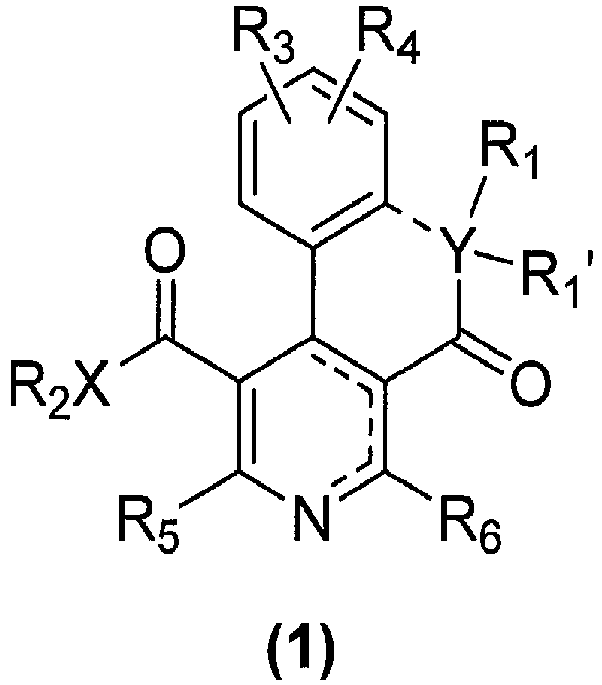
R1 and R1' are each independently hydrogen, an optionally substituted lower alkyl, an optionally substituted lower cycloalkyl, and the like; R2 is an optionally substituted lower alkyl, an optionally substituted lower cycloalkyl, and the like; R3 and R4 are each independently hydrogen, halogen, hydroxy, nitro, cyano, an optionally substituted lower alkyl, and the like; R5 and R6 are each independently an optionally substituted lower alkyl; an optionally substituted lower cycloalkyl, and the like; X is nitrogen or oxygen; Y is carbon, nitrogen or oxygen; and a broken line represents the presence or absence of a bond;
or a pharmaceutically acceptable salt, a solvate, or a prodrug thereof.
Description
- In general, the present invention relates to novel compounds with an inhibitory effect on mitochondrial hyperfission. Specifically, the present invention relates to compounds that exhibit the inhibitory effect on mitochondrial hyperfission through inhibition of dynamin-related protein 1 (Drp1)-filamin complex formation, and pharmaceutical compositions comprising the same.
- Mitochondria are organelles found in almost all eukaryotic cells, and take principally part in ATP generation as a result of oxidative phosphorylation that occurs in electron transport system. Mitochondria are dynamic organelles that change their morphology and/or structure by repeating division and fusion (Non-Patent Document 1). Mitochondria in healthy mature cardiomyocytes are static, and rarely divide or fuse. However, once mitochondria are in morbid state, they undergo violent division or fusion. Similar to neurodegenerative diseases, dysfunction of mitochondrial dynamics is thought to cause the onset and progression of cardiovascular diseases (Non-Patent Document 2). In addition, abnormal mitochondrial division or fusion is known to be involved in onset of cancers, cardiovascular diseases, neurodegenerative diseases, and the like (Non-Patent Document 3). For example, it has been suggested that abnormal mitochondrial division or fusion induces abnormality of energy metabolism in the infarct focus after myocardial infarction, which causes chronic heart failure (Non-Patent Document 4).
- Aberrant dynamics of mitochondria due to abnormal interaction between mitochondria and an actin cytoskeleton has attracted public attention as a critical determinant of cardiac vulnerability after myocardial infarction. Mitochondrial division is induced by activation of Dynamin-Related Protein 1 (Drp1), which is a GTP-binding protein. Upon hypoxic stimulation of cardiomyocytes to mimic myocardial infarction, Drp1 in the cells combines Filamin to form a Drp1-filamin complex, further forms a Drp1-filamin-actin complex to activate Drp1, and promotes mitochondrial division (Non-Patent Document 5).
- Cilnidipine, a dihydropyridine-based calcium antagonist represented by formula (A1):

- Currently, cilnidipine is widely prescribed as an antihypertension drug since it functions to block the L-type calcium channel and the N-type calcium channel. Cilnidipine is featured by its longer lastingness of the antihypertension activity as compared with other antihypertension drugs, and therefore, cilnidipine is valuable as a therapeutic agent for cardiovascular diseases including heart failure, arrhythmia, and the like (
Patent Document 3, 4 and 5). It has also been reported that cilnidipine is useful for the treatment or prevention of cerebral infarction and cerebral hemorrhage in addition to the commonly used antihypertensive treatment (e.g., Patent Document 6) and for the treatment or prevention of renal dysfunction (Patent Document 7), aiming at its calcium antagonistic action. Furthermore, cilnidipine has also been reported to have an effect of reducing the side effects of anticancer drugs (Patent Document 8). -
- Patent Document 1: International Publication No.
WO2016/080516 - Patent Document 2: International Publication No.
WO2020/241638 - Patent Document 3:
Japanese Patent No. 4613496 - Patent Document 4: Japanese Patent Publication (Kokai)
JP-A-2008-044871 - Patent Document 5: International Publication No.
WO2013/147137 - Patent Document 6: Japanese Patent Publication (Kokai)
JP-A-2004-359675 - Patent Document 7: International Publication No.
WO2008/016171 - Patent Document 8: Japanese Patent Publication (Kokai)
JP-A-2013-014549 -
- Non-Patent Document 1: Song, M. & Dorn, G.W. 2nd. (2015) Mitoconfusion: Noncanonical functioning of dynamism factors in static mitochondria of the heart. Cell Metab., 21, 195-205.
- Non-Patent Document 2: Dorn, G.W. 2nd. (2016) Mitochondrial fission/fusion and cardiomyopathy. Curr. Opin. Genet. Dev., 38, 38-44.
- Non-Patent Document 3: Hagir B Suliman, Claude A Piantadosi. Mitochondrial Quality Control as a Therapeutic Target. Pharmacol Rev. 2016 Jan; 68(1): 20-48. doi: 10.1124/pr.115.011502.
- Non-Patent Document 4: Picca A, Mankowski RT, Burman JL, Donisi L, Kim JS, Marzetti E, Leeuwenburgh C. Mitochondrial quality control mechanisms as molecular targets in cardiac ageing. Nat Rev Cardiol. 2018 Sep; 15(9):543-554. doi: 10.1038/s41569-018-0059-z.
- Non-Patent Document 5: Akiyuki Nishimura 1, Motohiro Nishida, Seikagaku, Vol. 91, No. 4, pp. 519-522 (2019)
- Non-Patent Document 6: Nishimura A., et al., Hypoxia-induced interaction of filamin with Drp1 causes mitochondrial hyperfission-associated myocardial aging, Sci. Signal., 11 (556), eaat5185, 2018.
- In general, it is important that a drug candidate compound has one main action and no other action, in view of the common process for drug development in which the efficacy of a drug candidate compound is confirmed and the adverse events thereof are identified. As described above, cilnidipine that has been found to exhibit the inhibitory effect on the formation of Drp1-filamin complex, has a calcium channel inhibitory effect, and this effect renders it approved as a drug agent for an antihypertension drug. Some of the derivatives of cilnidipine described in
Patent Documents 1 and 2 have not only an inhibitory effect on the formation of Drp1-filamin complex, but also a calcium channel inhibitory effect. - As a result of intensive studies on the cilnidipine derivatives, the present inventors succeeded in separating the inhibitory effect on the formation of the Drp1-filamin complex from the calcium channel inhibitory effect, so as to accomplish the present invention. Specifically, the present inventors synthesized various derivatives of cilnidipine by modifying the chemical structure thereof, and discovered specific compounds which attenuate the calcium channel inhibitory effect, and which have a potent inhibitory effect on mitochondrial hyperfission based on inhibitory effect on the formation of Drp1-filamin complex.
- Accordingly, the present invention encompasses the following aspects:
-
- [1] A compound represented by formula (1):


- R1 and R1' are each independently hydrogen, an optionally substituted lower alkyl, an optionally substituted lower cycloalkyl, an optionally substituted lower heterocycloalkyl, an optionally substituted aryl, an optionally substituted arylalkyl, an optionally substituted heteroaryl, an optionally substituted heteroarylalkyl, an optionally substituted carbonyl, an optionally substituted carboxamide, or a covalent substituent;
- R2 is an optionally substituted lower alkyl, an optionally substituted lower cycloalkyl, an optionally substituted lower heterocycloalkyl, an optionally substituted aryl, an optionally substituted arylalkyl, an optionally substituted heteroaryl, an optionally substituted heteroarylalkyl, an optionally substituted carboxamide, an optionally substituted carbonyl, or a covalent substituent;
- R3 and R4 are each independently hydrogen, halogen, hydroxy, nitro, cyano, an optionally substituted lower alkyl, an optionally substituted lower cycloalkyl, an optionally substituted lower heterocycloalkyl, an optionally substituted aryl, an optionally substituted arylalkyl, an optionally substituted heteroaryl, an optionally substituted heteroaryl, an optionally substituted heteroarylalkyl, an optionally substituted amino, an optionally substituted lower alkoxy, an optionally substituted lower alkylthio, an optionally substituted carbonyl, an optionally substituted carboxamide, deuterium, or a covalent substituent;
- R5 and R6 are each independently an optionally substituted lower alkyl, an optionally substituted lower cycloalkyl, an optionally substituted lower heterocycloalkyl, an optionally substituted aryl, an optionally substituted arylalkyl, an optionally substituted heteroaryl, an optionally substituted heteroarylalkyl, an optionally substituted carbonyl, an an optionally substituted carboxamide, or a covalent substituent;
- X is nitrogen or oxygen;
- Y is carbon, nitrogen or oxygen, and
- A broken line represents the presence or absence of a bond;
- provided that:
- a broken line attached to Y represents the presence or absence of a bond, if Y is carbon or nitrogen, or the broken line represents the absence of a bond, if X is oxygen; and provided that the covalent substituents are selected from a group consisting of acrylamide, alkynylamide, chloroacetamide, chlorofluoroacetamide, vinylsulfone, vinylsulfonamide, sulfonylfluoride, sulfonyltriazole, sulfonyloxyfluoride, bicyclobutaneketone, bicyclobutanamide, bicyclobutanesulfone, and bicyclobutanesulfonamide, and
- that the covalent substituent can be substituted with only one of the substituents of R1 through R6, when the covalent substituents are substituted;
- or a pharmaceutically acceptable salt, a solvate, or a prodrug thereof.
- provided that:
- [2] A compound, or a pharmaceutically acceptable salt, a solvate, or a prodrug thereof, wherein the compound is represented by formula (2):

- [3] The compound of [2], or a pharmaceutically acceptable salt, a solvate, or a prodrug thereof, wherein the compound is represented by formula (2-2):

- wherein R21 is an optionally substituted lower alkyl, an optionally substituted arylalkyl, an optionally substituted heteroarylalkyl, an optionally substituted carboxamide, an optionally substituted carbonyl, or a covalent substituent; or


- wherein R22 is independently an optionally substituted carbonyl, preferably an optionally substituted carboxylic acid, an optionally substituted alkoxycarbonyl, in particular an optionally substituted methoxycarbonyl, or an optionally substituted tert-butoxycarbonyl, more preferably these substituents R22 are located in the meta position.
- wherein R21 is an optionally substituted lower alkyl, an optionally substituted arylalkyl, an optionally substituted heteroarylalkyl, an optionally substituted carboxamide, an optionally substituted carbonyl, or a covalent substituent; or
- [4] The compound, or a pharmaceutically acceptable salt, a solvate, or a prodrug thereof, wherein the compound is represented by formula (3):

- [5] The compound of [4], or a pharmaceutically acceptable salt, a solvate, or a prodrug thereof, wherein the compound is represented by formula (3-2):

- [6] The compound of any one of [1] to [5], or a pharmaceutically acceptable salt, a solvate, or a prodrug thereof, wherein R1 or R1' is each independently hydrogen or an optionally substituted lower alkyl.
- [7] The compound of any one of [1] to [6], or a pharmaceutically acceptable salt, a solvate, or a prodrug thereof, wherein R2 is hydrogen or an optionally substituted lower alkyl.
- [8] The compound of any one of [1] to [7], or a pharmaceutically acceptable salt, a solvate, or a prodrug thereof, wherein R3 or R4 is each independently selected from the group consisting of hydrogen, an optionally substituted lower alkyl, amino, and nitro.
- [9] The compound of any one of [1] to [8], or a pharmaceutically acceptable salt, solvate, or a prodrug thereof, wherein R5 or R6 is each independently hydrogen, or an optionally substituted lower alkyl.
-
- [10] A pharmaceutical composition for treating or preventing a disease caused by mitochondrial hyperfission, which comprises the compound of any one of [1] to [9], or a pharmaceutically acceptable salt, a solvate, or a prodrug thereof.
- [11] The pharmaceutical composition of [10], wherein the disease caused by mitochondrial hyperfission is chronic heart failure, amyotrophic lateral sclerosis, neurodegenerative diseases, inflammatory bowel diseases, or diabetes or diabetic complications.
- The compounds of the present invention have a superior Drp1-dependent inhibitory effect on mitochondrial hyperfission, compared to the approved drug, cilnidipine, and are expected to exert a higher therapeutic effect on diseases caused by mitochondrial hyperfission, such as chronic heart failure, amyotrophic lateral sclerosis, neurodegenerative diseases, inflammatory bowel disease, or diabetes or diabetic complications.
-
-
Figure 1: Figure 1(a) is a fluorescence micrograph of a cell cultured under normoxia in Test Example 1, andFigure 1(b) is a fluorescence micrographof a cell cultured under hypoxia in Test Example 1. -
Figure 2: Figure 2(a) is a representative fluorescence micrograph showing the general morphology of mitochondria.Figure 2(b) is an image that illustrates a shape of mitochondria extracted by filtering the photograph ofFigure 2(a). Figure 2(c) is a graph that illustrates the results of measurement of length of mitochondria from the cardiomyocytes of a neonatal rat cultured under normoxia or hypoxia. -
Figure 3: Figures 3(a) and (b) are graphs that illustrate the inhibitory effect on mitochondrial hyperfission of the compounds prepared in Examples, as a result of measurement of the ratio of cells having vesicle-shaped mitochondria. -
Figure 4: Figures 4(a) and (b) are graphs that illustrate the results of measurement of increase in intracellular calcium ion concentration induced by potassium chloride stimulation. -
Figure 5: Figure 5 is a set of photographs that illustrate suppressive effect on aging of the compounds of the present invention. Scale bar indicates 20 µm. -
Figure 6: Figure 6 is graph that illustrates the cytoprotective effect against cytotoxicity induced by MeHg and hypotonic stimulation. In the figure, MeHg(+) indicates the presence of MeHg, and MeHg(-) indicates the absence of MeHg. Hypotonic stimulation (+) indicates condition in hypotonic solution, and hypotonic stimulation (-) indicates condition in isotonic solution. - In one embodiment, the present invention provides a compound represented by formula (1):

- R1 and R1' are each independently hydrogen, an optionally substituted lower alkyl, an optionally substituted lower cycloalkyl, an optionally substituted lower heterocycloalkyl, an optionally substituted aryl, an optionally substituted arylalkyl, an optionally substituted heteroaryl, an optionally substituted heteroarylalkyl, an optionally substituted carbonyl, an optionally substituted carboxamide, or a covalent substituent;
- R2 is an optionally substituted lower alkyl, an optionally substituted lower cycloalkyl, an optionally substituted lower heterocycloalkyl, an optionally substituted aryl, an optionally substituted arylalkyl, an optionally substituted heteroaryl, an optionally substituted heteroarylalkyl, an optionally substituted carboxamide, an optionally substituted carbonyl, or a covalent substituent;
- R3 and R4 are each independently hydrogen, halogen, hydroxy, nitro, cyano, an optionally substituted lower alkyl, an optionally substituted lower cycloalkyl, an optionally substituted lower heterocycloalkyl, an optionally substituted aryl, an optionally substituted arylalkyl, an optionally substituted heteroaryl, an optionally substituted heteroaryl, an optionally substituted heteroarylalkyl, an optionally substituted amino, an optionally substituted lower alkoxy, an optionally substituted lower alkylthio, an optionally substituted carbonyl, an optionally substituted carboxamide, deuterium, or a covalent substituent;
- R5 and R6 are each independently an optionally substituted lower alkyl, an optionally substituted lower cycloalkyl, an optionally substituted lower heterocycloalkyl, an optionally substituted aryl, an optionally substituted arylalkyl, an optionally substituted heteroaryl, an optionally substituted heteroarylalkyl, an optionally substituted carbonyl, an optionally substituted carboxamide, or a covalent substituent;
- X is nitrogen or oxygen;
- Y is carbon, nitrogen or oxygen, and
- A broken line represents the presence or absence of a bond;
provided that:- a broken line attached to Y represents the presence or absence of a bond, if Y is carbon or nitrogen, or the broken line represents the absence of a bond, if X is oxygen; and provided that the covalent substituents are selected from a group consisting of acrylamide, alkynylamide, chloroacetamide, chlorofluoroacetamide, vinylsulfone, vinylsulfonamide, sulfonylfluoride, sulfonyltriazole, sulfonyloxyfluoride, bicyclobutaneketone, bicyclobutanamide, bicyclobutanesulfone, and bicyclobutanesulfonamide, and
that the covalent substituent can be substituted with only one of the substituents of R1 through R6, when the covalent substituents are substituted; - or a pharmaceutically acceptable salt, a solvate, or a prodrug thereof.
- a broken line attached to Y represents the presence or absence of a bond, if Y is carbon or nitrogen, or the broken line represents the absence of a bond, if X is oxygen; and provided that the covalent substituents are selected from a group consisting of acrylamide, alkynylamide, chloroacetamide, chlorofluoroacetamide, vinylsulfone, vinylsulfonamide, sulfonylfluoride, sulfonyltriazole, sulfonyloxyfluoride, bicyclobutaneketone, bicyclobutanamide, bicyclobutanesulfone, and bicyclobutanesulfonamide, and
- As used herein, the term "lower alkyl" in "optionally substituted lower alkyl" means a straight or branched hydrocarbon chain group which consists of carbon atoms and hydrogen atoms, which does not contain any unsaturation, which contains 1 to 10, or 1 to 8, or 1 to 6, or 1 to 3 carbon atoms, and which connected to the remainder of the molecule by a single bond. Examples of lower alkyl groups include, but are not limited to, alkyl groups such as methyl, ethyl, n-propyl, isopropyl, isobutyl, 3-methyl-1-pentyl, 4-methyl-1-pentyl, 3,3-dimethyl-1-butyl, t-butyl, pentyl, isopentyl and hexyl. Preferred substituents are methyl, ethyl, n-propyl and isopropyl. Alkyl groups may be optionally substituted with one or more substituents, in which the substituents are as defined below.
- As used herein, the term "lower cycloalkyl" in "optionally substituted lower cycloalkyl" means a nonaromatic monocyclic or polycyclic group containing carbon atoms and hydrogen atoms. A lower cycloalkyl group may contain one or more carbon-carbon double bonds in the ring, so long as the presence of the carbon-carbon double bonds does not render the ring aromatic. Examples of lower cycloalkyl groups include, but are not limited to, C3 to C7 fully saturated cycloalkyl groups such as cyclopropyl, cyclobutyl, cyclopentyl, cyclohexyl, cycloheptyl; saturated cyclic terpenes and bicyclic terpenes and C3 to C7 cycloalkenyl groups such as cyclopropenyl, cyclobutenyl, cyclopentenyl, cyclohexenyl, cycloheptenyl; and unsaturated cyclic terpenes and bicyclic terpenes. A lower cycloalkyl group may be unsubstituted or substituted with one or two suitable substituents, in which the substituents are as defined below. Preferably, cycloalkyl groups are monocyclic or bicyclic cyclic groups.
- As used herein, the term "lower heterocycloalkyl" in "optionally substituted lower heterocycloalkyl" means a nonaromatic monocyclic or polycyclic group containing carbon atoms and hydrogen atoms as well as at least one heteroatom, preferably 1 to 4 heteroatoms selected from nitrogen, oxygen, and sulfur. A lower heterocycloalkyl group may contain one or more carbon-carbon double bonds or carbon-heteroatom double bonds in the ring, unless the presence of such carbon-carbon or carbon-heteroatom double bond renders the ring aromatic. Examples of heterocycloalkyl groups include, but are not limited to, aziridinyl, pyrrolidinyl, pyrrolidino, piperidinyl, piperazino, piperazinyl, piperazino, morpholinyl, morpholino, thiomorpholinyl, thiomorpholino, tetrahydrofuranyl, tetrahydrothiofuranyl, tetrahydropyranyl, and pyranyl. A lower heterocycloalkyl group may be unsubstituted or substituted with one or two suitable substituents. Preferably, a heterocycloalkyl group is a monocyclic or bicyclic group, and more preferably it is a monocyclic group that contains 2 to 6 carbon atoms and 1 to 3 heteroatoms. A lower heterocycloalkyl group may be optionally substituted with one or more substituents, in which the substituents are as defined below.
- As used herein, the term "lower alkoxy" in "optionally substituted lower alkoxy" means an -O-alkyl group in alkyl as defined above. Examples of an optionally substituted lower alkoxy include, but are not limited to, a lower alkylalkoxy, a lower cycloalkylalkoxy, and a lower bicycloalkoxy.
- As used herein, the term "halogen" means chloro, bromo, iodo or fluoro.
- As used herein, the term "aryl" in "optionally substituted aryl" means an aromatic group, which contains 6 to 18, or 6 to 10, or 6, 7 or 8 carbon atoms, which contains 1, 2 or 3 aromatic nuclei, and which may be optionally fused. Examples of "aryl" include, but are not limited to, phenyl, naphthyl, diphenyl, indenyl, phenanthryl. An aryl group may be optionally substituted with one or more substituents, in which the substituents are as defined below.
- As used herein, the term "arylalkyl" in "optionally substituted arylalkyl" means a lower alkyl group substituted with an aryl group as defined above. Preferably, the term "arylalkyl" means benzyl, diphenylmethyl, trityl, or phenethyl group.
- As used herein, the term "heteroaryl" in "optionally substituted heteroaryl" means a stable 3- to 15-membered aromatic ring group which consists of a carbon atom and 1 to 5 heteroatoms selected from the group consisting of nitrogen, oxygen and sulfur. In one embodiment of the present invention, the heteroaryl group is a 3- to 10-membered, or a 5- or 6-membered aromatic ring group. In the present invention, a heteroaryl may be monocyclic, bicyclic or tricyclic ring systems, and may contain a fused ring system, in which the nitrogen, carbon or sulfur atom in the heteroaryl group may be optionally oxidized, or the nitrogen atom may be optionally quaternized. Examples of such heteroaryls include, but are not limited to, benzimidazolyl, benzothiazolyl, furanyl, pyronyl, thiophenyl, pyridinyl, bipyridinyl, pyrimidinyl, isothiazolyl, isoxazolyl, imidazolyl, indonyl, purinyl, quinolinyl, thiadiazolyl. Preferably, heteroaryl means pyridyl, pyrimidyl, furyl, thienyl, imidazolyl or thiazolyl. Preferred heteroaryls also include aziridin-1-yl, azetidin-1-yl, pyrrolidinyl, piperidinyl, piperazinyl, morpholino. A Heteroaryl group may be optionally substituted with one or more substituents, in which the substituents are as defined below.
- The term "heteroarylalkyl" means a lower alkyl group substituted with a heteroaryl group as defined above. Examples of heteroarylalkyl include, but are not limited to, pyridylmethyl, 2-(pyridyl)ethyl, 3-(pyridyl)propyl, pyridin-4-ylmethyl, pyrimidylmethyl, 2-(pyrimidyl)ethyl, 3-(pyrimidyl)propyl, furylmethyl, 2-(furyl)ethyl, 3-(furyl)propyl, thienylmethyl, 2-(thienyl)ethyl, 3-(thienyl)propyl, imidazolylmethyl, 2-(imidazolyl)ethyl, 3-(imidazolyl)propyl, thiazolylmethyl, 2-(thiazolyl)ethyl, or 3-(thiazolyl)propyl).
- As used herein, the term "carbonyl" in "optionally substituted carbonyl" means a group in which -C(O)- is attached with a substituent, and "optionally substituted carbonyl" includes, for example, a carboxy: -COOH in which OH is substituted, an alkylcarbonyl: -C(O)-alkyl group, or an "alkoxycarbonyl": -C(O)O-alkyl group. Preferred "optionally substituted carbonyls" include a lower alkylalkoxycarbonyl, a lower cycloalkylalkoxycarbonyl, a lower bicycloalkylalkoxycarbonyl, a lower alkylcarbonyl, a lower cycloalkylcarbonyl and a lower bicycloalkylcarbonyl.
- As used herein, the term "carboxamide" in "optionally substituted carboxamide" means a group in which -C(O)N- may be attached with a substituent, and includes, for example, carboxamide: -C(O)NH2, an alkylcarboxamide: -C(O)NH-alkyl group, and -C(O)N-(alkyl group)(alkyl group). Preferred "carboxamides" include, but are not limited to, carboxamide, methylcarboxamide, and dimethylcarboxamide.
- As used herein, the term "optionally substituted amino" includes amino, a lower alkylamino, a lower cycloalkylamino, a lower bicycloalkylamino and the like. More specific examples include, but are not limited to, dimethylamino, ethanolamino.
- As used herein, the term "covalent substituent" is synonymous with a covalent bond-forming group, and means a group which reacts with a target protein or the like to provide a compound irreversibly inhibiting or enhancing a function of the protein. Covalent substituents have the advantage in exerting potent and sustained pharmaceutical effects by irreversibly binding to target proteins. Reviews of covalent substituents have been described in in vivo targeting endogenous proteins with reactive small molecules, Naoya Shindo, Akio Ojida, Handbook of In Vivo Chemistry in Mice. From Lab to Living System, Tanaka, K., Vong, K. Eds. Wiley-VCH,; 281-307 (2020), and Covalent inhibitors: a rational approach to drug discovery, Fandi Sutanto, Markella Konstantinidou and Alexander Doemling, RSC Medicinal Chemistry, 11, 876-884 (2020). In the present invention, examples of covalent substituents include, but are not limited to, acrylamides, alkynylamides, chloroacetamides, chlorofluoroacetamides, vinylsulfones, vinylsulfonamides, sulfonylfluorides, sulfonyltriazoles, sulfonyloxyfluorides, bicyclobutaneketones, bicyclobutanamides, bicyclobutanesulfone, and bicyclobutanesulfonamide.
- In the present invention, the substitution of covalent substituents is optional and not required. A compound substituted with any covalent substituent has only one covalent substituent. Specifically, in a compound substituted with any covalent substituent, the covalent substituent may be substituted with only one substituent of R1 to R6 substituents.
- The "optionally substituted" in each of the above definitions means that a substituent may be substituted at an arbitrary, substitutable position (involved in carbon atoms and heteroatoms), and the substituent may be further substituted with one or more substituents selected from the group consisting of a halogen (fluoro, chloro, bromo); an alkoxy, preferably methoxy; an alkylcarbonyl, preferably methylcarbonyl; an alkoxycarbonyl, preferably methoxycarbonyl and ethoxycarbonyl; hydroxycarbonyl; an optionally substituted methyl such as trifluoromethyl; cyano; nitro, methanesulfonyl; isobutyl; tert-butyl; ethanone; acetamidomethyl (-CH2-NH-CO-CH3); oxazolyl or isoxazolyl substituted optionally with a C1 to C3 alkyl (such as methyl); pyridyl; hydroxy; phenyl; an alkylamide, preferably isobutylamide (-NH-CO-CH-(CH3)2); an O-alkylamino-alkyl, preferably O-(CH2)2-N-(CH2-CH3)2; N-acetamide; [1,2,3]thiadiazolyl; dialkylamine, preferably dimethylamine; ethyl; ethyl substituted by amine (such as dialkylamine), or a dialkylcarboxamide, preferably dimethylamine and diethylamine), preferably a group in which the dialkylamine of the dialkylcarboxamide forms a 4-, 5-, 6- or 7-membered ring; isopropyl; N-propionamide, haloacetyl, cyano, formyl and ketones.
- Preferably, the above substituents are selected from the group consisting of fluoro, chloro, bromo, methoxy, methylcarbonyl, methoxycarbonyl, hydroxycarbonyl, ethoxycarbonyl, an optionally substituted methyl such as trifluoromethyl, cyano, nitro, methanesulfonyl, pyridine, tert-butyl, acetamidomethyl (-CH2-NH-CO-CH3), oxazolyl or isoxazolyl substituted optionally with a C1 to C3 alkyl (such as methyl), phenyl, O-(CH2)2-N-(CH2-CH3)2, N-acetamide, dimethylamine, isopropyl, N-propionamide, haloacetyl, cyano, formyl and a ketone.
- The compounds of the present invention may be in the form of salts, preferably pharmaceutically acceptable salts, solvates or prodrugs.
- In yet another preferred embodiment, the present invention provides a compound, or a pharmaceutically acceptable salt, a solvate, or a prodrug thereof, wherein the compound is represented by formula (2):

- In yet another preferred embodiment, the present invention provides a compound, or a pharmaceutically acceptable salt, a solvate, or a prodrug thereof, wherein the compound is represented by formula (3):

- In yet another preferred embodiment, the present invention provides a compound represented by formula (1):

- X is oxygen;
- Y is nitrogen or oxygen;
- A broken line represents the presence or absence of a bond;
- One of R1 and R1' is hydrogen, and the other is an optionally substituted lower alkyl, an optionally substituted aryl, an optionally substituted arylalkyl, an optionally substituted heteroarylalkyl, an optionally substituted carbonyl, an optionally substituted carboxamide, or a covalent substituent;
- R2 is an optionally substituted lower alkyl, an optionally substituted arylalkyl, an optionally substituted heteroarylalkyl, an optionally substituted carboxamide, an optionally substituted carbonyl, or a covalent substituent;
- R3 and R4 are each independently hydrogen, halogen, hydroxy, nitro, cyano, an optionally substituted lower alkyl, an optionally substituted amino, an optionally substituted lower alkoxy, an optionally substituted lower alkylthio, an optionally substituted carbonyl, an optionally substituted carboxamide, deuterium, or a covalent substituent;
- R5 and R6 are each independently an optionally substituted lower alkyl, an optionally substituted carbonyl, an optionally substituted carboxamide, or a covalent substituent;
provided that:- a broken line attached to Y represents the presence or absence of a bond, if Y is carbon or nitrogen, or the broken line represents the absence of a bond, if X is oxygen; and provided that the covalent substituents are selected from a group consisting of acrylamide, alkynylamide, chloroacetamide, chlorofluoroacetamide, vinylsulfone, vinylsulfonamide, sulfonylfluoride, sulfonyltriazole, sulfonyloxyfluoride, bicyclobutaneketone, bicyclobutanamide, bicyclobutanesulfone, and bicyclobutanesulfonamide, and
that the covalent substituent can be substituted with only one of the substituents of R1 through R6, when the covalent substituents are substituted; - or a pharmaceutically acceptable salt, a solvate, or a prodrug thereof.
- a broken line attached to Y represents the presence or absence of a bond, if Y is carbon or nitrogen, or the broken line represents the absence of a bond, if X is oxygen; and provided that the covalent substituents are selected from a group consisting of acrylamide, alkynylamide, chloroacetamide, chlorofluoroacetamide, vinylsulfone, vinylsulfonamide, sulfonylfluoride, sulfonyltriazole, sulfonyloxyfluoride, bicyclobutaneketone, bicyclobutanamide, bicyclobutanesulfone, and bicyclobutanesulfonamide, and
- In yet another preferred embodiment, the present invention provides a compound represented by formula (2):

- X is oxygen;
- R1 is an optionally substituted lower alkyl, an optionally substituted aryl, an optionally substituted arylalkyl, an optionally substituted heteroarylalkyl, an optionally substituted carbonyl, an optionally substituted carboxamide, or is a covalent substituent;
- R2 is an optionally substituted lower alkyl, an optionally substituted arylalkyl, an optionally substituted heteroarylalkyl, an optionally substituted carboxamide, an optionally substituted carbonyl, or a covalent substituent;
- R3 and R4 are each independently hydrogen, halogen, hydroxy, nitro, cyano, an optionally substituted lower alkyl, an optionally substituted amino, an optionally substituted lower alkoxy, an optionally substituted lower alkylthio, an optionally substituted carbonyl, an optionally substituted carboxamide, deuterium, or covalent substituent;
- R5 and R6 are each independently an optionally substituted lower alkyl, an optionally substituted carbonyl, an optionally substituted carboxamide, or a covalent substituent;
- provided that:
- the covalent substituents are acrylamide, alkynylamide, chloroacetamide, chlorofluoroacetamide, vinylsulfone, vinylsulfonamide, sulfonylfluoride, sulfonyltriazole, sulfonyloxyfluoride, bicyclobutaneketone, bicyclobutanamide, bicyclobutanesulfone, and bicyclobutanesulfonamide; and
- that the covalent substituents can be substituted with only one of the substituents of R1 through R6, when the covalent substituents are substituted;
- or a pharmaceutically acceptable salt, a solvate, or a prodrug thereof.
- In such embodiments, preferred compounds are represented by formula (2-2):


- In yet another preferred embodiment, the present invention provides a compound represented by formula (3):

- X is oxygen;
- a broken line represents the presence or absence of a bond;
- one of R1 and R1 is hydrogen, and the other is an optionally substituted lower alkyl, an optionally substituted aryl, an optionally substituted arylalkyl, an optionally substituted heteroarylalkyl, substituted optionally a carbonyl, an optionally substituted carboxamide, or a covalent substituent;
- R2 is an optionally substituted lower alkyl, an optionally substituted arylalkyl, an optionally substituted heteroarylalkyl, an optionally substituted carboxamide, an optionally substituted carbonyl, or a covalent substituent;
- R3 and R4 are each independently hydrogen, halogen, hydroxy, nitro, cyano, an optionally substituted lower alkyl, an optionally substituted amino, an optionally substituted lower alkoxy, an optionally substituted lower alkylthio, an optionally substituted carbonyl, an optionally substituted carboxamide, deuterium, or covalent substituent;
- R5 and R6 are each independently an optionally substituted lower alkyl, an optionally substituted carbonyl, an optionally substituted carboxamide, or a covalent substituent;
- provided that:
- the covalent substituents are acrylamide, alkynylamide, chloroacetamide, chlorofluoroacetamide, vinylsulfone, vinylsulfonamide, sulfonylfluoride, sulfonyltriazole, sulfonyloxyfluoride, bicyclobutaneketone, bicyclobutanamide, bicyclobutanesulfone, and bicyclobutanesulfonamide; and
- that the covalent substituents can be substituted with only one of the substituents of R1 through R6, when the covalent substituents are substituted;
- or a pharmaceutically acceptable salt, a solvate, or a prodrug thereof.
- In such embodiments, preferred compounds are represented by formula (3-2):


- The compounds of the present invention are preferably those wherein R1 and R1' are each independently selected from the group consisting of hydrogen or an optionally substituted lower alkyl, and more preferably those wherein R1 and R1' are each independently selected from the group consisting of hydrogen, methyl, benzyl, and 4-pyridylmethyl, or pharmaceutically acceptable salts, solvates, or prodrugs thereof.
- In another embodiment, the compounds of the present invention are those wherein R2 is preferably selected from the group consisting of hydrogen and an optionally substituted lower alkyl, and more preferably selected from the group consisting of methyl, ethyl, benzyl, pyridin-4-ylmethyl, 2-(pyridin-4-yl)ethyl, and 3-(pyridin-4-yl)propyl, or pharmaceutically acceptable salts, solvates, or prodrugs thereof.
- In another embodiment, the compounds of the present invention are preferably those wherein R3 or R4 is each independently selected from the group consisting of hydrogen, an optionally substituted lower alkyl, amino, and nitro, and more preferably those wherein R3 or R4 is each independently selected from the group consisting of hydrogen, methyl, ethyl, amino, and nitro, or pharmaceutically acceptable salts, solvates, or prodrugs thereof. Even more preferably, R3 or R4 is a group that can serve as the basis for covalent substituents.
- In another embodiment, the compounds of the present invention are preferably those in which R5 or R6 is each independently selected from the group consisting of hydrogen and an optionally substituted lower alkyl, and more preferably those in which R5 or R6 is each independently selected from the group consisting of hydrogen, methyl, ethyl, hydroxymethyl, aminomethyl, 2-hydroxyethyl, and 2-aminoethyl, or pharmaceutically acceptable salts, solvates, or prodrugs thereof. Even more preferably, R5 or R6 is a group that can serve as the basis for covalent substituents.
- In one preferred embodiment of the present invention, a compound of the present invention wherein R1, R1', R2, R3, R4, R5 and R6 are each of the preferred groups, or a pharmaceutically acceptable salt, a solvate, or a prodrug thereof is provided.
- The term "pharmaceutically acceptable salt" means a salt that, when administered to a subject, affords (directly or indirectly) a compound described herein. The preparation of the salt may be carried out by methods known in the art. Preferably, when administered to humans, the "pharmaceutically acceptable salt" is physiologically tolerable, and typically affords a molecular part that does not create any allergic reactions or any similar untoward reactions (such as upset stomach, dizziness, and the like).
- For example, pharmaceutically acceptable salts of the compounds provided herein are synthesized from the parent compounds, which contain a basic or acidic moiety, according to conventional chemical methods. Generally, such salts are prepared by reacting the free acid or free base forms of these compounds with appropriate bases or acids in stoichiometric amounts, for example, in water or an organic solvent, or a mixture thereof. Generally, non-aqueous media such as ether, ethyl acetate, ethanol, isopropanol or acetonitrile are preferred. Examples of acid addition salts include mineral acid addition salts (such as hydrochloride, hydrobromide, hydroiodide, sulfate, nitrate, phosphate), and organic acid addition salts such as acetate, maleate, fumarate, citrate, oxalate, succinate, tartrate, malate, mandelate, methanesulfonate and p-toluenesulfonate. Examples of alkali addition salts include inorganic salts (such as salts of sodium, potassium, calcium, ammonium, magnesium, aluminum, and lithium), and organic alkali salts (such as salts of ethylenediamine, ethanolamine, N,N-dialkyleneethanolamine, triethanolamine, glucamine, and a basic amino acid).
- According to the present invention, it should be understood that the term "solvate" means any form of the active compound of the present invention to which another molecule (most likely it would be a polar solvent) is attached via a non-covalent bond. Examples of such solvates include hydrates and alcoholates such as methanolates.
- Whether the compounds of the present invention are either free compounds or solvates (such as hydrates), they may be in crystalline forms, and both forms should be within the scope of the present invention. In general, methods of solvation are known in the art. Suitable solvates are pharmaceutically acceptable solvates. In specific embodiments, the solvate is a hydrate.
- The term "prodrug" as used herein means a chemical compound that is subjected to chemical derivatization such as substitution or addition of a further chemical group so as to alter any of physicochemical properties thereof, for example, solubility or bioavailability toward pharmaceutical use. Examples of the prodrug include ester and ether derivatives of an active compound which, when administered to a subject, afford the active compound itself. Examples of the well-known methods for preparing prodrugs of a given active compound are known to those skilled in the art, and may be found in, for example, Krogsgaard-Larsen et al., Textbook of Drug design and Discovery, Taylor & Francis (April 2002).
- Preparation of salts, solvates and prodrugs can be carried out by methods known in the art. It should be understood that non-pharmaceutically acceptable salts, solvates or prodrugs are also within the scope of the present invention as they may be useful in the preparation of pharmaceutically acceptable salts, solvates or prodrugs.
- Methods for preparing the compounds of the present invention are generally described below.

- R3 to R6 are the same as defined in formula (1); and
- R7 and R8 are each independently an optionally substituted lower alkyl, an optionally substituted lower cycloalkyl, an optionally substituted lower heterobicycloalkyl, an optionally substituted aryl, an optionally substituted arylalkyl, an optionally substituted heteroaryl, an optionally substituted heteroarylalkyl, an optionally substituted carbonyl, an optionally substituted carboxamide, or a covalent substituent.
- The compound represented by general formula (IV) can be obtained by subjecting three components of a benzaldehyde of general formula (I), a compound of general formula (II), and a compound of general formula (III) to a condensation reaction.
- This reaction can be carried out in a suitable solvent at a suitable temperature. Any solvent may be used as long as it does not adversely affect the reaction. Examples include acetonitrile, methanol, ethanol, n-propyl alcohol, 2-propyl alcohol, t-butyl alcohol, acetone, N,N'-dimethylformamide, dimethyl sulfoxide, tetrahydrofuran, diethyl ether, dioxane, ethyl acetate, toluene, methylene chloride, dichloroethane, chloroform, N,N'-dimethylacetamide, 1,3-dimethyl-2-imidazolidinone, 1-methyl-2-pyrrolidinone, 1,2-dimethoxyethane, xylene, and a mixed solvent thereof.
- This reaction preferably proceeds at 0 to 100°C, in particular at room temperature to 80°C.
- Then, the resulting compound of general formula (IV) can be subjected to a hydrolysis reaction to obtain a compound of general formula (V).
- This reaction can be carried out in a suitable solvent in the presence or absence of a suitable base at a suitable temperature. Examples of the Base include sodium hydroxide, potassium hydroxide, ammonia, triethylamine, diisopropylethylamine, tetra-n-butylammonium fluoride and the like.
- This reaction preferably proceeds at -20 to 100°C, in particular at 0 to 80°C.
- Then, the compound of general formula (V) and a disubstituted amine of general formula (VI) can be subjected to a condensation reaction to obtain a compound of general formula (VII).
- This reaction can be carried out in a suitable solvent in the presence of a suitable condensing agent, in the presence or absence of a suitable additive, in the presence or absence of a suitable base, at a suitable temperature.
- Examples of the condensing agent include N,N'-dicyclohexylcarbodiimide, N,N'-diisopropylcarbodiimide, 1-ethyl-3-(3-dimethylaminopropyl)carbodiimide, N,N'-carbonyldiimidazole, 1,1'-carbonyldi(1,2,4-triazole), 4-(4,6-dimethoxy-1,3,5-triazin-2-yl)-4-methylmorpholinium chloride n-hydrate (where n is any number), O-(7-azabenzotriazol-1-yl)-N,N,N',N'-tetramethyluronium hexafluorophosphate, {{(1-cyano-2-ethoxy-2-oxoethylidene)amino)oxy}-4-morpholinomethylene}dimethylammonium hexafluorophosphate, and the like.
- Examples of the additive include 1-hydroxybenzotriazole, 1-hydroxy-7-azabenzotriazole, N-hydroxysuccinimide and the like.
- This reaction preferably proceeds at -20 to 100°C, in particular at 0 to 80°C.
- Then, the compound of general formula (VII) can be subjected to an oxidation reaction to obtain a compound of general formula (VIII).
- This reaction can be carried out in a suitable solvent in the presence of a suitable oxidizing agent at a suitable temperature.
- Examples of the oxidizing agent include 2,3-dichloro-5,6-dicyano-p-benzoquinone, diammonium cerium (IV) nitrate, potassium peroxodisulfate, 2,2,6,6-tetramethylpiperidine 1-oxyl, and the like.
- This reaction preferably proceeds at 0 to 100°C, in particular at room temperature to 80°C.
- Alternatively, the compounds of the present invention can be prepared according to Reaction Scheme II below. Reaction Scheme II

- A compound of general formula (IV) can be subjected to an oxidation reaction to convert to a compound of general formula (IX).
- This reaction can be carried out in a suitable solvent in the presence of a suitable oxidizing agent at a suitable temperature.
- Examples of the oxidizing agent include 2,3-dichloro-5,6-dicyano-p-benzoquinone, diammonium cerium (IV) nitrate, potassium peroxodisulfate, 2,2,6,6-tetramethylpiperidine 1-oxyl, and the like.
- This reaction preferably proceeds at 0 to 100°C, in particular at room temperature to 80°C.
- Then, the compound of general formula (IX) can be subjected to a hydrolysis reaction to obtain a compound of general formula (X).
- This reaction can be carried out in a suitable solvent in the presence of a suitable base at a suitable temperature.
- Examples of the base include sodium hydroxide, potassium hydroxide, ammonia, triethylamine, diisopropylethylamine, tetra-n-butylammonium fluoride and the like.
- This reaction preferably proceeds at -20 to 100°C, in particular at 0 to 80°C.
- Additionally, the compounds of the present invention can be prepared according to Reaction Scheme III below. Reaction Scheme III


- R5 to R6 are the same as defined in Reaction Scheme (1);
- R9 is an optionally substituted alkoxy, preferably methoxy, cyano, or the like; and
- Provided that R5 and R6 represent the same group in Reaction Formula III.
- The compound of general formula (XIII) can be obtained by subjecting three components of an acetoacetate of general formula (XI), a benzaldehyde with a nitro group of general formula (XII), and ammonium acetate to a condensation reaction.
- This reaction can be carried out in a suitable solvent at a suitable temperature.
- This reaction preferably proceeds at 0 to 100°C, in particular at room temperature to 80°C.
- The compound of general formula (XIII) can be subjected to an oxidation reaction to obtain a compound of general formula (XIV).
- This reaction can be carried out in a suitable solvent in the presence of a suitable oxidizing agent at a suitable temperature.
- Examples of the oxidizing agent include 2,3-dichloro-5,6-dicyano-p-benzoquinone, diammonium cerium (IV) nitrate, potassium peroxodisulfate, 2,2,6,6-tetramethylpiperidine 1-oxyl, and the like.
- This reaction preferably proceeds at 0 to 100°C, in particular at room temperature to 80°C.
- A compound of general formula (XV) can be obtained by subjecting the nitro group of the compound of general formula (XIV) to a reductive reaction, as well as cyclizing intramolecularly.
- This reaction can be carried out in a suitable solvent in the presence or absence of a suitable reducing agent, in the presence or absence of a suitable catalyst, in the presence or absence of hydrogen, under a suitable pressure, at a suitable temperature.
- As the reducing agent, iron, tin(II) chloride, palladium carbon, platinum carbon, noble metal catalysts, and the like can be used.
- This reaction proceeds preferably at normal pressure to 10 atm, in particular at normal pressure to 3 atm.
- This reaction preferably proceeds at 0 to 100°C, in particular at room temperature to 80°C.
- Further, the compound of general formula (XV) can be also obtained by subjecting the nitro group of the compound of general formula (XIII) to a reductive reaction, as well as cyclizing intramolecularly and aromatizing at the same time.
- This reaction can be carried out in a suitable solvent in the presence or absence of a suitable reducing agent, in the presence or absence of a suitable catalyst, in the presence or absence of hydrogen, under a suitable pressure, at a suitable temperature.
- As the reducing agent, iron, tin(II) chloride, palladium carbon, platinum carbon, noble metal catalysts, and the like can be used.
This reaction proceeds favorably at normal pressure to 10 atm, in particular at normal pressure to 3 atm.
This reaction preferably proceeds at 0 to 100°C, in particular room temperature to 80°C. - Additionally, the compounds of the present invention can be prepared according to Reaction Scheme IV below. Reaction Scheme IV

- A compound of general formula (XVII) can be obtained by subjecting the compound of general formula (XV) to a condensation reaction using a halogenated compound of general formula (XVI) wherein X is chlorine, bromine, iodine, or the like.
- This reaction can be carried out in a suitable solvent in the presence of a suitable base at a suitable temperature.
- Examples of the base include sodium hydride, potassium hydride, triethylamine, diisopropylethylamine, dimethylaminopyridine, sodium alkoxide and the like.
- This reaction preferably proceeds at -20 to 100°C, in particular at 0 to 80°C.
- Alternatively, a compound of general formula (XVIII) can be obtained by subjecting the compound of general formula (XV), wherein R9 = CN, to a hydrolysis reaction.
- This reaction can be carried out in a suitable solvent in the presence of a suitable base at a suitable temperature.
- Examples of the base include sodium hydroxide, potassium hydroxide, ammonia, triethylamine, diisopropylethylamine, tetra-n-butylammonium fluoride and the like.
- This reaction preferably proceeds at -20 to 100°C, in particular at 0 to 80°C.
- Then, the compound of general formula (XVIII) and the disubstituted amine of general formula (IV) can be subjected to a condensation reaction to obtain a compound of general formula (XIX).
- This reaction can be carried out in a suitable solvent in the presence of a suitable condensing agent, in the presence or absence of a suitable additive, in the presence or absence of a suitable base, at a suitable temperature.
- Examples of the condensing agent include N,N'-dicyclohexylcarbodiimide, N,N'-diisopropylcarbodiimide, 1-ethyl-3-(3-dimethylaminopropyl)carbodiimide, N,N'-carbonyldiimidazole, 1,1'-carbonyldi(1,2,4-triazole), 4-(4,6-dimethoxy-1,3,5-triazin-2-yl)-4-methylmorpholinium chloride n-hydrate, O-(7-azabenzotriazol-1-yl)-N,N,N',N'-tetramethyluronium hexafluorophosphate, {{((1-cyano-2-ethoxy-2-oxoethylidene) amino)oxy}-4-morpholinomethylene}dimethylammonium hexafluorophosphate and the like.
- Examples of the additives include 1-hydroxybenzotriazole, 1-hydroxy-7-azabenzotriazole, N-hydroxysuccinimide and the like.
- This reaction preferably proceeds at -20 to 100°C, in particular at 0 to 80°C.
- Alternatively, the compounds of the present invention can be prepared according to Reaction Scheme V below. Reaction Scheme V


- R3 to R8 are the same as defined in Reaction Scheme (1); and
- R10 is hydrogen, hydroxy, an optionally substituted lower alkyl, an optionally substituted lower alkoxy, an optionally substituted carbonyl, cyano, formyl, nitro, or an optionally substituted amino.
- A compound of general formula (XXI) can be obtained by subjecting three components of the benzaldehyde of general formula (I), the compound of general formula (II), and the acetoacetamide of general formula (XX) to a condensation reaction. Then, the compound of general formula (XXI) can be subjected to an oxidative cyclization reaction to obtain a compound of general formula (XXII).
- This reaction can be carried out in a suitable solvent at a suitable temperature.
- This reaction preferably proceeds at 0 to 100°C, in particular at room temperature to 80°C.
- Alternatively, the compounds of the present invention can be prepared according to Reaction Scheme VI below. Reaction Scheme VI

- A compound of general formula (XXIII) can be obtained by subjecting the compound of the general formula (XXII) wherein R10 is an alkoxycarbonyl group, preferably methoxycarbonyl group, ethoxycarbonyl group, tert-butoxycarbonyl group or the like) to a hydrolysis reaction. Then, the compound represented by general formula (XXIII) and the disubstituted amine represented by general formula (IV) can be subjected to a condensation reaction to obtain the compound represented by general formula (XXIV).
- Alternatively, the compounds of the present invention of general formula (XIX) can be prepared according to Reaction Scheme VII below.

- A compound of general formula (XXVII) can be obtained by subjecting a benzaldehyde with a nitro group of general formula (XII), a compound of general formula (XXVI) and an acetoacetamide of general formula (XXV) to a condensation reaction. Then, the nitro group of general formula (XXVII) can be subjected to a reduction reaction to obtain a compound of general formula (XXVIII). Next, the compound of general formula (XXVIII) can be subjected to a hydrolysis reaction, and the resulting compound of (XXIX) can be intramolecularly cyclized and aromatized to obtain a compound of general formula (XIX). Alternatively, the compound of general formula [XIX] can be obtained by subjecting the nitro group of the compound of general formula [XXVII] to a reduction reaction, followed by cyclizing intramolecularly and aromatizing, which process dose or do not go through the compound of [XXIX].
- Alternatively, the compounds of general formula (XIX) of the present invention can be prepared according to Reaction Scheme VIII below.

- R3 to R8 are the same as defined in Reaction Scheme (1);
- provided that R5 and R6 mean the same group in Reaction Scheme VIII.
- A compound of general formula (XXX) can be obtained by subjecting three components of an acetoacetamide of general formula (XXV) wherein R8 is hydrogen, a benzaldehyde with a nitro group of general formula (XII), and ammonium acetate to a condensation reaction. Then, the compound of general formula (XXX) can be subjected to an oxidation reaction to obtain a compound of general formula (XXXI). Next, the nitro group of the compound of general formula (XXXI) can be subjected to a reduction reaction, and simultaneously to an intramolecular cyclization and an aromatization, to obtain a compound of general formula (XIX).
- As another aspect, the present invention relates to a pharmaceutical composition for treating or preventing a disease caused by mitochondrial hyperfission, which comprises the compound of the present invention, or a pharmaceutically acceptable salt, a solvate, or a prodrug thereof. As demonstrated in the working examples herein, the compounds of the present invention and the like are specific those which have a potent inhibitory effect on mitochondrial hyperfission based on inhibitory effect on the formation of Drp1-filamin complex, and which, unlike cilnidipine, attenuate the calcium channel inhibitory effect that is the main action of cilnidipine. It can be expected that inhibition of mitochondrial hyperfission exert a strong therapeutic effect on chronic heart failure, amyotrophic lateral sclerosis, neurodegenerative diseases, inflammatory bowel diseases, or diabetes or diabetic complications, for example.
- As used herein, "treatment" means a method or process aimed at (1) delaying a disease caused by mitochondrial hyperfission; (2) slowing down or halting the progression, aggravation or exacerbation of the symptoms of a disease caused by mitochondrial hyperfission; (3) inducing remission of the symptoms of a disease caused by mitochondrial hyperfission; or (4) facilitating the cure of a disease caused by mitochondrial hyperfission. Treatment may be given as a prophylactic measure before the onset of the disease or the condition, or treatment may be given after the onset of the disease.
- As used herein, "prevention" means a prophylactic action on a disease caused by mitochondrial hyperfission.
- Examples of the disease caused by mitochondrial hyperfission include, for example, chronic heart failure, amyotrophic lateral sclerosis, neurodegenerative diseases, inflammatory bowel diseases, or diabetes or diabetic complications.
- According to the present invention, a pharmaceutical composition usually means a drug agent for treatment or prevention of diseases, or for examination/diagnosis.
- The pharmaceutical compositions of the present invention may be formulated by methods well-known to those skilled in the art. For example, the pharmaceutical compositions may be used parenterally in the form of injections of sterile solutions or suspensions with water or other pharmaceutically acceptable liquids. For example, the pharmaceutical compositions may be formulated by combining appropriately with pharmacologically acceptable carriers or vehicles, in particular sterile water, physiological saline, vegetable oils, emulsifiers, suspending agents, surfactants, stabilizers, flavoring agents, excipients, vehicles, preservatives, binders, and the like, and admixing them in a unit dosage form required for generally accepted pharmaceutical practice. The amount of an active ingredient in these formulations is set such that a suitable dosage within the indicated range is obtained.
- Sterile compositions for injection may be formulated according to conventional prescriptions using a vehicle such as distilled water for injection.
- Examples of the aqueous solution for injection include, for example, physiological saline, and isotonic solutions containing glucose and other adjuvants such as D-sorbitol, D-mannose, D-mannitol, sodium chloride, and the like. Appropriate solubilizing agents such as alcohols (such as ethanol), polyalcohols (such as propylene glycol, polyethylene glycol), nonionic surfactants (such as polysorbate 80 (TM), HCO-50) may be used in combination.
- Examples of oily liquids include sesame oil and soybean oil, and benzyl benzoate and/or benzyl alcohol may be used as a solubilizing agent in combination with them. Further, a buffer (such as phosphate buffer and sodium acetate buffer), an analgesic (such as procaine hydrochloride), a stabilizer (such as benzyl alcohol and phenol), and an antioxidant may be blended. The prepared injection solution is usually filled into a suitable ampoule.
- The pharmaceutical compositions of the present invention are preferably administered by parenteral administration. For example, the compositions may be in the form of an injection type, nasal administration type, pulmonary administration type, or transdermal administration type. For example, the compositions may be administered systemically or locally by intravenous injection, intramuscular injection, intraperitoneal injection, subcutaneous injection and the like.
- The administration method may be appropriately selected depending on the patient's age and symptoms. The dose of a pharmaceutical composition comprising a polypeptide may be set, for example, into the range of 0.0001 mg to 1000 mg per kg body weight per dose. Alternatively, for example, the dose may be set to 0.001 to 100000 mg per patient, although the present invention is not necessarily limited to these figures. The dose and the administration method vary depending on the patient's body weight, age, symptoms, and the like, and those skilled in the art can determine an appropriate dose and an administration method taking account of those conditions.
- Hereinafter, the present invention will be described in detail by way of the working examples, but it should be noted that these would not limit the scope of the present invention and merely illustrate the invention.
- Abbreviations used herein have the following meanings:
- MeOH: methanol
- EtOH: ethanol
- IPrOH: isopropanol or 2-propanol
- DMF: N,N-dimethylformamide
- MeCN: acetonitrile
- THF: tetrahydrofuran
- CH2Cl2: dichloromethane
- NMR: nuclear magnetic resonance
- MS: mass spectrometry
- DMSO: dimethyl sulfoxide
- CDCl3: deuterated chloroform
- Fe: iron
- AcOH: acetic acid
- NH3: ammonia
- TBAF: tetra-n-butylammonium fluoride
- EDC/HCl: 1-(3-dimethyl-aminopropyl)-3-ethylcarbodiimide hydrochloride
- HOBt•H2O: 1-hydroxybenzotriazole hydrate
- TEA: triethylamine
- DMAP: 4-dimethylaminopyridine
- K2S2O8: potassium persulfate or potassium peroxodisulfate
- NH4OAc: ammonium acetate
- NaH: sodium hydride
- Pd/C: Palladium on carbon
- TFA: trifluoroacetic acid
- SNAP: disposable silica gel column
- sfar silica HC D: disposable silica gel column
- Presep: Disposable silica gel column
- The title compound was prepared according to the synthetic steps in Scheme 1.

-


- A solution of 2-methoxyethyl acetoacetate (TCI, 8 g, 50 mmol) and ammonium acetate (WAKO, 19.25 g, 250 mmol) in 2-propanol (150 mL) was stirred at 60°C for 4 hours under an argon atmosphere. After concentrating the reaction solution under reduced pressure, ethyl acetate (150 mL) was added thereto and the mixture was stirred. The mixture was dried over magnesium sulfate, filtered, and concentrated under reduced pressure, to provide 2-methoxyethyl-3-aminocrotonate (8.59 g, quant.) as a pale yellow oil.
- 1H NMR (500 MHz, CDCl3): δ 1.87 (3H, s), 3.36 (3H, s), 3.57 (2H, t, J = 4.8 Hz), 4.18 (2H, dt, J = 5.0, 0.5 Hz), 4.55 (1H, s). MS (ESI, pos): m/z 160 (M+H)+, 182 (M+Na)+.
-

- A solution of 3-hydroxypropionitrile (WAKO, 7.11 g, 100 mmol) and 2,2,6-trimethyl-1,3-dioxin-4-one (TCI, 15.6 g, 110 mmol) in toluene (100 mL) was reflux for 2 hours under an argon atmosphere. The reaction solution was cooled to room temperature, and then concentrated under reduced pressure. The residue was purified by medium-pressure column chromatography (Presep Si, 30 µm, 90 g, hexane:ethyl acetate = 88:12 → 22:78, 50 mL/min) to provide 2-cyanoethyl 3-oxobutanoate (15.4 g, 99%) as a yellow oil.
- 1H NMR (500 MHz, CDCl3): δ 2.26 (3H, s), 2.72 (2H, t, J = 6.3 Hz), 3.51 (3H, s), 4.33 (2H, t, J = 6.3 Hz). MS (ESI, pos): m/z 178 (M + Na)+.
- A solution of 2-nitrobenzaldehyde (TCI, 1.51 g, 10 mmol), 2-methoxyethyl-3-aminocrotonate (1.59 g, 10 mmol), and 2-cyanoethyl 3-oxobutanoate (1.55 g, 10 mmol) in 2-propanol (40 mL) was stirred for 3 hours at 70°C under an argon atmosphere. The precipitated solid was collected by filtration to provide compound 1 (2.74 g, 64%) as a yellow solid.
- 1H NMR (500 MHz, DMF-d7): δ 2.36 and 2.39 (3H, s), 2.92-2.94 (2H, m), 3.25 (3H, s), 3.50-3.58 (2H, m), 4.00-4.23 (2H, m), 4.13-4.32 (2H, m), 5.82 (1H, s), 7.41-7.43 (1H, m), 7.61-7.66 (2H, m), 7.80 (1H, dd, J = 8.5, 1.0 Hz), 9.14 (1H, m). MS (ESI, pos): m/z 430 (M + H)+, 452 (M + Na)+.
- 1.0 M TBAF in THF (TCI, 12 mL, 12 mmol) was added to a solution of compound 1 (4.3 g, 10 mmol) in DMF (20 mL), and the mixture was stirred at room temperature for 4 hours under an argon atmosphere, followed by adding 1.0 M TBAF in THF (TCI, 10 mL, 10 mmol) thereto, and stirring the resulting mixture overnight at room temperature. After cooling to 0°C, 1N HCl (32 mL) was added, ethyl acetate (100 mL) and water (100 mL) were added, and the mixture was stirred. After separation, the organic layer was washed with water (100 mL) and saturated brine (100 mL). The aqueous layer was extracted with ethyl acetate (100 mL), and the organic layers were combined, dried over magnesium sulfate, and concentrated under reduced pressure. The concentrated residue was crystallized with diethyl ether, and the crystal was collected by filtration and dried to provide compound 2 (3.0 g, 80%) as a yellow solid.
- 1H NMR (500 MHz, DMSO-d6): δ 2.11 and 2.26 (3H, s), 3.14 (3H, s), 3.38-3.46 (2H, m), 3.91-4.09 (2H, m), 5.57 (1H, s), 7.33 (1H, dt, J = 7.7, 1.5 Hz), 7.46 (1H, dd, J = 8.0, 1.0 Hz), 7.57 (1H, dt, J = 7.7, 1.5 Hz), 7.68 (1H, dd, J = 8.0, 1.0 Hz), 8.82 (1H, s), 11.7 (1H, brd). MS (ESI, pos): m/z 399 (M + Na)+.
- In the following Examples 2-6, each example compound was prepared according to the following
scheme using compound 2 prepared in Example 1 as a starting material.
- A solution of compound 2 (377 mg, 1.0 mmol), DMAP (WAKO, 134 mg, 1.1 mmol), and EDC/HCl (WATANABE, 288 mg, 1.5 mmol) in dichloromethane (22 mL) was stirred at room temperature under an argon atmosphere. After 1 hour, methylamine in THF (2 mol/L, 1 mL) was added dropwise. After 23 hours, the stirring was stopped, ethyl acetate and water were added thereto, and the layers were separated. The aqueous layer was extracted with ethyl acetate. The organic layers were combined, washed with saturated brine, and dried over magnesium sulfate. After the filtrate was concentrated under reduced pressure, the residue was purified by medium pressure column chromatography (
SNAP 25 µm, 25 g, chloroform:methanol = 100:0 → 99:1) to provide compound 3a (224 mg, 58%) as an orange solid. - 1H NMR (500 MHz, CDCl3): δ 2.26 (3H, s), 2.25 (3H, s), 2.76 (3H, d), 3.33 (3H, s), 3.52 (2H, m), 3.97 (1H, m), 4.32 (1H, m), 5.54 (2H, s), 7.24 (1H, s), 7.29 (1H, t), 7.51 (1H, t), 7.58 (1H, d), 7.68 (1H, d) . MS (ESI, pos) : m/z not detected.
- A solution of compound 2 (377 mg, 1.0 mmol), dimethylamine hydrochloride (TCI, 82 mg, 1.0 mmol), and triethylamine (320 mg, 3.2 mmol) in DMF (10 mL) was stirred at 0°C under an argon atmosphere. EDC/HCl (WATANABE, 211 mg, 1.1 mmol) and HOBt/H2O (WATANABE, 184 mg, 1.2 mmol) were added thereto, and after stirring for 2 hours, the mixture was returned to room temperature and stirred overnight. Ethyl acetate (50 mL) and water (50 mL) were used to separate the layers, the aqueous layer was further extracted with ethyl acetate (80 mL), and then the organic layers were combined and washed with saturated brine (50 mL). After drying over magnesium sulfate and concentrating under reduced pressure, the resultant residue was purified by medium pressure column chromatography (
SNAP 25 µm, 25 g, chloroform:methanol = 100:0 → 97:3) to provide compound 3b (274 mg, 68%) as a yellow solid. - 1H NMR (500 MHz, CDCl3): δ 1.84 (3H, s), 2.37 (3H, s), 2.94 (3H, s), 3.17-3.29 (6H, m), 3.37 (2H, t), 3.99 (1H, m), 4.07 (1H, m), 5.33 (1H, s), 5.37 (1H, s), 7.23 (1H, d), 7.51 (1H, t), 7.60 and 7.62 (1H, d), 7.67 and 7.68 (1H, d). MS (ESI, pos): m/z 487 (M + Na)+.
- A solution of compound 2 (377 mg, 1.0 mmol), benzylamine (TCI, 110 µL, 1.0 mmol), and triethylamine (TCI, 202 mg, 2.0 mmol) in DMF (10 mL) was cooled to 0°C under an argon atmosphere, then EDC/HCl (WATANABE, 211 mg, 1.1 mmol) and HOBt/H2O (WATANABE, 184 mg, 1.2 mmol) were added thereto, and the mixture was stirred for 2 hours. The mixture was returned to room temperature, and further stirred overnight. Water (80 mL) and ethyl acetate (80 mL) were used to separate the layers, and the organic layer was washed with water (80 mL) and saturated brine (80 mL). The aqueous layer was extracted with ethyl acetate (80 mL), and the organic layers were combined, dried over magnesium sulfate, and concentrated under reduced pressure. The residue was purified by medium pressure column chromatography (
SNAP 25 µm, 10 g, hexane:ethyl acetate = 84:16 → 20:80) to provide compound 3c (288 mg, 62%) as a yellow solid. - 1H NMR (500 MHz, DMSO-d6): δ 2.01 (3H, s), 2.21 (3H, s), 3.14 (3H, s), 3.30-3.40 (2H, m), 3.82-4.05 (2H, m), 4.15 (1H, dd, J = 15, 6.0 Hz), 4.30 (1H, dd, J = 15, 6.0 Hz), 5.43 (1H, s), 7.01-7.02 (2H, m), 7.14-7.21 (3H, m), 7.35-7.38 (1H, m), 7.54 (1H, dd, J = 8.0, 1.5 Hz), 7.61-7.65 (1H, m), 7.70 (1H, dd, J = 8.0, 1.5 Hz), 7.99 (1H, brd), 8.52 (1H, brd). MS (ESI, pos): m/z 488 (M + Na)+.
- A solution of compound 2 (377 mg, 1.0 mmol), 4-(aminomethyl)pyridine (sigma-Aldrich, 108 mg, 1.0 mmol) and triethylamine (200 mg, 2.0 mmol) in DMF (10 mL) was stirred at 0°C under an argon atmosphere. EDC/HCl (WATANABE, 211 mg, 1.1 mmol) and HOBt/H2O (WATANABE, 184 mg, 1.2 mmol) were added thereto and the mixture was stirred for 2 hours. After returning to room temperature, the mixture was stirred overnight. Ethyl acetate (80 mL) and water (80 mL) were used to separate the layers, the aqueous layer was further extracted with ethyl acetate (80 mL), and then the organic layers were combined and washed with saturated brine (50 mL) . After drying over magnesium sulfate and concentrating under reduced pressure, the concentrated residue was purified by medium pressure column chromatography (
SNAP 25 µm, 25 g, chloroform:methanol = 98:2→95:5). The resultant material was involved with a spot corresponding to any impurity, and therefore the material was again purified by medium pressure column chromatography (SNAP 25 µm, 35 g, chloroform:methanol = 98:2 → 95:5) to provide compound 3d (147 mg, 31%) as a yellow oil. - 1H NMR (500 MHz, CDCl3): δ 2.27 (3H, s), 2.51 (3H, s), 3.32 (3H, s), 3.45-3.58 (2H, m), 3.94-3.99 (1H, m), 4.29-4.34 (2H, m), 4.53-4.58 (1H, dd), 5.64 (1H, s), 5.66 (1H,s), 6.89 and 6.91 (2H, d), 7.34 (1H, t), 7.58 (2H, t), 7.63-7.65 (2H, d), 7.91 (1H, t), 8.35 and 8.36 (2H, d). MS (ESI, pos): m/z 467 (M + H)+, 489 (M + Na)+.
- A solution of compound 2 (377 mg, 1 mmol), 3-(pyridin-4-yl)propan-1-amine (BLD pharm, 136 mg, 1.0 mmol) and triethylamine (TCI, 200 mg, 2.0 mmol) in DMF (10 mL) were cooled to 0°C under an argon atmosphere, then EDC/HCl (WATANABE, 211 mg, 1.1 mmol), HOBt/H2O (WATANABE, 184 mg, 1.2 mmol) were added thereto, and the mixture was stirred for 2 hours. The mixture was returned to room temperature and stirred overnight. Water (20 mL) and ethyl acetate (20 mL) were used to separate the layers, and the organic layer was washed with water (20 mL) and saturated brine (20 mL). The aqueous layer was extracted with ethyl acetate (20 mL), and the organic layers were combined, dried over magnesium sulfate, and concentrated under reduced pressure. The residue was purified by medium pressure column chromatography (
SNAP 25 µm, 10 g, chloroform:methanol = 100:0 → 98:2), so that the desired fractions were collected and concentrated under reduced pressure. Further the concentrated residue was purified by medium pressure column chromatography (SNAP 25 µm, 25 g, chloroform:methanol = 100:0 → 96:4), so that the desired fractions were collected and concentrated under reduced pressure to provide compound 3f (164 mg, 33%) as a yellow solid. - 1H NMR (500 MHz, CDCl3): δ 1.71-7.80 (2H, m), 2.30 (3H, s), 2.43-2.49 (2H, m), 2.51 (3H, s), 3.19-3.24 (2H, m), 3.33(3H, s), 3.47-3.62 (2H, m), 3.96-4.02 (2H, m), 4.30-4.35 (2H, m), 5.57 (1H, s), 5.78 (1H, brd), 7.03 (2H, dd, J = 4.5, 1.5 Hz), 7.27-7.30 (1H, m), 7.34 (1H, brd), 7.53 (1H, dt, J = 8, 1.5 Hz), 7.60 (1H, dd, J = 8, 1.5 Hz), 7.68 (1H, dd, J = 8, 1.5 Hz), 8.43 (1H, dd, J = 4.5, 1.5 Hz). MS (ESI, pos) : m/z 495 (M + H)+, 517 (M + Na)+.
- In the following Examples 7 to 10, each example compound was prepared according to the following scheme using the example compounds prepared above as a starting material.

- A solution of compound 3a prepared in Example 2 (164 mg, 0.42 mmol) and potassium peroxodisulfate (Nacalai, 340 mg, 1.26 mmol) in acetonitrile/water (2:1, 12.6 mL) was stirred at room temperature under an argon atmosphere. After 1 hour, the solution was heated at 100°C, after 5 hours, the stirring was stopped, and ethyl acetate and water were added thereto to separate the layers. The aqueous layer was extracted with ethyl acetate. The organic layers were combined, washed with saturated brine, and dried over magnesium sulfate. After concentration under reduced pressure, the residue was purified by medium pressure column chromatography (
SNAP 25 µm, 10 g, chloroform:methanol = 100:0 → 98.9:1.1) to provide compound 4a (30 mg, 18%) as a colorless solid. - 1H NMR (500 MHz, CDCl3): δ 2.59 (3H, d), 2.62 (3H, s), 3.25 (3H, s), 3.34 (2H, m), 4.04 (1H, m), 4.10 (1H, m), 5.98 (1H, s), 7.33 (1H, d), 7.56 (1H, t), 7.65 (1H, t), 8.07 (1H, d). MS (ESI, pos): m/z 410 (M + Na)+.
- A solution of compound 3c prepared in Example 4 (220 mg, 0.47 mmol) and potassium peroxodisulfate (nacalai, 384 mg, 1.42 mmol) in acetonitrile/water (2:1, 15 mL) was stirred at 100°C for 2 hours under an argon atmosphere. After returning to room temperature, the solution was separated with water (30 mL) and ethyl acetate (30 mL), and the organic layer was washed with water (30 mL) and saturated brine (30 mL). The aqueous layer was extracted with ethyl acetate (30 mL), and the organic layers were combined, dried over magnesium sulfate, and concentrated under reduced pressure. The residue was purified by medium pressure column chromatography (
SNAP 25 µm, 10 g, chloroform:methanol = 99.9:0.1 → 98:2) to provide compound 4c (64 mg, 29%) as a yellow solid. - 1H NMR (500 MHz, CDCl3): δ 2.61 (3H, s), 2.67 (3H, s), 3.24 (3H, s), 3.28-3.38 (2H, m), 3.99-4.11 (3H, m), 4.47 (1H, dd, J = 14.5, 7.5 Hz), 6.42 (1H, brd), 6.78-6.80 (2H, m), 7.13-7.21 (3H, m), 7.30 (1H, dd, J = 7.5, 1.0 Hz), 7.45-7.49 (1H, m), 7.60 (1H, dt, J = 7.5, 1.0 Hz), 7.82 (1H, dd, J = 7.5, 1.0 Hz). MS (ESI, pos): m/z 464 (M + H)+, 486 (M + Na)+.
- A solution of compound 3d prepared in Example 5 (117 mg, 0.25 mmol) and potassium peroxodisulfate (Nacalai, 203 mg, 0.75 mmol) in acetonitrile/water (2:1, 7.5 mL) was refluxed at 80°C for 1 hour. The stirring was stopped, 1N NaOH was added thereto until the pH reached 7, and the mixture was separated with ethyl acetate (50 mL) and water (50 mL). The aqueous layer was extracted with ethyl acetate (50 mL), and the organic layers were combined and washed with saturated brine (50 mL). After drying over magnesium sulfate, the combination was concentrated under reduced pressure, and the residue was purified by medium pressure column chromatography (
SNAP 10 µm, 10 g, chloroform:methanol = 100:0 → 96:4) to provide compound 4d (50 mg, 43%) as a white solid. - 1H NMR (500 MHz, CDCl3): δ 2.62 (3H, s), 2.66 (3H, s), 3.24 (3H, s), 3.29-3.38 (2H, m), 4.00-4.04 (2H, m), 4.08-4.12 (1H, m), 4.59-4.63 (1H, dd), 6.64 (1H, t), 6.76 and 6.77 (2H, d), 7.30 and 7.31 (1H, d), 7.54 (1H, t), 7.62 (1H, t), 7.87 and 7.89 (1H, d), 8.37 and 8.38 (2H, d) . MS (ESI, pos): m/z 487 (M + Na)+.
- A solution of compound 3f prepared in Example 6 (126 mg, 0.25 mmol) and potassium peroxodisulfate (Nacalai, 206 mg, 0.76 mmol) in acetonitrile/water (2:1, 7 mL) was stirred at 80°C for 1.5 hours under an argon atmosphere. After returning to room temperature, 1N NaOH (350 uL) was added thereto, the mixture was separated with water (40 mL) and ethyl acetate (40 mL), and the organic layer was washed with water (40 mL) and saturated brine (40 mL). The aqueous layer was extracted with ethyl acetate (40 mL), and the organic layers were combined, dried over magnesium sulfate, and concentrated under reduced pressure. The residue was purified by medium pressure column chromatography (
SNAP 25 µm, 10 g, chloroform:methanol = 100:0 → 96:4) to providecompound 4f (43 mg, 34%) as pale yellowish white oil. - 1H NMR (500 MHz, CDCl3): δ 1.37 (2H, m), 2.31 (2H, t, J = 7.5 Hz), 2.63 (3H, s), 2.64 (3H, s), 2.95-3.02 (1H, m), 3.21-3.26 (4H, m), 3.31-3.39 (2H, m), 4.02-4.14 (2H, m), 6.18 (1H, brd), 6.97 (2H, d, J = 5.0 Hz), 7.35 (1H, dd, J = 8.0, 1.0 Hz), 7.46-7.49 (1H, m), 7.63 (1H, dt, J = 8.0, 1.0 Hz), 8.00 (1H, dd, J = 8.0, 1.0 Hz), 8.48 (2H, d, J = 5.0 Hz). MS (ESI, pos): m/z 493 (M + H)+, 515 (M + Na)+.
-

- A solution of
compound 2 prepared in Example 1 (377 mg, 1.0 mmol), 4-(2-aminoethyl)pyridine (TCI, 122 mg, 1.0 mmol), and triethylamine (WAKO, 200 mg, 2.0 mmol) in DMF (10 mL) was cooled to 0°C under an argon atmosphere. HOBt/H2O (WATANABE, 184 mg, 1.2 mmol) and EDC/HCl (WATANABE, 211 mg, 1.1 mmol) were added thereto, and the mixture was stirred at 0°C for 2 hours and stirred at room temperature overnight. Water (80 mL) and ethyl acetate (80 mL) were added to the reaction solution, and after separating the layers, the organic layer was washed with saturated brine. The aqueous layer was extracted with ethyl acetate, and the organic layers were combined and dried over magnesium sulfate. After concentration under reduced pressure, the residue was purified by medium pressure column chromatography (SNAP 25 µm, 25 g, chloroform:methanol = 100:0 → 93.1:6.9) to provide a brown amorphous (358 mg) . MS (ESI, pos) confirmed compound 3e: m/z 481 (M + H)+, and compound 4e: m/z 479 (M + Na)+, and therefore the crude product was used as it is in the next reaction. A solution of the crude product (358 mg) and potassium peroxodisulfate (Nacalai, 608 mg, 2.25 mmol) in acetonitrile/water (2:1, 12.6 mL) was stirred at 80°C for 1.5 hours under an argon atmosphere. Water and ethyl acetate (80 mL) were added to the reaction mixture, and after separating the layers, the organic layer was washed with saturated brine. The aqueous layer was extracted with ethyl acetate. The organic layers were combined, dried over magnesium sulfate, and concentrated under reduced pressure. The residue was purified by medium pressure column chromatography (SNAP 25 µm, 10 g, chloroform:methanol = 100:0 → 96:4) to provide compound 4e (135 mg, 38%) as a brown amorphous. - 1H NMR (500 MHz, CDCl3): δ 2.45 (2H, m), 2.58 (3H, m), 2.60 (3H, s), 3.24 (3H, s), 3.30 (4H, m), 4.09 (2H, m), 6.19 (1H, t), 6.98 (2H, d), 7.30 (1H, d), 7.52 (1H, t), 7.62 (1H, t), 7.92 (1H, d), 8.45 (2H, d). MS (ESI, pos): m/z 479 (M + H)+, 501 (M + Na)+.
-

- A solution of compound 1 prepared in Example 1-3 (858 mg, 2.0 mmol) and potassium peroxodisulfate (Nacalai, 1.62 g, 6.0 mmol) in acetonitrile/water (2:1, 60 mL) was stirred at 80°C for 1 hour under an argon atmosphere. After returning to room temperature, 1N NaOH (8.5 mL) was added to the solution, the mixture was separated with water (80 mL) and ethyl acetate (80 mL), and the organic layer was washed with water (80 mL) and saturated brine (80 mL). The aqueous layer was extracted with ethyl acetate (80 mL), and the organic layers were combined, dried over magnesium sulfate, and concentrated under reduced pressure. The residue was purified by medium pressure column chromatography (
SNAP 25 um, chloroform:methanol = 100:0 → 99.8:0.2), so that the desired fractions were collected and the concentrated under reduced pressure to provide compound 5 (570 mg, 67%) as a yellow oil. - 1H NMR (500 MHz, CDCl3): δ 2.35-2.49 (2H, m), 2.68 (6H, s), 3.24 (3H, s), 3.28-3.13 (2H, m), 3.97-4.03 (1H, m), 4.07-4.14 (2H, m), 4.16-4.20 (1H, m), 7.25 (1H, dd, J = 7.5, 1.5 Hz), 7.60 (1H, dt, J = 7.5, 1.5 Hz), 7.67 (1H, dt, J = 7.5, 1.5 Hz), 8.22 (1H, dd, J = 7.5, 1.5 Hz). MS (ESI, pos): m/z 450 (M + H)+.
- To a solution of
compound 5 prepared in Example 12-1 (520 mg, 1.21 mmol) in THF (2 mL), 1.0 M TBAF in THF (TCI, 1.45 mL, 1.45 mmol) was added and the mixture was stirred overnight at room temperature under an argon atmosphere, followed by adding more 1.0 M TBAF in THF (TCI, 1.21 mL, 1.21 mmol) thereto, and stirring the mixture for 2 hours. After adding saturated aqueous sodium bicarbonate, the mixture was separated with ethyl acetate (40 mL) and water (40 mL), and the organic layer was washed with water (40 mL) and saturated brine (40 mL) . The aqueous layer was extracted with ethyl acetate (40 mL), and the organic layers were combined, dried over magnesium sulfate, and concentrated under reduced pressure. The residue was purified by medium pressure column chromatography (SNAP 25 µm, 10 g, hexane:ethyl acetate = 90:10 → 0:100) to provide compound 6 (164 mg, 36%) as a colorless solid. - 1H NMR (500 MHz, DMSO-d6): δ 2.56 (6H, s), 3.10 (3H, s), 3.31-3.24 (2H, m), 3.92-4.06 (2H, m), 7.27 (1H, dd, J = 8.0, 1.5 Hz), 7.71 (1H, dt, J = 7.8, 1.5 Hz), 7.79 (1H, dt, J = 7.78, 1.5 Hz), 8.26 (1H, dd, J = 8.0, 1.5 Hz), 13.3 (1H, brd). MS (ESI, pos): m/z 375 (M + H)+, 397 (M + Na)+.
- The title compound was prepared according to the synthetic steps in
Scheme 2.
- A solution of 2-nitrobenzaldehyde (TCI, 3.03 g, 20 mmol), 2-methoxyethyl 3-oxobutanoate (TCI, 6.0 mL, 41 mmol), and ammonium acetate (WAKO, 2.42 g, 31 mmol) in 2-propanol (100 mL) was heated with stirring at 80°C for 24 hours under an argon atmosphere. The mixture was cooled to room temperature, diluted with ethyl acetate (200 mL), and the dilution was washed with water (50 mL × 2) and saturated brine (50 mL ×2) . The organic layer was dried over sodium sulfate, filtration, and concentrated under reduced pressure. The residue was washed with a diisopropyl ether (30 mL)/dichloromethane (3 mL) solution to provide compound 7 (5.42 g, 62%) as a yellow solid.
- 1H NMR (500 MHz, CDCl3): δ 2.32 (6H, s), 3.28 (6H, s), 3.48-3.58 (4H, m), 4.02-4.07 (2H, m), 4.22-4.27 (2H, m), 5.64 (1H, s), 5.88 (1H, s), 7.23-7.26 (1H, m), 7.43-7.47 (1H, m), 7.52 (1H, dd, J = 8.0, 1.4 Hz), 7.73 (1H, dd, J = 8.0, 1.4 Hz). MS (ESI, pos): m/z 435 (M + H)+, 457 (M + Na)+.
- A solution of
compound 7 prepared in Example 13-1 (3.91 g, 9.0 mmol) and potassium peroxodisulfate (Nacalai, 7.30 g, 27.0 mmol) in acetonitrile/water (2:1, 30 mL) was reflux at 80°C. After 20 minutes, the mixture was cooled to room temperature, acetonitrile was distilled off under reduced pressure, diluted with water, and the dilution was extracted with ethyl acetate (50 mL × 3). The extract was washed with water (50 mL × 2) and saturated brine (50 mL), and dried over sodium sulfate. After filtration and concentration under reduced pressure, the residue was purified by medium pressure column chromatography (SNAP 25 µm, 35 g, hexane/ethyl acetate = 83/17 → 50/50 → 30/70) to provide compound 8 (2.42 g, 62%) as a yellow solid. - 1H NMR (500 MHz, CDCl3): δ 2.67 (6H, s), 3.24 (6H, s), 3.28-3.31 (4H, m), 3.97-4.02 (2H, m), 4.08-4.13 (2H, m), 5.64 (1H, s), 5.88 (1H, s), 7.22 (1H, d, J = 7.7 Hz), 7.55-7. 64 (2H, m), 8.24 (1H, d, J = 8.1 Hz). MS (ESI, pos): m/z 433 (M + H)+, 455 (M + Na)+.
- A solution of compound 8 prepared in Example 13-2 (2.92 g, 6.8 mmol), iron powder (WAKO, 1.44 g, 25.8 mmol), and 36% hydrochloric acid (2.0 mL) in ethanol (50 mL) was refluxed for 14 hours. After cooling to room temperature, the mixture was neutralized with 1N NaOH, and filtered through celite with chloroform. The filtrate was washed with water (50 mL × 2) and saturated brine (50 mL), and dried over sodium sulfate. After filtration and concentration under reduced pressure, the residue was purified by medium pressure column chromatography (
SNAP 25 µm, 10 g, chloroform/methanol = 100/0 → 99/1), followed by washing the resultant solid with diisopropyl ether to provide compound 9 (851 mg, 38%) as a white solid. - 1H NMR (500 MHz, CDCl3): δ 2.70 (3H, s), 3.20 (3H, s), 3.36 (3H, s), 3.70-3.72 (2H, m), 4.61-4.63 (2H, m), 7.17-7.21 (1H, m), 7.24 (1H, dd, J = 8.1, 0.9 Hz), 7.52-7.56 (1H, m), 7.97 (1H, d, J = 8.3 Hz). MS (ESI, pos): m/z 327 (M + H)+.
- Iron powder (WAKO, 1.54 g, 27.5 mmol) was added to a solution of compound 7 (217mg, 0.5 mmol) prepared in Example 13-1 in acetic acid (8 mL), and the mixture was stirred at 100°C. After 3 hours, ethyl acetate was added, and the mixture was stirred for 1 hour. The mixture was filtered through celite with ethyl acetate, and 10N NaOH (15 mL) was added under an ice bath to separate the layers. The aqueous layer was extracted with ethyl acetate. The organic layers were combined, washed with saturated brine, and dried over magnesium sulfate, and concentrated under reduced pressure. The residue was purified by medium pressure column chromatography (
SNAP 25 µm, 10 g, hexane/ethyl acetate = 88/12 → 0/100) to provide compound 9 (224.1 mg, 20%) as a yellow solid. - 1H NMR (500 MHz, CDCl3): δ 2.79 (3H, s), 3.21 (3H, s), 3.36 (3H, s), 3.71(2H, m), 4.62 (2H, m), 7.18 (1H, m), 7.28 (1H, m), 7.53 (1H, m), 7.98 (1H, m), 10.7 (1H, s). MS (ESI, pos): m/z 327 (M + H)+.
- In Examples 14 to 16 below, each example compound was prepared according to the following
scheme using compound 9 prepared in Example 13 as a starting material.
- After sodium hydride (WAKO, 60% in oil, 10.3 mg, 0.43 mmol) was added to an ice-cooled solution of compound 9 (98.9 mg, 0.30 mmol) in DMF (5.0 mL) under an argon atmosphere, the mixture was stirred at room temperature for 30 minutes. The mixture was ice-cooled again, methyl iodide (TCI, 40 µL, 0.64 mmol) was added, and the mixture was stirred at room temperature for 30 minutes. After further addition of methyl iodide (40 µL, 0.64 mmol), the disappearance of the starting material was confirmed, water (10 mL) was added, and the mixture was extracted with ethyl acetate (10 mL × 3). The organic layer was washed with water (10 mL × 3) and saturated brine (10 mL), and dried over sodium sulfate. After filtration and concentration under reduced pressure, the residue was purified by medium pressure column chromatography (
SNAP 25 µm, 10 g, hexane/ethyl acetate = 100/0 → 50/50) to provide compound 10a (110 mg, quant.) as a white solid. - 1H NMR (500 MHz, CDCl3): δ 2.68 (3H, s), 3.14 (3H, s), 3.34 (3H, s), 3.675 (2H, m), 3.73 (3H, s), 4.57 (2H, m), 7.21 (1H, m), 7.39 (1H, dd, J = 8.5, 0.8 Hz), 7.60 (1H, m), 8.01 (1H, dd, J = 8.3, 1.3 Hz). MS (ESI, pos): m/z 341 (M + H)+, 363 (M + Na)+.
- To an ice-cooled solution of compound 9 (98.3 mg, 0.30 mmol) in DMF (5.0 mL) was added sodium hydride (WAKO, 60% in oil, 10.5 mg, 0.43 mmol) under an argon atmosphere, the mixture was stirred at room temperature for 30 minutes. After the mixture was ice-cooled again, benzyl bromide (WAKO, 72 µL, 0.60 mmol) was added thereto, and the mixture was stirred at room temperature for 30 minutes. After 1 hour, the disappearance of the starting materials was confirmed, water (10 mL) was added thereto, and the mixture was extracted with ethyl acetate (10 mL × 3). The organic layer was washed with water (10 mL × 3) and saturated brine (10 mL), and dried over sodium sulfate. After filtration and concentration under reduced pressure, the residue was purified by medium pressure column chromatography (
SNAP 25 µm, 10 g, hexane/ethyl acetate = 100/0 → 65/35) to provide compound 10b (111 mg, 89%) as a yellow oil. - 1H NMR (500 MHz, CDCl3): δ 2.70 (3H, s), 3.17 (3H, s), 3.34 (3H, s), 3.69 (2H, m), 4.59 (2H, m), 5.58 (2H, s), 7.16 (1H, m), 7.23 (2H, m), 7.26 (2H, m), 7.31 (2H. m), 7.44 (1H, m), 8.02 (1H, dd, J = 8.3, 1.3 Hz), 8.55 (2H, d, J = 5.0 Hz). MS (ESI, pos): m/z 417 (M + H)+, 439 (M + Na)+.
- To an ice-cooled solution of compound 9 (98.5 mg, 0.30 mmol) and 4-pyridylmethyl chloride (WAKO, 62.3 mg, 0.37 mmol) in DMF (5.0 mL) was added sodium hydride (WAKO, 60% in oil, 19.3 mg, 0.80 mmol) under an argon atmosphere, and then the mixture was stirred at room temperature for 11 hours. Water (10 mL) was added thereto, and the mixture was extracted with ethyl acetate (10 mL × 3). The organic layer was washed with water (10 mL × 3) and saturated brine (10 mL), and dried over sodium sulfate. After filtration and concentration under reduced pressure, the residue was purified by medium pressure column chromatography (
SNAP 25 µm, 10 g, hexane/ethyl acetate = 75/25 → 0/100) to provide compound 10c (35.1 mg, 28%) as a white solid. - 1H NMR (500 MHz, CDCl3): δ 2.71 (3H, s), 3.15 (3H, s), 3.35 (3H, s), 3.67-3.71 (2H, m), 4.58-4.62 (2H, m), 5.56 (2H, brd), 7.09 (1H, d, J = 8.5 Hz), 7.14 (2H, d, J = 5.7 Hz), 7.17-7.23 (1H, m), 7.43-7.48 (1H, m), 8.06 (1H, dd, J = 8.3, 1.2 Hz). MS (ESI, pos): m/z 418 (M + H)+, 440 (M + Na)+.
- To an ice-cooled solution of compound 9 (61.2 mg, 0.19 mmol) and 4-pyridylmethyl chloride (WAKO, 37.5 mg, 0.22 mmol) in DMF (3.0 mL), triethylamine (67 µL) was added under ice-cooling under an argon atmosphere, and the mixture was stirred at room temperature for 3 hours. Then, sodium hydride (WAKO, 60% in oil, 12.2 mg, 0.51 mmol) was added thereto under ice-cooling, and the mixture was stirred at room temperature for 1 hour. Furthermore, under ice-cooling, sodium hydride (WAKO, 60% in oil, 12.5 mg, 0.52 mmol) and 4-pyridylmethyl chloride (WAKO, 38.3 mg, 0.22 mmol) were added thereto and the mixture was stirred at room temperature for 2 hours. Furthermore, under ice-cooling, sodium hydride (WAKO, 60% in oil, 14.2 mg, 0.59 mmol) and 4-pyridylmethyl chloride (WAKO, 39.2 mg, 0.24 mmol) were added thereto and the mixture was stirred overnight. Water (10 mL) was added thereto, and the mixture was extracted with ethyl acetate (10 mL × 3). The organic layer was washed with water (10 mL × 3) and saturated brine (10 mL), and dried over sodium sulfate, filtration, concentration under reduced pressure. The residue was purified by medium pressure column chromatography (
SNAP 25 µm, 10 g, hexane/ethyl acetate = 75/25 → 0/100) to provide compound 10c (41.9 mg, 53%) as a white solid. - 1H NMR (500 MHz, CDCl3): δ 2.71 (3H, s), 3.15 (3H, s), 3.35 (3H, s), 3.67-3.71 (2H, m), 4.58-4.62 (2H, m), 5.55 (2H, brd), 7.09 (1H, d, J = 8.4 Hz), 7.15 (2H, d, J = 4.7 Hz), 7.17-7.23 (1H, m), 7.42-7.49 (1H, m), 8.06 (1H, dd, J = 8.2, 1.1 Hz), 8.56 (2H, s). MS (ESI, pos): m/z 418 (M + H)+, 440 (M + Na)+.
- The title compounds were prepared according to the synthetic steps in Scheme 3.

- A solution of 2-nitrobenzaldehyde (TCI, 1.52 g, 10.1 mmol), 2-cyanoethoxyethyl 3-oxobutanoate (3.09 g, 20.0 mmol) and ammonium acetate (WAKO, 1.17 g, 15.2 mmol) in 2-propanol (50 mL) was reflux at 80°C for 15 hours under an argon atmosphere. After cooling to room temperature, the mixture was diluted with ethyl acetate and water, and the dilution was extracted with ethyl acetate (50 mL × 4), washed with water (50 mL × 2) and saturated brine (50 mL), and dried over sodium sulfate. After filtration and concentration under reduced pressure to give a crude product (4.92 g) as a solid. Dichloromethane was added thereto and the solid was collected by filtration to provide compound 11 (1.70 g, 40%) as a yellow solid.
- 1H NMR (500 MHz, CDCl3): δ 2.36 (6H, s), 2.68-2.72 (4H, m), 4.13-4.18 (2H, m), 4.28-4.33 (2H, m), 5.77 (1H, s), 6.00 (1H, s), 7.28-7.31 (1H, m), 7.48-7.51 (2H, m), 7.71 (1H, d, J = 7.9 Hz). MS (ESI, pos): m/z 447 (M + Na)+.
- Compound 11 (1.70 g, 4.0 mmol) prepared in Example 17-2 and potassium peroxodisulfate (Nacalai, 3.27 g, 12.1 mmol) were added to acetonitrile (15 mL)/water (8 mL), and the mixture was reflux. As any solid was not completely dissolved during the reflux, additional acetonitrile (10 mL)/water (5 mL) was added thereto. After 2.5 hours, the mixture was cooled to room temperature, acetonitrile was distilled off under reduced pressure, the resultant material was diluted with ethyl acetate and water, and the dilution was extracted with ethyl acetate (50 mL × 3), followed by washing the extract with water (50 mL × 2) and saturated brine (50 mL), and then drying over sodium sulfate. After filtration and concentration under reduced pressure, the residue was purified by medium pressure column chromatography (
SNAP 25 µm, 25 g, chloroform/methanol = 100/0 → 95/5) to provide compound 12 (0.98 g, 58%) as a white solid. - 1H NMR (500 MHz, CDCl3): δ 2.40-2.49 (4H, m), 2.70 (6H, s), 4.08-4.13 (2H, m), 4.17-4.22 (2H, m), 7.28 (1H, dd, J = 7.6, 1.4 Hz), 7.62-7.66 (2H, m), 7.69-7.73 (1H, m), 8.21 (1H, dd, J = 4.1, 1.4 Hz). MS (ESI, pos): m/z 423 (M + H)+, 445 (M + Na)+.
- 10% Pd/C (WAKO, 22.5 mg) was added to a solution of compound 12 prepared in Example 17-2 (212 mg, 0.50 mmol) in ethanol (10 mL), and the mixture was stirred overnight at room temperature under a hydrogen atmosphere. 10% Pd/C (WAKO, 22.5 mg) was added again, and the mixture was stirred at room temperature for 19 hours under a hydrogen atmosphere. After filtering the reaction mixture and washing with ethanol, the filtrate was concentrated under reduced pressure, and the residue was purified by medium pressure column chromatography (
SNAP 25 µm, 10 g, chloroform/methanol = 100/0 → 95/5) to provide compound 13 (135 mg, 84%). - 1H NMR (500 MHz, CDCl3): δ 2.73 (3H, s), 2.81 (2H, t, J = 6.3 Hz), 3.22 (3H, s), 4.63 (2H, t, J = 6.3 Hz), 7.32 (1H, m), 7.73 (1H, m), 7.85 (1H, dd, J = 8.4, 1.1 Hz), 7.96 (1H, dd, J = 8.4, 0.8 Hz). MS (ESI, pos): None detected.
- 25% Aqueous ammonia (10 mL) was added to a solution of compound 13 prepared in Example 17-3 (426 mg, 1.33 mmol) in methanol (10 mL), and the mixture was stirred at room temperature for 2 hours. The reaction solution was neutralized by adding acetic acid thereto, and the precipitated solid was washed with chloroform, followed by heating the solid at 70°C to remove the residual acetic acid and drying the same under reduced pressure, thereby providing compound 14 (257 mg, 72%) as a white solid.
- 1H NMR (500 MHz, DMSO-d6): δ 2.52 (3H, s), 2.94 (3H, s), 6.98-7.03 (1H, m), 7.20-7.30 (2H, m), 8.73 (1H, d, J = 8.2 Hz). MS (ESI, neg): m/z 267 (M-H)+.
- The title compounds were prepared according to the synthetic steps in
Scheme 4.
- A solution of m-anisidine (TCI, 615 mg, 5.0 mmol) and 2,2,6-trimethyl-1,3-dioxin-4-one (TCI, 781 µL, 5.5 mmol) in toluene (13 mL) was reflux for 1 hour under an argon atmosphere. After cooling the reaction solution to room temperature, then concentrated under reduced pressure. The residue was purified by medium pressure column chromatography (
SNAP 25 µm, 25 g, hexane:ethyl acetate = 88:12 → 0:100) to provide compound 15a (896 mg, 86%) as a yellow solid. - 1H NMR (500 MHz, CDCl3): δ 2.33 (3H, s), 3.58 (2H, s), 3.80 (3H, s), 6.68 (1H, dd, J = 8.0, 2.0 Hz), 7.04 (1H, dd, J = 8.0, 2.0 Hz), 7.22 (1H, t, J = 8.0 Hz), 7.28 (1H, t, J = 2.0 Hz), 9.07 (1H, brd). MS (ESI, pos): m/z 230 (M + Na)+.
- P-Acetoacetanisidide (compound 15b) was purchased from TCI.
- A solution of tert-butyl 3-aminobenzoate (combi-Blocks, 1.0 g, 5.2 mmol) and 2,2,6-trimethyl-1,3-dioxin-4-one (TCI, 809 mg, 5.7 mmol) in toluene (20 mL) was reflux under an argon atmosphere at 110°C for 0.5 hours. After cooling to room temperature and concentrating under reduced pressure, the residue was purified by medium pressure column chromatography (
SNAP 25 µm, 25 g, hexane:ethyl acetate = 88:12 → 0:100) to provide compound 15c (1.12 g, 78%) as a yellow oil. - 1H NMR (500 MHz, CDCl3): δ 1.59 (9H, s), 2.33 (3H, s), 3.60 (2H, s), 7.37 (1H, t), 7.88 (1H, d), 7.97 (1H, s), 9.23 (1H, s). MS (ESI, pos): m/z 300 (M + Na)+.
- A solution of benzaldehyde (aldrich, 455 mg, 4.29 mmol), compound 15a (890 mg, 4.29 mmol), and 2-methoxyethyl-3-aminocrotonate (713 mg, 4.48 mmol) in 2-propanol (22 mL) was stirred overnight at 70°C under an argon atmosphere. The reaction solution was cooled to room temperature, and concentrated, followed by purifying the concentrated residue by medium pressure column chromatography (
SNAP 25 µm, 50 g, hexane:ethyl acetate = 88:12 → 0:100) to provide compound 16a (680 mg, 36%) as a yellow solid. - 1H NMR (500 MHz, CDCl3): δ 2.31 (3H, s), 2.33 (3H, s), 3.36 (3H, s), 3.54-3.61 (2H, m), 3.76 (3H, s), 4.16-4.21 (1H, m), 4.23-4.27 (1H, m), 4.84 (1H, s), 5.66 (1H, brd), 6.58 (1H, ddd, J = 8.0, 2.5, 0.75 Hz), 6.66 (1H, ddd, J = 8.0, 2.5, 0.75 Hz), 7.05 (1H, t, J = 2.5 Hz), 7.11 (1H, t, J = 8.0 Hz), 7.15 (1H, brd), 7.24-7.27 (1H, m), 7.32-7.35 (2H, m), 7.44-7.46 (2H, m). MS (ESI, pos): m/z 437 (M + H)+, 459 (M + Na)+.
- A solution of benzaldehyde (aldrich, 106 mg, 1.0 mmol), p-acetoacetanisidide 15b (TCI, 207 mg, 1.0 mmol), and 2-methoxyethyl-3-aminocrotonate (175 mg, 1.1 mmol) in 2-propanol (5 mL) was stirred overnight at 70°C under an argon atmosphere. After cooling the reaction solution to room temperature and concentrating, the mixture was separated with water (20 mL) and chloroform (20 mL), and the organic layer was washed with water (20 mL) and saturated brine (20 mL). The aqueous layer was extracted with chloroform (20 mL), and the organic layers were combined, dried over magnesium sulfate, filtered, and concentrated under reduced pressure. The residue was purified by medium pressure column chromatography (
SNAP 25 µm, 10 g, chloroform:methanol = 99:1 → 98:2), and the desired fractions were collected and concentrated under reduced pressure. Further purification by medium pressure column chromatography (SNAP 25 µm, 10 g, hexane:ethyl acetate = 84:16 → 0:100) gavecompound 16b (135 mg, 31%) as a yellow oil. - 1H NMR (500 MHz, CDCl3): δ 2.30 (3H, s), 2.32 (3H, s), 3.36 (3H, s), 3.54-3.61 (2H, m), 3.45 (3H, s), 4.16-4.27 (2H, m), 4.85 (1H, s), 5.66 (1H, brd), 6.77 (2H, td, J = 10.5, 2.8 Hz), 7.06 (1H, brd), 7.15 (2H, td, J = 10.5, 2.8 Hz), 7.23-7.26 (1H, m), 7.31-7.34 (2H, m), 7.43-7.45 (2H, m). MS (ESI, pos): m/z 437 (M + H)+, 459 (M + Na)+.
- A solution of compound 15c (318 mg, 2.0 mmol), benzaldehyde (sigma-Aldrich, 212 mg, 2.0 mmol), and 2-methoxyethyl-3-aminocrotonate (555 mg, 2.0 mmol) in 2-propanol (10 mL) was stirred overnight at 70°C under an argon atmosphere. After returning to room temperature and concentrating under reduced pressure, the residue was purified by medium pressure column chromatography (
SNAP 25 µm, 25 g, hexane:ethyl acetate = 88:12 → 0:100) to providecompound 16c (402 mg, 40%) as a yellow oil. - 1H NMR (500 MHz, CDCl3): δ 1.57 (9H, s), 2.28 (3H, s), 2.32 (1H, s), 3.37 (3H, s), 3.59 (2H, m), 4.20 (2H, m), 4.86 (1H, s), 5.57 (1H, s), 7.21 (1H, s), 7.36 (3H, m), 7.46 (2H, d), 7.53 (1H, s), 7.63 (1H, dd), 7.77 (1H, d) . MS (ESI, pos): None detected
- A solution of compound 16a prepared in Example 19-3 (446 mg, 1.02 mmol) and potassium peroxodisulfate (Nacalai, 828 mg, 3.06 mmol) in acetonitrile/water (2:1, 30 mL) was stirred at 80°C for 2 hours under an argon atmosphere. After returning to room temperature, the liquidity was adjusted to
pH 7. The mixture was separated with ethyl acetate (80 mL), and then the organic layer was washed with water (80 mL) and saturated brine (80 mL). The aqueous layer was extracted with ethyl acetate (80 mL), and the organic layers were combined, dried over magnesium sulfate, and concentrated under reduced pressure. The residue was purified by medium pressure column chromatography (SNAP 25 µm, 10 g, hexane:ethyl acetate = 88:12 → 50:50) to providecompound 17a (266 mg, 60%) as a pale yellow solid. - 1H NMR (500 MHz, CDCl3): δ 2.71 (3H, s), 3.11 (3H, s), 3.37 (3H, s), 3.70-3.72 (2H, m), 3.84 (3H, s), 4.61-4.63 (2H, m), 6.71 (1H, dd, J = 8.0, 1.0 Hz), 6.83 (1H, t, J = 2.5 Hz), 6.90 (1H, ddd, J = 8.0, 2.5, 1.0 Hz), 7.08 (1H, ddd, J = 8.0, 2.5, 1.0 Hz), 7.15-7.18 (1H, m), 7.34-7.38 (1H, m), 7.53 (1H, t, J = 8.0 Hz), 8.03 (1H, dd, J = 8.0, 1.0 Hz). MS (ESI, pos): m/z 433 (M + H)+, 455 (M + Na)+.
- A solution of
compound 16c (200 mg, 0.29 mmol) and potassium peroxodisulfate (Nacalai, 319 mg, 1.18 mmol) in acetonitrile/water (2:1, 15 mL) was reflux at 80°C for 1.5 hours under an argon atmosphere. After returning to room temperature, the pH was adjusted to about 7, and water (50 mL) and ethyl acetate (50 mL) were added thereto. After separation, the aqueous layer was extracted with ethyl acetate (2 × 50 mL). The organic layers were combined, washed with water (2 × 50 mL) and saturated brine (2 × 50 mL), dried over magnesium sulfate, and concentrated under reduced pressure. The residue was purified by medium pressure column chromatography (SNAP 25 µm, 10 g, hexane:ethyl acetate = 88:12 → 0:100). Since the resultant material was contaminated with impurities, it was concentrated again and purified by medium pressure column chromatography (SNAP 25 µm, 10 g, hexane:ethyl acetate = 95:5 → 65:35). From this operation compound 17c (86.4 mg, 44%) was obtained as a pale yellow solid. - 1H NMR (500 MHz, CDCl3): δ 1.59 (9H, s), 2.72 (3H, s), 3.10 (3H, s), 3.38 (3H, s), 3.72 (2H, t), 4.62 (2H, t), 6.60 (1H, d), 7.18 (1H, t), 7.36 (1H, t), 7.49 (1H, d), 7.69 (1H, t), 7.91 (1H, s), 8.05 (1H, d), 8.18 (1H, d). MS (ESI, pos): m/z 503 (M + H)+, 525 (M + Na)+.
- In Examples 22-26 below, each example compound was prepared according to
Scheme 5 below.

- A solution of m-nitrobenzaldehyde (WAKO, 453 mg, 3.0 mmol), 2-methoxyethyl-3-aminocrotonate (525 mg, 3.0 mmol), and 2-cyanoethyl 3-oxobutanoate (465 mg, 3.0 mmol) in 2-propanol (12 mL) was stirred at 100°C for 2 hours under an argon atmosphere. After overnight, the mixture was cooled to room temperature and concentrated, and the residue was purified by medium pressure column chromatography (
SNAP 25 µm, 25 g, hexane:ethyl acetate = 88:12 → 20:80), so that the desired fractions were collected and concentrated under reduced pressure. After that, the residue was crystallized with diisopropyl ether to provide compound 18 (1.0 g, 77%) as a yellow solid. - 1H NMR (500 MHz, CDCl3): δ 2.37 (3H, s), 2.40 (3H, s), 2.65 (2H, dt, J = 7.6, 1.5 Hz), 3.35 (3H, s), 3.51-3.59 (2H, m), 4.15-4.28 (4H, m), 5.12 (1H, s), 5.86 (1H, brd), 7.40 (1H, t, J = 7.8 Hz), 7.71 (1H, td, J = 7.8, 1.3 Hz), 8.01 (1H, dd, J = 7.8, 1.3 Hz), 8.11 (1H, t, J = 2.0 Hz). MS (ESI, pos): m/z 430 (M + H)+, 452 (M + Na)+.
- To a solution of compound 18 prepared in Example 22 (215 mg, 0.50 mmol) in THF (1 mL), 1.0 M TBAF in THF (TCI, 600 µL, 0.6 mmol) was added, the mixture was stirred at room temperature for 4 hours under an argon atmosphere, followed by adding 1.0 M TBAF in THF (TCI, 500 µL, 0.5 mmol) thereto and stirring the mixture overnight at room temperature. After cooling to 0°C, the mixture was added with 1N HCl (1.5 mL), and with ethyl acetate (20 mL) and water (20 mL), and the mixture was stirred. After separation, the organic layer was washed with water (20 mL) and saturated brine (20 mL). The aqueous layer was extracted with ethyl acetate (20 mL), and the organic layers were combined, dried over magnesium sulfate, and concentrated under reduced pressure. The residue was crystallized with diisopropyl ether to provide compound 19 (136 mg, 72%) as a yellow solid.
- 1H NMR (500 MHz, DMSO-d6): δ 2.28 (3H, s), 2.29 (3H, s), 3.21 (3H, s), 3.43-3.52 (2H, m), 4.01-4.13 (2H, m), 4.97 (1H, s), 7.55 (1H, t, J = 7.3 Hz), 7.62 (1H, dt, J = 7.3, 1.3 Hz), 7.97-8.01 (2H, m), 8.94 (1H, brd), 10.8 (1H, brd). MS (ESI, pos): m/z 377 (M + H)+, 399 (M + Na)+.
- A solution of compound 19 prepared in Example 23 (102 mg, 0.27 mmol), benzylamine (TCI, 29.6 µL, 0.27 mmol), and triethylamine (TCI, 54mg, 0.54 mmol) in DMF (2.7 mL) was brought to 0°C under an argon atmosphere, then EDC/HCl (WATANABE, 57 mg, 0.297 mmol) and HOBt/H2O (WATANABE, 496 mg, 0.324 mmol) were added thereto, and the mixture was stirred for 2 hours. The mixture was returned to room temperature, and stirred overnight. The mixture was separated with water (20 mL) and ethyl acetate (20 mL), and the organic layer was washed with water (20 mL) and saturated brine (20 mL). The aqueous layer was extracted with ethyl acetate (20 mL), and the organic layers were combined, dried over magnesium sulfate, and concentrated under reduced pressure. The residue was purified by medium pressure column chromatography (
SNAP 25 µm, 10 g, hexane:ethyl acetate = 84:16 → 20:80) to provide compound 20a (85 mg, 68%) as a yellow solid. - 1H NMR (500 MHz, DMSO-d6): δ 2.04 (3H, s), 2.26 (3H, s), 3.17 (3H, s), 3.39-3.47 (2H, m), 3.95-4.07 (2H, m), 4.16 (1H, dd, J=15, 5.5 Hz), 4.27 (1H, dd, J=15, 5.5 Hz), 5.00 (1H, s), 6.92-6.95 (2H, m), 7.13-7.18 (3H, m), 7.53 (1H, t, J = 16 Hz), 7.61 (1H, td, J = 8.0, 2.5 Hz), 7.97 (1H, t, J = 4.0 Hz), 8.02 (1H, ddd, J = 8.0, 2.5, 1.0 Hz), 8.12(1H, brd), 8.51 (1H, brd). MS (ESI, pos) : m/z 466 (M + H)+, 488 (M + Na)+.
- A solution of compound 19 prepared in Example 24 (180 mg, 0.477 mmol), 3-(pyridin-4-yl)propan-1-amine (BLD pharm, 65 mg, 0.477 mmol) and triethylamine (TCI, 96mg, 0.954 mmol) in DMF (5 mL) was brought to 0°C under an argon atmosphere, then EDC/HCl (WATANABE, 101 mg, 0.525 mmol) and HOBt/H2O (WATANABE, 88 mg, 0.572 mmol) were added thereto, and the mixture was stirred for 2 hours. The mixture was returned to room temperature and stirred for another 2 days. The mixture was separated with water (30 mL) and ethyl acetate (30 mL), and the organic layer was washed with water (30 mL) and saturated brine (30 mL). The aqueous layer was extracted with ethyl acetate (30 mL), and the organic layers were combined, dried over magnesium sulfate, and concentrated under reduced pressure. The residue was purified by medium pressure column chromatography (
SNAP 25 µm, 10 g, chloroform: methanol = 100:0 → 96:4) to provide compound 20b (144 mg, 61%) as a yellow solid. - 1H NMR (500 MHz, CDCl3) : δ 1.68-1.76 (2H, m), 2.27 (3H, s), 2.33 (3H, s), 2.48 (2H, t, J = 8.0 Hz), 3.18-3.28 (2H, m), 3.34 (3H, s), 3.52-3.59 (2H, m), 4.15-4.18 (1H, m), 4.22-4.28 (1H, m), 4.93 (1H, s), 5.41 (1H, brd), 5.65 (1H, brd), 7.02 (2H, dd, J = 4.5, 1.5 Hz), 7.41 (1H, t, J =8.0 Hz), 7.69 (1H, dt, J=8.0, 1.0 Hz), 8.03 (1H, ddd, J = 8.0, 2.0, 1.0 Hz), 8.15 (1H, t, J = 2.0 Hz), 8.47 (2H, dd, J = 4.5, 1.5 Hz). MS (ESI, pos): m/z 517 (M + Na)+.
- A solution of compound 20b prepared in Example 25 (114 mg, 0.23 mmol) and potassium peroxodisulfate (Nacalai, 186 mg, 0.69 mmol) in acetonitrile/water (2:1, 7 mL) was stirred at 80°C for 1 hour under an argon atmosphere. After returning to room temperature, the liquidity was adjusted to pH 7-8. The mixture was separated with ethyl acetate (40 mL), washed with water (40 mL) and saturated brine (40 mL). The aqueous layer was extracted with ethyl acetate (40 mL), and the organic layers were combined, dried over magnesium sulfate, and concentrated under reduced pressure. The residue was purified by medium pressure column chromatography (
SNAP 25 µm, 10 g, chloroform:methanol = 100:0 → 90:10) to provide compound 21b (59 mg, 52%) as a pale yellow oil. - 1H NMR (500 MHz, CDCl3): δ 1.49-1.55 (2H, m), 2.36 (2H, t, J = 8.0 Hz), 2.62 (6H, s), 3.15-3.19 (2H, m), 3.22 (3H, s), 3.32-3.36 (2H, m), 4.10-4.14 (2H, m), 5.76 (1H, brd), 6.96-6.97 (2H, m), 7.55 (1H, t, J = 8.0 Hz), 7.68-7.70 (1H, m), 8.15-8.20 (2H, m), 8.45-8.46 (2H, m). MS (ESI, pos): m/z 493 (M + H)+, 515 (M + Na)+.
- In Examples 27-29 below, each example compound was prepared according to
Scheme 6.

- 2-
Methoxyethyl 2,4-dimethyl-5-oxo-6-(3-((pyridin-4-ylmethyl)carbamoyl)phenyl)-5,6-dihydrobenzo[c] [2,7] naphthyridine-1- Carboxylate (compound 23a) -

- To a solution of 17c (213 mg, 0.42 mmol) synthesized in Example 21-1 in dichloromethane (4 mL) was added trifluoroacetic acid (2 mL) under ice cooling. After stirring at room temperature for 1 hour, the reaction mixture was boiled as an azeotrope with toluene. The residue was diluted with ethyl acetate (30 mL), and the dilution was dried over magnesium sulfate, filtered, and concentrated under reduced pressure. The residue was purified by medium pressure column chromatography (
SNAP 25 µm, 25 g, chloroform: methanol = 100:0 → 98:2) to provide compound 22 (181 mg, 97%) as a yellow solid. - 1H NMR (500 MHz, CDCl3): δ 2.79 (3H, s), 3.16 (3H, s), 3.37 (3H, s), 3.71 (2H, t), 4.63 (2H, t), 6.64 (1H, d), 7.24 (1H, t), 7.42 (1H, t), 7.57 (1H, d), 7.76 (1H, t), 8.04 (1H, s), 8.09 (1H, d), 8.28 (1H, d). MS (ESI, pos): No m/z detected.
-

- A reaction similar to that of Example 24 was conducted using compound 22 prepared in Example 27 (100 mg, 0.22 mmol), 4-(aminomethyl)pyridine (24 mg, 0.22 mmol), EDC/HCl (46mg, 0.24 mmol), HOBt/H2O (40 mg, 0.26 mmol), TEA (44 mg, 0.44 mmol), and DMF (10 mL) to provide compound 23a (68.8 mg, 58%) .
- 1H NMR (500 MHz, CDCl3): δ 2.12 (3H, s), 3.07 (3H, s), 3.37 (3H, s), 3.71 (2H, t), 4.62 (2H, t), 4.66 (2H, s), 6.60 (1H, s), 6.65 (1H, brd), 7.19 (1H, t), 7.28 (1H, m), 7.36 (1H, t), 7.50 (1H, d), 7.75 (2H, m), 8.02 (1H, d), 8.05 (1H, d), 8.58 (2H, brd). MS (ESI, pos): m/z 559 (M + Na)+.
-

- A reaction similar to that of Example 24 was conducted using compound 22 prepared in Example 27-1 (140mg, 0.31 mmol), 4-(aminoethyl)pyridine (38 mg, 0.31 mmol), EDC/HCl (65 mg, 0.34 mmol), HOBt/H2O (57mg, 0.37 mmol), TEA (62 mg, 0.62 mmol), and DMF (15 mL) to provide compound 23b (108 mg, 63%).
- 1H NMR (500 MHz, CDCl3): δ 2.72 (3H, s), 2.95 (3H, s), 3.07 (3H, s), 3.37 (3H, s), 3.70-3.76 (4H, m), 4.62 (2H, t), 6.28 (1H, s), 6.58 (1H, d), 7.17-7.20 (3H, m), 7.35 (1H, t), 7.47 (1H, d), 7.66 (1H, s), 7.70 (1H, t), 7.89 (1H, d), 8.05 (1H, d), 8.58 (2H, d). MS (ESI, pos): m/z 573 (M + Na)+.
-

- A reaction similar to that of Example 24 was conducted using compound 22 prepared in Example 27-1 (100 mg, 0.22 mmol), 4-(aminopropyl)pyridine (30 mg, 0.22 mmol), EDC/HCl (46 mg, 0.24 mmol), HOBt/H2O (40 mg, 0.26 mmol), TEA (44mg, 0.44 mmol) and DMF (10 mL) to provide compound 23c (99 mg, 80%).
- 1H NMR (500 MHz, CDCl3) : δ 1.96 (2H, q), 2.71 (5H, m), 3.07 (3H, s), 3.37 (3H, s), 3.49 (2H, m), 3.71 (2H, t), 4.62 (2H, t), 6.27 (1H, t), 6.58 (1H, d), 7.13 (2H, d), 7.18 (1H, t), 7.35 (1H, t), 7.47 (1H, d), 7.65 (1H, s), 7.71 (1H, t), 7.93 (1H, d), 8.04 (1H, d), 8.48 (1H, d). MS (ESI, pos): m/z 587 (M + Na)+.
-

-

- A solution of
compound 16c prepared in Example 20-1 (100 mg, 0.20 mmol) in dioxane (1 mL) was cooled to 0°C under an argon atmosphere, and then a 4M hydrochloride dioxane solution (1 mL) was added dropwise thereto. The mixture was stirred at 0°C for 30 minutes and at room temperature for 50 minutes. A solution of 4M hydrochloride dioxane (1 mL) was added dropwise thereto, and the mixture was stirred for an additional 90 minutes. After concentration under reduced pressure and drying in vacuo, the residue was purified by medium pressure column chromatography (Presep, 8 g, chloroform: methanol = 100:0 → 90:10) to provide compound 24 (26 mg, 26%) as a yellow gum. Also, compound 25 (28 mg, 31%) was obtained as a yellow solid.
Compound 24 1H NMR (500 MHz, CDCl3): δ 1.57 (9H, s), 2.63 (3H, s), 2.70 (3H, s), 3.23 (3H, s), 4.11 (2H, t, J = 4.8 Hz), 7.29 (1H, t, J = 7.9 Hz), 7.33-7.39 (5H, m), 7.45-7.47 (1H, m), 7.51-7.56 (1H, m), 7.67-7.71 (1H, m). MS (ESI, pos): m/z 505 (M + H)+.
Compound 25 1H NMR (500 MHz, DMSO): δ 2.53 (3H, s), 2.54 (3H, s), 3,16 (3H, s), 3.26 (2H, t, J = 4.7 Hz), 4.07 (2H, t, J = 4.7 Hz), 7.25-7.40 (6H, m), 7.54-7.63 (2H, m), 8.04-8.06 (1H, m), 10.50 (1H, s). MS (ESI, neg): m/z 447 (M - H)+. -


- A solution of
compound 25 prepared in Example 31 (100 mg, 0.20 mmol) in THF (2 mL) was cooled to 0°C under an argon atmosphere, then oxalyl chloride (TCI, 95 µL, 1.1 mmol) and DMF (1 drop) were added dropwise thereto and the mixture was stirred at room temperature for 30 minutes. Methanol (1 mL) was added thereto and the mixture was stirred for 3 hours. Further, methanol (1 mL) was added thereto and the mixture was stirred for 1 hour. After concentration under reduced pressure, ethyl acetate (15 mL) and saturated aqueous sodium bicarbonate (15 mL) were added thereto and the mixture was stirred and separated. The aqueous layer was extracted with ethyl acetate, and the organic layers were combined, washed with saturated brine, dried over magnesium sulfate, and concentrated under reduced pressure. The residue was purified by medium pressure column chromatography (Presep, 8 g, chloroform: methanol = 100:0 → 99:1) to provide compound 26 (61 mg, 60%) as a yellow amorphous. - 1H NMR (500 MHz, CDCl3): δ 2.62 (3H, s), 2.70 (3H, s), 3.23 (3H, s), 3.23 (2H, t, J = 4.8 Hz), 3.88 (3H, s), 4.11 (2H, t, J = 5.0 Hz), 6.99 (1H, br), 7.31 (1H, t, J = 7.9 Hz), 7.34-7.40 (1H, m), 7.46-7.50 (1H, m), 7.61-7.64 (1H, m), 7.73-7.76 (1H, m). MS (ESI, pos): m/z 463 (M + H)+.
-

-


- After a solution of 3-nitrobenzoyl chloride (1.85 g, 10 mmol) in dichloromethane (10 mL) was cooled to 0°C under an argon atmosphere, 2-cyanoethanol (745 ul, 11 mmol) was added thereto, and the mixture was stirred at room temperature for 1.5 hours. Triethylamine (1 mL) was added thereto, the mixture was stirred for 0.5 hours, and separated with ethyl acetate (100 mL) and water (100 mL). The aqueous layer was extracted with ethyl acetate, and the organic layers were combined, washed with saturated brine, dried over magnesium sulfate, and concentrated under reduced pressure. The concentrated residue was dried in vacuo to provide compound 27 (2.17 g, 99%) as a colorless solid.
- 1H NMR (500 MHz, DMSO-d6) : δ 3.09 (2H, dd), 4.54 (2H, dd), 7.88 (1H, dd), 8.39 (1H, ddd), 8.51-8.56 (1H, m), 8.66 (1H, dd). MS (ESI, pos) : m/z 191 (M + H - NO)+
-


- To a solution of compound 27 (2.17 g, 9.86 mmol) in methanol (30 mL) and AcOEt (10 mL), palladium-activated carbon (100 mg, 0.09 mmol) was added under an argon atmosphere, and the mixture was stirred at room temperature under a hydrogen atmosphere for 2 hours. Additional palladium-activated carbon (100 mg, 0.09 mmol) was added thereto under an argon atmosphere, and the mixture was stirred at room temperature under a hydrogen atmosphere for 1 hour. The mixture was filtered under reduced pressure and concentrated under reduced pressure. The concentrated residue was dried in vacuo to provide compound 28 (1.84 g, 98%) as a white solid.
- 1H NMR (500 MHz, DMSO-d6) : δ 3.00 (2H, dd), 4.40 (2H, dd), 5.35-5.45 (2H, br), 6.80-6.84 (1H, m), 7.11 (1H, ddd), 7.16 (1H, dd), 7.19 (1H, dd). MS (ESI, pos): m/z 191 (M + H)+
-


- A solution of compound 28 (1.84 g, 9.86 mmol) and 2,2,6-trimethyl-1,3-dioxin-4-one (TCI, 1.51 g, 10.6 mmol) in toluene (20mL) and 1,4-dioxane (20mL) was heated at 110°C under an argon atmosphere, and the mixture was stirred for 2.5 hours. After concentration under reduced pressure, the residue was purified by medium pressure column chromatography (sfar silica HC D 50 g, chloroform: methanol = 100:0 → 99:1) to provide compound 29 (2.61 g, 98%) as a brown oil.
- 1H NMR (500 MHz, CDCl3): δ 2.34 (3H, s), 2.85 (2H, dd), 3.62 (2H, s), 4.53 (2H, dd), 7.42 (1H, dd), 7.81 (1H, ddd), 7.88-7.94 (1H, m), 8.10 (1H, dd), 9.31 (1H, br). MS (ESI, pos): m/z 297 (M + Na)+
-


- A solution of compound 29 (1.3 g, 4.7 mmol), 2-methoxyethyl-3-aminocrotonate (0.82 g, 5.2 mmol), and benzaldehyde (470 µl, 5.2 mmol) in isopropyl alcohol (15 mL) was stirred under an argon atmosphere at 70°C for 24 hours. After concentration under reduced pressure, the residue was purified by medium pressure column chromatography (Presep, 115 g, hexane:ethyl acetate = 84:16 → 0:100). Fractions containing the desired product were collected and further purified by medium pressure column chromatography (Presep, 28 g, hexane:ethyl acetate = 85:15 → 30:70) to provide compound 30 (893 mg, 37%) as a yellow amorphous.
- 1H NMR (500 MHz, CDCl3): δ 2.32 (3H, s), 2.36 (3H, s), 2.83 (2H, dd), 3.37 (3H, s), 3.56-3.60 (2H, m), 4.16-4.30 (2H, m), 4.50 (2H, dd), 4.86 (1H, s), 5.61 (1H, s), 7.27-7.30 (2H, m), 7.33 (1H, dd), 7.37 (2H, dd), 7.45-7.48 (1H, m), 7.59-7.62 (1H, m), 7.71 (1H, ddd), 7.80 (1H, dd). MS (ESI, pos): m/z 526 (M + Na)+
-

- To a solution of compound 30 (0.44 g, 0.87 mmol) in tetrahydrofuran (2 mL), 1.0 M TBAF in TFA (1ml, 1 mmol) was added, and the mixture was stirred at room temperature for 20 hours under an argon atmosphere. Ethyl acetate (20 mL) and water (20 mL) were added thereto, and the mixture was stirred and separated. The aqueous layer was extracted with ethyl acetate, and the organic layers were combined, washed with saturated brine, dried over magnesium sulfate, and concentrated under reduced pressure. The residue was purified by medium pressure column chromatography (Presep, 13 g, chloroform: methanol = 100:0 → 90:10) to provide compound 31 (260 mg, 66%) as a yellow amorphous.
- 1H NMR (500 MHz, CDCl3) : δ 2.32 (3H, s), 2.35 (3H, s), 3.38 (3H, s), 3.57-3.62 (2H, m), 4.18-4.30 (2H, m), 4.90 (1H, s), 5.63 (1H, s), 7.27-7.40 (5H, m), 7.46 (2H, d), 7.62-7.65 (1H, m), 7.75 (1H, ddd), 7.87 (1H, dd, J = 1.7Hz).
- 1H NMR (500 MHz, DMSO-d6): δ 2.05 (3H, s), 2.27 (3H, s), 3.21 (3H, s), 3.49-3.49 (2H, m), 3.97-4.10 (2H, m), 4.90 (1H, s), 5.63 (1H, s, D2O exchangeable), 7.06-7.22 (5H, m), 7.35 (1H, dd), 7.56 (1H, ddd), 7.76-7.80 (1H, m), 8.20 (1H, dd), 8.49 (1H, s), 9.69 (1H, s). MS not detectable.
-

-

- A method similar to that of Example 1-1 was used to provide 2-cyanoethyl-3-aminocrotonate (746.8 mg, 97%) as a crude product from 2-cyanoethyl 3-oxobutanoate (775.7 mg, 5.0 mmol), ammonium acetate (1.927 g, 25 mmol), and 2-propanol.
- 1H NMR (500 MHz, CDCl3): δ 1.93 (3H, s), 2.69 (2H, t, J = 6.4 Hz), 4.26 (2H, t, J = 6.4 Hz), 4.56 (1H, s). MS (ESI, pos): m/z 177 (M + Na)+.
-

- A method similar to that of Example 19-1 was used to provide compound 32 (2.25 g, 79%) as a yellow solid from benzylamine (1.607 g, 15 mmol), 2,2,6-trimethyl-1,3-dioxin-4-one (1.99 ml, 15 mmol), and toluene (15 mL).
- 1H NMR (500 MHz, CDCl3): δ 2.26 (3H, s), 3.45 (2H, s), 4.46 (2H, d, J = 5.8 Hz), 7.20-7.36 (6H, m). MS (ESI, pos): m/z 214 (M + Na)+.
-


- A method similar to that of Example 19-3 was used to provide compound 33 (506 mg, 23%) as a crude product from compound 32 (926mg, 4.84 mmol), 2-nitrobenzaldehyde (732 mg, 4.84 mmol), 2-cyanoethyl-3-aminocrotonate (746.8 mg, 4.85 mmol) and 2-propanol. NMR and MS were not measured.
-

- A method similar to that of Example 20-2 was used to provide compound 34 (154.9 mg, 31%) as a white solid from compound 33 (506mg, 1.10 mmol), potassium peroxodisulfate (891.8mg, 3.30 mmol), acetonitrile (5 mL), and water (5 mL).
- 1H NMR (500 MHz, CDCl3): δ 2.35-2.52 (2H, m), 2.62 (3H, s), 4.02-4.11 (2H, m), 4.13-4.21 (1H, m), 4.47 (1H, dd, J = 14.5, 7.5 Hz), 6.40 (1H, t, J = 5.8 Hz), 6.80 (2H, d, J = 7.0 Hz), 7.13-7.23 (3H, m), 7.32 (1H, dd, J = 7.6, 1.3 Hz), 7.49 (1H, td, J = 7.9, 1.4 Hz), 7.63 (1H, td, J = 7.6, 1.2 Hz), 7.80 (1H, dd, J = 8.2, 1.1 Hz). MS (ESI, pos): m/z 459 (M + H)+, 481 (M + Na)+.
-

- A solution of compound 34 (154.9 mg, 0.34 mmol) and palladium-activated carbon (10%, 15.49 mg) in ethanol (10 mL) was stirred under a hydrogen atmosphere at room temperature for 3 hours. Additional palladium-activated carbon (10%, 25.2 mg) was added thereto, the mixture was stirred at room temperature for 12 hours under a hydrogen atmosphere, and further palladium-activated carbon (10%, 21.5 mg) was added thereto. After 5 hours, the palladium was removed by filtration and the mixture was concentrated under reduced pressure. The residue was purified by medium pressure column chromatography (
SNAP 25 µm, 10 g, chloroform: methanol = 100:0 → 99:1) to provide compound 35 (13.3 mg, 11%) as a white solid. - 1H NMR (500 MHz, DMSO-d6): δ 2.99 (3H, s), 4.51 (2H, d, J = 5.9 Hz), 6.84-6.91 (1H, m), 7.27-7.34 (2H, m), 7.35-7.39 (4H, m), 7.46-7.52 (1H, m), 8.08 (1H, d, J = 8.3 Hz), 9.23 (1H, t, J = 5.9 Hz), 11.7 (1H, s). MS (ESI, pos): m/z 358 (M + H)+, 380 (M + Na)+.
- A system for evaluating quantitatively the degree of mitochondrial division in cells was constructed. Specifically, cardiomyocytes derived from neonatal rats were cultured under either normoxia (20%) or hypoxia (1%) for 16 hours. Subsequently, the cells were stained with a fluorescent dye (MitoTracker Green FM, Thermo Fisher Scientific) that selectively stains mitochondria. Then, the mitochondria were observed under a fluorescence microscope, and the mitochondrial morphology was quantitatively measured by image analysis.
Figures 1(a) and (b) are representative fluorescence micrographs showing the morphology of mitochondria.Fig. 1(a) is a fluorescence micrograph of a cell cultured under normoxia, andFig. 1(b) is a fluorescence micrograph of a cell cultured under hypoxia. -
Figure 2(a) and (b) are each a micrograph and an image explaining a method for quantitatively measuring mitochondrial morphology by image analysis.Figure 2(a) is a representative fluorescence micrograph showing the general morphology of mitochondria.Figure 2(b) is an image obtained by filtering the photograph inFigure 2(a) and extracting the shape of the mitochondria. Image analysis was performed based on the image inFig. 2(b) to quantify the lengths of mitochondrial fragments. For the quantification, in order to classify the mitochondria into vesicle-shaped, intermediate-shaped and tube-shaped, <3.5 um is set for vesicle-shaped, 3.6 um <length <4.2 um is set for intermediate-shaped, and >4.2 µm is set for tube-shaped, respectively, as thresholds. -
Fig. 2(c) is a graph that illustrates the results of measurement of length of mitochondria from the cardiomyocytes of a neonatal rat cultured under normoxia or hypoxia. That is, the micrographs ofFigure 1(a) and (b) were allocated to the micrograph ofFigure 2(a) to create the image corresponding toFigure 2(b) for each micrograph, followed by performing image analysis to obtain the result ofFigure 2(c) . InFigure 2(c) , "black bars" represent the results of culturing under normoxia, and "white bars" represent the results of culturing under hypoxia. As mentioned above, mitochondria of 3.5 um or smaller were classified as vesicle-shaped, mitochondria of 4.2 um or larger as tube-shaped, and mitochondria of 3.6 um or larger but smaller than 4.2 um as intermediate-shaped. - As a result, it was demonstrated that the cardiomyocytes from the neonatal rat, cultured under normoxia, produced large percentages of tube-shaped mitochondria, whereas the cardiomyocytes from the neonatal rat, cultured under hypoxia (1%), caused mitochondrial division, and produced large percentages of vesicle-shaped mitochondria. In addition, it was confirmed that the method of Test Example can quantitatively evaluate the morphology of mitochondria.
- The system for evaluation constructed in Test Example 1 was used to evaluate the mitochondrial hyperfission inhibitory effects of the compounds prepared in Examples.
- Specifically, at first, each compound was added to the culture medium of cardiomyocytes derived from neonatal rats at a final concentration of 0.3 µM, and the mixture was incubated for 1 hour.
- Then, each cells were cultured for an additional 18 hours in a hypoxic environment. Subsequently, mitochondria were stained with MitoTracker Green FM (Thermo Fisher Scientific) or anti-pyruvate dehydrogenase antibody (Abcam) and observed under a fluorescence microscope to quantitatively measure the morphology of mitochondria. For comparison, a group involving cilnidipine as a positive control and a group involving dimethyl sulfoxide (DMSO) as a negative control were also prepared.
- The results are shown in
Figures 3(a) and (b). Figure 3 is graphs that illustrate that the compounds prepared in Examples show the inhibitory effect on mitochondrial hyperfission as the results of measuring the percentage of cells with vesicle-shaped mitochondria. The results confirmed that compound 2 (Example 1),compound 4f (Example 10),compound 16b (Example 19), compound 18 (Example 22), compound 20a (Example 24), compound 6 (Example 12),Compound 17a (Example 20), Compound 14 (Example 18), Compound 10a (Example 14), and Compound 10b (Example 15), andCompound 16c (Example 20-1), Compound 17c (Example 21), compound 24 (Example 30), compound 25 (Example 31), compound 26 (Example 32), compound 30 (Example 33-4), and compound 31 (Example 33) showed mitochondrial hyperfission inhibitory effect that is the same as or more effect of cilnidipine. - The compounds prepared in Examples were evaluated for calcium channel blocking activity. Specifically, at first, Neuro-2a cells, mouse-derived neuroblastoma cell line, were cultured in a serum-free medium, and Fura 2-AM (Dojindo Laboratories) that is a calcium ion probe, was added to the medium so that it was taken up by the cells.
- Subsequently, after replacing the medium with HEPES buffer (pH 7.4), each compound was each added at final concentrations of 0, 1, 10, 100 and 1,000 nM and the mixtures were incubated for 30 minutes.
- Then, depolarization stimulation was applied with potassium chloride (
final concentration 60 mM), and the influx of calcium ions into the cells was measured by fluorescence microscopy. -
Figures 4(a) and (b) are graphs that illustrate the results of measurement of increase in intracellular calcium ion concentration induced by potassium chloride stimulation. Δratio on the vertical axis is expressed by formula (F1) below and represents a value that reflects the intracellular calcium ion concentration.
- The results demonstrated that
compound 2,compound 4f,compound 16b, compound 18, compound 20a,compound 6,compound 14,compound 16c andcompound 17a exhibit no Ca2+ antagonism. - The compounds prepared in Examples were investigated for effects on the aging of cardiomyocytes. The aging of cardiomyocytes was evaluated by detecting β-galactosidase, one of the aging markers.
- Specifically, DOJINDO's cell aging detection kit-SPiDER-βGAL was used for detection according to the attached protocol. Each compound was added to the culture medium of cardiomyocytes derived from neonatal rats at a final concentration of 1 µM and the medium were incubated for 1 hour. Then, the medium was cultured for 16 hours under normoxia (20%) or hypoxia (1%). Subsequently, Bafilomycin A1, which inhibits endogenous β-galactosidase activity, was added and the medium was incubated for 1 hour. After washing the cells with a medium, SPiDER-βGAL was added thereto and the mixture was incubated for 30 minutes. After removing the supernatant, HEPES buffer (pH 7.4) was added thereto and the cells were observed under a fluorescence microscope to detect β-galactosidase in the aging cells. For comparison, a group involving cilnidipine as a positive control and a group involving dimethylsulfoxide (DMSO) as a negative control were prepared.
- The results are shown in
Figure 5. Figure 5 shows the fluorescence of β-galactosidase, a marker of cellular aging accelerated by normoxia/hypoxia. Arrowheads indicate the β-galactosidase-positive cells. - The result demonstrated that
compound 2 andcompound 4f exhibit the suppressive effect on aging that is the same as cilnidipine. - Neonatal rat myocardial cells (NRCM) were seeded at 2.0 x 10⁵ cells/ml in Matrigel-coated 96-well plates. The NRCMs were pretreated by incubating for 1 hour at 37°C, 5% CO2 with 1 µM of each compound 16c and cilnidipine as a positive control, 1 hour before hypotonic stimulation. To provide hypotonic stimulation, the NRCMs were incubated in isotonic solutions (100% DMEM) or 50% hypotonic solutions (50% DMEM and 50% water) in the presence or absence of 50 nM MeHg that a non-neurotoxic concentration, at 37°C and 5% CO2 for 2 days. Two days later, cytotoxicity was measured by an LDH release assay using a cytotoxic LDH assay kit (Dojindo).
- The results are shown in
Figure 6 .Compound 16c exhibited the cytoprotective effects against MeHg and hypotonic stimulation similar to those of cilnidipine.
Claims (11)
- A compound represented by formula (1):
 R1 and R1' are each independently hydrogen, an optionally substituted lower alkyl, an optionally substituted lower cycloalkyl, an optionally substituted lower heterocycloalkyl, an optionally substituted aryl, an optionally substituted arylalkyl, an optionally substituted heteroaryl, an optionally substituted heteroarylalkyl, an optionally substituted carbonyl, an optionally substituted carboxamide, or a covalent substituent;R2 is an optionally substituted lower alkyl, an optionally substituted lower cycloalkyl, an optionally substituted lower heterocycloalkyl, an optionally substituted aryl, an optionally substituted arylalkyl, an optionally substituted heteroaryl, an optionally substituted heteroarylalkyl, an optionally substituted carboxamide, an optionally substituted carbonyl, or a covalent substituent;R3 and R4 are each independently hydrogen, halogen, hydroxy, nitro, cyano, an optionally substituted lower alkyl, an optionally substituted lower cycloalkyl, an optionally substituted lower heterocycloalkyl, an optionally substituted aryl, an optionally substituted arylalkyl, an optionally substituted heteroaryl, an optionally substituted heteroaryl, an optionally substituted heteroarylalkyl, an optionally substituted amino, an optionally substituted lower alkoxy, an optionally substituted lower alkylthio, an optionally substituted carbonyl, an optionally substituted carboxamide, deuterium, or a covalent substituent;R5 and R6 are each independently an optionally substituted lower alkyl, an optionally substituted lower cycloalkyl, an optionally substituted lower heterocycloalkyl, an optionally substituted aryl, an optionally substituted arylalkyl, an optionally substituted heteroaryl, an optionally substituted heteroarylalkyl, an optionally substituted carbonyl, an an optionally substituted carboxamide, or a covalent substituent;X is nitrogen or oxygen;Y is carbon, nitrogen or oxygen, andA broken line represents the presence or absence of a bond;
provided that:a broken line attached to Y represents the presence or absence of a bond, if Y is carbon or nitrogen, or the broken line represents the absence of a bond, if X is oxygen; and provided that the covalent substituents are selected from a group consisting of acrylamide, alkynylamide, chloroacetamide, chlorofluoroacetamide, vinylsulfone, vinylsulfonamide, sulfonylfluoride, sulfonyltriazole, sulfonyloxyfluoride, bicyclobutaneketone, bicyclobutanamide, bicyclobutanesulfone, and bicyclobutanesulfonamide, and
that the covalent substituent can be substituted with only one of the substituents of R1 through R6, when the covalent substituents are substituted;or a pharmaceutically acceptable salt, a solvate, or a prodrug thereof. - A compound, or a pharmaceutically acceptable salt, a solvate, or a prodrug thereof, wherein the compound is represented by formula (2):


- The compound of claim 2, or a pharmaceutically acceptable salt, a solvate, or a prodrug thereof, wherein the compound is represented by formula (2-2):
 wherein R21 is an optionally substituted lower alkyl, an optionally substituted arylalkyl, an optionally substituted heteroarylalkyl, an optionally substituted carboxamide, an optionally substituted carbonyl, or a covalent substituent; or
 wherein R22 is independently an optionally substituted carbonyl, preferably an optionally substituted carboxylic acid, an optionally substituted alkoxycarbonyl, in particular an optionally substituted methoxycarbonyl, or an optionally substituted tert-butoxycarbonyl, more preferably these substituents R22 are located in the meta position.
 - The compound, or a pharmaceutically acceptable salt, a solvate, or a prodrug thereof, wherein the compound is represented by formula (3):

- The compound of claim 4, or a pharmaceutically acceptable salt, a solvate, or a prodrug thereof, wherein the compound is represented by formula (3-2):

- The compound of any one of claims 1 to 5, or a pharmaceutically acceptable salt, a solvate, or a prodrug thereof, wherein R1 or R1' is each independently hydrogen or an optionally substituted lower alkyl.
- The compound of any one of claims 1 to 6, or a pharmaceutically acceptable salt, a solvate, or a prodrug thereof, wherein R2 is hydrogen or an optionally substituted lower alkyl.
- The compound of any one of claims 1 to 7, or a pharmaceutically acceptable salt, a solvate, or a prodrug thereof, wherein R3 or R4 is each independently selected from the group consisting of hydrogen, an optionally substituted lower alkyl, amino, and nitro.
- The compound of any one of claims 1 to 8, or a pharmaceutically acceptable salt, solvate, or a prodrug thereof, wherein R5 or R6 is each independently hydrogen, or an optionally substituted lower alkyl.
- A pharmaceutical composition for treating or preventing a disease caused by mitochondrial hyperfission, which comprises the compound of any one of claims 1 to 9, or a pharmaceutically acceptable salt, a solvate, or a prodrug thereof.
- The pharmaceutical composition of claim 10, wherein the disease caused by mitochondrial hyperfission is chronic heart failure, amyotrophic lateral sclerosis, neurodegenerative diseases, inflammatory bowel diseases, or diabetes or diabetic complications.
Applications Claiming Priority (2)
| Application Number | Priority Date | Filing Date | Title |
|---|---|---|---|
| JP2020198084 | 2020-11-30 | ||
| PCT/JP2021/043654 WO2022114187A1 (en) | 2020-11-30 | 2021-11-29 | Compound having inhibitory action against excessive mitochondrial divisions |
Publications (2)
| Publication Number | Publication Date |
|---|---|
| EP4252843A1 true EP4252843A1 (en) | 2023-10-04 |
| EP4252843A4 EP4252843A4 (en) | 2025-02-19 |
Family
ID=81754473
Family Applications (1)
| Application Number | Title | Priority Date | Filing Date |
|---|---|---|---|
| EP21898159.5A Pending EP4252843A4 (en) | 2020-11-30 | 2021-11-29 | ASSOCIATED WITH INHIBITORY EFFECT AGAINST EXCESSIVE MITOCHONDRIAL DIVISIONS |
Country Status (6)
| Country | Link |
|---|---|
| US (1) | US20240002343A1 (en) |
| EP (1) | EP4252843A4 (en) |
| JP (1) | JPWO2022114187A1 (en) |
| CN (1) | CN116710449A (en) |
| CA (1) | CA3203614A1 (en) |
| WO (1) | WO2022114187A1 (en) |
Family Cites Families (18)
| Publication number | Priority date | Publication date | Assignee | Title |
|---|---|---|---|---|
| DE3209276A1 (en) * | 1982-03-13 | 1983-09-15 | Bayer Ag, 5090 Leverkusen | MEDICINAL PRODUCTS WITH ANTI-HYPOXIC AND ISCHAEMY-PROTECTIVE EFFECT |
| US4478834A (en) * | 1983-02-11 | 1984-10-23 | Usv Pharmaceutical Corporation | Dihydropyridines and their use in the treatment of asthma |
| DE3445852A1 (en) * | 1984-12-15 | 1986-06-19 | Bayer Ag, 5090 Leverkusen | DIHYDROPYRIDINE-CARBONIC ACID AMIDES, METHOD FOR THE PRODUCTION THEREOF AND THEIR USE IN MEDICINAL PRODUCTS |
| GB8804439D0 (en) * | 1988-02-25 | 1988-03-23 | Pfizer Ltd | Dihydropyridines |
| JPH03223253A (en) * | 1990-01-26 | 1991-10-02 | Fujisawa Pharmaceut Co Ltd | Phenylpyridine compound |
| DD298389A5 (en) * | 1990-03-06 | 1992-02-20 | Bayer Aktiengesellschaft,De | BASIC DIHYDROPYRIDINES PROCESS FOR THEIR PREPARATION AND THEIR USE AS INTERMEDIATE PRODUCTS |
| KR940005016B1 (en) * | 1990-11-30 | 1994-06-09 | 후지레비오 가부시끼가이샤 | 1,4-dihydropyridine derivatives |
| US5767131A (en) * | 1993-04-05 | 1998-06-16 | Synaptic Pharmaceutical Corporation | Dihydropyridines and new uses thereof |
| WO1999032446A1 (en) * | 1997-12-22 | 1999-07-01 | Ajinomoto Co., Inc. | Novel dihydropyridine derivative |
| WO2000078719A1 (en) * | 1999-06-23 | 2000-12-28 | Ajinomoto Co., Inc. | Dihydropyridine derivative |
| JP4613496B2 (en) | 2003-02-07 | 2011-01-19 | 味の素株式会社 | Arrhythmia treatment |
| JP2004359675A (en) | 2003-05-12 | 2004-12-24 | Ajinomoto Co Inc | Treatment and prevention for stroke |
| JP2008044871A (en) | 2006-08-11 | 2008-02-28 | Ajinomoto Co Inc | Cardiovascular disease-preventing and treating agent |
| US9968574B2 (en) * | 2009-05-15 | 2018-05-15 | The University Of Kentucky Research Foundation | Treatment of MCI and Alzheimer's disease |
| JP5830983B2 (en) | 2011-07-05 | 2015-12-09 | 味の素株式会社 | Anti-cancer drug side effect reducing agent |
| JP6688503B2 (en) * | 2014-11-21 | 2020-04-28 | 大学共同利用機関法人自然科学研究機構 | Pharmaceutical composition |
| CN107216352B (en) * | 2017-06-11 | 2019-05-17 | 中国医学科学院放射医学研究所 | Mitochondrial targeting dihydropyridine derivatives and preparation method and application |
| EP3976177A4 (en) * | 2019-05-31 | 2023-05-31 | RDiscovery, LLC | DRP1-FILAMIN COMPLEX FORMATION INHIBITORS |
-
2021
- 2021-11-29 US US18/254,897 patent/US20240002343A1/en active Pending
- 2021-11-29 CN CN202180079998.7A patent/CN116710449A/en active Pending
- 2021-11-29 WO PCT/JP2021/043654 patent/WO2022114187A1/en not_active Ceased
- 2021-11-29 JP JP2022565489A patent/JPWO2022114187A1/ja active Pending
- 2021-11-29 EP EP21898159.5A patent/EP4252843A4/en active Pending
- 2021-11-29 CA CA3203614A patent/CA3203614A1/en active Pending
Also Published As
| Publication number | Publication date |
|---|---|
| EP4252843A4 (en) | 2025-02-19 |
| CN116710449A (en) | 2023-09-05 |
| WO2022114187A1 (en) | 2022-06-02 |
| JPWO2022114187A1 (en) | 2022-06-02 |
| CA3203614A1 (en) | 2022-06-02 |
| US20240002343A1 (en) | 2024-01-04 |
Similar Documents
| Publication | Publication Date | Title |
|---|---|---|
| JP7001614B2 (en) | Monofunctional intermediate for ligand-gated target proteolysis | |
| US6462068B1 (en) | Heterocyclylmethyl-substituted pyrazole derivatives | |
| AU2010272548B2 (en) | Spiro amino compounds suitable for the treatment of inter alia sleep disorders and drug addiction | |
| MXPA05002644A (en) | Pyrimidinone derivatives as therapeutic agents against acute and chronic inflammatory, ischaemic and remodelling processes. | |
| EP2698367A1 (en) | Benzimidazoles for the treatment of cancer | |
| US20060247439A1 (en) | Mchir antagonists | |
| CN117143175A (en) | Compound for targeted SOS1 protein ubiquitination regulation and preparation method and application thereof | |
| JP2018522863A (en) | NADPH oxidase 4 inhibitor | |
| AU2010215524A1 (en) | Novel ortho-aminoamides for the treatment of cancer | |
| JP5340736B2 (en) | Benzamide compounds useful as histone deacetylase inhibitors | |
| CA2745019A1 (en) | Quinolone compound and pharmaceutical composition | |
| JP2006522824A (en) | Β-carboline useful for treating inflammatory diseases | |
| WO1998049144A1 (en) | Novel dihydropyridine derivative | |
| EP0288758B1 (en) | Dihydropyridinamides, process for their preparation and their use in medicines | |
| WO2002022588A1 (en) | Novel pyrimidine derivative and novel pyridine derivative | |
| US7205299B2 (en) | Indole derivatives having an apoptosis-inducing effect | |
| EP1043314A1 (en) | Novel dihydropyridine derivative | |
| US20240002343A1 (en) | Compounds having inhibitory effect on mitochondrial hyperfission | |
| KR101132599B1 (en) | Indole derivatives with apoptosis-inducing effect | |
| KR102846784B1 (en) | Indole derivatives, Preparation Method thereof, and Pharmaceutical use thereof | |
| KR102846783B1 (en) | Novel Indole derivatives, Pharmaceutical composition comprising the same, and Use thereof | |
| EP1530567A1 (en) | Pyridinyl substituted (1,2,3,)triazoles as inhibitors of the tgf-beta signalling pathway | |
| KR20070026397A (en) | Method for preparing 4-tetrazolyl-4-phenylpiperidine compound | |
| Chen et al. | Synthesis, Characterization and Suppression of Impurities during Optimization of Dabigatran Etexilate | |
| JP2024544556A (en) | Drak2 inhibitors and methods for their production and use |
Legal Events
| Date | Code | Title | Description |
|---|---|---|---|
| STAA | Information on the status of an ep patent application or granted ep patent |
Free format text: STATUS: THE INTERNATIONAL PUBLICATION HAS BEEN MADE |
|
| PUAI | Public reference made under article 153(3) epc to a published international application that has entered the european phase |
Free format text: ORIGINAL CODE: 0009012 |
|
| STAA | Information on the status of an ep patent application or granted ep patent |
Free format text: STATUS: REQUEST FOR EXAMINATION WAS MADE |
|
| 17P | Request for examination filed |
Effective date: 20230627 |
|
| AK | Designated contracting states |
Kind code of ref document: A1 Designated state(s): AL AT BE BG CH CY CZ DE DK EE ES FI FR GB GR HR HU IE IS IT LI LT LU LV MC MK MT NL NO PL PT RO RS SE SI SK SM TR |
|
| DAV | Request for validation of the european patent (deleted) | ||
| DAX | Request for extension of the european patent (deleted) | ||
| A4 | Supplementary search report drawn up and despatched |
Effective date: 20250117 |
|
| RIC1 | Information provided on ipc code assigned before grant |
Ipc: A61K 31/4745 20060101ALI20250113BHEP Ipc: A61K 31/4422 20060101ALI20250113BHEP Ipc: A61K 31/4418 20060101ALI20250113BHEP Ipc: C07D 213/82 20060101ALI20250113BHEP Ipc: C07D 213/80 20060101ALI20250113BHEP Ipc: C07D 471/04 20060101ALI20250113BHEP Ipc: C07D 211/90 20060101ALI20250113BHEP Ipc: A61P 43/00 20060101ALI20250113BHEP Ipc: A61P 21/00 20060101ALI20250113BHEP Ipc: A61P 9/04 20060101ALI20250113BHEP Ipc: A61P 3/10 20060101ALI20250113BHEP Ipc: A61P 1/04 20060101AFI20250113BHEP |