EP4252452B1 - Make-before-break-mobilität eines maschinenlernkontexts - Google Patents
Make-before-break-mobilität eines maschinenlernkontexts Download PDFInfo
- Publication number
- EP4252452B1 EP4252452B1 EP20816964.9A EP20816964A EP4252452B1 EP 4252452 B1 EP4252452 B1 EP 4252452B1 EP 20816964 A EP20816964 A EP 20816964A EP 4252452 B1 EP4252452 B1 EP 4252452B1
- Authority
- EP
- European Patent Office
- Prior art keywords
- cell
- model instance
- machine learning
- terminal
- learning model
- Prior art date
- Legal status (The legal status is an assumption and is not a legal conclusion. Google has not performed a legal analysis and makes no representation as to the accuracy of the status listed.)
- Active
Links
Images




Classifications
-
- H—ELECTRICITY
- H04—ELECTRIC COMMUNICATION TECHNIQUE
- H04W—WIRELESS COMMUNICATION NETWORKS
- H04W36/00—Hand-off or reselection arrangements
- H04W36/24—Reselection being triggered by specific parameters
- H04W36/32—Reselection being triggered by specific parameters by location or mobility data, e.g. speed data
- H04W36/322—Reselection being triggered by specific parameters by location or mobility data, e.g. speed data by location data
-
- H—ELECTRICITY
- H04—ELECTRIC COMMUNICATION TECHNIQUE
- H04W—WIRELESS COMMUNICATION NETWORKS
- H04W36/00—Hand-off or reselection arrangements
- H04W36/0005—Control or signalling for completing the hand-off
- H04W36/0083—Determination of parameters used for hand-off, e.g. generation or modification of neighbour cell lists
- H04W36/0085—Hand-off measurements
-
- H—ELECTRICITY
- H04—ELECTRIC COMMUNICATION TECHNIQUE
- H04W—WIRELESS COMMUNICATION NETWORKS
- H04W36/00—Hand-off or reselection arrangements
- H04W36/0005—Control or signalling for completing the hand-off
- H04W36/0083—Determination of parameters used for hand-off, e.g. generation or modification of neighbour cell lists
- H04W36/00837—Determination of triggering parameters for hand-off
-
- H—ELECTRICITY
- H04—ELECTRIC COMMUNICATION TECHNIQUE
- H04W—WIRELESS COMMUNICATION NETWORKS
- H04W36/00—Hand-off or reselection arrangements
- H04W36/16—Performing reselection for specific purposes
- H04W36/18—Performing reselection for specific purposes for allowing seamless reselection, e.g. soft reselection
- H04W36/185—Performing reselection for specific purposes for allowing seamless reselection, e.g. soft reselection using make before break
Definitions
- the present disclosure relates to mobility in the context of machine learning models.
- the required ML models should not cover the complete network in one ML model instance.
- a model instance needs to be trained to learn the specific characteristics of each local context, for example in use cases that depend on the local radio propagation environment, such as mobility prediction and positioning.
- To include all local contexts into one single ML model instance would make it impractically large for several reasons. Simply, the size of the required ML model instance may become a problem and a single monolithic instance doesn't allow for different ML lifecycles (deployment, training, retraining etc.) for each of the local contexts.
- model size may also impact the performance of the ML model [1].
- Validity area is the area or scope, within which the machine learning model instance makes predictions or other insights based on the inference. For this, it may need input data, such as measurements or Key Performance Indicator (KPIs) from a wider scope, the measurement area.
- KPIs Key Performance Indicator
- An example of a predictive handover concept utilizes ML for predicting the optimal handover target and point in time.
- the ML model uses a continuous stream of UE RSRP measurements, from specific cells, with certain measurement frequency.
- the results show that the performance gains are increasing as a function of the measurement frequency. Close real-time measurements (every ⁇ 10ms) are needed to get the highest performance gains, which means that the inference may need to be done in the UE itself.
- the ML utilizes logged measurements from the specific cells with the same frequency as prediction.
- the training data is split into input and output frames.
- Input frame is N samples in time from K cells, and output frame is M samples after the input frame.
- the output frame is used to estimate the optimal handover target for the input, this process is also called labeling (see Fig. 1 ). This enables the ML model to learn the optimal handover point and target based on the input frame data.
- WO2019172813A1 discloses a method performed by a wireless communication device for managing communication in a wireless communications network.
- the wireless communication device obtains an indicator indicating a model and one or more trained model parameters for the model, wherein the model is related to an event being one of the following events: a handover procedure, a cell reselection procedure, and a beam reselection procedure.
- the wireless communication device further selects the model based on the obtained indicator.
- the wireless communication device executes the selected model using the obtained one or more trained model parameters; and triggers a process, being associated with the event, based on an output of the executed model.
- a computer program product comprising a set of instructions which, when executed on an apparatus, is configured to cause the apparatus to carry out the method according to the second aspect.
- the computer program product may be embodied as a computer-readable medium or directly loadable into a computer.
- the apparatus is configured to perform the corresponding method, although in some cases only the apparatus or only the method are described.
- the new ML model instance needs to be also first downloaded into the UE. This data transfer might be too slow and, consequently, there might be a too long interruption in the ML based network automation function.
- both gNBs are covered by their own ML model instances, for example for predictive ML-based mobility use case.
- the UE When the UE is handed over within the gNB-1 (e.g. from cell 1 to cell 2), it keeps inferring its mobility decisions with the same ML model instance 1.
- the gNB-2 e.g. cell 3
- it needs to update the ML model instance, which may mean downloading the new ML model instance in the UE as well as any required warmup of a stateful ML model instance. If the UE is moving fast, it may need to hand over to the next cell (e.g. cell 4), before the process is completed, which may result in the predictive handover to not perform as expected.
- the validity areas may not be covered only by different ML model instances, but also different ML models. This means, the hyper parameters may also vary. The problem remains the same also in this case.
- Some example embodiments of the invention provide a make-before-break method for seamlessly handing over the ML context from one ML model instance validity area to another.
- the ML model instance validity areas are designed to overlap at the validity area borders.
- one of the ML model instances is defined as active and one or more other ML model instances are defined as standby.
- a cache area and time may be defined for each ML model instance.
- the downloaded ML model instances are recommended to be cached by the UE at least while the UE is within the cache area or until the cache time expires. This can help the UE to prioritize the cached ML model instances, in case it is running out of the space reserved for the cache.
- the cache area should be wider than the validity area including the overlaps with neighbouring ML model instances. Caching minimizes the need for re-downloading the ML model instance into the UE in case it is moving back and forth in the same area.
- the definition and configuration of the validity and cache areas, the cache time and the related active and standby selections may be done by the Operations Support System (OSS).
- OSS Operations Support System
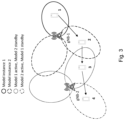
- Fig. 3 shows how a method according to some example embodiments of the invention works.
- Fig. 3 shows the same network and the same movement of the UE as the example shown in Fig...
- the validity area of ML model instance 1 comprises cells 1, 2, and 3.
- the validity area of ML model instance 2 comprises calls 2, 3, and 4.
- cell 2 belongs to the validity area of both ML model instances 1 and 2, with ML model instance 1 configured as active and ML model instance 2 as standby (inactive).
- cell 3 belongs to the validity area of both ML model instances 1 and 2, with ML model instance 2 configured as active and ML model instance 1 as standby (inactive).
- the standby ML model instances (this can be more than one) may be downloaded into the UE, while the active (current) ML model instance continues with inference.
- stateful ML models e.g. LSTM RNN
- the inference may be started in the standby ML model instances to have the internal state ready when the respective ML model instance becomes active.
- the UE may be requested to swap the active and standby ML model instances. Since active ML model instance and standby ML model instance(s) cover the overlap area, the swap may take place exactly at the point of handover but does not need to take place exactly at the point of handover. It may take place before or after the handover.
- the UE may perform the swap from the ML model instance 1 to the ML model instance 2.
- the swap of the two ML model instances is not triggered by handover but rather by failure recovery, where the UE might change cells.
- the standby ML model instance may be deactivated or removed (if not cached).
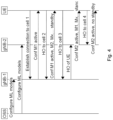
- Fig. 4 shows a sequence diagram for the example of predictive ML-based mobility shown in Fig. 3 .
- OSS configures the required ML model instances in gNB-1 and gNB-2.
- ML model instance M1 is configured for inference of the predictive ML-based handover decisions.
- gNB-1 already configures the ML model instance M2 in the UE as standby.
- Additional ML model instances, depicted in the sequence as Mx, may also be configured as standby ML model instances.
- the standby ML model instances are downloaded from the gNB-1 to the UE, if they are not already cached (stored) in the UE.
- the UE may start feeding measurements into the standby ML model instances, for example to start updating the internal state of the LSTM RNN used for predictive mobility.
- ML model instance M1 remains active, i.e. it infers the handover decisions.
- the UE When the UE is handed over to cell 3 of gNB-2, the UE remains in the validity area of both ML model instances M1 and M2, and ML model instance M1 can continue with the inference. However, since ML model instance M2 is configured as active in cell 3 and the ML model instance M1 is configured as standby in cell 3, the UE swaps the active ML model instance, i.e. the one inferring the handover decisions, from ML model instance M1 to ML model instance M2. Due to the overlapping validity areas, this may or may not happen exactly at the handover. Nevertheless seamless inference can be ensured.
- each single ML model instance may cover an area of several gNBs, although in the example only a single gNB at the validity area border is shown.
- Fig. 5 shows a sequence diagram of a ping pong handover at the validity area border, i.e. between cells 2 and 3 of Fig. 3 .
- the UE only swaps the active and standby ML model instances, but full reselection of the ML model instances is not required.
- the serving cell configures the UE with a measurement event.
- gNB 1 provides the ML model instance M2 only when the measurement event occurs. This would be relevant for UEs that are served by cell 2 but are not expected to make a handover to cell 3 (e.g. because session is released before the handover, or the UE moves back to cell 1, etc%), especially in areas, where there may be more than two ML model instances with overlapping validity areas.
- the serving cell may provide the UE with the standby ML model instance only when it receives a measurement event that is triggered by Mn > Ms -1 dB.
- gNB-1 may provide the one or more standby ML model instances including the ML model instance M2 only when the UE is in the respective overlapping area (i.e. cell 2 for ML model instance M2 in this example). However, in some example embodiments, gNB-1 may provide at least some of the one or more standby ML model instances even when the terminal is not in the respective overlapping area.
- OSS configures the active and the standby ML model instances in the gNB.
- OS configures only the respective active ML model instance in each gNB, and the gNB exchange their ML model instances via Xn interface.
- gNB-1 may configure the UE with criteria (such as a radio condition, e.g. RSRP, RSRQ).
- the UE may switch to the ML model instance M2 when the criterion is fulfilled.
- the UE may switch to the ML model instance M2 only if the UE is in the overlapping validity area (i.e. cells 2 and 3 in the example of Fig. 3 ) and the criterion is fulfilled.
- the gNB (serving cell) decides (i.e. configures the UE) which of the ML model instances is active, and which is (are) standby.
- Fig. 6 shows an apparatus according to an example embodiment of the invention.
- the apparatus may be a base station such as a gNB, eNB etc., or an element thereof.
- Fig. 7 shows a method according to an example embodiment of the invention.
- the apparatus according to Fig. 6 may perform the method of Fig. 7 but is not limited to this method.
- the method of Fig. 7 may be performed by the apparatus of Fig. 6 but is not limited to being performed by this apparatus.
- the apparatus comprises means for instructing 10.
- the means for instructing 10 may be an instructing means.
- the means for instructing 10 may be an instructor.
- the means for instructing 10 may be an instructing processor.
- the means for instructing 10 instructs a first cell to provide, to a terminal (e.g. UE), a first ML model instance associated to the first cell and a second ML model instance associated to a second cell different from the first cell (S10).
- a terminal e.g. UE
- first ML model instance associated to the first cell
- second ML model instance associated to a second cell different from the first cell (S10).
- Fig. 8 shows an apparatus according to an example embodiment of the invention.
- the apparatus may be a terminal such as a UE, or an element thereof.
- Fig. 9 shows a method according to an example embodiment of the invention.
- the apparatus according to Fig. 8 may perform the method of Fig. 9 but is not limited to this method.
- the method of Fig. 9 may be performed by the apparatus of Fig. 8 but is not limited to being performed by this apparatus.
- the apparatus comprises means for storing 110, means for checking 115, means for activating 120, means for inferring 130, and means for inhibiting 140.
- the means for storing 110, means for checking 115, means for activating 120, means for inferring 130, and means for inhibiting 140 may be a storing means, checking means, activating means, inferring means, and inhibiting means, respectively.
- the means for storing 110, means for checking 115, means for activating 120, means for inferring 130, and means for inhibiting 140 may be a storage device, checker, activator, inferer, and inhibitor, respectively.
- the means for storing 110, means for checking 115, means for activating 120, means for inferring 130, and means for inhibiting 140 may be a storing processor, checking processor, activating processor, inferring processor, and inhibiting processor, respectively.
- the means for storing 110 stores a first ML model instance and a second ML model instance in a cache of a terminal (S110).
- cache specifies any storage medium such as a RAM, a harddisk, etc..
- the first ML model instance is associated to a first cell.
- the second ML model instance is associated to a second cell different from the first cell.
- the first ML model instance is configured to make, if activated, a first prediction on a radio condition of the terminal.
- the second ML model instance is configured to make, if activated, a second prediction on the radio condition of the terminal.
- the radio condition may be e.g. an (optimum) point for handover, an (optimum) modulation and coding scheme, or any other radio condition.
- the means for checking 115 checks if a predefined first requirement is fulfilled (S115).
- the first requirement may include that the terminal is served by the first cell.
- the decision involving the terminal may be related to mobility of the terminal, such as a handover decision or the decision that the UE triggers a handover decision in the eNB.
- the decision involving the terminal may be related to positioning of the UE.
- RF fingerprinting radio measurement fingerprinting
- RF fingerprinting based positioning uses signal strength measurements taken by a UE from a number of surrounding cells to determine its location. The signal strength of a given number of strongest cells are measured in a set number of known locations to create the training data. The IDs of the measured cells and their signal strengths are the "fingerprint" of those locations.
- the training data may be used to train a ML model that may learn to interpolate the UE location also between the locations for which the training data were collected.
- Fig. 10 shows an apparatus according to an example embodiment of the invention.
- the apparatus may be a operations support system such as a OSS, or an element thereof.
- Fig. 11 shows a method according to an example embodiment of the invention.
- the apparatus according to Fig. 10 may perform the method of Fig. 11 but is not limited to this method.
- the method of Fig. 11 may be performed by the apparatus of Fig. 10 but is not limited to being performed by this apparatus.
- the apparatus comprises means for providing 210.
- the means for providing 210 may be a providing means.
- the means for providing 210 may be a provider.
- the means for providing 210 may be a providing processor.
- the means for providing 210 provides a first cell with a first ML model instance associated to the first cell and a second ML model instance associated to a second cell (S210).
- the second cell is different from the first cell.
- Fig. 12 shows an apparatus according to an embodiment of the invention.
- the apparatus comprises at least one processor 810, at least one memory 820 including computer program code, and the at least one processor 810, with the at least one memory 820 and the computer program code, being arranged to cause the apparatus to at least perform at least one of the methods according to Figs. 7, 9 , and 11 and related description.
- Different ML model instances may be different instances of the same ML model or instances of different ML models.
- a prediction of an optimal point for handover is an example of a prediction of a radio condition.
- Other radio conditions which may be predicted by the respective ML model instance may be parameters for MIMO, a modulation and coding scheme, etc.
- a cell may be represented by its respective base station (e.g. gNB or eNB).
- a validity area may comprise one or more cells. If the validity area comprises more than one cell they may be of the same or of different base stations.
- 5G 5th Generation
- the invention is not limited to 5G. It may be used in networks of other 3GPP generations, too, e.g. in previous generations such as 3G and 4G, and in forthcoming generations such as 6G, 7G, etc.
- the invention is not limited to 3GPP networks but may be used in other radio networks providing mobility, too.
- the names of the terminals (e.g. UE) and base stations (e.g. eNB, gNB) have to be adapted accordingly.
- One piece of information may be transmitted in one or plural messages from one entity to another entity. Each of these messages may comprise further (different) pieces of information.
- Names of network elements, network functions, protocols, and methods are based on current standards. In other versions or other technologies, the names of these network elements and/or network functions and/or protocols and/or methods may be different, as long as they provide a corresponding functionality.
- each of the entities described in the present description may be based on a different hardware, or some or all of the entities may be based on the same hardware. It does not necessarily mean that they are based on different software. That is, each of the entities described in the present description may be based on different software, or some or all of the entities may be based on the same software.
- Each of the entities described in the present description may be deployed in the cloud.
- example embodiments of the present invention provide, for example, a base station, such as a eNB or gNB, or a component thereof, an apparatus embodying the same, a method for controlling and/or operating the same, and computer program(s) controlling and/or operating the same as well as mediums carrying such computer program(s) and forming computer program product(s).
- example embodiments of the present invention provide, for example, a terminal, such as a UE, or a component thereof, an apparatus embodying the same, a method for controlling and/or operating the same, and computer program(s) controlling and/or operating the same as well as mediums carrying such computer program(s) and forming computer program product(s).
- a terminal such as a UE
- computer program(s) controlling and/or operating the same as well as mediums carrying such computer program(s) and forming computer program product(s).
- an operation support system such as an OSS, or a component thereof, an apparatus embodying the same, a method for controlling and/or operating the same, and computer program(s) controlling and/or operating the same as well as mediums carrying such computer program(s) and forming computer program product(s).
- Implementations of any of the above described blocks, apparatuses, systems, techniques or methods include, as non-limiting examples, implementations as hardware, software, firmware, special purpose circuits or logic, general purpose hardware or controller or other computing devices, or some combination thereof.
- Each of the entities described in the present description may be embodied in the cloud.
Landscapes
- Engineering & Computer Science (AREA)
- Computer Networks & Wireless Communication (AREA)
- Signal Processing (AREA)
- Mobile Radio Communication Systems (AREA)
Claims (14)
- Vorrichtung (gNB), die Folgendes umfasst:einen oder mehrere Prozessoren, undeinen Speicher, in dem Anweisungen gespeichert sind, die, wenn sie von dem einen oder den mehreren Prozessoren ausgeführt werden, die Vorrichtung zu Folgendem veranlassen:Anweisen (S10) einer ersten Zelle, einem Endgerät (UE) eine erste Maschinenlernmodellinstanz, die mit der ersten Zelle verknüpft ist, und eine zweite Maschinenlernmodellinstanz, die mit einer zweiten Zelle verknüpft ist, die sich von der ersten Zelle unterscheidet, bereitzustellen;Prüfen, ob sich das Endgerät in einem vordefinierten Überlappungsbereich befindet;Unterbinden des Bereitstellens der zweiten Maschinenlernmodellinstanz für das Endgerät, wenn sich das Endgerät außerhalb des vordefinierten Überlappungsbereichs befindet;Anweisen der ersten Zelle, das Endgerät mit einem Messereignis auszulegen;Prüfen, ob das Endgerät das Messereignis meldet; undUnterbinden des Bereitstellens der zweiten Maschinenlernmodellinstanz für das Endgerät, wenn das Endgerät das Messereignis nicht meldet.
- Vorrichtung nach Anspruch 1, wobei die Anweisungen, wenn sie von dem einen oder den mehreren Prozessoren ausgeführt werden, die Vorrichtung ferner zu Folgendem veranlassen:
Anweisen der ersten Zelle, das Endgerät anzuweisen, die erste Maschinenlernmodellinstanz zu aktivieren, während sie von der ersten Zelle bedient wird. - Vorrichtung nach einem der Ansprüche 1 bis 2, wobei die Anweisungen, wenn sie von dem einen oder den mehreren Prozessoren ausgeführt werden, die Vorrichtung ferner zu Folgendem veranlassen:Anweisen der ersten Zelle, das Endgerät abzufragen, ob das Endgerät mindestens eine der ersten Maschinenlernmodellinstanz und der zweiten Maschinenlernmodellinstanz speichert;Unterbinden des Bereitstellens der ersten Maschinenlernmodellinstanz, wenn das Endgerät die erste Maschinenlernmodellinstanz speichert;Unterbinden des Bereitstellens der zweiten Maschinenlernmodellinstanz, wenn das Endgerät die zweite Maschinenlernmodellinstanz speichert.
- Vorrichtung nach einem der Ansprüche 1 bis 3, wobei die zweite Maschinenlernmodellinstanz von einem Betriebsunterstützungssystem oder von der zweiten Zelle empfangen wird.
- Vorrichtung nach einem der Ansprüche 1 bis 4, wobei die Anweisungen, wenn sie von dem einen oder den mehreren Prozessoren ausgeführt werden, die Vorrichtung ferner zu Folgendem veranlassen:
Anweisen der ersten Zelle, einer dritten Zelle, die sich von der ersten Zelle unterscheidet, die erste Maschinenlernmodellinstanz bereitzustellen. - Vorrichtung nach einem der Ansprüche 1 bis 5, wobei die Anweisungen, wenn sie von dem einen oder den mehreren Prozessoren ausgeführt werden, die Vorrichtung ferner zu Folgendem veranlassen:
Anweisen der ersten Zelle, das Endgerät mit einem Kriterium zum Aktivieren der zweiten Maschinenlernmodellinstanz auszulegen. - Verfahren, das Folgendes umfasst:Anweisen (S10) einer ersten Zelle, einem Endgerät (UE) eine erste Maschinenlernmodellinstanz, die mit der ersten Zelle verknüpft ist, und eine zweite Maschinenlernmodellinstanz, die mit einer zweiten Zelle verknüpft ist, die sich von der ersten Zelle unterscheidet, bereitzustellen;Prüfen, ob sich das Endgerät in einem vordefinierten Überlappungsbereich befindet;Unterbinden des Bereitstellens der zweiten Maschinenlernmodellinstanz für das Endgerät, wenn sich das Endgerät außerhalb des vordefinierten Überlappungsbereichs befindet;Anweisen der ersten Zelle, das Endgerät mit einem Messereignis auszulegen;Prüfen, ob das Endgerät das Messereignis meldet; undUnterbinden des Bereitstellens der zweiten Maschinenlernmodellinstanz für das Endgerät, wenn das Endgerät das Messereignis nicht meldet.
- Verfahren nach Anspruch 7, das ferner Folgendes umfasst:
Anweisen der ersten Zelle, das Endgerät anzuweisen, die erste Maschinenlernmodellinstanz zu aktivieren, während sie von der ersten Zelle bedient wird. - Verfahren nach einem der Ansprüche 7 bis 8, das ferner Folgendes umfasst:Anweisen der ersten Zelle, das Endgerät abzufragen, ob das Endgerät mindestens eine der ersten Maschinenlernmodellinstanz und der zweiten Maschinenlernmodellinstanz speichert;Unterbinden des Bereitstellens der ersten Maschinenlernmodellinstanz, wenn das Endgerät die erste Maschinenlernmodellinstanz speichert;Unterbinden des Bereitstellens der zweiten Maschinenlernmodellinstanz, wenn das Endgerät die zweite Maschinenlernmodellinstanz speichert.
- Verfahren nach einem der Ansprüche 7 bis 9, wobei die zweite Maschinenlernmodellinstanz von einem Betriebsunterstützungssystem oder von der zweiten Zelle empfangen wird.
- Verfahren nach einem der Ansprüche 7 bis 10, das ferner Folgendes umfasst:
Anweisen der ersten Zelle, einer dritten Zelle, die sich von der ersten Zelle unterscheidet, die erste Maschinenlernmodellinstanz bereitzustellen. - Verfahren nach einem der Ansprüche 7 bis 11, das ferner Folgendes umfasst:
Anweisen der ersten Zelle, das Endgerät mit einem Kriterium zum Aktivieren der zweiten Maschinenlernmodellinstanz auszulegen. - Computerprogrammprodukt, das einen Satz von Anweisungen umfasst, der, wenn er in einer Vorrichtung ausgeführt wird, dazu ausgelegt ist, die Vorrichtung zu veranlassen, das Verfahren nach einem der Ansprüche 7 bis 12 umzusetzen.
- Computerprogrammprodukt nach Anspruch 13, das als ein computerlesbares Medium realisiert oder direkt in einen Computer ladbar ist.
Applications Claiming Priority (1)
| Application Number | Priority Date | Filing Date | Title |
|---|---|---|---|
| PCT/EP2020/083889 WO2022111827A1 (en) | 2020-11-30 | 2020-11-30 | Make-before-break mobility of machine learning context |
Publications (2)
| Publication Number | Publication Date |
|---|---|
| EP4252452A1 EP4252452A1 (de) | 2023-10-04 |
| EP4252452B1 true EP4252452B1 (de) | 2024-11-06 |
Family
ID=73654817
Family Applications (1)
| Application Number | Title | Priority Date | Filing Date |
|---|---|---|---|
| EP20816964.9A Active EP4252452B1 (de) | 2020-11-30 | 2020-11-30 | Make-before-break-mobilität eines maschinenlernkontexts |
Country Status (3)
| Country | Link |
|---|---|
| US (1) | US12543096B2 (de) |
| EP (1) | EP4252452B1 (de) |
| WO (1) | WO2022111827A1 (de) |
Families Citing this family (3)
| Publication number | Priority date | Publication date | Assignee | Title |
|---|---|---|---|---|
| EP4659481A2 (de) * | 2023-02-03 | 2025-12-10 | AUMOVIO Germany GmbH | Verfahren für gnb-ue-verhalten für modellbasierte mobilität |
| EP4583565A1 (de) * | 2024-01-05 | 2025-07-09 | Nokia Technologies Oy | Auf maschinenlernmodellfingerabdruck basierende validierung und leistungsüberwachung |
| US12293060B1 (en) * | 2024-03-29 | 2025-05-06 | Interactive Aristotle, Inc. | Machine learning model access control |
Family Cites Families (6)
| Publication number | Priority date | Publication date | Assignee | Title |
|---|---|---|---|---|
| US11271796B2 (en) * | 2016-07-15 | 2022-03-08 | Tupl Inc. | Automatic customer complaint resolution |
| US11087236B2 (en) * | 2016-07-29 | 2021-08-10 | Splunk Inc. | Transmitting machine learning models to edge devices for edge analytics |
| US10944465B2 (en) | 2017-08-09 | 2021-03-09 | Telefonaktiebolaget Lm Ericsson (Publ) | System and method for antenna beam selection |
| US11490313B2 (en) * | 2018-03-08 | 2022-11-01 | Telefonaktiebolaget Lm Ericsson (Publ) | Managing communication in a wireless communications network |
| RU2702980C1 (ru) * | 2018-12-14 | 2019-10-14 | Самсунг Электроникс Ко., Лтд. | Распределённое обучение моделей машинного обучения для персонализации |
| US20230269606A1 (en) | 2020-05-05 | 2023-08-24 | Nokia Technologies Oy | Measurement configuration for local area machine learning radio resource management |
-
2020
- 2020-11-30 EP EP20816964.9A patent/EP4252452B1/de active Active
- 2020-11-30 US US18/254,740 patent/US12543096B2/en active Active
- 2020-11-30 WO PCT/EP2020/083889 patent/WO2022111827A1/en not_active Ceased
Also Published As
| Publication number | Publication date |
|---|---|
| EP4252452A1 (de) | 2023-10-04 |
| US12543096B2 (en) | 2026-02-03 |
| WO2022111827A1 (en) | 2022-06-02 |
| US20230422126A1 (en) | 2023-12-28 |
Similar Documents
| Publication | Publication Date | Title |
|---|---|---|
| JP7495524B2 (ja) | ローカルエリア機械学習無線リソース管理のための測定構成 | |
| CN111357313B (zh) | 终端设备特定的切换参数 | |
| RU2452133C2 (ru) | Способ и устройство для обработки исторической информации по мобильной станции в системе беспроводной связи | |
| CN102405665B (zh) | 自优化切换方法 | |
| US20250247719A1 (en) | Methods and apparatuses for an ai or ml based cco mechanism | |
| EP4252452B1 (de) | Make-before-break-mobilität eines maschinenlernkontexts | |
| US20120276900A1 (en) | Enhancing cellular networks via an adjustable handover boundary | |
| WO2021031624A1 (zh) | 信息的传输方法及装置、存储介质和电子装置 | |
| US20140038612A1 (en) | Information processing method and apparatus | |
| EP2534872A1 (de) | Verfahren und vorrichtung für den bericht von messdaten | |
| EP4274177A1 (de) | Verfahren zur bewertung der auswirkung von aktionen auf die leistung eines mobilen netzwerks | |
| CN111093236A (zh) | 一种信息发送、接收方法、装置、设备和存储介质 | |
| GB2420047A (en) | Mobile radio communications device and method for transferring between networks | |
| US20250142384A1 (en) | INTELLIGENT ADAPTIVE MEASUREMENT GAPS FOR LOW MOBILITY USER EQUIPMENT (UEs) | |
| CN100531434C (zh) | 非切换触发手机邻区列表更新的方法 | |
| US20080254798A1 (en) | Handover Method and System | |
| US20240314612A1 (en) | Method and apparatus for reporting measurement in wireless communication system | |
| US20250055782A1 (en) | Enabling a flexible mdt configuration | |
| Aziz et al. | Autonomous neighbor relation detection and handover optimization in LTE | |
| WO2025209071A1 (zh) | 信息处理方法、装置、终端及网络设备 | |
| WO2025184853A1 (zh) | 一种无线通信的方法及无线通信设备 | |
| WO2026031182A1 (zh) | 无线通信的方法、终端设备和网络设备 | |
| WO2025232979A1 (en) | Reduction of ue radio measurements based on prediction | |
| WO2025241809A1 (zh) | 预测信息上报方法、装置、系统及存储介质 | |
| WO2025184805A1 (zh) | 无线通信的方法、终端设备和网络设备 |
Legal Events
| Date | Code | Title | Description |
|---|---|---|---|
| STAA | Information on the status of an ep patent application or granted ep patent |
Free format text: STATUS: UNKNOWN |
|
| STAA | Information on the status of an ep patent application or granted ep patent |
Free format text: STATUS: THE INTERNATIONAL PUBLICATION HAS BEEN MADE |
|
| PUAI | Public reference made under article 153(3) epc to a published international application that has entered the european phase |
Free format text: ORIGINAL CODE: 0009012 |
|
| STAA | Information on the status of an ep patent application or granted ep patent |
Free format text: STATUS: REQUEST FOR EXAMINATION WAS MADE |
|
| 17P | Request for examination filed |
Effective date: 20230630 |
|
| AK | Designated contracting states |
Kind code of ref document: A1 Designated state(s): AL AT BE BG CH CY CZ DE DK EE ES FI FR GB GR HR HU IE IS IT LI LT LU LV MC MK MT NL NO PL PT RO RS SE SI SK SM TR |
|
| DAV | Request for validation of the european patent (deleted) | ||
| DAX | Request for extension of the european patent (deleted) | ||
| GRAP | Despatch of communication of intention to grant a patent |
Free format text: ORIGINAL CODE: EPIDOSNIGR1 |
|
| STAA | Information on the status of an ep patent application or granted ep patent |
Free format text: STATUS: GRANT OF PATENT IS INTENDED |
|
| INTG | Intention to grant announced |
Effective date: 20240529 |
|
| GRAS | Grant fee paid |
Free format text: ORIGINAL CODE: EPIDOSNIGR3 |
|
| GRAA | (expected) grant |
Free format text: ORIGINAL CODE: 0009210 |
|
| STAA | Information on the status of an ep patent application or granted ep patent |
Free format text: STATUS: THE PATENT HAS BEEN GRANTED |
|
| AK | Designated contracting states |
Kind code of ref document: B1 Designated state(s): AL AT BE BG CH CY CZ DE DK EE ES FI FR GB GR HR HU IE IS IT LI LT LU LV MC MK MT NL NO PL PT RO RS SE SI SK SM TR |
|
| REG | Reference to a national code |
Ref country code: GB Ref legal event code: FG4D |
|
| REG | Reference to a national code |
Ref country code: CH Ref legal event code: EP |
|
| REG | Reference to a national code |
Ref country code: DE Ref legal event code: R096 Ref document number: 602020040960 Country of ref document: DE |
|
| REG | Reference to a national code |
Ref country code: IE Ref legal event code: FG4D |
|
| REG | Reference to a national code |
Ref country code: LT Ref legal event code: MG9D |
|
| REG | Reference to a national code |
Ref country code: NL Ref legal event code: MP Effective date: 20241106 |
|
| PG25 | Lapsed in a contracting state [announced via postgrant information from national office to epo] |
Ref country code: PT Free format text: LAPSE BECAUSE OF FAILURE TO SUBMIT A TRANSLATION OF THE DESCRIPTION OR TO PAY THE FEE WITHIN THE PRESCRIBED TIME-LIMIT Effective date: 20250306 Ref country code: IS Free format text: LAPSE BECAUSE OF FAILURE TO SUBMIT A TRANSLATION OF THE DESCRIPTION OR TO PAY THE FEE WITHIN THE PRESCRIBED TIME-LIMIT Effective date: 20250306 Ref country code: HR Free format text: LAPSE BECAUSE OF FAILURE TO SUBMIT A TRANSLATION OF THE DESCRIPTION OR TO PAY THE FEE WITHIN THE PRESCRIBED TIME-LIMIT Effective date: 20241106 |
|
| PG25 | Lapsed in a contracting state [announced via postgrant information from national office to epo] |
Ref country code: NL Free format text: LAPSE BECAUSE OF FAILURE TO SUBMIT A TRANSLATION OF THE DESCRIPTION OR TO PAY THE FEE WITHIN THE PRESCRIBED TIME-LIMIT Effective date: 20241106 Ref country code: FI Free format text: LAPSE BECAUSE OF FAILURE TO SUBMIT A TRANSLATION OF THE DESCRIPTION OR TO PAY THE FEE WITHIN THE PRESCRIBED TIME-LIMIT Effective date: 20241106 |
|
| REG | Reference to a national code |
Ref country code: AT Ref legal event code: MK05 Ref document number: 1740755 Country of ref document: AT Kind code of ref document: T Effective date: 20241106 |
|
| PG25 | Lapsed in a contracting state [announced via postgrant information from national office to epo] |
Ref country code: BG Free format text: LAPSE BECAUSE OF FAILURE TO SUBMIT A TRANSLATION OF THE DESCRIPTION OR TO PAY THE FEE WITHIN THE PRESCRIBED TIME-LIMIT Effective date: 20241106 |
|
| PG25 | Lapsed in a contracting state [announced via postgrant information from national office to epo] |
Ref country code: ES Free format text: LAPSE BECAUSE OF FAILURE TO SUBMIT A TRANSLATION OF THE DESCRIPTION OR TO PAY THE FEE WITHIN THE PRESCRIBED TIME-LIMIT Effective date: 20241106 |
|
| PG25 | Lapsed in a contracting state [announced via postgrant information from national office to epo] |
Ref country code: NO Free format text: LAPSE BECAUSE OF FAILURE TO SUBMIT A TRANSLATION OF THE DESCRIPTION OR TO PAY THE FEE WITHIN THE PRESCRIBED TIME-LIMIT Effective date: 20250206 |
|
| PG25 | Lapsed in a contracting state [announced via postgrant information from national office to epo] |
Ref country code: GR Free format text: LAPSE BECAUSE OF FAILURE TO SUBMIT A TRANSLATION OF THE DESCRIPTION OR TO PAY THE FEE WITHIN THE PRESCRIBED TIME-LIMIT Effective date: 20250207 Ref country code: LV Free format text: LAPSE BECAUSE OF FAILURE TO SUBMIT A TRANSLATION OF THE DESCRIPTION OR TO PAY THE FEE WITHIN THE PRESCRIBED TIME-LIMIT Effective date: 20241106 Ref country code: AT Free format text: LAPSE BECAUSE OF FAILURE TO SUBMIT A TRANSLATION OF THE DESCRIPTION OR TO PAY THE FEE WITHIN THE PRESCRIBED TIME-LIMIT Effective date: 20241106 |
|
| PG25 | Lapsed in a contracting state [announced via postgrant information from national office to epo] |
Ref country code: PL Free format text: LAPSE BECAUSE OF FAILURE TO SUBMIT A TRANSLATION OF THE DESCRIPTION OR TO PAY THE FEE WITHIN THE PRESCRIBED TIME-LIMIT Effective date: 20241106 |
|
| PG25 | Lapsed in a contracting state [announced via postgrant information from national office to epo] |
Ref country code: RS Free format text: LAPSE BECAUSE OF FAILURE TO SUBMIT A TRANSLATION OF THE DESCRIPTION OR TO PAY THE FEE WITHIN THE PRESCRIBED TIME-LIMIT Effective date: 20250206 |
|
| REG | Reference to a national code |
Ref country code: DE Ref legal event code: R119 Ref document number: 602020040960 Country of ref document: DE |
|
| REG | Reference to a national code |
Ref country code: CH Ref legal event code: PL |
|
| PG25 | Lapsed in a contracting state [announced via postgrant information from national office to epo] |
Ref country code: SM Free format text: LAPSE BECAUSE OF FAILURE TO SUBMIT A TRANSLATION OF THE DESCRIPTION OR TO PAY THE FEE WITHIN THE PRESCRIBED TIME-LIMIT Effective date: 20241106 |
|
| PG25 | Lapsed in a contracting state [announced via postgrant information from national office to epo] |
Ref country code: DK Free format text: LAPSE BECAUSE OF FAILURE TO SUBMIT A TRANSLATION OF THE DESCRIPTION OR TO PAY THE FEE WITHIN THE PRESCRIBED TIME-LIMIT Effective date: 20241106 |
|
| PG25 | Lapsed in a contracting state [announced via postgrant information from national office to epo] |
Ref country code: LU Free format text: LAPSE BECAUSE OF NON-PAYMENT OF DUE FEES Effective date: 20241130 |
|
| REG | Reference to a national code |
Ref country code: CH Ref legal event code: PL |
|
| PG25 | Lapsed in a contracting state [announced via postgrant information from national office to epo] |
Ref country code: EE Free format text: LAPSE BECAUSE OF FAILURE TO SUBMIT A TRANSLATION OF THE DESCRIPTION OR TO PAY THE FEE WITHIN THE PRESCRIBED TIME-LIMIT Effective date: 20241106 |
|
| PG25 | Lapsed in a contracting state [announced via postgrant information from national office to epo] |
Ref country code: CH Free format text: LAPSE BECAUSE OF NON-PAYMENT OF DUE FEES Effective date: 20241130 |
|
| PG25 | Lapsed in a contracting state [announced via postgrant information from national office to epo] |
Ref country code: RO Free format text: LAPSE BECAUSE OF FAILURE TO SUBMIT A TRANSLATION OF THE DESCRIPTION OR TO PAY THE FEE WITHIN THE PRESCRIBED TIME-LIMIT Effective date: 20241106 |
|
| PG25 | Lapsed in a contracting state [announced via postgrant information from national office to epo] |
Ref country code: SK Free format text: LAPSE BECAUSE OF FAILURE TO SUBMIT A TRANSLATION OF THE DESCRIPTION OR TO PAY THE FEE WITHIN THE PRESCRIBED TIME-LIMIT Effective date: 20241106 |
|
| PG25 | Lapsed in a contracting state [announced via postgrant information from national office to epo] |
Ref country code: CZ Free format text: LAPSE BECAUSE OF FAILURE TO SUBMIT A TRANSLATION OF THE DESCRIPTION OR TO PAY THE FEE WITHIN THE PRESCRIBED TIME-LIMIT Effective date: 20241106 |
|
| PG25 | Lapsed in a contracting state [announced via postgrant information from national office to epo] |
Ref country code: IT Free format text: LAPSE BECAUSE OF FAILURE TO SUBMIT A TRANSLATION OF THE DESCRIPTION OR TO PAY THE FEE WITHIN THE PRESCRIBED TIME-LIMIT Effective date: 20241106 |
|
| REG | Reference to a national code |
Ref country code: BE Ref legal event code: MM Effective date: 20241130 |
|
| PG25 | Lapsed in a contracting state [announced via postgrant information from national office to epo] |
Ref country code: SE Free format text: LAPSE BECAUSE OF FAILURE TO SUBMIT A TRANSLATION OF THE DESCRIPTION OR TO PAY THE FEE WITHIN THE PRESCRIBED TIME-LIMIT Effective date: 20241106 |
|
| PLBE | No opposition filed within time limit |
Free format text: ORIGINAL CODE: 0009261 |
|
| STAA | Information on the status of an ep patent application or granted ep patent |
Free format text: STATUS: NO OPPOSITION FILED WITHIN TIME LIMIT |
|
| PG25 | Lapsed in a contracting state [announced via postgrant information from national office to epo] |
Ref country code: MC Free format text: LAPSE BECAUSE OF FAILURE TO SUBMIT A TRANSLATION OF THE DESCRIPTION OR TO PAY THE FEE WITHIN THE PRESCRIBED TIME-LIMIT Effective date: 20241106 |
|
| PG25 | Lapsed in a contracting state [announced via postgrant information from national office to epo] |
Ref country code: DE Free format text: LAPSE BECAUSE OF NON-PAYMENT OF DUE FEES Effective date: 20250603 |
|
| 26N | No opposition filed |
Effective date: 20250807 |
|
| PG25 | Lapsed in a contracting state [announced via postgrant information from national office to epo] |
Ref country code: BE Free format text: LAPSE BECAUSE OF NON-PAYMENT OF DUE FEES Effective date: 20241130 |
|
| PGFP | Annual fee paid to national office [announced via postgrant information from national office to epo] |
Ref country code: FR Payment date: 20250930 Year of fee payment: 6 |
|
| PG25 | Lapsed in a contracting state [announced via postgrant information from national office to epo] |
Ref country code: IE Free format text: LAPSE BECAUSE OF NON-PAYMENT OF DUE FEES Effective date: 20241130 |
|
| GBPC | Gb: european patent ceased through non-payment of renewal fee |
Effective date: 20250206 |
|
| PG25 | Lapsed in a contracting state [announced via postgrant information from national office to epo] |
Ref country code: GB Free format text: LAPSE BECAUSE OF NON-PAYMENT OF DUE FEES Effective date: 20250206 |