EP4250065A1 - Gesture recognition apparatus, head-mounted-type display apparatus, gesture recognition method, program, and computer readable medium - Google Patents
Gesture recognition apparatus, head-mounted-type display apparatus, gesture recognition method, program, and computer readable medium Download PDFInfo
- Publication number
- EP4250065A1 EP4250065A1 EP23159828.5A EP23159828A EP4250065A1 EP 4250065 A1 EP4250065 A1 EP 4250065A1 EP 23159828 A EP23159828 A EP 23159828A EP 4250065 A1 EP4250065 A1 EP 4250065A1
- Authority
- EP
- European Patent Office
- Prior art keywords
- gesture
- region
- motion
- detection means
- detected
- Prior art date
- Legal status (The legal status is an assumption and is not a legal conclusion. Google has not performed a legal analysis and makes no representation as to the accuracy of the status listed.)
- Granted
Links
Images


Classifications
-
- G—PHYSICS
- G06—COMPUTING OR CALCULATING; COUNTING
- G06F—ELECTRIC DIGITAL DATA PROCESSING
- G06F3/00—Input arrangements for transferring data to be processed into a form capable of being handled by the computer; Output arrangements for transferring data from processing unit to output unit, e.g. interface arrangements
- G06F3/01—Input arrangements or combined input and output arrangements for interaction between user and computer
- G06F3/017—Gesture based interaction, e.g. based on a set of recognized hand gestures
-
- G—PHYSICS
- G02—OPTICS
- G02B—OPTICAL ELEMENTS, SYSTEMS OR APPARATUS
- G02B27/00—Optical systems or apparatus not provided for by any of the groups G02B1/00 - G02B26/00, G02B30/00
- G02B27/01—Head-up displays
- G02B27/017—Head mounted
-
- G—PHYSICS
- G06—COMPUTING OR CALCULATING; COUNTING
- G06F—ELECTRIC DIGITAL DATA PROCESSING
- G06F3/00—Input arrangements for transferring data to be processed into a form capable of being handled by the computer; Output arrangements for transferring data from processing unit to output unit, e.g. interface arrangements
- G06F3/01—Input arrangements or combined input and output arrangements for interaction between user and computer
- G06F3/03—Arrangements for converting the position or the displacement of a member into a coded form
- G06F3/0304—Detection arrangements using opto-electronic means
-
- G—PHYSICS
- G06—COMPUTING OR CALCULATING; COUNTING
- G06T—IMAGE DATA PROCESSING OR GENERATION, IN GENERAL
- G06T7/00—Image analysis
- G06T7/20—Analysis of motion
-
- G—PHYSICS
- G06—COMPUTING OR CALCULATING; COUNTING
- G06V—IMAGE OR VIDEO RECOGNITION OR UNDERSTANDING
- G06V10/00—Arrangements for image or video recognition or understanding
- G06V10/20—Image preprocessing
- G06V10/25—Determination of region of interest [ROI] or a volume of interest [VOI]
-
- G—PHYSICS
- G06—COMPUTING OR CALCULATING; COUNTING
- G06V—IMAGE OR VIDEO RECOGNITION OR UNDERSTANDING
- G06V40/00—Recognition of biometric, human-related or animal-related patterns in image or video data
- G06V40/10—Human or animal bodies, e.g. vehicle occupants or pedestrians; Body parts, e.g. hands
-
- G—PHYSICS
- G06—COMPUTING OR CALCULATING; COUNTING
- G06V—IMAGE OR VIDEO RECOGNITION OR UNDERSTANDING
- G06V40/00—Recognition of biometric, human-related or animal-related patterns in image or video data
- G06V40/20—Movements or behaviour, e.g. gesture recognition
- G06V40/28—Recognition of hand or arm movements, e.g. recognition of deaf sign language
Definitions
- the present invention relates to a technology for recognizing gestures.
- a hand serving as a portion to make a gesture is extracted from an image obtained by image-capturing the hand, fingers, or the like of a user with a camera, and that the shape of the extracted hand is specified to recognize the gesture.
- an electronic apparatus such as smart glasses for AR (Augmented Reality) is transportable and used in various situations.
- an operation is assisted by smart glasses, there is a possibility that an operation site is dark or an operator with the smart glasses wears gloves. Therefore, when gestures are recognized by such electronic apparatus, the gestures may not be recognized with high accuracy (the recognition of the gestures becomes unstable) depending on the use situation of the electronic apparatus.
- the detection of joints or the like key points to recognize gestures
- the specification recognition of the shapes of hands or the like (portions to make gestures), or the like may not be performed with high accuracy.
- the present invention provides a technology capable of recognizing gestures with high accuracy under various situations.
- the present invention in its first aspect provides a gesture recognition apparatus as specified in claims 1 to 8.
- the present invention in its second aspect provides a head-mounted-type display apparatus as specified in claim 9.
- the present invention in its third aspect provides a gesture recognition method as specified in claim 10.
- the present invention in its fourth aspect provides a program as specified in claim 11.
- the present invention in its fifth aspect provides a computer readable medium as specified in claim 12.
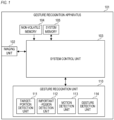
- FIG. 1 is a block diagram showing a configuration example of a gesture recognition apparatus 101 in the present embodiment.
- the gesture recognition apparatus 101 has an imaging unit 102, a system control unit 103, a non-volatile memory 104, a system memory 105, and a gesture recognition unit 110.
- the imaging unit 102 has an optical system including a plurality of lenses and an image sensor (for example, a CCD or CMOS sensor) and is arranged to face a direction in which an image of a gesture by a user is capable of being captured.
- An image sensor is used in the present embodiment, but any sensor available in the recognition of a gesture may only be used.
- a ranging sensor for example, a sensor using a laser such as LiDAR (Light Detection and Ranging) may be used as such.
- the non-volatile memory 104 is electrically erasable/recordable memory and is, for example, a Flash-ROM or the like.
- the operating constant, program, or the like of the system control unit 103 is stored.
- the program represents, for example, a program for performing the respective processing of a flowchart that will be described later in the present embodiment.
- the system memory 105 is, for example, a RAM or the like and develops the operating variable of the system control unit 103, a constant or a program read from the non-volatile memory 104, or the like.
- the system control unit 103 is a control unit composed of at least one processor or circuit and controls the entire gesture recognition apparatus 101.
- the system control unit 103 realizes the respective processing of the flowchart that will be described later by running the program stored in the non-volatile memory 104 described above.
- the system control unit 103 generates a detection image by applying image processing such as noise reduction and resizing to a captured image obtained from the imaging unit 102 and records the detection image on the system memory 105. Further, the system control unit 103 performs processing according to a gesture recognized by the gesture recognition unit 110. For example, the system control unit 103 generates a control signal corresponding to a recognized gesture and controls the respective units of the gesture recognition apparatus 101 using the control signal.
- the gesture recognition unit 110 has a target-portion detection unit 111, an important-region detection unit 112, a motion detection unit 113, and a gesture detection unit 114 and recognizes a gesture on the basis of a captured image (specifically a detection image described above) obtained from the imaging unit 102.
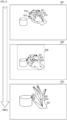
- FIG. 2 is a diagram showing a detection example of hands and joints in the present embodiment.
- FIGS. 3A and 3B are diagrams for describing an example of an important region according to a gesture in the present embodiment.
- FIG. 4 is a diagram for describing an example of the detection result of the motion detection unit 113 in the present embodiment.
- An image 200 shown in FIG. 2 is a detection image obtained by applying image processing to a captured image obtained from the imaging unit 102.
- a left hand 211 and a right hand 212 of a user who makes a gesture (gesture operation) are reflected.
- An image 201 shown in FIG. 2 is an image obtained by superimposing the detection result of the target-portion detection unit 111 on the detection image 200.
- the target-portion detection unit 111 detects (extracts) the hands and joints that are portions (target portions) making a gesture from the detection image 200.
- the positions of 22 spots in total including a hand position (the position of a hand) and the joint positions (the positions of joints) of 21 spots from a wrist to respective fingertips are detected for each of the left hand 211 and the right hand 212.
- the hand position is, for example, the central position of a hand.
- the target-portion detection unit 111 obtains joint information on the basis of the j oint positions of the 21 spots.
- a hand position 221 and joint information 231 are obtained for the left hand 211, and a hand position 222 and joint information 232 are obtained for the right hand 212.
- the joint information 231 and 232 show the joint positions of the 21 spots and a plurality of line segments connecting the joint positions of the 21 spots together so as to form a skeletal frame. Note that a user makes a gesture with hands or fingers in the present embodiment but may make a gesture with his/her arms, feet, eyes, mouth, or the like.
- the important-region detection unit 112 detects an important region that is a region to be (mainly) used for a gesture from target portions (hands and joints) detected by the target-portion detection unit 111. For example, the important-region detection unit 112 selects an important portion that is a portion to be (mainly) used for a gesture from a plurality of target portions detected by the target-portion detection unit 111 and determines the region of the selected important portion as an important region. The important region is different depending on the type of a gesture.
- FIGS. 3A and 3B show an example of a gesture.
- FIG. 3A shows a pinch operation (pinch operation with a thumb and an index finger)
- FIG. 3B shows a drag operation (movement operation) with an index finger.
- the pinch operation is performed mainly by the movement of the tip ends of a thumb and an index finger. Therefore, the important-region detection unit 112 detects the regions of the tip ends of the thumb and the index finger as important regions during the pinch operation.
- the drag operation (drag operation with an index finger) is performed mainly by the movement of the tip end of an index finger. Therefore, the important-region detection unit 112 detects the region of the tip end of the index finger as an important region during the drag operation.
- a gesture is not limited to the pinch operation or the drag operation.
- the important-region detection unit 112 is enabled to detect an important region corresponding to a gesture being made using the information on the corresponding relationship.
- the motion detection unit 113 detects the motion of an important region detected by the important-region detection unit 112 on the basis of the detection result of the important-region detection unit 112.
- a region 421 of the tip end of the index finger of a hand 411 was detected as an important region in the past.
- the motion detection unit 113 detects a movement region 422 corresponding to the important region 421 from a current detection image using various methods such as block matching to detect motion 430 from the important region 421 to the movement region 422.
- the region of the tip end of the index finger of a hand 412 (identical with the hand 411) is detected.
- the motion detection unit 113 is enabled to detect a movement region or the motion of an important region by calculating the motion vector of a characteristic point (for example, a joint position) in the important region.
- the gesture detection unit 114 detects (recognizes) a gesture on the basis of the motion of target regions (hands and joints) detected by the target-portion detection unit 111.
- the gesture detection unit 114 detects a gesture using the detection result (a hand position and joint information) of the target-portion detection unit 111 or the detection result (the motion of an important region) of the motion detection unit 113.
- the gesture detection unit 114 detects a gesture by, for example, comparing the detection result of the target-portion detection unit 111 or the motion detection unit 113 with a gesture model stored in advance in the non-volatile memory 104.
- a method for detecting a gesture is not limited to this, and a gesture may be detected using a detector having been learned by deep learning or the like.
- deep learning it is possible to detect, from the time-series data of joint information, a gesture (such as a gesture to draw a circle with a finger) that is not detectable from the data of one frame by using RNN (Recurrent Neural Network).
- a gesture detectable by the gesture detection unit 114 is not limited to one, but the gesture detection unit 114 may detect a plurality of gestures.
- FIG. 5 is a flowchart showing an example of the gesture recognition processing in the present embodiment. This processing is realized when the system control unit 103 develops a program stored in the non-volatile memory 104 into the system memory 105 and runs the same. For example, the processing of FIG. 5 starts when the gesture recognition apparatus 101 activates.
- FIG. 6 is a diagram for describing an example of the gesture recognition processing in the present embodiment. In FIG. 6 , detection images 601 to 603 are arranged in chronological order. The detection image 601 is the oldest, and the detection image 603 is the newest. A hand 611 is reflected in the detection image 601, a hand 621 is reflected in the detection image 602, and a hand 631 is reflected in the detection image 603. The hands 611, 621, and 631 are the identical.
- step S501 the system control unit 103 acquires a captured image from the imaging unit 102 and applies image processing to the captured image to generate (acquire) the detection image 601.
- step S502 the system control unit 103 acquires, using the target-portion detection unit 111, a hand position 612 and joint information 613 from the detection image 601 generated in step S501.
- step S503 the system control unit 103 determines whether the hand position 612 and the joint information 613 have been successfully acquired in step S502.
- the processing proceeds to step S504 when the hand position 612 and the joint information 613 have been successfully acquired. Otherwise, the processing proceeds to step S506.
- a part of a target portion for example, a part of joints
- imperfect joint information is obtained. Therefore, the processing proceeds to step S506.
- step S504 the system control unit 103 detects (recognizes), using the gesture detection unit 114, a gesture from the hand position 612 and the joint information 613 acquired in step S502.
- the system control unit 103 may detect a gesture using only a hand position and joint information acquired from one detection image or detect a gesture using a hand position and joint information acquired from each of a plurality of detection images acquired until the present.
- step S505 the system control unit 103 detects important regions 614 and 615 from the hand 611 using the important-region detection unit 112 and stores the data of the important regions 614 and 615 in the system memory 105.
- the data of the important regions stored in the system memory 105 may be the data of an image of the important regions cut out from the detection image or the data of the characteristics (characteristic points) of the image of the important regions.
- the system control unit 103 detects important regions corresponding to the gesture detected in step S504. When having failed to detect the gesture in step S504, the system control unit 103 detects important regions corresponding to a gesture capable of being made at the hand position 612. Therefore, detected important regions are different depending on a hand position.
- the system control unit 103 may detect the region of the hand 611 as an important portion or may detect the region of a target portion to be most-frequently used for a gesture among a plurality of target portions (for example, a plurality of joints) as an important portion.
- step S510 the system control unit 103 determines whether to end the gesture recognition processing.
- the processing proceeds to step S511 when the system control unit 103 ends the gesture recognition processing.
- step S511 the system control unit 103 deletes the data of the important regions stored in the system memory 105. Then, the system control unit 103 ends the gesture recognition processing.
- the processing returns to step S501 when the system control unit 103 does not end the gesture recognition processing.
- the system control unit 103 acquires a new detection image 602 in step S501 and acquires a hand position 622 and joint information 623 in step S502. Then, the processing proceeds to step S503.
- step S503 the system control unit 103 determines whether the hand position 622 and the joint information 623 have been successfully acquired in step S502.
- the processing proceeds to step S504 when the system control unit 103 has succeeded in acquiring the hand position 622 and the joint information 623. Otherwise, the processing proceeds to step S506.
- step S506 it is assumed that a part of the information (the hand position 622 and the joint information 623) has not been successfully acquired and the processing proceeds to step S506.
- step S506 the system control unit 103 determines whether the data of important regions is stored in the system memory 105. When the data of the important regions is stored, the processing proceeds to step S507. Otherwise, the processing returns to step S501. Here, it is assumed that the data of important regions 614 and 615 is stored and the processing proceeds to step S507.
- step S507 the system control unit 103 detects two movement regions corresponding to the important regions 614 and 615, respectively, from the detection image 602 using the data of the important regions 614 and 615 acquired in step S506 and detects the motion of the important regions 614 and 615.
- the system control unit 103 may detect movement regions from the entire region of the detection image 602 but may limit a region in which the movement regions are detected to a specific region 626 that is a part of the detection image 602 or the like on the basis of the positions of the important regions 614 and 615 or the like.
- step S508 the system control unit 103 determines whether the motion of the important regions 614 and 615 has been successfully detected in step S507. The processing proceeds to step S509 when the motion of the important regions 614 and 615 has been successfully detected. Otherwise, the processing returns to step S501. If parts corresponding to the important regions 614 and 615 are positioned outside the detection image 602 or hidden behind another object, the motion of the important regions 614 and 615 is not successfully detected. In this case, the processing returns to step S501. Here, it is assumed that the motion of the important regions 614 and 615 has been successfully detected and the processing proceeds to step S509.
- step S509 the system control unit 103 detects a gesture from the motion of the important regions 614 and 615 detected in step S507 using the gesture detection unit 114. At this time, the system control unit 103 may additionally use the hand position 612 and the joint information 613 acquired in the past.
- step S510 the system control unit 103 determines whether to end the gesture recognition processing.
- the processing proceeds to step S511 when the system control unit 103 ends the gesture recognition processing. Otherwise, the processing returns to step S501.
- the processing returns to step S501.
- the system control unit 103 acquires a new detection image 603 in step S501 and acquires a hand position 632 and joint information 633 in step S502. Then, the processing proceeds to step S503.
- a gesture is recognized on the basis of the motion of regions to be used for the gesture among portions making the gesture according to the present embodiment. In this manner, it is possible to recognize gestures with high accuracy under various environments.
- the gesture recognition apparatus 101 may be provided in an electronic apparatus (head-mounted type display apparatus) such as smart glasses for AR (Augmented Reality).
- a display control unit provided in the head-mounted type display apparatus controls display on the basis of the recognition result of the gesture recognition apparatus 101.
- the gesture recognition apparatus 101 (the gesture recognition unit 110) may be electronic apparatus separate from the head-mounted type display apparatus and may be, for example, a computer (server) on a cloud.
- Embodiment(s) of the present invention can also be realized by a computer of a system or apparatus that reads out and executes computer executable instructions (e.g., one or more programs) recorded on a storage medium (which may also be referred to more fully as a 'non-transitory computer-readable storage medium') to perform the functions of one or more of the above-described embodiment(s) and/or that includes one or more circuits (e.g., application specific integrated circuit (ASIC)) for performing the functions of one or more of the above-described embodiment(s), and by a method performed by the computer of the system or apparatus by, for example, reading out and executing the computer executable instructions from the storage medium to perform the functions of one or more of the above-described embodiment(s) and/or controlling the one or more circuits to perform the functions of one or more of the above-described embodiment(s).
- computer executable instructions e.g., one or more programs
- a storage medium which may also be referred to more fully as
- the computer may comprise one or more processors (e.g., central processing unit (CPU), micro processing unit (MPU)) and may include a network of separate computers or separate processors to read out and execute the computer executable instructions.
- the computer executable instructions may be provided to the computer, for example, from a network or the storage medium.
- the storage medium may include, for example, one or more of a hard disk, a random-access memory (RAM), a read only memory (ROM), a storage of distributed computing systems, an optical disk (such as a compact disc (CD), digital versatile disc (DVD), or Blu-ray Disc (BD) TM ), a flash memory device, a memory card, and the like.
- a gesture recognition apparatus includes: a portion detection means configured to detect from a captured image a portion making a gesture; a recognition means configured to recognize the gesture on a basis of motion of the portion detected by the portion detection means; a region detection means configured to detect from the portion a region to be used for the gesture; and a motion detection means configured to detect motion of the region detected by the region detection means, wherein the recognition means recognizes the gesture on a basis of the motion detected by the motion detection means.
Landscapes
- Engineering & Computer Science (AREA)
- Theoretical Computer Science (AREA)
- Physics & Mathematics (AREA)
- General Physics & Mathematics (AREA)
- Human Computer Interaction (AREA)
- General Engineering & Computer Science (AREA)
- Multimedia (AREA)
- Computer Vision & Pattern Recognition (AREA)
- Psychiatry (AREA)
- General Health & Medical Sciences (AREA)
- Social Psychology (AREA)
- Health & Medical Sciences (AREA)
- Optics & Photonics (AREA)
- User Interface Of Digital Computer (AREA)
- Image Analysis (AREA)
Abstract
Description
- The present invention relates to a technology for recognizing gestures.
- Technologies for recognizing gestures with the hands, fingers, or the like of users and perform processing according to the recognized gestures have been proposed. With such technologies, the users are enabled to operate an electronic apparatus (an input device of the electronic apparatus) without touching the same by making gestures.
- It is disclosed in
Japanese Patent Application Laid-open No. 2015-172887 - It is disclosed in
Japanese Patent Application Laid-open No. 2019-71048 - However, an electronic apparatus such as smart glasses for AR (Augmented Reality) is transportable and used in various situations. For example, when an operation is assisted by smart glasses, there is a possibility that an operation site is dark or an operator with the smart glasses wears gloves. Therefore, when gestures are recognized by such electronic apparatus, the gestures may not be recognized with high accuracy (the recognition of the gestures becomes unstable) depending on the use situation of the electronic apparatus. For example, the detection of joints or the like (key points to recognize gestures), the specification (recognition) of the shapes of hands or the like (portions to make gestures), or the like may not be performed with high accuracy.
- The present invention provides a technology capable of recognizing gestures with high accuracy under various situations.
- The present invention in its first aspect provides a gesture recognition apparatus as specified in claims 1 to 8.
- The present invention in its second aspect provides a head-mounted-type display apparatus as specified in claim 9.
- The present invention in its third aspect provides a gesture recognition method as specified in
claim 10. - The present invention in its fourth aspect provides a program as specified in claim 11. The present invention in its fifth aspect provides a computer readable medium as specified in claim 12.
- Further features of the present invention will become apparent from the following description of exemplary embodiments with reference to the attached drawings.
-
-
FIG. 1 is a block diagram showing a configuration example of a gesture recognition apparatus; -
FIG. 2 is a diagram showing a detection example of hands and joints; -
FIGS. 3A and 3B are diagrams for describing an example of an important region according to a gesture; -
FIG. 4 is a diagram for describing an example of the detection result of a motion detection unit; -
FIG. 5 is a flowchart showing an example of gesture recognition processing; and -
FIG. 6 is a diagram for describing an example of the gesture recognition processing. - An embodiment of the present invention will be described.
FIG. 1 is a block diagram showing a configuration example of agesture recognition apparatus 101 in the present embodiment. Thegesture recognition apparatus 101 has animaging unit 102, asystem control unit 103, anon-volatile memory 104, asystem memory 105, and agesture recognition unit 110. - The
imaging unit 102 has an optical system including a plurality of lenses and an image sensor (for example, a CCD or CMOS sensor) and is arranged to face a direction in which an image of a gesture by a user is capable of being captured. An image sensor is used in the present embodiment, but any sensor available in the recognition of a gesture may only be used. A ranging sensor (for example, a sensor using a laser such as LiDAR (Light Detection and Ranging)) may be used as such. - The
non-volatile memory 104 is electrically erasable/recordable memory and is, for example, a Flash-ROM or the like. In thenon-volatile memory 104, the operating constant, program, or the like of thesystem control unit 103 is stored. Here, the program represents, for example, a program for performing the respective processing of a flowchart that will be described later in the present embodiment. - The
system memory 105 is, for example, a RAM or the like and develops the operating variable of thesystem control unit 103, a constant or a program read from thenon-volatile memory 104, or the like. - The
system control unit 103 is a control unit composed of at least one processor or circuit and controls the entiregesture recognition apparatus 101. Thesystem control unit 103 realizes the respective processing of the flowchart that will be described later by running the program stored in thenon-volatile memory 104 described above. Thesystem control unit 103 generates a detection image by applying image processing such as noise reduction and resizing to a captured image obtained from theimaging unit 102 and records the detection image on thesystem memory 105. Further, thesystem control unit 103 performs processing according to a gesture recognized by thegesture recognition unit 110. For example, thesystem control unit 103 generates a control signal corresponding to a recognized gesture and controls the respective units of thegesture recognition apparatus 101 using the control signal. - The
gesture recognition unit 110 has a target-portion detection unit 111, an important-region detection unit 112, amotion detection unit 113, and agesture detection unit 114 and recognizes a gesture on the basis of a captured image (specifically a detection image described above) obtained from theimaging unit 102. - The
gesture recognition unit 110 will be described in detail usingFIGS. 2 to 4 .FIG. 2 is a diagram showing a detection example of hands and joints in the present embodiment.FIGS. 3A and 3B are diagrams for describing an example of an important region according to a gesture in the present embodiment.FIG. 4 is a diagram for describing an example of the detection result of themotion detection unit 113 in the present embodiment. - An
image 200 shown inFIG. 2 is a detection image obtained by applying image processing to a captured image obtained from theimaging unit 102. In thedetection image 200, aleft hand 211 and aright hand 212 of a user who makes a gesture (gesture operation) are reflected. Animage 201 shown inFIG. 2 is an image obtained by superimposing the detection result of the target-portion detection unit 111 on thedetection image 200. - The target-
portion detection unit 111 detects (extracts) the hands and joints that are portions (target portions) making a gesture from thedetection image 200. InFIG. 2 , the positions of 22 spots in total including a hand position (the position of a hand) and the joint positions (the positions of joints) of 21 spots from a wrist to respective fingertips are detected for each of theleft hand 211 and theright hand 212. The hand position is, for example, the central position of a hand. The target-portion detection unit 111 obtains joint information on the basis of the j oint positions of the 21 spots. Ahand position 221 andjoint information 231 are obtained for theleft hand 211, and ahand position 222 and joint information 232 are obtained for theright hand 212. Thejoint information 231 and 232 show the joint positions of the 21 spots and a plurality of line segments connecting the joint positions of the 21 spots together so as to form a skeletal frame. Note that a user makes a gesture with hands or fingers in the present embodiment but may make a gesture with his/her arms, feet, eyes, mouth, or the like. - The important-
region detection unit 112 detects an important region that is a region to be (mainly) used for a gesture from target portions (hands and joints) detected by the target-portion detection unit 111. For example, the important-region detection unit 112 selects an important portion that is a portion to be (mainly) used for a gesture from a plurality of target portions detected by the target-portion detection unit 111 and determines the region of the selected important portion as an important region. The important region is different depending on the type of a gesture.FIGS. 3A and 3B show an example of a gesture.FIG. 3A shows a pinch operation (pinch operation with a thumb and an index finger), andFIG. 3B shows a drag operation (movement operation) with an index finger. The pinch operation is performed mainly by the movement of the tip ends of a thumb and an index finger. Therefore, the important-region detection unit 112 detects the regions of the tip ends of the thumb and the index finger as important regions during the pinch operation. The drag operation (drag operation with an index finger) is performed mainly by the movement of the tip end of an index finger. Therefore, the important-region detection unit 112 detects the region of the tip end of the index finger as an important region during the drag operation. Note that a gesture is not limited to the pinch operation or the drag operation. By setting information on the corresponding relationship between gestures and important regions and storing the same in thenon-volatile memory 104 in advance, the important-region detection unit 112 is enabled to detect an important region corresponding to a gesture being made using the information on the corresponding relationship. - The
motion detection unit 113 detects the motion of an important region detected by the important-region detection unit 112 on the basis of the detection result of the important-region detection unit 112. InFIG. 4 , aregion 421 of the tip end of the index finger of ahand 411 was detected as an important region in the past. For example, themotion detection unit 113 detects amovement region 422 corresponding to theimportant region 421 from a current detection image using various methods such as block matching to detectmotion 430 from theimportant region 421 to themovement region 422. As themovement region 422, the region of the tip end of the index finger of a hand 412 (identical with the hand 411) is detected. Themotion detection unit 113 is enabled to detect a movement region or the motion of an important region by calculating the motion vector of a characteristic point (for example, a joint position) in the important region. - The
gesture detection unit 114 detects (recognizes) a gesture on the basis of the motion of target regions (hands and joints) detected by the target-portion detection unit 111. In the present embodiment, thegesture detection unit 114 detects a gesture using the detection result (a hand position and joint information) of the target-portion detection unit 111 or the detection result (the motion of an important region) of themotion detection unit 113. Thegesture detection unit 114 detects a gesture by, for example, comparing the detection result of the target-portion detection unit 111 or themotion detection unit 113 with a gesture model stored in advance in thenon-volatile memory 104. Note that a method for detecting a gesture is not limited to this, and a gesture may be detected using a detector having been learned by deep learning or the like. In the case of using deep learning, it is possible to detect, from the time-series data of joint information, a gesture (such as a gesture to draw a circle with a finger) that is not detectable from the data of one frame by using RNN (Recurrent Neural Network). A gesture detectable by thegesture detection unit 114 is not limited to one, but thegesture detection unit 114 may detect a plurality of gestures. - Gesture recognition processing in the present embodiment will be described.
FIG. 5 is a flowchart showing an example of the gesture recognition processing in the present embodiment. This processing is realized when thesystem control unit 103 develops a program stored in thenon-volatile memory 104 into thesystem memory 105 and runs the same. For example, the processing ofFIG. 5 starts when thegesture recognition apparatus 101 activates.FIG. 6 is a diagram for describing an example of the gesture recognition processing in the present embodiment. InFIG. 6 ,detection images 601 to 603 are arranged in chronological order. Thedetection image 601 is the oldest, and thedetection image 603 is the newest. Ahand 611 is reflected in thedetection image 601, ahand 621 is reflected in thedetection image 602, and ahand 631 is reflected in thedetection image 603. Thehands - In step S501, the
system control unit 103 acquires a captured image from theimaging unit 102 and applies image processing to the captured image to generate (acquire) thedetection image 601. - In step S502, the
system control unit 103 acquires, using the target-portion detection unit 111, ahand position 612 and joint information 613 from thedetection image 601 generated in step S501. - In step S503, the
system control unit 103 determines whether thehand position 612 and the joint information 613 have been successfully acquired in step S502. The processing proceeds to step S504 when thehand position 612 and the joint information 613 have been successfully acquired. Otherwise, the processing proceeds to step S506. When a part of a target portion (for example, a part of joints) has not been detected, imperfect joint information is obtained. Therefore, the processing proceeds to step S506. Here, it is assumed that thehand position 612 and the joint information 613 have been successfully acquired and the processing proceeds to step S504. - In step S504, the
system control unit 103 detects (recognizes), using thegesture detection unit 114, a gesture from thehand position 612 and the joint information 613 acquired in step S502. Note that thesystem control unit 103 may detect a gesture using only a hand position and joint information acquired from one detection image or detect a gesture using a hand position and joint information acquired from each of a plurality of detection images acquired until the present. - In step S505, the
system control unit 103 detectsimportant regions hand 611 using the important-region detection unit 112 and stores the data of theimportant regions system memory 105. The data of the important regions stored in thesystem memory 105 may be the data of an image of the important regions cut out from the detection image or the data of the characteristics (characteristic points) of the image of the important regions. In step S505, thesystem control unit 103 detects important regions corresponding to the gesture detected in step S504. When having failed to detect the gesture in step S504, thesystem control unit 103 detects important regions corresponding to a gesture capable of being made at thehand position 612. Therefore, detected important regions are different depending on a hand position. When a plurality of gestures are capable of being made at thehand position 612, thesystem control unit 103 may detect the region of thehand 611 as an important portion or may detect the region of a target portion to be most-frequently used for a gesture among a plurality of target portions (for example, a plurality of joints) as an important portion. - In step S510, the
system control unit 103 determines whether to end the gesture recognition processing. The processing proceeds to step S511 when thesystem control unit 103 ends the gesture recognition processing. In step S511, thesystem control unit 103 deletes the data of the important regions stored in thesystem memory 105. Then, thesystem control unit 103 ends the gesture recognition processing. The processing returns to step S501 when thesystem control unit 103 does not end the gesture recognition processing. Here, it is assumed that the processing returns to step S501. Thesystem control unit 103 acquires anew detection image 602 in step S501 and acquires a hand position 622 and joint information 623 in step S502. Then, the processing proceeds to step S503. - In step S503, the
system control unit 103 determines whether the hand position 622 and the joint information 623 have been successfully acquired in step S502. The processing proceeds to step S504 when thesystem control unit 103 has succeeded in acquiring the hand position 622 and the joint information 623. Otherwise, the processing proceeds to step S506. Here, it is assumed that a part of the information (the hand position 622 and the joint information 623) has not been successfully acquired and the processing proceeds to step S506. - In step S506, the
system control unit 103 determines whether the data of important regions is stored in thesystem memory 105. When the data of the important regions is stored, the processing proceeds to step S507. Otherwise, the processing returns to step S501. Here, it is assumed that the data ofimportant regions - In step S507, the
system control unit 103 detects two movement regions corresponding to theimportant regions detection image 602 using the data of theimportant regions important regions system control unit 103 may detect movement regions from the entire region of thedetection image 602 but may limit a region in which the movement regions are detected to aspecific region 626 that is a part of thedetection image 602 or the like on the basis of the positions of theimportant regions - In step S508, the
system control unit 103 determines whether the motion of theimportant regions important regions important regions detection image 602 or hidden behind another object, the motion of theimportant regions important regions - In step S509, the
system control unit 103 detects a gesture from the motion of theimportant regions gesture detection unit 114. At this time, thesystem control unit 103 may additionally use thehand position 612 and the joint information 613 acquired in the past. - In step S510, the
system control unit 103 determines whether to end the gesture recognition processing. The processing proceeds to step S511 when thesystem control unit 103 ends the gesture recognition processing. Otherwise, the processing returns to step S501. Here, it is assumed that the processing returns to step S501. Thesystem control unit 103 acquires anew detection image 603 in step S501 and acquires ahand position 632 and joint information 633 in step S502. Then, the processing proceeds to step S503. - As described above, a gesture is recognized on the basis of the motion of regions to be used for the gesture among portions making the gesture according to the present embodiment. In this manner, it is possible to recognize gestures with high accuracy under various environments.
- Note that the above embodiment is only an example and configurations obtained by appropriately deforming or modifying the above configurations within the range of the gist of the present invention are also included in the present invention. For example, the
gesture recognition apparatus 101 may be provided in an electronic apparatus (head-mounted type display apparatus) such as smart glasses for AR (Augmented Reality). In this case, a display control unit provided in the head-mounted type display apparatus controls display on the basis of the recognition result of thegesture recognition apparatus 101. The gesture recognition apparatus 101 (the gesture recognition unit 110) may be electronic apparatus separate from the head-mounted type display apparatus and may be, for example, a computer (server) on a cloud. - According to the present invention, it is possible to recognize gestures with high accuracy under various environments.
- Embodiment(s) of the present invention can also be realized by a computer of a system or apparatus that reads out and executes computer executable instructions (e.g., one or more programs) recorded on a storage medium (which may also be referred to more fully as a 'non-transitory computer-readable storage medium') to perform the functions of one or more of the above-described embodiment(s) and/or that includes one or more circuits (e.g., application specific integrated circuit (ASIC)) for performing the functions of one or more of the above-described embodiment(s), and by a method performed by the computer of the system or apparatus by, for example, reading out and executing the computer executable instructions from the storage medium to perform the functions of one or more of the above-described embodiment(s) and/or controlling the one or more circuits to perform the functions of one or more of the above-described embodiment(s). The computer may comprise one or more processors (e.g., central processing unit (CPU), micro processing unit (MPU)) and may include a network of separate computers or separate processors to read out and execute the computer executable instructions. The computer executable instructions may be provided to the computer, for example, from a network or the storage medium. The storage medium may include, for example, one or more of a hard disk, a random-access memory (RAM), a read only memory (ROM), a storage of distributed computing systems, an optical disk (such as a compact disc (CD), digital versatile disc (DVD), or Blu-ray Disc (BD)™), a flash memory device, a memory card, and the like.
- While the present invention has been described with reference to exemplary embodiments, it is to be understood that the invention is not limited to the disclosed exemplary embodiments. The scope of the following claims is to be accorded the broadest interpretation so as to encompass all such modifications and equivalent structures and functions.
- A gesture recognition apparatus according to the present invention includes: a portion detection means configured to detect from a captured image a portion making a gesture; a recognition means configured to recognize the gesture on a basis of motion of the portion detected by the portion detection means; a region detection means configured to detect from the portion a region to be used for the gesture; and a motion detection means configured to detect motion of the region detected by the region detection means, wherein the recognition means recognizes the gesture on a basis of the motion detected by the motion detection means.
Claims (12)
- A gesture recognition apparatus comprising:a portion detection means configured to detect from a captured image a portion making a gesture;a recognition means configured to recognize the gesture on a basis of motion of the portion detected by the portion detection means;a region detection means configured to detect from the portion a region to be used for the gesture; anda motion detection means configured to detect motion of the region detected by the region detection means, whereinthe recognition means recognizes the gesture on a basis of the motion detected by the motion detection means.
- The gesture recognition apparatus according to claim 1, wherein,
in a case where a part of the portion is not detected by the portion detection means, the recognition means recognizes the gesture on the basis of the motion detected by the motion detection means. - The gesture recognition apparatus according to claim 1 or 2, wherein
the region detection means changes a region to be detected, depending on a type of the gesture recognized by the recognition means. - The gesture recognition apparatus according to claim 3, whereinthe portion detection means detects a hand from the captured image, andin a case where the gesture recognized by the recognition means is a pinch operation, the region detection means detects a region of a tip end of a thumb and a region of a tip end of an index finger.
- The gesture recognition apparatus according to claim 3 or 4, whereinthe portion detection means detects a hand from the captured image, andin a case where the gesture recognized by the recognition means is a drag operation, the region detection means detects a region of a tip end of an index finger.
- The gesture recognition apparatus according to claim 1 or 2, wherein
the region detection means changes a region to be detected, depending on a position of the portion detected by the portion detection means. - The gesture recognition apparatus according to any one of claims 1 to 6, wherein,
in a case where a plurality of portions are detected by the portion detection means, the region detection means detects a region of a portion to be most-frequently used for the gesture from among the plurality of portions. - The gesture recognition apparatus according to any one of claims 1 to 7, further comprising
a generation means configured to generate a control signal corresponding to the gesture recognized by the recognition means. - A head-mounted-type display apparatus comprising
a display control means configured to control display on a basis of a recognition result of the gesture recognition apparatus according to any one of claims 1 to 8. - A gesture recognition method comprising:a portion detection step of detecting from a captured image a portion making a gesture;a recognition step of recognizing the gesture on a basis of motion of the portion detected in the portion detection step;a region detection step of detecting from the portion a region to be used for the gesture; anda motion detection step of detecting motion of the region detected in the region detection step, whereinin the recognition step, the gesture is recognized on a basis of the motion detected in the motion detection step.
- A program that causes a computer to function as each means of the gesture recognition apparatus according to any one of claims 1 to 8.
- A computer readable medium storing a program that causes a computer to function as each means of the gesture recognition apparatus according to any one of claims 1 to 8.
Applications Claiming Priority (1)
| Application Number | Priority Date | Filing Date | Title |
|---|---|---|---|
| JP2022045114A JP7799525B2 (en) | 2022-03-22 | 2022-03-22 | Gesture recognition device, head-mounted display device, gesture recognition method, program, and storage medium |
Publications (2)
| Publication Number | Publication Date |
|---|---|
| EP4250065A1 true EP4250065A1 (en) | 2023-09-27 |
| EP4250065B1 EP4250065B1 (en) | 2025-09-17 |
Family
ID=85461921
Family Applications (1)
| Application Number | Title | Priority Date | Filing Date |
|---|---|---|---|
| EP23159828.5A Active EP4250065B1 (en) | 2022-03-22 | 2023-03-03 | Gesture recognition apparatus, head-mounted-type display apparatus, gesture recognition method, program, and computer readable medium |
Country Status (4)
| Country | Link |
|---|---|
| US (1) | US12524077B2 (en) |
| EP (1) | EP4250065B1 (en) |
| JP (1) | JP7799525B2 (en) |
| CN (1) | CN116798069A (en) |
Families Citing this family (2)
| Publication number | Priority date | Publication date | Assignee | Title |
|---|---|---|---|---|
| JP7799524B2 (en) | 2022-03-22 | 2026-01-15 | キヤノン株式会社 | Gesture recognition device, head-mounted display device, gesture recognition method, program, and storage medium |
| JP2025033657A (en) | 2023-08-30 | 2025-03-13 | ルネサスエレクトロニクス株式会社 | Storage |
Citations (3)
| Publication number | Priority date | Publication date | Assignee | Title |
|---|---|---|---|---|
| US20150261303A1 (en) * | 2014-03-12 | 2015-09-17 | Omron Corporation | Gesture recognition apparatus and control method of gesture recognition apparatus |
| JP2019071048A (en) | 2017-10-07 | 2019-05-09 | タタ コンサルタンシー サービシズ リミテッドTATA Consultancy Services Limited | System and method for deep learning based hand gesture recognition from first person view point |
| US20190243462A1 (en) * | 2017-09-26 | 2019-08-08 | Boe Technology Group Co., Ltd. | Gesture identification method and electronic device |
Family Cites Families (17)
| Publication number | Priority date | Publication date | Assignee | Title |
|---|---|---|---|---|
| JPH1153563A (en) * | 1997-07-31 | 1999-02-26 | Sony Corp | Attitude detection game device and game method |
| JP4261145B2 (en) | 2001-09-19 | 2009-04-30 | 株式会社リコー | Information processing apparatus, information processing apparatus control method, and program for causing computer to execute the method |
| KR20120051212A (en) * | 2010-11-12 | 2012-05-22 | 엘지전자 주식회사 | Method for user gesture recognition in multimedia device and multimedia device thereof |
| EP2602692A1 (en) * | 2011-12-05 | 2013-06-12 | Alcatel Lucent | Method for recognizing gestures and gesture detector |
| JP6157207B2 (en) * | 2013-05-13 | 2017-07-05 | キヤノン株式会社 | Information processing apparatus, gesture recognition method, computer program |
| US10042446B2 (en) * | 2013-08-13 | 2018-08-07 | Samsung Electronics Company, Ltd. | Interaction modes for object-device interactions |
| JP2015043141A (en) * | 2013-08-26 | 2015-03-05 | キヤノン株式会社 | Gesture recognition device and control program |
| JP6287382B2 (en) * | 2014-03-12 | 2018-03-07 | オムロン株式会社 | Gesture recognition device and method for controlling gesture recognition device |
| JP6460862B2 (en) * | 2014-03-20 | 2019-01-30 | 国立研究開発法人産業技術総合研究所 | Gesture recognition device, system and program thereof |
| JP6428382B2 (en) * | 2015-03-02 | 2018-11-28 | 富士ゼロックス株式会社 | Input system, input device, and program |
| JP2018206080A (en) * | 2017-06-05 | 2018-12-27 | セイコーエプソン株式会社 | Head-mounted display device, program, and control method for head-mounted display device |
| JP2019053714A (en) * | 2017-09-12 | 2019-04-04 | セイコーエプソン株式会社 | Head-mounted display device and control method for head-mounted display device |
| US10296102B1 (en) * | 2018-01-31 | 2019-05-21 | Piccolo Labs Inc. | Gesture and motion recognition using skeleton tracking |
| US10976829B1 (en) * | 2019-06-03 | 2021-04-13 | Facebook, Inc. | Systems and methods for displaying augmented-reality objects |
| US11194402B1 (en) * | 2020-05-29 | 2021-12-07 | Lixel Inc. | Floating image display, interactive method and system for the same |
| CN112527107B (en) * | 2020-11-30 | 2023-04-07 | 京东方科技集团股份有限公司 | Gesture recognition method and device, electronic equipment and storage medium |
| JP7799524B2 (en) | 2022-03-22 | 2026-01-15 | キヤノン株式会社 | Gesture recognition device, head-mounted display device, gesture recognition method, program, and storage medium |
-
2022
- 2022-03-22 JP JP2022045114A patent/JP7799525B2/en active Active
-
2023
- 2023-02-28 US US18/175,568 patent/US12524077B2/en active Active
- 2023-03-03 EP EP23159828.5A patent/EP4250065B1/en active Active
- 2023-03-22 CN CN202310283575.8A patent/CN116798069A/en active Pending
Patent Citations (4)
| Publication number | Priority date | Publication date | Assignee | Title |
|---|---|---|---|---|
| US20150261303A1 (en) * | 2014-03-12 | 2015-09-17 | Omron Corporation | Gesture recognition apparatus and control method of gesture recognition apparatus |
| JP2015172887A (en) | 2014-03-12 | 2015-10-01 | オムロン株式会社 | Gesture recognition device and method for controlling gesture recognition device |
| US20190243462A1 (en) * | 2017-09-26 | 2019-08-08 | Boe Technology Group Co., Ltd. | Gesture identification method and electronic device |
| JP2019071048A (en) | 2017-10-07 | 2019-05-09 | タタ コンサルタンシー サービシズ リミテッドTATA Consultancy Services Limited | System and method for deep learning based hand gesture recognition from first person view point |
Also Published As
| Publication number | Publication date |
|---|---|
| EP4250065B1 (en) | 2025-09-17 |
| US20230305634A1 (en) | 2023-09-28 |
| US12524077B2 (en) | 2026-01-13 |
| JP7799525B2 (en) | 2026-01-15 |
| CN116798069A (en) | 2023-09-22 |
| JP2023139535A (en) | 2023-10-04 |
Similar Documents
| Publication | Publication Date | Title |
|---|---|---|
| KR102728007B1 (en) | Content creation in augmented reality environment | |
| JP5885835B2 (en) | Computer device operable by movement of user's eyeball and method for operating the computer device | |
| US20110115892A1 (en) | Real-time embedded visible spectrum light vision-based human finger detection and tracking method | |
| US10146992B2 (en) | Image processing apparatus, image processing method, and storage medium that recognize an image based on a designated object type | |
| EP4250065A1 (en) | Gesture recognition apparatus, head-mounted-type display apparatus, gesture recognition method, program, and computer readable medium | |
| CN110476141A (en) | Sight tracing and user terminal for executing this method | |
| KR20140002007A (en) | Information processing device, information processing method, and recording medium | |
| JP2010237872A (en) | Device, method and program for detecting person area | |
| JP2025508595A (en) | Method, device and storage medium for input recognition in a virtual scene | |
| EP3185106A1 (en) | Operating apparatus, control method therefor, program, and storage medium storing program | |
| CN108781252A (en) | A kind of image capturing method and device | |
| JP2016099643A (en) | Image processing device, image processing method, and image processing program | |
| Uke et al. | Optimal video processing and soft computing algorithms for human hand gesture recognition from real-time video | |
| CN114821630A (en) | Static gesture recognition method and system and electronic equipment | |
| US20260012698A1 (en) | Information processing apparatus, image capturing system, method, and non-transitory computer-readable storage medium for selecting a trained model | |
| US12087095B2 (en) | Gesture recognition apparatus, head-mounted-type display apparatus, gesture recognition method, and non-transitory computer readable medium for recognizing gesture using captured image | |
| US11340706B2 (en) | Gesture recognition based on depth information and computer vision | |
| US11250242B2 (en) | Eye tracking method and user terminal performing same | |
| CN118609167A (en) | Gesture recognition method, device, equipment and storage medium | |
| KR102305880B1 (en) | User's Gaze Tracking Method, and Medium Being Recorded with Program for Executing the Method | |
| WO2018191058A1 (en) | Image processing system with discriminative control | |
| US11451705B2 (en) | Imaging control apparatus, imaging control method, and storage medium | |
| US20250373923A1 (en) | Information processing apparatus, control method of information processing apparatus, and storage medium | |
| KR20150043149A (en) | Method for controlling digital apparatus and photographing method by recognition of hand shape, and apparatus thereof | |
| CN113298020B (en) | Handwriting trajectory recognition method, device, mobile terminal and storage medium |
Legal Events
| Date | Code | Title | Description |
|---|---|---|---|
| PUAI | Public reference made under article 153(3) epc to a published international application that has entered the european phase |
Free format text: ORIGINAL CODE: 0009012 |
|
| STAA | Information on the status of an ep patent application or granted ep patent |
Free format text: STATUS: THE APPLICATION HAS BEEN PUBLISHED |
|
| AK | Designated contracting states |
Kind code of ref document: A1 Designated state(s): AL AT BE BG CH CY CZ DE DK EE ES FI FR GB GR HR HU IE IS IT LI LT LU LV MC ME MK MT NL NO PL PT RO RS SE SI SK SM TR |
|
| STAA | Information on the status of an ep patent application or granted ep patent |
Free format text: STATUS: REQUEST FOR EXAMINATION WAS MADE |
|
| 17P | Request for examination filed |
Effective date: 20240327 |
|
| RBV | Designated contracting states (corrected) |
Designated state(s): AL AT BE BG CH CY CZ DE DK EE ES FI FR GB GR HR HU IE IS IT LI LT LU LV MC ME MK MT NL NO PL PT RO RS SE SI SK SM TR |
|
| GRAP | Despatch of communication of intention to grant a patent |
Free format text: ORIGINAL CODE: EPIDOSNIGR1 |
|
| STAA | Information on the status of an ep patent application or granted ep patent |
Free format text: STATUS: GRANT OF PATENT IS INTENDED |
|
| INTG | Intention to grant announced |
Effective date: 20250403 |
|
| GRAJ | Information related to disapproval of communication of intention to grant by the applicant or resumption of examination proceedings by the epo deleted |
Free format text: ORIGINAL CODE: EPIDOSDIGR1 |
|
| STAA | Information on the status of an ep patent application or granted ep patent |
Free format text: STATUS: REQUEST FOR EXAMINATION WAS MADE |
|
| GRAP | Despatch of communication of intention to grant a patent |
Free format text: ORIGINAL CODE: EPIDOSNIGR1 |
|
| STAA | Information on the status of an ep patent application or granted ep patent |
Free format text: STATUS: GRANT OF PATENT IS INTENDED |
|
| INTC | Intention to grant announced (deleted) | ||
| INTG | Intention to grant announced |
Effective date: 20250627 |
|
| GRAS | Grant fee paid |
Free format text: ORIGINAL CODE: EPIDOSNIGR3 |
|
| GRAA | (expected) grant |
Free format text: ORIGINAL CODE: 0009210 |
|
| STAA | Information on the status of an ep patent application or granted ep patent |
Free format text: STATUS: THE PATENT HAS BEEN GRANTED |
|
| AK | Designated contracting states |
Kind code of ref document: B1 Designated state(s): AL AT BE BG CH CY CZ DE DK EE ES FI FR GB GR HR HU IE IS IT LI LT LU LV MC ME MK MT NL NO PL PT RO RS SE SI SK SM TR |
|
| REG | Reference to a national code |
Ref country code: GB Ref legal event code: FG4D |
|
| REG | Reference to a national code |
Ref country code: CH Ref legal event code: EP |
|
| REG | Reference to a national code |
Ref country code: DE Ref legal event code: R096 Ref document number: 602023006660 Country of ref document: DE |
|
| REG | Reference to a national code |
Ref country code: IE Ref legal event code: FG4D |
|
| PG25 | Lapsed in a contracting state [announced via postgrant information from national office to epo] |
Ref country code: NO Free format text: LAPSE BECAUSE OF FAILURE TO SUBMIT A TRANSLATION OF THE DESCRIPTION OR TO PAY THE FEE WITHIN THE PRESCRIBED TIME-LIMIT Effective date: 20251217 |
|
| REG | Reference to a national code |
Ref country code: LT Ref legal event code: MG9D |
|
| PG25 | Lapsed in a contracting state [announced via postgrant information from national office to epo] |
Ref country code: FI Free format text: LAPSE BECAUSE OF FAILURE TO SUBMIT A TRANSLATION OF THE DESCRIPTION OR TO PAY THE FEE WITHIN THE PRESCRIBED TIME-LIMIT Effective date: 20250917 |
|
| PG25 | Lapsed in a contracting state [announced via postgrant information from national office to epo] |
Ref country code: HR Free format text: LAPSE BECAUSE OF FAILURE TO SUBMIT A TRANSLATION OF THE DESCRIPTION OR TO PAY THE FEE WITHIN THE PRESCRIBED TIME-LIMIT Effective date: 20250917 |
|
| PG25 | Lapsed in a contracting state [announced via postgrant information from national office to epo] |
Ref country code: GR Free format text: LAPSE BECAUSE OF FAILURE TO SUBMIT A TRANSLATION OF THE DESCRIPTION OR TO PAY THE FEE WITHIN THE PRESCRIBED TIME-LIMIT Effective date: 20251218 |
|
| PG25 | Lapsed in a contracting state [announced via postgrant information from national office to epo] |
Ref country code: SE Free format text: LAPSE BECAUSE OF FAILURE TO SUBMIT A TRANSLATION OF THE DESCRIPTION OR TO PAY THE FEE WITHIN THE PRESCRIBED TIME-LIMIT Effective date: 20250917 |
|
| REG | Reference to a national code |
Ref country code: NL Ref legal event code: MP Effective date: 20250917 |
|
| PG25 | Lapsed in a contracting state [announced via postgrant information from national office to epo] |
Ref country code: LV Free format text: LAPSE BECAUSE OF FAILURE TO SUBMIT A TRANSLATION OF THE DESCRIPTION OR TO PAY THE FEE WITHIN THE PRESCRIBED TIME-LIMIT Effective date: 20250917 |
|
| PG25 | Lapsed in a contracting state [announced via postgrant information from national office to epo] |
Ref country code: BG Free format text: LAPSE BECAUSE OF FAILURE TO SUBMIT A TRANSLATION OF THE DESCRIPTION OR TO PAY THE FEE WITHIN THE PRESCRIBED TIME-LIMIT Effective date: 20250917 |
|
| PG25 | Lapsed in a contracting state [announced via postgrant information from national office to epo] |
Ref country code: RS Free format text: LAPSE BECAUSE OF FAILURE TO SUBMIT A TRANSLATION OF THE DESCRIPTION OR TO PAY THE FEE WITHIN THE PRESCRIBED TIME-LIMIT Effective date: 20251217 |
|
| PG25 | Lapsed in a contracting state [announced via postgrant information from national office to epo] |
Ref country code: NL Free format text: LAPSE BECAUSE OF FAILURE TO SUBMIT A TRANSLATION OF THE DESCRIPTION OR TO PAY THE FEE WITHIN THE PRESCRIBED TIME-LIMIT Effective date: 20250917 |
|
| REG | Reference to a national code |
Ref country code: AT Ref legal event code: MK05 Ref document number: 1838827 Country of ref document: AT Kind code of ref document: T Effective date: 20250917 |
|
| PG25 | Lapsed in a contracting state [announced via postgrant information from national office to epo] |
Ref country code: SM Free format text: LAPSE BECAUSE OF FAILURE TO SUBMIT A TRANSLATION OF THE DESCRIPTION OR TO PAY THE FEE WITHIN THE PRESCRIBED TIME-LIMIT Effective date: 20250917 |
|
| PG25 | Lapsed in a contracting state [announced via postgrant information from national office to epo] |
Ref country code: ES Free format text: LAPSE BECAUSE OF FAILURE TO SUBMIT A TRANSLATION OF THE DESCRIPTION OR TO PAY THE FEE WITHIN THE PRESCRIBED TIME-LIMIT Effective date: 20250917 |
|
| PGFP | Annual fee paid to national office [announced via postgrant information from national office to epo] |
Ref country code: DE Payment date: 20260219 Year of fee payment: 4 |
|
| PG25 | Lapsed in a contracting state [announced via postgrant information from national office to epo] |
Ref country code: AT Free format text: LAPSE BECAUSE OF FAILURE TO SUBMIT A TRANSLATION OF THE DESCRIPTION OR TO PAY THE FEE WITHIN THE PRESCRIBED TIME-LIMIT Effective date: 20250917 |
|
| PG25 | Lapsed in a contracting state [announced via postgrant information from national office to epo] |
Ref country code: IT Free format text: LAPSE BECAUSE OF FAILURE TO SUBMIT A TRANSLATION OF THE DESCRIPTION OR TO PAY THE FEE WITHIN THE PRESCRIBED TIME-LIMIT Effective date: 20250917 |
|
| PG25 | Lapsed in a contracting state [announced via postgrant information from national office to epo] |
Ref country code: IS Free format text: LAPSE BECAUSE OF FAILURE TO SUBMIT A TRANSLATION OF THE DESCRIPTION OR TO PAY THE FEE WITHIN THE PRESCRIBED TIME-LIMIT Effective date: 20260117 |
|
| PGFP | Annual fee paid to national office [announced via postgrant information from national office to epo] |
Ref country code: FR Payment date: 20260220 Year of fee payment: 4 |
|
| PG25 | Lapsed in a contracting state [announced via postgrant information from national office to epo] |
Ref country code: CZ Free format text: LAPSE BECAUSE OF FAILURE TO SUBMIT A TRANSLATION OF THE DESCRIPTION OR TO PAY THE FEE WITHIN THE PRESCRIBED TIME-LIMIT Effective date: 20250917 Ref country code: PT Free format text: LAPSE BECAUSE OF FAILURE TO SUBMIT A TRANSLATION OF THE DESCRIPTION OR TO PAY THE FEE WITHIN THE PRESCRIBED TIME-LIMIT Effective date: 20260119 |
|
| PG25 | Lapsed in a contracting state [announced via postgrant information from national office to epo] |
Ref country code: PL Free format text: LAPSE BECAUSE OF FAILURE TO SUBMIT A TRANSLATION OF THE DESCRIPTION OR TO PAY THE FEE WITHIN THE PRESCRIBED TIME-LIMIT Effective date: 20250917 |
|
| PG25 | Lapsed in a contracting state [announced via postgrant information from national office to epo] |
Ref country code: SK Free format text: LAPSE BECAUSE OF FAILURE TO SUBMIT A TRANSLATION OF THE DESCRIPTION OR TO PAY THE FEE WITHIN THE PRESCRIBED TIME-LIMIT Effective date: 20250917 Ref country code: EE Free format text: LAPSE BECAUSE OF FAILURE TO SUBMIT A TRANSLATION OF THE DESCRIPTION OR TO PAY THE FEE WITHIN THE PRESCRIBED TIME-LIMIT Effective date: 20250917 |