EP4249828A2 - Thermo-elektrochemischer wandler - Google Patents
Thermo-elektrochemischer wandler Download PDFInfo
- Publication number
- EP4249828A2 EP4249828A2 EP23182443.4A EP23182443A EP4249828A2 EP 4249828 A2 EP4249828 A2 EP 4249828A2 EP 23182443 A EP23182443 A EP 23182443A EP 4249828 A2 EP4249828 A2 EP 4249828A2
- Authority
- EP
- European Patent Office
- Prior art keywords
- low
- pressure
- heat
- mea
- working fluid
- Prior art date
- Legal status (The legal status is an assumption and is not a legal conclusion. Google has not performed a legal analysis and makes no representation as to the accuracy of the status listed.)
- Pending
Links
Images


Classifications
-
- H—ELECTRICITY
- H01—ELECTRIC ELEMENTS
- H01M—PROCESSES OR MEANS, e.g. BATTERIES, FOR THE DIRECT CONVERSION OF CHEMICAL ENERGY INTO ELECTRICAL ENERGY
- H01M8/00—Fuel cells; Manufacture thereof
- H01M8/04—Auxiliary arrangements, e.g. for control of pressure or for circulation of fluids
- H01M8/04007—Auxiliary arrangements, e.g. for control of pressure or for circulation of fluids related to heat exchange
- H01M8/04067—Heat exchange or temperature measuring elements, thermal insulation, e.g. heat pipes, heat pumps, fins
- H01M8/04074—Heat exchange unit structures specially adapted for fuel cell
-
- H—ELECTRICITY
- H01—ELECTRIC ELEMENTS
- H01M—PROCESSES OR MEANS, e.g. BATTERIES, FOR THE DIRECT CONVERSION OF CHEMICAL ENERGY INTO ELECTRICAL ENERGY
- H01M14/00—Electrochemical current or voltage generators not provided for in groups H01M6/00 - H01M12/00; Manufacture thereof
-
- F—MECHANICAL ENGINEERING; LIGHTING; HEATING; WEAPONS; BLASTING
- F25—REFRIGERATION OR COOLING; COMBINED HEATING AND REFRIGERATION SYSTEMS; HEAT PUMP SYSTEMS; MANUFACTURE OR STORAGE OF ICE; LIQUEFACTION SOLIDIFICATION OF GASES
- F25B—REFRIGERATION MACHINES, PLANTS OR SYSTEMS; COMBINED HEATING AND REFRIGERATION SYSTEMS; HEAT PUMP SYSTEMS
- F25B23/00—Machines, plants or systems, with a single mode of operation not covered by groups F25B1/00 - F25B21/00, e.g. using selective radiation effect
-
- H—ELECTRICITY
- H01—ELECTRIC ELEMENTS
- H01M—PROCESSES OR MEANS, e.g. BATTERIES, FOR THE DIRECT CONVERSION OF CHEMICAL ENERGY INTO ELECTRICAL ENERGY
- H01M8/00—Fuel cells; Manufacture thereof
- H01M8/04—Auxiliary arrangements, e.g. for control of pressure or for circulation of fluids
- H01M8/04082—Arrangements for control of reactant parameters, e.g. pressure or concentration
- H01M8/04089—Arrangements for control of reactant parameters, e.g. pressure or concentration of gaseous reactants
-
- H—ELECTRICITY
- H01—ELECTRIC ELEMENTS
- H01M—PROCESSES OR MEANS, e.g. BATTERIES, FOR THE DIRECT CONVERSION OF CHEMICAL ENERGY INTO ELECTRICAL ENERGY
- H01M8/00—Fuel cells; Manufacture thereof
- H01M8/04—Auxiliary arrangements, e.g. for control of pressure or for circulation of fluids
- H01M8/04082—Arrangements for control of reactant parameters, e.g. pressure or concentration
- H01M8/04089—Arrangements for control of reactant parameters, e.g. pressure or concentration of gaseous reactants
- H01M8/04104—Regulation of differential pressures
-
- H—ELECTRICITY
- H01—ELECTRIC ELEMENTS
- H01M—PROCESSES OR MEANS, e.g. BATTERIES, FOR THE DIRECT CONVERSION OF CHEMICAL ENERGY INTO ELECTRICAL ENERGY
- H01M8/00—Fuel cells; Manufacture thereof
- H01M8/04—Auxiliary arrangements, e.g. for control of pressure or for circulation of fluids
- H01M8/04082—Arrangements for control of reactant parameters, e.g. pressure or concentration
- H01M8/04201—Reactant storage and supply, e.g. means for feeding, pipes
- H01M8/04216—Reactant storage and supply, e.g. means for feeding, pipes characterised by the choice for a specific material, e.g. carbon, hydride, absorbent
-
- H—ELECTRICITY
- H01—ELECTRIC ELEMENTS
- H01M—PROCESSES OR MEANS, e.g. BATTERIES, FOR THE DIRECT CONVERSION OF CHEMICAL ENERGY INTO ELECTRICAL ENERGY
- H01M8/00—Fuel cells; Manufacture thereof
- H01M8/10—Fuel cells with solid electrolytes
- H01M8/1004—Fuel cells with solid electrolytes characterised by membrane-electrode assemblies [MEA]
-
- H—ELECTRICITY
- H01—ELECTRIC ELEMENTS
- H01M—PROCESSES OR MEANS, e.g. BATTERIES, FOR THE DIRECT CONVERSION OF CHEMICAL ENERGY INTO ELECTRICAL ENERGY
- H01M8/00—Fuel cells; Manufacture thereof
- H01M8/18—Regenerative fuel cells, e.g. redox flow batteries or secondary fuel cells
- H01M8/182—Regeneration by thermal means
-
- H—ELECTRICITY
- H01—ELECTRIC ELEMENTS
- H01M—PROCESSES OR MEANS, e.g. BATTERIES, FOR THE DIRECT CONVERSION OF CHEMICAL ENERGY INTO ELECTRICAL ENERGY
- H01M8/00—Fuel cells; Manufacture thereof
- H01M8/22—Fuel cells in which the fuel is based on materials comprising carbon or oxygen or hydrogen and other elements; Fuel cells in which the fuel is based on materials comprising only elements other than carbon, oxygen or hydrogen
- H01M8/227—Dialytic cells or batteries; Reverse electrodialysis cells or batteries
-
- Y—GENERAL TAGGING OF NEW TECHNOLOGICAL DEVELOPMENTS; GENERAL TAGGING OF CROSS-SECTIONAL TECHNOLOGIES SPANNING OVER SEVERAL SECTIONS OF THE IPC; TECHNICAL SUBJECTS COVERED BY FORMER USPC CROSS-REFERENCE ART COLLECTIONS [XRACs] AND DIGESTS
- Y02—TECHNOLOGIES OR APPLICATIONS FOR MITIGATION OR ADAPTATION AGAINST CLIMATE CHANGE
- Y02E—REDUCTION OF GREENHOUSE GAS [GHG] EMISSIONS, RELATED TO ENERGY GENERATION, TRANSMISSION OR DISTRIBUTION
- Y02E60/00—Enabling technologies; Technologies with a potential or indirect contribution to GHG emissions mitigation
- Y02E60/30—Hydrogen technology
- Y02E60/50—Fuel cells
Definitions
- the present invention relates to the conversion of heat energy to electrical energy or electrical energy to heat energy utilizing a heat engine having a pair of electrochemical cells.
- the conversion of heat energy or chemical energy to electrical energy, or visa-versa electrical energy to heat energy or chemical energy may be accomplished in a variety of ways.
- known electrochemical cells or batteries rely on chemical reactions wherein ions and electrons of a reactant being oxidized are transferred to the reactant being reduced via separate paths.
- the electrons are transferred electrically via wiring through an external load where they perform work and the ions are conducted through an electrolyte separator.
- battery type electrochemical cells can produce only a limited amount of energy because the confines of the battery casing limit the amounts of available reactants that may be contained therein. Although such cells can be designed to be recharged by applying a reverse polarity current/voltage across the electrodes, such recharging requires a separate electrical source. Another downside of these conventional battery type electrochemical cells is that, during the recharging process, the cells are typically not usable.
- Fuel cells have been developed in an effort to overcome problems associated with battery type electrochemical cells.
- the chemical reactants are continuously supplied to and removed from the electrochemical cell.
- fuel cells operate by conducting an ionized species through a selective electrolyte which generally blocks passage of electrons and non-ionized species.
- the most common type of fuel cell is a hydrogen-oxygen fuel cell which passes hydrogen through one of the electrodes and oxygen through the other electrode.
- the hydrogen ions are conducted through the electrolyte separator to the oxygen side of the cell under the chemical reaction potential of the hydrogen and oxygen.
- Porous electrodes on either side of the electrolyte separator are used to couple the electrons involved in the chemical reaction to an external load via an external circuit.
- the electrons and hydrogen ions reconstitute hydrogen and complete the reaction, while the oxygen on the oxygen side of the cell results in the production of water which is expelled from the system.
- a continuous electrical current is maintained by a continuous supply of hydrogen and oxygen to the cell.
- Mechanical heat engines have also been designed and used to produce electrical power. Such mechanical heat engines operate on thermodynamic cycles wherein shaft work is performed using a piston or turbine to compress a working fluid. The compression process is performed at a low temperature and, after compression, the working fluid is raised to a higher temperature. At the high temperature, the working fluid is allowed to expand against a load, such as a piston or turbine, thereby producing shaft work.
- a fundamental principle of the operation of all engines which employ a working fluid is that less work is required to compress the working fluid at low temperatures than that produced by expanding the working fluid at high temperatures. This is the case for all thermodynamic engines employing a working fluid.
- steam engines operate on the Rankine thermodynamic cycle, wherein water is pumped to a high pressure, and then heated to steam and expanded through a piston or turbine to perform work.
- Internal combustion engines operate on the Otto cycle, wherein low-temperature ambient air is compressed by a piston and then heated to very high temperatures via fuel combustion inside the cylinder. As the cycle continues, the expansion of the heated air against the piston produces more work than that consumed during the lower temperature compression process.
- the Stirling engine has been developed to operate on the Stirling cycle in an effort to provide an engine that has high efficiency and offers greater versatility in the selection of the heat source.
- the ideal Stirling thermodynamic cycle is of equivalent efficiency to the ideal Carnot cycle, which defines the theoretical maximum efficiency of an engine operating on heat input at high temperatures and heat rejection at low temperatures.
- the Stirling engine suffers from reliability problems and efficiency losses associated with its mechanical moving parts.
- AMTEC Alkali Metal Thermo-Electrochemical Conversion
- the sodium ions recombine with the electrons to reconstitute sodium upon leaving the electrolyte, in much the same way as the process that occurs in battery and fuel cell type electrochemical cells.
- the reconstituted sodium which is at a low pressure and a high temperature, leaves the electrochemical cell as an expanded gas.
- the gas is then cooled and condensed back to a liquid state.
- the resulting low-temperature liquid is then re-pressurized. Operation of an AMTEC engine approximates the Rankine thermodynamic cycle.
- AMTEC technology Numerous publications are available on AMTEC technology. See, for example, Conceptual design of AMTEC demonstrative system for 100 tld garbage disposal power generating facility, Qiuya Ni et al. (Chinese Academy of Sciences, Inst. of Electrical Engineering, Beijing, China ). Another representative publication is Intersociety Energy Conversion Engineering Conference and Exhibit (IECEC), 35th, Las Vegas, NV (July 24-28, 2000), Collection of Technical Papers. Vol. 2 (A00-37701 10-44 ). Also see American Institute of Aeronautics and Astronautics, 190, p. 1295-1299. REPORT NUMBER(S)- AIAA Paper 2000-3032 .
- AMTEC heat engines suffer from reliability issues due to the highly corrosive nature of the alkali metal working fluid. AMTEC engines also have very limited utility. Specifically, AMTEC engines can only be operated at very high temperatures because ionic conductive solid electrolytes achieve practical conductivity levels only at high temperatures. Indeed, even the low-temperature pressurization process must occur at a relatively high temperature compared to other types of heat engines, because the alkali metal working fluid must remain above its melt temperature at all times as it moves through the cycle. Mechanical pumps and even magneto-hydrodynamic pumps have been used to pressurize the low-temperature working fluid.
- JTEC Johnson Thermo-Electrochemical Converter
- the JTEC heat engine includes a first MEA coupled to a high temperature heat source (i.e., a high temperature MEA), a second MEA coupled to a low temperature heat sink (i.e., a low temperature MEA), and a recuperative heat exchanger connecting the two MEAs.
- a high temperature heat source i.e., a high temperature MEA
- a second MEA coupled to a low temperature heat sink (i.e., a low temperature MEA)
- a recuperative heat exchanger connecting the two MEAs.
- Each MEA includes a non-porous membrane capable of conducting ions of the working fluid and porous electrodes positioned on opposite sides of the non-porous membrane that are capable of conducting electrons.
- Operation of the JTEC is just like any other engine. Take, for example, a jet engine, which includes a compressor and combustion chamber.
- the compressor stage pulls in air, compresses air, and supplies the compressed air to the combustion chamber.
- the air is heated in the combustion chamber and expands through the power stage.
- the power stage couples shaft work back to the compressor stage, thereby maintaining a continuous supply of compressed air.
- the difference in work generated by the power stage and that consumed by the compressor stage is the net work output by the jet engine.
- the primary difference between the JTEC and a jet engine is that the turbine of a jet engine is mechanical and operates on the Brayton thermodynamic cycle, whereas the JTEC heat engine is a fully solid-state engine and operates on the more efficient Carnot equivalent Ericsson Thermodynamic cycle.
- the working fluid passes through each MEA by releasing electrons to the electrode on the entering side, such that the ions can be conducted through the non-porous membrane to the opposite electrode.
- the working fluid is reconstituted within the opposite electrode as it re-supplies electrons to working fluid ions as they exit the membrane.
- the low temperature MEA operates at a lower voltage than the high temperature MEA.
- the low temperature MEA compresses the working fluid (such as hydrogen or oxygen) at low voltage and the high temperature MEA stack expands the working fluid at high voltage.
- the difference in voltage between the two MEAs is applied across the external load.
- the working fluid circulates continuously inside the JTEC heat engine and is never consumed. The current flow through the two MEAs and the external load is the same.
- a pressure differential is applied across each MEA with a load attached, thereby producing a voltage and current as the working fluid passes from high pressure to low pressure.
- the electron current is directed to the external load as electrons are stripped from the protons as they pass through the membrane, which is a proton conductive membrane (PCM).
- PCM proton conductive membrane
- the JTEC system utilizes the electrochemical potential of the working fluid pressure applied across the PCM. More particularly, on the high-pressure side of each MEA and the low-pressure side of each MEA, the working fluid is oxidized resulting in the creation of protons and electrons.
- the pressure differential at the high temperature end forces the protons through the membrane causing the electrodes to conduct electrons through an external load, while the imposition of an external voltage forces protons through the membrane at the low temperature end.
- the protons are reduced with the electrons to reform the working fluid.
- V OC RT 2 F ln P H P L
- V OC open circuit voltage
- R the universal gas constant
- T the cell temperature
- F Faraday's constant
- P H the pressure on the high pressure side
- P L the pressure on the low pressure side
- P H / P L the pressure ratio
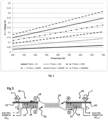
- Fig. 1 is a plot of the Nernst equation for hydrogen-based generated voltage vs. temperature for several pressure ratios. At a pressure ratio of 10,000, for example, Fig. 1 depicts that when the temperature is high, the voltage is high and when the temperature is low the voltage is low, such that there is a linear relationship between these parameters.
- the working fluid in the JTEC is compressed in the low temperature electrochemical cell by supplying current at a voltage that is sufficient to overcome the Nernst potential of the low temperature cell, thereby driving the working fluid from the low-pressure side of the membrane to the high-pressure side.
- the working fluid is expanded in the high temperature electrochemical cell as current (power) is extracted under the Nernst potential of the high temperature cell. Electrical current flow is generated as the working fluid expands from the high-pressure side of the membrane to the low-pressure side.
- a greater amount of work (electricity) is extracted during high temperature expansion than the work (electricity) input required for the low temperature compression.
- the difference in heat energy input to the engine to maintain constant temperature during high temperature expansion versus the heat energy removed to maintain constant temperature during low temperature compression is provided as the difference in electrical energy output by the high temperature expansion process versus that consumed by the low temperature compression process.
- the high temperature cell will have a higher voltage than the low temperature cell. Since the current (I) is the same through both cells, the voltage differential means that the power generated through the expansion of working fluid in the high temperature cell is higher than that generated in the low temperature cell.
- the power output by the high temperature cell (V HT ⁇ I) is sufficient to drive the compression process in the low temperature cell (V LT ⁇ I), as well as to supply net power output to an external load ((V HT ⁇ I)-(V LT ⁇ I)).
- This voltage differential provides the basis for the JTEC engine.
- the JTEC heat engine offers a practical way of using available high barrier, low conductivity membrane materials to provide a thermo-electrochemical heat engine that can approximate an Ericsson cycle, that can operate over a wide range of heat source temperatures, and that eliminates the reliability and inefficiency problems associated with mechanical engines.
- the design of the JTEC heat engine is complicated by the need for a large membrane/electrode surface area and by the need for a significant number of cells to be electrically connected in series to achieve practical output voltage levels.
- the open circuit voltage can be greater than 1.0 volts
- the Nernst voltage from the hydrogen pressure differential across a MEA is in the range of only about 0.2 volts. As such, many cells will have to be connected in series to achieve useful output voltage levels.
- the membranes must have good ion conductivity and high diffusion barrier properties, because diffusion of working fluid (such as hydrogen gas) under the pressure differential across the membrane results in reduced electrical output and efficiency.
- working fluid such as hydrogen gas
- membrane materials that have good ion conductivity such as Nafion manufactured by the DuPont Corp.
- membrane materials that have high molecular diffusion barrier properties generally have relatively low ionic conductivity, such that use of these materials would result in high system impedance and high polarization losses.
- thermo-electrochemical converter of the present invention selectively implements a temperature gradient across each MEA to generate local thermogalvanic voltages which have opposite polarity to that of activation energy and resistivity loss voltages, thereby serving to locally minimize or negate their effect on output voltage, efficiency and power density.
- the present invention is directed to a thermo-electrochemical converter comprising a working fluid; a first membrane electrode assembly and a second membrane electrode assembly coupled to the first membrane electrode assembly, each of the first and second membrane electrode assemblies including a first porous electrode operating at a first pressure, a second porous electrode operating at a second pressure which is higher than the first pressure, and an ion conductive membrane sandwiched therebetween, the first membrane electrode assembly working to compress the working fluid and the second membrane electrode assembly working to expand the working fluid; a first heat transfer member coupled to the first porous electrode of the first membrane electrode assembly, the first heat transfer member thermally interfacing with and facilitating heat transfer from a surface constituting a low-pressure side of the first membrane electrode assembly; a second heat transfer member coupled to the first porous electrode of the second membrane electrode assembly, the second heat transfer member thermally interfacing with and facilitating heat transfer to a surface constituting a low-pressure side of the second membrane electrode assembly; a heat sink coupled to the low-pressure side of the first membrane electrode assembly;
- thermo-electrochemical converter comprising: an ionizable working fluid; at least one membrane electrode assembly including a first porous electrode, a second porous electrode and at least one ion conductive membrane configured to conduct ions of the ionizable working fluid sandwiched between the first and second porous electrodes; a first conduit operating containing the ionizable working fluid at a first pressure and a second conduit containing the ionizable working fluid at a second pressure which is higher than the first pressure, the first conduit being coupled to the first porous electrode and corresponding to a low-pressure side of the at least one membrane electrode assembly and the second conduit being coupled to the second porous electrode and corresponding to a high-pressure side of the at least one membrane electrode assembly; and a heat conductor coupled to the at least one membrane electrode assembly on the low-pressure side, the heat conductor coupling heat to and from substantially an entire surface of the membrane electrode assembly on the low-pressure side.
- the present invention is directed to a method of converting heat into electrical energy.
- the method comprises providing a thermo-electrochemical converter comprising: a working fluid; a first membrane electrode assembly and a second membrane electrode assembly coupled to the first membrane electrode assembly, each of the first and second membrane electrode assemblies including a first porous electrode operating at a first pressure, a second porous electrode operating at a second pressure which is higher than the first pressure, and an ion conductive membrane sandwiched therebetween; a first heat transfer member coupled to the first porous electrode of the first membrane electrode assembly, the first heat transfer member thermally interfacing with and facilitating heat transfer from a surface constituting a low-pressure side of the first membrane electrode assembly; a second heat transfer member coupled to the first porous electrode of the second membrane electrode assembly, the second heat transfer member thermally interfacing with and facilitating heat transfer to a surface constituting a low-pressure side of the second membrane electrode assembly; a heat sink coupled to the low-pressure side of the first membrane electrode assembly; and a heat source coupled to the
- the method further comprises compressing the working fluid at the first membrane electrode assembly, and expanding the working fluid at second membrane electrode assembly.
- Heat of compression generated as the working fluid is compressed at the first membrane electrode assembly is removed to the heat sink, with the removal of the heat of compression being enhanced by the first heat transfer member, such that a temperature gradient is produced which increases toward a high-pressure side of the first membrane electrode assembly and thermogalvanic voltage is generated which moves the working fluid in the same direction as voltage being applied to the first membrane electrode assembly for pumping of the working fluid such that decreased voltage is needed to drive compression of the working fluid at the first membrane electrode assembly.
- Electrical power is generated at the second membrane electrode assembly as the working fluid expands from a high-pressure side to the low-pressure side, with the application of heat from the heat source to the low-pressure side of the second membrane electrode assembly being enhanced by the second heat transfer member, such that a heat flux is produced in a direction opposite to a direction of the working fluid expanding through the second membrane electrode assembly and thermovoltaic potential generated by the heat applied to the low-pressure side pulls the working fluid toward the low-pressure side, thereby increasing output voltage of the second membrane electrode assembly.
- Figs. 1-7 show preferred embodiments of a heat engine including one or more MEAs, or aspects thereof.
- electrochemical cell membrane electrode assembly
- MEA membrane electrode assembly stack
- MEA cell MEA cell
- thermo-electrochemical converter according to an embodiment of the present invention.
- the converter comprises at least one MEA 200.
- the MEA 200 comprises a membrane 220 sandwiched between a pair of electrodes 230, 232. It will be understood that the MEA 200 may comprise a plurality of overlapping layers of alternating electrodes 230, 232 and membranes 220 arranged in a high density stacked configuration.
- the membrane 220 is preferably an ion conductive membrane or proton conductive membrane having a thickness on the order of approximately 0.1 ⁇ m to 500 ⁇ m, and more preferably between approximately 1 ⁇ m and 500 ⁇ m. More particularly, the membrane 220 is preferably made from a proton conductive material or ion conductive material, and more preferably of a material that is conductive of ions of a working fluid that passes through the MEA 200. In one embodiment, the membrane 220 is preferably formed of a material comprising polybenzimidazole, yttrium-doped barium zirconate, or titanium oxide, and more preferably polybenzimidazole or yttrium-doped barium zirconate. However, it will be understood by those skilled in the art that any material, and preferably any polymer or ceramic material, which demonstrates a similar ion conductivity over a broad temperature range may be used to form the membrane 220.
- the electrodes 230, 232 preferably each has a thickness of approximately 25 ⁇ m.
- the electrodes 230, 232 are preferably comprised or formed of the same material as the membrane 220, such that the high thermal stresses that would otherwise occur under the extreme temperatures encountered during co-sintering or fusing to form the MEA 200 and in many end-use applications during operation of the MEA 200 are eliminated or at least reduced.
- the electrodes 230, 232 are preferably porous structures, while the membrane 220 is preferably a non-porous structure. It will be understood that the electrodes 230, 232 and the membrane 220 may be formed of different materials having similar thermal expansion coefficients, such that there would be little or no thermal stress generated during co-sintering/fusing or use of the MEA 200.
- the porous electrodes 230, 232 may be doped or infused with additional material(s) to provide electronic conductivity and catalytic material, in order to promote oxidation and reduction of the working fluid.
- the MEA 200 further comprises a conduit system including at least one low-pressure conduit 237 (represented by dashed lines in Fig. 7 ) coupled to the first porous electrode 230 and at least one high-pressure conduit 238 (represented by solid lines in Fig. 7 ) coupled to the second porous electrode 232.
- a supply of an ionizable gas, preferably hydrogen, is contained within the conduit system as the working fluid.
- the working fluid e.g., oxygen
- the working fluid is 100% oxygen.
- the working fluid comprises 0.1% to 99.9% hydrogen with the balance being an inert gas.
- the low-pressure conduit 237 directs the flow of the working fluid (e.g., hydrogen) in the direction of arrow A, while the high-pressure conduit 238 directs the flow of the working fluid in the direction of arrow B (i.e., the opposite direction of the low pressure conduit 237 flow).
- the low-pressure conduit 37 and high-pressure conduit 38 define low- and high-pressure electrodes 230, 232, respectively, and low- and high-pressure sides of the MEA 200.
- the high-pressure side of the MEA 200 may be at a pressure of as low as 0.5 psi and as high as 3,000 psi. Preferably, the high-pressure side of the MEA 200 is maintained at a pressure of approximately 300 psi.
- the low-pressure side of the MEA 200 may be at a pressure of as low as 0.0001 psi and as high as 0.3 psi. Preferably, the low-pressure side of the MEA 200 is maintained at a pressure of approximately 0.03 psi.
- a preferred pressure ratio of the high-pressure side to the low pressure side is 10,000:1 (see Fig. 1 ).
- the MEA 200 further includes at least one heat transfer member 240 coupled to the MEA 200 on the low-pressure side (i.e., the side corresponding to the low-pressure electrode 230 and the low-pressure conduit 237).
- the heat transfer member 240 provides a thermal interface effectively across the entire surface of the low-pressure side of the MEA 200, effectively coupling heat to and from substantially the entire surface of low-pressure side of the MEA, for example to a heat sink (not shown) or from a heat source (not shown).
- First and second terminals 233 and 231 are connected to the low-pressure and high-pressure electrodes 230, 232, respectively.
- the MEA 200 may operate as a heat engine to expand the working fluid from high pressure to low pressure so as to generate electricity.
- Power may be extracted from the MEA 200 by connecting an electric load to the first and second terminals 233, 231. Electric power is produced as the pressure differential between the high- and low-pressure conduits 238, 237 forces the working fluid through the MEA 200. While under pressure, the working fluid is oxidized at the high-pressure electrode 232 connected to terminal 231, thereby releasing electrons to the high-pressure electrode 232 and causing ions of the working fluid to enter the ion conductive membrane 220 as indicated by arrows 33.
- the high-pressure electrode 232 With the high-pressure electrode 232 connected to an external load, electrons flow through the load to the low-pressure electrode 230, where ions exiting the membrane 220 are reduced to reconstitute the working fluid and which is coupled to the heat transfer member 240 so as to facilitate the supply of heat of expansion to the working fluid (e.g., from a heat source).
- the converter supplies power to the external load as pressure forces the working fluid to flow through the MEA 200.
- the MEA 200 is configured to operate to pump the working fluid from low pressure to high pressure creating a compression process. Electrical power is consumed by the compression process. A power source is applied across the first and second terminals 233, 231. Voltage is applied at a potential that is sufficient to force current flow by overcoming the Nernst potential generated by the MEA 200 at its operating temperature and pressure differential. The applied power strips electrons from the working fluid at the interface of the low-pressure electrode 230 and membrane 220. The resulting ions are conducted through the ion conductive membrane 220 in the direction indicated by arrow 39.
- the power source supplies electrons to the high-pressure electrode 232, so as to reconstitute the working fluid at the interface of the high-pressure electrode 232 and membrane 220 as ions exit the membrane 220.
- This current flow under the applied voltage in effect, provides the pumping power needed for pumping the working fluid from low pressure to high pressure.
- the removal of the heat of compression, for example to a heat sink (not shown), is facilitated by the heat transfer member 240 coupled to the low-pressure side of the MEA 200.
- thermo-electrochemical converter according to another embodiment of the present invention.
- the converter operates on a combination of Nernst voltage and thermogalvanic voltage produced across two or more ion conductive membrane electrode assemblies, as described herein more fully.
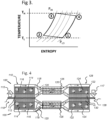
- Fig. 3 shows the ideal temperature entropy diagram for the Ericsson engine cycle of the converter of Fig. 2 . Electrical connections are not shown in Fig. 2 .
- the converter includes a first MEA 10, a second MEA 28, a heat exchanger 26 connecting the first and second MEAs 10, 28, a working fluid which flows in a continuous loop between the first and second MEAs 10, 28, a first conduit 18 and a second conduit 20, all of which are housed in a monolithic co-sintered ceramic structure.
- the first and second MEAs 10, 28 of Fig. 2 are the same as the MEA 200 of Fig. 7 , and thus the above description of the various components of the MEA 200 is not repeated herein as the description is equally applicable to the MEAs 10, 28 of Fig. 2 .
- the first MEA 10 includes a membrane 14 which is conductive of ions of the working fluid and is sandwiched between a first, porous electrode 12 and a second, porous electrode 16.
- the first MEA 10 is coupled to a heat sink 5 and functions to pump the working fluid from a low pressure to a high pressure (i.e., compress the working fluid), with electrical power being consumed by the compression process and the heat of compression being rejected (heat removal is represented by arrow Q L in Fig. 2 ).
- the second MEA 28 includes a membrane 24 which is conductive of ions of the working fluid and is sandwiched between a first porous electrode 30 and a second, porous electrode 22.
- the second MEA 28 is coupled to a heat source 7 (with the heat supply being represented by arrow Q H in Fig. 2 ), and functions to expand the working fluid from a high pressure to a low pressure. The expansion of the working fluid through the second MEA 28 generates electricity.
- the heat exchanger 26 is preferably a recuperative, counterflow heat exchanger which recuperates heat from working fluid leaving the second MEA 28 by coupling it to working fluid flowing to the second MEA 28.
- Providing such a recuperative heat exchanger in combination with a heat source and heat sink coupled to the high and low temperature electrochemical cells (i.e., MEA stacks) enables sufficient heat transfer for near constant temperature expansion and compression processes, thereby allowing the engine to approximate the thermodynamic Ericsson cycle.
- the first conduit 18 operates at a first pressure and the second conduit 20 operates at a second pressure which is higher than the first pressure. Therefore, the first conduit 18 is referred to herein as the "low-pressure conduit 18" and the second conduit 20 is referred to herein as the "high-pressure conduit.”
- the low-pressure conduit 18 couples the first electrodes 12, 30 of the first and second MEAs 10, 28, respectively, to enable the flow of working fluid between the first electrodes 12, 30.
- the first electrodes 12, 30 are low-pressure electrodes
- the sides of the MEAs 10, 28 corresponding to the first electrodes 12, 30 are low-pressure sides of the respective MEA 10, 28, and the side of the converter corresponding to the first electrodes 12, 30 is a low-pressure side of the converter.
- the high-pressure conduit 20 couples the second electrodes 16, 22 of the first and second MEA stacks 10, 28, respectively, to enable the flow of working fluid between the second electrodes 16, 22.
- the second electrodes 16, 22 are high-pressure electrodes
- the sides of the MEAs 10, 28 corresponding to the second electrodes 16, 22 are high-pressure sides of the respective MEA 10, 28, and the side of the converter corresponding to the second electrodes 16, 22 is a high-pressure side of the converter.
- the high-pressure side of each MEA 10, 28 may be at a pressure of as low as 0.5 psi and as high as 3,000 psi. Preferably, the high-pressure side of each MEA 10, 28 is maintained at a pressure of approximately 300 psi.
- the low-pressure side of each MEA 10, 28 may be at a pressure of as low as 0.0001 psi and as high as 0.3 psi. Preferably, the low-pressure side of each MEA 10, 28 is maintained at a pressure of approximately 0.03 psi.
- a preferred pressure ratio of the high-pressure side to the low-pressure side of each MEA 10, 28 is 10,000:1 (see Fig. 1 ).
- the first MEA 10 and the second MEA 28 preferably each includes at least one heat transfer member, also known as a heat conductor or heat spreader.
- the low-pressure electrodes 12, 30 of the first and second MEAs 10, 28 include a heat transfer member.
- the low-pressure electrodes 12, 30 themselves are structured to function as heat transfer members.
- each of the low-pressure electrodes 12, 30 is coupled to a separate heat transfer member.
- the low-pressure electrode 12 of the first MEA 10 is structured to function as a heat transfer member with respect to the heat sink 5 and the low-pressure electrode 30 of the second MEA 28 is structured to function as a heat transfer member with respect to the heat source 7, and thus no separate component is shown or designated as the heat transfer member.
- the low-pressure electrode 12 of the first MEA 10 facilitates the transfer of heat from the first MEA 10 to the associated heat sink 5
- the low-pressure electrode 30 of the second MEA 28 facilitates the transfer of heat to the second MEA 28 from the associated heat source 7.
- the heat source 7 to which the second MEA 28 is coupled is preferably at an elevated temperature relative to the temperature of the heat sink 5 to which the first MEA 10 is coupled.
- the first MEA 10 constitutes a low-temperature, compression cell and low-temperature side of the converter
- the second MEA 28 constitutes a high-temperature, expansion cell and high-temperature side of the converter and has a higher Nernst voltage than the low-temperature cell 10.
- Operation of the low-temperature cell 10 is driven by electric power input with heat rejection by the first heat transfer member to the heat sink 5.
- Operation of the high-temperature cell 28 is driven by heat input to the second heat transfer member from the heat source 7 to produce electricity.
- the second MEA 28 produces an amount of electrical power that is sufficient to drive the operation of the first MEA 10 and provide net power output.
- the heat source 7 to which the second MEA 28 is coupled is preferably at reduced temperature relative to the temperature of the heat sink 5 to which the first MEA 10 is coupled.
- Working fluid is expanded in the second MEA 28 as the heat of expansion is extracted from the low-temperature heat source 7.
- Operation of the second MEA 28 is driven by heat input to the second heat transfer member from the heat source 7 to produce electricity.
- Working fluid is compressed at a high temperature in the first MEA 10 as the heat of compression is rejected at the elevated temperature.
- Operation of the first MEA 10 is driven by electric power input with heat rejection by the first heat transfer member to the heat sink 5.
- the first MEA 10 consumes an amount of electrical power that is greater than that produced by the second MEA 28 with net power input being required as for a heat pump.
- thermodynamic states 1 through 4 are identical at the respective points labeled in Figs. 2 and 3 .
- the converter operates as follows, with the working fluid being hydrogen.
- another ionizable gas such as oxygen, may instead be used as the working fluid.
- electrical energy W IN is supplied to the low-temperature MEA 10 to pump hydrogen from low-temperature, low-pressure state 1 to low-temperature, high-pressure state 2.
- hydrogen is compressed in the low-temperature MEA 10, thereby driving the hydrogen from the low-pressure side of the membrane 14 to the high-pressure side.
- the temperature of the hydrogen increases by a finite amount because of the heat of compression which is generated as the hydrogen transitions across membrane 14 from the low-pressure side to the high-pressure side, while simultaneously heat Q L is being removed to the heat sink 5 from the low-pressure side of the membrane 14.
- Heat removal to the heat sink 5 is enhanced by the low-pressure electrode 12 comprising or being coupled to a heat conductive material. As a result, a temperature gradient increasing towards the high-pressure side of the low-temperature MEA 10 is maintained.
- state 3 is high-temperature, high-pressure state.
- the heat needed to elevate the temperature of the hydrogen from low-pressure, high-temperature state 2 to high-temperature, high-pressure 3 is transferred from the hydrogen flowing in the opposite direction through the heat exchanger 26.
- electrical power W OUT is generated as hydrogen expands across the high-temperature, high-pressure MEA 28 from high pressure, high temperature state 3 to high temperature, low-pressure state 4.
- the temperature of the hydrogen (protons) increases by a finite amount as heat Q H is supplied from the heat source 7 to the low-pressure side of the membrane 24, facilitated by the low-pressure electrode 30 comprising or being coupled to a heat conductive material, to overcome the temperature decrease that would otherwise occur due to the heat of expansion which is generated as the hydrogen (protons) transitions to the low-pressure side across the membrane 24 from the high-pressure side.
- the low-pressure electrode 30 comprising or being coupled to a heat conductive material
- the hydrogen passes through the recuperative, counterflow heat exchanger 26 and therein its temperature is lowered by heat transfer to the hydrogen counterflowing from low-temperature, high-pressure state 2 to high-temperature, high-pressure state 3, until the hydrogen passing from high-temperature, low-pressure state 4 reaches the temperature of low-temperature, low-pressure state 1.
- the hydrogen is pumped by the low-temperature MEA 10 from low-temperature, low-pressure state 1 back to low-temperature, high-pressure state 2, as described above, and so forth as the cycle continues.
- Fig. 4 shows a converter assembly in accordance with another embodiment of the present invention, and details a specific preferred structure of the low-pressure electrodes 12, 30 as heat conductive electrodes which function as a heat sink spreader and a heat source spreader, respectively, to transfer heat from and to the respective MEAs 10, 28.
- the heat engine includes two identical converters 100 arranged in a stacked configuration, although it will be understood that more than two converters 100 may be included in the assembly.
- the converters 100 are identical to each other and to the converter described above with respect to Figs. 2 and 3 . Accordingly, a detailed description of the configuration of each converter 100 is not necessary.
- each converter 100 includes a first, low-temperature MEA 110 coupled to a heat sink 115 (with the heat removal being represented by arrow Q L ), a second, high-temperature MEA 128 coupled to a heat source 117 (with the heat supply being represented by arrow Q H ), a heat exchanger 126 connecting the low-temperature and high-temperature MEAs 110, 128.
- Each low-temperature MEA 110 includes an ion conductive membrane 114 sandwiched between a first electrode 112 and a second electrode 116.
- Each high-temperature MEA 128 includes an ion conductive membrane 124 sandwiched between a first electrode 130 and a second electrode 122.
- Each converter 100 further includes a first conduit 118 operating at a first pressure and a second conduit 120 operating at a second pressure which is higher than the first pressure.
- the low-pressure conduit 118 of each converter 100 couples the first electrode 112 of the low-temperature MEA 110 with the first electrode 130 of the high-temperature MEA 128, thereby enabling the flow of working fluid between the two low-pressure electrodes 112, 130.
- the low-pressure electrodes 112, 130 constitute a low-pressure side of the respective MEA 110, 128 and are coupled to the heat sink 115 and heat source 117, respectively.
- the high-pressure conduit 120 of each converter 100 couples the second electrode 116 of the low-temperature MEA 110 with the second electrode 122 of the high-temperature MEA 128, thereby enabling the flow of working fluid between the high-temperature electrodes 116, 122.
- the high-temperature electrodes 116, 122 constitute a high-pressure side of the respective MEA 110, 128.
- the first and second converters 100 are stacked such that the low-pressure electrodes 112, 130 of each converter 100 are arranged in a back-to-back configuration, with heat being supplied to the back-to-back low-pressure electrodes 130 of the high-temperature MEA cells 128 by the heat source 117 and heat being removed from the back-to-back low-pressure electrodes 112 of the low-temperature MEA cells 110 by the heat sink 115.
- the low-temperature MEAs 110 constitute a low-temperature MEA stack and the high-temperature MEAs 128 constitute a high-temperature MEA stack.
- the low-temperature MEAs 110 and high-temperature MEAs 128 of the first and second converters 100 need not include distinct low-pressure electrodes 112, 130. Instead, the low-temperature MEAs 110 of the first and second converters 100 may be stacked on top of each other, such that adjacent MEAs 110 share a common low-pressure electrode 112, and the high-temperature MEAs 128 of the first and second converters 100 may be stacked on top of each other, such that adjacent MEAs 128 share a common low-pressure electrode 130. Similarly, the converters 100 need not have distinct low-pressure and high-pressure conduits 118, 120, but may instead share common conduits 118, 120.
- a first heat transfer member 140 and more particularly a first heat conductor 140, is coupled to and arranged between adjacent low-pressure electrodes 112 of the low-temperature MEA stack 140.
- the first heat conductor 140 couples the low-temperature MEA stack 140 to the associated heat sink 115.
- a second heat transfer member 142 and more particularly a second heat conductor 142, is coupled to and arranged between adjacent low-pressure electrodes 130 of the high-temperature MEA stack 160.
- the second heat conductor 142 couples the high-temperature MEA stack 160 to the associated heat source 117. It will be understood that while the heat conductors 140, 142 are shown as separate components from the low-pressure electrodes 112, 130 in Fig. 4 , the heat conductors 140, 142 may instead be integral components of the low-pressure electrodes 112, 130.
- the first heat conductor 140 provides a thermal interface effectively across the entire surface of the low-pressure sides of the low-temperature MEAs 110 (i.e., the side corresponding to the low-pressure electrodes 112), and facilitates heat transfer from the low-temperature MEAs 110 to the heat sink 115.
- the second heat conductor 142 provides a thermal interface effectively across the entire surface of the low-pressure sides of the high-temperature MEAs 128 (i.e., the side corresponding to the low-pressure electrodes 130), and facilitates heat transfer from the heat source 117 to the high-temperature MEAs 128.
- the first and second heat conductors 140, 142 are preferably made of a porous material, but may include non-porous sections to provide enhanced heat transfer effect.
- the first and second heat conductors 140, 142 may also include sections formed of a different material which provides for enhanced heat transfer effect.
- the first and second heat spreaders 140, 142 may be formed of practically any material which is thermally conductive. Examples of such thermally conductive material includes, but are not limited to, metals, diamond, graphite, silicon carbide, aluminum nitride, and any equivalents thereof.
- the first and second heat spreaders 140, 142 may be formed of the same material or mixture of materials, or of different materials or mixtures of materials.
- a high-temperature MEA 170 of a converter in accordance with an embodiment of the present invention.
- heat input is implemented in a manner that generates galvanic voltage to increase overall converter performance.
- the MEA 170 includes an ion conductive membrane 172, and more particularly a proton conductive membrane 172 of a thickness T 172 , sandwiched between a first, porous electrode 174 and a second, porous electrode 176.
- the first electrode 174 is coupled to a heat source (not shown), such that the first electrode 174 is a heated electrode.
- the first electrode 174 operates at a first pressure and the second electrode 176 operates at a second pressure which is higher than the first pressure.
- the low-pressure electrode 174 comprises a material having high thermal conductivity and thus acts as a heat spreader or is coupled to a component comprising such a thermally conductive material.
- Hydrogen mass flow 178 enters the high-pressure electrode 176 and is oxidized. The resulting electrons are conducted through an external circuit (not shown), via first and second electrode terminals 180 and 182, while the resulting protons 184 are conducted through the proton conductive membrane 172.
- Internal resistive heating 186 due to proton current is designated as Q R in Fig. 5 .
- the voltage produced across the MEA 170 is the result of the Nernst voltage due to the difference between high pressure P H and low pressure P L . As such, it is desirable to maintain constant-temperature compression and expansion processes so as to closely approximate the Ericsson cycle. Ideally, heat output 150, Q OUT on the low-temperature side 176 is zero, since there is no heat sink on the entering side of the MEA, except for that associated with the entering hydrogen. Voltage losses within the MEA 170 are associated with the resistance of the membrane, hydrogen activation energy, voltage loss due to hydrogen flow pressure drops within the conduits that couple multiple MEAs back-to-back, hydrogen permeation through the membranes, and the like.
- the temperature gradient produced with heat flux across each MEA is in a direction opposite to that of the proton conduction, and generates a thermogalvanic voltage (e.g., Seebeck voltage) across each MEA which is of opposite polarity relative to resistance voltage losses associated with the proton conduction.
- a thermogalvanic voltage e.g., Seebeck voltage
- the temperature gradient and thermogalvanic voltage locally minimize or wholly negate losses such as activation energy losses and resistivity voltage losses.
- the temperature gradient produced with heat flux across the MEA 170 is in a direction opposite to that of the proton conduction, and generates a thermogalvanic voltage (e.g., Seebeck voltage) across the MEA 170 which is of opposite polarity relative to resistance voltage losses associated with the proton conduction.
- a thermogalvanic voltage e.g., Seebeck voltage
- the temperature gradient and thermogalvanic voltage locally minimize or wholly negate losses such as activation energy losses and resistivity voltage losses.
- Fig. 6 depicts the results a modeling analysis of a complete thermoelectrochemical converter, in accordance with the present invention, including both high- and low-temperature MEA cells showing effects of the heat spreaders location.
- the representative converter operates on a 150°C heat source and a 50°C heat sink.
- the membrane of the converter analyzed for the graph of Fig. 6 comprised phosphoric acid-based polybenzimizole as a proton conductive membrane material.
- the membrane had an ionic conductivity of 0.056 S/cm at 50°C and 0.355 S/cm at 150°C.
- the model allocates 70% of the theoretical Nernst open circuit voltage of the two MEAs, arranged in a back-to-back configuration, as output voltage to a load, with the remaining 30% being consumed by internal losses. Under this condition, maximum possible output current is constrained to a level such that losses associated with resistance, hydrogen flow, activation energy, and the like can be accommodated within the 30% of the open circuit voltage, thus achieving 70% of Carnot output efficiency.
- the model predicts output power density under the 70% of Carnot output efficiency constraint.
- the configuration represented by line 64 in which the heat flux is in the opposite direction of the ion flux, has improved power density as compared to the configuration of line 62, in which the heat flux is in the same direction as the ion flux.
- Fig. 6 reflects that the power density changes significantly with just a few degrees temperature difference across the membranes. Note that when there is no temperature gradient, the power output is 9 mW/cm 2 and both models are at the same power level. However, as temperature gradients develop across the membranes of both MEAs, the two configurations diverge in performance.
- Line 62 shows the output power density for the case where the heat flux is in the same direction as that of the hydrogen or proton flux through each MEA.
- line 64 shows the case where heat is input and extracted from each MEA in a manner that produces heat flux in a direction that is opposite to the direction of the proton or hydrogen flux, as in the present invention.
- thermogalvanic voltage tends to move the working fluid in the same direction as the voltage being applied to the cell to produce pumping.
- the resulting two voltages combine overcome the Nernst potential defined by the temperature and pressure ratio of the MEA, which results in a lower input voltage being needed to achieve the desired pumping.
- thermogalvanic voltage is generated at the high-temperature MEA, in addition to the cell's Nernst potential, which results in a higher output voltage than would be realized by the Nernst potential alone.
- heat is input on the low-pressure side such that the resulting heat flux into the MEA is in the opposite direction of the working fluid expanding through the MEA from the high-pressure side to the low-pressure side.
- Pressure forces the working fluid through the MEA, stripping off electrons to the external circuit (load and low-temperature MEA) with protons being conducted through the membrane.
- the thermovoltaic potential generated by heat applied to the low-pressure side has the same effect.
- the thermovoltaic potential pulls the working fluid to the low-pressure side. This voltage is additive to the Nernst voltage. The combination results in higher overall high-temperature MEA output voltage.
- thermovoltaic voltage operates in opposition to the Nernst voltages, under this condition, rather than being additive to the Nernst voltages.
- the decreasing voltage of line 62 in Fig. 6 is illustrative of such a configuration.
- heat is extracted from the low-temperature MEA from the high-pressure side, rather than the low-pressure side. Under this condition, the low-temperature side of the MEA is the side to which working fluid is being compressed.
- thermovoltaic potential tends to move the working fluid toward the higher temperature, low-pressure side in opposition to the voltage being applied to pump the working fluid to the high-pressure side.
- the applied voltage must be high enough to overcome both the thermovoltaic potential created by the applied temperature gradient and the Nernst voltage in performing the low-temperature MEA compression process.
- supplying heat on the high-pressure side of the high-temperature MEA creates a thermovoltaic potential that tends move the working fluid toward the high-pressure side in opposition to expansion of working fluid from the high-pressure side. The net effect is to reduce the output voltage of the MEA.
Landscapes
- Engineering & Computer Science (AREA)
- Chemical & Material Sciences (AREA)
- General Chemical & Material Sciences (AREA)
- Electrochemistry (AREA)
- Chemical Kinetics & Catalysis (AREA)
- Sustainable Development (AREA)
- Sustainable Energy (AREA)
- Life Sciences & Earth Sciences (AREA)
- Manufacturing & Machinery (AREA)
- Physics & Mathematics (AREA)
- Mechanical Engineering (AREA)
- Thermal Sciences (AREA)
- General Engineering & Computer Science (AREA)
- Hybrid Cells (AREA)
Applications Claiming Priority (3)
| Application Number | Priority Date | Filing Date | Title |
|---|---|---|---|
| US202062976764P | 2020-02-14 | 2020-02-14 | |
| EP21777380.3A EP4104226A2 (de) | 2020-02-14 | 2021-02-12 | Thermo-elektrochemischer wandler |
| PCT/US2021/017745 WO2021216171A2 (en) | 2020-02-14 | 2021-02-12 | Thermo-electrochemical converter |
Related Parent Applications (1)
| Application Number | Title | Priority Date | Filing Date |
|---|---|---|---|
| EP21777380.3A Division EP4104226A2 (de) | 2020-02-14 | 2021-02-12 | Thermo-elektrochemischer wandler |
Publications (2)
| Publication Number | Publication Date |
|---|---|
| EP4249828A2 true EP4249828A2 (de) | 2023-09-27 |
| EP4249828A3 EP4249828A3 (de) | 2023-12-06 |
Family
ID=77911110
Family Applications (2)
| Application Number | Title | Priority Date | Filing Date |
|---|---|---|---|
| EP21777380.3A Pending EP4104226A2 (de) | 2020-02-14 | 2021-02-12 | Thermo-elektrochemischer wandler |
| EP23182443.4A Pending EP4249828A3 (de) | 2020-02-14 | 2021-02-12 | Thermo-elektrochemischer wandler |
Family Applications Before (1)
| Application Number | Title | Priority Date | Filing Date |
|---|---|---|---|
| EP21777380.3A Pending EP4104226A2 (de) | 2020-02-14 | 2021-02-12 | Thermo-elektrochemischer wandler |
Country Status (6)
| Country | Link |
|---|---|
| US (1) | US12531255B2 (de) |
| EP (2) | EP4104226A2 (de) |
| JP (1) | JP7622082B2 (de) |
| KR (1) | KR102887002B1 (de) |
| CN (1) | CN115176367B (de) |
| WO (1) | WO2021216171A2 (de) |
Citations (1)
| Publication number | Priority date | Publication date | Assignee | Title |
|---|---|---|---|---|
| US7160639B2 (en) | 2000-07-28 | 2007-01-09 | Johnson Research & Development Co., Inc. | Johnson reversible engine |
Family Cites Families (8)
| Publication number | Priority date | Publication date | Assignee | Title |
|---|---|---|---|---|
| US7943250B1 (en) * | 2000-07-28 | 2011-05-17 | Johnson Research & Development Co., Inc. | Electrochemical conversion system for energy management |
| WO2010065423A1 (en) | 2008-12-02 | 2010-06-10 | Xergy Incorporated | Electrochemical compressor and refrigeration system |
| US9266085B2 (en) * | 2010-09-09 | 2016-02-23 | Johnson Research & Development Co. Inc. | Johnson ambient-heat engine |
| US10522862B2 (en) * | 2014-08-11 | 2019-12-31 | Johnson Ip Holding, Llc | Thermo-electrochemical converter |
| CN107743571B (zh) * | 2015-03-09 | 2020-09-11 | 约翰逊Ip控股有限公司 | 具有集成能量存储的热-电化学转换器 |
| GB2553411A (en) * | 2016-06-20 | 2018-03-07 | Xergy Ltd | Electrochemical compression of ammonia using ion exchange membranes |
| WO2018031713A1 (en) * | 2016-08-12 | 2018-02-15 | Johnson Ip Holding, Llc | Thermo-electrochemical converter |
| WO2018053474A1 (en) * | 2016-09-19 | 2018-03-22 | Johnson Ip Holding, Llc | Johnson thermo-electrochemical converter |
-
2021
- 2021-02-12 EP EP21777380.3A patent/EP4104226A2/de active Pending
- 2021-02-12 CN CN202180012669.0A patent/CN115176367B/zh active Active
- 2021-02-12 EP EP23182443.4A patent/EP4249828A3/de active Pending
- 2021-02-12 KR KR1020227030006A patent/KR102887002B1/ko active Active
- 2021-02-12 JP JP2022549209A patent/JP7622082B2/ja active Active
- 2021-02-12 US US17/797,572 patent/US12531255B2/en active Active
- 2021-02-12 WO PCT/US2021/017745 patent/WO2021216171A2/en not_active Ceased
Patent Citations (1)
| Publication number | Priority date | Publication date | Assignee | Title |
|---|---|---|---|---|
| US7160639B2 (en) | 2000-07-28 | 2007-01-09 | Johnson Research & Development Co., Inc. | Johnson reversible engine |
Non-Patent Citations (3)
| Title |
|---|
| "Intersociety Energy Conversion Engineering Conference and Exhibit (IECEC), 35th", COLLECTION OF TECHNICAL PAPERS, vol. 2, 24 July 2000 (2000-07-24), pages 10 - 44 |
| AMERICAN INSTITUTE OF AERONAUTICS AND ASTRONAUTICS, REPORT NUMBER(S)- AIAA PAPER 2000-3032, vol. 190, pages 1295 - 1299 |
| J.H. HIRSCHENHOFER ET AL.: "Fuel Cell Handbook", 1999, pages: 2 - 5 |
Also Published As
| Publication number | Publication date |
|---|---|
| EP4104226A2 (de) | 2022-12-21 |
| EP4249828A3 (de) | 2023-12-06 |
| WO2021216171A3 (en) | 2022-03-10 |
| US20230056025A1 (en) | 2023-02-23 |
| US12531255B2 (en) | 2026-01-20 |
| JP7622082B2 (ja) | 2025-01-27 |
| CN115176367A (zh) | 2022-10-11 |
| JP2023513814A (ja) | 2023-04-03 |
| KR102887002B1 (ko) | 2025-11-17 |
| CN115176367B (zh) | 2025-10-21 |
| WO2021216171A2 (en) | 2021-10-28 |
| KR20220133994A (ko) | 2022-10-05 |
Similar Documents
| Publication | Publication Date | Title |
|---|---|---|
| US10938053B2 (en) | Thermo-electrochemical converter | |
| US11799116B2 (en) | Johnson thermo-electrochemical converter | |
| US11127998B2 (en) | Thermo-electrochemical converter | |
| US12531255B2 (en) | Thermo-electrochemical converter | |
| EP3759758B1 (de) | Methode zum verbinden von säuredotierten membranen | |
| US11211629B2 (en) | Johnson thermo-electrochemical converter |
Legal Events
| Date | Code | Title | Description |
|---|---|---|---|
| PUAI | Public reference made under article 153(3) epc to a published international application that has entered the european phase |
Free format text: ORIGINAL CODE: 0009012 |
|
| STAA | Information on the status of an ep patent application or granted ep patent |
Free format text: STATUS: THE APPLICATION HAS BEEN PUBLISHED |
|
| AC | Divisional application: reference to earlier application |
Ref document number: 4104226 Country of ref document: EP Kind code of ref document: P |
|
| AK | Designated contracting states |
Kind code of ref document: A2 Designated state(s): AL AT BE BG CH CY CZ DE DK EE ES FI FR GB GR HR HU IE IS IT LI LT LU LV MC MK MT NL NO PL PT RO RS SE SI SK SM TR |
|
| REG | Reference to a national code |
Ref country code: DE Ref legal event code: R079 Free format text: PREVIOUS MAIN CLASS: F25B0001000000 Ipc: H01M0008040070 |
|
| PUAL | Search report despatched |
Free format text: ORIGINAL CODE: 0009013 |
|
| AK | Designated contracting states |
Kind code of ref document: A3 Designated state(s): AL AT BE BG CH CY CZ DE DK EE ES FI FR GB GR HR HU IE IS IT LI LT LU LV MC MK MT NL NO PL PT RO RS SE SI SK SM TR |
|
| RIC1 | Information provided on ipc code assigned before grant |
Ipc: F25B 1/00 20060101ALI20231031BHEP Ipc: H01M 14/00 20060101ALI20231031BHEP Ipc: H01M 8/22 20060101ALI20231031BHEP Ipc: H01M 8/18 20060101ALI20231031BHEP Ipc: H01M 8/04082 20160101ALI20231031BHEP Ipc: H01M 8/04089 20160101ALI20231031BHEP Ipc: F25B 23/00 20060101ALI20231031BHEP Ipc: H01M 8/04007 20160101AFI20231031BHEP |
|
| STAA | Information on the status of an ep patent application or granted ep patent |
Free format text: STATUS: REQUEST FOR EXAMINATION WAS MADE |
|
| 17P | Request for examination filed |
Effective date: 20240606 |
|
| RBV | Designated contracting states (corrected) |
Designated state(s): AL AT BE BG CH CY CZ DE DK EE ES FI FR GB GR HR HU IE IS IT LI LT LU LV MC MK MT NL NO PL PT RO RS SE SI SK SM TR |