EP4248997A1 - Therapeutic agent or prophylactic agent for covid-19 - Google Patents
Therapeutic agent or prophylactic agent for covid-19 Download PDFInfo
- Publication number
- EP4248997A1 EP4248997A1 EP21894619.2A EP21894619A EP4248997A1 EP 4248997 A1 EP4248997 A1 EP 4248997A1 EP 21894619 A EP21894619 A EP 21894619A EP 4248997 A1 EP4248997 A1 EP 4248997A1
- Authority
- EP
- European Patent Office
- Prior art keywords
- group
- optionally substituted
- ring
- therapeutic
- prophylactic agent
- Prior art date
- Legal status (The legal status is an assumption and is not a legal conclusion. Google has not performed a legal analysis and makes no representation as to the accuracy of the status listed.)
- Pending
Links
Images



Classifications
-
- A—HUMAN NECESSITIES
- A61—MEDICAL OR VETERINARY SCIENCE; HYGIENE
- A61K—PREPARATIONS FOR MEDICAL, DENTAL OR TOILETRY PURPOSES
- A61K31/00—Medicinal preparations containing organic active ingredients
- A61K31/185—Acids; Anhydrides, halides or salts thereof, e.g. sulfur acids, imidic, hydrazonic or hydroximic acids
- A61K31/19—Carboxylic acids, e.g. valproic acid
- A61K31/195—Carboxylic acids, e.g. valproic acid having an amino group
- A61K31/196—Carboxylic acids, e.g. valproic acid having an amino group the amino group being directly attached to a ring, e.g. anthranilic acid, mefenamic acid, diclofenac, chlorambucil
-
- A—HUMAN NECESSITIES
- A61—MEDICAL OR VETERINARY SCIENCE; HYGIENE
- A61K—PREPARATIONS FOR MEDICAL, DENTAL OR TOILETRY PURPOSES
- A61K31/00—Medicinal preparations containing organic active ingredients
- A61K31/185—Acids; Anhydrides, halides or salts thereof, e.g. sulfur acids, imidic, hydrazonic or hydroximic acids
- A61K31/19—Carboxylic acids, e.g. valproic acid
- A61K31/192—Carboxylic acids, e.g. valproic acid having aromatic groups, e.g. sulindac, 2-aryl-propionic acids, ethacrynic acid
-
- A—HUMAN NECESSITIES
- A61—MEDICAL OR VETERINARY SCIENCE; HYGIENE
- A61K—PREPARATIONS FOR MEDICAL, DENTAL OR TOILETRY PURPOSES
- A61K31/00—Medicinal preparations containing organic active ingredients
- A61K31/185—Acids; Anhydrides, halides or salts thereof, e.g. sulfur acids, imidic, hydrazonic or hydroximic acids
- A61K31/19—Carboxylic acids, e.g. valproic acid
- A61K31/194—Carboxylic acids, e.g. valproic acid having two or more carboxyl groups, e.g. succinic, maleic or phthalic acid
-
- A—HUMAN NECESSITIES
- A61—MEDICAL OR VETERINARY SCIENCE; HYGIENE
- A61K—PREPARATIONS FOR MEDICAL, DENTAL OR TOILETRY PURPOSES
- A61K31/00—Medicinal preparations containing organic active ingredients
- A61K31/185—Acids; Anhydrides, halides or salts thereof, e.g. sulfur acids, imidic, hydrazonic or hydroximic acids
- A61K31/19—Carboxylic acids, e.g. valproic acid
- A61K31/195—Carboxylic acids, e.g. valproic acid having an amino group
- A61K31/197—Carboxylic acids, e.g. valproic acid having an amino group the amino and the carboxyl groups being attached to the same acyclic carbon chain, e.g. gamma-aminobutyric acid [GABA], beta-alanine, epsilon-aminocaproic acid or pantothenic acid
-
- A—HUMAN NECESSITIES
- A61—MEDICAL OR VETERINARY SCIENCE; HYGIENE
- A61K—PREPARATIONS FOR MEDICAL, DENTAL OR TOILETRY PURPOSES
- A61K31/00—Medicinal preparations containing organic active ingredients
- A61K31/185—Acids; Anhydrides, halides or salts thereof, e.g. sulfur acids, imidic, hydrazonic or hydroximic acids
- A61K31/19—Carboxylic acids, e.g. valproic acid
- A61K31/195—Carboxylic acids, e.g. valproic acid having an amino group
- A61K31/197—Carboxylic acids, e.g. valproic acid having an amino group the amino and the carboxyl groups being attached to the same acyclic carbon chain, e.g. gamma-aminobutyric acid [GABA], beta-alanine, epsilon-aminocaproic acid or pantothenic acid
- A61K31/198—Alpha-amino acids, e.g. alanine or edetic acid [EDTA]
-
- A—HUMAN NECESSITIES
- A61—MEDICAL OR VETERINARY SCIENCE; HYGIENE
- A61K—PREPARATIONS FOR MEDICAL, DENTAL OR TOILETRY PURPOSES
- A61K31/00—Medicinal preparations containing organic active ingredients
- A61K31/21—Esters, e.g. nitroglycerine, selenocyanates
- A61K31/215—Esters, e.g. nitroglycerine, selenocyanates of carboxylic acids
- A61K31/216—Esters, e.g. nitroglycerine, selenocyanates of carboxylic acids of acids having aromatic rings, e.g. benactizyne, clofibrate
-
- A—HUMAN NECESSITIES
- A61—MEDICAL OR VETERINARY SCIENCE; HYGIENE
- A61K—PREPARATIONS FOR MEDICAL, DENTAL OR TOILETRY PURPOSES
- A61K31/00—Medicinal preparations containing organic active ingredients
- A61K31/21—Esters, e.g. nitroglycerine, selenocyanates
- A61K31/215—Esters, e.g. nitroglycerine, selenocyanates of carboxylic acids
- A61K31/235—Esters, e.g. nitroglycerine, selenocyanates of carboxylic acids having an aromatic ring attached to a carboxyl group
-
- A—HUMAN NECESSITIES
- A61—MEDICAL OR VETERINARY SCIENCE; HYGIENE
- A61K—PREPARATIONS FOR MEDICAL, DENTAL OR TOILETRY PURPOSES
- A61K31/00—Medicinal preparations containing organic active ingredients
- A61K31/21—Esters, e.g. nitroglycerine, selenocyanates
- A61K31/215—Esters, e.g. nitroglycerine, selenocyanates of carboxylic acids
- A61K31/235—Esters, e.g. nitroglycerine, selenocyanates of carboxylic acids having an aromatic ring attached to a carboxyl group
- A61K31/24—Esters, e.g. nitroglycerine, selenocyanates of carboxylic acids having an aromatic ring attached to a carboxyl group having an amino or nitro group
- A61K31/245—Amino benzoic acid types, e.g. procaine, novocaine
-
- A—HUMAN NECESSITIES
- A61—MEDICAL OR VETERINARY SCIENCE; HYGIENE
- A61K—PREPARATIONS FOR MEDICAL, DENTAL OR TOILETRY PURPOSES
- A61K31/00—Medicinal preparations containing organic active ingredients
- A61K31/21—Esters, e.g. nitroglycerine, selenocyanates
- A61K31/27—Esters, e.g. nitroglycerine, selenocyanates of carbamic or thiocarbamic acids, meprobamate, carbachol, neostigmine
-
- A—HUMAN NECESSITIES
- A61—MEDICAL OR VETERINARY SCIENCE; HYGIENE
- A61K—PREPARATIONS FOR MEDICAL, DENTAL OR TOILETRY PURPOSES
- A61K31/00—Medicinal preparations containing organic active ingredients
- A61K31/33—Heterocyclic compounds
- A61K31/335—Heterocyclic compounds having oxygen as the only ring hetero atom, e.g. fungichromin
- A61K31/34—Heterocyclic compounds having oxygen as the only ring hetero atom, e.g. fungichromin having five-membered rings with one oxygen as the only ring hetero atom, e.g. isosorbide
- A61K31/341—Heterocyclic compounds having oxygen as the only ring hetero atom, e.g. fungichromin having five-membered rings with one oxygen as the only ring hetero atom, e.g. isosorbide not condensed with another ring, e.g. ranitidine, furosemide, bufetolol, muscarine
-
- A—HUMAN NECESSITIES
- A61—MEDICAL OR VETERINARY SCIENCE; HYGIENE
- A61K—PREPARATIONS FOR MEDICAL, DENTAL OR TOILETRY PURPOSES
- A61K31/00—Medicinal preparations containing organic active ingredients
- A61K31/33—Heterocyclic compounds
- A61K31/335—Heterocyclic compounds having oxygen as the only ring hetero atom, e.g. fungichromin
- A61K31/357—Heterocyclic compounds having oxygen as the only ring hetero atom, e.g. fungichromin having two or more oxygen atoms in the same ring, e.g. crown ethers, guanadrel
-
- A—HUMAN NECESSITIES
- A61—MEDICAL OR VETERINARY SCIENCE; HYGIENE
- A61K—PREPARATIONS FOR MEDICAL, DENTAL OR TOILETRY PURPOSES
- A61K31/00—Medicinal preparations containing organic active ingredients
- A61K31/33—Heterocyclic compounds
- A61K31/335—Heterocyclic compounds having oxygen as the only ring hetero atom, e.g. fungichromin
- A61K31/357—Heterocyclic compounds having oxygen as the only ring hetero atom, e.g. fungichromin having two or more oxygen atoms in the same ring, e.g. crown ethers, guanadrel
- A61K31/36—Compounds containing methylenedioxyphenyl groups, e.g. sesamin
-
- A—HUMAN NECESSITIES
- A61—MEDICAL OR VETERINARY SCIENCE; HYGIENE
- A61K—PREPARATIONS FOR MEDICAL, DENTAL OR TOILETRY PURPOSES
- A61K31/00—Medicinal preparations containing organic active ingredients
- A61K31/33—Heterocyclic compounds
- A61K31/395—Heterocyclic compounds having nitrogen as a ring hetero atom, e.g. guanethidine or rifamycins
- A61K31/40—Heterocyclic compounds having nitrogen as a ring hetero atom, e.g. guanethidine or rifamycins having five-membered rings with one nitrogen as the only ring hetero atom, e.g. sulpiride, succinimide, tolmetin, buflomedil
- A61K31/403—Heterocyclic compounds having nitrogen as a ring hetero atom, e.g. guanethidine or rifamycins having five-membered rings with one nitrogen as the only ring hetero atom, e.g. sulpiride, succinimide, tolmetin, buflomedil condensed with carbocyclic rings, e.g. carbazole
-
- A—HUMAN NECESSITIES
- A61—MEDICAL OR VETERINARY SCIENCE; HYGIENE
- A61K—PREPARATIONS FOR MEDICAL, DENTAL OR TOILETRY PURPOSES
- A61K31/00—Medicinal preparations containing organic active ingredients
- A61K31/33—Heterocyclic compounds
- A61K31/395—Heterocyclic compounds having nitrogen as a ring hetero atom, e.g. guanethidine or rifamycins
- A61K31/40—Heterocyclic compounds having nitrogen as a ring hetero atom, e.g. guanethidine or rifamycins having five-membered rings with one nitrogen as the only ring hetero atom, e.g. sulpiride, succinimide, tolmetin, buflomedil
- A61K31/403—Heterocyclic compounds having nitrogen as a ring hetero atom, e.g. guanethidine or rifamycins having five-membered rings with one nitrogen as the only ring hetero atom, e.g. sulpiride, succinimide, tolmetin, buflomedil condensed with carbocyclic rings, e.g. carbazole
- A61K31/4035—Isoindoles, e.g. phthalimide
-
- A—HUMAN NECESSITIES
- A61—MEDICAL OR VETERINARY SCIENCE; HYGIENE
- A61K—PREPARATIONS FOR MEDICAL, DENTAL OR TOILETRY PURPOSES
- A61K31/00—Medicinal preparations containing organic active ingredients
- A61K31/33—Heterocyclic compounds
- A61K31/395—Heterocyclic compounds having nitrogen as a ring hetero atom, e.g. guanethidine or rifamycins
- A61K31/40—Heterocyclic compounds having nitrogen as a ring hetero atom, e.g. guanethidine or rifamycins having five-membered rings with one nitrogen as the only ring hetero atom, e.g. sulpiride, succinimide, tolmetin, buflomedil
- A61K31/403—Heterocyclic compounds having nitrogen as a ring hetero atom, e.g. guanethidine or rifamycins having five-membered rings with one nitrogen as the only ring hetero atom, e.g. sulpiride, succinimide, tolmetin, buflomedil condensed with carbocyclic rings, e.g. carbazole
- A61K31/404—Indoles, e.g. pindolol
-
- A—HUMAN NECESSITIES
- A61—MEDICAL OR VETERINARY SCIENCE; HYGIENE
- A61K—PREPARATIONS FOR MEDICAL, DENTAL OR TOILETRY PURPOSES
- A61K31/00—Medicinal preparations containing organic active ingredients
- A61K31/33—Heterocyclic compounds
- A61K31/395—Heterocyclic compounds having nitrogen as a ring hetero atom, e.g. guanethidine or rifamycins
- A61K31/40—Heterocyclic compounds having nitrogen as a ring hetero atom, e.g. guanethidine or rifamycins having five-membered rings with one nitrogen as the only ring hetero atom, e.g. sulpiride, succinimide, tolmetin, buflomedil
- A61K31/403—Heterocyclic compounds having nitrogen as a ring hetero atom, e.g. guanethidine or rifamycins having five-membered rings with one nitrogen as the only ring hetero atom, e.g. sulpiride, succinimide, tolmetin, buflomedil condensed with carbocyclic rings, e.g. carbazole
- A61K31/404—Indoles, e.g. pindolol
- A61K31/4045—Indole-alkylamines; Amides thereof, e.g. serotonin, melatonin
-
- A—HUMAN NECESSITIES
- A61—MEDICAL OR VETERINARY SCIENCE; HYGIENE
- A61K—PREPARATIONS FOR MEDICAL, DENTAL OR TOILETRY PURPOSES
- A61K31/00—Medicinal preparations containing organic active ingredients
- A61K31/33—Heterocyclic compounds
- A61K31/395—Heterocyclic compounds having nitrogen as a ring hetero atom, e.g. guanethidine or rifamycins
- A61K31/40—Heterocyclic compounds having nitrogen as a ring hetero atom, e.g. guanethidine or rifamycins having five-membered rings with one nitrogen as the only ring hetero atom, e.g. sulpiride, succinimide, tolmetin, buflomedil
- A61K31/403—Heterocyclic compounds having nitrogen as a ring hetero atom, e.g. guanethidine or rifamycins having five-membered rings with one nitrogen as the only ring hetero atom, e.g. sulpiride, succinimide, tolmetin, buflomedil condensed with carbocyclic rings, e.g. carbazole
- A61K31/404—Indoles, e.g. pindolol
- A61K31/405—Indole-alkanecarboxylic acids; Derivatives thereof, e.g. tryptophan, indomethacin
-
- A—HUMAN NECESSITIES
- A61—MEDICAL OR VETERINARY SCIENCE; HYGIENE
- A61K—PREPARATIONS FOR MEDICAL, DENTAL OR TOILETRY PURPOSES
- A61K31/00—Medicinal preparations containing organic active ingredients
- A61K31/33—Heterocyclic compounds
- A61K31/395—Heterocyclic compounds having nitrogen as a ring hetero atom, e.g. guanethidine or rifamycins
- A61K31/435—Heterocyclic compounds having nitrogen as a ring hetero atom, e.g. guanethidine or rifamycins having six-membered rings with one nitrogen as the only ring hetero atom
- A61K31/44—Non condensed pyridines; Hydrogenated derivatives thereof
- A61K31/4406—Non condensed pyridines; Hydrogenated derivatives thereof only substituted in position 3, e.g. zimeldine
-
- A—HUMAN NECESSITIES
- A61—MEDICAL OR VETERINARY SCIENCE; HYGIENE
- A61K—PREPARATIONS FOR MEDICAL, DENTAL OR TOILETRY PURPOSES
- A61K31/00—Medicinal preparations containing organic active ingredients
- A61K31/33—Heterocyclic compounds
- A61K31/395—Heterocyclic compounds having nitrogen as a ring hetero atom, e.g. guanethidine or rifamycins
- A61K31/435—Heterocyclic compounds having nitrogen as a ring hetero atom, e.g. guanethidine or rifamycins having six-membered rings with one nitrogen as the only ring hetero atom
- A61K31/44—Non condensed pyridines; Hydrogenated derivatives thereof
- A61K31/4427—Non condensed pyridines; Hydrogenated derivatives thereof containing further heterocyclic ring systems
- A61K31/4439—Non condensed pyridines; Hydrogenated derivatives thereof containing further heterocyclic ring systems containing a five-membered ring with nitrogen as a ring hetero atom, e.g. omeprazole
-
- A—HUMAN NECESSITIES
- A61—MEDICAL OR VETERINARY SCIENCE; HYGIENE
- A61K—PREPARATIONS FOR MEDICAL, DENTAL OR TOILETRY PURPOSES
- A61K31/00—Medicinal preparations containing organic active ingredients
- A61K31/33—Heterocyclic compounds
- A61K31/395—Heterocyclic compounds having nitrogen as a ring hetero atom, e.g. guanethidine or rifamycins
- A61K31/435—Heterocyclic compounds having nitrogen as a ring hetero atom, e.g. guanethidine or rifamycins having six-membered rings with one nitrogen as the only ring hetero atom
- A61K31/44—Non condensed pyridines; Hydrogenated derivatives thereof
- A61K31/4427—Non condensed pyridines; Hydrogenated derivatives thereof containing further heterocyclic ring systems
- A61K31/444—Non condensed pyridines; Hydrogenated derivatives thereof containing further heterocyclic ring systems containing a six-membered ring with nitrogen as a ring heteroatom, e.g. amrinone
-
- A—HUMAN NECESSITIES
- A61—MEDICAL OR VETERINARY SCIENCE; HYGIENE
- A61K—PREPARATIONS FOR MEDICAL, DENTAL OR TOILETRY PURPOSES
- A61K31/00—Medicinal preparations containing organic active ingredients
- A61K31/33—Heterocyclic compounds
- A61K31/395—Heterocyclic compounds having nitrogen as a ring hetero atom, e.g. guanethidine or rifamycins
- A61K31/435—Heterocyclic compounds having nitrogen as a ring hetero atom, e.g. guanethidine or rifamycins having six-membered rings with one nitrogen as the only ring hetero atom
- A61K31/44—Non condensed pyridines; Hydrogenated derivatives thereof
- A61K31/455—Nicotinic acids, e.g. niacin; Derivatives thereof, e.g. esters, amides
-
- A—HUMAN NECESSITIES
- A61—MEDICAL OR VETERINARY SCIENCE; HYGIENE
- A61K—PREPARATIONS FOR MEDICAL, DENTAL OR TOILETRY PURPOSES
- A61K31/00—Medicinal preparations containing organic active ingredients
- A61K31/33—Heterocyclic compounds
- A61K31/395—Heterocyclic compounds having nitrogen as a ring hetero atom, e.g. guanethidine or rifamycins
- A61K31/435—Heterocyclic compounds having nitrogen as a ring hetero atom, e.g. guanethidine or rifamycins having six-membered rings with one nitrogen as the only ring hetero atom
- A61K31/47—Quinolines; Isoquinolines
-
- A—HUMAN NECESSITIES
- A61—MEDICAL OR VETERINARY SCIENCE; HYGIENE
- A61K—PREPARATIONS FOR MEDICAL, DENTAL OR TOILETRY PURPOSES
- A61K31/00—Medicinal preparations containing organic active ingredients
- A61K31/33—Heterocyclic compounds
- A61K31/395—Heterocyclic compounds having nitrogen as a ring hetero atom, e.g. guanethidine or rifamycins
- A61K31/435—Heterocyclic compounds having nitrogen as a ring hetero atom, e.g. guanethidine or rifamycins having six-membered rings with one nitrogen as the only ring hetero atom
- A61K31/47—Quinolines; Isoquinolines
- A61K31/4709—Non-condensed quinolines and containing further heterocyclic rings
-
- A—HUMAN NECESSITIES
- A61—MEDICAL OR VETERINARY SCIENCE; HYGIENE
- A61K—PREPARATIONS FOR MEDICAL, DENTAL OR TOILETRY PURPOSES
- A61K31/00—Medicinal preparations containing organic active ingredients
- A61K31/33—Heterocyclic compounds
- A61K31/395—Heterocyclic compounds having nitrogen as a ring hetero atom, e.g. guanethidine or rifamycins
- A61K31/435—Heterocyclic compounds having nitrogen as a ring hetero atom, e.g. guanethidine or rifamycins having six-membered rings with one nitrogen as the only ring hetero atom
- A61K31/47—Quinolines; Isoquinolines
- A61K31/472—Non-condensed isoquinolines, e.g. papaverine
-
- A—HUMAN NECESSITIES
- A61—MEDICAL OR VETERINARY SCIENCE; HYGIENE
- A61K—PREPARATIONS FOR MEDICAL, DENTAL OR TOILETRY PURPOSES
- A61K31/00—Medicinal preparations containing organic active ingredients
- A61K31/33—Heterocyclic compounds
- A61K31/395—Heterocyclic compounds having nitrogen as a ring hetero atom, e.g. guanethidine or rifamycins
- A61K31/495—Heterocyclic compounds having nitrogen as a ring hetero atom, e.g. guanethidine or rifamycins having six-membered rings with two or more nitrogen atoms as the only ring heteroatoms, e.g. piperazine or tetrazines
- A61K31/498—Pyrazines or piperazines ortho- and peri-condensed with carbocyclic ring systems, e.g. quinoxaline, phenazine
-
- A—HUMAN NECESSITIES
- A61—MEDICAL OR VETERINARY SCIENCE; HYGIENE
- A61K—PREPARATIONS FOR MEDICAL, DENTAL OR TOILETRY PURPOSES
- A61K31/00—Medicinal preparations containing organic active ingredients
- A61K31/33—Heterocyclic compounds
- A61K31/395—Heterocyclic compounds having nitrogen as a ring hetero atom, e.g. guanethidine or rifamycins
- A61K31/535—Heterocyclic compounds having nitrogen as a ring hetero atom, e.g. guanethidine or rifamycins having six-membered rings with at least one nitrogen and one oxygen as the ring hetero atoms, e.g. 1,2-oxazines
- A61K31/5375—1,4-Oxazines, e.g. morpholine
- A61K31/538—1,4-Oxazines, e.g. morpholine ortho- or peri-condensed with carbocyclic ring systems
-
- A—HUMAN NECESSITIES
- A61—MEDICAL OR VETERINARY SCIENCE; HYGIENE
- A61K—PREPARATIONS FOR MEDICAL, DENTAL OR TOILETRY PURPOSES
- A61K31/00—Medicinal preparations containing organic active ingredients
- A61K31/66—Phosphorus compounds
- A61K31/683—Diesters of a phosphorus acid with two hydroxy compounds, e.g. phosphatidylinositols
-
- A—HUMAN NECESSITIES
- A61—MEDICAL OR VETERINARY SCIENCE; HYGIENE
- A61K—PREPARATIONS FOR MEDICAL, DENTAL OR TOILETRY PURPOSES
- A61K45/00—Medicinal preparations containing active ingredients not provided for in groups A61K31/00 - A61K41/00
- A61K45/06—Mixtures of active ingredients without chemical characterisation, e.g. antiphlogistics and cardiaca
-
- A—HUMAN NECESSITIES
- A61—MEDICAL OR VETERINARY SCIENCE; HYGIENE
- A61P—SPECIFIC THERAPEUTIC ACTIVITY OF CHEMICAL COMPOUNDS OR MEDICINAL PREPARATIONS
- A61P31/00—Antiinfectives, i.e. antibiotics, antiseptics, chemotherapeutics
- A61P31/12—Antivirals
- A61P31/14—Antivirals for RNA viruses
-
- C—CHEMISTRY; METALLURGY
- C12—BIOCHEMISTRY; BEER; SPIRITS; WINE; VINEGAR; MICROBIOLOGY; ENZYMOLOGY; MUTATION OR GENETIC ENGINEERING
- C12N—MICROORGANISMS OR ENZYMES; COMPOSITIONS THEREOF; PROPAGATING, PRESERVING, OR MAINTAINING MICROORGANISMS; MUTATION OR GENETIC ENGINEERING; CULTURE MEDIA
- C12N9/00—Enzymes; Proenzymes; Compositions thereof; Processes for preparing, activating, inhibiting, separating or purifying enzymes
- C12N9/90—Isomerases (5.)
-
- C—CHEMISTRY; METALLURGY
- C12—BIOCHEMISTRY; BEER; SPIRITS; WINE; VINEGAR; MICROBIOLOGY; ENZYMOLOGY; MUTATION OR GENETIC ENGINEERING
- C12N—MICROORGANISMS OR ENZYMES; COMPOSITIONS THEREOF; PROPAGATING, PRESERVING, OR MAINTAINING MICROORGANISMS; MUTATION OR GENETIC ENGINEERING; CULTURE MEDIA
- C12N9/00—Enzymes; Proenzymes; Compositions thereof; Processes for preparing, activating, inhibiting, separating or purifying enzymes
- C12N9/99—Enzyme inactivation by chemical treatment
-
- C—CHEMISTRY; METALLURGY
- C12—BIOCHEMISTRY; BEER; SPIRITS; WINE; VINEGAR; MICROBIOLOGY; ENZYMOLOGY; MUTATION OR GENETIC ENGINEERING
- C12Y—ENZYMES
- C12Y502/00—Cis-trans-isomerases (5.2)
- C12Y502/01—Cis-trans-Isomerases (5.2.1)
- C12Y502/01008—Peptidylprolyl isomerase (5.2.1.8), i.e. cyclophilin
-
- G—PHYSICS
- G01—MEASURING; TESTING
- G01N—INVESTIGATING OR ANALYSING MATERIALS BY DETERMINING THEIR CHEMICAL OR PHYSICAL PROPERTIES
- G01N33/00—Investigating or analysing materials by specific methods not covered by groups G01N1/00 - G01N31/00
- G01N33/48—Biological material, e.g. blood, urine; Haemocytometers
- G01N33/50—Chemical analysis of biological material, e.g. blood, urine; Testing involving biospecific ligand binding methods; Immunological testing
- G01N33/5005—Chemical analysis of biological material, e.g. blood, urine; Testing involving biospecific ligand binding methods; Immunological testing involving human or animal cells
- G01N33/5008—Chemical analysis of biological material, e.g. blood, urine; Testing involving biospecific ligand binding methods; Immunological testing involving human or animal cells for testing or evaluating the effect of chemical or biological compounds, e.g. drugs, cosmetics
- G01N33/502—Chemical analysis of biological material, e.g. blood, urine; Testing involving biospecific ligand binding methods; Immunological testing involving human or animal cells for testing or evaluating the effect of chemical or biological compounds, e.g. drugs, cosmetics for testing non-proliferative effects
-
- C—CHEMISTRY; METALLURGY
- C12—BIOCHEMISTRY; BEER; SPIRITS; WINE; VINEGAR; MICROBIOLOGY; ENZYMOLOGY; MUTATION OR GENETIC ENGINEERING
- C12N—MICROORGANISMS OR ENZYMES; COMPOSITIONS THEREOF; PROPAGATING, PRESERVING, OR MAINTAINING MICROORGANISMS; MUTATION OR GENETIC ENGINEERING; CULTURE MEDIA
- C12N15/00—Mutation or genetic engineering; DNA or RNA concerning genetic engineering, vectors, e.g. plasmids, or their isolation, preparation or purification; Use of hosts therefor
- C12N15/09—Recombinant DNA-technology
- C12N15/11—DNA or RNA fragments; Modified forms thereof; Non-coding nucleic acids having a biological activity
- C12N15/113—Non-coding nucleic acids modulating the expression of genes, e.g. antisense oligonucleotides; Antisense DNA or RNA; Triplex- forming oligonucleotides; Catalytic nucleic acids, e.g. ribozymes; Nucleic acids used in co-suppression or gene silencing
- C12N15/1137—Non-coding nucleic acids modulating the expression of genes, e.g. antisense oligonucleotides; Antisense DNA or RNA; Triplex- forming oligonucleotides; Catalytic nucleic acids, e.g. ribozymes; Nucleic acids used in co-suppression or gene silencing against enzymes
-
- C—CHEMISTRY; METALLURGY
- C12—BIOCHEMISTRY; BEER; SPIRITS; WINE; VINEGAR; MICROBIOLOGY; ENZYMOLOGY; MUTATION OR GENETIC ENGINEERING
- C12N—MICROORGANISMS OR ENZYMES; COMPOSITIONS THEREOF; PROPAGATING, PRESERVING, OR MAINTAINING MICROORGANISMS; MUTATION OR GENETIC ENGINEERING; CULTURE MEDIA
- C12N2310/00—Structure or type of the nucleic acid
- C12N2310/10—Type of nucleic acid
- C12N2310/14—Type of nucleic acid interfering nucleic acids [NA]
-
- G—PHYSICS
- G01—MEASURING; TESTING
- G01N—INVESTIGATING OR ANALYSING MATERIALS BY DETERMINING THEIR CHEMICAL OR PHYSICAL PROPERTIES
- G01N2333/00—Assays involving biological materials from specific organisms or of a specific nature
- G01N2333/90—Enzymes; Proenzymes
- G01N2333/99—Isomerases (5.)
Definitions
- the present invention relates to therapeutic or prophylactic agents for viral diseases caused by viruses that infect humans, such as coronavirus infection, particularly coronavirus infection caused by beta-coronavirus and, more particularly the coronavirus infection COVID-19 caused by SARS coronavirus 2 (SARS-CoV-2), which therapeutic or prophylactic agent contains a compound that inhibits the function of Pin 1 as an active ingredient.
- coronavirus infection particularly coronavirus infection caused by beta-coronavirus and, more particularly the coronavirus infection COVID-19 caused by SARS coronavirus 2 (SARS-CoV-2)
- SARS-CoV-2 SARS coronavirus 2
- Coronaviruses are viruses that infect not only human but also other animals and cause various diseases. Coronaviruses specific to each animal (animal coronaviruses) have been detected for not only domestic animals such as dogs, cats, cows, pigs, chicken, horses, alpacas and camels, but also belugas whales, giraffes, ferrets, shrews, bats and sparrows. Coronaviruses exhibit high species-specificity and rarely jump the species barrier to infect other species.
- coronaviruses that infect humans four kinds of commonly transmitted coronaviruses (Human Coronavirus: HCoV), HCoV-229E, HCoV-OC43, HCoV-NL63 and HCoV-HKU1; and two kinds of severe pneumonia-causing coronaviruses transmitted from animals, Severe Acute Respiratory Syndrome-associated Coronavirus (SARS-CoV) and Middle East Respiratory Syndrome Coronavirus (MERS-CoV) had previously been known.
- SARS-CoV Severe Acute Respiratory Syndrome-associated Coronavirus
- MERS-CoV Middle East Respiratory Syndrome Coronavirus
- SARS coronavirus 2 SARS coronavirus 2
- SARS-CoV-2 Severe Acute Respiratory Syndrome CoronaVirus 2
- COVID-19 The infectious disease caused by SARS coronavirus 2 mainly spreads by human-to-human transmission through airborne droplets expelled by coughs and sneezes of an infected person. COVID-19 causes fever, respiratory symptoms, headache, fatigue and the like and can also cause olfactory or taste disorders.
- Coronaviruses are a type of RNA virus (single-stranded RNA virus) with RNA as its genetic material and have an outermost lipid bilayer membrane called an envelope around their viral particles.
- the particles are spherical with an average diameter of approximately 100 nm and having projections on the surface, giving a crown-like appearance.
- Coronaviruses cannot proliferate by themselves, but they adhere to and enter cells such as cells of human mucous membranes to proliferate.
- coronaviruses are classified into the order Nidovirales, the subfamily Coronavirinae, and the family Coronaviridae, and according to their genetic characteristics, they are classified into the four groups, alpha, beta, gamma and delta.
- HCoV-229E and HCoV-NL63 are classified as alpha-coronaviruses, and MERS-CoV, SARS-CoV, SARS-CoV-2, HCoV-OC43 and HCoV-HKU1 are classified as beta-coronaviruses.
- Pin1 is a kind of peptidyl-prolyl cis-trans isomerase (PPIase) that catalyzes cis / trans isomerization of proline residues in proteins, and is characterized by specifically acting on proline residues immediately preceded by phosphorylated serine or threonine to change the conformation of those proline residues. Accordingly, Pin1 is a molecule that links phosphorylation of a protein to conformational change of the protein, and is considered to play an important role in intracellular signal transduction. It has been reported that Pin1 expression level is significantly increased in several tissues such as liver, muscle, adipose tissue and kidney from obese mice or diabetic mice (Non-Patent Documents 1-3).
- Pin1 facilitates the proliferation of some viruses such as cytomegalovirus, Epstein-Barr virus, hepatitis B virus, hepatitis C virus, human immunodeficiency virus and feline coronavirus (Non-Patent Documents 4-10). However, it is speculated that the molecular mechanisms underlying Pin1-induced facilitation of viral proliferation differ among these viruses.
- a Pin1 inhibitor with a specific structure can be used as a therapeutic or prophylactic agent for fatty liver disease, a therapeutic or prophylactic agent for obesity, a therapeutic agent for inflammatory diseases, and a therapeutic agent for cancer (Patent Documents 5-7 and Non-Patent Document 15).
- the Pin1 inhibitor dipentamethylenethiuram monosulfide inhibited replication of feline coronavirus (FCoV) (Non-Patent Documents 10).
- an object of the present invention is to develop novel therapeutic or prophylactic agents for infectious diseases caused by coronaviruses that infect humans, particularly coronavirus infection caused by beta-coronavirus and, more particularly the coronavirus infection, COVID-19, caused by SARS coronavirus 2 (SARS-CoV-2).
- the inventors intensively studied to solve the above-described problem. Considering the facts that COVID-19 is associated with high mortality in obese patients and that Pin1 expression level is significantly increased in livers of human subjects having steatosis and other facts, the inventors investigated the effect of Pin1 on proliferation of SARS-CoV-2 and found that proliferation of SARS-CoV-2 can be suppressed using a Pin1 inhibitor, and consequently have accomplished the present invention.
- the present invention is therapeutic or prophylactic agents for viral diseases caused by viruses that infect humans, for example therapeutic or prophylactic agents for coronavirus infection, particularly therapeutic or prophylactic agents for coronavirus infection caused by beta-coronaviruses, more particularly coronavirus infection caused by SARS-CoV-2, wherein the therapeutic or prophylactic agents contain a compound with a function of inhibiting Pin1 or a pharmaceutically acceptable salt thereof as an active ingredient.
- the compound with a function of inhibiting Pin1 may be a compound inhibiting the PPIase activity of the Pin1 enzyme, a compound inhibiting binding between the Pin1 enzyme and a target protein, or a compound facilitating degradation of the Pin1 enzyme.
- the aforementioned compound may be a compound represented by the following Formula (I-I) (hereinafter referred to as an "anthranilic acid compound”): (wherein at least one of R 11 and R 12 is an optionally substituted polycyclic aryl group, an optionally substituted polycyclic heterocyclic group, or a group represented by the following Formula (I-II): (wherein rings A and B respectively represent an optionally substituted monocyclic or polycyclic aryl group, and R 14 represents an optionally substituted alkylene group having 1 to 3 carbon atoms, an optionally substituted alkenylene group having 2 to 3 carbon atoms, or divalent oxy group),
- At least one of R 11 and R 12 is preferably an optionally substituted polycyclic aryl group.
- R 11 and R 12 is an optionally substituted naphthyl group.
- R 11 is an optionally substituted naphthyl group.
- R 13 is preferably a hydrogen atom or a methyl group.
- X 1 is preferably -CO- group.
- the aforementioned compound may also be a compound represented by the following Formula (II-I) (hereinafter referred to as an "amide compound”): (wherein m represents an integer from 0 to 2, n represents an integer from 0 to 1, and 0 ⁇ m+n ⁇ 2,
- the R 22 is preferably a group represented by the following Formula (II-II): (wherein a ring A represents an optionally substituted monocyclic heterocyclic group, rings B and C respectively represent an optionally substituted monocyclic or polycyclic aryl group or heterocyclic group, and the rings A, B and C form a condensed ring).
- the m is preferably 1, and the n is preferably 0.
- the R 21 is preferably a hydrogen atom.
- the X 2 is preferably a single bond.
- the aforementioned compound may also be a compound represented by the following Formula (III-I) (hereinafter referred to as a "carboxylic-acid-derivative compound”): (wherein m represents an integer from 0 to 2, n represents an integer from 0 to 2, and 0 ⁇ m+n ⁇ 3,
- the m is preferably 1, and the n is preferably 0.
- the X 3 is preferably -NH-CO- group, or -O-CO- group.
- the ring A is preferably a benzene ring.
- the R 32 is preferably an optionally substituted polycyclic aryl group, or an optionally substituted polycyclic heterocyclic group.
- the Z 3 is preferably a hydrogen atom.
- the Y 3 is preferably a single bond, -CH 2 - group, or -CH 2 -O- group.
- the R 31 is preferably a hydrogen atom.
- the aforementioned compound may also be a compound represented by the following Formula (IV-I) (hereinafter referred to as a "3,5-diaminobenzoic acid compound”): (wherein a ring A represents an optionally substituted monocyclic or polycyclic aromatic ring or heterocycle,
- the ring A is preferably an optionally substituted polycyclic aromatic ring or heterocycle.
- the ring A is preferably a ring represented by the following Formula (IV-VI): (wherein A 1 , A 2 , and A 3 independently represent a carbon atom or a nitrogen atom, and a ring K represents an optionally substituted monocyclic or polycyclic aromatic ring, heterocycle or cyclic hydrocarbon).
- all of A 1 , A 2 , and A 3 are preferably a carbon atom.
- the R 41 is preferably a group represented by the following Formula (IV-II): (wherein a ring B represents an optionally substituted monocyclic heterocycle, rings C and D independently represent an optionally substituted monocyclic or polycyclic aromatic ring, heterocycle or cyclic hydrocarbon, and the rings B, C and D form a condensed ring).
- the R 42 is preferably a hydrogen atom.
- the R 43 is preferably a hydrogen atom.
- the R 44 is preferably a hydrogen atom.
- the X 4 is preferably a single bond.
- the Y 4 is preferably a single bond.
- the present invention also provides a method for screening therapeutic or prophylactic agents for COVID-19, comprising steps of:
- the present invention also provides a therapeutic or prophylactic agent for COVID-19 containing the Pin1 inhibitors identified by the above-described screening method or pharmaceutically acceptable salts thereof as an active ingredient.
- the therapeutic or prophylactic agent for any of coronavirus infections can further contain one or more active ingredients of at least one or more other drugs selected from drugs classified as therapeutic or prophylactic agents for coronavirus infections.
- the therapeutic or prophylactic agent for any of coronavirus infections may be used in combination with at least one or more other drugs selected from drugs classified as therapeutic or prophylactic agents for coronavirus infections.
- the present invention provides any of the above-described compounds or pharmaceutically acceptable salts thereof for use as a therapeutic or prophylactic agent for coronavirus infection.
- the present invention also provides use of any of the above-described compounds or pharmaceutically acceptable salts thereof for manufacture of a medicament for treating or preventing coronavirus infection.
- the present invention also provides a method of treating or preventing coronavirus infection by administering to a patient a therapeutically effective amount of the above-described compound or pharmaceutically acceptable salt thereof.
- the present invention also provides a compound with a function of inhibiting Pin1 or a pharmaceutically acceptable salt thereof for use in treating or preventing coronavirus infection.
- the therapeutic or prophylactic agent for viral diseases suppresses the proliferation of viruses and thus has an effect of treating viral diseases or of preventing viral diseases.
- it can treat or prevent coronavirus infection caused by coronavirus, specifically beta-coronaviruses, and especially beneficially SARS-CoV2.
- the compounds that are active ingredients of the present invention are compounds that have inhibitory activity against the function of Pin1, and the compounds include, for example, compounds having the following chemical structures 1-1 to 1-5 or salts thereof.
- One of the compounds that are active ingredients of the therapeutic or prophylactic agents for coronavirus disease according to present invention is a compound that has a chemical structure represented by the following Formula (I-I) and inhibitory activity against the function of Pin1:
- R 11 and R 12 are an optionally substituted polycyclic aryl group, an optionally substituted polycyclic heterocyclic group, or a group represented by the following Formula (I-II): (wherein rings A and B respectively represent an optionally substituted monocyclic or polycyclic aryl group, and R 14 represents an optionally substituted alkylene group having 1 to 3 carbon atoms, an optionally substituted alkenylene group having 2 to 3 carbon atoms, or divalent oxy group), if neither R 11 nor R 12 is any of the aforementioned groups, that is, R 11 nor R 12 is any of the optionally substituted polycyclic aryl group, the optionally substituted polycyclic heterocyclic group, and the group represented by the Formula (I-II), R 11 or R 12 is a hydrogen atom, an optionally substituted hydrocarbon group (except for the optionally substituted polycyclic aryl group), or an optionally substituted monocyclic heterocyclic group,
- R 11 and R 12 means R 11 , R 12 , or R 11 and R 12 .
- R 12 when R 11 is the optionally substituted polycyclic aryl group, the optionally substituted polycyclic heterocyclic group, or the group represented by the Formula (I-II), R 12 may not be any of these groups or may be any one of these groups.
- R 12 may be the hydrogen atom, the optionally substituted hydrocarbon group (except for the optionally substituted polycyclic aryl group), or the optionally substituted monocyclic heterocyclic group, or alternatively R 12 may be the optionally substituted polycyclic aryl group, the optionally substituted polycyclic heterocyclic group, or the group represented by the Formula (I-II).
- R 11 may not be any of these groups or may be any one of these groups.
- R 11 may be the hydrogen atom, the optionally substituted hydrocarbon group (except for the optionally substituted polycyclic aryl group), or the optionally substituted monocyclic heterocyclic group, or alternatively R 11 may be the optionally substituted polycyclic aryl group, the optionally substituted polycyclic heterocyclic group, or the group represented by the Formula (I-II).
- R 11 and R 12 are the optionally substituted polycyclic aryl group, the optionally substituted polycyclic heterocyclic group, or the group represented by the Formula (I-II), it is preferable for enhancing the inhibitory activity against the function of Pin1 that at least one of R 11 and R 12 is the optionally substituted polycyclic aryl group, or the optionally substituted polycyclic heterocyclic group.
- Either one of R 11 and R 12 is more preferably the optionally substituted polycyclic aryl group, and still more preferably a polycyclic aryl group.
- R 11 and R 12 may be the optionally substituted polycyclic aryl group.
- the "polycyclic aryl group” is a group derived from an aromatic compound containing a condensed ring of two or more rings consisting only of carbon.
- Examples of the "polycyclic aryl group" in the anthranilic acid compound according to the present invention can include, but are not limited to, an indenyl group, a naphthyl group, a fluorenyl group, an anthryl group, a biphenylenyl group, a phenanthrenyl group, an as -indacenyl group, a s-indacenyl group, an acenaphthylenyl group, a phenalenyl group, a fluoranthenyl group, a pyrenyl group, a naphthacenyl group, and a hexacenyl group.
- Examples of the specific chemical structure of the "optionally substituted polycyclic aryl group" in the anthranilic acid compound according to the present invention can include, but are not limited to, the following groups:
- the "optionally substituted polycyclic aryl group” is preferably an optionally substituted naphthyl group.
- the optionally substituted naphthyl group may be attached to the matrix of the compound represented by the Formula (I-I) at position 1 or 2 of the naphthyl group.
- This "optionally substituted naphthyl group” can be represented by the following Formula (I-III):
- R 15 represents 0 to 7 identical or different substituents attached to a naphthyl group. Although R 15 may be provided at any of positions 1 to 8 of the naphthyl group, R 15 cannot be provided at a position at which the naphthyl group is attached to the matrix of the compound. Also, R 15 may not be provided on the naphthyl group so that the naphthyl group does not have any substituents. If R 15 is provided on the naphthyl group, 1 to 7 R 15 may be provided, and they may be different substituents from each other, or all or some of them may be the same substituents. R 15 is preferably a substituent having 1 to 10 atoms.
- R 11 and R 12 can be the optionally substituted polycyclic heterocyclic group.
- the "polycyclic heterocyclic group” refers to a group containing a condensed ring of two or more rings and consisting of carbon atoms and non-carbon atoms.
- heterocyclic group can include, but are not limited to, a bicyclic to tetracyclic condensed ring group having carbon atoms and further having one to four heteroatoms selected from oxygen, sulfur, and nitrogen atoms, such as an indolyl group, a benzofuryl group, a benzothiazolyl group, a benzoxazolyl group, a xanthenyl group, a benzimidazolyl group, a quinolyl group, an isoquinolyl group, a phthalazinyl group, a quinazolinyl group, a quinoxalinyl group, an indolizinyl group, a quinolizinyl group, a 1,8-naphthyridinyl group, a dibenzofuranyl group, a carbazolyl group, an acridinyl group, a phenanthridinyl group, a perimidinyl group, a
- Examples of the specific chemical structure of the "optionally substituted polycyclic heterocyclic group" in the anthranilic acid compound according to the present invention can include, but are not limited to, the following groups:
- R 11 and R 12 can be a group represented by the following Formula (I-II): (wherein rings A and B respectively represent an optionally substituted monocyclic or polycyclic aryl group, and R 14 represents an optionally substituted alkylene group having 1 to 3 carbon atoms, an optionally substituted alkenylene group having 2 to 3 carbon atoms, or divalent oxy group),
- the "monocyclic or polycyclic aryl group” can be, but are not limited to, a phenyl group, an indenyl group, a naphthyl group, a fluorenyl group, an anthryl group, a biphenylenyl group, a phenanthrenyl group, an as -indacenyl group, an s-indacenyl group, an acenaphthylenyl group, a phenalenyl group, a fluoranthenyl group, a pyrenyl group, a naphthacenyl group, and a hexacenyl group.
- Examples of the "alkylene group having 1 to 3 carbon atoms" in the anthranilic acid compound according to the present invention include, but are not limited to, a methylene group, an ethylene group, a trimethylene group, and the like.
- examples of the "alkenylene group having 2 to 3 carbon atoms" in the anthranilic acid compound according to the present invention include, but are not limited to, a vinylene group, a 1-propenylene group, a 2-propenylene group, and the like.
- R 14 can be the divalent oxy group, and in this case, the Formula (I-II) can be represented by the following Formula (I-IV): (wherein rings A and B respectively represent an optionally substituted monocyclic or polycyclic aryl group.)
- R 11 or R 12 is a hydrogen atom, an optionally substituted hydrocarbon group (except for the optionally substituted polycyclic aryl group), or an optionally substituted monocyclic heterocyclic group, preferably a hydrogen atom or an optionally substituted phenyl group.
- the "hydrocarbon group” means a group derived from a compound composed of carbon and hydrogen atoms.
- the hydrocarbon group can include, but are not limited to, aliphatic hydrocarbon, monocyclic saturated hydrocarbon, and aromatic hydrocarbon groups, and preferably contain 1 to 16 carbon atoms.
- Specific examples of the hydrocarbon group include, but are not limited to, an alkyl group, an alkenyl group, an alkynyl group, a cycloalkyl group, and an aryl group.
- examples of the "alkyl group” include a methyl group, an ethyl group, a propyl group, an isopropyl group, a butyl group, an isobutyl group, a sec-butyl group, a tert -butyl group, a pentyl group, and a hexyl group.
- examples of the "alkenyl group” include a vinyl group, a 1-propenyl group, an allyl group, an isopropenyl group, a butenyl group, and an isobutenyl group.
- alkynyl group examples include an ethynyl group, a propargyl group, and a 1-propynyl group.
- cycloalkyl group examples include a cyclopropyl group, a cyclobutyl group, a cyclopentyl group, and a cyclohexyl group.
- aryl group examples include a phenyl group, an indenyl group, a naphthyl group, a fluorenyl group, an anthryl group, a biphenylenyl group, a phenanthrenyl group, an as -indacenyl group, an s-indacenyl group, an acenaphthylenyl group, a phenalenyl group, a fluoranthenyl group, a pyrenyl group, a naphthacenyl group, and a hexacenyl group.
- the "monocyclic heterocyclic group” can be, but are not limited to, a 5-membered heterocyclic group having carbon atoms and further having one to four heteroatoms selected from oxygen, sulfur, and nitrogen atoms, such as a 2- or 3-thienyl group, a 2- or 3-furyl group, a 1-, 2- or 3-pyrrolyl group, a 1-, 2- or 3-pyrrolidinyl group, a 2-, 4- or 5-oxazolyl group, a 3-, 4- or 5-isooxazolyl group, a 2-, 4- or 5-thiazolyl group, a 3-, 4- or 5-isothiazolyl group, a 3-, 4- or 5-pyrazolyl group, a 2-, 3- or 4-pyrazolidinyl group, a 2-, 4- or 5-imidazolyl group, a 1,2,3-triazolyl group, a 1,2,4-triazolyl group, and a 1H- or 2H
- the "monocyclic heterocyclic group” can be, but are not limited to a 6-memberd ring group having carbon atoms and further having one to four heteroatoms selected from oxygen, sulfur, and nitrogen atoms, such as a 2-, 3- or 4-pyridyl group, an N-oxide-2-, 3- or 4-pyridyl group, a 2-, 4- or 5-pyrimidinyl group, an N-oxide-2-, 4- or 5-pyrimidinyl group, a thiomorpholinyl group, a morpholinyl group, a piperidino group, a 2-, 3- or 4-piperidyl group, a thiopyranyl group, a 1,4-oxazinyl group, a 1,4-thiazinyl group, a 1,3-thiazinyl group, a piperazinyl group, a triazinyl group, a 3- or 4-pyridazinyl group, a pyrazinyl group, and an N
- R 13 is a hydrogen atom, an optionally substituted hydrocarbon group or an optionally substituted heterocyclic group.
- R 13 is preferably a hydrogen atom or a methyl group, and more preferably a hydrogen atom.
- the anthranilic acid compound according to the present invention has higher activity when R 13 is a hydrogen atom and the compound has a carboxyl group. However, when R 13 is not a hydrogen atom but an ester body, it can easily become a carboxyl group by hydrolysis so that the compound can exhibit high activity. Therefore, when R 13 is the optionally substituted hydrocarbon group or the optionally substituted heterocyclic group, the anthranilic acid compound according to the present invention can also be used as a prodrug.
- the "heterocyclic group” refers to a group derived from a cyclic compound composed of atoms of carbon and some other elements. It is preferable to use an aromatic heterocyclic ring as the "heterocyclic group”.
- the "heterocyclic group” can be, but is not limited to, for example, any of 5- to 14-membered monocyclic to pentacyclic heterocyclic groups each having carbon atoms and further having one to four heteroatoms of one or two elements selected from nitrogen, oxygen, and sulfur.
- heterocyclic group can include, but are not limited to, a 5-membered cyclic group having carbon atoms and further having one to four heteroatoms selected from oxygen, sulfur, and nitrogen, such as a 2- or 3-thienyl group, 2- or 3-furyl group, a 1-, 2- or 3-pyrrolyl group, a 1-, 2- or 3-pyrrolidinyl group, a 2-, 4- or 5-oxazolyl group, a 3-, 4- or 5-isooxazolyl group, a 2-, 4- or 5-thiazolyl group, a 3-, 4- or 5-isothiazolyl group, a 3-, 4- or 5-pyrazolyl group, a 2-, 3- or 4-pyrazolidinyl group, a 2-, 4- or 5-imidazolyl group, a 1,2,3-triazolyl group, a 1,2,4-triazolyl group, and a 1H- or 2H-tetrazolyl group.
- heterocyclic group can include, but are not limited to, a 6-membered cyclic group having carbon atoms and further having one to four heteroatoms selected from oxygen, sulfur, and nitrogen, such as a 2-, 3- or 4-pyridyl group, an N-oxide-2-, 3- or 4-pyridyl group, a 2-, 4- or 5-pyrimidinyl group, an N-oxide-2-, 4- or 5-pyrimidinyl group, a thiomorpholinyl group, a morpholinyl group, a piperidino group, a 2-, 3- or 4-piperidyl group, a thiopyranyl group, a 1,4-oxazinyl group, a 1,4-thiazinyl group, a 1,3-thiazinyl group, a piperazinyl group, a triazinyl group, a 3- or 4-pyridazinyl group, a pyrazinyl group, and an N-oxide
- heterocyclic group can include, but are not limited to, a bicyclic to tetracyclic condensed ring group having carbon atoms and further having one to four heteroatoms selected from oxygen, sulfur, and nitrogen, such as an indolyl group, a benzofuryl group, a benzothiazolyl group, a benzoxazolyl group, a xanthenyl group, a benzimidazolyl group, a quinolyl group, an isoquinolyl group, a phthalazinyl group, a quinazolinyl group, a quinoxalinyl group, an indolizinyl group, a quinolizinyl group, a 1,8-naphthyridinyl group, a dibenzofuranyl group, a carbazolyl group, an acridinyl group, a phenanthridinyl group, a perimidinyl group, a
- X 1 is a single bond, -CO- group, -CO-O-CH 2 - group, -CO-CH 2 -O- group, -SO 2 - group, -CH 2 -CO-NH- group, -CH 2 -CO- group, -CH 2 - group, or - CO-CH 2 - group.
- X 1 is preferably a single bond or -CO- group (carbonyl group).
- Formula (I-I) can be represented by the following Formula (I-V): (wherein R 11 , R 12 and R 13 are the same as above.)
- the "substituent" used with respect to the anthranilic acid compound according to the present invention refers to a halogen (such as, for example, fluorine, chlorine, bromine, or iodine), an alkyl group (for example, a C 1-6 alkyl group, such as a methyl group, an ethyl group, a propyl group, an isopropyl group, a butyl group, an isobutyl group, a sec -butyl group, a tert -butyl group, a pentyl group, or a hexyl group), a cycloalkyl group (for example, a C 3-6 cycloalkyl group, such as a cyclopropyl group, a cyclobutyl group, a cyclopentyl group, or a cyclohexyl group), an alkynyl group (for example, a C 2-6 alkynyl group,
- the "substituent containing 1 to 10 atoms" used in R 15 is those which contain 1 to 10 atoms among the aforementioned substituents.
- substituents include, but are not limited thereto, a halogen atom, a methyl group, an ethyl group, a vinyl group, a methoxy group, an ethoxy group, an acetyl group, a carboxyl group, a methoxycarbonyl group, a chloromethyl group, an amino group, a methylamino group, a hydroxy group, a sulfo group, and a methylthio group.
- the phrase "optionally substituted” means that a substituent as described above is present or absent. In cases where a moiety is substituted, two or more substituents may be present within the moiety, and the substituents may be identical to or different from each other. In cases where the anthranilic acid compound according to the present invention is "optionally substituted,” the number of substituents within the compound is preferably from 0 to 3.
- the anthranilic acid compound can be synthesized using, for example, a method described in WO 2019/031472 , although it is not limited thereto.
- Another one of the compounds that are active ingredients of the therapeutic or prophylactic agents for coronavirus infection according to present invention is a compound that has a chemical structure represented by the following Formula (II-I) and inhibitory activity against the function of Pin1:
- m represents an integer from 0 to 2
- n represents an integer from 0 to 1
- m and n are integers satisfying the relationship 0 ⁇ m+n ⁇ 2. That is, there are five combinations of (m, n): (0,0), (0,1), (1,0), (1,1), and (2,0).
- the amide compound according to the present invention consists of a naphthyl group portion and a chain portion attached thereto.
- the chain portion can have structures in which the chain portion is attached to any part of the naphthyl group, and these structures can be classified into two structures: a structure in which the chain portion is attached to position 1 of the naphthyl group, and a structure in which the chain portion is attached to position 2 of the naphthyl group.
- the amide compound according to the present invention can have the five chemical structures represented by the following Formulae (II-VI) to (II-X) on the basis of the five combinations of (m, n):
- the amide compound according to the present invention can have the five chemical structures represented by the following Formulae (II-XI) to (II-XV) on the basis of the five combinations of (m, n):
- R 21 is a hydrogen atom, an optionally substituted hydrocarbon group, an optionally substituted heterocyclic group, or an optionally substituted amino group.
- the amide compound according to the present invention has inhibitory activity against the function of Pin1 when R 21 is a hydrogen atom to form a carboxyl group. Therefore, R 21 is preferably the hydrogen atom.
- R 21 is the optionally substituted hydrocarbon group, the optionally substituted heterocyclic group, or the optionally substituted amino group
- the compound represented by the Formula (II-I) forms an ester bond at R 21 so that the compound can be converted to a carboxyl group by hydrolysis. Therefore, even if R 21 is the optionally substituted hydrocarbon group, the optionally substituted heterocyclic group, or the optionally substituted amino group, the amide compound according to the present invention can be used as a prodrug.
- the "hydrocarbon group" used in R 21 in the Formula (II-I) and the like means a group derived from a compound composed of carbon and hydrogen atoms.
- the hydrocarbon group can include, but are not limited to, aliphatic hydrocarbon, monocyclic saturated hydrocarbon, and aromatic hydrocarbon groups, and preferably contain 1 to 16 carbon atoms.
- Specific examples of the hydrocarbon group include, but are not limited to, an alkyl group, an alkenyl group, an alkynyl group, a cycloalkyl group, an aryl group, and an aralkyl group.
- examples of the "alkyl group” include a methyl group, an ethyl group, a propyl group, an isopropyl group, a butyl group, an isobutyl group, a sec-butyl group, a tert -butyl group, a pentyl group, and a hexyl group.
- examples of the "alkenyl group” include a vinyl group, a 1-propenyl group, an a llyl group, an isopropenyl group, a butenyl group, and an isobutenyl group.
- alkynyl group examples include an ethynyl group, a propargyl group, and a 1-propynyl group.
- cycloalkyl group examples include a cyclopropyl group, a cyclobutyl group, a cyclopentyl group, and a cyclohexyl group.
- aryl group examples include a phenyl group, an indenyl group, a naphthyl group, a fluorenyl group, an anthryl group, a biphenylenyl group, a phenanthrenyl group, an as -indacenyl group, an s-indacenyl group, an acenaphthylenyl group, a phenalenyl group, a fluoranthenyl group, a pyrenyl group, a naphthacenyl group, and a hexacenyl group.
- aralkyl group examples include a benzyl group, a styryl group, and a phenethyl group.
- the "heterocyclic group" used in R 21 in the Formula (II-I) and the like refers to a group derived from a cyclic compound composed of atoms of carbon and some other elements. It is preferable to use an aromatic heterocyclic ring as the "heterocyclic group”.
- the "heterocyclic group” can be, but is not limited to, for example, any of 5- to 14-membered monocyclic to pentacyclic heterocyclic groups each having carbon atoms and further having one to four heteroatoms of one or two elements selected from nitrogen, oxygen, and sulfur.
- heterocyclic group can include, but are not limited to, a 5-membered cyclic group having carbon atoms and further having one to four heteroatoms selected from oxygen, sulfur, and nitrogen, such as a 2- or 3-thienyl group, 2- or 3-furyl group, a 1-, 2- or 3-pyrrolyl group, a 1-, 2- or 3-pyrrolidinyl group, a 2-, 4- or 5-oxazolyl group, a 3-, 4- or 5-isooxazolyl group, a 2-, 4- or 5-thiazolyl group, a 3-, 4- or 5-isothiazolyl group, a 3-, 4- or 5-pyrazolyl group, a 2-, 3- or 4-pyrazolidinyl group, a 2-, 4- or 5-imidazolyl group, a 1,2,3-triazolyl group, a 1,2,4-triazolyl group, and a 1H- or 2H-tetrazolyl group.
- heterocyclic group can include, but are not limited to, a 6-membered cyclic group having carbon atoms and further having one to four heteroatoms selected from oxygen, sulfur, and nitrogen, such as a 2-, 3- or 4-pyridyl group, an N-oxide-2-, 3- or 4-pyridyl group, a 2-, 4- or 5-pyrimidinyl group, an N-oxide-2-, 4- or 5-pyrimidinyl group, a thiomorpholinyl group, a morpholinyl group, a piperidino group, a 2-, 3- or 4-piperidyl group, a thiopyranyl group, a 1,4-oxazinyl group, a 1,4-thiazinyl group, a 1,3-thiazinyl group, a piperazinyl group, a triazinyl group, a 3- or 4-pyridazinyl group, a pyrazinyl group, and an N-oxide
- heterocyclic group can include, but are not limited to, a bicyclic to tetracyclic condensed ring group having carbon atoms and further having one to four heteroatoms selected from oxygen, sulfur, and nitrogen, such as an indolyl group, a benzofuryl group, a benzothiazolyl group, a benzoxazolyl group, a xanthenyl group, a benzimidazolyl group, a quinolyl group, an isoquinolyl group, a phthalazinyl group, a quinazolinyl group, a quinoxalinyl group, an indolizinyl group, a quinolizinyl group, a 1,8-naphthyridinyl group, a dibenzofuranyl group, a carbazolyl group, an acridinyl group, a phenanthridinyl group, a perimidinyl group, a
- the "optionally substituted amino group" used for R 21 in the Formula (II-I) and the like is a primary amino group, a secondary amino group, or a tertiary amino group.
- the primary amino group is -NH 2 group.
- the secondary amino group is an amino group having one substituent, and may include, but are not limited to, for example, alkylamino group, arylamino group, alkoxycarbonylamino group and the like.
- the tertiary amino group is an amino group having identical or different two substituents, and may include, but not limited to, for example, dialkylamino group, diarylamino group and the like.
- R 22 is an optionally substituted aryl group containing a condensed ring of three or more rings, a substituted naphthyl group, or a group represented by the Formula (II), (III), (IV), or (V).
- the naphthyl group portion, the carbonic acid portion, and the R 22 portion involve the inhibitory activity against the function of Pin1 of the amide compound according to the present invention.
- the R 22 portion can have a wide variety of chemical structures with an aromatic ring or a heterocycle.
- the "aryl group containing a condensed ring of three or more rings” refers to a group derived from aromatic compounds containing a condensed ring of three or more rings consisting only of carbon.
- aryl group containing a condensed ring of three or more rings is preferably a tricyclic aryl group.
- the "aryl group containing a condensed ring of three or more rings" in the amide compound according to the present invention can be, but are not limited to, a fluorenyl group, an anthryl group, a biphenylenyl group, an indacenyl group, a phenanthrenyl group, an as -indacenyl group, an s-indacenyl group, an acenaphthylenyl group, a phenalenyl group, a fluoranthenyl group, a pyrenyl group, a naphthacenyl group, and a hexacenyl group.
- Examples of the specific chemical structure of the "optionally substituted aryl group containing a condensed ring of three or more rings" in the amide compound according to the present invention can include, but are not limited to, the following groups:
- R 22 in the Formula (II-I) can be a substituted naphthyl group such as but not limited to 6-methoxycarbonyl-2- naphthyl group and 5-methyl-1- naphthyl group.
- R 22 in the Formula (II-I) can be a group represented by the Formula (II-II) with the following structure: (wherein a ring A represents an optionally substituted monocyclic heterocyclic group, and rings B and C respectively represent an optionally substituted monocyclic or polycyclic aryl group or heterocyclic group, and the rings A, B and C form a condensed ring.)
- rings B and C are preferably a benzene ring.
- Examples of the specific chemical structure of the compound represented by the Formula (II-II) can include, but are not limited to, the following groups:
- R 22 in the Formula (II-I) can be a group represented by the Formula (II-III) with the following structure: (wherein rings D and E respectively represent an optionally substituted monocyclic or polycyclic aryl group or heterocyclic group, and R 24 represents a divalent oxy group or a carbonyl group.)
- Examples of the specific chemical structure of the compound represented by the Formula (II-III) can include, but are not limited to, the following groups:
- R 24 in the Formula (II-I) can be a group represented by the Formula (II-IV) with the following structure: (wherein rings D and E respectively represent an optionally substituted monocyclic or polycyclic aryl group or heterocyclic group.)
- Examples of the specific chemical structure of the compound represented by the Formula (II-IV) can include, but are not limited to, the following groups:
- R 22 in the Formula (II-I) can be a group represented by the Formula (II-V) with the following structure: (wherein R 25 represents 0 to 7 identical or different substituents attached to a naphthyl group, and Y 2 represents -NH- group or an alkylene group having 1 or 2 carbon atoms.)
- Examples of the specific chemical structure of the compound represented by the Formula (II-V) can include, but are not limited to, the following groups:
- R 22 in the Formula (II-I) representing the amide compound according to the present invention is preferably a group represented by the Formula (II-II), the Formula (II-III), or the Formula (II-IV). More preferably, R 22 is a group represented by the Formula (II-II).
- R 23 is 0 to 7 identical or different substituents attached to a naphthyl group.
- R 23 may be provided at any of positions 1 to 8 of the naphthyl group, R 23 cannot be provided at a position at which the chain portion of the amide compound according to the present invention is attached to the naphthyl group. Also, R 23 may be omitted on the naphthyl group so that the naphthyl group does not have any substituents. If R 23 is provided on the naphthyl group, 1 to 7 substituents of R 23 may be provided, and they may be different substituents from each other, or all or some of them may be the same substituents. R 23 is preferably a substituent having 1 to 10 atoms.
- X 2 is a single bond, -CH 2 - group, or -NH- group.
- X 2 is preferably a single bond.
- Formula (II-I) can be represented by the following Formula (II-XVI): (wherein m, n, R 21 , R 22 and R 23 are the same as above.)
- the "substituent" used with respect to the amide compound according to the present invention refers to a halogen (such as, for example, fluorine, chlorine, bromine, or iodine), an alkyl group (for example, a C 1-6 alkyl group, such as a methyl group, an ethyl group, a propyl group, an isopropyl group, a butyl group, an isobutyl group, a sec- butyl group, a tert -butyl group, a pentyl group, or a hexyl group), a cycloalkyl group (for example, a C 3-6 cycloalkyl group, such as a cyclopropyl group, a cyclobutyl group, a cyclopentyl group, or a cyclohexyl group), an alkynyl group (for example, a C 2-6 alkynyl group, such as an e
- the substituents are those which contain 1 to 10 atoms among the aforementioned substituents.
- substituents include, but are not limited thereto, a halogen atom, a methyl group, an ethyl group, a vinyl group, a methoxy group, an ethoxy group, an acetyl group, a carboxyl group, a methoxycarbonyl group, a chloromethyl group, a primary amino group, a methylamino group, a dimethylamino group, a hydroxy group, a sulfo group, and a methylthio group.
- the phrase "optionally substituted" means that a substituent as described above is present or absent. In cases where a moiety is substituted, two or more substituents may be present within the moiety, and the substituents may be identical to or different from each other. In cases where the amide compound according to the present invention is "optionally substituted,” the number of substituents within the compound is preferably from 0 to 3.
- the amide compound can be synthesized using, for example, a method described in WO 2019/031470 , although it is not limited thereto.
- Another one of the compounds that are active ingredients of the therapeutic or prophylactic agents for coronavirus infection according to present invention is a compound that has a chemical structure represented by the following Formula (III-I) and inhibitory activity against the function of Pin1:
- m represents an integer from 0 to 2
- n represents an integer from 0 to 2
- m and n are integers satisfying the relationship 0 ⁇ m+n ⁇ 3. That is, there are eight combinations of (m, n): (0,0), (0,1), (0,2), (1,0), (1,1), (1,2), (2,0), and (2,1).
- the compound that is an active ingredient of the carboxylic-acid-derivative compound according to the present invention can have eight chemical structures on the basis of eight combinations of (m, n).
- a ring A is an optionally substituted monocyclic aromatic ring or an optionally substituted monocyclic heterocycle.
- the "monocyclic aromatic ring” is a single ring formed by unsaturated organic compounds consisting of carbon and hydrogen, examples of which include, but are not limited to, a benzene ring and a cyclopentadiene ring.
- the "monocyclic heterocycle” is a single ring formed by unsaturated organic compounds consisting of carbon, hydrogen and other atoms, examples of which include, but are not limited to, a pyrrole ring, an imidazole ring, a pyrazole ring, a furan ring, a thiophene ring, an isothiazole ring, an isoxazole ring, a pyrizine ring, a pyrazine ring, a pyrimidine ring, a pyridazine ring, a pyran ring, and a pyrroline ring.
- the ring A and an adjacent benzene ring form a condensed ring so as to form a group containing a bicyclic condensed ring.
- the group containing the bicyclic condensed ring include, but are not limited, to a naphthyl group, an indenyl group, an indolyl group, a benzimidazolyl group, an isoindolyl group, a 3H-indolyl group, a 1H-indazolyl group, an isobenzofuranyl group, a quinolyl group, an isoquinolyl group, a phthalazinyl group, a quinoxalinyl group, a quinazolinyl group, a cinolinyl group, and chromenyl group, each of which is optionally substituted.
- the optionally substituted naphthyl group, the optionally substituted indolyl group, or the optionally substituted benzimidazolyl group is preferable for the bicyclic condensed ring. It is more preferable that the bicyclic condensed ring is a substituted naphthyl group, and in this case, the ring A is a benzene ring.
- the compound that is an active ingredient of the carboxylic-acid-derivative compound according to the present invention has a structure which can be divided into two major portions: a ring portion consisting of a group containing a bicyclic condensed ring having a benzene ring and the ring A; and a chain portion attached thereto.
- the ring portion can be attached to the chain portion at position 1 or 2 of the naphthyl group.
- the ring portion is attached to chain portion at position 2 of the naphthyl group.
- the ring portion can be attached to the chain portion at position 1, 2 or 3 of the indolyl group.
- the ring portion is attached to chain portion at position 2 or 3 of the indolyl group.
- the ring portion can be attached to the chain portion at position 1 or 2 of the benzimidazolyl group.
- the ring portion is attached to chain portion at position 2 of the benzimidazolyl group.
- Examples of the specific chemical structure of the group containing the bicyclic condensed ring (the ring portion) can include, but are not limited to, the following groups:
- X 3 is a single bond, -NH- group, -NH-CO- group, -O-CO- group, -CH 2 -S-CH 2 - group, -CH 2 -S-(CH 2 ) 2 -S- group, or -NH-R 34 - group (R 34 is an alkylene group having 1 to 5 carbon atoms, or an alkenylene group having 2 to 5 carbon atoms).
- All of these groups are divalent groups which may be attached to Y 3 on either side.
- X 3 is -NH-CO-
- either the CO- side or the -NH side may be attached to Y 3 .
- alkylene group having 1 to 5 carbon atoms examples include, but are not limited to, a linear or branched alkylene group such as a methylene group, an ethylene group, a trimethylene group, a 2-methyltrimethylene group, and a pentamethylene group.
- examples of the "alkenylene group having 2 to 5 carbon atoms" in the carboxylic-acid-derivative compound according to the present invention include, but are not limited to, a linear or branched alkenylene group having 1 to 3 double bond and 2 to 5 carbon atoms, such as a vinylene group, a 1-propenylene group, a 1-methyl-1-propenylene group, a 2-methyl-1-propenylene group, a 2-butenylene group, a 2-pentenylene group, a 1,3-butadienylene group, and a 3-dimethyl-1-propenylene group.
- a linear or branched alkenylene group having 1 to 3 double bond and 2 to 5 carbon atoms such as a vinylene group, a 1-propenylene group, a 1-methyl-1-propenylene group, a 2-methyl-1-propenylene group, a 2-butenylene group, a 2-pentenylene group, a 1,3-buta
- Y 3 is a single bond, -NH- group, -CO- group, -SO 2 - group, -O-CO- group, -CO-NR 35 - group (R 35 represents a hydrogen atom, or an optionally substituted alkyl group having 1 to 5 carbon atoms), -O-R 36 - group (R 36 represents an optionally substituted alkylene group having 1 to 5 carbon atoms, or an optionally substituted alkenylene group having 2 to 5 carbon atoms), -NR 35 -R 36 - group, -S-R 36 -group, -CO-R 36 - group, -SO 2 -R 36 - group, -NR 35 -CO-R 36 - group, -R 36 -NR 35 -CO- group, an optionally substituted alkylene group having 1 to 6 carbon atoms, or an optionally substituted alkenylene group having 2 to 6 carbon atoms.
- All of these groups are divalent groups which may be attached to R 32 on either side.
- R 32 is divalent groups which may be attached to R 32 on either side.
- Y 3 is -O-CO- group
- either the CO- side or the -O side may be attached to R 32 .
- alkylene group having 1 to 6 carbon atoms examples include, but are not limited to, a linear or branched alkylene group such as a methylene group, an ethylene group, a trimethylene group, a 2-methyltrimethylene group, a pentamethylene group, a hexamethylene group, and a 3-methylpentamethylene group.
- examples of the "alkenylene group having 2 to 6 carbon atoms" in the carboxylic-acid-derivative compound according to the present invention include, but are not limited to, a linear or branched alkenylene group having 1 to 3 double bond and 2 to 6 carbon atoms, such as a vinylene group, a 1-propenylene group, a 1-methyl-1-propenylene group, a 2-methyl-1-propenylene group, a 2-butenylene group, a 2-pentenylene group, a 1,3-butadienylene group, a 3-dimethyl-1-propenylene group, a 1, 4-hexadienylene group, and a 4-methyl-3-pentenylene group.
- a linear or branched alkenylene group having 1 to 3 double bond and 2 to 6 carbon atoms such as a vinylene group, a 1-propenylene group, a 1-methyl-1-propenylene group, a 2-methyl-1-propenylene group,
- R 31 is a hydrogen atom, an optionally substituted hydrocarbon group, an optionally substituted heterocyclic group, or an optionally substituted amino group.
- the carboxylic-acid-derivative compound according to the present invention has inhibitory activity against the function of Pin1 when R 31 is the hydrogen atom and the compound is a carboxyl group. Therefore, R 31 is preferably the hydrogen atom.
- R 31 is the optionally substituted hydrocarbon group, the optionally substituted heterocyclic group, or the optionally substituted amino group
- the compound represented by the Formula (III-I) forms an ester bond at R 31 so that the compound can be converted to a carboxyl group by hydrolysis. Therefore, even if R 31 is the optionally substituted hydrocarbon group, the optionally substituted heterocyclic group, or the optionally substituted amino group, the compounds that are active ingredients of the carboxylic-acid-derivative compound according to the present invention can be used as a prodrug.
- the "hydrocarbon group" used in R 31 in the Formula (III-I) and the like means a group derived from a compound composed of carbon and hydrogen atoms.
- the hydrocarbon group can include, but are not limited to, aliphatic hydrocarbon, monocyclic saturated hydrocarbon, and aromatic hydrocarbon groups, and preferably contain 1 to 16 carbon atoms.
- Specific examples of the hydrocarbon group include, but are not limited to, an alkyl group, an alkenyl group, an alkynyl group, a cycloalkyl group, an aryl group, and an aralkyl group.
- examples of the "alkyl group” include a methyl group, an ethyl group, a propyl group, an isopropyl group, a butyl group, an isobutyl group, a sec -butyl group, a tert -butyl group, a pentyl group, and a hexyl group.
- examples of the "alkenyl group” include a vinyl group, a 1-propenyl group, an a llyl group, an isopropenyl group, a butenyl group, and an isobutenyl group.
- alkynyl group examples include an ethynyl group, a propargyl group, and a 1-propynyl group.
- cycloalkyl group examples include a cyclopropyl group, a cyclobutyl group, a cyclopentyl group, and a cyclohexyl group.
- aryl group examples include a phenyl group, an indenyl group, a naphthyl group, a fluorenyl group, an anthryl group, a biphenylenyl group, a phenanthrenyl group, an as -indacenyl group, an s-indacenyl group, an acenaphthylenyl group, a phenalenyl group, a fluoranthenyl group, a pyrenyl group, a naphthacenyl group, and a hexacenyl group.
- aralkyl group examples include a benzyl group, a styryl group, and a phenethyl group.
- the "heterocyclic group” used in R 31 in the Formula (III-I) and the like refers to a group derived from a cyclic compound composed of atoms of carbon and some other elements. It is preferable to use an aromatic heterocyclic ring as the "heterocyclic group”.
- the "heterocyclic group” can be, but is not limited to, for example, any of 5- to 14-membered monocyclic to pentacyclic heterocyclic groups each having carbon atoms and further having one to four heteroatoms of one or two elements selected from nitrogen, oxygen, and sulfur.
- heterocyclic group can include, but are not limited to, a 5-membered cyclic group having carbon atoms and further having one to four heteroatoms selected from oxygen, sulfur, and nitrogen, such as a 2- or 3-thienyl group, 2- or 3-furyl group, a 1-, 2- or 3-pyrrolyl group, a 1-, 2- or 3-pyrrolidinyl group, a 2-, 4- or 5-oxazolyl group, a 3-, 4- or 5-isooxazolyl group, a 2-, 4- or 5-thiazolyl group, a 3-, 4- or 5-isothiazolyl group, a 3-, 4- or 5-pyrazolyl group, a 2-, 3- or 4-pyrazolidinyl group, a 2-, 4- or 5-imidazolyl group, a 1,2,3-triazolyl group, a 1,2,4-triazolyl group, and a 1H- or 2H-tetrazolyl group.
- heterocyclic group can include, but are not limited to, a 6-membered cyclic group having carbon atoms and further having one to four heteroatoms selected from oxygen, sulfur, and nitrogen, such as a 2-, 3- or 4-pyridyl group, an N-oxide-2-, 3- or 4-pyridyl group, a 2-, 4- or 5-pyrimidinyl group, an N-oxide-2-, 4- or 5-pyrimidinyl group, a thiomorpholinyl group, a morpholinyl group, a piperidino group, a 2-, 3- or 4-piperidyl group, a thiopyranyl group, a 1,4-oxazinyl group, a 1,4-thiazinyl group, a 1,3-thiazinyl group, a piperazinyl group, a triazinyl group, a 3- or 4-pyridazinyl group, a pyrazinyl group, and an N-oxide
- heterocyclic group can include, but are not limited to, a bicyclic to tetracyclic condensed ring group having carbon atoms and further having one to four heteroatoms selected from oxygen, sulfur, and nitrogen, such as an indolyl group, a benzofuryl group, a benzothiazolyl group, a benzoxazolyl group, a xanthenyl group, a benzimidazolyl group, a quinolyl group, an isoquinolyl group, a phthalazinyl group, a quinazolinyl group, a quinoxalinyl group, an indolizinyl group, a quinolizinyl group, a 1,8-naphthyridinyl group, a dibenzofuranyl group, a carbazolyl group, an acridinyl group, a phenanthridinyl group, a perimidinyl group, a
- R 32 is an optionally substituted aryl group, an optionally substituted heterocyclic group, an optionally substituted cycloalkyl group, or a group represented by the Formula (III-II).
- the "aryl group" in the carboxylic-acid-derivative compound according to the present invention can be, but are not limited to, a phenyl group, an indenyl group, a naphathyl group, a fluorenyl group, an anthryl group, a biphenylenyl group, a phenanthrenyl group, an as -indacenyl group, an s-indacenyl group, an acenaphthylenyl group, a phenalenyl group, a fluoranthenyl group, a pyrenyl group, a naphthacenyl group, and a hexacenyl group.
- R 32 in the Formula (III-I) can be a group represented by the Formula (III-II) with the following structure:
- rings B and C respectively represent an optionally substituted aryl group, an optionally substituted heterocyclic group, or an optionally substituted cycloalkyl group
- R 37 represents a single bond, -O- group, -CO- group, -NH- group, -SO 2 - group, -CO-NH- group, an optionally substituted alkylene group having 1 to 3 carbon atoms, an optionally substituted alkenylene group having 2 to 3 carbon atoms, -S-R 38 - group (R 38 represents an optionally substituted alkylene group having 1 to 2 carbon atoms), -CO-R 38 - group, -O-R 38 - group, or -SO 2 -R 38 - group.
- alkylene group having 1 to 2 carbon atoms is a methylene group or an ethylene group
- examples of the "alkylene group having 1 to 3 carbon atoms" other than the aforementioned alkylene group includeed a trimethylene group.
- examples of the "alkenylene group having 2 to 3 carbon atoms” include a vinylene group and a 1-propenylene group.
- R 32 in the Formula (III-I) is preferably the optionally substituted polycyclic aryl group or the optionally substituted polycyclic heterocyclic group.
- R 32 is the same or different substituents.
- the "substituent" in the carboxylic-acid-derivative compound according to the present invention refers to a halogen (such as, for example, fluorine, chlorine, bromine, or iodine), an alkyl group (for example, a C 1-6 alkyl group, such as a methyl group, an ethyl group, a propyl group, an isopropyl group, a butyl group, an isobutyl group, a sec- butyl group, a tert -butyl group, a pentyl group, or a hexyl group), a cycloalkyl group (for example, a C 3-6 cycloalkyl group, such as a cyclopropyl group, a cyclobutyl group, a cyclopentyl group, or a cyclohexyl group), an alkynyl group (for example, a C 2-6 alkynyl group,
- low-molecular-weight substituents having 1 to 10 atoms are preferable.
- substituents include, but are not limited thereto, a halogen atom, a methyl group, an ethyl group, a vinyl group, a methoxy group, an ethoxy group, an acetyl group, a carboxyl group, a methoxycarbonyl group, a chloromethyl group, an amino group, a methylamino group, a hydroxy group, a sulfo group, and a methylthio group.
- the phrase "optionally substituted" means that a substituent as described above is present or absent. In cases where a moiety is substituted, two or more substituents may be present within the moiety, and the substituents may be identical to or different from each other. In cases where the carboxylic-acid-derivative compound according to the present invention is "optionally substituted," the number of substituents within the compound is preferably from 0 to 3.
- Z 3 is a hydrogen atom, an optionally substituted amino group, or an optionally substituted amine.
- the "optionally substituted amino group” is a primary amino group, a secondary amino group, or a tertiary amino group.
- the primary amino group is -NH 2 group.
- the secondary amino group is an amino group having one substituent, and may include, but are not limited to, for example, alkylamino group, arylamino group, alkoxycarbonylamino group and the like.
- the tertiary amino group is an amino group having identical or different two substituents, and may include, but not limited to, for example, dialkylamino group, diarylamino group and the like.
- Z 3 is the optionally substituted amine
- X 3 and Z 3 form a ring.
- X 3 can be -NH-CO- group.
- the Formula (III-I) can be represented by the following Formula (III-VIII): (wherein m, n, A, Y 3 , R 31 , R 32 , and R 33 are the same as above. * indicates the position of an asymmetric carbon atom.)
- the compounds in the middle row respectively correspond to compounds represented by the Formula (III-VIII) in which Y 3 is, from left to right, -CH 2 - group (alkylene group), -CH 2 -SO 2 - group (-SO 2 -R 36 - group), and -CH 2 -S- group (-S-R 36 -group).
- the compounds in the lower row respectively correspond to compounds represented by the Formula (III-VIII) in which Y 3 is -CH(CH 2 CH(CH 3 ) 2 )-NH-CO-group (-R 36 -NR 35 -CO- group), -CH(CH 3 )-O- group (-O-R 36 - group), and -CH 2 -CH 2 -CO-N(CH 3 )- group (-NR 35 -CO-R 36 - group).
- Non-Patent Document 3 Bioorg. Med. Chem. Lett., 2010, Vol.20, No.2, pp.586-590 ), and it has been confirmed that these compounds have inhibitory activity against Pin1.
- the specific examples of chemical structures of some of these compounds are as follows:
- the compound represented by the Formula (III-VIII) has inhibitory activity against the function of Pin1 when R 31 is a hydrogen atom and the compound has a carboxyl group. However, even if R 31 is a methyl group or a benzyl group, it can easily become a carboxyl group by hydrolysis so that the compound can exhibit inhibitory activity against the function of Pin1.
- the compounds synthesized in Example 1 of Patent Document 5 corresponds to compounds represented by the Formula (III-VIII) in which Y 3 is a single bond, -CH 2 - group (alkylene group), or -NH- group.
- the compound represented by the Formula (III-VIII) can be synthesized by, for example, but not limited to, using amino acid derivatives as raw materials according to the scheme shown in the following reaction flow chart: (wherein R 31 , R 32 , R 33 , and Y 3 are the same as above, and Z represents a hydroxyl group or a chlorine atom).
- reaction (1) in the aforementioned scheme an alcohol having R 31 is reacted with a carboxyl group of an amino acid derivative for dehydration condensation, thereby attaching R 31 to the amino acid derivative via an ester bond.
- reaction (2) a carboxylic acid or acid chloride having R 32 and Y 3 is reacted with an amino group in the compound produced by the reaction (1) for dehydration condensation, thereby attaching Y 3 to R 32 via an amide bond.
- R 31 for synthesizing a compound in which R 31 is H, R 31 can be detached by hydrolysis or the like after the reactions (1) and (2) so as to obtain the compound in which R 31 is H, or alternatively, a carboxylic acid having R 32 and Y 3 is directly reacted with an amino acid derivative in which R 31 is a hydrogen atom for dehydration condensation so as to obtain the compound in which R 31 is H without the reaction (1).
- X 3 can be -O-CO- group.
- Formula (III-I) can be represented by the following Formula (III-IX): (wherein m, n, A, Y 3 , R 31 , R 32 , and R 33 are the same as above. * indicates the position of an asymmetric carbon atom.)
- the compound represented by the Formula (III-IX) can be a therapeutic or prophylactic agent that can be easily decomposed due to its ester bond and has few side effects.
- the compound represented by the Formula (III-IX) has inhibitory activity against the function of Pin1 when R 31 is a hydrogen atom and the compound has a carboxyl group. However, even if R 31 is a benzyl group, it can easily become a carboxyl group by hydrolysis so that the compound can exhibit inhibitory activity against the function of Pin1.
- the compounds synthesized in Example 1 of Patent Document 5 corresponds to compounds represented by the Formula (III-IX) in which Y 3 is a single bond, -CH 2 - group (alkylene group), -CHz-O- group (-O-R 36 - group) or -CH(NHBoc)-CH 2 - group (substituted alkylene group).
- the compound represented by the Formula (III-IX) can be synthesized by, for example, but not limited to, using amino acid derivatives as raw materials according to the scheme shown in the following reaction flow chart: (wherein A, Y 3 , R 31 , R 32 , and R 33 are the same as above).
- reaction (1) in the aforementioned scheme an amino group in an amino acid derivative as a raw material becomes a hydroxyl group via a substitution reaction.
- reaction (2) an alcohol having R 31 is reacted with a carboxylic acid of an hydroxycarboxylic acid derivative for dehydration condensation, thereby attaching R 31 to the amino acid derivative via an ester bond.
- a carboxylic acid having R 32 and Y 3 is reacted with a hydroxyl group produced by the reaction (1) for dehydration condensation, thereby attaching Y 3 to R 32 via an ester bond.
- R 31 for synthesizing a compound in which R 31 is H, R 31 can be detached by hydrolysis or the like after the reactions (1) to (3) so as to obtain the compound in which R 31 is H, or alternatively, a hydroxycarboxylic acid derivative is directly reacted with a carboxylic acid having R 32 and Y 3 for dehydration condensation so as to obtain the compound in which R 31 is H without the reaction (2).
- X 3 can be -NH- group.
- Many compounds represented by the Formula (III-I) in which X 3 is -NH- group have been synthesized in Patent Document 2 ( WO 2006/040646 ), and it has been confirmed that these compounds have inhibitory activity against Pin1.
- Patent Document 2 WO 2006/040646
- the specific examples of chemical structures of some of these compounds are as follows:
- X 3 can be -NH-R 34 - group (R 34 is an alkylene group having 1 to 5 carbon atoms, or an alkenylene group having 2 to 5 carbon atoms).
- R 34 is an alkylene group having 1 to 5 carbon atoms, or an alkenylene group having 2 to 5 carbon atoms.
- Many compounds represented by the Formula (III-I) in which X 3 is -NH-R 34 - group have been synthesized in Patent Document 2 ( WO 2006/040646 ), and it has been confirmed that these compounds have inhibitory activity against Pin1.
- Patent Document 2 WO 2006/040646
- the compound on the left of the upper row corresponds to a compound represented by the Formula (III-I) in which X 3 is -NH-CH 2 - group (-NH-R 34 - group) and Y 3 is -CO-N(CH 3 )-C(CH 3 ) 2 -CH 2 - group (-R 36 -NR 35 -CO- group).
- the compound in the middle of the upper row corresponds to a compound represented by the Formula (III-I) in which X 3 is -NH-(CH 2 ) 4 - group (-NH-R 34 - group) and Y 3 is -O-CH 2 - group (-O-R 36 -group).
- the compound on the right of the upper row corresponds to a compound represented by the Formula (III-I) in which X 3 is -NH-(CH 2 ) 2 - group and Y 3 is -O-CO-group.
- the compound on the left of the lower row corresponds to a compound represented by the Formula (III-I) in which X 3 is -NH-CH 2 - group (-NH-R 34 - group) and Y 3 is -CO-NH-CH 2 - group (-R 36 -NR 35 -CO- group).
- the compound in the middle of the lower row corresponds to a compound represented by the Formula (III-I) in which X 3 is -NH-(CH 2 ) 2 - group (-NH-R 34 - group) and Y 3 is -CO-NH-CH 2 - group (-CO-NR 35 -group).
- the compound on the right of the lower row corresponds to a compound represented by the Formula (III-I) in which X 3 is -NH-CH 2 - group (-NH-R 34 - group) and Y 3 is -CO-NH-(CH 2 ) 2 - group (-R 36 -NR 35 -CO- group).
- both X 3 and Y 3 can be a single bond.
- R 32 in the Formula (III-I) can be a group represented by the Formula (III-II) with the following structure:
- rings B and C respectively represent an optionally substituted aryl group, an optionally substituted heterocyclic group, or an optionally substituted cycloalkyl group
- R 37 represents a single bond, -O- group, -CO- group, -NH- group, -SO 2 - group, -CO-NH- group, an optionally substituted alkylene group having 1 to 3 carbon atoms, an optionally substituted alkenylene group having 2 to 3 carbon atoms, -S-R 38 - group (R 38 represents an optionally substituted alkylene group having 1 to 2 carbon atoms), -CO-R 38 - group, -O-R 38 - group, or -SO 2 -R 38 - group.
- the compounds in the upper row respectively correspond to compounds represented by the Formula (III-II) in which R 37 attaching the two rings to each other is, from left to right, a single bond, -CO- group, and -CO-NH- group.
- the compounds in the lower row respectively correspond to compounds represented by the Formula (III-II) in which R 37 is -O-CH 2 - group (-O-R 38 - group) and -CH 2 -SO 2 - group (-SO 2 -R 38 - group).
- Examples that can be used as the compounds of the Formula (III-I) in which R 32 is a group represented by the Formula (III-II) can include the compounds in which R 37 is -O- group, -CO- group, or -NH- group. Examples that can be used as the compounds of the Formula (III-I) in which R 32 is a group represented by the Formula (III-II) can include the compounds in which R 37 is single bond, -O- group, -CH 2 - group (alkylene group), or -CH(OH)- group (substituted alkylene group).
- the carboxylic-acid-derivative compound can be synthesized using, for example, a method described in WO 2019/031471 , although it is not limited thereto.
- Another one of the compounds that are active ingredients of the therapeutic or prophylactic agents for coronavirus disease according to present invention is a compound that has a chemical structure represented by the following Formula (IV-I) and inhibitory activity against the function of Pin1:
- a ring A represents an optionally substituted monocyclic or polycyclic aromatic ring or heterocycle.
- the ring A is attached to X 4 via any atom in the monocyclic or polycyclic aromatic ring or heterocycle (preferably a carbon atom or a nitrogen atom). In cases where X 4 is a single bond, the ring A is directly attached to a carbonyl group (-CO-).
- the "aromatic ring” is an unsaturated carbon organic compound composed of carbon and hydrogen in a form of a ring.
- a monocyclic aromatic ring include, but are not limited to, a benzene ring, a cyclopentadiene ring and the like.
- Examples of a polycyclic aromatic ring include, but are not limited to, a naphthalene ring, an indene ring, an azulene ring, a fluorene ring, a phenanthrene ring, an anthracene ring, a tetracene ring, a pentacene ring, a benzopyrene ring, a chrysene ring, a pyrene ring, a triphenylene ring and the like.
- the "heterocycle” refers to an organic compound composed of carbon, hydrogen and other atoms in a form of a single ring.
- a monocyclic heterocycle include, but are not limited to, a pyrrole ring, an imidazole ring, a pyrrolidine ring, a furan ring, a tetrahydrofuran ring, a 1,3-dioxolane ring, a thiophene ring, a pyridine ring, a pyrazine ring, a pyrimidine ring, a piperazine ring, a pyran ring, a 1,4-dioxane ring and the like.
- Examples of a polycyclic aromatic ring include, but are not limited to, an indole ring, a quinoline ring, a quinoxaline ring, a quinazoline ring, a purine ring, an isobenzofuran ring, a chroman ring, a benzodioxane ring, a benzodioxole ring, a carbazole ring, an acridine ring, a phenoxazine ring, a 4H-pyrido [2,3-c] carbazole ring and the like.
- the "cyclic hydrocarbon” refers to a saturated carbon organic compound composed of carbon and hydrogen in a form of a ring.
- a monocyclic hydrocarbon include, but are not limited to, cyclopentane, cyclohexane, cycloheptane and the like.
- a polycyclic hydrocarbon include, but are not limited to, tricycloheptane, tricyclodecane, perhydro-1,4-ethanoanthracene and the like.
- the "substituent” refers to a halogen (such as, for example, fluorine, chlorine, bromine, or iodine), an alkyl group (for example, a C 1-6 alkyl group, such as a methyl group, an ethyl group, a propyl group, an isopropyl group, a butyl group, an isobutyl group, a sec- butyl group, a tert-butyl group, a pentyl group, or a hexyl group), a cycloalkyl group (for example, a C 3-6 cycloalkyl group, such as a cyclopropyl group, a cyclobutyl group, a cyclopentyl group, or a cyclohexyl group), an alkynyl group (for example, a C 2-6 alkynyl group,
- a halogen such as, for example, fluorine, chlorine,
- the phrase "optionally substituted" means that a substituent as described above is present or absent. In cases where a moiety is substituted, two or more substituents may be present within the moiety, and the substituents may be identical to or different from each other. In cases where the 3,5-diaminobenzoic acid compound according to the present invention is "optionally substituted," the number of substituents within the compound is preferably from 0 to 3, and more preferably 0.
- the substituent containing 0 to 12 carbon atoms is preferred.
- the substituent containing 0 to 6 carbon atoms is more preferred.
- substituent containing 1 to 10 atoms is preferred.
- substituents include, but are not limited to, halogen atom, a methyl group, an ethyl group, a vinyl group, a methoxy group, an ethoxy group, an acetyl group, a carboxyl group, a methoxycarbonyl group, a chloromethyl group, an amino group, a methylamino group, a hydroxy group, a sulfo group, and a methylthio group.
- the ring A in the Formula (IV-I) is an optionally substituted monocyclic or polycyclic aromatic ring or heterocycle as described above, and preferably an optionally substituted polycyclic aromatic ring or heterocycle.
- the ring A represents a group represented by the following Formula (IV-VI):
- a 1 , A 2 , and A 3 independently represent a carbon atom or a nitrogen atom, and a ring K represents an optionally substituted monocyclic or polycyclic aromatic ring, heterocycle or cyclic hydrocarbon.
- Examples of the group represented by the Formula (IV-VI) include, but are not limited to, groups having the following structure:
- the group represented by the Formula (IV-VI) is preferably a group in which all of A 1 , A 2 , and A 3 represent a carbon atom. Moreover, the group represented by the Formula (IV-VI) is preferably a group in which the ring K is an optionally substituted monocyclic or polycyclic aromatic ring.
- a naphthyl group may be used as the group represented by the Formula (IV-VI).
- R 41 represents an optionally substituted polycyclic aromatic ring or a group represented by any of the Formulae (IV-II)-(IV-V).
- the group represented by the Formula (IV-II) is a group having the following structure:
- a ring B represents an optionally substituted monocyclic heterocycle
- rings C and D independently represent an optionally substituted monocyclic or polycyclic aromatic ring, heterocycle or cyclic hydrocarbon.
- the rings B, C and D form a condensed ring.
- N in the ring B represents a nitrogen atom
- the ring B is attached to Y 4 via a nitrogen atom.
- the ring B is attached to a carbonyl group (-CO-) via a nitrogen atom.
- Examples of the group represented by the Formula (IV-II) include, but are not limited to, groups having the following structure:
- rings C and D are optionally substituted monocyclic aromatic rings or heterocycles, and more preferably, both of them are optionally substituted monocyclic aromatic rings.
- the group represented by the Formula (IV-II) is a heterocycle having three rings.
- the group represented by the Formula (IV-II) is preferably an optionally substituted carbazolyl group.
- the group represented by the Formula (IV-III) is a group having the following structure:
- a ring E represents an optionally substituted monocyclic heterocycle
- a ring F represents an optionally substituted monocyclic or polycyclic aromatic ring, heterocycle or cyclic hydrocarbon.
- the rings E and F form a condensed ring.
- N in the ring E represents a nitrogen atom, and the ring E is attached to Y 4 via a nitrogen atom.
- the ring E is attached to a carbonyl group (-CO-) via a nitrogen atom.
- Examples of the group represented by the Formula (IV-III) include, but are not limited to, groups having the following structure:
- a ring F is preferably an optionally substituted monocyclic aromatic ring or a heterocycle, and more preferably an optionally substituted monocyclic aromatic ring.
- the group represented by the Formula (IV-III) is a heterocycle having two rings.
- the group represented by the Formula (IV-IV) is a group having the following structure:
- rings G and H independently represent an optionally substituted monocyclic or polycyclic aromatic ring or heterocycle.
- Examples of the group represented by the Formula (IV-IV) include, but are not limited to, groups having the following structure:
- rings G and H are preferably optionally substituted monocyclic aromatic rings or heterocycles.
- the group represented by the Formula (IV-IV) is preferably an optionally substituted diphenylamino group.
- the group represented by the Formula (IV-V) is a group having the following structure:
- a ring I represents an optionally substituted monocyclic aromatic ring or heterocycle
- a ring J represents an optionally substituted monocyclic or polycyclic aromatic ring, heterocycle or cyclic hydrocarbon.
- the rings I and J form a condensed ring.
- R 46 represents a hydrogen atom, an optionally substituted hydrocarbon group, or an optionally substituted heterocyclic group.
- the "hydrocarbon group” means a group derived from a compound composed of carbon and hydrogen atoms.
- the hydrocarbon group can include, but are not limited to, aliphatic hydrocarbon, monocyclic saturated hydrocarbon, and aromatic hydrocarbon groups, and preferably contain 1 to 16 carbon atoms.
- Specific examples of the hydrocarbon group include, but are not limited to, an alkyl group, an alkenyl group, an alkynyl group, a cycloalkyl group, and an aryl group.
- examples of the "alkyl group” include a methyl group, an ethyl group, a propyl group, an isopropyl group, a butyl group, an isobutyl group, a sec-butyl group, a tert-butyl group, a pentyl group, and a hexyl group.
- examples of the "alkenyl group” include a vinyl group, a 1-propenyl group, an a llyl group, an isopropenyl group, a butenyl group, and an isobutenyl group.
- alkynyl group examples include an ethynyl group, a propargyl group, and a 1-propynyl group.
- cycloalkyl group examples include a cyclopropyl group, a cyclobutyl group, a cyclopentyl group, and a cyclohexyl group.
- aryl group examples include a phenyl group, an indenyl group, a naphthyl group, a fluorenyl group, an anthryl group, a biphenylenyl group, a phenanthrenyl group, an as -indacenyl group, an s-indacenyl group, an acenaphthylenyl group, a phenalenyl group, a fluoranthenyl group, a pyrenyl group, a naphthacenyl group, and a hexacenyl group.
- the "heterocyclic group” refers to a group derived from a cyclic compound composed of atoms of carbon and some other elements.
- the “heterocyclic group” can be, but is not limited to, for example, any of 5- to 14-membered monocyclic to pentacyclic heterocyclic groups each having carbon atoms and further having one to four heteroatoms of one or two elements selected from nitrogen, oxygen, and sulfur.
- heterocyclic group can include but are not limited to a 2- or 3-thienyl group, a 2- or 3-furyl group, a 1-, 2- or 3-pyrrolyl group, a 1-, 2- or 3-pyrrolidinyl group, a 2-, 4- or 5-oxazolyl group, a 3-, 4- or 5-isooxazolyl group, a 2-, 4- or 5-thiazolyl group, a 3-, 4- or 5-isothiazolyl group, a 3-, 4- or 5-pyrazolyl group, a 2-, 3- or 4-pyrazolidinyl group, a 2-, 4- or 5-imidazolyl group, a 1,2,3-triazolyl group, a 1,2,4-triazolyl group, and a 1H- or 2H-tetrazolyl group as 5-membered cyclic groups each having carbon atoms and further having one to four heteroatoms selected from oxygen, sulfur, and nitrogen.
- heterocyclic group can include but are not limited to a 2-, 3- or 4-pyridyl group, an N-oxide-2-, 3- or 4-pyridyl group, a 2-, 4- or 5-pyrimidinyl group, an N-oxide-2-, 4- or 5-pyrimidinyl group, a thiomorpholinyl group, a morpholinyl group, a piperidino group, a 2-, 3- or 4-piperidyl group, a thiopyranyl group, a 1,4-oxazinyl group, a 1,4-thiazinyl group, a 1,3-thiazinyl group, a piperazinyl group, a triazinyl group, a 3- or 4-pyridazinyl group, a pyrazinyl group, and an N-oxide-3- or 4-pyridazinyl group as 6-membered cyclic groups each having carbon atoms and further having one to four heteroatoms selected
- heterocyclic group can include but are not limited to an indolyl group, a benzofuryl group, a benzothiazolyl group, a benzoxazolyl group, a xanthenyl group, a benzimidazolyl group, a quinolyl group, an isoquinolyl group, a phthalazinyl group, a quinazolinyl group, a quinoxalinyl group, an indolizinyl group, a quinolizinyl group, a 1,8-naphthyridinyl group, a dibenzofuranyl group, a carbazolyl group, an acridinyl group, a phenanthridinyl group, a perimidinyl group, a phenazinyl group, a chromanyl group, a phenothiazinyl group, a phenoxazinyl group, and a 7H
- Examples of the group represented by the Formula (IV-V) can include, but are not limited to, groups having the following structure:
- a ring J is preferably an optionally substituted monocyclic aromatic ring or a heterocycle.
- R 46 is preferably a hydrogen atom.
- any groups represented by the Formulae (IV-II) - (IV-V) have two or more rings and are characterized by their attachment to Y 4 via a nitrogen atom.
- the compound having the group represented by the Formula (IV-II) or (IV-IV) it is preferable to use the compound having the group represented by the Formula (IV-II) or (IV-IV), and more preferable to use the group represented by the Formula IV-(II), among the groups represented by the Formulae (IV-II)-(IV-V).
- R 42 represents a hydrogen atom, an optionally substituted hydrocarbon group, an optionally substituted heterocyclic group, or an optionally substituted amino group.
- the "optionally substituted amino group” is a primary amino group, a secondary amino group, or a tertiary amino group.
- the secondary amino group may be an amino group having one substituent, and may include, but are not limited to, for example, alkylamino group, arylamino group, alkoxycarbonylamino group and the like.
- the tertiary amino group may be an amino group having identical or different two substituents, and may include, but not limited to, for example, dialkylamino group, diarylamino group and the like.
- the compound in which R 42 is a hydrogen atom or a methyl group is preferably used, and in particular, the compound in which R 42 is a hydrogen atom and -CO 2 R 42 group is a carboxyl group (-CO 2 H) is preferably used.
- R 42 is an optionally substituted hydrocarbon group, an optionally substituted heterocycle group or an optionally substituted amino group, and the activity of the compound is low, the compound may be subject to hydrolysis and easily become a carboxyl group by substitution by hydrogen atoms so that the activity of the compound may be increased.
- such a compound can be also used as a prodrug.
- R 43 represents a hydrogen atom, an optionally substituted hydrocarbon group, or an optionally substituted heterocyclic group.
- R 44 represents a hydrogen atom, an optionally substituted hydrocarbon group, or an optionally substituted heterocyclic group.
- R 45 represents 0 to 3 identical or different substituents attached to a benzene ring.
- “different” also includes the case in which only one of three substituents is different.
- the compound having no R 45 namely, the compound having hydrogen atoms at positions 2, 4, and 6 of the benzene ring is preferably used.
- X 4 represents a single bond, C 1-2 alkylene group, -O-group, -CH 2 -O- group, -CH 2 -NH-CO- group, or -CH 2 -NH-CO-O-CH 2 - group.
- the compound in which X 4 is a single bond preferably the compound in which X 4 is a single bond, -CH 2 -O- group or -CH 2 -NH-CO- group may be used, and more preferably the compound in which X 4 is a single bond may be used.
- Y 4 represents a single bond or C 1-2 alkylene group.
- the compound in which Y 4 is a single bond or C 1 alkylene group (methylene group) may be used, and more preferably the compound in which Y 4 is a single bond may be used.
- single bond refers to the state that the groups on both sides of X 4 (or Y 4 ) are attached directly without any linking groups.
- R 43 and R 44 are preferably hydrogen atoms, and more preferably X 4 and Y 4 are single bonds.
- Such compounds can be represented by the following general formula (IV-VIII):
- the aforementioned 3,5-diaminobenzoic acid compound can be synthesized by, for example, but not limited to, using a diaminobenzoate ester, according to the scheme shown in the following reaction flow chart (A):
- the ring A, R 41 to R 45 , X 4 and Y 4 are the same as defined in the Formula (IV-I).
- W and Z independently represent a halogen atom or a hydroxy group.
- the reaction (1) is a reaction for Boc-protecting amines, in which one amine in diaminobenzoate ester is reacted with (Boc) 2 O (di-tert-butyl dicarbonate) in the presence of a base.
- the reaction (2) is a reaction in which the unreacted other amine in the diaminobenzoate ester is reacted with an acyl halide or a carboxylic acid having R 41 and Y 4 to attach a group having R 41 and Y 4 to the amine via an amide bond.
- the reaction (3) is a reaction for deprotection in which a Boc group is detached under an acidic condition.
- the reaction (4) is a reaction in which the deprotected amine is reacted with an acyl halide or a carboxylic acid having the ring A and X 4 to attach a group having the ring A and X 4 to the amine via an amide bond.
- the compound obtained from the reaction flow chart (A) is the compound represented by the Formula (IV-I), and moreover, in the case of R 42 being not a hydrogen atom, R 42 may be detached in a basic condition to obtain a carboxylic acid in which R 42 is substituted with a hydrogen atom.
- R 42 may also be detached after the reaction (3), followed by performing the reaction (4) to obtain a carboxylic compound.
- the 3,5-diaminobenzoic acid compound according to the present invention can also be synthesized by using a diaminobenzoate ester according to the scheme shown in the following reaction flow chart (B):
- rings A, R 41 to R 45 , X 4 and Y 4 are the same as defined in the Formula (IV-I).
- W and Z independently represent a halogen atom or a hydroxy group.
- reaction (1) is the same as the reaction (1) in the reaction flow chart (A), that is, a reaction for Boc-protecting amines, in which one amine in diaminobenzoate ester is reacted with (Boc) 2 O (di-tert-butyl dicarbonate) in the presence of a base.
- reaction (5) is a reaction in which the unreacted other amine in the diaminobenzoate ester is reacted with an acyl halide or a carboxylic acid having rings A and X 4 to attach a group having the rings A and X 4 to the amine via an amide bond.
- the reaction (6) is a reaction for deprotection in which a Boc group is detached under an acidic condition.
- the reaction (7) is a reaction in which the deprotected amine is reacted with an acyl halide or a carboxylic acid having R 41 and Y 4 to attach a group having R 41 and Y 4 to the amine via an amide bond.
- the reaction (A) is different from the reaction (B) in that the reaction (A) attaches the group having R 41 and Y 4 first, while the reaction (B) attaches the group having the rings A and X 4 first.
- the compound obtained from the reaction flow chart (B) is the compound represented by the Formula (IV-I), and moreover, in the case of R 42 being not a hydrogen atom, R 42 may be detached in a basic condition to obtain a compound of a carboxylic acid in which R 42 is substituted with a hydrogen atom.
- R 42 may also be detached after the reaction (6), followed by performing the reaction (7) to yield a carboxylic compound.
- reaction flow charts (A) and (B) are the reactions involving protection with a Boc group and deprotection. However, these reactions can be accomplished without protection with a Boc group.
- the compound may be synthesized with the scheme shown in the following reaction flow chart (C):
- the ring A, R 41 to R 45 , X and Y are the same as defined in the Formula (IV-I).
- W and Z independently represent a halogen atom or a hydroxy group.
- the reaction (8) is a reaction in which one amine in diaminobenzoate ester is reacted with an acyl halide or a carboxylic acid having R 41 and Y 4 to attach a group having R 41 and Y 4 to the amine via an amide bond.
- the reaction (9) is a reaction is a reaction in which the unreacted other amine in the diaminobenzoate ester is reacted with an acyl halide or a carboxylic acid having rings A and X 4 to attach a group having the rings A and X 4 to the amine via an amide bond.
- the reaction flow chart (C) is a synthesis method in which the group having R 41 and Y 4 is first attached as with the reaction flow chart (A). Although the purity is lower because the protection with a Boc group is not performed, it is possible to synthesize it at sufficiently high purity by exploring the reaction conditions.
- the compound obtained from the reaction flow chart (C) is the compound represented by the Formula (IV-I), and moreover, in the case of R 42 being not a hydrogen atom, R 42 may be detached in a basic condition to obtain a carboxylic acid in which R 42 is substituted with a hydrogen atom.
- R 42 may also be detached after the reaction (8), followed by performing the reaction (9) to yield a carboxylic compound.
- the compound that is an active ingredient of the present invention is a compound that has inhibitory activity against the function of Pin1.
- the compounds that have a chemical structure represented by the Formula (I-I), (II-I), (III-I), (IV-I), or Table 1, or salts thereof can be used as the aforementioned compound.
- the phrase "inhibit the function of Pin1” means: inhibiting the isomerase activity of Pin1 and/or the activity of Pin1 to associate or interact with another protein, such as IRS-1; and/or facilitating decomposition of the Pin1 enzyme.
- the activity of a Pin1 inhibitor according to the present invention to inhibit the function of Pin1 can be measured by, for example, but not limited to, examining AMPK (AMP-activated protein kinase) phosphorylation level as an index (see Yusuke Nakatsu et al., Journal of Biological Chemistry, 2015, Vol. 290, No. 40, pp. 24255-24266 ).
- AMPK AMP-activated protein kinase
- the activity of a Pin1 inhibitor according to the present invention to inhibit the function of Pin1 can be measured by detecting a change in the isomerase activity of Pin1 against a peptide substrate as a change in absorbance (see Hailong Zhao et al., Bioorganic & Medicinal Chemistry, 2016, Vol. 24, pp. 5911-5920 ).
- the activity of a Pin1 inhibitor according to the present invention to inhibit the function of Pin1 can also be measured by detecting the association of the inhibitor with Pin1, which competes with the association of Pin1 with a peptide substrate (see Shuo Wei et al., Nature Medicine, Vol. 21, No. 5, pp. 457-466 , online methods).
- the therapeutic or prophylactic agents for viral diseases according to the present invention contain the compound that inhibits the function of Pin1 or pharmaceutically acceptable salt thereof as an active ingredient.
- the compound that inhibits the function of Pin1 includes, for example, a compound that has a chemical structure represented by the Formula (I-I), (II-I), (III-I), (IV-I), or Table 1.
- examples of the "pharmaceutically acceptable salt” can include, but are not limited to, sodium, potassium, and ammonium salts. Additionally, in cases where the compound has a basic functional group in the molecule, examples of a pharmaceutically acceptable salt of the compound can include hydrochloride, phosphate, acetate, phthalate, fumarate, and oxalate salts.
- Viral diseases which are indications of the therapeutic or prophylactic agent according to the present invention, are diseases caused by viruses, including, e.g., a coronavirus infection caused by coronaviruses.
- Coronaviruses that infect humans include alpha-coronaviruses (HCoV-229E and HCoV-NL63) and beta-coronaviruses (MERS-CoV, SARS-CoV, SARS-CoV-2, HCoV-OC43 and HCoV-HKU1).
- HCoV-229E, HCoV-OC43, HCoV-NL63 and HCoV-HKU1 are causes of common cold, mostly with mild symptoms, however sometimes accompanied by high fever.
- SARS-CoV is derived from a bat-borne coronavirus, which infects human and causes severe pneumonia
- MERS-CoV is a virus that causes cold symptoms in dromedary camels, but causes severe pneumonia if it jumps the species barrier to infect humans.
- the infectious disease caused by SARS-CoV-2 (COVID-19) mainly spreads with human-to-human transmission via through airborne droplets expelled by coughs and sneezes of an infected person. COVID-19 causes fever, respiratory symptoms, headache, fatigue and the like and can also cause olfactory or taste disorders.
- the therapeutic or prophylactic agent according to the present invention is especially preferred to be applied to a coronavirus infection caused by beta-coronavirus, and more preferably applied to a coronavirus infection caused by SARS-CoV-2 (COVID-19).
- the compounds serving as an active ingredient in the present invention have an effect of inhibiting the function of Pin1 as their mechanism of action and can suppress viral proliferation so that they can be used as a therapeutic or prophylactic agent for viral diseases.
- the therapeutic or prophylactic agent for viral diseases according to the present invention can be administered as a therapeutic agent or a prophylactic agent not only to patients diagnosed as having a viral disease, but also to patients possibly having a viral disease and patients at risk of developing a viral disease.
- the therapeutic or prophylactic agent for viral diseases according to the present invention suppresses proliferation of SARS-CoV-2 virus so that it can be preferably used particularly to treat or prevent coronavirus infection caused by SARS-CoV-2.
- the present invention can provide a method of treating or preventing COVID-19, the method comprising administrating a therapeutically effective amount of a Pin1 inhibitor (including those identified by the screening method of Example 6), or a pharmaceutically acceptable salt thereof, having the function as a therapeutic or prophylactic agent for a viral disease, to the subjects in need thereof, e.g., patients suffering from COVID-19, medical workers who have frequent contact with COVID-19 patients or SARS-CoV-2, service workers who serve many people, and the like.
- a Pin1 inhibitor including those identified by the screening method of Example 6
- a pharmaceutically acceptable salt thereof having the function as a therapeutic or prophylactic agent for a viral disease
- the therapeutic or prophylactic agents for viral diseases according to the present invention can be prepared by combining a compound as an active ingredient or a pharmaceutically acceptable salt thereof and a pharmaceutically acceptable carrier to form a pharmaceutical composition, and may be made in the form of, for example, but not limited to, tablets, granules, capsules, powders, liquids, injection solutions, suppositories, patches, eye drops, and inhalants.
- Preferred dosage forms include: for example, tablets, granules, capsules, powders, and liquids for oral administration.
- a pharmaceutically acceptable carrier which can be used in the therapeutic or prophylactic agents for viral diseases according to the present invention
- various inorganic or organic carrier materials can be used.
- an excipient, a lubricant, a binder, a disintegrator, and the like can be used.
- the pharmaceutical composition is prepared in liquid formulation, such as a liquid or an injection solution, a solvent, a solubilizing agent, a suspending agent, a buffering agent, and the like can be used.
- additives such as antioxidant, antiseptic agent, and coloring agent can also be used as necessary.
- Non-limiting examples of an excipient that can be used include lactose, D-mannitol, and starch; non-limiting examples of a lubricant that can be used include magnesium stearate and talc; non-limiting examples of a binder that can be used include crystalline cellulose and gelatin; non-limiting examples of a disintegrator that can be used include carboxymethyl cellulose.
- examples of a solvent that can be used include distilled water, alcohols, and propylene glycol; examples of a solubilizing agent that can be used include polyethylene glycol and ethanol; examples of a suspending agent that can be used include stearyl triethanolamine and sodium lauryl sulfate; examples of a buffering agent that can be used include phosphate and acetate salts.
- the therapeutic or prophylactic agent for viral diseases according to the invention may be administered to a patient, e.g., preferably at a daily dose of 0.01 to 100 mg, more preferably 0.1 to 10 mg of active ingredient per kg of patient's body weight.
- the therapeutic or prophylactic agent for coronavirus diseases according to the present invention may contain, in addition to the compound according to the present invention or pharmaceutically acceptable salts thereof, one or more active ingredients of at least one or more drugs selected from drugs classified as therapeutic or prophylactic agents for coronavirus diseases.
- active ingredients include, but not limited to, remdesivir, favipiravir, chloroquine, hydroxychloroquine, nafamostat, interferon and the like.
- the therapeutic or prophylactic agent for viral diseases according to the invention can be used in combination with other therapeutic or prophylactic agents for viral diseases.
- VeroE6/TMPRSS2 cells transduced with siRNA targeting Pin1.
- VeroE6 cells overexpressing TMPRSS2 (hereinafter referred to as "VeroE6/TMPRSS2 cell") ( Shutoku Matsuyama and other 17 authers, PNAS, March 31, 2020, Vol. 117, p. 7001-7003 ) were transfected with the following two types of Pin1 siRNAs (SEQ ID No. 1 and SEQ ID No. 2) or a control siRNA at a final concentration of 20 nM by reverse transfection.
- FIG. 1 shows results of Western blotting, and (B) shows the relative intensity of SARS-CoV-2 nucleocapsid normalized to the detection intensity of SARS-CoV-2 nucleocapsid in control siRNA. As shown in Figs.
- both of the two types of Pin1 siRNAs significantly reduced the expression level of the Pin1 protein.
- the detection intensity of SARS-CoV-2 nucleocapsid was significantly reduced compared to the control siRNA. Thus, it was confirmed that the proliferation of SARS-CoV-2 can be suppressed by inhibiting the expression of Pin1.
- an anthranilic acid compound was produced.
- intermediates (H-122 and H-64) used to synthesize the compound according to the present invention were produced.
- the known compound (H-122) represented by the following structural formula was synthesized in two steps according to the method described in J. Org. Chem., 2001, vol.66, pp.2784-2788 using anthranilic acid as a raw material.
- the known compound (H-64) represented by the following structural formula was synthesized in four steps according to the method described in J. Org. Chem., 2001, vol.66, pp.2784-2788 using anthranilic acid as a raw material.
- Triethylamine (316 mg, 0.44 mL, 3.12 mmol) was added to a solution of H-64 (400 mg, 1.56 mmol) and 2-naphthoyl chloride (327 mg, 1.72 mmol) in dichloromethane (5 mL) at room temperature and stirred for 13 hours at the same temperature. Water was added to the mixture, and the mixture was extracted with ethyl acetate. The organic layer was washed with saturated saline solution, dried over anhydrous magnesium sulfate, and then filtered and concentrated under reduced pressure. The residue was purified by silica gel column chromatography (chloroform: ethyl acetate, 15:1) to give H-68 as white crystals (531 mg, 1.29 mmol, 83%).
- Lithium hydroxide aqueous solution (1 M, 2.2 mL, 2.2 mmol) was added to a solution of H-68 (300 mg, 0.73 mmol) in THF (8 mL) at room temperature and stirred for 4 hours at the same temperature.
- the mixture was neutralized with 1M hydrochloric acid and extracted with ethyl acetate.
- the organic layer was washed with saturated saline solution, dried over anhydrous magnesium sulfate, and then filtered and concentrated under reduced pressure to give H-77 as white crystals (280 mg, 0.705 mmol, 97%).
- Example 3 Other anthranilic acid compounds used in Example 3 were synthesized by using the production method described in WO 2019/031472 and the known methods. Amide compounds used in Example 3 were synthesized by using the production method described in WO 2019/031470 and the known methods. Carboxylic-acid-derivative compounds used in Example 3 were synthesized by using the production method described in WO 2019/031471 and the known methods.
- Example 2 the inhibitory effect of SARS-CoV-2 proliferation by the Pin1 inhibotor H-77.
- H-77 produced in Example 2-1 was added to VeroE6 / TMPRSS2 cells to the final concentration of 10 ⁇ M, to which SARS-CoV-2 was infected at multiplicity of infection (MOI) of 10 after 2 hours, followed by recovering cell lysate 8 hours after the infection and then detecting SARS-CoV-2 nucleocapsid, Pin1 and actin as an internal standard in the cells by Western blotting.
- FIG. 2 (A) shows results of Western blotting.
- H-77 was added to VeroE6/TMPRSS2 cells to the final concentration of 0, 2, 5, 7.5, and 10 ⁇ M, to which SARS-CoV-2 was infected at multiplicity of infection (MOI) of 0.01 after 2 hours, followed by recovering culture supernatant 24 hours after the infection and then quantifying the SARS-CoV-2 RNA level in the supernatant by real-time PCR.
- FIG. 2 (B) shows results of quantification, in which the proliferation of SARS-CoV-2 was suppressed by adding 5 ⁇ M of H-77, and in particular, the proliferation of SARS-CoV-2 was substantially suppressed by adding 7.5 ⁇ M of H-77.
- FIGs. 3 (A) and (B) show photographs of the cells infected with SARS-CoV-2.
- H-77 was added to VeroE6/TMPRSS2 cells at the final concentration of 10 ⁇ M, then the cells were infected with SARS-CoV-2 at multiplicity of infection (MOI) of 0.01 to 0.02 after 2 hours, followed by taking a photograph 20 hours after infection.
- FIG. 3 (B) is a photograph similar to that in FIG. 3 (A) except that DMSO was added as a control instead of H-77.
- Table 2 shows results of the confirmation test of a suppressing effect of various Pin1 inhibitors against SARS-CoV-2 proliferation.
- a Pin1 inhibitor was added to VeroE6 / TMPRSS2 cells to the final concentration of 20 ⁇ M, to which SARS-CoV-2 was infected at multiplicity of infection (MOI) of 10 after 2 hours, followed by recovering cell lysate 8 hours after the infection and then detecting SARS-CoV-2 nucleocapsid, Pin1 and actin as an internal standard in the cells by Western blotting.
- MOI multiplicity of infection
- the inhibition rate was determined by defining the band area when Pin1 inhibitor was not added as 0 % inhibition, then calculating the comparative ratio of the band area when Pin1 inhibitor was added under the same test condition.
- the inhibition rate is 100 %.
- the "Class” means the system of the Pin1 inhibitors.
- Examples 3-2 to 3-16 are the Pin1 inhibitors of the anthranilic acid compound (the Formula (I-I))
- Examples 3-17 to 3-23 are the Pin1 inhibitors of the amide compound (the Formula (II-I)) and are simultaneously the Pin1 inhibitors of the carboxylic-acid-derivative compound (the Formula (III-I)).
- Examples 3-24 to 3-56 are the Pin1 inhibitors of the carboxylic-acid-derivative compound (the Formula (III-I)).
- Examples 3-57 to 3-75 are the Pin1 inhibitors of the 3,5-diaminobenzoic acid compound (the Formula (IV-I)).
- Examples 3-76 to 108 are the Pin1 inhibitors that are not encompassed by these Formulae. [Table 2] Ex No. Comp. No.
- FIG. 4 shows the result of adding the Pin1 inhibitors of the Formula (I-I) (H-77 (Example 3-2), H-362 (Example 3-5), H-363 (Example 3-6), H-370 (Example 3-7), H-371 (Example 3-8), H-537 (Example 3-11), H-787 (Example 3-12), and H-835 (Example 3-14)).
- FIG. 5 shows results of adding the Pin1 inhibitors of the Formula (II-I) (H-509 (Example 3-20) and H-853 (Example 3-22)).
- FIG. 6 shows results of adding the Pin1 inhibitors of the Formula (III-I) (H-33 (Example 3-25), H-130 (Example 3-29), H-175 (Example 3-35), and H-614 (Example 3-53)).
- FIG. 7 shows results of adding the Pin1 inhibitors of the Formula (IV-I) (H-596 (Example 3-54), H-688 (Example 3-58), H-859 (Example 3-66), and H-870 (Example 3-67)).
- FIGs. 4 to 7 shows that H-77, H-537, and H-688 exhibited high inhibition rate even at 5 ⁇ M addition amount. Therefore, they are expected to have therapeutic and prophylactic effects when administered at a low concentration.
- ATRA a therapeutic agent for promyelocytic leukemia known to have inhibitory activity against Pin1.
- ATRA was added to VeroE6 / TMPRSS2 cells to the final concentrations of 0, 0.5, 1, 5, 10, 20, and 30 ⁇ M, to which SARS-CoV-2 was infected at multiplicity of infection (MOI) of 0.01 after 2 hours, followed by recovering cell lysate after 24 hours and then detecting SARS-CoV-2 nucleocapsid, Pin1 and actin as an internal standard in the cells by Western blotting.
- MOI multiplicity of infection
- SARS-CoV-2 proliferation was evaluated on the basis of the expression level of SARS-CoV-2 nucleocapsid in the cells.
- FIG. 8 (A) shows results of Western blotting.
- FIG. 8 (B) shows results by real-time PCR evaluation of SARS-CoV-2 RNA level in the culture supernatant 24 hours after infection in the aforementioned experiment.
- the proliferation of SARS-CoV-2 was suppressed by adding 5 ⁇ M or more of ATRA, and in particular, the proliferation of SARS-CoV-2 was substantially suppressed by adding 10 ⁇ M or more of ATRA.
- FIG. 9 (A) shows results of Western blotting.
- FIG. 9 (B) shows results by real-time PCR evaluation of SARS-CoV-2 RNA level in the culture supernatant 24 hours after infection in the aforementioned experiment.
- SARS-CoV-2 proliferation could be suppressed (1) when H-77 was added before the SARS-CoV-2 infection, (2) when H-77 was added at the time of the SARS-CoV-2 infection, and (3, 4) when H-77 was added after the SARS-CoV-2 infection.
- the compound according to the present invention functions both as a prophylactic agent and as a therapeutic agent.
- SARS-CoV-2 was slightly detected when H-77 was added 6 hours after the infection, it is preferable to administer H-77 as soon as possible after infection.
- therapeutic or prophylactic agents for coronavirus infection caused by SARS-CoV-2 were identified by a screening method comprising steps of: acquiring a library of Pin1 inhibitors using a cell-free assay; and measuring their ability to inhibit proliferation of SARS-CoV-2 virus using a cell-based assay.
- a cell-free assay for measuring cis-to-trans conversion of a phosphorylated serine/threonine-proline motif contained in a substrate peptide was used to measure inhibitory activity against the function of Pin1, and the library of Pin1 inhibitors was acquired (see, Bernhard Janowski, and 3 other authers, Analytical Biochemistry, October 15, 1997, Vol.252(2), p.299-307 ).
- Succ-AEPF-pNA succinyl-alanine-glutamic acid-proline-phenylalanine-p-nitroanilide
- a Pin1 enzyme alone, or the Pin1 enzyme and 2 ⁇ M or 20 ⁇ M of the test compound were added, and the kinetics of Pin1 cis/trans isomerase activity was measured for 1000 seconds using a UV/Vis spectrophotometer.
- the enzymatic rate constant of the reaction was determined by fitting the data to a first-order kinetics equation, and the inhibitory activity against the function of Pin1 of the test compound was measured.
- test compound examples include the compounds having the chemical structures represented by the Formula (I-I), (II-I), (III-I), (IV-I) or Table 1, or the salts thereof.
- the Pin1 inhibitor library was generated by collecting compounds whose rate of inhibiting the function of Pin1 (1-enzyme rate constant of the test compound/enzyme rate constant of the Pin1 enzyme alone) was greater than or equal to a predetermined value, for example, 10% or more, preferably 50% or more of the rate of the Pin1 enzyme alone. Then, with respect to the compounds identified as Pin1 inhibitor as a result of the aforementioned measurement, their ability to inhibit proliferation of SARS-CoV-2 virus using a cell-based assay for measuring increases in viral components.
- the suppressing effect against SARS-CoV-2 proliferation was confirmed by the method described in Example 3-1.
- the test compounds that has been shown to have the suppressing effect against SARS-CoV-2 proliferation were identified as therapeutic or prophylactic agents for coronavirus infection caused by SARS-CoV-2.
- the screening method comprising the seteps of: acquiring the library of Pin1 inhibitors using the cell-free assay; and measuring their ability to inhibit proliferation of SARS-CoV-2 virus using the cell-based assay allows for the identification of therapeutic or prophylactic agents for coronavirus infection caused by SARS-CoV-2 from a group of the test compounds such as the compounds having the chemical structures represented by the Formula (I-I), (II-I), (III-I), (IV-I) or Table 1, or the salts thereof.
- Both therapeutic and prophylactic agents for viral diseases according to the present invention are useful in the pharmaceutical industry.
Landscapes
- Health & Medical Sciences (AREA)
- Life Sciences & Earth Sciences (AREA)
- Chemical & Material Sciences (AREA)
- General Health & Medical Sciences (AREA)
- Medicinal Chemistry (AREA)
- Veterinary Medicine (AREA)
- Pharmacology & Pharmacy (AREA)
- Animal Behavior & Ethology (AREA)
- Public Health (AREA)
- Epidemiology (AREA)
- Emergency Medicine (AREA)
- Organic Chemistry (AREA)
- Engineering & Computer Science (AREA)
- Molecular Biology (AREA)
- Virology (AREA)
- Bioinformatics & Cheminformatics (AREA)
- Biomedical Technology (AREA)
- Genetics & Genomics (AREA)
- Zoology (AREA)
- Wood Science & Technology (AREA)
- General Chemical & Material Sciences (AREA)
- Biochemistry (AREA)
- Oncology (AREA)
- Chemical Kinetics & Catalysis (AREA)
- Communicable Diseases (AREA)
- Nuclear Medicine, Radiotherapy & Molecular Imaging (AREA)
- Microbiology (AREA)
- Biotechnology (AREA)
- General Engineering & Computer Science (AREA)
- Immunology (AREA)
- Hematology (AREA)
- Urology & Nephrology (AREA)
- Toxicology (AREA)
- Cell Biology (AREA)
- Tropical Medicine & Parasitology (AREA)
- Food Science & Technology (AREA)
- Physics & Mathematics (AREA)
- Analytical Chemistry (AREA)
- General Physics & Mathematics (AREA)
- Pathology (AREA)
Abstract
Description
- The present invention relates to therapeutic or prophylactic agents for viral diseases caused by viruses that infect humans, such as coronavirus infection, particularly coronavirus infection caused by beta-coronavirus and, more particularly the coronavirus infection COVID-19 caused by SARS coronavirus 2 (SARS-CoV-2), which therapeutic or prophylactic agent contains a compound that inhibits the function of
Pin 1 as an active ingredient. - Coronaviruses are viruses that infect not only human but also other animals and cause various diseases. Coronaviruses specific to each animal (animal coronaviruses) have been detected for not only domestic animals such as dogs, cats, cows, pigs, chicken, horses, alpacas and camels, but also belugas whales, giraffes, ferrets, shrews, bats and sparrows. Coronaviruses exhibit high species-specificity and rarely jump the species barrier to infect other species. As coronaviruses that infect humans: four kinds of commonly transmitted coronaviruses (Human Coronavirus: HCoV), HCoV-229E, HCoV-OC43, HCoV-NL63 and HCoV-HKU1; and two kinds of severe pneumonia-causing coronaviruses transmitted from animals, Severe Acute Respiratory Syndrome-associated Coronavirus (SARS-CoV) and Middle East Respiratory Syndrome Coronavirus (MERS-CoV) had previously been known.
- Around December 2019, infections with a novel coronavirus, SARS coronavirus 2 (SARS-CoV-2: Severe Acute Respiratory Syndrome CoronaVirus 2), were identified and rapidly spread around the world, resulting in a global pandemic that still shows no sign of ending. The infectious disease caused by SARS coronavirus 2 (COVID-19) mainly spreads by human-to-human transmission through airborne droplets expelled by coughs and sneezes of an infected person. COVID-19 causes fever, respiratory symptoms, headache, fatigue and the like and can also cause olfactory or taste disorders. In particular, the elderly and patients with an underlying medical condition (cardiovascular disease, diabetes, chronic respiratory disease, chronic kidney disease, hypertension, or obesity) have higher mortality from COVID-19. Under these circumstances, effective therapeutic and prophylactic drugs for COVID-19 are highly desired.
- Coronaviruses are a type of RNA virus (single-stranded RNA virus) with RNA as its genetic material and have an outermost lipid bilayer membrane called an envelope around their viral particles. The particles are spherical with an average diameter of approximately 100 nm and having projections on the surface, giving a crown-like appearance. Coronaviruses cannot proliferate by themselves, but they adhere to and enter cells such as cells of human mucous membranes to proliferate. Virologically, coronaviruses are classified into the order Nidovirales, the subfamily Coronavirinae, and the family Coronaviridae, and according to their genetic characteristics, they are classified into the four groups, alpha, beta, gamma and delta. HCoV-229E and HCoV-NL63 are classified as alpha-coronaviruses, and MERS-CoV, SARS-CoV, SARS-CoV-2, HCoV-OC43 and HCoV-HKU1 are classified as beta-coronaviruses.
- Pin1 is a kind of peptidyl-prolyl cis-trans isomerase (PPIase) that catalyzes cis/trans isomerization of proline residues in proteins, and is characterized by specifically acting on proline residues immediately preceded by phosphorylated serine or threonine to change the conformation of those proline residues. Accordingly, Pin1 is a molecule that links phosphorylation of a protein to conformational change of the protein, and is considered to play an important role in intracellular signal transduction. It has been reported that Pin1 expression level is significantly increased in several tissues such as liver, muscle, adipose tissue and kidney from obese mice or diabetic mice (Non-Patent Documents 1-3). It has also been reported that Pin1 facilitates the proliferation of some viruses such as cytomegalovirus, Epstein-Barr virus, hepatitis B virus, hepatitis C virus, human immunodeficiency virus and feline coronavirus (Non-Patent Documents 4-10). However, it is speculated that the molecular mechanisms underlying Pin1-induced facilitation of viral proliferation differ among these viruses.
- As compounds that inhibit Pin1, a phenylalaninol-phosphate derivative, an indole- or benzimidazole-alanine derivative, a fredericamycin A compound, a phenyl-imidazole derivative, a naphthyl-substituted amino acid derivative, a glutamate or aspartate derivative, and the like have been reported (
Patent Documents 1 to 4 and Non-Patent Documents 11 to 14). Furthermore, it is also known that a Pin1 inhibitor with a specific structure can be used as a therapeutic or prophylactic agent for fatty liver disease, a therapeutic or prophylactic agent for obesity, a therapeutic agent for inflammatory diseases, and a therapeutic agent for cancer (Patent Documents 5-7 and Non-Patent Document 15). In addition, it has also been reported that the Pin1 inhibitor dipentamethylenethiuram monosulfide inhibited replication of feline coronavirus (FCoV) (Non-Patent Documents 10). -
- Patent Document 1:
WO 2004/087720 - Patent Document 2:
WO 2006/040646 - Patent Document 3:
WO 2005/007123 - Patent Document 4:
WO 2002/060436 - Patent Document 5:
WO 2019/031471 - Patent Document 6:
WO 2019/031472 - Patent Document 7:
WO 2019/031470 -
- Non-Patent Document 1: Yusuke Nakatsu, and 10 other authers, International Journal of Molecular Sciences, September 7, 2016, Vol. 17(9), E1495
- Non-Patent Document 2: Yusuke Nakatsu, and 20 other authers, Journal of Biological Chemistry, December 2012, Vol. 287(53), p. 44526-35
- Non-Patent Document 3: Yusuke Nakatsu, and 22 other authers, Journal of Biological Chemistry, June 2011, Vol. 286(23), p. 20812-22
- Non-Patent Document 4: Martin Schutz, and 9 other authers, Virus Research, August 2020, Vol. 285, 198023
- Non-Patent Document 5: Yohei Narita, and 7 other authers, Journal of Virology, February 2013, Vol. 87, No. 4, p. 2120-2127
- Non-Patent Document 6: Mayuko Nishi, and 9 other authers, Frontiers in Cell and Developmental Biology, January 2020, Vol. 8, Article 26
- Non-Patent Document 7: Yun-Sook Lim, and 4 other authers, JOURNAL OF VIROLOGY, September 2011, Vol. 85, No. 17, p. 8777-8788
- Non-Patent Document 8: Hai Hou, and 3 other authers, Gene, June 2015, Vol. 565,
- Non-Patent Document 9: Shogo Misumi, and 6 other authers, Journal of Biological Chemistry, August 13, 2010, Vol. 285, No. 33, p. 25185-25195
- Non-Patent Document 10: Yoshikazu Tanaka, and 4 other authers, Antiviral Research, Published: February 2016, Vol.126, pp. 1-7
- Non-Patent Document 11: Andrew Potter, and 16 other authors, Bioorganic & Medicinal Chemistry Letters (Bioorg. Med. Chem. Lett.), Published: November 15, 2010 (Epub: September 17, 2010), Vol. 20, No. 22, pp. 6483-6488.
- Non-Patent Document 12: Andrew Potter, and 14 other authors, Bioorganic & Medicinal Chemistry Letters (Bioorg. Med. Chem. Lett.), Published: January 15, 2010 (Epub: November 22, 2009), Vol. 20, No. 2, pp. 586-590.
- Non-Patent Document 13: Liming Dong, and 11 other authors, Bioorganic & Medicinal Chemistry Letters (Bioorg. Med. Chem. Lett.), Published: April 1, 2010 (Epub: February 14, 2010), Vol. 20, No. 7, pp. 2210-2214.
- Non-Patent Document 14: Hidehiko Nakagawa, and 6 other authers, Bioorganic & Medicinal Chemistry Letters (Bioorg. Med. Chem. Lett.), Published: December 1, 2015 (Epub: October 22, 2015), Vol.25, pp.5619-5624
- Non-Patent Document 15: Tomoichiro Asano, Journal of Japan Foundation for Applied Enzymology, Published: March 1, 2014, No.48, pp.39-40.
- In view of the existing situation as described above, an object of the present invention is to develop novel therapeutic or prophylactic agents for infectious diseases caused by coronaviruses that infect humans, particularly coronavirus infection caused by beta-coronavirus and, more particularly the coronavirus infection, COVID-19, caused by SARS coronavirus 2 (SARS-CoV-2).
- The inventors intensively studied to solve the above-described problem. Considering the facts that COVID-19 is associated with high mortality in obese patients and that Pin1 expression level is significantly increased in livers of human subjects having steatosis and other facts, the inventors investigated the effect of Pin1 on proliferation of SARS-CoV-2 and found that proliferation of SARS-CoV-2 can be suppressed using a Pin1 inhibitor, and consequently have accomplished the present invention.
- That is, the present invention is therapeutic or prophylactic agents for viral diseases caused by viruses that infect humans, for example therapeutic or prophylactic agents for coronavirus infection, particularly therapeutic or prophylactic agents for coronavirus infection caused by beta-coronaviruses, more particularly coronavirus infection caused by SARS-CoV-2, wherein the therapeutic or prophylactic agents contain a compound with a function of inhibiting Pin1 or a pharmaceutically acceptable salt thereof as an active ingredient. The compound with a function of inhibiting Pin1 may be a compound inhibiting the PPIase activity of the Pin1 enzyme, a compound inhibiting binding between the Pin1 enzyme and a target protein, or a compound facilitating degradation of the Pin1 enzyme.
- The aforementioned compound may be a compound represented by the following Formula (I-I) (hereinafter referred to as an "anthranilic acid compound"):


- if neither R11 nor R12 is any of the aforementioned groups, R11 or R12 is a hydrogen atom, an optionally substituted hydrocarbon group, or an optionally substituted monocyclic heterocyclic group,
- R13 is a hydrogen atom, an optionally substituted hydrocarbon group, or an optionally substituted heterocyclic group, and
- X1 is a single bond, -CO- group, -CO-O-CH2- group, -CO-CHz-O- group, -SO2-group, -CH2-CO-NH- group, -CH2-CO- group, -CH2- group, or -CO-CH2- group).
- With respect to the anthranilic acid compound or the salt thereof, at least one of R11 and R12 is preferably an optionally substituted polycyclic aryl group.
- In this case, it is more preferable that at least one of R11 and R12 is an optionally substituted naphthyl group.
- Even more preferably, R11 is an optionally substituted naphthyl group.
- With respect to the anthranilic acid compound or the salt thereof, R13 is preferably a hydrogen atom or a methyl group.
- With respect to the anthranilic acid compound or the salt thereof, X1 is preferably -CO- group.
- The aforementioned compound may also be a compound represented by the following Formula (II-I) (hereinafter referred to as an "amide compound"):

- R21 is a hydrogen atom, an optionally substituted hydrocarbon group, an optionally substituted heterocyclic group, or an optionally substituted amino group,
- R22 is an optionally substituted aryl group containing a condensed ring of three or more rings, a substituted naphthyl group, or a group represented by the following Formulae (II-II), (II-III), (II-IV), or (II-V):


- R23 is 0 to 7 identical or different substituents attached to a naphthyl group, and
- X2 is a single bond, -CH2- group, or -NH- group).
- In the amide compound or salt thereof, the R22 is preferably a group represented by the following Formula (II-II):

- In the amide compound or salt thereof, the m is preferably 1, and the n is preferably 0.
- In the amide compound or salt thereof, the R21 is preferably a hydrogen atom.
- In the amide compound or salt thereof, the X2 is preferably a single bond.
- The aforementioned compound may also be a compound represented by the following Formula (III-I) (hereinafter referred to as a "carboxylic-acid-derivative compound"):


- a ring A is an optionally substituted monocyclic aromatic ring or heterocycle,
- X3 is a single bond, -NH- group, -NH-CO- group, -O-CO- group, -CH2-S-CH2-group, -CH2-S-(CH2)2-S- group, or -NH-R34- group (R34 is an alkylene group having 1 to 5 carbon atoms, or an alkenylene group having 2 to 5 carbon atoms),
- Y3 is a single bond, -NH- group, -CO- group, -SO2- group, -O-CO- group, -CO-NR35- group (R35 represents a hydrogen atom, or an optionally substituted alkyl group having 1 to 5 carbon atoms), -O-R36- group (R36 represents an optionally substituted alkylene group having 1 to 5 carbon atoms, or an optionally substituted alkenylene group having 2 to 5 carbon atoms), -NR35-R36- group, -S-R36- group, -CO-R36- group, - SO2-R36- group, -NR35-CO-R36- group, -R36-NR35-CO- group, an optionally substituted alkylene group having 1 to 6 carbon atoms, or an optionally substituted alkenylene group having 2 to 6 carbon atoms,
- Z3 is a hydrogen atom, an optionally substituted amino group, or an optionally substituted amine,
- if the Z3 is the optionally substituted amine, the X3 and the Z3 form a ring,
- R31 is a hydrogen atom, an optionally substituted hydrocarbon group, an optionally substituted heterocyclic group, or an optionally substituted amino group,
- R32 is an optionally substituted aryl group, an optionally substituted heterocyclic group, an optionally substituted cycloalkyl group, or a group represented by the following Formula (III-II):

- R33 is 0 to 4 identical or different substituents).
- In the carboxylic-acid-derivative compound or salt thereof, the m is preferably 1, and the n is preferably 0.
- In the carboxylic-acid-derivative compound or salt thereof, the X3 is preferably -NH-CO- group, or -O-CO- group.
- In the carboxylic-acid-derivative compound or salt thereof, the ring A is preferably a benzene ring.
- In the carboxylic-acid-derivative compound or salt thereof, the R32 is preferably an optionally substituted polycyclic aryl group, or an optionally substituted polycyclic heterocyclic group.
- In the carboxylic-acid-derivative compound or salt thereof, the Z3 is preferably a hydrogen atom.
- In the carboxylic-acid-derivative compound or salt thereof, the Y3 is preferably a single bond, -CH2- group, or -CH2-O- group.
- In the carboxylic-acid-derivative compound or salt thereof, the R31 is preferably a hydrogen atom.
- The aforementioned compound may also be a compound represented by the following Formula (IV-I) (hereinafter referred to as a "3,5-diaminobenzoic acid compound"):

- R41 represents an optionally substituted polycyclic aromatic ring or a group represented by any of the following Formulae (IV-II) to (IV-V):
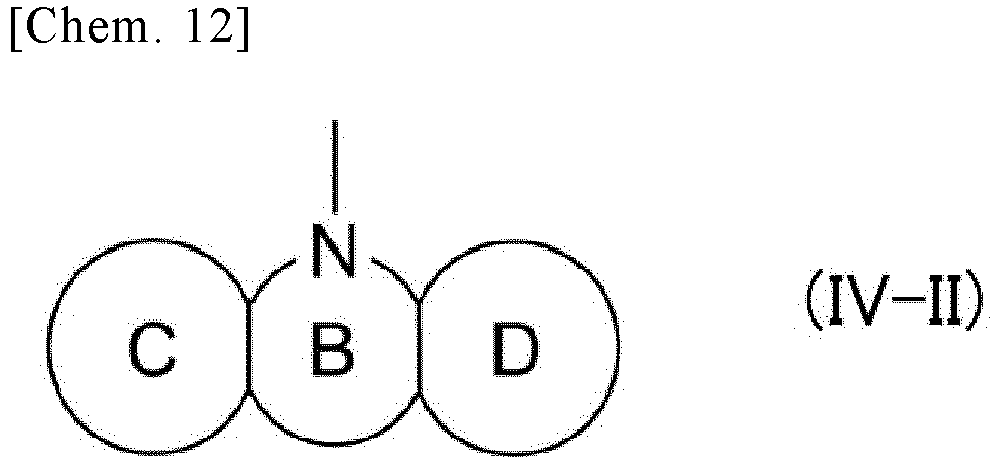


- R42 represents a hydrogen atom, an optionally substituted hydrocarbon group, an optionally substituted heterocyclic group, or an optionally substituted amino group;
- R43 represents a hydrogen atom, an optionally substituted hydrocarbon group, or an optionally substituted heterocyclic group;
- R44 represents a hydrogen atom, an optionally substituted hydrocarbon group, or an optionally substituted heterocyclic group;
- R45 represents 0 to 3 identical or different substituents attached to a benzene ring;
- X4 represents a single bond, an alkylene group having 1 or 2 carbon atoms, -O-group, -CH2-O- group, -CH2-NH-CO- group, or -CH2-NH-CO-O-CH2- group; and
- Y4 represents a single bond or an alkylene group having 1 or 2 carbon atoms).
- In the 3,5-diaminobenzoic acid compound and the salt thereof, the ring A is preferably an optionally substituted polycyclic aromatic ring or heterocycle.
- In this case, the ring A is preferably a ring represented by the following Formula (IV-VI):

- In the Formula (IV-VI), all of A1, A2, and A3 are preferably a carbon atom.
- In 3,5-diaminobenzoic acid compound or the salt thereof, the R41 is preferably a group represented by the following Formula (IV-II):

- In 3,5-diaminobenzoic acid compound or the salt thereof, the R42 is preferably a hydrogen atom.
- In 3,5-diaminobenzoic acid compound or the salt thereof, the R43 is preferably a hydrogen atom.
- In 3,5-diaminobenzoic acid compound or the salt thereof, the R44 is preferably a hydrogen atom.
- In 3,5-diaminobenzoic acid compound or the salt thereof, the X4 is preferably a single bond.
- In 3,5-diaminobenzoic acid compound or the salt thereof, the Y4 is preferably a single bond.
- The present invention also provides a method for screening therapeutic or prophylactic agents for COVID-19, comprising steps of:
- A) acquiring a library of Pin1 inhibitors by measuring their activity of inhibiting the function of Pin1 using a cell-free assay for measuring cis-to-trans conversion of a phosphorylated serine/threonine-proline motif contained in a substrate peptide; and
- B) measuring ability to inhibit proliferation of SARS-CoV-2 virus of compounds identified as Pin1 inhibitors in the step A using a cell-based assay for measuring increases in viral components.
- The present invention also provides a therapeutic or prophylactic agent for COVID-19 containing the Pin1 inhibitors identified by the above-described screening method or pharmaceutically acceptable salts thereof as an active ingredient.
- The therapeutic or prophylactic agent for any of coronavirus infections can further contain one or more active ingredients of at least one or more other drugs selected from drugs classified as therapeutic or prophylactic agents for coronavirus infections.
- Moreover, the therapeutic or prophylactic agent for any of coronavirus infections may be used in combination with at least one or more other drugs selected from drugs classified as therapeutic or prophylactic agents for coronavirus infections.
- In addition, the present invention provides any of the above-described compounds or pharmaceutically acceptable salts thereof for use as a therapeutic or prophylactic agent for coronavirus infection.
- The present invention also provides use of any of the above-described compounds or pharmaceutically acceptable salts thereof for manufacture of a medicament for treating or preventing coronavirus infection.
- The present invention also provides a method of treating or preventing coronavirus infection by administering to a patient a therapeutically effective amount of the above-described compound or pharmaceutically acceptable salt thereof.
- The present invention also provides a compound with a function of inhibiting Pin1 or a pharmaceutically acceptable salt thereof for use in treating or preventing coronavirus infection.
- The therapeutic or prophylactic agent for viral diseases according to the present invention suppresses the proliferation of viruses and thus has an effect of treating viral diseases or of preventing viral diseases. In particular, it can treat or prevent coronavirus infection caused by coronavirus, specifically beta-coronaviruses, and especially beneficially SARS-CoV2.
-
-
FIG. 1 (A) shows results of Western blotting of SARS-CoV-2 nucleocapsid, Pin1 and actin in cells when either one of two kinds of Pin1 siRNAs and control siRNA is added, and (B) shows the relative intensity of SARS-CoV-2 nucleocapsid normalized to the detection intensity of SARS-CoV-2 nucleocapsid in control siRNA. -
FIG. 2 (A) shows results of Western blotting of SARS-CoV-2 nucleocapsid, Pin1 and actin in cells when a Pin1 inhibitor H-77 is added at a final concentration of 10 µM, and (B) shows results of real-time PCR quantification of SARS-CoV-2 RNA level when H-77 was added at final concentrations of 0, 2, 5, 7.5, and 10 µM. -
FIGs. 3 show photographs of VeroE6/TMPRSS2 cells 20 hours after infection with SARS-CoV-2, wherein (A) is the case with the addition of H-77, and (B) is the case with the addition of DMSO as a control. -
FIG. 4 shows results of Western blotting of SARS-CoV-2 nucleocapsid and actin in cells when a Pin1 inhibitor included in the Formula (I-I) was added at a final concentration of 5 or 10 µM. -
FIG. 5 shows results of Western blotting of SARS-CoV-2 nucleocapsid and actin in cells when a Pin1 inhibitor included in the Formula (II-I) was added at a final concentration of 5 or 10 µM. -
FIG. 6 shows results of Western blotting of SARS-CoV-2 nucleocapsid and actin in cells when a Pin1 inhibitor included in the Formula (III-I) was added at a final concentration of 5 or 10 µM. -
FIG. 7 shows results of Western blotting of SARS-CoV-2 nucleocapsid and actin in cells when a Pin1 inhibitor included in the Formula (IV-I) was added at a final concentration of 5 or 10 µM. -
FIG. 8 (A) shows results of Western blotting of SARS-CoV-2 nucleocapsid, Pin1 and actin in cells when a Pin1 inhibitor ATRA is added at final concentrations of 0, 0.5, 1, 5, 10, 20, and 30µM, and (B) shows the result of real-time PCR quantification of SARS-CoV-2 RNA level. -
FIG. 9 (A) shows results of Western blotting of SARS-CoV-2 nucleocapsid, Pin1 and actin in cells when a Pin1 inhibitor H-77 is added 1). 2 hours before infection, 2). at the time of infection, 3). 2 hours after infection, and 4). 6 hours after infection, or 5). when the Pin1 inhibitor H-77 is not added, and (B) shows results of real-time PCR quantification of SARS-CoV-2 RNA level. - The compounds that are active ingredients of the present invention are compounds that have inhibitory activity against the function of Pin1, and the compounds include, for example, compounds having the following chemical structures 1-1 to 1-5 or salts thereof.
- One of the compounds that are active ingredients of the therapeutic or prophylactic agents for coronavirus disease according to present invention is a compound that has a chemical structure represented by the following Formula (I-I) and inhibitory activity against the function of Pin1:
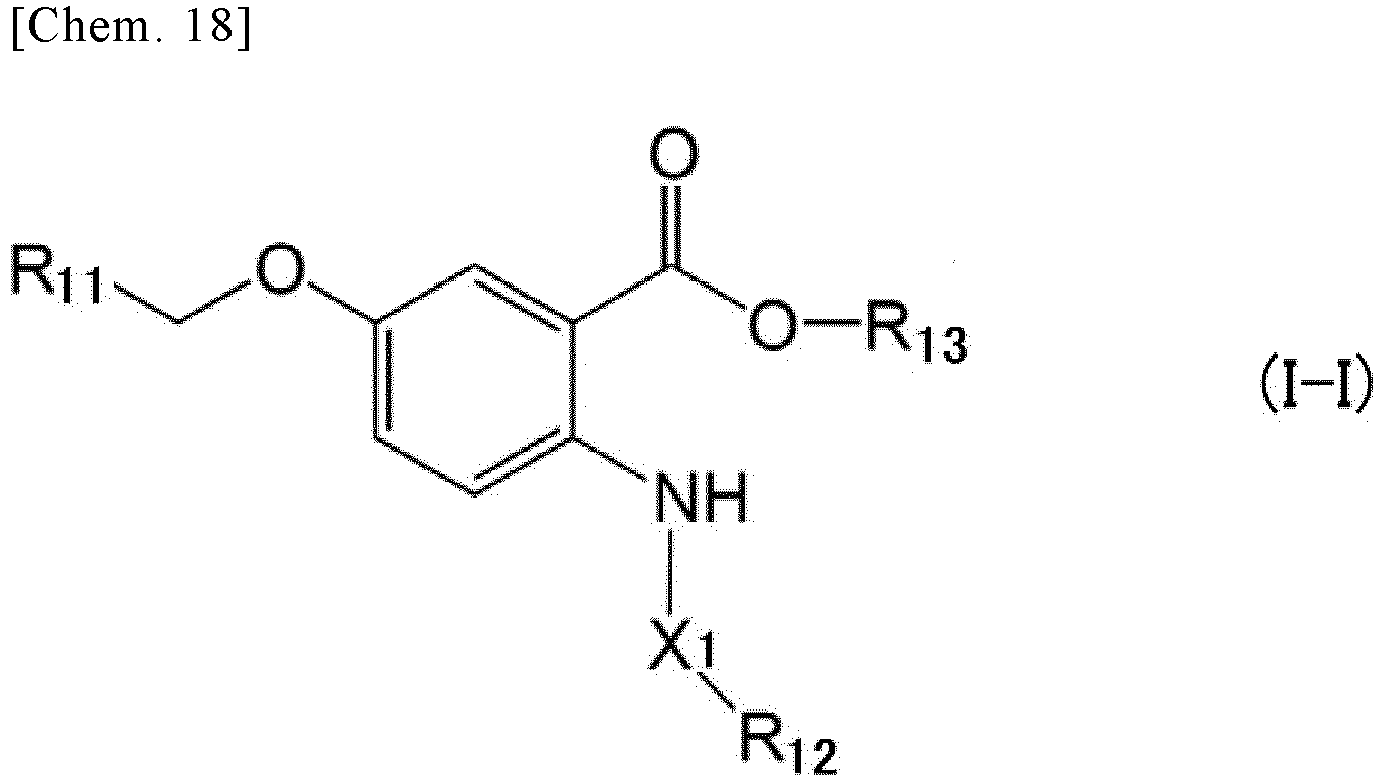
- In the Formula (I-I), at least one of R11 and R12 is an optionally substituted polycyclic aryl group, an optionally substituted polycyclic heterocyclic group, or a group represented by the following Formula (I-II):

if neither R11 nor R12 is any of the aforementioned groups, that is, R11 nor R12 is any of the optionally substituted polycyclic aryl group, the optionally substituted polycyclic heterocyclic group, and the group represented by the Formula (I-II), R11 or R12 is a hydrogen atom, an optionally substituted hydrocarbon group (except for the optionally substituted polycyclic aryl group), or an optionally substituted monocyclic heterocyclic group, - In the Formula (I-I) "at least one of R11 and R12" means R11, R12, or R11 and R12.
- Therefore, when R11 is the optionally substituted polycyclic aryl group, the optionally substituted polycyclic heterocyclic group, or the group represented by the Formula (I-II), R12 may not be any of these groups or may be any one of these groups. In other words, in this case, R12 may be the hydrogen atom, the optionally substituted hydrocarbon group (except for the optionally substituted polycyclic aryl group), or the optionally substituted monocyclic heterocyclic group, or alternatively R12 may be the optionally substituted polycyclic aryl group, the optionally substituted polycyclic heterocyclic group, or the group represented by the Formula (I-II).
- Similarly, when R12 is the optionally substituted polycyclic aryl group, the optionally substituted polycyclic heterocyclic group, or the group represented by the Formula (I-II), R11 may not be any of these groups or may be any one of these groups. In other words, in this case, R11 may be the hydrogen atom, the optionally substituted hydrocarbon group (except for the optionally substituted polycyclic aryl group), or the optionally substituted monocyclic heterocyclic group, or alternatively R11 may be the optionally substituted polycyclic aryl group, the optionally substituted polycyclic heterocyclic group, or the group represented by the Formula (I-II).
- In the Formula (I-I), although at least one of R11 and R12 is the optionally substituted polycyclic aryl group, the optionally substituted polycyclic heterocyclic group, or the group represented by the Formula (I-II), it is preferable for enhancing the inhibitory activity against the function of Pin1 that at least one of R11 and R12 is the optionally substituted polycyclic aryl group, or the optionally substituted polycyclic heterocyclic group. Either one of R11 and R12 is more preferably the optionally substituted polycyclic aryl group, and still more preferably a polycyclic aryl group.
- In the Formula (I-I), at least one of R11 and R12 may be the optionally substituted polycyclic aryl group. In the anthranilic acid compound according to the present invention, the "polycyclic aryl group" is a group derived from an aromatic compound containing a condensed ring of two or more rings consisting only of carbon.
- In this respect, it is preferable to use a bicyclic to tetracyclic aryl group as the "polycyclic aryl group".
- Examples of the "polycyclic aryl group" in the anthranilic acid compound according to the present invention can include, but are not limited to, an indenyl group, a naphthyl group, a fluorenyl group, an anthryl group, a biphenylenyl group, a phenanthrenyl group, an as-indacenyl group, a s-indacenyl group, an acenaphthylenyl group, a phenalenyl group, a fluoranthenyl group, a pyrenyl group, a naphthacenyl group, and a hexacenyl group.
- Examples of the specific chemical structure of the "optionally substituted polycyclic aryl group" in the anthranilic acid compound according to the present invention can include, but are not limited to, the following groups:


- In the anthranilic acid compound according to the present invention, the "optionally substituted polycyclic aryl group" is preferably an optionally substituted naphthyl group. In this respect, the optionally substituted naphthyl group may be attached to the matrix of the compound represented by the Formula (I-I) at
position - This "optionally substituted naphthyl group" can be represented by the following Formula (I-III):

- In the Formula (I-III), R15 represents 0 to 7 identical or different substituents attached to a naphthyl group. Although R15 may be provided at any of
positions 1 to 8 of the naphthyl group, R15 cannot be provided at a position at which the naphthyl group is attached to the matrix of the compound. Also, R15 may not be provided on the naphthyl group so that the naphthyl group does not have any substituents. If R15 is provided on the naphthyl group, 1 to 7 R15 may be provided, and they may be different substituents from each other, or all or some of them may be the same substituents. R15 is preferably a substituent having 1 to 10 atoms. - In the Formula (I-I), at least one of R11 and R12 can be the optionally substituted polycyclic heterocyclic group. In the anthranilic acid compound according to the present invention, the "polycyclic heterocyclic group" refers to a group containing a condensed ring of two or more rings and consisting of carbon atoms and non-carbon atoms.
- It is preferable to use an aromatic heterocyclic ring as the "polycyclic heterocyclic group".
- Examples of the "polycyclic heterocyclic group" of the anthranilic acid compound according to the present invention can include, but are not limited to, any of 5- to 14-membered bicyclic to pentacyclic heterocyclic groups having carbon atoms and further having one to four heteroatoms of one or two elements selected from nitrogen, oxygen, and sulfur.
- Specific examples of the heterocyclic group can include, but are not limited to, a bicyclic to tetracyclic condensed ring group having carbon atoms and further having one to four heteroatoms selected from oxygen, sulfur, and nitrogen atoms, such as an indolyl group, a benzofuryl group, a benzothiazolyl group, a benzoxazolyl group, a xanthenyl group, a benzimidazolyl group, a quinolyl group, an isoquinolyl group, a phthalazinyl group, a quinazolinyl group, a quinoxalinyl group, an indolizinyl group, a quinolizinyl group, a 1,8-naphthyridinyl group, a dibenzofuranyl group, a carbazolyl group, an acridinyl group, a phenanthridinyl group, a perimidinyl group, a phenazinyl group, a chromanyl group, a phenothiazinyl group, a phenoxazinyl group, and a 7H-pirazino[2,3-c]carbazolyl group.
- Examples of the specific chemical structure of the "optionally substituted polycyclic heterocyclic group" in the anthranilic acid compound according to the present invention can include, but are not limited to, the following groups:


- In the Formula (I-I), at least one of R11 and R12 can be a group represented by the following Formula (I-II):

- In the anthranilic acid compound according to the present invention, the "monocyclic or polycyclic aryl group" can be, but are not limited to, a phenyl group, an indenyl group, a naphthyl group, a fluorenyl group, an anthryl group, a biphenylenyl group, a phenanthrenyl group, an as-indacenyl group, an s-indacenyl group, an acenaphthylenyl group, a phenalenyl group, a fluoranthenyl group, a pyrenyl group, a naphthacenyl group, and a hexacenyl group.
- Examples of the "alkylene group having 1 to 3 carbon atoms" in the anthranilic acid compound according to the present invention include, but are not limited to, a methylene group, an ethylene group, a trimethylene group, and the like.
- Also, examples of the "alkenylene group having 2 to 3 carbon atoms" in the anthranilic acid compound according to the present invention include, but are not limited to, a vinylene group, a 1-propenylene group, a 2-propenylene group, and the like.
- In the Formula (I-II), R14 can be the divalent oxy group, and in this case, the Formula (I-II) can be represented by the following Formula (I-IV):

- In the Formula (I-I), if neither R41 nor R42 is the optionally substituted polycyclic aryl group, the optionally substituted polycyclic heterocyclic group, and the group represented by the Formula (I-II), R11 or R12 is a hydrogen atom, an optionally substituted hydrocarbon group (except for the optionally substituted polycyclic aryl group), or an optionally substituted monocyclic heterocyclic group, preferably a hydrogen atom or an optionally substituted phenyl group.
- In the anthranilic acid compound according to the present invention, the "hydrocarbon group" means a group derived from a compound composed of carbon and hydrogen atoms. Examples of the hydrocarbon group can include, but are not limited to, aliphatic hydrocarbon, monocyclic saturated hydrocarbon, and aromatic hydrocarbon groups, and preferably contain 1 to 16 carbon atoms. Specific examples of the hydrocarbon group include, but are not limited to, an alkyl group, an alkenyl group, an alkynyl group, a cycloalkyl group, and an aryl group.
- In this respect, examples of the "alkyl group" include a methyl group, an ethyl group, a propyl group, an isopropyl group, a butyl group, an isobutyl group, a sec-butyl group, a tert-butyl group, a pentyl group, and a hexyl group. Examples of the "alkenyl group" include a vinyl group, a 1-propenyl group, an allyl group, an isopropenyl group, a butenyl group, and an isobutenyl group. Examples of the "alkynyl group" include an ethynyl group, a propargyl group, and a 1-propynyl group. Examples of "cycloalkyl group" include a cyclopropyl group, a cyclobutyl group, a cyclopentyl group, and a cyclohexyl group. Examples of "aryl group" include a phenyl group, an indenyl group, a naphthyl group, a fluorenyl group, an anthryl group, a biphenylenyl group, a phenanthrenyl group, an as-indacenyl group, an s-indacenyl group, an acenaphthylenyl group, a phenalenyl group, a fluoranthenyl group, a pyrenyl group, a naphthacenyl group, and a hexacenyl group.
- In the anthranilic acid compound according to the present invention, the "monocyclic heterocyclic group" can be, but are not limited to, a 5-membered heterocyclic group having carbon atoms and further having one to four heteroatoms selected from oxygen, sulfur, and nitrogen atoms, such as a 2- or 3-thienyl group, a 2- or 3-furyl group, a 1-, 2- or 3-pyrrolyl group, a 1-, 2- or 3-pyrrolidinyl group, a 2-, 4- or 5-oxazolyl group, a 3-, 4- or 5-isooxazolyl group, a 2-, 4- or 5-thiazolyl group, a 3-, 4- or 5-isothiazolyl group, a 3-, 4- or 5-pyrazolyl group, a 2-, 3- or 4-pyrazolidinyl group, a 2-, 4- or 5-imidazolyl group, a 1,2,3-triazolyl group, a 1,2,4-triazolyl group, and a 1H- or 2H-tetrazolyl group. Moreover, the "monocyclic heterocyclic group" can be, but are not limited to a 6-memberd ring group having carbon atoms and further having one to four heteroatoms selected from oxygen, sulfur, and nitrogen atoms, such as a 2-, 3- or 4-pyridyl group, an N-oxide-2-, 3- or 4-pyridyl group, a 2-, 4- or 5-pyrimidinyl group, an N-oxide-2-, 4- or 5-pyrimidinyl group, a thiomorpholinyl group, a morpholinyl group, a piperidino group, a 2-, 3- or 4-piperidyl group, a thiopyranyl group, a 1,4-oxazinyl group, a 1,4-thiazinyl group, a 1,3-thiazinyl group, a piperazinyl group, a triazinyl group, a 3- or 4-pyridazinyl group, a pyrazinyl group, and an N-oxide-3- or 4-pyridazinyl group.
- In the Formula (I-I), R13 is a hydrogen atom, an optionally substituted hydrocarbon group or an optionally substituted heterocyclic group. R13 is preferably a hydrogen atom or a methyl group, and more preferably a hydrogen atom.
- The anthranilic acid compound according to the present invention has higher activity when R13 is a hydrogen atom and the compound has a carboxyl group. However, when R13 is not a hydrogen atom but an ester body, it can easily become a carboxyl group by hydrolysis so that the compound can exhibit high activity. Therefore, when R13 is the optionally substituted hydrocarbon group or the optionally substituted heterocyclic group, the anthranilic acid compound according to the present invention can also be used as a prodrug.
- In the anthranilic acid compound according to the present invention, the "heterocyclic group" refers to a group derived from a cyclic compound composed of atoms of carbon and some other elements. It is preferable to use an aromatic heterocyclic ring as the "heterocyclic group".
- In the anthranilic acid compound according to the present invention, the "heterocyclic group" can be, but is not limited to, for example, any of 5- to 14-membered monocyclic to pentacyclic heterocyclic groups each having carbon atoms and further having one to four heteroatoms of one or two elements selected from nitrogen, oxygen, and sulfur. Specific examples of the heterocyclic group can include, but are not limited to, a 5-membered cyclic group having carbon atoms and further having one to four heteroatoms selected from oxygen, sulfur, and nitrogen, such as a 2- or 3-thienyl group, 2- or 3-furyl group, a 1-, 2- or 3-pyrrolyl group, a 1-, 2- or 3-pyrrolidinyl group, a 2-, 4- or 5-oxazolyl group, a 3-, 4- or 5-isooxazolyl group, a 2-, 4- or 5-thiazolyl group, a 3-, 4- or 5-isothiazolyl group, a 3-, 4- or 5-pyrazolyl group, a 2-, 3- or 4-pyrazolidinyl group, a 2-, 4- or 5-imidazolyl group, a 1,2,3-triazolyl group, a 1,2,4-triazolyl group, and a 1H- or 2H-tetrazolyl group. Moreover, specific examples of the heterocyclic group can include, but are not limited to, a 6-membered cyclic group having carbon atoms and further having one to four heteroatoms selected from oxygen, sulfur, and nitrogen, such as a 2-, 3- or 4-pyridyl group, an N-oxide-2-, 3- or 4-pyridyl group, a 2-, 4- or 5-pyrimidinyl group, an N-oxide-2-, 4- or 5-pyrimidinyl group, a thiomorpholinyl group, a morpholinyl group, a piperidino group, a 2-, 3- or 4-piperidyl group, a thiopyranyl group, a 1,4-oxazinyl group, a 1,4-thiazinyl group, a 1,3-thiazinyl group, a piperazinyl group, a triazinyl group, a 3- or 4-pyridazinyl group, a pyrazinyl group, and an N-oxide-3- or 4-pyridazinyl group. Moreover, specific examples of the heterocyclic group can include, but are not limited to, a bicyclic to tetracyclic condensed ring group having carbon atoms and further having one to four heteroatoms selected from oxygen, sulfur, and nitrogen, such as an indolyl group, a benzofuryl group, a benzothiazolyl group, a benzoxazolyl group, a xanthenyl group, a benzimidazolyl group, a quinolyl group, an isoquinolyl group, a phthalazinyl group, a quinazolinyl group, a quinoxalinyl group, an indolizinyl group, a quinolizinyl group, a 1,8-naphthyridinyl group, a dibenzofuranyl group, a carbazolyl group, an acridinyl group, a phenanthridinyl group, a perimidinyl group, a phenazinyl group, a chromanyl group, a phenothiazinyl group, a phenoxazinyl group, and a 7H-pirazino[2,3-c]carbazolyl group.
- In the Formula (I-I), X1 is a single bond, -CO- group, -CO-O-CH2- group, -CO-CH2-O- group, -SO2- group, -CH2-CO-NH- group, -CH2-CO- group, -CH2- group, or - CO-CH2- group.
- X1 is preferably a single bond or -CO- group (carbonyl group).
- When X1 is a single bond, the Formula (I-I) can be represented by the following Formula (I-V):

- The "substituent" used with respect to the anthranilic acid compound according to the present invention refers to a halogen (such as, for example, fluorine, chlorine, bromine, or iodine), an alkyl group (for example, a C1-6 alkyl group, such as a methyl group, an ethyl group, a propyl group, an isopropyl group, a butyl group, an isobutyl group, a sec-butyl group, a tert-butyl group, a pentyl group, or a hexyl group), a cycloalkyl group (for example, a C3-6 cycloalkyl group, such as a cyclopropyl group, a cyclobutyl group, a cyclopentyl group, or a cyclohexyl group), an alkynyl group (for example, a C2-6 alkynyl group, such as an ethynyl group, a 1-propynyl group, or a propargyl group), an alkenyl group (for example, a C2-6 alkenyl group, such as a vinyl group, an allyl group, an isopropenyl group, a butenyl group, or an isobutenyl group), an aralkyl group (for example, a C7-11 aralkyl group, such as a benzyl group, an α-methylbenzyl group, or a phenethyl group), an aryl group (for example, a C6-10 aryl group, such as a phenyl group or a naphthyl group; preferably a phenyl group), an alkoxy group (for example, a C1-6 alkoxy group, such as a methoxy group, an ethoxy group, a propoxy group, an isopropoxy group, a butoxy group, an isobutoxy group, a sec-butoxy group, or a tert-butoxy), an aryloxy group (for example, a C6-10 aryloxy group, such as phenoxy), an alkanoyl group (for example, a C1-6 alkyl-carbonyl group, such as a formyl group, an acetyl group, a propionyl group, a butyryl group, or an isobutyryl group), an arylcarbonyl group (for example, a C6-10 aryl-carbonyl group, such as a benzoyl group or a naphthoyl group), an alkanoyloxy group (for example, a C1-6 alkyl-carbonyloxy group, such as a formyloxy group, an acetyloxy group, a propionyloxy group, a butyryloxy group, or an isobutyryloxy group), an arylcarbonyloxy group (for example, a C6-10 aryl-carbonyloxy group, such as a benzoyloxy group or a naphthoyloxy group), carboxyl group, an alkoxycarbonyl group (for example, a C1-6 alkoxy-carbonyl group, such as a methoxycarbonyl group, an ethoxycarbonyl group, a propoxycarbonyl group, an isopropoxycarbonyl group, a butoxycarbonyl group, an isobutoxycarbonyl group, or a tert-butoxycarbonyl), an aralkyloxycarbonyl group (for example, a C7-11 aralkyloxycarbonyl group, such as a benzyloxycarbonyl group), a carbamoyl group, a halogenated alkyl group (for example, a mono-, di-, or tri-halogenated -C1-4 alkyl group, such as a chloromethyl group, a dichloromethyl group, a trifluoromethyl group, or a 2,2,2-trifluoroethyl group), an oxo group, an amidino group, an imino group, an amino group, an alkylamino group (for example, a mono-C1-4 alkylamino group, such as a methylamino group, an ethylamino group, a propylamino group, an isopropylamino group, or a butylamino group), a dialkylamino group (for example, a di-C1-4 alkylamino group, such as a dimethylamino group, a diethylamino group, a dipropylamino group, a diisopropylamino group, a dibutylamino group, or a methylethylamino group), an alkoxycarbonylamino group (for example, a C1-6 alkoxycarbonylamino group, such as a methoxycarbonylamino group, an isoproxycarbonylamino group, or a tert-butoxycarbonylamino group), a cyclic amino group (a 3- to 6-membered cyclic amino group containing carbon atoms and one nitrogen atom and further containing one to three heteroatoms selected from oxygen, sulfur, and nitrogen; such as, for example, an aziridinyl group, an azetidinyl group, a pyrrolidinyl group, a pyrrolinyl group, a pyrrolyl group, an imidazolyl group, a pyrazolyl group, an imidazolidinyl group, a piperidyl group, a morpholinyl group, a dihydropyridyl group, a pyridyl group, an N-methylpiperazinyl group, or an N-ethylpiperazinyl group), an alkylenedioxy group (for example, a C1-3 alkylenedioxy group, such as a methylenedioxy group or an ethylenedioxy group), a hydroxy group, a cyano group, a mercapto group, a sulfo group, a sulfino group, a phosphono group, a sulfamoyl group, a monoalkylsulfamoyl group (for example, a mono-C1-6 alkylsulfamoyl group, such as N-methylsulfamoyl, N-ethylsulfamoyl, N-propylsulfamoyl, N-isopropylsulfamoyl, or N-butylsulfamoyl), a dialkylsulfamoyl group (for example, a di-C1-6 alkylsulfamoyl group, such as an N,N-dimethylsulfamoyl group, an N,N-diethylsulfamoyl group, an N,N-dipropylsulfamoyl group, or an N,N-dibutylsulfamoyl group), an alkylthio group (for example, a C1-6 alkylthio group, such as a methylthio group, an ethylthio group, propylthio group, an isopropylthio group, a butylthio group, a sec-butylthio group, or a tert-butylthio group), an arylthio group (for example, a C6-10 arylthio group, such as a phenylthio group or a naphthylthio group), an alkylsulfinyl group (for example, a C1-6 alkylsulfinyl group, such as a methylsulfinyl group, an ethylsulfinyl group, a propylsulfinyl group, or a butylsulfinyl group), an alkylsulfonyl group (for example, a C1-6 alkylsulfonyl group, such as a methylsulfonyl group, an ethylsulfonyl group, a propylsulfonyl group, or a butylsulfonyl group), or an arylsulfonyl group (for example, a C6-10 arylsulfonyl group, such as a phenylsulfonyl group or a naphthylsulfonyl group).
- In the anthranilic acid compound according to the present invention, the "substituent containing 1 to 10 atoms" used in R15 is those which contain 1 to 10 atoms among the aforementioned substituents. Examples that can be used as such a substituent include, but are not limited thereto, a halogen atom, a methyl group, an ethyl group, a vinyl group, a methoxy group, an ethoxy group, an acetyl group, a carboxyl group, a methoxycarbonyl group, a chloromethyl group, an amino group, a methylamino group, a hydroxy group, a sulfo group, and a methylthio group.
- In the anthranilic acid compound according to the present invention, the phrase "optionally substituted" means that a substituent as described above is present or absent. In cases where a moiety is substituted, two or more substituents may be present within the moiety, and the substituents may be identical to or different from each other. In cases where the anthranilic acid compound according to the present invention is "optionally substituted," the number of substituents within the compound is preferably from 0 to 3.
- The anthranilic acid compound can be synthesized using, for example, a method described in
WO 2019/031472 , although it is not limited thereto. - Another one of the compounds that are active ingredients of the therapeutic or prophylactic agents for coronavirus infection according to present invention is a compound that has a chemical structure represented by the following Formula (II-I) and inhibitory activity against the function of Pin1:


- In the Formula (II-I), m represents an integer from 0 to 2, n represents an integer from 0 to 1, and m and n are integers satisfying the
relationship 0≤m+n≤2. That is, there are five combinations of (m, n): (0,0), (0,1), (1,0), (1,1), and (2,0). - The amide compound according to the present invention consists of a naphthyl group portion and a chain portion attached thereto. The chain portion can have structures in which the chain portion is attached to any part of the naphthyl group, and these structures can be classified into two structures: a structure in which the chain portion is attached to
position 1 of the naphthyl group, and a structure in which the chain portion is attached toposition 2 of the naphthyl group. - When the chain portion is attached to
position 2 of the naphthyl group, the amide compound according to the present invention can have the five chemical structures represented by the following Formulae (II-VI) to (II-X) on the basis of the five combinations of (m, n):

- The Formula (II-VI) represents a formula when m=0 and n=0 in the Formula (II-I).
- The Formula (II-VII) represents a formula when m=0 and n=1 in the Formula (II-I).
- The Formula (II-VIII) represents a formula when m=1 and n=0 in the Formula (II-I).
- The Formula (II-IX) represents a formula when m=1 and n=1 in the Formula (II-I).
- The Formula (II-X) represents a formula when m=2 and n=0 in the Formula (II-I).
- As the amide compound according to the present invention, a compound represented by the Formula (II-VI) to (II-X) is preferable in which the chain portion is attached to
position 2 of the naphthyl group, and a compound represented by the Formula (II-VIII) is particularly preferable in which m=1 and n=0. - When the chain portion is attached to
position 1 of the naphthyl group, the amide compound according to the present invention can have the five chemical structures represented by the following Formulae (II-XI) to (II-XV) on the basis of the five combinations of (m, n):

- In the Formula (II-I) representing the amide compound according to the present invention, R21 is a hydrogen atom, an optionally substituted hydrocarbon group, an optionally substituted heterocyclic group, or an optionally substituted amino group.
- The amide compound according to the present invention has inhibitory activity against the function of Pin1 when R21 is a hydrogen atom to form a carboxyl group. Therefore, R21 is preferably the hydrogen atom.
- However, when R21 is the optionally substituted hydrocarbon group, the optionally substituted heterocyclic group, or the optionally substituted amino group, the compound represented by the Formula (II-I) forms an ester bond at R21 so that the compound can be converted to a carboxyl group by hydrolysis. Therefore, even if R21 is the optionally substituted hydrocarbon group, the optionally substituted heterocyclic group, or the optionally substituted amino group, the amide compound according to the present invention can be used as a prodrug.
- In the amide compound according to the present invention, the "hydrocarbon group" used in R21 in the Formula (II-I) and the like means a group derived from a compound composed of carbon and hydrogen atoms. Examples of the hydrocarbon group can include, but are not limited to, aliphatic hydrocarbon, monocyclic saturated hydrocarbon, and aromatic hydrocarbon groups, and preferably contain 1 to 16 carbon atoms. Specific examples of the hydrocarbon group include, but are not limited to, an alkyl group, an alkenyl group, an alkynyl group, a cycloalkyl group, an aryl group, and an aralkyl group.
- In this respect, examples of the "alkyl group" include a methyl group, an ethyl group, a propyl group, an isopropyl group, a butyl group, an isobutyl group, a sec-butyl group, a tert-butyl group, a pentyl group, and a hexyl group. Examples of the "alkenyl group" include a vinyl group, a 1-propenyl group, an a llyl group, an isopropenyl group, a butenyl group, and an isobutenyl group. Examples of the "alkynyl group" include an ethynyl group, a propargyl group, and a 1-propynyl group. Examples of "cycloalkyl group" include a cyclopropyl group, a cyclobutyl group, a cyclopentyl group, and a cyclohexyl group. Examples of "aryl group" include a phenyl group, an indenyl group, a naphthyl group, a fluorenyl group, an anthryl group, a biphenylenyl group, a phenanthrenyl group, an as-indacenyl group, an s-indacenyl group, an acenaphthylenyl group, a phenalenyl group, a fluoranthenyl group, a pyrenyl group, a naphthacenyl group, and a hexacenyl group. Examples of "aralkyl group" include a benzyl group, a styryl group, and a phenethyl group.
- In the amide compound according to the present invention, the "heterocyclic group" used in R21 in the Formula (II-I) and the like refers to a group derived from a cyclic compound composed of atoms of carbon and some other elements. It is preferable to use an aromatic heterocyclic ring as the "heterocyclic group".
- In the amide compound according to the present invention, the "heterocyclic group" can be, but is not limited to, for example, any of 5- to 14-membered monocyclic to pentacyclic heterocyclic groups each having carbon atoms and further having one to four heteroatoms of one or two elements selected from nitrogen, oxygen, and sulfur. Specific examples of the heterocyclic group can include, but are not limited to, a 5-membered cyclic group having carbon atoms and further having one to four heteroatoms selected from oxygen, sulfur, and nitrogen, such as a 2- or 3-thienyl group, 2- or 3-furyl group, a 1-, 2- or 3-pyrrolyl group, a 1-, 2- or 3-pyrrolidinyl group, a 2-, 4- or 5-oxazolyl group, a 3-, 4- or 5-isooxazolyl group, a 2-, 4- or 5-thiazolyl group, a 3-, 4- or 5-isothiazolyl group, a 3-, 4- or 5-pyrazolyl group, a 2-, 3- or 4-pyrazolidinyl group, a 2-, 4- or 5-imidazolyl group, a 1,2,3-triazolyl group, a 1,2,4-triazolyl group, and a 1H- or 2H-tetrazolyl group. Moreover, specific examples of the heterocyclic group can include, but are not limited to, a 6-membered cyclic group having carbon atoms and further having one to four heteroatoms selected from oxygen, sulfur, and nitrogen, such as a 2-, 3- or 4-pyridyl group, an N-oxide-2-, 3- or 4-pyridyl group, a 2-, 4- or 5-pyrimidinyl group, an N-oxide-2-, 4- or 5-pyrimidinyl group, a thiomorpholinyl group, a morpholinyl group, a piperidino group, a 2-, 3- or 4-piperidyl group, a thiopyranyl group, a 1,4-oxazinyl group, a 1,4-thiazinyl group, a 1,3-thiazinyl group, a piperazinyl group, a triazinyl group, a 3- or 4-pyridazinyl group, a pyrazinyl group, and an N-oxide-3- or 4-pyridazinyl group. Moreover, specific examples of the heterocyclic group can include, but are not limited to, a bicyclic to tetracyclic condensed ring group having carbon atoms and further having one to four heteroatoms selected from oxygen, sulfur, and nitrogen, such as an indolyl group, a benzofuryl group, a benzothiazolyl group, a benzoxazolyl group, a xanthenyl group, a benzimidazolyl group, a quinolyl group, an isoquinolyl group, a phthalazinyl group, a quinazolinyl group, a quinoxalinyl group, an indolizinyl group, a quinolizinyl group, a 1,8-naphthyridinyl group, a dibenzofuranyl group, a carbazolyl group, an acridinyl group, a phenanthridinyl group, a perimidinyl group, a phenazinyl group, a chromanyl group, a phenothiazinyl group, a phenoxazinyl group, and a 7H-pirazino[2,3-c]carbazolyl group.
- In the amide compound according to the present invention, the "optionally substituted amino group" used for R21 in the Formula (II-I) and the like is a primary amino group, a secondary amino group, or a tertiary amino group. The primary amino group is -NH2 group. The secondary amino group is an amino group having one substituent, and may include, but are not limited to, for example, alkylamino group, arylamino group, alkoxycarbonylamino group and the like. The tertiary amino group is an amino group having identical or different two substituents, and may include, but not limited to, for example, dialkylamino group, diarylamino group and the like.
- In the Formula (II-I) representing the amide compound according to the present invention, R22 is an optionally substituted aryl group containing a condensed ring of three or more rings, a substituted naphthyl group, or a group represented by the Formula (II), (III), (IV), or (V).
- It is believed that especially the naphthyl group portion, the carbonic acid portion, and the R22 portion involve the inhibitory activity against the function of Pin1 of the amide compound according to the present invention. The R22 portion can have a wide variety of chemical structures with an aromatic ring or a heterocycle.
- In the amide compound according to the present invention, the "aryl group containing a condensed ring of three or more rings" refers to a group derived from aromatic compounds containing a condensed ring of three or more rings consisting only of carbon.
- The "aryl group containing a condensed ring of three or more rings" is preferably a tricyclic aryl group.
- The "aryl group containing a condensed ring of three or more rings" in the amide compound according to the present invention can be, but are not limited to, a fluorenyl group, an anthryl group, a biphenylenyl group, an indacenyl group, a phenanthrenyl group, an as-indacenyl group, an s-indacenyl group, an acenaphthylenyl group, a phenalenyl group, a fluoranthenyl group, a pyrenyl group, a naphthacenyl group, and a hexacenyl group.
- Examples of the specific chemical structure of the "optionally substituted aryl group containing a condensed ring of three or more rings" in the amide compound according to the present invention can include, but are not limited to, the following groups:

- R22 in the Formula (II-I) can be a substituted naphthyl group such as but not limited to 6-methoxycarbonyl-2- naphthyl group and 5-methyl-1- naphthyl group.
- R22 in the Formula (II-I) can be a group represented by the Formula (II-II) with the following structure:


- In the Formula (II-II), rings B and C are preferably a benzene ring.
- Examples of the specific chemical structure of the compound represented by the Formula (II-II) can include, but are not limited to, the following groups:

- R22 in the Formula (II-I) can be a group represented by the Formula (II-III) with the following structure:

- Examples of the specific chemical structure of the compound represented by the Formula (II-III) can include, but are not limited to, the following groups:

- R24 in the Formula (II-I) can be a group represented by the Formula (II-IV) with the following structure:

- Examples of the specific chemical structure of the compound represented by the Formula (II-IV) can include, but are not limited to, the following groups:
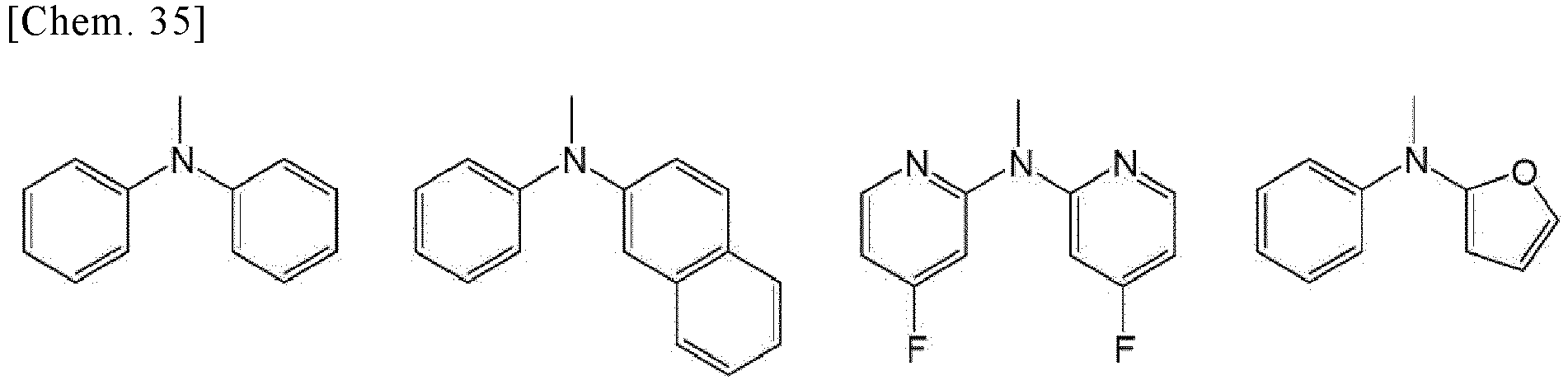
- R22 in the Formula (II-I) can be a group represented by the Formula (II-V) with the following structure:

- Examples of the specific chemical structure of the compound represented by the Formula (II-V) can include, but are not limited to, the following groups:

- R22 in the Formula (II-I) representing the amide compound according to the present invention is preferably a group represented by the Formula (II-II), the Formula (II-III), or the Formula (II-IV). More preferably, R22 is a group represented by the Formula (II-II).
- In the Formula (II-I) representing the amide compound according to the present invention, R23 is 0 to 7 identical or different substituents attached to a naphthyl group.
- Although R23 may be provided at any of
positions 1 to 8 of the naphthyl group, R23 cannot be provided at a position at which the chain portion of the amide compound according to the present invention is attached to the naphthyl group. Also, R23 may be omitted on the naphthyl group so that the naphthyl group does not have any substituents. If R23 is provided on the naphthyl group, 1 to 7 substituents of R23 may be provided, and they may be different substituents from each other, or all or some of them may be the same substituents. R23 is preferably a substituent having 1 to 10 atoms. - In the Formula (II-I) representing the amide compound according to the present invention, X2 is a single bond, -CH2- group, or -NH- group.
- X2 is preferably a single bond.
- When X2 is a single bond, the Formula (II-I) can be represented by the following Formula (II-XVI):
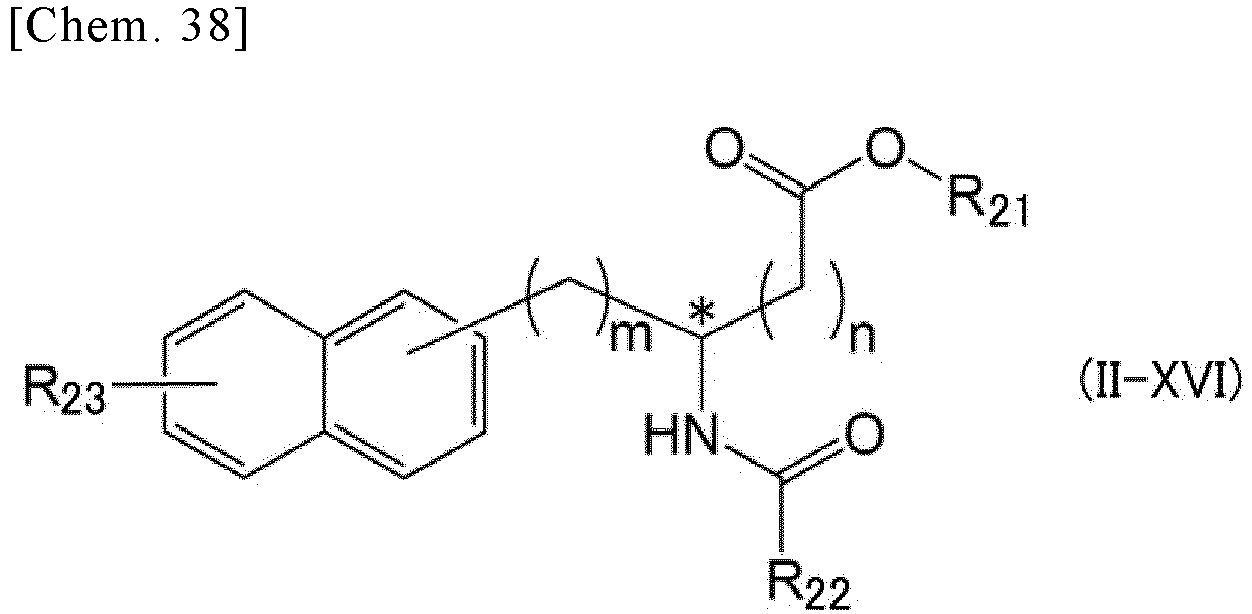
- The "substituent" used with respect to the amide compound according to the present invention refers to a halogen (such as, for example, fluorine, chlorine, bromine, or iodine), an alkyl group (for example, a C1-6 alkyl group, such as a methyl group, an ethyl group, a propyl group, an isopropyl group, a butyl group, an isobutyl group, a sec-butyl group, a tert-butyl group, a pentyl group, or a hexyl group), a cycloalkyl group (for example, a C3-6 cycloalkyl group, such as a cyclopropyl group, a cyclobutyl group, a cyclopentyl group, or a cyclohexyl group), an alkynyl group (for example, a C2-6 alkynyl group, such as an ethynyl group, a 1-propynyl group, or a propargyl group), an alkenyl group (for example, a C2-6 alkenyl group, such as a vinyl group, an allyl group, an isopropenyl group, a butenyl group, or an isobutenyl group), an aralkyl group (for example, a C7-11 aralkyl group, such as a benzyl group, an α-methylbenzyl group, or a phenethyl group), an aryl group (for example, a C6-10 aryl group, such as a phenyl group or a naphthyl group; preferably a phenyl group), an alkoxy group (for example, a C1-6 alkoxy group, such as a methoxy group, an ethoxy group, a propoxy group, an isopropoxy group, a butoxy group, an isobutoxy group, a sec-butoxy group, or a tert-butoxy), an aryloxy group (for example, a C6-10 aryloxy group, such as phenoxy), an alkanoyl group (for example, a C1-6 alkyl-carbonyl group, such as a formyl group, an acetyl group, a propionyl group, a butyryl group, or an isobutyryl group), an arylcarbonyl group (for example, a C6-10 aryl-carbonyl group, such as a benzoyl group or a naphthoyl group), an alkanoyloxy group (for example, a C1-6 alkyl-carbonyloxy group, such as a formyloxy group, an acetyloxy group, a propionyloxy group, a butyryloxy group, or an isobutyryloxy group), an arylcarbonyloxy group (for example, a C6-10 aryl-carbonyloxy group, such as a benzoyloxy group or a naphthoyloxy group), carboxyl group, an alkoxycarbonyl group (for example, a C1-6 alkoxy-carbonyl group, such as a methoxycarbonyl group, an ethoxycarbonyl group, a propoxycarbonyl group, an isopropoxycarbonyl group, a butoxycarbonyl group, an isobutoxycarbonyl group, or a tert-butoxycarbonyl), an aralkyloxycarbonyl group (for example, a C7-11 aralkyloxycarbonyl group, such as a benzyloxycarbonyl group), a carbamoyl group, a halogenated alkyl group (for example, a mono-, di-, or tri-halogenated -C1-4 alkyl group, such as a chloromethyl group, a dichloromethyl group, a trifluoromethyl group, or a 2,2,2-trifluoroethyl group), an oxo group, an amidino group, an imino group, an amino group, an alkylamino group (for example, a mono-C1-4 alkylamino group, such as a methylamino group, an ethylamino group, a propylamino group, an isopropylamino group, or a butylamino group), a dialkylamino group (for example, a di-C1-4 alkylamino group, such as a dimethylamino group, a diethylamino group, a dipropylamino group, a diisopropylamino group, a dibutylamino group, or a methylethylamino group), an alkoxycarbonylamino group (for example, a C1-6 alkoxycarbonylamino group, such as a methoxycarbonylamino group, an isoproxycarbonylamino group, or a tert-butoxycarbonylamino group), a cyclic amino group (a 3- to 6-membered cyclic amino group containing carbon atoms and one nitrogen atom and further containing one to three heteroatoms selected from oxygen, sulfur, and nitrogen; such as, for example, an aziridinyl group, an azetidinyl group, a pyrrolidinyl group, a pyrrolinyl group, a pyrrolyl group, an imidazolyl group, a pyrazolyl group, an imidazolidinyl group, a piperidyl group, a morpholinyl group, a dihydropyridyl group, a pyridyl group, an N-methylpiperazinyl group, or an N-ethylpiperazinyl group), an alkylenedioxy group (for example, a C1-3 alkylenedioxy group, such as a methylenedioxy group or an ethylenedioxy group), a hydroxy group, a cyano group, a mercapto group, a sulfo group, a sulfino group, a phosphono group, a sulfamoyl group, a monoalkylsulfamoyl group (for example, a mono-C1-6 alkylsulfamoyl group, such as N-methylsulfamoyl, N-ethylsulfamoyl, N-propylsulfamoyl, N-isopropylsulfamoyl, or N-butylsulfamoyl), a dialkylsulfamoyl group (for example, a di-C1-6 alkylsulfamoyl group, such as an N,N-dimethylsulfamoyl group, an N,N-diethylsulfamoyl group, an N,N-dipropylsulfamoyl group, or an N,N-dibutylsulfamoyl group), an alkylthio group (for example, a C1-6 alkylthio group, such as a methylthio group, an ethylthio group, propylthio group, an isopropylthio group, a butylthio group, a sec-butylthio group, or a tert-butylthio group), an arylthio group (for example, a C6-10 arylthio group, such as a phenylthio group or a naphthylthio group), an alkylsulfinyl group (for example, a C1-6 alkylsulfinyl group, such as a methylsulfinyl group, an ethylsulfinyl group, a propylsulfinyl group, or a butylsulfinyl group), an alkylsulfonyl group (for example, a C1-6 alkylsulfonyl group, such as a methylsulfonyl group, an ethylsulfonyl group, a propylsulfonyl group, or a butylsulfonyl group), or an arylsulfonyl group (for example, a C6-10 arylsulfonyl group, such as a phenylsulfonyl group or a naphthylsulfonyl group).
- In the amide compound according to the present invention, if the "substituents" have 1 to 10 atoms, the substituents are those which contain 1 to 10 atoms among the aforementioned substituents. Examples that can be used as such a substituent include, but are not limited thereto, a halogen atom, a methyl group, an ethyl group, a vinyl group, a methoxy group, an ethoxy group, an acetyl group, a carboxyl group, a methoxycarbonyl group, a chloromethyl group, a primary amino group, a methylamino group, a dimethylamino group, a hydroxy group, a sulfo group, and a methylthio group.
- In the amide compound according to the present invention, the phrase "optionally substituted" means that a substituent as described above is present or absent. In cases where a moiety is substituted, two or more substituents may be present within the moiety, and the substituents may be identical to or different from each other. In cases where the amide compound according to the present invention is "optionally substituted," the number of substituents within the compound is preferably from 0 to 3.
- The amide compound can be synthesized using, for example, a method described in
WO 2019/031470 , although it is not limited thereto. - Another one of the compounds that are active ingredients of the therapeutic or prophylactic agents for coronavirus infection according to present invention is a compound that has a chemical structure represented by the following Formula (III-I) and inhibitory activity against the function of Pin1:

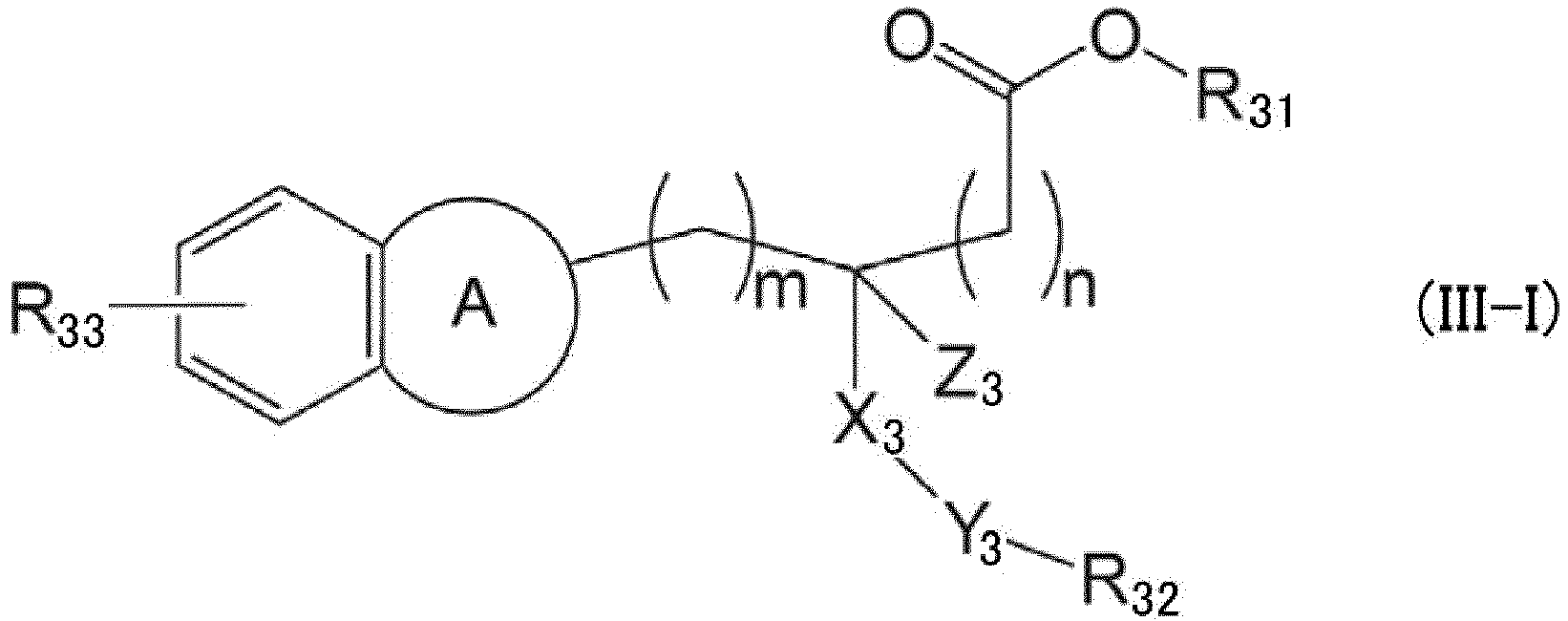
- In the Formula (III-I), m represents an integer from 0 to 2, n represents an integer from 0 to 2, and m and n are integers satisfying the
relationship 0≤m+n≤3. That is, there are eight combinations of (m, n): (0,0), (0,1), (0,2), (1,0), (1,1), (1,2), (2,0), and (2,1). - The compound that is an active ingredient of the carboxylic-acid-derivative compound according to the present invention can have eight chemical structures on the basis of eight combinations of (m, n).
- In the compound that is an active ingredient of the carboxylic-acid-derivative compound according to the present invention, it is preferable that m=1 and n=0.
- In the Formula (III-I), a ring A is an optionally substituted monocyclic aromatic ring or an optionally substituted monocyclic heterocycle.
- In the carboxylic-acid-derivative compound according to the present invention, the "monocyclic aromatic ring" is a single ring formed by unsaturated organic compounds consisting of carbon and hydrogen, examples of which include, but are not limited to, a benzene ring and a cyclopentadiene ring.
- In the carboxylic-acid-derivative compound according to the present invention, the "monocyclic heterocycle" is a single ring formed by unsaturated organic compounds consisting of carbon, hydrogen and other atoms, examples of which include, but are not limited to, a pyrrole ring, an imidazole ring, a pyrazole ring, a furan ring, a thiophene ring, an isothiazole ring, an isoxazole ring, a pyrizine ring, a pyrazine ring, a pyrimidine ring, a pyridazine ring, a pyran ring, and a pyrroline ring.
- The ring A and an adjacent benzene ring form a condensed ring so as to form a group containing a bicyclic condensed ring. Examples of the group containing the bicyclic condensed ring include, but are not limited, to a naphthyl group, an indenyl group, an indolyl group, a benzimidazolyl group, an isoindolyl group, a 3H-indolyl group, a 1H-indazolyl group, an isobenzofuranyl group, a quinolyl group, an isoquinolyl group, a phthalazinyl group, a quinoxalinyl group, a quinazolinyl group, a cinolinyl group, and chromenyl group, each of which is optionally substituted.
- Among the above-described groups, the optionally substituted naphthyl group, the optionally substituted indolyl group, or the optionally substituted benzimidazolyl group is preferable for the bicyclic condensed ring. It is more preferable that the bicyclic condensed ring is a substituted naphthyl group, and in this case, the ring A is a benzene ring.
- The compound that is an active ingredient of the carboxylic-acid-derivative compound according to the present invention has a structure which can be divided into two major portions: a ring portion consisting of a group containing a bicyclic condensed ring having a benzene ring and the ring A; and a chain portion attached thereto.
- When the group containing the bicyclic condensed ring (the ring portion) is the optionally substituted naphthyl group, the ring portion can be attached to the chain portion at
position position 2 of the naphthyl group. - When the group containing the bicyclic condensed ring (the ring portion) is the optionally substituted indolyl group, the ring portion can be attached to the chain portion at
position position - When the group containing the bicyclic condensed ring (the ring portion) is the optionally substituted benzimidazolyl group, the ring portion can be attached to the chain portion at
position position 2 of the benzimidazolyl group. - Examples of the specific chemical structure of the group containing the bicyclic condensed ring (the ring portion) can include, but are not limited to, the following groups:

- In the Formula (III-I), X3 is a single bond, -NH- group, -NH-CO- group, -O-CO- group, -CH2-S-CH2- group, -CH2-S-(CH2)2-S- group, or -NH-R34- group (R34 is an alkylene group having 1 to 5 carbon atoms, or an alkenylene group having 2 to 5 carbon atoms).
- All of these groups are divalent groups which may be attached to Y3 on either side. For Example, when X3 is -NH-CO-, either the CO- side or the -NH side may be attached to Y3.
- Examples of the "alkylene group having 1 to 5 carbon atoms" in the carboxylic-acid-derivative compound according to the present invention include, but are not limited to, a linear or branched alkylene group such as a methylene group, an ethylene group, a trimethylene group, a 2-methyltrimethylene group, and a pentamethylene group.
- In addition, examples of the "alkenylene group having 2 to 5 carbon atoms" in the carboxylic-acid-derivative compound according to the present invention include, but are not limited to, a linear or branched alkenylene group having 1 to 3 double bond and 2 to 5 carbon atoms, such as a vinylene group, a 1-propenylene group, a 1-methyl-1-propenylene group, a 2-methyl-1-propenylene group, a 2-butenylene group, a 2-pentenylene group, a 1,3-butadienylene group, and a 3-dimethyl-1-propenylene group.
- In the Formula (III-I), Y3 is a single bond, -NH- group, -CO- group, -SO2- group, -O-CO- group, -CO-NR35- group (R35 represents a hydrogen atom, or an optionally substituted alkyl group having 1 to 5 carbon atoms), -O-R36- group (R36 represents an optionally substituted alkylene group having 1 to 5 carbon atoms, or an optionally substituted alkenylene group having 2 to 5 carbon atoms), -NR35-R36- group, -S-R36-group, -CO-R36- group, -SO2-R36- group, -NR35-CO-R36- group, -R36-NR35-CO- group, an optionally substituted alkylene group having 1 to 6 carbon atoms, or an optionally substituted alkenylene group having 2 to 6 carbon atoms.
- All of these groups are divalent groups which may be attached to R32 on either side. For Example, when Y3 is -O-CO- group, either the CO- side or the -O side may be attached to R32.
- Examples of the "alkylene group having 1 to 6 carbon atoms" in the carboxylic-acid-derivative compound according to the present invention include, but are not limited to, a linear or branched alkylene group such as a methylene group, an ethylene group, a trimethylene group, a 2-methyltrimethylene group, a pentamethylene group, a hexamethylene group, and a 3-methylpentamethylene group.
- In addition, examples of the "alkenylene group having 2 to 6 carbon atoms" in the carboxylic-acid-derivative compound according to the present invention include, but are not limited to, a linear or branched alkenylene group having 1 to 3 double bond and 2 to 6 carbon atoms, such as a vinylene group, a 1-propenylene group, a 1-methyl-1-propenylene group, a 2-methyl-1-propenylene group, a 2-butenylene group, a 2-pentenylene group, a 1,3-butadienylene group, a 3-dimethyl-1-propenylene group, a 1, 4-hexadienylene group, and a 4-methyl-3-pentenylene group.
- In the Formula (III-I), R31 is a hydrogen atom, an optionally substituted hydrocarbon group, an optionally substituted heterocyclic group, or an optionally substituted amino group.
- The carboxylic-acid-derivative compound according to the present invention has inhibitory activity against the function of Pin1 when R31 is the hydrogen atom and the compound is a carboxyl group. Therefore, R31 is preferably the hydrogen atom.
- However, when R31 is the optionally substituted hydrocarbon group, the optionally substituted heterocyclic group, or the optionally substituted amino group, the compound represented by the Formula (III-I) forms an ester bond at R31 so that the compound can be converted to a carboxyl group by hydrolysis. Therefore, even if R31 is the optionally substituted hydrocarbon group, the optionally substituted heterocyclic group, or the optionally substituted amino group, the compounds that are active ingredients of the carboxylic-acid-derivative compound according to the present invention can be used as a prodrug.
- In the carboxylic-acid-derivative compound according to the present invention, the "hydrocarbon group" used in R31 in the Formula (III-I) and the like means a group derived from a compound composed of carbon and hydrogen atoms. Examples of the hydrocarbon group can include, but are not limited to, aliphatic hydrocarbon, monocyclic saturated hydrocarbon, and aromatic hydrocarbon groups, and preferably contain 1 to 16 carbon atoms. Specific examples of the hydrocarbon group include, but are not limited to, an alkyl group, an alkenyl group, an alkynyl group, a cycloalkyl group, an aryl group, and an aralkyl group.
- In this respect, examples of the "alkyl group" include a methyl group, an ethyl group, a propyl group, an isopropyl group, a butyl group, an isobutyl group, a sec-butyl group, a tert-butyl group, a pentyl group, and a hexyl group. Examples of the "alkenyl group" include a vinyl group, a 1-propenyl group, an a llyl group, an isopropenyl group, a butenyl group, and an isobutenyl group. Examples of the "alkynyl group" include an ethynyl group, a propargyl group, and a 1-propynyl group. Examples of "cycloalkyl group" include a cyclopropyl group, a cyclobutyl group, a cyclopentyl group, and a cyclohexyl group. Examples of "aryl group" include a phenyl group, an indenyl group, a naphthyl group, a fluorenyl group, an anthryl group, a biphenylenyl group, a phenanthrenyl group, an as-indacenyl group, an s-indacenyl group, an acenaphthylenyl group, a phenalenyl group, a fluoranthenyl group, a pyrenyl group, a naphthacenyl group, and a hexacenyl group. Examples of "aralkyl group" include a benzyl group, a styryl group, and a phenethyl group.
- In the carboxylic-acid-derivative compound according to the present invention, the "heterocyclic group" used in R31 in the Formula (III-I) and the like refers to a group derived from a cyclic compound composed of atoms of carbon and some other elements. It is preferable to use an aromatic heterocyclic ring as the "heterocyclic group".
- In the carboxylic-acid-derivative compound according to the present invention, the "heterocyclic group" can be, but is not limited to, for example, any of 5- to 14-membered monocyclic to pentacyclic heterocyclic groups each having carbon atoms and further having one to four heteroatoms of one or two elements selected from nitrogen, oxygen, and sulfur. Specific examples of the heterocyclic group can include, but are not limited to, a 5-membered cyclic group having carbon atoms and further having one to four heteroatoms selected from oxygen, sulfur, and nitrogen, such as a 2- or 3-thienyl group, 2- or 3-furyl group, a 1-, 2- or 3-pyrrolyl group, a 1-, 2- or 3-pyrrolidinyl group, a 2-, 4- or 5-oxazolyl group, a 3-, 4- or 5-isooxazolyl group, a 2-, 4- or 5-thiazolyl group, a 3-, 4- or 5-isothiazolyl group, a 3-, 4- or 5-pyrazolyl group, a 2-, 3- or 4-pyrazolidinyl group, a 2-, 4- or 5-imidazolyl group, a 1,2,3-triazolyl group, a 1,2,4-triazolyl group, and a 1H- or 2H-tetrazolyl group. Moreover, specific examples of the heterocyclic group can include, but are not limited to, a 6-membered cyclic group having carbon atoms and further having one to four heteroatoms selected from oxygen, sulfur, and nitrogen, such as a 2-, 3- or 4-pyridyl group, an N-oxide-2-, 3- or 4-pyridyl group, a 2-, 4- or 5-pyrimidinyl group, an N-oxide-2-, 4- or 5-pyrimidinyl group, a thiomorpholinyl group, a morpholinyl group, a piperidino group, a 2-, 3- or 4-piperidyl group, a thiopyranyl group, a 1,4-oxazinyl group, a 1,4-thiazinyl group, a 1,3-thiazinyl group, a piperazinyl group, a triazinyl group, a 3- or 4-pyridazinyl group, a pyrazinyl group, and an N-oxide-3- or 4-pyridazinyl group. Moreover, specific examples of the heterocyclic group can include, but are not limited to, a bicyclic to tetracyclic condensed ring group having carbon atoms and further having one to four heteroatoms selected from oxygen, sulfur, and nitrogen, such as an indolyl group, a benzofuryl group, a benzothiazolyl group, a benzoxazolyl group, a xanthenyl group, a benzimidazolyl group, a quinolyl group, an isoquinolyl group, a phthalazinyl group, a quinazolinyl group, a quinoxalinyl group, an indolizinyl group, a quinolizinyl group, a 1,8-naphthyridinyl group, a dibenzofuranyl group, a carbazolyl group, an acridinyl group, a phenanthridinyl group, a perimidinyl group, a phenazinyl group, a chromanyl group, a phenothiazinyl group, a phenoxazinyl group, and a 7H-pirazino[2,3-c]carbazolyl group.
- In the Formula (III-I), R32 is an optionally substituted aryl group, an optionally substituted heterocyclic group, an optionally substituted cycloalkyl group, or a group represented by the Formula (III-II).
- The "aryl group" in the carboxylic-acid-derivative compound according to the present invention can be, but are not limited to, a phenyl group, an indenyl group, a naphathyl group, a fluorenyl group, an anthryl group, a biphenylenyl group, a phenanthrenyl group, an as-indacenyl group, an s-indacenyl group, an acenaphthylenyl group, a phenalenyl group, a fluoranthenyl group, a pyrenyl group, a naphthacenyl group, and a hexacenyl group.
- R32 in the Formula (III-I) can be a group represented by the Formula (III-II) with the following structure:

- In the Formula (III-II), rings B and C respectively represent an optionally substituted aryl group, an optionally substituted heterocyclic group, or an optionally substituted cycloalkyl group, and R37 represents a single bond, -O- group, -CO- group, -NH- group, -SO2- group, -CO-NH- group, an optionally substituted alkylene group having 1 to 3 carbon atoms, an optionally substituted alkenylene group having 2 to 3 carbon atoms, -S-R38- group (R38 represents an optionally substituted alkylene group having 1 to 2 carbon atoms), -CO-R38- group, -O-R38- group, or -SO2-R38- group.
- In this respect, the "alkylene group having 1 to 2 carbon atoms" is a methylene group or an ethylene group, and examples of the "alkylene group having 1 to 3 carbon atoms" other than the aforementioned alkylene group inclued a trimethylene group.
- In addition, examples of the "alkenylene group having 2 to 3 carbon atoms" include a vinylene group and a 1-propenylene group.
- In the Formula (III-I), when R32 is a group represented by the Formula (III-II), any one of the ring B, the ring C, and R37 is attached to Y3.
- The structure when Y3 is attached to the ring B is represented by the following Formula (III-III), the structure when Y3 is attached to the ring C is represented by the following Formula (III-IV), and the structure when Y3 is attached to R37 is represented by the following Formula (III-V):

- In order to provide the compound with high activity, R32 in the Formula (III-I) is preferably the optionally substituted polycyclic aryl group or the optionally substituted polycyclic heterocyclic group.
- In the Formula (III-I), R32 is the same or different substituents.
- The "substituent" in the carboxylic-acid-derivative compound according to the present invention refers to a halogen (such as, for example, fluorine, chlorine, bromine, or iodine), an alkyl group (for example, a C1-6 alkyl group, such as a methyl group, an ethyl group, a propyl group, an isopropyl group, a butyl group, an isobutyl group, a sec-butyl group, a tert-butyl group, a pentyl group, or a hexyl group), a cycloalkyl group (for example, a C3-6 cycloalkyl group, such as a cyclopropyl group, a cyclobutyl group, a cyclopentyl group, or a cyclohexyl group), an alkynyl group (for example, a C2-6 alkynyl group, such as an ethynyl group, a 1-propynyl group, or a propargyl group), an alkenyl group (for example, a C2-6 alkenyl group, such as a vinyl group, an allyl group, an isopropenyl group, a butenyl group, or an isobutenyl group), an aralkyl group (for example, a C7-11 aralkyl group, such as a benzyl group, an α-methylbenzyl group, or a phenethyl group), an aryl group (for example, a C6-10 aryl group, such as a phenyl group or a naphthyl group; preferably a phenyl group), an alkoxy group (for example, a C1-6 alkoxy group, such as a methoxy group, an ethoxy group, a propoxy group, an isopropoxy group, a butoxy group, an isobutoxy group, a sec-butoxy group, or a tert-butoxy), an aryloxy group (for example, a C6-10 aryloxy group, such as phenoxy), an alkanoyl group (for example, a C1-6 alkyl-carbonyl group, such as a formyl group, an acetyl group, a propionyl group, a butyryl group, or an isobutyryl group), an arylcarbonyl group (for example, a C6-10 aryl-carbonyl group, such as a benzoyl group or a naphthoyl group), an alkanoyloxy group (for example, a C1-6 alkyl-carbonyloxy group, such as a formyloxy group, an acetyloxy group, a propionyloxy group, a butyryloxy group, or an isobutyryloxy group), an arylcarbonyloxy group (for example, a C6-10 aryl-carbonyloxy group, such as a benzoyloxy group or a naphthoyloxy group), carboxyl group, an alkoxycarbonyl group (for example, a C1-6 alkoxy-carbonyl group, such as a methoxycarbonyl group, an ethoxycarbonyl group, a propoxycarbonyl group, an isopropoxycarbonyl group, a butoxycarbonyl group, an isobutoxycarbonyl group, or a tert-butoxycarbonyl), an aralkyloxycarbonyl group (for example, a C7-11 aralkyloxycarbonyl group, such as a benzyloxycarbonyl group), a carbamoyl group, a halogenated alkyl group (for example, a mono-, di-, or tri-halogenated -C1-4 alkyl group, such as a chloromethyl group, a dichloromethyl group, a trifluoromethyl group, or a 2,2,2-trifluoroethyl group), an oxo group, an amidino group, an imino group, an amino group, an alkylamino group (for example, a mono-C1-4 alkylamino group, such as a methylamino group, an ethylamino group, a propylamino group, an isopropylamino group, or a butylamino group), a dialkylamino group (for example, a di-C1-4 alkylamino group, such as a dimethylamino group, a diethylamino group, a dipropylamino group, a diisopropylamino group, a dibutylamino group, or a methylethylamino group), an alkoxycarbonylamino group (for example, a C1-6 alkoxycarbonylamino group, such as a methoxycarbonylamino group, an isoproxycarbonylamino group, or a tert-butoxycarbonylamino group), a cyclic amino group (a 3- to 6-membered cyclic amino group containing carbon atoms and one nitrogen atom and further containing one to three heteroatoms selected from oxygen, sulfur, and nitrogen; such as, for example, an aziridinyl group, an azetidinyl group, a pyrrolidinyl group, a pyrrolinyl group, a pyrrolyl group, an imidazolyl group, a pyrazolyl group, an imidazolidinyl group, a piperidyl group, a morpholinyl group, a dihydropyridyl group, a pyridyl group, an N-methylpiperazinyl group, or an N-ethylpiperazinyl group), an alkylenedioxy group (for example, a C1-3 alkylenedioxy group, such as a methylenedioxy group or an ethylenedioxy group), a hydroxy group, a cyano group, a mercapto group, a sulfo group, a sulfino group, a phosphono group, a sulfamoyl group, a monoalkylsulfamoyl group (for example, a mono-C1-6 alkylsulfamoyl group, such as N-methylsulfamoyl, N-ethylsulfamoyl, N-propylsulfamoyl, N-isopropylsulfamoyl, or N-butylsulfamoyl), a dialkylsulfamoyl group (for example, a di-C1-6 alkylsulfamoyl group, such as an N,N-dimethylsulfamoyl group, an N,N-diethylsulfamoyl group, an N,N-dipropylsulfamoyl group, or an N,N-dibutylsulfamoyl group), an alkylthio group (for example, a C1-6 alkylthio group, such as a methylthio group, an ethylthio group, propylthio group, an isopropylthio group, a butylthio group, a sec-butylthio group, or a tert-butylthio group), an arylthio group (for example, a C6-10 arylthio group, such as a phenylthio group or a naphthylthio group), an alkylsulfinyl group (for example, a C1-6 alkylsulfinyl group, such as a methylsulfinyl group, an ethylsulfinyl group, a propylsulfinyl group, or a butylsulfinyl group), an alkylsulfonyl group (for example, a C1-6 alkylsulfonyl group, such as a methylsulfonyl group, an ethylsulfonyl group, a propylsulfonyl group, or a butylsulfonyl group), or an arylsulfonyl group (for example, a C6-10 arylsulfonyl group, such as a phenylsulfonyl group or a naphthylsulfonyl group).
- Among the aforementioned substituents, low-molecular-weight substituents having 1 to 10 atoms are preferable. Examples that can be used as such a substituent include, but are not limited thereto, a halogen atom, a methyl group, an ethyl group, a vinyl group, a methoxy group, an ethoxy group, an acetyl group, a carboxyl group, a methoxycarbonyl group, a chloromethyl group, an amino group, a methylamino group, a hydroxy group, a sulfo group, and a methylthio group.
- In the carboxylic-acid-derivative compound according to the present invention, the phrase "optionally substituted" means that a substituent as described above is present or absent. In cases where a moiety is substituted, two or more substituents may be present within the moiety, and the substituents may be identical to or different from each other. In cases where the carboxylic-acid-derivative compound according to the present invention is "optionally substituted," the number of substituents within the compound is preferably from 0 to 3.
- In the Formula (III-I), Z3 is a hydrogen atom, an optionally substituted amino group, or an optionally substituted amine.
- In the carboxylic-acid-derivative compound according to the present invention, the "optionally substituted amino group" is a primary amino group, a secondary amino group, or a tertiary amino group. The primary amino group is -NH2 group. The secondary amino group is an amino group having one substituent, and may include, but are not limited to, for example, alkylamino group, arylamino group, alkoxycarbonylamino group and the like. The tertiary amino group is an amino group having identical or different two substituents, and may include, but not limited to, for example, dialkylamino group, diarylamino group and the like.
- When Z3 is the optionally substituted amine, X3 and Z3 form a ring. The phrase "form a ring" means that Z3 is -NH-, -N=, or -NR- (R represents a substituent) and is attached to any atom within X3 to form a ring.
- Examples of the ring formed by X3 and Z3 include, but are not limited to: a dihydrothiazole ring which is formed in the case that X3 is -CH2-S-CH2- group or -CH2-S-(CH2)2-S- group, Z3 is -N=, and Z3 is attached to a carbon atom within X3 via a double bond; and a piperidine ring which is formed in the case that X3 is a tetramethylene group, Z3 is -NH-, and Z3 is attached to a carbon atom within X3.
- In the Formula (III-I), when X3 is -CH2-S-CH2- group, Z3 is -N=, and X3 and Z3 form a dihydrothiazole ring, the compound can be represented by the following Formula (III-VI):
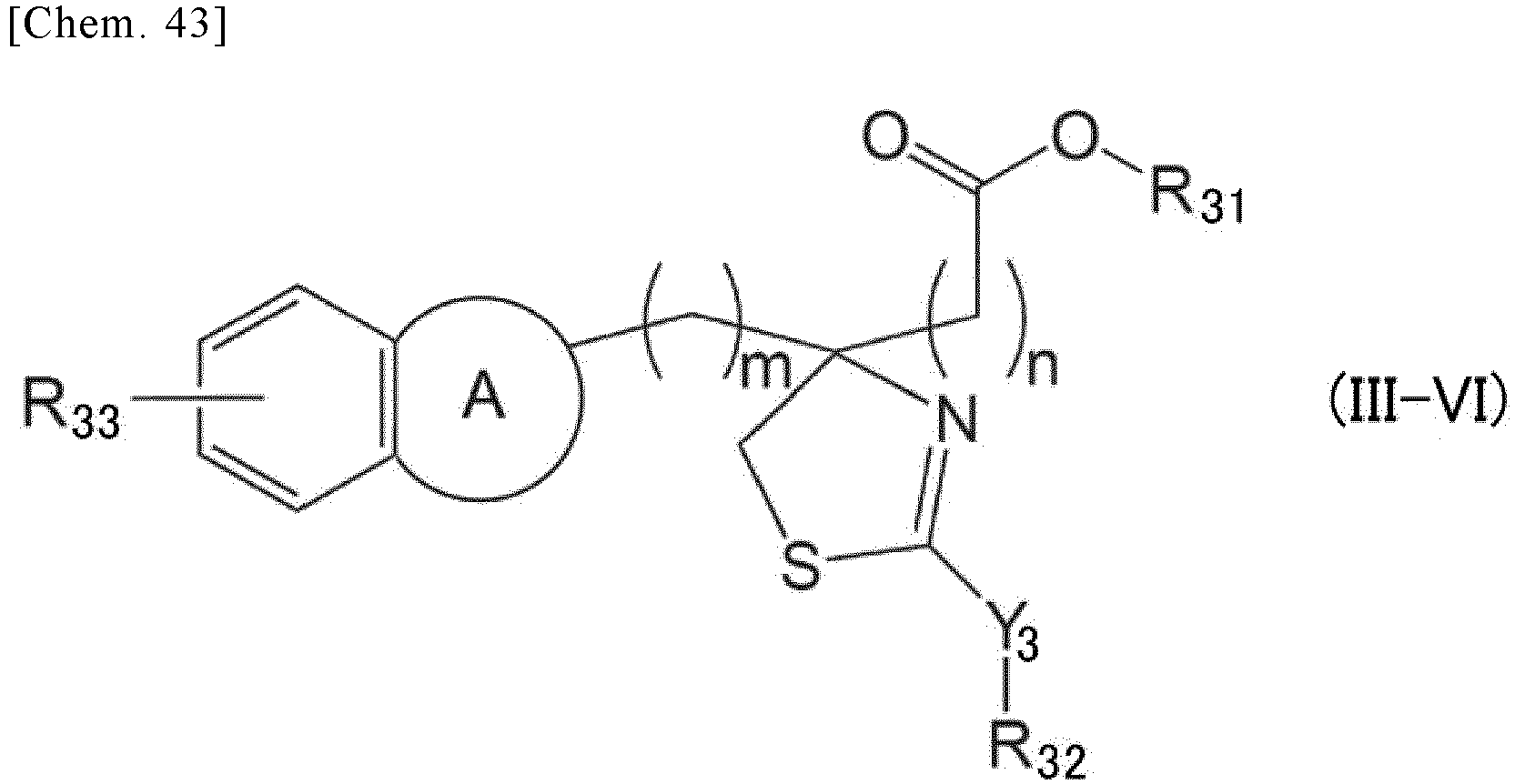
- Many compounds represented by the Formula (III-VI) have been synthesized in Patent Document 2 (
WO 2006/040646 ), and it has been confirmed that these compounds have inhibitory activity against Pint. The specific examples of chemical structures of some of these compounds are as follows:
- All of these compounds correspond to a compound represented by the Formula (III-VI) in which Y3 is -O-CH2- group (-O-R36- group).
- In the Formula (III-I), when X3 is -CH2-S-(CH2)2-S- group, Z3 is -N= group, and X3 and Z3 form a dihydrothiazole ring, the compound can be represented by the following Formula (III-VII):
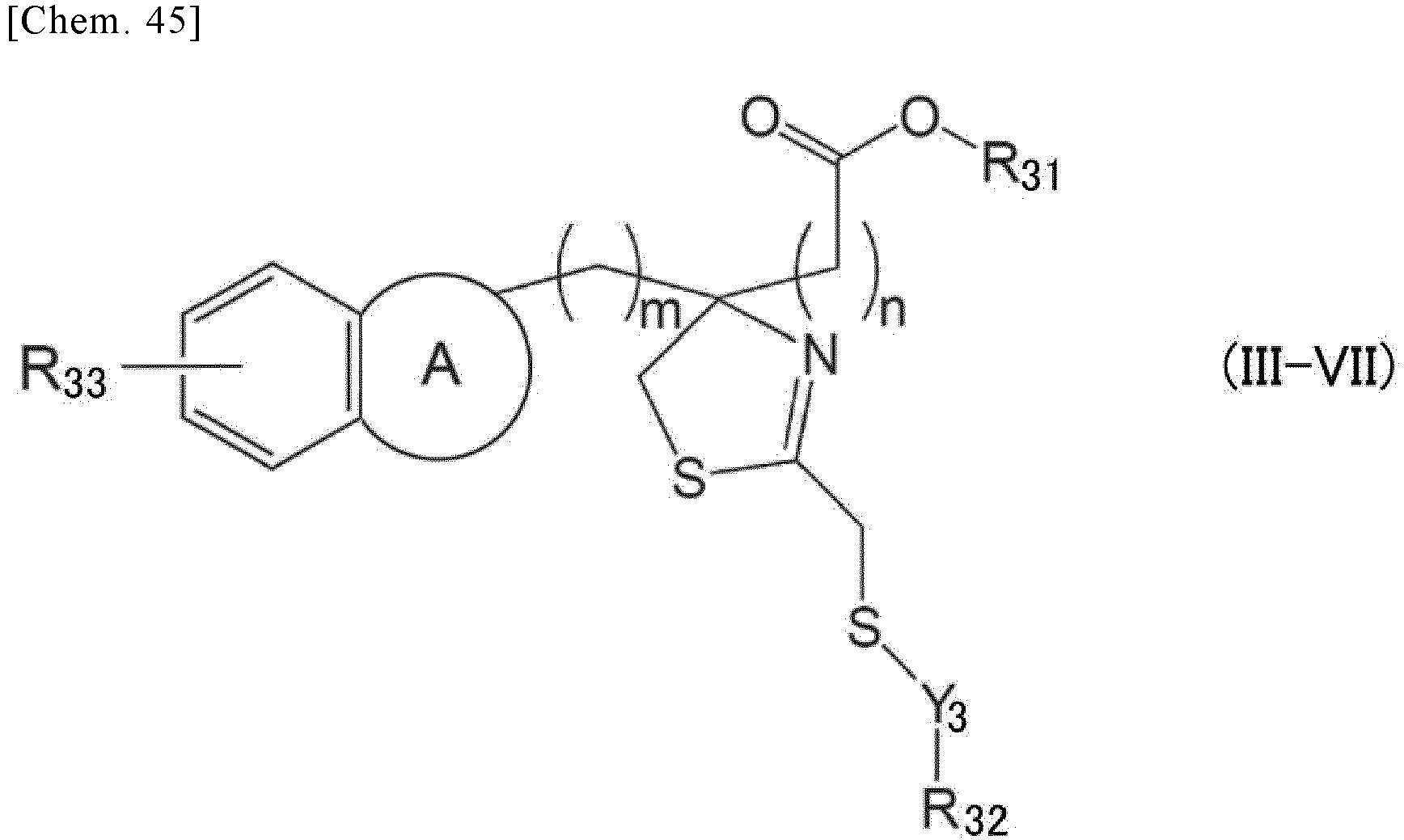
- Many compounds represented by the Formula (III-VII) have been synthesized in Patent Document 2 (
WO 2006/040646 ), and it has been confirmed that these compounds have inhibitory activity against Pin1. The specific examples of chemical structures of some of these compounds are as follows:
- These compounds respectively correspond to compounds represented by the Formula (III-VII) in which Y3 is a single bond, -CH2-CH2- group (alkylene group), and -CH2-CO-NH- group (-NR35-CO-R36- group).
- In the compound represented by the Formula (III-I), X3 can be -NH-CO- group. In this case, it is preferable that m=1, n=0, and Z3 is a hydrogen atom because there are abundant raw materials for synthesis such as amino acid derivatives.
- In this case, the Formula (III-I) can be represented by the following Formula (III-VIII):


- Many compounds represented by the Formula (III-VIII) have been synthesized in Patent Document 2 (
WO 2006/040646 ), and it has been confirmed that these compounds have inhibitory activity against Pin1. The specific examples of chemical structures of some of these compounds are as follows:


- The compounds in the upper row respectively correspond to compounds represented by the Formula (III-VIII) in which Y3 is, from left to right, -CH=CH- group (alkenylene group), -CH2-CH2-CO- group (-CO-R36- group), and -CH(CH3)- group (substituted alkylene group).
- The compounds in the middle row respectively correspond to compounds represented by the Formula (III-VIII) in which Y3 is, from left to right, -CH2- group (alkylene group), -CH2-SO2- group (-SO2-R36- group), and -CH2-S- group (-S-R36-group).
- The compounds in the lower row respectively correspond to compounds represented by the Formula (III-VIII) in which Y3 is -CH(CH2CH(CH3)2)-NH-CO-group (-R36-NR35-CO- group), -CH(CH3)-O- group (-O-R36- group), and -CH2-CH2-CO-N(CH3)- group (-NR35-CO-R36- group).
- Many compounds represented by the Formula (III-VIII) have been synthesized in Non-Patent Document 3 (Bioorg. Med. Chem. Lett., 2010, Vol.20, No.2, pp.586-590), and it has been confirmed that these compounds have inhibitory activity against Pin1. The specific examples of chemical structures of some of these compounds are as follows:

- All of these compounds correspond to a compound represented by the Formula (III-VIII) in which Y3 is a single bond. The middle compound of these three compounds is designated as (R)-2-(5-(4-methoxyphenyl)-2-methylfuran-3-carboxamido)-3-(naphthalene-6-yl) propanoic acid, hereinafter referred to as "C1".
- The compound represented by the Formula (III-VIII) has inhibitory activity against the function of Pin1 when R31 is a hydrogen atom and the compound has a carboxyl group. However, even if R31 is a methyl group or a benzyl group, it can easily become a carboxyl group by hydrolysis so that the compound can exhibit inhibitory activity against the function of Pin1.
- For example, the compounds synthesized in Example 1 of Patent Document 5 (
WO 2019/031471 ) corresponds to compounds represented by the Formula (III-VIII) in which Y3 is a single bond, -CH2- group (alkylene group), or -NH- group. - The compound represented by the Formula (III-VIII) can be synthesized by, for example, but not limited to, using amino acid derivatives as raw materials according to the scheme shown in the following reaction flow chart:


- In the reaction (1) in the aforementioned scheme, an alcohol having R31 is reacted with a carboxyl group of an amino acid derivative for dehydration condensation, thereby attaching R31 to the amino acid derivative via an ester bond. Then in the reaction (2), a carboxylic acid or acid chloride having R32 and Y3 is reacted with an amino group in the compound produced by the reaction (1) for dehydration condensation, thereby attaching Y3 to R32 via an amide bond.
- In this scheme, for synthesizing a compound in which R31 is H, R31 can be detached by hydrolysis or the like after the reactions (1) and (2) so as to obtain the compound in which R31 is H, or alternatively, a carboxylic acid having R32 and Y3 is directly reacted with an amino acid derivative in which R31 is a hydrogen atom for dehydration condensation so as to obtain the compound in which R31 is H without the reaction (1).
- In the compound represented by the Formula (III-I), X3 can be -O-CO- group. In this case, it is preferable that m=1, n=0, and Z3 is a hydrogen atom because there are abundant raw materials for synthesis such as amino acid derivatives.
- In this case, the Formula (III-I) can be represented by the following Formula (III-IX):

- The compound represented by the Formula (III-IX) can be a therapeutic or prophylactic agent that can be easily decomposed due to its ester bond and has few side effects.
- The compound represented by the Formula (III-IX) has inhibitory activity against the function of Pin1 when R31 is a hydrogen atom and the compound has a carboxyl group. However, even if R31 is a benzyl group, it can easily become a carboxyl group by hydrolysis so that the compound can exhibit inhibitory activity against the function of Pin1.
- For example, the compounds synthesized in Example 1 of Patent Document 5 (
WO 2019/031471 ) corresponds to compounds represented by the Formula (III-IX) in which Y3 is a single bond, -CH2- group (alkylene group), -CHz-O- group (-O-R36- group) or -CH(NHBoc)-CH2- group (substituted alkylene group). - The compound represented by the Formula (III-IX) can be synthesized by, for example, but not limited to, using amino acid derivatives as raw materials according to the scheme shown in the following reaction flow chart:

- In the reaction (1) in the aforementioned scheme, an amino group in an amino acid derivative as a raw material becomes a hydroxyl group via a substitution reaction. In the reaction (2), an alcohol having R31 is reacted with a carboxylic acid of an hydroxycarboxylic acid derivative for dehydration condensation, thereby attaching R31 to the amino acid derivative via an ester bond. Then in the reaction (3), a carboxylic acid having R32 and Y3 is reacted with a hydroxyl group produced by the reaction (1) for dehydration condensation, thereby attaching Y3 to R32 via an ester bond.
- In this scheme, for synthesizing a compound in which R31 is H, R31 can be detached by hydrolysis or the like after the reactions (1) to (3) so as to obtain the compound in which R31 is H, or alternatively, a hydroxycarboxylic acid derivative is directly reacted with a carboxylic acid having R32 and Y3 for dehydration condensation so as to obtain the compound in which R31 is H without the reaction (2).
- In the compound represented by the Formula (III-I), X3 can be -NH- group. Many compounds represented by the Formula (III-I) in which X3 is -NH- group have been synthesized in Patent Document 2 (
WO 2006/040646 ), and it has been confirmed that these compounds have inhibitory activity against Pin1. The specific examples of chemical structures of some of these compounds are as follows:
- These compounds respectively correspond to compounds represented by the Formula (III-I) in which Y3 is, from left to right, a single bond, -CH2- group (alkylene group), and -CH2-CH2- group (alkylene group).
- In the compound represented by the Formula (III-I), X3 can be -NH-R34- group (R34 is an alkylene group having 1 to 5 carbon atoms, or an alkenylene group having 2 to 5 carbon atoms). Many compounds represented by the Formula (III-I) in which X3 is -NH-R34- group have been synthesized in Patent Document 2 (
WO 2006/040646 ), and it has been confirmed that these compounds have inhibitory activity against Pin1. The specific examples of chemical structures of some of these compounds are as follows:

- The compound on the left of the upper row corresponds to a compound represented by the Formula (III-I) in which X3 is -NH-CH2- group (-NH-R34- group) and Y3 is -CO-N(CH3)-C(CH3)2-CH2- group (-R36-NR35-CO- group). The compound in the middle of the upper row corresponds to a compound represented by the Formula (III-I) in which X3 is -NH-(CH2)4- group (-NH-R34- group) and Y3 is -O-CH2- group (-O-R36-group). The compound on the right of the upper row corresponds to a compound represented by the Formula (III-I) in which X3 is -NH-(CH2)2- group and Y3 is -O-CO-group.
- The compound on the left of the lower row corresponds to a compound represented by the Formula (III-I) in which X3 is -NH-CH2- group (-NH-R34- group) and Y3 is -CO-NH-CH2- group (-R36-NR35-CO- group). The compound in the middle of the lower row corresponds to a compound represented by the Formula (III-I) in which X3 is -NH-(CH2)2- group (-NH-R34- group) and Y3 is -CO-NH-CH2- group (-CO-NR35-group). The compound on the right of the lower row corresponds to a compound represented by the Formula (III-I) in which X3 is -NH-CH2- group (-NH-R34- group) and Y3 is -CO-NH-(CH2)2- group (-R36-NR35-CO- group).
- In the compounds represented by the Formula (III-I), both X3 and Y3 can be a single bond.
- Many compounds represented by the Formula (III-I) in which both X3 and Y3 are a single bond have been synthesized in Patent Document 2 (
WO 2006/040646 ), and it has been confirmed that these compounds have inhibitory activity against Pin1. The specific examples of chemical structures of some of these compounds are as follows:
- R32 in the Formula (III-I) can be a group represented by the Formula (III-II) with the following structure:
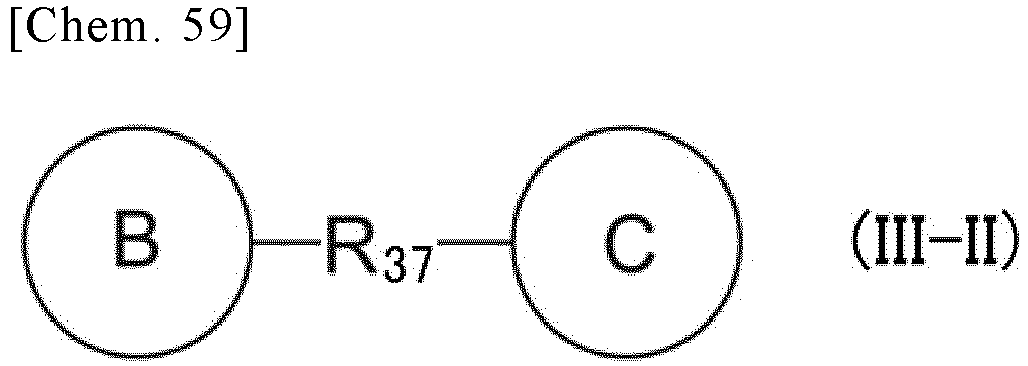
- In the Formula (III-II), rings B and C respectively represent an optionally substituted aryl group, an optionally substituted heterocyclic group, or an optionally substituted cycloalkyl group, and R37 represents a single bond, -O- group, -CO- group, -NH- group, -SO2- group, -CO-NH- group, an optionally substituted alkylene group having 1 to 3 carbon atoms, an optionally substituted alkenylene group having 2 to 3 carbon atoms, -S-R38- group (R38 represents an optionally substituted alkylene group having 1 to 2 carbon atoms), -CO-R38- group, -O-R38- group, or -SO2-R38- group.
- Many compounds represented by the Formula (III-I) in which R32 is the compound represented by the Formula (III-II) have been synthesized in Patent Document 2 (
WO 2006/040646 ), and it has been confirmed that these compounds have inhibitory activity against Pin1. The specific examples of chemical structures of some of these compounds are as follows:

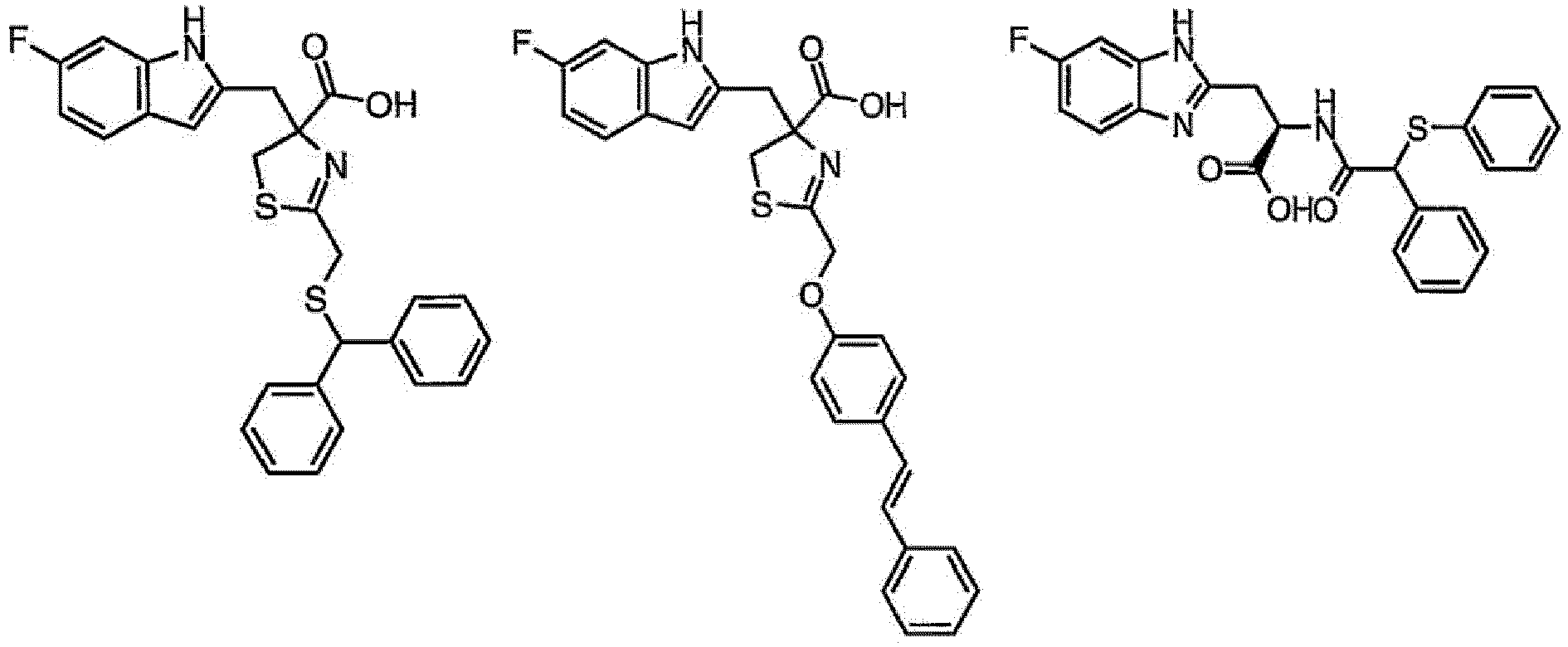

- The compounds in the upper row respectively correspond to compounds represented by the Formula (III-II) in which R37 attaching the two rings to each other is, from left to right, a single bond, -CO- group, and -CO-NH- group.
- The compounds in the middle row respectively correspond to compounds represented by the Formula (III-II) in which R37 is, from left to right, -CH2- group (alkylene group), -C=C- group (alkenylene group), and -CH2-S- group (-S-R38- group).
- The compounds in the lower row respectively correspond to compounds represented by the Formula (III-II) in which R37 is -O-CH2- group (-O-R38- group) and -CH2-SO2- group (-SO2-R38- group).
- Examples that can be used as the compounds of the Formula (III-I) in which R32 is a group represented by the Formula (III-II) can include the compounds in which R37 is -O- group, -CO- group, or -NH- group. Examples that can be used as the compounds of the Formula (III-I) in which R32 is a group represented by the Formula (III-II) can include the compounds in which R37 is single bond, -O- group, -CH2- group (alkylene group), or -CH(OH)- group (substituted alkylene group).
- The carboxylic-acid-derivative compound can be synthesized using, for example, a method described in
WO 2019/031471 , although it is not limited thereto. - Another one of the compounds that are active ingredients of the therapeutic or prophylactic agents for coronavirus disease according to present invention is a compound that has a chemical structure represented by the following Formula (IV-I) and inhibitory activity against the function of Pin1:

- In the Formula (IV-I), a ring A represents an optionally substituted monocyclic or polycyclic aromatic ring or heterocycle.
- The ring A is attached to X4 via any atom in the monocyclic or polycyclic aromatic ring or heterocycle (preferably a carbon atom or a nitrogen atom). In cases where X4 is a single bond, the ring A is directly attached to a carbonyl group (-CO-).
- In the 3,5-diaminobenzoic acid compound according to the present invention, the "aromatic ring" is an unsaturated carbon organic compound composed of carbon and hydrogen in a form of a ring. Examples of a monocyclic aromatic ring include, but are not limited to, a benzene ring, a cyclopentadiene ring and the like. Examples of a polycyclic aromatic ring include, but are not limited to, a naphthalene ring, an indene ring, an azulene ring, a fluorene ring, a phenanthrene ring, an anthracene ring, a tetracene ring, a pentacene ring, a benzopyrene ring, a chrysene ring, a pyrene ring, a triphenylene ring and the like.
- In the 3,5-diaminobenzoic acid compound according to the present invention, the "heterocycle" refers to an organic compound composed of carbon, hydrogen and other atoms in a form of a single ring. Examples of a monocyclic heterocycle include, but are not limited to, a pyrrole ring, an imidazole ring, a pyrrolidine ring, a furan ring, a tetrahydrofuran ring, a 1,3-dioxolane ring, a thiophene ring, a pyridine ring, a pyrazine ring, a pyrimidine ring, a piperazine ring, a pyran ring, a 1,4-dioxane ring and the like. Examples of a polycyclic aromatic ring include, but are not limited to, an indole ring, a quinoline ring, a quinoxaline ring, a quinazoline ring, a purine ring, an isobenzofuran ring, a chroman ring, a benzodioxane ring, a benzodioxole ring, a carbazole ring, an acridine ring, a phenoxazine ring, a 4H-pyrido [2,3-c] carbazole ring and the like.
- In the 3,5-diaminobenzoic acid compound according to the present invention, the "cyclic hydrocarbon" refers to a saturated carbon organic compound composed of carbon and hydrogen in a form of a ring. Examples of a monocyclic hydrocarbon include, but are not limited to, cyclopentane, cyclohexane, cycloheptane and the like. Examples of a polycyclic hydrocarbon include, but are not limited to, tricycloheptane, tricyclodecane, perhydro-1,4-ethanoanthracene and the like.
- In the 3,5-diaminobenzoic acid compound according to the present invention, the "substituent" refers to a halogen (such as, for example, fluorine, chlorine, bromine, or iodine), an alkyl group (for example, a C1-6 alkyl group, such as a methyl group, an ethyl group, a propyl group, an isopropyl group, a butyl group, an isobutyl group, a sec-butyl group, a tert-butyl group, a pentyl group, or a hexyl group), a cycloalkyl group (for example, a C3-6 cycloalkyl group, such as a cyclopropyl group, a cyclobutyl group, a cyclopentyl group, or a cyclohexyl group), an alkynyl group (for example, a C2-6 alkynyl group, such as an ethynyl group, a 1-propynyl group, or a propargyl group), an alkenyl group (for example, a C2-6 alkenyl group, such as a vinyl group, an allyl group, an isopropenyl group, a butenyl group, or an isobutenyl group), an aralkyl group (for example, a C7-11 aralkyl group, such as a benzyl group, an α-methylbenzyl group, or a phenethyl group), an aryl group (for example, a C6-10 aryl group, such as a phenyl group or a naphthyl group; preferably a phenyl group), an alkoxy group (for example, a C1-6 alkoxy group, such as a methoxy group, an ethoxy group, a propoxy group, an isopropoxy group, a butoxy group, an isobutoxy group, a sec-butoxy group, or a tert-butoxy), an aryloxy group (for example, a C6-10 aryloxy group, such as phenoxy), an alkanoyl group (for example, a C1-6 alkyl-carbonyl group, such as a formyl group, an acetyl group, a propionyl group, a butyryl group, or an isobutyryl group), an arylcarbonyl group (for example, a C6-10 aryl-carbonyl group, such as a benzoyl group or a naphthoyl group), an alkanoyloxy group (for example, a C1-6 alkyl-carbonyloxy group, such as a formyloxy group, an acetyloxy group, a propionyloxy group, a butyryloxy group, or an isobutyryloxy group), an arylcarbonyloxy group (for example, a C6-10 aryl-carbonyloxy group, such as a benzoyloxy group or a naphthoyloxy group), a carboxyl group, an alkoxycarbonyl group (for example, a C1-6 alkoxy-carbonyl group, such as a methoxycarbonyl group, an ethoxycarbonyl group, a propoxycarbonyl group, an isopropoxycarbonyl group, a butoxycarbonyl group, an isobutoxycarbonyl group, or a tert-butoxycarbonyl), an aralkyloxycarbonyl group (for example, a C7-11 aralkyloxycarbonyl group, such as a benzyloxycarbonyl group), a carbamoyl group, a halogenated alkyl group (for example, a mono-, di-, or tri-halogenated -C1-4 alkyl group, such as a chloromethyl group, a dichloromethyl group, a trifluoromethyl group, or a 2,2,2-trifluoroethyl group), an oxo group, an amidino group, an imino group, an amino group, an alkylamino group (for example, a mono-C1-4 alkylamino group, such as a methylamino group, an ethylamino group, a propylamino group, an isopropylamino group, or a butylamino group), a dialkylamino group (for example, a di-C1-4 alkylamino group, such as a dimethylamino group, a diethylamino group, a dipropylamino group, a diisopropylamino group, a dibutylamino group, or a methylethylamino group), an alkoxycarbonylamino group (for example, a C1-6 alkoxycarbonylamino group, such as a methoxycarbonylamino group, an isoproxycarbonylamino group, or a tert-butoxycarbonylamino group), a cyclic amino group (a 3- to 6-membered cyclic amino group containing carbon atoms and one nitrogen atom and further containing one to three heteroatoms selected from oxygen, sulfur, and nitrogen; such as, for example, an aziridinyl group, an azetidinyl group, a pyrrolidinyl group, a pyrrolinyl group, a pyrrolyl group, an imidazolyl group, a pyrazolyl group, a imidazolidinyl group, a piperidyl group, a morpholinyl group, a dihydropyridyl group, a pyridyl group, an N-methylpiperazinyl group, or an N-ethylpiperazinyl group), an alkylenedioxy group (for example, a C1-3 alkylenedioxy group, such as a methylenedioxy group or an ethylenedioxy group), a hydroxy group, a cyano group, a mercapto group, a sulfo group, a sulfino group, a phosphono group, a sulfamoyl group, a monoalkylsulfamoyl group (for example, a mono-C1-6 alkylsulfamoyl group, such as N-methylsulfamoyl, N-ethylsulfamoyl, N-propylsulfamoyl, N-isopropylsulfamoyl, or N-butylsulfamoyl), a dialkylsulfamoyl group (for example, a di-C1-6 alkylsulfamoyl group, such as an N,N-dimethylsulfamoyl group, an N,N-diethylsulfamoyl group, an N,N-dipropylsulfamoyl group, or an N,N-dibutylsulfamoyl group), an alkylthio group (for example, a C1-6 alkylthio group, such as a methylthio group, an ethylthio group, a propylthio group, an isopropylthio group, a butylthio group, a sec-butylthio group, or a tert-butylthio group), an arylthio group (for example, a C6-10 arylthio group, such as a phenylthio group or a naphthylthio group), an alkylsulfinyl group (for example, a C1-6 alkylsulfinyl group, such as a methylsulfinyl group, an ethylsulfinyl group, a propylsulfinyl group, or a butylsulfinyl group), an alkylsulfonyl group (for example, a C1-6 alkylsulfonyl group, such as a methylsulfonyl group, an ethylsulfonyl group, a propylsulfonyl group, or a butylsulfonyl group), or an arylsulfonyl group (for example, a C6-10 arylsulfonyl group, such as a phenylsulfonyl group or a naphthylsulfonyl group).
- In the 3,5-diaminobenzoic acid compound according to the present invention, the phrase "optionally substituted" means that a substituent as described above is present or absent. In cases where a moiety is substituted, two or more substituents may be present within the moiety, and the substituents may be identical to or different from each other. In cases where the 3,5-diaminobenzoic acid compound according to the present invention is "optionally substituted," the number of substituents within the compound is preferably from 0 to 3, and more preferably 0.
- For the "substituent", the substituent containing 0 to 12 carbon atoms is preferred. The substituent containing 0 to 6 carbon atoms is more preferred.
- For the "substituent", the substituent containing 1 to 10 atoms is preferred. Examples of such substituent include, but are not limited to, halogen atom, a methyl group, an ethyl group, a vinyl group, a methoxy group, an ethoxy group, an acetyl group, a carboxyl group, a methoxycarbonyl group, a chloromethyl group, an amino group, a methylamino group, a hydroxy group, a sulfo group, and a methylthio group.
- The ring A in the Formula (IV-I) is an optionally substituted monocyclic or polycyclic aromatic ring or heterocycle as described above, and preferably an optionally substituted polycyclic aromatic ring or heterocycle.
- More preferably, the ring A represents a group represented by the following Formula (IV-VI):


- In the Formula (IV-VI), A1, A2, and A3 independently represent a carbon atom or a nitrogen atom, and a ring K represents an optionally substituted monocyclic or polycyclic aromatic ring, heterocycle or cyclic hydrocarbon.
- Examples of the group represented by the Formula (IV-VI) include, but are not limited to, groups having the following structure:

- The group represented by the Formula (IV-VI) is preferably a group in which all of A1, A2, and A3 represent a carbon atom. Moreover, the group represented by the Formula (IV-VI) is preferably a group in which the ring K is an optionally substituted monocyclic or polycyclic aromatic ring.
- More preferably, a naphthyl group may be used as the group represented by the Formula (IV-VI).
- In the Formula (IV-I), R41 represents an optionally substituted polycyclic aromatic ring or a group represented by any of the Formulae (IV-II)-(IV-V).
- The group represented by the Formula (IV-II) is a group having the following structure:

- In the Formula (IV-II), a ring B represents an optionally substituted monocyclic heterocycle, rings C and D independently represent an optionally substituted monocyclic or polycyclic aromatic ring, heterocycle or cyclic hydrocarbon. The rings B, C and D form a condensed ring.
- N in the ring B represents a nitrogen atom, and the ring B is attached to Y4 via a nitrogen atom. In cases where Y4 is a single bond, the ring B is attached to a carbonyl group (-CO-) via a nitrogen atom.
- Examples of the group represented by the Formula (IV-II) include, but are not limited to, groups having the following structure:

- Preferably, rings C and D are optionally substituted monocyclic aromatic rings or heterocycles, and more preferably, both of them are optionally substituted monocyclic aromatic rings. In these cases, the group represented by the Formula (IV-II) is a heterocycle having three rings.
- The group represented by the Formula (IV-II) is preferably an optionally substituted carbazolyl group.
- The group represented by the Formula (IV-III) is a group having the following structure:

- N in the ring E represents a nitrogen atom, and the ring E is attached to Y4 via a nitrogen atom. In cases where Y4 is a single bond, the ring E is attached to a carbonyl group (-CO-) via a nitrogen atom.
- Examples of the group represented by the Formula (IV-III) include, but are not limited to, groups having the following structure:

- A ring F is preferably an optionally substituted monocyclic aromatic ring or a heterocycle, and more preferably an optionally substituted monocyclic aromatic ring. In these cases, the group represented by the Formula (IV-III) is a heterocycle having two rings.
- The group represented by the Formula (IV-IV) is a group having the following structure:
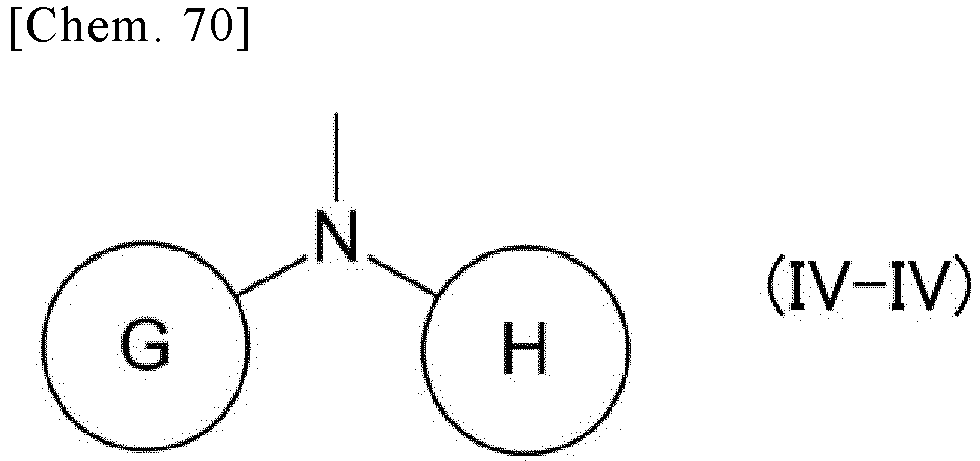
- In the Formula (IV-IV), rings G and H independently represent an optionally substituted monocyclic or polycyclic aromatic ring or heterocycle.
- Examples of the group represented by the Formula (IV-IV) include, but are not limited to, groups having the following structure:

- In the Formula (IV-IV), rings G and H are preferably optionally substituted monocyclic aromatic rings or heterocycles. The group represented by the Formula (IV-IV) is preferably an optionally substituted diphenylamino group.
- The group represented by the Formula (IV-V) is a group having the following structure:

- In the Formula (IV-V), a ring I represents an optionally substituted monocyclic aromatic ring or heterocycle, and a ring J represents an optionally substituted monocyclic or polycyclic aromatic ring, heterocycle or cyclic hydrocarbon. The rings I and J form a condensed ring.
- In the Formula (IV-V), R46 represents a hydrogen atom, an optionally substituted hydrocarbon group, or an optionally substituted heterocyclic group.
- In the 3,5-diaminobenzoic acid compound according to the present invention, the "hydrocarbon group" means a group derived from a compound composed of carbon and hydrogen atoms. Examples of the hydrocarbon group can include, but are not limited to, aliphatic hydrocarbon, monocyclic saturated hydrocarbon, and aromatic hydrocarbon groups, and preferably contain 1 to 16 carbon atoms. Specific examples of the hydrocarbon group include, but are not limited to, an alkyl group, an alkenyl group, an alkynyl group, a cycloalkyl group, and an aryl group.
- In this respect, examples of the "alkyl group" include a methyl group, an ethyl group, a propyl group, an isopropyl group, a butyl group, an isobutyl group, a sec-butyl group, a tert-butyl group, a pentyl group, and a hexyl group. Examples of the "alkenyl group" include a vinyl group, a 1-propenyl group, an a llyl group, an isopropenyl group, a butenyl group, and an isobutenyl group. Examples of the "alkynyl group" include an ethynyl group, a propargyl group, and a 1-propynyl group. Examples of "cycloalkyl group" include a cyclopropyl group, a cyclobutyl group, a cyclopentyl group, and a cyclohexyl group. Examples of "aryl group" include a phenyl group, an indenyl group, a naphthyl group, a fluorenyl group, an anthryl group, a biphenylenyl group, a phenanthrenyl group, an as-indacenyl group, an s-indacenyl group, an acenaphthylenyl group, a phenalenyl group, a fluoranthenyl group, a pyrenyl group, a naphthacenyl group, and a hexacenyl group.
- In addition, in the 3,5-diaminobenzoic acid compound according to the present invention, the "heterocyclic group" refers to a group derived from a cyclic compound composed of atoms of carbon and some other elements. In the present invention, the "heterocyclic group" can be, but is not limited to, for example, any of 5- to 14-membered monocyclic to pentacyclic heterocyclic groups each having carbon atoms and further having one to four heteroatoms of one or two elements selected from nitrogen, oxygen, and sulfur. Specific examples of the heterocyclic group can include but are not limited to a 2- or 3-thienyl group, a 2- or 3-furyl group, a 1-, 2- or 3-pyrrolyl group, a 1-, 2- or 3-pyrrolidinyl group, a 2-, 4- or 5-oxazolyl group, a 3-, 4- or 5-isooxazolyl group, a 2-, 4- or 5-thiazolyl group, a 3-, 4- or 5-isothiazolyl group, a 3-, 4- or 5-pyrazolyl group, a 2-, 3- or 4-pyrazolidinyl group, a 2-, 4- or 5-imidazolyl group, a 1,2,3-triazolyl group, a 1,2,4-triazolyl group, and a 1H- or 2H-tetrazolyl group as 5-membered cyclic groups each having carbon atoms and further having one to four heteroatoms selected from oxygen, sulfur, and nitrogen. Moreover, specific examples of the heterocyclic group can include but are not limited to a 2-, 3- or 4-pyridyl group, an N-oxide-2-, 3- or 4-pyridyl group, a 2-, 4- or 5-pyrimidinyl group, an N-oxide-2-, 4- or 5-pyrimidinyl group, a thiomorpholinyl group, a morpholinyl group, a piperidino group, a 2-, 3- or 4-piperidyl group, a thiopyranyl group, a 1,4-oxazinyl group, a 1,4-thiazinyl group, a 1,3-thiazinyl group, a piperazinyl group, a triazinyl group, a 3- or 4-pyridazinyl group, a pyrazinyl group, and an N-oxide-3- or 4-pyridazinyl group as 6-membered cyclic groups each having carbon atoms and further having one to four heteroatoms selected from oxygen, sulfur, and nitrogen. Moreover, specific examples of the heterocyclic group can include but are not limited to an indolyl group, a benzofuryl group, a benzothiazolyl group, a benzoxazolyl group, a xanthenyl group, a benzimidazolyl group, a quinolyl group, an isoquinolyl group, a phthalazinyl group, a quinazolinyl group, a quinoxalinyl group, an indolizinyl group, a quinolizinyl group, a 1,8-naphthyridinyl group, a dibenzofuranyl group, a carbazolyl group, an acridinyl group, a phenanthridinyl group, a perimidinyl group, a phenazinyl group, a chromanyl group, a phenothiazinyl group, a phenoxazinyl group, and a 7H-pirazino[2,3-c]carbazolyl group as bicyclic to tetracyclic condensed ring groups each having carbon atoms and further having one to four heteroatoms selected from oxygen, sulfur, and nitrogen.
- Examples of the group represented by the Formula (IV-V) can include, but are not limited to, groups having the following structure:

- In the Formula (IV-V), a ring J is preferably an optionally substituted monocyclic aromatic ring or a heterocycle. R46 is preferably a hydrogen atom.
- Any groups represented by the Formulae (IV-II) - (IV-V) have two or more rings and are characterized by their attachment to Y4 via a nitrogen atom.
- In the 3,5-diaminobenzoic acid compound according to the present invention, from the viewpoint of activity of the compounds, it is preferable to use the compound having the group represented by the Formula (IV-II) or (IV-IV), and more preferable to use the group represented by the Formula IV-(II), among the groups represented by the Formulae (IV-II)-(IV-V).
- In the Formula (IV-I), R42 represents a hydrogen atom, an optionally substituted hydrocarbon group, an optionally substituted heterocyclic group, or an optionally substituted amino group.
- In the 3,5-diaminobenzoic acid compound according to the present invention, the "optionally substituted amino group" is a primary amino group, a secondary amino group, or a tertiary amino group. The secondary amino group may be an amino group having one substituent, and may include, but are not limited to, for example, alkylamino group, arylamino group, alkoxycarbonylamino group and the like. The tertiary amino group may be an amino group having identical or different two substituents, and may include, but not limited to, for example, dialkylamino group, diarylamino group and the like.
- In the 3,5-diaminobenzoic acid compound according to the present invention, from the viewpoint of activity of the compounds, the compound in which R42 is a hydrogen atom or a methyl group is preferably used, and in particular, the compound in which R42 is a hydrogen atom and -CO2R42 group is a carboxyl group (-CO2H) is preferably used. However, even if R42 is an optionally substituted hydrocarbon group, an optionally substituted heterocycle group or an optionally substituted amino group, and the activity of the compound is low, the compound may be subject to hydrolysis and easily become a carboxyl group by substitution by hydrogen atoms so that the activity of the compound may be increased. Thus, such a compound can be also used as a prodrug.
- In the Formula (IV-I), R43 represents a hydrogen atom, an optionally substituted hydrocarbon group, or an optionally substituted heterocyclic group.
- Moreover, R44 represents a hydrogen atom, an optionally substituted hydrocarbon group, or an optionally substituted heterocyclic group.
- In the 3,5-diaminobenzoic acid compound according to the present invention, from the viewpoint of activity of the compounds, the compound in which R43 and R44 are hydrogen atoms is preferably used. Such a compound can be represented by the following general formula (IV-VII):

- In the Formula (IV-VII), the ring A, R41, R42, R45, X4 and Y4 are the same as defined in the Formula (IV-I).
- In the Formula (IV-I), R45 represents 0 to 3 identical or different substituents attached to a benzene ring. In this context, "different" also includes the case in which only one of three substituents is different. In the 3,5-diaminobenzoic acid compound according to the present invention, the compound having no R45, namely, the compound having hydrogen atoms at
positions - In the Formula (IV-I), X4 represents a single bond, C1-2 alkylene group, -O-group, -CH2-O- group, -CH2-NH-CO- group, or -CH2-NH-CO-O-CH2- group.
- In the 3,5-diaminobenzoic acid compound according to the present invention, from the viewpoint of activity of the compounds, preferably the compound in which X4 is a single bond, -CH2-O- group or -CH2-NH-CO- group may be used, and more preferably the compound in which X4 is a single bond may be used.
- In the Formula (IV-I), Y4 represents a single bond or C1-2 alkylene group.
- In the 3,5-diaminobenzoic acid compound according to the present invention, from the viewpoint of activity of the compounds, preferably the compound in which Y4 is a single bond or C1 alkylene group (methylene group) may be used, and more preferably the compound in which Y4 is a single bond may be used.
- In this context, the "single bond" refers to the state that the groups on both sides of X4 (or Y4) are attached directly without any linking groups.
- In the 3,5-diaminobenzoic acid compound according to the present invention, from the viewpoint of activity of the compounds, in the compound represented by the Formula (IV-I), R43 and R44 are preferably hydrogen atoms, and more preferably X4 and Y4 are single bonds. Such compounds can be represented by the following general formula (IV-VIII):


- In the Formula (IV-VIII), the ring A, R41, R42 and R45 are the same as defined in the Formula (IV-I).
- The aforementioned 3,5-diaminobenzoic acid compound can be synthesized by, for example, but not limited to, using a diaminobenzoate ester, according to the scheme shown in the following reaction flow chart (A):


- In the reaction flow chart (A), the ring A, R41 to R45, X4 and Y4 are the same as defined in the Formula (IV-I). W and Z independently represent a halogen atom or a hydroxy group.
- In the reaction flow chart (A), the reaction (1) is a reaction for Boc-protecting amines, in which one amine in diaminobenzoate ester is reacted with (Boc)2O (di-tert-butyl dicarbonate) in the presence of a base. Then, the reaction (2) is a reaction in which the unreacted other amine in the diaminobenzoate ester is reacted with an acyl halide or a carboxylic acid having R41 and Y4 to attach a group having R41 and Y4 to the amine via an amide bond. The reaction (3) is a reaction for deprotection in which a Boc group is detached under an acidic condition. Then, the reaction (4) is a reaction in which the deprotected amine is reacted with an acyl halide or a carboxylic acid having the ring A and X4 to attach a group having the ring A and X4 to the amine via an amide bond.
- The compound obtained from the reaction flow chart (A) is the compound represented by the Formula (IV-I), and moreover, in the case of R42 being not a hydrogen atom, R42 may be detached in a basic condition to obtain a carboxylic acid in which R42 is substituted with a hydrogen atom.
- Furthermore, in the case of R42 being not a hydrogen atom, R42 may also be detached after the reaction (3), followed by performing the reaction (4) to obtain a carboxylic compound.
- The 3,5-diaminobenzoic acid compound according to the present invention can also be synthesized by using a diaminobenzoate ester according to the scheme shown in the following reaction flow chart (B):

- In the reaction flow chart (B), rings A, R41 to R45, X4 and Y4 are the same as defined in the Formula (IV-I). W and Z independently represent a halogen atom or a hydroxy group.
- In the reaction flow chart (B), the reaction (1) is the same as the reaction (1) in the reaction flow chart (A), that is, a reaction for Boc-protecting amines, in which one amine in diaminobenzoate ester is reacted with (Boc)2O (di-tert-butyl dicarbonate) in the presence of a base. Then, the reaction (5) is a reaction in which the unreacted other amine in the diaminobenzoate ester is reacted with an acyl halide or a carboxylic acid having rings A and X4 to attach a group having the rings A and X4 to the amine via an amide bond. The reaction (6) is a reaction for deprotection in which a Boc group is detached under an acidic condition. Then, the reaction (7) is a reaction in which the deprotected amine is reacted with an acyl halide or a carboxylic acid having R41 and Y4 to attach a group having R41 and Y4 to the amine via an amide bond.
- The reaction (A) is different from the reaction (B) in that the reaction (A) attaches the group having R41 and Y4 first, while the reaction (B) attaches the group having the rings A and X4 first.
- The compound obtained from the reaction flow chart (B) is the compound represented by the Formula (IV-I), and moreover, in the case of R42 being not a hydrogen atom, R42 may be detached in a basic condition to obtain a compound of a carboxylic acid in which R42 is substituted with a hydrogen atom.
- Furthermore, in the case of R42 being not a hydrogen atom, R42 may also be detached after the reaction (6), followed by performing the reaction (7) to yield a carboxylic compound.
- The reaction flow charts (A) and (B) are the reactions involving protection with a Boc group and deprotection. However, these reactions can be accomplished without protection with a Boc group. For example, the compound may be synthesized with the scheme shown in the following reaction flow chart (C):

- In the reaction flow chart (C), the ring A, R41 to R45, X and Y are the same as defined in the Formula (IV-I). W and Z independently represent a halogen atom or a hydroxy group.
- In the reaction flow chart (C), the reaction (8) is a reaction in which one amine in diaminobenzoate ester is reacted with an acyl halide or a carboxylic acid having R41 and Y4 to attach a group having R41 and Y4 to the amine via an amide bond. The reaction (9) is a reaction is a reaction in which the unreacted other amine in the diaminobenzoate ester is reacted with an acyl halide or a carboxylic acid having rings A and X4 to attach a group having the rings A and X4 to the amine via an amide bond.
- The reaction flow chart (C) is a synthesis method in which the group having R41 and Y4 is first attached as with the reaction flow chart (A). Although the purity is lower because the protection with a Boc group is not performed, it is possible to synthesize it at sufficiently high purity by exploring the reaction conditions.
- The compound obtained from the reaction flow chart (C) is the compound represented by the Formula (IV-I), and moreover, in the case of R42 being not a hydrogen atom, R42 may be detached in a basic condition to obtain a carboxylic acid in which R42 is substituted with a hydrogen atom.
- Furthermore, in the case of R42 being not a hydrogen atom, R42 may also be detached after the reaction (8), followed by performing the reaction (9) to yield a carboxylic compound.
- The compounds shown in the following table or salts thereof can also be used as the compound that is an active ingredient of the therapeutic or prophylactic agent for coronavirus disease according to present invention:
[Table 1] Compound No. Structural Formula Reference PA-1 
CN 107098906 PA-2 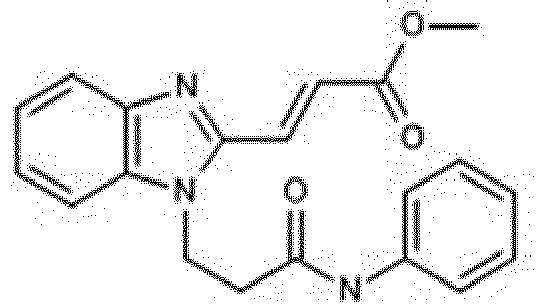
CN 106632065 PA-3 
WO 2017/063757 PA-4 
WO 2017/063756 PA-5 
WO 2017/063755 PA-6 
WO 2017/063754 PA-7 
WO 2016/145186 PA-8 
WO 2016/011268 PA-9 
CN 102250075 PA-10 
WO 2006/124494 PA-11 
WO 2006/040646 PA-1 2 
WO 2006/040646 PA-13 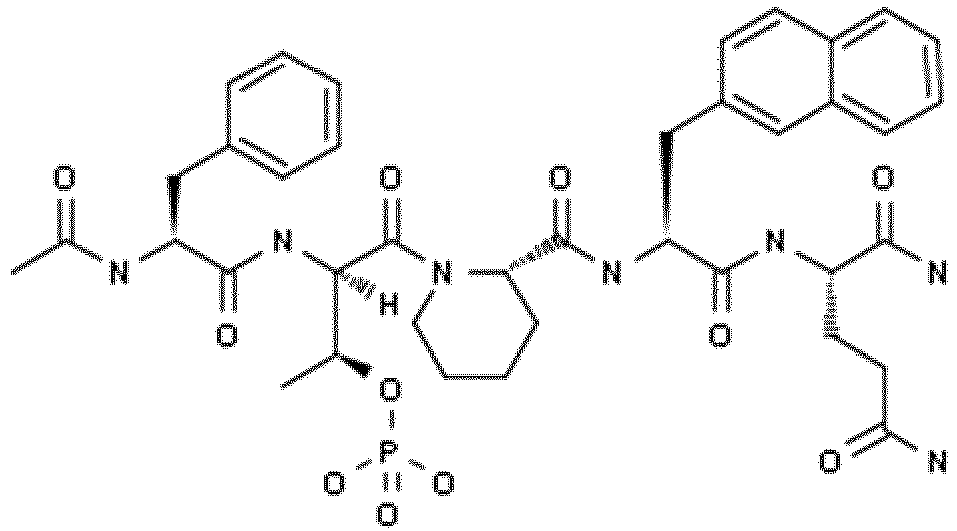
WO 2006/019982 PA-14 
WO 2006/020417 PA-1 5 
US 2005250742 PA-16 
WO 2005/063259 PA-17 
WO 2005/007123 PA-1 8 
WO 2004/087720 PA-19 
WO 2004/026815 PA-20 
WO 2004/026815 PA-21 
WO 2004/026815 PA-22 
WO 2003/093258 PA-23 
WO 2003/074550 PA-24 
WO 2003/073999 PA-25 
WO 2003/074497 PA-26 232nd Am Chem Soc (ACS) Natl Meet 2006 PA-27 
Bioorg Med Chem Lett 2010, 20(2): 586 PA-28 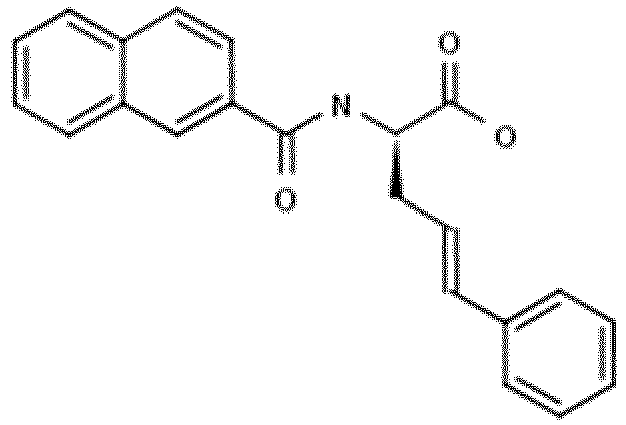
Bioorg Med Chem Lett 2010, 20(7): 2210 PA-29 
Bioorg Med Chem Lett 2010, 20(22): 6483 PA-30 
Bioorg Med Chem 2012, 20(9): 2992 PA-31 
Bioorg Med Chem Lett 2014, 24(24): 5612 PA-32 
Bioorg Med Chem Lett 2015, 25(23): 5619 PA-33 
Nat Commun 2017, 8: 15772 - The compound that is an active ingredient of the present invention is a compound that has inhibitory activity against the function of Pin1. For example, the compounds that have a chemical structure represented by the Formula (I-I), (II-I), (III-I), (IV-I), or Table 1, or salts thereof can be used as the aforementioned compound.
- In the present invention, the phrase "inhibit the function of Pin1" means: inhibiting the isomerase activity of Pin1 and/or the activity of Pin1 to associate or interact with another protein, such as IRS-1; and/or facilitating decomposition of the Pin1 enzyme.
- In order to examine whether the compound as an active ingredient has inhibitory activity against the function of Pin1, the activity of a Pin1 inhibitor according to the present invention to inhibit the function of Pin1 can be measured by, for example, but not limited to, examining AMPK (AMP-activated protein kinase) phosphorylation level as an index (see Yusuke Nakatsu et al., Journal of Biological Chemistry, 2015, Vol. 290, No. 40, pp. 24255-24266). Alternatively, the activity of a Pin1 inhibitor according to the present invention to inhibit the function of Pin1 can be measured by detecting a change in the isomerase activity of Pin1 against a peptide substrate as a change in absorbance (see Hailong Zhao et al., Bioorganic & Medicinal Chemistry, 2016, Vol. 24, pp. 5911-5920). Alternatively, the activity of a Pin1 inhibitor according to the present invention to inhibit the function of Pin1 can also be measured by detecting the association of the inhibitor with Pin1, which competes with the association of Pin1 with a peptide substrate (see Shuo Wei et al., Nature Medicine, Vol. 21, No. 5, pp. 457-466, online methods).
- The therapeutic or prophylactic agents for viral diseases according to the present invention contain the compound that inhibits the function of Pin1 or pharmaceutically acceptable salt thereof as an active ingredient. The compound that inhibits the function of Pin1 includes, for example, a compound that has a chemical structure represented by the Formula (I-I), (II-I), (III-I), (IV-I), or Table 1.
- Examples of the "pharmaceutically acceptable salt" can include, but are not limited to, sodium, potassium, and ammonium salts. Additionally, in cases where the compound has a basic functional group in the molecule, examples of a pharmaceutically acceptable salt of the compound can include hydrochloride, phosphate, acetate, phthalate, fumarate, and oxalate salts.
- "Viral diseases", which are indications of the therapeutic or prophylactic agent according to the present invention, are diseases caused by viruses, including, e.g., a coronavirus infection caused by coronaviruses.
- Coronaviruses that infect humans include alpha-coronaviruses (HCoV-229E and HCoV-NL63) and beta-coronaviruses (MERS-CoV, SARS-CoV, SARS-CoV-2, HCoV-OC43 and HCoV-HKU1). HCoV-229E, HCoV-OC43, HCoV-NL63 and HCoV-HKU1 are causes of common cold, mostly with mild symptoms, however sometimes accompanied by high fever. It is thought that SARS-CoV is derived from a bat-borne coronavirus, which infects human and causes severe pneumonia, while MERS-CoV is a virus that causes cold symptoms in dromedary camels, but causes severe pneumonia if it jumps the species barrier to infect humans. The infectious disease caused by SARS-CoV-2 (COVID-19) mainly spreads with human-to-human transmission via through airborne droplets expelled by coughs and sneezes of an infected person. COVID-19 causes fever, respiratory symptoms, headache, fatigue and the like and can also cause olfactory or taste disorders. The therapeutic or prophylactic agent according to the present invention is especially preferred to be applied to a coronavirus infection caused by beta-coronavirus, and more preferably applied to a coronavirus infection caused by SARS-CoV-2 (COVID-19).
- The compounds serving as an active ingredient in the present invention have an effect of inhibiting the function of Pin1 as their mechanism of action and can suppress viral proliferation so that they can be used as a therapeutic or prophylactic agent for viral diseases. The therapeutic or prophylactic agent for viral diseases according to the present invention can be administered as a therapeutic agent or a prophylactic agent not only to patients diagnosed as having a viral disease, but also to patients possibly having a viral disease and patients at risk of developing a viral disease. In addition, the therapeutic or prophylactic agent for viral diseases according to the present invention suppresses proliferation of SARS-CoV-2 virus so that it can be preferably used particularly to treat or prevent coronavirus infection caused by SARS-CoV-2. Namely, the present invention can provide a method of treating or preventing COVID-19, the method comprising administrating a therapeutically effective amount of a Pin1 inhibitor (including those identified by the screening method of Example 6), or a pharmaceutically acceptable salt thereof, having the function as a therapeutic or prophylactic agent for a viral disease, to the subjects in need thereof, e.g., patients suffering from COVID-19, medical workers who have frequent contact with COVID-19 patients or SARS-CoV-2, service workers who serve many people, and the like.
- The therapeutic or prophylactic agents for viral diseases according to the present invention can be prepared by combining a compound as an active ingredient or a pharmaceutically acceptable salt thereof and a pharmaceutically acceptable carrier to form a pharmaceutical composition, and may be made in the form of, for example, but not limited to, tablets, granules, capsules, powders, liquids, injection solutions, suppositories, patches, eye drops, and inhalants. Preferred dosage forms include: for example, tablets, granules, capsules, powders, and liquids for oral administration.
- As a pharmaceutically acceptable carrier which can be used in the therapeutic or prophylactic agents for viral diseases according to the present invention, various inorganic or organic carrier materials can be used. When the pharmaceutical composition is prepared in solid formulation, such as a tablet or a granule, an excipient, a lubricant, a binder, a disintegrator, and the like can be used. When the pharmaceutical composition is prepared in liquid formulation, such as a liquid or an injection solution, a solvent, a solubilizing agent, a suspending agent, a buffering agent, and the like can be used. Moreover, additives such as antioxidant, antiseptic agent, and coloring agent can also be used as necessary.
- Non-limiting examples of an excipient that can be used include lactose, D-mannitol, and starch; non-limiting examples of a lubricant that can be used include magnesium stearate and talc; non-limiting examples of a binder that can be used include crystalline cellulose and gelatin; non-limiting examples of a disintegrator that can be used include carboxymethyl cellulose. Moreover, examples of a solvent that can be used include distilled water, alcohols, and propylene glycol; examples of a solubilizing agent that can be used include polyethylene glycol and ethanol; examples of a suspending agent that can be used include stearyl triethanolamine and sodium lauryl sulfate; examples of a buffering agent that can be used include phosphate and acetate salts.
- The therapeutic or prophylactic agent for viral diseases according to the invention may be administered to a patient, e.g., preferably at a daily dose of 0.01 to 100 mg, more preferably 0.1 to 10 mg of active ingredient per kg of patient's body weight.
- The therapeutic or prophylactic agent for coronavirus diseases according to the present invention may contain, in addition to the compound according to the present invention or pharmaceutically acceptable salts thereof, one or more active ingredients of at least one or more drugs selected from drugs classified as therapeutic or prophylactic agents for coronavirus diseases. Examples of such an active ingredient which can be used include, but not limited to, remdesivir, favipiravir, chloroquine, hydroxychloroquine, nafamostat, interferon and the like. The therapeutic or prophylactic agent for viral diseases according to the invention can be used in combination with other therapeutic or prophylactic agents for viral diseases.
- Now, the present invention will be described in detail by reference to Examples, but the present invention is not limited thereto.
- In this Example, in order to investigate the effect of Pin1 on SARS-CoV-2 proliferation, SARS-CoV-2 proliferation was observed in VeroE6/TMPRSS2 cells transduced with siRNA targeting Pin1. VeroE6 cells overexpressing TMPRSS2 (hereinafter referred to as "VeroE6/TMPRSS2 cell") (Shutoku Matsuyama and other 17 authers, PNAS, March 31, 2020, Vol. 117, p. 7001-7003) were transfected with the following two types of Pin1 siRNAs (SEQ ID No. 1 and SEQ ID No. 2) or a control siRNA at a final concentration of 20 nM by reverse transfection.
- SEQ ID No. 1: cggcaacagc agcaguggug gcaaa
- SEQ ID No. 2: gcccuggagc ugaucaacgg cuaca
- After 3 days, SARS-CoV-2 was infected to these cells at multiplicity of infection (MOI) of 0.01, followed by recovering cell lysate 24 hours after the infection and then detecting SARS-CoV-2 nucleocapsid, Pin1, and actin as an internal standard in the cells by Western blotting. SARS-CoV-2 proliferation was evaluated on the basis of the expression level of SARS-CoV-2 nucleocapsid in the cells.
FIG. 1 (A) shows results of Western blotting, and (B) shows the relative intensity of SARS-CoV-2 nucleocapsid normalized to the detection intensity of SARS-CoV-2 nucleocapsid in control siRNA. As shown inFigs. 1 , both of the two types of Pin1 siRNAs significantly reduced the expression level of the Pin1 protein. In addition, in the cells transfected with the two types of Pin1 siRNAs, the detection intensity of SARS-CoV-2 nucleocapsid was significantly reduced compared to the control siRNA. Thus, it was confirmed that the proliferation of SARS-CoV-2 can be suppressed by inhibiting the expression of Pin1. - In this Example, an anthranilic acid compound was produced. First, intermediates (H-122 and H-64) used to synthesize the compound according to the present invention were produced. The known compound (H-122) represented by the following structural formula was synthesized in two steps according to the method described in J. Org. Chem., 2001, vol.66, pp.2784-2788 using anthranilic acid as a raw material.

- The known compound (H-64) represented by the following structural formula was synthesized in four steps according to the method described in J. Org. Chem., 2001, vol.66, pp.2784-2788 using anthranilic acid as a raw material.

- Triethylamine (316 mg, 0.44 mL, 3.12 mmol) was added to a solution of H-64 (400 mg, 1.56 mmol) and 2-naphthoyl chloride (327 mg, 1.72 mmol) in dichloromethane (5 mL) at room temperature and stirred for 13 hours at the same temperature. Water was added to the mixture, and the mixture was extracted with ethyl acetate. The organic layer was washed with saturated saline solution, dried over anhydrous magnesium sulfate, and then filtered and concentrated under reduced pressure. The residue was purified by silica gel column chromatography (chloroform: ethyl acetate, 15:1) to give H-68 as white crystals (531 mg, 1.29 mmol, 83%).
- The measured NMR spectrum and HR-ESI-MS result of H-68 are as follows. 1H NMR (400 MHz, CDCl3) δ 3.99 (3H, s), 5.11 (2H, s), 7.28 (1H, dd, J = 9.2, 3.2 Hz), 7.32-7.48 (5H, m), 7.54-7.62 (2H, m), 7.70 (1H, d, J = 3.2 Hz), 7.88-7.93 (1H, m), 7.97 (1H, d, J = 8.8 Hz), 8.01-8.05 (1H, m), 8.09 (1H, dd, J = 8.7, 1.8 Hz), 8.57 (1H, bs), 8.92 (1H, d, J = 9.2 Hz), 12.0 (1H, bs); HRESIMS calcd for C26H22NO4 [M+H]+ 412.1549, found 412.1550.
- The identified chemical structure of H-68 is as follows:

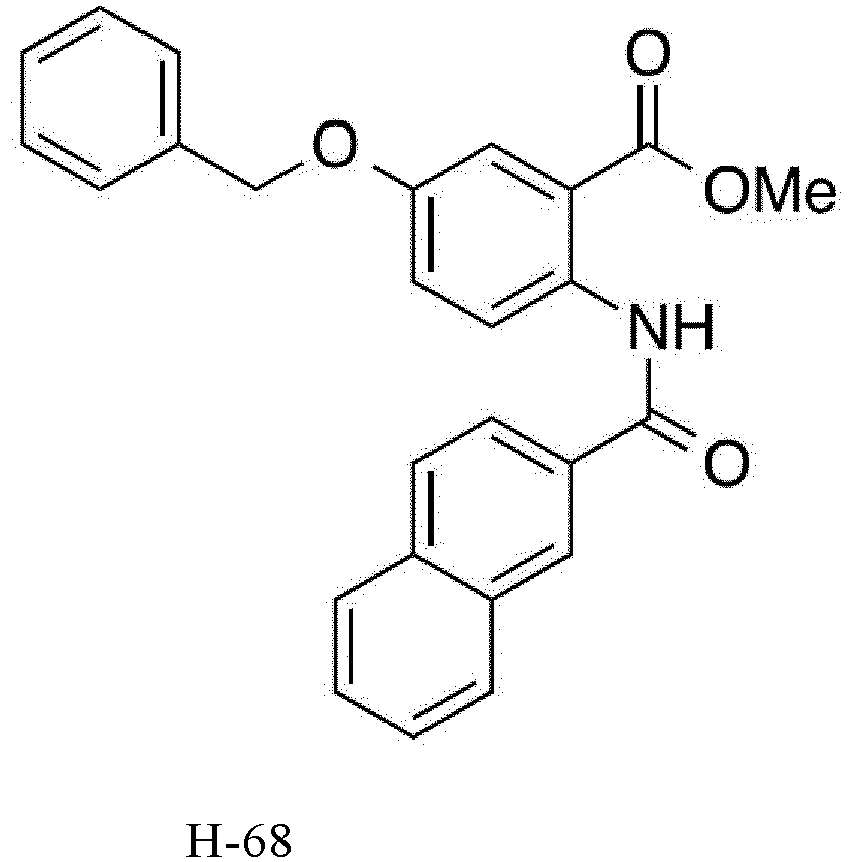
- Lithium hydroxide aqueous solution (1 M, 2.2 mL, 2.2 mmol) was added to a solution of H-68 (300 mg, 0.73 mmol) in THF (8 mL) at room temperature and stirred for 4 hours at the same temperature. The mixture was neutralized with 1M hydrochloric acid and extracted with ethyl acetate. The organic layer was washed with saturated saline solution, dried over anhydrous magnesium sulfate, and then filtered and concentrated under reduced pressure to give H-77 as white crystals (280 mg, 0.705 mmol, 97%).
- The measured NMR spectrum and HR-ESI-MS result of H-77 are as follows. 1H NMR (400 MHz, DMSOd6) δ 5.16 (2H, s), 7.31-7.43 (4H, m), 7.45-7.49 (2H, m), 7.60-7.69 (3H, m), 7.99 (1H, dd, J = 8.7, 1.8 Hz), 8.00-8.05 (1H, m), 8.06-8.12 (2H, m), 8.55 (1H, bs), 8.61 (1H, d, J = 9.1 Hz), 12.0 (1H, bs); HRESIMS calcd for C25H19NO4Na [M+Na]+ 420.1212, found 420.1218.
- The identified chemical structure of H-77 is as follows:


- Other anthranilic acid compounds used in Example 3 were synthesized by using the production method described in
WO 2019/031472 and the known methods. Amide compounds used in Example 3 were synthesized by using the production method described inWO 2019/031470 and the known methods. Carboxylic-acid-derivative compounds used in Example 3 were synthesized by using the production method described inWO 2019/031471 and the known methods. - In this Example, the inhibitory effect of SARS-CoV-2 proliferation by the Pin1 inhibotor H-77. First, H-77 produced in Example 2-1 was added to VeroE6 / TMPRSS2 cells to the final concentration of 10 µM, to which SARS-CoV-2 was infected at multiplicity of infection (MOI) of 10 after 2 hours, followed by recovering cell lysate 8 hours after the infection and then detecting SARS-CoV-2 nucleocapsid, Pin1 and actin as an internal standard in the cells by Western blotting.
FIG. 2 (A) shows results of Western blotting. - Also, H-77 was added to VeroE6/TMPRSS2 cells to the final concentration of 0, 2, 5, 7.5, and 10 µM, to which SARS-CoV-2 was infected at multiplicity of infection (MOI) of 0.01 after 2 hours, followed by recovering culture supernatant 24 hours after the infection and then quantifying the SARS-CoV-2 RNA level in the supernatant by real-time PCR.
FIG. 2 (B) shows results of quantification, in which the proliferation of SARS-CoV-2 was suppressed by adding 5 µM of H-77, and in particular, the proliferation of SARS-CoV-2 was substantially suppressed by adding 7.5 µM of H-77. -
FIGs. 3 (A) and (B) show photographs of the cells infected with SARS-CoV-2. InFIG. 3 (A) , H-77 was added to VeroE6/TMPRSS2 cells at the final concentration of 10 µM, then the cells were infected with SARS-CoV-2 at multiplicity of infection (MOI) of 0.01 to 0.02 after 2 hours, followed by taking aphotograph 20 hours after infection.FIG. 3 (B) is a photograph similar to that inFIG. 3 (A) except that DMSO was added as a control instead of H-77. - Table 2 shows results of the confirmation test of a suppressing effect of various Pin1 inhibitors against SARS-CoV-2 proliferation. In the confirmation test, a Pin1 inhibitor was added to VeroE6 / TMPRSS2 cells to the final concentration of 20 µM, to which SARS-CoV-2 was infected at multiplicity of infection (MOI) of 10 after 2 hours, followed by recovering cell lysate 8 hours after the infection and then detecting SARS-CoV-2 nucleocapsid, Pin1 and actin as an internal standard in the cells by Western blotting. The inhibition rate was determined by defining the band area when Pin1 inhibitor was not added as 0 % inhibition, then calculating the comparative ratio of the band area when Pin1 inhibitor was added under the same test condition. When a band area is 0 (when no band is observed), the inhibition rate is 100 %. In Table 2, the "Class" means the system of the Pin1 inhibitors. Examples 3-2 to 3-16 are the Pin1 inhibitors of the anthranilic acid compound (the Formula (I-I)), Examples 3-17 to 3-23 are the Pin1 inhibitors of the amide compound (the Formula (II-I)) and are simultaneously the Pin1 inhibitors of the carboxylic-acid-derivative compound (the Formula (III-I)). Examples 3-24 to 3-56 are the Pin1 inhibitors of the carboxylic-acid-derivative compound (the Formula (III-I)). Examples 3-57 to 3-75 are the Pin1 inhibitors of the 3,5-diaminobenzoic acid compound (the Formula (IV-I)). Examples 3-76 to 108 are the Pin1 inhibitors that are not encompassed by these Formulae.
[Table 2] Ex No. Comp. No. Inhibition Rate Structural Formula of Pin 1 Inhibitor Class 3-2 H-77 96 
(I-I) 3-3 H-338 99 
(I-I) 3-4 H-339 76 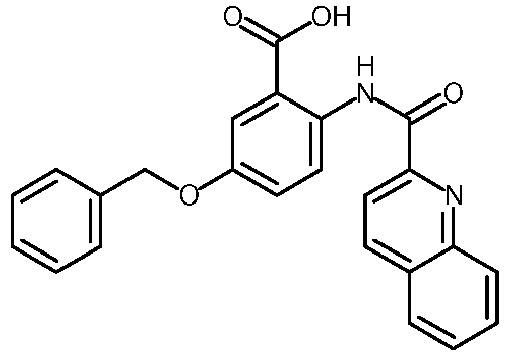
(I-I) 3-5 H-362 99 
(I-I) 3-6 H-363 99 
(I-I) 3-7 H-370 98 
(I-I) 3-8 H-371 99 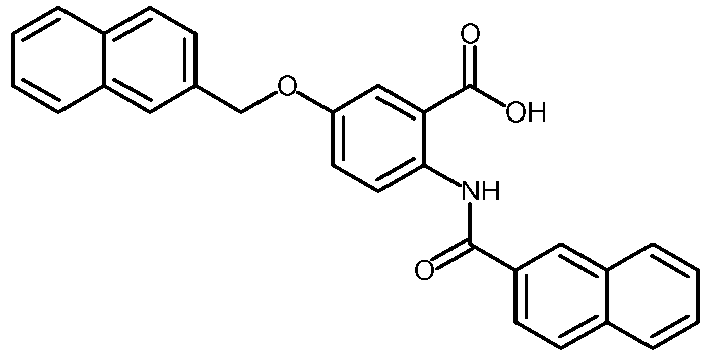
(I-I) 3-9 H-429 99 
(I-I) 3-10 H-487 63 
(I-I) 3-11 H-537 96 
(I-I) 3-12 H-787 97 
(I-I) 3-13 H-800 91 
(I-I) 3-14 H-835 99 
(I-I) 3-15 H-839 83 
(I-I) 3-16 H-103 100 
(II-I) (III-I) 3-17 H-105 100 
(II-I) (III-I) 3-18 H-162 99 
(II-I) (III-I) 3-19 H-393 80 
(II-I) (III-I) 3-20 H-509 98 
(II-I) (III-I) 3-21 H-536 75 
(II-I) (III-I) 3-22 H-853 99 
(II-I) (III-I) 3-23 H-30 99 
(III-I) 3-24 H-32 86 
(III-I) 3-25 H-33 100 
(III-I) 3-26 H-95 95 
(III-I) 3-27 H-106 100 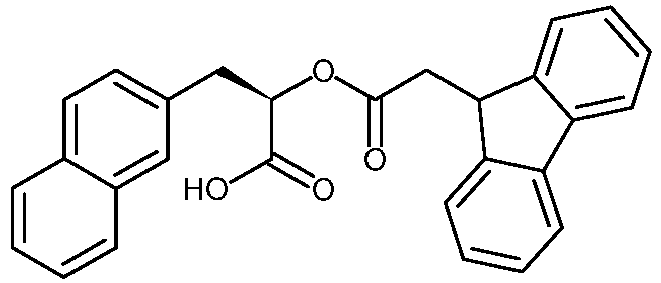
(III-I) 3-28 H-123 99 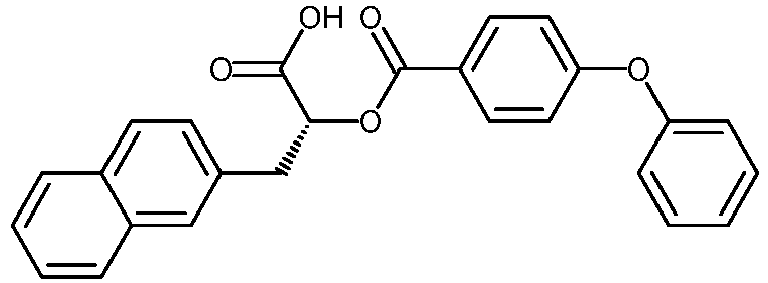
(III-I) 3-29 H-130 100 
(III-I) 3-30 H-132 99 
(III-I) 3-31 H-134 98 
(III-I) 3-32 H-149 99 
(III-I) 3-33 H-151 98 
(III-I) 3-34 H-157 100 
(III-I) 3-35 H-175 100 
(III-I) 3-36 H-177 99 
(III-I) 3-37 H-179 97 
(III-I) 3-38 H-181 99 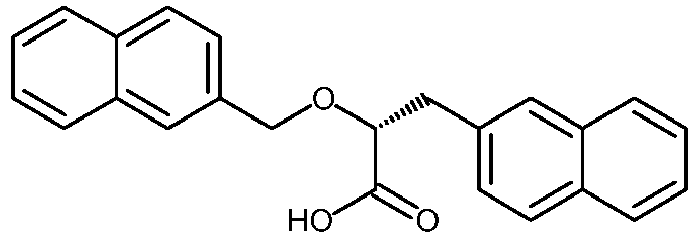
(III-I) 3-39 H-198 67 
(III-I) 3-40 H-200 98 
(III-I) 3-41 H-210 99 
(III-I) 3-42 H-248 88 
(III-I) 3-43 H-254 94 
(III-I) 3-44 H-262 94 
(III-I) 3-45 H-263 54 
(III-I) 3-46 H-269 98 
(III-I) 3-47 H-438 99 
(III-I) 3-48 H-452 52 
(III-I) 3-49 H-464 100 
(III-I) 3-50 H-507 99 
(III-I) 3-51 H-512 90 
(III-I) 3-52 H-514 99 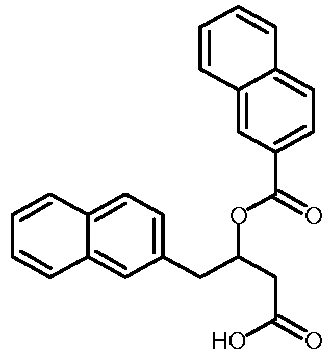
(III-I) 3-53 H-614 96 
(III-I) 3-54 H-596 99 
(IV-I) 3-55 H-680 53 
(IV-I) 3-56 H-684 66 
(IV-I) 3-57 H-685 58 
(IV-I) 3-58 H-688 98 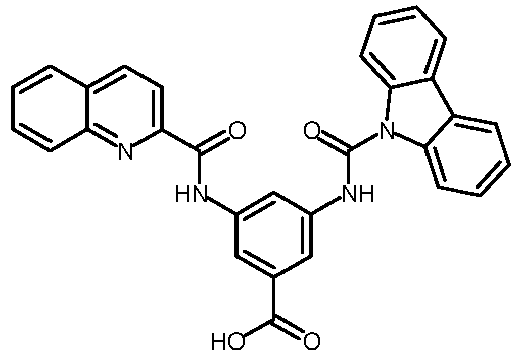
(IV-I) 3-59 H-691 52 
(IV-I) 3-60 H-693 77 
(IV-I) 3-61 H-762 83 
(IV-I) 3-62 H-763 97 
(IV-I) 3-63 H-819 95 
(IV-I) 3-64 H-821 95 
(IV-I) 3-65 H-857 55 
(IV-I) 3-66 H-859 89 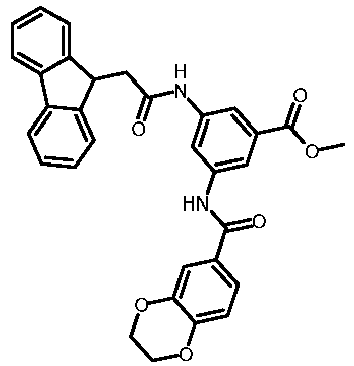
(IV-I) 3-67 H-870 97 
(IV-I) 3-68 H-871 61 
(IV-I) 3-69 H-876 69 
(IV-I) 3-70 H-878 56 
(IV-I) 3-71 H-881 88 
(IV-I) 3-72 H-890 54 
(IV-I) 3-73 H-78 96 
3-74 H-336 98 
3-75 H-337 100 
3-76 H-348 81 
3-77 H-444 55 
3-78 H-448 100 
3-79 H-488 100 
3-80 H-489 99 
3-81 H-491 91 
3-82 H-546 83 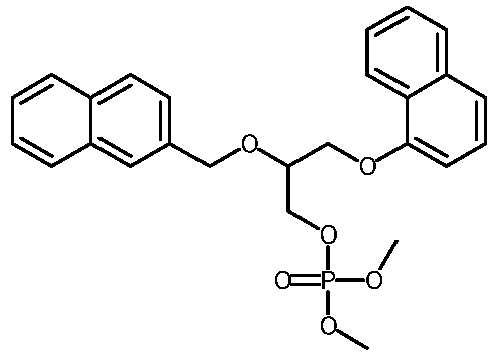
3-83 H-619 94 
3-84 H-626 88 
3-85 H-644 95 
3-86 H-669 64 
3-87 H-674 50 
3-88 H-678 87 
3-89 H-696-2 98 
3-90 H-707 55 
3-91 H-708 62 
3-92 H-715 63 
3-93 H-717 87 
3-94 H-725-2 81 
3-95 H-727 50 
3-96 H-739 51 
3-97 H-742 57 
3-98 H-743 59 
3-99 H-755 78 
3-100 H-755-2 75 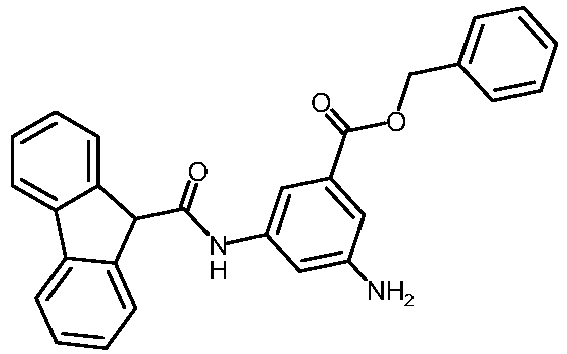
3-101 H-816 63 
3-102 H-817 61 
3-103 H-832 65 
3-104 H-848 53 
3-105 H-849 50 
3-106 H-851 59 
3-107 H-872 78 
3-108 H-873 67 
- In addition, in Table 2, the Pin1 inhibitors which showed high inhibition rate were observed to confirm a suppressing effect against SARS-CoV-2 proliferation when added at 5 µM or 10 µM. To 1 × 10⁵ VeroE6 / TMPRSS2 cells /well was added a Pin1 inhibitor to a final concentration of 5 or 10 µM, to which SARS-CoV-2 was infected at multiplicity of infection (MOI) of 10 after 2 hours, followed by recovering cell lysate 8 hours after the infection and then detecting SARS-CoV-2 nucleocapsid and actin as an internal standard in the cells by Western blotting.
FIG. 4 shows the result of adding the Pin1 inhibitors of the Formula (I-I) (H-77 (Example 3-2), H-362 (Example 3-5), H-363 (Example 3-6), H-370 (Example 3-7), H-371 (Example 3-8), H-537 (Example 3-11), H-787 (Example 3-12), and H-835 (Example 3-14)).FIG. 5 shows results of adding the Pin1 inhibitors of the Formula (II-I) (H-509 (Example 3-20) and H-853 (Example 3-22)).FIG. 6 shows results of adding the Pin1 inhibitors of the Formula (III-I) (H-33 (Example 3-25), H-130 (Example 3-29), H-175 (Example 3-35), and H-614 (Example 3-53)).FIG. 7 shows results of adding the Pin1 inhibitors of the Formula (IV-I) (H-596 (Example 3-54), H-688 (Example 3-58), H-859 (Example 3-66), and H-870 (Example 3-67)).FIGs. 4 to 7 shows that H-77, H-537, and H-688 exhibited high inhibition rate even at 5 µM addition amount. Therefore, they are expected to have therapeutic and prophylactic effects when administered at a low concentration. - In this Example, the inhibitory effect of SARS-CoV-2 proliferation by ATRA, a therapeutic agent for promyelocytic leukemia known to have inhibitory activity against Pin1. ATRA was added to VeroE6 / TMPRSS2 cells to the final concentrations of 0, 0.5, 1, 5, 10, 20, and 30 µM, to which SARS-CoV-2 was infected at multiplicity of infection (MOI) of 0.01 after 2 hours, followed by recovering cell lysate after 24 hours and then detecting SARS-CoV-2 nucleocapsid, Pin1 and actin as an internal standard in the cells by Western blotting. SARS-CoV-2 proliferation was evaluated on the basis of the expression level of SARS-CoV-2 nucleocapsid in the cells.
FIG. 8 (A) shows results of Western blotting.FIG. 8 (B) shows results by real-time PCR evaluation of SARS-CoV-2 RNA level in the culture supernatant 24 hours after infection in the aforementioned experiment. As shown inFIGs. 8 , the proliferation of SARS-CoV-2 was suppressed by adding 5 µM or more of ATRA, and in particular, the proliferation of SARS-CoV-2 was substantially suppressed by adding 10 µM or more of ATRA. - In this Example, it was confirmed that the Pin1 inhibitor H-77 exhibited a suppressive effect even after infection with SARS-CoV-2. VeroE6/TMPRSS2 cells were infected with SARS-CoV-2 at multiplicity of infection (MOI) of 0.01 to 0.02, to which H-77 was added either: 1. 2 hours before the infection, 2. at the time of the infection, 3. 2 hours after the infection, or 4. 6 hours after the infection, to a final concentration of 10 µM. Alternatively, 5. H-77 was not added. Cell lysate was recovered 24 hours after the infection, and then SARS-CoV-2 nucleocapsid in the cells and actin as an internal standard were detected by Western blotting. SARS-CoV-2 proliferation was evaluated on the basis of the expression level of SARS-CoV-2 nucleocapsid in the cells.
FIG. 9 (A) shows results of Western blotting.FIG. 9 (B) shows results by real-time PCR evaluation of SARS-CoV-2 RNA level in the culture supernatant 24 hours after infection in the aforementioned experiment. As shown inFIGs. 9 , it was confirmed that SARS-CoV-2 proliferation could be suppressed (1) when H-77 was added before the SARS-CoV-2 infection, (2) when H-77 was added at the time of the SARS-CoV-2 infection, and (3, 4) when H-77 was added after the SARS-CoV-2 infection. In other words, it was confirmed that the compound according to the present invention functions both as a prophylactic agent and as a therapeutic agent. However, since SARS-CoV-2 was slightly detected when H-77 was added 6 hours after the infection, it is preferable to administer H-77 as soon as possible after infection. - In this Example, therapeutic or prophylactic agents for coronavirus infection caused by SARS-CoV-2 were identified by a screening method comprising steps of: acquiring a library of Pin1 inhibitors using a cell-free assay; and measuring their ability to inhibit proliferation of SARS-CoV-2 virus using a cell-based assay. First, a cell-free assay for measuring cis-to-trans conversion of a phosphorylated serine/threonine-proline motif contained in a substrate peptide was used to measure inhibitory activity against the function of Pin1, and the library of Pin1 inhibitors was acquired (see, Bernhard Janowski, and 3 other authers, Analytical Biochemistry, October 15, 1997, Vol.252(2), p.299-307). Succ-AEPF-pNA (succinyl-alanine-glutamic acid-proline-phenylalanine-p-nitroanilide) was used as the substrate peptide. Approximately 60% of the substrate was retained in cis conformation in LiClItrifluoroethanol. A Pin1 enzyme alone, or the Pin1 enzyme and 2 µM or 20 µM of the test compound were added, and the kinetics of Pin1 cis/trans isomerase activity was measured for 1000 seconds using a UV/Vis spectrophotometer. The enzymatic rate constant of the reaction was determined by fitting the data to a first-order kinetics equation, and the inhibitory activity against the function of Pin1 of the test compound was measured. Examples of the test compound that can be used include the compounds having the chemical structures represented by the Formula (I-I), (II-I), (III-I), (IV-I) or Table 1, or the salts thereof. As a result of the measurement, the Pin1 inhibitor library was generated by collecting compounds whose rate of inhibiting the function of Pin1 (1-enzyme rate constant of the test compound/enzyme rate constant of the Pin1 enzyme alone) was greater than or equal to a predetermined value, for example, 10% or more, preferably 50% or more of the rate of the Pin1 enzyme alone. Then, with respect to the compounds identified as Pin1 inhibitor as a result of the aforementioned measurement, their ability to inhibit proliferation of SARS-CoV-2 virus using a cell-based assay for measuring increases in viral components. For example, the suppressing effect against SARS-CoV-2 proliferation was confirmed by the method described in Example 3-1. As a result, the test compounds that has been shown to have the suppressing effect against SARS-CoV-2 proliferation were identified as therapeutic or prophylactic agents for coronavirus infection caused by SARS-CoV-2. As described above, the screening method comprising the seteps of: acquiring the library of Pin1 inhibitors using the cell-free assay; and measuring their ability to inhibit proliferation of SARS-CoV-2 virus using the cell-based assay allows for the identification of therapeutic or prophylactic agents for coronavirus infection caused by SARS-CoV-2 from a group of the test compounds such as the compounds having the chemical structures represented by the Formula (I-I), (II-I), (III-I), (IV-I) or Table 1, or the salts thereof.
- Both therapeutic and prophylactic agents for viral diseases according to the present invention are useful in the pharmaceutical industry.
Claims (37)
- A therapeutic or prophylactic agent for COVID-19 containing a compound with a function of inhibiting Pin1 or a pharmaceutically acceptable salt thereof as an active ingredient.
- The therapeutic or prophylactic agent according to claim 1, wherein the compound is a compound represented by the following Formula (I-I):
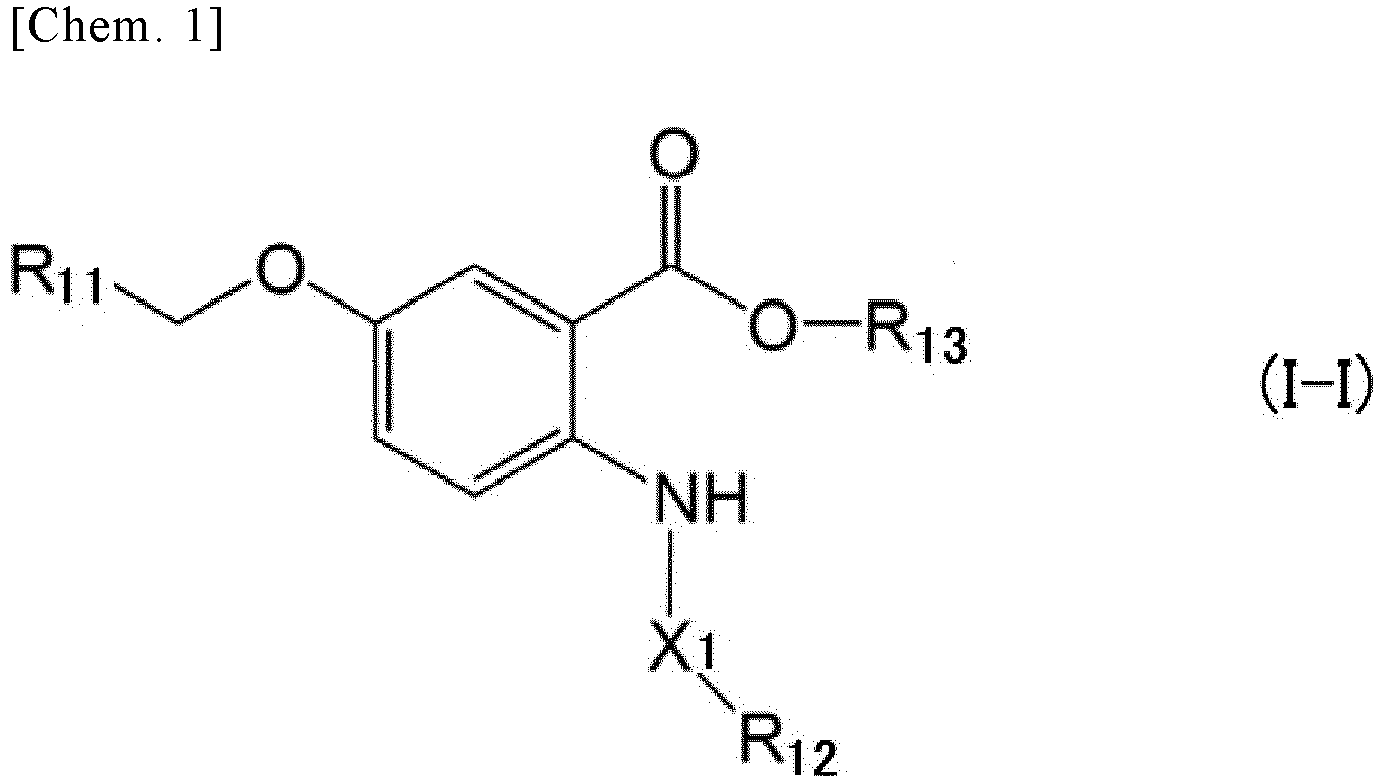
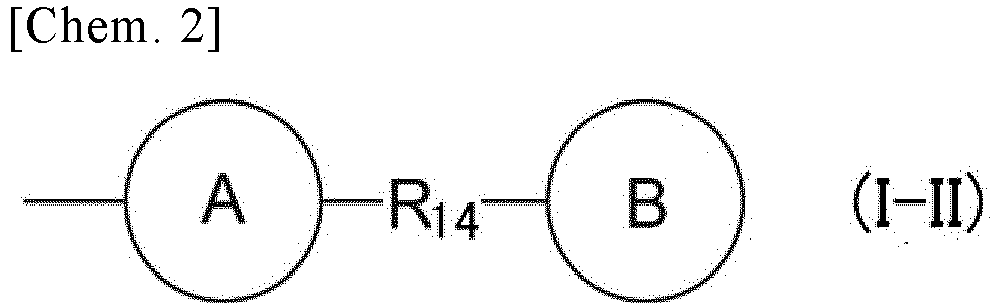 if neither R11 nor R12 is any of the aforementioned groups, R11 or R12 is a hydrogen atom, an optionally substituted hydrocarbon group, or an optionally substituted monocyclic heterocyclic group,R13 is a hydrogen atom, an optionally substituted hydrocarbon group, or an optionally substituted heterocyclic group, andX1 is a single bond, -CO- group, -CO-O-CH2- group, -CO-CH2-O- group, -SO2-group, -CH2-CO-NH- group, -CH2-CO- group, -CH2- group, or -CO-CH2- group).
 - The therapeutic or prophylactic agent according to claim 2, wherein at least one of the R11 and the R12 is an optionally substituted polycyclic aryl group.
- The therapeutic or prophylactic agent according to claim 3, wherein at least one of the R11 and the R12 is an optionally substituted naphthyl group.
- The therapeutic or prophylactic agent according to claim 4, wherein the R11 is an optionally substituted naphthyl group.
- The therapeutic or prophylactic agent according to any one of claims 2 to 5, wherein the R13 is a hydrogen atom or a methyl group.
- The therapeutic or prophylactic agent according to any one of claims 2 to 6, wherein X1 is -CO- group.
- The therapeutic or prophylactic agent according to claim 1, wherein the compound is a compound represented by the following Formula (II-I):

 R21 is a hydrogen atom, an optionally substituted hydrocarbon group, an optionally substituted heterocyclic group, or an optionally substituted amino group,R22 is an optionally substituted aryl group containing a condensed ring of three or more rings, a substituted naphthyl group, or a group represented by the following Formulae (II-II), (II-III), (II-IV), or (II-V):


 R23 is 0 to 7 identical or different substituents attached to a naphthyl group, andX2 is a single bond, -CH2- group, or -NH- group).
 - The therapeutic or prophylactic agent according to claim 8, wherein the R22 is a group represented by the following Formula (II-II):

- The therapeutic or prophylactic agent according to claim 8 or 9, wherein the m is 1, and the n is 0.
- The therapeutic or prophylactic agent according to any one of claims 8 to 10, wherein the R21 is a hydrogen atom.
- The therapeutic or prophylactic agent according to any one of claims 8 to 11, wherein the X2 is a single bond.
- The therapeutic or prophylactic agent according to claim 1, wherein the compound is a compound represented by the following Formula (III-I):
 a ring A is an optionally substituted monocyclic aromatic ring or heterocycle,X3 is a single bond, -NH- group, -NH-CO- group, -O-CO- group, -CH2-S-CH2-group, -CH2-S-(CH2)2-S- group, or -NH-R34- group (R34 is an alkylene group having 1 to 5 carbon atoms, or an alkenylene group having 2 to 5 carbon atoms),Y3 is a single bond, -NH- group, -CO- group, -SO2- group, -O-CO- group, -CO-NR35- group (R35 represents a hydrogen atom, or an optionally substituted alkyl group having 1 to 5 carbon atoms), -O-R36- group (R36 represents an optionally substituted alkylene group having 1 to 5 carbon atoms, or an optionally substituted alkenylene group having 2 to 5 carbon atoms), -NR35-R36- group, -S-R36- group, -CO-R36- group, - SO2-R36- group, -NR35-CO-R36- group, -R36-NR35-CO- group, an optionally substituted alkylene group having 1 to 6 carbon atoms, or an optionally substituted alkenylene group having 2 to 6 carbon atoms,Z3 is a hydrogen atom, an optionally substituted amino group, or an optionally substituted amine,if the Z3 is the optionally substituted amine, the X3 and the Z3 form a ring,R31 is a hydrogen atom, an optionally substituted hydrocarbon group, an optionally substituted heterocyclic group, or an optionally substituted amino group,R32 is an optionally substituted aryl group, an optionally substituted heterocyclic group, an optionally substituted cycloalkyl group, or a group represented by the following Formula (III-II):
 R33 is 0 to 4 identical or different substituents).
 - The therapeutic or prophylactic agent according to claim 13, wherein the m is 1, and the n is 0.
- The therapeutic or prophylactic agent according to claim 13 or 14, wherein the X3 is -NH-CO- group, or -O-CO- group.
- The therapeutic or prophylactic agent according to any one of claims 13 to 15, wherein the ring A is a benzene ring.
- The therapeutic or prophylactic agent according to any one of claims 13 to 16, wherein the R32 is an optionally substituted polycyclic aryl group, or an optionally substituted polycyclic heterocyclic group.
- The therapeutic or prophylactic agent according to any one of claims 13 to 17, wherein the Z3 is a hydrogen atom.
- The therapeutic or prophylactic agent according to any one of claims 13 to 18, wherein the Y3 is a single bond, -CH2- group, or -CH2-O- group.
- The therapeutic or prophylactic agent according to any one of claims 13 to 19, wherein the R31 is a hydrogen atom.
- The therapeutic or prophylactic agent according to claim 1, wherein the compound is a compound represented by the following Formula (IV-1):

 R41 represents an optionally substituted polycyclic aromatic ring or a group represented by any of the following Formulae (IV-II) to (IV-V):
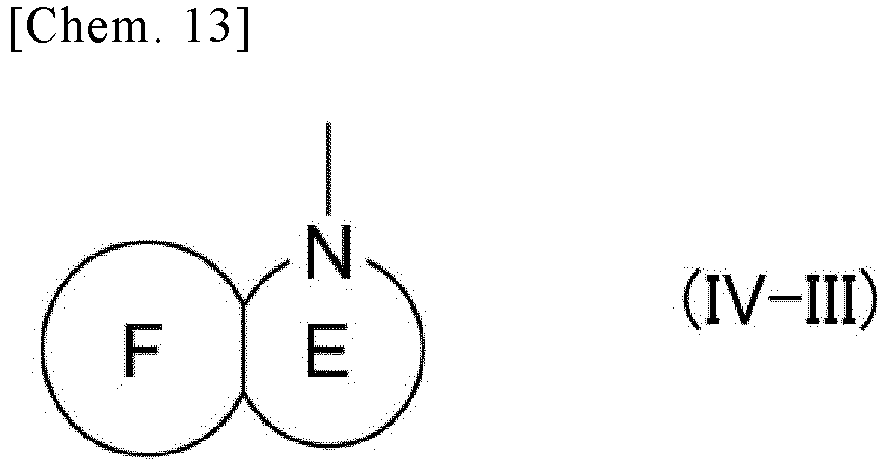

 R42 represents a hydrogen atom, an optionally substituted hydrocarbon group, an optionally substituted heterocyclic group, or an optionally substituted amino group;R43 represents a hydrogen atom, an optionally substituted hydrocarbon group, or an optionally substituted heterocyclic group;R44 represents a hydrogen atom, an optionally substituted hydrocarbon group, or an optionally substituted heterocyclic group;R45 represents 0 to 3 identical or different substituents attached to a benzene ring;X4 represents a single bond, an alkylene group having 1 or 2 carbon atoms, -O-group, -CH2-O- group, -CH2-NH-CO- group, or -CH2-NH-CO-O-CH2- group; andY4 represents a single bond or an alkylene group having 1 or 2 carbon atoms).
 - The therapeutic or prophylactic agent according to claim 21, wherein the ring A is an optionally substituted polycyclic aromatic ring or heterocycle.
- The therapeutic or prophylactic agent according to claim 22, wherein the ring A is a ring represented by the following Formula (IV-VI):

- The therapeutic or prophylactic agent according to claim 23, wherein all of A1, A2, and A3 are a carbon atom.
- The therapeutic or prophylactic agent according to any one of claims 21 to 24, wherein the R41 is preferably a group represented by the following Formula (IV-II):

- The therapeutic or prophylactic agent according to any one of claims 21 to 25, wherein the R42 is a hydrogen atom.
- The therapeutic or prophylactic agent according to any one of claims 21 to 26, wherein the R43 is a hydrogen atom.
- The therapeutic or prophylactic agent according to any one of claims 21 to 27, wherein the R44 is a hydrogen atom.
- The therapeutic or prophylactic agent according to any one of claims 21 to 28, wherein the X4 is a single bond.
- The therapeutic or prophylactic agent according to any one of claims 21 to 29, wherein the Y4 is a single bond.
- A method for screening therapeutic or prophylactic agents for COVID-19, comprising steps of:A) acquiring a library of Pin1 inhibitors by measuring their activity of inhibiting the function of Pin1 using a cell-free assay for measuring cis-to-trans conversion of a phosphorylated serine/threonine-proline motif contained in a substrate peptide; andB) measuring ability to inhibit proliferation of SARS-CoV-2 virus of compounds identified as Pin1 inhibitors in the step A using a cell-based assay for measuring increases in viral components.
- A therapeutic or prophylactic agent for COVID-19 containing the Pin1 inhibitors identified by the screening method according to claim 31 or pharmaceutically acceptable salts thereof as an active ingredient.
- The therapeutic or prophylactic agent according to any one of claims 1 to 30 and 32, further containing one or more active ingredients of at least one or more other drugs selected from drugs classified as therapeutic or prophylactic agents for coronavirus infections.
- The therapeutic or prophylactic agent according to any one of claims 1 to 30, 32, and 33 for treating or preventing coronavirus infections in combination with at least one or more other drugs selected from drugs classified as therapeutic or prophylactic agents for coronavirus infections.
- Use of the therapeutic or prophylactic agent according to any one of claims 1 to 30, 32, and 33 for manufacture of a medicament for treating or preventing coronavirus infection.
- A method of treating or preventing COVID-19, comprising administering to a subject in need thereof a therapeutically effective amount of the therapeutic or prophylactic agent according to any one of claims 1 to 30, 32, and 33.
- A compound with a function of inhibiting Pin1 or a pharmaceutically acceptable salt thereof for use in treating or preventing coronavirus infection.
Applications Claiming Priority (2)
| Application Number | Priority Date | Filing Date | Title |
|---|---|---|---|
| JP2020191046A JP7835423B2 (en) | 2020-11-17 | 2020-11-17 | A therapeutic or prophylactic agent for COVID-19 |
| PCT/JP2021/042013 WO2022107745A1 (en) | 2020-11-17 | 2021-11-16 | Therapeutic agent or prophylactic agent for covid-19 |
Publications (2)
| Publication Number | Publication Date |
|---|---|
| EP4248997A1 true EP4248997A1 (en) | 2023-09-27 |
| EP4248997A4 EP4248997A4 (en) | 2024-12-25 |
Family
ID=81708957
Family Applications (1)
| Application Number | Title | Priority Date | Filing Date |
|---|---|---|---|
| EP21894619.2A Pending EP4248997A4 (en) | 2020-11-17 | 2021-11-16 | THERAPEUTIC AGENT OR PROPHYLACTIC AGENT AGAINST COVID-19 |
Country Status (6)
| Country | Link |
|---|---|
| US (1) | US20240024266A1 (en) |
| EP (1) | EP4248997A4 (en) |
| JP (1) | JP7835423B2 (en) |
| KR (1) | KR20230110723A (en) |
| CN (1) | CN117651552A (en) |
| WO (1) | WO2022107745A1 (en) |
Cited By (1)
| Publication number | Priority date | Publication date | Assignee | Title |
|---|---|---|---|---|
| EP4119165A4 (en) * | 2020-03-12 | 2024-04-24 | Hiroshima University | NOVEL 3,5-DIAMINOBENZOIC ACID COMPOUND AS WELL AS PIN1 INHIBITOR AND THERAPEUTIC AGENT FOR INFLAMMATORY DISEASES |
Families Citing this family (4)
| Publication number | Priority date | Publication date | Assignee | Title |
|---|---|---|---|---|
| JPWO2023224029A1 (en) * | 2022-05-16 | 2023-11-23 | ||
| JPWO2023238894A1 (en) * | 2022-06-10 | 2023-12-14 | ||
| JPWO2025053222A1 (en) * | 2023-09-08 | 2025-03-13 | ||
| KR20250118315A (en) | 2024-01-29 | 2025-08-06 | 주식회사 아메니스바이오사이언스 | Novel anti-viral pharmaceutical composition inhibiting expression or activation of pin1 and uses thereof |
Family Cites Families (9)
| Publication number | Priority date | Publication date | Assignee | Title |
|---|---|---|---|---|
| JP2004533992A (en) | 2000-12-22 | 2004-11-11 | ピンテックス ファーマシューティカルズ,インク. | Method of inhibiting Pin1-related conditions using Fredericamycin A compounds |
| WO2004087720A1 (en) | 2003-03-10 | 2004-10-14 | Pfizer Inc. | Phosphate/sulfate ester compounds and pharmaceutical compositions for inhibiting protein interacting nima (pin1) |
| US20060106077A1 (en) | 2003-07-18 | 2006-05-18 | Pintex Pharmaceuticals, Inc. | Pin1-Modulating compounds and methods of use thereof |
| WO2006040646A1 (en) | 2004-10-14 | 2006-04-20 | Pfizer, Inc. | Benzimidazole or indole amides as inhibitors of pin1 |
| EP2858648B1 (en) * | 2012-06-07 | 2018-08-22 | Beth Israel Deaconess Medical Center, Inc. | Methods and compositions for the inhibition of pin1 |
| US11071738B2 (en) | 2017-08-07 | 2021-07-27 | Hiroshima University | Therapeutic agent for fatty liver diseases and therapeutic agent for adiposity |
| JP7205830B2 (en) | 2017-08-07 | 2023-01-17 | 国立大学法人広島大学 | Novel anthranilic acid compound, and Pin1 inhibitor, therapeutic agent for inflammatory disease, and therapeutic agent for cancer using the same |
| WO2019031470A1 (en) | 2017-08-07 | 2019-02-14 | 国立大学法人広島大学 | NOVEL AMIDE COMPOUND, AND Pin1 INHIBITOR, THERAPEUTIC AGENT FOR INFLAMMATORY DISEASES AND THERAPEUTIC AGENT FOR CANCER THAT USE THE SAME |
| EP4119165A4 (en) * | 2020-03-12 | 2024-04-24 | Hiroshima University | NOVEL 3,5-DIAMINOBENZOIC ACID COMPOUND AS WELL AS PIN1 INHIBITOR AND THERAPEUTIC AGENT FOR INFLAMMATORY DISEASES |
-
2020
- 2020-11-17 JP JP2020191046A patent/JP7835423B2/en active Active
-
2021
- 2021-11-16 CN CN202180077105.5A patent/CN117651552A/en active Pending
- 2021-11-16 KR KR1020237015003A patent/KR20230110723A/en active Pending
- 2021-11-16 US US18/036,998 patent/US20240024266A1/en active Pending
- 2021-11-16 WO PCT/JP2021/042013 patent/WO2022107745A1/en not_active Ceased
- 2021-11-16 EP EP21894619.2A patent/EP4248997A4/en active Pending
Cited By (1)
| Publication number | Priority date | Publication date | Assignee | Title |
|---|---|---|---|---|
| EP4119165A4 (en) * | 2020-03-12 | 2024-04-24 | Hiroshima University | NOVEL 3,5-DIAMINOBENZOIC ACID COMPOUND AS WELL AS PIN1 INHIBITOR AND THERAPEUTIC AGENT FOR INFLAMMATORY DISEASES |
Also Published As
| Publication number | Publication date |
|---|---|
| CN117651552A (en) | 2024-03-05 |
| JP2022080079A (en) | 2022-05-27 |
| KR20230110723A (en) | 2023-07-25 |
| EP4248997A4 (en) | 2024-12-25 |
| JP7835423B2 (en) | 2026-03-25 |
| WO2022107745A1 (en) | 2022-05-27 |
| US20240024266A1 (en) | 2024-01-25 |
Similar Documents
| Publication | Publication Date | Title |
|---|---|---|
| US20240024266A1 (en) | Therapeutic Agent or Prophylactic Agent for COVID-19 | |
| EP1024800B1 (en) | Thyroxine analogues having no significant hormonal activity to treat malignant tumors | |
| CN103450077B (en) | IRE-1 alpha inhibitor | |
| EP3680232B1 (en) | Novel anthranilic acid-based compound, and pin1 inhibitor, therapeutic agent for inflammatory diseases and therapeutic agent for cancer that use the same | |
| US11071738B2 (en) | Therapeutic agent for fatty liver diseases and therapeutic agent for adiposity | |
| US11504379B2 (en) | Amide compound, and Pin1 inhibitor, therapeutic agent for inflammatory diseases and therapeutic agent for cancer that use the same | |
| US12545643B2 (en) | 3,5-diaminobenzoic acid compound, and Pin1 inhibitor and therapeutic agent for inflammatory diseases using same | |
| KR101097189B1 (en) | Pharmaceutical composition for the treatment and prevention of diseases caused by coronavirus containing dihydroxychromone derivative as an active ingredient | |
| RU2056416C1 (en) | Derivatives of thiourea, pharmaceutical composition and method of treatment | |
| CN118176202B (en) | A crystal form of a cyano-substituted polypeptide compound and a preparation method thereof | |
| CN113402414A (en) | Benzoic acid derivative and preparation method and pharmaceutical application thereof | |
| TW202402296A (en) | Triazine derivatives | |
| WO2023160112A1 (en) | Azaphilone compound and use thereof in preparation of anti-tumor drugs | |
| CN101597276B (en) | Propylidene derivative of N-(Alpha, Beta-dimercapto-Beta-carboxyl propionyl)-amino acid and synthetic method and application thereof | |
| EP3050871A1 (en) | Novel bis-amide derivative and use thereof | |
| US20070149487A1 (en) | Antiviral Compositions and Methods | |
| RU2860135C1 (en) | Derivatives of 7-amino-[1,2,4]triazolo[1,5-a]pyrimidine and pharmaceutically acceptable salts thereof, possessing antiviral and antimicrobial activity | |
| CN114874108B (en) | Bairimquinone derivative and application thereof in preparing AMPK activator and medicine for treating breast cancer | |
| US3787409A (en) | 2,4-diamino-5-(3-alkoxy-4,5-methylenedioxybenzyl)pyrimidine | |
| NZ201591A (en) | Fluorinated alkane diamine derivatives | |
| EP0072762B1 (en) | Fluorinated diaminoalkene derivatives | |
| CN111233820A (en) | Fingolimod derivative containing crown ether and di (2-methoxyethoxy) structure | |
| KR20250118317A (en) | Novel anti-viral pharmaceutical composition of anthranilic acid-based compound inhibiting expression or activation of pin1 and uses thereof | |
| JPS5841843A (en) | Fluorinated diaminoalkene derivative | |
| KR100800437B1 (en) | Oxadiazole-derived derivatives, preparation method thereof, and pharmaceutical composition for cancer prevention and treatment containing the same as an active ingredient |
Legal Events
| Date | Code | Title | Description |
|---|---|---|---|
| STAA | Information on the status of an ep patent application or granted ep patent |
Free format text: STATUS: THE INTERNATIONAL PUBLICATION HAS BEEN MADE |
|
| PUAI | Public reference made under article 153(3) epc to a published international application that has entered the european phase |
Free format text: ORIGINAL CODE: 0009012 |
|
| STAA | Information on the status of an ep patent application or granted ep patent |
Free format text: STATUS: REQUEST FOR EXAMINATION WAS MADE |
|
| 17P | Request for examination filed |
Effective date: 20230518 |
|
| AK | Designated contracting states |
Kind code of ref document: A1 Designated state(s): AL AT BE BG CH CY CZ DE DK EE ES FI FR GB GR HR HU IE IS IT LI LT LU LV MC MK MT NL NO PL PT RO RS SE SI SK SM TR |
|
| DAV | Request for validation of the european patent (deleted) | ||
| DAX | Request for extension of the european patent (deleted) | ||
| RAP1 | Party data changed (applicant data changed or rights of an application transferred) |
Owner name: AMENIS BIOSCIENCES, INC. |
|
| A4 | Supplementary search report drawn up and despatched |
Effective date: 20241125 |
|
| RIC1 | Information provided on ipc code assigned before grant |
Ipc: A61K 31/498 20060101ALI20241119BHEP Ipc: A61K 31/472 20060101ALI20241119BHEP Ipc: A61K 31/4709 20060101ALI20241119BHEP Ipc: A61K 31/47 20060101ALI20241119BHEP Ipc: A61K 31/455 20060101ALI20241119BHEP Ipc: A61K 31/4439 20060101ALI20241119BHEP Ipc: A61K 31/405 20060101ALI20241119BHEP Ipc: A61K 31/404 20060101ALI20241119BHEP Ipc: A61K 31/4035 20060101ALI20241119BHEP Ipc: A61K 31/403 20060101ALI20241119BHEP Ipc: A61K 31/36 20060101ALI20241119BHEP Ipc: A61K 31/357 20060101ALI20241119BHEP Ipc: A61K 31/341 20060101ALI20241119BHEP Ipc: A61K 31/27 20060101ALI20241119BHEP Ipc: A61K 31/245 20060101ALI20241119BHEP Ipc: A61K 31/235 20060101ALI20241119BHEP Ipc: A61K 31/216 20060101ALI20241119BHEP Ipc: A61K 31/198 20060101ALI20241119BHEP Ipc: A61K 31/196 20060101ALI20241119BHEP Ipc: A61K 31/192 20060101ALI20241119BHEP Ipc: A61K 45/00 20060101AFI20241119BHEP |
|
| STAA | Information on the status of an ep patent application or granted ep patent |
Free format text: STATUS: EXAMINATION IS IN PROGRESS |
|
| 17Q | First examination report despatched |
Effective date: 20260310 |
|
| STAA | Information on the status of an ep patent application or granted ep patent |
Free format text: STATUS: THE APPLICATION HAS BEEN WITHDRAWN |