EP4248917B1 - Prothetische herzklappensegelanordnungen und verfahren - Google Patents
Prothetische herzklappensegelanordnungen und verfahren Download PDFInfo
- Publication number
- EP4248917B1 EP4248917B1 EP23191760.0A EP23191760A EP4248917B1 EP 4248917 B1 EP4248917 B1 EP 4248917B1 EP 23191760 A EP23191760 A EP 23191760A EP 4248917 B1 EP4248917 B1 EP 4248917B1
- Authority
- EP
- European Patent Office
- Prior art keywords
- support strip
- commissure
- folded
- support
- tabs
- Prior art date
- Legal status (The legal status is an assumption and is not a legal conclusion. Google has not performed a legal analysis and makes no representation as to the accuracy of the status listed.)
- Active
Links
Images








Classifications
-
- A—HUMAN NECESSITIES
- A61—MEDICAL OR VETERINARY SCIENCE; HYGIENE
- A61F—FILTERS IMPLANTABLE INTO BLOOD VESSELS; PROSTHESES; DEVICES PROVIDING PATENCY TO, OR PREVENTING COLLAPSING OF, TUBULAR STRUCTURES OF THE BODY, e.g. STENTS; ORTHOPAEDIC, NURSING OR CONTRACEPTIVE DEVICES; FOMENTATION; TREATMENT OR PROTECTION OF EYES OR EARS; BANDAGES, DRESSINGS OR ABSORBENT PADS; FIRST-AID KITS
- A61F2/00—Filters implantable into blood vessels; Prostheses, i.e. artificial substitutes or replacements for parts of the body; Appliances for connecting them with the body; Devices providing patency to, or preventing collapsing of, tubular structures of the body, e.g. stents
- A61F2/02—Prostheses implantable into the body
- A61F2/24—Heart valves ; Vascular valves, e.g. venous valves; Heart implants, e.g. passive devices for improving the function of the native valve or the heart muscle; Transmyocardial revascularisation [TMR] devices; Valves implantable in the body
- A61F2/2412—Heart valves ; Vascular valves, e.g. venous valves; Heart implants, e.g. passive devices for improving the function of the native valve or the heart muscle; Transmyocardial revascularisation [TMR] devices; Valves implantable in the body with soft flexible valve members, e.g. tissue valves shaped like natural valves
- A61F2/2415—Manufacturing methods
-
- A—HUMAN NECESSITIES
- A61—MEDICAL OR VETERINARY SCIENCE; HYGIENE
- A61F—FILTERS IMPLANTABLE INTO BLOOD VESSELS; PROSTHESES; DEVICES PROVIDING PATENCY TO, OR PREVENTING COLLAPSING OF, TUBULAR STRUCTURES OF THE BODY, e.g. STENTS; ORTHOPAEDIC, NURSING OR CONTRACEPTIVE DEVICES; FOMENTATION; TREATMENT OR PROTECTION OF EYES OR EARS; BANDAGES, DRESSINGS OR ABSORBENT PADS; FIRST-AID KITS
- A61F2/00—Filters implantable into blood vessels; Prostheses, i.e. artificial substitutes or replacements for parts of the body; Appliances for connecting them with the body; Devices providing patency to, or preventing collapsing of, tubular structures of the body, e.g. stents
- A61F2/02—Prostheses implantable into the body
- A61F2/24—Heart valves ; Vascular valves, e.g. venous valves; Heart implants, e.g. passive devices for improving the function of the native valve or the heart muscle; Transmyocardial revascularisation [TMR] devices; Valves implantable in the body
- A61F2/2412—Heart valves ; Vascular valves, e.g. venous valves; Heart implants, e.g. passive devices for improving the function of the native valve or the heart muscle; Transmyocardial revascularisation [TMR] devices; Valves implantable in the body with soft flexible valve members, e.g. tissue valves shaped like natural valves
- A61F2/2418—Scaffolds therefor, e.g. support stents
-
- B—PERFORMING OPERATIONS; TRANSPORTING
- B29—WORKING OF PLASTICS; WORKING OF SUBSTANCES IN A PLASTIC STATE IN GENERAL
- B29C—SHAPING OR JOINING OF PLASTICS; SHAPING OF MATERIAL IN A PLASTIC STATE, NOT OTHERWISE PROVIDED FOR; AFTER-TREATMENT OF THE SHAPED PRODUCTS, e.g. REPAIRING
- B29C65/00—Joining or sealing of preformed parts, e.g. welding of plastics materials; Apparatus therefor
- B29C65/56—Joining or sealing of preformed parts, e.g. welding of plastics materials; Apparatus therefor using mechanical means or mechanical connections, e.g. form-fits
- B29C65/62—Stitching
-
- A—HUMAN NECESSITIES
- A61—MEDICAL OR VETERINARY SCIENCE; HYGIENE
- A61F—FILTERS IMPLANTABLE INTO BLOOD VESSELS; PROSTHESES; DEVICES PROVIDING PATENCY TO, OR PREVENTING COLLAPSING OF, TUBULAR STRUCTURES OF THE BODY, e.g. STENTS; ORTHOPAEDIC, NURSING OR CONTRACEPTIVE DEVICES; FOMENTATION; TREATMENT OR PROTECTION OF EYES OR EARS; BANDAGES, DRESSINGS OR ABSORBENT PADS; FIRST-AID KITS
- A61F2/00—Filters implantable into blood vessels; Prostheses, i.e. artificial substitutes or replacements for parts of the body; Appliances for connecting them with the body; Devices providing patency to, or preventing collapsing of, tubular structures of the body, e.g. stents
- A61F2/02—Prostheses implantable into the body
- A61F2/24—Heart valves ; Vascular valves, e.g. venous valves; Heart implants, e.g. passive devices for improving the function of the native valve or the heart muscle; Transmyocardial revascularisation [TMR] devices; Valves implantable in the body
- A61F2/2427—Devices for manipulating or deploying heart valves during implantation
- A61F2/2436—Deployment by retracting a sheath
-
- A—HUMAN NECESSITIES
- A61—MEDICAL OR VETERINARY SCIENCE; HYGIENE
- A61F—FILTERS IMPLANTABLE INTO BLOOD VESSELS; PROSTHESES; DEVICES PROVIDING PATENCY TO, OR PREVENTING COLLAPSING OF, TUBULAR STRUCTURES OF THE BODY, e.g. STENTS; ORTHOPAEDIC, NURSING OR CONTRACEPTIVE DEVICES; FOMENTATION; TREATMENT OR PROTECTION OF EYES OR EARS; BANDAGES, DRESSINGS OR ABSORBENT PADS; FIRST-AID KITS
- A61F2/00—Filters implantable into blood vessels; Prostheses, i.e. artificial substitutes or replacements for parts of the body; Appliances for connecting them with the body; Devices providing patency to, or preventing collapsing of, tubular structures of the body, e.g. stents
- A61F2/02—Prostheses implantable into the body
- A61F2/24—Heart valves ; Vascular valves, e.g. venous valves; Heart implants, e.g. passive devices for improving the function of the native valve or the heart muscle; Transmyocardial revascularisation [TMR] devices; Valves implantable in the body
- A61F2/2427—Devices for manipulating or deploying heart valves during implantation
- A61F2/2439—Expansion controlled by filaments
-
- A—HUMAN NECESSITIES
- A61—MEDICAL OR VETERINARY SCIENCE; HYGIENE
- A61F—FILTERS IMPLANTABLE INTO BLOOD VESSELS; PROSTHESES; DEVICES PROVIDING PATENCY TO, OR PREVENTING COLLAPSING OF, TUBULAR STRUCTURES OF THE BODY, e.g. STENTS; ORTHOPAEDIC, NURSING OR CONTRACEPTIVE DEVICES; FOMENTATION; TREATMENT OR PROTECTION OF EYES OR EARS; BANDAGES, DRESSINGS OR ABSORBENT PADS; FIRST-AID KITS
- A61F2/00—Filters implantable into blood vessels; Prostheses, i.e. artificial substitutes or replacements for parts of the body; Appliances for connecting them with the body; Devices providing patency to, or preventing collapsing of, tubular structures of the body, e.g. stents
- A61F2/95—Instruments specially adapted for placement or removal of stents or stent-grafts
- A61F2/9517—Instruments specially adapted for placement or removal of stents or stent-grafts handle assemblies therefor
-
- A—HUMAN NECESSITIES
- A61—MEDICAL OR VETERINARY SCIENCE; HYGIENE
- A61F—FILTERS IMPLANTABLE INTO BLOOD VESSELS; PROSTHESES; DEVICES PROVIDING PATENCY TO, OR PREVENTING COLLAPSING OF, TUBULAR STRUCTURES OF THE BODY, e.g. STENTS; ORTHOPAEDIC, NURSING OR CONTRACEPTIVE DEVICES; FOMENTATION; TREATMENT OR PROTECTION OF EYES OR EARS; BANDAGES, DRESSINGS OR ABSORBENT PADS; FIRST-AID KITS
- A61F2220/00—Fixations or connections for prostheses classified in groups A61F2/00 - A61F2/26 or A61F2/82 or A61F9/00 or A61F11/00 or subgroups thereof
- A61F2220/0025—Connections or couplings between prosthetic parts, e.g. between modular parts; Connecting elements
- A61F2220/0075—Connections or couplings between prosthetic parts, e.g. between modular parts; Connecting elements sutured, ligatured or stitched, retained or tied with a rope, string, thread, wire or cable
-
- A—HUMAN NECESSITIES
- A61—MEDICAL OR VETERINARY SCIENCE; HYGIENE
- A61F—FILTERS IMPLANTABLE INTO BLOOD VESSELS; PROSTHESES; DEVICES PROVIDING PATENCY TO, OR PREVENTING COLLAPSING OF, TUBULAR STRUCTURES OF THE BODY, e.g. STENTS; ORTHOPAEDIC, NURSING OR CONTRACEPTIVE DEVICES; FOMENTATION; TREATMENT OR PROTECTION OF EYES OR EARS; BANDAGES, DRESSINGS OR ABSORBENT PADS; FIRST-AID KITS
- A61F2220/00—Fixations or connections for prostheses classified in groups A61F2/00 - A61F2/26 or A61F2/82 or A61F9/00 or A61F11/00 or subgroups thereof
- A61F2220/0025—Connections or couplings between prosthetic parts, e.g. between modular parts; Connecting elements
- A61F2220/0091—Connections or couplings between prosthetic parts, e.g. between modular parts; Connecting elements connected by a hinged linkage mechanism, e.g. of the single-bar or multi-bar linkage type
-
- A—HUMAN NECESSITIES
- A61—MEDICAL OR VETERINARY SCIENCE; HYGIENE
- A61F—FILTERS IMPLANTABLE INTO BLOOD VESSELS; PROSTHESES; DEVICES PROVIDING PATENCY TO, OR PREVENTING COLLAPSING OF, TUBULAR STRUCTURES OF THE BODY, e.g. STENTS; ORTHOPAEDIC, NURSING OR CONTRACEPTIVE DEVICES; FOMENTATION; TREATMENT OR PROTECTION OF EYES OR EARS; BANDAGES, DRESSINGS OR ABSORBENT PADS; FIRST-AID KITS
- A61F2240/00—Manufacturing or designing of prostheses classified in groups A61F2/00 - A61F2/26 or A61F2/82 or A61F9/00 or A61F11/00 or subgroups thereof
- A61F2240/001—Designing or manufacturing processes
-
- B—PERFORMING OPERATIONS; TRANSPORTING
- B29—WORKING OF PLASTICS; WORKING OF SUBSTANCES IN A PLASTIC STATE IN GENERAL
- B29L—INDEXING SCHEME ASSOCIATED WITH SUBCLASS B29C, RELATING TO PARTICULAR ARTICLES
- B29L2031/00—Other particular articles
- B29L2031/753—Medical equipment; Accessories therefor
- B29L2031/7532—Artificial members, protheses
- B29L2031/7534—Cardiovascular protheses
Definitions
- the present disclosure relates to prosthetic heart valves, and to methods and assemblies for forming commissures associated with leaflets of such prosthetic heart valves.
- the human heart can suffer from various valvular diseases. These valvular diseases can result in significant malfunctioning of the heart and ultimately require repair of the native valve or replacement of the native valve with an artificial valve.
- repair devices e.g., stents
- artificial valves e.g., stents
- Percutaneous and minimally-invasive surgical approaches are used in various procedures to deliver prosthetic medical devices to locations inside the body that are not readily accessible by surgery or where access without surgery is desirable.
- a prosthetic heart valve can be mounted in a crimped state on the distal end of a delivery device and advanced through the patient's vasculature (e.g., through a femoral artery and the aorta) until the prosthetic valve reaches the implantation site in the heart.
- the prosthetic valve is then expanded to its functional size, for example, by inflating a balloon on which the prosthetic valve is mounted, actuating a mechanical actuator that applies an expansion force to the prosthetic valve, or by deploying the prosthetic valve from a sheath of the delivery device so that the prosthetic valve can self-expand to its functional size.
- Prosthetic valves that rely on a mechanical actuator for expansion can be referred to as "mechanically expandable" prosthetic heart valves.
- the actuator typically takes the form of pull cables, sutures, wires and/or shafts that are configured to transmit expansion forces from a handle of the delivery apparatus to the prosthetic valve.
- Most expandable, transcatheter heart valves comprise a cylindrical metal frame or stent and prosthetic leaflets mounted inside the frame. The leaflets may be attached to the frame at commissure tab of the leaflets.
- forces experienced during operation of the prosthetic valve and/or other conditions may be concentrated at the commissure tabs, which may compromise the structure of the leaflets and/or cause the leaflets to detach from the frame.
- the attachment of the commissure tabs to the frame in such configurations may require delicate assembly skills to ensure proper attachment and reduce damage to the leaflets.
- US 8 696 743 describes a multi-leaflet valve which includes at least two leaflets, an outer tube and a seam protector for each seam.
- Each seam protector is positioned to be in contact with a portion of the outer tube, with tube portions and leaflet ends being positioned between adjacent seam protection pieces.
- the seam protectors provide a lower stress surface about which the leaflets can bend or flex during their opening and closing.
- the seam protectors may include an enlarged end portion with an extending straight surface, an inverted U-shaped structure, or a sinusoidal-shaped structure, for example.
- the valve can be further provided with a seam cover or protector that is stitched onto the seam allowance of the layers of one or more of the seams.
- the seams can be provided with one or more inserts to fill spaces between adjacent tissue layers and create tension in certain material sheets.
- US 2004/039436 describes a valve prosthesis device suitable for implantation in body ducts.
- the device comprises a support stent, comprised of a deployable construction adapted to be initially crimped in a narrow configuration suitable for catheterization through the body duct to a target location and adapted to be deployed by exerting substantially radial forces from within by means of a deployment device to a deployed state in the target location, and a valve assembly comprising a flexible conduit having an inlet end and an outlet, made of pliant material attached to the support beams providing collapsible slack portions of the conduit at the outlet.
- US 2011/295363 describes a prosthetic heart valve for an endoprosthesis used in the treatment of a stenotic cardiac valve and/or a cardiac valve insufficiency.
- the prosthetic heart valve comprises of a plurality of leaflets, which consist of a natural and/or synthetic material and have a first opened position for opening the heart chamber and a second closed position for closing the heart chamber, the leaflets being able to switch between their first and second position in response to the blood flow through the heart.
- US 2018/028310 describes a prosthetic heart valve that can include a radially collapsible and expandable annular frame having a plurality of struts defining openings.
- the prosthetic heart valve can further include a plurality of leaflets that regulate the flow of blood through the frame.
- the commissures may be formed by coupling a pair of adjacent commissure tabs of adjacent leaflets of the prosthetic heart valve.
- the commissures may include a support strip folded over an inner reinforcing element and positioned between the adjacent commissure tabs, and an outer reinforcing member including first and second outer reinforcing elements that are respectively positioned on outer surfaces of the adjacent commissure tabs and attached thereto via stitching, such that the inner reinforcing element is positioned between the stitching and a fold region of the support strip.
- a method of assembling a prosthetic heart valve including a plurality of leaflets can include: forming a plurality of commissures with the plurality of leaflets, wherein each commissure is formed by pairing a first commissure tab of a first leaflet with an adjacent, second commissure tab of a second leaflet, folding a support strip over an inner reinforcing element, positioning the folded support strip between the first commissure tab and the second commissure tab, attaching first and second outer reinforcing elements to the first and second commissure tabs, respectively, via stitching that extends through the first outer reinforcing element, the first leaflet, the folded support strip, the second leaflet, and the second outer reinforcing element, the stitching extending over at least a portion of the first reinforcing element opposite a fold region of the support strip, and, for each commissure, securing end portions of the support strip to a respective support portion of a frame of the prosthetic heart valve.
- a prosthetic heart valve can include: an annular frame comprising a plurality of commissure support portions, and a plurality of leaflets, each leaflet having a commissure tab that is coupled to an adjacent commissure tab of another leaflet via a folded support strip to form a commissure of an associated commissure tab pair, wherein, for each commissure tab pair: the folded support strip is disposed between respective inner surfaces of the commissure tabs in the commissure tab pair, an inner reinforcing element is disposed in a fold region of the folded support strip, first and second outer reinforcing elements are positioned adjacent respective outer surfaces of the commissure tabs in the commissure tab pair, a reinforcing suture passes through, in order: the first outer reinforcing element, a first commissure tab of the commissure tab pair, a first section of the folded support strip, a second section of the folded support strip, a second commissure tab of the commissure tab pair, and a second outer reinforcing element, and the inner
- a method of assembling a commissure for a leaflet pair of a prosthetic valve can include: folding a support strip over an inner reinforcing element to form a first folded portion of the support strip extending from a fold region of the support strip to a first end portion and a second folded portion of the support strip extending from the fold region of the support strip to a second end portion opposite the first end portion, positioning the folded support strip between inner surfaces of adjacent ends of a first commissure tab of a first leaflet of the leaflet pair and a second commissure tab of a second leaflet of the leaflet pair, folding an outer reinforcing member into a U-shape to form a first outer reinforcing element and a second outer reinforcing element, placing the first outer reinforcing element against an outer surface of the first commissure tab and the second outer reinforcing element against an outer surface of the second commissure, forming, via a suture, one or more stitches that pass through, in order,
- An aspect of the presently claimed invention comprises a method of assembling a prosthetic heart valve comprising a plurality of leaflets that includes forming a plurality of commissures with the plurality of leaflets, wherein each commissure is formed by pairing a first commissure tab of a first leaflet with an adjacent, second commissure tab of a second leaflet, folding a first portion of a support strip over a first edge reinforcing element, folding a second portion of the support strip over a second edge reinforcing element, coupling an end portion of the first portion of the support strip to an end portion of the second portion of the support strip to form a reinforced region of the support strip, positioning the support strip along respective inner surfaces of the first commissure tab and the second commissure tab, coupling first and second outer reinforcing elements to the first and second commissure tabs, respectively, via stitching that extends through the first outer reinforcing element, the first commissure tab, the folded support strip, the second commissure tab, and the second outer reinforcing element, the stitching
- a method of assembling a prosthetic heart valve comprising a plurality of leaflets includes forming a plurality of commissures with the plurality of leaflets, wherein each commissure is formed by pairing a first commissure tab of a first leaflet with an adjacent, second commissure tab of a second leaflet, the first commissure tab comprising a first extended tab and the second commissure tab comprising a second extended tab, folding the first and second extended tabs over first and second portions of a primary reinforcing element, respectively, placing first and second portions of a secondary reinforcing element on respective outer surfaces of the folded first and second extended tabs, and coupling end portions of the first and second portions of the secondary reinforcing element to one another, and, for each commissure, coupling a fold region of the first and second extended tabs to a support material and securing the support material and/or the first and second extended tabs to an associated support structure of a frame of the prosthetic heart valve.
- proximal refers to a position, direction, or portion of a component that is closer to the user and a handle of the delivery system that is outside the patient
- distal refers to a position, direction, or portion of a component that is further away from the user and the handle and closer to the implantation site.
- longitudinal refers to an axis extending in the proximal and distal directions, unless otherwise expressly defined.
- the prosthetic heart valves may include a frame and a plurality of leaflets attached to the frame via commissures formed by joining pairs of adjacent ends of the leaflets.
- the formation of the commissures may include attaching a support strip folded over a first reinforcing member to the leaflets and attaching a second reinforcing member over outer surfaces of the leaflets.
- Opposing ends of the support strip may be joined together, directly or indirectly (e.g., via one or more sutures), and the opposing ends of the support strip and/or sutures that join the opposing ends of the support strip may be wrapped around a corresponding commissure support portion of the frame of the prosthetic valve.
- forces experienced by the leaflets during radial expansion and compression of the frame and/or as the leaflets open and closed during operation of the prosthetic valve may be at least partially absorbed by the support strip, reducing the stresses exerted on the leaflets.
- the support strip may be made of more robust material than the leaflets, the overall strength of the commissure may be increased relative to other configurations.
- the use of reinforcing members both inside the folded support strip and outside the adjacent leaflets provide additional reinforcing strength for the commissure by providing a further deflection of stresses away from the potentially relatively delicate material of the leaflets.
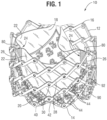
- FIG. 1 shows an exemplary prosthetic heart valve 10, according to one embodiment.
- the prosthetic heart valve 10 can be radially compressible and expandable between a radially compressed configuration for delivery into a patient and a radially expanded configuration.
- the prosthetic heart valve 10 can be implanted within the native aortic valve, although it also can be implanted at other locations in the heart, including within the native mitral valve, the native pulmonary valve, and the native tricuspid valve.
- the prosthetic heart valve 10 can include an annular stent or frame 12 having a first end 14 and a second end 16.
- the first end 14 is an inflow end and the second end 16 is an outflow end.
- the outflow end 16 can be coupled to a delivery apparatus for delivering and implanting the prosthetic heart valve within the native aortic valve is a transfemoral, retrograde delivery approach.
- the outflow end 16 is the proximal-most end of the prosthetic valve.
- the inflow end 14 can be coupled to the delivery apparatus, depending on the particular native valve being replaced and the delivery technique that is used (e.g., trans-septal, transapical, etc.).
- the inflow end 14 can be coupled to the delivery apparatus (and therefore is the proximal-most end of the prosthetic heart valve in the delivery configuration) when delivering the prosthetic heart valve to the native mitral valve via a trans-septal delivery approach.
- the frame 12 can be made of any of various suitable materials, such as stainless steel, a cobalt chromium alloy, or a nickel titanium alloy ("NiTi”), for example Nitinol.
- the frame 12 can include a plurality of interconnected struts 28 arranged in a lattice-type pattern.
- the struts 28 are shown as positioned diagonally, or offset at an angle relative to, and radially offset from, a longitudinal axis of the prosthetic heart valve 10 when the prosthetic heart valve 10 is in the expanded configuration.
- the struts 28 can be offset by a different amount than depicted in FIG. 1 , or some or all of the struts 28 can be positioned parallel to the longitudinal axis of the prosthetic heart valve 10.
- the struts 28 are pivotably coupled to one another at one or more pivot joints along the length of each strut.
- each of the struts 28 can be formed with apertures at opposing ends of the strut and apertures spaced along the length of the strut.
- Respective hinges can be formed at the locations where struts 28 overlap each other via fasteners or pivot members, such as rivets or pins 30 that extend through the apertures. The hinges can allow the struts 28 to pivot relative to one another as the frame 12 is radially expanded or compressed, such as during assembly, preparation, or implantation of the prosthetic heart valve 10.
- the frame 12 can be constructed by forming individual components (e.g., the struts and fasteners of the frame) and then mechanically assembling and connecting the individual components together.
- the struts 28 are not coupled to each other with respective hinges but are otherwise pivotable or bendable relative to each other to permit radial expansion and contraction of the frame 12.
- the frame 12 can be formed (e.g., via laser cutting, electroforming or physical vapor deposition) from a single piece of material (e.g., a metal tube). Further details regarding the construction of the frame and the prosthetic heart valve are described in U.S. Patent Application Publication Nos. 2018/0153689 , 2018/0344456 , and 2019/0060057 .
- the prosthetic heart valve 10 can also include a valvular structure 18 which is coupled to the frame 12 and configured to regulate the flow of blood through the prosthetic heart valve 10 from the inflow end 14 to the outflow end 16.
- the prosthetic heart valve 10 can further include a plurality of actuators 80 mounted to and equally spaced around the inner surface of the frame 12. The actuators are configured to apply expansion and compression to the frame for radially expanding and compressing the prosthetic valve.
- the actuators 80 are linear actuators, each of which comprises an inner member, or piston, 90 and an outer member, or cylinder, 92.
- the inner member 90 is pivotably coupled to a junction of the frame, such as at the first end 14, while the outer member 92 is pivotably coupled to another junction of the frame closer to the second end 16. Moving the inner member 90 proximally relative to the outer member 92 and/or moving the outer member 92 distally relative to the inner member 90 is effective to radially expand the prosthetic valve. Conversely, moving the inner member 90 distally relative to the outer member 92 and/or moving the outer member 92 proximally relative to the inner member 90 is effective to radially compress the prosthetic valve.
- the actuators 80 can include locking mechanisms that are configured to retain the prosthetic valve in an expanded state inside the patient's body.
- each of the actuators 80 can be configured to form a releasable connection with one or more respective actuators of a delivery apparatus of a transcatheter delivery system.
- the actuators of the delivery apparatus can transmit forces from a handle of the delivery apparatus to the actuators 80 for expanding or compressing the prosthetic valve.
- Further details of the actuators, locking mechanisms and delivery apparatuses for actuating the actuators can be found in U.S. Patent Application Publication Nos. 2018/0153689 , 2019/0060057 and 2018/0325665 .
- Any of the actuators and locking mechanisms disclosed in the previously filed applications can be incorporated in any of the prosthetic valves disclosed herein.
- any of the delivery apparatuses disclosed in the previously filed applications can be used to deliver and implant any of the prosthetic valves discloses herein.
- each of the actuators 80 can be used to support a respective commissure 24 (described below).
- the actuators 80 can include commissure support portions for supporting and attaching commissures 24 of the valvular structure 18 to the frame 12, as described further herein.
- the valvular structure 18 can include, for example, a leaflet assembly comprising one or more leaflets 22 (three leaflets 22 in the illustrated embodiment) made of a flexible material.
- the leaflets 22 of the leaflet assembly can be made from in whole or part, biological material, bio-compatible synthetic materials, or other such materials. Suitable biological material can include, for example, bovine pericardium (or pericardium from other sources).
- the leaflets 22 can be arranged to form commissures 24, which can be, for example, mounted to commissure support portions of respective actuators 80. Further details regarding transcatheter prosthetic heart valves, including the manner in which the valvular structure can be coupled to the frame 12 of the prosthetic heart valve 10, can be found, for example, in U.S. Patent Nos. 6,730,118 , 7,393,360 , 7,510,575 , 7,993,394 , and 8,652,202 , and U.S. Patent Application Publication No. 2018/0325665 .
- the commissures 24 can be mounted (e.g., sutured) directly to commissure support portions of the actuators 80 of the frame 12 via commissure attachments 26, which can be strips of fabric.
- each commissure attachment 26 may be wrapped around a corresponding actuator 80 and a pair of adjacent commissure tabs of adjacent leaflets and secured to the commissure tabs and the actuator via one or more stitches extending through the commissure attachment and the pair of the commissure tabs.
- the commissures 24 can be mounted to support struts or posts of the frame that are separate from the actuators 80.
- the prosthetic heart valve 10 can also include one or more skirts or sealing members.
- the prosthetic heart valve 10 can include an inner skirt 20 mounted on the inner surface of the frame 12.
- the inner skirt 20 is a circumferential inner skirt that spans an entire circumference of the inner surface of the frame 12.
- the inner skirt 20 can function as a sealing member to prevent or decrease paravalvular leakage (e.g., when the valve is placed at the implantation site) and as an attachment surface to anchor the leaflets 22 to the frame 12.
- a cusp edge portion 40 of each leaflet 22 (the inflow edge portion) can be secured to the inner skirt 20 with stitching 42 (referred to as a "scallop line").
- the upper and lower edge portions of the inner skirt 20 can be secured to the frame with suture loops 44 that extending through the inner skirt and around adjacent struts 28 of the frame. In this manner, the cusp edge portions of the leaflets are supported by the inner skirt 20 and the commissures are supported by actuators 80.
- the prosthetic heart valve 10 can also include an outer skirt mounted on the outer surface of the frame 12 (not shown in FIG. 1 ).
- the outer skirt can function as a sealing member for the prosthetic valve by sealing against the tissue of the native valve annulus and helping to reduce paravalvular leakage past the prosthetic valve.
- the inner and outer skirts can be formed from any of various suitable biocompatible materials, including any of various synthetic materials (e.g., PET) or natural tissue (e.g., pericardial tissue).
- the inner and outer skirts can be mounted to the frame using sutures, an adhesive, welding, and/or other means for attaching the skirts to the frame.
- FIG. 22 illustrates a delivery apparatus 100, according to one embodiment, adapted to deliver a prosthetic heart valve 102, such as the illustrated prosthetic heart valve 10, described above with respect to FIG. 1 .
- the prosthetic valve 102 can be releasably coupled to the delivery apparatus 100.
- the delivery apparatus 100 and other delivery apparatuses disclosed herein can be used to implant prosthetic devices other than prosthetic valves, such as stents or grafts.
- the delivery apparatus 100 in the illustrated embodiment generally includes a handle 104, a first elongated shaft 106 (which comprises an outer shaft in the illustrated embodiment) extending distally from the handle 104, at least one actuator assembly 108 extending distally through the outer shaft 106.
- the at least one actuator assembly 108 can be configured to radially expand and/or radially collapse the prosthetic valve 102 when actuated.
- actuator 108 can be provided for each actuator on the prosthetic valve.
- three actuator assemblies 108 can be provided for a prosthetic valve having three actuators. In other embodiments, a greater or fewer number of actuator assemblies can be present.
- a distal end portion 116 of the shaft 106 can be sized to house the prosthetic valve in its radially compressed, delivery state during delivery of the prosthetic valve through the patient's vasculature. In this manner, the distal end portion 116 functions as a delivery sheath or capsule for the prosthetic valve during delivery,
- the actuator assemblies 108 can be releasably coupled to the prosthetic valve 102.
- each actuator assembly 108 can be coupled to a respective actuator of the prosthetic valve 102.
- Each actuator assembly 108 can comprise a support tube, an actuator member, and a locking tool. When actuated, the actuator assembly can transmit pushing and/or pulling forces to portions of the prosthetic valve to radially expand and collapse the prosthetic valve as previously described.
- the actuator assemblies 108 can be at least partially disposed radially within, and extend axially through, one or more lumens of the outer shaft 106.
- the actuator assemblies 108 can extend through a central lumen of the shaft 106 or through separate respective lumens formed in the shaft 106.
- the handle 104 of the delivery apparatus 100 can include one or more control mechanisms (e.g., knobs or other actuating mechanisms) for controlling different components of the delivery apparatus 100 in order to expand and/or deploy the prosthetic valve 102.
- control mechanisms e.g., knobs or other actuating mechanisms
- the handle 104 comprises first, second, and third knobs 110, 112, and 114.
- the first knob 110 can be a rotatable knob configured to produce axial movement of the outer shaft 106 relative to the prosthetic valve 102 in the distal and/or proximal directions in order to deploy the prosthetic valve from the delivery sheath 116 once the prosthetic valve has been advanced to a location at or adjacent the desired implantation location with the patient's body.
- rotation of the first knob 110 in a first direction e.g., clockwise
- rotation of the first knob 110 in a second direction e.g., counter-clockwise
- the first knob 110 can be actuated by sliding or moving the knob 110 axially, such as pulling and/or pushing the knob. In other embodiments, actuation of the first knob 110 (rotation or sliding movement of the knob 110) can produce axial movement of the actuator assemblies 108 (and therefore the prosthetic valve 102) relative to the delivery sheath 116 to advance the prosthetic valve distally from the sheath 116.
- the second knob 112 can be a rotatable knob configured to produce radial expansion and/or contraction of the prosthetic valve 102.
- rotation of the second knob 112 can move the actuator member and the support tube axially relative to one another.
- Rotation of the second knob 112 in a first direction e.g., clockwise
- Rotation of the second knob 112 in a second direction e.g., counter-clockwise
- the second knob 112 can be actuated by sliding or moving the knob 112 axially, such as pulling and/or pushing the knob.
- the third knob 114 can be a rotatable knob configured to retain the prosthetic heart valve 102 in its expanded configuration.
- the third knob 114 can be operatively connected to a proximal end portion of the locking tool of each actuator assembly 108.
- Rotation of the third knob in a first direction e.g., clockwise
- Rotation of the knob 114 in the opposite direction e.g., counterclockwise
- the third knob 114 can be actuated by sliding or moving the third knob 114 axially, such as pulling and/or pushing the knob.
- the handle 104 can include a fourth rotatable knob operative connected to a proximal end portion of each actuator member.
- the fourth knob can be configured to rotate each actuator member, upon rotation of the knob, to unscrew each actuator member from the proximal portion of a respective actuator. As described above, once the locking tools and the actuator members are uncoupled from the prosthetic valve 102, they can be removed from the patient.
- FIGS. 2-11 and 14 show example stages of assembling and mounting of a commissure to a commissure support portion (e.g., a support post) of a frame of a prosthetic valve (e.g., a prosthetic heart valve, such as prosthetic heart valve 10 of FIG. 1 and/or the prosthetic heart valve of FIGS. 12 and 13 , described in more detail below).
- a commissure support portion e.g., a support post
- a prosthetic valve e.g., a prosthetic heart valve, such as prosthetic heart valve 10 of FIG. 1 and/or the prosthetic heart valve of FIGS. 12 and 13 , described in more detail below.
- an example first stage of assembly may include attaching an inner reinforcing element 220 to a support strip 212 (e.g., a fabric strip) along a vertical centerline of the strip 212.
- the inner reinforcing element may be attached or otherwise coupled to the support strip in any suitable manner (e.g., adhering, melting/sintering, stitching, etc.).
- the inner reinforcing element 220 is attached to the support strip 212 using a suture that forms stitches 262 passing through the strip 212 and the inner reinforcing element 220.
- the support strip 212 may be a strip of any suitable material (e.g., fabric), which may include material that is stronger (e.g., more resilient to tearing and/or deforming) than a material used for forming the leaflets and/or the commissure tab portions of the leaflets of the prosthetic valve (not shown in FIG. 2 and described in more detail below).
- the support strip 212 is a polyethylene terephthalate (PET) fabric, although various other suitable biocompatible fabrics can be used.
- the support strip 212 may be continuous (e.g., with no gaps and/or a substantially uniform distribution of the material forming the support strip) and may be longer in one dimension than another (e.g., having a width/length that is greater than a height of the strip).
- the support strip 212 may be relatively thin (e.g., having a thickness that is substantially smaller than the width and height of the strip and substantially smaller than a width or diameter of the inner reinforcing element 220).
- the support strip may include one or more stitching lines or other markings, examples of which are shown at 216a, 216b, 216c, and 216d.
- stitching lines 216a and 216b may be positioned near end portions of the support strip (e.g., adjacent vertical edges of the strip), while stitching lines 216c and 216b may be positioned near the fold region (e.g., adjacent the inner reinforcing element 220) of the support strip.
- the stitching lines or markings may be ink markings or other types of markings that visually indicate the locations for placing sutures during assembly.
- each stitching line comprises a series of spaced apart circular markings or "dots".
- the stitching lines or markings may optionally be formed with a plurality of pre-formed apertures or openings for receiving sutures (e.g., apertures or openings that extend at least partially through the support strip). It is to be understood that the number of stitching lines illustrated herein on the support strip is exemplary, and any suitable number of stitching lines or other markings may be included on the support strip or other elements of the prosthetic valve (e.g., the commissure tabs, as described in more detail below with respect to FIG. 4 ) without departing from the scope of the disclosure.
- the inner reinforcing element 220 can be a string, or cord, or a relatively thick suture, such as an Ethibond suture, which may be substantially wider/thicker and/or have a substantially larger diameter (e.g., at least twice as wide/thick and/or have twice the diameter) than stitching sutures 262. As shown, the inner reinforcing element 220 may be substantially the same height (or slightly shorter, such as 1-5% shorter to provide for machining tolerances and avoid extension of the inner reinforcing element past edges of the strip) as the height of the support strip 212. In other examples, the inner reinforcing element can be a relatively narrow strip of fabric, which can be folded lengthwise one or more times to increase its overall thickness. In still other examples, the inner reinforcing element can be a metal wire or a bar, such as a rectangular or cylindrical bar, formed from a metal and/or a polymer.
- an example second stage of assembly of the commissure may include folding the support strip 212 (e.g., widthwise) over the inner reinforcing element 220 as illustrated, to form a first folded portion 214a and a second folded portion 214b of the support strip 212.
- the first folded portion 214a may extend from a fold region 215 of the support strip 212 to a first terminal end of the support strip
- the second folded portion 214b may extend from the fold region 215 of the support strip to a second terminal end of the support strip.
- the support strip 212 may be folded symmetrically, such that opposing ends (e.g., the terminal ends) of the support strip 212 are aligned and/or corresponding stitching lines on the first and second folded portions are aligned (e.g., stitch line 216c is aligned with stitch line 216d and/or stitch line 216a is aligned with stitch line 216b).
- the inner reinforcing element 220 is disposed within the fold region 215 of the support strip 212, such that the inner reinforcing element is adjacent to and/or in contact with an inner surface of the support strip.
- the inner surface of the support strip in the fold region may be coplanar with at least a portion of the inner reinforcing element (e.g., following a curvature of an outer surface of the inner reinforcing element) and may at least partially cover (e.g., envelope) the inner reinforcing element.
- an example third stage of assembly of the commissure may include placing or otherwise positioning the folded support strip 212 between two adjacent commissure tabs 230a and 230b of two adjacent leaflets 231a and 231b, respectively (which can have the same overall shape of leaflets 22 of FIG. 1 ).
- the opposing ends of the first folded portion 214a and the second folded portion 214b extend beyond the respective edges of the commissure tabs 230a and 230b.
- the commissure tabs 230a and 230b may include one or more stitching lines or other markings, examples of which are shown at 234a and 234b.
- the stitching lines 234a and 234b may be similar to the stitching lines 216a-c of the support strip.
- the stitching lines 234a and 234b may be ink markings or other types of markings that visually indicate the locations for placing sutures during assembly and that may optionally be formed with a plurality of pre-formed apertures or openings for receiving sutures (e.g., apertures or openings that extend at least partially through the commissure tabs).
- the stitching lines 234a and 234b may be aligned with one another (and with the stitching lines 216c and 216d of the support strip 212) when the commissure tabs are positioned for attachment to the support strip 212.
- FIG. 4 also shows an outer reinforcing member 222, which includes a first outer reinforcing element 224a and a second outer reinforcing element 224b.
- the outer reinforcing member 222 is a single member that is folded into a U-shape configuration to form the first and second outer reinforcing elements (e.g., the first and second outer reinforcing elements are individual elements that are coupled to one another and/or form different sections of a single continuous element).
- the outer reinforcing member 222 may be discontinuous and include the first and second discrete or separate outer reinforcing elements in a spatially separated configuration (e.g., where the first and second outer reinforcing elements are spatially separated from one another).
- the outer reinforcing member 222 and/or the first and second outer reinforcing elements 224a and 224b may comprise any of the materials or structures described above for the inner reinforcing member.
- the outer reinforcing member comprises a string, a cord, or a relatively thick suture, such as an Ethibond suture, which is substantially wider than stitching sutures 262.
- the outer reinforcing member 222 may be formed of the same material and/or have a same thickness/diameter as the inner reinforcing element 220. In other examples, the outer reinforcing member 222 or portions thereof may have a different composition and/or thickness/diameter than the inner reinforcing element 220.
- an example fourth stage of assembly of the commissure may include placing the first and second outer reinforcing elements 224a and 224b against the outer surfaces of the commissure tabs 230a and 230b, respectively.
- the first and second outer reinforcing elements may be aligned with the stitching lines 234a and 234b and initially positioned adjacent the inner reinforcing element 220 (e.g., in front of and closer to end portions of the commissure tabs/support strip than the inner reinforcing element 220).
- the first and second outer reinforcing elements may be aligned with the inner reinforcing element 220.
- a suture may be used to form stitches 264 that extend through, in order: the first outer reinforcing element 224a, the commissure tab 230a (e.g., through the stitching line 234a), the first folded portion 214a (e.g., through the stitching line 216c), the second folded portion 214b (e.g., through the stitching line 216d), the commissure tab 230b (e.g., through the stitching line 234b), and the second outer reinforcing element 224b in order to attach the first and second outer reinforcing elements to the commissure tabs and support strip.
- the stitches 264 can be in-and-out stitches. although other stitching techniques can be used.
- the commissure tabs 230a and 230b and the support strip 212 may together form the commissure, which can then be mounted to a frame of a prosthetic valve, as further described below.
- FIG. 6 is a cross-sectional view of the commissure after attaching the first and second outer reinforcing elements 224a and 224b to the commissure tabs 230a and 230b and the folded support strip 212.
- the inner reinforcing element 220 is secured between the fold region 215 of the support strip 212 and the stitches 264 (one of which is shown in FIG. 6 ).
- the stitches 264 extend behind the inner reinforcing element 220, such that the stitches 264 are adjacent an opposite side of the inner reinforcing element 220 than the fold region 215 of the support strip 212.
- the inner reinforcing element 220 is positioned between inner surfaces of the commissure tabs 230a and 230b, while the first and second outer reinforcing elements 224a and 224b are positioned adjacent outer surfaces of the commissure tabs 230a and 230b, respectively (e.g., on opposite sides of the commissure tabs than the inner reinforcing element).
- the commissure may be attached and/or mounted to a commissure support portion (e.g., a support strut/post) of a frame of the prosthetic valve.
- FIG. 7 shows one example of a fifth stage of assembling the commissure, including attaching sutures 266a and 266b to the first folded portion 214a of the support strip and the second folded portion 214b of the support strip, respectively.
- the sutures 266a and 266b are stitched to the first folded portion 214a and the second folded portion 214b via stitches 268a and 268b, respectively, along sections of the first folded portion and the second folded portion that extend beyond the edges of commissure tabs 230a and 230b (e.g., through stitch lines 216a and 216b, respectively).
- the opposite end portions of the sutures 266a and 266b are then pulled in directions indicated by arrows 290a and 290b, respectively (e.g., to extend around the support strut, as described below with respect to FIG. 9 ).
- the stitch(es) 264 is anchored to the inner reinforcing element 220 and holds both outer reinforcing elements 224a and 224b that are holding the commissure tabs 230a and 230b. As the commissure tabs of the leaflets pull on the outer reinforcing elements, the outer reinforcing elements are pulled closer to each other, creating a vice action on the commissure tabs of the leaflets. This happens because the stitch(es) 264 is anchored at a central hinge point on inner reinforcing element 220.
- the pulling of the sutures 266a and 266b may cause end portions of the commissure tabs 230a and 230b to fold back (e.g., in opposing directions to one another) and partially over the first and second outer reinforcing elements 224a and 224b, respectively, thereby bringing the first and second outer reinforcing elements toward and optionally into alignment with the inner reinforcing element 220.
- the first and second outer reinforcing elements may be positioned in respective fold regions 265a and 265b of the commissure tabs 230a and 230b.
- the folding of the commissure tabs may further cause the stitch 264 to come into contact with the inner reinforcing element 220, deforming the stitch to form a slight fold in the stitch opposite the fold region 215 of the support strip 212. Accordingly, the inner reinforcing element 220 may be secured between the fold region 215 of the support strip 212 and a fold of the stitch 264. It is to be understood that in other examples, the outer reinforcing elements 224a and 224b and/or the stitch 264 may be positioned such that the stitch 264 extends behind the inner reinforcing element 220 (e.g., between the inner reinforcing element 220 and the fold region 215 of the folded support strip 214) or through the inner reinforcing element 220.
- an optional additional stage of assembling the commissure may include attaching edge portions of commissure tabs 230a and 230b to the first folded portion 214a and the second folded portion 214b, respectively, for example via supplemental stitches 270a and 270b.
- the supplemental stitches 270a and 270b may be attached at a location of the first folded portion between stitching lines 216a and 216c and at a location of the second folded portion between stitching lines 216b and 216d in order to supplement the attachment of the support strip to the commissure tabs that is provided by the stitch 264 near the fold region of the support strip.
- one example of a sixth stage of assembling the commissure includes securing the commissure to a support strut 250 of a frame of the prosthetic valve.
- the sutures 266a and 266b are pulled around the support strut 250 in the opposing directions indicated by arrows 290a and 290b, respectively, to reach one another.
- the sutures 266a and 266b may be secured to one another around the support strut 250 by stitching or tying the sutures together at tie 272, which may be positioned on an opposite side of the support strut from the fold region of the support strip 212 (e.g., in alignment with the fold region).
- another example of the fifth stage of assembling the commissure may include folding opposing end portions of the support strip 212 over corresponding end portions of the adjacent commissure tabs 230a and 230b.
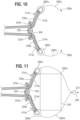
- each of the first folded portion 214a and the second folded portion 214b may be folded around outer edge regions of the commissure tabs 230a and 230b, respectively, to form a first flap 214c and a second flap 214d, respectively.
- a suture 266'a may be stitched through the first folded portion 214a and the commissure tab 230a through stitch 268'a, and a suture 266'b may be stitched through the second folded portion 214b and the commissure tab 230b through stitch 268'b, such that stitches 268'a and 268'b fulfill the roles of both stitches 268a, 268b and 270a, 270b as described above with respect to FIGS. 7-9 .
- suture 266'a may be stitched through the first flap 214c, the commissure tab 230a, and the first folded portion 214a through stitch 268' and suture 266'b may be stitched through the second flap 216d, the commissure tab 230b, and the second folded portion 214b through stitch 268'b.
- FIG. 11 another example of the sixth stage of assembling the commissure is similar to the sixth stage described above with respect to FIG. 9 , and includes pulling the sutures 266'a and 266'b around the support strut 250 and attaching the sutures 266'a and 266'b to one another at tie 272.
- the first folded portion 214a and the second folded portion 214b are both stitched to a single suture instead of two separate sutures, such as sutures 266a, 266b or 266'a, 266'b, wherein both ends of the single suture are secured to one another by stitching or tying them together at tie 272.
- FIG. 12 another example of the fifth and sixth stages of assembling the commissure may be performed for embodiments in which the first folded portion 214a of the support strip 212 and the second folded portion 214b of the support strip 212 are long enough such that opposing end portions of the first and second folded portions may be pulled around the support strut 250 and directly attached to each other (e.g., via stitching or tying the end portions together).
- respective end portions of the first folded portion 214a and the second folded portion 214b may be pulled in opposite directions indicated by arrows 290a and 290b around the support strut 250 and tied directly to one another and/or coupled via suture 298 at a region opposite the fold region of the support strip 212.
- the first and second folded portions may optionally be further attached to the commissure tabs via supplemental sutures 270a and 270b, respectively, as described above with respect to FIG. 8 .
- the resulting commissure configurations described herein effectively move the direction of force carrying axes away from the commissure tabs 230a and 230b.
- first folded portion 214a and the second folded portion 214b of the support strip 212 are pulled around the support strut 250 in directions indicated by arrows 290a and 290b, either directly or via sutures 266a and 266b or 266'a and 266'b, or when suture or tie 272 is pulled in direction 292 (see FIG.
- the pull forces are translated via stitches 268a and 268b or 268'a and 268'b to the edges of the support strip 212, which may be formed of a high-durability material (e.g., a cloth, such as a PET fabric) or other material, instead of acting on the suturing regions of the commissure tabs 230a and 230b, thereby reducing stress concentrations on the commissure tabs and associated leaflets.
- a high-durability material e.g., a cloth, such as a PET fabric
- pulling the first folded portion 214a and the second folded portion 214b in directions indicated by arrows 290a and 290b, or pulling the tie 272 in direction 292 may translate at least partially to pull forces acting on the stitch 264 and the fold region 215 of the support strip 214 in a combination of circumferential directions (e.g., direction 294a adjacent its extension through the first outer reinforcing element 224a, direction 294b adjacent its extension through the second outer reinforcing element 224b) and radial directions (e.g., direction 292) .
- These pull forces may act to tighten and vertically straighten the stitch 264, which may result in a general displacement of the inner reinforcing element 220 in direction 296 (see FIG.
- the pull forces described above may also result in general displacement of the outer reinforcing elements 224a and 224b (e.g., in the direction 296 for lateral pull forces on the support strip 214).
- the net effect of the pull forces may cause a general displacement of the inner and/or outer reinforcing elements that is based on parameters of the pull forces (e.g., source/location, magnitude, direction, etc.), which may in turn be based on parameters of the configuration (e.g., support post size/shape, nature of attachment of the commissure to the frame, commissure tab length, support strip length, etc.).
- the configuration may further reduce stresses acting directly on commissure tabs 230a and 230b.
- pull forces on the leaflets in the direction 296 e.g., derived by diastolic pressure while the prosthetic valve is deployed in a patient
- a prosthetic valve can be assembled by first forming a leaflet assembly and then assembling the leaflet assembly onto the frame (e.g., frame 12).
- the leaflet assembly can be formed by connecting all pairs of adjacent commissure tabs of all of the leaflets of the prosthetic valve by implementing at least the steps described above in connection with FIGS. 2-6 .
- the prosthetic valve has three leaflets (although a greater or fewer number of leaflets may be used), in which case the leaflet assembly has three pairs commissure tabs secured to each other in the manner shown in FIG. 6 .
- An inner skirt (e.g., inner skirt 20) can be placed inside of the frame and secured thereto with sutures (e.g., suture loops) 44, as shown in FIG. 1 and described above.
- the leaflet assembly can then be placed inside of the frame.
- Each commissure can be secured to a respective commissure support portion (e.g., a support strut 250 or an actuator 80) using one or more of the techniques described above in connection with FIGS. 7-12 .
- the cusp edge portion of each leaflet can be secured to the inner skirt 20 by stitching the cusp edge portion of each leaflet to the inner skirt to form stitching 42.
- FIGS. 7-12 some of the steps shown in FIGS. 7-12 optionally can be performed prior to placing the leaflet assembly inside of the frame.
- the sutures 266a, 266b can be threaded through the support strip 212 as shown in FIG. 7 prior to placing the leaflet assembly inside of the frame.
- sutures forming stitches 270a, 270b FIGS. 8-9 and 12
- sutures forming stitches 266'a, 266'b, 268'a, 268'b FIGS. 10-11
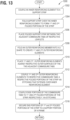
- FIG. 13 is a flow chart of an example method 1300 of assembling a commissure of a prosthetic valve and mounting the commissure on a corresponding support portion of a frame of a prosthetic valve. For example, at least a portion of method 1300 may be performed to assemble the commissure configurations as illustrated in FIGS. 1-12 . It is to be understood that one or more of the elements of method 1300 may be omitted or performed in a different order without departing from the scope of the disclosure. Method 1300 may be iteratively performed to form a plurality of commissures with a plurality of leaflets of a prosthetic valve (e.g., a prosthetic heart valve).
- a prosthetic valve e.g., a prosthetic heart valve
- Each commissure may be formed by pairing a first commissure tab of a first leaflet with an adjacent, second commissure tab of a second leaflet, then performing at least a portion of method 1300 for the respective pair of commissure tabs.
- the prosthetic valve may be assembled by mounting each of the resulting commissures to respective support portions (e.g., support struts) of a frame of the prosthetic valve.
- the method includes coupling an inner reinforcing element to a support strip.
- An example of coupling the inner reinforcing element to the support strip is shown and described above with respect to FIG. 2 .
- the method includes folding the support strip over the inner reinforcing element to form first and second folded portions of the support strip. An example of folding the support strip over the inner reinforcing element is shown and described above with respect to FIG. 3 .
- the method includes placing the folded support strip between two adjacent commissure tabs of respective leaflets.
- the folded support strip may be positioned in alignment with a cusp region of the commissure tabs, and stitching lines may be used to assist in the alignment (e.g., stitching lines near the cusp region of the commissure tabs may be aligned with stitching lines near the fold region of the support strip).
- an outer reinforcing member may be used to reinforce the location of attachment.
- the outer reinforcing member is a single reinforcing member (e.g., a single, thick suture)
- the member may be prepared for use in the commissure by folding the outer reinforcing member into a U-shape to create first and second outer reinforcing elements, as indicated at 1308.
- the first and second outer reinforcing elements may be formed in another manner and/or may be separate or discrete elements (e.g., 1308 may be omitted or replaced with an alternative outer reinforcing member preparation stage).
- the method includes placing the first and second outer reinforcing elements against respective outer surfaces of the two adjacent commissure tabs.
- the method includes coupling the first and second outer reinforcing elements to respective commissure tabs and respective folded portions of the strip via stitching that extends over the inner reinforcing element.
- FIG. 5 shows an example of the above-described positioning and coupling of the outer reinforcing elements.
- the cross-sectional view of FIG. 6 illustrates an example of the extension of the stitching behind (radially outward of) the inner reinforcing element.
- a fold region of the outer reinforcing member may extend across edge portions of the two adjacent commissure tabs and the folded support strip. Accordingly, the fold region of the outer reinforcing member may be at least partially aligned with the stitching that extends across the inner reinforcing element.
- the method includes optionally coupling edge portions of the commissure tabs to first and second folded portions of the support strip, respectively, via additional stitching.
- the additional point of coupling between these elements may provide supplemental stress/force distribution to reduce stress/force on the commissure tabs and/or associated leaflets.
- the support strip may generally be vulnerable to tearing or fraying.
- Folding the support strip around the commissure tabs may create a robust attachment, as the commissure tab material positioned between the fold of the support strip by the suture loop may prevent the breaking away of material (e.g., threads) forming the support strip.
- the coupling may also help to keep the edge portions of the commissure tabs from moving independently from the folded support strip, which may further reduce wear or other complications arising from such movement.
- the method includes securing the end portions of the first and second folded portions of the support strip to a support portion (e.g., support strut 250) of a frame of the prosthetic valve, which may include coupling the end portions of the first and second folded portions of the support strip to one another around the support portion of the frame. Examples of this coupling are shown in FIGS.
- direct coupling e.g., where end portions of the first and second folded portions of the support strip are directly sutured, adhered, or otherwise coupled and/or in contact with one another
- indirect coupling via a single suture e.g., indirect coupling via multiple sutures (e.g., a first suture attached to the first folded portion and a second suture attached to the second folded portion), and/or any other suitable coupling mechanism.
- direct attachment of the end portions of the support strip to one another may be reinforced by a further suture or other coupling mechanism applied to a region where the end portions of the support strip are coupled to one another (e.g., stitching a suture through the end portions of the support strip in the region of direct attachment).
- Securing the commissure to the support portion of the frame may utilize any suitable coupling mechanisms, such as stitching (e.g., shoelace stitching), knotting/tying (e.g., square knotting), adhering, sintering, and/or any other mechanism or combination of mechanisms.
- a non-limiting, illustrative example of a coupling method may include making tight shoelace stitches with a suture starting at an outflow edge of the support portion of the frame, making a square knot, using remaining suture tails to make a shoelace stitch under the resulting junction (e.g., the first and last stitch sutures may be on the outer side of the tissue-skirt subassembly), making two square knots, and cutting suture tails to a selected length.
- FIG. 14 is an embodiment of assembling a commissure in accordance with the presently claimed invention, where the commissure of the example of FIG. 14 has a reinforced zone formed by folded end portions of a support strip and edge reinforcing members.
- the stitched end portions of the support strip reinforce the commissure and reduce the risk of cloth tear, without using an attached external component, such as an inner reinforcing member (e.g., formed of a suture or other material).
- the folded support strip of the assembly shown in FIG. 14 also forms a double-layered structure, thereby doubling the total thickness of the material disposed between leaflets associated with the commissure.
- FIG. 14 is similar to that of FIGS. 9 and 11 , however, the configuration of FIG. 14 does not include an inner reinforcing element attached to a vertical centerline of a support strip.
- a first portion 1414a of the support strip 1412 extends (e.g., from the vertical centerline of the support strip 1412) in one direction, and is folded (e.g., widthwise) over an edge reinforcing element 1426a (shown and described in more detail with respect to FIG. 15 ) to form a third portion 1414c extending back toward the vertical centerline of the support strip 1412.
- a second portion 1414b of the support strip extends (e.g., from the vertical centerline of the support strip) in an opposing direction to that of portion 1414a, and is folded (e.g., widthwise) over an edge reinforcing element 1426b to form a fourth portion 1414d extending back toward the vertical centerline of the support strip 1412.
- the edge reinforcing elements 1426a and 1426b can be sutures or pieces of fabric, and may be thinner than the Ethibond or other material used as an inner reinforcing element 220 in FIG. 2 and/or thinner than the outer reinforcing elements 1424a and 1424b. However, in other implementations, elements 1426a, 1426b can be Ethibond sutures.
- the support strip end portions 1414e and 1414f, at the ends of portions 1414c and 1414d, respectively, are stitched together via stitches 1468.
- the remaining sections of support strip end portions 1414e and 1414f extending from the stitches 1468, are further folded over stitches 1468.
- a reinforced region is formed along the vertical centerline of the support strip 1412, by stitching end portions of the support strip 1412 itself instead of using an additional external component, such as an inner reinforcing element 220 of FIG. 2 .
- the resulting folded support strip 1412 is then positioned between the commissure tabs 1430a and 1430b, having stitched end portions 1414e and 1414f placed therebetween.
- a suture is then used to form stitches 1464 through (e.g., in order) the first outer reinforcing element 1424a, commissure tab 1430a, folded portions 1414a and 1414c, folded portions 1414d and 1414b, commissure tab 1430b and the second outer reinforcing element 1424b.
- the stitches 1464 extend over the reinforced region of the support strip, such that the reinforced region of the support strip is positioned between the stitches 1464 and the commissure tabs 1430a and 1430b (e.g., the inner surfaces of the commissure tabs, in a region where the commissure tabs meet one another). In other examples, the stitches 1464 may pass through the extended tabs in the reinforced region.
- Suture 1466 is then stitched through folded portions 1414a and 1414c and through folded portion 1414d and 1414b on opposite sides of a support post 1450, finally securing the commissure to the support post 1450 via ties 1472.
- the commissure may be secured to the support post 1450 using any suitable mechanism, including the example approaches described herein (e.g., in FIGS. 9 , 11 , and 12 ).
- the suture 1466 passes through the folded portions 1414a-d behind (e.g., toward the commissure tabs) the respective edge reinforcing elements 1426a and 1426b.
- the suture 1466 and/or an additional suture attached thereto may pass through the edge reinforcing elements 1426a and 1426b and/or in front of (e.g., toward the tie 1472 and away from the commissure tabs) the edge reinforcing elements 1426a and 1426b.
- FIG. 15 is a detailed view of a portion of the support strip 1412 of FIG. 14 (e.g., portions 1414a and 1414c) folded around the edge reinforcing element 1426a.
- the folded portions 1414a and 1414c comprise stitching lines 1516, adjacent the edge reinforcing element 1426a, and the folded portion 1414b and 1414d (not shown in FIG. 15 ) comprise stitching lines adjacent the edge reinforcing element 1426b.
- the stitching lines 1516 for folded portions 1414a and 1414c may be aligned over each other when the support strip 1412 is folded over the edge reinforcing element 1426a, and the stitching lines for folded portions 1414b and 1414d may be aligned over each other when the support strip 1412 is folded over the edge reinforcing element 1426b.
- support strip end portions 1414e and 1414f comprise stitching lines adjacent to their respective edges.
- the stitching lines of the support strip end portions 1414e and 1414f may be aligned over each other when stitched together along the vertical centerline of the support strip 1412.
- the edge reinforcing element 1426 is longer than the height of the support strip 1412, and thus extends past edges of the support strip in a vertical direction (e.g., along a longitudinal axis of the edge reinforcing element).
- the edge reinforcing element 1426a may be reinforced by tying or otherwise coupling ends of the edge reinforcing element 1426a to corresponding ends of edge reinforcing element 1426b (e.g., a top end of edge reinforcing element 1426a may be coupled to a top end of edge reinforcing element 1426b, and a bottom end of edge reinforcing element 1426a may be coupled to a bottom end of edge reinforcing element 1426b).
- edge reinforcing element 1426a may be reinforced by tying or otherwise coupling opposing ends of the edge reinforcing element 1426a to one another (e.g., a top end of edge reinforcing element 1426a may be coupled to a bottom end of edge reinforcing element 1426a, such that the edge reinforcing element 1426a loops around an outer surface of the support strip 1412 in an edge fold region of the support strip 1412).
- the support strip 1412 may be configured to be wider (e.g., on both sides in the axial direction of the associated valve) and folded so as to create a double layer with no free edge of the cloth.
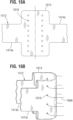
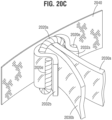
- FIGS. 16A and 16B show an example configuration of support strip 1412 that includes an edge reinforcing region 1614 positioned between portions 1414a and 1414c (e.g., positioned in an edge fold region of the support strip.
- the support strip 1412 may include another, similarly-configured/dimensioned edge reinforcing region positioned between support strip portions 1414b and 1414d (which are shown in FIG. 14 ).
- FIG. 16A shows a first view of an unfolded edge reinforcing region 1614.
- a height of the support strip 1412 e.g., in the axial direction of the valve in which the support strip is included
- FIG. 16B shows a second view of the edge reinforcing region 1614 folded over itself to reinforce an edge fold region of the support strip 1412.
- the edge reinforcing region 1614 may be used in some examples in place of the edge reinforcing elements 1426a/b, or in other examples in combination with/in addition to the edge reinforcing elements 1426a/b.
- the edge reinforcing region 1614 also optionally includes a plurality of stitching lines 1616, which may be similar in configuration to stitching lines 1516 of FIG. 15 .
- the stitching lines 1616 may comprise an external marking, such as an ink marking, visually indicating suturing locations for a user assembling the commissure and/or may be formed with a plurality of apertures or openings, through which a needle carrying sutures (e.g., sutures 1666 in FIG. 16B ) can pass.
- the stitching lines 1616 may be used for alignment purposes when folding the edge reinforcing region 1614 over itself. For example, for each end portion of the edge reinforcing region 1614 (e.g., where the end portions extend from a center of the edge reinforcing region outward in opposing directions along a longitudinal axis of the edge reinforcing region, past respective edges of the support strip portions 1414a and 1414c), one or more markings and/or apertures/openings in an outer row(s) of the respective end portion of the edge reinforcing region may be aligned with one or more corresponding markings and/or apertures/openings in an inner (e.g., nearer to a center of the edge reinforcing region) row(s) of the respective end portion of the edge reinforcing region.
- an inner e.g., nearer to a center of the edge reinforcing region
- the end portions of the edge reinforcing region of the support strip may be folded toward one another and each end portion may at least partially overlap itself when in a folded state (e.g., as shown in FIG. 16B ). It is to be understood that other folding arrangements may be used to create the folded edge reinforcing region 1614 without departing from the scope of the disclosure.
- the disclosed configurations described with respect to FIGS. 14, 15 , 16A, and 16B include a reinforced region along the vertical centerline of the support strip 1412, by stitching end portion of the support strip 1412 itself instead of using an additional external component, such as inner reinforcing element 220 of FIG. 2 .
- the folded support strip 1412 forms a double-layered structure, such that the total thickness of the support strip 1412 disposed between the commissure tabs 1430a and 1430b and the post 1450 is doubled, relative to the single layered support strip 212 according to FIG. 2 .
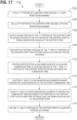
- FIG. 17 is a flow chart of an embodiment of a method 1700, in accordance with the presently claimed invention, for assembling a commissure of a prosthetic valve using edge reinforcing members and mounting the commissure on a corresponding support portion of a frame of a prosthetic valve.
- method 1700 may be performed to assemble the commissure configurations as illustrated in FIGS. 14 and 15 . It is to be understood that one or more elements of method 1700 may be omitted or performed in a different order without departing from the scope of the disclosure.
- Method 1700 may be iteratively performed to form a plurality of commissures with a plurality of leaflets of a prosthetic valve (e.g., a prosthetic heart valve).
- a prosthetic valve e.g., a prosthetic heart valve
- Each commissure may be formed by pairing a first commissure tab of a first leaflet with an adjacent, second commissure tab of a second leaflet, then performing at least a portion of method 1700 for the respective pair of commissure tabs.
- the prosthetic valve may be assembled by mounting each of the resulting commissures to respective support portions (e.g., support struts/posts) of a frame of the prosthetic valve.
- the method includes folding (e.g., widthwise) a first portion of a support strip around a first edge reinforcing element/member.
- folding e.g., widthwise
- An example of folding the first portion of a support strip around a first edge reinforcing element/member is shown and described above with respect to FIG. 14 and in more detail with respect to FIG. 15 .
- the method includes folding (e.g., widthwise) a second portion of the support strip around a second edge reinforcing element/member.
- the second portion of the support strip may be folded around the second edge reinforcing element/member in a similar manner to the folding of the first portion of the support strip around the first edge reinforcing element/member as shown and described above with respect to FIG. 15 .
- the second portion of the support strip may extend in an opposite direction from a vertical centerline of the support strip relative to the first portion of the support strip, for example as shown and described above with respect to FIG. 14 .
- the second edge reinforcing element/member may be substantially in alignment with the first edge reinforcing element/member (e.g., the second edge reinforcing element may be on an opposite side of the support structure from the first edge reinforcing element).
- the method includes coupling an end portion of the first portion of the support strip to an end portion of the second portion of the support strip to form a reinforced region of the support strip.
- An example of coupling the end portions of the support strip to form the reinforced region is shown and described above with respect to FIG. 14 .
- stitch 1468 of FIG. 14 is one example of an element used to couple the end portions of the support strip to one another.
- each end portion of the support strip may extend (e.g., from a vertical centerline of the support strip) toward and then around a respective edge reinforcing element, then back toward a center of the support strip (e.g., such that the portions of the support strip are folded over itself around the edge reinforcing element) to meet the other end portion of the support strip.
- the method optionally includes further folding the end portions of the first and second portions of the support strip over stitches used for coupling the end portions.
- An example of the folding of the end portions over themselves and thus over stitches used for coupling the end portions to one another is shown and described above with respect to FIG. 14 .
- the end portions of the support strip 1412 are shown as being folded over (e.g., in opposite directions to one another) the stitch 1468 in FIG. 14 .
- the method includes positioning the support strip along an inner surface of adjacent commissure tabs, such that a coupling region of the first and second portions of the support strip (e.g., the reinforced region of the support strip) is positioned between the commissure tabs.
- a coupling region of the first and second portions of the support strip e.g., the reinforced region of the support strip
- An example of the positioning of the support strip is shown and described above with respect to FIG. 14 .
- the first portion of the support strip is shown as being positioned at least partially in contact with and/or adjacent to an inner surface of the first commissure tab 1430a and the second portion of the support strip is shown as being positioned at least partially in contact with and/or adjacent to an inner surface of the second commissure tab 1430b.
- the reinforced region of the support strip, formed by the end portions of the support strip folded over stitch 1468, is shown in FIG. 14 as being approximately aligned with (e.g., positioned over) a location where the commissure tabs 1430a and 1430b meet (e.g., between the commissure tabs).
- the method includes positioning the first and second outer reinforcing elements against respective outer surfaces of the adjacent commissure tabs.
- the method includes coupling the first and second outer reinforcing elements to respective commissure tabs and respective portions of the support strip via stitching that extends over the reinforced region of the support strip.
- An example of the positioning of the outer reinforcing elements and the coupling of these elements to the support strip is shown and described above with respect to FIG. 14 .
- FIGS. 5 and 6 show an example of positioning and coupling outer reinforcing elements that may also be used for this portion of method 1700.
- the positioning and coupling of the outer reinforcing elements may be performed in a similar manner to the placing and coupling described above at 1310 and 1312 of FIG. 13 , where the commissure includes and utilizes a reinforced region (formed as described above at 1706/1708) in an analogous manner to the inner reinforcing element described with respect to FIG. 13 (and shown in FIGS. 5 and 6 ).
- the method includes securing first and second portions of the support strip to a support portion of a frame of the prosthetic valve (e.g., support structure 1450 of FIG. 14 ).
- a support portion of a frame of the prosthetic valve e.g., support structure 1450 of FIG. 14
- An example of this securing is shown using suture 1466 in FIG. 14 , however, any suitable mechanism for securing the first and second portions of the support strip may be used.
- direct coupling e.g., where portions of the first and second folded portions of the support strip are directly sutured, adhered, or otherwise coupled and/or in contact with one another
- indirect coupling via a single suture e.g., indirect coupling via multiple sutures (e.g., a first suture attached to the first portion of the support strip and/or first edge reinforcing element and a second suture attached to the second portion of the support strip and/or second edge reinforcing element), and/or any other suitable coupling mechanism.
- direct attachment of the portions of the support strip to one another may be reinforced by a further suture or other coupling mechanism applied to a region where the portions of the support strip are coupled to one another (e.g., stitching a suture through the portions of the support strip in the region of direct attachment).
- Securing the commissure to the support portion of the frame may utilize any suitable coupling mechanisms, such as stitching (e.g., shoelace stitching), knotting/tying (e.g., square knotting), adhering, sintering, and/or any other mechanism or combination of mechanisms.
- a non-limiting, illustrative example of a coupling method may include making tight shoelace stitches with a suture starting at an outflow edge of the support portion of the frame, making a square knot, using remaining suture tails to make a shoelace stitch under the resulting junction (e.g., the first and last stitch sutures may be on the outer side of the tissue-skirt subassembly), making two square knots, and cutting suture tails to a selected length.
- FIG. 18 is another example of assembling a commissure of a prosthetic valve, including folding extended commissure tabs of leaflets of the prosthetic valve over portions of a reinforcing member.
- additional portions of the reinforcing member may be placed over outer surfaces of the folded extended commissure tabs and associated end portions of the reinforcing member may be knotted or otherwise coupled together to form and secure a resulting support structure (e.g., a suture frame) over the extended commissure tabs.
- a resulting support structure e.g., a suture frame
- commissure tabs 1830a and 1830b of the leaflets of the prosthetic valve are provided with extended tabs 1832a and 1832b, respectively.
- the extended tabs 1832a and 1832b are folded over primary reinforcing element 1820a portions.
- Secondary reinforcing element 1820b portions are placed over the outer surfaces of the folded tabs 1832a and 1832b (e.g., where the inner surfaces in a region of the primary reinforcing element portions transitions, due to the folding, to outer surfaces over which the secondary reinforcing element portions are placed), thereby framing the tabs (e.g., forming a suture frame or other support structure).
- End portions of the secondary reinforcing element 1820b may be knotted or otherwise coupled together to secure the resulting support structure over the tabs.
- a post skirt 1840 or other support/buffering material may be stitched to the folded portion of the commissure tabs 1830a and 1830b, configured to circumvent and attach the commissure to a support post 1810 (e.g., a support structure of a frame of a prosthetic valve).
- the disclosed commissure configuration can be easily attached to a wide variety of frame posts, including posts of mechanically expandable valves.
- a single reinforcing member which can be for example suture (e.g., a braided suture, such as an Ethibond suture), can be used to form both the primary reinforcing element 1820a portions and the secondary reinforcing element 1820b portions.
- the reinforcing member is an Ethibond 3.0 suture.
- FIG. 19 shows a cross-sectional view of the commissure tabs 1830a and 1830b of FIG. 18 , including a single reinforcing member 1820, which is wrapped and/or crossed in different directions between different extensions thereof (exemplary wrap directions shown in dashed lines in Fig. 19 ).
- FIG. 19 shows a cross-sectional view of the commissure tabs 1830a and 1830b of FIG. 18 , including a single reinforcing member 1820, which is wrapped and/or crossed in different directions between different extensions thereof (exemplary wrap directions shown in dashed lines in Fig. 19 ).
- the single reinforcing member is continuous, such that primary and secondary reinforcing elements 1820a and 1820b of FIG. 18 correspond to different regions of the same single reinforcing member 1820.
- multiple reinforcing elements may be coupled together or separately coupled to the extended tabs to collectively form a reinforcing member having the primary and secondary reinforcing elements 1820a and 1820b.
- commissure tabs 2030a and 2030b of the leaflets of the prosthetic valve are provided with extended tabs 2032a and 2032b, respectively.
- a primary reinforcing element 2020a is placed over the outer surfaces of the extended tabs 2032a and 2032b.
- side portions 2020b and 2020c of the primary reinforcing element 2020a may be positioned to be in contact with the outer surfaces of the extended tabs 2032b and 2032a, respectively.
- primary stitches 2050a and 2050b are respectively applied to attach the primary reinforcing element to a post skirt 2040 (or other support/buffering material and/or support strip) through the extended tabs of the leaflet.
- the post skirt 2040 may be configured to circumvent and attach the commissure to a support post or other support structure of the prosthetic valve (e.g., a support structure of a frame of the prosthetic valve, a frame post, including posts of mechanically expandable valves, etc.).
- the primary stitch 2050a may pass through, in order, the side portion 2020c of the primary reinforcing element, the extended tab 2032a, and the post skirt 2040.
- the primary stitch 2050b may pass through, in order, the side portion 2020b of the primary reinforcing element, the extended tab 2032b, and the post skirt 2040. In this way, the primary stitches 2050a and 2050b may take the load of the diastolic pressure forces on the leaflets/commissure tabs.
- FIG. 20C shows a second stage of example of assembling a commissure of a prosthetic valve including extended commissure tabs, where the extended commissure tabs are folded over at least a portion of the primary reinforcing element.
- end portions of the extended tabs 2032a and 2032b are folded (e.g., pulled in a direction back toward the remaining portions of the associated leaflets) around and/or over the respective side portions of the primary reinforcing element (e.g., before caging the associated leaflets in a suture window).
- At least a portion of the end portions of the extended tabs may be substantially parallel to respective outer surfaces of the associated commissure tabs when folded over the primary reinforcing element.
- end portions 2020d and 2020e of the primary reinforcing element 2020a are pulled around an underside of respective folded regions of the extended tabs to align with an outside of the folded regions.
- end portion 2020d may be positioned against an opposing surface of the extended tab 2032b from the surface that contacts/faces the side portion 2020b (shown in FIG. 20A , not fully visible in the view of FIG. 20C ) of the primary reinforcing element.
- end portion 2020e may be positioned against an opposing surface of the extended tab 2032a from the surface that contacts/faces the side portion 2020c (shown in FIG. 20A , not fully visible in the view of FIG. 20C ) of the primary reinforcing element.
- the end portions 2020d and 2020e may be attached to at least the respective extended tabs 2032b and 2032a (e.g., via secondary sutures).
- the attachment mechanism e.g., sutures
- the end portions 2020d and 2020e may not be terminated as shown in FIG. 20C and may extend and be knotted or otherwise coupled together to secure the resulting support structure (e.g., formed by the primary reinforcing element) over the extended tabs.
- FIG. 20C shows the extended tabs 2032a and 2032b being reinforced by portions of a single reinforcing element 2020a (which can be for example a suture, such as a braided suture, as described above with respect to reinforcing elements 1820a and 1820b).
- a single reinforcing element 2020a which can be for example a suture, such as a braided suture, as described above with respect to reinforcing elements 1820a and 1820b.
- FIGS. 20A-20C may additionally or alternatively be formed using multiple reinforcing elements that are coupled to one another and/or the extended tabs and other commissure elements in the manner described above for the different portions of the reinforcing element 2020a.
- FIG. 21 is a flow chart of an example method 2100 for assembling a commissure of a prosthetic valve using extended commissure tabs of leaflets of the prosthetic valve. For example, at least a portion of method 2100 may be performed to assemble the commissure configurations as illustrated in FIGS. 18, 19 , and/or 20A-20C. It is to be understood that one or more elements of method 2100 may be omitted or performed in a different order without departing from the scope of the disclosure. Method 2100 may be iteratively performed to form a plurality of commissures with a plurality of leaflets of a prosthetic valve (e.g., a prosthetic heart valve).
- a prosthetic valve e.g., a prosthetic heart valve
- Each commissure may be formed by pairing a first commissure tab of a first leaflet with an adjacent, second commissure tab of a second leaflet, then performing at least a portion of method 2100 for the respective pair of commissure tabs.
- the prosthetic valve may be assembled by mounting each of the resulting commissures to respective support portions (e.g., support struts/posts) of a frame of the prosthetic valve.
- the method includes placing one or more primary reinforcing elements on respective outer surfaces of extended tabs of adjacent commissure tabs of adjacent leaflets.
- An example of the placement of the primary reinforcing elements is shown and described above with respect to 1820a of FIG. 18 .
- the primary reinforcing elements are portions of a single, continuous primary reinforcing member that extends around edges of the adjacent commissure tabs to contact the outer surfaces of the commissure tabs.
- the positioning of this example of a primary reinforcing element may be similar to the positioning of the outer reinforcing elements shown and described above with respect to FIGS. 4 and 5 .
- the method includes folding the extended tabs over the one or more primary reinforcing elements, respectively.
- An example of the folding is shown and described above with respect to FIGS. 18 and 19 .
- each extended tab is folded over itself (and over a respective primary reinforcing element placed on its outer surface) to create a loop in which the respective primary reinforcing element is positioned.
- the primary reinforcing elements are positioned such that they are each adjacent to a respective inner surface of the folded extended commissure tab (e.g., the region of the extended commissure tab that extends from the fold in the extended commissure tab toward an end portion of the extended commissure tab).
- the method includes placing one or more secondary reinforcing elements on respective outer surfaces of the folded extended tabs.
- An example of the placement of the secondary reinforcing elements is shown and described above with respect to FIG. 18 .
- the secondary reinforcing elements are portions of a single, continuous secondary reinforcing member that extends around edges of the adjacent commissure tabs to contact the outer surfaces of the folded extended tabs. It is to be understood that in other examples, multiple secondary reinforcing elements may be used to contact the outer surfaces of the folded extended tabs.
- the outer surfaces of the folded extended tabs extend from the inner surfaces of the extended tabs due to the folding of the extended tabs (e.g., at a fold region of the extended tabs, the inner surfaces of the extended tabs become outer surfaces of the folded extended tabs).
- the respective primary and secondary reinforcing elements are positioned adjacent opposite surfaces of the folded extended tab from one another.
- the method includes coupling end portions of the one or more secondary reinforcing elements to one another to form a support structure.
- the end portions of the secondary reinforcing elements may be coupled to one another across an edge of the extended tabs, at an outer surface of the folded extended tabs, and/or within an associated loop formed by folding the extended tabs over themselves as described at 2104.
- the method includes coupling a fold region of the extended tabs to a support material, such as a support strip and/or post skirt.
- a support material such as a support strip and/or post skirt.
- the fold region of the extended tabs may include portions of the extended tabs that are folded over the primary reinforcing elements as described at 2104. Any suitable mechanism may be used to couple the extended tabs (e.g., in the fold region) to the support material.
- the method includes securing the support material and/or the extended tabs to an associated support structure of a frame of the prosthetic valve (e.g., support structure 1810 of FIG. 18 ).
- the mechanism used to couple the fold region of the extended tabs to the support material may also be used at least in part to secure the support material and/or the extended tabs to the associated support structure of the frame.
- the primary and/or secondary reinforcing elements may be directly or indirectly coupled to the support material and/or to a coupling mechanism used to secure the support material and/or extended tabs to the support structure. Any suitable mechanism for securing the support material and/or the extended tabs to the support structure may be used.
- direct coupling e.g., where portions of the support material and/or the extended tabs are directly sutured, adhered, or otherwise coupled and/or in contact with the support structure and/or with one another
- indirect coupling via a single suture e.g., after wrapping the support material around the support structure of the frame
- direct attachment of portions of the support material to one another may be reinforced by a further suture or other coupling mechanism applied to a region where the portions of the support material are coupled to one another (e.g., stitching a suture through the portions of the support material in the region of direct attachment).
- Securing the commissure to the support portion of the frame may utilize any suitable coupling mechanisms, such as stitching (e.g., shoelace stitching), knotting/tying (e.g., square knotting), adhering, sintering, and/or any other mechanism or combination of mechanisms.
- stitching e.g., shoelace stitching
- knotting/tying e.g., square knotting
- adhering e.g., sintering
- sintering e.g., any other mechanism or combination of mechanisms.
Landscapes
- Health & Medical Sciences (AREA)
- Engineering & Computer Science (AREA)
- Biomedical Technology (AREA)
- Cardiology (AREA)
- Oral & Maxillofacial Surgery (AREA)
- Transplantation (AREA)
- Heart & Thoracic Surgery (AREA)
- Vascular Medicine (AREA)
- Life Sciences & Earth Sciences (AREA)
- Animal Behavior & Ethology (AREA)
- General Health & Medical Sciences (AREA)
- Public Health (AREA)
- Veterinary Medicine (AREA)
- Manufacturing & Machinery (AREA)
- Mechanical Engineering (AREA)
- Prostheses (AREA)
Claims (15)
- Verfahren zur Montage einer Herzklappenprothese (10), die eine Vielzahl von Segeln umfasst, wobei das Verfahren Folgendes umfasst:Bilden einer Vielzahl von Kommissuren (24) mit der Vielzahl von Segeln, wobei jede Kommissur durch Paaren einer ersten Kommissurlasche (1430a) eines ersten Segels mit einer benachbarten zweiten Kommissurlasche (1430b) eines zweiten Segels gebildet wird,Falten (1702) eines ersten Abschnitts (1414a) eines Stützstreifens (1412) über ein erstes Randverstärkungselement (1426a),Falten (1704) eines zweiten Abschnitts (1414b) des Stützstreifens über ein zweites Randverstärkungselement (1426b),Koppeln (1706) eines Endabschnitts (1414e) des ersten Abschnitts des Stützstreifens an einen Endabschnitt (1414f) des zweiten Abschnitts des Stützstreifens, um einen verstärkten Bereich des Stützstreifens zu bilden,Positionieren (1710) des Stützstreifens entlang jeweiliger Innenflächen der ersten Kommissurlasche und der zweiten Kommissurlasche,Koppeln (1714) eines ersten und eines zweiten äußeren Verstärkungselements (1424a, 1424b) an die erste bzw. zweite Kommissurlasche über eine Naht (1464), die sich durch das erste äußere Verstärkungselement, die erste Kommissurlasche, den gefalteten Stützstreifen, die zweite Kommissurlasche und das zweite äußere Verstärkungselement erstreckt, wobei sich die Naht über den verstärkten Bereich des Stützstreifens erstreckt, undfür jede Kommissur, Befestigen (1716) des Stützstreifens an einem entsprechenden Stützabschnitt (1450) eines Rahmens der Herzklappenprothese (10).
- Verfahren nach Anspruch 1, wobei der verstärkte Bereich an im Wesentlichen einer vertikalen Mittellinie des Stützstreifens positioniert ist.
- Verfahren nach Anspruch 1 oder Anspruch 2, ferner umfassend das jeweilige Falten (1708) der Endabschnitte des ersten und des zweiten Abschnitts des Stützstreifens über Maschen (1468), die zum Aneinanderkoppeln der Endabschnitte dienen.
- Verfahren nach einem der vorhergehenden Ansprüche, wobei das Befestigen des Stützstreifens an dem jeweiligen Stützabschnitt des Rahmens das Nähen eines jeweiligen Fadens (1466) an gefaltete Abschnitte des Stützstreifens, die um das erste bzw. das zweite Randverstärkungselement gefaltet sind, das Herumlegen der jeweiligen Fäden um den Stützabschnitt des Rahmens und das Anbringen der jeweiligen Fäden aneinander umfasst.
- Verfahren nach einem der Ansprüche 1 bis 3, wobei das Befestigen des Stützstreifens an dem jeweiligen Stützabschnitt des Rahmens das Herumlegen der gefalteten Abschnitte des Stützstreifens, die um das erste bzw. das zweite Randverstärkungselement gefaltet sind, um den Stützabschnitt des Rahmens herum und das direkte Anbringen der gefalteten Abschnitte des Stützstreifens und/oder des ersten und des zweiten Randverstärkungselements aneinander umfasst.
- Verfahren nach Anspruch 5, ferner umfassend Verstärken eines Bereichs des direkten Anbringens der gefalteten Bereiche des Stützstreifens durch Nähen eines Fadens durch die gefalteten Bereiche des Stützstreifens in dem Bereich des direkten Anbringens.
- Verfahren nach einem der Ansprüche 1 bis 3, wobei sich gefaltete Bereiche des Stützstreifens, die um das erste bzw. zweite Randverstärkungselement gefaltet sind, über Endabschnitte der ersten bzw. der zweiten Kommissurlasche hinaus erstrecken und wobei das Befestigen des Stützstreifens an dem jeweiligen Stützabschnitt des Rahmens das Falten der gefalteten Bereiche des Stützstreifens um die Endabschnitte der ersten bzw. der zweiten Kommissurlasche, Nähen der gefalteten Bereiche des Stützstreifens und/oder des ersten und des zweiten Randverstärkungselements mit mindestens einem Faden an die Endabschnitte der ersten bzw. der zweiten Kommissurlasche, und Koppeln der gefalteten Bereiche des Stützstreifens über den mindestens einen Faden umfasst.
- Verfahren nach Anspruch 7, wobei der mindestens eine Faden einen einzelnen Faden umfasst, der durch beide gefalteten Bereiche des Stützstreifens geht, und wobei das Koppeln der gefalteten Bereiche des Stützstreifens über den mindestens einen Faden das Herumlegen von Endabschnitten des einzelnen Fadens um die Stützstruktur in zueinander entgegengesetzten Richtungen und das Koppeln der Endabschnitte des einzelnen Fadens umfasst.
- Verfahren nach Anspruch 7, wobei der mindestens eine Faden einen ersten Faden, der durch einen ersten gefalteten Bereich des Stützstreifens geht, und einen zweiten Faden, der durch einen zweiten gefalteten Bereich des gefalteten Stützstreifens geht, umfasst und wobei das Koppeln der gefalteten Bereiche des Stützstreifens über den mindestens einen Faden das Herumlegen des ersten und des zweiten Fadens um die Stützstruktur und das Koppeln des ersten und des zweiten Fadens umfasst.
- Verfahren nach einem der Ansprüche 1 bis 3, wobei gefaltete Bereiche des Stützstreifens, die um das erste bzw. das zweite Randverstärkungselement gefaltet sind, durch Binden eines Fadens um die Stützstruktur gekoppelt werden.
- Verfahren nach einem der vorhergehenden Ansprüche, wobei das Befestigen des Stützstreifens an dem jeweiligen Stützabschnitt des Rahmens mindestens teilweises Falten der ersten und der zweiten Kommissurlasche an einem Faltbereich der Kommissurlaschen um das erste bzw. das zweite äußere Verstärkungselement herum umfasst, um einen Faltbereich der Naht zu erzeugen, der sich über den Verstärkungsbereich des Stützstreifens erstreckt, und wobei der Verstärkungsbereich des Stützstreifens zwischen dem Faltbereich der Naht und einem Faltbereich der Kommissurlaschen positioniert ist.
- Herzklappenprothese (10), umfassend:einen ringförmigen Rahmen, der eine Vielzahl von Kommissurstützabschnitten (1450) umfasst, undeine Vielzahl von Segeln (22), wobei jedes Segel eine Kommissurlasche (1430) hat, die über einen gefalteten Stützstreifen an eine benachbarte Kommissurlasche eines anderen Segels gekoppelt ist, um eine Kommissur (24) eines zugeordneten Kommissurlaschenpaars zu bilden,wobei für jedes Kommissurlaschenpaar:der Stützstreifen (1412) entlang jeweiliger Innenflächen der ersten Kommissurlasche (1430a) und der zweiten Kommissurlasche (1430b) positioniert ist,ein erster Abschnitt (1414a) des Stützstreifens über ein erstes Randverstärkungselement (1426a) gefaltet ist,ein zweiter Abschnitt (1414b) des Stützstreifens über ein zweites Randverstärkungselement (1426b) gefaltet ist,ein Endabschnitt (1414e) des ersten Abschnitts des Stützstreifens an einen Endabschnitt (1414f) des zweiten Abschnitts des Stützstreifens gekoppelt wird, um einen verstärkten Bereich des Stützstreifens zu bilden,ein erstes und ein zweites äußeres Verstärkungselement (1424a, 1424b) angrenzend an jeweilige Außenflächen der Kommissurlaschen in dem Kommissurlaschenpaar positioniert sind,das erste und das zweite äußere Verstärkungselement (1424a, 1424b) an die erste bzw. die zweite Kommissurlasche (1430a, 1430b) über eine Naht (1464) gekoppelt sind, die sich durch Folgendes erstreckt: das erste äußere Verstärkungselement (1424a), die erste Kommissurlasche (1430a), den gefalteten Stützstreifen (1412), die zweite Kommissurlasche (1430b) und das zweite äußere Verstärkungselement (1424b), wobei sich die Naht über den verstärkten Bereich des Stützstreifens erstreckt, undwobei für jede Kommissur der Stützstreifen (1412) an einem jeweiligen Kommissurstützabschnitt (1450) der Vielzahl von Kommissurstützabschnitten befestigt ist.
- Herzklappenprothese nach Anspruch 12, wobei der verstärkte Bereich an im Wesentlichen einer vertikalen Mittellinie des Stützstreifens positioniert ist.
- Herzklappenprothese nach Anspruch 12 oder Anspruch 13, wobei die Endabschnitte des ersten und des zweiten Abschnitts des Stützstreifens über Maschen (1468) gefaltet sind, die zum Aneinanderkoppeln der Endabschnitte dienen.
- Herzklappenprothese nach einem der Ansprüche 12 bis 14, wobei der Stützstreifen an dem jeweiligen Stützabschnitt des Rahmens über jeweilige Fäden (1466) befestigt ist, die an gefaltete Abschnitte des Stützstreifens genäht sind, die um das erste bzw. das zweite Randverstärkungselement gefaltet sind, wobei die jeweiligen Fäden um den Stützabschnitt des Rahmens herumgelegt und aneinander angebracht sind.
Priority Applications (1)
| Application Number | Priority Date | Filing Date | Title |
|---|---|---|---|
| EP25157058.6A EP4563125A3 (de) | 2020-01-10 | 2021-01-05 | Prothetische herzklappensegelanordnungen und verfahren |
Applications Claiming Priority (3)
| Application Number | Priority Date | Filing Date | Title |
|---|---|---|---|
| US202062959433P | 2020-01-10 | 2020-01-10 | |
| EP21702341.5A EP4065048B1 (de) | 2020-01-10 | 2021-01-05 | Herzklappenprothesensegelanordnungen und verfahren |
| PCT/US2021/012168 WO2021141888A1 (en) | 2020-01-10 | 2021-01-05 | Prosthetic heart valve leaflet assemblies and methods |
Related Parent Applications (2)
| Application Number | Title | Priority Date | Filing Date |
|---|---|---|---|
| EP21702341.5A Division EP4065048B1 (de) | 2020-01-10 | 2021-01-05 | Herzklappenprothesensegelanordnungen und verfahren |
| EP21702341.5A Division-Into EP4065048B1 (de) | 2020-01-10 | 2021-01-05 | Herzklappenprothesensegelanordnungen und verfahren |
Related Child Applications (1)
| Application Number | Title | Priority Date | Filing Date |
|---|---|---|---|
| EP25157058.6A Division EP4563125A3 (de) | 2020-01-10 | 2021-01-05 | Prothetische herzklappensegelanordnungen und verfahren |
Publications (3)
| Publication Number | Publication Date |
|---|---|
| EP4248917A2 EP4248917A2 (de) | 2023-09-27 |
| EP4248917A3 EP4248917A3 (de) | 2023-12-27 |
| EP4248917B1 true EP4248917B1 (de) | 2025-02-12 |
Family
ID=74347746
Family Applications (3)
| Application Number | Title | Priority Date | Filing Date |
|---|---|---|---|
| EP21702341.5A Active EP4065048B1 (de) | 2020-01-10 | 2021-01-05 | Herzklappenprothesensegelanordnungen und verfahren |
| EP25157058.6A Pending EP4563125A3 (de) | 2020-01-10 | 2021-01-05 | Prothetische herzklappensegelanordnungen und verfahren |
| EP23191760.0A Active EP4248917B1 (de) | 2020-01-10 | 2021-01-05 | Prothetische herzklappensegelanordnungen und verfahren |
Family Applications Before (2)
| Application Number | Title | Priority Date | Filing Date |
|---|---|---|---|
| EP21702341.5A Active EP4065048B1 (de) | 2020-01-10 | 2021-01-05 | Herzklappenprothesensegelanordnungen und verfahren |
| EP25157058.6A Pending EP4563125A3 (de) | 2020-01-10 | 2021-01-05 | Prothetische herzklappensegelanordnungen und verfahren |
Country Status (4)
| Country | Link |
|---|---|
| US (1) | US20220323209A1 (de) |
| EP (3) | EP4065048B1 (de) |
| CN (1) | CN115151218A (de) |
| WO (1) | WO2021141888A1 (de) |
Families Citing this family (4)
| Publication number | Priority date | Publication date | Assignee | Title |
|---|---|---|---|---|
| CN115003255A (zh) * | 2020-01-10 | 2022-09-02 | 爱德华兹生命科学公司 | 假体心脏瓣膜小叶的组装方法 |
| CN115484897A (zh) * | 2020-03-05 | 2022-12-16 | 爱德华兹生命科学公司 | 假体心脏瓣膜小叶组合件和方法 |
| US20240252312A1 (en) * | 2023-01-27 | 2024-08-01 | Medtronic, Inc. | Reinforced commissure for prosthetic heart valve |
| WO2025046450A1 (en) * | 2023-08-30 | 2025-03-06 | Medtronic, Inc. | Heart valve prothesis having improved commissure durability |
Family Cites Families (10)
| Publication number | Priority date | Publication date | Assignee | Title |
|---|---|---|---|---|
| US6893460B2 (en) | 2001-10-11 | 2005-05-17 | Percutaneous Valve Technologies Inc. | Implantable prosthetic valve |
| US8696743B2 (en) * | 2008-04-23 | 2014-04-15 | Medtronic, Inc. | Tissue attachment devices and methods for prosthetic heart valves |
| HUE047762T2 (hu) | 2008-06-06 | 2020-05-28 | Edwards Lifesciences Corp | Kis profilú transzkatéteres szívbillentyû |
| US8652202B2 (en) | 2008-08-22 | 2014-02-18 | Edwards Lifesciences Corporation | Prosthetic heart valve and delivery apparatus |
| CA2799459A1 (en) * | 2010-05-25 | 2011-12-01 | Jenavalve Technology Inc. | Prosthetic heart valve and transcatheter delivered endoprosthesis comprising a prosthetic heart valve and a stent |
| US11096781B2 (en) * | 2016-08-01 | 2021-08-24 | Edwards Lifesciences Corporation | Prosthetic heart valve |
| US10603165B2 (en) | 2016-12-06 | 2020-03-31 | Edwards Lifesciences Corporation | Mechanically expanding heart valve and delivery apparatus therefor |
| US11135056B2 (en) | 2017-05-15 | 2021-10-05 | Edwards Lifesciences Corporation | Devices and methods of commissure formation for prosthetic heart valve |
| US10869759B2 (en) | 2017-06-05 | 2020-12-22 | Edwards Lifesciences Corporation | Mechanically expandable heart valve |
| US10806573B2 (en) | 2017-08-22 | 2020-10-20 | Edwards Lifesciences Corporation | Gear drive mechanism for heart valve delivery apparatus |
-
2021
- 2021-01-05 EP EP21702341.5A patent/EP4065048B1/de active Active
- 2021-01-05 EP EP25157058.6A patent/EP4563125A3/de active Pending
- 2021-01-05 WO PCT/US2021/012168 patent/WO2021141888A1/en not_active Ceased
- 2021-01-05 EP EP23191760.0A patent/EP4248917B1/de active Active
- 2021-01-05 CN CN202180015685.5A patent/CN115151218A/zh active Pending
-
2022
- 2022-06-28 US US17/851,232 patent/US20220323209A1/en active Pending
Also Published As
| Publication number | Publication date |
|---|---|
| EP4248917A3 (de) | 2023-12-27 |
| WO2021141888A1 (en) | 2021-07-15 |
| EP4248917A2 (de) | 2023-09-27 |
| CN115151218A (zh) | 2022-10-04 |
| EP4563125A2 (de) | 2025-06-04 |
| EP4065048B1 (de) | 2024-04-17 |
| US20220323209A1 (en) | 2022-10-13 |
| EP4065048A1 (de) | 2022-10-05 |
| EP4563125A3 (de) | 2025-08-27 |
Similar Documents
| Publication | Publication Date | Title |
|---|---|---|
| CN209059539U (zh) | 人工心脏瓣膜 | |
| EP4065048B1 (de) | Herzklappenprothesensegelanordnungen und verfahren | |
| EP4221635B1 (de) | Prothetische herzklappensegelanordnungen | |
| US12343253B2 (en) | Prosthetic heart valve leaflet assemblies and methods | |
| US20220280289A1 (en) | Prosthetic heart valves with commissure post protrusions for commissure assembly position locking | |
| CN114430675B (zh) | 假体心脏瓣膜小叶组件和组装方法 | |
| JP7736575B2 (ja) | 人工心臓弁 | |
| US20220323211A1 (en) | Prosthetic heart valve leaflet assemblies and methods | |
| US20220409368A1 (en) | Prosthetic heart valve leaflet assemblies and methods | |
| US20220387175A1 (en) | Prosthetic heart valve | |
| HK40078969A (en) | Prosthetic heart valve |
Legal Events
| Date | Code | Title | Description |
|---|---|---|---|
| PUAI | Public reference made under article 153(3) epc to a published international application that has entered the european phase |
Free format text: ORIGINAL CODE: 0009012 |
|
| STAA | Information on the status of an ep patent application or granted ep patent |
Free format text: STATUS: THE APPLICATION HAS BEEN PUBLISHED |
|
| AC | Divisional application: reference to earlier application |
Ref document number: 4065048 Country of ref document: EP Kind code of ref document: P |
|
| AK | Designated contracting states |
Kind code of ref document: A2 Designated state(s): AL AT BE BG CH CY CZ DE DK EE ES FI FR GB GR HR HU IE IS IT LI LT LU LV MC MK MT NL NO PL PT RO RS SE SI SK SM TR |
|
| REG | Reference to a national code |
Ref legal event code: R079 Ipc: A61F0002240000 Ref country code: DE Ref legal event code: R079 Ref document number: 602021026219 Country of ref document: DE Free format text: PREVIOUS MAIN CLASS: A61F0002820000 Ipc: A61F0002240000 |
|
| PUAL | Search report despatched |
Free format text: ORIGINAL CODE: 0009013 |
|
| AK | Designated contracting states |
Kind code of ref document: A3 Designated state(s): AL AT BE BG CH CY CZ DE DK EE ES FI FR GB GR HR HU IE IS IT LI LT LU LV MC MK MT NL NO PL PT RO RS SE SI SK SM TR |
|
| RIC1 | Information provided on ipc code assigned before grant |
Ipc: A61F 2/82 20130101ALI20231117BHEP Ipc: A61F 2/915 20130101ALI20231117BHEP Ipc: A61F 2/24 20060101AFI20231117BHEP |
|
| STAA | Information on the status of an ep patent application or granted ep patent |
Free format text: STATUS: REQUEST FOR EXAMINATION WAS MADE |
|
| 17P | Request for examination filed |
Effective date: 20240624 |
|
| RBV | Designated contracting states (corrected) |
Designated state(s): AL AT BE BG CH CY CZ DE DK EE ES FI FR GB GR HR HU IE IS IT LI LT LU LV MC MK MT NL NO PL PT RO RS SE SI SK SM TR |
|
| GRAP | Despatch of communication of intention to grant a patent |
Free format text: ORIGINAL CODE: EPIDOSNIGR1 |
|
| STAA | Information on the status of an ep patent application or granted ep patent |
Free format text: STATUS: GRANT OF PATENT IS INTENDED |
|
| INTG | Intention to grant announced |
Effective date: 20241114 |
|
| GRAS | Grant fee paid |
Free format text: ORIGINAL CODE: EPIDOSNIGR3 |
|
| GRAA | (expected) grant |
Free format text: ORIGINAL CODE: 0009210 |
|
| STAA | Information on the status of an ep patent application or granted ep patent |
Free format text: STATUS: THE PATENT HAS BEEN GRANTED |
|
| P01 | Opt-out of the competence of the unified patent court (upc) registered |
Free format text: CASE NUMBER: APP_68284/2024 Effective date: 20241226 |
|
| AC | Divisional application: reference to earlier application |
Ref document number: 4065048 Country of ref document: EP Kind code of ref document: P |
|
| AK | Designated contracting states |
Kind code of ref document: B1 Designated state(s): AL AT BE BG CH CY CZ DE DK EE ES FI FR GB GR HR HU IE IS IT LI LT LU LV MC MK MT NL NO PL PT RO RS SE SI SK SM TR |
|
| REG | Reference to a national code |
Ref country code: GB Ref legal event code: FG4D |
|
| REG | Reference to a national code |
Ref country code: CH Ref legal event code: EP |
|
| REG | Reference to a national code |
Ref country code: DE Ref legal event code: R096 Ref document number: 602021026219 Country of ref document: DE |
|
| REG | Reference to a national code |
Ref country code: IE Ref legal event code: FG4D |
|
| REG | Reference to a national code |
Ref country code: NL Ref legal event code: MP Effective date: 20250212 |
|
| PG25 | Lapsed in a contracting state [announced via postgrant information from national office to epo] |
Ref country code: RS Free format text: LAPSE BECAUSE OF FAILURE TO SUBMIT A TRANSLATION OF THE DESCRIPTION OR TO PAY THE FEE WITHIN THE PRESCRIBED TIME-LIMIT Effective date: 20250512 |
|
| PG25 | Lapsed in a contracting state [announced via postgrant information from national office to epo] |
Ref country code: FI Free format text: LAPSE BECAUSE OF FAILURE TO SUBMIT A TRANSLATION OF THE DESCRIPTION OR TO PAY THE FEE WITHIN THE PRESCRIBED TIME-LIMIT Effective date: 20250212 |
|
| PG25 | Lapsed in a contracting state [announced via postgrant information from national office to epo] |
Ref country code: PL Free format text: LAPSE BECAUSE OF FAILURE TO SUBMIT A TRANSLATION OF THE DESCRIPTION OR TO PAY THE FEE WITHIN THE PRESCRIBED TIME-LIMIT Effective date: 20250212 |
|
| PG25 | Lapsed in a contracting state [announced via postgrant information from national office to epo] |
Ref country code: ES Free format text: LAPSE BECAUSE OF FAILURE TO SUBMIT A TRANSLATION OF THE DESCRIPTION OR TO PAY THE FEE WITHIN THE PRESCRIBED TIME-LIMIT Effective date: 20250212 |
|
| REG | Reference to a national code |
Ref country code: LT Ref legal event code: MG9D |
|
| PG25 | Lapsed in a contracting state [announced via postgrant information from national office to epo] |
Ref country code: IS Free format text: LAPSE BECAUSE OF FAILURE TO SUBMIT A TRANSLATION OF THE DESCRIPTION OR TO PAY THE FEE WITHIN THE PRESCRIBED TIME-LIMIT Effective date: 20250612 Ref country code: NO Free format text: LAPSE BECAUSE OF FAILURE TO SUBMIT A TRANSLATION OF THE DESCRIPTION OR TO PAY THE FEE WITHIN THE PRESCRIBED TIME-LIMIT Effective date: 20250512 |
|
| PG25 | Lapsed in a contracting state [announced via postgrant information from national office to epo] |
Ref country code: NL Free format text: LAPSE BECAUSE OF FAILURE TO SUBMIT A TRANSLATION OF THE DESCRIPTION OR TO PAY THE FEE WITHIN THE PRESCRIBED TIME-LIMIT Effective date: 20250212 |
|
| PG25 | Lapsed in a contracting state [announced via postgrant information from national office to epo] |
Ref country code: HR Free format text: LAPSE BECAUSE OF FAILURE TO SUBMIT A TRANSLATION OF THE DESCRIPTION OR TO PAY THE FEE WITHIN THE PRESCRIBED TIME-LIMIT Effective date: 20250212 |
|
| PG25 | Lapsed in a contracting state [announced via postgrant information from national office to epo] |
Ref country code: PT Free format text: LAPSE BECAUSE OF FAILURE TO SUBMIT A TRANSLATION OF THE DESCRIPTION OR TO PAY THE FEE WITHIN THE PRESCRIBED TIME-LIMIT Effective date: 20250612 Ref country code: LV Free format text: LAPSE BECAUSE OF FAILURE TO SUBMIT A TRANSLATION OF THE DESCRIPTION OR TO PAY THE FEE WITHIN THE PRESCRIBED TIME-LIMIT Effective date: 20250212 |
|
| PG25 | Lapsed in a contracting state [announced via postgrant information from national office to epo] |
Ref country code: GR Free format text: LAPSE BECAUSE OF FAILURE TO SUBMIT A TRANSLATION OF THE DESCRIPTION OR TO PAY THE FEE WITHIN THE PRESCRIBED TIME-LIMIT Effective date: 20250513 Ref country code: BG Free format text: LAPSE BECAUSE OF FAILURE TO SUBMIT A TRANSLATION OF THE DESCRIPTION OR TO PAY THE FEE WITHIN THE PRESCRIBED TIME-LIMIT Effective date: 20250212 |
|
| REG | Reference to a national code |
Ref country code: AT Ref legal event code: MK05 Ref document number: 1765375 Country of ref document: AT Kind code of ref document: T Effective date: 20250212 |
|
| PG25 | Lapsed in a contracting state [announced via postgrant information from national office to epo] |
Ref country code: SE Free format text: LAPSE BECAUSE OF FAILURE TO SUBMIT A TRANSLATION OF THE DESCRIPTION OR TO PAY THE FEE WITHIN THE PRESCRIBED TIME-LIMIT Effective date: 20250212 |
|
| PG25 | Lapsed in a contracting state [announced via postgrant information from national office to epo] |
Ref country code: SM Free format text: LAPSE BECAUSE OF FAILURE TO SUBMIT A TRANSLATION OF THE DESCRIPTION OR TO PAY THE FEE WITHIN THE PRESCRIBED TIME-LIMIT Effective date: 20250212 |
|
| PG25 | Lapsed in a contracting state [announced via postgrant information from national office to epo] |
Ref country code: DK Free format text: LAPSE BECAUSE OF FAILURE TO SUBMIT A TRANSLATION OF THE DESCRIPTION OR TO PAY THE FEE WITHIN THE PRESCRIBED TIME-LIMIT Effective date: 20250212 |
|
| PG25 | Lapsed in a contracting state [announced via postgrant information from national office to epo] |
Ref country code: IT Free format text: LAPSE BECAUSE OF FAILURE TO SUBMIT A TRANSLATION OF THE DESCRIPTION OR TO PAY THE FEE WITHIN THE PRESCRIBED TIME-LIMIT Effective date: 20250212 |
|
| PG25 | Lapsed in a contracting state [announced via postgrant information from national office to epo] |
Ref country code: AT Free format text: LAPSE BECAUSE OF FAILURE TO SUBMIT A TRANSLATION OF THE DESCRIPTION OR TO PAY THE FEE WITHIN THE PRESCRIBED TIME-LIMIT Effective date: 20250212 |
|
| PG25 | Lapsed in a contracting state [announced via postgrant information from national office to epo] |
Ref country code: EE Free format text: LAPSE BECAUSE OF FAILURE TO SUBMIT A TRANSLATION OF THE DESCRIPTION OR TO PAY THE FEE WITHIN THE PRESCRIBED TIME-LIMIT Effective date: 20250212 Ref country code: CZ Free format text: LAPSE BECAUSE OF FAILURE TO SUBMIT A TRANSLATION OF THE DESCRIPTION OR TO PAY THE FEE WITHIN THE PRESCRIBED TIME-LIMIT Effective date: 20250212 |
|
| PG25 | Lapsed in a contracting state [announced via postgrant information from national office to epo] |
Ref country code: RO Free format text: LAPSE BECAUSE OF FAILURE TO SUBMIT A TRANSLATION OF THE DESCRIPTION OR TO PAY THE FEE WITHIN THE PRESCRIBED TIME-LIMIT Effective date: 20250212 |
|
| PG25 | Lapsed in a contracting state [announced via postgrant information from national office to epo] |
Ref country code: SK Free format text: LAPSE BECAUSE OF FAILURE TO SUBMIT A TRANSLATION OF THE DESCRIPTION OR TO PAY THE FEE WITHIN THE PRESCRIBED TIME-LIMIT Effective date: 20250212 |
|
| REG | Reference to a national code |
Ref country code: DE Ref legal event code: R097 Ref document number: 602021026219 Country of ref document: DE |
|
| PLBE | No opposition filed within time limit |
Free format text: ORIGINAL CODE: 0009261 |
|
| STAA | Information on the status of an ep patent application or granted ep patent |
Free format text: STATUS: NO OPPOSITION FILED WITHIN TIME LIMIT |
|
| PGFP | Annual fee paid to national office [announced via postgrant information from national office to epo] |
Ref country code: GB Payment date: 20251120 Year of fee payment: 6 |
|
| 26N | No opposition filed |
Effective date: 20251113 |
|
| PGFP | Annual fee paid to national office [announced via postgrant information from national office to epo] |
Ref country code: DE Payment date: 20251119 Year of fee payment: 6 |