EP4247925B1 - Fabric conditioner - Google Patents
Fabric conditioner Download PDFInfo
- Publication number
- EP4247925B1 EP4247925B1 EP21806749.4A EP21806749A EP4247925B1 EP 4247925 B1 EP4247925 B1 EP 4247925B1 EP 21806749 A EP21806749 A EP 21806749A EP 4247925 B1 EP4247925 B1 EP 4247925B1
- Authority
- EP
- European Patent Office
- Prior art keywords
- composition
- perfume
- ionic surfactant
- fabric conditioner
- fatty
- Prior art date
- Legal status (The legal status is an assumption and is not a legal conclusion. Google has not performed a legal analysis and makes no representation as to the accuracy of the status listed.)
- Active
Links
Images

Classifications
-
- C—CHEMISTRY; METALLURGY
- C11—ANIMAL OR VEGETABLE OILS, FATS, FATTY SUBSTANCES OR WAXES; FATTY ACIDS THEREFROM; DETERGENTS; CANDLES
- C11D—DETERGENT COMPOSITIONS; USE OF SINGLE SUBSTANCES AS DETERGENTS; SOAP OR SOAP-MAKING; RESIN SOAPS; RECOVERY OF GLYCEROL
- C11D3/00—Other compounding ingredients of detergent compositions covered in group C11D1/00
- C11D3/0005—Other compounding ingredients characterised by their effect
- C11D3/001—Softening compositions
- C11D3/0015—Softening compositions liquid
-
- C—CHEMISTRY; METALLURGY
- C11—ANIMAL OR VEGETABLE OILS, FATS, FATTY SUBSTANCES OR WAXES; FATTY ACIDS THEREFROM; DETERGENTS; CANDLES
- C11D—DETERGENT COMPOSITIONS; USE OF SINGLE SUBSTANCES AS DETERGENTS; SOAP OR SOAP-MAKING; RESIN SOAPS; RECOVERY OF GLYCEROL
- C11D1/00—Detergent compositions based essentially on surface-active compounds; Use of these compounds as a detergent
- C11D1/38—Cationic compounds
- C11D1/645—Mixtures of compounds all of which are cationic
-
- C—CHEMISTRY; METALLURGY
- C11—ANIMAL OR VEGETABLE OILS, FATS, FATTY SUBSTANCES OR WAXES; FATTY ACIDS THEREFROM; DETERGENTS; CANDLES
- C11D—DETERGENT COMPOSITIONS; USE OF SINGLE SUBSTANCES AS DETERGENTS; SOAP OR SOAP-MAKING; RESIN SOAPS; RECOVERY OF GLYCEROL
- C11D1/00—Detergent compositions based essentially on surface-active compounds; Use of these compounds as a detergent
- C11D1/66—Non-ionic compounds
- C11D1/722—Ethers of polyoxyalkylene glycols having mixed oxyalkylene groups; Polyalkoxylated fatty alcohols or polyalkoxylated alkylaryl alcohols with mixed oxyalkylele groups
-
- C—CHEMISTRY; METALLURGY
- C11—ANIMAL OR VEGETABLE OILS, FATS, FATTY SUBSTANCES OR WAXES; FATTY ACIDS THEREFROM; DETERGENTS; CANDLES
- C11D—DETERGENT COMPOSITIONS; USE OF SINGLE SUBSTANCES AS DETERGENTS; SOAP OR SOAP-MAKING; RESIN SOAPS; RECOVERY OF GLYCEROL
- C11D1/00—Detergent compositions based essentially on surface-active compounds; Use of these compounds as a detergent
- C11D1/66—Non-ionic compounds
- C11D1/835—Mixtures of non-ionic with cationic compounds
-
- C—CHEMISTRY; METALLURGY
- C11—ANIMAL OR VEGETABLE OILS, FATS, FATTY SUBSTANCES OR WAXES; FATTY ACIDS THEREFROM; DETERGENTS; CANDLES
- C11D—DETERGENT COMPOSITIONS; USE OF SINGLE SUBSTANCES AS DETERGENTS; SOAP OR SOAP-MAKING; RESIN SOAPS; RECOVERY OF GLYCEROL
- C11D11/00—Special methods for preparing compositions containing mixtures of detergents
- C11D11/0094—Process for making liquid detergent compositions, e.g. slurries, pastes or gels
-
- C—CHEMISTRY; METALLURGY
- C11—ANIMAL OR VEGETABLE OILS, FATS, FATTY SUBSTANCES OR WAXES; FATTY ACIDS THEREFROM; DETERGENTS; CANDLES
- C11D—DETERGENT COMPOSITIONS; USE OF SINGLE SUBSTANCES AS DETERGENTS; SOAP OR SOAP-MAKING; RESIN SOAPS; RECOVERY OF GLYCEROL
- C11D17/00—Detergent materials or soaps characterised by their shape or physical properties
- C11D17/0008—Detergent materials or soaps characterised by their shape or physical properties aqueous liquid non soap compositions
-
- C—CHEMISTRY; METALLURGY
- C11—ANIMAL OR VEGETABLE OILS, FATS, FATTY SUBSTANCES OR WAXES; FATTY ACIDS THEREFROM; DETERGENTS; CANDLES
- C11D—DETERGENT COMPOSITIONS; USE OF SINGLE SUBSTANCES AS DETERGENTS; SOAP OR SOAP-MAKING; RESIN SOAPS; RECOVERY OF GLYCEROL
- C11D3/00—Other compounding ingredients of detergent compositions covered in group C11D1/00
- C11D3/16—Organic compounds
- C11D3/26—Organic compounds containing nitrogen
- C11D3/30—Amines; Substituted amines ; Quaternized amines
-
- C—CHEMISTRY; METALLURGY
- C11—ANIMAL OR VEGETABLE OILS, FATS, FATTY SUBSTANCES OR WAXES; FATTY ACIDS THEREFROM; DETERGENTS; CANDLES
- C11D—DETERGENT COMPOSITIONS; USE OF SINGLE SUBSTANCES AS DETERGENTS; SOAP OR SOAP-MAKING; RESIN SOAPS; RECOVERY OF GLYCEROL
- C11D3/00—Other compounding ingredients of detergent compositions covered in group C11D1/00
- C11D3/50—Perfumes
- C11D3/502—Protected perfumes
- C11D3/505—Protected perfumes encapsulated or adsorbed on a carrier, e.g. zeolite or clay
-
- C—CHEMISTRY; METALLURGY
- C11—ANIMAL OR VEGETABLE OILS, FATS, FATTY SUBSTANCES OR WAXES; FATTY ACIDS THEREFROM; DETERGENTS; CANDLES
- C11D—DETERGENT COMPOSITIONS; USE OF SINGLE SUBSTANCES AS DETERGENTS; SOAP OR SOAP-MAKING; RESIN SOAPS; RECOVERY OF GLYCEROL
- C11D1/00—Detergent compositions based essentially on surface-active compounds; Use of these compounds as a detergent
- C11D1/38—Cationic compounds
- C11D1/42—Amino alcohols or amino ethers
- C11D1/44—Ethers of polyoxyalkylenes with amino alcohols; Condensation products of epoxyalkanes with amines
-
- C—CHEMISTRY; METALLURGY
- C11—ANIMAL OR VEGETABLE OILS, FATS, FATTY SUBSTANCES OR WAXES; FATTY ACIDS THEREFROM; DETERGENTS; CANDLES
- C11D—DETERGENT COMPOSITIONS; USE OF SINGLE SUBSTANCES AS DETERGENTS; SOAP OR SOAP-MAKING; RESIN SOAPS; RECOVERY OF GLYCEROL
- C11D1/00—Detergent compositions based essentially on surface-active compounds; Use of these compounds as a detergent
- C11D1/38—Cationic compounds
- C11D1/52—Carboxylic amides, alkylolamides or imides or their condensation products with alkylene oxides
- C11D1/526—Carboxylic amides (R1-CO-NR2R3), where R1, R2 or R3 are polyalkoxylated
-
- C—CHEMISTRY; METALLURGY
- C11—ANIMAL OR VEGETABLE OILS, FATS, FATTY SUBSTANCES OR WAXES; FATTY ACIDS THEREFROM; DETERGENTS; CANDLES
- C11D—DETERGENT COMPOSITIONS; USE OF SINGLE SUBSTANCES AS DETERGENTS; SOAP OR SOAP-MAKING; RESIN SOAPS; RECOVERY OF GLYCEROL
- C11D1/00—Detergent compositions based essentially on surface-active compounds; Use of these compounds as a detergent
- C11D1/38—Cationic compounds
- C11D1/62—Quaternary ammonium compounds
-
- C—CHEMISTRY; METALLURGY
- C11—ANIMAL OR VEGETABLE OILS, FATS, FATTY SUBSTANCES OR WAXES; FATTY ACIDS THEREFROM; DETERGENTS; CANDLES
- C11D—DETERGENT COMPOSITIONS; USE OF SINGLE SUBSTANCES AS DETERGENTS; SOAP OR SOAP-MAKING; RESIN SOAPS; RECOVERY OF GLYCEROL
- C11D1/00—Detergent compositions based essentially on surface-active compounds; Use of these compounds as a detergent
- C11D1/66—Non-ionic compounds
- C11D1/72—Ethers of polyoxyalkylene glycols
-
- C—CHEMISTRY; METALLURGY
- C11—ANIMAL OR VEGETABLE OILS, FATS, FATTY SUBSTANCES OR WAXES; FATTY ACIDS THEREFROM; DETERGENTS; CANDLES
- C11D—DETERGENT COMPOSITIONS; USE OF SINGLE SUBSTANCES AS DETERGENTS; SOAP OR SOAP-MAKING; RESIN SOAPS; RECOVERY OF GLYCEROL
- C11D1/00—Detergent compositions based essentially on surface-active compounds; Use of these compounds as a detergent
- C11D1/66—Non-ionic compounds
- C11D1/74—Carboxylates or sulfonates esters of polyoxyalkylene glycols
-
- C—CHEMISTRY; METALLURGY
- C11—ANIMAL OR VEGETABLE OILS, FATS, FATTY SUBSTANCES OR WAXES; FATTY ACIDS THEREFROM; DETERGENTS; CANDLES
- C11D—DETERGENT COMPOSITIONS; USE OF SINGLE SUBSTANCES AS DETERGENTS; SOAP OR SOAP-MAKING; RESIN SOAPS; RECOVERY OF GLYCEROL
- C11D2111/00—Cleaning compositions characterised by the objects to be cleaned; Cleaning compositions characterised by non-standard cleaning or washing processes
- C11D2111/10—Objects to be cleaned
- C11D2111/12—Soft surfaces, e.g. textile
Definitions
- the present invention is in the field of providing an aqueous concentrated fabric conditioner composition for diluting at home to produce a ready to use fabric conditioner.
- the document US 5 656 585 discloses a concentrated liquid fabric softening microemulsion composition comprising a diester quaternary ammonium surfactant, which is converted to a macroemulsion upon dilution with water.
- the present invention provides a method of in home preparation of a fabric conditioner, wherein an aqueous concentrated fabric conditioner comprising:
- the concentrated compositions described herein comprise a fabric softening active.
- the fabric conditioners of the present invention comprise more than 10 wt. % fabric softening active, more preferably more than 15 wt. % fabric softening active, most preferably more than 20 wt. % fabric softening active by weight of the composition.
- the fabric conditioners of the present invention comprise less than 50 wt. % fabric softening active, more preferably less than 45 wt. % fabric softening active, most preferably less than 40 wt. % fabric softening active by weight of the composition.
- the fabric conditioners comprise 10 to 50 wt. % fabric softening active, preferably 15 to 45 wt.% fabric softening active and more preferably 20 to 40 wt. % fabric softening active by weight of the composition.
- the fabric softening actives are cationic materials. Suitable cationic fabric softening actives are described herein.
- the fabric conditioner compositions of the method of the invention comprise quaternary ammonium compounds (QAC).
- the QAC preferably comprises at least one chain derived from fatty acids, more preferably at least two chains derived from a fatty acids.
- fatty acids are defined as aliphatic monocarboxylic acids having a chain of 4 to 28 carbons.
- Fatty acids may be derived from various sources such as tallow or plant sources.
- the fatty acid chains are derived from plants.
- the fatty acid chains of the QAC comprise from 10 to 50 wt. % of saturated C18 chains and from 5 to 40 wt. % of monounsaturated C18 chains by weight of total fatty acid chains.
- the fatty acid chains of the QAC comprise from 20 to 40 wt. %, preferably from 25 to 35 wt. % of saturated C18 chains and from 10 to 35 wt. %, preferably from 15 to 30 wt. % of monounsaturated C18 chains, by weight of total fatty acid chains.
- the quaternary ammonium fabric softening actives for use in the method of the present invention are so called "ester quats" or ester linked quaternary ammonium compounds.
- Particularly preferred materials are the ester-linked triethanolamine (TEA) quaternary ammonium compounds comprising a mixture of mono-, di- and tri-ester linked components.
- TAA ester-linked triethanolamine
- TEA-based fabric softening compounds comprise a mixture of mono, di- and tri ester forms of the compound where the di-ester linked component comprises no more than 70 wt.% of the fabric softening compound, preferably no more than 60 wt.% e.g. no more than 55%, or even no more that 45% of the fabric softening compound and at least 10 wt.% of the monoester linked component.
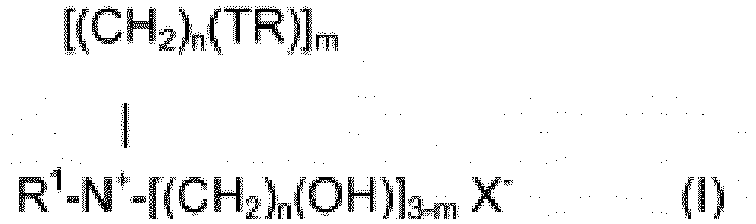
- a first group of quaternary ammonium compounds (QACs) suitable for use in the present invention is represented by formula (I): wherein each R is independently selected from a C5 to C35 alkyl or alkenyl group; R1 represents a C1 to C4 alkyl, C2 to C4 alkenyl or a C1 to C4 hydroxyalkyl group; T may be either O-CO. (i.e. an ester group bound to R via its carbon atom), or may alternatively be CO-O (i.e.
- Suitable actives include soft quaternary ammonium actives such as Stepantex VT90, Rewoquat WE18 (ex-Evonik) and Tetranyl L1/90N, Tetranyl L190 SP and Tetranyl L190 S (all ex-Kao).
- TEA ester quats actives rich in the di-esters of triethanolammonium methylsulfate, otherwise referred to as "TEA ester quats".
- Preapagen TM TQL Ex-Clariant
- Tetranyl TM AHT-1 Ex-Kao
- AT-1 di-[hardened tallow ester] of triethanolammonium methylsulfate
- L5/90 di-[palm ester] of triethanolammonium methylsulfate
- Rewoquat TM WE15 a di-ester of triethanolammonium methylsulfate having fatty acyl residues deriving from C10-C20 and C16-C18 unsaturated fatty acids
- a second group of QACs suitable for use in the invention is represented by formula (II): wherein each R1 group is independently selected from C1 to C4 alkyl, hydroxyalkyl or C2 to C4 alkenyl groups; and wherein each R2 group is independently selected from C8 to C28 alkyl or alkenyl groups; and wherein n, T, and X- are as defined above.
- Preferred materials of this second group include 1,2 bis[tallowoyloxy]-3-trimethylammonium propane chloride, 1,2 bis[hardened tallowoyloxy]-3-trimethylammonium propane chloride, 1,2-bis[oleoyloxy]-3-trimethylammonium propane chloride, and 1,2 bis[stearoyloxy]-3-trimethylammonium propane chloride.
- Such materials are described in US 4, 137,180 (Lever Brothers ).
- these materials also comprise an amount of the corresponding mono-ester.
- a third group of QACs suitable for use in the invention is represented by formula (III): (R 1 ) 2 -N*-[(CH 2 ) n -T-R 2 ] 2 X - (III) wherein each R1 group is independently selected from C1 to C4 alkyl, or C2 to C4 alkenyl groups; and wherein each R2 group is independently selected from C8 to C28 alkyl or alkenyl groups; and n, T, and X- are as defined above.
- Preferred materials of this third group include bis(2-tallowoyloxyethyl)dimethyl ammonium chloride, partially hardened and hardened versions thereof.
- R1 and R2 are independently selected from C10 to C22 alkyl or alkenyl groups, preferably C14 to C20 alkyl or alkenyl groups.
- X- is as defined above.
- the iodine value of the quaternary ammonium fabric conditioning material is preferably from 0 to 80, more preferably from 0 to 60, and most preferably from 0 to 45.
- the iodine value may be chosen as appropriate.
- Essentially saturated material having an iodine value of from 0 to 5, preferably from 0 to 1 may be used in the compositions of the invention. Such materials are known as "hardened" quaternary ammonium compounds.
- a further preferred range of iodine values is from 20 to 60, preferably 25 to 50, more preferably from 30 to 45.
- a material of this type is a "soft" triethanolamine quaternary ammonium compound, preferably triethanolamine di-alkylester methylsulfate. Such ester-linked triethanolamine quaternary ammonium compounds comprise unsaturated fatty chains.
- the iodine value represents the mean iodine value of the parent fatty acyl compounds or fatty acids of all the quaternary ammonium materials present.
- the iodine value represents the mean iodine value of the parent acyl compounds of fatty acids of all of the quaternary ammonium materials present.
- Iodine value refers to, the fatty acid used to produce the QAC, the measurement of the degree of unsaturation present in a material by a method of nmr spectroscopy as described in Anal. Chem. , 34, 1136 (1962) Johnson and Shoolery .
- a further type of softening compound may be a non-ester quaternary ammonium material represented by formula (VI): wherein each R1 group is independently selected from C1 to C4 alkyl, hydroxyalkyl or C2 to C4 alkenyl groups; R2 group is independently selected from C8 to C28 alkyl or alkenyl groups, and X- is as defined above.
- formula (VI) wherein each R1 group is independently selected from C1 to C4 alkyl, hydroxyalkyl or C2 to C4 alkenyl groups; R2 group is independently selected from C8 to C28 alkyl or alkenyl groups, and X- is as defined above.
- the concentrated compositions described herein comprise a non-ionic surfactant.
- the non-ionic surfactant provides spontaneous mixing between the concentrated fabric conditioners described herein and water when the concentrate is combined with water.
- Preferred non-ionic surfactants include addition products of ethylene oxide and/or propylene oxide with fatty alcohols, fatty acids and fatty amines and combinations thereof. These are preferably selected from addition products of (a) an alkoxide selected from ethylene oxide, propylene oxide and mixtures thereof with (b) a fatty material selected from fatty alcohols, fatty acids and fatty amines and combinations thereof.
- Y is selected from: -O- , -C(O)O- , -C(O)N(R)- or -C(O)N(R)R-
- Y is -O-.
- z is 14 to 49, more preferably 14 to 34, most preferably 19-29.
- a suitable preferred non-ionic surfactant is Lutensol TM AT25 (BASF) based on C16:18 chain and 25 EO groups.
- Other suitable surfactants include Renex 36 (Trideceth-6), ex Croda; Tergitol 15-S3, ex Dow Chemical Co.; Dihydrol LT7, ex Thai Ethoxylate Itd; Cremophor CO40, ex BASF and Neodol 91-8, ex Shell.
- compositions comprise 0.3 to 5 wt.% non-ionic surfactant, more preferably 0.4 to 4 wt.% non-ionic surfactant.
- the ratio of non-ionic surfactant to cationic fabric softening active calculated on wt.% is 1:20 to 1:40 and most preferably 1:20 to 1:35.
- compositions described herein preferably comprise perfume.
- the compositions preferably comprise 0.1 to 30 wt. % perfume materials, i.e. free perfume and/or perfume microcapsules.
- free perfumes and perfume microcapsules provide the consumer with perfume hits at different points during the laundry process.
- the compositions of the present invention comprise a combination of both free perfume and perfume microcapsules.
- the compositions of the present invention comprise 0.5 to 20 wt.% perfume materials, more preferably 1 to 15 wt.% perfume materials, most preferably 1 to 10 wt. % perfume materials.
- Useful perfume components may include materials of both natural and synthetic origin. They include single compounds and mixtures. Specific examples of such components may be found in the current literature, e.g., in Fenaroli's Handbook of Flavor Ingredients, 1975, CRC Press ; Synthetic Food Adjuncts, 1947 by M. B. Jacobs, edited by Van Nostr and; or Perfume and Flavor Chemicals by S. Arctander 1969, Montclair, N.J. (USA ). These substances are well known to the person skilled in the art of perfuming, flavouring, and/or aromatizing consumer products.
- compositions of the present invention preferably comprises 0.1 to 15 wt.% free perfume, more preferably 0.5 to 8 wt. % free perfume.
- Particularly preferred perfume components are blooming perfume components and substantive perfume components.
- Blooming perfume components are defined by a boiling point less than 250°C and a LogP or greater than 2.5.
- Substantive perfume components are defined by a boiling point greater than 250°C and a LogP greater than 2.5. Boiling point is measured at standard pressure (760 mm Hg).
- a perfume composition will comprise a mixture of blooming and substantive perfume components.
- the perfume composition may comprise other perfume components.
- perfume components it is commonplace for a plurality of perfume components to be present in a free oil perfume composition.
- compositions for use in the present invention it is envisaged that there will be three or more, preferably four or more, more preferably five or more, most preferably six or more different perfume components.
- An upper limit of 300 perfume components may be applied.
- compositions of the present invention preferably comprise 0.1 to 15 wt.% perfume microcapsules, more preferably 0.2 to 8 wt. % perfume microcapsules.
- the weight of microcapsules is of the material as supplied.
- suitable encapsulating materials may comprise, but are not limited to; aminoplasts, proteins, polyurethanes, polyacrylates, polymethacrylates, polysaccharides, polyamides, polyolefins, gums, silicones, lipids, modified cellulose, polyphosphate, polystyrene, polyesters or combinations thereof.
- Particularly preferred materials are aminoplast microcapsules, such as melamine formaldehyde or urea formaldehyde microcapsules.
- Perfume microcapsules of the present invention can be friable microcapsules and/or moisture activated microcapsules.
- friable it is meant that the perfume microcapsule will rupture when a force is exerted.
- moisture activated it is meant that the perfume is released in the presence of water.
- the compositions of the present invention preferably comprise friable microcapsules. Moisture activated microcapsules may additionally be present. Examples of a microcapsules which can be friable include aminoplast microcapsules.
- Perfume components contained in a microcapsule may comprise odiferous materials and/or pro-fragrance materials.
- Particularly preferred perfume components contained in a microcapsule are blooming perfume components and substantive perfume components.
- B looming perfume components are defined by a boiling point less than 250°C and a LogP greater than 2.5.
- the encapsulated perfume compositions comprises at least 20 wt.% blooming perfume ingredients, more preferably at least 30 wt.% and most preferably at least 40 wt.% blooming perfume ingredients.
- Substantive perfume components are defined by a boiling point greater than 250°C and a LogP greater than 2.5.
- the encapsulated perfume compositions comprises at least 10 wt.% substantive perfume ingredients, more preferably at least 20 wt.% and most preferably at least 30 wt.% substantive perfume ingredients. Boiling point is measured at standard pressure (760 mm Hg).
- a perfume composition will comprise a mixture of blooming and substantive perfume components.
- the perfume composition may comprise other perfume components.
- perfume components it is commonplace for a plurality of perfume components to be present in a microcapsule.
- compositions for use in the present invention it is envisaged that there will be three or more, preferably four or more, more preferably five or more, most preferably six or more different perfume components in a microcapsule.
- An upper limit of 300 perfume components may be applied.
- the microcapsules may comprise perfume components and a carrier for the perfume ingredients, such as zeolites or cyclodextrins.
- Co-softeners may be used. When employed, they are typically present at from 0.1 to 20% and particularly at from 0.5 to 10%, based on the total weight of the composition.
- Preferred co-softeners include fatty esters, and fatty N-oxides.
- Fatty esters that may be employed include fatty monoesters, such as glycerol monostearate, fatty sugar esters, such as those disclosed WO 01/46361 (Unilever ).
- compositions of the present invention may comprise a fatty complexing agent.
- Suitable fatty complexing agents include fatty alcohols and fatty acids. Of these, fatty alcohols are most preferred.
- the fatty complexing material improves the viscosity profile of the composition by complexing with mono-ester component of the fabric conditioner material thereby providing a composition which has relatively higher levels of di-ester and tri-ester linked components.
- the di-ester and tri-ester linked components are more stable and do not affect initial viscosity as detrimentally as the mono-ester component.
- compositions comprising quaternary ammonium materials based on TEA may destabilise the composition through depletion flocculation.
- depletion flocculation is significantly reduced.
- the fatty complexing agent at the increased levels as required by the present invention, "neutralises” the mono-ester linked component of the quaternary ammonium material. This in situ di-ester generation from mono-ester and fatty alcohol also improves the softening of the composition.
- Preferred fatty acids include tallow fatty acid or vegetable fatty acids, particularly preferred are hardened tallow fatty acid or hardened vegetable fatty acid (available under the trade name Pristerene TM , ex Croda).
- Preferred fatty alcohols include tallow alcohol or vegetable alcohol, particularly preferred are hardened tallow alcohol or hardened vegetable alcohol (available under the trade names Stenol TM and Hydrenol TM , ex BASF and Laurex TM CS, ex Huntsman).
- the fatty complexing agent is preferably present in an amount greater than 0.3 to 5% by weight based on the total weight of the composition. More preferably, the fatty component is present in an amount of from 0.4 to 4%.
- the weight ratio of the mono-ester component of the quaternary ammonium fabric softening material to the fatty complexing agent is preferably from 5:1 to 1:5, more preferably 4:1 to 1:4, most preferably 3:1 to 1:3, e.g. 2:1 to 1:2.
- the concentrated compositions as described herein preferably comprise preservatives, either a single preservative or a combination of preservatives.
- the level of preservatives is important to ensure preservation both before and after dilution of the concentrated formulations.
- Two preferred classes of preservatives are organic acid and/or the salts thereof and isothiazolinones. Examples of organic acid and/or the salts thereof are potassium sorbate and sodium benzoate. Examples of isothiazolinones are Methylisothiazolinone (MIT), Chloromethylisothiazolinone (CMIT) and Benzisothiazolinone (BIT).
- preservatives are preferably included at an inclusion level of 0.005 to 1 wt.%, more preferably 0.01 to 0.8 wt. %.
- Preferred inclusion levels of organic acid and/or the salts thereof are 0.2 to 0.8 wt.% and preferred inclusion levels of isothiazolinones is 0.01 to 0.05 wt.%.
- the concentrated compositions described herein may comprise other ingredients of fabric conditioner liquids as will be known to the person skilled in the art.
- antifoams, insect repellents, shading or hueing dyes antibacterial agents, anti-virus agents, pH buffering agents, perfume carriers, hydrotropes, anti-redeposition agents, soil-release agents, polyelectrolytes, anti-shrinking agents, anti-wrinkle agents, anti-oxidants, dyes, colorants, sunscreens, anti-corrosion agents, drape imparting agents, anti-static agents, sequestrants and ironing aids.
- the products of the invention may contain pearlisers and/or opacifiers.
- a preferred sequestrant is HEDP, an abbreviation for Etidronic acid or 1-hydroxyethane 1,1-diphosphonic acid.
- compositions described herein are aqueous compositions.
- the compositions preferably comprise more than 40 wt.% water, more preferably more than 50 wt.% water.
- the fabric softening active and non-ionic surfactant are heated to a temperature above 50°C, more preferably above 55°C, most preferably above 60°C.
- the aqueous compositions in step b may comprise other ingredients. Additional ingredients may be added after the premix.
- the aqueous composition comprising water comprising water in step b is at a temperature of above 40°C, preferably above 45°C.
- any free perfume is added after cooling the composition below 40°C.
- aqueous concentrated fabric conditioner as described herein is mixed with water to produce an aqueous fabric conditioner composition.
- the mixing, or dilution takes place prior to the laundry process.
- the fabric conditioner prepared by the method described herein can then be used in a laundry process.
- the laundry process is defined as the process in which clothes are washed, rinsed and dried.
- the mixing with water takes place before the fabric conditioner composition is added to the washing machine (drum or drawer) or before the fabric conditioner is added to the receptacle in which hand washing occurs.
- the consumer may prepare the liquid fabric conditioner just before the laundry process or may prepare the liquid fabric conditioner days or weeks before using it in the laundry process.
- the concentrated fabric conditioning composition may be diluted with water in any suitable receptacle, for example a bottle, a jug, a pot, a box, a bowl, i.e. any container suitable for containing a liquid composition.
- the receptacle has means for closing the receptible, i.e. for sealing the liquid fabric conditioner composition within the receptacle, for example a lid.
- a bottle is used, preferably the bottle has a lid.
- the consumer may have a 'keeper' bottle. This may be a bottle provided especially for the purpose of mixing and storing the diluted fabric conditioner or may be an old bottle previously purchased. The 'keeper' bottle is kept and reused with subsequent purchases of dilutable concentrated products.
- Either the water or concentrated fabric conditioner composition may be placed in the receptacle first. However, preferably the water is placed in the receptacle, followed by the concentrated fabric conditioner composition. This prevents foaming.
- the consumer may shake or stir the diluted composition to ensure full dispersal of the concentrated fabric conditioner in the water. Once the diluted fabric conditioner is made, this may be used according to regular dossing habits.
- the ratio of concentrated fabric conditioner composition to water is 1:20 to 1:1 by weight, preferably 1:10 to 1:1.5, more preferably 1:10 to 1:2.
- compositions were prepared by the following method.
- the fabric softening active and non-ionic surfactant (where present) were heated together to a temperature of ⁇ 65°C to form a pre-melt. Separately water was heated to ⁇ 50°C, some minors and preservative were added with stirring. The pre-mix was slowly added with stirring. The formulation was cooled and stored at ambient conditions.
- composition 1 spontaneously disperses in the water, whereas composition A does not mix with the water and will require stirring and/or shaking to disperse in the water.
Landscapes
- Chemical & Material Sciences (AREA)
- Life Sciences & Earth Sciences (AREA)
- Engineering & Computer Science (AREA)
- Chemical Kinetics & Catalysis (AREA)
- Oil, Petroleum & Natural Gas (AREA)
- Wood Science & Technology (AREA)
- Organic Chemistry (AREA)
- Dispersion Chemistry (AREA)
- Treatments For Attaching Organic Compounds To Fibrous Goods (AREA)
Description
- The present invention is in the field of providing an aqueous concentrated fabric conditioner composition for diluting at home to produce a ready to use fabric conditioner.
- Consumers are becoming more conscious of the environmental impact of the products they use. In particular, consumers are concerned with the vast amount of packaging used in their everyday lives. There is a need for more concentrated products, which can provide the same consumer benefits, but with a lower environmental impact. One solution is to sell 'concentrated' products which the consumer can dilute at home with water. This reduces the amount of packaging required and reduces the weight/quantity of product being transported thereby having a positive impact on carbon emissions. However, a problem arises since high concentrations of cationic fabric softening compounds lead to thick formulations, which require vigorous mixing to disperse in water. Fabric conditioners are routinely sold in ~ 2 litre bottles. At home, many consumers would struggle with to sufficiently mix a concentrated product with the required amount of water due to the size and weight of the bottle.
- The problem of viscosity is disclosed in
WO 2007/141310 which discloses a stable, concentrated (pre-dilute) aqueous fabric softening composition. However, the inclusion of polymers involves extra processing steps. - The document
US 5 656 585 discloses a concentrated liquid fabric softening microemulsion composition comprising a diester quaternary ammonium surfactant, which is converted to a macroemulsion upon dilution with water. - There remains a need for concentrated dilute at home fabric conditioners which can spontaneously mix with water or require minimal mixing to prepare a diluted fabric conditioner formulation suitable for use.
- The present invention provides a method of in home preparation of a fabric conditioner, wherein an aqueous concentrated fabric conditioner comprising:
- a. 10 to 50 wt. % ester linked quaternary ammonium compound; and
- b. Non-ionic surfactant;
- These and other aspects, features and advantages will become apparent to those of ordinary skill in the art from a reading of the following detailed description and the appended claims. For the avoidance of doubt, any feature of one aspect of the present invention may be utilised in any other aspect of the invention. The word "comprising" is intended to mean "including" but not necessarily "consisting of" or "composed of." In other words, the listed steps or options need not be exhaustive. It is noted that the examples given in the description below are intended to clarify the invention and are not intended to limit the invention to those examples per se. Similarly, all percentages are weight/weight percentages unless otherwise indicated. Except in the operating and comparative examples, or where otherwise explicitly indicated, all numbers in this description indicating amounts of material or conditions of reaction, physical properties of materials and/or use are to be understood as modified by the word "about". Numerical ranges expressed in the format "from x to y" are understood to include x and y. When for a specific feature multiple preferred ranges are described in the format "from x to y", it is understood that all ranges combining the different endpoints are also contemplated.
- The concentrated compositions described herein comprise a fabric softening active. Preferably the fabric conditioners of the present invention comprise more than 10 wt. % fabric softening active, more preferably more than 15 wt. % fabric softening active, most preferably more than 20 wt. % fabric softening active by weight of the composition. Preferably the fabric conditioners of the present invention comprise less than 50 wt. % fabric softening active, more preferably less than 45 wt. % fabric softening active, most preferably less than 40 wt. % fabric softening active by weight of the composition.
- Suitably the fabric conditioners comprise 10 to 50 wt. % fabric softening active, preferably 15 to 45 wt.% fabric softening active and more preferably 20 to 40 wt. % fabric softening active by weight of the composition.
- The fabric softening actives are cationic materials. Suitable cationic fabric softening actives are described herein.
- The fabric conditioner compositions of the method of the invention comprise quaternary ammonium compounds (QAC).
- The QAC preferably comprises at least one chain derived from fatty acids, more preferably at least two chains derived from a fatty acids. Generally fatty acids are defined as aliphatic monocarboxylic acids having a chain of 4 to 28 carbons. Fatty acids may be derived from various sources such as tallow or plant sources. Preferably the fatty acid chains are derived from plants. Preferably the fatty acid chains of the QAC comprise from 10 to 50 wt. % of saturated C18 chains and from 5 to 40 wt. % of monounsaturated C18 chains by weight of total fatty acid chains. In a further preferred embodiment, the fatty acid chains of the QAC comprise from 20 to 40 wt. %, preferably from 25 to 35 wt. % of saturated C18 chains and from 10 to 35 wt. %, preferably from 15 to 30 wt. % of monounsaturated C18 chains, by weight of total fatty acid chains.
- The quaternary ammonium fabric softening actives for use in the method of the present invention are so called "ester quats" or ester linked quaternary ammonium compounds. Particularly preferred materials are the ester-linked triethanolamine (TEA) quaternary ammonium compounds comprising a mixture of mono-, di- and tri-ester linked components.
- Typically, TEA-based fabric softening compounds comprise a mixture of mono, di- and tri ester forms of the compound where the di-ester linked component comprises no more than 70 wt.% of the fabric softening compound, preferably no more than 60 wt.% e.g. no more than 55%, or even no more that 45% of the fabric softening compound and at least 10 wt.% of the monoester linked component.
- A first group of quaternary ammonium compounds (QACs) suitable for use in the present invention is represented by formula (I):
- Suitable actives include soft quaternary ammonium actives such as Stepantex VT90, Rewoquat WE18 (ex-Evonik) and Tetranyl L1/90N, Tetranyl L190 SP and Tetranyl L190 S (all ex-Kao).
- Also suitable are actives rich in the di-esters of triethanolammonium methylsulfate, otherwise referred to as "TEA ester quats".
- Commercial examples include Preapagen™ TQL (ex-Clariant), and Tetranyl™ AHT-1 (ex-Kao), (both di-[hardened tallow ester] of triethanolammonium methylsulfate), AT-1 (di-[tallow ester] of triethanolammonium methylsulfate), and L5/90 (di-[palm ester] of triethanolammonium methylsulfate), (both ex-Kao), and Rewoquat™ WE15 (a di-ester of triethanolammonium methylsulfate having fatty acyl residues deriving from C10-C20 and C16-C18 unsaturated fatty acids) (ex-Evonik).
- A second group of QACs suitable for use in the invention is represented by formula (II):

- Preferred materials of this second group include 1,2 bis[tallowoyloxy]-3-trimethylammonium propane chloride, 1,2 bis[hardened tallowoyloxy]-3-trimethylammonium propane chloride, 1,2-bis[oleoyloxy]-3-trimethylammonium propane chloride, and 1,2 bis[stearoyloxy]-3-trimethylammonium propane chloride. Such materials are described in
US 4, 137,180 (Lever Brothers ). Preferably, these materials also comprise an amount of the corresponding mono-ester. - A third group of QACs suitable for use in the invention is represented by formula (III):
(R1)2-N*-[(CH2)n-T-R2]2X- (III)
wherein each R1 group is independently selected from C1 to C4 alkyl, or C2 to C4 alkenyl groups; and wherein each R2 group is independently selected from C8 to C28 alkyl or alkenyl groups; and n, T, and X- are as defined above. Preferred materials of this third group include bis(2-tallowoyloxyethyl)dimethyl ammonium chloride, partially hardened and hardened versions thereof. - A particular example of the fourth group of QACs is represented the by the formula:

- A fourth group of QACs suitable for use in the invention are represented by formula (V)

- The iodine value of the quaternary ammonium fabric conditioning material is preferably from 0 to 80, more preferably from 0 to 60, and most preferably from 0 to 45. The iodine value may be chosen as appropriate. Essentially saturated material having an iodine value of from 0 to 5, preferably from 0 to 1 may be used in the compositions of the invention. Such materials are known as "hardened" quaternary ammonium compounds.
- A further preferred range of iodine values is from 20 to 60, preferably 25 to 50, more preferably from 30 to 45. A material of this type is a "soft" triethanolamine quaternary ammonium compound, preferably triethanolamine di-alkylester methylsulfate. Such ester-linked triethanolamine quaternary ammonium compounds comprise unsaturated fatty chains.
- If there is a mixture of quaternary ammonium materials present in the composition, the iodine value, referred to above, represents the mean iodine value of the parent fatty acyl compounds or fatty acids of all the quaternary ammonium materials present. Likewise, if there are any saturated quaternary ammonium materials present in the composition, the iodine value represents the mean iodine value of the parent acyl compounds of fatty acids of all of the quaternary ammonium materials present.
- Iodine value as used in the context of the present invention refers to, the fatty acid used to produce the QAC, the measurement of the degree of unsaturation present in a material by a method of nmr spectroscopy as described in Anal. Chem. , 34, 1136 (1962) Johnson and Shoolery.
- A further type of softening compound may be a non-ester quaternary ammonium material represented by formula (VI):

- The concentrated compositions described herein comprise a non-ionic surfactant. The non-ionic surfactant provides spontaneous mixing between the concentrated fabric conditioners described herein and water when the concentrate is combined with water.
- Preferred non-ionic surfactants include addition products of ethylene oxide and/or propylene oxide with fatty alcohols, fatty acids and fatty amines and combinations thereof. These are preferably selected from addition products of (a) an alkoxide selected from ethylene oxide, propylene oxide and mixtures thereof with (b) a fatty material selected from fatty alcohols, fatty acids and fatty amines and combinations thereof.
- Preferred non-ionic surfactants are substantially water soluble surfactants of the general formula (VII):
R-Y-(C2H4O)z-CH2-CH2-OH (VII)
wherein
R is selected from the group consisting of primary, secondary and branched chain alkyl and/or acyl hydrocarbyl groups (when Y = -C(O)O, R ≠ an acyl hydrocarbyl group); primary, secondary and branched chain alkenyl hydrocarbyl groups; and primary, secondary and branched chain alkenyl-substituted phenolic hydrocarbyl groups; the hydrocarbyl groups having a chain length of from 10 to 60, preferably 10 to 25, e.g. 14 to 20 carbon atoms. - Y is selected from:
-O- , -C(O)O- , -C(O)N(R)- or -C(O)N(R)R-
- R has the meaning given above for formula (VII), or can be hydrogen; and
- Z is at least about 6, preferably at least about 10, more preferably at least 15.
- Preferably R is selected from the group consisting of primary, secondary and branched chain alkyl and/or acyl hydrocarbyl groups (when Y = -C(O)O, R ≠ an acyl hydrocarbyl group). More preferably R is a primary alkyl group having a chain length of from 10 to 60, preferably 10 to 25, most preferably 14 to 20 carbon atoms.
- Preferably Y is -O-.
- Preferably z is 14 to 49, more preferably 14 to 34, most preferably 19-29.
- An example of a suitable preferred non-ionic surfactant is Lutensol™ AT25 (BASF) based on C16:18 chain and 25 EO groups. Other suitable surfactants include Renex 36 (Trideceth-6), ex Croda; Tergitol 15-S3, ex Dow Chemical Co.; Dihydrol LT7, ex Thai Ethoxylate Itd; Cremophor CO40, ex BASF and Neodol 91-8, ex Shell.
- Preferably the compositions comprise 0.3 to 5 wt.% non-ionic surfactant, more preferably 0.4 to 4 wt.% non-ionic surfactant.
- The ratio of non-ionic surfactant to cationic fabric softening active calculated on wt.% is 1:20 to 1:40 and most preferably 1:20 to 1:35.
- The concentrated compositions described herein preferably comprise perfume. Where present, the compositions preferably comprise 0.1 to 30 wt. % perfume materials, i.e. free perfume and/or perfume microcapsules. As is known in the art, free perfumes and perfume microcapsules provide the consumer with perfume hits at different points during the laundry process. It is particularly preferred that the compositions of the present invention comprise a combination of both free perfume and perfume microcapsules. Preferably the compositions of the present invention comprise 0.5 to 20 wt.% perfume materials, more preferably 1 to 15 wt.% perfume materials, most preferably 1 to 10 wt. % perfume materials.
- Useful perfume components may include materials of both natural and synthetic origin. They include single compounds and mixtures. Specific examples of such components may be found in the current literature, e.g., in Fenaroli's Handbook of Flavor Ingredients, 1975, CRC Press; Synthetic Food Adjuncts, 1947 by M. B. Jacobs, edited by Van Nostrand; or Perfume and Flavor Chemicals by S. Arctander 1969, Montclair, N.J. (USA). These substances are well known to the person skilled in the art of perfuming, flavouring, and/or aromatizing consumer products.
- The compositions of the present invention preferably comprises 0.1 to 15 wt.% free perfume, more preferably 0.5 to 8 wt. % free perfume.
- Particularly preferred perfume components are blooming perfume components and substantive perfume components. Blooming perfume components are defined by a boiling point less than 250°C and a LogP or greater than 2.5. Substantive perfume components are defined by a boiling point greater than 250°C and a LogP greater than 2.5. Boiling point is measured at standard pressure (760 mm Hg). Preferably a perfume composition will comprise a mixture of blooming and substantive perfume components. The perfume composition may comprise other perfume components.
- It is commonplace for a plurality of perfume components to be present in a free oil perfume composition. In the compositions for use in the present invention it is envisaged that there will be three or more, preferably four or more, more preferably five or more, most preferably six or more different perfume components. An upper limit of 300 perfume components may be applied.
- The compositions of the present invention preferably comprise 0.1 to 15 wt.% perfume microcapsules, more preferably 0.2 to 8 wt. % perfume microcapsules. The weight of microcapsules is of the material as supplied.
- When perfume components are encapsulated, suitable encapsulating materials, may comprise, but are not limited to; aminoplasts, proteins, polyurethanes, polyacrylates, polymethacrylates, polysaccharides, polyamides, polyolefins, gums, silicones, lipids, modified cellulose, polyphosphate, polystyrene, polyesters or combinations thereof. Particularly preferred materials are aminoplast microcapsules, such as melamine formaldehyde or urea formaldehyde microcapsules.
- Perfume microcapsules of the present invention can be friable microcapsules and/or moisture activated microcapsules. By friable, it is meant that the perfume microcapsule will rupture when a force is exerted. By moisture activated, it is meant that the perfume is released in the presence of water. The compositions of the present invention preferably comprise friable microcapsules. Moisture activated microcapsules may additionally be present. Examples of a microcapsules which can be friable include aminoplast microcapsules.
- Perfume components contained in a microcapsule may comprise odiferous materials and/or pro-fragrance materials.
- Particularly preferred perfume components contained in a microcapsule are blooming perfume components and substantive perfume components. B looming perfume components are defined by a boiling point less than 250°C and a LogP greater than 2.5. Preferably the encapsulated perfume compositions comprises at least 20 wt.% blooming perfume ingredients, more preferably at least 30 wt.% and most preferably at least 40 wt.% blooming perfume ingredients. Substantive perfume components are defined by a boiling point greater than 250°C and a LogP greater than 2.5. Preferably the encapsulated perfume compositions comprises at least 10 wt.% substantive perfume ingredients, more preferably at least 20 wt.% and most preferably at least 30 wt.% substantive perfume ingredients. Boiling point is measured at standard pressure (760 mm Hg). Preferably a perfume composition will comprise a mixture of blooming and substantive perfume components. The perfume composition may comprise other perfume components.
- It is commonplace for a plurality of perfume components to be present in a microcapsule. In the compositions for use in the present invention it is envisaged that there will be three or more, preferably four or more, more preferably five or more, most preferably six or more different perfume components in a microcapsule. An upper limit of 300 perfume components may be applied.
- The microcapsules may comprise perfume components and a carrier for the perfume ingredients, such as zeolites or cyclodextrins.
- Co-softeners may be used. When employed, they are typically present at from 0.1 to 20% and particularly at from 0.5 to 10%, based on the total weight of the composition. Preferred co-softeners include fatty esters, and fatty N-oxides. Fatty esters that may be employed include fatty monoesters, such as glycerol monostearate, fatty sugar esters, such as those disclosed
WO 01/46361 (Unilever - The compositions of the present invention may comprise a fatty complexing agent.
- Especially suitable fatty complexing agents include fatty alcohols and fatty acids. Of these, fatty alcohols are most preferred.
- Without being bound by theory it is believed that the fatty complexing material improves the viscosity profile of the composition by complexing with mono-ester component of the fabric conditioner material thereby providing a composition which has relatively higher levels of di-ester and tri-ester linked components. The di-ester and tri-ester linked components are more stable and do not affect initial viscosity as detrimentally as the mono-ester component.
- It is also believed that the higher levels of mono-ester linked component present in compositions comprising quaternary ammonium materials based on TEA may destabilise the composition through depletion flocculation. By using the fatty complexing material to complex with the mono-ester linked component, depletion flocculation is significantly reduced.
- In other words, the fatty complexing agent at the increased levels, as required by the present invention, "neutralises" the mono-ester linked component of the quaternary ammonium material. This in situ di-ester generation from mono-ester and fatty alcohol also improves the softening of the composition.
- Preferred fatty acids include tallow fatty acid or vegetable fatty acids, particularly preferred are hardened tallow fatty acid or hardened vegetable fatty acid (available under the trade name Pristerene™, ex Croda). Preferred fatty alcohols include tallow alcohol or vegetable alcohol, particularly preferred are hardened tallow alcohol or hardened vegetable alcohol (available under the trade names Stenol™ and Hydrenol™, ex BASF and Laurex™ CS, ex Huntsman).
- The fatty complexing agent is preferably present in an amount greater than 0.3 to 5% by weight based on the total weight of the composition. More preferably, the fatty component is present in an amount of from 0.4 to 4%. The weight ratio of the mono-ester component of the quaternary ammonium fabric softening material to the fatty complexing agent is preferably from 5:1 to 1:5, more preferably 4:1 to 1:4, most preferably 3:1 to 1:3, e.g. 2:1 to 1:2.
- The concentrated compositions as described herein preferably comprise preservatives, either a single preservative or a combination of preservatives. The level of preservatives is important to ensure preservation both before and after dilution of the concentrated formulations. Two preferred classes of preservatives are organic acid and/or the salts thereof and isothiazolinones. Examples of organic acid and/or the salts thereof are potassium sorbate and sodium benzoate. Examples of isothiazolinones are Methylisothiazolinone (MIT), Chloromethylisothiazolinone (CMIT) and Benzisothiazolinone (BIT). Generally, preservatives are preferably included at an inclusion level of 0.005 to 1 wt.%, more preferably 0.01 to 0.8 wt. %. Preferred inclusion levels of organic acid and/or the salts thereof are 0.2 to 0.8 wt.% and preferred inclusion levels of isothiazolinones is 0.01 to 0.05 wt.%.
- The concentrated compositions described herein may comprise other ingredients of fabric conditioner liquids as will be known to the person skilled in the art. Among such materials there may be mentioned: antifoams, insect repellents, shading or hueing dyes, antibacterial agents, anti-virus agents, pH buffering agents, perfume carriers, hydrotropes, anti-redeposition agents, soil-release agents, polyelectrolytes, anti-shrinking agents, anti-wrinkle agents, anti-oxidants, dyes, colorants, sunscreens, anti-corrosion agents, drape imparting agents, anti-static agents, sequestrants and ironing aids. The products of the invention may contain pearlisers and/or opacifiers. A preferred sequestrant is HEDP, an abbreviation for Etidronic acid or 1-hydroxyethane 1,1-diphosphonic acid.
- The concentrated compositions described herein are aqueous compositions. The compositions preferably comprise more than 40 wt.% water, more preferably more than 50 wt.% water.
- Also disclosed is a method of producing an aqueous fabric conditioner suitable for in home dilution, preferably an aqueous fabric conditioner as described herein, said method comprising the step of:
- a. Mixing a fabric softening active and non-ionic surfactant to form a pre-mix;
- b. Adding the premix to an aqueous composition comprising water.
- Preferably in step a, the fabric softening active and non-ionic surfactant are heated to a temperature above 50°C, more preferably above 55°C, most preferably above 60°C. The aqueous compositions in step b may comprise other ingredients. Additional ingredients may be added after the premix.
- Preferably the aqueous composition comprising water comprising water in step b is at a temperature of above 40°C, preferably above 45°C. Preferably any free perfume is added after cooling the composition below 40°C.
- In one aspect of the present invention is a provided a method of in home preparation of a fabric conditioner, wherein an aqueous concentrated fabric conditioner as described herein is mixed with water to produce an aqueous fabric conditioner composition. The mixing, or dilution takes place prior to the laundry process. The fabric conditioner prepared by the method described herein can then be used in a laundry process. The laundry process is defined as the process in which clothes are washed, rinsed and dried. In other words the mixing with water takes place before the fabric conditioner composition is added to the washing machine (drum or drawer) or before the fabric conditioner is added to the receptacle in which hand washing occurs. The consumer may prepare the liquid fabric conditioner just before the laundry process or may prepare the liquid fabric conditioner days or weeks before using it in the laundry process.
- The concentrated fabric conditioning composition may be diluted with water in any suitable receptacle, for example a bottle, a jug, a pot, a box, a bowl, i.e. any container suitable for containing a liquid composition. Preferably the receptacle has means for closing the receptible, i.e. for sealing the liquid fabric conditioner composition within the receptacle, for example a lid. Preferably a bottle is used, preferably the bottle has a lid. Generally, the consumer may have a 'keeper' bottle. This may be a bottle provided especially for the purpose of mixing and storing the diluted fabric conditioner or may be an old bottle previously purchased. The 'keeper' bottle is kept and reused with subsequent purchases of dilutable concentrated products.
- Either the water or concentrated fabric conditioner composition may be placed in the receptacle first. However, preferably the water is placed in the receptacle, followed by the concentrated fabric conditioner composition. This prevents foaming.
- Although mixing may not be necersary, the consumer may shake or stir the diluted composition to ensure full dispersal of the concentrated fabric conditioner in the water. Once the diluted fabric conditioner is made, this may be used according to regular dossing habits.
- The ratio of concentrated fabric conditioner composition to water is 1:20 to 1:1 by weight, preferably 1:10 to 1:1.5, more preferably 1:10 to 1:2.
- The effect of a non-ionic surfactant for a dilute at home formulation was assessed as follows:
Table 1: Example compositions Wt.% active A 1 Fabric softening active1 24 24 Non-ionic surfactant2 0 1 Preservative 0.75 0.75 Minors <1 <1 Water To 100 To 100 Fabric Softening active1 - TEA quaternary ammonium compound according to formula (I) above
Non-ionic surfactant2 - Lutensol AT-25 ex BASF. - The compositions were prepared by the following method. The fabric softening active and non-ionic surfactant (where present) were heated together to a temperature of ~ 65°C to form a pre-melt. Separately water was heated to ~ 50°C, some minors and preservative were added with stirring. The pre-mix was slowly added with stirring. The formulation was cooled and stored at ambient conditions.
- 250 ml of each composition (A and 1) were each poured into identical bottles comprising 500 ml of water (dilution ratio of 1:2). A photograph was taken immediately after adding the 250 ml of concentrated compositions to the water.
Figure 1 is the photograph after adding composition A to water.Figure 2 is the photograph after adding composition 1 to the water. As demonstrated by the figures, composition 1 spontaneously disperses in the water, whereas composition A does not mix with the water and will require stirring and/or shaking to disperse in the water.
Claims (7)
- A method of in home preparation of a fabric conditioner, wherein an aqueous concentrated fabric conditioner comprising:a. 10 to 50 wt. % ester linked quaternary ammonium compound; andb. Non-ionic surfactant;is mixed with water to produce an aqueous fabric conditioner composition,wherein the ratio of non-ionic surfactant to cationic fabric softening active is 1:20 to 1:40 by weight and the ratio of concentrated fabric conditioner composition to water is 1:20 to 1:1 by weight.
- A method according to claim 1, wherein the composition comprises 0.3 to 5 wt.% non-ionic surfactant.
- A method according to any preceding claim, wherein the non-ionic surfactant comprises surfactants selected from addition products of ethylene oxide and/or propylene oxide with fatty alcohols, fatty acids and fatty amines and combinations thereof.
- A method according to any preceding claim, wherein the non-ionic surfactant comprises surfactants having the general formula (VII):
R-Y-(C2H4O)z-CH2-CH2-OH
wherein R is selected from the group consisting of primary, secondary andbranched chain alkyl and/or acyl hydrocarbyl groups (when Y = -C(O)O, R ≠ an acyl hydrocarbyl group); primary, secondary and branched chain alkenyl hydrocarbyl groups; and primary, secondary and branched chain alkenyl-substituted phenolic hydrocarbyl groups; the hydrocarbyl groups having a chain length of from 10 to 60, and combinations thereof;Y is selected from: -O-, -C(O)O- , -C(O)N(R)- or -C(O)N(R)R- in which R has the meaning given above, or can be hydrogen; andZ is at least 6. - A method according to any preceding claim, wherein the composition further comprises free perfume.
- A method according to any preceding claim, wherein the composition further comprises encapsulated perfume.
- A method according to any preceding claim, wherein the composition further comprises preservatives.
Applications Claiming Priority (2)
| Application Number | Priority Date | Filing Date | Title |
|---|---|---|---|
| EP20208506 | 2020-11-18 | ||
| PCT/EP2021/081583 WO2022106322A1 (en) | 2020-11-18 | 2021-11-12 | Fabric conditioner |
Publications (2)
| Publication Number | Publication Date |
|---|---|
| EP4247925A1 EP4247925A1 (en) | 2023-09-27 |
| EP4247925B1 true EP4247925B1 (en) | 2024-09-04 |
Family
ID=73476070
Family Applications (1)
| Application Number | Title | Priority Date | Filing Date |
|---|---|---|---|
| EP21806749.4A Active EP4247925B1 (en) | 2020-11-18 | 2021-11-12 | Fabric conditioner |
Country Status (5)
| Country | Link |
|---|---|
| US (1) | US20230407206A1 (en) |
| EP (1) | EP4247925B1 (en) |
| CN (1) | CN116507707A (en) |
| PL (1) | PL4247925T3 (en) |
| WO (1) | WO2022106322A1 (en) |
Citations (3)
| Publication number | Priority date | Publication date | Assignee | Title |
|---|---|---|---|---|
| EP0730023A2 (en) | 1995-03-01 | 1996-09-04 | Colgate-Palmolive Company | Laundry concentrates |
| WO2007090567A1 (en) | 2006-02-10 | 2007-08-16 | Unilever Plc | Fabric conditioning compositions |
| WO2013174603A1 (en) | 2012-05-24 | 2013-11-28 | Unilever Plc | Improvements relating to fabric conditioners |
Family Cites Families (11)
| Publication number | Priority date | Publication date | Assignee | Title |
|---|---|---|---|---|
| GB1567947A (en) | 1976-07-02 | 1980-05-21 | Unilever Ltd | Esters of quaternised amino-alcohols for treating fabrics |
| CA2108905A1 (en) * | 1991-04-30 | 1992-10-31 | Alice Marie Vogel | Fabric softener containing substituted imidazoline and highly ethoxylated compounds |
| US5656585A (en) * | 1994-12-21 | 1997-08-12 | Colgate-Palmolive Company | Clear, concentrated liquid fabric softener compositions |
| PE132599A1 (en) * | 1997-11-24 | 2000-01-20 | Procter & Gamble | CLEAR OR TRANSPARENT SOFTENING AQUEOUS COMPOSITIONS FOR USE IN TEXTILE MATERIALS, CONTAINING A HIGH LEVEL OF POWERFUL ELECTROLYTE AND OPTIONAL PHASE STABILIZER |
| GB9930435D0 (en) | 1999-12-22 | 2000-02-16 | Unilever Plc | Fabric softening compositions |
| GB0021765D0 (en) * | 2000-09-05 | 2000-10-18 | Unilever Plc | A method of preparing fabric conditioning compositions |
| GB0121802D0 (en) * | 2001-09-10 | 2001-10-31 | Unilever Plc | Fabric conditioning compositions |
| GB0611486D0 (en) | 2006-06-09 | 2006-07-19 | Unilever Plc | Fabric softener composition |
| WO2014166686A1 (en) * | 2013-04-12 | 2014-10-16 | Unilever Plc | Improvements relating to fabric conditioners |
| BR112017012522A2 (en) * | 2014-12-15 | 2018-02-27 | Unilever Nv | tissue conditioning fluid liquid composition and method of obtaining a tissue conditioning liquid |
| DE112018004426T5 (en) * | 2017-10-05 | 2020-05-20 | Unilever N.V. | Methods and devices for customized laundry |
-
2021
- 2021-11-12 US US18/037,155 patent/US20230407206A1/en not_active Abandoned
- 2021-11-12 CN CN202180075927.XA patent/CN116507707A/en active Pending
- 2021-11-12 WO PCT/EP2021/081583 patent/WO2022106322A1/en not_active Ceased
- 2021-11-12 EP EP21806749.4A patent/EP4247925B1/en active Active
- 2021-11-12 PL PL21806749.4T patent/PL4247925T3/en unknown
Patent Citations (3)
| Publication number | Priority date | Publication date | Assignee | Title |
|---|---|---|---|---|
| EP0730023A2 (en) | 1995-03-01 | 1996-09-04 | Colgate-Palmolive Company | Laundry concentrates |
| WO2007090567A1 (en) | 2006-02-10 | 2007-08-16 | Unilever Plc | Fabric conditioning compositions |
| WO2013174603A1 (en) | 2012-05-24 | 2013-11-28 | Unilever Plc | Improvements relating to fabric conditioners |
Also Published As
| Publication number | Publication date |
|---|---|
| CN116507707A (en) | 2023-07-28 |
| PL4247925T3 (en) | 2025-01-07 |
| WO2022106322A1 (en) | 2022-05-27 |
| US20230407206A1 (en) | 2023-12-21 |
| EP4247925A1 (en) | 2023-09-27 |
Similar Documents
| Publication | Publication Date | Title |
|---|---|---|
| US12398344B2 (en) | Fabric conditioner compositions | |
| EP2294168A1 (en) | Improvements relating to fabric conditioners | |
| US20230407206A1 (en) | Fabric conditioner | |
| CA2492320C (en) | Fabric conditioning compositions | |
| EP4526415B1 (en) | Concentrated fabric conditioner | |
| CZ299080B6 (en) | Fabric conditioning composition | |
| CZ299081B6 (en) | Fabric conditioning composition | |
| US20240002752A1 (en) | Concentrated non-aqueous fabric conditioners | |
| EP4279569A1 (en) | Concentrated non-aqueous fabric conditioners | |
| EP4490257B1 (en) | Concentrated fabric conditioner | |
| WO2024153564A1 (en) | Laundry composition | |
| US20250027010A1 (en) | Fabric conditioning method | |
| EP4526413A1 (en) | Concentrated fabric conditioners | |
| BR112021011219B1 (en) | FABRIC CONDITIONING COMPOSITION, METHOD FOR PREPARING A FABRIC CONDITIONING COMPOSITION AND USE OF A TRIGLYCERIDE | |
| EP4526414A1 (en) | Concentrated fabric conditioner | |
| EP4377430A1 (en) | Method of producing a fabric conditioner | |
| WO2024153563A1 (en) | Laundry composition | |
| EP4490256A1 (en) | Concentrated fabric conditioner |
Legal Events
| Date | Code | Title | Description |
|---|---|---|---|
| STAA | Information on the status of an ep patent application or granted ep patent |
Free format text: STATUS: UNKNOWN |
|
| STAA | Information on the status of an ep patent application or granted ep patent |
Free format text: STATUS: THE INTERNATIONAL PUBLICATION HAS BEEN MADE |
|
| PUAI | Public reference made under article 153(3) epc to a published international application that has entered the european phase |
Free format text: ORIGINAL CODE: 0009012 |
|
| STAA | Information on the status of an ep patent application or granted ep patent |
Free format text: STATUS: REQUEST FOR EXAMINATION WAS MADE |
|
| 17P | Request for examination filed |
Effective date: 20230428 |
|
| AK | Designated contracting states |
Kind code of ref document: A1 Designated state(s): AL AT BE BG CH CY CZ DE DK EE ES FI FR GB GR HR HU IE IS IT LI LT LU LV MC MK MT NL NO PL PT RO RS SE SI SK SM TR |
|
| DAV | Request for validation of the european patent (deleted) | ||
| DAX | Request for extension of the european patent (deleted) | ||
| REG | Reference to a national code |
Ref country code: DE Ref legal event code: R079 Free format text: PREVIOUS MAIN CLASS: C11D0001645000 Ipc: C11D0001835000 Ref country code: DE Ref legal event code: R079 Ref document number: 602021018442 Country of ref document: DE Free format text: PREVIOUS MAIN CLASS: C11D0001645000 Ipc: C11D0001835000 |
|
| GRAP | Despatch of communication of intention to grant a patent |
Free format text: ORIGINAL CODE: EPIDOSNIGR1 |
|
| STAA | Information on the status of an ep patent application or granted ep patent |
Free format text: STATUS: GRANT OF PATENT IS INTENDED |
|
| RIC1 | Information provided on ipc code assigned before grant |
Ipc: C11D 1/74 20060101ALN20240430BHEP Ipc: C11D 1/52 20060101ALN20240430BHEP Ipc: C11D 1/44 20060101ALN20240430BHEP Ipc: C11D 1/72 20060101ALN20240430BHEP Ipc: C11D 1/62 20060101ALN20240430BHEP Ipc: C11D 11/00 20060101ALI20240430BHEP Ipc: C11D 1/835 20060101AFI20240430BHEP |
|
| INTG | Intention to grant announced |
Effective date: 20240523 |
|
| GRAS | Grant fee paid |
Free format text: ORIGINAL CODE: EPIDOSNIGR3 |
|
| GRAA | (expected) grant |
Free format text: ORIGINAL CODE: 0009210 |
|
| STAA | Information on the status of an ep patent application or granted ep patent |
Free format text: STATUS: THE PATENT HAS BEEN GRANTED |
|
| AK | Designated contracting states |
Kind code of ref document: B1 Designated state(s): AL AT BE BG CH CY CZ DE DK EE ES FI FR GB GR HR HU IE IS IT LI LT LU LV MC MK MT NL NO PL PT RO RS SE SI SK SM TR |
|
| REG | Reference to a national code |
Ref country code: GB Ref legal event code: FG4D |
|
| REG | Reference to a national code |
Ref country code: CH Ref legal event code: EP |
|
| P01 | Opt-out of the competence of the unified patent court (upc) registered |
Free format text: CASE NUMBER: APP_46095/2024 Effective date: 20240809 |
|
| REG | Reference to a national code |
Ref country code: IE Ref legal event code: FG4D |
|
| REG | Reference to a national code |
Ref country code: DE Ref legal event code: R096 Ref document number: 602021018442 Country of ref document: DE |
|
| REG | Reference to a national code |
Ref country code: LT Ref legal event code: MG9D |
|
| REG | Reference to a national code |
Ref country code: NL Ref legal event code: MP Effective date: 20240904 |
|
| PG25 | Lapsed in a contracting state [announced via postgrant information from national office to epo] |
Ref country code: NO Free format text: LAPSE BECAUSE OF FAILURE TO SUBMIT A TRANSLATION OF THE DESCRIPTION OR TO PAY THE FEE WITHIN THE PRESCRIBED TIME-LIMIT Effective date: 20241204 |
|
| PG25 | Lapsed in a contracting state [announced via postgrant information from national office to epo] |
Ref country code: FI Free format text: LAPSE BECAUSE OF FAILURE TO SUBMIT A TRANSLATION OF THE DESCRIPTION OR TO PAY THE FEE WITHIN THE PRESCRIBED TIME-LIMIT Effective date: 20240904 Ref country code: GR Free format text: LAPSE BECAUSE OF FAILURE TO SUBMIT A TRANSLATION OF THE DESCRIPTION OR TO PAY THE FEE WITHIN THE PRESCRIBED TIME-LIMIT Effective date: 20241205 |
|
| PG25 | Lapsed in a contracting state [announced via postgrant information from national office to epo] |
Ref country code: BG Free format text: LAPSE BECAUSE OF FAILURE TO SUBMIT A TRANSLATION OF THE DESCRIPTION OR TO PAY THE FEE WITHIN THE PRESCRIBED TIME-LIMIT Effective date: 20240904 |
|
| PG25 | Lapsed in a contracting state [announced via postgrant information from national office to epo] |
Ref country code: LV Free format text: LAPSE BECAUSE OF FAILURE TO SUBMIT A TRANSLATION OF THE DESCRIPTION OR TO PAY THE FEE WITHIN THE PRESCRIBED TIME-LIMIT Effective date: 20240904 |
|
| PG25 | Lapsed in a contracting state [announced via postgrant information from national office to epo] |
Ref country code: HR Free format text: LAPSE BECAUSE OF FAILURE TO SUBMIT A TRANSLATION OF THE DESCRIPTION OR TO PAY THE FEE WITHIN THE PRESCRIBED TIME-LIMIT Effective date: 20240904 |
|
| PG25 | Lapsed in a contracting state [announced via postgrant information from national office to epo] |
Ref country code: ES Free format text: LAPSE BECAUSE OF FAILURE TO SUBMIT A TRANSLATION OF THE DESCRIPTION OR TO PAY THE FEE WITHIN THE PRESCRIBED TIME-LIMIT Effective date: 20240904 Ref country code: RS Free format text: LAPSE BECAUSE OF FAILURE TO SUBMIT A TRANSLATION OF THE DESCRIPTION OR TO PAY THE FEE WITHIN THE PRESCRIBED TIME-LIMIT Effective date: 20241204 |
|
| PG25 | Lapsed in a contracting state [announced via postgrant information from national office to epo] |
Ref country code: RS Free format text: LAPSE BECAUSE OF FAILURE TO SUBMIT A TRANSLATION OF THE DESCRIPTION OR TO PAY THE FEE WITHIN THE PRESCRIBED TIME-LIMIT Effective date: 20241204 Ref country code: NO Free format text: LAPSE BECAUSE OF FAILURE TO SUBMIT A TRANSLATION OF THE DESCRIPTION OR TO PAY THE FEE WITHIN THE PRESCRIBED TIME-LIMIT Effective date: 20241204 Ref country code: LV Free format text: LAPSE BECAUSE OF FAILURE TO SUBMIT A TRANSLATION OF THE DESCRIPTION OR TO PAY THE FEE WITHIN THE PRESCRIBED TIME-LIMIT Effective date: 20240904 Ref country code: HR Free format text: LAPSE BECAUSE OF FAILURE TO SUBMIT A TRANSLATION OF THE DESCRIPTION OR TO PAY THE FEE WITHIN THE PRESCRIBED TIME-LIMIT Effective date: 20240904 Ref country code: GR Free format text: LAPSE BECAUSE OF FAILURE TO SUBMIT A TRANSLATION OF THE DESCRIPTION OR TO PAY THE FEE WITHIN THE PRESCRIBED TIME-LIMIT Effective date: 20241205 Ref country code: FI Free format text: LAPSE BECAUSE OF FAILURE TO SUBMIT A TRANSLATION OF THE DESCRIPTION OR TO PAY THE FEE WITHIN THE PRESCRIBED TIME-LIMIT Effective date: 20240904 Ref country code: ES Free format text: LAPSE BECAUSE OF FAILURE TO SUBMIT A TRANSLATION OF THE DESCRIPTION OR TO PAY THE FEE WITHIN THE PRESCRIBED TIME-LIMIT Effective date: 20240904 Ref country code: BG Free format text: LAPSE BECAUSE OF FAILURE TO SUBMIT A TRANSLATION OF THE DESCRIPTION OR TO PAY THE FEE WITHIN THE PRESCRIBED TIME-LIMIT Effective date: 20240904 |
|
| REG | Reference to a national code |
Ref country code: AT Ref legal event code: MK05 Ref document number: 1720417 Country of ref document: AT Kind code of ref document: T Effective date: 20240904 |
|
| PG25 | Lapsed in a contracting state [announced via postgrant information from national office to epo] |
Ref country code: NL Free format text: LAPSE BECAUSE OF FAILURE TO SUBMIT A TRANSLATION OF THE DESCRIPTION OR TO PAY THE FEE WITHIN THE PRESCRIBED TIME-LIMIT Effective date: 20240904 |
|
| PG25 | Lapsed in a contracting state [announced via postgrant information from national office to epo] |
Ref country code: IS Free format text: LAPSE BECAUSE OF FAILURE TO SUBMIT A TRANSLATION OF THE DESCRIPTION OR TO PAY THE FEE WITHIN THE PRESCRIBED TIME-LIMIT Effective date: 20250104 Ref country code: PT Free format text: LAPSE BECAUSE OF FAILURE TO SUBMIT A TRANSLATION OF THE DESCRIPTION OR TO PAY THE FEE WITHIN THE PRESCRIBED TIME-LIMIT Effective date: 20250106 |
|
| PG25 | Lapsed in a contracting state [announced via postgrant information from national office to epo] |
Ref country code: RO Free format text: LAPSE BECAUSE OF FAILURE TO SUBMIT A TRANSLATION OF THE DESCRIPTION OR TO PAY THE FEE WITHIN THE PRESCRIBED TIME-LIMIT Effective date: 20240904 Ref country code: SM Free format text: LAPSE BECAUSE OF FAILURE TO SUBMIT A TRANSLATION OF THE DESCRIPTION OR TO PAY THE FEE WITHIN THE PRESCRIBED TIME-LIMIT Effective date: 20240904 |
|
| PG25 | Lapsed in a contracting state [announced via postgrant information from national office to epo] |
Ref country code: EE Free format text: LAPSE BECAUSE OF FAILURE TO SUBMIT A TRANSLATION OF THE DESCRIPTION OR TO PAY THE FEE WITHIN THE PRESCRIBED TIME-LIMIT Effective date: 20240904 Ref country code: AT Free format text: LAPSE BECAUSE OF FAILURE TO SUBMIT A TRANSLATION OF THE DESCRIPTION OR TO PAY THE FEE WITHIN THE PRESCRIBED TIME-LIMIT Effective date: 20240904 |
|
| PG25 | Lapsed in a contracting state [announced via postgrant information from national office to epo] |
Ref country code: CZ Free format text: LAPSE BECAUSE OF FAILURE TO SUBMIT A TRANSLATION OF THE DESCRIPTION OR TO PAY THE FEE WITHIN THE PRESCRIBED TIME-LIMIT Effective date: 20240904 |
|
| PG25 | Lapsed in a contracting state [announced via postgrant information from national office to epo] |
Ref country code: SK Free format text: LAPSE BECAUSE OF FAILURE TO SUBMIT A TRANSLATION OF THE DESCRIPTION OR TO PAY THE FEE WITHIN THE PRESCRIBED TIME-LIMIT Effective date: 20240904 |
|
| REG | Reference to a national code |
Ref country code: DE Ref legal event code: R026 Ref document number: 602021018442 Country of ref document: DE |
|
| PLBI | Opposition filed |
Free format text: ORIGINAL CODE: 0009260 |
|
| PLAF | Information modified related to communication of a notice of opposition and request to file observations + time limit |
Free format text: ORIGINAL CODE: EPIDOSCOBS2 |
|
| PLAX | Notice of opposition and request to file observation + time limit sent |
Free format text: ORIGINAL CODE: EPIDOSNOBS2 |
|
| REG | Reference to a national code |
Ref country code: CH Ref legal event code: PL |
|
| 26 | Opposition filed |
Opponent name: HENKEL AG & CO. KGAA Effective date: 20250527 |
|
| PG25 | Lapsed in a contracting state [announced via postgrant information from national office to epo] |
Ref country code: MC Free format text: LAPSE BECAUSE OF FAILURE TO SUBMIT A TRANSLATION OF THE DESCRIPTION OR TO PAY THE FEE WITHIN THE PRESCRIBED TIME-LIMIT Effective date: 20240904 |
|
| PG25 | Lapsed in a contracting state [announced via postgrant information from national office to epo] |
Ref country code: DK Free format text: LAPSE BECAUSE OF FAILURE TO SUBMIT A TRANSLATION OF THE DESCRIPTION OR TO PAY THE FEE WITHIN THE PRESCRIBED TIME-LIMIT Effective date: 20240904 |
|
| PG25 | Lapsed in a contracting state [announced via postgrant information from national office to epo] |
Ref country code: LU Free format text: LAPSE BECAUSE OF NON-PAYMENT OF DUE FEES Effective date: 20241112 |
|
| REG | Reference to a national code |
Ref country code: CH Ref legal event code: PL |
|
| PG25 | Lapsed in a contracting state [announced via postgrant information from national office to epo] |
Ref country code: CH Free format text: LAPSE BECAUSE OF NON-PAYMENT OF DUE FEES Effective date: 20241130 |
|
| REG | Reference to a national code |
Ref country code: BE Ref legal event code: MM Effective date: 20241130 |
|
| PG25 | Lapsed in a contracting state [announced via postgrant information from national office to epo] |
Ref country code: SE Free format text: LAPSE BECAUSE OF FAILURE TO SUBMIT A TRANSLATION OF THE DESCRIPTION OR TO PAY THE FEE WITHIN THE PRESCRIBED TIME-LIMIT Effective date: 20240904 |
|
| RAP4 | Party data changed (patent owner data changed or rights of a patent transferred) |
Owner name: UNILEVER IP HOLDINGS B.V. Owner name: UNILEVER GLOBAL IP LIMITED |
|
| PG25 | Lapsed in a contracting state [announced via postgrant information from national office to epo] |
Ref country code: BE Free format text: LAPSE BECAUSE OF NON-PAYMENT OF DUE FEES Effective date: 20241130 |
|
| PLBB | Reply of patent proprietor to notice(s) of opposition received |
Free format text: ORIGINAL CODE: EPIDOSNOBS3 |
|
| PG25 | Lapsed in a contracting state [announced via postgrant information from national office to epo] |
Ref country code: IE Free format text: LAPSE BECAUSE OF NON-PAYMENT OF DUE FEES Effective date: 20241112 |
|
| PGFP | Annual fee paid to national office [announced via postgrant information from national office to epo] |
Ref country code: DE Payment date: 20251119 Year of fee payment: 5 |
|
| PGFP | Annual fee paid to national office [announced via postgrant information from national office to epo] |
Ref country code: GB Payment date: 20251121 Year of fee payment: 5 |
|
| PGFP | Annual fee paid to national office [announced via postgrant information from national office to epo] |
Ref country code: IT Payment date: 20251119 Year of fee payment: 5 |
|
| PGFP | Annual fee paid to national office [announced via postgrant information from national office to epo] |
Ref country code: FR Payment date: 20251126 Year of fee payment: 5 |
|
| PGFP | Annual fee paid to national office [announced via postgrant information from national office to epo] |
Ref country code: TR Payment date: 20251104 Year of fee payment: 5 |
|
| PGFP | Annual fee paid to national office [announced via postgrant information from national office to epo] |
Ref country code: PL Payment date: 20251031 Year of fee payment: 5 |
|
| PG25 | Lapsed in a contracting state [announced via postgrant information from national office to epo] |
Ref country code: HU Free format text: LAPSE BECAUSE OF FAILURE TO SUBMIT A TRANSLATION OF THE DESCRIPTION OR TO PAY THE FEE WITHIN THE PRESCRIBED TIME-LIMIT; INVALID AB INITIO Effective date: 20211112 |
|
| PG25 | Lapsed in a contracting state [announced via postgrant information from national office to epo] |
Ref country code: CY Free format text: LAPSE BECAUSE OF FAILURE TO SUBMIT A TRANSLATION OF THE DESCRIPTION OR TO PAY THE FEE WITHIN THE PRESCRIBED TIME-LIMIT; INVALID AB INITIO Effective date: 20211112 |
|
| PLCK | Communication despatched that opposition was rejected |
Free format text: ORIGINAL CODE: EPIDOSNREJ1 |
|
| PG25 | Lapsed in a contracting state [announced via postgrant information from national office to epo] |
Ref country code: SI Free format text: LAPSE BECAUSE OF FAILURE TO SUBMIT A TRANSLATION OF THE DESCRIPTION OR TO PAY THE FEE WITHIN THE PRESCRIBED TIME-LIMIT Effective date: 20240904 |
|
| PG25 | Lapsed in a contracting state [announced via postgrant information from national office to epo] |
Ref country code: LT Free format text: LAPSE BECAUSE OF FAILURE TO SUBMIT A TRANSLATION OF THE DESCRIPTION OR TO PAY THE FEE WITHIN THE PRESCRIBED TIME-LIMIT Effective date: 20240904 |