EP4247686B1 - Verfahren zur reduzierung von hochgeschwindigkeits-off-tracking in schwerlastfahrzeugen mit mehreren anhängern - Google Patents
Verfahren zur reduzierung von hochgeschwindigkeits-off-tracking in schwerlastfahrzeugen mit mehreren anhängern Download PDFInfo
- Publication number
- EP4247686B1 EP4247686B1 EP20810945.4A EP20810945A EP4247686B1 EP 4247686 B1 EP4247686 B1 EP 4247686B1 EP 20810945 A EP20810945 A EP 20810945A EP 4247686 B1 EP4247686 B1 EP 4247686B1
- Authority
- EP
- European Patent Office
- Prior art keywords
- vehicle
- nocp
- force
- trajectories
- heavy duty
- Prior art date
- Legal status (The legal status is an assumption and is not a legal conclusion. Google has not performed a legal analysis and makes no representation as to the accuracy of the status listed.)
- Active
Links
Images




Classifications
-
- B—PERFORMING OPERATIONS; TRANSPORTING
- B60—VEHICLES IN GENERAL
- B60W—CONJOINT CONTROL OF VEHICLE SUB-UNITS OF DIFFERENT TYPE OR DIFFERENT FUNCTION; CONTROL SYSTEMS SPECIALLY ADAPTED FOR HYBRID VEHICLES; ROAD VEHICLE DRIVE CONTROL SYSTEMS FOR PURPOSES NOT RELATED TO THE CONTROL OF A PARTICULAR SUB-UNIT
- B60W30/00—Purposes of road vehicle drive control systems not related to the control of a particular sub-unit, e.g. of systems using conjoint control of vehicle sub-units
- B60W30/18—Propelling the vehicle
- B60W30/18172—Preventing, or responsive to skidding of wheels
-
- B—PERFORMING OPERATIONS; TRANSPORTING
- B60—VEHICLES IN GENERAL
- B60W—CONJOINT CONTROL OF VEHICLE SUB-UNITS OF DIFFERENT TYPE OR DIFFERENT FUNCTION; CONTROL SYSTEMS SPECIALLY ADAPTED FOR HYBRID VEHICLES; ROAD VEHICLE DRIVE CONTROL SYSTEMS FOR PURPOSES NOT RELATED TO THE CONTROL OF A PARTICULAR SUB-UNIT
- B60W50/00—Details of control systems for road vehicle drive control not related to the control of a particular sub-unit, e.g. process diagnostic or vehicle driver interfaces
- B60W50/06—Improving the dynamic response of the control system, e.g. improving the speed of regulation or avoiding hunting or overshoot
-
- B—PERFORMING OPERATIONS; TRANSPORTING
- B62—LAND VEHICLES FOR TRAVELLING OTHERWISE THAN ON RAILS
- B62D—MOTOR VEHICLES; TRAILERS
- B62D59/00—Trailers with driven ground wheels or the like
- B62D59/04—Trailers with driven ground wheels or the like driven from propulsion unit on trailer
-
- B—PERFORMING OPERATIONS; TRANSPORTING
- B60—VEHICLES IN GENERAL
- B60W—CONJOINT CONTROL OF VEHICLE SUB-UNITS OF DIFFERENT TYPE OR DIFFERENT FUNCTION; CONTROL SYSTEMS SPECIALLY ADAPTED FOR HYBRID VEHICLES; ROAD VEHICLE DRIVE CONTROL SYSTEMS FOR PURPOSES NOT RELATED TO THE CONTROL OF A PARTICULAR SUB-UNIT
- B60W50/00—Details of control systems for road vehicle drive control not related to the control of a particular sub-unit, e.g. process diagnostic or vehicle driver interfaces
- B60W2050/0001—Details of the control system
- B60W2050/0002—Automatic control, details of type of controller or control system architecture
- B60W2050/0013—Optimal controllers
-
- B—PERFORMING OPERATIONS; TRANSPORTING
- B60—VEHICLES IN GENERAL
- B60W—CONJOINT CONTROL OF VEHICLE SUB-UNITS OF DIFFERENT TYPE OR DIFFERENT FUNCTION; CONTROL SYSTEMS SPECIALLY ADAPTED FOR HYBRID VEHICLES; ROAD VEHICLE DRIVE CONTROL SYSTEMS FOR PURPOSES NOT RELATED TO THE CONTROL OF A PARTICULAR SUB-UNIT
- B60W50/00—Details of control systems for road vehicle drive control not related to the control of a particular sub-unit, e.g. process diagnostic or vehicle driver interfaces
- B60W2050/0001—Details of the control system
- B60W2050/0019—Control system elements or transfer functions
- B60W2050/0026—Lookup tables or parameter maps
-
- B—PERFORMING OPERATIONS; TRANSPORTING
- B60—VEHICLES IN GENERAL
- B60W—CONJOINT CONTROL OF VEHICLE SUB-UNITS OF DIFFERENT TYPE OR DIFFERENT FUNCTION; CONTROL SYSTEMS SPECIALLY ADAPTED FOR HYBRID VEHICLES; ROAD VEHICLE DRIVE CONTROL SYSTEMS FOR PURPOSES NOT RELATED TO THE CONTROL OF A PARTICULAR SUB-UNIT
- B60W50/00—Details of control systems for road vehicle drive control not related to the control of a particular sub-unit, e.g. process diagnostic or vehicle driver interfaces
- B60W2050/0001—Details of the control system
- B60W2050/0019—Control system elements or transfer functions
- B60W2050/0028—Mathematical models, e.g. for simulation
- B60W2050/0031—Mathematical model of the vehicle
- B60W2050/0033—Single-track, 2D vehicle model, i.e. two-wheel bicycle model
-
- B—PERFORMING OPERATIONS; TRANSPORTING
- B60—VEHICLES IN GENERAL
- B60W—CONJOINT CONTROL OF VEHICLE SUB-UNITS OF DIFFERENT TYPE OR DIFFERENT FUNCTION; CONTROL SYSTEMS SPECIALLY ADAPTED FOR HYBRID VEHICLES; ROAD VEHICLE DRIVE CONTROL SYSTEMS FOR PURPOSES NOT RELATED TO THE CONTROL OF A PARTICULAR SUB-UNIT
- B60W2300/00—Indexing codes relating to the type of vehicle
- B60W2300/12—Trucks; Load vehicles
- B60W2300/125—Heavy duty trucks
-
- B—PERFORMING OPERATIONS; TRANSPORTING
- B60—VEHICLES IN GENERAL
- B60W—CONJOINT CONTROL OF VEHICLE SUB-UNITS OF DIFFERENT TYPE OR DIFFERENT FUNCTION; CONTROL SYSTEMS SPECIALLY ADAPTED FOR HYBRID VEHICLES; ROAD VEHICLE DRIVE CONTROL SYSTEMS FOR PURPOSES NOT RELATED TO THE CONTROL OF A PARTICULAR SUB-UNIT
- B60W2300/00—Indexing codes relating to the type of vehicle
- B60W2300/14—Tractor-trailers, i.e. combinations of a towing vehicle and one or more towed vehicles, e.g. caravans; Road trains
-
- B—PERFORMING OPERATIONS; TRANSPORTING
- B60—VEHICLES IN GENERAL
- B60W—CONJOINT CONTROL OF VEHICLE SUB-UNITS OF DIFFERENT TYPE OR DIFFERENT FUNCTION; CONTROL SYSTEMS SPECIALLY ADAPTED FOR HYBRID VEHICLES; ROAD VEHICLE DRIVE CONTROL SYSTEMS FOR PURPOSES NOT RELATED TO THE CONTROL OF A PARTICULAR SUB-UNIT
- B60W2300/00—Indexing codes relating to the type of vehicle
- B60W2300/14—Tractor-trailers, i.e. combinations of a towing vehicle and one or more towed vehicles, e.g. caravans; Road trains
- B60W2300/145—Semi-trailers
-
- B—PERFORMING OPERATIONS; TRANSPORTING
- B60—VEHICLES IN GENERAL
- B60W—CONJOINT CONTROL OF VEHICLE SUB-UNITS OF DIFFERENT TYPE OR DIFFERENT FUNCTION; CONTROL SYSTEMS SPECIALLY ADAPTED FOR HYBRID VEHICLES; ROAD VEHICLE DRIVE CONTROL SYSTEMS FOR PURPOSES NOT RELATED TO THE CONTROL OF A PARTICULAR SUB-UNIT
- B60W2300/00—Indexing codes relating to the type of vehicle
- B60W2300/14—Tractor-trailers, i.e. combinations of a towing vehicle and one or more towed vehicles, e.g. caravans; Road trains
- B60W2300/147—Road trains
-
- B—PERFORMING OPERATIONS; TRANSPORTING
- B60—VEHICLES IN GENERAL
- B60W—CONJOINT CONTROL OF VEHICLE SUB-UNITS OF DIFFERENT TYPE OR DIFFERENT FUNCTION; CONTROL SYSTEMS SPECIALLY ADAPTED FOR HYBRID VEHICLES; ROAD VEHICLE DRIVE CONTROL SYSTEMS FOR PURPOSES NOT RELATED TO THE CONTROL OF A PARTICULAR SUB-UNIT
- B60W2520/00—Input parameters relating to overall vehicle dynamics
- B60W2520/10—Longitudinal speed
- B60W2520/105—Longitudinal acceleration
-
- B—PERFORMING OPERATIONS; TRANSPORTING
- B60—VEHICLES IN GENERAL
- B60W—CONJOINT CONTROL OF VEHICLE SUB-UNITS OF DIFFERENT TYPE OR DIFFERENT FUNCTION; CONTROL SYSTEMS SPECIALLY ADAPTED FOR HYBRID VEHICLES; ROAD VEHICLE DRIVE CONTROL SYSTEMS FOR PURPOSES NOT RELATED TO THE CONTROL OF A PARTICULAR SUB-UNIT
- B60W2552/00—Input parameters relating to infrastructure
- B60W2552/30—Road curve radius
-
- B—PERFORMING OPERATIONS; TRANSPORTING
- B60—VEHICLES IN GENERAL
- B60W—CONJOINT CONTROL OF VEHICLE SUB-UNITS OF DIFFERENT TYPE OR DIFFERENT FUNCTION; CONTROL SYSTEMS SPECIALLY ADAPTED FOR HYBRID VEHICLES; ROAD VEHICLE DRIVE CONTROL SYSTEMS FOR PURPOSES NOT RELATED TO THE CONTROL OF A PARTICULAR SUB-UNIT
- B60W2552/00—Input parameters relating to infrastructure
- B60W2552/40—Coefficient of friction
-
- B—PERFORMING OPERATIONS; TRANSPORTING
- B60—VEHICLES IN GENERAL
- B60W—CONJOINT CONTROL OF VEHICLE SUB-UNITS OF DIFFERENT TYPE OR DIFFERENT FUNCTION; CONTROL SYSTEMS SPECIALLY ADAPTED FOR HYBRID VEHICLES; ROAD VEHICLE DRIVE CONTROL SYSTEMS FOR PURPOSES NOT RELATED TO THE CONTROL OF A PARTICULAR SUB-UNIT
- B60W2720/00—Output or target parameters relating to overall vehicle dynamics
- B60W2720/26—Wheel slip
-
- B—PERFORMING OPERATIONS; TRANSPORTING
- B60—VEHICLES IN GENERAL
- B60W—CONJOINT CONTROL OF VEHICLE SUB-UNITS OF DIFFERENT TYPE OR DIFFERENT FUNCTION; CONTROL SYSTEMS SPECIALLY ADAPTED FOR HYBRID VEHICLES; ROAD VEHICLE DRIVE CONTROL SYSTEMS FOR PURPOSES NOT RELATED TO THE CONTROL OF A PARTICULAR SUB-UNIT
- B60W2720/00—Output or target parameters relating to overall vehicle dynamics
- B60W2720/30—Wheel torque
Definitions
- the present invention relates to heavy duty vehicles, and in particular to multi-trailer vehicles comprising one or more dolly vehicle units.
- multi-trailer vehicles comprising one or more dolly vehicle units.
- the invention will be described mainly with respect to semi-trailer vehicles and trucks, the invention is not restricted to this particular type of vehicle but may also be used in other types of vehicles.
- a semitrailer vehicle normally comprises a tractor arranged to tow a trailer unit via a fifth wheel connection.
- a dolly vehicle unit can be added to the vehicle combination, which allows for additional trailer units to be towed by the same tractor.
- a traditional dolly is an unpowered vehicle unit designed for connection to a tractor unit, truck, or prime mover vehicle with strong traction power.
- Dolly vehicles comprising on-board energy sources such as electric machines and dolly vehicles with one or more steered axles have recently been proposed. Such dolly vehicles can provide additional power to the vehicle combination, thus reducing the traction power requirements imposed on the prime mover vehicle. Electrified dolly vehicles may also reduce overall fuel consumption by the vehicle combination since they provide a degree of hybridization to conventional diesel-engine powered tractors. Steered axle dolly vehicles may furthermore be used for improved steering of the vehicle combination, e.g., when negotiating sharp curves.
- trailer units may veer off track during abrupt turns such as in evasive manoeuvres. This effect is often referred to as off-tracking or trailer overshooting and is normally most pronounced for the last trailer unit.
- US 10,518,831 B2 relates to self-powered steerable dolly vehicles. Methods for controlling the dolly vehicles in order to, e.g., negotiate sharp turns, are disclosed. Methods for controlling propulsion and regenerative braking operations in dependence of an upcoming vehicle route to be travelled by the dolly vehicle are also discussed.
- the method comprises obtaining a model of vehicle dynamics describing dynamics of the multi-trailer heavy duty vehicle, determining respective force trajectories for two or more axles of the vehicle as a solution to a non-linear optimal control problem (NOCP), where the NOCP is formulated with an objective to at least minimize trailer off-tracking, and wherein the NOCP is formulated based on the model of vehicle dynamics and a prediction of vehicle control during the maneuver, and controlling motion of the heavy duty vehicle during the maneuver based on the determined force trajectories.
- NOCP non-linear optimal control problem
- This method has been shown to be able to effectively reduce vehicle unit off-tracking during maneuvers such as abrupt lane changes and evasive maneuvers comprising hard turning control inputs, i.e., banking.
- the method may, e.g., be used to derive target tyre force trajectories and/or target wheel slip trajectories for at least two axles to be followed during the maneuver.
- the method may be used to derive target wheel torque trajectories or target axle torque trajectories to be followed during the maneuver.
- the method comprises obtaining information related to a road friction coefficient ⁇ associated with an upcoming vehicle path, wherein the NOCP is formulated to account for the road friction coefficient ⁇ .
- the method comprises configuring lateral and longitudinal wheel slip limits ⁇ lim for at least two wheels of an axle on the heavy duty vehicle, wherein lateral and longitudinal wheel slip values are related to respective lateral and longitudinal tyre force values F x , F y via a pre-determined combined tyre slip model, wherein the NOCP is constrained by the lateral and longitudinal wheel slip limits ⁇ lim .
- the method comprises solving the NOCP in real-time.
- This option may be suitable for vehicles comprising relatively powerful on-board data processing systems.
- the method comprises obtaining a solution to the NOCP from a pre-determined look-up table (LUT) wherein the LUT comprises solutions to a plurality of NOCPs solved for different NOCP input parameters, where a solution is selected from the LUT in dependence of a respective set of parameters of a current operating scenario of the heavy duty vehicle and in dependence of the maneuver.
- LUT look-up table
- the method may, e.g., comprise obtaining the solution to the NOCP by obtaining target brake and propulsion force trajectories from the LUT based on a steering angle of the vehicle and based on a speed of the vehicle.
- the force trajectories for the two or more axles of the vehicle (100) have equal tyre forces for each side of the respective axle. This simplifies vehicle control since only axle forces need to be considered instead of individual wheel forces.
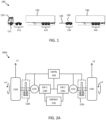
- FIG. 1 illustrates an example vehicle combination 100 for cargo transport.
- the vehicle combination 100 comprises a truck or towing vehicle 110 configured to tow a first trailer unit 120 in a known manner, e.g., by a fifth wheel connection.
- a dolly vehicle 130 can be connected to the rear of the first trailer 120 via a drawbar 136. This dolly vehicle can then tow a second trailer 140, thus increasing the cargo transport capacity of the vehicle combination. Consequently, the heavy duty vehicle 100 is a multi-trailer vehicle.
- a heavy duty vehicle is taken to be a vehicle designed for the handling and transport of heavier objects or large quantities of cargo.
- a heavy duty vehicle could be a semi-trailer vehicle or a truck.
- a heavy duty vehicle could be a vehicle designed for use in construction or farming.
- a dolly vehicle 130 is traditionally a passive vehicle comprising no driven or steerable axles, and with a relatively short wheelbase. It has recently been shown that self-powered dolly vehicles may provide both increased fuel efficiency and maneuverability.
- This type of self-powered dolly vehicle comprises an on-board energy source, such as a battery, super-capacitor, or a fuel cell stack, and at least one pair of driven wheels. Some self-powered dolly vehicles may also be steerable.
- An example of self-powered steerable axles of this type suitable for use with a self-powered dolly vehicle will be discussed in more detail below in connection to, e.g., Figure 2A .
- This type of driven axle can of course also be used with prime movers 110 and trailer units 120, 140.
- Increased fuel efficiency is for instance obtained if an electric machine arranged for regenerative braking is installed in the dolly vehicle or self-powered trailer unit.
- the vehicle combination then effectively becomes a hybrid electric vehicle, even if the towing vehicle only comprises a traditional diesel engine with no on-board electric hybridization.
- Adding a self-powered dolly vehicle 130 to the vehicle combination 100 can also improve startability, since the dolly vehicle is then able to generate extra torque when bringing the vehicle combination into motion from a stand-still.
- Vehicle startability may be a limiting factor in the maximum load possible to carry, and a self-powered dolly vehicle may therefore contribute to an increased cargo capacity, which is an advantage.
- Both the truck 110 and the self-powered steerable dolly vehicle 130 may comprise electric machines for propulsion and/or regenerative brakes for decelerating the vehicle unit while harvesting energy.
- the self-powered vehicle units also comprise respective energy sources.
- An energy source is normally a battery, super-capacitor, fuel cell or other device arranged to store electrical energy.
- an energy source may also comprise mechanical energy storage devices such as springs and compressed air tanks for pneumatic machines. Combinations of different types of energy sources can also be used.
- a traditional fuel tank for storing gasoline or diesel fuel can of course also be considered an energy source in this context.
- the present invention focuses on propulsion arrangements based on electric machines powered by an electrical energy storage device, such as a battery or a fuel cell stack.
- the present invention is applicable to multi-trailer vehicle combinations comprising passive dolly vehicle units as well as self-powered dolly vehicle units.
- FIG. 2A schematically illustrates an example driven axle arrangement 200a which can be used with, e.g., the self-powered dolly vehicle unit 130 or with the prime mover 110.
- the driven axle arrangement comprises an axle with left- and right-hand side driven wheels 210l, 210r.
- the axle is powered by a propulsion arrangement.
- the example 200a shown in Figure 2A comprises a propulsion arrangement comprising an energy source 250 such as a battery connected to two electrical machines 230l, 230r which each drive one of the left and right wheels 210l, 210r.
- a driven axle arrangement comprising a propulsion arrangement such as an electric machine or combustion engine which in turn powers the left and right wheels 210l, 210r via a differential is of course also possible.
- the driven axle arrangement in Figure 2A comprises friction brakes 220l, 220r and an active suspension arrangement 215l, 215r. Both the friction brakes 220l, 220r, the suspension 215l, 215r and the electrical machines 230l, 230r may be controlled by a control unit 240.
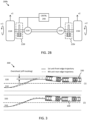
- FIG. 2B schematically illustrates an example non-driven axle arrangement 200b of a heavy duty vehicle.
- the non-driven axle arrangement 200b comprises a control unit 240 arranged to control an active suspension 215l, 215r as well as friction brakes 220l, 220r with which braking is applied to the wheels 210l, 210r.
- Both the towing vehicle 110 and the steerable dolly vehicle 130 may comprise control units, which will be discussed in more detail below in connection to Figure 8 .
- These control units can be arranged according to a layered functional architecture where some functions may be comprised in a traffic situation management (TSM) layer and some other functions may be comprised in a vehicle motion management (VMM) layer.
- TSM traffic situation management
- VMM vehicle motion management
- the TSM layer plans vehicle operation with a time horizon of, e.g., 10-30 seconds. This time frame for instance corresponds to the time it takes for the vehicle to negotiate a curve, i.e., to transition from driving straight to entering the curve and then exiting the curve again or driving up a hill.
- the TSM layer may continuously request desired acceleration profiles (a req ) and curvature profiles (c req ) from the VMM layer.
- the VMM layer operates with a time horizon of about 1 second or so, and continuously transforms the acceleration profiles and curvature profiles into control commands, sometimes referred to as requests, for the various motion support device (MSD) functions on the vehicle, i.e., it among other things performs MSD coordination.
- MSD motion support device
- a lane change scenario 300 is illustrated in Figure 3 .
- a heavy duty multi-trailer vehicle 100 executes an abrupt lane-change maneuver where the vehicle is initially following a right-hand side lane 310 and then changes to the left-hand side lane 320.
- the front edge trajectory of the first vehicle unit is illustrated by a solid line and the rear edge trajectory of the 4 th vehicle unit, i.e., the second trailer 140, is shown as a dash-dotted line.
- the top example illustrates trajectories if no overshoot mitigating measures are taken, while the bottom example illustrates trajectories given the currently proposed off-tracking mitigation techniques.
- vehicle unit motion By determining vehicle unit motion using, e.g., global positioning systems, vision-based sensors, wheel speed sensors, radar sensors and/or lidar sensors, and translating this vehicle unit motion into a local coordinate system of a given wheel 210l, 210r (in terms of, e.g., longitudinal and lateral velocity components), it becomes possible to accurately estimate wheel slip in real time by comparing the vehicle unit motion in the wheel reference coordinate system to data obtained from the wheel speed sensor arranged in connection to the wheel.
- a tyre model exemplified in Figure 4 , can be used to translate between a desired longitudinal or lateral tyre force Fx, Fy for a given wheel and an equivalent wheel slip ⁇ x , ⁇ y for the wheel.
- the relationship between longitudinal force Fx and longitudinal wheel slip ⁇ x depends on lateral wheel slip ⁇ y and vv.
- Wheel longitudinal slip ⁇ x relates to a difference between wheel rotational velocity and speed over ground and will be discussed in more detail below.
- Wheel speed ⁇ is a rotational speed of the wheel, given in units of, e.g., rotations per minute (rpm) or angular velocity in terms radians/second (rad/sec) or degrees/second (deg/sec).
- a tyre model is a model of wheel behavior which describes wheel force generated in longitudinal direction (in the rolling direction) and/or lateral direction (orthogonal to the longitudinal direction) as function of wheel slip.
- Tyre and vehicle dynamics Elsevier Ltd. 2012, ISBN 978-0-08-097016-5, Hans Pacejka covers the fundamentals of tyre models.
- longitudinal wheel slip ⁇ x is in accordance with SAE J670 ( SAE Vehicle Dynamics Standards Committee January 24, 2008 ).
- the longitudinal wheel slip is bounded between -1 and 1 and quantifies how much the wheel is slipping with respect to the road surface.
- Wheel slip is, in essence, a speed difference measured between the wheel and the vehicle.
- a wheel slip value is equivalent to a wheel speed value given a velocity of the wheel over the surface, in the coordinate system of the wheel.
- the VMM function manages both force generation and MSD coordination, i.e., it determines what forces that are required at the vehicle units in order to fulfil the requests from the TSM function, for instance to accelerate the vehicle according to a requested acceleration profile requested by TSM and/or to generate a certain curvature motion by the vehicle also requested by TSM.
- the forces may comprise e.g., yaw moments Mz, longitudinal forces Fx and lateral forces Fy, as well as different types of torques to be applied at different wheels.
- the VMM function keeps track of the state of charge of the electrical energy system (ESS) of the vehicle, i.e., the traction batteries or the fuel cell system as well as the current state of any brake resistors, and determines how to best meet braking torque requirements by the electric machines and by the friction brakes 220l, 220r on the different axles of the vehicle combination.
- ESS electrical energy system
- the VMM and optionally also the MSD control units maintain information on v x (in the reference frame of the wheel), while a wheel speed sensor or the like can be used to determine ⁇ x (the rotational velocity of the wheel).
- a tyre is subject to a longitudinal force F x , a lateral force F y , and a normal force F z .
- the normal force F z is key to determining some important vehicle properties. For instance, the normal force to a large extent determines the achievable longitudinal tyre force F x by the wheel since, normally, F x ⁇ ⁇ F z , where ⁇ is a friction coefficient associated with a road friction condition.
- the maximum available lateral force for a given lateral slip can be described by the so-called Magic Formula as described in " Tyre and vehicle dynamics", Elsevier Ltd. 2012, ISBN 978-0-08-097016-5, by Hans Pacejka .
- LCVs long combination vehicles
- LHVs long combination vehicles
- LCVs or LHVs
- LCVs are energy- and cost-efficient compared to tractor-semitrailers.
- performance measures are different from that of tractor-semitrailers.
- the high-speed off-tracking phenomenon is one of the drawbacks that must be considered in LCVs to reduce the risk of accidents on roads caused by these vehicles.
- the optimal brake distribution is done with the objective of reducing high-speed off-tracking of the last vehicle unit, e.g., during evasive manoeuvres performed at high speed, such as obstacle avoidance manoeuvring or abrupt lane change.
- the longitudinal force distribution according to the present technique is performed over axles, where the applied force is equal for right and left wheels of an axle, which simplifies the control method and reduces computational complexity.
- the overshoot can decrease up to 50% in an A-double vehicle depending on the speed and the manoeuvre.
- the speed change during manoeuvre can happen either by reducing the speed of the vehicle, or increasing the speed before the manoeuvre by for example 2.5 km/h (using propulsion) and then reducing it by 5 km/h during the manoeuvre by optimal brake distribution, which results in a total of 2.5 km/h reduction in speed. If more speed reduction is allowed the overshoot can be reduced by more than 50%.
- the optimal controller When studying the optimal brake distribution over axles, it was noted that the braking of the axles of the last units (in case of an A-double vehicle, the two last units) is necessary in order to reduce the overshoot.
- the optimal controller generates the axles' brake signals at the right time during the manoeuvre and with an appropriate amount of force. This time span where braking is performed is a part of the time during which the articulation angles are non-zero, when the brake forces act like for stretching the LCV, i.e. reducing one or more of the articulation angles of the vehicle combination.
- the first unit may propel the vehicle combination, both for increasing the stretching effect and for mitigating speed reduction during the manoeuvre.
- the method comprises obtaining S1 a model of vehicle dynamics describing dynamics of the multi-trailer heavy duty vehicle 100.
- the method also comprises determining S4 respective force trajectories a for two or more axles of the vehicle 100 as a solution to a non-linear optimal control problem (NOCP), where the NOCP is formulated with an objective to at least minimize trailer off-tracking, wherein the NOCP is formulated based on the model of vehicle dynamics.
- NOCP non-linear optimal control problem
- ua and sa be binary matrices defining the units, axles of each unit and the steerable axles, e.g., for the single-track 6-axle version of the vehicle 100 shown above with the lumped group axles.
- ua 1,1 ; 1,0 ; 1,1 ; 1,0
- sa 1,0 ; 0,0 ; 1,0 ; 0,0 .
- the potential energy is zero.
- any nonlinear tire model can be used to describe F yw as a function of lateral and longitudinal slips, for instance the one exemplified in Figure 4 .
- an NOCP can be defined and solved in real-time.
- the accuracy and the performance of the controller depends on the accuracy of the model of vehicle dynamics and parameters. It has been found, however, that the model discussed above provides good results.
- the present techniques mitigates high-speed off-tracking through optimal distribution of longitudinal forces between axles (optionally lumped axles) of the multi-trailer vehicle.
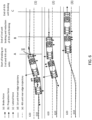
- FIG. 6 An example A-double 100 vehicle is shown in Figure 6 , executing a lane change manoeuvre from a first lane 610 to a second lane 620.
- Example longitudinal forces are shown in the figure. Dashed arrows indicate braking forces and solid lines indicate propulsion forces, while dash-dot arrows indicate the lateral forces.
- the front edge trajectory of the first vehicle unit 110 is indicated by solid lines, while the rear edge trajectory of the fourth vehicle unit (i.e. the second trailer unit 140) is indicated by dash-dot lines.
- the vehicle needs to brake only the axles of the third and the fourth vehicle units, i.e., the dolly and the second semitrailer, to reduce the off-tracking and the end of single-lane-change manoeuvre.
- the braking should be done at a right time (or position) regarding the vehicle orientation, speed, and steering angle.
- the dotted line A shows the position at which braking is commenced on the 3:rd and 4:th unit axles, i.e. the front and rear axles of the second trailer unit 140.
- the dotted line B shows the position at which braking may be ended at on the 3:rd unit axles and reduced on the 4:th unit axles
- the dotted line C shows the position at which braking is ended.
- the off-tracking at the beginning of the single-lane-change manoeuvre can be reduced in a similar manner, but the required forces are not shown in the figures.
- the longitudinal forces act as inputs (decision variables) to the NOCP.
- the optimal trajectories of the longitudinal forces are found throughout the manoeuvre.
- These longitudinal forces are then converted to torque requests that are met by the braking and propulsion actuators, or, as discussed above, to wheel slip or wheel speed requests.
- the force trajectories may, e.g., comprise target tyre force trajectories and/or target wheel slip trajectories for at least two axles to be followed during the maneuver.
- the force trajectories comprises target wheel torque trajectories or target axle torque trajectories to be followed during the maneuver.
- Figure 5 schematically illustrates a vehicle 100 travelling along a path p.
- the path may, for instance, be a stretch of road associated with a height profile 510 and perhaps also a section with reduced friction 520, as well as a turn maneuver m to be executed by the vehicle 100.
- the methods disclosed herein may comprise obtaining S2 information related to a road friction coefficient ⁇ along the upcoming vehicle path p.
- This means that the vehicle 100 either estimates a road friction coefficient ⁇ using on-board sensors such as cameras, infra-red sensors, and thermometers, or receives road friction reports from a remote server 530 by wireless link 540 via a radio base station 550.
- the NOCP is then formulated to account for the road friction coefficient ⁇ . For instance, a variation in road friction condition may warrant a reduction in braking force by one or more axles in order to prevent excessive wheel slip.
- This constraint on wheel force takes road friction coefficient into account and configures a safety margin to account for discrepancies in the road friction data.
- the method also comprises configuring S32 lateral and longitudinal wheel slip limits ⁇ lim for at least two wheels 115, 125, 135, 145 of an axle on the heavy duty vehicle 100.
- the lateral and longitudinal wheel slip values are related to respective lateral and longitudinal tyre force values F x , F y via a pre-determined combined tyre slip model, as discussed in connection to Figure 4 , wherein the NOCP is constrained by the lateral and longitudinal wheel slip limits ⁇ lim .
- the method may comprise solving S41 the NOCP in real-time.
- parts of the NOCP may be solved remotely, such as at the remote server 530 illustrated in Figure 5 .
- the method may comprise obtaining S42 a solution to the NOCP from a pre-determined look-up table (LUT) which comprises solutions to a plurality of NOCPs solved for different NOCP input parameters.
- LUT look-up table
- a solution can then be selected from the LUT in dependence of a respective set of parameters of a current operating scenario of the heavy duty vehicle 100 and in dependence of the maneuver. This selection can be performed in real time despite limited processing capability, since, in this case, for reducing the off-tracking, the vehicle controller simply reads the correct brake and propulsion force trajectories from a look-up table based, e.g., on the steering angle input and the speed of the vehicle.
- the method optionally comprises obtaining target brake and propulsion force trajectories from the LUT based on a steering angle of the vehicle 100 and based on a speed of the vehicle 100.
- the NOCP can be defined as follows, where it is appreciated that a any of the constraints can be assumed not applicable, depending on the vehicle type etc.
- Constraints 1.3-1.7 and 1.9 and 1.10 are included to make sure that the generated longitudinal forces are feasible and can be met by the lower level controllers, where the propulsion source on different axles can be either electric motors (EM) or an internal combustion engine (ICE), or both.
- EM electric motors
- ICE internal combustion engine
- F max S ⁇ F z
- ⁇ the road friction coefficient
- S a safety (or conservativity) factor
- F z is the axle vertical force.
- the decision variables in the example NOCP above may include longitudinal forces rather than exclusively the steering angle(s).
- the set of states of the NOCP may comprise longitudinal speed of a first vehicle unit 110, lateral speed of the first vehicle unit 110, yaw angle of the first vehicle unit 110, as well as respective derivatives, and also articulation angles of the heavy duty vehicle 100 and their derivatives.
- the force trajectories for the two or more axles of the vehicle 100 have equal tyre forces for each side of the respective axle.
- the input-output system of the present technique can, according to an example, be described as follows.
- NOCP in mathematical form can be defined as follows.
- the cost function is a convex quadratic cost of deviation of the vehicle path from a given trajectory or the trajectory of the towed units from the path of the towing unit.
- This type of NOCP can be solved using methods such as model predictive control (both linear or nonlinear).
- the objective is to reduce the distance between the trajectory of all the units and the given desired trajectory.
- the NOCP includes a model of a vehicle powertrain, as illustrated schematically in Figure 12.
- dynamic equations of a parallel hybrid powertrain comprising one or more electric machines (EM) and internal combustion engines (ICE) can be derived, as can equations for evaluating fuel consumption, electric energy consumption, state of charge of batteries, and energy dissipated in different parts of the powertrain.
- EM electric machines
- ICE internal combustion engines
- conventional and fully electric powertrains can be derived from the equations of the hybrid powertrain in a straight-forward manner by setting weight parameters to effectively zero out contributions from the ICE or from the EM.
- m is the vehicle total mass or equivalent total mass
- s(t) is the travelled distance at time t
- F g is the road grade
- F roll is the rolling resistance
- F air is the air drag.
- F g s t ⁇ m g sin ⁇ p s t
- F roll s t m g f r cos ⁇ p s t
- air v x t 0.5 ⁇ a A f c d v x t 2
- g , ⁇ p , f r , ⁇ a , A f , and c d represent the gravitational constant, road grade (positive downhill), rolling resistance coefficient, air density, equivalent vehicle front area and air drag coefficient, respectively.
- F steer approximates all forces caused by steering and from the articulation angles, i.e., side slips of the tires, as well as the rotational inertia. This term is close to zero in straight road driving and is negligible for single-unit vehicles. However, for articulated vehicles on curved roads, the term cannot be neglected for accurate state and energy consumption estimations.
- P f , P e , P de , P ew , and P det denote, respectively, powers associated with the fuel tank, with the ICE output, dissipated by the ICE, at the ICE transmission output and dissipated in ICE transmission, respectively.
- P b , P db , P a , P mc , P dm , P m , P dmt , P mw represent the powers provided by or stored in the battery, dissipated in the battery, used for auxiliaries, consumed or regenerated by EM, dissipated in EM, at EM output/input to/from transmission, dissipated in EM transmission and at output/input to/from wheels, respectively.
- P br be the friction brake power.
- the power balance equation for each subsystem can be written as follows. A power balance can be assumed since there is no energy storage or generation inside the powertrain, except that in the fuel tank and battery, i.e., no inertial flywheels or elastic shafts are modelled.
- the power dissipation of the ICE and the EM can, e.g., be modelled by direct use of data from measured maps or by using high-degree nonlinear fitted curves. Measurements can, e.g., be performed for varying torques and angular speeds.
- R , r e , T e , ⁇ e , r m , T m , and ⁇ m denote the wheel radius, gear ratio from wheel to engine, engine torque, engine speed, gear ratio from wheel to EM, EM torque and EM speed, respectively.
- Other surface fitting functions can of course also be used with similar effect.
- transmission dissipation can be assumed to be linear with respect to the power input being independent of gear selection:
- P det P e t P e t ⁇ ⁇ te P e t P e t ⁇ 0
- P dmt P m t P m t ⁇ ⁇ tm P m t if P m t > 0 ⁇ P m t ⁇ tm ⁇ P m t if P m t ⁇ 0
- ⁇ te ⁇ tm represent the transmission efficiency of the ICE and the EM, respectively.
- the negative sign in the second part above is needed in order to keep P dmt positive.
- SOC state of charge
- F xx denote a force corresponding to the above-mentioned powers P xx (as illustrated, e.g., in Figure 10 ), ⁇ e is integer gear of ICE, ⁇ m is integer gears of EM, R w is wheel radius, V b 2 is the battery open circuit voltage , r e is the ICE gearbox and final ratio and r m is the EM gearbox and final ratio. ,
- the optimization then can be, for example, defined as:
- the performance of the proposed NOCPs are not limited to the single-lane-change manoeuvre. It can be used for any high-speed manoeuvres where the optimal longitudinal force distribution can help improved vehicle performance and stability. This is because the defined optimal control problem is nonlinear and is based on a nonlinear vehicle model that includes nonlinear lateral and longitudinal dynamic of the multi-trailer vehicles as well as nonlinear combined slip tire models. For the same reason, the problem definition can be extended to include any type of LCV rather than only the A-double. Moreover, the methods can work together with the optimal steering of the other axles and can work for the combined optimal control and distribution of steering, propulsion and braking, in all speed ranges, i.e., from a low-speed to high-speed and in any manoeuvre.
- FIG. 8 schematically illustrates, in terms of a number of functional units, the components of a control unit 240 according to embodiments of the discussions and methods disclosed herein.
- This control unit 240 may be comprised in the vehicle 100, e.g., in the form of a vehicle motion management (VMM) unit configured to perform force allocation and the like.
- VMM vehicle motion management
- Processing circuitry 810 is provided using any combination of one or more of a suitable central processing unit CPU, multiprocessor, microcontroller, digital signal processor DSP, etc., capable of executing software instructions stored in a computer program product, e.g. in the form of a storage medium 830.
- the processing circuitry 810 may further be provided as at least one application specific integrated circuit ASIC, or field programmable gate array FPGA.
- the processing circuitry 810 is configured to cause the control unit 240 to perform a set of operations, or steps, such as the methods discussed in connection to Figure 8A and 7B.
- the storage medium 830 may store the set of operations
- the processing circuitry 810 may be configured to retrieve the set of operations from the storage medium 830 to cause the control unit 240 to perform the set of operations.
- the set of operations may be provided as a set of executable instructions.
- the processing circuitry 810 is thereby arranged to execute methods as herein disclosed.
- the storage medium 830 may also comprise persistent storage, which, for example, can be any single one or combination of magnetic memory, optical memory, solid state memory or even remotely mounted memory.
- the control unit 240 may further comprise an interface 820 for communications with at least one external device, such as an electric machine or a gearbox.
- the interface 820 may comprise one or more transmitters and receivers, comprising analogue and digital components and a suitable number of ports for wireline or wireless communication.
- the processing circuitry 810 controls the general operation of the control unit 240, e.g., by sending data and control signals to the interface 820 and the storage medium 830, by receiving data and reports from the interface 820, and by retrieving data and instructions from the storage medium 830.
- Other components, as well as the related functionality, of the control node are omitted in order not to obscure the concepts presented herein.
- Figure 9 illustrates a computer readable medium 910 carrying a computer program comprising program code means 920 for performing, e.g., the methods illustrated in Figure 7 , when said program product is run on a computer.
- the computer readable medium and the code means may together form a computer program product 900.
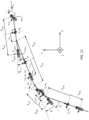
- Figures 10 and 11 illustrates an example model of vehicle dynamics which can be used with the herein proposed methods. It was discussed above in connection with the reference to in " Computationally Efficient Nonlinear One-and Two-Track Models for Multitrailer Road Vehicles", by T. Ghandriz, B. Jacobson, P. Nilsson, L. Laine, and N. Fröjd, published in IEEE Access 09 November 2020, ISSN: 2169-3536 .
Landscapes
- Engineering & Computer Science (AREA)
- Transportation (AREA)
- Mechanical Engineering (AREA)
- Automation & Control Theory (AREA)
- Chemical & Material Sciences (AREA)
- Combustion & Propulsion (AREA)
- Human Computer Interaction (AREA)
- Control Of Driving Devices And Active Controlling Of Vehicle (AREA)
- Regulating Braking Force (AREA)
Claims (15)
- Verfahren zur Verringerung der Spurabweichung eines Schwerlastfahrzeugs (100) mit mehreren Anhängern während eines Manövers, das Verfahren umfassend:Erhalten (S1) eines Modells der Fahrzeugdynamik, das die Dynamik des Schwerlastfahrzeugs mit mehreren Anhängern (100) beschreibt,Bestimmen (S4) jeweiliger Krafttrajektorien (a) für zwei oder mehr Achsen des Fahrzeugs (100) als eine Lösung eines nichtlinearen optimalen Steuerungsproblems, NOCP, wobei das NOCP mit einem Ziel formuliert ist, die Spurabweichung des Anhängers zumindest zu minimieren, wobei das NOCP basierend auf dem Modell der Fahrzeugdynamik und einer Vorhersage der Fahrzeugsteuerung während des Manövers formuliert ist, undSteuern (S5) der Bewegung des Schwerlastfahrzeugs (100) während des Manövers basierend auf den ermittelten Krafttrajektorien (a).
- Verfahren nach Anspruch 1, umfassend Erhalten (S2) von Informationen, die sich auf einen Straßenreibungskoeffizienten (µ) beziehen, der mit einem bevorstehenden Fahrzeugpfad assoziiert ist, wobei das NOCP formuliert ist, den Straßenreibungskoeffizienten (µ) zu berücksichtigen.
- Verfahren nach Anspruch 2, ferner umfassend Konfigurieren (S31) einer Grenze Fmax auf Achsenkräfte gegeben durch

- Verfahren nach Anspruch 1 oder 2, ferner umfassend Konfigurieren (S32) lateraler und longitudinaler Radschlupfgrenzen (λlim) für mindestens zwei Räder (115, 125, 135, 145) einer Achse des Schwerlastfahrzeugs (100), wobei laterale und longitudinale Radschlupfgrenzwerte mit jeweiligen lateralen und longitudinalen Reifenkraftwerten (Fx, Fy) über ein vorbestimmtes kombiniertes Reifenschlupfmodell in Beziehung gesetzt werden, wobei das NOCP durch die lateralen und longitudinalen Radschlupfgrenzen (λlim) eingeschränkt ist.
- Verfahren nach einem der vorhergehenden Ansprüche, wobei die Krafttrajektorien (a) Ziel-Reifenkrafttrajektorien und/oder Ziel-Radschlupftrajektorien für mindestens zwei Achsen umfassen, denen während des Manövers zu folgen ist.
- Verfahren nach einem der Ansprüche 1 bis 4, wobei das Verfahren Bestimmen von Ziel-Raddrehmomenttrajektorien oder Ziel-Achsdrehmomenttrajektorien umfasst, denen während des Manövers zu folgen ist.
- Verfahren nach einem der vorhergehenden Ansprüche, umfassend Lösen (841) des NOCP in Echtzeit.
- Verfahren nach einem der Ansprüche 1 bis 6, umfassend Erhalten (842) einer Lösung für das NOCP aus einer vorbestimmten Nachschlagetabelle, LUT, wobei die LUT Lösungen für eine Vielzahl von NOCPs umfasst, die für verschiedene NOCP-Eingabeparameter gelöst wurden, wobei eine Lösung aus der LUT in Abhängigkeit von einem jeweiligen Satz von Parametern eines aktuellen Betriebsszenarios des Schwerlastfahrzeugs (100) und in Abhängigkeit des Manövers ausgewählt ist.
- Verfahren nach Anspruch 8, umfassend Erhalten (843) der Lösung für das NOCP durch Erhalten von Zielbrems- und Antriebskrafttrajektorien aus der LUT basierend auf einem Lenkwinkel des Fahrzeugs (100) und basierend auf einer Geschwindigkeit des Fahrzeugs (100).
- Verfahren nach einem der vorhergehenden Ansprüche, wobei ein Satz Zustände des NOCP longitudinale Geschwindigkeit einer ersten Fahrzeugeinheit (110), laterale Geschwindigkeit der ersten Fahrzeugeinheit (110), Gierwinkel der ersten Fahrzeugeinheit (110), sowie jeweilige Derivate und auch Knickwinkel des Schwerlastfahrzeugs (100) und deren Derivate umfasst.
- Verfahren nach einem der vorhergehenden Ansprüche, wobei die Krafttrajektorien (a) für die zwei oder mehr Achsen des Fahrzeugs (100) gleiche Reifenkräfte für jede Seite der jeweiligen Achse aufweisen.
- Verfahren nach einem der vorhergehenden Ansprüche, wobei eine Entfernung des Pfades (p), d. h. die Länge der bestimmten Krafttrajektorien, zwischen 5-300 m beträgt.
- Steuereinheit (240) mit einer Verarbeitungsschaltung (910), die konfiguriert ist, ein Verfahren nach einem der vorhergehenden Ansprüche durchzuführen.
- Schwerlastfahrzeug (100) umfassend die Steuereinheit (240) nach Anspruch 13.
- Dolly-Fahrzeugeinheit (130) umfassend die Steuereinheit (240) nach Anspruch 13.
Applications Claiming Priority (1)
| Application Number | Priority Date | Filing Date | Title |
|---|---|---|---|
| PCT/EP2020/082708 WO2022106005A1 (en) | 2020-11-19 | 2020-11-19 | Methods for reducing high-speed off-tracking in multi-trailer heavy duty vehicles |
Publications (3)
| Publication Number | Publication Date |
|---|---|
| EP4247686A1 EP4247686A1 (de) | 2023-09-27 |
| EP4247686B1 true EP4247686B1 (de) | 2024-12-25 |
| EP4247686C0 EP4247686C0 (de) | 2024-12-25 |
Family
ID=73497780
Family Applications (1)
| Application Number | Title | Priority Date | Filing Date |
|---|---|---|---|
| EP20810945.4A Active EP4247686B1 (de) | 2020-11-19 | 2020-11-19 | Verfahren zur reduzierung von hochgeschwindigkeits-off-tracking in schwerlastfahrzeugen mit mehreren anhängern |
Country Status (4)
| Country | Link |
|---|---|
| US (1) | US12162494B2 (de) |
| EP (1) | EP4247686B1 (de) |
| CN (1) | CN116472505A (de) |
| WO (1) | WO2022106005A1 (de) |
Families Citing this family (8)
| Publication number | Priority date | Publication date | Assignee | Title |
|---|---|---|---|---|
| PL3943350T3 (pl) * | 2020-07-21 | 2024-04-15 | Knorr-Bremse Systeme für Nutzfahrzeuge GmbH | Urządzenie i sposób określania tarcia drogowego |
| US11807107B2 (en) * | 2021-08-17 | 2023-11-07 | Anamnesis Corporation | Vehicle system and longitudinal vehicle control method |
| WO2023237184A1 (en) * | 2022-06-07 | 2023-12-14 | Volvo Truck Corporation | Method of distributed control allocation for multi-unit vehicle combinations |
| US20240087159A1 (en) * | 2022-09-13 | 2024-03-14 | Stoneridge Electronics Ab | Camera monitor system for commercial vehicles including wheel position estimation |
| WO2025131299A1 (en) * | 2023-12-22 | 2025-06-26 | Volvo Autonomous Solutions AB | System and method for controlling traction and brake distribution |
| WO2025218892A1 (en) * | 2024-04-17 | 2025-10-23 | Volvo Truck Corporation | Trajectory planning for vehicle combinations |
| WO2025218891A1 (en) * | 2024-04-17 | 2025-10-23 | Volvo Truck Corporation | Determining capabilities of vehicle combinations |
| CN119858565B (zh) * | 2025-01-23 | 2025-11-25 | 浙江吉利控股集团有限公司 | 轨迹预测方法、装置、电子设备及车辆 |
Family Cites Families (8)
| Publication number | Priority date | Publication date | Assignee | Title |
|---|---|---|---|---|
| DE102012000783A1 (de) | 2012-01-17 | 2013-07-18 | Gm Global Technology Operations, Llc | Stabilisierung eines Fahrzeuggespanns |
| DE102012000784A1 (de) | 2012-01-17 | 2013-07-18 | GM Global Technology Operations LLC (n. d. Gesetzen des Staates Delaware) | Stabilisierung eines Fahrzeuggespanns |
| WO2016099344A1 (en) | 2014-12-19 | 2016-06-23 | Volvo Truck Corporation | Method and arrangement for improving manoeuvrability of a vehicle combination |
| DE102015209245A1 (de) | 2015-05-20 | 2016-11-24 | Avl Commercial Driveline & Tractor Engineering Gmbh | Verfahren zum Betrieb eines Fahrzeuggespanns, Fahrzeuggespann, Zugfahrzeug und Arbeitsgerät |
| US10518831B2 (en) | 2017-04-21 | 2019-12-31 | Wrightspeed, Inc. | Self-powered actively steerable converter dollies for long combination vehicles |
| EP4636664A2 (de) * | 2018-02-26 | 2025-10-22 | Federal Express Corporation | Systeme und verfahren zur verbesserten kollisionsvermeidung bei logistischen bodenunterstützungsgeräten unter verwendung von multi-sensor-detektionsfusion |
| US11327449B2 (en) * | 2020-05-29 | 2022-05-10 | Mitsubishi Electric Research Laboratories, Inc. | Nonlinear optimization for stochastic predictive vehicle control |
| CN116457270A (zh) * | 2020-11-19 | 2023-07-18 | 沃尔沃卡车集团 | 用于多挂车重型车辆的预测性能量和运动管理 |
-
2020
- 2020-11-19 CN CN202080107327.2A patent/CN116472505A/zh active Pending
- 2020-11-19 US US18/253,360 patent/US12162494B2/en active Active
- 2020-11-19 WO PCT/EP2020/082708 patent/WO2022106005A1/en not_active Ceased
- 2020-11-19 EP EP20810945.4A patent/EP4247686B1/de active Active
Also Published As
| Publication number | Publication date |
|---|---|
| US20230415746A1 (en) | 2023-12-28 |
| WO2022106005A1 (en) | 2022-05-27 |
| CN116472505A (zh) | 2023-07-21 |
| EP4247686A1 (de) | 2023-09-27 |
| US12162494B2 (en) | 2024-12-10 |
| EP4247686C0 (de) | 2024-12-25 |
Similar Documents
| Publication | Publication Date | Title |
|---|---|---|
| EP4247695B1 (de) | Prädiktive energie- und bewegungsverwaltung für schwerlastfahrzeuge mit mehreren aufliegern | |
| EP4247686B1 (de) | Verfahren zur reduzierung von hochgeschwindigkeits-off-tracking in schwerlastfahrzeugen mit mehreren anhängern | |
| EP4140839B1 (de) | Fahrzeugsteuerung basierend auf einer dynamisch konfigurierten seitenschlupfgrenze | |
| Katsuyama et al. | A state-of-the-art review: toward a novel vehicle dynamics control concept taking the driveline of electric vehicles into account as promising control actuators | |
| EP4103453B1 (de) | Verfahren zur steuerung eines selbstfahrenden rollwagenfahrzeugs während eines ausweichmanövers | |
| EP4330097B1 (de) | Fahrzeugsteuerung auf basis dynamisch konfigurierter längsradschlupfgrenzen | |
| CN115837843A (zh) | 一种分布式驱动电动汽车直接横摆力矩协调转向控制方法 | |
| EP4347302B1 (de) | Energieeffizienter antrieb auf basis eines radschlupfausgeglichenen antriebs | |
| CN111959500A (zh) | 一种基于轮胎力分配的汽车路径跟踪性能提升方法 | |
| JP2024514554A (ja) | 大型車両を制動するための方法及び装置 | |
| KR20210081401A (ko) | 원하는 곡률 경로를 차량이 따르도록 하는 방법 | |
| EP4396063B1 (de) | Fahrzeugsteuerung für vereinfachten autonomen antrieb | |
| CN114312765B (zh) | 一种纵向主动防撞控制系统及方法 | |
| Sun et al. | Design of four wheel steering and direct yaw moment control for unmanned vehicle with path tracking controller in extreme maneuvers | |
| Guastadisegni et al. | Vehicle stability control through pre-emptive braking | |
| CN119343276A (zh) | 用于多单元车辆组合的控制分配方法 | |
| US20250242817A1 (en) | Control barrier functions for safety-critical control of automotive stability | |
| WO2024213246A1 (en) | Power control for combination vehicles | |
| WO2024213253A1 (en) | Braking control for vehicles | |
| 나재원 | Terrain driving control algorithm for skid-steered in-wheel driving vehicles |
Legal Events
| Date | Code | Title | Description |
|---|---|---|---|
| STAA | Information on the status of an ep patent application or granted ep patent |
Free format text: STATUS: UNKNOWN |
|
| STAA | Information on the status of an ep patent application or granted ep patent |
Free format text: STATUS: THE INTERNATIONAL PUBLICATION HAS BEEN MADE |
|
| PUAI | Public reference made under article 153(3) epc to a published international application that has entered the european phase |
Free format text: ORIGINAL CODE: 0009012 |
|
| STAA | Information on the status of an ep patent application or granted ep patent |
Free format text: STATUS: REQUEST FOR EXAMINATION WAS MADE |
|
| 17P | Request for examination filed |
Effective date: 20230512 |
|
| AK | Designated contracting states |
Kind code of ref document: A1 Designated state(s): AL AT BE BG CH CY CZ DE DK EE ES FI FR GB GR HR HU IE IS IT LI LT LU LV MC MK MT NL NO PL PT RO RS SE SI SK SM TR |
|
| DAV | Request for validation of the european patent (deleted) | ||
| DAX | Request for extension of the european patent (deleted) | ||
| GRAP | Despatch of communication of intention to grant a patent |
Free format text: ORIGINAL CODE: EPIDOSNIGR1 |
|
| STAA | Information on the status of an ep patent application or granted ep patent |
Free format text: STATUS: GRANT OF PATENT IS INTENDED |
|
| RIC1 | Information provided on ipc code assigned before grant |
Ipc: G05D 1/00 20060101ALI20240624BHEP Ipc: B60W 50/00 20060101ALI20240624BHEP Ipc: B62D 59/04 20060101ALI20240624BHEP Ipc: B60W 50/06 20060101AFI20240624BHEP |
|
| INTG | Intention to grant announced |
Effective date: 20240715 |
|
| GRAS | Grant fee paid |
Free format text: ORIGINAL CODE: EPIDOSNIGR3 |
|
| GRAA | (expected) grant |
Free format text: ORIGINAL CODE: 0009210 |
|
| STAA | Information on the status of an ep patent application or granted ep patent |
Free format text: STATUS: THE PATENT HAS BEEN GRANTED |
|
| AK | Designated contracting states |
Kind code of ref document: B1 Designated state(s): AL AT BE BG CH CY CZ DE DK EE ES FI FR GB GR HR HU IE IS IT LI LT LU LV MC MK MT NL NO PL PT RO RS SE SI SK SM TR |
|
| REG | Reference to a national code |
Ref country code: GB Ref legal event code: FG4D |
|
| REG | Reference to a national code |
Ref country code: CH Ref legal event code: EP |
|
| REG | Reference to a national code |
Ref country code: DE Ref legal event code: R096 Ref document number: 602020043760 Country of ref document: DE |
|
| REG | Reference to a national code |
Ref country code: IE Ref legal event code: FG4D |
|
| U01 | Request for unitary effect filed |
Effective date: 20250110 |
|
| U07 | Unitary effect registered |
Designated state(s): AT BE BG DE DK EE FI FR IT LT LU LV MT NL PT RO SE SI Effective date: 20250117 |
|
| PG25 | Lapsed in a contracting state [announced via postgrant information from national office to epo] |
Ref country code: HR Free format text: LAPSE BECAUSE OF FAILURE TO SUBMIT A TRANSLATION OF THE DESCRIPTION OR TO PAY THE FEE WITHIN THE PRESCRIBED TIME-LIMIT Effective date: 20241225 |
|
| PG25 | Lapsed in a contracting state [announced via postgrant information from national office to epo] |
Ref country code: NO Free format text: LAPSE BECAUSE OF FAILURE TO SUBMIT A TRANSLATION OF THE DESCRIPTION OR TO PAY THE FEE WITHIN THE PRESCRIBED TIME-LIMIT Effective date: 20250325 |
|
| PG25 | Lapsed in a contracting state [announced via postgrant information from national office to epo] |
Ref country code: GR Free format text: LAPSE BECAUSE OF FAILURE TO SUBMIT A TRANSLATION OF THE DESCRIPTION OR TO PAY THE FEE WITHIN THE PRESCRIBED TIME-LIMIT Effective date: 20250326 |
|
| PG25 | Lapsed in a contracting state [announced via postgrant information from national office to epo] |
Ref country code: RS Free format text: LAPSE BECAUSE OF FAILURE TO SUBMIT A TRANSLATION OF THE DESCRIPTION OR TO PAY THE FEE WITHIN THE PRESCRIBED TIME-LIMIT Effective date: 20250325 |
|
| PG25 | Lapsed in a contracting state [announced via postgrant information from national office to epo] |
Ref country code: SM Free format text: LAPSE BECAUSE OF FAILURE TO SUBMIT A TRANSLATION OF THE DESCRIPTION OR TO PAY THE FEE WITHIN THE PRESCRIBED TIME-LIMIT Effective date: 20241225 |
|
| PG25 | Lapsed in a contracting state [announced via postgrant information from national office to epo] |
Ref country code: PL Free format text: LAPSE BECAUSE OF FAILURE TO SUBMIT A TRANSLATION OF THE DESCRIPTION OR TO PAY THE FEE WITHIN THE PRESCRIBED TIME-LIMIT Effective date: 20241225 |
|
| PG25 | Lapsed in a contracting state [announced via postgrant information from national office to epo] |
Ref country code: ES Free format text: LAPSE BECAUSE OF FAILURE TO SUBMIT A TRANSLATION OF THE DESCRIPTION OR TO PAY THE FEE WITHIN THE PRESCRIBED TIME-LIMIT Effective date: 20241225 |
|
| PG25 | Lapsed in a contracting state [announced via postgrant information from national office to epo] |
Ref country code: IS Free format text: LAPSE BECAUSE OF FAILURE TO SUBMIT A TRANSLATION OF THE DESCRIPTION OR TO PAY THE FEE WITHIN THE PRESCRIBED TIME-LIMIT Effective date: 20250425 |
|
| PG25 | Lapsed in a contracting state [announced via postgrant information from national office to epo] |
Ref country code: SK Free format text: LAPSE BECAUSE OF FAILURE TO SUBMIT A TRANSLATION OF THE DESCRIPTION OR TO PAY THE FEE WITHIN THE PRESCRIBED TIME-LIMIT Effective date: 20241225 |
|
| PG25 | Lapsed in a contracting state [announced via postgrant information from national office to epo] |
Ref country code: CZ Free format text: LAPSE BECAUSE OF FAILURE TO SUBMIT A TRANSLATION OF THE DESCRIPTION OR TO PAY THE FEE WITHIN THE PRESCRIBED TIME-LIMIT Effective date: 20241225 |
|
| PLBE | No opposition filed within time limit |
Free format text: ORIGINAL CODE: 0009261 |
|
| STAA | Information on the status of an ep patent application or granted ep patent |
Free format text: STATUS: NO OPPOSITION FILED WITHIN TIME LIMIT |
|
| 26N | No opposition filed |
Effective date: 20250926 |