EP4246360B1 - Verfahren und system zur verteilten berechnung von digitalen unterschriften - Google Patents
Verfahren und system zur verteilten berechnung von digitalen unterschriften Download PDFInfo
- Publication number
- EP4246360B1 EP4246360B1 EP22204890.2A EP22204890A EP4246360B1 EP 4246360 B1 EP4246360 B1 EP 4246360B1 EP 22204890 A EP22204890 A EP 22204890A EP 4246360 B1 EP4246360 B1 EP 4246360B1
- Authority
- EP
- European Patent Office
- Prior art keywords
- party
- session key
- digital signature
- ciphertext
- key
- Prior art date
- Legal status (The legal status is an assumption and is not a legal conclusion. Google has not performed a legal analysis and makes no representation as to the accuracy of the status listed.)
- Active
Links
Images




Classifications
-
- G—PHYSICS
- G06—COMPUTING OR CALCULATING; COUNTING
- G06F—ELECTRIC DIGITAL DATA PROCESSING
- G06F21/00—Security arrangements for protecting computers, components thereof, programs or data against unauthorised activity
- G06F21/60—Protecting data
- G06F21/64—Protecting data integrity, e.g. using checksums, certificates or signatures
-
- H—ELECTRICITY
- H04—ELECTRIC COMMUNICATION TECHNIQUE
- H04L—TRANSMISSION OF DIGITAL INFORMATION, e.g. TELEGRAPHIC COMMUNICATION
- H04L9/00—Cryptographic mechanisms or cryptographic arrangements for secret or secure communications; Network security protocols
- H04L9/06—Cryptographic mechanisms or cryptographic arrangements for secret or secure communications; Network security protocols the encryption apparatus using shift registers or memories for block-wise or stream coding, e.g. DES systems or RC4; Hash functions; Pseudorandom sequence generators
- H04L9/0618—Block ciphers, i.e. encrypting groups of characters of a plain text message using fixed encryption transformation
-
- H—ELECTRICITY
- H04—ELECTRIC COMMUNICATION TECHNIQUE
- H04L—TRANSMISSION OF DIGITAL INFORMATION, e.g. TELEGRAPHIC COMMUNICATION
- H04L9/00—Cryptographic mechanisms or cryptographic arrangements for secret or secure communications; Network security protocols
- H04L9/08—Key distribution or management, e.g. generation, sharing or updating, of cryptographic keys or passwords
- H04L9/0861—Generation of secret information including derivation or calculation of cryptographic keys or passwords
- H04L9/0869—Generation of secret information including derivation or calculation of cryptographic keys or passwords involving random numbers or seeds
-
- H—ELECTRICITY
- H04—ELECTRIC COMMUNICATION TECHNIQUE
- H04L—TRANSMISSION OF DIGITAL INFORMATION, e.g. TELEGRAPHIC COMMUNICATION
- H04L9/00—Cryptographic mechanisms or cryptographic arrangements for secret or secure communications; Network security protocols
- H04L9/30—Public key, i.e. encryption algorithm being computationally infeasible to invert or user's encryption keys not requiring secrecy
- H04L9/3066—Public key, i.e. encryption algorithm being computationally infeasible to invert or user's encryption keys not requiring secrecy involving algebraic varieties, e.g. elliptic or hyper-elliptic curves
-
- H—ELECTRICITY
- H04—ELECTRIC COMMUNICATION TECHNIQUE
- H04L—TRANSMISSION OF DIGITAL INFORMATION, e.g. TELEGRAPHIC COMMUNICATION
- H04L9/00—Cryptographic mechanisms or cryptographic arrangements for secret or secure communications; Network security protocols
- H04L9/30—Public key, i.e. encryption algorithm being computationally infeasible to invert or user's encryption keys not requiring secrecy
- H04L9/3066—Public key, i.e. encryption algorithm being computationally infeasible to invert or user's encryption keys not requiring secrecy involving algebraic varieties, e.g. elliptic or hyper-elliptic curves
- H04L9/3073—Public key, i.e. encryption algorithm being computationally infeasible to invert or user's encryption keys not requiring secrecy involving algebraic varieties, e.g. elliptic or hyper-elliptic curves involving pairings, e.g. identity based encryption [IBE], bilinear mappings or bilinear pairings, e.g. Weil or Tate pairing
-
- H—ELECTRICITY
- H04—ELECTRIC COMMUNICATION TECHNIQUE
- H04L—TRANSMISSION OF DIGITAL INFORMATION, e.g. TELEGRAPHIC COMMUNICATION
- H04L9/00—Cryptographic mechanisms or cryptographic arrangements for secret or secure communications; Network security protocols
- H04L9/32—Cryptographic mechanisms or cryptographic arrangements for secret or secure communications; Network security protocols including means for verifying the identity or authority of a user of the system or for message authentication, e.g. authorization, entity authentication, data integrity or data verification, non-repudiation, key authentication or verification of credentials
- H04L9/3218—Cryptographic mechanisms or cryptographic arrangements for secret or secure communications; Network security protocols including means for verifying the identity or authority of a user of the system or for message authentication, e.g. authorization, entity authentication, data integrity or data verification, non-repudiation, key authentication or verification of credentials using proof of knowledge, e.g. Fiat-Shamir, GQ, Schnorr, ornon-interactive zero-knowledge proofs
-
- H—ELECTRICITY
- H04—ELECTRIC COMMUNICATION TECHNIQUE
- H04L—TRANSMISSION OF DIGITAL INFORMATION, e.g. TELEGRAPHIC COMMUNICATION
- H04L9/00—Cryptographic mechanisms or cryptographic arrangements for secret or secure communications; Network security protocols
- H04L9/32—Cryptographic mechanisms or cryptographic arrangements for secret or secure communications; Network security protocols including means for verifying the identity or authority of a user of the system or for message authentication, e.g. authorization, entity authentication, data integrity or data verification, non-repudiation, key authentication or verification of credentials
- H04L9/3247—Cryptographic mechanisms or cryptographic arrangements for secret or secure communications; Network security protocols including means for verifying the identity or authority of a user of the system or for message authentication, e.g. authorization, entity authentication, data integrity or data verification, non-repudiation, key authentication or verification of credentials involving digital signatures
- H04L9/3252—Cryptographic mechanisms or cryptographic arrangements for secret or secure communications; Network security protocols including means for verifying the identity or authority of a user of the system or for message authentication, e.g. authorization, entity authentication, data integrity or data verification, non-repudiation, key authentication or verification of credentials involving digital signatures using DSA or related signature schemes, e.g. elliptic based signatures, ElGamal or Schnorr schemes
Definitions
- the disclosure herein generally relates to the field of cryptography and digital signatures, and, more particularly, to a method and a system for distributed digital signature computation.
- the blockchain technology empowers participants to confirm transactions such as fund transfers, trading without a need for a central clearing authority.
- the fund transfer in blockchain utilizes a virtual currency called crypto currency.
- the crypto currency uses cryptography for security, making it difficult to counterfeit while allowing for nearly anonymous financial transactions between two parties.
- a primary drawback of crypto currency in blockchains is theft of private key and the loss of the private key due to a software or hardware failure.
- HSMs hardware Security Modules
- ECDSA distributed Elliptic Curve Digital Signature Algorithm
- Embodiments of the present disclosure present technological improvements as solutions to one or more of the above-mentioned technical problems recognized by the inventors in conventional systems.
- a method for distributed digital signature computation according to appended claim 1 is provided.
- a corresponding system according to claim 5 and a corresponding non-transitory computer-readable medium comprising instructions according to claim 8 are also provided.
- the dependent claims provide further aspects of the invention.
- the disclosure generates a digital signature based on ECDSA.
- a private key is split as two random shares between two parties and the two parties run a secure multiparty protocol to generate the digital signature, wherein two parties refer to one of two computing devices such as two PCs, two servers, two mobile devices, etc., or a combination of above devices, for example one PC and one mobile.
- An existing prior art - US20180359097A1 also belongs to the same field of invention of two party ECDSA method.
- a main feature of the patent includes a method wherein the first party encrypts its key share and exchange it with the second party. Further, the two parties use two party protocol to compute signature.
- a challenge in the cited patent is that the key generation involves complex and interactive protocols to prove the correctness of the keys shared, hence the key generation takes 2.5 seconds in contrast to the disclosed key generation that takes 5 milliseconds for the same as illustrated in the experiment section.
- the disclosed technique has several advantages compared to the mentioned/ cited prior art items which includes no requirement of any participation in any kind of key exchange or generation method if any two parties want to combine [or aggregate] their ECDSA signature.
- the parties can simply run the disclosed digital signature computation technique, which results in a single [known as aggregated] signature, wherein the digital signature (single) guarantees that both parties have participated in the signature computation and requires a public key that is aggregation of the two individual public keys.
- the two parties use the methods proposed in the two cited prior arts, then they first have to run in a joint key generation method, which is not required in the disclosed technique.
- FIG. 1 through FIG.4B where similar reference characters denote corresponding features consistently throughout the figures, there are shown preferred embodiments and these embodiments are described in the context of the following exemplary system and/or method.
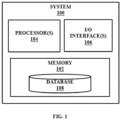
- FIG. 1 is an exemplary block diagram of a system 100 for distributed digital signature computation in accordance with some embodiments of the present disclosure.
- the system 100 enables communication between the two parties that require to generate the digital signature.
- the system 100 includes a processor(s) 104, communication interface device(s), alternatively referred as input/output (I/O) interface(s) 106, and one or more data storage devices or a memory 102 operatively coupled to the processor(s) 104.
- the system 100 with one or more hardware processors is configured to execute functions of one or more functional blocks of the system 100.
- the processor(s) 104 can be one or more hardware processors 104.
- the one or more hardware processors 104 can be implemented as one or more microprocessors, microcomputers, microcontrollers, digital signal processors, central processing units, state machines, logic circuitries, and/or any devices that manipulate signals based on operational instructions.
- the one or more hardware processors 104 is configured to fetch and execute computer-readable instructions stored in the memory 102.
- the system 100 can be implemented in a variety of computing systems including laptop computers, notebooks, hand-held devices such as mobile phones, workstations, mainframe computers, servers, a network cloud and the like.
- the I/O interface(s) 106 can include a variety of software and hardware interfaces, for example, a web interface, a graphical user interface, a touch user interface (TUI) and the like and can facilitate multiple communications within a wide variety of networks N/W and protocol types, including wired networks, for example, LAN, cable, etc., and wireless networks, such as WLAN, cellular, or satellite.
- the I/O interface (s) 106 can include one or more ports for connecting a number of devices (nodes) of the system 100 to one another or to another server.
- the memory 102 may include any computer-readable medium known in the art including, for example, volatile memory, such as static random-access memory (SRAM) and dynamic random-access memory (DRAM), and/or non-volatile memory, such as read only memory (ROM), erasable programmable ROM, flash memories, hard disks, optical disks, and magnetic tapes.
- volatile memory such as static random-access memory (SRAM) and dynamic random-access memory (DRAM)
- DRAM dynamic random-access memory
- non-volatile memory such as read only memory (ROM), erasable programmable ROM, flash memories, hard disks, optical disks, and magnetic tapes.
- the memory 102 may include a database 108 configured to include information regarding extraction of tasks, labelling of words, performing preprocessing of received documents.
- the memory 102 may comprise information pertaining to input(s)/output(s) of each step performed by the processor(s) 104 of the system 100 and methods of the present disclosure.
- the database 108 may be external (not shown) to the system 100 and coupled to the system via the I/O interface 106.
- the system 100 supports various connectivity options such as BLUETOOTH ® , USB, ZigBee and other cellular services.
- the network environment enables connection of various components of the system 100 using any communication link including Internet, WAN, MAN, and so on.
- the system 100 is implemented to operate as a stand-alone device.
- the system 100 may be implemented to work as a loosely coupled device to a smart computing environment. The components and functionalities of the system 100 are described further in detail.
- the various modules of the system 100 are configured for distributed digital signature computation are implemented as at least one of a logically self-contained part of a software program, a self-contained hardware component, and/or, a self-contained hardware component with a logically self-contained part of a software program embedded into each of the hardware component that when executed perform the above method described herein.
- FIG.2 is an exemplary flow diagram illustrating a method 200 for distributed digital signature computation using the system 100 of FIG. 1 according to an embodiment of the present disclosure.
- a plurality of input parameters and a message digest (M) is shared with the first party and the second party, via one or more hardware processors 104.
- the plurality of input parameters comprises an elliptic curve (E) defined as an elliptic curve equation over a finite field, a group base point in the elliptic curve (G), a fixed prime number indicating an order of points in the elliptic curve (q), a Paillier Encryption parameters including a Paillier modulus (N), a Paillier private key ( ⁇ ( N )), a Paillier public key (g).
- E elliptic curve
- G group base point in the elliptic curve
- q a fixed prime number indicating an order of points in the elliptic curve
- Paillier Encryption parameters including a Paillier modulus (N), a Paillier private key ( ⁇ ( N )), a Paillier public key (g).
- the first party and the second party refer to one of two computing devices such as two PCs, two servers, two mobile devices, etc., or a combination of above devices, for example one PC and one mobile.
- the first random number (a) and the second random number (b) are shares of a secret key ( sk ) .
- the disclosed technique ensures secure generation of the digital signature by splitting the secret key and distributing one part each to the participating parties, thus increasing safety and making the technique more secure.
- a public key is generated by the first party and the second party based on a public key generation technique, via one or more hardware processors 104.
- the public key is generated by the first party and the second party using the plurality of input parameters, the first random number (a) and the second random number (b).
- the two parties - the party A and the party B independently generate their key shares and then together obtain the public key in several steps as discussed below - using the public key generation technique.
- the method for public key generation technique is explained using flowchart of 300 as depicted in FIG.3 .
- the public key generation technique comprises the following steps.
- a first partial public key is computed at the first party.
- the first partial public key is computed as an exponentiation of the group base point (G) with the first random number (a).
- the first party generates the first random number (a) which is the first share of the private key. Further the first part of public key (G1) is obtained as exponentiation of base point with the first key share. To prove that the first share of the key and the first part of public key are valid the first party generates a zero-knowledge proof (ZKP), wherein the ZKP is a cryptographic construct used to prove integrity of a class of computations, wherein the class of computation refers to providing a correctness of discrete logarithm operation. If the ZKP is valid, the process of generation of the digital key is continued while if the ZKP is invalid, then the process of the generation of the digital key is aborted.
- G 1 a ⁇ G
- a second partial public key is computed at the second party.
- the second partial public key is computed as an as exponentiation of the group base point (G) with the second random number
- the second party generates the second random number which is the second share of the private key. Further the second part of the public key is obtained as exponentiation of base point with the second random number. To prove that its (second) key share and the second part of public key are valid the second party generates the zero-knowledge proof (ZKP). If the ZKP is valid, the process of generation of the digital key is continued while if the ZKP is invalid, then the process of the generation of the digital key is aborted.
- G 2 b ⁇ G
- the first partial public key is exchanged with the second party and the second partial public key is exchanged with the first party for a zero-knowledge proof verification.
- the first party verifies that the zero-knowledge proof (ZKP) received (from the second party) is valid, wherein in case of invalid ZKP, the generation of the digital signature is aborted.
- the second party verifies that the zero-knowledge proof received (from the first party) is valid, wherein in case of invalid ZKP, the generation of the digital signature is aborted. If none of the parties call abort, the public key is generated simultaneously at the first party and the second party.
- the public key is generated at the first party and the second party.
- the public key is generated as an elliptic curve point addition (denoted by ⁇ ) of the first partial public key and the second partial public key two partial public key.
- G A G 1 ⁇ G 2
- G B G 1 ⁇ G 2
- the public keys generated at the first party and the second party are exchanged with each other.
- Each of the first party and the second party compares the public key it has received (from the other party) with the public key it has computed, if the public keys are same, the generation of the digital signature is continued, while the generation of the digital signature is aborted for unequal public key i.e. when the received and generated public keys match.
- a session key is generated by the first party and the second party based on a session key generation technique, via one or more hardware processors 104.
- the session key is generated by the first party and the second party using the plurality of input parameters, the third random number ( k 1 ) and the fourth random number ( k 2 ).
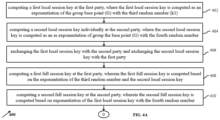
- the method for session key generation technique is explained using flowchart of 300 as depicted in FIG.4 .
- the session key generation technique comprises the following steps.
- a first local session key is computed at the first party.
- the first local session key is computed as an exponentiation of the group base point (G) with the third random number ( k 1 ).
- a second local session key is computed at the second party.
- the second local session key is computed as an as exponentiation of group the base point (G) with the fourth random number ( k 2 ).
- the first local session key is exchanged with the second party and the second local session key is exchanged with the first party.
- a first full session key is computed at the first party.
- the first full session key is computed based on the exponentiation of the third random number and the second local session key.
- a second full session key is computed at the second party.
- the second full session key is computed based on exponentiation of the first local session key with the fourth random number.
- the first full local session key is exchanged with the second party and the second full local session key is exchanged with the first party.
- the first full local session key is compared with the second full local session key by both the first party and the second party. Based on the comparison, either step 414A or 414B is performed.
- a session key is generated at both the first party and the second party.
- the session key is generated as an elliptic curve point multiplication of the first full local session key and the second full local session key.
- step 414B of the method (400) if the first full local session key and the second full local session key are unequal, then the process of generation of the session key is aborted.
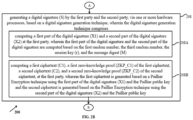
- a digital signature (S) is generated by the first party and the second party, via one or more hardware processors 104.
- the digital signature generation technique includes computation of a first part of the digital signature (X1), a second part of the digital signature (X2), a third part of the digital signature (X3), and a fourth part of the digital signature (X4), and comprises the following sub-steps.
- the first part of the digital signature (X1) and the second part of the digital signature (X2) are computed at the first party.
- the first part of the digital signature and the second part of the digital signature are computed based on the first random number, the third random number, the session key (r), and the message digest (M).
- the first part of the digital signature (X1) and the second part of the digital signature (X2) are computed by the first party, wherein the first part of the digital signature (X1) is the first and main part of the digital signature on the message M with private key share of the first party.
- the second part of the digital signature is computed based on the first random number, the third random number, the session key ® , and the message digest (M) as shown below:
- X 2 1 / k 1 ⁇ ⁇ a ⁇ r modulo q
- the second part of the digital signature (X2) is utilized to remove occurrence of any extra terms in the final signature that result due to distributed nature of the computation.
- a first ciphertext (C1), a first zero-knowledge proof (ZKP_C1) of the first ciphertext, a second ciphertext (C2), and a second zero-knowledge proof (ZKP_C2) of the second ciphertext are computed at the first party.
- the first party provides ZKP_C1 and ZKP_C2 to prove to the second party that the ciphertexts C1 and C2 are the valid encryptions of X1 and X2 respectively under the Paillier public key of first party and that the inequality 1 ⁇ X 1, X 2 ⁇ N holds.
- the first ciphertext (C1) is computed based on a Paillier Encryption technique using the first part of the digital signature (X1) and the Paillier public key (of the first party).
- the second ciphertext is computed based on the Paillier Encryption technique using the second part of the digital signature (X2) and the Paillier public key (of the first party).
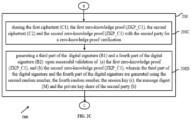
- the first ciphertext (C1), the first zero-knowledge proof (ZKP_C1), the second ciphertext (C2) and the second zero-knowledge proof (ZKP_C2) is shared with the second party for a zero-knowledge proof verification.
- the ZKP_C1 and the ZKP_C2 is shared with the second party for a zero-knowledge proof verification, wherein second party verifies that the zero-knowledge proof (ZKP) received (from the first party) is valid or invalid. In case of invalid ZKP, the generation of the digital signature is aborted. Further for a valid ZKP, the process of generation of the digital signature is continued.
- ZKP zero-knowledge proof
- a third part of the digital signature (X3) and a fourth part of the digital signature (X4) is generated at the second party.
- the third part of the digital signature (B1) and a fourth part is generated upon successful validation of:
- the third part of the digital signature and the fourth part of the digital signature are generated using the second random number, the fourth random number, the session key (r), the message digest (M) and the private key share of the second party (b).
- third part of the digital signature is generated using the second random number, the fourth random number, the session key (r), the message digest (M) and the private key share of the second party (b).
- X 3 1 / k 2 ⁇ M + r ⁇ b modulo q
- the third part of the digital signature (X3) and the fourth part of the digital signature (X4) is computed by the second party, wherein the third part of the digital signature (X3) is the first and main part of the digital signature on the message M with private key share of the second party.
- fourth part of the digital signature is generated using the second random number, the fourth random number, the session key (r), the message digest (M) and the private key share of the second party (b).
- X 4 1 / k 2 ⁇ b ⁇ r ⁇ r modulo q
- the fourth part of the digital signature (X4) is utilized to remove any extra terms in the final signature that may result due to distributed nature of the computation.
- a third ciphertext (C3) of the third signature and a fourth ciphertext (C4) of the fourth signature is computed at the second party.
- the third ciphertext and the fourth ciphertext (C4) are generated using the Paillier Encryption technique.
- C3 C 1 X 3
- C4 C 2 X 4 also expressed as shown below:
- C 3 C 1 X 3 modulo N 2
- C 4 C 2 X 4 modulo N 2
- an encrypted form of a full signature (Z) is generated at the second party.
- the encrypted form of the full signature (Z) is generated by a summation of the third ciphertext (C3) and the fourth ciphertext (C4) using the Paillier encryption parameter.
- the encrypted form of a full signature (Z) is shared by the second party with the first party.
- the digital signature (S) is obtained at the first party.
- the digital signature is obtained by decrypting the encrypted form of full signature using the Paillier private key (of the first party) based on the Paillier Encryption technique.
- S 1 / M ⁇ Y modulo q wherein Y is decrypted form of the full signature (Z)
- the full signature is shared with first party, wherein the first party decrypts value of Z using private key of Paillier Cryptosystem, wherein the decrypted value is denoted by Y.
- the value of S has a property that either S or N-S (modulo q) gives a valid signature. This property occurs due to distributed nature of the computation.
- the first party runs ECDSA signature verification process on (r,S). If the verification is positive then the first party returns (r,S) as valid signature on M and ends [signature computation] method. Otherwise, the first party runs the ECDSA verification on (r, (N-S) modulo q). If this verification is positive then the first party outputs (r, N-S) as signature on M and ends [signature computation] method. If not first party outputs the message "Signature generation failed" and aborts the method.
- the disclosed technique can be extended to a (2,n) threshold scheme.
- the signature computation method remains same as described in the above sections.
- the key generation method is tweaked to include a (2,n) as follows:
- the n parties agree on using some verifiable linear secret sharing scheme (In an example scenario : Feldman's Verifiable Secret Sharing Scheme).
- each party distributes its key share among the remaining (n-1) parties in such a way that any 2 (of the n-1) parties can reconstruct the key share.
- the experimental setup includes two parties - Party1 and Party2 on two different endpoints.
- the Party1 and Party2 follow the method disclosed and jointly compute the shared secret key - public key and signature in the key generation and digital signature generation protocols respectively.
- a standard Bitcoin curve -SECP256k1 was used for elliptic curve based operation and key size was kept as 1024 bits.
- the entire code base is built in C using the open-ssl based ECC library for the elliptic curve operations and MPZ library for all the number theoretic operations.
- the ECDSA signature generated by the disclosed method is verified by any ECDSA verification algorithm.
- the experiments are run on machine with Intel I5 pro processor with 8 cores each with processor speed of 1.7Ghz.
- the Random-Access Memory (RAM) of the machine is 16GB and it is running on Ubuntu 18.0 operating system.
- the disclosed ECDSA based digital signature technique has two components, key generation and signature computation. In case of multi-party protocols, the efficiency is indicated by the time required to run the protocols. The lesser the requirement the better is the protocol.
- Table 1 illustrates the comparison of timings taken by the disclosed technique and the two other known methods. The known methods used for comparison are as follows : (a) Lindell, Y. Fast Secure Two-Party ECDSA Signing. J Cryptol 34, 44 (2021 )or US20180359097A1 - represented as - Method A in table. 1 (b) J. Doerner, Y. Kondi, E. Lee and A.
- the disclosed technique has several advantages compared to the mentioned/ cited prior art items which includes no requirement of any participation in any kind of key exchange or generation method if any two parties want to combine [or aggregate] their ECDSA signature.
- the parties can simply run the disclosed digital signature computation technique, which results in a single [known as aggregated] signature, wherein the digital signature (single) guarantees that both parties have participated in the signature computation and requires a public key that is aggregation of the two individual public keys.
- the two parties use the methods proposed in the two cited prior arts, then they first have to run in a joint key generation method, which is not required in the disclosed technique, hence resulting in faster and efficient generation of the digital signature.
- Another advantage of the disclosed technique is the total computations required is much less compared to other cited prior arts.
- Lindell's key generation method takes about 350 number of Paillier encryption/decryption operations while the disclosed technique takes only 4 Elliptic curve exponentiations.
- the disclosed technique two party signature method requires only 16 Elliptic curve exponentiations, 5 Paillier encryption/decryption operations.
- the embodiments of present disclosure herein provide a solution to secure digital key generation.
- the constant theft of cryptocurrencies is due to compromise of the secret signing key inherently stored in a single location.
- one of challenges in the existing ECDSA signature is single point failure, wherein the signing key (private key) is prone to theft.
- the disclosed technique overcomes the challenging in the existing techniques by party distributed signature that ensures the safety of the private key.
- the disclosed techniques slits the key in two parts and saves at two different locations/machines.
- the digital signature is obtained securely using several steps that includes generation of first two parts of digital signature at one party, generation of the second two parts of digital signature at second party, finally decrypting a complete digital signature at the first party.
- Such computer-readable storage means contain program-code means for implementation of one or more steps of the method, when the program runs on a server or mobile device or any suitable programmable device.
- the hardware device can be any kind of device which can be programmed including e.g., any kind of computer like a server or a personal computer, or the like, or any combination thereof.
- the device may also include means which could be e.g., hardware means like e.g., an application-specific integrated circuit (ASIC), a field-programmable gate array (FPGA), or a combination of hardware and software means, e.g., an ASIC and an FPGA, or at least one microprocessor and at least one memory with software processing components located therein.
- the means can include both hardware means and software means.
- the method embodiments described herein could be implemented in hardware and software.
- the device may also include software means. Alternatively, the embodiments may be implemented on different hardware devices, e.g., using a plurality of CPUs.
- the embodiments herein can comprise hardware and software elements.
- the embodiments that are implemented in software include but are not limited to, firmware, resident software, microcode, etc.
- the functions performed by various components described herein may be implemented in other components or combinations of other components.
- a computer-usable or computer readable medium can be any apparatus that can comprise, store, communicate, propagate, or transport the program for use by or in connection with the instruction execution system, apparatus, or device.
- a computer-readable storage medium refers to any type of physical memory on which information or data readable by a processor may be stored.
- a computer-readable storage medium may store instructions for execution by one or more processors, including instructions for causing the processor(s) to perform steps or stages consistent with the embodiments described herein.
- the term "computer-readable medium” should be understood to include tangible items and exclude carrier waves and transient signals, i.e., be non-transitory. Examples include random access memory (RAM), read-only memory (ROM), volatile memory, nonvolatile memory, hard drives, CD ROMs, DVDs, flash drives, disks, and any other known physical storage media.
Landscapes
- Engineering & Computer Science (AREA)
- Computer Security & Cryptography (AREA)
- Computer Networks & Wireless Communication (AREA)
- Signal Processing (AREA)
- Theoretical Computer Science (AREA)
- Physics & Mathematics (AREA)
- General Physics & Mathematics (AREA)
- Pure & Applied Mathematics (AREA)
- Mathematical Optimization (AREA)
- Mathematical Physics (AREA)
- Mathematical Analysis (AREA)
- Algebra (AREA)
- Computing Systems (AREA)
- Health & Medical Sciences (AREA)
- Bioethics (AREA)
- General Health & Medical Sciences (AREA)
- Computer Hardware Design (AREA)
- Software Systems (AREA)
- General Engineering & Computer Science (AREA)
- Storage Device Security (AREA)
Claims (8)
- Prozessorimplementiertes Verfahren (200) für eine auf einem elliptischen Kurvendigitalsignaturalgorithmus (Elliptic Curve Digital Signature Algorithm, ECDSA) basierende digitale Signatur in einer verteilten Weise durch eine erste Partei und eine zweite Partei, umfassend:Teilen (202), über einen oder mehrere Hardwareprozessoren (104), einer Mehrzahl von Eingabeparametern und eines Nachrichtenauszugs (M) mit der ersten Partei und der zweiten Partei, wobei die Mehrzahl von Eingabeparametern umfasst:eine elliptische Kurve (E), die als eine elliptische Kurvengleichung über ein finites Feld definiert ist,einen Gruppenbasispunkt in der elliptischen Kurve (G),eine feste Primzahl, die eine Reihenfolge von Punkten in der elliptischen Kurve (q) angibt,Paillier-Verschlüsselungsparameter, die einen Paillier-Modulus (N) enthalten,einen privaten Paillier-Schlüssel (λ (N)),einen öffentlichen Paillier-Schlüssel (g),Erzeugen (204) eines öffentlichen Schlüssels, über einen oder mehrere Hardwareprozessoren (104), durch die erste Partei und die zweite Partei basierend auf einer Erzeugungstechnik für öffentliche Schlüssel, wobei der öffentliche Schlüssel durch die erste Partei und die zweite Partei unter Verwendung der Mehrzahl von Eingabeparametern, einer ersten Zufallszahl (a) und einer zweiten Zufallszahl (b) erzeugt wird, wobei die Erzeugungstechnik für öffentliche Schlüssel (300) umfasst:Berechnen eines ersten öffentlichen Teilschlüssels an der ersten Partei, wobei der erste öffentliche Teilschlüssel als eine Potenzierung des Gruppenbasispunkts (G) mit der ersten Zufallszahl (302) berechnet wird;Berechnen eines zweiten öffentlichen Teilschlüssels an der zweiten Partei, wobei der zweite öffentliche Teilschlüssel als eine Potenzierung des Gruppenbasispunkts (G) mit der zweiten Zufallszahl (304) berechnet wird;Austauschen des ersten öffentlichen Teilschlüssels mit der zweiten Partei und Austauschen des zweiten öffentlichen Teilschlüssels mit der ersten Partei für eine Zero-Knowledge-Proof-Verifizierung (306); undErzeugen des öffentlichen Schlüssels an der ersten Partei und der zweiten Partei, wobei der öffentliche Schlüssel als eine elliptische Kurvenaddition des ersten öffentlichen Teilschlüssels und des zweiten öffentlichen Teilschlüssels (308) erzeugt wird;Erzeugen (206) eines Sitzungsschlüssels, über den einen oder die mehreren Hardwareprozessoren, durch die erste Partei und die zweite Partei basierend auf einer Sitzungsschlüssel-Erzeugungstechnik, wobei der Sitzungsschlüssel durch die erste Partei und die zweite Partei unter Verwendung der Mehrzahl von Eingabeparametern, einer dritten Zufallszahl (k1) und einer vierten Zufallszahl (k2) erzeugt wird, wobei die Sitzungsschlüssel-Erzeugungstechnik (400) umfasst:Berechnen eines ersten lokalen Sitzungsschlüssels an der ersten Partei, wobei der erste lokale Sitzungsschlüssel als eine Potenzierung des Gruppenbasispunkts (G) mit der dritten Zufallszahl (k1) (402) berechnet wird;Berechnen eines zweiten lokalen Sitzungsschlüssels an der zweiten Partei, wobei der zweite lokale Sitzungsschlüssel als eine Potenzierung des Gruppenbasispunkts (G) mit der vierten Zufallszahl (k2) (404) berechnet wird;Austauschen des ersten lokalen Sitzungsschlüssels mit der zweiten Partei und Austauschen des zweiten lokalen Sitzungsschlüssels mit der ersten Partei (406);Berechnen eines ersten vollständigen Sitzungsschlüssels an der ersten Partei, wobei der erste vollständige Sitzungsschlüssel basierend auf der Potenzierung der dritten Zufallszahl und des zweiten lokalen Sitzungsschlüssels (408) berechnet wird;Berechnen eines zweiten vollständigen Sitzungsschlüssels an der zweiten Partei, wobei der zweite vollständige Sitzungsschlüssel basierend auf der Potenzierung des ersten lokalen Sitzungsschlüssels mit der vierten Zufallszahl (410) berechnet wird;Austauschen des ersten vollständigen lokalen Sitzungsschlüssels mit der zweiten Partei und Austauschen des zweiten vollständigen lokalen Sitzungsschlüssels mit der ersten Partei (412);Vergleichen des ersten vollständigen lokalen Sitzungsschlüssels und des zweiten vollständigen lokalen Sitzungsschlüssels (414) an der ersten Partei und der zweiten Partei, wobeiein Sitzungsschlüssel (r) an der ersten Partei und der zweiten Partei erzeugt wird, wenn der erste vollständige lokale Sitzungsschlüssel und der zweite vollständige lokale Sitzungsschlüssel gleich sind, wobei der Sitzungsschlüssel als eine elliptische Kurvenmultiplikation des ersten vollständigen lokalen Sitzungsschlüssels und des zweiten vollständigen lokalen Sitzungsschlüssels (414A) erzeugt wird, oderder Prozess der Erzeugung des Sitzungsschlüssels abgebrochen wird, wenn der erste vollständige lokale Sitzungsschlüssel und der zweite vollständige lokale Sitzungsschlüssel ungleich sind (414B); undErzeugen (208) einer digitalen Signatur (S) durch die erste Partei und die zweite Partei, über den einen oder die mehreren Hardwareprozessoren (104), basierend auf einer digitalen Signaturerzeugungstechnik, wobei die digitale Signaturerzeugungstechnik umfasst:Berechnen (208A) eines ersten Teils der digitalen Signatur (X1) und eines zweiten Teils der digitalen Signatur (X2) an der ersten Partei, wobei der erste Teil der digitalen Signatur und der zweite Teil der digitalen Signatur basierend auf der ersten Zufallszahl, der dritten Zufallszahl, dem Sitzungsschlüssel (r) und dem Nachrichtenauszug (M) berechnet werden;Berechnen (208B) eines ersten Chiffretexts (C1), eines ersten Zero-Knowledge-Proofs (ZKP_C1) des ersten Chiffretexts, eines zweiten Chiffretexts (C2) und eines zweiten Zero-Knowledge-Proofs (ZKP_C2) des zweiten Chiffretexts an der ersten Partei, wobei der erste Chiffretext basierend auf einer Paillier-Verschlüsselungstechnik unter Verwendung des ersten Teils der digitalen Signatur (X1) und des öffentlichen Paillier-Schlüssels berechnet wird und der zweite Chiffretext basierend auf der Paillier-Verschlüsselungstechnik unter Verwendung des zweiten Teils der digitalen Signatur (X2) und des öffentlichen Paillier-Schlüssels berechnet wird;Teilen (208C) des ersten Chiffretexts (C1), des ersten Zero-Knowledge-Proofs (ZKP_C1), des zweiten Chiffretexts (C2) und des zweiten Zero-Knowledge-Proofs (ZKP_C1) mit der zweiten Partei für eine Zero-Knowledge-Proof-Verifizierung;Erzeugen (208D) eines dritten Teils der digitalen Signatur (X3) und eines vierten Teils der digitalen Signatur (X4) an der zweiten Partei bei erfolgreicher Validierung von (a) dem ersten Zero-Knowledge-Proof (ZKP_C1) und (b) dem zweiten Zero-Knowledge-Proof (ZKP_C1), wobei der dritte Teil der digitalen Signatur und der vierte Teil der digitalen Signatur unter Verwendung der zweiten Zufallszahl, der vierten Zufallszahl, des Sitzungsschlüssels (r), des Nachrichtenauszugs (M) und des privaten Schlüsselanteils der zweiten Partei erzeugt werden (b);Berechnen (208E) eines dritten Chiffretexts (C3) des dritten Teils der Signatur und eines vierten Chiffretexts (C4) des vierten Teils der Signatur an der zweiten Partei, wobei der dritte Chiffretext und der vierte Chiffretext (C4) unter Verwendung der Paillier-Verschlüsselungstechnik erzeugt werden;Erzeugen (208F) einer verschlüsselten Form einer vollständigen Signatur (Z) an der zweiten Partei und Teilen der verschlüsselten Form der vollständigen Signatur (Z) mit der ersten Partei, wobei die verschlüsselte Form der vollständigen Signatur (Z) durch eine Summierung des ersten Chiffretexts (C1), des zweiten Chiffretexts (C2), des dritten Chiffretexts (C3) und des vierten Chiffretexts (C4) unter Verwendung des Paillier-Verschlüsselungsparameters (208F) erzeugt wird; undErhalten (208G) der digitalen Signatur (S) an der ersten Partei, wobei die digitale Signatur durch Entschlüsseln der verschlüsselten Form der vollständigen Signatur unter Verwendung des privaten Paillier-Schlüssels basierend auf der Paillier-Verschlüsselungstechnik erhalten wird.
- Verfahren (200) nach Anspruch 1, wobei, wenn die Zero-Knowledge-Proof-Verifizierung fehlschlägt, der Prozess der Erzeugung des digitalen Schlüssels abgebrochen wird.
- Verfahren (200) nach Anspruch 1, wobei die Berechnung des ersten Teils der digitalen Signatur (X1) und des zweiten Teils der digitalen Signatur (X2) ausgedrückt werden als:


- Verfahren (200) nach Anspruch 1, wobei die Berechnung des dritten Teils der digitalen Signatur (X3) und des vierten Teils der digitalen Signatur (X4) ausgedrückt werden als:


- System zum Berechnen einer auf einem elliptischen Kurvendigitalsignaturalgorithmus (Elliptic Curve Digital Signature Algorithm, ECDSA) basierenden digitalen Signatur in einer verteilten Weise durch eine erste Partei und eine zweite Partei (100), umfassend:einen Speicher (102), der Anweisungen speichert;eine oder mehrere Kommunikationsschnittstellen (106); undeinen oder mehrere Hardwareprozessoren (104), die über die eine oder die mehreren Kommunikationsschnittstellen (106) mit dem Speicher (102) gekoppelt sind, wobei der eine oder die mehreren Hardwareprozessoren (104) durch die Anweisungen konfiguriert sind zum:
Teilen einer Mehrzahl von Eingabeparametern und eines Nachrichtenauszugs (M) mit der ersten Partei und der zweiten Partei, wobei die Mehrzahl von Eingabeparametern umfasst:eine elliptische Kurve (E), die als eine elliptische Kurvengleichung über ein finites Feld definiert ist,einen Gruppenbasispunkt in der elliptischen Kurve (G),eine feste Primzahl, die eine Reihenfolge von Punkten in der elliptischen Kurve (q) angibt,Paillier-Verschlüsselungsparameter, die einen Paillier-Modulus (N) enthalten,einen privaten Paillier-Schlüssel (λ (N)),einen öffentlichen Paillier-Schlüssel (g),Erzeugen eines öffentlichen Schlüssels, über einen oder mehrere Hardwareprozessoren, durch die erste Partei und die zweite Partei basierend auf einer Erzeugungstechnik für öffentliche Schlüssel, wobei der öffentliche Schlüssel durch die erste Partei und die zweite Partei unter Verwendung der Mehrzahl von Eingabeparametern, einer ersten Zufallszahl und einer zweiten Zufallszahl erzeugt wird, wobei die Erzeugungstechnik für öffentliche Schlüssel (300) umfasst:Berechnen eines ersten öffentlichen Teilschlüssels an der ersten Partei, wobei der erste öffentliche Teilschlüssel als eine Potenzierung des Gruppenbasispunkts (G) mit der ersten Zufallszahl (302) berechnet wird;Berechnen eines zweiten öffentlichen Teilschlüssels an der zweiten Partei, wobei der zweite öffentliche Teilschlüssel als eine Potenzierung des Gruppenbasispunkts (G) mit der zweiten Zufallszahl (304) berechnet wird;Austauschen des ersten öffentlichen Teilschlüssels mit der zweiten Partei und Austauschen des zweiten öffentlichen Teilschlüssels mit der ersten Partei für eine Zero-Knowledge-Proof-Verifizierung (306); und
Erzeugen des öffentlichen Schlüssels an der ersten Partei und der zweiten Partei, wobei der öffentliche Schlüssel als eine elliptische Kurvenaddition des ersten öffentlichen Teilschlüssels und des zweiten öffentlichen Teilschlüssels (308) erzeugt wird;Erzeugen eines Sitzungsschlüssels, über einen oder mehrere Hardwareprozessoren, durch die erste Partei und die zweite Partei basierend auf einer Sitzungsschlüssel-Erzeugungstechnik, wobei der Sitzungsschlüssel durch die erste Partei und die zweite Partei unter Verwendung der Mehrzahl von Eingabeparametern, einer dritten Zufallszahl (k1) und einer vierten Zufallszahl (k2) erzeugt wird), wobei die Sitzungsschlüssel-Erzeugungstechnik (400) umfasst:Berechnen eines ersten lokalen Sitzungsschlüssels an der ersten Partei, wobei der erste lokale Sitzungsschlüssel als eine Potenzierung des Gruppenbasispunkts (G) mit der dritten Zufallszahl (k1) (402) berechnet wird;Berechnen eines zweiten lokalen Sitzungsschlüssels an der zweiten Partei, wobei der zweite lokale Sitzungsschlüssel als eine Potenzierung des Gruppenbasispunkts (G) mit der vierten Zufallszahl (k2) (404) berechnet wird;Austauschen des ersten lokalen Sitzungsschlüssels mit der zweiten Partei und Austauschen des zweiten lokalen Sitzungsschlüssels mit der ersten Partei (406);Berechnen eines ersten vollständigen Sitzungsschlüssels an der ersten Partei, wobei der erste vollständige Sitzungsschlüssel basierend auf der Potenzierung der dritten Zufallszahl und des zweiten lokalen Sitzungsschlüssels (408) berechnet wird;Berechnen eines zweiten vollständigen Sitzungsschlüssels an der zweiten Partei, wobei der zweite vollständige Sitzungsschlüssel basierend auf der Potenzierung des ersten lokalen Sitzungsschlüssels mit der vierten Zufallszahl (410) berechnet wird;Austauschen des ersten vollständigen lokalen Sitzungsschlüssels mit der zweiten Partei und Austauschen des zweiten vollständigen lokalen Sitzungsschlüssels mit der ersten Partei (412);Vergleichen des ersten vollständigen lokalen Sitzungsschlüssels und des zweiten vollständigen lokalen Sitzungsschlüssels (414) an der ersten Partei und der zweiten Partei, wobei
ein Sitzungsschlüssel (r) an der ersten Partei und der zweiten Partei erzeugt wird, wenn der erste vollständige lokale Sitzungsschlüssel und der zweite vollständige lokale Sitzungsschlüssel gleich sind, wobei der Sitzungsschlüssel als eine elliptische Kurvenmultiplikation des ersten vollständigen lokalen Sitzungsschlüssels und des zweiten vollständigen lokalen Sitzungsschlüssels (414A) erzeugt wird, oderder Prozess der Erzeugung des Sitzungsschlüssels abgebrochen wird, wenn der erste vollständige lokale Sitzungsschlüssel und der zweite vollständige lokale Sitzungsschlüssel ungleich sind (414B); undErzeugen einer digitalen Signatur (S) durch die erste Partei und die zweite Partei, über einen oder mehrere Hardwareprozessoren, basierend auf einer digitalen Signaturerzeugungstechnik, wobei die digitale Signaturerzeugungstechnik umfasst:Berechnen eines ersten Teils der digitalen Signatur (X1) und eines zweiten Teils der digitalen Signatur (X2) an der ersten Partei, wobei der erste Teil der digitalen Signatur und der zweite Teil der digitalen Signatur basierend auf der ersten Zufallszahl, der dritten Zufallszahl, dem Sitzungsschlüssel (r) und dem Nachrichtenauszug (M) berechnet werden;Berechnen eines ersten Chiffretexts (C1), eines ersten Zero-Knowledge-Proofs (ZKP_C1) des ersten Chiffretexts, eines zweiten Chiffretexts (C2) und eines zweiten Zero-Knowledge-Proofs (ZKP_C2) des zweiten Chiffretexts an der ersten Partei, wobei der erste Chiffretext basierend auf einer Paillier-Verschlüsselungstechnik unter Verwendung des ersten Teils der digitalen Signatur (X1) und des öffentlichen Paillier-Schlüssels erzeugt wird und der zweite Chiffretext basierend auf der Paillier-Verschlüsselungstechnik unter Verwendung des zweiten Teils der digitalen Signatur (X2) und des öffentlichen Paillier-Schlüssels erzeugt wird;Teilen des ersten Chiffretexts (C1), des ersten Zero-Knowledge-Proofs (ZKP_C1), des zweiten Chiffretexts (C2) und des zweiten Zero-Knowledge-Proofs (ZKP_C1) mit der zweiten Partei für eine Zero-Knowledge-Proof-Verifizierung;Erzeugen eines dritten Teils der digitalen Signatur (X3) und eines vierten Teils der digitalen Signatur (X4) an der zweiten Partei bei erfolgreicher Validierung von (a) dem ersten Zero-Knowledge-Proof (ZKP_C1) und (b) dem zweiten Zero-Knowledge-Proof (ZKP_C1), wobei der dritte Teil der digitalen Signatur und der vierte Teil der digitalen Signatur unter Verwendung der zweiten Zufallszahl, der vierten Zufallszahl, des Sitzungsschlüssels (r), des Nachrichtenauszugs (M) und des privaten Schlüsselanteils der zweiten Partei erzeugt werden (b);Berechnen eines dritten Chiffretexts (C3) des dritten Teils der Signatur und eines vierten Chiffretexts (C4) des vierten Teils der Signatur an der zweiten Partei, wobei der dritte Chiffretext und der vierte Chiffretext (C4) unter Verwendung der Paillier-Verschlüsselungstechnik erzeugt werden;Erzeugen einer verschlüsselten Form einer vollständigen Signatur (Z) an der zweiten Partei und Teilen der verschlüsselten Form der vollständigen Signatur (Z) mit der ersten Partei, wobei die verschlüsselte Form der vollständigen Signatur (Z) durch eine Summierung des ersten Chiffretexts (C1), des zweiten Chiffretexts (C2), des dritten Chiffretexts (C3) und des vierten Chiffretexts (C4) unter Verwendung des Paillier-Verschlüsselungsparameters erzeugt wird; undErhalten der digitalen Signatur (S) an der ersten Partei, wobei die digitale Signatur durch Entschlüsseln der verschlüsselten Form der vollständigen Signatur unter Verwendung des privaten Paillier-Schlüssels basierend auf der Paillier-Verschlüsselungstechnik erhalten wird. - System nach Anspruch 8, wobei der eine oder die mehreren Hardwareprozessoren durch die Anweisungen konfiguriert sind zum Durchführen der Berechnung des ersten Teils der digitalen Signatur (X1) und des zweiten Teils der digitalen Signatur (X2), ausgedrückt als:


- System nach Anspruch 8, wobei der eine oder die mehreren Hardwareprozessoren durch die Anweisungen konfiguriert sind zum Durchführen der Berechnung des dritten Teils der digitalen Signatur (X3) und des vierten Teils der digitalen Signatur (X4), ausgedrückt als:


- Ein oder mehrere nichtflüchtige maschinenlesbare Informationsspeichermedien, umfassend eine oder mehrere Anweisungen, die bei Ausführung eine Berechnung einer auf einem elliptischen Kurvendigitalsignaturalgorithmus (Elliptic Curve Digital Signature Algorithm, ECDSA) basierenden digitalen Signatur in einer verteilten Weise durch eine erste Partei und eine zweite Partei durchführen, indem sie einen oder mehrere Hardwareprozessoren zu Folgendem veranlassen:
Teilen einer Mehrzahl von Eingabeparametern und eines Nachrichtenauszugs (M) mit der ersten Partei und der zweiten Partei, wobei die Mehrzahl von Eingabeparametern umfasst:eine elliptische Kurve (E), die als eine elliptische Kurvengleichung über ein finites Feld definiert ist,einen Gruppenbasispunkt in der elliptischen Kurve (G),eine feste Primzahl, die eine Reihenfolge von Punkten in der elliptischen Kurve (q) angibt,Paillier-Verschlüsselungsparameter, die einen Paillier-Modulus (N) enthalten,einen privaten Paillier-Schlüssel (λ (N)),einen öffentlichen Paillier-Schlüssel (g);Erzeugen eines öffentlichen Schlüssels durch die erste Partei und die zweite Partei basierend auf einer Erzeugungstechnik für öffentliche Schlüssel, wobei der öffentliche Schlüssel durch die erste Partei und die zweite Partei unter Verwendung der Mehrzahl von Eingabeparametern, einer ersten Zufallszahl und einer zweiten Zufallszahl erzeugt wird, wobei die Erzeugungstechnik für öffentliche Schlüssel (300) umfasst:Berechnen eines ersten öffentlichen Teilschlüssels an der ersten Partei, wobei der erste öffentliche Teilschlüssel als eine Potenzierung des Gruppenbasispunkts (G) mit der ersten Zufallszahl (302) berechnet wird;Berechnen eines zweiten öffentlichen Teilschlüssels an der zweiten Partei, wobei der zweite öffentliche Teilschlüssel als eine Potenzierung des Gruppenbasispunkts (G) mit der zweiten Zufallszahl (304) berechnet wird;Austauschen des ersten öffentlichen Teilschlüssels mit der zweiten Partei und Austauschen des zweiten öffentlichen Teilschlüssels mit der ersten Partei für eine Zero-Knowledge-Proof-Verifizierung (306); und
Erzeugen des öffentlichen Schlüssels an der ersten Partei und der zweiten Partei, wobei der öffentliche Schlüssel als eine elliptische Kurvenaddition des ersten öffentlichen Teilschlüssels und des zweiten öffentlichen Teilschlüssels (308) erzeugt wird;Erzeugen eines Sitzungsschlüssels durch die erste Partei und die zweite Partei basierend auf einer Sitzungsschlüssel-Erzeugungstechnik, wobei der Sitzungsschlüssel durch die erste Partei und die zweite Partei unter Verwendung der Mehrzahl von Eingabeparametern, der dritten Zufallszahl (k1) und der vierten Zufallszahl (k2) erzeugt wird), wobei die Sitzungsschlüssel-Erzeugungstechnik (400) umfasst:Berechnen eines ersten lokalen Sitzungsschlüssels an der ersten Partei, wobei der erste lokale Sitzungsschlüssel als eine Potenzierung des Gruppenbasispunkts (G) mit der dritten Zufallszahl (k1) (402) berechnet wird;Berechnen eines zweiten lokalen Sitzungsschlüssels an der zweiten Partei, wobei der zweite lokale Sitzungsschlüssel als eine Potenzierung des Gruppenbasispunkts (G) mit der vierten Zufallszahl (k2) (404) berechnet wird;Austauschen des ersten lokalen Sitzungsschlüssels mit der zweiten Partei und Austauschen des zweiten lokalen Sitzungsschlüssels mit der ersten Partei (406);Berechnen eines ersten vollständigen Sitzungsschlüssels an der ersten Partei, wobei der erste vollständige Sitzungsschlüssel basierend auf der Potenzierung der dritten Zufallszahl und des zweiten lokalen Sitzungsschlüssels (408) berechnet wird;Berechnen eines zweiten vollständigen Sitzungsschlüssels an der zweiten Partei, wobei der zweite vollständige Sitzungsschlüssel basierend auf der Potenzierung des ersten lokalen Sitzungsschlüssels mit der vierten Zufallszahl (410) berechnet wird;Austauschen des ersten vollständigen lokalen Sitzungsschlüssels mit der zweiten Partei und Austauschen des zweiten vollständigen lokalen Sitzungsschlüssels mit der ersten Partei (412);Vergleichen des ersten vollständigen lokalen Sitzungsschlüssels und des zweiten vollständigen lokalen Sitzungsschlüssels (414) an der ersten Partei und der zweiten Partei, wobei
ein Sitzungsschlüssel (r) an der ersten Partei und der zweiten Partei erzeugt wird, wenn der erste vollständige lokale Sitzungsschlüssel und der zweite vollständige lokale Sitzungsschlüssel gleich sind, wobei der Sitzungsschlüssel als eine elliptische Kurvenmultiplikation des ersten vollständigen lokalen Sitzungsschlüssels und des zweiten vollständigen lokalen Sitzungsschlüssels (414A) erzeugt wird, oderder Prozess der Erzeugung des Sitzungsschlüssels abgebrochen wird, wenn der erste vollständige lokale Sitzungsschlüssel und der zweite vollständige lokale Sitzungsschlüssel ungleich sind (414B); undErzeugen einer digitalen Signatur (S) durch die erste Partei und die zweite Partei basierend auf einer digitalen Signaturerzeugungstechnik, wobei die digitale Signaturerzeugungstechnik umfasst:Berechnen eines ersten Teils der digitalen Signatur (X1) und eines zweiten Teils der digitalen Signatur (X2) an der ersten Partei, wobei der erste Teil der digitalen Signatur und der zweite Teil der digitalen Signatur basierend auf der ersten Zufallszahl, der dritten Zufallszahl, dem Sitzungsschlüssel (r) und dem Nachrichtenauszug (M) berechnet werden;Berechnen eines ersten Chiffretexts (C1), eines ersten Zero-Knowledge-Proofs (ZKP_C1) des ersten Chiffretexts, eines zweiten Chiffretexts (C2) und eines zweiten Zero-Knowledge-Proofs (ZKP_C2) des zweiten Chiffretexts an der ersten Partei, wobei der erste Chiffretext basierend auf einer Paillier-Verschlüsselungstechnik unter Verwendung des ersten Teils der digitalen Signatur (X1) und des öffentlichen Paillier-Schlüssels erzeugt wird und der zweite Chiffretext basierend auf der Paillier-Verschlüsselungstechnik unter Verwendung des zweiten Teils der digitalen Signatur (X2) und des öffentlichen Paillier-Schlüssels erzeugt wird;Teilen des ersten Chiffretexts (C1), des ersten Zero-Knowledge-Proofs (ZKP_C1), des zweiten Chiffretexts (C2) und des zweiten Zero-Knowledge-Proofs (ZKP_C1) mit der zweiten Partei für eine Zero-Knowledge-Proof-Verifizierung;Erzeugen eines dritten Teils der digitalen Signatur (X3) und eines vierten Teils der digitalen Signatur (X4) an der zweiten Partei bei erfolgreicher Validierung von (a) dem ersten Zero-Knowledge-Proof (ZKP_C1) und (b) dem zweiten Zero-Knowledge-Proof (ZKP_C1), wobei der dritte Teil der digitalen Signatur und der vierte Teil der digitalen Signatur unter Verwendung der zweiten Zufallszahl, der vierten Zufallszahl, des Sitzungsschlüssels (r), des Nachrichtenauszugs (M) und des privaten Schlüsselanteils der zweiten Partei erzeugt werden (b);Berechnen eines dritten Chiffretexts (C3) des dritten Teils der Signatur und eines vierten Chiffretexts (C4) des vierten Teils der Signatur an der zweiten Partei, wobei der dritte Chiffretext und der vierte Chiffretext (C4) unter Verwendung der Paillier-Verschlüsselungstechnik erzeugt werden;Erzeugen einer verschlüsselten Form einer vollständigen Signatur (Z) an der zweiten Partei und Teilen der verschlüsselten Form der vollständigen Signatur (Z) mit der ersten Partei, wobei die verschlüsselte Form der vollständigen Signatur (Z) durch eine Summierung des ersten Chiffretexts (C1), des zweiten Chiffretexts (C2), des dritten Chiffretexts (C3) und des vierten Chiffretexts (C4) unter Verwendung des Paillier-Verschlüsselungsparameters erzeugt wird; undErhalten der digitalen Signatur (S) an der ersten Partei, wobei die digitale Signatur durch Entschlüsseln der verschlüsselten Form der vollständigen Signatur unter Verwendung des privaten Paillier-Schlüssels basierend auf der Paillier-Verschlüsselungstechnik erhalten wird.
Applications Claiming Priority (1)
| Application Number | Priority Date | Filing Date | Title |
|---|---|---|---|
| IN202221014001 | 2022-03-15 |
Publications (3)
| Publication Number | Publication Date |
|---|---|
| EP4246360A1 EP4246360A1 (de) | 2023-09-20 |
| EP4246360C0 EP4246360C0 (de) | 2024-08-21 |
| EP4246360B1 true EP4246360B1 (de) | 2024-08-21 |
Family
ID=84047696
Family Applications (1)
| Application Number | Title | Priority Date | Filing Date |
|---|---|---|---|
| EP22204890.2A Active EP4246360B1 (de) | 2022-03-15 | 2022-11-01 | Verfahren und system zur verteilten berechnung von digitalen unterschriften |
Country Status (2)
| Country | Link |
|---|---|
| US (1) | US12225138B2 (de) |
| EP (1) | EP4246360B1 (de) |
Families Citing this family (4)
| Publication number | Priority date | Publication date | Assignee | Title |
|---|---|---|---|---|
| CN119583210B (zh) * | 2024-12-30 | 2025-10-17 | 西北工业大学 | 基于门限ecdsa签名的分布式匿名通信方法及系统 |
| CN119921957B (zh) * | 2025-01-07 | 2025-10-31 | 武汉大学 | 一种抗恶意敌手的三方协同sm2数字签名生成方法及系统 |
| CN120223318A (zh) * | 2025-03-03 | 2025-06-27 | 本源量子计算科技(合肥)股份有限公司 | 协作签名方法及相关装置 |
| CN120090806A (zh) * | 2025-03-11 | 2025-06-03 | 本源量子计算科技(合肥)股份有限公司 | 协作签名方法及相关装置 |
Family Cites Families (4)
| Publication number | Priority date | Publication date | Assignee | Title |
|---|---|---|---|---|
| US8924728B2 (en) * | 2004-11-30 | 2014-12-30 | Intel Corporation | Apparatus and method for establishing a secure session with a device without exposing privacy-sensitive information |
| US10530585B2 (en) | 2017-06-07 | 2020-01-07 | Bar-Ilan University | Digital signing by utilizing multiple distinct signing keys, distributed between two parties |
| CN113508554A (zh) | 2019-03-05 | 2021-10-15 | 塞皮奥有限责任公司 | 一种用于向消息提供数字签名的方法 |
| US20220255735A1 (en) * | 2021-02-08 | 2022-08-11 | Visa International Service Association | Blinding techniques for post-quantum public keys |
-
2022
- 2022-11-01 EP EP22204890.2A patent/EP4246360B1/de active Active
- 2022-11-04 US US18/052,767 patent/US12225138B2/en active Active
Also Published As
| Publication number | Publication date |
|---|---|
| EP4246360A1 (de) | 2023-09-20 |
| US12225138B2 (en) | 2025-02-11 |
| US20230299977A1 (en) | 2023-09-21 |
| EP4246360C0 (de) | 2024-08-21 |
Similar Documents
| Publication | Publication Date | Title |
|---|---|---|
| EP4246360B1 (de) | Verfahren und system zur verteilten berechnung von digitalen unterschriften | |
| US12438703B2 (en) | Secure multi-party computation methods, apparatuses, and systems | |
| CN110557245B (zh) | 用于spdz的容错和安全多方计算的方法和系统 | |
| US10944566B2 (en) | Methods and systems for supporting fairness in secure computations | |
| US20210243005A1 (en) | Fully homomorphic encryption method and device and computer readable storage medium | |
| CN111049650B (zh) | 一种基于sm2算法的协同解密方法及装置、系统、介质 | |
| US8520847B2 (en) | Split-key key-agreement protocol | |
| RU2534944C2 (ru) | Способ обеспечения безопасности связи в сети, используемые для этого устройство связи, сеть и компьютерная программа | |
| Liu et al. | A novel verifiable secret sharing mechanism using theory of numbers and a method for sharing secrets | |
| US6111952A (en) | Asymmetrical cryptographic communication method and portable object therefore | |
| CN111291122B (zh) | 基于区块链的竞标方法及装置 | |
| US20240121109A1 (en) | Digital signatures | |
| KR20220142254A (ko) | 블룸 필터를 이용한 블록체인에서의 다중 서명 지갑 시스템 | |
| Wong et al. | Secure multiparty computation of threshold signatures made more efficient | |
| Shi et al. | Threshold EDDSA signature for blockchain-based decentralized finance applications | |
| CN118890152A (zh) | 一种数据的安全传输方法、装置、电子设备以及介质 | |
| CN118316607A (zh) | 一种抗量子攻击的隐私集合求交方法、介质及系统 | |
| US10361855B2 (en) | Computing a secure elliptic curve scalar multiplication using an unsecured and secure environment | |
| WO2020169996A1 (en) | Matrix-based cryptographic methods and apparatus | |
| KR20240045231A (ko) | 디지털 서명 셰어의 생성 | |
| Knudsen et al. | High-performance asynchronous byzantine fault tolerance consensus protocol | |
| Eslami et al. | Provably Secure Group Key Exchange Protocol in the Presence of Dishonest Insiders. | |
| US20250125972A1 (en) | Generating digital signatures | |
| CN116702232A (zh) | 执行矩阵安全乘法的方法及装置 | |
| Meng et al. | A secure and efficient on-line/off-line group key distribution protocol |
Legal Events
| Date | Code | Title | Description |
|---|---|---|---|
| PUAI | Public reference made under article 153(3) epc to a published international application that has entered the european phase |
Free format text: ORIGINAL CODE: 0009012 |
|
| STAA | Information on the status of an ep patent application or granted ep patent |
Free format text: STATUS: THE APPLICATION HAS BEEN PUBLISHED |
|
| AK | Designated contracting states |
Kind code of ref document: A1 Designated state(s): AL AT BE BG CH CY CZ DE DK EE ES FI FR GB GR HR HU IE IS IT LI LT LU LV MC ME MK MT NL NO PL PT RO RS SE SI SK SM TR |
|
| STAA | Information on the status of an ep patent application or granted ep patent |
Free format text: STATUS: REQUEST FOR EXAMINATION WAS MADE |
|
| 17P | Request for examination filed |
Effective date: 20240213 |
|
| RBV | Designated contracting states (corrected) |
Designated state(s): AL AT BE BG CH CY CZ DE DK EE ES FI FR GB GR HR HU IE IS IT LI LT LU LV MC ME MK MT NL NO PL PT RO RS SE SI SK SM TR |
|
| GRAP | Despatch of communication of intention to grant a patent |
Free format text: ORIGINAL CODE: EPIDOSNIGR1 |
|
| STAA | Information on the status of an ep patent application or granted ep patent |
Free format text: STATUS: GRANT OF PATENT IS INTENDED |
|
| INTG | Intention to grant announced |
Effective date: 20240510 |
|
| GRAS | Grant fee paid |
Free format text: ORIGINAL CODE: EPIDOSNIGR3 |
|
| GRAA | (expected) grant |
Free format text: ORIGINAL CODE: 0009210 |
|
| STAA | Information on the status of an ep patent application or granted ep patent |
Free format text: STATUS: THE PATENT HAS BEEN GRANTED |
|
| AK | Designated contracting states |
Kind code of ref document: B1 Designated state(s): AL AT BE BG CH CY CZ DE DK EE ES FI FR GB GR HR HU IE IS IT LI LT LU LV MC ME MK MT NL NO PL PT RO RS SE SI SK SM TR |
|
| REG | Reference to a national code |
Ref country code: GB Ref legal event code: FG4D |
|
| REG | Reference to a national code |
Ref country code: CH Ref legal event code: EP |
|
| REG | Reference to a national code |
Ref country code: IE Ref legal event code: FG4D |
|
| REG | Reference to a national code |
Ref country code: DE Ref legal event code: R096 Ref document number: 602022005475 Country of ref document: DE |
|
| U01 | Request for unitary effect filed |
Effective date: 20240821 |
|
| U07 | Unitary effect registered |
Designated state(s): AT BE BG DE DK EE FI FR IT LT LU LV MT NL PT SE SI Effective date: 20240827 |
|
| U20 | Renewal fee for the european patent with unitary effect paid |
Year of fee payment: 3 Effective date: 20241127 |
|
| PG25 | Lapsed in a contracting state [announced via postgrant information from national office to epo] |
Ref country code: NO Free format text: LAPSE BECAUSE OF FAILURE TO SUBMIT A TRANSLATION OF THE DESCRIPTION OR TO PAY THE FEE WITHIN THE PRESCRIBED TIME-LIMIT Effective date: 20241121 |
|
| PG25 | Lapsed in a contracting state [announced via postgrant information from national office to epo] |
Ref country code: PL Free format text: LAPSE BECAUSE OF FAILURE TO SUBMIT A TRANSLATION OF THE DESCRIPTION OR TO PAY THE FEE WITHIN THE PRESCRIBED TIME-LIMIT Effective date: 20240821 Ref country code: GR Free format text: LAPSE BECAUSE OF FAILURE TO SUBMIT A TRANSLATION OF THE DESCRIPTION OR TO PAY THE FEE WITHIN THE PRESCRIBED TIME-LIMIT Effective date: 20241122 |
|
| PG25 | Lapsed in a contracting state [announced via postgrant information from national office to epo] |
Ref country code: IS Free format text: LAPSE BECAUSE OF FAILURE TO SUBMIT A TRANSLATION OF THE DESCRIPTION OR TO PAY THE FEE WITHIN THE PRESCRIBED TIME-LIMIT Effective date: 20241221 |
|
| PG25 | Lapsed in a contracting state [announced via postgrant information from national office to epo] |
Ref country code: HR Free format text: LAPSE BECAUSE OF FAILURE TO SUBMIT A TRANSLATION OF THE DESCRIPTION OR TO PAY THE FEE WITHIN THE PRESCRIBED TIME-LIMIT Effective date: 20240821 |
|
| PG25 | Lapsed in a contracting state [announced via postgrant information from national office to epo] |
Ref country code: RS Free format text: LAPSE BECAUSE OF FAILURE TO SUBMIT A TRANSLATION OF THE DESCRIPTION OR TO PAY THE FEE WITHIN THE PRESCRIBED TIME-LIMIT Effective date: 20241121 Ref country code: ES Free format text: LAPSE BECAUSE OF FAILURE TO SUBMIT A TRANSLATION OF THE DESCRIPTION OR TO PAY THE FEE WITHIN THE PRESCRIBED TIME-LIMIT Effective date: 20240821 |
|
| PG25 | Lapsed in a contracting state [announced via postgrant information from national office to epo] |
Ref country code: RS Free format text: LAPSE BECAUSE OF FAILURE TO SUBMIT A TRANSLATION OF THE DESCRIPTION OR TO PAY THE FEE WITHIN THE PRESCRIBED TIME-LIMIT Effective date: 20241121 Ref country code: PL Free format text: LAPSE BECAUSE OF FAILURE TO SUBMIT A TRANSLATION OF THE DESCRIPTION OR TO PAY THE FEE WITHIN THE PRESCRIBED TIME-LIMIT Effective date: 20240821 Ref country code: NO Free format text: LAPSE BECAUSE OF FAILURE TO SUBMIT A TRANSLATION OF THE DESCRIPTION OR TO PAY THE FEE WITHIN THE PRESCRIBED TIME-LIMIT Effective date: 20241121 Ref country code: IS Free format text: LAPSE BECAUSE OF FAILURE TO SUBMIT A TRANSLATION OF THE DESCRIPTION OR TO PAY THE FEE WITHIN THE PRESCRIBED TIME-LIMIT Effective date: 20241221 Ref country code: HR Free format text: LAPSE BECAUSE OF FAILURE TO SUBMIT A TRANSLATION OF THE DESCRIPTION OR TO PAY THE FEE WITHIN THE PRESCRIBED TIME-LIMIT Effective date: 20240821 Ref country code: GR Free format text: LAPSE BECAUSE OF FAILURE TO SUBMIT A TRANSLATION OF THE DESCRIPTION OR TO PAY THE FEE WITHIN THE PRESCRIBED TIME-LIMIT Effective date: 20241122 Ref country code: ES Free format text: LAPSE BECAUSE OF FAILURE TO SUBMIT A TRANSLATION OF THE DESCRIPTION OR TO PAY THE FEE WITHIN THE PRESCRIBED TIME-LIMIT Effective date: 20240821 |
|
| PG25 | Lapsed in a contracting state [announced via postgrant information from national office to epo] |
Ref country code: SM Free format text: LAPSE BECAUSE OF FAILURE TO SUBMIT A TRANSLATION OF THE DESCRIPTION OR TO PAY THE FEE WITHIN THE PRESCRIBED TIME-LIMIT Effective date: 20240821 |
|
| PG25 | Lapsed in a contracting state [announced via postgrant information from national office to epo] |
Ref country code: CZ Free format text: LAPSE BECAUSE OF FAILURE TO SUBMIT A TRANSLATION OF THE DESCRIPTION OR TO PAY THE FEE WITHIN THE PRESCRIBED TIME-LIMIT Effective date: 20240821 |
|
| PG25 | Lapsed in a contracting state [announced via postgrant information from national office to epo] |
Ref country code: SK Free format text: LAPSE BECAUSE OF FAILURE TO SUBMIT A TRANSLATION OF THE DESCRIPTION OR TO PAY THE FEE WITHIN THE PRESCRIBED TIME-LIMIT Effective date: 20240821 |
|
| PLBE | No opposition filed within time limit |
Free format text: ORIGINAL CODE: 0009261 |
|
| STAA | Information on the status of an ep patent application or granted ep patent |
Free format text: STATUS: NO OPPOSITION FILED WITHIN TIME LIMIT |
|
| PG25 | Lapsed in a contracting state [announced via postgrant information from national office to epo] |
Ref country code: MC Free format text: LAPSE BECAUSE OF FAILURE TO SUBMIT A TRANSLATION OF THE DESCRIPTION OR TO PAY THE FEE WITHIN THE PRESCRIBED TIME-LIMIT Effective date: 20240821 |
|
| 26N | No opposition filed |
Effective date: 20250522 |
|
| PG25 | Lapsed in a contracting state [announced via postgrant information from national office to epo] |
Ref country code: IE Free format text: LAPSE BECAUSE OF NON-PAYMENT OF DUE FEES Effective date: 20241101 |
|
| PG25 | Lapsed in a contracting state [announced via postgrant information from national office to epo] |
Ref country code: RO Free format text: LAPSE BECAUSE OF FAILURE TO SUBMIT A TRANSLATION OF THE DESCRIPTION OR TO PAY THE FEE WITHIN THE PRESCRIBED TIME-LIMIT Effective date: 20240821 |
|
| REG | Reference to a national code |
Ref country code: CH Ref legal event code: U11 Free format text: ST27 STATUS EVENT CODE: U-0-0-U10-U11 (AS PROVIDED BY THE NATIONAL OFFICE) Effective date: 20251201 |