EP4245581A1 - Vehicle refrigerator control method, storage medium, and vehicle - Google Patents
Vehicle refrigerator control method, storage medium, and vehicle Download PDFInfo
- Publication number
- EP4245581A1 EP4245581A1 EP23161596.4A EP23161596A EP4245581A1 EP 4245581 A1 EP4245581 A1 EP 4245581A1 EP 23161596 A EP23161596 A EP 23161596A EP 4245581 A1 EP4245581 A1 EP 4245581A1
- Authority
- EP
- European Patent Office
- Prior art keywords
- vehicle
- refrigerator
- vehicle refrigerator
- controlling
- information
- Prior art date
- Legal status (The legal status is an assumption and is not a legal conclusion. Google has not performed a legal analysis and makes no representation as to the accuracy of the status listed.)
- Pending
Links
Images



Classifications
-
- B—PERFORMING OPERATIONS; TRANSPORTING
- B60—VEHICLES IN GENERAL
- B60H—ARRANGEMENTS OF HEATING, COOLING, VENTILATING OR OTHER AIR-TREATING DEVICES SPECIALLY ADAPTED FOR PASSENGER OR GOODS SPACES OF VEHICLES
- B60H1/00—Heating, cooling or ventilating devices
- B60H1/32—Cooling devices
- B60H1/3204—Cooling devices using compression
- B60H1/3205—Control means therefor
- B60H1/3208—Vehicle drive related control of the compressor drive means, e.g. for fuel saving purposes
-
- B—PERFORMING OPERATIONS; TRANSPORTING
- B60—VEHICLES IN GENERAL
- B60H—ARRANGEMENTS OF HEATING, COOLING, VENTILATING OR OTHER AIR-TREATING DEVICES SPECIALLY ADAPTED FOR PASSENGER OR GOODS SPACES OF VEHICLES
- B60H1/00—Heating, cooling or ventilating devices
- B60H1/00357—Air-conditioning arrangements specially adapted for particular vehicles
- B60H1/00385—Air-conditioning arrangements specially adapted for particular vehicles for vehicles having an electrical drive, e.g. hybrid or fuel cell
- B60H1/00392—Air-conditioning arrangements specially adapted for particular vehicles for vehicles having an electrical drive, e.g. hybrid or fuel cell for electric vehicles having only electric drive means
-
- F—MECHANICAL ENGINEERING; LIGHTING; HEATING; WEAPONS; BLASTING
- F25—REFRIGERATION OR COOLING; COMBINED HEATING AND REFRIGERATION SYSTEMS; HEAT PUMP SYSTEMS; MANUFACTURE OR STORAGE OF ICE; LIQUEFACTION SOLIDIFICATION OF GASES
- F25D—REFRIGERATORS; COLD ROOMS; ICE-BOXES; COOLING OR FREEZING APPARATUS NOT OTHERWISE PROVIDED FOR
- F25D29/00—Arrangement or mounting of control or safety devices
- F25D29/005—Mounting of control devices
-
- B—PERFORMING OPERATIONS; TRANSPORTING
- B60—VEHICLES IN GENERAL
- B60H—ARRANGEMENTS OF HEATING, COOLING, VENTILATING OR OTHER AIR-TREATING DEVICES SPECIALLY ADAPTED FOR PASSENGER OR GOODS SPACES OF VEHICLES
- B60H1/00—Heating, cooling or ventilating devices
- B60H1/0025—Heating, cooling or ventilating devices the devices being independent of the vehicle
- B60H1/00264—Transportable devices
-
- B—PERFORMING OPERATIONS; TRANSPORTING
- B60—VEHICLES IN GENERAL
- B60H—ARRANGEMENTS OF HEATING, COOLING, VENTILATING OR OTHER AIR-TREATING DEVICES SPECIALLY ADAPTED FOR PASSENGER OR GOODS SPACES OF VEHICLES
- B60H1/00—Heating, cooling or ventilating devices
- B60H1/00507—Details, e.g. mounting arrangements, desaeration devices
- B60H1/00592—Add-on devices, e.g. heat/cooling boxes, compartment dividers, upgrade sets
-
- B—PERFORMING OPERATIONS; TRANSPORTING
- B60—VEHICLES IN GENERAL
- B60H—ARRANGEMENTS OF HEATING, COOLING, VENTILATING OR OTHER AIR-TREATING DEVICES SPECIALLY ADAPTED FOR PASSENGER OR GOODS SPACES OF VEHICLES
- B60H1/00—Heating, cooling or ventilating devices
- B60H1/00642—Control systems or circuits; Control members or indication devices for heating, cooling or ventilating devices
- B60H1/00735—Control systems or circuits characterised by their input, i.e. by the detection, measurement or calculation of particular conditions, e.g. signal treatment, dynamic models
- B60H1/00764—Control systems or circuits characterised by their input, i.e. by the detection, measurement or calculation of particular conditions, e.g. signal treatment, dynamic models the input being a vehicle driving condition, e.g. speed
-
- B—PERFORMING OPERATIONS; TRANSPORTING
- B60—VEHICLES IN GENERAL
- B60L—PROPULSION OF ELECTRICALLY-PROPELLED VEHICLES; SUPPLYING ELECTRIC POWER FOR AUXILIARY EQUIPMENT OF ELECTRICALLY-PROPELLED VEHICLES; ELECTRODYNAMIC BRAKE SYSTEMS FOR VEHICLES IN GENERAL; MAGNETIC SUSPENSION OR LEVITATION FOR VEHICLES; MONITORING OPERATING VARIABLES OF ELECTRICALLY-PROPELLED VEHICLES; ELECTRIC SAFETY DEVICES FOR ELECTRICALLY-PROPELLED VEHICLES
- B60L1/00—Supplying electric power to auxiliary equipment of vehicles
- B60L1/02—Supplying electric power to auxiliary equipment of vehicles to electric heating circuits
- B60L1/04—Supplying electric power to auxiliary equipment of vehicles to electric heating circuits fed by the power supply line
- B60L1/06—Supplying electric power to auxiliary equipment of vehicles to electric heating circuits fed by the power supply line using only one supply
- B60L1/08—Methods and devices for control or regulation
-
- B—PERFORMING OPERATIONS; TRANSPORTING
- B60—VEHICLES IN GENERAL
- B60N—SEATS SPECIALLY ADAPTED FOR VEHICLES; VEHICLE PASSENGER ACCOMMODATION NOT OTHERWISE PROVIDED FOR
- B60N3/00—Arrangements or adaptations of other passenger fittings, not otherwise provided for
- B60N3/10—Arrangements or adaptations of other passenger fittings, not otherwise provided for of receptacles for food or beverages, e.g. refrigerated
- B60N3/104—Arrangements or adaptations of other passenger fittings, not otherwise provided for of receptacles for food or beverages, e.g. refrigerated with refrigerating or warming systems
-
- B—PERFORMING OPERATIONS; TRANSPORTING
- B60—VEHICLES IN GENERAL
- B60H—ARRANGEMENTS OF HEATING, COOLING, VENTILATING OR OTHER AIR-TREATING DEVICES SPECIALLY ADAPTED FOR PASSENGER OR GOODS SPACES OF VEHICLES
- B60H1/00—Heating, cooling or ventilating devices
- B60H1/32—Cooling devices
- B60H2001/3236—Cooling devices information from a variable is obtained
- B60H2001/3255—Cooling devices information from a variable is obtained related to temperature
- B60H2001/3261—Cooling devices information from a variable is obtained related to temperature of the air at an evaporating unit
-
- B—PERFORMING OPERATIONS; TRANSPORTING
- B60—VEHICLES IN GENERAL
- B60H—ARRANGEMENTS OF HEATING, COOLING, VENTILATING OR OTHER AIR-TREATING DEVICES SPECIALLY ADAPTED FOR PASSENGER OR GOODS SPACES OF VEHICLES
- B60H1/00—Heating, cooling or ventilating devices
- B60H1/32—Cooling devices
- B60H2001/3236—Cooling devices information from a variable is obtained
- B60H2001/3266—Cooling devices information from a variable is obtained related to the operation of the vehicle
-
- F—MECHANICAL ENGINEERING; LIGHTING; HEATING; WEAPONS; BLASTING
- F25—REFRIGERATION OR COOLING; COMBINED HEATING AND REFRIGERATION SYSTEMS; HEAT PUMP SYSTEMS; MANUFACTURE OR STORAGE OF ICE; LIQUEFACTION SOLIDIFICATION OF GASES
- F25D—REFRIGERATORS; COLD ROOMS; ICE-BOXES; COOLING OR FREEZING APPARATUS NOT OTHERWISE PROVIDED FOR
- F25D2500/00—Problems to be solved
- F25D2500/06—Stock management
-
- Y—GENERAL TAGGING OF NEW TECHNOLOGICAL DEVELOPMENTS; GENERAL TAGGING OF CROSS-SECTIONAL TECHNOLOGIES SPANNING OVER SEVERAL SECTIONS OF THE IPC; TECHNICAL SUBJECTS COVERED BY FORMER USPC CROSS-REFERENCE ART COLLECTIONS [XRACs] AND DIGESTS
- Y02—TECHNOLOGIES OR APPLICATIONS FOR MITIGATION OR ADAPTATION AGAINST CLIMATE CHANGE
- Y02T—CLIMATE CHANGE MITIGATION TECHNOLOGIES RELATED TO TRANSPORTATION
- Y02T10/00—Road transport of goods or passengers
- Y02T10/80—Technologies aiming to reduce greenhouse gasses emissions common to all road transportation technologies
- Y02T10/88—Optimized components or subsystems, e.g. lighting, actively controlled glasses
Definitions
- the disclosure relates to the field of electric vehicles, and in particular provides a vehicle refrigerator control method, a storage medium, and a vehicle.
- the vehicle refrigerators are used in a more demanding situation than household refrigerators, and also need to have noise, vibration and harshness (NVH) and energy consumption problems addressed while meeting the refrigeration requirement of refrigerators.
- N HVAC noise, vibration and harshness
- energy consumption of the vehicle refrigerator affects the vehicle's endurance and battery charge level.
- the continuous operation of the vehicle refrigerator may cause the vehicle battery to drain and then make it impossible to start the vehicle again.
- the vehicle refrigerator As a part of an intelligent cockpit, has an increasing demand for an improvement in intelligence.
- how to implement the intelligent identification of items stored in the vehicle refrigerator, reasonably setting a target temperature of the vehicle refrigerator based on the stored items, and optimizing the control over the vehicle refrigerator based on vehicle state information have become urgent problems to be solved.
- the disclosure aims to solve or partly solve the foregoing technical problems, that is, of how to implement the intelligent identification of items stored in a vehicle refrigerator, and of controlling the vehicle refrigerator based on information of the stored item and the vehicle state information.
- the disclosure provides a vehicle refrigerator control method, the method including:
- controlling the vehicle refrigerator based on the real-time temperature, the target temperature, and the vehicle state information includes:
- the vehicle state information further includes at least one of a vehicle start state, a vehicle traveling state, an in-vehicle occupant status, and a vehicle battery charge level
- the method for "controlling the vehicle refrigerator based on the vehicle state information when the real-time temperature thereof is greater than the target temperature" includes:
- the method for "controlling the operation of the vehicle refrigerator based on at least one of the vehicle start state, the vehicle traveling state, the in-vehicle occupant status, and the vehicle battery charge level" includes:
- the vehicle traveling state includes at least a vehicle traveling speed
- the method for "controlling the operation of the vehicle refrigerator based on the vehicle traveling state when the vehicle start state indicates started" includes:
- the method for "controlling the operation of the vehicle refrigerator based on at least one of the in-vehicle occupant status and the vehicle battery charge level when the vehicle start state indicates unstarted" includes:
- the vehicle refrigerator is at least provided with a first key and a second key
- the method for obtaining the target temperature of the vehicle refrigerator includes:
- the historical item information is stored in a cloud server, and the method for "updating real-time item information of the vehicle refrigerator based on the key states of the first key and/or the second key and the historical item information" includes:
- the disclosure provides a storage medium adapted to store a plurality of program codes, where the program codes are adapted to be loaded and run by a processor to perform a vehicle refrigerator control method according to any one of the foregoing solutions.
- the disclosure provides a vehicle including a vehicle body, a processor, and a memory, where the memory is adapted to store a plurality of program codes, and the program codes are adapted to be loaded and run by the processor to perform a vehicle refrigerator control method according to any one of the foregoing solutions.
- a code scanning module of the disclosure performs intelligent control over the vehicle refrigerator based on the real-time temperature and the target temperature of the vehicle refrigerator and the vehicle state information.
- the method of the disclosure not only optimizes the control over the vehicle refrigerator, satisfies the refrigeration requirement, but also solves the problems of NVH and vehicle energy consumption, etc, thereby providing users with a more comfortable experience.
- the code scanning module is triggered by operating the physical keys set on the vehicle refrigerator, to obtain the item information of the items stored in the vehicle refrigerator, and a suitable target temperature is then set based on the item information, so that the intelligent identification and intelligent storage management of the items in the refrigerator are achieved, thereby bringing a more convenient and intelligent experience to users.
- the physical keys are more reliable and can better adapt to the demanding vehicle situation, thereby improving the reliability and stability of item identification.
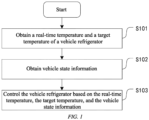
- FIG. 1 is a flowchart of main steps of a vehicle refrigerator control method according to an embodiment of the disclosure.
- a vehicle refrigerator control method of the disclosure includes:
- an electric vehicle 2 is equipped with a vehicle refrigerator 1, and the vehicle refrigerator 1 is connected to a vehicle control unit (VCU) of the electric vehicle 2 through a CAN bus, for data exchange; the VCU of the electric vehicle 2 is connected to a cloud server 3 through a public wireless communication network such as 4G/5G, and performs data exchange; and the cloud server 3 can perform data exchange with the vehicle refrigerator 1 through the public wireless communication network such as 4G/5G, and the VCU.
- VCU vehicle control unit
- step S101 a real-time temperature of a refrigerator and/or a freezer of the vehicle refrigerator 1 is obtained in real time or periodically by using a temperature sensor provided in the vehicle refrigerator 1, and the real-time temperature is uploaded to the VCU and/or the cloud server 3 according to settings.
- the method for obtaining the target temperature is determining the target temperature based on item information of items stored in the vehicle refrigerator, which will be described below in detail with reference to FIGS. 3 and 4 .
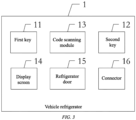
- the vehicle refrigerator 1 includes at least a first key 11, a second key 12, a code scanning module 13, a display screen 14, a refrigerator door 15, and a connector 16.
- the method for determining the target temperature based on item information of the item stored in the vehicle refrigerator specifically includes:
- the item information includes the historical item information and the real-time item information, and is usually stored in the cloud server 3.
- the historical item information is historical data of information of all items that are once stored in the vehicle refrigerator 1; and the real-time item information is real-time information of items that are currently stored in the vehicle refrigerator 1.
- the data content of item information includes: an item code, an item name, an item production date and/or shelf life, an optimal storage temperature, etc.
- the historical item information of the items stored in the vehicle refrigerator 1 can be obtained by querying from the cloud server 3.
- the VCU of the electric vehicle 2 checks, in real time, whether there is a key triggered, and determines, based on key states of a first key 11 and a second key 12 of the vehicle refrigerator 1, whether the first key 11 is valid or the second key 12 is valid.
- the key when the key is a self-reset key, the key can be set to be pressed down and held for more than a first duration (such as 0.5 seconds), and then released, which indicates a valid state.
- the VCU determines that the operation is an item put-in operation, and then starts the code scanning module 13 on the vehicle refrigerator 1. At this time, the user can place a one-dimensional barcode or two-dimensional code of the item to be put into the vehicle refrigerator 1 in an effective reading area of the code scanning module 13, so that the code scanning module 13 performs code scanning to obtain information of the item to be put into the refrigerator.
- the VCU detects, in real time, the presence of a condition for the end of the put-in operation.
- the user can continuously perform code scanning operations, to obtain information of a plurality of items that all need to be put into the vehicle refrigerator 1.
- a state of the refrigerator door 15 can be used as a determination condition for the end of the put-in operation.
- the process of identifying item put-in in combination with the refrigerator door 15 and the first key 11 is as follows:
- the fifth step of closing the refrigerator door 15 is temporarily not performed, but the next item to be put into the vehicle refrigerator 1 is simply placed into the effective code-scanning area, and then continuous put-in operations are performed from step three.
- the code scanning module 13 is a laser code scanner. In another embodiment, the code scanning module 13 is an image code scanner.
- a put-in ending condition can be set such that if the code scanning module 13 has not read valid data for more than a second period of time (for example, 3 seconds), it is determined that the put-in operation is ended.
- the VCU determines that the operation is an item take-out operation, and then starts the code scanning module 13 on the vehicle refrigerator 1.
- the user needs to place a one-dimensional barcode or two-dimensional code of the item in the effective reading area of the code scanning module 13, so that the code scanning module 13 performs code scanning to obtain information of the item to be taken out of the refrigerator.
- the VCU detects, in real time, the presence of a condition for the end of the take-out operation.
- the user can continuously perform code scanning operations on the items to be taken out of the refrigerator, to obtain information of a plurality of items that all need to be taken out of the vehicle refrigerator 1.
- a state of the refrigerator door 15 can be used as a determination condition for the end of the take-out operation.
- the process of identifying item take-out in combination with the refrigerator door 15 and the second key 12 is as follows:
- the fifth step of closing the refrigerator door 15 is temporarily not performed, but subsequent items are simply taken out and subjected to code scanning, and then continuous take-out operations are performed from step three.
- the user may also complete the put-in operation and the take-out operation at one time.
- the user first triggers the first key 11, so that a system performs the put-in operation; and after the user further triggers the second key 12, the system automatically ends the process of the put-in operation, and then executes the process of the take-out operation.
- the item information obtained directly by scanning the code of the vehicle refrigerator 1 includes at least the item code.
- the one-dimensional barcode and/or the two-dimensional code on the item is a customized special code
- the special code can contain more information, for example, an item name, an item production date and/or shelf life, an optimal storage temperature, etc.
- the steps of the method for updating real-time item information of the vehicle refrigerator 1 based on the key states of the first key 11 and/or the second key 12 and the historical item information are as shown in FIG. 6 .
- the electric vehicle 2 uploads, to the cloud server 3, item fetching and/or inputting data of the vehicle refrigerator 1.
- the cloud server 3 it is determined, based on the key states of the first key 11 and/or the second key 12 that are contained in the data, whether the uploaded item includes an added item.
- the uploaded data is the item fetching data (the data contains the state of the second key 12)
- the information of the item is found from real-time information of items that are currently stored in the vehicle refrigerator 1, and is then deleted, so that the real-time item information is updated.
- the uploaded data is the item inputting data (the data contains the state of the first key 11)
- the item is an added item, and there is a need to further determine whether the added item is a new item.
- the item code of the added item is compared with all the item codes in the historical item information stored in the cloud server 3. If there is a same item code, this indicates that the added item is not a new item, and other item information (such as an item name, an item production date and/or shelf life, an optimal storage temperature, etc.) of the added item is directly obtained from the historical item information stored in the cloud server 3.
- the added item is a new item, and other item information of the new item can be obtained by means of querying from the Internet of Things based on the item code information, and the information of the new item is added to the historical item information, so that the historical item information in the cloud server 3 is constantly updated.
- the first key 11 and the second key 12 are physical keys.
- the physical keys are selected to assist with code scanning to obtain the information of the item stored in the vehicle refrigerator 1 because the physical keys are more reliable and can better adapt to the demanding vehicle situation, thereby improving the reliability and stability of item identification.
- the vehicle refrigerator 1 is also equipped with an indicator light and/or a display screen 14, which reminds the user of the current operation content and operation state during the item put-in and take-out operations, thereby making the item identification process more reliable while improving the user experience.
- the vehicle refrigerator 1 is also equipped with a communication module, such as a CAN communication module in this embodiment.
- the control module (a main processor) of the vehicle refrigerator 1 performs data exchange with the VCU of the electric vehicle 2 through a communication interface of the connector 16.
- the cloud server 3 can be set to periodically send the information of the item currently stored in the vehicle refrigerator 1 to the user through the vehicle display screen, the user's smart phone, etc., so that the user can know the item in the vehicle refrigerator 1 in a timely manner.
- the cloud server can also be set to send, to the user, expiration reminder information regarding an item that is about to expire, prompting the user to use same in a timely manner.
- the cloud server 3 performs autonomous learning and calculation based on the storage temperature information in the real-time item information, and integrates optimal storage temperatures of all items, to obtain the target temperature of the vehicle refrigerator 1.
- an average value of the optimal storage temperatures of all the items can be selected as the target temperature, or the optimal storage temperature with the minimum value can be selected as the target temperature.
- Those skilled in the art can design the method for obtaining the target temperature according to actual conditions.
- the method for obtaining the target temperature of the vehicle refrigerator 1 is that the user directly sets the target temperature through a smart terminal.
- the target temperature is manually preset through a dedicated APP on a smart phone, and is then uploaded to the cloud server 3.
- a cloud server 30 is designed to connect and manage a plurality of electric vehicles and vehicle refrigerators through a public wireless communication network such as 4G/5G.
- Information of items stored in all vehicle refrigerators of the system such as a vehicle refrigerator 1-1 of an electric vehicle 2-1, a vehicle refrigerator 1-2 of an electric vehicle 2-2, and a vehicle refrigerator 1-n of an electric vehicle 2-n, is uploaded and summarized to the cloud server 30, and the cloud server 30 iteratively updates the data stored in the server with the new item information, Internet data, etc., thereby forming the big data of the historical item information of the vehicle refrigerator.
- the VCU of the electric vehicle 2 can obtain vehicle state information, where the vehicle state information includes: a vehicle energy-saving setting, a vehicle start state, a vehicle traveling state, an in-vehicle occupant status, a vehicle battery charge level, etc.
- step S103 the operation of the vehicle refrigerator 1 is controlled based on the real-time temperature of the vehicle refrigerator 1, the target temperature of the vehicle refrigerator 1 and the vehicle state information, which are already obtained.
- the real-time temperature of the vehicle refrigerator 1 is preferentially compared with the target temperature thereof, and when the real-time temperature is less than or equal to the target temperature, the vehicle energy saving and NVH need to be considered while maintaining the real-time temperature of the vehicle refrigerator 1 not greater than the target temperature thereof. Therefore, preferably, the vehicle refrigerator 1 is controlled to operate in the silent and low power mode.
- the vehicle refrigerator 1 is controlled based on the vehicle state information. Further referring to FIG. 8 , the method for controlling the vehicle refrigerator 1 based on the vehicle state information is described in detail with reference to FIG. 8 .
- the vehicle energy-saving setting is a vehicle energy-saving mode.
- energy-saving is prioritized, and in this case, the vehicle refrigerator 1 is controlled to operate in the silent and low power mode.
- a further determination is made regarding other information in the vehicle state information, such as a vehicle start state, a vehicle traveling state, an in-vehicle occupant status, a vehicle battery charge level, etc., and the operation of the vehicle refrigerator 1 is controlled based on at least one of same.
- a further determination as to the vehicle start state is made.
- the operation of the vehicle refrigerator 1 is controlled based on the vehicle traveling state; and when the electric vehicle 2 is not started, the operation of the vehicle refrigerator 1 is controlled based on at least one type of information of the in-vehicle occupant status and the vehicle battery charge level.
- the vehicle refrigerator 1 enters an intelligent NVH operating mode, that is, different refrigerating capacity modes are controlled based on vehicle traveling speeds in different gears, to meet NVH requirements in vehicle-specific application environment.
- the vehicle refrigerator 1 is controlled to operate in a first refrigerating capacity mode when the vehicle traveling speed is less than a first speed threshold; the vehicle refrigerator is controlled to operate in a second refrigerating capacity mode when the vehicle traveling speed is greater than or equal to the first speed threshold and less than a second speed threshold; and the vehicle refrigerator is controlled to operate in a third refrigerating capacity mode when the vehicle traveling speed is greater than or equal to the second speed threshold.
- refrigerating capacities respectively corresponding to the first refrigerating capacity mode, the second refrigerating capacity mode and the third refrigerating capacity mode increase sequentially.
- the first speed threshold is less than the second speed threshold.
- the output power and noise of a vehicle usually increase with the increase of the vehicle speed, and in this case, the noise generated when the vehicle refrigerator 1 operates may have a reduced impact with respect to the vehicle noise. Therefore, as the vehicle speed increases, the refrigerating capacity of the vehicle refrigerator 1 can be increased, to further ensure the refrigerating effect of the vehicle refrigerator 1.
- the first speed threshold may be set at a vehicle idling speed or 5 km/h
- the second speed threshold may be set at 40 km/h.
- a first determination of the in-vehicle occupant status is made to check whether there is a person in the vehicle.
- the vehicle refrigerator 1 is controlled to operate in a silent and low power mode.
- the vehicle refrigerator 1 is further controlled to operate based on the vehicle battery charge level.
- the method for obtaining the in-vehicle occupant status is not limited in the disclosure.
- an apparatus such as a camera connected to the VCU of the electric vehicle 2, an infrared human body sensor, and a millimeter-wave radar sensor in the vehicle can be used to detect whether there is a person in the vehicle.
- Those skilled in the art can also select other technical solutions to implement the detection of the in-vehicle occupant status according to actual conditions.
- the vehicle refrigerator 1 is connected to a traction battery of the electric vehicle 2 through a power interface of the connector 16, and is supplied with electric energy by the traction battery, and the vehicle battery charge level is obtained through a battery management system (BMS) of the traction battery.
- BMS battery management system
- the vehicle battery charge level is greater than a first charge level threshold, it indicates that the battery of the electric vehicle 2 is fully charged and can provide sufficient power for the vehicle refrigerator 1 for refrigeration.
- the refrigerating effect of the vehicle refrigerator 1 is given top priority, and the vehicle refrigerator 1 can be controlled to operate in a fourth refrigerating capacity mode.
- the vehicle refrigerator 1 When the vehicle battery charge level is less than or equal to the first charge level threshold, the vehicle battery charge level drops. In this case, in order to prolong the running time of the vehicle refrigerator 1, the vehicle refrigerator 1 is controlled to operate in a silent and low power mode.
- a second charge level threshold can be set, where the second charge level threshold is less than the first charge level threshold.
- the first charge level threshold can be set to be 60% of the capacity of the traction battery of the electric vehicle 2
- the second charge level threshold can be set to be 30% of the capacity of the traction battery of the electric vehicle 2.
- the VCU of the electric vehicle 2 can send a reminder message to the user through the cloud server 3, and can send one or more combinations of the following messages according to the user setting.
- the reminder message includes: a reminder of the remaining battery charge level of the vehicle, a reminder to take out an item stored in the vehicle refrigerator, a reminder of an estimated showdown time of the vehicle refrigerator, etc.
- the user can set whether the vehicle refrigerator 1 will be shut down immediately or after a preset period of time according to actual conditions.
- the preset period of time can be set based on the capacity of the traction battery of the electric vehicle 2, the second charge level threshold, and the power consumption of the vehicle refrigerator 1.
- the silent and low power mode has the minimum refrigerating capacity, and also has the minimum amount of noise and vibration generated.
- the vehicle refrigerator 1 can be set to operate intermittently at a low power.
- vehicle refrigerator 1 is set to operate at 10% of the full-load refrigerating capacity for 10 minutes every 2 hours, and the running noise level of the vehicle refrigerator 1 in this case is usually not higher than 32 dB.
- the refrigerating capacity of the first refrigerating capacity mode is less than the refrigerating capacity of the second refrigerating capacity mode
- the refrigerating capacity of the second refrigerating capacity mode is less than the refrigerating capacity of the third refrigerating capacity mod
- the refrigerating capacity of the fourth refrigerating capacity mode is higher than those of the silent and low power mode and the first refrigerating capacity mode, usually for the purpose of fast refrigerating.
- the respective refrigerating capacities of the silent and low power mode, the first refrigerating capacity mode, the second refrigerating capacity mode, and the third refrigerating capacity mode can be set according to actual conditions of the electric vehicle 2.
- the comparison between the real-time temperature of the vehicle refrigerator 1 and the target temperature thereof is carried out at all times, provided that the real-time temperature is not higher than the target temperature, that is, controlling the vehicle refrigerator 1 to enter the silent and low power mode.
- the operation of the vehicle refrigerator 1 is controlled based on current vehicle state information.
- the method for obtaining the respective refrigerating capacity of the vehicle refrigerator 1 based on real-time temperature, the target temperature and the vehicle state information can be implemented either in the cloud server 3 or in the VCU of the electric vehicle 2. Without departing from the principle of the disclosure, the technical solutions after changing data processing positions shall all fall within the scope of protection of the disclosure.
- control of refrigerating components (such as a compressor and a fan) of the vehicle refrigerator 1 based on the refrigerating capacity is usually carried out by the control module (the main processor) of the vehicle refrigerator 1.
- the method for controlling the refrigerating components of the vehicle refrigerator 1 based on the refrigerating capacity is a well-known technology in the art, which can be implemented by those skilled in the art by referring to relevant technical documents, and is thus not repeated here.
- the disclosure also provides a storage medium.
- the storage medium may be configured to store a program for performing the vehicle refrigerator control method in the foregoing method embodiments, where the program may be loaded and run by a processor to implement the foregoing vehicle refrigerator control method.
- the storage medium may be a storage device formed by various electronic devices.
- the storage medium in the embodiments of the disclosure is a non-transitory readable-writable storage medium.
- the disclosure also provides a vehicle including a vehicle body, a processor, and a memory.
- the vehicle body may be an electric vehicle; the electric vehicle is equipped with a vehicle refrigerator; the processor and the memory are installed on the vehicle body; and the memory may be configured to store a program for performing the vehicle refrigerator control method in the foregoing method embodiments, where the program may be loaded and run by the processor to implement the foregoing vehicle refrigerator control method.
- the memory may be a storage device formed by various electronic devices.
- the memory in the embodiments of the disclosure is a non-transitory readable storage medium.
- a and/or B indicates all possible combinations of A and B, for example, only A, only B, or A and B.
Landscapes
- Engineering & Computer Science (AREA)
- Mechanical Engineering (AREA)
- Physics & Mathematics (AREA)
- Thermal Sciences (AREA)
- Power Engineering (AREA)
- Transportation (AREA)
- General Engineering & Computer Science (AREA)
- Life Sciences & Earth Sciences (AREA)
- Sustainable Development (AREA)
- Sustainable Energy (AREA)
- Chemical & Material Sciences (AREA)
- Combustion & Propulsion (AREA)
- Devices That Are Associated With Refrigeration Equipment (AREA)
Abstract
The disclosure relates to the field of electric vehicles, and in particular provides a vehicle refrigerator control method, a storage medium, and a vehicle, aiming to solve the problems of how to implement the intelligent identification of items stored in a vehicle refrigerator, and of controlling the vehicle refrigerator based on information of the stored item and vehicle state information. To this end, the method of the disclosure includes: obtaining item information of a vehicle refrigerator; obtaining a real-time temperature and a target temperature of the vehicle refrigerator; obtaining vehicle state information; and controlling the vehicle refrigerator based on the real-time temperature, the target temperature, and the vehicle state information. By applying the method of the disclosure, the user can quickly and accurately know the information of the item stored in the vehicle refrigerator, a suitable target temperature can be automatically set based on the item information, and the vehicle refrigerator can be controlled, based on the vehicle state information, to operate in different modes. The method of the disclosure not only optimizes the control over the vehicle refrigerator, satisfies the refrigeration requirement, but also solves the problems of NVH and vehicle energy consumption, etc, thereby providing users with a more comfortable experience.
Description
- The disclosure relates to the field of electric vehicles, and in particular provides a vehicle refrigerator control method, a storage medium, and a vehicle.
- As vehicle refrigerators begin to be accepted by more and more users, various vehicle manufacturers have launched vehicles with integrated vehicle refrigerators. However, most vehicle refrigerators still remain in the stage of basic refrigeration, and cannot identify items in a vehicle refrigerator to achieve intelligent storage management and reminders. When a user needs to check information (the type, quantity, shelf life, etc.) of the items in the refrigerator, he/she often needs to return to a vehicle, open the refrigerator and then confirm the items one by one. This method is time consuming and may also increase additional operations of the user, and if the user forgets to check an item or leaves an item out, there may sometimes be the case where the item expires beyond the shelf life thereof.
- In addition, the vehicle refrigerators are used in a more demanding situation than household refrigerators, and also need to have noise, vibration and harshness (NVH) and energy consumption problems addressed while meeting the refrigeration requirement of refrigerators. During the operation of the refrigerator, noise and vibration will be generated, which will affect the comfort of passengers; and The energy consumption of the vehicle refrigerator affects the vehicle's endurance and battery charge level. Especially after the vehicle is powered off, the continuous operation of the vehicle refrigerator may cause the vehicle battery to drain and then make it impossible to start the vehicle again.
- With the advancement of automobile intelligence technology, the vehicle refrigerator, as a part of an intelligent cockpit, has an increasing demand for an improvement in intelligence. During the use of the vehicle refrigerator, how to implement the intelligent identification of items stored in the vehicle refrigerator, reasonably setting a target temperature of the vehicle refrigerator based on the stored items, and optimizing the control over the vehicle refrigerator based on vehicle state information have become urgent problems to be solved.
- Accordingly, there is a need for a new solution to solve the foregoing problem in the art.
- The disclosure aims to solve or partly solve the foregoing technical problems, that is, of how to implement the intelligent identification of items stored in a vehicle refrigerator, and of controlling the vehicle refrigerator based on information of the stored item and the vehicle state information.
- In a first aspect, the disclosure provides a vehicle refrigerator control method, the method including:
- obtaining a real-time temperature and a target temperature of a vehicle refrigerator;
- obtaining vehicle state information, the vehicle state information at least including a vehicle energy-saving setting; and
- controlling the vehicle refrigerator based on the real-time temperature, the target temperature, and the vehicle state information.
- In an implementation of the foregoing vehicle refrigerator control method, "controlling the vehicle refrigerator based on the real-time temperature, the target temperature, and the vehicle state information" includes:
- determining whether the real-time temperature of the vehicle refrigerator is less than or equal to the target temperature;
- controlling the vehicle refrigerator to operate in a silent and low power mode when the real-time temperature thereof is less than or equal to the target temperature; and
- controlling the vehicle refrigerator based on the vehicle state information when the real-time temperature thereof is greater than the target temperature.
- In an implementation of the foregoing vehicle refrigerator control method, the vehicle state information further includes at least one of a vehicle start state, a vehicle traveling state, an in-vehicle occupant status, and a vehicle battery charge level, and the method for "controlling the vehicle refrigerator based on the vehicle state information when the real-time temperature thereof is greater than the target temperature" includes:
- determining whether the vehicle energy-saving setting is a vehicle energy-saving mode;
- if so, controlling the vehicle refrigerator to operate in the silent and low power mode; and
- if not, controlling the operation of the vehicle refrigerator based on at least one of the vehicle start state, the vehicle traveling state, the in-vehicle occupant status, and the vehicle battery charge level.
- In an implementation of the foregoing vehicle refrigerator control method, the method for "controlling the operation of the vehicle refrigerator based on at least one of the vehicle start state, the vehicle traveling state, the in-vehicle occupant status, and the vehicle battery charge level" includes:
- controlling the operation of the vehicle refrigerator based on the vehicle traveling state when the vehicle start state indicates started; and
- controlling the operation of the vehicle refrigerator based on at least one of the in-vehicle occupant status and the vehicle battery charge level when the vehicle start state indicates unstarted.
- In an implementation of the foregoing vehicle refrigerator control method, the vehicle traveling state includes at least a vehicle traveling speed, and the method for "controlling the operation of the vehicle refrigerator based on the vehicle traveling state when the vehicle start state indicates started" includes:
- controlling the vehicle refrigerator to operate in a first refrigerating capacity mode when the vehicle traveling speed is less than a first speed threshold;
- controlling the vehicle refrigerator to operate in a second refrigerating capacity mode when the vehicle traveling speed is greater than or equal to the first speed threshold and less than a second speed threshold; and
- controlling the vehicle refrigerator to operate in a third refrigerating capacity mode when the vehicle traveling speed is greater than or equal to the second speed threshold,
- where refrigerating capacities respectively corresponding to the first refrigerating capacity mode, the second refrigerating capacity mode and the third refrigerating capacity mode increase sequentially.
- In an implementation of the foregoing vehicle refrigerator control method, the method for "controlling the operation of the vehicle refrigerator based on at least one of the in-vehicle occupant status and the vehicle battery charge level when the vehicle start state indicates unstarted" includes:
- controlling the vehicle refrigerator to operate in the silent and low power mode when the in-vehicle occupant status indicates that there is a person; and
- controlling the operation of the vehicle refrigerator based on the vehicle battery charge level when the in-vehicle occupant status indicates that there is no person,
- where, the method for "controlling the operation of the vehicle refrigerator based on the vehicle battery charge level" includes:
- controlling the vehicle refrigerator to operate in a fourth refrigerating capacity mode when the vehicle battery charge level is greater than a first charge level threshold;
- controlling the vehicle refrigerator to operate in the silent and low power mode when the vehicle battery charge level is less than or equal to the first charge level threshold; and
- controlling the vehicle refrigerator to stop operating after a preset period of time and/or to send a reminder message to a user when the vehicle battery charge level is less than a second charge level threshold, the reminder message including at least: a reminder to take out an item stored in the vehicle refrigerator and/or a reminder of an estimated showdown time of the vehicle refrigerator,
- where the first charge level threshold is greater than the second charge level threshold.
- In an implementation of the foregoing vehicle refrigerator control method, the vehicle refrigerator is at least provided with a first key and a second key, and the method for obtaining the target temperature of the vehicle refrigerator includes:
- obtaining a preset target temperature;
- or, determining the target temperature based on item information of the item stored in the vehicle refrigerator,
- where the method for "determining the target temperature based on item information of the item stored in the vehicle refrigerator" includes:
- obtaining historical item information of the vehicle refrigerator;
- detecting key states of the first key and the second key in real time;
- updating real-time item information of the vehicle refrigerator based on the key states of the first key and/or the second key and the historical item information; and
- determining the target temperature based on the real-time item information.
- In an implementation of the foregoing vehicle refrigerator control method, the historical item information is stored in a cloud server, and the method for "updating real-time item information of the vehicle refrigerator based on the key states of the first key and/or the second key and the historical item information" includes:
- obtaining information of an added item based on the first key;
- when the information of the added item is contained in the historical item information, obtaining the information of the added item from the cloud server; and
- when the information of the added item is not contained in the historical item information, obtaining the information of the added item through the Internet.
- In a second aspect, the disclosure provides a storage medium adapted to store a plurality of program codes, where the program codes are adapted to be loaded and run by a processor to perform a vehicle refrigerator control method according to any one of the foregoing solutions.
- In a third aspect, the disclosure provides a vehicle including a vehicle body, a processor, and a memory, where the memory is adapted to store a plurality of program codes, and the program codes are adapted to be loaded and run by the processor to perform a vehicle refrigerator control method according to any one of the foregoing solutions.
- With the foregoing technical solutions, a code scanning module of the disclosure performs intelligent control over the vehicle refrigerator based on the real-time temperature and the target temperature of the vehicle refrigerator and the vehicle state information. The method of the disclosure not only optimizes the control over the vehicle refrigerator, satisfies the refrigeration requirement, but also solves the problems of NVH and vehicle energy consumption, etc, thereby providing users with a more comfortable experience.
- Further, in the disclosure, the code scanning module is triggered by operating the physical keys set on the vehicle refrigerator, to obtain the item information of the items stored in the vehicle refrigerator, and a suitable target temperature is then set based on the item information, so that the intelligent identification and intelligent storage management of the items in the refrigerator are achieved, thereby bringing a more convenient and intelligent experience to users. Moreover, the physical keys are more reliable and can better adapt to the demanding vehicle situation, thereby improving the reliability and stability of item identification.
- Implementations of the disclosure are described below with reference to accompanying drawings, in which:
-
FIG. 1 is a flowchart of main steps of a vehicle refrigerator control method according to an embodiment of the disclosure; -
FIG. 2 is a schematic diagram of a vehicle refrigerator application system according to an embodiment of the disclosure; -
FIG. 3 is a schematic diagram of a compositional structure of a vehicle refrigerator according to an embodiment of the disclosure; -
FIG. 4 is a flowchart of main steps of determining a target temperature based on item information of an item stored in a vehicle refrigerator according to an embodiment of the disclosure; -
FIG. 5 is a flowchart of main steps of obtaining real-time item information according to an embodiment of the disclosure; -
FIG. 6 is a flowchart of main steps of updating real-time item information based on key states of a first key and/or a second key and historical item information according to an embodiment of the disclosure; -
FIG. 7 is a schematic diagram of a vehicle refrigerator application system according to another embodiment of the disclosure; and -
FIG. 8 is a flowchart of main steps of controlling a vehicle refrigerator based on vehicle state information according to an embodiment of the disclosure. - To make the objectives, technical solutions and advantages of embodiments of the disclosure clearer, the technical solutions in the embodiments of the disclosure will be clearly and completely described below with reference to the accompanying drawings. Apparently, the described embodiments are some of, rather than all of, the embodiments of the disclosure. Based on the embodiments of the disclosure, all other embodiments obtained by those of ordinary skill in the art without involving any inventive effort shall fall within the scope of protection of the disclosure.
- Those skilled in the art should understand that these implementations are only used to explain the technical principles of the disclosure, and are not intended to limit the scope of protection of the disclosure. Those skilled in the art can make adjustments as required, so as to adapt to specific application scenarios. For example, although an electric vehicle is used as the application scenario in the embodiments of the disclosure, it is obvious that the method of the disclosure is also applicable to vehicles such as conventional fuel vehicles, hybrid vehicles, fuel cell electric vehicles and other new energy vehicles, provided that the vehicles are equipped with a vehicle refrigerator.
- First, referring to
FIG. 1, FIG. 1 is a flowchart of main steps of a vehicle refrigerator control method according to an embodiment of the disclosure. As shown inFIG. 1 , a vehicle refrigerator control method of the disclosure includes: - step S101: obtaining a real-time temperature and a target temperature of a vehicle refrigerator;
- step S102: obtaining vehicle state information; and
- step S103: controlling the vehicle refrigerator based on the real-time temperature, the target temperature, and the vehicle state information.
- In the vehicle refrigerator application system according to the embodiment of the disclosure as shown in
FIG. 2 , anelectric vehicle 2 is equipped with avehicle refrigerator 1, and thevehicle refrigerator 1 is connected to a vehicle control unit (VCU) of theelectric vehicle 2 through a CAN bus, for data exchange; the VCU of theelectric vehicle 2 is connected to acloud server 3 through a public wireless communication network such as 4G/5G, and performs data exchange; and thecloud server 3 can perform data exchange with thevehicle refrigerator 1 through the public wireless communication network such as 4G/5G, and the VCU. - In step S101, a real-time temperature of a refrigerator and/or a freezer of the
vehicle refrigerator 1 is obtained in real time or periodically by using a temperature sensor provided in thevehicle refrigerator 1, and the real-time temperature is uploaded to the VCU and/or thecloud server 3 according to settings. - In this embodiment, preferably, the method for obtaining the target temperature is determining the target temperature based on item information of items stored in the vehicle refrigerator, which will be described below in detail with reference to
FIGS. 3 and4 . - As shown in
FIG. 3 , thevehicle refrigerator 1 includes at least a first key 11, a second key 12, acode scanning module 13, adisplay screen 14, arefrigerator door 15, and aconnector 16. Further, as shown inFIG. 4 , the method for determining the target temperature based on item information of the item stored in the vehicle refrigerator specifically includes: - step S401: obtaining historical item information of the vehicle refrigerator;
- step S402: detecting key states of a first key and a second key in real time;
- step S403: updating real-time item information of the vehicle refrigerator based on the key states of the first key and/or the second key and the historical item information; and
- step S404: determining the target temperature based on the real-time item information.
- In this embodiment, the item information includes the historical item information and the real-time item information, and is usually stored in the
cloud server 3. The historical item information is historical data of information of all items that are once stored in thevehicle refrigerator 1; and the real-time item information is real-time information of items that are currently stored in thevehicle refrigerator 1. The data content of item information includes: an item code, an item name, an item production date and/or shelf life, an optimal storage temperature, etc. In step S401, when needed, the historical item information of the items stored in thevehicle refrigerator 1 can be obtained by querying from thecloud server 3. - Further referring to
FIG. 5 , the method for obtaining the real-time item information in steps S402 and S403 is described in detail in conjunction withFIG. 5 . - The VCU of the
electric vehicle 2 checks, in real time, whether there is a key triggered, and determines, based on key states of a first key 11 and asecond key 12 of thevehicle refrigerator 1, whether the first key 11 is valid or the second key 12 is valid. As an example, when the key is a self-reset key, the key can be set to be pressed down and held for more than a first duration (such as 0.5 seconds), and then released, which indicates a valid state. - When a user needs to put an item into the vehicle refrigerator, he/she first presses down the first key 11 and holds same for more than 0.5 seconds, and then releases the
first key 11. When detecting that the first key 11 is valid, the VCU determines that the operation is an item put-in operation, and then starts thecode scanning module 13 on thevehicle refrigerator 1. At this time, the user can place a one-dimensional barcode or two-dimensional code of the item to be put into thevehicle refrigerator 1 in an effective reading area of thecode scanning module 13, so that thecode scanning module 13 performs code scanning to obtain information of the item to be put into the refrigerator. - At the same time, the VCU detects, in real time, the presence of a condition for the end of the put-in operation. When no condition for the end of the put-in operation is present, the user can continuously perform code scanning operations, to obtain information of a plurality of items that all need to be put into the
vehicle refrigerator 1. Preferably, a state of therefrigerator door 15 can be used as a determination condition for the end of the put-in operation. As an example, the process of identifying item put-in in combination with therefrigerator door 15 and the first key 11 is as follows: - Step one: opening the
refrigerator door 15; - Step two: triggering the first key 11 to start the
code scanning module 13; - Step three: performing code scanning on an item;
- Step four: putting the item into the refrigerator; and
- Step five: closing the
refrigerator door 15. - With a plurality of items to be put in at one time, after the execution of the fourth step of putting the item into the refrigerator, the fifth step of closing the
refrigerator door 15 is temporarily not performed, but the next item to be put into thevehicle refrigerator 1 is simply placed into the effective code-scanning area, and then continuous put-in operations are performed from step three. - In this embodiment, the
code scanning module 13 is a laser code scanner. In another embodiment, thecode scanning module 13 is an image code scanner. - In another embodiment, a put-in ending condition can be set such that if the
code scanning module 13 has not read valid data for more than a second period of time (for example, 3 seconds), it is determined that the put-in operation is ended. - Similarly, when a user needs to take an item out of the
vehicle refrigerator 1, he/she first presses down the second key 12 and holds same for more than 0.5 seconds, and then releases thesecond key 12. When detecting that the second key 12 is valid, the VCU determines that the operation is an item take-out operation, and then starts thecode scanning module 13 on thevehicle refrigerator 1. At this time, when taking the item out of thevehicle refrigerator 1, the user needs to place a one-dimensional barcode or two-dimensional code of the item in the effective reading area of thecode scanning module 13, so that thecode scanning module 13 performs code scanning to obtain information of the item to be taken out of the refrigerator. - At the same time, the VCU detects, in real time, the presence of a condition for the end of the take-out operation. When no condition for the end of the take-out operation is present, the user can continuously perform code scanning operations on the items to be taken out of the refrigerator, to obtain information of a plurality of items that all need to be taken out of the
vehicle refrigerator 1. Preferably, a state of therefrigerator door 15 can be used as a determination condition for the end of the take-out operation. As an example, the process of identifying item take-out in combination with therefrigerator door 15 and the second key 12 is as follows: - Step one: opening the
refrigerator door 15; - Step two: triggering the second key 12 to start the
code scanning module 13; - Step three: taking out an item;
- Step four: performing code scanning on the item; and
- Step five: closing the
refrigerator door 15. - With a plurality of items to be taken out at one time, after the execution of the fourth step of performing code scanning on the item, the fifth step of closing the
refrigerator door 15 is temporarily not performed, but subsequent items are simply taken out and subjected to code scanning, and then continuous take-out operations are performed from step three. - It should be noted that the user may also complete the put-in operation and the take-out operation at one time. As an example, the user first triggers the first key 11, so that a system performs the put-in operation; and after the user further triggers the second key 12, the system automatically ends the process of the put-in operation, and then executes the process of the take-out operation.
- In this embodiment, the item information obtained directly by scanning the code of the
vehicle refrigerator 1 includes at least the item code. Moreover, when the one-dimensional barcode and/or the two-dimensional code on the item is a customized special code, the special code can contain more information, for example, an item name, an item production date and/or shelf life, an optimal storage temperature, etc. - After the user completes the put-in operation and/or the take-out operation of a product by using the first key 11 and/or the second key 12, the steps of the method for updating real-time item information of the
vehicle refrigerator 1 based on the key states of the first key 11 and/or the second key 12 and the historical item information are as shown inFIG. 6 . - The
electric vehicle 2 uploads, to thecloud server 3, item fetching and/or inputting data of thevehicle refrigerator 1. At thecloud server 3, it is determined, based on the key states of the first key 11 and/or the second key 12 that are contained in the data, whether the uploaded item includes an added item. - When the uploaded data is the item fetching data (the data contains the state of the second key 12), based on an item code in information of items to be taken out of the refrigerator, the information of the item is found from real-time information of items that are currently stored in the
vehicle refrigerator 1, and is then deleted, so that the real-time item information is updated. - When the uploaded data is the item inputting data (the data contains the state of the first key 11), the item is an added item, and there is a need to further determine whether the added item is a new item.
- The item code of the added item is compared with all the item codes in the historical item information stored in the
cloud server 3. If there is a same item code, this indicates that the added item is not a new item, and other item information (such as an item name, an item production date and/or shelf life, an optimal storage temperature, etc.) of the added item is directly obtained from the historical item information stored in thecloud server 3. - If the item code of the added item is not contained in the historical item information, the added item is a new item, and other item information of the new item can be obtained by means of querying from the Internet of Things based on the item code information, and the information of the new item is added to the historical item information, so that the historical item information in the
cloud server 3 is constantly updated. - It should be noted that, preferably, the first key 11 and the second key 12 are physical keys. The physical keys are selected to assist with code scanning to obtain the information of the item stored in the
vehicle refrigerator 1 because the physical keys are more reliable and can better adapt to the demanding vehicle situation, thereby improving the reliability and stability of item identification. - In this embodiment, the
vehicle refrigerator 1 is also equipped with an indicator light and/or adisplay screen 14, which reminds the user of the current operation content and operation state during the item put-in and take-out operations, thereby making the item identification process more reliable while improving the user experience. - It should be noted that the
vehicle refrigerator 1 is also equipped with a communication module, such as a CAN communication module in this embodiment. The control module (a main processor) of thevehicle refrigerator 1 performs data exchange with the VCU of theelectric vehicle 2 through a communication interface of theconnector 16. - It should be noted that the
cloud server 3 can be set to periodically send the information of the item currently stored in thevehicle refrigerator 1 to the user through the vehicle display screen, the user's smart phone, etc., so that the user can know the item in thevehicle refrigerator 1 in a timely manner. The cloud server can also be set to send, to the user, expiration reminder information regarding an item that is about to expire, prompting the user to use same in a timely manner. - Further, in step S404, the
cloud server 3 performs autonomous learning and calculation based on the storage temperature information in the real-time item information, and integrates optimal storage temperatures of all items, to obtain the target temperature of thevehicle refrigerator 1. As an example, an average value of the optimal storage temperatures of all the items can be selected as the target temperature, or the optimal storage temperature with the minimum value can be selected as the target temperature. Those skilled in the art can design the method for obtaining the target temperature according to actual conditions. - In another embodiment, the method for obtaining the target temperature of the
vehicle refrigerator 1 is that the user directly sets the target temperature through a smart terminal. As an example, the target temperature is manually preset through a dedicated APP on a smart phone, and is then uploaded to thecloud server 3. - Preferably, in the schematic diagram of another vehicle refrigerator application system as shown in
FIG. 7 , acloud server 30 is designed to connect and manage a plurality of electric vehicles and vehicle refrigerators through a public wireless communication network such as 4G/5G. Information of items stored in all vehicle refrigerators of the system, such as a vehicle refrigerator 1-1 of an electric vehicle 2-1, a vehicle refrigerator 1-2 of an electric vehicle 2-2, and a vehicle refrigerator 1-n of an electric vehicle 2-n, is uploaded and summarized to thecloud server 30, and thecloud server 30 iteratively updates the data stored in the server with the new item information, Internet data, etc., thereby forming the big data of the historical item information of the vehicle refrigerator. - Further, in step S102, similarly, the VCU of the
electric vehicle 2 can obtain vehicle state information, where the vehicle state information includes: a vehicle energy-saving setting, a vehicle start state, a vehicle traveling state, an in-vehicle occupant status, a vehicle battery charge level, etc. - In step S103, the operation of the
vehicle refrigerator 1 is controlled based on the real-time temperature of thevehicle refrigerator 1, the target temperature of thevehicle refrigerator 1 and the vehicle state information, which are already obtained. - In this embodiment, the real-time temperature of the
vehicle refrigerator 1 is preferentially compared with the target temperature thereof, and when the real-time temperature is less than or equal to the target temperature, the vehicle energy saving and NVH need to be considered while maintaining the real-time temperature of thevehicle refrigerator 1 not greater than the target temperature thereof. Therefore, preferably, thevehicle refrigerator 1 is controlled to operate in the silent and low power mode. - When the real-time temperature is greater than the target temperature, the
vehicle refrigerator 1 is controlled based on the vehicle state information. Further referring toFIG. 8 , the method for controlling thevehicle refrigerator 1 based on the vehicle state information is described in detail with reference toFIG. 8 . - First, it is determined whether the vehicle energy-saving setting is a vehicle energy-saving mode. When the
electric vehicle 2 is set to be in the vehicle energy-saving mode, energy-saving is prioritized, and in this case, thevehicle refrigerator 1 is controlled to operate in the silent and low power mode. When theelectric vehicle 2 is not set to the vehicle energy-saving mode, a further determination is made regarding other information in the vehicle state information, such as a vehicle start state, a vehicle traveling state, an in-vehicle occupant status, a vehicle battery charge level, etc., and the operation of thevehicle refrigerator 1 is controlled based on at least one of same. - A further determination as to the vehicle start state is made. When the
electric vehicle 2 has started, the operation of thevehicle refrigerator 1 is controlled based on the vehicle traveling state; and when theelectric vehicle 2 is not started, the operation of thevehicle refrigerator 1 is controlled based on at least one type of information of the in-vehicle occupant status and the vehicle battery charge level. - Specifically, when the
electric vehicle 2 has started, thevehicle refrigerator 1 enters an intelligent NVH operating mode, that is, different refrigerating capacity modes are controlled based on vehicle traveling speeds in different gears, to meet NVH requirements in vehicle-specific application environment. Thevehicle refrigerator 1 is controlled to operate in a first refrigerating capacity mode when the vehicle traveling speed is less than a first speed threshold; the vehicle refrigerator is controlled to operate in a second refrigerating capacity mode when the vehicle traveling speed is greater than or equal to the first speed threshold and less than a second speed threshold; and the vehicle refrigerator is controlled to operate in a third refrigerating capacity mode when the vehicle traveling speed is greater than or equal to the second speed threshold. In addition, refrigerating capacities respectively corresponding to the first refrigerating capacity mode, the second refrigerating capacity mode and the third refrigerating capacity mode increase sequentially. - It can be seen from above that the first speed threshold is less than the second speed threshold. In other words, the output power and noise of a vehicle usually increase with the increase of the vehicle speed, and in this case, the noise generated when the
vehicle refrigerator 1 operates may have a reduced impact with respect to the vehicle noise. Therefore, as the vehicle speed increases, the refrigerating capacity of thevehicle refrigerator 1 can be increased, to further ensure the refrigerating effect of thevehicle refrigerator 1. As an example, the first speed threshold may be set at a vehicle idling speed or 5 km/h, and the second speed threshold may be set at 40 km/h. - When the vehicle is not started, a first determination of the in-vehicle occupant status is made to check whether there is a person in the vehicle. When there is a person in the vehicle, the
vehicle refrigerator 1 is controlled to operate in a silent and low power mode. When there is no person in the vehicle, thevehicle refrigerator 1 is further controlled to operate based on the vehicle battery charge level. - It should be noted that the method for obtaining the in-vehicle occupant status is not limited in the disclosure. As an example, an apparatus such as a camera connected to the VCU of the
electric vehicle 2, an infrared human body sensor, and a millimeter-wave radar sensor in the vehicle can be used to detect whether there is a person in the vehicle. Those skilled in the art can also select other technical solutions to implement the detection of the in-vehicle occupant status according to actual conditions. - In this embodiment, the
vehicle refrigerator 1 is connected to a traction battery of theelectric vehicle 2 through a power interface of theconnector 16, and is supplied with electric energy by the traction battery, and the vehicle battery charge level is obtained through a battery management system (BMS) of the traction battery. When the vehicle battery charge level is greater than a first charge level threshold, it indicates that the battery of theelectric vehicle 2 is fully charged and can provide sufficient power for thevehicle refrigerator 1 for refrigeration. In this case, the refrigerating effect of thevehicle refrigerator 1 is given top priority, and thevehicle refrigerator 1 can be controlled to operate in a fourth refrigerating capacity mode. - When the vehicle battery charge level is less than or equal to the first charge level threshold, the vehicle battery charge level drops. In this case, in order to prolong the running time of the
vehicle refrigerator 1, thevehicle refrigerator 1 is controlled to operate in a silent and low power mode. - In addition, in order to prevent the vehicle battery from being over-discharged and avoid the occurrence of a situation in which the normal operation of other devices in the vehicle is affected due to an excessively low battery charge level, a second charge level threshold can be set, where the second charge level threshold is less than the first charge level threshold. As an example, the first charge level threshold can be set to be 60% of the capacity of the traction battery of the
electric vehicle 2, and the second charge level threshold can be set to be 30% of the capacity of the traction battery of theelectric vehicle 2. - When the vehicle battery charge level further drops and is less than the second charge level threshold, the VCU of the
electric vehicle 2 can send a reminder message to the user through thecloud server 3, and can send one or more combinations of the following messages according to the user setting. The reminder message includes: a reminder of the remaining battery charge level of the vehicle, a reminder to take out an item stored in the vehicle refrigerator, a reminder of an estimated showdown time of the vehicle refrigerator, etc. - Moreover, the user can set whether the
vehicle refrigerator 1 will be shut down immediately or after a preset period of time according to actual conditions. The preset period of time can be set based on the capacity of the traction battery of theelectric vehicle 2, the second charge level threshold, and the power consumption of thevehicle refrigerator 1. - It should be noted that, among several operating modes of the
vehicle refrigerator 1, the silent and low power mode has the minimum refrigerating capacity, and also has the minimum amount of noise and vibration generated. As an example, in the silent and low power mode, thevehicle refrigerator 1 can be set to operate intermittently at a low power. For example,vehicle refrigerator 1 is set to operate at 10% of the full-load refrigerating capacity for 10 minutes every 2 hours, and the running noise level of thevehicle refrigerator 1 in this case is usually not higher than 32 dB. - The refrigerating capacity of the first refrigerating capacity mode is less than the refrigerating capacity of the second refrigerating capacity mode, the refrigerating capacity of the second refrigerating capacity mode is less than the refrigerating capacity of the third refrigerating capacity mod, and the refrigerating capacity of the fourth refrigerating capacity mode is higher than those of the silent and low power mode and the first refrigerating capacity mode, usually for the purpose of fast refrigerating. The respective refrigerating capacities of the silent and low power mode, the first refrigerating capacity mode, the second refrigerating capacity mode, and the third refrigerating capacity mode can be set according to actual conditions of the
electric vehicle 2. - It should be noted that, during the process of controlling the operation of the
vehicle refrigerator 1 based on the vehicle state information shown inFIG. 8 , the comparison between the real-time temperature of thevehicle refrigerator 1 and the target temperature thereof is carried out at all times, provided that the real-time temperature is not higher than the target temperature, that is, controlling thevehicle refrigerator 1 to enter the silent and low power mode. When the real-time temperature is higher than the target temperature, the operation of thevehicle refrigerator 1 is controlled based on current vehicle state information. - It should be noted that the method for obtaining the respective refrigerating capacity of the
vehicle refrigerator 1 based on real-time temperature, the target temperature and the vehicle state information can be implemented either in thecloud server 3 or in the VCU of theelectric vehicle 2. Without departing from the principle of the disclosure, the technical solutions after changing data processing positions shall all fall within the scope of protection of the disclosure. - It should be noted that the control of refrigerating components (such as a compressor and a fan) of the
vehicle refrigerator 1 based on the refrigerating capacity is usually carried out by the control module (the main processor) of thevehicle refrigerator 1. The method for controlling the refrigerating components of thevehicle refrigerator 1 based on the refrigerating capacity is a well-known technology in the art, which can be implemented by those skilled in the art by referring to relevant technical documents, and is thus not repeated here. - Further, the disclosure also provides a storage medium. The storage medium may be configured to store a program for performing the vehicle refrigerator control method in the foregoing method embodiments, where the program may be loaded and run by a processor to implement the foregoing vehicle refrigerator control method. For ease of description, only parts related to the embodiments of the disclosure are shown. For specific technical details that are not disclosed, reference may be made to the method part of the embodiments of the disclosure. The storage medium may be a storage device formed by various electronic devices. Optionally, the storage medium in the embodiments of the disclosure is a non-transitory readable-writable storage medium.
- Further, the disclosure also provides a vehicle including a vehicle body, a processor, and a memory. Optionally, the vehicle body may be an electric vehicle; the electric vehicle is equipped with a vehicle refrigerator; the processor and the memory are installed on the vehicle body; and the memory may be configured to store a program for performing the vehicle refrigerator control method in the foregoing method embodiments, where the program may be loaded and run by the processor to implement the foregoing vehicle refrigerator control method. For ease of description, only parts related to the embodiments of the disclosure are shown. For specific technical details that are not disclosed, reference may be made to the method part of the embodiments of the disclosure. The memory may be a storage device formed by various electronic devices. Optionally, the memory in the embodiments of the disclosure is a non-transitory readable storage medium.
- Those skilled in the art should be able to realize that the method steps of the various examples described in conjunction with the embodiments disclosed herein can be implemented in electronic hardware, computer software or a combination of both. To clearly illustrate the interchangeability of electronic hardware and software, the compositions and steps of the various examples have been generally described in terms of functionality in the above description. Whether these functions are performed in electronic hardware or software depends on the specific application and design constraints of the technical solution. Those skilled in the art can implement the described functions by using different methods for each particular application, but such implementation should not be considered as going beyond the scope of the disclosure.
- It should be noted that in the description of the disclosure, the term "A and/or B" indicates all possible combinations of A and B, for example, only A, only B, or A and B.
- It should be noted that the terms "first", "second", "third", "fourth", and other ordinal numbers in the description, claims, and drawings of the disclosure are only intended to distinguish between similar obj ects, not to describe or indicate a particular order or sequence. It should be understood that the data termed in such a way are interchangeable in proper circumstances so that the embodiments of the disclosure described herein can be implemented in other orders than the order illustrated or described herein.
- Heretofore, the technical solutions of the disclosure have been described with reference to the preferred embodiments shown in the accompanying drawings. However, those skilled in the art can readily understand that the scope of protection of the disclosure is apparently not limited to these specific embodiments. Those skilled in the art can make equivalent changes or substitutions to the related technical features without departing from the principle of the disclosure, and all the technical solutions with such changes or substitutions shall fall within the scope of protection of the disclosure.
Claims (10)
- A vehicle refrigerator control method, comprising:obtaining a real-time temperature and a target temperature of a vehicle refrigerator;obtaining vehicle state information, the vehicle state information at least comprising a vehicle energy-saving setting; andcontrolling the vehicle refrigerator based on the real-time temperature, the target temperature, and the vehicle state information.
- The vehicle refrigerator control method according to claim 1, wherein "controlling the vehicle refrigerator based on the real-time temperature, the target temperature, and the vehicle state information" comprises:determining whether the real-time temperature of the vehicle refrigerator is less than or equal to the target temperature;controlling the vehicle refrigerator to operate in a silent and low power mode when the real-time temperature thereof is less than or equal to the target temperature; andcontrolling the vehicle refrigerator based on the vehicle state information when the real-time temperature thereof is greater than the target temperature.
- The vehicle refrigerator control method according to claim 2, wherein the vehicle state information further comprises at least one of a vehicle start state, a vehicle traveling state, an in-vehicle occupant status, and a vehicle battery charge level, and the method for "controlling the vehicle refrigerator based on the vehicle state information when the real-time temperature thereof is greater than the target temperature" comprises:determining whether the vehicle energy-saving setting is a vehicle energy-saving mode;if so, controlling the vehicle refrigerator to operate in the silent and low power mode; andif not, controlling the operation of the vehicle refrigerator based on at least one of the vehicle start state, the vehicle traveling state, the in-vehicle occupant status, and the vehicle battery charge level.
- The vehicle refrigerator control method according to claim 3, wherein the method for "controlling the operation of the vehicle refrigerator based on at least one of the vehicle start state, the vehicle traveling state, the in-vehicle occupant status, and the vehicle battery charge level" comprises:controlling the operation of the vehicle refrigerator based on the vehicle traveling state when the vehicle start state indicates started; andcontrolling the operation of the vehicle refrigerator based on at least one of the in-vehicle occupant status and the vehicle battery charge level when the vehicle start state indicates unstarted.
- The vehicle refrigerator control method according to claim 3 or 4, wherein the vehicle traveling state comprises at least a vehicle traveling speed, and the method for "controlling the operation of the vehicle refrigerator based on the vehicle traveling state when the vehicle start state indicates started" comprises:controlling the vehicle refrigerator to operate in a first refrigerating capacity mode when the vehicle traveling speed is less than a first speed threshold;controlling the vehicle refrigerator to operate in a second refrigerating capacity mode when the vehicle traveling speed is greater than or equal to the first speed threshold and less than a second speed threshold; andcontrolling the vehicle refrigerator to operate in a third refrigerating capacity mode when the vehicle traveling speed is greater than or equal to the second speed threshold,wherein refrigerating capacities respectively corresponding to the first refrigerating capacity mode, the second refrigerating capacity mode and the third refrigerating capacity mode increase sequentially.
- The vehicle refrigerator control method according to claim 4 or 5, wherein the method for "controlling the operation of the vehicle refrigerator based on at least one of the in-vehicle occupant status and the vehicle battery charge level when the vehicle start state indicates unstarted" comprises:controlling the vehicle refrigerator to operate in the silent and low power mode when the in-vehicle occupant status indicates that there is a person; andcontrolling the operation of the vehicle refrigerator based on the vehicle battery charge level when the in-vehicle occupant status indicates that there is no person,wherein, the method for "controlling the operation of the vehicle refrigerator based on the vehicle battery charge level" comprises:controlling the vehicle refrigerator to operate in a fourth refrigerating capacity mode when the vehicle battery charge level is greater than a first charge level threshold;controlling the vehicle refrigerator to operate in the silent and low power mode when the vehicle battery charge level is less than or equal to the first charge level threshold; andcontrolling the vehicle refrigerator to stop operating after a preset period of time and/or to send a reminder message to a user when the vehicle battery charge level is less than a second charge level threshold, the reminder message comprising at least: a reminder to take out an item stored in the vehicle refrigerator and/or a reminder of an estimated showdown time of the vehicle refrigerator,wherein the first charge level threshold is greater than the second charge level threshold.
- The vehicle refrigerator control method according to any one of claims 1 to 6, wherein the vehicle refrigerator is at least provided with a first key and a second key, and the method for obtaining the target temperature of the vehicle refrigerator comprises:obtaining a preset target temperature;or, determining the target temperature based on item information of the item stored in the vehicle refrigerator,wherein the method for "determining the target temperature based on item information of the item stored in the vehicle refrigerator" comprises:obtaining historical item information of the vehicle refrigerator;detecting key states of the first key and the second key in real time;updating real-time item information of the vehicle refrigerator based on the key states of the first key and/or the second key and the historical item information; anddetermining the target temperature based on the real-time item information.
- The vehicle refrigerator control method according to claim 7, wherein the historical item information is stored in a cloud server, and the method for "updating real-time item information of the vehicle refrigerator based on the key states of the first key and/or the second key and the historical item information" comprises:obtaining information of an added item based on the first key;when the information of the added item is contained in the historical item information, obtaining the information of the added item from the cloud server; andwhen the information of the added item is not contained in the historical item information, obtaining the information of the added item through the Internet.
- A storage medium adapted to store a plurality of program codes, wherein the program codes are adapted to be loaded and run by a processor to perform a vehicle refrigerator control method according to any one of claims 1 to 8.
- A vehicle, comprising a vehicle body, a processor, and a memory, wherein the memory is adapted to store a plurality of program codes, and the program codes are adapted to be loaded and run by the processor to perform a vehicle refrigerator control method according to any one of claims 1 to 8.
Applications Claiming Priority (1)
| Application Number | Priority Date | Filing Date | Title |
|---|---|---|---|
| CN202210267650.7A CN114593556B (en) | 2022-03-17 | 2022-03-17 | Vehicle refrigerator control method, storage medium and vehicle |
Publications (1)
| Publication Number | Publication Date |
|---|---|
| EP4245581A1 true EP4245581A1 (en) | 2023-09-20 |
Family
ID=81810443
Family Applications (1)
| Application Number | Title | Priority Date | Filing Date |
|---|---|---|---|
| EP23161596.4A Pending EP4245581A1 (en) | 2022-03-17 | 2023-03-13 | Vehicle refrigerator control method, storage medium, and vehicle |
Country Status (3)
| Country | Link |
|---|---|
| US (1) | US12427836B2 (en) |
| EP (1) | EP4245581A1 (en) |
| CN (1) | CN114593556B (en) |
Cited By (1)
| Publication number | Priority date | Publication date | Assignee | Title |
|---|---|---|---|---|
| WO2025092303A1 (en) * | 2023-10-31 | 2025-05-08 | 比亚迪股份有限公司 | Vehicle control method, controller, vehicle, and computer-readable storage medium |
Families Citing this family (10)
| Publication number | Priority date | Publication date | Assignee | Title |
|---|---|---|---|---|
| CN115534786A (en) * | 2022-08-13 | 2022-12-30 | 吉林省中赢高科技有限公司 | Vehicle-mounted heating and refrigerating device controlled through wireless network |
| CN120134937A (en) * | 2022-08-15 | 2025-06-13 | 北京车和家汽车科技有限公司 | Vehicle refrigerator control method and related equipment |
| CN115366820A (en) * | 2022-08-25 | 2022-11-22 | 芜湖雄狮汽车科技有限公司 | Vehicle-mounted trunk, vehicle and monitoring method |
| CN116147274B (en) * | 2022-12-20 | 2024-11-08 | 珠海格力电器股份有限公司 | Temperature control method and device for refrigerator, electronic equipment and storage medium |
| CN116045598B (en) * | 2022-12-21 | 2023-11-07 | 阿维塔科技(重庆)有限公司 | Vehicle-mounted refrigerator control method and device and computer-readable storage medium |
| CN116749769B (en) * | 2023-08-21 | 2023-11-21 | 小米汽车科技有限公司 | Vehicle-mounted refrigerator control method and device, storage medium and vehicle |
| CN119778966A (en) * | 2024-07-25 | 2025-04-08 | 比亚迪股份有限公司 | Control system of vehicle refrigerator and vehicle |
| CN118999063B (en) * | 2024-10-21 | 2025-01-07 | 佛山市艾凯控股集团有限公司 | Vehicle-mounted refrigerator control method and system based on vehicle-machine interaction |
| CN119178281B (en) * | 2024-10-25 | 2025-05-02 | 佛山市艾凯控股集团有限公司 | A vehicle refrigerator control method and system based on CAN communication data |
| CN119245282B (en) * | 2024-11-13 | 2025-09-23 | 重庆赛力斯凤凰智创科技有限公司 | Vehicle refrigerator control method, device, electronic device and storage medium |
Citations (4)
| Publication number | Priority date | Publication date | Assignee | Title |
|---|---|---|---|---|
| US20030106332A1 (en) * | 2000-06-28 | 2003-06-12 | Hiroshi Okamoto | Refrigerating apparatus for use in vehicles, using an engine as power source |
| US20180038633A1 (en) * | 2016-08-08 | 2018-02-08 | Ford Global Technologies, Llc | Vehicle-based smart cooler |
| US20190126772A1 (en) * | 2017-11-02 | 2019-05-02 | Toyota Jidosha Kabushiki Kaisha | Electric vehicle |
| CN113266975A (en) * | 2021-04-20 | 2021-08-17 | 华人运通(江苏)技术有限公司 | Vehicle-mounted refrigerator control method, device, equipment and storage medium |
Family Cites Families (12)
| Publication number | Priority date | Publication date | Assignee | Title |
|---|---|---|---|---|
| JP3587254B2 (en) * | 2002-07-08 | 2004-11-10 | トヨタ自動車株式会社 | Vehicle control device |
| DE10301531A1 (en) * | 2003-01-17 | 2004-08-05 | Daimlerchrysler Ag | Control for electrical installation and transmission of motor vehicle has circuit management operating dependent on power feed and battery voltage |
| JP5077195B2 (en) * | 2008-11-11 | 2012-11-21 | アイシン・エィ・ダブリュ株式会社 | Driving support device, method and program |
| US8602141B2 (en) * | 2010-04-05 | 2013-12-10 | Daimler Trucks North America Llc | Vehicle power system with fuel cell auxiliary power unit (APU) |
| CN108020017B (en) * | 2016-11-03 | 2019-12-10 | 比亚迪股份有限公司 | Control method, device and system for vehicle-mounted refrigerator |
| KR102427466B1 (en) * | 2017-08-01 | 2022-08-01 | 엘지전자 주식회사 | Vehicle, refrigerater for vehicle, and controlling method for refrigerator for vehicle |
| CN107776455A (en) * | 2017-11-02 | 2018-03-09 | 广东英得尔实业发展有限公司 | The operating method and maintenance skill of a kind of car refrigerator |
| JP7119819B2 (en) * | 2018-09-18 | 2022-08-17 | トヨタ自動車株式会社 | electric vehicle |
| DE102019101082A1 (en) * | 2019-01-16 | 2020-07-16 | sonnen GmbH | Computer program product for reading out status data of electrical power units, methods for providing control power and / or for self-consumption optimization and electrical energy storage |
| CN113002300B (en) * | 2019-12-20 | 2022-08-05 | 比亚迪股份有限公司 | Electric vehicle power consumption management method, electric vehicle, and computer storage medium |
| CN111256426B (en) * | 2020-01-16 | 2021-08-17 | 珠海格力电器股份有限公司 | Method, apparatus, refrigerator, computer equipment, storage medium for adjusting temperature |
| CN112455302A (en) * | 2020-12-14 | 2021-03-09 | 广东英得尔实业发展有限公司 | Refrigerator noise reduction method and refrigerator noise reduction system |
-
2022
- 2022-03-17 CN CN202210267650.7A patent/CN114593556B/en active Active
-
2023
- 2023-03-13 EP EP23161596.4A patent/EP4245581A1/en active Pending
- 2023-03-16 US US18/184,716 patent/US12427836B2/en active Active
Patent Citations (4)
| Publication number | Priority date | Publication date | Assignee | Title |
|---|---|---|---|---|
| US20030106332A1 (en) * | 2000-06-28 | 2003-06-12 | Hiroshi Okamoto | Refrigerating apparatus for use in vehicles, using an engine as power source |
| US20180038633A1 (en) * | 2016-08-08 | 2018-02-08 | Ford Global Technologies, Llc | Vehicle-based smart cooler |
| US20190126772A1 (en) * | 2017-11-02 | 2019-05-02 | Toyota Jidosha Kabushiki Kaisha | Electric vehicle |
| CN113266975A (en) * | 2021-04-20 | 2021-08-17 | 华人运通(江苏)技术有限公司 | Vehicle-mounted refrigerator control method, device, equipment and storage medium |
Cited By (1)
| Publication number | Priority date | Publication date | Assignee | Title |
|---|---|---|---|---|
| WO2025092303A1 (en) * | 2023-10-31 | 2025-05-08 | 比亚迪股份有限公司 | Vehicle control method, controller, vehicle, and computer-readable storage medium |
Also Published As
| Publication number | Publication date |
|---|---|
| CN114593556A (en) | 2022-06-07 |
| US20230294484A1 (en) | 2023-09-21 |
| US12427836B2 (en) | 2025-09-30 |
| CN114593556B (en) | 2024-11-12 |
Similar Documents
| Publication | Publication Date | Title |
|---|---|---|
| US12427836B2 (en) | Vehicle refrigerator control method, storage medium, and vehicle | |
| CN111251944B (en) | Vehicle, reservation management system thereof, reservation system thereof, and reservation management method thereof | |
| CN112789193B (en) | Method and backend device for predictive control of a charging process of an electrical energy storage device of a motor vehicle | |
| JP5220046B2 (en) | Vehicle state monitoring server and vehicle state monitoring system | |
| CN111361452B (en) | Vehicle battery management method and system | |
| EP4155144B1 (en) | Battery energy management method and device for hybrid vehicle, and machine-readable storage medium | |
| CN114475475B (en) | Vehicle storage battery management method and device and electronic equipment | |
| US20190232792A1 (en) | Vehicle battery charging systems and methods | |
| US20130173136A1 (en) | Apparatus and method for displaying vehicle-driving information in mobile terminal | |
| CN111260091A (en) | Vehicle, reservation management system thereof, reservation system thereof, and reservation management method thereof | |
| KR102706405B1 (en) | Status Output System | |
| CN109835208A (en) | Charging management method, computer equipment and storage medium | |
| CN117082604B (en) | Vehicle control method and electronic device | |
| CN118863869A (en) | Vehicle maintenance recommendation method, device, electronic device and storage medium | |
| US12234796B2 (en) | Power distribution management method and device for hybrid vehicle | |
| CN119928653B (en) | Power management methods, devices, and equipment | |
| CN111391614A (en) | Battery electric quantity prompting method and device for vehicle-mounted air conditioner, air conditioner and storage medium | |
| CN121019369A (en) | Vehicle battery energy management methods and related equipment | |
| CN119596167A (en) | Low voltage battery drain detection system for vehicles | |
| CN117656831A (en) | Discharge control method and device for electric vehicles | |
| CN110388722A (en) | Air conditioner anti-freezing control method and device, storage medium and air conditioner | |
| KR20200015988A (en) | Method for managing battery of vehicle | |
| US20260131687A1 (en) | Parking management server and method thereof | |
| CN116696579B (en) | Engine control methods, devices, vehicles, and storage media | |
| CN121425116A (en) | Methods, devices, vehicles, and storage media for controlling vehicle power-off |
Legal Events
| Date | Code | Title | Description |
|---|---|---|---|
| PUAI | Public reference made under article 153(3) epc to a published international application that has entered the european phase |
Free format text: ORIGINAL CODE: 0009012 |
|
| STAA | Information on the status of an ep patent application or granted ep patent |
Free format text: STATUS: REQUEST FOR EXAMINATION WAS MADE |
|
| STAA | Information on the status of an ep patent application or granted ep patent |
Free format text: STATUS: EXAMINATION IS IN PROGRESS |
|
| 17P | Request for examination filed |
Effective date: 20230331 |
|
| AK | Designated contracting states |
Kind code of ref document: A1 Designated state(s): AL AT BE BG CH CY CZ DE DK EE ES FI FR GB GR HR HU IE IS IT LI LT LU LV MC ME MK MT NL NO PL PT RO RS SE SI SK SM TR |
|
| 17Q | First examination report despatched |
Effective date: 20230901 |