EP4245408A1 - Granulated adsorbent and method for producing same - Google Patents
Granulated adsorbent and method for producing same Download PDFInfo
- Publication number
- EP4245408A1 EP4245408A1 EP21891695.5A EP21891695A EP4245408A1 EP 4245408 A1 EP4245408 A1 EP 4245408A1 EP 21891695 A EP21891695 A EP 21891695A EP 4245408 A1 EP4245408 A1 EP 4245408A1
- Authority
- EP
- European Patent Office
- Prior art keywords
- metal
- cyano complex
- adsorbent
- binder
- granulated adsorbent
- Prior art date
- Legal status (The legal status is an assumption and is not a legal conclusion. Google has not performed a legal analysis and makes no representation as to the accuracy of the status listed.)
- Pending
Links
- 239000003463 adsorbent Substances 0.000 title claims abstract description 134
- 238000004519 manufacturing process Methods 0.000 title description 18
- 239000011230 binding agent Substances 0.000 claims abstract description 49
- 238000005189 flocculation Methods 0.000 claims abstract description 40
- 230000016615 flocculation Effects 0.000 claims abstract description 40
- XLYOFNOQVPJJNP-UHFFFAOYSA-N water Substances O XLYOFNOQVPJJNP-UHFFFAOYSA-N 0.000 claims abstract description 40
- 239000002002 slurry Substances 0.000 claims abstract description 37
- 239000003431 cross linking reagent Substances 0.000 claims abstract description 34
- 239000000843 powder Substances 0.000 claims abstract description 34
- 239000000203 mixture Substances 0.000 claims abstract description 20
- 238000001035 drying Methods 0.000 claims abstract description 17
- 238000010298 pulverizing process Methods 0.000 claims abstract description 8
- 238000001556 precipitation Methods 0.000 claims abstract 2
- 238000000034 method Methods 0.000 claims description 62
- 238000001179 sorption measurement Methods 0.000 claims description 38
- 230000008569 process Effects 0.000 claims description 32
- LELOWRISYMNNSU-UHFFFAOYSA-N hydrogen cyanide Chemical compound N#C LELOWRISYMNNSU-UHFFFAOYSA-N 0.000 claims description 24
- 239000004372 Polyvinyl alcohol Substances 0.000 claims description 13
- 238000010438 heat treatment Methods 0.000 claims description 13
- 229920002451 polyvinyl alcohol Polymers 0.000 claims description 13
- 150000003384 small molecules Chemical class 0.000 claims description 9
- 229920003169 water-soluble polymer Polymers 0.000 claims description 8
- 238000004132 cross linking Methods 0.000 claims description 5
- 238000005507 spraying Methods 0.000 claims description 4
- 150000003608 titanium Chemical class 0.000 claims description 4
- 238000009775 high-speed stirring Methods 0.000 claims description 2
- 238000005469 granulation Methods 0.000 abstract description 17
- 230000003179 granulation Effects 0.000 abstract description 17
- QGZKDVFQNNGYKY-UHFFFAOYSA-N Ammonia Chemical compound N QGZKDVFQNNGYKY-UHFFFAOYSA-N 0.000 description 51
- 229910052751 metal Inorganic materials 0.000 description 23
- 239000002184 metal Substances 0.000 description 23
- 150000002500 ions Chemical class 0.000 description 22
- 125000004093 cyano group Chemical group *C#N 0.000 description 20
- 229910021529 ammonia Inorganic materials 0.000 description 18
- 239000007788 liquid Substances 0.000 description 17
- 238000001694 spray drying Methods 0.000 description 16
- 238000000926 separation method Methods 0.000 description 13
- QGZKDVFQNNGYKY-UHFFFAOYSA-O Ammonium Chemical compound [NH4+] QGZKDVFQNNGYKY-UHFFFAOYSA-O 0.000 description 11
- 150000001768 cations Chemical class 0.000 description 11
- -1 cesium ions Chemical class 0.000 description 11
- 230000018044 dehydration Effects 0.000 description 11
- 238000006297 dehydration reaction Methods 0.000 description 11
- 239000000463 material Substances 0.000 description 11
- 239000011163 secondary particle Substances 0.000 description 11
- 239000000243 solution Substances 0.000 description 11
- 229910052792 caesium Inorganic materials 0.000 description 7
- 238000002156 mixing Methods 0.000 description 7
- NLXLAEXVIDQMFP-UHFFFAOYSA-N Ammonia chloride Chemical compound [NH4+].[Cl-] NLXLAEXVIDQMFP-UHFFFAOYSA-N 0.000 description 6
- XEEYBQQBJWHFJM-UHFFFAOYSA-N Iron Chemical compound [Fe] XEEYBQQBJWHFJM-UHFFFAOYSA-N 0.000 description 6
- 239000007864 aqueous solution Substances 0.000 description 6
- OKTJSMMVPCPJKN-UHFFFAOYSA-N Carbon Chemical compound [C] OKTJSMMVPCPJKN-UHFFFAOYSA-N 0.000 description 5
- NCMHKCKGHRPLCM-UHFFFAOYSA-N caesium(1+) Chemical compound [Cs+] NCMHKCKGHRPLCM-UHFFFAOYSA-N 0.000 description 5
- 238000010828 elution Methods 0.000 description 5
- 239000002105 nanoparticle Substances 0.000 description 5
- 239000002245 particle Substances 0.000 description 5
- 239000002244 precipitate Substances 0.000 description 5
- 239000002994 raw material Substances 0.000 description 5
- 239000007787 solid Substances 0.000 description 5
- 239000000126 substance Substances 0.000 description 5
- DGAQECJNVWCQMB-PUAWFVPOSA-M Ilexoside XXIX Chemical compound C[C@@H]1CC[C@@]2(CC[C@@]3(C(=CC[C@H]4[C@]3(CC[C@@H]5[C@@]4(CC[C@@H](C5(C)C)OS(=O)(=O)[O-])C)C)[C@@H]2[C@]1(C)O)C)C(=O)O[C@H]6[C@@H]([C@H]([C@@H]([C@H](O6)CO)O)O)O.[Na+] DGAQECJNVWCQMB-PUAWFVPOSA-M 0.000 description 4
- PXHVJJICTQNCMI-UHFFFAOYSA-N Nickel Chemical compound [Ni] PXHVJJICTQNCMI-UHFFFAOYSA-N 0.000 description 4
- ZLMJMSJWJFRBEC-UHFFFAOYSA-N Potassium Chemical compound [K] ZLMJMSJWJFRBEC-UHFFFAOYSA-N 0.000 description 4
- TVFDJXOCXUVLDH-UHFFFAOYSA-N caesium atom Chemical compound [Cs] TVFDJXOCXUVLDH-UHFFFAOYSA-N 0.000 description 4
- 229910001417 caesium ion Inorganic materials 0.000 description 4
- 238000005119 centrifugation Methods 0.000 description 4
- 239000013626 chemical specie Substances 0.000 description 4
- 238000001914 filtration Methods 0.000 description 4
- 239000007789 gas Substances 0.000 description 4
- 238000009434 installation Methods 0.000 description 4
- 238000004898 kneading Methods 0.000 description 4
- 229910021645 metal ion Inorganic materials 0.000 description 4
- BASFCYQUMIYNBI-UHFFFAOYSA-N platinum Chemical compound [Pt] BASFCYQUMIYNBI-UHFFFAOYSA-N 0.000 description 4
- 239000011148 porous material Substances 0.000 description 4
- 229910052700 potassium Inorganic materials 0.000 description 4
- 239000011591 potassium Substances 0.000 description 4
- 238000002360 preparation method Methods 0.000 description 4
- 239000010865 sewage Substances 0.000 description 4
- 229910052708 sodium Inorganic materials 0.000 description 4
- 239000011734 sodium Substances 0.000 description 4
- OYPRJOBELJOOCE-UHFFFAOYSA-N Calcium Chemical compound [Ca] OYPRJOBELJOOCE-UHFFFAOYSA-N 0.000 description 3
- LFQSCWFLJHTTHZ-UHFFFAOYSA-N Ethanol Chemical compound CCO LFQSCWFLJHTTHZ-UHFFFAOYSA-N 0.000 description 3
- OKKJLVBELUTLKV-UHFFFAOYSA-N Methanol Chemical compound OC OKKJLVBELUTLKV-UHFFFAOYSA-N 0.000 description 3
- 229910052783 alkali metal Inorganic materials 0.000 description 3
- 150000001340 alkali metals Chemical class 0.000 description 3
- 229910052784 alkaline earth metal Inorganic materials 0.000 description 3
- 150000001342 alkaline earth metals Chemical class 0.000 description 3
- 235000019270 ammonium chloride Nutrition 0.000 description 3
- 125000004429 atom Chemical group 0.000 description 3
- XRASGLNHKOPXQL-UHFFFAOYSA-L azane 2-oxidopropanoate titanium(4+) dihydrate Chemical compound N.N.O.O.[Ti+4].CC([O-])C([O-])=O.CC([O-])C([O-])=O XRASGLNHKOPXQL-UHFFFAOYSA-L 0.000 description 3
- 229910052791 calcium Inorganic materials 0.000 description 3
- 239000011575 calcium Substances 0.000 description 3
- 235000010410 calcium alginate Nutrition 0.000 description 3
- 239000000648 calcium alginate Substances 0.000 description 3
- 229960002681 calcium alginate Drugs 0.000 description 3
- OKHHGHGGPDJQHR-YMOPUZKJSA-L calcium;(2s,3s,4s,5s,6r)-6-[(2r,3s,4r,5s,6r)-2-carboxy-6-[(2r,3s,4r,5s,6r)-2-carboxylato-4,5,6-trihydroxyoxan-3-yl]oxy-4,5-dihydroxyoxan-3-yl]oxy-3,4,5-trihydroxyoxane-2-carboxylate Chemical compound [Ca+2].O[C@@H]1[C@H](O)[C@H](O)O[C@@H](C([O-])=O)[C@H]1O[C@H]1[C@@H](O)[C@@H](O)[C@H](O[C@H]2[C@H]([C@@H](O)[C@H](O)[C@H](O2)C([O-])=O)O)[C@H](C(O)=O)O1 OKHHGHGGPDJQHR-YMOPUZKJSA-L 0.000 description 3
- 229910017052 cobalt Inorganic materials 0.000 description 3
- 239000010941 cobalt Substances 0.000 description 3
- GUTLYIVDDKVIGB-UHFFFAOYSA-N cobalt atom Chemical compound [Co] GUTLYIVDDKVIGB-UHFFFAOYSA-N 0.000 description 3
- 239000010949 copper Substances 0.000 description 3
- 229910052802 copper Inorganic materials 0.000 description 3
- 229910000365 copper sulfate Inorganic materials 0.000 description 3
- ARUVKPQLZAKDPS-UHFFFAOYSA-L copper(II) sulfate Chemical compound [Cu+2].[O-][S+2]([O-])([O-])[O-] ARUVKPQLZAKDPS-UHFFFAOYSA-L 0.000 description 3
- 239000013078 crystal Substances 0.000 description 3
- 230000007547 defect Effects 0.000 description 3
- 239000001257 hydrogen Substances 0.000 description 3
- 229910052739 hydrogen Inorganic materials 0.000 description 3
- 125000004435 hydrogen atom Chemical class [H]* 0.000 description 3
- 229910052742 iron Inorganic materials 0.000 description 3
- 238000006116 polymerization reaction Methods 0.000 description 3
- 239000000276 potassium ferrocyanide Substances 0.000 description 3
- 238000011084 recovery Methods 0.000 description 3
- 229910052701 rubidium Inorganic materials 0.000 description 3
- IGLNJRXAVVLDKE-UHFFFAOYSA-N rubidium atom Chemical compound [Rb] IGLNJRXAVVLDKE-UHFFFAOYSA-N 0.000 description 3
- 238000007127 saponification reaction Methods 0.000 description 3
- 238000004062 sedimentation Methods 0.000 description 3
- 238000012360 testing method Methods 0.000 description 3
- XOGGUFAVLNCTRS-UHFFFAOYSA-N tetrapotassium;iron(2+);hexacyanide Chemical compound [K+].[K+].[K+].[K+].[Fe+2].N#[C-].N#[C-].N#[C-].N#[C-].N#[C-].N#[C-] XOGGUFAVLNCTRS-UHFFFAOYSA-N 0.000 description 3
- HRPVXLWXLXDGHG-UHFFFAOYSA-N Acrylamide Chemical compound NC(=O)C=C HRPVXLWXLXDGHG-UHFFFAOYSA-N 0.000 description 2
- VEXZGXHMUGYJMC-UHFFFAOYSA-M Chloride anion Chemical compound [Cl-] VEXZGXHMUGYJMC-UHFFFAOYSA-M 0.000 description 2
- VYZAMTAEIAYCRO-UHFFFAOYSA-N Chromium Chemical compound [Cr] VYZAMTAEIAYCRO-UHFFFAOYSA-N 0.000 description 2
- RYGMFSIKBFXOCR-UHFFFAOYSA-N Copper Chemical compound [Cu] RYGMFSIKBFXOCR-UHFFFAOYSA-N 0.000 description 2
- WHXSMMKQMYFTQS-UHFFFAOYSA-N Lithium Chemical compound [Li] WHXSMMKQMYFTQS-UHFFFAOYSA-N 0.000 description 2
- HBBGRARXTFLTSG-UHFFFAOYSA-N Lithium ion Chemical compound [Li+] HBBGRARXTFLTSG-UHFFFAOYSA-N 0.000 description 2
- FYYHWMGAXLPEAU-UHFFFAOYSA-N Magnesium Chemical compound [Mg] FYYHWMGAXLPEAU-UHFFFAOYSA-N 0.000 description 2
- KDLHZDBZIXYQEI-UHFFFAOYSA-N Palladium Chemical compound [Pd] KDLHZDBZIXYQEI-UHFFFAOYSA-N 0.000 description 2
- NBBJYMSMWIIQGU-UHFFFAOYSA-N Propionic aldehyde Chemical compound CCC=O NBBJYMSMWIIQGU-UHFFFAOYSA-N 0.000 description 2
- KJTLSVCANCCWHF-UHFFFAOYSA-N Ruthenium Chemical compound [Ru] KJTLSVCANCCWHF-UHFFFAOYSA-N 0.000 description 2
- 229910021536 Zeolite Inorganic materials 0.000 description 2
- 230000004308 accommodation Effects 0.000 description 2
- 229910052782 aluminium Inorganic materials 0.000 description 2
- XAGFODPZIPBFFR-UHFFFAOYSA-N aluminium Chemical compound [Al] XAGFODPZIPBFFR-UHFFFAOYSA-N 0.000 description 2
- VSCWAEJMTAWNJL-UHFFFAOYSA-K aluminium trichloride Chemical compound Cl[Al](Cl)Cl VSCWAEJMTAWNJL-UHFFFAOYSA-K 0.000 description 2
- 229910052788 barium Inorganic materials 0.000 description 2
- DSAJWYNOEDNPEQ-UHFFFAOYSA-N barium atom Chemical compound [Ba] DSAJWYNOEDNPEQ-UHFFFAOYSA-N 0.000 description 2
- 230000008901 benefit Effects 0.000 description 2
- AXCZMVOFGPJBDE-UHFFFAOYSA-L calcium dihydroxide Chemical compound [OH-].[OH-].[Ca+2] AXCZMVOFGPJBDE-UHFFFAOYSA-L 0.000 description 2
- 239000000920 calcium hydroxide Substances 0.000 description 2
- 229910001861 calcium hydroxide Inorganic materials 0.000 description 2
- 229910052804 chromium Inorganic materials 0.000 description 2
- 239000011651 chromium Substances 0.000 description 2
- JZCCFEFSEZPSOG-UHFFFAOYSA-L copper(II) sulfate pentahydrate Chemical compound O.O.O.O.O.[Cu+2].[O-]S([O-])(=O)=O JZCCFEFSEZPSOG-UHFFFAOYSA-L 0.000 description 2
- 238000005520 cutting process Methods 0.000 description 2
- WQOXQRCZOLPYPM-UHFFFAOYSA-N dimethyl disulfide Chemical compound CSSC WQOXQRCZOLPYPM-UHFFFAOYSA-N 0.000 description 2
- HNPSIPDUKPIQMN-UHFFFAOYSA-N dioxosilane;oxo(oxoalumanyloxy)alumane Chemical compound O=[Si]=O.O=[Al]O[Al]=O HNPSIPDUKPIQMN-UHFFFAOYSA-N 0.000 description 2
- 239000004744 fabric Substances 0.000 description 2
- 239000011790 ferrous sulphate Substances 0.000 description 2
- 235000003891 ferrous sulphate Nutrition 0.000 description 2
- 239000010419 fine particle Substances 0.000 description 2
- 229910052730 francium Inorganic materials 0.000 description 2
- KLMCZVJOEAUDNE-UHFFFAOYSA-N francium atom Chemical compound [Fr] KLMCZVJOEAUDNE-UHFFFAOYSA-N 0.000 description 2
- 239000008187 granular material Substances 0.000 description 2
- BAUYGSIQEAFULO-UHFFFAOYSA-L iron(2+) sulfate (anhydrous) Chemical compound [Fe+2].[O-]S([O-])(=O)=O BAUYGSIQEAFULO-UHFFFAOYSA-L 0.000 description 2
- 229910000359 iron(II) sulfate Inorganic materials 0.000 description 2
- 229910052744 lithium Inorganic materials 0.000 description 2
- 229910001416 lithium ion Inorganic materials 0.000 description 2
- 229910052749 magnesium Inorganic materials 0.000 description 2
- 239000011777 magnesium Substances 0.000 description 2
- 238000007726 management method Methods 0.000 description 2
- WPBNNNQJVZRUHP-UHFFFAOYSA-L manganese(2+);methyl n-[[2-(methoxycarbonylcarbamothioylamino)phenyl]carbamothioyl]carbamate;n-[2-(sulfidocarbothioylamino)ethyl]carbamodithioate Chemical compound [Mn+2].[S-]C(=S)NCCNC([S-])=S.COC(=O)NC(=S)NC1=CC=CC=C1NC(=S)NC(=O)OC WPBNNNQJVZRUHP-UHFFFAOYSA-L 0.000 description 2
- 229910052759 nickel Inorganic materials 0.000 description 2
- 229910052697 platinum Inorganic materials 0.000 description 2
- 238000003825 pressing Methods 0.000 description 2
- 239000011164 primary particle Substances 0.000 description 2
- 230000002285 radioactive effect Effects 0.000 description 2
- 229910052705 radium Inorganic materials 0.000 description 2
- HCWPIIXVSYCSAN-UHFFFAOYSA-N radium atom Chemical compound [Ra] HCWPIIXVSYCSAN-UHFFFAOYSA-N 0.000 description 2
- 238000009877 rendering Methods 0.000 description 2
- 229910052707 ruthenium Inorganic materials 0.000 description 2
- 229910052712 strontium Inorganic materials 0.000 description 2
- CIOAGBVUUVVLOB-UHFFFAOYSA-N strontium atom Chemical compound [Sr] CIOAGBVUUVVLOB-UHFFFAOYSA-N 0.000 description 2
- 239000006228 supernatant Substances 0.000 description 2
- UTYXJYFJPBYDKY-UHFFFAOYSA-N tetrapotassium;iron(2+);hexacyanide;trihydrate Chemical compound O.O.O.[K+].[K+].[K+].[K+].[Fe+2].N#[C-].N#[C-].N#[C-].N#[C-].N#[C-].N#[C-] UTYXJYFJPBYDKY-UHFFFAOYSA-N 0.000 description 2
- GETQZCLCWQTVFV-UHFFFAOYSA-N trimethylamine Chemical compound CN(C)C GETQZCLCWQTVFV-UHFFFAOYSA-N 0.000 description 2
- 229910052720 vanadium Inorganic materials 0.000 description 2
- GPPXJZIENCGNKB-UHFFFAOYSA-N vanadium Chemical compound [V]#[V] GPPXJZIENCGNKB-UHFFFAOYSA-N 0.000 description 2
- 239000002699 waste material Substances 0.000 description 2
- 239000010457 zeolite Substances 0.000 description 2
- JKNCOURZONDCGV-UHFFFAOYSA-N 2-(dimethylamino)ethyl 2-methylprop-2-enoate Chemical compound CN(C)CCOC(=O)C(C)=C JKNCOURZONDCGV-UHFFFAOYSA-N 0.000 description 1
- XAVMMNWPOYCFPU-UHFFFAOYSA-N 2-[bis(2-hydroxyethyl)amino]ethanolate;propan-2-olate;titanium(4+) Chemical compound [Ti+4].CC(C)[O-].CC(C)[O-].OCCN(CCO)CC[O-].OCCN(CCO)CC[O-] XAVMMNWPOYCFPU-UHFFFAOYSA-N 0.000 description 1
- AIFLGMNWQFPTAJ-UHFFFAOYSA-J 2-hydroxypropanoate;titanium(4+) Chemical compound [Ti+4].CC(O)C([O-])=O.CC(O)C([O-])=O.CC(O)C([O-])=O.CC(O)C([O-])=O AIFLGMNWQFPTAJ-UHFFFAOYSA-J 0.000 description 1
- UXVMQQNJUSDDNG-UHFFFAOYSA-L Calcium chloride Chemical compound [Cl-].[Cl-].[Ca+2] UXVMQQNJUSDDNG-UHFFFAOYSA-L 0.000 description 1
- 239000004971 Cross linker Substances 0.000 description 1
- RWSOTUBLDIXVET-UHFFFAOYSA-N Dihydrogen sulfide Chemical compound S RWSOTUBLDIXVET-UHFFFAOYSA-N 0.000 description 1
- QMMFVYPAHWMCMS-UHFFFAOYSA-N Dimethyl sulfide Chemical compound CSC QMMFVYPAHWMCMS-UHFFFAOYSA-N 0.000 description 1
- 229910052693 Europium Inorganic materials 0.000 description 1
- 229910052688 Gadolinium Inorganic materials 0.000 description 1
- 229910021577 Iron(II) chloride Inorganic materials 0.000 description 1
- 229910052765 Lutetium Inorganic materials 0.000 description 1
- JLVVSXFLKOJNIY-UHFFFAOYSA-N Magnesium ion Chemical compound [Mg+2] JLVVSXFLKOJNIY-UHFFFAOYSA-N 0.000 description 1
- ZOKXTWBITQBERF-UHFFFAOYSA-N Molybdenum Chemical compound [Mo] ZOKXTWBITQBERF-UHFFFAOYSA-N 0.000 description 1
- NPYPAHLBTDXSSS-UHFFFAOYSA-N Potassium ion Chemical compound [K+] NPYPAHLBTDXSSS-UHFFFAOYSA-N 0.000 description 1
- BQCADISMDOOEFD-UHFFFAOYSA-N Silver Chemical compound [Ag] BQCADISMDOOEFD-UHFFFAOYSA-N 0.000 description 1
- FKNQFGJONOIPTF-UHFFFAOYSA-N Sodium cation Chemical compound [Na+] FKNQFGJONOIPTF-UHFFFAOYSA-N 0.000 description 1
- QAOWNCQODCNURD-UHFFFAOYSA-L Sulfate Chemical compound [O-]S([O-])(=O)=O QAOWNCQODCNURD-UHFFFAOYSA-L 0.000 description 1
- BZHJMEDXRYGGRV-UHFFFAOYSA-N Vinyl chloride Chemical compound ClC=C BZHJMEDXRYGGRV-UHFFFAOYSA-N 0.000 description 1
- HCHKCACWOHOZIP-UHFFFAOYSA-N Zinc Chemical compound [Zn] HCHKCACWOHOZIP-UHFFFAOYSA-N 0.000 description 1
- IKHGUXGNUITLKF-XPULMUKRSA-N acetaldehyde Chemical compound [14CH]([14CH3])=O IKHGUXGNUITLKF-XPULMUKRSA-N 0.000 description 1
- 239000000654 additive Substances 0.000 description 1
- 238000005054 agglomeration Methods 0.000 description 1
- 230000002776 aggregation Effects 0.000 description 1
- 238000013019 agitation Methods 0.000 description 1
- DIZPMCHEQGEION-UHFFFAOYSA-H aluminium sulfate (anhydrous) Chemical compound [Al+3].[Al+3].[O-]S([O-])(=O)=O.[O-]S([O-])(=O)=O.[O-]S([O-])(=O)=O DIZPMCHEQGEION-UHFFFAOYSA-H 0.000 description 1
- COOGPNLGKIHLSK-UHFFFAOYSA-N aluminium sulfide Chemical compound [Al+3].[Al+3].[S-2].[S-2].[S-2] COOGPNLGKIHLSK-UHFFFAOYSA-N 0.000 description 1
- 238000004458 analytical method Methods 0.000 description 1
- 125000000129 anionic group Chemical group 0.000 description 1
- 239000011324 bead Substances 0.000 description 1
- 230000009286 beneficial effect Effects 0.000 description 1
- 230000033228 biological regulation Effects 0.000 description 1
- 230000015572 biosynthetic process Effects 0.000 description 1
- ZTQSAGDEMFDKMZ-UHFFFAOYSA-N butyric aldehyde Natural products CCCC=O ZTQSAGDEMFDKMZ-UHFFFAOYSA-N 0.000 description 1
- AIYUHDOJVYHVIT-UHFFFAOYSA-M caesium chloride Chemical compound [Cl-].[Cs+] AIYUHDOJVYHVIT-UHFFFAOYSA-M 0.000 description 1
- 239000001110 calcium chloride Substances 0.000 description 1
- 229910001628 calcium chloride Inorganic materials 0.000 description 1
- 229910052799 carbon Inorganic materials 0.000 description 1
- 238000003889 chemical engineering Methods 0.000 description 1
- 239000003795 chemical substances by application Substances 0.000 description 1
- 239000011248 coating agent Substances 0.000 description 1
- 238000000576 coating method Methods 0.000 description 1
- 239000002131 composite material Substances 0.000 description 1
- 150000001875 compounds Chemical class 0.000 description 1
- 229920001577 copolymer Polymers 0.000 description 1
- IYRDVAUFQZOLSB-UHFFFAOYSA-N copper iron Chemical compound [Fe].[Cu] IYRDVAUFQZOLSB-UHFFFAOYSA-N 0.000 description 1
- 238000003795 desorption Methods 0.000 description 1
- 230000006866 deterioration Effects 0.000 description 1
- 239000006185 dispersion Substances 0.000 description 1
- 238000010410 dusting Methods 0.000 description 1
- 230000000694 effects Effects 0.000 description 1
- 230000007613 environmental effect Effects 0.000 description 1
- OGPBJKLSAFTDLK-UHFFFAOYSA-N europium atom Chemical compound [Eu] OGPBJKLSAFTDLK-UHFFFAOYSA-N 0.000 description 1
- 238000011156 evaluation Methods 0.000 description 1
- 238000001704 evaporation Methods 0.000 description 1
- 230000008020 evaporation Effects 0.000 description 1
- 230000001747 exhibiting effect Effects 0.000 description 1
- 238000000605 extraction Methods 0.000 description 1
- 238000001125 extrusion Methods 0.000 description 1
- 239000003337 fertilizer Substances 0.000 description 1
- 239000012467 final product Substances 0.000 description 1
- 230000003311 flocculating effect Effects 0.000 description 1
- UIWYJDYFSGRHKR-UHFFFAOYSA-N gadolinium atom Chemical compound [Gd] UIWYJDYFSGRHKR-UHFFFAOYSA-N 0.000 description 1
- 239000001307 helium Substances 0.000 description 1
- 229910052734 helium Inorganic materials 0.000 description 1
- 229910000037 hydrogen sulfide Inorganic materials 0.000 description 1
- 229910052738 indium Inorganic materials 0.000 description 1
- APFVFJFRJDLVQX-UHFFFAOYSA-N indium atom Chemical compound [In] APFVFJFRJDLVQX-UHFFFAOYSA-N 0.000 description 1
- 238000001095 inductively coupled plasma mass spectrometry Methods 0.000 description 1
- 230000005764 inhibitory process Effects 0.000 description 1
- 238000004255 ion exchange chromatography Methods 0.000 description 1
- NMCUIPGRVMDVDB-UHFFFAOYSA-L iron dichloride Chemical compound Cl[Fe]Cl NMCUIPGRVMDVDB-UHFFFAOYSA-L 0.000 description 1
- DCYOBGZUOMKFPA-UHFFFAOYSA-N iron(2+);iron(3+);octadecacyanide Chemical compound [Fe+2].[Fe+2].[Fe+2].[Fe+3].[Fe+3].[Fe+3].[Fe+3].N#[C-].N#[C-].N#[C-].N#[C-].N#[C-].N#[C-].N#[C-].N#[C-].N#[C-].N#[C-].N#[C-].N#[C-].N#[C-].N#[C-].N#[C-].N#[C-].N#[C-].N#[C-] DCYOBGZUOMKFPA-UHFFFAOYSA-N 0.000 description 1
- 229910052747 lanthanoid Inorganic materials 0.000 description 1
- 150000002602 lanthanoids Chemical class 0.000 description 1
- 239000003446 ligand Substances 0.000 description 1
- OHSVLFRHMCKCQY-UHFFFAOYSA-N lutetium atom Chemical compound [Lu] OHSVLFRHMCKCQY-UHFFFAOYSA-N 0.000 description 1
- 229910001425 magnesium ion Inorganic materials 0.000 description 1
- 238000012423 maintenance Methods 0.000 description 1
- 150000002736 metal compounds Chemical class 0.000 description 1
- 150000002739 metals Chemical class 0.000 description 1
- 229910052750 molybdenum Inorganic materials 0.000 description 1
- 239000011733 molybdenum Substances 0.000 description 1
- 150000002825 nitriles Chemical class 0.000 description 1
- 239000004745 nonwoven fabric Substances 0.000 description 1
- 239000011368 organic material Substances 0.000 description 1
- 238000010979 pH adjustment Methods 0.000 description 1
- 229910052763 palladium Inorganic materials 0.000 description 1
- 239000013259 porous coordination polymer Substances 0.000 description 1
- 235000010408 potassium alginate Nutrition 0.000 description 1
- 239000000737 potassium alginate Substances 0.000 description 1
- MZYRDLHIWXQJCQ-YZOKENDUSA-L potassium alginate Chemical compound [K+].[K+].O1[C@@H](C([O-])=O)[C@@H](OC)[C@H](O)[C@H](O)[C@@H]1O[C@@H]1[C@@H](C([O-])=O)O[C@@H](O)[C@@H](O)[C@H]1O MZYRDLHIWXQJCQ-YZOKENDUSA-L 0.000 description 1
- 229910001414 potassium ion Inorganic materials 0.000 description 1
- 238000012545 processing Methods 0.000 description 1
- 239000000047 product Substances 0.000 description 1
- BDERNNFJNOPAEC-UHFFFAOYSA-N propan-1-ol Chemical compound CCCO BDERNNFJNOPAEC-UHFFFAOYSA-N 0.000 description 1
- 229960003351 prussian blue Drugs 0.000 description 1
- 239000013225 prussian blue Substances 0.000 description 1
- 230000004044 response Effects 0.000 description 1
- 229910052703 rhodium Inorganic materials 0.000 description 1
- 239000010948 rhodium Substances 0.000 description 1
- MHOVAHRLVXNVSD-UHFFFAOYSA-N rhodium atom Chemical compound [Rh] MHOVAHRLVXNVSD-UHFFFAOYSA-N 0.000 description 1
- 229910001419 rubidium ion Inorganic materials 0.000 description 1
- 238000007789 sealing Methods 0.000 description 1
- 229910052709 silver Inorganic materials 0.000 description 1
- 239000004332 silver Substances 0.000 description 1
- 229910001415 sodium ion Inorganic materials 0.000 description 1
- 230000002269 spontaneous effect Effects 0.000 description 1
- 238000003756 stirring Methods 0.000 description 1
- 238000006467 substitution reaction Methods 0.000 description 1
- 239000000725 suspension Substances 0.000 description 1
- 238000003786 synthesis reaction Methods 0.000 description 1
- 239000013076 target substance Substances 0.000 description 1
- WFKWXMTUELFFGS-UHFFFAOYSA-N tungsten Chemical compound [W] WFKWXMTUELFFGS-UHFFFAOYSA-N 0.000 description 1
- 229910052721 tungsten Inorganic materials 0.000 description 1
- 239000010937 tungsten Substances 0.000 description 1
- 238000009423 ventilation Methods 0.000 description 1
- 238000005406 washing Methods 0.000 description 1
- 239000002912 waste gas Substances 0.000 description 1
- 239000002351 wastewater Substances 0.000 description 1
- 238000004065 wastewater treatment Methods 0.000 description 1
- 239000003232 water-soluble binding agent Substances 0.000 description 1
- 229910052725 zinc Inorganic materials 0.000 description 1
- 239000011701 zinc Substances 0.000 description 1
Images



Classifications
-
- B—PERFORMING OPERATIONS; TRANSPORTING
- B01—PHYSICAL OR CHEMICAL PROCESSES OR APPARATUS IN GENERAL
- B01J—CHEMICAL OR PHYSICAL PROCESSES, e.g. CATALYSIS OR COLLOID CHEMISTRY; THEIR RELEVANT APPARATUS
- B01J20/00—Solid sorbent compositions or filter aid compositions; Sorbents for chromatography; Processes for preparing, regenerating or reactivating thereof
- B01J20/28—Solid sorbent compositions or filter aid compositions; Sorbents for chromatography; Processes for preparing, regenerating or reactivating thereof characterised by their form or physical properties
- B01J20/28014—Solid sorbent compositions or filter aid compositions; Sorbents for chromatography; Processes for preparing, regenerating or reactivating thereof characterised by their form or physical properties characterised by their form
- B01J20/2803—Sorbents comprising a binder, e.g. for forming aggregated, agglomerated or granulated products
-
- B—PERFORMING OPERATIONS; TRANSPORTING
- B01—PHYSICAL OR CHEMICAL PROCESSES OR APPARATUS IN GENERAL
- B01D—SEPARATION
- B01D53/00—Separation of gases or vapours; Recovering vapours of volatile solvents from gases; Chemical or biological purification of waste gases, e.g. engine exhaust gases, smoke, fumes, flue gases, aerosols
- B01D53/02—Separation of gases or vapours; Recovering vapours of volatile solvents from gases; Chemical or biological purification of waste gases, e.g. engine exhaust gases, smoke, fumes, flue gases, aerosols by adsorption, e.g. preparative gas chromatography
-
- B—PERFORMING OPERATIONS; TRANSPORTING
- B01—PHYSICAL OR CHEMICAL PROCESSES OR APPARATUS IN GENERAL
- B01J—CHEMICAL OR PHYSICAL PROCESSES, e.g. CATALYSIS OR COLLOID CHEMISTRY; THEIR RELEVANT APPARATUS
- B01J20/00—Solid sorbent compositions or filter aid compositions; Sorbents for chromatography; Processes for preparing, regenerating or reactivating thereof
- B01J20/02—Solid sorbent compositions or filter aid compositions; Sorbents for chromatography; Processes for preparing, regenerating or reactivating thereof comprising inorganic material
- B01J20/0203—Solid sorbent compositions or filter aid compositions; Sorbents for chromatography; Processes for preparing, regenerating or reactivating thereof comprising inorganic material comprising compounds of metals not provided for in B01J20/04
- B01J20/0225—Compounds of Fe, Ru, Os, Co, Rh, Ir, Ni, Pd, Pt
-
- B—PERFORMING OPERATIONS; TRANSPORTING
- B01—PHYSICAL OR CHEMICAL PROCESSES OR APPARATUS IN GENERAL
- B01J—CHEMICAL OR PHYSICAL PROCESSES, e.g. CATALYSIS OR COLLOID CHEMISTRY; THEIR RELEVANT APPARATUS
- B01J20/00—Solid sorbent compositions or filter aid compositions; Sorbents for chromatography; Processes for preparing, regenerating or reactivating thereof
- B01J20/02—Solid sorbent compositions or filter aid compositions; Sorbents for chromatography; Processes for preparing, regenerating or reactivating thereof comprising inorganic material
- B01J20/0203—Solid sorbent compositions or filter aid compositions; Sorbents for chromatography; Processes for preparing, regenerating or reactivating thereof comprising inorganic material comprising compounds of metals not provided for in B01J20/04
- B01J20/0225—Compounds of Fe, Ru, Os, Co, Rh, Ir, Ni, Pd, Pt
- B01J20/0229—Compounds of Fe
-
- B—PERFORMING OPERATIONS; TRANSPORTING
- B01—PHYSICAL OR CHEMICAL PROCESSES OR APPARATUS IN GENERAL
- B01J—CHEMICAL OR PHYSICAL PROCESSES, e.g. CATALYSIS OR COLLOID CHEMISTRY; THEIR RELEVANT APPARATUS
- B01J20/00—Solid sorbent compositions or filter aid compositions; Sorbents for chromatography; Processes for preparing, regenerating or reactivating thereof
- B01J20/02—Solid sorbent compositions or filter aid compositions; Sorbents for chromatography; Processes for preparing, regenerating or reactivating thereof comprising inorganic material
- B01J20/0203—Solid sorbent compositions or filter aid compositions; Sorbents for chromatography; Processes for preparing, regenerating or reactivating thereof comprising inorganic material comprising compounds of metals not provided for in B01J20/04
- B01J20/0233—Compounds of Cu, Ag, Au
- B01J20/0237—Compounds of Cu
-
- B—PERFORMING OPERATIONS; TRANSPORTING
- B01—PHYSICAL OR CHEMICAL PROCESSES OR APPARATUS IN GENERAL
- B01J—CHEMICAL OR PHYSICAL PROCESSES, e.g. CATALYSIS OR COLLOID CHEMISTRY; THEIR RELEVANT APPARATUS
- B01J20/00—Solid sorbent compositions or filter aid compositions; Sorbents for chromatography; Processes for preparing, regenerating or reactivating thereof
- B01J20/02—Solid sorbent compositions or filter aid compositions; Sorbents for chromatography; Processes for preparing, regenerating or reactivating thereof comprising inorganic material
- B01J20/0203—Solid sorbent compositions or filter aid compositions; Sorbents for chromatography; Processes for preparing, regenerating or reactivating thereof comprising inorganic material comprising compounds of metals not provided for in B01J20/04
- B01J20/0274—Solid sorbent compositions or filter aid compositions; Sorbents for chromatography; Processes for preparing, regenerating or reactivating thereof comprising inorganic material comprising compounds of metals not provided for in B01J20/04 characterised by the type of anion
-
- B—PERFORMING OPERATIONS; TRANSPORTING
- B01—PHYSICAL OR CHEMICAL PROCESSES OR APPARATUS IN GENERAL
- B01J—CHEMICAL OR PHYSICAL PROCESSES, e.g. CATALYSIS OR COLLOID CHEMISTRY; THEIR RELEVANT APPARATUS
- B01J20/00—Solid sorbent compositions or filter aid compositions; Sorbents for chromatography; Processes for preparing, regenerating or reactivating thereof
- B01J20/02—Solid sorbent compositions or filter aid compositions; Sorbents for chromatography; Processes for preparing, regenerating or reactivating thereof comprising inorganic material
- B01J20/04—Solid sorbent compositions or filter aid compositions; Sorbents for chromatography; Processes for preparing, regenerating or reactivating thereof comprising inorganic material comprising compounds of alkali metals, alkaline earth metals or magnesium
-
- B—PERFORMING OPERATIONS; TRANSPORTING
- B01—PHYSICAL OR CHEMICAL PROCESSES OR APPARATUS IN GENERAL
- B01J—CHEMICAL OR PHYSICAL PROCESSES, e.g. CATALYSIS OR COLLOID CHEMISTRY; THEIR RELEVANT APPARATUS
- B01J20/00—Solid sorbent compositions or filter aid compositions; Sorbents for chromatography; Processes for preparing, regenerating or reactivating thereof
- B01J20/22—Solid sorbent compositions or filter aid compositions; Sorbents for chromatography; Processes for preparing, regenerating or reactivating thereof comprising organic material
- B01J20/223—Solid sorbent compositions or filter aid compositions; Sorbents for chromatography; Processes for preparing, regenerating or reactivating thereof comprising organic material containing metals, e.g. organo-metallic compounds, coordination complexes
-
- B—PERFORMING OPERATIONS; TRANSPORTING
- B01—PHYSICAL OR CHEMICAL PROCESSES OR APPARATUS IN GENERAL
- B01J—CHEMICAL OR PHYSICAL PROCESSES, e.g. CATALYSIS OR COLLOID CHEMISTRY; THEIR RELEVANT APPARATUS
- B01J20/00—Solid sorbent compositions or filter aid compositions; Sorbents for chromatography; Processes for preparing, regenerating or reactivating thereof
- B01J20/30—Processes for preparing, regenerating, or reactivating
- B01J20/3021—Milling, crushing or grinding
-
- B—PERFORMING OPERATIONS; TRANSPORTING
- B01—PHYSICAL OR CHEMICAL PROCESSES OR APPARATUS IN GENERAL
- B01J—CHEMICAL OR PHYSICAL PROCESSES, e.g. CATALYSIS OR COLLOID CHEMISTRY; THEIR RELEVANT APPARATUS
- B01J20/00—Solid sorbent compositions or filter aid compositions; Sorbents for chromatography; Processes for preparing, regenerating or reactivating thereof
- B01J20/30—Processes for preparing, regenerating, or reactivating
- B01J20/3028—Granulating, agglomerating or aggregating
-
- B—PERFORMING OPERATIONS; TRANSPORTING
- B01—PHYSICAL OR CHEMICAL PROCESSES OR APPARATUS IN GENERAL
- B01J—CHEMICAL OR PHYSICAL PROCESSES, e.g. CATALYSIS OR COLLOID CHEMISTRY; THEIR RELEVANT APPARATUS
- B01J20/00—Solid sorbent compositions or filter aid compositions; Sorbents for chromatography; Processes for preparing, regenerating or reactivating thereof
- B01J20/30—Processes for preparing, regenerating, or reactivating
- B01J20/3042—Use of binding agents; addition of materials ameliorating the mechanical properties of the produced sorbent
-
- B—PERFORMING OPERATIONS; TRANSPORTING
- B01—PHYSICAL OR CHEMICAL PROCESSES OR APPARATUS IN GENERAL
- B01J—CHEMICAL OR PHYSICAL PROCESSES, e.g. CATALYSIS OR COLLOID CHEMISTRY; THEIR RELEVANT APPARATUS
- B01J20/00—Solid sorbent compositions or filter aid compositions; Sorbents for chromatography; Processes for preparing, regenerating or reactivating thereof
- B01J20/30—Processes for preparing, regenerating, or reactivating
- B01J20/3078—Thermal treatment, e.g. calcining or pyrolizing
-
- B—PERFORMING OPERATIONS; TRANSPORTING
- B01—PHYSICAL OR CHEMICAL PROCESSES OR APPARATUS IN GENERAL
- B01J—CHEMICAL OR PHYSICAL PROCESSES, e.g. CATALYSIS OR COLLOID CHEMISTRY; THEIR RELEVANT APPARATUS
- B01J20/00—Solid sorbent compositions or filter aid compositions; Sorbents for chromatography; Processes for preparing, regenerating or reactivating thereof
- B01J20/30—Processes for preparing, regenerating, or reactivating
- B01J20/3085—Chemical treatments not covered by groups B01J20/3007 - B01J20/3078
-
- C—CHEMISTRY; METALLURGY
- C01—INORGANIC CHEMISTRY
- C01C—AMMONIA; CYANOGEN; COMPOUNDS THEREOF
- C01C3/00—Cyanogen; Compounds thereof
- C01C3/08—Simple or complex cyanides of metals
- C01C3/11—Complex cyanides
-
- C—CHEMISTRY; METALLURGY
- C02—TREATMENT OF WATER, WASTE WATER, SEWAGE, OR SLUDGE
- C02F—TREATMENT OF WATER, WASTE WATER, SEWAGE, OR SLUDGE
- C02F1/00—Treatment of water, waste water, or sewage
- C02F1/28—Treatment of water, waste water, or sewage by sorption
- C02F1/288—Treatment of water, waste water, or sewage by sorption using composite sorbents, e.g. coated, impregnated, multi-layered
-
- G—PHYSICS
- G21—NUCLEAR PHYSICS; NUCLEAR ENGINEERING
- G21F—PROTECTION AGAINST X-RADIATION, GAMMA RADIATION, CORPUSCULAR RADIATION OR PARTICLE BOMBARDMENT; TREATING RADIOACTIVELY CONTAMINATED MATERIAL; DECONTAMINATION ARRANGEMENTS THEREFOR
- G21F9/00—Treating radioactively contaminated material; Decontamination arrangements therefor
- G21F9/04—Treating liquids
- G21F9/06—Processing
- G21F9/12—Processing by absorption; by adsorption; by ion-exchange
-
- B—PERFORMING OPERATIONS; TRANSPORTING
- B01—PHYSICAL OR CHEMICAL PROCESSES OR APPARATUS IN GENERAL
- B01D—SEPARATION
- B01D2253/00—Adsorbents used in seperation treatment of gases and vapours
- B01D2253/10—Inorganic adsorbents
- B01D2253/102—Carbon
-
- B—PERFORMING OPERATIONS; TRANSPORTING
- B01—PHYSICAL OR CHEMICAL PROCESSES OR APPARATUS IN GENERAL
- B01D—SEPARATION
- B01D2253/00—Adsorbents used in seperation treatment of gases and vapours
- B01D2253/10—Inorganic adsorbents
- B01D2253/112—Metals or metal compounds not provided for in B01D2253/104 or B01D2253/106
-
- B—PERFORMING OPERATIONS; TRANSPORTING
- B01—PHYSICAL OR CHEMICAL PROCESSES OR APPARATUS IN GENERAL
- B01D—SEPARATION
- B01D2253/00—Adsorbents used in seperation treatment of gases and vapours
- B01D2253/20—Organic adsorbents
- B01D2253/202—Polymeric adsorbents
-
- B—PERFORMING OPERATIONS; TRANSPORTING
- B01—PHYSICAL OR CHEMICAL PROCESSES OR APPARATUS IN GENERAL
- B01D—SEPARATION
- B01D2253/00—Adsorbents used in seperation treatment of gases and vapours
- B01D2253/25—Coated, impregnated or composite adsorbents
-
- B—PERFORMING OPERATIONS; TRANSPORTING
- B01—PHYSICAL OR CHEMICAL PROCESSES OR APPARATUS IN GENERAL
- B01D—SEPARATION
- B01D2257/00—Components to be removed
- B01D2257/40—Nitrogen compounds
- B01D2257/406—Ammonia
-
- B—PERFORMING OPERATIONS; TRANSPORTING
- B01—PHYSICAL OR CHEMICAL PROCESSES OR APPARATUS IN GENERAL
- B01D—SEPARATION
- B01D2258/00—Sources of waste gases
- B01D2258/06—Polluted air
-
- C—CHEMISTRY; METALLURGY
- C02—TREATMENT OF WATER, WASTE WATER, SEWAGE, OR SLUDGE
- C02F—TREATMENT OF WATER, WASTE WATER, SEWAGE, OR SLUDGE
- C02F2101/00—Nature of the contaminant
- C02F2101/006—Radioactive compounds
-
- C—CHEMISTRY; METALLURGY
- C02—TREATMENT OF WATER, WASTE WATER, SEWAGE, OR SLUDGE
- C02F—TREATMENT OF WATER, WASTE WATER, SEWAGE, OR SLUDGE
- C02F2101/00—Nature of the contaminant
- C02F2101/10—Inorganic compounds
- C02F2101/16—Nitrogen compounds, e.g. ammonia
Definitions
- the present invention relates to a granulated adsorbent for adsorption of small ions and/or small molecules and a process of producing the same.
- Adsorbents have been used in various fields, particularly it is important to be used in applications for removing harmful substances or recovering beneficial substances present in trace amounts from water or the atmosphere.
- adsorbents such as active carbon and zeolite are used for the purpose of removing organic materials from the atmosphere or water. These adsorbents are characterized by having a network of microspace in them, adsorbing the materials in the microspace. The absorbed materials are then removed or recovered.
- a metal-cyano complex has been known to act as an adsorbent for adsorbing small-sized molecules or ions, and in particular known as an adsorbent for selective adsorption of radioactive cesium ions (see Patent Publication 1 and Non-Patent Publication 1) or ammonia (Patent Publications 2 and 3).
- the metal-cyano complex is characterized by having its microspace size smaller than that of zeolite or the like, and having a large number of metal ions in the crystal, that allows absorbing molecules by coordination bonding.
- the adsorbent using a metal-cyano complex by making it into nanoparticles can enlarge its specific surface area, and improve the adsorption features (see Non-Patent Publication 2).
- Patent Publication 5 has proposed a method wherein calcium alginate formed by adding potassium alginate to a metal-cyano complex slurry followed by dropwise addition to calcium chloride is used as the binder.
- Patent Publication 6 has proposed a method of adding polyvinyl alcohol (PVA) as the binder to a dry-sprayed metal-cyano complex powder followed by kneading.
- PVA polyvinyl alcohol
- This method has the feature that a relatively small, spherical metal cyano complex powder of 10 ⁇ 50 um can be obtained by using spray drying, and PVA as a binder can cross-link spherical powder of metal cyano complex.
- PVA polyvinyl alcohol
- Non-Patent Publication 3 refers to a general spray-drying apparatus size, stating that if the amount of moisture evaporation is 10 kg/hr, it would reach approximately 7 metersX4.5 metersX6 meters.
- the metal-cyano complex slurry has a typical concentration of about 9 to 10%
- output obtained by making use of the aforesaid spray-drying apparatus would remain up to 1 kg/hr.
- the interior temperature of a drying machine may instantaneously be greater than 100°C, possibly giving a risk to rise to hydrogen cyanide generation.
- Patent Publication 7 an alternative process of preparing metal-cyano complex powder from the metal-cyano complex slurry without recourse to spray-drying is disclosed that in which the slurry is subjected to solid-liquid separation with centrifugation and dehydrated followed by drying.
- the metal-cyano complex slurry it would be difficult to treat the metal-cyano complex slurry in large quantities because it often comprises primary particles of less than 100 nanometers in diameter and high rotations of the order of 10000 rpm or more are required for centrifugation.
- Even with filtration making use of paper or fabric filters there would again be a problem in terms of high throughput because of clogging caused by small sizes of primary particles.
- the metal-cyano complex when used as an adsorbent, there is mounting demand for a granulated adsorbent that is available at low cost, ensures certain throughputs, has high strength, and has stability in water in particular.
- any method of preparing powder in not only simple but also high-throughput way is not yet found, leading to the need of carrying out spray-drying using large equipment.
- the present invention it is possible to provide a granulated adsorbent capable of full adsorption without recourse to spray-drying or the like which otherwise gives rise to an increased installation size and, hence, an increased cost.
- the temperature control during manufacturing is simplified, safety management during work is easy, it is possible to provide a cheaper and simpler method, and the obtained granulation adsorbent sufficiently retains both strength and adsorption function.
- the "adsorbent" refers to a material adapted to capture in it small ions and small molecules contained in water and the atmosphere for removal of them from the water and the atmosphere.
- the thus captured small ions and small molecules may be eliminated by any desired method like water washing, and/or heating.
- the thus eliminated small ions and small molecules may further be reused as valuable material, and the adsorbent may in itself be returned back to a state before adsorption or to a state equivalent thereto.
- the "small ion(s)" refers to an ion containing one or two atoms whose atomic number is greater than that of helium ion(s), for instance, lithium ion(s), sodium ion(s), potassium ion(s), ammonium ion(s), rubidium ion(s), cesium ion(s), and magnesium ion(s).
- the metal-cyano complex referred to herein has high selectivity to cesium, rubidium and ammonium ions, and may be used for removal and recovery of them, but is not limited thereto.
- the "small molecule(s)" refers to a molecule containing 5 or less atoms whose atomic number is greater than that of lithium ion, for instance, ammonia, hydrogen sulfide, methyl sulfide, methyl disulfide, trimethylamine, acetaldehyde, propionaldehyde, methanol, ethanol, propanol, and water.
- the metal-cyano complex referred to herein has high selectivity to ammonia, and may be used for removal and recovery of them, but is not limited thereto.
- the metal-cyano complex is a sort of porous coordination polymer comprising a metal ion (a cation having a plus charge) and a cyano group (an anionic CN - having a minus charge) that is a sort of ligand capable of crosslinking this metal ion.
- the metal-cyano complex is a series of compounds called metal-cyano complex having a hexacyano-metal ion in their structure.
- the metal-cyano complex comprises a nanopore structure that may capture a gas of interest inside. This nanopore structure has a pore size of 0.3 to 0.6 nm.
- the metal-cyano complex is assembled up by a regular repetition of such nanopore structures so that it has a large surface area for highly selective and efficient adsorption and desorption of ammonia chemical species.
- the metal-cyano complex comprises a face-centered cubic structure shown in Fig. 1 as a typical crystal structure, and is expressed by the following general formula (1).
- A stands for one or more cations of hydrogen, ammonium, an alkali metal, and an alkaline earth metal, and M and M' are independent from each other, standing for a cation of one or more atoms having an atomic number 3 to 83.
- M and M' are in no sense the cations of A standing for a cation of hydrogen, ammonium, an alkali metal including lithium, sodium, potassium, rubidium, cesium, and francium as well as a cation of an alkaline earth metal including magnesium, calcium, strontium, barium, and radium.
- A represents one or more cations of hydrogen, ammonium, an alkali metal including lithium, sodium, potassium, rubidium, cesium, and francium, and an alkaline earth metal including magnesium, calcium, strontium, barium, and radium.
- A may represent two or more cations in a mixed state, and x takes such a value as to keep the charge balance of the entire metal-cyano complex.
- M stands for one or more metal cations of vanadium, chromium, manganese, iron, ruthenium, cobalt, rhodium, nickel, palladium, platinum, copper, silver, zinc, indium, lanthanide, europium, gadolinium, and lutetium. M may stand for two or more cations in a mixed state, they exist in the metal-cyano complex in such a way as to keep the charge balance of the entire metal-cyano complex.
- M' there is the mention of one or more metal cations of vanadium, chromium, molybdenum, tungsten, manganese, iron, ruthenium, cobalt, nickel, platinum, and copper. With stability of cyanides in the PB derivative in mind, it is preferable to choose iron or cobalt for M'.
- M/M' By combining M with M', it is possible to control adsorbent features such as adsorption capacity, adsorption rate, selectivity, and adsorbent material stability. Any desired M/M' combinations may be used including combinations where M is Fe 3+ and M' is Fe 2+ , M is Cu 2+ and M' is Fe 2+ , M is Co 2+ and M' is Co 3+ , or M is Cu 3+ and M' is Co 2+ .
- the pores or voids of the nanopore structure of the PB derivative comprising a variety of A, M and M' are capable of adsorbing Cs + having an ionic radius of 0.183 nm with high selectivity and efficiency. This is considered due to the fact that the nanopore structure surrounded by CN minus charged with one of skeletons of the metal-cyano complex is well fit for plus charged Cs ions in terms of charge and space, resulting in efficient adsorption of Cs + to the pores.
- ammonium ions NH 4 + that is one sort of ammonia chemical species and has an ionic radius of 0.175 nm are close to those of Cs + . This is taken as one of factors allowing the metal-cyano complex to adsorb ammonia chemical species with efficiency. It is also possible to introduce defects into the PB derivative. With no defects, the metal site M is surrounded with plural cyano groups; however, the introduction of defects causes some cyano groups to be deleted resulting in a situation where various molecules are likely to be coordination bonded to the metal site M.
- the "granulated adsorbent” refers to one that is mainly composed of a metal-cyano complex capable of adsorption and that is mixed with a binder for maintaining strength and a crosslinking agent followed by granulation.
- the flocculation precipitant to be added upon solid-liquid separation is also included in the granulated adsorbent.
- the binder is added to the adsorbent for the purpose of maintaining its strength through mixing with the metal-cyano complex capable of adsorption.
- the crosslinking agent cross-links between the binders by various bonds and makes the binders insoluble, thereby preventing the elution of the binder in water and the associated elution of the metal cyano complex.
- the above materials is added for the purpose of preventing deterioration such as powder falling off and collapse of the granulation adsorbent.
- a flocculation precipitant is generally used for solid-liquid separation of a slurry that is a mixture of fine particles with water, for instance, for sewage disposal.
- agglomerating fine particles to be suspended in the sewage to be treated it prevents clogging during filtration treatment, quickly precipitates and removes supernatant, and increases the sedimentation rate during centrifugation.
- the flocculation precipitant added will remain on the solid side subjected to solid-liquid separation, namely, in a dehydrated cake. Therefore, the characteristic features essentially needed for the flocculation adsorbent comprise just only making the aforesaid solid-liquid separation easy to take place but also its safety when it is used for waste disposal or as valuable materials like fertilizers.
- Patent Publication 9 reports that a particulate or sheet-form adsorbent containing a slightly water-soluble ferrocyanide metal compound may be brought in contact with a treatment solution containing an inorganic polymeric flocculant and further with an alkaline treating agent having a pH value of 7 to 9 thereby holding back elution of the ferrocyanide ions used for removal of cesium.
- the flocculation precipitant according to the present invention is quite different from these methods in terms of usage.
- the flocculation precipitant is used during production of the adsorbent not when using it.
- the adsorbent is able to make by a general solid-liquid separation/dehydration process such as centrifugation and filtration.
- the ability of the flocculation precipitant to be demanded is also different from the case where it is added to the water to be disposed together with aforesaid adsorbent.
- a part of the flocculation precipitant added the metal-cyano complex slurry remains in the dehydrated metal-cyano complex cake and hence, in the adsorbent that is the final product.
- the flocculation precipitant should not interfere with the desired adsorption capability. More specifically, even when the flocculation precipitant is used for solid-liquid separation of the metal-cyano complex slurry, it should properly be selected depending on its application or, alternatively, it should not be selected with only solid-liquid separation capability in mind. Further in view of adsorbent management, it is desired to select a substance for which no new legal response is needed.
- the flocculation precipitant used herein comprises aluminum sulfate, poly (aluminum chloride), iron (II) chloride, polyferric sulfate, ferrous sulfate, calcium hydroxide and a polymeric flocculant among which the organic polymeric flocculant is used.
- a polymeric flocculant composed mainly of acrylamide and dimethylaminoethyl methacrylate is further preferred.
- the metal-cyano complex is produced by mixing an aqueous solution of the raw material, and in the process, a metal-cyano complex/water mixture (called hereafter the "slurry") is obtained.
- a metal-cyano complex/water mixture called hereafter the "slurry"
- the obtained metal cyano complex powder is granulated by mixing the binder, the crosslinking agent and water.
- the binder in the present invention is preferably also water-soluble, more preferably a water-soluble polymer, and particularly preferably polyvinyl alcohol.
- the binder used herein is preferably also soluble in water; more preferably a water-soluble polymer, and particularly preferably polyvinyl alcohol.
- the polymerization degree of the polyvinyl alcohol it has preferably a polymerization degree of 1700 or more from a point of view of maintaining the shape of the granulated adsorbent as set forth in Patent Publication 6 in particular.
- saponification degree it is also desirable that the saponification degree is 97% or greater.
- any crosslinking agent is not added when producing a granulation adsorbent.
- the above index is only a guide, meaning that it is possible to maintain the granulated adsorbent even with a polyvinyl alcohol having a smaller polymerization or saponification degree.
- the binder is also water.
- the binder is also water-soluble.
- the crosslinking agent capable of making the binder insoluble.
- the crosslinking agent generally functions by way of heating, often rendering the binder insoluble.
- temperature control is in need, because some cyano groups are generally released by heating out of a portion of the metal-cyano complex, turning into hydrogen cyanide (see Non-Patent Publication 1).
- the binder and crosslinking agent used in combination should be soluble in water and capable of crosslinking at low temperature.
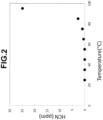
- Fig. 2 is illustrative of the "temperature dependency of the in-bag HCN concentration 24 hours after sealing of CuPBA nano-particles in an aluminum bag" shown in Non-Patent Publication 1, Fig. 11.
- the crosslinking agent is preferably water-soluble, and it is preferable to crosslink at 70 ° C. or lower from the viewpoint of the temperature limit when heating the metal cyano complex. It is more preferable to crosslink at heating 60°C or lower, and particularly preferable to crosslink at heating 50°C or lower. From this point of view, preference is given to a titanium lactate ammonium salt, titanium lactate, and diisopropoxybis (triethanolaminato) titanium, among which the titanium lactate ammonium salt is most preferable.
- the granulation adsorbent of the present embodiment may be other functions or For example, a mixture with another adsorbent such as activated carbon expands the adsorbent target, or a building member that by coating it on a building member and making it combined.
- a mixture with another adsorbent such as activated carbon expands the adsorbent target, or a building member that by coating it on a building member and making it combined.
- the granulated adsorbent according to this embodiment may be a mixture with other substances or a composite with other materials for adding other functions or for installation for use.
- a mixture with another adsorbent such as activated carbon expands the adsorbent target, or a building member coated and composited said mixture may be used for adsorption of the target substance in the location.
- the process of producing the granulated adsorbent according to one embodiment of this invention comprises the following steps.
- Fig. 3 shows one example of process steps for producing the granulate adsorbent according to the present embodiment.
- the present process is characterized by how the metal-cyano complex powder is prepared.
- the powder is prepared using spray drying, and is obtained as a fine powder having a particle diameter of 10 to 60 micrometers.
- This spray drying is characterized by being capable of increasing the specific surface area of the adsorbent, but there is a problem in terms of the need of using large scale installation for production steps, leading to increased costs.
- this problem is solved by using a dehydration step and a heat drying step in powder production. With these steps, it is possible to reduce the size of the equipment used drastically.
- a dehydration step and a heat drying step in powder production.
- the dehydration and drying of 10 kg/hr water As an example. Because the metal-cyan complex slurry has a solid content of about 10% as already described, a solid matter of about 1 kg/hr may be obtained by dehydration and drying of 10 kg/hr. If the solid matter is 40% (with a water content of 60%), the dehydrated cake is then obtained in an amount of 2.5 kg/hr. It is then required to convert this to a dried block of 1 kg/hr by thermal drying. The size needed for this step comes within a 1 meterX1 meterX1 meter for each of dehydration and heat drying, meaning that the necessary space is much smaller than the spray drying space.
- the process for preparing the metal cyano complex slurry is not particularly limited, and a desired slurry may be prepared with an appropriate solid fraction.
- a desired slurry may be prepared with an appropriate solid fraction.
- the process described in Patent Publication 7 and Non-Patent Publication 1 can be used.
- the dehydration process in the present embodiment is not particularly limited as long as the metal cyano complex slurry is dehydrated and solid-liquid separation can be performed. Addition of the flocculation precipitant allows the metal-cyano complex slurry to be dehydrated extremely easily. Without the addition of any flocculation precipitant, since the secondary particles in the metal cyano complex slurry are about several micrometers, it is necessary to another method of solid-liquid separation removing these secondary particles in the slurry is required. In the present invention, since the metal cyano complex becomes large enough to cause natural sedimentation due to addition of the flocculation precipitant, the selection range of the dehydration process is greatly expanded.
- such means as supernatant removal after spontaneous sedimentation, centrifugal dehydration, pressurized filtration (squeezing), and belt pressing may be select.
- spray drying when the secondary particle size is large, it causes clogging in the nozzle, so the opposite effect is generated from increasing the secondary particle size by adding a flocculating precipitate.
- the flocculation precipitant is added to the metal-cyano complex slurry.
- the flocculation precipitant aluminum sulfide, polyaluminum chloride, polyferric chloride, ferrous sulfate, calcium hydroxide, polymeric flocculant, and the like can be used. It is noted that the flocculation precipitant used herein should be selected such that its elution during use does not give rise to any problem because it remains in the produced granulated adsorbent.
- the metal-cyano complex slurry differs in pH depending on metal species, so it is necessary to select a flocculation precipitant according to it or adjust the pH before adding the flocculation precipitant.
- the heat drying process in the present invention is not particularly limited as long as the metal cyano complex dehydrated cake can be dried, and the temperature around the dehydrated cake may be raised from room temperature.
- the temperature is kept preferably at 70°C or lower, more preferably at 60°C or lower, most preferably at 50°C or lower (see Fig. 2 ).
- it is even better if there is a ventilation function to improve the drying speed.
- it may be a shelf dryer, a granulation dryer, a box type dryer, a rotary dryer, a vacuum dryer, a reduced-pressure dryer, and a low-temperature dryer.
- the secondary particle diameter of post-pulverization powder is preferably at 500 micrometers or lower, more preferably 100 micrometers or lower.
- the lower limit of the secondary particle size there is no particular limit on the lower limit of the secondary particle size, but about 500 nanometers is practical.
- the lower limit of secondary particle diameters about 500 nanometers is practical.
- Pulverization may be carried out by a cutter mill, a roll crusher, a millstone type pulverizer, a ring mill, a roller mill, a jet mill, a hammer mill, Atritor, a bead mill or the like.
- any method may be used to mix the metal-cyano complex powder, binder and crosslinking agent as long as they are fully mixed; for instance, a ribbon mixer, a cutter mixer, a screw mixer, a vibration mixer and the like may be used. It is noted that for uniform mixing and low-temperature kneading, binder dispersion spraying and crosslinking agent spraying at 500 rpm or less are effective.
- a granulated adsorbent A1 for ammonia gases was synthesized by way of the process steps as shown in Fig. 3 .
- a granulated adsorbent A2 for ions (cesium ions and ammonium ions) was prepared apart from the above. It is here understood that the adsorbents for ammonia gas and the adsorbents for ions have different mixing ratios of copper sulfate and potassium ferrocyanide. For this reason, the granulation adsorbent for ion can be obtained by changing the preparation of the raw material aqueous solution described in 1 in the manufacturing process of the granulated adsorbent for ammonia gas.
- Granulated adsorbent A1 for ammonia gas was used to carry out ammonia gas adsorption testing. 40 grams of granulated adsorbent A1 for ammonia gas were weighed out and then filled up in a 30 mm ⁇ vinyl chloride tube to prepare a column. Subsequently, an ammonia-containing air having an ammonia concentration of about 600 ppm was passed through the column at a flow rate of 15.5 L/min. An ammonia concentration before and after the column was measured using a detector tube (3M ⁇ 3L made by GASTEC Corporation).
- Fig. 5 shows an ammonia concentration before (- ⁇ -) and after (- ⁇ -) the column measured during passage of an ammonia-containing air through the column filled up with granulated adsorbent A1 for ammonia gas.
- ammonia concentration before the column remained at approximately 600 ppm, but the ammonia concentration after the column could initially be reduced down to 100 ppm and maintained sufficiently at a value lower than before the column even after a lapse of 250 minutes or longer. From this, it has been found that the granulated adsorbent for ammonia gas prepared in Example 1 is capable of sufficient ammonia gas adsorption.
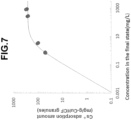
- Fig. 6 is indicative of the adsorption isotherm of granulated adsorbent A2 for ions.
- the granulated adsorbent produced by the inventive process is capable of sufficient ammonium ion adsorption.
- the concentration of ammonium ions in the adsorbent was about 9 mg/g or 9000 mg/kg (adsorbent). This shows that the concentration of ions in the adsorbent is about 450 times as high as the concentration of ions in water, and that the adsorbent is capable of sufficient adsorption.
- the cesium ion adsorption capability of granulated adsorbent A2 was evaluated as in Example 5.
- an aqueous cesium chloride solution was provided in place of the aqueous ammonium chloride solution at a concentration of 10, 50, 100, 500, 1000, and 5000 mg/L.
- the cesium ion concentration was measured by inductively coupled plasma mass spectroscopy.
- the adsorbent according to the invention was granulated, so that it can be more easily handled compared with powder.
- the process of producing adsorbents according to the invention can provide an adsorbent capable of sufficient adsorption without using any spray drying or similar process which might give rise to an increased equipment size and, hence, an increased cost.
- the present process also makes temperature control simple during production and safety control easy during work.
- the resulting granulated adsorbent can be used for adsorption of ammonia gas, ammonium ions, cesium ions or the like, and for waste water disposal, waste gas disposal, and predisposal for environmental estimations.
Landscapes
- Chemical & Material Sciences (AREA)
- Organic Chemistry (AREA)
- Analytical Chemistry (AREA)
- Chemical Kinetics & Catalysis (AREA)
- Inorganic Chemistry (AREA)
- Engineering & Computer Science (AREA)
- General Chemical & Material Sciences (AREA)
- Oil, Petroleum & Natural Gas (AREA)
- Health & Medical Sciences (AREA)
- Physics & Mathematics (AREA)
- General Health & Medical Sciences (AREA)
- Toxicology (AREA)
- Thermal Sciences (AREA)
- General Engineering & Computer Science (AREA)
- Life Sciences & Earth Sciences (AREA)
- Hydrology & Water Resources (AREA)
- Environmental & Geological Engineering (AREA)
- Water Supply & Treatment (AREA)
- High Energy & Nuclear Physics (AREA)
- Solid-Sorbent Or Filter-Aiding Compositions (AREA)
Abstract
Description
- The present invention relates to a granulated adsorbent for adsorption of small ions and/or small molecules and a process of producing the same.
- Adsorbents have been used in various fields, particularly it is important to be used in applications for removing harmful substances or recovering beneficial substances present in trace amounts from water or the atmosphere.
- For instance, adsorbents such as active carbon and zeolite are used for the purpose of removing organic materials from the atmosphere or water.
These adsorbents are characterized by having a network of microspace in them, adsorbing the materials in the microspace. The absorbed materials are then removed or recovered. - Among the adsorbents, a metal-cyano complex has been known to act as an adsorbent for adsorbing small-sized molecules or ions, and in particular known as an adsorbent for selective adsorption of radioactive cesium ions (see
Patent Publication 1 and Non-Patent Publication 1) or ammonia (Patent Publications 2 and 3). The metal-cyano complex is characterized by having its microspace size smaller than that of zeolite or the like, and having a large number of metal ions in the crystal, that allows absorbing molecules by coordination bonding. - In particular, the adsorbent using a metal-cyano complex by making it into nanoparticles can enlarge its specific surface area, and improve the adsorption features (see Non-Patent Publication 2).
- On the other hand, such an adsorbent in nanoparticle form has often difficulty chemical engineering handling. For instance, when a liquid or gas is passed through a column filled with small adsorbent particles, clogging or other problem may arise.
In order to solve this problem, a method of supporting a material having a large specific surface area such as a nonwoven fabric (Patent Document 4) and a method in which the adsorbent is used as a granulation adsorbent and the particle size is increased (Patent Document 5 and Patent Document 6) have been proposed. In the former method, since the amount of metal cyano complex occupying the adsorbent is relatively small, there is a problem that the adsorbent weight or the adsorption capacity per volume is small. Therefore, when processing a large amount of water / atmosphere, the latter method having a large adsorption capacity per adsorbent is preferable.
In order to provide a solution to this problem, it has been proposed a method wherein the adsorbent is carried on an unwoven fabric or like having a relatively large specific surface area (Patent Publication 4) or a method wherein the adsorbent is granulated to increase its particle diameter (seePatent Publications 5 and 6). A problem with the former method is that the amount of the metal-cyano complex accounting for the adsorbent is relatively reduced with the result that there is a small adsorption capacity per weight or volume of the adsorbent. Thus, when a large amount of water or atmospheric air is treated, it is preferable to use the latter method where there is an increased adsorption capacity per adsorbent. - When only the metal cyano complex is used as a granular body, powder may fall off during use due to insufficient strength.
- There are several methods proposed for granulation of metal-cyano complex, wherein the presence of a particular binder becomes significant. When only the metal-cyano complex is used in granulated form, powder may fall off due to insufficient strength during use.
- As a usage of the binder, for example,
Patent Publication 5 has proposed a method wherein calcium alginate formed by adding potassium alginate to a metal-cyano complex slurry followed by dropwise addition to calcium chloride is used as the binder. - Patent Publication 6 has proposed a method of adding polyvinyl alcohol (PVA) as the binder to a dry-sprayed metal-cyano complex powder followed by kneading. This method has the feature that a relatively small, spherical metal cyano complex powder of 10 ~ 50 um can be obtained by using spray drying, and PVA as a binder can cross-link spherical powder of metal cyano complex. By this method, it can achieve both a large specific surface area and the maintenance of the strength of the granulated adsorbent.
-
- Patent Publication 1: Unexamined Patent Publication No.
2013-253963 - Patent Publication 2: International Publication No.
2015/186919 - Patent Publication 3: Unexamined Patent Publication No.
2019-34273 - Patent Publication 4: Unexamined Patent Publication No.
2014-59280 - Patent Publication 5: Unexamined Patent Publication No.
2014-77720 - Patent Publication 6: Unexamined Patent Publication No.
2020-40054 - Patent Publication 7: Unexamined Patent Publication No.
2015-101523 - Patent Publication 8: Unexamined Patent Publication No.
2019-152525 - Patent Publication 9: International Patent Publication No.
2014/010417 -
- Non-Patent Publication 1: "Radioactive Cs-Polluted Ash Disposal Taking Advantage of Nanoparticles of the Prussian Blue Type Complex", https://unit.aist.go.jp/nmri/ja/results/paper/1703.briefi ng%20paper%20Cs.Ash%20decotamination.180330.pdf
- Non-Patent Publication 2: A. Takahashi, N. Minami, H. Tanaka, K. Sue, K. Minami, D, ParajuLi, K.-M. Lee, S. Ohkoshi, M. Kurihara, and T. Kawamoto, Green Chem. 17, 4228 (2015)
- Non-Patent Publication 3: http://www.makino-co.co.jp/products/kansou/kansou 01/
- As for the granulated adsorbent, however, there are some problems found in the methods described in these prior publications. With the method of
Patent Publication 5, adsorbent strength cannot possibly be maintained in water because calcium alginate is used as the binder. For instance, when the concentration of sodium or potassium is high in water, calcium of calcium alginate is substituted with sodium or potassium, rendering it water-soluble. - For the method of Patent Publication 6, it is essentially required to prepare micro-spherical powder comprising a metal-cyano complex/water mixture (hereafter called the metal-cyano complex slurry); however, there is a problem with a very increased production cost because the size of spray-drying apparatus used therewith gets very large. In particular, such an increased production size would lead to an increased factory installation cost, etc. For instance, Non-Patent Publication 3 refers to a general spray-drying apparatus size, stating that if the amount of moisture evaporation is 10 kg/hr, it would reach approximately 7 metersX4.5 metersX6 meters. As the metal-cyano complex slurry has a typical concentration of about 9 to 10%, output obtained by making use of the aforesaid spray-drying apparatus would remain up to 1 kg/hr. Referring further to spray-drying, the interior temperature of a drying machine may instantaneously be greater than 100°C, possibly giving a risk to rise to hydrogen cyanide generation.
- In Patent Publication 7, an alternative process of preparing metal-cyano complex powder from the metal-cyano complex slurry without recourse to spray-drying is disclosed that in which the slurry is subjected to solid-liquid separation with centrifugation and dehydrated followed by drying. However, it would be difficult to treat the metal-cyano complex slurry in large quantities because it often comprises primary particles of less than 100 nanometers in diameter and high rotations of the order of 10000 rpm or more are required for centrifugation. Even with filtration making use of paper or fabric filters, there would again be a problem in terms of high throughput because of clogging caused by small sizes of primary particles.
- Thus, when the metal-cyano complex is used as an adsorbent, there is mounting demand for a granulated adsorbent that is available at low cost, ensures certain throughputs, has high strength, and has stability in water in particular. In particular, referring to how to prepare powder from the metal-cyano complex slurry, any method of preparing powder in not only simple but also high-throughput way is not yet found, leading to the need of carrying out spray-drying using large equipment.
- In terms of safety, it is necessary to remove the cause of heating in each manufacturing process because some cyano groups are released off from a portion of the metal-cyano complex upon heating and turn to hydrogen cyanide (see Fig. 11 of Non-Patent Publication 1).
- As a result of study after study made to provide a solution to the aforesaid problems, the present inventors have found that by using a specific flocculation precipitant or the like, solid-liquid separation and drying upon production as well as additives used in process steps are optimized and temperature control is carried out, arriving at the required granulated adsorbent and the process of producing the same.
- The present invention has been accomplished on the basis of these findings, and carried out in the following embodiments.
- [1] A granulated adsorbent for adsorption of a small ion and/or a small molecule, that comprises a metal-cyano complex as an effective component, a binder, a crosslinking agent, and a flocculation precipitant that flocculates and precipitates the metal-cyano complex from a slurry that contains the metal-cyano complex, wherein said flocculation precipitant is an organic polymeric flocculant.
- [2] The granulated adsorbent of [1], wherein said organic polymeric flocculant is an amphoteric polymeric adsorbent.
- [3] The granulated adsorbent of [1] or [2], wherein said crosslinking agent has a function capable of crosslinking said binder by heating at not higher than 60°C.
- [4] The granulated adsorbent of [3], wherein said cross-linking agent is an organic titanium salt.
- [5] The granulated adsorbent of any of [1] to [4], wherein said binder is a water-soluble polymer.
- [6] The granulated adsorbent of [5], wherein said binder is a polyvinyl alcohol.
- [7] A process of producing a granulated adsorbent comprising a metal-cyano complex as an effective component for adsorption of a small ion and/or a small molecule, comprising:
- a step of adding a flocculation precipitant to a slurry containing a metal-cyano complex and then dehydrating said slurry for preparation of a metal-cyano complex dehydrated cake,
- a step of drying the metal-cyano complex dehydrated cake by heating for preparation of a metal-cyano complex dried block,
- a step of pulverizing the metal-cyano complex dried block into a metal-cyano complex powder, and
- a step of preparing a mixture containing the metal-cyano complex powder, binder, crosslinking agent and water for granulation using the mixture.
- [8] The process of producing a granulated adsorbent according to [7], wherein all said steps are carried out at not higher than 70°C for inhibition of generation of hydrogen cyanide.
- [9] The process of producing a granulated adsorbent according to [7] or [8], wherein the step of preparing the mixture is carried out by dispersing and injecting the binder and spraying the crosslinking agent without recourse to high-speed stirring.
- [10] The process of producing a granulated adsorbent according to any of [7] to [9], wherein said flocculation precipitant is an organic polymeric flocculant.
- [11] The process of producing a granulated adsorbent according to any of [7] to [10], wherein said crosslinking agent crosslinks the binder by heating at not higher than 60°C.
- [12] The process of producing a granulated adsorbent according to [11], wherein a said crosslinking agent is an organic titanium salt.
- [13] The process of producing a granulated adsorbent according to any of [7] to [12], wherein said binder is a water-soluble polymer.
- [14] The process of producing a granulated adsorbent according to [13], wherein said water-soluble polymer is a polyvinyl alcohol.
- According to the present invention, it is possible to provide a granulated adsorbent capable of full adsorption without recourse to spray-drying or the like which otherwise gives rise to an increased installation size and, hence, an increased cost. In addition, since the temperature control during manufacturing is simplified, safety management during work is easy, it is possible to provide a cheaper and simpler method, and the obtained granulation adsorbent sufficiently retains both strength and adsorption function.
-
-
Fig. 1 shows a typical crystal structure of a metal-cyano complex. -
Fig. 2 shows "the temperature dependency of the in-bag HCN concentration 24 hours after CuPBA nanoparticles are sealed in an aluminum bag" shown in Fig. 11 ofNon-Patent Publication 1. -
Fig. 3 shows one example of the production process of the granulated adsorbent according to the present invention. -
Fig. 4 is the microscopic photographs taken of the metal-cyano complex powder obtained in Example 1 at a drying temperature of not higher than 40°C and a water content of 5% or lower, with the right being a partially enlarged photograph thereof. -
Fig. 5 shows ammonia concentrations before and after passage of ammonia-containing air through a column filled up with a granulated adsorbent A1 for ammonia gas. -
Fig. 6 is an ammonium ion adsorption isotherm of granulated adsorbent A2 for ions. -
Fig. 7 is a cesium ion adsorption isotherm of granulated adsorbent A2 for ions. - In what follows, some embodiments of the invention (hereafter also called the "present embodiments") will be explained; however, they are provided for explanation of the invention rather than for limitation of the scope of the present invention.
- It is here understood that "to" indicative of numerical ranges includes the lower and upper limit values thereof.
- In the present disclosure, the "adsorbent" refers to a material adapted to capture in it small ions and small molecules contained in water and the atmosphere for removal of them from the water and the atmosphere. The thus captured small ions and small molecules may be eliminated by any desired method like water washing, and/or heating. In this case, the thus eliminated small ions and small molecules may further be reused as valuable material, and the adsorbent may in itself be returned back to a state before adsorption or to a state equivalent thereto.
- In the present disclosure, the "small ion(s)" refers to an ion containing one or two atoms whose atomic number is greater than that of helium ion(s), for instance, lithium ion(s), sodium ion(s), potassium ion(s), ammonium ion(s), rubidium ion(s), cesium ion(s), and magnesium ion(s). In particular, the metal-cyano complex referred to herein has high selectivity to cesium, rubidium and ammonium ions, and may be used for removal and recovery of them, but is not limited thereto.
- In the present disclosure, the "small molecule(s)" refers to a molecule containing 5 or less atoms whose atomic number is greater than that of lithium ion, for instance, ammonia, hydrogen sulfide, methyl sulfide, methyl disulfide, trimethylamine, acetaldehyde, propionaldehyde, methanol, ethanol, propanol, and water. In particular, the metal-cyano complex referred to herein has high selectivity to ammonia, and may be used for removal and recovery of them, but is not limited thereto.
- In the present embodiment(s), the metal-cyano complex is a sort of porous coordination polymer comprising a metal ion (a cation having a plus charge) and a cyano group (an anionic CN- having a minus charge) that is a sort of ligand capable of crosslinking this metal ion. The metal-cyano complex is a series of compounds called metal-cyano complex having a hexacyano-metal ion in their structure. The metal-cyano complex comprises a nanopore structure that may capture a gas of interest inside. This nanopore structure has a pore size of 0.3 to 0.6 nm. The metal-cyano complex is assembled up by a regular repetition of such nanopore structures so that it has a large surface area for highly selective and efficient adsorption and desorption of ammonia chemical species.
- In the present embodiment(s), the metal-cyano complex comprises a face-centered cubic structure shown in
Fig. 1 as a typical crystal structure, and is expressed by the following general formula (1).
AxM[M'(CN)6]y·zH2O ··· (1)
where x is 0 to 3, y is 0.1 to 1.5, z is 0 to 6, A stands for one or more cations of hydrogen, ammonium, an alkali metal, and an alkaline earth metal, and M and M' are independent from each other, standing for a cation of one or more atoms having an atomic number 3 to 83. However, it is to be noted that M and M' are in no sense the cations of A standing for a cation of hydrogen, ammonium, an alkali metal including lithium, sodium, potassium, rubidium, cesium, and francium as well as a cation of an alkaline earth metal including magnesium, calcium, strontium, barium, and radium. - A represents one or more cations of hydrogen, ammonium, an alkali metal including lithium, sodium, potassium, rubidium, cesium, and francium, and an alkaline earth metal including magnesium, calcium, strontium, barium, and radium. A may represent two or more cations in a mixed state, and x takes such a value as to keep the charge balance of the entire metal-cyano complex.
- M stands for one or more metal cations of vanadium, chromium, manganese, iron, ruthenium, cobalt, rhodium, nickel, palladium, platinum, copper, silver, zinc, indium, lanthanide, europium, gadolinium, and lutetium. M may stand for two or more cations in a mixed state, they exist in the metal-cyano complex in such a way as to keep the charge balance of the entire metal-cyano complex. For M', there is the mention of one or more metal cations of vanadium, chromium, molybdenum, tungsten, manganese, iron, ruthenium, cobalt, nickel, platinum, and copper. With stability of cyanides in the PB derivative in mind, it is preferable to choose iron or cobalt for M'.
- By combining M with M', it is possible to control adsorbent features such as adsorption capacity, adsorption rate, selectivity, and adsorbent material stability. Any desired M/M' combinations may be used including combinations where M is Fe3+ and M' is Fe2+, M is Cu2+ and M' is Fe2+, M is Co2+ and M' is Co3+, or M is Cu3+ and M' is Co2+.
- As well known in the art, the pores or voids of the nanopore structure of the PB derivative comprising a variety of A, M and M' are capable of adsorbing Cs+ having an ionic radius of 0.183 nm with high selectivity and efficiency. This is considered due to the fact that the nanopore structure surrounded by CN minus charged with one of skeletons of the metal-cyano complex is well fit for plus charged Cs ions in terms of charge and space, resulting in efficient adsorption of Cs+ to the pores.
- The plus charge and size of ammonium ions NH4 + that is one sort of ammonia chemical species and has an ionic radius of 0.175 nm are close to those of Cs+. This is taken as one of factors allowing the metal-cyano complex to adsorb ammonia chemical species with efficiency. It is also possible to introduce defects into the PB derivative. With no defects, the metal site M is surrounded with plural cyano groups; however, the introduction of defects causes some cyano groups to be deleted resulting in a situation where various molecules are likely to be coordination bonded to the metal site M. In the atmosphere, water molecules often remain bonded to that metal site M, while ammonia, known to be more likely to coordination bond to metals than water, bonds to the metal site M by substitution with the coordinated water molecules. This is also considered as one of factors through which the metal-cyano complex is capable of adsorbing ammonia chemical species efficiently.
- In the present disclosure, the "granulated adsorbent" refers to one that is mainly composed of a metal-cyano complex capable of adsorption and that is mixed with a binder for maintaining strength and a crosslinking agent followed by granulation. The flocculation precipitant to be added upon solid-liquid separation is also included in the granulated adsorbent.
- In the present invention, the binder is added to the adsorbent for the purpose of maintaining its strength through mixing with the metal-cyano complex capable of adsorption. On the other hand, the crosslinking agent cross-links between the binders by various bonds and makes the binders insoluble, thereby preventing the elution of the binder in water and the associated elution of the metal cyano complex. Further, the above materials is added for the purpose of preventing deterioration such as powder falling off and collapse of the granulation adsorbent.
- A flocculation precipitant is generally used for solid-liquid separation of a slurry that is a mixture of fine particles with water, for instance, for sewage disposal. By agglomerating fine particles to be suspended in the sewage to be treated, it prevents clogging during filtration treatment, quickly precipitates and removes supernatant, and increases the sedimentation rate during centrifugation. In this case, the flocculation precipitant added will remain on the solid side subjected to solid-liquid separation, namely, in a dehydrated cake. Therefore, the characteristic features essentially needed for the flocculation adsorbent comprise just only making the aforesaid solid-liquid separation easy to take place but also its safety when it is used for waste disposal or as valuable materials like fertilizers.
- From a point of view of combined use of an adsorbent and a flocculation precipitant in the prior art, there is a report about a method wherein the adsorbent is used to recover ions or other materials from sewage or environment water, and the flocculation precipitant is then added for solid-liquid separation thereby recovering those materials, as set forth in Patent Publication 8. Thus, in the general usage of flocculation precipitant, it is added into sewage or environment water, and the purpose is waste water treatment, analysis, suspension recovery.
- Further, Patent Publication 9 reports that a particulate or sheet-form adsorbent containing a slightly water-soluble ferrocyanide metal compound may be brought in contact with a treatment solution containing an inorganic polymeric flocculant and further with an alkaline treating agent having a pH value of 7 to 9 thereby holding back elution of the ferrocyanide ions used for removal of cesium.
- On the other hand, the flocculation precipitant according to the present invention is quite different from these methods in terms of usage.
In the present invention, the flocculation precipitant is used during production of the adsorbent not when using it. Thereby, the adsorbent is able to make by a general solid-liquid separation/dehydration process such as centrifugation and filtration. Accordingly, the ability of the flocculation precipitant to be demanded is also different from the case where it is added to the water to be disposed together with aforesaid adsorbent. - A part of the flocculation precipitant added the metal-cyano complex slurry remains in the dehydrated metal-cyano complex cake and hence, in the adsorbent that is the final product. In other words, the flocculation precipitant should not interfere with the desired adsorption capability. More specifically, even when the flocculation precipitant is used for solid-liquid separation of the metal-cyano complex slurry, it should properly be selected depending on its application or, alternatively, it should not be selected with only solid-liquid separation capability in mind. Further in view of adsorbent management, it is desired to select a substance for which no new legal response is needed. In terms of legal requirements, conventional usage is applied to waste material disposal; however, the present method needs quite different accommodations such as legal accommodation that must be complied for delivery of the produced adsorbent, e.g., laws relating to examination and production regulation of chemical substances as well as the foreign exchange law and foreign trade control laws. In the present invention, use is made of flocculation adsorbents that accommodate to these requirements.
- More specifically, the flocculation precipitant used herein comprises aluminum sulfate, poly (aluminum chloride), iron (II) chloride, polyferric sulfate, ferrous sulfate, calcium hydroxide and a polymeric flocculant among which the organic polymeric flocculant is used. In particular, an amphoteric type polymeric flocculant is more preferable, and a polymeric flocculant composed mainly of acrylamide and dimethylaminoethyl methacrylate is further preferred.
- Usually, the metal-cyano complex is produced by mixing an aqueous solution of the raw material, and in the process, a metal-cyano complex/water mixture (called hereafter the "slurry") is obtained. In the present invention, after obtaining a metal cyano complex powder using a flocculated precipitate obtained by adding the agglomeration precipitate to this slurry, the obtained metal cyano complex powder is granulated by mixing the binder, the crosslinking agent and water.
- Therefore, in order to appropriately mix the metal cyano complex powder and the binder, the binder in the present invention is preferably also water-soluble, more preferably a water-soluble polymer, and particularly preferably polyvinyl alcohol.
- For appropriate mixing of the metal-cyano complex powder with the binder, therefore, the binder used herein is preferably also soluble in water; more preferably a water-soluble polymer, and particularly preferably polyvinyl alcohol. Although there is no particular limitation on the polymerization degree of the polyvinyl alcohol, it has preferably a polymerization degree of 1700 or more from a point of view of maintaining the shape of the granulated adsorbent as set forth in Patent Publication 6 in particular. There is no particular limitation on saponification degree, it is also desirable that the saponification degree is 97% or greater. However, what should be noted here is that in Patent Publication 6, any crosslinking agent is not added when producing a granulation adsorbent. In the present invention, since polyvinyl alcohol is insolubilized by the addition of a crosslinking agent, the above index is only a guide, meaning that it is possible to maintain the granulated adsorbent even with a polyvinyl alcohol having a smaller polymerization or saponification degree.
- In the present invention, addition of the cross-linking agent is of extremely importance.
As described above, in order to properly mix the metal cyano complex and the binder, the binder is also water. As stated above, for appropriate mixing of the metal-cyano complex with the binder, it is desirable that the binder is also water-soluble.
When the water-soluble binder is used, however, if it comes in contact with water when using the granulated adsorbent, a problem with elution of the binder occur at that time, and it becomes difficult to maintain the strength of the granulated adsorbent. For this reason, it is of importance to add the crosslinking agent capable of making the binder insoluble. On the other hand, the crosslinking agent generally functions by way of heating, often rendering the binder insoluble. However, temperature control is in need, because some cyano groups are generally released by heating out of a portion of the metal-cyano complex, turning into hydrogen cyanide (see Non-Patent Publication 1). Accordingly, the binder and crosslinking agent used in combination should be soluble in water and capable of crosslinking at low temperature. Here note thatFig. 2 is illustrative of the "temperature dependency of the in-bag HCN concentration 24 hours after sealing of CuPBA nano-particles in an aluminum bag" shown inNon-Patent Publication 1, Fig. 11. - In the present invention, the crosslinking agent is preferably water-soluble, and it is preferable to crosslink at 70 ° C. or lower from the viewpoint of the temperature limit when heating the metal cyano complex. It is more preferable to crosslink at heating 60°C or lower, and particularly preferable to crosslink at heating 50°C or lower. From this point of view, preference is given to a titanium lactate ammonium salt, titanium lactate, and diisopropoxybis (triethanolaminato) titanium, among which the titanium lactate ammonium salt is most preferable.
- The granulation adsorbent of the present embodiment may be other functions or For example, a mixture with another adsorbent such as activated carbon expands the adsorbent target, or a building member that by coating it on a building member and making it combined.
- The granulated adsorbent according to this embodiment may be a mixture with other substances or a composite with other materials for adding other functions or for installation for use. For instance, a mixture with another adsorbent such as activated carbon expands the adsorbent target, or a building member coated and composited said mixture may be used for adsorption of the target substance in the location.
- The process of producing the granulated adsorbent according to one embodiment of this invention comprises the following steps.
- 1. Step of adding the flocculation precipitant into a slurry containing said metal-cyano complex and then dehydrating the slurry to prepare a metal-cyano complex dehydrated cake.
- 2. Step of heat drying said metal-cyano complex dehydrated cake to prepare a metal-cyano complex dried block.
- 3. Step of pulverizing the metal-cyano complex dried block into a metal-cyano complex powder.
- 4. Step of preparing a mixture containing the metal-cyano complex powder, a binder, a crosslinking agent and water, and then granulating using the mixture.
-
Fig. 3 shows one example of process steps for producing the granulate adsorbent according to the present embodiment. - Specifically, the present process is characterized by how the metal-cyano complex powder is prepared.
In Patent Publication 6, in all embodiments, the powder is prepared using spray drying, and is obtained as a fine powder having a particle diameter of 10 to 60 micrometers. This spray drying is characterized by being capable of increasing the specific surface area of the adsorbent, but there is a problem in terms of the need of using large scale installation for production steps, leading to increased costs. - In the present invention, this problem is solved by using a dehydration step and a heat drying step in powder production. With these steps, it is possible to reduce the size of the equipment used drastically. Here take the dehydration and drying of 10 kg/hr water as an example. Because the metal-cyan complex slurry has a solid content of about 10% as already described, a solid matter of about 1 kg/hr may be obtained by dehydration and drying of 10 kg/hr. If the solid matter is 40% (with a water content of 60%), the dehydrated cake is then obtained in an amount of 2.5 kg/hr. It is then required to convert this to a dried block of 1 kg/hr by thermal drying. The size needed for this step comes within a 1 meterX1 meterX1 meter for each of dehydration and heat drying, meaning that the necessary space is much smaller than the spray drying space.
- The process for preparing the metal cyano complex slurry is not particularly limited, and a desired slurry may be prepared with an appropriate solid fraction. For instance, the process described in Patent Publication 7 and
Non-Patent Publication 1 can be used. - The dehydration process in the present embodiment is not particularly limited as long as the metal cyano complex slurry is dehydrated and solid-liquid separation can be performed. Addition of the flocculation precipitant allows the metal-cyano complex slurry to be dehydrated extremely easily. Without the addition of any flocculation precipitant, since the secondary particles in the metal cyano complex slurry are about several micrometers, it is necessary to another method of solid-liquid separation removing these secondary particles in the slurry is required.
In the present invention, since the metal cyano complex becomes large enough to cause natural sedimentation due to addition of the flocculation precipitant, the selection range of the dehydration process is greatly expanded. For instance, such means as supernatant removal after spontaneous sedimentation, centrifugal dehydration, pressurized filtration (squeezing), and belt pressing may be select. However, it is not preferable to use spray drying. In spray drying, when the secondary particle size is large, it causes clogging in the nozzle, so the opposite effect is generated from increasing the secondary particle size by adding a flocculating precipitate. - In order to increase the options for dehydration process by increasing the size of the secondary particles, the flocculation precipitant is added to the metal-cyano complex slurry. As the flocculation precipitant, aluminum sulfide, polyaluminum chloride, polyferric chloride, ferrous sulfate, calcium hydroxide, polymeric flocculant, and the like can be used. It is noted that the flocculation precipitant used herein should be selected such that its elution during use does not give rise to any problem because it remains in the produced granulated adsorbent.
Further, the metal-cyano complex slurry differs in pH depending on metal species, so it is necessary to select a flocculation precipitant according to it or adjust the pH before adding the flocculation precipitant. - The heat drying process in the present invention is not particularly limited as long as the metal cyano complex dehydrated cake can be dried, and the temperature around the dehydrated cake may be raised from room temperature. However, in order to completely prevent the generation of hydrogen cyanide, the temperature is kept preferably at 70°C or lower, more preferably at 60°C or lower, most preferably at 50°C or lower (see
Fig. 2 ). In addition, it is even better if there is a ventilation function to improve the drying speed. For instance, it may be a shelf dryer, a granulation dryer, a box type dryer, a rotary dryer, a vacuum dryer, a reduced-pressure dryer, and a low-temperature dryer. It is also possible to use a device in which the dehydration function and the drying function are integrated. Further, depending on the type of dehydrator used, when the dehydrate cake is so large and not dry out, it is desired to reduce the size of each dehydration cake by cutting the dehydrated cake in advance. - For pulverizing a metal-cyano complex dried block, the secondary particle diameter of post-pulverization powder is preferably at 500 micrometers or lower, more preferably 100 micrometers or lower. There is no particular limit on the lower limit of the secondary particle size, but about 500 nanometers is practical. Although there is no particular limit on the lower limit of secondary particle diameters, about 500 nanometers is practical. However, it is here understood that a reduced secondary particle diameter often gives rise to dusting during production. Pulverization may be carried out by a cutter mill, a roll crusher, a millstone type pulverizer, a ring mill, a roller mill, a jet mill, a hammer mill, Atritor, a bead mill or the like.
- Any method may be used to mix the metal-cyano complex powder, binder and crosslinking agent as long as they are fully mixed; for instance, a ribbon mixer, a cutter mixer, a screw mixer, a vibration mixer and the like may be used. It is noted that for uniform mixing and low-temperature kneading, binder dispersion spraying and crosslinking agent spraying at 500 rpm or less are effective.
- There is no particular limit on how to granulate mixtures if granulated adsorbents having any desired particle diameter are obtainable; for instance, pan granulation, drum granulation, extraction granulation, and agitation granulation may be used.
- The present invention will now be explained in further details based on several examples; however, it should be understood that the present invention is not limited thereto.
- A granulated adsorbent A1 for ammonia gases was synthesized by way of the process steps as shown in
Fig. 3 . - 1. Preparation of Raw Material Aqueous Solution
For the raw material aqueous solution, 7.77 moles of copper sulfate pentahydrate were dissolved in 9.25 kg of water to prepare 10 liters of an aqueous copper sulfate solution LC1, and 4.24 moles of potassium ferrocyanide trihydrate were dissolved in 8.15 kg of water to prepare 9 liters of an aqueous potassium ferrocyanide solution LF1. - 2. Synthesis of Metal-Cyano Complex Slurry
LD1 and LF1 were mixed together to prepare a copper iron-cyano complex slurry S1, where M=Cu2+ and M'=Fe2+. - 3. Addition of Flocculation precipitant
After pH adjustment of slurry S1, 24 grams of an organic polymeric flocculant composed mainly of an acrylamide/dimethylaminoethyl methacrylate copolymer having a molecular weight of about 4,000,000 were added to the slurry and stirred by an agitator. - 4. Production of Dried Block
Slurry S1 was pressed with an electric oil pressing machine (YS-1 manufactured by Hashida Kiko Co. Ltd.) for solid-liquid separation to provide dehydrated cake C1. After cutting the dehydrated cake C1 into small pieces of about 3 cm square, it was dried at 40°C for 24 hours with a shelf dryer to prepare a dried block B1. - 5. Pulverization of Block to Fine Powder, Addition of Binder and Crosslinking Agent, and Kneading
The dried block B1 was pulverized using a cutter mixer (BLIXER-6 made by FMI Co., Ltd.) to obtain dried powder DP1. During this process, it was confirmed that the temperature of the cutter mixer did not exceed 40°C.Fig. 4 are photographs of dried powder DP1 in which the right one is a partially enlarged photograph thereof.
Separately, a 10% by weight aqueous solution of a polyvinyl alcohol was prepared as the binder and titanium lactate ammonium salt was prepared as the crosslinking agent. Without removing DP1 from the cutter mixer, binders and crosslinkers were added to DP1 in order. The cutter mixer was actuated for one minute for stirring to obtain wet powder WP1 in which a copper iron cyano-complex, flocculation precipitant and cross-linking agent were kneaded together. - 6. Granulation and Drying
Wet powder WP1 were charged in an extrusion granulator (F-5 made by Dalton Co., Ltd.) to obtain a water-containing granulated adsorbent WA1 which was then dried by a shelf drier at 50°C for 24 hours to obtain a granulated adsorbent A1 for ammonia gas. - A granulated adsorbent A2 for ions (cesium ions and ammonium ions) was prepared apart from the above. It is here understood that the adsorbents for ammonia gas and the adsorbents for ions have different mixing ratios of copper sulfate and potassium ferrocyanide. For this reason, the granulation adsorbent for ion can be obtained by changing the preparation of the raw material aqueous solution described in 1 in the manufacturing process of the granulated adsorbent for ammonia gas. More specifically, 6.6 moles of copper sulfate pentahydrate were dissolved in 9.36 kg of water to prepare 10 liters of an aqueous copper sulfate solution LC2 as the raw material aqueous solution, and 4.4 moles of potassium ferrocyanide trihydrate were dissolved in 9.16 kg of water to prepare 10 liters of an aqueous potassium ferrocyanide solution LF2. LC2 and LF2 were then used to obtain a granulated adsorbent A2 for ions via a step similar to the adsorbent for ammonia gas.
- Granulated adsorbent A1 for ammonia gas was used to carry out ammonia gas adsorption testing. 40 grams of granulated adsorbent A1 for ammonia gas were weighed out and then filled up in a 30 mmφ vinyl chloride tube to prepare a column. Subsequently, an ammonia-containing air having an ammonia concentration of about 600 ppm was passed through the column at a flow rate of 15.5 L/min. An ammonia concentration before and after the column was measured using a detector tube (3M·3L made by GASTEC Corporation).
-
Fig. 5 shows an ammonia concentration before (-●-) and after (-◆-) the column measured during passage of an ammonia-containing air through the column filled up with granulated adsorbent A1 for ammonia gas. - The ammonia concentration before the column remained at approximately 600 ppm, but the ammonia concentration after the column could initially be reduced down to 100 ppm and maintained sufficiently at a value lower than before the column even after a lapse of 250 minutes or longer. From this, it has been found that the granulated adsorbent for ammonia gas prepared in Example 1 is capable of sufficient ammonia gas adsorption.
- In this example, evaluation was made of relations of the temperature at which the granulated adsorbent was produced with respect to the generation of hydrogen cyanide gas. The hydrogen cyanide in the cutter mixer had a concentration of 5 ppm or lower as measured in
Step 5 of Example 1. This was lower than the allowable concentration recommended by JSOH. On the other hand, the hydrogen cyanide had a concentration of 25 ppm in the apparatus as measured after the interior temperature of the cutter mixer was increased to 73.7°C by extending the kneading time. It has thus been shown that an increasing temperature during work leads to the generation of hydrogen cyanide. - To evaluate the adsorption power of granulated adsorbent A2 for ions, batch shaking tests were carried out. 100 mg of granulated adsorbent A2 were weighed out, then charged in 10 mL of an aqueous ammonium chloride solution, and then shaken in a shaker for 24 hours at 600 rpm. The aqueous ammonium chloride solution had a concentration adjusted to 100, 500, 1000, and 400 mg-NH4/L, respectively. Thereafter, the resulting liquid was filtered through a filter having a pore size of 0.45 micrometer to prepare a sample liquid which was then evaluated the ammonium ion concentration by ion chromatography, to prepare an adsorption isotherm.
-
Fig. 6 is indicative of the adsorption isotherm of granulated adsorbent A2 for ions. - As a result, it has been found that the granulated adsorbent produced by the inventive process is capable of sufficient ammonium ion adsorption. For instance, when the ammonium ion concentration was 20 mg/L in the test liquid or about 20 mg/kg (water), the concentration of ammonium ions in the adsorbent was about 9 mg/g or 9000 mg/kg (adsorbent). This shows that the concentration of ions in the adsorbent is about 450 times as high as the concentration of ions in water, and that the adsorbent is capable of sufficient adsorption.
- The cesium ion adsorption capability of granulated adsorbent A2 was evaluated as in Example 5. In this case, an aqueous cesium chloride solution was provided in place of the aqueous ammonium chloride solution at a concentration of 10, 50, 100, 500, 1000, and 5000 mg/L. The cesium ion concentration was measured by inductively coupled plasma mass spectroscopy.
- The adsorption isotherms are shown in
Fig. 7 , indicating that this adsorbent is also capable of sufficiently high cesium ion adsorption as we 1 1 as ammonium ions. - From these results, it was found that a granulation adsorbent sufficiently exhibiting ammonia gas and ion adsorption ability can be produced by the method of the present invention without realizing a small secondary particle size by using a spray drying method or the like.
- From these, it has been found that according to the present invention, it is possible to produce a granulated adsorbent capable of sufficient ammonia gas and ion adsorption without a spray drying method or the like for realizing small secondary particle diameters. In addition, it was found that the generation of harmful hydrogen cyanide can be prevented by temperature control during production processes.
- The adsorbent according to the invention was granulated, so that it can be more easily handled compared with powder. The process of producing adsorbents according to the invention can provide an adsorbent capable of sufficient adsorption without using any spray drying or similar process which might give rise to an increased equipment size and, hence, an increased cost. The present process also makes temperature control simple during production and safety control easy during work. The resulting granulated adsorbent can be used for adsorption of ammonia gas, ammonium ions, cesium ions or the like, and for waste water disposal, waste gas disposal, and predisposal for environmental estimations.
Claims (14)
- A granulated adsorbent for adsorption of a small ion and/or a small molecule, comprising:a metal-cyano complex as an effective component,a flocculation precipitant for flocculation and precipitation of said metal-cyano complex from a slurry containing said metal-cyano complex,a binder, anda crosslinking agent,wherein said flocculation precipitant is an organic polymeric flocculant.
- The granulated adsorbent according to Claim 1, wherein said organic polymeric flocculant is an amphoteric polymeric flocculant.
- The granulated adsorbent according to Claim 1 or 2, wherein said crosslinking agent has a function capable of crosslinking the binder by heating of not higher than 60°C.
- The granulated adsorbent according to Claim 3, wherein said cross-linking agent is an organic titanium salt.
- The granulated adsorbent according to any one of Claims 1 to 4, wherein said binder is a water-soluble polymer.
- The granulated adsorbent according to Claim 5,
wherein said binder is a polyvinyl alcohol. - A process of producing a granulated adsorbent comprising a metal-cyano complex as an effective component for adsorption of a small ion and/or a small molecule, comprising:a step of adding a flocculation precipitant into a slurry containing said metal-cyano complex, and then dehydrating said slurry to prepare a metal-cyano complex dehydrated cake,a step of heat drying said metal-cyano complex dehydrated cake to prepare a metal-cyano complex dried block,a step of pulverizing said metal-cyano complex dried block into a metal-cyano complex powder, anda step of preparing a mixture containing said metal-cyano complex powder, binder, crosslinking agent and water, and then granulating using said mixture.
- The process of producing a granulated adsorbent according to Claim 7, wherein all the steps are carried out at not higher than 70°C to inhibit of generation of hydrogen cyanide.
- The process of producing a granulated adsorbent according to Claim 7 or 8, wherein said step of preparing said mixture is carried out by dispersing and injecting said binder and spraying said crosslinking agent without recourse to high-speed stirring.
- The process of producing a granulated adsorbent according to any one of Claims 7 to 9, wherein a polymeric flocculant is used as said flocculation precipitant.
- The process of producing a granulated adsorbent according to any one of Claims 7 to 10, wherein said crosslinking agent having a function capable of crosslinking the binder by heating at not higher than 60°C is used as the crosslinking agent.
- The process of producing a granulated adsorbent according to Claim 11, wherein an organic titanium salt is used as said crosslinking agent.
- The process of producing a granulated adsorbent according to any one of Claims 7 to 12, wherein a water-soluble polymer is used as said binder.
- The process of producing a granulated adsorbent according to Claim 13, wherein polyvinyl alcohol is used as said water-soluble polymer.
Applications Claiming Priority (2)
| Application Number | Priority Date | Filing Date | Title |
|---|---|---|---|
| JP2020187242A JP6918323B1 (en) | 2020-11-10 | 2020-11-10 | Granulation adsorbent and its manufacturing method |
| PCT/JP2021/040227 WO2022102448A1 (en) | 2020-11-10 | 2021-11-01 | Granulated adsorbent and method for producing same |
Publications (2)
| Publication Number | Publication Date |
|---|---|
| EP4245408A1 true EP4245408A1 (en) | 2023-09-20 |
| EP4245408A4 EP4245408A4 (en) | 2025-01-15 |
Family
ID=77172730
Family Applications (1)
| Application Number | Title | Priority Date | Filing Date |
|---|---|---|---|
| EP21891695.5A Pending EP4245408A4 (en) | 2020-11-10 | 2021-11-01 | Granulated adsorbent and method for producing same |
Country Status (5)
| Country | Link |
|---|---|
| US (1) | US20230405554A1 (en) |
| EP (1) | EP4245408A4 (en) |
| JP (1) | JP6918323B1 (en) |
| CN (1) | CN116568394A (en) |
| WO (1) | WO2022102448A1 (en) |
Families Citing this family (2)
| Publication number | Priority date | Publication date | Assignee | Title |
|---|---|---|---|---|
| CN115738892B (en) * | 2022-11-30 | 2023-06-02 | 中国科学院青海盐湖研究所 | Spherical combined lithium adsorbent and granulating method thereof |
| US20250018362A1 (en) * | 2023-07-14 | 2025-01-16 | Battelle Savannah River Alliance, Llc | Off-gas filter for capturing volatile elements |
Family Cites Families (15)
| Publication number | Priority date | Publication date | Assignee | Title |
|---|---|---|---|---|
| JP2013010087A (en) * | 2011-06-30 | 2013-01-17 | Vision Development Co Ltd | Method for treating waste liquid containing metal atoms |
| JP2013061220A (en) * | 2011-09-13 | 2013-04-04 | Futaba Shoji Kk | Radioactive cesium adsorptive cloth |
| JP6213978B2 (en) | 2012-02-14 | 2017-10-18 | 国立研究開発法人産業技術総合研究所 | Cesium adsorbent and method for removing cesium using the same |
| WO2014010417A1 (en) * | 2012-07-10 | 2014-01-16 | 東亞合成株式会社 | Method for manufacturing cesium adsorbent, and cesium adsorbent |
| EP2894637A4 (en) * | 2012-09-10 | 2016-05-04 | Jikei University | DECONTAMINATION AGENT FOR RADIOACTIVE CESSIUM AND PROCESS FOR PRODUCING THE SAME AND METHOD FOR REMOVING RADIOACTIVE CESSIUM |
| JP2014059280A (en) | 2012-09-19 | 2014-04-03 | Japan Vilene Co Ltd | Adsorption cartridge |
| JP2014077720A (en) * | 2012-10-11 | 2014-05-01 | National Institute Of Advanced Industrial & Technology | Cation adsorbent particle and manufacturing method thereof |
| JP6152764B2 (en) * | 2013-09-24 | 2017-06-28 | 東亞合成株式会社 | Cesium adsorbent manufacturing method and cesium adsorbent |
| JP6206918B2 (en) * | 2013-11-27 | 2017-10-04 | 国立研究開発法人産業技術総合研究所 | Method for synthesizing Prussian blue-type complex nanoparticles and Prussian blue-type complex nanoparticles synthesized by the method |
| KR101562044B1 (en) | 2014-06-02 | 2015-10-22 | 최규택 | Smart grid system for event data recoder using photovoltaic power generation system |
| JP6970406B2 (en) | 2017-08-15 | 2021-11-24 | 国立研究開発法人産業技術総合研究所 | A method for producing an aqueous solution containing ammonium ions and / and ammonia, a method for producing an ammonium salt, and an apparatus for producing the same. |
| CN107952421B (en) * | 2017-12-04 | 2020-07-03 | 中国石油大学(华东) | A kind of modified molecular sieve adsorbent for ammonia nitrogen wastewater treatment and preparation method thereof |
| JP2019152525A (en) | 2018-03-02 | 2019-09-12 | 国立研究開発法人産業技術総合研究所 | Monitoring method of tenuous radioactive cesium in sea water |
| JP7115944B2 (en) * | 2018-09-13 | 2022-08-09 | 関東化学株式会社 | Adsorbent containing metal cyano complex |
| CN111589411A (en) * | 2020-05-19 | 2020-08-28 | 兴核科学研究(福建)有限责任公司 | A kind of preparation method of cesium strontium element adsorbent particles |
-
2020
- 2020-11-10 JP JP2020187242A patent/JP6918323B1/en active Active
-
2021
- 2021-11-01 US US18/036,175 patent/US20230405554A1/en active Pending
- 2021-11-01 WO PCT/JP2021/040227 patent/WO2022102448A1/en not_active Ceased
- 2021-11-01 EP EP21891695.5A patent/EP4245408A4/en active Pending
- 2021-11-01 CN CN202180075635.6A patent/CN116568394A/en active Pending
Also Published As
| Publication number | Publication date |
|---|---|
| WO2022102448A1 (en) | 2022-05-19 |
| US20230405554A1 (en) | 2023-12-21 |
| JP6918323B1 (en) | 2021-08-11 |
| CN116568394A (en) | 2023-08-08 |
| JP2022076717A (en) | 2022-05-20 |
| EP4245408A4 (en) | 2025-01-15 |
Similar Documents
| Publication | Publication Date | Title |
|---|---|---|
| Jiang et al. | A facile microwave-assisted synthesis of mesoporous hydroxyapatite as an efficient adsorbent for Pb2+ adsorption | |
| Zhou et al. | Insights into dynamic adsorption of lead by nano-hydroxyapatite prepared with two-stage ultrasound | |
| Cadogan et al. | Efficiencies of chitosan nanoparticles and crab shell particles in europium uptake from aqueous solutions through biosorption: synthesis and characterization | |
| Liu et al. | Adsorptive removal of fluoride from aqueous solutions using Al-humic acid-La aerogel composites | |
| Zeng et al. | Preparation of adsorbent based on water treatment residuals and chitosan by homogeneous method with freeze-drying and its As (V) removal performance | |
| JP5224223B1 (en) | Method for producing cation sorbent | |
| US20230405554A1 (en) | Granulated adsorbent and process of producing the same | |
| JP5363817B2 (en) | Liquid processing apparatus and liquid processing method using hydrotalcite-like granular material | |
| CN102527331A (en) | Hydroxyapatite-modified zeolite composite material adsorbent, and preparation method and application thereof | |
| Yuan et al. | Adsorption of Cd (II) from aqueous solution by biogenic selenium nanoparticles | |
| Gayathri et al. | Adsorption capability of surface-modified jujube seeds for Cd (II), Cu (II) and Ni (II) ions removal: mechanism, equilibrium, kinetic and thermodynamic analysis | |
| Wang et al. | Selective adsorption of Rb+ and Cs+ by a superparamagnetic Fe₃O₄@ FeMn-MOF from brine | |
| Shadi et al. | Facile isotherms of iron oxide nanoparticles for the effectively removing organic and inorganic pollutants from landfill leachate: Isotherms, kinetics, and thermodynamics modelling | |
| WO2008015784A1 (en) | Hydrotalcite-like particulate material and method for production thereof | |
| Yakout et al. | Synthesis of magnetic alginate beads based on magnesium ferrite (MgFe2O4) nanoparticles for removal of Sr (II) from aqueous solution: kinetic, equilibrium and thermodynamic studies | |
| Wang et al. | Ion-imprinted macroporous polyethyleneimine incorporated chitosan/layered hydrotalcite foams for the selective biosorption of U (VI) ions | |
| JP5793231B1 (en) | Iodate ion adsorbent and method for producing the same | |
| US20200338526A1 (en) | Sorbents from iron-rich and aluminium-rich starting materials | |
| JP2014077720A (en) | Cation adsorbent particle and manufacturing method thereof | |
| Yousefi et al. | Modification of natural zeolite for effective removal of Cd (II) from wastewater | |
| Ye et al. | Fabrication and characterization of KGM-based FMBO-containing aerogels for removal of arsenite in aqueous solution | |
| JPWO2017061115A1 (en) | Adsorbent particles and granulated adsorbent | |
| CN114524481A (en) | Water purifying agent and water purifying method | |
| WO2007013909A2 (en) | Air filtration media comprising metal-doped precipitated silica materials | |
| Louadj et al. | Synthesis of new granular surfactant iron pillared montmorillonite with gluten: application to the removal of cationic dyes in mixture systems |
Legal Events
| Date | Code | Title | Description |
|---|---|---|---|
| STAA | Information on the status of an ep patent application or granted ep patent |
Free format text: STATUS: THE INTERNATIONAL PUBLICATION HAS BEEN MADE |
|
| PUAI | Public reference made under article 153(3) epc to a published international application that has entered the european phase |
Free format text: ORIGINAL CODE: 0009012 |
|
| STAA | Information on the status of an ep patent application or granted ep patent |
Free format text: STATUS: REQUEST FOR EXAMINATION WAS MADE |
|
| 17P | Request for examination filed |
Effective date: 20230609 |
|
| AK | Designated contracting states |
Kind code of ref document: A1 Designated state(s): AL AT BE BG CH CY CZ DE DK EE ES FI FR GB GR HR HU IE IS IT LI LT LU LV MC MK MT NL NO PL PT RO RS SE SI SK SM TR |
|
| DAV | Request for validation of the european patent (deleted) | ||
| DAX | Request for extension of the european patent (deleted) | ||
| A4 | Supplementary search report drawn up and despatched |
Effective date: 20241217 |
|
| RIC1 | Information provided on ipc code assigned before grant |
Ipc: C02F 101/16 20060101ALI20241211BHEP Ipc: C02F 101/00 20060101ALI20241211BHEP Ipc: C02F 1/28 20230101ALI20241211BHEP Ipc: C01C 3/11 20060101ALI20241211BHEP Ipc: B01D 53/02 20060101ALI20241211BHEP Ipc: G21F 9/12 20060101ALI20241211BHEP Ipc: B01J 20/22 20060101ALI20241211BHEP Ipc: B01J 20/04 20060101ALI20241211BHEP Ipc: B01J 20/02 20060101ALI20241211BHEP Ipc: B01J 20/30 20060101ALI20241211BHEP Ipc: B01J 20/28 20060101ALI20241211BHEP Ipc: B01J 20/26 20060101AFI20241211BHEP |