EP4245218B1 - Capteur non invasif et procédé de mesure - Google Patents
Capteur non invasif et procédé de mesure Download PDFInfo
- Publication number
- EP4245218B1 EP4245218B1 EP22163111.2A EP22163111A EP4245218B1 EP 4245218 B1 EP4245218 B1 EP 4245218B1 EP 22163111 A EP22163111 A EP 22163111A EP 4245218 B1 EP4245218 B1 EP 4245218B1
- Authority
- EP
- European Patent Office
- Prior art keywords
- irradiation
- model
- parameter
- configuration
- interest
- Prior art date
- Legal status (The legal status is an assumption and is not a legal conclusion. Google has not performed a legal analysis and makes no representation as to the accuracy of the status listed.)
- Active
Links
Images



Classifications
-
- A—HUMAN NECESSITIES
- A61—MEDICAL OR VETERINARY SCIENCE; HYGIENE
- A61B—DIAGNOSIS; SURGERY; IDENTIFICATION
- A61B5/00—Measuring for diagnostic purposes; Identification of persons
- A61B5/145—Measuring characteristics of blood in vivo, e.g. gas concentration or pH-value ; Measuring characteristics of body fluids or tissues, e.g. interstitial fluid or cerebral tissue
- A61B5/1455—Measuring characteristics of blood in vivo, e.g. gas concentration or pH-value ; Measuring characteristics of body fluids or tissues, e.g. interstitial fluid or cerebral tissue using optical sensors, e.g. spectral photometrical oximeters
-
- A—HUMAN NECESSITIES
- A61—MEDICAL OR VETERINARY SCIENCE; HYGIENE
- A61B—DIAGNOSIS; SURGERY; IDENTIFICATION
- A61B5/00—Measuring for diagnostic purposes; Identification of persons
- A61B5/0093—Detecting, measuring or recording by applying one single type of energy and measuring its conversion into another type of energy
-
- A—HUMAN NECESSITIES
- A61—MEDICAL OR VETERINARY SCIENCE; HYGIENE
- A61B—DIAGNOSIS; SURGERY; IDENTIFICATION
- A61B5/00—Measuring for diagnostic purposes; Identification of persons
- A61B5/0093—Detecting, measuring or recording by applying one single type of energy and measuring its conversion into another type of energy
- A61B5/0095—Detecting, measuring or recording by applying one single type of energy and measuring its conversion into another type of energy by applying light and detecting acoustic waves, i.e. photoacoustic measurements
-
- A—HUMAN NECESSITIES
- A61—MEDICAL OR VETERINARY SCIENCE; HYGIENE
- A61B—DIAGNOSIS; SURGERY; IDENTIFICATION
- A61B5/00—Measuring for diagnostic purposes; Identification of persons
- A61B5/145—Measuring characteristics of blood in vivo, e.g. gas concentration or pH-value ; Measuring characteristics of body fluids or tissues, e.g. interstitial fluid or cerebral tissue
- A61B5/14532—Measuring characteristics of blood in vivo, e.g. gas concentration or pH-value ; Measuring characteristics of body fluids or tissues, e.g. interstitial fluid or cerebral tissue for measuring glucose, e.g. by tissue impedance measurement
-
- A—HUMAN NECESSITIES
- A61—MEDICAL OR VETERINARY SCIENCE; HYGIENE
- A61B—DIAGNOSIS; SURGERY; IDENTIFICATION
- A61B5/00—Measuring for diagnostic purposes; Identification of persons
- A61B5/72—Signal processing specially adapted for physiological signals or for diagnostic purposes
- A61B5/7235—Details of waveform analysis
- A61B5/7264—Classification of physiological signals or data, e.g. using neural networks, statistical classifiers, expert systems or fuzzy systems
-
- A—HUMAN NECESSITIES
- A61—MEDICAL OR VETERINARY SCIENCE; HYGIENE
- A61B—DIAGNOSIS; SURGERY; IDENTIFICATION
- A61B5/00—Measuring for diagnostic purposes; Identification of persons
- A61B5/72—Signal processing specially adapted for physiological signals or for diagnostic purposes
- A61B5/7235—Details of waveform analysis
- A61B5/7264—Classification of physiological signals or data, e.g. using neural networks, statistical classifiers, expert systems or fuzzy systems
- A61B5/7267—Classification of physiological signals or data, e.g. using neural networks, statistical classifiers, expert systems or fuzzy systems involving training the classification device
-
- G—PHYSICS
- G01—MEASURING; TESTING
- G01N—INVESTIGATING OR ANALYSING MATERIALS BY DETERMINING THEIR CHEMICAL OR PHYSICAL PROPERTIES
- G01N21/00—Investigating or analysing materials by the use of optical means, i.e. using sub-millimetre waves, infrared, visible or ultraviolet light
- G01N21/17—Systems in which incident light is modified in accordance with the properties of the material investigated
- G01N21/25—Colour; Spectral properties, i.e. comparison of effect of material on the light at two or more different wavelengths or wavelength bands
- G01N21/27—Colour; Spectral properties, i.e. comparison of effect of material on the light at two or more different wavelengths or wavelength bands using photo-electric detection ; circuits for computing concentration
- G01N21/274—Calibration, base line adjustment, drift correction
-
- G—PHYSICS
- G16—INFORMATION AND COMMUNICATION TECHNOLOGY [ICT] SPECIALLY ADAPTED FOR SPECIFIC APPLICATION FIELDS
- G16H—HEALTHCARE INFORMATICS, i.e. INFORMATION AND COMMUNICATION TECHNOLOGY [ICT] SPECIALLY ADAPTED FOR THE HANDLING OR PROCESSING OF MEDICAL OR HEALTHCARE DATA
- G16H40/00—ICT specially adapted for the management or administration of healthcare resources or facilities; ICT specially adapted for the management or operation of medical equipment or devices
- G16H40/60—ICT specially adapted for the management or administration of healthcare resources or facilities; ICT specially adapted for the management or operation of medical equipment or devices for the operation of medical equipment or devices
- G16H40/63—ICT specially adapted for the management or administration of healthcare resources or facilities; ICT specially adapted for the management or operation of medical equipment or devices for the operation of medical equipment or devices for local operation
-
- G—PHYSICS
- G16—INFORMATION AND COMMUNICATION TECHNOLOGY [ICT] SPECIALLY ADAPTED FOR SPECIFIC APPLICATION FIELDS
- G16H—HEALTHCARE INFORMATICS, i.e. INFORMATION AND COMMUNICATION TECHNOLOGY [ICT] SPECIALLY ADAPTED FOR THE HANDLING OR PROCESSING OF MEDICAL OR HEALTHCARE DATA
- G16H50/00—ICT specially adapted for medical diagnosis, medical simulation or medical data mining; ICT specially adapted for detecting, monitoring or modelling epidemics or pandemics
- G16H50/20—ICT specially adapted for medical diagnosis, medical simulation or medical data mining; ICT specially adapted for detecting, monitoring or modelling epidemics or pandemics for computer-aided diagnosis, e.g. based on medical expert systems
-
- A—HUMAN NECESSITIES
- A61—MEDICAL OR VETERINARY SCIENCE; HYGIENE
- A61B—DIAGNOSIS; SURGERY; IDENTIFICATION
- A61B2560/00—Constructional details of operational features of apparatus; Accessories for medical measuring apparatus
- A61B2560/02—Operational features
- A61B2560/0223—Operational features of calibration, e.g. protocols for calibrating sensors
-
- A—HUMAN NECESSITIES
- A61—MEDICAL OR VETERINARY SCIENCE; HYGIENE
- A61B—DIAGNOSIS; SURGERY; IDENTIFICATION
- A61B2562/00—Details of sensors; Constructional details of sensor housings or probes; Accessories for sensors
- A61B2562/02—Details of sensors specially adapted for in-vivo measurements
- A61B2562/0271—Thermal or temperature sensors
Definitions
- the present invention relates to a measurement method and to a non-invasive sensor making it possible to measure one or more parameters of interest in a target medium.
- the invention relates to a non-invasive sensor based on the detection of a photothermal or photoacoustic effect, in particular configured to measure parameters in a target medium, such as a stratified and/or evolving medium.
- a measured parameter can for example be blood sugar in the skin.
- a zone of interest of a medium to be analyzed is irradiated by means of a laser beam of wavelength and modulation frequency chosen according to the parameter of interest to be measured.
- the laser beam is absorbed by the target over a depth which depends on the structure of the target.
- the absorption of light energy causes local heating of the target.
- a thermal wave with a frequency equal to the modulation frequency of the laser is generated in the target. This wave propagates into the target and in particular to the exterior surface of the target.
- the thermal wave can be directly detected and analyzed. We then speak of photothermal energy. Photoacoustic detection uses the fact that the thermal wave is associated with a pressure wave with a frequency identical to the modulation frequency.
- the pressure wave generated in the fluid external environment is detected when the thermal wave generated in the target arrives, after propagation, at the target interface - fluid external environment.
- Hu et al. have developed a generalized theory of the photoacoustic effect in a stratified material. ( Hu, H., Wang, X., & Xu, X. (1999). Generalized theory of the photoacoustic effect in a multilayer material. Journal of Applied Physics, 86, 3953-3958 .)
- Photoacoustic detection has many advantages compared to other detection techniques, among which we can cite the orthogonal aspect of transduction: the signal optical input of the medium to be analyzed is converted into an acoustic signal which is very specific to the phenomenon to be observed and which allows the use of inexpensive and miniaturized sensors.
- the document EP2460470 describes a regular calibration method for a non-invasive blood glucose sensor comprising a near-infrared laser source. Note that this sensor uses a detection method other than photoacoustic or photothermal detection, since it is the fraction of the incident light wave which is transmitted or scattered by the material which is detected. The technical constraints and limitations of such a sensor, particularly in terms of energy consumption and measurement precision, are therefore not the same as those of a sensor based on photoacoustic or photothermal detection.
- an optical spectrum of the tissue to be analyzed is measured by irradiating the tissue over a predetermined wavelength range, on the basis of which a calibration model is chosen for the measurements to follow. .
- the optical spectrum of the tissue to be analyzed is measured again and a difference between the measured spectrum and the reference spectrum is calculated.
- the quality of the previously chosen calibration model is evaluated on the basis of this difference and if this evaluation is unfavorable, a new calibration model is chosen to determine the value of the measured blood sugar.
- the blood glucose value is then determined by the sensor by substituting the absorbances measured at each wavelength of the spectrum into the calibration model.
- EP2460470 The adaptation of the calibration model over time following the process of EP2460470 allows blood glucose to be measured with increased precision compared to blood glucose sensors whose calibration is done only once when adapting the sensor to the patient.
- the disadvantage of the process EP2460470 is that it requires for each recalibration the acquisition of an optical spectrum of the tissue to be analyzed over a complete range of wavelengths. This acquisition is associated with significant energy consumption.
- photoacoustic detection requires not only a choice of wavelength but also a choice of laser modulation frequency.
- the depth of penetration of the laser into the target depends on the modulation frequency of the laser. If the structure of the target (for example the skin) changes over time, the modulation frequency to be used to measure the parameter of interest (for example interstitial blood glucose) also changes over time.
- the modulation frequency to be used to measure the parameter of interest for example interstitial blood glucose
- EP2460470 poses an a priori skin model, composed of three layers: a surface layer of 0.1 mm thick, an internal layer of 0.9 mm thick and a subcutaneous layer of 2.0 mm thick. Even if EP2460470 mentions the possibility (in ⁇ 79) of using the (overall) thickness of the skin as a variable in the simulations, it does not prove the feasibility of such an embodiment nor does it indicate whether it is possible to take into account a number of layers different from three. The calibration process EP2460470 therefore does not seem capable of taking into account all the intrinsic variability of the stratified environment to be studied.
- the invention therefore aims to improve the precision of a non-invasive sensor in a target medium, in particular stratified and/or scalable based on photoacoustic or photothermal detection while controlling the energy consumption of this sensor or even to reduce the energy consumption of this sensor while controlling its accuracy.
- the method therefore allows in the first case a validation of the chosen irradiation parameters and to acquire the certainty that the precision of the measurement is the best possible for this sensor configuration and the state of the target on the date of the measurement. taking into account the additional information acquired during the irradiation, and in the second case, an adaptation of the irradiation parameters to obtain in a second step the best possible measurement precision taking into account the additional information acquired during the first irradiation, the everything being carried out with controlled energy consumption and in particular without requiring the acquisition of complete spectra either in irradiation frequency or in modulation frequency.
- the lookup table is essential for this process. It is this correspondence table which makes it possible to associate with each current model configuration or chosen for irradiation the most suitable irradiation case and therefore to limit the energy consumption for each irradiation.
- g1) includes repeating g) after f).
- the irradiation is repeated as long as the irradiation parameters used are not the irradiation parameters optimal for the state of the target on the date of measurement.
- This embodiment allows, in particular if the repetition of the irradiation is carried out at a frequency higher than the frequency characteristic of the modifications of the structure of the target, to converge step by step towards the irradiation parameters making it possible to obtain the better precision.
- the energy consumption for each irradiation being controlled due to the fact that the number of irradiation parameters is limited for each case of irradiation, even if convergence is only obtained after three, four, five or even ten irradiations. successive, the overall energy consumption can be controlled and in particular lower than that which would be necessary for the acquisition of a complete spectrum in irradiation frequency at/or in modulation frequency, and this while controlling, or even improving simultaneously the measurement accuracy.
- a correspondence table is first generated by means of a processor and a database of model configurations comprising multiplets (model configuration, irradiation case, parameter of interest) and a signal acoustic or thermal detected by the detection cell associated with each byte and this correspondence table is stored in the memory of the non-invasive sensor.
- the correspondence table is obtained in an automated manner and can for example be updated when the database of model configurations is enriched or must be adapted to a given patient or type of patient.
- the measurement method comprises: a processor learns at least one inverse modeling algorithm from the model configuration database and stores the at least one inverse modeling algorithm in the memory of the non-invasive sensor.
- one or more inverse modeling algorithms can be learned in an automated manner, for example each adapted to a model configuration and a given irradiation case or to a group of model configurations and given irradiation cases.
- at least part of the acoustic or thermal signals detected by the detection cell associated with the bytes stored in the model configuration database are simulated, that is to say they are generated by means of a computerized simulation device.
- a correspondence table generated at from such a database can therefore cover a much wider range of situations with a much finer grain than in the absence of simulation, which ultimately makes it possible to generate optimal irradiation cases all the better adapted in terms of consumption and/or precision to each model configuration.
- the senor can measure with controlled precision and/or consumption a parameter of interest in a target environment, in particular a tissue of a living being.
- the invention finally relates to a computer program comprising instructions which cause the non-invasive sensor according to the previous embodiment to execute the steps of the method according to any one of the embodiments described above.
- the invention relates to a non-invasive sensor 1 of one or more parameters of a target medium 2, in particular of a stratified target medium 2 whose structuring may possibly evolve over time.
- the stratified target medium 2 can be, for example, a tissue of a human or animal organism, such as the skin.
- parameters of interest are hereinafter called “parameters of interest”.
- a parameter of interest may in particular be a physiological parameter in the case where the stratified medium is tissue from a human being or an animal.
- the physiological parameter to measure is blood sugar, particularly interstitial blood sugar. It could also involve measuring the water content in a particular layer of the skin or the lactate concentration of a particular layer. These examples are not limiting.
- the sensor 1 can be portable and it can allow continuous monitoring of the parameter(s) of interest.
- the non-invasive sensor 1 may be based on photoacoustic detection or photothermal detection.
- the measurement method is particularly suitable for improving the precision of a non-invasive sensor based on indirect photoacoustic detection, for which the sensor detects an acoustic wave generated in the gas surrounding the target medium 2 in response to irradiation, while controlling its energy consumption or to reduce the energy consumption of the sensor while controlling its precision.
- indirect photoacoustic detection will be described in more detail below, but the generalization to a sensor based on indirect photoacoustics or on photothermal energy will be made without difficulty.
- the light source 11a emits an intensity-modulated laser beam at at least one particular wavelength towards the target medium 2.
- the light source 11a may in particular be a light-emitting diode (LED), or a laser chip.
- the light source 11a may, in addition or as a variant, comprise a quantum cascade laser (QCL) emitting in the mid-infrared region (MIR-QCL), an ICL laser (“interband cavity laser”, a laser with internal or external cavity, a GaSb laser These examples are not limiting.
- QCL quantum cascade laser
- ICL laser internal laser
- GaSb laser GaSb laser
- the non-invasive sensor 1 may include several light sources 11a.
- the non-invasive sensor 1 also includes the circuits associated with the light source(s) 11a and at least one control device 11c configured to control the frequency at which at least one intensity modulation device 11b modulates the intensity d 'at least one light source 11a, so that the intensity of the light emitted by the light source 11a is modulated at an adjustable modulation frequency.
- the intensity modulation frequency of a given light source 11a is called fmod in the remainder of the description.
- the light source 11a can be modulated in intensity by any known electrical or mechanical means.
- the light can be emitted by a given light source 11a in a continuous or pulsed manner.
- the light incident on the target medium 2 emitted by the intensity modulated light source(s) 11a, propagates to the target medium 2 then through this target medium 2 (phenomenon symbolized by arrows in solid lines on the Figure 3 ). It is then gradually absorbed by the different constituents of this target 2, over a depth zmax which depends on the structure of the target medium 2 and its physico-chemical composition.
- the absorption of light energy causes local heating of the target medium 2. Consequently, a thermal wave of frequency equal to the modulation frequency of the light source propagates in the target medium 2 (phenomenon symbolized by arrows in dotted lines on the Figure 3 ), in particular towards the surface of the target medium 2.
- This thermal wave gives rise in the gaseous medium outside the target to a pressure wave of the same frequency, which propagates in this gaseous medium surrounding the target medium 2 and in particular in the cell photoacoustic detection 12 (phenomenon symbolized by alternating dotted arrows on the Figure 3 ).
- the detection cell 12 comprises, in the case of photoacoustic detection, a chamber filled with a gas (for example air) through which the acoustic wave propagates, and one or more appropriate sensors placed in this chamber, for example example facing the target medium 2.
- a gas for example air
- Each electroacoustic sensor is functionally connected to the signal processing module 13.
- the signal processing module 13 may include an analog-to-digital converter configured to convert the analog electrical signal from the electroacoustic sensor into a digital signal.
- the signal processing module 13 may include a synchronous detection device adapted to demodulate and extract the signal of interest from the detected signal.
- the signal processing module 13 optionally includes an operational amplifier operably connected to the analog-to-digital converter and configured to amplify the electronic signal derived from the acoustic response of the target 2 transmitted by an electroacoustic sensor.
- the analog-to-digital converter is operatively connected to a digital signal processor for digital signal processing.
- the non-invasive sensor 1 further comprises a module 14 for adapting the irradiation parameters and the calibration model, as well as a simulation module 15. These two elements are described in the following sections.
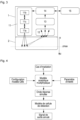
- a non-invasive sensor 1 comprising an adaptation module 14 for measuring the parameter of interest are represented schematically on the figure 2 in the particular case where the target medium 2 is the skin (in this case it is therefore a stratified medium) and the parameter of interest is interstitial blood glucose.
- the non-invasive sensor 1 further comprises a memory for storing a database of model configurations, a correspondence table and one or more inverse models which are described below.
- This storage memory can be distributed and/or shared in/with the adaptation module (14) and/or the simulation module (15).
- the adaptation module 14 carries out the steps of the method which make it possible to choose the model configuration of target medium 2 most adapted to the target medium 2 on the date of the measurement in the database of model configurations, to choose the parameters of optimal irradiation for the measurement on the basis of the correspondence table and to determine the most suitable inverse model, that is to say the most precise, for the calculation of the measured parameter from the signal detected for this particular measurement.
- the model configuration database and the correspondence table are generated from a simulation module 15, embedded in the sensor 1 or remote.
- the simulation module 15 is remote, the non-invasive sensor 1 comprises communication means so that the simulation module 15 and the adaptation module 14 exchange data.
- the simulation module 15 is a computerized device configured to generate a set of model configurations corresponding (or even modeling or describing) each to a particular state of the target medium 2, a set of cases of irradiation of the target medium 2 and the photoacoustic signals (or where appropriate photothermal) theoretically detected in response to each case of irradiation for each CMk model configuration of the target medium 2 from analytical models of the target medium 2 and the photoacoustic (or where applicable photothermal) detection cell 12 , as shown on the figure 4 .
- This simulation module 15 is particularly relevant in the case where the target environment 2 is evolving over time and/or stratified.
- the target medium 2 adopts different real configurations over time (one or more concentrations vary within one or more layers of the target medium 2, one or more dimensions such as, for example, the thickness d 'one of the layers of the target medium 2)) which can each be modeled by a particular model configuration.
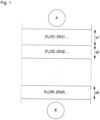
- the target medium 2 to be analyzed is modeled as shown in the figure 1 .
- the target medium 2 separates an external medium A from an internal medium B and is composed of a succession of N layers whose interfaces are for example assumed to be locally planar.
- Each layer i i ⁇ ⁇ 1 , NOT ⁇ is described by the parameter(s) of interest and a certain number of explicit parameters (called level 1 parameters because their values will be provided as input to the simulation module 15 for each simulation) appropriate for the target environment 2 considered.
- the target medium 2 is the skin and we seek to measure a glucose concentration in a layer j of this target medium 2, the target medium 2 will be described by its number of layers N, the concentration [Glc]j of interest, and each layer i can be described for modeling by its thickness ei, its water concentration [H 2 O]i.
- the concentrations [H 2 O]i ( i ⁇ ⁇ 1 , NOT ⁇ ) and the [Glc]i concentrations for ( i ⁇ ⁇ 1 , NOT ⁇ , i ⁇ j) are the level 1 parameters.
- the list of level 1 parameters can be enriched if one wishes to carry out more precise modeling.
- the concentrations of other components of the skin such as fats, lactate, oxygen, etc., can be included in the list of level 1 parameters describing a skin layer.
- Non-explicit parameters of the target environment model 2 can be calculated using analytical models.
- the thermal conductivity, the thermal capacity, the density or even the absorption coefficient at each wavelength of each layer of the target medium 2 can be deduced from the level 1 parameters and from known equations.
- the parameter of interest plays a particular role, it is not included in the list of level 1 parameters. Depending on the stage of the process, this parameter of interest will be known or not: its value is known to carry out the simulations by means of the simulation module 15, but it is of course unknown in the case of a real measurement with the non-invasive sensor 1.
- the number of layers N of the target medium 2 can also be a variable of the model. Still in the example of the skin, depending on the physiological situations, N can thus be greater than or equal to one or two. Thus, for certain physiological situations, the skin can be correctly described by two layers, the first corresponding to the stratum corneum, whose glucose concentration can for example be low, and the second to the rest of the skin, the glucose concentration of the second layer being assimilated to the interstitial glucose concentration to be measured.
- the water concentration of a layer may, for example, increase with the depth at which this layer is located.
- N may therefore not be a constant.
- the external environment A is generally the atmosphere surrounding the patient, which also fills the photoacoustic detection cell.
- the simulation module 15 implements a multiphysics analytical stratified medium 2 model based for example on physical and/or chemical equations such as, by way of non-limiting example, the Beer-Lambert equations for optical absorption and the equations thermodynamics of heat (Fourier's law and conservation laws).
- a model configuration CMk (k positive integer) of target medium 2 corresponds to (or even models) a particular state of the given target medium 2. This particular state is assumed to be correctly represented by the data of the number of layers N and the values of the level 1 parameters for each layer.
- the multiphysics analytical model allows, if the parameter of interest is also known, to simulate the thermal wave generated at the layer interface 1/ external environment A (interface 1/A) in response to irradiation by a light source 11a whose irradiation parameters are known, namely for example the modulation frequency fmod, the wavelength ⁇ and the surface density power.
- the multiphysics analytical model makes it possible to simulate the pressure wave generated in the external environment A.
- the simulated response wave can be provided as input to a processor implementing the detection cell model.
- the non-invasive sensor 1 based on photoacoustic or photothermal detection comprises a photoacoustic (respectively phothermal) detection cell 12 configured to detect and analyze the pressure wave (respectively the thermal wave) generated in the external environment A when the wave thermal generated in the target medium 2 in response to the irradiation reaches the interface 1/A.
- a photoacoustic (respectively phothermal) detection cell 12 configured to detect and analyze the pressure wave (respectively the thermal wave) generated in the external environment A when the wave thermal generated in the target medium 2 in response to the irradiation reaches the interface 1/A.
- the entire detection cell 12 can be modeled analytically. From a response wave simulated by the multiphysics analytical model, which would theoretically be received at the input of the detection cell 12, the detection cell model 12 makes it possible to predict the output signal of the detection cell 12.
- the parameters of the model of the detection cell 12 can include its dimensions (for example the size of the vent, the height of the cell, %), thermodynamic state parameters (temperature, atmospheric pressure, relative or absolute humidity, ).
- the photoacoustic detection cell can in particular be modeled using an equivalent RLC circuit.
- the model described in Dehe, Alfons et al. “The Infineon Silicon MEMS Microphone.” (2013 ) may be suitable.
- this photoacoustic detection cell model a model of the signal processing step carried out by the signal processing module 13 if necessary, so as to generate, from each simulated response wave generated by the processor which implements the analytical multiphysics model, the signal theoretically obtained at the output of the photoacoustic detection cell (and where appropriate after processing of the signal by the signal processing module 13) which corresponds to it.
- the processor of the simulation module 15 can be configured to implement the photoacoustic detection cell model.
- the simulation module 15 therefore receives as input the parameters of the model configuration CMk of target medium 2, that is to say the number of layers N of the target medium 2 and the level 1 parameters for each layer, as well as the parameter of interest and the irradiation parameters of the irradiation case Ij.
- the simulation module 15 provides the signal theoretically expected at the output of the detection cell 12 or, where appropriate, the processed simulated signal theoretically expected at the output of the signal processing module 13 for the CMk model configuration of target medium 2 chosen , called simulated output signal.
- the simulated output signal can be stored in memory as a Fourier spectrum.
- the multiplets ⁇ CMk model configuration of target medium 2, irradiation case Ij, parameter of interest, amplitudes and phases of the components of the simulated output signal ⁇ can be stored in a database of model configurations.
- CMk model configurations each CMk model configuration corresponding to a number of layers N and a set of level 1 parameters, and optionally to a value or range of values of the parameter of interest, describing a particular situation of the target medium 2 of interest.
- each CMk model configuration it is possible to generate, possibly in an automated and/or random manner, a large number of irradiation cases Ij, each irradiation case corresponding to a set of irradiation parameters describing the parameters of the (des) light sources 11a used for irradiation.
- a case of irradiation Ij can therefore include one or more frequencies for modulating the intensity of one or more lasers, the wavelength of each of these lasers and optionally the power irradiated by each laser.
- the simulation module 15 we calculate the amplitude and the phase of each component of the simulated output signal obtained at the output of the processor of the simulation module 15 implementing the global analytical model comprising in cascade the multiphysics analytical model and the model of detection cell for each model configuration CMk for each case of irradiation Ij, a value of the parameter of interest being additionally provided.
- the cases of irradiation Ij can be the same for several different CMk model configurations, and possibly several values of the parameter of interest, or different from one CMk model configuration to another and/or a value of the parameter of interest to another.
- all of these CMk model configurations, irradiation cases, parameters of interest and associated simulated photoacoustic (or where applicable photothermal) signals can be stored in a database of model configurations in the form of bytes ⁇ model configuration CMk, case of irradiation Ij, parameter of interest, amplitude and phase of the components of the simulated output signal ⁇
- CMk model configurations and/or Ij irradiation cases may not be completely random.
- CMk model configurations can, among other things, be based on physiological considerations to restrict the space of possibilities to physiologically realistic model configurations.
- the generation of irradiation cases can in particular take into account the limitations of the light sources 11a available for a non-invasive sensor 1 given in wavelength and/or power, or even of the modulation frequency ranges relevant for the type of target medium 2 to analyze, or wavelengths relevant to the parameter(s) of interest.
- the database of model configurations may only include multiplets ⁇ model configuration CMk, irradiation case Ij, parameter of interest, amplitudes and phases of the components of the signal actually measured ⁇ obtained by experiments in real situations or understand both such multiplets obtained in a real situation and multiplets obtained by simulation.
- an artificial intelligence model can be trained in the simulation module 15.
- the artificial intelligence model after learning, is capable of solving the inverse problem, that is to say finding the parameter(s) of interest and the CMk model configuration of target medium 2, therefore the number of layers N and the level 1 parameters, knowing the simulated photoacoustic signal and the irradiation parameters of the irradiation case, as shown in Figure Figure 5 .
- the learned model which will be called the inverse model subsequently, can be transmitted to the adaptation module 14 and stored in the memory of this module.
- irradiation Ij can be associated with the same CMk model configuration, it is also possible, using statistical analysis and/or artificial intelligence techniques, to identify the case of irradiation Ij which makes it possible to measure the parameter of interest with the desired precision and/or the amount of measurement data allowing the lowest energy consumption.
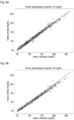
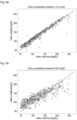
- the interest of the correspondence table can be understood in light of the figures 6a to 9b .
- the context of these figures is that of measuring interstitial blood glucose in the skin.
- Inverse models are trained on a database of model configurations including, in this context, multiplets (model configuration (CMk), irradiation case (Ij), parameter of interest) and an acoustic or thermal signal detected by the detection cell associated with each byte.
- CMk model configuration
- Ij irradiation case
- parameter of interest an acoustic or thermal signal detected by the detection cell associated with each byte.
- the method makes it possible to reduce the energy consumption for each irradiation while controlling the precision of the measurement, thanks to an adaptation of the irradiation case to the detected model configuration.
- the optimal irradiation case selected for all of the two groups can be observed on the figure 6c , for which the irradiation parameters to be selected are ⁇ wavelength 1034 cm -1 ; two different modulation frequencies: 200 Hz and 400 Hz ⁇ and the analysis of the module (equivalently of the amplitude) of the signal detected at each of these frequencies must be carried out.
- the threshold value for the RMSE set for this example at 20 mg/dL, is also exceeded, indicating that other influencing variables must be taken into account to respect this threshold value.
- the correspondence table may possibly include an optimal irradiation case for all groups, particularly with a view to initial irradiation.
- an optimal irradiation case for all groups particularly with a view to initial irradiation.
- the number of irradiation parameters (i.e. the two quantities carrying the most information) was selected to ensure that the RMSE remains less than 20 mg/dL even with irradiation not including all possibilities, and that the precision is better than this threshold value at low blood glucose, according to usage in the field of blood glucose sensors.
- the number of irradiation parameters selected results from a compromise between the power available for each irradiation and the acceptable RMSE.
- the couples ⁇ CMk; I opt. k ⁇ or ⁇ category k of model configurations, Iopt.cat.k ⁇ are stored in a correspondence table in the memory of the non-invasive sensor 1, for example in a memory of the simulation module 15 and/or the adaptation module 14 .
- the inverse models corresponding to each model configuration CMk or each category of model configuration are also stored in the memory of the non-invasive sensor 1, for example in a memory of the simulation module 15 and/or the adaptation module 14.
- the measurement method according to the invention therefore makes it possible to reduce the energy consumption of the sensor 1 compared to the methods of the prior art with identical or even improved precision.
- the method may include at most one step f) of validating the model configuration.
- the method may also include a reiteration of step f) of validating the model configuration.
- CMirrad CMirrad
- CMmes is different from CMirrad
- the adaptation of the irradiation parameters and the model configuration makes it possible to increase the precision of the measurement at the cost of at least one additional irradiation but with energy consumption always controlled, and thanks to the second validation step, to confirm that the precision of the measurement is indeed maximum.
- the reiteration of the validation step is authorized (as shown in the figure 2 )
- we acquire at the output of the process the additional information that the precision of the measurement is indeed maximum.
- the measurement result of the parameter of interest is obtained after the first irradiation or after two irradiations.
- a limitation of the number of validation steps of the model configuration can be provided.
- the physiological situation corresponds to 3 layers each characterized by 2 concentrations (for example water and blood sugar)
- Knowledge of the amplitude and phase of each of the three components of the photoacoustic signal corresponding to well-chosen modulation frequencies and wavelengths should allow the resolution of the inverse problem with the desired precision.
- the difficulty lies in the optimal choice of these optimal modulation frequencies and wavelengths, which is solved by means of the lookup table.
- the consumption of sensor 1 is therefore limited or controlled.
- each irradiation step requires limited power, less than that necessary to obtain a complete absorption spectrum for each possible modulation frequency.
- the artificial intelligence model of the simulation device 15 can be pre-trained on the database of simulated model configurations then re-trained on a database of experimental model configurations, corresponding to real situations for a given patient or a given group of patients, in order to ensure that the inverse model correctly predicts real situations without requiring an exhaustive experimental data set.
- the learning of inverse models may include a transfer learning step.
Landscapes
- Health & Medical Sciences (AREA)
- Life Sciences & Earth Sciences (AREA)
- Engineering & Computer Science (AREA)
- Physics & Mathematics (AREA)
- Biomedical Technology (AREA)
- General Health & Medical Sciences (AREA)
- Public Health (AREA)
- Medical Informatics (AREA)
- Pathology (AREA)
- Surgery (AREA)
- Animal Behavior & Ethology (AREA)
- Molecular Biology (AREA)
- Heart & Thoracic Surgery (AREA)
- Veterinary Medicine (AREA)
- Biophysics (AREA)
- Artificial Intelligence (AREA)
- Mathematical Physics (AREA)
- Optics & Photonics (AREA)
- Spectroscopy & Molecular Physics (AREA)
- Epidemiology (AREA)
- Primary Health Care (AREA)
- Evolutionary Computation (AREA)
- Fuzzy Systems (AREA)
- Signal Processing (AREA)
- Psychiatry (AREA)
- Physiology (AREA)
- Computer Vision & Pattern Recognition (AREA)
- General Physics & Mathematics (AREA)
- Chemical & Material Sciences (AREA)
- Business, Economics & Management (AREA)
- Emergency Medicine (AREA)
- Theoretical Computer Science (AREA)
- Biochemistry (AREA)
- Analytical Chemistry (AREA)
- Immunology (AREA)
- General Business, Economics & Management (AREA)
- Acoustics & Sound (AREA)
- Databases & Information Systems (AREA)
- Data Mining & Analysis (AREA)
- Investigating Or Analysing Materials By Optical Means (AREA)
Priority Applications (8)
| Application Number | Priority Date | Filing Date | Title |
|---|---|---|---|
| DK22163111.2T DK4245218T3 (da) | 2022-03-18 | 2022-03-18 | Ikke-invasiv sensor samt målemetode |
| FIEP22163111.2T FI4245218T3 (en) | 2022-03-18 | 2022-03-18 | NON-INVASIVE SENSOR AND MEASUREMENT METHOD |
| EP22163111.2A EP4245218B1 (fr) | 2022-03-18 | 2022-03-18 | Capteur non invasif et procédé de mesure |
| KR1020247031843A KR20240160597A (ko) | 2022-03-18 | 2023-03-17 | 비침습적 센서 및 측정 방법 |
| CN202380028163.8A CN118891005A (zh) | 2022-03-18 | 2023-03-17 | 无创传感器和测量方法 |
| JP2024555327A JP2025509821A (ja) | 2022-03-18 | 2023-03-17 | 非侵襲センサおよび測定方法 |
| US18/848,496 US20250204790A1 (en) | 2022-03-18 | 2023-03-17 | Non-invasive sensor and measuring method |
| PCT/EP2023/056879 WO2023175139A1 (fr) | 2022-03-18 | 2023-03-17 | Capteur non invasif et procede de mesure |
Applications Claiming Priority (1)
| Application Number | Priority Date | Filing Date | Title |
|---|---|---|---|
| EP22163111.2A EP4245218B1 (fr) | 2022-03-18 | 2022-03-18 | Capteur non invasif et procédé de mesure |
Publications (2)
| Publication Number | Publication Date |
|---|---|
| EP4245218A1 EP4245218A1 (fr) | 2023-09-20 |
| EP4245218B1 true EP4245218B1 (fr) | 2024-05-29 |
Family
ID=81392699
Family Applications (1)
| Application Number | Title | Priority Date | Filing Date |
|---|---|---|---|
| EP22163111.2A Active EP4245218B1 (fr) | 2022-03-18 | 2022-03-18 | Capteur non invasif et procédé de mesure |
Country Status (8)
| Country | Link |
|---|---|
| US (1) | US20250204790A1 (https=) |
| EP (1) | EP4245218B1 (https=) |
| JP (1) | JP2025509821A (https=) |
| KR (1) | KR20240160597A (https=) |
| CN (1) | CN118891005A (https=) |
| DK (1) | DK4245218T3 (https=) |
| FI (1) | FI4245218T3 (https=) |
| WO (1) | WO2023175139A1 (https=) |
Families Citing this family (1)
| Publication number | Priority date | Publication date | Assignee | Title |
|---|---|---|---|---|
| CN120130981A (zh) * | 2025-04-07 | 2025-06-13 | 脑机交互与人机共融海河实验室 | 一种用于精准无创颅内压监测的差分式近红外探头传感器及监测方法 |
Family Cites Families (3)
| Publication number | Priority date | Publication date | Assignee | Title |
|---|---|---|---|---|
| US6574490B2 (en) * | 2001-04-11 | 2003-06-03 | Rio Grande Medical Technologies, Inc. | System for non-invasive measurement of glucose in humans |
| EP2460470A4 (en) | 2009-07-28 | 2015-04-22 | Panasonic Healthcare Co Ltd | DEVICE FOR MEASURING THE BLOOD SUGAR MIRROR |
| EP3133980B1 (en) * | 2014-04-25 | 2020-12-02 | Helmholtz Zentrum München Deutsches Forschungszentrum für Gesundheit und Umwelt (GmbH) | Device and method for frequency-domain thermoacoustic sensing |
-
2022
- 2022-03-18 DK DK22163111.2T patent/DK4245218T3/da active
- 2022-03-18 FI FIEP22163111.2T patent/FI4245218T3/en active
- 2022-03-18 EP EP22163111.2A patent/EP4245218B1/fr active Active
-
2023
- 2023-03-17 WO PCT/EP2023/056879 patent/WO2023175139A1/fr not_active Ceased
- 2023-03-17 KR KR1020247031843A patent/KR20240160597A/ko active Pending
- 2023-03-17 US US18/848,496 patent/US20250204790A1/en active Pending
- 2023-03-17 JP JP2024555327A patent/JP2025509821A/ja active Pending
- 2023-03-17 CN CN202380028163.8A patent/CN118891005A/zh active Pending
Also Published As
| Publication number | Publication date |
|---|---|
| WO2023175139A1 (fr) | 2023-09-21 |
| KR20240160597A (ko) | 2024-11-11 |
| JP2025509821A (ja) | 2025-04-11 |
| EP4245218A1 (fr) | 2023-09-20 |
| DK4245218T3 (da) | 2024-09-02 |
| US20250204790A1 (en) | 2025-06-26 |
| FI4245218T3 (en) | 2024-08-27 |
| CN118891005A (zh) | 2024-11-01 |
Similar Documents
| Publication | Publication Date | Title |
|---|---|---|
| EP1984727B1 (fr) | Procede et dispositif de caracterisation, par pyrometrie active, d'un materiau en couche mince dispose sur un substrat | |
| CA2384526C (fr) | Ensemble de traitement thermique de tissus biologiques et procede de mise en oeuvre de cet ensemble | |
| EP4245218B1 (fr) | Capteur non invasif et procédé de mesure | |
| EP3885765B1 (fr) | Dispositif de détection d'un analyte par détection photoacoustique | |
| US20220257154A1 (en) | Miniaturized noninvasive glucose sensor and continuous glucose monitoring system | |
| EP1265529B1 (fr) | Mesure non invasive du taux de bilirubine de la peau | |
| EP3487412B1 (fr) | Procede de mesure d'un parametre viscoelastique d'un organe humain ou animal | |
| EP3449239B1 (fr) | Procédé et appareil de mesure de la concentration en eau dans un matériau diffusant la lumière. | |
| WO2021023576A1 (fr) | Procédé d'analyse d'un gaz par un capteur optique | |
| EP4275597B1 (fr) | Capteur non invasif et procede de mesure | |
| CN116322481A (zh) | 光声葡萄糖传感器、系统和方法 | |
| EP1573655A1 (fr) | Procede de determination du caractere vivant d'un element porteur d'une empreinte digitale | |
| EP3016277B1 (fr) | Procédé de diagnostic d'un système photovoltaïque | |
| EP3291923B1 (fr) | Procede d'ajustement de parametres de fonctionnement pour l'alimentation d'un tranducteur | |
| EP3724652A1 (fr) | Dispositif, installation et procede d'imagerie de defauts d'une structure par emission et reception d'ondes mecaniques dans cette structure | |
| EP4403095A1 (en) | Process for detecting acoustic leaks in a non-invasive sensor based on indirect photoacoustic detection | |
| Park et al. | Influence of Raman spectrometer collection efficiency on performance of noninvasive blood glucose detection for device miniaturization | |
| EP3291033A1 (fr) | Système et procédé d'estimation du comportement thermique d'un bâtiment, pour un contrôle optimal de chauffage | |
| EP4144292A1 (en) | Process and analyte monitor for estimating a quantity in mathematical relationship with an analyte concentration level in a target | |
| EP4368097A1 (en) | Process for non-invasively analyzing a multilayer medium | |
| WO2025237534A1 (en) | Process for detecting acoustic leaks in a non-invasive sensor based on indirect photoacoustic detection | |
| EP2981213A1 (fr) | Procede et systeme de caracterisation d'un tissu osseux | |
| EP2667208A1 (fr) | Système électronique à capteurs intégrés, procédé d'estimation de valeur de grandeur physique de fonctionnement et programme d'ordinateur correspondant | |
| FR3144285A1 (fr) | Procédé d ’analyse d’un objet comportant plusieurs couches superposées, par mesures de réflectance optique. | |
| CN116568215A (zh) | 使用具有单波长的激光组合的光声诊断设备和方法 |
Legal Events
| Date | Code | Title | Description |
|---|---|---|---|
| PUAI | Public reference made under article 153(3) epc to a published international application that has entered the european phase |
Free format text: ORIGINAL CODE: 0009012 |
|
| STAA | Information on the status of an ep patent application or granted ep patent |
Free format text: STATUS: REQUEST FOR EXAMINATION WAS MADE |
|
| 17P | Request for examination filed |
Effective date: 20220920 |
|
| AK | Designated contracting states |
Kind code of ref document: A1 Designated state(s): AL AT BE BG CH CY CZ DE DK EE ES FI FR GB GR HR HU IE IS IT LI LT LU LV MC MK MT NL NO PL PT RO RS SE SI SK SM TR |
|
| GRAP | Despatch of communication of intention to grant a patent |
Free format text: ORIGINAL CODE: EPIDOSNIGR1 |
|
| STAA | Information on the status of an ep patent application or granted ep patent |
Free format text: STATUS: GRANT OF PATENT IS INTENDED |
|
| INTG | Intention to grant announced |
Effective date: 20231221 |
|
| GRAS | Grant fee paid |
Free format text: ORIGINAL CODE: EPIDOSNIGR3 |
|
| GRAA | (expected) grant |
Free format text: ORIGINAL CODE: 0009210 |
|
| STAA | Information on the status of an ep patent application or granted ep patent |
Free format text: STATUS: THE PATENT HAS BEEN GRANTED |
|
| AK | Designated contracting states |
Kind code of ref document: B1 Designated state(s): AL AT BE BG CH CY CZ DE DK EE ES FI FR GB GR HR HU IE IS IT LI LT LU LV MC MK MT NL NO PL PT RO RS SE SI SK SM TR |
|
| REG | Reference to a national code |
Ref country code: CH Ref legal event code: EP |
|
| REG | Reference to a national code |
Ref country code: IE Ref legal event code: FG4D Free format text: LANGUAGE OF EP DOCUMENT: FRENCH |
|
| REG | Reference to a national code |
Ref country code: DE Ref legal event code: R096 Ref document number: 602022003625 Country of ref document: DE |
|
| REG | Reference to a national code |
Ref country code: FI Ref legal event code: FGE |
|
| REG | Reference to a national code |
Ref country code: DK Ref legal event code: T3 Effective date: 20240827 |
|
| REG | Reference to a national code |
Ref country code: SE Ref legal event code: TRGR |
|
| REG | Reference to a national code |
Ref country code: NL Ref legal event code: FP |
|
| RAP4 | Party data changed (patent owner data changed or rights of a patent transferred) |
Owner name: ECLYPIA |
|
| REG | Reference to a national code |
Ref country code: LT Ref legal event code: MG9D |
|
| PG25 | Lapsed in a contracting state [announced via postgrant information from national office to epo] |
Ref country code: IS Free format text: LAPSE BECAUSE OF FAILURE TO SUBMIT A TRANSLATION OF THE DESCRIPTION OR TO PAY THE FEE WITHIN THE PRESCRIBED TIME-LIMIT Effective date: 20240929 |
|
| PG25 | Lapsed in a contracting state [announced via postgrant information from national office to epo] |
Ref country code: BG Free format text: LAPSE BECAUSE OF FAILURE TO SUBMIT A TRANSLATION OF THE DESCRIPTION OR TO PAY THE FEE WITHIN THE PRESCRIBED TIME-LIMIT Effective date: 20240529 |
|
| PG25 | Lapsed in a contracting state [announced via postgrant information from national office to epo] |
Ref country code: HR Free format text: LAPSE BECAUSE OF FAILURE TO SUBMIT A TRANSLATION OF THE DESCRIPTION OR TO PAY THE FEE WITHIN THE PRESCRIBED TIME-LIMIT Effective date: 20240529 |
|
| PG25 | Lapsed in a contracting state [announced via postgrant information from national office to epo] |
Ref country code: GR Free format text: LAPSE BECAUSE OF FAILURE TO SUBMIT A TRANSLATION OF THE DESCRIPTION OR TO PAY THE FEE WITHIN THE PRESCRIBED TIME-LIMIT Effective date: 20240830 |
|
| REG | Reference to a national code |
Ref country code: AT Ref legal event code: MK05 Ref document number: 1689945 Country of ref document: AT Kind code of ref document: T Effective date: 20240529 |
|
| PG25 | Lapsed in a contracting state [announced via postgrant information from national office to epo] |
Ref country code: ES Free format text: LAPSE BECAUSE OF FAILURE TO SUBMIT A TRANSLATION OF THE DESCRIPTION OR TO PAY THE FEE WITHIN THE PRESCRIBED TIME-LIMIT Effective date: 20240529 |
|
| PG25 | Lapsed in a contracting state [announced via postgrant information from national office to epo] |
Ref country code: AT Free format text: LAPSE BECAUSE OF FAILURE TO SUBMIT A TRANSLATION OF THE DESCRIPTION OR TO PAY THE FEE WITHIN THE PRESCRIBED TIME-LIMIT Effective date: 20240529 |
|
| PG25 | Lapsed in a contracting state [announced via postgrant information from national office to epo] |
Ref country code: PL Free format text: LAPSE BECAUSE OF FAILURE TO SUBMIT A TRANSLATION OF THE DESCRIPTION OR TO PAY THE FEE WITHIN THE PRESCRIBED TIME-LIMIT Effective date: 20240529 |
|
| PG25 | Lapsed in a contracting state [announced via postgrant information from national office to epo] |
Ref country code: LV Free format text: LAPSE BECAUSE OF FAILURE TO SUBMIT A TRANSLATION OF THE DESCRIPTION OR TO PAY THE FEE WITHIN THE PRESCRIBED TIME-LIMIT Effective date: 20240529 |
|
| PG25 | Lapsed in a contracting state [announced via postgrant information from national office to epo] |
Ref country code: PL Free format text: LAPSE BECAUSE OF FAILURE TO SUBMIT A TRANSLATION OF THE DESCRIPTION OR TO PAY THE FEE WITHIN THE PRESCRIBED TIME-LIMIT Effective date: 20240529 Ref country code: LV Free format text: LAPSE BECAUSE OF FAILURE TO SUBMIT A TRANSLATION OF THE DESCRIPTION OR TO PAY THE FEE WITHIN THE PRESCRIBED TIME-LIMIT Effective date: 20240529 Ref country code: IS Free format text: LAPSE BECAUSE OF FAILURE TO SUBMIT A TRANSLATION OF THE DESCRIPTION OR TO PAY THE FEE WITHIN THE PRESCRIBED TIME-LIMIT Effective date: 20240929 Ref country code: HR Free format text: LAPSE BECAUSE OF FAILURE TO SUBMIT A TRANSLATION OF THE DESCRIPTION OR TO PAY THE FEE WITHIN THE PRESCRIBED TIME-LIMIT Effective date: 20240529 Ref country code: GR Free format text: LAPSE BECAUSE OF FAILURE TO SUBMIT A TRANSLATION OF THE DESCRIPTION OR TO PAY THE FEE WITHIN THE PRESCRIBED TIME-LIMIT Effective date: 20240830 Ref country code: ES Free format text: LAPSE BECAUSE OF FAILURE TO SUBMIT A TRANSLATION OF THE DESCRIPTION OR TO PAY THE FEE WITHIN THE PRESCRIBED TIME-LIMIT Effective date: 20240529 Ref country code: BG Free format text: LAPSE BECAUSE OF FAILURE TO SUBMIT A TRANSLATION OF THE DESCRIPTION OR TO PAY THE FEE WITHIN THE PRESCRIBED TIME-LIMIT Effective date: 20240529 Ref country code: AT Free format text: LAPSE BECAUSE OF FAILURE TO SUBMIT A TRANSLATION OF THE DESCRIPTION OR TO PAY THE FEE WITHIN THE PRESCRIBED TIME-LIMIT Effective date: 20240529 Ref country code: RS Free format text: LAPSE BECAUSE OF FAILURE TO SUBMIT A TRANSLATION OF THE DESCRIPTION OR TO PAY THE FEE WITHIN THE PRESCRIBED TIME-LIMIT Effective date: 20240829 |
|
| PG25 | Lapsed in a contracting state [announced via postgrant information from national office to epo] |
Ref country code: EE Free format text: LAPSE BECAUSE OF FAILURE TO SUBMIT A TRANSLATION OF THE DESCRIPTION OR TO PAY THE FEE WITHIN THE PRESCRIBED TIME-LIMIT Effective date: 20240529 |
|
| PG25 | Lapsed in a contracting state [announced via postgrant information from national office to epo] |
Ref country code: CZ Free format text: LAPSE BECAUSE OF FAILURE TO SUBMIT A TRANSLATION OF THE DESCRIPTION OR TO PAY THE FEE WITHIN THE PRESCRIBED TIME-LIMIT Effective date: 20240529 |
|
| PG25 | Lapsed in a contracting state [announced via postgrant information from national office to epo] |
Ref country code: RO Free format text: LAPSE BECAUSE OF FAILURE TO SUBMIT A TRANSLATION OF THE DESCRIPTION OR TO PAY THE FEE WITHIN THE PRESCRIBED TIME-LIMIT Effective date: 20240529 Ref country code: SK Free format text: LAPSE BECAUSE OF FAILURE TO SUBMIT A TRANSLATION OF THE DESCRIPTION OR TO PAY THE FEE WITHIN THE PRESCRIBED TIME-LIMIT Effective date: 20240529 |
|
| PG25 | Lapsed in a contracting state [announced via postgrant information from national office to epo] |
Ref country code: SM Free format text: LAPSE BECAUSE OF FAILURE TO SUBMIT A TRANSLATION OF THE DESCRIPTION OR TO PAY THE FEE WITHIN THE PRESCRIBED TIME-LIMIT Effective date: 20240529 |
|
| PG25 | Lapsed in a contracting state [announced via postgrant information from national office to epo] |
Ref country code: SM Free format text: LAPSE BECAUSE OF FAILURE TO SUBMIT A TRANSLATION OF THE DESCRIPTION OR TO PAY THE FEE WITHIN THE PRESCRIBED TIME-LIMIT Effective date: 20240529 Ref country code: SK Free format text: LAPSE BECAUSE OF FAILURE TO SUBMIT A TRANSLATION OF THE DESCRIPTION OR TO PAY THE FEE WITHIN THE PRESCRIBED TIME-LIMIT Effective date: 20240529 Ref country code: RO Free format text: LAPSE BECAUSE OF FAILURE TO SUBMIT A TRANSLATION OF THE DESCRIPTION OR TO PAY THE FEE WITHIN THE PRESCRIBED TIME-LIMIT Effective date: 20240529 Ref country code: EE Free format text: LAPSE BECAUSE OF FAILURE TO SUBMIT A TRANSLATION OF THE DESCRIPTION OR TO PAY THE FEE WITHIN THE PRESCRIBED TIME-LIMIT Effective date: 20240529 Ref country code: CZ Free format text: LAPSE BECAUSE OF FAILURE TO SUBMIT A TRANSLATION OF THE DESCRIPTION OR TO PAY THE FEE WITHIN THE PRESCRIBED TIME-LIMIT Effective date: 20240529 |
|
| REG | Reference to a national code |
Ref country code: DE Ref legal event code: R097 Ref document number: 602022003625 Country of ref document: DE |
|
| PLBE | No opposition filed within time limit |
Free format text: ORIGINAL CODE: 0009261 |
|
| STAA | Information on the status of an ep patent application or granted ep patent |
Free format text: STATUS: NO OPPOSITION FILED WITHIN TIME LIMIT |
|
| PGFP | Annual fee paid to national office [announced via postgrant information from national office to epo] |
Ref country code: SE Payment date: 20250328 Year of fee payment: 4 |
|
| PGFP | Annual fee paid to national office [announced via postgrant information from national office to epo] |
Ref country code: DK Payment date: 20250328 Year of fee payment: 4 Ref country code: NL Payment date: 20250328 Year of fee payment: 4 Ref country code: FI Payment date: 20250328 Year of fee payment: 4 |
|
| PG25 | Lapsed in a contracting state [announced via postgrant information from national office to epo] |
Ref country code: SI Free format text: LAPSE BECAUSE OF FAILURE TO SUBMIT A TRANSLATION OF THE DESCRIPTION OR TO PAY THE FEE WITHIN THE PRESCRIBED TIME-LIMIT Effective date: 20240529 |
|
| PGFP | Annual fee paid to national office [announced via postgrant information from national office to epo] |
Ref country code: BE Payment date: 20250327 Year of fee payment: 4 |
|
| 26N | No opposition filed |
Effective date: 20250303 |
|
| PGFP | Annual fee paid to national office [announced via postgrant information from national office to epo] |
Ref country code: NO Payment date: 20250331 Year of fee payment: 4 |
|
| PGFP | Annual fee paid to national office [announced via postgrant information from national office to epo] |
Ref country code: IT Payment date: 20250331 Year of fee payment: 4 |
|
| PG25 | Lapsed in a contracting state [announced via postgrant information from national office to epo] |
Ref country code: MC Free format text: LAPSE BECAUSE OF FAILURE TO SUBMIT A TRANSLATION OF THE DESCRIPTION OR TO PAY THE FEE WITHIN THE PRESCRIBED TIME-LIMIT Effective date: 20240529 |
|
| REG | Reference to a national code |
Ref country code: CH Ref legal event code: H13 Free format text: ST27 STATUS EVENT CODE: U-0-0-H10-H13 (AS PROVIDED BY THE NATIONAL OFFICE) Effective date: 20251023 |
|
| PG25 | Lapsed in a contracting state [announced via postgrant information from national office to epo] |
Ref country code: LU Free format text: LAPSE BECAUSE OF NON-PAYMENT OF DUE FEES Effective date: 20250318 |
|
| PG25 | Lapsed in a contracting state [announced via postgrant information from national office to epo] |
Ref country code: CH Free format text: LAPSE BECAUSE OF NON-PAYMENT OF DUE FEES Effective date: 20250331 |
|
| PG25 | Lapsed in a contracting state [announced via postgrant information from national office to epo] |
Ref country code: IE Free format text: LAPSE BECAUSE OF NON-PAYMENT OF DUE FEES Effective date: 20250318 |
|
| PGFP | Annual fee paid to national office [announced via postgrant information from national office to epo] |
Ref country code: GB Payment date: 20260302 Year of fee payment: 5 |
|
| PGFP | Annual fee paid to national office [announced via postgrant information from national office to epo] |
Ref country code: DE Payment date: 20260227 Year of fee payment: 5 |
|
| PGFP | Annual fee paid to national office [announced via postgrant information from national office to epo] |
Ref country code: FR Payment date: 20260324 Year of fee payment: 5 |