EP4243157A1 - Sekundärbatterie mit gasadsorptionsmaterial und sekundärbatteriemodul - Google Patents
Sekundärbatterie mit gasadsorptionsmaterial und sekundärbatteriemodul Download PDFInfo
- Publication number
- EP4243157A1 EP4243157A1 EP22895851.8A EP22895851A EP4243157A1 EP 4243157 A1 EP4243157 A1 EP 4243157A1 EP 22895851 A EP22895851 A EP 22895851A EP 4243157 A1 EP4243157 A1 EP 4243157A1
- Authority
- EP
- European Patent Office
- Prior art keywords
- secondary battery
- gas
- adsorbing material
- case
- battery
- Prior art date
- Legal status (The legal status is an assumption and is not a legal conclusion. Google has not performed a legal analysis and makes no representation as to the accuracy of the status listed.)
- Pending
Links
Images


Classifications
-
- H—ELECTRICITY
- H01—ELECTRIC ELEMENTS
- H01M—PROCESSES OR MEANS, e.g. BATTERIES, FOR THE DIRECT CONVERSION OF CHEMICAL ENERGY INTO ELECTRICAL ENERGY
- H01M50/00—Constructional details or processes of manufacture of the non-active parts of electrochemical cells other than fuel cells, e.g. hybrid cells
- H01M50/10—Primary casings; Jackets or wrappings
- H01M50/116—Primary casings; Jackets or wrappings characterised by the material
- H01M50/124—Primary casings; Jackets or wrappings characterised by the material having a layered structure
- H01M50/1243—Primary casings; Jackets or wrappings characterised by the material having a layered structure characterised by the internal coating on the casing
-
- H—ELECTRICITY
- H01—ELECTRIC ELEMENTS
- H01M—PROCESSES OR MEANS, e.g. BATTERIES, FOR THE DIRECT CONVERSION OF CHEMICAL ENERGY INTO ELECTRICAL ENERGY
- H01M10/00—Secondary cells; Manufacture thereof
- H01M10/05—Accumulators with non-aqueous electrolyte
-
- H—ELECTRICITY
- H01—ELECTRIC ELEMENTS
- H01M—PROCESSES OR MEANS, e.g. BATTERIES, FOR THE DIRECT CONVERSION OF CHEMICAL ENERGY INTO ELECTRICAL ENERGY
- H01M10/00—Secondary cells; Manufacture thereof
- H01M10/42—Methods or arrangements for servicing or maintenance of secondary cells or secondary half-cells
- H01M10/52—Removing gases inside the secondary cell, e.g. by absorption
-
- H—ELECTRICITY
- H01—ELECTRIC ELEMENTS
- H01M—PROCESSES OR MEANS, e.g. BATTERIES, FOR THE DIRECT CONVERSION OF CHEMICAL ENERGY INTO ELECTRICAL ENERGY
- H01M50/00—Constructional details or processes of manufacture of the non-active parts of electrochemical cells other than fuel cells, e.g. hybrid cells
- H01M50/30—Arrangements for facilitating escape of gases
- H01M50/342—Non-re-sealable arrangements
- H01M50/3425—Non-re-sealable arrangements in the form of rupturable membranes or weakened parts, e.g. pierced with the aid of a sharp member
-
- H—ELECTRICITY
- H01—ELECTRIC ELEMENTS
- H01M—PROCESSES OR MEANS, e.g. BATTERIES, FOR THE DIRECT CONVERSION OF CHEMICAL ENERGY INTO ELECTRICAL ENERGY
- H01M50/00—Constructional details or processes of manufacture of the non-active parts of electrochemical cells other than fuel cells, e.g. hybrid cells
- H01M50/30—Arrangements for facilitating escape of gases
- H01M50/375—Vent means sensitive to or responsive to temperature
-
- H—ELECTRICITY
- H01—ELECTRIC ELEMENTS
- H01M—PROCESSES OR MEANS, e.g. BATTERIES, FOR THE DIRECT CONVERSION OF CHEMICAL ENERGY INTO ELECTRICAL ENERGY
- H01M50/00—Constructional details or processes of manufacture of the non-active parts of electrochemical cells other than fuel cells, e.g. hybrid cells
- H01M50/30—Arrangements for facilitating escape of gases
- H01M50/394—Gas-pervious parts or elements
-
- B—PERFORMING OPERATIONS; TRANSPORTING
- B01—PHYSICAL OR CHEMICAL PROCESSES OR APPARATUS IN GENERAL
- B01D—SEPARATION
- B01D53/00—Separation of gases or vapours; Recovering vapours of volatile solvents from gases; Chemical or biological purification of waste gases, e.g. engine exhaust gases, smoke, fumes, flue gases, aerosols
- B01D53/02—Separation of gases or vapours; Recovering vapours of volatile solvents from gases; Chemical or biological purification of waste gases, e.g. engine exhaust gases, smoke, fumes, flue gases, aerosols by adsorption, e.g. preparative gas chromatography
- B01D53/04—Separation of gases or vapours; Recovering vapours of volatile solvents from gases; Chemical or biological purification of waste gases, e.g. engine exhaust gases, smoke, fumes, flue gases, aerosols by adsorption, e.g. preparative gas chromatography with stationary adsorbents
-
- H—ELECTRICITY
- H01—ELECTRIC ELEMENTS
- H01M—PROCESSES OR MEANS, e.g. BATTERIES, FOR THE DIRECT CONVERSION OF CHEMICAL ENERGY INTO ELECTRICAL ENERGY
- H01M2200/00—Safety devices for primary or secondary batteries
- H01M2200/10—Temperature sensitive devices
-
- H—ELECTRICITY
- H01—ELECTRIC ELEMENTS
- H01M—PROCESSES OR MEANS, e.g. BATTERIES, FOR THE DIRECT CONVERSION OF CHEMICAL ENERGY INTO ELECTRICAL ENERGY
- H01M2200/00—Safety devices for primary or secondary batteries
- H01M2200/20—Pressure-sensitive devices
-
- H—ELECTRICITY
- H01—ELECTRIC ELEMENTS
- H01M—PROCESSES OR MEANS, e.g. BATTERIES, FOR THE DIRECT CONVERSION OF CHEMICAL ENERGY INTO ELECTRICAL ENERGY
- H01M50/00—Constructional details or processes of manufacture of the non-active parts of electrochemical cells other than fuel cells, e.g. hybrid cells
- H01M50/10—Primary casings; Jackets or wrappings
- H01M50/102—Primary casings; Jackets or wrappings characterised by their shape or physical structure
- H01M50/105—Pouches or flexible bags
-
- H—ELECTRICITY
- H01—ELECTRIC ELEMENTS
- H01M—PROCESSES OR MEANS, e.g. BATTERIES, FOR THE DIRECT CONVERSION OF CHEMICAL ENERGY INTO ELECTRICAL ENERGY
- H01M50/00—Constructional details or processes of manufacture of the non-active parts of electrochemical cells other than fuel cells, e.g. hybrid cells
- H01M50/10—Primary casings; Jackets or wrappings
- H01M50/172—Arrangements of electric connectors penetrating the casing
- H01M50/174—Arrangements of electric connectors penetrating the casing adapted for the shape of the cells
- H01M50/178—Arrangements of electric connectors penetrating the casing adapted for the shape of the cells for pouch or flexible bag cells
-
- H—ELECTRICITY
- H01—ELECTRIC ELEMENTS
- H01M—PROCESSES OR MEANS, e.g. BATTERIES, FOR THE DIRECT CONVERSION OF CHEMICAL ENERGY INTO ELECTRICAL ENERGY
- H01M50/00—Constructional details or processes of manufacture of the non-active parts of electrochemical cells other than fuel cells, e.g. hybrid cells
- H01M50/30—Arrangements for facilitating escape of gases
- H01M50/383—Flame arresting or ignition-preventing means
-
- Y—GENERAL TAGGING OF NEW TECHNOLOGICAL DEVELOPMENTS; GENERAL TAGGING OF CROSS-SECTIONAL TECHNOLOGIES SPANNING OVER SEVERAL SECTIONS OF THE IPC; TECHNICAL SUBJECTS COVERED BY FORMER USPC CROSS-REFERENCE ART COLLECTIONS [XRACs] AND DIGESTS
- Y02—TECHNOLOGIES OR APPLICATIONS FOR MITIGATION OR ADAPTATION AGAINST CLIMATE CHANGE
- Y02E—REDUCTION OF GREENHOUSE GAS [GHG] EMISSIONS, RELATED TO ENERGY GENERATION, TRANSMISSION OR DISTRIBUTION
- Y02E60/00—Enabling technologies; Technologies with a potential or indirect contribution to GHG emissions mitigation
- Y02E60/10—Energy storage using batteries
Definitions
- the present invention relates to a secondary battery that has a material, which adsorbs/desorbs gas depending on the temperature condition, coated on the inner side of a battery case, and it relates to a secondary battery module including the same.
- a prismatic secondary battery and a pouch-type secondary battery which can be applied to appliances such as a mobile phone in a thin layer
- lithium secondary batteries such as a lithium-ion battery and a lithium-ion polymer battery which have advantages such as high energy density, high discharge voltage, high output stability, etc.
- the lithium secondary battery has drawbacks in terms of stability. Specifically, gas is generated when electrolyte reacts during first charging, aging, and charge/discharge right after electrolyte gets injected into a battery assembly. And the gas generated causes problems such as decrease in capacity and lithium deposition by being trapped inside the battery.
- the pressure between the case and the battery assembly also known as the dead space
- the pressure between the case and the battery assembly also known as the dead space
- the gas trapped inside the battery assembly hard to be emitted to the dead space
- the battery performance may be degenerated due to the trapped gas.
- it increases the internal pressure of the battery and causes deformation in a cylindrical or a prismatic battery case, and serious problems such as explosion of a secondary battery may also occur.
- means of gas emission are often formed on the case in order to lower the internal pressure by emitting gas generated inside the secondary battery case to the outside.
- means of gas emission rupture in relatively high critical temperature and because the internal pressure of the battery slowly increases, when one among the multiple individual secondary batteries within the secondary battery module shows abnormal increase in temperature, heat is transferred to the adjacent secondary battery, and it can either cause a normal secondary battery to stop working due to series of rupture in means of gas emission, or cause decrease in the battery performance.
- the present invention is invented to solve above-mentioned problems, and it is directed to provide a secondary battery and a secondary battery module comprising the same that adsorbs gas inside the battery in a normal operating temperature, and that can vent gas to the outside of the case by quickly emitting gas to increase the internal pressure and quickly reaching a pressure critical point when abnormal increase in the temperature occurs.
- the present invention is also directed to provide a secondary battery that adsorbs gas generated in a normal operating temperature of a secondary battery, inhibits deformation in the battery case by lowering the pressure inside the battery case, and does not degrade the battery performance.
- the present invention in one embodiment, provides a secondary battery that includes an electrode assembly
- the gas adsorbing material may have a critical temperature between 70 and 150°C, and it may adsorb internal gas below the critical temperature and may desorb internal gas at or above the critical temperature.
- Such gas adsorbing material may include a diamine compound that includes one or more metals selected from the group consisting of magnesium, manganese, iron, zinc, and cobalt, and the diamine compound may comprise one or more selected from the group consisting of mmen-Mg2(dobpdc), mmen-Mn2(dobpdc), mmen-Fe2(dobpdc), mmen-Zn2(dobpdc), and mmen-Co2(dobpdc).
- the gas adsorbing material may include one or more selected from the group consisting of carbon fiber, activated carbon, zeolite, alumina, silica, bauxite, and molecular sieves.
- the coating layer may include a first gas adsorbing material that has a critical temperature of 70 to 110°C; a second gas adsorbing material that has a critical temperature of 110 to 140°C; and a binder.
- first gas adsorbing material and the second gas adsorbing material each may be included at 60 to 80wt% and 19 to 50% with respect to the total weight of the coating layer.
- the coating layer may have an average thickness of 50 ⁇ m to 500 ⁇ m.
- the coating layer may have a pattern structure with an area ratio of 50 to 90% with respect to the total surface area of the case.
- the internal gas may include one or more selected from the group consisting of oxygen (O 2 ), hydrogen (H 2 ), ethylene (C 2 H 4 ), acetylene (C 2 H 2 ), propylene (C 3 H 6 ), carbon monoxide (CO), carbon dioxide (CO 2 ), methane (CH 4 ), ethane (CH 3 CH 3 ), propane (CH 3 CH 2 CH 3 ), nitrogen monoxide (NO) and nitrogen dioxide (NO 2 ).
- the secondary battery may also include a means of gas emission venting under pressure.
- the present invention provides a secondary battery module that includes the secondary battery according to the present invention described above.
- the secondary battery according to the present invention by having a gas adsorbing material that adsorbs gas in a normal operating temperature on the basis of a critical temperature, and desorbs internal gas adsorbed in a high temperature coated on the inner side of the case, it is possible to reach an internal pressure critical point in a short time when exposed to an abnormally high temperature, thus it can better improve the safety for heat transfer and fire in the battery because it can hasten the internal gas emission time point.
- the secondary battery inhibits deformation of the battery case by adsorbing gas generated in a normal operating temperature range and lowering the pressure inside the battery case, and it has an excellent effect in not degrading the battery performance.
- the present invention in one embodiment, provides a secondary battery that includes an electrode assembly
- the secondary battery according to the present invention includes an electrode assembly, and the electrode assembly has a shape inserted into a case.
- the case can be widely applied depending on the shape, structure, and manufacturing method of the secondary battery, it can specifically be applied to a cylindrical, prismatic, pouch-type, etc.
- the case mentioned above may be a pouch-type case.
- the case may have a coating layer on its inner side containing a gas adsorbing material that adsorbs or desorbs internal gas generated during charge/discharge of the secondary battery.
- the case may include a coating layer in a mixed form of a gas adsorbing material and a binder that fixes it on the inner surface where an electrode assembly is being placed.
- the gas adsorbing material contained in the coating layer has a critical temperature of 70 to 150°C, and it may adsorb internal gas below the critical temperature and may desorb internal gas at or above the critical temperature. That is, the gas adsorbing material lowers the pressure inside the case by adsorbing internal gas generated due to charge/discharge of the battery in a normal operating temperature which is at or below the critical temperature, and when heat gets generated above the critical temperature due to abnormal operation of the battery, it can quickly vent open the internal gas before thermal runaway by desorbing the adsorbed gas and increasing the gas pressure inside the case in a short time or in an instant.
- the gas adsorbing material may have a critical temperature of 70 to 150°C, specifically between 70 ⁇ 130°C; 70 ⁇ 110°C; 70 ⁇ 90°C; 90 ⁇ 120°C; 100 ⁇ 110°C; 110 ⁇ 125°C; or 120 ⁇ 140°C.
- the present invention adsorbs internal gas in a normal operation temperature and effectively desorbs gas in an abnormal operation temperature, for example, in heating condition, to increase internal pressure in a short time or in an instant, by controlling the critical temperature of gas adsorbing material to the above range.
- gas adsorbing material may be applied without being limited so long as it is adsorbing or desorbing gas on the basis of a critical temperature between 70 and 150°C, it may specifically comprise a diamine compound including one or more metals selected from the group consisting of magnesium, manganese, iron, zinc, and cobalt.
- a diamine compound including one or more metals selected from the group consisting of magnesium, manganese, iron, zinc, and cobalt.
- materials that collect gas by having a porous structure such as carbon fiber, activated carbon, zeolite, alumina, silica, bauxite, and molecular sieves, etc. can be used alone or in combination.
- the gas adsorbing material may include the diamine compound with a critical temperature between 70 and 90°C including one or more selected from the group consisting of mmen-Mg 2 (dobpdc), mmen-Mn 2 (dobpdc), mmen-Fe 2 (dobpdc), mmen-Zn 2 (dobpdc), and mmen-Co 2 (dobpdc).
- mmen means N,N-diethylethylenediamine
- Dobpdc means 4,4'-dioxidobiphenyl-3,3'-dicarboxylate.
- the diamine compound is an uncoordinated amine compound of mmen molecule, eliminating acidic protons from the metal binding amine of neighboring mmen molecule, and phase transition occurs during gas (CO 2 , for example) adsorption where carbamate that has opposite cation to that of ammonium is formed. If an appropriate temperature and pressure are applied, rearrangement of carbamate becomes possible, where M-N bond breaks and M-O bond is formed. The ion-pairing interaction elongates the mmen molecule and makes M-N bond unstable, stimulating gas (CO 2 , for example) insertion into the next metallic part.
- Such synergistic effect is extended until a complete one-dimensional ammonium-carbamate chain is formed, and large amount of gas (CO 2 , for example) is adsorbed due to the synergistic effect, causing the adsorption isotherm to appear in a steep vertical form.
- gas CO 2 , for example
- the metal-amine bonding strength varies depending on the type of divalent metal M, causing the location of the adsorption stage and the desorption stage to be different, and the location of the adsorption stage and the desorption stage given the same temperature changes in the order of Mg ⁇ Mn ⁇ Fe ⁇ Zn ⁇ Co. That is, internal gas is adsorbed when the mmen-M 2 (dobpdc) is lower than the critical temperature and internal gas is emitted when the mmen-M 2 (dobpdc) is higher than the critical temperature, and the critical temperature where the adsorption and desorption of internal gas is switched can be controlled by selecting an appropriate M.
- the present invention uses the gas (CO 2 , for example) adsorption and desorption properties of mmen-M 2 (dobpdc), and the internal gas such as CO 2 that is generated during the normal charge-discharge process of the secondary battery increases the adsorption rate using a gas adsorbing material of the mmen-M 2 (dobpdc).
- CO 2 gas adsorption and desorption properties of mmen-M 2
- the internal gas such as CO 2 that is generated during the normal charge-discharge process of the secondary battery increases the adsorption rate using a gas adsorbing material of the mmen-M 2 (dobpdc).
- an abnormal reaction such as temperature rise due to a short circuit in the secondary battery occurs, it sharply raises the internal pressure of the secondary battery case by rapidly desorbing internal gas that has been adsorbed into the gas adsorbing material at temperature at or above the critical temperature, causing the gas to be emitted by rupturing the rupture element of
- the gas adsorbing material may be a zeolite, activated alumina, and/or silica gel that has a critical temperature between 110 and 140°C. While zeolite, activated alumina, and/or silica gel contain the same chemical components, their critical temperature may vary due to a post-treatment process such as a heat treatment, a surface treatment, and a surface coating, as well as due to processing condition in manufacturing or doping within the material. And the critical temperature may be appropriately controlled in accordance with the internal temperature range predicted based on the operating condition of the secondary battery.
- the coating layer contains a gas adsorbing material
- it may contain two or more gas adsorbing materials with different critical temperature.
- internal gas can be easily controlled to a predetermined temperature range for it to be emitted.
- the coating layer may include a first gas adsorbing material that has a critical temperature between 70 and 110°C; a second gas adsorbing material that has a critical temperature between 110 and 140°C; and a binder.
- the coating layer may include a first gas adsorbing material that has a critical temperature between 80 and 95°C; a second gas adsorbing material that has a critical temperature between 115 and 130°C; and a binder.
- the coating layer may include a first gas adsorbing material that has a critical temperature between 100 and 110°C; a second gas adsorbing material that has a critical temperature between 110 and 120°C; and a binder.
- the first gas adsorbing material adsorbs the gas generated during normal operation of the secondary battery and/or from internal temperature condition below the critical temperature and reduces the internal pressure, if the internal temperature exceeds the critical temperature, 70 ⁇ 110°C in specific, due to an abnormal operation of the secondary battery, it may substantially increase the internal pressure by desorbing the adsorbed gas.
- the second gas adsorbing material has a higher critical temperature compared to that of the first gas adsorbing material, it can prevent the damage in an electrode assembly inserted into the secondary battery by partially adsorbing gas desorbed from the first gas adsorbing material when the internal temperature exceeds the critical temperature of the first gas adsorbing material due to an abnormal operation of the secondary battery. It may also increase the internal pressure of the secondary battery in a short time or in an instant by desorbing the adsorbed gas before heat transfer occurs to the secondary battery adjacent to the relevant secondary battery inside the secondary battery.
- the first gas adsorbing material may have a critical temperature that is lower than the temperature where heat transfer of the secondary battery occurs.
- first and the second adsorbing materials may be included into the coating layer with a certain weight ratio.
- the first gas adsorbing material and the second gas adsorbing material may each be comprised at 60 to 80wt% and 19 to 50% with respect to the total weight of the coating layer, and more specifically they may each be comprised at 65 to 75wt% and 24 to 40wt%; or 62 to 70wt% and 29 to 35wt% with respect to the total weight.
- the present invention by controlling the content of the first and the second gas adsorbing material contained in the coating layer to the above range, can keep the internal pressure of the battery low in a normal operating temperature of the battery.
- the internal temperature exceeds 120°C due to an abnormal operation of the battery, more specifically under temperature condition at or above 140°C, it can desorb internal gas and momentarily increase the internal pressure before thermal runaway of the battery occurs. This allows internal gas to be emitted outside the case in a lower temperature condition, better improving the safety of the battery.
- the coating layer is formed on the inner side of the case, it may be formed on all sides of the inner part of the case to surround the electrode assembly inserted into the case, and in some cases, a pattern structure can be formed in order to increase the surface area.
- the coating layer may be formed on all sides of the inner part of the case in a form surrounding the electrode assembly in order to adsorb gas generated from a side reaction between the active materials of the electrode assembly and/or between the active material and electrolyte during charge-discharge of the battery; and while it may be formed on all sides of the inner part of the case, it is formed with a pattern structure so that it can more effectively adsorb internal gas of the battery by increasing the surface area.
- the coating layer may be formed with an area ratio between 50 and 90% with respect to the total surface area of the case, specifically formed with an area ratio between 60 and 90%; 70 and 90%; 75 and 90%; or 70 and 85% with respect to the total surface area of the case.
- the coating layer may have an average thickness between 50 ⁇ m and 500 ⁇ m, specifically between 50 ⁇ m and 400 ⁇ m; 50 ⁇ m and 300 ⁇ m; 50 ⁇ m and 200 ⁇ m; 100 ⁇ m and 300 ⁇ m; 150 ⁇ m and 300 ⁇ m; or 80 ⁇ m and 150 ⁇ m.
- the present invention may prevent the energy density from decreasing, and maximize the gas adsorption rate by controlling the area ratio and average thickness of the coating layer to the above range.
- the internal gas being generated from the inside of the battery during the charge-discharge of the secondary battery is originated from either the decomposition of a positive electrode, an negative electrode, and/or a separation membrane that forms the electrode assembly or the decomposition of an electrolyte, and its type may not be particularly limited.
- the internal gas may comprise one or more selected from the group consisting of oxygen (O 2 ), hydrogen (H 2 ), ethylene (C 2 H 4 ), acetylene (C 2 H 2 ), propylene (C 3 H 6 ), carbon monoxide (CO), carbon dioxide (CO 2 ), methane (CH 4 ), ethane (CH 3 CH 3 ), propane (CH 3 CH 2 CH 3 ), nitrogen monoxide (NO) and nitrogen dioxide (NO 2 ).
- the internal gas may be a carbon monoxide (CO) and/or carbon dioxide (CO 2 ). If heat gets generated due to an abnormal operation during the charge-discharge of the battery, a considerable amount of carbon monoxide (CO) and/or carbon dioxide (CO 2 ) gets formed by the electrolyte decomposition.
- the present invention may effectively control internal pressure due to gas by adsorbing/desorbing carbon monoxide (CO) and/or carbon dioxide (CO 2 ) at a high rate.
- the secondary battery according to the present invention may also include a means of gas emission in order to emit gas to the case where the electrode assembly is inserted.
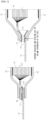
- FIG. 1 and FIG. 2 are cross-sectional views illustrating the structure of the secondary battery according to present invention, and the structure of the secondary battery of the present invention is composed of an electrode lead 10 and a case 12 accommodating an electrode assembly 14, where the case has a coating layer 16 on its inner side.
- the electrode lead 10 is connected to a case 12 via a sealing part 15, and it is partially exposed to the outside of the case 12.
- the case 12 may additionally include a means of gas emission 11 that vents internal gas when the internal pressure steeply increases by internal gas being desorbed from the coating layer 16 due to an abnormal operation of the battery.
- the means of gas emission can be formed on one side of the case 12, or, as illustrated in FIG. 2 , can be formed between the electrode lead 10 and an electrode tab 10'.
- Internal gas such as CO, CO 2 , etc. can be formed due to temperature rise when an abnormal reaction occurs during the charge-discharge process of the secondary battery. As a result, the internal pressure of the secondary battery case 12 rises, causing the case deformation and safety related issues such as fire may occur.
- the means of gas emission 11 is directed to solve the above-mentioned issues, and while it is not limited to a specific form, the means of gas emission 11 may include: an opening part (not illustrated) that connects the inside and outside of the secondary battery case and a rupturing part (not illustrated) that seals the inside of the secondary battery case and gets ruptured when the internal pressure of the secondary battery case increases.
- the secondary battery according to one embodiment of the present invention may contain a current blocking part.
- the current blocking part may be a fuse that is short-circuited when temperature rises, and may be formed in a structure that is separated by an increased pressure due to internal gas generation.
- the present invention uses the sudden desorption of the internal gas by a gas adsorbing material, and it is desirable for the current blocking part to have a structure that blocks the current by being separated due to pressure.
- the secondary battery according to the present invention desorbs gas that has been adsorbed to the gas adsorbing material when temperature rises due to an abnormal reaction inside the battery; when the pressure inside the secondary battery case 12 exceeds above a certain level, the means of gas emission 11 gets vented, emitting activated gas, gas generated by the charge-discharge of the battery, and/or gas generated by the battery being exposed to a high temperature; and the secondary battery stops working due to a current blocking element 13.
- the present invention provides a secondary battery module that includes the secondary battery according to the present invention stated above.
- the secondary battery module according to the present invention includes the secondary battery according to the present invention that has a coating layer containing a gas adsorbing material that adsorbs or desorbs gas based on the critical temperature on the inner side of the case.
- the secondary battery module adsorbs internal gas at a normal operating temperature of the battery, and desorbs the adsorbed internal gas when heat gets generated due to an abnormal operation of the battery, allowing it to reach the internal pressure critical point of the battery in a short time and easily control the internal gas emission time point, which is an excellent advantage in terms of safety.
- the secondary battery module according to the present invention has excellent safety when exposed to high temperature by having a composition that has the secondary battery of the present invention, it can be used as a power source for medium and large size devices which require high-temperature safety, long cycle properties, high-rate properties, etc.
- medium and large size devices may include a power tool that moves by being powered by an electrical motor; electric cars including Electric Vehicle (EV), Hybrid Electric Vehicle (HEV), Plug-in Hybrid Electric Vehicle (PHEV), etc.; electric two-wheel vehicles including an E-bike and an Escooter; an electric golf cart; and a power storage system. More specifically, it can include Hybrid Electric Vehicle (HEV), but it is not limited thereto.
- HEV Hybrid Electric Vehicle
- a Secondary battery was manufactured by preparing an electrode assembly that has a positive electrode, a negative electrode, and a separation membrane interposed between the positive electrode and the negative electrode, inserting the prepared assembly into a pouch-type case, injecting an electrolyte, and sealing the case.
- a coating layer an average thickness: approx. 50 ⁇ m
- the coating layer contained 97wt% of a gas adsorbing material and 3wt% of a binder, a first gas adsorbing material (a critical temperature: approx. 75 ⁇ 80°C), a second gas adsorbing material (a critical temperature: approx. 125 ⁇ 130°C), and the area ratio were controlled as illustrated in Table 1 below.
- Example 2 Besides using a case that does not have a coating layer formed on the inner side, the same method as in Example 1 was performed to manufacture a secondary battery.
- the time that takes for internal gas to be emitted (that is, vented) from the means of gas emission of each secondary battery and the internal temperature of the secondary battery when internal gas is being emitted were measured by performing overcharging of secondary batteries manufactured in the Examples and Comparative Example.
- a temperature sensor was introduced to the inside of the secondary batteries manufactured in the Examples and Comparative Example, and after charging the battery to 4.2V, it was overcharged with a constant current of 0.05C until it reached 10V. In the overcharging process, the internal temperature of the battery was measured when the means of gas emission emitted the internal gas. The result is shown in Table 2 below. [Table 2] Internal Temperature During Venting Example 1 95°C Example 2 93°C Example 3 140°C Example 4 115°C Comparative Example 1 Ignition occurred before venting
- the secondary battery according to the present invention can have its safety improved by having a coating layer containing a gas adsorbing material that adsorbs and desorbs internal gas depending on the critical temperature on the inner side of the case.
- the secondary battery of the examples can easily control the internal pressure of the battery when exposed to a high temperature due to an abnormal operation of the battery by having a coating layer containing a gas adsorbing material formed on the inner side of the case, and it can perform the internal gas emission before the thermal runaway of the battery gets induced.
- the secondary battery according to the present invention may further enhance the safety in terms of battery heat transfer and fire by having a gas adsorbing material that adsorbing internal gas in a normal operating temperature based on a critical temperature and desorbs the adsorbed internal gas in a high temperature coated on the inner side of the case.
Landscapes
- Chemical & Material Sciences (AREA)
- Chemical Kinetics & Catalysis (AREA)
- Electrochemistry (AREA)
- General Chemical & Material Sciences (AREA)
- Engineering & Computer Science (AREA)
- Manufacturing & Machinery (AREA)
- Secondary Cells (AREA)
- Sealing Battery Cases Or Jackets (AREA)
- Gas Exhaust Devices For Batteries (AREA)
Applications Claiming Priority (2)
| Application Number | Priority Date | Filing Date | Title |
|---|---|---|---|
| KR1020210157299A KR102872641B1 (ko) | 2021-11-16 | 2021-11-16 | 가스 흡착 소재를 포함하는 이차전지 및 이차전지 모듈 |
| PCT/KR2022/015169 WO2023090642A1 (ko) | 2021-11-16 | 2022-10-07 | 가스 흡착 소재를 포함하는 이차전지 및 이차전지 모듈 |
Publications (2)
| Publication Number | Publication Date |
|---|---|
| EP4243157A1 true EP4243157A1 (de) | 2023-09-13 |
| EP4243157A4 EP4243157A4 (de) | 2025-06-18 |
Family
ID=86397256
Family Applications (1)
| Application Number | Title | Priority Date | Filing Date |
|---|---|---|---|
| EP22895851.8A Pending EP4243157A4 (de) | 2021-11-16 | 2022-10-07 | Sekundärbatterie mit gasadsorptionsmaterial und sekundärbatteriemodul |
Country Status (6)
| Country | Link |
|---|---|
| US (1) | US20240055720A1 (de) |
| EP (1) | EP4243157A4 (de) |
| JP (1) | JP7622960B2 (de) |
| KR (1) | KR102872641B1 (de) |
| CN (1) | CN116711135A (de) |
| WO (1) | WO2023090642A1 (de) |
Families Citing this family (2)
| Publication number | Priority date | Publication date | Assignee | Title |
|---|---|---|---|---|
| CN117805319B (zh) * | 2023-12-27 | 2025-03-07 | 海南安桥网络科技有限公司 | 一种车用电池异常状态的检测方法和电池管理系统 |
| KR20260050687A (ko) * | 2024-10-08 | 2026-04-15 | 주식회사 엘지에너지솔루션 | 전지 케이스 및 이를 포함하는 리튬 이차전지 |
Family Cites Families (20)
| Publication number | Priority date | Publication date | Assignee | Title |
|---|---|---|---|---|
| JPS5016179B1 (de) * | 1969-09-03 | 1975-06-11 | ||
| JPH07192775A (ja) * | 1993-12-24 | 1995-07-28 | Sony Corp | 非水電解液二次電池 |
| US6358302B1 (en) * | 1999-11-18 | 2002-03-19 | The Boc Group, Inc. | Purification of gases using multi-composite adsorbent |
| US6746515B2 (en) | 2001-04-30 | 2004-06-08 | Battelle Memorial Institute | Method and apparatus for thermal swing adsorption and thermally-enhanced pressure swing adsorption |
| US7041412B2 (en) * | 2001-07-23 | 2006-05-09 | Matsushita Electric Industrial Co., Ltd. | Non-aqueous electrolyte secondary battery |
| JP2010182427A (ja) * | 2009-02-03 | 2010-08-19 | Toyota Central R&D Labs Inc | 収容体、電池及び電池システム |
| US9172072B2 (en) * | 2010-09-02 | 2015-10-27 | Gs Yuasa International Ltd | Battery comprising gas absorbent material and battery system |
| JP5673135B2 (ja) | 2011-01-24 | 2015-02-18 | 日産自動車株式会社 | ラミネート型電池 |
| EP2768608A4 (de) * | 2011-10-18 | 2015-06-03 | Univ California | Alkylaminfunktionalisierte metallorganische gerüstmaterialien für verbundgastrennungen |
| KR20150057480A (ko) * | 2013-11-19 | 2015-05-28 | 삼성에스디아이 주식회사 | 세퍼레이터, 이를 포함하는 리튬 전지, 상기 세퍼레이터의 제조방법, 및 상기 리튬 전지의 제조방법 |
| TWM508804U (zh) * | 2015-05-15 | 2015-09-11 | Asia Electronic Material Co | 電池殼層結構 |
| EP3352885B1 (de) * | 2015-09-25 | 2022-11-02 | ExxonMobil Technology and Engineering Company | Zyklische temperaturwechseladsorption mit direkter wärmeübertragung mithilfe einer wärmeübertragungsflüssigkeit |
| US20180272314A1 (en) * | 2015-09-30 | 2018-09-27 | The Regents Of The University Of California | Gas purification with diamine-appended metal-organic frameworks |
| JP7498106B2 (ja) * | 2017-07-19 | 2024-06-11 | エクソンモービル テクノロジー アンド エンジニアリング カンパニー | Co2の吸着及び捕捉のためのv型吸着剤及びガス濃縮の使用 |
| KR102555751B1 (ko) * | 2017-10-17 | 2023-07-14 | 주식회사 엘지에너지솔루션 | 가스 배출이 가능한 이차전지용 파우치형 케이스 |
| KR102234218B1 (ko) * | 2018-01-09 | 2021-03-31 | 주식회사 엘지화학 | 가스 흡착층을 포함하는 전지케이스 |
| CN110718722B (zh) * | 2018-07-13 | 2022-01-25 | 宁德新能源科技有限公司 | 吸附组件和电池 |
| KR102365539B1 (ko) * | 2019-07-16 | 2022-02-22 | 삼성전자주식회사 | 이산화탄소 흡착제 및 이를 포함하는 공기정화장치 |
| CN113067062A (zh) * | 2019-12-30 | 2021-07-02 | 荣盛盟固利新能源科技有限公司 | 一种自吸附气体锂离子电池壳及其制备方法 |
| KR20210157299A (ko) | 2020-06-19 | 2021-12-28 | 주식회사 디에이치인터내셔널 | 휴대용 구강세정기 |
-
2021
- 2021-11-16 KR KR1020210157299A patent/KR102872641B1/ko active Active
-
2022
- 2022-10-07 US US18/267,152 patent/US20240055720A1/en active Pending
- 2022-10-07 EP EP22895851.8A patent/EP4243157A4/de active Pending
- 2022-10-07 CN CN202280008310.0A patent/CN116711135A/zh active Pending
- 2022-10-07 WO PCT/KR2022/015169 patent/WO2023090642A1/ko not_active Ceased
- 2022-10-07 JP JP2023535718A patent/JP7622960B2/ja active Active
Also Published As
| Publication number | Publication date |
|---|---|
| JP7622960B2 (ja) | 2025-01-28 |
| JP2024500677A (ja) | 2024-01-10 |
| EP4243157A4 (de) | 2025-06-18 |
| WO2023090642A1 (ko) | 2023-05-25 |
| CN116711135A (zh) | 2023-09-05 |
| KR102872641B1 (ko) | 2025-10-16 |
| US20240055720A1 (en) | 2024-02-15 |
| KR20230071280A (ko) | 2023-05-23 |
Similar Documents
| Publication | Publication Date | Title |
|---|---|---|
| US11904713B2 (en) | Hazard mitigation through gas flow communication between battery packs | |
| EP4243157A1 (de) | Sekundärbatterie mit gasadsorptionsmaterial und sekundärbatteriemodul | |
| JP7045543B2 (ja) | ガス吸着層を含む電池ケース | |
| US8852769B2 (en) | Nonaqueous electrolyte secondary battery and method for manufacturing the same | |
| EP3913730A1 (de) | Batteriepack, fahrzeug und steuerverfahren zur verminderung des thermischen ablaufs eines akkupacks | |
| EP2613380A2 (de) | Wiederaufladbare batterie von erhöhter stabilität | |
| KR101956334B1 (ko) | 가스 흡착성 고분자를 포함하고 있는 이차전지 | |
| US7314683B2 (en) | Carbon compound-adsorbed cathode active material and lithium battery using the same | |
| US20130196189A1 (en) | Nonaqueous electrolyte secondary battery, method for manufacturing nonaqueous electrolyte secondary battery, and vehicle comprising nonaqueous electrolyte secondary battery | |
| KR20130014431A (ko) | 안전성 향상을 위한 분리막을 포함하는 전극조립체 및 이를 포함하는 리튬 이차전지 | |
| KR20070076412A (ko) | 전지 응용기기 | |
| CN116868430A (zh) | 电池单体、电池、用电装置、制造方法及制造设备 | |
| EP3972012B1 (de) | Lithium-ionen-sekundärbatterie und herstellungsverfahren dafür | |
| JP7202526B2 (ja) | 非水電解液二次電池の製造方法 | |
| KR102772957B1 (ko) | 전기화학소자용 분리막 및 이를 포함하는 전기화학소자 | |
| EP1311017B1 (de) | Alkalische Speicherbatterie | |
| KR102956904B1 (ko) | 배터리 셀 제조방법, 배터리 셀 제조장치 | |
| KR20250155080A (ko) | 고온 안전성이 향상된 리튬 이차전지용 양극 및 이를 포함하는 리튬 이차전지 | |
| EP4216335A2 (de) | Beutelartige sekundärbatterie, sekundärbatteriemodul damit und vorrichtung damit | |
| KR102886194B1 (ko) | 전극, 전극조립체 및 이를 포함하는 이차전지 | |
| KR101236579B1 (ko) | 파우치형 리튬이차전지 | |
| KR20220136260A (ko) | 배터리 셀 제조방법, 배터리 셀 제조장치 | |
| EP4693586A1 (de) | Lithiumsekundärbatterie | |
| CN121261055A (zh) | 复合隔膜及其在锂离子电池中的应用 | |
| KR20140032699A (ko) | 가스 배출 유로가 구비된 리튬 이차 전지 |
Legal Events
| Date | Code | Title | Description |
|---|---|---|---|
| STAA | Information on the status of an ep patent application or granted ep patent |
Free format text: STATUS: THE INTERNATIONAL PUBLICATION HAS BEEN MADE |
|
| PUAI | Public reference made under article 153(3) epc to a published international application that has entered the european phase |
Free format text: ORIGINAL CODE: 0009012 |
|
| STAA | Information on the status of an ep patent application or granted ep patent |
Free format text: STATUS: REQUEST FOR EXAMINATION WAS MADE |
|
| 17P | Request for examination filed |
Effective date: 20230609 |
|
| AK | Designated contracting states |
Kind code of ref document: A1 Designated state(s): AL AT BE BG CH CY CZ DE DK EE ES FI FR GB GR HR HU IE IS IT LI LT LU LV MC ME MK MT NL NO PL PT RO RS SE SI SK SM TR |
|
| DAV | Request for validation of the european patent (deleted) | ||
| DAX | Request for extension of the european patent (deleted) | ||
| A4 | Supplementary search report drawn up and despatched |
Effective date: 20250519 |
|
| RIC1 | Information provided on ipc code assigned before grant |
Ipc: H01M 50/178 20210101ALN20250513BHEP Ipc: H01M 50/105 20210101ALN20250513BHEP Ipc: H01M 50/342 20210101ALI20250513BHEP Ipc: H01M 10/05 20100101ALI20250513BHEP Ipc: B01D 53/04 20060101ALI20250513BHEP Ipc: H01M 50/30 20210101ALI20250513BHEP Ipc: H01M 50/375 20210101ALI20250513BHEP Ipc: H01M 50/124 20210101ALI20250513BHEP Ipc: H01M 10/52 20060101AFI20250513BHEP |
|
| STAA | Information on the status of an ep patent application or granted ep patent |
Free format text: STATUS: EXAMINATION IS IN PROGRESS |
|
| 17Q | First examination report despatched |
Effective date: 20260113 |