EP4242239A1 - Ethylene copolymer and method for preparation thereof and composition and crosslinked polymer and tire - Google Patents
Ethylene copolymer and method for preparation thereof and composition and crosslinked polymer and tire Download PDFInfo
- Publication number
- EP4242239A1 EP4242239A1 EP20962168.9A EP20962168A EP4242239A1 EP 4242239 A1 EP4242239 A1 EP 4242239A1 EP 20962168 A EP20962168 A EP 20962168A EP 4242239 A1 EP4242239 A1 EP 4242239A1
- Authority
- EP
- European Patent Office
- Prior art keywords
- ethylene copolymer
- structural unit
- conjugated diene
- mol
- present disclosure
- Prior art date
- Legal status (The legal status is an assumption and is not a legal conclusion. Google has not performed a legal analysis and makes no representation as to the accuracy of the status listed.)
- Pending
Links
- 229920001038 ethylene copolymer Polymers 0.000 title claims abstract description 171
- 238000000034 method Methods 0.000 title claims abstract description 41
- 239000000203 mixture Substances 0.000 title claims abstract description 14
- 229920006037 cross link polymer Polymers 0.000 title claims abstract description 11
- 238000002360 preparation method Methods 0.000 title claims description 22
- 150000001993 dienes Chemical class 0.000 claims abstract description 102
- 238000006116 polymerization reaction Methods 0.000 claims abstract description 42
- VGGSQFUCUMXWEO-UHFFFAOYSA-N Ethene Chemical compound C=C VGGSQFUCUMXWEO-UHFFFAOYSA-N 0.000 claims abstract description 34
- 239000005977 Ethylene Substances 0.000 claims abstract description 34
- 125000000391 vinyl group Chemical group [H]C([*])=C([H])[H] 0.000 claims abstract description 30
- 229920002554 vinyl polymer Polymers 0.000 claims abstract description 30
- 238000004132 cross linking Methods 0.000 claims abstract description 5
- 150000002736 metal compounds Chemical class 0.000 claims description 59
- KAKZBPTYRLMSJV-UHFFFAOYSA-N butadiene group Chemical group C=CC=C KAKZBPTYRLMSJV-UHFFFAOYSA-N 0.000 claims description 32
- 125000004435 hydrogen atom Chemical group [H]* 0.000 claims description 24
- 125000003837 (C1-C20) alkyl group Chemical group 0.000 claims description 18
- 229920001577 copolymer Polymers 0.000 claims description 10
- 125000004429 atom Chemical group 0.000 claims description 7
- 239000003431 cross linking reagent Substances 0.000 claims description 7
- 125000000008 (C1-C10) alkyl group Chemical group 0.000 claims description 6
- 238000009826 distribution Methods 0.000 claims description 6
- 239000002685 polymerization catalyst Substances 0.000 claims description 6
- 230000009477 glass transition Effects 0.000 claims description 5
- 239000000470 constituent Substances 0.000 claims description 4
- QCWXUUIWCKQGHC-UHFFFAOYSA-N Zirconium Chemical group [Zr] QCWXUUIWCKQGHC-UHFFFAOYSA-N 0.000 claims description 3
- 125000005843 halogen group Chemical group 0.000 claims description 3
- 229910052751 metal Inorganic materials 0.000 claims description 3
- 239000002184 metal Substances 0.000 claims description 3
- 229910052726 zirconium Inorganic materials 0.000 claims description 3
- 125000001309 chloro group Chemical group Cl* 0.000 claims description 2
- 229910052710 silicon Inorganic materials 0.000 claims description 2
- 239000010703 silicon Substances 0.000 claims description 2
- 229910052801 chlorine Inorganic materials 0.000 claims 1
- 230000000052 comparative effect Effects 0.000 description 70
- YXFVVABEGXRONW-UHFFFAOYSA-N Toluene Chemical compound CC1=CC=CC=C1 YXFVVABEGXRONW-UHFFFAOYSA-N 0.000 description 33
- VLKZOEOYAKHREP-UHFFFAOYSA-N n-Hexane Chemical compound CCCCCC VLKZOEOYAKHREP-UHFFFAOYSA-N 0.000 description 16
- 238000004073 vulcanization Methods 0.000 description 16
- 229940125904 compound 1 Drugs 0.000 description 14
- RTZKZFJDLAIYFH-UHFFFAOYSA-N Diethyl ether Chemical compound CCOCC RTZKZFJDLAIYFH-UHFFFAOYSA-N 0.000 description 12
- 229940125782 compound 2 Drugs 0.000 description 10
- 229940126214 compound 3 Drugs 0.000 description 9
- 125000002496 methyl group Chemical group [H]C([H])([H])* 0.000 description 9
- 239000000243 solution Substances 0.000 description 9
- MCULRUJILOGHCJ-UHFFFAOYSA-N triisobutylaluminium Chemical compound CC(C)C[Al](CC(C)C)CC(C)C MCULRUJILOGHCJ-UHFFFAOYSA-N 0.000 description 9
- LFQSCWFLJHTTHZ-UHFFFAOYSA-N Ethanol Chemical compound CCO LFQSCWFLJHTTHZ-UHFFFAOYSA-N 0.000 description 8
- VEXZGXHMUGYJMC-UHFFFAOYSA-N Hydrochloric acid Chemical compound Cl VEXZGXHMUGYJMC-UHFFFAOYSA-N 0.000 description 8
- HEDRZPFGACZZDS-MICDWDOJSA-N Trichloro(2H)methane Chemical compound [2H]C(Cl)(Cl)Cl HEDRZPFGACZZDS-MICDWDOJSA-N 0.000 description 8
- 229910052739 hydrogen Inorganic materials 0.000 description 8
- 239000001257 hydrogen Substances 0.000 description 8
- 238000005481 NMR spectroscopy Methods 0.000 description 7
- 125000001511 cyclopentyl group Chemical group [H]C1([H])C([H])([H])C([H])([H])C([H])(*)C1([H])[H] 0.000 description 7
- 125000001559 cyclopropyl group Chemical group [H]C1([H])C([H])([H])C1([H])* 0.000 description 7
- CPOFMOWDMVWCLF-UHFFFAOYSA-N methyl(oxo)alumane Chemical compound C[Al]=O CPOFMOWDMVWCLF-UHFFFAOYSA-N 0.000 description 7
- UFHFLCQGNIYNRP-UHFFFAOYSA-N Hydrogen Chemical compound [H][H] UFHFLCQGNIYNRP-UHFFFAOYSA-N 0.000 description 6
- RRHGJUQNOFWUDK-UHFFFAOYSA-N Isoprene Chemical compound CC(=C)C=C RRHGJUQNOFWUDK-UHFFFAOYSA-N 0.000 description 6
- OKKJLVBELUTLKV-UHFFFAOYSA-N Methanol Chemical compound OC OKKJLVBELUTLKV-UHFFFAOYSA-N 0.000 description 6
- 125000000217 alkyl group Chemical group 0.000 description 6
- 125000001495 ethyl group Chemical group [H]C([H])([H])C([H])([H])* 0.000 description 6
- 125000004123 n-propyl group Chemical group [H]C([H])([H])C([H])([H])C([H])([H])* 0.000 description 6
- 229920000642 polymer Polymers 0.000 description 6
- BTBUEUYNUDRHOZ-UHFFFAOYSA-N Borate Chemical compound [O-]B([O-])[O-] BTBUEUYNUDRHOZ-UHFFFAOYSA-N 0.000 description 5
- 230000015572 biosynthetic process Effects 0.000 description 5
- 230000003197 catalytic effect Effects 0.000 description 5
- 238000006243 chemical reaction Methods 0.000 description 5
- 239000000047 product Substances 0.000 description 5
- 239000007787 solid Substances 0.000 description 5
- 238000003786 synthesis reaction Methods 0.000 description 5
- 125000006273 (C1-C3) alkyl group Chemical group 0.000 description 4
- 125000004169 (C1-C6) alkyl group Chemical group 0.000 description 4
- IJGRMHOSHXDMSA-UHFFFAOYSA-N Atomic nitrogen Chemical compound N#N IJGRMHOSHXDMSA-UHFFFAOYSA-N 0.000 description 4
- MZRVEZGGRBJDDB-UHFFFAOYSA-N N-Butyllithium Chemical compound [Li]CCCC MZRVEZGGRBJDDB-UHFFFAOYSA-N 0.000 description 4
- 150000001875 compounds Chemical class 0.000 description 4
- 238000007334 copolymerization reaction Methods 0.000 description 4
- 229920001971 elastomer Polymers 0.000 description 4
- 238000001914 filtration Methods 0.000 description 4
- 239000007789 gas Substances 0.000 description 4
- 125000001449 isopropyl group Chemical group [H]C([H])([H])C([H])(*)C([H])([H])[H] 0.000 description 4
- 239000005060 rubber Substances 0.000 description 4
- 238000003756 stirring Methods 0.000 description 4
- YMWUJEATGCHHMB-UHFFFAOYSA-N Dichloromethane Chemical compound ClCCl YMWUJEATGCHHMB-UHFFFAOYSA-N 0.000 description 3
- CBENFWSGALASAD-UHFFFAOYSA-N Ozone Chemical compound [O-][O+]=O CBENFWSGALASAD-UHFFFAOYSA-N 0.000 description 3
- 239000006229 carbon black Substances 0.000 description 3
- 230000008859 change Effects 0.000 description 3
- 229940125898 compound 5 Drugs 0.000 description 3
- 150000002978 peroxides Chemical class 0.000 description 3
- 239000012071 phase Substances 0.000 description 3
- 238000011925 1,2-addition Methods 0.000 description 2
- KOMNUTZXSVSERR-UHFFFAOYSA-N 1,3,5-tris(prop-2-enyl)-1,3,5-triazinane-2,4,6-trione Chemical compound C=CCN1C(=O)N(CC=C)C(=O)N(CC=C)C1=O KOMNUTZXSVSERR-UHFFFAOYSA-N 0.000 description 2
- VZSRBBMJRBPUNF-UHFFFAOYSA-N 2-(2,3-dihydro-1H-inden-2-ylamino)-N-[3-oxo-3-(2,4,6,7-tetrahydrotriazolo[4,5-c]pyridin-5-yl)propyl]pyrimidine-5-carboxamide Chemical compound C1C(CC2=CC=CC=C12)NC1=NC=C(C=N1)C(=O)NCCC(N1CC2=C(CC1)NN=N2)=O VZSRBBMJRBPUNF-UHFFFAOYSA-N 0.000 description 2
- XMNIXWIUMCBBBL-UHFFFAOYSA-N 2-(2-phenylpropan-2-ylperoxy)propan-2-ylbenzene Chemical compound C=1C=CC=CC=1C(C)(C)OOC(C)(C)C1=CC=CC=C1 XMNIXWIUMCBBBL-UHFFFAOYSA-N 0.000 description 2
- RGSFGYAAUTVSQA-UHFFFAOYSA-N Cyclopentane Chemical group C1CCCC1 RGSFGYAAUTVSQA-UHFFFAOYSA-N 0.000 description 2
- 239000004793 Polystyrene Substances 0.000 description 2
- MVPPADPHJFYWMZ-UHFFFAOYSA-N chlorobenzene Chemical compound ClC1=CC=CC=C1 MVPPADPHJFYWMZ-UHFFFAOYSA-N 0.000 description 2
- 125000001995 cyclobutyl group Chemical group [H]C1([H])C([H])([H])C([H])(*)C1([H])[H] 0.000 description 2
- 125000000113 cyclohexyl group Chemical group [H]C1([H])C([H])([H])C([H])([H])C([H])(*)C([H])([H])C1([H])[H] 0.000 description 2
- 125000002704 decyl group Chemical group [H]C([H])([H])C([H])([H])C([H])([H])C([H])([H])C([H])([H])C([H])([H])C([H])([H])C([H])([H])C([H])([H])C([H])([H])* 0.000 description 2
- 230000000694 effects Effects 0.000 description 2
- 239000000945 filler Substances 0.000 description 2
- 238000010528 free radical solution polymerization reaction Methods 0.000 description 2
- 238000005227 gel permeation chromatography Methods 0.000 description 2
- 125000003187 heptyl group Chemical group [H]C([*])([H])C([H])([H])C([H])([H])C([H])([H])C([H])([H])C([H])([H])C([H])([H])[H] 0.000 description 2
- 125000004051 hexyl group Chemical group [H]C([H])([H])C([H])([H])C([H])([H])C([H])([H])C([H])([H])C([H])([H])* 0.000 description 2
- 150000002431 hydrogen Chemical class 0.000 description 2
- 125000000959 isobutyl group Chemical group [H]C([H])([H])C([H])(C([H])([H])[H])C([H])([H])* 0.000 description 2
- 239000007791 liquid phase Substances 0.000 description 2
- 238000004519 manufacturing process Methods 0.000 description 2
- 239000000178 monomer Substances 0.000 description 2
- 125000004108 n-butyl group Chemical group [H]C([H])([H])C([H])([H])C([H])([H])C([H])([H])* 0.000 description 2
- 229910052757 nitrogen Inorganic materials 0.000 description 2
- 125000001400 nonyl group Chemical group [H]C([*])([H])C([H])([H])C([H])([H])C([H])([H])C([H])([H])C([H])([H])C([H])([H])C([H])([H])C([H])([H])[H] 0.000 description 2
- 125000002347 octyl group Chemical group [H]C([*])([H])C([H])([H])C([H])([H])C([H])([H])C([H])([H])C([H])([H])C([H])([H])C([H])([H])[H] 0.000 description 2
- 125000001147 pentyl group Chemical group C(CCCC)* 0.000 description 2
- 229920002223 polystyrene Polymers 0.000 description 2
- 239000002994 raw material Substances 0.000 description 2
- 229920006395 saturated elastomer Polymers 0.000 description 2
- 125000002914 sec-butyl group Chemical group [H]C([H])([H])C([H])([H])C([H])(*)C([H])([H])[H] 0.000 description 2
- 239000002904 solvent Substances 0.000 description 2
- 229910001220 stainless steel Inorganic materials 0.000 description 2
- 239000010935 stainless steel Substances 0.000 description 2
- 239000000126 substance Substances 0.000 description 2
- 238000001308 synthesis method Methods 0.000 description 2
- 125000000999 tert-butyl group Chemical group [H]C([H])([H])C(*)(C([H])([H])[H])C([H])([H])[H] 0.000 description 2
- DUNKXUFBGCUVQW-UHFFFAOYSA-J zirconium tetrachloride Chemical compound Cl[Zr](Cl)(Cl)Cl DUNKXUFBGCUVQW-UHFFFAOYSA-J 0.000 description 2
- RELMFMZEBKVZJC-UHFFFAOYSA-N 1,2,3-trichlorobenzene Chemical compound ClC1=CC=CC(Cl)=C1Cl RELMFMZEBKVZJC-UHFFFAOYSA-N 0.000 description 1
- RFFLAFLAYFXFSW-UHFFFAOYSA-N 1,2-dichlorobenzene Chemical class ClC1=CC=CC=C1Cl RFFLAFLAYFXFSW-UHFFFAOYSA-N 0.000 description 1
- OCJBOOLMMGQPQU-UHFFFAOYSA-N 1,4-dichlorobenzene Chemical compound ClC1=CC=C(Cl)C=C1 OCJBOOLMMGQPQU-UHFFFAOYSA-N 0.000 description 1
- OHVLMTFVQDZYHP-UHFFFAOYSA-N 1-(2,4,6,7-tetrahydrotriazolo[4,5-c]pyridin-5-yl)-2-[4-[2-[[3-(trifluoromethoxy)phenyl]methylamino]pyrimidin-5-yl]piperazin-1-yl]ethanone Chemical compound N1N=NC=2CN(CCC=21)C(CN1CCN(CC1)C=1C=NC(=NC=1)NCC1=CC(=CC=C1)OC(F)(F)F)=O OHVLMTFVQDZYHP-UHFFFAOYSA-N 0.000 description 1
- LDXJRKWFNNFDSA-UHFFFAOYSA-N 2-(2,4,6,7-tetrahydrotriazolo[4,5-c]pyridin-5-yl)-1-[4-[2-[[3-(trifluoromethoxy)phenyl]methylamino]pyrimidin-5-yl]piperazin-1-yl]ethanone Chemical compound C1CN(CC2=NNN=C21)CC(=O)N3CCN(CC3)C4=CN=C(N=C4)NCC5=CC(=CC=C5)OC(F)(F)F LDXJRKWFNNFDSA-UHFFFAOYSA-N 0.000 description 1
- HVTQDSGGHBWVTR-UHFFFAOYSA-N 2-[4-[2-(2,3-dihydro-1H-inden-2-ylamino)pyrimidin-5-yl]-3-phenylmethoxypyrazol-1-yl]-1-morpholin-4-ylethanone Chemical compound C(C1=CC=CC=C1)OC1=NN(C=C1C=1C=NC(=NC=1)NC1CC2=CC=CC=C2C1)CC(=O)N1CCOCC1 HVTQDSGGHBWVTR-UHFFFAOYSA-N 0.000 description 1
- IHCCLXNEEPMSIO-UHFFFAOYSA-N 2-[4-[2-(2,3-dihydro-1H-inden-2-ylamino)pyrimidin-5-yl]piperidin-1-yl]-1-(2,4,6,7-tetrahydrotriazolo[4,5-c]pyridin-5-yl)ethanone Chemical compound C1C(CC2=CC=CC=C12)NC1=NC=C(C=N1)C1CCN(CC1)CC(=O)N1CC2=C(CC1)NN=N2 IHCCLXNEEPMSIO-UHFFFAOYSA-N 0.000 description 1
- YLZOPXRUQYQQID-UHFFFAOYSA-N 3-(2,4,6,7-tetrahydrotriazolo[4,5-c]pyridin-5-yl)-1-[4-[2-[[3-(trifluoromethoxy)phenyl]methylamino]pyrimidin-5-yl]piperazin-1-yl]propan-1-one Chemical compound N1N=NC=2CN(CCC=21)CCC(=O)N1CCN(CC1)C=1C=NC(=NC=1)NCC1=CC(=CC=C1)OC(F)(F)F YLZOPXRUQYQQID-UHFFFAOYSA-N 0.000 description 1
- WTFUTSCZYYCBAY-SXBRIOAWSA-N 6-[(E)-C-[[4-[2-(2,3-dihydro-1H-inden-2-ylamino)pyrimidin-5-yl]piperazin-1-yl]methyl]-N-hydroxycarbonimidoyl]-3H-1,3-benzoxazol-2-one Chemical compound C1C(CC2=CC=CC=C12)NC1=NC=C(C=N1)N1CCN(CC1)C/C(=N/O)/C1=CC2=C(NC(O2)=O)C=C1 WTFUTSCZYYCBAY-SXBRIOAWSA-N 0.000 description 1
- XDTMQSROBMDMFD-UHFFFAOYSA-N Cyclohexane Chemical compound C1CCCCC1 XDTMQSROBMDMFD-UHFFFAOYSA-N 0.000 description 1
- LVZWSLJZHVFIQJ-UHFFFAOYSA-N Cyclopropane Chemical group C1CC1 LVZWSLJZHVFIQJ-UHFFFAOYSA-N 0.000 description 1
- SNRUBQQJIBEYMU-UHFFFAOYSA-N Dodecane Natural products CCCCCCCCCCCC SNRUBQQJIBEYMU-UHFFFAOYSA-N 0.000 description 1
- BUGBHKTXTAQXES-UHFFFAOYSA-N Selenium Chemical compound [Se] BUGBHKTXTAQXES-UHFFFAOYSA-N 0.000 description 1
- NINIDFKCEFEMDL-UHFFFAOYSA-N Sulfur Chemical compound [S] NINIDFKCEFEMDL-UHFFFAOYSA-N 0.000 description 1
- RTAQQCXQSZGOHL-UHFFFAOYSA-N Titanium Chemical group [Ti] RTAQQCXQSZGOHL-UHFFFAOYSA-N 0.000 description 1
- 150000001335 aliphatic alkanes Chemical class 0.000 description 1
- 150000001336 alkenes Chemical class 0.000 description 1
- 239000003963 antioxidant agent Substances 0.000 description 1
- 230000003078 antioxidant effect Effects 0.000 description 1
- 125000001204 arachidyl group Chemical group [H]C([*])([H])C([H])([H])C([H])([H])C([H])([H])C([H])([H])C([H])([H])C([H])([H])C([H])([H])C([H])([H])C([H])([H])C([H])([H])C([H])([H])C([H])([H])C([H])([H])C([H])([H])C([H])([H])C([H])([H])C([H])([H])C([H])([H])C([H])([H])[H] 0.000 description 1
- 150000004945 aromatic hydrocarbons Chemical class 0.000 description 1
- 239000006227 byproduct Substances 0.000 description 1
- 239000003054 catalyst Substances 0.000 description 1
- 239000003795 chemical substances by application Substances 0.000 description 1
- 238000007796 conventional method Methods 0.000 description 1
- 150000001924 cycloalkanes Chemical class 0.000 description 1
- 125000000753 cycloalkyl group Chemical group 0.000 description 1
- 230000003247 decreasing effect Effects 0.000 description 1
- 229940117389 dichlorobenzene Drugs 0.000 description 1
- 238000000113 differential scanning calorimetry Methods 0.000 description 1
- PXJJSXABGXMUSU-UHFFFAOYSA-N disulfur dichloride Chemical compound ClSSCl PXJJSXABGXMUSU-UHFFFAOYSA-N 0.000 description 1
- 125000003438 dodecyl group Chemical group [H]C([H])([H])C([H])([H])C([H])([H])C([H])([H])C([H])([H])C([H])([H])C([H])([H])C([H])([H])C([H])([H])C([H])([H])C([H])([H])C([H])([H])* 0.000 description 1
- 239000000706 filtrate Substances 0.000 description 1
- 229910052735 hafnium Inorganic materials 0.000 description 1
- VBJZVLUMGGDVMO-UHFFFAOYSA-N hafnium atom Chemical group [Hf] VBJZVLUMGGDVMO-UHFFFAOYSA-N 0.000 description 1
- DMEGYFMYUHOHGS-UHFFFAOYSA-N heptamethylene Natural products C1CCCCCC1 DMEGYFMYUHOHGS-UHFFFAOYSA-N 0.000 description 1
- 238000002347 injection Methods 0.000 description 1
- 239000007924 injection Substances 0.000 description 1
- 125000002960 margaryl group Chemical group [H]C([*])([H])C([H])([H])C([H])([H])C([H])([H])C([H])([H])C([H])([H])C([H])([H])C([H])([H])C([H])([H])C([H])([H])C([H])([H])C([H])([H])C([H])([H])C([H])([H])C([H])([H])C([H])([H])C([H])([H])[H] 0.000 description 1
- 230000007246 mechanism Effects 0.000 description 1
- 238000002844 melting Methods 0.000 description 1
- 230000008018 melting Effects 0.000 description 1
- 125000001421 myristyl group Chemical group [H]C([*])([H])C([H])([H])C([H])([H])C([H])([H])C([H])([H])C([H])([H])C([H])([H])C([H])([H])C([H])([H])C([H])([H])C([H])([H])C([H])([H])C([H])([H])C([H])([H])[H] 0.000 description 1
- 125000001196 nonadecyl group Chemical group [H]C([*])([H])C([H])([H])C([H])([H])C([H])([H])C([H])([H])C([H])([H])C([H])([H])C([H])([H])C([H])([H])C([H])([H])C([H])([H])C([H])([H])C([H])([H])C([H])([H])C([H])([H])C([H])([H])C([H])([H])C([H])([H])C([H])([H])[H] 0.000 description 1
- JRZJOMJEPLMPRA-UHFFFAOYSA-N olefin Natural products CCCCCCCC=C JRZJOMJEPLMPRA-UHFFFAOYSA-N 0.000 description 1
- 125000000913 palmityl group Chemical group [H]C([*])([H])C([H])([H])C([H])([H])C([H])([H])C([H])([H])C([H])([H])C([H])([H])C([H])([H])C([H])([H])C([H])([H])C([H])([H])C([H])([H])C([H])([H])C([H])([H])C([H])([H])C([H])([H])[H] 0.000 description 1
- 125000002958 pentadecyl group Chemical group [H]C([*])([H])C([H])([H])C([H])([H])C([H])([H])C([H])([H])C([H])([H])C([H])([H])C([H])([H])C([H])([H])C([H])([H])C([H])([H])C([H])([H])C([H])([H])C([H])([H])C([H])([H])[H] 0.000 description 1
- 239000003208 petroleum Substances 0.000 description 1
- 230000000704 physical effect Effects 0.000 description 1
- 229920003023 plastic Polymers 0.000 description 1
- 239000004033 plastic Substances 0.000 description 1
- 229920000573 polyethylene Polymers 0.000 description 1
- 229920000098 polyolefin Polymers 0.000 description 1
- 238000001556 precipitation Methods 0.000 description 1
- 230000008569 process Effects 0.000 description 1
- 239000000523 sample Substances 0.000 description 1
- 239000012488 sample solution Substances 0.000 description 1
- 229910052711 selenium Inorganic materials 0.000 description 1
- 239000011669 selenium Substances 0.000 description 1
- 238000004904 shortening Methods 0.000 description 1
- 125000004079 stearyl group Chemical group [H]C([*])([H])C([H])([H])C([H])([H])C([H])([H])C([H])([H])C([H])([H])C([H])([H])C([H])([H])C([H])([H])C([H])([H])C([H])([H])C([H])([H])C([H])([H])C([H])([H])C([H])([H])C([H])([H])C([H])([H])C([H])([H])[H] 0.000 description 1
- 229910052717 sulfur Inorganic materials 0.000 description 1
- 239000011593 sulfur Substances 0.000 description 1
- 229910052714 tellurium Inorganic materials 0.000 description 1
- PORWMNRCUJJQNO-UHFFFAOYSA-N tellurium atom Chemical compound [Te] PORWMNRCUJJQNO-UHFFFAOYSA-N 0.000 description 1
- CZDYPVPMEAXLPK-UHFFFAOYSA-N tetramethylsilane Chemical compound C[Si](C)(C)C CZDYPVPMEAXLPK-UHFFFAOYSA-N 0.000 description 1
- 229910052719 titanium Inorganic materials 0.000 description 1
- 125000002889 tridecyl group Chemical group [H]C([*])([H])C([H])([H])C([H])([H])C([H])([H])C([H])([H])C([H])([H])C([H])([H])C([H])([H])C([H])([H])C([H])([H])C([H])([H])C([H])([H])C([H])([H])[H] 0.000 description 1
- 125000002948 undecyl group Chemical group [H]C([*])([H])C([H])([H])C([H])([H])C([H])([H])C([H])([H])C([H])([H])C([H])([H])C([H])([H])C([H])([H])C([H])([H])C([H])([H])[H] 0.000 description 1
- 239000004711 α-olefin Substances 0.000 description 1
Classifications
-
- B—PERFORMING OPERATIONS; TRANSPORTING
- B60—VEHICLES IN GENERAL
- B60C—VEHICLE TYRES; TYRE INFLATION; TYRE CHANGING; CONNECTING VALVES TO INFLATABLE ELASTIC BODIES IN GENERAL; DEVICES OR ARRANGEMENTS RELATED TO TYRES
- B60C1/00—Tyres characterised by the chemical composition or the physical arrangement or mixture of the composition
-
- C—CHEMISTRY; METALLURGY
- C08—ORGANIC MACROMOLECULAR COMPOUNDS; THEIR PREPARATION OR CHEMICAL WORKING-UP; COMPOSITIONS BASED THEREON
- C08F—MACROMOLECULAR COMPOUNDS OBTAINED BY REACTIONS ONLY INVOLVING CARBON-TO-CARBON UNSATURATED BONDS
- C08F210/00—Copolymers of unsaturated aliphatic hydrocarbons having only one carbon-to-carbon double bond
- C08F210/02—Ethene
-
- C—CHEMISTRY; METALLURGY
- C08—ORGANIC MACROMOLECULAR COMPOUNDS; THEIR PREPARATION OR CHEMICAL WORKING-UP; COMPOSITIONS BASED THEREON
- C08F—MACROMOLECULAR COMPOUNDS OBTAINED BY REACTIONS ONLY INVOLVING CARBON-TO-CARBON UNSATURATED BONDS
- C08F236/00—Copolymers of compounds having one or more unsaturated aliphatic radicals, at least one having two or more carbon-to-carbon double bonds
- C08F236/02—Copolymers of compounds having one or more unsaturated aliphatic radicals, at least one having two or more carbon-to-carbon double bonds the radical having only two carbon-to-carbon double bonds
- C08F236/04—Copolymers of compounds having one or more unsaturated aliphatic radicals, at least one having two or more carbon-to-carbon double bonds the radical having only two carbon-to-carbon double bonds conjugated
-
- C—CHEMISTRY; METALLURGY
- C08—ORGANIC MACROMOLECULAR COMPOUNDS; THEIR PREPARATION OR CHEMICAL WORKING-UP; COMPOSITIONS BASED THEREON
- C08F—MACROMOLECULAR COMPOUNDS OBTAINED BY REACTIONS ONLY INVOLVING CARBON-TO-CARBON UNSATURATED BONDS
- C08F236/00—Copolymers of compounds having one or more unsaturated aliphatic radicals, at least one having two or more carbon-to-carbon double bonds
- C08F236/02—Copolymers of compounds having one or more unsaturated aliphatic radicals, at least one having two or more carbon-to-carbon double bonds the radical having only two carbon-to-carbon double bonds
- C08F236/04—Copolymers of compounds having one or more unsaturated aliphatic radicals, at least one having two or more carbon-to-carbon double bonds the radical having only two carbon-to-carbon double bonds conjugated
- C08F236/06—Butadiene
-
- C—CHEMISTRY; METALLURGY
- C08—ORGANIC MACROMOLECULAR COMPOUNDS; THEIR PREPARATION OR CHEMICAL WORKING-UP; COMPOSITIONS BASED THEREON
- C08F—MACROMOLECULAR COMPOUNDS OBTAINED BY REACTIONS ONLY INVOLVING CARBON-TO-CARBON UNSATURATED BONDS
- C08F4/00—Polymerisation catalysts
- C08F4/42—Metals; Metal hydrides; Metallo-organic compounds; Use thereof as catalyst precursors
- C08F4/44—Metals; Metal hydrides; Metallo-organic compounds; Use thereof as catalyst precursors selected from light metals, zinc, cadmium, mercury, copper, silver, gold, boron, gallium, indium, thallium, rare earths or actinides
- C08F4/60—Metals; Metal hydrides; Metallo-organic compounds; Use thereof as catalyst precursors selected from light metals, zinc, cadmium, mercury, copper, silver, gold, boron, gallium, indium, thallium, rare earths or actinides together with refractory metals, iron group metals, platinum group metals, manganese, rhenium technetium or compounds thereof
- C08F4/62—Refractory metals or compounds thereof
- C08F4/64—Titanium, zirconium, hafnium or compounds thereof
- C08F4/659—Component covered by group C08F4/64 containing a transition metal-carbon bond
- C08F4/65912—Component covered by group C08F4/64 containing a transition metal-carbon bond in combination with an organoaluminium compound
-
- C—CHEMISTRY; METALLURGY
- C08—ORGANIC MACROMOLECULAR COMPOUNDS; THEIR PREPARATION OR CHEMICAL WORKING-UP; COMPOSITIONS BASED THEREON
- C08F—MACROMOLECULAR COMPOUNDS OBTAINED BY REACTIONS ONLY INVOLVING CARBON-TO-CARBON UNSATURATED BONDS
- C08F4/00—Polymerisation catalysts
- C08F4/42—Metals; Metal hydrides; Metallo-organic compounds; Use thereof as catalyst precursors
- C08F4/44—Metals; Metal hydrides; Metallo-organic compounds; Use thereof as catalyst precursors selected from light metals, zinc, cadmium, mercury, copper, silver, gold, boron, gallium, indium, thallium, rare earths or actinides
- C08F4/60—Metals; Metal hydrides; Metallo-organic compounds; Use thereof as catalyst precursors selected from light metals, zinc, cadmium, mercury, copper, silver, gold, boron, gallium, indium, thallium, rare earths or actinides together with refractory metals, iron group metals, platinum group metals, manganese, rhenium technetium or compounds thereof
- C08F4/62—Refractory metals or compounds thereof
- C08F4/64—Titanium, zirconium, hafnium or compounds thereof
- C08F4/659—Component covered by group C08F4/64 containing a transition metal-carbon bond
- C08F4/6592—Component covered by group C08F4/64 containing a transition metal-carbon bond containing at least one cyclopentadienyl ring, condensed or not, e.g. an indenyl or a fluorenyl ring
- C08F4/65922—Component covered by group C08F4/64 containing a transition metal-carbon bond containing at least one cyclopentadienyl ring, condensed or not, e.g. an indenyl or a fluorenyl ring containing at least two cyclopentadienyl rings, fused or not
- C08F4/65927—Component covered by group C08F4/64 containing a transition metal-carbon bond containing at least one cyclopentadienyl ring, condensed or not, e.g. an indenyl or a fluorenyl ring containing at least two cyclopentadienyl rings, fused or not two cyclopentadienyl rings being mutually bridged
-
- C—CHEMISTRY; METALLURGY
- C08—ORGANIC MACROMOLECULAR COMPOUNDS; THEIR PREPARATION OR CHEMICAL WORKING-UP; COMPOSITIONS BASED THEREON
- C08F—MACROMOLECULAR COMPOUNDS OBTAINED BY REACTIONS ONLY INVOLVING CARBON-TO-CARBON UNSATURATED BONDS
- C08F2420/00—Metallocene catalysts
- C08F2420/05—Cp or analog where at least one of the carbon atoms of the coordinating ring is replaced by a heteroatom
Definitions
- the present disclosure relates to an ethylene copolymer and a preparation method thereof, more particularly, the present disclosure relates to an ethylene copolymer comprising a structural unit derived from ethylene and a structural unit derived from a conjugated diene and a preparation method thereof; the present disclosure also relates to a composition comprising the ethylene copolymer and a crosslinked polymer comprising a unit derived from the ethylene copolymer; and the present disclosure further relates to a tire having at least one constituent element including the ethylene copolymer, the composition or the crosslinked polymer.
- Ethylene as a widely used and easily available monomer, is widely used in the plastic industry.
- Conjugated dienes particularly butadiene and isoprene, are the most important monomers for the synthesis of rubbers.
- Butadiene as a by-product in a process of preparing ethylene by a petroleum route, used to have a price similar to that of ethylene.
- the yield of butadiene is decreased and its price is significantly increased.
- the price of ethylene is reduced. Therefore, the use of ethylene as a raw material for preparing rubber for tires is quite attractive, which can greatly save the cost of raw material.
- the existing methods for copolymerizing ethylene and conjugated dienes have the main problems that the content of a conjugated diene structural unit in the prepared polymer is not high, and the content of an unsaturated bond on a backbone of the prepared polymer is high, which makes it difficult to improve the physical properties such as weather resistance, thermal resistance and ozone resistance of the copolymer.
- the present disclosure aims to provide an ethylene copolymer comprising a conjugated diene structural unit derived from a conjugated diene, the ethylene copolymer not only has a higher content of conjugated diene structural unit, but also has a higher content of 1,2-polymerized vinyl structural unit formed by 1,2-polymerization of the conjugated diene and having side chain double bonds, while having a low content of unsaturated bonds on a backbone of the copolymer.
- the present disclosure provides an ethylene copolymer, wherein the ethylene copolymer comprises an ethylene structural unit derived from ethylene and a conjugated diene structural unit derived from a conjugated diene; based on the total amount of the ethylene copolymer, the content of the conjugated diene structural unit is 25-45 mol%, and the content of a 1,2-polymerized vinyl structural unit formed by 1,2-polymerization of the conjugated diene and having side chain double bonds is 20-40 mol%; the total amount of a 1,2-polymerized structural unit is 95 mol% or more based on the total amount of the conjugated diene structural unit in the ethylene copolymer, and the ethylene copolymer has a weight average molecular weight of 20,000 to 300,000.
- the present disclosure provides a method for the preparation of an ethylene copolymer, comprising contacting ethylene with a conjugated diene in the presence of a polymerization catalyst, wherein the polymerization catalyst comprises a component A and a component B,
- the present disclosure provides an ethylene copolymer prepared by the method in the second aspect of the present disclosure.
- the present disclosure provides a composition, comprising an ethylene copolymer and a crosslinking agent, wherein the ethylene copolymer is the ethylene copolymer according to the first or third aspect of the present disclosure.
- the present disclosure provides a crosslinked polymer, comprising a unit derived from the ethylene copolymer according to the first or third aspect of the present disclosure.
- the present disclosure provides a tire having at least one constituent element comprising the ethylene copolymer according to the first or third aspect of the present disclosure, the composition according to the fourth aspect of the present disclosure, or the crosslinked polymer according to the fifth aspect of the present disclosure.
- the ethylene copolymer according to the present disclosure not only have a higher content of conjugated diene structural unit, but also has a higher content of 1,2-polymerized vinyl structural unit while having a low content of unsaturated double bonds on the backbone of the copolymer.
- the ethylene copolymer according to the present disclosure has good crosslinking properties, and a crosslinked product has good weather resistance, thermal resistance and ozone resistance.
- the ethylene copolymer according to the present disclosure has broad application prospects in the field of rubber, especially in the field of vehicle tire rubber.
- the method for the preparation of the ethylene copolymer according to the present disclosure not only enables the preparation of the ethylene copolymer according to the present disclosure, but also achieves an improved catalytic activity, thereby improving the production efficiency, and is suitable for industrial scale applications.
- the present disclosure provides an ethylene copolymer, wherein the ethylene copolymer comprises an ethylene structural unit derived from ethylene and a conjugated diene structural unit derived from a conjugated diene.
- the term of "structural unit derived from ethylene” means that the structural unit is formed from ethylene, and the structural unit has the same type of atoms and the same number of respective atoms except for a change in electronic structure compared with ethylene; and the term of "structural unit derived from a conjugated diene” means that the structural unit is formed from the conjugated diene, and the structural unit has the same type of atoms and the same number of respective atoms except for a change in electronic structure compared with the conjugated diene.
- the ethylene copolymer according to the present disclosure, the conjugated diene means a compound containing a conjugated double bond in a molecular structure.
- the conjugated diene may be one or two or more selected from compounds represented by a formula 11, in the formula 11, R 3 , R 4 and R 5 are the same or different, and are each selected from the group consisting of hydrogen and C 1 -C 5 linear or branched alkyl.
- conjugated diene may include, but are not limited to, butadiene and/or isoprene.
- the conjugated diene is butadiene.
- the content of the conjugated diene structural unit is 25-45 mol%, for example, 25, 26, 27, 28, 29, 30, 31, 32, 33, 34, 35, 36, 37, 38, 39, 40, 41, 42, 43, 44 or 45 mol% based on the total amount of the ethylene copolymer.
- the content of the conjugated diene structural unit is 25-40 mol% based on the total amount of the ethylene copolymer. More preferably, the content of the conjugated diene structural unit is 30-35 mol% based on the total amount of the ethylene copolymer.
- the conjugated diene structural unit is essentially a 1,2-polymerized structural unit formed by 1,2-polymerization of the conjugated diene, and thus the ethylene copolymer according to the present disclosure, the content of the 1,2-polymerized structural unit is high, and the content of unsaturated double bonds on a backbone of the copolymer is low.
- the ethylene copolymer according to the present disclosure, the total amount of the 1,2-polymerized structural unit is 95 mol% or more, preferably 98 mol% or more, more preferably 100 mol% based on the total amount of the conjugated diene structural unit in the ethylene copolymer.
- the content of double bonds on a backbone of the ethylene copolymer is generally 5 mol% or less, preferably 2 mol% or less, more preferably 0 mol%.
- the double bonds on the backbone of the ethylene copolymer may be derived, for example, from structural units formed by 1,4-polymerization and 1,3-polymerization of conjugated dienes.
- a 1,2-polymerized structural unit refers to a structural unit formed by 1,2-polymerization (i.e., 1,2-addition) of conjugated dienes
- a 1,4-polymerized structural unit refers to a structural unit formed by 1,4-polymerization (i.e., 1,4-addition) of conjugated dienes
- a 1,3-polymerized structural unit refers to a structural unit formed by 1,3-polymerization (i.e., 1,3-addition) of conjugated dienes.
- the 1,2-polymerized structural unit includes a 1,2-polymerized vinyl structural unit formed by 1,2-polymerization of the conjugated diene and having side chain double bonds, a 1,2-cyclopropane ring structural unit formed by 1,2-polymerization of the conjugated diene and having a cyclopropane ring, and a 1,2-cyclopentane ring structural unit formed by 1,2-polymerization of the conjugated diene and having a cyclopentane ring.
- the 1,2-polymerized vinyl structural unit is represented by formula 14
- the 1,2-cyclopropane ring structural unit is represented by formula 15
- the 1,2-cyclopentane ring structural unit is represented by formula 16:
- the content of the 1,2-polymerized vinyl structural unit formed by 1,2-polymerization of the conjugated diene and having side chain double bonds is high.
- the content of the 1,2-polymerized vinyl structural unit i.e.
- the vinyl content is 20-40 mol%, for example, 20, 20.5, 21, 21.5, 22, 22.5, 23, 23.5, 24, 24.5, 25, 25.5, 26, 26.5, 27, 27.5, 28, 28.5, 29, 29.5, 30, 30.5, 31, 31.5, 32, 32.5, 33, 33.5, 34, 34.5, 35, 35.5, 36, 36.5, 37, 37.5, 38, 38.5, 39, 39.5 or 40 mol% based on the total amount of the ethylene copolymer according to the present disclosure.
- the content of the 1,2-polymerized vinyl structural unit is 20-35 mol% based on the total amount of the ethylene copolymer according to the present disclosure. More preferably, the content of the 1,2-polymerized vinyl structural unit is 21-30 mol% based on the total amount of the ethylene copolymer according to the present disclosure.
- the content of the 1,2-polymerized vinyl structural unit may be up to 55% or more, preferably 55-90%, for example, 55, 56, 57, 58, 59, 60, 61, 62, 63, 64, 65, 66, 67, 68, 69, 70, 71, 72, 73, 74, 75, 76, 77, 78, 79, 80, 81, 82, 83, 84, 85, 86, 87, 88, 89 or 90% based on the total amount of the conjugated diene structural unit in the ethylene copolymer.
- the content of the 1,2-polymerized vinyl structural unit is 60-88% based on the total amount of the conjugated diene structural unit in the ethylene copolymer. More preferably, the content of the 1,2-polymerized vinyl structural unit is 63-85% based on the total amount of the conjugated diene structural unit in the ethylene copolymer.
- a molar ratio of the 1,2-cyclopentane ring structural unit to the 1,2-cyclopropane ring structural unit is 0.1-3: 1, preferably 0.3-2.5: 1, more preferably 0.4-2: 1, further preferably 0.5-1.8:1.
- the microstructure composition of the ethylene copolymer is determined by nuclear magnetic resonance spectroscopy.
- the ethylene copolymer according to the present disclosure not only has a higher content of 1,2-polymerized vinyl structural unit, but also has a higher molecular weight.
- the ethylene copolymer according to the present disclosure has a weight average molecular weight (M w ) of 20,000 to 300,000, preferably 25,000 to 250,000, more preferably 30,000 to 200,000, further preferably 40,000 to 150,000.
- M w weight average molecular weight
- M w molecular weight distribution index
- M w /M n molecular weight distribution index
- the molecular weight (g/mol) and the molecular weight distribution index are determined by gel permeation chromatography (GPC) with monodisperse polystyrene as a standard.
- the glass transition temperature (T g ) of the ethylene copolymer may be in the range of -50°C to -15°C, preferably in the range of -40°C to -20°C.
- the glass transition temperature is determined by differential scanning calorimetry (DSC).
- the present disclosure provides a method for the preparation of an ethylene copolymer, comprising contacting ethylene with a conjugated diene in the presence of a polymerization catalyst.
- the conjugated diene means a compound containing a conjugated double bond in a molecular structure.
- the conjugated diene may be one or two or more selected from compounds represented by a formula 11, in the formula 11, R 3 , R 4 and R 5 are the same or different, and are each selected from the group consisting of hydrogen and C 1 -C 5 linear or branched alkyl.
- conjugated diene may include, but are not limited to, butadiene and/or isoprene.
- the conjugated diene is butadiene.
- the polymerization catalyst includes a component A and a component B.
- the component A is selected from metal compounds represented by formula 1, in the formula 1, M is a metal atom selected from a Group IVB, and may be a titanium atom, a zirconium atom or a hafnium atom. Preferably, in the formula 1, M is a zirconium atom.
- X 1 and X 2 are the same or different, and are each independently a halogen atom.
- X 1 and X 2 are both chlorine atoms.
- Rb is a Group IVA element-containing divalent group.
- Rb is preferably a divalent group containing silicon, more preferably a divalent group represented by a formula 2, in the formula 2, R 1 and R 2 are the same or different, and are each independently C 1 -C 10 alkyl.
- the C 1 -C 10 alkyl includes C 1 -C 10 linear alkyl, C 3 -C 10 branched alkyl, and C 3 -C 10 cycloalkyl, and specific examples of the C 1 -C 10 alkyl may include, but are not limited to methyl, ethyl, n -propyl, isopropyl, n -butyl, sec -butyl, isobutyl, tert -butyl, pentyl and its various isomers, hexyl and its various isomers, heptyl and its various isomers, octyl and its various isomers, nonyl and its various isomers, decyl and its various isomers, cyclopropyl, cyclobutyl, cyclopentyl or cyclohexyl.
- R 1 and R 2 are both methyl.
- L 1 and L 2 are the same or different, and are each independently selected from groups represented by formulae 3 to 6, in the formula 3, R A 1 , R A 2 , R A 3 , R A 4 and R A 5 are the same or different, and are each independently a hydrogen atom or C 1 -C 20 alkyl.
- the C 1 -C 20 alkyl includes C 1 -C 20 linear alkyl, C 3 -C 20 branched alkyl and C 3 -C 20 cycloalkyl, and specific examples of the C 1 -C 20 alkyl may include, but are not limited to methyl, ethyl, n -propyl, isopropyl, n -butyl, sec -butyl, isobutyl, tert -butyl, pentyl and its various isomers, hexyl and its various isomers, heptyl and its various isomers, octyl and its various isomers, nonyl and its various isomers, decyl and its various isomers, undecyl and its various isomers, dodecyl and its various isomers, tridecyl and its various isomers, tetradecyl and its various isomers, pentadecyl and its
- R A 1 , R A 2 , R A 3 , R A 4 and R A 5 are simultaneously hydrogen atoms.
- R A 1 , R A 2 , R A 3 , R A 4 and R A 5 are each independently a hydrogen atom or C 1 -C 20 alkyl, and R A 1 , R A 2 , R A 3 , R A 4 and R A 5 are not simultaneously a hydrogen atom.
- at least one (preferably two) of R A 1 , R A 2 , R A 3 , R A 4 and R A 5 is preferably C 1 -C 10 alkyl, more preferably C 1 -C 6 alkyl, further preferably C 1 -C 3 alkyl, more preferably methyl, and the remaining groups are hydrogen atoms.
- R B 1 , R B 2 , R B 3 , R B 4 and R B 5 are the same or different, and are each independently a hydrogen atom or C 1 -C 20 alkyl.
- R B 1 , R B 2 , R B 3 , R B 4 and R B 5 are simultaneously hydrogen atoms.
- R B 1 , R B 2 , R B 3 , R B 4 and R B 5 are each independently a hydrogen atom or C 1 -C 20 alkyl, and R B 1 , R B 2 , R B 3 , R B 4 and R B 5 are not simultaneously a hydrogen atom, and in this embodiment, at least one (preferably two, more preferably R B 2 and R B 4 ) of R B 1 , R B 2 , R B 3 , R B 4 and R B 5 is preferably C 1 -C 10 alkyl, more preferably C 1 -C 6 alkyl, further preferably C 1 -C 3 alkyl, even preferably methyl, and the remaining groups are hydrogen atoms.
- R C 1 , R C 2 , R C 3 and R C 4 are the same or different, and are each independently a hydrogen atom or C 1 -C 20 alkyl.
- At least one (preferably two, more preferably R C 1 and R C 3 ) of R C 1 , R C 2 , R C 3 and R C 4 is C 1 -C 20 alkyl, preferably C 1 -C 6 alkyl, more preferably C 1 -C 3 alkyl, further preferably methyl, ethyl, n -propyl or isopropyl, and the remaining groups are hydrogen atoms.
- R C 1 is methyl
- R C 3 is ethyl or n-propyl
- R C 2 and R C 4 are hydrogen atoms.
- R D 1 , R D 2 , R D 3 and R D 4 are the same or different, and are each independently a hydrogen atom or C 1 -C 20 alkyl.
- At least one (preferably two, more preferably R D 1 and R D 3 ) of R D 1, R D 2 , R D 3 and R D 4 is C 1 -C 20 alkyl, preferably C 1 -C 6 alkyl, more preferably C 1 -C 3 alkyl, further preferably methyl, ethyl, n -propyl or isopropyl, and the remaining groups are hydrogen atoms.
- R D 1 is methyl
- R D 3 is ethyl or n-propyl
- R D 2 and R D 4 are hydrogen atoms.
- the component A is preferably one or two or more selected from metal compounds represented by formulae 7 to 10:
- the component A is selected from metal compounds represented by the formula 7 and the formula 8.
- the method according to the present disclosure not only increases the content of the conjugated diene structural unit derived from the conjugated diene and the content of a structural unit formed by 1,2-polymerization of the conjugated diene in the ethylene copolymer, but also achieves a higher catalytic activity, preparing the ethylene copolymer having a higher molecular weight.
- the component A is selected from metal compounds represented by the formula 9 and the formula 10.
- the method according to the present disclosure enables more conjugated dienes to be polymerized in a 1,2-polymerization manner under the condition of obtaining a higher catalytic activity, thereby obtaining the ethylene copolymer having a higher content of 1,2-polymerized structural unit.
- the metal compound as the component A can be obtained commercially or can be prepared by a conventional method.
- the component B comprises an aluminoxane, preferably an organoaluminoxane, more preferably methylaluminoxane.
- the component B is an aluminoxane, preferably an organoaluminoxane, more preferably methylaluminoxane.
- a molar ratio of the component A to the component B may be 1:0.1-5000, preferably 1:1-3000, more preferably 1:1-1000, further preferably 1:10-1000, even further preferably 1:100-800.
- the component A may be used in an amount of 0.1-100 ⁇ mol, preferably 1-80 ⁇ mol, more preferably 3-60 ⁇ mol, further preferably 5-30 ⁇ mol relative to 1 mol of the conjugated diene.
- contacting ethylene with the conjugated diene can be carried out at a temperature of -50°C to 150°C, preferably 10-120°C, more preferably 30-90°C, further preferably 40-70°C.
- the pressure of ethylene may be 0-100 MPa, preferably 2-50 MPa, more preferably 3-30 MPa, further preferably 5-10 MPa, the pressure being in terms of a gauge pressure (G).
- the contacting is carried out in the presence of a molecular weight regulator, and the molecular weight regulator is used in an amount so that the prepared olefin polymer has a weight average molecular weight of 20,000 to 300,000, preferably 25,000 to 250,000, more preferably 30,000 to 200,000, further preferably 40,000 to 150,000.
- the molecular weight regulator may be conventionally selected, preferably hydrogen.
- the preparation method of the present disclosure can be carried out by solution polymerization.
- Solvents that may be used in the solution polymerization include C 6 -C 12 aromatic hydrocarbons, C 6 -C 12 halogenated aromatic hydrocarbons, C 5 -C 10 linear alkanes and C 5 -C 10 cycloalkanes, for example, one or two or more of toluene, chlorobenzene, dichlorobenzene, n-hexane and cyclohexane.
- the present disclosure provides an ethylene copolymer prepared by the method in the second aspect of the present disclosure.
- the ethylene copolymer prepared by the method according to the second aspect of the present disclosure not only has a higher content of conjugated diene structural unit, but also has a high content of structural unit formed by 1,2-polymerization of the conjugated diene, and thus the ethylene copolymer according to the third aspect of the present disclosure has a low content of unsaturated double bonds on a molecular backbone and has good weather resistance, thermal resistance and ozone resistance.
- the ethylene copolymer according to the third aspect of the present disclosure has a higher content of 1,2-polymerized vinyl structural unit, and thus the ethylene copolymer according to the third aspect of the present disclosure has more excellent vulcanization properties, showing a faster vulcanization speed and a higher degree of vulcanization.
- the content of the conjugated diene structural unit is 20-45 mol%, for example, 20, 21, 22, 23, 24, 25, 26, 27, 28, 29, 30, 31, 32, 33, 34, 35, 36, 37, 38, 39, 40, 41, 42, 43, 44 or 45 mol% based on the total amount of the ethylene copolymer according to the third aspect of the present disclosure.
- the content of the conjugated diene structural unit is 25-40 mol% based on the total amount of the ethylene copolymer according to the third aspect of the present disclosure. More preferably, the content of the conjugated diene structural unit is 30-35 mol% based on the total amount of the ethylene copolymer according to the third aspect of the present disclosure.
- the conjugated diene structural unit is substantially a 1,2-polymerized structural unit formed by 1,2-polymerization of the conjugated diene.
- the total amount of the 1,2-polymerized structural unit is 95 mol% or more, preferably 98 mol% or more, more preferably 100 mol% based on the total amount of the conjugated diene structural unit in the ethylene copolymer.
- the ethylene copolymer according to the third aspect of the present disclosure the content of double bonds on a backbone of the ethylene copolymer is generally 5 mol% or less, preferably 2 mol% or less, more preferably 0 mol%.
- the 1,2-polymerized structural unit includes a 1,2-polymerized vinyl structural unit formed by 1,2-polymerization of the conjugated diene and having side chain double bonds, a 1,2-cyclopropane ring structural unit formed by 1,2-polymerization of the conjugated diene and having a cyclopropane ring, and a 1,2-cyclopentane ring structural unit formed by 1,2-polymerization of the conjugated diene and having a cyclopentane ring.
- the content of the 1,2-polymerized vinyl structural unit is 18-40 mol%, for example, 18, 18.5, 19, 19.5, 20, 20.5, 21, 21.5, 22, 22.5, 23, 23.5, 24, 24.5, 25, 25.5, 26, 26.5, 27, 27.5, 28, 28.5, 29, 29.5, 30, 30.5, 31, 31.5, 32, 32.5, 33, 33.5, 34, 34.5, 35, 35.5, 36, 36.5, 37, 37.5, 38, 38.5, 39, 39.5 or 40 mol% based on the total amount of the ethylene copolymer according to the third aspect of the present disclosure.
- the content of the 1,2-polymerized vinyl structural unit is 20-35 mol% based on the total amount of the ethylene copolymer according to the third aspect of the present disclosure. More preferably, the content of the 1,2-polymerized vinyl structural unit is 21-30 mol% based on the total amount of the ethylene copolymer according to the third aspect of the present disclosure.
- the content of the 1,2-polymerized vinyl structural unit may be up to 55% or more, preferably 55-90%, for example, 55, 56, 57, 58, 59, 60, 61, 62, 63, 64, 65, 66, 67, 68, 69, 70, 71, 72, 73, 74, 75, 76, 77, 78, 79, 80, 81, 82, 83, 84, 85, 86, 87, 88, 89 or 90% based on the total amount of the conjugated diene structural unit in the ethylene copolymer according to the third aspect of the present disclosure.
- the content of the 1,2-polymerized vinyl structural unit is 60-88% based on the total amount of the conjugated diene structural unit in the ethylene copolymer according to the third aspect of the present disclosure. More preferably, the content of the 1,2-polymerized vinyl structural unit is 63-85% based on the total amount of the conjugated diene structural unit in the ethylene copolymer according to the third aspect of the present disclosure.
- a molar ratio of the 1,2-cyclopentane ring structural unit to the 1,2-cyclopropane ring structural unit is 0.1-3: 1, preferably 0.3-2.5: 1, more preferably 0.4-2:1, further preferably 0.5-1.8:1.
- the ethylene copolymer according to the third aspect of the present disclosure may have a weight average molecular weight (M w ) of 20,000 to 300,000, preferably 25,000 to 250,000, more preferably 30,000 to 200,000, further preferably 40,000 to 150,000.
- M w weight average molecular weight
- the ethylene copolymer according to the third aspect of the present disclosure has a molecular weight distribution index (M w /M n ) of 3.5 or less, preferably 3.2 or less, more preferably 1.5-3.
- the glass transition temperature (T g ) of the ethylene copolymer may be in the range of -50°C to -15°C, preferably in the range of -40°C to -20°C.
- the present disclosure provides a composition, comprising an ethylene copolymer and a crosslinking agent, wherein the ethylene copolymer is the ethylene copolymer according to the first or third aspect of the present disclosure.
- the crosslinking agent may be a substance sufficient to crosslink vinyl in the ethylene copolymer.
- the crosslinking agent may be one or two or more selected from the group consisting of sulfur, sulfur monochloride, selenium, tellurium and peroxide.
- the crosslinking agent is peroxide, such as dicumyl peroxide.
- the composition according to the present disclosure may also comprise a vulcanization accelerator to accelerate vulcanization, thereby shortening the vulcanization time, lowering the vulcanization temperature and reducing the amount of a vulcanizing agent used.
- the vulcanization accelerator may be a conventional substance capable of fulfilling the above function, for example triallyl isocyanurate.
- the composition according to the present disclosure may also comprise other components according to specific requirements, such as one or two or more of antioxidant and filler, and a preferred example of the filler may include, but is not limited to, carbon black.
- the present disclosure provides a crosslinked polymer formed by crosslinking the ethylene copolymer according to the first aspect of the present disclosure or the third aspect of the present disclosure.
- the ethylene copolymer according to the first or third aspect of the present disclosure may be in contact with a crosslinking agent for a crosslinking reaction to obtain the crosslinked polymer according to the fifth aspect of the present disclosure.
- the present disclosure provides a tire having at least one constituent element comprising the ethylene copolymer according to the first aspect of the present disclosure, the composition according to the fourth aspect of the present disclosure, or the crosslinked polymer according to the fifth aspect of the present disclosure.
- the molecular weight and molecular weight distribution index (M w /M n ) of a polymer were determined by using a 1260 Infinity II high temperature gel permeation chromatograph manufactured by Agilent Corporation using two MIXD-B chromatographic columns (300 ⁇ 7.5 mm) and one Guard chromatographic column (50 ⁇ 7.5 mm).
- a mobile phase was trichlorobenzene, and a flow rate was 1 mL/min; a sample solution has a concentration of 1 mg/mL, and an injection volume was 200 ⁇ L; the test temperature was 150°C; and monodisperse polystyrene was used as a standard sample.
- NMR spectroscopy was carried out by using a 400 MHz NMR spectrometer commercially available from Bruker Corporation, and deuterated o-dichlorobenzene was used as a solvent, and tetramethylsilicon (TMS) was used as an internal standard when the microstructure of a polymer was tested.
- TMS tetramethylsilicon
- conjugated diene structural unit refers to a structural unit formed from a conjugated diene
- conjugated diene the term of "1,2-polymerization” refers to polymerization of conjugated dienes in a 1,2-addition manner
- 1,4-polymerization refers to polymerization of conjugated dienes in a 1,4-addition manner
- 1,3-polymerization refers to polymerization of conjugated dienes in a 1,3-addition manner
- vinyl refers to a structural unit formed by 1,2-polymerization of conjugated dienes and having side chain double bonds (taking butadiene as example, vinyl is the term of "cyclopropane ring” refers to a structural unit formed by 1,2-polymerization of conjugated dienes and having a cyclopropane ring taking butadiene as example, the cyclopropane ring is and the term of "cyclopentane ring"
- Examples 1-6 served to illustrate the ethylene polymer and the preparation method thereof according to the present disclosure.
- a 500 mL stainless steel reactor was subjected to full replacement with nitrogen, and was then subjected to full replacement with hydrogen, 120 g of toluene, 8 mL of methylaluminoxane (a 10 wt% solution in toluene), and 25.0 g of butadiene were added, and 0.44 kg/cm 2 G of hydrogen was then added.
- a liquid phase and a gas phase were saturated with 7.8 kg/cm 2 G of ethylene at 60°C. Then 5 ⁇ mol of a metal compound 1 previously dissolved in toluene was added to start polymerization. Ethylene gas was continuously supplied to maintain a total pressure to be 7.8 kg/cm 2 G.
- An ethylene copolymer was prepared by the same method as that in Example 1 except that instead of using methylaluminoxane, 2.5 mL of an n-hexane solution of triisobutylaluminum (the concentration of triisobutylaluminum was 1 M) was used, and 0.03 mmol of trityl-tetrakis(pentafluorophenyl)borate was dissolved in toluene together with the metal compound 1 to be added to a polymerization reactor.
- the specific experimental conditions are listed in Table 1, and the test results of the property parameters of the prepared ethylene copolymer are listed in Table 2.
- An ethylene copolymer was prepared by the same method as that in Comparative Example 1 except that the metal compound 1 was replaced with a comparative metal compound 1.
- the specific experimental conditions are listed in Table 1, and the test results of the property parameters of the prepared ethylene copolymer are listed in Table 2.
- An ethylene copolymer was prepared by the same method as that in Example 1 except that the metal compound 1 was replaced with the comparative metal compound 1.
- the specific experimental conditions are listed in Table 1, and the test results of the property parameters of the prepared ethylene copolymer are listed in Table 2.
- An ethylene copolymer was prepared by the same method as that in Example 1 except that the metal compound 1 was replaced with a metal compound 2, and the property parameters of the prepared ethylene copolymer are listed in Table 2.
- An ethylene copolymer was prepared by the same method as that in Example 2 except that instead of using methylaluminoxane, 2.5 mL of an n-hexane solution of triisobutylaluminum (the concentration of triisobutylaluminum was 1 M) was used, and 0.03 mmol of trityl-tetrakis(pentafluorophenyl)borate was dissolved in toluene together with the metal compound 2 to be added to the polymerization reactor.
- the specific experimental conditions are listed in Table 1, and the test results of the property parameters of the prepared ethylene copolymer are listed in Table 2.
- An ethylene copolymer was prepared by the same method as that in Example 2 except that the metal compound 2 was replaced with a comparative metal compound 2.
- the specific experimental conditions are listed in Table 1, and the test results of the property parameters of the prepared ethylene copolymer are listed in Table 2.
- a 500 mL stainless steel reactor was subjected to full replacement with nitrogen, and was then subjected to full replacement with hydrogen, 120 g of toluene, 7.5 mL of MAO (a 10 wt% solution in toluene), and 35 g of butadiene were added, 0.44 kg/cm 2 G of hydrogen was then added, and a liquid phase and a gas phase were saturated with 7.8 kg/cm 2 G of ethylene at 60°C. Then 5 ⁇ mol of the metal compound 2 previously dissolved in toluene was added to start polymerization. Ethylene gas was continuously supplied to maintain a total pressure to be 7.8 kg/cm 2 G.
- An ethylene copolymer was prepared by the same method as that in Example 3 except that the metal compound 2 was replaced with the comparative metal compound 2.
- the specific experimental conditions are listed in Table 1, and the test results of the property parameters of the prepared ethylene copolymer are listed in Table 2.
- An ethylene copolymer was prepared by the same method as that in Example 1 except that the metal compound 1 was replaced with a metal compound 3.
- the specific experimental conditions are listed in Table 1, and the test results of the property parameters of the prepared ethylene copolymer are listed in Table 2.
- An ethylene copolymer was prepared by the same method as that in Example 3 except that instead of using methylaluminoxane, 2.5 mL of an n -hexane solution of triisobutylaluminum (the concentration of triisobutylaluminum was 1 M) was used, and 0.03 mmol of trityl-tetrakis(pentafluorophenyl)borate was dissolved in toluene together with the metal compound 3 to be added to the polymerization reactor.
- the specific experimental conditions are listed in Table 1, and the test results of the property parameters of the prepared ethylene copolymer are listed in Table 2.
- An ethylene copolymer was prepared by the same method as that in Example 3 except that the metal compound 3 was replaced with a comparative metal compound 3.
- the specific experimental conditions are listed in Table 1, and the test results of the property parameters of the prepared ethylene copolymer are listed in Table 2.
- An ethylene copolymer was prepared by the same method as that in Example 3 except that the metal compound 3 was replaced with a comparative metal compound 3.
- the specific experimental conditions are listed in Table 1, and the test results of the property parameters of the prepared ethylene copolymer are listed in Table 2.
- An ethylene copolymer was prepared by the same method as that in Example 1 except that the metal compound 1 was replaced with a metal compound 4.
- the specific experimental conditions are listed in Table 1, and the test results of the property parameters of the prepared ethylene copolymer are listed in Table 2.
- An ethylene copolymer was prepared by the same method as that in Example 5 except that instead of using methylaluminoxane, 2.5 mL of an n -hexane solution of triisobutylaluminum (the concentration of triisobutylaluminum was 1 M) was used, and 0.03 mmol of trityl-tetrakis(pentafluorophenyl)borate was dissolved in toluene together with the metal compound 4 to be added to the polymerization reactor.
- the specific experimental conditions are listed in Table 1, and the test results of the property parameters of the prepared ethylene copolymer are listed in Table 2.
- An ethylene copolymer was prepared by the same method as that in Example 5 except that the metal compound 4 was replaced with a comparative metal compound 4.
- the specific experimental conditions are listed in Table 1, and the test results of the property parameters of the prepared ethylene copolymer are listed in Table 2.
- An ethylene copolymer was prepared by the same method as that in Example 1 except that the metal compound 1 was replaced with the metal compound 4.
- the specific experimental conditions are listed in Table 1, and the test results of the property parameters of the prepared ethylene copolymer are listed in Table 2.
- An ethylene copolymer was prepared by the same method as that in Example 6 except that the metal compound 4 was replaced with a comparative metal compound 5.
- the specific experimental conditions are listed in Table 1, and the test results of the property parameters of the prepared ethylene copolymer are listed in Table 2.
- An ethylene copolymer was prepared by the same method as that in Example 6 except that the metal compound 4 was replaced with a comparative metal compound 6.
- the specific experimental conditions are listed in Table 1, and the test results of the property parameters of the prepared ethylene copolymer are listed in Table 2.
- the results in Table 2 confirmed that the ethylene copolymer according to the present disclosure not only has an increased molecular weight and a narrow molecular weight distribution index, but also has an increased content of conjugated diene structural unit, while a backbone of the ethylene copolymer is substantially free of unsaturated groups.
- the results in Table 2 also confirmed that the olefin polymerization method according to the present disclosure, not only can the ethylene copolymer according to the present disclosure be prepared, but also an increased catalyst activity can be obtained, thereby increasing the production efficiency.
- the ethylene copolymers prepared in Examples 2 and 4 were respectively blended with carbon black, peroxide and vulcanization aid in an open mill according to formulas shown in Table 3.
- the vulcanization properties of blends were tested by using a MDR vulcanizer purchased from Alpha Technology Company at a temperature of 160°C, and a vulcanization rate was evaluated, wherein the test time was 20 min. The test results are listed in Table 4.
- the ethylene copolymer according to the present disclosure has a faster torque increase during vulcanization, a faster vulcanization rate and a higher degree of vulcanization.
Landscapes
- Chemical & Material Sciences (AREA)
- Polymers & Plastics (AREA)
- Health & Medical Sciences (AREA)
- Chemical Kinetics & Catalysis (AREA)
- Medicinal Chemistry (AREA)
- Organic Chemistry (AREA)
- Engineering & Computer Science (AREA)
- Crystallography & Structural Chemistry (AREA)
- Materials Engineering (AREA)
- Mechanical Engineering (AREA)
- Addition Polymer Or Copolymer, Post-Treatments, Or Chemical Modifications (AREA)
- Compositions Of Macromolecular Compounds (AREA)
- Transition And Organic Metals Composition Catalysts For Addition Polymerization (AREA)
Abstract
Description
- This application claims the benefits of
Chinese patent applications 202011311765.9 202011314968.3, filed on November 20, 2020 - The present disclosure relates to an ethylene copolymer and a preparation method thereof, more particularly, the present disclosure relates to an ethylene copolymer comprising a structural unit derived from ethylene and a structural unit derived from a conjugated diene and a preparation method thereof; the present disclosure also relates to a composition comprising the ethylene copolymer and a crosslinked polymer comprising a unit derived from the ethylene copolymer; and the present disclosure further relates to a tire having at least one constituent element including the ethylene copolymer, the composition or the crosslinked polymer.
- Ethylene, as a widely used and easily available monomer, is widely used in the plastic industry. Conjugated dienes, particularly butadiene and isoprene, are the most important monomers for the synthesis of rubbers. Butadiene, as a by-product in a process of preparing ethylene by a petroleum route, used to have a price similar to that of ethylene. Recently, due to a change in an ethylene preparation route, the yield of butadiene is decreased and its price is significantly increased. In contrast, the price of ethylene is reduced. Therefore, the use of ethylene as a raw material for preparing rubber for tires is quite attractive, which can greatly save the cost of raw material. However, copolymerization is difficult due to different polymerization mechanisms of conjugated dienes and alpha-olefins. Thus, catalyzing the copolymerization of ethylene and conjugated dienes using a same catalytic system is a highly challenging topic, and achieving copolymerization of ethylene and conjugated dienes has always been a direction of academic and industrial efforts.
- The existing methods for copolymerizing ethylene and conjugated dienes have the main problems that the content of a conjugated diene structural unit in the prepared polymer is not high, and the content of an unsaturated bond on a backbone of the prepared polymer is high, which makes it difficult to improve the physical properties such as weather resistance, thermal resistance and ozone resistance of the copolymer.
- Therefore, it is urgent to develop a polymerization process suitable for the copolymerization of ethylene and conjugated dienes to increase the catalytic activity, the molecular weight of a polymer and the content of the conjugated diene structural unit in the polymer.
- The present disclosure aims to provide an ethylene copolymer comprising a conjugated diene structural unit derived from a conjugated diene, the ethylene copolymer not only has a higher content of conjugated diene structural unit, but also has a higher content of 1,2-polymerized vinyl structural unit formed by 1,2-polymerization of the conjugated diene and having side chain double bonds, while having a low content of unsaturated bonds on a backbone of the copolymer.
- According to a first aspect of the present disclosure, the present disclosure provides an ethylene copolymer, wherein the ethylene copolymer comprises an ethylene structural unit derived from ethylene and a conjugated diene structural unit derived from a conjugated diene; based on the total amount of the ethylene copolymer, the content of the conjugated diene structural unit is 25-45 mol%, and the content of a 1,2-polymerized vinyl structural unit formed by 1,2-polymerization of the conjugated diene and having side chain double bonds is 20-40 mol%; the total amount of a 1,2-polymerized structural unit is 95 mol% or more based on the total amount of the conjugated diene structural unit in the ethylene copolymer, and the ethylene copolymer has a weight average molecular weight of 20,000 to 300,000.
- According to a second aspect of the present disclosure, the present disclosure provides a method for the preparation of an ethylene copolymer, comprising contacting ethylene with a conjugated diene in the presence of a polymerization catalyst, wherein the polymerization catalyst comprises a component A and a component B,
- the component A is selected from metal compounds represented by a formula 1,

- in the formula 1, M is a metal atom selected from a Group IVB,
- X1 and X2 are the same or different, and are each independently a halogen atom,
- Rb is a Group IVA element-containing divalent group,
- L1 and L2 are the same or different, and are each independently selected from groups represented by formulae 3 to 6,


- in the formula 3, RA 1, RA 2, RA 3, RA 4 and RA 5 are the same or different, and are each independently a hydrogen atom or C1-C20 alkyl,
- in the formula 4, RB 1, RB 2, RB 3, RB 4 and RB 5 are the same or different, and are each independently a hydrogen atom or C1-C20 alkyl,
- in the formula 5, RC 1, RC 2, RC 3 and RC 4 are the same or different, and are each independently a hydrogen atom or C1-C20 alkyl, and
- in the formula 6, RD 1, RD 2, RD 3 and RD 4 are the same or different, and are each independently a hydrogen atom or C1-C20 alkyl; and
- the component B is an aluminoxane.
- According to a third aspect of the present disclosure, the present disclosure provides an ethylene copolymer prepared by the method in the second aspect of the present disclosure.
- According to a fourth aspect of the present disclosure, the present disclosure provides a composition, comprising an ethylene copolymer and a crosslinking agent, wherein the ethylene copolymer is the ethylene copolymer according to the first or third aspect of the present disclosure.
- According to a fifth aspect of the present disclosure, the present disclosure provides a crosslinked polymer, comprising a unit derived from the ethylene copolymer according to the first or third aspect of the present disclosure.
- According to a sixth aspect of the present disclosure, the present disclosure provides a tire having at least one constituent element comprising the ethylene copolymer according to the first or third aspect of the present disclosure, the composition according to the fourth aspect of the present disclosure, or the crosslinked polymer according to the fifth aspect of the present disclosure.
- The ethylene copolymer according to the present disclosure not only have a higher content of conjugated diene structural unit, but also has a higher content of 1,2-polymerized vinyl structural unit while having a low content of unsaturated double bonds on the backbone of the copolymer. The ethylene copolymer according to the present disclosure has good crosslinking properties, and a crosslinked product has good weather resistance, thermal resistance and ozone resistance. The ethylene copolymer according to the present disclosure has broad application prospects in the field of rubber, especially in the field of vehicle tire rubber.
- The method for the preparation of the ethylene copolymer according to the present disclosure not only enables the preparation of the ethylene copolymer according to the present disclosure, but also achieves an improved catalytic activity, thereby improving the production efficiency, and is suitable for industrial scale applications.
- The endpoints and any values of the ranges disclosed herein are not limited to the precise range or value, and these ranges or values should be understood as including values close to these ranges or values. For numerical ranges, the endpoint values of each range, the endpoint values of each range and individual point values, and individual point values may be combined with each other to obtain one or more new numerical ranges, and these numerical ranges should be considered to be specifically disclosed herein.
- According to a first aspect of the present disclosure, the present disclosure provides an ethylene copolymer, wherein the ethylene copolymer comprises an ethylene structural unit derived from ethylene and a conjugated diene structural unit derived from a conjugated diene.
- In the present disclosure, the term of "structural unit derived from ethylene" means that the structural unit is formed from ethylene, and the structural unit has the same type of atoms and the same number of respective atoms except for a change in electronic structure compared with ethylene; and the term of "structural unit derived from a conjugated diene" means that the structural unit is formed from the conjugated diene, and the structural unit has the same type of atoms and the same number of respective atoms except for a change in electronic structure compared with the conjugated diene. The ethylene copolymer according to the present disclosure, the conjugated diene means a compound containing a conjugated double bond in a molecular structure. The conjugated diene may be one or two or more selected from compounds represented by a formula 11,

- The ethylene copolymer according to the present disclosure, specific examples of the conjugated diene may include, but are not limited to, butadiene and/or isoprene. Preferably, the conjugated diene is butadiene.
- The ethylene copolymer according to the present disclosure, the content of the conjugated diene structural unit is 25-45 mol%, for example, 25, 26, 27, 28, 29, 30, 31, 32, 33, 34, 35, 36, 37, 38, 39, 40, 41, 42, 43, 44 or 45 mol% based on the total amount of the ethylene copolymer. Preferably, the content of the conjugated diene structural unit is 25-40 mol% based on the total amount of the ethylene copolymer. More preferably, the content of the conjugated diene structural unit is 30-35 mol% based on the total amount of the ethylene copolymer.
- The ethylene copolymer according to the present disclosure, the conjugated diene structural unit is essentially a 1,2-polymerized structural unit formed by 1,2-polymerization of the conjugated diene, and thus the ethylene copolymer according to the present disclosure, the content of the 1,2-polymerized structural unit is high, and the content of unsaturated double bonds on a backbone of the copolymer is low. The ethylene copolymer according to the present disclosure, the total amount of the 1,2-polymerized structural unit is 95 mol% or more, preferably 98 mol% or more, more preferably 100 mol% based on the total amount of the conjugated diene structural unit in the ethylene copolymer. The ethylene copolymer according to the present disclosure, the content of double bonds on a backbone of the ethylene copolymer is generally 5 mol% or less, preferably 2 mol% or less, more preferably 0 mol%. The double bonds on the backbone of the ethylene copolymer may be derived, for example, from structural units formed by 1,4-polymerization and 1,3-polymerization of conjugated dienes.
- In the present disclosure, a 1,2-polymerized structural unit refers to a structural unit formed by 1,2-polymerization (i.e., 1,2-addition) of conjugated dienes, a 1,4-polymerized structural unit refers to a structural unit formed by 1,4-polymerization (i.e., 1,4-addition) of conjugated dienes, and a 1,3-polymerized structural unit refers to a structural unit formed by 1,3-polymerization (i.e., 1,3-addition) of conjugated dienes.
- The ethylene copolymer according to the present disclosure, the 1,2-polymerized structural unit includes a 1,2-polymerized vinyl structural unit formed by 1,2-polymerization of the conjugated diene and having side chain double bonds, a 1,2-cyclopropane ring structural unit formed by 1,2-polymerization of the conjugated diene and having a cyclopropane ring, and a 1,2-cyclopentane ring structural unit formed by 1,2-polymerization of the conjugated diene and having a cyclopentane ring.
- Taking butadiene as an example, the 1,2-polymerized vinyl structural unit is represented by formula 14, the 1,2-cyclopropane ring structural unit is represented by formula 15, and the 1,2-cyclopentane ring structural unit is represented by formula 16:

- The ethylene copolymer according to the present disclosure, the content of the 1,2-polymerized vinyl structural unit formed by 1,2-polymerization of the conjugated diene and having side chain double bonds is high. The content of the 1,2-polymerized vinyl structural unit (i.e. the vinyl content) is 20-40 mol%, for example, 20, 20.5, 21, 21.5, 22, 22.5, 23, 23.5, 24, 24.5, 25, 25.5, 26, 26.5, 27, 27.5, 28, 28.5, 29, 29.5, 30, 30.5, 31, 31.5, 32, 32.5, 33, 33.5, 34, 34.5, 35, 35.5, 36, 36.5, 37, 37.5, 38, 38.5, 39, 39.5 or 40 mol% based on the total amount of the ethylene copolymer according to the present disclosure. Preferably, the content of the 1,2-polymerized vinyl structural unit is 20-35 mol% based on the total amount of the ethylene copolymer according to the present disclosure. More preferably, the content of the 1,2-polymerized vinyl structural unit is 21-30 mol% based on the total amount of the ethylene copolymer according to the present disclosure.
- The ethylene copolymer according to the present disclosure, the content of the 1,2-polymerized vinyl structural unit may be up to 55% or more, preferably 55-90%, for example, 55, 56, 57, 58, 59, 60, 61, 62, 63, 64, 65, 66, 67, 68, 69, 70, 71, 72, 73, 74, 75, 76, 77, 78, 79, 80, 81, 82, 83, 84, 85, 86, 87, 88, 89 or 90% based on the total amount of the conjugated diene structural unit in the ethylene copolymer. Preferably, the content of the 1,2-polymerized vinyl structural unit is 60-88% based on the total amount of the conjugated diene structural unit in the ethylene copolymer. More preferably, the content of the 1,2-polymerized vinyl structural unit is 63-85% based on the total amount of the conjugated diene structural unit in the ethylene copolymer.
- The ethylene copolymer according to the present disclosure, in the conjugated diene structural unit of the copolymer, a molar ratio of the 1,2-cyclopentane ring structural unit to the 1,2-cyclopropane ring structural unit is 0.1-3: 1, preferably 0.3-2.5: 1, more preferably 0.4-2: 1, further preferably 0.5-1.8:1. In the present disclosure, the microstructure composition of the ethylene copolymer is determined by nuclear magnetic resonance spectroscopy.
- The ethylene copolymer according to the present disclosure not only has a higher content of 1,2-polymerized vinyl structural unit, but also has a higher molecular weight. The ethylene copolymer according to the present disclosure has a weight average molecular weight (Mw) of 20,000 to 300,000, preferably 25,000 to 250,000, more preferably 30,000 to 200,000, further preferably 40,000 to 150,000. The ethylene copolymer according to the present disclosure, the ethylene copolymer has a molecular weight distribution index (Mw/Mn) of 3.5 or less, preferably 3.2 or less, more preferably 1.5-3.
- In the present disclosure, the molecular weight (g/mol) and the molecular weight distribution index are determined by gel permeation chromatography (GPC) with monodisperse polystyrene as a standard.
- The ethylene copolymer according to the present disclosure, the glass transition temperature (Tg) of the ethylene copolymer may be in the range of -50°C to -15°C, preferably in the range of -40°C to -20°C.
- In the present disclosure, the glass transition temperature is determined by differential scanning calorimetry (DSC).
- According to a second aspect of the present disclosure, the present disclosure provides a method for the preparation of an ethylene copolymer, comprising contacting ethylene with a conjugated diene in the presence of a polymerization catalyst.
- According to the preparation method of the present disclosure, the conjugated diene means a compound containing a conjugated double bond in a molecular structure. The conjugated diene may be one or two or more selected from compounds represented by a formula 11,

- According to the preparation method of the present disclosure, specific examples of the conjugated diene may include, but are not limited to, butadiene and/or isoprene. Preferably, the conjugated diene is butadiene.
- According to the preparation method of the present disclosure, the polymerization catalyst includes a component A and a component B.
- The component A is selected from metal compounds represented by formula 1,

- In the formula 1, X1 and X2 are the same or different, and are each independently a halogen atom. Preferably, in the formula 1, X1 and X2 are both chlorine atoms.
- In the formula 1, Rb is a Group IVA element-containing divalent group. In the formula 1, Rb is preferably a divalent group containing silicon, more preferably a divalent group represented by a formula 2,

- Preferably, in the formula 2, R1 and R2 are both methyl.
- In the formula 1, L1 and L2 are the same or different, and are each independently selected from groups represented by formulae 3 to 6,


- In the present disclosure, the C1-C20 alkyl includes C1-C20 linear alkyl, C3-C20 branched alkyl and C3-C20 cycloalkyl, and specific examples of the C1-C20 alkyl may include, but are not limited to methyl, ethyl, n-propyl, isopropyl, n-butyl, sec-butyl, isobutyl, tert-butyl, pentyl and its various isomers, hexyl and its various isomers, heptyl and its various isomers, octyl and its various isomers, nonyl and its various isomers, decyl and its various isomers, undecyl and its various isomers, dodecyl and its various isomers, tridecyl and its various isomers, tetradecyl and its various isomers, pentadecyl and its various isomers, hexadecyl and its various isomers, heptadecyl and its various isomers, octadecyl and its various isomers, nonadecyl and its various isomers, eicosyl and its various isomers, cyclopropyl, cyclobutyl, cyclopentyl and cyclohexyl.
- In one embodiment, in the formula 3, RA 1, RA 2, RA 3, RA 4 and RA 5 are simultaneously hydrogen atoms.
- In another embodiment, in the formula 3, RA 1, RA 2, RA 3, RA 4 and RA 5 are each independently a hydrogen atom or C1-C20 alkyl, and RA 1, RA 2, RA 3, RA 4 and RA 5 are not simultaneously a hydrogen atom. In this embodiment, at least one (preferably two) of RA 1, RA 2, RA 3, RA 4 and RA 5 is preferably C1-C10 alkyl, more preferably C1-C6 alkyl, further preferably C1-C3 alkyl, more preferably methyl, and the remaining groups are hydrogen atoms.
- In the formula 4, RB 1, RB 2, RB 3, RB 4 and RB 5 are the same or different, and are each independently a hydrogen atom or C1-C20 alkyl.
- In one embodiment, in the formula 4, RB 1, RB 2, RB 3, RB 4 and RB 5 are simultaneously hydrogen atoms. In another embodiment, in the formula 4, RB 1, RB 2, RB 3, RB 4 and RB 5 are each independently a hydrogen atom or C1-C20 alkyl, and RB 1, RB 2, RB 3, RB 4 and RB 5 are not simultaneously a hydrogen atom, and in this embodiment, at least one (preferably two, more preferably RB 2 and RB 4) of RB 1, RB 2, RB 3, RB 4 and RB 5 is preferably C1-C10 alkyl, more preferably C1-C6 alkyl, further preferably C1-C3 alkyl, even preferably methyl, and the remaining groups are hydrogen atoms.
- In the formula 5, RC 1, RC 2, RC 3 and RC 4 are the same or different, and are each independently a hydrogen atom or C1-C20 alkyl.
- In one preferred embodiment, in the formula 5, at least one (preferably two, more preferably RC 1 and RC 3) of RC 1, RC 2, RC 3 and RC 4 is C1-C20 alkyl, preferably C1-C6 alkyl, more preferably C1-C3 alkyl, further preferably methyl, ethyl, n-propyl or isopropyl, and the remaining groups are hydrogen atoms. According to this preferred embodiment, in one more preferred example, RC 1 is methyl, RC 3 is ethyl or n-propyl, and RC 2 and RC 4 are hydrogen atoms.
- In the formula 6, RD 1, RD 2, RD 3 and RD 4 are the same or different, and are each independently a hydrogen atom or C1-C20 alkyl.
- In one preferred embodiment, in the formula 6, at least one (preferably two, more preferably RD 1 and RD 3) of RD1, RD 2, RD 3 and RD 4 is C1-C20 alkyl, preferably C1-C6 alkyl, more preferably C1-C3 alkyl, further preferably methyl, ethyl, n-propyl or isopropyl, and the remaining groups are hydrogen atoms. According to this preferred embodiment, in one more preferred example, RD 1 is methyl, RD 3 is ethyl or n-propyl, and RD 2 and RD 4 are hydrogen atoms.
- According to the preparation method of the present disclosure, the component A is preferably one or two or more selected from metal compounds represented by formulae 7 to 10:


- In one more preferred example, the component A is selected from metal compounds represented by the formula 7 and the formula 8. According to this more preferred example, the method according to the present disclosure not only increases the content of the conjugated diene structural unit derived from the conjugated diene and the content of a structural unit formed by 1,2-polymerization of the conjugated diene in the ethylene copolymer, but also achieves a higher catalytic activity, preparing the ethylene copolymer having a higher molecular weight.
- In another more preferred example, the component A is selected from metal compounds represented by the formula 9 and the formula 10. According to this more preferred example, the method according to the present disclosure enables more conjugated dienes to be polymerized in a 1,2-polymerization manner under the condition of obtaining a higher catalytic activity, thereby obtaining the ethylene copolymer having a higher content of 1,2-polymerized structural unit. According to the preparation method of the present disclosure, the metal compound as the component A can be obtained commercially or can be prepared by a conventional method. According to the preparation method of the present disclosure, the component B comprises an aluminoxane, preferably an organoaluminoxane, more preferably methylaluminoxane. In one preferred embodiment, the component B is an aluminoxane, preferably an organoaluminoxane, more preferably methylaluminoxane.
- According to the preparation method of the present disclosure, a molar ratio of the component A to the component B may be 1:0.1-5000, preferably 1:1-3000, more preferably 1:1-1000, further preferably 1:10-1000, even further preferably 1:100-800.
- According to the preparation method of the present disclosure, the component A may be used in an amount of 0.1-100 µmol, preferably 1-80 µmol, more preferably 3-60 µmol, further preferably 5-30 µmol relative to 1 mol of the conjugated diene.
- According to the preparation method of the present disclosure, contacting ethylene with the conjugated diene can be carried out at a temperature of -50°C to 150°C, preferably 10-120°C, more preferably 30-90°C, further preferably 40-70°C. According to the preparation method of the present disclosure, when ethylene is in contact with the conjugated diene for polymerization, the pressure of ethylene may be 0-100 MPa, preferably 2-50 MPa, more preferably 3-30 MPa, further preferably 5-10 MPa, the pressure being in terms of a gauge pressure (G).
- According to the preparation method of the present disclosure, the contacting is carried out in the presence of a molecular weight regulator, and the molecular weight regulator is used in an amount so that the prepared olefin polymer has a weight average molecular weight of 20,000 to 300,000, preferably 25,000 to 250,000, more preferably 30,000 to 200,000, further preferably 40,000 to 150,000. The molecular weight regulator may be conventionally selected, preferably hydrogen. The preparation method of the present disclosure can be carried out by solution polymerization. Solvents that may be used in the solution polymerization include C6-C12 aromatic hydrocarbons, C6-C12 halogenated aromatic hydrocarbons, C5-C10 linear alkanes and C5-C10 cycloalkanes, for example, one or two or more of toluene, chlorobenzene, dichlorobenzene, n-hexane and cyclohexane.
- According to a third aspect of the present disclosure, the present disclosure provides an ethylene copolymer prepared by the method in the second aspect of the present disclosure.
- The ethylene copolymer prepared by the method according to the second aspect of the present disclosure not only has a higher content of conjugated diene structural unit, but also has a high content of structural unit formed by 1,2-polymerization of the conjugated diene, and thus the ethylene copolymer according to the third aspect of the present disclosure has a low content of unsaturated double bonds on a molecular backbone and has good weather resistance, thermal resistance and ozone resistance. More importantly, the ethylene copolymer according to the third aspect of the present disclosure has a higher content of 1,2-polymerized vinyl structural unit, and thus the ethylene copolymer according to the third aspect of the present disclosure has more excellent vulcanization properties, showing a faster vulcanization speed and a higher degree of vulcanization. The content of the conjugated diene structural unit is 20-45 mol%, for example, 20, 21, 22, 23, 24, 25, 26, 27, 28, 29, 30, 31, 32, 33, 34, 35, 36, 37, 38, 39, 40, 41, 42, 43, 44 or 45 mol% based on the total amount of the ethylene copolymer according to the third aspect of the present disclosure. Preferably, the content of the conjugated diene structural unit is 25-40 mol% based on the total amount of the ethylene copolymer according to the third aspect of the present disclosure. More preferably, the content of the conjugated diene structural unit is 30-35 mol% based on the total amount of the ethylene copolymer according to the third aspect of the present disclosure.
- The ethylene copolymer according to the third aspect of the present disclosure, the conjugated diene structural unit is substantially a 1,2-polymerized structural unit formed by 1,2-polymerization of the conjugated diene. The total amount of the 1,2-polymerized structural unit is 95 mol% or more, preferably 98 mol% or more, more preferably 100 mol% based on the total amount of the conjugated diene structural unit in the ethylene copolymer. The ethylene copolymer according to the third aspect of the present disclosure, the content of double bonds on a backbone of the ethylene copolymer is generally 5 mol% or less, preferably 2 mol% or less, more preferably 0 mol%.
- The ethylene copolymer according to the third aspect of the present disclosure, the 1,2-polymerized structural unit includes a 1,2-polymerized vinyl structural unit formed by 1,2-polymerization of the conjugated diene and having side chain double bonds, a 1,2-cyclopropane ring structural unit formed by 1,2-polymerization of the conjugated diene and having a cyclopropane ring, and a 1,2-cyclopentane ring structural unit formed by 1,2-polymerization of the conjugated diene and having a cyclopentane ring. The content of the 1,2-polymerized vinyl structural unit is 18-40 mol%, for example, 18, 18.5, 19, 19.5, 20, 20.5, 21, 21.5, 22, 22.5, 23, 23.5, 24, 24.5, 25, 25.5, 26, 26.5, 27, 27.5, 28, 28.5, 29, 29.5, 30, 30.5, 31, 31.5, 32, 32.5, 33, 33.5, 34, 34.5, 35, 35.5, 36, 36.5, 37, 37.5, 38, 38.5, 39, 39.5 or 40 mol% based on the total amount of the ethylene copolymer according to the third aspect of the present disclosure. Preferably, the content of the 1,2-polymerized vinyl structural unit is 20-35 mol% based on the total amount of the ethylene copolymer according to the third aspect of the present disclosure. More preferably, the content of the 1,2-polymerized vinyl structural unit is 21-30 mol% based on the total amount of the ethylene copolymer according to the third aspect of the present disclosure.
- The content of the 1,2-polymerized vinyl structural unit may be up to 55% or more, preferably 55-90%, for example, 55, 56, 57, 58, 59, 60, 61, 62, 63, 64, 65, 66, 67, 68, 69, 70, 71, 72, 73, 74, 75, 76, 77, 78, 79, 80, 81, 82, 83, 84, 85, 86, 87, 88, 89 or 90% based on the total amount of the conjugated diene structural unit in the ethylene copolymer according to the third aspect of the present disclosure. Preferably, the content of the 1,2-polymerized vinyl structural unit is 60-88% based on the total amount of the conjugated diene structural unit in the ethylene copolymer according to the third aspect of the present disclosure. More preferably, the content of the 1,2-polymerized vinyl structural unit is 63-85% based on the total amount of the conjugated diene structural unit in the ethylene copolymer according to the third aspect of the present disclosure.
- The ethylene copolymer according to the third aspect of the present disclosure, in the conjugated diene structural unit of the copolymer, a molar ratio of the 1,2-cyclopentane ring structural unit to the 1,2-cyclopropane ring structural unit is 0.1-3: 1, preferably 0.3-2.5: 1, more preferably 0.4-2:1, further preferably 0.5-1.8:1.
- The ethylene copolymer according to the third aspect of the present disclosure may have a weight average molecular weight (Mw) of 20,000 to 300,000, preferably 25,000 to 250,000, more preferably 30,000 to 200,000, further preferably 40,000 to 150,000. The ethylene copolymer according to the third aspect of the present disclosure, the ethylene copolymer has a molecular weight distribution index (Mw/Mn) of 3.5 or less, preferably 3.2 or less, more preferably 1.5-3.
- The ethylene copolymer according to the third aspect of the present disclosure, the glass transition temperature (Tg) of the ethylene copolymer may be in the range of -50°C to -15°C, preferably in the range of -40°C to -20°C.
- According to a fourth aspect of the present disclosure, the present disclosure provides a composition, comprising an ethylene copolymer and a crosslinking agent, wherein the ethylene copolymer is the ethylene copolymer according to the first or third aspect of the present disclosure.
- The crosslinking agent may be a substance sufficient to crosslink vinyl in the ethylene copolymer. In particular, the crosslinking agent may be one or two or more selected from the group consisting of sulfur, sulfur monochloride, selenium, tellurium and peroxide. In one preferred embodiment, the crosslinking agent is peroxide, such as dicumyl peroxide.
- The composition according to the present disclosure may also comprise a vulcanization accelerator to accelerate vulcanization, thereby shortening the vulcanization time, lowering the vulcanization temperature and reducing the amount of a vulcanizing agent used. The vulcanization accelerator may be a conventional substance capable of fulfilling the above function, for example triallyl isocyanurate. The composition according to the present disclosure may also comprise other components according to specific requirements, such as one or two or more of antioxidant and filler, and a preferred example of the filler may include, but is not limited to, carbon black.
- According to a fifth aspect of the present disclosure, the present disclosure provides a crosslinked polymer formed by crosslinking the ethylene copolymer according to the first aspect of the present disclosure or the third aspect of the present disclosure. The ethylene copolymer according to the first or third aspect of the present disclosure may be in contact with a crosslinking agent for a crosslinking reaction to obtain the crosslinked polymer according to the fifth aspect of the present disclosure. According to a sixth aspect of the present disclosure, the present disclosure provides a tire having at least one constituent element comprising the ethylene copolymer according to the first aspect of the present disclosure, the composition according to the fourth aspect of the present disclosure, or the crosslinked polymer according to the fifth aspect of the present disclosure.
- The present disclosure is described in detail below with reference to examples, but the scope of the present disclosure is not thereby limited.
- In the following examples and comparative examples, the molecular weight and molecular weight distribution index (Mw/Mn) of a polymer were determined by using a 1260 Infinity II high temperature gel permeation chromatograph manufactured by Agilent Corporation using two MIXD-B chromatographic columns (300×7.5 mm) and one Guard chromatographic column (50×7.5 mm). A mobile phase was trichlorobenzene, and a flow rate was 1 mL/min; a sample solution has a concentration of 1 mg/mL, and an injection volume was 200 µL; the test temperature was 150°C; and monodisperse polystyrene was used as a standard sample.
- In the following examples and comparative examples, NMR spectroscopy was carried out by using a 400 MHz NMR spectrometer commercially available from Bruker Corporation, and deuterated o-dichlorobenzene was used as a solvent, and tetramethylsilicon (TMS) was used as an internal standard when the microstructure of a polymer was tested. Wherein the term of "conjugated diene structural unit" refers to a structural unit formed from a conjugated diene, the term of "1,2-polymerization" refers to polymerization of conjugated dienes in a 1,2-addition manner, the term of "1,4-polymerization" refers to polymerization of conjugated dienes in a 1,4-addition manner, and the term of "1,3-polymerization" refers to polymerization of conjugated dienes in a 1,3-addition manner; and the term of "vinyl" refers to a structural unit formed by 1,2-polymerization of conjugated dienes and having side chain double bonds (taking butadiene as example, vinyl is

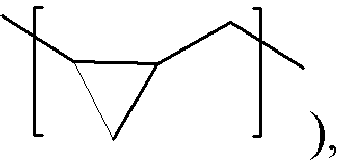

- The following examples and comparative examples refer to the following metal compounds and comparative metal compounds.

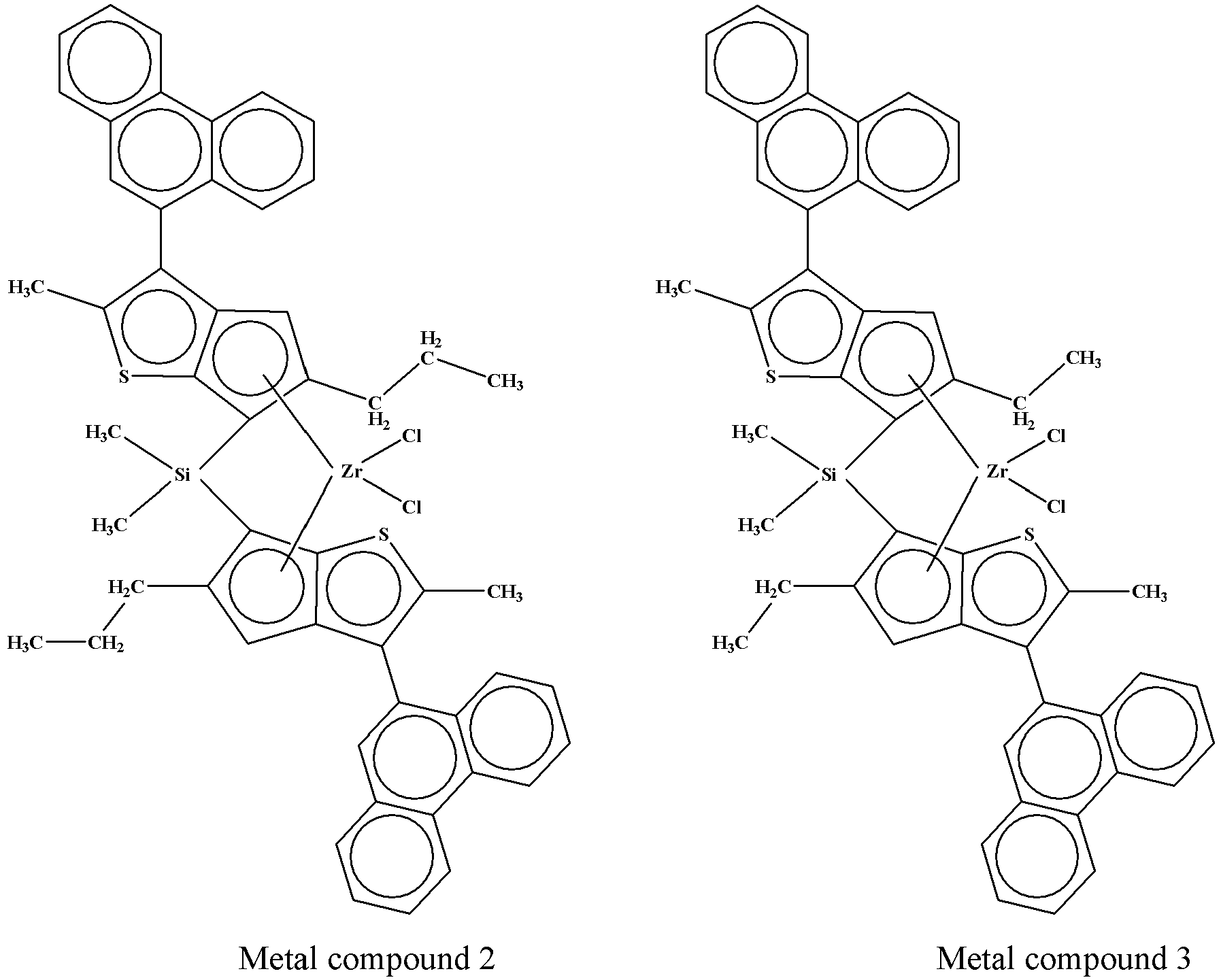
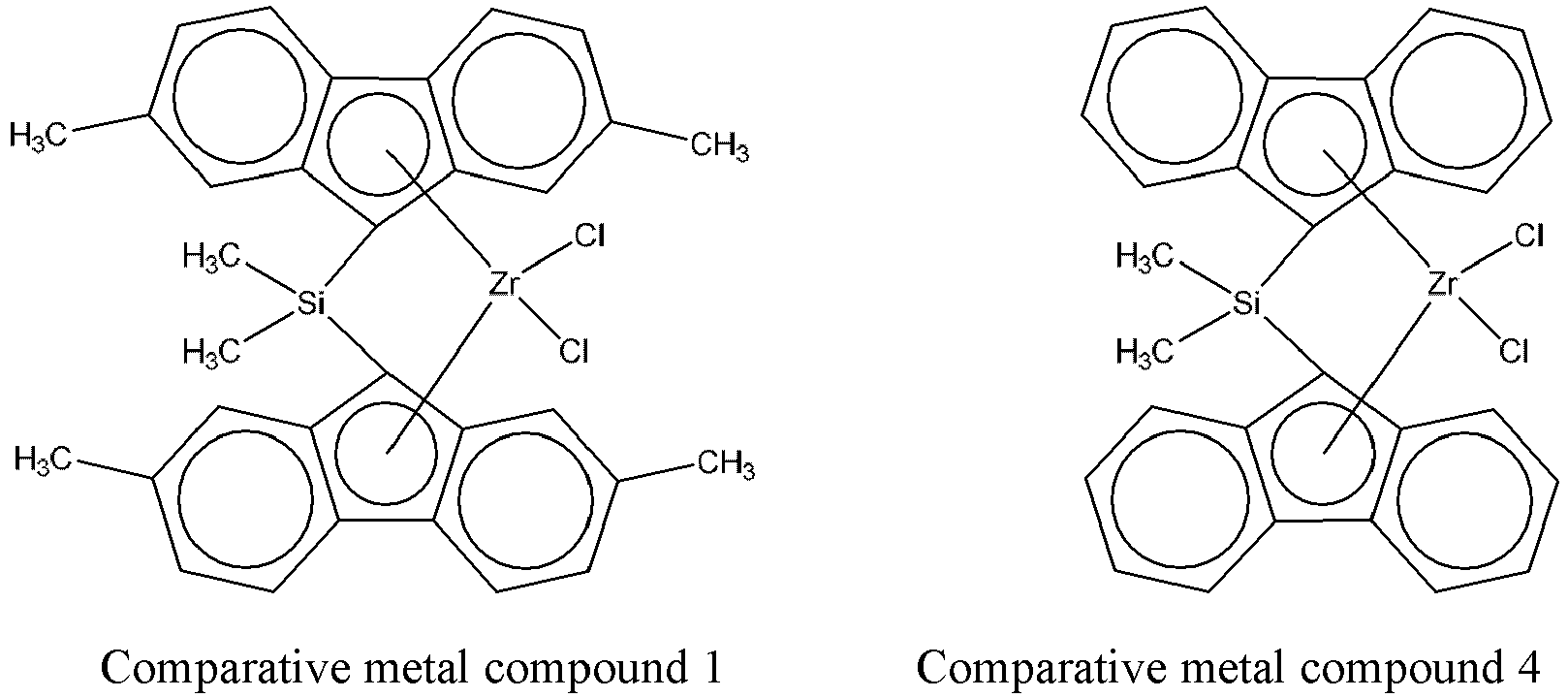
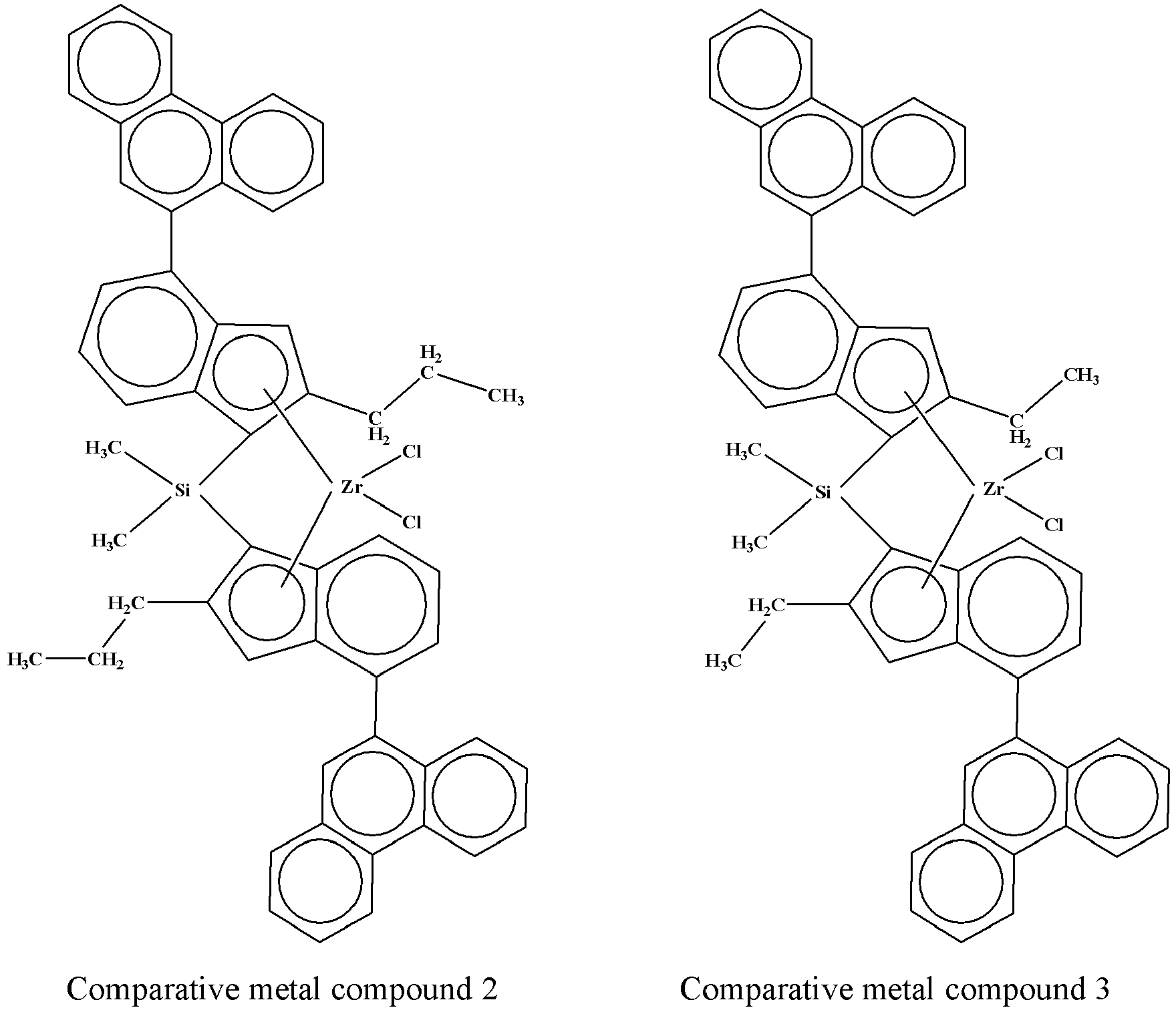

- Preparative examples 1-4 were used to prepare metal compounds 1-4.
- 0.94 g (2 mmol) of bis(2,5-dimethylcyclopentadithiophene)-dimethylsilicon and 50 mL of diethyl ether were added into a reaction flask, and 2.5 mL (4 mmol) of a 1.6 M solution of butyllithium in hexane was added dropwise at -78°C. After stirring at room temperature (25°C) for 6 hours, the temperature was reduced to -40°C, and 0.466 g (2 mmol) of zirconium tetrachloride was added slowly. Stirring was performed overnight. Filtering was performed, and the resulting solid was washed with diethyl ether. A product was recrystallized with dichloromethane. Yield: 45 wt%. H1-NMR (CDCl3, 400 MHz): δppm 6.75 (q, 4H), 2.51 (d, 12H), 1.82 (s, 6H).
- The same synthesis method as that of the metal compound 1 was employed except that bis(2,5-dimethylcyclopentadithiophene)-dimethylsilicon was replaced with 2 mmol of bis(cyclopentadithiophene)-dimethylsilicon. Yield: 57 wt%.
- H1-NMR (CDCl3, 400 MHz): 6ppm 7.15 (d, 4H), 7.10 (d, 4H), 1.80 (s, 6H).
- 1.02 g (2 mmol) of bis(2-methyl-5-n-propyl-3-(9-phenanthryl)-6-hydro-cyclopenta[2,3-b]thiophene-6)-dimethylsilicon and 50 mL of diethyl ether were added into a reaction flask, and 2.5 mL (4 mmol) of a 1.6 M solution of butyllithium in hexane was added dropwise at -78°C. After stirring at room temperature (25°C) for 6 hours, 0.466 g (2 mmol) of zirconium tetrachloride was added slowly. Stirring was performed overnight. Filtering was performed, and the resulting solid was washed with diethyl ether. A filtrate was drained to give a target product. Yield: 56 wt%.
- H1-NMR (CDCl3, 400 MHz): 6ppm 7.15-8.90 (m, 18H), 6.62 (s, 2H), 1.15-2.95 (m, 14H), 1.08 (s, 6H), 0.92 (t, 6H).
- The same synthesis method as that of a metal compound 5 was adopted except that 2 mmol of bis(2-methyl-5-ethyl-3-(9-phenanthryl)-6-hydro-cyclopenta[2,3-b]thiophene-6)-dimethylsilicon was used instead of bis(2,5-dimethyl-3-phenyl-6-hydro-cyclopenta[2,3-b]thiophene-6)-dimethylsilicon. Yield: 61 wt%.
- H1-NMR (CDCl3, 400 MHz): 6ppm 7.10-8.85 (m, 18H), 6.60 (s, 2H), 1.85-2.80 (m, 10H), 1.10 (s, 6H), 0.85 (s, 6H).
- Examples 1-6 served to illustrate the ethylene polymer and the preparation method thereof according to the present disclosure.
- A 500 mL stainless steel reactor was subjected to full replacement with nitrogen, and was then subjected to full replacement with hydrogen, 120 g of toluene, 8 mL of methylaluminoxane (a 10 wt% solution in toluene), and 25.0 g of butadiene were added, and 0.44 kg/cm2G of hydrogen was then added. A liquid phase and a gas phase were saturated with 7.8 kg/cm2G of ethylene at 60°C. Then 5 µmol of a metal compound 1 previously dissolved in toluene was added to start polymerization. Ethylene gas was continuously supplied to maintain a total pressure to be 7.8 kg/cm2G. After 15 minutes of polymerization, a small amount of methanol was added to terminate the reaction. The resulting product was poured into a large amount of ethanol to which hydrochloric acid (the HCl concentration was 0.2 wt%) was added for precipitation, a solid was separated by filtration, and the separated solid was washed with ethanol. The washed solid was dried with a vacuum oven until the weight was no longer reduced to obtain the ethylene copolymer according to the present disclosure. The specific experimental conditions are listed in Table 1, and the test results of the property parameters of the prepared ethylene copolymer are listed in Table 2.
- An ethylene copolymer was prepared by the same method as that in Example 1 except that instead of using methylaluminoxane, 2.5 mL of an n-hexane solution of triisobutylaluminum (the concentration of triisobutylaluminum was 1 M) was used, and 0.03 mmol of trityl-tetrakis(pentafluorophenyl)borate was dissolved in toluene together with the metal compound 1 to be added to a polymerization reactor. The specific experimental conditions are listed in Table 1, and the test results of the property parameters of the prepared ethylene copolymer are listed in Table 2.
- An ethylene copolymer was prepared by the same method as that in Comparative Example 1 except that the metal compound 1 was replaced with a comparative metal compound 1. The specific experimental conditions are listed in Table 1, and the test results of the property parameters of the prepared ethylene copolymer are listed in Table 2.
- An ethylene copolymer was prepared by the same method as that in Example 1 except that the metal compound 1 was replaced with the comparative metal compound 1. The specific experimental conditions are listed in Table 1, and the test results of the property parameters of the prepared ethylene copolymer are listed in Table 2.
- An ethylene copolymer was prepared by the same method as that in Example 1 except that the metal compound 1 was replaced with a metal compound 2, and the property parameters of the prepared ethylene copolymer are listed in Table 2.
- An ethylene copolymer was prepared by the same method as that in Example 2 except that instead of using methylaluminoxane, 2.5 mL of an n-hexane solution of triisobutylaluminum (the concentration of triisobutylaluminum was 1 M) was used, and 0.03 mmol of trityl-tetrakis(pentafluorophenyl)borate was dissolved in toluene together with the metal compound 2 to be added to the polymerization reactor. The specific experimental conditions are listed in Table 1, and the test results of the property parameters of the prepared ethylene copolymer are listed in Table 2.
- An ethylene copolymer was prepared by the same method as that in Example 2 except that the metal compound 2 was replaced with a comparative metal compound 2. The specific experimental conditions are listed in Table 1, and the test results of the property parameters of the prepared ethylene copolymer are listed in Table 2.
- A 500 mL stainless steel reactor was subjected to full replacement with nitrogen, and was then subjected to full replacement with hydrogen, 120 g of toluene, 7.5 mL of MAO (a 10 wt% solution in toluene), and 35 g of butadiene were added, 0.44 kg/cm2G of hydrogen was then added, and a liquid phase and a gas phase were saturated with 7.8 kg/cm2G of ethylene at 60°C. Then 5 µmol of the metal compound 2 previously dissolved in toluene was added to start polymerization. Ethylene gas was continuously supplied to maintain a total pressure to be 7.8 kg/cm2G. After 15 minutes of polymerization, a small amount of methanol was added to terminate the reaction. The resulting product was poured into a large amount of ethanol to which hydrochloric acid (0.2 wt%, hydrochloric acid being in terms of HCl) was added, and precipitated, and a copolymer was separated by filtration, and washed with ethanol. The washed copolymer was dried with a vacuum oven until the weight was no longer reduced to obtain the ethylene copolymer according to the present disclosure. The specific experimental conditions are listed in Table 1, and the test results of the property parameters of the prepared ethylene copolymer are listed in Table 2.
- An ethylene copolymer was prepared by the same method as that in Example 3 except that the metal compound 2 was replaced with the comparative metal compound 2. The specific experimental conditions are listed in Table 1, and the test results of the property parameters of the prepared ethylene copolymer are listed in Table 2.
- An ethylene copolymer was prepared by the same method as that in Example 1 except that the metal compound 1 was replaced with a metal compound 3. The specific experimental conditions are listed in Table 1, and the test results of the property parameters of the prepared ethylene copolymer are listed in Table 2.
- An ethylene copolymer was prepared by the same method as that in Example 3 except that instead of using methylaluminoxane, 2.5 mL of an n-hexane solution of triisobutylaluminum (the concentration of triisobutylaluminum was 1 M) was used, and 0.03 mmol of trityl-tetrakis(pentafluorophenyl)borate was dissolved in toluene together with the metal compound 3 to be added to the polymerization reactor. The specific experimental conditions are listed in Table 1, and the test results of the property parameters of the prepared ethylene copolymer are listed in Table 2.
- An ethylene copolymer was prepared by the same method as that in Example 3 except that the metal compound 3 was replaced with a comparative metal compound 3. The specific experimental conditions are listed in Table 1, and the test results of the property parameters of the prepared ethylene copolymer are listed in Table 2.
- An ethylene copolymer was prepared by the same method as that in Example 3 except that the metal compound 3 was replaced with a comparative metal compound 3. The specific experimental conditions are listed in Table 1, and the test results of the property parameters of the prepared ethylene copolymer are listed in Table 2.
- An ethylene copolymer was prepared by the same method as that in Example 1 except that the metal compound 1 was replaced with a metal compound 4. The specific experimental conditions are listed in Table 1, and the test results of the property parameters of the prepared ethylene copolymer are listed in Table 2.
- An ethylene copolymer was prepared by the same method as that in Example 5 except that instead of using methylaluminoxane, 2.5 mL of an n-hexane solution of triisobutylaluminum (the concentration of triisobutylaluminum was 1 M) was used, and 0.03 mmol of trityl-tetrakis(pentafluorophenyl)borate was dissolved in toluene together with the metal compound 4 to be added to the polymerization reactor. The specific experimental conditions are listed in Table 1, and the test results of the property parameters of the prepared ethylene copolymer are listed in Table 2.
- An ethylene copolymer was prepared by the same method as that in Example 5 except that the metal compound 4 was replaced with a comparative metal compound 4. The specific experimental conditions are listed in Table 1, and the test results of the property parameters of the prepared ethylene copolymer are listed in Table 2.
- An ethylene copolymer was prepared by the same method as that in Example 1 except that the metal compound 1 was replaced with the metal compound 4. The specific experimental conditions are listed in Table 1, and the test results of the property parameters of the prepared ethylene copolymer are listed in Table 2.
- An ethylene copolymer was prepared by the same method as that in Example 6 except that the metal compound 4 was replaced with a comparative metal compound 5. The specific experimental conditions are listed in Table 1, and the test results of the property parameters of the prepared ethylene copolymer are listed in Table 2.
- An ethylene copolymer was prepared by the same method as that in Example 6 except that the metal compound 4 was replaced with a comparative metal compound 6. The specific experimental conditions are listed in Table 1, and the test results of the property parameters of the prepared ethylene copolymer are listed in Table 2.
Table 1 No. Metal compound MAO mL Triisobutylaluminum mL Trityl-tetrakis(pentafluorophenyl)borate mmol Butadiene g Ethylene kg/cm2G Hydrogen kg/cm G No. Usage amount µmol Example 1 1 5 8 - - 25.0 7.8 0.44 Comparative Example 1 1 5 - 2.5 0.03 25.0 7.8 0.44 Comparative Example 2 Comparative metal compound 1 5 - 2.5 0.03 25.0 7.8 0.44 Comparative Example 3 Comparative metal compound 1 5 8 - - 25.0 7.8 0.44 Example 2 2 5 8 - - 25.0 7.8 0.44 Comparative Example 4 2 5 2.5 0.03 25.0 7.8 0.44 Comparative Example 5 Comparative metal compound 2 5 8 - - 25.0 7.8 0.44 Example 3 2 5 7.5 - - 35.0 7.8 0.44 Comparative Example 6 Comparative metal compound 2 5 7.5 - - 35.0 7.8 0.44 Example 4 3 5 8 - - 25.0 7.8 0.44 Comparative Example 7 3 5 - 2.5 0.03 25.0 7.8 0.44 Comparative Example 8 Comparative metal compound 3 5 - 2.5 0.03 25.0 7.8 0.44 Comparative Example 9 Comparative metal compound 3 5 8 - - 25.0 7.8 0.44 Example 5 4 5 8 - - 25.0 7.8 0.44 Comparative Example 10 4 5 - 2.5 0.03 25.0 7.8 0.44 Comparative Example 11 Comparative metal compound 4 5 8 - - 25.0 7.8 0.44 Example 6 4 5 8 - - 25.0 12 0.44 Comparative Example 12 Comparative metal compound 5 5 8 - - 25.0 7.8 0.44 Comparative Example 13 Comparative metal compound 6 5 8 - - 25.0 7.8 0.44 Table 2 No. Yield g Activity kg/(mmol●h) M, M. Mw/Mn Melting point °C Glass transition temperature °C Content of conjugated diene structural unit mol% Vinyl content mol% Cyclopropane ring content mol% Cyclopentane ring content mol% Content of 1,4-structure mol% Content of 1,3-structure mol% Example 1 6.5 5.2 138000 52000 2.7 - -30 31.3 21.6 4.07 5.63 0 0 Comparative Example 1 6.0 4.80 127000 47500 2.7 29 -35 23 14.95 4.14 3.91 0 0 Comparative Example 2 4.5 3.60 58000 21000 2.8 35/125 -40 10 4.5 3.6 1.9 0 0 Comparative Example 3 4.8 3.84 62000 30200 2.1 120 -38 9.9 5.2 3.5 1.2 0 0 Example 2 0.8 0.64 45600 19800 2.3 - -29 34.13 25.6 5.46 3.07 0 0 Comparative Example 4 0.6 0.48 38000 17500 2.2 - -31 23 15.87 2.99 4.14 0 0 Comparative Example 5 0.7 0.56 41000 19000 2.2 35 -32 16 6.2 5.1 4.7 0 0 Example 3 0.8 0.64 41000 20500 2.0 - -22 31 26.35 2.17 2.48 0 0 Comparative Example 6 0.6 0.48 37000 17500 2.1 35 -33 14 9.8 2.24 1.96 0 0 Example 4 3.1 2.48 48000 16800 2.9 - -30 33.57 23.5 5.71 4.36 0 0 Comparative Example 7 2.8 2.24 42500 15600 2.7 - -33 17 9.86 3.74 3.4 0 0 Comparative Example 8 2.4 1.92 41000 14500 2.8 30 -35 13 7.15 3.25 2.6 0 0 Comparative Example 9 3.0 2.4 45000 23000 2.0 32 -36 16 8.2 4.6 3.2 0 0 Example 5 5.8 4.64 49000 26000 1.9 - -28 31.54 20.5 4.10 6.94 0 0 Comparative Example 10 5.2 4.16 35000 16700 2.1 34 -32 15 9.0 1.95 4.05 0 0 Comparative Example 11 4.1 3.28 35000 17000 2.1 120 -39 11 4.8 2.9 3.3 0 0 Example 6 6.3 5.04 59000 38000 1.6 - -29 31.2 23.4 5.30 2.50 0 0 Comparative Example 12 12.0 9.60 230000 100000 2.3 105 - 4.51 0 1.04 3.47 0 0 Comparative Example 13 2.5 2.00 120000 57000 2.1 102 - 6 0.12 1.5 4.38 0 0 - The results in Table 2 confirmed that the ethylene copolymer according to the present disclosure not only has an increased molecular weight and a narrow molecular weight distribution index, but also has an increased content of conjugated diene structural unit, while a backbone of the ethylene copolymer is substantially free of unsaturated groups. The results in Table 2 also confirmed that the olefin polymerization method according to the present disclosure, not only can the ethylene copolymer according to the present disclosure be prepared, but also an increased catalyst activity can be obtained, thereby increasing the production efficiency.
- The ethylene copolymers prepared in Examples 2 and 4 were respectively blended with carbon black, peroxide and vulcanization aid in an open mill according to formulas shown in Table 3. The vulcanization properties of blends were tested by using a MDR vulcanizer purchased from Alpha Technology Company at a temperature of 160°C, and a vulcanization rate was evaluated, wherein the test time was 20 min. The test results are listed in Table 4.
- The vulcanization properties of the ethylene copolymers prepared in Comparative Examples 5 and 9 were respectively tested by the same method as that in Test examples 1-2, and the test results are shown in Table 4.
Table 3 No. Test Example 1 Comparative Test Example 1 Test Example 2 Comparative Test Example 2 Source and usage amount of ethylene copolymer Example 2 100 parts by weight (phr) Comparative Example 5 100 phr Example 4 100 phr Comparative Example 9 100 phr Usage amount of carbon black N550 15 phr 15 phr 15 phr 15 phr Usage amount of dicumyl peroxide 5 phr 5 phr 5 phr 5 phr Usage amount of triallylisocyanurate 1 phr 1 phr 1 phr 1 phr Table 4 No. Test Example 1 Comparative Test Example 1 Test Example 2 Comparative Test Example 2 tc10 (min) 0.5 1.1 0.7 0.9 tc90 (min) 8.5 13.2 8.6 12.1 MH (dNm) 92.3 45.1 90.5 56.8 ML (dNm) 0.5 0.6 0.5 0.7 - As can be seen from the test results of vulcanization properties in Table 4, the ethylene copolymer according to the present disclosure has a faster torque increase during vulcanization, a faster vulcanization rate and a higher degree of vulcanization.
- Preferred embodiments of the present disclosure are described above in detail, but the present disclosure is not limited thereto. Within the technical concept range of the present disclosure, the technical solution of the present disclosure can be subjected to various simple variations, including the combination of various technical features in any other suitable manner, and these simple variations and combinations should likewise be considered as the contents disclosed by the present disclosure, and all fall within the protection scope of the present disclosure.
Claims (22)
- An ethylene copolymer, wherein the ethylene copolymer comprises an ethylene structural unit derived from ethylene and a conjugated diene structural unit derived from a conjugated diene; based on the total amount of the ethylene copolymer, the content of the conjugated diene structural unit is 25-45 mol%, and the content of a 1,2-polymerized vinyl structural unit formed by 1,2-polymerization of the conjugated diene and having side chain double bonds is 20-40 mol%; the total amount of a 1,2-polymerized structural unit is 95 mol% or more based on the total amount of the conjugated diene structural unit in the ethylene copolymer, and the ethylene copolymer has a weight average molecular weight of 20,000 to 300,000.
- The ethylene copolymer according to claim 1, wherein the content of the 1,2-polymerized vinyl structural unit is 20-35 mol%, preferably 21-30 mol% based on the total amount of the ethylene copolymer.
- The ethylene copolymer according to claim 1 or 2, wherein the content of the 1,2-polymerized vinyl structural unit is 55-90%, preferably 60-88%, more preferably 63-85% based on the content of the conjugated diene structural unit.
- The ethylene copolymer according to any one of claims 1 to 3, wherein the total amount of the 1,2-polymerized structural unit is 98 mol% or more, preferably 100 mol% based on the total amount of the conjugated diene structural unit in the ethylene copolymer.
- The ethylene copolymer according to any one of claims 1 to 4, wherein the content of the conjugated diene structural unit is 25-40 mol%, preferably from 30-35 mol% based on the total amount of the ethylene copolymer.
- The ethylene copolymer according to any one of claims 1 to 5, wherein a molar ratio of a 1,2-cyclopentane ring structural unit to a 1,2-cyclopropane ring structural unit in the conjugated diene structural unit of the copolymer is 0.1-3:1, preferably 0.3-2.5:1, more preferably 0.4-2:1, further preferably 0.5-1.8:1.
- The ethylene copolymer according to any one of claims 1 to 6, wherein the ethylene copolymer has a weight average molecular weight of 25,000 to 250,000, preferably 30,000 to 200,000, more preferably 40,000 to 150,000; and
preferably, the copolymer has a molecular weight distribution index of 3.5 or less, preferably 3.2 or less, more preferably 1.5-3. - The ethylene copolymer according to any one of claims 1 to 7, wherein the glass transition temperature of the ethylene copolymer is in the range of -50°C to -15°C, preferably in the range of from -40°C to -20°C.
- The ethylene copolymer according to any one of claims 1 to 8, wherein the conjugated diene is butadiene.
- A method for the preparation of an ethylene copolymer, comprising contacting ethylene with a conjugated diene in the presence of a polymerization catalyst, wherein the polymerization catalyst comprises a component A and a component B,the component A is selected from metal compounds represented by a formula 1,
 in the formula 1, M is a metal atom selected from a Group IVB,X1 and X2 are the same or different, and are each independently a halogen atom,Rb is a Group IVA element-containing divalent group,L1 and L2 are the same or different, and are each independently selected from groups represented by formulae 3 to 6,
 in the formula 3, RA 1, RA 2, RA 3, RA 4 and RA 5 are the same or different, and are each independently a hydrogen atom or C1-C20 alkyl,in the formula 4, RB 1, RB 2, RB 3, RB 4 and RB 5 are the same or different, and are each independently a hydrogen atom or C1-C20 alkyl,in the formula 5, RC 1, RC 2, RC 3 and RC 4 are the same or different, and are each independently a hydrogen atom or C1-C20 alkyl, andin the formula 6, RD 1, RD 2, RD 3 and RD 4 are the same or different, and are each independently a hydrogen atom or C1-C20 alkyl; andthe component B comprises an aluminoxane.
 - The method according to claim 10, wherein in the formula 1, M is a zirconium atom; and/or in the formula 1, X1 and X2 are each independently a chlorine atom.
- The method according to claim 10 or 11, wherein in the formula 1, Rb is a divalent group containing silicon, preferably a divalent group represented by a formula 2,

- The method according to claim 10, wherein the component A is one or two or more selected from metal compounds represented by formulae 7 to 10:


- The method according to any one of claims 10 to 13, wherein a molar ratio of the component A to the component B is 1:0.1-5000.
- The method according to any one of claims 10 to 14, wherein the component A is used in an amount of 0.1-100 µmol relative to 1 mol of the conjugated diene.
- The method according to any one of claims 10 to 15, wherein the conjugated diene is butadiene.
- The method according to any one of claims 10 to 16, wherein the contacting is carried out at a temperature of -50°C to 150°C, and the pressure of ethylene is 0-100 MPa, the pressure being in terms of a gauge pressure.
- The method according to any one of claims 10 to 17, wherein the contacting is carried out in the presence of a molecular weight regulator, and the molecular weight regulator is used in an amount so that the prepared ethylene copolymer has a weight average molecular weight of 20,000 to 300,000, preferably 25,000 to 250,000, more preferably 30,000 to 200,000, further preferably 40,000 to 150,000.
- An ethylene copolymer, prepared by the method according to any one of claims 10 to 18.
- A composition, comprising an ethylene copolymer and a crosslinking agent, wherein the ethylene copolymer is the ethylene copolymer according to any one of claims 1 to 9 and 19.
- A crosslinked polymer, formed by crosslinking the ethylene copolymer according to any one of claims 1 to 9 and 19.
- A tire, having at least one constituent element comprising the ethylene copolymer according to any one of claims 1 to 9 and 19, the composition according to claim 20, or the crosslinked polymer according to claim 21.
Applications Claiming Priority (3)
| Application Number | Priority Date | Filing Date | Title |
|---|---|---|---|
| CN202011314968.3A CN114516930B (en) | 2020-11-20 | 2020-11-20 | Ethylene polymerization process and ethylene polymers made therefrom |
| CN202011311765.9A CN114516929B (en) | 2020-11-20 | 2020-11-20 | Ethylene copolymer, process for producing the same, composition and crosslinked polymer, and tire |
| PCT/CN2020/132147 WO2022104877A1 (en) | 2020-11-20 | 2020-11-27 | Ethylene copolymer and method for preparation thereof and composition and crosslinked polymer and tire |
Publications (2)
| Publication Number | Publication Date |
|---|---|
| EP4242239A1 true EP4242239A1 (en) | 2023-09-13 |
| EP4242239A4 EP4242239A4 (en) | 2024-05-15 |
Family
ID=81708306
Family Applications (1)
| Application Number | Title | Priority Date | Filing Date |
|---|---|---|---|
| EP20962168.9A Pending EP4242239A4 (en) | 2020-11-20 | 2020-11-27 | ETHYLENE COPOLYMER AND PREPARATION METHOD THEREFOR AND COMPOSITION AND CROSS-LINKED POLYMER AND TIRE |
Country Status (5)
| Country | Link |
|---|---|
| US (1) | US20240010768A1 (en) |
| EP (1) | EP4242239A4 (en) |
| JP (1) | JP7621483B2 (en) |
| KR (1) | KR20230109729A (en) |
| WO (1) | WO2022104877A1 (en) |
Family Cites Families (12)
| Publication number | Priority date | Publication date | Assignee | Title |
|---|---|---|---|---|
| JPS4834982A (en) * | 1971-09-07 | 1973-05-23 | ||
| US5191052A (en) * | 1985-06-21 | 1993-03-02 | Exxon Chemical Patents Inc. | Copolymers of ethylene and 1,3-butadiene |
| IN172494B (en) * | 1986-12-19 | 1993-09-04 | Exxon Chemical Patents Inc | |
| JPH1180269A (en) * | 1997-07-18 | 1999-03-26 | Mitsui Chem Inc | Unsaturated copolymer, method for producing the same, and copolymer composition |
| US6288191B1 (en) * | 1998-03-06 | 2001-09-11 | Sumitomo Chemical Company, Limited | Ethylene-isoprene random copolymer |
| AU3538601A (en) * | 1999-12-28 | 2001-07-09 | Basell Technology Company B.V. | Process for the preparation of ethylene polymers |
| JP2004018696A (en) * | 2002-06-17 | 2004-01-22 | Tosoh Corp | Ethylene-conjugated diene copolymer |
| WO2004035639A1 (en) * | 2002-10-16 | 2004-04-29 | Societe De Technologie Michelin | Ethylene/butadiene copolymers, catalytic system of producing same and production of said polymers |
| JP2005200503A (en) * | 2004-01-14 | 2005-07-28 | National Institute Of Advanced Industrial & Technology | Copolymer of propylene and conjugated diene and process for producing the same |
| JP4368728B2 (en) * | 2004-04-19 | 2009-11-18 | 独立行政法人産業技術総合研究所 | Method for producing copolymer of propylene and conjugated diene |
| SG174602A1 (en) * | 2009-03-30 | 2011-11-28 | Mitsui Chemicals Inc | Copolymer of olefin and conjugated diene, and process for producing same |
| JP5567209B2 (en) * | 2010-04-12 | 2014-08-06 | ロッテ ケミカル コーポレーション | Supported catalyst for olefin polymerization and process for producing polyolefin using the same |
-
2020
- 2020-11-27 KR KR1020237020824A patent/KR20230109729A/en active Pending
- 2020-11-27 US US18/253,626 patent/US20240010768A1/en active Pending
- 2020-11-27 JP JP2023530770A patent/JP7621483B2/en active Active
- 2020-11-27 EP EP20962168.9A patent/EP4242239A4/en active Pending
- 2020-11-27 WO PCT/CN2020/132147 patent/WO2022104877A1/en not_active Ceased
Also Published As
| Publication number | Publication date |
|---|---|
| JP7621483B2 (en) | 2025-01-24 |
| WO2022104877A1 (en) | 2022-05-27 |
| KR20230109729A (en) | 2023-07-20 |
| US20240010768A1 (en) | 2024-01-11 |
| EP4242239A4 (en) | 2024-05-15 |
| JP2023549958A (en) | 2023-11-29 |
Similar Documents
| Publication | Publication Date | Title |
|---|---|---|
| CN114341252A (en) | Rubber composition | |
| CN104379613B (en) | Polymerization catalyst composition, method for producing synthetic polyisoprene, and synthetic polyisoprene | |
| CN100469831C (en) | pneumatic tire | |
| WO2017065299A1 (en) | Multicomponent copolymer, rubber composition, cross-linked rubber composition, rubber product, and tire | |
| EP3722339B1 (en) | Copolymer, rubber composition, resin composition, tire and resin product | |
| CN110023352A (en) | Multiple copolymer, rubber composition, crosslinked rubber composition and rubber product | |
| US9399689B2 (en) | Method for producing polybutadiene, polybutadiene, rubber composition and tire | |
| CN113480690B (en) | Multipolymer and preparation method thereof | |
| EP3680265B1 (en) | Method for producing copolymer, copolymer, rubber composition, and tire | |
| CN108137765A (en) | Multiple copolymer, rubber composition, crosslinked rubber composition and rubber | |
| CN114516929B (en) | Ethylene copolymer, process for producing the same, composition and crosslinked polymer, and tire | |
| CN104428332B (en) | Isoprene copolymer and method for producing same | |
| US8604143B2 (en) | Catalysts for polymerization of isoprene and preparations and uses thereof | |
| US20240010768A1 (en) | Ethylene copolymer and method for preparation thereof and composition and crosslinked polymer and tire | |
| US12606695B2 (en) | High-performance tyre | |
| CN114516930A (en) | Ethylene polymerization process and ethylene polymers made therefrom | |
| TW201607967A (en) | Conjugated diene polymerization catalyst, conjugated diene polymer, modified conjugated diene polymer and polybutadiene, and compositions containing same | |
| WO2024088247A1 (en) | Copolymer, preparation method therefor, vulcanized rubber and use thereof | |
| CN120005073A (en) | Ethylene copolymer and preparation method and composition thereof, cross-linked polymer and tire | |
| JP7027351B2 (en) | Multiple copolymers, rubber compositions and rubber articles | |
| CN108059691B (en) | Catalyst compounding process for preparing polybutadiene with adjustable structure |
Legal Events
| Date | Code | Title | Description |
|---|---|---|---|
| STAA | Information on the status of an ep patent application or granted ep patent |
Free format text: STATUS: THE INTERNATIONAL PUBLICATION HAS BEEN MADE |
|
| PUAI | Public reference made under article 153(3) epc to a published international application that has entered the european phase |
Free format text: ORIGINAL CODE: 0009012 |
|
| STAA | Information on the status of an ep patent application or granted ep patent |
Free format text: STATUS: REQUEST FOR EXAMINATION WAS MADE |
|
| 17P | Request for examination filed |
Effective date: 20230606 |
|
| AK | Designated contracting states |
Kind code of ref document: A1 Designated state(s): AL AT BE BG CH CY CZ DE DK EE ES FI FR GB GR HR HU IE IS IT LI LT LU LV MC MK MT NL NO PL PT RO RS SE SI SK SM TR |
|
| DAV | Request for validation of the european patent (deleted) | ||
| DAX | Request for extension of the european patent (deleted) | ||
| A4 | Supplementary search report drawn up and despatched |
Effective date: 20240416 |
|
| RIC1 | Information provided on ipc code assigned before grant |
Ipc: C08L 23/08 20060101ALN20240410BHEP Ipc: C08K 3/04 20060101ALN20240410BHEP Ipc: C08F 4/6592 20060101ALI20240410BHEP Ipc: C08F 236/04 20060101ALI20240410BHEP Ipc: C08F 210/02 20060101AFI20240410BHEP |