EP4241069B1 - Bestimmung der supramolekularen organisation von verkapselten molekülen durch lumineszenz-lebensdaueranalyse - Google Patents
Bestimmung der supramolekularen organisation von verkapselten molekülen durch lumineszenz-lebensdaueranalyse Download PDFInfo
- Publication number
- EP4241069B1 EP4241069B1 EP21806401.2A EP21806401A EP4241069B1 EP 4241069 B1 EP4241069 B1 EP 4241069B1 EP 21806401 A EP21806401 A EP 21806401A EP 4241069 B1 EP4241069 B1 EP 4241069B1
- Authority
- EP
- European Patent Office
- Prior art keywords
- organization
- lifetime
- standard
- data
- putative
- Prior art date
- Legal status (The legal status is an assumption and is not a legal conclusion. Google has not performed a legal analysis and makes no representation as to the accuracy of the status listed.)
- Active
Links
Images

Classifications
-
- G—PHYSICS
- G01—MEASURING; TESTING
- G01N—INVESTIGATING OR ANALYSING MATERIALS BY DETERMINING THEIR CHEMICAL OR PHYSICAL PROPERTIES
- G01N21/00—Investigating or analysing materials by the use of optical means, i.e. using sub-millimetre waves, infrared, visible or ultraviolet light
- G01N21/62—Systems in which the material investigated is excited whereby it emits light or causes a change in wavelength of the incident light
- G01N21/63—Systems in which the material investigated is excited whereby it emits light or causes a change in wavelength of the incident light optically excited
- G01N21/64—Fluorescence; Phosphorescence
- G01N21/6408—Fluorescence; Phosphorescence with measurement of decay time, time resolved fluorescence
-
- G—PHYSICS
- G01—MEASURING; TESTING
- G01N—INVESTIGATING OR ANALYSING MATERIALS BY DETERMINING THEIR CHEMICAL OR PHYSICAL PROPERTIES
- G01N33/00—Investigating or analysing materials by specific methods not covered by groups G01N1/00 - G01N31/00
- G01N33/15—Medicinal preparations ; Physical properties thereof, e.g. dissolubility
Definitions
- the present invention refers to methods for assessing one or more organization states of molecules and nanocarriers within a substance based on lifetime decay analysis data.
- Nanoparticles, nanocapsules, nanocarriers and other similar structures have an enormous range of potential and actual applications. These structures are used to encapsulate different molecules resulting in preparations having a specific supramolecular organization that are used in several technical fields ranging from medicine, diagnostic, nutraceutical, cosmetic, textile, production of special paints dyes and inks.
- nanocarriers such as liposomes
- drug delivery carriers for medicaments and in particular for chemotherapeutic agents
- a means of modulating drug distribution to increase drug efficacy and reduce cytotoxicity.
- drug liposomal formulations ( Gregoriadis - U, Y. B. Liposomes Problems and Prospects. 66-77 (2001 )), potentially guarantee selected advantages, such as: ( i ) prolonged drug circulation time (with avoidance of the Reticuloendothelial system, RES), ( ii ) a protective lipid bilayer to increase drug stability ( iii ) stable loading of a high concentration of drug molecules.
- Doxil ® consists of a formulation of 85-nm-diameter liposomes with 2000-Da segments of poly-(ethylene glycol) (PEG) engrafted onto the liposome surface and loaded with doxorubicin (hereafter DOX).
- DOX poly-(ethylene glycol)
- the drug is a luminescent chemical compound, i.e. a compound that upon irradiation with electromagnetic radiation can re-emit electromagnetic radiation with a detectable lifetime, which is the characteristic time of the radiation emission.
- luminescence lifetime is extraordinarly sensitive to a series of physicochemical parameters affecting the nanoscale proximity of the emitting compound and, as such, is potentially informative of the nanoscale molecular organization of the emitting compound (e.g. self-aggregated, bound to other structures/molecules, free in solution, etc.).
- the authors fail to address the supramolecular organization of the drug within the nanoparticles, i.e. provide a 'nanoscale' parameter indicating how luminescent molecules organize in the case of nanoparticles. It is important to stress that molecular organization states of luminescent molecules cannot be binary and are characteristically more than two. In particular, the authors apply lifetime analysis to a substance whose exact organization is not uniform. This causes a subsequent more complex analysis of the lifetime results, i.e. a fourth-order exponential result for a so-called 'non-coupled' Valrubicin.
- the present invention refers to collecting lifetime decay data characteristic of a pure or nearly pure organization state of molecules and nanocarriers within a standard or reference substance.
- data are monoexponential decay data.
- data may be present in the literature or be collected in an experiment where the reference substance is prepared in order to show a pure or nearly pure organization state.
- a comparison to the lifetime decay data of the substance under test is operated. Further to such comparison, in order to have a higher level of precision, additional steps are provided in order to provide information at the nanoscale level about organization states present in the substance under test.
- the invention relates to a first case wherein the organization states of the test substance are unknown, thereby providing a method to find such states (claims 1-3); and to a second case wherein organization states within the test substance are already known, e.g. from literature, but fractional intensity for each of the known states needs to be determined (claim 4).
- the methods according to the invention may be automatized to provide fast results in lab testing as well as quality tests of production substances, e.g. drugs, nutraceutical/dietary supplements, cosmetic agents, inks, paint, dyes to be used in several fields as agrochemicals (e.g., controlled-release pesticides), industrial chemicals (e.g., paints, adhesives, inks, anti-counterfeiting inks, cosmetics) and, more recently, textiles.
- agrochemicals e.g., controlled-release pesticides
- industrial chemicals e.g., paints, adhesives, inks, anti-counterfeiting inks, cosmetics
- the present invention relates to a method for the quantitative determination by lifetime analysis of target luminescent molecules and more specifically of the supramolecular organization of target luminescent molecules encapsulated within, included in or loaded onto nanocarriers.
- the method according to the invention is directed to the study of test substances, comprising nanocarriers loaded with or encapsulating target luminescent molecules having an unknown supramolecular organization.
- siramolecular organization of the molecule is meant the spatial organization of the plurality of target luminescent molecules encapsulated within, included in or loaded onto the nanocarrier; as non-limitative examples of possible states the molecules can be self-aggregated, bound to other structures/molecules, free in solution, crystallized etc.
- the term “nanocarrier”, is used alongside “nanoparticle-based structure", “nanosystem”, “nanocapsule”, “nanosphere”, “nano-based formulation”, “nanoparticle” and other terms and expressions known to the expert in the field to include any carrier that is meant to be formed and loaded with or can encapsulate or include one or multiple agents and that have one or more dimensions in the nanoscale.
- encapsulated will be used, within the scope of the invention, to indicate any form of relation of the molecules with the nanocarrier structure, it will therefore also stand for “included” “loaded” “inserted” “embedded” “adsorbed” “bound” “chemically linked” etc.
- nanocarriers can be both synthetic and natural polymer-based nanoparticles, nanostructured lipid carriers, lipid-based nanoparticles, solid lipid nanoparticles, liposomes, dendrimers, mesoporous silica nanoparticles micelles, nanoemulsions, polymeric nanoparticles, metallic nanoparticles, surfactant-based emulsions, peptide or protein-based particles, nanoparticles that are formed using a combination of nanomaterials such as mixed lipid-polymer nanoparticles.
- the nanocarrier according to the invention is also formed by luminescent components, said components should not have a excitation/emission spectra overlapping with the target. luminescent molecule's one.
- the structures according to the invention can assume different shapes such as spheroidal, cuboidal, pyramidal, oblong, cylindrical, toroidal etc., the shape assumed doesn't limit the application of the method according to the invention.
- such structures can be loaded with or can encapsulate or include one or more than one luminescent agents, such as, but not limited to, therapeutic or diagnostic agents such as doxorubicin, paclitaxel and bleomycin, molecules used in the nutraceutical and dietary supplement fields such as quercetin and flavonoids, cosmetic agents, inks, paint, dyes to be used in several fields as agrochemicals (e.g., controlled-release pesticides), industrial chemicals (e.g., paints, adhesives, inks, anti-counterfeiting inks, cosmetics) and, more recently, textiles.
- therapeutic or diagnostic agents such as doxorubicin, paclitaxel and bleomycin
- molecules used in the nutraceutical and dietary supplement fields such
- luminescent components “luminescent molecules” or “luminescence agents” are used to indicate agents, components of the nanostructures and chemical compounds that upon irradiation with electromagnetic radiation can re-emit electromagnetic radiation with a detectable lifetime.
- electromagnetic radiation having a wavelength comprised between 300 and 1200 nm, preferably 350 and 1000 nanometres, more preferably between 400 and 700 nm.
- the luminescent molecules according to the invention are preferably fluorescent and phosphorescent molecules, more preferably fluorescent molecules.
- the method according to the invention is used to determine in a non-perturbative way the supramolecular organization of one or more luminescent agents loaded, incapsulated or included in a nanostructure provided that, if multiple agents are present, the intervals of wavelengths emitted upon irradiation are not too overlapping and therefore indistinguishable.
- the nanostructure is loaded with or encapsulate or include a single agent.
- Lifetime Imaging Microscopy is meant a technique to map the spatial distribution of nano-to-millisecond excited state lifetimes within microscopic images.
- Lifetime Imaging Microscopy systems have been implemented both in the time domain, using pulsed excitation sources and time-correlated or time-gated detection (including, but not limited to, Digital Frequency Domain (DFD)-based detection cards), and in the frequency domain, using sinusoidally intensity-modulated excitation light and modulated detectors.
- This approach can be applied to both Fluorescence (i.e. Fluorescence Lifetime Imaging Microscopy, or FLIM) and Phosphorescence (i.e. Phosphorescence Lifetime Imaging Microscopy, or PLIM).
- FLIM Fluorescence Lifetime Imaging Microscopy
- FLIM Fluorescence Lifetime Imaging Microscopy
- a raster-scan confocal microscope is used to image the sample, so that lifetime data can be acquired in many points (i.e. pixels) in space. This in turn allows increasing the statistics, and therefore the accuracy, in the measurement (please note, in fact, that accuracy is inversely proportional to the squared root of the number of acquired photons 'N').
- the proposed invention allows therefore the characterization of the supramolecular organization of the molecules loaded onto or incorporated into the nanocarrier in a non-perturbative way.
- it is of primary potential interest for several industries as a methodological platform to quantitatively and rapidly screen the nano-formulation in terms of supramolecular organization of the loaded/encapsulated agent and, based on obtained results, plan rational modification of the production/synthetic process.
- pharmaceutical industries and companies are interested in including this procedure along quality-control workflow of their drug-manufacturing process.
- electromagnetic radiation having a wavelength ranging between 300 and 1200 nm, preferably 350 and 1000 nanometres, more preferably between 400 and 700 nm, for simplicity we shall use the term luminescence to describe this process and use the term light to indicate said electromagnetic radiation, regardless of its wavelength.
- fluorescence lifetime i.e. the characteristic time of the radiation emission
- fluorescence lifetime is extremely sensitive to a series of physicochemical parameters including those affecting the nanoscale proximity of the emitting molecule, such as its supramolecular organization (e.g. self-aggregated, bound to other structures/molecules, free in solution, etc.).
- the method according to the invention is based on the use of Lifetime Imaging Microscopy in order to assess in a non-perturbative way the supramolecular organization of a plurality of luminescent molecules encapsulated within, included in or loaded onto the nanocarrier.
- Lifetime Imaging Microscopy in order to assess in a non-perturbative way the supramolecular organization of a plurality of luminescent molecules encapsulated within, included in or loaded onto the nanocarrier.
- a number of substances having each a pure nanoscale organization e.g. 'free floating' wherein the molecule is encapsulated in the nanocarrier to float free in solution in and out the nanocarrier, provide a mono-exponential lifetime analysis result; instead a substance having mixed or non-pure organization, e.g. a mix of at least two organization states, cannot provide mono-exponential lifetime analysis results.
- a further aspect of the invention is that the supramolecular organization for which quantitative information is collected is firstly assumed; then quantified by exponential decay of a lifetime analysis in an initialization step where an initialization substance is prepared so as to comprise 100% of the assumed supramolecular organization; and later compare the result of the initialization step with the result of a lifetime analysis applied to a test substance wherein the supramolecular organization is unknown yet.
- the lifetime data of the initialization substance and the test substance (obtained either by fitting the exponential decay or by the phasor-transformation of the decay) can be compared quantitatively using standard statistical tools, e.g. the T-test to evaluate the null hypothesis such that the means of the two populations are equal (if the statistics of the two populations follows a normal distribution).
- the method of the invention is also applicable iteratively by adding, at each iteration, a new supramolecular-organization state whose exponential decay data are compared to those of the test substance in order to assess a fractional intensity contribution.
- the number of added supramolecular-organization states and the related number of iterations is determined based on the obtained results at each iteration (see below).
- the method is also applicable with a single starting supramolecular organization i.e. the first assumed supramolecular organization, in order to check whether the fractional intensity contribution of the test substance supramolecular organization is 100% of the first assumed supramolecular organization. This is helpful e.g. for a rapid quality test during mass production of the test substance.
- a i indicates the series of pre-exponential factors (i.e. the fractional intensity contribution of each supramolecular configuration state considered)
- t is time
- ⁇ i is the characteristic lifetime of each supramolecular configuration state considered. It is important to note that fitting operation according to the present invention requires the calculation of A i (pre-exponential factors or weights) whereas, during each fitting operation, ⁇ i is already assigned based on the i-th standard substance including the i-th putative organization state.
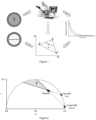
- the phasor approach to lifetime data is used as a fit-free, fast, graphical method to extract the quantitative information encrypted in the lifetime measurements ( Digman, et al. "The phasor approach to fluorescence lifetime imaging analysis.” Biophys. 2008 ).
- the fluorescence lifetime spectra of each pixel in the image is mapped onto a "phasor" plot that is made up out of two numbers: the real and imaginary parts (amplitude and phase respectively) of the first harmonic of the Fourier transform of the fluorescence lifetime, with no need for lifetime-decay data fitting.
- the measured decay instead, consists of a superimposition of different monoexponential components
- the resulting phasor falls inside the semicircle, in a position that depends on the fractional contributions of the components (see below).
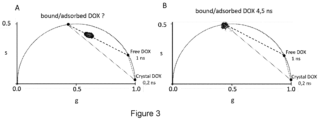
- lifetime data of a standard organization state having a monoexponetial decay fall on the universal circle.
- Each lifetime measurement being typically performed in multiple points (i.e. pixels) in space, will yield a distribution of data-points in the phasor plot whose dispersion will reflect the intrinsic uncertainty in the measurement (that is inversely proportional to the squared root of the number of acquired photons 'N' ) and the intrinsic heterogeneity, if any, of the measured lifetime.
- Data-points in the phasor plot can be analysed by standard statistical tools (e.g. Principal Moment analysis of multivariate data) to extract the relevant parameters of the distribution.
- first reference luminescence lifetime dataset it is possible to assess a 100% fractional intensity of the first organization state if the reference data and the test data are superimposed. Otherwise, a further organization e.g. second organization state shall be assumed, lifetime data thereof shall be collected and step 6 of comparing is completed according to the previous paragraph. Additional iterations are possible depending on the result of the comparison.
- the fractional intensity contribution of all the supramolecular organizations considered is extracted in a fit-free, graphical manner, by applying simple algebraic rules to the phasor-plot dataset (a dedicated routine is available in the SimFCS software, free download at www.lfd.uci.edu).
- a preferred approach to find the reference is to perform dedicated lifetime analysis in order to find the lifetime analysis parameter value(s) of each standard supramolecular organization to be considered in the subsequent test lifetime analysis, where an unknown supramolecular organization is tested.
- Steps (1) to (3) are repeated in the same order for all those supramolecular organizations of the luminescent molecule (obtained in the form of pure, separate standards) which are thought to be present within the nanocarrier under study (e.g. free molecule, crystalized molecule, etc.).
- These reference standards will delineate a portion of the phasor plot within which the nanocarrier under study will lie.
- Simple algebraic rules will be applied to extract the fractional-intensity contribution of each of the standards.
- the number of standards is comprised between 1 and 4, although there is no physical limit to the number of components.
- the phasor of a decay consisting of a linear combination of three pure components falls inside the triangle and the fractional intensities of the components can be retrieved (see Refs. 6,7 for more details).
- Quercetin is a hydrophobic agent with potential anticancer activity. It was encapsulated into several different nanocarriers, among others: chitosan-coated nano-liposomes ( Hao et al. LWT - Food Science and Technology Volume 85, Part A, November 2017, Pages 37-44 ), poly(lactic-co-glycolic) acid (PLGA) nanoparticles (Lozano et al 2019.
- Nanoencapsulated Quercetin Improves Cardioprotection during Hypoxia-Reoxygenation Injury through Preservation of Mitochondrial Function
- biodegradable monomethoxy poly(ethylene glycol)-poly( ⁇ -caprolactone) (MPEG-PCL) micelles Gao et al. Nanoscale. 2012 Nov 21;4(22):7021-30 ). These latter were used to provide a proof-of-principle test in treating ovarian cancer.
- These Quercetin loaded MPEG-PCL micelles with drug loading of 6.9% had a mean particle size of 36 nm, rendering the complete dispersion of Quercetin in water. Still, no information was retrieved on Quercetin supramolecular organization within these example nanoparticles.
- the proposed procedure allows the characterization of the nanoscale molecular organization of a drug in a pharmaceutical formulation.
- it is of potential interest for pharmaceutical industries as a methodological platform to quantitatively and rapidly screen the formulation in terms of drug nanoscale organization and, based on obtained results, plan rational modification of the production/synthetic process.
- Pharmaceutical industries/companies may be interested in including this procedure in their quality-control workflow of their drug-manufacturing process
- a test to determine the number of organization states of fluorescent target molecules within a test substance is as follows:
- a further step e.g. a check step, is provided to determine whether potential additional organization states may be present in the test substance.
- comparison lifetime data are collected from a lifetime analysis of a comparison substance derived from the test substance so as to comprise, in the case of only three organization states, a mix of the first and second state.
- a comparison substance is produced on purpose in a laboratory and, according to an embodiment, the example already discussed for simil-Doxoves ® can be applied or suitably adapted.
- the comparison substance shall only provide a linear combination of the remaining organization states.
- a further (fourth) organization state must be assumed and the corresponding standard lifetime data collected.
- the linear combination test that, in case of three only organization states, provides a positive result when comparison substance lifetime data lies on the line of the phasor plot connecting the assumed non-cancelled organization states, can be generalized so that one or more comparison substances are prepared to exclude one or more putative organization states; and a positive result of the check step corresponds to:
- the present invention is applicable in fields other than drugs, such as the nutraceutical and dietary fields, cosmetic agents, inks, paint, dyes to be used in several fields as agrochemicals (e.g., controlled-release pesticides), industrial chemicals (e.g., paints, adhesives, inks, anti-counterfeiting inks, cosmetics) and, more recently, textiles.
- drugs such as the nutraceutical and dietary fields, cosmetic agents, inks, paint, dyes to be used in several fields as agrochemicals (e.g., controlled-release pesticides), industrial chemicals (e.g., paints, adhesives, inks, anti-counterfeiting inks, cosmetics) and, more recently, textiles.
- agrochemicals e.g., controlled-release pesticides
- industrial chemicals e.g., paints, adhesives, inks, anti-counterfeiting inks, cosmetics
- textiles e.g., textiles
- the nanocarrier particle be luminescent instead of the molecule.
- the nanocarrier particle be luminescent in at least one of its components, instead of the encapsulated molecule.
- the method according to the invention in this case, can be used to determine if the lifetime of the luminescent component of the nanocarrier is affected (and to what extent) by the possible closeness/proximity/interaction with the molecules loaded, incapsulated or included in the nanocarrier.
- the method can be still sensitive to some of the organization states of the encapsulated molecules with respect to the luminescent component of the nanocarrier, i.e. specifically to those affecting the lifetime of the luminescent component of the nanocarrier. For the sake of clearness, these states will be referred to in the following as "reciprocal organization states" (of the encapsulated molecule with respect to the luminescent component of the nanocarrier.
- steps (1) to (3) are repeated iteratively in the same order for all those reciprocal supramolecular organizations of the luminescent component of the nanocarrier with respect to the encapsulated molecules (obtained possibly in the form of pure, separate standards) which are thought to be present within the nanocarrier under study.
- luminescent nanoparticles are the ones, suitably adjusted, already described above for luminescent molecules.
- luminescent molecules also for luminescent nanocarriers it is possible to analyze lifetime data either as fitting data of exponential decay or graphical phasor-based data.
Landscapes
- Health & Medical Sciences (AREA)
- Life Sciences & Earth Sciences (AREA)
- Chemical & Material Sciences (AREA)
- General Physics & Mathematics (AREA)
- Pathology (AREA)
- Analytical Chemistry (AREA)
- Biochemistry (AREA)
- General Health & Medical Sciences (AREA)
- Physics & Mathematics (AREA)
- Immunology (AREA)
- Engineering & Computer Science (AREA)
- Nuclear Medicine, Radiotherapy & Molecular Imaging (AREA)
- Bioinformatics & Cheminformatics (AREA)
- Biophysics (AREA)
- Molecular Biology (AREA)
- Pharmacology & Pharmacy (AREA)
- Food Science & Technology (AREA)
- Medicinal Chemistry (AREA)
- Investigating, Analyzing Materials By Fluorescence Or Luminescence (AREA)
Claims (8)
- Verfahren zur Bestimmung einer supramolekularen Organisation, die in einer Testsubstanz vorhanden ist, die mehrere darin verkapselte, enthaltene oder auf Nanoträgerpartikel geladene Zielmoleküle umfasst, durch Lumineszenzlebensdaueranalyse, wobei die Moleküle und/oder die Nanoträgerpartikel lumineszierend sind, umfassend die folgenden Schritte:- Definieren mindestens eine erste mutmaßliche supramolekulare Standardorganisation einer Vielzahl von Zielmolekülen und Nanoträgerpartikeln,- Empfangen mindestens eines ersten Satzes von Standard-Lumineszenzlebensdauerdaten, die einen ersten Zerfall im Zusammenhang mit einer ersten Standardsubstanz darstellen, wobei die Moleküle und Nanoträgerpartikel rein oder nahezu rein gemäß der ersten mutmaßlichen supramolekularen Organisation organisiert sind, wobei die mutmaßliche erste supramolekulare Standardorganisation fast 100% bzw. 100% der Organisationszustände innerhalb der ersten Standardsubstanz beschreibt;- Verarbeiten einer Testsubstanz, die eine unbekannte supramolekulare Organisation aufweist, um einen Datensatz zur Testlumineszenzlebensdauer zu erhalten;- quantitativ Vergleichen des TestLumineszenzlebensdauer-Datensatzes und mindestens des ersten Standard-Lumineszenzlebensdauer-Datensatzes quantitativ;- Bestimmen, ob die erste mutmaßliche supramolekulare Organisation in der Testsubstanz vorhanden ist oder nicht, basierend auf einer quantitativen Überlagerung des Testlumineszenzlebensdauerdatensatzes und des ersten Lumineszenzlebensdauerdatensatzes, der Standardlumineszenzlebensdauer.
- Bestimmungsverfahren nach Anspruch 1, wobei- der Definitionsschritt umfasst mindestens eine zweite oder mehrere mutmaßliche supramolekulare Standardorganisationen;- der Empfangsschritt umfasst einen zweiten oder mehrere Standard-Lumineszenzlebensdauerdatensätze, die einen zweiten Zerfall im Zusammenhang mit einer zweiten Standardsubstanz repräsentieren, wobei die Moleküle und Nanoträgerpartikel ausschließlich oder nahezu ausschließlich gemäß der zweiten oder mehreren mutmaßlichen Organisationen organisiert sind; und- der Schritt des Bestimmens, ob eine alternative supramolekulare Organisation der Zielmoleküle und der Nanoträgerpartikel in der Testsubstanz vorhanden ist, basierend darauf, ob die Lumineszenzlebensdauerdaten der Testsubstanz eine lineare Kombination der ersten, zweiten oder weiterer Standardlumineszenzlebensdauerdatensätze sind.
- Bestimmungsverfahren nach Anspruch 2, weiterhin umfassend die folgenden Schritte:- Identifizieren einer bestimmten Anzahl von Iterationen für mindestens zwei oder mehrere mutmaßliche supramolekulare Standardorganisationen;- Sammeln von Vergleichslumineszenzlebensdauerdaten einer Vergleichssubstanz, die so erzeugt wurden, dass sie nicht mindestens eine der mutmaßlichen Standardorganisationen der Zielmoleküle und Nanoträgerpartikel aufweisen; und- Vergleichen der Lebensdauerdaten der Testsubstanz und der Lebensdauerdaten der Vergleichssubstanz, um zu bestätigen, ob die Anzahl der Iterationen auf die Gesamtzahl der supramolekularen Standardorganisationen innerhalb der Testsubstanz hinweist.
- Verfahren nach einem der vorhergehenden Ansprüche, umfassend einen zusätzlichen Schritt der Quantifizierung eines Teilintensitätsbeitrags von jeder definierten supramolekularen Organisation der Zielmoleküle und des Nanoträgers.
- Verfahren nach einem der vorhergehenden Ansprüche, wobei es sich bei den Lumineszenzlebensdauerdaten entweder um angepasste exponentielle Zerfallsdaten oder um Zeigerspurdaten handelt.
- Verfahren nach Anspruch 5, wobei ein geeigneter exponentieller Zerfall die Berechnung eines i-ten Gewichts Ai umfasst, das jeder i-ten mutmaßlichen Organisation zuzuordnen ist, und einer i-ten charakteristischen Lebensdauer, die jeder i-ten mutmaßlichen Organisation zuzuordnen ist, die bereits aus einem i-ten Standardsatz erhaltener Lebensdauerdaten-Lumineszenzdaten in dem Empfangsschritt zugeordnet ist.
- Verfahren nach einem der vorhergehenden Ansprüche, wobei das Molekül oder der Nanoträger ein Arzneimittel ist.
- Verfahren nach einem der vorhergehenden Ansprüche, wobei die Standard-Lumineszenzlebensdauerdaten monoexponentiell sind.
Applications Claiming Priority (2)
| Application Number | Priority Date | Filing Date | Title |
|---|---|---|---|
| IT202000026699 | 2020-11-09 | ||
| PCT/IB2021/060300 WO2022097108A1 (en) | 2020-11-09 | 2021-11-08 | Determination of the supramolecular organization of encapsulated molecules by luminescence lifetime analysis |
Publications (3)
| Publication Number | Publication Date |
|---|---|
| EP4241069A1 EP4241069A1 (de) | 2023-09-13 |
| EP4241069B1 true EP4241069B1 (de) | 2024-09-25 |
| EP4241069C0 EP4241069C0 (de) | 2024-09-25 |
Family
ID=74194985
Family Applications (1)
| Application Number | Title | Priority Date | Filing Date |
|---|---|---|---|
| EP21806401.2A Active EP4241069B1 (de) | 2020-11-09 | 2021-11-08 | Bestimmung der supramolekularen organisation von verkapselten molekülen durch lumineszenz-lebensdaueranalyse |
Country Status (3)
| Country | Link |
|---|---|
| US (1) | US11913882B2 (de) |
| EP (1) | EP4241069B1 (de) |
| WO (1) | WO2022097108A1 (de) |
Family Cites Families (4)
| Publication number | Priority date | Publication date | Assignee | Title |
|---|---|---|---|---|
| CN102791827B (zh) * | 2009-11-09 | 2016-11-16 | 华盛顿大学商业化中心 | 官能化发色聚合物点及其生物共轭体 |
| US10222335B2 (en) * | 2010-10-27 | 2019-03-05 | The Regents Of The University Of California | Phasor method to fluorescence lifetime microscopy to discriminate metabolic state of cells in living tissue |
| WO2013106733A1 (en) * | 2012-01-12 | 2013-07-18 | The Regents Of The University Of Michigan | Method of determining the viability of at least one cell |
| WO2020023507A1 (en) * | 2018-07-23 | 2020-01-30 | Cornell University | Natural fluorescent polyhedral amino acid crystals for efficient entrapment and systemic delivery of hydrophobic small molecules |
-
2021
- 2021-11-08 EP EP21806401.2A patent/EP4241069B1/de active Active
- 2021-11-08 WO PCT/IB2021/060300 patent/WO2022097108A1/en not_active Ceased
- 2021-11-08 US US18/252,202 patent/US11913882B2/en active Active
Also Published As
| Publication number | Publication date |
|---|---|
| WO2022097108A1 (en) | 2022-05-12 |
| US11913882B2 (en) | 2024-02-27 |
| US20230341326A1 (en) | 2023-10-26 |
| EP4241069C0 (de) | 2024-09-25 |
| EP4241069A1 (de) | 2023-09-13 |
Similar Documents
| Publication | Publication Date | Title |
|---|---|---|
| Marcu et al. | Fluorescence lifetime spectroscopy and imaging: principles and applications in biomedical diagnostics | |
| EP1983330B1 (de) | Mikroskopisches Weitfeldlichtverfahren | |
| Boreham et al. | Time-resolved fluorescence spectroscopy and fluorescence lifetime imaging microscopy for characterization of dendritic polymer nanoparticles and applications in nanomedicine | |
| Schäferling | Nanoparticle‐based luminescent probes for intracellular sensing and imaging of pH | |
| Pan et al. | Distribution of a model bioactive within solid lipid nanoparticles and nanostructured lipid carriers influences its loading efficiency and oxidative stability | |
| Tsai et al. | Upconversion nanoparticles for sensing pH | |
| Tentori et al. | Fluorescence lifetime microscopy unveils the supramolecular organization of liposomal Doxorubicin | |
| Kuimova | Molecular rotors image intracellular viscosity | |
| Davey et al. | Membrane order and molecular dynamics associated with IgE receptor cross-linking in mast cells | |
| Behera et al. | A fluorescence study of the interaction of anticancer drug molecule doxorubicin hydrochloride in pluronic P123 and F127 micelles | |
| Hackbarth et al. | Singlet oxygen luminescence kinetics in a heterogeneous environment—Identification of the photosensitizer localization in small unilamellar vesicles | |
| Bruun et al. | Study on intracellular delivery of liposome encapsulated quantum dots using advanced fluorescence microscopy | |
| Winterhalder et al. | Beyond the borders—Biomedical applications of non-linear Raman microscopy | |
| Cardellini et al. | Advanced static and dynamic fluorescence microscopy techniques to investigate drug delivery systems | |
| Elistratova et al. | Lifetime oxygen sensors based on block copolymer micelles and non-covalent human serum albumin adducts bearing phosphorescent near-infrared iridium (III) complex | |
| US11913882B2 (en) | Determination of the supramolecular organization of encapsulated molecules by luminescence lifetime analysis | |
| Liu et al. | Strategies and progress of Raman technologies for cellular uptake analysis of the drug delivery systems | |
| Carretta et al. | Monitoring drug stability by label-free fluorescence lifetime imaging: a case study on liposomal doxorubicin | |
| Veres et al. | Comparison of binding ability and location of two mesoporphyrin derivatives in liposomes explored with conventional and site-selective fluorescence spectroscopy | |
| Blank et al. | Electron spin resonance microscopy applied to the study of controlled drug release | |
| Mohanty et al. | Fluorescence lifetime: a multifaceted tool for exploring biological systems | |
| Singh et al. | Sulfated-β-cyclodextrin templated aggregation of a metachromatic dye, Basic Orange 21: A photophysical investigation | |
| Elhassan et al. | Lipophilic molecular rotor to assess the viscosity of oil core in nano-emulsion droplets | |
| Zhang et al. | Characterization of quantum dots with hyperspectral fluorescence microscopy for multiplexed optical imaging of biomolecules | |
| Lapinski et al. | The role of phospholipid headgroups in mediating bilayer organization: Perturbations induced by the presence of a tethered chromophore |
Legal Events
| Date | Code | Title | Description |
|---|---|---|---|
| STAA | Information on the status of an ep patent application or granted ep patent |
Free format text: STATUS: UNKNOWN |
|
| STAA | Information on the status of an ep patent application or granted ep patent |
Free format text: STATUS: THE INTERNATIONAL PUBLICATION HAS BEEN MADE |
|
| PUAI | Public reference made under article 153(3) epc to a published international application that has entered the european phase |
Free format text: ORIGINAL CODE: 0009012 |
|
| STAA | Information on the status of an ep patent application or granted ep patent |
Free format text: STATUS: REQUEST FOR EXAMINATION WAS MADE |
|
| 17P | Request for examination filed |
Effective date: 20230508 |
|
| AK | Designated contracting states |
Kind code of ref document: A1 Designated state(s): AL AT BE BG CH CY CZ DE DK EE ES FI FR GB GR HR HU IE IS IT LI LT LU LV MC MK MT NL NO PL PT RO RS SE SI SK SM TR |
|
| DAV | Request for validation of the european patent (deleted) | ||
| DAX | Request for extension of the european patent (deleted) | ||
| GRAP | Despatch of communication of intention to grant a patent |
Free format text: ORIGINAL CODE: EPIDOSNIGR1 |
|
| STAA | Information on the status of an ep patent application or granted ep patent |
Free format text: STATUS: GRANT OF PATENT IS INTENDED |
|
| INTG | Intention to grant announced |
Effective date: 20240605 |
|
| GRAS | Grant fee paid |
Free format text: ORIGINAL CODE: EPIDOSNIGR3 |
|
| GRAA | (expected) grant |
Free format text: ORIGINAL CODE: 0009210 |
|
| STAA | Information on the status of an ep patent application or granted ep patent |
Free format text: STATUS: THE PATENT HAS BEEN GRANTED |
|
| AK | Designated contracting states |
Kind code of ref document: B1 Designated state(s): AL AT BE BG CH CY CZ DE DK EE ES FI FR GB GR HR HU IE IS IT LI LT LU LV MC MK MT NL NO PL PT RO RS SE SI SK SM TR |
|
| REG | Reference to a national code |
Ref country code: GB Ref legal event code: FG4D |
|
| REG | Reference to a national code |
Ref country code: CH Ref legal event code: EP |
|
| REG | Reference to a national code |
Ref country code: DE Ref legal event code: R096 Ref document number: 602021019401 Country of ref document: DE |
|
| REG | Reference to a national code |
Ref country code: IE Ref legal event code: FG4D |
|
| U01 | Request for unitary effect filed |
Effective date: 20241022 |
|
| U07 | Unitary effect registered |
Designated state(s): AT BE BG DE DK EE FI FR IT LT LU LV MT NL PT RO SE SI Effective date: 20241105 |
|
| U20 | Renewal fee for the european patent with unitary effect paid |
Year of fee payment: 4 Effective date: 20241115 |
|
| PG25 | Lapsed in a contracting state [announced via postgrant information from national office to epo] |
Ref country code: NO Free format text: LAPSE BECAUSE OF FAILURE TO SUBMIT A TRANSLATION OF THE DESCRIPTION OR TO PAY THE FEE WITHIN THE PRESCRIBED TIME-LIMIT Effective date: 20241225 |
|
| PG25 | Lapsed in a contracting state [announced via postgrant information from national office to epo] |
Ref country code: GR Free format text: LAPSE BECAUSE OF FAILURE TO SUBMIT A TRANSLATION OF THE DESCRIPTION OR TO PAY THE FEE WITHIN THE PRESCRIBED TIME-LIMIT Effective date: 20241226 |
|
| PG25 | Lapsed in a contracting state [announced via postgrant information from national office to epo] |
Ref country code: RS Free format text: LAPSE BECAUSE OF FAILURE TO SUBMIT A TRANSLATION OF THE DESCRIPTION OR TO PAY THE FEE WITHIN THE PRESCRIBED TIME-LIMIT Effective date: 20241225 |
|
| PG25 | Lapsed in a contracting state [announced via postgrant information from national office to epo] |
Ref country code: RS Free format text: LAPSE BECAUSE OF FAILURE TO SUBMIT A TRANSLATION OF THE DESCRIPTION OR TO PAY THE FEE WITHIN THE PRESCRIBED TIME-LIMIT Effective date: 20241225 Ref country code: NO Free format text: LAPSE BECAUSE OF FAILURE TO SUBMIT A TRANSLATION OF THE DESCRIPTION OR TO PAY THE FEE WITHIN THE PRESCRIBED TIME-LIMIT Effective date: 20241225 Ref country code: GR Free format text: LAPSE BECAUSE OF FAILURE TO SUBMIT A TRANSLATION OF THE DESCRIPTION OR TO PAY THE FEE WITHIN THE PRESCRIBED TIME-LIMIT Effective date: 20241226 |
|
| PG25 | Lapsed in a contracting state [announced via postgrant information from national office to epo] |
Ref country code: IS Free format text: LAPSE BECAUSE OF FAILURE TO SUBMIT A TRANSLATION OF THE DESCRIPTION OR TO PAY THE FEE WITHIN THE PRESCRIBED TIME-LIMIT Effective date: 20250125 |
|
| PG25 | Lapsed in a contracting state [announced via postgrant information from national office to epo] |
Ref country code: SM Free format text: LAPSE BECAUSE OF FAILURE TO SUBMIT A TRANSLATION OF THE DESCRIPTION OR TO PAY THE FEE WITHIN THE PRESCRIBED TIME-LIMIT Effective date: 20240925 |
|
| PG25 | Lapsed in a contracting state [announced via postgrant information from national office to epo] |
Ref country code: ES Free format text: LAPSE BECAUSE OF FAILURE TO SUBMIT A TRANSLATION OF THE DESCRIPTION OR TO PAY THE FEE WITHIN THE PRESCRIBED TIME-LIMIT Effective date: 20240925 |
|
| PG25 | Lapsed in a contracting state [announced via postgrant information from national office to epo] |
Ref country code: PL Free format text: LAPSE BECAUSE OF FAILURE TO SUBMIT A TRANSLATION OF THE DESCRIPTION OR TO PAY THE FEE WITHIN THE PRESCRIBED TIME-LIMIT Effective date: 20240925 Ref country code: CZ Free format text: LAPSE BECAUSE OF FAILURE TO SUBMIT A TRANSLATION OF THE DESCRIPTION OR TO PAY THE FEE WITHIN THE PRESCRIBED TIME-LIMIT Effective date: 20240925 |
|
| PG25 | Lapsed in a contracting state [announced via postgrant information from national office to epo] |
Ref country code: SK Free format text: LAPSE BECAUSE OF FAILURE TO SUBMIT A TRANSLATION OF THE DESCRIPTION OR TO PAY THE FEE WITHIN THE PRESCRIBED TIME-LIMIT Effective date: 20240925 |
|
| REG | Reference to a national code |
Ref country code: CH Ref legal event code: PL |
|
| PG25 | Lapsed in a contracting state [announced via postgrant information from national office to epo] |
Ref country code: MC Free format text: LAPSE BECAUSE OF FAILURE TO SUBMIT A TRANSLATION OF THE DESCRIPTION OR TO PAY THE FEE WITHIN THE PRESCRIBED TIME-LIMIT Effective date: 20240925 |
|
| REG | Reference to a national code |
Ref country code: CH Ref legal event code: PL |
|
| PG25 | Lapsed in a contracting state [announced via postgrant information from national office to epo] |
Ref country code: CH Free format text: LAPSE BECAUSE OF NON-PAYMENT OF DUE FEES Effective date: 20241130 |
|
| PLBE | No opposition filed within time limit |
Free format text: ORIGINAL CODE: 0009261 |
|
| STAA | Information on the status of an ep patent application or granted ep patent |
Free format text: STATUS: NO OPPOSITION FILED WITHIN TIME LIMIT |
|
| 26N | No opposition filed |
Effective date: 20250626 |
|
| PG25 | Lapsed in a contracting state [announced via postgrant information from national office to epo] |
Ref country code: IE Free format text: LAPSE BECAUSE OF NON-PAYMENT OF DUE FEES Effective date: 20241108 |
|
| U20 | Renewal fee for the european patent with unitary effect paid |
Year of fee payment: 5 Effective date: 20251124 |
|
| PGFP | Annual fee paid to national office [announced via postgrant information from national office to epo] |
Ref country code: GB Payment date: 20251125 Year of fee payment: 5 |
|
| PG25 | Lapsed in a contracting state [announced via postgrant information from national office to epo] |
Ref country code: HR Free format text: LAPSE BECAUSE OF FAILURE TO SUBMIT A TRANSLATION OF THE DESCRIPTION OR TO PAY THE FEE WITHIN THE PRESCRIBED TIME-LIMIT Effective date: 20240925 |
|
| PG25 | Lapsed in a contracting state [announced via postgrant information from national office to epo] |
Ref country code: HU Free format text: LAPSE BECAUSE OF FAILURE TO SUBMIT A TRANSLATION OF THE DESCRIPTION OR TO PAY THE FEE WITHIN THE PRESCRIBED TIME-LIMIT; INVALID AB INITIO Effective date: 20211108 |
|
| PG25 | Lapsed in a contracting state [announced via postgrant information from national office to epo] |
Ref country code: CY Free format text: LAPSE BECAUSE OF FAILURE TO SUBMIT A TRANSLATION OF THE DESCRIPTION OR TO PAY THE FEE WITHIN THE PRESCRIBED TIME-LIMIT; INVALID AB INITIO Effective date: 20211108 |