EP4240883B1 - Martensitaushärtender stahl - Google Patents
Martensitaushärtender stahl Download PDFInfo
- Publication number
- EP4240883B1 EP4240883B1 EP21889716.3A EP21889716A EP4240883B1 EP 4240883 B1 EP4240883 B1 EP 4240883B1 EP 21889716 A EP21889716 A EP 21889716A EP 4240883 B1 EP4240883 B1 EP 4240883B1
- Authority
- EP
- European Patent Office
- Prior art keywords
- powder
- steel
- measured
- fulfils
- spht
- Prior art date
- Legal status (The legal status is an assumption and is not a legal conclusion. Google has not performed a legal analysis and makes no representation as to the accuracy of the status listed.)
- Active
Links
Images
Classifications
-
- C—CHEMISTRY; METALLURGY
- C22—METALLURGY; FERROUS OR NON-FERROUS ALLOYS; TREATMENT OF ALLOYS OR NON-FERROUS METALS
- C22C—ALLOYS
- C22C38/00—Ferrous alloys, e.g. steel alloys
- C22C38/18—Ferrous alloys, e.g. steel alloys containing chromium
- C22C38/40—Ferrous alloys, e.g. steel alloys containing chromium with nickel
- C22C38/58—Ferrous alloys, e.g. steel alloys containing chromium with nickel with more than 1.5% by weight of manganese
-
- C—CHEMISTRY; METALLURGY
- C22—METALLURGY; FERROUS OR NON-FERROUS ALLOYS; TREATMENT OF ALLOYS OR NON-FERROUS METALS
- C22C—ALLOYS
- C22C38/00—Ferrous alloys, e.g. steel alloys
- C22C38/18—Ferrous alloys, e.g. steel alloys containing chromium
- C22C38/40—Ferrous alloys, e.g. steel alloys containing chromium with nickel
-
- B—PERFORMING OPERATIONS; TRANSPORTING
- B22—CASTING; POWDER METALLURGY
- B22F—WORKING METALLIC POWDER; MANUFACTURE OF ARTICLES FROM METALLIC POWDER; MAKING METALLIC POWDER; APPARATUS OR DEVICES SPECIALLY ADAPTED FOR METALLIC POWDER
- B22F1/00—Metallic powder; Treatment of metallic powder, e.g. to facilitate working or to improve properties
- B22F1/05—Metallic powder characterised by the size or surface area of the particles
- B22F1/052—Metallic powder characterised by the size or surface area of the particles characterised by a mixture of particles of different sizes or by the particle size distribution
-
- B—PERFORMING OPERATIONS; TRANSPORTING
- B22—CASTING; POWDER METALLURGY
- B22F—WORKING METALLIC POWDER; MANUFACTURE OF ARTICLES FROM METALLIC POWDER; MAKING METALLIC POWDER; APPARATUS OR DEVICES SPECIALLY ADAPTED FOR METALLIC POWDER
- B22F10/00—Additive manufacturing of workpieces or articles from metallic powder
- B22F10/20—Direct sintering or melting
-
- B—PERFORMING OPERATIONS; TRANSPORTING
- B33—ADDITIVE MANUFACTURING TECHNOLOGY
- B33Y—ADDITIVE MANUFACTURING, i.e. MANUFACTURING OF THREE-DIMENSIONAL [3-D] OBJECTS BY ADDITIVE DEPOSITION, ADDITIVE AGGLOMERATION OR ADDITIVE LAYERING, e.g. BY 3-D PRINTING, STEREOLITHOGRAPHY OR SELECTIVE LASER SINTERING
- B33Y70/00—Materials specially adapted for additive manufacturing
-
- B—PERFORMING OPERATIONS; TRANSPORTING
- B33—ADDITIVE MANUFACTURING TECHNOLOGY
- B33Y—ADDITIVE MANUFACTURING, i.e. MANUFACTURING OF THREE-DIMENSIONAL [3-D] OBJECTS BY ADDITIVE DEPOSITION, ADDITIVE AGGLOMERATION OR ADDITIVE LAYERING, e.g. BY 3-D PRINTING, STEREOLITHOGRAPHY OR SELECTIVE LASER SINTERING
- B33Y80/00—Products made by additive manufacturing
-
- C—CHEMISTRY; METALLURGY
- C22—METALLURGY; FERROUS OR NON-FERROUS ALLOYS; TREATMENT OF ALLOYS OR NON-FERROUS METALS
- C22C—ALLOYS
- C22C33/00—Making ferrous alloys
- C22C33/02—Making ferrous alloys by powder metallurgy
- C22C33/0207—Using a mixture of prealloyed powders or a master alloy
-
- C—CHEMISTRY; METALLURGY
- C22—METALLURGY; FERROUS OR NON-FERROUS ALLOYS; TREATMENT OF ALLOYS OR NON-FERROUS METALS
- C22C—ALLOYS
- C22C33/00—Making ferrous alloys
- C22C33/02—Making ferrous alloys by powder metallurgy
- C22C33/0257—Making ferrous alloys by powder metallurgy characterised by the range of the alloying elements
-
- C—CHEMISTRY; METALLURGY
- C22—METALLURGY; FERROUS OR NON-FERROUS ALLOYS; TREATMENT OF ALLOYS OR NON-FERROUS METALS
- C22C—ALLOYS
- C22C38/00—Ferrous alloys, e.g. steel alloys
- C22C38/02—Ferrous alloys, e.g. steel alloys containing silicon
-
- C—CHEMISTRY; METALLURGY
- C22—METALLURGY; FERROUS OR NON-FERROUS ALLOYS; TREATMENT OF ALLOYS OR NON-FERROUS METALS
- C22C—ALLOYS
- C22C38/00—Ferrous alloys, e.g. steel alloys
- C22C38/04—Ferrous alloys, e.g. steel alloys containing manganese
-
- C—CHEMISTRY; METALLURGY
- C22—METALLURGY; FERROUS OR NON-FERROUS ALLOYS; TREATMENT OF ALLOYS OR NON-FERROUS METALS
- C22C—ALLOYS
- C22C38/00—Ferrous alloys, e.g. steel alloys
- C22C38/18—Ferrous alloys, e.g. steel alloys containing chromium
- C22C38/40—Ferrous alloys, e.g. steel alloys containing chromium with nickel
- C22C38/42—Ferrous alloys, e.g. steel alloys containing chromium with nickel with copper
-
- C—CHEMISTRY; METALLURGY
- C22—METALLURGY; FERROUS OR NON-FERROUS ALLOYS; TREATMENT OF ALLOYS OR NON-FERROUS METALS
- C22C—ALLOYS
- C22C38/00—Ferrous alloys, e.g. steel alloys
- C22C38/18—Ferrous alloys, e.g. steel alloys containing chromium
- C22C38/40—Ferrous alloys, e.g. steel alloys containing chromium with nickel
- C22C38/44—Ferrous alloys, e.g. steel alloys containing chromium with nickel with molybdenum or tungsten
-
- C—CHEMISTRY; METALLURGY
- C22—METALLURGY; FERROUS OR NON-FERROUS ALLOYS; TREATMENT OF ALLOYS OR NON-FERROUS METALS
- C22C—ALLOYS
- C22C38/00—Ferrous alloys, e.g. steel alloys
- C22C38/18—Ferrous alloys, e.g. steel alloys containing chromium
- C22C38/40—Ferrous alloys, e.g. steel alloys containing chromium with nickel
- C22C38/46—Ferrous alloys, e.g. steel alloys containing chromium with nickel with vanadium
-
- C—CHEMISTRY; METALLURGY
- C22—METALLURGY; FERROUS OR NON-FERROUS ALLOYS; TREATMENT OF ALLOYS OR NON-FERROUS METALS
- C22C—ALLOYS
- C22C38/00—Ferrous alloys, e.g. steel alloys
- C22C38/18—Ferrous alloys, e.g. steel alloys containing chromium
- C22C38/40—Ferrous alloys, e.g. steel alloys containing chromium with nickel
- C22C38/48—Ferrous alloys, e.g. steel alloys containing chromium with nickel with niobium or tantalum
-
- C—CHEMISTRY; METALLURGY
- C22—METALLURGY; FERROUS OR NON-FERROUS ALLOYS; TREATMENT OF ALLOYS OR NON-FERROUS METALS
- C22C—ALLOYS
- C22C38/00—Ferrous alloys, e.g. steel alloys
- C22C38/18—Ferrous alloys, e.g. steel alloys containing chromium
- C22C38/40—Ferrous alloys, e.g. steel alloys containing chromium with nickel
- C22C38/50—Ferrous alloys, e.g. steel alloys containing chromium with nickel with titanium or zirconium
-
- C—CHEMISTRY; METALLURGY
- C22—METALLURGY; FERROUS OR NON-FERROUS ALLOYS; TREATMENT OF ALLOYS OR NON-FERROUS METALS
- C22C—ALLOYS
- C22C38/00—Ferrous alloys, e.g. steel alloys
- C22C38/18—Ferrous alloys, e.g. steel alloys containing chromium
- C22C38/40—Ferrous alloys, e.g. steel alloys containing chromium with nickel
- C22C38/52—Ferrous alloys, e.g. steel alloys containing chromium with nickel with cobalt
-
- Y—GENERAL TAGGING OF NEW TECHNOLOGICAL DEVELOPMENTS; GENERAL TAGGING OF CROSS-SECTIONAL TECHNOLOGIES SPANNING OVER SEVERAL SECTIONS OF THE IPC; TECHNICAL SUBJECTS COVERED BY FORMER USPC CROSS-REFERENCE ART COLLECTIONS [XRACs] AND DIGESTS
- Y02—TECHNOLOGIES OR APPLICATIONS FOR MITIGATION OR ADAPTATION AGAINST CLIMATE CHANGE
- Y02P—CLIMATE CHANGE MITIGATION TECHNOLOGIES IN THE PRODUCTION OR PROCESSING OF GOODS
- Y02P10/00—Technologies related to metal processing
- Y02P10/25—Process efficiency
Definitions
- the present invention relates to a new type of maraging steel, which has suitable properties for tools such as hot-work tools and plastic moulding tools and wherein the composition is suitable also for use in an additive manufacturing method.
- hot-work tools' is applied to a great number of different kinds of tools for the working or forming of metals at comparatively high temperatures, for example tools for die casting, hot-pressing and moulds for forming plastics as well as various other kinds of tools intended for use in work at high temperatures.
- Conventional hot-work tool steels are developed for strength and hardness during prolonged exposure to elevated temperatures and generally use a substantial amount of carbide forming alloys.
- Uddeholm DIEVAR ® is a premium hot work tool of this type. It is a high-performance chromium-molybdenum-vanadium steel produced by ESR. It contains balanced carbon and vanadium contents as described in WO9950468 A1 . Steels of this type utilize particle strengthening by the precipitation of nanometre-sized carbides to hinder dislocation movements, so called secondary hardening steels.
- Maraging steels are not hardened by carbon but by the precipitation of intermetallic phases in a highly alloyed matrix of low carbon martensite.
- Commercial maraging steels often contains 18 % Ni and significant amounts of Mo, Co, Ti and Al.
- 18 % Ni steels is the Grade 300 Maraging Steel also designated 1.2709.
- a different class of maraging steels is stainless and embraces 17-7PH, 17-4 PH, 15-5 PH, PH 15-7Mo, PH 14-8Mo and PH 13-8Mo.
- maraging steel combines ultrahigh strength and ductility
- a drawback of maraging steels is that they contain high amounts of expensive alloy elements.
- a further drawback in many maraging steels is the partial reversion from martensite to austenite that takes place during aging treatment. This type of austenite is referred to as reverted austenite and is to be distinguished from retained austenite, which can also be present in maraging steels after hardening and aging.
- the microstructural changes that take place during heat treatment and use result in transformational stresses and distortion because austenite and martensite have different densities.
- the transformation of austenite into martensite causes a volume increase and the transformation of austenite into martensite results in a shrinkage of the tool steel. Accordingly, these unwanted transformations may lead to harmful dimensional changes, which is a difficult problem in high precision moulds, tools and dies.
- the presence of highly reactive elements may impair the polishability due to the formation of hard inclusions like Al 2 O 3 , TiN and VN.
- Maraging steel metal powder has been increasingly used in the Additive Manufacturing (AM) since the low carbon content helps prevent cracking during cooling. Due to the high costs for AM powder, recycling of the powder has gained considerable interest.
- AM-powder will be subjected to oxygen pick-up during processing, because the oxygen content in a Selective Laser Melting (SLM) built chamber generally is in the order of 1000 ppm. Accordingly, the repeated heating of the powder during reuse may result in a substantial oxygen uptake, in particular if the steel contains a high amount of oxygen active elements like Al and Ti.
- SLM Selective Laser Melting
- Document DE2141026 relates to a large steel forging - of high strength, ductility and machinability.
- the steel contains max. 0.1% C, max. 0.5% Si, max. 0.7% Mn, 5 - 13% Cr, 2 - 10% Ni, 1.5 - 5% Mo and/or W and 3 - 8% Co.
- Document EP3467128 relates to an extrusion die made of steel for making a hot working tool, the steel consists of (in weight-%) C 0.01 - 0.08, Si 0.05 - 0.6, Mn 0.1 - 0.8, Cr 3.9 - 6.1, Ni 1.0 - 3.0, Mo 7.0 - 9.0, Co 9.0 - 12.5, Cu 0.2 - 6.5, N 0.01- 0.15.
- the present invention aims at obviating the aforementioned disadvantages of previously known materials.
- the present invention is directed to a steel having a high tempering resistance in combination with a high toughness as well as a high dimensional stability.
- Tempering resistance is the ability of a steel to keep its hardness at an elevated temperature for prolonged time.
- Toughness is the ability of the steel to absorb energy and plastically deform without fracturing.
- a further object is to provide a maraging steel having a good polishability as well as a good dimensional stability.
- Another further object is to provide a maraging steel having a low content of reactive elements such that melt atomization of the steel can be performed by use of nitrogen gas and that the powder will have improved properties for recirculation in laser based AM.
- Carbon is an undesired impurity element in maraging steels.
- the upper limit for carbon is 0.08 %.
- the upper limit may be set to 0.07, 0.06, 0.05, 0.04, 0.03 or 0.02 %.
- Silicon is used for deoxidation.
- Si is also a strong ferrite former. Si is therefore limited to 0.9 %.
- the upper limit may be 0.8, 0.7, 0.6, 0.5 or 0.4 %.
- the lower limit is 0.1, or may be 0.2 or 0.3%
- Manganese contributes to improving the deoxidation and the hardenability of the steel.
- the content of Mn is not critical but is limited to 2 %.
- the upper limit may be set to 1.5, 1.0, 0.6, 0.5 or 0.4 %.
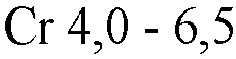
- Chromium is to be present in a content of at least 4.0 % in order to provide a good hardenability and corrosion resistance. If the chromium content is too high, this may lead to the formation of undesired phases such as delta ferrite.
- the upper limit is therefore 6.5 %.
- the upper limit may be set to 6.0 or 5.5 %.
- the lower limit is 4.0, or may be set to 4.1, 4.2, 4.3, 4.4 or 4.5 %.
- Nickel is an austenite stabilizer, which supresses the formation of delta ferrite. Nickel gives the steel a good hardenability and toughness. Ni promotes the precipitation of Mo as ⁇ -phase.
- the lower limit may be 2.0, 2.5 or 3 %.
- the upper limit is 4.5, or may be 4.3, 4.1 or 4.0 %.
- Mo in solid solution is known to have a very favourable effect on the hardenability.
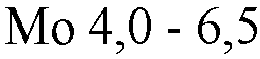
- Mo is in the present invention required for the precipitation hardening during aging. It would appear that Mo forms the intermetallic ⁇ -phase (Fe,Ni,Co) 7 Mo 6 during aging. For this reason, the amount of Mo is 4.0 -6.5%.
- the lower limit may be 4.1, 4.2, 4.3, 4.4 or 4.5 %.
- the upper limit may be or 6.4, 6.3, 6.2, 6.2, 6.0, 5.9, 5.8, 5.7, 5.6 or 5.5 %.
- Cobalt is dissolved in the matrix of the maraging steel and lowers the solubility of molybdenum, thereby Co promotes the precipitation of Mo as ⁇ -phase.
- Co increases the M S temperature and the A c1 temperature, which results in a reduced risk for the formation of reverted austenite.
- Cu may be optionally added in order to increase the strength of the steel by precipitation of ⁇ -Cu.
- the upper limit is 4 % and may be set to 3.5, 3.0, 2.5 or 2.0 %.
- V, Nb, Ti V, Nb and Ti are strong carbide, nitride and/or oxide formers.
- the content of these elements should therefore be limited in order to avoid the formation of undesired carbides and nitrides.
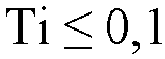
- the maximum amount of each of these elements is therefore 0.1 %.
- these elements are limited to 0.05, 0.03, 0.02, 0.01 or 0.005.
- P and S are the main impurities, which may have a negative effect on the mechanical properties of the steel.
- P is therefore limited to 0.1, and may be limited to 0.05, 0.04, 0.03 0.02 or 0.01 %. If sulphur is not deliberately added, then the impurity content of S is limited to 0.05, or may be limited to 0.04, 0.003, 0.001, 0.0008, 0.0005 or even 0.0001%. However, in an example not forming part of the present invention, S may be deliberately added in an amount of up to 0.35 % for improving the machinability of the steel. The upper limit of S may be reduced to 0.30, 0.25, 0.15 or 0.10 %.
- the inventive steel composition consists of in weight % (wt.%): C ⁇ 0.08 Si 0.1 - 0.9 Mn ⁇ 2 Cr 4.0 - 6.5 Ni 2.0 - 4.5 Mo 4.0 - 6.5 Co 2.0 - 5.5 Cu ⁇ 4.0 Nb ⁇ 0.1 V ⁇ 0.1 Ti ⁇ 0.1 Fe and impurities balance.
- the steel of the present invention is extraordinary stable against the formation of reverted austenite during heating.
- the martensite-to-austenite transformation temperature (Ac1) for the inventive steel should preferably be higher than 680 °C, which a typical temperature for Al-die casting.
- the Ac1 can easily be determined in a dilatometer and is taken as the temperature at which the thermal expansion first deviates from linearity. It is preferred that the Ac1 temperature is at least 690 °C, preferably ⁇ 700 °C, more preferably ⁇ 710 °C and most preferably ⁇ 720 °C.
- the steel preferably fulfils at least one of the following requirements: C ⁇ 0.07 Si 0.2 - 0.8 Mn ⁇ 1 Cr 4.1 - 6.0 Ni 2.5 - 4.5 Mo 4.0 - 6.0 Co 2.5 - 5.0 Cu ⁇ 3.0 V ⁇ 0.05 Nb ⁇ 0.05 Ti ⁇ 0.05 and/or wherein the steel is in the aged condition and comprises intermetallic precipitates, wherein the at least 50 vol. % of the precipitates is of the type (Fe,Ni,Co) 7 Mo 6 .
- the steel more preferably fulfils at least one of the following compositional requirements: C ⁇ 0.06 Si 0.2 - 0.7 Mn ⁇ 0.6 Cr 4.3 - 5.7 Ni 2.7 - 4.3 Mo 4.2 - 5.8 Co 2.7 - 4.7 Cu ⁇ 2.5 V ⁇ 0.03 Nb ⁇ 0.03 Ti ⁇ 0.03 and/or wherein the steel is in the aged condition and comprises intermetallic precipitates, wherein the at least 70 vol.
- % of the precipitates is of the type (Fe,Ni,Co) 7 Mo 6 , and/or wherein the cleanliness fulfils the following maximum requirements with respect to micro-slag according to ASTM E45-97, Method A: A A B B C C D D T H T H T H T H 1.0 0 1.5 1.0 0 0 1.5 1.0
- the steel fulfils the following requirements: C ⁇ 0.06 Si 0.3 - 0.6 Mn ⁇ 0.4 Cr 4.5 - 5.5 Ni 3.0 - 4.0 Mo 4.5 - 5.5 Co 3.0 - 4.5 V ⁇ 0.05 Nb ⁇ 0.05 Ti ⁇ 0.05 Al ⁇ 0.01
- the steel fulfils the following requirements: C ⁇ 0.06 Si 0.2 - 0.7 Mn ⁇ 0.6 Cr 4.3 - 5.7 Ni 2.7 - 4.3 Mo 4.2 - 5.8 Co 2.7 - 4.7 V ⁇ 0.03 Ti ⁇ 0.03 Al ⁇ 0.01
- the inventive alloy may be in the form of a pre-alloyed powder produced by melt atomizing, wherein the powder has a composition as set out above.
- the inventive alloy may be used for the production of hot working tools, plastic moulding tools and for small dies and any other tool. These products may be produced by any suitable method.
- a preferred production method is PM involving HIP or AM.
- the steel powder is suitable for Selective Laser Melting involving recirculation of the powder, because of the low reactivity of the alloy powder with oxygen and nitrogen.
- the alloys of the present invention can be produced by Powder Metallurgy (PM).
- PM powders can be produced by conventional gas- or water- atomization of pre-alloyed steel.
- gas-atomization is the preferred atomization method, because it is important to use a technique, that produces powder particles having a high degree of roundness and a low amount of satellites.
- the close-coupled gas atomization method can be used for this purpose.
- the maximum size of the powder particles for AM is 150 ⁇ m, and the preferred size range is 10 - 100 ⁇ m with a mean size of about 25 - 45 ⁇ m.
- the AM methods of prime interest are Liquid Metal Deposition (LMD), Selective Laser Melting (SLM) and Electron Beam (EB) melting.
- LMD Liquid Metal Deposition
- SLM Selective Laser Melting
- EB Electron Beam
- the powder characteristics are also of importance for AM.
- the powder size distribution measured with a Camsizer according to ISO 4497 should fulfil the following requirements (in ⁇ m): 5 ⁇ D 10 ⁇ 35 20 ⁇ D 50 ⁇ 55 D 90 ⁇ 80
- the powder should fulfil the following size requirements (in ⁇ m): 10 ⁇ D 10 ⁇ 30 25 ⁇ D 50 ⁇ 45 D 90 ⁇ 70
- the coarse size fraction D90 is limited to ⁇ 60 ⁇ m or even ⁇ 55 ⁇ m.
- the sphericity of the powder should be high.
- the mean SPHT should be at least 0.80 and can preferably be at least 0.85, 0.90, 0.91, 0.92 0.93, 0.94 or even 0.95.
- not more than 5 % of the particles should have a SPHT ⁇ 0.70.
- Preferably said value should be less than 0.70, 0.65, 0.55 or even 0.50.
- the aspect ratio can be used in the classifying of the powder particles.
- the aspect ratio is defined as b/l, wherein b is the shortest width of the particle projection and l is the longest diameter.
- the mean aspect ratio should preferably be at least 0.85 or more preferably 0. 86, 0.87, 0.88, 0.89, or 0.90.
- the alloys had the following nominal compositions (in wt. %): Inventive Uddeholm Dievar ® C 0.03 0.36 Si 0.43 0.20 Mn 0.03 0.5 Cr 5.25 5 Ni 3.43 - Mo 5.51 2.3 V 0.07 0.55 Co 3.82 - Cu 0.04 - balance iron and impurities.
- the comparative steel was conventionally produced by ingot casting followed by ESR.
- the comparative steel was subjected to tempering twice for two hours (2x2) at 615 ° C in order to obtain a hardness of 45 HRC.
- the tempering resistance of the alloys was thereafter examined at a temperature of 600 °C.
- the toughness of the steels was examined after tempering and it was found that the inventive steel had a Charpy-V toughness of 25 J, whereas the comparative steel had a Charpy-V toughness of 22 J. Accordingly, it can be seen that the inventive steel had a much higher tempering resistance than the comparative steel.
- the microstructure of the steels was examined after aging and it was found that the precipitate responsible for the hardening in the inventive steel is (Fe,Ni,Co) 7 Mo 6 , i.e. the intermetallic ⁇ -phase.
- the precipitation Module (TC-Prisma, Thermo Calc Version 2021b) was used as computational tool for simulating the precipitation process in the inventive steel.
- the result of the precipitation calculation for the inventive steel used in this example indicated that the size of the intermetallic ⁇ -phase would be about 20 nm after 10 hours and that the amount of the ⁇ -phase would be slightly less than 5 vol. %.
- one inventive alloy is compared to the Grade 300 Maraging Steel (1.2709).
- the alloys had the following nominal compositions (in wt. %): Inventive 1.2709 C 0.03 0.005 Si 0.43 0.04 Mn 0.03 0.05 Cr 5.25 0.02 Ni 3.43 18.1 Mo 5.51 5.1 V 0.07 0.03 Co 3.82 8.8 Cu 0.04 0.01 Ti - 0.95 balance iron and impurities.
- SLM selective laser melting
- inventive steel was free from retained austenite ( ⁇ 2 vol. %) in the as-built condition, whereas the comparative steel contained 11 vol. % retained austenite.
- the amount of retained austenite was determined by X-ray diffraction according to the standard ASTM E975-13.
- the propensity to form reverted austenite during aging was examined by holding the steels at an aging temperature of 540 °C for 1 hour.
- the examination revealed that the inventive steel did not form any reverted austenite, whereas the amount of austenite increased to 17 vol. % in the comparative steel. Accordingly, the aging was performed above the martensite-to-austenite transformation temperature (Ac1) for the comparative steel 1.2709. Therefore, the thermal expansion of the steel 1.2709 will be affected by the martensite-to-austenite transformation during reheating.
- inventive steel may be used for die casting of aluminium, which generally is performed with a melt temperature of about 680 °C.
- the microstructure of the steels was examined after aging and it was found that the precipitate responsible for the hardening in the inventive steel is (Fe,Ni,Co) 7 Mo 6 , i.e. the intermetallic ⁇ -phase.
- the precipitate responsible for the hardening in the comparative steel 1.2709 was as expected (Fe,Ni,Co) 3 (Ti,Mo) and only a minor amount of the ⁇ -phase was found.
- the sensitivity to the formation of non-metallic inclusions when subjected to an oxygen containing atmosphere was qualitatively examined.
- the inventive steel with the same composition as in example 2 was compared to the steel Uddeholm CORRAX ® .
- the nominal composition of the comparative steel is 0.03 % C, 0.3 % Si, 0.3 % Mn, 12.0 % Cr, 9.2 % Ni, 1.4 % Mo and 1.6 % Al.
- Both steels were subjected to melting under protective argon atmosphere in a HF-furnace followed by casting the melts in an inclined copper chute in open air.
- the alloy of the present invention is useful in a wide range of applications.
- the alloy is useful in tools and dies for hot working and plastic moulding as well as for AM-applications.
Landscapes
- Chemical & Material Sciences (AREA)
- Engineering & Computer Science (AREA)
- Materials Engineering (AREA)
- Mechanical Engineering (AREA)
- Metallurgy (AREA)
- Organic Chemistry (AREA)
- Manufacturing & Machinery (AREA)
- Powder Metallurgy (AREA)
- Heat Treatment Of Steel (AREA)
- Heat Treatment Of Articles (AREA)
- Manufacture Of Metal Powder And Suspensions Thereof (AREA)
Claims (10)
- Stahl, der für Warmarbeitswerkzeuge geeignet ist, wobei der Stahl besteht aus in Gewichts-% (Gew.-%):





- Stahl nach Anspruch 1, der mindestens eine der folgenden Anforderungen erfüllt:


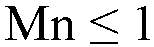


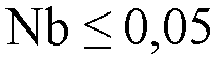
 und / oder wobei die Martensit-Austenit-Umwandlungstemperatur Ac1 höher als 680 °C ist,und / oder wobei der Stahl in dem gealterten Zustand vorliegt und intermetallische Ausscheidungen umfasst, wobei mindestens 50 Vol.-% der Ausscheidungen von dem Typ (Fe,Ni,Co)7Mo6 sind.
 - Stahl nach Anspruch 1 oder 2, der mindestens eine der folgenden Zusammensetzungsanforderungen erfüllt:


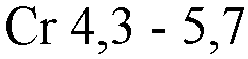
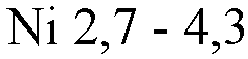


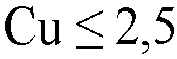


 und / oder wobei die Martensit-Austenit-Umwandlungstemperatur Ac1 höher als 700 °C ist,und / oder wobei der Stahl in dem gealterten Zustand vorliegt und intermetallische Ausscheidungen umfasst, wobei mindestens 70 Vol.-% der Ausscheidungen von dem Typ (Fe,Ni,Co)7Mo6 sind,und / oder wobei die Reinheit die folgenden maximalen Anforderungen in Bezug auf Mikroschlacken nach ASTM E45-97, Methode A, erfüllt:
A A B B C C D D T H T H T H T H 1,0 0 1,5 1,0 0 0 1,5 1,0 - Stahl nach Anspruch 1 oder 2, der die folgenden Anforderungen erfüllt:

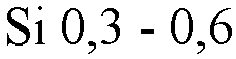


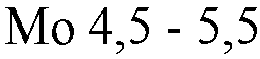


- Stahl nach Anspruch 1 oder 2, der die folgenden Anforderungen erfüllt:
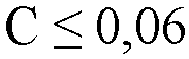


- Vorlegiertes Pulver, hergestellt durch Schmelzzerstäubung, wobei das Pulver eine Zusammensetzung nach einem der Ansprüche 1 - 5 aufweist.
- Vorlegiertes Pulver nach Anspruch 6, wobei das Pulver durch Gaszerstäubung hergestellt wird, mindestens 80 % der Pulverteilchen eine Größe in dem Bereich von 5 - 150 µm aufweisen und wobei das Pulver mindestens eine der folgenden Anforderungen erfüllt:
Pulvergrößenverteilung (in µm): 5 ≤ D10 ≤ 35 20 ≤ D50 ≤ 55 D90 ≤ 80 Mittlere Sphärizität, SPHT ≥ 0,85 Mittleres Seitenverhältnis, b/1 ≥ 0,85 - Vorlegiertes Pulver nach Anspruch 6, wobei mindestens 90 % der Pulverteilchen eine Größe in dem Bereich von 10 bis 100 µm aufweisen und wobei das Pulver mindestens eine der folgenden Anforderungen erfüllt:
Pulvergrößenverteilung (in µm): 10 ≤ D10 ≤ 30 25 ≤ D50 ≤ 45 D90 ≤ 70 Mittlere Sphärizität, SPHT ≥ 0,90 Mittleres Seitenverhältnis, b/l ≥ 0,88 - Artikel, der durch Flüssigmetallabscheidung, selektives Laserschmelzen oder Elektronenstrahlschmelzen geformt wird, wobei der Artikel eine wie in einem der Ansprüche 1 - 5 Legierung umfasst.
- Verwendung einer wie in einem der Ansprüche 1 - 5 definierten Legierung für die Herstellung von Werkzeugen und Formen für Warmumformung und Kunststoffformen.
Applications Claiming Priority (2)
| Application Number | Priority Date | Filing Date | Title |
|---|---|---|---|
| SE2051286A SE544681C2 (en) | 2020-11-05 | 2020-11-05 | Maraging steel for hot-work tools |
| PCT/SE2021/051102 WO2022098285A1 (en) | 2020-11-05 | 2021-11-04 | Maraging steel |
Publications (4)
| Publication Number | Publication Date |
|---|---|
| EP4240883A1 EP4240883A1 (de) | 2023-09-13 |
| EP4240883A4 EP4240883A4 (de) | 2024-04-03 |
| EP4240883C0 EP4240883C0 (de) | 2025-03-19 |
| EP4240883B1 true EP4240883B1 (de) | 2025-03-19 |
Family
ID=81458131
Family Applications (1)
| Application Number | Title | Priority Date | Filing Date |
|---|---|---|---|
| EP21889716.3A Active EP4240883B1 (de) | 2020-11-05 | 2021-11-04 | Martensitaushärtender stahl |
Country Status (11)
| Country | Link |
|---|---|
| US (1) | US20240102139A1 (de) |
| EP (1) | EP4240883B1 (de) |
| JP (1) | JP2023549731A (de) |
| KR (1) | KR20230098636A (de) |
| CN (1) | CN116457487B (de) |
| CA (1) | CA3197030A1 (de) |
| ES (1) | ES3030136T3 (de) |
| PL (1) | PL4240883T3 (de) |
| SE (1) | SE544681C2 (de) |
| TW (1) | TWI890885B (de) |
| WO (1) | WO2022098285A1 (de) |
Families Citing this family (2)
| Publication number | Priority date | Publication date | Assignee | Title |
|---|---|---|---|---|
| CN114918429B (zh) * | 2022-05-31 | 2024-10-15 | 重庆大学 | 一种2GPa级超高强马氏体模具钢的制造方法 |
| CN118341982A (zh) * | 2024-04-19 | 2024-07-16 | 北京科技大学 | 一种提高激光增材制造马氏体时效钢强韧化的方法 |
Family Cites Families (13)
| Publication number | Priority date | Publication date | Assignee | Title |
|---|---|---|---|---|
| GB647701A (en) * | 1944-02-24 | 1950-12-20 | William Jessop And Sons Ltd | Improvements in and relating to nickel chromium steels |
| JPS5110171B1 (de) * | 1967-06-13 | 1976-04-02 | ||
| JPS5132572B1 (de) * | 1968-01-10 | 1976-09-13 | ||
| GB1336678A (en) * | 1971-07-28 | 1973-11-07 | Mitsubishi Heavy Ind Ltd | Steel |
| JPH0426738A (ja) * | 1990-05-19 | 1992-01-29 | Sumitomo Metal Ind Ltd | 熱間製管工具用鋼及び熱間製管工具 |
| JPH11236642A (ja) * | 1998-02-20 | 1999-08-31 | Nippon Steel Corp | 高疲労強度厚鋼板 |
| SE511758C2 (sv) | 1998-03-27 | 1999-11-22 | Uddeholm Tooling Ab | Stålmaterial för varmarbetsverktyg |
| JP3602102B2 (ja) * | 2002-02-05 | 2004-12-15 | 日本高周波鋼業株式会社 | 熱間工具鋼 |
| US20070053784A1 (en) * | 2005-09-06 | 2007-03-08 | Crucible Materials Corp. | Maraging steel article and method of manufacture |
| CN101688271B (zh) * | 2007-07-11 | 2013-03-27 | 日立金属株式会社 | 马氏体时效钢和金属带用马氏体时效钢 |
| TWI756226B (zh) * | 2016-06-30 | 2022-03-01 | 瑞典商伍德赫爾恩股份有限公司 | 用於工具架之鋼 |
| SE541309C2 (en) * | 2017-10-09 | 2019-06-25 | Uddeholms Ab | Steel suitable for hot working tools |
| DE102017131218A1 (de) * | 2017-12-22 | 2019-06-27 | Voestalpine Böhler Edelstahl Gmbh & Co Kg | Verfahren zum Herstellen eines Gegenstands aus einem Maraging-Stahl |
-
2020
- 2020-11-05 SE SE2051286A patent/SE544681C2/en unknown
-
2021
- 2021-11-01 TW TW110140605A patent/TWI890885B/zh active
- 2021-11-04 US US18/035,045 patent/US20240102139A1/en active Pending
- 2021-11-04 CA CA3197030A patent/CA3197030A1/en active Pending
- 2021-11-04 ES ES21889716T patent/ES3030136T3/es active Active
- 2021-11-04 EP EP21889716.3A patent/EP4240883B1/de active Active
- 2021-11-04 KR KR1020237018625A patent/KR20230098636A/ko active Pending
- 2021-11-04 WO PCT/SE2021/051102 patent/WO2022098285A1/en not_active Ceased
- 2021-11-04 PL PL21889716.3T patent/PL4240883T3/pl unknown
- 2021-11-04 JP JP2023527047A patent/JP2023549731A/ja active Pending
- 2021-11-04 CN CN202180074834.5A patent/CN116457487B/zh active Active
Also Published As
| Publication number | Publication date |
|---|---|
| EP4240883A4 (de) | 2024-04-03 |
| ES3030136T3 (en) | 2025-06-26 |
| WO2022098285A1 (en) | 2022-05-12 |
| EP4240883C0 (de) | 2025-03-19 |
| US20240102139A1 (en) | 2024-03-28 |
| EP4240883A1 (de) | 2023-09-13 |
| CA3197030A1 (en) | 2022-05-12 |
| TWI890885B (zh) | 2025-07-21 |
| SE2051286A1 (en) | 2022-05-06 |
| CN116457487A (zh) | 2023-07-18 |
| PL4240883T3 (pl) | 2025-07-14 |
| JP2023549731A (ja) | 2023-11-29 |
| TW202229580A (zh) | 2022-08-01 |
| KR20230098636A (ko) | 2023-07-04 |
| SE544681C2 (en) | 2022-10-18 |
| CN116457487B (zh) | 2025-03-04 |
Similar Documents
| Publication | Publication Date | Title |
|---|---|---|
| EP3472365B1 (de) | Stahl für kunststoffformwerkzeuge | |
| US7842141B2 (en) | Stainless-steel pipe for oil well and process for producing the same | |
| US10094007B2 (en) | Method of manufacturing a ferrous alloy article using powder metallurgy processing | |
| JP4652490B2 (ja) | 統合粉末冶金法により製造したスチールとその熱処理工具及び該スチールの工具への使用 | |
| CN111183241B (zh) | 适用于热加工工具的钢 | |
| EP4240883B1 (de) | Martensitaushärtender stahl | |
| JPH068484B2 (ja) | 加工可能なホウ素含有ステンレス鋼合金から製造される物品及びその製造方法 | |
| WO2018056884A1 (en) | Hot work tool steel | |
| KR20250099456A (ko) | 분말 야금 공구강 | |
| EP4450186A1 (de) | Verwaltung von stahlpulver frei von co, ti und al | |
| JP2022109036A (ja) | 高速度鋼 |
Legal Events
| Date | Code | Title | Description |
|---|---|---|---|
| STAA | Information on the status of an ep patent application or granted ep patent |
Free format text: STATUS: THE INTERNATIONAL PUBLICATION HAS BEEN MADE |
|
| PUAI | Public reference made under article 153(3) epc to a published international application that has entered the european phase |
Free format text: ORIGINAL CODE: 0009012 |
|
| STAA | Information on the status of an ep patent application or granted ep patent |
Free format text: STATUS: REQUEST FOR EXAMINATION WAS MADE |
|
| 17P | Request for examination filed |
Effective date: 20230602 |
|
| AK | Designated contracting states |
Kind code of ref document: A1 Designated state(s): AL AT BE BG CH CY CZ DE DK EE ES FI FR GB GR HR HU IE IS IT LI LT LU LV MC MK MT NL NO PL PT RO RS SE SI SK SM TR |
|
| DAV | Request for validation of the european patent (deleted) | ||
| DAX | Request for extension of the european patent (deleted) | ||
| STAA | Information on the status of an ep patent application or granted ep patent |
Free format text: STATUS: EXAMINATION IS IN PROGRESS |
|
| A4 | Supplementary search report drawn up and despatched |
Effective date: 20240306 |
|
| RIC1 | Information provided on ipc code assigned before grant |
Ipc: C22C 38/52 20060101ALI20240229BHEP Ipc: C22C 38/44 20060101ALI20240229BHEP Ipc: C22C 38/04 20060101ALI20240229BHEP Ipc: C22C 38/02 20060101ALI20240229BHEP Ipc: C22C 33/02 20060101ALI20240229BHEP Ipc: B33Y 80/00 20150101ALI20240229BHEP Ipc: B33Y 70/00 20200101ALI20240229BHEP Ipc: B22F 1/052 20220101ALI20240229BHEP Ipc: C22C 38/50 20060101ALI20240229BHEP Ipc: C22C 38/48 20060101ALI20240229BHEP Ipc: C22C 38/46 20060101ALI20240229BHEP Ipc: C22C 38/42 20060101ALI20240229BHEP Ipc: C22C 38/40 20060101AFI20240229BHEP |
|
| 17Q | First examination report despatched |
Effective date: 20240322 |
|
| GRAP | Despatch of communication of intention to grant a patent |
Free format text: ORIGINAL CODE: EPIDOSNIGR1 |
|
| STAA | Information on the status of an ep patent application or granted ep patent |
Free format text: STATUS: GRANT OF PATENT IS INTENDED |
|
| INTG | Intention to grant announced |
Effective date: 20241008 |
|
| GRAS | Grant fee paid |
Free format text: ORIGINAL CODE: EPIDOSNIGR3 |
|
| GRAA | (expected) grant |
Free format text: ORIGINAL CODE: 0009210 |
|
| STAA | Information on the status of an ep patent application or granted ep patent |
Free format text: STATUS: THE PATENT HAS BEEN GRANTED |
|
| AK | Designated contracting states |
Kind code of ref document: B1 Designated state(s): AL AT BE BG CH CY CZ DE DK EE ES FI FR GB GR HR HU IE IS IT LI LT LU LV MC MK MT NL NO PL PT RO RS SE SI SK SM TR |
|
| REG | Reference to a national code |
Ref country code: GB Ref legal event code: FG4D |
|
| REG | Reference to a national code |
Ref country code: CH Ref legal event code: EP |
|
| REG | Reference to a national code |
Ref country code: IE Ref legal event code: FG4D |
|
| REG | Reference to a national code |
Ref country code: DE Ref legal event code: R096 Ref document number: 602021027946 Country of ref document: DE |
|
| U01 | Request for unitary effect filed |
Effective date: 20250415 |
|
| U07 | Unitary effect registered |
Designated state(s): AT BE BG DE DK EE FI FR IT LT LU LV MT NL PT RO SE SI Effective date: 20250423 |
|
| REG | Reference to a national code |
Ref country code: ES Ref legal event code: FG2A Ref document number: 3030136 Country of ref document: ES Kind code of ref document: T3 Effective date: 20250626 |
|
| PG25 | Lapsed in a contracting state [announced via postgrant information from national office to epo] |
Ref country code: RS Free format text: LAPSE BECAUSE OF FAILURE TO SUBMIT A TRANSLATION OF THE DESCRIPTION OR TO PAY THE FEE WITHIN THE PRESCRIBED TIME-LIMIT Effective date: 20250619 |
|
| PG25 | Lapsed in a contracting state [announced via postgrant information from national office to epo] |
Ref country code: NO Free format text: LAPSE BECAUSE OF FAILURE TO SUBMIT A TRANSLATION OF THE DESCRIPTION OR TO PAY THE FEE WITHIN THE PRESCRIBED TIME-LIMIT Effective date: 20250619 |
|
| PG25 | Lapsed in a contracting state [announced via postgrant information from national office to epo] |
Ref country code: HR Free format text: LAPSE BECAUSE OF FAILURE TO SUBMIT A TRANSLATION OF THE DESCRIPTION OR TO PAY THE FEE WITHIN THE PRESCRIBED TIME-LIMIT Effective date: 20250319 |
|
| PG25 | Lapsed in a contracting state [announced via postgrant information from national office to epo] |
Ref country code: GR Free format text: LAPSE BECAUSE OF FAILURE TO SUBMIT A TRANSLATION OF THE DESCRIPTION OR TO PAY THE FEE WITHIN THE PRESCRIBED TIME-LIMIT Effective date: 20250620 |
|
| PG25 | Lapsed in a contracting state [announced via postgrant information from national office to epo] |
Ref country code: SM Free format text: LAPSE BECAUSE OF FAILURE TO SUBMIT A TRANSLATION OF THE DESCRIPTION OR TO PAY THE FEE WITHIN THE PRESCRIBED TIME-LIMIT Effective date: 20250319 |
|
| PG25 | Lapsed in a contracting state [announced via postgrant information from national office to epo] |
Ref country code: SK Free format text: LAPSE BECAUSE OF FAILURE TO SUBMIT A TRANSLATION OF THE DESCRIPTION OR TO PAY THE FEE WITHIN THE PRESCRIBED TIME-LIMIT Effective date: 20250319 |
|
| PG25 | Lapsed in a contracting state [announced via postgrant information from national office to epo] |
Ref country code: IS Free format text: LAPSE BECAUSE OF FAILURE TO SUBMIT A TRANSLATION OF THE DESCRIPTION OR TO PAY THE FEE WITHIN THE PRESCRIBED TIME-LIMIT Effective date: 20250719 |
|
| U1N | Appointed representative for the unitary patent procedure changed after the registration of the unitary effect |
Representative=s name: NORENS PATENTBYRA AB; SE |
|
| REG | Reference to a national code |
Ref country code: CH Ref legal event code: U11 Free format text: ST27 STATUS EVENT CODE: U-0-0-U10-U11 (AS PROVIDED BY THE NATIONAL OFFICE) Effective date: 20251201 |
|
| U20 | Renewal fee for the european patent with unitary effect paid |
Year of fee payment: 5 Effective date: 20251117 |
|
| PGFP | Annual fee paid to national office [announced via postgrant information from national office to epo] |
Ref country code: GB Payment date: 20251117 Year of fee payment: 5 |
|
| PGFP | Annual fee paid to national office [announced via postgrant information from national office to epo] |
Ref country code: TR Payment date: 20251020 Year of fee payment: 5 |
|
| PGFP | Annual fee paid to national office [announced via postgrant information from national office to epo] |
Ref country code: CH Payment date: 20251201 Year of fee payment: 5 |
|
| PGFP | Annual fee paid to national office [announced via postgrant information from national office to epo] |
Ref country code: CZ Payment date: 20251007 Year of fee payment: 5 |
|
| PGFP | Annual fee paid to national office [announced via postgrant information from national office to epo] |
Ref country code: PL Payment date: 20251007 Year of fee payment: 5 |
|
| PLBE | No opposition filed within time limit |
Free format text: ORIGINAL CODE: 0009261 |
|
| STAA | Information on the status of an ep patent application or granted ep patent |
Free format text: STATUS: NO OPPOSITION FILED WITHIN TIME LIMIT |
|
| REG | Reference to a national code |
Ref country code: CH Ref legal event code: L10 Free format text: ST27 STATUS EVENT CODE: U-0-0-L10-L00 (AS PROVIDED BY THE NATIONAL OFFICE) Effective date: 20260128 |
|
| PGFP | Annual fee paid to national office [announced via postgrant information from national office to epo] |
Ref country code: ES Payment date: 20251208 Year of fee payment: 5 |