EP4239944A1 - Verfahren zur kryptographischen signatur einer dateninformation, elektronische vorrichtung und computerprogramm dafür - Google Patents
Verfahren zur kryptographischen signatur einer dateninformation, elektronische vorrichtung und computerprogramm dafür Download PDFInfo
- Publication number
- EP4239944A1 EP4239944A1 EP23150780.7A EP23150780A EP4239944A1 EP 4239944 A1 EP4239944 A1 EP 4239944A1 EP 23150780 A EP23150780 A EP 23150780A EP 4239944 A1 EP4239944 A1 EP 4239944A1
- Authority
- EP
- European Patent Office
- Prior art keywords
- point
- signature
- scalar
- equal
- derived
- Prior art date
- Legal status (The legal status is an assumption and is not a legal conclusion. Google has not performed a legal analysis and makes no representation as to the accuracy of the status listed.)
- Granted
Links
Images


Classifications
-
- H—ELECTRICITY
- H04—ELECTRIC COMMUNICATION TECHNIQUE
- H04L—TRANSMISSION OF DIGITAL INFORMATION, e.g. TELEGRAPHIC COMMUNICATION
- H04L9/00—Cryptographic mechanisms or cryptographic arrangements for secret or secure communications; Network security protocols
- H04L9/002—Countermeasures against attacks on cryptographic mechanisms
- H04L9/004—Countermeasures against attacks on cryptographic mechanisms for fault attacks
-
- H—ELECTRICITY
- H04—ELECTRIC COMMUNICATION TECHNIQUE
- H04L—TRANSMISSION OF DIGITAL INFORMATION, e.g. TELEGRAPHIC COMMUNICATION
- H04L9/00—Cryptographic mechanisms or cryptographic arrangements for secret or secure communications; Network security protocols
- H04L9/32—Cryptographic mechanisms or cryptographic arrangements for secret or secure communications; Network security protocols including means for verifying the identity or authority of a user of the system or for message authentication, e.g. authorization, entity authentication, data integrity or data verification, non-repudiation, key authentication or verification of credentials
- H04L9/3247—Cryptographic mechanisms or cryptographic arrangements for secret or secure communications; Network security protocols including means for verifying the identity or authority of a user of the system or for message authentication, e.g. authorization, entity authentication, data integrity or data verification, non-repudiation, key authentication or verification of credentials involving digital signatures
- H04L9/3252—Cryptographic mechanisms or cryptographic arrangements for secret or secure communications; Network security protocols including means for verifying the identity or authority of a user of the system or for message authentication, e.g. authorization, entity authentication, data integrity or data verification, non-repudiation, key authentication or verification of credentials involving digital signatures using DSA or related signature schemes, e.g. elliptic based signatures, ElGamal or Schnorr schemes
-
- H—ELECTRICITY
- H04—ELECTRIC COMMUNICATION TECHNIQUE
- H04L—TRANSMISSION OF DIGITAL INFORMATION, e.g. TELEGRAPHIC COMMUNICATION
- H04L9/00—Cryptographic mechanisms or cryptographic arrangements for secret or secure communications; Network security protocols
- H04L9/32—Cryptographic mechanisms or cryptographic arrangements for secret or secure communications; Network security protocols including means for verifying the identity or authority of a user of the system or for message authentication, e.g. authorization, entity authentication, data integrity or data verification, non-repudiation, key authentication or verification of credentials
- H04L9/3247—Cryptographic mechanisms or cryptographic arrangements for secret or secure communications; Network security protocols including means for verifying the identity or authority of a user of the system or for message authentication, e.g. authorization, entity authentication, data integrity or data verification, non-repudiation, key authentication or verification of credentials involving digital signatures
-
- H—ELECTRICITY
- H04—ELECTRIC COMMUNICATION TECHNIQUE
- H04L—TRANSMISSION OF DIGITAL INFORMATION, e.g. TELEGRAPHIC COMMUNICATION
- H04L9/00—Cryptographic mechanisms or cryptographic arrangements for secret or secure communications; Network security protocols
- H04L9/08—Key distribution or management, e.g. generation, sharing or updating, of cryptographic keys or passwords
- H04L9/0861—Generation of secret information including derivation or calculation of cryptographic keys or passwords
- H04L9/0869—Generation of secret information including derivation or calculation of cryptographic keys or passwords involving random numbers or seeds
-
- H—ELECTRICITY
- H04—ELECTRIC COMMUNICATION TECHNIQUE
- H04L—TRANSMISSION OF DIGITAL INFORMATION, e.g. TELEGRAPHIC COMMUNICATION
- H04L9/00—Cryptographic mechanisms or cryptographic arrangements for secret or secure communications; Network security protocols
- H04L9/30—Public key, i.e. encryption algorithm being computationally infeasible to invert or user's encryption keys not requiring secrecy
- H04L9/3066—Public key, i.e. encryption algorithm being computationally infeasible to invert or user's encryption keys not requiring secrecy involving algebraic varieties, e.g. elliptic or hyper-elliptic curves
-
- H—ELECTRICITY
- H04—ELECTRIC COMMUNICATION TECHNIQUE
- H04L—TRANSMISSION OF DIGITAL INFORMATION, e.g. TELEGRAPHIC COMMUNICATION
- H04L9/00—Cryptographic mechanisms or cryptographic arrangements for secret or secure communications; Network security protocols
- H04L9/32—Cryptographic mechanisms or cryptographic arrangements for secret or secure communications; Network security protocols including means for verifying the identity or authority of a user of the system or for message authentication, e.g. authorization, entity authentication, data integrity or data verification, non-repudiation, key authentication or verification of credentials
- H04L9/3247—Cryptographic mechanisms or cryptographic arrangements for secret or secure communications; Network security protocols including means for verifying the identity or authority of a user of the system or for message authentication, e.g. authorization, entity authentication, data integrity or data verification, non-repudiation, key authentication or verification of credentials involving digital signatures
- H04L9/3249—Cryptographic mechanisms or cryptographic arrangements for secret or secure communications; Network security protocols including means for verifying the identity or authority of a user of the system or for message authentication, e.g. authorization, entity authentication, data integrity or data verification, non-repudiation, key authentication or verification of credentials involving digital signatures using RSA or related signature schemes, e.g. Rabin scheme
-
- H—ELECTRICITY
- H04—ELECTRIC COMMUNICATION TECHNIQUE
- H04L—TRANSMISSION OF DIGITAL INFORMATION, e.g. TELEGRAPHIC COMMUNICATION
- H04L2209/00—Additional information or applications relating to cryptographic mechanisms or cryptographic arrangements for secret or secure communication H04L9/00
- H04L2209/04—Masking or blinding
- H04L2209/046—Masking or blinding of operations, operands or results of the operations
-
- H—ELECTRICITY
- H04—ELECTRIC COMMUNICATION TECHNIQUE
- H04L—TRANSMISSION OF DIGITAL INFORMATION, e.g. TELEGRAPHIC COMMUNICATION
- H04L2209/00—Additional information or applications relating to cryptographic mechanisms or cryptographic arrangements for secret or secure communication H04L9/00
- H04L2209/08—Randomization, e.g. dummy operations or using noise
-
- H—ELECTRICITY
- H04—ELECTRIC COMMUNICATION TECHNIQUE
- H04L—TRANSMISSION OF DIGITAL INFORMATION, e.g. TELEGRAPHIC COMMUNICATION
- H04L2209/00—Additional information or applications relating to cryptographic mechanisms or cryptographic arrangements for secret or secure communication H04L9/00
- H04L2209/16—Obfuscation or hiding, e.g. involving white box
-
- H—ELECTRICITY
- H04—ELECTRIC COMMUNICATION TECHNIQUE
- H04L—TRANSMISSION OF DIGITAL INFORMATION, e.g. TELEGRAPHIC COMMUNICATION
- H04L2209/00—Additional information or applications relating to cryptographic mechanisms or cryptographic arrangements for secret or secure communication H04L9/00
- H04L2209/72—Signcrypting, i.e. digital signing and encrypting simultaneously
Definitions
- the present invention relates to the technical field of cryptography.
- It relates more particularly to a method of cryptographic processing, as well as an electronic device and an associated computer program.
- the cryptographic algorithm is broken down into a series of elementary processing operations and look-up tables associated respectively with these elementary processing operations are used to manipulate masked data. .
- the properties of elliptic curves over finite bodies are used in the calculations involved in data processing such as data signature.
- a first element of the group is associated with a generating point of said group and an affine coordinate of a signature point equal to the combination is determined, by means of said operation , of elements equal to the generating point and in number equal to a first scalar.
- a signature part is also determined from the private key, the first scalar, said affine coordinate and the datum.
- the signature of the message consists of the affine coordinate and the signature part.
- the first scalar used can be determined by random drawing but it can be relatively easy for an attacker to block random sources, especially in the context of white box implementations.
- the first scalar used can also be determined by applying a pseudo-random algorithm to the data.
- the first method consists in verifying the signature of the data using a public key associated with the private key.
- the verification is however slower than the signature and its white box implementation is also particularly memory consuming.
- the second method consists of calculating the signature of the data twice and comparing the two signatures thus calculated.
- this method doubles the computation time and requires doubling the white box implementation to guard against double fault attacks that inject the same error, which consumes twice as much memory.
- the invention also proposes a computer program comprising instructions executable by a processor and suitable for the implementation of a method of cryptographic signature of data as defined previously, when these instructions are executed by the processor.
- This electronic device can be configured for the implementation of each of the possible embodiments envisaged for the method of cryptographic signature of a datum as defined above.
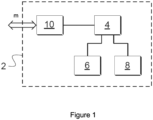
- FIG. 1 schematically represents an electronic device 2 comprising a processor 4 (for example a microprocessor), a storage module 6, a random access memory 8 and a communication module 10.
- a processor 4 for example a microprocessor
- storage module 6 for example a hard disk drive
- random access memory 8 for example a hard disk drive
- Random access memory 8 and storage module 6 are each linked to processor 4 so that processor 4 can read or write data in each of these memories 6, 8.
- the storage module 6 stores computer program instructions, some of which are designed to implement a cryptographic signature method such as at least one of those described with reference to the figures 3 to 4 when these instructions are executed by the processor 4.
- the storage module 6 is for example in practice a hard disk or a non-volatile memory, possibly re-inscribable (for example of the EEPROM type for "Electrically Erasable and Programmable Read-Only Memory ").
- the random-access memory 8 can itself memorize at least some of the elements (in particular the scalars and the points of an elliptical curve) manipulated during the various processing operations carried out during at least one of the methods described with reference to the figures 3 to 4 .
- the electronic device 2 also comprises a set of blocks (not shown), for example a block for determining a first signature point, a block for determining a signature part, a block for determining a second intermediate scalar and a block for determining a second signature point.
- These blocks can in practice be produced by a combination of hardware elements and software elements.
- Each block has a functionality described in the methods in accordance with the invention and set out below.
- the electronic device 2 stores for example software instructions that can be executed by the processor 4 of the electronic device 2 in order to use a hardware element (for example a communication interface or a memory) and thus to implement the functionality offered by the block.
- the computer program instructions stored in the storage module 6 have for example been received (for example from a remote computer) during an operating phase of the electronic device 2 prior to the methods described in reference to figures 3 to 4 .
- the invention applies in particular when the electronic device 2 is not secure and an attacker can therefore have access to the internal functioning of the electronic device 2, and thus to the processing carried out by the processor 4 and to the data manipulated during these treatments. (This is the white-box cryptography framework mentioned in the introduction.)
- the communication module 10 is connected to the processor 4 so as to allow the processor 4 to receive data from another electronic device (not shown) and/or to send data to another electronic device (not shown).
- the processor 4 can thus receive a datum m from the other electronic device and/or transmit other data, for example a result of at least one of the methods described with reference to the figure 3 And 4 , typically the signature of the data item m, intended for the other electronic entity.
- Each figure among the figure 3 And 4 represents a process for the cryptographic signature of data in accordance with the invention.
- Each of these cryptographic processing methods is here implemented by the electronic device 2 (due to the execution of the computer program instructions stored in the storage module 6 as indicated above).
- Each of these methods implements operations in a finite group Gr of order n of points of an elliptic curve E.
- This group Gr is equipped with an operation of addition of two points of the elliptic curve E, here later evoked as an operation.
- the elliptical curve E is defined by a set of parameters comprising a point of the group Gr called the generating point G.
- This generating point is therefore predetermined and can in practice be stored in the electronic device 2, for example in its storage module 6. All point of the group Gr can be uniquely associated with a set of c affine coordinates in a reference frame of a space of dimension c.
- each of these methods implements algebraic operations (addition, multiplication, subtraction) on scalars, hereinafter referred to as addition, product and subtraction.
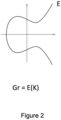
- FIG. 2 represents an example of an elliptic curve E in an affine frame of dimension 2, and an example of a group Gr of points of the elliptic curve E defined on a body K.
- the invention is not limited to this example of elliptical curve and group Gr.
- the elliptical curve E can have another shape in this frame, or the elliptic curve E can be defined in another frame and /or another space, in particular of dimension greater than 2.
- picture 3 shows the main steps of a method of cryptographic signature of data according to a first mode of implementation of the invention.
- the process of picture 3 aims to determine the signature of a datum m, for example received via the communication module 10, by means of a private key d and an ECDSA type algorithm.
- the processor 4 determines a first derivation scalar ti and a second derivation scalar t 0 .
- the first derivation scalar ti and the second derivation scalar t 0 can each be determined by random drawing, by applying a pseudo-random algorithm, for example to the datum m, or by reading a memory of the electronic device 2, for example if the first derivation scalar ti and/or the second derivation scalar t 0 have been previously determined and then stored in the storage module 6.
- the second derivation scalar t 0 preferably has a value modulo the order n of the group Gr, which is strictly greater than one.
- the method then comprises a step of determining a first derived generating point T 0 (step E4) equal to the combination, by means of the operation of the group Gr, of elements equal to the generating point G of the elliptic curve E and in number equal to the second derivation scalar t 0 , for example by multiplying the generating point G by the second derivation scalar t 0 .
- T 0 [t 0 ] G .
- the step for determining a first derived generator point can determine the first derived generator point T 0 by calculation from the second derivation scalar t 0 and the generator point G, or by reading a memory of the electronic device 2, for example if the first derived generating point T 0 has been previously calculated and stored in its storage module 6.
- the step for determining a second derived generator point can determine the second derived generator point T 1 by calculation from the first derivation scalar ti and the generator point G, or by reading a memory of the device electronic 2, for example if the second derived generating point T 1 has been previously calculated and stored in the storage module 6.
- the method then comprises a step for determining a first intermediate scalar (step E8) during which the processor 4 determines said first intermediate scalar k, for example by random drawing or by applying a pseudo-random algorithm, typically to the datum m .
- the method also comprises a step for determining a third intermediate scalar (step E9) during which the processor 4 determines said third intermediate scalar k", for example by random drawing or by applying a pseudo-random algorithm, typically to the datum m.
- the third intermediate scalar (k) is one.
- the method then comprises a step for determining a second intermediate scalar (step E12) during which the second intermediate scalar k' is determined by adding to a scalar result of a product of the first intermediate scalar k and of the second derivation scalar t 0 , a scalar resulting from a product of the first derivation scalar ti and the third intermediate scalar k".
- the second intermediate scalar k' is therefore equal to kt 0 + k".ti .
- the second intermediate scalar k′ is determined by subtracting from a scalar result of a product of the first intermediate scalar k and of the second derivation scalar t 0 , a scalar resulting from a product of the first derivation scalar ti and the third intermediate scalar k".
- the second intermediate scalar k' is therefore worth in this variant of the step kt 0 - k".ti.
- a second intermediate scalar k' is determined by adding or subtracting to a scalar result of a product of the first intermediate scalar k and of a selected scalar , a scalar resulting from a product of a first derivation scalar ti and a third intermediate scalar k", the selected scalar being the second derivation scalar t 0 .
- step E14 determines a second signature point R 0 equal to the combination by means of said operation, of elements equal to a selected point of the curve and in number equal to the second intermediate scalar k', and other elements equal to a point among a second derived generating point T 1 or the opposite of the second derived generating point T 1 for said operation and in number equal to the third intermediate scalar k", the selected point being the generating point G.
- step E14 The variant of the step of determining a second signature point (step E14) is typically used when the step of determining a second intermediate scalar (step E12) is implemented according to its variant which was described earlier.
- the method comprises a step for determining a signature part (step E16) which determines a signature part s from the private key d, from the first intermediate scalar k, from an affine coordinate r 1 (typically a affine coordinate along a predetermined dimension in an affine frame of a predetermined affine space) of the first signature point R 1 and of the datum m.
- step E16 determines a signature part s from the private key d, from the first intermediate scalar k, from an affine coordinate r 1 (typically a affine coordinate along a predetermined dimension in an affine frame of a predetermined affine space) of the first signature point R 1 and of the datum m.
- the signature part s is equal, modulo the order of the group Gr, to the scalar result of the product of the multiplicative inverse of the first intermediate scalar k, of the inverse multiplicative of the second derivation scalar t 0 and of an intermediate signature scalar, said intermediate signature scalar being equal to the sum of a condensate e of the datum m by a hash function H and of a scalar result of a product of the affine coordinate r 1 (typically an affine coordinate according to a first predetermined dimension in an affine frame of reference of a predetermined space) of the first signature point and of the private key d.
- the affine coordinate r 1 typically an affine coordinate according to a first predetermined dimension in an affine frame of reference of a predetermined space
- the hash function H is typically an SHA-1, SHA-224, SHA-256, SHA-384, SHA-512, SHA3-224, SHA3-256, SHA3-384 or SHA3-512 algorithm.
- the electronic device 2 therefore has the signature of the data item m by the ECDSA algorithm by means of the private key d, namely the signature part s and another signature part determined from an affine coordinate r 0 (typically according to a second predetermined dimension in the affine coordinate system of the predetermined space, for example the first dimension described previously) of the second signature point R 0 .
- the other signature part is the affine coordinate r 0 of the second signature point R 0 .
- the attack mentioned in the introduction can no longer be carried out. Indeed, the attacker needs to know the value of the faulty affine coordinate which is used in the calculation of the signature part.
- the first signature point and the second signature point are calculated in two different ways. It would therefore be necessary for the attacker to inject the same fault twice, once in the calculation of the affine coordinate of the first signature point and another time in the calculation of the affine coordinate of the second signature point. By implementing these two calculations differently, the attack becomes impossible.
- the third intermediate scalar (k) has a non-zero value.
- the steps of determining a first derived generator point (step E4) and of determining a second derived generator point (step E6) can be executed in an arbitrary order.
- the initialization step (step E2) can be performed after the step for determining a first derived generating point (step E4) and/or after the step for determining a second generating point derived (step E6), in particular when the determination of the first derived generating point T 0 and/or of the second derived generating point T 1 is by reading a memory of the electronic device 2.
- the steps of determining a first intermediate scalar (step E8) and of determining a third intermediate scalar (step E9) can be executed in an arbitrary order.
- the step of determining a first intermediate scalar (step E8) and/or the step of determining a third intermediate scalar (step E9) can be executed before any one of the steps E2 to E6.
- the step of determining a first signature point can be performed at any time after the step of determining a first derived generator point (step E4) and the step of determining of a first intermediate scalar (step E8), but before the step of determining a signature part (step E16).
- the step of determining a second signature point can be performed at any time after the step of determining a second derived generator point (step E6) and the step of determining of a second intermediate scalar (step E12).
- the step of determining a signature part can be performed at any time after the step of determining a first signature point (step E10).
- FIG 4 represents in the form of a flowchart a method of cryptographic signature of data according to another mode of implementation of the invention.
- the process of figure 4 also aims to determine the signature of a datum m, for example received via the communication module 10, by means of a private key d and an ECDSA type algorithm.
- the process of figure 4 includes an initialization step E2 identical to the initialization step E2 of the first embodiment.
- the method then comprises a step of determining a first derived generator point T 0 (step E4) identical to that of the first mode of implementation.
- the method also comprises a step of determining a second derived generating point T 1 (step E106) equal to the combination by means of the operation of the group
- Gr of elements equal to the first derived generating point T 0 of the elliptic curve E and in number equal to the first scalar of derivation ti.
- This step of determining a second derived generator point can determine the second derived generator point T 1 by calculation from the first derivative scalar ti and from the first derivative generator point T 0 , or by calculation from the first derivative scalar ti , of the second derivation scalar t 0 and of the generating point G, or by reading a memory of the electronic device 2, for example if the second derived generating point T 1 has been previously calculated and stored in its storage module 6.
- the method then comprises a step of determining a first intermediate scalar (step E8), a step of determining a third intermediate scalar (step E9), and then a step of determining a first signature point R 1 ( step E10), identical to those described for the first mode of implementation.
- the method then comprises a step for determining a second intermediate scalar (step E112) during which the second intermediate scalar k' is determined by adding to the first intermediate scalar k, a scalar resulting from the product of the first derivation scalar ti and of the third intermediate scalar k".
- the second intermediate scalar k' is therefore equal to k + k".ti .
- the second intermediate scalar k' is determined by subtracting from the first intermediate scalar k, a scalar resulting from a product of the first derivative scalar ti and of the third intermediate scalar k".
- the second intermediate scalar k' is therefore equal in this variant of step k - k".ti.
- a second intermediate scalar k′ is determined by adding or subtracting to a scalar result of a product of the first intermediate scalar k and of a selected scalar, a scalar result of a product of a first derivation scalar ti and a third intermediate scalar k", the selected scalar having the value 1.
- this step for determining a second signature point determines a second signature point R 0 equal to the combination, by means of said operation, of elements equal to a selected point of the curve and in equal number to the second intermediate scalar k', and other elements equal to one point among a second derived generating point T 1 or the opposite of the second derived generating point T 1 for said operation and in number equal to the third intermediate scalar k", the selected point being the first derived generating point T 0 .
- step E114 The variant of this step of determining a second signature point (step E114) is typically used when the step of determining a second intermediate scalar (step E112) is implemented according to its variant which was described earlier.
- step E16 the method includes a step of determining a signature part (step E16) identical to that of the first mode of implementation.
- the electronic device 2 therefore has the signature of the data item m by the ECDSA algorithm by means of the private key d, namely the signature part s and another signature part determined from an affine coordinate r 0 (typically according to a second predetermined dimension in the affine reference of the predetermined space, for example the first dimension described for the affine coordinate r 1 of the first signature point R 1 at the step of determining a signature part E16) of the second signature point R 0 .
- the other signature part is the affine coordinate r 0 of the second signature point R 0 .
- the attack mentioned in the introduction can no longer be carried out. Indeed, the attacker needs to know the value of the faulty affine coordinate which is used in the calculation of the signature part.
- the first signature point and the second signature point are calculated in two different ways. It would therefore be necessary for the attacker to inject the same fault twice, once in the calculation of the affine coordinate of the first signature point and another time in the calculation of the affine coordinate of the second signature point. By implementing these two calculations differently, the attack becomes impossible.
- the selected scalar being one
- the third intermediate scalar (k) has a non-zero value.
- the step of determining a second derived generator point can be executed before the step of determining a first derived generator point (step E4), when the second derived generator point T 1 is determined by calculation from the first derivation scalar ti, from the second derivation scalar t 0 and from the generating point G, or by reading a memory of the electronic device 2.
- the initialization step (step E2) can be performed after the step for determining a first derivative generator (step E4) and/or after the step for determining a second derivative generator point (step E6), in particular when the determination of the first derived generator point T 0 and/or of the second derived generator point T 1 is by reading a memory of the electronic device 2.
- the steps of determining a first intermediate scalar (step E8) and of determining a third intermediate scalar (step E9) can be executed in an arbitrary order.
- the step of determining a first intermediate scalar (step E8) and/or the step of determining a third intermediate scalar (step E9) can be executed before any of the initialization steps (step E2) , determining a first derived generating point (step E4) and determining a second derived generating point (step E106).
- the step of determining a first signature point can be performed at any time after the step of determining a first derived generator point (step E4) and the step of determining of a first intermediate scalar (step E8).
- the step of determining a second signature point can be performed at any time after the steps of determining a first derived generator point (step E4), of determining a second derived generator point (step E106) and determination of a second intermediate scalar (step E112).
- the step of determining a signature part can be performed at any time after the step of determining a first signature point (step E10).
- these embodiments can be adapted for a cryptographic signature of the data by means of an EdDSA type algorithm.
- the step for determining a signature part also determines a signature part s from the private key d, from the first intermediate scalar k, from the affine coordinate r 1 (typically a coordinate affine along a first predetermined dimension in an affine frame of a predetermined space) of the first signature point R 1 and of data m.
- this step of determining a signature part determines a signature part s which is equal, modulo the order n of the group Gr, to the sum of the first intermediate scalar k and of a scalar result of a product of the private key d and of a digest of an intermediate datum m' by a hash function H, said intermediate datum m being the concatenation of the affine coordinate r 1 of the first signature point , of another affine coordinate r y1 (typically an affine coordinate according to a first other predetermined dimension which is different from the first predetermined dimension in the affine frame of reference of the predetermined space) of the first signature point, of two affine coordinates q and q y (typically respectively an affine coordinate along the first predetermined dimension and the first other predetermined dimension in the affine frame of the predetermined space) of another point Q of the curve E, and of the datum m.
- s k+
- step E200 determines the other signature part u by concatenation of an affine coordinate r 0 (typically according to a second predetermined dimension in the reference affine of the predetermined space, for example the first predetermined dimension) of the second signature point R 0 and of another affine coordinate r y0 (typically according to a second other predetermined dimension in the affine reference of the predetermined space, for example the first other predetermined dimension) of the second signature point R 0 .
- u r 0
- r y0 a step for determining another signature part u
- the electronic device 2 therefore has the signature of the data item m by the EdDSA algorithm by means of the private key d, namely the signature part s described above and the other signature part u determined by the step of determining another signature part (step E200) from an affine coordinate r 0 of the second signature point R 0 .
- the two embodiments described with reference to figure 3 And 4 can be adapted for a cryptographic signature of the datum m by means of a Schnorr signature type algorithm.
- the step for determining a signature part E16 also determines a signature part s from the private key d, from the first intermediate scalar k, from the affine coordinate r 1 (typically an affine coordinate according to a first predetermined dimension in an affine frame of a predetermined space) of the first signature point R 1 and of the datum m.
- the step for determining a signature part E16 determines a signature part s which is equal, modulo the order n of the group Gr, to the sum of the first intermediate scalar k and of a scalar result of a product of the private key d and a condensate of an intermediate datum m' by a hash function H, said intermediate datum m being the concatenation of the affine coordinate r 1 of the first signature point, of another affine coordinate r y1 (typically a affine coordinate according to a first other predetermined dimension which is different from the first predetermined dimension in the affine coordinate system of the predetermined space) of the first signature point R 1 , and of the datum m.
- s k+dH(r 1
- the hash function H is typically an SHA-1, SHA-224, SHA-256, SHA-384, SHA-512, SHA3-224, SHA3-256, SHA3-384 or SHA3-512 algorithm whose result may possibly be truncated.
- step E201 Another step for determining another signature part u (step E201) in which the other signature part u is determined by applying the hash function H to the concatenation of an affine coordinate r 0 (typically according to a second predetermined dimension in the affine coordinate system of the predetermined space, for example the first predetermined dimension) of the second signature point R 0 , of another affine coordinate r y0 (typically according to a second other predetermined dimension in the affine coordinate system of the predetermined space, for example the first other predetermined dimension) of the second signature point R 0 , and of the datum m.
- H H(r 0
- the electronic device 2 therefore has the signature of the datum m by the Schnorr signature algorithm by means of the private key d, namely the signature part s described above and the other signature part u determined by the other step of determining another signature part (step E201) from an affine coordinate r 0 of the second signature point R 0 .
- each method can be executed according to other orders insofar as each step has the elements (for example scalars and/or points of the elliptic curve) necessary for its execution. .
- the step of determining another signature part E200 and the other step of determining another signature part E201 can be executed at any time after the step of determining a second signature point (step E14) of the method described with reference to the picture 3 or the step of determining a second signature point (step E114) of the method described with reference to the figure 4 .
- the attack mentioned in the introduction can no longer be carried out. Indeed, the attacker needs to know the value of the faulty affine coordinates of the signature point which is used in the calculation of the signature part.
- the first signature point and the second signature point are calculated in two different ways. The attacker would therefore have to inject the same fault twice, once in the calculation of the two affine coordinates of the first signature point and another time in the calculation of the two affine coordinates of the second signature point. By implementing these two calculations differently, the attack becomes impossible.
- the third intermediate scalar (k) has a non-zero value.
- the calculations involved in the processing of points on the elliptic curve E are generally themselves carried out by the implementation of operations (additions, subtractions and products) in another finite body on one or more coordinates of the point(s) concerned (for example for each point, one or more affine coordinates, and not necessarily the affine coordinates according to all the dimensions of the associated affine coordinate system, or according to another example for each point, one or more projective coordinates and not necessarily the projective coordinates according to all the dimensions of the associated projective coordinate system).
- the step of determining the first signature point R 1 and the step of determining the part of signature s can be implemented in white box.
- the method is resistant to the attack mentioned in the prior art when the method is implemented in a non-secure device.
- the step of determining the signature part s are implemented in white box.
- the method is resistant to the attack mentioned in the prior art when the method is implemented in a non-secured device, while limiting the memory consumption of said device and the calculations associated with this implementation.
Landscapes
- Engineering & Computer Science (AREA)
- Computer Security & Cryptography (AREA)
- Computer Networks & Wireless Communication (AREA)
- Signal Processing (AREA)
- Theoretical Computer Science (AREA)
- Mathematical Optimization (AREA)
- General Physics & Mathematics (AREA)
- Mathematical Analysis (AREA)
- Algebra (AREA)
- Mathematical Physics (AREA)
- Pure & Applied Mathematics (AREA)
- Physics & Mathematics (AREA)
- Computing Systems (AREA)
- Storage Device Security (AREA)
- Complex Calculations (AREA)
- Financial Or Insurance-Related Operations Such As Payment And Settlement (AREA)
Applications Claiming Priority (1)
| Application Number | Priority Date | Filing Date | Title |
|---|---|---|---|
| FR2201866A FR3133251B1 (fr) | 2022-03-03 | 2022-03-03 | Procédé de signature cryptographique d’une donnée, dispositif électronique et programme d’ordinateur associés |
Publications (2)
| Publication Number | Publication Date |
|---|---|
| EP4239944A1 true EP4239944A1 (de) | 2023-09-06 |
| EP4239944B1 EP4239944B1 (de) | 2024-03-20 |
Family
ID=82320019
Family Applications (1)
| Application Number | Title | Priority Date | Filing Date |
|---|---|---|---|
| EP23150780.7A Active EP4239944B1 (de) | 2022-03-03 | 2023-01-09 | Verfahren zur kryptographischen signatur einer dateninformation, elektronische vorrichtung und computerprogramm dafür |
Country Status (7)
| Country | Link |
|---|---|
| US (1) | US12212688B2 (de) |
| EP (1) | EP4239944B1 (de) |
| JP (1) | JP2023129381A (de) |
| KR (1) | KR20230130540A (de) |
| CN (1) | CN116707814A (de) |
| ES (1) | ES2988670T3 (de) |
| FR (1) | FR3133251B1 (de) |
Families Citing this family (1)
| Publication number | Priority date | Publication date | Assignee | Title |
|---|---|---|---|---|
| CN121358673A (zh) | 2023-07-31 | 2026-01-16 | 旭化成株式会社 | 玻璃布的保管方法及玻璃布包装体 |
Citations (1)
| Publication number | Priority date | Publication date | Assignee | Title |
|---|---|---|---|---|
| EP2553866B1 (de) * | 2010-03-31 | 2018-11-21 | Irdeto B.V. | System und verfahren zum schutz kryptografischer anlagen vor einem white-box-angriff |
Family Cites Families (6)
| Publication number | Priority date | Publication date | Assignee | Title |
|---|---|---|---|---|
| CN102761413B (zh) * | 2011-04-27 | 2015-06-10 | 航天信息股份有限公司 | p元域SM2椭圆曲线公钥密码算法的实现系统 |
| US8745376B2 (en) * | 2011-10-14 | 2014-06-03 | Certicom Corp. | Verifying implicit certificates and digital signatures |
| US20160149704A1 (en) * | 2014-11-25 | 2016-05-26 | Umm Al-Qura University | Method and apparatus for parallel scalar multiplication |
| EP3334083A1 (de) * | 2016-12-08 | 2018-06-13 | Gemalto SA | Verfahren fuer mit homomorpher verschluesselung geschuetzter rsa-signatur oder entschluesselung |
| CN111130787B (zh) * | 2020-03-26 | 2020-10-30 | 北京信安世纪科技股份有限公司 | 数字签名方法、设备和存储介质 |
| CN113573304B (zh) * | 2020-04-28 | 2024-10-15 | 刘琦 | 签名实现、验签方法以及签名终端、验签终端和存储介质 |
-
2022
- 2022-03-03 FR FR2201866A patent/FR3133251B1/fr active Active
-
2023
- 2023-01-09 EP EP23150780.7A patent/EP4239944B1/de active Active
- 2023-01-09 ES ES23150780T patent/ES2988670T3/es active Active
- 2023-02-09 CN CN202310099900.5A patent/CN116707814A/zh active Pending
- 2023-02-14 US US18/168,725 patent/US12212688B2/en active Active
- 2023-02-20 KR KR1020230022302A patent/KR20230130540A/ko active Pending
- 2023-03-02 JP JP2023032322A patent/JP2023129381A/ja active Pending
Patent Citations (1)
| Publication number | Priority date | Publication date | Assignee | Title |
|---|---|---|---|---|
| EP2553866B1 (de) * | 2010-03-31 | 2018-11-21 | Irdeto B.V. | System und verfahren zum schutz kryptografischer anlagen vor einem white-box-angriff |
Non-Patent Citations (2)
| Title |
|---|
| DOTTAX EMMANUELLE ET AL: "White-Box ECDSA: Challenges and Existing Solutions", 21 October 2021, ARXIV.ORG, CORNELL UNIVERSITY LIBRARY, 201 OLIN LIBRARY CORNELL UNIVERSITY ITHACA, NY 14853, PAGE(S) 184 - 201, XP047614346 * |
| S. CHOW ET AL.: "White Box Cryptography and an AES implementation", POST-PROCEEDINGS OF THE 9TH ANNUAL WORKSHOP ON SELECTED AREAS IN CRYPTOGRAPHY (SAC'02, 15 August 2002 (2002-08-15) |
Also Published As
| Publication number | Publication date |
|---|---|
| FR3133251A1 (fr) | 2023-09-08 |
| EP4239944B1 (de) | 2024-03-20 |
| ES2988670T3 (es) | 2024-11-21 |
| CN116707814A (zh) | 2023-09-05 |
| JP2023129381A (ja) | 2023-09-14 |
| KR20230130540A (ko) | 2023-09-12 |
| US20230283480A1 (en) | 2023-09-07 |
| US12212688B2 (en) | 2025-01-28 |
| FR3133251B1 (fr) | 2024-03-22 |
Similar Documents
| Publication | Publication Date | Title |
|---|---|---|
| FR2759226A1 (fr) | Protocole de verification d'une signature numerique | |
| EP2345202B1 (de) | Digitales signaturverfahren in zwei schritten | |
| US10333718B2 (en) | Method for the generation of a digital signature of a message, corresponding generation unit, electronic apparatus and computer program product | |
| FR2789535A1 (fr) | Procede de securisation d'un ensemble electronique de cryptographie a cle secrete contre les attaques par analyse physique | |
| EP3373509B1 (de) | Verfahren zur erzeugung einer elektronischen unterschrift eines dokuments mit einem vorbestimmten geheimschlüssel | |
| EP2248008A2 (de) | Gegenmassnahmenverfahren und vorrichtungen für asymmetrische kryptographie mit einem unterschriftendiagramm | |
| EP4239944B1 (de) | Verfahren zur kryptographischen signatur einer dateninformation, elektronische vorrichtung und computerprogramm dafür | |
| FR2793366A1 (fr) | Protocole de signature numerique a largeur de bande reduite | |
| FR2960728A1 (fr) | Procede de determination d'une representation d'un produit et procede d'evaluation d'une fonction | |
| WO1997047110A1 (fr) | Procede de cryptographie a cle publique | |
| EP2336931B1 (de) | Verfahren zur Unterschriftenprüfung | |
| FR2773027A1 (fr) | Procede de signature numerique | |
| FR3024808A1 (fr) | Procede de cryptographie sur courbe elliptique comprenant une detection d’erreur | |
| US20070113083A1 (en) | System and method of message authentication | |
| WO1998051038A1 (fr) | Generateur pseudo-aleatoire base sur une fonction de hachage pour systemes cryptographiques necessitant le tirage d'aleas | |
| FR3140728A1 (fr) | Procédé de traitement cryptographique, dispositif électronique et programme d’ordinateur associés | |
| EP3579491A1 (de) | Bestimmungsverfahren des modularen kehrwerts und entsprechende kryptographische verarbeitungsvorrichtung | |
| WO2007006810A1 (fr) | Procede cryptographique pour la mise en oeuvre securisee d'une exponentiation et composant associe | |
| FR2884088A1 (fr) | Procede et dispositif cryptographique permettant de proteger les logiques de cles publiques contre les attaques par faute | |
| WO2006030107A1 (fr) | Procede de traitement de donnees, entite electronique et carte a microcircuit, notamment pour dechiffrer ou signer un message de façon securisee | |
| EP3407537B1 (de) | Verfahren zur elektronischen signatur eines dokuments mit einem vorbestimmten geheimen schlüssel | |
| FR2818846A1 (fr) | Procede de contre-mesure dans un composant electronique mettant en oeuvre un algorithme de cryptographie | |
| EP1199628B1 (de) | Recheneinheit zum Bestimmen der Inverse einer Ganzzahl Modulo einer grossen Zahl | |
| WO2007065468A1 (fr) | Procédé de génération de signature avec preuve de sécurité 'tight', procédé de vérification et schéma de signature associés basés sur le modèle de diffie-hellman | |
| EP4572223A1 (de) | Verfahren zur durchrechnung einer funktion im white-box kontext und system dafür |
Legal Events
| Date | Code | Title | Description |
|---|---|---|---|
| PUAI | Public reference made under article 153(3) epc to a published international application that has entered the european phase |
Free format text: ORIGINAL CODE: 0009012 |
|
| STAA | Information on the status of an ep patent application or granted ep patent |
Free format text: STATUS: REQUEST FOR EXAMINATION WAS MADE |
|
| 17P | Request for examination filed |
Effective date: 20230109 |
|
| AK | Designated contracting states |
Kind code of ref document: A1 Designated state(s): AL AT BE BG CH CY CZ DE DK EE ES FI FR GB GR HR HU IE IS IT LI LT LU LV MC ME MK MT NL NO PL PT RO RS SE SI SK SM TR |
|
| GRAP | Despatch of communication of intention to grant a patent |
Free format text: ORIGINAL CODE: EPIDOSNIGR1 |
|
| STAA | Information on the status of an ep patent application or granted ep patent |
Free format text: STATUS: GRANT OF PATENT IS INTENDED |
|
| RIC1 | Information provided on ipc code assigned before grant |
Ipc: H04L 9/32 20060101ALI20231114BHEP Ipc: H04L 9/00 20220101AFI20231114BHEP |
|
| INTG | Intention to grant announced |
Effective date: 20231218 |
|
| GRAS | Grant fee paid |
Free format text: ORIGINAL CODE: EPIDOSNIGR3 |
|
| GRAA | (expected) grant |
Free format text: ORIGINAL CODE: 0009210 |
|
| STAA | Information on the status of an ep patent application or granted ep patent |
Free format text: STATUS: THE PATENT HAS BEEN GRANTED |
|
| AK | Designated contracting states |
Kind code of ref document: B1 Designated state(s): AL AT BE BG CH CY CZ DE DK EE ES FI FR GB GR HR HU IE IS IT LI LT LU LV MC ME MK MT NL NO PL PT RO RS SE SI SK SM TR |
|
| REG | Reference to a national code |
Ref country code: GB Ref legal event code: FG4D Free format text: NOT ENGLISH |
|
| REG | Reference to a national code |
Ref country code: CH Ref legal event code: EP |
|
| REG | Reference to a national code |
Ref country code: DE Ref legal event code: R096 Ref document number: 602023000026 Country of ref document: DE |
|
| REG | Reference to a national code |
Ref country code: IE Ref legal event code: FG4D Free format text: LANGUAGE OF EP DOCUMENT: FRENCH |
|
| PG25 | Lapsed in a contracting state [announced via postgrant information from national office to epo] |
Ref country code: LT Free format text: LAPSE BECAUSE OF FAILURE TO SUBMIT A TRANSLATION OF THE DESCRIPTION OR TO PAY THE FEE WITHIN THE PRESCRIBED TIME-LIMIT Effective date: 20240320 |
|
| REG | Reference to a national code |
Ref country code: LT Ref legal event code: MG9D |
|
| PG25 | Lapsed in a contracting state [announced via postgrant information from national office to epo] |
Ref country code: GR Free format text: LAPSE BECAUSE OF FAILURE TO SUBMIT A TRANSLATION OF THE DESCRIPTION OR TO PAY THE FEE WITHIN THE PRESCRIBED TIME-LIMIT Effective date: 20240621 |
|
| PG25 | Lapsed in a contracting state [announced via postgrant information from national office to epo] |
Ref country code: HR Free format text: LAPSE BECAUSE OF FAILURE TO SUBMIT A TRANSLATION OF THE DESCRIPTION OR TO PAY THE FEE WITHIN THE PRESCRIBED TIME-LIMIT Effective date: 20240320 Ref country code: RS Free format text: LAPSE BECAUSE OF FAILURE TO SUBMIT A TRANSLATION OF THE DESCRIPTION OR TO PAY THE FEE WITHIN THE PRESCRIBED TIME-LIMIT Effective date: 20240620 |
|
| REG | Reference to a national code |
Ref country code: NL Ref legal event code: MP Effective date: 20240320 |
|
| PG25 | Lapsed in a contracting state [announced via postgrant information from national office to epo] |
Ref country code: RS Free format text: LAPSE BECAUSE OF FAILURE TO SUBMIT A TRANSLATION OF THE DESCRIPTION OR TO PAY THE FEE WITHIN THE PRESCRIBED TIME-LIMIT Effective date: 20240620 Ref country code: NO Free format text: LAPSE BECAUSE OF FAILURE TO SUBMIT A TRANSLATION OF THE DESCRIPTION OR TO PAY THE FEE WITHIN THE PRESCRIBED TIME-LIMIT Effective date: 20240620 Ref country code: LT Free format text: LAPSE BECAUSE OF FAILURE TO SUBMIT A TRANSLATION OF THE DESCRIPTION OR TO PAY THE FEE WITHIN THE PRESCRIBED TIME-LIMIT Effective date: 20240320 Ref country code: HR Free format text: LAPSE BECAUSE OF FAILURE TO SUBMIT A TRANSLATION OF THE DESCRIPTION OR TO PAY THE FEE WITHIN THE PRESCRIBED TIME-LIMIT Effective date: 20240320 Ref country code: GR Free format text: LAPSE BECAUSE OF FAILURE TO SUBMIT A TRANSLATION OF THE DESCRIPTION OR TO PAY THE FEE WITHIN THE PRESCRIBED TIME-LIMIT Effective date: 20240621 Ref country code: FI Free format text: LAPSE BECAUSE OF FAILURE TO SUBMIT A TRANSLATION OF THE DESCRIPTION OR TO PAY THE FEE WITHIN THE PRESCRIBED TIME-LIMIT Effective date: 20240320 Ref country code: BG Free format text: LAPSE BECAUSE OF FAILURE TO SUBMIT A TRANSLATION OF THE DESCRIPTION OR TO PAY THE FEE WITHIN THE PRESCRIBED TIME-LIMIT Effective date: 20240320 |
|
| REG | Reference to a national code |
Ref country code: AT Ref legal event code: MK05 Ref document number: 1668783 Country of ref document: AT Kind code of ref document: T Effective date: 20240320 |
|
| PG25 | Lapsed in a contracting state [announced via postgrant information from national office to epo] |
Ref country code: SE Free format text: LAPSE BECAUSE OF FAILURE TO SUBMIT A TRANSLATION OF THE DESCRIPTION OR TO PAY THE FEE WITHIN THE PRESCRIBED TIME-LIMIT Effective date: 20240320 Ref country code: LV Free format text: LAPSE BECAUSE OF FAILURE TO SUBMIT A TRANSLATION OF THE DESCRIPTION OR TO PAY THE FEE WITHIN THE PRESCRIBED TIME-LIMIT Effective date: 20240320 |
|
| PG25 | Lapsed in a contracting state [announced via postgrant information from national office to epo] |
Ref country code: NL Free format text: LAPSE BECAUSE OF FAILURE TO SUBMIT A TRANSLATION OF THE DESCRIPTION OR TO PAY THE FEE WITHIN THE PRESCRIBED TIME-LIMIT Effective date: 20240320 |
|
| PG25 | Lapsed in a contracting state [announced via postgrant information from national office to epo] |
Ref country code: NL Free format text: LAPSE BECAUSE OF FAILURE TO SUBMIT A TRANSLATION OF THE DESCRIPTION OR TO PAY THE FEE WITHIN THE PRESCRIBED TIME-LIMIT Effective date: 20240320 |
|
| PG25 | Lapsed in a contracting state [announced via postgrant information from national office to epo] |
Ref country code: IS Free format text: LAPSE BECAUSE OF FAILURE TO SUBMIT A TRANSLATION OF THE DESCRIPTION OR TO PAY THE FEE WITHIN THE PRESCRIBED TIME-LIMIT Effective date: 20240720 |
|
| PG25 | Lapsed in a contracting state [announced via postgrant information from national office to epo] |
Ref country code: PT Free format text: LAPSE BECAUSE OF FAILURE TO SUBMIT A TRANSLATION OF THE DESCRIPTION OR TO PAY THE FEE WITHIN THE PRESCRIBED TIME-LIMIT Effective date: 20240722 Ref country code: SM Free format text: LAPSE BECAUSE OF FAILURE TO SUBMIT A TRANSLATION OF THE DESCRIPTION OR TO PAY THE FEE WITHIN THE PRESCRIBED TIME-LIMIT Effective date: 20240320 |
|
| PG25 | Lapsed in a contracting state [announced via postgrant information from national office to epo] |
Ref country code: EE Free format text: LAPSE BECAUSE OF FAILURE TO SUBMIT A TRANSLATION OF THE DESCRIPTION OR TO PAY THE FEE WITHIN THE PRESCRIBED TIME-LIMIT Effective date: 20240320 Ref country code: CZ Free format text: LAPSE BECAUSE OF FAILURE TO SUBMIT A TRANSLATION OF THE DESCRIPTION OR TO PAY THE FEE WITHIN THE PRESCRIBED TIME-LIMIT Effective date: 20240320 |
|
| PG25 | Lapsed in a contracting state [announced via postgrant information from national office to epo] |
Ref country code: AT Free format text: LAPSE BECAUSE OF FAILURE TO SUBMIT A TRANSLATION OF THE DESCRIPTION OR TO PAY THE FEE WITHIN THE PRESCRIBED TIME-LIMIT Effective date: 20240320 |
|
| PG25 | Lapsed in a contracting state [announced via postgrant information from national office to epo] |
Ref country code: PL Free format text: LAPSE BECAUSE OF FAILURE TO SUBMIT A TRANSLATION OF THE DESCRIPTION OR TO PAY THE FEE WITHIN THE PRESCRIBED TIME-LIMIT Effective date: 20240320 |
|
| PG25 | Lapsed in a contracting state [announced via postgrant information from national office to epo] |
Ref country code: SK Free format text: LAPSE BECAUSE OF FAILURE TO SUBMIT A TRANSLATION OF THE DESCRIPTION OR TO PAY THE FEE WITHIN THE PRESCRIBED TIME-LIMIT Effective date: 20240320 |
|
| PG25 | Lapsed in a contracting state [announced via postgrant information from national office to epo] |
Ref country code: SM Free format text: LAPSE BECAUSE OF FAILURE TO SUBMIT A TRANSLATION OF THE DESCRIPTION OR TO PAY THE FEE WITHIN THE PRESCRIBED TIME-LIMIT Effective date: 20240320 Ref country code: SK Free format text: LAPSE BECAUSE OF FAILURE TO SUBMIT A TRANSLATION OF THE DESCRIPTION OR TO PAY THE FEE WITHIN THE PRESCRIBED TIME-LIMIT Effective date: 20240320 Ref country code: RO Free format text: LAPSE BECAUSE OF FAILURE TO SUBMIT A TRANSLATION OF THE DESCRIPTION OR TO PAY THE FEE WITHIN THE PRESCRIBED TIME-LIMIT Effective date: 20240320 Ref country code: PT Free format text: LAPSE BECAUSE OF FAILURE TO SUBMIT A TRANSLATION OF THE DESCRIPTION OR TO PAY THE FEE WITHIN THE PRESCRIBED TIME-LIMIT Effective date: 20240722 Ref country code: PL Free format text: LAPSE BECAUSE OF FAILURE TO SUBMIT A TRANSLATION OF THE DESCRIPTION OR TO PAY THE FEE WITHIN THE PRESCRIBED TIME-LIMIT Effective date: 20240320 Ref country code: IS Free format text: LAPSE BECAUSE OF FAILURE TO SUBMIT A TRANSLATION OF THE DESCRIPTION OR TO PAY THE FEE WITHIN THE PRESCRIBED TIME-LIMIT Effective date: 20240720 Ref country code: EE Free format text: LAPSE BECAUSE OF FAILURE TO SUBMIT A TRANSLATION OF THE DESCRIPTION OR TO PAY THE FEE WITHIN THE PRESCRIBED TIME-LIMIT Effective date: 20240320 Ref country code: CZ Free format text: LAPSE BECAUSE OF FAILURE TO SUBMIT A TRANSLATION OF THE DESCRIPTION OR TO PAY THE FEE WITHIN THE PRESCRIBED TIME-LIMIT Effective date: 20240320 Ref country code: AT Free format text: LAPSE BECAUSE OF FAILURE TO SUBMIT A TRANSLATION OF THE DESCRIPTION OR TO PAY THE FEE WITHIN THE PRESCRIBED TIME-LIMIT Effective date: 20240320 |
|
| REG | Reference to a national code |
Ref country code: ES Ref legal event code: FG2A Ref document number: 2988670 Country of ref document: ES Kind code of ref document: T3 Effective date: 20241121 |
|
| REG | Reference to a national code |
Ref country code: DE Ref legal event code: R097 Ref document number: 602023000026 Country of ref document: DE |
|
| PG25 | Lapsed in a contracting state [announced via postgrant information from national office to epo] |
Ref country code: DK Free format text: LAPSE BECAUSE OF FAILURE TO SUBMIT A TRANSLATION OF THE DESCRIPTION OR TO PAY THE FEE WITHIN THE PRESCRIBED TIME-LIMIT Effective date: 20240320 |
|
| PLBE | No opposition filed within time limit |
Free format text: ORIGINAL CODE: 0009261 |
|
| STAA | Information on the status of an ep patent application or granted ep patent |
Free format text: STATUS: NO OPPOSITION FILED WITHIN TIME LIMIT |
|
| PG25 | Lapsed in a contracting state [announced via postgrant information from national office to epo] |
Ref country code: DK Free format text: LAPSE BECAUSE OF FAILURE TO SUBMIT A TRANSLATION OF THE DESCRIPTION OR TO PAY THE FEE WITHIN THE PRESCRIBED TIME-LIMIT Effective date: 20240320 |
|
| 26N | No opposition filed |
Effective date: 20241223 |
|
| PG25 | Lapsed in a contracting state [announced via postgrant information from national office to epo] |
Ref country code: SI Free format text: LAPSE BECAUSE OF FAILURE TO SUBMIT A TRANSLATION OF THE DESCRIPTION OR TO PAY THE FEE WITHIN THE PRESCRIBED TIME-LIMIT Effective date: 20240320 |
|
| PG25 | Lapsed in a contracting state [announced via postgrant information from national office to epo] |
Ref country code: LU Free format text: LAPSE BECAUSE OF NON-PAYMENT OF DUE FEES Effective date: 20250109 Ref country code: MC Free format text: LAPSE BECAUSE OF FAILURE TO SUBMIT A TRANSLATION OF THE DESCRIPTION OR TO PAY THE FEE WITHIN THE PRESCRIBED TIME-LIMIT Effective date: 20240320 |
|
| PG25 | Lapsed in a contracting state [announced via postgrant information from national office to epo] |
Ref country code: BE Free format text: LAPSE BECAUSE OF NON-PAYMENT OF DUE FEES Effective date: 20250131 |
|
| REG | Reference to a national code |
Ref country code: BE Ref legal event code: MM Effective date: 20250131 |
|
| PGFP | Annual fee paid to national office [announced via postgrant information from national office to epo] |
Ref country code: FR Payment date: 20251217 Year of fee payment: 4 |
|
| PG25 | Lapsed in a contracting state [announced via postgrant information from national office to epo] |
Ref country code: IE Free format text: LAPSE BECAUSE OF NON-PAYMENT OF DUE FEES Effective date: 20250109 |
|
| PGFP | Annual fee paid to national office [announced via postgrant information from national office to epo] |
Ref country code: ES Payment date: 20260202 Year of fee payment: 4 |
|
| PGFP | Annual fee paid to national office [announced via postgrant information from national office to epo] |
Ref country code: DE Payment date: 20251217 Year of fee payment: 4 |
|
| PGFP | Annual fee paid to national office [announced via postgrant information from national office to epo] |
Ref country code: IT Payment date: 20260131 Year of fee payment: 4 |