EP4239641A1 - Verfahren und systeme zum screening und entwurf von korrosionsinhibitoren - Google Patents
Verfahren und systeme zum screening und entwurf von korrosionsinhibitoren Download PDFInfo
- Publication number
- EP4239641A1 EP4239641A1 EP23153699.6A EP23153699A EP4239641A1 EP 4239641 A1 EP4239641 A1 EP 4239641A1 EP 23153699 A EP23153699 A EP 23153699A EP 4239641 A1 EP4239641 A1 EP 4239641A1
- Authority
- EP
- European Patent Office
- Prior art keywords
- corrosion inhibitor
- molecules
- molecule
- inhibitor molecules
- training
- Prior art date
- Legal status (The legal status is an assumption and is not a legal conclusion. Google has not performed a legal analysis and makes no representation as to the accuracy of the status listed.)
- Pending
Links
- 238000005260 corrosion Methods 0.000 title claims abstract description 647
- 230000007797 corrosion Effects 0.000 title claims abstract description 647
- 239000003112 inhibitor Substances 0.000 title claims abstract description 637
- 238000000034 method Methods 0.000 title claims abstract description 96
- 238000012216 screening Methods 0.000 title claims abstract description 33
- 238000013461 design Methods 0.000 title claims abstract description 25
- 230000005764 inhibitory process Effects 0.000 claims abstract description 51
- 230000003993 interaction Effects 0.000 claims abstract description 39
- 238000012549 training Methods 0.000 claims description 106
- 238000012986 modification Methods 0.000 claims description 55
- 230000004048 modification Effects 0.000 claims description 55
- 230000006870 function Effects 0.000 claims description 40
- 239000000126 substance Substances 0.000 claims description 34
- 230000015654 memory Effects 0.000 claims description 21
- 125000000524 functional group Chemical group 0.000 claims description 20
- 230000015572 biosynthetic process Effects 0.000 claims description 11
- 238000003786 synthesis reaction Methods 0.000 claims description 9
- 229910045601 alloy Inorganic materials 0.000 claims description 8
- 239000000956 alloy Substances 0.000 claims description 8
- 239000000203 mixture Substances 0.000 claims description 6
- 239000002253 acid Substances 0.000 claims description 5
- 230000002195 synergetic effect Effects 0.000 abstract description 6
- 238000007796 conventional method Methods 0.000 abstract 1
- 239000010410 layer Substances 0.000 description 43
- 230000000875 corresponding effect Effects 0.000 description 16
- 230000004913 activation Effects 0.000 description 10
- 125000004429 atom Chemical group 0.000 description 10
- 238000010586 diagram Methods 0.000 description 8
- 238000004770 highest occupied molecular orbital Methods 0.000 description 8
- 238000004768 lowest unoccupied molecular orbital Methods 0.000 description 8
- 229910052751 metal Inorganic materials 0.000 description 8
- 239000002184 metal Substances 0.000 description 8
- 238000010801 machine learning Methods 0.000 description 7
- 230000008569 process Effects 0.000 description 7
- 238000003775 Density Functional Theory Methods 0.000 description 5
- WVCHIGAIXREVNS-UHFFFAOYSA-N 2-hydroxy-1,4-naphthoquinone Chemical compound C1=CC=C2C(O)=CC(=O)C(=O)C2=C1 WVCHIGAIXREVNS-UHFFFAOYSA-N 0.000 description 4
- 238000013459 approach Methods 0.000 description 4
- 150000001875 compounds Chemical class 0.000 description 4
- 230000002596 correlated effect Effects 0.000 description 4
- 238000004891 communication Methods 0.000 description 3
- CSFWPUWCSPOLJW-UHFFFAOYSA-N hydroxynaphthoquinone Natural products C1=CC=C2C(=O)C(O)=CC(=O)C2=C1 CSFWPUWCSPOLJW-UHFFFAOYSA-N 0.000 description 3
- RAXXELZNTBOGNW-UHFFFAOYSA-N imidazole Natural products C1=CNC=N1 RAXXELZNTBOGNW-UHFFFAOYSA-N 0.000 description 3
- 238000000329 molecular dynamics simulation Methods 0.000 description 3
- 238000000302 molecular modelling Methods 0.000 description 3
- 238000007637 random forest analysis Methods 0.000 description 3
- 238000012360 testing method Methods 0.000 description 3
- IJGRMHOSHXDMSA-UHFFFAOYSA-N Atomic nitrogen Chemical compound N#N IJGRMHOSHXDMSA-UHFFFAOYSA-N 0.000 description 2
- 101000801295 Homo sapiens Protein O-mannosyl-transferase TMTC3 Proteins 0.000 description 2
- VEXZGXHMUGYJMC-UHFFFAOYSA-N Hydrochloric acid Chemical compound Cl VEXZGXHMUGYJMC-UHFFFAOYSA-N 0.000 description 2
- 102100033736 Protein O-mannosyl-transferase TMTC3 Human genes 0.000 description 2
- JUJWROOIHBZHMG-UHFFFAOYSA-N Pyridine Chemical compound C1=CC=NC=C1 JUJWROOIHBZHMG-UHFFFAOYSA-N 0.000 description 2
- 238000000157 electrochemical-induced impedance spectroscopy Methods 0.000 description 2
- 238000007781 pre-processing Methods 0.000 description 2
- 238000012545 processing Methods 0.000 description 2
- 239000002356 single layer Substances 0.000 description 2
- 231100000331 toxic Toxicity 0.000 description 2
- 230000002588 toxic effect Effects 0.000 description 2
- 230000004580 weight loss Effects 0.000 description 2
- 229910001209 Low-carbon steel Inorganic materials 0.000 description 1
- 239000002262 Schiff base Substances 0.000 description 1
- 150000004753 Schiff bases Chemical class 0.000 description 1
- 229910000831 Steel Inorganic materials 0.000 description 1
- NINIDFKCEFEMDL-UHFFFAOYSA-N Sulfur Chemical compound [S] NINIDFKCEFEMDL-UHFFFAOYSA-N 0.000 description 1
- 239000005864 Sulphur Substances 0.000 description 1
- FZWLAAWBMGSTSO-UHFFFAOYSA-N Thiazole Chemical compound C1=CSC=N1 FZWLAAWBMGSTSO-UHFFFAOYSA-N 0.000 description 1
- 230000006978 adaptation Effects 0.000 description 1
- 150000001412 amines Chemical class 0.000 description 1
- 238000004458 analytical method Methods 0.000 description 1
- 230000003466 anti-cipated effect Effects 0.000 description 1
- QVGXLLKOCUKJST-UHFFFAOYSA-N atomic oxygen Chemical group [O] QVGXLLKOCUKJST-UHFFFAOYSA-N 0.000 description 1
- 230000004888 barrier function Effects 0.000 description 1
- 230000033228 biological regulation Effects 0.000 description 1
- 238000006664 bond formation reaction Methods 0.000 description 1
- 230000001413 cellular effect Effects 0.000 description 1
- 230000008859 change Effects 0.000 description 1
- 238000005094 computer simulation Methods 0.000 description 1
- 238000007405 data analysis Methods 0.000 description 1
- 238000013500 data storage Methods 0.000 description 1
- 238000013135 deep learning Methods 0.000 description 1
- 238000011161 development Methods 0.000 description 1
- 230000007613 environmental effect Effects 0.000 description 1
- 238000002474 experimental method Methods 0.000 description 1
- 238000009472 formulation Methods 0.000 description 1
- 239000007789 gas Substances 0.000 description 1
- 230000014509 gene expression Effects 0.000 description 1
- 125000005842 heteroatom Chemical group 0.000 description 1
- 150000007857 hydrazones Chemical class 0.000 description 1
- 125000001183 hydrocarbyl group Chemical group 0.000 description 1
- 125000004435 hydrogen atom Chemical group [H]* 0.000 description 1
- 230000002209 hydrophobic effect Effects 0.000 description 1
- 230000002401 inhibitory effect Effects 0.000 description 1
- 150000002500 ions Chemical class 0.000 description 1
- 238000012417 linear regression Methods 0.000 description 1
- 238000007726 management method Methods 0.000 description 1
- 239000000463 material Substances 0.000 description 1
- 230000007246 mechanism Effects 0.000 description 1
- 150000002739 metals Chemical class 0.000 description 1
- 229910052757 nitrogen Inorganic materials 0.000 description 1
- 230000003287 optical effect Effects 0.000 description 1
- 239000001301 oxygen Substances 0.000 description 1
- 229910052760 oxygen Inorganic materials 0.000 description 1
- 230000002093 peripheral effect Effects 0.000 description 1
- 238000001874 polarisation spectroscopy Methods 0.000 description 1
- 230000010287 polarization Effects 0.000 description 1
- 238000010248 power generation Methods 0.000 description 1
- UMJSCPRVCHMLSP-UHFFFAOYSA-N pyridine Natural products COC1=CC=CN=C1 UMJSCPRVCHMLSP-UHFFFAOYSA-N 0.000 description 1
- 230000003068 static effect Effects 0.000 description 1
- 239000010959 steel Substances 0.000 description 1
- 239000013589 supplement Substances 0.000 description 1
- 150000003573 thiols Chemical class 0.000 description 1
- 230000001052 transient effect Effects 0.000 description 1
- 238000010200 validation analysis Methods 0.000 description 1
Images



Classifications
-
- G—PHYSICS
- G16—INFORMATION AND COMMUNICATION TECHNOLOGY [ICT] SPECIALLY ADAPTED FOR SPECIFIC APPLICATION FIELDS
- G16C—COMPUTATIONAL CHEMISTRY; CHEMOINFORMATICS; COMPUTATIONAL MATERIALS SCIENCE
- G16C20/00—Chemoinformatics, i.e. ICT specially adapted for the handling of physicochemical or structural data of chemical particles, elements, compounds or mixtures
- G16C20/10—Analysis or design of chemical reactions, syntheses or processes
-
- G—PHYSICS
- G16—INFORMATION AND COMMUNICATION TECHNOLOGY [ICT] SPECIALLY ADAPTED FOR SPECIFIC APPLICATION FIELDS
- G16C—COMPUTATIONAL CHEMISTRY; CHEMOINFORMATICS; COMPUTATIONAL MATERIALS SCIENCE
- G16C20/00—Chemoinformatics, i.e. ICT specially adapted for the handling of physicochemical or structural data of chemical particles, elements, compounds or mixtures
- G16C20/60—In silico combinatorial chemistry
- G16C20/64—Screening of libraries
-
- G—PHYSICS
- G16—INFORMATION AND COMMUNICATION TECHNOLOGY [ICT] SPECIALLY ADAPTED FOR SPECIFIC APPLICATION FIELDS
- G16C—COMPUTATIONAL CHEMISTRY; CHEMOINFORMATICS; COMPUTATIONAL MATERIALS SCIENCE
- G16C20/00—Chemoinformatics, i.e. ICT specially adapted for the handling of physicochemical or structural data of chemical particles, elements, compounds or mixtures
- G16C20/20—Identification of molecular entities, parts thereof or of chemical compositions
-
- G—PHYSICS
- G16—INFORMATION AND COMMUNICATION TECHNOLOGY [ICT] SPECIALLY ADAPTED FOR SPECIFIC APPLICATION FIELDS
- G16C—COMPUTATIONAL CHEMISTRY; CHEMOINFORMATICS; COMPUTATIONAL MATERIALS SCIENCE
- G16C20/00—Chemoinformatics, i.e. ICT specially adapted for the handling of physicochemical or structural data of chemical particles, elements, compounds or mixtures
- G16C20/30—Prediction of properties of chemical compounds, compositions or mixtures
-
- G—PHYSICS
- G16—INFORMATION AND COMMUNICATION TECHNOLOGY [ICT] SPECIALLY ADAPTED FOR SPECIFIC APPLICATION FIELDS
- G16C—COMPUTATIONAL CHEMISTRY; CHEMOINFORMATICS; COMPUTATIONAL MATERIALS SCIENCE
- G16C20/00—Chemoinformatics, i.e. ICT specially adapted for the handling of physicochemical or structural data of chemical particles, elements, compounds or mixtures
- G16C20/70—Machine learning, data mining or chemometrics
Definitions
- the disclosure herein generally relates to the field of corrosion inhibitors, and, more particularly, to methods and systems for screening and design of corrosion inhibitors.
- Corrosion of metallic structures is a ubiquitous problem in various industries such as power generation, oil and gas, pulp and paper, metals processing etc. The corrosion results in significant financial losses.
- Use of corrosion inhibitors is one of the most effective and economical ways to mitigate corrosion of metal and alloy components.
- the corrosion inhibitors are substances that are added in small quantities in corrosive media to protect metal and alloy components from the corrosion.
- the corrosion inhibitors are typically surfactant-type compounds comprising (i) a hydrophilic head group containing heteroatoms such as Oxygen (O), Nitrogen (N), and Sulphur (S), and (ii) a hydrophobic tail group comprising hydrocarbon groups.
- Embodiments of the present disclosure present technological improvements as solutions to one or more of the above-mentioned technical problems recognized by the inventors in conventional systems.
- a processor-implemented method for screening and design of corrosion inhibitors including the steps of: receiving a plurality of corrosion inhibitor molecules from a molecular structure database, and one or more experimental conditions for each of the plurality of corrosion inhibitor molecules from an experimental repository; determining one or more quantum chemical descriptors for each of the plurality of corrosion inhibitor molecules, using a quantum chemical descriptors calculating technique; determining one or more molecular descriptors for each of the plurality of corrosion inhibitor molecules, using a molecular descriptors calculating technique; predicting an inhibition efficiency (IE) for each of the plurality of corrosion inhibitor molecules, based on (i) the one or more molecular descriptors, and (ii) the one or more experimental conditions, using an IE prediction model; determining an energy gap for each of the plurality of corrosion inhibitor molecules, based on the one or more quantum chemical descriptors for each of the plurality of corrosion inhibitor molecules; identifying out of the plurality of corrosion inhibitor molecules, (i) a first
- a system for screening and design of corrosion inhibitors includes: a memory storing instructions; one or more Input/Output (I/O) interfaces; and one or more hardware processors coupled to the memory via the one or more I/O interfaces, wherein the one or more hardware processors are configured by the instructions to: receive a plurality of corrosion inhibitor molecules from a molecular structure database, and one or more experimental conditions for each of the plurality of corrosion inhibitor molecules from an experimental repository; determine one or more quantum chemical descriptors for each of the plurality of corrosion inhibitor molecules, using a quantum chemical descriptors calculating technique; determine one or more molecular descriptors for each of the plurality of corrosion inhibitor molecules, using a molecular descriptors calculating technique; predict an inhibition efficiency (IE) for each of the plurality of corrosion inhibitor molecules, based on (i) the one or more molecular descriptors, and (ii) the one or more experimental conditions, using an IE prediction model; determine an energy gap for each of the
- one or more non-transitory machine-readable information storage mediums comprising one or more instructions which when executed by one or more hardware processors cause: receiving a plurality of corrosion inhibitor molecules from a molecular structure database, and one or more experimental conditions for each of the plurality of corrosion inhibitor molecules from an experimental repository; determining one or more quantum chemical descriptors for each of the plurality of corrosion inhibitor molecules, using a quantum chemical descriptors calculating technique; determining one or more molecular descriptors for each of the plurality of corrosion inhibitor molecules, using a molecular descriptors calculating technique; predicting an inhibition efficiency (IE) for each of the plurality of corrosion inhibitor molecules, based on (i) the one or more molecular descriptors, and (ii) the one or more experimental conditions, using an IE prediction model; determining an energy gap for each of the plurality of corrosion inhibitor molecules, based on the one or more quantum chemical descriptors for each of the plurality of corrosion inhibitor molecules; identifying, out of the pluralit
- the modifications performed to the second optimal corrosion inhibitor molecule, to obtain the modified corrosion inhibitor molecule by: determining xyz-coordinates of the second optimal corrosion inhibitor molecule using a coordinates determination model; identifying one or more locations having atoms for the second optimal corrosion inhibitor molecule where the modifications to be performed, based on the xyz-coordinates; replacing an atom present in each location of the one or more locations in the second optimal corrosion inhibitor molecule, with a functional group identified from one or more functional groups; and rotating and adjusting the replaced functional groups in the second optimal corrosion inhibitor molecule in such a way that a distance between the atoms of the replaced functional groups and the existing atoms in the second optimal corrosion inhibitor molecule should be greater than a sum of covalent radii of the atoms, to obtain the modified corrosion inhibitor molecule.
- the IE prediction model is obtained by: receiving (i) a plurality of training corrosion inhibitor molecules from the molecular structure database, (ii) a plurality of pre-processed molecular descriptors for each of the plurality of training corrosion inhibitor molecules, (iii) the one or more experimental conditions for each of the plurality of training corrosion inhibitor molecules, from the experimental repository and (iv) the inhibition efficiency (IE) for each of the plurality of training corrosion inhibitor molecules from the experimental repository; and training a multi-task network model comprising an auto-encoder and a prediction network model, with the plurality of training corrosion inhibitor molecules based on a batch size, using (i) the plurality of pre-processed molecular descriptors associated with each training corrosion inhibitor molecule, (ii) the one or more experimental conditions associated with each training corrosion inhibitor molecule, and (iii) the inhibition efficiency (IE) associated with each training corrosion inhibitor molecule, to obtain the IE prediction model, wherein training the multi-task network model with each training corrosion inhibitor molecule
- the auto-encoder cost function is defined as the mean square error between the reconstructed feature vector associated with the training corrosion inhibitor, and the feature vector associated with the training corrosion inhibitor molecule; and the prediction network model cost function is defined as the mean square error between the predicted IE associated with the training corrosion inhibitor molecule, and the IE associated with the training corrosion inhibitor molecule.
- predicting the inhibition efficiency (IE) for each of the plurality of corrosion inhibitor molecules based on (i) the one or more molecular descriptors, and (ii) the one or more experimental conditions, using the IE prediction model, by; passing a feature vector of the one or more molecular descriptors associated with each of the plurality of corrosion inhibitor molecules, to an encoder of an auto-encoder present in the IE prediction model, to obtain a latent feature vector corresponding to each of the plurality of corrosion inhibitor molecules; concatenating the one or more experimental conditions for each of the plurality of corrosion inhibitor molecules with the latent feature vector corresponding to each of the plurality of corrosion inhibitor molecules, to obtain a concatenated feature vector of each of the plurality of corrosion inhibitor molecules; and passing the concatenated feature vector of each of the plurality of corrosion inhibitor molecules, to a prediction network model present in the IE prediction model, to obtain the inhibition efficiency (IE) for each of the plurality of corrosion inhibitor molecules.
- the one or more experimental conditions are selected from a group comprising but are not limited to: (i) a temperature, (ii) an inhibitor concentration, (iii) an acid concentration, (iv) an alloy composition, (v) a pressure, (vi) a solubility, and (vii) a solution chemistry.
- Corrosion inhibitors are useful to mitigate corrosion of metal or alloy components.
- traditional corrosion inhibitors are toxic and need to be replaced by greener alternatives.
- Efficient screening models are required to find effective corrosive inhibitor molecules with desired properties. To make these models, database of experimental inhibition efficiency of molecules is essential.
- the present disclosure herein provides methods and systems for screening and design of corrosion inhibitors, that addresses the technical problems in the art, by developing an inhibition efficiency (IE) prediction model to predict the IE of the molecule effectively and accurately.
- the disclosed IE prediction model of the present disclosure is developed by training a multi-task network model using the molecular descriptors of different classes of the molecules, and also the experimental conditions of the molecule.
- the present disclosure employs a unique screening technique that screens the molecules not only based on the molecular descriptors (for finding the IE), but also using quantum chemical descriptors, and using various parameters including the inhibition efficiency of the molecule, an energy gap of the molecule, a synergistic effect of the molecules and an interaction energy of the molecules.
- the present disclosure allows to design a new molecule by making changes to the molecules that suits based on the end applications.
- FIG. 1 through FIG. 6 where similar reference characters denote corresponding features consistently throughout the figures, there are shown preferred embodiments and these embodiments are described in the context of the following exemplary systems and/or methods.
- FIG. 1 is an exemplary block diagram of a system 100 for screening and design of corrosion inhibitors, in accordance with some embodiments of the present disclosure.
- the system 100 includes or is otherwise in communication with one or more hardware processors 104, communication interface device(s) or input/output (I/O) interface(s) 106, and one or more data storage devices or memory 102 operatively coupled to the one or more hardware processors 104.
- the one or more hardware processors 104, the memory 102, and the I/O interface(s) 106 may be coupled to a system bus 108 or a similar mechanism.
- the I/O interface(s) 106 may include a variety of software and hardware interfaces, for example, a web interface, a graphical user interface, and the like.
- the I/O interface(s) 106 may include a variety of software and hardware interfaces, for example, interfaces for peripheral device(s), such as a keyboard, a mouse, an external memory, a plurality of sensor devices, a printer and the like. Further, the I/O interface(s) 106 may enable the system 100 to communicate with other devices, such as web servers and external databases.
- the I/O interface(s) 106 can facilitate multiple communications within a wide variety of networks and protocol types, including wired networks, for example, local area network (LAN), cable, etc., and wireless networks, such as Wireless LAN (WLAN), cellular, or satellite.
- the I/O interface(s) 106 may include one or more ports for connecting a number of computing systems with one another or to another server computer. Further, the I/O interface(s) 106 may include one or more ports for connecting a number of devices to one another or to another server.
- the one or more hardware processors 104 may be implemented as one or more microprocessors, microcomputers, microcontrollers, digital signal processors, central processing units, state machines, logic circuitries, and/or any devices that manipulate signals based on operational instructions.
- the one or more hardware processors 104 are configured to fetch and execute computer-readable instructions stored in the memory 102.
- the expressions 'processors' and 'hardware processors' may be used interchangeably.
- the system 100 can be implemented in a variety of computing systems, such as laptop computers, portable computers, notebooks, hand-held devices, workstations, mainframe computers, servers, a network cloud and the like.
- the memory 102 may include any computer-readable medium known in the art including, for example, volatile memory, such as static random access memory (SRAM) and dynamic random access memory (DRAM), and/or non-volatile memory, such as read only memory (ROM), erasable programmable ROM, flash memories, hard disks, optical disks, and magnetic tapes.
- volatile memory such as static random access memory (SRAM) and dynamic random access memory (DRAM)
- non-volatile memory such as read only memory (ROM), erasable programmable ROM, flash memories, hard disks, optical disks, and magnetic tapes.
- the memory 102 includes a plurality of modules 102a and a repository 102b for storing data processed, received, and generated by one or more of the plurality of modules 102a.
- the plurality of modules 102a may include routines, programs, objects, components, data structures, and so on, which perform particular tasks or implement particular abstract data types.
- the plurality of modules 102a may include programs or computer-readable instructions or coded instructions that supplement applications or functions performed by the system 100.
- the plurality of modules 102a may also be used as, signal processor(s), state machine(s), logic circuitries, and/or any other device or component that manipulates signals based on operational instructions.
- the plurality of modules 102a can be used by hardware, by computer-readable instructions executed by the one or more hardware processors 104, or by a combination thereof.
- the plurality of modules 102a can include various sub-modules (not shown in FIG. 1 ).
- the memory 102 may include information pertaining to input(s)/output(s) of each step performed by the processor(s) 104 of the system 100 and methods of the present disclosure.
- the repository 102b may include a database or a data engine. Further, the repository 102b amongst other things, may serve as a database or includes a plurality of databases for storing the data that is processed, received, or generated as a result of the execution of the plurality of modules 102a. Although the repository 102a is shown internal to the system 100, it will be noted that, in alternate embodiments, the repository 102b can also be implemented external to the system 100, where the repository 102b may be stored within an external database (not shown in FIG. 1 ) communicatively coupled to the system 100. The data contained within such external database may be periodically updated. For example, data may be added into the external database and/or existing data may be modified and/or non-useful data may be deleted from the external database.
- the data may be stored in an external system, such as a Lightweight Directory Access Protocol (LDAP) directory and a Relational Database Management System (RDBMS).
- LDAP Lightweight Directory Access Protocol
- RDBMS Relational Database Management System
- the data stored in the repository 102b may be distributed between the system 100 and the external database.
- FIG. 2 is an exemplary block diagram illustrating modules 200 of the system 100 of FIG. 1 for screening and design of corrosion inhibitors, in accordance with some embodiments of the present disclosure.
- the modules 200 include a molecular descriptors module 202, a quantum chemical descriptors module 204, an IE prediction module 206, and an IE checking module 208, a synergy module 210, an energy gap checking module 212, an interaction energy checking module 214, an experimental synthesis module 216, and a modification module 218.
- the modules 200 of FIG. 2 may be stored in the plurality of modules 102a comprised in the memory 102 of the system 100.
- FIG. 3A and FIG. 3B illustrates exemplary flow diagrams of a processor-implemented method 300 for screening and design of corrosion inhibitors, in accordance with some embodiments of the present disclosure.
- steps of the method 300 including process steps, method steps, techniques or the like may be described in a sequential order, such processes, methods and techniques may be configured to work in alternate orders. In other words, any sequence or order of steps that may be described does not necessarily indicate a requirement that the steps be performed in that order.
- the steps of processes described herein may be performed in any practical order. Further, some steps may be performed simultaneously, or some steps may be performed alone or independently.
- the one or more hardware processors 104 of the system 100 are configured to receive a plurality of corrosion inhibitor molecules and one or more experimental conditions for each of the plurality of corrosion inhibitor molecules.
- the plurality of corrosion inhibitor molecules is received from a molecular structure database.
- the molecular structure database includes many molecules in which some may be potential inhibitor molecules and others may not. Hence the potential inhibitor molecules are identified from the molecular structure database and considered as the plurality of corrosion inhibitor molecules.
- the one or more experimental conditions for each of the plurality of corrosion inhibitor molecules are received from an experimental repository.
- the one or more experimental conditions for each of the plurality of corrosion inhibitor molecules are selected from a group including but are not limited to a temperature, an inhibitor concentration, an acid concentration, an alloy composition, a pressure, a solubility, and a solution chemistry.
- the one or more experimental conditions of each corrosion inhibitor molecules defines the physical and chemical characteristics of the corresponding inhibitor molecule.
- the molecular structure database and the experimental repository may present in the repository 102b of the system 100.
- the one or more hardware processors 104 of the system 100 are configured to determine one or more quantum chemical descriptors for each of the plurality of corrosion inhibitor molecules received at step 302 of the method 300.
- a quantum chemical descriptors calculating technique such as a density functional theory (DFT) technique is employed to determine the one or more quantum chemical descriptors for each corrosion inhibitor molecule.
- the quantum chemical descriptors calculating technique may present in the quantum chemical descriptors module 204.
- the one or more quantum chemical descriptors for each corrosion inhibitor molecule includes a total electronic energy (E) of the corrosion inhibitor molecule, a highest occupied molecular orbital energy ( E HOMO ) of the corrosion inhibitor molecule, a lowest unoccupied molecular orbital energy ( E LUMO ) of the corrosion inhibitor molecule, an absolute electronegativity ( ⁇ ) of the of the corrosion inhibitor molecule, an electrophilicity index ( ⁇ ) of the corrosion inhibitor molecule, a chemical hardness ( ⁇ ) of the corrosion inhibitor molecule, and so on.
- E electronic energy
- E HOMO highest occupied molecular orbital energy
- E LUMO lowest unoccupied molecular orbital energy
- the one or more hardware processors 104 of the system 100 are configured to determine one or more molecular descriptors for each of the plurality of corrosion inhibitor molecules received at step 302 of the method 300.
- a molecular descriptors calculating technique such as a PaDEL-Descriptor tool, a Mordred tool, or a RDkit is employed to determine the one or more molecular descriptors for each corrosion inhibitor molecule.
- the molecular descriptors are numerical values that quantitatively describes the physical and chemical information of the corrosion inhibitor molecule.
- the molecular descriptors calculating technique may present in the molecular descriptors module 202.
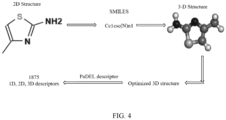
- FIG. 4 shows an exemplary process flow for determining one or more molecular descriptors for each corrosion inhibitor molecule, in accordance with some embodiments of the present disclosure.
- SMILEs notations are obtained from 2-dimensional (2-D) structure of the corrosion inhibitor molecule, using a LigParGen tool.
- the 3-Dimensional (3-D) structure of the corrosion inhibitor molecule is obtained from the SMILEs notations, using a Obabel tool.
- an optimized 3-D structure for the corrosion inhibitor molecule is generated by minimizing the 3-Dimensional (3-D) structure, using a general Amber force field (GAFF) tool.
- GFF Amber force field
- the PaDEL-Descriptor tool is used on the optimized 3-D structure to determine the one or more molecular descriptors for the corrosion inhibitor molecule.
- the one or more hardware processors 104 of the system 100 are configured to predict an inhibition efficiency (IE) for each of the plurality of corrosion inhibitor molecules received at step 302 of the method 300.
- the inhibition efficiency (IE) for each corrosion inhibitor molecule is predicted, based on the corresponding one or more molecular descriptors determined at step 306 of the method 300, and the one or more experimental conditions received at step 302 of the method 300, using an IE prediction model.
- the IE prediction model is present in the IE prediction module 206.
- the IE prediction model is a deep learning-based model and obtaining the IE prediction model is detailed explained in the below steps.
- a plurality of training corrosion inhibitor molecules is from the molecular structure database as mentioned at step 302 of the method.
- a plurality of pre-processed molecular descriptors for each of the plurality of training corrosion inhibitor molecules is received.
- the one or more experimental conditions for each of the plurality of training corrosion inhibitor molecules, and the inhibition efficiency (IE) for each of the plurality of training corrosion inhibitor molecules are received from the experimental repository.
- the plurality of pre-processed molecular descriptors for each training corrosion inhibitor molecule is obtained by first determining the one or more molecular descriptors for each training corrosion inhibitor molecule, using the molecular descriptors calculating technique as mentioned at step 306 of the method 300. Then, the determined one or more molecular descriptors for each training corrosion inhibitor molecule, are pre-processed to obtain the pre-processed molecular descriptors.
- the pre-processing includes removing the molecular descriptors having the missing values, removing the molecular descriptors having an interquartile range (IQR) (which is the difference between the 75 th and 25 th percentiles of each descriptor) of the molecular descriptors having zero and finally removing the highly correlated molecular descriptors.
- IQR interquartile range
- the highly correlated molecular descriptors are assumed to carry the redundant information and such redundancies are removed.
- the one of the molecular descriptor present in the pair of molecular descriptors is removed, if the r value for such pair of molecular descriptors is greater than a predefined correlation threshold value.
- the predefined correlation threshold value is 0.95.
- a multi-task network model is trained with the plurality of training corrosion inhibitor molecules, using (i) the plurality of pre-processed molecular descriptors associated with each training corrosion inhibitor molecule, (ii) the one or more experimental conditions associated with each training corrosion inhibitor molecule, and (iii) the inhibition efficiency (IE) associated with each training corrosion inhibitor molecule, to obtain the IE prediction model.
- FIG. 5 is an exemplary block diagram of a multi-task network model 500, in accordance with some embodiments of the present disclosure.
- the multi-task network model 500 includes an auto-encoder 502 and a prediction network model 504.
- the auto-encoder 502 includes an encoder 502a and a decoder 502b.
- the encoder 502a includes a first input layer, a first dropout layer, a first dense layer, a second dropout layer, a second dense layer, a third dropout layer and a third dense layer.
- the decoder 502b includes a fourth dense layer, a fifth dense layer, and a six dense layer.
- the prediction network model 504 includes a second input layer, a concatenate layer, a seventh dense layer, an eighth dense layer, a ninth dense layer and a tenth dense layer.
- the main features of the encoder 502a, the decoder 502b, and the prediction network model 504 are mentioned below:
- the plurality of training corrosion inhibitor molecules is passed to the multi-task network model 500 based on a predefined batch size.
- the predefined batch size defines the number of training corrosion inhibitor molecules out of the plurality of training corrosion inhibitor molecules, to be passed to the multi-task network model 500, at each iteration.
- the predefined batch size is 32, i.e., 32 training corrosion inhibitor molecules at each iteration during the training of the multi-task network model 500.
- a feature vector representing the plurality of pre-processed molecular descriptors associated with the training corrosion inhibitor molecule is passed to the encoder 502a of the auto-encoder 502, to obtain a latent feature vector of the training corrosion inhibitor molecule.
- the latent feature vector of the training corrosion inhibitor molecule is passed to the decoder 502b of the auto-encoder 502, to obtain a reconstructed feature vector associated with the training corrosion inhibitor molecule.
- the one or more experimental conditions associated with the training corrosion inhibitor molecule are then concatenated with the latent feature vector of the training corrosion inhibitor molecule, to obtain a concatenated feature vector of the training corrosion inhibitor molecule.
- the concatenated feature vector of the training corrosion inhibitor molecule is then passed to the prediction network model 504, to obtain a predicted IE associated with the training corrosion inhibitor molecule.
- a cost function of the multi-task network model 504 is minimized to update the model weights of the multi-task network model.
- the cost function of the multi-task network model 504 is a weighted sum of an auto-encoder cost function and a prediction network model cost function.
- the auto-encoder cost function is defined as the mean square error (MSE) between the reconstructed feature vector associated with the training corrosion inhibitor, and the feature vector associated with the training corrosion inhibitor molecule.
- the prediction network model cost function is defined as the mean square error (MSE) between the predicted IE associated with the training corrosion inhibitor molecule, and the IE associated with the training corrosion inhibitor molecule.
- M is the number of data points
- y i represents the actual IE
- y ⁇ ⁇ represents the predicted IE
- each data point refers to a set one or more molecular descriptors and the one or more experimental conditions associated with each corrosion inhibitor molecule
- M is the number of data points
- x i represents the actual feature vector
- x ⁇ ⁇ represents the reconstructed feature vector
- each data point refers to a set one or more molecular descriptors and the one or more experimental conditions associated with each corrosion inhibitor molecule.
- the model weights of the multi-task network model 500 are updated based on the value of the cost function. If the value of the cost function is less in the present iteration, compared to the value of the cost function in the previous iteration (a reference value is taken for the first iteration), then the model weights are updated with respect to the present iteration. Else the model weights are retailed as in the previous iteration.
- the multi-task network model 500 is trained with the plurality of training corrosion inhibitor molecules passed in the form of the number of batches to obtain the IE prediction model.
- the obtained IE prediction model is then used to predict the inhibition efficiency (IE) for each of the plurality of corrosion inhibitor molecules received at step 302 of the method 300. Predicting the inhibition efficiency (IE) for each of the plurality of corrosion inhibitor molecules, based on (i) the one or more molecular descriptors, and (ii) the one or more experimental conditions, using the IE prediction model, is further explained in the below steps.
- the feature vector representing the one or more molecular descriptors associated with each of the plurality of corrosion inhibitor molecules is passed to the encoder 502a of the auto-encoder 502 present in the IE prediction model, to obtain the latent feature vector corresponding to each of the plurality of corrosion inhibitor molecules.
- the one or more experimental conditions corresponding to each of the plurality of corrosion inhibitor molecules are concatenated with the respective latent feature vector, to obtain the concatenated feature vector of each of the plurality of corrosion inhibitor molecules.
- the concatenated feature vector of each of the plurality of corrosion inhibitor molecules is then passed to the prediction network model 504 present in the IE prediction model, to obtain the inhibition efficiency (IE) for each of the plurality of corrosion inhibitor molecules.
- the one or more hardware processors 104 of the system 100 are configured to determine an energy gap for each of the plurality of corrosion inhibitor molecules received at step 302 of the method 300.
- the energy gap for each of the plurality of corrosion inhibitor molecules is determined based on the one or more quantum chemical descriptors corresponding to the corrosion inhibitor molecule, received at step 304 of the method 300.
- the energy gap for each of the plurality of corrosion inhibitor molecules is a difference between the lowest unoccupied molecular orbital energy ( E LUMO ) and the highest occupied molecular orbital energy ( E HOMO ) of the corrosion inhibitor molecule, i.e, E LUMO - E HOMO .
- E LUMO lowest unoccupied molecular orbital energy
- E HOMO highest occupied molecular orbital energy
- the one or more hardware processors 104 of the system 100 are configured to identify (i) a first set of corrosion inhibitor molecules, and (ii) a second set of corrosion inhibitor molecules, out of the plurality of corrosion inhibitor molecules, based on the corresponding inhibition efficiency(IE) determined at step 308 of the method 300.
- the first set of corrosion inhibitor molecules are the corrosion inhibitor molecules having the IE greater than or equal to a predefined IE threshold.
- the second set of corrosion inhibitor molecules are the corrosion inhibitor molecules having the IE less than the predefined IE threshold.
- the greater the IE the effective the molecules inhibits the corrosion and hence the first set of corrosion inhibitor molecules are added to a potential corrosion inhibitor molecules repository.
- the potential corrosion inhibitor molecules repository includes all the potential corrosion inhibitor molecules that satisfies the defined parameters for further screening.
- the predefined IE threshold may be 90%.
- the potential corrosion inhibitor molecules repository may present in the repository 102b of the system 100.
- the one or more hardware processors 104 of the system 100 are configured to identify (i) a third set of corrosion inhibitor molecules, and (ii) a fourth set of corrosion inhibitor molecules, out of the plurality of corrosion inhibitor molecules received at step 302 of the method 300, based on the corresponding energy gap determined at step 310 of the method 300.
- the third set of corrosion inhibitor molecules are the corrosion inhibitor molecules having the energy gap greater than a predefined energy gap threshold.
- the fourth set of corrosion inhibitor molecules are the corrosion inhibitor molecules having the energy gap less than or equal to the predefined energy gap threshold.
- the predefined energy gap threshold is dynamically defined based on the energy gap of the reference inhibitor molecule known in the art.
- the one or more hardware processors 104 of the system 100 are configured to form one or more first corrosion inhibitor molecule pairs from (i) the second set of corrosion inhibitor molecules identified at step 312 of the method 300, and (ii) the third set of corrosion inhibitor molecules identified at step 314 of the method 300. More specifically, the corrosion inhibitor molecules present in the second set of corrosion inhibitor molecules and the third set of corrosion inhibitor molecules are first combined and all possible combinations of corrosion inhibitor molecule pairs are formed.
- the number of the corrosion inhibitor molecules present in the second set of corrosion inhibitor molecules and the third set of corrosion inhibitor molecules are 4, then the number of the first corrosion inhibitor molecule pairs formed will be 6. In another example, the number of the corrosion inhibitor molecules present in the second set of corrosion inhibitor molecules and the third set of corrosion inhibitor molecules, are 5, then the number of the first corrosion inhibitor molecule pairs formed will be 10, and so on.
- the one or more hardware processors 104 of the system 100 are configured to identify one or more second corrosion inhibitor molecule pairs out of the one or more first corrosion inhibitor molecule pairs formed at step 316 of the method 300.
- the identify one or more second corrosion inhibitor molecule pairs are the one or more first corrosion inhibitor molecule pairs that satisfies synergy criteria.
- the synergy criteria defined in the synergy module 210 are used to check the synergistic effect between the two corrosion inhibitor molecules. The more the synergy the high the corrosion inhibition of the molecule.
- the calculated HOMO ( E HOMO ) and LUMO ( E LUMO ) energies are plotted along with fermi energy of the metal surface.
- the molecule having HOMO energy closest to the fermi energy of metal will donate electron and the molecule having LUMO energy closest to the metal fermi will receive electron. While in some cases it may happen, that synergistic effect is because of impermeable monolayer formation that can be further studied by calculating an interaction energy and monolayer formation using DFT. If the computed interaction energy of mixed molecule (corrosion inhibitor molecules present in the second corrosion inhibitor pair) is more than the sum of the interaction energy of the individual molecule then there is synergy between the two such corrosion inhibitor molecules.
- the one or more first corrosion inhibitor molecule pairs those does not satisfy the synergy criteria are to a corrosion inhibitor molecules modification repository.
- the corrosion inhibitor molecules modification repository may present in the repository 102b of the system 100.
- the one or more hardware processors 104 of the system 100 are configured to determine an interaction energy for (i) each corrosion inhibitor molecule present in the fourth set of corrosion inhibitor molecules, and (ii) each corrosion inhibitor molecule pair present in the one or more second corrosion inhibitor molecule pairs.
- the interaction energy for each corrosion inhibitor molecule pair is the sum of the interaction energies of the corrosion inhibitor molecules present in the corresponding corrosion inhibitor molecule pair.
- the interaction energy for each corrosion inhibitor molecule is determined using one of: the DFT technique, a molecular dynamics (MD) technique, and a reactive force field (ReaxFF) technique.
- the one or more hardware processors 104 of the system 100 are configured to add each corrosion inhibitor molecule present in the fourth set of corrosion inhibitor molecules, to one of: (i) the potential corrosion inhibitor molecules repository and (ii) the corrosion inhibitor molecules modification repository, based on the corresponding interaction energy of each corrosion inhibitor molecule, through the interaction energy checking module 214. More particularly, the corrosion inhibitor molecules present in the fourth set of corrosion inhibitor molecules, having the interaction energy greater than or equal to a predefined interaction energy threshold, are added to the potential corrosion inhibitor molecules repository. Similarly, the corrosion inhibitor molecules present in the fourth set of corrosion inhibitor molecules, having the interaction energy less than the predefined interaction energy threshold, are added to the corrosion inhibitor molecules modification repository.
- the predefined interaction energy threshold is dynamically defined based on the interaction energy of the reference inhibitor molecule known in the art.
- the one or more hardware processors 104 of the system 100 are configured to add each corrosion inhibitor molecule present in the one or more second corrosion inhibitor molecule pairs, to one of: (i) the potential corrosion inhibitor molecules repository and (ii) the corrosion inhibitor molecules modification repository, based on the corresponding interaction energy.
- the corrosion inhibitor molecules present in the second corrosion inhibitor molecule pair whose interaction energy is greater than or equal to a predefined interaction energy pair threshold are added to the potential corrosion inhibitor molecules repository.
- the corrosion inhibitor molecules present in the second corrosion inhibitor molecule pair whose interaction energy is less than the predefined interaction energy pair threshold are added to the corrosion inhibitor molecules modification repository.
- the predefined interaction energy pair threshold is a value that is greater than the interaction energy of each individual inhibitor molecule present in the second corrosion inhibitor molecule pair.
- the one or more hardware processors 104 of the system 100 are configured to identify a first optimal corrosion inhibitor molecule out of the one or more corrosion inhibitor molecules present in the potential corrosion inhibitor molecules repository, based on feasibility criteria.
- the feasibility criteria define how feasible the corrosion inhibitor molecule is.
- the feasibility criteria include at least one of: (i) how bio-degradable or green molecule (eco-friendly), (ii) abundantly available, and (iii) less cost or cheap. Based on the feasibility criteria, the first optimal corrosion inhibitor molecule is identified. Then, an experimental synthesis is carried out on the first optimal corrosion inhibitor molecule, to a synthesized corrosion inhibitor molecule.
- the corrosion inhibition efficiency of the synthesized corrosion inhibitor molecule is calculated using a weight loss technique and by comparing with a reference corrosion inhibitor molecule, through the experimental synthesis module. If the corrosion inhibition efficiency of the synthesized corrosion inhibitor molecule, is more than the corrosion inhibition efficiency of the reference molecule, then such synthesized corrosion inhibitor molecule is proceeded towards plant trails. If the corrosion inhibition efficiency of the synthesized corrosion inhibitor molecule, is less than or equal to the corrosion inhibition efficiency of the reference molecule, then the synthesized corrosion inhibitor molecule is added to the corrosion inhibitor molecules modification repository. In this case, the next corrosion inhibition molecule present in the potential corrosion inhibitor molecules repository, that most satisfies the feasibility criteria is identified as the first optimal corrosion inhibitor molecule and the process is continued until one such first optimal corrosion inhibitor molecule is identified for the plant trails.
- the remaining one or more corrosion inhibitor molecules present in the potential corrosion inhibitor molecules repository, that does not satisfy the feasibility criteria, are added to the corrosion inhibitor molecules modification repository.
- the one or more hardware processors 104 of the system 100 are configured to perform plant trails using the first optimal corrosion inhibitor molecule identified at step 324 of the method 300.
- the one or more hardware processors 104 of the system 100 are further configured to identify a second optimal corrosion inhibitor molecule out of the one or more corrosion inhibitor molecules present in the corrosion inhibitor molecules modification repository, based on the feasibility criteria defined at step 324 of the method 300.
- the one or more hardware processors 104 of the system 100 are configured to identify a second optimal corrosion inhibitor molecule out of the one or more corrosion inhibitor, and perform modifications to the second optimal corrosion inhibitor molecule, through the modification module 218, to obtain a modified corrosion inhibitor molecule.
- the modified corrosion inhibitor molecule is then added to the plurality of corrosion inhibitor molecules as received at the step 302 of the method 300, for further screening and design of corrosion inhibitors.
- the purpose of obtaining the modified corrosion inhibitor molecule is to get the corrosion inhibitor molecule that is suitable for the application.
- xyz-coordinates of the second optimal corrosion inhibitor molecule is determined using a coordinates determination model such as an AVOGADRO tool, a LIGPARGEN tool, and so on.
- a coordinates determination model such as an AVOGADRO tool, a LIGPARGEN tool, and so on.
- the one or more locations having atoms for the second optimal corrosion inhibitor molecule where the modifications to be performed based on the determined xyz-coordinates.
- an atom present in each location of the one or more locations in the second optimal corrosion inhibitor molecule is replaced with a functional group selected from one or more functional groups present in a functional group repository.
- the replaced functional groups in the second optimal corrosion inhibitor molecule are rotated and adjusted in such a way that a distance between the atoms of the replaced functional groups and the existing atoms in the second optimal corrosion inhibitor molecule should be greater than a sum of covalent radii of the atoms, to obtain the modified corrosion inhibitor molecule.
- the functional group repository is present in the repository 102b of the system 100.
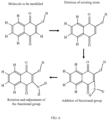
- FIG. 6 shows an exemplary process flow for obtaining an exemplary modified corrosion inhibitor molecule, in accordance with some embodiments of the present disclosure.
- the molecule 2-hydroxy-1,4-naphthaquinone (called as lawsone) is modified to get the modified corrosion inhibitor molecule with the enhanced corrosion inhibition efficiency.
- the xyz-coordinates of the lawsone molecule is obtained using the AVOGADRO tool.
- the -NH2 amine functional group selected from the functional group repository and introduced in place of H- atom deleted in the previous step.
- the functional group (-NH2) is adjusted and rotated in order to avoid overlap or any other unintended bond formation.
- the lawsone molecule is modified into 2-hydroxy-3-amino-1,4-naphthaquinone which is again added to plurality of corrosion inhibitors for further screening.
- the method and systems of the present disclosure ensures to predict the inhibition efficiency (IE) of the molecule accurately, as the disclosed IE prediction model of the present disclosure is developed by training a multi-task network model using the molecular descriptors of different classes of the molecules, and also the experimental conditions of the molecule.
- the present disclosure provides the unique screening technique that screens the molecules not only based on the molecular descriptors (for finding the IE), but also using quantum chemical descriptors, and using various parameters including the inhibition efficiency of the molecule, an energy gap of the molecule, a synergistic effect of the molecules and an interaction energy of the molecules.
- the molecules screened using the unique screening technique may be efficient and effective for the corrosion inhibition end applications.
- the present disclosure allows to design the new corrosion inhibition molecules by making changes to the molecules that suits based on the end applications.
- the corrosion data from literature and information available in the public domain is collected to build the dataset of corrosion inhibitors for mild steel in hydrochloric acid.
- the build dataset is the largest dataset having 135 organic corrosion inhibitors across multiple classes such as pyridine, imidazole, Schiff bases, trizaole, thiol, amine, thiazole, hydrazone, etc.
- the data collected includes experimental inhibition efficiencies at different temperatures, inhibitor concentrations and acid concentrations obtained from weight loss, Tafel polarization and electrochemical impedance spectroscopy (EIS) methods.
- the unprocessed corrosion data consists of 700 and 1875 columns of molecular descriptors apart from experimental conditions. After missing data analysis, the molecular descriptors are reduced to 1496. Further, after IQR analysis, the number of molecular descriptors is reduced to 1327 and following removal of highly correlated descriptors, the count is further reduced to 647. Hence, after data pre-processing, 647 molecular descriptors out of the original 1875 descriptors are the pre-processed molecular descriptors.
- the multi-task network model of the present disclosure performed the best compared to the conventional machine learning models.
- the MAE value on test data was found to be 6.46.
- the embodiments of present disclosure herein address unresolved problem of the screening the corrosion inhibitor molecules based on various parameters including the accurate inhibition efficiency of the molecule and using the unique screening technique.
- the experimental results also show that the IE prediction model of the present disclosure outperform in predicting the inhibition efficiency of the molecule, compared to the conventional machine learning models in the art.
- Such computer-readable storage means contain program-code means for implementation of one or more steps of the method, when the program runs on a server or mobile device or any suitable programmable device.
- the hardware device can be any kind of device which can be programmed including e.g., any kind of computer like a server or a personal computer, or the like, or any combination thereof.
- the device may also include means which could be e.g., hardware means like e.g., an application-specific integrated circuit (ASIC), a field-programmable gate array (FPGA), or a combination of hardware and software means, e.g., an ASIC and an FPGA, or at least one microprocessor and at least one memory with software processing components located therein.
- the means can include both hardware means and software means.
- the method embodiments described herein could be implemented in hardware and software.
- the device may also include software means. Alternatively, the embodiments may be implemented on different hardware devices, e.g., using a plurality of CPUs.
- the embodiments herein can comprise hardware and software elements.
- the embodiments that are implemented in software include but are not limited to, firmware, resident software, microcode, etc.
- the functions performed by various components described herein may be implemented in other components or combinations of other components.
- a computer-usable or computer readable medium can be any apparatus that can comprise, store, communicate, propagate, or transport the program for use by or in connection with the instruction execution system, apparatus, or device.
- a computer-readable storage medium refers to any type of physical memory on which information or data readable by a processor may be stored.
- a computer-readable storage medium may store instructions for execution by one or more processors, including instructions for causing the processor(s) to perform steps or stages consistent with the embodiments described herein.
- the term "computer-readable medium” should be understood to include tangible items and exclude carrier waves and transient signals, i.e., be non-transitory. Examples include random access memory (RAM), read-only memory (ROM), volatile memory, nonvolatile memory, hard drives, CD ROMs, DVDs, flash drives, disks, and any other known physical storage media.
Landscapes
- Chemical & Material Sciences (AREA)
- Engineering & Computer Science (AREA)
- Computing Systems (AREA)
- Theoretical Computer Science (AREA)
- Crystallography & Structural Chemistry (AREA)
- Life Sciences & Earth Sciences (AREA)
- Bioinformatics & Cheminformatics (AREA)
- Bioinformatics & Computational Biology (AREA)
- Health & Medical Sciences (AREA)
- General Health & Medical Sciences (AREA)
- Analytical Chemistry (AREA)
- Evolutionary Computation (AREA)
- Chemical Kinetics & Catalysis (AREA)
- Artificial Intelligence (AREA)
- Computer Vision & Pattern Recognition (AREA)
- Data Mining & Analysis (AREA)
- Databases & Information Systems (AREA)
- Spectroscopy & Molecular Physics (AREA)
- Physics & Mathematics (AREA)
- Medical Informatics (AREA)
- Software Systems (AREA)
- Library & Information Science (AREA)
- Medicinal Chemistry (AREA)
- Testing Resistance To Weather, Investigating Materials By Mechanical Methods (AREA)
Applications Claiming Priority (1)
| Application Number | Priority Date | Filing Date | Title |
|---|---|---|---|
| IN202221011898 | 2022-03-04 |
Publications (1)
| Publication Number | Publication Date |
|---|---|
| EP4239641A1 true EP4239641A1 (de) | 2023-09-06 |
Family
ID=85132794
Family Applications (1)
| Application Number | Title | Priority Date | Filing Date |
|---|---|---|---|
| EP23153699.6A Pending EP4239641A1 (de) | 2022-03-04 | 2023-01-27 | Verfahren und systeme zum screening und entwurf von korrosionsinhibitoren |
Country Status (2)
| Country | Link |
|---|---|
| US (1) | US12354711B2 (de) |
| EP (1) | EP4239641A1 (de) |
Cited By (1)
| Publication number | Priority date | Publication date | Assignee | Title |
|---|---|---|---|---|
| CN119939334A (zh) * | 2024-12-30 | 2025-05-06 | 东南大学 | 一种基于官能团分类和机器学习的钢筋阻锈剂性能预测方法 |
Families Citing this family (2)
| Publication number | Priority date | Publication date | Assignee | Title |
|---|---|---|---|---|
| CN118553320B (zh) * | 2024-05-17 | 2025-01-17 | 北京科技大学 | 一种缓蚀剂的确认方法和装置 |
| CN120220893A (zh) * | 2025-03-25 | 2025-06-27 | 北京科技大学 | 绿色高效缓蚀剂确认方法、装置、设备及可读存储介质 |
Family Cites Families (3)
| Publication number | Priority date | Publication date | Assignee | Title |
|---|---|---|---|---|
| GB2543498A (en) * | 2015-10-19 | 2017-04-26 | Schlumberger Holdings | Corrosion inhibition |
| BR112018007928A2 (pt) * | 2015-11-12 | 2018-10-30 | Ecolab Usa Inc. | método para inibir corrosão, e, composição. |
| US11699505B2 (en) * | 2018-11-29 | 2023-07-11 | Tata Consultancy Services Limited | Method and system for estimating corrosion inhibitor concentration using a multi-electrode array sensor |
-
2023
- 2023-01-27 EP EP23153699.6A patent/EP4239641A1/de active Pending
- 2023-01-27 US US18/102,171 patent/US12354711B2/en active Active
Non-Patent Citations (7)
| Title |
|---|
| AGARWAL ABHISHEK ET AL: "Multitask Learning Framework for Screening of Corrosion Inhibitors for Mild Steel", AMPP ANNUAL CONFERENCE + EXPO, 6 March 2022 (2022-03-06), San Antonio, Texas, XP093060515, Retrieved from the Internet <URL:https://onepetro.org/amppcorr/proceedings/AMPP22/2-AMPP22/D021S005R012/488776> * |
| AL-FAKIH ABDO MOHAMMED ET AL: "Quantitative structure-activity relationship model for prediction study of corrosion inhibition efficiency using two-stage sparse multiple linear regression : QSAR study using two-stage SMLR", JOURNAL OF CHEMOMETRICS., vol. 30, no. 7, 8 June 2016 (2016-06-08), GB, pages 361 - 368, XP093060473, ISSN: 0886-9383, Retrieved from the Internet <URL:https://api.wiley.com/onlinelibrary/tdm/v1/articles/10.1002%2Fcem.2800> DOI: 10.1002/cem.2800 * |
| CHEN FIONA FANG ET AL: "Correlation between molecular features and electrochemical properties using an artificial neural network", MATERIALS & DESIGN, vol. 112, 1 December 2016 (2016-12-01), AMSTERDAM, NL, pages 410 - 418, XP093060482, ISSN: 0264-1275, DOI: 10.1016/j.matdes.2016.09.084 * |
| KOKALJ ANTON: "Molecular modeling of organic corrosion inhibitors: Calculations, pitfalls, and conceptualization of molecule-surface bonding", CORROSION SCIENCE, OXFORD, GB, vol. 193, 27 June 2021 (2021-06-27), XP086870430, ISSN: 0010-938X, [retrieved on 20210627], DOI: 10.1016/J.CORSCI.2021.109650 * |
| KUMAR DHARMENDR ET AL: "Imidazole derivatives as corrosion inhibitors for copper: A DFT and reactive force field study", CORROSION SCIENCE, OXFORD, GB, vol. 171, 5 May 2020 (2020-05-05), XP086163112, ISSN: 0010-938X, [retrieved on 20200505], DOI: 10.1016/J.CORSCI.2020.108724 * |
| KUMAR DHARMENDR ET AL: "Unravelling the mechanisms of corrosion inhibition of iron by henna extract: A density functional theory study", CORROSION SCIENCE, OXFORD, GB, vol. 142, 17 July 2018 (2018-07-17), pages 102 - 109, XP085460425, ISSN: 0010-938X, DOI: 10.1016/J.CORSCI.2018.07.011 * |
| WINKLER D. A. ET AL: "Towards chromate-free corrosion inhibitors: structure-property models for organic alternatives", GREEN CHEMISTRY, vol. 16, no. 6, 1 January 2014 (2014-01-01), GB, pages 3349 - 3357, XP093060489, ISSN: 1463-9262, Retrieved from the Internet <URL:https://pubs.rsc.org/en/content/articlepdf/2014/gc/c3gc42540a> DOI: 10.1039/C3GC42540A * |
Cited By (1)
| Publication number | Priority date | Publication date | Assignee | Title |
|---|---|---|---|---|
| CN119939334A (zh) * | 2024-12-30 | 2025-05-06 | 东南大学 | 一种基于官能团分类和机器学习的钢筋阻锈剂性能预测方法 |
Also Published As
| Publication number | Publication date |
|---|---|
| US20230282315A1 (en) | 2023-09-07 |
| US12354711B2 (en) | 2025-07-08 |
Similar Documents
| Publication | Publication Date | Title |
|---|---|---|
| EP4239641A1 (de) | Verfahren und systeme zum screening und entwurf von korrosionsinhibitoren | |
| Karpov et al. | Transformer-CNN: Swiss knife for QSAR modeling and interpretation | |
| Wu et al. | Lite transformer with long-short range attention | |
| Rizvi et al. | Understanding time-varying systematic risks in Islamic and conventional sectoral indices | |
| Bohn et al. | Analysis of car crash simulation data with nonlinear machine learning methods | |
| Blunt et al. | Statistical phase estimation and error mitigation on a superconducting quantum processor | |
| Santos et al. | Predicting software defects with explainable machine learning | |
| Kaiser et al. | Using probabilistic neural networks to model the toxicity of chemicals to the fathead minnow (Pimephales promelas): A study based on 865 compounds | |
| Gajewicz-Skretna et al. | Aquatic toxicity (Pre) screening strategy for structurally diverse chemicals: global or local classification tree models? | |
| Husain et al. | Poisson and logistic regressions for inhomogeneous multivariate point processes: a case study in the Barro Colorado Island plot | |
| Charest et al. | Improving predictions of compound amenability for liquid chromatography–mass spectrometry to enhance non-targeted analysis | |
| Gong et al. | AI-driven discovery of high-performance corrosion inhibitors using a BERT-GPT framework for molecular generation | |
| Johnson et al. | A comparison of modeling preprocessing techniques | |
| Káčer et al. | SMEs’ failure prediction: are machine learning models superior? | |
| Cunha et al. | Corporate bankruptcy prediction: re-estimating classical accounting-based models with a sample from Portugal | |
| Bashir et al. | A hybrid data preprocessing technique based on maximum likelihood logistic regression with filtering for enhancing software defect prediction | |
| Yap et al. | The application of principal component analysis in the selection of industry specific financial ratios | |
| CN117035515A (zh) | 工作量的评估方法、装置、计算机设备及存储介质 | |
| Bargagli Stoffi et al. | Machine learning for zombie hunting | |
| Amasaki et al. | The effects of gradual weighting on duration-based moving windows for software effort estimation | |
| Sponerová | Bankruptcy Prediction: The Case of the Czech Republic and Slovakia | |
| NASSER | A new singular value decomposition based robust graphical clustering technique and its application in climatic data | |
| Cairone et al. | Artificial intelligence for predicting volatile fatty acids rejection in nanofiltration membranes | |
| Chiu et al. | Visualization of financial trends using chance discovery methods | |
| Bose et al. | Improving the stability and transferability of effective admet models by adding quantum mechanical descriptors |
Legal Events
| Date | Code | Title | Description |
|---|---|---|---|
| PUAI | Public reference made under article 153(3) epc to a published international application that has entered the european phase |
Free format text: ORIGINAL CODE: 0009012 |
|
| STAA | Information on the status of an ep patent application or granted ep patent |
Free format text: STATUS: THE APPLICATION HAS BEEN PUBLISHED |
|
| AK | Designated contracting states |
Kind code of ref document: A1 Designated state(s): AL AT BE BG CH CY CZ DE DK EE ES FI FR GB GR HR HU IE IS IT LI LT LU LV MC ME MK MT NL NO PL PT RO RS SE SI SK SM TR |
|
| STAA | Information on the status of an ep patent application or granted ep patent |
Free format text: STATUS: REQUEST FOR EXAMINATION WAS MADE |
|
| 17P | Request for examination filed |
Effective date: 20231030 |
|
| RBV | Designated contracting states (corrected) |
Designated state(s): AL AT BE BG CH CY CZ DE DK EE ES FI FR GB GR HR HU IE IS IT LI LT LU LV MC ME MK MT NL NO PL PT RO RS SE SI SK SM TR |