EP4238953A1 - Compound, organic electroluminescent element and electronic device - Google Patents
Compound, organic electroluminescent element and electronic device Download PDFInfo
- Publication number
- EP4238953A1 EP4238953A1 EP21885810.8A EP21885810A EP4238953A1 EP 4238953 A1 EP4238953 A1 EP 4238953A1 EP 21885810 A EP21885810 A EP 21885810A EP 4238953 A1 EP4238953 A1 EP 4238953A1
- Authority
- EP
- European Patent Office
- Prior art keywords
- group
- substituted
- unsubstituted
- carbon atoms
- ring
- Prior art date
- Legal status (The legal status is an assumption and is not a legal conclusion. Google has not performed a legal analysis and makes no representation as to the accuracy of the status listed.)
- Pending
Links
Images

Classifications
-
- C—CHEMISTRY; METALLURGY
- C07—ORGANIC CHEMISTRY
- C07C—ACYCLIC OR CARBOCYCLIC COMPOUNDS
- C07C13/00—Cyclic hydrocarbons containing rings other than, or in addition to, six-membered aromatic rings
- C07C13/28—Polycyclic hydrocarbons or acyclic hydrocarbon derivatives thereof
- C07C13/32—Polycyclic hydrocarbons or acyclic hydrocarbon derivatives thereof with condensed rings
- C07C13/62—Polycyclic hydrocarbons or acyclic hydrocarbon derivatives thereof with condensed rings with more than three condensed rings
- C07C13/66—Polycyclic hydrocarbons or acyclic hydrocarbon derivatives thereof with condensed rings with more than three condensed rings the condensed ring system contains only four rings
-
- C—CHEMISTRY; METALLURGY
- C07—ORGANIC CHEMISTRY
- C07D—HETEROCYCLIC COMPOUNDS
- C07D311/00—Heterocyclic compounds containing six-membered rings having one oxygen atom as the only hetero atom, condensed with other rings
- C07D311/02—Heterocyclic compounds containing six-membered rings having one oxygen atom as the only hetero atom, condensed with other rings ortho- or peri-condensed with carbocyclic rings or ring systems
- C07D311/78—Ring systems having three or more relevant rings
-
- C—CHEMISTRY; METALLURGY
- C07—ORGANIC CHEMISTRY
- C07D—HETEROCYCLIC COMPOUNDS
- C07D335/00—Heterocyclic compounds containing six-membered rings having one sulfur atom as the only ring hetero atom
- C07D335/04—Heterocyclic compounds containing six-membered rings having one sulfur atom as the only ring hetero atom condensed with carbocyclic rings or ring systems
-
- C—CHEMISTRY; METALLURGY
- C07—ORGANIC CHEMISTRY
- C07F—ACYCLIC, CARBOCYCLIC OR HETEROCYCLIC COMPOUNDS CONTAINING ELEMENTS OTHER THAN CARBON, HYDROGEN, HALOGEN, OXYGEN, NITROGEN, SULFUR, SELENIUM OR TELLURIUM
- C07F7/00—Compounds containing elements of Groups 4 or 14 of the Periodic Table
- C07F7/02—Silicon compounds
- C07F7/08—Compounds having one or more C—Si linkages
- C07F7/0803—Compounds with Si-C or Si-Si linkages
- C07F7/081—Compounds with Si-C or Si-Si linkages comprising at least one atom selected from the elements N, O, halogen, S, Se or Te
- C07F7/0812—Compounds with Si-C or Si-Si linkages comprising at least one atom selected from the elements N, O, halogen, S, Se or Te comprising a heterocyclic ring
- C07F7/0816—Compounds with Si-C or Si-Si linkages comprising at least one atom selected from the elements N, O, halogen, S, Se or Te comprising a heterocyclic ring said ring comprising Si as a ring atom
-
- C—CHEMISTRY; METALLURGY
- C09—DYES; PAINTS; POLISHES; NATURAL RESINS; ADHESIVES; COMPOSITIONS NOT OTHERWISE PROVIDED FOR; APPLICATIONS OF MATERIALS NOT OTHERWISE PROVIDED FOR
- C09K—MATERIALS FOR MISCELLANEOUS APPLICATIONS, NOT PROVIDED FOR ELSEWHERE
- C09K11/00—Luminescent materials, e.g. electroluminescent or chemiluminescent
- C09K11/06—Luminescent materials, e.g. electroluminescent or chemiluminescent containing organic luminescent materials
-
- H—ELECTRICITY
- H10—SEMICONDUCTOR DEVICES; ELECTRIC SOLID-STATE DEVICES NOT OTHERWISE PROVIDED FOR
- H10K—ORGANIC ELECTRIC SOLID-STATE DEVICES
- H10K85/00—Organic materials used in the body or electrodes of devices covered by this subclass
- H10K85/60—Organic compounds having low molecular weight
- H10K85/615—Polycyclic condensed aromatic hydrocarbons, e.g. anthracene
- H10K85/622—Polycyclic condensed aromatic hydrocarbons, e.g. anthracene containing four rings, e.g. pyrene
-
- H—ELECTRICITY
- H10—SEMICONDUCTOR DEVICES; ELECTRIC SOLID-STATE DEVICES NOT OTHERWISE PROVIDED FOR
- H10K—ORGANIC ELECTRIC SOLID-STATE DEVICES
- H10K85/00—Organic materials used in the body or electrodes of devices covered by this subclass
- H10K85/60—Organic compounds having low molecular weight
- H10K85/615—Polycyclic condensed aromatic hydrocarbons, e.g. anthracene
- H10K85/626—Polycyclic condensed aromatic hydrocarbons, e.g. anthracene containing more than one polycyclic condensed aromatic rings, e.g. bis-anthracene
-
- H—ELECTRICITY
- H10—SEMICONDUCTOR DEVICES; ELECTRIC SOLID-STATE DEVICES NOT OTHERWISE PROVIDED FOR
- H10K—ORGANIC ELECTRIC SOLID-STATE DEVICES
- H10K85/00—Organic materials used in the body or electrodes of devices covered by this subclass
- H10K85/60—Organic compounds having low molecular weight
- H10K85/631—Amine compounds having at least two aryl rest on at least one amine-nitrogen atom, e.g. triphenylamine
- H10K85/636—Amine compounds having at least two aryl rest on at least one amine-nitrogen atom, e.g. triphenylamine comprising heteroaromatic hydrocarbons as substituents on the nitrogen atom
-
- H—ELECTRICITY
- H10—SEMICONDUCTOR DEVICES; ELECTRIC SOLID-STATE DEVICES NOT OTHERWISE PROVIDED FOR
- H10K—ORGANIC ELECTRIC SOLID-STATE DEVICES
- H10K85/00—Organic materials used in the body or electrodes of devices covered by this subclass
- H10K85/60—Organic compounds having low molecular weight
- H10K85/649—Aromatic compounds comprising a hetero atom
- H10K85/657—Polycyclic condensed heteroaromatic hydrocarbons
-
- H—ELECTRICITY
- H10—SEMICONDUCTOR DEVICES; ELECTRIC SOLID-STATE DEVICES NOT OTHERWISE PROVIDED FOR
- H10K—ORGANIC ELECTRIC SOLID-STATE DEVICES
- H10K85/00—Organic materials used in the body or electrodes of devices covered by this subclass
- H10K85/60—Organic compounds having low molecular weight
- H10K85/649—Aromatic compounds comprising a hetero atom
- H10K85/657—Polycyclic condensed heteroaromatic hydrocarbons
- H10K85/6574—Polycyclic condensed heteroaromatic hydrocarbons comprising only oxygen in the heteroaromatic polycondensed ring system, e.g. cumarine dyes
-
- H—ELECTRICITY
- H10—SEMICONDUCTOR DEVICES; ELECTRIC SOLID-STATE DEVICES NOT OTHERWISE PROVIDED FOR
- H10K—ORGANIC ELECTRIC SOLID-STATE DEVICES
- H10K85/00—Organic materials used in the body or electrodes of devices covered by this subclass
- H10K85/60—Organic compounds having low molecular weight
- H10K85/649—Aromatic compounds comprising a hetero atom
- H10K85/657—Polycyclic condensed heteroaromatic hydrocarbons
- H10K85/6576—Polycyclic condensed heteroaromatic hydrocarbons comprising only sulfur in the heteroaromatic polycondensed ring system, e.g. benzothiophene
-
- H—ELECTRICITY
- H10—SEMICONDUCTOR DEVICES; ELECTRIC SOLID-STATE DEVICES NOT OTHERWISE PROVIDED FOR
- H10K—ORGANIC ELECTRIC SOLID-STATE DEVICES
- H10K85/00—Organic materials used in the body or electrodes of devices covered by this subclass
- H10K85/60—Organic compounds having low molecular weight
- H10K85/658—Organoboranes
-
- C—CHEMISTRY; METALLURGY
- C07—ORGANIC CHEMISTRY
- C07B—GENERAL METHODS OF ORGANIC CHEMISTRY; APPARATUS THEREFOR
- C07B2200/00—Indexing scheme relating to specific properties of organic compounds
- C07B2200/05—Isotopically modified compounds, e.g. labelled
-
- C—CHEMISTRY; METALLURGY
- C09—DYES; PAINTS; POLISHES; NATURAL RESINS; ADHESIVES; COMPOSITIONS NOT OTHERWISE PROVIDED FOR; APPLICATIONS OF MATERIALS NOT OTHERWISE PROVIDED FOR
- C09K—MATERIALS FOR MISCELLANEOUS APPLICATIONS, NOT PROVIDED FOR ELSEWHERE
- C09K2211/00—Chemical nature of organic luminescent or tenebrescent compounds
- C09K2211/10—Non-macromolecular compounds
- C09K2211/1003—Carbocyclic compounds
- C09K2211/1007—Non-condensed systems
-
- C—CHEMISTRY; METALLURGY
- C09—DYES; PAINTS; POLISHES; NATURAL RESINS; ADHESIVES; COMPOSITIONS NOT OTHERWISE PROVIDED FOR; APPLICATIONS OF MATERIALS NOT OTHERWISE PROVIDED FOR
- C09K—MATERIALS FOR MISCELLANEOUS APPLICATIONS, NOT PROVIDED FOR ELSEWHERE
- C09K2211/00—Chemical nature of organic luminescent or tenebrescent compounds
- C09K2211/10—Non-macromolecular compounds
- C09K2211/1003—Carbocyclic compounds
- C09K2211/1011—Condensed systems
-
- C—CHEMISTRY; METALLURGY
- C09—DYES; PAINTS; POLISHES; NATURAL RESINS; ADHESIVES; COMPOSITIONS NOT OTHERWISE PROVIDED FOR; APPLICATIONS OF MATERIALS NOT OTHERWISE PROVIDED FOR
- C09K—MATERIALS FOR MISCELLANEOUS APPLICATIONS, NOT PROVIDED FOR ELSEWHERE
- C09K2211/00—Chemical nature of organic luminescent or tenebrescent compounds
- C09K2211/10—Non-macromolecular compounds
- C09K2211/1018—Heterocyclic compounds
-
- C—CHEMISTRY; METALLURGY
- C09—DYES; PAINTS; POLISHES; NATURAL RESINS; ADHESIVES; COMPOSITIONS NOT OTHERWISE PROVIDED FOR; APPLICATIONS OF MATERIALS NOT OTHERWISE PROVIDED FOR
- C09K—MATERIALS FOR MISCELLANEOUS APPLICATIONS, NOT PROVIDED FOR ELSEWHERE
- C09K2211/00—Chemical nature of organic luminescent or tenebrescent compounds
- C09K2211/10—Non-macromolecular compounds
- C09K2211/1018—Heterocyclic compounds
- C09K2211/1025—Heterocyclic compounds characterised by ligands
- C09K2211/1088—Heterocyclic compounds characterised by ligands containing oxygen as the only heteroatom
-
- H—ELECTRICITY
- H10—SEMICONDUCTOR DEVICES; ELECTRIC SOLID-STATE DEVICES NOT OTHERWISE PROVIDED FOR
- H10K—ORGANIC ELECTRIC SOLID-STATE DEVICES
- H10K50/00—Organic light-emitting devices
- H10K50/10—OLEDs or polymer light-emitting diodes [PLED]
- H10K50/11—OLEDs or polymer light-emitting diodes [PLED] characterised by the electroluminescent [EL] layers
-
- H—ELECTRICITY
- H10—SEMICONDUCTOR DEVICES; ELECTRIC SOLID-STATE DEVICES NOT OTHERWISE PROVIDED FOR
- H10K—ORGANIC ELECTRIC SOLID-STATE DEVICES
- H10K50/00—Organic light-emitting devices
- H10K50/10—OLEDs or polymer light-emitting diodes [PLED]
- H10K50/11—OLEDs or polymer light-emitting diodes [PLED] characterised by the electroluminescent [EL] layers
- H10K50/125—OLEDs or polymer light-emitting diodes [PLED] characterised by the electroluminescent [EL] layers specially adapted for multicolour light emission, e.g. for emitting white light
- H10K50/13—OLEDs or polymer light-emitting diodes [PLED] characterised by the electroluminescent [EL] layers specially adapted for multicolour light emission, e.g. for emitting white light comprising stacked EL layers within one EL unit
-
- Y—GENERAL TAGGING OF NEW TECHNOLOGICAL DEVELOPMENTS; GENERAL TAGGING OF CROSS-SECTIONAL TECHNOLOGIES SPANNING OVER SEVERAL SECTIONS OF THE IPC; TECHNICAL SUBJECTS COVERED BY FORMER USPC CROSS-REFERENCE ART COLLECTIONS [XRACs] AND DIGESTS
- Y02—TECHNOLOGIES OR APPLICATIONS FOR MITIGATION OR ADAPTATION AGAINST CLIMATE CHANGE
- Y02E—REDUCTION OF GREENHOUSE GAS [GHG] EMISSIONS, RELATED TO ENERGY GENERATION, TRANSMISSION OR DISTRIBUTION
- Y02E10/00—Energy generation through renewable energy sources
- Y02E10/50—Photovoltaic [PV] energy
- Y02E10/549—Organic PV cells
Definitions
- the present invention relates to a compound, an organic electroluminescence device, and an electronic device.
- organic electroluminescence device (hereinafter, occasionally referred to as "organic EL device”) has found its application in a full-color display for mobile phones, televisions and the like.
- organic EL device When a voltage is applied to an organic EL device, holes are injected from an anode and electrons are injected from a cathode into an emitting layer. The injected electrons and holes are recombined in the emitting layer to form excitons.
- excitons Singlet excitons and triplet excitons are generated at a ratio of 25%:75%.
- An object of the invention is to provide a compound capable of improving performance of an organic EL device, an organic electroluminescence device containing the compound, and an electronic device including the organic electroluminescence device.
- Another object of the invention is to provide a compound capable of providing an organic electroluminescence device, in which a plurality of emitting layers are layered, in a favorable balance between a luminous efficiency and a lifetime when the compound is used in an emitting layer close to an anode of the organic electroluminescence device, and to provide an electronic device including the organic electroluminescence device.
- a compound having at least one group represented by a formula (11) below and a single benz[de]anthracene derivative skeleton represented by a formula (1000) below in a molecule having at least one group represented by a formula (11) below and a single benz[de]anthracene derivative skeleton represented by a formula (1000) below in a molecule.
- a compound having at least one group represented by a formula (110A) below and a single benz[de]anthracene derivative skeleton represented by a formula (1000A) below in a molecule having at least one group represented by a formula (110A) below and a single benz[de]anthracene derivative skeleton represented by a formula (1000A) below in a molecule.
- an organic electroluminescence device including: a cathode, an anode, and at least one organic layer provided between the cathode and the anode, in which the at least one organic layer includes an emitting layer and at least one of the at least one organic layer contains the compound according to the above aspect of the invention.
- an organic electroluminescence device including: a cathode, an anode, and at least one emitting layer provided between the cathode and the anode, in which the at least one emitting layer includes a first emitting layer and a second emitting layer, the first emitting layer contains a first compound, and the first compound is a compound represented by a formula (1000B) below and having at least one group represented by a formula (110) below.
- an electronic device including the organic electroluminescence device according to the above aspect of the invention.
- a compound capable of improving performance of an organic EL device an organic electroluminescence device containing the compound, and an electronic device including the organic electroluminescence device.
- a compound capable of providing an organic electroluminescence device in which a plurality of emitting layers are layered, in a favorable balance between a luminous efficiency and a lifetime when the compound is used in an emitting layer close to an anode of the organic electroluminescence device, and to provide an electronic device including the organic electroluminescence device.
- Fig. 1 schematically shows an exemplary arrangement of an organic electroluminescence device according to an exemplary embodiment of the invention.
- a hydrogen atom includes isotopes having different numbers of neutrons, specifically, protium, deuterium and tritium.
- the ring carbon atoms refer to the number of carbon atoms among atoms forming a ring of a compound (e.g., a monocyclic compound, fused-ring compound, crosslinking compound, carbon ring compound, and heterocyclic compound) in which the atoms are bonded with each other to form the ring.
- a compound e.g., a monocyclic compound, fused-ring compound, crosslinking compound, carbon ring compound, and heterocyclic compound
- carbon atom(s) contained in the substituent(s) is not counted in the ring carbon atoms.
- a benzene ring has 6 ring carbon atoms
- a naphthalene ring has 10 ring carbon atoms
- a pyridine ring has 5 ring carbon atoms
- a furan ring has 4 ring carbon atoms.
- 9,9-diphenylfluorenyl group has 13 ring carbon atoms
- 9,9'-spirobifluorenyl group has 25 ring carbon atoms.
- a benzene ring When a benzene ring is substituted by a substituent in a form of, for instance, an alkyl group, the number of carbon atoms of the alkyl group is not counted in the number of the ring carbon atoms of the benzene ring. Accordingly, the benzene ring substituted by an alkyl group has 6 ring carbon atoms.
- a naphthalene ring is substituted by a substituent in a form of, for instance, an alkyl group
- the number of carbon atoms of the alkyl group is not counted in the number of the ring carbon atoms of the naphthalene ring. Accordingly, the naphthalene ring substituted by an alkyl group has 10 ring carbon atoms.
- the ring atoms refer to the number of atoms forming a ring of a compound (e.g., a monocyclic compound, fused-ring compound, crosslinking compound, carbon ring compound, and heterocyclic compound) in which the atoms are bonded to each other to form the ring (e.g., monocyclic ring, fused ring, and ring assembly).
- Atom(s) not forming the ring e.g., hydrogen atom(s) for saturating the valence of the atom which forms the ring
- atom(s) in a substituent by which the ring is substituted are not counted as the ring atoms.
- a pyridine ring has 6 ring atoms
- a quinazoline ring has 10 ring atoms
- a furan ring has 5 ring atoms.
- the number of hydrogen atom(s) bonded to a pyridine ring or the number of atoms forming a substituent are not counted as the pyridine ring atoms.
- a pyridine ring bonded with a hydrogen atom(s) or a substituent(s) has 6 ring atoms.
- the hydrogen atom(s) bonded to carbon atom(s) of a quinazoline ring or the atoms forming a substituent are not counted as the quinazoline ring atoms. Accordingly, a quinazoline ring bonded with hydrogen atom(s) or a substituent(s) has 10 ring atoms.
- XX to YY carbon atoms in the description of "substituted or unsubstituted ZZ group having XX to YY carbon atoms” represent carbon atoms of an unsubstituted ZZ group and do not include carbon atoms of a substituent(s) of the substituted ZZ group.
- YY is larger than "XX,” “XX” representing an integer of 1 or more and “YY” representing an integer of 2 or more.
- XX to YY atoms in the description of "substituted or unsubstituted ZZ group having XX to YY atoms” represent atoms of an unsubstituted ZZ group and do not include atoms of a substituent(s) of the substituted ZZ group.
- YY is larger than "XX,” "XX” representing an integer of 1 or more and “YY” representing an integer of 2 or more.
- an unsubstituted ZZ group refers to an "unsubstituted ZZ group” in a “substituted or unsubstituted ZZ group”
- a substituted ZZ group refers to a "substituted ZZ group” in a “substituted or unsubstituted ZZ group.”
- unsubstituted used in a "substituted or unsubstituted ZZ group” means that a hydrogen atom(s) in the ZZ group is not substituted with a substituent(s).
- the hydrogen atom(s) in the "unsubstituted ZZ group” is protium, deuterium, or tritium.
- substituted used in a "substituted or unsubstituted ZZ group” means that at least one hydrogen atom in the ZZ group is substituted with a substituent.
- substituted used in a "BB group substituted by AA group” means that at least one hydrogen atom in the BB group is substituted with the AA group.
- An "unsubstituted aryl group" mentioned herein has, unless otherwise specified herein, 6 to 50, preferably 6 to 30, more preferably 6 to 18 ring carbon atoms.
- An "unsubstituted heterocyclic group” mentioned herein has, unless otherwise specified herein, 5 to 50 ring atoms, preferably 5 to 30 ring atoms, more preferably 5 to 18 ring atoms.
- An "unsubstituted alkyl group” mentioned herein has, unless otherwise specified herein, 1 to 50 carbon atoms, preferably 1 to 20 carbon atoms, more preferably 1 to 6 carbon atoms.
- An "unsubstituted alkenyl group” mentioned herein has, unless otherwise specified herein, 2 to 50, preferably 2 to 20, more preferably 2 to 6 carbon atoms.
- An "unsubstituted alkynyl group” mentioned herein has, unless otherwise specified herein, 2 to 50 carbon atoms, preferably 2 to 20 carbon atoms, more preferably 2 to 6 carbon atoms.
- An "unsubstituted cycloalkyl group" mentioned herein has, unless otherwise specified herein, 3 to 50, preferably 3 to 20, more preferably 3 to 6 ring carbon atoms.
- An "unsubstituted arylene group" mentioned herein has, unless otherwise specified herein, 6 to 50 ring carbon atoms, preferably 6 to 30 ring carbon atoms, more preferably 6 to 18 ring carbon atoms.
- An "unsubstituted divalent heterocyclic group" mentioned herein has, unless otherwise specified herein, 5 to 50 ring atoms, preferably 5 to 30 ring atoms, more preferably 5 to 18 ring atoms.
- An "unsubstituted alkylene group” mentioned herein has, unless otherwise specified herein, 1 to 50 carbon atoms, preferably 1 to 20 carbon atoms, more preferably 1 to 6 carbon atoms.
- specific examples (specific example group G1) of the "substituted or unsubstituted aryl group” mentioned herein include unsubstituted aryl groups (specific example group G1A) below and substituted aryl groups (specific example group G1B).
- an unsubstituted aryl group refers to an "unsubstituted aryl group” in a “substituted or unsubstituted aryl group”
- a substituted aryl group refers to a "substituted aryl group” in a “substituted or unsubstituted aryl group.”
- a simply termed "aryl group” herein includes both of an "unsubstituted aryl group” and a "substituted aryl group.”
- substituted aryl group refers to a group derived by substituting at least one hydrogen atom in an "unsubstituted aryl group” with a substituent.
- substituted aryl group include a group derived by substituting at least one hydrogen atom in the "unsubstituted aryl group” in the specific example group G1A below with a substituent, and examples of the substituted aryl group in the specific example group G1B below.
- the examples of the "unsubstituted aryl group” and the “substituted aryl group” mentioned herein are merely exemplary, and the "substituted aryl group” mentioned herein includes a group derived by further substituting a hydrogen atom bonded to a carbon atom of a skeleton of a "substituted aryl group” in the specific example group G1B below, and a group derived by further substituting a hydrogen atom of a substituent of the "substituted aryl group” in the specific example group G1B below.
- phenyl group p-biphenyl group, m-biphenyl group, o-biphenyl group, p-terphenyl-4-yl group, p-terphenyl-3-yl group, p-terphenyl-2-yl group, m-terphenyl-4-yl group, m-terphenyl-3-yl group, m-terphenyl-2-yl group, o-terphenyl-4-yl group, o-terphenyl-3-yl group, o-terphenyl-2-yl group, 1-naphthyl group, 2-naphthyl group, anthryl group, benzanthryl group, phenanthryl group, benzophenanthryl group, phenalenyl group, pyrenyl group, chrysenyl group, benzochrysenyl group, triphenylenyl group, benzotriphenylenyl group, be
- o-tolyl group m-tolyl group, p-tolyl group, para-xylyl group, meta-xylyl group, ortho-xylyl group, para-isopropylphenyl group, meta-isopropylphenyl group, ortho-isopropylphenyl group, para-t-butylphenyl group, meta-t-butylphenyl group, ortho-t-butylphenyl group, 3,4,5-trimethylphenyl group, 9,9-dimethylfluorenyl group, 9,9-diphenylfluorenyl group, 9,9-bis(4-methylphenyl)fluorenyl group, 9,9-bis(4-isopropylphenyl)fluorenyl group, 9,9-bis(4-t-butylphenyl)fluorenyl group, cyanophenyl group, triphenylsilylphenyl group, trimethylsilylphenyl group, pheny
- heterocyclic group refers to a cyclic group having at least one hetero atom in the ring atoms.
- the hetero atom include a nitrogen atom, oxygen atom, sulfur atom, silicon atom, phosphorus atom, and boron atom.
- heterocyclic group is a monocyclic group or a fused-ring group.
- heterocyclic group is an aromatic heterocyclic group or a non-aromatic heterocyclic group.
- Specific examples (specific example group G2) of the "substituted or unsubstituted heterocyclic group" mentioned herein include unsubstituted heterocyclic groups (specific example group G2A) and substituted heterocyclic groups (specific example group G2B).
- an unsubstituted heterocyclic group refers to an "unsubstituted heterocyclic group" in a “substituted or unsubstituted heterocyclic group”
- a substituted heterocyclic group refers to a "substituted heterocyclic group” in a “substituted or unsubstituted heterocyclic group.”
- a simply termed “heterocyclic group” herein includes both of an "unsubstituted heterocyclic group” and a "substituted heterocyclic group.”
- the "substituted heterocyclic group” refers to a group derived by substituting at least one hydrogen atom in an "unsubstituted heterocyclic group” with a substituent.
- Specific examples of the "substituted heterocyclic group” include a group derived by substituting at least one hydrogen atom in the "unsubstituted heterocyclic group” in the specific example group G2A below with a substituent, and examples of the substituted heterocyclic group in the specific example group G2B below.
- the examples of the "unsubstituted heterocyclic group” and the “substituted heterocyclic group” mentioned herein are merely exemplary, and the "substituted heterocyclic group” mentioned herein includes a group derived by further substituting a hydrogen atom bonded to a ring atom of a skeleton of a "substituted heterocyclic group” in the specific example group G2B below, and a group derived by further substituting a hydrogen atom of a substituent of the "substituted heterocyclic group” in the specific example group G2B below.
- the specific example group G2A includes, for instance, unsubstituted heterocyclic groups including a nitrogen atom (specific example group G2A1) below, unsubstituted heterocyclic groups including an oxygen atom (specific example group G2A2) below, unsubstituted heterocyclic groups including a sulfur atom (specific example group G2A3) below, and monovalent heterocyclic groups (specific example group G2A4) derived by removing a hydrogen atom from cyclic structures represented by formulae (TEMP-16) to (TEMP-33) below.
- the specific example group G2B includes, for instance, substituted heterocyclic groups including a nitrogen atom (specific example group G2B1) below, substituted heterocyclic groups including an oxygen atom (specific example group G2B2) below, substituted heterocyclic groups including a sulfur atom (specific example group G2B3) below, and groups derived by substituting at least one hydrogen atom of the monovalent heterocyclic groups (specific example group G2B4) derived from the cyclic structures represented by formulae (TEMP-16) to (TEMP-33) below.
- pyrrolyl group imidazolyl group, pyrazolyl group, triazolyl group, tetrazolyl group, oxazolyl group, isoxazolyl group, oxadiazolyl group, thiazolyl group, isothiazolyl group, thiadiazolyl group, pyridyl group, pyridazynyl group, pyrimidinyl group, pyrazinyl group, triazinyl group, indolyl group, isoindolyl group, indolizinyl group, quinolizinyl group, quinolyl group, isoquinolyl group, cinnolyl group, phthalazinyl group, quinazolinyl group, quinoxalinyl group, benzimidazolyl group, indazolyl group, phenanthrolinyl group, phenanthridinyl group, acridinyl group, phenazinyl
- furyl group oxazolyl group, isoxazolyl group, oxadiazolyl group, xanthenyl group, benzofuranyl group, isobenzofuranyl group, dibenzofuranyl group, naphthobenzofuranyl group, benzoxazolyl group, benzisoxazolyl group, phenoxazinyl group, morpholino group, dinaphthofuranyl group, azadibenzofuranyl group, diazadibenzofuranyl group, azanaphthobenzofuranyl group, and diazanaphthobenzofuranyl group.
- X A and Y A are each independently an oxygen atom, a sulfur atom, NH, or CH 2 . However, at least one of X A or Y A is an oxygen atom, a sulfur atom, or NH.
- the monovalent heterocyclic groups derived from the cyclic structures represented by the formulae (TEMP-16) to (TEMP-33) include a monovalent group derived by removing one hydrogen atom from NH, or CH 2 .
- phenyldibenzofuranyl group methyldibenzofuranyl group, t-butyldibenzofuranyl group, and monovalent residue of spiro[9H-xanthene-9,9'-[9H]fluorene].
- phenyldibenzothiophenyl group methyldibenzothiophenyl group, t-butyldibenzothiophenyl group, and monovalent residue of spiro[9H-thioxanthene-9,9'-[9H]fluorene].
- the "at least one hydrogen atom of a monovalent heterocyclic group” means at least one hydrogen atom selected from a hydrogen atom bonded to a ring carbon atom of the monovalent heterocyclic group, a hydrogen atom bonded to a nitrogen atom of at least one of X A or Y A in a form of NH, and a hydrogen atom of one of X A and Y A in a form of a methylene group (CH 2 ).
- Specific examples (specific example group G3) of the "substituted or unsubstituted alkyl group" mentioned herein include unsubstituted alkyl groups (specific example group G3A) and substituted alkyl groups (specific example group G3B below).
- an unsubstituted alkyl group refers to an "unsubstituted alkyl group" in a “substituted or unsubstituted alkyl group”
- a substituted alkyl group refers to a "substituted alkyl group” in a “substituted or unsubstituted alkyl group.”
- alkyl group herein includes both of an "unsubstituted alkyl group” and a "substituted alkyl group.”
- the "substituted alkyl group” refers to a group derived by substituting at least one hydrogen atom in an "unsubstituted alkyl group” with a substituent.
- Specific examples of the "substituted alkyl group” include a group derived by substituting at least one hydrogen atom of an "unsubstituted alkyl group” (specific example group G3A) below with a substituent, and examples of the substituted alkyl group (specific example group G3B) below.
- the alkyl group for the "unsubstituted alkyl group” refers to a chain alkyl group.
- the "unsubstituted alkyl group” include linear “unsubstituted alkyl group” and branched “unsubstituted alkyl group.” It should be noted that the examples of the "unsubstituted alkyl group” and the “substituted alkyl group” mentioned herein are merely exemplary, and the "substituted alkyl group” mentioned herein includes a group derived by further substituting a hydrogen atom of a skeleton of the "substituted alkyl group” in the specific example group G3B, and a group derived by further substituting a hydrogen atom of a substituent of the "substituted alkyl group” in the specific example group G3B.
- heptafluoropropyl group (including isomer thereof), pentafluoroethyl group, 2,2,2-trifluoroethyl group, and trifluoromethyl group.
- Specific examples (specific example group G4) of the "substituted or unsubstituted alkenyl group" mentioned herein include unsubstituted alkenyl groups (specific example group G4A) and substituted alkenyl groups (specific example group G4B).
- an unsubstituted alkenyl group refers to an "unsubstituted alkenyl group” in a “substituted or unsubstituted alkenyl group”
- a substituted alkenyl group refers to a "substituted alkenyl group” in a “substituted or unsubstituted alkenyl group.”
- alkenyl group herein includes both of an "unsubstituted alkenyl group” and a "substituted alkenyl group.”
- substituted alkenyl group refers to a group derived by substituting at least one hydrogen atom in an "unsubstituted alkenyl group” with a substituent.
- Specific examples of the "substituted alkenyl group” include an "unsubstituted alkenyl group” (specific example group G4A) substituted by a substituent, and examples of the substituted alkenyl group (specific example group G4B) below.
- the examples of the "unsubstituted alkenyl group” and the “substituted alkenyl group” mentioned herein are merely exemplary, and the "substituted alkenyl group” mentioned herein includes a group derived by further substituting a hydrogen atom of a skeleton of the "substituted alkenyl group” in the specific example group G4B with a substituent, and a group derived by further substituting a hydrogen atom of a substituent of the "substituted alkenyl group” in the specific example group G4B with a substituent.
- 1,3-butanedienyl group 1-methylvinyl group, 1-methylallyl group, 1,1-dimethylallyl group, 2-methylallyl group, and 1,2-dimethylallyl group.
- an unsubstituted alkynyl group refers to an "unsubstituted alkynyl group" in a "substituted or unsubstituted alkynyl group.”
- a simply termed "alkynyl group” herein includes both of an "unsubstituted alkynyl group” and a "substituted alkynyl group.”
- substituted alkynyl group refers to a group derived by substituting at least one hydrogen atom in an "unsubstituted alkynyl group” with a substituent.
- substituents include a group derived by substituting at least one hydrogen atom of the "unsubstituted alkynyl group” (specific example group G5A) below with a substituent.
- Specific examples (specific example group G6) of the "substituted or unsubstituted cycloalkyl group” mentioned herein include unsubstituted cycloalkyl groups (specific example group G6A) and substituted cycloalkyl groups (specific example group G6B).
- an unsubstituted cycloalkyl group refers to an "unsubstituted cycloalkyl group” in a “substituted or unsubstituted cycloalkyl group”
- a substituted cycloalkyl group refers to a "substituted cycloalkyl group” in a "substituted or unsubstituted cycloalkyl group.”
- a simply termed "cycloalkyl group” herein includes both of an "unsubstituted cycloalkyl group” and a "substituted cycloalkyl group.”
- the "substituted cycloalkyl group” refers to a group derived by substituting at least one hydrogen atom of an "unsubstituted cycloalkyl group” with a substituent.
- Specific examples of the "substituted cycloalkyl group” include a group derived by substituting at least one hydrogen atom of the "unsubstituted cycloalkyl group” (specific example group G6A) below with a substituent, and examples of the substituted cycloalkyl group (specific example group G6B) below.
- the examples of the "unsubstituted cycloalkyl group” and the “substituted cycloalkyl group” mentioned herein are merely exemplary, and the "substituted cycloalkyl group” mentioned herein includes a group derived by substituting at least one hydrogen atom bonded to a carbon atom of a skeleton of the "substituted cycloalkyl group” in the specific example group G6B with a substituent, and a group derived by further substituting a hydrogen atom of a substituent of the "substituted cycloalkyl group” in the specific example group G6B with a substituent.
- cyclopropyl group cyclobutyl group, cyclopentyl group, cyclohexyl group, 1-adamantyl group, 2-adamantyl group, 1-norbornyl group, and 2-norbornyl group.
- Specific examples (specific example group G7) of the group represented herein by -Si(R 901 )(R 902 )(R 903 ) include: -Si(G1)(G1)(G1); -Si(G1)(G2)(G2); - Si(G1)(G1)(G2); -Si(G2)(G2)(G2); -Si(G3)(G3)(G3); and -Si(G6)(G6)(G6).
- a plurality of G1 in -Si(G1)(G1)(G1) are mutually the same or different.
- a plurality of G2 in -Si(G1)(G2)(G2) are mutually the same or different.
- a plurality of G1 in -Si(G1)(G1)(G2) are mutually the same or different.
- a plurality of G2 in -Si(G2)(G2)(G2) are mutually the same or different.
- the plurality of G3 in -Si(G3)(G3)(G3) are mutually the same or different.
- a plurality of G6 in -Si(G6)(G6)(G6) are mutually the same or different.
- Specific examples (specific example group G8) of a group represented by - O-(R 904 ) herein include: -O(G1); -O(G2); -O(G3); and -O(G6).
- Specific examples (specific example group G9) of a group represented herein by -S-(R 905 ) include: -S(G1); -S(G2); -S(G3); and -S(G6).
- Specific examples (specific example group G10) of a group represented herein by -N(R 906 )(R 907 ) include: -N(G1)(G1); -N(G2)(G2); -N(G1)(G2); -N(G3)(G3); and -N(G6)(G6).
- a plurality of G1 in -N(G1)(G1) are mutually the same or different.
- a plurality of G2 in -N(G2)(G2) are mutually the same or different.
- a plurality of G3 in -N(G3)(G3) are mutually the same or different.
- a plurality of G6 in -N(G6)(G6)) are mutually the same or different.
- halogen atom examples include a fluorine atom, chlorine atom, bromine atom, and iodine atom.
- substituted or unsubstituted fluoroalkyl group refers to a group derived by substituting at least one hydrogen atom bonded to at least one of carbon atoms forming an alkyl group in the "substituted or unsubstituted alkyl group” with a fluorine atom, and also includes a group (perfluoro group) derived by substituting all of hydrogen atoms bonded to carbon atoms forming the alkyl group in the "substituted or unsubstituted alkyl group” with fluorine atoms.
- an “unsubstituted fluoroalkyl group” has, unless otherwise specified herein, 1 to 50 carbon atoms, preferably 1 to 30 carbon atoms, more preferably 1 to 18 carbon atoms.
- the "substituted fluoroalkyl group” refers to a group derived by substituting at least one hydrogen atom in a "fluoroalkyl group” with a substituent.
- substituted fluoroalkyl group examples include a group derived by further substituting at least one hydrogen atom bonded to a carbon atom of an alkyl chain of a "substituted fluoroalkyl group” with a substituent, and a group derived by further substituting at least one hydrogen atom of a substituent of the "substituted fluoroalkyl group” with a substituent.
- Specific examples of the "substituted fluoroalkyl group” include a group derived by substituting at least one hydrogen atom of the "alkyl group” (specific example group G3) with a fluorine atom.
- substituted or unsubstituted haloalkyl group refers to a group derived by substituting at least one hydrogen atom bonded to carbon atoms forming the alkyl group in the "substituted or unsubstituted alkyl group” with a halogen atom, and also includes a group derived by substituting all hydrogen atoms bonded to carbon atoms forming the alkyl group in the "substituted or unsubstituted alkyl group” with halogen atoms.
- an “unsubstituted haloalkyl group” has, unless otherwise specified herein, 1 to 50 carbon atoms, preferably 1 to 30 carbon atoms, more preferably 1 to 18 carbon atoms.
- the "substituted haloalkyl group” refers to a group derived by substituting at least one hydrogen atom in a “haloalkyl group” with a substituent.
- the examples of the "substituted haloalkyl group” mentioned herein include a group derived by further substituting at least one hydrogen atom bonded to a carbon atom of an alkyl chain of a "substituted haloalkyl group” with a substituent, and a group derived by further substituting at least one hydrogen atom of a substituent of the "substituted haloalkyl group” with a substituent.
- Specific examples of the "substituted haloalkyl group” include a group derived by substituting at least one hydrogen atom of the "alkyl group” (specific example group G3) with a halogen atom.
- the haloalkyl group is sometimes referred to as a halogenated alkyl group.
- a “substituted or unsubstituted alkoxy group” mentioned herein include a group represented by -O(G3), G3 being the “substituted or unsubstituted alkyl group” in the specific example group G3.
- An “unsubstituted alkoxy group” has, unless otherwise specified herein, 1 to 50 carbon atoms, preferably 1 to 30 carbon atoms, more preferably 1 to 18 carbon atoms.
- a “substituted or unsubstituted alkylthio group” mentioned herein include a group represented by -S(G3), G3 being the “substituted or unsubstituted alkyl group” in the specific example group G3.
- An “unsubstituted alkylthio group” has, unless otherwise specified herein, 1 to 50 carbon atoms, preferably 1 to 30 carbon atoms, more preferably 1 to 18 carbon atoms.
- a “substituted or unsubstituted aryloxy group” mentioned herein include a group represented by -O(G1), G1 being the “substituted or unsubstituted aryl group” in the specific example group G1.
- An "unsubstituted aryloxy group” has, unless otherwise specified herein, 6 to 50 ring carbon atoms, preferably 6 to 30 ring carbon atoms, more preferably 6 to 18 ring carbon atoms.
- a “substituted or unsubstituted arylthio group” mentioned herein include a group represented by -S(G1), G1 being the “substituted or unsubstituted aryl group” in the specific example group G1.
- An “unsubstituted arylthio group” has, unless otherwise specified herein, 6 to 50 ring carbon atoms, preferably 6 to 30 ring carbon atoms, more preferably 6 to 18 ring carbon atoms.
- a "trialkylsilyl group” mentioned herein include a group represented by -Si(G3)(G3)(G3), G3 being the "substituted or unsubstituted alkyl group” in the specific example group G3.
- the plurality of G3 in -Si(G3)(G3)(G3) are mutually the same or different.
- Each of the alkyl groups in the "trialkylsilyl group” has, unless otherwise specified herein, 1 to 50 carbon atoms, preferably 1 to 20 carbon atoms, more preferably 1 to 6 carbon atoms.
- a "substituted or unsubstituted aralkyl group” mentioned herein include a group represented by (G3)-(G1), G3 being the "substituted or unsubstituted alkyl group” in the specific example group G3, G1 being the "substituted or unsubstituted aryl group” in the specific example group G1.
- the "aralkyl group” is a group derived by substituting a hydrogen atom of the "alkyl group” with a substituent in a form of the "aryl group,” which is an example of the "substituted alkyl group.”
- An "unsubstituted aralkyl group,” which is an “unsubstituted alkyl group” substituted by an “unsubstituted aryl group,” has, unless otherwise specified herein, 7 to 50 carbon atoms, preferably 7 to 30 carbon atoms, more preferably 7 to 18 carbon atoms.
- substituted or unsubstituted aralkyl group include a benzyl group, 1-phenylethyl group, 2-phenylethyl group, 1-phenylisopropyl group, 2-phenylisopropyl group, phenyl-t-butyl group, ⁇ -naphthylmethyl group, 1- ⁇ -naphthylethyl group, 2- ⁇ -naphthylethyl group, 1- ⁇ -naphthylisopropyl group, 2- ⁇ -naphthylisopropyl group, ⁇ -naphthylmethyl group, 1- ⁇ -naphthylethyl group, 2- ⁇ -naphthylethyl group, 1- ⁇ -naphthylisopropyl group, and 2- ⁇ -naphthylisopropyl group.
- substituted or unsubstituted aryl group mentioned herein include, unless otherwise specified herein, a phenyl group, p-biphenyl group, m-biphenyl group, o-biphenyl group, p-terphenyl-4-yl group, p-terphenyl-3-yl group, p-terphenyl-2-yl group, m-terphenyl-4-yl group, m-terphenyl-3-yl group, m-terphenyl-2-yl group, o-terphenyl-4-yl group, o-terphenyl-3-yl group, o-terphenyl-2-yl group, 1-naphthyl group, 2-naphthyl group, anthryl group, phenanthryl group, pyrenyl group, chrysenyl group, triphenylenyl group, fluorenyl group, 9,9'-s
- substituted or unsubstituted heterocyclic group mentioned herein include, unless otherwise specified herein, a pyridyl group, pyrimidinyl group, triazinyl group, quinolyl group, isoquinolyl group, quinazolinyl group, benzimidazolyl group, phenanthrolinyl group, carbazolyl group (1-carbazolyl group, 2-carbazolyl group, 3-carbazolyl group, 4-carbazolyl group, or 9-carbazolyl group), benzocarbazolyl group, azacarbazolyl group, diazacarbazolyl group, dibenzofuranyl group, naphthobenzofuranyl group, azadibenzofuranyl group, diazadibenzofuranyl group, dibenzothiophenyl group, naphthobenzothiophenyl group, azadibenzothiophenyl group, diazadibenzo
- the (9-phenyl)carbazolyl group mentioned herein is, unless otherwise specified herein, specifically a group represented by one of formulae below.
- dibenzofuranyl group and dibenzothiophenyl group mentioned herein are, unless otherwise specified herein, each specifically represented by one of formulae below.
- substituted or unsubstituted alkyl group mentioned herein include, unless otherwise specified herein, a methyl group, ethyl group, propyl group, isopropyl group, n-butyl group, isobutyl group, and t-butyl group.
- the "substituted or unsubstituted arylene group" mentioned herein is, unless otherwise specified herein, a divalent group derived by removing one hydrogen atom on an aryl ring of the "substituted or unsubstituted aryl group.”
- Specific examples of the "substituted or unsubstituted arylene group” include a divalent group derived by removing one hydrogen atom on an aryl ring of the "substituted or unsubstituted aryl group” in the specific example group G1.
- the "substituted or unsubstituted divalent heterocyclic group” mentioned herein is, unless otherwise specified herein, a divalent group derived by removing one hydrogen atom on a heterocyclic ring of the "substituted or unsubstituted heterocyclic group.”
- Specific examples of the "substituted or unsubstituted heterocyclic group” include a divalent group derived by removing one hydrogen atom on a heterocyclic ring of the "substituted or unsubstituted heterocyclic group" in the specific example group G2.
- the "substituted or unsubstituted alkylene group” mentioned herein is, unless otherwise specified herein, a divalent group derived by removing one hydrogen atom on an alkyl ring of the "substituted or unsubstituted alkyl group.”
- Specific examples of the "substituted or unsubstituted alkylene group” include a divalent group derived by removing one hydrogen atom on an alkyl ring of the "substituted or unsubstituted alkyl group" in the specific example group G3.
- the substituted or unsubstituted arylene group mentioned herein is, unless otherwise specified herein, preferably any one of groups represented by formulae (TEMP-42) to (TEMP-68) below.
- Q 1 to Q 10 each independently are a hydrogen atom or a substituent.
- Q 1 to Q 10 each independently are a hydrogen atom or a substituent.
- Q 9 and Q 10 may be mutually bonded through a single bond to form a ring.
- Q 1 to Q 8 each independently are a hydrogen atom or a substituent.
- the substituted or unsubstituted divalent heterocyclic group mentioned herein is, unless otherwise specified herein, preferably a group represented by any one of formulae (TEMP-69) to (TEMP-102) below.
- Q 1 to Q 9 each independently are a hydrogen atom or a substituent.
- Q 1 to Q 8 each independently are a hydrogen atom or a substituent.
- the combination of adjacent ones of R 921 to R 930 is a combination of R 921 and a combination of R 922 , R 922 and R 923 , a combination of R 923 and R 924 , a combination of R 924 and R 930 , a combination of R 930 and R 925 , a combination of R 925 and R 926 , a combination of R 926 and R 927 , a combination of R 927 and R 928 , a combination of R 928 and R 929 , or a combination of R 929 and R 921 .
- At least one combination means that two or more of the above combinations of adjacent two or more of R 921 to R 930 may simultaneously form rings.
- the anthracene compound represented by the formula (TEMP-103) is represented by a formula (TEMP-104) below.
- the instance where the "combination of adjacent two or more" form a ring means not only an instance where the "two" adjacent components are bonded but also an instance where adjacent "three or more” are bonded.
- R 921 and R 922 are mutually bonded to form a ring Q A and R 922 , R 923 are mutually bonded to form a ring Qc, and mutually adjacent three components (R 921 , R 922 and R 923 ) are mutually bonded to form a ring fused to the anthracene basic skeleton.
- the anthracene compound represented by the formula (TEMP-103) is represented by a formula (TEMP-105) below.
- the ring Q A and the ring Qc share R 922 .
- the formed "monocyclic ring” or “fused ring” may be, in terms of the formed ring in itself, a saturated ring or an unsaturated ring.
- the “monocyclic ring” or “fused ring” may be a saturated ring or an unsaturated ring.
- the ring Q A and the ring Q B formed in the formula (TEMP-104) are each independently a "monocyclic ring” or a “fused ring.” Further, the ring Q A and the ring Qc formed in the formula (TEMP-105) are each a "fused ring.” The ring Q A and the ring Qc in the formula (TEMP-105) are fused to form a fused ring.
- the ring Q A in the formula (TMEP-104) is a benzene ring
- the ring Q A is a monocyclic ring.
- the ring Q A in the formula (TMEP-104) is a naphthalene ring
- the ring Q A is a fused ring.
- the "unsaturated ring” represents an aromatic hydrocarbon ring or an aromatic heterocycle.
- the “saturated ring” represents an aliphatic hydrocarbon ring or a non-aromatic heterocycle.
- aromatic hydrocarbon ring examples include a ring formed by terminating a bond of a group in the specific example of the specific example group G1 with a hydrogen atom.
- aromatic heterocyclic ring examples include a ring formed by terminating a bond of an aromatic heterocyclic group in the specific example of the specific example group G2 with a hydrogen atom.
- aliphatic hydrocarbon ring examples include a ring formed by terminating a bond of a group in the specific example of the specific example group G6 with a hydrogen atom.
- a ring is formed only by a plurality of atoms of a basic skeleton, or by a combination of a plurality of atoms of the basic skeleton and one or more optional atoms.
- the ring Q A formed by mutually bonding R 921 and R 922 shown in the formula (TEMP-104) is a ring formed by a carbon atom of the anthracene skeleton bonded with R 921 , a carbon atom of the anthracene skeleton bonded with R 922 , and one or more optional atoms.
- the ring Q A is a monocyclic unsaturated ring formed by R 921 and R 922
- the ring formed by a carbon atom of the anthracene skeleton bonded with R 921 , a carbon atom of the anthracene skeleton bonded with R 922 , and four carbon atoms is a benzene ring.
- the "optional atom” is, unless otherwise specified herein, preferably at least one atom selected from the group consisting of a carbon atom, nitrogen atom, oxygen atom, and sulfur atom.
- a bond of the optional atom (e.g. a carbon atom and a nitrogen atom) not forming a ring may be terminated by a hydrogen atom or the like or may be substituted by an “optional substituent” described later.
- the ring includes an optional element other than carbon atom, the resultant ring is a heterocycle.
- the number of "one or more optional atoms" forming the monocyclic ring or fused ring is, unless otherwise specified herein, preferably in a range from 2 to 15, more preferably in a range from 3 to 12, further preferably in a range from 3 to 5.
- the ring which may be a "monocyclic ring” or “fused ring,” is preferably a “monocyclic ring.”
- the ring which may be a "saturated ring” or "unsaturated ring,” is preferably an "unsaturated ring.”
- the "monocyclic ring” is preferably a benzene ring.
- the "unsaturated ring” is preferably a benzene ring.
- At least one combination of adjacent two or more are “mutually bonded to form a substituted or unsubstituted monocyclic ring” or “mutually bonded to form a substituted or unsubstituted fused ring,” unless otherwise specified herein, at least one combination of adjacent two or more of components are preferably mutually bonded to form a substituted or unsubstituted "unsaturated ring” formed of a plurality of atoms of the basic skeleton, and 1 to 15 atoms of at least one element selected from the group consisting of carbon, nitrogen, oxygen and sulfur.
- the substituent is, for instance, the substituent described in later-described “optional substituent.”
- the substituent for the substituted or unsubstituted group (sometimes referred to as an "optional substituent") is selected from the group consisting of, for instance, an unsubstituted alkyl group having 1 to 50 carbon atoms, an unsubstituted alkenyl group having 2 to 50 carbon atoms, an unsubstituted alkynyl group having 2 to 50 carbon atoms, an unsubstituted cycloalkyl group having 3 to 50 ring carbon atoms, -Si(R 901 )(R 902 )(R 903 ), -O-(R 904 ), -S-(R 905 ), - N(R 906 )(R 907 ), a halogen atom, a cyano group, a nitro group, an unsubstituted aryl group having 6 to 50 ring carbon atoms, and an unsubstituted heterocyclic group having 5 to 50 ring
- R 901 to R 907 are each independently a hydrogen atom, a substituted or unsubstituted alkyl group having 1 to 50 carbon atoms, a substituted or unsubstituted cycloalkyl group having 3 to 50 ring carbon atoms, a substituted or unsubstituted aryl group having 6 to 50 ring carbon atoms, or a substituted or unsubstituted heterocyclic group having 5 to 50 ring atoms.
- the two or more R 901 are mutually the same or different.
- the two or more R 902 are mutually the same or different.
- the two or more R 903 are mutually the same or different.
- the two or more R 904 are mutually the same or different.
- the two or more R 905 are mutually the same or different.
- the two or more R 906 are mutually the same or different.
- the two or more R 907 are mutually the same or different.
- the substituent for "substituted or unsubstituted" group is selected from the group consisting of an alkyl group having 1 to 50 carbon atoms, an aryl group having 6 to 50 ring carbon atoms, and a heterocyclic group having 5 to 50 ring atoms.
- the substituent for "substituted or unsubstituted" group is selected from the group consisting of an alkyl group having 1 to 18 carbon atoms, an aryl group having 6 to 18 ring carbon atoms, and a heterocyclic group having 5 to 18 ring atoms.
- adjacent ones of the optional substituents may form a "saturated ring" or an "unsaturated ring,” preferably a substituted or unsubstituted saturated five-membered ring, a substituted or unsubstituted saturated six-membered ring, a substituted or unsubstituted saturated five-membered ring, or a substituted or unsubstituted unsaturated six-membered ring, more preferably a benzene ring.
- the optional substituent may further include a substituent.
- substituent for the optional substituent are the same as the examples of the optional substituent.
- a compound according to a first exemplary embodiment is a compound represented by a formula (1000B) below and having at least one group represented by a formula (110) below.
- a compound represented by the formula (1000B) is preferably a compound represented by a formula (100) below and having at least one group represented by the formula (110).
- R 10 to R 19 each independently represent the same as R 10 to R 19 in the formula (1000B); none of combinations of adjacent two or more of R 10 to R 19 are mutually bonded; and Ar 100 , L 100 , and mx respectively represent the same as Ar 100 , L 100 , and mx in the formula (110).
- LUMO Location Unoccupied Molecular Orbital
- a cyano-substituted benzoxanthene compound a compound in which a cyano group is directly bonded to a benzoxanthene ring
- LUMO Low Unoccupied Molecular Orbital
- the host material may suffer a large damage at an interface of the emitting layer close to the hole transporting layer to lower a lifetime of an organic EL device. It is inappropriate to use a cyano-substituted benzoxanthene compound particularly in the emitting layer close to the hole transporting layer in an organic EL device in which a plurality of emitting layers are layered.
- the compound according to the exemplary embodiment is also preferably represented by a formula (101) or (102) below.
- R 10 to R 19 each independently represent the same as R 10 to R 19 in the formula (1000B); none of combinations of adjacent two or more of R 10 to R 19 are mutually bonded; and Ar 100 , L 100 , and mx respectively represent the same as Ar 100 , L 100 , and mx in the formula (110).
- R 10 to R 19 not being a group represented by the formula (110) are each independently a hydrogen atom, a substituted or unsubstituted alkyl group having 1 to 50 carbon atoms, a substituted or unsubstituted cycloalkyl group having 3 to 50 ring carbon atoms, or a substituted or unsubstituted aryl group having 6 to 50 ring carbon atoms.
- R 10 to R 19 not being a group represented by the formula (110) are each preferably a hydrogen atom.
- L 100 is preferably a single bond or an arylene group including at most three substituted or unsubstituted benzene rings.
- L 100 is preferably not a substituted or unsubstituted anthrylene group.
- L 100 is also preferably not a single bond.
- a group represented by -(L 100 ) mx - in the formula (110) is also preferably a group represented by one of formulae (111) to (120) below.
- a group represented by -(L 100 ) mx - in the formula (110) is preferably a group represented by the formula (111) or (112).
- Ar 100 is preferably an aryl group in which at least four substituted or unsubstituted benzene rings are fused.
- Ar 100 is preferably an aryl group in which four substituted or unsubstituted benzene rings are fused or an aryl group in which five substituted or unsubstituted benzene rings are fused.
- Ar 100 is preferably a group represented by a formula (1100), (1200), (1300), (1400), (1500), (1600), (1700), or (1800).
- one of R 111 to R 120 is a bond.
- one of R 1201 to R 1212 is a bond.
- one of R 1301 to R 1314 is a bond.
- one of R 1401 to R 1414 is a bond.
- one of R 1501 to R 1514 is a bond.
- one of R 1601 to R 1612 is a bond.
- one of R 1701 to R 1710 is a bond.
- one of R 1801 to R 1812 is a bond.
- R 111 to R 120 not being a bond, R 1201 to R 1212 not being a bond, R 1301 to R 1314 not being a bond, R 1401 to R 1414 not being a bond, R 1501 to R 1514 not being a bond, R 1601 to R 1612 not being a bond, R 1701 to R 1710 not being a bond, and R 1801 to R 1812 not being a bond are each independently a hydrogen atom, a substituted or unsubstituted alkyl group having 1 to 50 carbon atoms, a substituted or unsubstituted haloalkyl group having 1 to 50 carbon atoms, a substituted or unsubstituted alkenyl group having 2 to 50 carbon atoms, a substituted or unsubstituted alkynyl group having 2 to 50 carbon atoms, a substituted or unsubstituted cycloalkyl group having 3 to 50 ring carbon atoms, a group represented by -Si(R
- a group represented by the formula (1100) in which R 111 is a bond is represented by a formula (1112) below.
- a group represented by the formula (1100) in which R 120 is a bond is represented by a formula (1113) below.
- a group represented by the formula (1100) in which R 119 is a bond is represented by a formula (1114) below.
- R 111 to R 120 not being a bond, R 1201 to R 1212 not being a bond, R 1301 to R 1314 not being a bond, R 1401 to R 1414 not being a bond, R 1501 to R 1514 not being a bond, R 1601 to R 1612 not being a bond, R 1701 to R 1710 not being a bond, and R 1801 to R 1812 not being a bond are preferably each independently a hydrogen atom, a substituted or unsubstituted alkyl group having 1 to 50 carbon atoms, a substituted or unsubstituted cycloalkyl group having 3 to 50 ring carbon atoms, or a substituted or unsubstituted aryl group having 6 to 50 ring carbon atoms.
- R 111 to R 120 not being a bond, R 1201 to R 1212 not being a bond, R 1301 to R 1314 not being a bond, R 1401 to R 1414 not being a bond, R 1501 to R 1514 not being a bond, R 1601 to R 1612 not being a bond, R 1701 to R 1710 not being a bond, and R 1801 to R 1812 not being a bond are preferably each a hydrogen atom.
- Ar 100 as a substituted or unsubstituted heterocyclic group including at least two aromatic rings and at least one heterocyclic group is also preferably, for instance, a substituted or unsubstituted benzoxanthenyl group, a substituted or unsubstituted dibenzofuranyl group, a substituted or unsubstituted naphthobenzofuranyl group, or a substituted or unsubstituted dibenzothienyl group.
- the compound according to the exemplary embodiment preferably does not include a cyano group in a molecule.
- the compound according to the exemplary embodiment also preferably includes one or two benzoxanthene rings in a molecule.
- the compound according to the exemplary embodiment also preferably includes only a single benzoxanthene ring in a molecule.
- the compound according to the exemplary embodiment is also preferably a compound having at least one group represented by a formula (11) below and a single benz[de]anthracene derivative skeleton represented by a formula (1000) below in a molecule.
- a compound represented by the formula (1000) preferably includes at least one group represented by the formula (11) and a single benzoxanthene ring represented by a formula (1) below in a molecule.
- R 10 to R 19 each independently represent the same as R 10 to R 19 in the formula (1000); none of combinations of adjacent two or more of R 10 to R 19 are mutually bonded; and Ar 1 , L 1 , and mx respectively represent the same as Ar1, L 1 , and mx in the formula (11).
- L 1 that is a substituted or unsubstituted arylene group having 6 to 15 ring carbon atoms or a substituted or unsubstituted divalent heterocyclic group having 5 to 15 ring atoms is provided between a benzoxanthene ring and Ar 1 that is a substituted or unsubstituted aryl group having four or more rings, whereby a decrease in a hole mobility can be inhibited and a decrease in a luminous efficiency of an organic EL device can be also inhibited.
- the compound including at least one group represented by the formula (11) and a single benzoxanthene ring represented by the formula (1) in a molecule is preferably represented by a formula (121) or (122).
- R 10 to R 19 each independently represent the same as R 10 to R 19 in the formula (1); and Ar1, L 1 , and mx respectively represent the same as Ar 1 , L 1 , and mx in the formula (11).
- R 10 to R 12 and R 14 to R 19 are each preferably not a group represented by the formula (11).
- R 10 to R 17 and R 19 are each preferably not a group represented by the formula (11).
- R 10 to R 19 not being a group represented by the formula (11) are preferably each independently a hydrogen atom, a substituted or unsubstituted alkyl group having 1 to 50 carbon atoms, a substituted or unsubstituted cycloalkyl group having 3 to 50 ring carbon atoms, or a substituted or unsubstituted aryl group having 6 to 50 ring carbon atoms.
- R 10 to R 19 not being a group represented by the formula (11) are preferably each a hydrogen atom.
- L 1 is preferably an arylene group including at most three substituted or unsubstituted benzene rings.
- L 1 is preferably not a substituted or unsubstituted anthrylene group.
- a group represented by - (L 1 ) mx - in the formula (11) is also preferably a group represented by one of the formulae (111) to (120).
- a group represented by - (L 1 )m x - in the formula (11) is preferably a group represented by one of the formulae (111) and (112).
- the compound including at least one group represented by the formula (11) and a single benz[de]anthracene derivative skeleton represented by the formula (1000) in a molecule is also preferably represented by a formula (123), (124), (125), or (126).
- a benz[de]anthracene derivative skeleton is substituted by Ar 11 (a substituted or unsubstituted aryl group having 6 to 14 ring carbon atoms except for a substituted or unsubstituted anthryl group), whereby a singlet energy S 1 can be decreased and an excited state can be expected to be stabilized, so that a lifetime of an organic EL device can be prolonged.
- Ar 11 a substituted or unsubstituted aryl group having 6 to 14 ring carbon atoms except for a substituted or unsubstituted anthryl group
- Ar 10 an aryl group in which at least four substituted or unsubstituted benzene rings are fused
- Ar 11 a substituted or unsubstituted aryl group having 6 to 14 ring carbon atoms except for a substituted or unsubstituted anthryl group
- a compound represented by the formula (123) is more preferably represented by a formula (1230) below.
- a compound represented by the formula (124) is more preferably represented by a formula (1240) below.
- a compound represented by the formula (125) is more preferably represented by a formula (1250) below.
- a compound represented by the formula (126) is more preferably represented by a formula (1260) below.
- X, L 10 , Ar 10 , Ar 11 , m10, m11, and Rm each independently represent the same as L 10 , Ar 10 , Ar 11 , m10, m11, and Rm in the formulae (123), (124), (125), and (126).
- X is preferably an oxygen atom.
- L 10 is preferably an arylene group including at most three substituted or unsubstituted benzene rings.
- a group represented by -L 10 - is preferably a group represented by one of the formulae (111) to (120).
- a group represented by -L 10 - is preferably a group represented by the formula (111) or (112).
- the compound according to the exemplary embodiment is also preferably a compound having at least one group represented by a formula (110A) below and a single benz[de]anthracene derivative skeleton represented by a formula (1000A) below in a molecule.
- a compound represented by the formula (1000A) preferably includes at least one group represented by the formula (110A) and a single benzoxanthene ring represented by a formula (100A) below in a molecule.
- R 10 to R 19 each independently represent the same as R 10 to R 19 in the formula (1000A); none of combinations of adjacent two or more of R 10 to R 19 are mutually bonded; and Ar 1 , L 1 , and mx respectively represent the same as Ar1, L 1 , and mx in the formula (110A).
- R 13 or R 18 is a group having Ar 1 that is a substituted or unsubstituted aryl group including four or more rings.
- Hole injectability of the compound according to the exemplary embodiment is improved by Ar 1 being thus bonded to a benzoxanthene ring at a para position with respect to an oxygen atom (O) through a single bond, a substituted or unsubstituted arylene group having 6 to 50 ring carbon atoms, or a substituted or unsubstituted divalent heterocyclic group having 5 to 50 ring atoms. Therefore, the luminous efficiency of the organic EL device containing the compound according to the exemplary embodiment can be expected to be improved.
- a compound represented by the formula (100A) is also preferably represented by a formula (121A) or (122A) below.
- R 10 to R 19 each independently represent the same as R 10 to R 19 in the formula (100A); and Ar1, L 100 , and mx respectively represent the same as Ar1, L 100 , and mx in the formula (110A).
- R 10 to R 12 and R 14 to R 19 are each preferably not a group represented by the formula (110A).
- R 10 to R 17 and R 19 are each preferably not a group represented by the formula (110A).
- R 10 to R 19 not being a group represented by the formula (110A) are preferably each independently a hydrogen atom, a substituted or unsubstituted alkyl group having 1 to 50 carbon atoms, a substituted or unsubstituted cycloalkyl group having 3 to 50 ring carbon atoms, or a substituted or unsubstituted aryl group having 6 to 50 ring carbon atoms.
- R 10 to R 19 not being a group represented by the formula (110A) are preferably each a hydrogen atom.
- L 100 is preferably a single bond or an arylene group including at most three substituted or unsubstituted benzene rings.
- a group represented by - (L 100 ) mx - is preferably a group represented by one of the formulae (111) to (120).
- a group represented by - (L 100 ) mx - is preferably a group represented by the formula (111) or (112).
- Ar 1 is preferably an aryl group in which at least four substituted or unsubstituted benzene rings are fused.
- Ar 1 or Ar 10 is preferably a substituted or unsubstituted aryl group in which four benzene rings are fused or a substituted or unsubstituted aryl group in which five benzene rings are fused.
- Ar 1 or Ar 10 is preferably a group represented by a formula (1100), (1200), (1300), (1400), (1500), (1600), (1700), or (1800).
- Ar 1 or Ar 10 is preferably a group represented by the formula (1100) or (1200).
- the compound according to the exemplary embodiment in a case of "at least one of combinations of adjacent two or more of R 10 to R 19 are mutally bonded to form a ring (substituted or unsubstituted monocyclic ring or substituted or unsubstituted fused ring), examples of the combinations of adjacent two or more include a combination of R 10 and R 11 , a combination of R 11 and R 12 , a combination of R 12 and R 13 , a combination of R 13 and R 14 , a combination of R 14 and R 15 , a combination of R 16 and R 17 , a combination of R 17 and R 18 , a combination of R 18 and R 19 , and a combination of R 19 and R 10 .
- a combination of R 13 and R 14 , a combination of R 16 and R 17 , or a combination of R 19 and R 10 are mutually bonded to form a substituted or unsubstituted benzene ring.
- R 2001 to R 2004 are each independently a hydrogen atom, a substituted or unsubstituted alkyl group having 1 to 50 carbon atoms, a substituted or unsubstituted alkenyl group having 2 to 50 carbon atoms, a substituted or unsubstituted alkynyl group having 2 to 50 carbon atoms, a substituted or unsubstituted cycloalkyl group having 3 to 50 ring carbon atoms, a group represented by -Si(R 901 )(R 902 )(R 903 ), a group represented by -O-(R 904 ), a group represented by -S-(R 905 ), a group represented by -N(R 906 )(R 907 ), a halogen atom, a cyan
- R 2001 to R 2004 are preferably each independently a hydrogen atom, a substituted or unsubstituted alkyl group having 1 to 50 carbon atoms, a halogen atom, a cyano group, a nitro group, a substituted or unsubstituted aryl group having 6 to 50 ring carbon atoms, or a substituted or unsubstituted heterocyclic group having 5 to 50 ring atoms.
- a hydrogen atom in the compound according to the exemplary embodiment is a protium atom, a deuterium atom, or a tritium atom.
- a hydrogen atom in the compound according to the exemplary embodiment is a protium atom.
- a hydrogen atom in the compound according to the exemplary embodiment is a deuterium atom.
- the compound according to the exemplary embodiment can be manufactured by application of known substitution reactions and materials depending on a target compound, in accordance with or based on synthesis methods described later in Examples.
- Examples of the compound according to the exemplary embodiment include the following compounds. However, the invention is not limited to these specific examples.
- a deuterium atom is denoted by D and a protium atom is denoted by H or a description for a protium is omitted.
- the compound according to the exemplary embodiment can improve performance of an organic EL device. Moreover, when the compound according to the exemplary embodiment is used in an emitting layer (first emitting layer) close to an anode of an organic EL device in which a plurality of emitting layers are layered, the organic EL device in a favorable balance between a luminous efficiency and a lifetime can be expected to be provided.
- first emitting layer first emitting layer
- An organic-electroluminescence-device material according to a second exemplary embodiment contains the compound according to the first exemplary embodiment.
- the organic-electroluminescence-device material contains only the compound according to the first exemplary embodiment.
- the organic-electroluminescence-device material contains the compound according to the first exemplary embodiment and another compound(s) different from the compound according to the first exemplary embodiment.
- the compound according to the first exemplary embodiment is preferably a host material.
- the organic-electroluminescence-device material may contain the compound according to the first exemplary embodiment as the host material and another compound(s) such as a dopant material.
- the organic EL device includes an anode, a cathode, and at least one organic layer disposed between the anode and the cathode.
- the organic layer includes at least one layer formed of an organic compound.
- the organic layer includes a plurality of layers formed of an organic compound(s).
- the organic layer may further contain an inorganic compound.
- At least one of the at least one organic layer contains the compound according to the first exemplary embodiment.
- the emitting layer preferably contains the compound according to the first exemplary embodiment.
- the emitting layer contains a compound represented by the formula (100).
- the emitting layer contains a compound represented by the formula (1).
- the emitting layer contains a compound represented by the formula (100A).
- the emitting layer may contain a metal complex. In an exemplary embodiment, the emitting layer preferably does not contain a metal complex.
- the emitting layer preferably does not contain a phosphorescent material (dopant material).
- the emitting layer preferably does not contain a heavy metal complex and a phosphorescent rare-metal complex.
- the heavy metal complex include an iridium complex, osmium complex, and platinum complex.
- the organic layer may consist of a single emitting layer or may further include at least one layer usable in organic EL devices.
- the layer usable in the organic EL device which are not particularly limited, include at least one layer selected from the group consisting of a hole injecting layer, hole transporting layer, electron injecting layer, electron transporting layer, and blocking layer.
- the organic EL device preferably includes a hole transporting layer between the anode and the emitting layer.
- the organic EL device preferably includes an electron transporting layer between the cathode and the emitting layer.
- the organic layer may be provided by a plurality of emitting layers.
- the organic layer may be provided by two emitting layers, that is, a first emitting layer and a second emitting layer.
- the organic EL device according to the exemplary embodiment may include at least one organic layer in addition to the first and second emitting layers.
- the organic EL device according to the exemplary embodiment may further include at least one layer selected from the group consisting of a hole injecting layer, hole transporting layer, electron injecting layer, electron transporting layer, hole blocking layer, and electron blocking layer.
- the organic layer also preferably has the first and second emitting layers.
- first emitting layer is disposed between the anode and the cathode and the second emitting layer is disposed between the first emitting layer and the cathode.
- second emitting layer is disposed between the anode and the cathode and the first emitting layer is disposed between the second emitting layer and the cathode.
- the first and second emitting layers can be disposed in any one of the above exemplary arrangements.
- the first and second emitting layers may be in direct contact with each other or may not be in direct contact with each other.
- An organic EL device includes: the anode, the cathode, the first emitting layer disposed between the anode and the cathode, and the second emitting layer disposed between the first emitting layer and the cathode, in which the first emitting layer contains a first compound, the first compound is a compound represented by the formula (100) and having at least one group represented by the formula (110), and the first and second emitting layers are in direct contact with each other.
- the organic EL device preferably has the electron transporting layer between the cathode and the emitting layer.
- the organic EL device may have the electron transporting layer between the cathode and the second emitting layer in an exemplary arrangement.
- the organic EL device in a case where the organic layer has the emitting layer, the organic EL device according to the exemplary embodiment preferably has the hole transporting layer between the anode and the emitting layer. In a case where the emitting layer has the first emitting layer and the second emitting layer, the organic EL device may have the hole transporting layer between the anode and the first emitting layer in another exemplary arrangement.
- a non-doped region which does not contain a third compound that fluoresces, may also be provided on a side of the first emitting layer close to the anode.
- the organic EL device may have the first emitting layer, the second emitting layer, and the non-doped region disposed between the anode and the first emitting layer.
- the non-doped region may be, for instance, a non-doped organic layer provided on a side of the first emitting layer close to the anode and being in direct contact with the first emitting layer.
- the non-doped organic layer does not contain a metal atom.
- a content ratio of each of all materials forming the non-doped organic layer with respect to the non-doped organic layer is preferably 10 mass% or more, more preferably more than 10 mass%.
- the non-doped organic layer preferably contains the compound according to the first exemplary embodiment.
- the non-doped organic layer also preferably consists of the compound according to the first exemplary embodiment.
- the non-doped organic layer is, for instance, a second hole transporting layer or an electron blocking layer.
- Fig. 1 schematically shows an exemplary arrangement of the organic EL device of the exemplary embodiment.
- An organic EL device 1 includes a light-transmissive substrate 2, an anode 3, a cathode 4, and an organic layer 10 provided between the anode 3 and the cathode 4.
- the organic layer 10 includes a hole injecting layer 6, a hole transporting layer 7, a first emitting layer 51, a second emitting layer 52, an electron transporting layer 8, and an electron injecting layer 9, which are sequentially layered on the anode 3.
- the first emitting layer preferably contains the first compound.
- the first compound is preferably a first host material.
- the first emitting layer further contains a third compound that emits fluorescence.
- the first emitting layer also preferably contains the first compound as the fist host material and the third compound as a first dopant material.
- the "host material” refers to, for instance, a material that accounts for "50 mass% or more of the layer.” Accordingly, for instance, the first emitting layer contains 50 mass% or more of the first compound with respect to a total mass of the first emitting layer. Moreover, for instance, the "host material” may account for 60 mass% or more of the layer, 70 mass% or more of the layer, 80 mass% or more of the layer, 90 mass% or more of the layer, or 95 mass% or more of the layer.
- the first compound is the compound according to the first exemplary embodiment.
- the first compound is a compound represented by the formula (1000B) and having at least one group represented by the formula (110).
- the first compound is a compound having at least one group represented by the formula (11) and a single benz[de]anthracene derivative skeleton represented by the formula (1000) in a molecule.
- the first compound is a compound having at least one group represented by the formula (110A) and having a single benz[de]anthracene derivative skeleton represented by the formula (1000A) in a molecule.
- the second emitting layer preferably contains a second compound.
- the second compound is preferably a second host material.
- the second emitting layer further contains a fourth compound that emits fluorescence.
- the second emitting layer also preferably contains the second compound as the second host material and the fourth compound as a second dopant material.
- the first emitting layer contains the third compound and the the second emitting layer contains the fourth compound
- the third compound and the fourth compound are mutually the same or different.
- the second compound is not particularly limited.
- the second compound as the host material is exemplified by a heterocyclic compound and a fused aromatic compound.
- the fused aromatic compound include an anthracene derivative, a pyrene derivative, and a benzanthracene derivative.
- the second compound is also preferably, for instance, a compound represented by a formula (2).
- R 901 , R 902 , R 903 , R 904 , R 905 , R 906 , R 907 , R 801 , and R 802 are each independently a hydrogen atom, a substituted or unsubstituted alkyl group having 1 to 50 carbon atoms, a substituted or unsubstituted cycloalkyl group having 3 to 50 ring carbon atoms, a substituted or unsubstituted aryl group having 6 to 50 ring carbon atoms, or a substituted or unsubstituted heterocyclic group having 5 to 50 ring atoms;
- R 201 to R 208 are each independently a hydrogen atom, a substituted or unsubstituted alkyl group having 1 to 50 carbon atoms, a substituted or unsubstituted haloalkyl group having 1 to 50 carbon atoms, a substituted or unsubstituted alkenyl group having 2 to 50 carbon atoms, a substituted or unsubstituted alkynyl group having 2 to 50 carbon atoms, a substituted or unsubstituted cycloalkyl group having 3 to 50 ring carbon atoms, a group represented by -Si(R 901 )(R 902 )(R 903 ), a group represented by -O-(R 904 ), a group represented by - S-(R 905 ), a group represented by -N(R 906 )(R 907 ), a substituted or unsubstituted a
- L 201 and L 202 are each independently a single bond, a substituted or unsubstituted arylene group having 6 to 50 ring carbon atoms, or a substituted or unsubstituted divalent heterocyclic group having 5 to 50 ring atoms;
- Ar 201 and Ar 202 are each independently a substituted or unsubstituted aryl group having 6 to 50 ring carbon atoms, or a substituted or unsubstituted heterocyclic group having 5 to 50 ring atoms.
- R 201 to R 208 also preferably each independently a hydrogen atom, a substituted or unsubstituted alkyl group having 1 to 50 carbon atoms, a substituted or unsubstituted cycloalkyl having 3 to 50 ring carbon atoms, or a group represented by -Si(R 901 )(R 902 )(R 903 ).
- R 201 to R 208 are also preferably each a hydrogen atom.
- L 201 and L 202 are each independently a single bond or a substituted or unsubstituted arylene group having 6 to 50 ring carbon atoms and Ar 201 and Ar 202 are each independently a substituted or unsubstituted aryl group having 6 to 50 ring carbon atoms.
- Ar 201 and Ar 202 are preferably each independently phenyl group, a naphthyl group, phenanthryl group, a biphenyl group, a terphenyl group, a diphenylfluorenyl group, a dimethylfluorenyl group, a benzodiphenylfluorenyl group, a benzodimethylfluorenyl group, dibenzofuranyl group, a dibenzothienyl group, a benzoxanthenyl group, a naphthobenzofuranyl group, or a naphthobenzothienyl group.
- the second compound represented by the formula (2) is preferably a compound represented by a formula (201), (202), (203), (204), (205), (206), (207), (208) or (209) below.
- L 201 and Ar 201 represent the same as L 201 and Ar 201 in the formula (2)
- R 201 to R 208 each independently represent the same as R 201 to R 208 in the formula (2).
- the second compound represented by the formula (2) is also preferably a compound represented by a formula (221), (222), (223), (224), (225), (226), (227), (228) or (229) below.
- the second compound represented by the formula (2) is also preferably a compound represented by a formula (241), (242), (243), (244), (245), (246), (247), (248) or (249) below.
- R 201 to R 208 in the second compound represented by the formula (2) are preferably each independently a hydrogen atom, a substituted or unsubstituted alkyl group having 1 to 50 carbon atoms, a substituted or unsubstituted cycloalkyl group having 3 to 50 ring carbon atoms, or a group represented by -Si(R 901 )(R 902 )(R 903 ).
- L 101 is preferably a single bond, or an unsubstituted arylene group having 6 to 22 ring carbon atoms.
- Ar 101 is preferably a substituted or unsubstituted aryl group having 6 to 22 ring carbon atoms.
- R 201 to R 208 that are substituents on an anthracene skeleton in the second compound represented by the formula (2) are preferably hydrogen atoms in terms of preventing inhibition of intermolecular interaction to inhibit a decrease in electron mobility.
- R 201 to R 208 may be a substituted or unsubstituted aryl group having 6 to 50 ring carbon atoms or a substituted or unsubstituted heterocyclic group having 5 to 50 ring atoms.
- R 201 to R 208 each are a bulky substituent such as an alkyl group and a cycloalkyl group
- intermolecular interaction may be inhibited to decrease the electron mobility of the second compound relative to that of the first compound, so that a relationship of ⁇ H2 > ⁇ H1 shown by a numerical formula below (Numerical Formula 3) may not be satisfied.
- a numerical formula below (Numerical Formula 3)
- the second compound is used in the second emitting layer, it can be expected that satisfying the relationship of ⁇ H2 > ⁇ H1 inhibits a decrease in a recombination ability between holes and electrons in the first emitting layer and a decrease in a luminous efficiency.
- R 201 to R 208 also preferably each independently a hydrogen atom, a substituted or unsubstituted alkyl group having 1 to 50 carbon atoms, a substituted or unsubstituted cycloalkyl having 3 to 50 ring carbon atoms, or a group represented by -Si(R 901 )(R 902 )(R 903 ).
- R 201 to R 208 are preferably each a hydrogen atom.
- examples of a substituent for a "substituted or unsubstituted group" on R 201 to R 208 do not include the above-described substituent that is likely to be bulky, especially a substituted or unsubstituted alkyl group and a substituted or unsubstituted cycloalkyl group.
- the substituent for a "substituted or unsubstituted" group on R 201 to R 208 do not include a substituted or unsubstituted alkyl group and a substituted or unsubstituted cycloalkyl group, inhibition of intermolecular interaction to be caused by presence of a bulky substituent such as an alkyl group and a cycloalkyl group can be prevented, thereby preventing a decrease in the electron mobility.
- a decrease in a recombination ability between holes and electrons in the first emitting layer and a decrease in the luminous efficiency can be inhibited.
- R 201 to R 208 being the substituents on the anthracene skeleton are not bulky substituents, and R 201 to R 208 as substituents are unsubstituted.
- R 201 to R 208 being the substituents on the anthracene skeleton are not bulky substituents and substituents are bonded to R 201 to R 208 which are the not-bulky substituents
- the substituents bonded to R 201 to R 208 are preferably not the bulky substituents
- the substituents bonded to R 201 to R 208 serving as substituents are preferably not an alkyl group and cycloalkyl group, more preferably not an alkyl group, cycloalkyl group, haloalkyl group, alkenyl group, alkynyl group, group represented by -Si(R 901 )(R 902 )(R 903 ), group represented by -O-(R 904 ), group
- Ar 201 in the second compound represented by the formula (2) is a substituted or unsubstituted dibenzofuranyl group.
- Ar 201 in the second compound represented by the formula (2) is an unsubstituted dibenzofuranyl group.
- the second compound represented by the formula (2) has at least one hydrogen atom, the hydrogen atom including at least one deuterium atom.
- L 201 in the second compound represented by the formula (2) is one of TEMP-63 to TEMP-68.
- Ar 201 is at least one group selected from the group consisting of a substituted or unsubstituted anthryl group, benzanthryl group, phenanthryl group, benzophenanthryl group, phenalenyl group, pyrenyl group, chrysenyl group, benzochrysenyl group, triphenylenyl group, benzotriphenylenyl group, tetracenyl group, pentacenyl group, fluoranthenyl group, benzofluoranthenyl group, and perylenyl group.
- Ar 201 in the second compound represented by the formula (2) is a substituted or unsubstituted fluorenyl group.
- Ar 201 in the second compound represented by the formula (2) is a substituted or unsubstituted xanthenyl group.
- Ar 201 in the second compound represented by the formula (2) is a benzoxanthenyl group.
- the second compound can be manufactured by a known method.
- the second compound can also be manufactured based on a known method through a known alternative reaction using a known material(s) tailored for the target compound.
- Examples of the second compound include compounds below. It should however be noted that the invention is not limited to the specific examples of the second compound.
- the third compound and the fourth compound are each independently at least one compound selected from the group consisting of a compound represented by a formula (3) below, a compound represented by a formula (4) below, a compound represented by a formula (5) below, a compound represented by a formula (6) below, a compound represented by a formula (7) below, a compound represented by a formula (8) below, a compound represented by a formula (9) below, and a compound represented by a formula (10) below.
- R 901 , R 902 , R 903 , R 904 , R 905 , R 906 , and R 907 are each independently a hydrogen atom, a substituted or unsubstituted alkyl group having 1 to 50 carbon atoms, a substituted or unsubstituted cycloalkyl group having 3 to 50 ring carbon atoms, a substituted or unsubstituted aryl group having 6 to 50 ring carbon atoms, or a substituted or unsubstituted heterocyclic group having 5 to 50 ring atoms;
- R 301 to R 310 are each preferably a group represented by the formula (31).
- the compound represented by the formula (3) is a compound represented by a formula (33) below.
- L 301 is preferably a single bond
- L 302 and L 303 are each preferably a single bond.
- the compound represented by the formula (3) is represented by a formula (34) or a formula (35) below.
- At least one of Ar 301 or Ar 302 is preferably a group represented by a formula (36) below.
- At least one of Ar 312 or Ar 313 is preferably a group represented by the formula (36) below.
- At least one of Ar 315 or Ar 316 is preferably a group represented by the formula (36) below.
- X 3 is preferably an oxygen atom.
- At least one of R 321 to R 327 is preferably a substituted or unsubstituted alkyl group having 1 to 50 carbon atoms, a substituted or unsubstituted alkenyl group having 2 to 50 carbon atoms, a substituted or unsubstituted alkynyl group having 2 to 50 carbon atoms, a substituted or unsubstituted cycloalkyl group having 3 to 50 ring carbon atoms, a substituted or unsubstituted aryl group having 6 to 50 ring carbon atoms, or a substituted or unsubstituted heterocyclic group having 5 to 50 ring atoms.
- Ar 301 is a group represented by the formula (36) and Ar 302 is a substituted or unsubstituted aryl group having 6 to 50 ring carbon atoms.
- Ar 312 is a group represented by the formula (36) and Ar 313 is a substituted or unsubstituted aryl group having 6 to 50 ring carbon atoms.
- Ar 315 is a group represented by the formula (36) and Ar 316 is a substituted or unsubstituted aryl group having 6 to 50 ring carbon atoms.
- the compound represented by the formula (3) is represented by a formula (37) below.
- the "aromatic hydrocarbon ring" for the A1 ring and A2 ring has the same structure as a compound formed by introducing a hydrogen atom to the "aryl group" described above.
- Ring atoms of the "aromatic hydrocarbon ring" for the A1 ring and the A2 ring include two carbon atoms on a fused bicyclic structure at the center of the formula (4).
- substituted or unsubstituted aromatic hydrocarbon ring having 6 to 50 ring carbon atoms include a compound formed by introducing a hydrogen atom to the "aryl group” described in the specific example group G1.
- the "heterocycle” for the A1 ring and A2 ring has the same structure as a compound formed by introducing a hydrogen atom to the "heterocyclic group" described above.
- Ring atoms of the "heterocycle" for the A1 ring and the A2 ring include two carbon atoms on a fused bicyclic structure at the center of the formula (4).
- substituted or unsubstituted heterocycle having 5 to 50 ring atoms include a compound formed by introducing a hydrogen atom to the "heterocyclic group” described in the specific example group G2.
- Rb is bonded to any one of carbon atoms forming the aromatic hydrocarbon ring for the A1 ring or any one of the atoms forming the heterocycle for the A1 ring.
- Rc is bonded to any one of carbon atoms forming the aromatic hydrocarbon ring for the A2 ring or any one of the atoms forming the heterocycle for the A2 ring.
- At least one of Ra, Rb, or Rc is preferably a group represented by a formula (4a) below. More preferably, at least two of Ra, Rb, and Rc are groups represented by the formula (4a).
- the compound represented by the formula (4) is represented by a formula (42) below.
- At least one of R 401 to R 411 is preferably a group represented by the formula (4a). More preferably, at least two of R 401 to R 411 are each a group represented by the formula (4a).
- R 404 and R 411 are each a group represented by the formula (4a).
- the compound represented by the formula (4) is a compound formed by bonding a structure represented by a formula (4-1) or a formula (4-2) below to the A1 ring.
- the compound represented by the formula (42) is a compound formed by bonding a structure represented by the formula (4-1) or the formula (4-2) to the ring bonded with R 404 to R 407 .
- two bonds * are each independently bonded to a ring-forming carbon atom of the aromatic hydrocarbon ring or a ring atom of the heterocycle for the A1 ring in the formula (4) or bonded to one of R 404 to R 407 in the formula (42);
- the compound represented by the formula (4) is a compound represented by a formula (41-3), a formula (41-4), or a formula (41-5) below.
- a substituted or unsubstituted aromatic hydrocarbon ring having 6 to 50 ring carbon atoms for the A1 ring in the formula (41-5) is a substituted or unsubstituted naphthalene ring, or a substituted or unsubstituted fluorene ring.
- a substituted or unsubstituted heterocycle having 5 to 50 ring atoms for the A1 ring in the formula (41-5) is a substituted or unsubstituted dibenzofuran ring, a substituted or unsubstituted carbazole ring, or a substituted or unsubstituted dibenzothiophene ring.
- the compound represented by the formula (4) or the formula (42) is selected from the group consisting of compounds represented by formulae (461) to (467) below.
- a compound represented by the formula (42) at least one combination of adjacent two or more of R 401 to R 411 are mutually bonded to form a substituted or unsubstituted monocyclic ring or a substituted or unsubstituted fused ring.
- the compound represented by the formula (42) in the exemplary embodiment is described in detail as a compound represented by a formula (45) below.
- the combination of R 461 and R 462 and the combination of R 462 and R 463 ; the combination of R 464 and R 465 and the combination of R 465 and R 466 ; the combination of R 465 and R 466 and the combination of R 466 and R 467 ; the combination of R 468 and R 469 and the combination of R 469 and R 470 ; and the combination of R 469 and R 470 and the combination of R 470 and R 471 do not form a ring at the same time.
- At least two rings formed by R 461 to R 471 are mutually the same or different.
- R 461 to R 471 forming neither the substituted or unsubstituted monocyclic ring nor the substituted or unsubstituted fused ring are each independently a hydrogen atom, a substituted or unsubstituted alkyl group having 1 to 50 carbon atoms, a substituted or unsubstituted alkenyl group having 2 to 50 carbon atoms, a substituted or unsubstituted alkynyl group having 2 to 50 carbon atoms, a substituted or unsubstituted cycloalkyl group having 3 to 50 ring carbon atoms, a group represented by -Si(R 901 )(R 902 )(R 903 ), a group represented by -O-(R 904 ), a group represented by - S-(R 905 ), a group represented by -N(R 906 )(R 907 ), a halogen atom, a cyano group, a nitro group, a substitute
- R n and R n+1 are mutually bonded to form a substituted or unsubstituted monocyclic ring or fused ring together with two ring-forming carbon atoms bonded to R n and R n+1 .
- the ring is preferably formed of atoms selected from the group consisting of a carbon atom, an oxygen atom, a sulfur atom, and a nitrogen atom, and is preferably made of 3 to 7, more preferably 5 or 6 atoms.
- the number of the above cyclic structures in the compound represented by the formula (45) is, for instance, 2, 3, or 4.
- the two or more of the cyclic structures may be present on the same benzene ring on the basic skeleton represented by the formula (45) or may be present on different benzene rings. For instance, when three cyclic structures are present, each of the cyclic structures may be present on corresponding one of the three benzene rings of the formula (45).
- Examples of the above cyclic structures in the compound represented by the formula (45) include structures represented by formulae (451) to (460) below.
- R 462 , R 464 , R 465 , R 470 or R 471 is a group forming no cyclic structure.
- R 901 to R 907 represent the same as those as described above.
- the compound represented by the formula (45) is represented by one of formulae (45-1) to (45-6) below.
- the compound represented by the formula (45) is represented by one of formulae (45-7) to (45-12) below.
- the compound represented by the formula (45) is represented by one of formulae (45-13) to (45-21) below.
- substituents include a substituted or unsubstituted alkyl group having 1 to 50 carbon atoms, a substituted or unsubstituted aryl group having 6 to 50 ring carbon atoms, a group represented by the formula (461), a group represented by the formula (463), and a group represented by the formula (464).
- the compound represented by the formula (45) is represented by one of formulae (45-22) to (45-25) below.
- the compound represented by the formula (45) is represented by a formula (45-26) below.
- the compound represented by the formula (5) will be described.
- the compound represented by the formula (5) corresponds to a compound represented by the formula (41-3).
- a combination of adjacent two or more of R 501 to R 507 and R 511 to R 517 refers to, for instance, a combination of R 501 and R 502 , a combination of R 502 and R 503 , a combination of R 503 and R 504 , a combination of R 505 and R 506 , a combination of R 506 and R 507 , and a combination of R 501 , R 502 , and R 503 .
- At least one, preferably two of R 501 to R 507 and R 511 to R 517 are groups represented by -N(R 906 )(R 907 ).
- R 501 to R 507 and R 511 to R 517 are each independently a hydrogen atom, a substituted or unsubstituted aryl group having 6 to 50 ring carbon atoms, or a substituted or unsubstituted heterocyclic group having 5 to 50 ring atoms.
- a compound represented by the formula (5) is a compound represented by a formula (52) below.
- a compound represented by the formula (5) is a compound represented by a formula (53) below.
- R 551 , R 552 and R 561 to R 564 each independently represent the same as R 551 , R 552 and R 561 to R 564 in the formula (52).
- R 561 to R 564 in the formulae (52) and (53) are each independently a substituted or unsubstituted aryl group having 6 to 50 ring carbon atoms (preferably a phenyl group).
- R 521 and R 522 in the formula (5) and R 551 and R 552 in the formulae (52) and (53) are hydrogen atoms.
- the substituent for "substituted or unsubstituted" in the formulae (5), (52) and (53) is a substituted or unsubstituted alkyl group having 1 to 50 carbon atoms, a substituted or unsubstituted alkenyl group having 2 to 50 carbon atoms, a substituted or unsubstituted alkynyl group having 2 to 50 carbon atoms, a substituted or unsubstituted cycloalkyl group having 3 to 50 ring carbon atoms, a substituted or unsubstituted aryl group having 6 to 50 ring carbon atoms, or a substituted or unsubstituted heterocyclic group having 5 to 50 ring atoms.
- the a ring, b ring and c ring are each a ring (a substituted or unsubstituted aromatic hydrocarbon ring having 6 to 50 ring carbon atoms, or a substituted or unsubstituted heterocycle having 5 to 50 ring atoms) fused with a fused bicyclic structure formed of a boron atom and two nitrogen atoms at the center of the formula (6).
- the "aromatic hydrocarbon ring" for the a, b, and c rings has the same structure as a compound formed by introducing a hydrogen atom to the "aryl group" described above.
- Ring atoms of the "aromatic hydrocarbon ring" for the a ring include three carbon atoms on the fused bicyclic structure at the center of the formula (6).
- Ring atoms of the "aromatic hydrocarbon ring" for the b ring and c ring include two carbon atoms on the fused bicyclic structure at the center of the formula (6).
- substituted or unsubstituted aromatic hydrocarbon ring having 6 to 50 ring carbon atoms include a compound formed by introducing a hydrogen atom to the "aryl group” described in the specific example group G1.
- heterocycle for the a, b, and c rings has the same structure as a compound formed by introducing a hydrogen atom to the "heterocyclic group" described above.
- Ring atoms of the "heterocycle” for the a ring include three carbon atoms on the fused bicyclic structure at the center of the formula (6). Ring atoms of the "heterocycle” for the b ring and c ring include two carbon atoms on the fused bicyclic structure at the center of the formula (6).
- Specific examples of the "substituted or unsubstituted heterocycle having 5 to 50 ring atoms” include a compound formed by introducing a hydrogen atom to the "heterocyclic group" described in the specific example group G2.
- R 601 and R 602 are optionally each independently bonded with the a ring, b ring, or c ring to form a substituted or unsubstituted heterocycle.
- the "heterocycle" in this arrangement includes a nitrogen atom on the fused bicyclic structure at the center of the formula (6).
- the heterocycle in the above arrangement optionally includes a hetero atom other than the nitrogen atom.
- R 601 and R 602 bonded with the a ring, b ring, or c ring specifically means that atoms forming R 601 and R 602 are bonded with atoms forming the a ring, b ring, or c ring.
- R 601 may be bonded with the a ring to form a bicyclic (or tri-or-more cyclic) fused nitrogen-containing heterocycle, in which the ring including R 601 and the a ring are fused.
- the nitrogen-containing heterocycle include a compound corresponding to a nitrogen-containing bi(or-more)cyclic fused heterocyclic group in the specific example group G2.
- the a ring, b ring and c ring in the formula (6) are each independently a substituted or unsubstituted aromatic hydrocarbon ring having 6 to 50 ring carbon atoms.
- the a ring, b ring and c ring in the formula (6) are each independently a substituted or unsubstituted benzene ring or a substituted or unsubstituted naphthalene ring.
- R 601 and R 602 in the formula (6) are each independently a substituted or unsubstituted aryl group having 6 to 50 ring carbon atoms, or a substituted or unsubstituted heterocyclic group having 5 to 50 ring atoms, preferably a substituted or unsubstituted aryl group having 6 to 50 ring carbon atoms.
- a compound represented by the formula (6) is a compound represented by a formula (62) below.
- R 601A and R 602A in the formula (62) are groups corresponding to R 601 and R 602 in the formula (6), respectively.
- R 601A and R 611 are optionally bonded with each other to form a bicyclic (or tri-or-more cyclic) fused nitrogen-containing heterocycle, in which the ring including R 601A and R 611 and a benzene ring corresponding to the a ring are fused.
- Specific examples of the nitrogen-containing heterocycle include a compound corresponding to a nitrogen-containing bi(or-more)cyclic fused heterocyclic group in the specific example group G2. The same applies to R 601A bonded with R 621 , R 602A bonded with R 613 , and R 602A bonded with R 614 .
- At least one combination of adjacent two or more of R 611 to R 621 may be mutually bonded to form a substituted or unsubstituted monocyclic ring, or mutually bonded to form a substituted or unsubstituted fused ring.
- R 611 and R 612 are optionally mutually bonded to form a structure in which a benzene ring, indole ring, pyrrole ring, benzofuran ring, benzothiophene ring or the like is fused to the six-membered ring bonded with R 611 and R 612 , the resultant fused ring forming a naphthalene ring, carbazole ring, indole ring, dibenzofuran ring, or dibenzothiophene ring, respectively.
- R 611 to R 621 not contributing to ring formation are each independently a hydrogen atom, a substituted or unsubstituted alkyl group having 1 to 50 carbon atoms, a substituted or unsubstituted aryl group having 6 to 50 ring carbon atoms, or a substituted or unsubstituted heterocyclic group having 5 to 50 ring atoms.
- R 611 to R 621 not contributing to ring formation are each independently a hydrogen atom, a substituted or unsubstituted aryl group having 6 to 50 ring carbon atoms, or a substituted or unsubstituted heterocyclic group having 5 to 50 ring atoms.
- R 611 to R 621 not contributing to ring formation are each independently a hydrogen atom, or a substituted or unsubstituted alkyl group having 1 to 50 carbon atoms.
- R 611 to R 621 not contributing to ring formation are each independently a hydrogen atom, or a substituted or unsubstituted alkyl group having 1 to 50 carbon atoms, and at least one of R 611 to R 621 is a substituted or unsubstituted alkyl group having 1 to 50 carbon atoms.
- a compound represented by the formula (62) is a compound represented by a formula (63) below.
- R 631 are optionally bonded with R 646 to form a substituted or unsubstituted heterocycle.
- R 631 and R 646 are optionally bonded with each other to form a tri-or-more cyclic fused nitrogen-containing heterocycle, in which a benzene ring bonded with R 646 , a ring including a nitrogen atom, and a benzene ring corresponding to the a ring are fused.
- Specific examples of the nitrogen-containing heterocycle include a compound corresponding to a nitrogen-containing tri(-or-more)cyclic fused heterocyclic group in the specific example group G2. The same applies to R 633 bonded with R 647 , R 634 bonded with R 651 , and R 641 bonded with R 642 .
- R 631 to R 651 not contributing to ring formation are each independently a hydrogen atom, a substituted or unsubstituted alkyl group having 1 to 50 carbon atoms, a substituted or unsubstituted aryl group having 6 to 50 ring carbon atoms, or a substituted or unsubstituted heterocyclic group having 5 to 50 ring atoms.
- R 631 to R 651 not contributing to ring formation are each independently a hydrogen atom, a substituted or unsubstituted aryl group having 6 to 50 ring carbon atoms, or a substituted or unsubstituted heterocyclic group having 5 to 50 ring atoms.
- R 631 to R 651 not contributing to ring formation are each independently a hydrogen atom, or a substituted or unsubstituted alkyl group having 1 to 50 carbon atoms.
- R 631 to R 651 not contributing to ring formation are each independently a hydrogen atom, or a substituted or unsubstituted alkyl group having 1 to 50 carbon atoms, and at least one of R 631 to R 651 is a substituted or unsubstituted alkyl group having 1 to 50 carbon atoms.
- a compound represented by the formula (63) is a compound represented by a formula (63A) below.
- R 661 to R 665 are each independently a substituted or unsubstituted alkyl group having 1 to 50 carbon atoms, or a substituted or unsubstituted aryl group having 6 to 50 ring carbon atoms.
- R 661 to R 665 are each independently a substituted or unsubstituted alkyl group having 1 to 50 carbon atoms.
- a compound represented by the formula (63) is a compound represented by a formula (63B) below.
- a compound represented by the formula (63) is a compound represented by a formula (63B') below.
- R 672 to R 675 each independently represent the same as R 672 to R 675 in the formula (63B).
- R 671 to R 675 is a substituted or unsubstituted alkyl group having 1 to 50 carbon atoms, a substituted or unsubstituted alkenyl group having 2 to 50 carbon atoms, a substituted or unsubstituted alkynyl group having 2 to 50 carbon atoms, a substituted or unsubstituted cycloalkyl group having 3 to 50 ring carbon atoms, a group represented by -N(R 906 )(R 907 ), or a substituted or unsubstituted aryl group having 6 to 50 ring carbon atoms.
- R 672 is a hydrogen atom, a substituted or unsubstituted alkyl group having 1 to 50 carbon atoms, a group represented by-N(R 906 )(R 907 ), or a substituted or unsubstituted aryl group having 6 to 50 ring carbon atoms;
- R 671 and R 673 to R 675 are each independently a substituted or unsubstituted alkyl group having 1 to 50 carbon atoms, a group represented by -N(R 906 )(R 907 ), or a substituted or unsubstituted aryl group having 6 to 50 ring carbon atoms.
- a compound represented by the formula (63) is a compound represented by a formula (63C) below.
- R 631 and R 682 are each independently a hydrogen atom, a substituted or unsubstituted alkyl group having 1 to 50 carbon atoms, a substituted or unsubstituted alkenyl group having 2 to 50 carbon atoms, a substituted or unsubstituted alkynyl group having 2 to 50 carbon atoms, a substituted or unsubstituted cycloalkyl group having 3 to 50 ring carbon atoms, or a substituted or unsubstituted aryl group having 6 to 50 ring carbon atoms; and
- R 683 to R 686 are each independently a substituted or unsubstituted alkyl group having 1 to 50 carbon atoms, a substituted or unsubstituted alkenyl group having 2 to 50 carbon atoms, a substituted or unsubstituted alkynyl group having 2 to 50 carbon atoms, a substituted or unsubstituted cycloalkyl group having 3 to 50 ring carbon atoms, or a substituted or unsubstituted aryl group having 6 to 50 ring carbon atoms.
- a compound represented by the formula (63) is a compound represented by a formula (63C') below.
- R 683 to R 686 each independently represent the same as R 683 to R 686 in the formula (63C).
- R 631 to R 686 are each independently a substituted or unsubstituted alkyl group having 1 to 50 carbon atoms, or a substituted or unsubstituted aryl group having 6 to 50 ring carbon atoms.
- R 631 to R 686 are each independently a substituted or unsubstituted aryl group having 6 to 50 ring carbon atoms.
- a compound represented by the formula (6) is producible by initially bonding the a ring, b ring and c ring with linking groups (a group including N-R 601 and a group including N-R 602 ) to form an intermediate (first reaction), and bonding the a ring, b ring and c ring with a linking group (a group including a boron atom) to form a final product (second reaction).
- first reaction an amination reaction (e.g. Buchwald-Hartwig reaction) is applicable.
- Tandem Hetero-Friedel-Crafts Reactions or the like is applicable.
- r ring is a ring represented by the formula (72) or the formula (73), the r ring being fused with adjacent ring(s) at any position(s);
- each of the p ring, q ring, r ring, s ring, and t ring is fused with an adjacent ring(s) sharing two carbon atoms.
- the fused position and orientation are not limited but may be defined as required.
- a compound represented by the formula (7) is represented by any one of formulae (71-1) to (71-6) below.
- R 701 , X 7 , Ar 701 , Ar 702 , L 701 , m1 and m3 respectively represent the same as R 701 , X 7 , Ar 701 , Ar 702 , L 701 , m1 and m3 in the formula (7).
- a compound represented by the formula (7) is represented by any one of formulae (71-11) to (71-13) below.
- R 701 , X 7 , Ar 701 , Ar 702 , L 701 , m1, m3 and m4 respectively represent the same as R 701 , X 7 , Ar 701 , Ar 702 , L 701 , m1, m3 and m4 in the formula (7).
- a compound represented by the formula (7) is represented by any one of formulae (71-21) to (71-25) below.
- R 701 , X 7 , Ar 701 , Ar 702 , L 701 , m1 and m4 respectively represent the same as R 701 , X 7 , Ar 701 , Ar 702 , L 701 , m1 and m4 in the formula (7).
- a compound represented by the formula (7) is represented by any one of formulae (71-31) to (71-33) below.
- R 701 , X 7 , Ar 701 , Ar 702 , L 701 , and m2 to m4 respectively represent the same as R 701 , X 7 , Ar 701 , Ar 702 , L 701 , and m2 to m4 in the formula (7).
- Ar 701 and Ar 702 are each independently a substituted or unsubstituted aryl group having 6 to 50 ring carbon atoms.
- one of Ar 701 and Ar 702 is a substituted or unsubstituted aryl group having 6 to 50 ring carbon atoms, and the other of Ar 701 and Ar 702 is a substituted or unsubstituted heterocyclic group having 5 to 50 ring atoms.
- R 801 and R 802 , R 802 and R 803 , or R 803 and R 804 are mutually bonded to form a divalent group represented by a formula (82) below; and at least one combination of R 805 and R 806 , R 806 and R 807 , or R 807 and R 808 are mutually bonded to form a divalent group represented by a formula (83) below.
- At least one of R 801 to R 804 not forming the divalent group represented by the formula (82) or R 811 to R 814 is a monovalent group represented by a formula (84) below;
- Ar 801 and Ar 802 are each independently a substituted or unsubstituted aryl group having 6 to 50 ring carbon atoms, or a substituted or unsubstituted heterocyclic group having 5 to 50 ring atoms;
- L 801 to L 803 are each independently a single bond, a substituted or unsubstituted arylene group having 6 to 30 ring carbon atoms, a substituted or unsubstituted divalent heterocyclic group having 5 to 30 ring atoms, or a divalent linking group formed by bonding two, three or four groups selected from the group consisting of a substituted or unsubstituted arylene group having 6 to 30 ring carbon atoms and a substituted or unsubstituted divalent heterocyclic group having 5 to 30 ring atoms; and * in the formula (84) represents a bonding position to the cyclic structure represented by the formula (8), a group represented by the formula (82), or a group represented by the formula (83).
- the positions for the divalent group represented by the formula (82) and the divalent group represented by the formula (83) to be formed are not specifically limited but the divalent groups may be formed at any possible positions on R 801 to R 808 .
- a compound represented by the formula (8) is represented by any one of formulae (81-1) to (81-6) below.
- a compound represented by the formula (8) is represented by any one of formulae (81-7) to (81-18) below.
- R 801 to R 808 not forming the divalent group represented by the formula (82) or (83) and not being the monovalent group represented by the formula (84), and R 811 to R 814 and R 821 to R 824 not being the monovalent group represented by the formula (84) are preferably each independently a hydrogen atom, a substituted or unsubstituted alkyl group having 1 to 50 carbon atoms, a substituted or unsubstituted alkenyl group having 2 to 50 carbon atoms, a substituted or unsubstituted alkynyl group having 2 to 50 carbon atoms, a substituted or unsubstituted cycloalkyl group having 3 to 50 ring carbon atoms, a substituted or unsubstituted aryl group having 6 to 50 ring carbon atoms, or a substituted or unsubstituted heterocyclic group having 5 to 50 ring atoms.
- the monovalent group represented by the formula (84) is preferably represented by a formula (85) or (86) below.
- R 831 to R 840 are each independently a hydrogen atom, a substituted or unsubstituted alkyl group having 1 to 50 carbon atoms, a substituted or unsubstituted alkenyl group having 2 to 50 carbon atoms, a substituted or unsubstituted alkynyl group having 2 to 50 carbon atoms, a substituted or unsubstituted cycloalkyl group having 3 to 50 ring carbon atoms, a group represented by -Si(R 901 )(R 902 )(R 903 ), a group Represented by -O-(R 904 ), a group represented by - S-(R 905 ), a group represented by -N(R 906 )(R 907 ), a halogen atom, a cyano group, a nitro group, a substituted or unsubstituted aryl group having 6 to 50 ring carbon atoms, or
- Ar 801 , L 801 , and L 803 represent the same as Ar 801 , L 801 , and L 803 in the formula (84); and HAr 801 is a structure represented by a formula (87).
- a 91 ring and A 92 ring are each independently a substituted or unsubstituted aromatic hydrocarbon ring having 6 to 50 ring carbon atoms, or a substituted or unsubstituted heterocycle having 5 to 50 ring atoms; and at least one ring selected from the group consisting of A 91 ring and A 92 ring is bonded to * in a structure represented by a formula (92).
- a 93 ring is a substituted or unsubstituted aromatic hydrocarbon ring having 6 to 50 ring carbon atoms, or a substituted or unsubstituted heterocycle having 5 to 50 ring atoms;
- At least one ring selected from the group consisting of A 91 ring and A 92 ring is bonded to a bond * of a structure represented by the formula (92).
- the ring-forming carbon atoms of the aromatic hydrocarbon ring or the ring atoms of the heterocycle of the A 91 ring in an exemplary embodiment are bonded to the bonds * in a structure represented by the formula (92).
- the ring-forming carbon atoms of the aromatic hydrocarbon ring or the ring atoms of the heterocycle of the A 92 ring in an exemplary embodiment are bonded to the bonds * in a structure represented by the formula (92).
- a group represented by a formula (93) below is bonded to one or both of the A 91 ring and A 92 ring.
- Ar 91 and Ar 92 are each independently a substituted or unsubstituted aryl group having 6 to 50 ring carbon atoms, or a substituted or unsubstituted heterocyclic group having 5 to 50 ring atoms;
- the ring-forming carbon atoms of the aromatic hydrocarbon ring or the ring atoms of the heterocycle of the A 92 ring are bonded to the bonds* in a structure represented by the formula (92).
- the moieties represented by the formula (92) may be mutually the same or different.
- R 91 and R 92 are each independently a substituted or unsubstituted aryl group having 6 to 50 ring carbon atoms.
- R 91 and R 92 are mutually bonded to form a fluorene structure.
- the rings A 91 and A 92 are each independently a substituted or unsubstituted aromatic hydrocarbon ring having 6 to 50 ring carbon atoms, example of which is a substituted or unsubstituted benzene ring.
- the ring A 93 is a substituted or unsubstituted aromatic hydrocarbon ring having 6 to 50 ring carbon atoms, example of which is a substituted or unsubstituted benzene ring.
- X 9 is an oxygen atom or a sulfur atom.
- Ar 1001 is a substituted or unsubstituted aryl group having 6 to 50 ring carbon atoms.
- Ax 3 ring is a substituted or unsubstituted aromatic hydrocarbon ring having 6 to 50 ring carbon atoms, example of which is a substituted or unsubstituted benzene ring, a substituted or unsubstituted naphthalene ring, or a substituted or unsubstituted anthracene ring.
- R 1003 and R 1004 are each independently a substituted or unsubstituted alkyl group having 1 to 50 carbon atoms.
- ax is 1.
- the emitting layer contains, as at least one of the third compound or the fourth compound, at least one compound selected from the group consisting of a compound represented by the formula (4), a compound represented by the formula (5), a compound represented by the formula (7), a compound represented by the formula (8), a compound represented by the formula (9), and a compound represented by a formula (63a) below.
- a compound represented by the formula (4) is a compound represented by the formula (41-3), the formula (41-4), or the formula (41-5), the A1 ring in the formula (41-5) being a substituted or unsubstituted fused aromatic hydrocarbon ring having 10 to 50 ring carbon atoms, or a substituted or unsubstituted fused heterocycle having 8 to 50 ring atoms.
- the substituted or unsubstituted fused aromatic hydrocarbon ring having 10 to 50 ring carbon atoms in the formulae (41-3), (41-4) and (41-5) is a substituted or unsubstituted naphthalene ring, a substituted or unsubstituted anthracene ring, or a substituted or unsubstituted fluorene ring; and the substituted or unsubstituted fused heterocycle having 8 to 50 ring atoms is a substituted or unsubstituted dibenzofuran ring, a substituted or unsubstituted carbazole ring, or a substituted or unsubstituted dibenzothiophene ring.
- the substituted or unsubstituted fused aromatic hydrocarbon ring having 10 to 50 ring carbon atoms in the formula (41-3), (41-4) or (41-5) is a substituted or unsubstituted naphthalene ring, or a substituted or unsubstituted fluorene ring; and the substituted or unsubstituted fused heterocycle having 8 to 50 ring atoms is a substituted or unsubstituted dibenzofuran ring, a substituted or unsubstituted carbazole ring, or a substituted or unsubstituted dibenzothiophene ring.
- a compound represented by the formula (4) is selected from the group consisting of a compound represented by a formula (461) below, a compound represented by a formula (462) below, a compound represented by a formula (463) below, a compound represented by a formula (464) below, a compound represented by a formula (465) below, a compound represented by a formula (466) below, and a compound represented by a formula (467) below.
- At least one combination of adjacent two or more of R 421 to R 427 , R 431 to R 436 , R 440 to R 448 , and R 451 to R 454 are mutually bonded to form a substituted or unsubstituted monocyclic ring, mutually bonded to form a substituted or unsubstituted fused ring, or not mutually bonded;
- R 421 to R 427 and R 440 to R 448 are each independently a hydrogen atom, a substituted or unsubstituted aryl group having 6 to 50 ring carbon atoms, or a substituted or unsubstituted heterocyclic group having 5 to 50 ring atoms.
- R 421 to R 427 and R 440 to R 447 are each independently selected from the group consisting of a hydrogen atom, a substituted or unsubstituted aryl group having 6 to 18 ring carbon atoms, and a substituted or unsubstituted heterocyclic group having 5 to 18 ring atoms.
- a compound represented by the formula (41-3) is a compound represented by a formula (41-3-1) below.
- R 423 , R 425 , R 426 , R 442 , R 444 and R 445 each independently represent the same as R 423 , R 425 , R 426 , R 442 , R 444 and R 445 in the formula (41-3).
- a compound represented by the formula (41-3) is a compound represented by a formula (41-3-2) below.
- R 421 to R 427 and R 440 to R 448 each independently represent the same as R 421 to R 427 and R 440 to R 448 in the formula (41-3); and at least one of R 421 to R 427 or R 440 to R 446 is a group represented by - N(R 906 )(R 907 ).
- R 421 to R 427 and R 440 to R 446 in the formula (41-3-2) are each a group represented by -N(R 906 )(R 907 ).
- a compound represented by the formula (41-3-2) is a compound represented by a formula (41-3-3) below.
- R 421 to R 424 , R 440 to R 443 , R 447 , and R 448 each independently represent the same as R 421 to R 424 , R 440 to R 443 , R 447 , and R 448 in the formula (41-3); and R A , R B , Rc, and R D are each independently a substituted or unsubstituted aryl group having 6 to 18 ring carbon atoms, or a substituted or unsubstituted heterocyclic group having 5 to 18 ring atoms.
- a compound represented by the formula (41-3-3) is a compound represented by a formula (41-3-4) below.
- R 447 , R 448 , R A , R B , Rc and R D each independently represent the same as R 447 , R 448 , R A , R B , Rc and R D in the formula (41-3-3).
- R A , R B , R C , and R D are each independently a substituted or unsubstituted aryl group having 6 to 18 ring carbon atoms.
- R A , R B , R C , and R D are each independently a substituted or unsubstituted phenyl group.
- R 447 and R 448 are each a hydrogen atom.
- a substituent for "substituted or unsubstituted" group in each of the formulae is an unsubstituted alkyl group having 1 to 50 carbon atoms, an unsubstituted alkenyl group having 2 to 50 carbon atoms, an unsubstituted alkynyl group having 2 to 50 carbon atoms, an unsubstituted cycloalkyl group having 3 to 50 ring carbon atoms, -Si(R 901a )(R 902a )(R 903a ), -O-(R 904a ), -S-(R 905a ), - N(R 906a )(R 907a ), a halogen atom, a cyano group, a nitro group, an unsubstituted aryl group having 6 to 50 ring carbon atoms, or an unsubstituted heterocyclic group having 5 to 50 ring atoms;
- a substituent for "substituted or unsubstituted" group in each of the formulae is an unsubstituted alkyl group having 1 to 50 carbon atoms, an unsubstituted aryl group having 6 to 50 ring carbon atoms, or an unsubstituted heterocyclic group having 5 to 50 ring atoms.
- a substituent for "substituted or unsubstituted" group in each of the formulae is an unsubstituted alkyl group having 1 to 18 carbon atoms, an unsubstituted aryl group having 6 to 18 ring carbon atoms, or an unsubstituted heterocyclic group having 5 to 18 ring atoms.
- the first emitting layer further contains the third compound that fluoresces and the third compound is a compound emitting a light having a main peak wavelength in a range from 430 nm to 480 nm.
- the second emitting layer further contains the fourth compound that fluoresces and the fourth compound is a compound emitting a light having a main peak wavelength in a range from 430 nm to 480 nm.
- a measurement method of a main peak wavelength of the compound is as follows.
- a toluene solution of a measurement target compound at a concentration ranging from 10 -6 mol/L to 10 -5 mol/L is prepared and put in a quartz cell.
- An emission spectrum (ordinate axis: emission intensity, abscissa axis: wavelength) of the thus-obtained sample is measured at a normal temperature (300K).
- the emission spectrum is measurable using a spectrophotometer (machine name: F-7000) manufactured by Hitachi High-Tech Science Corporation. It should be noted that the machine for measuring the emission spectrum is not limited to the machine used herein.
- a peak wavelength of the emission spectrum exhibiting the maximum luminous intensity is defined as a main peak wavelength. It should be noted that the main peak wavelength is sometimes referred to as a fluorescence main peak wavelength (FL-peak) herein.
- the first emitting layer contains the first compound and the third compound in the organic EL device according to the exemplary embodiment
- the first compound is a host material (sometimes referred to as a matrix material) and the third compound is a dopant material (sometimes referred to as a guest material, emitter, or luminescent material).
- a singlet energy S 1 (H1) of the first compound and a singlet energy S 1 (D3) of the third compound preferably satisfy a relationship of a numerical formula (Numerical Formula 1) below.
- the second emitting layer contains the second compound and the fourth compound in the organic EL device according to the exemplary embodiment
- the second compound is a host material (sometimes referred to as a matrix material) and the fourth compound is a dopant material (sometimes referred to as a guest material, emitter, or luminescent material).
- a singlet energy S 1 (H2) of the second compound and a singlet energy S 1 (D4) of the fourth compound preferably satisfy a relationship of a numerical formula (Numerical Formula 2) below.
- a method of measuring a singlet energy S 1 with use of a solution (sometimes referred to as a solution method) is exemplified by a method below.
- a toluene solution of a measurement target compound at a concentration ranging from 10 -5 mol/L to 10 -4 mol/L is prepared and put in a quartz cell.
- An absorption spectrum (ordinate axis: absorption intensity, abscissa axis: wavelength) of the thus-obtained sample is measured at a normal temperature (300K).
- a tangent is drawn to the fall of the absorption spectrum close to the long-wavelength region, and a wavelength value ⁇ edge (nm) at an intersection of the tangent and the abscissa axis is assigned to a conversion equation (F2) below to calculate singlet energy.
- S 1 eV 1239.85 l ⁇ edge
- Any device for measuring absorption spectrum is usable.
- a spectrophotometer (U3310 manufactured by Hitachi, Ltd.) is usable.
- the tangent to the fall of the absorption spectrum close to the long-wavelength region is drawn as follows. While moving on a curve of the absorption spectrum from the local maximum value closest to the long-wavelength region, among the local maximum values of the absorption spectrum, in a long-wavelength direction, a tangent at each point on the curve is checked. An inclination of the tangent is decreased and increased in a repeated manner as the curve falls (i.e., a value of the ordinate axis is decreased). A tangent drawn at a point where the inclination of the curve is the local minimum closest to the long-wavelength region (except when absorbance is 0.1 or less) is defined as the tangent to the fall of the absorption spectrum close to the long-wavelength region.
- the local maximum absorbance of 0.2 or less is not counted as the above-mentioned local maximum absorbance closest to the long-wavelength region.
- an electron mobility ⁇ H1 of the first compound and an electron mobility ⁇ H2 of the second compound also preferably satisfy a relationship of a numerical formula (Numerical Formula 3) below.
- the electron mobility can be measured according to impedance spectroscopy.
- a measurement target layer having a thickness in a range from 100 nm to 200 nm is held between the anode and the cathode, to which a small alternating voltage of 100 mV or less is applied while a bias DC voltage is applied.
- a value of an alternating current (absolute value and phase) which flows at this time is measured. This measurement is performed while changing a frequency of the alternating voltage, and complex impedance (Z) is calculated from the current value and the voltage value.
- a frequency dependency of the imaginary part (ImM) of the modulus M i ⁇ Z (i: imaginary unit, ⁇ : angular frequency) is obtained.
- the reciprocal number of a frequency ⁇ at which the ImM becomes the maximum is defined as a response time of electrons carried in the measurement target layer.
- the first emitting layer and the second emitting layer preferably do not contain a phosphorescent material (dopant material).
- the first emitting layer and the second emitting layer preferably do not contain a heavy metal complex and a phosphorescent rare earth metal complex.
- a heavy metal complex examples include iridium complex, osmium complex, and platinum complex.
- first emitting layer and the second emitting layer also preferably do not contain a metal complex.
- a film thickness of the emitting layer of the organic EL device according to the exemplary embodiment is preferably in a range from 5 nm to 50 nm, more preferably in a range from 7 nm to 50 nm, further preferably in a range from 10 nm to 50 nm.
- the film thickness of the emitting layer is 5 nm or more, the emitting layer is easily formable and chromaticity is easily adjustable.
- the film thickness of the emitting layer is 50 nm or less, a rise in the drive voltage is easily reducible.
- a content ratio of each of the first compound and the third compound in the first emitting layer preferably falls, for instance, within a range below.
- the content ratio of the first compound is preferably in a range from 80 mass% to 99 mass%, more preferably in a range from 90 mass% to 99 mass%, further preferably in a range from 95 mass% to 99 mass%.
- the content ratio of the third compound is preferably in a range from 1 mass% to 10 mass%, more preferably in a range from 1 mass% to 7 mass%, further preferably in a range from 1 mass% to 5 mass%.
- the upper limit of the total of the content ratios of the first compound and the third compound in the first emitting layer is 100 mass%.
- the first emitting layer of the exemplary embodiment further contains a material(s) other than the first and third compounds.
- the first emitting layer may contain a single type of the first compound or two or more types of the first compound.
- the first emitting layer may contain a single type of the third compound or two or more types of the third compound.
- a content ratio of each of the second compound and the fourth compound in the second emitting layer preferably falls, for instance, within a range below.
- the content ratio of the second compound is preferably in a range from 80 mass% to 99 mass%, more preferably in a range from 90 mass% to 99 mass%, further preferably in a range from 95 mass% to 99 mass%.
- the content ratio of the fourth compound is preferably in a range from 1 mass% to 10 mass%, more preferably in a range from 1 mass% to 7 mass%, further preferably in a range from 1 mass% to 5 mass%.
- the upper limit of the total of the content ratios of the second compound and the fourth compound in the second emitting layer is 100 mass%.
- the second emitting layer of the exemplary embodiment further contains a material(s) other than the second and fourth compounds.
- the second emitting layer may contain a single type of the second compound or two or more types of the second compound.
- the second emitting layer may contain a single type of the fourth compound or two or more types of the fourth compound.
- the substrate is used as a support for the organic EL device.
- glass, quartz, plastics and the like are usable for the substrate.
- a flexible substrate is also usable.
- the flexible substrate is a bendable substrate, which is exemplified by a plastic substrate.
- the material for the plastic substrate include polycarbonate, polyarylate, polyethersulfone, polypropylene, polyester, polyvinyl fluoride, polyvinyl chloride, polyimide, and polyethylene naphthalate.
- an inorganic vapor deposition film is also usable.
- Metal an alloy, an electrically conductive compound, a mixture thereof, or the like having a large work function (specifically, 4.0 eV or more) is preferably used as the anode formed on the substrate.
- the material include ITO (Indium Tin Oxide), indium oxide-tin oxide containing silicon or silicon oxide, indium oxide-zinc oxide, indium oxide containing tungsten oxide and zinc oxide, and graphene.
- gold Au
- platinum Pt
- nickel Ni
- tungsten W
- chrome Cr
- molybdenum Mo
- iron Fe
- cobalt Co
- copper Cu
- palladium Pd
- titanium Ti
- nitrides of a metal material e.g., titanium nitride
- the material is typically formed into a film by a sputtering method.
- the indium oxide-zinc oxide can be formed into a film by the sputtering method using a target in which zinc oxide in a range from 1 mass% to 10 mass% is added to indium oxide.
- the indium oxide containing tungsten oxide and zinc oxide can be formed by the sputtering method using a target in which tungsten oxide in a range from 0.5 mass% to 5 mass% and zinc oxide in a range from 0.1 mass% to 1 mass% are added to indium oxide.
- the anode may be formed by a vacuum deposition method, a coating method, an inkjet method, a spin coating method or the like.
- the hole injecting layer adjacent to the anode is formed of a composite material into which holes are easily injectable irrespective of the work function of the anode
- a material usable as an electrode material e.g., metal, an alloy, an electroconductive compound, a mixture thereof, and the elements belonging to the group 1 or 2 of the periodic table
- an electrode material e.g., metal, an alloy, an electroconductive compound, a mixture thereof, and the elements belonging to the group 1 or 2 of the periodic table
- a material having a small work function such as elements belonging to Groups 1 and 2 in the periodic table of the elements, specifically, an alkali metal such as lithium (Li) and cesium (Cs), an alkaline earth metal such as magnesium (Mg), calcium (Ca) and strontium (Sr), alloys (e.g., MgAg and AlLi) including the alkali metal or the alkaline earth metal, a rare earth metal such as europium (Eu) and ytterbium (Yb), alloys including the rare earth metal are also usable for the anode.
- an alkali metal such as lithium (Li) and cesium (Cs)
- an alkaline earth metal such as magnesium (Mg), calcium (Ca) and strontium (Sr)
- alloys e.g., MgAg and AlLi including the alkali metal or the alkaline earth metal
- a rare earth metal such as europium (Eu) and ytterbium (Yb)
- the material for the cathode include elements belonging to Groups 1 and 2 in the periodic table of the elements, specifically, the alkali metal such as lithium (Li) and cesium (Cs), the alkaline earth metal such as magnesium (Mg), calcium (Ca) and strontium (Sr), alloys (e.g., MgAg and AlLi) including the alkali metal or the alkaline earth metal, the rare earth metal such as europium (Eu) and ytterbium (Yb), and alloys including the rare earth metal.
- the alkali metal such as lithium (Li) and cesium (Cs)
- the alkaline earth metal such as magnesium (Mg), calcium (Ca) and strontium (Sr)
- alloys e.g., MgAg and AlLi
- the rare earth metal such as europium (Eu) and ytterbium (Yb), and alloys including the rare earth metal.
- the vacuum deposition method and the sputtering method are usable for forming the cathode using the alkali metal, alkaline earth metal and the alloy thereof. Further, when a silver paste is used for the cathode, the coating method and the inkjet method are usable.
- various conductive materials such as Al, Ag, ITO, graphene, and indium oxide-tin oxide containing silicon or silicon oxide may be used for forming the cathode regardless of the work function.
- the conductive materials can be formed into a film using the sputtering method, inkjet method, spin coating method and the like.
- the hole injecting layer is a layer containing a substance exhibiting a high hole injectability.
- the substance exhibiting a high hole injectability include molybdenum oxide, titanium oxide, vanadium oxide, rhenium oxide, ruthenium oxide, chrome oxide, zirconium oxide, hafnium oxide, tantalum oxide, silver oxide, tungsten oxide, and manganese oxide.
- the examples of the highly hole-injectable substance further include: an aromatic amine compound, which is a low-molecule organic compound, such as 4,4',4"-tris(N,N-diphenylamino)triphenylamine (abbreviation: TDATA), 4,4',4"-tris[N-(3-methylphenyl)-N-phenylamino]triphenylamine (abbreviation: MTDATA), 4,4'-bis[N-(4-diphenylaminophenyl)-N-phenylamino]biphenyl (abbreviation: DPAB), 4,4'-bis(N- ⁇ 4-[N'-(3-methylphenyl)-N'-phenylamino]phenyl ⁇ -N-phenylamino)biphenyl (abbreviation: DNTPD), 1,3,5-tris[N-(4-diphenylaminophenyl)-N-phenylamino]benzene (abbre
- a high polymer compound e.g., oligomer, dendrimer and polymer
- a high-molecule compound include poly(N-vinylcarbazole) (abbreviation: PVK), poly(4-vinyltriphenylamine) (abbreviation: PVTPA), poly[N-(4- ⁇ N'-[4-(4-diphenylamino)phenyl]phenyl-N'-phenylamino ⁇ phenyl)methacrylamide] (abbreviation: PTPDMA), and poly[N,N'-bis(4-butylphenyl)-N,N'-bis(phenyl)benzidine] (abbreviation: Poly-TPD).
- PVK poly(N-vinylcarbazole)
- PVTPA poly(4-vinyltriphenylamine)
- PTPDMA poly[N-(4- ⁇ N'-[4-(4-diphenylamino)phenyl]phenyl
- an acid-added high polymer compound such as poly(3,4-ethylenedioxythiophene)/poly(styrene sulfonic acid) (PEDOT/PSS) and polyaniline/poly(styrene sulfonic acid) (PAni/PSS) are also usable.
- PEDOT/PSS poly(3,4-ethylenedioxythiophene)/poly(styrene sulfonic acid)
- PAni/PSS polyaniline/poly(styrene sulfonic acid)
- the hole transporting layer is a layer containing a highly hole-transporting substance.
- An aromatic amine compound, carbazole derivative, anthracene derivative and the like are usable for the hole transporting layer.
- Specific examples of a material for the hole transporting layer include 4,4'-bis[N-(1-naphthyl)-N-phenylamino]biphenyl (abbreviation: NPB), N,N'-bis(3-methylphenyl)-N,N'-diphenyl-[1,1'-biphenyl]-4,4'-diamine (abbreviation: TPD), 4-phenyl-4'-(9-phenylfluorene-9-yl)triphenylamine (abbreviation: BAFLP), 4,4'-bis[N-(9,9-dimethylfluorene-2-yl)-N-phenylamino]biphenyl (abbreviation: DFLDPBi), 4,4',
- a carbazole derivative such as CBP, 9-[4-(N-carbazolyl)]phenyl-10-phenylanthracene (CzPA), and 9-phenyl-3-[4-(10-phenyl-9-anthryl)phenyl]-9H-carbazole (PCzPA) and an anthracene derivative such as t-BuDNA, DNA, and DPAnth may be used.
- a high polymer compound such as poly(N-vinylcarbazole) (abbreviation: PVK) and poly(4-vinyltriphenylamine) (abbreviation: PVTPA) is also usable.
- any substance exhibiting a higher hole transportability than an electron transportability may be used.
- the layer containing the substance exhibiting a high hole transportability may be not only a single layer but also a laminate of two or more layers formed of the above substance(s).
- the electron transporting layer is a layer containing a highly electron-transporting substance.
- a metal complex such as an aluminum complex, beryllium complex, and zinc complex
- a hetero aromatic compound such as imidazole derivative, benzimidazole derivative, azine derivative, carbazole derivative, and phenanthroline derivative
- 3) a high polymer compound are usable.
- a metal complex such as Alq, tris(4-methyl-8-quinolinato)aluminum (abbreviation: Almq 3 ), bis(10-hydroxybenzo[h]quinolinato)beryllium (abbreviation: BeBq 2 ), BAlq, Znq, ZnPBO and ZnBTZ is usable.
- a heteroaromatic compound such as 2-(4-biphenylyl)-5-(4-tert-butylphenyl)-1,3,4-oxadiazole (abbreviation: PBD), 1,3-bis[5-(ptert-butylphenyl)-1,3,4-oxadiazole-2-yl]benzene (abbreviation: OXD-7), 3-(4-tert-butylphenyl)-4-phenyl-5-(4-biphenylyl)-1,2,4-triazole (abbreviation: TAZ), 3-(4-tert-butylphenyl)-4-(4-ethylphenyl)-5-(4-biphenylyl)-1,2,4-triazole (abbreviation: p-EtTAZ), bathophenanthroline (abbreviation: BPhen), bathocuproine (abbreviation: BCP), and 4,4'-bis(
- a benzimidazole compound is preferably usable.
- the above-described substances mostly have an electron mobility of 10 -6 cm 2 /Vs or more. It should be noted that any substance other than the above substance may be used for the electron transporting layer as long as the substance exhibits a higher electron transportability than the hole transportability.
- the electron transporting layer may be provided in the form of a single layer or a laminate of two or more layers of the above substance(s).
- a high polymer compound is usable for the electron transporting layer.
- PF-Py poly[(9,9-dihexylfluorene-2,7-diyl)-co-(pyridine-3,5-diyl)]
- PF-BPy poly[(9,9-dioctylfluorene-2,7-diyl)-co-(2,2'-bipyridine-6,6'-diyl)]
- PF-BPy poly[(9,9-dioctylfluorene-2,7-diyl)-co-(2,2'-bipyridine-6,6'-diyl)]
- the electron injecting layer is a layer containing a highly electron-injectable substance.
- a material for the electron injecting layer include an alkali metal, alkaline earth metal and a compound thereof, examples of which include lithium (Li), cesium (Cs), calcium (Ca), lithium fluoride (LiF), cesium fluoride (CsF), calcium fluoride (CaF 2 ), and lithium oxide (LiOx).
- the alkali metal, alkaline earth metal or the compound thereof may be added to the substance exhibiting the electron transportability in use. Specifically, for instance, magnesium (Mg) added to Alq may be used. In this case, the electrons can be more efficiently injected from the cathode.
- the electron injecting layer may be provided by a composite material in a form of a mixture of the organic compound and the electron donor.
- a composite material exhibits excellent electron injectability and electron transportability since electrons are generated in the organic compound by the electron donor.
- the organic compound is preferably a material excellent in transporting the generated electrons.
- the above examples e.g., the metal complex and the hetero aromatic compound
- the electron donor any substance exhibiting electron donating property to the organic compound is usable.
- the electron donor is preferably alkali metal, alkaline earth metal and rare earth metal such as lithium, cesium, magnesium, calcium, erbium and ytterbium.
- the electron donor is also preferably alkali metal oxide and alkaline earth metal oxide such as lithium oxide, calcium oxide, and barium oxide.
- a Lewis base such as magnesium oxide is usable.
- the organic compound such as tetrathiafulvalene (abbreviation: TTF) is usable.
- a method for forming each layer of the organic EL device in the exemplary embodiment is subject to no limitation except for the above particular description.
- known methods of dry film-forming such as vacuum deposition, sputtering, plasma or ion plating and wet film-forming such as spin coating, dipping, flow coating or ink-jet are applicable.
- a film thickness of each of the organic layers of the organic EL device in the exemplary embodiment is not limited unless otherwise specified in the above.
- the thickness preferably ranges from several nanometers to 1 ⁇ m because excessively small film thickness is likely to cause defects (e.g. pin holes) and excessively large thickness leads to the necessity of applying high voltage and consequent reduction in efficiency.
- the organic electroluminescence device preferably emits light having a main peak wavelength in a range from 430 nm to 480 nm when the organic electroluminescence device is driven.
- the main peak wavelength of the light emitted from the organic EL device when being driven is measured as follows. Voltage is applied on the organic EL devices such that a current density becomes 10 mA/cm 2 , where spectral radiance spectrum is measured by a spectroradiometer CS-2000 (manufactured by Konica Minolta, Inc.). A peak wavelength of an emission spectrum, at which the luminous intensity of the resultant spectral radiance spectrum is at the maximum, is measured and defined as the main peak wavelength (unit: nm).
- the organic EL device according to the exemplary embodiment can improve device performance. Moreover, in the organic EL device according to the exemplary embodiment in which a plurality of emitting layers are layered, since the emitting layer close to the anode (first emitting layer) contains the compound according to the first exemplary embodiment, a balance between a luminous efficiency and a lifetime can be expected to be favorable.
- An electronic device is installed with any one of the organic EL devices according to the above exemplary embodiments.
- Examples of the electronic device include a display device and a light-emitting unit.
- Examples of the display device include a display component (e.g., an organic EL panel module), TV, mobile phone, tablet and personal computer.
- Examples of the light-emitting unit include an illuminator and a vehicle light.
- the emitting layer does not necessarily include a single layer or two emitting layers, but may include a plurality, i.e., exceeding two, of emitting layers layered.
- the organic EL device includes a plurality of emitting layers, it is only required that one or two of the emitting layers satisfy the conditions described in the above exemplary embodiments.
- the rest of the emitting layers may be a fluorescent emitting layer or a phosphorescent emitting layer with use of emission caused by electron transfer from the triplet excited state directly to the ground state.
- the organic EL device includes a plurality of emitting layers
- these emitting layers may be mutually adjacently provided, or may form a so-called tandem organic EL device, in which a plurality of emitting units are layered via an intermediate layer.
- a blocking layer may be provided adjacent to at least one of a side of the emitting layer close to the anode or a side of the emitting layer close to the cathode.
- the blocking layer is preferably provided in contact with the emitting layer to block at least any of holes, electrons, excitons or combinations thereof.
- the blocking layer when the blocking layer is provided in contact with the side of the emitting layer close to the cathode, the blocking layer permits transport of electrons, and blocks holes from reaching a layer provided closer to the cathode (e.g., the electron transporting layer) beyond the blocking layer.
- the blocking layer is preferably interposed between the emitting layer and the electron transporting layer.
- the blocking layer When the blocking layer is provided in contact with the side of the emitting layer close to the anode, the blocking layer permits transport of holes and blocks electrons from reaching a layer provided closer to the anode (e.g., the hole transporting layer) beyond the blocking layer.
- the blocking layer is preferably interposed between the emitting layer and the hole transporting layer.
- the blocking layer may be provided adjacent to the emitting layer so that the excitation energy does not leak out from the emitting layer toward neighboring layer(s).
- the blocking layer blocks excitons generated in the emitting layer from being transferred to a layer(s) (e.g., the electron transporting layer and the hole transporting layer) closer to the electrode(s) beyond the blocking layer.
- the emitting layer is preferably bonded with the blocking layer.
- the organic EL devices were manufactured and evaluated as follows.
- a glass substrate (size: 25 mm ⁇ 75 mm ⁇ 1.1 mm thick, manufactured by Geomatec Co., Ltd.) having an ITO (Indium Tin Oxide) transparent electrode (anode) was ultrasonic-cleaned in isopropyl alcohol for five minutes, and then UV-ozone-cleaned for 30 minutes.
- a film thickness of the ITO transparent electrode was 130 nm.
- the cleaned glass substrate having the transparent electrode line was attached to a substrate holder of a vacuum deposition apparatus.
- a compound HIL-1 was vapor-deposited on a surface of the glass substrate, where the transparent electrode line was provided, to cover the transparent electrode, thereby forming a 5-nm-thick hole injecting layer.
- a compound HTL-1 was vapor-deposited to form an 80-nm-thick first hole transporting layer.
- a compound EBL-1 was vapor-deposited to form a 10-nm-thick second hole transporting layer (also referred to as an electron blocking layer).
- a compound BH1-1 as the first compound and a compound BD-1 as the third compound were co-deposited on the second hole transporting layer such that a ratio of the compound BD-1 accounted for 2 mass%, thereby forming a 5-nm-thick first emitting layer.
- a compound BH2-3 as the second compound and a compound BD-1 as the fourth compound were co-deposited on the first emitting layer such that a ratio of the compound BD-1 accounted for 2 mass%, thereby forming a 20-nm-thick second emitting layer.
- a compound aET-1 was vapor-deposited on the second emitting layer to form a 10-nm-thick first electron transporting layer (also referred to as a hole blocking layer).
- a compound bET-1 was vapor-deposited on the first electron transporting layer to form a 15-nm-thick second electron transporting layer.
- LiF was vapor-deposited on the second electron transporting layer to form a 1-nm-thick electron injecting layer.
- Metal (Al) was vapor-deposited on the electron injecting layer to form an 80-nm-thick cathode.
- a device arrangement of the organic EL device in Example 1 is roughly shown as follows. ITO(130) / HIL-1(5) / HTL-1(80) / EBL-1(10) / BH1-1:BD-1(5,98%:2%) / BH2-3:BD-1(20,98%:2%) / aET-1(10) / bET-1(15) / LiF(1) / Al(80)
- An organic EL device of Comparative 1 was manufactured in the same manner as in Example 1 except that a 25-nm-thick second emitting layer was formed on the second hole transporting layer without forming the first emitting layer as shown in Table 1.
- An organic EL device of Comparative 2 was manufactured in the same manner as in Example 1 except that a 25-nm-thick first emitting layer was formed as the emitting layer and the first electron transporting layer was formed on the first emitting layer without forming the second emitting layer as shown in Table 1.
- Each of organic EL devices of Comparatives 6 and 7 was manufactured in the same manner as in Example 1 except that the first compound of the first emitting layer was replaced by compounds shown in Table 1.
- An organic EL device of Example 15 was manufactured in the same manner as in Example 1 except that the third compound of the first emitting layer and the fourth compound of the second emitting layer were replaced by compounds shown in Table 2.
- Each of organic EL devices of Examples 16, 17, 18, 19, 20, 21, 22, 23, and 24 was manufactured in the same manner as in Example 15 except that the first compound of the first emitting layer was replaced by compounds shown in Table 2.
- An organic EL device of Comparative 8 was manufactured in the same manner as in Example 15 except that a 25-nm-thick second emitting layer was formed on the second hole transporting layer without forming the first emitting layer as shown in Table 2.
- Table 2 First Emitting Layer Second Emitting Layer EQE [%] LT9 5 [h] First Compound Third Compound Thickness [nm] Second Compound Fourth Compound Thickness [nm] Ex. 15 BH1-1 BD-2 5 BH2-3 BD-2 20 9.5 140 Ex. 16 BH1-6 BD-2 5 BH2-3 BD-2 20 9.4 135 Ex. 17 BH1-7 BD-2 5 BH2-3 BD-2 20 9.3 165 Ex.
- a glass substrate (size: 25 mm ⁇ 75 mm ⁇ 1.1 mm thick, manufactured by Geomatec Co., Ltd.) having an ITO (Indium Tin Oxide) transparent electrode (anode) was ultrasonic-cleaned in isopropyl alcohol for five minutes, and then UV-ozone-cleaned for 30 minutes.
- a film thickness of the ITO transparent electrode was 130 nm.
- the cleaned glass substrate having the transparent electrode line was attached to a substrate holder of a vacuum deposition apparatus.
- a compound HTL-2 and a compound HIL-2 were co-deposited on a surface of the glass substrate, where the transparent electrode line was provided, to cover the transparent electrode, thereby forming a 10-nm-thick hole injecting layer.
- the compound HTL-2 and the compound HIL-2 were set at 90 mass% and 10 mass%, respectively, in ratio in the hole injecting layer.
- the compound HTL-2 was vapor-deposited to form an 85-nm-thick first hole transporting layer.
- a compound EBL-2 was vapor-deposited to form a 5-nm-thick second hole transporting layer (also referred to as an electron blocking layer).
- the compound BH1-1 as the first compound and a compound BD-2 as the third compound were co-deposited on the second hole transporting layer such that a ratio of the compound BD-2 accounted for 2 mass%, thereby forming a 5-nm-thick first emitting layer.
- a compound BH2-4 as the second compound and the compound BD-2 as the fourth compound were co-deposited on the first emitting layer such that a ratio of the compound BD-2 accounted for 2 mass%, thereby forming a 15-nm-thick second emitting layer.
- a compound aET-2 was vapor-deposited on the second emitting layer to form a 5-nm-thick first electron transporting layer (also referred to as a hole blocking layer).
- a compound bET-2 and a compound Liq were co-deposited on the first electron transporting layer to form a 25-nm-thick second electron transporting layer.
- the compound bET-2 and the compound Liq were set at 50 mass% and 50 mass%, respectively, in ratio in the second electron transporting layer.
- Liq is an abbreviation of (8-quinolinolato)lithium ((8-Quinolinolato)lithium).
- the compound Liq was vapor-deposited on the second electron transporting layer to form a 1-nm-thick electron injecting layer.
- Metal (Al) was vapor-deposited on the electron injecting layer to form an 80-nm-thick cathode.
- a device arrangement of the organic EL device of Example 25 is roughly shown as follows. ITO(130) / HTL-2:HIL-2(10,90%:10%) / HTL-2(85) / EBL-2(5) / BH1-1:BD-2(5,98%:2%) / BH2-4:BD-2(15,98%:2%) / aET-2(5) / bET-2:Liq(25,50%:50%) / Liq(1) / Al(80)
- the numerals (90%:10%) represented by percentage in the same parentheses indicate a ratio (mass%) between the compound HTL-2 and the compound HIL-2 in the hole injecting layer.
- the numerals (98%:2%) represented by percentage in the same parentheses indicate a ratio (mass%) between the compound BH1-1 or BH2-4 and the compound BD-2 in the first emitting layer or the second emitting layer.
- the numerals (50%:50%) represented by percentage in the same parentheses indicate a ratio (mass%) between the compound bET-2 and the compound Liq in the second electron transporting layer. Similar notations apply to the description below.
- An organic EL device of Comparative 9 was manufactured in the same manner as in Example 25 except that a 20-nm-thick second emitting layer was formed on the second hole transporting layer without forming the first emitting layer as shown in Table 3.
- Table 3 First Emitting Layer Second Emitting Layer EQE [%] LT95 [h] First Compound Third Compound Thickness [nm] Second Compound Fourth Compound Thickness [nm] Ex. 25 BH1-1 BD-2 5 BH2-4 BD-2 15 9.9 80 Comp. 9 - - - BH2-4 BD-2 20 9.9 40
- a glass substrate (size: 25 mm ⁇ 75 mm ⁇ 1.1 mm thick, manufactured by Geomatec Co., Ltd.) having an ITO (Indium Tin Oxide) transparent electrode (anode) was ultrasonic-cleaned in isopropyl alcohol for five minutes, and then UV-ozone-cleaned for 30 minutes.
- a film thickness of the ITO transparent electrode was 130 nm.
- the cleaned glass substrate having the transparent electrode line was attached to a substrate holder of a vacuum deposition apparatus.
- the compound HIL-1 was vapor-deposited on a surface of the glass substrate, where the transparent electrode line was provided, to cover the transparent electrode, thereby forming a 5-nm-thick hole injecting layer.
- the compound HTL-1 was vapor-deposited to form an 80-nm-thick first hole transporting layer.
- the compound EBL-1 was vapor-deposited to form a 10-nm-thick second hole transporting layer (also referred to as the electron blocking layer).
- a compound BH1-22 as the first compound and the compound BD-1 as the third compound were co-deposited on the second hole transporting layer such that a ratio of the compound BD-1 accounted for 2 mass%, thereby forming a 5-nm-thick first emitting layer.
- a compound BH2-3 as the second compound and the compound BD-1 as the fourth compound were co-deposited on the first emitting layer such that a ratio of the compound BD-1 accounted for 2 mass%, thereby forming a 20-nm-thick second emitting layer.
- a compound aET-1 was vapor-deposited on the second emitting layer to form a 10-nm-thick first electron transporting layer (also referred to as the hole blocking layer).
- the compound bET-1 was vapor-deposited on the first electron transporting layer to form a 15-nm-thick second electron transporting layer.
- LiF was vapor-deposited on the second electron transporting layer to form a 1-nm-thick electron injecting layer.
- Metal (Al) was vapor-deposited on the electron injecting layer to form an 80-nm-thick cathode.
- a device arrangement of the organic EL device of Example 26 is roughly shown as follows. ITO(130) / HIL-1(5) / HTL-1(80) / EBL-1(10) / BH1-22:BD-1(5,98%:2%) / BH2-3:BD-1(20,98%:2%) / aET-1(10) / bET-1(15) / LiF(1) / Al(80)
- the compound BH1-1 was synthesized through a synthesis pathway below.
- the obtained solid was sequentially washed with water and methanol, and then repeatedly recrystallized with toluene to obtain 4.70 g of a light yellow solid (yield of 80%).
- the light yellow solid was a compound BH1-1 and m/e was equal to 571 while a molecular weight was 570.69.
- a compound BH1-2 was synthesized through a synthesis pathway below.
- N-bromosuccinimide Under argon atmosphere, 13.5 g of N-bromosuccinimide was added to 400 mL of a mixed solution including 15.0 g of benzo[kl]xanthene in dichloromethane and acetonitrile (3:1). The obtained solution was stirred at the room temperature for ten minutes. After the solution was stirred, the deposited solid was filtered and collected. The obtained solid was washed with a mixed solvent of acetonitrile and methanol to obtain 15.6 g of a white solid (yield of 77%). As a result of FD-MS analysis, the white solid was a 4-bromobenzo[kl]xanthene compound and m/e was equal to 298 while a molecular weight was 297.15. DCM is the abbreviation for dichloromethane, MeCN is the abbreviation for acetonitrile, and NBS is the abbreviation for N-bromosuccinimide.
- the obtained solid was sequentially washed with water and acetone, and then recrystallized with a mixed solvent of toluene and cyclohexane to obtain 2.34 of a light yellow solid (yield of 47%).
- the light yellow solid was a compound BH1-2 and m/e was equal to 495 while a molecular weight was 494.59.
- a compound BH1-3 was synthesized through a synthesis pathway below.
- the obtained solid was sequentially washed with water and methanol, and then repeatedly recrystallized with toluene to obtain 6.59 g of a light yellow solid (yield of 75%).
- the obtained compound was subjected to FD-MS analysis and was identified as the compound BH1-3.
- a compound BH1-4 was synthesized through a synthesis pathway below.
- the obtained solid was sequentially washed with water and methanol, and then repeatedly recrystallized with toluene to obtain 3.50 g of a light yellow solid (yield of 59%).
- the obtained compound was subjected to FD-MS analysis and was identified as the compound BH1-4.
- a compound BH1-5 was synthesized through a synthesis pathway below.
- the obtained solid was sequentially washed with water and methanol, and then repeatedly recrystallized with toluene to obtain 3.80 g of a light yellow solid (yield of 64%).
- the obtained compound was subjected to FD-MS analysis and was identified as the compound BH1-5.
- a compound BH1-6 was synthesized through a synthesis pathway below.
- the obtained solid was sequentially washed with water and methanol, and then repeatedly recrystallized with toluene to obtain 3.09 g of a light yellow solid (yield of 69%).
- the obtained compound was subjected to FD-MS analysis and was identified as the compound BH1-6.
- An intermediate M2 was synthesized through a synthesis pathway below.
- the obtained solid was sequentially washed with water and methanol, and then repeatedly recrystallized with toluene to obtain 7.16 g of a light yellow solid (yield of 99%).
- the obtained compound was subjected to FD-MS (Field Desorption Mass Spectrometry) analysis and was identified as the intermediate M2.
- a compound BH1-7 was synthesized through a synthesis pathway below.
- the obtained solid was sequentially washed with water and acetone, and then recrystallized with a mixed solvent of toluene and hexane to obtain 64.3 g of a light yellow solid (yield of 72%).
- the light yellow solid was the compound BH1-7 and m/e was equal to 571 while a molecular weight was 570.69.
- An intermediate M3 was synthesized through a synthesis pathway below.
- An intermediate M4 was synthesized through a synthesis pathway below.
- the crude product was purified by silica-gel chromatography using toluene to obtain 1.00 g of a light yellow solid (yield of 81%).
- the light yellow solid was the intermediate M4 and m/e was equal to 486 while a molecular weight was 485.44.
- a compound BH1-8 was synthesized through a synthesis pathway below.
- the obtained solid was sequentially washed with water and acetone, and then recrystallized with a mixed solvent of toluene and hexane to obtain 11.0 g of a light yellow solid (yield of 37%).
- the light yellow solid was the compound BH1-8 and m/e was equal to 575 while a molecular weight was 575.72.
- a compound BH1-9 was synthesized through a synthesis pathway below.
- the obtained solid was sequentially washed with water and acetone, and then recrystallized with a mixed solvent of toluene and hexane to obtain 66.9 g of a light yellow solid (yield of 76%).
- the light yellow solid was the compound BH1-9 and m/e was equal to 576 while a molecular weight was 575.72.
- a compound BH1-10 was synthesized through a synthesis pathway below.
- a compound BH1-11 was synthesized through a synthesis pathway below.
- the deposited solid was filtered and collected.
- the obtained solid was sequentially washed with water and acetone, and then recrystallized with a mixed solvent of toluene and hexane to obtain 2.10 g of a light yellow solid (yield of 32%).
- the light yellow solid was the compound BH1-11 and m/e was equal to 445 while a molecular weight was 444.53.
- a compound BH- was synthesized through a synthesis pathway below.
- the obtained solid was sequentially washed with water and acetone, and then recrystallized with a mixed solvent of toluene and hexane to obtain 2.4 g of a light yellow solid (yield of 69%).
- the light yellow solid was the compound BH1-12 and m/e was equal to 445 while a molecular weight was 444.53.
- a compound BH1-13 was synthesized through a synthesis pathway below.
- a compound BH1-14 was synthesized through a synthesis pathway below.
- the obtained solid was sequentially washed with water and acetone, and then recrystallized with a mixed solvent of toluene and hexane to obtain 1.70 g of a light yellow solid (yield of 50%).
- the light yellow solid was the compound BH1-14 and m/e was equal to 576 while a molecular weight was 575.72.
- a compound BH1-15 was synthesized through a synthesis pathway below.
- the obtained solution was cooled to the room temperature. After the solution was cooled, the deposited solid was filtered and collected. The obtained solid was sequentially washed with water and acetone, and then recrystallized with a mixed solvent of toluene and hexane to obtain 3.26 g of a light yellow solid (yield of 48%).
- the light yellow solid was the compound BH1-15 and m/e was equal to 461 while a molecular weight was 460.59.
- a compound BH1-16 was synthesized through a synthesis pathway below.
- the obtained solid was sequentially washed with water and acetone, and then recrystallized with a mixed solvent of toluene and hexane to obtain 2.16 g of a light yellow solid (yield of 55%).
- the light yellow solid was the compound BH1-16 and m/e was equal to 461 while a molecular weight was 460.59.
- a compound BH1-17 was synthesized through a synthesis pathway below.
- a compound BH1-18 was synthesized through a synthesis pathway below.
- the obtained solid was sequentially washed with water and acetone, and then recrystallized with a mixed solvent of toluene and hexane to obtain 2.32 g of a light yellow solid (yield of 66%).
- the light yellow solid was the compound BH1-18 and m/e was equal to 587 while a molecular weight was 586.75.
- a compound BH1-19 was synthesized through a synthesis pathway below.
- the obtained solid was sequentially washed with water and acetone, and then recrystallized with a mixed solvent of toluene and hexane to obtain 2.40 g of a light yellow solid (yield of 64%).
- the light yellow solid was the compound BH1-19 and m/e was equal to 471 while a molecular weight was 470.62.
- a compound BH1-20 was synthesized through a synthesis pathway below.
- the obtained solid was sequentially washed with water and acetone, and then recrystallized with a mixed solvent of toluene and hexane to obtain 2.89 g of a light yellow solid (yield of 69%).
- the light yellow solid was the compound BH1-20 and m/e was equal to 597 while a molecular weight was 596.77.
- the obtained solid was sequentially washed with water and acetone, and then recrystallized with a mixed solvent of toluene and hexane to obtain 1.20 g of a light yellow solid (yield of 11%).
- the light yellow solid was the intermediate M9 and m/e was equal to 303.
- a compound BH1-21 was synthesized through a synthesis pathway below.
- the light yellow solid was a compound BH1-21 and m/e was equal to 495 while a molecular weight was 494.59.
- a compound X-1 was synthesized through a synthesis pathway below.
- a compound X-2 was synthesized through a synthesis pathway below.
- the compound X-1 (10 g) was dissolved in 1,2-dichloroethane (200 mL), to which N-bromosuccinimide (NBS) (6.7g) was added. Under nitrogen atmosphere, the reaction solution was heated to 80 degrees C and stirred for six hours. After the reaction solution was stirred, a sodium carbonate aqueous solution was added to the reaction solution. The deposited solid was collected by filtration and recrystallized with toluene to obtain 7.2 g of a light yellow solid (yield of 55%). As a result of FD-MS analysis, the light yellow solid was the compound X-2 and m/e was equal to 332 while a molecular weight was 331.59.
- a compound X-3 was synthesized through a synthesis pathway below.
- the compound X-2 (5.0 g), phenylboronic acid (2.8 g), and tetrakis(triphenylphosphine)palladium (0.5 g) were added to dimethoxyethane (150 mL), to which a sodium carbonate aqueous solution (2.0M, 19 mL) was added.
- the obtained solution was stirred overnight at 80 degrees C under nitrogen atmosphere. After the solution was stirred, a solvent was distilled away from the solution under reduced pressure.
- the obtained residue was subjected to silica-gel column chromatography to obtain 3.9 g of a yellow solid (yield of 78%).
- the yellow solid was the compound X-3 and m/e was equal to 329 while a molecular weight was 328.80.
- a compound BH1-22 was synthesized through a synthesis pathway below.
- the reaction solution was filtered to obtain a solid.
- the solid was recrystallized with 1,4-dioxane to obtain 1.0 g of a light yellow solid (yield of 71%).
- the light yellow solid was the compound BH1-22 and m/e was equal to 571 while a molecular weight was 570.69.
- a compound P-1 was synthesized through a synthesis pathway below.
- a compound P-2 was synthesized through a synthesis pathway below.
- the compound P-1 (5.8 g), phenylboronic acid (2.95 g), and tetrakis(triphenylphosphine)palladium (0.64 g) were dissolved in dimethoxyethane (80 mL), to which an aqueous solution (16 mL) of potassium carbonate (5.2 g) was added. Under argon atmosphere, the reaction solution was stirred for eight hours while being heated to 80 degrees C. After the reaction solution was stirred, a solvent was distilled away from the reaction solution under reduced pressure. The obtained residue was subjected to gel filtration chromatography to obtain 4.6 g of a colorless solid (yield of 80%). As a result of FD-MS analysis, the colorless solid was the compound P-2 and m/e was equal to 308 while a molecular weight was 308.38.
- a compound P-3 was synthesized through a synthesis pathway below.
- the compound P-2 (4.6 g) was dissolved in dichloromethane (100 mL), to which 60 mL of boron tribromide in dichloromethane (1.0 M) was added dropwise under ice-cooling. Subsequently, the obtained solution was stirred at the room temperature for two days. The stirred reaction solution was added to ice water and extracted with ethyl acetate. Subsequently, an organic layer from which a solvent was distilled away was subjected to silica-gel column chromatography to obtain 4.2 g of a colorless solid (yield of 95%). As a result of FD-MS analysis, the colorless solid was the compound P-3 and m/e was equal to 294 while a molecular weight was 294.35.
- a compound P-4 was synthesized through a synthesis pathway below.
- the compound P-3 (4.3 g) and trimethylamine (3.0 g) were dissolved in dichloromethane (50 mL), to which trifluoromethanesulfonic anhydride (5.0 g) was added while being cooled in an ice bath. After the reaction solution was stirred for two hours, a solvent was distilled away from the reaction solution under reduced pressure. The obtained residue was subjected to silica-gel column chromatography to obtain 4.3 g of a white solid (yield of 85%). As a result of FD-MS analysis, the white solid was the compound P-4 and m/e was equal to 426 while a molecular weight was 426.41.
- a compound P-5 was synthesized through a synthesis pathway below.
- a compound BH1-23 was synthesized through a synthesis pathway below.
- a compound X-4 was synthesized through a synthesis pathway below.
- the compound X-1 (1.0 g), phenylboronic acid (0.9 g), and XPhos Pd G4 (0.17 g) were added to 1,4-dioxane (50 mL), to which a sodium carbonate aqueous solution (2.0M, 6.0 mL) was added. Under argon atmosphere, the obtained solution was heated at 100 degrees C for six hours with stirring.
- the reaction solution was stirred, a solvent was distilled away from the reaction solution under reduced pressure.
- the obtained residue was subjected to silica-gel column chromatography to obtain 0.7 g of a light yellow solid (yield of 60%).
- the light yellow solid was the compound X-4 and m/e was equal to 294 while a molecular weight was 294.35.
- a compound X-5 was synthesized through a synthesis pathway below.
- the compound X-4 (1.0 g) was dissolved in 1,2-dichloroethane (20 mL), to which N-bromosuccinimide (NBS) (0.61g) was added. Under nitrogen atmosphere, the reaction solution was heated to 80 degrees C and stirred for six hours. After the reaction solution was stirred, a sodium carbonate aqueous solution was added to the reaction solution. The deposited solid was collected by filtration and recrystallized with toluene to obtain 0.63 g of a yellow solid (yield of 50%). As a result of FD-MS analysis, the yellow solid was the compound X-5 and m/e was equal to 373 while a molecular weight was 373.25.
- a compound BH1-24 was synthesized through a synthesis pathway below.
- the reaction solution was filtered to obtain a solid.
- the solid was recrystallized with 1,4-dioxane to obtain 1.0 g of a light yellow solid (yield of 65%).
- the light yellow solid was the compound BH1-24 and m/e was equal to 571 while a molecular weight was 570.69.
- a compound X-6 was synthesized through a synthesis pathway below.
- a compound X-7 was synthesized through a synthesis pathway below.
- the compound X-6 (1.0 g), dodecanethiol (1.2 g), and sodium hydroxide (0.48 g) were added to N-methylpyrrolidone (NMP) (40 mL). The obtained solution was stirred overnight at 150 degrees C under argon atmosphere. After being stirred, the reaction solution was purified by column chromatography. The obtained crude product was recrystallized with toluene to obtain 0.74 g of a colorless solid (yield of 78%). As a result of FD-MS analysis, the colorless solid was the compound X-7 and m/e was equal to 234 while a molecular weight was 234.25.
- a compound X-8 was synthesized through a synthesis pathway below.
- the compound X-7 (2.47 g), trifluoromethanesulfonic anhydride (3.57 g), and pyridine (1.00 g) were added to dichloromethane (75 mL) under ice-cooling. The obtained solution was stirred at the room temperature for seven hours under argon atmosphere. After being stirred, the reaction solution was purified by silica-gel column chromatography to obtain 3.47 g of a colorless solid (yield of 90%). As a result of FD-MS analysis, the colorless solid was the compound X-8 and m/e was equal to 366 while a molecular weight was 366.31.
- a compound BH1-25 was synthesized through a synthesis pathway below.
- a compound X-10 was synthesized through a synthesis pathway below.
- a compound X-11 was synthesized through a synthesis pathway below.
- the compound X-10 (4.0 g), dodecanethiol (10 g), and sodium hydroxide (3.8 g) were added to N-methylpyrrolidone (NMP) (160 mL).
- NMP N-methylpyrrolidone
- the obtained solution was stirred at 140 degrees C for five hours under argon atmosphere.
- the reaction solution was purified by silica-gel column chromatography to obtain 3.56 g of a colorless solid (yield of 95%).
- the colorless solid was the compound X-11 and m/e was equal to 234 while a molecular weight was 234.25.
- a compound X-12 was synthesized through a synthesis pathway below.
- the compound X-11 (3.5 g), trifluoromethanesulfonic anhydride (5.2 g), and pyridine (1.4 g) were added to dichloromethane (150 mL) under ice-cooling. The obtained solution was stirred at the room temperature for three hours under argon atmosphere. After being stirred, the reaction solution was purified by silica-gel column chromatography to obtain 1.3 g of a colorless solid (yield of 24%). As a result of FD-MS analysis, the colorless solid was the compound X-12 and m/e was equal to 366 while a molecular weight was 366.31.
- a compound BH1-26 was synthesized through a synthesis pathway below.
- a compound X-14 was synthesized through a synthesis pathway below.
- a compound X-15 was synthesized through a synthesis pathway below.
- the compound X-14 (2.2 g), dodecanethiol (5.7 g), and sodium hydroxide (2.2 g) were added to N-methylpyrrolidone (NMP) (90 mL).
- NMP N-methylpyrrolidone
- the obtained solution was stirred at 140 degrees C for five hours under argon atmosphere.
- the reaction solution was purified by silica-gel column chromatography to obtain 1.4 g of a colorless solid (yield of 70%).
- the colorless solid was the compound X-15 and m/e was equal to 234 while a molecular weight was 234.25.
- a compound X-16 was synthesized through a synthesis pathway below.
- the compound X-15 (1.4 g), trifluoromethanesulfonic anhydride (2.1 g), and pyridine (0.57 g) were added to dichloromethane (60 mL) under ice-cooling. The obtained solution was stirred at the room temperature for four hours under argon atmosphere. After being stirred, the reaction solution was purified by silica-gel column chromatography to obtain 1.6 g of a colorless solid (yield of 71 %). As a result of FD-MS analysis, the colorless solid was the compound X-16 and m/e was equal to 366 while a molecular weight was 366.31.
- a compound BH1-27 was synthesized through a synthesis pathway below.
- the obtained residue was recrystallized with toluene to obtain 0.92 g of a light yellow solid (yield of 46%).
- the light yellow solid was the compound BH1-27 and m/e was equal to 571 while a molecular weight was 570.69.
- a compound X-9 was synthesized through a synthesis pathway below.
- the compound X-8 (2.4 g), bis(pinacolato)diboron (3.5 g), palladium acetate (0.1 g), XPhos (0.4 g), and potassium acetate (2.7 g) were added to 1,4-dioxane (50 mL). Under argon atmosphere, the obtained solution was stirred at 100 degrees C for six hours. After being stirred, the reaction solution was purified by silica-gel column chromatography to obtain 2.0 g of a colorless solid (yield of 89%). As a result of FD-MS analysis, the colorless solid was the compound X-9 and m/e was equal to 344 while a molecular weight was 344.22.
- a compound BH1-28 was synthesized through a synthesis pathway below.
- a compound X-13 was synthesized through a synthesis pathway below.
- the compound X-12 (2.2 g), bis(pinacolato)diboron (3.1 g), palladium acetate (0.1 g), XPhos (0.3 g), and potassium acetate (1.8 g) were added to 1,4-dioxane (50 mL). Under argon atmosphere, the obtained solution was stirred at 100 degrees C for six hours. After being stirred, the reaction solution was purified by silica-gel column chromatography to obtain 1.8 g of a colorless solid (yield of 87%). As a result of FD-MS analysis, the colorless solid was the compound X-13 and m/e was equal to 344 while a molecular weight was 344.22.
- a compound BH1-29 was synthesized through a synthesis pathway below.
- the compound X-13 (3.1 g), 7-(4-bromophenyl)-tetraphene (3.5 g), SPhos Pd G4 (0.32 g), and a sodium carbonate aqueous solution (2M, 15 mL) were added to 1,4-dioxane (100 mL). Under argon atmosphere, the obtained solution was stirred at 90 degrees C for five hours. After the reaction solution was stirred, a solvent was distilled away from the reaction solution under reduced pressure. The obtained residue was recrystallized with toluene to obtain 3.1 g of a light yellow solid (yield of 66%). As a result of FD-MS analysis, the light yellow solid was the compound BH1-29 and m/e was equal to 521 while a molecular weight was 520.63.
- a compound X-17 was synthesized through a synthesis pathway below.
- the compound X-16 (1.5 g), bis(pinacolato)diboron (2.1 g), palladium acetate (0.05 g), XPhos (0.2 g), and potassium acetate (1.2 g) were added to 1,4-dioxane (50 mL). Under argon atmosphere, the obtained solution was stirred at 100 degrees C for six hours. After being stirred, the reaction solution was purified by silica-gel column chromatography to obtain 1.1 g of a colorless solid (yield of 78%). As a result of FD-MS analysis, the colorless solid was the compound X-17 and m/e was equal to 344 while a molecular weight was 344.22.
- a compound BH1-30 was synthesized through a synthesis pathway below.
Landscapes
- Chemical & Material Sciences (AREA)
- Organic Chemistry (AREA)
- Engineering & Computer Science (AREA)
- Materials Engineering (AREA)
- Physics & Mathematics (AREA)
- Spectroscopy & Molecular Physics (AREA)
- Electroluminescent Light Sources (AREA)
- Optics & Photonics (AREA)
Abstract
Description
- The present invention relates to a compound, an organic electroluminescence device, and an electronic device.
- An organic electroluminescence device (hereinafter, occasionally referred to as "organic EL device") has found its application in a full-color display for mobile phones, televisions and the like. When a voltage is applied to an organic EL device, holes are injected from an anode and electrons are injected from a cathode into an emitting layer. The injected electrons and holes are recombined in the emitting layer to form excitons. Specifically, according to the electron spin statistics theory, singlet excitons and triplet excitons are generated at a ratio of 25%:75%.
- Various studies have been made on a compound to be used for an organic EL device in order to enhance the performance of the organic EL device (see, for instance, Patent Literatures 1 to 4). The performance of the organic EL device is evaluable in terms of, for instance, luminance, emission wavelength, chromaticity, luminous efficiency, drive voltage, and lifetime.
-
- Patent Literature 1
US Patent Application Publication No. 2015/270498 -
Patent Literature 2US Patent Application Publication No. 2015/001479 - Patent Literature 3
US Patent Application Publication No. 2015/069344 - Patent Literature 4
US Patent Application Publication No. 2017/331051 - An object of the invention is to provide a compound capable of improving performance of an organic EL device, an organic electroluminescence device containing the compound, and an electronic device including the organic electroluminescence device.
- Another object of the invention is to provide a compound capable of providing an organic electroluminescence device, in which a plurality of emitting layers are layered, in a favorable balance between a luminous efficiency and a lifetime when the compound is used in an emitting layer close to an anode of the organic electroluminescence device, and to provide an electronic device including the organic electroluminescence device.
- According to an aspect of the invention, there is provided a compound having at least one group represented by a formula (11) below and a single benz[de]anthracene derivative skeleton represented by a formula (1000) below in a molecule.
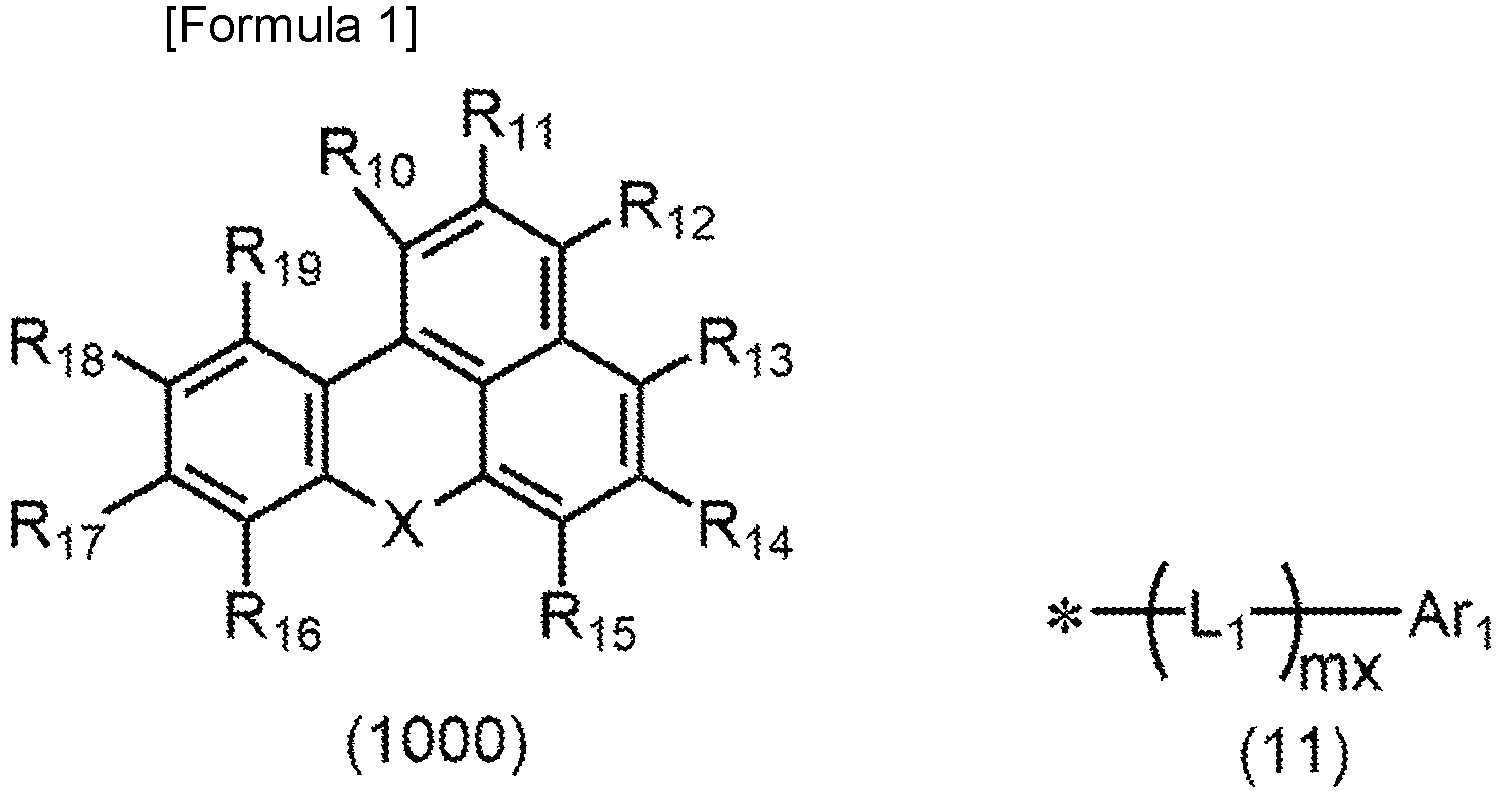
- In the formula (1000):
- X is an oxygen atom, a sulfur atom, C(R2001)(R2002), or Si(R2003)(R2004);
- R2001 to R2004 are each independently a hydrogen atom, a substituted or unsubstituted alkyl group having 1 to 50 carbon atoms, a substituted or unsubstituted alkenyl group having 2 to 50 carbon atoms, a substituted or unsubstituted alkynyl group having 2 to 50 carbon atoms, a substituted or unsubstituted cycloalkyl group having 3 to 50 ring carbon atoms, a group represented by -Si(R901)(R902)(R903), a group represented by -O-(R904), a group represented by -S-(R905), a group represented by -N(R906)(R907), a halogen atom, a cyano group, a nitro group, a substituted or unsubstituted aryl group having 6 to 50 ring carbon atoms, or a substituted or unsubstituted heterocyclic group having 5 to 50 ring atoms;
- at least one combination of adjacent two or more of R10 to R19 are mutually bonded to form a substituted or unsubstituted monocyclic ring, mutually bonded to form a substituted or unsubstituted fused ring, or not mutually bonded;
- R10 to R19 forming neither the substituted or unsubstituted monocyclic ring nor the substituted or unsubstituted fused ring are each independently a hydrogen atom, a substituted or unsubstituted alkyl group having 1 to 50 carbon atoms, a substituted or unsubstituted haloalkyl group having 1 to 50 carbon atoms, a substituted or unsubstituted alkenyl group having 2 to 50 carbon atoms, a substituted or unsubstituted alkynyl group having 2 to 50 carbon atoms, a substituted or unsubstituted cycloalkyl group having 3 to 50 ring carbon atoms, a group represented by -Si(R901)(R902)(R903), a group represented by -O-(R904), a group represented by - S-(R905), a group represented by -N(R906)(R907), a substituted or unsubstituted aralkyl group having 7 to 50 carbon atoms, a group represented by -C(=O)R801, a group represented by -COOR802, a halogen atom, a nitro group, a substituted or unsubstituted aryl group having 6 to 50 ring carbon atoms, a substituted or unsubstituted heterocyclic group having 5 to 50 ring atoms, or a group represented by the formula (11), and
- at least one of R10 to R19 is a group represented by the formula (11);
- when a plurality of groups represented by the formula (11) are present, the plurality of groups represented by the formula (11) are mutually the same or different;
- L1 is a substituted or unsubstituted arylene group having 6 to 15 ring carbon atoms, or a substituted or unsubstituted divalent heterocyclic group having 5 to 15 ring atoms;
- mx is 1, 2, or 3;
- when two or more L1 are present, the two or more L1 are mutually the same or different;
- Ar1 is a substituted or unsubstituted aryl group including four or more rings;
- when two or more Ar1 are present, the two or more Ar1 are mutually the same or different;
- * in the formula (11) represents a bonding position;
- in a compound represented by the formula (1000), R901, R902, R903, R904, R905, R906, R907, R801, and R802 are each independently a hydrogen atom, a substituted or unsubstituted alkyl group having 1 to 50 carbon atoms, a substituted or unsubstituted cycloalkyl group having 3 to 50 ring carbon atoms, a substituted or unsubstituted aryl group having 6 to 50 ring carbon atoms, or a substituted or unsubstituted heterocyclic group having 5 to 50 ring atoms;
- when a plurality of R901 are present, the plurality of R901 are mutually the same or different;
- when a plurality of R902 are present, the plurality of R902 are mutually the same or different;
- when a plurality of R903 are present, the plurality of R903 are mutually the same or different;
- when a plurality of R904 are present, the plurality of R904 are mutually the same or different;
- when a plurality of R905 are present, the plurality of R905 are mutually the same or different;
- when a plurality of R906 are present, the plurality of R906 are mutually the same or different;
- when a plurality of R907 are present, the plurality of R907 are mutually the same or different;
- when a plurality of R801 are present, the plurality of R801 are mutually the same or different; and
- when a plurality of R802 are present, the plurality of R802 are mutually the same or different.
- According to another aspect of the invention, there is provided a compound having at least one group represented by a formula (110A) below and a single benz[de]anthracene derivative skeleton represented by a formula (1000A) below in a molecule.

- In the formula (1000A):
- X is an oxygen atom, a sulfur atom, C(R2001)(R2002), or Si(R2003)(R2004);
- R2001 to R2004 are each independently a hydrogen atom, a substituted or unsubstituted alkyl group having 1 to 50 carbon atoms, a substituted or unsubstituted alkenyl group having 2 to 50 carbon atoms, a substituted or unsubstituted alkynyl group having 2 to 50 carbon atoms, a substituted or unsubstituted cycloalkyl group having 3 to 50 ring carbon atoms, a group represented by -Si(R901)(R902)(R903), a group represented by -O-(R904), a group represented by -S-(R905), a group represented by -N(R906)(R907), a halogen atom, a cyano group, a nitro group, a substituted or unsubstituted aryl group having 6 to 50 ring carbon atoms, or a substituted or unsubstituted heterocyclic group having 5 to 50 ring atoms;
- at least one combination of adjacent two or more of R10 to R19 are mutually bonded to form a substituted or unsubstituted monocyclic ring, mutually bonded to form a substituted or unsubstituted fused ring, or not mutually bonded;
- R10 to R19 forming neither the substituted or unsubstituted monocyclic ring nor the substituted or unsubstituted fused ring are each independently a hydrogen atom, a substituted or unsubstituted alkyl group having 1 to 50 carbon atoms, a substituted or unsubstituted haloalkyl group having 1 to 50 carbon atoms, a substituted or unsubstituted alkenyl group having 2 to 50 carbon atoms, a substituted or unsubstituted alkynyl group having 2 to 50 carbon atoms, a substituted or unsubstituted cycloalkyl group having 3 to 50 ring carbon atoms, a group represented by -Si(R901)(R902)(R903), a group represented by -O-(R904), a group represented by - S-(R905), a group represented by -N(R906)(R907), a substituted or unsubstituted aralkyl group having 7 to 50 carbon atoms, a group represented by -C(=O)R801, a group represented by -COOR802, a halogen atom, a nitro group, a substituted or unsubstituted aryl group having 6 to 50 ring carbon atoms, a substituted or unsubstituted heterocyclic group having 5 to 50 ring atoms, or a group represented by the formula (110A);
- at least one of R13 or R18 is a group represented by the formula (110A);
- when a plurality of groups represented by the formula (110A) are present, the plurality of groups represented by the formula (110A) are mutually the same or different;
- L100 is a single bond, a substituted or unsubstituted arylene group having 6 to 50 ring carbon atoms, or a substituted or unsubstituted divalent heterocyclic group having 5 to 50 ring atoms;
- mx is 1, 2, or 3;
- when two or more L100 are present, the two or more L100 are mutually the same or different;
- Ar1 is a substituted or unsubstituted aryl group including four or more rings;
- when two or more Ar1 are present, the two or more Ar1 are mutually the same or different;
- * in the formula (110A) represents a bonding position;
- in a compound represented by the formula (1000A), R901, R902, R903, R904, R905, R906, R907, R801, and R802 are each independently a hydrogen atom, a substituted or unsubstituted alkyl group having 1 to 50 carbon atoms, a substituted or unsubstituted cycloalkyl group having 3 to 50 ring carbon atoms, a substituted or unsubstituted aryl group having 6 to 50 ring carbon atoms, or a substituted or unsubstituted heterocyclic group having 5 to 50 ring atoms;
- when a plurality of R901 are present, the plurality of R901 are mutually the same or different;
- when a plurality of R902 are present, the plurality of R902 are mutually the same or different;
- when a plurality of R903 are present, the plurality of R903 are mutually the same or different;
- when a plurality of R904 are present, the plurality of R904 are mutually the same or different;
- when a plurality of R905 are present, the plurality of R905 are mutually the same or different;
- when a plurality of R906 are present, the plurality of R906 are mutually the same or different;
- when a plurality of R907 are present, the plurality of R907 are mutually the same or different;
- when a plurality of R801 are present, the plurality of R801 are mutually the same or different; and
- when a plurality of R802 are present, the plurality of R802 are mutually the same or different.
- According to still another aspect of the invention, there is provided an organic electroluminescence device including: a cathode, an anode, and at least one organic layer provided between the cathode and the anode, in which the at least one organic layer includes an emitting layer and at least one of the at least one organic layer contains the compound according to the above aspect of the invention.
- According to a further aspect of the invention, there is provided an organic electroluminescence device including: a cathode, an anode, and at least one emitting layer provided between the cathode and the anode, in which the at least one emitting layer includes a first emitting layer and a second emitting layer, the first emitting layer contains a first compound, and the first compound is a compound represented by a formula (1000B) below and having at least one group represented by a formula (110) below.
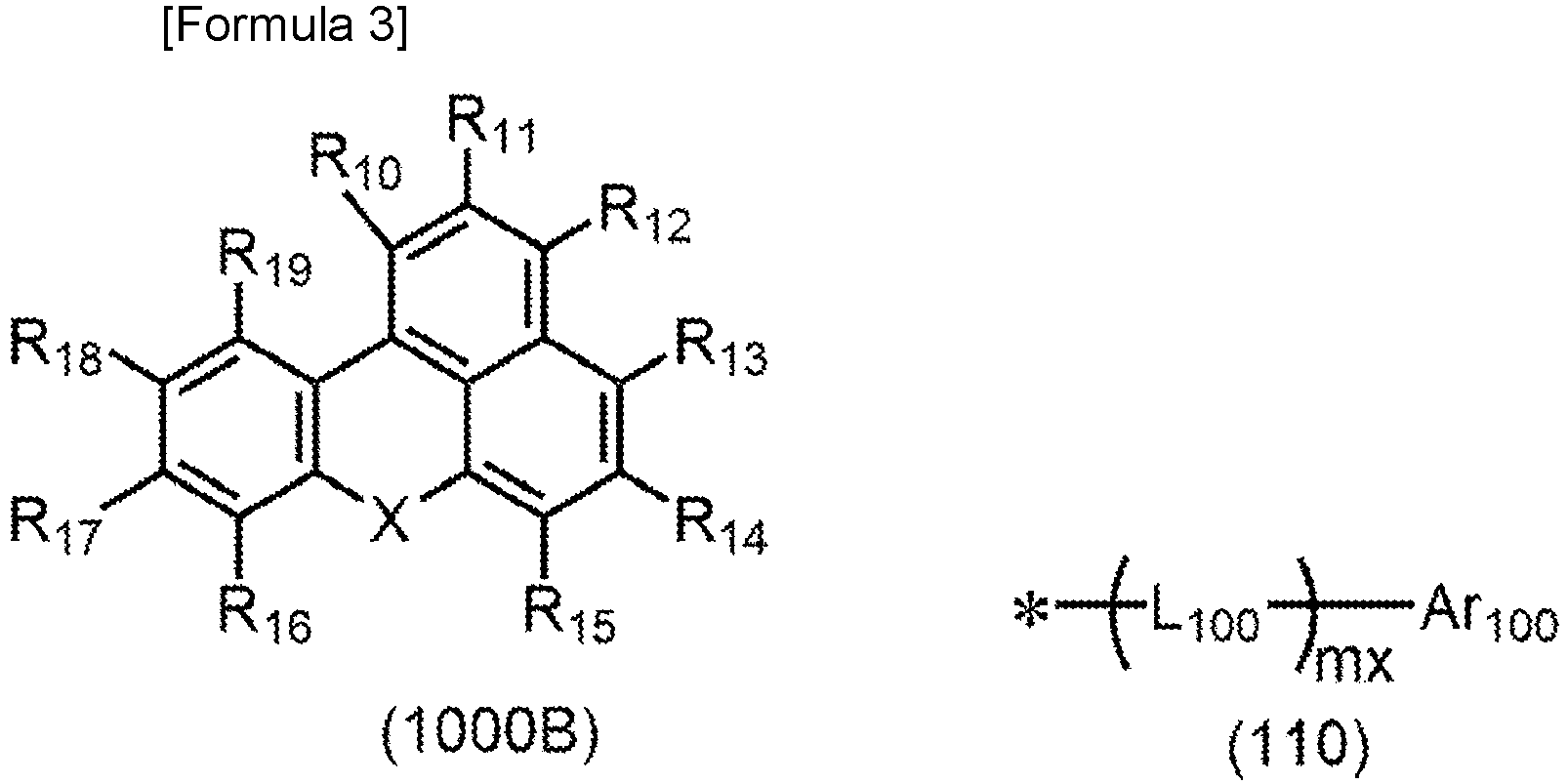
- In the formula (1000B):
- X is an oxygen atom, a sulfur atom, C(R2001)(R2002), or Si(R2003)(R2004);
- R2001 to R2004 are each independently a hydrogen atom, a substituted or unsubstituted alkyl group having 1 to 50 carbon atoms, a substituted or unsubstituted alkenyl group having 2 to 50 carbon atoms, a substituted or unsubstituted alkynyl group having 2 to 50 carbon atoms, a substituted or unsubstituted cycloalkyl group having 3 to 50 ring carbon atoms, a group represented by -Si(R901)(R902)(R903), a group represented by -O-(R904), a group represented by -S-(R905), a group represented by -N(R906)(R907), a halogen atom, a cyano group, a nitro group, a substituted or unsubstituted aryl group having 6 to 50 ring carbon atoms, or a substituted or unsubstituted heterocyclic group having 5 to 50 ring atoms;
- at least one combination of adjacent two or more of R10 to R19 are mutually bonded to form a substituted or unsubstituted monocyclic ring, mutually bonded to form a substituted or unsubstituted fused ring, or not mutually bonded;
- R10 to R19 forming neither the substituted or unsubstituted monocyclic ring nor the substituted or unsubstituted fused ring are each independently a hydrogen atom, a substituted or unsubstituted alkyl group having 1 to 50 carbon atoms, a substituted or unsubstituted haloalkyl group having 1 to 50 carbon atoms, a substituted or unsubstituted alkenyl group having 2 to 50 carbon atoms, a substituted or unsubstituted alkynyl group having 2 to 50 carbon atoms, a substituted or unsubstituted cycloalkyl group having 3 to 50 ring carbon atoms, a group represented by -Si(R901)(R902)(R903), a group represented by -O-(R904), a group represented by - S-(R905), a group represented by -N(R906)(R907), a substituted or unsubstituted aralkyl group having 7 to 50 carbon atoms, a group represented by -C(=O)R801, a group represented by -COOR802, a halogen atom, a nitro group, a substituted or unsubstituted aryl group having 6 to 50 ring carbon atoms, a substituted or unsubstituted heterocyclic group having 5 to 50 ring atoms, or a group represented by the formula (110);
- at least one of R10 to R19 is a group represented by the formula (110);
- when a plurality of groups represented by the formula (110) are present, the plurality of groups represented by the formula (110) are mutually the same or different;
- L100 is a single bond, a substituted or unsubstituted arylene group having 6 to 50 ring carbon atoms, or a substituted or unsubstituted divalent heterocyclic group having 5 to 50 ring atoms;
- mx is 1, 2, or 3;
- when two or more L100 are present, the two or more L100 are mutually the same or different;
- Ar100 is a substituted or unsubstituted aryl group including three or more rings or a substituted or unsubstituted heterocyclic group including two or more aromatic rings and one or more heterocyclic rings;
- Ar100 does not include an anthracene ring;
- when two or more Ar100 are present, the two or more Ar100 are mutually the same or different; and
- * in the formula (110) represents a bonding position;
- in the first compound represented by the formula (1000B), R901, R902, R903, R904, R905, R906, R907, R801, and R802 are each independently a hydrogen atom, a substituted or unsubstituted alkyl group having 1 to 50 carbon atoms, a substituted or unsubstituted cycloalkyl group having 3 to 50 ring carbon atoms, a substituted or unsubstituted aryl group having 6 to 50 ring carbon atoms, or a substituted or unsubstituted heterocyclic group having 5 to 50 ring atoms;
- when a plurality of R901 are present, the plurality of R901 are mutually the same or different;
- when a plurality of R902 are present, the plurality of R902 are mutually the same or different;
- when a plurality of R903 are present, the plurality of R903 are mutually the same or different;
- when a plurality of R904 are present, the plurality of R904 are mutually the same or different;
- when a plurality of R905 are present, the plurality of R905 are mutually the same or different;
- when a plurality of R906 are present, the plurality of R906 are mutually the same or different;
- when a plurality of R907 are present, the plurality of R907 are mutually the same or different;
- when a plurality of R801 are present, the plurality of R801 are mutually the same or different; and
- when a plurality of R802 are present, the plurality of R802 are mutually the same or different.
- According to a still further aspect of the invention, there is provided an electronic device including the organic electroluminescence device according to the above aspect of the invention.
- According to the above aspects of the invention, there can be provided a compound capable of improving performance of an organic EL device, an organic electroluminescence device containing the compound, and an electronic device including the organic electroluminescence device.
- Moreover, according to the above aspects of the invention, there can be provided a compound capable of providing an organic electroluminescence device, in which a plurality of emitting layers are layered, in a favorable balance between a luminous efficiency and a lifetime when the compound is used in an emitting layer close to an anode of the organic electroluminescence device, and to provide an electronic device including the organic electroluminescence device.
-
Fig. 1 schematically shows an exemplary arrangement of an organic electroluminescence device according to an exemplary embodiment of the invention. - Herein, a hydrogen atom includes isotopes having different numbers of neutrons, specifically, protium, deuterium and tritium.
- In chemical formulae herein, it is assumed that a hydrogen atom (i.e. protium, deuterium and tritium) is bonded to each of bondable positions that are not annexed with signs "R" or the like or "D" representing a deuterium.
- Herein, the ring carbon atoms refer to the number of carbon atoms among atoms forming a ring of a compound (e.g., a monocyclic compound, fused-ring compound, crosslinking compound, carbon ring compound, and heterocyclic compound) in which the atoms are bonded with each other to form the ring. When the ring is substituted by a substituent(s), carbon atom(s) contained in the substituent(s) is not counted in the ring carbon atoms. Unless otherwise specified, the same applies to the "ring carbon atoms" described later. For instance, a benzene ring has 6 ring carbon atoms, a naphthalene ring has 10 ring carbon atoms, a pyridine ring has 5 ring carbon atoms, and a furan ring has 4 ring carbon atoms. Further, for instance, 9,9-diphenylfluorenyl group has 13 ring carbon atoms and 9,9'-spirobifluorenyl group has 25 ring carbon atoms.
- When a benzene ring is substituted by a substituent in a form of, for instance, an alkyl group, the number of carbon atoms of the alkyl group is not counted in the number of the ring carbon atoms of the benzene ring. Accordingly, the benzene ring substituted by an alkyl group has 6 ring carbon atoms. When a naphthalene ring is substituted by a substituent in a form of, for instance, an alkyl group, the number of carbon atoms of the alkyl group is not counted in the number of the ring carbon atoms of the naphthalene ring. Accordingly, the naphthalene ring substituted by an alkyl group has 10 ring carbon atoms.
- Herein, the ring atoms refer to the number of atoms forming a ring of a compound (e.g., a monocyclic compound, fused-ring compound, crosslinking compound, carbon ring compound, and heterocyclic compound) in which the atoms are bonded to each other to form the ring (e.g., monocyclic ring, fused ring, and ring assembly). Atom(s) not forming the ring (e.g., hydrogen atom(s) for saturating the valence of the atom which forms the ring) and atom(s) in a substituent by which the ring is substituted are not counted as the ring atoms. Unless otherwise specified, the same applies to the "ring atoms" described later. For instance, a pyridine ring has 6 ring atoms, a quinazoline ring has 10 ring atoms, and a furan ring has 5 ring atoms. For instance, the number of hydrogen atom(s) bonded to a pyridine ring or the number of atoms forming a substituent are not counted as the pyridine ring atoms. Accordingly, a pyridine ring bonded with a hydrogen atom(s) or a substituent(s) has 6 ring atoms. For instance, the hydrogen atom(s) bonded to carbon atom(s) of a quinazoline ring or the atoms forming a substituent are not counted as the quinazoline ring atoms. Accordingly, a quinazoline ring bonded with hydrogen atom(s) or a substituent(s) has 10 ring atoms.
- Herein, "XX to YY carbon atoms" in the description of "substituted or unsubstituted ZZ group having XX to YY carbon atoms" represent carbon atoms of an unsubstituted ZZ group and do not include carbon atoms of a substituent(s) of the substituted ZZ group. Herein, "YY" is larger than "XX," "XX" representing an integer of 1 or more and "YY" representing an integer of 2 or more.
- Herein, "XX to YY atoms" in the description of "substituted or unsubstituted ZZ group having XX to YY atoms" represent atoms of an unsubstituted ZZ group and do not include atoms of a substituent(s) of the substituted ZZ group. Herein, "YY" is larger than "XX," "XX" representing an integer of 1 or more and "YY" representing an integer of 2 or more.
- Herein, an unsubstituted ZZ group refers to an "unsubstituted ZZ group" in a "substituted or unsubstituted ZZ group," and a substituted ZZ group refers to a "substituted ZZ group" in a "substituted or unsubstituted ZZ group."
- Herein, the term "unsubstituted" used in a "substituted or unsubstituted ZZ group" means that a hydrogen atom(s) in the ZZ group is not substituted with a substituent(s). The hydrogen atom(s) in the "unsubstituted ZZ group" is protium, deuterium, or tritium.
- Herein, the term "substituted" used in a "substituted or unsubstituted ZZ group" means that at least one hydrogen atom in the ZZ group is substituted with a substituent. Similarly, the term "substituted" used in a "BB group substituted by AA group" means that at least one hydrogen atom in the BB group is substituted with the AA group.
- Substituents mentioned herein will be described below.
- An "unsubstituted aryl group" mentioned herein has, unless otherwise specified herein, 6 to 50, preferably 6 to 30, more preferably 6 to 18 ring carbon atoms.
- An "unsubstituted heterocyclic group" mentioned herein has, unless otherwise specified herein, 5 to 50 ring atoms, preferably 5 to 30 ring atoms, more preferably 5 to 18 ring atoms.
- An "unsubstituted alkyl group" mentioned herein has, unless otherwise specified herein, 1 to 50 carbon atoms, preferably 1 to 20 carbon atoms, more preferably 1 to 6 carbon atoms.
- An "unsubstituted alkenyl group" mentioned herein has, unless otherwise specified herein, 2 to 50, preferably 2 to 20, more preferably 2 to 6 carbon atoms.
- An "unsubstituted alkynyl group" mentioned herein has, unless otherwise specified herein, 2 to 50 carbon atoms, preferably 2 to 20 carbon atoms, more preferably 2 to 6 carbon atoms.
- An "unsubstituted cycloalkyl group" mentioned herein has, unless otherwise specified herein, 3 to 50, preferably 3 to 20, more preferably 3 to 6 ring carbon atoms.
- An "unsubstituted arylene group" mentioned herein has, unless otherwise specified herein, 6 to 50 ring carbon atoms, preferably 6 to 30 ring carbon atoms, more preferably 6 to 18 ring carbon atoms.
- An "unsubstituted divalent heterocyclic group" mentioned herein has, unless otherwise specified herein, 5 to 50 ring atoms, preferably 5 to 30 ring atoms, more preferably 5 to 18 ring atoms.
- An "unsubstituted alkylene group" mentioned herein has, unless otherwise specified herein, 1 to 50 carbon atoms, preferably 1 to 20 carbon atoms, more preferably 1 to 6 carbon atoms.
- Specific examples (specific example group G1) of the "substituted or unsubstituted aryl group" mentioned herein include unsubstituted aryl groups (specific example group G1A) below and substituted aryl groups (specific example group G1B). Herein, an unsubstituted aryl group refers to an "unsubstituted aryl group" in a "substituted or unsubstituted aryl group," and a substituted aryl group refers to a "substituted aryl group" in a "substituted or unsubstituted aryl group." A simply termed "aryl group" herein includes both of an "unsubstituted aryl group" and a "substituted aryl group."
- The "substituted aryl group" refers to a group derived by substituting at least one hydrogen atom in an "unsubstituted aryl group" with a substituent. Examples of the "substituted aryl group" include a group derived by substituting at least one hydrogen atom in the "unsubstituted aryl group" in the specific example group G1A below with a substituent, and examples of the substituted aryl group in the specific example group G1B below. It should be noted that the examples of the "unsubstituted aryl group" and the "substituted aryl group" mentioned herein are merely exemplary, and the "substituted aryl group" mentioned herein includes a group derived by further substituting a hydrogen atom bonded to a carbon atom of a skeleton of a "substituted aryl group" in the specific example group G1B below, and a group derived by further substituting a hydrogen atom of a substituent of the "substituted aryl group" in the specific example group G1B below.
- phenyl group, p-biphenyl group, m-biphenyl group, o-biphenyl group, p-terphenyl-4-yl group, p-terphenyl-3-yl group, p-terphenyl-2-yl group, m-terphenyl-4-yl group, m-terphenyl-3-yl group, m-terphenyl-2-yl group, o-terphenyl-4-yl group, o-terphenyl-3-yl group, o-terphenyl-2-yl group, 1-naphthyl group, 2-naphthyl group, anthryl group, benzanthryl group, phenanthryl group, benzophenanthryl group, phenalenyl group, pyrenyl group, chrysenyl group, benzochrysenyl group, triphenylenyl group, benzotriphenylenyl group, tetracenyl group, pentacenyl group, fluorenyl group, 9,9'-spirobifluorenyl group, benzofluorenyl group, dibenzofluorenyl group, fluoranthenyl group, benzofluoranthenyl group, perylenyl group, and a monovalent aryl group derived by removing one hydrogen atom from cyclic structures represented by formulae (TEMP-1) to (TEMP-15) below.


- o-tolyl group, m-tolyl group, p-tolyl group, para-xylyl group, meta-xylyl group, ortho-xylyl group, para-isopropylphenyl group, meta-isopropylphenyl group, ortho-isopropylphenyl group, para-t-butylphenyl group, meta-t-butylphenyl group, ortho-t-butylphenyl group, 3,4,5-trimethylphenyl group, 9,9-dimethylfluorenyl group, 9,9-diphenylfluorenyl group, 9,9-bis(4-methylphenyl)fluorenyl group, 9,9-bis(4-isopropylphenyl)fluorenyl group, 9,9-bis(4-t-butylphenyl)fluorenyl group, cyanophenyl group, triphenylsilylphenyl group, trimethylsilylphenyl group, phenylnaphthyl group, naphthylphenyl group, and a group derived by substituting at least one hydrogen atom of a monovalent group derived from the cyclic structures represented by the formulae (TEMP-1) to (TEMP-15) with a substituent.
- The "heterocyclic group" mentioned herein refers to a cyclic group having at least one hetero atom in the ring atoms. Specific examples of the hetero atom include a nitrogen atom, oxygen atom, sulfur atom, silicon atom, phosphorus atom, and boron atom.
- The "heterocyclic group" mentioned herein is a monocyclic group or a fused-ring group.
- The "heterocyclic group" mentioned herein is an aromatic heterocyclic group or a non-aromatic heterocyclic group.
- Specific examples (specific example group G2) of the "substituted or unsubstituted heterocyclic group" mentioned herein include unsubstituted heterocyclic groups (specific example group G2A) and substituted heterocyclic groups (specific example group G2B). Herein, an unsubstituted heterocyclic group refers to an "unsubstituted heterocyclic group" in a "substituted or unsubstituted heterocyclic group," and a substituted heterocyclic group refers to a "substituted heterocyclic group" in a "substituted or unsubstituted heterocyclic group." A simply termed "heterocyclic group" herein includes both of an "unsubstituted heterocyclic group" and a "substituted heterocyclic group."
- The "substituted heterocyclic group" refers to a group derived by substituting at least one hydrogen atom in an "unsubstituted heterocyclic group" with a substituent. Specific examples of the "substituted heterocyclic group" include a group derived by substituting at least one hydrogen atom in the "unsubstituted heterocyclic group" in the specific example group G2A below with a substituent, and examples of the substituted heterocyclic group in the specific example group G2B below. It should be noted that the examples of the "unsubstituted heterocyclic group" and the "substituted heterocyclic group" mentioned herein are merely exemplary, and the "substituted heterocyclic group" mentioned herein includes a group derived by further substituting a hydrogen atom bonded to a ring atom of a skeleton of a "substituted heterocyclic group" in the specific example group G2B below, and a group derived by further substituting a hydrogen atom of a substituent of the "substituted heterocyclic group" in the specific example group G2B below.
- The specific example group G2A includes, for instance, unsubstituted heterocyclic groups including a nitrogen atom (specific example group G2A1) below, unsubstituted heterocyclic groups including an oxygen atom (specific example group G2A2) below, unsubstituted heterocyclic groups including a sulfur atom (specific example group G2A3) below, and monovalent heterocyclic groups (specific example group G2A4) derived by removing a hydrogen atom from cyclic structures represented by formulae (TEMP-16) to (TEMP-33) below.
- The specific example group G2B includes, for instance, substituted heterocyclic groups including a nitrogen atom (specific example group G2B1) below, substituted heterocyclic groups including an oxygen atom (specific example group G2B2) below, substituted heterocyclic groups including a sulfur atom (specific example group G2B3) below, and groups derived by substituting at least one hydrogen atom of the monovalent heterocyclic groups (specific example group G2B4) derived from the cyclic structures represented by formulae (TEMP-16) to (TEMP-33) below.
- pyrrolyl group, imidazolyl group, pyrazolyl group, triazolyl group, tetrazolyl group, oxazolyl group, isoxazolyl group, oxadiazolyl group, thiazolyl group, isothiazolyl group, thiadiazolyl group, pyridyl group, pyridazynyl group, pyrimidinyl group, pyrazinyl group, triazinyl group, indolyl group, isoindolyl group, indolizinyl group, quinolizinyl group, quinolyl group, isoquinolyl group, cinnolyl group, phthalazinyl group, quinazolinyl group, quinoxalinyl group, benzimidazolyl group, indazolyl group, phenanthrolinyl group, phenanthridinyl group, acridinyl group, phenazinyl group, carbazolyl group, benzocarbazolyl group, morpholino group, phenoxazinyl group, phenothiazinyl group, azacarbazolyl group, and diazacarbazolyl group.
- furyl group, oxazolyl group, isoxazolyl group, oxadiazolyl group, xanthenyl group, benzofuranyl group, isobenzofuranyl group, dibenzofuranyl group, naphthobenzofuranyl group, benzoxazolyl group, benzisoxazolyl group, phenoxazinyl group, morpholino group, dinaphthofuranyl group, azadibenzofuranyl group, diazadibenzofuranyl group, azanaphthobenzofuranyl group, and diazanaphthobenzofuranyl group.
- thienyl group, thiazolyl group, isothiazolyl group, thiadiazolyl group, benzothiophenyl group (benzothienyl group), isobenzothiophenyl group (isobenzothienyl group), dibenzothiophenyl group (dibenzothienyl group), naphthobenzothiophenyl group (nahthobenzothienyl group), benzothiazolyl group, benzisothiazolyl group, phenothiazinyl group, dinaphthothiophenyl group (dinaphthothienyl group), azadibenzothiophenyl group (azadibenzothienyl group), diazadibenzothiophenyl group (diazadibenzothienyl group), azanaphthobenzothiophenyl group (azanaphthobenzothienyl group), and diazanaphthobenzothiophenyl group (diazanaphthobenzothienyl group).
-


- In the formulae (TEMP-16) to (TEMP-33), XA and YA are each independently an oxygen atom, a sulfur atom, NH, or CH2. However, at least one of XA or YA is an oxygen atom, a sulfur atom, or NH.
- When at least one of XA or YA in the formulae (TEMP-16) to (TEMP-33) is NH or CH2, the monovalent heterocyclic groups derived from the cyclic structures represented by the formulae (TEMP-16) to (TEMP-33) include a monovalent group derived by removing one hydrogen atom from NH, or CH2.
- (9-phenyl)carbazolyl group, (9-biphenylyl)carbazolyl group, (9-phenyl)phenylcarbazolyl group, (9-naphthyl)carbazolyl group, diphenylcarbazole-9-yl group, phenylcarbazole-9-yl group, methylbenzimidazolyl group, ethylbenzimidazolyl group, phenyltriazinyl group, biphenylyltriazinyl group, diphenyltriazinyl group, phenylquinazolinyl group, and biphenylquinazolinyl group.
- phenyldibenzofuranyl group, methyldibenzofuranyl group, t-butyldibenzofuranyl group, and monovalent residue of spiro[9H-xanthene-9,9'-[9H]fluorene].
- phenyldibenzothiophenyl group, methyldibenzothiophenyl group, t-butyldibenzothiophenyl group, and monovalent residue of spiro[9H-thioxanthene-9,9'-[9H]fluorene].
- Groups Obtained by Substituting at Least One Hydrogen Atom of Monovalent Heterocyclic Group Derived from Cyclic Structures Represented by Formulae (TEMP-16) to (TEMP-33) with Substituent (Specific Example Group G2B4):
- The "at least one hydrogen atom of a monovalent heterocyclic group" means at least one hydrogen atom selected from a hydrogen atom bonded to a ring carbon atom of the monovalent heterocyclic group, a hydrogen atom bonded to a nitrogen atom of at least one of XA or YA in a form of NH, and a hydrogen atom of one of XA and YA in a form of a methylene group (CH2).
- Specific examples (specific example group G3) of the "substituted or unsubstituted alkyl group" mentioned herein include unsubstituted alkyl groups (specific example group G3A) and substituted alkyl groups (specific example group G3B below). Herein, an unsubstituted alkyl group refers to an "unsubstituted alkyl group" in a "substituted or unsubstituted alkyl group," and a substituted alkyl group refers to a "substituted alkyl group" in a "substituted or unsubstituted alkyl group." A simply termed "alkyl group" herein includes both of an "unsubstituted alkyl group" and a "substituted alkyl group."
- The "substituted alkyl group" refers to a group derived by substituting at least one hydrogen atom in an "unsubstituted alkyl group" with a substituent. Specific examples of the "substituted alkyl group" include a group derived by substituting at least one hydrogen atom of an "unsubstituted alkyl group" (specific example group G3A) below with a substituent, and examples of the substituted alkyl group (specific example group G3B) below. Herein, the alkyl group for the "unsubstituted alkyl group" refers to a chain alkyl group. Accordingly, the "unsubstituted alkyl group" include linear "unsubstituted alkyl group" and branched "unsubstituted alkyl group." It should be noted that the examples of the "unsubstituted alkyl group" and the "substituted alkyl group" mentioned herein are merely exemplary, and the "substituted alkyl group" mentioned herein includes a group derived by further substituting a hydrogen atom of a skeleton of the "substituted alkyl group" in the specific example group G3B, and a group derived by further substituting a hydrogen atom of a substituent of the "substituted alkyl group" in the specific example group G3B.
- methyl group, ethyl group, n-propyl group, isopropyl group, n-butyl group, isobutyl group, s-butyl group, and t-butyl group.
- heptafluoropropyl group (including isomer thereof), pentafluoroethyl group, 2,2,2-trifluoroethyl group, and trifluoromethyl group.
- Specific examples (specific example group G4) of the "substituted or unsubstituted alkenyl group" mentioned herein include unsubstituted alkenyl groups (specific example group G4A) and substituted alkenyl groups (specific example group G4B). Herein, an unsubstituted alkenyl group refers to an "unsubstituted alkenyl group" in a "substituted or unsubstituted alkenyl group," and a substituted alkenyl group refers to a "substituted alkenyl group" in a "substituted or unsubstituted alkenyl group." A simply termed "alkenyl group" herein includes both of an "unsubstituted alkenyl group" and a "substituted alkenyl group."
- The "substituted alkenyl group" refers to a group derived by substituting at least one hydrogen atom in an "unsubstituted alkenyl group" with a substituent. Specific examples of the "substituted alkenyl group" include an "unsubstituted alkenyl group" (specific example group G4A) substituted by a substituent, and examples of the substituted alkenyl group (specific example group G4B) below. It should be noted that the examples of the "unsubstituted alkenyl group" and the "substituted alkenyl group" mentioned herein are merely exemplary, and the "substituted alkenyl group" mentioned herein includes a group derived by further substituting a hydrogen atom of a skeleton of the "substituted alkenyl group" in the specific example group G4B with a substituent, and a group derived by further substituting a hydrogen atom of a substituent of the "substituted alkenyl group" in the specific example group G4B with a substituent.
- vinyl group, allyl group, 1-butenyl group, 2-butenyl group, and 3-butenyl group.
- 1,3-butanedienyl group, 1-methylvinyl group, 1-methylallyl group, 1,1-dimethylallyl group, 2-methylallyl group, and 1,2-dimethylallyl group.
- Specific examples (specific example group G5) of the "substituted or unsubstituted alkynyl group" mentioned herein include unsubstituted alkynyl groups (specific example group G5A) below. Herein, an unsubstituted alkynyl group refers to an "unsubstituted alkynyl group" in a "substituted or unsubstituted alkynyl group." A simply termed "alkynyl group" herein includes both of an "unsubstituted alkynyl group" and a "substituted alkynyl group."
- The "substituted alkynyl group" refers to a group derived by substituting at least one hydrogen atom in an "unsubstituted alkynyl group" with a substituent. Specific examples of the "substituted alkynyl group" include a group derived by substituting at least one hydrogen atom of the "unsubstituted alkynyl group" (specific example group G5A) below with a substituent.
- ethynyl group.
- Specific examples (specific example group G6) of the "substituted or unsubstituted cycloalkyl group" mentioned herein include unsubstituted cycloalkyl groups (specific example group G6A) and substituted cycloalkyl groups (specific example group G6B). Herein, an unsubstituted cycloalkyl group refers to an "unsubstituted cycloalkyl group" in a "substituted or unsubstituted cycloalkyl group," and a substituted cycloalkyl group refers to a "substituted cycloalkyl group" in a "substituted or unsubstituted cycloalkyl group." A simply termed "cycloalkyl group" herein includes both of an "unsubstituted cycloalkyl group" and a "substituted cycloalkyl group."
- The "substituted cycloalkyl group" refers to a group derived by substituting at least one hydrogen atom of an "unsubstituted cycloalkyl group" with a substituent. Specific examples of the "substituted cycloalkyl group" include a group derived by substituting at least one hydrogen atom of the "unsubstituted cycloalkyl group" (specific example group G6A) below with a substituent, and examples of the substituted cycloalkyl group (specific example group G6B) below. It should be noted that the examples of the "unsubstituted cycloalkyl group" and the "substituted cycloalkyl group" mentioned herein are merely exemplary, and the "substituted cycloalkyl group" mentioned herein includes a group derived by substituting at least one hydrogen atom bonded to a carbon atom of a skeleton of the "substituted cycloalkyl group" in the specific example group G6B with a substituent, and a group derived by further substituting a hydrogen atom of a substituent of the "substituted cycloalkyl group" in the specific example group G6B with a substituent.
- cyclopropyl group, cyclobutyl group, cyclopentyl group, cyclohexyl group, 1-adamantyl group, 2-adamantyl group, 1-norbornyl group, and 2-norbornyl group.
- 4-methylcyclohexyl group
- Specific examples (specific example group G7) of the group represented herein by -Si(R901)(R902)(R903) include: -Si(G1)(G1)(G1); -Si(G1)(G2)(G2); - Si(G1)(G1)(G2); -Si(G2)(G2)(G2); -Si(G3)(G3)(G3); and -Si(G6)(G6)(G6).
- Herein: G1 represents a "substituted or unsubstituted aryl group" in the specific example group G1;
- G2 represents a "substituted or unsubstituted heterocyclic group" in the specific example group G2;
- G3 represents a "substituted or unsubstituted alkyl group" in the specific example group G3; and
- G6 represents a "substituted or unsubstituted cycloalkyl group" in the specific example group G6.
- A plurality of G1 in -Si(G1)(G1)(G1) are mutually the same or different.
- A plurality of G2 in -Si(G1)(G2)(G2) are mutually the same or different.
- A plurality of G1 in -Si(G1)(G1)(G2) are mutually the same or different.
- A plurality of G2 in -Si(G2)(G2)(G2) are mutually the same or different.
- The plurality of G3 in -Si(G3)(G3)(G3) are mutually the same or different.
- A plurality of G6 in -Si(G6)(G6)(G6) are mutually the same or different.
- Specific examples (specific example group G8) of a group represented by - O-(R904) herein include: -O(G1); -O(G2); -O(G3); and -O(G6).
- Herein: G1 represents a "substituted or unsubstituted aryl group" in the specific example group G1;
- G2 represents a "substituted or unsubstituted heterocyclic group" in the specific example group G2;
- G3 represents a "substituted or unsubstituted alkyl group" in the specific example group G3; and
- G6 represents a "substituted or unsubstituted cycloalkyl group" in the specific example group G6.
- Specific examples (specific example group G9) of a group represented herein by -S-(R905) include: -S(G1); -S(G2); -S(G3); and -S(G6).
- Herein: G1 represents a "substituted or unsubstituted aryl group" in the specific example group G1;
- G2 represents a "substituted or unsubstituted heterocyclic group" in the specific example group G2;
- G3 represents a "substituted or unsubstituted alkyl group" in the specific example group G3; and
- G6 represents a "substituted or unsubstituted cycloalkyl group" in the specific example group G6.
- Specific examples (specific example group G10) of a group represented herein by -N(R906)(R907) include: -N(G1)(G1); -N(G2)(G2); -N(G1)(G2); -N(G3)(G3); and -N(G6)(G6).
- Herein: G1 represents a "substituted or unsubstituted aryl group" in the specific example group G1;
- G2 represents a "substituted or unsubstituted heterocyclic group" in the specific example group G2;
- G3 represents a "substituted or unsubstituted alkyl group" in the specific example group G3; and
- G6 represents a "substituted or unsubstituted cycloalkyl group" in the specific example group G6.
- A plurality of G1 in -N(G1)(G1) are mutually the same or different.
- A plurality of G2 in -N(G2)(G2) are mutually the same or different.
- A plurality of G3 in -N(G3)(G3) are mutually the same or different.
- A plurality of G6 in -N(G6)(G6)) are mutually the same or different.
- Specific examples (specific example group G11) of "halogen atom" mentioned herein include a fluorine atom, chlorine atom, bromine atom, and iodine atom.
- The "substituted or unsubstituted fluoroalkyl group" mentioned herein refers to a group derived by substituting at least one hydrogen atom bonded to at least one of carbon atoms forming an alkyl group in the "substituted or unsubstituted alkyl group" with a fluorine atom, and also includes a group (perfluoro group) derived by substituting all of hydrogen atoms bonded to carbon atoms forming the alkyl group in the "substituted or unsubstituted alkyl group" with fluorine atoms. An "unsubstituted fluoroalkyl group" has, unless otherwise specified herein, 1 to 50 carbon atoms, preferably 1 to 30 carbon atoms, more preferably 1 to 18 carbon atoms. The "substituted fluoroalkyl group" refers to a group derived by substituting at least one hydrogen atom in a "fluoroalkyl group" with a substituent. It should be noted that the examples of the "substituted fluoroalkyl group" mentioned herein include a group derived by further substituting at least one hydrogen atom bonded to a carbon atom of an alkyl chain of a "substituted fluoroalkyl group" with a substituent, and a group derived by further substituting at least one hydrogen atom of a substituent of the "substituted fluoroalkyl group" with a substituent. Specific examples of the "substituted fluoroalkyl group" include a group derived by substituting at least one hydrogen atom of the "alkyl group" (specific example group G3) with a fluorine atom.
- The "substituted or unsubstituted haloalkyl group" mentioned herein refers to a group derived by substituting at least one hydrogen atom bonded to carbon atoms forming the alkyl group in the "substituted or unsubstituted alkyl group" with a halogen atom, and also includes a group derived by substituting all hydrogen atoms bonded to carbon atoms forming the alkyl group in the "substituted or unsubstituted alkyl group" with halogen atoms. An "unsubstituted haloalkyl group" has, unless otherwise specified herein, 1 to 50 carbon atoms, preferably 1 to 30 carbon atoms, more preferably 1 to 18 carbon atoms. The "substituted haloalkyl group" refers to a group derived by substituting at least one hydrogen atom in a "haloalkyl group" with a substituent. It should be noted that the examples of the "substituted haloalkyl group" mentioned herein include a group derived by further substituting at least one hydrogen atom bonded to a carbon atom of an alkyl chain of a "substituted haloalkyl group" with a substituent, and a group derived by further substituting at least one hydrogen atom of a substituent of the "substituted haloalkyl group" with a substituent. Specific examples of the "substituted haloalkyl group" include a group derived by substituting at least one hydrogen atom of the "alkyl group" (specific example group G3) with a halogen atom. The haloalkyl group is sometimes referred to as a halogenated alkyl group.
- Specific examples of a "substituted or unsubstituted alkoxy group" mentioned herein include a group represented by -O(G3), G3 being the "substituted or unsubstituted alkyl group" in the specific example group G3. An "unsubstituted alkoxy group" has, unless otherwise specified herein, 1 to 50 carbon atoms, preferably 1 to 30 carbon atoms, more preferably 1 to 18 carbon atoms.
- Specific examples of a "substituted or unsubstituted alkylthio group" mentioned herein include a group represented by -S(G3), G3 being the "substituted or unsubstituted alkyl group" in the specific example group G3. An "unsubstituted alkylthio group" has, unless otherwise specified herein, 1 to 50 carbon atoms, preferably 1 to 30 carbon atoms, more preferably 1 to 18 carbon atoms.
- Specific examples of a "substituted or unsubstituted aryloxy group" mentioned herein include a group represented by -O(G1), G1 being the "substituted or unsubstituted aryl group" in the specific example group G1. An "unsubstituted aryloxy group" has, unless otherwise specified herein, 6 to 50 ring carbon atoms, preferably 6 to 30 ring carbon atoms, more preferably 6 to 18 ring carbon atoms.
- Specific examples of a "substituted or unsubstituted arylthio group" mentioned herein include a group represented by -S(G1), G1 being the "substituted or unsubstituted aryl group" in the specific example group G1. An "unsubstituted arylthio group" has, unless otherwise specified herein, 6 to 50 ring carbon atoms, preferably 6 to 30 ring carbon atoms, more preferably 6 to 18 ring carbon atoms.
- Specific examples of a "trialkylsilyl group" mentioned herein include a group represented by -Si(G3)(G3)(G3), G3 being the "substituted or unsubstituted alkyl group" in the specific example group G3. The plurality of G3 in -Si(G3)(G3)(G3) are mutually the same or different. Each of the alkyl groups in the "trialkylsilyl group" has, unless otherwise specified herein, 1 to 50 carbon atoms, preferably 1 to 20 carbon atoms, more preferably 1 to 6 carbon atoms.
- Specific examples of a "substituted or unsubstituted aralkyl group" mentioned herein include a group represented by (G3)-(G1), G3 being the "substituted or unsubstituted alkyl group" in the specific example group G3, G1 being the "substituted or unsubstituted aryl group" in the specific example group G1. Accordingly, the "aralkyl group" is a group derived by substituting a hydrogen atom of the "alkyl group" with a substituent in a form of the "aryl group," which is an example of the "substituted alkyl group." An "unsubstituted aralkyl group," which is an "unsubstituted alkyl group" substituted by an "unsubstituted aryl group," has, unless otherwise specified herein, 7 to 50 carbon atoms, preferably 7 to 30 carbon atoms, more preferably 7 to 18 carbon atoms.
- Specific examples of the "substituted or unsubstituted aralkyl group" include a benzyl group, 1-phenylethyl group, 2-phenylethyl group, 1-phenylisopropyl group, 2-phenylisopropyl group, phenyl-t-butyl group, α-naphthylmethyl group, 1-α-naphthylethyl group, 2-α-naphthylethyl group, 1-α-naphthylisopropyl group, 2-α-naphthylisopropyl group, β-naphthylmethyl group, 1-β-naphthylethyl group, 2-β-naphthylethyl group, 1-β-naphthylisopropyl group, and 2-β-naphthylisopropyl group.
- Preferable examples of the substituted or unsubstituted aryl group mentioned herein include, unless otherwise specified herein, a phenyl group, p-biphenyl group, m-biphenyl group, o-biphenyl group, p-terphenyl-4-yl group, p-terphenyl-3-yl group, p-terphenyl-2-yl group, m-terphenyl-4-yl group, m-terphenyl-3-yl group, m-terphenyl-2-yl group, o-terphenyl-4-yl group, o-terphenyl-3-yl group, o-terphenyl-2-yl group, 1-naphthyl group, 2-naphthyl group, anthryl group, phenanthryl group, pyrenyl group, chrysenyl group, triphenylenyl group, fluorenyl group, 9,9'-spirobifluorenyl group, 9,9-dimethylfluorenyl group, and 9,9-diphenylfluorenyl group.
- Preferable examples of the substituted or unsubstituted heterocyclic group mentioned herein include, unless otherwise specified herein, a pyridyl group, pyrimidinyl group, triazinyl group, quinolyl group, isoquinolyl group, quinazolinyl group, benzimidazolyl group, phenanthrolinyl group, carbazolyl group (1-carbazolyl group, 2-carbazolyl group, 3-carbazolyl group, 4-carbazolyl group, or 9-carbazolyl group), benzocarbazolyl group, azacarbazolyl group, diazacarbazolyl group, dibenzofuranyl group, naphthobenzofuranyl group, azadibenzofuranyl group, diazadibenzofuranyl group, dibenzothiophenyl group, naphthobenzothiophenyl group, azadibenzothiophenyl group, diazadibenzothiophenyl group, (9-phenyl)carbazolyl group ((9-phenyl)carbazole-1-yl group, (9-phenyl)carbazole-2-yl group, (9-phenyl)carbazole-3-yl group, or (9-phenyl)carbazole-4-yl group), (9-biphenylyl)carbazolyl group, (9-phenyl)phenylcarbazolyl group, diphenylcarbazole-9-yl group, phenylcarbazole-9-yl group, phenyltriazinyl group, biphenylyltriazinyl group, diphenyltriazinyl group, phenyldibenzofuranyl group, and phenyldibenzothiophenyl group.
- The carbazolyl group mentioned herein is, unless otherwise specified herein, specifically a group represented by one of formulae below.


- The (9-phenyl)carbazolyl group mentioned herein is, unless otherwise specified herein, specifically a group represented by one of formulae below.

- In the formulae (TEMP-Cz1) to (TEMP-Cz9), * represents a bonding position.
- The dibenzofuranyl group and dibenzothiophenyl group mentioned herein are, unless otherwise specified herein, each specifically represented by one of formulae below.


- In the formulae (TEMP-34) to (TEMP-41), * represents a bonding position.
- Preferable examples of the substituted or unsubstituted alkyl group mentioned herein include, unless otherwise specified herein, a methyl group, ethyl group, propyl group, isopropyl group, n-butyl group, isobutyl group, and t-butyl group.
- The "substituted or unsubstituted arylene group" mentioned herein is, unless otherwise specified herein, a divalent group derived by removing one hydrogen atom on an aryl ring of the "substituted or unsubstituted aryl group." Specific examples of the "substituted or unsubstituted arylene group" (specific example group G12) include a divalent group derived by removing one hydrogen atom on an aryl ring of the "substituted or unsubstituted aryl group" in the specific example group G1.
- The "substituted or unsubstituted divalent heterocyclic group" mentioned herein is, unless otherwise specified herein, a divalent group derived by removing one hydrogen atom on a heterocyclic ring of the "substituted or unsubstituted heterocyclic group." Specific examples of the "substituted or unsubstituted heterocyclic group" (specific example group G13) include a divalent group derived by removing one hydrogen atom on a heterocyclic ring of the "substituted or unsubstituted heterocyclic group" in the specific example group G2.
- The "substituted or unsubstituted alkylene group" mentioned herein is, unless otherwise specified herein, a divalent group derived by removing one hydrogen atom on an alkyl ring of the "substituted or unsubstituted alkyl group." Specific examples of the "substituted or unsubstituted alkylene group" (specific example group G14) include a divalent group derived by removing one hydrogen atom on an alkyl ring of the "substituted or unsubstituted alkyl group" in the specific example group G3.
- The substituted or unsubstituted arylene group mentioned herein is, unless otherwise specified herein, preferably any one of groups represented by formulae (TEMP-42) to (TEMP-68) below.


- In the formulae (TEMP-42) to (TEMP-52), Q1 to Q10 each independently are a hydrogen atom or a substituent.
- In the formulae (TEMP-42) to (TEMP-52), * represents a bonding position.


- In the formulae (TEMP-53) to (TEMP-62), Q1 to Q10 each independently are a hydrogen atom or a substituent.
- In the formulae, Q9 and Q10 may be mutually bonded through a single bond to form a ring.
- In the formulae (TEMP-53) to (TEMP-62), * represents a bonding position.


- In the formulae (TEMP-63) to (TEMP-68), Q1 to Q8 each independently are a hydrogen atom or a substituent.
- In the formulae (TEMP-63) to (TEMP-68), * represents a bonding position.
- The substituted or unsubstituted divalent heterocyclic group mentioned herein is, unless otherwise specified herein, preferably a group represented by any one of formulae (TEMP-69) to (TEMP-102) below.
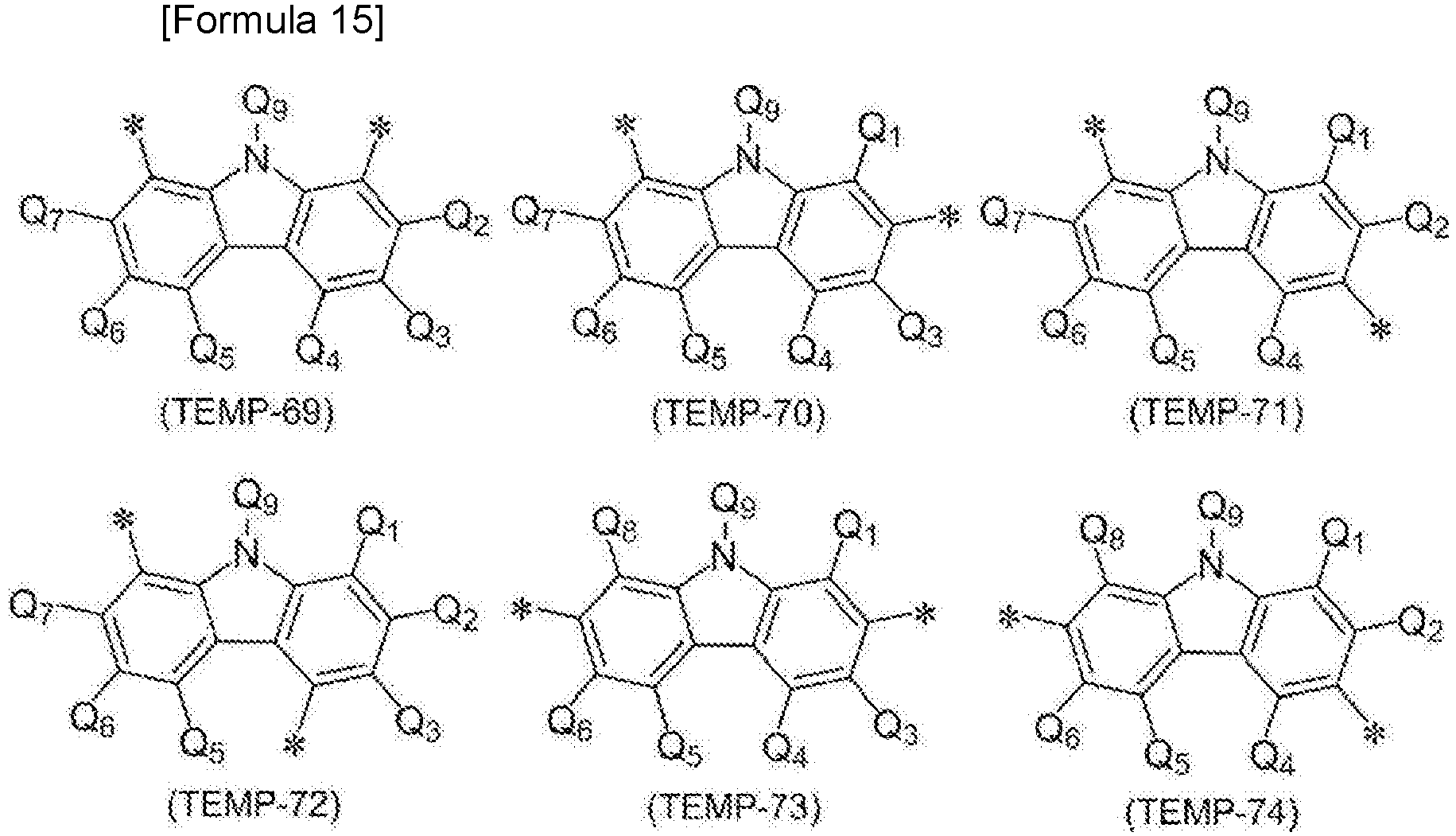


- In the formulae (TEMP-69) to (TEMP-82), Q1 to Q9 each independently are a hydrogen atom or a substituent.


- In the formulae (TEMP-83) to (TEMP-102), Q1 to Q8 each independently are a hydrogen atom or a substituent.
- The substituent mentioned herein has been described above.
- Instances where "at least one combination of adjacent two or more (of... ) are mutually bonded to form a substituted or unsubstituted monocyclic ring, mutually bonded to form a substituted or unsubstituted fused ring, or not mutually bonded" mentioned herein refer to instances where "at least one combination of adjacent two or more (of...) are mutually bonded to form a substituted or unsubstituted monocyclic ring," at least one combination of adjacent two or more (of... ) are mutually bonded to form a substituted or unsubstituted fused ring," and "at least one combination of adjacent two or more (of...) are not mutually bonded."
- Instances where "at least one combination of adjacent two or more (of... ) are mutually bonded to form a substituted or unsubstituted monocyclic ring" and "at least one combination of adjacent two or more (of...) are mutually bonded to form a substituted or unsubstituted fused ring" mentioned herein (these instances will be sometimes collectively referred to as an instance of "bonded to form a ring" hereinafter) will be described below. An anthracene compound having a basic skeleton in a form of an anthracene ring and represented by a formula (TEMP-103) below will be used as an example for the description.

- For instance, when "at least one combination of adjacent two or more of" R921 to R930 "are mutually bonded to form a ring," the combination of adjacent ones of R921 to R930 (i.e. the combination at issue) is a combination of R921 and a combination of R922, R922 and R923, a combination of R923 and R924, a combination of R924 and R930, a combination of R930 and R925, a combination of R925 and R926, a combination of R926 and R927, a combination of R927 and R928, a combination of R928 and R929, or a combination of R929 and R921.
- The term "at least one combination" means that two or more of the above combinations of adjacent two or more of R921 to R930 may simultaneously form rings. For instance, when R921 and R922 are mutually bonded to form a ring QA and R925 and R926 are simultaneously mutually bonded to form a ring QB, the anthracene compound represented by the formula (TEMP-103) is represented by a formula (TEMP-104) below.

- The instance where the "combination of adjacent two or more" form a ring means not only an instance where the "two" adjacent components are bonded but also an instance where adjacent "three or more" are bonded. For instance, R921 and R922 are mutually bonded to form a ring QA and R922, R923 are mutually bonded to form a ring Qc, and mutually adjacent three components (R921, R922 and R923) are mutually bonded to form a ring fused to the anthracene basic skeleton. In this case, the anthracene compound represented by the formula (TEMP-103) is represented by a formula (TEMP-105) below. In the formula (TEMP-105) below, the ring QA and the ring Qc share R922.


- The formed "monocyclic ring" or "fused ring" may be, in terms of the formed ring in itself, a saturated ring or an unsaturated ring. When the "combination of adjacent two" form a "monocyclic ring" or a "fused ring," the "monocyclic ring" or "fused ring" may be a saturated ring or an unsaturated ring. For instance, the ring QA and the ring QB formed in the formula (TEMP-104) are each independently a "monocyclic ring" or a "fused ring." Further, the ring QA and the ring Qc formed in the formula (TEMP-105) are each a "fused ring." The ring QA and the ring Qc in the formula (TEMP-105) are fused to form a fused ring. When the ring QA in the formula (TMEP-104) is a benzene ring, the ring QA is a monocyclic ring. When the ring QA in the formula (TMEP-104) is a naphthalene ring, the ring QA is a fused ring.
- The "unsaturated ring" represents an aromatic hydrocarbon ring or an aromatic heterocycle. The "saturated ring" represents an aliphatic hydrocarbon ring or a non-aromatic heterocycle.
- Specific examples of the aromatic hydrocarbon ring include a ring formed by terminating a bond of a group in the specific example of the specific example group G1 with a hydrogen atom.
- Specific examples of the aromatic heterocyclic ring include a ring formed by terminating a bond of an aromatic heterocyclic group in the specific example of the specific example group G2 with a hydrogen atom.
- Specific examples of the aliphatic hydrocarbon ring include a ring formed by terminating a bond of a group in the specific example of the specific example group G6 with a hydrogen atom.
- The phrase "to form a ring" herein means that a ring is formed only by a plurality of atoms of a basic skeleton, or by a combination of a plurality of atoms of the basic skeleton and one or more optional atoms. For instance, the ring QA formed by mutually bonding R921 and R922 shown in the formula (TEMP-104) is a ring formed by a carbon atom of the anthracene skeleton bonded with R921, a carbon atom of the anthracene skeleton bonded with R922, and one or more optional atoms. Specifically, when the ring QA is a monocyclic unsaturated ring formed by R921 and R922, the ring formed by a carbon atom of the anthracene skeleton bonded with R921, a carbon atom of the anthracene skeleton bonded with R922, and four carbon atoms is a benzene ring.
- The "optional atom" is, unless otherwise specified herein, preferably at least one atom selected from the group consisting of a carbon atom, nitrogen atom, oxygen atom, and sulfur atom. A bond of the optional atom (e.g. a carbon atom and a nitrogen atom) not forming a ring may be terminated by a hydrogen atom or the like or may be substituted by an "optional substituent" described later. When the ring includes an optional element other than carbon atom, the resultant ring is a heterocycle.
- The number of "one or more optional atoms" forming the monocyclic ring or fused ring is, unless otherwise specified herein, preferably in a range from 2 to 15, more preferably in a range from 3 to 12, further preferably in a range from 3 to 5.
- Unless otherwise specified herein, the ring, which may be a "monocyclic ring" or "fused ring," is preferably a "monocyclic ring."
- Unless otherwise specified herein, the ring, which may be a "saturated ring" or "unsaturated ring," is preferably an "unsaturated ring."
- Unless otherwise specified herein, the "monocyclic ring" is preferably a benzene ring.
- Unless otherwise specified herein, the "unsaturated ring" is preferably a benzene ring.
- When "at least one combination of adjacent two or more" (of...) are "mutually bonded to form a substituted or unsubstituted monocyclic ring" or "mutually bonded to form a substituted or unsubstituted fused ring," unless otherwise specified herein, at least one combination of adjacent two or more of components are preferably mutually bonded to form a substituted or unsubstituted "unsaturated ring" formed of a plurality of atoms of the basic skeleton, and 1 to 15 atoms of at least one element selected from the group consisting of carbon, nitrogen, oxygen and sulfur.
- When the "monocyclic ring" or the "fused ring" has a substituent, the substituent is the substituent described in later-described "optional substituent." When the "monocyclic ring" or the "fused ring" has a substituent, specific examples of the substituent are the substituents described in the above under the subtitle "Substituents Mentioned Herein."
- When the "saturated ring" or the "unsaturated ring" has a substituent, the substituent is, for instance, the substituent described in later-described "optional substituent." When the "monocyclic ring" or the "fused ring" has a substituent, specific examples of the substituent are the substituents described in the above under the subtitle "Substituents Mentioned Herein."
- The above is the description for the instances where "at least one combination of adjacent two or more (of...) are mutually bonded to form a substituted or unsubstituted monocyclic ring" and "at least one combination of adjacent two or more (of...) are mutually bonded to form a substituted or unsubstituted fused ring" mentioned herein (sometimes referred to as an instance "bonded to form a ring".
- In an exemplary embodiment herein, the substituent for the substituted or unsubstituted group (sometimes referred to as an "optional substituent") is selected from the group consisting of, for instance, an unsubstituted alkyl group having 1 to 50 carbon atoms, an unsubstituted alkenyl group having 2 to 50 carbon atoms, an unsubstituted alkynyl group having 2 to 50 carbon atoms, an unsubstituted cycloalkyl group having 3 to 50 ring carbon atoms, -Si(R901)(R902)(R903), -O-(R904), -S-(R905), - N(R906)(R907), a halogen atom, a cyano group, a nitro group, an unsubstituted aryl group having 6 to 50 ring carbon atoms, and an unsubstituted heterocyclic group having 5 to 50 ring atoms.
- Herein, R901 to R907 are each independently a hydrogen atom, a substituted or unsubstituted alkyl group having 1 to 50 carbon atoms, a substituted or unsubstituted cycloalkyl group having 3 to 50 ring carbon atoms, a substituted or unsubstituted aryl group having 6 to 50 ring carbon atoms, or a substituted or unsubstituted heterocyclic group having 5 to 50 ring atoms.
- When two or more R901 are present, the two or more R901 are mutually the same or different.
- When two or more R902 are present, the two or more R902 are mutually the same or different.
- When two or more R903 are present, the two or more R903 are mutually the same or different.
- When two or more R904 are present, the two or more R904 are mutually the same or different.
- When two or more R905 are present, the two or more R905 are mutually the same or different.
- When two or more R906 are present, the two or more R906 are mutually the same or different.
- When two or more R907 are present, the two or more R907 are mutually the same or different.
- In an exemplary embodiment, the substituent for "substituted or unsubstituted" group is selected from the group consisting of an alkyl group having 1 to 50 carbon atoms, an aryl group having 6 to 50 ring carbon atoms, and a heterocyclic group having 5 to 50 ring atoms.
- In an exemplary embodiment, the substituent for "substituted or unsubstituted" group is selected from the group consisting of an alkyl group having 1 to 18 carbon atoms, an aryl group having 6 to 18 ring carbon atoms, and a heterocyclic group having 5 to 18 ring atoms.
- Specific examples of the above optional substituent are the same as the specific examples of the substituent described in the above under the subtitle "Substituent Mentioned Herein."
- Unless otherwise specified herein, adjacent ones of the optional substituents may form a "saturated ring" or an "unsaturated ring," preferably a substituted or unsubstituted saturated five-membered ring, a substituted or unsubstituted saturated six-membered ring, a substituted or unsubstituted saturated five-membered ring, or a substituted or unsubstituted unsaturated six-membered ring, more preferably a benzene ring.
- Unless otherwise specified herein, the optional substituent may further include a substituent. Examples of the substituent for the optional substituent are the same as the examples of the optional substituent.
- Herein, numerical ranges represented by "AA to BB" represents a range whose lower limit is the value (AA) recited before "to" and whose upper limit is the value (BB) recited after "to."
- A compound according to a first exemplary embodiment is a compound represented by a formula (1000B) below and having at least one group represented by a formula (110) below.

- In the formula (1000B):
- X is an oxygen atom, a sulfur atom, C(R2001)(R2002), or Si(R2003)(R2004);
- at least one combination of adjacent two or more of R10 to R19 are mutually bonded to form a substituted or unsubstituted monocyclic ring, mutually bonded to form a substituted or unsubstituted fused ring, or not mutually bonded;
- R10 to R19 forming neither the substituted or unsubstituted monocyclic ring nor the substituted or unsubstituted fused ring are each independently a hydrogen atom, a substituted or unsubstituted alkyl group having 1 to 50 carbon atoms, a substituted or unsubstituted haloalkyl group having 1 to 50 carbon atoms, a substituted or unsubstituted alkenyl group having 2 to 50 carbon atoms, a substituted or unsubstituted alkynyl group having 2 to 50 carbon atoms, a substituted or unsubstituted cycloalkyl group having 3 to 50 ring carbon atoms, a group represented by -Si(R901)(R902)(R903), a group represented by -O-(R904), a group represented by - S-(R905), a group represented by -N(R906)(R907), a substituted or unsubstituted aralkyl group having 7 to 50 carbon atoms, a group represented by -C(=O)R801, a group represented by -COOR802, a halogen atom, a nitro group, a substituted or unsubstituted aryl group having 6 to 50 ring carbon atoms, a substituted or unsubstituted heterocyclic group having 5 to 50 ring atoms, or a group represented by the formula (110);
- at least one of R10 to R19 is a group represented by the formula (110);
- when a plurality of groups represented by the formula (110) are present, the plurality of groups represented by the formula (110) are mutually the same or different;
- L100 is a single bond, a substituted or unsubstituted arylene group having 6 to 50 ring carbon atoms, or a substituted or unsubstituted divalent heterocyclic group having 5 to 50 ring atoms;
- mx is 1, 2, or 3;
- when two or more L100 are present, the two or more L100 are mutually the same or different;
- Ar100 is a substituted or unsubstituted aryl group including three or more rings or a substituted or unsubstituted heterocyclic group including two or more aromatic rings and one or more heterocyclic rings;
- Ar100 does not include an anthracene ring;
- when two or more Ar100 are present, the two or more Ar100 are mutually the same or different; and
- * in the formula (110) represents a bonding position.
- A compound represented by the formula (1000B) is preferably a compound represented by a formula (100) below and having at least one group represented by the formula (110).

- In the formula (100): R10 to R19 each independently represent the same as R10 to R19 in the formula (1000B); none of combinations of adjacent two or more of R10 to R19 are mutually bonded; and Ar100, L100, and mx respectively represent the same as Ar100, L100, and mx in the formula (110).
- LUMO (Lowest Unoccupied Molecular Orbital) of a compound in which a cyano group is directly bonded to a benzoxanthene ring (hereinafter, referred to as a cyano-substituted benzoxanthene compound) is lower than LUMO of a compound in which a cyano group is not bonded to a benzoxanthene ring. In a case where a cyano-substituted benzoxanthene compound is used as a host material in the emitting layer, the host material may suffer a large damage at an interface of the emitting layer close to the hole transporting layer to lower a lifetime of an organic EL device. It is inappropriate to use a cyano-substituted benzoxanthene compound particularly in the emitting layer close to the hole transporting layer in an organic EL device in which a plurality of emitting layers are layered.
- The compound according to the exemplary embodiment is also preferably represented by a formula (101) or (102) below.


- In the formulae (101) and (102): R10 to R19 each independently represent the same as R10 to R19 in the formula (1000B); none of combinations of adjacent two or more of R10 to R19 are mutually bonded; and Ar100, L100, and mx respectively represent the same as Ar100, L100, and mx in the formula (110).
- In the compound according to the exemplary embodiment, it is preferable that R10 to R19 not being a group represented by the formula (110) are each independently a hydrogen atom, a substituted or unsubstituted alkyl group having 1 to 50 carbon atoms, a substituted or unsubstituted cycloalkyl group having 3 to 50 ring carbon atoms, or a substituted or unsubstituted aryl group having 6 to 50 ring carbon atoms.
- In the compound according to the exemplary embodiment, R10 to R19 not being a group represented by the formula (110) are each preferably a hydrogen atom.
- In the compound according to the exemplary embodiment, L100 is preferably a single bond or an arylene group including at most three substituted or unsubstituted benzene rings.
- In the compound according to the exemplary embodiment, L100 is preferably not a substituted or unsubstituted anthrylene group.
- In the compound according to the exemplary embodiment, L100 is also preferably not a single bond.
- In the compound according to the exemplary embodiment, a group represented by -(L100)mx- in the formula (110) is also preferably a group represented by one of formulae (111) to (120) below.


- * in the formulae (111) to (120) represents a bonding position.
- A group represented by -(L100)mx- in the formula (110) is preferably a group represented by the formula (111) or (112).
- In the compound according to the exemplary embodiment, Ar100 is preferably an aryl group in which at least four substituted or unsubstituted benzene rings are fused.
- In the compound according to the exemplary embodiment, Ar100 is preferably an aryl group in which four substituted or unsubstituted benzene rings are fused or an aryl group in which five substituted or unsubstituted benzene rings are fused.
- In the compound according to the exemplary embodiment, Ar100 is preferably a group represented by a formula (1100), (1200), (1300), (1400), (1500), (1600), (1700), or (1800).


- In the formula (1100), one of R111 to R120 is a bond.
- In the formula (1200), one of R1201 to R1212 is a bond.
- In the formula (1300), one of R1301 to R1314 is a bond.
- In the formula (1400), one of R1401 to R1414 is a bond.
- In the formula (1500), one of R1501 to R1514 is a bond.
- In the formula (1600), one of R1601 to R1612 is a bond.
- In the formula (1700), one of R1701 to R1710 is a bond.
- In the formula (1800), one of R1801 to R1812 is a bond.
- R111 to R120 not being a bond, R1201 to R1212 not being a bond, R1301 to R1314 not being a bond, R1401 to R1414 not being a bond, R1501 to R1514 not being a bond, R1601 to R1612 not being a bond, R1701 to R1710 not being a bond, and R1801 to R1812 not being a bond are each independently a hydrogen atom, a substituted or unsubstituted alkyl group having 1 to 50 carbon atoms, a substituted or unsubstituted haloalkyl group having 1 to 50 carbon atoms, a substituted or unsubstituted alkenyl group having 2 to 50 carbon atoms, a substituted or unsubstituted alkynyl group having 2 to 50 carbon atoms, a substituted or unsubstituted cycloalkyl group having 3 to 50 ring carbon atoms, a group represented by -Si(R901)(R902)(R903), a group represented by -O-(R904), a group represented by -S-(R905), a group represented by -N(R906)(R907), a substituted or unsubstituted aralkyl group having 7 to 50 carbon atoms, a group represented by -C(=O)R801, a group represented by -COOR802, a halogen atom, a nitro group, a substituted or unsubstituted aryl group having 6 to 50 ring carbon atoms, or a substituted or unsubstituted heterocyclic group having 5 to 50 ring atoms.
- A group represented by the formula (1100) in which R111 is a bond is represented by a formula (1112) below. A group represented by the formula (1100) in which R120 is a bond is represented by a formula (1113) below. A group represented by the formula (1100) in which R119 is a bond is represented by a formula (1114) below.


- In the formulae (1112), (1113), and (1114):
- R111 to R120 are each independently a hydrogen atom, a substituted or unsubstituted alkyl group having 1 to 50 carbon atoms, a substituted or unsubstituted haloalkyl group having 1 to 50 carbon atoms, a substituted or unsubstituted alkenyl group having 2 to 50 carbon atoms, a substituted or unsubstituted alkynyl group having 2 to 50 carbon atoms, a substituted or unsubstituted cycloalkyl group having 3 to 50 ring carbon atoms, a group represented by -Si(R901)(R902)(R903), a group represented by -O-(R904), a group represented by -S-(R905), a group represented by -N(R906)(R907), a substituted or unsubstituted aralkyl group having 7 to 50 carbon atoms, a group represented by -C(=O)R801, a group represented by -COOR802, a halogen atom, a nitro group, a substituted or unsubstituted aryl group having 6 to 50 ring carbon atoms, or a substituted or unsubstituted heterocyclic group having 5 to 50 ring atoms; and
- * in the formulae (1112) to (1114) represents a bonding position.
- In the compound according to the exemplary embodiment, R111 to R120 not being a bond, R1201 to R1212 not being a bond, R1301 to R1314 not being a bond, R1401 to R1414 not being a bond, R1501 to R1514 not being a bond, R1601 to R1612 not being a bond, R1701 to R1710 not being a bond, and R1801 to R1812 not being a bond are preferably each independently a hydrogen atom, a substituted or unsubstituted alkyl group having 1 to 50 carbon atoms, a substituted or unsubstituted cycloalkyl group having 3 to 50 ring carbon atoms, or a substituted or unsubstituted aryl group having 6 to 50 ring carbon atoms.
- In the compound according to the exemplary embodiment, R111 to R120 not being a bond, R1201 to R1212 not being a bond, R1301 to R1314 not being a bond, R1401 to R1414 not being a bond, R1501 to R1514 not being a bond, R1601 to R1612 not being a bond, R1701 to R1710 not being a bond, and R1801 to R1812 not being a bond are preferably each a hydrogen atom.
- In the compound according to the exemplary embodiment, Ar100 as a substituted or unsubstituted heterocyclic group including at least two aromatic rings and at least one heterocyclic group is also preferably, for instance, a substituted or unsubstituted benzoxanthenyl group, a substituted or unsubstituted dibenzofuranyl group, a substituted or unsubstituted naphthobenzofuranyl group, or a substituted or unsubstituted dibenzothienyl group.
- The compound according to the exemplary embodiment preferably does not include a cyano group in a molecule.
- The compound according to the exemplary embodiment also preferably includes one or two benzoxanthene rings in a molecule.
- The compound according to the exemplary embodiment also preferably includes only a single benzoxanthene ring in a molecule.
- The compound according to the exemplary embodiment is also preferably a compound having at least one group represented by a formula (11) below and a single benz[de]anthracene derivative skeleton represented by a formula (1000) below in a molecule.

- In the formula (1000):
- X is an oxygen atom, a sulfur atom, C(R2001)(R2002), or Si(R2003)(R2004);
- at least one combination of adjacent two or more of R10 to R19 are mutually bonded to form a substituted or unsubstituted monocyclic ring, mutually bonded to form a substituted or unsubstituted fused ring, or not mutually bonded;
- R10 to R19 forming neither the substituted or unsubstituted monocyclic ring nor the substituted or unsubstituted fused ring are each independently a hydrogen atom, a substituted or unsubstituted alkyl group having 1 to 50 carbon atoms, a substituted or unsubstituted haloalkyl group having 1 to 50 carbon atoms, a substituted or unsubstituted alkenyl group having 2 to 50 carbon atoms, a substituted or unsubstituted alkynyl group having 2 to 50 carbon atoms, a substituted or unsubstituted cycloalkyl group having 3 to 50 ring carbon atoms, a group represented by -Si(R901)(R902)(R903), a group represented by -O-(R904), a group represented by - S-(R905), a group represented by -N(R906)(R907), a substituted or unsubstituted aralkyl group having 7 to 50 carbon atoms, a group represented by -C(=O)R801, a group represented by -COOR802, a halogen atom, a nitro group, a substituted or unsubstituted aryl group having 6 to 50 ring carbon atoms, a substituted or unsubstituted heterocyclic group having 5 to 50 ring atoms, or a group represented by the formula (11),
- at least one of R10 to R19 is a group represented by the formula (11);
- when a plurality of groups represented by the formula (11) are present, the plurality of groups represented by the formula (11) are mutually the same or different;
- L1 is a substituted or unsubstituted arylene group having 6 to 15 ring carbon atoms, or a substituted or unsubstituted divalent heterocyclic group having 5 to 15 ring atoms;
- mx is 1, 2, or 3;
- when two or more L1 are present, the two or more L1 are mutually the same or different;
- Ar1 is a substituted or unsubstituted aryl group including four or more rings;
- when two or more Ar1 are present, the two or more Ar1 are mutually the same or different; and
- * in the formula (11) represents a bonding position.
- A compound represented by the formula (1000) preferably includes at least one group represented by the formula (11) and a single benzoxanthene ring represented by a formula (1) below in a molecule.

- In the formula (1): R10 to R19 each independently represent the same as R10 to R19 in the formula (1000); none of combinations of adjacent two or more of R10 to R19 are mutually bonded; and Ar1, L1, and mx respectively represent the same as Ar1, L1, and mx in the formula (11).
- In a compound represented by the formula (1), L1 that is a substituted or unsubstituted arylene group having 6 to 15 ring carbon atoms or a substituted or unsubstituted divalent heterocyclic group having 5 to 15 ring atoms is provided between a benzoxanthene ring and Ar1 that is a substituted or unsubstituted aryl group having four or more rings, whereby a decrease in a hole mobility can be inhibited and a decrease in a luminous efficiency of an organic EL device can be also inhibited.
- The compound including at least one group represented by the formula (11) and a single benzoxanthene ring represented by the formula (1) in a molecule is preferably represented by a formula (121) or (122).


- In the formulae (121) and (122): R10 to R19 each independently represent the same as R10 to R19 in the formula (1); and Ar1, L1, and mx respectively represent the same as Ar1, L1, and mx in the formula (11).
- In the formula (121), R10 to R12 and R14 to R19 are each preferably not a group represented by the formula (11).
- In the formula (122), R10 to R17 and R19 are each preferably not a group represented by the formula (11).
- In a compound represented by the formula (1), R10 to R19 not being a group represented by the formula (11) are preferably each independently a hydrogen atom, a substituted or unsubstituted alkyl group having 1 to 50 carbon atoms, a substituted or unsubstituted cycloalkyl group having 3 to 50 ring carbon atoms, or a substituted or unsubstituted aryl group having 6 to 50 ring carbon atoms.
- In a compound represented by the formula (1), R10 to R19 not being a group represented by the formula (11) are preferably each a hydrogen atom.
- In a compound represented by the formula (1), L1 is preferably an arylene group including at most three substituted or unsubstituted benzene rings.
- In a compound represented by the formula (1), L1 is preferably not a substituted or unsubstituted anthrylene group.
- In a compound represented by the formula (1), a group represented by - (L1)mx- in the formula (11) is also preferably a group represented by one of the formulae (111) to (120).
- In a compound represented by the formula (1), a group represented by - (L1)mx- in the formula (11) is preferably a group represented by one of the formulae (111) and (112).
- The compound including at least one group represented by the formula (11) and a single benz[de]anthracene derivative skeleton represented by the formula (1000) in a molecule is also preferably represented by a formula (123), (124), (125), or (126).
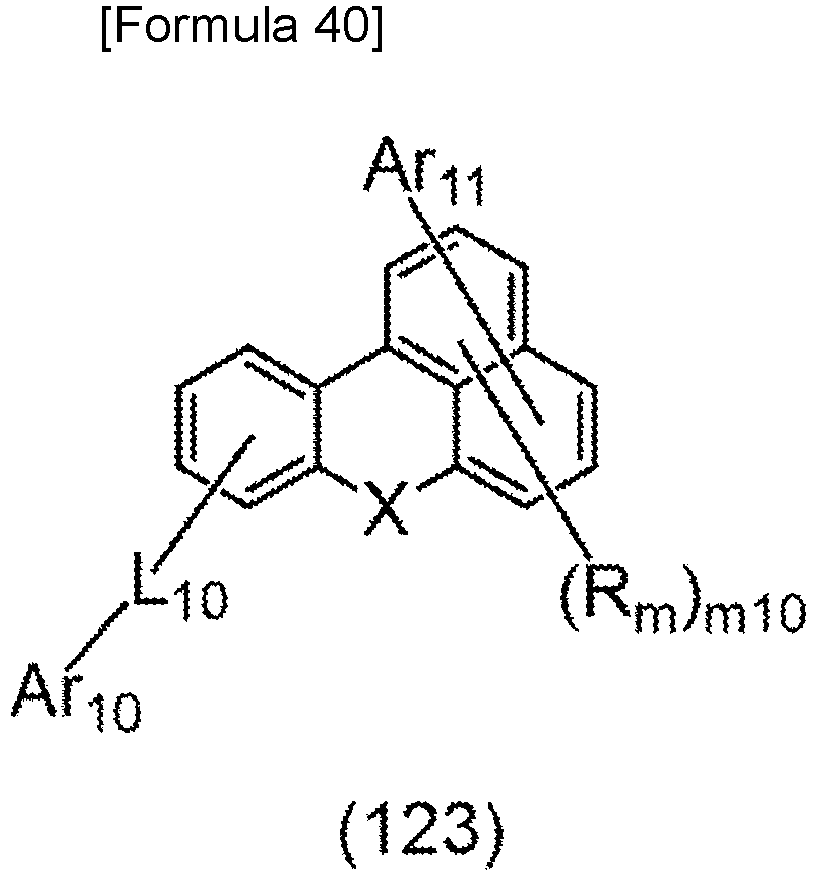


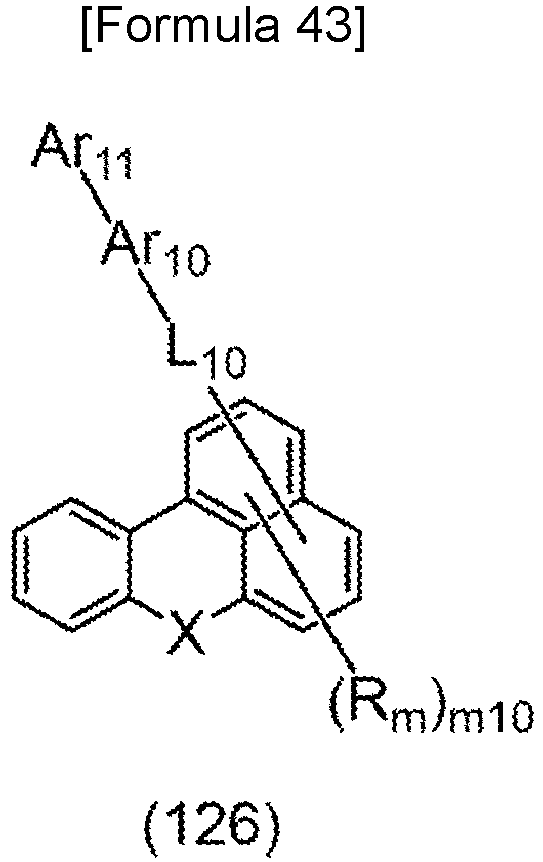
- In the formulae (123), (124), (125), and (126):
- X is an oxygen atom, a sulfur atom, C(R2001)(R2002), or Si(R2003)(R2004);
- R2001 to R2004 are each independently a hydrogen atom, a substituted or unsubstituted alkyl group having 1 to 50 carbon atoms, a substituted or unsubstituted alkenyl group having 2 to 50 carbon atoms, a substituted or unsubstituted alkynyl group having 2 to 50 carbon atoms, a substituted or unsubstituted cycloalkyl group having 3 to 50 ring carbon atoms, a group represented by -Si(R901)(R902)(R903), a group represented by -O-(R904), a group represented by -S-(R905), a group represented by -N(R906)(R907), a halogen atom, a cyano group, a nitro group, a substituted or unsubstituted aryl group having 6 to 50 ring carbon atoms, or a substituted or unsubstituted heterocyclic group having 5 to 50 ring atoms;
- L10 is a substituted or unsubstituted arylene group having 6 to 15 ring carbon atoms, or a substituted or unsubstituted divalent heterocyclic group having 5 to 15 ring atoms;
- Ar10 is an aryl group in which at least four substituted or unsubstituted benzene rings are fused;
- Ar11 is a substituted or unsubstituted aryl group having 6 to 14 ring carbon atoms;
- Ar11 is not a substituted or unsubstituted anthryl group;
- m10 is 5;
- m11 is 6;
- Rm is each independently a hydrogen atom, a substituted or unsubstituted alkyl group having 1 to 50 carbon atoms, a substituted or unsubstituted haloalkyl group having 1 to 50 carbon atoms, a substituted or unsubstituted alkenyl group having 2 to 50 carbon atoms, a substituted or unsubstituted alkynyl group having 2 to 50 carbon atoms, a substituted or unsubstituted cycloalkyl group having 3 to 50 ring carbon atoms, a group represented by -Si(R901)(R902)(R903), a group represented by -O-(R904), a group represented by -S-(R905), a group represented by -N(R906)(R907), a substituted or unsubstituted aralkyl group having 7 to 50 carbon atoms, a group represented by -C(=O)R801, a group represented by -COOR802, a halogen atom, a nitro group, a substituted or unsubstituted aryl group having 6 to 50 ring carbon atoms, or a substituted or unsubstituted heterocyclic group having 5 to 50 ring atoms;
- a plurality of Rm are not mutually bonded;
- R901, R902, R903, R904, R905, R906, R907, R801, and R802 are each independently a hydrogen atom, a substituted or unsubstituted alkyl group having 1 to 50 carbon atoms, a substituted or unsubstituted cycloalkyl group having 3 to 50 ring carbon atoms, a substituted or unsubstituted aryl group having 6 to 50 ring carbon atoms, or a substituted or unsubstituted heterocyclic group having 5 to 50 ring atoms;
- when a plurality of R901 are present, the plurality of R901 are mutually the same or different;
- when a plurality of R902 are present, the plurality of R902 are mutually the same or different;
- when a plurality of R903 are present, the plurality of R903 are mutually the same or different;
- when a plurality of R904 are present, the plurality of R904 are mutually the same or different;
- when a plurality of R905 are present, the plurality of R905 are mutually the same or different;
- when a plurality of R906 are present, the plurality of R906 are mutually the same or different;
- when a plurality of R907 are present, the plurality of R907 are mutually the same or different;
- when a plurality of R801 are present, the plurality of R801 are mutually the same or different; and
- when a plurality of R802 are present, the plurality of R802 are mutually the same or different.
- As in a compound represented by the formula (123) and a compound represented by the formula (125), a benz[de]anthracene derivative skeleton is substituted by Ar11 (a substituted or unsubstituted aryl group having 6 to 14 ring carbon atoms except for a substituted or unsubstituted anthryl group), whereby a singlet energy S1 can be decreased and an excited state can be expected to be stabilized, so that a lifetime of an organic EL device can be prolonged.
- As in a compound represented by the formula (124) and a compound represented by the formula (126), Ar10 (an aryl group in which at least four substituted or unsubstituted benzene rings are fused) is substituted by Ar11 (a substituted or unsubstituted aryl group having 6 to 14 ring carbon atoms except for a substituted or unsubstituted anthryl group), whereby electron transportability can be improved and a carrier balance of an organic EL device using the compound can be expected to be improved.
- A compound represented by the formula (123) is more preferably represented by a formula (1230) below. A compound represented by the formula (124) is more preferably represented by a formula (1240) below. A compound represented by the formula (125) is more preferably represented by a formula (1250) below. A compound represented by the formula (126) is more preferably represented by a formula (1260) below.


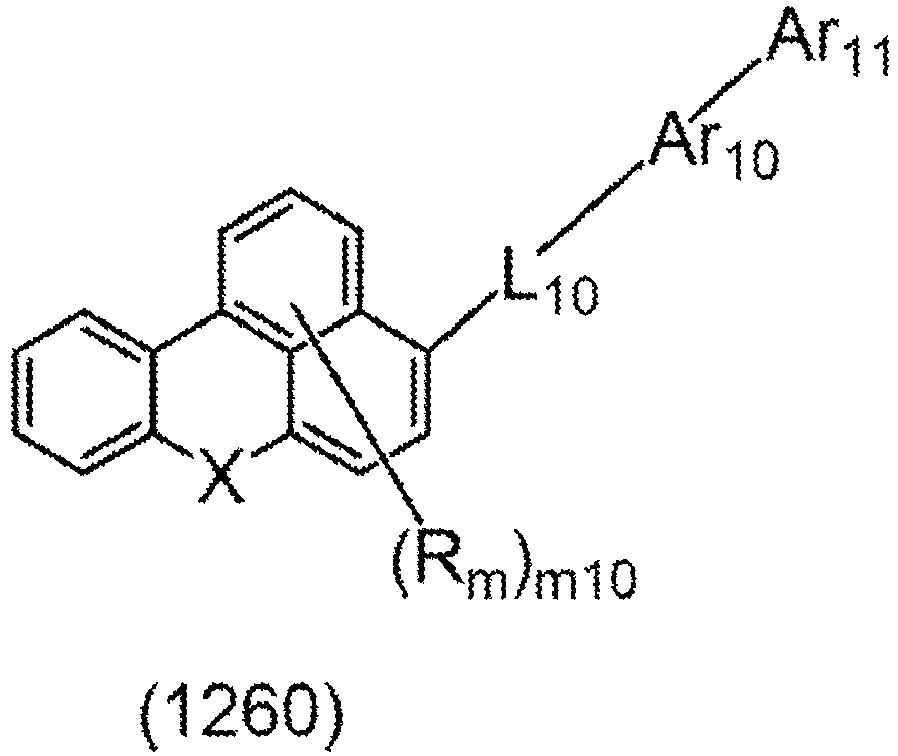
- In the formulae (1230), (1240), (1250), and (1260), X, L10, Ar10, Ar11, m10, m11, and Rm each independently represent the same as L10, Ar10, Ar11, m10, m11, and Rm in the formulae (123), (124), (125), and (126).
- In a compound represented by the formula (123), (124), (125), (126), (1230), (1240), (1250), or (1260), X is preferably an oxygen atom.
- In a compound represented by the formula (123), (124), (125), (126), (1230), (1240), (1250), or (1260), L10 is preferably an arylene group including at most three substituted or unsubstituted benzene rings.
- In a compound represented by the formula (123), (124), (125), (126), (1230), (1240), (1250), or (1260), a group represented by -L10- is preferably a group represented by one of the formulae (111) to (120).
- In a compound represented by the formula (123), (124), (125), (126), (1230), (1240), (1250), or (1260), a group represented by -L10- is preferably a group represented by the formula (111) or (112).
- The compound according to the exemplary embodiment is also preferably a compound having at least one group represented by a formula (110A) below and a single benz[de]anthracene derivative skeleton represented by a formula (1000A) below in a molecule.

- In the formula (1000A):
- X is an oxygen atom, a sulfur atom, C(R2001)(R2002), or Si(R2003)(R2004);
- at least one combination of adjacent two or more of R10 to R19 are mutually bonded to form a substituted or unsubstituted monocyclic ring, mutually bonded to form a substituted or unsubstituted fused ring, or not mutually bonded;
- R10 to R19 forming neither the substituted or unsubstituted monocyclic ring nor the substituted or unsubstituted fused ring are each independently a hydrogen atom, a substituted or unsubstituted alkyl group having 1 to 50 carbon atoms, a substituted or unsubstituted haloalkyl group having 1 to 50 carbon atoms, a substituted or unsubstituted alkenyl group having 2 to 50 carbon atoms, a substituted or unsubstituted alkynyl group having 2 to 50 carbon atoms, a substituted or unsubstituted cycloalkyl group having 3 to 50 ring carbon atoms, a group represented by -Si(R901)(R902)(R903), a group represented by -O-(R904), a group represented by - S-(R905), a group represented by -N(R906)(R907), a substituted or unsubstituted aralkyl group having 7 to 50 carbon atoms, a group represented by -C(=O)R801, a group represented by -COOR802, a halogen atom, a nitro group, a substituted or unsubstituted aryl group having 6 to 50 ring carbon atoms, a substituted or unsubstituted heterocyclic group having 5 to 50 ring atoms, or a group represented by the formula (110A);
- at least one of R13 or R18 is a group represented by the formula (110A);
- when a plurality of groups represented by the formula (110A) are present, the plurality of groups represented by the formula (110A) are mutually the same or different;
- L100 is a single bond, a substituted or unsubstituted arylene group having 6 to 50 ring carbon atoms, or a substituted or unsubstituted divalent heterocyclic group having 5 to 50 ring atoms;
- mx is 1, 2, or 3;
- when two or more L100 are present, the two or more L100 are mutually the same or different;
- Ar1 is a substituted or unsubstituted aryl group including four or more rings;
- when two or more Ar1 are present, the two or more Ar1 are mutually the same or different; and
- * in the formula (110A) represents a bonding position.
- A compound represented by the formula (1000A) preferably includes at least one group represented by the formula (110A) and a single benzoxanthene ring represented by a formula (100A) below in a molecule.

- In the formula (100A): R10 to R19 each independently represent the same as R10 to R19 in the formula (1000A); none of combinations of adjacent two or more of R10 to R19 are mutually bonded; and Ar1, L1, and mx respectively represent the same as Ar1, L1, and mx in the formula (110A).
- In a compound represented by the formula (100A), at least one of R13 or R18 is a group having Ar1 that is a substituted or unsubstituted aryl group including four or more rings. Hole injectability of the compound according to the exemplary embodiment is improved by Ar1 being thus bonded to a benzoxanthene ring at a para position with respect to an oxygen atom (O) through a single bond, a substituted or unsubstituted arylene group having 6 to 50 ring carbon atoms, or a substituted or unsubstituted divalent heterocyclic group having 5 to 50 ring atoms. Therefore, the luminous efficiency of the organic EL device containing the compound according to the exemplary embodiment can be expected to be improved.
- A compound represented by the formula (100A) is also preferably represented by a formula (121A) or (122A) below.


- In the formulae (121A) and (122A): R10 to R19 each independently represent the same as R10 to R19 in the formula (100A); and Ar1, L100, and mx respectively represent the same as Ar1, L100, and mx in the formula (110A).
- In the formula (121A), R10 to R12 and R14 to R19 are each preferably not a group represented by the formula (110A).
- In the formula (122A), R10 to R17 and R19 are each preferably not a group represented by the formula (110A).
- In the compound represented by the formula (100A), R10 to R19 not being a group represented by the formula (110A) are preferably each independently a hydrogen atom, a substituted or unsubstituted alkyl group having 1 to 50 carbon atoms, a substituted or unsubstituted cycloalkyl group having 3 to 50 ring carbon atoms, or a substituted or unsubstituted aryl group having 6 to 50 ring carbon atoms.
- In a compound represented by the formula (100A), R10 to R19 not being a group represented by the formula (110A) are preferably each a hydrogen atom.
- In a compound represented by the formula (100A), L100 is preferably a single bond or an arylene group including at most three substituted or unsubstituted benzene rings.
- In a compound represented by the formula (100A), a group represented by - (L100)mx- is preferably a group represented by one of the formulae (111) to (120).
- In a compound represented by the formula (100A), a group represented by - (L100)mx- is preferably a group represented by the formula (111) or (112).
- In the compound according to the exemplary embodiment, Ar1 is preferably an aryl group in which at least four substituted or unsubstituted benzene rings are fused.
- In the compound according to the exemplary embodiment, Ar1 or Ar10 is preferably a substituted or unsubstituted aryl group in which four benzene rings are fused or a substituted or unsubstituted aryl group in which five benzene rings are fused.
- In the compound according to the exemplary embodiment, Ar1 or Ar10 is preferably a group represented by a formula (1100), (1200), (1300), (1400), (1500), (1600), (1700), or (1800).
- In the compound according to the exemplary embodiment, Ar1 or Ar10 is preferably a group represented by the formula (1100) or (1200).
- In the compound according to the exemplary embodiment, it is preferable that all of the "substituted or unsubstituted" groups are "unsubstituted" groups.
- In the compound according to the exemplary embodiment (e.g., a compound represented by the formula (1000B), a compound represented by the formula (1000), a compound represented by the formula (1000A)), in a case of "at least one of combinations of adjacent two or more of R10 to R19 are mutally bonded to form a ring (substituted or unsubstituted monocyclic ring or substituted or unsubstituted fused ring), examples of the combinations of adjacent two or more include a combination of R10 and R11, a combination of R11 and R12, a combination of R12 and R13, a combination of R13 and R14, a combination of R14 and R15, a combination of R16 and R17, a combination of R17 and R18, a combination of R18 and R19, and a combination of R19 and R10.
- In the compound according to the exemplary embodiment (e.g., a compound represented by the formula (1000B), a compound represented by the formula (1000), a compound represented by the formula (1000A)), it is preferable that a combination of R13 and R14, a combination of R16 and R17, or a combination of R19 and R10 are mutually bonded to form a substituted or unsubstituted benzene ring.
- In the compound according to the exemplary embodiment (e.g., a compound represented by the formula (1000B), a compound represented by the formula (1000), a compound represented by the formula (1000A)), R2001 to R2004 are each independently a hydrogen atom, a substituted or unsubstituted alkyl group having 1 to 50 carbon atoms, a substituted or unsubstituted alkenyl group having 2 to 50 carbon atoms, a substituted or unsubstituted alkynyl group having 2 to 50 carbon atoms, a substituted or unsubstituted cycloalkyl group having 3 to 50 ring carbon atoms, a group represented by -Si(R901)(R902)(R903), a group represented by -O-(R904), a group represented by -S-(R905), a group represented by -N(R906)(R907), a halogen atom, a cyano group, a nitro group, a substituted or unsubstituted aryl group having 6 to 50 ring carbon atoms, or a substituted or unsubstituted heterocyclic group having 5 to 50 ring atoms.
- In the compound according to the exemplary embodiment (e.g., a compound represented by the formula (1000B), a compound represented by the formula (1000), a compound represented by the formula (1000A)), R2001 to R2004 are preferably each independently a hydrogen atom, a substituted or unsubstituted alkyl group having 1 to 50 carbon atoms, a halogen atom, a cyano group, a nitro group, a substituted or unsubstituted aryl group having 6 to 50 ring carbon atoms, or a substituted or unsubstituted heterocyclic group having 5 to 50 ring atoms.
- In the compound according to the exemplary embodiment (e.g., a compound represented by the formula (1000B), a compound represented by the formula (1000), a compound represented by the formula (1000A)):
- R901, R902, R903, R904, R905, R906, R907, R801, and R802 are each independently a hydrogen atom, a substituted or unsubstituted alkyl group having 1 to 50 carbon atoms, a substituted or unsubstituted cycloalkyl group having 3 to 50 ring carbon atoms, a substituted or unsubstituted aryl group having 6 to 50 ring carbon atoms, or a substituted or unsubstituted heterocyclic group having 5 to 50 ring atoms;
- when a plurality of R901 are present, the plurality of R901 are mutually the same or different;
- when a plurality of R902 are present, the plurality of R902 are mutually the same or different;
- when a plurality of R903 are present, the plurality of R903 are mutually the same or different;
- when a plurality of R904 are present, the plurality of R904 are mutually the same or different;
- when a plurality of R905 are present, the plurality of R905 are mutually the same or different;
- when a plurality of R906 are present, the plurality of R906 are mutually the same or different;
- when a plurality of R907 are present, the plurality of R907 are mutually the same or different;
- when a plurality of R801 are present, the plurality of R801 are mutually the same or different; and
- when a plurality of R802 are present, the plurality of R802 are mutually the same or different.
- A hydrogen atom in the compound according to the exemplary embodiment is a protium atom, a deuterium atom, or a tritium atom. In an exemplary embodiment, a hydrogen atom in the compound according to the exemplary embodiment is a protium atom. In an exemplary embodiment, a hydrogen atom in the compound according to the exemplary embodiment is a deuterium atom.
- The compound according to the exemplary embodiment can be manufactured by application of known substitution reactions and materials depending on a target compound, in accordance with or based on synthesis methods described later in Examples.
- Examples of the compound according to the exemplary embodiment include the following compounds. However, the invention is not limited to these specific examples. In the chemical formulae herein, a deuterium atom is denoted by D and a protium atom is denoted by H or a description for a protium is omitted.


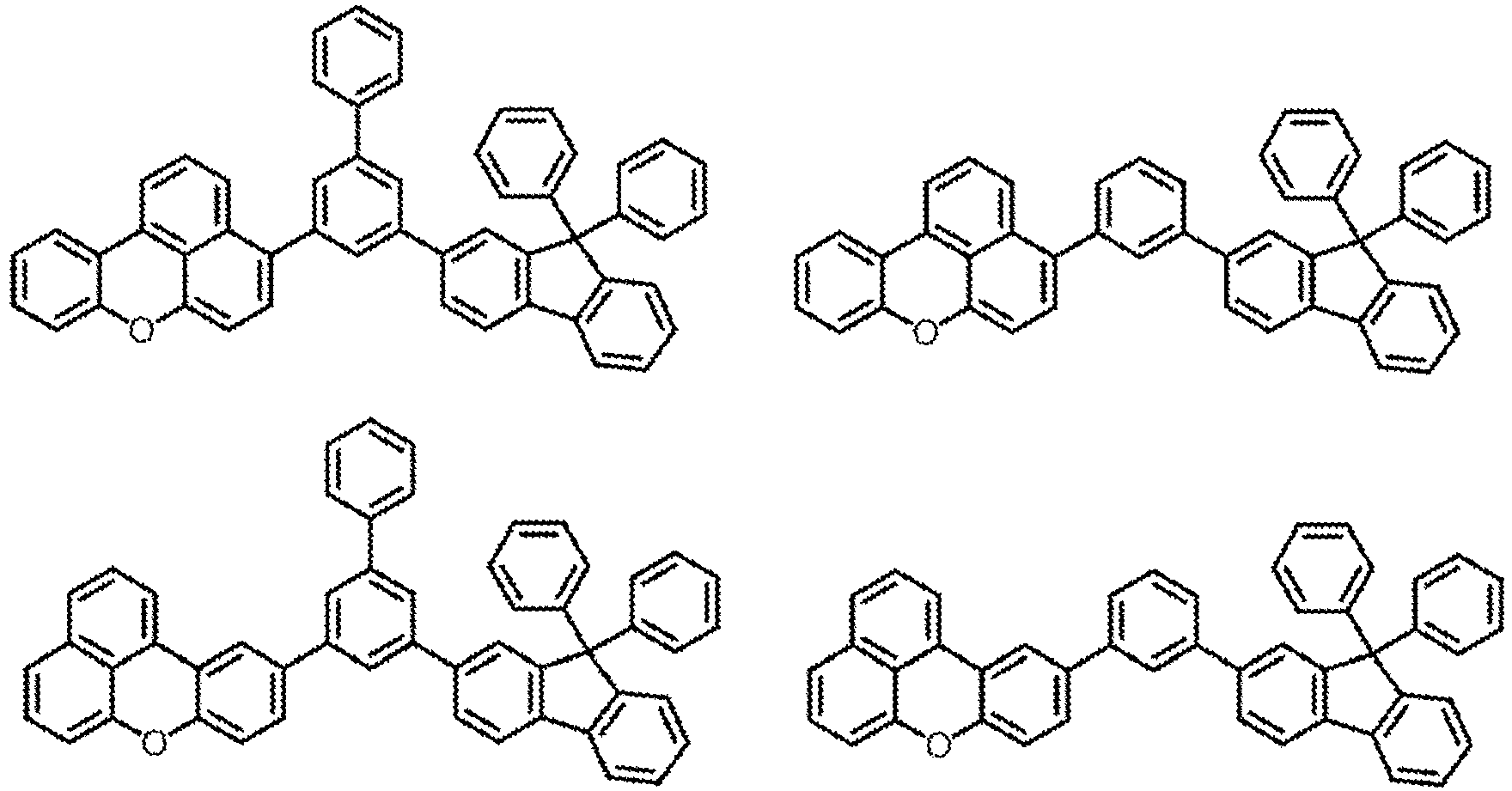


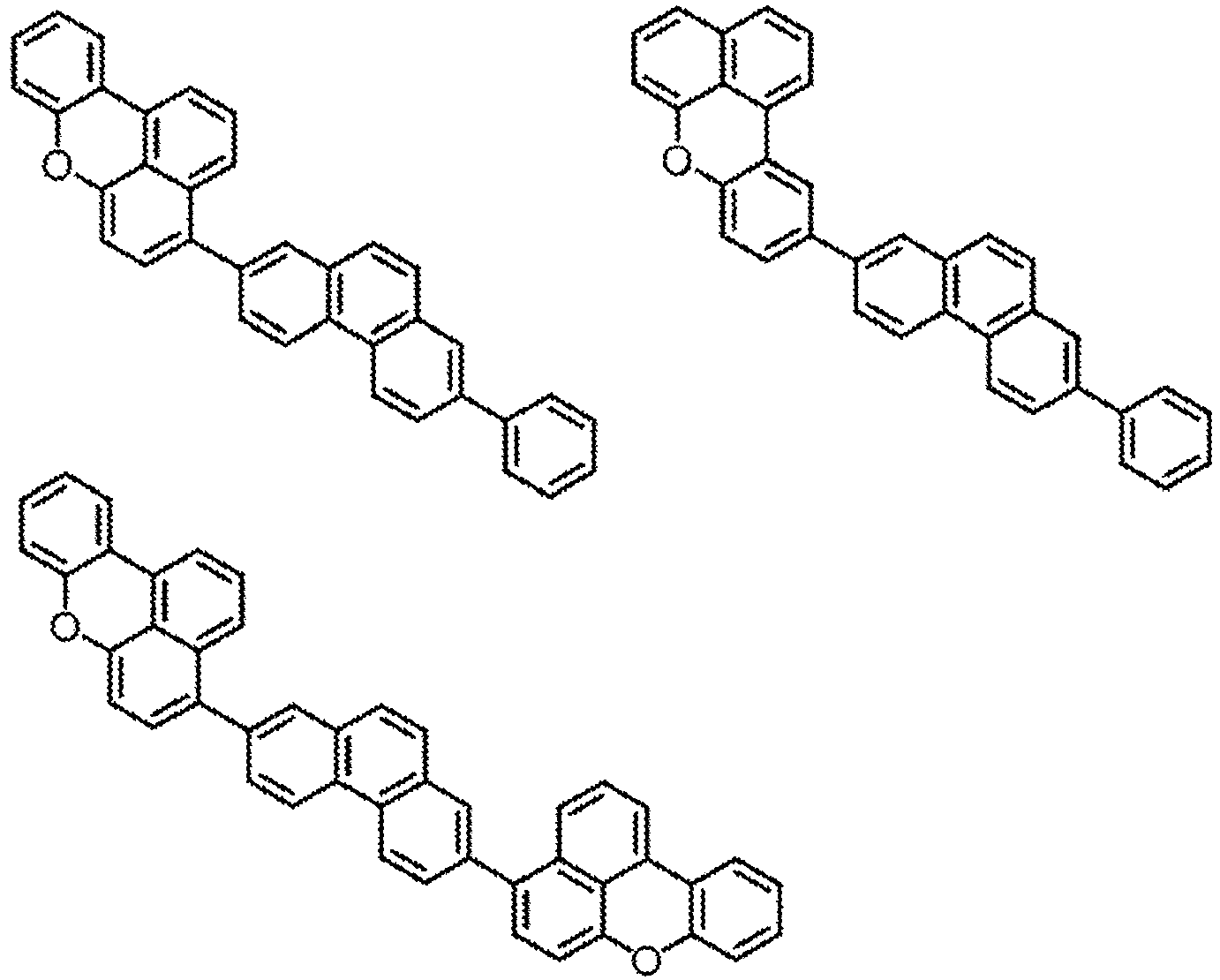


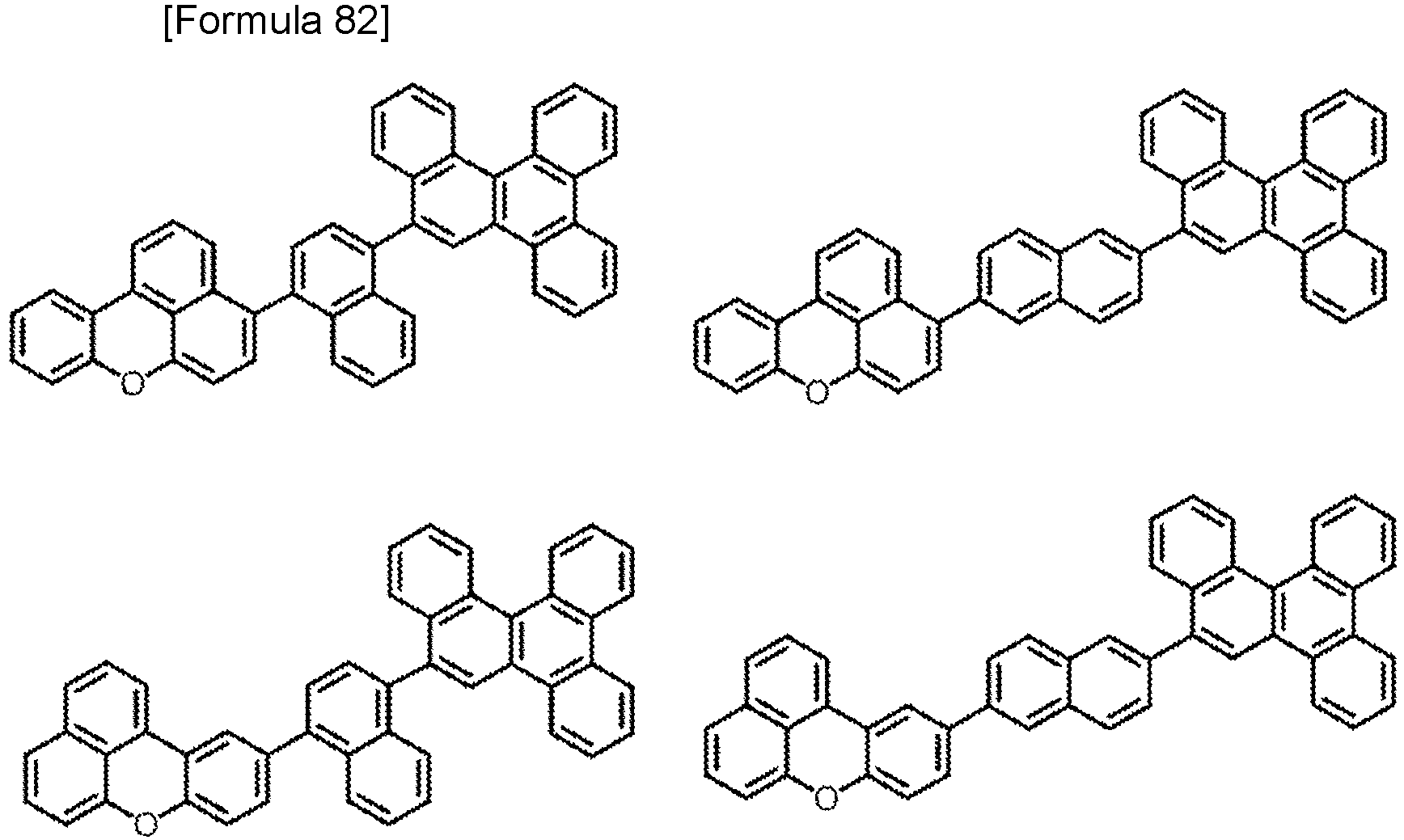


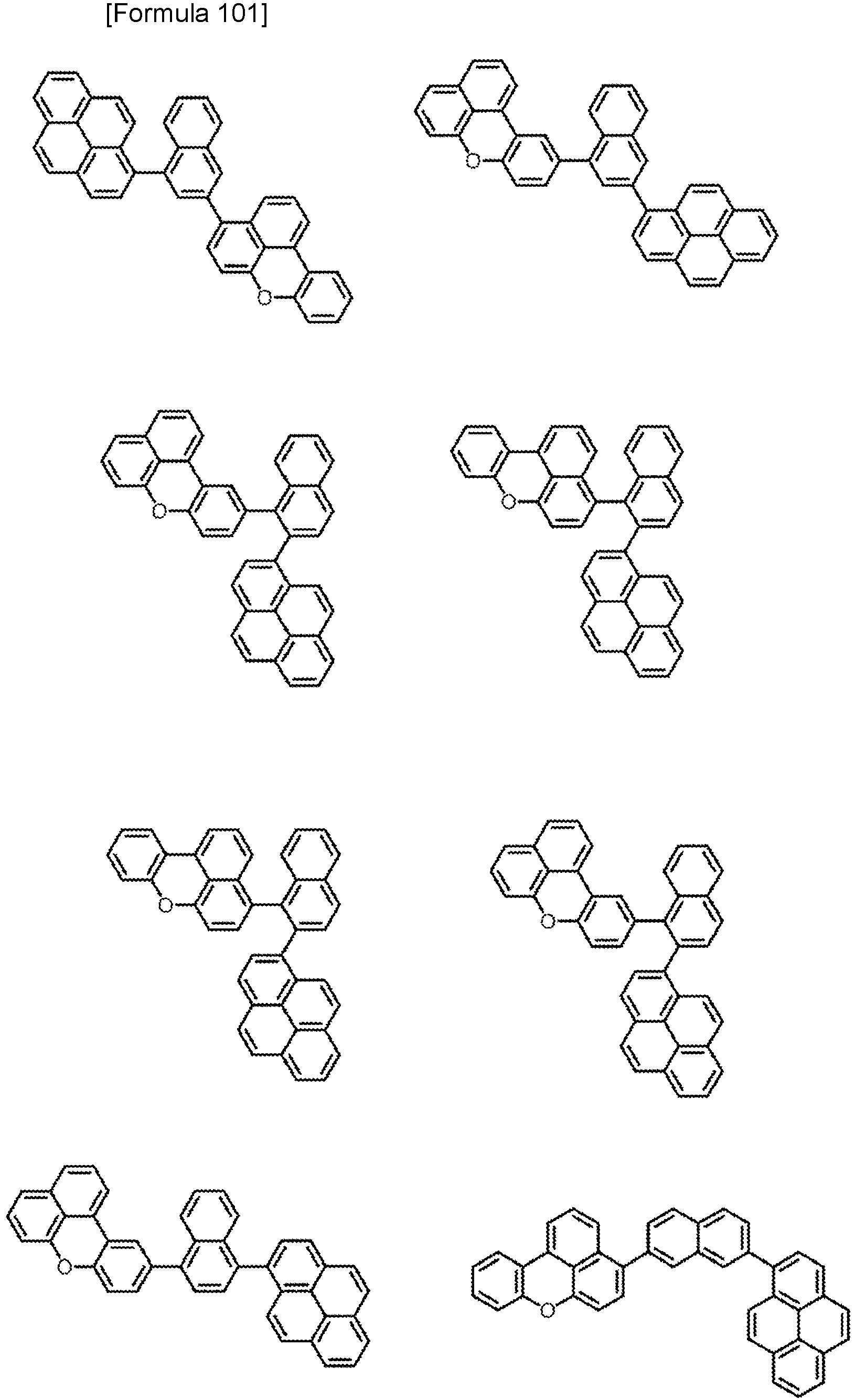





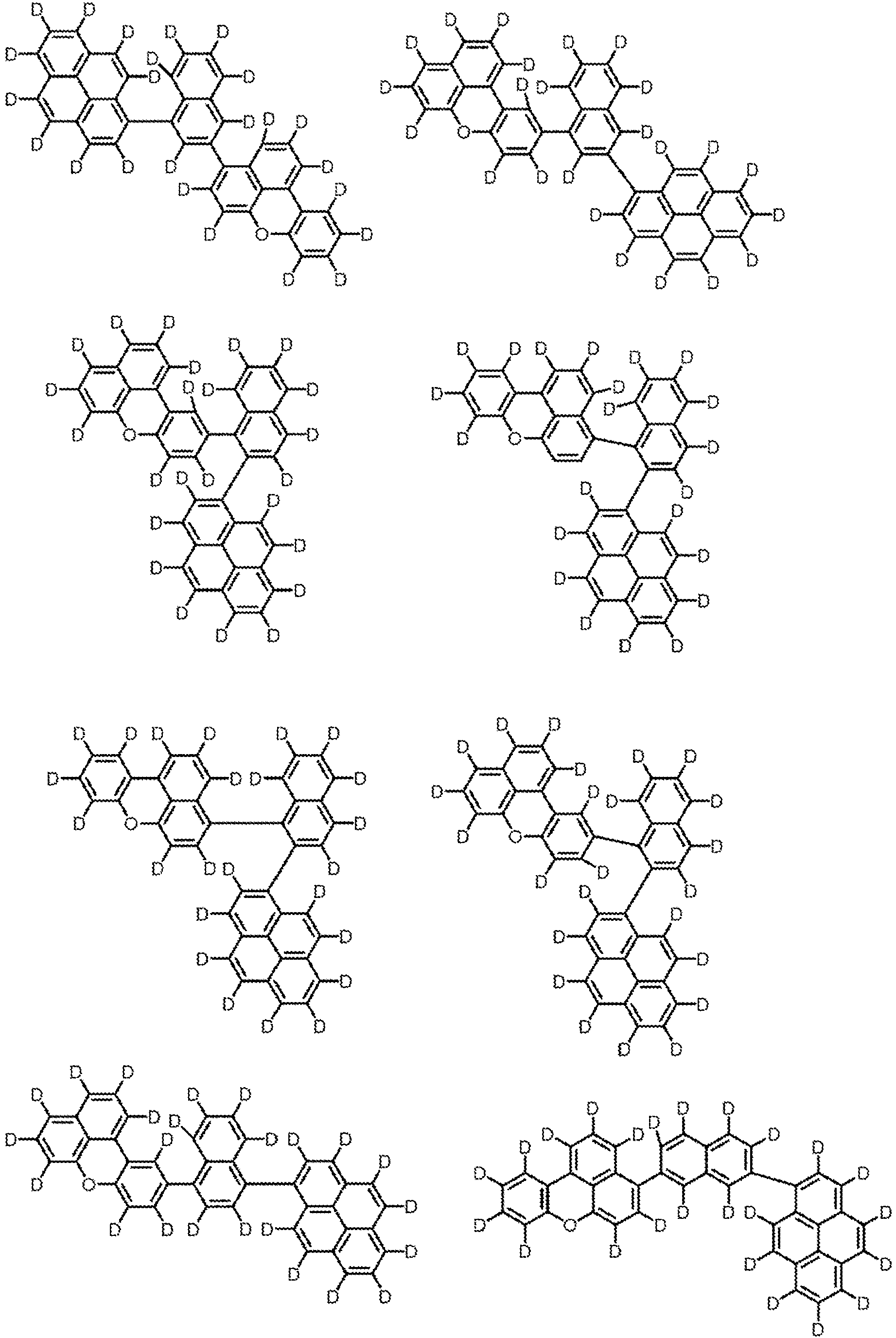


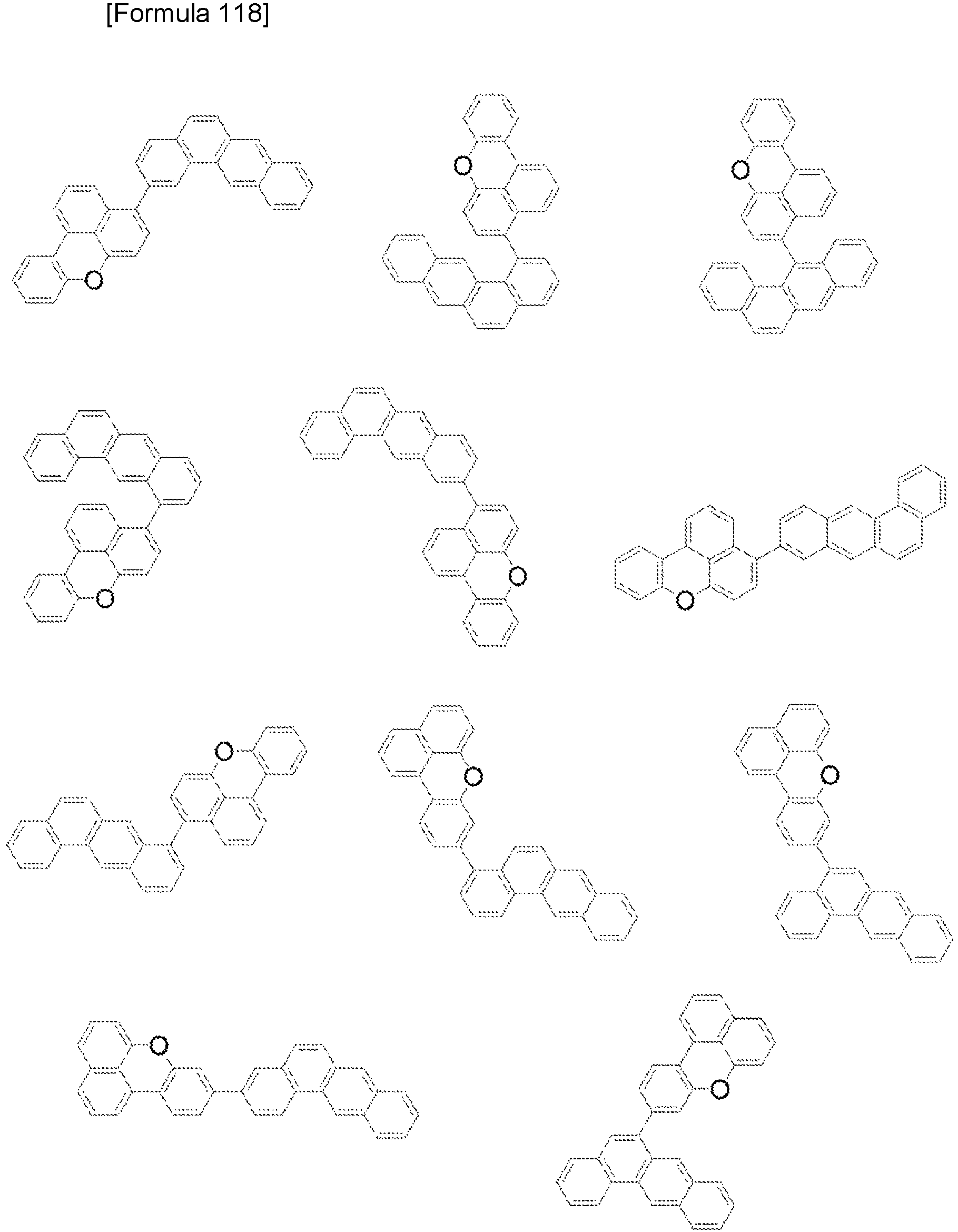






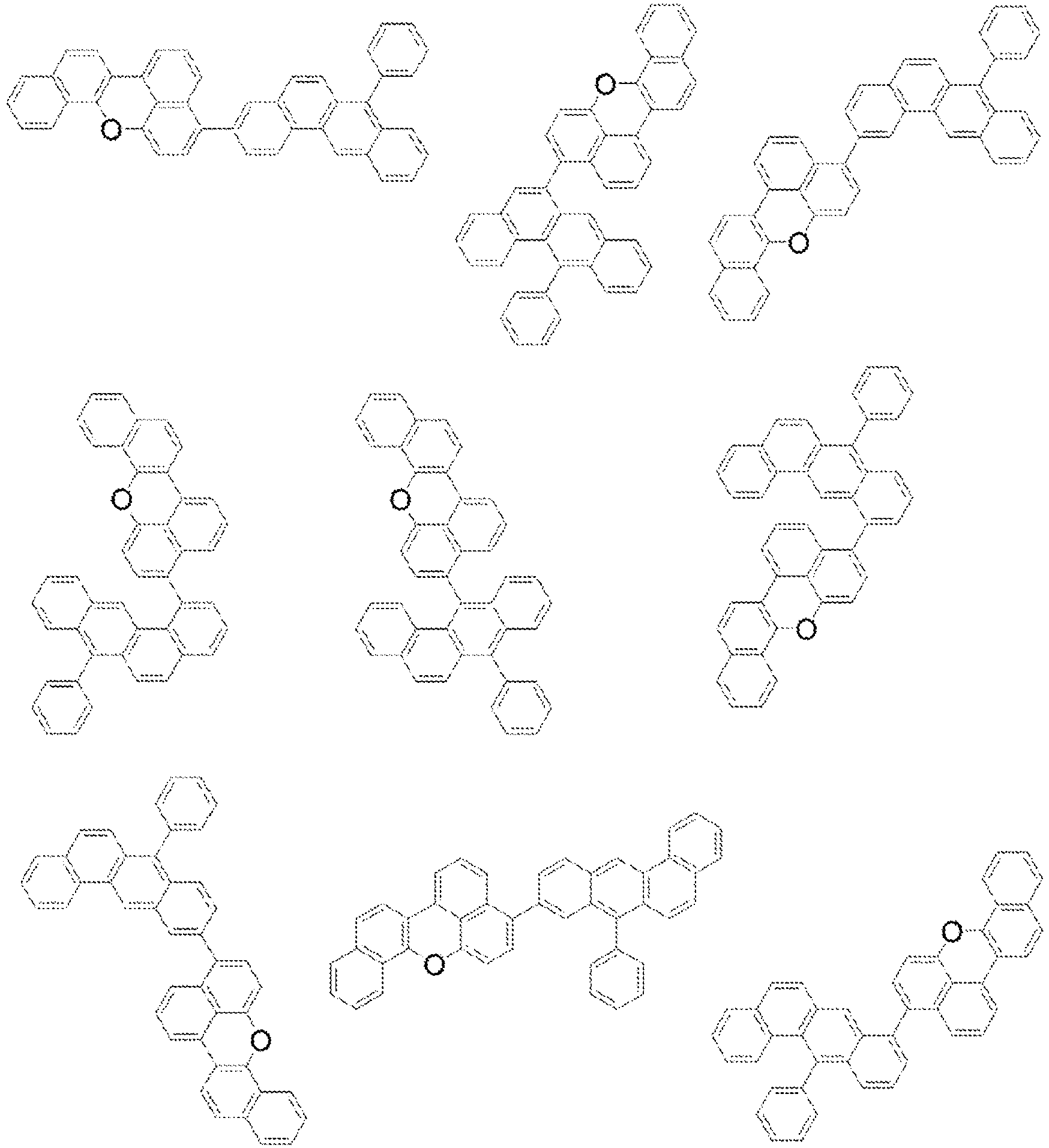


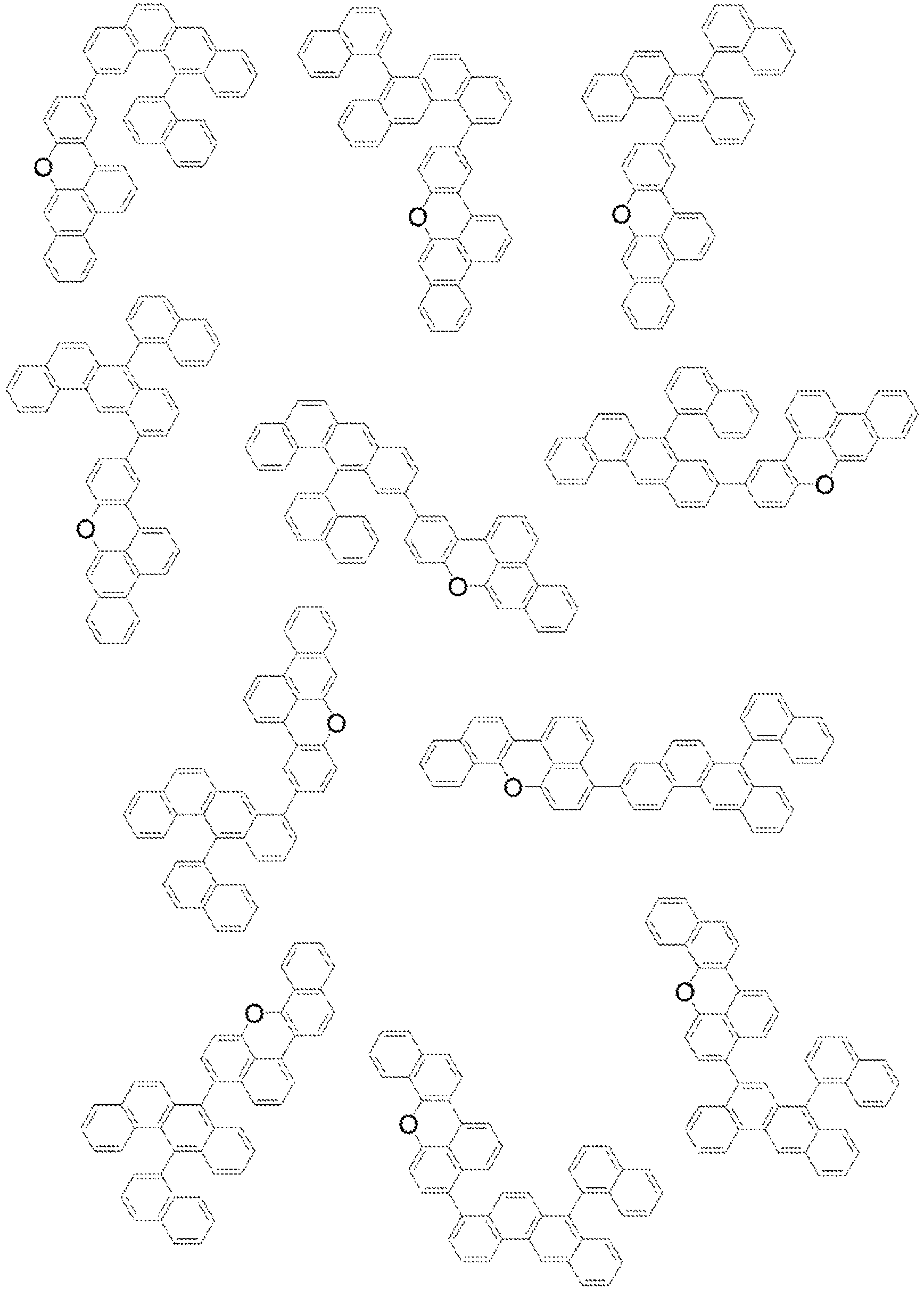


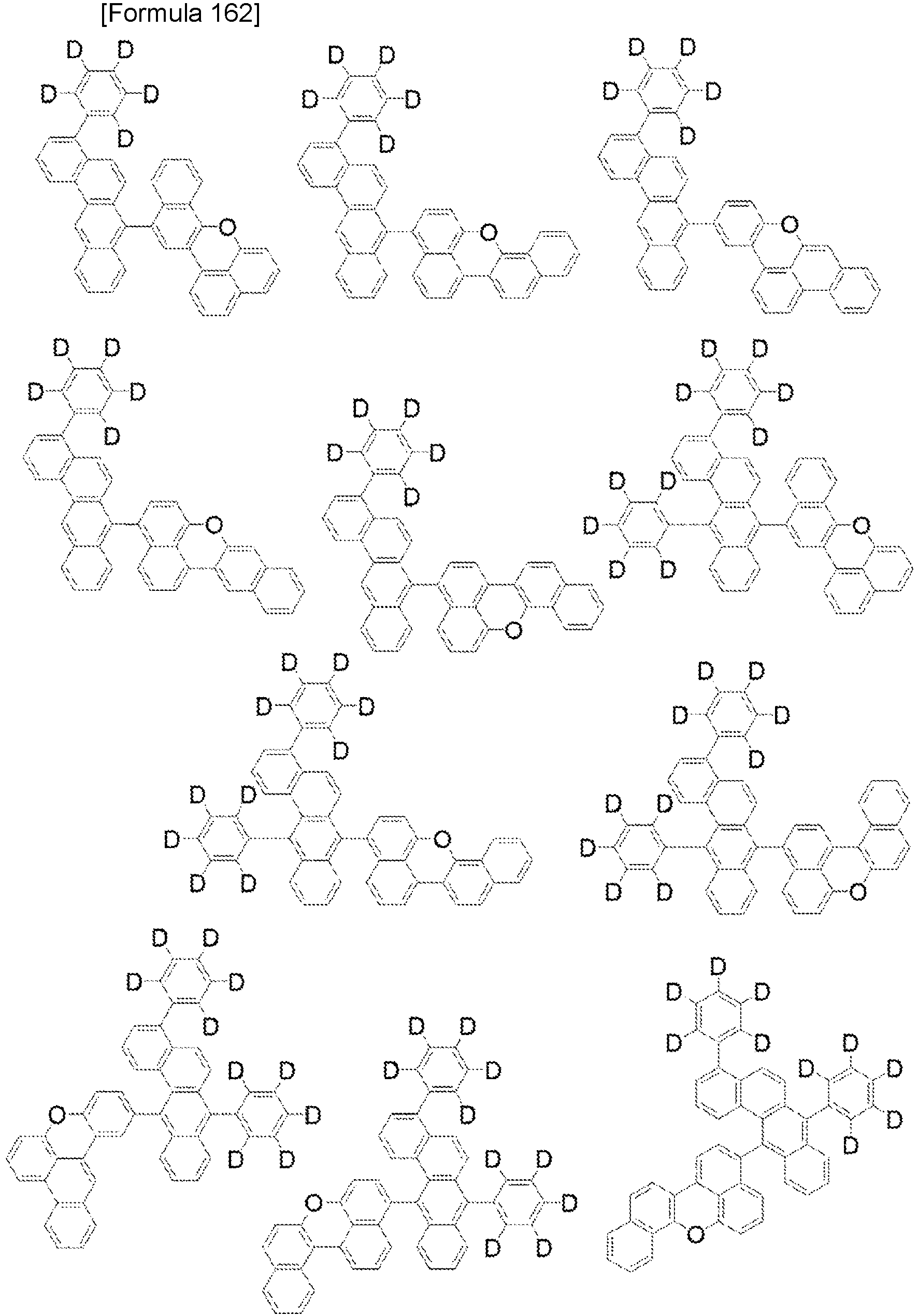


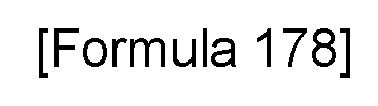


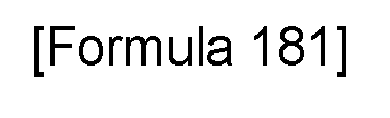


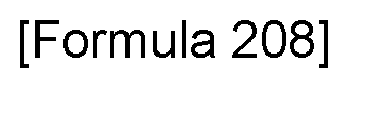


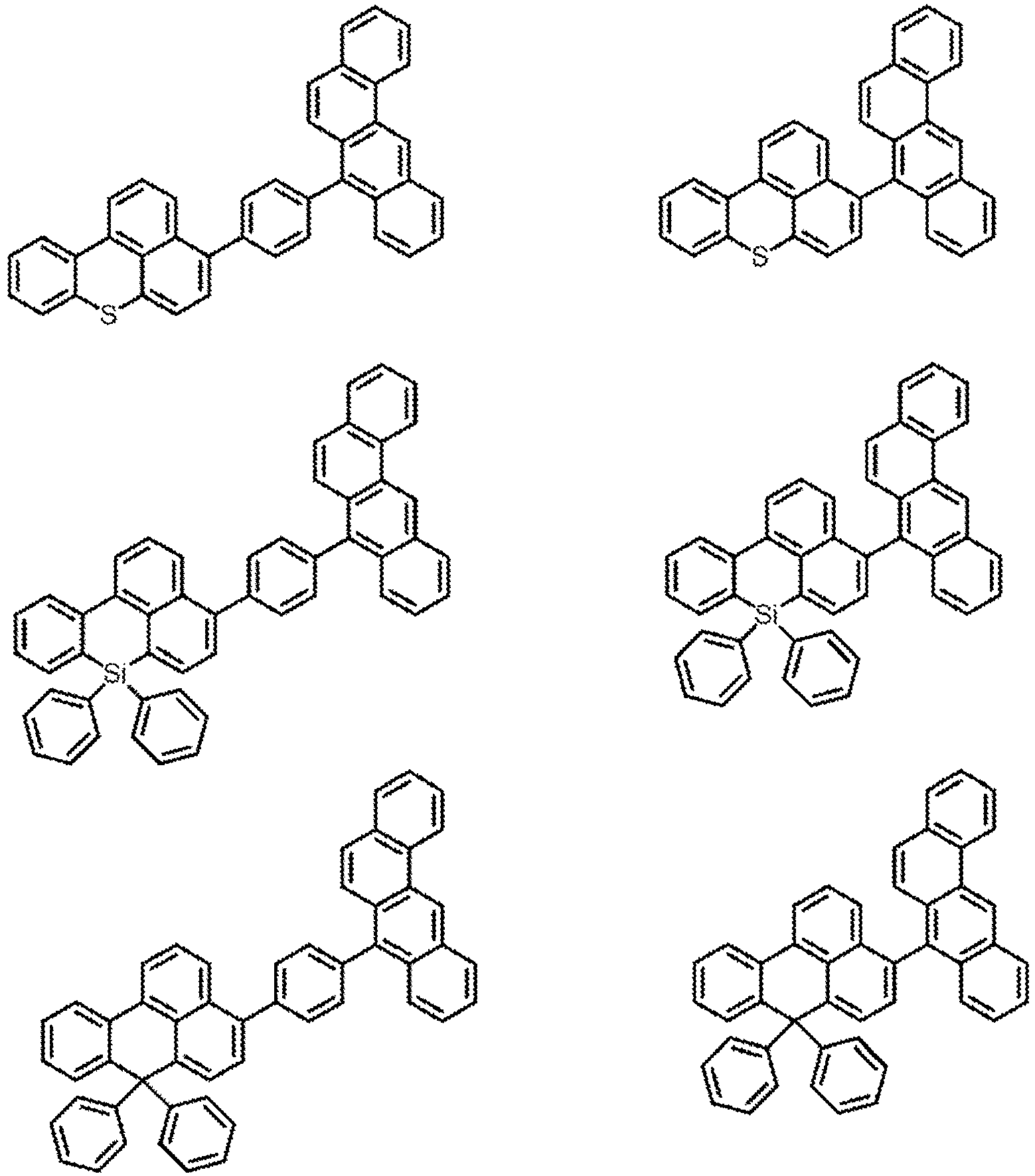



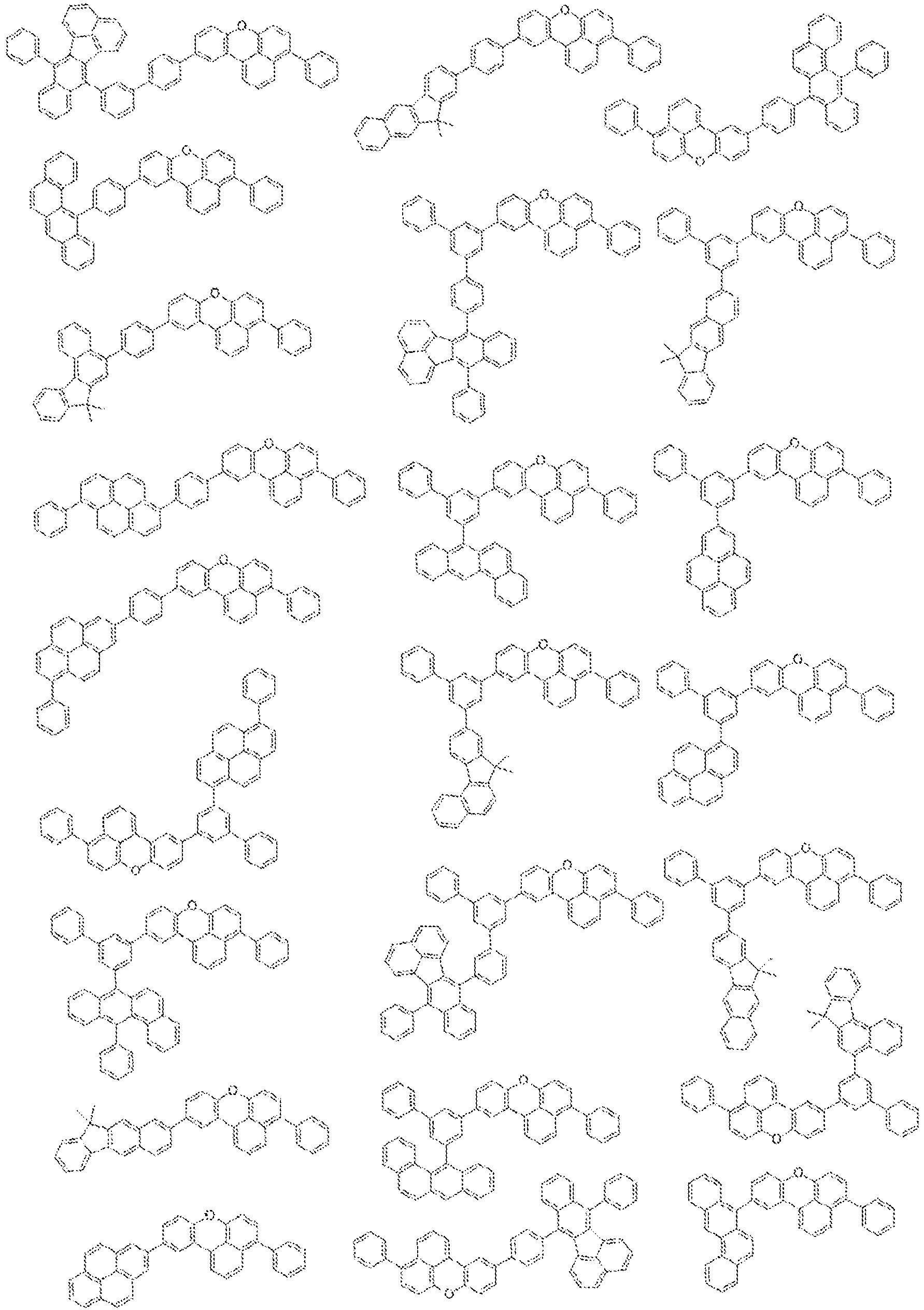




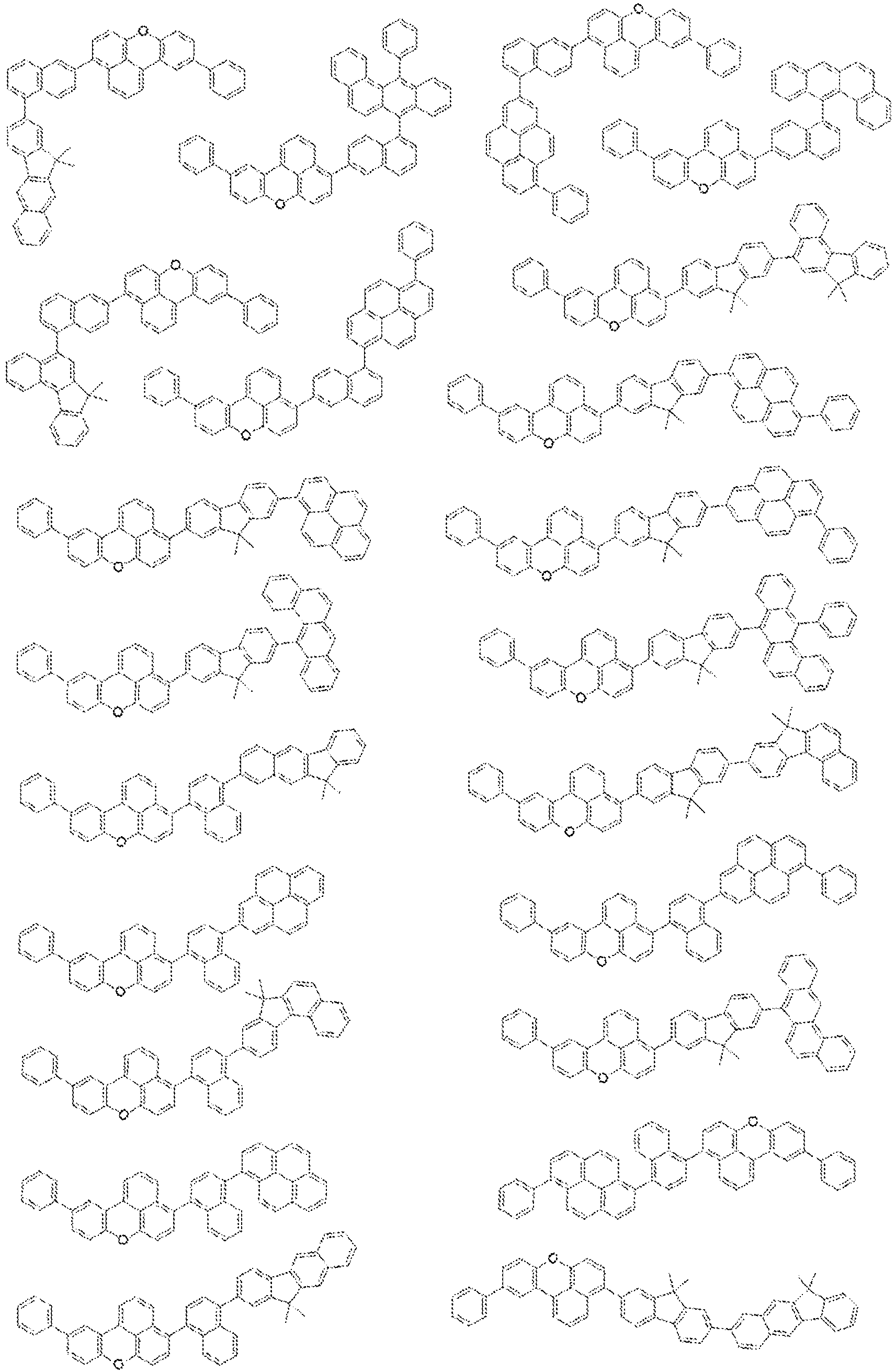





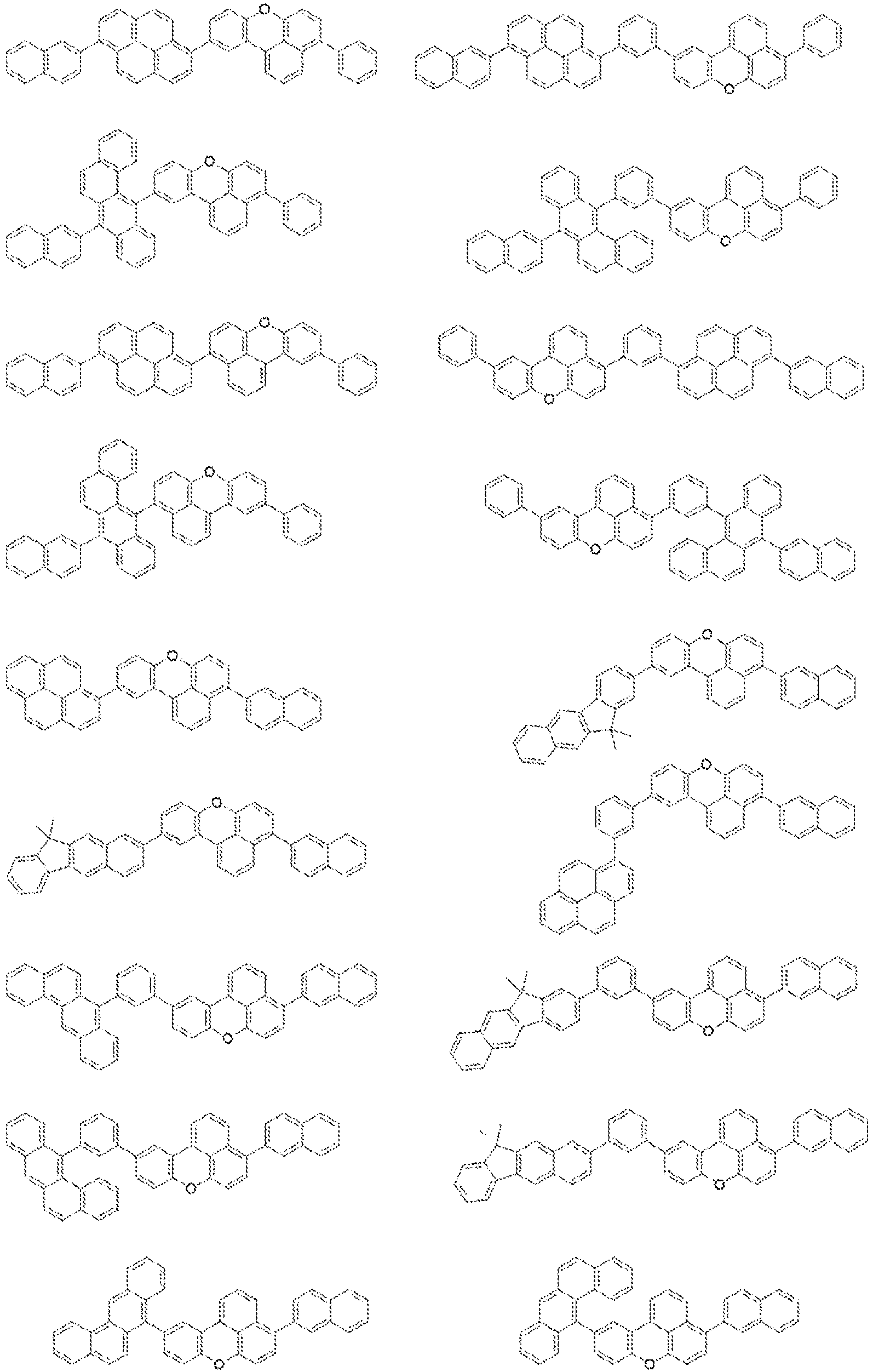


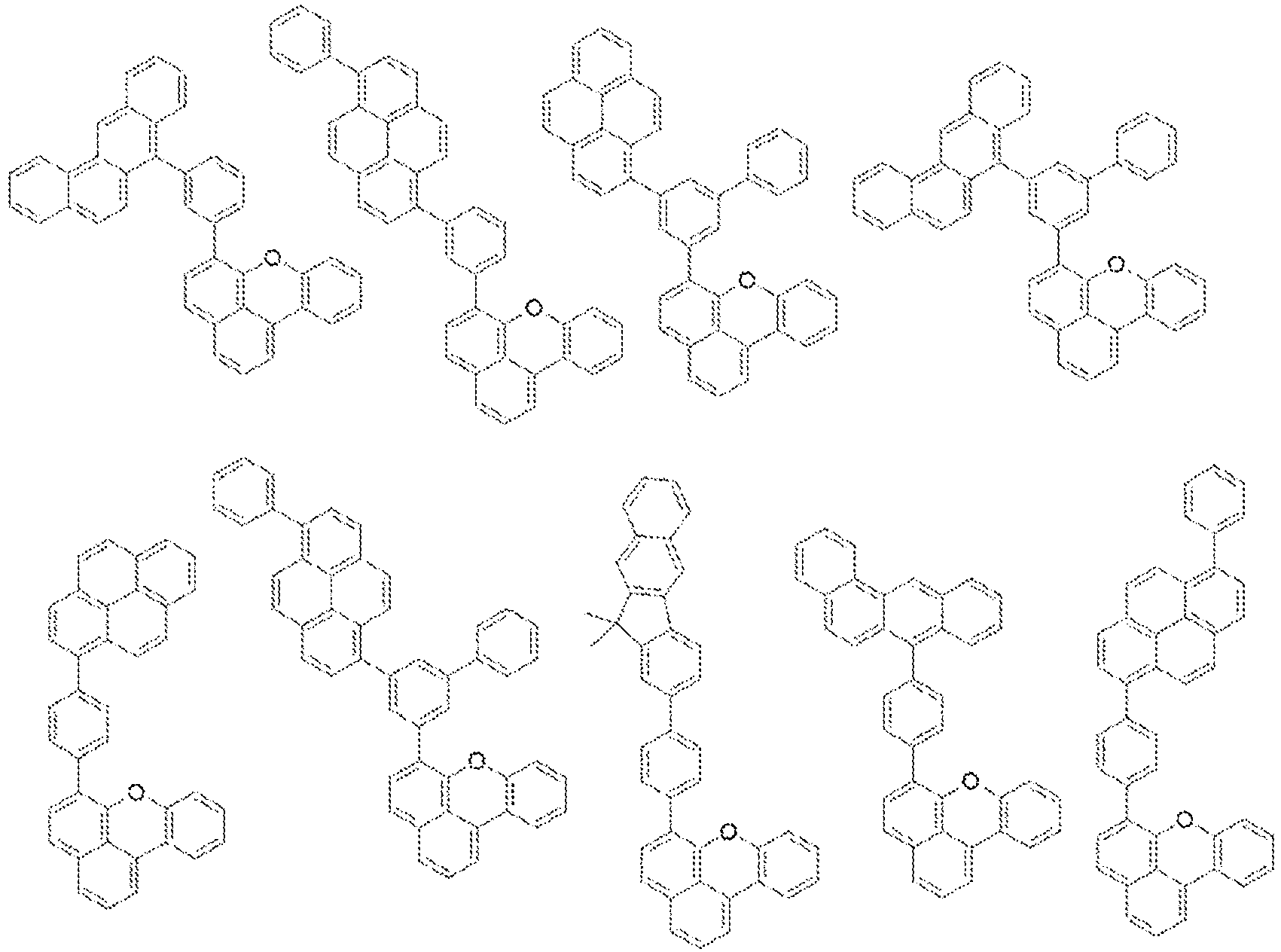




- The compound according to the exemplary embodiment can improve performance of an organic EL device. Moreover, when the compound according to the exemplary embodiment is used in an emitting layer (first emitting layer) close to an anode of an organic EL device in which a plurality of emitting layers are layered, the organic EL device in a favorable balance between a luminous efficiency and a lifetime can be expected to be provided.
- An organic-electroluminescence-device material according to a second exemplary embodiment contains the compound according to the first exemplary embodiment. As one example, the organic-electroluminescence-device material contains only the compound according to the first exemplary embodiment. As another example, the organic-electroluminescence-device material contains the compound according to the first exemplary embodiment and another compound(s) different from the compound according to the first exemplary embodiment.
- In the organic-electroluminescence-device material according to the second exemplary embodiment, the compound according to the first exemplary embodiment is preferably a host material. In this case, the organic-electroluminescence-device material may contain the compound according to the first exemplary embodiment as the host material and another compound(s) such as a dopant material.
- An organic EL device according to a third exemplary embodiment will be described.
- The organic EL device according to the third exemplary embodiment includes an anode, a cathode, and at least one organic layer disposed between the anode and the cathode. The organic layer includes at least one layer formed of an organic compound. Alternatively, the organic layer includes a plurality of layers formed of an organic compound(s). The organic layer may further contain an inorganic compound.
- In the organic EL device according to the third exemplary embodiment, at least one of the at least one organic layer contains the compound according to the first exemplary embodiment.
- In the organic EL device according to the third exemplary embodiment, at least one of the at least one organic layer is preferably an emitting layer. In the organic EL device according to the third exemplary embodiment, the emitting layer preferably contains the compound according to the first exemplary embodiment. In an exemplary embodiment, the emitting layer contains a compound represented by the formula (100). In an exemplary embodiment, the emitting layer contains a compound represented by the formula (1). In an exemplary embodiment, the emitting layer contains a compound represented by the formula (100A).
- In an exemplary embodiment, the emitting layer may contain a metal complex. In an exemplary embodiment, the emitting layer preferably does not contain a metal complex.
- In an exemplary embodiment, the emitting layer preferably does not contain a phosphorescent material (dopant material).
- In an exemplary embodiment, the emitting layer preferably does not contain a heavy metal complex and a phosphorescent rare-metal complex. Examples of the heavy metal complex include an iridium complex, osmium complex, and platinum complex.
- For instance, the organic layer may consist of a single emitting layer or may further include at least one layer usable in organic EL devices. Examples of the layer usable in the organic EL device, which are not particularly limited, include at least one layer selected from the group consisting of a hole injecting layer, hole transporting layer, electron injecting layer, electron transporting layer, and blocking layer.
- The organic EL device according to the exemplary embodiment preferably includes a hole transporting layer between the anode and the emitting layer.
- The organic EL device according to the exemplary embodiment preferably includes an electron transporting layer between the cathode and the emitting layer.
- In the organic EL device according to the exemplary embodiment, the organic layer may be provided by a plurality of emitting layers. For instance, the organic layer may be provided by two emitting layers, that is, a first emitting layer and a second emitting layer. The organic EL device according to the exemplary embodiment may include at least one organic layer in addition to the first and second emitting layers. For instance, the organic EL device according to the exemplary embodiment may further include at least one layer selected from the group consisting of a hole injecting layer, hole transporting layer, electron injecting layer, electron transporting layer, hole blocking layer, and electron blocking layer.
- In the organic EL device according to the exemplary embodiment, the organic layer also preferably has the first and second emitting layers.
- An exemplary arrangement is assumed in which the first emitting layer is disposed between the anode and the cathode and the second emitting layer is disposed between the first emitting layer and the cathode. Another exemplary arrangement is assumed in which the second emitting layer is disposed between the anode and the cathode and the first emitting layer is disposed between the second emitting layer and the cathode. In the organic EL device according to the exemplary embodiment, the first and second emitting layers can be disposed in any one of the above exemplary arrangements.
- In the organic EL device according to the exemplary embodiment, the first and second emitting layers may be in direct contact with each other or may not be in direct contact with each other.
- An organic EL device according to an exemplary embodiment includes: the anode, the cathode, the first emitting layer disposed between the anode and the cathode, and the second emitting layer disposed between the first emitting layer and the cathode, in which the first emitting layer contains a first compound, the first compound is a compound represented by the formula (100) and having at least one group represented by the formula (110), and the first and second emitting layers are in direct contact with each other.
- In a case where the organic layer has the emitting layer in the organic EL device according to the exemplary embodiment, the organic EL device preferably has the electron transporting layer between the cathode and the emitting layer. In a case where the emitting layer has the first emitting layer and the second emitting layer, the organic EL device may have the electron transporting layer between the cathode and the second emitting layer in an exemplary arrangement.
- In a case where the organic layer has the emitting layer, the organic EL device according to the exemplary embodiment preferably has the hole transporting layer between the anode and the emitting layer. In a case where the emitting layer has the first emitting layer and the second emitting layer, the organic EL device may have the hole transporting layer between the anode and the first emitting layer in another exemplary arrangement.
- In the organic EL device according to the exemplary embodiment, a non-doped region, which does not contain a third compound that fluoresces, may also be provided on a side of the first emitting layer close to the anode.
- The organic EL device according to the exemplary embodiment may have the first emitting layer, the second emitting layer, and the non-doped region disposed between the anode and the first emitting layer. The non-doped region may be, for instance, a non-doped organic layer provided on a side of the first emitting layer close to the anode and being in direct contact with the first emitting layer.
- The non-doped organic layer does not contain a metal atom. A content ratio of each of all materials forming the non-doped organic layer with respect to the non-doped organic layer is preferably 10 mass% or more, more preferably more than 10 mass%. The non-doped organic layer preferably contains the compound according to the first exemplary embodiment. The non-doped organic layer also preferably consists of the compound according to the first exemplary embodiment.
- The non-doped organic layer is, for instance, a second hole transporting layer or an electron blocking layer.
-
Fig. 1 schematically shows an exemplary arrangement of the organic EL device of the exemplary embodiment. - An organic EL device 1 includes a light-
transmissive substrate 2, an anode 3, a cathode 4, and anorganic layer 10 provided between the anode 3 and the cathode 4. Theorganic layer 10 includes ahole injecting layer 6, ahole transporting layer 7, a first emittinglayer 51, a second emittinglayer 52, anelectron transporting layer 8, and an electron injecting layer 9, which are sequentially layered on the anode 3. - In the organic EL device according to the exemplary embodiment, the first emitting layer preferably contains the first compound. The first compound is preferably a first host material.
- In the organic EL device according to the exemplary embodiment, it is also preferable that the first emitting layer further contains a third compound that emits fluorescence. The first emitting layer also preferably contains the first compound as the fist host material and the third compound as a first dopant material.
- Herein, the "host material" refers to, for instance, a material that accounts for "50 mass% or more of the layer." Accordingly, for instance, the first emitting layer contains 50 mass% or more of the first compound with respect to a total mass of the first emitting layer. Moreover, for instance, the "host material" may account for 60 mass% or more of the layer, 70 mass% or more of the layer, 80 mass% or more of the layer, 90 mass% or more of the layer, or 95 mass% or more of the layer.
- In the organic EL device according to the exemplary embodiment, the first compound is the compound according to the first exemplary embodiment.
- In an organic EL device according to an exemplary embodiment, the first compound is a compound represented by the formula (1000B) and having at least one group represented by the formula (110).
- In an organic EL device according to an exemplary embodiment, the first compound is a compound having at least one group represented by the formula (11) and a single benz[de]anthracene derivative skeleton represented by the formula (1000) in a molecule.
- In an organic EL device according to an exemplary embodiment, the first compound is a compound having at least one group represented by the formula (110A) and having a single benz[de]anthracene derivative skeleton represented by the formula (1000A) in a molecule.
- In the organic EL device according to the exemplary embodiment, the second emitting layer preferably contains a second compound. The second compound is preferably a second host material.
- In the organic EL device according to the exemplary embodiment, it is also preferable that the second emitting layer further contains a fourth compound that emits fluorescence. The second emitting layer also preferably contains the second compound as the second host material and the fourth compound as a second dopant material.
- When the first emitting layer contains the third compound and the the second emitting layer contains the fourth compound, the third compound and the fourth compound are mutually the same or different.
- In the organic EL device according to the exemplary embodiment, the second compound is not particularly limited. In the organic EL device according to the exemplary embodiment, the second compound as the host material is exemplified by a heterocyclic compound and a fused aromatic compound. Examples of the fused aromatic compound include an anthracene derivative, a pyrene derivative, and a benzanthracene derivative.
- The second compound is also preferably, for instance, a compound represented by a formula (2).


- In the formula (2):
- R201 to R208 are each independently a hydrogen atom, a substituted or unsubstituted alkyl group having 1 to 50 carbon atoms, a substituted or unsubstituted haloalkyl group having 1 to 50 carbon atoms, a substituted or unsubstituted alkenyl group having 2 to 50 carbon atoms, a substituted or unsubstituted alkynyl group having 2 to 50 carbon atoms, a substituted or unsubstituted cycloalkyl group having 3 to 50 ring carbon atoms, a group represented by -Si(R901)(R902)(R903), a group represented by -O-(R904), a group represented by -S-(R905), a group represented by -N(R906)(R907), a substituted or unsubstituted aralkyl group having 7 to 50 carbon atoms, a group represented by -C(=O)R801, a group represented by -COOR802, a halogen atom, a nitro group, a substituted or unsubstituted aryl group having 6 to 50 ring carbon atoms, or a substituted or unsubstituted heterocyclic group having 5 to 50 ring atoms;
- L201 and L202 are each independently a single bond, a substituted or unsubstituted arylene group having 6 to 50 ring carbon atoms, or a substituted or unsubstituted divalent heterocyclic group having 5 to 50 ring atoms;
- Ar201 and Ar202 are each independently a substituted or unsubstituted aryl group having 6 to 50 ring carbon atoms, or a substituted or unsubstituted heterocyclic group having 5 to 50 ring atoms.
- In the second compound according to the exemplary embodiment, R901, R902, R903, R904, R905, R906, R907, R801, and R802 are each independently a hydrogen atom, a substituted or unsubstituted alkyl group having 1 to 50 carbon atoms, a substituted or unsubstituted cycloalkyl group having 3 to 50 ring carbon atoms, a substituted or unsubstituted aryl group having 6 to 50 ring carbon atoms, or a substituted or unsubstituted heterocyclic group having 5 to 50 ring atoms;
- when a plurality of R901 are present, the plurality of R901 are mutually the same or different;
- when a plurality of R902 are present, the plurality of R902 are mutually the same or different;
- when a plurality of R903 are present, the plurality of R903 are mutually the same or different;
- when a plurality of R904 are present, the plurality of R904 are mutually the same or different;
- when a plurality of R905 are present, the plurality of R905 are mutually the same or different;
- when a plurality of R906 are present, the plurality of R906 are mutually the same or different;
- when a plurality of R907 are present, the plurality of R907 are mutually the same or different;
- when a plurality of R801 are present, the plurality of R801 are mutually the same or different; and
- when a plurality of R802 are present, the plurality of R802 are mutually the same or different.
- In the organic EL device according to the exemplary embodiment, it is preferable that R201 to R208 are each independently a hydrogen atom, a substituted or unsubstituted alkyl group having 1 to 50 carbon atoms, a substituted or unsubstituted haloalkyl group having 1 to 50 carbon atoms, a substituted or unsubstituted alkenyl group having 2 to 50 carbon atoms, a substituted or unsubstituted alkynyl group having 2 to 50 carbon atoms, a substituted or unsubstituted cycloalkyl group having 3 to 50 ring carbon atoms, a group represented by -Si(R901)(R902)(R903), a group represented by -O-(R904), a group represented by - S-(R905), a group represented by -N(R906)(R907), a substituted or unsubstituted aralkyl group having 7 to 50 carbon atoms, a group represented by -C(=O)R801, a group represented by -COOR802, a halogen atom, or a nitro group;
- L201 and L202 are each independently a single bond, a substituted or unsubstituted arylene group having 6 to 50 ring carbon atoms, or a substituted or unsubstituted divalent heterocyclic group having 5 to 50 ring atoms;
- Ar201 and Ar202 are each independently a substituted or unsubstituted aryl group having 6 to 50 ring carbon atoms, or a substituted or unsubstituted heterocyclic group having 5 to 50 ring atoms.
- In the second compound, R201 to R208 also preferably each independently a hydrogen atom, a substituted or unsubstituted alkyl group having 1 to 50 carbon atoms, a substituted or unsubstituted cycloalkyl having 3 to 50 ring carbon atoms, or a group represented by -Si(R901)(R902)(R903).
- In the second compound, R201 to R208 are also preferably each a hydrogen atom.
- In the organic EL device according to the exemplary embodiment, it is preferable that L201 and L202 are each independently a single bond or a substituted or unsubstituted arylene group having 6 to 50 ring carbon atoms and Ar201 and Ar202 are each independently a substituted or unsubstituted aryl group having 6 to 50 ring carbon atoms.
- In the organic EL device according to the exemplary embodiment, Ar201 and Ar202 are preferably each independently phenyl group, a naphthyl group, phenanthryl group, a biphenyl group, a terphenyl group, a diphenylfluorenyl group, a dimethylfluorenyl group, a benzodiphenylfluorenyl group, a benzodimethylfluorenyl group, dibenzofuranyl group, a dibenzothienyl group, a benzoxanthenyl group, a naphthobenzofuranyl group, or a naphthobenzothienyl group.
- In the organic EL device according to the exemplary embodiment, the second compound represented by the formula (2) is preferably a compound represented by a formula (201), (202), (203), (204), (205), (206), (207), (208) or (209) below.


- In the formulae (201) to (209), L201 and Ar201 represent the same as L201 and Ar201 in the formula (2), and R201 to R208 each independently represent the same as R201 to R208 in the formula (2).
- The second compound represented by the formula (2) is also preferably a compound represented by a formula (221), (222), (223), (224), (225), (226), (227), (228) or (229) below.

- [Formula 292]
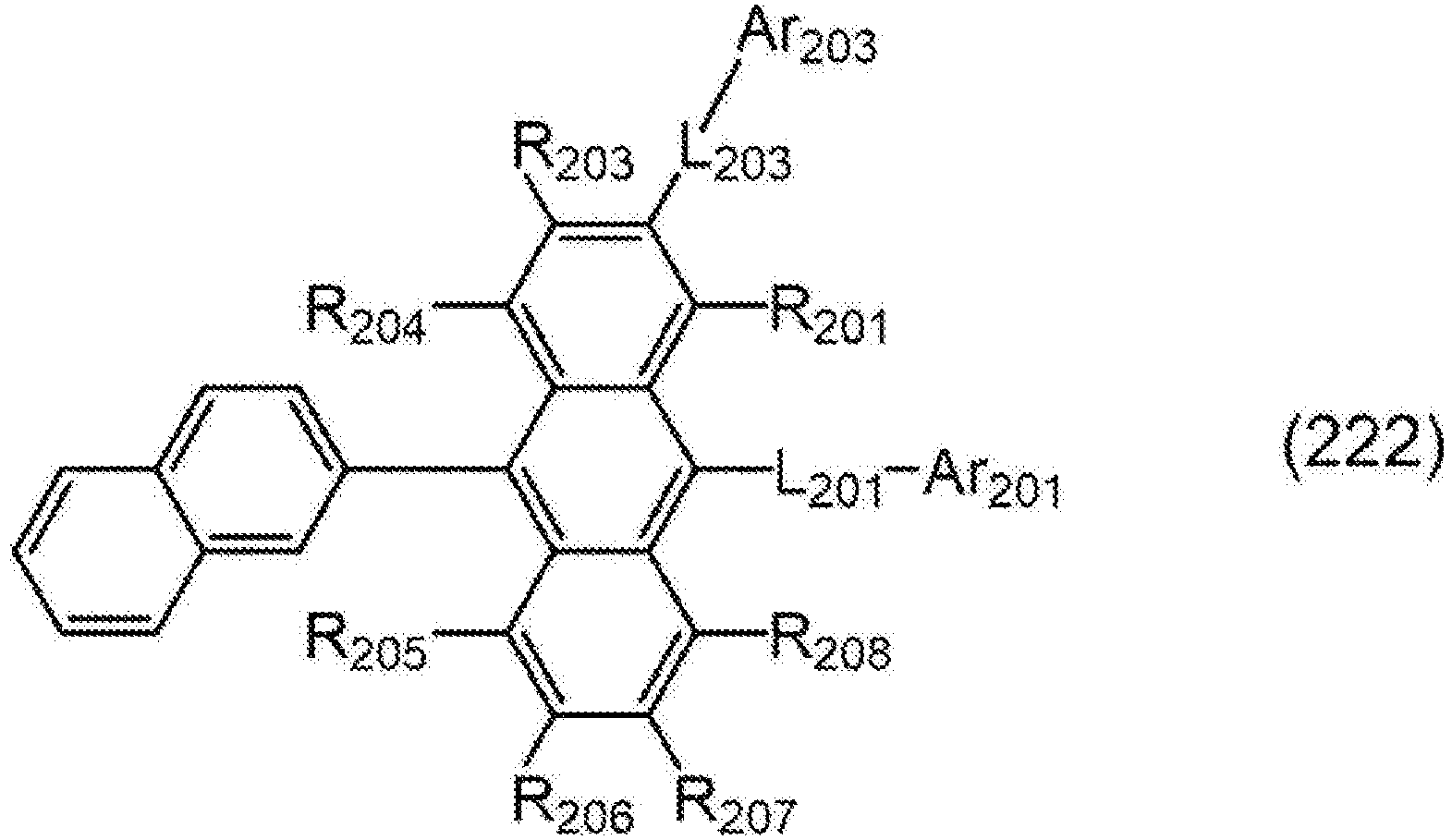


- In the formulae (221), (222), (223), (224), (225), (226), (227), (228) and (229):
- R201 and R203 to R208 each independently represent the same as R201 and R203 to R208 in the formula (2);
- L201 and Ar201 respectively represent the same as L201 and Ar201 in the formula (2);
- L203 represents the same as L201 in the formula (2);
- L203 and L201 are mutually the same or different;
- Ar203 represents the same as Ar201 in the formula (2); and
- Ar203 and Ar201 are mutually the same or different.
- The second compound represented by the formula (2) is also preferably a compound represented by a formula (241), (242), (243), (244), (245), (246), (247), (248) or (249) below.

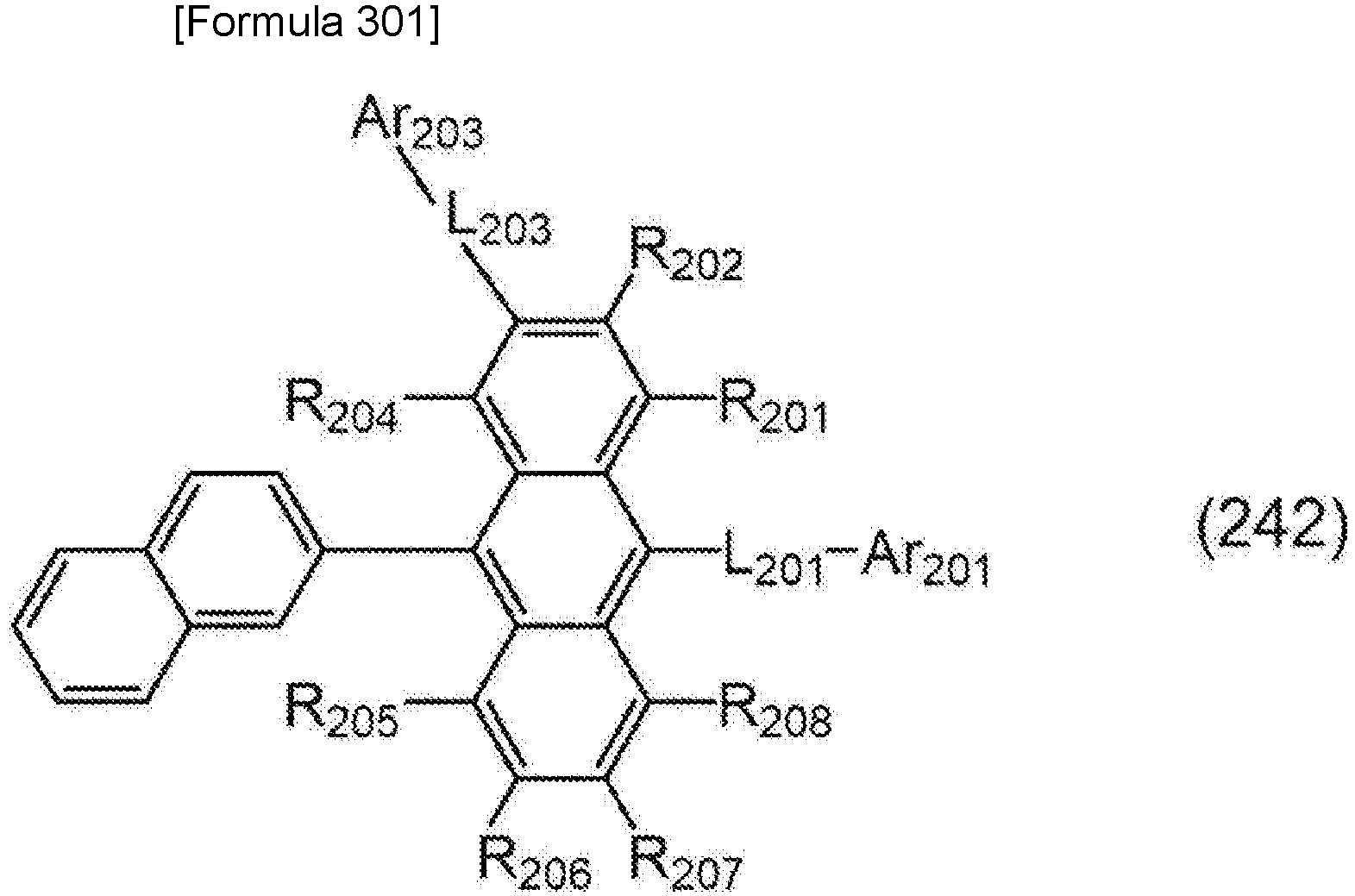


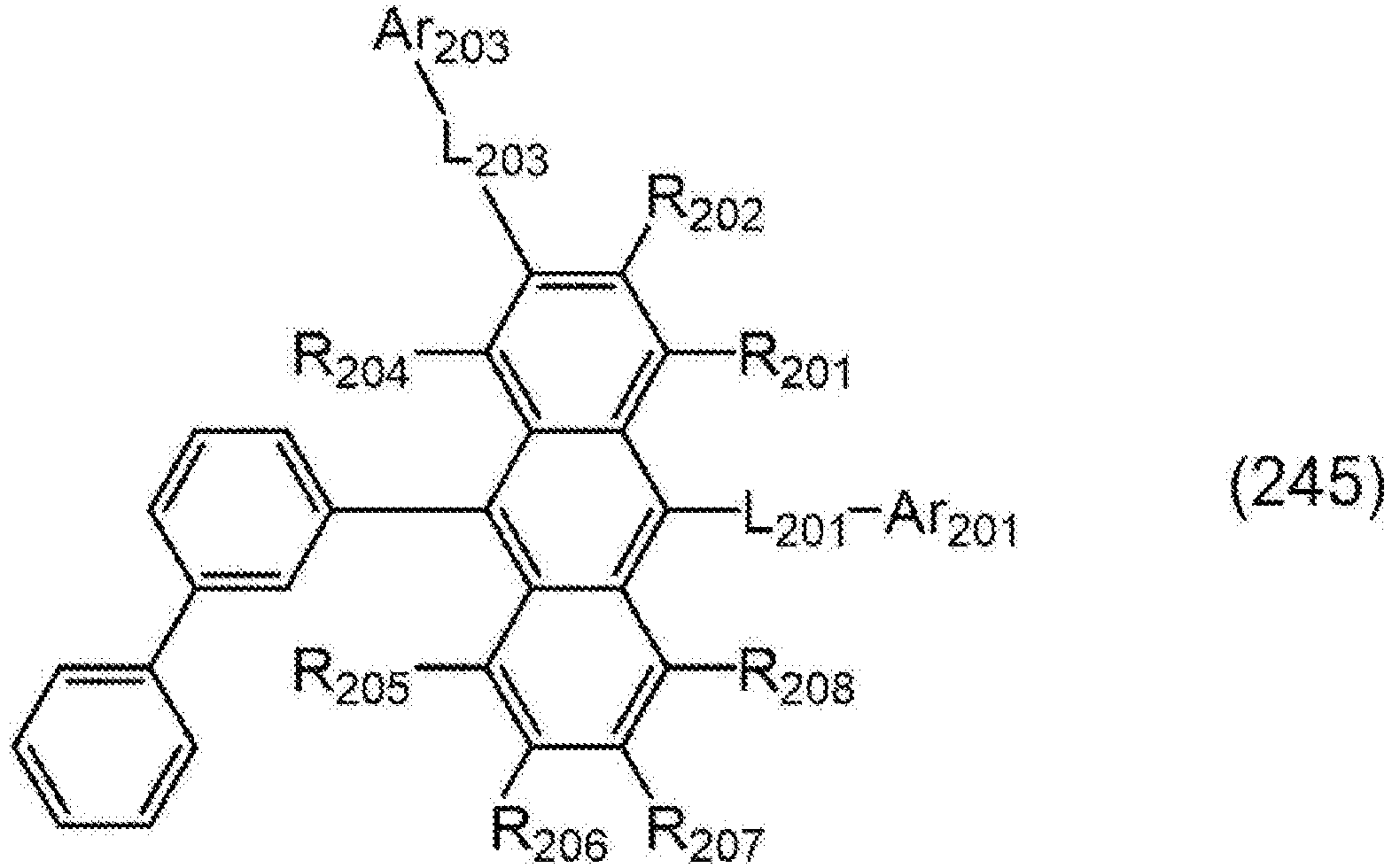


- In the formulae (241), (242), (243), (244), (245), (246), (247), (248) and (249):
- R201, R202 and R204 to R208 each independently represent the same as R201, R202 and R204 to R208 in the formula (2);
- L201 and Ar201 respectively represent the same as L201 and Ar201 in the formula (2);
- L203 represents the same as L201 in the formula (2);
- L203 and L201 are mutually the same or different;
- Ar203 represents the same as Ar201 in the formula (2); and
- Ar203 and Ar201 are mutually the same or different.
- R201 to R208 in the second compound represented by the formula (2) are preferably each independently a hydrogen atom, a substituted or unsubstituted alkyl group having 1 to 50 carbon atoms, a substituted or unsubstituted cycloalkyl group having 3 to 50 ring carbon atoms, or a group represented by -Si(R901)(R902)(R903).
- L101 is preferably a single bond, or an unsubstituted arylene group having 6 to 22 ring carbon atoms.
- Ar101 is preferably a substituted or unsubstituted aryl group having 6 to 22 ring carbon atoms.
- In the organic EL device according to the exemplary embodiment, R201 to R208 that are substituents on an anthracene skeleton in the second compound represented by the formula (2) are preferably hydrogen atoms in terms of preventing inhibition of intermolecular interaction to inhibit a decrease in electron mobility. However, R201 to R208 may be a substituted or unsubstituted aryl group having 6 to 50 ring carbon atoms or a substituted or unsubstituted heterocyclic group having 5 to 50 ring atoms.
- Assuming that R201 to R208 each are a bulky substituent such as an alkyl group and a cycloalkyl group, intermolecular interaction may be inhibited to decrease the electron mobility of the second compound relative to that of the first compound, so that a relationship of µH2 > µH1 shown by a numerical formula below (Numerical Formula 3) may not be satisfied. When the second compound is used in the second emitting layer, it can be expected that satisfying the relationship of µH2 > µH1 inhibits a decrease in a recombination ability between holes and electrons in the first emitting layer and a decrease in a luminous efficiency. It should be noted that substituents, namely, a haloalkyl group, alkenyl group, alkynyl group, group represented by - Si(R901)(R902)(R903), group represented by -O-(R904), group represented by -S-(R905), group represented by -N(R906)(R907), aralkyl group, group represented by -C(=O)R801, group represented by -COOR802, halogen atom, cyano group, and nitro group are likely to be bulky, and an alkyl group and cycloalkyl group are likely to be further bulky.
- In the second compound represented by the formula (2), R201 to R208 being the substituents on the anthracene skeleton are each preferably not a bulky substituent and preferably not an alkyl group and cycloalkyl group. More preferably, R201 to R208 are not an alkyl group, cycloalkyl group, haloalkyl group, alkenyl group, alkynyl group, group represented by -Si(R901)(R902)(R903), group represented by -O-(R904), group represented by -S-(R905), group represented by -N(R906)(R907), aralkyl group, group represented by C(=O)R801, group represented by -COOR802, halogen atom, cyano group, and nitro group.
- In the second compound represented by the formula (2) in the organic EL device according to the exemplary embodiment, R201 to R208 also preferably each independently a hydrogen atom, a substituted or unsubstituted alkyl group having 1 to 50 carbon atoms, a substituted or unsubstituted cycloalkyl having 3 to 50 ring carbon atoms, or a group represented by -Si(R901)(R902)(R903).
- In the second compound represented by the formula (2) in the organic EL device according to the exemplary embodiment, R201 to R208 are preferably each a hydrogen atom.
- In the second compound, it is also preferable that examples of a substituent for a "substituted or unsubstituted group" on R201 to R208 do not include the above-described substituent that is likely to be bulky, especially a substituted or unsubstituted alkyl group and a substituted or unsubstituted cycloalkyl group. Since the examples of the substituent for a "substituted or unsubstituted" group on R201 to R208 do not include a substituted or unsubstituted alkyl group and a substituted or unsubstituted cycloalkyl group, inhibition of intermolecular interaction to be caused by presence of a bulky substituent such as an alkyl group and a cycloalkyl group can be prevented, thereby preventing a decrease in the electron mobility. Moreover, when the second compound described above is used in the second emitting layer, a decrease in a recombination ability between holes and electrons in the first emitting layer and a decrease in the luminous efficiency can be inhibited.
- It is more preferable that R201 to R208 being the substituents on the anthracene skeleton are not bulky substituents, and R201 to R208 as substituents are unsubstituted. Assuming that R201 to R208 being the substituents on the anthracene skeleton are not bulky substituents and substituents are bonded to R201 to R208 which are the not-bulky substituents, the substituents bonded to R201 to R208 are preferably not the bulky substituents; the substituents bonded to R201 to R208 serving as substituents are preferably not an alkyl group and cycloalkyl group, more preferably not an alkyl group, cycloalkyl group, haloalkyl group, alkenyl group, alkynyl group, group represented by -Si(R901)(R902)(R903), group represented by -O-(R904), group represented by -S-(R905), group represented by -N(R906)(R907), aralkyl group, group represented by -C(=O)R801, group represented by -COOR802, halogen atom, cyano group, and nitro group.
- In the first compound and the second compound, it is also preferable that all of the "substituted or unsubstituted" groups are "unsubstituted" groups.
- In the organic EL device according to the exemplary embodiment, for instance, Ar201 in the second compound represented by the formula (2) is a substituted or unsubstituted dibenzofuranyl group.
- In the organic EL device according to the exemplary embodiment, for instance, Ar201 in the second compound represented by the formula (2) is an unsubstituted dibenzofuranyl group.
- In the organic EL device according to the exemplary embodiment, for instance, the second compound represented by the formula (2) has at least one hydrogen atom, the hydrogen atom including at least one deuterium atom.
- In the organic EL device according to the exemplary embodiment, for instance, L201 in the second compound represented by the formula (2) is one of TEMP-63 to TEMP-68.


- In the formulae (TEMP-63) to (TEMP-68), * represents a bonding position.
- In the second compound represented by the formula (2) in the organic EL device according to the exemplary embodiment, Ar201 is at least one group selected from the group consisting of a substituted or unsubstituted anthryl group, benzanthryl group, phenanthryl group, benzophenanthryl group, phenalenyl group, pyrenyl group, chrysenyl group, benzochrysenyl group, triphenylenyl group, benzotriphenylenyl group, tetracenyl group, pentacenyl group, fluoranthenyl group, benzofluoranthenyl group, and perylenyl group.
- In the organic EL device according to the exemplary embodiment, for instance, Ar201 in the second compound represented by the formula (2) is a substituted or unsubstituted fluorenyl group.
- In the organic EL device according to the exemplary embodiment, for instance, Ar201 in the second compound represented by the formula (2) is a substituted or unsubstituted xanthenyl group.
- In the organic EL device according to the exemplary embodiment, for instance, Ar201 in the second compound represented by the formula (2) is a benzoxanthenyl group.
- The second compound can be manufactured by a known method. The second compound can also be manufactured based on a known method through a known alternative reaction using a known material(s) tailored for the target compound.
- Examples of the second compound include compounds below. It should however be noted that the invention is not limited to the specific examples of the second compound.


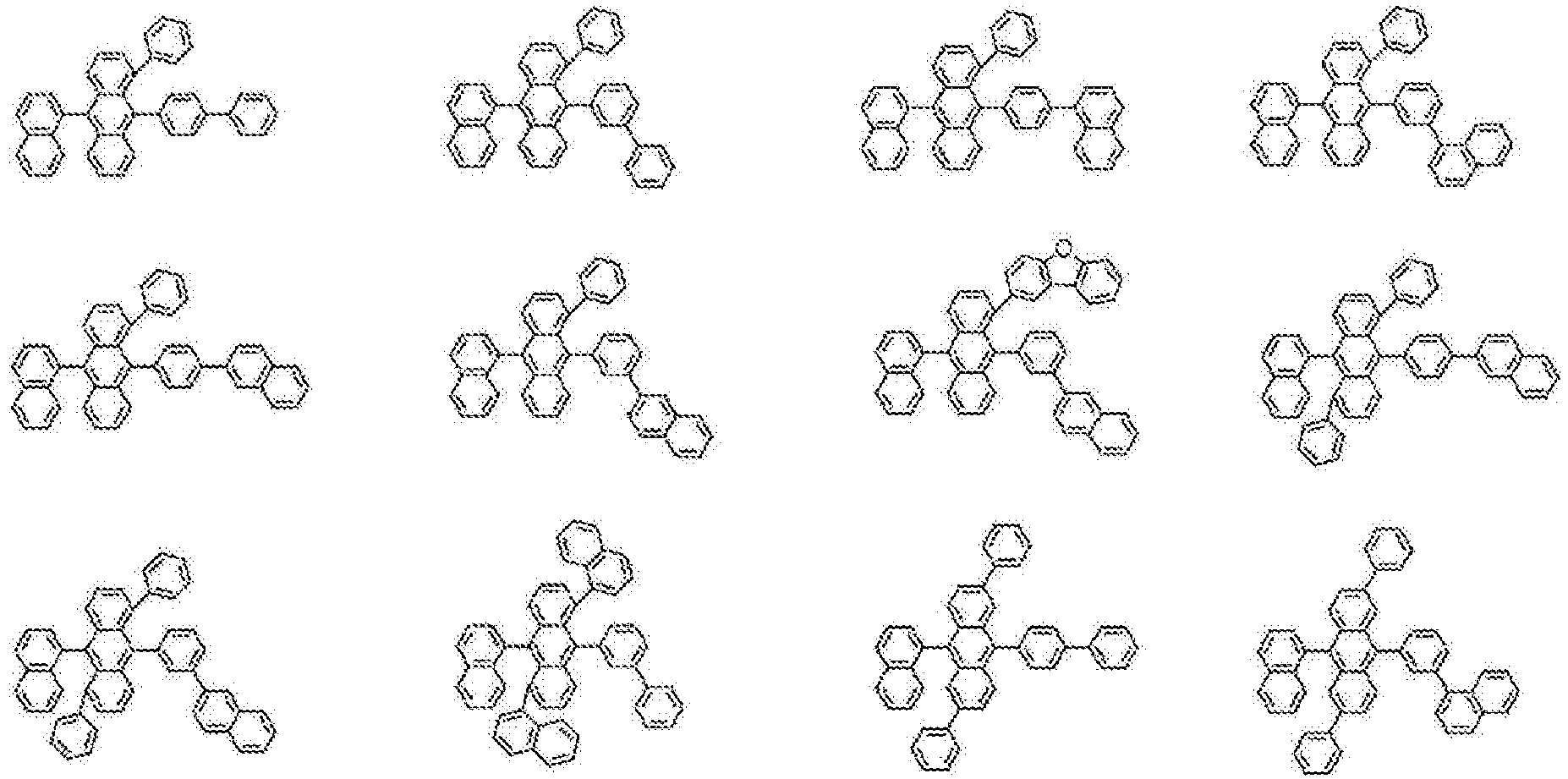


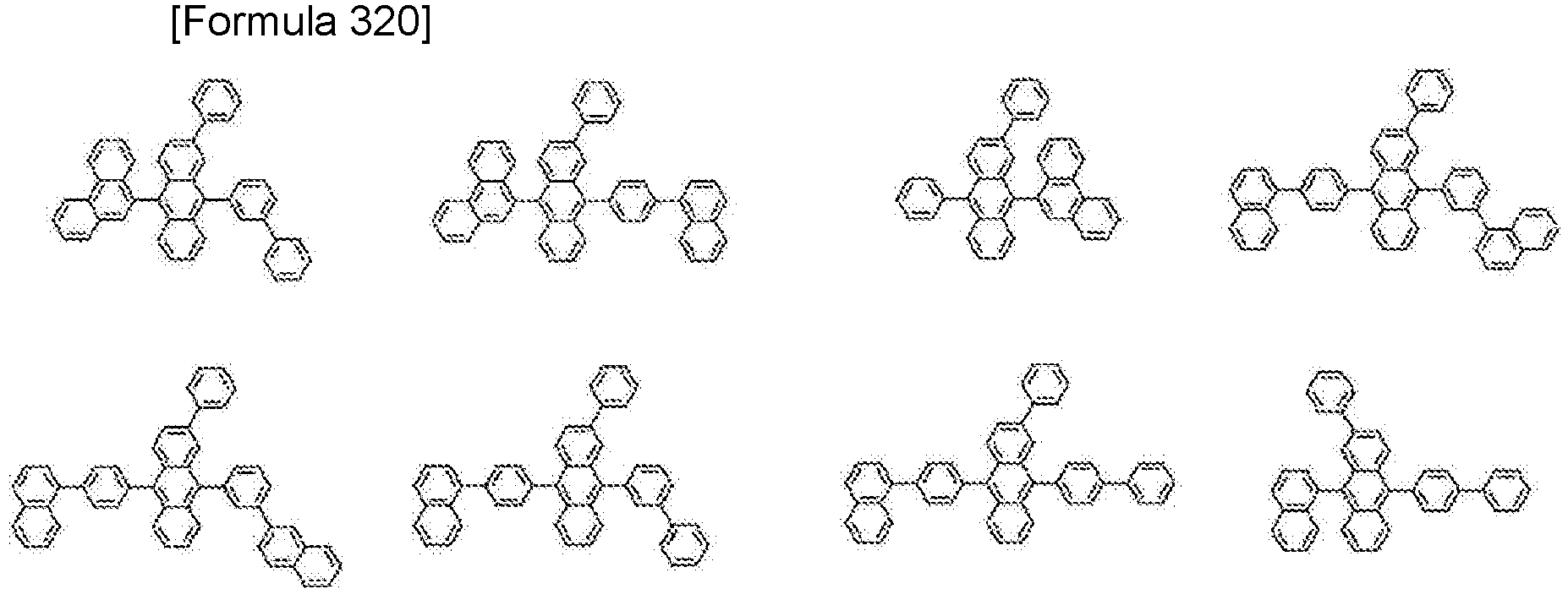


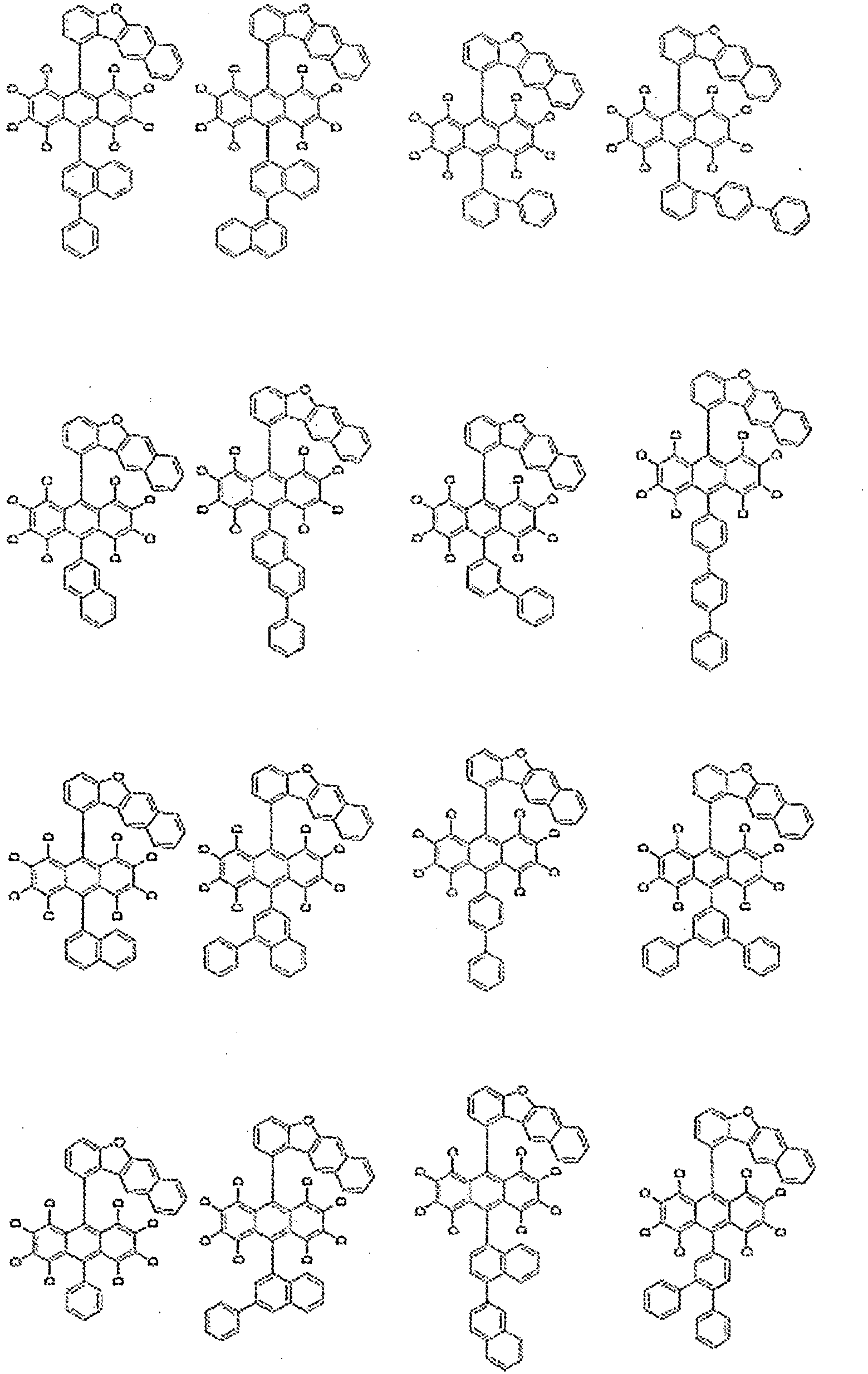


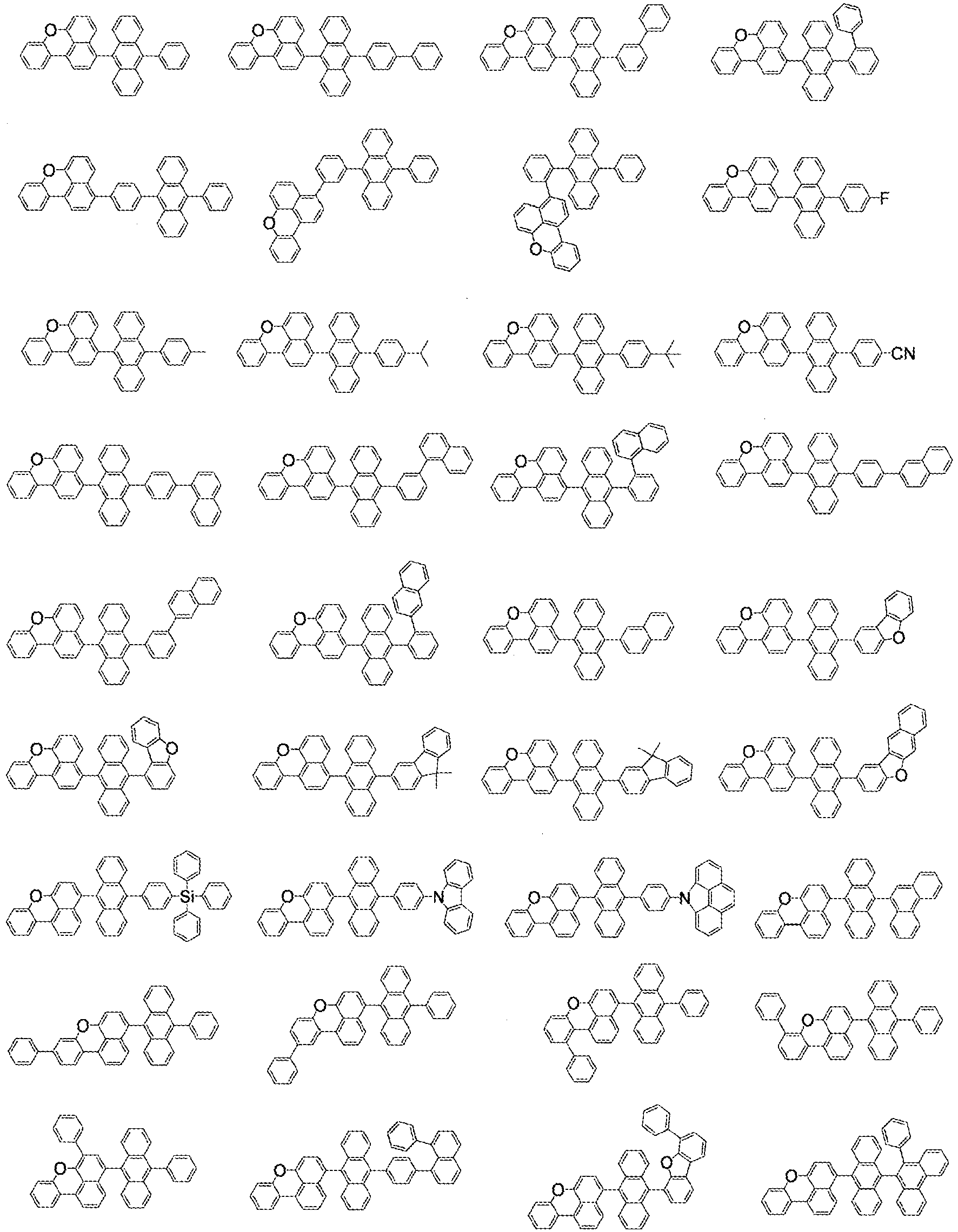




- The third compound and the fourth compound are each independently at least one compound selected from the group consisting of a compound represented by a formula (3) below, a compound represented by a formula (4) below, a compound represented by a formula (5) below, a compound represented by a formula (6) below, a compound represented by a formula (7) below, a compound represented by a formula (8) below, a compound represented by a formula (9) below, and a compound represented by a formula (10) below.
- The compound represented by the formula (3) will be described.

- In the formula (3):
- at least one combination of adjacent two or more of R301 to R310 are mutually bonded to form a substituted or unsubstituted monocyclic ring, mutually bonded to form a substituted or unsubstituted fused ring, or not mutually bonded;
- at least one of R301 to R310 is a monovalent group represented by a formula (31) below; and
- R301 to R310 forming neither the substituted or unsubstituted monocyclic ring nor the substituted or unsubstituted fused ring and not being a monovalent group represented by the formula (31) below are each independently a hydrogen atom, a substituted or unsubstituted alkyl group having 1 to 50 carbon atoms, a substituted or unsubstituted alkenyl group having 2 to 50 carbon atoms, a substituted or unsubstituted alkynyl group having 2 to 50 carbon atoms, a substituted or unsubstituted cycloalkyl group having 3 to 50 ring carbon atoms, a group represented by -Si(R901)(R902)(R903), a group represented by -O-(R904), a group represented by - S-(R905), a group represented by -N(R906)(R907), a halogen atom, a cyano group, a nitro group, a substituted or unsubstituted aryl group having 6 to 50 ring carbon atoms, or a substituted or unsubstituted heterocyclic group having 5 to 50 ring atoms.
- In the formula (31):
- Ar301 and Ar302 are each independently a substituted or unsubstituted aryl group having 6 to 50 ring carbon atoms, or a substituted or unsubstituted heterocyclic group having 5 to 50 ring atoms;
- L301 to L303 are each independently a single bond, a substituted or unsubstituted arylene group having 6 to 30 ring carbon atoms, or a substituted or unsubstituted divalent heterocyclic group having 5 to 30 ring atoms; and
- * represents a bonding position in a pyrene ring in the formula (3).
- In the third and fourth compounds, R901, R902, R903, R904, R905, R906, and R907 are each independently a hydrogen atom, a substituted or unsubstituted alkyl group having 1 to 50 carbon atoms, a substituted or unsubstituted cycloalkyl group having 3 to 50 ring carbon atoms, a substituted or unsubstituted aryl group having 6 to 50 ring carbon atoms, or a substituted or unsubstituted heterocyclic group having 5 to 50 ring atoms;
- when a plurality of R901 are present, the plurality of R901 are mutually the same or different;
- when a plurality of R902 are present, the plurality of R902 are mutually the same or different;
- when a plurality of R903 are present, the plurality of R903 are mutually the same or different;
- when a plurality of R904 are present, the plurality of R904 are mutually the same or different;
- when a plurality of R905 are present, the plurality of R905 are mutually the same or different;
- when a plurality of R906 are present, the plurality of R906 are mutually the same or different; and
- when a plurality of R907 are present, the plurality of R907 are mutually the same or different.
- In the formula (3), two of R301 to R310 are each preferably a group represented by the formula (31).
- In an exemplary embodiment, the compound represented by the formula (3) is a compound represented by a formula (33) below.

- In the formula (33):
- R311 to R318 each independently represent the same as R301 to R310 in the formula (3) that are not the monovalent group represented by the formula (31);
- L311 to L316 are each independently a single bond, a substituted or unsubstituted arylene group having 6 to 30 ring carbon atoms, or a substituted or unsubstituted divalent heterocyclic group having 5 to 30 ring atoms;
- Ar312, Ar313, Ar315, and Ar316 are each independently a substituted or unsubstituted aryl group having 6 to 50 ring carbon atoms, or a substituted or unsubstituted heterocyclic group having 5 to 50 ring atoms.
- In the formula (31), L301 is preferably a single bond, and L302 and L303 are each preferably a single bond.
- In an exemplary embodiment, the compound represented by the formula (3) is represented by a formula (34) or a formula (35) below.

- In the formula (34):
- R311 to R318 each independently represent the same as R301 to R310 in the formula (3) that are not the monovalent group represented by the formula (31);
- L312, L313, L315 and L316 each independently represent the same as L312, L313, L315 and L316 in the formula (33); and
- Ar312, Ar313, Ar315 and Ar316 each independently represent the same as Ar312, Ar313, Ar315 and Ar316 in the formula (33).
- In the formula (35):
- R311 to R318 each independently represent the same as R301 to R310 in the formula (3) that are not the monovalent group represented by the formula (31); and
- Ar312, Ar313, Ar315 and Ar316 each independently represent the same as Ar312, Ar313, Ar315 and Ar316 in the formula (33).
- In the formula (31), at least one of Ar301 or Ar302 is preferably a group represented by a formula (36) below.
- In the formulae (33) to (35), at least one of Ar312 or Ar313 is preferably a group represented by the formula (36) below.
- In the formulae (33) to (35), at least one of Ar315 or Ar316 is preferably a group represented by the formula (36) below.

- In the formula (36):
- X3 represents an oxygen atom or a sulfur atom;
- at least one combination of adjacent two or more of R321 to R327 are mutually bonded to form a substituted or unsubstituted monocyclic ring, mutually bonded to form a substituted or unsubstituted fused ring, or not mutually bonded;
- R321 to R327 forming neither the substituted or unsubstituted monocyclic ring nor the substituted or unsubstituted fused ring are each independently a hydrogen atom, a substituted or unsubstituted alkyl group having 1 to 50 carbon atoms, a substituted or unsubstituted alkenyl group having 2 to 50 carbon atoms, a substituted or unsubstituted alkynyl group having 2 to 50 carbon atoms, a substituted or unsubstituted cycloalkyl group having 3 to 50 ring carbon atoms, a group represented by -Si(R901)(R902)(R903), a group represented by -O-(R904), a group represented by - S-(R905), a group represented by -N(R906)(R907), a halogen atom, a cyano group, a nitro group, a substituted or unsubstituted aryl group having 6 to 50 ring carbon atoms, or a substituted or unsubstituted heterocyclic group having 5 to 50 ring atoms; and
- * represents a bonding position to L302, L303, L312, L313, L315 or L316.
- X3 is preferably an oxygen atom.
- At least one of R321 to R327 is preferably a substituted or unsubstituted alkyl group having 1 to 50 carbon atoms, a substituted or unsubstituted alkenyl group having 2 to 50 carbon atoms, a substituted or unsubstituted alkynyl group having 2 to 50 carbon atoms, a substituted or unsubstituted cycloalkyl group having 3 to 50 ring carbon atoms, a substituted or unsubstituted aryl group having 6 to 50 ring carbon atoms, or a substituted or unsubstituted heterocyclic group having 5 to 50 ring atoms.
- In the formula (31), it is preferable that Ar301 is a group represented by the formula (36) and Ar302 is a substituted or unsubstituted aryl group having 6 to 50 ring carbon atoms.
- In the formulae (33) to (35), it is preferable that Ar312 is a group represented by the formula (36) and Ar313 is a substituted or unsubstituted aryl group having 6 to 50 ring carbon atoms.
- In the formulae (33) to (35), it is preferable that Ar315 is a group represented by the formula (36) and Ar316 is a substituted or unsubstituted aryl group having 6 to 50 ring carbon atoms.
- In an exemplary embodiment, the compound represented by the formula (3) is represented by a formula (37) below.

- In the formula (37):
- R311 to R318 each independently represent the same as R301 to R310 in the formula (3) that are not the monovalent group represented by the formula (31);
- at least one combination of adjacent two or more of R321 to R327 are mutually bonded to form a substituted or unsubstituted monocyclic ring, mutually bonded to form a substituted or unsubstituted fused ring, or not mutually bonded;
- at least one combination of adjacent two or more of R341 to R347 are mutually bonded to form a substituted or unsubstituted monocyclic ring, mutually bonded to form a substituted or unsubstituted fused ring, or not mutually bonded;
- R321 to R327 and R341 to R347 forming neither the substituted or unsubstituted monocyclic ring nor the substituted or unsubstituted fused ring are each independently a hydrogen atom, a substituted or unsubstituted alkyl group having 1 to 50 carbon atoms, a substituted or unsubstituted alkenyl group having 2 to 50 carbon atoms, a substituted or unsubstituted alkynyl group having 2 to 50 carbon atoms, a substituted or unsubstituted cycloalkyl group having 3 to 50 ring carbon atoms, a group represented by -Si(R901)(R902)(R903), a group represented by -O-(R904), a group represented by -S-(R905), a group represented by -N(R906)(R907), a halogen atom, a cyano group, a nitro group, a substituted or unsubstituted aryl group having 6 to 50 ring carbon atoms, or a substituted or unsubstituted heterocyclic group having 5 to 50 ring atoms;
- R331 to R335 and R351 to R355 are each independently a hydrogen atom, a substituted or unsubstituted alkyl group having 1 to 50 carbon atoms, a substituted or unsubstituted alkenyl group having 2 to 50 carbon atoms, a substituted or unsubstituted alkynyl group having 2 to 50 carbon atoms, a substituted or unsubstituted cycloalkyl group having 3 to 50 ring carbon atoms, a group represented by -Si(R901)(R902)(R903), a group represented by -O-(R904), a group represented by - S-(R905), a group represented by -N(R906)(R907), a halogen atom, a cyano group, a nitro group, a substituted or unsubstituted aryl group having 6 to 50 ring carbon atoms, or a substituted or unsubstituted heterocyclic group having 5 to 50 ring atoms.
- Specific examples of the compound represented by the formula (3) include compounds shown below.


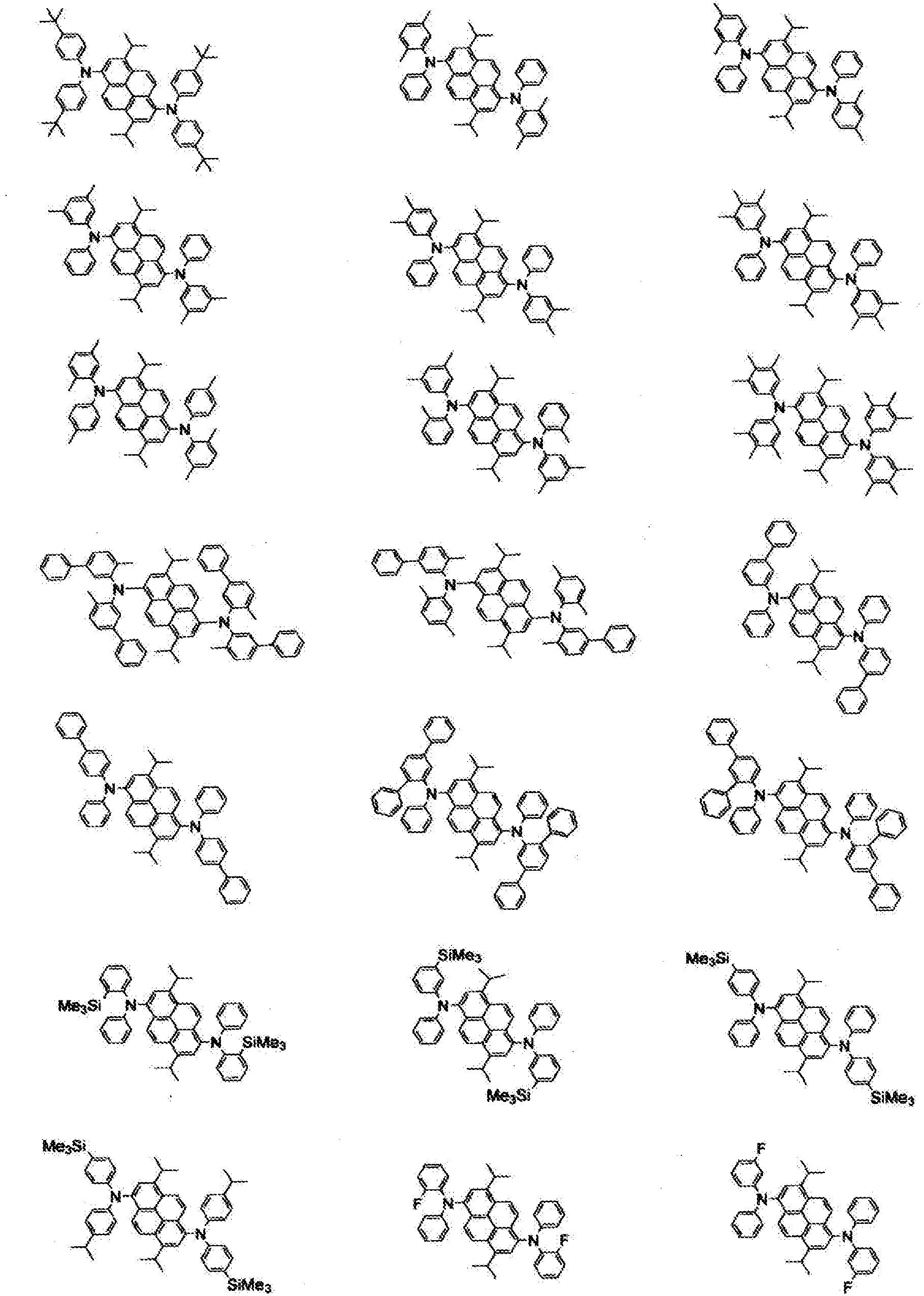


- The compound represented by the formula (4) will be described.


- In the formula (4):
- Z is each independently CRa or a nitrogen atom;
- A1 ring and A2 ring are each independently a substituted or unsubstituted aromatic hydrocarbon ring having 6 to 50 ring carbon atoms, or a substituted or unsubstituted heterocycle having 5 to 50 ring atoms;
- when a plurality of Ra are present, at least one combination of adjacent two or more of the plurality of Ra are mutually bonded to form a substituted or unsubstituted monocyclic ring, mutually bonded to form a substituted or unsubstituted fused ring, or not mutually bonded;
- n21 and n22 are each independently 0, 1, 2, 3, or 4;
- when a plurality of Rb are present, at least one combination of adjacent two or more of the plurality of Rb are mutually bonded to form a substituted or unsubstituted monocyclic ring, mutually bonded to form a substituted or unsubstituted fused ring, or not mutually bonded;
- when a plurality of Rc are present, at least one combination of adjacent two or more of the plurality of Rc are mutually bonded to form a substituted or unsubstituted monocyclic ring, mutually bonded to form a substituted or unsubstituted fused ring, or not mutually bonded; and
- Ra, Rb and Rc forming neither the substituted or unsubstituted monocyclic ring nor the substituted or unsubstituted fused ring are each independently a substituted or unsubstituted alkyl group having 1 to 50 carbon atoms, a substituted or unsubstituted alkenyl group having 2 to 50 carbon atoms, a substituted or unsubstituted alkynyl group having 2 to 50 carbon atoms, a substituted or unsubstituted cycloalkyl group having 3 to 50 ring carbon atoms, a group represented by -Si(R901)(R902)(R903), a group represented by -O-(R904), a group represented by - S-(R905), a group represented by -N(R906)(R907), a halogen atom, a cyano group, a nitro group, a substituted or unsubstituted aryl group having 6 to 50 ring carbon atoms, or a substituted or unsubstituted heterocyclic group having 5 to 50 ring atoms.
- The "aromatic hydrocarbon ring" for the A1 ring and A2 ring has the same structure as a compound formed by introducing a hydrogen atom to the "aryl group" described above.
- Ring atoms of the "aromatic hydrocarbon ring" for the A1 ring and the A2 ring include two carbon atoms on a fused bicyclic structure at the center of the formula (4).
- Specific examples of the "substituted or unsubstituted aromatic hydrocarbon ring having 6 to 50 ring carbon atoms" include a compound formed by introducing a hydrogen atom to the "aryl group" described in the specific example group G1.
- The "heterocycle" for the A1 ring and A2 ring has the same structure as a compound formed by introducing a hydrogen atom to the "heterocyclic group" described above.
- Ring atoms of the "heterocycle" for the A1 ring and the A2 ring include two carbon atoms on a fused bicyclic structure at the center of the formula (4).
- Specific examples of the "substituted or unsubstituted heterocycle having 5 to 50 ring atoms" include a compound formed by introducing a hydrogen atom to the "heterocyclic group" described in the specific example group G2.
- Rb is bonded to any one of carbon atoms forming the aromatic hydrocarbon ring for the A1 ring or any one of the atoms forming the heterocycle for the A1 ring.
- Rc is bonded to any one of carbon atoms forming the aromatic hydrocarbon ring for the A2 ring or any one of the atoms forming the heterocycle for the A2 ring.
- At least one of Ra, Rb, or Rc is preferably a group represented by a formula (4a) below. More preferably, at least two of Ra, Rb, and Rc are groups represented by the formula (4a).
- [Formula 366]
∗-L401-Ar401 (4a)
- In the formula (4a):
- L401 is a single bond, a substituted or unsubstituted arylene group having 6 to 30 ring carbon atoms, or a substituted or unsubstituted divalent heterocyclic group having 5 to 30 ring atoms; and
- Ar401 is a substituted or unsubstituted aryl group having 6 to 50 ring carbon atoms, a substituted or unsubstituted heterocyclic group having 5 to 50 ring atoms, or a group represented by the formula (4b).
- In the formula (4b):
- L402 and L403 are each independently a single bond, a substituted or unsubstituted arylene group having 6 to 30 ring carbon atoms, or a substituted or unsubstituted divalent heterocyclic group having 5 to 30 ring atoms;
- a combination of Ar402 and Ar403 are mutually bonded to form a substituted or unsubstituted monocyclic ring, mutually bonded to form a substituted or unsubstituted fused ring, or not mutually bonded; and
- Ar402 and Ar403 forming neither the substituted or unsubstituted monocyclic ring nor the substituted or unsubstituted fused ring are each independently a substituted or unsubstituted aryl group having 6 to 50 ring carbon atoms, or a substituted or unsubstituted heterocyclic group having 5 to 50 ring atoms.
- In an exemplary embodiment, the compound represented by the formula (4) is represented by a formula (42) below.

- In the formula (42):
- at least one combination of adjacent two or more of R401 to R411 are mutually bonded to form a substituted or unsubstituted monocyclic ring, mutually bonded to form a substituted or unsubstituted fused ring, or not mutually bonded; and
- R401 to R411 forming neither the substituted or unsubstituted monocyclic ring nor the substituted or unsubstituted fused ring are each independently a hydrogen atom, a substituted or unsubstituted alkyl group having 1 to 50 carbon atoms, a substituted or unsubstituted alkenyl group having 2 to 50 carbon atoms, a substituted or unsubstituted alkynyl group having 2 to 50 carbon atoms, a substituted or unsubstituted cycloalkyl group having 3 to 50 ring carbon atoms, a group represented by -Si(R901)(R902)(R903), a group represented by -O-(R904), a group represented by - S-(R905), a group represented by -N(R906)(R907), a halogen atom, a cyano group, a nitro group, a substituted or unsubstituted aryl group having 6 to 50 ring carbon atoms, or a substituted or unsubstituted heterocyclic group having 5 to 50 ring atoms.
- At least one of R401 to R411 is preferably a group represented by the formula (4a). More preferably, at least two of R401 to R411 are each a group represented by the formula (4a).
- Preferably, R404 and R411 are each a group represented by the formula (4a).
- In an exemplary embodiment, the compound represented by the formula (4) is a compound formed by bonding a structure represented by a formula (4-1) or a formula (4-2) below to the A1 ring.
- Further, in an exemplary embodiment, the compound represented by the formula (42) is a compound formed by bonding a structure represented by the formula (4-1) or the formula (4-2) to the ring bonded with R404 to R407.

- In the formula (4-1), two bonds * are each independently bonded to a ring-forming carbon atom of the aromatic hydrocarbon ring or a ring atom of the heterocycle for the A1 ring in the formula (4) or bonded to one of R404 to R407 in the formula (42);
- in the formula (4-2), three bonds * are each independently bonded to a ring-forming carbon atom of the aromatic hydrocarbon ring or a ring atom of the heterocycle for the A1 ring in the formula (4) or bonded to one of R404 to R407 in the formula (42);
- at least one combination of adjacent two or more of R421 to R427 are mutually bonded to form a substituted or unsubstituted monocyclic ring, mutually bonded to form a substituted or unsubstituted fused ring, or not mutually bonded;
- at least one combination of adjacent two or more of R431 to R438 are mutually bonded to form a substituted or unsubstituted monocyclic ring, mutually bonded to form a substituted or unsubstituted fused ring, or not mutually bonded; and
- R421 to R427 and R431 to R438 forming neither the substituted or unsubstituted monocyclic ring nor the substituted or unsubstituted fused ring are each independently a hydrogen atom, a substituted or unsubstituted alkyl group having 1 to 50 carbon atoms, a substituted or unsubstituted alkenyl group having 2 to 50 carbon atoms, a substituted or unsubstituted alkynyl group having 2 to 50 carbon atoms, a substituted or unsubstituted cycloalkyl group having 3 to 50 ring carbon atoms, a group represented by -Si(R901)(R902)(R903), a group represented by -O-(R904), a group represented by -S-(R905), a group represented by -N(R906)(R907), a halogen atom, a cyano group, a nitro group, a substituted or unsubstituted aryl group having 6 to 50 ring carbon atoms, or a substituted or unsubstituted heterocyclic group having 5 to 50 ring atoms.
- In an exemplary embodiment, the compound represented by the formula (4) is a compound represented by a formula (41-3), a formula (41-4), or a formula (41-5) below.

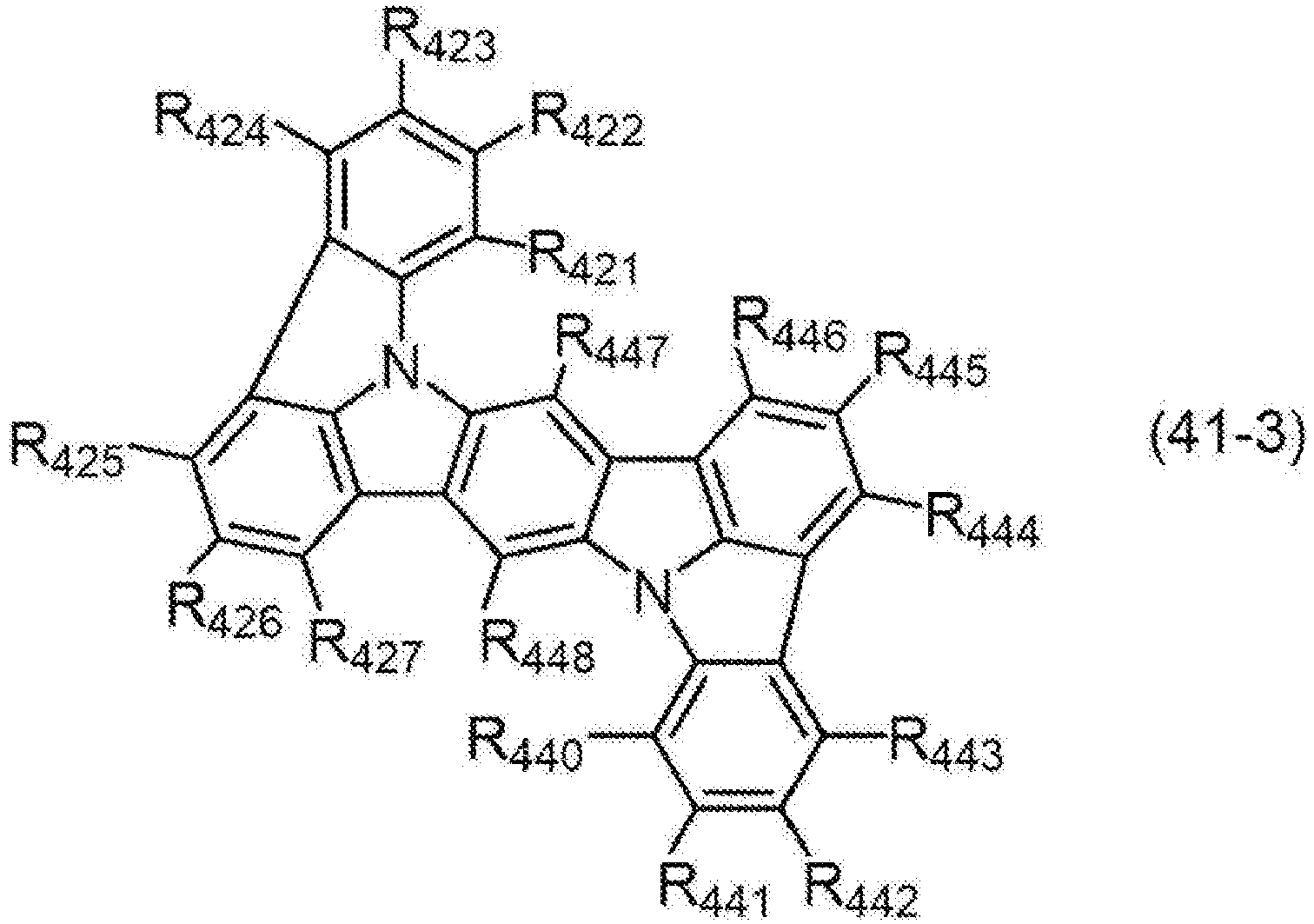


- In the formulae (41-3), (41-4) and (41-5):
- A1 ring is as defined for the formula (4);
- R421 to R427 each independently represent the same as R421 to R427 in the formula (4-1); and
- R440 to R448 each independently represent the same as R401 to R411 in the formula (42).
- In an exemplary embodiment, a substituted or unsubstituted aromatic hydrocarbon ring having 6 to 50 ring carbon atoms for the A1 ring in the formula (41-5) is a substituted or unsubstituted naphthalene ring, or a substituted or unsubstituted fluorene ring.
- In an exemplary embodiment, a substituted or unsubstituted heterocycle having 5 to 50 ring atoms for the A1 ring in the formula (41-5) is a substituted or unsubstituted dibenzofuran ring, a substituted or unsubstituted carbazole ring, or a substituted or unsubstituted dibenzothiophene ring.
- In an exemplary embodiment, the compound represented by the formula (4) or the formula (42) is selected from the group consisting of compounds represented by formulae (461) to (467) below.
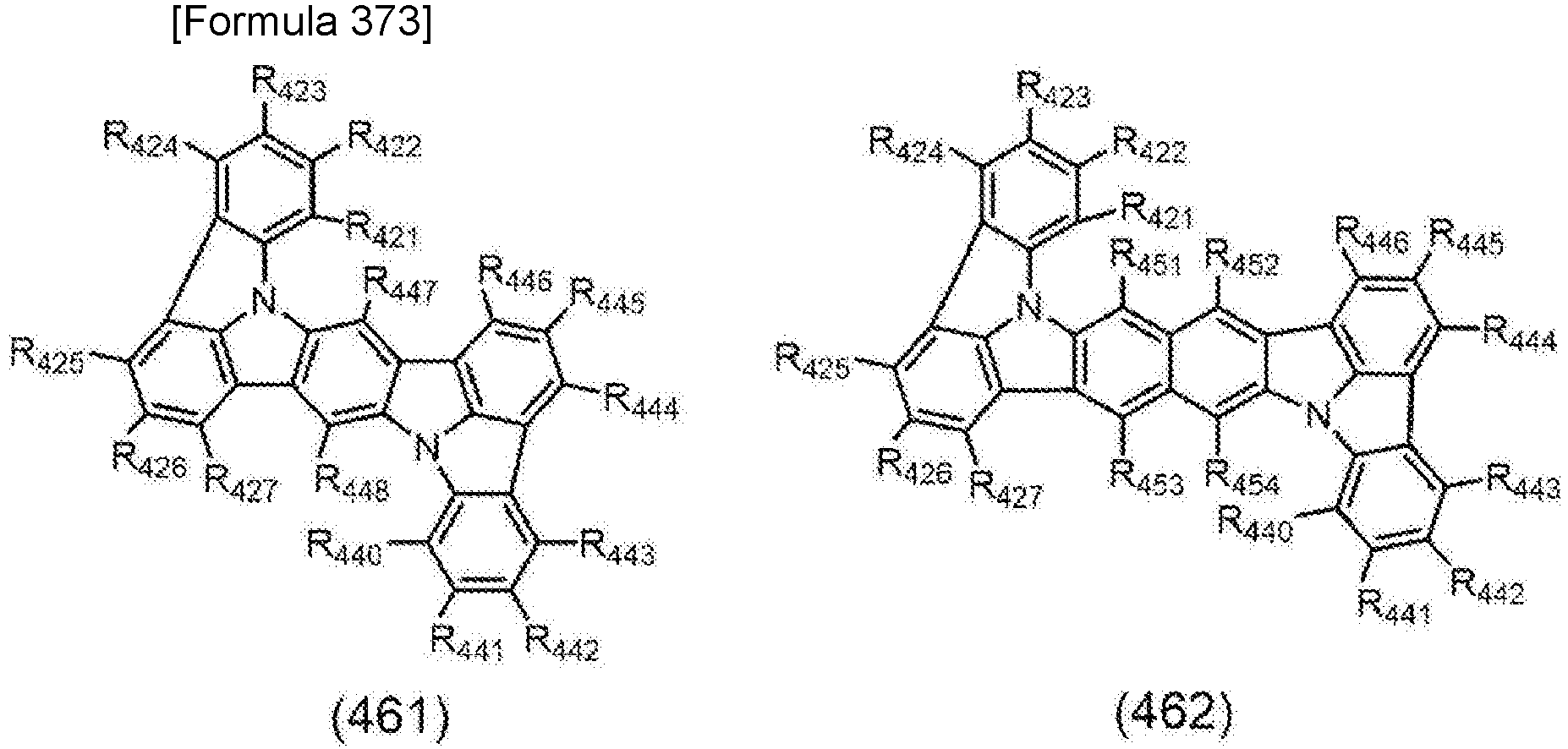


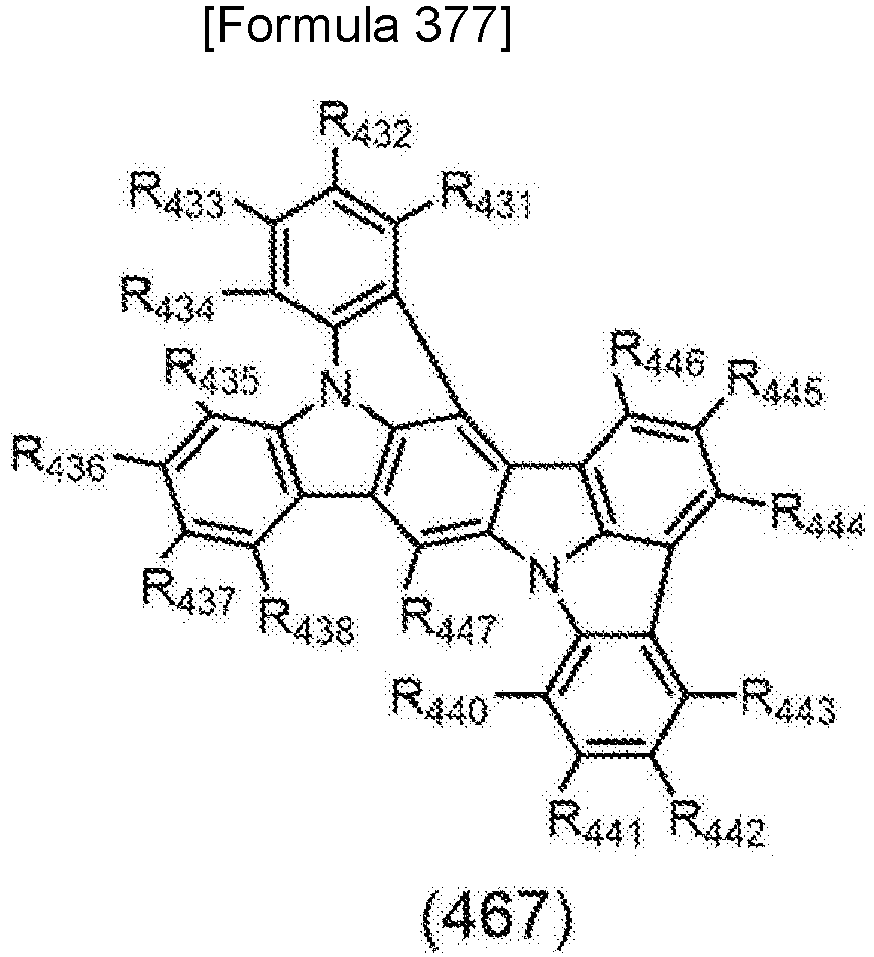
- In the formulae (461), (462), (463), (464), (465), (466) and (467):
- R421 to R427 each independently represent the same as R421 to R427 in the formula (4-1);
- R431 to R438 each independently represent the same as R431 to R438 in the formula (4-2);
- R440 to R448 and R451 to R454 each independently represent the same as R401 to R411 in the formula (42);
- X4 is an oxygen atom, NR801, or C(R802)(R803);
- R801, R802, and R803 are each independently a hydrogen atom, a substituted or unsubstituted alkyl group having 1 to 50 carbon atoms, a substituted or unsubstituted cycloalkyl group having 3 to 50 ring carbon atoms, a substituted or unsubstituted aryl group having 6 to 50 ring carbon atoms, or a substituted or unsubstituted heterocyclic group having 5 to 50 ring atoms;
- a substituted or unsubstituted alkyl group having 1 to 50 carbon atoms, or a substituted or unsubstituted aryl group having 6 to 50 ring carbon atoms;
- when a plurality of R801 are present, the plurality of R801 are mutually the same or different;
- when a plurality of R802 are present, the plurality of R802 are mutually the same or different; and
- when a plurality of R803 are present, the plurality of R803 are mutually the same or different.
- In an exemplary embodiment, in a compound represented by the formula (42), at least one combination of adjacent two or more of R401 to R411 are mutually bonded to form a substituted or unsubstituted monocyclic ring or a substituted or unsubstituted fused ring. The compound represented by the formula (42) in the exemplary embodiment is described in detail as a compound represented by a formula (45) below.
- The compound represented by the formula (45) will be described.


- In the formula (45): two or more of combinations selected from the group consisting of a combination of R461 and R462, a combination of R462 and R463, a combination of R464 and R465, a combination of R465 and R466, a combination of R466 and R467, a combination of R468 and R469, a combination of R469 and R470, and a combination of R470 and R471 are mutually bonded to form a substituted or unsubstituted monocyclic ring or a substituted or unsubstituted fused ring.
- However, the combination of R461 and R462 and the combination of R462 and R463; the combination of R464 and R465 and the combination of R465 and R466; the combination of R465 and R466 and the combination of R466 and R467; the combination of R468 and R469 and the combination of R469 and R470; and the combination of R469 and R470 and the combination of R470 and R471 do not form a ring at the same time.
- At least two rings formed by R461 to R471 are mutually the same or different.
- R461 to R471 forming neither the substituted or unsubstituted monocyclic ring nor the substituted or unsubstituted fused ring are each independently a hydrogen atom, a substituted or unsubstituted alkyl group having 1 to 50 carbon atoms, a substituted or unsubstituted alkenyl group having 2 to 50 carbon atoms, a substituted or unsubstituted alkynyl group having 2 to 50 carbon atoms, a substituted or unsubstituted cycloalkyl group having 3 to 50 ring carbon atoms, a group represented by -Si(R901)(R902)(R903), a group represented by -O-(R904), a group represented by - S-(R905), a group represented by -N(R906)(R907), a halogen atom, a cyano group, a nitro group, a substituted or unsubstituted aryl group having 6 to 50 ring carbon atoms, or a substituted or unsubstituted heterocyclic group having 5 to 50 ring atoms.
- In the formula (45), Rn and Rn+1 (n being an integer selected from 461, 462, 464 to 466, and 468 to 470) are mutually bonded to form a substituted or unsubstituted monocyclic ring or fused ring together with two ring-forming carbon atoms bonded to Rn and Rn+1. The ring is preferably formed of atoms selected from the group consisting of a carbon atom, an oxygen atom, a sulfur atom, and a nitrogen atom, and is preferably made of 3 to 7, more preferably 5 or 6 atoms.
- The number of the above cyclic structures in the compound represented by the formula (45) is, for instance, 2, 3, or 4. The two or more of the cyclic structures may be present on the same benzene ring on the basic skeleton represented by the formula (45) or may be present on different benzene rings. For instance, when three cyclic structures are present, each of the cyclic structures may be present on corresponding one of the three benzene rings of the formula (45).
- Examples of the above cyclic structures in the compound represented by the formula (45) include structures represented by formulae (451) to (460) below.

- In the formulae (451) to (457):
- each combination of *1 and *2, *3 and *4, *5 and *6, *7 and *8, *9 and *10, *11 and *12, and *13 and *14 represent the two ring-forming carbon atoms bonded to Rn and Rn+1;
- the ring-forming carbon atom bonded to Rn may be any one of the two ring-forming carbon atoms represented by *1 and *2, *3 and *4, *5 and *6, *7 and *8, *9 and *10, *11 and *12, and *13 and *14;
- X45 is C(R4512)(R4513), NR4514, an oxygen atom, or a sulfur atom;
- at least one combination of adjacent two or more of R4501 to R4506 and R4512 to R4513 are mutually bonded to form a substituted or unsubstituted monocyclic ring, mutually bonded to form a substituted or unsubstituted fused ring, or not mutually bonded; and
- R4501 to R4514 forming neither the substituted or unsubstituted monocyclic ring nor the substituted or unsubstituted fused ring each independently represent the same as R461 to R471 in the formula (45).
- In the formulae (458) to (460):
- each combination of *1 and *2, and *3 and *4 represent the two ring-forming carbon atoms bonded to Rn and Rn+1;
- the ring-forming carbon atom bonded to Rn may be any one of the two ring-forming carbon atoms represented by *1 and *2, or *3 and *4;
- X45 is C(R4512)(R4513), NR4514, an oxygen atom, or a sulfur atom;
- at least one combination of adjacent two or more of R4512 to R4513 and R4515 to R4525 are mutually bonded to form a substituted or unsubstituted monocyclic ring, mutually bonded to form a substituted or unsubstituted fused ring, or not mutually bonded; and
- R4512 to R4513, R4515 to R4521 and R4522 to R4525 forming neither the substituted or unsubstituted monocyclic ring nor the substituted or unsubstituted fused ring, and R4514 each independently represent the same as R461 to R471 in the formula (45).
- In the formula (45), it is preferable that at least one of R462, R464, R465, R470 or R471 (preferably, at least one of R462, R465, or R470, more preferably R462) is a group forming no cyclic structure.
-
- (i) In the formula (45), a substituent, if present, for a cyclic structure formed by Rn and Rn+1,
- (ii) in the formula (45), R461 to R471 forming no cyclic structure, and
- (iii) R4501 to R4514 and R4515 to R4525 in the formulae (451) to (460) are preferably each independently a hydrogen atom, a substituted or unsubstituted alkyl group having 1 to 50 carbon atoms, a substituted or unsubstituted alkenyl group having 2 to 50 carbon atoms, a substituted or unsubstituted alkynyl group having 2 to 50 carbon atoms, a substituted or unsubstituted cycloalkyl group having 3 to 50 ring carbon atoms, a group represented by -N(R906)(R907), a substituted or unsubstituted aryl group having 6 to 50 ring carbon atoms, a substituted or unsubstituted heterocyclic group having 5 to 50 ring atoms, or groups represented by formulae (461) to (464).
- In the formulae (461) to (464):
- Rd are each independently a hydrogen atom, a substituted or unsubstituted alkyl group having 1 to 50 carbon atoms, a substituted or unsubstituted alkenyl group having 2 to 50 carbon atoms, a substituted or unsubstituted alkynyl group having 2 to 50 carbon atoms, a substituted or unsubstituted cycloalkyl group having 3 to 50 ring carbon atoms, a group represented by -Si(R901)(R902)(R903), a group represented by -O-(R904), a group represented by -S-(R905), a group represented by -N(R906)(R907), a halogen atom, a cyano group, a nitro group, a substituted or unsubstituted aryl group having 6 to 50 ring carbon atoms, or a substituted or unsubstituted heterocyclic group having 5 to 50 ring atoms;
- X46 is C(R801)(R802), NR803, an oxygen atom, or a sulfur atom;
- R801, R802, and R803 are each independently a hydrogen atom, a substituted or unsubstituted alkyl group having 1 to 50 carbon atoms, a substituted or unsubstituted cycloalkyl group having 3 to 50 ring carbon atoms, a substituted or unsubstituted aryl group having 6 to 50 ring carbon atoms, or a substituted or unsubstituted heterocyclic group having 5 to 50 ring atoms;
- a substituted or unsubstituted alkyl group having 1 to 50 carbon atoms, or a substituted or unsubstituted aryl group having 6 to 50 ring carbon atoms;
- when a plurality of R801 are present, the plurality of R801 are mutually the same or different;
- when a plurality of R802 are present, the plurality of R802 are mutually the same or different;
- when a plurality of R803 are present, the plurality of R803 are mutually the same or different;
- p1 is 5;
- p2 is 4;
- p3 is 3;
- p4 is 7; and
- * in the formulae (461) to (464) each independently represents a bonding position to a cyclic structure.
- In the third and fourth compounds, R901 to R907 represent the same as those as described above.
- In an exemplary embodiment, the compound represented by the formula (45) is represented by one of formulae (45-1) to (45-6) below.


- In the formulae (45-1) to (45-6):
- rings d to i are each independently a substituted or unsubstituted monocyclic ring or a substituted or unsubstituted fused ring; and
- R461 to R471 each independently represent the same as R461 to R471 in the formula (45).
- In an exemplary embodiment, the compound represented by the formula (45) is represented by one of formulae (45-7) to (45-12) below.


- In the formulae (45-7) to (45-12):
- rings d to f, k, and j are each independently a substituted or unsubstituted monocyclic ring or a substituted or unsubstituted fused ring; and
- R461 to R471 each independently represent the same as R461 to R471 in the formula (45).
- In an exemplary embodiment, the compound represented by the formula (45) is represented by one of formulae (45-13) to (45-21) below.


- In the formulae (45-13) to (45-21):
- rings d to k are each independently a substituted or unsubstituted monocyclic ring or a substituted or unsubstituted fused ring; and
- R461 to R471 each independently represent the same as R461 to R471 in the formula (45).
- When the ring g or the ring h further has a substituent, examples of the substituent include a substituted or unsubstituted alkyl group having 1 to 50 carbon atoms, a substituted or unsubstituted aryl group having 6 to 50 ring carbon atoms, a group represented by the formula (461), a group represented by the formula (463), and a group represented by the formula (464).
- In an exemplary embodiment, the compound represented by the formula (45) is represented by one of formulae (45-22) to (45-25) below.

- In the formulae (45-22) to (45-25):
- X46 and X47 are each independently C(R801)(R802), NR803, an oxygen atom, or a sulfur atom;
- R461 to R471 and R481 to R488 each independently represent the same as R461 to R471 of the formula (45);
- R801, R802, and R803 are each independently a hydrogen atom, a substituted or unsubstituted alkyl group having 1 to 50 carbon atoms, a substituted or unsubstituted cycloalkyl group having 3 to 50 ring carbon atoms, a substituted or unsubstituted aryl group having 6 to 50 ring carbon atoms, or a substituted or unsubstituted heterocyclic group having 5 to 50 ring atoms;
- a substituted or unsubstituted alkyl group having 1 to 50 carbon atoms, or a substituted or unsubstituted aryl group having 6 to 50 ring carbon atoms;
- when a plurality of R801 are present, the plurality of R801 are mutually the same or different;
- when a plurality of R802 are present, the plurality of R802 are mutually the same or different; and
- when a plurality of R803 are present, the plurality of R803 are mutually the same or different.
- In an exemplary embodiment, the compound represented by the formula (45) is represented by a formula (45-26) below.

- In the formula (45-26):
- X46 is C(R801)(R802), NR803, an oxygen atom, or a sulfur atom;
- R463, R464, R467, R468, R471, and R481 to R492 each independently represent the same as R461 to R471 in the formula (45);
- R801, R802, and R803 are each independently a hydrogen atom, a substituted or unsubstituted alkyl group having 1 to 50 carbon atoms, a substituted or unsubstituted cycloalkyl group having 3 to 50 ring carbon atoms, a substituted or unsubstituted aryl group having 6 to 50 ring carbon atoms, or a substituted or unsubstituted heterocyclic group having 5 to 50 ring atoms;
- a substituted or unsubstituted alkyl group having 1 to 50 carbon atoms, or a substituted or unsubstituted aryl group having 6 to 50 ring carbon atoms;
- when a plurality of R801 are present, the plurality of R801 are mutually the same or different;
- when a plurality of R802 are present, the plurality of R802 are mutually the same or different; and
- when a plurality of R803 are present, the plurality of R803 are mutually the same or different.
- Specific examples of the compound represented by the formula (4) include compounds shown below. In the specific examples below, Ph represents a phenyl group, and D represents a deuterium atom.


- The compound represented by the formula (5) will be described. The compound represented by the formula (5) corresponds to a compound represented by the formula (41-3).

- In the formula (5):
- at least one combination of adjacent two or more of R501 to R507 and R511 to R517 are mutually bonded to form a substituted or unsubstituted monocyclic ring, mutually bonded to form a substituted or unsubstituted fused ring, or not mutually bonded;
- R501 to R507 and R511 to R517 forming neither the substituted or unsubstituted monocyclic ring nor the substituted or unsubstituted fused ring are each independently a hydrogen atom, a substituted or unsubstituted alkyl group having 1 to 50 carbon atoms, a substituted or unsubstituted alkenyl group having 2 to 50 carbon atoms, a substituted or unsubstituted alkynyl group having 2 to 50 carbon atoms, a substituted or unsubstituted cycloalkyl group having 3 to 50 ring carbon atoms, a group represented by -Si(R901)(R902)(R903), a group Represented by -O-(R904), a group represented by -S-(R905), a group represented by -N(R906)(R907), a halogen atom, a cyano group, a nitro group, a substituted or unsubstituted aryl group having 6 to 50 ring carbon atoms, or a substituted or unsubstituted heterocyclic group having 5 to 50 ring atoms; and
- R521 and R522 are each independently a hydrogen atom, a substituted or unsubstituted alkyl group having 1 to 50 carbon atoms, a substituted or unsubstituted alkenyl group having 2 to 50 carbon atoms, a substituted or unsubstituted alkynyl group having 2 to 50 carbon atoms, a substituted or unsubstituted cycloalkyl group having 3 to 50 ring carbon atoms, a group represented by -Si(R901)(R902)(R903), a group Represented by -O-(R904), a group represented by -S-(R905), a group represented by -N(R906)(R907), a halogen atom, a cyano group, a nitro group, a substituted or unsubstituted aryl group having 6 to 50 ring carbon atoms, or a substituted or unsubstituted heterocyclic group having 5 to 50 ring atoms.
- "A combination of adjacent two or more of R501 to R507 and R511 to R517" refers to, for instance, a combination of R501 and R502, a combination of R502 and R503, a combination of R503 and R504, a combination of R505 and R506, a combination of R506 and R507, and a combination of R501, R502, and R503.
- In an exemplary embodiment, at least one, preferably two of R501 to R507 and R511 to R517 are groups represented by -N(R906)(R907).
- In an exemplary embodiment, R501 to R507 and R511 to R517 are each independently a hydrogen atom, a substituted or unsubstituted aryl group having 6 to 50 ring carbon atoms, or a substituted or unsubstituted heterocyclic group having 5 to 50 ring atoms.
- In an exemplary embodiment, a compound represented by the formula (5) is a compound represented by a formula (52) below.
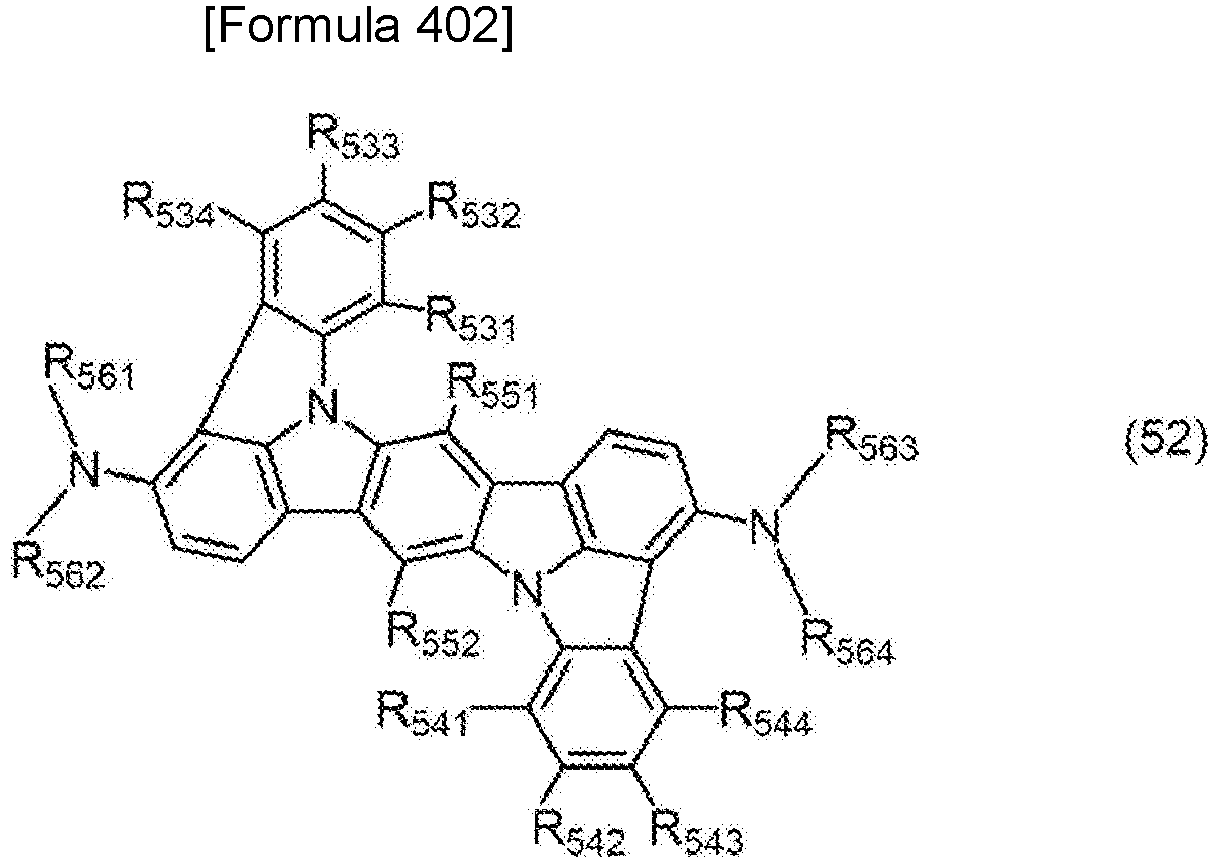
- In the formula (52):
- at least one combination of adjacent two or more of R531 to R534 and R541 to R544 are mutually bonded to form a substituted or unsubstituted monocyclic ring, mutually bonded to form a substituted or unsubstituted fused ring, or not mutually bonded;
- R531 to R534 and R541 to R544 forming neither the substituted or unsubstituted monocyclic ring nor the substituted or unsubstituted fused ring, and R551 and R552 are each independently a hydrogen atom, a substituted or unsubstituted aryl group having 6 to 50 ring carbon atoms, or a substituted or unsubstituted heterocyclic group having 5 to 50 ring atoms; and
- R561 to R564 are each independently a substituted or unsubstituted aryl group having 6 to 50 ring carbon atoms, or a substituted or unsubstituted heterocyclic group having 5 to 50 ring atoms.
- In an exemplary embodiment, a compound represented by the formula (5) is a compound represented by a formula (53) below.

- In the formula (53), R551, R552 and R561 to R564 each independently represent the same as R551, R552 and R561 to R564 in the formula (52).
- In an exemplary embodiment, R561 to R564 in the formulae (52) and (53) are each independently a substituted or unsubstituted aryl group having 6 to 50 ring carbon atoms (preferably a phenyl group).
- In an exemplary embodiment, R521 and R522 in the formula (5) and R551 and R552 in the formulae (52) and (53) are hydrogen atoms.
- In an exemplary embodiment, the substituent for "substituted or unsubstituted" in the formulae (5), (52) and (53) is a substituted or unsubstituted alkyl group having 1 to 50 carbon atoms, a substituted or unsubstituted alkenyl group having 2 to 50 carbon atoms, a substituted or unsubstituted alkynyl group having 2 to 50 carbon atoms, a substituted or unsubstituted cycloalkyl group having 3 to 50 ring carbon atoms, a substituted or unsubstituted aryl group having 6 to 50 ring carbon atoms, or a substituted or unsubstituted heterocyclic group having 5 to 50 ring atoms.
- Specific examples of a compound represented by the formula (5) include compounds shown below.


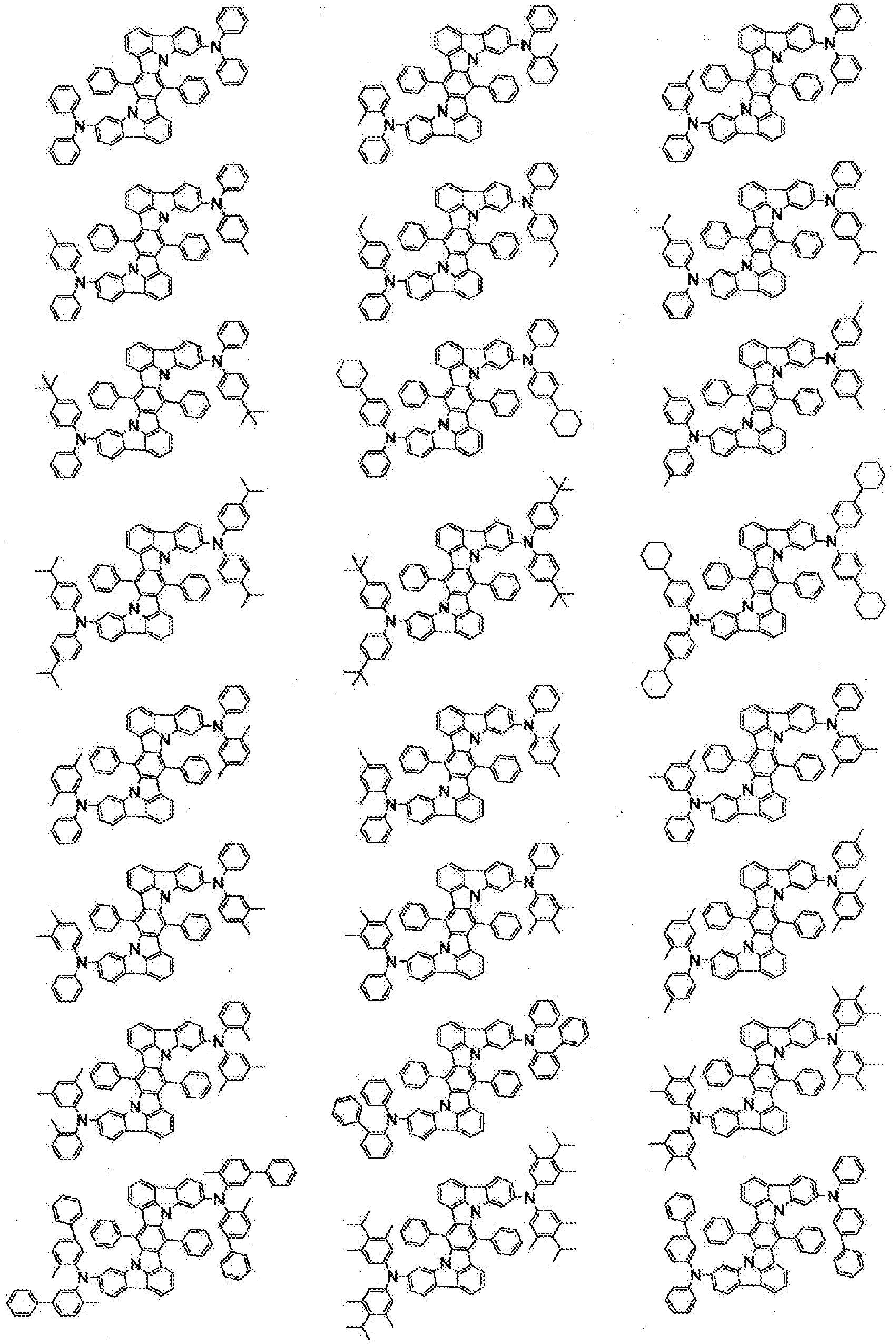


- A compound represented by the formula (6) will be described.

- In the formula (6):
- a ring, b ring and c ring are each independently a substituted or unsubstituted aromatic hydrocarbon ring having 6 to 50 ring carbon atoms, or a substituted or unsubstituted heterocycle having 5 to 50 ring atoms;
- R601 and R602 are each independently bonded to the a ring, b ring or c ring to form a substituted or unsubstituted heterocycle, or not bonded thereto to form no substituted or unsubstituted heterocycle; and
- R601 and R602 not forming the substituted or unsubstituted heterocycle are each independently a substituted or unsubstituted alkyl group having 1 to 50 carbon atoms, a substituted or unsubstituted alkenyl group having 2 to 50 carbon atoms, a substituted or unsubstituted alkynyl group having 2 to 50 carbon atoms, a substituted or unsubstituted cycloalkyl group having 3 to 50 ring carbon atoms, a substituted or unsubstituted aryl group having 6 to 50 ring carbon atoms, or a substituted or unsubstituted heterocyclic group having 5 to 50 ring atoms.
- The a ring, b ring and c ring are each a ring (a substituted or unsubstituted aromatic hydrocarbon ring having 6 to 50 ring carbon atoms, or a substituted or unsubstituted heterocycle having 5 to 50 ring atoms) fused with a fused bicyclic structure formed of a boron atom and two nitrogen atoms at the center of the formula (6).
- The "aromatic hydrocarbon ring" for the a, b, and c rings has the same structure as a compound formed by introducing a hydrogen atom to the "aryl group" described above.
- Ring atoms of the "aromatic hydrocarbon ring" for the a ring include three carbon atoms on the fused bicyclic structure at the center of the formula (6).
- Ring atoms of the "aromatic hydrocarbon ring" for the b ring and c ring include two carbon atoms on the fused bicyclic structure at the center of the formula (6).
- Specific examples of the "substituted or unsubstituted aromatic hydrocarbon ring having 6 to 50 ring carbon atoms" include a compound formed by introducing a hydrogen atom to the "aryl group" described in the specific example group G1.
- The "heterocycle" for the a, b, and c rings has the same structure as a compound formed by introducing a hydrogen atom to the "heterocyclic group" described above.
- Ring atoms of the "heterocycle" for the a ring include three carbon atoms on the fused bicyclic structure at the center of the formula (6). Ring atoms of the "heterocycle" for the b ring and c ring include two carbon atoms on the fused bicyclic structure at the center of the formula (6). Specific examples of the "substituted or unsubstituted heterocycle having 5 to 50 ring atoms" include a compound formed by introducing a hydrogen atom to the "heterocyclic group" described in the specific example group G2.
- R601 and R602 are optionally each independently bonded with the a ring, b ring, or c ring to form a substituted or unsubstituted heterocycle. The "heterocycle" in this arrangement includes a nitrogen atom on the fused bicyclic structure at the center of the formula (6). The heterocycle in the above arrangement optionally includes a hetero atom other than the nitrogen atom. R601 and R602 bonded with the a ring, b ring, or c ring specifically means that atoms forming R601 and R602 are bonded with atoms forming the a ring, b ring, or c ring. For instance, R601 may be bonded with the a ring to form a bicyclic (or tri-or-more cyclic) fused nitrogen-containing heterocycle, in which the ring including R601 and the a ring are fused. Specific examples of the nitrogen-containing heterocycle include a compound corresponding to a nitrogen-containing bi(or-more)cyclic fused heterocyclic group in the specific example group G2.
- The same applies to R601 bonded with the b ring, R602 bonded with the a ring, and R602 bonded with the c ring.
- In an exemplary embodiment, the a ring, b ring and c ring in the formula (6) are each independently a substituted or unsubstituted aromatic hydrocarbon ring having 6 to 50 ring carbon atoms.
- In an exemplary embodiment, the a ring, b ring and c ring in the formula (6) are each independently a substituted or unsubstituted benzene ring or a substituted or unsubstituted naphthalene ring.
- In an exemplary embodiment, R601 and R602 in the formula (6) are each independently a substituted or unsubstituted aryl group having 6 to 50 ring carbon atoms, or a substituted or unsubstituted heterocyclic group having 5 to 50 ring atoms, preferably a substituted or unsubstituted aryl group having 6 to 50 ring carbon atoms.
- In an exemplary embodiment, a compound represented by the formula (6) is a compound represented by a formula (62) below.

- In the formula (62):
- R601A is bonded with at least one of R611 or R621 to form a substituted or unsubstituted heterocycle, or not bonded therewith to form no substituted or unsubstituted heterocycle;
- R602A is bonded with at least one of R613 or R614 to form a substituted or unsubstituted heterocycle, or not bonded therewith to form no substituted or unsubstituted heterocycle;
- R601A and R602A not forming the substituted or unsubstituted heterocycle are each independently a substituted or unsubstituted alkyl group having 1 to 50 carbon atoms, a substituted or unsubstituted alkenyl group having 2 to 50 carbon atoms, a substituted or unsubstituted alkynyl group having 2 to 50 carbon atoms, a substituted or unsubstituted cycloalkyl group having 3 to 50 ring carbon atoms, a substituted or unsubstituted aryl group having 6 to 50 ring carbon atoms, or a substituted or unsubstituted heterocyclic group having 5 to 50 ring atoms;
- at least one combination of adjacent two or more of R611 to R621 may be mutually bonded to form a substituted or unsubstituted monocyclic ring, mutually bonded to form a substituted or unsubstituted fused ring, or not mutually bonded; and
- R611 to R621 not forming the substituted or unsubstituted heterocycle, the substituted or unsubstituted monocyclic ring, and the substituted or unsubstituted fused ring are each independently a hydrogen atom, a substituted or unsubstituted alkyl group having 1 to 50 carbon atoms, a substituted or unsubstituted alkenyl group having 2 to 50 carbon atoms, a substituted or unsubstituted alkynyl group having 2 to 50 carbon atoms, a substituted or unsubstituted cycloalkyl group having 3 to 50 ring carbon atoms, a group represented by -Si(R901)(R902)(R903), a group Represented by -O-(R904), a group represented by -S-(R905), a group represented by -N(R906)(R907), a halogen atom, a cyano group, a nitro group, a substituted or unsubstituted aryl group having 6 to 50 ring carbon atoms, or a substituted or unsubstituted heterocyclic group having 5 to 50 ring atoms.
- R601A and R602A in the formula (62) are groups corresponding to R601 and R602 in the formula (6), respectively.
- For instance, R601A and R611 are optionally bonded with each other to form a bicyclic (or tri-or-more cyclic) fused nitrogen-containing heterocycle, in which the ring including R601A and R611 and a benzene ring corresponding to the a ring are fused. Specific examples of the nitrogen-containing heterocycle include a compound corresponding to a nitrogen-containing bi(or-more)cyclic fused heterocyclic group in the specific example group G2. The same applies to R601A bonded with R621, R602A bonded with R613, and R602A bonded with R614.
- At least one combination of adjacent two or more of R611 to R621 may be mutually bonded to form a substituted or unsubstituted monocyclic ring, or mutually bonded to form a substituted or unsubstituted fused ring.
- For instance, R611 and R612 are optionally mutually bonded to form a structure in which a benzene ring, indole ring, pyrrole ring, benzofuran ring, benzothiophene ring or the like is fused to the six-membered ring bonded with R611 and R612, the resultant fused ring forming a naphthalene ring, carbazole ring, indole ring, dibenzofuran ring, or dibenzothiophene ring, respectively.
- In an exemplary embodiment, R611 to R621 not contributing to ring formation are each independently a hydrogen atom, a substituted or unsubstituted alkyl group having 1 to 50 carbon atoms, a substituted or unsubstituted aryl group having 6 to 50 ring carbon atoms, or a substituted or unsubstituted heterocyclic group having 5 to 50 ring atoms.
- In an exemplary embodiment, R611 to R621 not contributing to ring formation are each independently a hydrogen atom, a substituted or unsubstituted aryl group having 6 to 50 ring carbon atoms, or a substituted or unsubstituted heterocyclic group having 5 to 50 ring atoms.
- In an exemplary embodiment, R611 to R621 not contributing to ring formation are each independently a hydrogen atom, or a substituted or unsubstituted alkyl group having 1 to 50 carbon atoms.
- In an exemplary embodiment, R611 to R621 not contributing to ring formation are each independently a hydrogen atom, or a substituted or unsubstituted alkyl group having 1 to 50 carbon atoms, and
at least one of R611 to R621 is a substituted or unsubstituted alkyl group having 1 to 50 carbon atoms. - In an exemplary embodiment, a compound represented by the formula (62) is a compound represented by a formula (63) below.

- In the formula (63):
- R631 is bonded with R646 to form a substituted or unsubstituted heterocycle, or not bonded therewith to form no substituted or unsubstituted heterocycle;
- R633 is bonded with R647 to form a substituted or unsubstituted heterocycle, or not bonded therewith to form no substituted or unsubstituted heterocycle;
- R634 is bonded with R651 to form a substituted or unsubstituted heterocycle, or not bonded therewith to form no substituted or unsubstituted heterocycle;
- R641 is bonded with R642 to form a substituted or unsubstituted heterocycle, or not bonded therewith to form no substituted or unsubstituted heterocycle;
- at least one combination of adjacent two or more of R631 to R651 are mutually bonded to form a substituted or unsubstituted monocyclic ring, mutually bonded to form a substituted or unsubstituted fused ring, or not mutually bonded;
- R631 to R651 not forming the substituted or unsubstituted heterocycle, the substituted or unsubstituted monocyclic ring, and the substituted or unsubstituted fused ring are each independently a hydrogen atom, a substituted or unsubstituted alkyl group having 1 to 50 carbon atoms, a substituted or unsubstituted alkenyl group having 2 to 50 carbon atoms, a substituted or unsubstituted alkynyl group having 2 to 50 carbon atoms, a substituted or unsubstituted cycloalkyl group having 3 to 50 ring carbon atoms, a group represented by -Si(R901)(R902)(R903), a group Represented by -O-(R904), a group represented by -S-(R905), a group represented by -N(R906)(R907), a halogen atom, a cyano group, a nitro group, a substituted or unsubstituted aryl group having 6 to 50 ring carbon atoms, or a substituted or unsubstituted heterocyclic group having 5 to 50 ring atoms.
- R631 are optionally bonded with R646 to form a substituted or unsubstituted heterocycle. For instance, R631 and R646 are optionally bonded with each other to form a tri-or-more cyclic fused nitrogen-containing heterocycle, in which a benzene ring bonded with R646, a ring including a nitrogen atom, and a benzene ring corresponding to the a ring are fused. Specific examples of the nitrogen-containing heterocycle include a compound corresponding to a nitrogen-containing tri(-or-more)cyclic fused heterocyclic group in the specific example group G2. The same applies to R633 bonded with R647, R634 bonded with R651, and R641 bonded with R642.
- In an exemplary embodiment, R631 to R651 not contributing to ring formation are each independently a hydrogen atom, a substituted or unsubstituted alkyl group having 1 to 50 carbon atoms, a substituted or unsubstituted aryl group having 6 to 50 ring carbon atoms, or a substituted or unsubstituted heterocyclic group having 5 to 50 ring atoms.
- In an exemplary embodiment, R631 to R651 not contributing to ring formation are each independently a hydrogen atom, a substituted or unsubstituted aryl group having 6 to 50 ring carbon atoms, or a substituted or unsubstituted heterocyclic group having 5 to 50 ring atoms.
- In an exemplary embodiment, R631 to R651 not contributing to ring formation are each independently a hydrogen atom, or a substituted or unsubstituted alkyl group having 1 to 50 carbon atoms.
- In an exemplary embodiment, R631 to R651 not contributing to ring formation are each independently a hydrogen atom, or a substituted or unsubstituted alkyl group having 1 to 50 carbon atoms, and
at least one of R631 to R651 is a substituted or unsubstituted alkyl group having 1 to 50 carbon atoms. - In an exemplary embodiment, a compound represented by the formula (63) is a compound represented by a formula (63A) below.

- In the formula (63A):
- R661 is a hydrogen atom, a substituted or unsubstituted alkyl group having 1 to 50 carbon atoms, a substituted or unsubstituted alkenyl group having 2 to 50 carbon atoms, a substituted or unsubstituted alkynyl group having 2 to 50 carbon atoms, a substituted or unsubstituted cycloalkyl group having 3 to 50 ring carbon atoms, or a substituted or unsubstituted aryl group having 6 to 50 ring carbon atoms; and
- R662 to R665 are each independently a substituted or unsubstituted alkyl group having 1 to 50 carbon atoms, a substituted or unsubstituted alkenyl group having 2 to 50 carbon atoms, a substituted or unsubstituted alkynyl group having 2 to 50 carbon atoms, a substituted or unsubstituted cycloalkyl group having 3 to 50 ring carbon atoms, or a substituted or unsubstituted aryl group having 6 to 50 ring carbon atoms.
- In an exemplary embodiment, R661 to R665 are each independently a substituted or unsubstituted alkyl group having 1 to 50 carbon atoms, or a substituted or unsubstituted aryl group having 6 to 50 ring carbon atoms.
- In an exemplary embodiment, R661 to R665 are each independently a substituted or unsubstituted alkyl group having 1 to 50 carbon atoms.
- In an exemplary embodiment, a compound represented by the formula (63) is a compound represented by a formula (63B) below.

- In the formula (63B):
- R671 and R672 are each independently a hydrogen atom, a substituted or unsubstituted alkyl group having 1 to 50 carbon atoms, a substituted or unsubstituted alkenyl group having 2 to 50 carbon atoms, a substituted or unsubstituted alkynyl group having 2 to 50 carbon atoms, a substituted or unsubstituted cycloalkyl group having 3 to 50 ring carbon atoms, a group represented by -N(R906)(R907), or a substituted or unsubstituted aryl group having 6 to 50 ring carbon atoms; and
- R673 to R675 are each independently a substituted or unsubstituted alkyl group having 1 to 50 carbon atoms, a substituted or unsubstituted alkenyl group having 2 to 50 carbon atoms, a substituted or unsubstituted alkynyl group having 2 to 50 carbon atoms, a substituted or unsubstituted cycloalkyl group having 3 to 50 ring carbon atoms, a group represented by -N(R906)(R907), or a substituted or unsubstituted aryl group having 6 to 50 ring carbon atoms.
- In an exemplary embodiment, a compound represented by the formula (63) is a compound represented by a formula (63B') below.
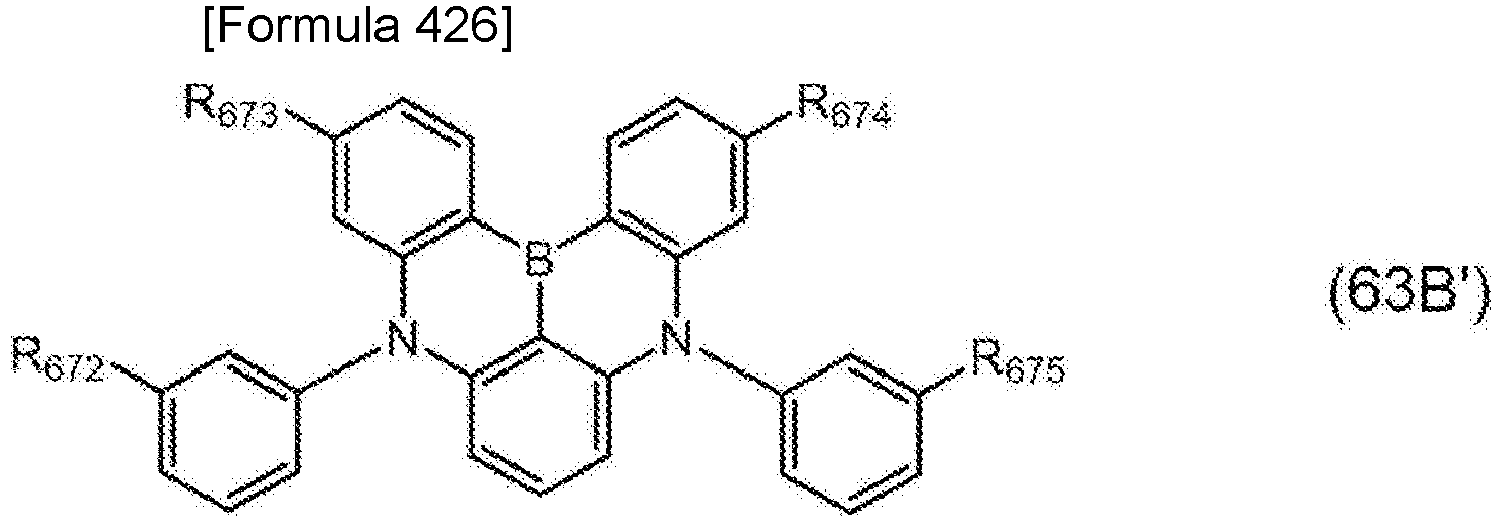
- In the formula (63B'), R672 to R675 each independently represent the same as R672 to R675 in the formula (63B).
- In an exemplary embodiment, at least one of R671 to R675 is a substituted or unsubstituted alkyl group having 1 to 50 carbon atoms, a substituted or unsubstituted alkenyl group having 2 to 50 carbon atoms, a substituted or unsubstituted alkynyl group having 2 to 50 carbon atoms, a substituted or unsubstituted cycloalkyl group having 3 to 50 ring carbon atoms, a group represented by -N(R906)(R907), or a substituted or unsubstituted aryl group having 6 to 50 ring carbon atoms.
- In an exemplary embodiment: R672 is a hydrogen atom, a substituted or unsubstituted alkyl group having 1 to 50 carbon atoms, a group represented by-N(R906)(R907), or a substituted or unsubstituted aryl group having 6 to 50 ring carbon atoms; and
- R671 and R673 to R675 are each independently a substituted or unsubstituted alkyl group having 1 to 50 carbon atoms, a group represented by -N(R906)(R907), or a substituted or unsubstituted aryl group having 6 to 50 ring carbon atoms.
- In an exemplary embodiment, a compound represented by the formula (63) is a compound represented by a formula (63C) below.

- In the formula (63C): R631 and R682 are each independently a hydrogen atom, a substituted or unsubstituted alkyl group having 1 to 50 carbon atoms, a substituted or unsubstituted alkenyl group having 2 to 50 carbon atoms, a substituted or unsubstituted alkynyl group having 2 to 50 carbon atoms, a substituted or unsubstituted cycloalkyl group having 3 to 50 ring carbon atoms, or a substituted or unsubstituted aryl group having 6 to 50 ring carbon atoms; and
- R683 to R686 are each independently a substituted or unsubstituted alkyl group having 1 to 50 carbon atoms, a substituted or unsubstituted alkenyl group having 2 to 50 carbon atoms, a substituted or unsubstituted alkynyl group having 2 to 50 carbon atoms, a substituted or unsubstituted cycloalkyl group having 3 to 50 ring carbon atoms, or a substituted or unsubstituted aryl group having 6 to 50 ring carbon atoms.
- In an exemplary embodiment, a compound represented by the formula (63) is a compound represented by a formula (63C') below.


- In the formula (63C'), R683 to R686 each independently represent the same as R683 to R686 in the formula (63C).
- In an exemplary embodiment, R631 to R686 are each independently a substituted or unsubstituted alkyl group having 1 to 50 carbon atoms, or a substituted or unsubstituted aryl group having 6 to 50 ring carbon atoms.
- In an exemplary embodiment, R631 to R686 are each independently a substituted or unsubstituted aryl group having 6 to 50 ring carbon atoms.
- A compound represented by the formula (6) is producible by initially bonding the a ring, b ring and c ring with linking groups (a group including N-R601 and a group including N-R602) to form an intermediate (first reaction), and bonding the a ring, b ring and c ring with a linking group (a group including a boron atom) to form a final product (second reaction). In the first reaction, an amination reaction (e.g. Buchwald-Hartwig reaction) is applicable. In the second reaction, Tandem Hetero-Friedel-Crafts Reactions or the like is applicable.
- Specific examples of a compound represented by the formula (6) are shown below. It should however be noted that these specific examples are merely exemplary and do not limit a compound represented by the formula (6).









- A compound represented by the formula (7) will be described below.


- In the formula (7): r ring is a ring represented by the formula (72) or the formula (73), the r ring being fused with adjacent ring(s) at any position(s);
- q ring and s ring are each independently a ring represented by the formula (74) and fused with adjacent ring(s) at any position(s);
- p ring and t ring are each independently a structure represented by the formula (75) or the formula (76) and fused with adjacent ring(s) at any position(s);
- X7 is an oxygen atom, a sulfur atom, or NR702;
- when a plurality of R701 are present, adjacent ones of the plurality of R701 are mutually bonded to form a substituted or unsubstituted monocyclic ring, mutually bonded to form a substituted or unsubstituted fused ring, or not mutually bonded;
- R701 and R702 forming neither the substituted or unsubstituted monocyclic ring nor the substituted or unsubstituted fused ring are each independently a substituted or unsubstituted alkyl group having 1 to 50 carbon atoms, a substituted or unsubstituted alkenyl group having 2 to 50 carbon atoms, a substituted or unsubstituted alkynyl group having 2 to 50 carbon atoms, a substituted or unsubstituted cycloalkyl group having 3 to 50 ring carbon atoms, a group represented by -Si(R901)(R902)(R903), a group Represented by -O-(R904), a group represented by-S-(R905), a group represented by -N(R906)(R907), a halogen atom, a cyano group, a nitro group, a substituted or unsubstituted aryl group having 6 to 50 ring carbon atoms, or a substituted or unsubstituted heterocyclic group having 5 to 50 ring atoms;
- Ar701 and Ar702 are each independently a substituted or unsubstituted alkyl group having 1 to 50 carbon atoms, a substituted or unsubstituted alkenyl group having 2 to 50 carbon atoms, a substituted or unsubstituted alkynyl group having 2 to 50 carbon atoms, a substituted or unsubstituted cycloalkyl group having 3 to 50 ring carbon atoms, a substituted or unsubstituted aryl group having 6 to 50 ring carbon atoms, or a substituted or unsubstituted heterocyclic group having 5 to 50 ring atoms;
- L701 is a substituted or unsubstituted alkylene group having 1 to 50 carbon atoms, a substituted or unsubstituted alkenylene group having 2 to 50 carbon atoms, a substituted or unsubstituted alkynylene group having 2 to 50 carbon atoms, a substituted or unsubstituted cycloalkylene group having 3 to 50 ring carbon atoms, a substituted or unsubstituted arylene group having 6 to 50 ring carbon atoms, or a substituted or unsubstituted divalent heterocyclic group having 5 to 50 ring atoms;
- m1 is 0, 1, or 2;
- m2 is 0, 1, 2, 3, or 4;
- m3 is each independently 0, 1, 2, 3 or 3;
- m4 is each independently 0, 1, 2, 3, 4, or 5;
- when a plurality of R701 are present, the plurality of R701 are mutually the same or different;
- when a plurality of X7 are present, the plurality of X7 are mutually the same or different;
- when a plurality of R702 are present, the plurality of R702 are mutually the same or different;
- when a plurality of Ar701 are present, the plurality of Ar701 are mutually the same or different;
- when a plurality of Ar702 are present, the plurality of Ar702 are mutually the same or different; and
- when a plurality of L701 are present, the plurality of L701 are mutually the same or different.
- In the formula (7), each of the p ring, q ring, r ring, s ring, and t ring is fused with an adjacent ring(s) sharing two carbon atoms. The fused position and orientation are not limited but may be defined as required.
- In an exemplary embodiment, in the formula (72) or the formula (73) representing the r ring, m1 = 0 or m2 = 0 is satisfied.
- In an exemplary embodiment, a compound represented by the formula (7) is represented by any one of formulae (71-1) to (71-6) below.


- In the formulae (71-1) to (71-6), R701, X7, Ar701, Ar702, L701, m1 and m3 respectively represent the same as R701, X7, Ar701, Ar702, L701, m1 and m3 in the formula (7).
- In an exemplary embodiment, a compound represented by the formula (7) is represented by any one of formulae (71-11) to (71-13) below.


- In the formulae (71-11) to (71-13), R701, X7, Ar701, Ar702, L701, m1, m3 and m4 respectively represent the same as R701, X7, Ar701, Ar702, L701, m1, m3 and m4 in the formula (7).
- In an exemplary embodiment, a compound represented by the formula (7) is represented by any one of formulae (71-21) to (71-25) below.


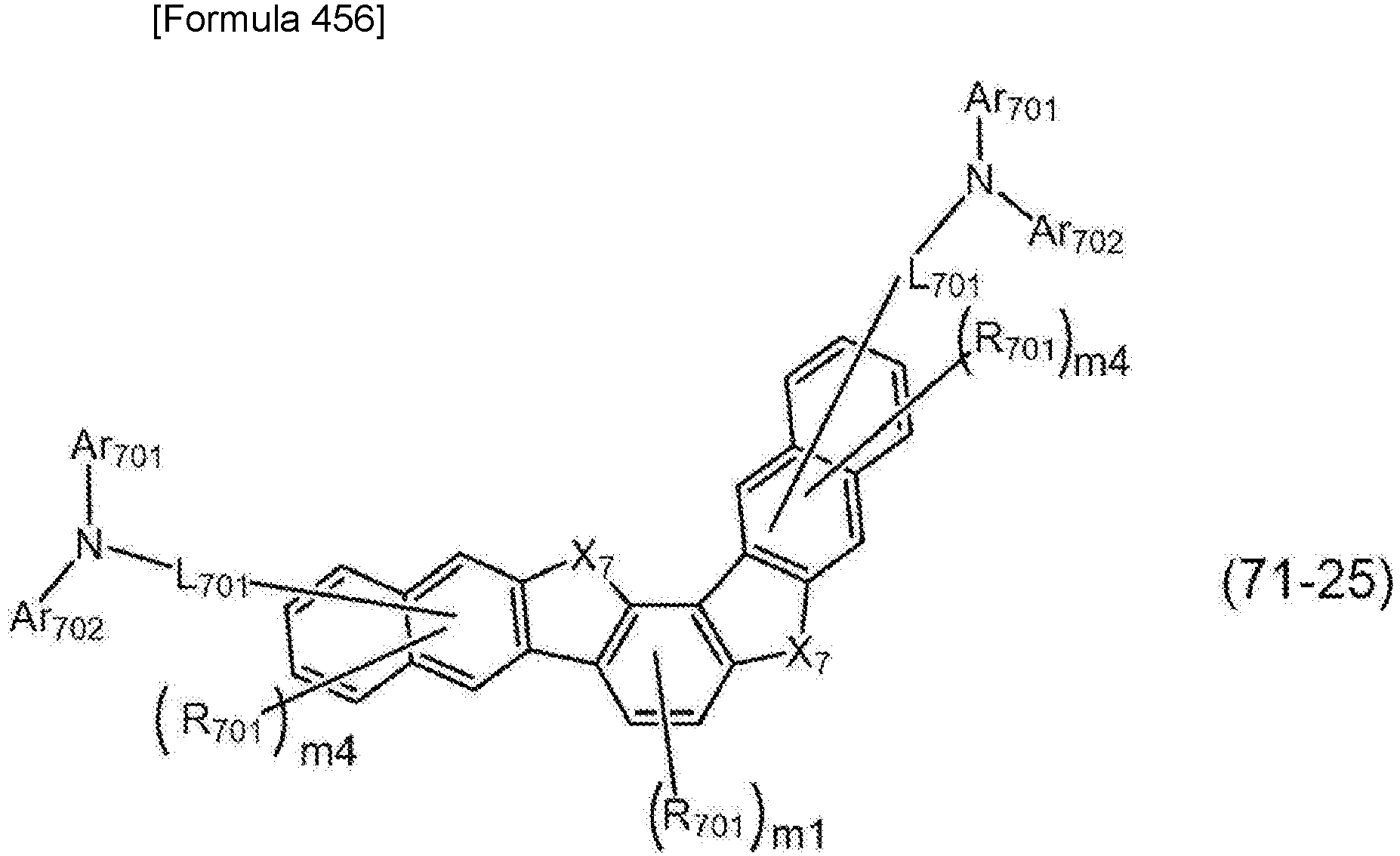
- In the formulae (71-21) to (71-25), R701, X7, Ar701, Ar702, L701, m1 and m4 respectively represent the same as R701, X7, Ar701, Ar702, L701, m1 and m4 in the formula (7).
- In an exemplary embodiment, a compound represented by the formula (7) is represented by any one of formulae (71-31) to (71-33) below.


- In the formulae (71-31) to (71-33), R701, X7, Ar701, Ar702, L701, and m2 to m4 respectively represent the same as R701, X7, Ar701, Ar702, L701, and m2 to m4 in the formula (7).
- In an exemplary embodiment, Ar701 and Ar702 are each independently a substituted or unsubstituted aryl group having 6 to 50 ring carbon atoms.
- In an exemplary embodiment, one of Ar701 and Ar702 is a substituted or unsubstituted aryl group having 6 to 50 ring carbon atoms, and the other of Ar701 and Ar702 is a substituted or unsubstituted heterocyclic group having 5 to 50 ring atoms.
- Specific examples of a compound represented by the formula (7) include compounds shown below.


- A compound represented by the formula (8) will be described below.

- In the formula (8): at least one combination of R801 and R802, R802 and R803, or R803 and R804 are mutually bonded to form a divalent group represented by a formula (82) below; and
at least one combination of R805 and R806, R806 and R807, or R807 and R808 are mutually bonded to form a divalent group represented by a formula (83) below.
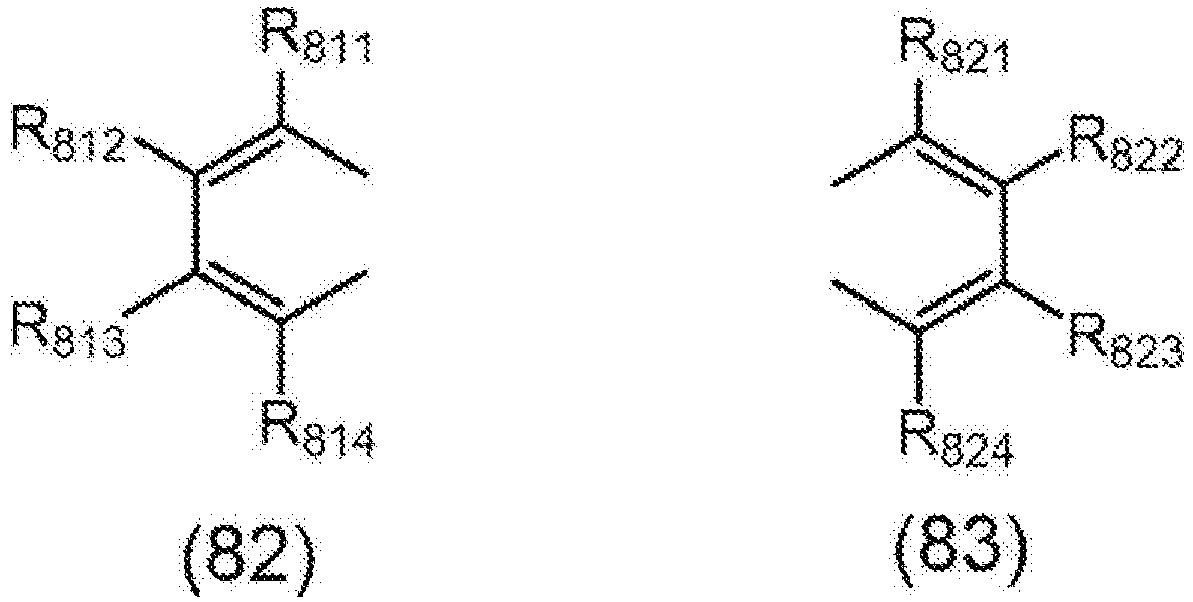
- At least one of R801 to R804 not forming the divalent group represented by the formula (82) or R811 to R814 is a monovalent group represented by a formula (84) below;
- at least one of R805 to R808 not forming the divalent group represented by the formula (83) or R821 to R824 is a monovalent group represented by a formula (84) below;
- X8 is an oxygen atom, a sulfur atom, or NR809; and
- R801 to R808 not forming the divalent group represented by the formula (82) or (83) and not being the monovalent group represented by the formula (84), R811 to R814 and R821 to R824 not being the monovalent group represented by the formula (84), and R809 are each independently a hydrogen atom, a substituted or unsubstituted alkyl group having 1 to 50 carbon atoms, a substituted or unsubstituted alkenyl group having 2 to 50 carbon atoms, a substituted or unsubstituted alkynyl group having 2 to 50 carbon atoms, a substituted or unsubstituted cycloalkyl group having 3 to 50 ring carbon atoms, a group represented by -Si(R901)(R902)(R903), a group Represented by -O-(R904), a group represented by -S-(R905), a group represented by -N(R906)(R907), a halogen atom, a cyano group, a nitro group, a substituted or unsubstituted aryl group having 6 to 50 ring carbon atoms, or a substituted or unsubstituted heterocyclic group having 5 to 50 ring atoms.
- In the formula (84): Ar801 and Ar802 are each independently a substituted or unsubstituted aryl group having 6 to 50 ring carbon atoms, or a substituted or unsubstituted heterocyclic group having 5 to 50 ring atoms;
- L801 to L803 are each independently a single bond, a substituted or unsubstituted arylene group having 6 to 30 ring carbon atoms, a substituted or unsubstituted divalent heterocyclic group having 5 to 30 ring atoms, or a divalent linking group formed by bonding two, three or four groups selected from the group consisting of a substituted or unsubstituted arylene group having 6 to 30 ring carbon atoms and a substituted or unsubstituted divalent heterocyclic group having 5 to 30 ring atoms; and
* in the formula (84) represents a bonding position to the cyclic structure represented by the formula (8), a group represented by the formula (82), or a group represented by the formula (83). - In the formula (8), the positions for the divalent group represented by the formula (82) and the divalent group represented by the formula (83) to be formed are not specifically limited but the divalent groups may be formed at any possible positions on R801 to R808.
- In an exemplary embodiment, a compound represented by the formula (8) is represented by any one of formulae (81-1) to (81-6) below.


- In the formulae (81-1) to (81-6):
- X8 represents the same as X8 in the formula (8);
- at least two of R801 to R824 are each a monovalent group represented by the formula (84); and
- R801 to R824 that are not the monovalent group represented by the formula (84) are each independently a hydrogen atom, a substituted or unsubstituted alkyl group having 1 to 50 carbon atoms, a substituted or unsubstituted alkenyl group having 2 to 50 carbon atoms, a substituted or unsubstituted alkynyl group having 2 to 50 carbon atoms, a substituted or unsubstituted cycloalkyl group having 3 to 50 ring carbon atoms, a group represented by -Si(R901)(R902)(R903), a group Represented by -O-(R904), a group represented by -S-(R905), a group represented by -N(R906)(R907), a halogen atom, a cyano group, a nitro group, a substituted or unsubstituted aryl group having 6 to 50 ring carbon atoms, or a substituted or unsubstituted heterocyclic group having 5 to 50 ring atoms.
- In an exemplary embodiment, a compound represented by the formula (8) is represented by any one of formulae (81-7) to (81-18) below.


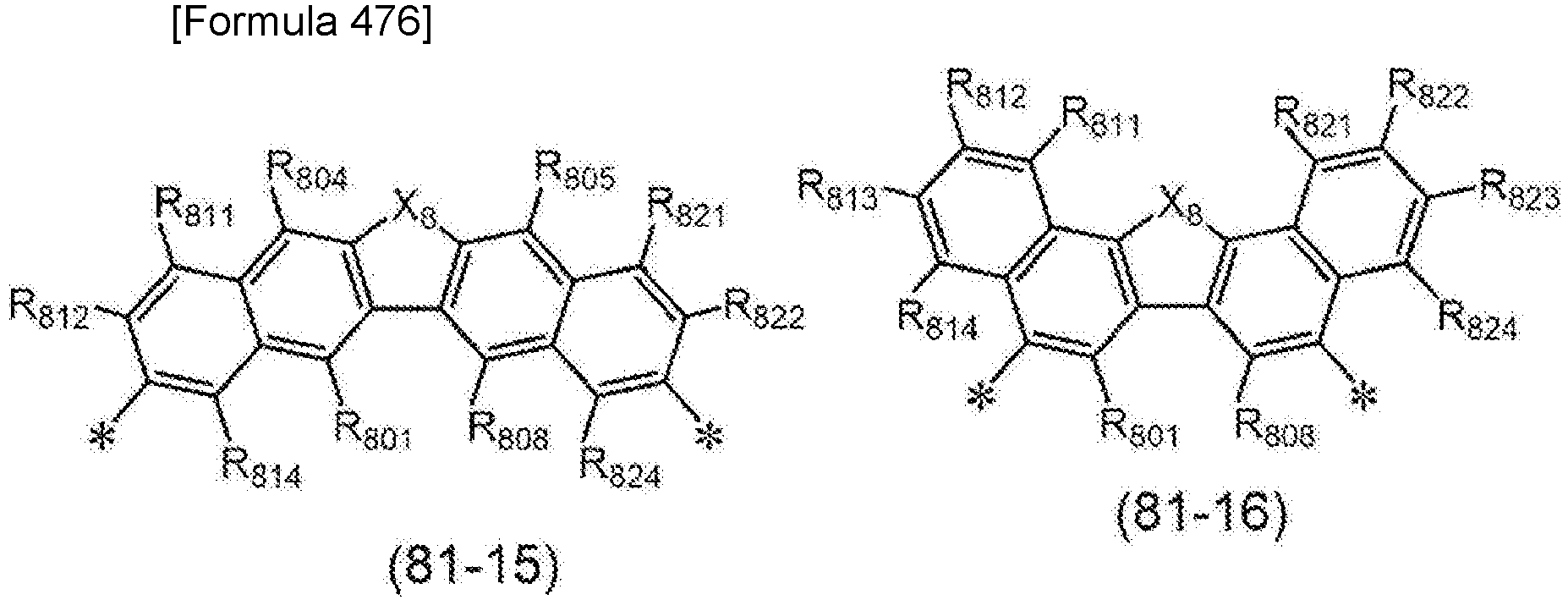


- In the formulae (81-7) to (81-18):
- X8 represents the same as X8 in the formula (8);
- * is a single bond bonded to a monovalent group represented by the formula (84); and
- R801 to R824 each independently represent the same as R801 to R824 that are each not a monovalent group represented by the formula (84) in the formulae (81-1) to (81-6).
- R801 to R808 not forming the divalent group represented by the formula (82) or (83) and not being the monovalent group represented by the formula (84), and R811 to R814 and R821 to R824 not being the monovalent group represented by the formula (84) are preferably each independently a hydrogen atom, a substituted or unsubstituted alkyl group having 1 to 50 carbon atoms, a substituted or unsubstituted alkenyl group having 2 to 50 carbon atoms, a substituted or unsubstituted alkynyl group having 2 to 50 carbon atoms, a substituted or unsubstituted cycloalkyl group having 3 to 50 ring carbon atoms, a substituted or unsubstituted aryl group having 6 to 50 ring carbon atoms, or a substituted or unsubstituted heterocyclic group having 5 to 50 ring atoms.
- The monovalent group represented by the formula (84) is preferably represented by a formula (85) or (86) below.


- In the formula (85): R831 to R840 are each independently a hydrogen atom, a substituted or unsubstituted alkyl group having 1 to 50 carbon atoms, a substituted or unsubstituted alkenyl group having 2 to 50 carbon atoms, a substituted or unsubstituted alkynyl group having 2 to 50 carbon atoms, a substituted or unsubstituted cycloalkyl group having 3 to 50 ring carbon atoms, a group represented by -Si(R901)(R902)(R903), a group Represented by -O-(R904), a group represented by - S-(R905), a group represented by -N(R906)(R907), a halogen atom, a cyano group, a nitro group, a substituted or unsubstituted aryl group having 6 to 50 ring carbon atoms, or a substituted or unsubstituted heterocyclic group having 5 to 50 ring atoms; and
* in the formula (85) represents the same as * in the formula (84).
- In the formula (86): Ar801, L801, and L803 represent the same as Ar801, L801, and L803 in the formula (84); and HAr801 is a structure represented by a formula (87).


- In the formula (87):
- X81 is an oxygen atom or a sulfur atom;
- one of R841 to R848 is a single bond with L803; and
- R841 to R848 not being the single bond are each independently a hydrogen atom, a substituted or unsubstituted alkyl group having 1 to 50 carbon atoms, a substituted or unsubstituted alkenyl group having 2 to 50 carbon atoms, a substituted or unsubstituted alkynyl group having 2 to 50 carbon atoms, a substituted or unsubstituted cycloalkyl group having 3 to 50 ring carbon atoms, a group represented by -Si(R901)(R902)(R903), a group Represented by -O-(R904), a group represented by - S-(R905), a group represented by -N(R906)(R907), a halogen atom, a cyano group, a nitro group, a substituted or unsubstituted aryl group having 6 to 50 ring carbon atoms, or a substituted or unsubstituted heterocyclic group having 5 to 50 ring atoms.
- Specific examples of a compound represented by the formula (8) include compounds shown below as well as the compounds disclosed in
WO 2014/104144 .


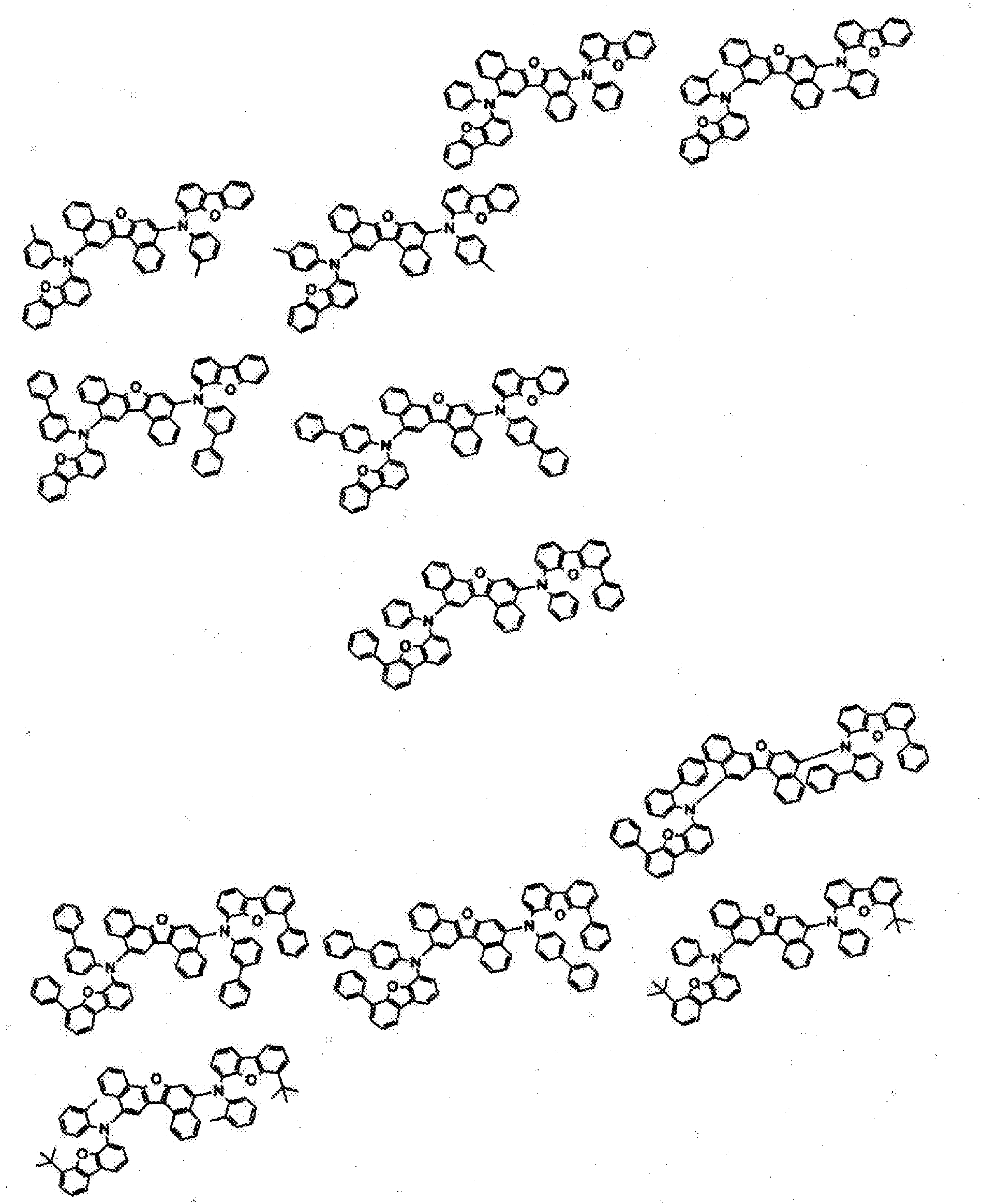


- A compound represented by the formula (9) will be described below.

- In the formula (9): A91 ring and A92 ring are each independently a substituted or unsubstituted aromatic hydrocarbon ring having 6 to 50 ring carbon atoms, or a substituted or unsubstituted heterocycle having 5 to 50 ring atoms; and
at least one ring selected from the group consisting of A91 ring and A92 ring is bonded to * in a structure represented by a formula (92).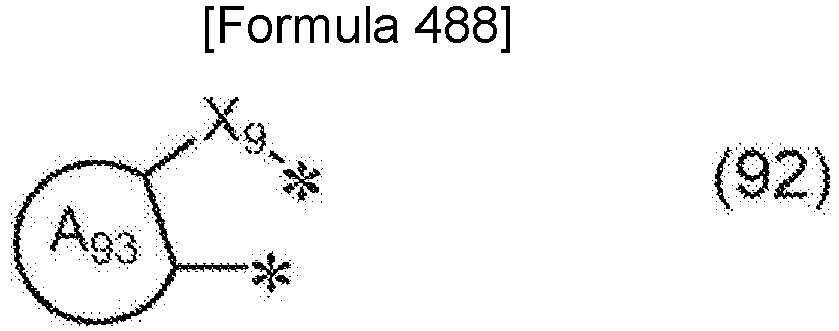
- In the formula (92): A93 ring is a substituted or unsubstituted aromatic hydrocarbon ring having 6 to 50 ring carbon atoms, or a substituted or unsubstituted heterocycle having 5 to 50 ring atoms;
- X9 is NR93, C(R94)(R95), Si(R96)(R97), Ge(R98)(R99), an oxygen atom, a sulfur atom, or a selenium atom;
- R91 and R92 are mutually bonded to form a substituted or unsubstituted monocyclic ring, mutually bonded to form a substituted or unsubstituted fused ring, or not mutually bonded; and
- R91 and R92 forming neither the substituted or unsubstituted monocyclic ring nor the substituted or unsubstituted fused ring, and R93 to R99 are each independently a hydrogen atom, a substituted or unsubstituted alkyl group having 1 to 50 carbon atoms, a substituted or unsubstituted alkenyl group having 2 to 50 carbon atoms, a substituted or unsubstituted alkynyl group having 2 to 50 carbon atoms, a substituted or unsubstituted cycloalkyl group having 3 to 50 ring carbon atoms, a group represented by -Si(R901)(R902)(R903), a group Represented by -O-(R904), a group represented by -S-(R905), a group represented by -N(R906)(R907), a halogen atom, a cyano group, a nitro group, a substituted or unsubstituted aryl group having 6 to 50 ring carbon atoms, or a substituted or unsubstituted heterocyclic group having 5 to 50 ring atoms.
- At least one ring selected from the group consisting of A91 ring and A92 ring is bonded to a bond * of a structure represented by the formula (92). In other words, the ring-forming carbon atoms of the aromatic hydrocarbon ring or the ring atoms of the heterocycle of the A91 ring in an exemplary embodiment are bonded to the bonds * in a structure represented by the formula (92). Further, the ring-forming carbon atoms of the aromatic hydrocarbon ring or the ring atoms of the heterocycle of the A92 ring in an exemplary embodiment are bonded to the bonds * in a structure represented by the formula (92).
- In an exemplary embodiment, a group represented by a formula (93) below is bonded to one or both of the A91 ring and A92 ring.
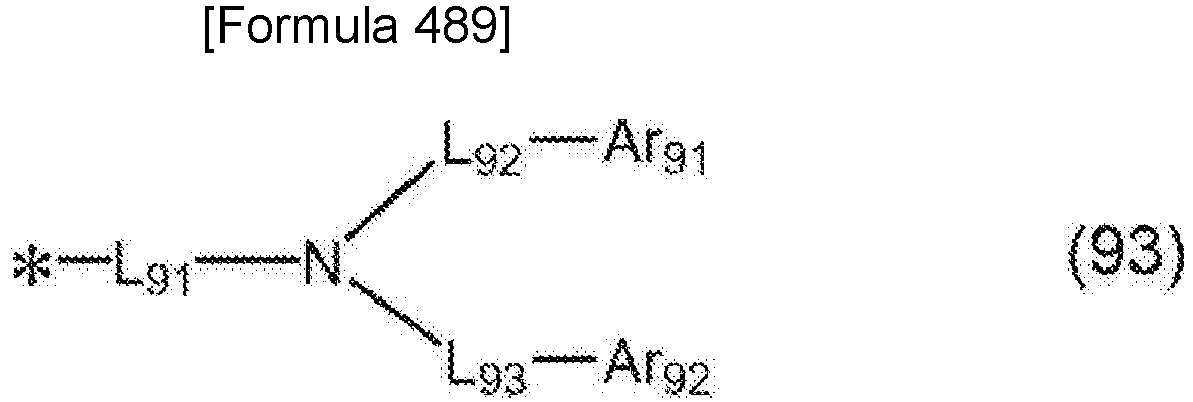
- In the formula (93): Ar91 and Ar92 are each independently a substituted or unsubstituted aryl group having 6 to 50 ring carbon atoms, or a substituted or unsubstituted heterocyclic group having 5 to 50 ring atoms;
- L91 to L93 are each independently a single bond, a substituted or unsubstituted arylene group having 6 to 30 ring carbon atoms, a substituted or unsubstituted divalent heterocyclic group having 5 to 30 ring atoms, or a divalent linking group formed by bonding two, three or four groups selected from the group consisting of a substituted or unsubstituted arylene group having 6 to 30 ring carbon atoms and a substituted or unsubstituted divalent heterocyclic group having 5 to 30 ring atoms; and
- * in the formula (93) represents a bonding position to one of the A91 ring and the A92 ring.
- In an exemplary embodiment, in addition to the A91 ring, the ring-forming carbon atoms of the aromatic hydrocarbon ring or the ring atoms of the heterocycle of the A92 ring are bonded to the bonds* in a structure represented by the formula (92). In this case, the moieties represented by the formula (92) may be mutually the same or different.
- In an exemplary embodiment, R91 and R92 are each independently a substituted or unsubstituted aryl group having 6 to 50 ring carbon atoms.
- In an exemplary embodiment, R91 and R92 are mutually bonded to form a fluorene structure.
- In an exemplary embodiment, the rings A91 and A92 are each independently a substituted or unsubstituted aromatic hydrocarbon ring having 6 to 50 ring carbon atoms, example of which is a substituted or unsubstituted benzene ring.
- In an exemplary embodiment, the ring A93 is a substituted or unsubstituted aromatic hydrocarbon ring having 6 to 50 ring carbon atoms, example of which is a substituted or unsubstituted benzene ring.
- In an exemplary embodiment, X9 is an oxygen atom or a sulfur atom.
- Specific examples of a compound represented by the formula (9) include compounds shown below.


- A compound represented by the formula (10) will be described below.


- In the formula (10):
- Ax1 ring is a ring represented by the formula (10a) and fused with adjacent ring(s) at any position(s);
- Ax2 ring is a ring represented by the formula (10b) and fused with adjacent ring(s) at any position(s);
- two * in the formula (10b) are bonded to Ax3 ring at any position(s);
- XA and XB are each independently C(R1003)(R1004), Si(R1006)(R1006), an oxygen atom or a sulfur atom;
- Ax3 ring is a substituted or unsubstituted aromatic hydrocarbon ring having 6 to 50 ring carbon atoms, or a substituted or unsubstituted heterocycle having 5 to 50 ring atoms;
- Ar1001 is a substituted or unsubstituted aryl group having 6 to 50 ring carbon atoms, or a substituted or unsubstituted heterocyclic group having 5 to 50 ring atoms;
- R1001 to R1006 are each independently a hydrogen atom, a substituted or unsubstituted alkyl group having 1 to 50 carbon atoms, a substituted or unsubstituted alkenyl group having 2 to 50 carbon atoms, a substituted or unsubstituted alkynyl group having 2 to 50 carbon atoms, a substituted or unsubstituted cycloalkyl group having 3 to 50 ring carbon atoms, a group represented by -Si(R901)(R902)(R903), a group Represented by -O-(R904), a group represented by -S-(R905), a group represented by -N(R906)(R907), a halogen atom, a cyano group, a nitro group, a substituted or unsubstituted aryl group having 6 to 50 ring carbon atoms, or a substituted or unsubstituted heterocyclic group having 5 to 50 ring atoms;
- mx1 is 3, mx2 is 2;
- a plurality of R1001 are are mutually the same or different;
- a plurality of R1002 are mutually the same or different;
- ax is 0, 1, or 2;
- when ax is 0 or 1, the structures enclosed by brackets indicated by "3-ax" are mutually the same or different; and
- when ax is 2, a plurality of Ar1001 are mutually the same or different.
- In an exemplary embodiment, Ar1001 is a substituted or unsubstituted aryl group having 6 to 50 ring carbon atoms.
- In an exemplary embodiment, Ax3 ring is a substituted or unsubstituted aromatic hydrocarbon ring having 6 to 50 ring carbon atoms, example of which is a substituted or unsubstituted benzene ring, a substituted or unsubstituted naphthalene ring, or a substituted or unsubstituted anthracene ring.
- In an exemplary embodiment, R1003 and R1004 are each independently a substituted or unsubstituted alkyl group having 1 to 50 carbon atoms.
- In an exemplary embodiment, ax is 1.
- Specific examples of a compound represented by the formula (10) include compounds shown below.


- In an exemplary embodiment, the emitting layer contains, as at least one of the third compound or the fourth compound, at least one compound selected from the group consisting of a compound represented by the formula (4), a compound represented by the formula (5), a compound represented by the formula (7), a compound represented by the formula (8), a compound represented by the formula (9), and a compound represented by a formula (63a) below.
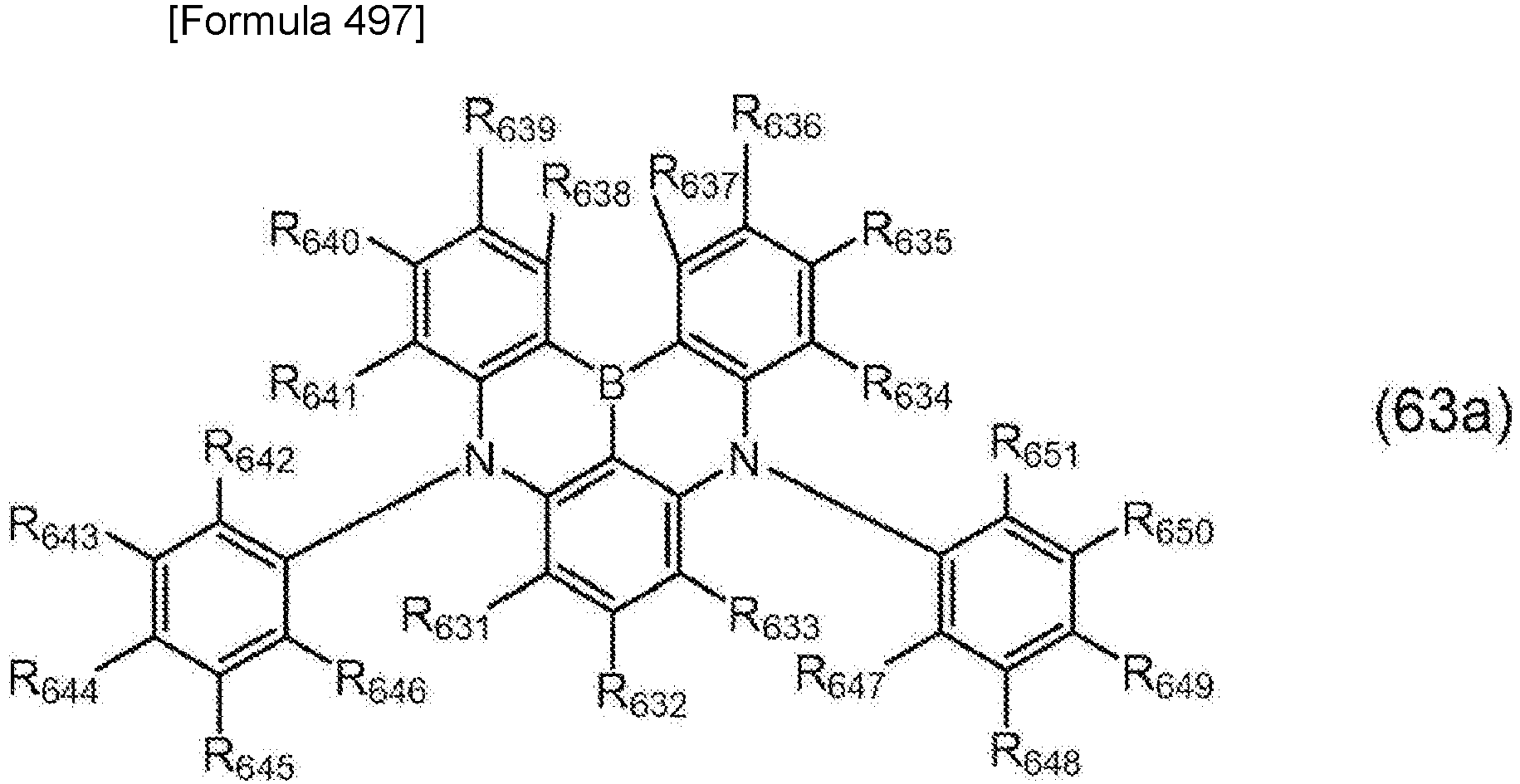
- In the formula (63a):
- R631 is bonded with R646 to form a substituted or unsubstituted heterocycle, or not bonded to form no substituted or unsubstituted heterocycle;
- R633 is bonded with R647 to form a substituted or unsubstituted heterocycle, or not bonded to form no substituted or unsubstituted heterocycle;
- R634 is bonded with R651 to form a substituted or unsubstituted heterocycle, or not bonded to form no substituted or unsubstituted heterocycle;
- R641 is bonded with R642 to form a substituted or unsubstituted heterocycle, or not bonded to form no substituted or unsubstituted heterocycle;
- at least one combination of adjacent two or more of R631 to R651 are mutually bonded to form a substituted or unsubstituted monocyclic ring, mutually bonded to form a substituted or unsubstituted fused ring, or not mutually bonded;
- R631 to R651 not forming the substituted or unsubstituted heterocycle, the substituted or unsubstituted monocyclic ring, and the substituted or unsubstituted fused ring are each independently a hydrogen atom, a halogen atom, a cyano group, a nitro group, a substituted or unsubstituted alkyl group having 1 to 50 carbon atoms, a substituted or unsubstituted alkenyl group having 2 to 50 carbon atoms, a substituted or unsubstituted alkynyl group having 2 to 50 carbon atoms, a substituted or unsubstituted cycloalkyl group having 3 to 50 ring carbon atoms, a group represented by -Si(R901)(R902)(R903), a group Represented by -O-(R904), a group represented by -S-(R905), a group represented by -N(R906)(R907), a substituted or unsubstituted aryl group having 6 to 50 ring carbon atoms, or a substituted or unsubstituted heterocyclic group having 5 to 50 ring atoms; and
- at least one of R631 to R651 not forming the substituted or unsubstituted heterocycle, the substituted or unsubstituted monocyclic ring, and the substituted or unsubstituted fused ring is a halogen atom, a cyano group, a nitro group, a substituted or unsubstituted alkyl group having 1 to 50 carbon atoms, a substituted or unsubstituted alkenyl group having 2 to 50 carbon atoms, a substituted or unsubstituted alkynyl group having 2 to 50 carbon atoms, a substituted or unsubstituted cycloalkyl group having 3 to 50 ring carbon atoms, a group represented by -Si(R901)(R902)(R903), a group Represented by -O-(R904), a group represented by - S-(R905), a group represented by -N(R906)(R907), a halogen atom, a cyano group, a nitro group, a substituted or unsubstituted aryl group having 6 to 50 ring carbon atoms, or a substituted or unsubstituted heterocyclic group having 5 to 50 ring atoms.
- In an exemplary embodiment, a compound represented by the formula (4) is a compound represented by the formula (41-3), the formula (41-4), or the formula (41-5), the A1 ring in the formula (41-5) being a substituted or unsubstituted fused aromatic hydrocarbon ring having 10 to 50 ring carbon atoms, or a substituted or unsubstituted fused heterocycle having 8 to 50 ring atoms.
- In an exemplary embodiment, the substituted or unsubstituted fused aromatic hydrocarbon ring having 10 to 50 ring carbon atoms in the formulae (41-3), (41-4) and (41-5) is a substituted or unsubstituted naphthalene ring, a substituted or unsubstituted anthracene ring, or a substituted or unsubstituted fluorene ring; and
the substituted or unsubstituted fused heterocycle having 8 to 50 ring atoms is a substituted or unsubstituted dibenzofuran ring, a substituted or unsubstituted carbazole ring, or a substituted or unsubstituted dibenzothiophene ring. - In an exemplary embodiment, the substituted or unsubstituted fused aromatic hydrocarbon ring having 10 to 50 ring carbon atoms in the formula (41-3), (41-4) or (41-5) is a substituted or unsubstituted naphthalene ring, or a substituted or unsubstituted fluorene ring; and
the substituted or unsubstituted fused heterocycle having 8 to 50 ring atoms is a substituted or unsubstituted dibenzofuran ring, a substituted or unsubstituted carbazole ring, or a substituted or unsubstituted dibenzothiophene ring. - In an exemplary embodiment, a compound represented by the formula (4) is selected from the group consisting of a compound represented by a formula (461) below, a compound represented by a formula (462) below, a compound represented by a formula (463) below, a compound represented by a formula (464) below, a compound represented by a formula (465) below, a compound represented by a formula (466) below, and a compound represented by a formula (467) below.


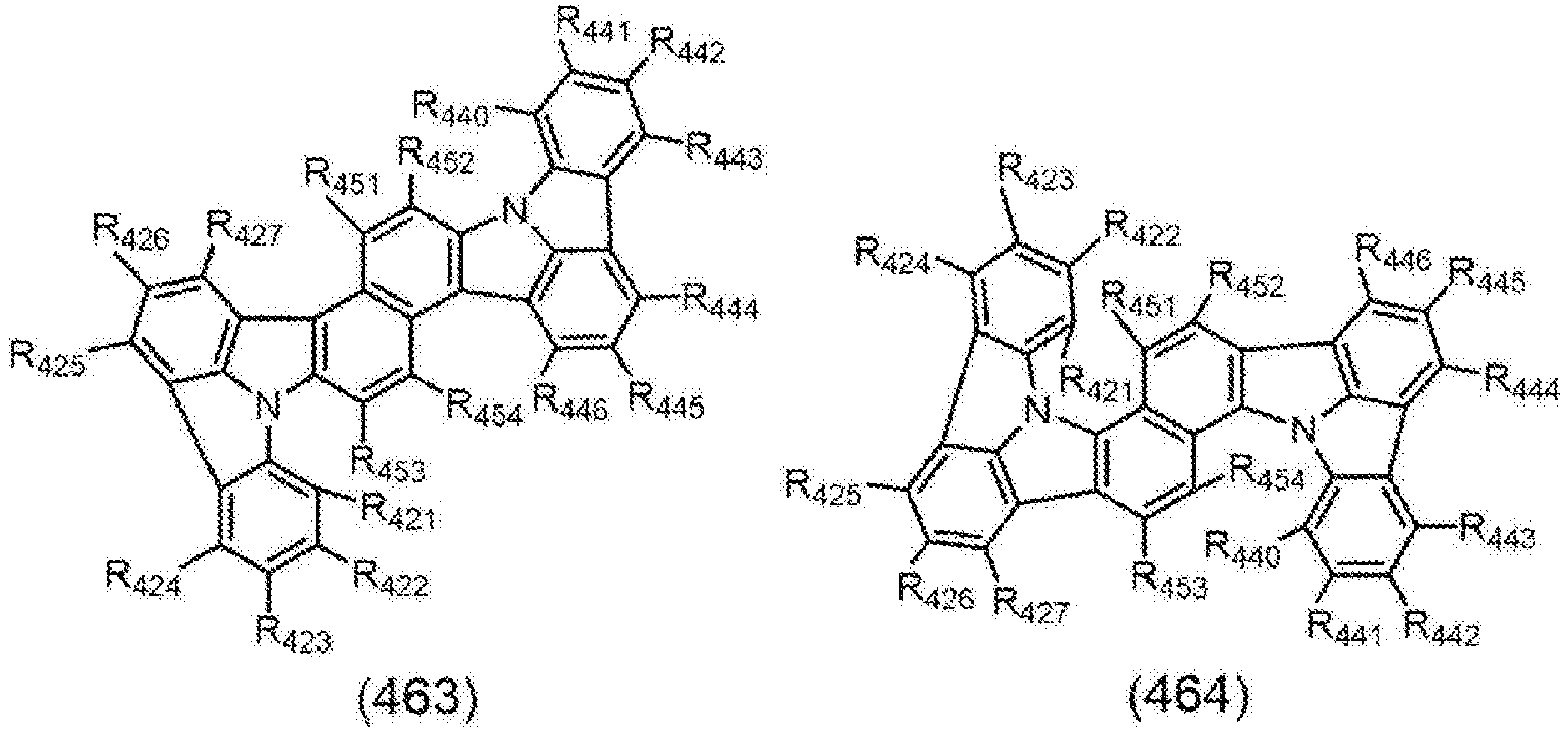


- In the formulae (461) to (467): at least one combination of adjacent two or more of R421 to R427, R431 to R436, R440 to R448, and R451 to R454 are mutually bonded to form a substituted or unsubstituted monocyclic ring, mutually bonded to form a substituted or unsubstituted fused ring, or not mutually bonded;
- R421 to R427, R431 to R436, R440 to R448 and R451 to R454 forming neither the substituted or unsubstituted monocyclic ring nor the substituted or unsubstituted fused ring, and R437 and R438 are each independently a hydrogen atom, a substituted or unsubstituted alkyl group having 1 to 50 carbon atoms, a substituted or unsubstituted alkenyl group having 2 to 50 carbon atoms, a substituted or unsubstituted alkynyl group having 2 to 50 carbon atoms, a substituted or unsubstituted cycloalkyl group having 3 to 50 ring carbon atoms, a group represented by -Si(R901)(R902)(R903), a group Represented by -O-(R904), a group represented by - S-(R905), a group represented by -N(R906)(R907), a halogen atom, a cyano group, a nitro group, a substituted or unsubstituted aryl group having 6 to 50 ring carbon atoms, or a substituted or unsubstituted heterocyclic group having 5 to 50 ring atoms;
- X4 is an oxygen atom, NR801, or C(R802)(R803);
- R801, R802, and R803 are each independently a hydrogen atom, a substituted or unsubstituted alkyl group having 1 to 50 carbon atoms, a substituted or unsubstituted cycloalkyl group having 3 to 50 ring carbon atoms, a substituted or unsubstituted aryl group having 6 to 50 ring carbon atoms, or a substituted or unsubstituted heterocyclic group having 5 to 50 ring atoms;
- a substituted or unsubstituted alkyl group having 1 to 50 carbon atoms, or a substituted or unsubstituted aryl group having 6 to 50 ring carbon atoms;
- when a plurality of R801 are present, the plurality of R801 are mutually the same or different;
- when a plurality of R802 are present, the plurality of R802 are mutually the same or different; and
- when a plurality of R803 are present, the plurality of R803 are mutually the same or different.
- In an exemplary embodiment, R421 to R427 and R440 to R448 are each independently a hydrogen atom, a substituted or unsubstituted aryl group having 6 to 50 ring carbon atoms, or a substituted or unsubstituted heterocyclic group having 5 to 50 ring atoms.
- In an exemplary embodiment, R421 to R427 and R440 to R447 are each independently selected from the group consisting of a hydrogen atom, a substituted or unsubstituted aryl group having 6 to 18 ring carbon atoms, and a substituted or unsubstituted heterocyclic group having 5 to 18 ring atoms.
- In an exemplary embodiment, a compound represented by the formula (41-3) is a compound represented by a formula (41-3-1) below.


- In the formula (41-3-1), R423, R425, R426, R442, R444 and R445 each independently represent the same as R423, R425, R426, R442, R444 and R445 in the formula (41-3).
- In an exemplary embodiment, a compound represented by the formula (41-3) is a compound represented by a formula (41-3-2) below.

- In the formula (41-3-2), R421 to R427 and R440 to R448 each independently represent the same as R421 to R427 and R440 to R448 in the formula (41-3); and
at least one of R421 to R427 or R440 to R446 is a group represented by - N(R906)(R907). - In an exemplary embodiment, two of R421 to R427 and R440 to R446 in the formula (41-3-2) are each a group represented by -N(R906)(R907).
- In an exemplary embodiment, a compound represented by the formula (41-3-2) is a compound represented by a formula (41-3-3) below.

- In the formula (41-3-3), R421 to R424, R440 to R443, R447, and R448 each independently represent the same as R421 to R424, R440 to R443, R447, and R448 in the formula (41-3); and
RA, RB, Rc, and RD are each independently a substituted or unsubstituted aryl group having 6 to 18 ring carbon atoms, or a substituted or unsubstituted heterocyclic group having 5 to 18 ring atoms. - In an exemplary embodiment, a compound represented by the formula (41-3-3) is a compound represented by a formula (41-3-4) below.

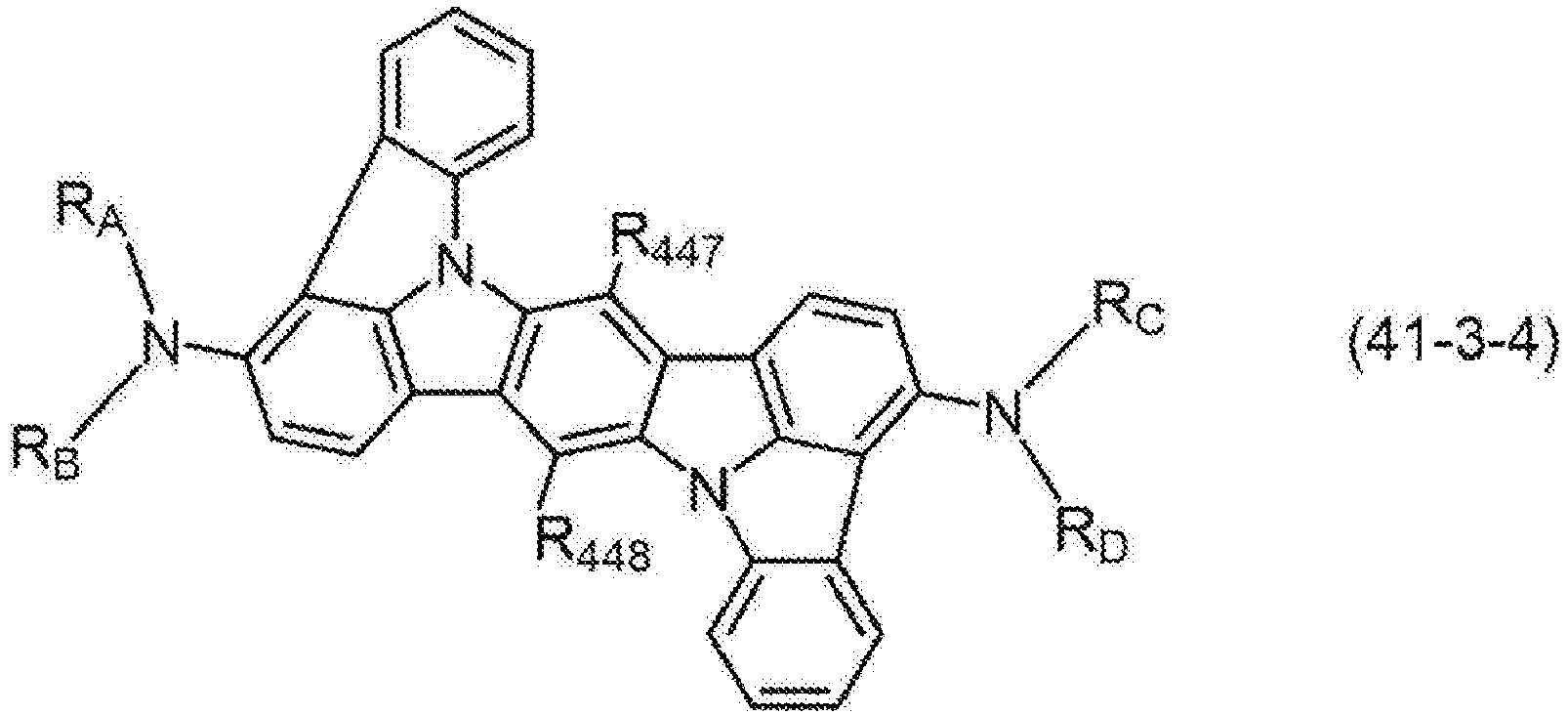
- In the formula (41-3-4), R447, R448, RA, RB, Rc and RD each independently represent the same as R447, R448, RA, RB, Rc and RD in the formula (41-3-3).
- In an exemplary embodiment, RA, RB, RC, and RD are each independently a substituted or unsubstituted aryl group having 6 to 18 ring carbon atoms.
- In an exemplary embodiment, RA, RB, RC, and RD are each independently a substituted or unsubstituted phenyl group.
- In an exemplary embodiment, R447 and R448 are each a hydrogen atom.
- In an exemplary embodiment, a substituent for "substituted or unsubstituted" group in each of the formulae is an unsubstituted alkyl group having 1 to 50 carbon atoms, an unsubstituted alkenyl group having 2 to 50 carbon atoms, an unsubstituted alkynyl group having 2 to 50 carbon atoms, an unsubstituted cycloalkyl group having 3 to 50 ring carbon atoms, -Si(R901a)(R902a)(R903a), -O-(R904a), -S-(R905a), - N(R906a)(R907a), a halogen atom, a cyano group, a nitro group, an unsubstituted aryl group having 6 to 50 ring carbon atoms, or an unsubstituted heterocyclic group having 5 to 50 ring atoms;
- R901a to R907a are each independently a hydrogen atom, an unsubstituted alkyl group having 1 to 50 carbon atoms, an unsubstituted aryl group having 6 to 50 ring carbon atoms, or an unsubstituted heterocyclic group having 5 to 50 ring atoms;
- when two or more R901a are present, the two or more R901a are mutually the same or different;
- when two or more R902a are present, the two or more R902a are mutually the same or different;
- when two or more R903a are present, the two or more R903a are mutually the same or different;
- when two or more R904a are present, the two or more R904a are mutually the same or different;
- when two or more R905a are present, the two or more R905a are mutually the same or different;
- when two or more R906a are present, the two or more R906a are mutually the same or different; and
- when two or more R907a are present, the two or more R907a are mutually the same or different.
- In an exemplary embodiment, a substituent for "substituted or unsubstituted" group in each of the formulae is an unsubstituted alkyl group having 1 to 50 carbon atoms, an unsubstituted aryl group having 6 to 50 ring carbon atoms, or an unsubstituted heterocyclic group having 5 to 50 ring atoms.
- In an exemplary embodiment, a substituent for "substituted or unsubstituted" group in each of the formulae is an unsubstituted alkyl group having 1 to 18 carbon atoms, an unsubstituted aryl group having 6 to 18 ring carbon atoms, or an unsubstituted heterocyclic group having 5 to 18 ring atoms.
- In the organic EL device according to the exemplary embodiment, it is preferable that the first emitting layer further contains the third compound that fluoresces and the third compound is a compound emitting a light having a main peak wavelength in a range from 430 nm to 480 nm.
- In the organic EL device according to the exemplary embodiment, it is preferable that the second emitting layer further contains the fourth compound that fluoresces and the fourth compound is a compound emitting a light having a main peak wavelength in a range from 430 nm to 480 nm.
- A measurement method of a main peak wavelength of the compound is as follows. A toluene solution of a measurement target compound at a concentration ranging from 10-6 mol/L to 10-5 mol/L is prepared and put in a quartz cell. An emission spectrum (ordinate axis: emission intensity, abscissa axis: wavelength) of the thus-obtained sample is measured at a normal temperature (300K). The emission spectrum is measurable using a spectrophotometer (machine name: F-7000) manufactured by Hitachi High-Tech Science Corporation. It should be noted that the machine for measuring the emission spectrum is not limited to the machine used herein.
- A peak wavelength of the emission spectrum exhibiting the maximum luminous intensity is defined as a main peak wavelength. It should be noted that the main peak wavelength is sometimes referred to as a fluorescence main peak wavelength (FL-peak) herein.
- In a case where the first emitting layer contains the first compound and the third compound in the organic EL device according to the exemplary embodiment, it is preferable that the first compound is a host material (sometimes referred to as a matrix material) and the third compound is a dopant material (sometimes referred to as a guest material, emitter, or luminescent material).
- When the first emitting layer of the organic EL device according to the exemplary embodiment contains the first compound and the third compound, a singlet energy S1(H1) of the first compound and a singlet energy S1(D3) of the third compound preferably satisfy a relationship of a numerical formula (Numerical Formula 1) below.

- In a case where the second emitting layer contains the second compound and the fourth compound in the organic EL device according to the exemplary embodiment, it is preferable that the second compound is a host material (sometimes referred to as a matrix material) and the fourth compound is a dopant material (sometimes referred to as a guest material, emitter, or luminescent material).
- When the second emitting layer of the organic EL device according to the exemplary embodiment contains the second compound and the fourth compound, a singlet energy S1(H2) of the second compound and a singlet energy S1(D4) of the fourth compound preferably satisfy a relationship of a numerical formula (Numerical Formula 2) below.

- A method of measuring a singlet energy S1 with use of a solution (sometimes referred to as a solution method) is exemplified by a method below.
- A toluene solution of a measurement target compound at a concentration ranging from 10-5 mol/L to 10-4 mol/L is prepared and put in a quartz cell. An absorption spectrum (ordinate axis: absorption intensity, abscissa axis: wavelength) of the thus-obtained sample is measured at a normal temperature (300K). A tangent is drawn to the fall of the absorption spectrum close to the long-wavelength region, and a wavelength value λedge (nm) at an intersection of the tangent and the abscissa axis is assigned to a conversion equation (F2) below to calculate singlet energy.

- Any device for measuring absorption spectrum is usable. For instance, a spectrophotometer (U3310 manufactured by Hitachi, Ltd.) is usable.
- The tangent to the fall of the absorption spectrum close to the long-wavelength region is drawn as follows. While moving on a curve of the absorption spectrum from the local maximum value closest to the long-wavelength region, among the local maximum values of the absorption spectrum, in a long-wavelength direction, a tangent at each point on the curve is checked. An inclination of the tangent is decreased and increased in a repeated manner as the curve falls (i.e., a value of the ordinate axis is decreased). A tangent drawn at a point where the inclination of the curve is the local minimum closest to the long-wavelength region (except when absorbance is 0.1 or less) is defined as the tangent to the fall of the absorption spectrum close to the long-wavelength region.
- The local maximum absorbance of 0.2 or less is not counted as the above-mentioned local maximum absorbance closest to the long-wavelength region.
- In the organic EL device according to the exemplary embodiment, an electron mobility µH1 of the first compound and an electron mobility µH2 of the second compound also preferably satisfy a relationship of a numerical formula (Numerical Formula 3) below.

- When the first compound and the second compound satisfy the relationship of the numerical formula (Numerical Formula 3), a recombination ability of holes and electrons in the first emitting layer is improved.
- The electron mobility can be measured according to impedance spectroscopy.
- A measurement target layer having a thickness in a range from 100 nm to 200 nm is held between the anode and the cathode, to which a small alternating voltage of 100 mV or less is applied while a bias DC voltage is applied. A value of an alternating current (absolute value and phase) which flows at this time is measured. This measurement is performed while changing a frequency of the alternating voltage, and complex impedance (Z) is calculated from the current value and the voltage value. A frequency dependency of the imaginary part (ImM) of the modulus M = iωZ (i: imaginary unit, ω: angular frequency) is obtained. The reciprocal number of a frequency ω at which the ImM becomes the maximum is defined as a response time of electrons carried in the measurement target layer. The electron mobility is calculated by the following equation.

- The first emitting layer and the second emitting layer preferably do not contain a phosphorescent material (dopant material).
- The first emitting layer and the second emitting layer preferably do not contain a heavy metal complex and a phosphorescent rare earth metal complex. Examples of the heavy-metal complex herein include iridium complex, osmium complex, and platinum complex.
- Further, the first emitting layer and the second emitting layer also preferably do not contain a metal complex.
- A film thickness of the emitting layer of the organic EL device according to the exemplary embodiment is preferably in a range from 5 nm to 50 nm, more preferably in a range from 7 nm to 50 nm, further preferably in a range from 10 nm to 50 nm. When the film thickness of the emitting layer is 5 nm or more, the emitting layer is easily formable and chromaticity is easily adjustable. When the film thickness of the emitting layer is 50 nm or less, a rise in the drive voltage is easily reducible.
- When the first emitting layer contains the first compound and the third compound, a content ratio of each of the first compound and the third compound in the first emitting layer preferably falls, for instance, within a range below.
- The content ratio of the first compound is preferably in a range from 80 mass% to 99 mass%, more preferably in a range from 90 mass% to 99 mass%, further preferably in a range from 95 mass% to 99 mass%.
- The content ratio of the third compound is preferably in a range from 1 mass% to 10 mass%, more preferably in a range from 1 mass% to 7 mass%, further preferably in a range from 1 mass% to 5 mass%.
- The upper limit of the total of the content ratios of the first compound and the third compound in the first emitting layer is 100 mass%.
- It is not excluded that the first emitting layer of the exemplary embodiment further contains a material(s) other than the first and third compounds.
- The first emitting layer may contain a single type of the first compound or two or more types of the first compound. The first emitting layer may contain a single type of the third compound or two or more types of the third compound.
- When the second emitting layer contains the second compound and the fourth compound, a content ratio of each of the second compound and the fourth compound in the second emitting layer preferably falls, for instance, within a range below.
- The content ratio of the second compound is preferably in a range from 80 mass% to 99 mass%, more preferably in a range from 90 mass% to 99 mass%, further preferably in a range from 95 mass% to 99 mass%.
- The content ratio of the fourth compound is preferably in a range from 1 mass% to 10 mass%, more preferably in a range from 1 mass% to 7 mass%, further preferably in a range from 1 mass% to 5 mass%.
- The upper limit of the total of the content ratios of the second compound and the fourth compound in the second emitting layer is 100 mass%.
- It is not excluded that the second emitting layer of the exemplary embodiment further contains a material(s) other than the second and fourth compounds.
- The second emitting layer may contain a single type of the second compound or two or more types of the second compound. The second emitting layer may contain a single type of the fourth compound or two or more types of the fourth compound.
- An arrangement of an organic EL device will be further described below. It should be noted that the reference numerals will be sometimes omitted below.
- The substrate is used as a support for the organic EL device. For instance, glass, quartz, plastics and the like are usable for the substrate. A flexible substrate is also usable. The flexible substrate is a bendable substrate, which is exemplified by a plastic substrate. Examples of the material for the plastic substrate include polycarbonate, polyarylate, polyethersulfone, polypropylene, polyester, polyvinyl fluoride, polyvinyl chloride, polyimide, and polyethylene naphthalate. Moreover, an inorganic vapor deposition film is also usable.
- Metal, an alloy, an electrically conductive compound, a mixture thereof, or the like having a large work function (specifically, 4.0 eV or more) is preferably used as the anode formed on the substrate. Specific examples of the material include ITO (Indium Tin Oxide), indium oxide-tin oxide containing silicon or silicon oxide, indium oxide-zinc oxide, indium oxide containing tungsten oxide and zinc oxide, and graphene. In addition, gold (Au), platinum (Pt), nickel (Ni), tungsten (W), chrome (Cr), molybdenum (Mo), iron (Fe), cobalt (Co), copper (Cu), palladium (Pd), titanium (Ti), and nitrides of a metal material (e.g., titanium nitride) are usable.
- The material is typically formed into a film by a sputtering method. For instance, the indium oxide-zinc oxide can be formed into a film by the sputtering method using a target in which zinc oxide in a range from 1 mass% to 10 mass% is added to indium oxide. Moreover, for instance, the indium oxide containing tungsten oxide and zinc oxide can be formed by the sputtering method using a target in which tungsten oxide in a range from 0.5 mass% to 5 mass% and zinc oxide in a range from 0.1 mass% to 1 mass% are added to indium oxide. In addition, the anode may be formed by a vacuum deposition method, a coating method, an inkjet method, a spin coating method or the like.
- Among the organic layers formed on the anode, since the hole injecting layer adjacent to the anode is formed of a composite material into which holes are easily injectable irrespective of the work function of the anode, a material usable as an electrode material (e.g., metal, an alloy, an electroconductive compound, a mixture thereof, and the elements belonging to the
group 1 or 2 of the periodic table) is also usable for the anode. - A material having a small work function such as elements belonging to
Groups 1 and 2 in the periodic table of the elements, specifically, an alkali metal such as lithium (Li) and cesium (Cs), an alkaline earth metal such as magnesium (Mg), calcium (Ca) and strontium (Sr), alloys (e.g., MgAg and AlLi) including the alkali metal or the alkaline earth metal, a rare earth metal such as europium (Eu) and ytterbium (Yb), alloys including the rare earth metal are also usable for the anode. It should be noted that the vacuum deposition method and the sputtering method are usable for forming the anode using the alkali metal, alkaline earth metal and the alloy thereof. Further, when a silver paste is used for the anode, the coating method and the inkjet method are usable. - It is preferable to use metal, an alloy, an electroconductive compound, a mixture thereof, or the like having a small work function (specifically, 3.8 eV or less) for the cathode. Examples of the material for the cathode include elements belonging to
Groups 1 and 2 in the periodic table of the elements, specifically, the alkali metal such as lithium (Li) and cesium (Cs), the alkaline earth metal such as magnesium (Mg), calcium (Ca) and strontium (Sr), alloys (e.g., MgAg and AlLi) including the alkali metal or the alkaline earth metal, the rare earth metal such as europium (Eu) and ytterbium (Yb), and alloys including the rare earth metal. - It should be noted that the vacuum deposition method and the sputtering method are usable for forming the cathode using the alkali metal, alkaline earth metal and the alloy thereof. Further, when a silver paste is used for the cathode, the coating method and the inkjet method are usable.
- By providing the electron injecting layer, various conductive materials such as Al, Ag, ITO, graphene, and indium oxide-tin oxide containing silicon or silicon oxide may be used for forming the cathode regardless of the work function. The conductive materials can be formed into a film using the sputtering method, inkjet method, spin coating method and the like.
- The hole injecting layer is a layer containing a substance exhibiting a high hole injectability. Examples of the substance exhibiting a high hole injectability include molybdenum oxide, titanium oxide, vanadium oxide, rhenium oxide, ruthenium oxide, chrome oxide, zirconium oxide, hafnium oxide, tantalum oxide, silver oxide, tungsten oxide, and manganese oxide.
- In addition, the examples of the highly hole-injectable substance further include: an aromatic amine compound, which is a low-molecule organic compound, such as 4,4',4"-tris(N,N-diphenylamino)triphenylamine (abbreviation: TDATA), 4,4',4"-tris[N-(3-methylphenyl)-N-phenylamino]triphenylamine (abbreviation: MTDATA), 4,4'-bis[N-(4-diphenylaminophenyl)-N-phenylamino]biphenyl (abbreviation: DPAB), 4,4'-bis(N-{4-[N'-(3-methylphenyl)-N'-phenylamino]phenyl}-N-phenylamino)biphenyl (abbreviation: DNTPD), 1,3,5-tris[N-(4-diphenylaminophenyl)-N-phenylamino]benzene (abbreviation: DPA3B), 3-[N-(9-phenylcarbazole-3-yl)-N-phenylamino]-9-phenylcarbazole (abbreviation: PCzPCA1), 3,6-bis[N-(9-phenylcarbazole-3-yl)-N-phenylamino]-9-phenylcarbazole (abbreviation: PCzPCA2), and 3-[N-(1-naphthyl)-N-(9-phenylcarbazole-3-yl)amino]-9-phenylcarbazole (abbreviation: PCzPCN1); and dipyrazino[2,3-f:20,30-h]quinoxaline-2,3,6,7,10,11-hexacarbonitrile (HAT-CN).
- In addition, a high polymer compound (e.g., oligomer, dendrimer and polymer) is usable as the substance exhibiting a high hole injectability. Examples of the high-molecule compound include poly(N-vinylcarbazole) (abbreviation: PVK), poly(4-vinyltriphenylamine) (abbreviation: PVTPA), poly[N-(4-{N'-[4-(4-diphenylamino)phenyl]phenyl-N'-phenylamino}phenyl)methacrylamide] (abbreviation: PTPDMA), and poly[N,N'-bis(4-butylphenyl)-N,N'-bis(phenyl)benzidine] (abbreviation: Poly-TPD). Moreover, an acid-added high polymer compound such as poly(3,4-ethylenedioxythiophene)/poly(styrene sulfonic acid) (PEDOT/PSS) and polyaniline/poly(styrene sulfonic acid) (PAni/PSS) are also usable.
- The hole transporting layer is a layer containing a highly hole-transporting substance. An aromatic amine compound, carbazole derivative, anthracene derivative and the like are usable for the hole transporting layer. Specific examples of a material for the hole transporting layer include 4,4'-bis[N-(1-naphthyl)-N-phenylamino]biphenyl (abbreviation: NPB), N,N'-bis(3-methylphenyl)-N,N'-diphenyl-[1,1'-biphenyl]-4,4'-diamine (abbreviation: TPD), 4-phenyl-4'-(9-phenylfluorene-9-yl)triphenylamine (abbreviation: BAFLP), 4,4'-bis[N-(9,9-dimethylfluorene-2-yl)-N-phenylamino]biphenyl (abbreviation: DFLDPBi), 4,4',4"-tris(N,N-diphenylamino)triphenylamine (abbreviation: TDATA), 4,4',4''-tris[N-(3-methylphenyl)-N-phenylamino]triphenylamine (abbreviation: MTDATA), and 4,4'-bis[N-(spiro-9,9'-bifluorene-2-yl)-N-phenylamino]biphenyl (abbreviation: BSPB). The above-described substances mostly have a hole mobility of 10-6 cm2/(V·s) or more.
- For the hole transporting layer, a carbazole derivative such as CBP, 9-[4-(N-carbazolyl)]phenyl-10-phenylanthracene (CzPA), and 9-phenyl-3-[4-(10-phenyl-9-anthryl)phenyl]-9H-carbazole (PCzPA) and an anthracene derivative such as t-BuDNA, DNA, and DPAnth may be used. A high polymer compound such as poly(N-vinylcarbazole) (abbreviation: PVK) and poly(4-vinyltriphenylamine) (abbreviation: PVTPA) is also usable.
- However, in addition to the above substances, any substance exhibiting a higher hole transportability than an electron transportability may be used. It should be noted that the layer containing the substance exhibiting a high hole transportability may be not only a single layer but also a laminate of two or more layers formed of the above substance(s).
- The electron transporting layer is a layer containing a highly electron-transporting substance. For the electron transporting layer, 1) a metal complex such as an aluminum complex, beryllium complex, and zinc complex, 2) a hetero aromatic compound such as imidazole derivative, benzimidazole derivative, azine derivative, carbazole derivative, and phenanthroline derivative, and 3) a high polymer compound are usable. Specifically, as a low-molecule organic compound, a metal complex such as Alq, tris(4-methyl-8-quinolinato)aluminum (abbreviation: Almq3), bis(10-hydroxybenzo[h]quinolinato)beryllium (abbreviation: BeBq2), BAlq, Znq, ZnPBO and ZnBTZ is usable. In addition to the metal complex, a heteroaromatic compound such as 2-(4-biphenylyl)-5-(4-tert-butylphenyl)-1,3,4-oxadiazole (abbreviation: PBD), 1,3-bis[5-(ptert-butylphenyl)-1,3,4-oxadiazole-2-yl]benzene (abbreviation: OXD-7), 3-(4-tert-butylphenyl)-4-phenyl-5-(4-biphenylyl)-1,2,4-triazole (abbreviation: TAZ), 3-(4-tert-butylphenyl)-4-(4-ethylphenyl)-5-(4-biphenylyl)-1,2,4-triazole (abbreviation: p-EtTAZ), bathophenanthroline (abbreviation: BPhen), bathocuproine (abbreviation: BCP), and 4,4'-bis(5-methylbenzoxazole-2-yl)stilbene (abbreviation: BzOs) is usable. In the exemplary embodiment, a benzimidazole compound is preferably usable. The above-described substances mostly have an electron mobility of 10-6 cm2/Vs or more. It should be noted that any substance other than the above substance may be used for the electron transporting layer as long as the substance exhibits a higher electron transportability than the hole transportability. The electron transporting layer may be provided in the form of a single layer or a laminate of two or more layers of the above substance(s).
- Specific examples of the compound usable for the electron transporting layer include compounds below. It should however be noted that the invention is not limited to the specific examples of the compound.


- Further, a high polymer compound is usable for the electron transporting layer. For instance, poly[(9,9-dihexylfluorene-2,7-diyl)-co-(pyridine-3,5-diyl)] (abbreviation: PF-Py), poly[(9,9-dioctylfluorene-2,7-diyl)-co-(2,2'-bipyridine-6,6'-diyl)] (abbreviation: PF-BPy) and the like are usable.
- The electron injecting layer is a layer containing a highly electron-injectable substance. Examples of a material for the electron injecting layer include an alkali metal, alkaline earth metal and a compound thereof, examples of which include lithium (Li), cesium (Cs), calcium (Ca), lithium fluoride (LiF), cesium fluoride (CsF), calcium fluoride (CaF2), and lithium oxide (LiOx). In addition, the alkali metal, alkaline earth metal or the compound thereof may be added to the substance exhibiting the electron transportability in use. Specifically, for instance, magnesium (Mg) added to Alq may be used. In this case, the electrons can be more efficiently injected from the cathode.
- Alternatively, the electron injecting layer may be provided by a composite material in a form of a mixture of the organic compound and the electron donor. Such a composite material exhibits excellent electron injectability and electron transportability since electrons are generated in the organic compound by the electron donor. In this case, the organic compound is preferably a material excellent in transporting the generated electrons. Specifically, the above examples (e.g., the metal complex and the hetero aromatic compound) of the substance forming the electron transporting layer are usable. As the electron donor, any substance exhibiting electron donating property to the organic compound is usable. Specifically, the electron donor is preferably alkali metal, alkaline earth metal and rare earth metal such as lithium, cesium, magnesium, calcium, erbium and ytterbium. The electron donor is also preferably alkali metal oxide and alkaline earth metal oxide such as lithium oxide, calcium oxide, and barium oxide. Moreover, a Lewis base such as magnesium oxide is usable. Further, the organic compound such as tetrathiafulvalene (abbreviation: TTF) is usable.
- A method for forming each layer of the organic EL device in the exemplary embodiment is subject to no limitation except for the above particular description. However, known methods of dry film-forming such as vacuum deposition, sputtering, plasma or ion plating and wet film-forming such as spin coating, dipping, flow coating or ink-jet are applicable.
- A film thickness of each of the organic layers of the organic EL device in the exemplary embodiment is not limited unless otherwise specified in the above. In general, the thickness preferably ranges from several nanometers to 1 µm because excessively small film thickness is likely to cause defects (e.g. pin holes) and excessively large thickness leads to the necessity of applying high voltage and consequent reduction in efficiency.
- The organic electroluminescence device according to the exemplary embodiment preferably emits light having a main peak wavelength in a range from 430 nm to 480 nm when the organic electroluminescence device is driven.
- The main peak wavelength of the light emitted from the organic EL device when being driven is measured as follows. Voltage is applied on the organic EL devices such that a current density becomes 10 mA/cm2, where spectral radiance spectrum is measured by a spectroradiometer CS-2000 (manufactured by Konica Minolta, Inc.). A peak wavelength of an emission spectrum, at which the luminous intensity of the resultant spectral radiance spectrum is at the maximum, is measured and defined as the main peak wavelength (unit: nm).
- The organic EL device according to the exemplary embodiment can improve device performance. Moreover, in the organic EL device according to the exemplary embodiment in which a plurality of emitting layers are layered, since the emitting layer close to the anode (first emitting layer) contains the compound according to the first exemplary embodiment, a balance between a luminous efficiency and a lifetime can be expected to be favorable.
- An electronic device according to a fourth exemplary embodiment is installed with any one of the organic EL devices according to the above exemplary embodiments. Examples of the electronic device include a display device and a light-emitting unit. Examples of the display device include a display component (e.g., an organic EL panel module), TV, mobile phone, tablet and personal computer. Examples of the light-emitting unit include an illuminator and a vehicle light.
- The scope of the invention is not limited by the above-described exemplary embodiments but includes any modification and improvement as long as such modification and improvement are compatible with the invention.
- For instance, the emitting layer does not necessarily include a single layer or two emitting layers, but may include a plurality, i.e., exceeding two, of emitting layers layered. In a case where the organic EL device includes a plurality of emitting layers, it is only required that one or two of the emitting layers satisfy the conditions described in the above exemplary embodiments. For instance, the rest of the emitting layers may be a fluorescent emitting layer or a phosphorescent emitting layer with use of emission caused by electron transfer from the triplet excited state directly to the ground state.
- When the organic EL device includes a plurality of emitting layers, these emitting layers may be mutually adjacently provided, or may form a so-called tandem organic EL device, in which a plurality of emitting units are layered via an intermediate layer.
- For instance, a blocking layer may be provided adjacent to at least one of a side of the emitting layer close to the anode or a side of the emitting layer close to the cathode. The blocking layer is preferably provided in contact with the emitting layer to block at least any of holes, electrons, excitons or combinations thereof.
- For instance, when the blocking layer is provided in contact with the side of the emitting layer close to the cathode, the blocking layer permits transport of electrons, and blocks holes from reaching a layer provided closer to the cathode (e.g., the electron transporting layer) beyond the blocking layer. When the organic EL device includes the electron transporting layer, the blocking layer is preferably interposed between the emitting layer and the electron transporting layer.
- When the blocking layer is provided in contact with the side of the emitting layer close to the anode, the blocking layer permits transport of holes and blocks electrons from reaching a layer provided closer to the anode (e.g., the hole transporting layer) beyond the blocking layer. When the organic EL device includes the hole transporting layer, the blocking layer is preferably interposed between the emitting layer and the hole transporting layer.
- Alternatively, the blocking layer may be provided adjacent to the emitting layer so that the excitation energy does not leak out from the emitting layer toward neighboring layer(s). The blocking layer blocks excitons generated in the emitting layer from being transferred to a layer(s) (e.g., the electron transporting layer and the hole transporting layer) closer to the electrode(s) beyond the blocking layer.
- The emitting layer is preferably bonded with the blocking layer.
- Specific structure, shape and the like of the components in the invention may be designed in any manner as long as an object of the invention can be achieved. Examples
- The invention will be described in further detail with reference to Examples. It should be noted that the scope of the invention is by no means limited to Examples.
- Structures of a compound represented by a formula (1000B) used for manufacturing organic EL devices in Examples 1 to 31 are shown below.


- Structures of compounds used for manufacturing organic EL devices in Comparatives 4 to 7 are shown below.

- Structures of other compounds used for manufacturing organic EL devices in Examples 1 to 31 and Comparatives 1 to 9 are shown below.


- The organic EL devices were manufactured and evaluated as follows.
- A glass substrate (size: 25 mm × 75 mm × 1.1 mm thick, manufactured by Geomatec Co., Ltd.) having an ITO (Indium Tin Oxide) transparent electrode (anode) was ultrasonic-cleaned in isopropyl alcohol for five minutes, and then UV-ozone-cleaned for 30 minutes. A film thickness of the ITO transparent electrode was 130 nm.
- The cleaned glass substrate having the transparent electrode line was attached to a substrate holder of a vacuum deposition apparatus. First, a compound HIL-1 was vapor-deposited on a surface of the glass substrate, where the transparent electrode line was provided, to cover the transparent electrode, thereby forming a 5-nm-thick hole injecting layer.
- Subsequent to the formation of the hole injecting layer, a compound HTL-1 was vapor-deposited to form an 80-nm-thick first hole transporting layer.
- Subsequent to the formation of the first hole transporting layer, a compound EBL-1 was vapor-deposited to form a 10-nm-thick second hole transporting layer (also referred to as an electron blocking layer).
- A compound BH1-1 as the first compound and a compound BD-1 as the third compound were co-deposited on the second hole transporting layer such that a ratio of the compound BD-1 accounted for 2 mass%, thereby forming a 5-nm-thick first emitting layer.
- A compound BH2-3 as the second compound and a compound BD-1 as the fourth compound were co-deposited on the first emitting layer such that a ratio of the compound BD-1 accounted for 2 mass%, thereby forming a 20-nm-thick second emitting layer.
- A compound aET-1 was vapor-deposited on the second emitting layer to form a 10-nm-thick first electron transporting layer (also referred to as a hole blocking layer).
- A compound bET-1 was vapor-deposited on the first electron transporting layer to form a 15-nm-thick second electron transporting layer.
- LiF was vapor-deposited on the second electron transporting layer to form a 1-nm-thick electron injecting layer.
- Metal (Al) was vapor-deposited on the electron injecting layer to form an 80-nm-thick cathode.
- A device arrangement of the organic EL device in Example 1 is roughly shown as follows.
ITO(130) / HIL-1(5) / HTL-1(80) / EBL-1(10) / BH1-1:BD-1(5,98%:2%) / BH2-3:BD-1(20,98%:2%) / aET-1(10) / bET-1(15) / LiF(1) / Al(80) - The numerals in parentheses represent film thickness (unit: nm).
- The numerals (98%:2%) represented by percentage in the same parentheses indicate a ratio (mass%) between the compound BH1-1 or BH2-3 and the compound BD-1 in the first emitting layer or the second emitting layer. Similar notations apply to the description below.
- Each of organic EL devices of Examples 2, 3, 4, 5, 6, 7, 8, 9, 10, 11, 12, 13, and 14 was manufactured in the same manner as in Example 1 except that the first compound of the first emitting layer was replaced by compounds shown in Table 1.
- An organic EL device of Comparative 1 was manufactured in the same manner as in Example 1 except that a 25-nm-thick second emitting layer was formed on the second hole transporting layer without forming the first emitting layer as shown in Table 1.
- An organic EL device of
Comparative 2 was manufactured in the same manner as in Example 1 except that a 25-nm-thick first emitting layer was formed as the emitting layer and the first electron transporting layer was formed on the first emitting layer without forming the second emitting layer as shown in Table 1. - Each of organic EL devices of Comparatives 3, 4, and 5 was manufactured in the same manner as in
Comparative 2 except that the first compound of the first emitting layer was replaced by compounds shown in Table 1. - Each of organic EL devices of
Comparatives Table 1 First Emitting Layer Second Emitting Layer EQE [%] LT95 [h] First Compound Third Compound Thickness [nm] Second Compound Fourth Compound Thickness [nm] Ex. 1 BH1-1 BD-1 5 BH2-3 BD-1 20 10.3 140 Ex. 2 BH1-2 BD-1 5 BH2-3 BD-1 20 10.1 135 Ex. 3 BH1-3 BD-1 5 BH2-3 BD-1 20 9.9 130 Ex. 4 BH1-4 BD-1 5 BH2-3 BD-1 20 10.2 140 Ex. 5 BH1-5 BD-1 5 BH2-3 BD-1 20 10.0 135 Ex. 6 BH1-6 BD-1 5 BH2-3 BD-1 20 10.0 135 Ex. 7 BH1-7 BD-1 5 BH2-3 BD-1 20 10.1 165 Ex. 8 BH1-8 BD-1 5 BH2-3 BD-1 20 10.3 160 Ex. 9 BH1-9 BD-1 5 BH2-3 BD-1 20 10.1 195 Ex. 10 BH1-10 BD-1 5 BH2-3 BD-1 20 10.0 215 Ex. 11 BH1-11 BD-1 5 BH2-3 BD-1 20 10.5 125 Ex. 12 BH1-12 BD-1 5 BH2-3 BD-1 20 10.5 125 Ex. 13 BH1-13 BD-1 5 BH2-3 BD-1 20 10.5 150 Ex. 14 BH1-14 BD-1 5 BH2-3 BD-1 20 10.4 150 Comp. 1 - - - BH2-3 BD-1 25 9.8 130 Comp. 2 BH1-1 BD-1 25 - - - 8.2 10 Comp. 3 BH1-3 BD-1 25 - - - 7.9 8 Comp. 4 Ref-BH1-1 BD-1 25 - - - 7.1 4 Comp. 5 Ref-BH1-2 BD-1 25 - - - 8.1 55 Comp. 6 Ref-BH1-1 BD-1 5 BH2-3 BD-1 20 7.4 25 Comp. 7 Ref-BH1-2 BD-1 5 BH2-3 BD-1 20 8.2 75 - The organic EL devices in Examples 1 to 31 and Comparatives 1 to 9 were evaluated as follows. Evaluation results are shown in Tables 1, 2, 3, and 4.
- Voltage was applied on the organic EL devices so that a current density was 10 mA/cm2, where spectral radiance spectrum was measured by a spectroradiometer CS-2000 (manufactured by Konica Minolta, Inc.). The external quantum efficiency EQE (unit: %) was calculated based on the obtained spectral-radiance spectra, assuming that the spectra was provided under a Lambertian radiation.
- Voltage was applied on the resultant organic EL devices such that a current density was 50 mA/cm2, where a time (LT95 (unit: hr)) elapsed before a luminance intensity was reduced to 95% of the initial luminance intensity was measured.
- An organic EL device of Example 15 was manufactured in the same manner as in Example 1 except that the third compound of the first emitting layer and the fourth compound of the second emitting layer were replaced by compounds shown in Table 2.
- Each of organic EL devices of Examples 16, 17, 18, 19, 20, 21, 22, 23, and 24 was manufactured in the same manner as in Example 15 except that the first compound of the first emitting layer was replaced by compounds shown in Table 2.
- An organic EL device of
Comparative 8 was manufactured in the same manner as in Example 15 except that a 25-nm-thick second emitting layer was formed on the second hole transporting layer without forming the first emitting layer as shown in Table 2.Table 2 First Emitting Layer Second Emitting Layer EQE [%] LT9 5 [h] First Compound Third Compound Thickness [nm] Second Compound Fourth Compound Thickness [nm] Ex. 15 BH1-1 BD-2 5 BH2-3 BD-2 20 9.5 140 Ex. 16 BH1-6 BD-2 5 BH2-3 BD-2 20 9.4 135 Ex. 17 BH1-7 BD-2 5 BH2-3 BD-2 20 9.3 165 Ex. 18 BH1-8 BD-2 5 BH2-3 BD-2 20 9.5 160 Ex. 19 BH1-9 BD-2 5 BH2-3 BD-2 20 9.3 190 Ex. 20 BH1-10 BD-2 5 BH2-3 BD-2 20 9.2 210 Ex. 21 BH1-11 BD-2 5 BH2-3 BD-2 20 9.7 120 Ex. 22 BH1-12 BD-2 5 BH2-3 BD-2 20 9.7 115 Ex. 23 BH1-13 BD-2 5 BH2-3 BD-2 20 9.7 145 Ex. 24 BH1-14 BD-2 5 BH2-3 BD-2 20 9.6 150 Comp. 8 - - - BH2-3 BD-2 25 9.2 130 - A glass substrate (size: 25 mm × 75 mm × 1.1 mm thick, manufactured by Geomatec Co., Ltd.) having an ITO (Indium Tin Oxide) transparent electrode (anode) was ultrasonic-cleaned in isopropyl alcohol for five minutes, and then UV-ozone-cleaned for 30 minutes. A film thickness of the ITO transparent electrode was 130 nm.
- The cleaned glass substrate having the transparent electrode line was attached to a substrate holder of a vacuum deposition apparatus. First, a compound HTL-2 and a compound HIL-2 were co-deposited on a surface of the glass substrate, where the transparent electrode line was provided, to cover the transparent electrode, thereby forming a 10-nm-thick hole injecting layer. The compound HTL-2 and the compound HIL-2 were set at 90 mass% and 10 mass%, respectively, in ratio in the hole injecting layer.
- Subsequent to the formation of the hole injecting layer, the compound HTL-2 was vapor-deposited to form an 85-nm-thick first hole transporting layer.
- Subsequent to the formation of the first hole transporting layer, a compound EBL-2 was vapor-deposited to form a 5-nm-thick second hole transporting layer (also referred to as an electron blocking layer).
- The compound BH1-1 as the first compound and a compound BD-2 as the third compound were co-deposited on the second hole transporting layer such that a ratio of the compound BD-2 accounted for 2 mass%, thereby forming a 5-nm-thick first emitting layer.
- A compound BH2-4 as the second compound and the compound BD-2 as the fourth compound were co-deposited on the first emitting layer such that a ratio of the compound BD-2 accounted for 2 mass%, thereby forming a 15-nm-thick second emitting layer.
- A compound aET-2 was vapor-deposited on the second emitting layer to form a 5-nm-thick first electron transporting layer (also referred to as a hole blocking layer).
- A compound bET-2 and a compound Liq were co-deposited on the first electron transporting layer to form a 25-nm-thick second electron transporting layer. The compound bET-2 and the compound Liq were set at 50 mass% and 50 mass%, respectively, in ratio in the second electron transporting layer. Liq is an abbreviation of (8-quinolinolato)lithium ((8-Quinolinolato)lithium).
- The compound Liq was vapor-deposited on the second electron transporting layer to form a 1-nm-thick electron injecting layer.
- Metal (Al) was vapor-deposited on the electron injecting layer to form an 80-nm-thick cathode.
- A device arrangement of the organic EL device of Example 25 is roughly shown as follows.
ITO(130) / HTL-2:HIL-2(10,90%:10%) / HTL-2(85) / EBL-2(5) / BH1-1:BD-2(5,98%:2%) / BH2-4:BD-2(15,98%:2%) / aET-2(5) / bET-2:Liq(25,50%:50%) / Liq(1) / Al(80) - The numerals in parentheses represent film thickness (unit: nm).
- The numerals (90%:10%) represented by percentage in the same parentheses indicate a ratio (mass%) between the compound HTL-2 and the compound HIL-2 in the hole injecting layer. The numerals (98%:2%) represented by percentage in the same parentheses indicate a ratio (mass%) between the compound BH1-1 or BH2-4 and the compound BD-2 in the first emitting layer or the second emitting layer. The numerals (50%:50%) represented by percentage in the same parentheses indicate a ratio (mass%) between the compound bET-2 and the compound Liq in the second electron transporting layer. Similar notations apply to the description below.
- An organic EL device of Comparative 9 was manufactured in the same manner as in Example 25 except that a 20-nm-thick second emitting layer was formed on the second hole transporting layer without forming the first emitting layer as shown in Table 3.
Table 3 First Emitting Layer Second Emitting Layer EQE [%] LT95 [h] First Compound Third Compound Thickness [nm] Second Compound Fourth Compound Thickness [nm] Ex. 25 BH1-1 BD-2 5 BH2-4 BD-2 15 9.9 80 Comp. 9 - - - BH2-4 BD-2 20 9.9 40 - A glass substrate (size: 25 mm × 75 mm × 1.1 mm thick, manufactured by Geomatec Co., Ltd.) having an ITO (Indium Tin Oxide) transparent electrode (anode) was ultrasonic-cleaned in isopropyl alcohol for five minutes, and then UV-ozone-cleaned for 30 minutes. A film thickness of the ITO transparent electrode was 130 nm.
- The cleaned glass substrate having the transparent electrode line was attached to a substrate holder of a vacuum deposition apparatus. First, the compound HIL-1 was vapor-deposited on a surface of the glass substrate, where the transparent electrode line was provided, to cover the transparent electrode, thereby forming a 5-nm-thick hole injecting layer.
- Subsequent to the formation of the hole injecting layer, the compound HTL-1 was vapor-deposited to form an 80-nm-thick first hole transporting layer.
- Subsequent to the formation of the first hole transporting layer, the compound EBL-1 was vapor-deposited to form a 10-nm-thick second hole transporting layer (also referred to as the electron blocking layer).
- A compound BH1-22 as the first compound and the compound BD-1 as the third compound were co-deposited on the second hole transporting layer such that a ratio of the compound BD-1 accounted for 2 mass%, thereby forming a 5-nm-thick first emitting layer.
- A compound BH2-3 as the second compound and the compound BD-1 as the fourth compound were co-deposited on the first emitting layer such that a ratio of the compound BD-1 accounted for 2 mass%, thereby forming a 20-nm-thick second emitting layer.
- A compound aET-1 was vapor-deposited on the second emitting layer to form a 10-nm-thick first electron transporting layer (also referred to as the hole blocking layer).
- The compound bET-1 was vapor-deposited on the first electron transporting layer to form a 15-nm-thick second electron transporting layer.
- LiF was vapor-deposited on the second electron transporting layer to form a 1-nm-thick electron injecting layer.
- Metal (Al) was vapor-deposited on the electron injecting layer to form an 80-nm-thick cathode.
- A device arrangement of the organic EL device of Example 26 is roughly shown as follows.
ITO(130) / HIL-1(5) / HTL-1(80) / EBL-1(10) / BH1-22:BD-1(5,98%:2%) / BH2-3:BD-1(20,98%:2%) / aET-1(10) / bET-1(15) / LiF(1) / Al(80) - The numerals in parentheses represent film thickness (unit: nm).
- The numerals (98%:2%) represented by percentage in the same parentheses indicate a ratio (mass%) between the compound BH1-22 or BH2-3 and the compound BD-1 in the first emitting layer or the second emitting layer. Similar notations apply to the description below.
- Each of organic EL devices of Examples 27, 28, 29, 30, and 31 was manufactured in the same manner as in Example 26 except that the first compound of the first emitting layer was replaced by compounds shown in Table 4.
Table 4 First Emitting Layer Second Emitting Layer EQE [%] LT95 [h] First Compound Third Compound Thickness [nm] Second Compound Fourth Compound Thickness [nm] Ex. 26 BH1-22 BD-1 5 BH2-3 BD-1 20 10.1 193 Ex. 27 BH1-23 BD-1 5 BH2-3 BD-1 20 10.3 143 Ex. 28 BH1-24 BD-1 5 BH2-3 BD-1 20 10.3 171 Ex. 29 BH1-25 BD-1 5 BH2-3 BD-1 20 10.3 130 Ex. 30 BH1-26 BD-1 5 BH2-3 BD-1 20 10.1 95 Ex. 31 BH1-27 BD-1 5 BH2-3 BD-1 20 9.9 132 - The compound BH1-1 was synthesized through a synthesis pathway below.


- Under argon atmosphere, 8.21 g of 3,5-dibromo-1,1'-biphenyl, 5.52 g of 4-(4,4,5,5-tetramethyl-1,3,2-dioxaborane-2-yl)benzo[kl]xanthene synthesized by a known method, 0.82 g of tetrakis(triphenylphosphine)palladium(0), 4.22 g of sodium carbonate, 150 mL of 1,4-dioxane, and 40 mL of water were put into a three-necked flask and refluxed for eight hours with stirring. After the reflux with stirring, the obtained solution was cooled to the room temperature. After the solution was cooled, the deposited solid was filtered and collected. The obtained solid was sequentially washed with water and methanol, and then repeatedly recrystallized with toluene to obtain 4.75 g of a light yellow solid (yield of 66%). The obtained compound was subjected to FD-MS (Field Desorption Mass Spectrometry) analysis and was identified as an intermediate M1.
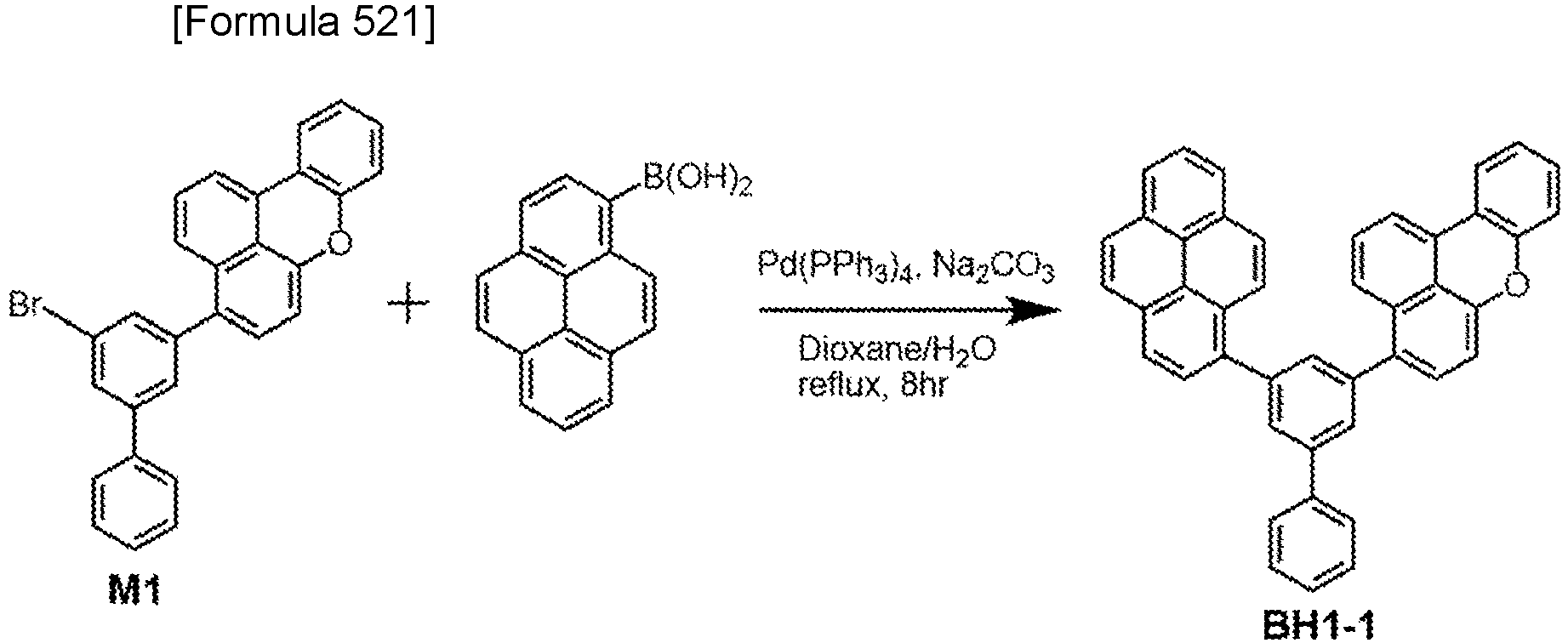
- Under argon atmosphere, 13.21 g of the intermediate M1, 2.53 g of pyrene-1-ylboronic acid synthesized by a known method, 0.22 g of tetrakis(triphenylphosphine)palladium(0), 2.22 g of sodium carbonate, 50 mL of 1,4-dioxane, and 10 mL of water were put into a three-necked flask and refluxed for eight hours with stirring. After the reflux with stirring, the obtained solution was cooled to the room temperature. After the solution was cooled, the deposited solid was filtered and collected. The obtained solid was sequentially washed with water and methanol, and then repeatedly recrystallized with toluene to obtain 4.70 g of a light yellow solid (yield of 80%). As a result of FD-MS analysis, the light yellow solid was a compound BH1-1 and m/e was equal to 571 while a molecular weight was 570.69.
- A compound BH1-2 was synthesized through a synthesis pathway below.

- Under argon atmosphere, 13.5 g of N-bromosuccinimide was added to 400 mL of a mixed solution including 15.0 g of benzo[kl]xanthene in dichloromethane and acetonitrile (3:1). The obtained solution was stirred at the room temperature for ten minutes. After the solution was stirred, the deposited solid was filtered and collected. The obtained solid was washed with a mixed solvent of acetonitrile and methanol to obtain 15.6 g of a white solid (yield of 77%). As a result of FD-MS analysis, the white solid was a 4-bromobenzo[kl]xanthene compound and m/e was equal to 298 while a molecular weight was 297.15. DCM is the abbreviation for dichloromethane, MeCN is the abbreviation for acetonitrile, and NBS is the abbreviation for N-bromosuccinimide.

- Under argon atmosphere, 3.00 g of 4-bromobenzo[kl]xanthene, 3.25 g of 4-(pyrene-1-yl)phenylboronic acid, 0.46 g of tetrakis(triphenylphosphine)palladium(0), 3.21 g of sodium carbonate, 50 mL of 1,4-dioxane, and 15 mL of ion-exchange water were put into a flask and refluxed for 18 hours with stirring. After the reflux with stirring, the obtained solution was cooled to the room temperature. After the solution was cooled, the deposited solid was filtered and collected. The obtained solid was sequentially washed with water and acetone, and then recrystallized with a mixed solvent of toluene and cyclohexane to obtain 2.34 of a light yellow solid (yield of 47%). As a result of FD-MS analysis, the light yellow solid was a compound BH1-2 and m/e was equal to 495 while a molecular weight was 494.59.
- A compound BH1-3 was synthesized through a synthesis pathway below.


- Under argon atmosphere, 5.00 g of 1,6-dibromo pyrene, 9.59 g of 4-(4,4,5,5-tetramethyl-1,3,2-dioxaborane-2-yl)benzo[kl]xanthene synthesized by a known method, 0.32 g of tetrakis(triphenylphosphine)palladium(0), 2.88 g of sodium carbonate, 60 mL of 1,4-dioxane, and 9.9 mL of water were put into a three-necked flask and refluxed for eight hours with stirring. After the reflux with stirring, the obtained solution was cooled to the room temperature. After the solution was cooled, the deposited solid was filtered and collected. The obtained solid was sequentially washed with water and methanol, and then repeatedly recrystallized with toluene to obtain 6.59 g of a light yellow solid (yield of 75%). The obtained compound was subjected to FD-MS analysis and was identified as the compound BH1-3.
- A compound BH1-4 was synthesized through a synthesis pathway below.

- Under argon atmosphere, 4.00 g of 1-bromopyrene, 3.70 g of benzo[kl]xanthene-10-yl-boronic acid synthesized by a known method, 0.33 g of tetrakis(triphenylphosphine)palladium(0), 3.00 g of sodium carbonate, 61 mL of 1,4-dioxane, and 10.0 mL of water were put into a three-necked flask and refluxed for five hours with stirring. After the reflux with stirring, the obtained solution was cooled to the room temperature. After the solution was cooled, the deposited solid was filtered and collected. The obtained solid was sequentially washed with water and methanol, and then repeatedly recrystallized with toluene to obtain 3.50 g of a light yellow solid (yield of 59%). The obtained compound was subjected to FD-MS analysis and was identified as the compound BH1-4.
- A compound BH1-5 was synthesized through a synthesis pathway below.

- Under argon atmosphere, 4.00 g of 1-bromopyrene, 3.83 g of benzo[kl]xanthene-9-yl-boronic acid synthesized by a known method, 0.65 g of tetrakis(triphenylphosphine)palladium(0), 2.42 g of sodium carbonate, 120 mL of 1,4-dioxane, and 10.0 mL of water were put into a three-necked flask and refluxed for six hours with stirring. After the reflux with stirring, the obtained solution was cooled to the room temperature. After the solution was cooled, the deposited solid was filtered and collected. The obtained solid was sequentially washed with water and methanol, and then repeatedly recrystallized with toluene to obtain 3.80 g of a light yellow solid (yield of 64%). The obtained compound was subjected to FD-MS analysis and was identified as the compound BH1-5.
- A compound BH1-6 was synthesized through a synthesis pathway below.

- Under argon atmosphere, 3.01 g of 1-bromopyrene, 3.70 g of 4-(4,4,5,5-tetramethyl-1,3,2-dioxaborane-2-yl)-benzo[kl]xanthene synthesized by a known method, 0.50 g of tetrakis(triphenylphosphine)palladium(0), 1.79 g of sodium carbonate, 100 mL of 1,4-dioxane, and 10 mL of water were put into a three-necked flask and refluxed for eight hours with stirring. After the reflux with stirring, the obtained solution was cooled to the room temperature. After the solution was cooled, the deposited solid was filtered and collected. The obtained solid was sequentially washed with water and methanol, and then repeatedly recrystallized with toluene to obtain 3.09 g of a light yellow solid (yield of 69%). The obtained compound was subjected to FD-MS analysis and was identified as the compound BH1-6.
- An intermediate M2 was synthesized through a synthesis pathway below.


- Under argon atmosphere, 5.00 g of 3-chloro-5-bormo-1,1'-biphenyl, 4.60 g of pyrene-1-ylboronic acid, 0.648 g of tetrakis(triphenylphosphine)palladium(0), 3.96 g of sodium carbonate, 20 mL of 1,4-dioxane, and 20 mL of water were put into a three-necked flask and refluxed for eight hours with stirring. After the reflux with stirring, the obtained solution was cooled to the room temperature. After the solution was cooled, the deposited solid was filtered and collected. The obtained solid was sequentially washed with water and methanol, and then repeatedly recrystallized with toluene to obtain 7.16 g of a light yellow solid (yield of 99%). The obtained compound was subjected to FD-MS (Field Desorption Mass Spectrometry) analysis and was identified as the intermediate M2.
- A compound BH1-7 was synthesized through a synthesis pathway below.


- Under argon atmosphere, 60.0 g of the intermediate M2 (chloro intermediate), 55.8 g of a boronic acid pinacol intermediate synthesized by a known method, 1.05 g of palladium acetate(II), 32.7 g of sodium carbonate, 500 mL of toluene, 450 mL of 1 ,4-dioxane, and 200 mL of ion-exchange water were put into a flask and refluxed for six hours with stirring. After the reflux with stirring, the obtained solution was cooled to the room temperature. After the solution was cooled, the deposited solid was filtered and collected. The obtained solid was sequentially washed with water and acetone, and then recrystallized with a mixed solvent of toluene and hexane to obtain 64.3 g of a light yellow solid (yield of 72%). As a result of FD-MS analysis, the light yellow solid was the compound BH1-7 and m/e was equal to 571 while a molecular weight was 570.69.
- An intermediate M3 was synthesized through a synthesis pathway below.


- Under argon atmosphere, 1.05 g of a halogen intermediate Ha1, 0.95 g of pyrene-1-ylboronic acid synthesized by a known method, 0.13 g of tetrakis(triphenylphosphine)palladium(0) (Pd(PPh3)4), 0.82 g of sodium carbonate, 8 mL of DME, and 4 mL of ion-exchange water were put into a flask and stirred for 18 hours at 100 degrees C. After being stirred, the obtained solution was cooled to the room temperature. After the solution was cooled, an organic layer was washed with saturated saline solution and then added with sodium sulfate to be dried. After the drying, filtration and concentration under reduced pressure were conducted. The crude product was purified by silica-gel chromatography using a mixed solvent of toluene and hexane to obtain 1.40 g of a light yellow solid (yield of 92%). As a result of FD-MS analysis, the light yellow solid was the intermediate M3 and m/e was equal to 394 while a molecular weight was 393.92.
- An intermediate M4 was synthesized through a synthesis pathway below.


- Under argon atmosphere, 1.93 g of the intermediate M3 (chloro intermediate), 2.00 g of bis(pinacolato)diboron, 0.02 g of palladium acetate(II), 0.50 g of potassium acetate, and 6 mL of 1,4-dioxane were put into a flask and stirred for seven hours at 100 degrees C. After being stirred, the obtained solution was cooled to the room temperature. After the solution was cooled, an organic layer was washed with saturated saline solution and then added with sodium sulfate to be dried. After the drying, filtration and concentration under reduced pressure were conducted. The crude product was purified by silica-gel chromatography using toluene to obtain 1.00 g of a light yellow solid (yield of 81%). As a result of FD-MS analysis, the light yellow solid was the intermediate M4 and m/e was equal to 486 while a molecular weight was 485.44.
- A compound BH1-8 was synthesized through a synthesis pathway below.

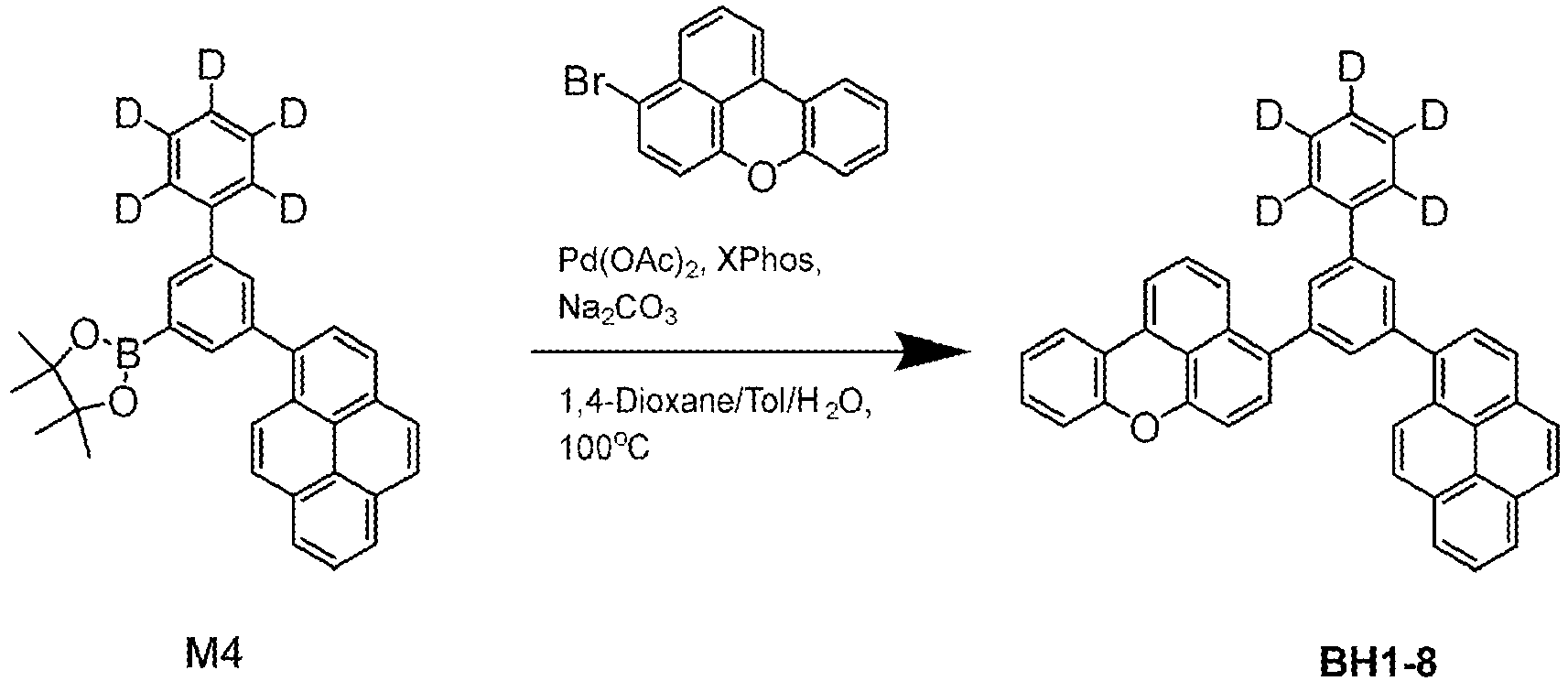
- Under argon atmosphere, 25.0 g of the intermediate M4 (boronic acid pinacol intermediate), 15.3 g of a bromo intermediate synthesized by a known method, 2.98 g of tetrakis(triphenylphosphine)palladium(0) (Pd(PPh3)4), 13.8 g of sodium carbonate, 520 mL of 1,4-dioxane, and 200 mL of ion-exchange water were put into a flask and refluxed for 18 hours with stirring. After the reflux with stirring, the obtained solution was cooled to the room temperature. After the solution was cooled, the deposited solid was filtered and collected. The obtained solid was sequentially washed with water and acetone, and then recrystallized with a mixed solvent of toluene and hexane to obtain 11.0 g of a light yellow solid (yield of 37%). As a result of FD-MS analysis, the light yellow solid was the compound BH1-8 and m/e was equal to 575 while a molecular weight was 575.72.
- A compound BH1-9 was synthesized through a synthesis pathway below.

- Under argon atmosphere, 60.0 g of the intermediate M3 (chloro intermediate) synthesized in the same manner as in Synthesis Example 8, 55.1 g of a boronic acid pinacol intermediate synthesized by a known method, 1.03 g of palladium(II) acetate, 32.3 g of sodium carbonate, 450 mL of toluene, 450 mL of 1,4-dioxane, and 170 mL of ion-exchange water were put into a flask and refluxed for six hours with stirring. After the reflux with stirring, the obtained solution was cooled to the room temperature. After the solution was cooled, the deposited solid was filtered and collected. The obtained solid was sequentially washed with water and acetone, and then recrystallized with a mixed solvent of toluene and hexane to obtain 66.9 g of a light yellow solid (yield of 76%). As a result of FD-MS analysis, the light yellow solid was the compound BH1-9 and m/e was equal to 576 while a molecular weight was 575.72.
- A compound BH1-10 was synthesized through a synthesis pathway below.


- Under argon atmosphere, 20.0 g of the compound BH1-7 (protium form) as a non-deuterated aromatic compound, 4.67 g of aluminum chloride, 1200 mL of benzene d6 were put into a flask and refluxed at 40 degrees C for 29 hours with stirring. After the reflux with stirring, the obtained solution was cooled to the room temperature. After the solution was cooled, the deposited solid was filtered and collected. The obtained solid was sequentially washed with water and acetone. The washed solid was recrystallized with a mixed solvent of toluene and hexane to obtain 12.7 g of an orange solid (yield of 61%). As a result of FD-MS analysis, the orange solid was the compound BH1-10 in a form of deuterium (deuterated aromatic compound) and m/e was equal to 595 while a molecular weight was 595.84.
- A compound BH1-11 was synthesized through a synthesis pathway below.


- Under argon atmosphere, 3.79 g of 10-chlorobenzo[kl]xanthene, 8.16 g of tetraphene-7-ylboronic acid synthesized by a known method, 0.41 g of tris(dibenzylideneacetone)dipalladium(0), 1.48 g of 2-dicyclohexylphosphino-2',6'-dimethoxy-1,1'-biphenyl, 4.77 g of sodium carbonate, 150 mL of 1,4-dioxane, and 20 mL of ion-exchange water were put into a flask and refluxed at 100 degrees C for six hours with stirring. After the reflux with stirring, the obtained solution was cooled to the room temperature. After the solution was cooled, the deposited solid was filtered and collected. The obtained solid was sequentially washed with water and acetone, and then recrystallized with a mixed solvent of toluene and hexane to obtain 2.10 g of a light yellow solid (yield of 32%). As a result of FD-MS analysis, the light yellow solid was the compound BH1-11 and m/e was equal to 445 while a molecular weight was 444.53.
- A compound BH- was synthesized through a synthesis pathway below.


- Under argon atmosphere, 2.40 g of an intermediate M5 (bromo intermediate), 2.37 g of a boronic acid pinacol intermediate synthesized by a known method, 0.18 g of tetrakis(triphenylphosphine)palladium(0), 2.16 g of potassium carbonate, 36 mL of 1,4-dioxane, and 6 mL of ion-exchange water were put into a flask and refluxed at 100 degrees C for six hours with stirring. After the reflux with stirring, the obtained solution was cooled to the room temperature. After the solution was cooled, the deposited solid was filtered and collected. The obtained solid was sequentially washed with water and acetone, and then recrystallized with a mixed solvent of toluene and hexane to obtain 2.4 g of a light yellow solid (yield of 69%). As a result of FD-MS analysis, the light yellow solid was the compound BH1-12 and m/e was equal to 445 while a molecular weight was 444.53.
- A compound BH1-13 was synthesized through a synthesis pathway below.


- Under argon atmosphere, 19.0 g of the compound BH1-11 (protium form) as a non-deuterated aromatic compound, 4.6 g of aluminum chloride, and 1140 mL of benzene d6 were put into a flask and refluxed at 40 degrees C for 29 hours with stirring. After the reflux with stirring, the obtained solution was cooled to the room temperature. After the solution was cooled, the deposited solid was filtered and collected. The obtained solid was sequentially washed with water and acetone. The washed solid was recrystallized with a mixed solvent of toluene and hexane to obtain 14.0 g of an orange solid (yield of 71%). As a result of FD-MS analysis, the orange solid was the compound BH1-13 as a deuterated aromatic compound and m/e was equal to 463 while a molecular weight was 462.64.
- A compound BH1-14 was synthesized through a synthesis pathway below.


- Under argon atmosphere, 2.60 g of an intermediate M6 (bromo intermediate), 1.55 g of a boronic acid intermediate synthesized by a known method, 0.14 g of tetrakis(triphenylphosphine)palladium(0), 1.64 g of potassium carbonate, 40 mL of 1,4-dioxane, and 10 mL of ion-exchange water were put into a flask and refluxed at 100 degrees C for six hours with stirring. After the reflux with stirring, the obtained solution was cooled to the room temperature. After the solution was cooled, the deposited solid was filtered and collected. The obtained solid was sequentially washed with water and acetone, and then recrystallized with a mixed solvent of toluene and hexane to obtain 1.70 g of a light yellow solid (yield of 50%). As a result of FD-MS analysis, the light yellow solid was the compound BH1-14 and m/e was equal to 576 while a molecular weight was 575.72.
- A compound BH1-15 was synthesized through a synthesis pathway below.


- Under argon atmosphere, 4.62 g of 10-bromobenzo[kl]thioxanthene, 8.16 g of tetraphene-7-ylboronic acid synthesized by a known method, 0.52 g of tris(dibenzylideneacetone)dipalladium(0), 1.63 g of 2-dicyclohexylphosphino-2',6'-dimethoxy-1,1'-biphenyl, 4.99 g of sodium carbonate, 150 mL of 1,4-dioxane, and 20 mL of ion-exchange water were put into a flask and refluxed at 100 degrees C for six hours with stirring. After the reflux with stirring, the obtained solution was cooled to the room temperature. After the solution was cooled, the deposited solid was filtered and collected. The obtained solid was sequentially washed with water and acetone, and then recrystallized with a mixed solvent of toluene and hexane to obtain 3.26 g of a light yellow solid (yield of 48%). As a result of FD-MS analysis, the light yellow solid was the compound BH1-15 and m/e was equal to 461 while a molecular weight was 460.59.
- A compound BH1-16 was synthesized through a synthesis pathway below.


- Under argon atmosphere, 2.40 g of the intermediate M5 (bromo intermediate), 2.37 g of a boronic acid intermediate synthesized by a known method, 0.21 g of tetrakis(triphenylphosphine)palladium(0), 2.33 g of potassium carbonate, 40 mL of 1,4-dioxane, and 10 mL of ion-exchange water were put into a flask and refluxed at 100 degrees C for six hours with stirring. After the reflux with stirring, the obtained solution was cooled to the room temperature. After the solution was cooled, the deposited solid was filtered and collected. The obtained solid was sequentially washed with water and acetone, and then recrystallized with a mixed solvent of toluene and hexane to obtain 2.16 g of a light yellow solid (yield of 55%). As a result of FD-MS analysis, the light yellow solid was the compound BH1-16 and m/e was equal to 461 while a molecular weight was 460.59.
- A compound BH1-17 was synthesized through a synthesis pathway below.


- Under argon atmosphere, 19.0 g of the compound BH1-15 (protium form) as a non-deuterated aromatic compound, 4.6 g of aluminum chloride, and 1140 mL of benzene d6 were put into a flask and refluxed at 40 degrees C for 29 hours with stirring. After the reflux with stirring, the obtained solution was cooled to the room temperature. After the solution was cooled, the deposited solid was filtered and collected. The obtained solid was sequentially washed with water and acetone. The washed solid was recrystallized with a mixed solvent of toluene and hexane to obtain 14.6 g of an orange solid (yield of 74%). As a result of FD-MS analysis, the orange solid was the compound BH1-17 as a deuterated aromatic compound and m/e was equal to 480 while a molecular weight was 479.71.
- A compound BH1-18 was synthesized through a synthesis pathway below.


- Under argon atmosphere, 2.60 g of an intermediate M7 (bromo intermediate), 2.05 g of a boronic acid intermediate synthesized by a known method, 0.22 g of tetrakis(triphenylphosphine)palladium(0), 1.68 g of potassium carbonate, 50 mL of 1,4-dioxane, and 10 mL of ion-exchange water were put into a flask and refluxed at 100 degrees C for six hours with stirring. After the reflux with stirring, the obtained solution was cooled to the room temperature. After the solution was cooled, the deposited solid was filtered and collected. The obtained solid was sequentially washed with water and acetone, and then recrystallized with a mixed solvent of toluene and hexane to obtain 2.32 g of a light yellow solid (yield of 66%). As a result of FD-MS analysis, the light yellow solid was the compound BH1-18 and m/e was equal to 587 while a molecular weight was 586.75.
- A compound BH1-19 was synthesized through a synthesis pathway below.

- Under argon atmosphere, 2.30 g of the intermediate M5 (bromo intermediate), 2.37 g of a boronic acid intermediate synthesized by a known method, 0.23 g of tetrakis(triphenylphosphine)palladium(0), 2.23 g of potassium carbonate, 40 mL of 1,4-dioxane, and 10 mL of ion-exchange water were put into a flask and refluxed at 100 degrees C for six hours with stirring. After the reflux with stirring, the obtained solution was cooled to the room temperature. After the solution was cooled, the deposited solid was filtered and collected. The obtained solid was sequentially washed with water and acetone, and then recrystallized with a mixed solvent of toluene and hexane to obtain 2.40 g of a light yellow solid (yield of 64%). As a result of FD-MS analysis, the light yellow solid was the compound BH1-19 and m/e was equal to 471 while a molecular weight was 470.62.
- A compound BH1-20 was synthesized through a synthesis pathway below.


- Under argon atmosphere, 2.60 g of an intermediate M8 (bromo intermediate), 2.02 g of a boronic acid intermediate synthesized by a known method, 0.25 g of tetrakis(triphenylphosphine)palladium(0), 1.67 g of potassium carbonate, 50 mL of 1,4-dioxane, and 10 mL of ion-exchange water were put into a flask and refluxed at 100 degrees C for six hours with stirring. After the reflux with stirring, the obtained solution was cooled to the room temperature. After the solution was cooled, the deposited solid was filtered and collected. The obtained solid was sequentially washed with water and acetone, and then recrystallized with a mixed solvent of toluene and hexane to obtain 2.89 g of a light yellow solid (yield of 69%). As a result of FD-MS analysis, the light yellow solid was the compound BH1-20 and m/e was equal to 597 while a molecular weight was 596.77.
- An intermediate M9 was synthesized through a synthesis pathway below.


- Under argon atmosphere, 10.0 g of 1-fluoro-2-iodonaphthalene, 6.57 g of 4-chloro-1-naphthol, 0.90 g of dichloro(p-cymene)ruthenium(II) (dimer), 7.21 g of potassium carbonate, and 200 mL of N-methyl-2-pyrrolidone were put into a flask and refluxed at 100 degrees C for six hours with stirring. After the reflux with stirring, the obtained solution was cooled to the room temperature. After the solution was cooled, the deposited solid was filtered and collected. The obtained solid was sequentially washed with water and acetone, and then recrystallized with a mixed solvent of toluene and hexane to obtain 1.20 g of a light yellow solid (yield of 11%). As a result of FD-MS analysis, the light yellow solid was the intermediate M9 and m/e was equal to 303.
- A compound BH1-21 was synthesized through a synthesis pathway below.

- Under argon atmosphere, 4.88 g of the intermediate M9, 8.16 g of tetraphene-7-yl boronic acid synthesized by a known method, 0.62 g of tris(dibenzylideneacetone)dipalladium(0), 1.77 g of 2-dicyclohexylphosphino-2',6'-dimethoxy-1,1'-biphenyl, 5.11 g of sodium carbonate, 150 mL of 1,4-dioxane, and 20 mL of ion-exchange water were put into a flask and refluxed at 100 degrees C for six hours with stirring. After the reflux with stirring, the obtained solution was cooled to the room temperature. After the solution was cooled, the deposited solid was filtered and collected. The obtained solid was sequentially washed with water and acetone, and then recrystallized with a mixed solvent of toluene and hexane to obtain 3.82 g of a light yellow solid (yield of 48%). As a result of FD-MS analysis, the light yellow solid was a compound BH1-21 and m/e was equal to 495 while a molecular weight was 494.59.
- A compound X-1 was synthesized through a synthesis pathway below.


- 1-hydroxynaphthalene (1.4 g), 2-bromo-4-chloro-1-fluorobenzene (2.5 g), diacetoxy palladium (0.11 g), triphenylphosphine (0.53 g), and cesium carbonate (13 g) were added to dimethyl formamide (50 mL). Under argon atmosphere, the obtained solution was heated to 140 degrees C and stirred for six hours. After the reaction solution was stirred, a solvent was distilled away from the reaction solution under reduced pressure. The obtained residue was subjected to silica-gel column chromatography to obtain 1.2 g of a white solid (yield of 49%). As a result of FD-MS analysis, the white solid was the compound X-1 and m/e was equal to 253 while a molecular weight was 252.70.
- A compound X-2 was synthesized through a synthesis pathway below.

- The compound X-1 (10 g) was dissolved in 1,2-dichloroethane (200 mL), to which N-bromosuccinimide (NBS) (6.7g) was added. Under nitrogen atmosphere, the reaction solution was heated to 80 degrees C and stirred for six hours. After the reaction solution was stirred, a sodium carbonate aqueous solution was added to the reaction solution. The deposited solid was collected by filtration and recrystallized with toluene to obtain 7.2 g of a light yellow solid (yield of 55%). As a result of FD-MS analysis, the light yellow solid was the compound X-2 and m/e was equal to 332 while a molecular weight was 331.59.
- A compound X-3 was synthesized through a synthesis pathway below.

- The compound X-2 (5.0 g), phenylboronic acid (2.8 g), and tetrakis(triphenylphosphine)palladium (0.5 g) were added to dimethoxyethane (150 mL), to which a sodium carbonate aqueous solution (2.0M, 19 mL) was added. The obtained solution was stirred overnight at 80 degrees C under nitrogen atmosphere. After the solution was stirred, a solvent was distilled away from the solution under reduced pressure. The obtained residue was subjected to silica-gel column chromatography to obtain 3.9 g of a yellow solid (yield of 78%). As a result of FD-MS analysis, the yellow solid was the compound X-3 and m/e was equal to 329 while a molecular weight was 328.80.
- A compound BH1-22 was synthesized through a synthesis pathway below.
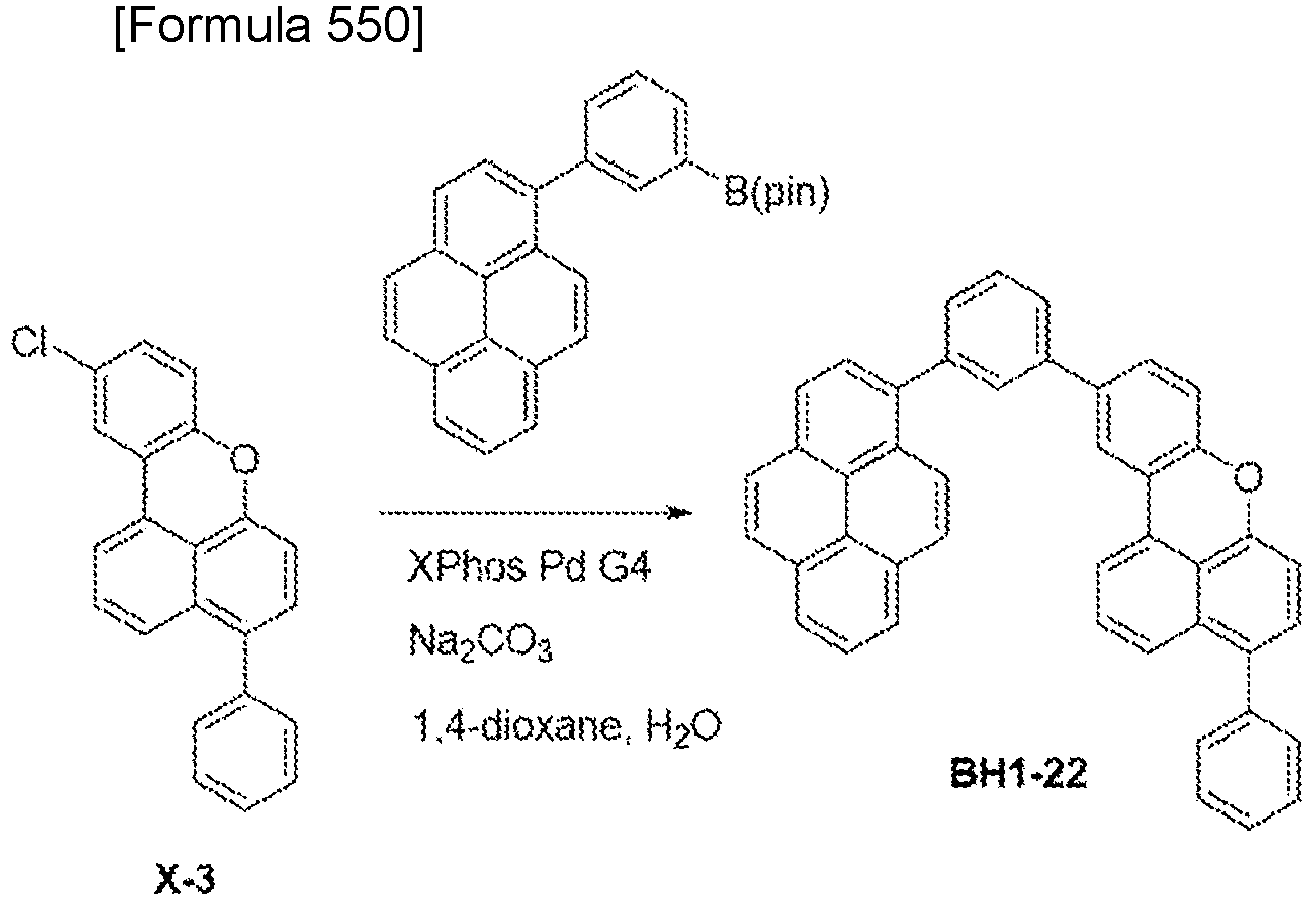
- The compound X-3 (0.8 g), 4,4,5,5-tetramethyl-2-[3-(1 -pyrenyl)phenyl]-1,3,2-dioxaborolane (1.0 g), and XPhos Pd G4 (0.1 g) were dissolved in 1,4-dioxane (13 mL), to which a sodium carbonate aqueous solution (2.0M, 3.8 mL) was added. Under argon atmosphere, the obtained solution was heated to 100 degrees C and stirred for one hour.
- After being stirred, the reaction solution was filtered to obtain a solid. The solid was recrystallized with 1,4-dioxane to obtain 1.0 g of a light yellow solid (yield of 71%). As a result of FD-MS analysis, the light yellow solid was the compound BH1-22 and m/e was equal to 571 while a molecular weight was 570.69.
- A compound P-1 was synthesized through a synthesis pathway below.


- 1-methoxypyrene (5.0 g) was dissolved in N,N-dimethylformamide (DMF) (100 mL) and cooled to 0 degree C in an ice bath. N-bromosuccinimide (NBS) (3.6 g) was added to this solution. The obtained solution was stirred for two hours, and subsequently stirred for another two hours at the room temperature. After being stirred, the reaction solution was added with water to deposit a solid. The solid was collected by filtration to obtain 6.3 g of a colorless solid (yield of 94%). As a result of FD-MS analysis, the colorless solid was the compound P-1 and m/e was equal to 311 while a molecular weight was 311.18.
- A compound P-2 was synthesized through a synthesis pathway below.

- The compound P-1 (5.8 g), phenylboronic acid (2.95 g), and tetrakis(triphenylphosphine)palladium (0.64 g) were dissolved in dimethoxyethane (80 mL), to which an aqueous solution (16 mL) of potassium carbonate (5.2 g) was added. Under argon atmosphere, the reaction solution was stirred for eight hours while being heated to 80 degrees C. After the reaction solution was stirred, a solvent was distilled away from the reaction solution under reduced pressure. The obtained residue was subjected to gel filtration chromatography to obtain 4.6 g of a colorless solid (yield of 80%). As a result of FD-MS analysis, the colorless solid was the compound P-2 and m/e was equal to 308 while a molecular weight was 308.38.
- A compound P-3 was synthesized through a synthesis pathway below.
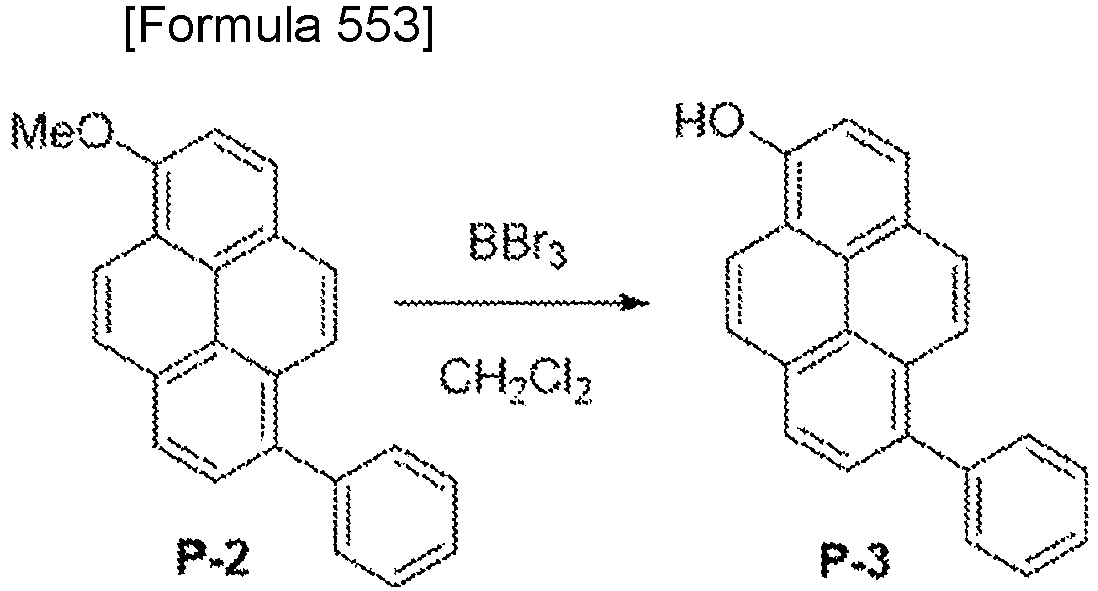
- The compound P-2 (4.6 g) was dissolved in dichloromethane (100 mL), to which 60 mL of boron tribromide in dichloromethane (1.0 M) was added dropwise under ice-cooling. Subsequently, the obtained solution was stirred at the room temperature for two days. The stirred reaction solution was added to ice water and extracted with ethyl acetate. Subsequently, an organic layer from which a solvent was distilled away was subjected to silica-gel column chromatography to obtain 4.2 g of a colorless solid (yield of 95%). As a result of FD-MS analysis, the colorless solid was the compound P-3 and m/e was equal to 294 while a molecular weight was 294.35.
- A compound P-4 was synthesized through a synthesis pathway below.


- The compound P-3 (4.3 g) and trimethylamine (3.0 g) were dissolved in dichloromethane (50 mL), to which trifluoromethanesulfonic anhydride (5.0 g) was added while being cooled in an ice bath. After the reaction solution was stirred for two hours, a solvent was distilled away from the reaction solution under reduced pressure. The obtained residue was subjected to silica-gel column chromatography to obtain 4.3 g of a white solid (yield of 85%). As a result of FD-MS analysis, the white solid was the compound P-4 and m/e was equal to 426 while a molecular weight was 426.41.
- A compound P-5 was synthesized through a synthesis pathway below.

- The compound P-4 (1.7 g), 3-chlorophenylboronic acid (0.69 g), and tetrakis(triphenylphosphine)palladium (0.23 g) were dissolved in dimethoxyethane (20 mL), to which an aqueous solution (4.0 mL) of potassium carbonate (1.1 g) was added. The obtained solution was stirred at 80 degrees C for five hours under argon atmosphere. After the reaction solution was stirred, a solvent was distilled away from the reaction solution under reduced pressure. The obtained residue was subjected to gel filtration chromatography to obtain 1.2 g of a white solid (yield of 78%). As a result of FD-MS analysis, the white solid was the compound P-5 and m/e was equal to 389 while a molecular weight was 388.89.
- A compound BH1-23 was synthesized through a synthesis pathway below.

- The compound P-5 (1.2 g), benzo[kl]xanthene-10-yl-boronic acid (3.70 g), and XPhos Pd G4 (0.13 g) were added to and dissolved in 1,4-dioxane (15 mL), to which an aqueous solution (3.0 mL) of potassium carbonate (1.3 g) was added. Under argon atmosphere, the obtained solution was heated for reflux with stirring for two hours. After being stirred, the reaction solution was filtered to obtain a solid. The solid was purified by silica-gel column chromatography to obtain 0.58 g of a white solid (yield of 33%). As a result of FD-MS analysis, the white solid was the compound BH1-23 and m/e was equal to 571 while a molecular weight was 570.69.
- A compound X-4 was synthesized through a synthesis pathway below.

- The compound X-1 (1.0 g), phenylboronic acid (0.9 g), and XPhos Pd G4 (0.17 g) were added to 1,4-dioxane (50 mL), to which a sodium carbonate aqueous solution (2.0M, 6.0 mL) was added. Under argon atmosphere, the obtained solution was heated at 100 degrees C for six hours with stirring.
- After the reaction solution was stirred, a solvent was distilled away from the reaction solution under reduced pressure. The obtained residue was subjected to silica-gel column chromatography to obtain 0.7 g of a light yellow solid (yield of 60%). As a result of FD-MS analysis, the light yellow solid was the compound X-4 and m/e was equal to 294 while a molecular weight was 294.35.
- A compound X-5 was synthesized through a synthesis pathway below.

- The compound X-4 (1.0 g) was dissolved in 1,2-dichloroethane (20 mL), to which N-bromosuccinimide (NBS) (0.61g) was added. Under nitrogen atmosphere, the reaction solution was heated to 80 degrees C and stirred for six hours. After the reaction solution was stirred, a sodium carbonate aqueous solution was added to the reaction solution. The deposited solid was collected by filtration and recrystallized with toluene to obtain 0.63 g of a yellow solid (yield of 50%). As a result of FD-MS analysis, the yellow solid was the compound X-5 and m/e was equal to 373 while a molecular weight was 373.25.
- A compound BH1-24 was synthesized through a synthesis pathway below.

- The compound X-5 (1.0 g), 4,4,5,5-tetramethyl-2-[3-(1 -pyrenyl)phenyl]-1,3,2-dioxaborolane (1.3 g), and XPhos Pd G4 (0.1 g) were dissolved in 1,4-dioxane (20 mL), to which a sodium carbonate aqueous solution (2.0M, 4.0 mL) was added. Under argon atmosphere, the obtained solution was heated to 100 degrees C and stirred for one hour.
- After being stirred, the reaction solution was filtered to obtain a solid. The solid was recrystallized with 1,4-dioxane to obtain 1.0 g of a light yellow solid (yield of 65%). As a result of FD-MS analysis, the light yellow solid was the compound BH1-24 and m/e was equal to 571 while a molecular weight was 570.69.
- A compound X-6 was synthesized through a synthesis pathway below.

- 6-methoxy-1-naphthol (0.17 g), 1,2-diiodebenzene (0.40 g), palladium acetate (0.02 g), tricyclohexylphosphine tetrafluoroborate (0.07 g), and cesium carbonate (1.17 g) were added to N,N-dimethylformamide (DMF) (10 mL) and stirred at 140 degrees C for four hours under argon atmosphere. After being stirred, the reaction solution was purified by silica-gel column chromatography to obtain 0.25 g of a colorless solid (yield of 72%). As a result of FD-MS analysis, the colorless solid was the compound X-6 and m/e was equal to 248 while a molecular weight was 248.28.
- A compound X-7 was synthesized through a synthesis pathway below.

- The compound X-6 (1.0 g), dodecanethiol (1.2 g), and sodium hydroxide (0.48 g) were added to N-methylpyrrolidone (NMP) (40 mL). The obtained solution was stirred overnight at 150 degrees C under argon atmosphere. After being stirred, the reaction solution was purified by column chromatography. The obtained crude product was recrystallized with toluene to obtain 0.74 g of a colorless solid (yield of 78%). As a result of FD-MS analysis, the colorless solid was the compound X-7 and m/e was equal to 234 while a molecular weight was 234.25.
- A compound X-8 was synthesized through a synthesis pathway below.

- The compound X-7 (2.47 g), trifluoromethanesulfonic anhydride (3.57 g), and pyridine (1.00 g) were added to dichloromethane (75 mL) under ice-cooling. The obtained solution was stirred at the room temperature for seven hours under argon atmosphere. After being stirred, the reaction solution was purified by silica-gel column chromatography to obtain 3.47 g of a colorless solid (yield of 90%). As a result of FD-MS analysis, the colorless solid was the compound X-8 and m/e was equal to 366 while a molecular weight was 366.31.
- A compound BH1-25 was synthesized through a synthesis pathway below.


- The compound X-8 (2.0 g), 4,4,5,5-tetramethyl-2-(5-(pyrene-1-yl)-[1,1'-biphenyl]-3-yl)-1,3,2-dioxaborolane (2.6 g), SPhos Pd G4 (0.22 g), and a sodium carbonate aqueous solution (2M, 8.2 mL) were added to 1,4-dioxane (55 mL). Under argon atmosphere, the obtained solution was stirred overnight at 90 degrees C. After the reaction solution was stirred, a solvent was distilled away from the reaction solution under reduced pressure. The obtained residue was recrystallized with toluene to obtain 2.2 g of a light yellow solid (yield of 70%). As a result of FD-MS analysis, the light yellow solid was the compound BH1-25 and m/e was equal to 571 while a molecular weight was 570.69.
- A compound X-10 was synthesized through a synthesis pathway below.


- 3-methoxy-1-naphthol (5.2 g), 1,2-diiodebenzene (12 g), palladium acetate (0.67 g), tricyclohexylphosphine tetrafluoroborate (2.2 g), and cesium carbonate (35 g) were added to N,N-dimethylformamide (DMF) (100 mL) and stirred at 140 degrees C for six hours under argon atmosphere. After being stirred, the reaction solution was purified by silica-gel column chromatography to obtain 3.7 g of a colorless solid (yield of 50%). As a result of FD-MS analysis, the colorless solid was the compound X-10 and m/e was equal to 248 while a molecular weight was 248.28.
- A compound X-11 was synthesized through a synthesis pathway below.

- The compound X-10 (4.0 g), dodecanethiol (10 g), and sodium hydroxide (3.8 g) were added to N-methylpyrrolidone (NMP) (160 mL). The obtained solution was stirred at 140 degrees C for five hours under argon atmosphere. After being stirred, the reaction solution was purified by silica-gel column chromatography to obtain 3.56 g of a colorless solid (yield of 95%). As a result of FD-MS analysis, the colorless solid was the compound X-11 and m/e was equal to 234 while a molecular weight was 234.25.
- A compound X-12 was synthesized through a synthesis pathway below.

- The compound X-11 (3.5 g), trifluoromethanesulfonic anhydride (5.2 g), and pyridine (1.4 g) were added to dichloromethane (150 mL) under ice-cooling. The obtained solution was stirred at the room temperature for three hours under argon atmosphere. After being stirred, the reaction solution was purified by silica-gel column chromatography to obtain 1.3 g of a colorless solid (yield of 24%). As a result of FD-MS analysis, the colorless solid was the compound X-12 and m/e was equal to 366 while a molecular weight was 366.31.
- A compound BH1-26 was synthesized through a synthesis pathway below.


- The compound X-12 (1.2 g), 4,4,5,5-tetramethyl-2-(5-(pyrene-1-yl)-[1,1'-biphenyl]-3-yl)-1,3,2-dioxaborolane (1.5 g), SPhos Pd G4 (0.12 g), and a sodium carbonate aqueous solution (2M, 3.8 mL) were added to 1,4-dioxane (30 mL). Under argon atmosphere, the obtained solution was stirred at 90 degrees C for seven hours. After the reaction solution was stirred, a solvent was distilled away from the reaction solution under reduced pressure. The obtained residue was recrystallized with toluene to obtain 0.77 g of a light yellow solid (yield of 45%). As a result of FD-MS analysis, the light yellow solid was the compound BH1-26 and m/e was equal to 571 while a molecular weight was 570.69.
- A compound X-14 was synthesized through a synthesis pathway below.


- 2-methoxy-1-naphthol (1.7 g), 1,2-diiodebenzene (4.0 g), palladium acetate (0.23 g), tricyclohexylphosphine tetrafluoroborate (0.74 g), and cesium carbonate (12 g) were added to N,N-dimethylformamide (DMF) (33 mL) and stirred at 140 degrees C for seven hours under argon atmosphere. After being stirred, the reaction solution was purified by silica-gel column chromatography to obtain 2.2 g of a colorless solid (yield of 45%). As a result of FD-MS analysis, the colorless solid was the compound X-14 and m/e was equal to 248 while a molecular weight was 248.28.
- A compound X-15 was synthesized through a synthesis pathway below.

- The compound X-14 (2.2 g), dodecanethiol (5.7 g), and sodium hydroxide (2.2 g) were added to N-methylpyrrolidone (NMP) (90 mL). The obtained solution was stirred at 140 degrees C for five hours under argon atmosphere. After being stirred, the reaction solution was purified by silica-gel column chromatography to obtain 1.4 g of a colorless solid (yield of 70%). As a result of FD-MS analysis, the colorless solid was the compound X-15 and m/e was equal to 234 while a molecular weight was 234.25.
- A compound X-16 was synthesized through a synthesis pathway below.

- The compound X-15 (1.4 g), trifluoromethanesulfonic anhydride (2.1 g), and pyridine (0.57 g) were added to dichloromethane (60 mL) under ice-cooling. The obtained solution was stirred at the room temperature for four hours under argon atmosphere. After being stirred, the reaction solution was purified by silica-gel column chromatography to obtain 1.6 g of a colorless solid (yield of 71 %). As a result of FD-MS analysis, the colorless solid was the compound X-16 and m/e was equal to 366 while a molecular weight was 366.31.
- A compound BH1-27 was synthesized through a synthesis pathway below.


- The compound X-16 (1.4 g), 4,4,5,5-tetramethyl-2-(5-(pyrene-1-yl)-[1,1'-biphenyl]-3-yl)-1,3,2-dioxaborolane (1.7 g), SPhos Pd G4 (0.28 g), and a sodium carbonate aqueous solution (2M, 4.4 mL) were added to 1,4-dioxane (55 mL). Under argon atmosphere, the obtained solution was stirred at 100 degrees C for seven hours. After the reaction solution was stirred, a solvent was distilled away from the reaction solution under reduced pressure. The obtained residue was recrystallized with toluene to obtain 0.92 g of a light yellow solid (yield of 46%). As a result of FD-MS analysis, the light yellow solid was the compound BH1-27 and m/e was equal to 571 while a molecular weight was 570.69.
- A compound X-9 was synthesized through a synthesis pathway below.


- The compound X-8 (2.4 g), bis(pinacolato)diboron (3.5 g), palladium acetate (0.1 g), XPhos (0.4 g), and potassium acetate (2.7 g) were added to 1,4-dioxane (50 mL). Under argon atmosphere, the obtained solution was stirred at 100 degrees C for six hours. After being stirred, the reaction solution was purified by silica-gel column chromatography to obtain 2.0 g of a colorless solid (yield of 89%). As a result of FD-MS analysis, the colorless solid was the compound X-9 and m/e was equal to 344 while a molecular weight was 344.22.
- A compound BH1-28 was synthesized through a synthesis pathway below.

- The compound X-9 (1.2 g), 1-(6-bromonaphthalene-2-yl)-pyrene (1.3 g), SPhos Pd G4 (0.15 g), and a sodium carbonate aqueous solution (2M, 5.2 mL) were added to 1,4-dioxane (40 mL). Under argon atmosphere, the obtained solution was stirred overnight at 90 degrees C. After the reaction solution was stirred, a solvent was distilled away from the reaction solution under reduced pressure. The obtained residue was recrystallized with toluene to obtain 0.85 g of a yellow solid (yield of 45%). As a result of FD-MS analysis, the yellow solid was the compound BH1-28 and m/e was equal to 545 while a molecular weight was 544.65.
- A compound X-13 was synthesized through a synthesis pathway below.
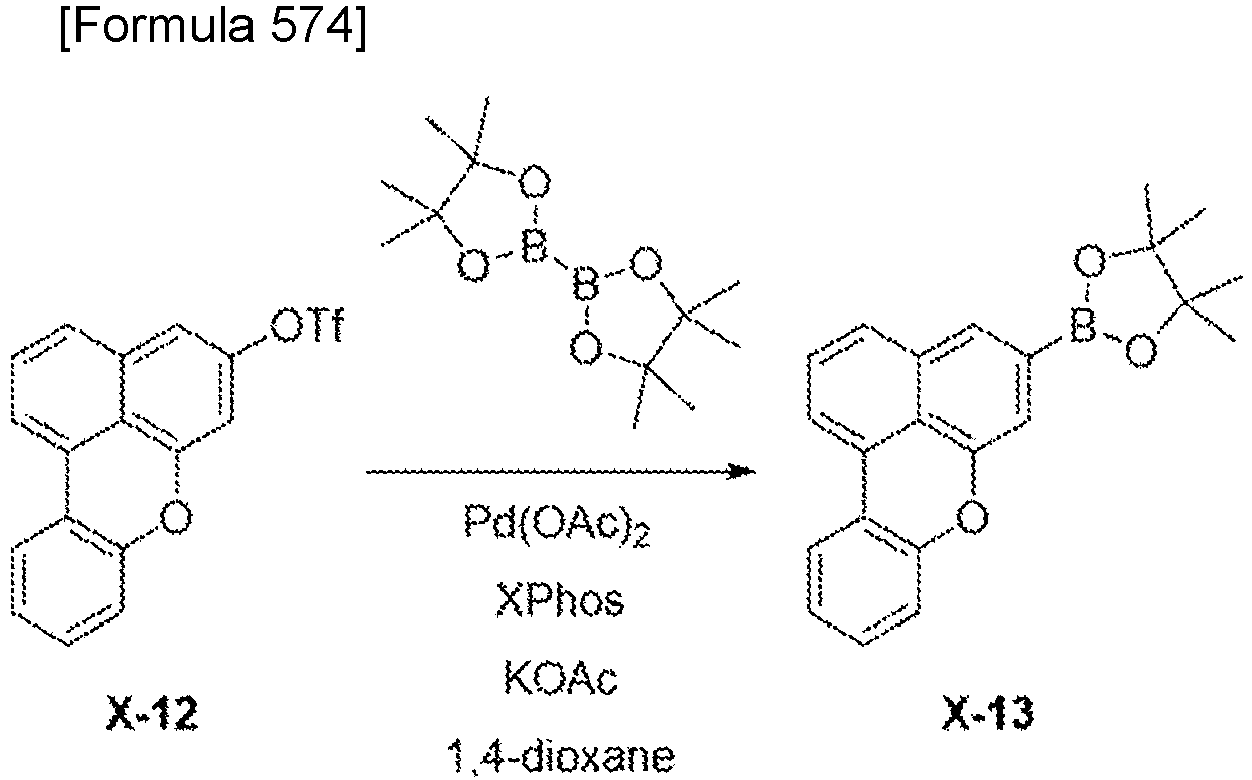
- The compound X-12 (2.2 g), bis(pinacolato)diboron (3.1 g), palladium acetate (0.1 g), XPhos (0.3 g), and potassium acetate (1.8 g) were added to 1,4-dioxane (50 mL). Under argon atmosphere, the obtained solution was stirred at 100 degrees C for six hours. After being stirred, the reaction solution was purified by silica-gel column chromatography to obtain 1.8 g of a colorless solid (yield of 87%). As a result of FD-MS analysis, the colorless solid was the compound X-13 and m/e was equal to 344 while a molecular weight was 344.22.
- A compound BH1-29 was synthesized through a synthesis pathway below.


- The compound X-13 (3.1 g), 7-(4-bromophenyl)-tetraphene (3.5 g), SPhos Pd G4 (0.32 g), and a sodium carbonate aqueous solution (2M, 15 mL) were added to 1,4-dioxane (100 mL). Under argon atmosphere, the obtained solution was stirred at 90 degrees C for five hours. After the reaction solution was stirred, a solvent was distilled away from the reaction solution under reduced pressure. The obtained residue was recrystallized with toluene to obtain 3.1 g of a light yellow solid (yield of 66%). As a result of FD-MS analysis, the light yellow solid was the compound BH1-29 and m/e was equal to 521 while a molecular weight was 520.63.
- A compound X-17 was synthesized through a synthesis pathway below.

- The compound X-16 (1.5 g), bis(pinacolato)diboron (2.1 g), palladium acetate (0.05 g), XPhos (0.2 g), and potassium acetate (1.2 g) were added to 1,4-dioxane (50 mL). Under argon atmosphere, the obtained solution was stirred at 100 degrees C for six hours. After being stirred, the reaction solution was purified by silica-gel column chromatography to obtain 1.1 g of a colorless solid (yield of 78%). As a result of FD-MS analysis, the colorless solid was the compound X-17 and m/e was equal to 344 while a molecular weight was 344.22.
- A compound BH1-30 was synthesized through a synthesis pathway below.

- The compound X-17 (1.4 g), 8-(3-bromophenyl)-11,11-dimethyl-11H-benzo[b]fluorene (1.6 g), SPhos Pd G4 (0.06 g), and a sodium carbonate aqueous solution (2M, 6.1 mL) were added to 1,4-dioxane (40 mL). Under argon atmosphere, the obtained solution was stirred overnight at 90 degrees C. After the reaction solution was stirred, a solvent was distilled away from the reaction solution under reduced pressure. The obtained residue was recrystallized with toluene to obtain 1.9 g of a colorless solid (yield of 89%). As a result of FD-MS analysis, the colorless solid was the compound BH1-30 and m/e was equal to 537 while a molecular weight was 536.67.
- 1... organic EL device, 2... substrate, 3... anode, 4... cathode, 51...first emitting layer, 52...second emitting layer, 6... hole injecting layer, 7... hole transporting layer, 8...electron transporting layer, 9...electron injecting layer


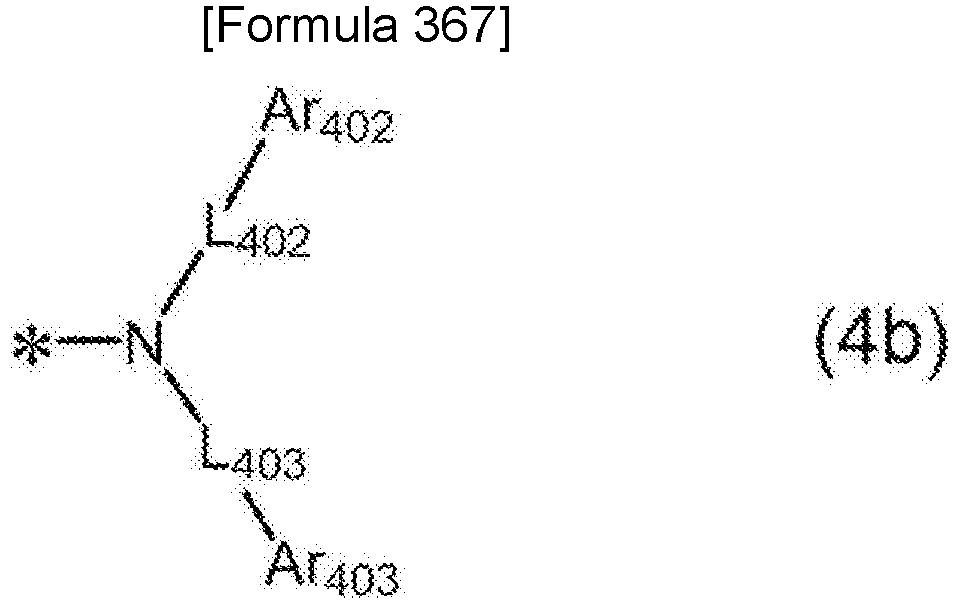



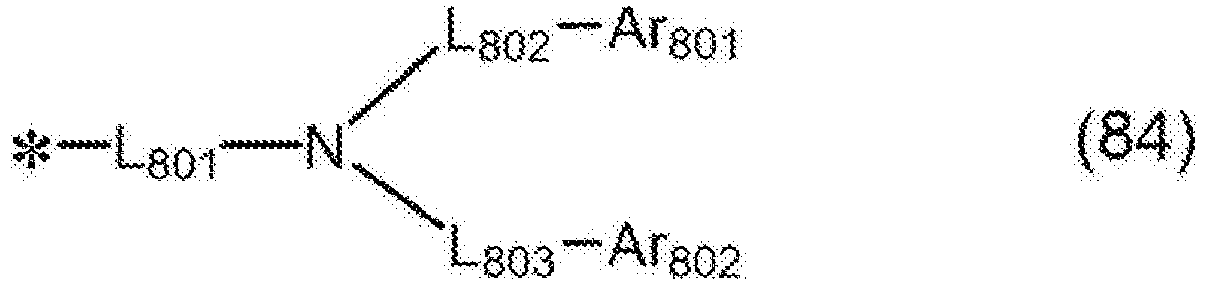
Claims (45)
- A compound comprising: at least one group represented by a formula (11) below; and a single benz[de]anthracene derivative skeleton represented by a formula (1000) below in a molecule,
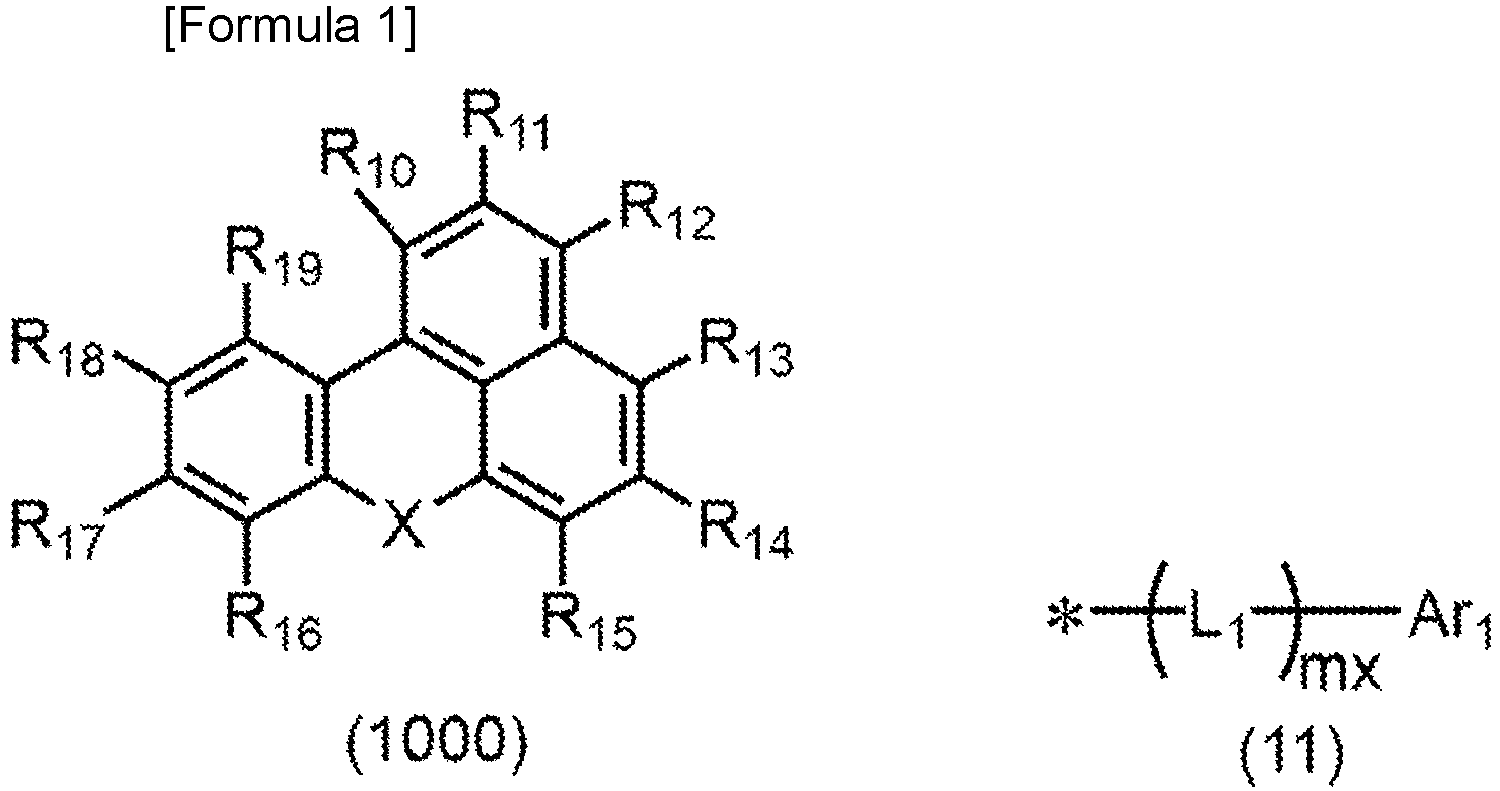 X is an oxygen atom, a sulfur atom, C(R2001)(R2002), or Si(R2003)(R2004);R2001 to R2004 are each independently a hydrogen atom, a substituted or unsubstituted alkyl group having 1 to 50 carbon atoms, a substituted or unsubstituted alkenyl group having 2 to 50 carbon atoms, a substituted or unsubstituted alkynyl group having 2 to 50 carbon atoms, a substituted or unsubstituted cycloalkyl group having 3 to 50 ring carbon atoms, a group represented by -Si(R901)(R902)(R903), a group represented by -O-(R904), a group represented by -S-(R905), a group represented by -N(R906)(R907), a halogen atom, a cyano group, a nitro group, a substituted or unsubstituted aryl group having 6 to 50 ring carbon atoms, or a substituted or unsubstituted heterocyclic group having 5 to 50 ring atoms;at least one combination of adjacent two or more of R10 to R19 are mutually bonded to form a substituted or unsubstituted monocyclic ring, mutually bonded to form a substituted or unsubstituted fused ring, or not mutually bonded;R10 to R19 forming neither the substituted or unsubstituted monocyclic ring nor the substituted or unsubstituted fused ring are each independently a hydrogen atom, a substituted or unsubstituted alkyl group having 1 to 50 carbon atoms, a substituted or unsubstituted haloalkyl group having 1 to 50 carbon atoms, a substituted or unsubstituted alkenyl group having 2 to 50 carbon atoms, a substituted or unsubstituted alkynyl group having 2 to 50 carbon atoms, a substituted or unsubstituted cycloalkyl group having 3 to 50 ring carbon atoms, a group represented by -Si(R901)(R902)(R903), a group represented by -O-(R904), a group represented by - S-(R905), a group represented by -N(R906)(R907), a substituted or unsubstituted aralkyl group having 7 to 50 carbon atoms, a group represented by -C(=O)R801, a group represented by -COOR802, a halogen atom, a nitro group, a substituted or unsubstituted aryl group having 6 to 50 ring carbon atoms, a substituted or unsubstituted heterocyclic group having 5 to 50 ring atoms, or a group represented by the formula (11);at least one of R10 to R19 is a group represented by the formula (11);when a plurality of groups represented by the formula (11) are present, the plurality of groups represented by the formula (11) are mutually the same or different;L1 is a substituted or unsubstituted arylene group having 6 to 15 ring carbon atoms, or a substituted or unsubstituted divalent heterocyclic group having 5 to 15 ring atoms;mx is 1, 2, or 3;when two or more L1 are present, the two or more L1 are mutually the same or different;Ar1 is a substituted or unsubstituted aryl group including four or more rings;when two or more Ar1 are present, the two or more Ar1 are mutually the same or different;* in the formula (11) represents a bonding position;in a compound represented by the formula (1000), R901, R902, R903, R904, R905, R906, R907, R801, and R802 are each independently a hydrogen atom, a substituted or unsubstituted alkyl group having 1 to 50 carbon atoms, a substituted or unsubstituted cycloalkyl group having 3 to 50 ring carbon atoms, a substituted or unsubstituted aryl group having 6 to 50 ring carbon atoms, or a substituted or unsubstituted heterocyclic group having 5 to 50 ring atoms;when a plurality of R901 are present, the plurality of R901 are mutually the same or different;when a plurality of R902 are present, the plurality of R902 are mutually the same or different;when a plurality of R903 are present, the plurality of R903 are mutually the same or different;when a plurality of R904 are present, the plurality of R904 are mutually the same or different;when a plurality of R905 are present, the plurality of R905 are mutually the same or different;when a plurality of R906 are present, the plurality of R906 are mutually the same or different;when a plurality of R907 are present, the plurality of R907 are mutually the same or different;when a plurality of R801 are present, the plurality of R801 are mutually the same or different; andwhen a plurality of R302 are present, the plurality of R302 are mutually the same or different.
 - The compound according to claim 1, wherein at least one combination of a combination of R10 and R11, a combination of R11 and R12, a combination of R12 and R13, a combination of R13 and R14, a combination of R14 and R15, a combination of R16 and R17, a combination of R17 and R18, a combination of R18 and R19, or a combination of R19 and R10 are mutually bonded to form a substituted or unsubstituted monocyclic ring, or mutually bonded to form a substituted or unsubstituted fused ring.
- The compound according to claim 2, wherein one combination of the combination of R13 and R14, the combination of R16 and R17, and the combination of R19 and R10 are mutually bonded to form a substituted or unsubstituted benzene ring.
- The compound according to claim 1, wherein the compound comprises: at least one group represented by the formula (11); and a single benzoxanthene ring represented by a formula (1) below in a molecule,
 where: R10 to R19 each independently represent the same as R10 to R19 in the formula (1000);none of combinations of adjacent two or more of R10 to R19 are mutually bonded; andAr1, L1, and mx respectively represent the same as Ar1, L1, and mx in the formula (11).
 - The compound according to claim 4, wherein the compound comprising at least one group represented by the formula (11) and a single benzoxanthene ring represented by the formula (1) in a molecule is represented by a formula (121) or (122),


 where: R10 to R19 each independently represent the same as R10 to R19 in the formula (1); andAr1, L1, and mx respectively represent the same as Ar1, L1, and mx in the formula (11).
 - The compound according to any one of claims 1 to 5, wherein R10 to R19 not being a group represented by the formula (11) are each independently a hydrogen atom, a substituted or unsubstituted alkyl group having 1 to 50 carbon atoms, a substituted or unsubstituted cycloalkyl group having 3 to 50 ring carbon atoms, or a substituted or unsubstituted aryl group having 6 to 50 ring carbon atoms.
- The compound according to any one of claims 1 to 6, wherein Ar1 is an aryl group in which at least four substituted or unsubstituted benzene rings are fused.
- The compound according to claim 1, wherein the compound comprising at least one group represented by the formula (11) and a single benz[de]anthracene derivative skeleton represented by the formula (1000) in a molecule is represented by a formula (123), (124), (125), or (126) below,


 where: X is an oxygen atom, a sulfur atom, C(R2001)(R2002), or Si(R2003)(R2004);R2001 to R2004 are each independently a hydrogen atom, a substituted or unsubstituted alkyl group having 1 to 50 carbon atoms, a substituted or unsubstituted alkenyl group having 2 to 50 carbon atoms, a substituted or unsubstituted alkynyl group having 2 to 50 carbon atoms, a substituted or unsubstituted cycloalkyl group having 3 to 50 ring carbon atoms, a group represented by -Si(R901)(R902)(R903), a group represented by -O-(R904), a group represented by -S-(R905), a group represented by -N(R906)(R907), a halogen atom, a cyano group, a nitro group, a substituted or unsubstituted aryl group having 6 to 50 ring carbon atoms, or a substituted or unsubstituted heterocyclic group having 5 to 50 ring atoms;L10 is a substituted or unsubstituted arylene group having 6 to 15 ring carbon atoms, or a substituted or unsubstituted divalent heterocyclic group having 5 to 15 ring atoms;Ar10 is an aryl group in which at least four substituted or unsubstituted benzene rings are fused;Ar11 is a substituted or unsubstituted aryl group having 6 to 14 ring carbon atoms;Ar11 is not a substituted or unsubstituted anthryl group;m10 is 5;m11 is 6;Rm is each independently a hydrogen atom, a substituted or unsubstituted alkyl group having 1 to 50 carbon atoms, a substituted or unsubstituted haloalkyl group having 1 to 50 carbon atoms, a substituted or unsubstituted alkenyl group having 2 to 50 carbon atoms, a substituted or unsubstituted alkynyl group having 2 to 50 carbon atoms, a substituted or unsubstituted cycloalkyl group having 3 to 50 ring carbon atoms, a group represented by -Si(R901)(R902)(R903), a group represented by -O-(R904), a group represented by -S-(R905), a group represented by -N(R906)(R907), a substituted or unsubstituted aralkyl group having 7 to 50 carbon atoms, a group represented by -C(=O)R801, a group represented by -COOR802, a halogen atom, a nitro group, a substituted or unsubstituted aryl group having 6 to 50 ring carbon atoms, or a substituted or unsubstituted heterocyclic group having 5 to 50 ring atoms;a plurality of Rm are not mutually bonded;R901, R902, R903, R904, R905, R906, R907, R801, and R302 are each independently a hydrogen atom, a substituted or unsubstituted alkyl group having 1 to 50 carbon atoms, a substituted or unsubstituted cycloalkyl group having 3 to 50 ring carbon atoms, a substituted or unsubstituted aryl group having 6 to 50 ring carbon atoms, or a substituted or unsubstituted heterocyclic group having 5 to 50 ring atoms;when a plurality of R901 are present, the plurality of R901 are mutually the same or different;when a plurality of R902 are present, the plurality of R902 are mutually the same or different;when a plurality of R903 are present, the plurality of R903 are mutually the same or different;when a plurality of R904 are present, the plurality of R904 are mutually the same or different;when a plurality of R905 are present, the plurality of R905 are mutually the same or different;when a plurality of R906 are present, the plurality of R906 are mutually the same or different;when a plurality of R907 are present, the plurality of R907 are mutually the same or different;when a plurality of R801 are present, the plurality of R801 are mutually the same or different; andwhen a plurality of R302 are present, the plurality of R302 are mutually the same or different.
 - The compound according to claim 8, wherein a compound represented by the formula (123) is represented by a formula (1230) below, a compound represented by the formula (124) is represented by a formula (1240) below, a compound represented by the formula (125) is represented by a formula (1250) below, and a compound represented by the formula (126) is represented by a formula (1260) below,
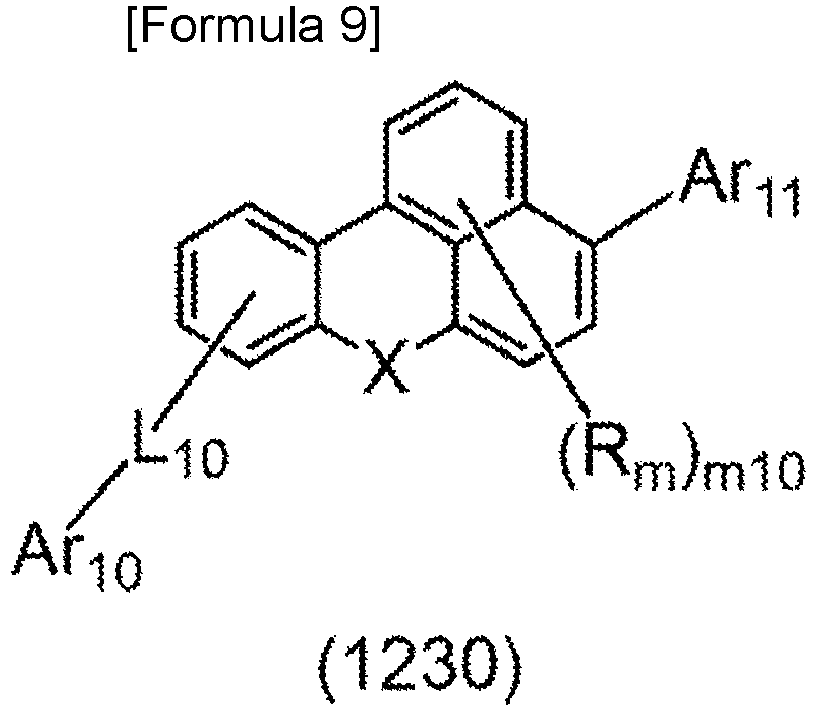


- The compound according to claim 8 or 9, wherein X is an oxygen atom.
- A compound comprising: at least one group represented by a formula (110A) below; and a single benz[de]anthracene derivative skeleton represented by a formula (1000A) below in a molecule,

 X is an oxygen atom, a sulfur atom, C(R2001)(R2002), or Si(R2003)(R2004);R2001 to R2004 are each independently a hydrogen atom, a substituted or unsubstituted alkyl group having 1 to 50 carbon atoms, a substituted or unsubstituted alkenyl group having 2 to 50 carbon atoms, a substituted or unsubstituted alkynyl group having 2 to 50 carbon atoms, a substituted or unsubstituted cycloalkyl group having 3 to 50 ring carbon atoms, a group represented by -Si(R901)(R902)(R903), a group represented by -O-(R904), a group represented by -S-(R905), a group represented by -N(R906)(R907), a halogen atom, a cyano group, a nitro group, a substituted or unsubstituted aryl group having 6 to 50 ring carbon atoms, or a substituted or unsubstituted heterocyclic group having 5 to 50 ring atoms;at least one combination of adjacent two or more of R10 to R19 are mutually bonded to form a substituted or unsubstituted monocyclic ring, mutually bonded to form a substituted or unsubstituted fused ring, or not mutually bonded;R10 to R19 forming neither the substituted or unsubstituted monocyclic ring nor the substituted or unsubstituted fused ring are each independently a hydrogen atom, a substituted or unsubstituted alkyl group having 1 to 50 carbon atoms, a substituted or unsubstituted haloalkyl group having 1 to 50 carbon atoms, a substituted or unsubstituted alkenyl group having 2 to 50 carbon atoms, a substituted or unsubstituted alkynyl group having 2 to 50 carbon atoms, a substituted or unsubstituted cycloalkyl group having 3 to 50 ring carbon atoms, a group represented by -Si(R901)(R902)(R903), a group represented by -O-(R904), a group represented by - S-(R905), a group represented by -N(R906)(R907), a substituted or unsubstituted aralkyl group having 7 to 50 carbon atoms, a group represented by -C(=O)R801, a group represented by -COOR802, a halogen atom, a nitro group, a substituted or unsubstituted aryl group having 6 to 50 ring carbon atoms, a substituted or unsubstituted heterocyclic group having 5 to 50 ring atoms, or a group represented by the formula (110A);at least one of R13 or R18 is a group represented by the formula (110A);when a plurality of groups represented by the formula (110A) are present, the plurality of groups represented by the formula (110A) are mutually the same or different;L100 is a single bond, a substituted or unsubstituted arylene group having 6 to 50 ring carbon atoms, or a substituted or unsubstituted divalent heterocyclic group having 5 to 50 ring atoms;mx is 1, 2, or 3;when two or more L100 are present, the two or more L100 are mutually the same or different;Ar1 is a substituted or unsubstituted aryl group including four or more rings;when two or more Ar1 are present, the two or more Ar1 are mutually the same or different;* in the formula (110A) represents a bonding position;in a compound represented by the formula (1000A), R901, R902, R903, R904, R905, R906, R907, R801, and R302 are each independently a hydrogen atom, a substituted or unsubstituted alkyl group having 1 to 50 carbon atoms, a substituted or unsubstituted cycloalkyl group having 3 to 50 ring carbon atoms, a substituted or unsubstituted aryl group having 6 to 50 ring carbon atoms, or a substituted or unsubstituted heterocyclic group having 5 to 50 ring atoms;when a plurality of R901 are present, the plurality of R901 are mutually the same or different;when a plurality of R902 are present, the plurality of R902 are mutually the same or different;when a plurality of R903 are present, the plurality of R903 are mutually the same or different;when a plurality of R904 are present, the plurality of R904 are mutually the same or different;when a plurality of R905 are present, the plurality of R905 are mutually the same or different;when a plurality of R906 are present, the plurality of R906 are mutually the same or different;when a plurality of R907 are present, the plurality of R907 are mutually the same or different;when a plurality of R801 are present, the plurality of R801 are mutually the same or different; andwhen a plurality of R302 are present, the plurality of R302 are mutually the same or different.
 - The compound according to claim 11, wherein at least one combination of a combination of R10 and R11, a combination of R11 and R12, a combination of R12 and R13, a combination of R13 and R14, a combination of R14 and R15, a combination of R16 and R17, a combination of R17 and R18, a combination of R18 and R19, or a combination of R19 and R10 are mutually bonded to form a substituted or unsubstituted monocyclic ring, or mutually bonded to form a substituted or unsubstituted fused ring.
- The compound according to claim 12, wherein one combination of the combination of R13 and R14, the combination of R16 and R17, and the combination of R19 and R10 are mutually bonded to form a substituted or unsubstituted benzene ring.
- The compound according to claim 11, wherein the compound comprises: at least one group represented by the formula (110A); and a single benzoxanthene ring represented by a formula (100A) below in a molecule,

 where: R10 to R19 each independently represent the same as R10 to R19 in the formula (1000A);none of combinations of adjacent two or more of R10 to R19 are mutually bonded; andAr1, L1, and mx respectively represent the same as Ar1, L1, and mx in the formula (110A).
 - The compound according to claim 14, wherein the compound comprising at least one group represented by the formula (110A) and a single benzoxanthene ring represented by the formula (100A) below in a molecule is represented by a formula (121A) or (122A),


 where: R10 to R19 each independently represent the same as R10 to R19 in the formula (100A), andAr1, L100, and mx respectively represent the same as Ar1, L100, and mx in the formula (110A).
 - The compound according to any one of claims 11 to 15, wherein R10 to R19 not being a group represented by the formula (110A) are each independently a hydrogen atom, a substituted or unsubstituted alkyl group having 1 to 50 carbon atoms, a substituted or unsubstituted cycloalkyl group having 3 to 50 ring carbon atoms, or a substituted or unsubstituted aryl group having 6 to 50 ring carbon atoms.
- The compound according to any one of claims 1 to 16, wherein a group represented by -(L1)mx-, a group represented by -L10-, or a group represented by - (L100)mx- is a group represented by one of formulae (111) to (120) below,


- The compound according to any one of claims 11 to 17, wherein Ar1 is an aryl group in which at least four substituted or unsubstituted benzene rings are fused.
- The compound according to any one of claims 1 to 18, wherein Ar1 or Ar10 is a group represented by a formula (1100), (1200), (1300), (1400), (1500), (1600), (1700), or (1800) below,


 where: in the formula (1100), one of R111 to R120 is a bond;in the formula (1200), one of R1201 to R1212 is a bond;in the formula (1300), one of R1301 to R1314 is a bond;in the formula (1400), one of R1401 to R1414 is a bond;in the formula (1500), one of R1501 to R1514 is a bond;in the formula (1600), one of R1601 to R1612 is a bond;in the formula (1700), one of R1701 to R1710 is a bond;in the formula (1800), one of R1801 to R1812 is a bond;R111 to R120 not being a bond, R1201 to R1212 not being a bond, R1301 to R1314 not being a bond, R1401 to R1414 not being a bond, R1501 to R1514 not being a bond, R1601 to R1612 not being a bond, R1701 to R1710 not being a bond, and R1801 to R1812 not being a bond are each independently a hydrogen atom, a substituted or unsubstituted alkyl group having 1 to 50 carbon atoms, a substituted or unsubstituted haloalkyl group having 1 to 50 carbon atoms, a substituted or unsubstituted alkenyl group having 2 to 50 carbon atoms, a substituted or unsubstituted alkynyl group having 2 to 50 carbon atoms, a substituted or unsubstituted cycloalkyl group having 3 to 50 ring carbon atoms, a group represented by -Si(R901)(R902)(R903), a group represented by -O-(R904), a group represented by -S-(R905), a group represented by -N(R906)(R907), a substituted or unsubstituted aralkyl group having 7 to 50 carbon atoms, a group represented by -C(=O)R801, a group represented by -COOR802, a halogen atom, a nitro group, a substituted or unsubstituted aryl group having 6 to 50 ring carbon atoms, or a substituted or unsubstituted heterocyclic group having 5 to 50 ring atoms.
 - The compound according to claim 19, wherein R111 to R120 not being a bond, R1201 to R1212 not being a bond, R1301 to R1314 not being a bond, R1401 to R1414 not being a bond, R1501 to R1514 not being a bond, R1601 to R1612 not being a bond, R1701 to R1710 not being a bond, and R1801 to R1812 not being a bond are each independently a hydrogen atom, a substituted or unsubstituted alkyl group having 1 to 50 carbon atoms, a substituted or unsubstituted cycloalkyl group having 3 to 50 ring carbon atoms, or a substituted or unsubstituted aryl group having 6 to 50 ring carbon atoms.
- The compound according to any one of claims 1 to 20, wherein all of the "substituted or unsubstituted" groups are "unsubstituted" groups.
- An organic electroluminescence device comprising:an anode;a cathode; andat least one organic layer disposed between the anode and the cathode, whereinthe at least one organic layer comprises an emitting layer, andat least one of the at least one organic layer comprises a compound according to any one of claims 1 to 21.
- The organic electroluminescence device according to claim 22, wherein the emitting layer comprises the compound.
- An organic electroluminescence device comprising:an anode;a cathode; andat least one emitting layer disposed between the anode and the cathode, whereinthe at least one emitting layer comprises a first emitting layer and a second emitting layer,the first emitting layer comprises a first compound, andthe first compound is a compound represented by a formula (1000B) below and comprising at least one group represented by a formula (110) below,

 X is an oxygen atom, a sulfur atom, C(R2001)(R2002), or Si(R2003)(R2004);R2001 to R2004 are each independently a hydrogen atom, a substituted or unsubstituted alkyl group having 1 to 50 carbon atoms, a substituted or unsubstituted alkenyl group having 2 to 50 carbon atoms, a substituted or unsubstituted alkynyl group having 2 to 50 carbon atoms, a substituted or unsubstituted cycloalkyl group having 3 to 50 ring carbon atoms, a group represented by -Si(R901)(R902)(R903), a group represented by -O-(R904), a group represented by -S-(R905), a group represented by -N(R906)(R907), a halogen atom, a cyano group, a nitro group, a substituted or unsubstituted aryl group having 6 to 50 ring carbon atoms, or a substituted or unsubstituted heterocyclic group having 5 to 50 ring atoms;at least one combination of adjacent two or more of R10 to R19 are mutually bonded to form a substituted or unsubstituted monocyclic ring, mutually bonded to form a substituted or unsubstituted fused ring, or not mutually bonded;R10 to R19 forming neither the substituted or unsubstituted monocyclic ring nor the substituted or unsubstituted fused ring are each independently a hydrogen atom, a substituted or unsubstituted alkyl group having 1 to 50 carbon atoms, a substituted or unsubstituted haloalkyl group having 1 to 50 carbon atoms, a substituted or unsubstituted alkenyl group having 2 to 50 carbon atoms, a substituted or unsubstituted alkynyl group having 2 to 50 carbon atoms, a substituted or unsubstituted cycloalkyl group having 3 to 50 ring carbon atoms, a group represented by -Si(R901)(R902)(R903), a group represented by -O-(R904), a group represented by - S-(R905), a group represented by -N(R906)(R907), a substituted or unsubstituted aralkyl group having 7 to 50 carbon atoms, a group represented by -C(=O)R801, a group represented by -COOR802, a halogen atom, a nitro group, a substituted or unsubstituted aryl group having 6 to 50 ring carbon atoms, a substituted or unsubstituted heterocyclic group having 5 to 50 ring atoms, or a group represented by the formula (110);at least one of R10 to R19 is a group represented by the formula (110);when a plurality of groups represented by the formula (110) are present, the plurality of groups represented by the formula (110) are mutually the same or different;L100 is a single bond, a substituted or unsubstituted arylene group having 6 to 50 ring carbon atoms, or a substituted or unsubstituted divalent heterocyclic group having 5 to 50 ring atoms;mx is 1, 2, or 3;when two or more L100 are present, the two or more L100 are mutually the same or different;Ar100 is a substituted or unsubstituted aryl group including three or more rings or a substituted or unsubstituted heterocyclic group including two or more aromatic rings and one or more heterocyclic rings;Ar100 does not include an anthracene ring;when two or more Ar100 are present, the two or more Ar100 are mutually the same or different; and* in the formula (110) represents a bonding position;in the first compound represented by the formula (1000B), R901, R902, R903, R904, R905, R906, R907, R801, and R802 are each independently a hydrogen atom, a substituted or unsubstituted alkyl group having 1 to 50 carbon atoms, a substituted or unsubstituted cycloalkyl group having 3 to 50 ring carbon atoms, a substituted or unsubstituted aryl group having 6 to 50 ring carbon atoms, or a substituted or unsubstituted heterocyclic group having 5 to 50 ring atoms;when a plurality of R901 are present, the plurality of R901 are mutually the same or different;when a plurality of R902 are present, the plurality of R902 are mutually the same or different;when a plurality of R903 are present, the plurality of R903 are mutually the same or different;when a plurality of R904 are present, the plurality of R904 are mutually the same or different;when a plurality of R905 are present, the plurality of R905 are mutually the same or different;when a plurality of R906 are present, the plurality of R906 are mutually the same or different;when a plurality of R907 are present, the plurality of R907 are mutually the same or different;when a plurality of R801 are present, the plurality of R801 are mutually the same or different; andwhen a plurality of R802 are present, the plurality of R802 are mutually the same or different.
 - The organic electroluminescence device according to claim 24, wherein at least one combination of a combination of R10 and R11, a combination of R11 and R12, a combination of R12 and R13, a combination of R13 and R14, a combination of R14 and R15, a combination of R16 and R17, a combination of R17 and R18, a combination of R18 and R19, or a combination of R19 and R10 are mutually bonded to form a substituted or unsubstituted monocyclic ring, or mutually bonded to form a substituted or unsubstituted fused ring.
- The organic electroluminescence device according to claim 25, wherein one combination of the combination of R13 and R14, the combination of R16 and R17, and the combination of R19 and R10 are mutually bonded to form a substituted or unsubstituted benzene ring.
- The organic electroluminescence device according to claim 24, wherein the first compound is a compound comprising at least one group represented by the formula (110) and represented by a formula (100) below,

 where: R10 to R19 each independently represent the same as R10 to R19 in the formula (1000B);none of combinations of adjacent two or more of R10 to R19 are mutually bonded; andAr100, L100, and mx respectively represent the same as Ar100, L100, and mx in the formula (110).
 - The organic electroluminescence device according to any one of claims 24 to 27, whereinthe first emitting layer is disposed between the anode and the cathode, andthe second emitting layer is disposed between the first emitting layer and the cathode.
- The organic electroluminescence device according to any one of claims 24 to 28, wherein the first emitting layer is in direct contact with the second emitting layer.
- The organic electroluminescence device according to any one of claims 24 to 29, wherein the first compound is represented by a formula (101) or (102) below,

 where: R10 to R19 each independently represent the same as R10 to R19 in the formula (1000B);none of combinations of adjacent two or more of R10 to R19 are mutually bonded; andAr100, L100, and mx respectively represent the same as Ar100, L100, and mx in the formula (110).
 - The organic electroluminescence device according to any one of claims 24 to 30, wherein R10 to R19 not being a group represented by the formula (110) are each independently a hydrogen atom, a substituted or unsubstituted alkyl group having 1 to 50 carbon atoms, a substituted or unsubstituted cycloalkyl group having 3 to 50 ring carbon atoms, or a substituted or unsubstituted aryl group having 6 to 50 ring carbon atoms.
- The organic electroluminescence device according to claim 24, wherein the compound represented by the formula (1000B) and comprising at least one group represented by the formula (110) is represented by a formula (123), (124), (125), or (126) below,


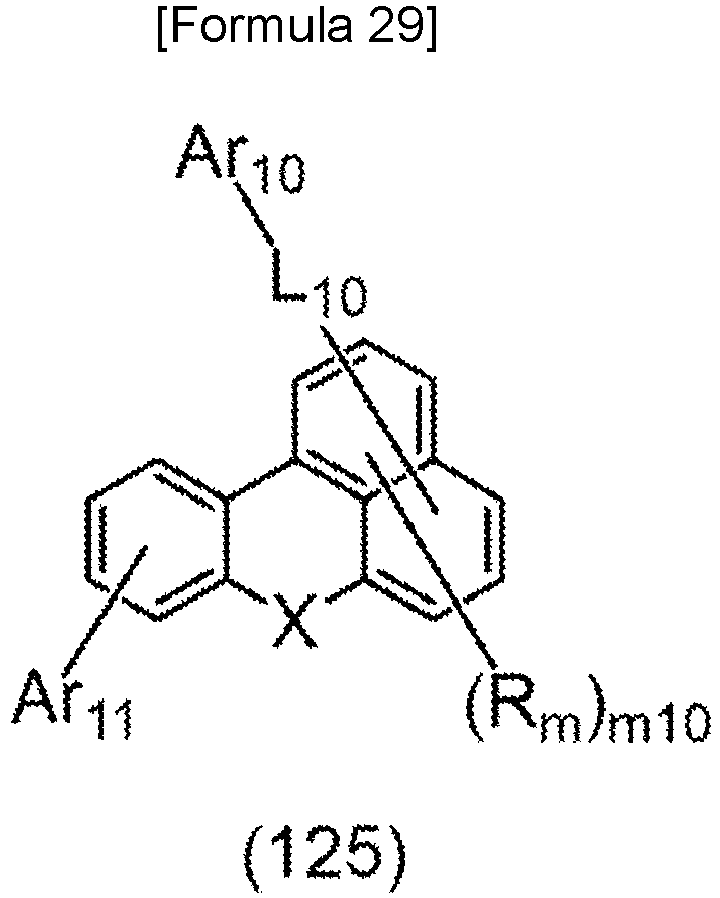

 where: X is an oxygen atom, a sulfur atom, C(R2001)(R2002), or Si(R2003)(R2004);R2001 to R2004 are each independently a hydrogen atom, a substituted or unsubstituted alkyl group having 1 to 50 carbon atoms, a substituted or unsubstituted alkenyl group having 2 to 50 carbon atoms, a substituted or unsubstituted alkynyl group having 2 to 50 carbon atoms, a substituted or unsubstituted cycloalkyl group having 3 to 50 ring carbon atoms, a group represented by -Si(R901)(R902)(R903), a group represented by -O-(R904), a group represented by -S-(R905), a group represented by -N(R906)(R907), a halogen atom, a cyano group, a nitro group, a substituted or unsubstituted aryl group having 6 to 50 ring carbon atoms, or a substituted or unsubstituted heterocyclic group having 5 to 50 ring atoms;L10 is a substituted or unsubstituted arylene group having 6 to 15 ring carbon atoms, or a substituted or unsubstituted divalent heterocyclic group having 5 to 15 ring atoms;Ar10 is an aryl group in which at least four substituted or unsubstituted benzene rings are fused;Ar11 is a substituted or unsubstituted aryl group having 6 to 14 ring carbon atoms;Ar11 is not a substituted or unsubstituted anthryl group;m10 is 5;m11 is 6;Rm is each independently a hydrogen atom, a substituted or unsubstituted alkyl group having 1 to 50 carbon atoms, a substituted or unsubstituted haloalkyl group having 1 to 50 carbon atoms, a substituted or unsubstituted alkenyl group having 2 to 50 carbon atoms, a substituted or unsubstituted alkynyl group having 2 to 50 carbon atoms, a substituted or unsubstituted cycloalkyl group having 3 to 50 ring carbon atoms, a group represented by -Si(R901)(R902)(R903), a group represented by -O-(R904), a group represented by -S-(R905), a group represented by -N(R906)(R907), a substituted or unsubstituted aralkyl group having 7 to 50 carbon atoms, a group represented by -C(=O)R801, a group represented by -COOR802, a halogen atom, a nitro group, a substituted or unsubstituted aryl group having 6 to 50 ring carbon atoms, or a substituted or unsubstituted heterocyclic group having 5 to 50 ring atoms;a plurality of Rm are not mutually bonded;R901, R902, R903, R904, R905, R906, R907, R801, and R802 are each independently a hydrogen atom, a substituted or unsubstituted alkyl group having 1 to 50 carbon atoms, a substituted or unsubstituted cycloalkyl group having 3 to 50 ring carbon atoms, a substituted or unsubstituted aryl group having 6 to 50 ring carbon atoms, or a substituted or unsubstituted heterocyclic group having 5 to 50 ring atoms;when a plurality of R901 are present, the plurality of R901 are mutually the same or different;when a plurality of R902 are present, the plurality of R902 are mutually the same or different;when a plurality of R903 are present, the plurality of R903 are mutually the same or different;when a plurality of R904 are present, the plurality of R904 are mutually the same or different;when a plurality of R905 are present, the plurality of R905 are mutually the same or different;when a plurality of R906 are present, the plurality of R906 are mutually the same or different;when a plurality of R907 are present, the plurality of R907 are mutually the same or different;when a plurality of R801 are present, the plurality of R801 are mutually the same or different; andwhen a plurality of R802 are present, the plurality of R802 are mutually the same or different.
 - The organic electroluminescence device according to claim 32, wherein a compound represented by the formula (123) is represented by a formula (1230) below, a compound represented by the formula (124) is represented by a formula (1240) below, a compound represented by the formula (125) is represented by a formula (1250) below, and a compound represented by the formula (126) is represented by a formula (1260) below,


- The organic electroluminescence device according to claim 32 or 33, wherein X is an oxygen atom.
- The organic electroluminescence device according to any one of claims 24 to 31, wherein Ar100 is a group represented by a formula (1100), (1200), (1300), (1400), (1500), (1600), (1700), or (1800),

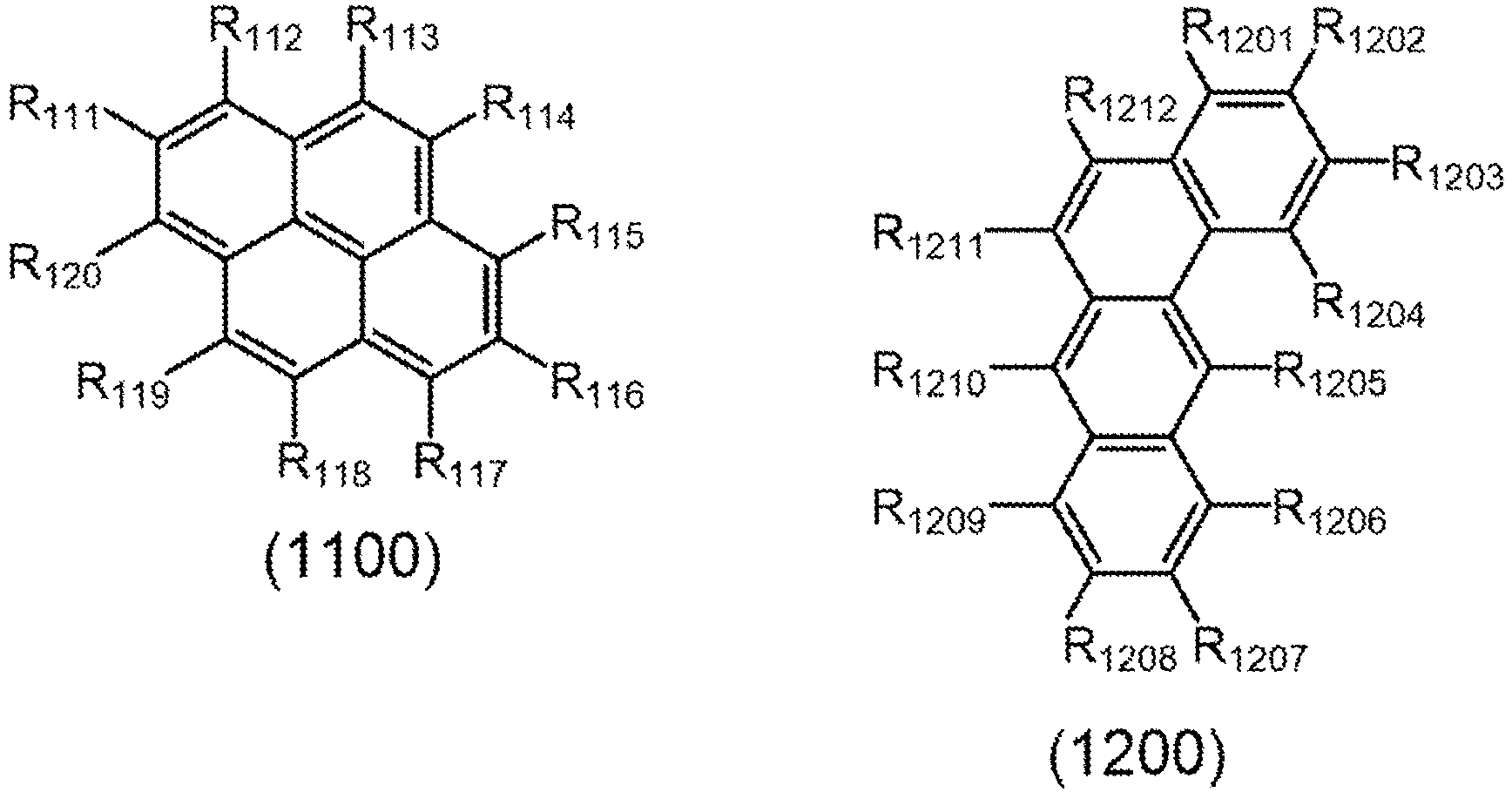


 where: in the formula (1100), one of R111 to R120 is a bond;in the formula (1200), one of R1201 to R1212 is a bond;in the formula (1300), one of R1301 to R1314 is a bond;in the formula (1400), one of R1401 to R1414 is a bond;in the formula (1500), one of R1501 to R1514 is a bond;in the formula (1600), one of R1601 to R1612 is a bond;in the formula (1700), one of R1701 to R1710 is a bond;in the formula (1800), one of R1801 to R1812 is a bond;R111 to R120 not being a bond, R1201 to R1212 not being a bond, R1301 to R1314 not being a bond, R1401 to R1414 not being a bond, R1501 to R1514 not being a bond, R1601 to R1612 not being a bond, R1701 to R1710 not being a bond, and R1801 to R1812 not being a bond are each independently a hydrogen atom, a substituted or unsubstituted alkyl group having 1 to 50 carbon atoms, a substituted or unsubstituted haloalkyl group having 1 to 50 carbon atoms, a substituted or unsubstituted alkenyl group having 2 to 50 carbon atoms, a substituted or unsubstituted alkynyl group having 2 to 50 carbon atoms, a substituted or unsubstituted cycloalkyl group having 3 to 50 ring carbon atoms, a group represented by -Si(R901)(R902)(R903), a group represented by -O-(R904), a group represented by -S-(R905), a group represented by -N(R906)(R907), a substituted or unsubstituted aralkyl group having 7 to 50 carbon atoms, a group represented by -C(=O)R801, a group represented by -COOR802, a halogen atom, a nitro group, a substituted or unsubstituted aryl group having 6 to 50 ring carbon atoms, or a substituted or unsubstituted heterocyclic group having 5 to 50 ring atoms.
 - The organic electroluminescence device according to any one of claims 24 to 35, wherein the second emitting layer comprises a second compound represented by a formula (2) below,
 where: R201 to R208 are each independently a hydrogen atom, a substituted or unsubstituted alkyl group having 1 to 50 carbon atoms, a substituted or unsubstituted haloalkyl group having 1 to 50 carbon atoms, a substituted or unsubstituted alkenyl group having 2 to 50 carbon atoms, a substituted or unsubstituted alkynyl group having 2 to 50 carbon atoms, a substituted or unsubstituted cycloalkyl group having 3 to 50 ring carbon atoms, a group represented by -Si(R901)(R902)(R903), a group represented by -O-(R904), a group represented by -S-(R905), a group represented by -N(R906)(R907), a substituted or unsubstituted aralkyl group having 7 to 50 carbon atoms, a group represented by -C(=O)R801, a group represented by -COOR802, a halogen atom, a nitro group, a substituted or unsubstituted aryl group having 6 to 50 ring carbon atoms, or a substituted or unsubstituted heterocyclic group having 5 to 50 ring atoms;L201 and L202 are each independently a single bond, a substituted or unsubstituted arylene group having 6 to 50 ring carbon atoms, or a substituted or unsubstituted divalent heterocyclic group having 5 to 50 ring atoms;Ar201 and Ar202 are each independently a substituted or unsubstituted aryl group having 6 to 50 ring carbon atoms, or a substituted or unsubstituted heterocyclic group having 5 to 50 ring atoms;in the second compound represented by the formula (2), R901, R902, R903, R904, R905, R906, R907, R801, and R802 are each independently a hydrogen atom, a substituted or unsubstituted alkyl group having 1 to 50 carbon atoms, a substituted or unsubstituted cycloalkyl group having 3 to 50 ring carbon atoms, a substituted or unsubstituted aryl group having 6 to 50 ring carbon atoms, or a substituted or unsubstituted heterocyclic group having 5 to 50 ring atoms;when a plurality of R901 are present, the plurality of R901 are mutually the same or different;when a plurality of R902 are present, the plurality of R902 are mutually the same or different;when a plurality of R903 are present, the plurality of R903 are mutually the same or different;when a plurality of R904 are present, the plurality of R904 are mutually the same or different;when a plurality of R905 are present, the plurality of R905 are mutually the same or different;when a plurality of R906 are present, the plurality of R906 are mutually the same or different;when a plurality of R907 are present, the plurality of R907 are mutually the same or different;when a plurality of R801 are present, the plurality of R801 are mutually the same or different; andwhen a plurality of R802 are present, the plurality of R802 are mutually the same or different.
 - The organic electroluminescence device according to claim 36, whereinR201 to R208 are each independently a hydrogen atom, a substituted or unsubstituted alkyl group having 1 to 50 carbon atoms, a substituted or unsubstituted haloalkyl group having 1 to 50 carbon atoms, a substituted or unsubstituted alkenyl group having 2 to 50 carbon atoms, a substituted or unsubstituted alkynyl group having 2 to 50 carbon atoms, a substituted or unsubstituted cycloalkyl group having 3 to 50 ring carbon atoms, a group represented by -Si(R901)(R902)(R903), a group represented by -O-(R904), a group represented by -S-(R905), a group represented by -N(R906)(R907), a substituted or unsubstituted aralkyl group having 7 to 50 carbon atoms, a group represented by -C(=O)R801, a group represented by -COOR802, a halogen atom, or a nitro group;L201 and L202 are each independently a single bond, a substituted or unsubstituted arylene group having 6 to 50 ring carbon atoms, or a substituted or unsubstituted divalent heterocyclic group having 5 to 50 ring atoms; andAr201 and Ar202 are each independently a substituted or unsubstituted aryl group having 6 to 50 ring carbon atoms, or a substituted or unsubstituted heterocyclic group having 5 to 50 ring atoms.
- The organic electroluminescence device according to claim 36 or 37, whereinL201 and L202 are each independently a single bond, or a substituted or unsubstituted arylene group having 6 to 50 ring carbon atoms; andAr201 and Ar202 are each independently a substituted or unsubstituted aryl group having 6 to 50 ring carbon atoms.
- The organic electroluminescence device according to any one of claims 36 to 38, wherein
Ar201 and Ar202 are each independently a phenyl group, a naphthyl group, a phenanthryl group, a biphenyl group, a terphenyl group, a diphenylfluorenyl group, a dimethylfluorenyl group, a benzodiphenylfluorenyl group, a benzodimethylfluorenyl group, a dibenzofuranyl group, a dibenzothienyl group, a benzoxanthenyl group, a naphthobenzofuranyl group, or a naphthobenzothienyl group. - The organic electroluminescence device according to any one of claims 36 to 39, wherein the second compound represented by the formula (2) is a compound represented by a formula (201), (202), (203), (204), (205), (206), (207), (208), or (209),


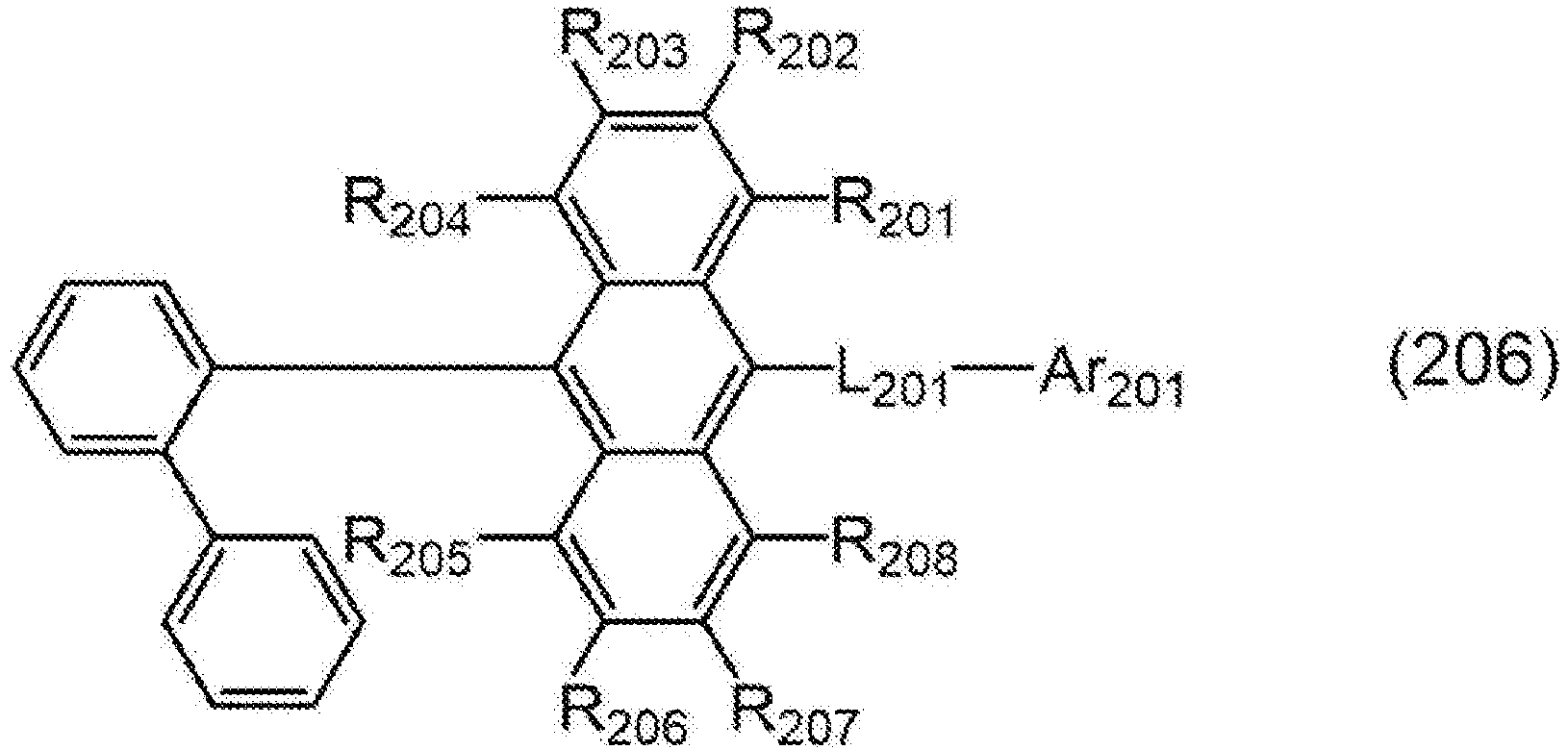


 where: L201 and Ar201 represent the same as L201 and Ar201 in the formula (2); andR201 to R208 each independently represent the same as R201 to R208 in the formula (2).
 - The organic electroluminescence device according to any one of claims 24 to 40, further comprising: a hole transporting layer between the anode and the emitting layer.
- The organic electroluminescence device according to any one of claims 24 to 41, further comprising: an electron transporting layer between the cathode and the emitting layer.
- The organic electroluminescence device according to any one of claims 24 to 42, whereinthe first emitting layer further comprises a third compound that fluoresces, andthe third compound is a compound that emits light having a main peak wavelength in a range from 430 nm to 480 nm.
- The organic electroluminescence device according to any one of claims 24 to 43, whereinthe second emitting layer further comprises a fourth compound that fluoresces, andthe fourth compound is a compound that emits light having a main peak wavelength in a range from 430 nm to 480 nm.
- An electronic device comprising the organic electroluminescence device according to any one of claims 22 to 44.
Applications Claiming Priority (5)
| Application Number | Priority Date | Filing Date | Title |
|---|---|---|---|
| JP2020179704 | 2020-10-27 | ||
| JP2021025304 | 2021-02-19 | ||
| JP2021062404 | 2021-03-31 | ||
| JP2021145819 | 2021-09-07 | ||
| PCT/JP2021/036397 WO2022091691A1 (en) | 2020-10-27 | 2021-10-01 | Compound, organic electroluminescent element and electronic device |
Publications (2)
| Publication Number | Publication Date |
|---|---|
| EP4238953A1 true EP4238953A1 (en) | 2023-09-06 |
| EP4238953A4 EP4238953A4 (en) | 2024-10-16 |
Family
ID=81382387
Family Applications (1)
| Application Number | Title | Priority Date | Filing Date |
|---|---|---|---|
| EP21885810.8A Pending EP4238953A4 (en) | 2020-10-27 | 2021-10-01 | COMPOUND, ORGANIC ELECTROLUMINESCENT ELEMENT AND ELECTRONIC DEVICE |
Country Status (6)
| Country | Link |
|---|---|
| US (1) | US20240090329A1 (en) |
| EP (1) | EP4238953A4 (en) |
| JP (1) | JP7815133B2 (en) |
| KR (1) | KR20230097082A (en) |
| CN (1) | CN116348436B (en) |
| WO (1) | WO2022091691A1 (en) |
Families Citing this family (3)
| Publication number | Priority date | Publication date | Assignee | Title |
|---|---|---|---|---|
| EP4299564A4 (en) | 2021-02-25 | 2025-04-23 | Idemitsu Kosan Co.,Ltd. | COMPOUND, MATERIAL FOR ORGANIC ELECTROLUMINESCENT ELEMENTS, ORGANIC ELECTROLUMINESCENT ELEMENT AND ELECTRONIC DEVICE |
| JP7554371B2 (en) * | 2021-12-27 | 2024-09-19 | 出光興産株式会社 | COMPOUND, ORGANIC ELECTROLUMINESCENT DEVICE, AND ELECTRONIC DEVICE |
| US20250324847A1 (en) * | 2022-05-20 | 2025-10-16 | Idemitsu Kosan Co.,Ltd. | Compound, material for organic electroluminescent elements, organic electroluminescent element, and electronic device |
Family Cites Families (17)
| Publication number | Priority date | Publication date | Assignee | Title |
|---|---|---|---|---|
| US20100295445A1 (en) * | 2009-05-22 | 2010-11-25 | Idemitsu Kosan Co., Ltd. | Organic electroluminescent device |
| KR20110104765A (en) * | 2010-03-17 | 2011-09-23 | 다우어드밴스드디스플레이머티리얼 유한회사 | Novel organic light emitting compound and organic electroluminescent device employing the same |
| JP6016482B2 (en) * | 2012-07-03 | 2016-10-26 | キヤノン株式会社 | Dibenzoxanthene compound, organic light emitting device, display device, image information processing device, and image forming device |
| CN103102299B (en) * | 2012-11-12 | 2015-08-05 | 吉林奥来德光电材料股份有限公司 | A kind of benzanthrene derivative, its preparation method and the electroluminescent organic material be made up of it |
| KR102269131B1 (en) * | 2013-07-01 | 2021-06-25 | 삼성디스플레이 주식회사 | Compound and organic light emitting device comprising same |
| KR102191990B1 (en) | 2013-09-10 | 2020-12-17 | 삼성디스플레이 주식회사 | Condensed compound and organic light emitting diode comprising the same |
| KR101622821B1 (en) * | 2014-02-14 | 2016-05-19 | 주식회사 두산 | Organic compounds and organic electro luminescence device comprising the same |
| KR102184675B1 (en) | 2014-03-19 | 2020-12-01 | 삼성디스플레이 주식회사 | Condensed-cyclic compound and organic light emitting diode comprising the same |
| KR102603864B1 (en) | 2016-05-13 | 2023-11-21 | 삼성디스플레이 주식회사 | Compound and Organic light emitting device comprising same |
| CN107827853B (en) * | 2017-11-15 | 2020-08-28 | 南京高光半导体材料有限公司 | Blue light-emitting compounds, organic electroluminescent devices and their applications |
| CN108148037B (en) * | 2017-11-15 | 2020-07-14 | 南京高光半导体材料有限公司 | Blue light-emitting compounds, organic electroluminescent devices and their applications |
| CN112823434B (en) * | 2018-10-16 | 2025-06-03 | 出光兴产株式会社 | Organic electroluminescent element and electronic device |
| US12516240B2 (en) * | 2019-08-08 | 2026-01-06 | Idemitsu Kosan Co., Ltd. | Compound, organic electroluminescence device using the same, and electronic apparatus |
| JP2023015412A (en) * | 2019-11-08 | 2023-02-01 | 出光興産株式会社 | Organic electroluminescence device and electronic device |
| JP2023040310A (en) * | 2019-12-27 | 2023-03-23 | 出光興産株式会社 | Organic electroluminescent element and electronic apparatus |
| WO2021201176A1 (en) * | 2020-04-01 | 2021-10-07 | 出光興産株式会社 | Organic electroluminescent element, compound, and electronic equipment |
| WO2021210305A1 (en) * | 2020-04-15 | 2021-10-21 | 出光興産株式会社 | Organic electroluminescent element and electronic device |
-
2021
- 2021-10-01 US US18/032,821 patent/US20240090329A1/en active Pending
- 2021-10-01 JP JP2022558944A patent/JP7815133B2/en active Active
- 2021-10-01 CN CN202180073461.XA patent/CN116348436B/en active Active
- 2021-10-01 WO PCT/JP2021/036397 patent/WO2022091691A1/en not_active Ceased
- 2021-10-01 KR KR1020237017385A patent/KR20230097082A/en active Pending
- 2021-10-01 EP EP21885810.8A patent/EP4238953A4/en active Pending
Also Published As
| Publication number | Publication date |
|---|---|
| KR20230097082A (en) | 2023-06-30 |
| JPWO2022091691A1 (en) | 2022-05-05 |
| WO2022091691A1 (en) | 2022-05-05 |
| CN116348436A (en) | 2023-06-27 |
| CN116348436B (en) | 2025-11-07 |
| EP4238953A4 (en) | 2024-10-16 |
| US20240090329A1 (en) | 2024-03-14 |
| JP7815133B2 (en) | 2026-02-17 |
Similar Documents
| Publication | Publication Date | Title |
|---|---|---|
| KR102874963B1 (en) | Organic electroluminescent devices and electronic devices | |
| KR102893925B1 (en) | Organic electroluminescent devices and electronic devices | |
| EP3696167B1 (en) | Compound, material for organic electroluminescence element, organic electroluminescence element, and electronic device | |
| EP3276697B1 (en) | Organic electroluminescent element, electronic device and compound | |
| EP3422431B1 (en) | Organic electroluminescent element and electronic device | |
| EP4361156A1 (en) | Compound, material for organic electroluminescent elements, organic electroluminescent element, and electronic device | |
| EP4108660A1 (en) | Organic electroluminescent element and electronic appliance | |
| EP3896070A1 (en) | Organic electroluminescent element, compound, material for organic electroluminescent element, and electronic device | |
| EP3974433B1 (en) | Organic electroluminescent element, compound, and electronic appliance | |
| EP4310931A1 (en) | Organic electroluminescent element, compound, and electronic device | |
| CN116348436B (en) | Compound, organic electroluminescent element, and electronic device | |
| KR20220062618A (en) | Organic electroluminescent devices and electronic devices | |
| EP4141011B1 (en) | Compound, material for organic electroluminescent element, organic electroluminescent element, and electronic equipment | |
| US11839138B2 (en) | Organic electroluminescent element and electronic device | |
| US12289995B2 (en) | Compound, material for organic electroluminescent element, organic electroluminescent element and electronic device | |
| EP4108661A1 (en) | Organic electroluminescence element and electronic device | |
| EP4458795A1 (en) | Compound, organic electroluminescent element, and electronic device | |
| WO2021201176A1 (en) | Organic electroluminescent element, compound, and electronic equipment | |
| EP4137473B1 (en) | Compound, organic electroluminescent element and electronic device | |
| US20240368103A1 (en) | Compound, organic-electroluminescence-device material, organic electroluminescence device, and electronic device | |
| US20240276878A1 (en) | Compound, organic-electroluminescence-device material, organic electroluminescence device, and electronic device | |
| KR20260004446A (en) | Compounds, organic electroluminescent devices, and electronic devices | |
| KR20260003749A (en) | Compounds, organic electroluminescent devices, and electronic devices | |
| CN118475549A (en) | Compound, organic electroluminescent element, and electronic device |
Legal Events
| Date | Code | Title | Description |
|---|---|---|---|
| STAA | Information on the status of an ep patent application or granted ep patent |
Free format text: STATUS: THE INTERNATIONAL PUBLICATION HAS BEEN MADE |
|
| PUAI | Public reference made under article 153(3) epc to a published international application that has entered the european phase |
Free format text: ORIGINAL CODE: 0009012 |
|
| STAA | Information on the status of an ep patent application or granted ep patent |
Free format text: STATUS: REQUEST FOR EXAMINATION WAS MADE |
|
| 17P | Request for examination filed |
Effective date: 20230323 |
|
| AK | Designated contracting states |
Kind code of ref document: A1 Designated state(s): AL AT BE BG CH CY CZ DE DK EE ES FI FR GB GR HR HU IE IS IT LI LT LU LV MC MK MT NL NO PL PT RO RS SE SI SK SM TR |
|
| DAV | Request for validation of the european patent (deleted) | ||
| DAX | Request for extension of the european patent (deleted) | ||
| A4 | Supplementary search report drawn up and despatched |
Effective date: 20240918 |
|
| RIC1 | Information provided on ipc code assigned before grant |
Ipc: H10K 85/60 20230101ALI20240912BHEP Ipc: H10K 85/00 20230101ALI20240912BHEP Ipc: C07F 7/08 20060101ALI20240912BHEP Ipc: H05B 33/12 20060101ALI20240912BHEP Ipc: C07D 311/78 20060101ALI20240912BHEP Ipc: C09K 11/06 20060101ALI20240912BHEP Ipc: C07D 335/04 20060101ALI20240912BHEP Ipc: C07C 13/66 20060101AFI20240912BHEP |
|
| RIN1 | Information on inventor provided before grant (corrected) |
Inventor name: SHIRASAKI, YOSHINAO Inventor name: KUDO, YU Inventor name: TAKAHASHI, RYOTA Inventor name: BAN, SHINTARO Inventor name: MORITA, TAKAMOTO Inventor name: IIDA, MAIKO Inventor name: YAMAKI, TARO Inventor name: NAKANO, YUKI Inventor name: ITOI, HIROAKI |