EP4236345A1 - Verfahren und vorrichtung zur konfiguration von einzeldienstressourcen, computervorrichtung und medium - Google Patents
Verfahren und vorrichtung zur konfiguration von einzeldienstressourcen, computervorrichtung und medium Download PDFInfo
- Publication number
- EP4236345A1 EP4236345A1 EP21893789.4A EP21893789A EP4236345A1 EP 4236345 A1 EP4236345 A1 EP 4236345A1 EP 21893789 A EP21893789 A EP 21893789A EP 4236345 A1 EP4236345 A1 EP 4236345A1
- Authority
- EP
- European Patent Office
- Prior art keywords
- state
- action
- osnr
- policy
- service
- Prior art date
- Legal status (The legal status is an assumption and is not a legal conclusion. Google has not performed a legal analysis and makes no representation as to the accuracy of the status listed.)
- Granted
Links
Images


Classifications
-
- H—ELECTRICITY
- H04—ELECTRIC COMMUNICATION TECHNIQUE
- H04Q—SELECTING
- H04Q11/00—Selecting arrangements for multiplex systems
- H04Q11/0001—Selecting arrangements for multiplex systems using optical switching
- H04Q11/0062—Network aspects
-
- H—ELECTRICITY
- H04—ELECTRIC COMMUNICATION TECHNIQUE
- H04B—TRANSMISSION
- H04B10/00—Transmission systems employing electromagnetic waves other than radio-waves, e.g. infrared, visible or ultraviolet light, or employing corpuscular radiation, e.g. quantum communication
- H04B10/07—Arrangements for monitoring or testing transmission systems; Arrangements for fault measurement of transmission systems
- H04B10/075—Arrangements for monitoring or testing transmission systems; Arrangements for fault measurement of transmission systems using an in-service signal
- H04B10/079—Arrangements for monitoring or testing transmission systems; Arrangements for fault measurement of transmission systems using an in-service signal using measurements of the data signal
- H04B10/0795—Performance monitoring; Measurement of transmission parameters
- H04B10/07953—Monitoring or measuring OSNR, BER or Q
-
- H—ELECTRICITY
- H04—ELECTRIC COMMUNICATION TECHNIQUE
- H04J—MULTIPLEX COMMUNICATION
- H04J3/00—Time-division multiplex systems
- H04J3/16—Time-division multiplex systems in which the time allocation to individual channels within a transmission cycle is variable, e.g. to accommodate varying complexity of signals, to vary number of channels transmitted
- H04J3/1605—Fixed allocated frame structures
- H04J3/1652—Optical Transport Network [OTN]
-
- H—ELECTRICITY
- H04—ELECTRIC COMMUNICATION TECHNIQUE
- H04L—TRANSMISSION OF DIGITAL INFORMATION, e.g. TELEGRAPHIC COMMUNICATION
- H04L47/00—Traffic control in data switching networks
- H04L47/70—Admission control; Resource allocation
-
- H—ELECTRICITY
- H04—ELECTRIC COMMUNICATION TECHNIQUE
- H04L—TRANSMISSION OF DIGITAL INFORMATION, e.g. TELEGRAPHIC COMMUNICATION
- H04L41/00—Arrangements for maintenance, administration or management of data switching networks, e.g. of packet switching networks
- H04L41/14—Network analysis or design
- H04L41/145—Network analysis or design involving simulating, designing, planning or modelling of a network
-
- H—ELECTRICITY
- H04—ELECTRIC COMMUNICATION TECHNIQUE
- H04Q—SELECTING
- H04Q11/00—Selecting arrangements for multiplex systems
- H04Q11/0001—Selecting arrangements for multiplex systems using optical switching
- H04Q11/0062—Network aspects
- H04Q2011/0064—Arbitration, scheduling or medium access control aspects
-
- H—ELECTRICITY
- H04—ELECTRIC COMMUNICATION TECHNIQUE
- H04Q—SELECTING
- H04Q11/00—Selecting arrangements for multiplex systems
- H04Q11/0001—Selecting arrangements for multiplex systems using optical switching
- H04Q11/0062—Network aspects
- H04Q2011/0073—Provisions for forwarding or routing, e.g. lookup tables
-
- H—ELECTRICITY
- H04—ELECTRIC COMMUNICATION TECHNIQUE
- H04Q—SELECTING
- H04Q11/00—Selecting arrangements for multiplex systems
- H04Q11/0001—Selecting arrangements for multiplex systems using optical switching
- H04Q11/0062—Network aspects
- H04Q2011/0084—Quality of service aspects
-
- H—ELECTRICITY
- H04—ELECTRIC COMMUNICATION TECHNIQUE
- H04Q—SELECTING
- H04Q11/00—Selecting arrangements for multiplex systems
- H04Q11/0001—Selecting arrangements for multiplex systems using optical switching
- H04Q11/0062—Network aspects
- H04Q2011/0086—Network resource allocation, dimensioning or optimisation
Definitions
- the present disclosure relates to the field of artificial intelligence technology.
- Reinforcement learning also called assessment learning
- the connectivism machine learning school divides learning algorithms into three types, i.e., unsupervised learning, supervised learning, and reinforcement learning.
- Reinforcement learning is a mode in which an agent learns in a trial-and-error manner, and takes actions under the guidance of rewards obtained through interaction with the environment, aiming to obtain a maximum reward.
- the main difference of the reinforcement learning from the supervised learning in the connectivism learning lies in reinforcement signals.
- the reinforcement signals provided by the environment for the reinforcement learning are used to assess quality of the generated actions (and are generally referred to as scalar signals), instead of telling a reinforcement learning system (RLS) how to generate a correct action. Since little information is provided from the external environment, the RLS has to learn on its own experience. In this manner, the RLS gains knowledge in the action-assessment environment, and improves the action scheme to adapt to the environment.
- the present disclosure provides a single service resource configuration method, including: configuring resource parameters for a service to be configured according to an action policy, calculating a timely reward in a current state, performing, after all the resource parameters are configured, impairment verification (IV) analysis according to the action policy, and ending one episode after the impairment verification analysis is completed, wherein a next state is entered after an action in the action policy is completed, and the action includes an action of configuring a resource parameter or an action of performing IV analysis; calculating and updating, according to the timely reward in each state, an optimization objective policy parameter in each state; iterating a preset number of episodes to calculate and update the optimization objective policy parameter in each state; determining, according to the optimization objective policy parameter in each state in the preset number of episodes, an optimal optimization objective policy parameter in each state; and updating the action policy according to the optimal optimization objective policy parameter in each state.
- IV impairment verification
- the resource parameters include a route, a wavelength, a spectrum, and a modulation format
- the resource parameters are configured for the service to be configured within one episode in a sequence of: configuring the route, configuring the wavelength, configuring the spectrum, and configuring the modulation format.
- the action policy includes a random action policy and a deterministic action policy
- configuring resource parameters for the service to be configured according to the action policy includes: configuring a route, a wavelength, a frequency spectrum and a modulation format for the service to be configured according to the random action policy
- performing IV analysis according to the action policy includes: performing IV analysis according to the deterministic action policy.
- configuring resource parameters for the service to be configured according to the action policy includes: configuring resource parameters for the service to be configured according to the action policy in each hop, performing IV analysis according to the action policy includes: performing IV analysis according to the action policy in each hop; and performing IV analysis includes: calculating a pre-calculated value of an optical signal noise ratio of each hop in the route of the service to be configured; determining, in response to the pre-calculated value of the optical signal noise ratio of each hop meeting a preset condition, that a result of the IV analysis is qualified; and determining, in response to pre-calculated value of the optical signal noise ratio of at least one hop not meeting the preset condition, that the result of the IV analysis is unqualified.
- performing IV analysis includes: calculating a pre-calculated value of an optical signal noise ratio of the service to be configured; determining, in response to that pre-calculated value of the optical signal noise ratio meeting a preset condition, that a result of the IV analysis is qualified; and determining, in response to the pre-calculated value of the optical signal noise ratio not meeting the preset condition, that the result of the IV analysis is unqualified.
- OSNR flu c tuation is a fluctuation of the optical signal noise ratio
- OSNR net allowance is a net allowance required by the optical signal noise ratio
- OSNR flatness , OSNR B2B , OSNR nonlinear , OSNR CD , OSNR PMD , OSNR filter , , OSNR PDL , OSNR fluctuation and OSNR net allowance are preset values.
- calculating and updating, according to the timely reward in each state, the optimization objective policy parameter in each state includes: calculating, according to timely rewards in various states after a next state, an expected return in a current state; and calculating and updating, according to the expected return in the current state, the optimization objective policy parameter in the current state.
- the optimization objective policy parameter in each state is calculated and updated with a Monte Carlo Process algorithm, a TD-Error algorithm of different policies or a TD-Error algorithm of a same policy, and updating the action policy according to the optimal optimization objective policy parameter in each state includes: updating the action policy according to the state behavior value Q ⁇ ( s,a ) .
- the optimization objective policy parameter when the optimization objective policy parameter is the state value V ⁇ ( s ) , the optimization objective policy parameter is calculated with a dynamic programming algorithm; and updating the action policy according to the optimal optimization objective policy parameter in each state includes: updating the action policy according to the state value V ⁇ ( s ) .
- the present disclosure provides a single service resource configuration apparatus, including: a first processing module, a second processing module and an updating module, wherein the first processing module is configured to configure resource parameters for a service to be configured according to an action policy, calculate a timely reward in a current state, perform, after all the resource parameters are configured, impairment verification (IV) analysis according to the action policy, and end one episode after the IV analysis is completed, wherein a next state is entered after an action in the action policy is completed, and the action includes an action of configuring a resource parameter or an action of performing IV analysis; calculate and update, according to the timely reward in each state, an optimization objective policy parameter in each state; and iterate a preset number of episodes to calculate and update the optimization objective policy parameter in each state; the second processing module is configured to determine, according to the optimization objective policy parameter in each state in the preset number of episodes, an optimal optimization objective policy parameter in each state; and the updating module is configured to update the action policy according to the optimal optimization objective policy parameter in each state.
- the first processing module is configured to configure
- the present disclosure provides a computer device, including: one or more processors; a storage means having one or more programs stored thereon, wherein the one or more programs, when executed by the one or more processors, cause the one or more processors to implement the single service resource configuration method as described above.
- the present disclosure provides a computer-readable medium storing a computer program thereon, wherein the program, when executed, causes the single service resource configuration method as described above to be implemented.
- Embodiments described herein may be described with reference to plan and/or sectional views in idealized representations of the present disclosure. Accordingly, the example illustrations may be modified in accordance with manufacturing techniques and/or tolerances. Accordingly, the embodiments are not limited to the embodiments shown in the drawings, but include modifications of configurations formed based on a manufacturing process. Thus, the regions illustrated in the figures have schematic properties, and the shapes of the regions shown in the figures illustrate specific shapes of regions of elements, but are not intended to be limiting.
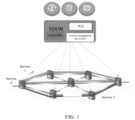
- FIG. 1 is a schematic diagram of OTN single service resource configuration under an SDON architecture.
- a path computation element mainly undertakes routing computation and resource allocation functions for OTN services, provides optimized paths which meet costs and other target policies for the services, and performs resource configuration and evaluation, such as Routing and Wavelength Assignment (RWA), Routing and Spectrum Assignment (RSA), Software Defined Optics (SDO), Impairment Verification (IV) and the like, on the basis of the optimized paths, to finally obtain service resource paths meeting optimization conditions of comprehensive indicators.
- RWA Routing and Wavelength Assignment
- RSA Routing and Spectrum Assignment
- SDO Software Defined Optics
- IV Impairment Verification
- a traditional resource configuration scheme for a single service in the OTN calculation and configuration of path resources are implemented step by step, rather than completely completed and realized in a unified algorithm.
- the effect of optimized configuration of service resources, the degree of comprehensive optimization, the optimization efficiency, the strictness of the optimization algorithm theory, and the like all have certain disadvantages.
- the reinforcement learning technology is adopted for creation and comprehensive optimization of an OTN single service. Since a design of the reinforcement learning algorithm model is close to flows and rules of an SDON management and control system for creation and resource allocation of a single service, the reinforcement learning technique can be ensured to comprehensively cover all flows and functional operations in comprehensive optimization of the OTN single service, and to be perfectly combined with the scene of comprehensive optimization of the OTN single service as much as possible, so that the reinforcement learning technology can be ensured to solve the problem of comprehensive optimization of the OTN single service in a manner suitable for local conditions and circumstances, and that an intelligent optimization effect of the reinforcement learning on the OTN single service can be fully exerted.
- the OTN single service mentioned in the present disclosure refers to a wavelength level service of an optical channel layer (i.e., an OCh layer, also called an L0 layer), and in an optimization calculation process of the OTN single service, the network environment (mainly including a network topology state, the number of other services in the OTN, a route, a resource allocation state, and the like) where the OTN service is located remains unchanged.
- an optical channel layer i.e., an OCh layer, also called an L0 layer
- the network environment mainly including a network topology state, the number of other services in the OTN, a route, a resource allocation state, and the like
- the action a t includes an action of configuring a resource parameter or an action of performing IV analysis.
- n-1 4, which means that one episode includes 5 actions, a 0 to a 4 .
- the action policy ⁇ ( s,a ) includes a random action policy and a deterministic action policy.
- the random action policy may be represented by ⁇ ' ( s,a )
- the deterministic action policy may be represented by ⁇ ( s,a ) (or ⁇ ( s )).
- Action sets for resource configuration of a OTN single service are listed below:
- each action set may be further split into multiple action sets taking a hop as a unit. For example, an action set a 11 indicates actions for allocating wavelengths in a first hop of the route of the service to be configured, and an action set a 12 indicates actions for allocating wavelengths in a second hop of the route of the service to be configured.
- S 0 is an initial state, i.e., a route to be configured state, in which no resource parameter is configured;
- S 1 is a wavelength to be configured state, in which a route is configured (i.e., the route configuration action a 0 is executed), but no wavelength is configured;
- S 2 is a spectrum to be configured state, in which a route and a wavelength are configured (i.e., the route configuration action a 0 and the wavelength configuration action a 1 are executed), but no spectrum is configured;
- S 3 is a modulation format to be configured state, in which a route, a wavelength and a spectrum are configured (i.e., the route configuration action a 0 , the wavelength configuration action a 1 , and the spectrum configuration action a 2 are executed), but no modulation format is configured;
- S 4 is an IV analysis state, in which a route, a wavelength, a spectrum and a modulation format are configured (i.e., the route configuration action a 0 , the wavelength configuration action
- a route configuration action a 0 is performed to select a working route from candidate routes; in state S 1 , a wavelength configuration action a 1 is performed to allocate a wavelength for the working route; in state S 2 , a spectrum configuration action a 1 is performed to allocate a spectrum for the route with the allocated wavelength; in state S 3 , an SDO configuration action a 3 is performed to configure a modulation format for the route with the allocated wavelength and spectrum; in state S 4 , an IV analysis action a 4 is performed to perform IV analysis on the route with the allocated wavelength, spectrum and SDO; and in state S 5 , the IV analysis is completed and the episode is ended.
- next states S 1 , S 2 , S 3 , S 4 , and S 5 corresponding to the actions a 0 , a 1 , a 2 , a 3 , and a 4 may be split into a plurality of states along with the splitting of actions in different hops. That is, the states may be divided in units of hops.
- the entire episode is ended only when all the hops therein enter the end state S 5 .
- FIG. 2 is a flowchart of a single service resource configuration method according to the present disclosure.
- the single service resource configuration method includes the following operations S11 to S15.
- resource parameters are configured for a service to be configured according to an action policy ⁇ ( s,a ) , and when one resource parameter is configured, a timely reward in that state is calculated. Then, the current state is ended and a next state is entered.
- resource parameters are configured in one episode, respectively, and timely rewards under corresponding states are calculated, until all resource parameters are configured, and IV analysis is performed. Then, one episode is ended.
- operations S11 to S12 are repeated to iterate the preset number of episodes, so as to calculate and update the optimization objective policy parameter in each state of each episode.
- the optimal optimization objective policy parameter in that state is determined from optimization objective policy parameters in different episodes. It should be noted that different algorithms may determine the optimal optimization objective policy parameter in different manners. After this operation, optimal optimization target policy parameters of the service to be configured in all states can be obtained.
- the optimization objective policy parameter is used for representing a state and an action.
- an optimal action a t in that state i.e., an action for configuring an optimal resource parameter in that state, can be determined, so that the optimal resource parameter in that state can be determined, thereby obtaining an action set of all optimal resource parameters, i.e., an optimized action policy ⁇ ( s,a ) .
- resource parameters are configured for a service to be configured according to an action policy, a timely reward in a current state is calculated, after all the resource parameters are configured, IV analysis is performed according to the action policy, and one episode is ended after the IV analysis is completed, where a next state is entered after an action is completed, and the action includes an action of configuring a resource parameter or an action of performing IV analysis; according to the timely reward in each state, an optimization objective policy parameter in each state is calculated and updated; a preset number of episodes is iterated to calculate and update the optimization objective policy parameter in each state; according to the optimization objective policy parameter in each state in the preset number of episodes, an optimal optimization objective policy parameter in each state is determined; and according to the optimal optimization objective policy parameter in each state, the action policy is updated.
- the present disclosure performs comprehensive optimization on various resources and performance indexes, optimizes resource configuration for an OTN single service, and thus provides an OTN service path with optimized comprehensive indexes for a user, and thereby obtaining an action policy with good convergence, high rigidness and high reliability.
- the resource parameters may include a route, a wavelength, a spectrum, and a modulation format
- the resource parameters are configured for the service to be configured within one episode in a sequence of: configuring the route, configuring the wavelength, configuring the spectrum, and configuring the modulation format.
- the present disclosure is described by taking the sequence of configuring a route, configuring a wavelength, configuring a spectrum, and configuring a modulation format as an example, but those skilled in the art will know that the sequence of resource parameter configuration and the types and number of resource parameters are not limited as long as it is ensured that the IV analysis is performed after all resource parameters are configured.
- the states include: a route to be configured state S 0 , a wavelength to be configured state S 1 , a spectrum to be configured state S 2 , a modulation format to be configured state S 3 , an IV analysis to be performed state S 4 , and an end state S 5 .
- R t represents a timely reward obtained in state S t , which is a timely reward obtained after performing action a t-1 in state S t-1 and shifting to state S t
- the action policy ⁇ ( s,a ) includes a random action policy ⁇ ' ( S,a ) and a deterministic action policy ⁇ ( S, a )
- configuring resource parameters for the service to be configured according to the action policy in operation S11 includes: configuring a route, a wavelength, a frequency spectrum and a modulation format for the service to be configured according to the random action policy ⁇ ' ( S,a ).
- Performing IV analysis according to the action policy in operation S11 includes: performing IV analysis according to the deterministic action policy ⁇ ( S,a ) .
- Actions a 0 , a 1 , a 2 , a 3 correspond to four operations of route selection, wavelength allocation, spectrum allocation and SDO setting, respectively, each with a plurality of candidates.
- one OTN service may select one of a plurality of candidate routes as a working route. If selecting one of the routes as the working route is regarded as a specific action, then action a 0 in state S 0 actually corresponds to a set of actions, and a specific action may be performed according to an action policy to select a route. Therefore, an initial policy for action a 0 in state S 0 may be a random policy ⁇ '( s 0 , a 0 ).
- initial policies for actions a 1 , a 2 , a 3 in states S 1 , S 2 , and S 3 are all random action policies, i.e., ⁇ ' ( s 1 ,a 1 ) , ⁇ ' ( s 2 ,a 2 ) , ⁇ ' ( s 3 ,a 3 ) .
- the action a 4 in state S 4 corresponds to an IV analysis operation, and may adopt a deterministic action policy ⁇ ( S 4 ,a 4 ).
- the IV analysis is used for evaluating influences of factors related to OTN service transmission, such as back-to-back OSNR, optical fiber nonlinearity, optical fiber CD, optical fiber PMD, optical filtering, PDL introduced by an optical device, service multi-hop accumulated OSNR fluctuation, OSNR flatness and the like on the system performance, and on the basis, for evaluating and analyzing feasibility of the optical link resource performance passed by the OTN service according to an OSNR allowance configuration requirement of a customer and the manufacturer policy.
- factors related to OTN service transmission such as back-to-back OSNR, optical fiber nonlinearity, optical fiber CD, optical fiber PMD, optical filtering, PDL introduced by an optical device, service multi-hop accumulated OSNR fluctuation, OSNR flatness and the like on the system performance, and on the basis, for evaluating and analyzing feasibility of the optical link resource performance passed by the OTN service according to an OSNR allowance configuration requirement of a customer and the manufacturer policy.
- FIG. 3 is a flowchart of a method for performing IV analysis according to the present disclosure.
- the method for performing IV analysis includes the following operations S21 to S24.
- the pre-calculated value OSNR pre-calculated value of the optical signal noise ratio of the service to be configured may be calculated by the 58 equation, which is not described in detail here.
- OSNR flatness is a flatness of the optical signal noise ratio, i.e., a statistical empirical value in the OTN network
- OSNR B2B is a back-to-back optical signal noise ratio, and may be found in an optical module manual
- OSNR nonlinear is a nonlinear cost of the optical signal noise ratio
- OSNR CD is a chromatic dispersion cost of the optical signal noise ratio
- OSNR PMD is a polarization mode dispersion cost of the optical signal noise ratio
- OSNR filter is a filter membrane cost of the optical signal noise ratio
- OSNR PDL is a polarization dependent loss
- the route of the service to be configured includes a plurality of hops.
- configuring resource parameters for the service to be configured according to the action policy in operation S11 of the single service resource configuration method described with respect to FIG. 1 includes: configuring resource parameters for the service to be configured according to the action policy in each hop.
- Performing IV analysis according to the action policy in operation S11 of the single service resource configuration method described with respect to FIG. 1 includes: performing IV analysis according to the action policy in each hop.
- 1 includes: calculating a pre-calculated value of an optical signal noise ratio of each hop in the route of the service to be configured; determining, in response to the pre-calculated value of the optical signal noise ratio of each hop meeting a preset condition, that a result of the IV analysis is qualified; and determining, in response to the pre-calculated value of the optical signal noise ratio of at least one hop not meeting the preset condition, that the result of the IV analysis is unqualified.
- FIG. 4 is a flowchart of a method for calculating an optimization objective policy parameter according to the present disclosure.
- calculating and updating, according to the timely reward in each state, the optimization objective policy parameter in each state includes the following operations S31 and S32.
- the expected return in a last state is the timely reward in that state.
- optimization of the optimization objective policy parameter can be achieved through a reward and punishment mechanism of the reinforcement learning algorithm.
- s ) is a probability of taking action a according to action policy ⁇ ( s,a ) in state S , and A is a set of actions executed in each state. It should be noted that if action policy ⁇ ( s,a ) is a deterministic action policy, then V ⁇ ( s,a ) Q ⁇ ( s,a ) .
- the optimization objective policy parameter in each state may be calculated and updated with a Monte Carlo Process (MCP) algorithm, a TD-Error algorithm of different policies or a TD-Error algorithm of a same policy.
- MCP Monte Carlo Process
- a Q-Learning algorithm in the TD-Error algorithm of different policies may be used, or a State-Action-Reward-Action (SASA) algorithm in the TD-Error algorithm of a same policy may be used.
- updating the action policy according to the optimal optimization objective policy parameter in each state includes: updating the action policy according to the state behavior value Q ⁇ ( s,a ) .
- determining the optimal optimization objective policy parameter in each state may include: determining, from the optimization objective policy parameter (i.e., state behavior value Q ⁇ ( s,a )) in each state in the preset number of episodes, a maximum value of the optimal optimization objective policy parameter in each state.
- the optimization objective policy parameter i.e., state behavior value Q ⁇ ( s,a )
- the optimization objective policy parameter when the optimization objective policy parameter is the state value V ⁇ ( s ) , the optimization objective policy parameter may be calculated and updated with a dynamic programming algorithm. Accordingly, updating the action policy according to the optimal optimization objective policy parameter in each state (i.e., operation S15 of the single service resource configuration method described with respect to FIG. 1 ) includes: updating the action policy ⁇ ( s,a ) according to the state value V ⁇ ( s ) .
- the process of implementing resource configuration of the OTN single service with an exploring initialization MCP algorithm includes:
- the process of implementing resource configuration of the OTN single service with the dynamic programming algorithm based on policy iteration includes the following operations 1 to 3.
- the present disclosure can be applied to the field of intelligent management and control and operation and maintenance of optical networks, and comprehensively optimize various resources and performance indexes of a OTN single service through reinforcement learning, and thus provide an OTN service path with optimized comprehensive indexes for a user.
- the reinforcement learning algorithm makes path comprehensive optimization possible, and an ideal path optimization result can be intelligently obtained through iterative improvement of the action policy.
- FIG. 5 is a schematic structural diagram of a single service resource configuration apparatus according to the present disclosure.
- the single service resource configuration apparatus according to the present disclosure includes a first processing module 101, a second processing module 102 and an updating module 103.
- the first processing module 101 is configured to configure resource parameters for a service to be configured according to an action policy, calculate a timely reward in a current state, perform, after all the resource parameters are configured, IV analysis according to the action policy, and end one episode after the IV analysis is completed, where a next state is entered after an action in the action policy is completed, and the action includes an action of configuring a resource parameter or an action of performing IV analysis; calculate and update, according to the timely reward in each state, an optimization objective policy parameter in each state; and iterate a preset number of episodes to calculate and update the optimization objective policy parameter in each state.
- the second processing module 102 is configured to determine, according to the optimization objective policy parameter in each state in the preset number of episodes, an optimal optimization objective policy parameter in each state.
- the updating module 103 is configured to update the action policy according to the optimal optimization objective policy parameter in each state.
- the resource parameters include a route, a wavelength, a spectrum, and a modulation format
- the resource parameters are configured for the service to be configured within one episode in a sequence of: configuring the route, configuring the wavelength, configuring the spectrum, and configuring the modulation format.
- the states include: a route to be configured state, a wavelength to be configured state, a spectrum to be configured state, a modulation format to be configured state, an IV analysis to be performed state, and an end state.
- the timely reward R 0 0, and in other states, the timely rewards meet any one or combination of the following conditions:
- the action policy includes a random action policy and a deterministic action policy
- the first processing module 101 is configured to configure a route, a wavelength, a frequency spectrum and a modulation format for the service to be configured according to the random action policy; and perform IV analysis according to the deterministic action policy.
- the first processing module 101 is configured to configure resource parameters for the service to be configured according to the action policy in each hop; and perform IV analysis according to the action policy in each hop.
- the first processing module 101 is configured to calculate a pre-calculated value of an optical signal noise ratio of each hop in the route of the service to be configured; determine, in response to the pre-calculated value of the optical signal noise ratio of each hop meeting a preset condition, that a result of the IV analysis is qualified; and determine, in response to the pre-calculated value of the optical signal noise ratio of at least one hop not meeting the preset condition, that the result of the IV analysis is unqualified.
- the first processing module 101 is configured to calculate a pre-calculated value of an optical signal noise ratio of the service to be configured; determine, in response to the pre-calculated value of the optical signal noise ratio meeting a preset condition, that a result of the IV analysis is qualified; and determine, in response to the pre-calculated value of the optical signal noise ratio not meeting the preset condition, that the result of the IV analysis is unqualified.
- the first processing module 101 is configured to calculate, according to timely rewards in various states after a next state, an expected return in a current state; and calculate and update, according to the expected return in the current state, the optimization objective policy parameter in the current state.
- the first processing module 101 is configured to calculate and update, when the optimization objective policy parameter is the state behavior value Q ⁇ ( s,a ) , the optimization objective policy parameter in each state with a Monte Carlo Process algorithm, a TD-Error algorithm of different policies or a TD-Error algorithm of a same policy.
- the updating module 103 is configured to update the action policy according to the state behavior value Q ⁇ ( s,a ) .
- the first processing module 101 is configured to calculate, when the optimization objective policy parameter is the state value V ⁇ ( s ), the optimization objective policy parameter with a dynamic programming algorithm.
- the updating module 103 is configured to update the action policy according to the state value V ⁇ ( s ) .
- the present disclosure provides a computer device, including: one or more processors and a storage means.
- the storage means has one or more programs stored thereon which, when executed by the one or more processors, cause the one or more processors to perform the single service resource configuration method described in any of the above embodiments.
- the present disclosure further provides a computer-readable medium storing a computer program thereon which, when executed, causes the single service resource configuration method described in any of the above embodiments to be implemented.
- the term computer storage medium includes volatile and nonvolatile, removable and non-removable media implemented in any method or technology for storage of information such as computer-readable instructions, data structures, program modules or other data, as is well known to those of ordinary skill in the art.
- the computer storage medium includes, but is not limited to, an RAM, an ROM, an EEPROM, a flash or any other memory technology, a CD-ROM, a digital versatile disc (DVD) or any other optical disc storage, a magnetic cartridge, a magnetic tape, a magnetic disk storage or any other magnetic storage device, or may be any other medium used for storing the desired information and accessible by a computer.
- a communication medium typically includes a computer-readable instruction, a data structure, a program module, or other data in a modulated data signal, such as a carrier wave or other transport mechanism, and may include any information delivery medium.
Landscapes
- Engineering & Computer Science (AREA)
- Computer Networks & Wireless Communication (AREA)
- Signal Processing (AREA)
- Physics & Mathematics (AREA)
- Electromagnetism (AREA)
- Data Exchanges In Wide-Area Networks (AREA)
Applications Claiming Priority (2)
| Application Number | Priority Date | Filing Date | Title |
|---|---|---|---|
| CN202011293457.8A CN114584865B (zh) | 2020-11-18 | 2020-11-18 | 单业务资源配置方法、装置、计算机设备和介质 |
| PCT/CN2021/129501 WO2022105642A1 (zh) | 2020-11-18 | 2021-11-09 | 单业务资源配置方法和装置、计算机设备和介质 |
Publications (4)
| Publication Number | Publication Date |
|---|---|
| EP4236345A1 true EP4236345A1 (de) | 2023-08-30 |
| EP4236345A4 EP4236345A4 (de) | 2024-10-09 |
| EP4236345B1 EP4236345B1 (de) | 2026-03-04 |
| EP4236345B9 EP4236345B9 (de) | 2026-04-15 |
Family
ID=81708353
Family Applications (1)
| Application Number | Title | Priority Date | Filing Date |
|---|---|---|---|
| EP21893789.4A Active EP4236345B9 (de) | 2020-11-18 | 2021-11-09 | Verfahren und vorrichtung zur konfiguration von einzeldienstressourcen, computervorrichtung und medium |
Country Status (4)
| Country | Link |
|---|---|
| US (1) | US12495229B2 (de) |
| EP (1) | EP4236345B9 (de) |
| CN (1) | CN114584865B (de) |
| WO (1) | WO2022105642A1 (de) |
Families Citing this family (2)
| Publication number | Priority date | Publication date | Assignee | Title |
|---|---|---|---|---|
| CN118037009B (zh) * | 2024-04-11 | 2024-06-11 | 国网四川省电力公司电力应急中心 | 一种基于北斗卫星通信的应急物资调配方法及系统 |
| CN118709074B (zh) * | 2024-06-19 | 2024-12-03 | 徐州博康环保科技有限公司 | 一种有机废气处理过程优化方法及系统 |
Family Cites Families (14)
| Publication number | Priority date | Publication date | Assignee | Title |
|---|---|---|---|---|
| GB9817268D0 (en) * | 1998-08-07 | 1998-10-07 | Northern Telecom Ltd | A method of allocating resources in a telecommunications network |
| CN105721192A (zh) * | 2014-12-05 | 2016-06-29 | 中兴通讯股份有限公司 | 实现容量规划的方法和装置 |
| CN106302153B (zh) * | 2015-05-11 | 2020-02-07 | 中兴通讯股份有限公司 | 多域控制器、单域控制器、软件定义光网络系统及方法 |
| US20180082210A1 (en) * | 2016-09-18 | 2018-03-22 | Newvoicemedia, Ltd. | System and method for optimizing communications using reinforcement learning |
| US11784740B2 (en) * | 2016-10-04 | 2023-10-10 | Telefonaktiebolaget Lm Ericsson (Publ) | Physical path control in hierarchical networks |
| US10542336B2 (en) * | 2017-02-02 | 2020-01-21 | Infinera Corporation | Multi-layer mechanisms to optimize optical transport network margin allocation |
| US11126929B2 (en) * | 2017-11-09 | 2021-09-21 | Ciena Corporation | Reinforcement learning for autonomous telecommunications networks |
| US10732639B2 (en) * | 2018-03-08 | 2020-08-04 | GM Global Technology Operations LLC | Method and apparatus for automatically generated curriculum sequence based reinforcement learning for autonomous vehicles |
| CN109743778B (zh) * | 2019-01-14 | 2022-05-10 | 长沙学院 | 一种基于强化学习的资源分配优化方法和系统 |
| CN109905784B (zh) * | 2019-01-16 | 2021-10-15 | 国家电网有限公司 | 一种光网络波长分配的业务重构方法及设备 |
| CN110730138A (zh) * | 2019-10-21 | 2020-01-24 | 中国科学院空间应用工程与技术中心 | 天基云雾计算架构的动态资源配置方法、系统和存储介质 |
| CN111246320B (zh) * | 2020-01-08 | 2021-09-07 | 郑州大学 | 一种云-雾弹性光网络中的深度强化学习流量疏导方法 |
| CN114125593B (zh) * | 2020-08-31 | 2025-10-03 | 中兴通讯股份有限公司 | Otn网络资源优化方法、装置、计算机设备和介质 |
| CN114125595B (zh) * | 2020-08-31 | 2025-12-30 | 中兴通讯股份有限公司 | Otn网络资源优化方法、装置、计算机设备和介质 |
-
2020
- 2020-11-18 CN CN202011293457.8A patent/CN114584865B/zh active Active
-
2021
- 2021-11-09 WO PCT/CN2021/129501 patent/WO2022105642A1/zh not_active Ceased
- 2021-11-09 EP EP21893789.4A patent/EP4236345B9/de active Active
- 2021-11-09 US US18/037,742 patent/US12495229B2/en active Active
Also Published As
| Publication number | Publication date |
|---|---|
| CN114584865B (zh) | 2025-10-03 |
| EP4236345B9 (de) | 2026-04-15 |
| CN114584865A (zh) | 2022-06-03 |
| EP4236345A4 (de) | 2024-10-09 |
| US12495229B2 (en) | 2025-12-09 |
| WO2022105642A1 (zh) | 2022-05-27 |
| EP4236345B1 (de) | 2026-03-04 |
| US20240007775A1 (en) | 2024-01-04 |
Similar Documents
| Publication | Publication Date | Title |
|---|---|---|
| Morais et al. | Machine learning models for estimating quality of transmission in DWDM networks | |
| Allogba et al. | Machine-learning-based lightpath QoT estimation and forecasting | |
| US12309538B2 (en) | Method and apparatus for optimizing OTN network resources, computer device and storage medium | |
| US12401442B2 (en) | Method for optimizing OTN resources, computer device and storage medium | |
| Morales et al. | Multi-band environments for optical reinforcement learning gym for resource allocation in elastic optical networks | |
| EP4236345B9 (de) | Verfahren und vorrichtung zur konfiguration von einzeldienstressourcen, computervorrichtung und medium | |
| Mahajan et al. | Quality of transmission estimator retraining for dynamic optimization in optical networks | |
| Nallaperuma et al. | Interpreting multi-objective reinforcement learning for routing and wavelength assignment in optical networks | |
| Villamayor-Paredes et al. | Routing, modulation level, and spectrum assignment in elastic optical networks. A route-permutation based genetic algorithms | |
| Karandin et al. | Probabilistic low-margin optical-network design with multiple physical-layer parameter uncertainties | |
| Amirabadi et al. | Deep neural network-based QoT estimation for SMF and FMF links | |
| Ravipudi et al. | Machine-learning-based impairment-aware dynamic RMSCA in multi-core elastic optical networks | |
| Ayoub et al. | Towards explainable reinforcement learning in optical networks: The RMSA use case | |
| Wu et al. | Dynamic network topology portrait for digital twin optical network | |
| Sun et al. | Digital twin-enabled multi-step strategies for autonomous power equalization in optical networks | |
| Brasileiro et al. | Ant colony optimization applied to the problem of choosing the best combination among M combinations of shortest paths in transparent optical networks | |
| Ribeiro | Machine Learning Techniques for Designing Optical Networks to Face Future Challenges | |
| Silva et al. | Deep-Quality-EON Classifier | |
| EP3739773A1 (de) | Leistungsmetrikauswertung von komponenten in einem optischen netzwerk | |
| de Freitas et al. | Surrogate Model for Adaptive Control of Optical Amplifier Operating Point based on Machine Learning | |
| Usmani et al. | Performance analysis of transfer-learning approaches for QOT estimation of network operating with 400ZR | |
| Wang et al. | A subcarrier-slot autonomous partition scheme based on deep-reinforcement-learning in elastic optical networks | |
| Freitas et al. | Applying Machine Learning to create a Surrogate Model for Adaptive Control of Optical Amplifier | |
| Bilal | Using machine learning techniques to improve quality of transmission estimation in multivendor optical open line systems | |
| Khan | Machine Learning for Multi-Layer Open and Disaggregated Optical Networks |
Legal Events
| Date | Code | Title | Description |
|---|---|---|---|
| STAA | Information on the status of an ep patent application or granted ep patent |
Free format text: STATUS: THE INTERNATIONAL PUBLICATION HAS BEEN MADE |
|
| PUAI | Public reference made under article 153(3) epc to a published international application that has entered the european phase |
Free format text: ORIGINAL CODE: 0009012 |
|
| STAA | Information on the status of an ep patent application or granted ep patent |
Free format text: STATUS: REQUEST FOR EXAMINATION WAS MADE |
|
| 17P | Request for examination filed |
Effective date: 20230525 |
|
| AK | Designated contracting states |
Kind code of ref document: A1 Designated state(s): AL AT BE BG CH CY CZ DE DK EE ES FI FR GB GR HR HU IE IS IT LI LT LU LV MC MK MT NL NO PL PT RO RS SE SI SK SM TR |
|
| DAV | Request for validation of the european patent (deleted) | ||
| DAX | Request for extension of the european patent (deleted) | ||
| A4 | Supplementary search report drawn up and despatched |
Effective date: 20240911 |
|
| RIC1 | Information provided on ipc code assigned before grant |
Ipc: H04Q 11/00 20060101AFI20240905BHEP |
|
| GRAP | Despatch of communication of intention to grant a patent |
Free format text: ORIGINAL CODE: EPIDOSNIGR1 |
|
| STAA | Information on the status of an ep patent application or granted ep patent |
Free format text: STATUS: GRANT OF PATENT IS INTENDED |
|
| INTG | Intention to grant announced |
Effective date: 20251128 |
|
| GRAS | Grant fee paid |
Free format text: ORIGINAL CODE: EPIDOSNIGR3 |
|
| GRAA | (expected) grant |
Free format text: ORIGINAL CODE: 0009210 |
|
| STAA | Information on the status of an ep patent application or granted ep patent |
Free format text: STATUS: THE PATENT HAS BEEN GRANTED |
|
| AK | Designated contracting states |
Kind code of ref document: B1 Designated state(s): AL AT BE BG CH CY CZ DE DK EE ES FI FR GB GR HR HU IE IS IT LI LT LU LV MC MK MT NL NO PL PT RO RS SE SI SK SM TR |
|
| REG | Reference to a national code |
Ref country code: CH Ref legal event code: F10 Free format text: ST27 STATUS EVENT CODE: U-0-0-F10-F00 (AS PROVIDED BY THE NATIONAL OFFICE) Effective date: 20260304 Ref country code: GB Ref legal event code: FG4D |
|
| REG | Reference to a national code |
Ref country code: CH Ref legal event code: Q17 Free format text: ST27 STATUS EVENT CODE: U-0-0-Q10-Q17 (AS PROVIDED BY THE NATIONAL OFFICE) Effective date: 20260318 |
|
| REG | Reference to a national code |
Ref country code: IE Ref legal event code: FG4D |
|
| REG | Reference to a national code |
Ref country code: DE Ref legal event code: R096 Ref document number: 602021049477 Country of ref document: DE |