EP4236324B1 - Bewegungsvektorvorhersage in der videokodierung - Google Patents
Bewegungsvektorvorhersage in der videokodierung Download PDFInfo
- Publication number
- EP4236324B1 EP4236324B1 EP23181365.0A EP23181365A EP4236324B1 EP 4236324 B1 EP4236324 B1 EP 4236324B1 EP 23181365 A EP23181365 A EP 23181365A EP 4236324 B1 EP4236324 B1 EP 4236324B1
- Authority
- EP
- European Patent Office
- Prior art keywords
- motion vector
- partition
- current
- prediction
- neighboring
- Prior art date
- Legal status (The legal status is an assumption and is not a legal conclusion. Google has not performed a legal analysis and makes no representation as to the accuracy of the status listed.)
- Active
Links
Images







Classifications
-
- H—ELECTRICITY
- H04—ELECTRIC COMMUNICATION TECHNIQUE
- H04N—PICTORIAL COMMUNICATION, e.g. TELEVISION
- H04N19/00—Methods or arrangements for coding, decoding, compressing or decompressing digital video signals
- H04N19/50—Methods or arrangements for coding, decoding, compressing or decompressing digital video signals using predictive coding
- H04N19/503—Methods or arrangements for coding, decoding, compressing or decompressing digital video signals using predictive coding involving temporal prediction
- H04N19/51—Motion estimation or motion compensation
- H04N19/55—Motion estimation with spatial constraints, e.g. at image or region borders
-
- H—ELECTRICITY
- H04—ELECTRIC COMMUNICATION TECHNIQUE
- H04N—PICTORIAL COMMUNICATION, e.g. TELEVISION
- H04N19/00—Methods or arrangements for coding, decoding, compressing or decompressing digital video signals
- H04N19/10—Methods or arrangements for coding, decoding, compressing or decompressing digital video signals using adaptive coding
- H04N19/102—Methods or arrangements for coding, decoding, compressing or decompressing digital video signals using adaptive coding characterised by the element, parameter or selection affected or controlled by the adaptive coding
- H04N19/103—Selection of coding mode or of prediction mode
- H04N19/105—Selection of the reference unit for prediction within a chosen coding or prediction mode, e.g. adaptive choice of position and number of pixels used for prediction
-
- H—ELECTRICITY
- H04—ELECTRIC COMMUNICATION TECHNIQUE
- H04N—PICTORIAL COMMUNICATION, e.g. TELEVISION
- H04N19/00—Methods or arrangements for coding, decoding, compressing or decompressing digital video signals
- H04N19/10—Methods or arrangements for coding, decoding, compressing or decompressing digital video signals using adaptive coding
- H04N19/134—Methods or arrangements for coding, decoding, compressing or decompressing digital video signals using adaptive coding characterised by the element, parameter or criterion affecting or controlling the adaptive coding
- H04N19/136—Incoming video signal characteristics or properties
- H04N19/137—Motion inside a coding unit, e.g. average field, frame or block difference
- H04N19/139—Analysis of motion vectors, e.g. their magnitude, direction, variance or reliability
-
- H—ELECTRICITY
- H04—ELECTRIC COMMUNICATION TECHNIQUE
- H04N—PICTORIAL COMMUNICATION, e.g. TELEVISION
- H04N19/00—Methods or arrangements for coding, decoding, compressing or decompressing digital video signals
- H04N19/10—Methods or arrangements for coding, decoding, compressing or decompressing digital video signals using adaptive coding
- H04N19/169—Methods or arrangements for coding, decoding, compressing or decompressing digital video signals using adaptive coding characterised by the coding unit, i.e. the structural portion or semantic portion of the video signal being the object or the subject of the adaptive coding
- H04N19/17—Methods or arrangements for coding, decoding, compressing or decompressing digital video signals using adaptive coding characterised by the coding unit, i.e. the structural portion or semantic portion of the video signal being the object or the subject of the adaptive coding the unit being an image region, e.g. an object
- H04N19/172—Methods or arrangements for coding, decoding, compressing or decompressing digital video signals using adaptive coding characterised by the coding unit, i.e. the structural portion or semantic portion of the video signal being the object or the subject of the adaptive coding the unit being an image region, e.g. an object the region being a picture, frame or field
-
- H—ELECTRICITY
- H04—ELECTRIC COMMUNICATION TECHNIQUE
- H04N—PICTORIAL COMMUNICATION, e.g. TELEVISION
- H04N19/00—Methods or arrangements for coding, decoding, compressing or decompressing digital video signals
- H04N19/10—Methods or arrangements for coding, decoding, compressing or decompressing digital video signals using adaptive coding
- H04N19/169—Methods or arrangements for coding, decoding, compressing or decompressing digital video signals using adaptive coding characterised by the coding unit, i.e. the structural portion or semantic portion of the video signal being the object or the subject of the adaptive coding
- H04N19/17—Methods or arrangements for coding, decoding, compressing or decompressing digital video signals using adaptive coding characterised by the coding unit, i.e. the structural portion or semantic portion of the video signal being the object or the subject of the adaptive coding the unit being an image region, e.g. an object
- H04N19/176—Methods or arrangements for coding, decoding, compressing or decompressing digital video signals using adaptive coding characterised by the coding unit, i.e. the structural portion or semantic portion of the video signal being the object or the subject of the adaptive coding the unit being an image region, e.g. an object the region being a block, e.g. a macroblock
-
- H—ELECTRICITY
- H04—ELECTRIC COMMUNICATION TECHNIQUE
- H04N—PICTORIAL COMMUNICATION, e.g. TELEVISION
- H04N19/00—Methods or arrangements for coding, decoding, compressing or decompressing digital video signals
- H04N19/10—Methods or arrangements for coding, decoding, compressing or decompressing digital video signals using adaptive coding
- H04N19/169—Methods or arrangements for coding, decoding, compressing or decompressing digital video signals using adaptive coding characterised by the coding unit, i.e. the structural portion or semantic portion of the video signal being the object or the subject of the adaptive coding
- H04N19/184—Methods or arrangements for coding, decoding, compressing or decompressing digital video signals using adaptive coding characterised by the coding unit, i.e. the structural portion or semantic portion of the video signal being the object or the subject of the adaptive coding the unit being bits, e.g. of the compressed video stream
-
- H—ELECTRICITY
- H04—ELECTRIC COMMUNICATION TECHNIQUE
- H04N—PICTORIAL COMMUNICATION, e.g. TELEVISION
- H04N19/00—Methods or arrangements for coding, decoding, compressing or decompressing digital video signals
- H04N19/50—Methods or arrangements for coding, decoding, compressing or decompressing digital video signals using predictive coding
- H04N19/503—Methods or arrangements for coding, decoding, compressing or decompressing digital video signals using predictive coding involving temporal prediction
- H04N19/51—Motion estimation or motion compensation
- H04N19/513—Processing of motion vectors
-
- H—ELECTRICITY
- H04—ELECTRIC COMMUNICATION TECHNIQUE
- H04N—PICTORIAL COMMUNICATION, e.g. TELEVISION
- H04N19/00—Methods or arrangements for coding, decoding, compressing or decompressing digital video signals
- H04N19/50—Methods or arrangements for coding, decoding, compressing or decompressing digital video signals using predictive coding
- H04N19/503—Methods or arrangements for coding, decoding, compressing or decompressing digital video signals using predictive coding involving temporal prediction
- H04N19/51—Motion estimation or motion compensation
- H04N19/513—Processing of motion vectors
- H04N19/517—Processing of motion vectors by encoding
- H04N19/52—Processing of motion vectors by encoding by predictive encoding
-
- H—ELECTRICITY
- H04—ELECTRIC COMMUNICATION TECHNIQUE
- H04N—PICTORIAL COMMUNICATION, e.g. TELEVISION
- H04N19/00—Methods or arrangements for coding, decoding, compressing or decompressing digital video signals
- H04N19/50—Methods or arrangements for coding, decoding, compressing or decompressing digital video signals using predictive coding
- H04N19/503—Methods or arrangements for coding, decoding, compressing or decompressing digital video signals using predictive coding involving temporal prediction
- H04N19/51—Motion estimation or motion compensation
- H04N19/573—Motion compensation with multiple frame prediction using two or more reference frames in a given prediction direction
-
- H—ELECTRICITY
- H04—ELECTRIC COMMUNICATION TECHNIQUE
- H04N—PICTORIAL COMMUNICATION, e.g. TELEVISION
- H04N19/00—Methods or arrangements for coding, decoding, compressing or decompressing digital video signals
- H04N19/50—Methods or arrangements for coding, decoding, compressing or decompressing digital video signals using predictive coding
- H04N19/593—Methods or arrangements for coding, decoding, compressing or decompressing digital video signals using predictive coding involving spatial prediction techniques
-
- H—ELECTRICITY
- H04—ELECTRIC COMMUNICATION TECHNIQUE
- H04N—PICTORIAL COMMUNICATION, e.g. TELEVISION
- H04N19/00—Methods or arrangements for coding, decoding, compressing or decompressing digital video signals
- H04N19/60—Methods or arrangements for coding, decoding, compressing or decompressing digital video signals using transform coding
- H04N19/61—Methods or arrangements for coding, decoding, compressing or decompressing digital video signals using transform coding in combination with predictive coding
-
- H—ELECTRICITY
- H04—ELECTRIC COMMUNICATION TECHNIQUE
- H04N—PICTORIAL COMMUNICATION, e.g. TELEVISION
- H04N19/00—Methods or arrangements for coding, decoding, compressing or decompressing digital video signals
- H04N19/60—Methods or arrangements for coding, decoding, compressing or decompressing digital video signals using transform coding
- H04N19/625—Methods or arrangements for coding, decoding, compressing or decompressing digital video signals using transform coding using discrete cosine transform [DCT]
Definitions
- the present invention relates to a method for processing a video signal and, more particularly, to a method for encoding or decoding a video signal.
- the present invention uses a method of scaling a neighboring partition motion vector to perform more accurate motion vector prediction.
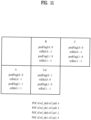
- FIGS. 10 and 11 show exemplary neighboring partitions having the same reference picture as that of the current partition and reference picture lists different from that of the current partition.
- predFlagL0 and predFlagL1 are list flag values that indicate whether a corresponding partition refers to reference picture lists List0 and List1. When a list flag value is 1, the corresponding partition refers to the corresponding reference picture list. When the list flag value is 0, the corresponding partition does not refer to the corresponding reference picture list.
- refIdxL0 and refIdxL1 are reference index values in corresponding lists when the list flag values predFlagL0 and predFlagL1 corresponding thereto are 1. The reference index value is set to -1 when a list flag value corresponding thereto is 0, that is, the corresponding reference picture list is not referred to.
- the current partition Cur has a value predFlagL0 of 1 which indicates L0 prediction and a value refIdxL0 of 0, and thus a motion vector of the current partition Cur can be predicted using motion vectors of neighboring partitions A and C which have the same list flag value predFlagL0 of 1 (the same reference picture list) and the same reference index reIdxL0 of 0 as those of the current partition Cur.
- the partition B has a value predFlagL0 of 0 which is different from that of the current partition, a value predFlagL1 of 1 indicating L1 prediction, and a value refIdxL1 of 1.
- a POC of a picture corresponding to the reference index ref_idx, 1, of List1 is 4 which equal the POC of the picture corresponding to the reference index of 0 of List0, which is referred to by the current partition.
- the present invention can use the motion vector of a partition that refers to the same reference picture (the same POC) as that of the current partition for motion vector prediction of the current partition even if the reference picture is from different reference picture lists. Accordingly, in FIG. 10 , the motion vector prediction value of the current partition can be acquired using the median of the motion vector of the partition A in the L0 direction, the motion vector of the partition B in the L1 direction and the motion vector of the partition C in the L0 direction.
- the current partition Cur has a value predFlagL0 of 1 that indicates L0 prediction
- the partitions B and C have values predFlagL0 and predFlagL1 of 0 that indicates intra prediction
- the partition A has a value predFlagL1 of 1 that indicates L1 prediction.
- the POC value, 4, of the picture corresponding to the reference index ref_idx, 0, of List0 referred to by the current partition equals to the POC value of the picture corresponding to the reference index ref_idx, 1, of List1 referred to by the partition A.
- the partition A and the current partition refer to the same reference picture. Accordingly, the present invention can use the motion vector of the partition A in L1 direction for motion vector prediction of the current partition.
- the embodiments of the present invention can select a motion vector of an inter mode partition which has the same POC as that of the current partition, that is, the same reference picture as that of the current partition even if the reference picture is from different reference picture lists in addition to a motion vector of an inter mode partition having the same reference index of the same reference picture list as those of the current partition among neighboring partitions and use the motion vectors for motion vector prediction of the current partition.
- the technique of predicting the motion vector of the current partition may be extended to an advanced motion vector prediction (AMVP) technique that collects a motion vector prediction candidate group from spatial and temporal neighboring partitions of the current partition and acquires the motion vector prediction value of the current partition.
- AMVP advanced motion vector prediction
- To select the best motion vector from motion vector candidates included in the motion vector prediction candidate group to use the best motion vector as a motion vector prediction value is referred to as motion vector competition.
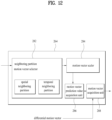
- the motion estimator 264 of the video signal decoder may include a neighboring partition motion vector selector 282 that selects a neighboring partition motion vector to be included in a motion vector prediction candidate group of the current partition, a motion vector scaler 284 that scales the selected neighboring partition motion vector when a reference picture of the neighboring partition is different from that of the current partition, a motion vector prediction value acquisition unit 286 that acquires a motion vector prediction value of the current partition using the motion vector prediction candidate group including the scaled neighboring partition motion vector, and a motion vector acquisition unit 288 that acquires a motion vector of the current partition using the motion vector prediction value.
- a neighboring partition motion vector selector 282 that selects a neighboring partition motion vector to be included in a motion vector prediction candidate group of the current partition
- a motion vector scaler 284 that scales the selected neighboring partition motion vector when a reference picture of the neighboring partition is different from that of the current partition
- a motion vector prediction value acquisition unit 286 that acquires a motion vector prediction value of
- the neighboring partition motion vector selector 282 can collect motion vector candidates from spatial and temporal neighboring partitions of the current partition.
- the motion vector acquisition unit 288 can calculate the motion vector of the current partition by summing the motion vector prediction value obtained through the motion vector prediction value acquisition unit 286 and a differential motion vector.
- the motion estimator 164 of the video signal encoder according to the present invention may include a neighboring partition motion vector selector, a motion vector scaler, a motion vector prediction value acquisition unit, and a motion vector acquisition unit, which have the same functions as those of the aforementioned motion estimator 264 of the video signal decoder according to the present invention.
- the motion vector prediction candidate group of the current partition may include a motion vector a' selected from a left group corresponding to a group of left neighboring partitions A 0 , A 1 , ..., A nA of the current partition, a motion vector b' selected from a top group corresponding to a group of top neighboring partitions B 0 , B 1 , ..., B nB of the current partition, and a motion vector c' selected from a corner group corresponding to a group of partitions C, D and E which are diagonally adjacent to the current partition.
- the median of the motion vectors a', b' and c' can be derived and included in the motion vector prediction candidate group.
- the motion vectors a', b' and c' are not included in the motion vector prediction candidate group when available values cannot be set therefor.
- a motion vector of a temporal neighboring partition may be included in the motion vector prediction candidate group.
- the motion vector of the temporal neighboring partition may be adaptively included in the motion vector prediction candidate group. That is, temporal competition information that represents whether the motion vector of the temporal neighboring partition is used for motion vector competition can be additionally used. Accordingly, when motion vector competition is used for acquisition of a motion vector prediction value of the current prediction unit, it is possible to restrict use of the motion vector of the temporal neighboring partition as a motion vector prediction candidate on the basis of the temporal competition information.
- the temporal competition information is subjected to motion vector competition, and thus the temporal competition information can be acquired only when motion competition indication information indicates that motion vector competition is used.
- the motion vectors a', b' and c' to be included in the motion vector prediction candidate group, shown in FIG. 13 may be selected from the groups (left group, top group and corner group) of the spatial neighboring partitions of the current partition through various methods.
- Partitions in each group can be sequentially searched from one direction to the other direction for inter mode partitions having the same reference picture list and the same reference index as those of the current partition, and a motion vector of the first detected partition can be included in the motion vector prediction candidate group.
- partitions in each group can be sequentially searched from one direction to the other direction for partitions having the inter mode regardless of reference picture lists and reference indexes, and a motion vector of the first detected partition can be included in the motion vector prediction candidate group.
- the motion vector selected from each group includes a value scaled according to the embodiment of the present invention.
- a motion vector of a partition having the inter mode can be selected only in the case in which an available motion vector cannot be searched through reference picture lists and reference indexes for each group. That is, i) partitions in each group can be sequentially searched from one direction to the other direction for inter mode partitions having the same reference picture list and the same reference index as those of the current partition, and a motion vector of the first detected partition can be included in the motion vector prediction candidate group. If there is no available motion vector, ii) partitions in each group can be sequentially searched from one direction to the other direction for partitions having the inter mode, a motion vector of the first detected partition can be selected, and a scaled value of the motion vector can be included in the motion vector prediction candidate group.
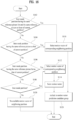
- motion vector prediction candidate group selection conditions in order to select available motion vectors to be included in the motion vector prediction candidate group for each group.
- the selected motion vector can be included in the motion vector prediction candidate group since the motion vector has the same reference picture as that of the motion vector of the current partition (S120). If a motion vector of a neighboring partition that satisfies conditions 3 and 4 is selected (S112), the selected motion vector can be scaled (S114) and included in the motion vector prediction candidate group (S120). However, if there is no neighboring partition motion vector that satisfies any of conditions 1 to 4, it is considered that an available neighboring partition motion vector is not present (S130).
- the present invention is not limited to the following embodiments and the order of searching neighboring partition motion vectors to be selected as the motion vector prediction candidate group can be changed in various manners.
- 'condition first search' means a process of sequentially searching partitions in a group, which satisfies one of the motion vector prediction candidate group selection conditions, according to order of positions of the partitions and then repeating the same process for the next condition
- 'partition position first search' means a process of sequentially checking whether a neighboring partition satisfies the four motion vector prediction candidate group selection conditions and then repeating the same process for the next neighboring partition.
- 'condition first search' provides higher priority to the motion vector prediction candidate group selection conditions for partitions in each group
- 'partition position first search' provides higher priority to the order of positions of partitions in each group.
- the partition position order is a predetermined order of neighboring partitions from one direction to the other direction.
- partition 0 partition 1 and partition 2 are partitions in the same group, which are arranged in position order.
- Partition 0 represents the first partition of the corresponding group and partition 2 represents the last partition of the group.
- the number of partitions included in a group need not be 3.
- numerals represent search order numbers. [Table 1] Partition 0 Partition 1 Partition 2 Condition 1 1 2 3 Condition 2 4 5 6 Condition 3 7 8 9 Condition 4 10 11 12
- condition first search can be performed on partitions in each group. Specifically, partitions 0 to 2 are sequentially searched to locate partitions that satisfy condition 1, and the motion vector of the first detected partition that satisfies condition 1 is selected as a motion vector to be included in the motion vector prediction candidate group. If there is no partition that satisfies condition 1, the partitions 0 to 2 are searched in the same manner for conditions 2, 3 and 4. [Table 2] Partition 0 Partition 1 Partition 2 Condition 1 1 5 9 Condition 2 2 6 10 Condition 3 3 7 11 Condition 4 4 8 12
- the motion vectors a', b' and c' selected by the above-mentioned methods proposed by the present invention affects i) the median of the motion vectors a', b' and c' and ii) an increase in the number of motion vectors included in the motion vector prediction candidate group. That is, a neighboring partition motion vector, which is not included in the motion vector prediction candidate group because it is not available, may become available according to motion vector scaling of the present invention and may be included in the motion vector prediction candidate group.
- motion vectors of temporal neighboring partitions can be included in the motion vector prediction candidate group, as described above.
- the number of spatial neighboring partition motion vectors included in the motion vector prediction candidate group is reduced in this manner, computation time and complexity required to select neighboring partition motion vectors can be decreased.
- the merge mode, skip mode or prediction mode which will be described below may be used.
- a partition in the merge mode, can be merged with vertical, horizontal or diagonal neighboring partitions A, B, C or D.
- merging serves to acquire prediction information for inter picture prediction of the current partition from inter prediction information of a neighboring partition.
- motion information of the current partition can be acquired using motion information of four or fewer spatial neighboring partitions and motion information of one temporal neighboring partition as the information indicating which partition is merged.
- the skip mode uses motion information of a previously coded partition as motion information about the current partition when the current partition is restored. Accordingly, information other than information indicating a to-be-skipped partition is not transmitted in the skip mode. In this case, motion information necessary for prediction can be derived from neighboring partition motion vectors.
- pixel values of a reference region in a previously coded reference picture can be used.
- the pixel values of the reference region may be accompanied by motion compensation using a motion vector prediction value.
- the current partition may have motion vector information when motion vector competition is used when the motion vector prediction value is acquired.
- the current partition When the current partition is not coded in the skip mode, the current partition can be directly coded in the prediction mode.
- the direct prediction mode predicts the motion information of the current partition from motion information of a decoded partition.
- the direct prediction mode is distinguished from the skip mode in that the current partition has a residual.
- the embodiments of the present invention it is possible to unify methods of predicting motion information in all modes by applying the method of acquiring motion information of a neighboring partition, used in the merge mode, to the skip mode and the normal inter mode. That is, motion information of a spatial neighboring partition is used in the skip mode and normal inter mode as in the merge mode, instead of performing a search process in a predetermined order to obtain available motion information in the skip mode and normal inter mode.
- the reference index or prediction direction of the current partition is known in the skip mode or normal inter mode, distinguished from the merge mode, it is possible to use a motion vector of a neighboring partition as an available motion vector included in the motion vector prediction candidate group when the neighboring partition has the same reference picture as that of the current partition and to exclude the motion vector of the neighboring partition from the motion vector prediction candidate group by processing the motion vector as an unavailable motion vector when the reference picture of the neighboring partition is different from the reference picture of the current partition.
- pixel accuracy of less than an integer number of pixels can be used.
- a pixel value smaller than an integer number of pixels is generated using interpolation of pixel values of a reference picture.
- Which one of the inter prediction mode, direct prediction mode, inter prediction mode and skip mode is used for prediction can be represented using prediction mode information or a flag that indicates whether the corresponding mode has been used.
- the corresponding mode can be derived using other information.
- a median filter can be used for motion vectors to be stored to obtain a compression value.
- information representing whether motion vector compression is used and information about a compression ratio can be additionally transmitted.
- transform e.g., DCT
- This unit is referred to as a transform unit in the following description.
- the transform unit normally has a square form for DCT and may be recursively segmented similarly to the coding unit.
- the size of the transform unit may be set to the most efficient size according to characteristics of the image and may be smaller or larger than the prediction unit.
- One prediction unit may include a plurality of transform units in general.
- the structure and size of the transform unit are similar to those of the coding unit as described above.
- one transform unit can be recursively segmented into four transform units in a quad tree form.
- Information about the structure of the transform unit may include a maximum height (or segmentation depth) of a predetermined transform unit tree, a maximum size of the transform unit, a minimum size of the transform unit, the difference between the maximum size and minimum size of the transform unit, and/or logs of these values, a depth of the transform unit and a size of the transform unit, which are derived using the values, etc.
- the maximum segmentation depth of the transform unit may depend on the prediction mode of the corresponding unit.
- the size of the coding unit may affect the size of the transform unit.
- the transform unit it is possible to acquire information representing whether the current transform unit has been segmented. For example, when this information indicates that the corresponding transform unit has been segmented, the corresponding transform unit can be further recursively segmented into four transform units.
- Embodiments described above are combinations of elements and features of the present invention.
- the elements or features may be considered selective unless otherwise mentioned.
- Each element or feature may be practiced without being combined with other elements or features.
- the decoding/encoding methods to which the present invention is applied may be implemented as code that can be written on a computer-readable recording medium and thus read by a processor.
- the computer-readable recording medium may be any type of recording device in which data is stored in a computer-readable manner. Examples of the computer-readable recording medium include a ROM, a RAM, a CD-ROM, a magnetic tape, a floppy disc, an optical data storage, and a carrier wave (e.g., data transmission through the Internet).
- a bitstream generated according to the encoding method can be stored in a computer readable recording medium or transmitted using a wired/wireless communication network.
- the embodiments of the present invention may be implemented by various means, for example, hardware, firmware, software, or combinations thereof.
- the embodiments of the present invention may be implemented using at least one of Application Specific Integrated Circuits (ASICs), Digital Signal Processors (DSPs), Digital Signal Processing Devices (DSPDs), Programmable Logic Devices (PLDs), Field Programmable Gate Arrays (FPGAs), processors, controllers, microcontrollers, microprocessors, and electrical units devised to perform the present invention.
- ASICs Application Specific Integrated Circuits
- DSPs Digital Signal Processors
- DSPDs Digital Signal Processing Devices
- PLDs Programmable Logic Devices
- FPGAs Field Programmable Gate Arrays
- processors controllers, microcontrollers, microprocessors, and electrical units devised to perform the present invention.
- controllers microcontrollers
- microprocessors microprocessors
- the embodiments of the present invention may be implemented as software modules.
- the software modules may execute one or more functions and operations described in the specification.
- Software code may be implemented as a software application written in an appropriate program language.
- the software code may be stored in a memory and executed by a controller.
- the present invention is applicable to video signal encoding and decoding.
Landscapes
- Engineering & Computer Science (AREA)
- Multimedia (AREA)
- Signal Processing (AREA)
- Physics & Mathematics (AREA)
- Discrete Mathematics (AREA)
- General Physics & Mathematics (AREA)
- Compression Or Coding Systems Of Tv Signals (AREA)
- Image Analysis (AREA)
- Testing, Inspecting, Measuring Of Stereoscopic Televisions And Televisions (AREA)
Claims (4)
- Verfahren zum Dekodieren eines Videosignals durch eine Vorrichtung auf der Grundlage von Bewegungsvektorprädiktion unter Verwendung einer Bewegungsvektorprädiktor-Kandidatengruppe für einen aktuellen Block, wobei die Bewegungsvektorprädiktor-Kandidatengruppe aus einem oder mehreren räumlich benachbarten Blöcken des aktuellen Blocks konstruiert wird, wobei das Verfahren umfasst:Bestimmen eines Bewegungsvektorprädiktors des aktuellen Blocks;Ableiten eines Bewegungsvektors des aktuellen Blocks auf der Grundlage des bestimmten Bewegungsvektorprädiktors; undDurchführen einer Interprädiktion für den aktuellen Block auf der Grundlage des abgeleiteten Bewegungsvektors,wobei das Bestimmen des Bewegungsvektorprädiktors ferner umfasst:Ableiten einer Bewegungsvektorprädiktor-Kandidatengruppe mit einer Vielzahl von Bewegungsvektorprädiktor-Kandidaten,dadurch gekennzeichnet, dass einer der Vielzahl von Bewegungsvektorprädiktor-Kandidaten als ein Bewegungsvektor eines räumlich benachbarten Blocks auf der Grundlage des Bewegungsvektors des räumlich benachbarten Blocks abgeleitet wird, der sich auf ein Referenzbild bezieht, das den gleichen Bildreihenfolgezähl, POC, -Wert wie ein Referenzbild des aktuellen Blocks in einer Referenzbildliste hat, die sich von einer Referenzbildliste des aktuellen Blocks unterscheidet.
- Verfahren nach Anspruch 1,
wobei der eine oder die mehreren räumlich benachbarten Blöcke eine vorbestimmte Anzahl von räumlich benachbarten Blöcken umfassen, die sich an linken und oberen Seite des aktuellen Blocks befinden. - Verfahren nach Anspruch 1 oder 2,
wobei die Bewegungsvektorprädiktor-Kandidatengruppe einen Bewegungsvektor nur eines Intermode-Blocks unter den ein oder mehreren räumlich benachbarten Blöcken umfasst. - Verfahren zum Kodieren eines Videosignals durch eine Vorrichtung auf der Grundlage von Bewegungsvektorprädiktion unter Verwendung einer Bewegungsvektorprädiktor-Kandidatengruppe für einen aktuellen Block, wobei die Bewegungsvektorprädiktor-Kandidatengruppe aus einem oder mehreren räumlich benachbarten Blöcken des aktuellen Blocks konstruiert wird, wobei das Verfahren umfasst:Durchführen einer Interprädiktion für den aktuellen Block auf der Grundlage eines Bewegungsvektors des aktuellen Blocks;Bestimmen eines Bewegungsvektorprädiktors des aktuellen Blocks; undCodieren des Bewegungsvektors des aktuellen Blocks auf der Grundlage des ermittelten Bewegungsvektorprädiktors,wobei das Bestimmen des Bewegungsvektorprädiktors ferner umfasst:Ableiten einer Bewegungsvektorprädiktor-Kandidatengruppe mit einer Vielzahl von Bewegungsvektorprädiktor-Kandidaten,dadurch gekennzeichnet, dass einer der Vielzahl von Bewegungsvektorprädiktor-Kandidaten als ein Bewegungsvektor eines räumlich benachbarten Blocks auf der Grundlage des Bewegungsvektors des räumlich benachbarten Blocks abgeleitet wird, der sich auf ein Referenzbild bezieht, das den gleichen Bildreihenfolgezähl, POC, -Wert wie ein Referenzbild des aktuellen Blocks in einer Referenzbildliste hat, die sich von einer Referenzbildliste des aktuellen Blocks unterscheidet.
Priority Applications (3)
| Application Number | Priority Date | Filing Date | Title |
|---|---|---|---|
| EP25179772.6A EP4586610A3 (de) | 2010-04-09 | 2011-04-08 | Verfahren und vorrichtung zur verarbeitung eines videosignals |
| HRP20250836TT HRP20250836T1 (hr) | 2010-04-09 | 2011-04-08 | Predviđanje vektora gibanja u video kodiranju |
| RS20250677A RS66998B1 (sr) | 2010-04-09 | 2011-04-08 | Predikcija vektora pokreta u video kodiranju |
Applications Claiming Priority (10)
| Application Number | Priority Date | Filing Date | Title |
|---|---|---|---|
| US32230110P | 2010-04-09 | 2010-04-09 | |
| US37328610P | 2010-08-13 | 2010-08-13 | |
| US201061424681P | 2010-12-20 | 2010-12-20 | |
| US201161432202P | 2011-01-13 | 2011-01-13 | |
| US201161454995P | 2011-03-21 | 2011-03-21 | |
| US201161466446P | 2011-03-22 | 2011-03-22 | |
| KR1020110032376A KR101752418B1 (ko) | 2010-04-09 | 2011-04-07 | 비디오 신호 처리 방법 및 장치 |
| EP21210463.2A EP3982634B1 (de) | 2010-04-09 | 2011-04-08 | Bewegungsvektorvorhersage in der videokodierung |
| EP11766196.7A EP2557796B1 (de) | 2010-04-09 | 2011-04-08 | Verfahren und vorrichtung zur verarbeitung von videosignalen |
| PCT/KR2011/002497 WO2011126345A2 (ko) | 2010-04-09 | 2011-04-08 | 비디오 신호 처리 방법 및 장치 |
Related Parent Applications (2)
| Application Number | Title | Priority Date | Filing Date |
|---|---|---|---|
| EP21210463.2A Division EP3982634B1 (de) | 2010-04-09 | 2011-04-08 | Bewegungsvektorvorhersage in der videokodierung |
| EP11766196.7A Division EP2557796B1 (de) | 2010-04-09 | 2011-04-08 | Verfahren und vorrichtung zur verarbeitung von videosignalen |
Related Child Applications (1)
| Application Number | Title | Priority Date | Filing Date |
|---|---|---|---|
| EP25179772.6A Division EP4586610A3 (de) | 2010-04-09 | 2011-04-08 | Verfahren und vorrichtung zur verarbeitung eines videosignals |
Publications (4)
| Publication Number | Publication Date |
|---|---|
| EP4236324A2 EP4236324A2 (de) | 2023-08-30 |
| EP4236324A3 EP4236324A3 (de) | 2023-10-11 |
| EP4236324B1 true EP4236324B1 (de) | 2025-06-25 |
| EP4236324C0 EP4236324C0 (de) | 2025-06-25 |
Family
ID=45028893
Family Applications (4)
| Application Number | Title | Priority Date | Filing Date |
|---|---|---|---|
| EP21210463.2A Active EP3982634B1 (de) | 2010-04-09 | 2011-04-08 | Bewegungsvektorvorhersage in der videokodierung |
| EP25179772.6A Pending EP4586610A3 (de) | 2010-04-09 | 2011-04-08 | Verfahren und vorrichtung zur verarbeitung eines videosignals |
| EP11766196.7A Active EP2557796B1 (de) | 2010-04-09 | 2011-04-08 | Verfahren und vorrichtung zur verarbeitung von videosignalen |
| EP23181365.0A Active EP4236324B1 (de) | 2010-04-09 | 2011-04-08 | Bewegungsvektorvorhersage in der videokodierung |
Family Applications Before (3)
| Application Number | Title | Priority Date | Filing Date |
|---|---|---|---|
| EP21210463.2A Active EP3982634B1 (de) | 2010-04-09 | 2011-04-08 | Bewegungsvektorvorhersage in der videokodierung |
| EP25179772.6A Pending EP4586610A3 (de) | 2010-04-09 | 2011-04-08 | Verfahren und vorrichtung zur verarbeitung eines videosignals |
| EP11766196.7A Active EP2557796B1 (de) | 2010-04-09 | 2011-04-08 | Verfahren und vorrichtung zur verarbeitung von videosignalen |
Country Status (12)
| Country | Link |
|---|---|
| US (13) | US8976865B2 (de) |
| EP (4) | EP3982634B1 (de) |
| KR (8) | KR101752418B1 (de) |
| CN (5) | CN102835113B (de) |
| ES (3) | ES2904348T3 (de) |
| FI (1) | FI3982634T3 (de) |
| HR (2) | HRP20250836T1 (de) |
| HU (3) | HUE057387T2 (de) |
| PL (3) | PL3982634T3 (de) |
| RS (1) | RS66998B1 (de) |
| SI (2) | SI2557796T1 (de) |
| WO (1) | WO2011126345A2 (de) |
Families Citing this family (88)
| Publication number | Priority date | Publication date | Assignee | Title |
|---|---|---|---|---|
| ES2975036T3 (es) | 2010-05-25 | 2024-07-02 | Lg Electronics Inc | Nuevo modo de predicción plano |
| US8855205B2 (en) * | 2010-05-26 | 2014-10-07 | Newratek Inc. | Method of predicting motion vectors in video codec in which multiple references are allowed, and motion vector encoding/decoding apparatus using the same |
| SI3985979T1 (sl) | 2010-12-13 | 2024-06-28 | Electronics And Telecommunications Research Institute | Metoda za določanje referenčne enote |
| HUE070880T2 (hu) * | 2010-12-31 | 2025-07-28 | Electronics & Telecommunications Res Inst | Eljárás videó információ kódolására és eljárás videó információ dekódolására, és berendezés az eljáráshoz |
| KR20120095814A (ko) * | 2011-02-21 | 2012-08-29 | 한밭대학교 산학협력단 | 복수 참조 영상을 이용한 영상 부복호화 방법 및 이러한 방법을 사용하는 장치 |
| CN103392340B (zh) * | 2011-03-14 | 2017-02-08 | 寰发股份有限公司 | 推导运动向量预测子的方法与装置 |
| RU2600936C2 (ru) | 2011-04-12 | 2016-10-27 | Сан Пэтент Траст | Способ кодирования движущихся изображений, устройство кодирования движущихся изображений, способ декодирования движущихся изображений, устройство декодирования движущихся изображений и устройство кодирования и декодирования движущихся изображений |
| US9485518B2 (en) | 2011-05-27 | 2016-11-01 | Sun Patent Trust | Decoding method and apparatus with candidate motion vectors |
| ES2959039T3 (es) | 2011-05-27 | 2024-02-19 | Sun Patent Trust | Aparato, procedimiento y programa para codificar imágenes en movimiento |
| EP3879832B1 (de) * | 2011-05-31 | 2024-08-21 | JVCKENWOOD Corporation | Vorrichtung zur verschlüsselung bewegter bilder, verfahren zur verschlüsselung bewegter bilder, programm zur verschlüsselung bewegter bilder, vorrichtung zur entschlüsselung bewegter bilder, verfahren zur entschlüsselung bewegter bilder und programm zur entschlüsselung bewegter bilder |
| EP4270953A3 (de) | 2011-05-31 | 2023-11-22 | Sun Patent Trust | Vorrichtung und verfahren zur dekodierung von bewegten bildern |
| US9131239B2 (en) * | 2011-06-20 | 2015-09-08 | Qualcomm Incorporated | Unified merge mode and adaptive motion vector prediction mode candidates selection |
| CA3019973C (en) * | 2011-06-28 | 2021-03-09 | Lg Electronics Inc. | Method for setting motion vector list and apparatus using same |
| JP5937594B2 (ja) | 2011-06-30 | 2016-06-22 | パナソニック インテレクチュアル プロパティ コーポレーション オブ アメリカPanasonic Intellectual Property Corporation of America | 画像復号方法及び画像復号装置 |
| EP2727357A1 (de) * | 2011-07-01 | 2014-05-07 | Motorola Mobility LLC | Vereinfachtes design für bewegungsvektorvorhersage |
| US11496760B2 (en) | 2011-07-22 | 2022-11-08 | Qualcomm Incorporated | Slice header prediction for depth maps in three-dimensional video codecs |
| US9521418B2 (en) | 2011-07-22 | 2016-12-13 | Qualcomm Incorporated | Slice header three-dimensional video extension for slice header prediction |
| WO2013018369A1 (ja) | 2011-08-03 | 2013-02-07 | パナソニック株式会社 | 動画像符号化方法、動画像符号化装置、動画像復号化方法、動画像復号化装置、および、動画像符号化復号化装置 |
| US9288505B2 (en) | 2011-08-11 | 2016-03-15 | Qualcomm Incorporated | Three-dimensional video with asymmetric spatial resolution |
| MX343471B (es) * | 2011-08-29 | 2016-11-07 | Ibex Pt Holdings Co Ltd | Metodo para generar un bloque de prediccion en modo de prediccion de vector de movimiento avanzada (amvp). |
| KR20130030181A (ko) | 2011-09-16 | 2013-03-26 | 한국전자통신연구원 | 움직임 벡터 예측기를 이용한 움직임 벡터 부호화/복호화 방법 및 장치 |
| MY180182A (en) | 2011-10-19 | 2020-11-24 | Sun Patent Trust | Picture coding method,picture coding apparatus,picture decoding method,and picture decoding apparatus |
| CA2836243C (en) | 2011-10-28 | 2020-12-01 | Panasonic Corporation | Image coding method, image decoding method, image coding apparatus, and image decoding apparatus |
| ES2780188T3 (es) | 2011-10-28 | 2020-08-24 | Sun Patent Trust | Método de codificación de imagen, método de decodificación de imagen, aparato de codificación de imagen y aparato de decodificación de imagen |
| US9185428B2 (en) | 2011-11-04 | 2015-11-10 | Google Technology Holdings LLC | Motion vector scaling for non-uniform motion vector grid |
| KR20130050405A (ko) * | 2011-11-07 | 2013-05-16 | 오수미 | 인터 모드에서의 시간 후보자 결정방법 |
| CN103918267B (zh) * | 2011-11-07 | 2017-05-17 | 寰发股份有限公司 | 推导缩放的运动向量的方法 |
| TWI523497B (zh) * | 2011-11-10 | 2016-02-21 | Sony Corp | Image processing apparatus and method |
| US9485503B2 (en) * | 2011-11-18 | 2016-11-01 | Qualcomm Incorporated | Inside view motion prediction among texture and depth view components |
| KR101960761B1 (ko) * | 2011-11-24 | 2019-03-22 | 에스케이텔레콤 주식회사 | 모션 벡터의 예측 부호화/복호화 방법 및 장치 |
| US8792745B2 (en) * | 2011-12-06 | 2014-07-29 | Sony Corporation | Encoder optimization of adaptive loop filters in HEVC |
| TWI580259B (zh) * | 2012-01-18 | 2017-04-21 | Jvc Kenwood Corp | Dynamic image decoding device, dynamic image decoding method, and dynamic image decoding program |
| EP4366307A3 (de) * | 2012-01-18 | 2024-07-17 | Electronics and Telecommunications Research Institute | Verfahren und vorrichtung zur codierung und decodierung eines bildes |
| US20130188716A1 (en) * | 2012-01-20 | 2013-07-25 | Qualcomm Incorporated | Temporal motion vector predictor candidate |
| CN104380746A (zh) | 2012-04-23 | 2015-02-25 | 三星电子株式会社 | 多视点视频编码方法和装置以及多视点视频解码方法和装置 |
| EP2849441B1 (de) * | 2012-05-10 | 2019-08-21 | LG Electronics Inc. | Vorrichtung und verfahren zur verarbeitung von videosignalen |
| WO2013176485A1 (ko) * | 2012-05-22 | 2013-11-28 | 엘지전자 주식회사 | 비디오 신호 처리 방법 및 장치 |
| US9172970B1 (en) | 2012-05-29 | 2015-10-27 | Google Inc. | Inter frame candidate selection for a video encoder |
| US11317101B2 (en) | 2012-06-12 | 2022-04-26 | Google Inc. | Inter frame candidate selection for a video encoder |
| PL400344A1 (pl) * | 2012-08-13 | 2014-02-17 | Politechnika Poznanska | Sposób wyznaczania predyktora wektora ruchu |
| US9503746B2 (en) | 2012-10-08 | 2016-11-22 | Google Inc. | Determine reference motion vectors |
| US9485515B2 (en) | 2013-08-23 | 2016-11-01 | Google Inc. | Video coding using reference motion vectors |
| KR20150056811A (ko) * | 2012-11-13 | 2015-05-27 | 인텔 코포레이션 | 차세대 비디오를 위한 콘텐츠 적응적 변환 코딩 |
| KR20140092423A (ko) * | 2012-12-20 | 2014-07-24 | 주식회사 팬택 | 계층적 영상 부/복호화 모드 결정 방법 및 이러한 방법을 사용하는 장치 |
| WO2014120368A1 (en) | 2013-01-30 | 2014-08-07 | Intel Corporation | Content adaptive entropy coding for next generation video |
| US9800857B2 (en) * | 2013-03-08 | 2017-10-24 | Qualcomm Incorporated | Inter-view residual prediction in multi-view or 3-dimensional video coding |
| EP3490259B1 (de) * | 2013-04-02 | 2021-10-13 | InterDigital Madison Patent Holdings, SAS | Verbesserte zeitliche bewegungsvektorvoraussage für skalierbare videokodierung |
| RU2654129C2 (ru) | 2013-10-14 | 2018-05-16 | МАЙКРОСОФТ ТЕКНОЛОДЖИ ЛАЙСЕНСИНГ, ЭлЭлСи | Функциональные возможности режима внутреннего предсказания с блочным копированием для кодирования и декодирования видео и изображений |
| EP3058736B1 (de) | 2013-10-14 | 2019-02-27 | Microsoft Technology Licensing, LLC | Codiererseitige optionen für intrablockkopievorhersagemodus zur bild- und videocodierung |
| US9432685B2 (en) * | 2013-12-06 | 2016-08-30 | Qualcomm Incorporated | Scalable implementation for parallel motion estimation regions |
| US10390034B2 (en) | 2014-01-03 | 2019-08-20 | Microsoft Technology Licensing, Llc | Innovations in block vector prediction and estimation of reconstructed sample values within an overlap area |
| MX360926B (es) | 2014-01-03 | 2018-11-22 | Microsoft Technology Licensing Llc | Prediccion de vector de bloque en codificacion/descodificacion de video e imagen. |
| US11284103B2 (en) | 2014-01-17 | 2022-03-22 | Microsoft Technology Licensing, Llc | Intra block copy prediction with asymmetric partitions and encoder-side search patterns, search ranges and approaches to partitioning |
| JP2017512026A (ja) | 2014-03-04 | 2017-04-27 | マイクロソフト テクノロジー ライセンシング,エルエルシー | イントラブロックコピー予測におけるブロック反転及びスキップモード |
| US9924183B2 (en) * | 2014-03-20 | 2018-03-20 | Nanjing Yuyan Information Technology Ltd. | Fast HEVC transcoding |
| CN105493505B (zh) | 2014-06-19 | 2019-08-06 | 微软技术许可有限责任公司 | 统一的帧内块复制和帧间预测模式 |
| CA2959682C (en) | 2014-09-30 | 2022-12-06 | Microsoft Technology Licensing, Llc | Rules for intra-picture prediction modes when wavefront parallel processing is enabled |
| CN107005696B (zh) * | 2014-11-27 | 2020-06-26 | 株式会社Kt | 视频信号处理方法和设备 |
| CN112584139B (zh) | 2014-11-27 | 2024-08-13 | 株式会社Kt | 对视频信号进行解码或编码的方法 |
| US10187653B2 (en) * | 2015-05-18 | 2019-01-22 | Avago Technologies International Sales Pte. Limited | Motor vector prediction using co-located prediction units |
| US10841574B2 (en) * | 2016-04-25 | 2020-11-17 | Lg Electronics Inc. | Image decoding method and device using intra prediction in image coding system |
| US10805607B2 (en) | 2016-04-29 | 2020-10-13 | Industry Academy Cooperation Foundation Of Sejong University | Video signal encoding/decoding method and apparatus |
| CN116916013A (zh) | 2016-04-29 | 2023-10-20 | 世宗大学校产学协力团 | 视频信号编码/解码方法和设备 |
| CN116567225A (zh) * | 2016-08-11 | 2023-08-08 | Lx 半导体科技有限公司 | 编码/解码设备以及发送图像数据的设备 |
| WO2018066874A1 (ko) * | 2016-10-06 | 2018-04-12 | 세종대학교 산학협력단 | 비디오 신호의 복호화 방법 및 이의 장치 |
| KR102435500B1 (ko) * | 2016-10-06 | 2022-08-23 | 세종대학교산학협력단 | 비디오 신호의 복호화 방법 및 이의 장치 |
| US10298951B2 (en) * | 2017-04-06 | 2019-05-21 | Mediatek Inc. | Method and apparatus of motion vector prediction |
| WO2019001739A1 (en) * | 2017-06-30 | 2019-01-03 | Huawei Technologies Co., Ltd. | ERROR RESILIENCE AND PARALLEL PROCESSING FOR MOTION VECTOR CALCULATION DECODER SIDE |
| KR102206084B1 (ko) | 2017-07-07 | 2021-01-21 | 삼성전자주식회사 | 적응적 움직임 벡터 해상도로 결정된 움직임 벡터의 부호화 장치 및 부호화 방법, 및 움직임 벡터의 복호화 장치 및 복호화 방법 |
| CN107360433B (zh) * | 2017-07-20 | 2020-06-19 | 北京奇艺世纪科技有限公司 | 一种帧间预测编码方法和装置 |
| CN109429064B (zh) * | 2017-08-22 | 2021-03-30 | 华为技术有限公司 | 一种视频数据的编解码方法、装置和介质 |
| EP3457695A1 (de) | 2017-09-18 | 2019-03-20 | Thomson Licensing | Verfahren und vorrichtung zur bewegungsvektorprädiktoranpassung für omnidirektionales video |
| CN116996667A (zh) | 2017-09-28 | 2023-11-03 | 三星电子株式会社 | 编码方法和装置以及解码方法和装置 |
| KR102577754B1 (ko) | 2017-09-28 | 2023-09-12 | 삼성전자주식회사 | 부호화 방법 및 그 장치, 복호화 방법 및 그 장치 |
| US10986349B2 (en) | 2017-12-29 | 2021-04-20 | Microsoft Technology Licensing, Llc | Constraints on locations of reference blocks for intra block copy prediction |
| KR102570087B1 (ko) | 2018-03-27 | 2023-08-25 | (주)휴맥스 | 모션 보상을 이용하는 비디오 신호 처리 방법 및 장치 |
| US11470346B2 (en) * | 2018-05-09 | 2022-10-11 | Sharp Kabushiki Kaisha | Systems and methods for performing motion vector prediction using a derived set of motion vectors |
| CN112470471A (zh) * | 2018-07-17 | 2021-03-09 | 华为技术有限公司 | 用于视频译码的受约束编码树 |
| US11057617B2 (en) * | 2018-08-03 | 2021-07-06 | Tencent America LLC | Method and apparatus for video coding |
| KR102827866B1 (ko) | 2018-08-17 | 2025-06-30 | 후아웨이 테크놀러지 컴퍼니 리미티드 | 비디오 코딩의 참조 픽처 관리 |
| US11212550B2 (en) * | 2018-09-21 | 2021-12-28 | Qualcomm Incorporated | History-based motion vector prediction for affine mode |
| WO2020094077A1 (en) * | 2018-11-06 | 2020-05-14 | Beijing Bytedance Network Technology Co., Ltd. | Weights derivation for geometric partitioning |
| CN113228675B (zh) | 2018-12-21 | 2024-08-06 | 北京字节跳动网络技术有限公司 | 视频处理中的运动矢量比特深度 |
| CN113498609B (zh) * | 2018-12-31 | 2023-06-20 | 北京达佳互联信息技术有限公司 | 用于视频编解码的依赖图片分辨率的配置 |
| WO2020146007A1 (en) | 2019-01-09 | 2020-07-16 | Futurewei Technologies, Inc. | Machine learning network model compression |
| WO2020262889A1 (ko) | 2019-06-22 | 2020-12-30 | 주식회사 엑스리스 | 영상 신호 부호화/복호화 방법 및 이를 위한 장치 |
| JP7324065B2 (ja) * | 2019-06-26 | 2023-08-09 | キヤノン株式会社 | 動きベクトル検出装置、撮像装置、動きベクトル検出方法、及びプログラム |
| US12425616B2 (en) * | 2022-11-15 | 2025-09-23 | Tencent America LLC | Scaled intra reference picture |
Family Cites Families (18)
| Publication number | Priority date | Publication date | Assignee | Title |
|---|---|---|---|---|
| KR100931746B1 (ko) * | 2002-04-19 | 2009-12-14 | 파나소닉 주식회사 | 움직임 벡터 계산방법 |
| JP2004023458A (ja) | 2002-06-17 | 2004-01-22 | Toshiba Corp | 動画像符号化/復号化方法及び装置 |
| JP4895995B2 (ja) | 2002-07-15 | 2012-03-14 | 日立コンシューマエレクトロニクス株式会社 | 動画像復号化方法 |
| US7154952B2 (en) * | 2002-07-19 | 2006-12-26 | Microsoft Corporation | Timestamp-independent motion vector prediction for predictive (P) and bidirectionally predictive (B) pictures |
| KR100506864B1 (ko) * | 2002-10-04 | 2005-08-05 | 엘지전자 주식회사 | 모션벡터 결정방법 |
| US7317839B2 (en) * | 2003-09-07 | 2008-01-08 | Microsoft Corporation | Chroma motion vector derivation for interlaced forward-predicted fields |
| US7599438B2 (en) | 2003-09-07 | 2009-10-06 | Microsoft Corporation | Motion vector block pattern coding and decoding |
| KR20050053297A (ko) * | 2003-12-02 | 2005-06-08 | 학교법인 성균관대학 | 동영상 부호화 방법 및 장치 |
| WO2005076632A2 (en) * | 2004-01-30 | 2005-08-18 | Thomson Licensing | Encoder with adaptive rate control for h.264 |
| US20060120612A1 (en) * | 2004-12-08 | 2006-06-08 | Sharath Manjunath | Motion estimation techniques for video encoding |
| KR100746006B1 (ko) | 2005-07-19 | 2007-08-06 | 삼성전자주식회사 | 계층적 구조에 적합하게 시간적 다이렉트 모드로인코딩하며, 디코딩하는 방법 및 장치 |
| RU2443074C2 (ru) | 2006-07-06 | 2012-02-20 | Томсон Лайсенсинг | Способ и устройство для отделения номера кадра и/или счетчика очередности изображения (рос) для мультивидового видеокодирования и видеодекодирования |
| JP4763549B2 (ja) * | 2006-08-18 | 2011-08-31 | 富士通セミコンダクター株式会社 | フレーム間予測処理装置、画像符号化装置、及び画像復号化装置 |
| KR101366241B1 (ko) * | 2007-03-28 | 2014-02-21 | 삼성전자주식회사 | 영상 부호화, 복호화 방법 및 장치 |
| US9648325B2 (en) * | 2007-06-30 | 2017-05-09 | Microsoft Technology Licensing, Llc | Video decoding implementations for a graphics processing unit |
| WO2009051419A2 (en) * | 2007-10-16 | 2009-04-23 | Lg Electronics Inc. | A method and an apparatus for processing a video signal |
| WO2009115901A2 (en) * | 2008-03-19 | 2009-09-24 | Nokia Corporation | Combined motion vector and reference index prediction for video coding |
| KR100890512B1 (ko) * | 2008-09-11 | 2009-03-26 | 엘지전자 주식회사 | 모션벡터 결정방법 |
-
2011
- 2011-04-07 KR KR1020110032376A patent/KR101752418B1/ko active Active
- 2011-04-08 ES ES11766196T patent/ES2904348T3/es active Active
- 2011-04-08 CN CN201180018198.0A patent/CN102835113B/zh active Active
- 2011-04-08 US US13/639,408 patent/US8976865B2/en active Active
- 2011-04-08 SI SI201132032T patent/SI2557796T1/sl unknown
- 2011-04-08 SI SI201132087T patent/SI3982634T1/sl unknown
- 2011-04-08 WO PCT/KR2011/002497 patent/WO2011126345A2/ko not_active Ceased
- 2011-04-08 ES ES21210463T patent/ES2954563T3/es active Active
- 2011-04-08 HR HRP20250836TT patent/HRP20250836T1/hr unknown
- 2011-04-08 FI FIEP21210463.2T patent/FI3982634T3/fi active
- 2011-04-08 PL PL21210463.2T patent/PL3982634T3/pl unknown
- 2011-04-08 HU HUE11766196A patent/HUE057387T2/hu unknown
- 2011-04-08 CN CN201610330793.2A patent/CN105847836B/zh active Active
- 2011-04-08 CN CN201610330601.8A patent/CN105847835B/zh active Active
- 2011-04-08 RS RS20250677A patent/RS66998B1/sr unknown
- 2011-04-08 PL PL11766196T patent/PL2557796T3/pl unknown
- 2011-04-08 HR HRP20230945TT patent/HRP20230945T1/hr unknown
- 2011-04-08 CN CN201610329756.XA patent/CN106028042B/zh active Active
- 2011-04-08 HU HUE23181365A patent/HUE072378T2/hu unknown
- 2011-04-08 EP EP21210463.2A patent/EP3982634B1/de active Active
- 2011-04-08 ES ES23181365T patent/ES3037835T3/es active Active
- 2011-04-08 HU HUE21210463A patent/HUE063019T2/hu unknown
- 2011-04-08 EP EP25179772.6A patent/EP4586610A3/de active Pending
- 2011-04-08 EP EP11766196.7A patent/EP2557796B1/de active Active
- 2011-04-08 CN CN201610329758.9A patent/CN105933712B/zh active Active
- 2011-04-08 EP EP23181365.0A patent/EP4236324B1/de active Active
- 2011-04-08 PL PL23181365.0T patent/PL4236324T3/pl unknown
-
2014
- 2014-12-09 US US14/564,825 patent/US9264734B2/en active Active
-
2016
- 2016-01-04 US US14/987,280 patent/US9407929B2/en active Active
- 2016-01-05 US US14/988,323 patent/US9402085B2/en active Active
- 2016-04-22 US US15/136,517 patent/US9699473B2/en active Active
- 2016-09-29 US US15/280,755 patent/US9800892B2/en active Active
-
2017
- 2017-06-16 KR KR1020170076805A patent/KR101857672B1/ko active Active
- 2017-08-24 US US15/685,662 patent/US10038914B2/en active Active
-
2018
- 2018-05-04 KR KR1020180051647A patent/KR101971971B1/ko active Active
- 2018-05-24 US US15/988,512 patent/US10404997B2/en active Active
-
2019
- 2019-04-16 KR KR1020190044354A patent/KR102094896B1/ko active Active
- 2019-07-16 US US16/513,198 patent/US10743021B2/en active Active
-
2020
- 2020-03-23 KR KR1020200034907A patent/KR102221724B1/ko active Active
- 2020-07-07 US US16/922,830 patent/US11277634B2/en active Active
-
2021
- 2021-02-23 KR KR1020210024222A patent/KR102334293B1/ko active Active
- 2021-11-29 KR KR1020210167241A patent/KR102438270B1/ko active Active
-
2022
- 2022-01-28 US US17/587,850 patent/US12022111B2/en active Active
- 2022-08-25 KR KR1020220107199A patent/KR102549223B1/ko active Active
-
2024
- 2024-05-22 US US18/671,305 patent/US12464159B2/en active Active
-
2025
- 2025-10-09 US US19/354,227 patent/US20260039860A1/en active Pending
Also Published As
Similar Documents
| Publication | Publication Date | Title |
|---|---|---|
| US12464159B2 (en) | Method and apparatus for processing video signal | |
| US12413707B2 (en) | Method and apparatus for processing a video signal |
Legal Events
| Date | Code | Title | Description |
|---|---|---|---|
| REG | Reference to a national code |
Ref country code: HR Ref legal event code: TUEP Ref document number: P20250836T Country of ref document: HR |
|
| PUAI | Public reference made under article 153(3) epc to a published international application that has entered the european phase |
Free format text: ORIGINAL CODE: 0009012 |
|
| STAA | Information on the status of an ep patent application or granted ep patent |
Free format text: STATUS: REQUEST FOR EXAMINATION WAS MADE |
|
| 17P | Request for examination filed |
Effective date: 20230626 |
|
| AC | Divisional application: reference to earlier application |
Ref document number: 2557796 Country of ref document: EP Kind code of ref document: P Ref document number: 3982634 Country of ref document: EP Kind code of ref document: P |
|
| AK | Designated contracting states |
Kind code of ref document: A2 Designated state(s): AL AT BE BG CH CY CZ DE DK EE ES FI FR GB GR HR HU IE IS IT LI LT LU LV MC MK MT NL NO PL PT RO RS SE SI SK SM TR |
|
| REG | Reference to a national code |
Ref country code: DE Ref legal event code: R079 Free format text: PREVIOUS MAIN CLASS: H04N0019610000 Ipc: H04N0019520000 Ref country code: DE Ref legal event code: R079 Ref document number: 602011075385 Country of ref document: DE Free format text: PREVIOUS MAIN CLASS: H04N0019610000 Ipc: H04N0019520000 |
|
| PUAL | Search report despatched |
Free format text: ORIGINAL CODE: 0009013 |
|
| AK | Designated contracting states |
Kind code of ref document: A3 Designated state(s): AL AT BE BG CH CY CZ DE DK EE ES FI FR GB GR HR HU IE IS IT LI LT LU LV MC MK MT NL NO PL PT RO RS SE SI SK SM TR |
|
| RIC1 | Information provided on ipc code assigned before grant |
Ipc: H04N 19/573 20140101ALI20230901BHEP Ipc: H04N 19/52 20140101AFI20230901BHEP |
|
| STAA | Information on the status of an ep patent application or granted ep patent |
Free format text: STATUS: EXAMINATION IS IN PROGRESS |
|
| 17Q | First examination report despatched |
Effective date: 20240410 |
|
| GRAP | Despatch of communication of intention to grant a patent |
Free format text: ORIGINAL CODE: EPIDOSNIGR1 |
|
| STAA | Information on the status of an ep patent application or granted ep patent |
Free format text: STATUS: GRANT OF PATENT IS INTENDED |
|
| INTG | Intention to grant announced |
Effective date: 20250124 |
|
| GRAS | Grant fee paid |
Free format text: ORIGINAL CODE: EPIDOSNIGR3 |
|
| GRAA | (expected) grant |
Free format text: ORIGINAL CODE: 0009210 |
|
| STAA | Information on the status of an ep patent application or granted ep patent |
Free format text: STATUS: THE PATENT HAS BEEN GRANTED |
|
| AC | Divisional application: reference to earlier application |
Ref document number: 2557796 Country of ref document: EP Kind code of ref document: P Ref document number: 3982634 Country of ref document: EP Kind code of ref document: P |
|
| AK | Designated contracting states |
Kind code of ref document: B1 Designated state(s): AL AT BE BG CH CY CZ DE DK EE ES FI FR GB GR HR HU IE IS IT LI LT LU LV MC MK MT NL NO PL PT RO RS SE SI SK SM TR |
|
| REG | Reference to a national code |
Ref country code: GB Ref legal event code: FG4D |
|
| REG | Reference to a national code |
Ref country code: CH Ref legal event code: EP |
|
| REG | Reference to a national code |
Ref country code: CH Ref legal event code: EP |
|
| REG | Reference to a national code |
Ref country code: IE Ref legal event code: FG4D |
|
| REG | Reference to a national code |
Ref country code: DE Ref legal event code: R096 Ref document number: 602011075385 Country of ref document: DE |
|
| U01 | Request for unitary effect filed |
Effective date: 20250716 |
|
| REG | Reference to a national code |
Ref country code: GR Ref legal event code: EP Ref document number: 20250401485 Country of ref document: GR Effective date: 20250808 Ref country code: SK Ref legal event code: T3 Ref document number: E 46686 Country of ref document: SK |
|
| U07 | Unitary effect registered |
Designated state(s): AT BE BG DE DK EE FI FR IT LT LU LV MT NL PT RO SE SI Effective date: 20250723 |
|
| REG | Reference to a national code |
Ref country code: HR Ref legal event code: T1PR Ref document number: P20250836 Country of ref document: HR |
|
| REG | Reference to a national code |
Ref country code: ES Ref legal event code: FG2A Ref document number: 3037835 Country of ref document: ES Kind code of ref document: T3 Effective date: 20251007 |
|
| REG | Reference to a national code |
Ref country code: HU Ref legal event code: AG4A Ref document number: E072378 Country of ref document: HU |
|
| PG25 | Lapsed in a contracting state [announced via postgrant information from national office to epo] |
Ref country code: IS Free format text: LAPSE BECAUSE OF FAILURE TO SUBMIT A TRANSLATION OF THE DESCRIPTION OR TO PAY THE FEE WITHIN THE PRESCRIBED TIME-LIMIT Effective date: 20251025 |
|
| PG25 | Lapsed in a contracting state [announced via postgrant information from national office to epo] |
Ref country code: SM Free format text: LAPSE BECAUSE OF FAILURE TO SUBMIT A TRANSLATION OF THE DESCRIPTION OR TO PAY THE FEE WITHIN THE PRESCRIBED TIME-LIMIT Effective date: 20250625 |