EP4236311B1 - Verfahren und vorrichtung zur prädiktiven codierung/decodierung von punktwolkentiefeninformationen - Google Patents
Verfahren und vorrichtung zur prädiktiven codierung/decodierung von punktwolkentiefeninformationen Download PDFInfo
- Publication number
- EP4236311B1 EP4236311B1 EP22810431.1A EP22810431A EP4236311B1 EP 4236311 B1 EP4236311 B1 EP 4236311B1 EP 22810431 A EP22810431 A EP 22810431A EP 4236311 B1 EP4236311 B1 EP 4236311B1
- Authority
- EP
- European Patent Office
- Prior art keywords
- depth information
- list
- candidate list
- point
- coded
- Prior art date
- Legal status (The legal status is an assumption and is not a legal conclusion. Google has not performed a legal analysis and makes no representation as to the accuracy of the status listed.)
- Active
Links
Images


Classifications
-
- H—ELECTRICITY
- H04—ELECTRIC COMMUNICATION TECHNIQUE
- H04N—PICTORIAL COMMUNICATION, e.g. TELEVISION
- H04N13/00—Stereoscopic video systems; Multi-view video systems; Details thereof
- H04N13/10—Processing, recording or transmission of stereoscopic or multi-view image signals
- H04N13/106—Processing image signals
- H04N13/128—Adjusting depth or disparity
-
- H—ELECTRICITY
- H04—ELECTRIC COMMUNICATION TECHNIQUE
- H04N—PICTORIAL COMMUNICATION, e.g. TELEVISION
- H04N19/00—Methods or arrangements for coding, decoding, compressing or decompressing digital video signals
- H04N19/50—Methods or arrangements for coding, decoding, compressing or decompressing digital video signals using predictive coding
- H04N19/597—Methods or arrangements for coding, decoding, compressing or decompressing digital video signals using predictive coding specially adapted for multi-view video sequence encoding
-
- G—PHYSICS
- G06—COMPUTING OR CALCULATING; COUNTING
- G06T—IMAGE DATA PROCESSING OR GENERATION, IN GENERAL
- G06T9/00—Image coding
- G06T9/001—Model-based coding, e.g. wire frame
-
- G—PHYSICS
- G06—COMPUTING OR CALCULATING; COUNTING
- G06T—IMAGE DATA PROCESSING OR GENERATION, IN GENERAL
- G06T9/00—Image coding
- G06T9/004—Predictors, e.g. intraframe, interframe coding
-
- H—ELECTRICITY
- H04—ELECTRIC COMMUNICATION TECHNIQUE
- H04N—PICTORIAL COMMUNICATION, e.g. TELEVISION
- H04N13/00—Stereoscopic video systems; Multi-view video systems; Details thereof
- H04N13/10—Processing, recording or transmission of stereoscopic or multi-view image signals
- H04N13/106—Processing image signals
- H04N13/161—Encoding, multiplexing or demultiplexing different image signal components
-
- H—ELECTRICITY
- H04—ELECTRIC COMMUNICATION TECHNIQUE
- H04N—PICTORIAL COMMUNICATION, e.g. TELEVISION
- H04N19/00—Methods or arrangements for coding, decoding, compressing or decompressing digital video signals
- H04N19/10—Methods or arrangements for coding, decoding, compressing or decompressing digital video signals using adaptive coding
- H04N19/102—Methods or arrangements for coding, decoding, compressing or decompressing digital video signals using adaptive coding characterised by the element, parameter or selection affected or controlled by the adaptive coding
- H04N19/103—Selection of coding mode or of prediction mode
- H04N19/105—Selection of the reference unit for prediction within a chosen coding or prediction mode, e.g. adaptive choice of position and number of pixels used for prediction
-
- H—ELECTRICITY
- H04—ELECTRIC COMMUNICATION TECHNIQUE
- H04N—PICTORIAL COMMUNICATION, e.g. TELEVISION
- H04N19/00—Methods or arrangements for coding, decoding, compressing or decompressing digital video signals
- H04N19/50—Methods or arrangements for coding, decoding, compressing or decompressing digital video signals using predictive coding
-
- H—ELECTRICITY
- H04—ELECTRIC COMMUNICATION TECHNIQUE
- H04N—PICTORIAL COMMUNICATION, e.g. TELEVISION
- H04N13/00—Stereoscopic video systems; Multi-view video systems; Details thereof
- H04N2013/0074—Stereoscopic image analysis
- H04N2013/0081—Depth or disparity estimation from stereoscopic image signals
Definitions
- the present invention pertains to the field of coding and decoding technologies for a point cloud, and in particular, to a method and an apparatus for predictively coding and decoding depth information of a point cloud.
- 3D point cloud data has been widely applied to virtual reality, augmented reality, autonomous driving, environment modeling, and the like.
- a large-scale point cloud usually has a large amount of data, which is extremely not conducive to transmission and storage of point cloud data. Therefore, the large-scale point cloud needs to be coded and decoded efficiently.
- cylindrical coordinate information (including depth information, azimuth information, and the like) of the point cloud is usually used to assist in coding Cartesian coordinate information. Therefore, in the prior art, each cylindrical coordinate component of the point cloud needs to be predictively coded.
- a method for coding and decoding a point cloud based on 2D regularized planar projection provided in a prior art 1, first, it may be determined whether to fill, with depth information, an empty pixel in a depth information image obtained by 2D planar projection; second, depth information of a current pixel is predicted based depth information of a coded pixel and occupancy information; then, it may be determined whether to quantify a predicted residual of the depth information; and finally, the predicted residual of the depth information is coded to generate a compressed bitstream of the depth information image.
- a prediction mode selected for coding and the predicted residual of depth information may be used to recreate depth information of a point cloud in a same manner at a decoding end.
- an adaptively updated prediction mode list is created. The list is updated based on a rule.
- an existing value in the prediction list is removed based on a predicted value corresponding to a prediction mode selected for a previously coded point of a point to be coded currently, and depth information of the previously coded point of the point to be coded currently is inserted into a first position in the prediction mode list. Then, an optimal prediction mode is selected at a coding end, to obtain a predicted residual of depth information of a current point. Finally, a prediction mode selected for coding and the predicted residual of the depth information may be used for prediction and recreation of the depth information at a decoding end in a same manner.
- the depth information of the point cloud is closely related to a scenario, and only depth information of a neighboring point is used for prediction in the foregoing method, without considering discontinuity of an actual scenario. Consequently, the obtained predicted residual of depth information is great, prediction accuracy is low, and a plurality of outliers and hop values exist, which affects coding efficiency.
- JAE-KYUN AHN ET AL "Large-Scale 3D Point Cloud Compression Using Adaptive Radial Distance Prediction in Hybrid Coordinate Domains", IEEE JOURNAL OF SELECTED TOPICS IN SIGNAL PROCESSING , describes a geometry compression algorithm for large-scale 3D point clouds (LS3DPC).
- An LS3DPC is converted into a range image, and radial distances are encoded in the range image instead of 3D coordinates of the point cloud.
- MPEG MEETING describes modified predictors based on G-PCC (Geometry-based Point Cloud Compression) predictors in G-PCC trees. The modified predictors are derived from a parent point.
- the present invention provides a method and an apparatus for predictively coding and decoding depth information of a point cloud.
- Technical problems are to be resolved in the present invention in the following technical solutions:
- a method for predictively coding depth information of a point cloud includes:
- the creating an adaptive prediction list of the depth information of the point cloud includes:
- the creating several candidate lists of the depth information of a point to be coded currently includes:
- Another embodiment of the present invention further provides a method for predictively decoding depth information of a point cloud.
- the method includes:
- Depth information value of coded points collected by a laser the same as a laser for collecting a depth information value of the point to be coded currently are stored in the first candidate list.
- Depth information values of coded points collected by a laser different from a laser for collecting a depth information value of the point to be coded currently is stored in the second candidate list.
- Another candidate list may be designed based on actual needs.
- a size of the first candidate list List0 is initialized.
- the size of the first candidate list List0 is equal to 4. Whenever depth information of a point has been coded, the size of the first candidate list List0 needs to be determined. When the size of the list is less than 4, namely, the list is not filled, the depth information value of the currently coded point is directly inserted into the end of the list. When the size of the list is equal to 4, namely, the list is filled, a first value in the list is removed from the list, and the depth information value of the currently coded point is inserted into the end of the list. As shown in FIG. 2, FIG. 2 is a schematic diagram of update of the first candidate list List0 according to an embodiment of the present invention. In FIG.
- ⁇ is a depth information value of a point to be coded currently
- ⁇ is a depth information value of a currently coded point to be inserted
- ⁇ is a depth information value of a coded point collected by a laser the same as a laser for collecting a depth information value of a current point
- ⁇ is a depth information value existing in the List0
- ⁇ is a depth information value to be removed from the list.
- the size of the second candidate list List1 may be initialized to 2.
- the size of the second candidate list List1 is equal to 2.
- q may be a fixed value or a value that is adaptively changed with an index number of a current laser, and q is, for example, equal to 1.
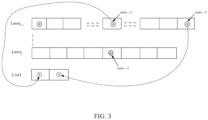
- the depth information of the point right above the point to be coded currently is inserted into the List1.
- the depth information of the point is filled with a value of a depth information value of a point within a scope on an upper left or upper right of the point to be coded currently or a linear combination of the depth information value.
- a depth information value of a coded point with a distance of D from a point, in a previous laser, right above the point to be coded currently is selected and inserted into the List1.
- D may be a positive value or a negative value, a fixed value, or a value that is adaptively changed with a position of the point to be coded currently. When D is the positive value, it indicates the upper right of the point to be coded currently.
- FIG. 3 is a schematic diagram of update of the second first candidate list List1 according to an embodiment of the present invention.
- ⁇ is a depth information value of a point to be coded currently
- ⁇ is a depth information value of the currently coded point to be inserted.
- a size of the third candidate list List2 is initialized.
- the size of the third candidate list List2 may be initialized to 5.
- the size of the third candidate list List2 is equal to 5. Whenever depth information of a point has been coded, the size of the third candidate list List2 needs to be determined. When the size of the list is less than 5, namely, the list is not filled, the depth information value of the currently coded point is directly inserted into the end of the List2. When the size of the list is equal to 5, namely, the list is filled, it is determined, based on a preset threshold t h 0 , whether the depth information value of the currently coded point should be inserted into the List2. Specifically, redundancy is checked first.
- a size of the fourth candidate list List3 is initialized.
- the size of the fourth candidate list List3 may be initialized to 4.
- depth information is divided into several intervals with a same size as the fourth candidate list List3.
- the depth information is generally in a range of [0, 2 32 - 1] , namely, the depth information is expressed by 32 bits at most, and the depth information is coded mostly with effective bits. Therefore, before the depth information is predictively coded, the depth information may be divided into several intervals with a same size as the fourth candidate list List3 based on a quantity of bits. For example, the depth information may be divided into four intervals based on the quantity of bits, which are [0, 2 8 - 1], [2 8 , 2 16 - 1], [2 16 , 2 24 - 1], and [2 24 , 2 32 - 1] successively.
- a value may be selected from each of the four intervals, such as 128, 32640, 65536, or 16777216, to fill the fourth candidate list List3.
- the four candidate lists are created in this embodiment, and a corresponding value may be selected, in order from the first candidate list to the fourth candidate list, to fill the prediction list. Details are as follows.
- a (preferably a first) depth information value in the first candidate list is inserted into the prediction list, and another depth information value in the first candidate list is selectively inserted into the prediction list based on a first threshold.
- the prediction list is filled with at most n values from the second candidate list List1, where n may be fixed or adaptively changed with a size of the prediction list. For example, n is equal to 1.
- a specific manner is as follows.
- a depth information value in the third candidate list is selectively inserted into the prediction list based on a third threshold when it is determined that the prediction list is not filled currently.
- the prediction list is filled with at most k values from the third candidate list List2, where k may be fixed or adaptively changed with a size of the prediction list. For example, k is equal to 1.
- a specific manner is as follows.
- a ratio of a depth information value in the List2 to a depth information value in a current prediction list is greater than a third threshold T 2 . If the ratio is greater than T 2 , the depth information value in the List2 is inserted into the prediction list, otherwise, the depth information value is not inserted.
- the order of values in the prediction list may be appropriately adjusted to adapt to a change in a scenario.
- the order may be adjusted based on a difference in depth information values in the prediction list.
- the first threshold T 0 , the second threshold T 1 , and the third threshold T 2 are not fixed, and may be all updated with coding.
- the foregoing threshold may be updated based on depth information of a previously coded point and a predicted value of depth information selected for the previously coded point.
- the threshold may be updated to a ratio of the depth information of the previously coded point and the predicted value for the previously coded point.
- Step 3 Predictively code the depth information of the point cloud based on the adaptive prediction list, to obtain codestream information.
- a prediction mode with lowest costs may be selected from the prediction list through an existing rate-distortion optimization technology, to predict depth information of a point to be coded currently, and a predicted residual of the depth information may be obtained. Then, an existing entropy coding technology is used to code the selected prediction mode and the predicted residual of the depth information, to obtain the codestream information.
- the depth information of the point cloud may be recreated only by synchronously creating the adaptive prediction list of the point cloud and parsing the prediction mode and the predicted residual of the depth information in the codestream.
- the adaptively updated candidate list of depth information is created, the prediction list is created based on the candidate list, and an optimal predicted value is selected to predict the depth information of the point cloud. Therefore, discontinuity of the depth information of the point cloud caused by discontinuity of an actual scenario can be resolved. Accordingly, a predicted residual and a frequency of occurrence of an outlier and a hop value, of the depth information, are significantly reduced, and prediction accuracy and coding efficiency are improved.
- FIG. 5 is a schematic structural diagram of an apparatus for predictively coding depth information of a point cloud according to an embodiment of the present invention.
- the apparatus includes:
- the apparatus provided in this embodiment can implement the coding method provided in the foregoing Embodiment 1. Details are not described herein again.
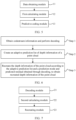
- FIG. 6 is a schematic flowchart of the method for predictively decoding depth information of a point cloud according to an embodiment of the present invention. The method specifically includes the following steps.
- Step 1 Obtain codestream information and perform decoding.
- the apparatus provided in this embodiment can implement the decoding method provided in the foregoing Embodiment 3. Details are not described herein again.
Landscapes
- Engineering & Computer Science (AREA)
- Multimedia (AREA)
- Signal Processing (AREA)
- Physics & Mathematics (AREA)
- General Physics & Mathematics (AREA)
- Theoretical Computer Science (AREA)
- Image Processing (AREA)
- Compression Or Coding Systems Of Tv Signals (AREA)
Claims (9)
- Ein Verfahren zur prädiktiven Kodierung von Tiefeninformationen einer Punktwolke, wobei das Verfahren Folgendes umfasst:Erhalten (S1) von Originaldaten der Punktwolke;Erstellen (S2) einer adaptiven Prädiktionsliste der Tiefeninformationen der Punktwolke; wobei das Erstellen einer adaptiven Prädiktionsliste der Tiefeninformationen der Punktwolke Folgendes umfasst:Erstellen mehrerer Kandidatenlisten der Tiefeninformationen eines Punktes, der aktuell zu kodieren ist; undAuswahl eines Wertes aus den Kandidatenlisten, um eine Prädiktionsliste zu füllen, um die adaptive Prädiktionsliste zu erhalten; undPrädiktive Kodierung (S3) der Tiefeninformationen der Punktwolke basierend auf der adaptiven Prädiktionsliste, um Codestream-Informationen zu erhalten, wobei nach der Erstellung der entsprechenden Prädiktionsliste für jeden zu kodierenden Punkt ein Prädiktionsmodus mit den niedrigsten Kosten aus der Prädiktionsliste mittels einer Rate-Distortion-Optimierungstechnologie ausgewählt wird, um die Tiefeninformation des aktuell zu kodierenden Punktes vorherzusagen, und eine Entropiekodierungstechnologie verwendet wird, um den ausgewählten Prädiktionsmodus und ein prädiziertes Residuum der Tiefeninformation des aktuell zu kodierenden Punktes zu kodieren;wobei das Erstellen mehrerer Kandidatenlisten der Tiefeninformationen eines Punktes, der aktuell zu kodieren ist, Folgendes umfasst:Erstellen von mindestens einer der folgenden Listen: einer ersten Kandidatenliste, einer zweiten Kandidatenliste, einer dritten Kandidatenliste oder einer vierten Kandidatenliste, wobeiTiefeninformationswerte kodierter Punkte, die von demselben Laser gesammelt wurden wie dem Laser, welcher den Tiefeninformationswert des aktuell zu kodierenden Punktes sammelt, in der ersten Kandidatenliste gespeichert werden;Tiefeninformationswerte kodierter Punkte, die von einem anderen Laser gesammelt wurden als dem Laser, welcher den Tiefeninformationswert des aktuell zu kodierenden Punktes sammelt, in der zweiten Kandidatenliste gespeichert werden;Tiefeninformationswerte historisch kodierter Punkte in der dritten Kandidatenliste gespeichert werden; unda-priori Tiefeninformationswerte in der vierten Kandidatenliste gespeichert werden.
- Das Verfahren zur prädiktiven Kodierung von Tiefeninformationen einer Punktwolke nach Anspruch 1, wobei das Erstellen der ersten Kandidatenliste Folgendes umfasst:Initialisierung einer Größe der ersten Kandidatenliste; undEinfügen eines Tiefeninformationswerts eines aktuell kodierten Punktes an das Ende der ersten Kandidatenliste, falls die erste Kandidatenliste aktuell nicht gefüllt ist; und Aktualisierung der ersten Kandidatenliste nach dem First-in-First-out-Prinzip, falls die erste Kandidatenliste aktuell gefüllt ist.
- Das Verfahren zur prädiktiven Kodierung von Tiefeninformationen einer Punktwolke nach Anspruch 1, wobei das Erstellen der zweiten Kandidatenliste Folgendes umfasst:Initialisierung einer Größe der zweiten Kandidatenliste; undEinfügen einer Tiefeninformation eines kodierten Punkts innerhalb eines Bereichs direkt oberhalb des aktuell zu kodierenden Punkts in die zweite Kandidatenliste, sofern die zweite Kandidatenliste derzeit nicht gefüllt ist und ein durch vorherige q-Laser des aktuellen Lasers erfasster Punkt bereits kodiert wurde.
- Verfahren zur prädiktiven Kodierung von Tiefeninformationen einer Punktwolke gemäß Anspruch 1, wobei das Erstellen der dritten Kandidatenliste Folgendes umfasst:Initialisierung einer Größe der dritten Kandidatenliste; undEinfügen eines Tiefeninformationswerts eines aktuell kodierten Punkts am Ende der dritten Kandidatenliste, sofern die dritte Kandidatenliste derzeit nicht gefüllt ist; und selektives Entfernen eines Wertes in der dritten Kandidatenliste basierend auf einem voreingestellten Schwellenwert sowie Einfügen des Tiefeninformationswerts des aktuell kodierten Punkts am Ende der Liste, sofern die dritte Kandidatenliste derzeit gefüllt ist.
- Verfahren zur prädiktiven Kodierung von Tiefeninformationen einer Punktwolke gemäß Anspruch 1, wobei das Auswählen eines Wertes aus der Kandidatenliste zur Befüllung einer Vorhersageliste, um die adaptive Vorhersageliste zu erhalten, Folgendes umfasst:Initialisierung einer Größe der Vorhersageliste;Auswahl eines Wertes einer Menge aus mehreren Kandidatenlisten in einer Reihenfolge und Befüllen der Menge in die Vorhersageliste; undAnpassen der Reihenfolge der Werte in der Vorhersageliste, um die adaptive Vorhersageliste zu erhalten.
- Verfahren zur prädiktiven Kodierung von Tiefeninformationen einer Punktwolke gemäß Anspruch 5, wobei das Auswählen eines Wertes einer Menge aus mehreren Kandidatenlisten in einer Reihenfolge und das Befüllen der Menge in die Vorhersageliste Folgendes umfasst:Einfügen eines Tiefeninformationswerts aus der ersten Kandidatenliste in die Vorhersageliste und selektives Einfügen eines weiteren Tiefeninformationswerts aus der ersten Kandidatenliste in die Vorhersageliste basierend auf einem ersten Schwellenwert;Selektives Einfügen eines Tiefeninformationswerts aus der zweiten Kandidatenliste in die Vorhersageliste basierend auf einem zweiten Schwellenwert, wenn festgestellt wird, dass die Vorhersageliste derzeit nicht gefüllt ist;Selektives Einfügen eines Tiefeninformationswerts aus der dritten Kandidatenliste in die Vorhersageliste basierend auf einem dritten Schwellenwert, wenn festgestellt wird, dass die Vorhersageliste derzeit nicht gefüllt ist; undNacheinander Einfügen eines Wertes aus der vierten Kandidatenliste in eine verbleibende Position der Vorhersageliste, wenn festgestellt wird, dass die Vorhersageliste derzeit nicht gefüllt ist.
- Vorrichtung zum prädiktiven Codieren von Tiefeninformationen einer Punktwolke, die so konfiguriert ist, das Verfahren nach einem der Ansprüche 1 bis 6 durchzuführen.
- Verfahren zum prädiktiven Decodieren von Tiefeninformationen einer Punktwolke, wobei das Verfahren Folgendes umfasst:Erhalt (Schritt 1) von Codestream-Informationen und Durchführung der Decodierung;Erstellen (Schritt 2) einer adaptiven Prädiktionsliste der Tiefeninformationen der Punktwolke; undRekonstruktion (Schritt 3) der Tiefeninformationen der Punktwolke basierend auf der adaptiven Prädiktionsliste sowie einem Prädiktionsmodus und dem durch die Decodierung erhaltenen prädizierten Residuum, um rekonstruierte Tiefeninformationen der Punktwolke zu erhalten;wobei das Erstellen einer adaptiven Prädiktionsliste der Tiefeninformationen der Punktwolke Folgendes umfasst:Erstellen mehrerer Kandidatenlisten für die aktuell zu codierenden Tiefeninformationen eines Punktes; undAuswählen eines Wertes aus den Kandidatenlisten zur Befüllung einer Prädiktionsliste, um die adaptive Prädiktionsliste zu erhalten;wobei das Erstellen mehrerer Kandidatenlisten für die aktuell zu codierenden Tiefeninformationen eines Punktes Folgendes umfasst:Erstellen mindestens einer aus einer ersten Kandidatenliste, einer zweiten Kandidatenliste, einer dritten Kandidatenliste oder einer vierten Kandidatenliste, wobeiTiefeninformationswerte codierter Punkte, die von einem Laser gesammelt wurden, der dem Laser entspricht, mit dem der Tiefeninformationswert des aktuell zu codierenden Punktes gesammelt wird, in der ersten Kandidatenliste gespeichert werden;Tiefeninformationswerte codierter Punkte, die von einem anderen Laser als dem Laser, mit dem der Tiefeninformationswert des aktuell zu codierenden Punktes gesammelt wird, gesammelt wurden, in der zweiten Kandidatenliste gespeichert werden;Historisch codierte Tiefeninformationswerte werden in der dritten Kandidatenliste gespeichert; undA-priori-Tiefeninformationswerte werden in der vierten Kandidatenliste gespeichert.
- Vorrichtung zum prädiktiven Decodieren von Tiefeninformationen einer Punktwolke, die so konfiguriert ist, das Verfahren gemäß Anspruch 8 durchzuführen.
Priority Applications (1)
| Application Number | Priority Date | Filing Date | Title |
|---|---|---|---|
| EP25182011.4A EP4716219A1 (de) | 2021-05-26 | 2022-05-18 | Verfahren und vorrichtung zur prädiktiven codierung und decodierung von tiefeninformationen einer punktwolke |
Applications Claiming Priority (2)
| Application Number | Priority Date | Filing Date | Title |
|---|---|---|---|
| CN202110580227.8A CN115412713B (zh) | 2021-05-26 | 2021-05-26 | 一种点云深度信息的预测编解码方法及装置 |
| PCT/CN2022/093614 WO2022247704A1 (zh) | 2021-05-26 | 2022-05-18 | 一种点云深度信息的预测编解码方法及装置 |
Related Child Applications (1)
| Application Number | Title | Priority Date | Filing Date |
|---|---|---|---|
| EP25182011.4A Division EP4716219A1 (de) | 2021-05-26 | 2022-05-18 | Verfahren und vorrichtung zur prädiktiven codierung und decodierung von tiefeninformationen einer punktwolke |
Publications (3)
| Publication Number | Publication Date |
|---|---|
| EP4236311A1 EP4236311A1 (de) | 2023-08-30 |
| EP4236311A4 EP4236311A4 (de) | 2024-08-14 |
| EP4236311B1 true EP4236311B1 (de) | 2025-07-09 |
Family
ID=84156615
Family Applications (2)
| Application Number | Title | Priority Date | Filing Date |
|---|---|---|---|
| EP25182011.4A Pending EP4716219A1 (de) | 2021-05-26 | 2022-05-18 | Verfahren und vorrichtung zur prädiktiven codierung und decodierung von tiefeninformationen einer punktwolke |
| EP22810431.1A Active EP4236311B1 (de) | 2021-05-26 | 2022-05-18 | Verfahren und vorrichtung zur prädiktiven codierung/decodierung von punktwolkentiefeninformationen |
Family Applications Before (1)
| Application Number | Title | Priority Date | Filing Date |
|---|---|---|---|
| EP25182011.4A Pending EP4716219A1 (de) | 2021-05-26 | 2022-05-18 | Verfahren und vorrichtung zur prädiktiven codierung und decodierung von tiefeninformationen einer punktwolke |
Country Status (4)
| Country | Link |
|---|---|
| US (2) | US12489920B2 (de) |
| EP (2) | EP4716219A1 (de) |
| CN (2) | CN118540450A (de) |
| WO (1) | WO2022247704A1 (de) |
Families Citing this family (2)
| Publication number | Priority date | Publication date | Assignee | Title |
|---|---|---|---|---|
| WO2023090616A1 (ko) * | 2021-11-19 | 2023-05-25 | 현대자동차주식회사 | 포인트 단위 예측을 이용하는 라이다 포인트 클라우드 코딩을 위한 방법 및 장치 |
| WO2024234159A1 (zh) * | 2023-05-12 | 2024-11-21 | Oppo广东移动通信有限公司 | 点云编解码方法、解码器、编码器及计算机可读存储介质 |
Family Cites Families (16)
| Publication number | Priority date | Publication date | Assignee | Title |
|---|---|---|---|---|
| CN106105212A (zh) * | 2014-03-07 | 2016-11-09 | 高通股份有限公司 | 简化的子预测单元(sub‑pu)运动参数继承(mpi) |
| US20180053324A1 (en) | 2016-08-19 | 2018-02-22 | Mitsubishi Electric Research Laboratories, Inc. | Method for Predictive Coding of Point Cloud Geometries |
| JP7438993B2 (ja) * | 2018-07-11 | 2024-02-27 | インターデジタル ヴイシー ホールディングス, インコーポレイテッド | 点群のジオメトリを符号化/復号する方法及び装置 |
| US11010931B2 (en) | 2018-10-02 | 2021-05-18 | Tencent America LLC | Method and apparatus for video coding |
| CN109657559B (zh) * | 2018-11-23 | 2023-02-07 | 盎锐(上海)信息科技有限公司 | 点云深度感知编码引擎装置 |
| WO2020175708A1 (ja) | 2019-02-28 | 2020-09-03 | パナソニック インテレクチュアル プロパティ コーポレーション オブ アメリカ | 三次元データ符号化方法、三次元データ復号方法、三次元データ符号化装置、及び三次元データ復号装置 |
| US20200296401A1 (en) | 2019-03-15 | 2020-09-17 | Mediatek Inc. | Method and Apparatus of Patch Segmentation for Video-based Point Cloud Coding |
| WO2020190097A1 (ko) * | 2019-03-20 | 2020-09-24 | 엘지전자 주식회사 | 포인트 클라우드 데이터 수신 장치, 포인트 클라우드 데이터 수신 방법, 포인트 클라우드 데이터 처리 장치 및 포인트 클라우드 데이터 처리 방법 |
| KR102699245B1 (ko) * | 2019-03-21 | 2024-08-27 | 엘지전자 주식회사 | 포인트 클라우드 데이터 부호화 장치, 포인트 클라우드 데이터 부호화 방법, 포인트 클라우드 데이터 복호화 장치 및 포인트 클라우드 데이터 복호화 방법 |
| US11581022B2 (en) * | 2019-05-29 | 2023-02-14 | Nokia Technologies Oy | Method and apparatus for storage and signaling of compressed point clouds |
| WO2020246689A1 (ko) * | 2019-06-05 | 2020-12-10 | 엘지전자 주식회사 | 포인트 클라우드 데이터 전송 장치, 포인트 클라우드 데이터 전송 방법, 포인트 클라우드 데이터 수신 장치 및 포인트 클라우드 데이터 수신 방법 |
| CN114616592B (zh) * | 2019-10-31 | 2025-08-08 | 黑莓有限公司 | 用于云压缩的方位角先验和树表示的方法和系统 |
| CN112218079B (zh) * | 2020-08-24 | 2022-10-25 | 北京大学深圳研究生院 | 一种基于空间顺序的点云分层方法、点云预测方法及设备 |
| US11935270B2 (en) | 2020-10-07 | 2024-03-19 | Qualcomm Incorporated | Predictive geometry coding in G-PCC |
| CN112565734B (zh) * | 2020-12-03 | 2022-04-19 | 西安电子科技大学 | 基于混合编码的点云属性编解码方法及装置 |
| US20220215596A1 (en) * | 2021-01-04 | 2022-07-07 | Qualcomm Incorporated | Model-based prediction for geometry point cloud compression |
-
2021
- 2021-05-26 CN CN202410639330.9A patent/CN118540450A/zh active Pending
- 2021-05-26 CN CN202110580227.8A patent/CN115412713B/zh active Active
-
2022
- 2022-05-18 WO PCT/CN2022/093614 patent/WO2022247704A1/zh not_active Ceased
- 2022-05-18 EP EP25182011.4A patent/EP4716219A1/de active Pending
- 2022-05-18 EP EP22810431.1A patent/EP4236311B1/de active Active
- 2022-05-18 US US18/039,633 patent/US12489920B2/en active Active
-
2025
- 2025-11-11 US US19/386,113 patent/US20260067500A1/en active Pending
Also Published As
| Publication number | Publication date |
|---|---|
| US20260067500A1 (en) | 2026-03-05 |
| EP4236311A4 (de) | 2024-08-14 |
| CN115412713A (zh) | 2022-11-29 |
| CN115412713B (zh) | 2024-06-25 |
| US20240007669A1 (en) | 2024-01-04 |
| EP4236311A1 (de) | 2023-08-30 |
| EP4716219A1 (de) | 2026-03-25 |
| WO2022247704A1 (zh) | 2022-12-01 |
| CN118540450A (zh) | 2024-08-23 |
| US12489920B2 (en) | 2025-12-02 |
Similar Documents
| Publication | Publication Date | Title |
|---|---|---|
| US20260067500A1 (en) | Method and apparatus for predictively coding and decoding depth information of point cloud | |
| EP3595180B1 (de) | Verfahren und vorrichtungen zur nachbarschaftsbasierten belegungsvorhersage bei der punktwolkenkompression | |
| CN115211117B (zh) | 用于在基于几何形状的点云压缩中的预测变换的预测器索引信令 | |
| CN112449754B (zh) | 一种数据编码、数据解码方法、设备及存储介质 | |
| EP4088261B1 (de) | Kontextbestimmung für den planarmodus in achtästigbasierter punktwolkkodierung | |
| EP3633857B1 (de) | Verfahren und vorrichtungen für zeitgleiche codierer-mapping-aktualisierungen in der punktwolkencodierung | |
| EP4576766A1 (de) | Verfahren und vorrichtung zur punktwolkenverarbeitung, computervorrichtung und speichermedium | |
| EP4542965A1 (de) | Punktwolkencodierungsverfahren, punktwolkendecodierungsverfahren und zugehörige vorrichtung | |
| CN114598892B (zh) | 点云数据编码方法、解码方法、装置、设备及存储介质 | |
| US20250356534A1 (en) | Method and apparatus for predictively coding and decoding attribute information of point cloud | |
| US20250022183A1 (en) | Dual Motion Fields for Coding Geometry and Attributes of a Point Cloud | |
| US20250220230A1 (en) | Point cloud data transmission device, point cloud data transmission method, point cloud data reception device, and point cloud data reception method | |
| EP4207762A1 (de) | Verfahren und vorrichtung zur codierung/decodierung einer punktwolke auf basis einer zweidimensionalen regulierungsebenenprojektion | |
| US20240037800A1 (en) | Encoding and decoding methods, related devices and storage medium | |
| CN115100302B (zh) | 点云处理方法、装置、设备以及介质 | |
| EP4236322A1 (de) | Verfahren und vorrichtung zur codierung/decodierung einer punktwolke auf basis einer zweidimensionalen projektion mit geregelter ebene | |
| US20250330642A1 (en) | Encoding method, decoding method, bitstream, encoder, decoder, and storage medium | |
| CN117581549A (zh) | 帧内预测、编解码方法及装置、编解码器、设备、介质 | |
| CN120958825A (zh) | 编解码方法、编码器、解码器、码流以及存储介质 | |
| CN120476597A (zh) | 编解码方法、码流、编码器、解码器以及存储介质 | |
| CN120476590A (zh) | 点云编解码方法、装置、设备及存储介质 | |
| US20260113450A1 (en) | Coding Region Adaptive Hierarchical Transform (RAHT) Prediction Mode | |
| KR20250129780A (ko) | 포인트 클라우드 인코딩 및 디코딩 방법, 장치, 장비 및 저장 매체 | |
| WO2024212042A1 (zh) | 编解码方法、码流、编码器、解码器以及存储介质 | |
| WO2026087714A1 (en) | Encoding and decoding the geometry of a point cloud |
Legal Events
| Date | Code | Title | Description |
|---|---|---|---|
| STAA | Information on the status of an ep patent application or granted ep patent |
Free format text: STATUS: THE INTERNATIONAL PUBLICATION HAS BEEN MADE |
|
| PUAI | Public reference made under article 153(3) epc to a published international application that has entered the european phase |
Free format text: ORIGINAL CODE: 0009012 |
|
| STAA | Information on the status of an ep patent application or granted ep patent |
Free format text: STATUS: REQUEST FOR EXAMINATION WAS MADE |
|
| 17P | Request for examination filed |
Effective date: 20230526 |
|
| AK | Designated contracting states |
Kind code of ref document: A1 Designated state(s): AL AT BE BG CH CY CZ DE DK EE ES FI FR GB GR HR HU IE IS IT LI LT LU LV MC MK MT NL NO PL PT RO RS SE SI SK SM TR |
|
| REG | Reference to a national code |
Ref country code: DE Ref legal event code: R079 Free format text: PREVIOUS MAIN CLASS: H04N0019103000 Ipc: H04N0019597000 Ref country code: DE Ref legal event code: R079 Ref document number: 602022017450 Country of ref document: DE Free format text: PREVIOUS MAIN CLASS: H04N0019103000 Ipc: H04N0019597000 |
|
| A4 | Supplementary search report drawn up and despatched |
Effective date: 20240712 |
|
| RIC1 | Information provided on ipc code assigned before grant |
Ipc: G06T 9/00 20060101ALI20240708BHEP Ipc: H04N 19/103 20140101ALI20240708BHEP Ipc: H04N 19/50 20140101ALI20240708BHEP Ipc: H04N 19/597 20140101AFI20240708BHEP |
|
| DAV | Request for validation of the european patent (deleted) | ||
| DAX | Request for extension of the european patent (deleted) | ||
| GRAP | Despatch of communication of intention to grant a patent |
Free format text: ORIGINAL CODE: EPIDOSNIGR1 |
|
| STAA | Information on the status of an ep patent application or granted ep patent |
Free format text: STATUS: GRANT OF PATENT IS INTENDED |
|
| INTG | Intention to grant announced |
Effective date: 20250204 |
|
| GRAS | Grant fee paid |
Free format text: ORIGINAL CODE: EPIDOSNIGR3 |
|
| GRAA | (expected) grant |
Free format text: ORIGINAL CODE: 0009210 |
|
| STAA | Information on the status of an ep patent application or granted ep patent |
Free format text: STATUS: THE PATENT HAS BEEN GRANTED |
|
| AK | Designated contracting states |
Kind code of ref document: B1 Designated state(s): AL AT BE BG CH CY CZ DE DK EE ES FI FR GB GR HR HU IE IS IT LI LT LU LV MC MK MT NL NO PL PT RO RS SE SI SK SM TR |
|
| REG | Reference to a national code |
Ref country code: GB Ref legal event code: FG4D |
|
| REG | Reference to a national code |
Ref country code: CH Ref legal event code: EP |
|
| REG | Reference to a national code |
Ref country code: IE Ref legal event code: FG4D |
|
| REG | Reference to a national code |
Ref country code: DE Ref legal event code: R096 Ref document number: 602022017450 Country of ref document: DE |
|
| REG | Reference to a national code |
Ref country code: NL Ref legal event code: FP |
|
| PG25 | Lapsed in a contracting state [announced via postgrant information from national office to epo] |
Ref country code: PT Free format text: LAPSE BECAUSE OF FAILURE TO SUBMIT A TRANSLATION OF THE DESCRIPTION OR TO PAY THE FEE WITHIN THE PRESCRIBED TIME-LIMIT Effective date: 20251110 |
|
| REG | Reference to a national code |
Ref country code: AT Ref legal event code: MK05 Ref document number: 1812973 Country of ref document: AT Kind code of ref document: T Effective date: 20250709 |
|
| PG25 | Lapsed in a contracting state [announced via postgrant information from national office to epo] |
Ref country code: IS Free format text: LAPSE BECAUSE OF FAILURE TO SUBMIT A TRANSLATION OF THE DESCRIPTION OR TO PAY THE FEE WITHIN THE PRESCRIBED TIME-LIMIT Effective date: 20251109 |
|
| PG25 | Lapsed in a contracting state [announced via postgrant information from national office to epo] |
Ref country code: NO Free format text: LAPSE BECAUSE OF FAILURE TO SUBMIT A TRANSLATION OF THE DESCRIPTION OR TO PAY THE FEE WITHIN THE PRESCRIBED TIME-LIMIT Effective date: 20251009 |
|
| REG | Reference to a national code |
Ref country code: LT Ref legal event code: MG9D |
|
| PG25 | Lapsed in a contracting state [announced via postgrant information from national office to epo] |
Ref country code: AT Free format text: LAPSE BECAUSE OF FAILURE TO SUBMIT A TRANSLATION OF THE DESCRIPTION OR TO PAY THE FEE WITHIN THE PRESCRIBED TIME-LIMIT Effective date: 20250709 |
|
| PG25 | Lapsed in a contracting state [announced via postgrant information from national office to epo] |
Ref country code: FI Free format text: LAPSE BECAUSE OF FAILURE TO SUBMIT A TRANSLATION OF THE DESCRIPTION OR TO PAY THE FEE WITHIN THE PRESCRIBED TIME-LIMIT Effective date: 20250709 |
|
| PG25 | Lapsed in a contracting state [announced via postgrant information from national office to epo] |
Ref country code: HR Free format text: LAPSE BECAUSE OF FAILURE TO SUBMIT A TRANSLATION OF THE DESCRIPTION OR TO PAY THE FEE WITHIN THE PRESCRIBED TIME-LIMIT Effective date: 20250709 |
|
| PG25 | Lapsed in a contracting state [announced via postgrant information from national office to epo] |
Ref country code: GR Free format text: LAPSE BECAUSE OF FAILURE TO SUBMIT A TRANSLATION OF THE DESCRIPTION OR TO PAY THE FEE WITHIN THE PRESCRIBED TIME-LIMIT Effective date: 20251010 |
|
| PG25 | Lapsed in a contracting state [announced via postgrant information from national office to epo] |
Ref country code: SE Free format text: LAPSE BECAUSE OF FAILURE TO SUBMIT A TRANSLATION OF THE DESCRIPTION OR TO PAY THE FEE WITHIN THE PRESCRIBED TIME-LIMIT Effective date: 20250709 |
|
| PG25 | Lapsed in a contracting state [announced via postgrant information from national office to epo] |
Ref country code: LV Free format text: LAPSE BECAUSE OF FAILURE TO SUBMIT A TRANSLATION OF THE DESCRIPTION OR TO PAY THE FEE WITHIN THE PRESCRIBED TIME-LIMIT Effective date: 20250709 |
|
| PG25 | Lapsed in a contracting state [announced via postgrant information from national office to epo] |
Ref country code: PL Free format text: LAPSE BECAUSE OF FAILURE TO SUBMIT A TRANSLATION OF THE DESCRIPTION OR TO PAY THE FEE WITHIN THE PRESCRIBED TIME-LIMIT Effective date: 20250709 Ref country code: BG Free format text: LAPSE BECAUSE OF FAILURE TO SUBMIT A TRANSLATION OF THE DESCRIPTION OR TO PAY THE FEE WITHIN THE PRESCRIBED TIME-LIMIT Effective date: 20250709 |
|
| PG25 | Lapsed in a contracting state [announced via postgrant information from national office to epo] |
Ref country code: RS Free format text: LAPSE BECAUSE OF FAILURE TO SUBMIT A TRANSLATION OF THE DESCRIPTION OR TO PAY THE FEE WITHIN THE PRESCRIBED TIME-LIMIT Effective date: 20251009 |
|
| PG25 | Lapsed in a contracting state [announced via postgrant information from national office to epo] |
Ref country code: ES Free format text: LAPSE BECAUSE OF FAILURE TO SUBMIT A TRANSLATION OF THE DESCRIPTION OR TO PAY THE FEE WITHIN THE PRESCRIBED TIME-LIMIT Effective date: 20250709 |
|
| PG25 | Lapsed in a contracting state [announced via postgrant information from national office to epo] |
Ref country code: SM Free format text: LAPSE BECAUSE OF FAILURE TO SUBMIT A TRANSLATION OF THE DESCRIPTION OR TO PAY THE FEE WITHIN THE PRESCRIBED TIME-LIMIT Effective date: 20250709 |
|
| PGFP | Annual fee paid to national office [announced via postgrant information from national office to epo] |
Ref country code: GB Payment date: 20260324 Year of fee payment: 5 |
|
| REG | Reference to a national code |
Ref country code: DE Ref legal event code: R097 Ref document number: 602022017450 Country of ref document: DE |
|
| PG25 | Lapsed in a contracting state [announced via postgrant information from national office to epo] |
Ref country code: DK Free format text: LAPSE BECAUSE OF FAILURE TO SUBMIT A TRANSLATION OF THE DESCRIPTION OR TO PAY THE FEE WITHIN THE PRESCRIBED TIME-LIMIT Effective date: 20250709 |
|
| PG25 | Lapsed in a contracting state [announced via postgrant information from national office to epo] |
Ref country code: IT Free format text: LAPSE BECAUSE OF FAILURE TO SUBMIT A TRANSLATION OF THE DESCRIPTION OR TO PAY THE FEE WITHIN THE PRESCRIBED TIME-LIMIT Effective date: 20250709 |
|
| PG25 | Lapsed in a contracting state [announced via postgrant information from national office to epo] |
Ref country code: CZ Free format text: LAPSE BECAUSE OF FAILURE TO SUBMIT A TRANSLATION OF THE DESCRIPTION OR TO PAY THE FEE WITHIN THE PRESCRIBED TIME-LIMIT Effective date: 20250709 |
|
| PG25 | Lapsed in a contracting state [announced via postgrant information from national office to epo] |
Ref country code: EE Free format text: LAPSE BECAUSE OF FAILURE TO SUBMIT A TRANSLATION OF THE DESCRIPTION OR TO PAY THE FEE WITHIN THE PRESCRIBED TIME-LIMIT Effective date: 20250709 Ref country code: SK Free format text: LAPSE BECAUSE OF FAILURE TO SUBMIT A TRANSLATION OF THE DESCRIPTION OR TO PAY THE FEE WITHIN THE PRESCRIBED TIME-LIMIT Effective date: 20250709 |
|
| PLBE | No opposition filed within time limit |
Free format text: ORIGINAL CODE: 0009261 |
|
| STAA | Information on the status of an ep patent application or granted ep patent |
Free format text: STATUS: NO OPPOSITION FILED WITHIN TIME LIMIT |
|
| PGFP | Annual fee paid to national office [announced via postgrant information from national office to epo] |
Ref country code: NL Payment date: 20260408 Year of fee payment: 5 |
|
| REG | Reference to a national code |
Ref country code: CH Ref legal event code: L10 Free format text: ST27 STATUS EVENT CODE: U-0-0-L10-L00 (AS PROVIDED BY THE NATIONAL OFFICE) Effective date: 20260521 |
|
| 26N | No opposition filed |
Effective date: 20260410 |
|
| PG25 | Lapsed in a contracting state [announced via postgrant information from national office to epo] |
Ref country code: LT Free format text: LAPSE BECAUSE OF FAILURE TO SUBMIT A TRANSLATION OF THE DESCRIPTION OR TO PAY THE FEE WITHIN THE PRESCRIBED TIME-LIMIT Effective date: 20250709 |
|
| PGFP | Annual fee paid to national office [announced via postgrant information from national office to epo] |
Ref country code: DE Payment date: 20260331 Year of fee payment: 5 |