EP4235579A1 - Decodierungsverfahren, decodierungsvorrichtung und programm - Google Patents
Decodierungsverfahren, decodierungsvorrichtung und programm Download PDFInfo
- Publication number
- EP4235579A1 EP4235579A1 EP20967023.1A EP20967023A EP4235579A1 EP 4235579 A1 EP4235579 A1 EP 4235579A1 EP 20967023 A EP20967023 A EP 20967023A EP 4235579 A1 EP4235579 A1 EP 4235579A1
- Authority
- EP
- European Patent Office
- Prior art keywords
- slice
- space
- point cloud
- encoded data
- decoding
- Prior art date
- Legal status (The legal status is an assumption and is not a legal conclusion. Google has not performed a legal analysis and makes no representation as to the accuracy of the status listed.)
- Pending
Links
Images




Classifications
-
- H—ELECTRICITY
- H04—ELECTRIC COMMUNICATION TECHNIQUE
- H04N—PICTORIAL COMMUNICATION, e.g. TELEVISION
- H04N19/00—Methods or arrangements for coding, decoding, compressing or decompressing digital video signals
- H04N19/10—Methods or arrangements for coding, decoding, compressing or decompressing digital video signals using adaptive coding
- H04N19/169—Methods or arrangements for coding, decoding, compressing or decompressing digital video signals using adaptive coding characterised by the coding unit, i.e. the structural portion or semantic portion of the video signal being the object or the subject of the adaptive coding
- H04N19/17—Methods or arrangements for coding, decoding, compressing or decompressing digital video signals using adaptive coding characterised by the coding unit, i.e. the structural portion or semantic portion of the video signal being the object or the subject of the adaptive coding the unit being an image region, e.g. an object
- H04N19/174—Methods or arrangements for coding, decoding, compressing or decompressing digital video signals using adaptive coding characterised by the coding unit, i.e. the structural portion or semantic portion of the video signal being the object or the subject of the adaptive coding the unit being an image region, e.g. an object the region being a slice, e.g. a line of blocks or a group of blocks
-
- G—PHYSICS
- G06—COMPUTING OR CALCULATING; COUNTING
- G06T—IMAGE DATA PROCESSING OR GENERATION, IN GENERAL
- G06T9/00—Image coding
- G06T9/40—Tree coding, e.g. quadtree, octree
-
- G—PHYSICS
- G06—COMPUTING OR CALCULATING; COUNTING
- G06T—IMAGE DATA PROCESSING OR GENERATION, IN GENERAL
- G06T9/00—Image coding
- G06T9/001—Model-based coding, e.g. wire frame
-
- H—ELECTRICITY
- H04—ELECTRIC COMMUNICATION TECHNIQUE
- H04N—PICTORIAL COMMUNICATION, e.g. TELEVISION
- H04N19/00—Methods or arrangements for coding, decoding, compressing or decompressing digital video signals
- H04N19/50—Methods or arrangements for coding, decoding, compressing or decompressing digital video signals using predictive coding
- H04N19/597—Methods or arrangements for coding, decoding, compressing or decompressing digital video signals using predictive coding specially adapted for multi-view video sequence encoding
-
- H—ELECTRICITY
- H04—ELECTRIC COMMUNICATION TECHNIQUE
- H04N—PICTORIAL COMMUNICATION, e.g. TELEVISION
- H04N19/00—Methods or arrangements for coding, decoding, compressing or decompressing digital video signals
- H04N19/70—Methods or arrangements for coding, decoding, compressing or decompressing digital video signals characterised by syntax aspects related to video coding, e.g. related to compression standards
-
- H—ELECTRICITY
- H04—ELECTRIC COMMUNICATION TECHNIQUE
- H04N—PICTORIAL COMMUNICATION, e.g. TELEVISION
- H04N19/00—Methods or arrangements for coding, decoding, compressing or decompressing digital video signals
- H04N19/90—Methods or arrangements for coding, decoding, compressing or decompressing digital video signals using coding techniques not provided for in groups H04N19/10-H04N19/85, e.g. fractals
- H04N19/96—Tree coding, e.g. quad-tree coding
-
- G—PHYSICS
- G06—COMPUTING OR CALCULATING; COUNTING
- G06T—IMAGE DATA PROCESSING OR GENERATION, IN GENERAL
- G06T2207/00—Indexing scheme for image analysis or image enhancement
- G06T2207/10—Image acquisition modality
- G06T2207/10028—Range image; Depth image; 3D point clouds
-
- H—ELECTRICITY
- H04—ELECTRIC COMMUNICATION TECHNIQUE
- H04N—PICTORIAL COMMUNICATION, e.g. TELEVISION
- H04N19/00—Methods or arrangements for coding, decoding, compressing or decompressing digital video signals
- H04N19/10—Methods or arrangements for coding, decoding, compressing or decompressing digital video signals using adaptive coding
- H04N19/134—Methods or arrangements for coding, decoding, compressing or decompressing digital video signals using adaptive coding characterised by the element, parameter or criterion affecting or controlling the adaptive coding
- H04N19/167—Position within a video image, e.g. region of interest [ROI]
Definitions
- the present invention relates to a decoding method, a decoding apparatus, and a program.
- G. pcc Geometry based Point Cloud Compression
- LiDAR light detection and ranging
- the partial access means, for example, decoding only a part of the point cloud expressed in the octree structure, that is, decoding only a part of the entire point cloud.
- a plurality of slices are associated with an octree structure in units of layers defined in a point cloud expressed by the octree structure.
- Non Patent Document 1 Hyun-Mook Oh, Hyejung Hur, Sejin Oh, "INTERNATIONAL ORGANISATION FOR STANDARDISATION ORGANISATION INTERNATIONALE DE NORMALISATION ISO/IEC JTC 1/SC 29/WG 7 CODING OF MOVING PICTURES AND AUDIO," ISO/IEC JTC 1/SC 29/WG 7 m55350, Online - October 2020.
- the slice disclosed in Non Patent Document 1 is associated with the octree structure according to the order in which the portions of the point cloud are expressed when the point cloud is expressed in the octree structure. That is, the slice disclosed in Non Patent Document 1 is associated with the octree structure according to the scan order of the point cloud in the point cloud encoding.
- the arrangement order of each portion in the three-dimensional space in which the point cloud is distributed does not necessarily coincide with the slice number order of the slice associated with the octree structure.
- an object of the present invention is to provide a decoding method, a decoding device, and a program capable of decoding a part of the entire point cloud without decoding the entire point cloud distributed in a three-dimensional space.
- One aspect of the present invention is a decoding method performed by a decoding device, the decoding method including steps of: acquiring, from among a plurality of slice numbers indicating a plurality of slices associated with encoded data of the entire point cloud distributed in a three-dimensional space, a first slice number indicating a first slice associated with encoded data of a point cloud of a first space that is a portion of the three-dimensional space, on the basis of a pointer indicating the first slice; and acquiring the encoded data of the point cloud of the first space on the basis of the first slice number, and decoding point cloud data of the first space from the encoded data of the point cloud of the first space.
- One aspect of the present invention is a decoding device including: an acquisition unit that acquires, from among a plurality of slice numbers indicating a plurality of slices associated with encoded data of the entire point cloud distributed in a three-dimensional space, a first slice number indicating a first slice associated with encoded data of a point cloud of a first space that is a portion of the three-dimensional space, on the basis of a pointer indicating the first slice; and a decoding unit that acquires the encoded data of the point cloud of the first space on the basis of the first slice number, and decodes point cloud data of the first space from the encoded data of the point cloud of the first space.
- One aspect of the present invention is a program for causing a computer to function as the above-described decoding device.
- a pointer for associating the spatial region and the slice is added to overhead (for example, a slice header or a slice footer).
- the slice associated with a desired spatial region is specified using the pointer.
- the pointer is only required to be information that can associate a spatial region with a slice number (slice identifier), and is not limited to the pointer illustrated in each of the following embodiments.
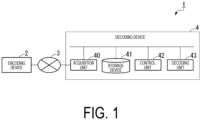
- Fig. 1 is a diagram illustrating a configuration example of a point cloud data processing system 1 according to a first embodiment.
- the point cloud data processing system 1 includes an encoding device 2, a communication line 3, and a decoding device 4.
- the point cloud data is generated using a LiDAR scanner or the like.
- the encoding device 2 acquires point cloud data.
- the encoding device 2 generates encoded data by encoding (octree encoding) the point cloud data using a slice segmentation structure for partial access and an octree structure.
- the encoding device 2 generates encoded data having the slice segmentation structure for partial access and the octree structure. For example, the encoding device 2 associates a plurality of slices with the entire generated encoded data. In a slice, a slice header and a slice footer are defined as overhead. The encoding device 2 transmits the encoded data to the decoding device 4 via the communication line 3 in units of slices.
- the decoding device 4 acquires the encoded data from the encoding device 2 in units of slices.
- the decoding device 4 performs decoding processing on the encoded data having the slice segmentation structure for partial access and the octree structure.
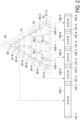
- Fig. 2 is a diagram illustrating an example of the octree structure and each slice in the first embodiment.
- Each node of the octree structure represents each point of the point cloud distributed in the three-dimensional space. That is, the node represents a portion constituting the three-dimensional space in which the point cloud is distributed. For example, a code "1" is assigned to a portion (node) where a point exists. For example, a code "0" is assigned to a portion where a point does not exist.
- a plurality of hierarchies are defined in the encoded data having the slice segmentation structure for partial access and the octree structure.
- a node 60 is a node on the most root side (parent hierarchy) in the encoded data. That is, the hierarchy of the node 60 is the highest hierarchy in the encoded data.
- Each node 67 is a node on the most leaf side (child hierarchy) in the encoded data. That is, the hierarchy of each node 67 is the lowest hierarchy in the encoded data.
- a zeroth hierarchy including the node 60, a first hierarchy including one or more nodes 61, a second hierarchy including one or more nodes 62, a third hierarchy including one or more nodes 63, a fourth hierarchy including one or more nodes 64, a fifth hierarchy including one or more nodes 65, a sixth hierarchy including one or more nodes 66, and a seventh hierarchy including one or more nodes 67 are associated with the encoded data having the slice segmentation structure for partial access and the octree structure.
- the encoded data of a group 51 including the node 60 of the zeroth hierarchy and each node of the first hierarchy to the fourth hierarchy is associated with a slice 100-1. That is, the encoded data of the group 51 is stored in the slice 100-1.
- the encoded data of the group 52 including each node 65 of the fifth hierarchy is associated with a slice 100-2.
- the association shown in Fig. 2 is an example.
- the group of nodes 65 in the fifth hierarchy may be associated with the plurality of slices 100-2.
- encoded data of a group 53 including nodes of the sixth to seventh hierarchies is associated with a slice 100-3, a slice 100-4, and a slice 100-5.
- the group 53 is divided into a subgroup 530-1, a subgroup 530-2, and a subgroup 530-3.
- These subgroups 530 are groups to which nodes (portions) having a predetermined positional relationship in a three-dimensional space belong.
- the predetermined positional relationship is, for example, a relationship of being spatially adjacent.
- the predetermined positional relationship may be, for example, a relationship in which a distance between positions is within a predetermined distance.
- the predetermined positional relationship may be, for example, a relationship in which one node (portion) is a parent space and another node (portion) is a child space (space included in the parent space).
- a node 66-0, a node 66-1, a node 67-0, and a node 67-1 belong to the subgroup 530-1 of the group 53.
- a node 66-2 and a node 67-2 belong to the subgroup 530-2 of the group 53.
- a node 66-3 and a node 67-3 belong to the subgroup 530-3 of the group 53.
- the encoded data of the subgroup 530-1 is associated with the slice 100-3.
- the encoded data of the subgroup 530-2 is associated with the slice 100-4.
- the encoded data of the subgroup 530-3 is associated with the slice 100-5.
- the slice header 101 of each slice 100 includes a group number and a subgroup number.
- a pointer is added to a slice footer 102 of each slice 100 associated with the octree structure or the like.
- the pointer indicates the slice 100 associated with a second point cloud having a predetermined positional relationship with respect to positions of the decoded first point cloud regarding the position in the three-dimensional space.
- the slice footer is an example of a position where the pointer is defined as an element.
- the position where the pointer is defined as an element may be a slice header.
- the position where the pointer is defined as an element is not limited to the overhead such as the slice header or the slice footer, and is not limited to a specific position.
- Fig. 3 is a diagram illustrating an example of each space and each slice having a predetermined positional relationship in the first embodiment.
- the first space (the group of nodes 65 of the group 52 illustrated in Fig. 2 ) associated with the slice 100-2 includes the second space (the space including the node 66-0 and the node 66-1) associated with the slice 100-3.
- the space of the node 66-0 includes, as an example, a space including the node 67-0 and the node 67-1.
- the node 66-0 and the node 66-3 are adjacent to each other.
- the node 66-2 and the node 66-3 are adjacent to each other.
- the node 66-1 and the node 66-2 are adjacent to each other.
- a distance between positions of the node 66-0, the node 66-1, the node 66-2, and the node 66-3 is within a predetermined distance.
- a slice footer 102-2 includes a slice number "#3" as a pointer to a slice 100-3 corresponding to a hierarchy (child hierarchy) lower than the hierarchy corresponding to the slice 100-2.
- the slice footer 102-2 includes a slice number "#4" as a pointer to a slice 100-4.
- the slice footer 102-2 includes a slice number "#5" as a pointer to a slice 100-5. That is, the pointer is configured such that the slice number of the slice on the leaf side belonging to the slice can be specified on the basis of the slice on the root side of the octree structure.
- the slice footer 102-2 may include not only the slice number but also information indicating the arrangement order of the node 66, the node 67, and the like in the three-dimensional space.
- the decoding device 4 includes an acquisition unit 40, a storage device 41, a control unit 42, and a decoding unit 43.
- the acquisition unit 40 acquires encoded data of the entire point cloud from the encoding device 2.
- the acquisition unit 40 records encoded data of the entire point cloud in the storage device 41.
- the acquisition unit 40 acquires the pointer indicating the first slice associated with the encoded data of the point cloud of the first space, which is a portion of the three-dimensional space, from the slice header 101 or the slice footer 102 of the slice 100 from among the plurality of slice numbers indicating the plurality of slices 100 associated with the encoded data of the entire point cloud distributed in the three-dimensional space.
- decoding can be performed without depending on other slices, and a slice (slice on the root side) including a point (spatial region) as a decoding target is specified as the first slice as a decoding target.
- the first slice as a decoding target is specified as in any one of (1) to (4), for example.
- the acquisition unit 40 acquires the pointer indicating the slice 100-2 (first slice) associated with the encoded data of the group of nodes 65 of the group 52 from the overhead (the slice header 101 or the slice footer 102) of the slice 100-1.
- the acquisition unit 40 acquires the slice number "#2" (first slice number) as a pointer. That is, the acquisition unit 40 acquires the slice number "#2" on the basis of the pointer.
- the acquisition unit 40 acquires the second slice number indicating the second slice associated with the encoded data of the point cloud of the second space on the basis of the pointer indicating the second slice associated with the encoded data belonging to the hierarchy (child hierarchy) lower than the hierarchy to which the encoded data of the first slice belongs.
- the acquisition unit 40 acquires the slice number "#3" indicating the slice 100-3 (second slice) associated with the encoded data of the node 66-0 and the node 66-1 (second space) from the slice header 101-2 on the basis of the pointer indicating the slice 100-3 associated with the encoded data belonging to the child hierarchy of the hierarchy to which the encoded data of the slice 100-2 (first slice) belongs. As similar to this, the acquisition unit 40 acquires the slice number "#3" indicating the slice 100-3 and the slice number "#5" indicating the slice 100-5 from the slice header 101-2.
- the node 66-0 and the node 66-3 have a positional relationship of being adjacent to each other in a three-dimensional space.
- the node 66-0 and the node 66-2 have a positional relationship of being close to each other in a three-dimensional space.
- the slice 100-3 associated with each node (each node of the child hierarchy) included in the node 65 associated with the slice 100-2 and pointers respectively indicating the slices 100-2, 100-3 are added to the slice footer 102-2.
- the decoding unit 43 decodes the point cloud in order from the slice on the root side.
- the acquisition unit 40 acquires, from the decoded slice on the root side, the slice number on the leaf side belonging to the slice.
- the decoding unit 43 decodes the entire slice indicated by the slice number.
- the decoding device 4 performs such decoding processing for each slice up to the lowermost layer (the most leaf side).
- the order of the processing targets is not limited.
- the decoding unit 43 confirms and decodes all the child slices, and then advances the processing for the grandchild hierarchy.
- the decoding unit 43 may return the processing target from the grandchild hierarchy to the child hierarchy or from the child hierarchy to the parent hierarchy.
- the information added to the slice footer may be, for example, only the slice number of the slice on the leaf side belonging to the slice on the root side, or may be both the number of slices on the leaf side directly belonging to the slice on the root side and the slice number of the slice on the leaf side belonging to the slice on the root side.
- a slice on the root side When entropy encoding of a geometry tree structure (octree structure) included in a slice on the leaf side is performed depending on a slice on the root side, or when encoding of attribute information corresponding to the geometry tree structure (octree structure) depends on a slice on the root side, a slice on the root side also needs as a decoding target. When there is no dependency regarding decoding and it is not necessary to decode other regions in the geometry tree structure, decoding processing other than the slice header and the slice footer of the slice on the root side may be skipped.
- the acquisition unit 40 acquires all the slice numbers of the slices (hereinafter, referred to as a "child slice") of the child hierarchy from the slice footer of the slice of the parent hierarchy.
- the decoding unit 43 refers to bounding box information in the slice header of each child slice to determine whether the spatial region as a decoding target is included in the child slice.
- the slice header includes an element for specifying the cover range of the bounding box in the encoded data.
- the storage device 41 stores the encoded data of the entire point cloud.
- the control unit 42 controls the operation of each functional unit of the decoding device 4. For example, the control unit 42 outputs the slice number of the slice 100 associated with the point cloud (node group) selected as the first decoding target to the acquisition unit 40 according to the operation by the user.
- the decoding unit 43 acquires the encoded data of the point cloud of the first space on the basis of the first slice number.
- the decoding unit 43 decodes the point cloud data of the first space from the encoded data of the point cloud of the first space. For example, the decoding unit 43 acquires the encoded data of the group of nodes 65 of the group 52 on the basis of the slice number "#2" (first slice number).
- the decoding unit 43 decodes each node 65 of the group 52 from the encoded data of the group 51 associated with the slice 100-1 and the encoded data of the group 52 associated with the slice 100-2.
- the decoding unit 43 acquires the encoded data of the point cloud of the second space on the basis of the second slice number.
- the decoding unit 43 decodes the point cloud data of the second space from the encoded data of the point cloud of the second space. For example, the decoding unit 43 acquires the encoded data of the subgroup 530-1 on the basis of the slice number "#3" (second slice number).
- the decoding unit 43 decodes the node 66-0 and the node 66-1 from the encoded data of the group 51, the encoded data of the group 52, and the encoded data of the subgroup 530-1.
- the decoding unit 43 may decode the node 66-3 from the encoded data of the group 51, the encoded data of the group 52, and the encoded data of the subgroup 530-3.
- the decoding unit 43 may decode the node 66-2 from the encoded data of the group 51, the encoded data of the group 52, and the encoded data of the subgroup 530-2.
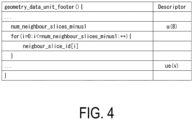
- Fig. 4 is a diagram illustrating an example of a data structure of the slice footer 102 in the first embodiment.
- a plurality of slices are associated with a geometry tree structure that is a point cloud (node group) of the octree structure.
- the slice footer 102 of each slice 100 has, by way of example, the data structure illustrated in Fig. 4 .
- the data structure of the slice footer 102 is, for example, a data structure in which an element is added to the geometry data unit footer (geometry_data_unit_footer()) (see Reference Document 1).
- the slice footer having the data structure illustrated in Fig. 4 has a variable "num_neighbour _slices_minus1" as an element.
- the variable "num_neighbour_slices_minus1" represents a value of a result of subtracting 1 from the number of slices associated with a node (portion) having a predetermined positional relationship in the three-dimensional space.
- the slice footer having the data structure illustrated in Fig. 4 has a pointer variable "neigbour_slice_id" as an element.
- the value of the pointer variable "neigbour_slice_id” is a slice number indicating a slice associated with a node (portion) having a predetermined positional relationship in the three-dimensional space.
- Information on the data structure illustrated in Fig. 4 may be included in a slice header instead of being included in a slice footer. As long as information can be provided as an overhead, a position at which information of the data structure illustrated in Fig. 4 is included is not limited to a specific position.
- Fig. 5 is a flowchart illustrating an operation example of the encoding device 2 in the first embodiment.
- the encoding device 2 acquires coordinates (point cloud data) of a point cloud distributed in a three-dimensional space as an encoding target (step S101).
- the encoding device 2 generates a point cloud having an octree structure (geometry tree structure) on the basis of the coordinates of the point cloud (step S102).
- the encoding device 2 associates the slice 100 with the point cloud according to the depth of the hierarchy to which the point cloud belongs in the octree structure and the position of the point cloud in the octree structure (step S103).
- the encoding device 2 assigns a slice number to each slice 100 (step S104).
- the encoding device 2 encodes the slice number of each slice 100 selected as the encoding target (step S105).
- the encoding device 2 stores each slice number in the slice header 101 (step S106).
- the encoding device 2 generates encoded data by encoding a point cloud having an octree structure (step S107).
- the encoding device 2 encodes information on the number of slices including points having a predetermined positional relationship in a three-dimensional space and slice numbers of the slices 100 (step S108).
- the encoding device 2 stores the information on the number of the slices 100 and the slice numbers in the slice footer 102 (step S109).
- the encoding device 2 determines whether all the point clouds of the selected slice 100 have been encoded (step S110). When it is determined that any of the point clouds is not encoded (step S110: NO), the encoding device 2 causes the process to return to step S105.
- step S110: NO the encoding device 2 outputs the encoded data to the decoding device 4 for each slice 100 having the slice footer 102 (step Sill).
- Fig. 6 is a flowchart illustrating an operation example of the decoding device 4 in the first embodiment.
- the acquisition unit 40 acquires the slice number of the slice 100 associated with the point cloud selected as the first decoding target from the control unit 42 (step S201).
- the acquisition unit 40 acquires the encoded data of the entire point cloud from the storage device 41 (step S202).
- the acquisition unit 40 selects the slice 100 from the encoded data of the entire point cloud.
- the acquisition unit 40 acquires a slice number indicating the selected slice 100. For example, in a case where the slice number is not acquired from the slice footer 102 in step S206, the acquisition unit 40 acquires the slice number from the slice header of the slice 100. For example, in a case where the slice number is acquired from the slice footer 102 in step S206, the acquisition unit 40 handles the slice number acquired from the slice footer 102 of the slice 100 as the slice number indicating the selected slice 100 (step S203) .
- the acquisition unit 40 determines whether the acquired slice number is the same as the slice number of the slice 100 associated with the point cloud selected as the decoding target. That is, the acquisition unit 40 determines whether the slice 100 having the slice number acquired from the slice header 101 is the slice 100 associated with the point cloud as a decoding target (step S204).
- step S204 NO
- the acquisition unit 40 causes the process to return to step S203.
- the decoding unit 43 decodes the point cloud having the octree structure using the encoded data of the point cloud associated with the slice 100 as a decoding target (step S205).
- the acquisition unit 40 acquires the slice number of the slice 100 as a decoding target next from the slice footer 102 of the slice 100 as a decoding target (step S206).
- the portion associated with the slice 100 as a decoding target and the portion associated with the slice 100 as a decoding target next have a predetermined positional relationship (for example, a positional relationship of being adjacent to each other) in the three-dimensional space.
- the acquisition unit 40 stops the processing of acquiring the slice numbers and the process proceeds to step S207.
- the acquisition unit 40 determines whether there is an undetermined slice 100 (step S207). When it is determined that there is an undetermined slice 100 (step S207: YES), the acquisition unit 40 causes the process to return to step S203. When it is determined that all the slices 100 have been determined (step S207: NO), the decoding unit 43 outputs the point cloud data to the storage device 41.
- the acquisition unit 40 acquires the first slice number from predetermined overhead (for example, the slice footer 102) on the basis of the pointer (additional information) indicating the first slice associated with the encoded data of the point cloud of the first space which is the portion of the three-dimensional space.
- the acquisition unit 40 acquires the first slice number "#2" from the overhead (for example, the slice header 101-1 or slice footer 102-1) of the slice 100-2 on the basis of the pointer indicating the slice 100-1 associated with the encoded data of the group of nodes 65 (first space) of the group 52.
- the decoding unit 43 acquires the encoded data of the point cloud of the first space on the basis of the first slice number (for example, "#2").
- the decoding unit 43 decodes the point cloud data of the first space from the encoded data of the point cloud of the first space.
- the acquisition unit 40 may acquire the second slice number indicating the second slice associated with the encoded data of the point cloud of the second space on the basis of the pointer indicating the second slice associated with the encoded data belonging to the child hierarchy of the hierarchy to which the encoded data of the first slice belongs. For example, the acquisition unit 40 may acquire the second slice number "#3" indicating the slice 100-3 (first slice) associated with the encoded data of the space (second space) including the node 66-0 and the node 66-1 on the basis of the pointer indicating the slice 100-3 (second slice) associated with the encoded data belonging to the child hierarchy (subgroup 530-1) of the group 52 to which the encoded data of the slice 100-2 (first slice) belongs.
- the decoding unit 43 acquires the encoded data of the point cloud of the second space on the basis of the second slice number (for example, "#3").
- the decoding unit 43 decodes the point cloud data of the second space from the encoded data of the point cloud of the second space.
- the part of the point cloud of can be decoded. Even if a slice of a part of the encoded data is lost, a point cloud corresponding to another slice can be decoded.
- the group number or the subgroup number is added to the slice header of the slice on the root side.
- a table or a tree indicating a parent-child relationship between the group and the subgroup to which the slice belongs may be added to the slice header or the independent syntax table of the slice on the root side.
- the decoding unit 43 may decode the point cloud (partial space) sequentially from the slice on the root side.
- the decoding unit 43 may decode a slice on the leaf side associated with the region (partial space) as a decoding target and a slice on the root side (upper side) of the slice with reference to the data table or the tree.
- additional information indicating the group number or the subgroup number and the parent-child relationship thereof may be added to the slice header or the independent syntax table.
- a data table or a tree indicating a parent-child relationship of at least one of a group and a subgroup is used.
- a data table or a tree indicating a parent-child relationship of the slice itself may be used.
- the data table or the tree may be added to at least one of the group and the subgroup, an independent syntax table, or the like.
- the decoding unit 43 determines whether the spatial region as a decoding target is included in the slice by referring to, for example, a data table added to the slice header on the root side.
- the decoding unit 43 may determine whether the spatial region as a decoding target is included in the slice by a determination method similar to the determination method illustrated in the above-described modification and the like.
- the encoded data of the first slice associated with the encoded data of the point cloud of the first space (first portion) and the encoded data of the second slice associated with the encoded data of the point cloud of the second space (second portion) belong to different hierarchies among a plurality of hierarchies determined for the entire encoded data expressed using the slice segmentation structure for partial access and the octree structure.
- the encoded data of the first slice associated with the encoded data of the point cloud of the first space (first portion) and the encoded data of the second slice associated with the encoded data of the point cloud of the second space (second portion) belong to the same hierarchy among a plurality of hierarchies determined for the entire encoded data expressed using the slice segmentation structure for partial access and the octree structure.
- This point is a difference from the first embodiment.
- the second embodiment is described by focusing on the differences from the first embodiment.
- Fig. 7 is a diagram illustrating an example of each space and each slice having a predetermined positional relationship in the second embodiment.
- the first space (space including the node 66-0, node 66-1, node 66-2, and node 66-3) associated with the slice 100-2 includes the second space (space including the node 66-0 and the node 66-1) associated with the slice 100-3.
- the space of the node 66-0 includes, as an example, a space including the node 67-0 and the node 67-1.
- the node 66-0 and the node 66-3 are adjacent to each other.
- the node 66-2 and the node 66-3 are adjacent to each other.
- the node 66-1 and the node 66-2 are adjacent to each other.
- a distance between positions of the node 66-0, the node 66-1, the node 66-2, and the node 66-3 is within a predetermined distance.
- a slice footer 102-3 includes a slice number "#5" as a pointer to a slice 100-5 corresponding to the same hierarchy as the hierarchy corresponding to the slice 100-3.
- a slice footer 102-5 includes a slice number "#4" as a pointer to a slice 100-4 corresponding to the same hierarchy as the hierarchy corresponding to the slice 100-5.
- the acquisition unit 40 acquires the second slice number indicating the second slice associated with the encoded data of the point cloud of the second space on the basis of the pointer indicating the second slice associated with the encoded data belonging to the same hierarchy as the hierarchy to which the encoded data of the first slice belongs.
- the acquisition unit 40 acquires the slice number "#5" (second slice number) indicating the slice 100-5 associated with the encoded data of the node 66-3 from the slice footer 102-3 (overhead of the first slice) of the slice 100-3 on the basis of the pointer indicating the slice 100-5 (second slice) associated with the encoded data belonging to the same hierarchy as the hierarchy to which the encoded data of the slice 100-3 (first slice) belongs to.
- the acquisition unit 40 acquires the slice number "#4" indicating the slice 100-4 (third slice) from the slice footer 102-5 (overhead of the second slice) of the slice 100-5 (second slice).
- the node 66-0 and the node 66-3 have a predetermined positional relationship (for example, a positional relationship of being adjacent to each other) in a three-dimensional space.
- the node 66-0 and the node 66-2 have a predetermined positional relationship (for example, a positional relationship of being close to each other) in a three-dimensional space.
- a pointer indicating the slice 100-5 associated with the node 66-3 adjacent to the node 66-0 associated with the slice 100-3 is added to the slice footer 102-3.
- a pointer indicating the slice 100-4 associated with the node 66-2 adjacent to the node 66-3 associated with the slice 100-5 is added to the slice footer 102-5.
- a case where a pointer to another slice of the same hierarchy as a predetermined hierarchy is determined on the basis of a slice of the predetermined hierarchy (a case where a pointer is directly held by a slice) will be described.
- the spatial region as a decoding target is included in any of the adjacent spatial regions.
- the spatial region indicated by the slice to which the pointer is added and the slice number of the spatially adjacent spatial region are indicated by the pointer.
- the acquisition unit 40 acquires the first slice number on the basis of the pointer indicating the first slice associated with the encoded data of the point cloud of the first space which is the portion of the three-dimensional space. For example, the acquisition unit 40 acquires the first slice number "#3" on the basis of the pointer indicating the slice 100-3 (first slice) associated with the encoded data of the node 66-0 and the node 66-1 (first space).
- the decoding unit 43 acquires the encoded data of the point cloud of the first space on the basis of the first slice number.
- the decoding unit 43 decodes the point cloud data of the first space from the encoded data of the point cloud of the first space.
- the acquisition unit 40 may acquire the second slice number (for example, "#5") indicating the second slice associated with the encoded data of the point cloud of the second space (for example, node 66-3) on the basis of the pointer (for example, the pointer added to the overhead of the first slice) indicating the second slice (for example, the slice 100-5) associated with the encoded data belonging to the same hierarchy as the hierarchy to which the encoded data of the first slice belongs.
- the decoding unit 43 acquires the encoded data of the point cloud of the second space on the basis of the second slice number.
- the decoding unit 43 decodes the point cloud data of the second space from the encoded data of the point cloud of the second space.
- a third embodiment is different from the first embodiment and the second embodiment in that the association between the position in the three-dimensional space in which the point cloud is distributed and all the slice numbers is registered in the data table.
- differences from the first embodiment and the second embodiment will be mainly described.
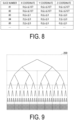
- Fig. 8 is a diagram illustrating an example of a data table in the third embodiment.
- the data table in the third embodiment represents association between each position in a three-dimensional space in which a point cloud is distributed and a plurality of slice numbers.
- the position associated with the slice number "#5" is a range from 2 to 3 in the X-axis direction, a range from 0 to 1 in the Y-axis direction, and a range from 0 to 1 in the Z-axis direction. That is, the position of the node 66-3 associated with the slice number "#5" is in these ranges.
- the expression method of the range of the position (coordinates) is not limited to the expression method using the set of boundary values.
- the expression method of the range of the position (coordinates) may be an expression method using the origin of the bounding box and the box size.
- the expression method of the range of the position (coordinates) may be an expression method using a Morton number.
- the encoding device 2 generates such a data table at the time of encoding the point cloud.
- the encoding device 2 adds a data table to a header of encoded data, for example.
- the encoding device 2 may add a data table to, for example, a "Sequence parameter set” (see Reference Document 1) of encoded data.
- the encoding device 2 may add a data table to "Geometry parameter set” (see Reference Document 1) of encoded data, for example.
- the acquisition unit 40 acquires the encoded data from the encoding device 2 in units of slices.
- the acquisition unit 40 acquires the data table from the encoding device 2.
- the decoding unit 43 performs decoding processing on the encoded data having the slice segmentation structure for partial access and the octree structure.
- the decoding unit 43 refers to the data table and selects the slice number of the slice 100 required when decoding the point cloud having the predetermined positional relationship.
- the Y coordinate "Y0 and Y1" of the node 66-0 and the Y coordinate "Y0 and Y1" of the node 66-3 are common.
- the Y coordinate "0 ⁇ y ⁇ 1" corresponding to the slice number "#3" and the Y coordinate "0 ⁇ y ⁇ 1" corresponding to the slice number "#5" are common.
- a partial range of the Z coordinate "Z0 to Z3" of the node 66-0 is common to the Z coordinate "Z0 to Z1" of the node 66-3.
- a partial range of the Z coordinate "0 ⁇ z ⁇ 3" corresponding to the slice number "#3” and the Y coordinate "0 ⁇ x ⁇ 1" corresponding to the slice number "#5" are common.
- the decoding unit 43 decodes the node 66-0 and the node 66-1 associated with the slice 100-3 indicated by the slice number "#3" from the encoded data of the slice 100-1, the encoded data of the slice 100-2, and the encoded data of the slice 100-3.
- the decoding unit 43 decodes the node 66-0 and the node 66-1 associated with the slice 100-3 indicated by the slice number "#3" from the encoded data of the slice 100-1, the encoded data of the slice 100-2, and the encoded data of the slice 100-3. In this manner, the node 66-0 and the node 66-1 and the node 66-3 adjacent to the node 66-0 are decoded.
- a group number or a subgroup number may be used.
- additional information is added to "Sequence parameter set syntax" or "Geometry parameter set syntax” (see Reference Document 1), but also an independent syntax table (for example, "tile inventory” (see Reference Document 1)) may be defined.
- the additional information may be created as a supplemental enhancement information (SEI) message.
- SEI Supplemental Enhancement Information
- the data table in the third embodiment indicates that the first space (for example, a space associated with the slice 100-3) and the second space (for example, a space associated with the slice 100-5) are adjacent to each other, for example, with respect to the X coordinate. That is, the data table in the third embodiment indicates the second slice (for example, slice 100-5) associated with the encoded data of the point cloud of the second space adjacent to the first space.
- the acquisition unit 40 acquires the second slice number (for example, "#5") indicating the second slice associated with the encoded data of the point cloud of the second space from the data table as the pointer.
- the decoding unit 43 acquires the encoded data of the point cloud of the first space on the basis of the first slice number from the storage device 41.
- the decoding unit 43 decodes the point cloud data of the first space from the encoded data of the point cloud of the first space.
- the decoding unit 43 acquires the encoded data of the point cloud of the second space adjacent to the first space on the basis of the second slice number from the storage device 41.
- the decoding unit 43 decodes the point cloud data of the second space from the encoded data of the point cloud of the second space adjacent to the first space.
- Fig. 9 is a diagram illustrating an example of a bounding box 200 in a first modification of the third embodiment.
- Fig. 10 is a diagram illustrating an example of a bounding box 201 defined in encoded data in a second modification of the third embodiment.
- tiles are utilized for decoding partial spaces.
- a slice tag added to a slice header is used for associating a tile and a slice.
- one slice tag is defined for each slice, one slice can belong to only one tile.
- the encoding efficiency is lower than the encoding efficiency in a case where the entire three-dimensional space is expressed using one tree.
- the decoding unit 43 determines whether the slice is a dependent slice in order to decode one tile.
- the decoding unit 43 specifies a dependent slice on the basis of the determination result.
- the decoding unit 43 decodes the tile using the specified slice. As described above, in the related art, it is not possible to decode a partial space for each tile with respect to encoded data having one octree structure.
- the number of belonging tiles and the belonging tile number are added to the information to be added to the slice as the slice tag.
- one slice can belong to a plurality of tiles.
- each region surrounded by a dotted line is each tile.
- Each node of the octree structure illustrated in Fig. 10 belongs to all the tiles overlapping the spatial region to which its own node belongs.
- the slice on the most root side belongs to all tiles.
- the partial space can be decoded for each tile with respect to the encoded data having one octree structure.
- Fig. 11 is a diagram illustrating a hardware configuration example of the decoding device 4 in each embodiment.
- Some or all of the functional units of the decoding device 4 are implemented as software by a processor 400 such as a central processing unit (CPU) executing a program stored in a memory 401 including a nonvolatile recording medium (non-transitory recording medium).
- the program may be recorded on a computer-readable recording medium.
- the computer-readable recording medium is, for example, a portable medium such as a flexible disk, a magneto-optical disk, a read only memory (ROM), or a compact disc read only memory (CD-ROM), or a non-transitory recording medium such as a storage device 41 such as a hard disk included in a computer system.
- Some or all of the functional units of the decoding device 4 may be implemented by using hardware including an electronic circuit (electronic circuit or circuitry) using, for example, a large scale integrated circuit (LSI), an application specific integrated circuit (ASIC), a programmable logic device (PLD), a field programmable gate array (FPGA), or the like.
- LSI large scale integrated circuit
- ASIC application specific integrated circuit
- PLD programmable logic device
- FPGA field programmable gate array
- a pointer similar to the pointer indicating the slice associated with the encoded data of the geometry tree structure may be given to the slice footer of the slice associated with the encoded data of the attribute layer structure.
- the present invention is applicable to a system that performs predetermined processing on point cloud data.
Landscapes
- Engineering & Computer Science (AREA)
- Multimedia (AREA)
- Signal Processing (AREA)
- Physics & Mathematics (AREA)
- General Physics & Mathematics (AREA)
- Theoretical Computer Science (AREA)
- Image Generation (AREA)
- Compression, Expansion, Code Conversion, And Decoders (AREA)
Applications Claiming Priority (1)
| Application Number | Priority Date | Filing Date | Title |
|---|---|---|---|
| PCT/JP2020/048833 WO2022137537A1 (ja) | 2020-12-25 | 2020-12-25 | 復号方法、復号装置及びプログラム |
Publications (2)
| Publication Number | Publication Date |
|---|---|
| EP4235579A1 true EP4235579A1 (de) | 2023-08-30 |
| EP4235579A4 EP4235579A4 (de) | 2024-05-15 |
Family
ID=82157967
Family Applications (1)
| Application Number | Title | Priority Date | Filing Date |
|---|---|---|---|
| EP20967023.1A Pending EP4235579A4 (de) | 2020-12-25 | 2020-12-25 | Decodierungsverfahren, decodierungsvorrichtung und programm |
Country Status (6)
| Country | Link |
|---|---|
| US (1) | US12283076B2 (de) |
| EP (1) | EP4235579A4 (de) |
| JP (1) | JP7568953B2 (de) |
| KR (1) | KR102821844B1 (de) |
| CN (1) | CN116783623A (de) |
| WO (1) | WO2022137537A1 (de) |
Families Citing this family (1)
| Publication number | Priority date | Publication date | Assignee | Title |
|---|---|---|---|---|
| US20230102401A1 (en) * | 2021-09-30 | 2023-03-30 | Qualcomm Incorporated | Inter prediction coding for geometry point cloud compression |
Family Cites Families (5)
| Publication number | Priority date | Publication date | Assignee | Title |
|---|---|---|---|---|
| EP3699870A4 (de) | 2017-10-16 | 2020-12-23 | Sony Corporation | Informationsverarbeitungsvorrichtung und -verfahren |
| KR20250079232A (ko) * | 2018-07-13 | 2025-06-04 | 파나소닉 인텔렉츄얼 프로퍼티 코포레이션 오브 아메리카 | 삼차원 데이터 부호화 방법, 삼차원 데이터 복호 방법, 삼차원 데이터 부호화 장치, 및 삼차원 데이터 복호 장치 |
| US12108016B2 (en) | 2018-10-02 | 2024-10-01 | Sony Corporation | Image processing device and method |
| CN114270832A (zh) | 2019-08-14 | 2022-04-01 | Lg电子株式会社 | 点云数据发送装置、点云数据发送方法、点云数据接收装置和点云数据接收方法 |
| CN116508318A (zh) * | 2020-10-30 | 2023-07-28 | Lg电子株式会社 | 点云数据发送装置、点云数据发送方法、点云数据接收装置及点云数据接收方法 |
-
2020
- 2020-12-25 JP JP2022570977A patent/JP7568953B2/ja active Active
- 2020-12-25 KR KR1020237020885A patent/KR102821844B1/ko active Active
- 2020-12-25 CN CN202080108129.8A patent/CN116783623A/zh active Pending
- 2020-12-25 WO PCT/JP2020/048833 patent/WO2022137537A1/ja not_active Ceased
- 2020-12-25 EP EP20967023.1A patent/EP4235579A4/de active Pending
- 2020-12-25 US US18/039,407 patent/US12283076B2/en active Active
Also Published As
| Publication number | Publication date |
|---|---|
| JP7568953B2 (ja) | 2024-10-17 |
| EP4235579A4 (de) | 2024-05-15 |
| US20230419558A1 (en) | 2023-12-28 |
| US12283076B2 (en) | 2025-04-22 |
| KR20230109732A (ko) | 2023-07-20 |
| WO2022137537A1 (ja) | 2022-06-30 |
| JPWO2022137537A1 (de) | 2022-06-30 |
| KR102821844B1 (ko) | 2025-06-17 |
| CN116783623A (zh) | 2023-09-19 |
Similar Documents
| Publication | Publication Date | Title |
|---|---|---|
| US20220414940A1 (en) | Information processing apparatus and method | |
| CN113259678B (zh) | 对点云信息进行编解码的方法和装置 | |
| US20230048381A1 (en) | Context determination for planar mode in octree-based point cloud coding | |
| JP7786631B2 (ja) | 情報処理装置および方法 | |
| CN113315977B (zh) | 点云信息解码的方法和装置 | |
| JP7586078B2 (ja) | 情報処理装置および方法 | |
| CN103136340B (zh) | 一种在集群中快速迁移海量空间数据的方法 | |
| US20250097460A1 (en) | Method for decoding immersive video and method for encoding immersive video | |
| EP4235579A1 (de) | Decodierungsverfahren, decodierungsvorrichtung und programm | |
| US6757883B1 (en) | Estimating free space in IC chips | |
| US11790602B2 (en) | Information processing device and method | |
| KR102731171B1 (ko) | 이머시브 영상 처리 방법 및 이머시브 영상 합성 방법 | |
| JP7415937B2 (ja) | 画像処理装置および方法 | |
| JP7779268B2 (ja) | 情報処理装置および方法 | |
| US11443482B1 (en) | Systems and methods for editing, animating, and processing point clouds using bounding volume hierarchies | |
| KR20250050070A (ko) | 3d 포인트 클라우드를 인코딩 및 디코딩하는 방법, 인코더, 디코더 | |
| US20250227216A1 (en) | Information processing device and method | |
| JP7818144B2 (ja) | ポイントクラウドデータの送信及び/又は記憶を改善するための方法、装置、及びコンピュータプログラム | |
| JP7783510B2 (ja) | 復号装置、復号方法および復号プログラム | |
| JP7568952B2 (ja) | 復号方法、復号装置及び復号プログラム | |
| US20250037314A1 (en) | Information processing device and method | |
| US20230222694A1 (en) | Method for decoding immersive video and method for encoding immersive video | |
| CN119631408A (zh) | 用于编码和解码3d点云的方法、编码器及解码器 | |
| WO2025078280A1 (en) | Method and apparatus for processing region related annotations in an image file | |
| GB2613852A (en) | Method and apparatus for encapsulating 3D region related annotation in a media file |
Legal Events
| Date | Code | Title | Description |
|---|---|---|---|
| STAA | Information on the status of an ep patent application or granted ep patent |
Free format text: STATUS: THE INTERNATIONAL PUBLICATION HAS BEEN MADE |
|
| PUAI | Public reference made under article 153(3) epc to a published international application that has entered the european phase |
Free format text: ORIGINAL CODE: 0009012 |
|
| STAA | Information on the status of an ep patent application or granted ep patent |
Free format text: STATUS: REQUEST FOR EXAMINATION WAS MADE |
|
| 17P | Request for examination filed |
Effective date: 20230526 |
|
| AK | Designated contracting states |
Kind code of ref document: A1 Designated state(s): AL AT BE BG CH CY CZ DE DK EE ES FI FR GB GR HR HU IE IS IT LI LT LU LV MC MK MT NL NO PL PT RO RS SE SI SK SM TR |
|
| DAV | Request for validation of the european patent (deleted) | ||
| DAX | Request for extension of the european patent (deleted) | ||
| REG | Reference to a national code |
Ref country code: DE Ref legal event code: R079 Free format text: PREVIOUS MAIN CLASS: G06T0009400000 Ipc: H04N0019174000 |
|
| A4 | Supplementary search report drawn up and despatched |
Effective date: 20240415 |
|
| RIC1 | Information provided on ipc code assigned before grant |
Ipc: G06T 9/40 20060101ALI20240409BHEP Ipc: G06T 9/00 20060101ALI20240409BHEP Ipc: H04N 19/70 20140101ALI20240409BHEP Ipc: H04N 19/597 20140101ALI20240409BHEP Ipc: H04N 19/174 20140101AFI20240409BHEP |
|
| STAA | Information on the status of an ep patent application or granted ep patent |
Free format text: STATUS: EXAMINATION IS IN PROGRESS |
|
| 17Q | First examination report despatched |
Effective date: 20241122 |
|
| RAP3 | Party data changed (applicant data changed or rights of an application transferred) |
Owner name: NTT, INC. |