EP4235397B1 - Verfahren und system zum umwandeln eines eingabecomputerprogramms in ein ausgabecomputerprogramm, das eine globale zielgenauigkeit erreicht - Google Patents
Verfahren und system zum umwandeln eines eingabecomputerprogramms in ein ausgabecomputerprogramm, das eine globale zielgenauigkeit erreicht Download PDFInfo
- Publication number
- EP4235397B1 EP4235397B1 EP22305212.7A EP22305212A EP4235397B1 EP 4235397 B1 EP4235397 B1 EP 4235397B1 EP 22305212 A EP22305212 A EP 22305212A EP 4235397 B1 EP4235397 B1 EP 4235397B1
- Authority
- EP
- European Patent Office
- Prior art keywords
- computer program
- mathematical
- mathematical function
- target
- accuracy
- Prior art date
- Legal status (The legal status is an assumption and is not a legal conclusion. Google has not performed a legal analysis and makes no representation as to the accuracy of the status listed.)
- Active
Links
Images
Classifications
-
- G—PHYSICS
- G06—COMPUTING OR CALCULATING; COUNTING
- G06F—ELECTRIC DIGITAL DATA PROCESSING
- G06F7/00—Methods or arrangements for processing data by operating upon the order or content of the data handled
- G06F7/38—Methods or arrangements for performing computations using exclusively denominational number representation, e.g. using binary, ternary, decimal representation
- G06F7/48—Methods or arrangements for performing computations using exclusively denominational number representation, e.g. using binary, ternary, decimal representation using non-contact-making devices, e.g. tube, solid state device; using unspecified devices
- G06F7/499—Denomination or exception handling, e.g. rounding or overflow
- G06F7/49942—Significance control
-
- G—PHYSICS
- G06—COMPUTING OR CALCULATING; COUNTING
- G06F—ELECTRIC DIGITAL DATA PROCESSING
- G06F8/00—Arrangements for software engineering
- G06F8/70—Software maintenance or management
- G06F8/76—Adapting program code to run in a different environment; Porting
-
- G—PHYSICS
- G06—COMPUTING OR CALCULATING; COUNTING
- G06F—ELECTRIC DIGITAL DATA PROCESSING
- G06F2207/00—Indexing scheme relating to methods or arrangements for processing data by operating upon the order or content of the data handled
- G06F2207/38—Indexing scheme relating to groups G06F7/38 - G06F7/575
- G06F2207/3804—Details
- G06F2207/3808—Details concerning the type of numbers or the way they are handled
- G06F2207/3812—Devices capable of handling different types of numbers
Definitions
- the present disclosure relates to computer program development and relates more specifically to a method and system for converting an input computer program, which includes mathematical functions applied to floating-point variables, into an output computer program achieving a target global accuracy.
- the target global accuracy corresponds to an upper bound on a global error allowed for the output computer program, wherein the errors relate to mathematical functions approximations and/or to floating-point rounding errors.
- Numerical computations are ubiquitous in various industrial domains which require them e.g. signal or image processing, automatic control, etc. For instance, such numerical computations are extensively used in computer programs of embedded systems for a variety of applications such as automotive or nuclear plants control, etc.
- the present disclosure aims at improving the situation.
- the present disclosure aims at overcoming at least some of the limitations of the prior art discussed above, by proposing a solution enabling obtaining a computer program having a predetermined target global accuracy (i.e. a global error below a predetermined upper bound) even when black-box implementations of mathematical functions are used.
- a predetermined target global accuracy i.e. a global error below a predetermined upper bound
- the present disclosure aims at proposing a solution enabling to formally prove that the obtained computer program achieves the target global accuracy.
- the present disclosure relates to a computer implemented method for converting an input computer program into an output computer program having a target global accuracy, said input computer program including mathematical functions applied to floating-point variables and the target global accuracy corresponding to a bound on a global error due to mathematical functions approximations and/or to floating-point rounding errors, said method comprising:
- the proposed solution relies on mathematical function synthesis to replace the implementations of the mathematical functions (which may be black-box, or which may have an insufficient target internal accuracy, or which may be too sophisticated and hard to formally verify) by synthesized implementations which achieve the target internal accuracies (target accuracies local to the corresponding mathematical functions) which collectively enable achieving the target global accuracy set for the computer program.
- the mathematical functions which may be black-box, or which may have an insufficient target internal accuracy, or which may be too sophisticated and hard to formally verify
- synthesized implementations which achieve the target internal accuracies (target accuracies local to the corresponding mathematical functions) which collectively enable achieving the target global accuracy set for the computer program.
- Synthesis tools usually require a prior knowledge of the value ranges of the variables used by the mathematical function to be synthesized. Such value ranges can be determined by using value range determination tools such as abstract interpretation tools or statistical tools, etc.
- value range determination tools such as abstract interpretation tools or statistical tools, etc.
- the value ranges of the calling mathematical function depend on the called mathematical function and may vary when a synthesized version is used instead.
- this should be done by replacing the called mathematical function by a call to the corresponding synthesized implementation.
- the proposed solution determines a dependency graph between mathematical functions calls, and the mathematical functions are processed (synthesized) according to the order provided by the dependency graph.
- a called mathematical function is processed first in order to obtain its synthesized version achieving the target internal accuracy for this mathematical function.
- the synthesized version of the called mathematical function is then used during the processing of the calling mathematical function, in particular during the determination of the value ranges of the variables of the calling mathematical function which are subsequently used by the synthesis tool.
- the present disclosure enables converting the input computer program into an output computer program which achieves the target global accuracy, provided that achieving the target internal accuracies of the mathematical functions enables achieving the target global accuracy for the whole output computer program.
- the converting method can further comprise one or more of the following optional features, considered either alone or in any technically possible combination.
- the converting method further comprises annotating the output computer program based on the target global accuracy and verifying the annotations of the output computer program by using a formal verification tool.
- the output computer program is further annotated based on the value ranges of the mathematical functions and based on the target internal accuracies of the synthesized mathematical functions.
- the formal verification tool is a deductive verification tool.
- the deductive verification tool uses automatic theorem provers.
- the deductive verification tool uses different automatic theorem provers for proof obligations related to mathematical functions approximations and for proof obligations related to floating-point rounding errors.
- the method further comprises iterating the following steps until an output computer program is generated which achieves the target global accuracy:
- the target internal accuracies are not sufficient to achieve the target global accuracy for the output computer program, it is possible to iteratively increase the constraints on all or part of the target internal accuracies (i.e. iteratively decrease the target upper bound on the internal error of all or part of the mathematical functions) until the generated synthesized mathematical functions yield an output computer program which actually achieves the target global accuracy set for it.
- different synthesized mathematical functions are synthesized for a same mathematical function having different call locations in the input computer program.
- a same mathematical function may be called at different locations in the input computer program without requiring having the same target internal accuracy for all call locations.
- the value range determination tool is an abstract interpretation tool.
- the present disclosure relates to a computer program product comprising instructions which, when executed by at least one processor, configure said at least one processor to carry out a converting method according to any one of the embodiments of the present disclosure.
- the present disclosure relates to a computer-readable storage medium comprising instructions which, when executed by at least one processor, configure said at least one processor to carry out a converting method according to any one of the embodiments of the present disclosure.
- the present disclosure relates to a system for converting an input computer program into an output computer program having a target global accuracy, said input computer program including mathematical functions applied to floating-point variables and the target global accuracy corresponds to a bound on a global error due to mathematical functions approximations and/or to floating-point rounding errors, said system comprising at least one processor and at least one memory, wherein the at least one processor is configured to carry out a converting method according to any one of the embodiments of the present disclosure.
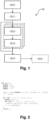
- Figure 1 represents schematically the main steps of a method 10 for converting an input computer program into an output computer program.
- the converting method 10 is carried out by a computer system (not represented in the figures).
- the computer system comprises one or more processors (which may belong to a same computer or to different computers) and one or more memories (magnetic hard disk, optical disk, electronic memory, or any computer readable storage medium) in which a computer program product is stored, in the form of a set of program-code instructions to be executed in order to implement all or part of the steps of the converting method 10.
- the computer system can comprise one or more programmable logic circuits (FPGA, PLD, etc.), and/or one or more specialized integrated circuits (ASIC), etc., adapted for implementing all or part of said steps of the converting method 10.
- the computer system comprises a set of means configured by software (specific computer program product) and/or by hardware (processor, FPGA, PLD, ASIC, etc.) to implement the steps of the converting method 10.
- the goal of the conversion is to achieve a target global accuracy.
- the target global accuracy corresponds to an upper bound on an allowable global error.
- the global error corresponds to the combination of the errors due to all mathematical functions' approximations and all floating-point rounding errors performed by the output computer program.
- the input computer program corresponds to a computer program in source code, which may be written in any computer language, for instance in C or C++ or Fortran computer language.
- the input computer program is meant to run on an embedded system, in order to execute tasks in relation with e.g. signal or image processing, automatic control, etc.
- the input computer program includes assignments, control structures (conditional branches, switches, loops, etc.), mathematical operations (addition, multiplication, etc.) and mathematical functions (exp, log, sin, cos, etc.) calls, applied to floating-point variables.
- the mathematical functions are the functions included in the library libm.
- the implementations of the mathematical functions included in the input computer program are typically black-box in the sense that their source code is not available. Typically, they are included as calls to mathematical functions in external libraries such as the libm library.
- the converting method 10 comprises a step S10 of receiving a target internal accuracy for each mathematical function used in the input computer program.
- the target internal accuracy of a mathematical function corresponds to an upper bound on an internal error which corresponds to the error due to all the (mathematical model) approximations and all floating-point rounding errors made in the considered mathematical function.
- the target internal accuracy considers the errors local to the associated mathematical function, while the target global accuracy considers the global error at the computer program level, which depends inter alia on the local errors of all the mathematical functions called.
- the obtained target internal accuracies are such that (or at least deemed to be such that), if the mathematical functions' implementations enable achieving their respective target internal accuracies, then the target global accuracy is also achieved by the computer program.
- target internal accuracies are actually determined is out of scope of the present disclosure and the target internal accuracies are assumed to be provided as an input of the converting method 10.
- target internal accuracies can be obtained by using e.g. statistical tools such as Monte Carlo arithmetic. Indeed, such techniques can be used to determine the impact of accuracy lowering for a given mathematical function of a computer program, therefore, to evaluate the impact of said given mathematical function internal accuracy on the global accuracy of the computer program (see e.g. [Defour2020]).
- the converting method 10 comprises also a step S11 of analyzing the input computer program to determine a dependency graph describing dependencies between mathematical functions calls.
- the computer system implementing the converting method 10 parses the input computer program to identify the mathematical functions called by the input computer program and their call locations, and also to identify mathematical functions which are called to process the results of previous mathematical functions' calls (i.e. identify dependencies between mathematical functions' calls).
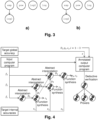
- Figure 2 represents schematically the source code of a simple exemplary input computer program.
- the input computer program calls four different mathematical functions, namely log2 (binary logarithm), pow (power), exp (exponential) and log (logarithm).
- log2 binary logarithm
- pow pow
- exp exposure
- log logarithm
- variable received as input by the mathematical function exp does not depend on the result of any other mathematical function, however the result of the mathematical function exp is used by the mathematical function log2 called inside the loop.
- the result of the mathematical function log2 called inside the loop is not used by another mathematical function.
- the mathematical function log2 is also called outside the loop, where the variable it receives as input does not depend on the result of another mathematical function and its result is not used by another mathematical function.
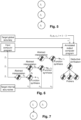
- Part a) of figure 3 represents schematically a dependency graph in the case where each call of a same mathematical function is associated to a respective target internal accuracy.
- the mathematical function log2 which is called twice in the input computer program of figure 2 , appears twice in the dependency graph.
- Each mathematical function which does not use the result of another mathematical function is the origin of a dependency path.
- Part b) of figure 3 represents schematically a dependency graph in the case where a same mathematical function is associated to a single target internal accuracy regardless its number of call locations in the input computer program.
- the mathematical function log2 which is called twice in the input computer program of figure 2 , appears only once in the dependency graph. Since the mathematical function log2 called inside the loop processes the result of the mathematical function exp, it is considered to be the call location that will require the lowest upper bound on its internal error, such that only this call location is considered in the dependency graph.
- step S10 may also be executed after the execution of the step S11, in order to first list the mathematical functions called and then obtain their respective target internal accuracies based on the list. For instance, it is possible to obtain target internal accuracies for each occurrence of each mathematical function in the dependency graph.
- the computer system processes the mathematical functions according to the dependency graph.
- mathematical functions on a same path are processed successively, from the origin of the path, to produce synthesized mathematical functions for each mathematical function in the dependency graph.
- the converting method 10 comprises steps of:
- the path having the mathematical function pow as origin comprises only the mathematical function pow.
- the mathematical function pow is processed first and a value range determination tool is used to produce values ranges for its input and output variables. Since the mathematical function pow does not depend on another mathematical function, no other synthesized mathematical function is used to produce the value ranges of the mathematical function pow. Then a synthesis tool is used to produce a synthesized mathematical function pow having the target internal accuracy required. The same applies also for the path having the mathematical function log as origin.
- the path having the mathematical function exp as origin comprises also the mathematical function log2.
- the mathematical function exp is processed first and the value range determination tool is used to produce values ranges for its input and output variables. Since the mathematical function exp does not depend on another mathematical function, no other synthesized mathematical function is used to produce the value ranges of the mathematical function exp. Then the synthesis tool is used to produce a synthesized mathematical function exp having the target internal accuracy required. Then the mathematical function log2 is processed and the value range determination tool is used to produce values ranges for its input and output variables. Since the mathematical function log2 depends on the mathematical function exp, the synthesized implementation of the mathematical function exp is used by the value range determination tool to produce the values ranges for the mathematical function log2. Then the synthesis tool is used to produce a synthesized mathematical function log2 having the target internal accuracy required.
- the determination of the value ranges may use any value range determination tool known to the skilled person.
- the determination of the value ranges of a mathematical function may use a statistical tool, such as Monte Carlo arithmetic.
- the determination of the value ranges uses an abstract interpretation tool.
- Any abstract interpretation tool known to the skilled person may be used.
- Fluctuat is an abstract interpretation tool developed at CEA (French Alternative Energys and Atomic Energy Commission) designed to analyze floating-point rounding errors of large C/C++ computer programs in a fully automated way (see [Goubault2013]).
- Fldlib is another example of abstraction interpretation tool that can be used, developed by Védrine et al.
- RAI Raun-time abstract interpretation, see [Védrine2021]
- the generation of the synthesized mathematical functions may use any synthesis tool known to the skilled person.
- Sollya [Chevillard2010] is a synthesis tool that can be used to develop safe floating-point computer programs. Given a mathematical expression, Sollya tries to provide both a polynomial approximation of this expression and an upper bound on the error committed when approximating it. Then, Sollya proposes a floating-point implementation of the polynomial approximation that keeps the error in a reasonable interval. In other terms, it provides an implementation of the mathematical function for which the contribution of rounding errors does not break the quality of the polynomial approximation.
- Metalibm ANR project addresses the development of tools to automate the generation of mathematical functions and digital filters meeting some criteria such as target accuracy, memory, speed, architecture, etc. All Metalibm tools can generate C functions meeting the user criteria, the target accuracy criterion being achieved through the use of the Sollya theory.
- the converting method 10 comprises a step S14 of generating the output computer program by replacing, in the input computer program, each mathematical function call by a call to its corresponding synthesized mathematical function.
- each mathematical function call has been replaced by a call to a synthesized mathematical function having a known (white-box) implementation and achieving a target internal accuracy. If the target internal accuracies collectively enable achieving the target global accuracy, then the output computer program should in principle achieve the target global accuracy set for it.
- the target global accuracy of the output computer program is not formally proved.
- the converting method 10 may further comprise automatically annotating the output computer program based on the target global accuracy and preferably based on predetermined value ranges for the input variables of the input computer program (for instance received with the target global accuracy). Based on such annotations, and thanks to the fact that the implementations of the synthesized mathematical functions are now known, it is possible to use a formal verification tool to formally prove the target global accuracy set for the output computer program, during an optional formal verification step S15 of the converting method 10.
- the output computer program may be further annotated based on the value ranges of the mathematical functions and based on the target internal accuracies of the synthesized mathematical functions, in order to formally prove the target internal accuracies of the synthesized mathematical functions of the output computer program.
- the formal verification of the output computer program may use any formal verification tool known to the skilled person.
- the formal verification of a computer program enriched with annotations (assertions) of numerical accuracy can be carried out using a deductive verification tool, which automatically discharges proof obligations to dedicated provers.
- a deductive verification tool which automatically discharges proof obligations to dedicated provers.
- Frama-C [Kirchner2015] plug-ins have included method and rounding error analysis features in their specification language. It was first used in the Caduceus plug-in [Boldo2007] which is based on the Why platform, responsible for the communication with dedicated provers like Gappa or the Coq proof assistant.
- Another non-limitative example of deductive verification tool that can be used is the Jessie plug-in [Ayad2010], based on a Why3 theory of floating-point numbers.
- provers examples include automatic theorem provers such as Coqlnterval [Daumas2005] and Gappa [Daumas201 0].
- Coqlnterval is a tool for the Coq proof assistant, based on the Flocq Coq formalization of floating-point arithmetic and on interval arithmetic computations (intervals having floating-point lower and upper bounds). Using interval computations, the tool is able to automatically prove inequalities on real-valued expressions. Therefore, it can be used to bound the approximation error of an algebraic expression approaching a mathematical function or model.
- Gappa is a tool designed to verify arithmetic properties of simple numerical programs.
- the converting method 10 may, if required, formally prove the target global accuracy of the output computer program and the target internal accuracies of the synthesized implementations of the mathematical functions. If the target internal accuracies of all synthesized mathematical functions are proved, but not the target global accuracy of the output computer program, then this might imply that the target internal accuracies obtained during step S10 are not sufficient to achieve the target global accuracy. If mandatory to achieve the target global accuracy set for the output computer program, then it is possible to repeat the steps of the converting method 10 by further constraining progressively all or part of the target internal accuracies set for the mathematical functions, until an output computer program is generated which achieves the target global accuracy. In the present disclosure, "further constraining" a target internal accuracy means decreasing the target upper bound on the internal error of the corresponding mathematical function.
- Figure 4 represents schematically the execution of the successive steps of the converting method 10 when considering an exemplary input computer program which includes three mathematical functions f 1 , f 2 and f 3 , and when considering that the determination of the value ranges of the mathematical functions uses abstract interpretation tools.
- the dependency graph of these mathematical functions f 1 , f 2 and f 3 , obtained during step S11, is depicted on figure 5 and includes a single path having as origin the mathematical function f 1 , followed by the mathematical functions f 2 then f 3 .
- the converting method receives as input:
- the converting method 10 processes the mathematical functions according to the dependency graph in figure 5 , and processes first the mathematical function f 1 .
- An abstract interpretation tool e.g. Fluctuat
- Fluctuat is used to produce a value range D 1 for the mathematical function f 1 .
- a synthesis tool uses the mathematical function f 1 , the value range D 1 and the target internal accuracy ⁇ 1 to generate a synthesized mathematical function p 1 .
- the synthesis tool also synthesizes a certificate c 1 as a predicate ensuring that the target internal accuracy ⁇ 1 is guaranteed by p 1 on D 1 .
- the mathematical function f 2 is processed next.
- An abstract interpretation tool is used to produce a value range D 2 , by using also the synthesized mathematical function p 1 .
- a synthesis tool uses the mathematical function f 2 , the value range D 2 and the target internal accuracy ⁇ 2 to generate a synthesized mathematical function p 2 and a certificate c 2 .
- the mathematical function f 3 is processed next.
- An abstract interpretation tool is used to produce a value range D 3 , by using also the synthesized mathematical function p 2 and the synthesized mathematical function p 1 .
- a synthesis tool uses the mathematical function f 3 , the value range D 3 and the target internal accuracy ⁇ 3 to generate a synthesized mathematical function p 3 and a certificate c 3 .
- the converting method 10 then generates the output computer program by replacing the calls to the mathematical functions f 1 , f 2 and f 3 by calls to the synthesized implementations p 1 , p 2 and p 3 (synthesized mathematical functions), respectively.
- the output computer program can also be enriched with several annotations corresponding to hypotheses, proof obligations or local assertions, for instance:
- the converting method 10 performs the formal verification of the automatically generated annotations, with the formal proof of the target global accuracy as final goal in mind.
- the converting method 10 uses a deductive verification tool to discharge proof obligations (annotations) to dedicated automatic theorem provers. For instance:
- Figure 6 represents schematically the execution of the successive steps of the converting method 10 when considering another exemplary input computer program which includes three mathematical functions f 1 , f 2 and f 3 .
- the dependency graph of these mathematical functions f 1 , f 2 and f 3 , obtained during step S11, is depicted on figure 7 and includes two paths:
- the present disclosure proposes a methodology for automatically generating, from an input computer program, an output computer program achieving a target global accuracy with respect to mathematical functions' approximations and floating-point rounding errors. This is achieved by combining value range determination tools (such as abstract interpretation tools or statistical tools) and synthesis tools based on a dependency graph describing the dependencies between the calls of the mathematical functions.
- value range determination tools such as abstract interpretation tools or statistical tools
- synthesis tools based on a dependency graph describing the dependencies between the calls of the mathematical functions.
- the target global accuracy of the output computer program can also be formally verified if required, by annotating the output computer program and using e.g. deductive (formal) verification tools.
- the proposed converting method 10 is fully automatic, provides an exhaustiveness guarantee of numerical accuracy, and optimizes mathematical function implementations. It reduces both the development and verification time of software relying on intensive use of floating-point numerical computations.
Landscapes
- Engineering & Computer Science (AREA)
- Theoretical Computer Science (AREA)
- General Engineering & Computer Science (AREA)
- Physics & Mathematics (AREA)
- General Physics & Mathematics (AREA)
- Software Systems (AREA)
- Computational Mathematics (AREA)
- Computing Systems (AREA)
- Mathematical Analysis (AREA)
- Mathematical Optimization (AREA)
- Pure & Applied Mathematics (AREA)
- Stored Programmes (AREA)
- Complex Calculations (AREA)
Claims (12)
- Computerimplementiertes Verfahren (10) zum Umwandeln eines Eingabecomputerprogramms in ein Ausgabecomputerprogramm, welches eine globale Zielgenauigkeit erreicht, wobei das Eingabecomputerprogramm mathematische Funktionen umfasst, welche auf Gleitkommavariablen angewendet werden, und die globale Zielgenauigkeit einer Begrenzung an einem globalen Fehler aufgrund von mathematischen Funktionsannäherungen und/oder von Gleitkommarundungsfehlern entspricht, wobei das Verfahren umfasst:- (S10) Empfangen einer internen Zielgenauigkeit für jede mathematische Funktion, welche in dem Eingabecomputerprogramm umfasst ist, wobei die internen Zielgenauigkeiten jeweiligen Begrenzungen an internen Fehlern der mathematischen Funktionen entsprechen, welche erforderlich sind, um die globale Zielgenauigkeit zu erreichen,- (S11) Analysieren des Eingabecomputerprogramms, um einen Abhängigkeitsgraphen zu bestimmen, welcher Abhängigkeiten zwischen Aufrufen von mathematischen Funktionen beschreibt,wobei das Verfahren ferner ein Verarbeiten der mathematischen Funktionen gemäß dem Abhängigkeitsgraphen umfasst, wobei das Verarbeiten für jede verarbeitete mathematische Funktion umfasst:- (S12) Verwenden eines Wertebereichsbestimmungswerkzeugs, um einen Wertebereich für jede Variable der verarbeiteten mathematischen Funktion zu erzeugen, auf Grundlage jeder synthetisierten mathematischen Funktion, welche für eine mathematische Funktion erhalten worden ist, von welcher die verarbeitete mathematische Funktion gemäß dem Abhängigkeitsgraphen abhängig ist,- (S13) Verwenden eines Synthesewerkzeugs, um eine synthetisierte mathematische Funktion zu erzeugen, welche die interne Zielgenauigkeit für die verarbeitete mathematische Funktion aufweist, auf Grundlage des Wertebereichs für jede Variable der verarbeiteten mathematischen Funktion,wobei das Verfahren ferner (S14) ein Generieren des Ausgabecomputerprogramms durch ein Ersetzen, in dem Eingabecomputerprogramm, jedes Aufrufs einer mathematischen Funktion durch einen Aufruf seiner entsprechenden synthetisierten mathematischen Funktion umfasst.
- Verfahren (10) nach Anspruch 1, ferner umfassend ein Annotieren des Ausgabecomputerprogramms auf Grundlage der globalen Zielgenauigkeit und (S15) ein Verifizieren der Annotationen des Ausgabecomputerprogramms unter Verwendung eines formalen Verifizierungswerkzeugs.
- Verfahren (10) nach Anspruch 2, wobei das Ausgabecomputerprogramm ferner auf Grundlage der Wertebereiche der mathematischen Funktionen und auf Grundlage der internen Zielgenauigkeiten der synthetisierten mathematischen Funktionen annotiert wird.
- Verfahren (10) nach einem der Ansprüche 2 bis 3, wobei das formale Verifizierungswerkzeug ein deduktives Verifizierungswerkzeug ist.
- Verfahren (10) nach Anspruch 4, wobei das deduktive Verifizierungswerkzeug automatische Theorembeweiser verwendet.
- Verfahren (10) nach Anspruch 5, wobei das deduktive Verifizierungswerkzeug für Beweisverpflichtungen in Bezug auf mathematische Funktionsannäherungen und für Beweisverpflichtungen in Bezug auf Gleitkommarundungsfehler verschiedene automatische Theorembeweiser verwendet.
- Verfahren (10) nach einem der Ansprüche 2 bis 6, wobei, wenn das generierte Ausgabecomputerprogramm die globale Zielgenauigkeit nicht erreicht, das Verfahren ferner ein Iterieren der folgenden Schritte umfasst, bis ein Ausgabecomputerprogramm generiert wird, welches die globale Zielgenauigkeit aufweist:- Aktualisieren der internen Zielgenauigkeiten durch ein weiteres Beschränken aller oder eines Teils der internen Zielgenauigkeiten,- Wiederholen der Verarbeitung der mathematischen Funktionen des Eingabecomputerprogramms, um aktualisierte synthetisierte mathematische Funktionen zu erzeugen, auf Grundlage der aktualisierten internen Zielgenauigkeiten,- Generieren des Ausgabecomputerprogramms auf Grundlage der aktualisierten synthetisierten mathematischen Funktionen.
- Verfahren (10) nach einem der Ansprüche 1 bis 7, wobei verschiedene synthetisierte mathematische Funktionen für eine gleiche mathematische Funktion synthetisiert werden, welche verschiedene Aufruforte in dem Eingabecomputerprogramm aufweist.
- Verfahren (10) nach einem der Ansprüche 1 bis 8, wobei das Wertebereichsbestimmungswerkzeug ein abstraktes Interpretationswerkzeug ist.
- Computerprogrammprodukt, umfassend Anweisungen, welche, wenn sie durch wenigstens einen Prozessor ausgeführt werden, den wenigstens einen Prozessor derart konfigurieren, dass er ein Verfahren (10) nach einem der Ansprüche 1 bis 9 durchführt.
- Computerlesbares Speichermedium, umfassend Anweisungen, welche, wenn sie durch wenigstens einen Prozessor ausgeführt werden, den wenigstens einen Prozessor derart konfigurieren, dass er ein Verfahren (10) nach einem der Ansprüche 1 bis 9 durchführt.
- System zum Umwandeln eines Eingabecomputerprogramms in ein Ausgabecomputerprogramm, welches eine globale Zielgenauigkeit erreicht, wobei das Eingabecomputerprogramm mathematische Funktionen umfasst, welche auf Gleitkommavariablen angewendet werden, und die globale Zielgenauigkeit einer Begrenzung an einem globalen Fehler aufgrund von mathematischen Funktionsannäherungen und/oder von Gleitkommarundungsfehlern entspricht, wobei das System wenigstens einen Prozessor und wenigstens einen Speicher umfasst, wobei der wenigstens eine Prozessor dazu eingerichtet ist, ein Verfahren (10) nach einem der Ansprüche 1 bis 9 durchzuführen.
Priority Applications (6)
| Application Number | Priority Date | Filing Date | Title |
|---|---|---|---|
| EP22305212.7A EP4235397B1 (de) | 2022-02-25 | 2022-02-25 | Verfahren und system zum umwandeln eines eingabecomputerprogramms in ein ausgabecomputerprogramm, das eine globale zielgenauigkeit erreicht |
| PCT/JP2023/003682 WO2023162642A1 (en) | 2022-02-25 | 2023-01-30 | Method and system for converting input computer program into output computer program |
| US18/728,365 US20240419442A1 (en) | 2022-02-25 | 2023-01-30 | Method and system for converting input computer program into output computer program |
| CA3249716A CA3249716A1 (en) | 2022-02-25 | 2023-01-30 | METHOD AND SYSTEM FOR CONVERSION OF AN INPUT COMPUTER PROGRAM INTO AN OUTPUT COMPUTER PROGRAM |
| CN202380017287.6A CN118679450A (zh) | 2022-02-25 | 2023-01-30 | 用于将输入计算机程序转换为输出计算机程序的方法和系统 |
| JP2024555617A JP7696514B2 (ja) | 2022-02-25 | 2023-01-30 | 入力コンピュータプログラムを出力コンピュータプログラムに変換する方法及びシステム |
Applications Claiming Priority (1)
| Application Number | Priority Date | Filing Date | Title |
|---|---|---|---|
| EP22305212.7A EP4235397B1 (de) | 2022-02-25 | 2022-02-25 | Verfahren und system zum umwandeln eines eingabecomputerprogramms in ein ausgabecomputerprogramm, das eine globale zielgenauigkeit erreicht |
Publications (2)
| Publication Number | Publication Date |
|---|---|
| EP4235397A1 EP4235397A1 (de) | 2023-08-30 |
| EP4235397B1 true EP4235397B1 (de) | 2024-06-19 |
Family
ID=80780566
Family Applications (1)
| Application Number | Title | Priority Date | Filing Date |
|---|---|---|---|
| EP22305212.7A Active EP4235397B1 (de) | 2022-02-25 | 2022-02-25 | Verfahren und system zum umwandeln eines eingabecomputerprogramms in ein ausgabecomputerprogramm, das eine globale zielgenauigkeit erreicht |
Country Status (6)
| Country | Link |
|---|---|
| US (1) | US20240419442A1 (de) |
| EP (1) | EP4235397B1 (de) |
| JP (1) | JP7696514B2 (de) |
| CN (1) | CN118679450A (de) |
| CA (1) | CA3249716A1 (de) |
| WO (1) | WO2023162642A1 (de) |
Families Citing this family (2)
| Publication number | Priority date | Publication date | Assignee | Title |
|---|---|---|---|---|
| EP4538907B1 (de) | 2023-10-11 | 2025-09-03 | Mitsubishi Electric R&D Centre Europe B.V. | Automatische identifizierung der erforderlichen internen genauigkeiten von anrufen willkürlicher funktionen in abhängigkeit von einer globalen zielgenauigkeit eines programms auf einem beliebigen programm |
| CN119597295B (zh) * | 2024-11-19 | 2025-10-10 | 湖南大学 | 一种用于自动混合精度优化程序的编译方法和系统 |
Family Cites Families (3)
| Publication number | Priority date | Publication date | Assignee | Title |
|---|---|---|---|---|
| JP4443100B2 (ja) * | 2002-07-31 | 2010-03-31 | インターナショナル・ビジネス・マシーンズ・コーポレーション | プログラム変換方法、これを用いたデータ処理装置及びプログラム |
| US8370822B2 (en) * | 2008-11-20 | 2013-02-05 | Apple Inc. | Compiling techniques for providing limited accuracy and enhanced performance granularity |
| US11120602B2 (en) * | 2019-06-03 | 2021-09-14 | Microsoft Technology Licensing, Llc | Acceleration of shader programs by compiler precision selection |
-
2022
- 2022-02-25 EP EP22305212.7A patent/EP4235397B1/de active Active
-
2023
- 2023-01-30 CN CN202380017287.6A patent/CN118679450A/zh active Pending
- 2023-01-30 US US18/728,365 patent/US20240419442A1/en active Pending
- 2023-01-30 CA CA3249716A patent/CA3249716A1/en active Pending
- 2023-01-30 JP JP2024555617A patent/JP7696514B2/ja active Active
- 2023-01-30 WO PCT/JP2023/003682 patent/WO2023162642A1/en not_active Ceased
Also Published As
| Publication number | Publication date |
|---|---|
| CN118679450A (zh) | 2024-09-20 |
| US20240419442A1 (en) | 2024-12-19 |
| CA3249716A1 (en) | 2023-08-31 |
| EP4235397A1 (de) | 2023-08-30 |
| JP7696514B2 (ja) | 2025-06-20 |
| JP2024545362A (ja) | 2024-12-05 |
| WO2023162642A1 (en) | 2023-08-31 |
| WO2023162642A8 (en) | 2024-07-18 |
Similar Documents
| Publication | Publication Date | Title |
|---|---|---|
| US20240419442A1 (en) | Method and system for converting input computer program into output computer program | |
| Arts et al. | Testing erlang data types with quviq quickcheck | |
| JP5923636B2 (ja) | モデル検査のためのループ抽象化 | |
| Abreu et al. | Bounded model checking for fixed-point digital filters | |
| v. Gleissenthall et al. | Solver-aided constant-time hardware verification | |
| US9436582B1 (en) | Calculating an immediate parent assertion statement for program verification | |
| US7543274B2 (en) | System and method for deriving a process-based specification | |
| Kellison et al. | Verified numerical methods for ordinary differential equations | |
| Ponsini et al. | Refining abstract interpretation based value analysis with constraint programming techniques | |
| Coward et al. | Formal verification of transcendental fixed-and floating-point algorithms using an automatic theorem prover | |
| US11307883B2 (en) | Optimization of the execution time of a computer program by determining the implementation of a function according to range of input parameters and accuracy | |
| Wirth | Hardware architectures for programming languages and programming languages for hardware architectures | |
| Rovara et al. | A framework for the efficient evaluation of runtime assertions on quantum computers | |
| Rasheed et al. | Auto-active verification of floating-point programs via nonlinear real provers | |
| Champion et al. | Generating property-directed potential invariants by backward analysis | |
| WO2024046516A1 (en) | Symbolic execution in testing software | |
| Inafune et al. | Symbolic backward simulation of Java bytecode program | |
| WO2024074163A1 (en) | Symbolic execution of machine code for software testing | |
| Wang et al. | Enhancing Translation Validation of Compiler Transformations with Large Language Models | |
| Putot | Static analysis of numerical programs and systems | |
| Xie et al. | Enhancing Translation Validation of Compiler Transformations with Large Language Models | |
| Wang | Automated Verification of Compiler Transformations | |
| Shreve et al. | Real-time checkers: built-in-test for mission-critical software | |
| Fofaliya et al. | AWS CBMC Benchmarks | |
| Khaitan et al. | O-Forge: An LLM+ Computer Algebra Framework for Asymptotic Analysis |
Legal Events
| Date | Code | Title | Description |
|---|---|---|---|
| PUAI | Public reference made under article 153(3) epc to a published international application that has entered the european phase |
Free format text: ORIGINAL CODE: 0009012 |
|
| STAA | Information on the status of an ep patent application or granted ep patent |
Free format text: STATUS: THE APPLICATION HAS BEEN PUBLISHED |
|
| AK | Designated contracting states |
Kind code of ref document: A1 Designated state(s): AL AT BE BG CH CY CZ DE DK EE ES FI FR GB GR HR HU IE IS IT LI LT LU LV MC MK MT NL NO PL PT RO RS SE SI SK SM TR |
|
| STAA | Information on the status of an ep patent application or granted ep patent |
Free format text: STATUS: REQUEST FOR EXAMINATION WAS MADE |
|
| 17P | Request for examination filed |
Effective date: 20231031 |
|
| RBV | Designated contracting states (corrected) |
Designated state(s): AL AT BE BG CH CY CZ DE DK EE ES FI FR GB GR HR HU IE IS IT LI LT LU LV MC MK MT NL NO PL PT RO RS SE SI SK SM TR |
|
| GRAP | Despatch of communication of intention to grant a patent |
Free format text: ORIGINAL CODE: EPIDOSNIGR1 |
|
| STAA | Information on the status of an ep patent application or granted ep patent |
Free format text: STATUS: GRANT OF PATENT IS INTENDED |
|
| RAP1 | Party data changed (applicant data changed or rights of an application transferred) |
Owner name: MITSUBISHI ELECTRIC CORPORATION Owner name: MITSUBISHI ELECTRIC R&D CENTRE EUROPE B.V. |
|
| INTG | Intention to grant announced |
Effective date: 20240313 |
|
| RIN1 | Information on inventor provided before grant (corrected) |
Inventor name: MELQUIOND, GUILLAUME Inventor name: FAISSOLE, FLORIAN Inventor name: BOYER, BENOIT |
|
| GRAS | Grant fee paid |
Free format text: ORIGINAL CODE: EPIDOSNIGR3 |
|
| P01 | Opt-out of the competence of the unified patent court (upc) registered |
Effective date: 20240404 |
|
| GRAA | (expected) grant |
Free format text: ORIGINAL CODE: 0009210 |
|
| STAA | Information on the status of an ep patent application or granted ep patent |
Free format text: STATUS: THE PATENT HAS BEEN GRANTED |
|
| AK | Designated contracting states |
Kind code of ref document: B1 Designated state(s): AL AT BE BG CH CY CZ DE DK EE ES FI FR GB GR HR HU IE IS IT LI LT LU LV MC MK MT NL NO PL PT RO RS SE SI SK SM TR |
|
| REG | Reference to a national code |
Ref country code: GB Ref legal event code: FG4D |
|
| REG | Reference to a national code |
Ref country code: CH Ref legal event code: EP |
|
| REG | Reference to a national code |
Ref country code: DE Ref legal event code: R096 Ref document number: 602022004046 Country of ref document: DE |
|
| PG25 | Lapsed in a contracting state [announced via postgrant information from national office to epo] |
Ref country code: BG Free format text: LAPSE BECAUSE OF FAILURE TO SUBMIT A TRANSLATION OF THE DESCRIPTION OR TO PAY THE FEE WITHIN THE PRESCRIBED TIME-LIMIT Effective date: 20240619 |
|
| PG25 | Lapsed in a contracting state [announced via postgrant information from national office to epo] |
Ref country code: FI Free format text: LAPSE BECAUSE OF FAILURE TO SUBMIT A TRANSLATION OF THE DESCRIPTION OR TO PAY THE FEE WITHIN THE PRESCRIBED TIME-LIMIT Effective date: 20240619 Ref country code: HR Free format text: LAPSE BECAUSE OF FAILURE TO SUBMIT A TRANSLATION OF THE DESCRIPTION OR TO PAY THE FEE WITHIN THE PRESCRIBED TIME-LIMIT Effective date: 20240619 |
|
| REG | Reference to a national code |
Ref country code: LT Ref legal event code: MG9D |
|
| PG25 | Lapsed in a contracting state [announced via postgrant information from national office to epo] |
Ref country code: GR Free format text: LAPSE BECAUSE OF FAILURE TO SUBMIT A TRANSLATION OF THE DESCRIPTION OR TO PAY THE FEE WITHIN THE PRESCRIBED TIME-LIMIT Effective date: 20240920 |
|
| REG | Reference to a national code |
Ref country code: NL Ref legal event code: MP Effective date: 20240619 |
|
| PG25 | Lapsed in a contracting state [announced via postgrant information from national office to epo] |
Ref country code: LV Free format text: LAPSE BECAUSE OF FAILURE TO SUBMIT A TRANSLATION OF THE DESCRIPTION OR TO PAY THE FEE WITHIN THE PRESCRIBED TIME-LIMIT Effective date: 20240619 |
|
| PG25 | Lapsed in a contracting state [announced via postgrant information from national office to epo] |
Ref country code: NO Free format text: LAPSE BECAUSE OF FAILURE TO SUBMIT A TRANSLATION OF THE DESCRIPTION OR TO PAY THE FEE WITHIN THE PRESCRIBED TIME-LIMIT Effective date: 20240919 Ref country code: LV Free format text: LAPSE BECAUSE OF FAILURE TO SUBMIT A TRANSLATION OF THE DESCRIPTION OR TO PAY THE FEE WITHIN THE PRESCRIBED TIME-LIMIT Effective date: 20240619 Ref country code: HR Free format text: LAPSE BECAUSE OF FAILURE TO SUBMIT A TRANSLATION OF THE DESCRIPTION OR TO PAY THE FEE WITHIN THE PRESCRIBED TIME-LIMIT Effective date: 20240619 Ref country code: GR Free format text: LAPSE BECAUSE OF FAILURE TO SUBMIT A TRANSLATION OF THE DESCRIPTION OR TO PAY THE FEE WITHIN THE PRESCRIBED TIME-LIMIT Effective date: 20240920 Ref country code: FI Free format text: LAPSE BECAUSE OF FAILURE TO SUBMIT A TRANSLATION OF THE DESCRIPTION OR TO PAY THE FEE WITHIN THE PRESCRIBED TIME-LIMIT Effective date: 20240619 Ref country code: BG Free format text: LAPSE BECAUSE OF FAILURE TO SUBMIT A TRANSLATION OF THE DESCRIPTION OR TO PAY THE FEE WITHIN THE PRESCRIBED TIME-LIMIT Effective date: 20240619 Ref country code: RS Free format text: LAPSE BECAUSE OF FAILURE TO SUBMIT A TRANSLATION OF THE DESCRIPTION OR TO PAY THE FEE WITHIN THE PRESCRIBED TIME-LIMIT Effective date: 20240919 |
|
| PG25 | Lapsed in a contracting state [announced via postgrant information from national office to epo] |
Ref country code: NL Free format text: LAPSE BECAUSE OF FAILURE TO SUBMIT A TRANSLATION OF THE DESCRIPTION OR TO PAY THE FEE WITHIN THE PRESCRIBED TIME-LIMIT Effective date: 20240619 |
|
| REG | Reference to a national code |
Ref country code: AT Ref legal event code: MK05 Ref document number: 1696336 Country of ref document: AT Kind code of ref document: T Effective date: 20240619 |
|
| PG25 | Lapsed in a contracting state [announced via postgrant information from national office to epo] |
Ref country code: NL Free format text: LAPSE BECAUSE OF FAILURE TO SUBMIT A TRANSLATION OF THE DESCRIPTION OR TO PAY THE FEE WITHIN THE PRESCRIBED TIME-LIMIT Effective date: 20240619 |
|
| PG25 | Lapsed in a contracting state [announced via postgrant information from national office to epo] |
Ref country code: PT Free format text: LAPSE BECAUSE OF FAILURE TO SUBMIT A TRANSLATION OF THE DESCRIPTION OR TO PAY THE FEE WITHIN THE PRESCRIBED TIME-LIMIT Effective date: 20241021 |
|
| PG25 | Lapsed in a contracting state [announced via postgrant information from national office to epo] |
Ref country code: PT Free format text: LAPSE BECAUSE OF FAILURE TO SUBMIT A TRANSLATION OF THE DESCRIPTION OR TO PAY THE FEE WITHIN THE PRESCRIBED TIME-LIMIT Effective date: 20241021 |
|
| PG25 | Lapsed in a contracting state [announced via postgrant information from national office to epo] |
Ref country code: PL Free format text: LAPSE BECAUSE OF FAILURE TO SUBMIT A TRANSLATION OF THE DESCRIPTION OR TO PAY THE FEE WITHIN THE PRESCRIBED TIME-LIMIT Effective date: 20240619 |
|
| PG25 | Lapsed in a contracting state [announced via postgrant information from national office to epo] |
Ref country code: EE Free format text: LAPSE BECAUSE OF FAILURE TO SUBMIT A TRANSLATION OF THE DESCRIPTION OR TO PAY THE FEE WITHIN THE PRESCRIBED TIME-LIMIT Effective date: 20240619 |
|
| PG25 | Lapsed in a contracting state [announced via postgrant information from national office to epo] |
Ref country code: AT Free format text: LAPSE BECAUSE OF FAILURE TO SUBMIT A TRANSLATION OF THE DESCRIPTION OR TO PAY THE FEE WITHIN THE PRESCRIBED TIME-LIMIT Effective date: 20240619 Ref country code: IS Free format text: LAPSE BECAUSE OF FAILURE TO SUBMIT A TRANSLATION OF THE DESCRIPTION OR TO PAY THE FEE WITHIN THE PRESCRIBED TIME-LIMIT Effective date: 20241019 |
|
| PG25 | Lapsed in a contracting state [announced via postgrant information from national office to epo] |
Ref country code: CZ Free format text: LAPSE BECAUSE OF FAILURE TO SUBMIT A TRANSLATION OF THE DESCRIPTION OR TO PAY THE FEE WITHIN THE PRESCRIBED TIME-LIMIT Effective date: 20240619 |
|
| PG25 | Lapsed in a contracting state [announced via postgrant information from national office to epo] |
Ref country code: RO Free format text: LAPSE BECAUSE OF FAILURE TO SUBMIT A TRANSLATION OF THE DESCRIPTION OR TO PAY THE FEE WITHIN THE PRESCRIBED TIME-LIMIT Effective date: 20240619 Ref country code: SK Free format text: LAPSE BECAUSE OF FAILURE TO SUBMIT A TRANSLATION OF THE DESCRIPTION OR TO PAY THE FEE WITHIN THE PRESCRIBED TIME-LIMIT Effective date: 20240619 |
|
| PG25 | Lapsed in a contracting state [announced via postgrant information from national office to epo] |
Ref country code: ES Free format text: LAPSE BECAUSE OF FAILURE TO SUBMIT A TRANSLATION OF THE DESCRIPTION OR TO PAY THE FEE WITHIN THE PRESCRIBED TIME-LIMIT Effective date: 20240619 Ref country code: SM Free format text: LAPSE BECAUSE OF FAILURE TO SUBMIT A TRANSLATION OF THE DESCRIPTION OR TO PAY THE FEE WITHIN THE PRESCRIBED TIME-LIMIT Effective date: 20240619 |
|
| PG25 | Lapsed in a contracting state [announced via postgrant information from national office to epo] |
Ref country code: SM Free format text: LAPSE BECAUSE OF FAILURE TO SUBMIT A TRANSLATION OF THE DESCRIPTION OR TO PAY THE FEE WITHIN THE PRESCRIBED TIME-LIMIT Effective date: 20240619 Ref country code: SK Free format text: LAPSE BECAUSE OF FAILURE TO SUBMIT A TRANSLATION OF THE DESCRIPTION OR TO PAY THE FEE WITHIN THE PRESCRIBED TIME-LIMIT Effective date: 20240619 Ref country code: RO Free format text: LAPSE BECAUSE OF FAILURE TO SUBMIT A TRANSLATION OF THE DESCRIPTION OR TO PAY THE FEE WITHIN THE PRESCRIBED TIME-LIMIT Effective date: 20240619 Ref country code: PL Free format text: LAPSE BECAUSE OF FAILURE TO SUBMIT A TRANSLATION OF THE DESCRIPTION OR TO PAY THE FEE WITHIN THE PRESCRIBED TIME-LIMIT Effective date: 20240619 Ref country code: IS Free format text: LAPSE BECAUSE OF FAILURE TO SUBMIT A TRANSLATION OF THE DESCRIPTION OR TO PAY THE FEE WITHIN THE PRESCRIBED TIME-LIMIT Effective date: 20241019 Ref country code: ES Free format text: LAPSE BECAUSE OF FAILURE TO SUBMIT A TRANSLATION OF THE DESCRIPTION OR TO PAY THE FEE WITHIN THE PRESCRIBED TIME-LIMIT Effective date: 20240619 Ref country code: EE Free format text: LAPSE BECAUSE OF FAILURE TO SUBMIT A TRANSLATION OF THE DESCRIPTION OR TO PAY THE FEE WITHIN THE PRESCRIBED TIME-LIMIT Effective date: 20240619 Ref country code: CZ Free format text: LAPSE BECAUSE OF FAILURE TO SUBMIT A TRANSLATION OF THE DESCRIPTION OR TO PAY THE FEE WITHIN THE PRESCRIBED TIME-LIMIT Effective date: 20240619 Ref country code: AT Free format text: LAPSE BECAUSE OF FAILURE TO SUBMIT A TRANSLATION OF THE DESCRIPTION OR TO PAY THE FEE WITHIN THE PRESCRIBED TIME-LIMIT Effective date: 20240619 |
|
| PG25 | Lapsed in a contracting state [announced via postgrant information from national office to epo] |
Ref country code: IT Free format text: LAPSE BECAUSE OF FAILURE TO SUBMIT A TRANSLATION OF THE DESCRIPTION OR TO PAY THE FEE WITHIN THE PRESCRIBED TIME-LIMIT Effective date: 20240619 |
|
| REG | Reference to a national code |
Ref country code: DE Ref legal event code: R082 Ref document number: 602022004046 Country of ref document: DE Representative=s name: PLASSERAUD IP GMBH, DE |
|
| REG | Reference to a national code |
Ref country code: DE Ref legal event code: R097 Ref document number: 602022004046 Country of ref document: DE |
|
| PGFP | Annual fee paid to national office [announced via postgrant information from national office to epo] |
Ref country code: DE Payment date: 20250212 Year of fee payment: 4 |
|
| PG25 | Lapsed in a contracting state [announced via postgrant information from national office to epo] |
Ref country code: DK Free format text: LAPSE BECAUSE OF FAILURE TO SUBMIT A TRANSLATION OF THE DESCRIPTION OR TO PAY THE FEE WITHIN THE PRESCRIBED TIME-LIMIT Effective date: 20240619 |
|
| PGFP | Annual fee paid to national office [announced via postgrant information from national office to epo] |
Ref country code: FR Payment date: 20250121 Year of fee payment: 4 |
|
| PLBE | No opposition filed within time limit |
Free format text: ORIGINAL CODE: 0009261 |
|
| STAA | Information on the status of an ep patent application or granted ep patent |
Free format text: STATUS: NO OPPOSITION FILED WITHIN TIME LIMIT |
|
| 26N | No opposition filed |
Effective date: 20250320 |
|
| PG25 | Lapsed in a contracting state [announced via postgrant information from national office to epo] |
Ref country code: SE Free format text: LAPSE BECAUSE OF FAILURE TO SUBMIT A TRANSLATION OF THE DESCRIPTION OR TO PAY THE FEE WITHIN THE PRESCRIBED TIME-LIMIT Effective date: 20240619 |
|
| PG25 | Lapsed in a contracting state [announced via postgrant information from national office to epo] |
Ref country code: MC Free format text: LAPSE BECAUSE OF FAILURE TO SUBMIT A TRANSLATION OF THE DESCRIPTION OR TO PAY THE FEE WITHIN THE PRESCRIBED TIME-LIMIT Effective date: 20240619 |
|
| REG | Reference to a national code |
Ref country code: CH Ref legal event code: PL |
|
| PG25 | Lapsed in a contracting state [announced via postgrant information from national office to epo] |
Ref country code: LU Free format text: LAPSE BECAUSE OF NON-PAYMENT OF DUE FEES Effective date: 20250225 |
|
| PG25 | Lapsed in a contracting state [announced via postgrant information from national office to epo] |
Ref country code: CH Free format text: LAPSE BECAUSE OF NON-PAYMENT OF DUE FEES Effective date: 20250228 |
|
| REG | Reference to a national code |
Ref country code: BE Ref legal event code: MM Effective date: 20250228 |
|
| PG25 | Lapsed in a contracting state [announced via postgrant information from national office to epo] |
Ref country code: BE Free format text: LAPSE BECAUSE OF NON-PAYMENT OF DUE FEES Effective date: 20250228 |
|
| PG25 | Lapsed in a contracting state [announced via postgrant information from national office to epo] |
Ref country code: IE Free format text: LAPSE BECAUSE OF NON-PAYMENT OF DUE FEES Effective date: 20250225 |