EP4235196B1 - Switch detection circuit, method and switch detector - Google Patents
Switch detection circuit, method and switch detector Download PDFInfo
- Publication number
- EP4235196B1 EP4235196B1 EP22200359.2A EP22200359A EP4235196B1 EP 4235196 B1 EP4235196 B1 EP 4235196B1 EP 22200359 A EP22200359 A EP 22200359A EP 4235196 B1 EP4235196 B1 EP 4235196B1
- Authority
- EP
- European Patent Office
- Prior art keywords
- switch
- external switch
- controller
- signal
- isolation module
- Prior art date
- Legal status (The legal status is an assumption and is not a legal conclusion. Google has not performed a legal analysis and makes no representation as to the accuracy of the status listed.)
- Active
Links
Images


Classifications
-
- G—PHYSICS
- G01—MEASURING; TESTING
- G01R—MEASURING ELECTRIC VARIABLES; MEASURING MAGNETIC VARIABLES
- G01R31/00—Arrangements for testing electric properties; Arrangements for locating electric faults; Arrangements for electrical testing characterised by what is being tested not provided for elsewhere
- G01R31/327—Testing of circuit interrupters, switches or circuit-breakers
-
- G—PHYSICS
- G01—MEASURING; TESTING
- G01R—MEASURING ELECTRIC VARIABLES; MEASURING MAGNETIC VARIABLES
- G01R31/00—Arrangements for testing electric properties; Arrangements for locating electric faults; Arrangements for electrical testing characterised by what is being tested not provided for elsewhere
- G01R31/327—Testing of circuit interrupters, switches or circuit-breakers
- G01R31/3277—Testing of circuit interrupters, switches or circuit-breakers of low voltage devices, e.g. domestic or industrial devices, such as motor protections, relays, rotation switches
-
- H—ELECTRICITY
- H02—GENERATION; CONVERSION OR DISTRIBUTION OF ELECTRIC POWER
- H02J—ELECTRIC POWER NETWORKS; CIRCUIT ARRANGEMENTS OR SYSTEMS FOR SUPPLYING OR DISTRIBUTING ELECTRIC POWER; SYSTEMS FOR STORING ELECTRIC ENERGY
- H02J7/00—Circuit arrangements for charging or discharging batteries or for supplying loads from batteries
- H02J7/60—Circuit arrangements for charging or discharging batteries or for supplying loads from batteries including safety or protection arrangements
- H02J7/663—Circuit arrangements for charging or discharging batteries or for supplying loads from batteries including safety or protection arrangements using battery or load disconnect circuits
- H02J7/667—Circuit arrangements for charging or discharging batteries or for supplying loads from batteries including safety or protection arrangements using battery or load disconnect circuits disconnection of loads if battery is not under charge, e.g. in vehicle if engine is not running
-
- H—ELECTRICITY
- H01—ELECTRIC ELEMENTS
- H01M—PROCESSES OR MEANS, e.g. BATTERIES, FOR THE DIRECT CONVERSION OF CHEMICAL ENERGY INTO ELECTRICAL ENERGY
- H01M10/00—Secondary cells; Manufacture thereof
- H01M10/42—Methods or arrangements for servicing or maintenance of secondary cells or secondary half-cells
- H01M10/4285—Testing apparatus
-
- H—ELECTRICITY
- H01—ELECTRIC ELEMENTS
- H01M—PROCESSES OR MEANS, e.g. BATTERIES, FOR THE DIRECT CONVERSION OF CHEMICAL ENERGY INTO ELECTRICAL ENERGY
- H01M10/00—Secondary cells; Manufacture thereof
- H01M10/42—Methods or arrangements for servicing or maintenance of secondary cells or secondary half-cells
- H01M10/48—Accumulators combined with arrangements for measuring, testing or indicating the condition of cells, e.g. the level or density of the electrolyte
-
- H—ELECTRICITY
- H02—GENERATION; CONVERSION OR DISTRIBUTION OF ELECTRIC POWER
- H02J—ELECTRIC POWER NETWORKS; CIRCUIT ARRANGEMENTS OR SYSTEMS FOR SUPPLYING OR DISTRIBUTING ELECTRIC POWER; SYSTEMS FOR STORING ELECTRIC ENERGY
- H02J7/00—Circuit arrangements for charging or discharging batteries or for supplying loads from batteries
- H02J7/80—Circuit arrangements for charging or discharging batteries or for supplying loads from batteries including monitoring or indicating arrangements
-
- H—ELECTRICITY
- H02—GENERATION; CONVERSION OR DISTRIBUTION OF ELECTRIC POWER
- H02J—ELECTRIC POWER NETWORKS; CIRCUIT ARRANGEMENTS OR SYSTEMS FOR SUPPLYING OR DISTRIBUTING ELECTRIC POWER; SYSTEMS FOR STORING ELECTRIC ENERGY
- H02J7/00—Circuit arrangements for charging or discharging batteries or for supplying loads from batteries
- H02J7/865—Battery or charger load switching, e.g. concurrent charging and load supply
-
- G—PHYSICS
- G01—MEASURING; TESTING
- G01R—MEASURING ELECTRIC VARIABLES; MEASURING MAGNETIC VARIABLES
- G01R31/00—Arrangements for testing electric properties; Arrangements for locating electric faults; Arrangements for electrical testing characterised by what is being tested not provided for elsewhere
- G01R31/327—Testing of circuit interrupters, switches or circuit-breakers
- G01R31/3271—Testing of circuit interrupters, switches or circuit-breakers of high voltage or medium voltage devices
- G01R31/3275—Fault detection or status indication
-
- G—PHYSICS
- G01—MEASURING; TESTING
- G01R—MEASURING ELECTRIC VARIABLES; MEASURING MAGNETIC VARIABLES
- G01R31/00—Arrangements for testing electric properties; Arrangements for locating electric faults; Arrangements for electrical testing characterised by what is being tested not provided for elsewhere
- G01R31/50—Testing of electric apparatus, lines, cables or components for short-circuits, continuity, leakage current or incorrect line connections
- G01R31/66—Testing of connections, e.g. of plugs or non-disconnectable joints
-
- H—ELECTRICITY
- H01—ELECTRIC ELEMENTS
- H01H—ELECTRIC SWITCHES; RELAYS; SELECTORS; EMERGENCY PROTECTIVE DEVICES
- H01H9/00—Details of switching devices, not covered by groups H01H1/00 - H01H7/00
- H01H9/16—Indicators for switching condition, e.g. "on" or "off"
- H01H9/167—Circuits for remote indication
-
- Y—GENERAL TAGGING OF NEW TECHNOLOGICAL DEVELOPMENTS; GENERAL TAGGING OF CROSS-SECTIONAL TECHNOLOGIES SPANNING OVER SEVERAL SECTIONS OF THE IPC; TECHNICAL SUBJECTS COVERED BY FORMER USPC CROSS-REFERENCE ART COLLECTIONS [XRACs] AND DIGESTS
- Y02—TECHNOLOGIES OR APPLICATIONS FOR MITIGATION OR ADAPTATION AGAINST CLIMATE CHANGE
- Y02E—REDUCTION OF GREENHOUSE GAS [GHG] EMISSIONS, RELATED TO ENERGY GENERATION, TRANSMISSION OR DISTRIBUTION
- Y02E60/00—Enabling technologies; Technologies with a potential or indirect contribution to GHG emissions mitigation
- Y02E60/10—Energy storage using batteries
Definitions
- the present invention relates to the field of new energy battery energy storage systems, and in particular to a switch detection circuit, method, and switch detector.
- a battery management system usually has a switch on-off detection function, for example, for detecting whether a high-voltage connector has been reliably plugged, whether a door access switch has been closed, etc.
- the existing detection methods require a set of an isolated power supply, an isolated optical coupler, or a digital isolator to detect the state of a switch, while the cost of providing the isolated power supply, the isolated optical coupler, or the digital isolator is relatively high.
- CN207488457U discloses a high voltage direct current contactor break -make detecting system, including controller, signal coupled electric capacity and signal detection electric capacity, the signal output part of controller with the one end of signal coupled electric capacity is connected, the other end and the input of high voltage direct current contactor of signal coupled electric capacity are connected, the output of high voltage direct current contactor with the one end of signal detection electric capacity is connected, the other end of signal detection electric capacity with the signal detection end of controller is connected.
- CN 111220930A discloses a device for detecting the on-off states of a contactor and a fuse of an electric vehicle.
- the device comprises a transformer, a coupling capacitor, a signal generation, and a signal evaluation device.
- a secondary side of the transformer is connected to two ends of a to-be-detected device that is a contactor or a fuse.
- the coupling capacitor is arranged between the secondary side of the transformer and the to-be-detected device.
- the signal generator is connected to the primary side of the transformer and is used for generating a test signal; and the signal evaluation device is connected to the primary side of the transformer and is used for acquiring a feedback signal of the primary side and judging the on-off state of the to-be-detected device according to the feedback signal.
- the invention further discloses a method for detecting the on-off states of the contactor and the fuse of the electric vehicle.
- CN111913132A discloses a loop on-off state detection device and method.
- a detection signal is sent to a detected loop contact point and a detection signal isolation coupler through an isolation capacitor I; the detection signal isolation coupler receives a feedback signal of the detected loop contact point through an isolation capacitor II, couples the feedback signal with the received detection signal, and sends a coupling result to a detection signal receiving processor; the detection signal receiving processor analyzes the coupling result, and if the detection signal receiving processor receives the detection signal, it is considered that the detected loop contact point is in a conducting state, otherwise, the detected loop contact point is in a disconnected state.
- the detection process does not need to depend on the state of a detection object, is direct detection, and does not need to be realized by virtue of state parameters, such as voltage, current and temperature of the detected loop contact point or an auxiliary device.
- the embodiments of the present invention mainly solve the technical problem of the high cost of the switch detection circuit in the prior art.
- one technical solution adopted by the embodiments of the present invention is to disclose a switch detection circuit including a controller, a first DC isolation module, a second DC isolation module, and a signal conditioning module;
- a first end of the capacitor C1 is connected to the output end of the controller, and a second end of the capacitor C1 is connected to the first end of the external switch; the second end of the external switch is connected to a first end of the capacitor C2, and a second end of the capacitor C2 is connected to the control end of the signal conditioning module.
- the signal conditioning module includes a switch tube Q1 and a resistor R2; and a control end of the switch tube Q1 is connected to the second end of the capacitor C2, and a first end of the switch tube Q1 is connected to the input end of the controller and a second end of the resistor R2; a second end of the switch tube Q1 is configured to be grounded, and a first end of the resistor R2 is configured to be connected to a power supply.
- one technical solution adopted by the embodiments of the present invention is to provide a switch detection method applied to the said switch detection circuit described in paragraphs 0009 to 0020, the method comprising:
- the step of determining whether the external switch has a fault based on the sampled voltage and the working state of the external switch includes:
- one technical solution adopted by the embodiments of the present invention is to provide a switch detector comprising the said switch detection circuit described in paragraphs 0009 to 0020.
- the embodiments of the present invention provide a switch detection circuit, a method and a switch detector, wherein the switch detection circuit includes a controller, a first DC isolation module, a second DC isolation module and a signal conditioning module; an output end of the controller is connected to a first end of an external switch via the first DC isolation module, a control end of the signal conditioning module is connected to a second end of the external switch via the second DC isolation module, and an output end of the signal conditioning module is connected to an input end of the controller; the output end of the controller is configured to output a pulse signal, and transmit the pulse signal to the second DC isolation module via the first DC isolation module and the external switch; at this moment, if a current flows out from the second DC isolation module, the control end of the signal conditioning module outputs a feedback signal to the input end of the controller after receiving the current, and the controller counts according to the feedback signal, and detects the working state of the external switch according to the count value, so that the on/off of the external switch can be detected without using an
- Fig. 1 is a structural block diagram of a switch detection circuit according to an embodiment of the present invention.
- the switch detection circuit includes a controller 11, an external switch 12, a first direct current (DC) isolation module 14, a second DC isolation module 15, and a signal conditioning module 13, wherein the controller 11 includes an input end, an output end, and a voltage detection end.
- DC direct current
- an output end of the controller 11 is connected to a first end of the external switch 12 via the first DC isolation module 14.
- a control end of the signal conditioning module 13 is connected to a second end of the external switch 12 via the second DC isolation module 15.
- An output end of the signal conditioning module 13 is connected to an input end of the controller 11.
- the output end of the controller 11 is configured to output a pulse signal, and transmit the pulse signal to the second DC isolation module 15 via the first DC isolation module 14 and the external switch 12.
- the pulse signal refers to an electrical signal continuously emitted according to a certain voltage amplitude and time interval.
- the pulse signal includes but is not limited to a square wave signal, and the square wave signal outputs high and low levels at intervals, wherein, the square wave signal has rising edges and falling edges because of the jumping between high and low level in the square wave signal.
- the first DC isolation module 14 and the second DC isolation module 15 both have the property of passing alternating current (AC) and blocking DC, namely, the first DC isolation module 14 and the second DC isolation module 15 are both configured to pass AC and block DC. Specifically, the first DC isolation module 14 and the second DC isolation module 15 are also configured to isolate DC connected to the external switch 12, so as to prevent the power supply connected to the external switch 12 from interfering with the detection result or damaging components in the detection circuit.
- the current transmitted by the first DC isolation module 14 varies according to the height of the pulse signal. When the pulse signal is at a rising edge, since the first DC isolation module 14 has the characteristics of passing AC and blocking DC, and passing high frequency and blocking low frequency, the first DC isolation module 14 is equivalent to a conductive wire.
- the pulse signal flows into the external switch 12 via the first DC isolation module 14.
- the pulse signal will flow into the second DC isolation module 15 through the first DC isolation module 14.
- the level of the second DC isolation module 15 jumps, and the second DC isolation module 15 is equivalent to a conductive wire so that the pulse signal flows out from the first DC isolation module 14 and is transmitted to a control end of the signal conditioning module 13 via the second DC isolation module 15.
- the pulse signal continuously outputs the high-level signal to the first DC isolation module 14, the first DC isolation module 14 starts charging.
- the external switch 12 is turned on, the first DC isolation module 14 and the second DC isolation module 15 are equivalent to energy storage devices, and no current flows out from the first DC isolation module 14 and the second DC isolation module 15.
- the first DC isolation module 14 When the pulse signal is at a falling edge or a low-level signal, the first DC isolation module 14 is in an open circuit state, no current flows out in the first DC isolation module 14, and in turn, no current is transmitted to the signal conditioning module 13 via the second DC isolation module 15 regardless of the working state of the external switch 12.
- the electrical signal output by the second DC isolation module 15 is a current signal actually output by the second DC isolation module 15 when the controller outputs a pulse signal.
- the first DC isolation module 14 is a capacitor C1
- the second DC isolation module 15 is a capacitor C2.
- a first end of the capacitor C1 is connected to the output end of the controller 11, and a second end of the capacitor C1 is connected to the first end of the external switch 12.
- the second end of the external switch 12 is connected to a first end of the capacitor C2, and a second end of the capacitor C2 is connected to the control end of the signal conditioning module 13.
- the capacitor C1 and capacitor C2 are isolation capacitors, and have the functions of passing AC and blocking DC, and passing high frequency and blocking low frequency. Under a high-frequency signal, the capacitors C1 and C2 exhibit a low impedance characteristic, that is to say, when a pulse signal output by the output end of the controller 11 is at a rising edge, the capacitor C1 exhibits the low impedance characteristic, and the pulse signal can directly flow out through the capacitor C1.
- the external switch 12 is turned on, the pulse signal flows into the capacitor C2 through the external switch 12, and the capacitor C2 also has a current flowing out. If the external switch 12 is in an off state, no current flows out of the capacitor C2.
- the pulse signal flows into the capacitor C1 to start charging the capacitor C1, and no current flows out from the capacitor C1. At this moment, no current exists in the capacitor C2 regardless of whether the external switch 12 is turned on.
- the capacitor has a high impedance characteristic. The pulse signal is isolated by the capacitor C1, so no current flows out of the capacitor C1. At this moment, no current exists in the capacitor C2 regardless of whether the external switch 12 is turned on.
- the external switch is usually connected to a DC power supply provided by a battery.
- a switch on/off detection circuit provided in the present invention can effectively isolate the DC power supply connected to the external switch by providing capacitors C1 and C2, so as to avoid the DC power supply interfering with the detection result, and better protect the detection circuit.
- the signal conditioning module 13 is configured to output a feedback signal to the input end of the controller 11 according to the electrical signal output by the second DC isolation module 15.
- the controller 11 is also configured to count the received feedback signal to obtain a count value, and detect the working state of the external switch 12 according to the count value.
- Fig. 2 is a schematic diagram of pulse counting in a switch detection circuit according to an embodiment of the present invention.
- the vertical axis of the pulse count is the voltage value of the pulse signal and the horizontal axis is time.
- the counting refers to counting the number of times a low-level signal is received at the input end of the controller 11 over a period of time.
- the selected time period is any time period for outputting pulse signals, and the specific time period can be set by a user according to requirements.
- the signal conditioning module 13 includes a switch tube Q1 and a resistor R2.
- a control end of the switch tube Q1 is connected to a second end of the capacitor C2.
- a first end of the switch tube Q1 is connected to the input end of the controller 11 and a second end of the resistor R2.
- a second end of the switch tube Q1 is configured to be grounded.
- a first end of the resistor R2 is configured to be connected to a power supply.
- the switch tube Q1 when a current flows out of the capacitor C2, the current flows into the control end of the switch tube Q1, and in turn, the switch tube Q1 is turned on. The input end of the controller 11 is grounded via the switch tube Q1 so as to receive a low-level signal. When no current flows out of the capacitor C2, the switch Q1 is in a cut-off state, and the input end of the controller 11 is connected to the power supply via the resistor R2 so as to receive a high-level signal.
- the controller 11 is configured to judge whether the count value is greater than a preset count threshold value. When the count value is greater than the preset count threshold value, it is judged that the external switch 12 is in an on state, and when the count value is less than the preset count threshold value, it is judged that the external switch 12 is in an off state. In this way, detection of the switch state can be achieved, and the introduction of a preset count threshold value can reduce misjudgment. Further, the controller 11 is configured to count according to the number of low-level signals received at its input end, record the count value, and compare the count value with the size of a preset threshold value.
- the preset count threshold is related to the number of pulses of the output pulse signal, and the preset count threshold value is equal to or slightly smaller than the number of pulses of the pulse signal.
- the number of pulses output by the output end of the controller 11 in a period of time is equal to the number of low levels received by the input end of the controller 11, wherein the number of pulses can be understood as the number of rising edges of the pulse signal, and the number of low levels received can be understood as the count value.
- the preset count threshold value is used as a determination basis, which can improve the accuracy of on/off detection of the switch and reduce misjudgment.
- the switch detection circuit may also determine whether the external switch 12 has a fault by detecting the resistance value of the external switch 12.
- Fig. 3 is a circuit diagram of a switch detection circuit according to an embodiment of the present invention.
- the switch detection circuit further includes a resistor R1 and a resistor R3.
- a first end of the resistor R1 is connected to the output end of the controller 11, and a second end of the resistor R1 is respectively connected to the first end of the capacitor C1 and a voltage detection end of the controller 11.
- a first end of the resistor R3 is connected to the second end of the capacitor C2, and a second end of the resistor R3 is configured to be grounded.
- the sampled voltage across the second end of the resistor R1 i.e. the sum of the resistor R3 and the voltage on the external switch 12
- the voltage detection end of the controller 11 the sampled voltage across the second end of the resistor R1
- the resistor R3 the voltage on the external switch 12
- the resistance value on the external switch 12 is calculated according to the sum of the voltages. Whether the external switch 12 has a fault is determined according to the size of the resistance value.
- An embodiment of the present invention provides a switch detection circuit, wherein the switch detection circuit includes a controller, a first DC isolation module, a second DC isolation module and a signal conditioning module.
- An output end of the controller is connected to a first end of the external switch via the first DC isolation module.
- a control end of the signal conditioning module is connected to a second end of the external switch via the second DC isolation module.
- An output end of the signal conditioning module is connected to the input end of the controller.
- the output end of the controller is configured to output a pulse signal, and transmit the pulse signal to the second DC isolation module via the first DC isolation module and the external switch; at this moment, if a current flows out from the second DC isolation module, the control end of the signal conditioning module outputs a feedback signal to the input end of the controller after receiving the current, and the controller counts according to the feedback signal and detects the working state of the external switch according to the count value, so that the on/off of the external switch can be detected without using an optical coupling DC isolation module, thus reducing the circuit detection cost.
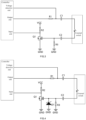
- Fig. 4 is a circuit diagram of another switch detection circuit according to an embodiment of the present invention.
- the switch detection circuit when a first end of the external switch is connected to a DC power supply, the switch detection circuit further includes a Zener diode D1.
- a cathode of the Zener diode D1 is connected to the control end of the switch tube Q1, and an anode of the Zener diode D1 is configured to be grounded.
- the capacitor C2 has the characteristics of passing AC and blocking DC and passing high frequency and blocking low frequency, the capacitor C2 is equivalent to a conductive wire at the moment when the external switch 12 is closed.
- Fig. 5 is a circuit diagram of another switch detection circuit according to an embodiment of the present invention.
- the switch detection circuit when a second end of the external switch is connected to a DC power supply, the switch detection circuit further includes a Zener diode D2.
- a cathode of the Zener diode D2 is connected to a second end of the resistor R1, and an anode of the Zener diode D2 is configured to be grounded.
- the capacitor C1 has the characteristics of passing AC and blocking DC and passing high frequency and blocking low frequency, the capacitor C1 is equivalent to a conductive wire at the moment when the external switch 12 is closed.
- Fig. 6 is a circuit diagram of yet another switch detection circuit according to an embodiment of the present invention.
- the switch detection circuit further includes Zener diodes DI and D2.
- a cathode of the Zener diode D1 is connected to the control end of the switch tube Q1, an anode of the Zener diode D1 is configured to be grounded.
- a cathode of the Zener diode D2 is connected to the second end of the resistor R1, and an anode of the Zener diode D2 is configured to be grounded.
- the capacitor C1 and the capacitor C2 are equivalent to conductive wires at the moment when the external switch 12 is closed.
- a second end of the resistor R1 is connected to the Zener diode D2 and the control end of the switch tube Q1 is connected to the Zener diode D1, so that the current in the DC power supply can directly flow out through the Zener diode, thereby avoiding misjudgment.
- Fig. 7 is a flowchart of a switch detection method according to an embodiment of the present invention, wherein the switch detection method is applied to the above-mentioned switch detection circuit.
- the switch detection method includes the following steps: S01, outputting a pulse signal and successively passing the pulse signal through the first DC isolation module, the external switch and the second DC isolation module, so that the signal conditioning module outputs a feedback signal according to the electrical signal output by the second DC isolation module.
- the pulse signal is periodically outputted through the output end of the controller.
- the pulse signal refers to an electrical signal continuously emitted according to a certain voltage amplitude and time interval.
- the pulse signal includes but is not limited to, a square wave signal, and the square wave signal outputs high and low levels at intervals, wherein, the square wave signal has rising edges and falling edges because of the jumping between the high and low-level in the square wave signal.
- the current in the first DC isolation module and the second DC isolation module change according to the level of the pulse signal.
- the pulse signal is at a rising edge, the first DC isolation module is in a short-circuit state, equivalent to a conductive wire.
- the pulse signal flows out to a control end of the signal conditioning module via the first DC isolation module, the external switch, and the second DC isolation module.
- the pulse signal is at a high level
- the first DC isolation module starts charging.
- the external switch is in an on-state
- the first DC isolation module and the second DC isolation module are equivalent to energy storage devices, and no current flows out from the first DC isolation module and the second DC isolation module.
- the pulse signal is at a falling edge or a low-level signal, the first DC isolation module and the second DC isolation module are in an open circuit state, and no current flows out in the first DC isolation module and the second DC isolation module.
- the signal conditioning module when a current flows out from the second DC isolation module, the current directly flows into the control end of the signal conditioning module so as to control the signal conditioning module to be turned on. At this moment, the input end of the controller is connected to a ground end through the signal conditioning module, namely, the input end of the controller receives a low-level signal.
- the signal conditioning module When no current flows out in the second DC isolation module, the signal conditioning module is in a cut-off state, and the input end of the controller is connected to the power supply via the signal conditioning module, namely, the input end of the controller receives the high-level signal.
- the feedback signal means that the received level signal jumps from a low level to a high level, namely, if the input end of the controller receives a low-level signal and then receives a high-level signal, the controller performs counting.
- Fig. 2 is a schematic diagram of pulse counting in a switch detection circuit according to an embodiment of the present invention.
- the counting refers to counting the number of times a low-level signal is received at the input end of the controller over a period of time.
- the selected time period is any time period for outputting pulse signals, and the specific time period can be set by a user according to requirements.
- the controller counts according to the jump of the level signal, records the count value and compares the size of the count value with a preset threshold value. Wherein when the count value is greater than the preset count threshold value, it is judged that the external switch is in an on state, and when the count value is less than the preset count threshold value, it is judged that the external switch is in an off state. In this way, detection of the switch state can be achieved, and the introduction of a preset count threshold value can reduce misjudgment.
- the switch detection method further includes determining whether the external switch has a fault.
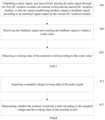
- Fig. 8 is a flowchart of external switch fault detection in a switch detection method according to an embodiment of the present invention. As shown in Fig. 8 , the switch detection method includes: S11 acquiring a sampled voltage at the rising edge of the pulse signal.
- the sampled voltage refers to the voltage collected at the voltage detection terminal of the controller when the rising edge of the pulse signal is output at the output end of the controller, that is, the sum of the voltage of the external switch and the voltage of the resistor R3.
- the acquisition mode of the sampled voltage may also include: acquiring a voltage value across the resistor R1, then acquiring the voltage value of the pulse signal, subtracting the voltage value of the resistor R1 from the voltage value of the pulse signal to obtain a difference, i.e. the voltage value of the sampled voltage.
- the resistance value of the external switch is calculated according to the sampled voltage.
- the calculation formula of the resistance value R ex of the external switch is as follow: where U is the sampled voltage, U 0 is the voltage value of the pulse signal, R 1 is the resistance value of the resistor R1, and R 3 is the resistance value of the resistor R3.
- the resistance value of the external switch is calculated and the magnitude of the resistance value of the external switch is judged. If the resistance value of the external switch is less than a first preset resistance value, then the external switch is in a normally conductive state; and if the resistance value of the external switch is greater than the first preset resistance value and less than a second preset resistance value, then the external switch is in a fault conductive state. When the external switch is in a cut-off state, the resistance value of the external switch is calculated and the magnitude of the resistance value of the external switch is judged.
- the external switch is in a normal cut-off or fault cut-off or a second end short-circuit cut-off state. If the sampled voltage gradually rises to the pulse signal voltage value, the external switch is in a first end short-circuit cut-off state and/or a first end short-circuit conductive state and/or a second end short-circuit conductive state.
- the first preset resistance value may be set to zero and the second preset resistance value may be set to infinity.
- the embodiment of the present invention provides a switch detection method, which includes: outputting a pulse signal, and sequentially passing the pulse signal through the first DC isolation module, the external switch, and the second DC isolation module, so that the signal conditioning module outputs a feedback signal according to the electrical signal output by the second DC isolation module, then counting according to the signal fed back by the signal conditioning module to obtain a count value, and finally detecting the working state of the external switch according to the count value.
- the switch detection method includes: outputting a pulse signal, and sequentially passing the pulse signal through the first DC isolation module, the external switch, and the second DC isolation module, so that the signal conditioning module outputs a feedback signal according to the electrical signal output by the second DC isolation module, then counting according to the signal fed back by the signal conditioning module to obtain a count value, and finally detecting the working state of the external switch according to the count value.
- Embodiments of the present invention also provide a switch detector comprising the above-mentioned switch detection circuit.
- the switch detector outputs a pulse signal via an output end of a controller, then an input end of the controller receives a feedback signal and counts.
- the on/off of the switch can be judged via the count value, thereby avoiding the use of an optical coupling DC isolation module for detection, reducing the cost of the circuit.
- the resistance value of the switch is detected via a voltage detection end of the controller, so that the switch detector can judge whether the switch has a fault while detecting the on/off of the switch.
Landscapes
- Engineering & Computer Science (AREA)
- Power Engineering (AREA)
- Manufacturing & Machinery (AREA)
- Chemical & Material Sciences (AREA)
- Chemical Kinetics & Catalysis (AREA)
- Electrochemistry (AREA)
- General Chemical & Material Sciences (AREA)
- Physics & Mathematics (AREA)
- General Physics & Mathematics (AREA)
- Electronic Switches (AREA)
- Testing Electric Properties And Detecting Electric Faults (AREA)
- Keying Circuit Devices (AREA)
Description
- The present invention relates to the field of new energy battery energy storage systems, and in particular to a switch detection circuit, method, and switch detector.
- In a new energy battery energy storage system, a battery management system (BMS) usually has a switch on-off detection function, for example, for detecting whether a high-voltage connector has been reliably plugged, whether a door access switch has been closed, etc.
- The existing detection methods require a set of an isolated power supply, an isolated optical coupler, or a digital isolator to detect the state of a switch, while the cost of providing the isolated power supply, the isolated optical coupler, or the digital isolator is relatively high.
-
CN207488457U discloses a high voltage direct current contactor break -make detecting system, including controller, signal coupled electric capacity and signal detection electric capacity, the signal output part of controller with the one end of signal coupled electric capacity is connected, the other end and the input of high voltage direct current contactor of signal coupled electric capacity are connected, the output of high voltage direct current contactor with the one end of signal detection electric capacity is connected, the other end of signal detection electric capacity with the signal detection end of controller is connected. -
CN 111220930A discloses a device for detecting the on-off states of a contactor and a fuse of an electric vehicle. The device comprises a transformer, a coupling capacitor, a signal generation, and a signal evaluation device. A secondary side of the transformer is connected to two ends of a to-be-detected device that is a contactor or a fuse. The coupling capacitor is arranged between the secondary side of the transformer and the to-be-detected device. The signal generator is connected to the primary side of the transformer and is used for generating a test signal; and the signal evaluation device is connected to the primary side of the transformer and is used for acquiring a feedback signal of the primary side and judging the on-off state of the to-be-detected device according to the feedback signal. The invention further discloses a method for detecting the on-off states of the contactor and the fuse of the electric vehicle. -
CN111913132A discloses a loop on-off state detection device and method. A detection signal is sent to a detected loop contact point and a detection signal isolation coupler through an isolation capacitor I; the detection signal isolation coupler receives a feedback signal of the detected loop contact point through an isolation capacitor II, couples the feedback signal with the received detection signal, and sends a coupling result to a detection signal receiving processor; the detection signal receiving processor analyzes the coupling result, and if the detection signal receiving processor receives the detection signal, it is considered that the detected loop contact point is in a conducting state, otherwise, the detected loop contact point is in a disconnected state. The detection process does not need to depend on the state of a detection object, is direct detection, and does not need to be realized by virtue of state parameters, such as voltage, current and temperature of the detected loop contact point or an auxiliary device. - Therefore, the existing technology needs to be further improved.
- The embodiments of the present invention mainly solve the technical problem of the high cost of the switch detection circuit in the prior art.
- In order to solve the above technical problem, one technical solution adopted by the embodiments of the present invention is to disclose a switch detection circuit including a controller, a first DC isolation module, a second DC isolation module, and a signal conditioning module;
- an output end of the controller is connected to a first end of an external switch via the first DC isolation module, a control end of the signal conditioning module is connected to a second end of the external switch via the second DC isolation module, and an output end of the signal conditioning module is connected to an input end of the controller;
- the output end of the controller is configured to output a pulse signal, and transmit the pulse signal to the second DC isolation module via the first DC isolation module and the external switch; and
- the signal conditioning module is configured to output a feedback signal to the input end of the controller according to an electrical signal output by the second DC isolation module, and the controller is also configured to count the received feedback signal to obtain a count value, and detect a working state of the external switch according to the count value;
- the first DC isolation module is a capacitor C1, the second DC isolation module is a capacitor C2;
- the switch detection circuit further comprises a resistor R1 and a resistor R3; and
- a first end of the resistor R1 is connected to the output end of the controller, and a second end of the resistor R1 is connected to the first end of the capacitor C1; a first end of the resistor R3 is connected to the second end of the capacitor C2, and a second end of the resistor R3 is configured to be grounded;
- a voltage detection end of the controller is connected to the second end of the resistor R1; and
- the controller is configured to detect a sampled voltage at the second end of the resistor R1 at rising edge of the pulse signal and determine whether the external switch has a fault based on the sampled voltage and the count value.
- Based on the said switch detection circuit described in paragraphs 0009 to 0017,a first end of the capacitor C1 is connected to the output end of the controller, and a second end of the capacitor C1 is connected to the first end of the external switch; the second end of the external switch is connected to a first end of the capacitor C2, and a second end of the capacitor C2 is connected to the control end of the signal conditioning module.
- Based on the said switch detection circuit described in paragraphs 0009 to 0018, the signal conditioning module includes a switch tube Q1 and a resistor R2; and
a control end of the switch tube Q1 is connected to the second end of the capacitor C2, and a first end of the switch tube Q1 is connected to the input end of the controller and a second end of the resistor R2; a second end of the switch tube Q1 is configured to be grounded, and a first end of the resistor R2 is configured to be connected to a power supply. - In order to solve the above technical problem, one technical solution adopted by the embodiments of the present invention is to provide a switch detection method applied to the said switch detection circuit described in paragraphs 0009 to 0020, the method comprising:
- outputting a pulse signal, and successively passing the pulse signal through the first DC isolation module, the external switch, and the second DC isolation module, so that the signal conditioning module outputs a feedback signal according to an electrical signal output by the second DC isolation module;
- receiving the feedback signal and counting the feedback signal to obtain a count value; and
detecting a working state of the external switch according to the count value - acquiring a sampled voltage at rising edge of the pulse signal; and
- determining whether the external switch has a fault according to the sampled voltage and the state of the external switch.
- Based on the said switch detection method described in paragraphs 0021 to 0025, the step of determining whether the external switch has a fault based on the sampled voltage and the working state of the external switch includes:
- calculating a resistance value of the external switch according to the sampled voltage; and
- determining whether the external switch has a fault according to the calculated resistance value and the working state of the external switch.
- Based on the said switch detection method described in paragraphs 0021 to 0028, the calculation formula of the resistance value Rex of the external switch is as follow:

wherein U is the sampled voltage, U0 is the voltage value of the pulse signal, R1 is the resistance value of the resistor R1, and R3 is the resistance value of the resistor R3. - In order to solve the above technical problem, one technical solution adopted by the embodiments of the present invention is to provide a switch detector comprising the said switch detection circuit described in paragraphs 0009 to 0020.
- Different from the case of related technology, the embodiments of the present invention provide a switch detection circuit, a method and a switch detector, wherein the switch detection circuit includes a controller, a first DC isolation module, a second DC isolation module and a signal conditioning module; an output end of the controller is connected to a first end of an external switch via the first DC isolation module, a control end of the signal conditioning module is connected to a second end of the external switch via the second DC isolation module, and an output end of the signal conditioning module is connected to an input end of the controller; the output end of the controller is configured to output a pulse signal, and transmit the pulse signal to the second DC isolation module via the first DC isolation module and the external switch; at this moment, if a current flows out from the second DC isolation module, the control end of the signal conditioning module outputs a feedback signal to the input end of the controller after receiving the current, and the controller counts according to the feedback signal, and detects the working state of the external switch according to the count value, so that the on/off of the external switch can be detected without using an optical coupling DC isolation module, thus reducing the circuit detection cost.
- One or more embodiments are illustrated by way of example in the accompanying drawings, which are not to be construed as limiting the embodiments, in which elements having the same reference numeral designations represent similar elements, and in which the figures are not to scale unless otherwise specified.
-
Fig. 1 is a structural block diagram of a switch detection circuit according to an embodiment of the present invention; -
Fig. 2 is a schematic diagram of pulse counting in a switch detection circuit according to an embodiment of the present invention; -
Fig. 3 is a circuit diagram of a switch detection circuit according to an embodiment of the present invention; -
Fig. 4 is a circuit diagram of another switch detection circuit according to an embodiment of the present invention; -
Fig. 5 is a circuit diagram of another switch detection circuit according to an embodiment of the present invention; -
Fig. 6 is a circuit diagram of yet another switch detection circuit according to an embodiment of the present invention; -
Fig. 7 is a flowchart of a switch detection method according to an embodiment of the present invention; and -
Fig. 8 is a flowchart of external switch fault detection in a switch detection method according to an embodiment of the present invention. - In order that the objects, aspects, and advantages of the present invention will become more apparent, the present invention will be further described in detail with reference to the accompanying drawings and embodiments. It should be understood that the specific embodiments described herein are illustrative only and are not limiting.
- It will be appreciated that various features of the embodiments of the present invention can be combined with one another without departing from the scope of the invention. In addition, although the functional modules are divided in the schematic diagram of the apparatus, and the logical sequence is shown in the flowchart, in some cases, the division of the modules may be different from that in the schematic diagram of the apparatus, or the sequence may be performed differently from that shown or described in the flowchart.
- Unless defined otherwise, all technical and scientific terms used herein have the same meaning as commonly understood by one of ordinary skill in the art to which the present invention belongs. The terminology used in the description of the invention herein is for the purpose of describing particular embodiments only and is not intended to limit the present invention. As used herein, the term "and/or" includes any and all combinations of one or more of the associated listed items.
- Reference is made to
Fig. 1 , which is a structural block diagram of a switch detection circuit according to an embodiment of the present invention. As shown inFig. 1 , the switch detection circuit includes acontroller 11, anexternal switch 12, a first direct current (DC) isolation module 14, a secondDC isolation module 15, and a signal conditioning module 13, wherein thecontroller 11 includes an input end, an output end, and a voltage detection end. - Specifically, an output end of the
controller 11 is connected to a first end of theexternal switch 12 via the first DC isolation module 14. A control end of the signal conditioning module 13 is connected to a second end of theexternal switch 12 via the secondDC isolation module 15. An output end of the signal conditioning module 13 is connected to an input end of thecontroller 11. - The output end of the
controller 11 is configured to output a pulse signal, and transmit the pulse signal to the secondDC isolation module 15 via the first DC isolation module 14 and theexternal switch 12. Specifically, the pulse signal refers to an electrical signal continuously emitted according to a certain voltage amplitude and time interval. The pulse signal includes but is not limited to a square wave signal, and the square wave signal outputs high and low levels at intervals, wherein, the square wave signal has rising edges and falling edges because of the jumping between high and low level in the square wave signal. - The first DC isolation module 14 and the second
DC isolation module 15 both have the property of passing alternating current (AC) and blocking DC, namely, the first DC isolation module 14 and the secondDC isolation module 15 are both configured to pass AC and block DC. Specifically, the first DC isolation module 14 and the secondDC isolation module 15 are also configured to isolate DC connected to theexternal switch 12, so as to prevent the power supply connected to theexternal switch 12 from interfering with the detection result or damaging components in the detection circuit. The current transmitted by the first DC isolation module 14 varies according to the height of the pulse signal. When the pulse signal is at a rising edge, since the first DC isolation module 14 has the characteristics of passing AC and blocking DC, and passing high frequency and blocking low frequency, the first DC isolation module 14 is equivalent to a conductive wire. The pulse signal flows into theexternal switch 12 via the first DC isolation module 14. When theexternal switch 12 is turned on, the pulse signal will flow into the secondDC isolation module 15 through the first DC isolation module 14. At this moment, the level of the secondDC isolation module 15 jumps, and the secondDC isolation module 15 is equivalent to a conductive wire so that the pulse signal flows out from the first DC isolation module 14 and is transmitted to a control end of the signal conditioning module 13 via the secondDC isolation module 15. When the pulse signal continuously outputs the high-level signal to the first DC isolation module 14, the first DC isolation module 14 starts charging. At this moment, if theexternal switch 12 is turned on, the first DC isolation module 14 and the secondDC isolation module 15 are equivalent to energy storage devices, and no current flows out from the first DC isolation module 14 and the secondDC isolation module 15. When the pulse signal is at a falling edge or a low-level signal, the first DC isolation module 14 is in an open circuit state, no current flows out in the first DC isolation module 14, and in turn, no current is transmitted to the signal conditioning module 13 via the secondDC isolation module 15 regardless of the working state of theexternal switch 12. Note that, in the present embodiment, the electrical signal output by the secondDC isolation module 15 is a current signal actually output by the secondDC isolation module 15 when the controller outputs a pulse signal. - As shown in
Fig. 3 , the first DC isolation module 14 is a capacitor C1, and the secondDC isolation module 15 is a capacitor C2. A first end of the capacitor C1 is connected to the output end of thecontroller 11, and a second end of the capacitor C1 is connected to the first end of theexternal switch 12. The second end of theexternal switch 12 is connected to a first end of the capacitor C2, and a second end of the capacitor C2 is connected to the control end of the signal conditioning module 13. - Specifically, the capacitor C1 and capacitor C2 are isolation capacitors, and have the functions of passing AC and blocking DC, and passing high frequency and blocking low frequency. Under a high-frequency signal, the capacitors C1 and C2 exhibit a low impedance characteristic, that is to say, when a pulse signal output by the output end of the
controller 11 is at a rising edge, the capacitor C1 exhibits the low impedance characteristic, and the pulse signal can directly flow out through the capacitor C1. When theexternal switch 12 is turned on, the pulse signal flows into the capacitor C2 through theexternal switch 12, and the capacitor C2 also has a current flowing out. If theexternal switch 12 is in an off state, no current flows out of the capacitor C2. When the output end of thecontroller 11 continuously outputs a high-level signal, the pulse signal flows into the capacitor C1 to start charging the capacitor C1, and no current flows out from the capacitor C1. At this moment, no current exists in the capacitor C2 regardless of whether theexternal switch 12 is turned on. When the output end of thecontroller 11 is a falling edge or a continuous low-level signal, the capacitor has a high impedance characteristic. The pulse signal is isolated by the capacitor C1, so no current flows out of the capacitor C1. At this moment, no current exists in the capacitor C2 regardless of whether theexternal switch 12 is turned on. Note that in an energy storage power supply, the external switch is usually connected to a DC power supply provided by a battery. A switch on/off detection circuit provided in the present invention can effectively isolate the DC power supply connected to the external switch by providing capacitors C1 and C2, so as to avoid the DC power supply interfering with the detection result, and better protect the detection circuit. - The signal conditioning module 13 is configured to output a feedback signal to the input end of the
controller 11 according to the electrical signal output by the secondDC isolation module 15. Thecontroller 11 is also configured to count the received feedback signal to obtain a count value, and detect the working state of theexternal switch 12 according to the count value. - Specifically, when a current flows out from the second
DC isolation module 15, the current directly flows into the control end of the signal conditioning module 13 so as to control the signal conditioning module 13 to be turned on. At this moment, the input end of thecontroller 11 is connected to a ground end, namely, the input end of thecontroller 11 receives a low-level signal. When no current flows out in the secondDC isolation module 15, the signal conditioning module 13 is in a cut-off state, and the input end of thecontroller 11 is connected to the power supply via the signal conditioning module 13, namely, the input end of thecontroller 11 receives the high-level signal. Reference is made toFig. 2 , which is a schematic diagram of pulse counting in a switch detection circuit according to an embodiment of the present invention. The vertical axis of the pulse count is the voltage value of the pulse signal and the horizontal axis is time. The counting refers to counting the number of times a low-level signal is received at the input end of thecontroller 11 over a period of time. Specifically, the selected time period is any time period for outputting pulse signals, and the specific time period can be set by a user according to requirements. - As shown in
Fig. 3 , the signal conditioning module 13 includes a switch tube Q1 and a resistor R2. A control end of the switch tube Q1 is connected to a second end of the capacitor C2. A first end of the switch tube Q1 is connected to the input end of thecontroller 11 and a second end of the resistor R2. A second end of the switch tube Q1 is configured to be grounded. A first end of the resistor R2 is configured to be connected to a power supply. - Specifically, when a current flows out of the capacitor C2, the current flows into the control end of the switch tube Q1, and in turn, the switch tube Q1 is turned on. The input end of the
controller 11 is grounded via the switch tube Q1 so as to receive a low-level signal. When no current flows out of the capacitor C2, the switch Q1 is in a cut-off state, and the input end of thecontroller 11 is connected to the power supply via the resistor R2 so as to receive a high-level signal. - In some embodiments, the
controller 11 is configured to judge whether the count value is greater than a preset count threshold value. When the count value is greater than the preset count threshold value, it is judged that theexternal switch 12 is in an on state, and when the count value is less than the preset count threshold value, it is judged that theexternal switch 12 is in an off state. In this way, detection of the switch state can be achieved, and the introduction of a preset count threshold value can reduce misjudgment. Further, thecontroller 11 is configured to count according to the number of low-level signals received at its input end, record the count value, and compare the count value with the size of a preset threshold value. Note that the preset count threshold is related to the number of pulses of the output pulse signal, and the preset count threshold value is equal to or slightly smaller than the number of pulses of the pulse signal. Normally, when theexternal switch 12 is normally turned on, the number of pulses output by the output end of thecontroller 11 in a period of time is equal to the number of low levels received by the input end of thecontroller 11, wherein the number of pulses can be understood as the number of rising edges of the pulse signal, and the number of low levels received can be understood as the count value. The preset count threshold value is used as a determination basis, which can improve the accuracy of on/off detection of the switch and reduce misjudgment. - In some embodiments, the switch detection circuit may also determine whether the
external switch 12 has a fault by detecting the resistance value of theexternal switch 12. Specifically, reference is made toFig. 3 , which is a circuit diagram of a switch detection circuit according to an embodiment of the present invention. As shown inFig. 3 , the switch detection circuit further includes a resistor R1 and a resistor R3. A first end of the resistor R1 is connected to the output end of thecontroller 11, and a second end of the resistor R1 is respectively connected to the first end of the capacitor C1 and a voltage detection end of thecontroller 11. A first end of the resistor R3 is connected to the second end of the capacitor C2, and a second end of the resistor R3 is configured to be grounded. - Specifically, when the rising edge of the pulse signal is output at the output end of the
controller 11, the sampled voltage across the second end of the resistor R1, i.e. the sum of the resistor R3 and the voltage on theexternal switch 12, is detected through the voltage detection end of thecontroller 11. Then whether theexternal switch 12 has a fault is determined through the sampled voltage and the count value. Wherein when a pulse signal output at the output end of thecontroller 11 is at the rising edge, the sum of voltages across theexternal switch 12 and the resistor R3 is collected. Then the resistance value on theexternal switch 12 is calculated according to the sum of the voltages. Whether theexternal switch 12 has a fault is determined according to the size of the resistance value. - An embodiment of the present invention provides a switch detection circuit, wherein the switch detection circuit includes a controller, a first DC isolation module, a second DC isolation module and a signal conditioning module. An output end of the controller is connected to a first end of the external switch via the first DC isolation module. A control end of the signal conditioning module is connected to a second end of the external switch via the second DC isolation module. An output end of the signal conditioning module is connected to the input end of the controller. The output end of the controller is configured to output a pulse signal, and transmit the pulse signal to the second DC isolation module via the first DC isolation module and the external switch; at this moment, if a current flows out from the second DC isolation module, the control end of the signal conditioning module outputs a feedback signal to the input end of the controller after receiving the current, and the controller counts according to the feedback signal and detects the working state of the external switch according to the count value, so that the on/off of the external switch can be detected without using an optical coupling DC isolation module, thus reducing the circuit detection cost.
- In some embodiments, reference is made to
Fig. 4 , which is a circuit diagram of another switch detection circuit according to an embodiment of the present invention. As shown inFig. 4 , when a first end of the external switch is connected to a DC power supply, the switch detection circuit further includes a Zener diode D1. A cathode of the Zener diode D1 is connected to the control end of the switch tube Q1, and an anode of the Zener diode D1 is configured to be grounded. Specifically, when the first end of theexternal switch 12 is connected to a DC power supply, since the capacitor C2 has the characteristics of passing AC and blocking DC and passing high frequency and blocking low frequency, the capacitor C2 is equivalent to a conductive wire at the moment when theexternal switch 12 is closed. At this moment, no matter whether theexternal switch 12 has a fault or not, a current in the DC power supply will flow into a control end of the switch tube Q1 to control the on/off of switch tube Q1, so that the input end of thecontroller 11 receives a feedback signal, and thecontroller 11 generates a misjudgment. Therefore, by connecting a Zener diode D1 at the control end of the switch tube Q1, the current in the DC power supply can directly flow out through the Zener diode D1 at the moment when theexternal switch 12 is closed, thereby avoiding misjudgment. - In another embodiment, reference is made to
Fig. 5 , which is a circuit diagram of another switch detection circuit according to an embodiment of the present invention. As shown inFig. 5 , when a second end of the external switch is connected to a DC power supply, the switch detection circuit further includes a Zener diode D2. A cathode of the Zener diode D2 is connected to a second end of the resistor R1, and an anode of the Zener diode D2 is configured to be grounded. Specifically, when the second end of theexternal switch 12 is connected to a DC power supply, since the capacitor C1 has the characteristics of passing AC and blocking DC and passing high frequency and blocking low frequency, the capacitor C1 is equivalent to a conductive wire at the moment when theexternal switch 12 is closed. At this moment, the current in the DC power supply will directly flow into the output end of the controller. Therefore, by connecting a Zener diode D2 at the second end of the resistor R1, the current in the DC power supply can flow out through the Zener diode D2 at the moment when theexternal switch 12 is closed. - In yet another embodiment, reference is made to
Fig. 6 , which is a circuit diagram of yet another switch detection circuit according to an embodiment of the present invention. As shown inFig. 6 , the switch detection circuit further includes Zener diodes DI and D2. Wherein a cathode of the Zener diode D1 is connected to the control end of the switch tube Q1, an anode of the Zener diode D1 is configured to be grounded. A cathode of the Zener diode D2 is connected to the second end of the resistor R1, and an anode of the Zener diode D2 is configured to be grounded. Specifically, when theexternal switch 12 is connected to a DC power supply, the capacitor C1 and the capacitor C2 are equivalent to conductive wires at the moment when theexternal switch 12 is closed. At this moment, a second end of the resistor R1 is connected to the Zener diode D2 and the control end of the switch tube Q1 is connected to the Zener diode D1, so that the current in the DC power supply can directly flow out through the Zener diode, thereby avoiding misjudgment. - Reference is made to
Fig. 7 , which is a flowchart of a switch detection method according to an embodiment of the present invention, wherein the switch detection method is applied to the above-mentioned switch detection circuit. As shown inFig. 7 , the switch detection method includes the following steps:
S01, outputting a pulse signal and successively passing the pulse signal through the first DC isolation module, the external switch and the second DC isolation module, so that the signal conditioning module outputs a feedback signal according to the electrical signal output by the second DC isolation module. - Specifically, the pulse signal is periodically outputted through the output end of the controller. The pulse signal refers to an electrical signal continuously emitted according to a certain voltage amplitude and time interval. The pulse signal includes but is not limited to, a square wave signal, and the square wave signal outputs high and low levels at intervals, wherein, the square wave signal has rising edges and falling edges because of the jumping between the high and low-level in the square wave signal. Wherein the current in the first DC isolation module and the second DC isolation module change according to the level of the pulse signal. When the pulse signal is at a rising edge, the first DC isolation module is in a short-circuit state, equivalent to a conductive wire. At this moment, if the external switch is in an on-state, the pulse signal flows out to a control end of the signal conditioning module via the first DC isolation module, the external switch, and the second DC isolation module. When the pulse signal is at a high level, the first DC isolation module starts charging. At this moment, if the external switch is in an on-state, the first DC isolation module and the second DC isolation module are equivalent to energy storage devices, and no current flows out from the first DC isolation module and the second DC isolation module. When the pulse signal is at a falling edge or a low-level signal, the first DC isolation module and the second DC isolation module are in an open circuit state, and no current flows out in the first DC isolation module and the second DC isolation module.
- Specifically, when a current flows out from the second DC isolation module, the current directly flows into the control end of the signal conditioning module so as to control the signal conditioning module to be turned on. At this moment, the input end of the controller is connected to a ground end through the signal conditioning module, namely, the input end of the controller receives a low-level signal. When no current flows out in the second DC isolation module, the signal conditioning module is in a cut-off state, and the input end of the controller is connected to the power supply via the signal conditioning module, namely, the input end of the controller receives the high-level signal.
- S02, receiving the feedback signal and counting the feedback signal to obtain a count value.
- Specifically, the feedback signal means that the received level signal jumps from a low level to a high level, namely, if the input end of the controller receives a low-level signal and then receives a high-level signal, the controller performs counting. Reference is made to
Fig. 2 , which is a schematic diagram of pulse counting in a switch detection circuit according to an embodiment of the present invention. The counting refers to counting the number of times a low-level signal is received at the input end of the controller over a period of time. Specifically, the selected time period is any time period for outputting pulse signals, and the specific time period can be set by a user according to requirements. - S03. detecting a working state of the external switch according to the count value.
- Specifically, the controller counts according to the jump of the level signal, records the count value and compares the size of the count value with a preset threshold value. Wherein when the count value is greater than the preset count threshold value, it is judged that the external switch is in an on state, and when the count value is less than the preset count threshold value, it is judged that the external switch is in an off state. In this way, detection of the switch state can be achieved, and the introduction of a preset count threshold value can reduce misjudgment.
- In some embodiments, the switch detection method further includes determining whether the external switch has a fault. Reference is made to
Fig. 8 , which is a flowchart of external switch fault detection in a switch detection method according to an embodiment of the present invention. As shown inFig. 8 , the switch detection method includes:
S11 acquiring a sampled voltage at the rising edge of the pulse signal. - Specifically, the sampled voltage refers to the voltage collected at the voltage detection terminal of the controller when the rising edge of the pulse signal is output at the output end of the controller, that is, the sum of the voltage of the external switch and the voltage of the resistor R3.
- In some embodiments, the acquisition mode of the sampled voltage may also include: acquiring a voltage value across the resistor R1, then acquiring the voltage value of the pulse signal, subtracting the voltage value of the resistor R1 from the voltage value of the pulse signal to obtain a difference, i.e. the voltage value of the sampled voltage.
- S12, determining whether the external switch has a fault according to the sampled voltage and the working state of the external switch.
- Specifically, the resistance value of the external switch is calculated according to the sampled voltage. The calculation formula of the resistance value Rex of the external switch is as follow:

- After calculating the resistance value of the external switch, whether the external switch has a fault is determined according to the resistance value of the external switch and the working state of the external switch.
- Specifically, whether the external switch is in an on-state or an off-state is judged according to the count value of the controller.
- When the external switch is in an on-state, the resistance value of the external switch is calculated and the magnitude of the resistance value of the external switch is judged. If the resistance value of the external switch is less than a first preset resistance value, then the external switch is in a normally conductive state; and if the resistance value of the external switch is greater than the first preset resistance value and less than a second preset resistance value, then the external switch is in a fault conductive state. When the external switch is in a cut-off state, the resistance value of the external switch is calculated and the magnitude of the resistance value of the external switch is judged. If the resistance value of the external switch is greater than the second preset resistance value, then the external switch is in a normal cut-off or fault cut-off or a second end short-circuit cut-off state. If the sampled voltage gradually rises to the pulse signal voltage value, the external switch is in a first end short-circuit cut-off state and/or a first end short-circuit conductive state and/or a second end short-circuit conductive state. Alternatively, the first preset resistance value may be set to zero and the second preset resistance value may be set to infinity.
- The embodiment of the present invention provides a switch detection method, which includes: outputting a pulse signal, and sequentially passing the pulse signal through the first DC isolation module, the external switch, and the second DC isolation module, so that the signal conditioning module outputs a feedback signal according to the electrical signal output by the second DC isolation module, then counting according to the signal fed back by the signal conditioning module to obtain a count value, and finally detecting the working state of the external switch according to the count value. Thus, in the case of not using an optical coupling DC isolation module, the on/off condition of the external switch is judged by the count value, reducing the detection cost of the circuit.
- It should be noted that in the above-mentioned various embodiments, there is not necessarily a certain order between the above-mentioned various steps. A person of ordinary skill in the art would have been able to understand according to the description of the embodiments of the present application that in different embodiments, the above-mentioned various steps can be performed in a different order, namely, can be performed in parallel, can be performed in exchange, etc.
- Embodiments of the present invention also provide a switch detector comprising the above-mentioned switch detection circuit. The switch detector outputs a pulse signal via an output end of a controller, then an input end of the controller receives a feedback signal and counts. The on/off of the switch can be judged via the count value, thereby avoiding the use of an optical coupling DC isolation module for detection, reducing the cost of the circuit. Further, the resistance value of the switch is detected via a voltage detection end of the controller, so that the switch detector can judge whether the switch has a fault while detecting the on/off of the switch.
Claims (7)
- A switch detection circuit, comprising a controller (11), a first DC isolation module (14), a second DC isolation module (15) and a signal conditioning module (13);wherein an output end of the controller (11) is configured to be connected to a first end of an external switch (12) via the first DC isolation module (14), a control end of the signal conditioning module (13) is configured to be connected to a second end of the external switch (12) via the second DC isolation module (15), and an output end of the signal conditioning module (13) is connected to an input end of the controller (11);the output end of the controller (11) is configured to output a pulse signal, and transmit the pulse signal to the second DC isolation module (15) via the first DC isolation module (14) and the external switch (12); characterized in thatthe signal conditioning module (13) is configured to output a feedback signal to the input end of the controller (11) according to an electrical signal output by the second DC isolation module (15), and the controller (11) is also configured to count the received feedback signal to obtain a count value, and detect a working state of the external switch (12) according to the count value;wherein the first DC isolation module (14) is a capacitor C1, the second DC isolation module (15) is a capacitor C2 and the switch detection circuit further comprises a resistor R1 and a resistor R3;wherein a first end of the resistor R1 is connected to the output end of the controller (11), and a second end of the resistor R1 is connected to the first end of the capacitor C1; a first end of the resistor R3 is connected to the second end of the capacitor C2, and a second end of the resistor R3 is configured to be grounded;wherein a voltage detection end of the controller (11) is connected to the second end of the resistor R1; and the controller (11) is configured to detect a sampled voltage of the second end of the resistor R1 at rising edge of the pulse signal, and determine whether the external switch (12) has a fault according to the sampled voltage and the count value.
- The switch detection circuit according to claim 1, characterized in that
a first end of the capacitor C1 is connected to the output end of the controller (11), and a second end of the capacitor C1 is configured to be connected to the first end of the external switch (12); a first end of the capacitor C2 is configured to be connected to the second end of the external switch (12), and a second end of the capacitor C2 is connected to the control end of the signal conditioning module (13). - The switch detection circuit according to claim 2, characterized in that the signal conditioning module (13) comprises a switch tube Q1 and a resistor R2; and
a control end of the switch tube Q1 is connected to the second end of the capacitor C2, and a first end of the switch tube Q1 is connected to the input end of controller and a second end of the resistor R2; a second end of the switch tube Q1 is configured to be grounded, and a first end of the resistor R2 is configured to be connected to a power supply. - A switch detection method applied to the switch detection circuit according to any one of claims 1 to 3, characterized in that the method comprises:outputting a pulse signal, and successively passing the pulse signal through the first DC isolation module (14), an external switch (12), and the second DC isolation module (15), so that the signal conditioning module (13) outputs a feedback signal according to an electrical signal output by the second DC isolation module (15);receiving the feedback signal and counting the feedback signal to obtain a count value; anddetecting a working state of the external switch (12) according to the count value;acquiring a sampled voltage at rising edge of the pulse signal; anddetermining whether the external switch (12) has a fault according to the sampled voltage and the working state of the external switch (12).
- The switch detection method according to claim 4, characterized in that the step of determining whether the external switch (12) has a fault according to the sampled voltage and the working state of the external switch (12) comprises:calculating a resistance value of the external switch (12) according to the sampled voltage; anddetermining whether the external switch (12) has a fault according to the calculated resistance value and the working state of the external switch (12).
- The switch detection method according to claim 8, characterized in that a calculation formula of the resistance value Rex of the external switch is as follow:

- A switch detector, characterized in that the switch detector comprises the switch detection circuit according to any one of claims 1-3.
Applications Claiming Priority (1)
| Application Number | Priority Date | Filing Date | Title |
|---|---|---|---|
| CN202210165686.4A CN114217220B (en) | 2022-02-23 | 2022-02-23 | A switch detection circuit, method and switch detector |
Publications (3)
| Publication Number | Publication Date |
|---|---|
| EP4235196A1 EP4235196A1 (en) | 2023-08-30 |
| EP4235196B1 true EP4235196B1 (en) | 2024-08-21 |
| EP4235196C0 EP4235196C0 (en) | 2024-08-21 |
Family
ID=80709343
Family Applications (1)
| Application Number | Title | Priority Date | Filing Date |
|---|---|---|---|
| EP22200359.2A Active EP4235196B1 (en) | 2022-02-23 | 2022-10-07 | Switch detection circuit, method and switch detector |
Country Status (4)
| Country | Link |
|---|---|
| US (1) | US11695284B1 (en) |
| EP (1) | EP4235196B1 (en) |
| JP (1) | JP7303359B1 (en) |
| CN (1) | CN114217220B (en) |
Families Citing this family (3)
| Publication number | Priority date | Publication date | Assignee | Title |
|---|---|---|---|---|
| CN117269758B (en) * | 2023-09-19 | 2025-04-29 | 青岛海洋科技中心 | Motor slip ring stator conductor and rotor conductor continuity test device and test method |
| CN119178950B (en) * | 2024-11-25 | 2025-04-01 | 四川泛华航空仪表电器有限公司 | A state monitoring system and method for an aircraft engine ignition device |
| CN119335384B (en) * | 2024-12-23 | 2025-05-20 | 济宁鲁科检测科技有限公司 | Working switch detection circuit and judgment method used in magnetic particle flaw detector |
Family Cites Families (15)
| Publication number | Priority date | Publication date | Assignee | Title |
|---|---|---|---|---|
| JPH07212969A (en) * | 1994-01-25 | 1995-08-11 | Amada Co Ltd | Rush current preventing circuit of power system |
| EP2149826B1 (en) | 2008-08-01 | 2011-11-30 | Siemens Aktiengesellschaft | Safety switching arrangement for outputting a switching signal |
| JP5910172B2 (en) * | 2012-03-01 | 2016-04-27 | 株式会社Gsユアサ | Switch failure diagnosis device, battery pack, switch failure diagnosis program, switch failure diagnosis method |
| CN203965585U (en) * | 2014-06-18 | 2014-11-26 | 深圳市沃泰克环保设备有限公司 | A kind of high-voltage switch gear pick-up unit |
| KR102051177B1 (en) * | 2016-10-19 | 2019-12-17 | 주식회사 엘지화학 | Apparatus and methode for switch diagnosis using voltage distribution |
| CN106569128B (en) * | 2016-11-03 | 2019-07-30 | 宁德时代新能源科技股份有限公司 | A detection method and device |
| CN206557343U (en) * | 2017-02-28 | 2017-10-13 | 国家电网公司 | A kind of device that the circuit-breaker switching on-off time is measured based on orthogonal pulses |
| CN107179500B (en) * | 2017-06-19 | 2020-06-02 | 国家电网公司 | Method for measuring switching-on and switching-off time when two ends of circuit breaker are grounded based on orthogonal pulse |
| CN107976626B (en) * | 2017-11-16 | 2019-12-06 | 湖南工业大学 | Relay life detection device |
| CN109814017A (en) * | 2017-11-20 | 2019-05-28 | 国网上海市电力公司 | IGBT on-off state detection circuit of three-phase commutation switch and its detection method and application |
| CN207488457U (en) * | 2017-11-20 | 2018-06-12 | 深圳市蓝海华腾技术股份有限公司 | A kind of high-voltage DC contactor break-make detecting system |
| KR102412313B1 (en) * | 2018-07-17 | 2022-06-22 | 주식회사 엘지에너지솔루션 | Apparatus and method for diagnosing switch |
| CN111220930A (en) * | 2018-11-23 | 2020-06-02 | 上海海拉电子有限公司 | Electric automobile contactor, and detection device and method for on-off state of fuse |
| CN209765017U (en) * | 2019-04-03 | 2019-12-10 | 福建金闽再造烟叶发展有限公司 | Relay detection device and tobacco sheet production system |
| CN111913132A (en) * | 2020-06-22 | 2020-11-10 | 南京康尼电子科技有限公司 | Loop on-off state detection device and method |
-
2022
- 2022-02-23 CN CN202210165686.4A patent/CN114217220B/en active Active
- 2022-09-14 US US17/944,350 patent/US11695284B1/en active Active
- 2022-09-16 JP JP2022148473A patent/JP7303359B1/en active Active
- 2022-10-07 EP EP22200359.2A patent/EP4235196B1/en active Active
Also Published As
| Publication number | Publication date |
|---|---|
| CN114217220B (en) | 2022-05-17 |
| JP7303359B1 (en) | 2023-07-04 |
| US11695284B1 (en) | 2023-07-04 |
| JP2023122615A (en) | 2023-09-04 |
| CN114217220A (en) | 2022-03-22 |
| EP4235196C0 (en) | 2024-08-21 |
| EP4235196A1 (en) | 2023-08-30 |
Similar Documents
| Publication | Publication Date | Title |
|---|---|---|
| EP4235196B1 (en) | Switch detection circuit, method and switch detector | |
| EP1930737B1 (en) | Insulating resistance detection apparatus | |
| EP3598150B1 (en) | Insulation detection device and method for energy storage system | |
| US8988084B2 (en) | Device and method for monitoring at least one energy reserve capacitor in a restraint system | |
| EP2698641A2 (en) | Earth fault detection circuit and power source device | |
| CN107167690B (en) | Device and method for detecting broken wire of battery pack voltage acquisition system | |
| EP3779475B1 (en) | Insulation detection circuit and insulation detection method | |
| US10145885B2 (en) | Electrical leakage detection apparatus | |
| US6879164B2 (en) | Method and device for insulation monitoring of a DC network | |
| CN105510833A (en) | Storage battery health status detection method, device and system | |
| US20230228802A1 (en) | Method for detecting an electrical insulation fault between an electric power source and an electrical ground | |
| CN116979486A (en) | Isolation type switch power supply capable of triggering protection | |
| CN106314189B (en) | A charging and discharging circuit and automobile | |
| CN109283445B (en) | Insulation detection method and controller of energy storage type rail vehicle charging system | |
| EP4068545B1 (en) | Earth leakage detecting device, and vehicular power supply system | |
| EP4130761A1 (en) | Electricity leakage detection device and vehicle power supply system | |
| CN111239469B (en) | Impact signal detection circuit and alternating current power supply equipment | |
| EP4697543A1 (en) | Photovoltaic energy storage inverter and control method therefor | |
| CN114545165A (en) | High-voltage insulation detection device special for capacitive load | |
| EP4723412A1 (en) | Control circuit, control system and vehicle | |
| CN115575806B (en) | A power battery system state detection device and method | |
| CN217954552U (en) | Voltage abnormity detection device | |
| CN116160861A (en) | Insulation monitoring device, control method of insulation monitoring device and electric automobile | |
| CN114720801B (en) | Vehicle-mounted detection system | |
| CN211830308U (en) | Overvoltage protection system for energy storage power supply |
Legal Events
| Date | Code | Title | Description |
|---|---|---|---|
| PUAI | Public reference made under article 153(3) epc to a published international application that has entered the european phase |
Free format text: ORIGINAL CODE: 0009012 |
|
| STAA | Information on the status of an ep patent application or granted ep patent |
Free format text: STATUS: REQUEST FOR EXAMINATION WAS MADE |
|
| 17P | Request for examination filed |
Effective date: 20221007 |
|
| AK | Designated contracting states |
Kind code of ref document: A1 Designated state(s): AL AT BE BG CH CY CZ DE DK EE ES FI FR GB GR HR HU IE IS IT LI LT LU LV MC ME MK MT NL NO PL PT RO RS SE SI SK SM TR |
|
| GRAP | Despatch of communication of intention to grant a patent |
Free format text: ORIGINAL CODE: EPIDOSNIGR1 |
|
| STAA | Information on the status of an ep patent application or granted ep patent |
Free format text: STATUS: GRANT OF PATENT IS INTENDED |
|
| INTG | Intention to grant announced |
Effective date: 20240506 |
|
| RIC1 | Information provided on ipc code assigned before grant |
Ipc: H01H 9/02 20060101ALI20240422BHEP Ipc: G01R 31/327 20060101AFI20240422BHEP |
|
| GRAS | Grant fee paid |
Free format text: ORIGINAL CODE: EPIDOSNIGR3 |
|
| GRAA | (expected) grant |
Free format text: ORIGINAL CODE: 0009210 |
|
| STAA | Information on the status of an ep patent application or granted ep patent |
Free format text: STATUS: THE PATENT HAS BEEN GRANTED |
|
| AK | Designated contracting states |
Kind code of ref document: B1 Designated state(s): AL AT BE BG CH CY CZ DE DK EE ES FI FR GB GR HR HU IE IS IT LI LT LU LV MC ME MK MT NL NO PL PT RO RS SE SI SK SM TR |
|
| REG | Reference to a national code |
Ref country code: GB Ref legal event code: FG4D |
|
| REG | Reference to a national code |
Ref country code: CH Ref legal event code: EP |
|
| REG | Reference to a national code |
Ref country code: DE Ref legal event code: R096 Ref document number: 602022005464 Country of ref document: DE |
|
| REG | Reference to a national code |
Ref country code: IE Ref legal event code: FG4D |
|
| U01 | Request for unitary effect filed |
Effective date: 20240905 |
|
| U07 | Unitary effect registered |
Designated state(s): AT BE BG DE DK EE FI FR IT LT LU LV MT NL PT RO SE SI Effective date: 20240923 |
|
| U20 | Renewal fee for the european patent with unitary effect paid |
Year of fee payment: 3 Effective date: 20240927 |
|
| PG25 | Lapsed in a contracting state [announced via postgrant information from national office to epo] |
Ref country code: NO Free format text: LAPSE BECAUSE OF FAILURE TO SUBMIT A TRANSLATION OF THE DESCRIPTION OR TO PAY THE FEE WITHIN THE PRESCRIBED TIME-LIMIT Effective date: 20241121 |
|
| PG25 | Lapsed in a contracting state [announced via postgrant information from national office to epo] |
Ref country code: GR Free format text: LAPSE BECAUSE OF FAILURE TO SUBMIT A TRANSLATION OF THE DESCRIPTION OR TO PAY THE FEE WITHIN THE PRESCRIBED TIME-LIMIT Effective date: 20241122 Ref country code: PL Free format text: LAPSE BECAUSE OF FAILURE TO SUBMIT A TRANSLATION OF THE DESCRIPTION OR TO PAY THE FEE WITHIN THE PRESCRIBED TIME-LIMIT Effective date: 20240821 |
|
| PG25 | Lapsed in a contracting state [announced via postgrant information from national office to epo] |
Ref country code: IS Free format text: LAPSE BECAUSE OF FAILURE TO SUBMIT A TRANSLATION OF THE DESCRIPTION OR TO PAY THE FEE WITHIN THE PRESCRIBED TIME-LIMIT Effective date: 20241221 |
|
| PG25 | Lapsed in a contracting state [announced via postgrant information from national office to epo] |
Ref country code: HR Free format text: LAPSE BECAUSE OF FAILURE TO SUBMIT A TRANSLATION OF THE DESCRIPTION OR TO PAY THE FEE WITHIN THE PRESCRIBED TIME-LIMIT Effective date: 20240821 |
|
| PG25 | Lapsed in a contracting state [announced via postgrant information from national office to epo] |
Ref country code: ES Free format text: LAPSE BECAUSE OF FAILURE TO SUBMIT A TRANSLATION OF THE DESCRIPTION OR TO PAY THE FEE WITHIN THE PRESCRIBED TIME-LIMIT Effective date: 20240821 Ref country code: RS Free format text: LAPSE BECAUSE OF FAILURE TO SUBMIT A TRANSLATION OF THE DESCRIPTION OR TO PAY THE FEE WITHIN THE PRESCRIBED TIME-LIMIT Effective date: 20241121 |
|
| PG25 | Lapsed in a contracting state [announced via postgrant information from national office to epo] |
Ref country code: RS Free format text: LAPSE BECAUSE OF FAILURE TO SUBMIT A TRANSLATION OF THE DESCRIPTION OR TO PAY THE FEE WITHIN THE PRESCRIBED TIME-LIMIT Effective date: 20241121 Ref country code: PL Free format text: LAPSE BECAUSE OF FAILURE TO SUBMIT A TRANSLATION OF THE DESCRIPTION OR TO PAY THE FEE WITHIN THE PRESCRIBED TIME-LIMIT Effective date: 20240821 Ref country code: NO Free format text: LAPSE BECAUSE OF FAILURE TO SUBMIT A TRANSLATION OF THE DESCRIPTION OR TO PAY THE FEE WITHIN THE PRESCRIBED TIME-LIMIT Effective date: 20241121 Ref country code: IS Free format text: LAPSE BECAUSE OF FAILURE TO SUBMIT A TRANSLATION OF THE DESCRIPTION OR TO PAY THE FEE WITHIN THE PRESCRIBED TIME-LIMIT Effective date: 20241221 Ref country code: HR Free format text: LAPSE BECAUSE OF FAILURE TO SUBMIT A TRANSLATION OF THE DESCRIPTION OR TO PAY THE FEE WITHIN THE PRESCRIBED TIME-LIMIT Effective date: 20240821 Ref country code: GR Free format text: LAPSE BECAUSE OF FAILURE TO SUBMIT A TRANSLATION OF THE DESCRIPTION OR TO PAY THE FEE WITHIN THE PRESCRIBED TIME-LIMIT Effective date: 20241122 Ref country code: ES Free format text: LAPSE BECAUSE OF FAILURE TO SUBMIT A TRANSLATION OF THE DESCRIPTION OR TO PAY THE FEE WITHIN THE PRESCRIBED TIME-LIMIT Effective date: 20240821 |
|
| PG25 | Lapsed in a contracting state [announced via postgrant information from national office to epo] |
Ref country code: SM Free format text: LAPSE BECAUSE OF FAILURE TO SUBMIT A TRANSLATION OF THE DESCRIPTION OR TO PAY THE FEE WITHIN THE PRESCRIBED TIME-LIMIT Effective date: 20240821 |
|
| PG25 | Lapsed in a contracting state [announced via postgrant information from national office to epo] |
Ref country code: CZ Free format text: LAPSE BECAUSE OF FAILURE TO SUBMIT A TRANSLATION OF THE DESCRIPTION OR TO PAY THE FEE WITHIN THE PRESCRIBED TIME-LIMIT Effective date: 20240821 |
|
| PG25 | Lapsed in a contracting state [announced via postgrant information from national office to epo] |
Ref country code: SK Free format text: LAPSE BECAUSE OF FAILURE TO SUBMIT A TRANSLATION OF THE DESCRIPTION OR TO PAY THE FEE WITHIN THE PRESCRIBED TIME-LIMIT Effective date: 20240821 |
|
| PLBE | No opposition filed within time limit |
Free format text: ORIGINAL CODE: 0009261 |
|
| STAA | Information on the status of an ep patent application or granted ep patent |
Free format text: STATUS: NO OPPOSITION FILED WITHIN TIME LIMIT |
|
| PG25 | Lapsed in a contracting state [announced via postgrant information from national office to epo] |
Ref country code: MC Free format text: LAPSE BECAUSE OF FAILURE TO SUBMIT A TRANSLATION OF THE DESCRIPTION OR TO PAY THE FEE WITHIN THE PRESCRIBED TIME-LIMIT Effective date: 20240821 |
|
| 26N | No opposition filed |
Effective date: 20250522 |
|
| PG25 | Lapsed in a contracting state [announced via postgrant information from national office to epo] |
Ref country code: IE Free format text: LAPSE BECAUSE OF NON-PAYMENT OF DUE FEES Effective date: 20241007 |
|
| U20 | Renewal fee for the european patent with unitary effect paid |
Year of fee payment: 4 Effective date: 20250926 |
|
| U1N | Appointed representative for the unitary patent procedure changed after the registration of the unitary effect |
Representative=s name: SANTARELLI; FR |
|
| PG25 | Lapsed in a contracting state [announced via postgrant information from national office to epo] |
Ref country code: CY Free format text: LAPSE BECAUSE OF FAILURE TO SUBMIT A TRANSLATION OF THE DESCRIPTION OR TO PAY THE FEE WITHIN THE PRESCRIBED TIME-LIMIT; INVALID AB INITIO Effective date: 20221007 |
|
| PG25 | Lapsed in a contracting state [announced via postgrant information from national office to epo] |
Ref country code: HU Free format text: LAPSE BECAUSE OF FAILURE TO SUBMIT A TRANSLATION OF THE DESCRIPTION OR TO PAY THE FEE WITHIN THE PRESCRIBED TIME-LIMIT; INVALID AB INITIO Effective date: 20221007 |