EP4233770A2 - Roller module for medical robot, driving device for medical robot, and medical robot - Google Patents
Roller module for medical robot, driving device for medical robot, and medical robot Download PDFInfo
- Publication number
- EP4233770A2 EP4233770A2 EP23179538.6A EP23179538A EP4233770A2 EP 4233770 A2 EP4233770 A2 EP 4233770A2 EP 23179538 A EP23179538 A EP 23179538A EP 4233770 A2 EP4233770 A2 EP 4233770A2
- Authority
- EP
- European Patent Office
- Prior art keywords
- roller
- module
- unit
- driving
- roller unit
- Prior art date
- Legal status (The legal status is an assumption and is not a legal conclusion. Google has not performed a legal analysis and makes no representation as to the accuracy of the status listed.)
- Granted
Links
Images



Classifications
-
- A—HUMAN NECESSITIES
- A61—MEDICAL OR VETERINARY SCIENCE; HYGIENE
- A61B—DIAGNOSIS; SURGERY; IDENTIFICATION
- A61B34/00—Computer-aided surgery; Manipulators or robots specially adapted for use in surgery
- A61B34/30—Surgical robots
-
- A—HUMAN NECESSITIES
- A61—MEDICAL OR VETERINARY SCIENCE; HYGIENE
- A61B—DIAGNOSIS; SURGERY; IDENTIFICATION
- A61B34/00—Computer-aided surgery; Manipulators or robots specially adapted for use in surgery
- A61B34/30—Surgical robots
- A61B34/35—Surgical robots for telesurgery
-
- A—HUMAN NECESSITIES
- A61—MEDICAL OR VETERINARY SCIENCE; HYGIENE
- A61B—DIAGNOSIS; SURGERY; IDENTIFICATION
- A61B34/00—Computer-aided surgery; Manipulators or robots specially adapted for use in surgery
- A61B34/20—Surgical navigation systems; Devices for tracking or guiding surgical instruments, e.g. for frameless stereotaxis
-
- A—HUMAN NECESSITIES
- A61—MEDICAL OR VETERINARY SCIENCE; HYGIENE
- A61M—DEVICES FOR INTRODUCING MEDIA INTO, OR ONTO, THE BODY; DEVICES FOR TRANSDUCING BODY MEDIA OR FOR TAKING MEDIA FROM THE BODY; DEVICES FOR PRODUCING OR ENDING SLEEP OR STUPOR
- A61M25/00—Catheters; Hollow probes
- A61M25/01—Introducing, guiding, advancing, emplacing or holding catheters
- A61M25/0105—Steering means as part of the catheter or advancing means; Markers for positioning
- A61M25/0113—Mechanical advancing means, e.g. catheter dispensers
-
- A—HUMAN NECESSITIES
- A61—MEDICAL OR VETERINARY SCIENCE; HYGIENE
- A61M—DEVICES FOR INTRODUCING MEDIA INTO, OR ONTO, THE BODY; DEVICES FOR TRANSDUCING BODY MEDIA OR FOR TAKING MEDIA FROM THE BODY; DEVICES FOR PRODUCING OR ENDING SLEEP OR STUPOR
- A61M25/00—Catheters; Hollow probes
- A61M25/01—Introducing, guiding, advancing, emplacing or holding catheters
- A61M25/09—Guide wires
-
- A—HUMAN NECESSITIES
- A61—MEDICAL OR VETERINARY SCIENCE; HYGIENE
- A61M—DEVICES FOR INTRODUCING MEDIA INTO, OR ONTO, THE BODY; DEVICES FOR TRANSDUCING BODY MEDIA OR FOR TAKING MEDIA FROM THE BODY; DEVICES FOR PRODUCING OR ENDING SLEEP OR STUPOR
- A61M25/00—Catheters; Hollow probes
- A61M25/01—Introducing, guiding, advancing, emplacing or holding catheters
- A61M25/09—Guide wires
- A61M25/09041—Mechanisms for insertion of guide wires
-
- A—HUMAN NECESSITIES
- A61—MEDICAL OR VETERINARY SCIENCE; HYGIENE
- A61M—DEVICES FOR INTRODUCING MEDIA INTO, OR ONTO, THE BODY; DEVICES FOR TRANSDUCING BODY MEDIA OR FOR TAKING MEDIA FROM THE BODY; DEVICES FOR PRODUCING OR ENDING SLEEP OR STUPOR
- A61M25/00—Catheters; Hollow probes
- A61M25/10—Balloon catheters
-
- F—MECHANICAL ENGINEERING; LIGHTING; HEATING; WEAPONS; BLASTING
- F16—ENGINEERING ELEMENTS AND UNITS; GENERAL MEASURES FOR PRODUCING AND MAINTAINING EFFECTIVE FUNCTIONING OF MACHINES OR INSTALLATIONS; THERMAL INSULATION IN GENERAL
- F16H—GEARING
- F16H1/00—Toothed gearings for conveying rotary motion
- F16H1/02—Toothed gearings for conveying rotary motion without gears having orbital motion
- F16H1/20—Toothed gearings for conveying rotary motion without gears having orbital motion involving more than two intermeshing members
- F16H1/22—Toothed gearings for conveying rotary motion without gears having orbital motion involving more than two intermeshing members with a plurality of driving or driven shafts; with arrangements for dividing torque between two or more intermediate shafts
- F16H1/222—Toothed gearings for conveying rotary motion without gears having orbital motion involving more than two intermeshing members with a plurality of driving or driven shafts; with arrangements for dividing torque between two or more intermediate shafts with non-parallel axes
-
- F—MECHANICAL ENGINEERING; LIGHTING; HEATING; WEAPONS; BLASTING
- F16—ENGINEERING ELEMENTS AND UNITS; GENERAL MEASURES FOR PRODUCING AND MAINTAINING EFFECTIVE FUNCTIONING OF MACHINES OR INSTALLATIONS; THERMAL INSULATION IN GENERAL
- F16H—GEARING
- F16H25/00—Gearings comprising primarily only cams, cam-followers and screw-and-nut mechanisms
- F16H25/18—Gearings comprising primarily only cams, cam-followers and screw-and-nut mechanisms for conveying or interconverting oscillating or reciprocating motions
- F16H25/20—Screw mechanisms
-
- A—HUMAN NECESSITIES
- A61—MEDICAL OR VETERINARY SCIENCE; HYGIENE
- A61B—DIAGNOSIS; SURGERY; IDENTIFICATION
- A61B17/00—Surgical instruments, devices or methods
- A61B2017/00367—Details of actuation of instruments, e.g. relations between pushing buttons, or the like, and activation of the tool, working tip, or the like
- A61B2017/00398—Details of actuation of instruments, e.g. relations between pushing buttons, or the like, and activation of the tool, working tip, or the like using powered actuators, e.g. stepper motors, solenoids
-
- A—HUMAN NECESSITIES
- A61—MEDICAL OR VETERINARY SCIENCE; HYGIENE
- A61B—DIAGNOSIS; SURGERY; IDENTIFICATION
- A61B34/00—Computer-aided surgery; Manipulators or robots specially adapted for use in surgery
- A61B34/30—Surgical robots
- A61B2034/301—Surgical robots for introducing or steering flexible instruments inserted into the body, e.g. catheters or endoscopes
Definitions
- Embodiments of the inventive concept relate to a roller module for a medical robot, a driving device for a medical robot, and a medical robot.
- Medical surgery may include a scheme in which a surgical tool (e.g., a balloon catheter, etc.) is inserted into a body to treat a disease related to blood vessels (e.g., cardiovascular coronary artery and peripheral artery interventions).
- a surgical tool e.g., a balloon catheter, etc.
- a disease related to blood vessels e.g., cardiovascular coronary artery and peripheral artery interventions.
- X-rays based imaging should be performed to determine a location of the balloon catheter inserted into the body.
- a medical staff performing the surgery is exposed to a radiation of the X-ray.
- a medical staff may be protected from the X-ray radiation by controlling the medical robot through a radio signal in a space separate from a surgery site.
- the robot may be contaminated with a patient's biomaterial. For this reason, the medical robot is cleaned to remove contaminants. However, when the robot is not completely cleaned, infection of the contaminants into a body may occur.
- the general medical robot may not accurately transfer a catheter based on a radio signal.
- Embodiments of the inventive concept provide a medical robot that may be hygienic, and precisely transport the catheter, a driving device mounted on the medical robot, and a roller module mounted on the driving device.
- a roller module for a medical robot includes a driving unit, and a roller unit rotated by the driving unit while a rotation axis of the roller unit is a vertical direction, wherein the roller unit includes at least one roller, and at least one shaft independently coupled to the at least one roller of the roller unit and rotated by the driving unit, wherein the at least one roller of the roller unit has at least one hole or groove defined therein in which at least a portion of the at least one shaft of the roller unit is independently received.
- the at least one hole or groove of the at least one roller of the roller unit may extend in the vertical direction, wherein a horizontal cross-section of the at least one hole or groove of the at least one roller of the roller unit may correspond to a horizontal cross-section of the at least one shaft of the roller unit.
- Each of a shape of the horizontal cross-section of the at least one hole or groove of the at least one roller of the roller unit and a shape of the horizontal cross-section of the at least one shaft of the roller unit may have a shape extending in a first direction and a second direction in a horizontal plane and intersecting with each other at a center point in a right manner.
- the driving unit may include a first driving motor, wherein a rotation axis of the first driving motor of the driving unit and a rotation axis of the at least one shaft of the roller unit may be perpendicular to each other.
- the driving unit further may include a first driving shaft, wherein a spur gear of the first driving motor of the driving unit may mesh with a spur gear of the first driving shaft of the driving unit, wherein at least one bevel gear of the at least one shaft of the roller unit may independently mesh with at least one bevel gear of the first driving shaft of the driving unit.
- the roller unit may move in the vertical direction by the driving unit.
- the roller unit further may include a screw, a nut meshing with the screw of the roller unit, and a casing disposed on the nut of the roller unit, wherein the screw of the roller unit may be rotated by the driving unit, wherein the nut of the roller unit may move in the vertical direction via rotation of the screw of the roller unit, wherein the casing of the roller unit may move in the vertical direction by the nut of the roller unit.
- the casing of the roller unit may include a pivotable hook, wherein the nut of the roller unit may include a bar locked and unlocked by the hook of the casing.
- the driving unit may include a second driving motor, wherein a rotation axis of the second driving motor of the driving unit and a rotation axis of the screw of the roller unit may be perpendicular to each other.
- the driving unit further may include a second driving shaft, wherein a spur gear of the second driving motor of the driving unit may mesh with a spur gear of the second driving shaft of the driving unit, wherein a bevel gear of the screw of the roller unit may mesh with a bevel gear of the second driving shaft of the driving unit.
- a driving device for a medical robot includes a base module, and a first roller module and a second roller module, wherein a spacing between the first roller module and the second roller module is controlled by the base module, wherein at least one of the first roller module or the second roller module includes a driving unit, and a roller unit rotated by the driving unit while a rotation axis of the roller unit is a vertical direction, wherein the roller unit includes at least one roller, and at least one shaft independently coupled to the at least one roller of the roller unit and rotated by the driving unit, wherein the at least one roller of the roller unit has at least one hole or groove defined therein in which at least a portion of the at least one shaft of the roller unit may be independently received.
- At least one of a guide catheter, a guide wire, and a balloon catheter may be disposed and clamped between the first roller module and the second roller module, and then may be transferred via rotation of a roller unit of the first roller module and a roller unit of the second roller module, wherein rotation axes of the roller unit of the first roller module and the roller unit of the second roller module may be parallel to each other, and rotation directions of the roller unit of the first roller module and the roller unit of the second roller module may be opposite to each other.
- Each of the roller unit of the first roller module and the roller unit of the second roller module may be removable in a cartridge form.
- the base module may include a base body, a first nut disposed on the base body of the base module and coupled to the first roller module, a second nut disposed on the base body of the base module and coupled to the second roller module, a screw meshing with the first nut of the base module and the second nut of the base module, and a first driving motor to rotate the screw of the base module, wherein forward or reverse rotation of the screw of the base module may allow the first nut of the base module and the second nut of the base module to move such that a spacing between the first roller module and the second roller module varies.
- the driving unit of the first roller module may include a first casing, a first driving motor and a first driving shaft disposed inside the first casing of the driving unit of the first roller module to rotate the roller unit of the first roller module, and a second driving motor and a second driving shaft disposed inside the first casing of the driving unit of the first roller module to move the roller unit of the first roller module in the vertical direction
- the driving unit of the second roller module may include a second casing, a first driving motor and a first driving shaft disposed inside the second casing of the driving unit of the second roller module to rotate the roller unit of the second roller module, and a second driving motor and a second driving shaft disposed inside the second casing of the driving unit of the second roller module to move the roller unit of the second roller module in the vertical direction
- the first casing of the driving unit of the first roller module may be supported by the first nut of the base module
- the second casing of the driving unit of the second roller module may be supported by the second nut of the base module.
- a gearbox may be disposed between the first driving motor of the base module and the screw of the base module.
- the base module further may include a second driving motor, and a belt connecting a spur gear of the first driving motor of the base module and a spur gear of the second driving motor of the base module to each other, wherein rotation of the first driving motor of the base module and rotation of the second driving motor of the base module may be associated with each other via the belt of the base module.
- a spiral rotation direction in which the screw of the base module and the first nut of the base module mesh with each other, and a spiral rotation direction in which the screw of the base module and the second nut of the base module mesh with each other may be opposite to each other.
- the guide catheter may be clamped to the first driving device, the guide wire may be clamped to the second driving device, the balloon catheter may be clamped to the third driving device, wherein the guide catheter may accommodate the guide wire and the balloon catheter therein.
- a travel direction of the first driving device and a travel direction of the second driving device may be in the same straight line, while the travel direction of the first driving device and a travel direction of the third driving device may intersect with each other.
- the medical robot may further include a first connector disposed between the first driving device and the second driving device to support the guide catheter, the guide wire, and the balloon catheter at the same time, wherein the first connector may move in the travel directions of the first driving device and the second driving device.
- the first connector may include a first connector body fixing the guide catheter, the guide wire and the balloon catheter, and a first connector support extending downward from the first connector body.
- a travel direction of the first driving device and a travel direction of the second driving device may intersect with each other, wherein the travel direction of the first driving device and a travel direction of the third driving device may intersect with each other, wherein the travel direction of the second driving device and the travel direction of the third driving device may intersect with each other.
- the travel direction of the first driving device, the travel direction of the second driving device, and the travel direction of the third driving device may intersect with each other at a single intersection.
- the medical robot may further include a second connector having a single intersection at which the travel directions of the first driving device, the second driving device, and the third driving device intersect with each other, wherein the second connector may include a first receiving portion accommodating the guide catheter, a second receiving portion accommodating the guide wire, and a third receiving portion accommodating the balloon catheter, wherein the first receiving portion of the second connector may be connected to the second receiving portion of the second connector and the third receiving portion of the second connector.
- the surgical tool (the balloon catheter) may be transferred using the roller module, and the roller of the roller unit may be manufactured in a form of a replaceable cartridge. Therefore, after one time surgery, a contaminated roller cartridge may be replaced with a new roller cartridge.
- the medical robot of the inventive concept may be used more hygienically than the general robot unit may be.
- the clamping degree of the surgical tool may be controlled by adjusting a distance between the first roller module and the second roller module facing away each other, thereby to precisely control a travel direction of the surgical tool. Further, the travel direction of the surgical tool may be precisely controlled via the vertical operation mode of the first roller module and the second roller module facing away each other.
- inventive concept provides the driving device for the medical robot constituting the medical robot, and the roller module for the medical robot constituting the driving device for the medical robot.
- inventive concept is not limited to the embodiments disclosed below, but may be implemented in various different forms.
- present embodiments are provided to merely complete the disclosure of the inventive concept, and to merely fully inform those skilled in the art of the inventive concept of the scope of the inventive concept.
- inventive concept is only defined by the scope of the claims.
- first, second, etc. are used to describe various components, it goes without saying that the components are not limited by these terms. These terms are only used to distinguish one component from another component. Therefore, it goes without saying that a first component as mentioned below may be a second component within a technical idea of the inventive concept.
- spatially relative terms such as “beneath,” “below,” “lower,” “under,” “above,” “upper,” and the like, may be used herein for ease of explanation to describe one element or feature's relationship to another element s or feature s as illustrated in the figures. It will be understood that the spatially relative terms are intended to encompass different orientations of the device in use or in operation, in addition to the orientation depicted in the figures. For example, when the device in the FIG. is turned over, elements described as “below” or “beneath” or “under” other elements or features would then be oriented “above” the other elements or features. Thus, the example terms “below” and “under” may encompass both an orientation of above and below. The device may be otherwise oriented for example, rotated 90 degrees or at other orientations, and the spatially relative descriptors used herein should be interpreted accordingly.
- a term “vertical direction” may mean an up-down direction in a drawing. Furthermore, the “vertical direction” may be parallel to a rotation axis of a “rolling operation mode”. That is, a rotation axis of a roller unit may be parallel to the "vertical direction”.
- the medical robot 1 of the inventive concept may transport a guide catheter 61, a guide wire 62 and a balloon catheter 63 for surgery.
- the surgery may be interventional surgery of coronary arteries and peripheral arteries of a cardiovascular system.
- the balloon catheter 63 is inserted into a cardiac blood vessel, such that a blocked blood vessel is artificially widened to treat a heart disease.
- the guide catheter 61 may be a hollow tube accommodating therein the guide wire 62 and the balloon catheter 63.
- the guide wire 62 has a length, and supports and guides the balloon catheter 63.
- the medical robot 1 of the inventive concept may include a first driving device 10, a second driving device 20, a third driving device 30, a first connector 40, and a support plate 50.
- the first driving device 10, the second driving device 20, and the third driving device 30 may transport the guide catheter 61, the guide wire 62, and the balloon catheter 63.
- the guide catheter 61 may be clamped to the first driving device 10
- the guide wire 62 may be clamped to the second driving device 20
- the balloon catheter 63 may be clamped to the third driving device 30.
- the first driving device 10 In order to transport the guide catheter 61, the guide wire 62 and the balloon catheter 63, the first driving device 10, the second driving device 20 and the third driving device 30 may perform "rolling operation mode", “clamping operation mode” and “vertical operation mode.
- a roller unit of each of the first driving device 10, the second driving device 20 and the third driving device 30 rotates, such that the guide catheter 61, the guide wire 62 and the balloon catheter 63 travel in a longitudinal direction.
- rollers of each of the first driving device 10, the second driving device 20 and the third driving device 30 move in the vertical direction to rotate each of the guide catheter 61, the guide wire 62 and the balloon catheter 63 having an curved end, thereby to determine a travel direction of each of the guide catheter 61, the guide wire 62 and the balloon catheter 63.
- the medical robot 1 of the inventive concept is characterized by precisely transferring the guide catheter 61, the guide wire 62 and the balloon catheter 63 using the above-described three operations.
- the roller unit is manufactured in a form of a cartridge, and may be replaced, so that surgery may be performed hygienically.
- the first driving device 10, the second driving device 20, and the third driving device 30 of the medical robot 1 of the inventive concept may have two arrangements.
- a travel direction of the first driving device 10 and a travel direction of the second driving device 20 may be in the same straight line, while the travel direction of the first driving device 10 and a travel direction of the third driving device 30 may intersect with each other.
- the first connector 40 may be used.
- the first connector 40 is disposed between the first driving device 10 and the second driving device 20 to support the guide catheter 61, the guide wire 62 and the balloon catheter 63 at the same time.
- the first connector 40 may move in the travel direction of the first driving device 10 and the second driving device 20 in order to stably support the guide catheter 61, the guide wire 62 and the balloon catheter 63.
- the first connector 40 may include a first connector body 41 fixing the guide catheter 61, the guide wire 62 and the balloon catheter 63, and a first connector support 42 extending downward from the first connector body 41.
- a support plate rail 51 for guiding movement of the first connector support 42 of the first connector 40 may be formed on the support plate 50.
- the travel direction of the first driving device 10 and the travel direction of the second driving device 20 may intersect with each other, while the travel direction of the first driving device 10 and the travel direction of the third driving device 30 may intersect with each other, while the travel direction of the second driving device 20 and the travel direction of the third driving device 30 may intersect with each other. Furthermore, the travel direction of the first driving device 10, the travel direction of the second driving device 20, and the travel direction of the third driving device 30 may intersect with each other at a single intersection.
- a second connector 40-1 may be used.
- the second connector 40-1 is a "Y-shaped connector" in which the single intersection between the travel directions of the first driving device 10 and the second driving device 20 and the third driving device 30 is defined.
- the second connector 40-1 includes a second connector body 41-1 and a second connector support 42-1 extending downward from the second connector body 41-1 to support the second connector body 41-1.
- the second connector body 41-1 may include a first receiving portion 41-2 for accommodating the guide catheter 61, a second receiving portion 41-3 for accommodating the guide wire 62, and a third receiving portion 41-4 for accommodating the balloon catheter 63.
- the first receiving portion 41-2 of the second connector 40-1 may be connected with both of the second receiving portion 41-3 of the second connector 40-1 and the third receiving portion 41-4 of the second connector 40-1.
- first driving device 10 of the medical robot 1 of the inventive concept will be described with reference to the drawings.
- a configuration of the first driving device 10 may be equally applied to the second driving device 20 and the third driving device 30. That is, the first driving device 10, the second driving device 20, and the third driving device 30 may have substantially the same technical configuration.
- the first driving device 10 may include a first roller module 100, a second roller module 200, and a base module 300.
- a roller unit 110 of the first roller module 100 and a roller unit 210 of the second roller module 200 may face away each other.
- the roller unit 110 of the first roller module 100 and the roller unit 210 of the second roller module 200 respectively have rotation axes parallel to each other, and rotation directions thereof may be opposite to each other.
- the "rolling operation mode" of the first driving device 10 may be performed by rotating the roller unit 110 of the first roller module 100 and the roller unit 210 of the second roller module 200 in opposite directions to each other.
- the "clamping operation mode" of the first driving device 10 may be achieved by bringing the roller unit 110 of the first roller module 100 and the second roller unit 210 of the second roller module 200 closer to each other or moving away from each other.
- the "vertical operation mode" of the first driving device 10 may be achieved by moving the roller unit 110 of the first roller module 100 and the roller unit 210 of the second roller module 200 in opposite directions to each other in the vertical direction.
- each of the roller unit 110 of the first roller module 100 and the roller unit 210 of the second roller module 200 may be replaced in a form of a cartridge.
- first roller module 100 will be described.
- a configuration of the first roller module 100 may be equally applied to the second roller module 200.
- the first roller module 100 and the second roller module 200 may have substantially the same technical configuration.
- the first roller module 100 may include the roller unit 110 and a driving unit 120.
- the roller unit 110 may include at least one roller 111 and at least one shaft 114 that may be independently coupled with the at least one roller 111 of the roller unit 110 respectively, and may be rotated by the driving unit 120.
- the at least one roller 111 of the roller unit 110 has at least one hole or groove 111-1 defined therein into which at least a portion of the at least one shaft 114 of the roller unit 110 is independently received.
- the at least one roller 111 of the roller unit 110 may be mounted to and separated from the at least one shaft 114 of the roller unit 110 while sliding in the vertical direction (a replaceable cartridge type).
- a casing 112 of the roller unit 110 together with the at least one roller 111 of the roller unit 110 may be mounted to and separated from the at least one shaft 114.
- a first hook 112-1 of the casing 112 may be locked and unlocked.
- the at least one roller 111 is rotatably coupled to the casing 112.
- the casing 112 may have at least one hole or groove defined therein corresponding to the at least one hole or groove 111-1 defined in the at least one roller 111.
- the hole or groove of the casing 112 may be defined in a bottom surface of the casing 112 and may extend upwards to a top of the casing 112. Due to this structure, the at least one roller 111 of the roller unit 110 may be mounted to and detached from the at least one shaft together with the casing while being accommodated in the casing 112 of the roller unit 110.
- the at least one hole or groove 111-1 of the at least one roller 111 of the roller unit 110 may extend in the vertical direction. Further, a horizontal cross-section of the at least one hole or groove 111-1 of the at least one roller 111 of the roller unit 110 and a horizontal cross-section of the at least one shaft 114 of the roller unit 110 may have a shape corresponding to each other.
- each of a shape of the horizontal cross-section of the at least one hole or groove 111-1 of the at least one roller 111 of the roller unit 110 and a shape of the horizontal cross-section of the at least one shaft 114 of the roller unit 110 may have a shape extending in a first direction and a second direction in a horizontal plane and intersecting with each other at a center point in a right manner.
- the roller unit 110 may rotate by the driving unit 120 in the rolling operation mode while the "vertical direction" axis is a rotation axis thereof.
- the driving unit 120 may include a first driving motor 122.
- a rotation axis of the first driving motor 122 of the driving unit 120 and a rotation axis of the at least one shaft 114 of the roller unit 110 may be perpendicular to each other.
- the driving unit 120 may further include a first driving shaft 123.
- a spur gear 122-1 of the first driving motor 122 of the driving unit 120 may mesh with a spur gear 123-1 of the first driving shaft 123 of the driving unit 120.
- At least one bevel gear 114-1 of the at least one shaft 114 of the roller unit 110 may mesh independently with at least one bevel gear 123-2 of the first driving shaft 123 of the driving unit 120.
- a driving force of the first driving motor 122 may be transmitted through the spur gear 122-1 of the first driving motor 122 and the spur gear 123-1 of the first driving shaft 123 to the first driving shaft 123. Furthermore, a driving force of the first driving shaft 123 may be transmitted through the at least one bevel gear 123-2 of the first driving shaft 123 and the bevel gear 114-1 of the at least one shaft 114 of the roller unit 110 to at least one shaft 114 of the roller unit 110.
- the roller unit 110 of the first roller module 100 and the second roller unit 210 of the second roller module 200 may be moved by the base module 300 such that a spacing therebetween varies (clamping operation mode).
- the base module 300 may include a first base body 310, a first nut 340 disposed on the first base body 310 of the base module 300, and coupled to the first roller module 100, a second nut 350 disposed on the first base body 310 of the base module 300 and coupled to the second roller module 200, a screw 330 meshing with the first nut 340 of the base module 300 and the second nut 350 of the base module 300, and a first driving motor 320 to rotate the screw 330 of the base module 300.
- a gearbox 330-1 may be disposed between the first driving motor 320 of the base module 300 and the screw 330 of the base module 300, so that a rotational speed and a torque of the screw 330 of the base module 300 may be adjusted.
- the screw 330 of the base module 300 and the first nut 340 of the base module 300 and the second nut 350 of the base module 300 may operate in a "lead screw” or "ball screw” manner. That is, when the screw 330 of the base module 300 rotates, the first nut 340 of the base module 300 and the second nut 350 of the base module 300 may move along the screw 330 of the base module 300.
- a forward or reverse rotation of the screw 330 of the base module 300 may move the first nut 340 of the base module 300 and the second nut 350 of the base module 300 such that a spacing between the first roller module 100 and the second roller module 200 varies.
- a spiral rotation direction 330-2 in which the screw 330 of the base module 300 and the first nut 340 of the base module 300 mesh with each other, and a spiral rotation direction 330-3 in which the screw 330 of the base module 300 and the second nut 350 of the base module 300 mesh with each other may be opposite to each other (see (1) in FIG. 11 ).
- the base module 300 may further include a second driving motor 320-1, and a belt 320-4 connecting a spur gear 320-2 of the first driving motor 320 of the base module 300 and a spur gear 320-3 of the second driving motor 320-1 of the base module 300 to each other.
- the rotation of the first driving motor 320 of the base module 300 and the rotation of the second driving motor 320-1 of the base module 300 may be associated with each other via the belt 320-4 of the base module 300 (see (2) in FIG. 11 ).
- the roller unit 110 may move in the "vertical direction” by the driving unit 120 (vertical operation mode).
- the roller unit 110 may further include a screw 115, a nut 116 meshing with the screw 115 of the roller unit 110, and the casing 112 disposed on the nut 116 of the roller unit 110.
- the screw 115 of the roller unit 110 may be rotated by the driving unit 120, and the nut 116 of the roller unit 110 may be moved in the vertical direction by the rotation of the screw 115 of the roller unit 110.
- the screw 115 of the roller unit 110 and the nut 116 of the roller unit 110 may operate in the "lead screw” or “ball screw” manner. That is, the rotation of the screw 115 of the roller unit 110 may allow the nut 116 of the roller unit 110 to move along the screw 115 of the roller unit 110.
- the casing 112 of the roller unit 110 may be moved vertically by the nut 116 of the roller unit 110. Furthermore, the at least one roller 111 of the roller unit 110 may move in a vertical direction together with the casing 112 of the roller unit 110.
- the casing 112 of the roller unit 110 may include a pivoting hook 112-1.
- the nut 116 of the roller unit 110 may include a bar 116-1 that is locked and unlocked by the hook 112-1 of the casing 112 (see FIG. 13 ).
- the number of the hooks 112-1 of the casing 112 of the roller unit 110 may be two which may be disposed at both ends of the bar 116-1 of the nut 116, respectively.
- the driving unit 120 may include a second driving motor 124.
- the rotation axis of the second driving motor 124 of the driving unit 120 and the rotation axis of the screw 115 of the roller unit 110 may be perpendicular to each other.
- the driving unit 120 may further include a second driving shaft 125.
- a spur gear 124-1 of the second driving motor 124 of the driving unit 120 may mesh with a spur gear 125-1 of the second driving shaft 125 of the driving unit 120.
- a bevel gear 115-1 of the screw 115 of the roller unit 110 may mesh with a bevel gear 125-2 of the second driving shaft 125 of the driving unit 120.
- the driving force of the second driving motor 124 may be transmitted through the spur gear 124-1 of the second driving motor 124 and the spur gear 125-1 of the second driving shaft 125 to the second driving shaft 125. Furthermore, the driving force of the second driving shaft 125 may be transmitted through the bevel gear 125-2 of the second driving shaft 125 and the bevel gear 115-1 of the screw 115 of the roller unit 110 to the screw 115 of the roller unit 110.
- the driving unit 120 may include a box-shaped housing 121.
- the first driving motor 122, the first driving shaft 123, the second driving motor 124, and the second driving shaft 125 may be disposed inside the housing 121 of the driving unit 120.
- a lower portion of the at least one shaft 114 of the roller unit 110 may be disposed inside the housing 121 of the driving unit 120.
- the housing 121 of the driving unit 120 is supported by the first nut 340 of the base module 300.
- the driving unit 120 and the roller unit 110 may be guided and moved by the first nut 340.
Landscapes
- Health & Medical Sciences (AREA)
- Engineering & Computer Science (AREA)
- Life Sciences & Earth Sciences (AREA)
- Heart & Thoracic Surgery (AREA)
- Surgery (AREA)
- Biomedical Technology (AREA)
- Public Health (AREA)
- Veterinary Medicine (AREA)
- Animal Behavior & Ethology (AREA)
- General Health & Medical Sciences (AREA)
- Molecular Biology (AREA)
- Medical Informatics (AREA)
- Robotics (AREA)
- Nuclear Medicine, Radiotherapy & Molecular Imaging (AREA)
- General Engineering & Computer Science (AREA)
- Hematology (AREA)
- Anesthesiology (AREA)
- Pulmonology (AREA)
- Biophysics (AREA)
- Mechanical Engineering (AREA)
- Child & Adolescent Psychology (AREA)
- Manipulator (AREA)
Abstract
Description
- Embodiments of the inventive concept relate to a roller module for a medical robot, a driving device for a medical robot, and a medical robot.
- Medical surgery may include a scheme in which a surgical tool (e.g., a balloon catheter, etc.) is inserted into a body to treat a disease related to blood vessels (e.g., cardiovascular coronary artery and peripheral artery interventions).
- In this surgical process, X-rays based imaging should be performed to determine a location of the balloon catheter inserted into the body. Thus, there is a risk that a medical staff performing the surgery is exposed to a radiation of the X-ray.
- In order to solve this problem, research on a medical robot that transports a catheter is being made. A medical staff may be protected from the X-ray radiation by controlling the medical robot through a radio signal in a space separate from a surgery site.
- However, due to repeated use of a general medical robot, the robot may be contaminated with a patient's biomaterial. For this reason, the medical robot is cleaned to remove contaminants. However, when the robot is not completely cleaned, infection of the contaminants into a body may occur.
- Further, the general medical robot may not accurately transfer a catheter based on a radio signal.
- Embodiments of the inventive concept provide a medical robot that may be hygienic, and precisely transport the catheter, a driving device mounted on the medical robot, and a roller module mounted on the driving device.
- The purposes to be achieved by the inventive concept are not limited to the purposes mentioned above. Other purposes not mentioned will be clearly understood by those skilled in the art from following descriptions.
- According to an exemplary embodiment, a roller module for a medical robot includes a driving unit, and a roller unit rotated by the driving unit while a rotation axis of the roller unit is a vertical direction, wherein the roller unit includes at least one roller, and at least one shaft independently coupled to the at least one roller of the roller unit and rotated by the driving unit, wherein the at least one roller of the roller unit has at least one hole or groove defined therein in which at least a portion of the at least one shaft of the roller unit is independently received.
- The at least one hole or groove of the at least one roller of the roller unit may extend in the vertical direction, wherein a horizontal cross-section of the at least one hole or groove of the at least one roller of the roller unit may correspond to a horizontal cross-section of the at least one shaft of the roller unit.
- Each of a shape of the horizontal cross-section of the at least one hole or groove of the at least one roller of the roller unit and a shape of the horizontal cross-section of the at least one shaft of the roller unit may have a shape extending in a first direction and a second direction in a horizontal plane and intersecting with each other at a center point in a right manner.
- The driving unit may include a first driving motor, wherein a rotation axis of the first driving motor of the driving unit and a rotation axis of the at least one shaft of the roller unit may be perpendicular to each other.
- The driving unit further may include a first driving shaft, wherein a spur gear of the first driving motor of the driving unit may mesh with a spur gear of the first driving shaft of the driving unit, wherein at least one bevel gear of the at least one shaft of the roller unit may independently mesh with at least one bevel gear of the first driving shaft of the driving unit.
- The roller unit may move in the vertical direction by the driving unit.
- The roller unit further may include a screw, a nut meshing with the screw of the roller unit, and a casing disposed on the nut of the roller unit, wherein the screw of the roller unit may be rotated by the driving unit, wherein the nut of the roller unit may move in the vertical direction via rotation of the screw of the roller unit, wherein the casing of the roller unit may move in the vertical direction by the nut of the roller unit.
- The casing of the roller unit may include a pivotable hook, wherein the nut of the roller unit may include a bar locked and unlocked by the hook of the casing.
- The driving unit may include a second driving motor, wherein a rotation axis of the second driving motor of the driving unit and a rotation axis of the screw of the roller unit may be perpendicular to each other.
- The driving unit further may include a second driving shaft, wherein a spur gear of the second driving motor of the driving unit may mesh with a spur gear of the second driving shaft of the driving unit, wherein a bevel gear of the screw of the roller unit may mesh with a bevel gear of the second driving shaft of the driving unit.
- According to an exemplary embodiment, a driving device for a medical robot includes a base module, and a first roller module and a second roller module, wherein a spacing between the first roller module and the second roller module is controlled by the base module, wherein at least one of the first roller module or the second roller module includes a driving unit, and a roller unit rotated by the driving unit while a rotation axis of the roller unit is a vertical direction, wherein the roller unit includes at least one roller, and at least one shaft independently coupled to the at least one roller of the roller unit and rotated by the driving unit, wherein the at least one roller of the roller unit has at least one hole or groove defined therein in which at least a portion of the at least one shaft of the roller unit may be independently received.
- At least one of a guide catheter, a guide wire, and a balloon catheter may be disposed and clamped between the first roller module and the second roller module, and then may be transferred via rotation of a roller unit of the first roller module and a roller unit of the second roller module, wherein rotation axes of the roller unit of the first roller module and the roller unit of the second roller module may be parallel to each other, and rotation directions of the roller unit of the first roller module and the roller unit of the second roller module may be opposite to each other.
- Each of the roller unit of the first roller module and the roller unit of the second roller module may be removable in a cartridge form.
- The base module may include a base body, a first nut disposed on the base body of the base module and coupled to the first roller module, a second nut disposed on the base body of the base module and coupled to the second roller module, a screw meshing with the first nut of the base module and the second nut of the base module, and a first driving motor to rotate the screw of the base module, wherein forward or reverse rotation of the screw of the base module may allow the first nut of the base module and the second nut of the base module to move such that a spacing between the first roller module and the second roller module varies.
- The driving unit of the first roller module may include a first casing, a first driving motor and a first driving shaft disposed inside the first casing of the driving unit of the first roller module to rotate the roller unit of the first roller module, and a second driving motor and a second driving shaft disposed inside the first casing of the driving unit of the first roller module to move the roller unit of the first roller module in the vertical direction, wherein the driving unit of the second roller module may include a second casing, a first driving motor and a first driving shaft disposed inside the second casing of the driving unit of the second roller module to rotate the roller unit of the second roller module, and a second driving motor and a second driving shaft disposed inside the second casing of the driving unit of the second roller module to move the roller unit of the second roller module in the vertical direction, wherein the first casing of the driving unit of the first roller module may be supported by the first nut of the base module, wherein the second casing of the driving unit of the second roller module may be supported by the second nut of the base module.
- A gearbox may be disposed between the first driving motor of the base module and the screw of the base module.
- The base module further may include a second driving motor, and a belt connecting a spur gear of the first driving motor of the base module and a spur gear of the second driving motor of the base module to each other, wherein rotation of the first driving motor of the base module and rotation of the second driving motor of the base module may be associated with each other via the belt of the base module.
- A spiral rotation direction in which the screw of the base module and the first nut of the base module mesh with each other, and a spiral rotation direction in which the screw of the base module and the second nut of the base module mesh with each other may be opposite to each other.
- According to an exemplary embodiment, a medical robot includes a first driving device, a second driving device, and a third driving device to transport a guide catheter, a guide wire, and a balloon catheter, respectively, wherein at least one of the first driving device, the second driving device, or the third driving device includes a base module, and a first roller module and a second roller module, wherein a spacing between the first roller module and the second roller module is controlled by the base module, wherein at least one of the first roller module or the second roller module includes a driving unit, and a roller unit rotated by the driving unit while a rotation axis of the roller unit is a vertical direction, wherein the roller unit includes at least one roller, and at least one shaft independently coupled to the at least one roller of the roller unit and rotated by the driving unit, wherein the at least one roller of the roller unit has at least one hole or groove defined therein in which at least a portion of the at least one shaft of the roller unit is independently received, wherein at least one of the guide catheter, the guide wire, and the balloon catheter is disposed and clamped between the first roller module and the second roller module, and then is transferred via rotation of a roller unit of the first roller module and a roller unit of the second roller module, wherein rotation axes of the roller unit of the first roller module and the roller unit of the second roller module are parallel to each other, and rotation directions of the roller unit of the first roller module and the roller unit of the second roller module are opposite to each other.
- The guide catheter may be clamped to the first driving device, the guide wire may be clamped to the second driving device, the balloon catheter may be clamped to the third driving device, wherein the guide catheter may accommodate the guide wire and the balloon catheter therein.
- A travel direction of the first driving device and a travel direction of the second driving device may be in the same straight line, while the travel direction of the first driving device and a travel direction of the third driving device may intersect with each other.
- The medical robot may further include a first connector disposed between the first driving device and the second driving device to support the guide catheter, the guide wire, and the balloon catheter at the same time, wherein the first connector may move in the travel directions of the first driving device and the second driving device.
- The first connector may include a first connector body fixing the guide catheter, the guide wire and the balloon catheter, and a first connector support extending downward from the first connector body.
- A travel direction of the first driving device and a travel direction of the second driving device may intersect with each other, wherein the travel direction of the first driving device and a travel direction of the third driving device may intersect with each other, wherein the travel direction of the second driving device and the travel direction of the third driving device may intersect with each other.
- The travel direction of the first driving device, the travel direction of the second driving device, and the travel direction of the third driving device may intersect with each other at a single intersection.
- The medical robot may further include a second connector having a single intersection at which the travel directions of the first driving device, the second driving device, and the third driving device intersect with each other, wherein the second connector may include a first receiving portion accommodating the guide catheter, a second receiving portion accommodating the guide wire, and a third receiving portion accommodating the balloon catheter, wherein the first receiving portion of the second connector may be connected to the second receiving portion of the second connector and the third receiving portion of the second connector.
- In the medical robot of the inventive concept, the surgical tool (the balloon catheter) may be transferred using the roller module, and the roller of the roller unit may be manufactured in a form of a replaceable cartridge. Therefore, after one time surgery, a contaminated roller cartridge may be replaced with a new roller cartridge. The medical robot of the inventive concept may be used more hygienically than the general robot unit may be.
- Further, in the medical robot of the inventive concept, the clamping degree of the surgical tool may be controlled by adjusting a distance between the first roller module and the second roller module facing away each other, thereby to precisely control a travel direction of the surgical tool. Further, the travel direction of the surgical tool may be precisely controlled via the vertical operation mode of the first roller module and the second roller module facing away each other.
- Further, the inventive concept provides the driving device for the medical robot constituting the medical robot, and the roller module for the medical robot constituting the driving device for the medical robot.
- The effects of the inventive concept are not limited to the effects mentioned above. Other effects not mentioned will be clearly understood by those skilled in the art from the following description.
-
-
FIG. 1 is a perspective view showing a medical robot of the inventive concept. -
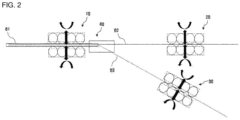
FIG. 2 is a conceptual diagram showing a rolling operation mode and a clamping operation mode of a medical robot equipped with a first connector of the inventive concept. -
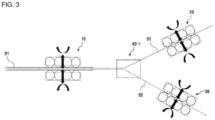
FIG. 3 is a conceptual diagram showing a rolling operation mode and a clamping operation mode of a medical robot equipped with a second connector of the inventive concept. -
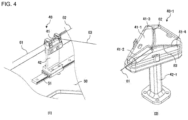
FIG. 4 is a perspective view showing a first connector and a second connector of a medical robot of the inventive concept. -
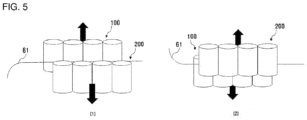
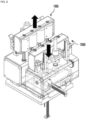
FIG. 5 is a conceptual diagram showing a vertical operation mode of a first driving device of a medical robot of the inventive concept. -
FIG. 6 is a perspective view showing a vertical operation mode of a first driving device of a medical robot of the inventive concept. -
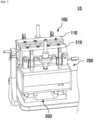
FIG. 7 is a perspective view showing a first driving device of the inventive concept. -
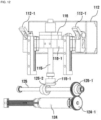
FIG. 8 is a perspective view showing a first roller module of the inventive concept. -
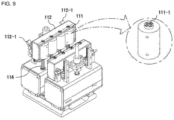
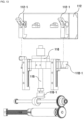
FIG. 9 is a perspective view showing that a groove or hole is formed in a roller of a first roller module of the inventive concept. -
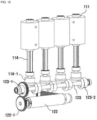
FIG. 10 is a perspective view showing a rolling operation mode of a first roller module of the inventive concept. -
FIG. 11 is a perspective view showing a clamping operation mode of a first roller module and a second roller module of the inventive concept. -
FIG. 12 is a perspective view showing a vertical operation mode of a first roller module of the inventive concept. -
FIG. 13 is a perspective view showing that a roller unit of a first roller module of the inventive concept is separated in a cartridge form. - Advantages and features of the inventive concept, and a method of achieving them will become apparent with reference to embodiments described below in detail together with the accompanying drawings. However, the inventive concept is not limited to the embodiments disclosed below, but may be implemented in various different forms. The present embodiments are provided to merely complete the disclosure of the inventive concept, and to merely fully inform those skilled in the art of the inventive concept of the scope of the inventive concept. The inventive concept is only defined by the scope of the claims.
- The terminology used herein is for the purpose of describing the embodiments only and is not intended to limit the inventive concept. As used herein, the singular forms "a" and "an" are intended to include the plural forms as well, unless the context clearly indicates otherwise. It will be further understood that the terms "comprises", "comprising", "includes", and "including" when used in this specification, specify the presence of the stated features, integers, operations, elements, and/or components, but do not preclude the presence or addition of one or greater other features, integers, operations, elements, components, and/or portions thereof. Like reference numerals refer to like elements throughout the disclosure. As used herein, the term "and/or" includes any and all combinations of one or more of the associated listed items. Although terms "first", "second", etc. are used to describe various components, it goes without saying that the components are not limited by these terms. These terms are only used to distinguish one component from another component. Therefore, it goes without saying that a first component as mentioned below may be a second component within a technical idea of the inventive concept.
- Unless otherwise defined, all terms including technical and scientific terms used herein have the same meaning as commonly understood by one of ordinary skill in the art to which this inventive concept belongs. It will be further understood that terms, such as those defined in commonly used dictionaries, should be interpreted as having a meaning that is consistent with their meaning in the context of the relevant art and will not be interpreted in an idealized or overly formal sense unless expressly so defined herein.
- Spatially relative terms, such as "beneath," "below," "lower," "under," "above," "upper," and the like, may be used herein for ease of explanation to describe one element or feature's relationship to another element s or feature s as illustrated in the figures. It will be understood that the spatially relative terms are intended to encompass different orientations of the device in use or in operation, in addition to the orientation depicted in the figures. For example, when the device in the FIG. is turned over, elements described as "below" or "beneath" or "under" other elements or features would then be oriented "above" the other elements or features. Thus, the example terms "below" and "under" may encompass both an orientation of above and below. The device may be otherwise oriented for example, rotated 90 degrees or at other orientations, and the spatially relative descriptors used herein should be interpreted accordingly.
- Hereinafter, a term "vertical direction" may mean an up-down direction in a drawing. Furthermore, the "vertical direction" may be parallel to a rotation axis of a "rolling operation mode". That is, a rotation axis of a roller unit may be parallel to the "vertical direction".
- Hereinafter, a
medical robot 1 of the inventive concept will be described with reference to the drawings. Themedical robot 1 of the inventive concept may transport aguide catheter 61, aguide wire 62 and aballoon catheter 63 for surgery. In this case, the surgery may be interventional surgery of coronary arteries and peripheral arteries of a cardiovascular system. In the interventional surgery, theballoon catheter 63 is inserted into a cardiac blood vessel, such that a blocked blood vessel is artificially widened to treat a heart disease. - The
guide catheter 61 may be a hollow tube accommodating therein theguide wire 62 and theballoon catheter 63. Theguide wire 62 has a length, and supports and guides theballoon catheter 63. - As shown in
FIG. 1 , themedical robot 1 of the inventive concept may include afirst driving device 10, asecond driving device 20, athird driving device 30, afirst connector 40, and asupport plate 50. - The
first driving device 10, thesecond driving device 20, and thethird driving device 30 may transport theguide catheter 61, theguide wire 62, and theballoon catheter 63. In this case, theguide catheter 61 may be clamped to thefirst driving device 10, theguide wire 62 may be clamped to thesecond driving device 20, and theballoon catheter 63 may be clamped to thethird driving device 30. - In order to transport the
guide catheter 61, theguide wire 62 and theballoon catheter 63, thefirst driving device 10, thesecond driving device 20 and thethird driving device 30 may perform "rolling operation mode", "clamping operation mode" and "vertical operation mode. - Referring to
FIG. 2 andFIG. 3 , in the "rolling operation mode", a roller unit of each of thefirst driving device 10, thesecond driving device 20 and thethird driving device 30 rotates, such that theguide catheter 61, theguide wire 62 and theballoon catheter 63 travel in a longitudinal direction. - Further, referring to
FIG. 2 andFIG. 3 , in the "clamping operation mode", mutually opposed roller units of each of thefirst driving device 10, thesecond driving device 20, and thethird driving device 30 become closer to or farther away from each other, such that a clamping degree of each of theguide catheter 61, theguide wire 62 and theballoon catheter 63 is controlled. - In one example, referring to
FIG. 5 andFIG. 6 , in the "vertical operation mode", rollers of each of thefirst driving device 10, thesecond driving device 20 and thethird driving device 30 move in the vertical direction to rotate each of theguide catheter 61, theguide wire 62 and theballoon catheter 63 having an curved end, thereby to determine a travel direction of each of theguide catheter 61, theguide wire 62 and theballoon catheter 63. - The
medical robot 1 of the inventive concept is characterized by precisely transferring theguide catheter 61, theguide wire 62 and theballoon catheter 63 using the above-described three operations. - Further, in the
medical robot 1 of the inventive concept, the roller unit is manufactured in a form of a cartridge, and may be replaced, so that surgery may be performed hygienically. - In one example, the
first driving device 10, thesecond driving device 20, and thethird driving device 30 of themedical robot 1 of the inventive concept may have two arrangements. - First, referring to
FIG. 2 to describe a first arrangement, a travel direction of thefirst driving device 10 and a travel direction of thesecond driving device 20 may be in the same straight line, while the travel direction of thefirst driving device 10 and a travel direction of thethird driving device 30 may intersect with each other. - In this case, the
first connector 40 may be used. Thefirst connector 40 is disposed between thefirst driving device 10 and thesecond driving device 20 to support theguide catheter 61, theguide wire 62 and theballoon catheter 63 at the same time. - Furthermore, the
first connector 40 may move in the travel direction of thefirst driving device 10 and thesecond driving device 20 in order to stably support theguide catheter 61, theguide wire 62 and theballoon catheter 63. - To this end, the
first connector 40 may include a first connector body 41 fixing theguide catheter 61, theguide wire 62 and theballoon catheter 63, and a first connector support 42 extending downward from the first connector body 41. - Furthermore, a support plate rail 51 for guiding movement of the first connector support 42 of the
first connector 40 may be formed on thesupport plate 50. - Hereinafter, referring to
FIG. 3 to describe a second arrangement, the travel direction of thefirst driving device 10 and the travel direction of thesecond driving device 20 may intersect with each other, while the travel direction of thefirst driving device 10 and the travel direction of thethird driving device 30 may intersect with each other, while the travel direction of thesecond driving device 20 and the travel direction of thethird driving device 30 may intersect with each other. Furthermore, the travel direction of thefirst driving device 10, the travel direction of thesecond driving device 20, and the travel direction of thethird driving device 30 may intersect with each other at a single intersection. - In this case, a second connector 40-1 may be used. The second connector 40-1 is a "Y-shaped connector" in which the single intersection between the travel directions of the
first driving device 10 and thesecond driving device 20 and thethird driving device 30 is defined. - The second connector 40-1 includes a second connector body 41-1 and a second connector support 42-1 extending downward from the second connector body 41-1 to support the second connector body 41-1.
- In one example, the second connector body 41-1 may include a first receiving portion 41-2 for accommodating the
guide catheter 61, a second receiving portion 41-3 for accommodating theguide wire 62, and a third receiving portion 41-4 for accommodating theballoon catheter 63. In this case, the first receiving portion 41-2 of the second connector 40-1 may be connected with both of the second receiving portion 41-3 of the second connector 40-1 and the third receiving portion 41-4 of the second connector 40-1. - Hereinafter, the
first driving device 10 of themedical robot 1 of the inventive concept will be described with reference to the drawings. In one example, a configuration of thefirst driving device 10 may be equally applied to thesecond driving device 20 and thethird driving device 30. That is, thefirst driving device 10, thesecond driving device 20, and thethird driving device 30 may have substantially the same technical configuration. - The
first driving device 10 may include afirst roller module 100, asecond roller module 200, and abase module 300. - A
roller unit 110 of thefirst roller module 100 and aroller unit 210 of thesecond roller module 200 may face away each other. Theroller unit 110 of thefirst roller module 100 and theroller unit 210 of thesecond roller module 200 respectively have rotation axes parallel to each other, and rotation directions thereof may be opposite to each other. - The "rolling operation mode" of the
first driving device 10 may be performed by rotating theroller unit 110 of thefirst roller module 100 and theroller unit 210 of thesecond roller module 200 in opposite directions to each other. - The "clamping operation mode" of the
first driving device 10 may be achieved by bringing theroller unit 110 of thefirst roller module 100 and thesecond roller unit 210 of thesecond roller module 200 closer to each other or moving away from each other. - The "vertical operation mode" of the
first driving device 10 may be achieved by moving theroller unit 110 of thefirst roller module 100 and theroller unit 210 of thesecond roller module 200 in opposite directions to each other in the vertical direction. - Further, each of the
roller unit 110 of thefirst roller module 100 and theroller unit 210 of thesecond roller module 200 may be replaced in a form of a cartridge. - First, the
first roller module 100 will be described. In one example, a configuration of thefirst roller module 100 may be equally applied to thesecond roller module 200. In other words, thefirst roller module 100 and thesecond roller module 200 may have substantially the same technical configuration. - As shown in
FIG. 8 , thefirst roller module 100 may include theroller unit 110 and adriving unit 120. - The
roller unit 110 may include at least oneroller 111 and at least oneshaft 114 that may be independently coupled with the at least oneroller 111 of theroller unit 110 respectively, and may be rotated by the drivingunit 120. - As shown in
FIG. 9 , the at least oneroller 111 of theroller unit 110 has at least one hole or groove 111-1 defined therein into which at least a portion of the at least oneshaft 114 of theroller unit 110 is independently received. - As a result, as shown in
FIG. 13 , the at least oneroller 111 of theroller unit 110 may be mounted to and separated from the at least oneshaft 114 of theroller unit 110 while sliding in the vertical direction (a replaceable cartridge type). In this case, acasing 112 of theroller unit 110 together with the at least oneroller 111 of theroller unit 110 may be mounted to and separated from the at least oneshaft 114. To this end, a first hook 112-1 of thecasing 112 may be locked and unlocked. Further, the at least oneroller 111 is rotatably coupled to thecasing 112. Thecasing 112 may have at least one hole or groove defined therein corresponding to the at least one hole or groove 111-1 defined in the at least oneroller 111. The hole or groove of thecasing 112 may be defined in a bottom surface of thecasing 112 and may extend upwards to a top of thecasing 112. Due to this structure, the at least oneroller 111 of theroller unit 110 may be mounted to and detached from the at least one shaft together with the casing while being accommodated in thecasing 112 of theroller unit 110. - Further, in order to facilitate the mounting and detachment, the at least one hole or groove 111-1 of the at least one
roller 111 of theroller unit 110 may extend in the vertical direction. Further, a horizontal cross-section of the at least one hole or groove 111-1 of the at least oneroller 111 of theroller unit 110 and a horizontal cross-section of the at least oneshaft 114 of theroller unit 110 may have a shape corresponding to each other. - In order to further secure the mounting and separation, each of a shape of the horizontal cross-section of the at least one hole or groove 111-1 of the at least one
roller 111 of theroller unit 110 and a shape of the horizontal cross-section of the at least oneshaft 114 of theroller unit 110 may have a shape extending in a first direction and a second direction in a horizontal plane and intersecting with each other at a center point in a right manner. - The
roller unit 110 may rotate by the drivingunit 120 in the rolling operation mode while the "vertical direction" axis is a rotation axis thereof. - Referring to
FIG. 10 , for this purpose, the drivingunit 120 may include afirst driving motor 122. In one example, a rotation axis of thefirst driving motor 122 of thedriving unit 120 and a rotation axis of the at least oneshaft 114 of theroller unit 110 may be perpendicular to each other. - This may be implemented using a bevel gear. In this case, the driving
unit 120 may further include afirst driving shaft 123. A spur gear 122-1 of thefirst driving motor 122 of thedriving unit 120 may mesh with a spur gear 123-1 of thefirst driving shaft 123 of thedriving unit 120. At least one bevel gear 114-1 of the at least oneshaft 114 of theroller unit 110 may mesh independently with at least one bevel gear 123-2 of thefirst driving shaft 123 of thedriving unit 120. - That is, a driving force of the
first driving motor 122 may be transmitted through the spur gear 122-1 of thefirst driving motor 122 and the spur gear 123-1 of thefirst driving shaft 123 to thefirst driving shaft 123. Furthermore, a driving force of thefirst driving shaft 123 may be transmitted through the at least one bevel gear 123-2 of thefirst driving shaft 123 and the bevel gear 114-1 of the at least oneshaft 114 of theroller unit 110 to at least oneshaft 114 of theroller unit 110. - The
roller unit 110 of thefirst roller module 100 and thesecond roller unit 210 of thesecond roller module 200 may be moved by thebase module 300 such that a spacing therebetween varies (clamping operation mode). - Referring to
FIG. 11 , for this purpose, thebase module 300,may include afirst base body 310, afirst nut 340 disposed on thefirst base body 310 of thebase module 300, and coupled to thefirst roller module 100, a second nut 350 disposed on thefirst base body 310 of thebase module 300 and coupled to thesecond roller module 200, ascrew 330 meshing with thefirst nut 340 of thebase module 300 and the second nut 350 of thebase module 300, and afirst driving motor 320 to rotate thescrew 330 of thebase module 300. - In one example, a gearbox 330-1 may be disposed between the
first driving motor 320 of thebase module 300 and thescrew 330 of thebase module 300, so that a rotational speed and a torque of thescrew 330 of thebase module 300 may be adjusted. - In this case, the
screw 330 of thebase module 300 and thefirst nut 340 of thebase module 300 and the second nut 350 of thebase module 300 may operate in a "lead screw" or "ball screw" manner. That is, when thescrew 330 of thebase module 300 rotates, thefirst nut 340 of thebase module 300 and the second nut 350 of thebase module 300 may move along thescrew 330 of thebase module 300. - That is, a forward or reverse rotation of the
screw 330 of thebase module 300 may move thefirst nut 340 of thebase module 300 and the second nut 350 of thebase module 300 such that a spacing between thefirst roller module 100 and thesecond roller module 200 varies. - To this end, a spiral rotation direction 330-2 in which the
screw 330 of thebase module 300 and thefirst nut 340 of thebase module 300 mesh with each other, and a spiral rotation direction 330-3 in which thescrew 330 of thebase module 300 and the second nut 350 of thebase module 300 mesh with each other may be opposite to each other (see (1) inFIG. 11 ). - In one example, in order to precisely control the rotation of the
first driving motor 320, thebase module 300 may further include a second driving motor 320-1, and a belt 320-4 connecting a spur gear 320-2 of thefirst driving motor 320 of thebase module 300 and a spur gear 320-3 of the second driving motor 320-1 of thebase module 300 to each other. The rotation of thefirst driving motor 320 of thebase module 300 and the rotation of the second driving motor 320-1 of thebase module 300 may be associated with each other via the belt 320-4 of the base module 300 (see (2) inFIG. 11 ). - The
roller unit 110 may move in the "vertical direction" by the driving unit 120 (vertical operation mode). - Referring to
FIG. 12 , for this purpose, theroller unit 110 may further include ascrew 115, anut 116 meshing with thescrew 115 of theroller unit 110, and thecasing 112 disposed on thenut 116 of theroller unit 110. - In this case, the
screw 115 of theroller unit 110 may be rotated by the drivingunit 120, and thenut 116 of theroller unit 110 may be moved in the vertical direction by the rotation of thescrew 115 of theroller unit 110. - That is, the
screw 115 of theroller unit 110 and thenut 116 of theroller unit 110 may operate in the "lead screw" or "ball screw" manner. That is, the rotation of thescrew 115 of theroller unit 110 may allow thenut 116 of theroller unit 110 to move along thescrew 115 of theroller unit 110. - In this case, the
casing 112 of theroller unit 110 may be moved vertically by thenut 116 of theroller unit 110. Furthermore, the at least oneroller 111 of theroller unit 110 may move in a vertical direction together with thecasing 112 of theroller unit 110. - In one example, in order to stably support the
casing 112 of theroller unit 110 while moving in the vertical direction, thecasing 112 of theroller unit 110 may include a pivoting hook 112-1. Thenut 116 of theroller unit 110 may include a bar 116-1 that is locked and unlocked by the hook 112-1 of the casing 112 (seeFIG. 13 ). - In this case, the number of the hooks 112-1 of the
casing 112 of theroller unit 110 may be two which may be disposed at both ends of the bar 116-1 of thenut 116, respectively. - In one example, in order to transmit the driving force to the
screw 115 of theroller unit 110, the drivingunit 120 may include asecond driving motor 124. The rotation axis of thesecond driving motor 124 of thedriving unit 120 and the rotation axis of thescrew 115 of theroller unit 110 may be perpendicular to each other. - This may be implemented using a bevel gear. In this connection, the driving
unit 120 may further include asecond driving shaft 125. A spur gear 124-1 of thesecond driving motor 124 of thedriving unit 120 may mesh with a spur gear 125-1 of thesecond driving shaft 125 of thedriving unit 120. A bevel gear 115-1 of thescrew 115 of theroller unit 110 may mesh with a bevel gear 125-2 of thesecond driving shaft 125 of thedriving unit 120. - That is, the driving force of the
second driving motor 124 may be transmitted through the spur gear 124-1 of thesecond driving motor 124 and the spur gear 125-1 of thesecond driving shaft 125 to thesecond driving shaft 125. Furthermore, the driving force of thesecond driving shaft 125 may be transmitted through the bevel gear 125-2 of thesecond driving shaft 125 and the bevel gear 115-1 of thescrew 115 of theroller unit 110 to thescrew 115 of theroller unit 110. - In one example, the driving
unit 120 may include a box-shapedhousing 121. Thefirst driving motor 122, thefirst driving shaft 123, thesecond driving motor 124, and thesecond driving shaft 125 may be disposed inside thehousing 121 of thedriving unit 120. - Further, a lower portion of the at least one
shaft 114 of theroller unit 110 may be disposed inside thehousing 121 of thedriving unit 120. - Further, the
housing 121 of thedriving unit 120 is supported by thefirst nut 340 of thebase module 300. Thus, in the clamping operation mode, the drivingunit 120 and theroller unit 110 may be guided and moved by thefirst nut 340. - Although the embodiment of the inventive concept has been described above with reference to the accompanying drawings, a person skilled in the art to which the inventive concept belongs will appreciate that the inventive concept may be implemented in various forms without changing the technical idea or essential features thereof. Therefore, the embodiments described above should be understood as illustrative in all respects, and as not limiting.
- Preferred features of the invention are as set forth in the following items:
- 1. A roller module for a medical robot, the roller module comprising:
- a driving unit; and
- a roller unit rotated by the driving unit while a rotation axis of the roller unit is a vertical direction,
- wherein the roller unit includes at least one roller, and at least one shaft independently coupled to the at least one roller of the roller unit and rotated by the driving unit,
- wherein the at least one roller of the roller unit has at least one hole or groove defined therein in which at least a portion of the at least one shaft of the roller unit is independently received.
- 2. The roller module of
item 1, wherein the at least one hole or groove of the at least one roller of the roller unit extends in the vertical direction,
wherein a horizontal cross-section of the at least one hole or groove of the at least one roller of the roller unit corresponds to a horizontal cross-section of the at least one shaft of the roller unit. - 3. The roller module of
item 2, wherein each of a shape of the horizontal cross-section of the at least one hole or groove of the at least one roller of the roller unit and a shape of the horizontal cross-section of the at least one shaft of the roller unit has a shape extending in a first direction and a second direction in a horizontal plane and intersecting with each other at a center point in a right manner. - 4. The roller module of
item 1, wherein the driving unit includes a first driving motor,
wherein a rotation axis of the first driving motor of the driving unit and a rotation axis of the at least one shaft of the roller unit are perpendicular to each other. - 5. The roller module of item 4, wherein the driving unit further includes a first driving shaft,
- wherein a spur gear of the first driving motor of the driving unit meshes with a spur gear of the first driving shaft of the driving unit,
- wherein at least one bevel gear of the at least one shaft of the roller unit independently meshes with at least one bevel gear of the first driving shaft of the driving unit.
- 6. The roller module of
item 1, wherein the roller unit moves in the vertical direction by the driving unit. - 7. The roller module of item 6, wherein the roller unit further includes a screw, a nut meshing with the screw of the roller unit, and a casing disposed on the nut of the roller unit,
- wherein the screw of the roller unit is rotated by the driving unit,
- wherein the nut of the roller unit moves in the vertical direction via rotation of the screw of the roller unit,
- wherein the casing of the roller unit moves in the vertical direction by the nut of the roller unit.
- 8. The roller module of item 7, wherein the casing of the roller unit includes a pivotable hook,
wherein the nut of the roller unit includes a bar locked and unlocked by the hook of the casing. - 9. The roller module of item 7, wherein the driving unit includes a second driving motor, wherein a rotation axis of the second driving motor of the driving unit and a rotation axis of the screw of the roller unit are perpendicular to each other.
- 10. The roller module of item 9, wherein the driving unit further includes a second driving shaft,
- wherein a spur gear of the second driving motor of the driving unit meshes with a spur gear of the second driving shaft of the driving unit,
- wherein a bevel gear of the screw of the roller unit meshes with a bevel gear of the second driving shaft of the driving unit.
- 11. A driving device for a medical robot, the driving device comprising:
- a base module; and
- a first roller module and a second roller module, wherein a spacing between the first roller module and the second roller module is controlled by the base module,
- wherein at least one of the first roller module or the second roller module includes:
- a driving unit; and
- a roller unit rotated by the driving unit while a rotation axis of the roller unit is a vertical direction,
- wherein the roller unit includes at least one roller, and at least one shaft independently coupled to the at least one roller of the roller unit and rotated by the driving unit,
- wherein the at least one roller of the roller unit has at least one hole or groove defined therein in which at least a portion of the at least one shaft of the roller unit is independently received.
- 12. The driving device of item 11, wherein at least one of a guide catheter, a guide wire, and a balloon catheter is disposed and clamped between the first roller module and the second roller module, and then is transferred via rotation of the roller unit of the first roller module and the roller unit of the second roller module,
wherein rotation axes of the roller unit of the first roller module and the roller unit of the second roller module are parallel to each other, and rotation directions of the roller unit of the first roller module and the roller unit of the second roller module are opposite to each other. - 13. The driving device of item 11, wherein each of the roller unit of the first roller module and the roller unit of the second roller module is removable in a cartridge form.
- 14. The driving device of item 11, wherein the base module includes:
- a base body;
- a first nut disposed on the base body of the base module and coupled to the first roller module;
- a second nut disposed on the base body of the base module and coupled to the second roller module;
- a screw meshing with the first nut of the base module and the second nut of the base module; and
- a first driving motor to rotate the screw of the base module,
- wherein forward or reverse rotation of the screw of the base module allows the first nut of the base module and the second nut of the base module to move such that a spacing between the first roller module and the second roller module varies.
- 15. The driving device of item 14, wherein the driving unit of the first roller module includes:
- a first casing;
- a first driving motor and a first driving shaft disposed inside the first casing of the driving unit of the first roller module to rotate the roller unit of the first roller module; and
- a second driving motor and a second driving shaft disposed inside the first casing of the driving unit of the first roller module to move the roller unit of the first roller module in the vertical direction,
- wherein the driving unit of the second roller module includes:
- a second casing;
- a first driving motor and a first driving shaft disposed inside the second casing of the driving unit of the second roller module to rotate the roller unit of the second roller module; and
- a second driving motor and a second driving shaft disposed inside the second casing of the driving unit of the second roller module to move the roller unit of the second roller module in the vertical direction,
- wherein the first casing of the driving unit of the first roller module is supported by the first nut of the base module,
- wherein the second casing of the driving unit of the second roller module is supported by the second nut of the base module.
- 16. The driving device of item 14, wherein a gearbox is disposed between the first driving motor of the base module and the screw of the base module.
- 17. The driving device of item 14, wherein the base module further includes a second driving motor, and a belt connecting a spur gear of the first driving motor of the base module and a spur gear of the second driving motor of the base module to each other,
wherein rotation of the first driving motor of the base module and rotation of the second driving motor of the base module are associated with each other via the belt of the base module. - 18. The driving device of item 14, wherein a spiral rotation direction in which the screw of the base module and the first nut of the base module mesh with each other, and a spiral rotation direction in which the screw of the base module and the second nut of the base module mesh with each other are opposite to each other.
- 19. A medical robot comprising:
- a first driving device, a second driving device, and a third driving device to transport a guide catheter, a guide wire, and a balloon catheter, respectively,
- wherein at least one of the first driving device, the second driving device, or the third driving device includes:
- a base module; and
- a first roller module and a second roller module, wherein a spacing between the first roller module and the second roller module is controlled by the base module,
- wherein at least one of the first roller module or the second roller module includes:
- a driving unit; and
- a roller unit rotated by the driving unit while a rotation axis of the roller unit is a vertical direction,
- wherein the roller unit includes at least one roller, and at least one shaft independently coupled to the at least one roller of the roller unit and rotated by the driving unit,
- wherein the at least one roller of the roller unit has at least one hole or groove defined therein in which at least a portion of the at least one shaft of the roller unit is independently received,
- wherein at least one of the guide catheter, the guide wire, and the balloon catheter is disposed and clamped between the first roller module and the second roller module, and then is transferred via rotation of the roller unit of the first roller module and the roller unit of the second roller module,
- wherein rotation axes of the roller unit of the first roller module and the roller unit of the second roller module are parallel to each other, and rotation directions of the roller unit of the first roller module and the roller unit of the second roller module are opposite to each other.
- 20. The medical robot of item 19, wherein the guide catheter is clamped to the first driving device, the guide wire is clamped to the second driving device, the balloon catheter is clamped to the third driving device,
wherein the guide catheter accommodates the guide wire and the balloon catheter therein. - 21. The medical robot of item 19, wherein a travel direction of the first driving device and a travel direction of the second driving device are in the same straight line, while the travel direction of the first driving device and a travel direction of the third driving device intersect with each other.
- 22. The medical robot of item 21, wherein the medical robot further comprises a first connector disposed between the first driving device and the second driving device to support the guide catheter, the guide wire, and the balloon catheter at the same time,
wherein the first connector moves in the travel directions of the first driving device and the second driving device. - 23. The medical robot of item 21, wherein the first connector includes a first connector body fixing the guide catheter, the guide wire and the balloon catheter, and a first connector support extending downward from the first connector body.
- 24. The medical robot of item 19, wherein a travel direction of the first driving device and a travel direction of the second driving device intersect with each other,
- wherein the travel direction of the first driving device and a travel direction of the third driving device intersect with each other,
- wherein the travel direction of the second driving device and the travel direction of the third driving device intersect with each other.
- 25. The medical robot of item 24, wherein the travel direction of the first driving device, the travel direction of the second driving device, and the travel direction of the third driving device intersect with each other at a single intersection.
- 26. The medical robot of item 24, wherein the medical robot further comprises a second connector having a single intersection at which the travel directions of the first driving device, the second driving device, and the third driving device intersect with each other,
- wherein the second connector includes a first receiving portion accommodating the guide catheter, a second receiving portion accommodating the guide wire, and a third receiving portion accommodating the balloon catheter,
- wherein the first receiving portion of the second connector is connected to the second receiving portion of the second connector and the third receiving portion of the second connector.
Claims (14)
- A medical robot comprising:a base module (300); anda first roller module (100) and a second roller module (200), wherein a spacing between the first roller module and the second roller module is controlled by the base module,wherein at least one of the first roller module (100) or the second roller module (200) includes:a driving unit (120); anda roller unit (110) configured to be rotatable about a vertical axis and movable along a vertical direction by the driving unit.
- The medical robot of claim 1,wherein a surgical tool is clamped between the first roller module (100) and the second roller module (200),wherein a roller unit (110) of the first roller module (100) and a roller unit (210) of the second roller module (200) are configured to be rotated in relatively opposite directions or to move vertically in relatively opposite directions in order to control a movement of the surgical tool.
- The medical robot of claim 1,
wherein a roller unit (110) of the first roller module (100) and a roller unit (210) of the second roller module (200) are configured to be rotated in relatively opposite directions such that the surgical tool clamped between the first roller module (100) and the second roller module (200) travels in a longitudinal direction. - The medical robot of claim 1,
wherein a roller unit (110) of the first roller module (100) and a roller unit (210) of the second roller module (200) are configured to be moved vertically in relatively opposite directions such that the surgical tool clamped between the first roller module (100) and the second roller module (200) rotates. - The medical robot of claim 1,
wherein a roller unit (110) of the first roller module (100) and a roller unit (210) of the second roller module (200) are configured to move relatively closer or farther apart such that a clamping degree of the surgical tool clamped between the first roller module (100) and the second roller module (200) is controlled. - The medical robot of claim 1,
wherein rotation axes of a roller unit (110) of the first roller module (100) and a roller unit (210) of the second roller module (200) are parallel to each other. - The medical robot of claim 1,
wherein each of a roller unit (110) of the first roller module (100) and a roller unit (210) of the second roller module (200) is removable in a cartridge form. - The medical robot of claim 1,wherein the roller unit (110) includes at least one roller (111), and at least one shaft (114) independently coupled to at least one roller of the roller unit and rotated by the driving unit,wherein at least one roller of the roller unit has at least one hole or groove (111-1) defined therein in which at least a portion of at least one shaft of the roller unit is independently received.
- The medical robot of claim 8,wherein the driving unit (120) includes a first driving motor (122),wherein a rotation axis of the first driving motor of the driving unit and a rotation axis of the at least one shaft of the roller unit are perpendicular to each other.
- The medical robot of claim 9,wherein the driving unit (120) further includes a first driving shaft (123),wherein a spur gear of the first driving motor of the driving unit meshes with a spur gear of the first driving shaft of the driving unit,wherein at least one bevel gear of the at least one shaft of the roller unit independently meshes with at least one bevel gear of the first driving shaft of the driving unit.
- The medical robot of claim 1,wherein the roller unit (110) includes a screw (115), and a nut (116) meshing with the screw of the roller unit,wherein the screw of the roller unit is rotated by the driving unit,wherein the nut of the roller unit moves in the vertical direction via rotation of the screw of the roller unit.
- The medical robot of claim 11,wherein the roller unit (110) further includes a casing (112) disposed on the nut of the roller unit,wherein the casing of the roller unit moves in the vertical direction by the nut of the roller unit.
- The medical robot of claim 1,
wherein the base module (300) includes:a base body (310);a first nut (340) disposed on the base body of the base module and coupled to the first roller module;a second nut (350) disposed on the base body of the base module and coupled to the second roller module;a screw (330) meshing with the first nut of the base module and the second nut of the base module; anda first driving motor (320) to rotate the screw of the base module,wherein forward or reverse rotation of the screw of the base module allows the first nut of the base module and the second nut of the base module to move such that a spacing between the first roller module and the second roller module varies. - The medical robot of claim 13,
wherein a spiral rotation direction in which the screw of the base module and the first nut of the base module mesh with each other, and a spiral rotation direction in which the screw of the base module and the second nut of the base module mesh with each other are opposite to each other.
Applications Claiming Priority (3)
| Application Number | Priority Date | Filing Date | Title |
|---|---|---|---|
| KR1020180045379A KR102184889B1 (en) | 2018-04-19 | 2018-04-19 | Roller module for medical robot, driving apparatus for medical robot and medical robot |
| PCT/KR2019/004770 WO2019203616A1 (en) | 2018-04-19 | 2019-04-19 | Roller module for medical robot, driving device for medical robot, and medical robot |
| EP19789507.1A EP3782574B1 (en) | 2018-04-19 | 2019-04-19 | Roller module for medical robot, driving device for medical robot, and medical robot |
Related Parent Applications (1)
| Application Number | Title | Priority Date | Filing Date |
|---|---|---|---|
| EP19789507.1A Division EP3782574B1 (en) | 2018-04-19 | 2019-04-19 | Roller module for medical robot, driving device for medical robot, and medical robot |
Publications (3)
| Publication Number | Publication Date |
|---|---|
| EP4233770A2 true EP4233770A2 (en) | 2023-08-30 |
| EP4233770A3 EP4233770A3 (en) | 2023-11-01 |
| EP4233770B1 EP4233770B1 (en) | 2025-12-17 |
Family
ID=68239660
Family Applications (2)
| Application Number | Title | Priority Date | Filing Date |
|---|---|---|---|
| EP23179538.6A Active EP4233770B1 (en) | 2018-04-19 | 2019-04-19 | Roller module for medical robot, driving device for medical robot, and medical robot |
| EP19789507.1A Active EP3782574B1 (en) | 2018-04-19 | 2019-04-19 | Roller module for medical robot, driving device for medical robot, and medical robot |
Family Applications After (1)
| Application Number | Title | Priority Date | Filing Date |
|---|---|---|---|
| EP19789507.1A Active EP3782574B1 (en) | 2018-04-19 | 2019-04-19 | Roller module for medical robot, driving device for medical robot, and medical robot |
Country Status (7)
| Country | Link |
|---|---|
| US (2) | US12114938B2 (en) |
| EP (2) | EP4233770B1 (en) |
| KR (1) | KR102184889B1 (en) |
| CN (3) | CN119655895A (en) |
| ES (1) | ES2957400T3 (en) |
| HU (1) | HUE063058T2 (en) |
| WO (1) | WO2019203616A1 (en) |
Families Citing this family (29)
| Publication number | Priority date | Publication date | Assignee | Title |
|---|---|---|---|---|
| JP7724214B2 (en) | 2019-11-28 | 2025-08-15 | マイクロボット メディカル リミテッド | Robotic manipulation of surgical tool handles |
| KR102487735B1 (en) * | 2020-10-30 | 2023-01-12 | 주식회사 메디픽셀 | A system for driving a medical instrument |
| KR102511036B1 (en) * | 2020-11-18 | 2023-03-17 | 재단법인 아산사회복지재단 | Treatment tool control device |
| JP7555637B2 (en) * | 2020-11-18 | 2024-09-25 | エルエヌ ロボティクス インコーポレイテッド | Treatment tool control device |
| KR102440299B1 (en) | 2021-01-19 | 2022-09-05 | 주식회사 페라자 | Robot for Vascular Intervention with Linear Contact Roller Mechanism and System thereof |
| FR3119534B1 (en) * | 2021-02-08 | 2024-07-05 | Robocath | device for convergence between several tracks in a robot catheter |
| CN113509302A (en) * | 2021-02-26 | 2021-10-19 | 中国科学院自动化研究所 | Interventional surgery delivery devices and delivery systems |
| CN113082463A (en) * | 2021-04-14 | 2021-07-09 | 王利 | Rotary pushing device and interventional operation robot |
| CA3215568A1 (en) * | 2021-04-19 | 2022-10-27 | Simon Sharon | Compact robotic device and assemblies for manipulation of elongate surgical tools |
| KR102602721B1 (en) | 2021-06-04 | 2023-11-16 | 주식회사 로엔서지컬 | Buckling prevention apparatus for flexible surgical instrument |
| CN113317878B (en) * | 2021-06-21 | 2022-06-10 | 哈尔滨理工大学 | An electrophysiological catheter robot |
| JP7540118B6 (en) * | 2021-07-05 | 2024-09-12 | 深▲せん▼愛博合創医療机器人有限公司 | Interventional Surgery Robot Slave Device |
| CN113729956B (en) * | 2021-07-05 | 2023-04-28 | 深圳市爱博医疗机器人有限公司 | From end device of intervention operation robot |
| KR102386014B1 (en) * | 2021-07-26 | 2022-04-14 | 주식회사 메디픽셀 | Tensioner module and stent driving apparatus including the same |
| JP2024527955A (en) * | 2021-07-29 | 2024-07-26 | マイクロボット メディカル リミテッド | Multi-unit device for robotic manipulation of elongated surgical tools |
| FR3127111B1 (en) * | 2021-09-17 | 2023-09-29 | Robocath | TRAINING MODULE FOR TRANSLATION OF SEVERAL FLEXIBLE ELONGATED MEDICAL INSTRUMENTS INCLUDING A CONVERGENCE DEVICE TOWARDS A COMMON TRACK |
| KR102416826B1 (en) * | 2021-10-28 | 2022-07-05 | 주식회사 메디픽셀 | Apparatus for rotating a longitudinal member |
| KR102697428B1 (en) * | 2022-03-04 | 2024-08-22 | 재단법인 아산사회복지재단 | Treatment tool control device |
| CN116269791B (en) * | 2022-09-08 | 2025-09-09 | 北京唯迈医疗设备有限公司 | Angiography interventional operation system convenient to disinfect |
| KR102892064B1 (en) | 2022-10-20 | 2025-12-01 | (주)엘엔로보틱스 | Connector mounter connected to procedure tool control unit |
| CN120018826A (en) | 2022-10-20 | 2025-05-16 | Ln 机器人股份有限公司 | Connector fixture to surgical tool control unit |
| WO2024085638A1 (en) | 2022-10-20 | 2024-04-25 | (주)엘엔로보틱스 | Surgical tool guide connected to surgical tool control device |
| WO2024106869A1 (en) * | 2022-11-14 | 2024-05-23 | (주)엘엔로보틱스 | Surgical tool control system comprising operating handle |
| KR102561899B1 (en) * | 2022-12-02 | 2023-08-01 | 주식회사 메디픽셀 | Device for control surgical instrument |
| KR102892073B1 (en) | 2023-02-14 | 2025-12-01 | (주)엘엔로보틱스 | Treatment tool control system |
| KR102892071B1 (en) | 2023-02-14 | 2025-12-01 | (주)엘엔로보틱스 | Treatment tool control system |
| CN116440392B (en) * | 2023-03-07 | 2024-04-05 | 极限人工智能有限公司 | Guide wire driving device and method based on Mecanum wheel and interventional operation robot |
| CN221932130U (en) * | 2024-01-25 | 2024-11-01 | 北京万思医疗器械有限公司 | Interventional consumables delivery device and vascular interventional surgery robot |
| WO2025264086A1 (en) * | 2024-06-20 | 2025-12-26 | (주)엘엔로보틱스 | Guide catheter driving device and surgical tool control system including same |
Family Cites Families (20)
| Publication number | Priority date | Publication date | Assignee | Title |
|---|---|---|---|---|
| US6096004A (en) * | 1998-07-10 | 2000-08-01 | Mitsubishi Electric Information Technology Center America, Inc. (Ita) | Master/slave system for the manipulation of tubular medical tools |
| EP1442720A1 (en) * | 2003-01-31 | 2004-08-04 | Tre Esse Progettazione Biomedica S.r.l | Apparatus for the maneuvering of flexible catheters in the human cardiovascular system |
| US20080064920A1 (en) * | 2006-09-08 | 2008-03-13 | Ethicon Endo-Surgery, Inc. | Medical drive system for providing motion to at least a portion of a medical apparatus |
| EP3646917B1 (en) * | 2008-05-06 | 2021-04-28 | Corindus, Inc | Catheter system |
| CN102596306B (en) * | 2009-11-12 | 2014-06-25 | 皇家飞利浦电子股份有限公司 | A steering system and a catcher system |
| KR101133268B1 (en) | 2009-11-25 | 2012-04-06 | 고려대학교 산학협력단 | Catheter remote control system |
| US20130035537A1 (en) * | 2011-08-05 | 2013-02-07 | Wallace Daniel T | Robotic systems and methods for treating tissue |
| FR2999939B1 (en) * | 2012-12-21 | 2015-01-16 | Robocath | CATHETERISM SYSTEM TRAINING MODULE |
| CN103157170B (en) * | 2013-02-25 | 2014-12-03 | 中国科学院自动化研究所 | Blood vessel interventional operation conduit or guide wire control device based on two-point clamping |
| FR3002851B1 (en) * | 2013-03-07 | 2015-06-19 | Robocath | ROBOTISE CATHETERISM SYSTEM TRAINING MODULE. |
| FR3022147B1 (en) * | 2014-06-12 | 2016-07-22 | Robocath | ROBOTISE MODULE OF SOFT MEDICAL MEDICAL TRAINING |
| CN104644270B (en) * | 2015-02-05 | 2016-09-07 | 北京航空航天大学 | A kind of catheter steering device based on reverse leading screw |
| KR101712733B1 (en) * | 2015-06-23 | 2017-03-06 | 한양대학교 에리카산학협력단 | Robot for Vascular Intervention and System thereof |
| WO2017010231A1 (en) * | 2015-07-16 | 2017-01-19 | 国立大学法人名古屋大学 | Insertion driving apparatus for linear object, medical appliance provided with same, and medical operation training apparatus |
| FR3046543B1 (en) * | 2016-01-07 | 2018-02-02 | Robocath | ROBOTISABLE MODULE FOR DRIVING AN ELONGATED SOFT MEDICAL DEVICE, MEDICAL ROBOT AND SYSTEM COMPRISING SUCH A MODULE |
| CA3004201C (en) * | 2016-02-05 | 2023-01-10 | Board Of Regents Of The University Of Texas System | Steerable intra-luminal medical device |
| CN105662586B (en) * | 2016-03-03 | 2017-12-12 | 北京理工大学 | A kind of intervention operation robot and its control method of catheter guide wire collaboration push |
| FR3048888A1 (en) * | 2016-03-18 | 2017-09-22 | Robocath | INSULATED MEDICAL INSTRUMENT ROBOT WITH LONG-SIDED MEDICAL INSTRUMENT AND ASSOCIATED ACCESSORIES |
| CN106880380A (en) * | 2017-03-21 | 2017-06-23 | 上海大学 | Blood vessel intervention operation wire catheter operation device |
| JP6827130B2 (en) * | 2017-12-29 | 2021-02-10 | エックスキャス, インコーポレイテッド | Manipulable surgical robotic system |
-
2018
- 2018-04-19 KR KR1020180045379A patent/KR102184889B1/en active Active
-
2019
- 2019-04-19 CN CN202510085000.4A patent/CN119655895A/en active Pending
- 2019-04-19 CN CN202510084843.2A patent/CN119655894A/en active Pending
- 2019-04-19 CN CN201980026784.6A patent/CN111989064B/en active Active
- 2019-04-19 HU HUE19789507A patent/HUE063058T2/en unknown
- 2019-04-19 EP EP23179538.6A patent/EP4233770B1/en active Active
- 2019-04-19 WO PCT/KR2019/004770 patent/WO2019203616A1/en not_active Ceased
- 2019-04-19 ES ES19789507T patent/ES2957400T3/en active Active
- 2019-04-19 EP EP19789507.1A patent/EP3782574B1/en active Active
-
2020
- 2020-10-16 US US17/072,912 patent/US12114938B2/en active Active
-
2024
- 2024-09-10 US US18/829,767 patent/US20240423729A1/en active Pending
Also Published As
| Publication number | Publication date |
|---|---|
| CN111989064B (en) | 2025-02-14 |
| EP3782574B1 (en) | 2023-07-12 |
| EP3782574A4 (en) | 2022-01-26 |
| CN119655894A (en) | 2025-03-21 |
| US12114938B2 (en) | 2024-10-15 |
| US20210052339A1 (en) | 2021-02-25 |
| ES2957400T3 (en) | 2024-01-18 |
| EP3782574A1 (en) | 2021-02-24 |
| EP4233770A3 (en) | 2023-11-01 |
| CN119655895A (en) | 2025-03-21 |
| EP4233770B1 (en) | 2025-12-17 |
| KR102184889B1 (en) | 2020-12-01 |
| KR102184889B9 (en) | 2022-03-15 |
| WO2019203616A1 (en) | 2019-10-24 |
| HUE063058T2 (en) | 2023-12-28 |
| CN111989064A (en) | 2020-11-24 |
| KR20190121928A (en) | 2019-10-29 |
| US20240423729A1 (en) | 2024-12-26 |
Similar Documents
| Publication | Publication Date | Title |
|---|---|---|
| EP3782574B1 (en) | Roller module for medical robot, driving device for medical robot, and medical robot | |
| JP7404501B2 (en) | Systems, apparatus and methods for robotic interventional procedures using a plurality of elongated medical devices | |
| US9770301B2 (en) | Module for driving a catheterization system | |
| US20250030311A1 (en) | Differential Drive | |
| US10149728B2 (en) | Elongate medical part guide module | |
| CN217488850U (en) | Robotic drive system for catheter-based surgical system | |
| US20040254566A1 (en) | Apparatus for the maneuvering of flexible catheters in the human cardiovascular system | |
| CN114762612B (en) | Torque device for an elongate medical device | |
| US20240000524A1 (en) | System and apparatus for manipulating an elongated medical device in a robotic catheter-based procedure system | |
| CN113545852A (en) | Instrument delivery module and interventional surgical robot | |
| CN108113757B (en) | Wearable robotic device for vascular interventional surgery | |
| EP4353181A2 (en) | Drivetrain for elongated medical device | |
| CN118453130A (en) | Double-channel vascular intervention surgical robot instrument delivery box assembly | |
| JP7711988B2 (en) | Vascular intervention treatment device | |
| CN222657183U (en) | Dual-channel vascular interventional surgery robotic instrument delivery box assembly | |
| CN221844971U (en) | Torque limiting actuator for an elongate medical device torquer | |
| US20240207574A1 (en) | Torque lmiting actuator for elongated medical device torquer | |
| CN116849811A (en) | Slave drive device for interventional surgical robots | |
| JP2024521778A (en) | Vascular intervention treatment device | |
| HK40079391A (en) | Device for automatically inserting and manipulating a medical tool into and within a bodily lumen | |
| HK40078928A (en) | Modular robotic system for driving movement of surgical tools |
Legal Events
| Date | Code | Title | Description |
|---|---|---|---|
| PUAI | Public reference made under article 153(3) epc to a published international application that has entered the european phase |
Free format text: ORIGINAL CODE: 0009012 |
|
| STAA | Information on the status of an ep patent application or granted ep patent |
Free format text: STATUS: THE APPLICATION HAS BEEN PUBLISHED |
|
| AC | Divisional application: reference to earlier application |
Ref document number: 3782574 Country of ref document: EP Kind code of ref document: P |
|
| AK | Designated contracting states |
Kind code of ref document: A2 Designated state(s): AL AT BE BG CH CY CZ DE DK EE ES FI FR GB GR HR HU IE IS IT LI LT LU LV MC MK MT NL NO PL PT RO RS SE SI SK SM TR |
|
| REG | Reference to a national code |
Ref country code: DE Ref legal event code: R079 Free format text: PREVIOUS MAIN CLASS: A61B0034350000 Ipc: A61B0034300000 Ref country code: DE Ref legal event code: R079 Ref document number: 602019079461 Country of ref document: DE Free format text: PREVIOUS MAIN CLASS: A61B0034350000 Ipc: A61B0034300000 |
|
| PUAL | Search report despatched |
Free format text: ORIGINAL CODE: 0009013 |
|
| AK | Designated contracting states |
Kind code of ref document: A3 Designated state(s): AL AT BE BG CH CY CZ DE DK EE ES FI FR GB GR HR HU IE IS IT LI LT LU LV MC MK MT NL NO PL PT RO RS SE SI SK SM TR |
|
| RIC1 | Information provided on ipc code assigned before grant |
Ipc: A61B 34/35 20160101ALI20230925BHEP Ipc: A61B 17/00 20060101ALI20230925BHEP Ipc: A61M 25/09 20060101ALI20230925BHEP Ipc: A61M 25/01 20060101ALI20230925BHEP Ipc: A61B 34/20 20160101ALI20230925BHEP Ipc: A61B 34/30 20160101AFI20230925BHEP |
|
| STAA | Information on the status of an ep patent application or granted ep patent |
Free format text: STATUS: REQUEST FOR EXAMINATION WAS MADE |
|
| 17P | Request for examination filed |
Effective date: 20240426 |
|
| RBV | Designated contracting states (corrected) |
Designated state(s): AL AT BE BG CH CY CZ DE DK EE ES FI FR GB GR HR HU IE IS IT LI LT LU LV MC MK MT NL NO PL PT RO RS SE SI SK SM TR |
|
| GRAP | Despatch of communication of intention to grant a patent |
Free format text: ORIGINAL CODE: EPIDOSNIGR1 |
|
| STAA | Information on the status of an ep patent application or granted ep patent |
Free format text: STATUS: GRANT OF PATENT IS INTENDED |
|
| INTG | Intention to grant announced |
Effective date: 20250717 |
|
| GRAS | Grant fee paid |
Free format text: ORIGINAL CODE: EPIDOSNIGR3 |
|
| GRAA | (expected) grant |
Free format text: ORIGINAL CODE: 0009210 |
|
| STAA | Information on the status of an ep patent application or granted ep patent |
Free format text: STATUS: THE PATENT HAS BEEN GRANTED |
|
| AC | Divisional application: reference to earlier application |
Ref document number: 3782574 Country of ref document: EP Kind code of ref document: P |
|
| AK | Designated contracting states |
Kind code of ref document: B1 Designated state(s): AL AT BE BG CH CY CZ DE DK EE ES FI FR GB GR HR HU IE IS IT LI LT LU LV MC MK MT NL NO PL PT RO RS SE SI SK SM TR |
|
| REG | Reference to a national code |
Ref country code: CH Ref legal event code: F10 Free format text: ST27 STATUS EVENT CODE: U-0-0-F10-F00 (AS PROVIDED BY THE NATIONAL OFFICE) Effective date: 20251217 Ref country code: GB Ref legal event code: FG4D |
|
| REG | Reference to a national code |
Ref country code: DE Ref legal event code: R096 Ref document number: 602019079461 Country of ref document: DE |
|
| P01 | Opt-out of the competence of the unified patent court (upc) registered |
Free format text: CASE NUMBER: UPC_APP_0019160_4233770/2025 Effective date: 20251223 |