EP4233766B1 - Gelenkanordnung für eine robotische vorrichtung - Google Patents
Gelenkanordnung für eine robotische vorrichtung Download PDFInfo
- Publication number
- EP4233766B1 EP4233766B1 EP23158900.3A EP23158900A EP4233766B1 EP 4233766 B1 EP4233766 B1 EP 4233766B1 EP 23158900 A EP23158900 A EP 23158900A EP 4233766 B1 EP4233766 B1 EP 4233766B1
- Authority
- EP
- European Patent Office
- Prior art keywords
- transition
- link
- end effector
- distal
- proximal
- Prior art date
- Legal status (The legal status is an assumption and is not a legal conclusion. Google has not performed a legal analysis and makes no representation as to the accuracy of the status listed.)
- Active
Links
Images






Classifications
-
- A—HUMAN NECESSITIES
- A61—MEDICAL OR VETERINARY SCIENCE; HYGIENE
- A61B—DIAGNOSIS; SURGERY; IDENTIFICATION
- A61B34/00—Computer-aided surgery; Manipulators or robots specially adapted for use in surgery
- A61B34/30—Surgical robots
-
- A—HUMAN NECESSITIES
- A61—MEDICAL OR VETERINARY SCIENCE; HYGIENE
- A61B—DIAGNOSIS; SURGERY; IDENTIFICATION
- A61B18/00—Surgical instruments, devices or methods for transferring non-mechanical forms of energy to or from the body
- A61B18/04—Surgical instruments, devices or methods for transferring non-mechanical forms of energy to or from the body by heating
- A61B18/12—Surgical instruments, devices or methods for transferring non-mechanical forms of energy to or from the body by heating by passing a current through the tissue to be heated, e.g. high-frequency current
- A61B18/14—Probes or electrodes therefor
- A61B18/1442—Probes having pivoting end effectors, e.g. forceps
-
- A—HUMAN NECESSITIES
- A61—MEDICAL OR VETERINARY SCIENCE; HYGIENE
- A61B—DIAGNOSIS; SURGERY; IDENTIFICATION
- A61B18/00—Surgical instruments, devices or methods for transferring non-mechanical forms of energy to or from the body
- A61B18/04—Surgical instruments, devices or methods for transferring non-mechanical forms of energy to or from the body by heating
- A61B18/12—Surgical instruments, devices or methods for transferring non-mechanical forms of energy to or from the body by heating by passing a current through the tissue to be heated, e.g. high-frequency current
- A61B18/14—Probes or electrodes therefor
- A61B18/1442—Probes having pivoting end effectors, e.g. forceps
- A61B18/1445—Probes having pivoting end effectors, e.g. forceps at the distal end of a shaft, e.g. forceps or scissors at the end of a rigid rod
-
- A—HUMAN NECESSITIES
- A61—MEDICAL OR VETERINARY SCIENCE; HYGIENE
- A61B—DIAGNOSIS; SURGERY; IDENTIFICATION
- A61B34/00—Computer-aided surgery; Manipulators or robots specially adapted for use in surgery
- A61B34/30—Surgical robots
- A61B34/35—Surgical robots for telesurgery
-
- A—HUMAN NECESSITIES
- A61—MEDICAL OR VETERINARY SCIENCE; HYGIENE
- A61B—DIAGNOSIS; SURGERY; IDENTIFICATION
- A61B34/00—Computer-aided surgery; Manipulators or robots specially adapted for use in surgery
- A61B34/70—Manipulators specially adapted for use in surgery
- A61B34/71—Manipulators operated by drive cable mechanisms
-
- B—PERFORMING OPERATIONS; TRANSPORTING
- B25—HAND TOOLS; PORTABLE POWER-DRIVEN TOOLS; MANIPULATORS
- B25J—MANIPULATORS; CHAMBERS PROVIDED WITH MANIPULATION DEVICES
- B25J17/00—Joints
- B25J17/02—Wrist joints
-
- B—PERFORMING OPERATIONS; TRANSPORTING
- B25—HAND TOOLS; PORTABLE POWER-DRIVEN TOOLS; MANIPULATORS
- B25J—MANIPULATORS; CHAMBERS PROVIDED WITH MANIPULATION DEVICES
- B25J9/00—Programme-controlled manipulators
- B25J9/10—Programme-controlled manipulators characterised by positioning means for manipulator elements
- B25J9/104—Programme-controlled manipulators characterised by positioning means for manipulator elements with cables, chains or ribbons
-
- A—HUMAN NECESSITIES
- A61—MEDICAL OR VETERINARY SCIENCE; HYGIENE
- A61B—DIAGNOSIS; SURGERY; IDENTIFICATION
- A61B17/00—Surgical instruments, devices or methods
- A61B2017/00477—Coupling
-
- A—HUMAN NECESSITIES
- A61—MEDICAL OR VETERINARY SCIENCE; HYGIENE
- A61B—DIAGNOSIS; SURGERY; IDENTIFICATION
- A61B18/00—Surgical instruments, devices or methods for transferring non-mechanical forms of energy to or from the body
- A61B2018/00053—Mechanical features of the instrument of device
- A61B2018/00166—Multiple lumina
-
- A—HUMAN NECESSITIES
- A61—MEDICAL OR VETERINARY SCIENCE; HYGIENE
- A61B—DIAGNOSIS; SURGERY; IDENTIFICATION
- A61B18/00—Surgical instruments, devices or methods for transferring non-mechanical forms of energy to or from the body
- A61B2018/00053—Mechanical features of the instrument of device
- A61B2018/00184—Moving parts
-
- A—HUMAN NECESSITIES
- A61—MEDICAL OR VETERINARY SCIENCE; HYGIENE
- A61B—DIAGNOSIS; SURGERY; IDENTIFICATION
- A61B18/00—Surgical instruments, devices or methods for transferring non-mechanical forms of energy to or from the body
- A61B2018/00571—Surgical instruments, devices or methods for transferring non-mechanical forms of energy to or from the body for achieving a particular surgical effect
- A61B2018/00589—Coagulation
-
- A—HUMAN NECESSITIES
- A61—MEDICAL OR VETERINARY SCIENCE; HYGIENE
- A61B—DIAGNOSIS; SURGERY; IDENTIFICATION
- A61B18/00—Surgical instruments, devices or methods for transferring non-mechanical forms of energy to or from the body
- A61B2018/00571—Surgical instruments, devices or methods for transferring non-mechanical forms of energy to or from the body for achieving a particular surgical effect
- A61B2018/00595—Cauterization
-
- A—HUMAN NECESSITIES
- A61—MEDICAL OR VETERINARY SCIENCE; HYGIENE
- A61B—DIAGNOSIS; SURGERY; IDENTIFICATION
- A61B18/00—Surgical instruments, devices or methods for transferring non-mechanical forms of energy to or from the body
- A61B2018/00571—Surgical instruments, devices or methods for transferring non-mechanical forms of energy to or from the body for achieving a particular surgical effect
- A61B2018/00607—Coagulation and cutting with the same instrument
-
- A—HUMAN NECESSITIES
- A61—MEDICAL OR VETERINARY SCIENCE; HYGIENE
- A61B—DIAGNOSIS; SURGERY; IDENTIFICATION
- A61B18/00—Surgical instruments, devices or methods for transferring non-mechanical forms of energy to or from the body
- A61B2018/00571—Surgical instruments, devices or methods for transferring non-mechanical forms of energy to or from the body for achieving a particular surgical effect
- A61B2018/0063—Sealing
-
- A—HUMAN NECESSITIES
- A61—MEDICAL OR VETERINARY SCIENCE; HYGIENE
- A61B—DIAGNOSIS; SURGERY; IDENTIFICATION
- A61B18/00—Surgical instruments, devices or methods for transferring non-mechanical forms of energy to or from the body
- A61B18/04—Surgical instruments, devices or methods for transferring non-mechanical forms of energy to or from the body by heating
- A61B18/12—Surgical instruments, devices or methods for transferring non-mechanical forms of energy to or from the body by heating by passing a current through the tissue to be heated, e.g. high-frequency current
- A61B18/14—Probes or electrodes therefor
- A61B18/1442—Probes having pivoting end effectors, e.g. forceps
- A61B2018/1452—Probes having pivoting end effectors, e.g. forceps including means for cutting
- A61B2018/1455—Probes having pivoting end effectors, e.g. forceps including means for cutting having a moving blade for cutting tissue grasped by the jaws
-
- A—HUMAN NECESSITIES
- A61—MEDICAL OR VETERINARY SCIENCE; HYGIENE
- A61B—DIAGNOSIS; SURGERY; IDENTIFICATION
- A61B34/00—Computer-aided surgery; Manipulators or robots specially adapted for use in surgery
- A61B34/30—Surgical robots
- A61B2034/305—Details of wrist mechanisms at distal ends of robotic arms
- A61B2034/306—Wrists with multiple vertebrae
Definitions
- the present disclosure relates to surgical instruments and, more specifically, to articulation assemblies for surgical instruments, such as for use in robotic surgical systems.
- Robotic surgical systems are increasingly utilized in various different surgical procedures.
- Some robotic surgical systems include a console supporting a robotic arm.
- One or more different surgical instruments may be configured for use with the robotic surgical system and selectively mountable to the robotic arm.
- the robotic arm provides one or more inputs to the mounted surgical instrument to enable operation of the mounted surgical instrument.
- a surgical forceps one type of instrument capable of being utilized with a robotic surgical system, relies on mechanical action between its jaw members to grasp, clamp, and constrict tissue. Electrosurgical forceps utilize both mechanical clamping action and energy to heat tissue to treat, e.g., coagulate, cauterize, or seal, tissue. Typically, the jaw members need to be manipulated about the tissue prior to tissue treatment. As such, the shaft is articulated in various directions (rotation, pitch, and yaw) to position the jaw members about tissue for tissue treatment, e.g., sealing, or to position the jaw members for dissection purposes. Once tissue is grasped and treated, the tissue is severed using a cutting element.
- US 2020/138508 A1 relates to an articulable wrist for end effector of surgical tool which has a flexible element arranged within a central channel, and conduits defined in the flexible element to receive central actuation elements extending through the flexible element.
- distal refers to the portion that is being described which is further from an operator (whether a human surgeon or a surgical robot), while the term “proximal” refers to the portion that is being described which is closer to the operator.
- proximal refers to the portion that is being described which is closer to the operator.
- the terms "about,” substantially,” and the like, as utilized herein, are meant to account for manufacturing, material, environmental, use, and/or measurement tolerances and variations, and in any event may encompass differences of up to 10%. Further, to the extent consistent, any of the aspects described herein may be used in conjunction with any or all of the other aspects described herein.
- the invention as defined in the independent claim relates to an articulating electrosurgical instrument including a housing having an elongated shaft extending therefrom and a wrist assembly operably supported at a distal end of the elongated shaft and configured to support an end effector assembly at distal end thereof.
- the wrist assembly includes: a proximal link operably coupled to the distal end of the elongated shaft; a distal link operably coupled to the end effector assembly; and a central link operably coupled between the proximal link and the distal link.
- a transition lumen is configured to be received within the distal link, central link and proximal link and includes a helical passageway defined therein configured to guide a blade rod therethrough for operable engagement with a blade disposed within the end effector assembly.
- the transition lumen includes a central passageway defined therein configured to guide a cam rod for reciprocation therethrough that actuates the end effector assembly upon translation thereof.
- the transition lumen includes a helical lead passageway defined therein configured to guide one or more electrical leads therethrough and into the end effector assembly.
- a distal end of the transition lumen includes a cap configured to mechanically engage a corresponding mechanical interface disposed at a distal end of the distal link.
- a proximal end of the transition lumen is keyed to mechanically engage a corresponding mechanical interface disposed within the proximal link.
- the transition lumen includes a cap configured to mechanically engage a corresponding mechanical interface disposed at a distal end of the distal link, a key-like interface disposed at a proximal end thereof configured to mechanically engage a corresponding mechanical interface disposed within the proximal link, and a stem disposed therebetween.
- the transition lumen includes a taper disposed between the cap and the stem configured to facilitate engagement within distal link.
- the cap is configured to receive a transition plug therein, the transition plug operably coupling to the end effector assembly.
- the transition plug includes opposing tangs on an outer surface thereof configured to receive complementary mechanical interfaces defined within the transition lumen to secure the transition plug within the transition lumen.
- the transition plug includes a passageway defined therein configured to guide the blade rod therethrough for operable engagement with the blade disposed within the end effector assembly.
- the transition plug includes a central passageway defined therein configured to guide a drive rod for reciprocation therethrough that actuates the end effector assembly upon translation thereof.
- the transition plug includes a lead passageway defined therein configured to guide one or more electrical leads therethrough and into the end effector assembly.
- the passageway of the transition plug and the helical passageway of the transition lumen are disposed in registration with one another to facilitate guiding the blade rod into the end effector assembly.
- a central passageway defined in the transition plug and a central passageway defined in the transition lumen are disposed in registration with one another to facilitate reciprocation of a cam rod therethrough that actuates the end effector assembly upon translation thereof.
- a cut-out defined in the transition plug and a lead passageway defined in the transition lumen are disposed in registration with one another to facilitate reception of one or more electrical leads therethrough.
- the transition lumen is made from a rubber-like or compliant material configured to bend upon articulation of the wrist assembly. In other aspects according to the present disclosure, the transition lumen is made from a moldable thermoplastic polyurethane.
- an articulating electrosurgical instrument including a housing having an elongated shaft extending therefrom and a wrist assembly operably supported to a distal end of the elongated shaft and configured to support an end effector assembly at distal end thereof.
- An articulation actuator is configured to articulate the end effector relative to the elongated shaft upon actuation thereof and a transition lumen is configured to be received within the wrist assembly.
- the transition lumen includes a helical passageway defined therein configured to guide a blade rod therethrough for operable engagement with a blade disposed within the end effector assembly.
- the transition lumen is made from a rubber-like or compliant material configured to bend upon articulation of the wrist assembly.
- the transition lumen includes a cap configured to mechanically engage a distal end of the wrist assembly, a key-like interface disposed at a proximal end thereof configured to mechanically engage a corresponding mechanical interface disposed within a proximal end of the wrist assembly, and a stem disposed therebetween.
- the transition lumen includes a taper disposed between the cap and the stem configured to facilitate engagement within the wrist assembly.
- the cap is configured to receive a transition plug therein, the transition plug operably coupling to the end effector assembly.
- the transition lumen includes a central passageway defined therein configured to guide a cam rod for reciprocation therethrough that actuates the end effector assembly upon translation thereof.
- the transition lumen includes a helical lead passageway defined therein configured to guide one or more electrical leads therethrough and into the end effector assembly.
- the transition plug includes opposing tangs on an outer surface thereof configured to receive complementary mechanical interfaces defined within the transition lumen to secure the transition plug within the transition lumen.
- the transition plug includes a transition passageway defined therein configured to guide the blade rod therethrough for operable engagement with the blade disposed within the end effector assembly.
- the transition passageway of the transition plug and the helical passageway of the transition lumen are disposed in registration with one another to facilitate guiding the blade rod into the end effector assembly.
- the transition plug includes a central passageway defined therein configured to guide a cam rod for reciprocation therethrough that actuates the end effector assembly upon translation thereof.
- the transition plug includes a lead passageway defined therein configured to guide one or more electrical leads therethrough and into the end effector assembly.
- a central passageway defined in the transition plug and a central passageway defined in the transition lumen are disposed in registration with one another to facilitate reciprocation of a cam rod therethrough that actuates the end effector assembly upon translation thereof.
- a cut-out defined in the transition plug and a lead passageway defined in the transition lumen are disposed in registration with one another to facilitate reception of one or more electrical leads therethrough.
- the transition lumen is made from a rubber-like or compliant material configured to bend upon articulation of the wrist assembly.
- the transition lumen is made from a moldable thermoplastic polyurethane.
- an articulating electrosurgical instrument including a housing having an elongated shaft extending therefrom and a wrist assembly operably supported to a distal end of the elongated shaft and configured to support an end effector assembly at distal end thereof.
- An articulation actuator is configured to articulate the end effector relative to the elongated shaft upon actuation thereof.
- a blade actuator is configured to transition a blade rod through the elongated shaft to actuate a blade disposed within the end effector assembly.
- the transition plug operably couples between the distal end of the elongated shaft and a proximal end of the end effector assembly, the transition plug including a transition passageway defined therein configured to guide the blade rod therethrough for operable engagement with the blade disposed within the end effector assembly.
- the transition plug includes a central passageway defined therethrough configured to guide a cam rod operably coupled to the end effector assembly and configured to actuate the end effector assembly upon translation thereof.
- the transition plug includes a lead passageway defined therein configured to guide one or more electrical leads therethrough and into the end effector assembly.
- the wrist assembly includes a transition lumen extending therethrough and wherein the passageway of the transition plug is disposed in registration with a helical transition passageway defined in the transition lumen to facilitate guiding the blade rod into the end effector assembly.
- the transition plug includes at least one relief channel defined in a face thereof configured to mechanically couple with the end effector assembly.
- the end effector assembly includes opposing jaw members movable relative to one another upon reciprocation of the cam rod and wherein proximal flanges of the opposing jaw members are configured to mechanically seat within corresponding relief channels defined in a face of the transition plug.
- the wrist assembly includes a transition lumen extending therethrough, a distal end of the transition lumen configured to mechanically receive the transition plug.
- the transition lumen includes a cap configured to mechanically engage a distal end of the wrist assembly, the cap configured to receive the transition plug therein.
- the transition plug includes opposing tangs on an outer surface thereof configured to receive complementary mechanical interfaces defined within the transition lumen to secure the transition plug within the transition lumen.
- an articulating electrosurgical instrument including a housing having an elongated shaft extending therefrom and a wrist assembly operably supported to a distal end of the elongated shaft and configured to support an end effector assembly at distal end thereof.
- the wrist assembly includes a proximal link operably coupled to the distal end of the elongated shaft, a distal link operably coupled to the end effector assembly, and a central link operably coupled between the proximal link and the distal link.
- An articulation actuator is disposed within the housing and configured to articulate the wrist assembly upon actuation thereof.
- the articulation actuator includes a plurality of actuation cables operably associated therewith coupled in opposing pairs such that proximal movement of one of the actuation cables of an opposing pair of actuation cables causes distal movement of the other actuation cable of the pair of actuation cables, each pair of actuation cables including a crimp at a distal end thereof, each crimp of each pair of actuation cables configured to seat within a corresponding pocket defined in the distal link.
- the wrist assembly includes a transition lumen configured to be received within at least the distal link, central link and proximal link, the pairs of articulation cables configured extend along an outer peripheral surface of the transition lumen through the wrist assembly.
- the transition lumen is configured to retain each crimp within each corresponding pocket.
- the transition lumen includes a cap configured to mechanically engage a distal end of the wrist assembly, a portion of the cap configured to retain each crimp within each corresponding pocket.
- the proximal link includes railways defined therein configured to guide the articulation cables through the wrist assembly.
- an articulating electrosurgical instrument including a housing having an elongated shaft extending therefrom and a wrist assembly operably supported to a distal end of the elongated shaft and configured to support an end effector assembly at distal end thereof.
- the wrist assembly includes a proximal link disposed proximate to the distal end of the elongated shaft, a distal link operably coupled to the end effector assembly, and a central link operably coupled between the proximal link and the distal link.
- a back transition plug is operably coupled to the proximal link and operably coupled to the elongated shaft at a distal end thereof, the back transition plug including a series of passageways defined therein configured to pass one or more actuation elements therethrough.
- the housing includes an actuation assembly disposed therein configured to translate a cam rod upon actuation thereof, the cam rod, in turn, actuating the end effector assembly and wherein the back transition plug includes a central passageway defined therethrough for reciprocating the cam rod.
- the housing includes a blade actuator disposed therein configured to translate a blade rod upon actuation thereof and wherein the back transition plug includes a second passageway defined therethrough for reciprocating the blade rod.
- the housing includes a series of leads extending therethrough for supplying energy to the end effector assembly and wherein the back transition plug includes a third passageway defined therein for guiding the leads therethrough to the end effector assembly.
- the back transition plug is tapered from the proximal to distal ends thereof.
- the back transition plug includes one or more mechanical interfaces configured to securely engage a corresponding mechanical interface disposed on the proximal link.
- the one or more mechanical interfaces includes a pair of opposing fingers that are configured to mechanically engage a corresponding pair of opposing recesses defined in the proximal link.
- the articulating electrosurgical instrument further includes a seal clip operably coupled to the distal end of the elongated shaft, the seal clip including a pair of opposing fingers that are configured to securely engage a corresponding pair of opposing apertures defined in the back transition plug.
- the articulating electrosurgical instrument further includes a seal disposed atop the seal clip between a proximal end of the back transition plug, the seal configured to seal the wrist assembly to the elongated shaft.
- the back transition plug is configured to guide a plurality of actuation cables therethrough to the wrist assembly, the plurality of actuation cables configured to articulate the end effector assembly upon translation thereof.
- the back transition plug includes a corresponding plurality of apertures defined therethrough to guide the plurality of articulation cables to the wrist assembly.
- an articulating electrosurgical instrument including a housing having an elongated shaft extending therefrom, the shaft defining a longitudinal axis therethrough and a wrist assembly operably supported to a distal end of the elongated shaft and configured to support an end effector assembly at distal end thereof.
- the end effector includes first and second jaw members, one or both of the first or second jaw members moveable relative to one another upon actuation of a cam rod disposed through the elongated shaft.
- the cam rod includes a cam member secured to a distal end thereof, the cam member configured to operably engage a cam slot defined within a proximal jaw flange of the movable jaw member to move the one or more jaw members upon translation thereof, wherein the cam member includes a crimp that is configured to secure the cam member to the cam rod.
- the crimp includes a geometric configuration configured to define a relief between the distal end of the cam member and the crimp, the relief allowing the cam member to pivot at an angle relative to the longitudinal axis.
- the geometric configuration is hexagonal.
- the cam member is configured to pivot when the cam member is pulled to a proximal portion of the slot defined in the movable jaw member.
- the relief is configured to eliminate potential catch points between the cam member and a transition between a distal segment and transition plug of the wrist assembly and allowing the cam member to pivot at an angle relative to the longitudinal axis during proximal translation of the cam member.
- the cam rod includes an outer tube disposed thereabout configured to increase rigidity of the cam rod and facilitate translation of the cam rod through the elongated shaft and the wrist assembly.
- the cam rod includes an outer tube disposed thereabout configured to reduce buckling of the cam rod when transitioning through the elongated shaft, wrist assembly and the end effector assembly.
- the outer tube is made from a superelastic or shape memory alloy.
- the outer tube extends to a point proximate a distal end of the cam rod and wherein a distal end of the tube is partially received in a counterbore defined within the cam member.
- a second crimp secures an end of the outer tube to the cam member.
- the cam member includes a pivot bar configured to engage the slot defined within the proximal flange of the at least one jaw member.
- an articulating electrosurgical instrument including a housing having an elongated shaft extending therefrom, the shaft defining a longitudinal axis therethrough and a wrist assembly operably supported to a distal end of the elongated shaft and configured to support an end effector assembly at distal end thereof.
- the end effector includes first and second jaw members, one or both of the first or second jaw members is moveable relative to one another upon actuation of a cam rod disposed through the elongated shaft.
- the cam rod includes a cam member configured to operably engage a cam slot defined within a proximal jaw flange of the moveable jaw member to move the jaw member upon translation thereof.
- the cam member includes a first crimp configured to secure the cam member to the cam rod and the cam rod includes an outer tube disposed thereabout configured to facilitate translation of the cam rod through the elongated shaft and the wrist assembly. A distal end of the outer tube is secured within a counterbore defined within the cam member by a second crimp.
- the outer tube is made from a superelastic or shape memory alloy.
- the first crimp includes a geometric configuration configured to define a relief between the distal end of the cam member and the first crimp, the relief allowing the cam member to pivot at an angle relative to the longitudinal axis.
- the geometric configuration is hexagonal.
- the cam member is configured to pivot when the cam member is pulled to a proximal portion of the slot defined in the at least one jaw member.
- the relief is configured to eliminate potential catch points between the cam member and a transition between a distal segment and transition plug of the wrist assembly and allowing the cam member to pivot at an angle relative to the longitudinal axis during proximal translation of the cam member.
- the cam member includes a pivot bar configured to engage the slot defined within the proximal flange of the movable jaw member.
- the outer tube is configured to reduce buckling of the cam rod when transitioning through the elongated shaft and the wrist assembly.
- an articulating electrosurgical instrument including a housing having an elongated shaft extending therefrom defining a longitudinal axis therealong and a wrist assembly operably supported to a distal end of the elongated shaft and configured to support an end effector assembly at distal end thereof.
- the end effector includes a pair of first and second jaw members, one or both of the first and second jaw members is moveable relative to the other jaw member.
- the wrist assembly includes a proximal link operably coupled to the distal end of the elongated shaft, a distal link operably coupled to the end effector assembly, and a central link operably coupled between the proximal link and the distal link, the central link including opposing proximal flanges configured to operably couple to the proximal link and opposing distal flanges configured to operably couple to the distal link.
- the distal flanges of the center link are oriented normally relative to the longitudinal axis and in line with the first and second jaw members to eliminate obstructing the view of the first and second jaw members during movement thereof.
- the proximal flanges are oriented transversely relative to the longitudinal axis.
- one or both of the distal or proximal pair of flanges of the central link includes shoulders configured to facilitate rotational engagement with one or both of the proximal and distal links.
- the shoulders are recessed relative to a distal end of the respective flange.
- each shoulder includes a radius of curvature to control the relative rotation between adjacent links.
- the distal pair of flanges of the central link include first shoulders and the proximal pair of flanges of the central link include second shoulders, the first and second shoulders cooperating to facilitate rotational engagement with respective the distal and proximal links.
- the first and second shoulders include radiuses of curvature to control the relative rotation between respective adjacent links.
- the radius of curvature of the first shoulders differs from the radius of curvature of the second shoulders.
- one (or more) of radiuses of curvature of the first or second shoulders is varied along the length thereof to reduce the possibility of tissue pinching between respective adjacent links.
- an articulating electrosurgical instrument including a housing having an elongated shaft extending therefrom defining a longitudinal axis therealong and a wrist assembly operably supported to a distal end of the elongated shaft and configured to support an end effector assembly at distal end thereof.
- the end effector includes a pair of first and second jaw members, one or both of the first and second jaw members is moveable relative to the other jaw member.
- the wrist assembly includes a central link operably disposed between a proximal link and distal link, the central link including shoulders including respective radiuses of curvature to control the relative rotation between adjacent proximal and distal links. One or more of the radiuses is configured to allow over-travel between respective adjacent proximal and distal links.
- the shoulders are configured to facilitate rotational engagement with the proximal and distal links.
- the radius of curvature of the shoulders between the proximal link and the central link differs from the radius of curvature of the shoulders between the distal link and the central link.
- one or more of the radiuses of curvature of the shoulders between the proximal link and the central link and the distal link and the central link varies along a length thereof to reduce the possibility of tissue pinching between respective adjacent links.
- the center link includes a pair of distal flanges configured to engage the distal link, the distal flanges of the central link oriented normally relative to the longitudinal axis and in-line with the first and second jaw members to eliminate obstructing the view of the first and second jaw members during movement thereof.
- the shoulders are disposed on the distal flanges of the central link.
- the shoulders are recessed relative to a distal end of the distal flanges of the central link.
- the center link includes a pair of distal flanges configured to engage the distal link and a pair of proximal flanges configured to engage the proximal link.
- the proximal flanges of the central link are oriented transversely relative to the longitudinal axis and the distal flanges are oriented normally relative to the longitudinal axis and in line with the first and second jaw members to eliminate obstructing the view of the first and second jaw members during movement thereof.
- the shoulders are disposed on the distal and proximal flanges of the central link.
- an articulating electrosurgical instrument including a housing having an elongated shaft extending therefrom, the elongated shaft defining a longitudinal axis therethrough and a wrist assembly operably supported to a distal end of the elongated shaft and configured to support an end effector assembly at distal end thereof.
- the end effector includes first and second jaw members, one or both of the first or second jaw members is moveable relative to one another upon actuation of a cam rod disposed through the elongated shaft.
- the cam rod includes a cam member secured to a distal end thereof having a pivot rod extending therefrom.
- the pivot rod is configured to operably engage one or more cam slots defined within a proximal jaw flange of the one or more jaw members to move the one or more jaw members upon translation thereof.
- the cam member includes a weld bore defined therein configured to facilitate securing the pivot rod to the cam member.
- the pivot rod extends transversely from the cam member relative to the longitudinal axis.
- the one or more jaw members includes a proximal flange that is bifurcated to include two cam slots defined therein and the pivot rod extends transversely from the cam member relative to the longitudinal axis to engage the two cam slots.
- the weld bore is configured to facilitate welding the pivot rod to the cam member.
- the weld bore is centered on the cam member or in a direction along the pivot rod axis to ensure proper loading of the pivot rod within the cam member.
- an articulating electrosurgical instrument including: engaging an elongated shaft to a housing, the elongated shaft defining a longitudinal axis therethrough; engaging a wrist assembly to a distal end of the elongated shaft, the wrist assembly configured to support an end effector assembly at distal end thereof, the wrist assembly including a central link operably disposed between a proximal link and distal link; feeding a cam rod through the elongated shaft, the proximal link, the center link and the distal link; securing a cam member to a distal end of the cam rod; and operably coupling the end effector assembly to the cam member and the distal link.
- the cam rod is flexible. In other aspects according to the present disclosure, the cam rod is fed through respective passageways defined within the proximal link, center link and distal link.
- securing the cam member to the cam rod includes crimping. In other aspects according to the present disclosure, securing the cam member to the cam rod includes crimping with a geometrical cross section.
- the method prior to operably coupling the end effector assembly to the cam member, the method further includes operably engaging a pivot rod to the cam member.
- the pivot rod extends transversely from the cam member relative to the longitudinal axis.
- operably engaging the pivot rod to the cam member includes welding.
- welding includes welding the pivot rod to the cam member through a weld bore defined within the cam member.
- the weld bore is centrally disposed in the cam member or in a direction along the pivot rod axis to ensure proper loading of the pivot rod within the cam member.
- operably coupling the end effector assembly to the cam member includes coupling the pivot rod to corresponding slots defined in a proximal end of a jaw member of the end effector assembly.
- the cam rod is fed through the respective passageways defined in the proximal, central and distal links.
- the end effector assembly includes first and second jaw members each having proximal flanges extending therefrom and wherein operably coupling the end effector assembly to the distal link includes engaging a transition plug of the wrist assembly with the proximal flanges of the first and second jaw members of the end effector assembly.
- a transition lumen extends through the proximal link, central link and distal link and wherein the transition lumen includes a passageway defined therethrough configured to receive the cam rod for translation therein.
- a surgical instrument 10 provided in accordance with the present disclosure generally includes a housing 20, a shaft 30 extending distally from the housing 20, an end effector assembly 100 extending distally from the shaft 30, and an actuation assembly 300 disposed within the housing 20 and operably associated with the shaft 30 and the end effector assembly 100.
- the surgical instrument 10 is detailed herein as an articulating electrosurgical forceps configured for use with a robotic surgical system, e.g., robotic surgical system 500 ( FIG. 3 ).
- robotic surgical system 500 FIG. 3
- the aspects and features of the surgical instrument 10 provided in accordance with the present disclosure, detailed below, are equally applicable for use with other suitable surgical instruments (including non-robotic surgical instrument) and/or in other suitable surgical systems (including non-robotic surgical systems).
- the housing 20 of the surgical instrument 10 includes first and second body portions 22a, 22b and a proximal faceplate 24 ( FIG. 2 ) that cooperate to enclose the actuation assembly 300 therein.
- the proximal faceplate 24 includes apertures defined therein through which inputs 410, 420, 430, 440 of the actuation assembly 300 extend.
- a pair of latch levers extends outwardly from opposing sides of the housing 20 and enables releasable engagement (directly or indirectly) of the housing 20 with a robotic arm of a surgical system, e.g., robotic surgical system 500 ( FIG. 3 ).
- An aperture 28 defined through the housing 20 permits a thumbwheel 640 to extend therethrough to enable manual manipulation of the thumbwheel 640 from the exterior of the housing 20 to permit manual opening and closing of the end effector assembly 100.
- the shaft 30 of the surgical instrument 10 includes a distal segment 732 (such as, for example, a collar or clevis), a proximal segment 34, and an articulating assembly 700 disposed between the distal and proximal segments 732, 34, respectively.
- the articulating assembly 700 includes one or more articulating components, e.g., links, joints, etc. Details relating to the articulating assembly are explained in more detail below with reference to FIGS. 4A - 10B .
- the articulation cables 738a and 738b are operably coupled to the distal segment 732 of the shaft 30 at the distal ends thereof and extend proximally from the distal segment 732 of the shaft 30, through the articulating assembly 700 and the proximal segment 34 of the shaft 30, and into the housing 20, wherein the articulation cables 738a and 738b operably couple with an articulation actuator 200 of the actuation assembly 300 to enable selective articulation of the distal segment (and, thus the end effector assembly 100) relative to the proximal segment 34 and the housing 20, e.g., about at least two axes of articulation (yaw and pitch articulation, for example).
- the articulation actuator 200 is operably coupled between the first and second inputs 410, 420, respectively, of the actuation assembly 300 and the articulation cables 738a, 738b ( FIG. 1 ) such that, upon receipt of appropriate rotational inputs into the first and/or second inputs 410, 420, the articulation actuator 200 manipulates the articulation cables 738a, 738b to articulate the end effector assembly 100 in a desired direction, e.g., to pitch and/or yaw the end effector assembly 100.
- the articulation cables 738a, 738b are arranged in a generally rectangular configuration, although other suitable configurations are also contemplated.
- actuation of the articulation cables 738a, 738b is effected in pairs. More specifically, in order to pitch the end effector assembly 100, the upper pair of cables 738 is actuated in a similar manner while the lower pair of cables 738a, 738b is actuated in a similar manner relative to one another but an opposite manner relative to the upper pair of cables 738a, 738b.
- the right pair of cables 738a, 738b is actuated in a similar manner while the left pair of cables 738a, 738b is actuated in a similar manner relative to one another but an opposite manner relative to the right pair of cables 738a, 738b. More details relating to the articulation cable are discussed below with respect to FIGS. 9B and 9C .
- a robotic surgical system 500 is configured for use in accordance with the present disclosure. Aspects and features of the robotic surgical system 500 not germane to the understanding of the present disclosure are omitted to avoid obscuring the aspects and features of the present disclosure in unnecessary detail.
- the robotic surgical system 500 generally includes a plurality of robot arms 502, 503; a control device 504; and an operating console 505 coupled with control device 504.
- the operating console 505 may include a display device 506, which may be set up in particular to display three-dimensional images; and manual input devices 507, 508, by means of which a person, e.g., a surgeon, may be able to telemanipulate the robot arms 502, 503 in a first operating mode.
- the robotic surgical system 500 may be configured for use on a patient 513 lying on a patient table 512 to be treated in a minimally invasive manner.
- the robotic surgical system 500 may further include a database 514, in particular coupled to the control device 504, in which are stored, for example, pre-operative data from the patient 513 and/or anatomical atlases.
- Each of the robot arms 502, 503 may include a plurality of members, which are connected through joints, and a mounted device which may be, for example, a surgical tool "ST.”
- a surgical tool "ST” may be the surgical instrument 10 ( FIG. 1 ), thus providing such functionality on a robotic surgical system 500.
- the actuation assembly 300 ( FIG. 2 ) is configured to operably interface with the robotic surgical system 500 when the surgical instrument 10 is mounted on the robotic surgical system 500 to enable robotic operation of the actuation assembly 300. That is, the robotic surgical system 500 selectively provides rotational inputs to inputs 410, 420, 430, 440 of the actuation assembly 300 to articulate the end effector assembly 100, grasp tissue between the first and second jaw members 110, 120, and/or cut tissue grasped between the first and second jaw members 110, 120.
- the robot arms 502, 503 may be driven by electric drives, e.g., motors, connected to the control device 504.
- the control device 504 e.g., a computer, may be configured to activate the motors, in particular by means of a computer program, in such a way that the robot arms 502, 503, and, thus, their mounted surgical tools "ST" execute a desired movement and/or function according to a corresponding input from the manual input devices 507, 508, respectively.
- the control device 504 may also be configured in such a way that it regulates the movement of the robot arms 502, 503 and/or of the motors.
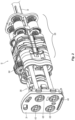
- articulation assembly 700 generally includes a front transition plug 750, a transition lumen 740, a distal link 780, a center link 710, a proximal link 720, a back transition plug 730, a seal 760, and a seal clip 770.
- the actuation cables 738a, 738b and a cam or drive rod 310a extend through the articulation assembly 700 as explained in detail below.
- FIG. 4A shows the articulation assembly 700 assembled for use and FIG. 4B shows an exploded view of the articulation assembly 700 with the various above-mentioned components separated.
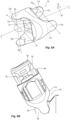
- Front transition plug 750 shown in FIGS. 5A-5D is configured to facilitate transitioning of the cam rod 310a and electrical leads 345a, 345b ( FIGS. 5C, 5D and 6F ) into the end effector assembly 100.
- Front transition plug 750 is generally mushroom-shaped to include a cap 751 and a stem 756 that depends therefrom, the stem 756 is configured for insertion within a distal end of the transition lumen 740.
- a central passage 753 is defined through the plug 750 that is configured to receive the cam rod 310a for reciprocation therein.
- a second, transitional passageway 756a (may be S-shaped) is defined through the plug 750 and is configured to facilitate transition and reciprocation of the blade rod 350 ( FIGS.
- a pair of relief channels 752a, 752b ( FIG. 5D ) is defined in the distal surface of the plug 750 and is configured to seat the flanges 124 ( FIG. 6F ) of fixed jaw member 120 providing lateral stability and rotational clearance for the end effector assembly 100.
- a key notch 757 ( FIG. 5D ) is defined in the distal surface of the plug 750 and is configured to secure a keying feature of distal segment 732 ( FIG. 4A ) providing par clocking/alignment and lateral stability to the end effector assembly 100.
- a cut-out 755 is defined in cap 751 ( FIG. 5D ) to facilitate passage of electrical leads 345a, 345b from the transition lumen 740 and into the end effector assembly 100. More particularly, leads 345a, 345b are configured to navigate internally through the transition lumen 740 and along the outer peripheral surface of stem 756 and through cut-out 755 into the end effector assembly 100. Leads 345a, 345b may be configured to travel along a helical path through the transition lumen 740 and into the plug 750 to reduce strain or unintended tension on the leads 345a, 345b during articulation and allow for a smoother transition to the end effector assembly 100. One or more mechanical interfaces, e.g., tangs 759, facilitate coupling and securing the plug 750 within the transition lumen 740. In embodiments, plug 750 and lumen 740 may be integrally formed.
- plug 750 is configured for insertion within the transition lumen 740 wherein the stem 756 of the plug 750 is secured therein while the cap 751 abuts the end effector assembly 100. Once completely inserted, tangs 759 engage complementary surfaces 749 of the transition lumen to secure the plug 750 within the transition lumen 740 ( FIG. 6A ). When inserted, the proximal portion of the plug 750 is compressed into a generally frustoconical configuration within the lumen 740.
- the helical pathway 756a of the plug 750 aligns with the internal helical pathway 741 of the lumen 740 to facilitate reciprocation of the blade rod 350 by reducing unintended motions at the end effector due to opening of the jaw members 110, 120 or reciprocation of the blade rod 350 and/or by reducing any strain due to articulation as explained in more detail below.
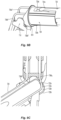
- transition lumen 740 is typically made from a rubber-like material or moldable thermoplastic polyurethane, e.g., pellethane, pelathyane (urethane) or the like, and includes a cap 742 and an elongated stem 744 trailing therefrom.
- Lumen 740 includes an internal, generally central, passage 743 used to reciprocate the cam or drive rod 310a therein that is disposed in longitudinal registration with passageway 753 of plug 750.
- a helical pathway 741 ( FIG. 6D ) extends therethrough and includes a distal end that is disposed in registration with helical pathway 756a of plug 750 ( FIG. 5B ).
- Helical pathway 741 is configured to smoothly reciprocate the blade rod 350 therein regardless of the articulation angle of the end effector 100 as explained in more detail below.
- a lead passageway 748 ( FIG. 6C ) is also defined in the transition lumen 740 and is configured to guide the lead wires 345a, 345b from the elongated shaft 30, into plug 750 and into the end effector assembly 100.
- the proximal end 746 of the lumen 740 is keyed to align and ensure proper engagement with proximal link 720 and reduce friction losses through the lumen 740 as the blade rod 350 and cam rod 310a reciprocate through the articulation assembly 700 ( FIGS. 6B and 6D ).
- the proximal end of the cap 742 also includes a taper 747 ( FIG. 6E ) extending to the stem 744 to facilitate engagement within distal link 780 and to guide the lead wires 345a, 345b through the lumen 740 from the proximal to distal ends and into plug 750 ( FIG. 6F ).
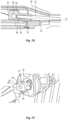
- cam rod 310a is shown alone ( FIGS. 7A and 7B ) and shown from various angles engaged within the articulation assembly 700 ( FIGS. 7C - 7F ). More particularly, cam rod 310a includes a proximal end 305 that is configured to engage the actuation assembly 300 and a distal end 306 that is configured to engage a crimp 315 of a cam member 325 ( FIGS. 7C - 7E ).
- a pivot rod 326 extends transversally through (or may be configured to project transversally from, e.g., pivot boss) the cam member 325 and is configured to operably engage a corresponding cam slot 113 defined in the flange 112 of jaw member 110 ( FIG. 5C ) (and cam slot in jaw member 120 (not shown)) such that movement of the cam rod 310a through the articulation assembly 700 pivots the jaw members 110, 120 between the open and closed positions.
- Flange 112 may be bifurcated to include two cam slots 113 for engagement with the pivot rod 326 on either side of the cam member 325, i.e., transversely.
- Cam rod 310a may be made from stainless steel or any other type of flexible and strong material that can absorb the necessary strains and stresses associated with camming the jaw members 110, 120, e.g., stranded cable.
- a Nitinol ® tube 310 may be disposed over the cam rod 310a to increase rigidity and to provide a smoother surface area for translation through the lumen 740 ( FIGS. 7B-7E ).
- Surgical grease may be utilized with the Nitinol ® tube 310 or other tubes of tubes.
- a coating e.g., a polyamide, may be extruded atop the cam rod 310a or otherwise deposited thereon to increase rigidity, support compressive loads and facilitate translation through the lumen 740.
- a polyamide coating provides smoother push/pull translation without the need for surgical grease.
- Any of the components describes herein can include a polyamide or similar coating to reduce wear for friction.
- Lubricants or other coating and/or surface treatments may be included in lieu of or in addition to a polyamide material to coat any of the components described herein to limit friction and component wear.
- a crimp 310c may be utilized to retain Nitinol ® tube 310 atop cam rod 310a.
- FIGS. 7D and 7E show a detailed view of the internal connection of the cam rod 310a to the cam member 325. More particularly, the distal end 306 of the cam rod 310a is configured to be received within an elongated channel 322 defined within the cam member 325. The proximal end of the elongated channel 322 includes a counter bore 327 defined therein which is configured to receive the outer Nitinol ® tube 310, or coating, when the cam rod 310a is fully inserted within the elongated channel 322. Once inserted, the cam member 325 is crimped to mechanically retain the cam rod 310a therein.
- a hex-like or other geometrically-shaped similar type crimp 315 is formed on the outer peripheral surface of the cam member 325 to allow the cam member 325 freedom to pivot or deflect at an angle " ⁇ " relative to a longitudinal axis defined through the elongated shaft 30 during proximal translation of the cam member 325 at a point 332 proximate a relief 145 defined by the distal end 324 of the cam member 325 and the crimp 315 between the plug 750 and the end effector assembly 100 ( FIGS. 7D and 7E ).
- the hex-like crimp 315 is oriented to eliminate any possible catch points between the cam member 325 and the transition between the distal segment 732 and the plug 750 and allow the cam member 325 to pivot at an angle " ⁇ " during proximal translation of the cam member 325.
- FIG. 7F shows a distal perspective view highlighting the cam rod 310a at assembly and showing a weld bore 329 defined in the distal-most surface or top surface 324 of the cam member 325.
- Weld bore 329 provides a point of access for welding the cam rod 326 to the cam member 325 during assembly. Providing the weld on center or along the pivot rod axis allows proper loading of the cam rod 326 and reduces weld splatter from reaching the bearing surfaces of the cam rod 326 which could affect performance of the cam rod 326.
- the weld bore 329 may remain open after welding or plugged as needed. Weld bore may also be defined within a different surface of the cam member 325, e.g., surface 321.
- FIGS. 8A - 9D which shows the wrist link assembly 701 composed of the three links, e.g., distal articulation link 780, center articulation link 710 and proximal articulation link 720.
- a pair of opposing distal pivot flanges 712a, 712b disposed normal to a longitudinal axis "L" defined therethrough and a pair of proximal pivot flanges 711a, 711b disposed about ninety degrees (90°) offset from the distal flanges 712a, 712b.
- Each pair of opposing flanges defines a rotation plane, e.g., flanges 712a, 712b define a rotation plane transverse "T" to the longitudinal axis "L” and proximal flanges 711a, 711b define a rotation plane normal "N" to the longitudinal axis "L”.
- the distal and proximal flanges 712a, 712b and 711a, 711b of the center link 710 are configured to reside in close proximity relative to one another to eliminate dead space along the articulation assembly 700. More specifically, center articulation link 710 includes pivot bearing surfaces 713a, 713b on the distal end and 717a, 717b on the proximal end.
- Each pair of bearing surfaces defines a theoretical pivot axis, PA1 and PA2, respectively.
- the wrist link assembly 701, and specifically the center link 710, is configured so the distance between these theoretical pivot axes PA1, PA2 are minimized. Minimizing the distance between the pivot axis PA1, PA2 reduces so called "dead space" along articulation assembly 700.
- Surfaces 711a, 711b and 712a, 712b are configured to both act as side bearing surfaces against bearings 721a and 721b ( FIG. 9A ) for alignment purposes and act as covers to prevent possible tissue pinch points.
- Center link 710 is configured to mechanically couple to proximal link 720 at flanges 711a, 711b and distal link 780 at flanges 712a, 712b.
- Central link 710 includes various shoulders and additional structure (not explicitly shown) configured to facilitate rotational engagement with both links 780 and 720.
- shoulders 713a, 713b are disposed proximate respective flanges 712a, 712b and may be configured to include a specific radius of curvature to control the relative rotation of the respective links, e.g., link 710 relative to link 780.
- shoulders 717a, 717b are disposed proximate respective flanges 711a, 711b and may be configured to include a specific radius of curvature to control the relative rotation of the respective links, e.g., link 710 relative to link 720. Controlling the radius of curvature not only controls the degree of rotation of the respective links, e.g., link 710 relative to link 780 or link 710 relative to link 720, but may be engineered to reduce tissue pinch points 810 between the same.
- the radius of any of the shoulders 713a, 713b or 717a, 717b may be varied or different from the radii of the other shoulders to limit tissue pinch.
- the center link 710 may be designed to over-travel to eliminate possible tissue pinch points.
- Center link 710 also defines a passage 715 that is configured to pass the articulation cables 738a, 738b, leads 345a, 345b, cam rod 310a and blade rod 350 therethrough.
- distal link 780 and proximal link 720 also include passageways, e.g., passageways 785, 728a, and 728b of distal link 780 and passageways 725 of proximal link 720, respectively, configured to pass the articulation cables 738a, 738b, leads 345a, 345b, cam rod 310a and blade rod 350 therethrough.
- distal link 780 couples to central link 710. More particularly, flanges 712a, 712b are configured to operably couple to corresponding mechanical interfaces 782a, 782b (See FIG. 5C ) to allow selective articulation along plane "T" ( FIG. 8A ) upon translation of the articulation cables 738a, 738b.
- Articulation cables 738a, 738b are configured to extend from the articulation actuator 200, through the various components (e.g., end cap 770, seal 760, back transition plug 730, proximal link 720, central link 710, and distal link 780, and secure within predefined pockets 781a, 781b defined in the distal link 780 ( FIG. 8C ).
- Articulation cables 738a, 738b are configured as four distinct individual cables 738a1, 738a2, 738b1, 738b2 extending from the articulation actuator 200 that are grouped in opposing pairs (e.g., individual cables 738a1, 738a2 and 738b1, 738b2) and crimped together at crimps 739a, 739b, respectively, at their respective distal ends to form articulation cables 738a, 738b. Movement of one of the cables, e.g., individual cable 738a1, in the cable pair produces the opposite movement of the other cable, e.g., individual cable 738a2, of the cable pair.
- Crimping (or otherwise joining) the opposing articulation cables 738a, 738b simplifies manufacturing and assembly.
- Crimps 739a, 739b are configured to sit and anchor within respective pockets 781a, 781b ( FIGS. 8B and 8C ) defined in the distal link 780.
- the cables e.g., individual cables 738a1, 738a2, are configured to extend through the various passageways, e.g., passageways 715 and 725, and are spaced as far as possible from one another to provide maximum torque for actuation purposes.
- proximal link 720 couples to central link 710. More particularly, flanges 711a, 711b are configured to operably couple to corresponding mechanical interfaces 721a, 721b (See FIGS. 9A and 9B ) to allow selective articulation along plane "N" ( FIG. 8A ) upon translation of the articulation cables 738a, 738b.
- a pair of opposing flanges 722a, 722b extends from a distal end of the proximal link 720 on either side of passage 725.
- Articulation cables 738a, 738b extend through apertures 728a, 728b defined in a proximal end of the flanges 722a, 722b and ride a respective pair of opposing railways 723a, 723b defined in flanges 722a, 722b.
- Railways 723a, 723b extend around the distal end of the flanges 722a, 722b to guide each cable, e.g., cable 738a1 and 738a2, of each articulation cable, e.g., 738a, as the individual cables 738a1 and 738a2 move oppositely through the articulation assembly 700 upon actuation thereof.
- articulation direction of the wrist 701 i.e., proximal link 720, central link 710 and distal link 780, is aligned with the jaw members 110, 120 for better visualization, e.g., side-to-side versus up and down.
- each flange 722a, 722b is configured to compensate for the changes in length of the cables 738a1 and 738a2 during articulation so that the overall length of each cable 738a1 and 738a2 remains substantially constant.
- the inner cable, e.g., cable 738a1 shortens during articulation
- the outer cable, e.g., cable 738a2 increases in length along the respective flange 722a ( FIG. 9C ).
- Back transition plug 730 operably couples to the proximal link 720 via a pair of opposing fingers 734a, 734b that are configured to mechanically engage a corresponding pair of opposing recesses 729a, 729b defined in the proximal link 720.
- Back transition plug 730 is configured to transition the various articulation cables 738a, 738b, leads 345a, 345b, cam rod 310a and blade rod 350 therethrough and into and through the wrist assembly 701 (e.g., links 720, 710 and 780) through various internal passageways defined therein, e.g., 731.
- passageway 739 is configured to transition the cam or drive rod 310a and also configured to prevent buckling of the cam rod 310a therein.
- a long outer tube 310 may be disposed over the cam rod 310a to prevent buckling as well.
- Other passageways, e.g., passageways 736a, 736b, are configured to pass the blade rod 350 and leads 345a, 345b therethrough.
- Passageways 731 ( FIG. 6F - shown in phantom) defined in the back transition plug 730 are configured to pass the articulation cables 738a, 738b, leads 345a, 345b therethrough.
- a seal clip 770 operably couples to the back transition plug 730 via fingers 772a, 772b which are configured to mechanically engage corresponding apertures 732a, 732b defined within the back transition plug 730.
- Each finger and aperture interface e.g., finger 772a and aperture 732a, may be configured at a different length than the other finger and aperture interface, e.g., finger 772b and aperture 732b, depending upon a particular purpose.
- the seal clip secures a seal or O-ring 760 to the back transition plug 730 ( FIGS. 10A and 10B ).
- Seal ring 760 may be made from any type of material configured to seal the seal clip atop shaft 30 and to the back transition plug 730. Seal ring 760 is configured to seal around all the passthrough articulation cables 738, electrical leads 345a, 345b, etc.
- the seal ring 760 may be made from a material that seals the seal clip atop shaft 30 and to the back transition plug 730.
Landscapes
- Health & Medical Sciences (AREA)
- Engineering & Computer Science (AREA)
- Life Sciences & Earth Sciences (AREA)
- Surgery (AREA)
- Robotics (AREA)
- Biomedical Technology (AREA)
- General Health & Medical Sciences (AREA)
- Veterinary Medicine (AREA)
- Public Health (AREA)
- Nuclear Medicine, Radiotherapy & Molecular Imaging (AREA)
- Animal Behavior & Ethology (AREA)
- Heart & Thoracic Surgery (AREA)
- Medical Informatics (AREA)
- Molecular Biology (AREA)
- Mechanical Engineering (AREA)
- Physics & Mathematics (AREA)
- Plasma & Fusion (AREA)
- Otolaryngology (AREA)
- Surgical Instruments (AREA)
- Manipulator (AREA)
Claims (14)
- Gelenkiges elektrochirurgisches Instrument (10), umfassend:ein Gehäuse (20) mit einem länglichen Schaft (30), der sich davon erstreckt;eine Gelenkanordnung (700), die funktional an einem distalen Ende des länglichen Schafts gelagert und dazu ausgelegt ist, eine Endeffektoranordnung (100) am distalen Ende davon zu tragen, wobei die Gelenkanordnung aufweist:eine proximale Verbindung (720), die funktional mit dem distalen Ende des länglichen Schaftes gekoppelt ist;eine distale Verbindung (780), die funktional mit der Endeffektoranordnung gekoppelt ist; undeine zentrale Verbindung (710), die funktional zwischen der proximalen Verbindung und der distalen Verbindung gekoppelt ist;ein Übergangslumen (740), das dazu ausgelegt ist, in mindestens der distalen Verbindung, der zentralen Verbindung und der proximalen Verbindung aufgenommen zu werden, dadurch gekennzeichnet, dass das Übergangslumen einen spiralförmigen Durchgang (741) darin definiert aufweist, der dazu ausgelegt ist, eine Klingenstange (350) zur funktionellen Verbindung mit einer Klinge, die in der Endeffektoranordnung angeordnet ist, dort hindurch zu führen.
- Gelenkiges elektrochirurgisches Instrument nach Anspruch 1, wobei das Übergangslumen einen zentralen Durchgang (743) darin definiert aufweist, der dazu ausgelegt ist, eine Nockenstange (310a) zur Hin- und Herbewegung dort hindurch zu führen, die die Endeffektoranordnung bei Translation davon betätigt.
- Gelenkiges elektrochirurgisches Instrument nach Anspruch 1 oder 2, wobei das Übergangslumen einen Leitungsdurchgang (748) darin definiert aufweist, der dazu ausgelegt ist, eine oder mehrere elektrische Leitungen (345a, 345b) dort hindurch und in die Endeffektoranordnung zu führen.
- Gelenkiges elektrochirurgisches Instrument nach einem vorhergehenden Anspruch, wobei ein proximales Ende des Übergangslumens (746) dazu konstruiert ist, eine entsprechende mechanische Schnittstelle, die in der proximalen Verbindung angeordnet ist, mechanisch in Eingriff zu nehmen.
- Gelenkiges elektrochirurgisches Instrument nach einem vorhergehenden Anspruch, wobei ein distales Ende des Übergangslumens eine Kappe (748) aufweist, die dazu ausgelegt ist, eine entsprechende mechanische Schnittstelle, die an einem distalen Ende der distalen Verbindung angeordnet ist, mechanisch in Eingriff zu nehmen.
- Gelenkiges elektrochirurgisches Instrument nach einem vorhergehenden Anspruch, wobei das Übergangslumen eine Kappe aufweist, die dazu ausgelegt ist, eine entsprechende mechanische Schnittstelle, die an einem distalen Ende der distalen Verbindung angeordnet ist, mechanisch in Eingriff zu nehmen, eine schlüsselförmige Schnittstelle, die an einem proximalen Ende davon angeordnet ist, die dazu ausgelegt ist, eine entsprechende mechanische Schnittstelle, die in der proximalen Verbindung angeordnet ist, mechanisch in Eingriff zu nehmen, und einen dazwischen angeordneten Stiel (756).
- Gelenkiges elektrochirurgisches Instrument nach Anspruch 6, wobei das Übergangslumen eine Verjüngung (747) aufweist, die zwischen der Kappe und dem Stiel angeordnet und dazu ausgelegt ist, den Eingriff in die distale Verbindung zu erleichtern.
- Gelenkiges elektrochirurgisches Instrument nach Anspruch 6 oder 7, wobei die Kappe dazu ausgelegt ist, einen Übergangsstecker (750) darin aufzunehmen, wobei der Übergangsstecker funktional mit der Endeffektoranordnung koppelt; wobei vorzugsweise der Übergangsstecker gegenüberliegende Zungen (759) an einer Außenseite davon aufweist, die dazu ausgelegt sind, komplementäre mechanische Schnittstellen aufzunehmen, die in dem Übergangslumen definiert sind, um den Übergangsstecker in dem Übergangslumen sicher zu befestigen.
- Gelenkiges elektrochirurgisches Instrument nach Anspruch 8, wobei der Übergangsstecker einen Durchgang (756a) darin definiert aufweist, der dazu ausgelegt ist, die Klingenstange zum funktionalen Eingriff mit der Klinge, die in der Endeffektoranordnung angeordnet ist, dort hindurch zu führen.
- Gelenkiges elektrochirurgisches Instrument nach Anspruch 8 oder Anspruch 9, wobei der Übergangsstecker einen zentralen Durchgang (753) darin definiert aufweist, der dazu ausgelegt ist, eine Nockenstange zur Hin- und Herbewegung dort hindurch zu führen, die die Endeffektoranordnung bei Translation davon betätigt; wobei vorzugsweise der Übergangsstecker einen Leitungsdurchgang (748) darin definiert aufweist, der dazu ausgelegt ist, eine oder mehrere elektrische Leitungen dort hindurch und in die Endeffektoranordnung zu führen.
- Gelenkiges elektrochirurgisches Instrument nach einem der Ansprüche 8-10, wobei der Durchgang (756a) des Übergangssteckers und der spiralförmige Durchgang (741) des Übergangslumens in Deckung miteinander angeordnet sind, um das Führen der Klingenstange in die Endeffektoranordnung zu erleichtern; wobei vorzugsweise ein zentraler Durchgang (753), der in dem Übergangsstecker definiert ist, und ein zentraler Durchgang (743), der in dem Übergangslumen definiert ist, in Deckung miteinander angeordnet sind, um die Hin- und Herbewegung einer Nockenstange dort hindurch zu erleichtern, die die Endeffektoranordnung bei Translation davon betätigt.
- Gelenkiges elektrochirurgisches Instrument nach einem der Ansprüche 8 bis 11, wobei ein Ausschnitt (755), der in dem Übergangsstecker (750) definiert ist, und ein Leitungsdurchgang (748), der in dem Übergangslumen definiert ist, in Deckung miteinander angeordnet sind, um die Aufnahme von einer oder mehreren elektrischen Leitungen dort hindurch zu erleichtern.
- Gelenkiges elektrochirurgisches Instrument nach einem der Ansprüche 8 bis 12, wobei das Übergangslumen aus einem gummiartigen oder nachgiebigen Material hergestellt ist, das dazu ausgelegt ist, sich bei Auslenkung der Gelenkanordnung zu biegen.
- Gelenkiges elektrochirurgisches Instrument nach Anspruch 13, wobei das Übergangslumen aus einem formbaren thermoplastischen Polyurethan hergestellt ist.
Priority Applications (1)
| Application Number | Priority Date | Filing Date | Title |
|---|---|---|---|
| EP24210396.8A EP4480433A3 (de) | 2022-02-25 | 2023-02-27 | Gelenkanordnung für eine robotische vorrichtung |
Applications Claiming Priority (7)
| Application Number | Priority Date | Filing Date | Title |
|---|---|---|---|
| US202263313781P | 2022-02-25 | 2022-02-25 | |
| US202263313775P | 2022-02-25 | 2022-02-25 | |
| US202263313788P | 2022-02-25 | 2022-02-25 | |
| US202263313797P | 2022-02-25 | 2022-02-25 | |
| US202263313793P | 2022-02-25 | 2022-02-25 | |
| US202263313790P | 2022-02-25 | 2022-02-25 | |
| US202263313777P | 2022-02-25 | 2022-02-25 |
Related Child Applications (2)
| Application Number | Title | Priority Date | Filing Date |
|---|---|---|---|
| EP24210396.8A Division EP4480433A3 (de) | 2022-02-25 | 2023-02-27 | Gelenkanordnung für eine robotische vorrichtung |
| EP24210396.8A Division-Into EP4480433A3 (de) | 2022-02-25 | 2023-02-27 | Gelenkanordnung für eine robotische vorrichtung |
Publications (2)
| Publication Number | Publication Date |
|---|---|
| EP4233766A1 EP4233766A1 (de) | 2023-08-30 |
| EP4233766B1 true EP4233766B1 (de) | 2024-12-11 |
Family
ID=85384397
Family Applications (2)
| Application Number | Title | Priority Date | Filing Date |
|---|---|---|---|
| EP24210396.8A Pending EP4480433A3 (de) | 2022-02-25 | 2023-02-27 | Gelenkanordnung für eine robotische vorrichtung |
| EP23158900.3A Active EP4233766B1 (de) | 2022-02-25 | 2023-02-27 | Gelenkanordnung für eine robotische vorrichtung |
Family Applications Before (1)
| Application Number | Title | Priority Date | Filing Date |
|---|---|---|---|
| EP24210396.8A Pending EP4480433A3 (de) | 2022-02-25 | 2023-02-27 | Gelenkanordnung für eine robotische vorrichtung |
Country Status (2)
| Country | Link |
|---|---|
| US (2) | US12419705B2 (de) |
| EP (2) | EP4480433A3 (de) |
Family Cites Families (39)
| Publication number | Priority date | Publication date | Assignee | Title |
|---|---|---|---|---|
| US5409453A (en) | 1992-08-12 | 1995-04-25 | Vidamed, Inc. | Steerable medical probe with stylets |
| US5752973A (en) | 1994-10-18 | 1998-05-19 | Archimedes Surgical, Inc. | Endoscopic surgical gripping instrument with universal joint jaw coupler |
| US5792135A (en) | 1996-05-20 | 1998-08-11 | Intuitive Surgical, Inc. | Articulated surgical instrument for performing minimally invasive surgery with enhanced dexterity and sensitivity |
| US7666191B2 (en) | 1996-12-12 | 2010-02-23 | Intuitive Surgical, Inc. | Robotic surgical system with sterile surgical adaptor |
| US7758569B2 (en) | 1998-02-24 | 2010-07-20 | Hansen Medical, Inc. | Interchangeable surgical instrument |
| US7048744B2 (en) | 2001-04-26 | 2006-05-23 | Sol Wiess | Attachable surgical accessory instrument |
| US6554829B2 (en) | 2001-01-24 | 2003-04-29 | Ethicon, Inc. | Electrosurgical instrument with minimally invasive jaws |
| US6817974B2 (en) | 2001-06-29 | 2004-11-16 | Intuitive Surgical, Inc. | Surgical tool having positively positionable tendon-actuated multi-disk wrist joint |
| US6602252B2 (en) | 2002-01-03 | 2003-08-05 | Starion Instruments Corporation | Combined dissecting, cauterizing, and stapling device |
| US6969385B2 (en) | 2002-05-01 | 2005-11-29 | Manuel Ricardo Moreyra | Wrist with decoupled motion transmission |
| US9060770B2 (en) | 2003-05-20 | 2015-06-23 | Ethicon Endo-Surgery, Inc. | Robotically-driven surgical instrument with E-beam driver |
| US7143925B2 (en) | 2004-07-28 | 2006-12-05 | Ethicon Endo-Surgery, Inc. | Surgical instrument incorporating EAP blocking lockout mechanism |
| US7857183B2 (en) | 2004-07-28 | 2010-12-28 | Ethicon Endo-Surgery, Inc. | Surgical instrument incorporating an electrically actuated articulation mechanism |
| US7540872B2 (en) | 2004-09-21 | 2009-06-02 | Covidien Ag | Articulating bipolar electrosurgical instrument |
| US8579176B2 (en) | 2005-07-26 | 2013-11-12 | Ethicon Endo-Surgery, Inc. | Surgical stapling and cutting device and method for using the device |
| US8029531B2 (en) | 2006-07-11 | 2011-10-04 | Cambridge Endoscopic Devices, Inc. | Surgical instrument |
| EP2083729B1 (de) | 2006-10-05 | 2013-12-11 | Covidien LP | Flexible endoskopische nähvorrichtungen |
| US8475453B2 (en) * | 2006-10-06 | 2013-07-02 | Covidien Lp | Endoscopic vessel sealer and divider having a flexible articulating shaft |
| EP2197364B1 (de) | 2007-09-21 | 2016-07-20 | Covidien LP | Chirurgische vorrichtung |
| US7861906B2 (en) | 2008-02-14 | 2011-01-04 | Ethicon Endo-Surgery, Inc. | Surgical stapling apparatus with articulatable components |
| US8858547B2 (en) | 2009-03-05 | 2014-10-14 | Intuitive Surgical Operations, Inc. | Cut and seal instrument |
| US8357161B2 (en) * | 2009-10-30 | 2013-01-22 | Covidien Lp | Coaxial drive |
| CN104958106B (zh) | 2009-11-13 | 2018-06-01 | 直观外科手术操作公司 | 具有紧凑腕部的手术工具 |
| US20110118708A1 (en) | 2009-11-13 | 2011-05-19 | Intuitive Surgical Operations, Inc. | Double universal joint |
| KR101800723B1 (ko) | 2009-11-13 | 2017-11-23 | 인튜어티브 서지컬 오퍼레이션즈 인코포레이티드 | 독립적으로 회전하는 부재 내의 병렬 구동 샤프트들을 위한 모터 연접부 |
| EP2675383B1 (de) * | 2011-02-18 | 2017-07-19 | Intuitive Surgical Operations, Inc. | Chirurgisches fusions- und schneidinstrument |
| KR101427330B1 (ko) | 2011-11-23 | 2014-08-06 | 주식회사 리브스메드 | 차동 부재 |
| US9737300B2 (en) | 2013-03-13 | 2017-08-22 | Ethicon Llc | Electrosurgical device with disposable shaft having rack and pinion drive |
| KR101584766B1 (ko) | 2014-04-24 | 2016-01-12 | 주식회사 리브스메드 | 수술용 인스트루먼트 |
| US10874465B2 (en) * | 2015-05-15 | 2020-12-29 | Intuitive Surgical Operations, Inc. | System and method for minimally invasive cutting instrument operation |
| CA3152886C (en) | 2016-02-05 | 2023-01-03 | Board Of Regents Of The University Of Texas System | Surgical apparatus |
| US11559307B2 (en) | 2017-12-28 | 2023-01-24 | Cilag Gmbh International | Method of robotic hub communication, detection, and control |
| EP3761898B1 (de) | 2018-03-07 | 2025-11-05 | Intuitive Surgical Operations, Inc. | Reibungsarme medizinische werkzeuge mit kleinem profil und montagefreundlichen bauteilen |
| US11406442B2 (en) | 2018-11-05 | 2022-08-09 | Cilag Gmbh International | Articulate wrist with flexible central member |
| US11576733B2 (en) | 2019-02-06 | 2023-02-14 | Covidien Lp | Robotic surgical assemblies including electrosurgical instruments having articulatable wrist assemblies |
| US11771507B2 (en) | 2019-08-21 | 2023-10-03 | Cilag Gmbh International | Articulable wrist with flexible member and pivot guides |
| US11925428B2 (en) | 2020-08-07 | 2024-03-12 | Covidien Lp | Manual end effector activation for robotic surgical systems |
| US20220079660A1 (en) * | 2020-09-11 | 2022-03-17 | Covidien Lp | Surgical instruments having an articulating section such as for use in robotic surgical systems |
| US20230310807A1 (en) * | 2022-04-05 | 2023-10-05 | Intuitive Surgical Operations, Inc. | Instrument with a counter-pivoting mechanism |
-
2023
- 2023-01-25 US US18/101,333 patent/US12419705B2/en active Active
- 2023-02-27 EP EP24210396.8A patent/EP4480433A3/de active Pending
- 2023-02-27 EP EP23158900.3A patent/EP4233766B1/de active Active
-
2025
- 2025-08-27 US US19/311,920 patent/US20250387183A1/en active Pending
Also Published As
| Publication number | Publication date |
|---|---|
| US12419705B2 (en) | 2025-09-23 |
| US20250387183A1 (en) | 2025-12-25 |
| EP4480433A3 (de) | 2025-02-26 |
| EP4480433A2 (de) | 2024-12-25 |
| US20230270512A1 (en) | 2023-08-31 |
| EP4233766A1 (de) | 2023-08-30 |
Similar Documents
| Publication | Publication Date | Title |
|---|---|---|
| EP3473201B1 (de) | Distal austauschbare kabelsysteme in chirurgischen werkzeugen | |
| JP7279030B2 (ja) | ロボット外科用ツールのための動力軸リスト部 | |
| US12251088B2 (en) | Low-friction, small profile medical tools having easy-to-assemble components | |
| EP3761898B1 (de) | Reibungsarme medizinische werkzeuge mit kleinem profil und montagefreundlichen bauteilen | |
| KR102715991B1 (ko) | 이중 액슬 로봇 엔드 이펙터 | |
| US20250359948A1 (en) | Medical device wrist | |
| EP4233766B1 (de) | Gelenkanordnung für eine robotische vorrichtung | |
| US12226178B2 (en) | Robotic surgical instrument | |
| US20240299079A1 (en) | Knife designs for end effectors used in surgical tools | |
| US12357372B2 (en) | End effector assembly for use in a robotic surgical instrument | |
| JP7439116B2 (ja) | ハサミスリーブアセンブリの保護 | |
| US20250325294A1 (en) | Knife designs for end effectors used in surgical tools | |
| US20220079660A1 (en) | Surgical instruments having an articulating section such as for use in robotic surgical systems | |
| EP4489675B1 (de) | Thermisch und mechanisch symmetrische elektroden für endeffektoren | |
| US20240293171A1 (en) | Knife housing for surgical tool end effectors | |
| US20240293170A1 (en) | Thermally and mechanically symmetric electrodes for end effectors | |
| US20240293138A1 (en) | Jaw mechanism for end effectors | |
| US20250025252A1 (en) | Surgical tools with end effector redirect pulleys | |
| US20220079661A1 (en) | Surgical instruments having an articulating section such as for use in robotic surgical systems | |
| EP3967254A1 (de) | Endeffektoranordnungen für chirurgische instrumente | |
| WO2022055685A1 (en) | End effector assemblies for surgical instruments such as for use in robotic surgical systems |
Legal Events
| Date | Code | Title | Description |
|---|---|---|---|
| PUAI | Public reference made under article 153(3) epc to a published international application that has entered the european phase |
Free format text: ORIGINAL CODE: 0009012 |
|
| STAA | Information on the status of an ep patent application or granted ep patent |
Free format text: STATUS: REQUEST FOR EXAMINATION WAS MADE |
|
| 17P | Request for examination filed |
Effective date: 20230227 |
|
| AK | Designated contracting states |
Kind code of ref document: A1 Designated state(s): AL AT BE BG CH CY CZ DE DK EE ES FI FR GB GR HR HU IE IS IT LI LT LU LV MC ME MK MT NL NO PL PT RO RS SE SI SK SM TR |
|
| GRAP | Despatch of communication of intention to grant a patent |
Free format text: ORIGINAL CODE: EPIDOSNIGR1 |
|
| STAA | Information on the status of an ep patent application or granted ep patent |
Free format text: STATUS: GRANT OF PATENT IS INTENDED |
|
| RIC1 | Information provided on ipc code assigned before grant |
Ipc: A61B 18/14 20060101ALI20240610BHEP Ipc: A61B 34/30 20160101AFI20240610BHEP |
|
| INTG | Intention to grant announced |
Effective date: 20240703 |
|
| GRAS | Grant fee paid |
Free format text: ORIGINAL CODE: EPIDOSNIGR3 |
|
| GRAA | (expected) grant |
Free format text: ORIGINAL CODE: 0009210 |
|
| STAA | Information on the status of an ep patent application or granted ep patent |
Free format text: STATUS: THE PATENT HAS BEEN GRANTED |
|
| AK | Designated contracting states |
Kind code of ref document: B1 Designated state(s): AL AT BE BG CH CY CZ DE DK EE ES FI FR GB GR HR HU IE IS IT LI LT LU LV MC ME MK MT NL NO PL PT RO RS SE SI SK SM TR |
|
| REG | Reference to a national code |
Ref country code: GB Ref legal event code: FG4D |
|
| REG | Reference to a national code |
Ref country code: CH Ref legal event code: EP |
|
| REG | Reference to a national code |
Ref country code: DE Ref legal event code: R096 Ref document number: 602023001288 Country of ref document: DE |
|
| REG | Reference to a national code |
Ref country code: IE Ref legal event code: FG4D |
|
| REG | Reference to a national code |
Ref country code: LT Ref legal event code: MG9D |
|
| PG25 | Lapsed in a contracting state [announced via postgrant information from national office to epo] |
Ref country code: HR Free format text: LAPSE BECAUSE OF FAILURE TO SUBMIT A TRANSLATION OF THE DESCRIPTION OR TO PAY THE FEE WITHIN THE PRESCRIBED TIME-LIMIT Effective date: 20241211 |
|
| PGFP | Annual fee paid to national office [announced via postgrant information from national office to epo] |
Ref country code: DE Payment date: 20250122 Year of fee payment: 3 |
|
| PG25 | Lapsed in a contracting state [announced via postgrant information from national office to epo] |
Ref country code: FI Free format text: LAPSE BECAUSE OF FAILURE TO SUBMIT A TRANSLATION OF THE DESCRIPTION OR TO PAY THE FEE WITHIN THE PRESCRIBED TIME-LIMIT Effective date: 20241211 |
|
| PG25 | Lapsed in a contracting state [announced via postgrant information from national office to epo] |
Ref country code: BG Free format text: LAPSE BECAUSE OF FAILURE TO SUBMIT A TRANSLATION OF THE DESCRIPTION OR TO PAY THE FEE WITHIN THE PRESCRIBED TIME-LIMIT Effective date: 20241211 |
|
| REG | Reference to a national code |
Ref country code: NL Ref legal event code: MP Effective date: 20241211 |
|
| PG25 | Lapsed in a contracting state [announced via postgrant information from national office to epo] |
Ref country code: ES Free format text: LAPSE BECAUSE OF FAILURE TO SUBMIT A TRANSLATION OF THE DESCRIPTION OR TO PAY THE FEE WITHIN THE PRESCRIBED TIME-LIMIT Effective date: 20241211 |
|
| PG25 | Lapsed in a contracting state [announced via postgrant information from national office to epo] |
Ref country code: NO Free format text: LAPSE BECAUSE OF FAILURE TO SUBMIT A TRANSLATION OF THE DESCRIPTION OR TO PAY THE FEE WITHIN THE PRESCRIBED TIME-LIMIT Effective date: 20250311 |
|
| PG25 | Lapsed in a contracting state [announced via postgrant information from national office to epo] |
Ref country code: GR Free format text: LAPSE BECAUSE OF FAILURE TO SUBMIT A TRANSLATION OF THE DESCRIPTION OR TO PAY THE FEE WITHIN THE PRESCRIBED TIME-LIMIT Effective date: 20250312 Ref country code: LV Free format text: LAPSE BECAUSE OF FAILURE TO SUBMIT A TRANSLATION OF THE DESCRIPTION OR TO PAY THE FEE WITHIN THE PRESCRIBED TIME-LIMIT Effective date: 20241211 |
|
| PG25 | Lapsed in a contracting state [announced via postgrant information from national office to epo] |
Ref country code: RS Free format text: LAPSE BECAUSE OF FAILURE TO SUBMIT A TRANSLATION OF THE DESCRIPTION OR TO PAY THE FEE WITHIN THE PRESCRIBED TIME-LIMIT Effective date: 20250311 |
|
| PG25 | Lapsed in a contracting state [announced via postgrant information from national office to epo] |
Ref country code: NL Free format text: LAPSE BECAUSE OF FAILURE TO SUBMIT A TRANSLATION OF THE DESCRIPTION OR TO PAY THE FEE WITHIN THE PRESCRIBED TIME-LIMIT Effective date: 20241211 |
|
| REG | Reference to a national code |
Ref country code: AT Ref legal event code: MK05 Ref document number: 1749751 Country of ref document: AT Kind code of ref document: T Effective date: 20241211 |
|
| PG25 | Lapsed in a contracting state [announced via postgrant information from national office to epo] |
Ref country code: SM Free format text: LAPSE BECAUSE OF FAILURE TO SUBMIT A TRANSLATION OF THE DESCRIPTION OR TO PAY THE FEE WITHIN THE PRESCRIBED TIME-LIMIT Effective date: 20241211 |
|
| PG25 | Lapsed in a contracting state [announced via postgrant information from national office to epo] |
Ref country code: PL Free format text: LAPSE BECAUSE OF FAILURE TO SUBMIT A TRANSLATION OF THE DESCRIPTION OR TO PAY THE FEE WITHIN THE PRESCRIBED TIME-LIMIT Effective date: 20241211 |
|
| PG25 | Lapsed in a contracting state [announced via postgrant information from national office to epo] |
Ref country code: IS Free format text: LAPSE BECAUSE OF FAILURE TO SUBMIT A TRANSLATION OF THE DESCRIPTION OR TO PAY THE FEE WITHIN THE PRESCRIBED TIME-LIMIT Effective date: 20250411 |
|
| PG25 | Lapsed in a contracting state [announced via postgrant information from national office to epo] |
Ref country code: PT Free format text: LAPSE BECAUSE OF FAILURE TO SUBMIT A TRANSLATION OF THE DESCRIPTION OR TO PAY THE FEE WITHIN THE PRESCRIBED TIME-LIMIT Effective date: 20250411 |
|
| PG25 | Lapsed in a contracting state [announced via postgrant information from national office to epo] |
Ref country code: EE Free format text: LAPSE BECAUSE OF FAILURE TO SUBMIT A TRANSLATION OF THE DESCRIPTION OR TO PAY THE FEE WITHIN THE PRESCRIBED TIME-LIMIT Effective date: 20241211 |
|
| PG25 | Lapsed in a contracting state [announced via postgrant information from national office to epo] |
Ref country code: RO Free format text: LAPSE BECAUSE OF FAILURE TO SUBMIT A TRANSLATION OF THE DESCRIPTION OR TO PAY THE FEE WITHIN THE PRESCRIBED TIME-LIMIT Effective date: 20241211 Ref country code: AT Free format text: LAPSE BECAUSE OF FAILURE TO SUBMIT A TRANSLATION OF THE DESCRIPTION OR TO PAY THE FEE WITHIN THE PRESCRIBED TIME-LIMIT Effective date: 20241211 |
|
| PG25 | Lapsed in a contracting state [announced via postgrant information from national office to epo] |
Ref country code: SK Free format text: LAPSE BECAUSE OF FAILURE TO SUBMIT A TRANSLATION OF THE DESCRIPTION OR TO PAY THE FEE WITHIN THE PRESCRIBED TIME-LIMIT Effective date: 20241211 |
|
| PG25 | Lapsed in a contracting state [announced via postgrant information from national office to epo] |
Ref country code: CZ Free format text: LAPSE BECAUSE OF FAILURE TO SUBMIT A TRANSLATION OF THE DESCRIPTION OR TO PAY THE FEE WITHIN THE PRESCRIBED TIME-LIMIT Effective date: 20241211 |
|
| PG25 | Lapsed in a contracting state [announced via postgrant information from national office to epo] |
Ref country code: IT Free format text: LAPSE BECAUSE OF FAILURE TO SUBMIT A TRANSLATION OF THE DESCRIPTION OR TO PAY THE FEE WITHIN THE PRESCRIBED TIME-LIMIT Effective date: 20241211 |
|
| PG25 | Lapsed in a contracting state [announced via postgrant information from national office to epo] |
Ref country code: SE Free format text: LAPSE BECAUSE OF FAILURE TO SUBMIT A TRANSLATION OF THE DESCRIPTION OR TO PAY THE FEE WITHIN THE PRESCRIBED TIME-LIMIT Effective date: 20241211 |
|
| REG | Reference to a national code |
Ref country code: DE Ref legal event code: R097 Ref document number: 602023001288 Country of ref document: DE |
|
| PG25 | Lapsed in a contracting state [announced via postgrant information from national office to epo] |
Ref country code: MC Free format text: LAPSE BECAUSE OF FAILURE TO SUBMIT A TRANSLATION OF THE DESCRIPTION OR TO PAY THE FEE WITHIN THE PRESCRIBED TIME-LIMIT Effective date: 20241211 |
|
| PG25 | Lapsed in a contracting state [announced via postgrant information from national office to epo] |
Ref country code: DK Free format text: LAPSE BECAUSE OF FAILURE TO SUBMIT A TRANSLATION OF THE DESCRIPTION OR TO PAY THE FEE WITHIN THE PRESCRIBED TIME-LIMIT Effective date: 20241211 |
|
| PG25 | Lapsed in a contracting state [announced via postgrant information from national office to epo] |
Ref country code: LU Free format text: LAPSE BECAUSE OF NON-PAYMENT OF DUE FEES Effective date: 20250227 |
|
| PLBE | No opposition filed within time limit |
Free format text: ORIGINAL CODE: 0009261 |
|
| STAA | Information on the status of an ep patent application or granted ep patent |
Free format text: STATUS: NO OPPOSITION FILED WITHIN TIME LIMIT |
|
| 26N | No opposition filed |
Effective date: 20250912 |
|
| REG | Reference to a national code |
Ref country code: BE Ref legal event code: MM Effective date: 20250228 |
|
| PG25 | Lapsed in a contracting state [announced via postgrant information from national office to epo] |
Ref country code: FR Free format text: LAPSE BECAUSE OF NON-PAYMENT OF DUE FEES Effective date: 20250228 |
|
| PG25 | Lapsed in a contracting state [announced via postgrant information from national office to epo] |
Ref country code: BE Free format text: LAPSE BECAUSE OF NON-PAYMENT OF DUE FEES Effective date: 20250228 |
|
| PG25 | Lapsed in a contracting state [announced via postgrant information from national office to epo] |
Ref country code: IE Free format text: LAPSE BECAUSE OF NON-PAYMENT OF DUE FEES Effective date: 20250227 |