EP4233253B1 - Pucch-trägerumschaltung - Google Patents
Pucch-trägerumschaltung Download PDFInfo
- Publication number
- EP4233253B1 EP4233253B1 EP21801666.5A EP21801666A EP4233253B1 EP 4233253 B1 EP4233253 B1 EP 4233253B1 EP 21801666 A EP21801666 A EP 21801666A EP 4233253 B1 EP4233253 B1 EP 4233253B1
- Authority
- EP
- European Patent Office
- Prior art keywords
- pucch
- harq
- cell
- network
- cells
- Prior art date
- Legal status (The legal status is an assumption and is not a legal conclusion. Google has not performed a legal analysis and makes no representation as to the accuracy of the status listed.)
- Active
Links
Images










Classifications
-
- H—ELECTRICITY
- H04—ELECTRIC COMMUNICATION TECHNIQUE
- H04L—TRANSMISSION OF DIGITAL INFORMATION, e.g. TELEGRAPHIC COMMUNICATION
- H04L1/00—Arrangements for detecting or preventing errors in the information received
- H04L1/12—Arrangements for detecting or preventing errors in the information received by using return channel
- H04L1/16—Arrangements for detecting or preventing errors in the information received by using return channel in which the return channel carries supervisory signals, e.g. repetition request signals
- H04L1/18—Automatic repetition systems, e.g. Van Duuren systems
- H04L1/1829—Arrangements specially adapted for the receiver end
- H04L1/1854—Scheduling and prioritising arrangements
-
- H—ELECTRICITY
- H04—ELECTRIC COMMUNICATION TECHNIQUE
- H04L—TRANSMISSION OF DIGITAL INFORMATION, e.g. TELEGRAPHIC COMMUNICATION
- H04L1/00—Arrangements for detecting or preventing errors in the information received
- H04L1/12—Arrangements for detecting or preventing errors in the information received by using return channel
- H04L1/16—Arrangements for detecting or preventing errors in the information received by using return channel in which the return channel carries supervisory signals, e.g. repetition request signals
- H04L1/18—Automatic repetition systems, e.g. Van Duuren systems
- H04L1/1829—Arrangements specially adapted for the receiver end
- H04L1/1861—Physical mapping arrangements
-
- H—ELECTRICITY
- H04—ELECTRIC COMMUNICATION TECHNIQUE
- H04L—TRANSMISSION OF DIGITAL INFORMATION, e.g. TELEGRAPHIC COMMUNICATION
- H04L1/00—Arrangements for detecting or preventing errors in the information received
- H04L1/12—Arrangements for detecting or preventing errors in the information received by using return channel
- H04L1/16—Arrangements for detecting or preventing errors in the information received by using return channel in which the return channel carries supervisory signals, e.g. repetition request signals
- H04L1/18—Automatic repetition systems, e.g. Van Duuren systems
- H04L1/1829—Arrangements specially adapted for the receiver end
- H04L1/1864—ARQ related signaling
-
- H—ELECTRICITY
- H04—ELECTRIC COMMUNICATION TECHNIQUE
- H04L—TRANSMISSION OF DIGITAL INFORMATION, e.g. TELEGRAPHIC COMMUNICATION
- H04L5/00—Arrangements affording multiple use of the transmission path
- H04L5/0001—Arrangements for dividing the transmission path
- H04L5/0003—Two-dimensional division
- H04L5/0005—Time-frequency
- H04L5/0007—Time-frequency the frequencies being orthogonal, e.g. OFDM(A) or DMT
- H04L5/001—Time-frequency the frequencies being orthogonal, e.g. OFDM(A) or DMT the frequencies being arranged in component carriers
-
- H—ELECTRICITY
- H04—ELECTRIC COMMUNICATION TECHNIQUE
- H04L—TRANSMISSION OF DIGITAL INFORMATION, e.g. TELEGRAPHIC COMMUNICATION
- H04L5/00—Arrangements affording multiple use of the transmission path
- H04L5/003—Arrangements for allocating sub-channels of the transmission path
- H04L5/0032—Distributed allocation, i.e. involving a plurality of allocating devices, each making partial allocation
- H04L5/0035—Resource allocation in a cooperative multipoint environment
-
- H—ELECTRICITY
- H04—ELECTRIC COMMUNICATION TECHNIQUE
- H04L—TRANSMISSION OF DIGITAL INFORMATION, e.g. TELEGRAPHIC COMMUNICATION
- H04L5/00—Arrangements affording multiple use of the transmission path
- H04L5/003—Arrangements for allocating sub-channels of the transmission path
- H04L5/0053—Allocation of signalling, i.e. of overhead other than pilot signals
- H04L5/0055—Physical resource allocation for ACK/NACK
-
- H—ELECTRICITY
- H04—ELECTRIC COMMUNICATION TECHNIQUE
- H04L—TRANSMISSION OF DIGITAL INFORMATION, e.g. TELEGRAPHIC COMMUNICATION
- H04L5/00—Arrangements affording multiple use of the transmission path
- H04L5/0091—Signalling for the administration of the divided path, e.g. signalling of configuration information
- H04L5/0096—Indication of changes in allocation
- H04L5/0098—Signalling of the activation or deactivation of component carriers, subcarriers or frequency bands
-
- H—ELECTRICITY
- H04—ELECTRIC COMMUNICATION TECHNIQUE
- H04W—WIRELESS COMMUNICATION NETWORKS
- H04W72/00—Local resource management
- H04W72/20—Control channels or signalling for resource management
- H04W72/21—Control channels or signalling for resource management in the uplink direction of a wireless link, i.e. towards the network
Definitions
- the present disclosure relates generally to communications, and more particularly, to wireless communications and related wireless devices and network nodes.
- the Primary serving cell is the master of the whole procedure. Primary serving cell decides that which serving cell need to be aggregated or added and deleted from the Aggregation.
- the role of the Primary Cell is among others to dynamically add or remove the secondary component carriers, dynamically activate and deactivate the secondary cell, handle all RRC (Radio resource control) and NAS (non-access stratum) procedures and receive measurement reports and control mobility of UE.
- a UE can aggregate maximum up to 16 component carriers where 1 is primary component carrier (PCell) and 15 are secondary component carriers (SCells).
- PCell primary component carrier
- SCells secondary component carriers
- Hybrid Automatic Repeat ReQuest is employed for error detection and correction.
- ARQ Automatic Repeat ReQuest
- error detection bits are added to data to be transmitted.
- error correction bits are also added.
- the receiver uses the error detection bits to determine if data has been lost. If data has been lost and the receiver is not able to use error correction bits to recover the data, then the receiver may use a second transmission of additional data to recover the data lost.
- HARQ-ACK feedback messages are transmitted by default on the PCell or PUCCH-SCell of the corresponding PUCCH group. If one wishes to use another UL cell for HARQ-ACK transmission, it is allowed only for a newly added SCell to semi-statically configure a serving cell ID within the same PUCCH group to use for the HARQ-ACK transmission.
- the existing behavior of HARQ-ACK feedback messages may be too restrictive in some scenarios, especially when the delay of HARQ-ACK transmission is of very high importance.
- the PCell or PUCCH-SCell, or the configured UL cell for HARQ-ACK feedback may not have a TDD pattern that is suitable for fast HARQ-ACK feedback, which may result in a delay bottleneck for the overall DL transmission.
- the proposed solutions allow for more flexible configuration of UL carrier used for HARQ-ACK feedback transmission.
- the embodiments allow to switch PUCCH carrier in a PUCCH group on which HARQ feeback is transmitted.
- the embodiments allow for example, the HARQ feedback to be provided on UL carrier in a PUCCH group and not necessarly only on the default PUCCH carriers such as PCell or PUCCH-SCell of the corresponding PUCCH group. This can be useful, e.g., for URLLC, to reduce the overall DL transmission latency which involves HARQ-ACK retransmission because the UE can switch to a PUCCH carrier which provides lower latency.
- FIG. 1 A simplified wireless communication system is illustrated in Figure 1 .
- the system includes a UE 100 that communicates with one or more access nodes 200, 210 using radio connections 107, 108.
- the access nodes 110, 120 are connected to a core network node 110.
- the access nodes 200, 210 are part of a radio access network 105.
- the access nodes 200, 210 correspond typically to a 5G NodeB (gNB) and the network node 110 corresponds typically to either an Access and Mobility Management Function AMF and/or a User Plane Function.
- the gNB is part of the radio access network 105, which in this case is the NG-RAN (Next Generation Radio Access Network), while the AMF and UPF are both part of the 5G Core Network (5GC).
- NG-RAN Next Generation Radio Access Network
- the 5G System consists of the access network and the core network.
- the Access Network (AN) is the network that allows the UE 100 to gain connectivity to the Core Network (CN), e.g. the base station which could be a gNB or an ng-eNB in 5G.
- the CN contains all the network functions, ensuring a wide range of different functionalities such as session management, connection management, charging, authentication, etc.
- the NR standard is designed to provide service for multiple use cases such as enhanced mobile broadband (eMBB), ultra-reliable and low latency communication (URLLC), and machine type communication (MTC).
- eMBB enhanced mobile broadband
- URLLC ultra-reliable and low latency communication
- MTC machine type communication
- eMBB enhanced mobile broadband
- URLLC ultra-reliable and low latency communication
- MTC machine type communication
- a mini-slot is a concept that is used in scheduling and in DL a min-slot can consist of 2, 4 or 7 OFDM symbols, while in UL a mini-slot can be any number of 1 to 14 OFDM symbols. It should be noted that the concepts of slot and mini-slot are not specific to a specific service, meaning that a mini-slot may be used for either eMBB, URLLC, or other services.
- An exemplary radio resource configuration for NR is illustrated in Figure 2.
- DCI downlink control information
- PDCCH physical downlink control channel
- RNTI radio network temporary identifier
- a UE is configured by higher layer signaling to monitor for DCls in different resources with different periodicities.
- DCI formats 1_0, 1_1, and 1_2 are used for scheduling DL data which is sent in physical downlink shared channel (PDSCH), and includes time and frequency resources for DL transmission, as well as modulation and coding information, HARQ (hybrid automatic repeat request) information, etc.
- PDSCH physical downlink shared channel
- HARQ hybrid automatic repeat request
- part of the scheduling including the periodicity is provided by the higher layer configurations, while the remaining scheduling information, such as time domain and frequency domain resource allocation, modulation and coding, etc., is provided by the DCI in PDCCH.
- SPS semi-persistent scheduling
- UL configured grant type 2 part of the scheduling including the periodicity is provided by the higher layer configurations, while the remaining scheduling information, such as time domain and frequency domain resource allocation, modulation and coding, etc., is provided by the DCI in PDCCH.
- Uplink control information is a control information sent by a UE to a gNB. It includes (a) Hybrid-ARQ acknowledgement (HARQ-ACK) which is a feedback information corresponding to the received downlink transport block whether the transport block reception is successful or not, (b) Channel state information (CSI) related to downlink channel conditions which provides gNB with channel-related information useful for DL scheduling, including information for multi-antenna and beamforming schemes, and (c) Scheduling requests (SR) which indicate a need of UL resources for UL data transmission.
- HARQ-ACK Hybrid-ARQ acknowledgement
- CSI Channel state information
- SR Scheduling requests
- UCI is typically transmitted on the physical uplink control channel (PUCCH).
- PUCCH physical uplink control channel
- UCI can be multiplexed with UL data and transmitted on PUSCH instead, if the timeline requirements for UCI multiplexing is met.
- the Physical Uplink Control Channel (PUCCH) is used by a UE to transmit HARQ-ACK feedback messages corresponding to the reception of DL data transmission. It is also used by the UE to send channel state information (CSI) or to request for an uplink grant for transmitting UL data.
- CSI channel state information
- PUCCH formats 0 and 1 support UCI up to 2 bits
- PUCCH formats 2, 3, and 4 can support UCI of more than 2 bits.
- PUCCH formats 0 and 2 are considered short PUCCH formats supporting PUCCH duration of 1 or 2 OFDM symbols
- PUCCH formats 1,3, and 4 are considered as long formats and can support PUCCH duration from 4 to 14 symbols.
- the procedure for receiving downlink transmission is that the UE first monitors and decodes a PDCCH in slot n which points to DL data scheduled in slot n+K0 slots (where K0 is larger than or equal to 0). The UE then decodes the data in the corresponding PDSCH. Finally, based on the outcome of the decoding, the UE sends an acknowledgement of the correct decoding (ACK) or a negative acknowledgement (NACK) to the gNB at time slot n+ K0+K1 (in case of slot aggregation n+ K0 would be replaced by the slot where PDSCH ends). Both K0 and K1 are indicated in the DCI. The resources for sending the acknowledgement are indicated by a PUCCH resource indicator (PRI) field in the DCI, which points to one of PUCCH resources that are configured by higher layers.
- PRI PUCCH resource indicator
- the feedback for several PDSCHs may need to be multiplexed in one feedback message. This is done by constructing HARQ-ACK codebooks.
- the UE can be configured to multiplex the ACK/NACK bits using a semi-static codebook or a dynamic codebook.
- Type 1 or semi-static codebook consists of a bit sequence where each element contains the ACK/NACK bit from a possible allocation in a certain slot, carrier, or transport block (TB).
- TB transport block
- TDRA time-domain resource allocation
- the table is pruned (i.e. entries are removed based on a specified algorithm) to derive a TDRA table that only contains non-overlapping time-domain allocations.
- One bit is then reserved in the HARQ codebook for each non-overlapping entry (assuming a UE is capable of supporting reception of multiple PDSCH in a slot).
- a UE can be configured to use a type 2 or dynamic HARQ codebook, where an ACK/NACK bit is present only if there is a corresponding transmission scheduled.
- DAI downlink assignment indicator
- total DAI shows the total number of ⁇ serving cell, PDCCH occasion ⁇ up to (and including) all PDCCHs of the current PDCCH monitoring occasion.
- the timing for sending HARQ feedback is determined based on both PDSCH transmission slot with reference to PDCCH slot (K0) and the PUCCH slot that contains HARQ feedback (K1).
- Figure 3 illustrates a timeline in a simple scenario with two PDSCHs and one feedback message.
- there are a total of 4 PUCCH resources configured and the PRI indicates that PUCCH 2 is to be used for HARQ feedback.
- PUCCH 2 is selected from 4 PUCCH resources based on the procedure defined in NR Rel-15.
- a UE can be configured with maximum of 4 PUCCH resource sets for transmission of HARQ-ACK information.
- Each set is associated with a range of UCI payload bits including HARQ-ACK bits.
- the first set is always associated to 1 or 2 HARQ-ACK bits and hence includes only PUCCH format 0 or 1 or both.
- the range of payload values (minimum of maximum values) for other sets, if configured, is provided by configuration except the maximum value for the last set where a default value is used, and the minimum value of the second set being 3.
- the first set can include maximum 32 PUCCH resources of PUCCH format 0 or 1.
- Other sets can include maximum 8 bits of format 2 or 3 or 4.
- the UE determines a slot for transmission of HARQ-ACK bits in a PUCCH corresponding to PDSCHs scheduled or activated by DCI via a K1 value provided by configuration or in a field in the corresponding DCI.
- the UE forms a codebook from the HARQ-ACK bits with associated PUCCH in a same slot via corresponding K1 values.
- the UE determines a PUCCH resource set that the size of the codebook is within the corresponding range of payload values associated to that set.
- the UE determines a PUCCH resource in that set if the set is configured with maximum 8 PUCCH resources, by a field in the last DCI associated to the corresponding PDSCHs. If the set is the first set and is configured with more than 8 resources, a PUCCH resource in that set is determined by a field in the last DCI associated to the corresponding PDSCHs and implicit rules based on the CCE.
- a PUCCH resource for HARQ-ACK transmission can overlap in time with other PUCCH resources for CSI and/or SR transmissions as well as PUSCH transmissions in a slot.
- the UE resolves overlapping between PUCCH resources, if any, by determining a PUCCH resource carrying the total UCI (including HARQ-ACK bits) such that the UCI multiplexing timeline requirements are met. There might be partial or completely dropping of CSI bits, if any, to multiplex the UCI in the determined PUCCH resource. Then, the UE resolves overlapping between PUCCH and PUSCH resources, if any, by multiplexing the UCI on the PUSCH resource if the timeline requirements for UCI multiplexing is met.
- the HARQ-ACK feedback information (carried in a physical uplink control channel, PUCCH) for multiple downlink component carriers (CC) are transmitted on the primary cell (PCell). This is to support asymmetric CA with the number of downlink carriers unrelated to the number of uplink carriers.
- a number of serving cells are used. There is a serving cell for each component carrier.
- the properties of the serving cells may differ for example, the coverage of the serving cells may differ because CCs on different frequency bands will experience different pathloss, see Figure 4A .
- the RRC connection is only handled by the Primary serving cell, served by the Primary component carrier (DL and UL PCC). It is also on the DL PCC that the UE receives NAS information, such as security parameters.
- PUCCH is sent on the UL PCC.
- the other component carriers are all referred to as Secondary component carriers (DL and UL SCC), serving the Secondary serving cells, see Figure 4A .
- the SCCs are added and removed as required, while the PCC is only changed at handover.
- Component Carrier, Carrier, Cell and Serving Cell are interchangeably used.
- carrier aggregation on all three component carriers can be used for the UE 100 C.
- UE 100 B is not within the coverage area of the cell A (component carrier A).
- a single uplink carrier may have to carry a large number of HARQ-ACK feedbacks.
- two PUCCH groups set of serving cells
- feedback messages relating to DL transmissions in the first PUCCH group are transmitted in the uplink of the PCell within the first PUCCH group
- feedback messages relating to the other PUCCH group are transmitted on the primary second cell (PSCell) or on a PUCCH-SCell of the second PUCCH group.
- the PUCCH group is a group of serving cells for which the PUCCH transmission is on the PCell or the PSCell or on the PUCCH-SCell.
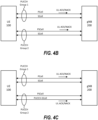
- Figure 4B illustrates a UE 100 which has two PUCCH groups configured for communication with a gNB 200.
- the first PUCCH group (PUCCH Group 1) includes a primary cell (PCell) and a secondary cell (SCell). Uplink ACK/NACK feedback for the first PUCCH group is carried on the uplink of PCell.
- the second PUCCH group (PUCCH Group 2) includes a primary second cell (PSCell) and a secondary cell (SCell). Uplink ACK/NACK feedback for the second PUCCH group is carried on the uplink of the PSCell.
- Figure 4C also illustrates a UE 100 which has two PUCCH groups configured for communication with a gNB 200, where the first PUCCH group (PUCCH Group 1) includes a primary cell (PCell) and a secondary cell (SCell). Uplink ACK/NACK feedback for the first PUCCH group is carried on the uplink of the te PCell.
- the second PUCCH group (PUCCH Group 2) includes a primary second cell (PSCell) and a secondary cell (PUCCH-SCell) that is configured to carry UL ACK/NACK for the second PUCCH group.
- Figure 4D illustrates a UE 100 which has two PUCCH groups configured for communication with a gNB 200.
- the first PUCCH group (PUCCH Group 1) includes a primary cell (PCell) and a secondary cell (SCell) for which uplink ACK/NACK feedback is carried on the uplink of the PCell.
- the first PUCCH group also includes a newly added SCell which carries its ACK/NACK feedback on its uplink.
- the second PUCCH group (PUCCH Group 2) includes a primary second cell (PSCell) and a secondary cell (SCell) for which uplink ACK/NACK feedback is carried on the uplink of the PSCell.
- the second PUCCH group also includes a newly added SCell which carries its ACK/NACK feedback on its uplink.
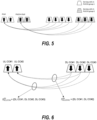
- Figure 5 shows an example of the HARQ-ACK feedback transmission mechanism with two PUCCH groups, in which the HARQ-ACK feedback for the first 4 DL CCs is transmitted in the UL PCell in the corresponding PUCCH group and the feedback for the last 3 DL CCs is transmitted in the PUCCH-SCell of the second PUCCH group.
- the PUCCH carrier or PUCCH cell would in the embodiments refer to the carrier, or cell, on which HARQ-ACK feedback is transmitted. Note that the term “carrier”, “component carrier” and “cell” are used with similar meanings in the context of this disclosure.
- Some embodiments described herein provide methods for flexible configuration, switching, and indication of a UL carrier for HARQ-ACK transmission in CA scenarios. Some embodiments provide solutions for PUCCH resource configuration, cell configuration, dynamic indication of UL cell, and HARQ-ACK codebook construction.
- UL HARQ feedback messages may be carried on a UL carrier other than the default PCell or PUCCH-SCell of the corresponding PUCCH group. This can be useful, for example, to reduce the overall DL transmission latency which involves HARQ-ACK retransmission, which may be especially helpful in URLLC communications.
- Embodiments described below can in general be applied to both slot-based PUCCH and sub-slot based PUCCH configurations. Embodiments described below may apply to both HARQ-ACK feedback of dynamically scheduled PDSCH and that of DL SPS. Moreover, various embodiments described herein may be combined.
- a UE may be semi-statically configured with a new RRC parameter to indicate that dynamic PUCCH carrier switching is allowed for HARQ-ACK feedback transmission. If the parameter is absent, then the legacy behavior as described above may be applied.
- the new RRC parameter to enable dynamic PUCCH carrier switching may be applied to a HARQ-ACK codebook with a certain index/priority (e.g. slot or sub-slot codebook).
- the dynamic PUCCH carrier switching operation may be enabled implicitly if the UE is configured with a PUCCH resource configuration for more than one carrier in a cell group or in any other way as described below.
- a separate PUCCH configuration is configured (e.g., in BWP_UL_dedicated) for each UL cell within applicable UL cells for PUCCH. This implies that there are separate parameters for dl-DataToUL-ACK (K 1 ), PUCCH resource set configuration, and pucch-PowerControl configuration for each UL cell.
- one RRC configuration with parameter PUCCH-config is provided to the UE (e.g., configured on PCell or PUCCH-SCell), but is applied to multiple UL cells, where in one version, one PUCCH-config is provided to UE for each PUCCH group and is applied to multiple UL cells within the corresponding PUCCH group, or in another version, one PUCCH-config is provided to UE and is applied to multiple UL cells across multiple PUCCH groups.
- the PUCCH-config there can exist separate parameters intended for multiple cells within the PUCCH-config, e.g.,separate dl-DataToUL-ACK (K 1 ) configuration, separate PUCCH resource set configuration, and/or separate pucch-PowerControl configuration for each UL cell applicable for PUCCH transmission.
- the remaining parameters in the PUCCH configuration can be common for all UL cells.
- the entire PUCCH-FormatConfig IE in a PUCCH-config can be configured independently for each UL cell, or only a subset of parameters in PUCCH-FormatConfig, such as parameter Nrslots for PUCCH repetition, can be configured independently for each UL cell.
- S UL , CC # i DL denote a set of applicable DL cells of which the DL transmission can have corresponding HARQ-ACK feedback sent on UL CC#i.
- S DL , CC # j UL denote a set of applicable UL cells on which HARQ-ACK feedback of DL transmission of DL CC#j can be sent.
- each UL cell is configured with a set of applicable DL cells which can have a corresponding HARQ-ACK feedback sent on this UL cell.
- a set of applicable DL cells S UL , CC # i DL is configured for each UL cell #i.
- the set of applicable DL cells can be configured in PUCCH-config IE which can be the common PUCCH-config or separate PUCCH-config as described above.
- PUCCH-config IE can be the common PUCCH-config or separate PUCCH-config as described above.
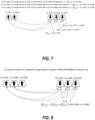
- 3 DL cells and 2 UL cells are illustrated, where both UL cells can be used for HARQ-ACK transmission.
- UL cell #1 is configured with DL cells #1, #2, and #3 as applicable DL cells.
- S UL , CC # 1 DL ⁇ DL CC#1, DL CC#2, DL CC#3 ⁇ .
- a set of applicable UL cells which can be used for HARQ-ACK feedback for this DL cell is configured.
- a set of applicable UL cells for HARQ-ACK feedback S DL , CC # j UL may be configured for each DL cell #j.
- the set of applicable UL cells for HARQ-ACK feedback can be configured in PDSCH-config IE in BWP-DownlinkDedicated for each DL cell, or it can be configured in PDSCH-ServingCellConfig IE in ServingCellConfig for each DL cell.
- a set of applicable UL cells is configured which can be used for HARQ-ACK feedback corresponding to DL transmission in any DL cell.
- a set of applicable UL cells for HARQ-ACK feedback may be configured and can be applied to any DL cell.
- the set of applicable UL cells for HARQ-ACK feedback can be configured, for example, as part of the PUCCH-config IE.
- FIG. 8 an example is illustrated with 3 DL cells and 3 UL cells.
- S UL , CC # 1 DL S UL
- CC # 2 DL DL CC # 1 , DL CC # 2 , DL CC # 3
- S UL , CC # 3 DL ⁇ .
- the size of the HARQ-ACK codebook is determined. This corresponds to determining a set of M A,c occasions for candidate PDSCH receptions for which the UE can transmit corresponding HARQ-ACK information in a PUCCH in slot n U .
- the size of the Type-1 HARQ-ACK codebook for an UL cell #i depends also on the time-domain resource allocation tables associated with the active DL BWP of DL cells in the set of applicable DL cells, S UL , CC # i DL (DL cells that have this UL cell #i as appliable UL cell for HARQ-ACK feedback transmission).
- the UE determines a set of M A,c occasions for candidate PDSCH receptions for which the UE can transmit corresponding HARQ-ACK information in a PUCCH in slot n U by independent pruning of TDRA entries for each DL cell or by joint pruning of TDRA entries across DL as follows.
- a procedure for independent pruning for each DL cell of TDRA entries includes:
- a procedure for joint pruning of TDRA entries across DL cells includes:
- Figure 9 illustrates the determination of Type-1 HARQ-ACK codebook size for HARQ-ACK feedback sent in slot n U on UL CC#2.
- the UE determines a set of occasions for candidate PDSCH receptions for which the UE can transmit corresponding HARQ-ACK information in a PUCCH in slot n U as follows.
- DL CC#3 is not considered since it is not an applicable DL cell which can have corresponding HARQ-ACK sent on UL CC#2 in the above example.
- the steps 2) and 3) would be modified, where the union of TDRA entries of TDRA tables 1 and 2 are considered. This would result in having 2 non-overlapping PDSCH reception candidates across DL cells #1 and #2 in slot n U - 3 and n U - 2. And the total number of PDSCH reception candidates having the HARQ-ACK feedback sent in slot n U on UL CC#2 would be 8 instead.
- Type-1 HARQ-ACK codebook construction and size determination can also be extended to the case where DL and UL cells have different subcarrier spacing (SCS).
- SCS subcarrier spacing
- the indication is provided through the existing PUCCH resource indictor (PRI) field in DCI formats 1_0, 1_1, and/or 1_2.
- serving cell ID information can be included as part of the PUCCH resource configuration using a new RRC parameter. If the indicated PUCCH resource contains this UL cell ID information, then it indicates the UL cell to use for the corresponding HARQ-ACK feedback. Table 1 below illustrates an example of a new RRC parameter in PUCCH-Resource indicating UL cell to use for the corresponding HARQ-ACK feedback.
- a separate DCI field is provided in DCI formats 1_0, 1_1, and/or 1_2 to select one of multiple cell ID values of applicable UL cells to use for HARQ-ACK transmission.
- the UL carriers/cell for HARQ-ACK is/are not indicated, and instead the carrier/cell is determined in the order of the UL serving cells. That is, the UE assumes that the PCell is used for HARQ-ACK feedback, and if there is no UL slot available on PCell then the UE chooses the PScell or PUCCH-SCell. If there is no UL slot available in the PSCell or the PUCCH-SCell, then the UE chooses SCell1, etc.
- the indication can be included in the activation DCI of each SPS configuration.
- two possible PUCCH cell indices are provided via pucch-Cell-r17 in the RRC configuration of PDSCH-ServingCellConfig IE as illustrated in the example in Table 2 below.
- the 1-bit in the PDSCH scheduling DCI can be an optionally configured field that is dedicated to dynamic PUCCH cell indication.
- 1-bit of an existing DCI field e.g., PRI
- an implicit indication in the DCI can be used to provide the equivalent 1-bit indication.
- an extra time offset, ⁇ is added to T proc,1 when the UE is configured to operate with dynamic PUCCH carrier switching. That is, the time gap between the end of PDSCH and the start of PUCCH carrying HARQ-ACK corresponding to the PDSCH is required to be at least T proc,1 + ⁇ .
- the time offset ⁇ can be SCS-dependent.
- the SCS for which ⁇ is considered is with respect to SCS of the UL cell used for HARQ-ACK feedback.
- the time offset ⁇ depends on UE processing time capability. For example, different ⁇ values are defined for UE processing time capability #1 and #2. Or the time offset ⁇ values for different SCS are reported as part of the UE capability reporting.
- additional UE feature restrictions are defined/introduced for UE operating with dynamic PUCCH carrier switching.
- dynamic PUCCH carrier indication is restricted to only indicating an UL cell in the same PUCCH groups as the DL cell of the corresponding DL transmission.
- dynamic PUCCH carrier indication is restricted to only indicating an UL cell with smallest or largest SCS in the same PUCCH group.
- dynamic PUCCH carrier indication is restricted to be used with configured/defined priority indicator (or codebook index) in a way that dynamic PUCCH carrier indication is allowed only for one CB index/priority and is not allowed for another CB index/priority.
- the dynamic PUCCH carrier can be configured to only one CB, e.g. only sub-slot, or to both CBs.
- UE should apply carrier switching for HARQ-ACK CB(s) of only certain index/priority.
- UE may not expect to apply dynamic switch to the HARQ-ACK CB for which dynamic PUCCH carrier switch is not configured/allowed.
- multiplexing procedure can be modified in several ways.
- the second CB can be multiplexed only if there is a room in PUCCH transport block.
- the second CB can be compressed (e.g. by bitwise AND operation) before multiplexing.
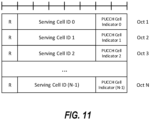
- the Serving Cell ID field indicates the identity of the PDSCH serving cell for which the MAC CE applies.
- the length of the field is 5 bits;
- the PUCCH Cell Indicator field indicates the UL serving cell where the HARQ-ACK for the PDSCH on the Serving Cell are carried.
- "PUCCH Cell Indicator” is 1-bit, where value '0' indicates PCell, value '1' indicates SpCell of this cell group or a PUCCH SCell.
- "PUCCH Cell Indicator” is 2-bit, and up to 4 PUCCH cells can be indicated. Value '0' indicates PCell. The illustration below assumes 2-bit "PUCCH Cell Indicator".
- R is set to 0.
- R is 1-bit if "PUCCH Cell Indicator” is 2-bit.
- R is 2-bit if "PUCCH Cell Indicator” is 1-bit.
- FIG. 11 Another example of the PUCCH cell activation/deactivation MAC CE is illustrated in Figure 11 , in which PUCCH cells for N PDSCH serving cells, N>1, are shown. The meaning of the fields are similar to those shown in Figure 10 .
- a new eLCID is provided for this new MAC CE.
- Table 3 a new eLCID is provided for this new MAC CE.
- Table 3 - LCID for New MAC CE Codepoint Index LCID values A value between 0 and 244 A value between 64 and 308 PUCCH Cell Activation/Deactivation
- the PUCCH cell for this PDSCH serving cell is according to the RRC configured pucch-Cell in PDSCH-ServingCellConfig.
- Sections A.2, A.3 and A.4 also apply to PUCCH carrier switching in a semi-static manner.
- a configuration of applicable UL cells for HARQ-ACK feedback described in Section A.3 can be specialized to the case where the set of applicable UL cells for each DL cell #j, , S DL , CC # j UL contains only one value, indicating a specific UL cell to use for HARQ-ACK feedback of DL transmission on DL cell #j.
- FIG 12A depicts an example of a UE 100 of a wireless communication network configured to provide wireless communication according to embodiments of inventive concepts.
- the UE 100 may include a transceiver circuit 112 (also referred to as a transceiver) including a transmitter and a receiver configured to provide uplink and downlink radio communications with wireless devices.
- the UE 100 may also include a processor circuit 116 (also referred to as a processor) coupled to the transceiver circuit 112, and a memory circuit 118 (also referred to as memory) coupled to the processor circuit 116.
- the memory circuit 118 may include computer readable program code that when executed by the processor circuit 116 causes the processor circuit to perform operations according to embodiments disclosed herein.
- processor circuit 116 may be defined to include memory so that a separate memory circuit is not required.
- operations of the UE 100 may be performed by processor 116 and/or transceiver 112.
- the processor 116 may control transceiver 112 to transmit uplink communications through transceiver 112 over a radio interface to one or more network nodes and/or to receive downlink communications through transceiver 112 from one or more network nodes over a radio interface.
- modules may be stored in memory 118, and these modules may provide instructions so that when instructions of a module are executed by processor 116, processor 116 performs respective operations (e.g., operations discussed above with respect to example embodiments).
- a UE 100 includes a processor circuit 116, a transceiver 112 coupled to the processor circuit, and a memory 118 coupled to the processor circuit, the memory including machine readable program instructions that, when executed by the processor circuit, cause the UE 100 to perform operations described above.
- Figure 12B illustrates operations of a UE according to some embodiments.
- a method of operating a UE includes configuring (1202) a PUCCH group including a plurality of cells, and receiving (1204) a configuration from a network node to dynamically change a cell on which HARQ feedback for a cell in the PUCCH group is transmitted.
- Configuring (1202) a PUCCH group may comprise the UE receiving a configuration from the network node that configures the UE with a PUCCH group.
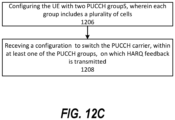
- FIG. 12C illustrates operations of a UE according to some embodiments.
- a method of operating a UE includes configuring (1206) two PUCCH groups, where each PUCCH group comprises a plurality of cells, where the HARQ feedback relating to DL transmissions on the cells in the first PUCCH group is transmitted in the UL of the primary cell, PCell, of the first PUCCH group and the HARQ feedback relating to DL transmissions on the cells in the second PUCCH group is transmitted in the UL of the primary second cell, PSCell, or on a PUCCH secondary cell, PUCCH-SCell, of the second PUCCH group and receiving a configuration (1208), from the network node, to switch the PUCCH carrier, within at least one of the PUCCH groups, on which HARQ the feedback is transmitted.
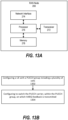
- FIG. 13A is a block diagram of a radio access network (RAN) node according to some embodiments.
- RAN radio access network
- Various embodiments provide a RAN node that includes a processor circuit 276 and a memory 278 coupled to the processor circuit.
- the memory 278 includes machine-readable computer program instructions that, when executed by the processor circuit, cause the processor circuit to perform operations depicted in Figure 13B .
- FIG. 13A depicts an example of a RAN node 200 of a wireless communication network configured to provide cellular communication according to embodiments of inventive concepts.
- the RAN node 200 may include a network interface circuit 274 (also referred to as a network interface) configured to provide communications with other nodes (e.g., with other base stations and/or core network nodes) of the wireless communication network.
- the memory circuit 278 may include computer readable program code that when executed by the processor circuit 276 causes the processor circuit to perform operations according to embodiments disclosed herein. According to other embodiments, processor circuit 276 may be defined to include memory so that a separate memory circuit is not required.
- the RAN node 200 includes a transceiver 272 for communicating with UEs 100 in the radio access network.
- operations of the RAN node 200 may be performed by processor 276 and/or network interface 274.
- the processor 276 may control the network interface 274 to transmit communications through the network interface 274 to one or more other network nodes and/or to receive communications through network interface from one or more other network nodes.
- the processor 276 may control the transceiver 272 to transmit communications through the transceiver 272 to one or more UEs 100 and/or to receive communications through transceiver 272 from one or more UEs 100.
- modules may be stored in memory 278, and these modules may provide instructions so that when instructions of a module are executed by processor 276, processor 276 performs respective operations.
- a structure similar to that of Figure 13A may be used to implement other network nodes.
- network nodes discussed herein may be implemented as virtual network nodes or as elements of a split-architecture node.
- Figure 13B illustrates operations of a network node according to some embodiments.
- a method of operating a network node includes configuring (1302) a UE with a PUCCH group including a plurality of cells, and configuring (1304) the UE to dynamically change a cell on which HARQ feedback for a cell of the PUCCH group is transmitted.
- FIG. 13C illustrates operations of a network node according to some embodiments.
- a method of operating a network node includes configuring (1306) the UE with two PUCCH groups, where each PUCCH group comprises a plurality of cells, where the HARQ feedback relating to DL transmissions on the cells in the first PUCCH group is transmitted in the UL of the primary cell, PCell, of the first PUCCH group and the HARQ feedback relating to DL transmissions on the cells in the second PUCCH group is transmitted in the UL of the primary second cell, PSCell, or on a PUCCH secondary cell, PUCCH-SCell, of the second PUCCH group, and configuring (1308) the UE to switch the PUCCH carrier, within at least one of the PUCCH groups, on which HARQ the feedback is transmitted.
- the terms “comprise”, “comprising”, “comprises”, “include”, “including”, “includes”, “have”, “has”, “having”, or variants thereof are open-ended, and include one or more stated features, integers, elements, steps, components, or functions but does not preclude the presence or addition of one or more other features, integers, elements, steps, components, functions, or groups thereof.
- the common abbreviation “e.g.” which derives from the Latin phrase “exempli gratia,” may be used to introduce or specify a general example or examples of a previously mentioned item, and is not intended to be limiting of such item.
- the common abbreviation “i.e.”, which derives from the Latin phrase “id est,” may be used to specify a particular item from a more general recitation.
- Example embodiments are described herein with reference to block diagrams and/or flowchart illustrations of computer-implemented methods, apparatus (systems and/or devices) and/or computer program products. It is understood that a block of the block diagrams and/or flowchart illustrations, and combinations of blocks in the block diagrams and/or flowchart illustrations, can be implemented by computer program instructions that are performed by one or more computer circuits.
- These computer program instructions may be provided to a processor circuit of a general purpose computer circuit, special purpose computer circuit, and/or other programmable data processing circuit to produce a machine, such that the instructions, which execute via the processor of the computer and/or other programmable data processing apparatus, transform and control transistors, values stored in memory locations, and other hardware components within such circuitry to implement the functions/acts specified in the block diagrams and/or flowchart block or blocks, and thereby create means (functionality) and/or structure for implementing the functions/acts specified in the block diagrams and/or flowchart block(s).
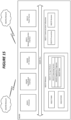
- Figure 14 A wireless network in accordance with some embodiments.
- a wireless network such as the example wireless network illustrated in Figure 14 .
- the wireless network of Figure 14 only depicts network QQ106, network nodes QQ160 and QQ160b, and WDs QQ110, QQ110b, and QQ110c (also referred to as mobile terminals).
- a wireless network may further include any additional elements suitable to support communication between wireless devices or between a wireless device and another communication device, such as a landline telephone, a service provider, or any other network node or end device.
- network node QQ160 and wireless device (WD) QQ110 are depicted with additional detail.
- the wireless network may provide communication and other types of services to one or more wireless devices to facilitate the wireless devices' access to and/or use of the services provided by, or via, the wireless network.
- the wireless network may comprise and/or interface with any type of communication, telecommunication, data, cellular, and/or radio network or other similar type of system.
- the wireless network may be configured to operate according to specific standards or other types of predefined rules or procedures.
- particular embodiments of the wireless network may implement communication standards, such as Global System for Mobile Communications (GSM), Universal Mobile Telecommunications System (UMTS), Long Term Evolution (LTE), and/or other suitable 2G, 3G, 4G, or 5G standards; wireless local area network (WLAN) standards, such as the IEEE 802.11 standards; and/or any other appropriate wireless communication standard, such as the Worldwide Interoperability for Microwave Access (WiMax), Bluetooth, Z-Wave and/or ZigBee standards.
- GSM Global System for Mobile Communications
- UMTS Universal Mobile Telecommunications System
- LTE Long Term Evolution
- WLAN wireless local area network
- WiMax Worldwide Interoperability for Microwave Access
- Bluetooth Z-Wave and/or ZigBee standards.
- Network QQ106 may comprise one or more backhaul networks, core networks, IP networks, public switched telephone networks (PSTNs), packet data networks, optical networks, wide-area networks (WANs), local area networks (LANs), wireless local area networks (WLANs), wired networks, wireless networks, metropolitan area networks, and other networks to enable communication between devices.
- PSTNs public switched telephone networks
- WANs wide-area networks
- LANs local area networks
- WLANs wireless local area networks
- wired networks wireless networks, metropolitan area networks, and other networks to enable communication between devices.
- Network node QQ160 and WD QQ110 comprise various components described in more detail below. These components work together in order to provide network node and/or wireless device functionality, such as providing wireless connections in a wireless network.
- the wireless network may comprise any number of wired or wireless networks, network nodes, base stations, controllers, wireless devices, relay stations, and/or any other components or systems that may facilitate or participate in the communication of data and/or signals whether via wired or wireless connections.
- network node refers to equipment capable, configured, arranged and/or operable to communicate directly or indirectly with a wireless device and/or with other network nodes or equipment in the wireless network to enable and/or provide wireless access to the wireless device and/or to perform other functions (e.g., administration) in the wireless network.
- network nodes include, but are not limited to, access points (APs) (e.g., radio access points), base stations (BSs) (e.g., radio base stations, Node Bs, evolved Node Bs (eNBs) and NR NodeBs (gNBs)).
- APs access points
- BSs base stations
- eNBs evolved Node Bs
- gNBs NR NodeBs
- Base stations may be categorized based on the amount of coverage they provide (or, stated differently, their transmit power level) and may then also be referred to as femto base stations, pico base stations, micro base stations, or macro base stations.
- a base station may be a relay node or a relay donor node controlling a relay.
- a network node may also include one or more (or all) parts of a distributed radio base station such as centralized digital units and/or remote radio units (RRUs), sometimes referred to as Remote Radio Heads (RRHs). Such remote radio units may or may not be integrated with an antenna as an antenna integrated radio.
- RRUs remote radio units
- RRHs Remote Radio Heads
- Such remote radio units may or may not be integrated with an antenna as an antenna integrated radio.
- Parts of a distributed radio base station may also be referred to as nodes in a distributed antenna system (DAS).
- DAS distributed antenna system
- network nodes include multi-standard radio (MSR) equipment such as MSR BSs, network controllers such as radio network controllers (RNCs) or base station controllers (BSCs), base transceiver stations (BTSs), transmission points, transmission nodes, multi-cell/multicast coordination entities (MCEs), core network nodes (e.g., MSCs, MMEs), O&M nodes, OSS nodes, SON nodes, positioning nodes (e.g., E-SMLCs), and/or MDTs.
- MSR multi-standard radio
- RNCs radio network controllers
- BSCs base station controllers
- BTSs base transceiver stations
- transmission points transmission nodes
- MCEs multi-cell/multicast coordination entities
- core network nodes e.g., MSCs, MMEs
- O&M nodes e.g., OSS nodes, SON nodes, positioning nodes (e.g., E-SMLCs), and/or MDTs.
- network nodes may represent any suitable device (or group of devices) capable, configured, arranged, and/or operable to enable and/or provide a wireless device with access to the wireless network or to provide some service to a wireless device that has accessed the wireless network.
- network node QQ160 includes processing circuitry QQ170, device readable medium QQ180, interface QQ190, auxiliary equipment QQ184, power source QQ186, power circuitry QQ187, and antenna QQ162.
- network node QQ160 illustrated in the example wireless network of Figure 14 may represent a device that includes the illustrated combination of hardware components, other embodiments may comprise network nodes with different combinations of components. It is to be understood that a network node comprises any suitable combination of hardware and/or software needed to perform the tasks, features, functions and methods disclosed herein.
- network node QQ160 may comprise multiple different physical components that make up a single illustrated component (e.g., device readable medium QQ180 may comprise multiple separate hard drives as well as multiple RAM modules).
- network node QQ160 may be composed of multiple physically separate components (e.g., a NodeB component and a RNC component, or a BTS component and a BSC component, etc.), which may each have their own respective components.
- network node QQ160 comprises multiple separate components (e.g., BTS and BSC components)
- one or more of the separate components may be shared among several network nodes.
- a single RNC may control multiple NodeB's.
- each unique NodeB and RNC pair may in some instances be considered a single separate network node.
- network node QQ160 may be configured to support multiple radio access technologies (RATs).
- RATs radio access technologies
- Network node QQ160 may also include multiple sets of the various illustrated components for different wireless technologies integrated into network node QQ160, such as, for example, GSM, WCDMA, LTE, NR, WiFi, or Bluetooth wireless technologies. These wireless technologies may be integrated into the same or different chip or set of chips and other components within network node QQ160.
- Processing circuitry QQ170 is configured to perform any determining, calculating, or similar operations (e.g., certain obtaining operations) described herein as being provided by a network node. These operations performed by processing circuitry QQ170 may include processing information obtained by processing circuitry QQ170 by, for example, converting the obtained information into other information, comparing the obtained information or converted information to information stored in the network node, and/or performing one or more operations based on the obtained information or converted information, and as a result of said processing making a determination.
- processing information obtained by processing circuitry QQ170 by, for example, converting the obtained information into other information, comparing the obtained information or converted information to information stored in the network node, and/or performing one or more operations based on the obtained information or converted information, and as a result of said processing making a determination.
- Processing circuitry QQ170 may comprise a combination of one or more of a microprocessor, controller, microcontroller, central processing unit, digital signal processor, application-specific integrated circuit, field programmable gate array, or any other suitable computing device, resource, or combination of hardware, software and/or encoded logic operable to provide, either alone or in conjunction with other network node QQ160 components, such as device readable medium QQ180, network node QQ160 functionality.
- processing circuitry QQ170 may execute instructions stored in device readable medium QQ180 or in memory within processing circuitry QQ170. Such functionality may include providing any of the various wireless features, functions, or benefits discussed herein.
- processing circuitry QQ170 may include a system on a chip (SOC).
- SOC system on a chip
- processing circuitry QQ170 may include one or more of radio frequency (RF) transceiver circuitry QQ172 and baseband processing circuitry QQ174.
- radio frequency (RF) transceiver circuitry QQ172 and baseband processing circuitry QQ174 may be on separate chips (or sets of chips), boards, or units, such as radio units and digital units.
- part or all of RF transceiver circuitry QQ172 and baseband processing circuitry QQ174 may be on the same chip or set of chips, boards, or units.
- processing circuitry QQ170 executing instructions stored on device readable medium QQ180 or memory within processing circuitry QQ170.
- some or all of the functionality may be provided by processing circuitry QQ170 without executing instructions stored on a separate or discrete device readable medium, such as in a hard-wired manner.
- processing circuitry QQ170 can be configured to perform the described functionality. The benefits provided by such functionality are not limited to processing circuitry QQ170 alone or to other components of network node QQ160, but are enjoyed by network node QQ160 as a whole, and/or by end users and the wireless network generally.
- Device readable medium QQ180 may comprise any form of volatile or non-volatile computer readable memory including, without limitation, persistent storage, solid-state memory, remotely mounted memory, magnetic media, optical media, random access memory (RAM), read-only memory (ROM), mass storage media (for example, a hard disk), removable storage media (for example, a flash drive, a Compact Disk (CD) or a Digital Video Disk (DVD)), and/or any other volatile or non-volatile, non-transitory device readable and/or computer-executable memory devices that store information, data, and/or instructions that may be used by processing circuitry QQ170.
- volatile or non-volatile computer readable memory including, without limitation, persistent storage, solid-state memory, remotely mounted memory, magnetic media, optical media, random access memory (RAM), read-only memory (ROM), mass storage media (for example, a hard disk), removable storage media (for example, a flash drive, a Compact Disk (CD) or a Digital Video Disk (DVD)), and/or any
- Device readable medium QQ180 may store any suitable instructions, data or information, including a computer program, software, an application including one or more of logic, rules, code, tables, etc. and/or other instructions capable of being executed by processing circuitry QQ170 and, utilized by network node QQ160.
- Device readable medium QQ180 may be used to store any calculations made by processing circuitry QQ170 and/or any data received via interface QQ190.
- processing circuitry QQ170 and device readable medium QQ180 may be considered to be integrated.
- Interface QQ190 is used in the wired or wireless communication of signalling and/or data between network node QQ160, network QQ106, and/or WDs QQ110. As illustrated, interface QQ190 comprises port(s)/terminal(s) QQ194 to send and receive data, for example to and from network QQ106 over a wired connection. Interface QQ190 also includes radio front end circuitry QQ192 that may be coupled to, or in certain embodiments a part of, antenna QQ162. Radio front end circuitry QQ192 comprises filters QQ198 and amplifiers QQ196. Radio front end circuitry QQ192 may be connected to antenna QQ162 and processing circuitry QQ170.
- Radio front end circuitry may be configured to condition signals communicated between antenna QQ162 and processing circuitry QQ170.
- Radio front end circuitry QQ192 may receive digital data that is to be sent out to other network nodes or WDs via a wireless connection.
- Radio front end circuitry QQ192 may convert the digital data into a radio signal having the appropriate channel and bandwidth parameters using a combination of filters QQ198 and/or amplifiers QQ196. The radio signal may then be transmitted via antenna QQ162.
- antenna QQ162 may collect radio signals which are then converted into digital data by radio front end circuitry QQ192.
- the digital data may be passed to processing circuitry QQ170.
- the interface may comprise different components and/or different combinations of components.
- network node QQ160 may not include separate radio front end circuitry QQ192, instead, processing circuitry QQ170 may comprise radio front end circuitry and may be connected to antenna QQ162 without separate radio front end circuitry QQ192.
- processing circuitry QQ170 may comprise radio front end circuitry and may be connected to antenna QQ162 without separate radio front end circuitry QQ192.
- all or some of RF transceiver circuitry QQ172 may be considered a part of interface QQ190.
- interface QQ190 may include one or more ports or terminals QQ194, radio front end circuitry QQ192, and RF transceiver circuitry QQ172, as part of a radio unit (not shown), and interface QQ190 may communicate with baseband processing circuitry QQ174, which is part of a digital unit (not shown).
- Antenna QQ162 may include one or more antennas, or antenna arrays, configured to send and/or receive wireless signals. Antenna QQ162 may be coupled to radio front end circuitry QQ192 and may be any type of antenna capable of transmitting and receiving data and/or signals wirelessly. In some embodiments, antenna QQ162 may comprise one or more omni-directional, sector or panel antennas operable to transmit/receive radio signals between, for example, 2 GHz and 66 GHz.
- An omni-directional antenna may be used to transmit/receive radio signals in any direction
- a sector antenna may be used to transmit/receive radio signals from devices within a particular area
- a panel antenna may be a line of sight antenna used to transmit/receive radio signals in a relatively straight line.
- the use of more than one antenna may be referred to as MIMO.
- antenna QQ162 may be separate from network node QQ160 and may be connectable to network node QQ160 through an interface or port.
- Antenna QQ162, interface QQ190, and/or processing circuitry QQ170 may be configured to perform any receiving operations and/or certain obtaining operations described herein as being performed by a network node. Any information, data and/or signals may be received from a wireless device, another network node and/or any other network equipment. Similarly, antenna QQ162, interface QQ190, and/or processing circuitry QQ170 may be configured to perform any transmitting operations described herein as being performed by a network node. Any information, data and/or signals may be transmitted to a wireless device, another network node and/or any other network equipment.
- Power circuitry QQ187 may comprise, or be coupled to, power management circuitry and is configured to supply the components of network node QQ160 with power for performing the functionality described herein. Power circuitry QQ187 may receive power from power source QQ186. Power source QQ186 and/or power circuitry QQ187 may be configured to provide power to the various components of network node QQ160 in a form suitable for the respective components (e.g., at a voltage and current level needed for each respective component). Power source QQ186 may either be included in, or external to, power circuitry QQ187 and/or network node QQ160.
- network node QQ160 may be connectable to an external power source (e.g., an electricity outlet) via an input circuitry or interface such as an electrical cable, whereby the external power source supplies power to power circuitry QQ187.
- power source QQ186 may comprise a source of power in the form of a battery or battery pack which is connected to, or integrated in, power circuitry QQ187. The battery may provide backup power should the external power source fail.
- Other types of power sources such as photovoltaic devices, may also be used.
- network node QQ160 may include additional components beyond those shown in Figure 14 that may be responsible for providing certain aspects of the network node's functionality, including any of the functionality described herein and/or any functionality necessary to support the subject matter described herein.
- network node QQ160 may include user interface equipment to allow input of information into network node QQ160 and to allow output of information from network node QQ160. This may allow a user to perform diagnostic, maintenance, repair, and other administrative functions for network node QQ160.
- wireless device refers to a device capable, configured, arranged and/or operable to communicate wirelessly with network nodes and/or other wireless devices.
- the term WD may be used interchangeably herein with user equipment (UE).
- Communicating wirelessly may involve transmitting and/or receiving wireless signals using electromagnetic waves, radio waves, infrared waves, and/or other types of signals suitable for conveying information through air.
- a WD may be configured to transmit and/or receive information without direct human interaction.
- a WD may be designed to transmit information to a network on a predetermined schedule, when triggered by an internal or external event, or in response to requests from the network.
- Examples of a WD include, but are not limited to, a smart phone, a mobile phone, a cell phone, a voice over IP (VoIP) phone, a wireless local loop phone, a desktop computer, a personal digital assistant (PDA), a wireless cameras, a gaming console or device, a music storage device, a playback appliance, a wearable terminal device, a wireless endpoint, a mobile station, a tablet, a laptop, a laptop-embedded equipment (LEE), a laptop-mounted equipment (LME), a smart device, a wireless customer-premise equipment (CPE). a vehicle-mounted wireless terminal device, etc.
- VoIP voice over IP
- PDA personal digital assistant
- PDA personal digital assistant
- gaming console or device a wireless cameras
- a gaming console or device a music storage device
- a playback appliance a wearable terminal device
- a wireless endpoint a mobile station, a tablet, a laptop, a laptop-embedded equipment (LEE), a laptop
- a WD may support device-to-device (D2D) communication, for example by implementing a 3GPP standard for sidelink communication, vehicle-to-vehicle (V2V), vehicle-to-infrastructure (V2I), vehicle-to-everything (V2X) and may in this case be referred to as a D2D communication device.
- D2D device-to-device
- V2V vehicle-to-vehicle
- V2I vehicle-to-infrastructure
- V2X vehicle-to-everything
- a WD may represent a machine or other device that performs monitoring and/or measurements, and transmits the results of such monitoring and/or measurements to another WD and/or a network node.
- the WD may in this case be a machine-to-machine (M2M) device, which may in a 3GPP context be referred to as an MTC device.
- M2M machine-to-machine
- the WD may be a UE implementing the 3GPP narrow band internet of things (NB-loT) standard.
- NB-loT narrow band internet of things
- machines or devices are sensors, metering devices such as power meters, industrial machinery, or home or personal appliances (e.g. refrigerators, televisions, etc.) personal wearables (e.g., watches, fitness trackers, etc.).
- a WD may represent a vehicle or other equipment that is capable of monitoring and/or reporting on its operational status or other functions associated with its operation.
- a WD as described above may represent the endpoint of a wireless connection, in which case the device may be referred to as a wireless terminal. Furthermore, a WD as described above may be mobile, in which case it may also be referred to as a mobile device or a mobile terminal.
- wireless device QQ110 includes antenna QQ111, interface QQ114, processing circuitry QQ120, device readable medium QQ130, user interface equipment QQ132, auxiliary equipment QQ134, power source QQ136 and power circuitry QQ137.
- WD QQ110 may include multiple sets of one or more of the illustrated components for different wireless technologies supported by WD QQ110, such as, for example, GSM, WCDMA, LTE, NR, WiFi, WiMAX, or Bluetooth wireless technologies, just to mention a few. These wireless technologies may be integrated into the same or different chips or set of chips as other components within WD QQ110.
- Antenna QQ111 may include one or more antennas or antenna arrays, configured to send and/or receive wireless signals, and is connected to interface QQ114.
- antenna QQ111 may be separate from WD QQ110 and be connectable to WD QQ110 through an interface or port.
- Antenna QQ111, interface QQ114, and/or processing circuitry QQ120 may be configured to perform any receiving or transmitting operations described herein as being performed by a WD. Any information, data and/or signals may be received from a network node and/or another WD.
- radio front end circuitry and/or antenna QQ111 may be considered an interface.
- interface QQ114 comprises radio front end circuitry QQ112 and antenna QQ111.
- Radio front end circuitry QQ112 comprise one or more filters QQ118 and amplifiers QQ116.
- Radio front end circuitry QQ112 is connected to antenna QQ111 and processing circuitry QQ120, and is configured to condition signals communicated between antenna QQ111 and processing circuitry QQ120.
- Radio front end circuitry QQ112 may be coupled to or a part of antenna QQ111.
- WD QQ110 may not include separate radio front end circuitry QQ112; rather, processing circuitry QQ120 may comprise radio front end circuitry and may be connected to antenna QQ111.
- Radio front end circuitry QQ112 may receive digital data that is to be sent out to other network nodes or WDs via a wireless connection. Radio front end circuitry QQ112 may convert the digital data into a radio signal having the appropriate channel and bandwidth parameters using a combination of filters QQ118 and/or amplifiers QQ116. The radio signal may then be transmitted via antenna QQ111. Similarly, when receiving data, antenna QQ111 may collect radio signals which are then converted into digital data by radio front end circuitry QQ112. The digital data may be passed to processing circuitry QQ120.
- the interface may comprise different components and/or different combinations of components.
- processing circuitry QQ120 includes one or more of RF transceiver circuitry QQ122, baseband processing circuitry QQ124, and application processing circuitry QQ126.
- the processing circuitry may comprise different components and/or different combinations of components.
- processing circuitry QQ120 of WD QQ110 may comprise a SOC.
- RF transceiver circuitry QQ122, baseband processing circuitry QQ124, and application processing circuitry QQ126 may be on separate chips or sets of chips.
- part or all of baseband processing circuitry QQ124 and application processing circuitry QQ126 may be combined into one chip or set of chips, and RF transceiver circuitry QQ122 may be on a separate chip or set of chips.
- part or all of RF transceiver circuitry QQ122 and baseband processing circuitry QQ124 may be on the same chip or set of chips, and application processing circuitry QQ126 may be on a separate chip or set of chips.
- part or all of RF transceiver circuitry QQ122, baseband processing circuitry QQ124, and application processing circuitry QQ126 may be combined in the same chip or set of chips.
- RF transceiver circuitry QQ122 may be a part of interface QQ114.
- RF transceiver circuitry QQ122 may condition RF signals for processing circuitry QQ120.
- processing circuitry QQ120 executing instructions stored on device readable medium QQ130, which in certain embodiments may be a computer-readable storage medium.
- some or all of the functionality may be provided by processing circuitry QQ120 without executing instructions stored on a separate or discrete device readable storage medium, such as in a hard-wired manner.
- processing circuitry QQ120 can be configured to perform the described functionality.
- the benefits provided by such functionality are not limited to processing circuitry QQ120 alone or to other components of WD QQ110, but are enjoyed by WD QQ110 as a whole, and/or by end users and the wireless network generally.
- Processing circuitry QQ120 may be configured to perform any determining, calculating, or similar operations (e.g., certain obtaining operations) described herein as being performed by a WD. These operations, as performed by processing circuitry QQ120, may include processing information obtained by processing circuitry QQ120 by, for example, converting the obtained information into other information, comparing the obtained information or converted information to information stored by WD QQ110, and/or performing one or more operations based on the obtained information or converted information, and as a result of said processing making a determination.
- processing information obtained by processing circuitry QQ120 by, for example, converting the obtained information into other information, comparing the obtained information or converted information to information stored by WD QQ110, and/or performing one or more operations based on the obtained information or converted information, and as a result of said processing making a determination.
- Device readable medium QQ130 may be operable to store a computer program, software, an application including one or more of logic, rules, code, tables, etc. and/or other instructions capable of being executed by processing circuitry QQ120.
- Device readable medium QQ130 may include computer memory (e.g., Random Access Memory (RAM) or Read Only Memory (ROM)), mass storage media (e.g., a hard disk), removable storage media (e.g., a Compact Disk (CD) or a Digital Video Disk (DVD)), and/or any other volatile or non-volatile, non-transitory device readable and/or computer executable memory devices that store information, data, and/or instructions that may be used by processing circuitry QQ120.
- RAM Random Access Memory
- ROM Read Only Memory
- mass storage media e.g., a hard disk
- removable storage media e.g., a Compact Disk (CD) or a Digital Video Disk (DVD)
- processing circuitry QQ120 and device readable medium QQ130 may be considered to be integrated.
- User interface equipment QQ132 may provide components that allow for a human user to interact with WD QQ110. Such interaction may be of many forms, such as visual, audial, tactile, etc.
- User interface equipment QQ132 may be operable to produce output to the user and to allow the user to provide input to WD QQ110. The type of interaction may vary depending on the type of user interface equipment QQ132 installed in WD QQ110.
- WD QQ110 is a smart phone
- the interaction may be via a touch screen
- WD QQ110 is a smart meter
- the interaction may be through a screen that provides usage (e.g., the number of gallons used) or a speaker that provides an audible alert (e.g., if smoke is detected).
- User interface equipment QQ132 may include input interfaces, devices and circuits, and output interfaces, devices and circuits. User interface equipment QQ132 is configured to allow input of information into WD QQ110, and is connected to processing circuitry QQ120 to allow processing circuitry QQ120 to process the input information.
- User interface equipment QQ132 may include, for example, a microphone, a proximity or other sensor, keys/buttons, a touch display, one or more cameras, a USB port, or other input circuitry. User interface equipment QQ132 is also configured to allow output of information from WD QQ110, and to allow processing circuitry QQ120 to output information from WD QQ110. User interface equipment QQ132 may include, for example, a speaker, a display, vibrating circuitry, a USB port, a headphone interface, or other output circuitry. Using one or more input and output interfaces, devices, and circuits, of user interface equipment QQ132, WD QQ110 may communicate with end users and/or the wireless network, and allow them to benefit from the functionality described herein.
- Auxiliary equipment QQ134 is operable to provide more specific functionality which may not be generally performed by WDs. This may comprise specialized sensors for doing measurements for various purposes, interfaces for additional types of communication such as wired communications etc. The inclusion and type of components of auxiliary equipment QQ134 may vary depending on the embodiment and/or scenario.
- Power source QQ136 may, in some embodiments, be in the form of a battery or battery pack. Other types of power sources, such as an external power source (e.g., an electricity outlet), photovoltaic devices or power cells, may also be used.
- WD QQ110 may further comprise power circuitry QQ137 for delivering power from power source QQ136 to the various parts of WD QQ110 which need power from power source QQ136 to carry out any functionality described or indicated herein.
- Power circuitry QQ137 may in certain embodiments comprise power management circuitry.
- Power circuitry QQ137 may additionally or alternatively be operable to receive power from an external power source; in which case WD QQ110 may be connectable to the external power source (such as an electricity outlet) via input circuitry or an interface such as an electrical power cable.
- Power circuitry QQ137 may also in certain embodiments be operable to deliver power from an external power source to power source QQ136. This may be, for example, for the charging of power source QQ136. Power circuitry QQ137 may perform any formatting, converting, or other modification to the power from power source QQ136 to make the power suitable for the respective components of WD QQ110 to which power is supplied.
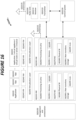
- FIG. 15 User Equipment in accordance with some embodiments
- Figure 15 illustrates one embodiment of a UE in accordance with various aspects described herein.
- a user equipment or UE may not necessarily have a user in the sense of a human user who owns and/or operates the relevant device.
- a UE may represent a device that is intended for sale to, or operation by, a human user but which may not, or which may not initially, be associated with a specific human user (e.g., a smart sprinkler controller).
- a UE may represent a device that is not intended for sale to, or operation by, an end user but which may be associated with or operated for the benefit of a user (e.g., a smart power meter).
- UE QQ2200 may be any UE identified by the 3rd Generation Partnership Project (3GPP), including a NB-loT UE, a machine type communication (MTC) UE, and/or an enhanced MTC (eMTC) UE.
- UE QQ200 as illustrated in Figure 15 , is one example of a WD configured for communication in accordance with one or more communication standards promulgated by the 3rd Generation Partnership Project (3GPP), such as 3GPP's GSM, UMTS, LTE, and/or 5G standards.
- 3GPP 3rd Generation Partnership Project
- the term WD and UE may be used interchangeable. Accordingly, although Figure 15 is a UE, the components discussed herein are equally applicable to a WD, and vice-versa.
- UE QQ200 includes processing circuitry QQ201 that is operatively coupled to input/output interface QQ205, radio frequency (RF) interface QQ209, network connection interface QQ211, memory QQ215 including random access memory (RAM) QQ217, read-only memory (ROM) QQ219, and storage medium QQ221 or the like, communication subsystem QQ231, power source QQ213, and/or any other component, or any combination thereof.
- Storage medium QQ221 includes operating system QQ223, application program QQ225, and data QQ227. In other embodiments, storage medium QQ221 may include other similar types of information.
- Certain UEs may utilize all of the components shown in Figure 15 , or only a subset of the components. The level of integration between the components may vary from one UE to another UE. Further, certain UEs may contain multiple instances of a component, such as multiple processors, memories, transceivers, transmitters, receivers, etc.
- processing circuitry QQ201 may be configured to process computer instructions and data.
- Processing circuitry QQ201 may be configured to implement any sequential state machine operative to execute machine instructions stored as machine-readable computer programs in the memory, such as one or more hardware-implemented state machines (e.g., in discrete logic, FPGA, ASIC, etc.); programmable logic together with appropriate firmware; one or more stored program, general-purpose processors, such as a microprocessor or Digital Signal Processor (DSP), together with appropriate software; or any combination of the above.
- the processing circuitry QQ201 may include two central processing units (CPUs). Data may be information in a form suitable for use by a computer.
- input/output interface QQ205 may be configured to provide a communication interface to an input device, output device, or input and output device.
- UE QQ200 may be configured to use an output device via input/output interface QQ205.
- An output device may use the same type of interface port as an input device.
- a USB port may be used to provide input to and output from UE QQ200.
- the output device may be a speaker, a sound card, a video card, a display, a monitor, a printer, an actuator, an emitter, a smartcard, another output device, or any combination thereof.
- UE QQ200 may be configured to use an input device via input/output interface QQ205 to allow a user to capture information into UE QQ200.
- the input device may include a touch-sensitive or presence-sensitive display, a camera (e.g., a digital camera, a digital video camera, a web camera, etc.), a microphone, a sensor, a mouse, a trackball, a directional pad, a trackpad, a scroll wheel, a smartcard, and the like.
- the presence-sensitive display may include a capacitive or resistive touch sensor to sense input from a user.
- a sensor may be, for instance, an accelerometer, a gyroscope, a tilt sensor, a force sensor, a magnetometer, an optical sensor, a proximity sensor, another like sensor, or any combination thereof.
- the input device may be an accelerometer, a magnetometer, a digital camera, a microphone, and an optical sensor.
- RF interface QQ209 may be configured to provide a communication interface to RF components such as a transmitter, a receiver, and an antenna.
- Network connection interface QQ211 may be configured to provide a communication interface to network QQ243a.
- Network QQ243a may encompass wired and/or wireless networks such as a local-area network (LAN), a wide-area network (WAN), a computer network, a wireless network, a telecommunications network, another like network or any combination thereof.
- network QQ243a may comprise a Wi-Fi network.
- Network connection interface QQ211 may be configured to include a receiver and a transmitter interface used to communicate with one or more other devices over a communication network according to one or more communication protocols, such as Ethernet, TCP/IP, SONET, ATM, or the like.
- Network connection interface QQ211 may implement receiver and transmitter functionality appropriate to the communication network links (e.g., optical, electrical, and the like).
- the transmitter and receiver functions may share circuit components, software or firmware, or alternatively may be implemented separately.
- RAM QQ217 may be configured to interface via bus QQ202 to processing circuitry QQ201 to provide storage or caching of data or computer instructions during the execution of software programs such as the operating system, application programs, and device drivers.
- ROM QQ219 may be configured to provide computer instructions or data to processing circuitry QQ201.
- ROM QQ219 may be configured to store invariant low-level system code or data for basic system functions such as basic input and output (I/O), startup, or reception of keystrokes from a keyboard that are stored in a non-volatile memory.
- Storage medium QQ221 may be configured to include memory such as RAM, ROM, programmable read-only memory (PROM), erasable programmable read-only memory (EPROM), electrically erasable programmable read-only memory (EEPROM), magnetic disks, optical disks, floppy disks, hard disks, removable cartridges, or flash drives.
- storage medium QQ221 may be configured to include operating system QQ223, application program QQ225 such as a web browser application, a widget or gadget engine or another application, and data file QQ227.
- Storage medium QQ221 may store, for use by UE QQ200, any of a variety of various operating systems or combinations of operating systems.
- Storage medium QQ221 may be configured to include a number of physical drive units, such as redundant array of independent disks (RAID), floppy disk drive, flash memory, USB flash drive, external hard disk drive, thumb drive, pen drive, key drive, high-density digital versatile disc (HD-DVD) optical disc drive, internal hard disk drive, Blu-Ray optical disc drive, holographic digital data storage (HDDS) optical disc drive, external mini-dual in-line memory module (DIMM), synchronous dynamic random access memory (SDRAM), external micro-DIMM SDRAM, smartcard memory such as a subscriber identity module or a removable user identity (SIM/RUIM) module, other memory, or any combination thereof.
- RAID redundant array of independent disks
- HD-DVD high-density digital versatile disc
- HDDS holographic digital data storage
- DIMM external mini-dual in-line memory module
- SDRAM synchronous dynamic random access memory
- SDRAM synchronous dynamic random access memory
- smartcard memory such as a subscriber identity module or a
- Storage medium QQ221 may allow UE QQ200 to access computer-executable instructions, application programs or the like, stored on transitory or non-transitory memory media, to off-load data, or to upload data.
- An article of manufacture, such as one utilizing a communication system may be tangibly embodied in storage medium QQ221, which may comprise a device readable medium.
- processing circuitry QQ201 may be configured to communicate with network QQ243b using communication subsystem QQ231.
- Network QQ243a and network QQ243b may be the same network or networks or different network or networks.
- Communication subsystem QQ231 may be configured to include one or more transceivers used to communicate with network QQ243b.
- communication subsystem QQ231 may be configured to include one or more transceivers used to communicate with one or more remote transceivers of another device capable of wireless communication such as another WD, UE, or base station of a radio access network (RAN) according to one or more communication protocols, such as IEEE 802.QQ2, CDMA, WCDMA, GSM, LTE, UTRAN, WiMax, or the like.
- RAN radio access network
- Each transceiver may include transmitter QQ233 and/or receiver QQ235 to implement transmitter or receiver functionality, respectively, appropriate to the RAN links (e.g., frequency allocations and the like). Further, transmitter QQ233 and receiver QQ235 of each transceiver may share circuit components, software or firmware, or alternatively may be implemented separately.
- the communication functions of communication subsystem QQ231 may include data communication, voice communication, multimedia communication, short-range communications such as Bluetooth, near-field communication, location-based communication such as the use of the global positioning system (GPS) to determine a location, another like communication function, or any combination thereof.
- communication subsystem QQ231 may include cellular communication, Wi-Fi communication, Bluetooth communication, and GPS communication.
- Network QQ243b may encompass wired and/or wireless networks such as a local-area network (LAN), a wide-area network (WAN), a computer network, a wireless network, a telecommunications network, another like network or any combination thereof.
- network QQ243b may be a cellular network, a Wi-Fi network, and/or a near-field network.
- Power source QQ213 may be configured to provide alternating current (AC) or direct current (DC) power to components of UE QQ200.
- communication subsystem QQ231 may be configured to include any of the components described herein.
- processing circuitry QQ201 may be configured to communicate with any of such components over bus QQ202.
- any of such components may be represented by program instructions stored in memory that when executed by processing circuitry QQ201 perform the corresponding functions described herein.
- the functionality of any of such components may be partitioned between processing circuitry QQ201 and communication subsystem QQ231.
- the non-computationally intensive functions of any of such components may be implemented in software or firmware and the computationally intensive functions may be implemented in hardware.
- FIG 16 is a schematic block diagram illustrating a virtualization environment QQ300 in which functions implemented by some embodiments may be virtualized.
- virtualizing means creating virtual versions of apparatuses or devices which may include virtualizing hardware platforms, storage devices and networking resources.
- virtualization can be applied to a node (e.g., a virtualized base station or a virtualized radio access node) or to a device (e.g., a UE, a wireless device or any other type of communication device) or components thereof and relates to an implementation in which at least a portion of the functionality is implemented as one or more virtual components (e.g., via one or more applications, components, functions, virtual machines or containers executing on one or more physical processing nodes in one or more networks).
- a node e.g., a virtualized base station or a virtualized radio access node
- a device e.g., a UE, a wireless device or any other type of communication device
- some or all of the functions described herein may be implemented as virtual components executed by one or more virtual machines implemented in one or more virtual environments QQ300 hosted by one or more of hardware nodes QQ330. Further, in embodiments in which the virtual node is not a radio access node or does not require radio connectivity (e.g., a core network node), then the network node may be entirely virtualized.
- the functions may be implemented by one or more applications QQ320 (which may alternatively be called software instances, virtual appliances, network functions, virtual nodes, virtual network functions, etc.) operative to implement some of the features, functions, and/or benefits of some of the embodiments disclosed herein.
- Applications QQ320 are run in virtualization environment QQ300 which provides hardware QQ330 comprising processing circuitry QQ360 and memory QQ390.
- Memory QQ390 contains instructions QQ395 executable by processing circuitry QQ360 whereby application QQ320 is operative to provide one or more of the features, benefits, and/or functions disclosed herein.
- Virtualization environment QQ300 comprises general-purpose or special-purpose network hardware devices QQ330 comprising a set of one or more processors or processing circuitry QQ360, which may be commercial off-the-shelf (COTS) processors, dedicated Application Specific Integrated Circuits (ASICs), or any other type of processing circuitry including digital or analog hardware components or special purpose processors.
- Each hardware device may comprise memory QQ390-1 which may be non-persistent memory for temporarily storing instructions QQ395 or software executed by processing circuitry QQ360.
- Each hardware device may comprise one or more network interface controllers (NICs) QQ370, also known as network interface cards, which include physical network interface QQ380.
- NICs network interface controllers
- Each hardware device may also include non-transitory, persistent, machine-readable storage media QQ390-2 having stored therein software QQ395 and/or instructions executable by processing circuitry QQ360.
- Software QQ395 may include any type of software including software for instantiating one or more virtualization layers QQ350 (also referred to as hypervisors), software to execute virtual machines QQ340 as well as software allowing it to execute functions, features and/or benefits described in relation with some embodiments described herein.
- Virtual machines QQ340 comprise virtual processing, virtual memory, virtual networking or interface and virtual storage, and may be run by a corresponding virtualization layer QQ350 or hypervisor. Different embodiments of the instance of virtual appliance QQ320 may be implemented on one or more of virtual machines QQ340, and the implementations may be made in different ways.
- processing circuitry QQ360 executes software QQ395 to instantiate the hypervisor or virtualization layer QQ350, which may sometimes be referred to as a virtual machine monitor (VMM).
- Virtualization layer QQ350 may present a virtual operating platform that appears like networking hardware to virtual machine QQ340.
- NFV network function virtualization
- NFV may be used to consolidate many network equipment types onto industry standard high volume server hardware, physical switches, and physical storage, which can be located in data centers, and customer premise equipment.
- virtual machine QQ340 may be a software implementation of a physical machine that runs programs as if they were executing on a physical, non-virtualized machine.
- Each of virtual machines QQ340, and that part of hardware QQ330 that executes that virtual machine be it hardware dedicated to that virtual machine and/or hardware shared by that virtual machine with others of the virtual machines QQ340, forms a separate virtual network elements (VNE).
- VNE virtual network elements
- VNF Virtual Network Function
- one or more radio units QQ3200 that each include one or more transmitters QQ3220 and one or more receivers QQ3210 may be coupled to one or more antennas QQ3225.
- Radio units QQ3200 may communicate directly with hardware nodes QQ330 via one or more appropriate network interfaces and may be used in combination with the virtual components to provide a virtual node with radio capabilities, such as a radio access node or a base station.
- FIG. 17 Telecommunication network connected via an intermediate network to a host computer in accordance with some embodiments.
- a communication system includes telecommunication network QQ410, such as a 3GPP-type cellular network, which comprises access network QQ411, such as a radio access network, and core network QQ414.
- Access network QQ411 comprises a plurality of base stations QQ412a, QQ412b, QQ412c, such as NBs, eNBs, gNBs or other types of wireless access points, each defining a corresponding coverage area QQ413a, QQ413b, QQ413c.
- Each base station QQ412a, QQ412b, QQ412c is connectable to core network QQ414 over a wired or wireless connection QQ415.
- base station QQ412 may not or need not be informed about the past routing of an incoming downlink communication with data originating from host computer QQ430 to be forwarded (e.g., handed over) to a connected UE QQ491.
- base station QQ412 need not be aware of the future routing of an outgoing uplink communication originating from the UE QQ491 towards the host computer QQ430.
- host computer QQ510 comprises hardware QQ515 including communication interface QQ516 configured to set up and maintain a wired or wireless connection with an interface of a different communication device of communication system QQ500.
- Host computer QQ510 further comprises processing circuitry QQ518, which may have storage and/or processing capabilities.
- processing circuitry QQ518 may comprise one or more programmable processors, application-specific integrated circuits, field programmable gate arrays or combinations of these (not shown) adapted to execute instructions.
- Host computer QQ510 further comprises software QQ511, which is stored in or accessible by host computer QQ510 and executable by processing circuitry QQ518.
- Software QQ511 includes host application QQ512.
- Host application QQ512 may be operable to provide a service to a remote user, such as UE QQ530 connecting via OTT connection QQ550 terminating at UE QQ530 and host computer QQ510. In providing the service to the remote user, host application QQ512 may provide user data which is transmitted using OTT connection QQ550.
- Communication system QQ500 further includes base station QQ520 provided in a telecommunication system and comprising hardware QQ525 enabling it to communicate with host computer QQ510 and with UE QQ530.
- Hardware QQ525 may include communication interface QQ526 for setting up and maintaining a wired or wireless connection with an interface of a different communication device of communication system QQ500, as well as radio interface QQ527 for setting up and maintaining at least wireless connection QQ570 with UE QQ530 located in a coverage area (not shown in Figure 18 ) served by base station QQ520.
- Communication interface QQ526 may be configured to facilitate connection QQ560 to host computer QQ510.
- Connection QQ560 may be direct or it may pass through a core network (not shown in Figure 18 ) of the telecommunication system and/or through one or more intermediate networks outside the telecommunication system.
- hardware QQ525 of base station QQ520 further includes processing circuitry QQ528, which may comprise one or more programmable processors, application-specific integrated circuits, field programmable gate arrays or combinations of these (not shown) adapted to execute instructions.
- Base station QQ520 further has software QQ521 stored internally or accessible via an external connection.
- Communication system QQ500 further includes UE QQ530 already referred to.
- Its hardware QQ535 may include radio interface QQ537 configured to set up and maintain wireless connection QQ570 with a base station serving a coverage area in which UE QQ530 is currently located.
- Hardware QQ535 of UE QQ530 further includes processing circuitry QQ538, which may comprise one or more programmable processors, application-specific integrated circuits, field programmable gate arrays or combinations of these (not shown) adapted to execute instructions.
- UE QQ530 further comprises software QQ531, which is stored in or accessible by UE QQ530 and executable by processing circuitry QQ538.
- Software QQ531 includes client application QQ532.
- Client application QQ532 may be operable to provide a service to a human or non-human user via UE QQ530, with the support of host computer QQ510.
- an executing host application QQ512 may communicate with the executing client application QQ532 via OTT connection QQ550 terminating at UE QQ530 and host computer QQ510.
- client application QQ532 may receive request data from host application QQ512 and provide user data in response to the request data.
- OTT connection QQ550 may transfer both the request data and the user data.
- Client application QQ532 may interact with the user to generate the user data that it provides.
- host computer QQ510, base station QQ520 and UE QQ530 illustrated in Figure 18 may be similar or identical to host computer QQ430, one of base stations QQ412a, QQ412b, QQ412c and one of UEs QQ491, QQ492 of Figure 17 , respectively.
- the inner workings of these entities may be as shown in Figure 18 and independently, the surrounding network topology may be that of Figure 17 .
- OTT connection QQ550 has been drawn abstractly to illustrate the communication between host computer QQ510 and UE QQ530 via base station QQ520, without explicit reference to any intermediary devices and the precise routing of messages via these devices.
- Network infrastructure may determine the routing, which it may be configured to hide from UE QQ530 or from the service provider operating host computer QQ510, or both. While OTT connection QQ550 is active, the network infrastructure may further take decisions by which it dynamically changes the routing (e.g., on the basis of load balancing consideration or reconfiguration of the network).
- Wireless connection QQ570 between UE QQ530 and base station QQ520 is in accordance with the teachings of the embodiments described throughout this disclosure.
- One or more of the various embodiments may improve the performance of OTT services provided to UE QQ530 using OTT connection QQ550, in which wireless connection QQ570 forms the last segment. More precisely, the teachings of these embodiments may improve the deblock filtering for video processing and thereby provide benefits such as improved video encoding and/or decoding.
- a measurement procedure may be provided for the purpose of monitoring data rate, latency and other factors on which the one or more embodiments improve.
- the measurement procedure and/or the network functionality for reconfiguring OTT connection QQ550 may be implemented in software QQ511 and hardware QQ515 of host computer QQ510 or in software QQ531 and hardware QQ535 of UE QQ530, or both.
- sensors may be deployed in or in association with communication devices through which OTT connection QQ550 passes; the sensors may participate in the measurement procedure by supplying values of the monitored quantities exemplified above, or supplying values of other physical quantities from which software QQ511, QQ531 may compute or estimate the monitored quantities.
- the reconfiguring of OTT connection QQ550 may include message format, retransmission settings, preferred routing etc.; the reconfiguring need not affect base station QQ520, and it may be unknown or imperceptible to base station QQ520. Such procedures and functionalities may be known and practiced in the art.
- measurements may involve proprietary UE signaling facilitating host computer QQ510's measurements of throughput, propagation times, latency and the like. The measurements may be implemented in that software QQ511 and QQ531 causes messages to be transmitted, in particular empty or 'dummy' messages, using OTT connection QQ550 while it monitors propagation times, errors etc.
- Figure 19 Methods implemented in a communication system including a host computer, a base station and a user equipment in accordance with some embodiments.
- FIG 19 is a flowchart illustrating a method implemented in a communication system, in accordance with one embodiment.
- the communication system includes a host computer, a base station and a UE which may be those described with reference to Figures 17 and 18 .
- the host computer provides user data.
- substep QQ611 (which may be optional) of step QQ610, the host computer provides the user data by executing a host application.
- step QQ620 the host computer initiates a transmission carrying the user data to the UE.
- step QQ630 the base station transmits to the UE the user data which was carried in the transmission that the host computer initiated, in accordance with the teachings of the embodiments described throughout this disclosure.
- step QQ640 the UE executes a client application associated with the host application executed by the host computer.
- Figure 20 Methods implemented in a communication system including a host computer, a base station and a user equipment in accordance with some embodiments.
- FIG 20 is a flowchart illustrating a method implemented in a communication system, in accordance with one embodiment.
- the communication system includes a host computer, a base station and a UE which may be those described with reference to Figures 17 and 18 .
- the host computer provides user data.
- the host computer provides the user data by executing a host application.
- the host computer initiates a transmission carrying the user data to the UE.
- the transmission may pass via the base station, in accordance with the teachings of the embodiments described throughout this disclosure.
- step QQ730 (which may be optional), the UE receives the user data carried in the transmission.
- Figure 21 Methods implemented in a communication system including a host computer, a base station and a user equipment in accordance with some embodiments.
- FIG 21 is a flowchart illustrating a method implemented in a communication system, in accordance with one embodiment.
- the communication system includes a host computer, a base station and a UE which may be those described with reference to Figures 17 and 18 .
- the UE receives input data provided by the host computer.
- the UE provides user data.
- substep QQ821 (which may be optional) of step QQ820, the UE provides the user data by executing a client application.
- substep QQ811 (which may be optional) of step QQ810, the UE executes a client application which provides the user data in reaction to the received input data provided by the host computer. In providing the user data, the executed client application may further consider user input received from the user. Regardless of the specific manner in which the user data was provided, the UE initiates, in substep QQ830 (which may be optional), transmission of the user data to the host computer. In step QQ840 of the method, the host computer receives the user data transmitted from the UE, in accordance with the teachings of the embodiments described throughout this disclosure.
- Figure 22 Methods implemented in a communication system including a host computer, a base station and a user equipment in accordance with some embodiments.
- FIG 22 is a flowchart illustrating a method implemented in a communication system, in accordance with one embodiment.
- the communication system includes a host computer, a base station and a UE which may be those described with reference to Figures 17 and 18 .
- the base station receives user data from the UE.
- the base station initiates transmission of the received user data to the host computer.
- the host computer receives the user data carried in the transmission initiated by the base station.
- any appropriate steps, methods, features, functions, or benefits disclosed herein may be performed through one or more functional units or modules of one or more virtual apparatuses.
- Each virtual apparatus may comprise a number of these functional units.
- These functional units may be implemented via processing circuitry, which may include one or more microprocessor or microcontrollers, as well as other digital hardware, which may include digital signal processors (DSPs), special-purpose digital logic, and the like.
- the processing circuitry may be configured to execute program code stored in memory, which may include one or several types of memory such as read-only memory (ROM), random-access memory (RAM), cache memory, flash memory devices, optical storage devices, etc.
- Program code stored in memory includes program instructions for executing one or more telecommunications and/or data communications protocols as well as instructions for carrying out one or more of the techniques described herein.
- the processing circuitry may be used to cause the respective functional unit to perform corresponding functions according one or more embodiments.
- the term unit may have conventional meaning in the field of electronics, electrical devices and/or electronic devices and may include, for example, electrical and/or electronic circuitry, devices, modules, processors, memories, logic solid state and/or discrete devices, computer programs or instructions for carrying out respective tasks, procedures, computations, outputs, and/or displaying functions, and so on, as such as those that are described herein.
Landscapes
- Engineering & Computer Science (AREA)
- Signal Processing (AREA)
- Computer Networks & Wireless Communication (AREA)
- Mobile Radio Communication Systems (AREA)
- Data Exchanges In Wide-Area Networks (AREA)
Claims (8)
- Betriebsverfahren für eine UE (100), umfassend:Konfigurieren (1206) von zwei PUCCH-Gruppen, wobei jede PUCCH-Gruppe eine Mehrzahl von Zellen umfasst, wobei die HARQ-ACK-Rückmeldung in Bezug auf DL-Übertragungen in den Zellen in der ersten PUCCH-Gruppe auf dem UL der primären Zelle, PCell, der ersten PUCCH-Gruppe gesendet wird und die HARQ-ACK-Rückmeldung in Bezug auf DL-Übertragungen in den Zellen in der zweiten PUCCH-Gruppe auf dem UL der primären zweiten Zelle, PSCell, oder in einer sekundären PUCCH-Zelle, PUCCH-SCell, der zweiten PUCCH-Gruppe gesendet wird; undEmpfangen einer Konfiguration (1208) zum Wechseln des PUCCH-Trägers innerhalb mindestens einer der PUCCH-Gruppen, auf dem die HARQ-ACK-Rückmeldung gesendet wird, wobei die UE dazu konfiguriert wird, den PUCCH-Träger, auf dem die HARQ-ACK-Rückmeldung gesendet wird, durch einen RRC-Parameter zum Ermöglichen dynamischen PUCCH-Trägerwechsels dynamisch zu wechseln.
- Verfahren nach Anspruch 1, wobei der RRC-Parameter zum Ermöglichen dynamischen PUCCH-Trägerwechsels auf ein HARQ-ACK-Codebuch mit einem bestimmten Index/einer bestimmten Priorität angewendet wird.
- Verfahren nach einem der vorhergehenden Ansprüche, wobei die UE mit einer maximalen Anzahl von insgesamt anwendbaren UL-Zellen zur Verwendung für HARQ-ACK-Rückmeldung auf dem PUCCH konfiguriert wird.
- Verfahren nach Anspruch 3, wobei die maximale Anzahl von insgesamt anwendbaren UL-Zellen zur Verwendung für HARQ-ACK-Rückmeldung auf dem PUCCH pro PUCCH-Gruppe ist.
- Verfahren nach Anspruch 3 bis 4, wobei die maximale Anzahl von insgesamt anwendbaren UL-Zellen zur Verwendung für HARQ-ACK-Rückmeldung auf dem PUCCH durch UE-Fähigkeitssignalisierung angegeben wird.
- Verfahren nach einem der vorhergehenden Ansprüche, wobei der Träger in der PUCCH-Gruppe, auf dem die HARQ-ACK-Rückmeldung gesendet wird, basierend auf einer Angabe in einem PUCCH-Ressourcenindikatorfeld in einer Downlink-Steuerinformation, DC1, durchgeführt wird, wobei eine ID einer bedienenden Zelle, die die UL-Zelle identifiziert, in der die HARQ-ACK-Rückmeldung gesendet wird, in der PUCCH-Ressourcenkonfiguration einer Funkressourcenkonfigurationsnachricht umfasst ist, die verwendet wird, um die UE zum Wechseln des PUCCH-Trägers zu konfigurieren, auf dem die HARQ-ACK-Rückmeldung gesendet wird.
- Verfahren nach einem der vorhergehenden Ansprüche, wobei die PUCCH-Trägerangabe für HARQ-ACK-Rückmeldung eines PDSCH semipersistenter Disposition, SPS, in der Aktivierungs-DCI jeder SPS-Konfiguration umfasst ist.
- Verfahren nach einem der vorhergehenden Ansprüche, wobei die UE zum Wechseln des PUCCH-Trägers, auf dem die HARQ-ACK-Rückmeldung gesendet wird, basierend auf zwei möglichen PUCCH-Zellindizes konfiguriert wird, die von der UE empfangen werden, wobei das 1-Bit-Feld in einer den PDSCH disponierenden DCI zum Angeben der PUCCH-Zelle/des PUCCH-Trägers verwendet wird.
Priority Applications (1)
| Application Number | Priority Date | Filing Date | Title |
|---|---|---|---|
| EP25166136.9A EP4586539A3 (de) | 2020-10-20 | 2021-10-20 | Pucch-trägerumschaltung |
Applications Claiming Priority (2)
| Application Number | Priority Date | Filing Date | Title |
|---|---|---|---|
| US202063094107P | 2020-10-20 | 2020-10-20 | |
| PCT/SE2021/051044 WO2022086414A2 (en) | 2020-10-20 | 2021-10-20 | Pucch carrier switching |
Related Child Applications (1)
| Application Number | Title | Priority Date | Filing Date |
|---|---|---|---|
| EP25166136.9A Division EP4586539A3 (de) | 2020-10-20 | 2021-10-20 | Pucch-trägerumschaltung |
Publications (2)
| Publication Number | Publication Date |
|---|---|
| EP4233253A2 EP4233253A2 (de) | 2023-08-30 |
| EP4233253B1 true EP4233253B1 (de) | 2025-03-26 |
Family
ID=78483456
Family Applications (2)
| Application Number | Title | Priority Date | Filing Date |
|---|---|---|---|
| EP21801666.5A Active EP4233253B1 (de) | 2020-10-20 | 2021-10-20 | Pucch-trägerumschaltung |
| EP25166136.9A Pending EP4586539A3 (de) | 2020-10-20 | 2021-10-20 | Pucch-trägerumschaltung |
Family Applications After (1)
| Application Number | Title | Priority Date | Filing Date |
|---|---|---|---|
| EP25166136.9A Pending EP4586539A3 (de) | 2020-10-20 | 2021-10-20 | Pucch-trägerumschaltung |
Country Status (5)
| Country | Link |
|---|---|
| US (1) | US20230379095A1 (de) |
| EP (2) | EP4233253B1 (de) |
| JP (1) | JP7625695B2 (de) |
| CN (2) | CN117749337A (de) |
| WO (1) | WO2022086414A2 (de) |
Families Citing this family (11)
| Publication number | Priority date | Publication date | Assignee | Title |
|---|---|---|---|---|
| US12170990B2 (en) * | 2021-02-01 | 2024-12-17 | Qualcomm Incorporated | Component carrier (CC) selection for a user equipment (UE) based on one or more CC selection criteria |
| EP4309442A4 (de) * | 2021-03-16 | 2024-05-08 | NEC Corporation | Verfahren, vorrichtung und computerspeichermedium zur kommunikation |
| KR20220131722A (ko) * | 2021-03-22 | 2022-09-29 | 삼성전자주식회사 | 무선 통신 시스템에서 제어 정보를 송수신하는 방법 및 장치 |
| CN115941131B (zh) * | 2021-08-02 | 2025-10-31 | 维沃移动通信有限公司 | 反馈方法、相关设备及可读存储介质 |
| CN117813860A (zh) * | 2021-08-18 | 2024-04-02 | 株式会社Ntt都科摩 | 终端以及无线通信方法 |
| US12413341B2 (en) * | 2021-10-12 | 2025-09-09 | Mediatek Singapore Pte. Ltd. | Method and apparatus for PUCCH carrier switching and PUCCH repetition in mobile communications |
| US12470333B2 (en) * | 2021-11-18 | 2025-11-11 | Qualcomm Incorporated | Physical uplink control channel carrier switch with multiple hybrid automatic repeat request acknowledgement codebooks |
| US20230345324A1 (en) * | 2022-04-22 | 2023-10-26 | Qualcomm Incorporated | User equipment (ue) capability signaling for physical uplink control channel (pucch) cell switching |
| CN115004822B (zh) * | 2022-04-29 | 2025-11-25 | 北京小米移动软件有限公司 | 一种上行切换的方法、装置及可读存储介质 |
| EP4564956A4 (de) * | 2022-07-29 | 2025-08-13 | Beijing Xiaomi Mobile Software Co Ltd | Verfahren und vorrichtung zur uplink-übertragungsumschaltung sowie verfahren und vorrichtung zur anzeige einer uplink-übertragungsumschaltung |
| WO2024164326A1 (zh) * | 2023-02-10 | 2024-08-15 | 北京小米移动软件有限公司 | 一种发送或接收应答信息的方法、装置及可读存储介质 |
Citations (2)
| Publication number | Priority date | Publication date | Assignee | Title |
|---|---|---|---|---|
| US20160270062A1 (en) * | 2015-03-09 | 2016-09-15 | Ofinno Technologies, Llc | Data and Multicast Signals in a Wireless Device and Wireless Network |
| WO2022035238A1 (en) * | 2020-08-11 | 2022-02-17 | Samsung Electronics Co., Ltd. | Adaptive cross-carrier scheduling and flexible pucch groups |
Family Cites Families (7)
| Publication number | Priority date | Publication date | Assignee | Title |
|---|---|---|---|---|
| JP6081350B2 (ja) | 2013-12-26 | 2017-02-15 | 株式会社Nttドコモ | ユーザ端末、無線基地局及び無線通信方法 |
| US10575217B2 (en) * | 2017-08-11 | 2020-02-25 | Qualcomm Incorporated | Techniques and apparatuses for managing sounding reference signal (SRS) transmissions in a bandwidth part |
| WO2020183721A1 (ja) * | 2019-03-14 | 2020-09-17 | 株式会社Nttドコモ | ユーザ端末及び無線通信方法 |
| US11652520B2 (en) * | 2019-08-01 | 2023-05-16 | Qualcomm Incorporated | Batch-based feedback in new radio |
| CN111800869B (zh) | 2019-08-22 | 2023-07-18 | 维沃移动通信有限公司 | 物理上行控制信道pucch传输方法、终端设备和网络设备 |
| KR20210062932A (ko) * | 2019-11-22 | 2021-06-01 | 삼성전자주식회사 | 무선 통신 시스템에서 제어 및 데이터 정보 전송 방법 및 장치 |
| ES3052748T3 (en) * | 2020-10-12 | 2026-01-13 | Wilus Inst Standards & Tech Inc | Method, device, and system for transmitting physical uplink control channel in wireless communication system |
-
2021
- 2021-10-20 JP JP2023524137A patent/JP7625695B2/ja active Active
- 2021-10-20 US US18/030,649 patent/US20230379095A1/en active Pending
- 2021-10-20 EP EP21801666.5A patent/EP4233253B1/de active Active
- 2021-10-20 CN CN202311449139.XA patent/CN117749337A/zh active Pending
- 2021-10-20 EP EP25166136.9A patent/EP4586539A3/de active Pending
- 2021-10-20 CN CN202180086191.6A patent/CN116671052A/zh active Pending
- 2021-10-20 WO PCT/SE2021/051044 patent/WO2022086414A2/en not_active Ceased
Patent Citations (2)
| Publication number | Priority date | Publication date | Assignee | Title |
|---|---|---|---|---|
| US20160270062A1 (en) * | 2015-03-09 | 2016-09-15 | Ofinno Technologies, Llc | Data and Multicast Signals in a Wireless Device and Wireless Network |
| WO2022035238A1 (en) * | 2020-08-11 | 2022-02-17 | Samsung Electronics Co., Ltd. | Adaptive cross-carrier scheduling and flexible pucch groups |
Also Published As
| Publication number | Publication date |
|---|---|
| WO2022086414A2 (en) | 2022-04-28 |
| CN117749337A (zh) | 2024-03-22 |
| EP4586539A2 (de) | 2025-07-16 |
| EP4586539A3 (de) | 2025-07-23 |
| JP7625695B2 (ja) | 2025-02-03 |
| JP2023548797A (ja) | 2023-11-21 |
| WO2022086414A3 (en) | 2022-06-02 |
| EP4233253A2 (de) | 2023-08-30 |
| CN116671052A (zh) | 2023-08-29 |
| US20230379095A1 (en) | 2023-11-23 |
Similar Documents
| Publication | Publication Date | Title |
|---|---|---|
| EP4233253B1 (de) | Pucch-trägerumschaltung | |
| EP3753162B1 (de) | Handhabung von sps-freigabe für codeblockgruppenbasiertes dynamisches harq-ack-codebuch | |
| AU2021322743B2 (en) | Cell monitoring in cross-carrier scheduling | |
| US20230283415A1 (en) | Enhanced one-shot harq-ack codebook transmission | |
| US20250301494A1 (en) | Resolving Collision of Semi-Persistent Scheduling Data | |
| WO2019082157A1 (en) | ALLOCATION OF PHYSICAL UPLINK CONTROL CHANNEL RESOURCES (PUCCH) | |
| US12156217B2 (en) | Overlapping multi-slot and single-slot control channel resources | |
| US20220209898A1 (en) | Code block group (cbg) level retransmission on configured grant resources | |
| US12531668B2 (en) | Enhanced one-shot HARQ-ACK codebook transmission | |
| US20250132883A1 (en) | Joint operations of pucch carrier switching methods | |
| EP3925125A1 (de) | Verfahren zur harq-codebuch-bestimmung für kommunikation mit niedriger latenz | |
| US11588582B2 (en) | Code rate enhancement for uplink data repetition | |
| US12137448B2 (en) | Configured uplink for unlicensed operation | |
| US11323985B2 (en) | Methods and apparatus relating to control channel decoding in a wireless communications network | |
| US20240267160A1 (en) | Processing Time for PUCCH Carrier Switching | |
| JP7602633B2 (ja) | 相対slivを伴うタイプ1harq-ackコードブック | |
| WO2023079522A1 (en) | Resolving overlapping sps harq-ack with repetition |
Legal Events
| Date | Code | Title | Description |
|---|---|---|---|
| STAA | Information on the status of an ep patent application or granted ep patent |
Free format text: STATUS: UNKNOWN |
|
| STAA | Information on the status of an ep patent application or granted ep patent |
Free format text: STATUS: THE INTERNATIONAL PUBLICATION HAS BEEN MADE |
|
| PUAI | Public reference made under article 153(3) epc to a published international application that has entered the european phase |
Free format text: ORIGINAL CODE: 0009012 |
|
| STAA | Information on the status of an ep patent application or granted ep patent |
Free format text: STATUS: REQUEST FOR EXAMINATION WAS MADE |
|
| 17P | Request for examination filed |
Effective date: 20230330 |
|
| AK | Designated contracting states |
Kind code of ref document: A2 Designated state(s): AL AT BE BG CH CY CZ DE DK EE ES FI FR GB GR HR HU IE IS IT LI LT LU LV MC MK MT NL NO PL PT RO RS SE SI SK SM TR |
|
| DAV | Request for validation of the european patent (deleted) | ||
| DAX | Request for extension of the european patent (deleted) | ||
| STAA | Information on the status of an ep patent application or granted ep patent |
Free format text: STATUS: EXAMINATION IS IN PROGRESS |
|
| 17Q | First examination report despatched |
Effective date: 20240131 |
|
| GRAP | Despatch of communication of intention to grant a patent |
Free format text: ORIGINAL CODE: EPIDOSNIGR1 |
|
| STAA | Information on the status of an ep patent application or granted ep patent |
Free format text: STATUS: GRANT OF PATENT IS INTENDED |
|
| INTG | Intention to grant announced |
Effective date: 20241217 |
|
| GRAS | Grant fee paid |
Free format text: ORIGINAL CODE: EPIDOSNIGR3 |
|
| GRAA | (expected) grant |
Free format text: ORIGINAL CODE: 0009210 |
|
| STAA | Information on the status of an ep patent application or granted ep patent |
Free format text: STATUS: THE PATENT HAS BEEN GRANTED |
|
| AK | Designated contracting states |
Kind code of ref document: B1 Designated state(s): AL AT BE BG CH CY CZ DE DK EE ES FI FR GB GR HR HU IE IS IT LI LT LU LV MC MK MT NL NO PL PT RO RS SE SI SK SM TR |
|
| REG | Reference to a national code |
Ref country code: GB Ref legal event code: FG4D |
|
| REG | Reference to a national code |
Ref country code: CH Ref legal event code: EP |
|
| REG | Reference to a national code |
Ref country code: DE Ref legal event code: R096 Ref document number: 602021028224 Country of ref document: DE |
|
| REG | Reference to a national code |
Ref country code: IE Ref legal event code: FG4D |
|
| PG25 | Lapsed in a contracting state [announced via postgrant information from national office to epo] |
Ref country code: RS Free format text: LAPSE BECAUSE OF FAILURE TO SUBMIT A TRANSLATION OF THE DESCRIPTION OR TO PAY THE FEE WITHIN THE PRESCRIBED TIME-LIMIT Effective date: 20250626 |
|
| PG25 | Lapsed in a contracting state [announced via postgrant information from national office to epo] |
Ref country code: FI Free format text: LAPSE BECAUSE OF FAILURE TO SUBMIT A TRANSLATION OF THE DESCRIPTION OR TO PAY THE FEE WITHIN THE PRESCRIBED TIME-LIMIT Effective date: 20250326 |
|
| REG | Reference to a national code |
Ref country code: LT Ref legal event code: MG9D |
|
| PG25 | Lapsed in a contracting state [announced via postgrant information from national office to epo] |
Ref country code: NO Free format text: LAPSE BECAUSE OF FAILURE TO SUBMIT A TRANSLATION OF THE DESCRIPTION OR TO PAY THE FEE WITHIN THE PRESCRIBED TIME-LIMIT Effective date: 20250626 |
|
| PG25 | Lapsed in a contracting state [announced via postgrant information from national office to epo] |
Ref country code: HR Free format text: LAPSE BECAUSE OF FAILURE TO SUBMIT A TRANSLATION OF THE DESCRIPTION OR TO PAY THE FEE WITHIN THE PRESCRIBED TIME-LIMIT Effective date: 20250326 |
|
| PG25 | Lapsed in a contracting state [announced via postgrant information from national office to epo] |
Ref country code: LV Free format text: LAPSE BECAUSE OF FAILURE TO SUBMIT A TRANSLATION OF THE DESCRIPTION OR TO PAY THE FEE WITHIN THE PRESCRIBED TIME-LIMIT Effective date: 20250326 |
|
| PG25 | Lapsed in a contracting state [announced via postgrant information from national office to epo] |
Ref country code: BG Free format text: LAPSE BECAUSE OF FAILURE TO SUBMIT A TRANSLATION OF THE DESCRIPTION OR TO PAY THE FEE WITHIN THE PRESCRIBED TIME-LIMIT Effective date: 20250326 Ref country code: GR Free format text: LAPSE BECAUSE OF FAILURE TO SUBMIT A TRANSLATION OF THE DESCRIPTION OR TO PAY THE FEE WITHIN THE PRESCRIBED TIME-LIMIT Effective date: 20250627 |
|
| REG | Reference to a national code |
Ref country code: NL Ref legal event code: MP Effective date: 20250326 |
|
| PG25 | Lapsed in a contracting state [announced via postgrant information from national office to epo] |
Ref country code: NL Free format text: LAPSE BECAUSE OF FAILURE TO SUBMIT A TRANSLATION OF THE DESCRIPTION OR TO PAY THE FEE WITHIN THE PRESCRIBED TIME-LIMIT Effective date: 20250326 |
|
| PG25 | Lapsed in a contracting state [announced via postgrant information from national office to epo] |
Ref country code: SE Free format text: LAPSE BECAUSE OF FAILURE TO SUBMIT A TRANSLATION OF THE DESCRIPTION OR TO PAY THE FEE WITHIN THE PRESCRIBED TIME-LIMIT Effective date: 20250326 |
|
| REG | Reference to a national code |
Ref country code: AT Ref legal event code: MK05 Ref document number: 1780040 Country of ref document: AT Kind code of ref document: T Effective date: 20250326 |
|
| PG25 | Lapsed in a contracting state [announced via postgrant information from national office to epo] |
Ref country code: SM Free format text: LAPSE BECAUSE OF FAILURE TO SUBMIT A TRANSLATION OF THE DESCRIPTION OR TO PAY THE FEE WITHIN THE PRESCRIBED TIME-LIMIT Effective date: 20250326 |
|
| PG25 | Lapsed in a contracting state [announced via postgrant information from national office to epo] |
Ref country code: ES Free format text: LAPSE BECAUSE OF FAILURE TO SUBMIT A TRANSLATION OF THE DESCRIPTION OR TO PAY THE FEE WITHIN THE PRESCRIBED TIME-LIMIT Effective date: 20250326 Ref country code: PT Free format text: LAPSE BECAUSE OF FAILURE TO SUBMIT A TRANSLATION OF THE DESCRIPTION OR TO PAY THE FEE WITHIN THE PRESCRIBED TIME-LIMIT Effective date: 20250728 |
|
| PG25 | Lapsed in a contracting state [announced via postgrant information from national office to epo] |
Ref country code: PL Free format text: LAPSE BECAUSE OF FAILURE TO SUBMIT A TRANSLATION OF THE DESCRIPTION OR TO PAY THE FEE WITHIN THE PRESCRIBED TIME-LIMIT Effective date: 20250326 Ref country code: IT Free format text: LAPSE BECAUSE OF FAILURE TO SUBMIT A TRANSLATION OF THE DESCRIPTION OR TO PAY THE FEE WITHIN THE PRESCRIBED TIME-LIMIT Effective date: 20250326 |
|
| PG25 | Lapsed in a contracting state [announced via postgrant information from national office to epo] |
Ref country code: AT Free format text: LAPSE BECAUSE OF FAILURE TO SUBMIT A TRANSLATION OF THE DESCRIPTION OR TO PAY THE FEE WITHIN THE PRESCRIBED TIME-LIMIT Effective date: 20250326 |
|
| PG25 | Lapsed in a contracting state [announced via postgrant information from national office to epo] |
Ref country code: EE Free format text: LAPSE BECAUSE OF FAILURE TO SUBMIT A TRANSLATION OF THE DESCRIPTION OR TO PAY THE FEE WITHIN THE PRESCRIBED TIME-LIMIT Effective date: 20250326 |
|
| PG25 | Lapsed in a contracting state [announced via postgrant information from national office to epo] |
Ref country code: RO Free format text: LAPSE BECAUSE OF FAILURE TO SUBMIT A TRANSLATION OF THE DESCRIPTION OR TO PAY THE FEE WITHIN THE PRESCRIBED TIME-LIMIT Effective date: 20250326 |
|
| PG25 | Lapsed in a contracting state [announced via postgrant information from national office to epo] |
Ref country code: SK Free format text: LAPSE BECAUSE OF FAILURE TO SUBMIT A TRANSLATION OF THE DESCRIPTION OR TO PAY THE FEE WITHIN THE PRESCRIBED TIME-LIMIT Effective date: 20250326 |
|
| PG25 | Lapsed in a contracting state [announced via postgrant information from national office to epo] |
Ref country code: IS Free format text: LAPSE BECAUSE OF FAILURE TO SUBMIT A TRANSLATION OF THE DESCRIPTION OR TO PAY THE FEE WITHIN THE PRESCRIBED TIME-LIMIT Effective date: 20250726 |
|
| REG | Reference to a national code |
Ref country code: DE Ref legal event code: R097 Ref document number: 602021028224 Country of ref document: DE |
|
| PGFP | Annual fee paid to national office [announced via postgrant information from national office to epo] |
Ref country code: DE Payment date: 20251029 Year of fee payment: 5 |
|
| PGFP | Annual fee paid to national office [announced via postgrant information from national office to epo] |
Ref country code: GB Payment date: 20251027 Year of fee payment: 5 |
|
| PG25 | Lapsed in a contracting state [announced via postgrant information from national office to epo] |
Ref country code: DK Free format text: LAPSE BECAUSE OF FAILURE TO SUBMIT A TRANSLATION OF THE DESCRIPTION OR TO PAY THE FEE WITHIN THE PRESCRIBED TIME-LIMIT Effective date: 20250326 |
|
| PG25 | Lapsed in a contracting state [announced via postgrant information from national office to epo] |
Ref country code: CZ Free format text: LAPSE BECAUSE OF FAILURE TO SUBMIT A TRANSLATION OF THE DESCRIPTION OR TO PAY THE FEE WITHIN THE PRESCRIBED TIME-LIMIT Effective date: 20250326 |
|
| PLBE | No opposition filed within time limit |
Free format text: ORIGINAL CODE: 0009261 |
|
| STAA | Information on the status of an ep patent application or granted ep patent |
Free format text: STATUS: NO OPPOSITION FILED WITHIN TIME LIMIT |
|
| REG | Reference to a national code |
Ref country code: CH Ref legal event code: L10 Free format text: ST27 STATUS EVENT CODE: U-0-0-L10-L00 (AS PROVIDED BY THE NATIONAL OFFICE) Effective date: 20260211 |
|
| 26N | No opposition filed |
Effective date: 20260105 |