EP4232324B1 - Verfahren zum betrieb eines sprachdialogsystems - Google Patents
Verfahren zum betrieb eines sprachdialogsystems Download PDFInfo
- Publication number
- EP4232324B1 EP4232324B1 EP22801804.0A EP22801804A EP4232324B1 EP 4232324 B1 EP4232324 B1 EP 4232324B1 EP 22801804 A EP22801804 A EP 22801804A EP 4232324 B1 EP4232324 B1 EP 4232324B1
- Authority
- EP
- European Patent Office
- Prior art keywords
- information
- speech
- output
- user
- vehicle
- Prior art date
- Legal status (The legal status is an assumption and is not a legal conclusion. Google has not performed a legal analysis and makes no representation as to the accuracy of the status listed.)
- Active
Links
Images

Classifications
-
- G—PHYSICS
- G10—MUSICAL INSTRUMENTS; ACOUSTICS
- G10L—SPEECH ANALYSIS TECHNIQUES OR SPEECH SYNTHESIS; SPEECH RECOGNITION; SPEECH OR VOICE PROCESSING TECHNIQUES; SPEECH OR AUDIO CODING OR DECODING
- G10L15/00—Speech recognition
- G10L15/22—Procedures used during a speech recognition process, e.g. man-machine dialogue
- G10L15/222—Barge in, i.e. overridable guidance for interrupting prompts
-
- B—PERFORMING OPERATIONS; TRANSPORTING
- B60—VEHICLES IN GENERAL
- B60R—VEHICLES, VEHICLE FITTINGS, OR VEHICLE PARTS, NOT OTHERWISE PROVIDED FOR
- B60R16/00—Electric or fluid circuits specially adapted for vehicles and not otherwise provided for; Arrangement of elements of electric or fluid circuits specially adapted for vehicles and not otherwise provided for
- B60R16/02—Electric or fluid circuits specially adapted for vehicles and not otherwise provided for; Arrangement of elements of electric or fluid circuits specially adapted for vehicles and not otherwise provided for electric constitutive elements
- B60R16/037—Electric or fluid circuits specially adapted for vehicles and not otherwise provided for; Arrangement of elements of electric or fluid circuits specially adapted for vehicles and not otherwise provided for electric constitutive elements for occupant comfort, e.g. for automatic adjustment of appliances according to personal settings, e.g. seats, mirrors, steering wheel
-
- G—PHYSICS
- G01—MEASURING; TESTING
- G01C—MEASURING DISTANCES, LEVELS OR BEARINGS; SURVEYING; NAVIGATION; GYROSCOPIC INSTRUMENTS; PHOTOGRAMMETRY OR VIDEOGRAMMETRY
- G01C21/00—Navigation; Navigational instruments not provided for in groups G01C1/00 - G01C19/00
- G01C21/26—Navigation; Navigational instruments not provided for in groups G01C1/00 - G01C19/00 specially adapted for navigation in a road network
- G01C21/34—Route searching; Route guidance
- G01C21/36—Input/output arrangements for on-board computers
- G01C21/3626—Details of the output of route guidance instructions
- G01C21/3629—Guidance using speech or audio output, e.g. text-to-speech
-
- G—PHYSICS
- G06—COMPUTING OR CALCULATING; COUNTING
- G06F—ELECTRIC DIGITAL DATA PROCESSING
- G06F40/00—Handling natural language data
- G06F40/30—Semantic analysis
-
- G—PHYSICS
- G08—SIGNALLING
- G08G—TRAFFIC CONTROL SYSTEMS
- G08G1/00—Traffic control systems for road vehicles
- G08G1/09—Arrangements for giving variable traffic instructions
- G08G1/0962—Arrangements for giving variable traffic instructions having an indicator mounted inside the vehicle, e.g. giving voice messages
-
- G—PHYSICS
- G10—MUSICAL INSTRUMENTS; ACOUSTICS
- G10L—SPEECH ANALYSIS TECHNIQUES OR SPEECH SYNTHESIS; SPEECH RECOGNITION; SPEECH OR VOICE PROCESSING TECHNIQUES; SPEECH OR AUDIO CODING OR DECODING
- G10L13/00—Speech synthesis; Text to speech systems
- G10L13/02—Methods for producing synthetic speech; Speech synthesisers
- G10L13/033—Voice editing, e.g. manipulating the voice of the synthesiser
-
- G—PHYSICS
- G10—MUSICAL INSTRUMENTS; ACOUSTICS
- G10L—SPEECH ANALYSIS TECHNIQUES OR SPEECH SYNTHESIS; SPEECH RECOGNITION; SPEECH OR VOICE PROCESSING TECHNIQUES; SPEECH OR AUDIO CODING OR DECODING
- G10L15/00—Speech recognition
- G10L15/22—Procedures used during a speech recognition process, e.g. man-machine dialogue
- G10L2015/226—Procedures used during a speech recognition process, e.g. man-machine dialogue using non-speech characteristics
- G10L2015/228—Procedures used during a speech recognition process, e.g. man-machine dialogue using non-speech characteristics of application context
Definitions
- the invention relates to a method for operating a speech dialogue system and a speech dialogue system for carrying out the method.
- US 2014/0136187 A1 A method is known in which a voice output is started automatically, taking the vehicle context into account.
- the vehicle context includes, for example, outside temperature, rain, position or fog.
- Context-relevant information includes, for example, instructions on how to operate the fog lights when fog is approaching.
- a method is known in which vehicle and situation-related information in particular is evaluated according to certain criteria and is output to the driver according to this evaluation, preferably at predetermined intervals.
- the identity of the current driver is recorded when the vehicle is started and the information for output to the driver is output depending on the current driver and a stored information output history of the respective driver.
- the US 2020 / 0 357 406 A1 discloses a method in which the output of information to a user is made dependent on various factors.
- the factors include, for example, whether the user is currently speaking, who is sending the information, the importance of the information, a connection to previous information or the user's preferences.
- the EN 10 2007 043264 A1 discloses a device for outputting a voice signal, wherein navigation announcements are assigned different urgency levels. In one possible embodiment, these urgency levels cause a traffic announcement to be interrupted in the current sentence depending on the content of the navigation announcement.
- the US 2016/236690 A1 discloses a speech dialog system that adapts information output by voice to the current situation and context of the driver. This includes withholding information at times of high driver stress and changing the pitch of the information output by voice under different conditions.
- the speech dialog system is also configured to output information directed at the user in varying degrees of detail.
- the object of the invention is to provide an improved method which takes into account other parameters in addition to the context when generating an automatic speech output.
- the method according to the invention it is checked whether information associated with a vehicle context is urgent, i.e. is only relevant for a short period of time and has a validity period less than a predetermined reference value, and if the information is urgent, it is checked whether the information has an importance value for the user that is above a threshold value, wherein if the threshold value is exceeded, a voice output adapted to the current communication status is automatically output to a vehicle user.
- the communication status includes various states of communication between the speech dialog system and the vehicle user. In one state, no communication takes place, i.e. the driver and the speech dialog system do not output any voice. In this state, the speech dialog system is ready to receive and listens for voice output from the vehicle user. Other states include voice output from the vehicle user or the speech dialog system.
- Information is urgent in the sense of this application if it is related to an event taking place at a particular time and the information is only valid for a very short period of time.
- a reaction to an event must be immediate or at least prompt, as the information loses relevance or completely loses its meaning after a short time.
- the specified validity period defines the scope of urgent information, for example, information that is no longer valid after 1s or 5s lose can be defined as urgent.
- Urgent information is information that is based on current sensor data (visual or acoustic) at a geographical location. Urgent information concerns, for example, the current traffic situation, a dangerous area to be passed or an associated traffic sign, a takeover request in automated driving or a point of interest that appears in the vehicle's surroundings.
- important information is information that has a high priority for a vehicle user, i.e. important information is user-specific.
- Information that is important for a vehicle user and has a corresponding importance value is stored in a user model.
- Important information can be stored manually and/or learned from user behavior.
- Important information is generated, for example, by applications such as a navigation system, an appointment calendar, or an email system.
- An email from one person can have a higher importance value than from another person.
- the importance values of information can also depend on the situation, e.g. a user may be interested in tourist information while on vacation, but this is not important on the way to work. All information about the current traffic situation and the current trip/journey should preferably be considered important.
- All information can have an individual level of importance, whereby in this case only information with an importance above a predefined threshold, i.e. with an importance value above a threshold, is taken into account.
- Urgent information does not always have to be important for a user. For example, a POI is urgent because it is only visible for a few seconds, but not important for a user because there is no interest in this POI. Conversely, there is information that is important for the user that is not urgent. For example, information in an email from a friend is very important but is not urgent because it is valid for a very long time.
- the vehicle user can advantageously concentrate as best as possible on the driving task.
- the speech dialogue system automatically issues a first, prosodically emphasized voice output to attract the attention of the vehicle user and to make them ready to listen.
- a prosodically emphasized voice output is understood to mean a voice output that is different from a standard one in terms of intonation, loudness, duration, speaking speed, rhythm and/or pitch.
- the vehicle user's attention is drawn by the highlighted voice output, whereby the voice output is preferably formulated as an appeal or greeting, an interjection and/or a name.
- the first voice output advantageously ensures that the driver does not miss subsequent information.
- a communication status exists in which a voice output from the speech dialogue system is being used, this is interrupted and automatically switched to a second, prosodically highlighted voice output that introduces a change of topic. If a voice output is in progress, this is aborted and a second voice output that is different from the first is accessed, which is clearly set apart from the voice output before the interruption due to the prosodic emphasis and attracts the attention of the vehicle user.
- a prosodic third voice output is automatically output to interrupt, attract attention and make the vehicle user ready to listen.
- the third voice output which is different from the first and second, is preferably formulated in an apologetic manner and aims to interrupt the driver's flow of speech and make the user ready to listen.
- the driver's reaction is monitored, with the further dialogue being designed depending on the reaction.
- the reaction includes an emotional reaction, a verbal utterance, a gesture and/or facial expression recorded by a camera, as well as neutral behavior in which no reaction following the voice output can be detected.
- a further speech output is given that is prosodically amplified compared to the first, second or third previous speech outputs.
- further optical and acoustic signals such as a beep or buzzing sound, can be added to increase attention.
- the further speech output includes a greeting by name or an appeal.
- the driver's reaction is then evaluated again and, depending on the reaction, the further dialogue is directed or further measures are initiated. If the vehicle user shows no reaction or a negative reaction, the verbal dialogue is stopped and, if necessary, a function of the vehicle is started, for example a Vehicle stop, steering intervention or speed adjustment is carried out. If the driver responds positively, the speech dialogue system issues the urgent information with an importance value that is above the threshold value.
- the process advantageously only presents the vehicle user with information that he or she actually wants.
- the state of the voice dialog system and/or the dialog history is stored until the interruption and, after the urgent information with an importance value above the threshold value is issued, this state is communicated to the user and/or the previous dialog history is repeated, at least partially summarized. For example, if a dialog took place before the interruption in which a navigation destination was issued or the vehicle user requested a telephone number, the user is informed of the state of the voice dialog system before the interruption, i.e. "Back to destination input" or "Do you still want to call Mr. Müller?" and the previous voice output and/or input is at least partially repeated. The user can thus continue the activities he started before the interruption without hindrance.
- the importance value of information is stored in a self-learning user model.
- Historical user behavior is used to determine which information is important or less important. For example, inputs into an entertainment system connected to the voice dialog system and preferably to the Internet are evaluated. Frequent actions such as requests for tourist information or queries about the appointment calendar, or calling a specific person increase the importance value of information or information classes related to these actions.
- the importance value is personalized and also learned depending on the situation and/or location in a model that is preferably designed as a neural network.
- each class of information is assigned an individual validity period.
- Information can be relevant to different users, for example, a warning from an intersection assistant regarding a crossing vehicle has a very short validity period, whereas a reference to a point of interest has a much longer validity period.
- the information classes provided with individual validity values enable comparison with the predefined reference value to differentiate between urgent and non-urgent information.
- the validity period of the information classes is dynamically adjusted in a further development depending on the vehicle context, i.e. time of day, weather, type and course of the road, speed. For example, at high speeds on a motorway, information indicating an exit sign has a significantly shorter validity period than when driving slowly.
- Information requesting the vehicle to take over control to end autonomous driving has a different validity period when driving on a motorway at moderate speed than when driving on a fast, winding country road.
- information may be urgent in one context and not urgent in another context, since the validity period of information may be less than, equal to or greater than the reference value depending on the context
- the system according to the invention is set up to carry out the method according to one of the preceding method steps.
- the system has sensors for determining the vehicle context and a control unit for determining information related to the vehicle context.
- Information is stored in the control unit, for example, for each vehicle context.
- the control unit also determines a validity period associated with the information and compares this with a predefined reference value. If the validity period is less than the reference value, then the information is to be classified as urgent.
- the control unit also checks whether the information has an importance value that exceeds a predetermined threshold value.
- the importance value indicates how relevant the content of the information is for a user.
- the importance value of each piece of information is stored in the control unit and is preferably dynamically adapted according to user behavior.
- the importance value of information can be the same for all users; in an alternative or additional development, the importance value of information is stored in a personalized profile of the vehicle user, i.e. the driver. If the information is urgent and exceeds the threshold, the control unit automatically, i.e. proactively, issues a voice output adapted to the communication status.
- a method for operating a voice dialog system is shown, in which the vehicle context is determined in step S1.
- the vehicle context includes, for example, the traffic situation during automated driving or the situation outside the moving vehicle, ie objects, points of interest, people, traffic signs, outside the vehicle, lane markings, end of traffic jams, crossing vehicles, weather conditions, etc.
- step S3 it is determined which information about the vehicle context determined by sensors is stored or can be generated for output to a driver.
- step S4 it is checked whether the information associated with the context is urgent. To do this, it is checked whether the validity period is below a predetermined reference value. If the validity period is below the reference value, the information is urgent and must be issued immediately in order to still be relevant for the vehicle user.
- step S50 If the information is not urgent, no proactive output is started and the method ends in step S50. If the information is urgent, the importance is checked in step S5. An importance value reflects the content's relevance for the vehicle user. Information can be important for one vehicle user and unimportant for another. If the importance value is below a predetermined threshold, the proactive output is terminated in step S50. If the importance value is above the threshold, the information is also relevant to the vehicle user in terms of content and the process continues in step S7. In step S7, the communication status is checked, ie whether a voice dialog is currently taking place or not. If no dialog is currently taking place, then in step S11 a first, prosodically highlighted voice output is automatically made to attract the attention of the vehicle user and to make them ready to listen. The first speech output includes an interjection, ie an appeal or greeting and/or a name address with prosodic emphasis, e.g. "Hello!, "It's important! or "Mr. Müller”.
- the first speech output includes an interjection,
- the ongoing voice dialog includes a voice output from the dialog system and/or a voice output from the vehicle user, for example a general voice output or a voice output directed at the dialog system.
- a voice output from the user is directed at the dialog system, for example, if a keyword has been mentioned beforehand or if this represents a response to a voice output from the dialog system.
- step S15 it is determined who has made a speech utterance up to the interruption. If the dialogue system has made a speech output at the time of the interruption, in step S17 it automatically switches to a second, prosodically highlighted speech output that introduces a change of topic.
- the change includes a pause in speech and an interjection containing the change of topic, for example "By the way” or "Look to the right".
- step S15 If it is determined in step S15 that it is not the dialogue system that has made a voice output, but the vehicle user who is speaking, then in step 19 a prosodic third voice output is automatically output to interrupt, attract the vehicle user's attention and make him or her ready to listen.
- the interruption preferably includes an interjection in the form of an apology, for example "I'm sorry, I have to interrupt you!.
- the driver's reaction is checked in step S 21.
- the reaction can include, for example, a verbal statement or feedback recorded by a camera in the form of a gesture and/or a facial expression.
- a negative reaction is, for example, a shaking of the head, a wave of the hand or a dismissive verbal statement. If no reaction or a negative reaction is detected in step S 21, ie negative, then in step S 23 another interjection comprising an appeal and/or a name address accompanied by an acoustic signal (beep) with a more pronounced prosodic emphasis than one of the previous three linguistic utterances, for example "Please listen, the information is very important".
- step S25 the user's reaction is checked again. If the reaction remains negative, depending on the information class, the system switches directly to step S29 or first to step S27, in which a non-verbal reaction from the vehicle occurs, for example an emergency stop is initiated if the vehicle user fails to take over control of the vehicle. If the check in step S29 shows that a dialog state was saved in step S13, then in step S31 this state is communicated to the user and/or a previous dialog is repeated to the user, at least partially summarized. If no dialog state is saved, the proactive output is terminated in step S50.
- step S21 If the reaction in step S21 is positive, i.e. expressed in the affirmative, for example by nodding, smiling or verbally uttering, the information is output in step S33.
- information is understood to mean, for example, a request, a suggestion or information as such, for example about a point of interest.
- step S35 a dialogue is conducted in the optional step S35 to clarify the matter. If the check in step S29 shows that a dialogue state was saved in step S13, then this state is communicated to the user in step S31 and/or a previous dialogue is repeated to the user, at least partially summarized. If no dialogue state is saved, the proactive output is terminated in step S50.
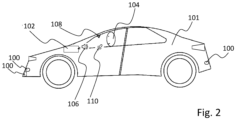
- Fig. 2 shows a system set up to carry out the method described above.
- the system implemented in the motor vehicle 101 has sensors 100 for determining the vehicle context and a control unit 102 for determining information related to the vehicle context.
- the sensors 100 are designed, for example, as ultrasound, radar or lidar sensors and/or as a camera.
- Information is stored in the control unit 102 for each vehicle context, for example.
- the control unit 102 further determines a validity period associated with the information and compares it with a predefined reference value. If the validity period is less than the reference value, the control unit 102 classifies the Information as urgent.
- the control unit 102 further checks whether the information has an importance value that exceeds a predetermined threshold value. The importance value indicates the content relevance of information for a vehicle user 104.
- the importance value of each piece of information is stored in the control unit 102 and is preferably adapted dynamically according to user behavior and the vehicle context.
- the importance value of information can be the same for all users; in an alternative or additional development, the importance value is personalized and stored in the control unit.
- the system also has loudspeakers 106; if the information is urgent and exceeds the threshold value, the control unit 102 automatically outputs one of the three voice outputs adapted to the communication status via the loudspeakers 106, i.e. proactively on its own initiative.
- Voice inputs from the vehicle user 104 are transmitted to the control unit 102 for evaluation via a microphone 110.
- a user's reaction to a voice output is determined using a camera 108 included in the system and the microphone 106.
Landscapes
- Engineering & Computer Science (AREA)
- Physics & Mathematics (AREA)
- Health & Medical Sciences (AREA)
- Audiology, Speech & Language Pathology (AREA)
- Computational Linguistics (AREA)
- Multimedia (AREA)
- Remote Sensing (AREA)
- Radar, Positioning & Navigation (AREA)
- Human Computer Interaction (AREA)
- Acoustics & Sound (AREA)
- General Physics & Mathematics (AREA)
- Theoretical Computer Science (AREA)
- Automation & Control Theory (AREA)
- General Health & Medical Sciences (AREA)
- General Engineering & Computer Science (AREA)
- Artificial Intelligence (AREA)
- Mechanical Engineering (AREA)
- Navigation (AREA)
Description
- Die Erfindung betrifft ein Verfahren zum Betrieb eines Sprachdialogsystems sowie ein Sprachdialogsystem zur Durchführung des Verfahrens.
- Aus der Offenlegung
US 2014/0136187 A1 ist eine Verfahren bekannt, bei dem eine Sprachausgabe selbsttätig unter Berücksichtigung des Fahrzeugkontextes gestartet wird. Der Fahrzeugkontext umfasst beispielsweise Außentemperatur, Regen, Position oder Nebel. Kontextrelevante Informationen umfassen beispielsweise Anweisungen zur Bedienung der Nebelleuchten bei aufkommendem Nebel. - Aus der
DE 10 2006 060 519 A1 ist eine Verfahren bekannt, in welchem insbesondere fahrzeug- und situationsbezogene Informationen nach bestimmten Kriterien bewertet und entsprechend dieser Bewertung an den Fahrer vorzugsweise in zeitlich vorherbestimmten Abständen ausgegeben werden. Dabei wird die Identität des aktuellen Fahrers beim Start des Fahrzeugs erfasst wird und die Informationen zur Ausgabe an den Fahrer in Abhängigkeit von dem aktuellen Fahrer sowie einer gespeicherten Informationsausgabehistorie des jeweiligen Fahrers ausgegeben. - Die
US 2020 / 0 357 406 A1 offenbart eine Verfahren, bei dem eine Ausgabe von Informationen an einen Nutzer von verschiedenen Faktoren abhängig gemacht wird. Die Faktoren umfassen dabei beispielsweise, ob der Nutzer gerade spricht, wer die Information sendet, eine Wichtigkeit der Information, einen Bezug zu vorangegangenen Informationen oder Vorlieben des Nutzers. - Die
DE 10 2007 043264 A1 offenbart eine Vorrichtung zur Ausgabe eines Sprachsignals, wobei Navigationsansagen unterschiedlichen Dringlichkeitsstufen zugeordnet sind. Diese Dringlichkeitsstufen bewirken bei einer möglichen Ausführungsform, dass je nach Inhalt der Navigationsansage eine Verkehrsdurchsage im laufenden Satz unterbrochen wird. - Aus der
DE 10 2013 015712 A1 ist ein Verfahren zur Klassifizierung von Verkehrsereignissen bekannt, wobei das relevanteste Verkehrsereignis einer Liste eine Informationsausgabe an einen Nutzer auslöst. Das Verkehrsereignis wird aus der Liste gelöscht, sobald dessen Gültigkeitsdauer abgelaufen ist. - Die
US 2016/236690 A1 offenbart ein Sprachdialogsystem, das eine per Sprache ausgegebene Information auf die aktuelle Situation und Kontext des Fahrers anpasst. Dies umfasst das Zurückhalten von Informationen im Moment hoher Fahrerbelastung und eine Änderung einer Stimmlage der sprachlich ausgegebenen Information bei unterschiedlichen Bedingungen. Das Sprachdialogsystem ist weiter eingerichtet an den Nutzer gerichtete Informationen unterschiedlich ausführlich auszugeben. - Aufgabe der Erfindung ist es demgegenüber ein verbessertes Verfahren bereitzustellen, das bei der Erzeugung einer selbsttätigen Sprachausgabe neben dem Kontext weitere Parameter berücksichtigt.
- Die Aufgabe wird durch ein Verfahren zum Betrieb eines Sprachdialogsystems mit den Merkmalen des Anspruchs 1 sowie ein einem Sprachdialogsystem gemäß Anspruch 11 gelöst. Die abhängigen Ansprüche definieren bevorzugte und vorteilhafte Ausführungsformen der vorliegenden Erfindung.
- Bei dem erfindungsgemäßen Verfahren wird überprüft, ob eine einem Fahrzeugkontext zugehörige Information dringlich ist, d.h. nur für eine kurze Zeitdauer relevant ist und eine Gültigkeitsdauer kleiner einem vorgegebenen Referenzwert aufweist, und sofern die Information dringlich ist, wird überprüft, ob die Information einen über einem Schwellenwert liegenden Wichtigkeitswert für den Nutzer aufweist, wobei sofern der Schwellenwert überschritten wird selbsttätig eine an den aktuellen Kommunikationsstatus angepasste Sprachausgabe an einen Fahrzeugnutzer ausgegeben wird.
- Der Kommunikationsstatus umfasst verschiedene Zustände einer Kommunikation des Sprachdialogsystems mit dem Fahrzeugnutzer. In einem Zustand findet keine Kommunikation statt, d.h. der Fahrer und das Sprachdialogsystem gibt keine Sprachausgabe aus. In diesem Zustand ist das Sprachdialogsystem empfangsbereit und lauscht auf Sprachausgabe des Fahrzeugnutzers. Weitere Zustände umfassen eine Sprachausgabe durch den Fahrzeugnutzer oder das Sprachdialogsystem.
- Eine Information ist im Sinne der vorliegenden Anmeldung dringlich, wenn sie einem zu einem Zeitpunkt stattfindenden Ereignis zugehörig und die Information nur eine sehr kurze Gültigkeitsdauer aufweist. Eine Reaktion auf ein Ereignis muss sofort oder zumindest zeitnah erfolgen, da die Information nach kurzer Zeit an Relevanz oder vollständig an Bedeutung verliert. Die vorgegebene Gültigkeitsdauer definiert den Umfang dringlicher Informationen, beispielsweise können Informationen die nach 1s oder 5s ihre Gültigkeit verlieren als dringlich definiert werden.
- Dringliche Informationen sind Informationen, die auf aktuellen Sensordaten (visuell oder auch akustisch) an einer geografischen Position basieren. Dringliche Informationen betreffen z.B. das aktuelle Verkehrsgeschehen, eine zu passierende Gefahrenstelle oder ein zugehöriges Verkehrszeichen, Übernahmeaufforderung beim automatisierten Fahren oder ein in der Fahrzeugumgebung auftauchender Point of Interest.
- Wichtig ist im Sinne der vorliegenden Anmeldung hingegen eine Information, die eine hohe Priorität für einen Fahrzeugnutzer aufweist, d.h. wichtige Informationen sind benutzerspezifisch. Für einen Fahrzeugnutzer wichtige Informationen mit entsprechendem Wichtigkeitswert werden in einem Benutzermodell gespeichert. Wichtige Informationen können manuell gespeichert und/oder aus dem Benutzerverhalten gelernt werden. Wichtige Informationen werden beispielsweise von Anwendungen wie einem Navigationssystem, einem Terminkalender, einem E-Mail-System generiert. Eine E-Mail von einer Person kann dabei einen größere Wichtigkeitswert als von einer anderen Person aufweisen. Wichtigkeitswerte einer Information können aber auch situationsabhängig sein, z.B. interessiert sich ein Benutzer während einer Urlaubsreise möglicherweise für touristische Informationen, auf der Fahrt zur Arbeit sind diese aber nicht wichtig. Alle Informationen über die aktuelle Verkehrssituation und die aktuelle Fahrt/Reise sind vorzugsweise als wichtig zu betrachten.
- Alle Informationen können einen individuellen Grad der Wichtigkeit aufweisen, wobei vorliegend nur Informationen mit einer über einem vorgegebenen Schwellenwert liegender Wichtigkeit, d.h. mit einem über einem Schwellenwert liegenden Wichtigkeitswert berücksichtigt werden. Eine dringliche Information muss für einen Nutzer nicht immer wichtig sein. Beispielsweise ist ein POI dringlich, weil nur wenige Sekunden sichtbar aber für einen Nutzer nicht wichtig, weil an diesem POI kein Interesse besteht. Umgekehrt gibt es für den Nutzer wichtige Informationen, die nicht dringlich sind. Eine Information einer E-Mail eines Bekannten weist als Beispiel eine hohe Wichtigkeit auf ist aber nicht dringlich, da die Gültigkeitsdauer sehr lang ist.
- Da im Verständnis der vorliegenden Anmeldung nur dringliche und wichtige Informationen akustisch ausgegeben werden, kann sich der Fahrzeugnutzer in vorteilhafter Weise bestmöglich auf die Fahraufgabe konzentrieren.
- Erfindungsgemäß wird, sofern ein Kommunikationsstatus vorliegt, bei dem keine Kommunikation zwischen Fahrer und Sprachdialogsystem erfolgt, selbsttätig durch das Sprachdialogsystem eine erste, prosodisch hervorgehobene Sprachausgabe zur Erweckung der Aufmerksamkeit und Herstellung der Zuhörbereitschaft des Fahrzeugnutzers ausgegeben. Unter einer prosodisch hervorgehobenen ist eine gegenüber einer standardmäßigen in Intonation, Lautheit, Dauer, Sprechtempo, Rhythmus und/oder Stimmhöhe veränderte Sprachausgabe zu verstehen. Die Aufmerksamkeit des Fahrzeugnutzers wird durch die hervorgehobene Sprachausgabe geweckt, wobei die Sprachausgabe bevorzug als Apell oder Gruß formulierte Interjektion und/oder namentliche Anrede formuliert ist. In vorteilhafter Weise wird durch die erste Sprachausgabe sichergestellt, dass der Fahrer nachfolgende Information nicht überhört.
- In einer weiteren zusätzlichen oder alternativen vorteilhaften Weiterbildung wird, sofern ein Kommunikationsstatus vorliegt, bei dem eine Sprachausgabe des Sprachdialogsystems erfolgt, diese unterbrochen und selbsttätig auf eine zweite, einen Themenwechsel einleitende prosodisch hervorgehobene Sprachausgabe gewechselt. Im Fall einer ablaufenden Sprachausgabe wird diese abgebrochen und auf eine von der ersten verschiedene zweite Sprachausgabe zugegriffen, die durch die prosodische Hervorhebung gegenüber der vor dem Abbruch ausgegebenen Sprache deutlich abgesetzt ist und die Aufmerksamkeit des Fahrzeugnutzers weckt.
- In einer weiteren zusätzlichen oder alternativen vorteilhaften Weiterbildung wird, sofern ein Kommunikationsstatus vorliegt, bei dem der Fahrzeugnutzer spricht, selbsttätig eine prosodische dritte Sprachausgabe zur Unterbrechung, Erweckung der Aufmerksamkeit und Herstellung der Zuhörbereitschaft des Fahrzeugnutzers ausgegeben. Die dritte, von der ersten und zweiten verschiedene Sprachausgabe ist vorzugsweise entschuldigend formuliert und verfolgt das Ziel den Redefluss des Fahrers zu unterbrechen und die Zuhörbereitschaft herzustellen.
- In einer weiteren Ausführungsform wird nach Ausgabe einer der ersten, zweiten oder dritten Sprachausgabe die Reaktion des Fahrers überwacht, wobei je Abhängigkeit der Reaktion der weitere Dialog gestaltet wird. Die Reaktion umfasst eine emotionale Regung, eine sprachliche Äußerung, eine durch eine Kamera erfasste Geste und/oder Gesichtsmimik als auch neutrales Verhalten, bei dem keine auf die Sprachausgabe folgende Reaktion feststellbar ist.
- In weiterer Ausgestaltung des Verfahrens wird sofern der Fahrer keine oder eine negative Reaktion zeigt eine weitere, gegenüber der ersten, der zweiten oder dritten vorhergehenden Sprachausgaben prosodisch verstärkte Sprachausgabe ausgegeben. Neben der weiteren Sprachausgabe können weiter optische und akustische Signale, beispielsweise ein Piep- oder Summton, zur Erhöhung der Aufmerksamkeit ergänzt werden. Die weitere Sprachausgabe umfasst eine namentliche Anrede oder einen Apell. Im Anschluss wird wieder die Reaktion des Fahrers ausgewertet und je nach Reaktion wird der weitere Dialog ausgerichtet oder weitere Maßnahmen eingeleitet. Zeigt der Fahrzeugnutzer keine oder eine abweisende Reaktion wird der sprachliche Dialog eingestellt und bei Bedarf eine Funktion des Fahrzeugs gestartet, beispielsweise ein Fahrzeughalt, ein Lenkeingriff oder eine Geschwindigkeitsanpassung ausgeführt. Sofern der Fahrer positiv reagiert gibt das Sprachdialogsystem die dringliche Information mit einem über dem Schwellenwert liegenden Wichtigkeitswert aus. In vorteilhafter Weise werden durch das Verfahren dem Fahrzeugnutzer nur Informationen präsentiert, die er auch wünscht.
- In einer weiteren vorteilhaften Ausbildung wird der Zustand des Sprachdialogsystems und/oder der Dialogverlauf bis zur Unterbrechung gespeichert und nach Ausgabe der dringlichen Information mit einem über dem Schwellenwert liegenden Wichtigkeitswert dieser Zustand dem Nutzer mitgeteilt und/oder der bisherige Dialogverlauf zumindest teilweise zusammengefasst wiederholt wiedergegeben. Hat beispielsweise vor der Unterbrechung ein Dialog stattgefunden, bei dem ein Navigationsziel ausgegeben wurde oder der Fahrzeugnutzer eine Telefonnummer anforderte, so wird dem Nutzer der Zustand des Sprachdialogsystems vor der Unterbrechung mitgeteilt, d.h. "Zurück zur Zieleingabe" oder "Willst du Herrn Müller noch anrufen?" und die bisherige Sprachaus- und/oder eingabe zumindest teilweise wiederholt. Der Nutzer kann damit seine vor der Unterbrechung begonnenen Aktivitäten ungehindert fortsetzen.
- In einer Weiterbildung des Verfahrens ist der Wichtigkeitswert einer Information in einem selbstlernenden Nutzermodell gespeichert. Aus dem historischen Nutzerverhalten wird ermittelt, welche Information wichtig oder weniger wichtig sind. Hierbei werden beispielsweise Eingaben in ein mit dem Sprachdialogsystem und vorzugsweise mit dem Internet verbundenen Entertainmentsystem ausgewertet. Häufige Aktionen wie Anfragen nach touristischen Informationen oder Abfragen des Terminkalenders, Anrufen einer bestimmten Person lassen den Wichtigkeitswert von mit diesen Aktionen im Kontext stehenden Informationen oder Informationsklassen ansteigen. Der Wichtigkeitswert wird dabei personalisiert sowie auch situations- und/oder ortsabhängig in einem vorzugweise als neuronalen Netz ausgebildeten Modell erlernt.
- In einer Weiterbildung des Verfahren wird jeder Klasse von Informationen eine individuelle Gültigkeitsdauer zugewiesen. Eine Information kann für einen Nutzer unterschiedliche relevant sein, beispielsweise eine Warnung eines Kreuzungsassistenten bezüglich einem querenden Fahrzeug hat ein eine sehr kurze Gültigkeitsdauer, ein Hinweis auf ein Point of Interest dagegen eine sehr viel längere Gültigkeitsdauer. Die mit individuellen Gültigkeitswerten versehenen Informationsklassen ermöglicht durch Vergleich mit dem vordefinierten Referenzwert eine Unterscheidung zwischen dringlichen und nicht dringlichen Informationen. Die Gültigkeitsdauer der Informationsklassen werden in einer Weiterbildung abhängig vom Fahrzeugkontext d.h. Tageszeit, Wetter, Straßenart- und Verlauf, Geschwindigkeit dynamisch angepasst. Beispielsweise weist bei hoher Geschwindigkeit auf einer Autobahn eine auf ein Ausfahrtschild hinweisende Information eine deutlich geringere Gültigkeitsdauer auf als bei langsamer Fahrt. Eine Information zur Übernahmeaufforderung der Fahrzeugführung zur Beendigung des autonomen Fahrbetriebs weist auf einer Autobahnfahrt mit moderater Geschwindigkeit eine andere Gültigkeitsdauer als auf einer schnell befahrenen kurvigen Landstraße.
- Mit anderen Worten kann eine Information in einem Kontext dringlich und in einem anderen Kontext nicht dringlich sein, da die Gültigkeitsdauer einer Information je nach Kontext kleiner bzw. gleich oder größer dem Referenzwert sein kann
- Das erfindungsgemäße System ist eingerichtet zur Durchführung des Verfahrens nach einem der vorangehenden Verfahrensschritte. Das System weist Sensoren zu Ermittlung des Fahrzeugkontextes und eine Steuereinheit zur Ermittlung von mit dem Fahrzeugkontext in Zusammenhang stehenden Informationen auf. Zu jedem Fahrzeugkontext sind beispielsweise in der Steuereinheit Information hinterlegt. Die Steuereinheit ermittelt weiter eine der Information zugehörigen Gültigkeitsdauer und vergleicht diese mit einem vordefinierten Referenzwert. Ist die Gültigkeitsdauer kleiner als der Referenzwert, dann ist die Information als dringlich einzustufen. Die Steuereinheit überprüft weiter, ob die Information einen vorgegebenen Schwellenwert überschreitenden Wichtigkeitswert aufweist. Der Wichtigkeitswert gibt wieder wie inhaltlich relevant eine Information für einen Nutzer ist. Der Wichtigkeitswert jeder Information ist im Steuergerät gespeichert und wird vorzugsweise dynamisch entsprechend dem Nutzerverhalten angepasst. Der Wichtigkeitswert einer Information kann für alle Nutzer gleichbedeutend sein, in einer alternativen oder zusätzlichen Weiterbildung ist der Wichtigkeitswert von Informationen personalisiert in einem Profil des Fahrzeugnutzers d.h. dem Fahrer gespeichert. Sofern die Information dringlich ist und den Schwellenwert überschreitet gibt das Steuergerät selbsttätig, d.h. proaktiv von sich aus einen an den Kommunikationsstatus angepasste Sprachausgabe aus.
- Weitere Vorteile, Merkmale und Einzelheiten ergeben sich aus der nachfolgenden Beschreibung, in der - gegebenenfalls unter Bezug auf die Zeichnung- zumindest ein Ausführungsbeispiel im Einzelnen beschrieben ist. Beschriebene und/oder bildlich dargestellte Merkmale können für sich oder in beliebiger, sinnvoller Kombination den Gegenstand der Erfindung bilden, gegebenenfalls auch unabhängig von den Ansprüchen, und können insbesondere zusätzlich auch Gegenstand einer oder mehrerer separater Anmeldung/en sein. Gleiche, ähnliche und/oder funktionsgleiche Teile sind mit gleichen Bezugszeichen versehen.
- Dabei zeigen:
- Fig. 1
- Verfahren zum Betrieb eines Sprachdialogsystems und
- Fig. 2
- ein Sprachdialogsystem.
- Gemäß
Fig.1 ist eine Verfahren zum Betrieb eine Sprachdialogsystems dargestellt, bei dem im Schritt S1 der Fahrzeugkontext ermittelt wird. Der Fahrzeugkontext umfasst beispielsweise die Verkehrssituation beim automatisierten Fahren oder die Situation außerhalb des fahrenden Fahrzeugs, d.h. Objekte, Point of Interest, Personen, Verkehrsschilder, außerhalb des Fahrzeugs, Fahrbahnmarkierungen, Stauende, querende Fahrzeuge, Wetterbedingungen etc. Im nächsten Schritt S3 wird ermittelt, welche Informationen zu dem von Sensoren ermittelten Fahrzeugkontext zur Ausgabe an einen Fahrer gespeichert sind oder generiert werden können. Im Schritt S4 wird überprüft, ob die zu dem Kontext zugehörigen Informationen dringlich sind. Dazu wird überprüft, ob die Gültigkeitsdauer unterhalb einem vorgegebenen Referenzwert liegen. Liegt die Gültigkeitsdauer unter dem Referenzwert ist die Information dringlich und muss unverzüglich ausgegeben werden, um für den Fahrzeugnutzer noch zeitlich relevant zu sein. Ist die Information nicht dringlich wird keine proaktive Ausgabe gestartet und das Verfahren im Schritt S50 beendet. Ist die Information dringlich, dann wird im Schritt S5 die Wichtigkeit überprüft. Ein Wichtigkeitswert gibt die inhaltliche Relevanz für den Fahrzeugnutzer wieder. Eine Information kann für einen Fahrzeugnutzer wichtig und für einen anderen unwichtig sein. Liegt der Wichtigkeitswert unterhalb einem vorgegebenen Schwellenwert, wird die proaktive Ausgabe im Schritt S50 beendet. Liegt der Wichtigkeitswert über dem Schwellenwert, dann ist die Information für den Fahrzeugnutzer auch inhaltlich von Relevanz und das Verfahren setzt sich im Schritt S7 fort. Im Schritt S7 wird der Kommunikationsstatus überprüft, d.h. ob ein aktuell Sprachdialog stattfindet oder nicht. Findet aktuell kein Dialog statt, dann erfolgt im Schritt S11 selbsttätig eine erste, prosodisch hervorgehobene Sprachausgabe zur Erweckung der Aufmerksamkeit und Herstellung der Zuhörbereitschaft des Fahrzeugnutzers. Die erste Sprachausgabe umfasst einer Interjektion, d.h. einen Apell oder Gruß und/oder eine namentliche Anrede mit prosodischer Hervorhebung, z.B. "Hallo!", "es ist wichtig!" oder "Herr Müller". - Wird in Schritt S7 ein laufender Sprachdialog ermittelt, dann wird im Schritt S13 der Dialog unterbrochen sowie der Dialogzustand d.h. Art des Dialogs und bis zur Unterbrechung erfolgter Dialog gespeichert. Der laufende Sprachdialog umfasst eine Sprachausgabe des Dialogsystems und/oder eine Sprachausgabe des Fahrzeugnutzers, beispielsweise eine allgemeine oder eine an das Dialogsystem gerichtet Sprachausgabe. Eine Sprachausgabe des Nutzers ist beispielsweise an das Dialogsystem gerichtet, sofern vorab eine Nennung eines Schlüsselwortes erfolgt ist oder diese eine Erwiderung auf eine Sprachausgabe des Dialogsystems darstellt.
- Im Schritt S15 wird ermittelt, wer bis zur Unterbrechung eine Sprachäußerung getätigt hat. Im Falle, dass das Dialogsystem im Zeitpunkt der Unterbrechung einer Sprachausgabe getätigt hat, wird im Schritt S17 selbsttätig auf eine zweite, einen Themenwechsel einleitende prosodisch hervorgehobene Sprachausgabe gewechselt. Der Wechsel umfasst eine Sprechpause und eine den Themenwechsel beinhaltende Interjektion, beispielsweise "Übrigens" oder "Richten Sie den Blick nach rechts".
- Wird in Schritt S15 festgestellt, dass nicht das Dialogsystem eine Sprachausgabe getätigt hat, sondern der Fahrzeugnutzer spricht, dann wird im Schritt 19 selbsttätig eine prosodische dritte Sprachausgabe zur Unterbrechung, Erweckung der Aufmerksamkeit und Herstellung der Zuhörbereitschaft des Fahrzeugnutzers ausgegeben. Die Unterbrechung umfasst vorzugsweise eine Interjektion in Form einer Entschuldigung, beispielsweise "Ich muss Sie leider unterbrechen!".
- Nach Ausgabe einer der drei Sprachausgaben wird im Schritt S 21 die Reaktion des Fahrers überprüft. Unterschieden wird eine positive oder negative bzw. keine Reaktion. Die Reaktion kann beispielsweise eine sprachliche Äußerung oder auch eine über Kamera erfasst Rückmeldung in Form einer Geste und/oder eines Gesichtsausdrucks umfassen. Eine ablehnende Reaktion ist beispielsweise ein Kopfschütteln, ein Abwinken mit einer Hand oder eine abweisende sprachliche Äußerung. Ist im Schritt S21 keine oder eine negative Reaktion feststellbar, d.h. ablehnend, dann wird im Schritt S23 eine weitere einen Apell umfassende Interjektion und/oder eine namentliche Anrede begleitet von einem akustischen Signal (beep) mit einer gegenüber einer der vorgehergehenden drei sprachlichen Äußerungen verstärkt prosodischer Hervorhebung ausgegeben, beispielsweise "Bitte zuhören, die Information ist sehr wichtig".
- Im Schritt S25 wird die Reaktion des Nutzers erneut überprüft, bleibt die Reaktion weiter negativ wird je nach Informationsklassen direkt zum Schritt S29 oder zuerst zum Schritt S27 gewechselt, bei dem eine nicht sprachliche Reaktion des Fahrzeugs erfolgt, beispielsweise wird nach nicht erfolgter Übernahme der Fahrzeugsteuerung durch den Fahrzeugnutzer ein Nothalt eingeleitet. Ergibt die Prüfung in Schritt S29, dass im Schritt S13 ein Dialogzustand gespeichert wurde, dann wird im Schritt S31 dieser Zustand dem Nutzer mitgeteilt und/oder ein bisheriger Dialog dem Nutzer zumindest teilweise zusammengefasst wiederholt wiedergegeben. Ist kein Dialogzustand gespeichert wird die proaktive Ausgabe im Schritt S50 beendet.
- Ist die Reaktion im Schritt S21 positiv, d.h. bejahend beispielsweise ausgedrückt durch Kopfnicken, Lächeln oder sprachlicher Äußerung, wird im Schritt S33 die Information ausgegeben. Unter Information ist im Verständnis der vorliegenden Anmeldung beispielsweise eine Aufforderung, ein Vorschlag als auch eine Information als solche, beispielsweise zu einem Point of Interest zu verstehen.
- Im Fall, dass der Fahrzeugnutzer mit einer Frage reagiert, wird im optionalen Schritt S35 ein Dialog zur Klärung geführt. Ergibt die Prüfung in Schritt S29 wiederum, dass im Schritt S13 ein Dialogzustand gespeichert wurde, dann wird im Schritt S31 dieser Zustand dem Nutzer mitgeteilt und/oder ein bisheriger Dialog dem Nutzer zumindest teilweise zusammengefasst wiederholt wiedergegeben. Ist kein Dialogzustand gespeichert wird die proaktive Ausgabe im Schritt S50 beendet.
-
Fig. 2 zeigt ein System eingerichtet zur Durchführung des vorab beschriebenen Verfahrens. Das im Kraftfahrzeug 101 implementierte System weist Sensoren 100 zur Ermittlung des Fahrzeugkontextes und eine Steuereinheit 102 zur Ermittlung von mit dem Fahrzeugkontext in Zusammenhang stehenden Informationen auf. Die Sensoren 100 sind beispielsweise als Ultraschall-, Radar- oder Lidarsensoren und/oder als Kamera ausgeführt. Zu jedem Fahrzeugkontext sind beispielsweise in der Steuereinheit 102 Information hinterlegt. Die Steuereinheit 102 ermittelt weiter eine der Information zugehörigen Gültigkeitsdauer und vergleicht diese mit einem vordefinierten Referenzwert. Ist die Gültigkeitsdauer kleiner als der Referenzwert, dann stuft das Steuergerät 102 die Information als dringlich ein. Die Steuereinheit 102 überprüft weiter, ob die Information einen vorgegebenen Schwellenwert überschreitenden Wichtigkeitswert aufweist. Der Wichtigkeitswert gibt eine inhaltliche Relevanz einer Information für einen Fahrzeugnutzer 104 ist. Der Wichtigkeitswert jeder Information ist im Steuergerät 102 gespeichert und wird vorzugsweise dynamisch entsprechend dem Nutzerverhalten und dem Fahrzeugkontext angepasst. Der Wichtigkeitswert einer Information kann für alle Nutzer gleich groß sein, in einer alternativen oder zusätzlichen Weiterbildung ist der Wichtigkeitswert von personalisiert in der Steuereinheit gespeichert. Das System weist weiter Lautsprecher 106 auf, sofern die Information dringlich ist und den Schwellenwert überschreitet gibt das Steuergerät 102 selbsttätig über die Lautsprecher 106, d.h. proaktiv von sich aus eine von den drei, an den Kommunikationsstatus angepasste Sprachausgabe aus. Spracheingaben des Fahrzeugnutzers 104 werden über ein Mikrofon 110 zur Auswertung an das Steuergerät 102 übermittelt. Mittels einer von dem System umfassten Kamera 108 und dem Mikrofon 106 wird eine Reaktion des Nutzers auf eine Sprachausgabe ermittelt.
Claims (11)
- Verfahren zum Betrieb eines Sprachdialogsystems mit folgenden Schritten:- Ermittlung eines Fahrzeugkontexts (S1) und- Ermittlung einer mit dem Fahrzeugkontext in Zusammenhang stehenden, in einer Steuereinheit hinterlegten Information (S3), gekennzeichnet durch,- Überprüfung, ob die Information eine Gültigkeitsdauer kleiner einem vordefinierten Referenzwert aufweist und somit als dringlich einzustufen ist (S4), und sofern die Information dringlich ist,- Überprüfung, ob die Information für einen Fahrzeugnutzer einen einen vorgegebenen Schwellenwert überschreitenden manuell gespeicherten oder aus einem Benutzerverhalten erlernten Wichtigkeitswert aufweist (S5),- wobei, sofern auch der Schwellenwert überschritten wird, selbsttätig eine an einen aktuellen Kommunikationsstatus des Sprachdialogsystems angepasste Sprachausgabe an den Fahrzeugnutzer ausgegeben wird (S11, S17, S19), wobei, sofern ein Kommunikationsstatus vorliegt, bei dem keine Kommunikation zwischen dem Fahrzeugnutzer und dem Sprachdialogsystem erfolgt, selbsttätig die Sprachausgabe als eine von der Information verschiedene erste, prosodisch hervorgehobene Sprachausgabe zur Erweckung der Aufmerksamkeit und Herstellung der Zuhörbereitschaft des Fahrzeugnutzers ausgegeben wird (S11).
- Verfahren nach Anspruch 1,
dadurch gekennzeichnet, dass, sofern ein Kommunikationsstatus vorliegt, bei dem eine ablaufende Sprachausgabe des Sprachdialogsystems erfolgt, diese unterbrochen (S13) und selbsttätig auf eine zweite von der Information verschiedene und einen Themenwechsel einleitende prosodisch hervorgehobene Sprachausgabe gewechselt wird (S17). - Verfahren nach Anspruch 1,
dadurch gekennzeichnet, dass, sofern ein Kommunikationsstatus vorliegt, bei dem der Fahrzeugnutzer spricht, selbsttätig (S13) die Sprachausgabe als eine prosodisch von der Information verschiedene dritte Sprachausgabe zur Unterbrechung, Erweckung der Aufmerksamkeit und Herstellung der Zuhörbereitschaft des Fahrzeugnutzers ausgegeben wird (S19). - Verfahren nach einem der vorhergehenden Ansprüche,
dadurch gekennzeichnet, dass, nach Ausgabe einer der ersten, zweiten oder dritten Sprachausgabe (S11, S17, S19) die Reaktion des Fahrzeugnutzers überwacht wird (S21). - Verfahren nach Anspruch 4,
dadurch gekennzeichnet, dass, sofern der Fahrzeugnutzer keine oder eine abweisende Reaktion zeigt, eine weitere, gegenüber der ersten, der zweiten oder der dritten vorhergehenden Sprachausgabe prosodisch verstärkte Sprachausgabe erfolgt (S23). - Verfahren nach einem der Ansprüche 4 oder 5,
dadurch gekennzeichnet, dass, sofern der Fahrer bejahend reagiert, das Sprachdialogsystem die dringliche Information mit dem über dem Schwellenwert liegenden Wichtigkeitswert ausgibt (S33). - Verfahren nach einem der Ansprüche 2 bis 6,
dadurch gekennzeichnet, dass
der Zustand des Sprachdialogsystems und/oder ein Dialogverlauf bis zur Unterbrechung gespeichert (S13) und nach Ausgabe der dringlichen Information mit dem über dem Schwellenwert liegenden Wichtigkeitswert (S33) dieser Zustand dem Nutzer mitgeteilt und/oder ein bisheriger Dialog dem Nutzer zumindest teilweise zusammengefasst wiederholt wiedergegeben wird (S31). - Verfahren nach einem der Ansprüche 1 bis 7,
dadurch gekennzeichnet, dass
der Wichtigkeitswert der Information selbstlernend aus historischem Nutzerverhalten ermittelt wird. - Verfahren nach einem der Ansprüche 1 bis 8,
dadurch gekennzeichnet, dass Klassen von Informationen jeweils eine individuelle Gültigkeitsdauer zugewiesen wird. - Verfahren nach Anspruch 9,
dadurch gekennzeichnet, dass
die individuelle Gültigkeitsdauer in Abhängigkeit vom Fahrzeugnutzer- und/oder Fahrzeugkontext angepasst wird. - Sprachdialogsystem eingerichtet zur Durchführung des Verfahrens nach einem der Ansprüche 1 bis 10.
Applications Claiming Priority (2)
| Application Number | Priority Date | Filing Date | Title |
|---|---|---|---|
| DE102021005546.2A DE102021005546B3 (de) | 2021-11-09 | 2021-11-09 | Verfahren zum Betrieb eines Sprachdialogsystems |
| PCT/EP2022/078625 WO2023083561A1 (de) | 2021-11-09 | 2022-10-14 | Verfahren zum betrieb eines sprachdialogsystems |
Publications (3)
| Publication Number | Publication Date |
|---|---|
| EP4232324A1 EP4232324A1 (de) | 2023-08-30 |
| EP4232324B1 true EP4232324B1 (de) | 2024-04-17 |
| EP4232324C0 EP4232324C0 (de) | 2024-04-17 |
Family
ID=83692607
Family Applications (1)
| Application Number | Title | Priority Date | Filing Date |
|---|---|---|---|
| EP22801804.0A Active EP4232324B1 (de) | 2021-11-09 | 2022-10-14 | Verfahren zum betrieb eines sprachdialogsystems |
Country Status (5)
| Country | Link |
|---|---|
| US (1) | US20250029610A1 (de) |
| EP (1) | EP4232324B1 (de) |
| CN (1) | CN118215605A (de) |
| DE (1) | DE102021005546B3 (de) |
| WO (1) | WO2023083561A1 (de) |
Family Cites Families (6)
| Publication number | Priority date | Publication date | Assignee | Title |
|---|---|---|---|---|
| DE102006060519A1 (de) | 2006-12-21 | 2008-06-26 | Daimler Ag | Verfahren und System zur Fahrerinformation |
| DE102007043264A1 (de) * | 2007-09-11 | 2009-03-12 | Siemens Ag | Vorrichtung und Verfahren zur Ausgabe eine Sprachsignals |
| US9798799B2 (en) | 2012-11-15 | 2017-10-24 | Sri International | Vehicle personal assistant that interprets spoken natural language input based upon vehicle context |
| DE102013015712A1 (de) * | 2013-09-20 | 2014-04-10 | Daimler Ag | Vorrichtung und Verfahren zur Unterstützung eines Fahrers eines Fahrzeugs bei der Navigation in einem Straßenverkehrsnetz |
| US10137902B2 (en) * | 2015-02-12 | 2018-11-27 | Harman International Industries, Incorporated | Adaptive interactive voice system |
| DK201970509A1 (en) | 2019-05-06 | 2021-01-15 | Apple Inc | Spoken notifications |
-
2021
- 2021-11-09 DE DE102021005546.2A patent/DE102021005546B3/de active Active
-
2022
- 2022-10-14 US US18/708,454 patent/US20250029610A1/en active Pending
- 2022-10-14 EP EP22801804.0A patent/EP4232324B1/de active Active
- 2022-10-14 WO PCT/EP2022/078625 patent/WO2023083561A1/de not_active Ceased
- 2022-10-14 CN CN202280073201.7A patent/CN118215605A/zh active Pending
Also Published As
| Publication number | Publication date |
|---|---|
| CN118215605A (zh) | 2024-06-18 |
| DE102021005546B3 (de) | 2022-11-10 |
| US20250029610A1 (en) | 2025-01-23 |
| WO2023083561A1 (de) | 2023-05-19 |
| EP4232324C0 (de) | 2024-04-17 |
| EP4232324A1 (de) | 2023-08-30 |
Similar Documents
| Publication | Publication Date | Title |
|---|---|---|
| EP1772339B1 (de) | Verfahren zur Entlastung des Fahrers eines Kraftfahrzeugs | |
| EP3762271A1 (de) | Verfahren zum betrieb eines kraftfahrzeugs mit einem autopilotsystem und kraftfahrzeug | |
| WO2019025120A1 (de) | Verfahren zum ermitteln eines benutzerfeedbacks bei einer benutzung eines geräts durch einen benutzer sowie steuervorrichtung zum durchführen des verfahrens | |
| DE102013006173A1 (de) | Verfahren und Vorrichtung zur proaktiven Dialogführung | |
| DE102016125649A1 (de) | Verwalten von nachrichten in fahrzeugen | |
| DE102020104735A1 (de) | Verfahren zum Bereitstellen einer Empfehlungsnachricht an einen Nutzer eines Fahrzeugs, computerlesbares Medium, System, und Fahrzeug | |
| DE10338512A1 (de) | Unterstützungsverfahren für Sprachdialoge zur Bedienung von Kraftfahrzeugfunktionen | |
| EP2420800B1 (de) | Technik zur Signalisierung von Telefonanrufen während einer Routenführung | |
| DE102016008365A1 (de) | Proaktive Steuerung eines Assistenzsystems eines Kraftfahrzeugs | |
| DE102019217751B4 (de) | Verfahren zum Betreiben eines Sprachdialogsystems und Sprachdialogsystem | |
| DE102012022630A1 (de) | Fahrerassistenzsystem und Verfahren zur Kommunikation eines Fahrers mit einem Fahrerassistenzsystem | |
| EP2880651A1 (de) | Verfahren und vorrichtung zum betreiben eines sprachgesteuerten informationssystems für ein fahrzeug | |
| EP2727773A1 (de) | Verfahren zum Aktivieren einer Sprachinteraktion mit einem Insassen eines Fahrzeugs und Sprachinteraktionssystem für ein Fahrzeug | |
| EP1121684B1 (de) | Verfahren und vorrichtung zur ausgabe von informationen und/oder meldungen per sprache | |
| EP4232324B1 (de) | Verfahren zum betrieb eines sprachdialogsystems | |
| DE102015119823B4 (de) | System für zustandsabhängige Mikrointeraktionsvollziehung | |
| DE102019116498A1 (de) | Vorrichtung, Fortbewegungsmittel und Verfahren zur Anpassung einer Fahrerassistenzfunktion | |
| DE102019105590B3 (de) | Cross-Platform Messaging in Fahrzeugen | |
| DE102020120867A1 (de) | Verfahren zum Betreiben eines Fahrassistenzsystems eines Kraftfahrzeugs | |
| DE102016218270B4 (de) | Verfahren zum Betreiben einer Kraftfahrzeug-Bedienvorrichtung mit Spracherkenner, Bedienvorrichtung und Kraftfahrzeug | |
| EP3895162B1 (de) | Verfahren zum betreiben eines interaktiven informationssystems für ein fahrzeug, sowie ein fahrzeug | |
| DE102021127183A1 (de) | Intelligenter persönlicher assistent | |
| DE102021205528A1 (de) | Verfahren und System zum Überprüfen einer Verfügbarkeit einer Online-Funktion eines Spracherkennungssystems in einem Kraftfahrzeug | |
| WO2005106847A2 (de) | Verfahren und vorrichtung für einen akustischen zugang zu einem anwendungsrechner | |
| EP1635145A2 (de) | Modul und Verfahren zur adaptiven Mensch-Maschine-Kommunikation in einem Kraftfahrzeug |
Legal Events
| Date | Code | Title | Description |
|---|---|---|---|
| STAA | Information on the status of an ep patent application or granted ep patent |
Free format text: STATUS: UNKNOWN |
|
| STAA | Information on the status of an ep patent application or granted ep patent |
Free format text: STATUS: THE INTERNATIONAL PUBLICATION HAS BEEN MADE |
|
| PUAI | Public reference made under article 153(3) epc to a published international application that has entered the european phase |
Free format text: ORIGINAL CODE: 0009012 |
|
| STAA | Information on the status of an ep patent application or granted ep patent |
Free format text: STATUS: REQUEST FOR EXAMINATION WAS MADE |
|
| 17P | Request for examination filed |
Effective date: 20230526 |
|
| AK | Designated contracting states |
Kind code of ref document: A1 Designated state(s): AL AT BE BG CH CY CZ DE DK EE ES FI FR GB GR HR HU IE IS IT LI LT LU LV MC ME MK MT NL NO PL PT RO RS SE SI SK SM TR |
|
| GRAP | Despatch of communication of intention to grant a patent |
Free format text: ORIGINAL CODE: EPIDOSNIGR1 |
|
| STAA | Information on the status of an ep patent application or granted ep patent |
Free format text: STATUS: GRANT OF PATENT IS INTENDED |
|
| INTG | Intention to grant announced |
Effective date: 20231128 |
|
| GRAS | Grant fee paid |
Free format text: ORIGINAL CODE: EPIDOSNIGR3 |
|
| GRAA | (expected) grant |
Free format text: ORIGINAL CODE: 0009210 |
|
| STAA | Information on the status of an ep patent application or granted ep patent |
Free format text: STATUS: THE PATENT HAS BEEN GRANTED |
|
| AK | Designated contracting states |
Kind code of ref document: B1 Designated state(s): AL AT BE BG CH CY CZ DE DK EE ES FI FR GB GR HR HU IE IS IT LI LT LU LV MC ME MK MT NL NO PL PT RO RS SE SI SK SM TR |
|
| DAV | Request for validation of the european patent (deleted) | ||
| DAX | Request for extension of the european patent (deleted) | ||
| REG | Reference to a national code |
Ref country code: GB Ref legal event code: FG4D Free format text: NOT ENGLISH |
|
| REG | Reference to a national code |
Ref country code: CH Ref legal event code: EP |
|
| REG | Reference to a national code |
Ref country code: DE Ref legal event code: R096 Ref document number: 502022000768 Country of ref document: DE |
|
| REG | Reference to a national code |
Ref country code: IE Ref legal event code: FG4D Free format text: LANGUAGE OF EP DOCUMENT: GERMAN |
|
| U01 | Request for unitary effect filed |
Effective date: 20240507 |
|
| U07 | Unitary effect registered |
Designated state(s): AT BE BG DE DK EE FI FR IT LT LU LV MT NL PT SE SI Effective date: 20240517 |
|
| PG25 | Lapsed in a contracting state [announced via postgrant information from national office to epo] |
Ref country code: IS Free format text: LAPSE BECAUSE OF FAILURE TO SUBMIT A TRANSLATION OF THE DESCRIPTION OR TO PAY THE FEE WITHIN THE PRESCRIBED TIME-LIMIT Effective date: 20240817 |
|
| PG25 | Lapsed in a contracting state [announced via postgrant information from national office to epo] |
Ref country code: HR Free format text: LAPSE BECAUSE OF FAILURE TO SUBMIT A TRANSLATION OF THE DESCRIPTION OR TO PAY THE FEE WITHIN THE PRESCRIBED TIME-LIMIT Effective date: 20240417 |
|
| PG25 | Lapsed in a contracting state [announced via postgrant information from national office to epo] |
Ref country code: GR Free format text: LAPSE BECAUSE OF FAILURE TO SUBMIT A TRANSLATION OF THE DESCRIPTION OR TO PAY THE FEE WITHIN THE PRESCRIBED TIME-LIMIT Effective date: 20240718 |
|
| PG25 | Lapsed in a contracting state [announced via postgrant information from national office to epo] |
Ref country code: ES Free format text: LAPSE BECAUSE OF FAILURE TO SUBMIT A TRANSLATION OF THE DESCRIPTION OR TO PAY THE FEE WITHIN THE PRESCRIBED TIME-LIMIT Effective date: 20240417 |
|
| PG25 | Lapsed in a contracting state [announced via postgrant information from national office to epo] |
Ref country code: PL Free format text: LAPSE BECAUSE OF FAILURE TO SUBMIT A TRANSLATION OF THE DESCRIPTION OR TO PAY THE FEE WITHIN THE PRESCRIBED TIME-LIMIT Effective date: 20240417 |
|
| PG25 | Lapsed in a contracting state [announced via postgrant information from national office to epo] |
Ref country code: PL Free format text: LAPSE BECAUSE OF FAILURE TO SUBMIT A TRANSLATION OF THE DESCRIPTION OR TO PAY THE FEE WITHIN THE PRESCRIBED TIME-LIMIT Effective date: 20240417 Ref country code: NO Free format text: LAPSE BECAUSE OF FAILURE TO SUBMIT A TRANSLATION OF THE DESCRIPTION OR TO PAY THE FEE WITHIN THE PRESCRIBED TIME-LIMIT Effective date: 20240717 Ref country code: IS Free format text: LAPSE BECAUSE OF FAILURE TO SUBMIT A TRANSLATION OF THE DESCRIPTION OR TO PAY THE FEE WITHIN THE PRESCRIBED TIME-LIMIT Effective date: 20240817 Ref country code: HR Free format text: LAPSE BECAUSE OF FAILURE TO SUBMIT A TRANSLATION OF THE DESCRIPTION OR TO PAY THE FEE WITHIN THE PRESCRIBED TIME-LIMIT Effective date: 20240417 Ref country code: GR Free format text: LAPSE BECAUSE OF FAILURE TO SUBMIT A TRANSLATION OF THE DESCRIPTION OR TO PAY THE FEE WITHIN THE PRESCRIBED TIME-LIMIT Effective date: 20240718 Ref country code: ES Free format text: LAPSE BECAUSE OF FAILURE TO SUBMIT A TRANSLATION OF THE DESCRIPTION OR TO PAY THE FEE WITHIN THE PRESCRIBED TIME-LIMIT Effective date: 20240417 Ref country code: RS Free format text: LAPSE BECAUSE OF FAILURE TO SUBMIT A TRANSLATION OF THE DESCRIPTION OR TO PAY THE FEE WITHIN THE PRESCRIBED TIME-LIMIT Effective date: 20240717 |
|
| U20 | Renewal fee for the european patent with unitary effect paid |
Year of fee payment: 3 Effective date: 20241025 |
|
| REG | Reference to a national code |
Ref country code: DE Ref legal event code: R097 Ref document number: 502022000768 Country of ref document: DE |
|
| PG25 | Lapsed in a contracting state [announced via postgrant information from national office to epo] |
Ref country code: CZ Free format text: LAPSE BECAUSE OF FAILURE TO SUBMIT A TRANSLATION OF THE DESCRIPTION OR TO PAY THE FEE WITHIN THE PRESCRIBED TIME-LIMIT Effective date: 20240417 |
|
| PG25 | Lapsed in a contracting state [announced via postgrant information from national office to epo] |
Ref country code: SK Free format text: LAPSE BECAUSE OF FAILURE TO SUBMIT A TRANSLATION OF THE DESCRIPTION OR TO PAY THE FEE WITHIN THE PRESCRIBED TIME-LIMIT Effective date: 20240417 Ref country code: RO Free format text: LAPSE BECAUSE OF FAILURE TO SUBMIT A TRANSLATION OF THE DESCRIPTION OR TO PAY THE FEE WITHIN THE PRESCRIBED TIME-LIMIT Effective date: 20240417 |
|
| PG25 | Lapsed in a contracting state [announced via postgrant information from national office to epo] |
Ref country code: SM Free format text: LAPSE BECAUSE OF FAILURE TO SUBMIT A TRANSLATION OF THE DESCRIPTION OR TO PAY THE FEE WITHIN THE PRESCRIBED TIME-LIMIT Effective date: 20240417 |
|
| PG25 | Lapsed in a contracting state [announced via postgrant information from national office to epo] |
Ref country code: SM Free format text: LAPSE BECAUSE OF FAILURE TO SUBMIT A TRANSLATION OF THE DESCRIPTION OR TO PAY THE FEE WITHIN THE PRESCRIBED TIME-LIMIT Effective date: 20240417 Ref country code: SK Free format text: LAPSE BECAUSE OF FAILURE TO SUBMIT A TRANSLATION OF THE DESCRIPTION OR TO PAY THE FEE WITHIN THE PRESCRIBED TIME-LIMIT Effective date: 20240417 Ref country code: RO Free format text: LAPSE BECAUSE OF FAILURE TO SUBMIT A TRANSLATION OF THE DESCRIPTION OR TO PAY THE FEE WITHIN THE PRESCRIBED TIME-LIMIT Effective date: 20240417 Ref country code: CZ Free format text: LAPSE BECAUSE OF FAILURE TO SUBMIT A TRANSLATION OF THE DESCRIPTION OR TO PAY THE FEE WITHIN THE PRESCRIBED TIME-LIMIT Effective date: 20240417 |
|
| PLBE | No opposition filed within time limit |
Free format text: ORIGINAL CODE: 0009261 |
|
| STAA | Information on the status of an ep patent application or granted ep patent |
Free format text: STATUS: NO OPPOSITION FILED WITHIN TIME LIMIT |
|
| 26N | No opposition filed |
Effective date: 20250120 |
|
| PG25 | Lapsed in a contracting state [announced via postgrant information from national office to epo] |
Ref country code: MC Free format text: LAPSE BECAUSE OF FAILURE TO SUBMIT A TRANSLATION OF THE DESCRIPTION OR TO PAY THE FEE WITHIN THE PRESCRIBED TIME-LIMIT Effective date: 20240417 |
|
| PG25 | Lapsed in a contracting state [announced via postgrant information from national office to epo] |
Ref country code: IE Free format text: LAPSE BECAUSE OF NON-PAYMENT OF DUE FEES Effective date: 20241014 |
|
| U20 | Renewal fee for the european patent with unitary effect paid |
Year of fee payment: 4 Effective date: 20251027 |
|
| PG25 | Lapsed in a contracting state [announced via postgrant information from national office to epo] |
Ref country code: CY Free format text: LAPSE BECAUSE OF FAILURE TO SUBMIT A TRANSLATION OF THE DESCRIPTION OR TO PAY THE FEE WITHIN THE PRESCRIBED TIME-LIMIT; INVALID AB INITIO Effective date: 20221014 |
|
| PG25 | Lapsed in a contracting state [announced via postgrant information from national office to epo] |
Ref country code: HU Free format text: LAPSE BECAUSE OF FAILURE TO SUBMIT A TRANSLATION OF THE DESCRIPTION OR TO PAY THE FEE WITHIN THE PRESCRIBED TIME-LIMIT; INVALID AB INITIO Effective date: 20221014 |