EP4231996B1 - Gebrauchsfertige noradrenalin-tropfbeutel mit geringen anzahlen subsichtbarer partikel - Google Patents
Gebrauchsfertige noradrenalin-tropfbeutel mit geringen anzahlen subsichtbarer partikel Download PDFInfo
- Publication number
- EP4231996B1 EP4231996B1 EP21789856.8A EP21789856A EP4231996B1 EP 4231996 B1 EP4231996 B1 EP 4231996B1 EP 21789856 A EP21789856 A EP 21789856A EP 4231996 B1 EP4231996 B1 EP 4231996B1
- Authority
- EP
- European Patent Office
- Prior art keywords
- solution
- headspace
- noradrenaline
- oxygen
- oxygen content
- Prior art date
- Legal status (The legal status is an assumption and is not a legal conclusion. Google has not performed a legal analysis and makes no representation as to the accuracy of the status listed.)
- Active
Links
Images
Classifications
-
- A—HUMAN NECESSITIES
- A61—MEDICAL OR VETERINARY SCIENCE; HYGIENE
- A61K—PREPARATIONS FOR MEDICAL, DENTAL OR TOILETRY PURPOSES
- A61K9/00—Medicinal preparations characterised by special physical form
- A61K9/0012—Galenical forms characterised by the site of application
- A61K9/0019—Injectable compositions; Intramuscular, intravenous, arterial, subcutaneous administration; Compositions to be administered through the skin in an invasive manner
-
- A—HUMAN NECESSITIES
- A61—MEDICAL OR VETERINARY SCIENCE; HYGIENE
- A61J—CONTAINERS SPECIALLY ADAPTED FOR MEDICAL OR PHARMACEUTICAL PURPOSES; DEVICES OR METHODS SPECIALLY ADAPTED FOR BRINGING PHARMACEUTICAL PRODUCTS INTO PARTICULAR PHYSICAL OR ADMINISTERING FORMS; DEVICES FOR ADMINISTERING FOOD OR MEDICINES ORALLY; BABY COMFORTERS; DEVICES FOR RECEIVING SPITTLE
- A61J1/00—Containers specially adapted for medical or pharmaceutical purposes
- A61J1/05—Containers specially adapted for medical or pharmaceutical purposes for collecting, storing or administering blood, plasma or medical fluids ; Infusion or perfusion containers
- A61J1/10—Bag-type containers
-
- A—HUMAN NECESSITIES
- A61—MEDICAL OR VETERINARY SCIENCE; HYGIENE
- A61J—CONTAINERS SPECIALLY ADAPTED FOR MEDICAL OR PHARMACEUTICAL PURPOSES; DEVICES OR METHODS SPECIALLY ADAPTED FOR BRINGING PHARMACEUTICAL PRODUCTS INTO PARTICULAR PHYSICAL OR ADMINISTERING FORMS; DEVICES FOR ADMINISTERING FOOD OR MEDICINES ORALLY; BABY COMFORTERS; DEVICES FOR RECEIVING SPITTLE
- A61J1/00—Containers specially adapted for medical or pharmaceutical purposes
- A61J1/14—Details; Accessories therefor
- A61J1/1468—Containers characterised by specific material properties
-
- A—HUMAN NECESSITIES
- A61—MEDICAL OR VETERINARY SCIENCE; HYGIENE
- A61K—PREPARATIONS FOR MEDICAL, DENTAL OR TOILETRY PURPOSES
- A61K31/00—Medicinal preparations containing organic active ingredients
- A61K31/13—Amines
- A61K31/135—Amines having aromatic rings, e.g. ketamine, nortriptyline
- A61K31/137—Arylalkylamines, e.g. amphetamine, epinephrine, salbutamol, ephedrine or methadone
-
- A—HUMAN NECESSITIES
- A61—MEDICAL OR VETERINARY SCIENCE; HYGIENE
- A61K—PREPARATIONS FOR MEDICAL, DENTAL OR TOILETRY PURPOSES
- A61K47/00—Medicinal preparations characterised by the non-active ingredients used, e.g. carriers or inert additives; Targeting or modifying agents chemically bound to the active ingredient
- A61K47/02—Inorganic compounds
Definitions
- the present invention as defined in the appended claims relates to ready to use noradrenaline drug products having low subvisible particle concentrations, and to materials and methods useful for the prevention of subvisible particle formation.
- Noradrenaline N-desmethylepinephrine (a/k/a norepinephrine) is a potent ⁇ -sympathomimetic drug and physiological neurotransmitter with the typical core structure of the phenylalkylamines (2-phenyl-1-aminoethane).
- the hydrogen tartrate and hydrochloride salts are widely used in injectable solutions for acute treatment of hypotension, anaphylactic shocks, and as vasoconstrictive additives in local anesthetic formulations to prolong the analgesic effect. Due to their common use in emergency medicine and intensive care units (ICUs), the typical dosage forms are ampoules for single use and sterile injectable solutions in glass bottles.
- noradrenaline formulations to help stabilize them.
- Hospira Inc. markets a 5 ml ampoule comprising 1 mg/ml noradrenaline bitartrate in the United States that contains sodium metabisulfite under the brand name Levophed ® .
- the label specifically cautions that sodium metabisulfite "may cause allergic-type reactions including anaphylactic symptoms and life-threatening or less severe asthmatic episodes in certain susceptible people.”
- Yadav (WO 2018/140894 A1 ) and Rakesh (US 2016/0058715 A1 ) disclose high volume ready to use bags of noradrenaline bitartrate and propose EDTA as an oxygen scavenger.
- Dinnequin U.S. Pub. No. 2005/0070613 A1
- Dinnequin reported that "Tests carried out at 25° C under light showed the presence of a coloured precipitate from the 5th day and an impurities concentration higher than 3% including especially adenochrome.”
- subvisible particles in sterile injectable products can originate from many sources, including the solution itself and its ingredients, the production process and its variables (e.g., environment, equipment, personnel), the product's packaging, and the preparation of the product for administration (e.g., manipulating the product, the environment in which it is prepared).
- the production process and its variables e.g., environment, equipment, personnel
- the preparation of the product for administration e.g., manipulating the product, the environment in which it is prepared.
- very little has been published on the formation of subvisible particles by solutions of noradrenaline.
- the inventors have also discovered a protective influence from translucent and transparent plastic materials that prevents the formation of subvisible particles, even when the plastic is not an excellent barrier to oxygen, and even when oxygen concentrations in the solution exceed those found in glass containers.
- plastics such as translucent polypropylene helps to protect the solution from light rays responsible the formation of subvisible particles, while keeping the container clear for human observation.
- the invention has particular applicability to plastics having optical properties comparable to a translucent polypropylene or a translucent film comprising polypropylene, ethylene vinyl alcohol (27 mol % ethylene), and polypropylene plies.
- the invention provides a hermetically sealed noradrenaline drug product in an intravenous ready to use translucent or transparent collapsible drip bag having low subvisible particle counts comprising: (a) a headspace consisting essentially of an inert gas and ⁇ 2% v/v oxygen; and (b) a liquid solution comprising: (i) noradrenaline or a pharmaceutically acceptable salt thereof at a concentration of from 0.001 to 0.2 mg/ml or from 0.001 to 0.035 mg/ml, (ii) less than 600 ppbw oxygen, (iii) ⁇ 25 per mL subvisible particles equal to or greater than 10 ⁇ m, and (iv) ⁇ 3 per mL subvisible particles equal to or greater than 25 ⁇ m; wherein: (i) the concentration of noradrenaline or pharmaceutically acceptable salt is based on the weight of the free base of noradrenaline (ii) the subvisible particle count is determined by the light obscuration particle count test in
- the invention provides a hermetically sealed noradrenaline drug product in an intravenous ready to use translucent or transparent collapsible drip bag having low subvisible particle counts comprising: (a) a headspace consisting essentially of an inert gas, ⁇ 1.5% v/v oxygen immediately after the bag is hermetically sealed, and ⁇ 1.2% v/v after the oxygen in the headspace and solution have reached equilibrium; and (b) an aqueous liquid solution comprising: (i) noradrenaline or a pharmaceutically acceptable salt thereof at a concentration of from 0.001 to 0.2 mg/ml or from 0.001 to 0.035 mg/ml, (ii) a tonicifying effective amount of sodium chloride, (iii) hydrochloric acid in an amount effective to impart a pH of from 3.0 to 4.5, (iv) less than 200 ppbw oxygen immediately after the product has been hermetically sealed, (v) less than 500 ppbw oxygen after the oxygen in the solution and head
- the invention provides a method of making a hermetically sealed noradrenaline drug product in an intravenous ready to use translucent or transparent collapsible drip bag having low subvisible particle counts comprising: (a) dissolving noradrenaline or a pharmaceutically acceptable salt thereof in water to produce a noradrenaline liquid solution at a concentration of from 0.001 to 0.2 or from 0.001 to 0.035 mg/ml; (b) distributing the noradrenaline solution and an inert gas into the bag, such that the percentage of the bag's volume occupied by the headspace is from 0 to 25% or from 2 to 15%; and (c) hermetically sealing the bag; wherein: (i) the oxygen concentration in the solution is less than 200 ppbw immediately after sealing the container and less than 500 ppbw after the oxygen content in the headspace and solution have reached equilibrium; (ii) the oxygen concentration in the headspace
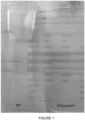
- Figure 1 is a photograph of the translucent polypropylene and polypropylene / ethylene vinyl alcohol / polypropylene bags described in Example 2, laid over a black and white image to illustrate contrast, haze, and luminous transmittance.
- the word “comprise” and variations of the word, such as “comprising” and “comprises,” means “including but not limited to,” and is not intended to exclude, for example, other additives, components, integers or steps.
- the element can also be described as “consisting of” or “consisting essentially of” the component, step or condition, or the plurality of components, steps or conditions.
- ranges are expressed herein by specifying alternative upper and lower limits of the range, it will be understood that the endpoints can be combined in any manner that is mathematically feasible.
- a range of from 50 or 80 to 100 or 70 can alternatively be expressed as a series of ranges of from 50 to 100, from 50 to 70, and from 80 to 100.
- a series of upper bounds and lower bounds are related using the phase "and” or “or”
- the upper bounds can be unlimited by the lower bounds or combined with the lower bounds, and vice versa.
- a range of greater than 40% and/or less than 80% includes ranges of greater than 40%, less than 80%, and greater than 40% but less than 80%.
- a claimed system comprises element A defined by elements A1, A2 and A3, in combination with element B defined by elements B1, B2 and B3, the invention will also be understood to cover a system defined by element A without element B, a system in which element A is defined by elements A1 and A2 in combination with element B defined by elements B2 and B3, and all other possible permutations.
- the term "about” will compensate for variability allowed for in the pharmaceutical industry and inherent in products in this industry, such as differences in product strength due to manufacturing variation and time-induced product degradation. The term allows for any variation which in the practice of good manufacturing practices would allow the product being evaluated to be considered therapeutically equivalent or bioequivalent in humans to the recited strength of a claimed product.
- compositions of the invention refers to molecular entities and other ingredients of such compositions that are physiologically tolerable and do not typically produce untoward reactions when administered to a subject (e.g., a mammal such as a human).
- test methodology or diagnostic instrument is performed based on the version in effect on October 1, 2020, unless otherwise stated to the contrary herein.
- Translucent means admitting or diffusing light so that objects beyond cannot be clearly distinguished.
- Transparent means having the property of transmitting light without appreciable scattering so that bodies lying beyond are entirely visible.
- the bags depicted in Figure 1 would be considered translucent because the letters beyond the bag can be distinguished, even though the identity of the letters is difficult to discern.
- injectable means suitable to be injected into a patient (human or animal).
- the noradrenaline solution of the invention is administered by intravenous or intra-arterial injection.
- an infusion of a therapeutically active amount of the noradrenaline solution according to the invention is provided.
- antioxidant shall mean any antioxidant known in the art which is added to a solution of noradrenaline of a pharmaceutically acceptable salt thereof in order to protect noradrenaline from oxidation.
- antioxidants are sulfite(s) or ascorbic acid, or the antioxidants disclosed in US2016/0058715A1 , see in particular paragraph [0016] thereof, or other antioxidants known in the art.
- the formulation could be defined as lacking any antioxidant as that term is traditionally used in the art, as described, for example, in Rowe et al., Handbook of Pharmaceutical Excipients, 6th Edition 2009 .
- the formulation could be defined as lacking any sulfites or lacking any sulfites or ascorbic acid.
- chelating agent(s) shall mean any chelating agent known in the art which is added to a solution of noradrenaline of a pharmaceutically acceptable salt thereof in order to protect noradrenaline from degradation.
- examples include in particular metal ion chelators, such as EDTA, EGTA, DTPA and the like; see e.g. WO2018/140894A1 , in particular paragraph [0024] thereof; the tartrate/bitartrate salt of noradrenaline is not considered a chelating agent within the present invention.
- EDTA disodium edetate
- noradrenaline or a pharmaceutically acceptable salt thereof are indicated as mg or ⁇ g calculated as noradrenaline free base, per ml of the total solution, unless indicated otherwise.
- the concentration of oxygen is indicated as percent (%) w/w for the headspace, or ppbw for the dissolved oxygen.
- the invention provides a hermetically sealed noradrenaline drug product in an intravenous ready to use translucent or transparent collapsible drip bag having low subvisible particle counts comprising: (a) a headspace consisting essentially of an inert gas and ⁇ 2% v/v oxygen; and (b) a liquid solution comprising: (i) noradrenaline or a pharmaceutically acceptable salt thereof at a concentration of from 0.001 to 0.2 mg/ml or from 0.001 to 0.035 mg/ml, (ii) less than 600 ppbw oxygen, (iii) ⁇ 25 per mL subvisible particles equal to or greater than 10 ⁇ m, and (iv) ⁇ 3 per mL subvisible particles equal to or greater than 25 ⁇ m; wherein: (i) the concentration of noradrenaline or pharmaceutically acceptable salt is based on the weight of the free base of noradrenaline (ii) the subvisible particle count is determined by the light obscuration particle count test in USP
- the invention provides a hermetically sealed noradrenaline drug product in an intravenous ready to use translucent or transparent collapsible drip bag having low subvisible particle counts comprising: (a) a headspace consisting essentially of an inert gas, ⁇ 1.5% v/v oxygen immediately after the bag is hermetically sealed, and ⁇ 1.2% v/v after the oxygen in the headspace and solution have reached equilibrium; and (b) an aqueous liquid solution comprising: (i) noradrenaline or a pharmaceutically acceptable salt thereof at a concentration of from 0.001 to 0.2 mg/ml or from 0.001 to 0.035 mg/ml, (ii) a tonicifying effective amount of sodium chloride, (iii) hydrochloric acid in an amount effective to impart a pH of from 3.0 to 4.5, (iv) less than 200 ppbw oxygen immediately after the product has been hermetically sealed, (v) less than 500 ppbw oxygen after the oxygen in the solution and headspace
- the invention provides a method of making a hermetically sealed noradrenaline drug product in an intravenous ready to use translucent or transparent collapsible drip bag having low subvisible particle counts comprising: (a) dissolving noradrenaline or a pharmaceutically acceptable salt thereof in water to produce a noradrenaline liquid solution at a concentration of from 0.001 to 0.2 or from 0.001 to 0.035 mg/ml; (b) distributing the noradrenaline solution and an inert gas into the bag, such that the percentage of the bag's volume occupied by the headspace is from 0 to 25% or from 2 to 15%; and (c) hermetically sealing the bag; wherein: (i) the oxygen concentration in the solution is less than 200 ppbw immediately after sealing the container and less than 500 ppbw after the oxygen content in the headspace and solution have reached equilibrium; (ii) the oxygen concentration in the headspace is less than 1.5 % immediately after sealing the container and less than 1.2% after the oxygen content in the headspace
- the interior volume of the bags of the current invention preferably ranges from 75 to 550 ml or from 100 to 350 ml or from 250 to 325 ml.
- a particularly preferred bag has a nominal volume of 250 ml, and an absolute volume of from 260 to 300 ml.
- the percentage of the bag's volume occupied by the headspace is from 0 to 25%, with the remainder of the bag's volume occupied by the drug solution. In other subembodiments the percentage of the bag's volume occupied by the headspace is from 2 to 15%, with the remainder occupied by the drug solution.
- the headspace preferably consists essentially of an inert gas and trace amounts of oxygen. Preferred inert gases are selected from argon and nitrogen and combinations thereof, with nitrogen being particularly preferred.
- the drug product also can be defined by the concentration of oxygen in the headspace at various timepoints.
- the oxygen content in the headspace immediately after the drug product is hermetically sealed, is less than 2.0% v/v, 1.5% v/v, 1.2% v/v, 1.1% v/v, or 1.0% v/v.
- the oxygen content can be defined after the solution and headspace oxygen concentrations reach equilibrium.
- the oxygen content in the headspace at equilibrium can be less than 2.0% v/v, 1.5% v/v, 1.2% v/v, 1.1% v/v, or 1.0% vivo
- the oxygen concentration in the headspace immediately after sealing the container is within a certain low range of about 0.2 to about 1.0 percent v/v, preferably in the range of about 0.3 to about 0.95 percent v/v, in particular about 0.5 to about 0.95 percent v/v.
- the drug product can be defined based on the concentration of oxygen in the drug solution at various timepoints. These concentrations can be in addition to or alternatives to the concentration of oxygen in the headspace.
- concentration of oxygen in the drug solution immediately after the container is sealed, the concentration of oxygen in the drug solution preferably will not exceed 200, 175, 150, 125, 100 , 75, or even 50 ppbw.
- oxygen content in the solution at equilibrium preferably will not exceed 600, 550, 500, 450, 400, 350, 300, or 250 ppbw.
- the drug product also can be defined based on minimum oxygen concentrations in the headspace and solution.
- the oxygen content in the headspace can be greater than 0.3%, 0.4%, 0.5%, 0.6%, 0.7%, 0.8%, 0.9%, 1%, or 1.1%.
- the oxygen content in the solution can be greater than 50 ppbw, 60 ppbw, 70 ppbw, or 80 ppbw.
- the oxygen content in the headspace can be greater than 0.5%, 0.6%, 0.7%, 0.8%, or 0.9%.
- the oxygen content in the solution can be greater than 250 ppbw, 275 ppbw, 300 ppbw, 325 ppbw, or 350 ppbw.
- FMS Frequency Modulation Spectroscopy
- An invasive draw where the container is physically breached and a sample is taken from the headspace and/or solution is another way. Another way is to calculate the content based on other oxygen values.
- the concentration of the oxygen in the headspace immediately after the bag is sealed knowing the oxygen content in the solution immediately after the bag is filled, the oxygen content in the solution or headspace at equilibrium, the volume of the headspace, and the total volume of the bag. Still another way is to base the concentration on another time point, when there is no oxygen added to the system.
- the oxygen concentration in the solution after the container is sealed will be the same as the concentration of oxygen in the solution after the oxygen purge, barring infiltration of oxygen into the system, or a subsequent oxygen purge.
- the subvisible particle concentrations will never exceed the following minimum values: ⁇ 25 per mL subvisible particles equal to or greater than 10 ⁇ m, and ⁇ 3 per mL subvisible particles equal to or greater than 25 ⁇ m. Thus, these subvisible particle concentration limits will never be violated either immediately after the bags are hermetically sealed or after the headspace and solution concentrations of oxygen have reached equilibrium.
- the subvisible particles equal to or greater than 10 ⁇ m will be less than or equal to 15 or 10 per mL.
- subvisible particles equal to or greater than 25 ⁇ m will be less than or equal to 2 or 1 per mL.
- the solution and/or headspace will maintain these subvisible particle counts for one or even two years when stored at 25 °C protected from light.
- the drug product will preferably experience an increase in the ⁇ 10 ⁇ m subvisible particle count of no more than 50%, 100%, 200%, 300%, 400%, or 500% for 12 months when stored at 25 °C and 60% relative humidity protected from light.
- the drug product will preferably experience an increase in the ⁇ 25 ⁇ m subvisible particle count of no more than 50%, 100%, 200%, 300%, 400%, or 500% for 12 months when stored at 25 °C and 60% relative humidity protected from light.
- the drug product can also be defined based on various formulation parameters.
- the noradrenaline for example, can be present as any pharmaceutically acceptable salt. Particularly preferred salts are the hydrochloride salt and the bitartrate salt, with the bitartrate salt most preferred.
- the drug product can also be defined based on its stability, and the presence of impurities (i.e. by-products from the manufacturing process of noradrenaline, degradants of noradrenaline, and contaminants, but excluding residual solvents) in the solution.
- impurities i.e. by-products from the manufacturing process of noradrenaline, degradants of noradrenaline, and contaminants, but excluding residual solvents
- the solution comprises no more than 1%, 0.5%, 0.2%, or even 0.1% (w/w) impurities and degradants of noradrenaline.
- the noradrenaline can be present in various concentrations, always calculated based on the weight of the free base.
- the concentration of noradrenaline is from 0.001 to 0.2 mg/ml.
- the concentration of the noradrenaline is from 0.001 to 0.035 mg/ml.
- the solution comprises from 0.01 to 0.2 mg/ml noradrenaline bitartrate based on the weight of the free base.
- the solution comprises approximately 0.016, 0.032, or 0.128 mg/ml noradrenaline bitartrate based on the weight of the free base.
- the solution also preferably includes a pharmaceutically acceptable tonicity agent and a pharmaceutically acceptable acid capable of adjusting the pH of the solution to 3.0 to 4.5.
- Suitable tonicity agents can be found in the United States Pharmacopoeia and include, for example, dextrose, glycerin, mannitol, potassium chloride and sodium chloride, with sodium chloride being most preferred.
- the tonicity agent is preferably present in concentrations adequate to render the solution isotonic, i.e. about 290 mOsm/kg, or substantially isotonic, i.e. from 250 to 350 mOsm/kg.
- Suitable acids include, for example, Acetic Acid, glacial, USP, Acetic Acid, NF, Citric Acid, anhydrous USP, Citric Acid, monohydrate USP, Fumaric Acid, NF, Hydrochloric Acid, diluted, NF, Hydrochloric Acid, NF, Lactic Acid, USP, Malic Acid, NF, Nitric Acid, NF, Phosphoric Acid, NF, Phosphoric Acid, diluted, NF, Propionic Acid, NF, Sodium phosphate monobasic, NF, Sulfuric Acid, NF, and Tartaric Acid, NF, with hydrochloric acid being most preferred.
- the acid is added in a quantity sufficient to impart a pH to the solution of from 3.0 to 4.5, preferably from 3.0 to 3.8 or from 3.1 to 3.6.
- the drug product can also be defined in terms of the bag in which it is housed.
- the bag can assume any configuration that permits filling, sealing, and subsequent access during use, in preferred embodiments the bag comprises two opposed walls sealed around their peripheries.
- the walls of the bag are preferably constructed of single ply polypropylene or multi-ply product incorporating a polypropylene inner ply and a second ply made from an ethylene vinyl alcohol copolymer.
- the bag wall is a multi-ply product comprising two polypropylene layers and an ethylene vinyl alcohol layer sandwiched between the two polypropylene layers.
- a preferred polypropylene is a translucent single ply random copolymer polypropylene such as the polypropylene ply based on a phthalate-free catalyst marketed by Total Research and Technology Feluy (Feluy, Belgium) under the trade name Polypropylene Aceso ® PPM R020 S01.
- a particularly preferred material is the single ply random copolymer polypropylene, having substantially the properties described in Table 2a.
- a preferred material for the second ply is an ethylene vinyl alcohol copolymer having the structure: -[CH 2 -CH 2 ] n -[CH(OH)-CH 2 ] m - or -[CH 2 -CH 2 ] n -[CH 2 -CH(OH)] m - comprising less than 35 or 30 or mol % ethylene, preferably about 27 mol % ethylene.
- a particularly preferred material is an ethylene vinyl alcohol copolymer comprising 27 mol % ethylene, having substantially the physical properties reported in Table 2b.
- the material used for the bag wall is defined based on its optical properties.
- the bag exhibits the optical properties of one or both of the bags depicted in Figure 1 .
- the bag exhibits the optical properties of the material described in Table 2a and/or 2b.
- the optical properties can be determined by the methods described in ASTM D 1003-61, and the plastic will have substantially the same haze and luminous transmittance values as one or both of the translucent polypropylene depicted in Figure 1 or described in Table 2a and/or Table 2b.
- the bags depicted in Figure 1 have substantially equivalent optical properties.
- the bag walls are characterized by an oxygen transmission rate of less than 0.2 or 0.15 or 0.12 cm 3 .20 ⁇ m/m 2 .day.atm when measured according to ISO 14663-2 Annex C.
- Still further embodiments define the material used to make the bag walls in terms of their ability to maintain subvisible particle counts over the life of the product.
- the walls are constructed of means for maintaining the subvisible particle counts for one year when stored at 25 °C and 60 percent relative humidity protected from light at the following levels:
- the "means for maintaining" will maintain these subvisible particle counts for one or even two years when stored at 25 °C protected from light.
- the means for maintaining will preferably prevent an increase in the ⁇ 10 ⁇ m subvisible particle count of no more than 50%, 100%, 200%, 300%, 400%, or 500% for 12 months when stored at 25 °C and 60% relative humidity protected from light.
- the means for maintaining will preferably experience an increase in the ⁇ 25 ⁇ m subvisible particle count of no more than 50%, 100%, 200%, 300%, 400%, or 500% for 12 months when stored at 25 °C and 60% relative humidity protected from light.
- the structure for this "means for maintaining" corresponds to a polypropylene ply displaying the haze and luminous transmittance of the single ply polypropylene bag in Figure 1 , as further described in Table 2a.
- the PP/EVOH/PP bag depicted in Figure 2 performs an equivalent function, as exhibited by the subvisible particle formation data in Example 2.
- Still further subembodiments relate specifically to the method of manufacturing the bags of the current invention.
- the manufacturing process is undertaken in the presence of light without any extra precautions taken against the presence of light.
- Still further embodiments relate to the drug product manufactured by the method of any of the methods of the current invention.
- the process for manufacturing the drug product of the current invention will typically be performed as described in WO2015/128418 A1 .
- the water used to prepare the solution is typically degassed or deaerated, distilled, sterile, pyrogen-free water for pharmaceutical use.
- the deoxygenated or degassed water is obtained by blowing or bubbling an inert gas current.
- Noradrenaline and optionally any excipient(s) are dissolved in the degassed water.
- dissolution can be carried out within a suitable inert container, in which air or oxygen have been removed by passage of inert gas.
- an inert gas can be blown into the container or tank of the solution, to remove any residual oxygen.
- the noradrenaline solution obtained will typically have has a residual oxygen content (dissolved oxygen) equal to or lower than 300 ppbw, 200 ppbw, 150 ppbw, preferably equal to or lower than 100 ppbw.
- the noradrenaline solution is also distributed into suitable containers.
- the containers may be depyrogenated, optionally in the presence of inert gas. Particular care is taken to minimize or avoid oxygen or air entering the container during the distributing (filling) step.
- the parameters of the distributing devices and environments for all steps are optimized and verified to constantly achieve the desired oxygen levels.
- Extra measures may comprise increasing the flow and direct insertion of an inert gas into the container during the distribution step, e.g.
- the drug product is sterilized by known means.
- known means in the art comprise e.g. sterile filtration, heat treatment and/or irradiation, in particular sterile filtration and/or heat treatment, with sterile filtration most preferred.
- the heat treatment if performed, may be accomplished typically at temperatures above 100°C, for a time suitable for sterilization, for example equal to or greater than 15 minutes.
- the heat treatment can be a heat sterilization for 15 minutes at 121 °C, in particular in an autoclave.
- the sterile filtration may be done by passing the solution containing noradrenaline through a filter of the type for sterilization, as known in the art. Passage of the noradrenaline solution through the filter can be sped up by blowing a current of inert gas which acts as a carrier. Suitable filters are those used in the pharmaceutical technology for preparation of sterile injectable solutions.
- the drug product is also hermetically sealed. Sealing can be done in any conventional way, taking care that during the sealing step oxygen (or air) is kept out of the container, e.g. by a flow of inert gas (such as through a coaxial needle), applying a drop of liquid nitrogen into the container before sealing, or applying vacuum or inert gas atmosphere.
- the device used for sealing the container can be placed in a reduced oxygen or substantially oxygen free environment for further minimizing the amount of oxygen entering the container during the sealing step d).
- the steps of the process of producing a noradrenaline solution as disclosed herein are carried out in sterile environments in order to avoid bacterial contamination of the noradrenaline solution.
- the noradrenaline solution or drug product of the invention as described herein is used as a parenteral dosage form, in particular a ready-to-administer parenteral dosage form, preferably in the treatment of cardiac circulatory collapse, in states of shock associated with low peripheral resistances or to restore and/or keep physiological pressure levels.
- Production batches of 50 ml glass vials were manufactured at noradrenaline concentrations ranging from 0.06 mg/ml to 0.2 mg/ml. Multiple production batches were evaluated for this Example; between 16 and 160 samples were withdrawn from each production batch, and evaluated for oxygen content in the headspace shortly after filling. The oxygen contents of the samples were then summed and averaged to give an average oxygen content for each batch. Vials were filled in an inert nitrogen atmosphere to an average solution volume of 52.5 ml, with an average headspace volume of 3.5 ml (i.e. 6.25%).
- the solution itself was purged with nitrogen prior to ingredient dissolution and filling into the vials, and constantly kept under strict exclusion of oxygen/air such that oxygen content in the final solution was consistently maintained below 50 ppbw, including the use of a coaxial needle for filling the vials with the noradrenaline solution and a stream of nitrogen at the same time.
- Product was manufactured aseptically, without a high temperature terminal sterilization, and without protection from light.
- 50 ml vials used for this Example were Type I clear colorless glass vials closed with a bromo-butyl stopper and an aluminum flip-off cap.
- the formulations consisted of noradrenaline bitartrate, sodium chloride, hydrochloric acid 1 N (for pH-adjustment), and water for injection.
- the final pH of the solution was 3.0-4.5.
- the final Osmolarity was 250 - 350 mOsm/kg.
- Pilot batches of noradrenaline in 250 ml pouches were manufactured at concentrations ranging from 0.016 mg/ml to 0.128 mg/ml.
- Pouches were filled in an inert nitrogen atmosphere to a solution volume on average of 262 ml, with an average headspace volume of 18 ml (i.e. 6.4%).
- the solution itself was purged with nitrogen prior to ingredients dissolution and filling into the pouches, such that oxygen content in the final solution was consistently maintained below 100 ppbw.
- the 250 ml pouches used for this Example were manufactured using either a single ply random copolymer polypropylene based on a phthalate-free catalyst marketed by Total Research and Technology Feluy (Feluy, Belgium), under the trade name Polypropylene Aceso ® PPM R020 S01, or a three ply polypropylene/EVOH copolymer/polypropylene bag wall with the EVOH copolymer being a 27 mol% Ethylene-Vinyl Alcohol Copolymer marketed by Kuraray America, Inc. (Houston, Texas) under the trade name EVAL TM L171B.
- the formulations consisted of noradrenaline bitartrate, sodium chloride, hydrochloric acid 1 N (for pH-adjustment), and water for injection.
- the final pH of the solution was 3.0-4.5.
- the final Osmolarity was 250 - 350 mOsm/kg.
- Polypropylene Aceso ® PPM R020 S01 and EVAL TM L171B polymers are characterized by the physical properties in Tables 2a and 2b: Table 2a (Polypropylene Aceso ® PPM R020 S01) Method Unit Typical Value Rheological Properties Melt Flow Index 230 °C/2.16 kg ISO 1133 g/10 min 1.8 Mechanical Properties Tensile Strength at Yield ISO 527-2 MPa 26 Elongation at Yield ISO 527-2 % 10 Tensile Modulus ISO 527-2 MPa 1000 Flexural Modulus ISO 178 MPa 900 Izod Impact Strength (notched) at 23°C ISO 180 kJ/m 2 6 Charpy impact strength (notched) at 23°C ISO 179 kJ/m 2 8 Rockwell Hardness - R-scale ISO 2039-2 82 Thermal Properties Melting Point ISO 3146 °C 149 Vicat Softening Point ISO 306 °C 50N - 50°C per hour 67 10N - 50°
- Oxygen content in the headspace and the solution are provided in Table 2d.
- the oxygen content was determined in the solution at equilibrium and in the solution and headspace immediately after the bag was sealed.
- the oxygen content in the headspace at T 0 was calculated according to the method of Example 3.
- Table 2e Package NA conc. PP 16 ⁇ g/ml PP/EVOH/PP 16 ⁇ g/ml PP 32 ⁇ g/ml PP/EVOH/PP 32 ⁇ g/ml PP 128 ⁇ g/ml PP/EVOH/PP 128 ⁇ g/ml Headspace O 2 1.28 1.26 1.33 1.30 1.27 1.28 Solution O 2 99 99 90 90 97 97 Solution O 2 Equilibrium 430 424 443 434 427 430
- the PP/EVOH/PP pouches produced less oxidative degradation than the PP pouches.
- both pouches performed equally well in terms of subvisible particles. This data is consistent with data in Example 1 showing that subvisible particle formation in dilute solutions, below a particular threshold for oxygen content, is not a function of oxidative degradation.
- the following procedure can be used to determine the concentrations of oxygen in solution and in the headspace in a sealed container after the oxygen between these two phases has been allowed to equilibrate. This method can be used regardless of the container selected or the volume inside the container, as long as the oxygen in the headspace is initially greater than the oxygen in the headspace at equilibrium.
Landscapes
- Health & Medical Sciences (AREA)
- General Health & Medical Sciences (AREA)
- Veterinary Medicine (AREA)
- Public Health (AREA)
- Pharmacology & Pharmacy (AREA)
- Animal Behavior & Ethology (AREA)
- Life Sciences & Earth Sciences (AREA)
- Chemical & Material Sciences (AREA)
- Epidemiology (AREA)
- Medicinal Chemistry (AREA)
- Emergency Medicine (AREA)
- Inorganic Chemistry (AREA)
- Hematology (AREA)
- Dermatology (AREA)
- Acyclic And Carbocyclic Compounds In Medicinal Compositions (AREA)
- Medical Preparation Storing Or Oral Administration Devices (AREA)
- Containers And Packaging Bodies Having A Special Means To Remove Contents (AREA)
- Medicinal Preparation (AREA)
Claims (15)
- Hermetisch versiegeltes Noradrenalin-Arzneistoffprodukt in einem intravenösen gebrauchsfertigen durchscheinenden oder transparenten faltbaren Tropfbeutel mit geringen Anzahlen subsichtbarer Partikel umfassend:a) einen Kopfraum bestehend im Wesentlichen aus einem inerten Gas und < 2 % v/v Sauerstoff; undb) eine flüssige Lösung umfassend:i) Noradrenalin oder ein pharmazeutisch verträgliches Salz davon in einer Konzentration von 0,001 bis 0,2 mg/ml oder von 0,001 bis 0,035 mg/ml,ii) weniger als 600 ppbw Sauerstoff,iii) ≤ 25 pro mL subsichtbare Partikel, welche gleich oder größer als 10 µm sind, undiv) ≤ 3 pro mL subsichtbare Partikel, welche gleich oder größer als 25 µm sind;wobei:i) die Konzentration an Noradrenalin oder pharmazeutisch verträglichem Salz auf das Gewicht der freien Base von Noradrenalin bezogen ist;ii) die Anzahl subsichtbarer Partikel durch den Partikelanzahl-Lichttrübungstest in USP <788> (01. Mai 2013) bestimmt wird;iii) der Sauerstoffgehalt in dem Kopfraum und der Lösung unmittelbar nachdem das Produkt hermetisch versiegelt wurde oder nachdem der Sauerstoffgehalt in dem Kopfraum und der Lösung Gleichgewicht erreicht hat gemessen wird;iv) die Partikelanzahlen unmittelbar nachdem das Produkt hermetisch versiegelt wurde oder nachdem der Sauerstoffgehalt in dem Kopfraum und der Lösung Gleichgewicht erreicht hat beobachtet werden;v) das Arzneistoffprodukt frei von Antioxidantien und chelatbildenden Mitteln ist.
- Arzneistoffprodukt nach Anspruch 1, wobei das Volumen des Beutels 75 bis 550 ml oder 100 bis 350 ml oder 250 bis 325 ml beträgt, und der Prozentsatz des Volumens des Beutels, welches durch den Kopfraum eingenommen wird, 0 bis 25 % oder 2 bis 15 % beträgt.
- Arzneistoffprodukt nach Anspruch 1 oder 2, wobei, unmittelbar nachdem das Produkt hermetisch versiegelt wurde,a) der Sauerstoffgehalt in dem Kopfraum weniger als 1,5 % v/v oder 1,2 % v/v beträgt; undb) der Sauerstoffgehalt in der Lösung weniger als 200 ppbw oder 120 ppbw beträgt.
- Arzneistoffprodukt nach einem der vorhergehenden Ansprüche, wobei, unmittelbar nachdem das Produkt hermetisch versiegelt wurde, die Lösung ≤ 10 pro mL subsichtbare Partikel, welche gleich oder größer als 10 µm sind, und ≤ 2 pro mL subsichtbare Partikel, welche gleich oder größer als 25 µm sind, umfasst.
- Arzneistoffprodukt nach einem der vorhergehenden Ansprüche, wobei, nachdem der Sauerstoffgehalt in dem Kopfraum und der Lösung Gleichgewicht erreicht hat,a) der Sauerstoffgehalt in dem Kopfraum weniger als 1,5 % v/v beträgt; undb) der Sauerstoffgehalt in der Lösung weniger als 500 ppbw beträgt.
- Arzneistoffprodukt nach einem der vorhergehenden Ansprüche, wobei, unmittelbar nachdem der Sauerstoffgehalt in dem Kopfraum und der Lösung Gleichgewicht erreicht hat, die Lösung ≤ 10 pro mL subsichtbare Partikel, welche gleich oder größer als 10 µm sind, und ≤ 2 pro mL subsichtbare Partikel, welche gleich oder größer als 25 µm sind, umfasst.
- Arzneistoffprodukt nach einem der vorhergehenden Ansprüche, wobei das Arzneistoffprodukt die Anzahlen subsichtbarer Partikel in Merkmalen (b)(iii) und (b)(iv) von Anspruch 1 ein Jahr lang aufrechterhält, wenn geschützt vor Licht bei 25°C gelagert wird.
- Arzneistoffprodukt nach einem der vorhergehenden Ansprüche, wobei die Lösung 0,01 bis 0,2 mg/ml Noradrenalinbitartrat, bezogen auf das Gewicht der freien Base, umfasst.
- Arzneistoffprodukt nach einem der vorhergehenden Ansprüche, wobei der Beutel zwei gegenüberliegende Wände, welche um ihre Peripherien herum versiegelt sind, umfasst, wobei die Wände eine innere Lage von durchscheinendem oder transparentem Polypropylen umfassen.
- Hermetisch versiegeltes Noradrenalin-Arzneistoffprodukt in einem intravenösen gebrauchsfertigen durchscheinenden oder transparenten faltbaren Tropfbeutel mit geringen Anzahlen subsichtbarer Partikel umfassend:a) einen Kopfraum bestehend im Wesentlichen aus einem inerten Gas, < 1,5 % v/v Sauerstoff unmittelbar nachdem der Beutel hermetisch versiegelt wurde, und < 1,2 % v/v nachdem der Sauerstoff in dem Kopfraum und der Lösung Gleichgewicht erreicht hat; undb) eine wässrige flüssige Lösung umfassend:i) Noradrenalin oder ein pharmazeutisch verträgliches Salz davon in einer Konzentration von 0,001 bis 0,2 mg/ml oder von 0,001 bis 0,035 mg/ml,ii) eine Tonizität verleihende wirksame Menge an Natriumchlorid,iii) Chlorwasserstoffsäure in einer Menge, welche zum Verleihen eines pH-Werts von 3,0 bis 4,5 wirksam ist,iv) weniger als 200 ppbw Sauerstoff unmittelbar nachdem das Produkt hermetisch versiegelt wurde,v) weniger als 500 ppbw Sauerstoff nachdem der Sauerstoff in der Lösung und dem Kopfraum Gleichgewicht erreicht hat,vi) ≤ 25 pro mL subsichtbare Partikel, welche gleich oder größer als 10 µm sind, undvii) ≤ 3 pro mL subsichtbare Partikel, welche gleich oder größer als 25 µm sind;wobei:i) die Konzentration an Noradrenalin oder pharmazeutisch verträglichem Salz auf das Gewicht der freien Base von Noradrenalin bezogen ist;ii) die Anzahl subsichtbarer Partikel durch den Partikelanzahl-Lichttrübungstest in USP <788> (01. Mai 2013) bestimmt wird;iii) die Partikelanzahlen unmittelbar nachdem das Produkt hermetisch versiegelt wurde und nachdem der Sauerstoffgehalt in dem Kopfraum und der Lösung Gleichgewicht erreicht hat beobachtet werden; undiv) das Arzneistoffprodukt frei von chelatbildenden Mitteln und Antioxidantien ist.
- Arzneistoffprodukt nach Anspruch 10, wobei, unmittelbar nachdem das Produkt hermetisch versiegelt wurde,a) der Sauerstoffgehalt in dem Kopfraum weniger als 1,2 % v/v beträgt; undb) der Sauerstoffgehalt in der Lösung weniger als 120 ppbw beträgt.
- Arzneistoffprodukt nach Anspruch 10 oder 11, wobei, nachdem der Sauerstoffgehalt in der Lösung und dem Kopfraum Gleichgewicht erreicht hat,a) der Sauerstoffgehalt in dem Kopfraum weniger als 1,2 % v/v beträgt; undb) der Sauerstoffgehalt in der Lösung weniger als 450 ppbw beträgt.
- Verfahren zur Herstellung eines hermetisch versiegelten Noradrenalin-Arzneistoffprodukts in einem intravenösen gebrauchsfertigen durchscheinenden oder transparenten faltbaren Tropfbeutel mit geringen Anzahlen subsichtbarer Partikel umfassend:a) Lösen von Noradrenalin oder einem pharmazeutisch verträglichen Salz davon in Wasser, wobei eine flüssige Noradrenalin-Lösung in einer Konzentration von 0,001 bis 0,2 oder von 0,001 bis 0,035 mg/ml hergestellt wird;b) Verteilen der Noradrenalin-Lösung und eines inerten Gases in dem Beutel, so dass der Prozentsatz des Volumens des Beutels, welches durch den Kopfraum eingenommen wird, 0 bis 25 % oder 2 bis 15 % beträgt; undc) hermetisch Versiegeln des Beutels;wobei:i) die Sauerstoffkonzentration in der Lösung weniger als 200 ppbw unmittelbar nach dem Versiegeln des Behälters und weniger als 500 ppbw nachdem der Sauerstoffgehalt in dem Kopfraum und der Lösung Gleichgewicht erreicht hat beträgt;ii) die Sauerstoffkonzentration in dem Kopfraum weniger als 1,5 % unmittelbar nach dem Versiegeln des Behälters und weniger als 1,2 % nachdem der Sauerstoffgehalt in dem Kopfraum und der Lösung Gleichgewicht erreicht hat beträgt;iii) in dem Arzneistoffprodukt chelatbildende Mittel, Konservierungsstoffe, und Antioxidantien weggelassen werden; undiv) wenn mit dem Kopfraum im Gleichgewicht, der Sauerstoffgehalt in der Lösung weniger als 500 ppbw beträgt.
- Verfahren nach Anspruch 13, wobei,a) unmittelbar nachdem das Produkt hermetisch versiegelt wurde, der Sauerstoffgehalt in dem Kopfraum weniger als 1,2 % v/v beträgt und der Sauerstoffgehalt in der Lösung weniger als 120 ppbw beträgt; undb) nachdem der Sauerstoffgehalt in der Lösung und dem Kopfraum Gleichgewicht erreicht hat, der Sauerstoffgehalt in dem Kopfraum weniger als 1,2 % v/v beträgt und der Sauerstoffgehalt in der Lösung weniger als 450 ppbw beträgt.
- Verfahren nach Anspruch 13 oder 14, durchgeführt in der Gegenwart von Licht ohne jedwede zusätzlichen Vorkehrungen, welche gegen die Gegenwart von Licht ergriffen werden.
Applications Claiming Priority (2)
| Application Number | Priority Date | Filing Date | Title |
|---|---|---|---|
| US202063094378P | 2020-10-21 | 2020-10-21 | |
| PCT/IB2021/058972 WO2022084775A1 (en) | 2020-10-21 | 2021-09-29 | Ready to use, noradrenaline drip bags, having low subvisible particle counts |
Publications (3)
| Publication Number | Publication Date |
|---|---|
| EP4231996A1 EP4231996A1 (de) | 2023-08-30 |
| EP4231996B1 true EP4231996B1 (de) | 2024-09-18 |
| EP4231996C0 EP4231996C0 (de) | 2024-09-18 |
Family
ID=78086001
Family Applications (1)
| Application Number | Title | Priority Date | Filing Date |
|---|---|---|---|
| EP21789856.8A Active EP4231996B1 (de) | 2020-10-21 | 2021-09-29 | Gebrauchsfertige noradrenalin-tropfbeutel mit geringen anzahlen subsichtbarer partikel |
Country Status (8)
| Country | Link |
|---|---|
| US (2) | US20220117843A1 (de) |
| EP (1) | EP4231996B1 (de) |
| AU (1) | AU2021365542B2 (de) |
| CA (1) | CA3197756A1 (de) |
| ES (1) | ES2991306T3 (de) |
| IL (1) | IL301878A (de) |
| PL (1) | PL4231996T3 (de) |
| WO (1) | WO2022084775A1 (de) |
Families Citing this family (1)
| Publication number | Priority date | Publication date | Assignee | Title |
|---|---|---|---|---|
| US11944586B2 (en) * | 2021-05-25 | 2024-04-02 | Baxter International Inc. | Containers with selective dissolved gas content |
Citations (5)
| Publication number | Priority date | Publication date | Assignee | Title |
|---|---|---|---|---|
| US20050070613A1 (en) | 2001-11-15 | 2005-03-31 | Bernard Dinnequin | Method for producing stable solutions of phenolic substances and resulting solutions |
| US20170049720A1 (en) | 2014-02-27 | 2017-02-23 | Sintetica S.A. | Process for producing a stable low concentration, injectable solution of noradrenaline |
| US20180140563A1 (en) | 2014-08-28 | 2018-05-24 | Sun Pharmaceutical Industries Limited | Parenteral dosage form of norepinephrine |
| WO2019057918A1 (de) | 2017-09-22 | 2019-03-28 | Fresenius Kabi Deutschland Gmbh | Verfahren zum befüllen einer medizinischen verpackung, befüllvorrichtung, sowie als beutel ausgebildete medizinische verpackung |
| WO2019183416A1 (en) | 2018-03-23 | 2019-09-26 | Nevakar Inc. | Epinephrine compositions and containers |
Family Cites Families (3)
| Publication number | Priority date | Publication date | Assignee | Title |
|---|---|---|---|---|
| US20180043020A1 (en) * | 2016-04-20 | 2018-02-15 | Coherus Biosciences, Inc. | Method of reducing immunogenicity of drug products |
| WO2018140894A1 (en) | 2017-01-30 | 2018-08-02 | Nevakar, Inc | Norepinephrine compositions and methods therefor |
| IL302239B2 (en) * | 2020-10-21 | 2024-07-01 | Sintetica S A | Stable, injectable noradrenaline solutions free of antioxidants |
-
2021
- 2021-09-29 PL PL21789856.8T patent/PL4231996T3/pl unknown
- 2021-09-29 IL IL301878A patent/IL301878A/en unknown
- 2021-09-29 WO PCT/IB2021/058972 patent/WO2022084775A1/en not_active Ceased
- 2021-09-29 AU AU2021365542A patent/AU2021365542B2/en active Active
- 2021-09-29 EP EP21789856.8A patent/EP4231996B1/de active Active
- 2021-09-29 ES ES21789856T patent/ES2991306T3/es active Active
- 2021-09-29 CA CA3197756A patent/CA3197756A1/en active Pending
- 2021-09-29 US US17/489,363 patent/US20220117843A1/en active Pending
-
2022
- 2022-11-22 US US17/991,861 patent/US20230091583A1/en not_active Abandoned
Patent Citations (6)
| Publication number | Priority date | Publication date | Assignee | Title |
|---|---|---|---|---|
| US20050070613A1 (en) | 2001-11-15 | 2005-03-31 | Bernard Dinnequin | Method for producing stable solutions of phenolic substances and resulting solutions |
| US20170049720A1 (en) | 2014-02-27 | 2017-02-23 | Sintetica S.A. | Process for producing a stable low concentration, injectable solution of noradrenaline |
| US10251848B2 (en) * | 2014-02-27 | 2019-04-09 | Sintetica S.A. | Process for producing a stable low concentration, injectable solution of noradrenaline |
| US20180140563A1 (en) | 2014-08-28 | 2018-05-24 | Sun Pharmaceutical Industries Limited | Parenteral dosage form of norepinephrine |
| WO2019057918A1 (de) | 2017-09-22 | 2019-03-28 | Fresenius Kabi Deutschland Gmbh | Verfahren zum befüllen einer medizinischen verpackung, befüllvorrichtung, sowie als beutel ausgebildete medizinische verpackung |
| WO2019183416A1 (en) | 2018-03-23 | 2019-09-26 | Nevakar Inc. | Epinephrine compositions and containers |
Non-Patent Citations (3)
| Title |
|---|
| D9 - United States Pharmacopeia, USP-NF <788>, unchanged version official since |
| LUDWIG HOELLEIN , ULRIKE HOLZGRABE: "Ficts and facts of epinephrine and norepinephrine stability in injectable solutions", INTERNATIONAL JOURNAL OF PHARMACEUTICS, vol. 434, no. 1, 11 May 2012 (2012-05-11), AMSTERDAM, NL, pages 468 - 480, XP028428028, ISSN: 0378-5173, DOI: 10.1016/j.ijpharm.2012.05.017 |
| MANINI PAOLA, PANZELLA LUCIA, NAPOLITANO ALESSANDRA, D’ISCHIA MARCO: "Oxidation Chemistry of Norepinephrine: Partitioning of the O -Quinone between Competing Cyclization and Chain Breakdown Pathways and Their Roles in Melanin Formation", CHEMICAL RESEARCH IN TOXICOLOGY, vol. 20, no. 10, 15 October 2007 (2007-10-15), US , pages 1549 - 1555, XP093191331, ISSN: 0893-228X, DOI: 10.1021/tx700254q |
Also Published As
| Publication number | Publication date |
|---|---|
| EP4231996A1 (de) | 2023-08-30 |
| IL301878A (en) | 2023-06-01 |
| EP4231996C0 (de) | 2024-09-18 |
| ES2991306T3 (es) | 2024-12-03 |
| PL4231996T3 (pl) | 2025-02-10 |
| AU2021365542B2 (en) | 2025-12-11 |
| AU2021365542A9 (en) | 2024-10-03 |
| WO2022084775A1 (en) | 2022-04-28 |
| AU2021365542A1 (en) | 2023-05-18 |
| US20220117843A1 (en) | 2022-04-21 |
| US20230091583A1 (en) | 2023-03-23 |
| CA3197756A1 (en) | 2022-04-28 |
Similar Documents
| Publication | Publication Date | Title |
|---|---|---|
| EP2990031B1 (de) | Parenterale darreichungsform von norepinephrin | |
| US8829054B1 (en) | Ready-to-use co-solvents pharmaceutical composition in modified flexible plastic container | |
| US10206872B2 (en) | Ready-to-administer solution of fentanyl citrate | |
| EP4231996B1 (de) | Gebrauchsfertige noradrenalin-tropfbeutel mit geringen anzahlen subsichtbarer partikel | |
| EP4051251B1 (de) | Stabile injizierbare noradrenalinlösungen, die frei von antioxidantien sind | |
| KR102246136B1 (ko) | 산화-민감성 제형을 위한 안정한 즉석 사용식 주입 백을 제조하는 방법 | |
| EP3290025B1 (de) | Stabile infusionsdosierform von morphin | |
| US20220257537A1 (en) | Dilute ready to use large volume containers of phenylephrine | |
| US20230329971A1 (en) | Medicinal product comprising a flexible plastic bag and an aqueous, ready-to-use solution of midazolam | |
| JP2025520938A (ja) | 注射用フェニレフリン組成物 | |
| US20160081972A1 (en) | Parenteral dosage form of amiodarone |
Legal Events
| Date | Code | Title | Description |
|---|---|---|---|
| STAA | Information on the status of an ep patent application or granted ep patent |
Free format text: STATUS: UNKNOWN |
|
| STAA | Information on the status of an ep patent application or granted ep patent |
Free format text: STATUS: THE INTERNATIONAL PUBLICATION HAS BEEN MADE |
|
| PUAI | Public reference made under article 153(3) epc to a published international application that has entered the european phase |
Free format text: ORIGINAL CODE: 0009012 |
|
| STAA | Information on the status of an ep patent application or granted ep patent |
Free format text: STATUS: REQUEST FOR EXAMINATION WAS MADE |
|
| 17P | Request for examination filed |
Effective date: 20230717 |
|
| AK | Designated contracting states |
Kind code of ref document: A1 Designated state(s): AL AT BE BG CH CY CZ DE DK EE ES FI FR GB GR HR HU IE IS IT LI LT LU LV MC MK MT NL NO PL PT RO RS SE SI SK SM TR |
|
| DAV | Request for validation of the european patent (deleted) | ||
| DAX | Request for extension of the european patent (deleted) | ||
| REG | Reference to a national code |
Ref country code: DE Ref legal event code: R079 Free format text: PREVIOUS MAIN CLASS: A61K0009000000 Ipc: A61K0009080000 Ref country code: DE Ref legal event code: R079 Ref document number: 602021019040 Country of ref document: DE Free format text: PREVIOUS MAIN CLASS: A61K0009000000 Ipc: A61K0009080000 |
|
| GRAP | Despatch of communication of intention to grant a patent |
Free format text: ORIGINAL CODE: EPIDOSNIGR1 |
|
| STAA | Information on the status of an ep patent application or granted ep patent |
Free format text: STATUS: GRANT OF PATENT IS INTENDED |
|
| RIC1 | Information provided on ipc code assigned before grant |
Ipc: A61K 31/137 20060101ALI20240522BHEP Ipc: A61K 9/08 20060101AFI20240522BHEP |
|
| INTG | Intention to grant announced |
Effective date: 20240607 |
|
| GRAS | Grant fee paid |
Free format text: ORIGINAL CODE: EPIDOSNIGR3 |
|
| GRAA | (expected) grant |
Free format text: ORIGINAL CODE: 0009210 |
|
| STAA | Information on the status of an ep patent application or granted ep patent |
Free format text: STATUS: THE PATENT HAS BEEN GRANTED |
|
| AK | Designated contracting states |
Kind code of ref document: B1 Designated state(s): AL AT BE BG CH CY CZ DE DK EE ES FI FR GB GR HR HU IE IS IT LI LT LU LV MC MK MT NL NO PL PT RO RS SE SI SK SM TR |
|
| REG | Reference to a national code |
Ref country code: GB Ref legal event code: FG4D |
|
| REG | Reference to a national code |
Ref country code: CH Ref legal event code: EP |
|
| REG | Reference to a national code |
Ref country code: IE Ref legal event code: FG4D |
|
| REG | Reference to a national code |
Ref country code: DE Ref legal event code: R096 Ref document number: 602021019040 Country of ref document: DE |
|
| U01 | Request for unitary effect filed |
Effective date: 20241004 |
|
| U07 | Unitary effect registered |
Designated state(s): AT BE BG DE DK EE FI FR IT LT LU LV MT NL PT RO SE SI Effective date: 20241025 |
|
| REG | Reference to a national code |
Ref country code: ES Ref legal event code: FG2A Ref document number: 2991306 Country of ref document: ES Kind code of ref document: T3 Effective date: 20241203 |
|
| U20 | Renewal fee for the european patent with unitary effect paid |
Year of fee payment: 4 Effective date: 20241113 |
|
| PG25 | Lapsed in a contracting state [announced via postgrant information from national office to epo] |
Ref country code: NO Free format text: LAPSE BECAUSE OF FAILURE TO SUBMIT A TRANSLATION OF THE DESCRIPTION OR TO PAY THE FEE WITHIN THE PRESCRIBED TIME-LIMIT Effective date: 20241218 |
|
| PG25 | Lapsed in a contracting state [announced via postgrant information from national office to epo] |
Ref country code: GR Free format text: LAPSE BECAUSE OF FAILURE TO SUBMIT A TRANSLATION OF THE DESCRIPTION OR TO PAY THE FEE WITHIN THE PRESCRIBED TIME-LIMIT Effective date: 20241219 |
|
| PG25 | Lapsed in a contracting state [announced via postgrant information from national office to epo] |
Ref country code: HR Free format text: LAPSE BECAUSE OF FAILURE TO SUBMIT A TRANSLATION OF THE DESCRIPTION OR TO PAY THE FEE WITHIN THE PRESCRIBED TIME-LIMIT Effective date: 20240918 |
|
| PG25 | Lapsed in a contracting state [announced via postgrant information from national office to epo] |
Ref country code: RS Free format text: LAPSE BECAUSE OF FAILURE TO SUBMIT A TRANSLATION OF THE DESCRIPTION OR TO PAY THE FEE WITHIN THE PRESCRIBED TIME-LIMIT Effective date: 20241218 |
|
| PGFP | Annual fee paid to national office [announced via postgrant information from national office to epo] |
Ref country code: ES Payment date: 20241203 Year of fee payment: 4 |
|
| PG25 | Lapsed in a contracting state [announced via postgrant information from national office to epo] |
Ref country code: RS Free format text: LAPSE BECAUSE OF FAILURE TO SUBMIT A TRANSLATION OF THE DESCRIPTION OR TO PAY THE FEE WITHIN THE PRESCRIBED TIME-LIMIT Effective date: 20241218 Ref country code: NO Free format text: LAPSE BECAUSE OF FAILURE TO SUBMIT A TRANSLATION OF THE DESCRIPTION OR TO PAY THE FEE WITHIN THE PRESCRIBED TIME-LIMIT Effective date: 20241218 Ref country code: HR Free format text: LAPSE BECAUSE OF FAILURE TO SUBMIT A TRANSLATION OF THE DESCRIPTION OR TO PAY THE FEE WITHIN THE PRESCRIBED TIME-LIMIT Effective date: 20240918 Ref country code: GR Free format text: LAPSE BECAUSE OF FAILURE TO SUBMIT A TRANSLATION OF THE DESCRIPTION OR TO PAY THE FEE WITHIN THE PRESCRIBED TIME-LIMIT Effective date: 20241219 |
|
| PG25 | Lapsed in a contracting state [announced via postgrant information from national office to epo] |
Ref country code: IS Free format text: LAPSE BECAUSE OF FAILURE TO SUBMIT A TRANSLATION OF THE DESCRIPTION OR TO PAY THE FEE WITHIN THE PRESCRIBED TIME-LIMIT Effective date: 20250118 |
|
| PG25 | Lapsed in a contracting state [announced via postgrant information from national office to epo] |
Ref country code: SM Free format text: LAPSE BECAUSE OF FAILURE TO SUBMIT A TRANSLATION OF THE DESCRIPTION OR TO PAY THE FEE WITHIN THE PRESCRIBED TIME-LIMIT Effective date: 20240918 |
|
| PG25 | Lapsed in a contracting state [announced via postgrant information from national office to epo] |
Ref country code: CZ Free format text: LAPSE BECAUSE OF FAILURE TO SUBMIT A TRANSLATION OF THE DESCRIPTION OR TO PAY THE FEE WITHIN THE PRESCRIBED TIME-LIMIT Effective date: 20240918 |
|
| PG25 | Lapsed in a contracting state [announced via postgrant information from national office to epo] |
Ref country code: SK Free format text: LAPSE BECAUSE OF FAILURE TO SUBMIT A TRANSLATION OF THE DESCRIPTION OR TO PAY THE FEE WITHIN THE PRESCRIBED TIME-LIMIT Effective date: 20240918 |
|
| REG | Reference to a national code |
Ref country code: CH Ref legal event code: PL |
|
| PLBI | Opposition filed |
Free format text: ORIGINAL CODE: 0009260 |
|
| PLAX | Notice of opposition and request to file observation + time limit sent |
Free format text: ORIGINAL CODE: EPIDOSNOBS2 |
|
| PG25 | Lapsed in a contracting state [announced via postgrant information from national office to epo] |
Ref country code: MC Free format text: LAPSE BECAUSE OF FAILURE TO SUBMIT A TRANSLATION OF THE DESCRIPTION OR TO PAY THE FEE WITHIN THE PRESCRIBED TIME-LIMIT Effective date: 20240918 |
|
| 26 | Opposition filed |
Opponent name: ZINNER, SANDRA, DR. Effective date: 20250617 |
|
| PG25 | Lapsed in a contracting state [announced via postgrant information from national office to epo] |
Ref country code: CH Free format text: LAPSE BECAUSE OF NON-PAYMENT OF DUE FEES Effective date: 20240930 |
|
| PG25 | Lapsed in a contracting state [announced via postgrant information from national office to epo] |
Ref country code: IE Free format text: LAPSE BECAUSE OF NON-PAYMENT OF DUE FEES Effective date: 20240929 |
|
| U20 | Renewal fee for the european patent with unitary effect paid |
Year of fee payment: 5 Effective date: 20250807 |
|
| PGFP | Annual fee paid to national office [announced via postgrant information from national office to epo] |
Ref country code: PL Payment date: 20250714 Year of fee payment: 5 |
|
| PGFP | Annual fee paid to national office [announced via postgrant information from national office to epo] |
Ref country code: GB Payment date: 20250807 Year of fee payment: 5 |
|
| PLBB | Reply of patent proprietor to notice(s) of opposition received |
Free format text: ORIGINAL CODE: EPIDOSNOBS3 |