EP4230997A1 - Mobile apparatus, food characteristics determination device, food characteristics determination method, and program - Google Patents
Mobile apparatus, food characteristics determination device, food characteristics determination method, and program Download PDFInfo
- Publication number
- EP4230997A1 EP4230997A1 EP21880023.3A EP21880023A EP4230997A1 EP 4230997 A1 EP4230997 A1 EP 4230997A1 EP 21880023 A EP21880023 A EP 21880023A EP 4230997 A1 EP4230997 A1 EP 4230997A1
- Authority
- EP
- European Patent Office
- Prior art keywords
- food product
- light
- mobile apparatus
- characteristic
- unit
- Prior art date
- Legal status (The legal status is an assumption and is not a legal conclusion. Google has not performed a legal analysis and makes no representation as to the accuracy of the status listed.)
- Pending
Links
Images





Classifications
-
- G—PHYSICS
- G01—MEASURING; TESTING
- G01N—INVESTIGATING OR ANALYSING MATERIALS BY DETERMINING THEIR CHEMICAL OR PHYSICAL PROPERTIES
- G01N21/00—Investigating or analysing materials by the use of optical means, i.e. using sub-millimetre waves, infrared, visible or ultraviolet light
- G01N21/17—Systems in which incident light is modified in accordance with the properties of the material investigated
- G01N21/25—Colour; Spectral properties, i.e. comparison of effect of material on the light at two or more different wavelengths or wavelength bands
- G01N21/31—Investigating relative effect of material at wavelengths characteristic of specific elements or molecules, e.g. atomic absorption spectrometry
-
- G—PHYSICS
- G01—MEASURING; TESTING
- G01N—INVESTIGATING OR ANALYSING MATERIALS BY DETERMINING THEIR CHEMICAL OR PHYSICAL PROPERTIES
- G01N21/00—Investigating or analysing materials by the use of optical means, i.e. using sub-millimetre waves, infrared, visible or ultraviolet light
- G01N21/17—Systems in which incident light is modified in accordance with the properties of the material investigated
- G01N21/47—Scattering, i.e. diffuse reflection
- G01N21/4738—Diffuse reflection, e.g. also for testing fluids, fibrous materials
- G01N21/474—Details of optical heads therefor, e.g. using optical fibres
-
- G—PHYSICS
- G01—MEASURING; TESTING
- G01N—INVESTIGATING OR ANALYSING MATERIALS BY DETERMINING THEIR CHEMICAL OR PHYSICAL PROPERTIES
- G01N33/00—Investigating or analysing materials by specific methods not covered by groups G01N1/00 - G01N31/00
- G01N33/02—Food
-
- G—PHYSICS
- G01—MEASURING; TESTING
- G01N—INVESTIGATING OR ANALYSING MATERIALS BY DETERMINING THEIR CHEMICAL OR PHYSICAL PROPERTIES
- G01N21/00—Investigating or analysing materials by the use of optical means, i.e. using sub-millimetre waves, infrared, visible or ultraviolet light
- G01N21/17—Systems in which incident light is modified in accordance with the properties of the material investigated
- G01N21/25—Colour; Spectral properties, i.e. comparison of effect of material on the light at two or more different wavelengths or wavelength bands
- G01N21/31—Investigating relative effect of material at wavelengths characteristic of specific elements or molecules, e.g. atomic absorption spectrometry
- G01N21/314—Investigating relative effect of material at wavelengths characteristic of specific elements or molecules, e.g. atomic absorption spectrometry with comparison of measurements at specific and non-specific wavelengths
- G01N2021/3155—Measuring in two spectral ranges, e.g. UV and visible
-
- G—PHYSICS
- G01—MEASURING; TESTING
- G01N—INVESTIGATING OR ANALYSING MATERIALS BY DETERMINING THEIR CHEMICAL OR PHYSICAL PROPERTIES
- G01N21/00—Investigating or analysing materials by the use of optical means, i.e. using sub-millimetre waves, infrared, visible or ultraviolet light
- G01N21/84—Systems specially adapted for particular applications
- G01N2021/8466—Investigation of vegetal material, e.g. leaves, plants, fruits
-
- G—PHYSICS
- G01—MEASURING; TESTING
- G01N—INVESTIGATING OR ANALYSING MATERIALS BY DETERMINING THEIR CHEMICAL OR PHYSICAL PROPERTIES
- G01N21/00—Investigating or analysing materials by the use of optical means, i.e. using sub-millimetre waves, infrared, visible or ultraviolet light
- G01N21/17—Systems in which incident light is modified in accordance with the properties of the material investigated
- G01N21/25—Colour; Spectral properties, i.e. comparison of effect of material on the light at two or more different wavelengths or wavelength bands
- G01N21/31—Investigating relative effect of material at wavelengths characteristic of specific elements or molecules, e.g. atomic absorption spectrometry
- G01N21/33—Investigating relative effect of material at wavelengths characteristic of specific elements or molecules, e.g. atomic absorption spectrometry using ultraviolet light
-
- G—PHYSICS
- G01—MEASURING; TESTING
- G01N—INVESTIGATING OR ANALYSING MATERIALS BY DETERMINING THEIR CHEMICAL OR PHYSICAL PROPERTIES
- G01N21/00—Investigating or analysing materials by the use of optical means, i.e. using sub-millimetre waves, infrared, visible or ultraviolet light
- G01N21/17—Systems in which incident light is modified in accordance with the properties of the material investigated
- G01N21/25—Colour; Spectral properties, i.e. comparison of effect of material on the light at two or more different wavelengths or wavelength bands
- G01N21/31—Investigating relative effect of material at wavelengths characteristic of specific elements or molecules, e.g. atomic absorption spectrometry
- G01N21/35—Investigating relative effect of material at wavelengths characteristic of specific elements or molecules, e.g. atomic absorption spectrometry using infrared light
- G01N21/359—Investigating relative effect of material at wavelengths characteristic of specific elements or molecules, e.g. atomic absorption spectrometry using infrared light using near infrared light
-
- G—PHYSICS
- G01—MEASURING; TESTING
- G01N—INVESTIGATING OR ANALYSING MATERIALS BY DETERMINING THEIR CHEMICAL OR PHYSICAL PROPERTIES
- G01N2201/00—Features of devices classified in G01N21/00
- G01N2201/02—Mechanical
- G01N2201/022—Casings
- G01N2201/0221—Portable; cableless; compact; hand-held
Definitions
- the present invention relates to a mobile apparatus, a food characteristics determination device, a food characteristics determination method, and a program.
- the mobile terminals (301 to 303) are equipped with an optical sensor that can measure the sugar content and maturity of fruit products, and when the owner of the mobile terminal holds the mobile phone over a fruit product at the storefront, at the same time as the kind of the fruit product is recognized, measurement of sugar content and maturity is started, and the owner of the mobile terminal can be notified of the degree of deliciousness corresponding to the kind of the fruit product based on the measured sugar content and maturity.”
- Patent document 1 Japanese Patent Application Publication No. 2011-48591
- a mobile apparatus comprising: a radiating unit configured to radiate light; a spectroscope configured to perform spectroscopy of light entered to output a measured value; an identification unit configured to identify a kind of a food product corresponding to the light entered the spectroscope; and a determination unit configured to determine a characteristic of the food product to output the characteristic of the food product, by referring to a storage unit configured to store a kind of a food product, a characteristic of the food product, and information about light in association with each other, based on the measured value output from the spectroscope and the kind of the food product identified by the identification unit.
- the mobile apparatus may be a general-purpose information communication terminal configured to fulfill a function corresponding to an installed application.
- the spectroscope may be detachable.
- the radiating unit may be detachable.
- An image-capturing unit configured to generate an image by image-capturing may further be comprised.
- the identification unit may be configured to identify the kind of the food product based on the image.
- the storage unit may be configured to store the information about light in further association with a part of the food product.
- the identification unit may be configured to identify the part of the food product based on the image.
- the determination unit may be configured to determine the characteristic of the food product further based on the part of the food product.
- the characteristic of the food product may include at least any of color, sugar content, acidity, maturity, firmness, or a functional ingredient amount.
- the radiating unit may be configured to radiate light in the visible light band, and the spectroscope may be configured to have sensitivity to the visible light band.
- the radiating unit may be configured to radiate light in the near-infrared band, and the spectroscope is configured to have sensitivity to the near-infrared band.
- the radiating unit may be configured to radiate light in the ultraviolet band, and the spectroscope is configured to have sensitivity to the ultraviolet band.
- the storage unit may be configured to store the information about light in further association with the distinction between scattered light and transmitted light.
- the determination unit may be configured to determine the characteristic of the food product further based on whether the measured value is of scattered light or transmitted light.
- a food characteristics determination device comprising: a storage unit configured to store a kind of food product, a characteristic of the food product, and information about light in association with each other; a communication unit configured to communicate with a mobile apparatus; and a determination unit configured to determine a characteristic of a food product by acquiring a kind of the food product and a measured value of spectroscopy from the mobile apparatus via the communication unit and referring to the storage unit, and output the characteristic of the food product to the mobile apparatus via the communication unit.
- a food characteristics determination method comprising: radiating light; performing spectroscopy of light entered to acquire a measured value; identifying a kind of a food product corresponding to the light entered in the performing the spectroscopy; and determining a characteristic of the food product to output the characteristic of the food product, by referring to a storage unit configured to store a kind of a food product, a characteristic of the food product, and information about light in association with each other, based on the measured value output in the performing the spectroscopy and the kind of the food product identified in the identifying, to determine the characteristic of the food product.
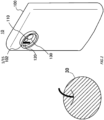
- Fig. 1 and Fig. 2 schematically show the exterior of a mobile apparatus 10 according to the present embodiment.
- the mobile apparatus 10 is configured to determine a characteristic, such as sugar content, of a food product 30, such as a greengrocery product.
- the mobile apparatus 10 is a general-purpose information communication terminal, such as a smartphone, a tablet, and a PDA, configured to fulfill the function corresponding to the installed application.
- a touch panel 104 configured to display information and receive input from the user is provided.
- a sample holder 102 having a cylindrical shape On the other surface side of the mobile apparatus 10, a sample holder 102 having a cylindrical shape is provided. In the sample holder 102, a radiating unit 110, a spectroscope 120, and an image-capturing unit 130 are provided. The inner diameter of the cylindrical shape is approximately 3 cm to 4 cm, and the height is approximately 2 cm to 3 cm. In the sample holder 102, an optical system such as a lens may further be arranged.
- the radiating unit 110 includes a source of light such as an LED and is configured to radiate light in the visible light band, the near-infrared band, and the ultraviolet band. Light in each band may be radiated at the same time.
- the spectroscope 120 is configured to perform spectroscopy of light entered to output a measured value.
- the spectroscope 120 is configured to perform spatial wavelength dispersion of light entered from a slit using a reflective grating and receive the light using a photodetector, to output the intensity of the light, which is associated with a wavelength, as a measured value.
- the spectroscope is small as an approximately 1 cm cube, and a mini-spectrometer of "Micro series" or "SMD series” made by Hamamatsu Photonics K.K. or the like may be used, for example.
- the image-capturing unit 130 is what is called a digital camera module having an optical system and an image-capturing device.
- the image-capturing unit 130 is configured to generate an image by image-capturing. For example, an image of the food product 30 is generated by capturing an image of the food product 30.
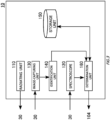
- Fig. 3 schematically shows function blocks of the mobile apparatus 10.
- the mobile apparatus 10 comprises an identification unit 140, a storage unit 150, and a determination unit 160.
- the identification unit 140 is configured to identify the kind of the food product 30 corresponding to the light entered the spectroscope 120. In this case, the identification unit 140 is configured to identify the kind of the food product 30 based on the image generated by the image-capturing unit 130. The identification unit 140 may identify the kind of the food product based on the matching degree with each of the pre-stored feature quantities of the food product, by image analysis, or may identify the kind of the food product using machine learning such as supervised learning Convolutional Neural Network (CNN) where pictures of food products and the kinds are used for the learning in advance.
- CNN supervised learning Convolutional Neural Network
- the storage unit 150 is configured to store a kind of food product, a characteristic of the food product, and information about light in association with each other.
- the determination unit 160 is configured to determine a characteristic of the food product to output the characteristic of the food product, by referring to the storage unit 150, based on the measured value output from the spectroscope 120 and the kind of the food product identified by the identification unit 140.
- Fig. 4 shows an example of information stored in the storage unit 150. As described above, the kinds of food products, characteristics of the food products, and information about light are associated with each other.
- the kinds of food products are greengrocery products such as a tomato, an apple, and a pumpkin, for example.
- the characteristics of food products include at least any of color, sugar content, acidity, maturity, firmness, or a functional ingredient amount.
- color 1, color 2 in association with "Tomato” as a kind of a food product, sugar content, acidity, maturity, firmness, functional ingredient amount 1, and functional ingredient amount 2 are associated as characteristics of the food product.
- Examples of color 1 and 2 are red and green.
- Examples of function ingredient amount 1 and 2 are the amount of chlorophyll and the amount of lycopene.
- the characteristic of the food product to be determined may be different for each kind of the food product.
- although sugar content, acidity, and maturity are associated with "Apple” as a kind of a food product, function ingredient amount 1 and 2 are not associated with it.
- the information about light may be an amount of light at a specific wavelength such as for color 1 or may be a calibration curve representing the correlation between a value of a food product and a measured value such as for the sugar content.
- information about light for color 1 is an amount of light of 630 nm, which corresponds to the red range.
- the information about light for color 2 is an amount of light of 500 nm, which corresponds to the green range.
- Fig. 4 schematically shows, as an example of the calibration curve, calibration curve 7 for the sugar content of "Apple" as a kind of a food product.
- the horizontal axis shows the magnitude of sugar content as a value of a characteristic.
- the vertical axis shows the magnitude of a measured value.
- This measured value is obtained by converting a measured value output from the spectroscope 120 by using a predetermined calculation formula.
- the conversion formula and/or calibration curve of a measured value is/are calculated in advance experimentally, through simulation and/or machine learning, such as multivariate analysis and principal component analysis.
- the magnitude of the measured value depends on the radiation characteristics of the radiating unit 110 and the sensitivity characteristics of the spectroscope 120.
- the calibration curve described above can also be described as what is obtained by performing calibration on a set of a specific type of radiating unit 110 and a specific type of spectroscope 120. Therefore, a calibration curve as a standard may temporarily be stored in the storage unit 150, and the user may be prompted to use the radiating unit 110 to radiate light and use the spectroscope 120 to perform measurement for a standard sample, and based on the measured value, calibration may be performed on the calibration curve for this mobile apparatus.
- FIG. 5 shows an example of operation flow S10 of the mobile apparatus 10.
- Operation flow S10 starts on the mobile apparatus 10 when an application configured to determine a characteristic of a food product is activated by the user.
- Said application is a computer program configured to cause the mobile apparatus 10 to perform each step of operation flow S10.
- the mobile apparatus 10 displays a message to prompt the user to capture an image of the food product 30 on the touch panel 104 (S101).
- a frame together with the message "fit the entire food product within the frame” may be displayed on the touch panel to facilitate identifying the kind of the food product 30.
- the image-capturing unit 130 captures an image of the food product 30 and generates an image of the food product 30 (the same step).
- the identification unit 140 identifies the kind of the food product 30 based on the image generated by the image-capturing unit 130 (S103).
- the radiating unit 110 irradiates the food product 30 with light (S105).
- a message to prompt the user to cause the food product 30 to contact with the sample holder 102 is preferably displayed.
- the radiating unit 110 radiates light in all bands of near-infrared, visible light, and ultraviolet that the radiating unit 110 itself can emit, regardless of the kind of the food product 30, the corresponding characteristic, and information about light.
- the spectroscope 120 performs spectroscopy of the light entered to output a measured value (S107). In this case, during the radiation of light by the radiating unit 110, the spectroscope 120 outputs the measured value. In this way, scattered light which is light radiated by the radiating unit 110 and scattered by the food product 30 can be measured. Further, in the present embodiment, the spectroscope 120 outputs a spectroscopic profile representing the intensity of each wavelength of the light entered as the measured value, regardless of the kind of the food product 30, the corresponding characteristic, and information about light.
- the determination unit 160 determines a characteristic of the food product 30, by referring to the storage unit 150, based on the measured value output from the spectroscope 120 and the kind of the food product 30 identified by the identification unit 140 (S111). In the present embodiment, the determination unit 160 also performs determination on any of the characteristics in association with the kind of the food product 30 in the storage unit 150. For example, in the example in Fig. 4 , determination is sequentially performed on the sugar content, acidity, and maturity for the kind of the food product 30 "Apple".
- determination unit 160 refers to the storage unit 150 and performs conversion into a measured value corresponding to the information about light for each characteristic from the profile being the measured value output from the spectroscope 120, as needed. For example, for "Sugar content” as a characteristic of the kind of the food product 30 "Apple”, the formula described above with reference to Fig. 4 is used to perform the conversion. For the measured value after the conversion, the determination unit 160 determines the characteristic represented by the calibration curve. In the example in Fig. 4 , when the measured value after the conversion for "Sugar content" as a characteristic of the kind of the food product 30 "Apple” is "3", sugar content is determined as "6".
- the determination unit 160 outputs the result of determination to the touch panel 104 (S113). For example, the determination unit 160 displays the message indicating "measured sugar content of the apple is 6" on the touch panel 104. Operation flow S10 ends here.
- the mobile apparatus 10 such as a smartphone, enables the user to know information about a characteristic of the food product 30 easily.
- using the radiating unit 110 and spectroscope 120 with a broad wavelength band enables knowing various characteristics of the food product 30.
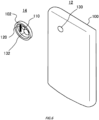
- Fig. 6 schematically shows the exterior of another mobile apparatus 12.
- the mobile apparatus 12 is the same as the mobile apparatus 10 except for parts that will be described in particular.
- the mobile apparatus 12 includes a spectroscopy unit 14 detachable from the body 100.
- the mobile apparatus 12 is configured to operate as a general-purpose information communication terminal even when the spectroscopy unit 14 is not attached thereto.
- the spectroscopy unit 14 has the sample holder 102, the radiating unit 110, and the spectroscope 120.
- a through hole 132 is further provided.
- the through hole 132 is arranged at a position where the image-capturing unit 130 of the body 100 looks into the through hole 132 when the spectroscopy unit 14 is attached to the body 100.
- the spectroscopy unit 14 is fixed to the body 100 by means of a magnet, screwing, a clip, or the like.
- the spectroscopy unit 14 and the body 100 are configured to transmit and receive information through wireless communication such as Bluetooth (registered trademark).
- wireless communication such as Bluetooth (registered trademark).
- wired communication may be employed for transmitting and receiving information, where a connector provided for the spectroscopy unit 14 is inserted into an interface for a wire, such as a USB-c type, provided for the body 100.
- the spectroscopy unit 14 when the spectroscopy unit 14 is not used, it can be detached, which allows the mobile apparatus 12 to have its effect contributing to the miniaturization of the mobile apparatus 12, in addition to the effects of the mobile apparatus 10.
- the radiating unit 110 and/or the spectroscope 120 may be detachable from the body 100 individually.
- a source of light in the near-infrared band and/or the ultraviolet band may be detachable.
- Fig. 7 schematically shows function blocks of still another mobile apparatus 16.
- the mobile apparatus 16 is the same as the mobile apparatus 10 except for parts that will be described in particular.
- the information stored in the storage unit 150 of the mobile apparatus 10 is stored in an external server 18.
- the mobile apparatus 16 is configured to refer to the information stored in the server 18 by communicating with the server 18 via a communication unit 170.
- the server 18 is a server serving the Agricultural Data Collaboration Platform (WAGRI), for example.
- WAGRI Agricultural Data Collaboration Platform
- the mobile apparatus 16 has its effect of allowing utilizing the latest, large amounts of information stored in the server 18, in addition to the effects of the mobile apparatus 10. Note that, some pieces of the information stored in the storage unit 150 of the mobile apparatus 10, such as a piece of information that may be often used and a piece of information that was used in the past, may be stored in the mobile apparatus 16.
- Fig. 8 (a) and (b) schematically show the exteriors of the front and a side of still another mobile apparatus 50.
- the mobile apparatus 50 is the same as the mobile apparatus 10 except for parts that will be described in particular.
- the spectroscope 120 is arranged in an opposing position to the radiating unit 110 by an arm 124 having an arc shape extending from the sample holder 102.
- information in the storage unit 150 in Fig. 4 is preferably information corresponding to measured quantities obtained by performing spectroscopy of the specularly transmitted light.
- the arm 124 may be hard so that the shape does not change or may be soft so that the shape can change.
- an optical system 126 such as a lens is arranged in the sample holder 102.
- Fig. 9 (a) and (b) schematically show the exteriors of the front and a side of still another mobile apparatus 52.
- the mobile apparatus 52 is the same as the mobile apparatus 50 except for parts that will be described in particular.
- the spectroscope 120 is arranged sideways relative to the radiating unit 110 by the arm 124 having an arc shape extending from the sample holder 102. This allows the spectroscope 120 to perform spectroscopy and measurement of diffusely transmitted light, which is light of the radiating unit 110 transmitted through the food product 32.
- information of the storage unit 150 in Fig. 4 is preferably information corresponding to measured quantities obtained by performing spectroscopy of the diffusely transmitted light.
- Fig. 10 (a) and (b) schematically show the exteriors of the front and a side of still another mobile apparatus 54.
- the mobile apparatus 54 is the same as the mobile apparatus 10 except for parts that will be described in particular.
- the spectroscope 120 in addition to the spectroscope 120, another spectroscope 122 is provided, and the spectroscope 122 is arranged in an opposing position to the radiating unit 110 by the arm 124 having an arc shape extending from the sample holder 102.
- This allows the spectroscope 120 to perform spectroscopy of scattered light of the food product 32 and additionally allows the spectroscope 122 to perform spectroscopy and measurement of specularly transmitted light transmitted through the food product 32.
- information about light in the storage unit 150 in Fig. 4 is preferably stored in further association with the distinction between scattered light and specularly transmitted light.
- the determination unit 160 is configured to determine a characteristic of the food product 32 further based on whether a measured value is of scattered light or specularly transmitted light.
- FIG. 11 (a) and (b) schematically show the exteriors of the front and a side of still another mobile apparatus 56.
- the mobile apparatus 54 is the same as the mobile apparatus 54 except for parts that will be described in particular.
- the spectroscope 120 in addition to the spectroscope 120, another spectroscope 122 is provided, and the spectroscope 122 is arranged sideways relative to the radiating unit 110 by the arm 124 having an arc shape extending from the sample holder 102.
- This allows the spectroscope 120 to perform spectroscopy of scattered light of the food product 32 and additionally allows the spectroscope 122 to perform spectroscopy and measurement of diffusely transmitted light transmitted through the food product 32.
- the determination unit 160 is configured to determine a characteristic of the food product 32 based on whether a measured value is of scattered light or diffusely transmitted light.
- Fig. 12 schematically shows function blocks of a food characteristics determination system 22 according to the second embodiment.
- the food characteristics determination system 22 comprises a mobile apparatus 19 and a food characteristics determination device 20 in communication with each other through the Internet or the like.
- the mobile apparatus 19 is the same as the mobile apparatus 10 except for parts that will be described in particular.
- the image-capturing unit 130 is configured to transmit an image of the food product 30 to the food characteristics determination device 20 via the communication unit 170.
- the spectroscope 120 is configured to transmit a measured value of the spectroscopy of the food product 30 via the communication unit 170. In this case, information associating them with each other and information required to return information to the mobile apparatus 19 are also transmitted.
- the food characteristics determination device 20 is, for example, a general-purpose information processing device, such as a personal computer, with a program installed therein.
- the food characteristics determination device 20 may also be a server serving the WAGRI described above.
- the food characteristics determination device 20 comprises a storage unit 200, a communication unit 210, an identification unit 220, and a determination unit 230.
- the storage unit 200 has information similar to the information stored in the storage unit 150 of the mobile apparatus 10.
- the storage unit 200 is configured to store a kind of a food product, a characteristic of the food product, and information about light in association with each other.
- the communication unit 210 is configured to communicate with the mobile apparatus 19.
- the identification unit 220 is configured to perform an operation similar to the operation of the identification unit 140 of the mobile apparatus 10. In other words, the identification unit 220 is configured to identify the kind of the food product 30 based on an image of the food product 30 acquired via the communication unit 210. Instead, the identification unit 140 may be provided on the side of the mobile apparatus 19, and the information indicating the kind of the food product 30 identified by the identification unit 140 may be acquired by the food characteristics determination device 20 via the communication unit 210.
- the determination unit 230 is configured to perform an operation similar to the operation of the determination unit 160 of the mobile apparatus 10.
- the determination unit 230 is configured to determine a characteristic of a food product by referring to the storage unit 200, based on the kind of the food product 30 identified by the identification unit 220 and a measured value of spectroscopy acquired from the mobile apparatus 19.
- the determination unit 230 is configured to output the result of the determined characteristic to the mobile apparatus 19 via the communication unit 210.
- An output unit 180 of the mobile apparatus 19 is configured to display, on the touch panel 104, information on the determined characteristic of the food product 30 acquired from the food characteristics determination device 20 via the communication unit 170.
- an effect of reducing the computational load in the mobile apparatus 19 can be obtained.
- information about light may be stored in association with information for identifying the radiating unit 110 and the spectroscope 120 in the storage unit 200, and the determination unit 230 may further receive information for identifying the radiating unit 110 and the spectroscope 120 from the mobile apparatus 19 to determine a characteristic of the food product 30 based on said information.
- the identification units 140, 220 may identify, based on an image of the food product 30, a part of the food product 30, for example, whether the part is closer to or far from the calyx of the greengrocery product.
- the storage units 150, 200 information about light is stored in further association with a part of a food product, and the determination unit is configured to determine a characteristic of the food product further based on the part of the food product. This enables determining a characteristic of a food product further precisely.
- the identification units 140, 220 are configured to identify the kind of the food product 30 based on an image of the food product 30.
- the user may input the kind of the food product 30.
- the kinds of food products stored in the storage unit 150 may be displayed in a selectable way on the touch panel 104.
- the determination units 160, 230 are configured to determine any of the characteristics associated with the kind of the food product 30.
- the user may select the characteristic to be determined.
- characteristics of a food product stored in the storage unit 150 may be displayed in a selectable way on the touch panel 104.
- the storage unit 150 may be referred, and characteristics corresponding to the identified kind may be displayed in a selectable way on the touch panel 104.
- the radiating unit 110 is configured to radiate light in the near infrared range, the visible light range, and the ultraviolet band. Accordingly, the spectroscopes 120, 122 have sensitivity to the near infrared range, the visible light range, and the ultraviolet band. Instead, only light in a band corresponding to a measured value corresponding to a characteristic to be determined may be radiated. Also, only a measured value corresponding to a characteristic to be determined may be output from the spectroscopes 120, 122.
- image-capturing of a food product and identification of the kind may be performed before or may be performed after radiation of light and measurement of spectroscopy.
- the mobile apparatus may be a special-purpose apparatus for determining a characteristic of a food product instead of a general-purpose information communication terminal.
- Fig. 13 shows an example of determining "Color 1" as a characteristic of "Tomato” as a kind of a food product using the mobile apparatus 10 according to the first embodiment.
- Fig. 13 (a) is a picture on day 1 of the exteriors of tomatoes, each of which is individually identified by numbers 1 to 8, and (b) is a picture on day 11 of the exteriors of the same tomatoes.
- Fig. 13 (c) shows the measurement result of color 1 of each tomato described above. While the developments of color 1, which is redness, of all of the tomatoes as the days passed are shown in the same figure, it can be read about the result that each of them converges at values like limit values.
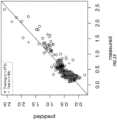
- Fig. 14 shows an example of determining "Sugar content" as a characteristic of "Muscat” as a kind of a food product using the mobile apparatus 10 according to the first embodiment.
- the horizontal axis shows a measured value of sugar content
- the vertical axis shows a prediction value based on a measurement value of the spectroscope 120.
- measured values “ ⁇ ” represents a measured value of sugar content by destructive testing.
- “+” represents a nondestructive estimated value obtained by performing machine learning using " ⁇ ” described above (that is, an actual measured value of destructive testing), it may be considered as a value equivalent to a measured value by destructive testing.
- measurement values of the spectroscope 120 and prediction values of sugar content are related in advance.
- Fig. 15 shows an example of determining "Acidity" as a characteristic of "Muscat” as a kind of a food product using the mobile apparatus 10 according to the first embodiment.
- the horizontal axis, the vertical axis, " ⁇ ", and “+” correspond to those in Fig. 14 , but sugar content is replaced with acidity.
- measurement values of the spectroscope 120 and prediction values of acidity are related with each other in advance, the relationship is different from the relationship for sugar content.
Landscapes
- Physics & Mathematics (AREA)
- Chemical & Material Sciences (AREA)
- Health & Medical Sciences (AREA)
- Life Sciences & Earth Sciences (AREA)
- Biochemistry (AREA)
- Analytical Chemistry (AREA)
- General Health & Medical Sciences (AREA)
- General Physics & Mathematics (AREA)
- Immunology (AREA)
- Pathology (AREA)
- Spectroscopy & Molecular Physics (AREA)
- Engineering & Computer Science (AREA)
- Food Science & Technology (AREA)
- Medicinal Chemistry (AREA)
- Investigating Or Analysing Materials By Optical Means (AREA)
Abstract
Description
- The present invention relates to a mobile apparatus, a food characteristics determination device, a food characteristics determination method, and a program.
- In
Patent document 1, it is described as "the mobile terminals (301 to 303) are equipped with an optical sensor that can measure the sugar content and maturity of fruit products, and when the owner of the mobile terminal holds the mobile phone over a fruit product at the storefront, at the same time as the kind of the fruit product is recognized, measurement of sugar content and maturity is started, and the owner of the mobile terminal can be notified of the degree of deliciousness corresponding to the kind of the fruit product based on the measured sugar content and maturity." - Patent document 1:
Japanese Patent Application Publication No. 2011-48591 - In the first aspect of the present invention, provided is a mobile apparatus, comprising: a radiating unit configured to radiate light; a spectroscope configured to perform spectroscopy of light entered to output a measured value; an identification unit configured to identify a kind of a food product corresponding to the light entered the spectroscope; and a determination unit configured to determine a characteristic of the food product to output the characteristic of the food product, by referring to a storage unit configured to store a kind of a food product, a characteristic of the food product, and information about light in association with each other, based on the measured value output from the spectroscope and the kind of the food product identified by the identification unit.
- The mobile apparatus may be a general-purpose information communication terminal configured to fulfill a function corresponding to an installed application. The spectroscope may be detachable. The radiating unit may be detachable.
- An image-capturing unit configured to generate an image by image-capturing may further be comprised. The identification unit may be configured to identify the kind of the food product based on the image.
- The storage unit may be configured to store the information about light in further association with a part of the food product. The identification unit may be configured to identify the part of the food product based on the image. The determination unit may be configured to determine the characteristic of the food product further based on the part of the food product.
- The characteristic of the food product may include at least any of color, sugar content, acidity, maturity, firmness, or a functional ingredient amount. The radiating unit may be configured to radiate light in the visible light band, and the spectroscope may be configured to have sensitivity to the visible light band. The radiating unit may be configured to radiate light in the near-infrared band, and the spectroscope is configured to have sensitivity to the near-infrared band. The radiating unit may be configured to radiate light in the ultraviolet band, and the spectroscope is configured to have sensitivity to the ultraviolet band.
- The storage unit may be configured to store the information about light in further association with the distinction between scattered light and transmitted light. The determination unit may be configured to determine the characteristic of the food product further based on whether the measured value is of scattered light or transmitted light.
- In the second aspect of the present invention, provided is a food characteristics determination device, comprising: a storage unit configured to store a kind of food product, a characteristic of the food product, and information about light in association with each other; a communication unit configured to communicate with a mobile apparatus; and a determination unit configured to determine a characteristic of a food product by acquiring a kind of the food product and a measured value of spectroscopy from the mobile apparatus via the communication unit and referring to the storage unit, and output the characteristic of the food product to the mobile apparatus via the communication unit.
- In the third aspect of the present invention, provided is a food characteristics determination method, comprising: radiating light; performing spectroscopy of light entered to acquire a measured value; identifying a kind of a food product corresponding to the light entered in the performing the spectroscopy; and determining a characteristic of the food product to output the characteristic of the food product, by referring to a storage unit configured to store a kind of a food product, a characteristic of the food product, and information about light in association with each other, based on the measured value output in the performing the spectroscopy and the kind of the food product identified in the identifying, to determine the characteristic of the food product.
- In the fourth aspect of the present invention, provided is a program for causing a mobile apparatus to perform: radiating light from a radiating unit; performing spectroscopy of light entered to acquire a measured value from a spectroscope; identifying a kind of a food product corresponding to the light entered in the performing the spectroscopy; and determining a characteristic of the food product to output the characteristic of the food product, by referring to a storage unit configured to store a kind of a food product, a characteristic of the food product, and information about light in association with each other, based on the measured value output in the performing the spectroscopy and the kind of the food product identified in the identifying, to determine the characteristic of the food product.
- The summary clause does not necessarily describe all necessary features of the embodiments of the present invention. The invention may also include a sub-combination of the features described above.
-
-
Fig. 1 schematically shows the exterior of amobile apparatus 10 according to the present embodiment. -
Fig. 2 schematically shows the exterior of amobile apparatus 10 according to the present embodiment. -
Fig. 3 schematically shows function blocks of amobile apparatus 10. -
Fig. 4 shows an example of information stored in astorage unit 150. -
Fig. 5 shows an example of operation flow S10 of themobile apparatus 10. -
Fig. 6 schematically shows the exterior of anothermobile apparatus 12. -
Fig. 7 schematically shows function blocks of still anothermobile apparatus 16. -
Fig. 8 (a) and (b) schematically show the exteriors of the front and a side of still anothermobile apparatus 50. -
Fig. 9 (a) and (b) schematically show the exteriors of the front and a side of still anothermobile apparatus 52. -
Fig. 10 (a) and (b) schematically show the exteriors of the front and a side of still anothermobile apparatus 54. -
Fig. 11 (a) and (b) schematically show the exteriors of the front and a side of still anothermobile apparatus 56. -
Fig. 12 schematically shows function blocks of a foodcharacteristics determination system 22 according to the second embodiment. -
Fig. 13 shows an example of determining "Color 1" as a characteristic of "Tomato" as a kind of a food product using themobile apparatus 10 according to the first embodiment. -
Fig. 14 shows an example of determining "Sugar content" as a characteristic of "Muscat" as a kind of a food product using themobile apparatus 10 according to the first embodiment. -
Fig. 15 shows an example of determining "Acidity" as a characteristic of "Muscat" as a kind of a food product using themobile apparatus 10 according to the first embodiment. - Hereinafter, the present invention will be described through embodiments of the present invention, but the following embodiments do not limit the present invention according to claims. In addition, not all combinations of features described in the embodiment are essential to the solution of the invention.
-
Fig. 1 andFig. 2 schematically show the exterior of amobile apparatus 10 according to the present embodiment. Themobile apparatus 10 is configured to determine a characteristic, such as sugar content, of afood product 30, such as a greengrocery product. - The
mobile apparatus 10 is a general-purpose information communication terminal, such as a smartphone, a tablet, and a PDA, configured to fulfill the function corresponding to the installed application. On one surface side of abody 100 of themobile apparatus 10, atouch panel 104 configured to display information and receive input from the user is provided. - On the other surface side of the
mobile apparatus 10, asample holder 102 having a cylindrical shape is provided. In thesample holder 102, aradiating unit 110, aspectroscope 120, and an image-capturingunit 130 are provided. The inner diameter of the cylindrical shape is approximately 3 cm to 4 cm, and the height is approximately 2 cm to 3 cm. In thesample holder 102, an optical system such as a lens may further be arranged. - The
radiating unit 110 includes a source of light such as an LED and is configured to radiate light in the visible light band, the near-infrared band, and the ultraviolet band. Light in each band may be radiated at the same time. - The
spectroscope 120 is configured to perform spectroscopy of light entered to output a measured value. For example, thespectroscope 120 is configured to perform spatial wavelength dispersion of light entered from a slit using a reflective grating and receive the light using a photodetector, to output the intensity of the light, which is associated with a wavelength, as a measured value. The spectroscope is small as an approximately 1 cm cube, and a mini-spectrometer of "Micro series" or "SMD series" made by Hamamatsu Photonics K.K. or the like may be used, for example. - The image-capturing
unit 130 is what is called a digital camera module having an optical system and an image-capturing device. The image-capturingunit 130 is configured to generate an image by image-capturing. For example, an image of thefood product 30 is generated by capturing an image of thefood product 30. -
Fig. 3 schematically shows function blocks of themobile apparatus 10. In addition to theradiating unit 110, thespectroscope 120, and the image-capturingunit 130 described above, themobile apparatus 10 comprises anidentification unit 140, astorage unit 150, and adetermination unit 160. - The
identification unit 140 is configured to identify the kind of thefood product 30 corresponding to the light entered thespectroscope 120. In this case, theidentification unit 140 is configured to identify the kind of thefood product 30 based on the image generated by the image-capturingunit 130. Theidentification unit 140 may identify the kind of the food product based on the matching degree with each of the pre-stored feature quantities of the food product, by image analysis, or may identify the kind of the food product using machine learning such as supervised learning Convolutional Neural Network (CNN) where pictures of food products and the kinds are used for the learning in advance. - The
storage unit 150 is configured to store a kind of food product, a characteristic of the food product, and information about light in association with each other. Thedetermination unit 160 is configured to determine a characteristic of the food product to output the characteristic of the food product, by referring to thestorage unit 150, based on the measured value output from thespectroscope 120 and the kind of the food product identified by theidentification unit 140. -
Fig. 4 shows an example of information stored in thestorage unit 150. As described above, the kinds of food products, characteristics of the food products, and information about light are associated with each other. - The kinds of food products are greengrocery products such as a tomato, an apple, and a pumpkin, for example. The characteristics of food products include at least any of color, sugar content, acidity, maturity, firmness, or a functional ingredient amount. In the example in
Fig. 4 , in association with "Tomato" as a kind of a food product,color 1,color 2, sugar content, acidity, maturity, firmness,functional ingredient amount 1, andfunctional ingredient amount 2 are associated as characteristics of the food product. Examples ofcolor function ingredient amount Fig. 4 , although sugar content, acidity, and maturity are associated with "Apple" as a kind of a food product,function ingredient amount - The information about light may be an amount of light at a specific wavelength such as for
color 1 or may be a calibration curve representing the correlation between a value of a food product and a measured value such as for the sugar content. In the example inFig. 4 , information about light forcolor 1 is an amount of light of 630 nm, which corresponds to the red range. The information about light forcolor 2 is an amount of light of 500 nm, which corresponds to the green range. -
Fig. 4 schematically shows, as an example of the calibration curve,calibration curve 7 for the sugar content of "Apple" as a kind of a food product. Here, the horizontal axis shows the magnitude of sugar content as a value of a characteristic. The vertical axis shows the magnitude of a measured value. This measured value is obtained by converting a measured value output from thespectroscope 120 by using a predetermined calculation formula. The conversion formula and/or calibration curve of a measured value is/are calculated in advance experimentally, through simulation and/or machine learning, such as multivariate analysis and principal component analysis. - Additionally, the magnitude of the measured value depends on the radiation characteristics of the radiating
unit 110 and the sensitivity characteristics of thespectroscope 120. Thus, the calibration curve described above can also be described as what is obtained by performing calibration on a set of a specific type of radiatingunit 110 and a specific type ofspectroscope 120. Therefore, a calibration curve as a standard may temporarily be stored in thestorage unit 150, and the user may be prompted to use theradiating unit 110 to radiate light and use thespectroscope 120 to perform measurement for a standard sample, and based on the measured value, calibration may be performed on the calibration curve for this mobile apparatus. -
Fig. 5 shows an example of operation flow S10 of themobile apparatus 10. Operation flow S10 starts on themobile apparatus 10 when an application configured to determine a characteristic of a food product is activated by the user. Said application is a computer program configured to cause themobile apparatus 10 to perform each step of operation flow S10. - The
mobile apparatus 10 displays a message to prompt the user to capture an image of thefood product 30 on the touch panel 104 (S101). In this case, a frame together with the message "fit the entire food product within the frame" may be displayed on the touch panel to facilitate identifying the kind of thefood product 30. When the user presses down a shooting button, the image-capturingunit 130 captures an image of thefood product 30 and generates an image of the food product 30 (the same step). Theidentification unit 140 identifies the kind of thefood product 30 based on the image generated by the image-capturing unit 130 (S103). - The radiating
unit 110 irradiates thefood product 30 with light (S105). In this case, to avoid the impact of external light, a message to prompt the user to cause thefood product 30 to contact with thesample holder 102 is preferably displayed. In the present embodiment, the radiatingunit 110 radiates light in all bands of near-infrared, visible light, and ultraviolet that the radiatingunit 110 itself can emit, regardless of the kind of thefood product 30, the corresponding characteristic, and information about light. - The
spectroscope 120 performs spectroscopy of the light entered to output a measured value (S107). In this case, during the radiation of light by the radiatingunit 110, thespectroscope 120 outputs the measured value. In this way, scattered light which is light radiated by the radiatingunit 110 and scattered by thefood product 30 can be measured. Further, in the present embodiment, thespectroscope 120 outputs a spectroscopic profile representing the intensity of each wavelength of the light entered as the measured value, regardless of the kind of thefood product 30, the corresponding characteristic, and information about light. - The
determination unit 160 determines a characteristic of thefood product 30, by referring to thestorage unit 150, based on the measured value output from thespectroscope 120 and the kind of thefood product 30 identified by the identification unit 140 (S111). In the present embodiment, thedetermination unit 160 also performs determination on any of the characteristics in association with the kind of thefood product 30 in thestorage unit 150. For example, in the example inFig. 4 , determination is sequentially performed on the sugar content, acidity, and maturity for the kind of thefood product 30 "Apple". - In this case,
determination unit 160 refers to thestorage unit 150 and performs conversion into a measured value corresponding to the information about light for each characteristic from the profile being the measured value output from thespectroscope 120, as needed. For example, for "Sugar content" as a characteristic of the kind of thefood product 30 "Apple", the formula described above with reference toFig. 4 is used to perform the conversion. For the measured value after the conversion, thedetermination unit 160 determines the characteristic represented by the calibration curve. In the example inFig. 4 , when the measured value after the conversion for "Sugar content" as a characteristic of the kind of thefood product 30 "Apple" is "3", sugar content is determined as "6". - The
determination unit 160 outputs the result of determination to the touch panel 104 (S113). For example, thedetermination unit 160 displays the message indicating "measured sugar content of the apple is 6" on thetouch panel 104. Operation flow S10 ends here. - Thus, according to the present embodiment, the
mobile apparatus 10, such as a smartphone, enables the user to know information about a characteristic of thefood product 30 easily. In particular, using theradiating unit 110 andspectroscope 120 with a broad wavelength band enables knowing various characteristics of thefood product 30. -
Fig. 6 schematically shows the exterior of anothermobile apparatus 12. Themobile apparatus 12 is the same as themobile apparatus 10 except for parts that will be described in particular. - The
mobile apparatus 12 includes aspectroscopy unit 14 detachable from thebody 100. Themobile apparatus 12 is configured to operate as a general-purpose information communication terminal even when thespectroscopy unit 14 is not attached thereto. - The
spectroscopy unit 14 has thesample holder 102, the radiatingunit 110, and thespectroscope 120. For thespectroscopy unit 14, a throughhole 132 is further provided. - The through
hole 132 is arranged at a position where the image-capturingunit 130 of thebody 100 looks into the throughhole 132 when thespectroscopy unit 14 is attached to thebody 100. - The
spectroscopy unit 14 is fixed to thebody 100 by means of a magnet, screwing, a clip, or the like. Thespectroscopy unit 14 and thebody 100 are configured to transmit and receive information through wireless communication such as Bluetooth (registered trademark). Instead of wireless communication, wired communication may be employed for transmitting and receiving information, where a connector provided for thespectroscopy unit 14 is inserted into an interface for a wire, such as a USB-c type, provided for thebody 100. - Thus, when the
spectroscopy unit 14 is not used, it can be detached, which allows themobile apparatus 12 to have its effect contributing to the miniaturization of themobile apparatus 12, in addition to the effects of themobile apparatus 10. Note that, instead of theentire spectroscopy unit 14 being detachable, the radiatingunit 110 and/or thespectroscope 120 may be detachable from thebody 100 individually. In addition, a part of the radiatingunit 110, a source of light in the near-infrared band and/or the ultraviolet band may be detachable. -
Fig. 7 schematically shows function blocks of still anothermobile apparatus 16. Themobile apparatus 16 is the same as themobile apparatus 10 except for parts that will be described in particular. - In the case of the
mobile apparatus 16, the information stored in thestorage unit 150 of themobile apparatus 10 is stored in anexternal server 18. Themobile apparatus 16 is configured to refer to the information stored in theserver 18 by communicating with theserver 18 via acommunication unit 170. Theserver 18 is a server serving the Agricultural Data Collaboration Platform (WAGRI), for example. - Thus, the
mobile apparatus 16 has its effect of allowing utilizing the latest, large amounts of information stored in theserver 18, in addition to the effects of themobile apparatus 10. Note that, some pieces of the information stored in thestorage unit 150 of themobile apparatus 10, such as a piece of information that may be often used and a piece of information that was used in the past, may be stored in themobile apparatus 16. -
Fig. 8 (a) and (b) schematically show the exteriors of the front and a side of still anothermobile apparatus 50. Themobile apparatus 50 is the same as themobile apparatus 10 except for parts that will be described in particular. - In the
mobile apparatus 50, thespectroscope 120 is arranged in an opposing position to theradiating unit 110 by anarm 124 having an arc shape extending from thesample holder 102. This allows thespectroscope 120 to perform spectroscopy and measurement of specularly transmitted light, which is light of the radiatingunit 110 transmitted through thefood product 32. In this case, information in thestorage unit 150 inFig. 4 is preferably information corresponding to measured quantities obtained by performing spectroscopy of the specularly transmitted light. Note that, thearm 124 may be hard so that the shape does not change or may be soft so that the shape can change. Note that, in thesample holder 102, anoptical system 126 such as a lens is arranged. -
Fig. 9 (a) and (b) schematically show the exteriors of the front and a side of still anothermobile apparatus 52. Themobile apparatus 52 is the same as themobile apparatus 50 except for parts that will be described in particular. - In the
mobile apparatus 52, thespectroscope 120 is arranged sideways relative to theradiating unit 110 by thearm 124 having an arc shape extending from thesample holder 102. This allows thespectroscope 120 to perform spectroscopy and measurement of diffusely transmitted light, which is light of the radiatingunit 110 transmitted through thefood product 32. In this case, information of thestorage unit 150 inFig. 4 is preferably information corresponding to measured quantities obtained by performing spectroscopy of the diffusely transmitted light. -
Fig. 10 (a) and (b) schematically show the exteriors of the front and a side of still anothermobile apparatus 54. Themobile apparatus 54 is the same as themobile apparatus 10 except for parts that will be described in particular. - In the
mobile apparatus 54, in addition to thespectroscope 120, anotherspectroscope 122 is provided, and thespectroscope 122 is arranged in an opposing position to theradiating unit 110 by thearm 124 having an arc shape extending from thesample holder 102. This allows thespectroscope 120 to perform spectroscopy of scattered light of thefood product 32 and additionally allows thespectroscope 122 to perform spectroscopy and measurement of specularly transmitted light transmitted through thefood product 32. - In this case, information about light in the
storage unit 150 inFig. 4 is preferably stored in further association with the distinction between scattered light and specularly transmitted light. Thedetermination unit 160 is configured to determine a characteristic of thefood product 32 further based on whether a measured value is of scattered light or specularly transmitted light. -
Fig. 11 (a) and (b) schematically show the exteriors of the front and a side of still anothermobile apparatus 56. Themobile apparatus 54 is the same as themobile apparatus 54 except for parts that will be described in particular. - In the
mobile apparatus 56, in addition to thespectroscope 120, anotherspectroscope 122 is provided, and thespectroscope 122 is arranged sideways relative to theradiating unit 110 by thearm 124 having an arc shape extending from thesample holder 102. This allows thespectroscope 120 to perform spectroscopy of scattered light of thefood product 32 and additionally allows thespectroscope 122 to perform spectroscopy and measurement of diffusely transmitted light transmitted through thefood product 32. - In this case, information about light in the
storage unit 150 inFig. 4 is preferably stored in further association with the distinction between scattered light and diffusely transmitted light. Thedetermination unit 160 is configured to determine a characteristic of thefood product 32 based on whether a measured value is of scattered light or diffusely transmitted light. -
Fig. 12 schematically shows function blocks of a foodcharacteristics determination system 22 according to the second embodiment. The foodcharacteristics determination system 22 comprises amobile apparatus 19 and a foodcharacteristics determination device 20 in communication with each other through the Internet or the like. Themobile apparatus 19 is the same as themobile apparatus 10 except for parts that will be described in particular. - In the
mobile apparatus 19, the image-capturingunit 130 is configured to transmit an image of thefood product 30 to the foodcharacteristics determination device 20 via thecommunication unit 170. Similarly, thespectroscope 120 is configured to transmit a measured value of the spectroscopy of thefood product 30 via thecommunication unit 170. In this case, information associating them with each other and information required to return information to themobile apparatus 19 are also transmitted. - The food
characteristics determination device 20 is, for example, a general-purpose information processing device, such as a personal computer, with a program installed therein. The foodcharacteristics determination device 20 may also be a server serving the WAGRI described above. The foodcharacteristics determination device 20 comprises astorage unit 200, acommunication unit 210, anidentification unit 220, and adetermination unit 230. - The
storage unit 200 has information similar to the information stored in thestorage unit 150 of themobile apparatus 10. In other words, thestorage unit 200 is configured to store a kind of a food product, a characteristic of the food product, and information about light in association with each other. Thecommunication unit 210 is configured to communicate with themobile apparatus 19. - The
identification unit 220 is configured to perform an operation similar to the operation of theidentification unit 140 of themobile apparatus 10. In other words, theidentification unit 220 is configured to identify the kind of thefood product 30 based on an image of thefood product 30 acquired via thecommunication unit 210. Instead, theidentification unit 140 may be provided on the side of themobile apparatus 19, and the information indicating the kind of thefood product 30 identified by theidentification unit 140 may be acquired by the foodcharacteristics determination device 20 via thecommunication unit 210. - The
determination unit 230 is configured to perform an operation similar to the operation of thedetermination unit 160 of themobile apparatus 10. In other words, thedetermination unit 230 is configured to determine a characteristic of a food product by referring to thestorage unit 200, based on the kind of thefood product 30 identified by theidentification unit 220 and a measured value of spectroscopy acquired from themobile apparatus 19. Thedetermination unit 230 is configured to output the result of the determined characteristic to themobile apparatus 19 via thecommunication unit 210. Anoutput unit 180 of themobile apparatus 19 is configured to display, on thetouch panel 104, information on the determined characteristic of thefood product 30 acquired from the foodcharacteristics determination device 20 via thecommunication unit 170. - Thus, according to the second embodiment, in addition to the effects of the first embodiment, an effect of reducing the computational load in the
mobile apparatus 19 can be obtained. Note that, information about light may be stored in association with information for identifying the radiatingunit 110 and thespectroscope 120 in thestorage unit 200, and thedetermination unit 230 may further receive information for identifying the radiatingunit 110 and thespectroscope 120 from themobile apparatus 19 to determine a characteristic of thefood product 30 based on said information. - In any of the embodiments described above, the
identification units food product 30, a part of thefood product 30, for example, whether the part is closer to or far from the calyx of the greengrocery product. In this case, in thestorage units - In any of the embodiments described above, the
identification units food product 30 based on an image of thefood product 30. Instead, or in addition, the user may input the kind of thefood product 30. In this case, the kinds of food products stored in thestorage unit 150 may be displayed in a selectable way on thetouch panel 104. - In any of the embodiments described above, the
determination units food product 30. Instead, or in addition, the user may select the characteristic to be determined. In this case, characteristics of a food product stored in thestorage unit 150 may be displayed in a selectable way on thetouch panel 104. In addition, if the kind of thefood product 30 has already been identified, thestorage unit 150 may be referred, and characteristics corresponding to the identified kind may be displayed in a selectable way on thetouch panel 104. - In any of the embodiments described above, the radiating
unit 110 is configured to radiate light in the near infrared range, the visible light range, and the ultraviolet band. Accordingly, thespectroscopes spectroscopes - Also, in any of the embodiments described above, image-capturing of a food product and identification of the kind may be performed before or may be performed after radiation of light and measurement of spectroscopy. Also, in any of the embodiments described above, the mobile apparatus may be a special-purpose apparatus for determining a characteristic of a food product instead of a general-purpose information communication terminal.
-
Fig. 13 shows an example of determining "Color 1" as a characteristic of "Tomato" as a kind of a food product using themobile apparatus 10 according to the first embodiment.Fig. 13 (a) is a picture onday 1 of the exteriors of tomatoes, each of which is individually identified bynumbers 1 to 8, and (b) is a picture onday 11 of the exteriors of the same tomatoes. -
Fig. 13 (c) shows the measurement result ofcolor 1 of each tomato described above. While the developments ofcolor 1, which is redness, of all of the tomatoes as the days passed are shown in the same figure, it can be read about the result that each of them converges at values like limit values. -
Fig. 14 shows an example of determining "Sugar content" as a characteristic of "Muscat" as a kind of a food product using themobile apparatus 10 according to the first embodiment. The horizontal axis shows a measured value of sugar content, and the vertical axis shows a prediction value based on a measurement value of thespectroscope 120. Among measured values, "∘" represents a measured value of sugar content by destructive testing. On the other hand, although "+" represents a nondestructive estimated value obtained by performing machine learning using "∘" described above (that is, an actual measured value of destructive testing), it may be considered as a value equivalent to a measured value by destructive testing. Also, as described with reference toFig. 4 , measurement values of thespectroscope 120 and prediction values of sugar content are related in advance. - It can be understood that the accuracy increases as the shape formed by the points on the graph is similar to a shape of a 45-degree straight line. Turning to
Fig. 14 , points generally gather around the 45-degree straight line. -
Fig. 15 shows an example of determining "Acidity" as a characteristic of "Muscat" as a kind of a food product using themobile apparatus 10 according to the first embodiment. The horizontal axis, the vertical axis, "∘", and "+" correspond to those inFig. 14 , but sugar content is replaced with acidity. Although measurement values of thespectroscope 120 and prediction values of acidity are related with each other in advance, the relationship is different from the relationship for sugar content. - It can be understood that the accuracy increases as the shape formed by the points on the graph is similar to a shape of a 45-degree straight line. Turning to
Fig. 15 , points generally gather around the 45-degree straight line. In addition, as seen fromFig. 13 to Fig. 15 , determining characteristics of different kinds of food products, determining different characteristics of the same kind, or the like can easily and precisely performed by using the samemobile apparatus 10. - While the present invention has been described with the embodiments, the technical scope of the present invention is not limited to the above-described embodiments. It is apparent to persons skilled in the art that various alterations and improvements can be added to the above-described embodiments. It is also apparent from the scope of the claims that the embodiments added with such alterations or improvements can be included in the technical scope of the present invention.
- Note that the operations, procedures, steps, and stages of each process performed by an apparatus, system, program, and method shown in the claims, embodiments, or diagrams can be performed in any order as long as the order is not indicated by "prior to," "before," or the like and as long as the output from a previous process is not used in a later process. Even if the operation flow is described by using phrases such as "first" or "next" in the scope of the claims, specification, or drawings, it does not necessarily mean that the process must be performed in this order.
- 10, 12, 16, 19, 50, 52, 54, 56: mobile apparatus; 14: spectroscopy unit; 18: server; 20: food characteristics determination device; 22: food characteristics determination system; 30, 32: food product; 100: body; 102: sample holder; 104: touch panel; 110: radiating unit; 120, 122: spectroscope; 124: arm; 126: optical system; 130: image-capturing unit; 132: through hole; 140: identification unit; 150: storage unit; 160: determination unit; 170: communication unit; 180: output unit; 200: storage unit; 210: communication unit; 220: identification unit; and 230: determination unit.
Claims (14)
- A mobile apparatus, comprising:a radiating unit configured to radiate light;a spectroscope configured to perform spectroscopy of light entered to output a measured value;an identification unit configured to identify a kind of a food product corresponding to the light entered the spectroscope; anda determination unit configured to determine a characteristic of the food product to output the characteristic of the food product, by referring to a storage unit configured to store a kind of a food product, a characteristic of the food product, and information about light in association with each other, based on the measured value output from the spectroscope and the kind of the food product identified by the identification unit.
- The mobile apparatus according to claim 1, wherein the mobile apparatus is a general-purpose information communication terminal configured to fulfill a function corresponding to an installed application.
- The mobile apparatus according to claim 2, wherein the spectroscope is detachable.
- The mobile apparatus according to claim 2 or 3, wherein the radiating unit is detachable.
- The mobile apparatus according to any one of claims 1 to 4, further comprising:an image-capturing unit configured to generate an image by image-capturing, whereinthe identification unit is configured to identify the kind of the food product based on the image.
- The mobile apparatus according to claim 5, whereinthe information about light is stored in the storage unit in further association with a part of the food product,the identification unit is configured to identify the part of the food product based on the image, andthe determination unit is configured to determine the characteristic of the food product further based on the part of the food product.
- The mobile apparatus according to any one of claims 1 to 6, wherein the characteristic of the food product includes at least any one of color, sugar content, acidity, maturity, firmness, or a functional ingredient amount.
- The mobile apparatus according to any one of claims 1 to 7, wherein the radiating unit is configured to radiate light in a visible light band, and the spectroscope is configured to have sensitivity to the visible light band.
- The mobile apparatus according to any one of claims 1 to 8, wherein the radiating unit is configured to radiate light in a near-infrared band, and the spectroscope is configured to have sensitivity to the near-infrared band.
- The mobile apparatus according to any one of claims 1 to 9, wherein the radiating unit is configured to radiate light in an ultraviolet band, and the spectroscope is configured to have sensitivity to the ultraviolet band.
- The mobile apparatus according to any one of claims 1 to 10, whereinthe information about light is stored in the storage unit in further association with a distinction between scattered light and transmitted light, andthe determination unit is configured to determine the characteristic of the food product further based on whether the measured value is of scattered light or transmitted light.
- A food characteristics determination device, comprising:a storage unit configured to store a kind of food product, a characteristic of the food product, and information about light in association with each other;a communication unit configured to communicate with a mobile apparatus; anda determination unit configured to determine a characteristic of a food product by acquiring a kind of the food product and a measured value of spectroscopy from the mobile apparatus via the communication unit and referring to the storage unit, and output the characteristic of the food product to the mobile apparatus via the communication unit.
- A food characteristics determination method, comprising:radiating light;performing spectroscopy of light entered to acquire a measured value;identifying a kind of a food product corresponding to the light entered in the performing the spectroscopy; andoutputting a characteristic of the food product by determining the characteristic of the food product by referring to a storage unit configured to store a kind of a food product, a characteristic of the food product, and information about light in association with each other, based on the measured value output in the performing the spectroscopy and the kind of the food product identified in the identifying, to determine the characteristic of the food product.
- A program for causing a mobile apparatus to perform:radiating light from a radiating unit;performing spectroscopy of light entered to acquire a measured value from a spectroscope;identifying a kind of a food product corresponding to the light entered in the performing the spectroscopy; andoutputting a characteristic of the food product by determining the characteristic of the food product by referring to a storage unit configured to store a kind of a food product, a characteristic of the food product, and information about light in association with each other, based on the measured value output in the performing the spectroscopy and the kind of the food product identified in the identifying, to determine the characteristic of the food product.
Applications Claiming Priority (2)
| Application Number | Priority Date | Filing Date | Title |
|---|---|---|---|
| JP2020172779 | 2020-10-13 | ||
| PCT/JP2021/037472 WO2022080284A1 (en) | 2020-10-13 | 2021-10-08 | Mobile apparatus, food characteristics determination device, food characteristics determination method, and program |
Publications (2)
| Publication Number | Publication Date |
|---|---|
| EP4230997A1 true EP4230997A1 (en) | 2023-08-23 |
| EP4230997A4 EP4230997A4 (en) | 2024-11-13 |
Family
ID=81208121
Family Applications (1)
| Application Number | Title | Priority Date | Filing Date |
|---|---|---|---|
| EP21880023.3A Pending EP4230997A4 (en) | 2020-10-13 | 2021-10-08 | Mobile apparatus, food characteristics determination device, food characteristics determination method, and program |
Country Status (3)
| Country | Link |
|---|---|
| EP (1) | EP4230997A4 (en) |
| JP (1) | JPWO2022080284A1 (en) |
| WO (1) | WO2022080284A1 (en) |
Family Cites Families (13)
| Publication number | Priority date | Publication date | Assignee | Title |
|---|---|---|---|---|
| BR0109219A (en) * | 2000-03-13 | 2004-06-22 | Autoline Inc | Apparatus and method and techniques for measuring and correlating fruit with visible / near infrared spectra |
| JP2002122540A (en) * | 2000-10-12 | 2002-04-26 | Mitsui Mining & Smelting Co Ltd | Apparatus and method for evaluating fruits and vegetables |
| JP2011048591A (en) * | 2009-08-26 | 2011-03-10 | Nec Corp | Portable terminal |
| JP5604763B2 (en) * | 2010-09-03 | 2014-10-15 | 国立大学法人神戸大学 | Transmission near-infrared spectroscopy measurement apparatus and transmission near-infrared spectroscopy measurement method |
| JP2012103092A (en) * | 2010-11-10 | 2012-05-31 | Seiko Epson Corp | Reading device |
| US10458845B2 (en) * | 2012-06-14 | 2019-10-29 | Medibotics Llc | Mobile device for food identification an quantification using spectroscopy and imaging |
| US9959628B2 (en) * | 2014-11-21 | 2018-05-01 | Christopher M. MUTTI | Imaging system for object recognition and assessment |
| EP3502664B1 (en) * | 2016-08-22 | 2021-10-27 | National University Corporation Hokkaido University | Object state detection and transmission system |
| US20180172510A1 (en) * | 2016-12-08 | 2018-06-21 | Verifood, Ltd. | Spectrometry system applications |
| JP6910792B2 (en) * | 2016-12-13 | 2021-07-28 | ソニーセミコンダクタソリューションズ株式会社 | Data processing equipment, data processing methods, programs, and electronics |
| RU2682593C1 (en) * | 2018-03-30 | 2019-03-19 | Самсунг Электроникс Ко., Лтд. | Ultra-compact high-resolution spectrometer and its application method |
| JP7280038B2 (en) * | 2018-12-20 | 2023-05-23 | 株式会社クボタ | Portable measuring device |
| CN111665201A (en) * | 2020-04-30 | 2020-09-15 | 华为技术有限公司 | Spectral detection method, mobile terminal and chip system |
-
2021
- 2021-10-08 WO PCT/JP2021/037472 patent/WO2022080284A1/en not_active Ceased
- 2021-10-08 EP EP21880023.3A patent/EP4230997A4/en active Pending
- 2021-10-08 JP JP2022556946A patent/JPWO2022080284A1/ja active Pending
Also Published As
| Publication number | Publication date |
|---|---|
| JPWO2022080284A1 (en) | 2022-04-21 |
| EP4230997A4 (en) | 2024-11-13 |
| WO2022080284A1 (en) | 2022-04-21 |
Similar Documents
| Publication | Publication Date | Title |
|---|---|---|
| US11709096B2 (en) | Precision luxmeter methods for digital cameras to quantify colors in uncontrolled lighting environments | |
| TWI795453B (en) | Methods and devices for performing an analytical measurement based on a color formation reaction | |
| CN104812292B (en) | Portable medical diagnostic system and the method using mobile device | |
| US20180059015A1 (en) | Personal liquid analysis system | |
| CN106683140B (en) | Color identification method and system | |
| US20160091433A1 (en) | Sensor apparatus to determine a value of a chemical parameter based on a color shade and methods thereof | |
| US20160109295A1 (en) | Portable electronic apparatus, spectrometer combined therewith, and method for detecting quality of test object by using the same | |
| US20190073763A1 (en) | System and method for urine analysis and personal health monitoring | |
| US20150099306A1 (en) | Test cassette reading device and reading method thereof | |
| US11974732B2 (en) | System and method for urine analysis and personal health monitoring | |
| CN116413222A (en) | Apparatus and method for estimating target composition | |
| JP2025506836A (en) | spatially resolved NIR spectrometer | |
| CN110514620A (en) | Spectral method of detection and system based on portable near infrared spectrometer | |
| US20140236489A1 (en) | Blood glucose measuring kit connectable to mobile device | |
| KR20150016723A (en) | System for analyzing the information of the target using the illuminance sensor of the smart device and the method thereby | |
| KR102293333B1 (en) | A food status determination device and a system for determining food status using the same | |
| WO2022080284A1 (en) | Mobile apparatus, food characteristics determination device, food characteristics determination method, and program | |
| KR20170043762A (en) | System of providing moblie service using skin condition inpector | |
| EP4177813A1 (en) | Fish purchasing system | |
| US20190086263A1 (en) | Reflectometer, electronic device and method | |
| Zhu et al. | Smartphone-based multispectral imaging for portable spectral analysis | |
| US20260076530A1 (en) | Normalized spectral analysis for endoscope assessment | |
| CA3079334C (en) | Methods and devices for performing an analytical measurement based on a color formation reaction | |
| WO2024224309A1 (en) | Apparatus and system for identifying presence of a substance of interest, and method of using thereof | |
| WO2025083144A1 (en) | Image-augmented skin analysis |
Legal Events
| Date | Code | Title | Description |
|---|---|---|---|
| STAA | Information on the status of an ep patent application or granted ep patent |
Free format text: STATUS: THE INTERNATIONAL PUBLICATION HAS BEEN MADE |
|
| PUAI | Public reference made under article 153(3) epc to a published international application that has entered the european phase |
Free format text: ORIGINAL CODE: 0009012 |
|
| STAA | Information on the status of an ep patent application or granted ep patent |
Free format text: STATUS: REQUEST FOR EXAMINATION WAS MADE |
|
| 17P | Request for examination filed |
Effective date: 20230510 |
|
| AK | Designated contracting states |
Kind code of ref document: A1 Designated state(s): AL AT BE BG CH CY CZ DE DK EE ES FI FR GB GR HR HU IE IS IT LI LT LU LV MC MK MT NL NO PL PT RO RS SE SI SK SM TR |
|
| DAV | Request for validation of the european patent (deleted) | ||
| DAX | Request for extension of the european patent (deleted) | ||
| REG | Reference to a national code |
Ref country code: DE Ref legal event code: R079 Free format text: PREVIOUS MAIN CLASS: G01N0021270000 Ipc: G01N0021310000 |
|
| A4 | Supplementary search report drawn up and despatched |
Effective date: 20241015 |
|
| RIC1 | Information provided on ipc code assigned before grant |
Ipc: G01N 21/84 20060101ALN20241009BHEP Ipc: G01N 21/359 20140101ALN20241009BHEP Ipc: G01N 21/33 20060101ALN20241009BHEP Ipc: G01N 33/02 20060101ALI20241009BHEP Ipc: G01N 21/47 20060101ALI20241009BHEP Ipc: G01N 21/31 20060101AFI20241009BHEP |
|
| GRAP | Despatch of communication of intention to grant a patent |
Free format text: ORIGINAL CODE: EPIDOSNIGR1 |
|
| STAA | Information on the status of an ep patent application or granted ep patent |
Free format text: STATUS: GRANT OF PATENT IS INTENDED |
|
| RIC1 | Information provided on ipc code assigned before grant |
Ipc: G01N 21/31 20060101AFI20260312BHEP Ipc: G01N 21/47 20060101ALI20260312BHEP Ipc: G01N 33/02 20060101ALI20260312BHEP Ipc: G01N 21/33 20060101ALN20260312BHEP Ipc: G01N 21/359 20140101ALN20260312BHEP Ipc: G01N 21/84 20060101ALN20260312BHEP |
|
| INTG | Intention to grant announced |
Effective date: 20260319 |