EP4229747B1 - Verstärkte busimpedanz- und thump-steuerung für elektrische stromsysteme - Google Patents
Verstärkte busimpedanz- und thump-steuerung für elektrische stromsysteme Download PDFInfo
- Publication number
- EP4229747B1 EP4229747B1 EP21806516.7A EP21806516A EP4229747B1 EP 4229747 B1 EP4229747 B1 EP 4229747B1 EP 21806516 A EP21806516 A EP 21806516A EP 4229747 B1 EP4229747 B1 EP 4229747B1
- Authority
- EP
- European Patent Office
- Prior art keywords
- power
- dfim
- electrical loads
- frequency
- electrical
- Prior art date
- Legal status (The legal status is an assumption and is not a legal conclusion. Google has not performed a legal analysis and makes no representation as to the accuracy of the status listed.)
- Active
Links
Images







Classifications
-
- H—ELECTRICITY
- H02—GENERATION; CONVERSION OR DISTRIBUTION OF ELECTRIC POWER
- H02J—ELECTRIC POWER NETWORKS; CIRCUIT ARRANGEMENTS OR SYSTEMS FOR SUPPLYING OR DISTRIBUTING ELECTRIC POWER; SYSTEMS FOR STORING ELECTRIC ENERGY
- H02J3/00—Circuit arrangements for AC mains or AC distribution networks
- H02J3/12—Arrangements for adjusting voltage in AC networks by changing a characteristic of the network load
- H02J3/16—Arrangements for adjusting voltage in AC networks by changing a characteristic of the network load by adjustment of reactive power
-
- H—ELECTRICITY
- H02—GENERATION; CONVERSION OR DISTRIBUTION OF ELECTRIC POWER
- H02J—ELECTRIC POWER NETWORKS; CIRCUIT ARRANGEMENTS OR SYSTEMS FOR SUPPLYING OR DISTRIBUTING ELECTRIC POWER; SYSTEMS FOR STORING ELECTRIC ENERGY
- H02J3/00—Circuit arrangements for AC mains or AC distribution networks
- H02J3/18—Arrangements for adjusting, eliminating or compensating reactive power in networks
- H02J3/1885—Arrangements for adjusting, eliminating or compensating reactive power in networks using rotating AC generators, e.g. synchronous generators
-
- H—ELECTRICITY
- H02—GENERATION; CONVERSION OR DISTRIBUTION OF ELECTRIC POWER
- H02J—ELECTRIC POWER NETWORKS; CIRCUIT ARRANGEMENTS OR SYSTEMS FOR SUPPLYING OR DISTRIBUTING ELECTRIC POWER; SYSTEMS FOR STORING ELECTRIC ENERGY
- H02J3/00—Circuit arrangements for AC mains or AC distribution networks
- H02J3/28—Arrangements for balancing of the load in networks by storage of energy
- H02J3/30—Arrangements for balancing of the load in networks by storage of energy using dynamo-electric machines coupled to flywheels
-
- H—ELECTRICITY
- H02—GENERATION; CONVERSION OR DISTRIBUTION OF ELECTRIC POWER
- H02K—DYNAMO-ELECTRIC MACHINES
- H02K7/00—Arrangements for handling mechanical energy structurally associated with dynamo-electric machines, e.g. structural association with mechanical driving motors or auxiliary dynamo-electric machines
- H02K7/02—Additional mass for increasing inertia, e.g. flywheels
- H02K7/025—Additional mass for increasing inertia, e.g. flywheels for power storage
-
- H—ELECTRICITY
- H02—GENERATION; CONVERSION OR DISTRIBUTION OF ELECTRIC POWER
- H02P—CONTROL OR REGULATION OF ELECTRIC MOTORS, ELECTRIC GENERATORS OR DYNAMO-ELECTRIC CONVERTERS; CONTROLLING TRANSFORMERS, REACTORS OR CHOKE COILS
- H02P9/00—Arrangements for controlling electric generators for the purpose of obtaining a desired output
- H02P9/007—Control circuits for doubly fed generators
-
- H—ELECTRICITY
- H02—GENERATION; CONVERSION OR DISTRIBUTION OF ELECTRIC POWER
- H02P—CONTROL OR REGULATION OF ELECTRIC MOTORS, ELECTRIC GENERATORS OR DYNAMO-ELECTRIC CONVERTERS; CONTROLLING TRANSFORMERS, REACTORS OR CHOKE COILS
- H02P9/00—Arrangements for controlling electric generators for the purpose of obtaining a desired output
- H02P9/10—Control effected upon generator excitation circuit to reduce harmful effects of overloads or transients, e.g. sudden application of load, sudden removal of load, sudden change of load
-
- H—ELECTRICITY
- H02—GENERATION; CONVERSION OR DISTRIBUTION OF ELECTRIC POWER
- H02J—ELECTRIC POWER NETWORKS; CIRCUIT ARRANGEMENTS OR SYSTEMS FOR SUPPLYING OR DISTRIBUTING ELECTRIC POWER; SYSTEMS FOR STORING ELECTRIC ENERGY
- H02J15/00—Systems for storing electric energy specially adapted for power networks
- H02J15/30—Systems for storing electric energy specially adapted for power networks using storage of inertial or mechanical energy, e.g. using flywheels
-
- H—ELECTRICITY
- H02—GENERATION; CONVERSION OR DISTRIBUTION OF ELECTRIC POWER
- H02J—ELECTRIC POWER NETWORKS; CIRCUIT ARRANGEMENTS OR SYSTEMS FOR SUPPLYING OR DISTRIBUTING ELECTRIC POWER; SYSTEMS FOR STORING ELECTRIC ENERGY
- H02J2105/00—Networks for supplying or distributing electric power characterised by their spatial reach or by the load
- H02J2105/30—Networks for supplying or distributing electric power characterised by their spatial reach or by the load the load networks being external to vehicles, i.e. exchanging power with vehicles
- H02J2105/31—Networks for supplying or distributing electric power characterised by their spatial reach or by the load the load networks being external to vehicles, i.e. exchanging power with vehicles for ships or vessels
-
- H—ELECTRICITY
- H02—GENERATION; CONVERSION OR DISTRIBUTION OF ELECTRIC POWER
- H02P—CONTROL OR REGULATION OF ELECTRIC MOTORS, ELECTRIC GENERATORS OR DYNAMO-ELECTRIC CONVERTERS; CONTROLLING TRANSFORMERS, REACTORS OR CHOKE COILS
- H02P2101/00—Special adaptation of control arrangements for generators
- H02P2101/35—Special adaptation of control arrangements for generators for ships
-
- H—ELECTRICITY
- H02—GENERATION; CONVERSION OR DISTRIBUTION OF ELECTRIC POWER
- H02P—CONTROL OR REGULATION OF ELECTRIC MOTORS, ELECTRIC GENERATORS OR DYNAMO-ELECTRIC CONVERTERS; CONTROLLING TRANSFORMERS, REACTORS OR CHOKE COILS
- H02P2207/00—Indexing scheme relating to controlling arrangements characterised by the type of motor
- H02P2207/07—Doubly fed machines receiving two supplies both on the stator only wherein the power supply is fed to different sets of stator windings or to rotor and stator windings
-
- Y—GENERAL TAGGING OF NEW TECHNOLOGICAL DEVELOPMENTS; GENERAL TAGGING OF CROSS-SECTIONAL TECHNOLOGIES SPANNING OVER SEVERAL SECTIONS OF THE IPC; TECHNICAL SUBJECTS COVERED BY FORMER USPC CROSS-REFERENCE ART COLLECTIONS [XRACs] AND DIGESTS
- Y02—TECHNOLOGIES OR APPLICATIONS FOR MITIGATION OR ADAPTATION AGAINST CLIMATE CHANGE
- Y02E—REDUCTION OF GREENHOUSE GAS [GHG] EMISSIONS, RELATED TO ENERGY GENERATION, TRANSMISSION OR DISTRIBUTION
- Y02E60/00—Enabling technologies; Technologies with a potential or indirect contribution to GHG emissions mitigation
- Y02E60/16—Mechanical energy storage, e.g. flywheels or pressurised fluids
Definitions
- This disclosure is directed in general to electrical power systems using electric machinery. More specifically, this disclosure relates to augmented bus impedance and thump control for electrical power systems having pulsating loads.
- US 2016/336828 A1 discloses a hybrid energy storage system is configured to control pulsed power.
- US 2019/199255 A1 discloses an AC excitation synchronous condenser and a control method, an AC-excitation induction machine, a full-controlled AC excitation converter, a grid-side converter and a controller.
- US 2019/199094 A1 discloses a system including multiple hybrid energy storage modules (HESMs) configured to accept constant-current DC input power from a main power source.
- HESMs hybrid energy storage modules
- US 2019/036336 A1 discloses a system including first and second sources configured to provide power to first and second medium-voltage direct current (MVDC) buses, respectively.
- MVDC medium-voltage direct current
- This disclosure provides systems for augmented bus impedance and thump control for electrical power systems.
- a system comprising: a power distribution bus configured to distribute power from an electrical power source; a plurality of electrical loads configured to receive portions of the power from the electrical power source; a doubly-fed induction machine (DFIM) configured to reduce transmission impedance and voltage drop on the power distribution bus and provide energy storage capability in response to a change in power at one or more of the electrical loads; and a flywheel coupled to the DFIM, the flywheel configured to rotate to store inertial energy that is convertible to power one or more of the electrical loads, characterized in that:
- a system comprising: a power generator configured to generate power for a plurality of electrical loads; a power distribution bus configured to receive and distribute power from the power generator; a doubly-fed induction machine (DFIM) configured to reduce transmission impedance and voltage drop on the power distribution bus in response to a change in real or reactive power at one or more of the electrical loads; and a flywheel coupled to the DFIM, the flywheel configured to rotate to store inertial energy that is convertible to power one or more of the electrical loads, characterized in that:
- a method comprising: generating power for a plurality of electrical loads using an electrical power generator; receiving the power at a power distribution bus and distributing at least some of the power for use at the electrical loads; reducing transmission impedance and voltage drop on the power distribution bus using a doubly-fed induction machine (DFIM) in response to a demand in reactive power at one or more of the electrical loads; and rotating a flywheel coupled to the DFIM to store inertial energy and to buffer the electrical power generator from oscillations in power associated with one of the electrical loads, so as to reduce system power surges, characterized in that:
- DFIM doubly-fed induction machine
- FIGURES 1 through 9 described below, and the various embodiments used to describe the principles of the present disclosure in this patent document are by way of illustration only and should not be construed in any way to limit the scope of the disclosure. Those skilled in the art will understand that the principles of the present disclosure may be implemented in any type of suitably arranged device or system.
- Modern ship power systems have a combination of pulsating loads of both low frequency/low pulse repetition frequency (PRF) and high frequency/high PRF combining on a common AC power distribution system. Interference between pulsating loads is a major problem on many military ships. For example, radar alternating current-to-direct current (AC/DC) power converters negatively interact with conventional variable-speed drives used for compressors and pumping equipment. To properly solve this problem on the megawatt scale, a combination of energy storage management and reactive power modulation is desired.
- AC/DC alternating current-to-direct current
- This disclosure provides various embodiments of augmented bus impedance control for electrical power systems.
- the disclosed embodiments combine real and reactive power control with active energy storage to stiffen the AC bus, reduce voltage sag, and significantly reduce “thump" (low frequency power oscillations).
- the disclosed embodiments use a doubly-fed multi-port induction machine to provide the reactive control and thump energy for compensation in "weak" AC power systems.
- Naval ships with long transmission distances from prime power generators to load sites may constitute weak systems since series electrical reactance is quite high.
- the disclosed embodiments improve voltage regulation and reactive power stability on these type of systems. Mitigation of thump is desirable for both land-based and ship-based power systems having fluctuating or stochastic loads.
- embodiments of this disclosure may include any one, more than one, or all of the features described here. Also, embodiments of this disclosure may additionally or alternatively include other features not listed here. While the disclosed embodiments may be described with respect to naval ships and early warning radar power systems, these embodiments are also applicable in any other suitable systems or applications.
- FIGURE 1 illustrates an example system 100 for augmented bus impedance control (ABIC) according to this disclosure.
- ABIC augmented bus impedance control
- Some embodiments of the system 100 can be used for naval ship power systems, although other uses are within the scope of this disclosure.
- ABIC represents a combination of real and reactive power control with energy storage to stiffen the AC bus, reduce voltage sag, and reduce "thump.”
- the system 100 includes a generator set 102 (such as a turbine generator) that provides power at a frequency f1 to an AC power distribution bus 104.
- the system 100 also includes a doubly-fed induction machine (DFIM) 106 that provides real power and energy storage to a fast pulsating load 110 (such as a laser, radar, railgun, or the like) and also provides a source of adjustable reactive power for providing voltage/VAR support for the power distribution bus 104.
- the DFIM 106 is an electrical machine which has bi-directional power flow for both real and reactive power into or out of its stator or primary windings; the DFIM 106 is controlled by excitation AC power fed to its rotor or secondary winding.
- the power distribution bus 104 distributes the power from the generator set 102 to the DFIM 106 and to a slow pulsating load 112.
- the slow pulsating load 112 is a "housekeeping" load that can represent one or more compressors, pumps, and the like.
- Portions of the power distribution bus 104 can be characterized as a "strong” bus or a "weak” bus depending on various factors. One factor is how much voltage fluctuation occurs at the fast pulsating load 110 when the current fluctuates by a specified amount (such as 80 percent). In a weak bus, the voltage at the fast pulsating load 110 may fluctuate significantly (such as by 20 percent or more). In a strong bus, the voltage fluctuates much less (such as 5 percent or less).
- a weak bus can be due to intermediate transformers plus transmission cable inductances that are present over a long transmission distance (such as about 800 feet or more). Another factor that characterizes the bus strength is the short circuit rating. For example, a strong bus may have a higher short circuit rating (such as 40 MVA), while a weak bus may have a lower short circuit rating (such as 6 MVA).
- the DFIM 106 is a rotating machine and may have about twice the capacitive energy storage density of an AC capacitor bank typically used in static VAR compensators (such as 8.43 MVAR/m 3 versus 4 MVAR/m 3 ).
- the DFIM 106 is coupled to a high-speed flywheel 108, which stores energy in the form of inertial energy, and also buffers the generator set 102 from oscillations in power associated with one of the electrical loads, thereby reducing system power surges.
- the flywheel 108 also helps the DFIM 106 reduce thump with a faster response time than standard ship turbine generators can respond. Reducing thump extends the life of all main electrical equipment.
- the DFIM 106 includes three stator winding ports. Port 1 is the primary power input to the stator, and Ports 2 and 3 are output ports on the stator. Port 1 receives input apparent power (MVA) from the unstable power distribution bus 104. Port 2 provides stable real power (on the order of megawatts) to the pulsating load 110 with recurrent power or current surges. The load 110 may be a rectified DC load or strictly AC load. Port 1 and Port 2 exchange power/energy with the flywheel 108. Port 3 produces leading power factor reactive power Q3 (MVAR), which is modulated by the action of the rotor (or secondary) excitation polyphase power input and this reactive power Q3 is injected into the power distribution bus 104.
- MVAR leading power factor reactive power Q3
- An ABIC reactive controller 114 adjusts the voltage level to obtain the correct VAR match to the respective load.
- the reactive power Q3 is generally proportional to the square of the output voltage of the DFIM 106.
- Port 3 supports a "synchronous condenser" function and utilizes the stored magnetic field of the DFIM 106 for source energy.
- Polyphase rotor excitation is obtained from a separate AC excitation power supply 116. This rotor excitation supply has the ability to change rotor current and voltage levels quickly on the order of one to two electrical cycles of the output power; consequently the output voltage at Ports 2 and 3 can be rapidly modulated. While FIGURE 1 shows only one DFIM 106, this is merely one example. Other embodiments could include additional DFIMs 106, including one or more machines that rotate in the opposite direction.
- FIGURE 2A illustrates an example graph 200 depicting transmissible power as a function of generator reactance in the system 100 of FIGURE 1 according to this disclosure.
- P max is the maximum normalized transmissible power from the generator set 102 to the load 110.
- the power is shown versus the generator reactance X t normalized to the transmission line characteristic impedance Z o . Even though the transmission line is mostly inductive and regardless of how long it is, the transmission line has a demand for reactive power.
- the curves labeled 1 through 5 in the graph 200 represent transmission lines of different lengths.
- Curve 1 is a transmission line with the shortest length (such as 0.5 km) or the "strongest" bus.
- Curve 5 is a transmission line with the longest length (such as 2.5 km) or the "weakest" bus.
- Quantity P o is the nominal output power of the source generator.
- point P 5 is the least desirable operating point since P max is only 1.0 per unit. It may be desired or necessary to have the ratio P max /P o be large and greater than 1.0.
- the system 100 changes an operating point P 5 on a medium- to long-length transmission line to an operating point between P 1 and P 5 (by increasing permissible real power) depending on the level of VAR injection (Q3@V1 in FIGURE 1 ) by the shunt connected DFIM 106.
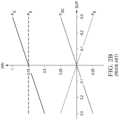
- FIGURE 2B illustrates a range of operation for conventional doubly-fed induction generators at positive and negative slip values.
- the real power output P G is for the stator circuit of a conventional doubly-excited wound-rotor induction machine as connected to the source, where P S is the nominal source power level.
- the positive slip value indicates the machine is operating as a motor, has a positive flow of power P R into the rotor and absorbing source energy.
- the negative slip value indicates the machine is operating as a generator, has a flow of power P R out of the rotor and giving back energy to the source.
- Rotor power is symmetrical about the zero slip value.
- the signal P GC is the control signal for estimating power to be returned to the source above and below nominal.
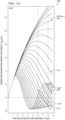
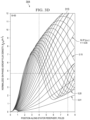
- FIGURE 3A through 3D illustrate example graphs 301-304 depicting a wide range of control for DFIM reactive power output according to this disclosure.
- the graphs 301-304 can be based on a tertiary polyphase machine winding at 60 Hz output with variable slip excitation control frequency.
- the DFIM may be represented by the DFIM 106 of FIGURE 1 .
- the graph 301 depicts the magnetic field quadrature density B q corresponding to reactive power output of the Q-axis winding as a function of the stator peripheral position corresponding to Port 1 and Port 3 windings in FIGURE 1 .
- the plot curve 311 indicates the reactive output magnetic field density B q of the Q-axis winding between poles 6 and 8.
- the plot curve 311 shows nearly equal positive and negative reactive power between point P 6 and point P 8 at about ⁇ 1 per unit quadrature magnetic flux density for the case of 15% slip.
- reactive power is the spatial integral of the reactive output B q with stator current loading of the winding of Port 3 in FIGURE 1 .
- the graph 302 depicts the reactive output radial magnetic field density B q of the Q-axis winding as a function of stator peripheral position up to six poles.
- the plot curve 312 indicates the reactive output magnetic field density B q of the Q-axis winding between poles 4 and 6.
- the DFIM when a purely reactive output is required to satisfy the medium frequency bus for reactive power, the DFIM can be operated at a slip of 19% and the output can be taken from windings located between poles 4 and 6, as indicated by the plot curve 312.
- the slip value is rapidly controlled by the rotor slip frequency excitation power supply in direct response to output reactive demand.
- the graph 303 depicts the normalized limit of generated reactive power Q as a function of slip value (per unit) and output frequency f (Hz) for a 4-pole specialized induction generator.
- f 50-600 Hz range
- the reactive characteristic peaks at about 0.05 per unit slip.
- the total Q can be divided equally among the outputs by using a proper winding design.
- Machines of multiples of four poles utilize multiple repeatable sections of four poles.
- the graph 304 depicts the in-phase normalized airgap radial flux density B p as a function of stator airgap peripheral location and slip value up to 0.25 per unit.
- the flux density B p is the main component of the real power output of the DFIM for either Ports 2 or 3.
- a slip value of 0.05 to 0.11 per unit can be most desirable.
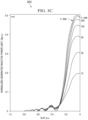
- FIGURE 3E illustrates a graph 305 for an example induction machine with tertiary windings and transient conditions with the ability to provide leading reactive power to an intermediate bus, according to this disclosure.
- the subject DFIM tertiary windings can output both real and reactive power for currents under certain limits which are hereby defined.
- the stator periphery is wound with a section of polyphase tertiary windings and a spatial transient occurs.
- a 12 pole machine would have 3 repeatable sections.
- the Bq 2 value is 0.27 per unit (p.u.) and the Bt 2 value is 0.44 per unit.
- Bt 2 Bp 2 + Bq 2 holds for all slip values.
- the per unit base quantity is the value Us/(p r *Js) where Us is the synchronous field speed (ms), p r is the rotor surface resistivity (ohms) and Js is the stator current loading (A/m periphery)
- the curve in FIGURE 3E indicates there is substantial real power (calculated as Integral Bp* Js) available from the tertiary windings in addition to the larger reactive power (calculated as Integral Bq* Js) to absorb or yield thump reactive power from/to the load.
- the adjustable frequency drive 414 to the DFIM 406 (described below with respect to FIGURE 4 ) momentarily increases the slip value from a low slip to a higher value to yield a higher Bp and consequent higher real power capability for at least one of the tertiary windings to absorb real power from the oscillating or unstable load.
- the thump energy dissipates in the machine rotor rather than being sent back to the turbine source.
- the machine can be operated at a slip value of 5-11% between poles 4 and 8 as shown in FIGURE 3D .
- the 8% slip curve 313 shows B p increasing from 4.7 per unit to 12 per unit over this four-pole sector.
- an intermediate slip value can be commanded by slip frequency regulation such as 16%.
- In-phase flux density B p is appreciable peaking at 9.8 per unit and quadrature flux density B q is 3.0 per unit (see FIGURE 3B ).
- the synchronous field speed of the rotor can be changed in the same short period, thereby allowing very fast control of where the DFIM output reactive power peaks.
- FIGURE 4 illustrates another example system 400 for augmented bus impedance control (ABIC) according to this disclosure.
- the system 400 includes multiple components that are the same as, or similar to, corresponding components of the system 100 of FIGURE 1 .
- the system 400 includes a ship power generator 402 that provides power to an AC power distribution bus 404.
- the generator 402 can be the same as, or similar to, the generator set 102 of FIGURE 1 .
- the generator 402 and bus 404 are at medium polyphase voltage potential such as 4160 Volts and frequency fx.
- the system 400 also includes a DFIM 406 with multiple (such as three) polyphase tertiary winding ports 1-3, each compensating for a distinct pulsed load 410-412 (such as a radar, a jammer, an electromagnetic effector requiring a higher voltage input, and the like).
- the DFIM 406 comprises a non-symmetrical, space-transient winding that generates leading reactive power in the tertiary windings, that operates at a voltage level different from the primary or secondary windings, and compensates for at least some of the reactive power demanded by the pulsed loads 410-412.
- the DFIM 406 is coupled to an energy storage inertial flywheel 408 and is brought up to speed by an adjustable-speed variable-voltage variable-frequency (VVVF) drive 414 having source frequency fx at the input and frequency fo at the output.
- VVVF variable-voltage variable-frequency
- Real power Po is provided to the primary winding of the DFIM 406 by the VVVF drive 414 to compensate for acceleration power, friction losses, windage losses and primary I 2 R losses.
- the DFIM 406 includes an 8-pole machine and has an output range of 500-733 Hz based on a practical operating speed range of 7,500 -11,000 rpm.
- FIGURE 4 shows only one DFIM 406, this is merely one example.
- Other embodiments could include additional DFIMs 406, including one or more that rotate in the opposite direction.
- the circuit for each load 410-412 has an AC-to-AC frequency converter 416-418 and a step-up or step-down transformer plus AC/DC rectifier 420-422 as appropriate to the desired input voltage to the load.
- the transformers 420-422 are provided to galvanically isolate the loads 410-412 from the source power.
- Each AC-to-AC frequency converter 416-418 converts the source frequency fx to an intermediate frequency f1, f2, f3 selected for the corresponding load 410-412.
- the advantage of a medium frequency intermediate link at f1, f2, f3 is the reduction in size of the transformer 420-422 and the reduction in filter component size, including the size of the DFIM 406.
- the architecture of the system 400 allows the rotor damper cage of the DFIM 406 to absorb higher harmonics generated by the AC/DC rectifiers 420-422 feeding the pulsating loads 410-412.
- Each frequency converter 416-418 outputs a frequency f1, f2 or f3, which is substantially higher (such as 10x) than the source frequency fx.
- a DFIM exciter 424 to vary the excitation current Ie and frequency fr on the secondary (rotor) winding of the DFIM 406 to be inversely proportional to shaft speed, the output frequencies f1, f2 and f3 on the tertiary windings can remain substantially constant over wide speed variations, as energy is extracted or returned to the flywheel 408.
- frequencies f1, f2 and f3 are preferably equal and also of the same frequency as the output fo from the VVVF drive 414, which is injected into the main stator winding of the DFIM 406.
- the DFIM exciter 424 enables the tertiary winding output to provide leading or lagging reactive power to compensate for oscillating load condition power factor on a recurrent or transient basis.
- Each pulsed load 410-412 has an equivalent reactance Xqq, as reflected to the input to the transformers 420-422.
- two loads 410-411 are matched with a step-down transformer 420-421, while the third load 412 has a step-up transformer 422.
- the frequency converters 416-418 have the ability to boost or buck the output voltage V1, V2, V3 above or below the source voltage Vx.
- the three outputs of the DFIM 406 have a common frequency, yet the output power/energy can be at substantially different rates (MW/s or MJ/s) and magnitudes.
- the multiple tertiary output windings of the DFIM 406, each associated with one of the output ports 1-3, provide VAR support for the loads 410-412.
- the tertiary windings responsive to the slip value operating range, also provide real power output or absorb real power (ref. FIGURE 3D ).
- Each output port 1-3 can provide leading reactive current and power to the corresponding load 410-412, which has a reactive demand or reactive power oscillation. This consequently reduces the reactive power demand on and physical size/weight of the frequency converters 416-418 providing mainly real power from the ship power generator 402.
- the thump real-power energy is extracted from or returned to the flywheel 408, rather than adversely affecting the ship power generator 402. This reduces overall ship power modulation, which is especially important for nuclear powered aircraft carriers, which are sensitive to adverse power modulation.
- the shunt connection of the DFIM 406 reduces the medium frequency bus impedance to a value below that which would exist without the DFIM connection, in much the same fashion as a static shunt capacitor reduces AC bus impedance, except that in the system 400, the effective bus impedance is adjustable by slip excitation control.
- the transformers 420-422 have an input reactive kVAR demand that is variable depending on conditions of the loads 410-412. The higher the pulsing rate (pulses/s) of each load 410-412, the higher is the reactive demand of the fundamental power and of the harmonic power at the input to the corresponding transformer/rectifier pair 420-422.
- the DFIM 406 controls the output of reactive power Q1, Q2, or Q3 by a combination of regulating the slip excitation current "Ie” and regulating the slip excitation frequency "fr” as explained below in conjunction with FIGURES 5A through 5D .
- the DFIM exciter 424 has a real power output Pr that compensates for winding losses in the DFIM rotor circuit.
- the principles of lowering the impedance of the AC power distribution bus 404 depends on various factors.
- the DFIM 406 comprises a negative AC resistance at any output frequency when controlled in the low slip mode (such as 1.5-2.5%).
- the DFIM 406 is kept in the negative resistance region by use of a fast active rotor frequency controller (such as a variable frequency Insulated Gate Bipolar Transistor or IGBT drive) over wide speed/energy range.
- the negative resistance of the DFIM 406 does not rely upon a converter for this characteristic, although the three frequency converters 416-418 are employed to match the bus 404 (e.g., 60 Hz) to a DFIM output frequency (such as 1000 Hz) required to obtain high power density for both kW and kVAR output.
- the system 400 can exhibit a reduction in bus impedance, such as from 0.63 Ohms to 0.12 Ohms at 60 Hz, although other values are possible and within the scope of this disclosure.
- the DFIM 406 attains a high power density (such as 6 kVA/kg) when high shaft speeds are used.
- the frequency converters 416-418 are very compact, efficient, and lightweight.
- the reactive power (kVAR) output of the DFIM 406 is independent of the real power (kW) output within the overall kVA machine rating.
- the output port 3 operates on a substantially quadrature axis magnetic circuit, while the real power output of the output port 2 operates on a substantially direct axis magnetic circuit.
- FIGURES 5A through 5D illustrate example phasor diagrams 501-504 showing reactive power control by the DFIM 406 according to this disclosure.
- the phasor diagram 501 shows three pulsed loads (load 1, load 2, load 3) representing the three pulsed loads 410-412 of FIGURE 4 , respectively.
- real power P is indicated by the X axis
- reactive power Q is indicated by the Y axis.
- the lines 510-512 represent the apparent powers S1, S2, S3 for the three pulsed loads, whereby apparent powers S1 > S2 > S3 and real powers P1 > P2 > P3.
- the output of the DFIM 406 (indicated by the line 513) in multiple windings/ports fully compensates for the three reactive powers Q1L > Q2L > Q3L, and real power is drawn through the frequency converters 416-418 exclusively.
- the phasor diagram 502 shows a sudden change in load 2 (line 511), which now exceeds load 1 and load 3 (i.e., P2 > P1 > P3) and thus Q2L > Q1L > Q3L.
- the situation is stable and the DFIM 406 compensates for the change within 2-5 cycles, and the real power P2 of load 2 is increased by the frequency converter 417.
- the DFIM 406 operates at a phase angle of 88-89 degrees, since most of its output is reactive power and only a small amount of real power Po is used for friction and windage loss.
- load 2 may be oscillating with large real and reactive power swings between the conditions of FIGURE 5A and FIGURE 5B on a periodic basis at multiple times per second, or at a low frequency (such as 2 Hz), thus creating a thump condition.
- a low frequency such as 2 Hz
- the frequency converters 416-418 are unidirectional in power flow, since the generator 402 (such as a gas turbine) cannot readily accept regenerative power from a large load.
- the phasor diagram 503 shows a case where load 3 (line 512) suddenly changes from being a non-regenerative Quadrant II load to a Quadrant III load, which is regenerative.
- the system 400 can absorb the load energy E3 as real power by having the DFIM 406 absorb this power/energy P3/E3 and use this energy E3 to recharge the flywheel 408 coupled to the DFIM 406.
- FIGURE 5C This mode is shown in FIGURE 5C , where the DFIM 406 (line 513) now operates in Quadrant IV, with phasor ST 3 providing all reactive power for the three loads 410-412 and absorbing real power/energy from load 3 on a recurrent basis until such time as the flywheel 408 can no longer accept further energy increase and must discharge its energy to any of the loads 410-412.
- the design of the DFIM 406 and the DFIM exciter 424 allows the swing of a load from Quadrant II to Quadrant III to occur on a stochastic basis or alternately on a periodic basis with rapid response. By absorbing the load energy into the flywheel 408, this eliminates thump energy that would otherwise be distributed throughout the system 400 (other than a prime mover source), which could result in undesirable over-voltage and transient effects.
- the system 400 allows for the DFIM 406 to have each output port 1-3 absorb thump energy independent of the adjacent ports and return each segment of thump energy to its attached energy storage unit while simultaneously providing reactive power compensation to each load.
- the phasor diagram 504 is illustrative of a standard high power 6-pulse controlled AC-DC rectifier, such as the rectifiers 420-422 of FIGURE 4 .
- a circuit diagram 505 in FIGURE 5D illustrates representative circuitry of such a high power 6-pulse controlled AC-DC rectifier.
- Q 1 represents fundamental reactive power
- Q H represents harmonic reactive power.
- FIGURE 6 shows an example equivalent circuit 600 of one of the three output branches shown in FIGURE 4 according to this disclosure.
- the input frequency converter 604 feeds a node 605 at the medium frequency bus.
- the reactive power developed by the DFIM 406 for each of its ports fully compensates for reactive power consumed in Xm and XL.
- the load rectifier 420-422 is a phase-controlled bridge device such as a thyristor
- this device has a gate delay ( ⁇ angle) and a phase back switching of currents
- an equivalent reactive demand occurs on the input to the rectifier 420-422, even when the load 410-412 is purely resistive.
- This reactive demand is especially large in acceleration or transient swings of the load 410-412; it is represented in the circuit 600 by the reactance Xc in series with the load.
- the consequent reactive demand is a combination of the transformer magnetizing reactance, the transformer leakage reactance and the AC-to-DC converter reactive demand, as explained below. Commutation overlap present in high power thyristor based AC-to-DC converters also adds to the reactive demand.
- This AC-to-DC converter reactive demand increases as a function of output DC current.
- the negative reactance -jX4 is a design feature of the DFIM output windings and can match the output reactances Xl + Xc in parallel to Xm, so the input frequency converter has no effective reactive demand.
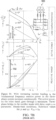
- FIGURES 7A through 7D illustrate properties of large conventional power converters.
- the illustrations in FIGURES 7A through 7D show graphs from the textbook "Basic Guide to Power Electronics” by Albert Kloss-Brown (Boveri & Cie, 1984).
- FIGURE 7A illustrates Figure 77 from the textbook.
- FIGURE 7B illustrates Figure 81 from the textbook.
- the lower graph of FIGURE 7B shows normalized reactive power as a function of DC load current i d and ⁇ angle.
- lines 701-702 have been added to the figures to illustrate reactive power demand (lagging PF) on the input side of the AC-DC controlled rectifier after the transformer.
- the line 703 shows normalized reactive power input q 1 to the AC-DC rectifier during acceleration or transient change of load conditions as being very high in the first three cycles.
- the line 704 shows mean reactive power of about 0.75 per unit during the first three cycles during acceleration region. Thus during rapid load changes, additional reactive power in needed beyond a steady-state requirement.
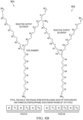
- FIGURES 8A and 8B illustrate example winding diagrams 801-804 for an ABIC machine, such as the DFIM 804, according to this disclosure.
- the ABIC machine is a 2-pole ABIC machine with 108 stator slots and 3 reactive output windings.
- the winding diagram 801 shows windings for the ABIC main input "M”.
- the winding diagram 802 shows windings for the reactive output Q1 group.
- the winding diagram 803 shows windings for the reactive output Q2 group.
- the winding diagram 804 shows windings for the reactive output Q3 group.
- the blocks M, Q1, M, Q2, etc., shown at the bottom of FIGURE 8B are functional blocks illustrating a main winding, which provides the excitation for the machine, followed by a reactive winding. This is then followed by another main winding and another reactive winding. This sequence of windings creates a transient in the machine magnetic circuit, which generates additional leading reactive power.
- FIGURES 1 through 8B illustrate example systems for augmented bus impedance control and related details
- various changes may be made to FIGURES 1 through 8B .
- the figures show systems with only one DFIM, this is merely one example.
- the systems could include additional DFIMs, including one or more that rotate in the opposite direction.
- electrical power systems come in a wide variety of configurations, and FIGURES 1 through 8B do not limit this disclosure to any particular configuration.
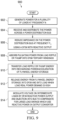
- FIGURE 9 illustrates an example method 900 for augmented bus impedance control according to this disclosure.
- the method 900 is described as being performed using the system 100 of FIGURE 1 or the system 400 of FIGURE 4 .
- the method 900 could be used with any other suitable device or system.
- power for a plurality of loads is generated using a power generator at step 902.
- This may include, for example, the power generator 402 generating power for use in the system 400.
- the power is received at a power distribution bus and at least some of the power is distributed for use at the loads at step 904.
- This may include, for example, the power distribution bus 404 distributing power, some of which is used at each of the loads 410-412.
- Impedance is reduced on the power distribution bus using a shunt connected DFIM in response to a change in power at one or more of the loads at step 906.
- This may include, for example, the DFIM 406 reducing the impedance on the bus 404 in response to a change in power at one or more of the loads 410-412.
- Pulsating power from load ripple or thump is absorbed into tertiary windings of the DFIM 406 at step 908.
- Load ripple or thump energy is transferred into recharging power or acceleration of flywheel energy storage at step 910.
- Energy from the flywheel energy storage is released into the DFIM 406 and into load at step 912 when the load real power demand is high.
- Voltage is modulated, at step 914, on intermediate loads by DFIM reactive power output and injection into the bus to compensate for large load swings which use reactive power in the output converter.
- FIGURE 9 illustrates one example of a method 900 for augmented bus impedance control
- various changes may be made to FIGURE 9 .
- steps shown in FIGURE 9 could overlap, occur in parallel, occur in a different order, or occur multiple times.
- some steps could be combined or removed and additional steps could be added according to particular needs.
- the term “or” is inclusive, meaning and/or.
Landscapes
- Engineering & Computer Science (AREA)
- Power Engineering (AREA)
- Control Of Eletrric Generators (AREA)
- Supply And Distribution Of Alternating Current (AREA)
- Networks Using Active Elements (AREA)
- Direct Current Feeding And Distribution (AREA)
- Remote Monitoring And Control Of Power-Distribution Networks (AREA)
- Control Of Electrical Variables (AREA)
Claims (12)
- System (100), umfassend:einen Leistungsverteilungsbus (104), der zum Verteilen von Leistung von einer Quelle elektrischer Leistung konfiguriert ist;eine Vielzahl von elektrischen Verbrauchern, die zum Empfangen von Teilen der Leistung von der Quelle elektrischer Leistung konfiguriert ist;eine doppelt gespeiste Induktionsmaschine (DFIM) (106), die zum Reduzieren von Übertragungsimpedanz und Reduzieren von Spannungsabfall auf dem Leistungsverteilungsbus als Reaktion auf eine Leistungsänderung an einem oder mehreren der elektrischen Verbraucher konfiguriert ist; undein an die DFIM (106) gekoppeltes Schwungrad (108), wobei das Schwungrad (108) zum Rotieren zum Speichern von Trägheitsenergie konfiguriert ist, die zum Versorgen eines oder mehrerer der elektrischen Verbraucher mit Leistung umgerichtet werden kann,dadurch gekennzeichnet, dass:einem der elektrischen Verbraucher zugeordnete Leistung bei einer niedrigen Frequenz, die einem Thump-Zustand zugeordnet ist, oszilliert;die DFIM (106) zum Extrahieren von dem Thump-Zustand zugeordneter Energie aus dem Schwungrad oder zum Zurückführen von dem Thump-Zustand zugeordneter Energie an das Schwungrad (108) konfiguriert ist, um eine Auswirkung des Thump-Zustands auf die Quelle elektrischer Leistung oder das elektrische Leistungssystem (100) zu minimieren;das System ferner eine Vielzahl von Frequenzumrichtern (416-418) umfasst, die jeweils einem der elektrischen Verbraucher entsprechen, wobei jeder Frequenzumrichter (416-418) zum Umrichten einer Frequenz der Leistung von der Quelle elektrischer Leistung in eine dem entsprechenden elektrischen Verbraucher zugeordnete Ausgangsfrequenz konfiguriert ist; unddie DFIM (106) eine Vielzahl von DFIM-Tertiärwicklungsanschlüssen umfasst, wobei jeder DFIM-Tertiärwicklungsanschluss zum Bereitstellen von voreilender Blindleistung an einem entsprechenden der elektrischen Verbraucher, der Blindleistungsbedarf oder Blindleistungsoszillation aufweist, und folglich zum Reduzieren des Blindleistungsbedarfs an der Vielzahl von Frequenzumrichtern (416-418) konfiguriert ist, die hauptsächlich Wirkleistung von der Quelle elektrischer Leistung bereitstellt.
- System (100) nach Anspruch 1, wobei:die dem einen der elektrischen Verbraucher zugeordnete Leistung zwischen regenerativer Leistung und nicht regenerativer Leistung oszilliert; unddie DFIM (106) zum Empfangen von mindestens einem Teil der regenerativen Leistung und zum Verwenden des mindestens einen Teils der regenerativen Leistung zum Erhöhen der in dem Schwungrad (108) gespeicherten Trägheitsenergie konfiguriert ist.
- System (100) nach Anspruch 1, wobei die DFIM (106) mehrere Ausgangsanschlüsse umfasst, wobei jeder Ausgangsanschluss zum von den anderen Ausgangsanschlüssen unabhängigen Absorbieren mindestens eines Teils der dem Thump-Zustand zugeordneten Energie konfiguriert ist.
- System (100) nach Anspruch 1, ferner umfassend:
einen DFIM-Erreger, der zum Variieren eines Erregerstroms und einer Erregerfrequenz an einer Sekundärwicklung des DFIM (106) als umgekehrt proportional zu einer Wellendrehzahl des Schwungrads (108) konfiguriert ist, um dadurch jede Ausgangsfrequenz an einer Tertiärwicklung über Variationen der Wellendrehzahl und der gespeicherten Trägheitsenergie hinweg auf einem im Wesentlichen konstanten Wert zu halten. - System (400), umfassend:einen Leistungsgenerator, der zum Generieren von Leistung für eine Vielzahl von elektrischen Verbrauchern konfiguriert ist;einen Leistungsverteilungsbus, der zum Empfangen und Verteilen von Leistung von dem Leistungsgenerator konfiguriert ist;eine doppelt gespeiste Induktionsmaschine (DFIM) (406), die zum Reduzieren von Übertragungsimpedanz und Reduzieren von Spannungsabfall auf dem Leistungsverteilungsbus als Reaktion auf eine Leistungsänderung an einem oder mehreren der elektrischen Verbraucher konfiguriert ist; undein an die DFIM (406) gekoppeltes Schwungrad (408), wobei das Schwungrad (408) zum Rotieren zum Speichern von Trägheitsenergie konfiguriert ist, die zum Versorgen eines oder mehrerer der elektrischen Verbraucher mit Leistung umgerichtet werden kann:
dadurch gekennzeichnet, dass:einem der elektrischen Verbraucher zugeordnete Wirkleistung oder Blindleistung bei einer niedrigen Frequenz, die einem Thump-Zustand zugeordnet ist, oszilliert;die DFIM (406) zum Extrahieren von dem Thump-Zustand zugeordneter Energie aus dem Schwungrad oder zum Zurückführen von dem Thump-Zustand zugeordneter Energie an das Schwungrad (408) konfiguriert ist, um eine Auswirkung des Thump-Zustands auf den Leistungsgenerator oder das elektrische Leistungssystem (400) zu minimieren;das System ferner eine Vielzahl von Frequenzumrichtern (416-418) umfasst, die jeweils einem der elektrischen Verbraucher entsprechen, wobei jeder Frequenzumrichter (416-418) zum Umrichten einer Frequenz der Leistung von dem Leistungsgenerator in eine dem entsprechenden elektrischen Verbraucher zugeordnete Ausgangsfrequenz konfiguriert ist; unddie DFIM (106) eine Vielzahl von DFIM-Tertiärwicklungsanschlüssen umfasst, wobei jeder DFIM-Tertiärwicklungsanschluss zum Bereitstellen von voreilendem Blindstrom und voreilender Blindleistung an einem entsprechenden der elektrischen Verbraucher, der Blindleistungsbedarf oder Blindleistungsoszillation aufweist, und folglich zum Reduzieren des Blindleistungsbedarfs an der Vielzahl von Frequenzumrichtern (416-418) konfiguriert ist, die hauptsächlich Wirkleistung von dem Leistungsgenerator bereitstellt. - System (400) nach Anspruch 5, wobei:die dem einen der elektrischen Verbraucher zugeordnete Leistung zwischen regenerativer Leistung und nicht regenerativer Leistung oszilliert; unddie DFIM (406) zum Empfangen von mindestens einem Teil der regenerativen Leistung und zum Verwenden des mindestens einen Teils der regenerativen Leistung zum Erhöhen der in dem Schwungrad (408) gespeicherten Trägheitsenergie konfiguriert ist.
- System (400) nach Anspruch 5, wobei die DFIM (406) mehrere Ausgangsanschlüsse umfasst, wobei jeder Ausgangsanschluss von den anderen Anschlüssen galvanisch isoliert ist und zum von den anderen Ausgangsanschlüssen unabhängigen Absorbieren mindestens eines Teils der dem Thump-Zustand zugeordneten Energie konfiguriert ist.
- System (400) nach Anspruch 5, ferner umfassend:
einen DFIM-Erreger, der zum Variieren eines Erregerstroms und einer Erregerfrequenz an einer Sekundärwicklung des DFIM (406) als umgekehrt proportional zu einer Wellendrehzahl des Schwungrads (408) konfiguriert ist, um dadurch jede Ausgangsfrequenz an einer Tertiärwicklung über große Variationen der Wellendrehzahl hinweg auf einem im Wesentlichen konstanten Wert zu halten. - Verfahren, umfassend:Generieren (902) von Leistung für eine Vielzahl von elektrischen Verbrauchern unter Verwendung eines Generators für elektrische Leistung;Empfangen (904) der Leistung an einem Leistungsverteilungsbus und Verteilen von mindestens einem Teil der Leistung zur Verwendung an den elektrischen Verbrauchern;Reduzieren (906) von Übertragungsimpedanz auf dem Leistungsverteilungsbus unter Verwendung einer doppelt gespeisten Induktionsmaschine (DFIM) (406) als Reaktion auf einen Blindleistungsbedarf an einem oder mehreren der elektrischen Verbraucher; undRotieren eines an die DFIM (406) gekoppelten Schwungrads (408) zum Speichern von Trägheitsenergie und zum Puffern des Generators für elektrische Leistung gegenüber einem der elektrischen Verbraucher zugeordneten Leistungsoszillationen, um dadurch plötzliche Systemleistungsspitzen zu reduzieren,dadurch gekennzeichnet, dass:einem der elektrischen Verbraucher zugeordnete Wirkleistung bei einer niedrigen Frequenz, die einem Thump-Zustand zugeordnet ist, oszilliert; undwobei das Verfahren ferner Folgendes umfasst:Extrahieren von dem Thump-Zustand zugeordneter Energie aus dem Schwungrad oder Zurückführen von dem Thump-Zustand zugeordneter Energie an das Schwungrad (408) über die DFIM (406), um eine Auswirkung des Thump-Zustands auf den Generator für elektrische Leistung zu minimieren;Bereitstellen von voreilender Blindleistung über eine Vielzahl von DFIM-Tertiärwicklungsanschlüssen an entsprechenden der elektrischen Verbraucher; undUmrichten einer Frequenz der Leistung von dem Generator für elektrische Leistung durch eine Vielzahl von Frequenzumrichtern (416-418) zum Ausgeben von entsprechenden elektrischen Verbrauchern zugeordneten Frequenzen und Bereitstellen von Wirkleistung an den entsprechenden elektrischen Verbrauchern, wobei die Frequenzumrichter (416-418) jeweils einem der elektrischen Verbraucher entsprechen.
- Verfahren nach Anspruch 9, wobei die DFIM (406) eine nicht symmetrische, raumtransiente Wicklung umfasst, die voreilende Blindleistung in einer Vielzahl von Tertiärwicklungen generiert, die mit einem Spannungsniveau betrieben wird, das sich von dem von Primär- und Sekundärwicklungen unterscheidet, und mindestens einen Teil der von den elektrischen Verbrauchern angeforderten Blindleistung kompensiert.
- Verfahren nach Anspruch 10, wobei eine Sekundärwicklung der DFIM (406) an eine DFIM-Erregerleistungsquelle gekoppelt ist, wobei die DFIM-Erregerleistungsquelle zum Ermöglichen der DFIM-Tertiärwicklungsanschlüsse konfiguriert ist, voreilende oder nacheilende Blindleistung bereitzustellen, um einen Leistungsfaktor bei einem Zustand mit oszillierendem Verbraucher auf wiederkehrender oder transienter Basis zu kompensieren.
- Verfahren nach Anspruch 11, wobei:
die DFIM (406) eine Vielzahl von mehrphasigen und galvanisch isolierten Ausgangsanschlüssen umfasst; und das Verfahren ferner Absorbieren von mindestens einem Teil der dem Thump-Zustand zugeordneten Energie an jedem Ausgangsanschluss unabhängig von den anderen Ausgangsanschlüssen umfasst.
Applications Claiming Priority (2)
| Application Number | Priority Date | Filing Date | Title |
|---|---|---|---|
| US17/073,219 US11742661B2 (en) | 2020-10-16 | 2020-10-16 | Augmented bus impedance and thump control for electrical power systems |
| PCT/US2021/053173 WO2022081355A1 (en) | 2020-10-16 | 2021-10-01 | Augmented bus impedance and thump control for electrical power systems |
Publications (2)
| Publication Number | Publication Date |
|---|---|
| EP4229747A1 EP4229747A1 (de) | 2023-08-23 |
| EP4229747B1 true EP4229747B1 (de) | 2025-05-14 |
Family
ID=78599198
Family Applications (1)
| Application Number | Title | Priority Date | Filing Date |
|---|---|---|---|
| EP21806516.7A Active EP4229747B1 (de) | 2020-10-16 | 2021-10-01 | Verstärkte busimpedanz- und thump-steuerung für elektrische stromsysteme |
Country Status (9)
| Country | Link |
|---|---|
| US (1) | US11742661B2 (de) |
| EP (1) | EP4229747B1 (de) |
| JP (1) | JP7593727B2 (de) |
| KR (1) | KR102870108B1 (de) |
| AU (1) | AU2021360339B2 (de) |
| ES (1) | ES3031049T3 (de) |
| IL (1) | IL300654B1 (de) |
| TW (1) | TWI905287B (de) |
| WO (1) | WO2022081355A1 (de) |
Family Cites Families (16)
| Publication number | Priority date | Publication date | Assignee | Title |
|---|---|---|---|---|
| US3667012A (en) * | 1970-07-31 | 1972-05-30 | Westinghouse Electric Corp | Electrical apparatus with frequency controlled load compensation |
| US4292572A (en) * | 1979-07-26 | 1981-09-29 | Dresser Industries, Inc. | Method and apparatus for regulating electric motor armature currents |
| US9531289B2 (en) | 2012-04-27 | 2016-12-27 | Raytheon Company | Electro-mechanical kinetic energy storage device and method of operation |
| US9373963B2 (en) | 2013-05-24 | 2016-06-21 | Raytheon Company | Energy transfer and storage apparatus for delivery of pulsed power |
| US9306386B2 (en) | 2013-09-13 | 2016-04-05 | Raytheon Company | Electromagnetic DC pulse power system including integrated fault limiter |
| US9531247B2 (en) | 2014-04-04 | 2016-12-27 | Raytheon Company | Inertial energy storage system and hydro-fluoro-ether power transformer scheme for radar power systems and large PFN charging |
| US9911532B2 (en) | 2014-08-25 | 2018-03-06 | Raytheon Company | Forced convection liquid cooling of fluid-filled high density pulsed power capacitor with native fluid |
| ES2622380T3 (es) * | 2014-10-27 | 2017-07-06 | Abb Schweiz Ag | Sistema de generación de energía eléctrica |
| US9837996B2 (en) | 2015-01-07 | 2017-12-05 | Raytheon Company | Method and apparatus for control of pulsed power in hybrid energy storage module |
| US9667232B2 (en) * | 2015-05-13 | 2017-05-30 | Raytheon Company | System and method for parallel configuration of hybrid energy storage module |
| WO2018004765A2 (en) | 2016-04-01 | 2018-01-04 | Raytheon Company | Hybrid energy storage modules for pulsed power effectors with medium voltage direct current (mvdc) power distribution |
| CN107171335B (zh) * | 2017-06-22 | 2020-11-03 | 清华大学 | 一种基于本地无功调节的风电场电压协调控制方法 |
| US11183846B2 (en) | 2017-12-22 | 2021-11-23 | Raytheon Company | System and method for modulating high power in a submersible energy storage vessel utilizing high voltage DC transmission |
| CN108281970B (zh) | 2017-12-25 | 2019-10-25 | 华中科技大学 | 一种交流励磁同步调相机及其控制方法 |
| US11038398B2 (en) * | 2018-06-26 | 2021-06-15 | Raytheon Company | System and method for damping of torsional oscillations in large inertial energy storage systems |
| US10790668B1 (en) * | 2019-05-06 | 2020-09-29 | General Electric Company | Method for reactive power oscillation damping for a wind turbine system with integrated reactive power compensation device |
-
2020
- 2020-10-16 US US17/073,219 patent/US11742661B2/en active Active
-
2021
- 2021-10-01 IL IL300654A patent/IL300654B1/en unknown
- 2021-10-01 WO PCT/US2021/053173 patent/WO2022081355A1/en not_active Ceased
- 2021-10-01 JP JP2023522955A patent/JP7593727B2/ja active Active
- 2021-10-01 EP EP21806516.7A patent/EP4229747B1/de active Active
- 2021-10-01 KR KR1020237009598A patent/KR102870108B1/ko active Active
- 2021-10-01 AU AU2021360339A patent/AU2021360339B2/en active Active
- 2021-10-01 ES ES21806516T patent/ES3031049T3/es active Active
- 2021-10-07 TW TW110137377A patent/TWI905287B/zh active
Also Published As
| Publication number | Publication date |
|---|---|
| US20220123555A1 (en) | 2022-04-21 |
| ES3031049T3 (en) | 2025-07-03 |
| WO2022081355A1 (en) | 2022-04-21 |
| US11742661B2 (en) | 2023-08-29 |
| IL300654B1 (en) | 2026-01-01 |
| KR102870108B1 (ko) | 2025-10-16 |
| AU2021360339A1 (en) | 2023-03-09 |
| JP2023546095A (ja) | 2023-11-01 |
| KR20230052971A (ko) | 2023-04-20 |
| IL300654A (en) | 2023-04-01 |
| TW202232844A (zh) | 2022-08-16 |
| AU2021360339B2 (en) | 2025-10-23 |
| JP7593727B2 (ja) | 2024-12-03 |
| EP4229747A1 (de) | 2023-08-23 |
| TWI905287B (zh) | 2025-11-21 |
Similar Documents
| Publication | Publication Date | Title |
|---|---|---|
| US9667232B2 (en) | System and method for parallel configuration of hybrid energy storage module | |
| US10491074B2 (en) | Electro-mechanical kinetic energy storage device and method of operation | |
| JP6976465B2 (ja) | 大きな慣性エネルギー貯蔵システムにおけるねじり振動を減衰させるためのシステム及び方法 | |
| JP7297106B2 (ja) | 複数のエネルギー蓄積モジュールを有する電力伝達システム | |
| AU2024266239B2 (en) | Active harmonic filter and reactive power control system for naval ship power systems | |
| Esobinenwu et al. | Reactive power (VAR) compensation techniques in high voltage transmission lines | |
| IL323442A (en) | Multi-interface subsea system for high-voltage power modulation and stored energy distribution | |
| EP4229747B1 (de) | Verstärkte busimpedanz- und thump-steuerung für elektrische stromsysteme | |
| Kuznetsov | Design criteria for large-scale energy storage and regulation of pulsed power on utility grids | |
| Bina et al. | An introduction to the CSCT as a new device to compensate reactive power in electrical networks |
Legal Events
| Date | Code | Title | Description |
|---|---|---|---|
| STAA | Information on the status of an ep patent application or granted ep patent |
Free format text: STATUS: UNKNOWN |
|
| STAA | Information on the status of an ep patent application or granted ep patent |
Free format text: STATUS: THE INTERNATIONAL PUBLICATION HAS BEEN MADE |
|
| PUAI | Public reference made under article 153(3) epc to a published international application that has entered the european phase |
Free format text: ORIGINAL CODE: 0009012 |
|
| STAA | Information on the status of an ep patent application or granted ep patent |
Free format text: STATUS: REQUEST FOR EXAMINATION WAS MADE |
|
| 17P | Request for examination filed |
Effective date: 20230421 |
|
| AK | Designated contracting states |
Kind code of ref document: A1 Designated state(s): AL AT BE BG CH CY CZ DE DK EE ES FI FR GB GR HR HU IE IS IT LI LT LU LV MC MK MT NL NO PL PT RO RS SE SI SK SM TR |
|
| DAV | Request for validation of the european patent (deleted) | ||
| DAX | Request for extension of the european patent (deleted) | ||
| GRAP | Despatch of communication of intention to grant a patent |
Free format text: ORIGINAL CODE: EPIDOSNIGR1 |
|
| STAA | Information on the status of an ep patent application or granted ep patent |
Free format text: STATUS: GRANT OF PATENT IS INTENDED |
|
| GRAJ | Information related to disapproval of communication of intention to grant by the applicant or resumption of examination proceedings by the epo deleted |
Free format text: ORIGINAL CODE: EPIDOSDIGR1 |
|
| STAA | Information on the status of an ep patent application or granted ep patent |
Free format text: STATUS: REQUEST FOR EXAMINATION WAS MADE |
|
| RIC1 | Information provided on ipc code assigned before grant |
Ipc: H02J 3/18 20060101ALI20250117BHEP Ipc: H02J 15/00 20060101ALI20250117BHEP Ipc: H02J 3/30 20060101ALI20250117BHEP Ipc: H02P 9/10 20060101ALI20250117BHEP Ipc: H02P 9/00 20060101AFI20250117BHEP |
|
| GRAP | Despatch of communication of intention to grant a patent |
Free format text: ORIGINAL CODE: EPIDOSNIGR1 |
|
| STAA | Information on the status of an ep patent application or granted ep patent |
Free format text: STATUS: GRANT OF PATENT IS INTENDED |
|
| INTG | Intention to grant announced |
Effective date: 20250213 |
|
| INTC | Intention to grant announced (deleted) | ||
| GRAS | Grant fee paid |
Free format text: ORIGINAL CODE: EPIDOSNIGR3 |
|
| GRAA | (expected) grant |
Free format text: ORIGINAL CODE: 0009210 |
|
| STAA | Information on the status of an ep patent application or granted ep patent |
Free format text: STATUS: THE PATENT HAS BEEN GRANTED |
|
| INTG | Intention to grant announced |
Effective date: 20250317 |
|
| AK | Designated contracting states |
Kind code of ref document: B1 Designated state(s): AL AT BE BG CH CY CZ DE DK EE ES FI FR GB GR HR HU IE IS IT LI LT LU LV MC MK MT NL NO PL PT RO RS SE SI SK SM TR |
|
| REG | Reference to a national code |
Ref country code: GB Ref legal event code: FG4D |
|
| REG | Reference to a national code |
Ref country code: CH Ref legal event code: EP |
|
| REG | Reference to a national code |
Ref country code: IE Ref legal event code: FG4D |
|
| REG | Reference to a national code |
Ref country code: DE Ref legal event code: R096 Ref document number: 602021030867 Country of ref document: DE |
|
| REG | Reference to a national code |
Ref country code: SE Ref legal event code: TRGR |
|
| REG | Reference to a national code |
Ref country code: ES Ref legal event code: FG2A Ref document number: 3031049 Country of ref document: ES Kind code of ref document: T3 Effective date: 20250703 |
|
| REG | Reference to a national code |
Ref country code: NL Ref legal event code: MP Effective date: 20250514 |
|
| PG25 | Lapsed in a contracting state [announced via postgrant information from national office to epo] |
Ref country code: FI Free format text: LAPSE BECAUSE OF FAILURE TO SUBMIT A TRANSLATION OF THE DESCRIPTION OR TO PAY THE FEE WITHIN THE PRESCRIBED TIME-LIMIT Effective date: 20250514 Ref country code: PT Free format text: LAPSE BECAUSE OF FAILURE TO SUBMIT A TRANSLATION OF THE DESCRIPTION OR TO PAY THE FEE WITHIN THE PRESCRIBED TIME-LIMIT Effective date: 20250915 |
|
| REG | Reference to a national code |
Ref country code: LT Ref legal event code: MG9D |
|
| PG25 | Lapsed in a contracting state [announced via postgrant information from national office to epo] |
Ref country code: GR Free format text: LAPSE BECAUSE OF FAILURE TO SUBMIT A TRANSLATION OF THE DESCRIPTION OR TO PAY THE FEE WITHIN THE PRESCRIBED TIME-LIMIT Effective date: 20250815 Ref country code: NO Free format text: LAPSE BECAUSE OF FAILURE TO SUBMIT A TRANSLATION OF THE DESCRIPTION OR TO PAY THE FEE WITHIN THE PRESCRIBED TIME-LIMIT Effective date: 20250814 |
|
| PG25 | Lapsed in a contracting state [announced via postgrant information from national office to epo] |
Ref country code: NL Free format text: LAPSE BECAUSE OF FAILURE TO SUBMIT A TRANSLATION OF THE DESCRIPTION OR TO PAY THE FEE WITHIN THE PRESCRIBED TIME-LIMIT Effective date: 20250514 Ref country code: PL Free format text: LAPSE BECAUSE OF FAILURE TO SUBMIT A TRANSLATION OF THE DESCRIPTION OR TO PAY THE FEE WITHIN THE PRESCRIBED TIME-LIMIT Effective date: 20250514 |
|
| PGFP | Annual fee paid to national office [announced via postgrant information from national office to epo] |
Ref country code: IT Payment date: 20250923 Year of fee payment: 5 |
|
| PG25 | Lapsed in a contracting state [announced via postgrant information from national office to epo] |
Ref country code: BG Free format text: LAPSE BECAUSE OF FAILURE TO SUBMIT A TRANSLATION OF THE DESCRIPTION OR TO PAY THE FEE WITHIN THE PRESCRIBED TIME-LIMIT Effective date: 20250514 |
|
| PGFP | Annual fee paid to national office [announced via postgrant information from national office to epo] |
Ref country code: GB Payment date: 20250923 Year of fee payment: 5 |
|
| PG25 | Lapsed in a contracting state [announced via postgrant information from national office to epo] |
Ref country code: HR Free format text: LAPSE BECAUSE OF FAILURE TO SUBMIT A TRANSLATION OF THE DESCRIPTION OR TO PAY THE FEE WITHIN THE PRESCRIBED TIME-LIMIT Effective date: 20250514 |
|
| PGFP | Annual fee paid to national office [announced via postgrant information from national office to epo] |
Ref country code: FR Payment date: 20250924 Year of fee payment: 5 |
|
| PGFP | Annual fee paid to national office [announced via postgrant information from national office to epo] |
Ref country code: SE Payment date: 20250923 Year of fee payment: 5 |
|
| PG25 | Lapsed in a contracting state [announced via postgrant information from national office to epo] |
Ref country code: RS Free format text: LAPSE BECAUSE OF FAILURE TO SUBMIT A TRANSLATION OF THE DESCRIPTION OR TO PAY THE FEE WITHIN THE PRESCRIBED TIME-LIMIT Effective date: 20250814 |
|
| PG25 | Lapsed in a contracting state [announced via postgrant information from national office to epo] |
Ref country code: IS Free format text: LAPSE BECAUSE OF FAILURE TO SUBMIT A TRANSLATION OF THE DESCRIPTION OR TO PAY THE FEE WITHIN THE PRESCRIBED TIME-LIMIT Effective date: 20250914 |
|
| PG25 | Lapsed in a contracting state [announced via postgrant information from national office to epo] |
Ref country code: LV Free format text: LAPSE BECAUSE OF FAILURE TO SUBMIT A TRANSLATION OF THE DESCRIPTION OR TO PAY THE FEE WITHIN THE PRESCRIBED TIME-LIMIT Effective date: 20250514 |
|
| REG | Reference to a national code |
Ref country code: CH Ref legal event code: U11 Free format text: ST27 STATUS EVENT CODE: U-0-0-U10-U11 (AS PROVIDED BY THE NATIONAL OFFICE) Effective date: 20251101 |
|
| PGFP | Annual fee paid to national office [announced via postgrant information from national office to epo] |
Ref country code: DE Payment date: 20250923 Year of fee payment: 5 |
|
| PG25 | Lapsed in a contracting state [announced via postgrant information from national office to epo] |
Ref country code: DK Free format text: LAPSE BECAUSE OF FAILURE TO SUBMIT A TRANSLATION OF THE DESCRIPTION OR TO PAY THE FEE WITHIN THE PRESCRIBED TIME-LIMIT Effective date: 20250514 Ref country code: SM Free format text: LAPSE BECAUSE OF FAILURE TO SUBMIT A TRANSLATION OF THE DESCRIPTION OR TO PAY THE FEE WITHIN THE PRESCRIBED TIME-LIMIT Effective date: 20250514 |
|
| PGFP | Annual fee paid to national office [announced via postgrant information from national office to epo] |
Ref country code: AT Payment date: 20260113 Year of fee payment: 5 |
|
| PGFP | Annual fee paid to national office [announced via postgrant information from national office to epo] |
Ref country code: CH Payment date: 20251101 Year of fee payment: 5 |
|
| PG25 | Lapsed in a contracting state [announced via postgrant information from national office to epo] |
Ref country code: CZ Free format text: LAPSE BECAUSE OF FAILURE TO SUBMIT A TRANSLATION OF THE DESCRIPTION OR TO PAY THE FEE WITHIN THE PRESCRIBED TIME-LIMIT Effective date: 20250514 |
|
| PG25 | Lapsed in a contracting state [announced via postgrant information from national office to epo] |
Ref country code: EE Free format text: LAPSE BECAUSE OF FAILURE TO SUBMIT A TRANSLATION OF THE DESCRIPTION OR TO PAY THE FEE WITHIN THE PRESCRIBED TIME-LIMIT Effective date: 20250514 |
|
| PG25 | Lapsed in a contracting state [announced via postgrant information from national office to epo] |
Ref country code: SK Free format text: LAPSE BECAUSE OF FAILURE TO SUBMIT A TRANSLATION OF THE DESCRIPTION OR TO PAY THE FEE WITHIN THE PRESCRIBED TIME-LIMIT Effective date: 20250514 |
|
| PGFP | Annual fee paid to national office [announced via postgrant information from national office to epo] |
Ref country code: ES Payment date: 20251103 Year of fee payment: 5 |
|
| REG | Reference to a national code |
Ref country code: DE Ref legal event code: R097 Ref document number: 602021030867 Country of ref document: DE |
|
| PG25 | Lapsed in a contracting state [announced via postgrant information from national office to epo] |
Ref country code: RO Free format text: LAPSE BECAUSE OF FAILURE TO SUBMIT A TRANSLATION OF THE DESCRIPTION OR TO PAY THE FEE WITHIN THE PRESCRIBED TIME-LIMIT Effective date: 20250514 |
|
| PLBE | No opposition filed within time limit |
Free format text: ORIGINAL CODE: 0009261 |
|
| STAA | Information on the status of an ep patent application or granted ep patent |
Free format text: STATUS: NO OPPOSITION FILED WITHIN TIME LIMIT |
|
| REG | Reference to a national code |
Ref country code: CH Ref legal event code: L10 Free format text: ST27 STATUS EVENT CODE: U-0-0-L10-L00 (AS PROVIDED BY THE NATIONAL OFFICE) Effective date: 20260325 |
|
| 26N | No opposition filed |
Effective date: 20260217 |