EP4229359B1 - Verfahren zur erzeugung einer karte für vorrichtungen der erweiterten realität in einer industriellen anlage - Google Patents
Verfahren zur erzeugung einer karte für vorrichtungen der erweiterten realität in einer industriellen anlage Download PDFInfo
- Publication number
- EP4229359B1 EP4229359B1 EP21836405.7A EP21836405A EP4229359B1 EP 4229359 B1 EP4229359 B1 EP 4229359B1 EP 21836405 A EP21836405 A EP 21836405A EP 4229359 B1 EP4229359 B1 EP 4229359B1
- Authority
- EP
- European Patent Office
- Prior art keywords
- sub
- space
- anchors
- spaces
- augmented reality
- Prior art date
- Legal status (The legal status is an assumption and is not a legal conclusion. Google has not performed a legal analysis and makes no representation as to the accuracy of the status listed.)
- Active
Links
Images


Classifications
-
- G—PHYSICS
- G01—MEASURING; TESTING
- G01C—MEASURING DISTANCES, LEVELS OR BEARINGS; SURVEYING; NAVIGATION; GYROSCOPIC INSTRUMENTS; PHOTOGRAMMETRY OR VIDEOGRAMMETRY
- G01C21/00—Navigation; Navigational instruments not provided for in groups G01C1/00 - G01C19/00
- G01C21/38—Electronic maps specially adapted for navigation; Updating thereof
- G01C21/3804—Creation or updating of map data
- G01C21/3807—Creation or updating of map data characterised by the type of data
- G01C21/383—Indoor data
-
- G—PHYSICS
- G02—OPTICS
- G02B—OPTICAL ELEMENTS, SYSTEMS OR APPARATUS
- G02B27/00—Optical systems or apparatus not provided for by any of the groups G02B1/00 - G02B26/00, G02B30/00
- G02B27/01—Head-up displays
-
- G—PHYSICS
- G06—COMPUTING OR CALCULATING; COUNTING
- G06F—ELECTRIC DIGITAL DATA PROCESSING
- G06F3/00—Input arrangements for transferring data to be processed into a form capable of being handled by the computer; Output arrangements for transferring data from processing unit to output unit, e.g. interface arrangements
- G06F3/01—Input arrangements or combined input and output arrangements for interaction between user and computer
- G06F3/011—Arrangements for interaction with the human body, e.g. for user immersion in virtual reality
-
- G—PHYSICS
- G06—COMPUTING OR CALCULATING; COUNTING
- G06T—IMAGE DATA PROCESSING OR GENERATION, IN GENERAL
- G06T11/00—Two-dimensional [2D] image generation
- G06T11/20—Drawing from basic elements
- G06T11/26—Drawing of charts or graphs
-
- G—PHYSICS
- G06—COMPUTING OR CALCULATING; COUNTING
- G06T—IMAGE DATA PROCESSING OR GENERATION, IN GENERAL
- G06T19/00—Manipulating three-dimensional [3D] models or images for computer graphics
- G06T19/006—Mixed reality
Definitions
- Augmented reality (AR) applications provide an interactive experience to a user in a real-world environment.
- Objects that reside in the real-world environment are augmented by computer-generated information.
- the displayed overlaid information can be interwoven in the augmented reality with the physical real-world such that it is perceived by the user as an immersive aspect of the real environment.
- Augmented reality can be used to enhance natural environments or situations and offer perceptually enriched experiences to the user or operator.
- Augmentation techniques are typically performed in real time and in a semantic context with environmental elements or objects.
- augmented reality annotations i.e. the displayed overlaid information
- this is particularly useful in relation to information that is relevant to a physical infrastructure.
- relevant information like the type of material/parameters etc., can be provided upfront and/or annotated persistently during the commissioning, service and maintenance activities.
- augmented reality content is created in a three-dimensional graphics programming environment and anchored to a two-dimensional visual marker.
- the augmented reality content is then retrieved when this two-dimensional visual marker is read by a camera of a client device / mobile device handled by a user.
- real objects such as industrial equipment, are scanned and detected by client devices and then augmented reality content associated with the real object is retrieved and displayed.
- augmented reality content is retrieved based on location of the client device.
- augmented reality is geographically referenced and fetched based on the location of the client device determined by location detection technique such as GPS, wide-area RF location technology, etc.
- location detection technique such as GPS, wide-area RF location technology, etc.
- a further conventional approach is marker-based optical tracking technology.
- a camera on the augmented reality device recognizes optical markers which are placed at different positions throughout the plant. Each optical marker is designed to be easily recognizable by image processing techniques.
- a piece of software on the augmented reality device detects the marker, thus identifying which part of the plant the user is in; and then performs pose estimation based on the perspective in which the marker appears from the devices' camera position.
- the AR device has a good estimation of exactly where it is within the plant.
- This technology has the drawback that special markers must be placed at exactly defined locations in the plant.
- US2020/090407 A1 discloses a method for generating a canonical AR map including a series of anchor, and an additional map that partially superposes on the canonical map.
- the method includes orientating the additional map with respect to the canonical map based on the anchors in an overlapping portion.
- the current disclosure describes a method for generating a map for augmented reality devices according to claim 1.
- the current disclosure also describes a non transitory storage medium for generating a map for augmented reality devices in an industrial facility according to claim 3.
- Figure 1 illustrates a section 1 of the industrial facility comprising a plurality of industrial devices in industrial facility 100, displayed on an augmented reality device.
- Industrial facility herein refers to any environment where one or more industrial processes such as manufacturing, refining, smelting, assembly of equipment may take place and includes process plants, oil refineries, automobile factories, etc.
- the plurality of industrial devices includes industrial equipment, control devices, field devices, mobile devices, operator stations, etc.
- the control devices include process controllers, programmable logic controllers, supervisory controllers, automated guided vehicles, robots, operator devices, etc.
- One or more control devices are connected to a plurality of field devices.
- the plurality of the field devices includes actuators and sensor devices for monitoring and controlling industrial equipment in the industrial facility.
- These field devices can include flowmeters, valve actuators, temperature sensors, pressure sensors, etc. All the industrial devices may be connected to each other via one or more network (realized via wired and wireless technologies).
- the industrial facility 100 may include an augmented reality device (not shown in figure 1 ) for displaying the status of one or more industrial devices in industrial facility to an operator and for allowing the operator to define KPIs for the control of the industrial processes in the facility.
- the augmented reality device is capable of displaying a plurality of graphical elements associated with industrial devices within a view of a camera of the augmented reality device.
- the augmented reality device displays graphical elements (shown in figure as graphical elements 4), when the camera of the augmented reality device is pointed towards the section 100 of the industrial facility.
- the graphical elements are indicative of one or more parameters associated with the industrial devices within the view of the augmented reality device.
- the augmented reality device contains software that can perform local SLAM (simultaneous location and mapping) for augmented reality.
- SLAM simultaneous location and mapping
- the SLAM software can create a 3D SLAM map of local optical features of the world around it and save this map to a server.
- the augmented reality device can retrieve a map of pre-stored features from a server and then use that for tracking.
- This means the augmented reality device "knows" its own position and orientation within an (arbitrary) coordinate system of the SLAM map.
- the size of this map is limited to certain 3D area, e.g. approximately 10x10x10 meters.
- the augmented reality device also contains a GPS, Wi-Fi-based or similar geolocation device. This lets it determine its position to within a certain accuracy, e.g. approximately 5 meters outdoors, or 50 meters indoors.
- the augmented reality device is connected to a server for displaying the graphical elements.
- the server includes a map for localization of the augmented reality device in order to establish the orientation and position of the augmented reality device in relation to the other devices and the equipment in the industrial facility.
- the map is generated using a portable device and the server.
- the portable device has all the capabilities associated with the augmented reality device and may be capable of piloting itself around the industrial facility.
- the server stores the information of the equipment in each subspace and along with associated metadata, and can provide image processing capabilities like image recognition, OCR, or 3D object detection. This is further explained in relation to figure 2 .
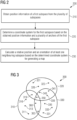
- Figure 2 illustrates a method 200 of generating a map for augmented reality devices in an industrial facility.
- the industrial facility comprises two or more subspaces.
- Sub space herein refers to a logical segment or section of an industrial facility comprising one or more industrial devices.
- Each sub space represents at least a part of the physical infrastructure.
- Each subspace can also be referred to as an augmented reality bubble i.e. a spatial area with defined limitations and forming an interior dimension system.
- a sub space may be embodied by any arbitrary geometrical shape, a spherical dimension may be chosen for the sake of simplicity. However, the term 'bubble' or 'sub space' is not limited to spherical shapes.
- straight geometrical shapes may include straight edges in order to support modular stacking of sub spaces within a mathematically superordinate coordinate system.
- a spherical dimension of a sub space may be chosen to a diameter of 10 meters, surrounding a particular physical location, e.g. a specific GPS position outdoors, or a specific meeting room indoors, or a specific machine.
- sub spaces are determined using a model of the industrial facility.
- Each sub space from the two or more sub spaces comprises a plurality of anchors.
- Each anchor from the plurality of anchors of a corresponding sub space is affixed in a corresponding location within the corresponding sub space.
- an anchor is affixed on or next to an industrial device within the corresponding sub space.
- an anchor is a Radio Frequency Identification (RFID) tag affixed on a nameplate of a flowmeter.
- RFID Radio Frequency Identification
- Each anchor has at least one anchor identifier that describes it in such a way that it can be easily identified as a potential identifier by a user and easily recognized and interpreted by a mobile augmented reality device.
- An anchor identifier has the property that it is relatively unique, meaning it exists only once within the corresponding sub space (or at least only once in a prominent place, or only a small number of times).
- Such an anchor identifier can be, for example, the text of an identifier label in a physical plant. These often are already present in chemical, pharmaceutical, or power plants.
- an anchor identifier can be, for example the text of a street sign, poster or other large sign, the content of a bar code or QR code of a label, the category of an object as returned by an image-processing algorithm (for example, "cactus" can be an identifier, if there is only one cactus in the sub space) and/or the category of an object as returned by a 3D object detection algorithm (for example, "Pump type XYZ" can be an identifier, if there is an algorithm that can detect and classify all types of pumps in a process plant).
- the information element may also be referred to as hologram, which are hereinafter understood as a container for placing technical information precisely at exact positions relative to the real equipment, e.g.
- Holograms can be annotations, created by users, for users. These annotations can include speech (audio and speech-to-text); floating 3D models such as arrows; drawings; captured photos and videos from the device, or other documents. Holograms can be, for example, text, 3D models, small animations, instruction documents, photos, videos, etc. Holograms can also contain links to live data, e.g. a chart from a temperature sensor that is inside a machine. Or historical data. Each hologram has a 3D position in a coordinate system.
- the SLAM software on the augmented reality device can estimate the distance of identifiers (e.g. anchor identifiers and spatial environment identifiers) from the camera, thereby calculating the position of each identifier within the coordinate system of the SLAM software, or other such coordinate systems.
- identifiers e.g. anchor identifiers and spatial environment identifiers
- each sub space includes three or more anchors and such that each sub space overlaps another sub space and in the overlapping area there is at least one anchor.
- the plurality of anchors of a corresponding sub space includes one or more anchors located in an area overlapping with another sub-space from the plurality of sub spaces.
- Figure 3 illustrates a logical representation of a section of the industrial facility comprising three sub spaces 310, 320 and 330.
- Each sub space comprises a plurality of anchors.
- the sub space 310 comprises anchors 311, 313, 316, 319, 350, 360, and 363.
- the sub space 320 comprises anchors 321, 323, 326, 341, 343 and 339.
- the subspace 330 comprises anchors 336, 333, and 331.
- the sub space 310 overlaps the sub spaces 320 and 330.
- the anchors 319 and 350 are in the overlapping area between sub space 310 and sub space 320.
- the anchors 350, 360 and 363 are in the overlapping area between sub space 310 and 330.
- the sub space 320 overlaps the sub space 330.
- the anchors 339, 341, 343, and 350 are present in the overlapping area between sub space 320 and 330.
- the anchor 350 is present in the overlapping area common to all three of the sub spaces.
- each sub space includes one or more a spatial environment identifier readable by the augmented reality device, in relation the corresponding sub space in which the spatial environment identifier is located.
- a spatial environment identifier readable by the augmented reality device, in relation the corresponding sub space in which the spatial environment identifier is located.
- "kitchen" could be such a spatial environment identifier in relation to a sub space associated with a kitchen in the office building.
- the server along with the portable device, obtains position information of a first sub space from the plurality of subspaces using a localization subsystem.
- the first sub space herein refers to the sub space within which the portable device is currently present. Accordingly, in an example, for determining the first sub space, the portable device scans one or more anchors within the first sub space and based on the locations of the one or more anchors determines the first sub space within which the portable device is present. In another example, the portable device includes a localization sub system such as a global positioning system and is capable of determining its location. Then, based on the location of the portable device, the first sub space within which the portable device is present, is determined. In an example, referring to figure 3 , the portable device is present in the sub space 310. Accordingly, the first sub space is the sub space 310.
- the server along with the portable device determines a coordinate system for the first sub space based on the obtained position information and a plurality of anchors of the first sub space.
- the portable device along with then server, determines a coordinate system for the sub space 310. Accordingly, the coordinates of each anchor within the first sub space 310 is determined using the coordinate system.
- Coordinate system as mentioned herein can refer to any well-known coordinate system such as cartesian coordinate system, polar coordinate system, etc.
- the server along with the portable device, calculates a relative position and an orientation of at least one neighboring subspace based on the determined coordinate system, for generating the map based on the position information of the first subspace and the relative position of the at least one neighboring subspace.
- the at least one neighboring subspace includes one or more anchors in an area overlapping the first subspace.
- the coordinates of the anchors in relation to the coordinate system are calculated. This especially includes the anchors in the overlapping areas with the sub spaces 320 and 330. Accordingly, the coordinates of anchors 319, 350, 360 and 363 are calculated using the coordinate system of the first sub space 310. Then based on the coordinates of the anchors in the overlapping areas, the server along with the portable device calculates the coordinates of the anchors in the sub spaces 320 and 330 using the coordinate system. Accordingly, coordinate system of the first sub space is extended to the other sub spaces.
- the server along with the portable device calculates the relative positions and orientations of the sub spaces 320 and 330.
- This may be performed using a plurality of well-known transformation techniques. For example, a technique for bestfitting rigid transformation that aligns two sets of corresponding points as described in ' Least-Squares Rigid Motion Using SVD', Hornung and Rabinovich, ETH Zurich, 2017 , may be used.
- the calculated coordinates of the anchors and the position and orientation information of the sub spaces are stored as the map of the section of the industrial facility. This map may be used by augmented display devices to improve the display of graphical elements. This is further explained in the description to figure 4 .
- the coordinate system determined in the above mentioned method 200 is further augmented with position information from a location system such as a GPS system.
- the industrial facility is a portable facility (for example a portable or modular industrial system) and may be shipped to a different location.
- the coordinate system and the coordinates and positions calculated above are referential values prior to shipping of the industrial system and upon installation of the industrial facility at a particular location, position information of the particular location is used to transform the map and the coordinate system from relative values to absolute values.
- the method 200 includes generating a graph associated with the two or more sub spaces.
- the graph comprises a plurality of nodes and edges.
- Each node from the plurality of nodes is associated with one of a sub space from the two or more sub spaces and an anchor from a first set of anchors.
- Each anchor from the first set of anchors is in at least one area overlapping a one sub space and another sub space from the two or more sub spaces.
- An example of such a graph is illustrated in figure 5 .
- FIG. 5 illustrates an example graph 500 generated in relation to the sub spaces shown in figure 3 .
- Each subspace (310, 320 and 330) is illustrated as a node (510, 540 and 580) in the graph 500.
- each anchor (319, 350, 360, 363, 341, 343, 339) in overlapping areas between the sub spaces 310, 320 and 330 are further illustrated as nodes (530, 555, 550, 560, 590, 570, 575) in the graph 500.
- An edge from a sub space node to an anchor node indicates that the corresponding anchor is within the corresponding sub space.
- sub space node 540 having an edge to an anchor node 550 is indicative that the anchor 360 (represented by anchor node 550) is within sub space 310 (represented by sub space node 540).
- a sub space is chosen as an initial sub space and then sub spaces neighboring the first sub space within a certain radius is queried from the map. Then, a depth-first search of the graph is then performed in which the relative transforms of all the sub spaces with respect to the first sub space is calculated by successive transform matrix multiplications.
- the above mentioned transformation is carried out in a cycle and the position of the initial bubble could be computed from two other bubbles.
- Figure 4 illustrates a method 400 for displaying data on an augmented reality device in an industrial facility.
- the industrial facility comprises a plurality of sub spaces (for example sub spaces 310, 320 and 330) .
- the augmented reality device determines a first sub space and a position and an orientation of the augmented reality device in the first sub space.
- the augmented reality device is present within the first sub space in the industrial facility.
- the augmented reality device determines a first set of anchors within a first sub space from the plurality of sub spaces. Each anchor from the first set of anchors, is present in the first sub space. Based on the determined anchors in the first sub space, the augmented reality device determines a position and an orientation of the augmented reality device in the first sub space.
- the augmented reality device uses one or more of its mapping sensors to generating a SLAM (simultaneous localization and mapping) map for determining the first sub space and the orientation and position of the augmented reality device.
- the one or more mapping sensors includes acoustic sensors, laser sensors, etc.
- the augmented reality device determines one or more others sub spaces based on the orientation of the augmented reality device in the first sub space, for displaying data associated with one or more objects in the one or more sub spaces. For determining the one or more other spaces, the augmented reality device utilizes the map generated above by the server. Subsequent to the determination of the first sub space, the augmented reality device obtains the above mentioned map from the server. Then based on the position and orientation of the augmented reality device in the first sub space, the augmented reality device utilizes the map to determine its coordinates in relation to the coordinate system of the map.
- each sub space from the one or more other sub spaces includes at least one anchor in an area overlapping one or more of the first sub space and another sub space from the one or more other sub-spaces.
- the augmented reality device populates a display of the augmented reality device with one or more data elements associated with one or more objects of the first sub space and the one or more other sub spaces. Based on the determined one or more other sub spaces and the position and orientation of the augmented reality device, the augmented reality device determines the data elements for the objects in the first sub space and the one or more sub spaces. Then, based on the coordinates of the objects, the augmented reality device determines positions of the data elements on the display of the augmented reality device. Accordingly, by using the map, the augmented reality device is able to generate and position the data elements, effectively.
- the data elements displayed by the above method can assist a user to perform actions at exact positions and increases the accuracy of those actions.
- the above mentioned method 400 further includes assigning weights to anchors and sub spaces based on the distance of anchors and the sub spaces from the augmented reality device. Accordingly, for the sub spaces which are further away from the augmented reality device than a predefined threshold distance, data elements associated with the equipment or industrial devices in these sub spaces are not displayed.
- the portable device along with the server can create an anchor such that the anchor is present in both the sub spaces or can modify an existing anchors in one of the sub spaces to be present in both the sub spaces.
- the portable device could approach an existing anchor in the second sub space and calculates its position in relation to the first sub space using the coordinate system. Accordingly, the existing anchor is included in the first sub space. While this explained above with a single anchor between two sub spaces, the above aspect can extended to modifying or adding multiple anchors between multiple sub spaces.
- the present disclosure can take a form of a computer program product comprising computer-usable or computer-readable medium storing program code for use by or in connection with one or more computers, processing units, or instruction execution system.
- the method 200 or the method 400 may be realized in a single device or across one or more devices.
- the current disclosure describes a server for generating a map for augmented reality devices in an industrial facility comprising two or more subspaces.
- the server comprises one or more processors connected to a non transitory memory module which includes a plurality of instruction.
- the one or more processors of the server are configured to, upon execution of the instructions, obtain position information of a first sub space from the plurality of subspaces, determine a coordinate system for the first sub space based on the obtained position information and a plurality of anchors of the first sub space, and calculate, a relative position and an orientation of at least one neighboring subspace based on the determined coordinate system, for generating the map based on the position information of the first subspace and the relative position of the at least one neighboring subspace, wherein the at least one neighboring subspace includes one or more anchors in an area overlapping the first subspace.
- the current disclosure describes an augmented reality device for displaying data associated with one or more objects in an industrial facility comprising of a plurality of sub spaces.
- the augmented reality device comprises one or more processors connected to a non transitory memory module which comprises a plurality of instructions.
- the one or more processors configured to determine a first sub space and a position and an orientation of the augmented reality device in the first sub space, wherein the augmented reality device is within the first sub space in the industrial facility, determine one or more others sub spaces based on the orientation of the augmented reality device in the first sub space, for displaying data associated with one or more objects in the one or more sub spaces, wherein each sub space from the one or more other sub spaces includes at least one anchor in an area overlapping one or more of the first sub space and another sub space from the one or more other subspaces and populate a display of the augmented reality device with one or more data elements associated with one or more objects of the first sub space and the one or more other sub spaces.
- a computer-usable or computer-readable non-transitory storage medium can be any apparatus that can contain, store, communicate, propagate, or transport the program for use by or in connection with the instruction execution system, apparatus, or device.
- the medium can be electronic, magnetic, optical, electromagnetic, infrared, or semiconductor system (or apparatus or device) or a propagation mediums in and of themselves as signal carriers are not included in the definition of physical computer-readable medium include a semiconductor or solid state memory, magnetic tape, a removable computer diskette, random access memory (RAM), a read only memory (ROM), a rigid magnetic disk and optical disk such as compact disk read-only memory (CD-ROM), compact disk read/write, DVD and Blu ray.
- Both processing units and program code for implementing each aspect of the technology can be centralized or distributed (or a combination thereof) as known to those skilled in the art.
Landscapes
- Engineering & Computer Science (AREA)
- Physics & Mathematics (AREA)
- Radar, Positioning & Navigation (AREA)
- Remote Sensing (AREA)
- General Physics & Mathematics (AREA)
- Theoretical Computer Science (AREA)
- General Engineering & Computer Science (AREA)
- Automation & Control Theory (AREA)
- Computer Graphics (AREA)
- Software Systems (AREA)
- Computer Hardware Design (AREA)
- Human Computer Interaction (AREA)
- Optics & Photonics (AREA)
- Processing Or Creating Images (AREA)
- Navigation (AREA)
- User Interface Of Digital Computer (AREA)
Claims (3)
- Verfahren (200) zum Erzeugen einer Karte für Vorrichtungen der erweiterten Realität in einer industriellen Anlage, die zwei oder mehr Teilräume (310, 320, 330) umfasst, wobei jeder Teilraum aus den zwei oder mehr Teilräumen (310, 320, 330) eine Vielzahl von Ankerpunkten (311, 313, 316, 319, 350, 360, 363, 321, 323, 326, 341, 343, 339, 336, 333, 331) umfasst, wobei die Vielzahl von Ankerpunkten eines entsprechenden Teilraums einen oder mehrere Ankerpunkte (350, 360, 363, 319, 341, 343, 339) enthält, die sich in einem Bereich befinden, der sich mit einem anderen Teilraum aus der Vielzahl von Teilräumen (310, 320, 330) überlappt, wobei das Verfahren (200) umfasst:a. Ermitteln (210) von Positionsinformationen eines ersten Teilraums (310) aus der Vielzahl von Teilräumen (310, 320, 330);b. Bestimmen (220) eines Koordinatensystems für den ersten Teilraum (310) basierend auf den ermittelten Positionsinformationen und einer Vielzahl von Ankerpunkten (319, 350, 360, 363, 316, 313, 311) des ersten Teilraums (310); undc. Berechnen (230) einer relativen Position und einer Ausrichtung mindestens eines benachbarten Teilraums (330) basierend auf dem bestimmten Koordinatensystem, um die Karte basierend auf den Positionsinformationen des ersten Teilraums (310) und der relativen Position des mindestens einen benachbarten Teilraums (330) zu erzeugen, wobei der mindestens eine benachbarte Teilraum (330) einen oder mehrere Ankerpunkte (350, 360, 363) in einem sich mit dem ersten Teilraum (310) überlappenden Bereich enthält,wobei das Berechnen der relativen Position und der Ausrichtung des mindestens einen benachbarten Teilraums (330) ferner umfasst:Erzeugen eines den zwei oder mehr Teilräumen (310, 320, 330) zugeordneten Graphen (500), wobei der Graph (500) eine Vielzahl von Knoten (510, 520, 530, 540, 550, 560, 570, 575, 580, 590, 555) und Kanten umfasst, wobei jeder Knoten aus der Vielzahl von Knoten (510, 520, 530, 540, 550, 560, 570, 575, 580, 590, 555) einem von einem Teilraum aus den zwei oder mehr Teilräumen (310, 320, 330) und einem Ankerpunkt aus einem ersten Satz von Ankerpunkten (319, 350, 360, 363, 341, 343, 339) zugeordnet ist, wobei jeder Ankerpunkt aus dem ersten Satz von Ankerpunkten (319, 350, 360, 363, 341, 343, 339) in mindestens einem Bereich liegt, der sich mit einem Teilraum und einem anderen Teilraum aus den zwei oder mehr Teilräumen (310, 320, 330) überlappt,Auswählen eines ersten Teilraums (310) aus den zwei oder mehr Teilräumen (310, 320, 330) als einen Anfangsteilraum und Durchführen einer Tiefensuche in dem Graphen (500), wobei das Durchführen der Tiefensuche das Berechnen von relativen Transformationen eines oder mehrerer Teilräume (320, 330) in Bezug auf den ersten Teilraum (310) unter Verwendung einer oder mehrerer Transformationsmatrixmultiplikationen beinhaltet.
- Verfahren (200) nach Anspruch 1, wobei das Verfahren (200) ferner das Ermitteln von Positionsinformationen des ersten Teilraums (310) aus der Vielzahl von Teilräumen (310, 320, 330) umfasst.
- Nicht flüchtiges Speichermedium zum Erzeugen einer Karte für Vorrichtungen der erweiterten Realität in einer industriellen Anlage, die zwei oder mehr Teilräume (310, 320, 330) umfasst, wobei jeder Teilraum aus den zwei oder mehr Teilräumen (310, 320, 330) eine Vielzahl von Ankerpunkten umfasst, wobei die Vielzahl von Ankerpunkten eines entsprechenden Teilraums einen oder mehrere Ankerpunkte enthält, die sich in einem Bereich befinden, der sich mit einem anderen Teilraum aus den zwei oder mehr Teilräumen (310, 320, 330) überlappt; umfassend eine Vielzahl von Anweisungen, die, wenn sie auf einem oder mehreren Prozessoren ausgeführt werden, den einen oder die mehreren Prozessoren dazu veranlassen:a. Positionsinformationen eines ersten Teilraums (310) aus der Vielzahl von Teilräumen (310, 320, 330) zu ermitteln;b. ein Koordinatensystem für den ersten Teilraum (310) basierend auf den ermittelten Positionsinformationen und einer Vielzahl von Ankerpunkten des ersten Teilraums (310) zu bestimmen; undc. eine relative Position und eine Ausrichtung mindestens eines benachbarten Teilraums (330) basierend auf dem bestimmten Koordinatensystem zu berechnen, um die Karte basierend auf den Positionsinformationen des ersten Teilraums (310) und der relativen Position des mindestens einen benachbarten Teilraums (330) zu erzeugen, wobei der mindestens eine benachbarte Teilraum (330) einen oder mehrere Ankerpunkte in einem den ersten Teilraum (310) überlappenden Bereich enthält,wobei das Berechnen der relativen Position und der Ausrichtung des mindestens einen benachbarten Teilraums (330) ferner umfasst:einen den zwei oder mehr Teilräumen (310, 320, 330) zugeordneten Graphen (500) zu erzeugen, wobei der Graph (500) eine Vielzahl von Knoten (510, 520, 530, 540, 550, 560, 570, 575, 580, 590, 555) und Kanten umfasst, wobei jeder Knoten aus der Vielzahl von Knoten (510, 520, 530, 540, 550, 560, 570, 575, 580, 590, 555) einem von einem Teilraum aus den zwei oder mehr Teilräumen (310, 320, 330) und einem Ankerpunkt aus einem ersten Satz von Ankerpunkten (319, 350, 360, 363, 341, 343, 339) zugeordnet ist, wobei jeder Ankerpunkt aus dem ersten Satz von Ankerpunkten (319, 350, 360, 363, 341, 343, 339) in mindestens einem Bereich liegt, der sich mit einem Teilraum und einem anderen Teilraum aus den zwei oder mehr Teilräumen (310, 320, 330) überlappt,einen ersten Teilraum (310) aus den zwei oder mehr Teilräumen (310, 320, 330) als einen Anfangsteilraum auszuwählen und eine Tiefensuche in dem Graphen (500) durchzuführen, wobei das Durchführen der Tiefensuche das Berechnen von relativen Transformationen eines oder mehrerer Teilräume (320, 330) in Bezug auf den ersten Teilraum (310) unter Verwendung einer oder mehrerer Transformationsmatrixmultiplikationen beinhaltet.
Applications Claiming Priority (2)
| Application Number | Priority Date | Filing Date | Title |
|---|---|---|---|
| EP20215025.6A EP4015996A1 (de) | 2020-12-17 | 2020-12-17 | Verfahren zur erzeugung einer karte für vorrichtungen der erweiterten realität in einer industriellen anlage |
| PCT/EP2021/084882 WO2022128710A1 (en) | 2020-12-17 | 2021-12-09 | Method for generating a map for augmented reality devices in an industrial facility |
Publications (3)
| Publication Number | Publication Date |
|---|---|
| EP4229359A1 EP4229359A1 (de) | 2023-08-23 |
| EP4229359B1 true EP4229359B1 (de) | 2024-09-18 |
| EP4229359C0 EP4229359C0 (de) | 2024-09-18 |
Family
ID=73855349
Family Applications (2)
| Application Number | Title | Priority Date | Filing Date |
|---|---|---|---|
| EP20215025.6A Ceased EP4015996A1 (de) | 2020-12-17 | 2020-12-17 | Verfahren zur erzeugung einer karte für vorrichtungen der erweiterten realität in einer industriellen anlage |
| EP21836405.7A Active EP4229359B1 (de) | 2020-12-17 | 2021-12-09 | Verfahren zur erzeugung einer karte für vorrichtungen der erweiterten realität in einer industriellen anlage |
Family Applications Before (1)
| Application Number | Title | Priority Date | Filing Date |
|---|---|---|---|
| EP20215025.6A Ceased EP4015996A1 (de) | 2020-12-17 | 2020-12-17 | Verfahren zur erzeugung einer karte für vorrichtungen der erweiterten realität in einer industriellen anlage |
Country Status (4)
| Country | Link |
|---|---|
| US (1) | US20240044668A1 (de) |
| EP (2) | EP4015996A1 (de) |
| CN (1) | CN116745733A (de) |
| WO (1) | WO2022128710A1 (de) |
Families Citing this family (1)
| Publication number | Priority date | Publication date | Assignee | Title |
|---|---|---|---|---|
| CN121233004A (zh) * | 2024-06-27 | 2025-12-30 | 优奈柯恩(北京)科技有限公司 | 用于终端设备的定位方法、装置、电子设备和介质 |
Family Cites Families (18)
| Publication number | Priority date | Publication date | Assignee | Title |
|---|---|---|---|---|
| US8908918B2 (en) * | 2012-11-08 | 2014-12-09 | Navigate Surgical Technologies, Inc. | System and method for determining the three-dimensional location and orientation of identification markers |
| CN103365911B (zh) * | 2012-04-06 | 2017-05-24 | 腾讯科技(深圳)有限公司 | 一种基于二维分块结构地图空间索引的方法和系统 |
| WO2014026021A1 (en) * | 2012-08-08 | 2014-02-13 | Virginia Tech Intellectual Properties, Inc. | Systems and methods for image-based searching |
| US9483879B2 (en) * | 2014-09-18 | 2016-11-01 | Microsoft Technology Licensing, Llc | Using free-form deformations in surface reconstruction |
| CN105701771A (zh) * | 2016-03-17 | 2016-06-22 | 江苏科技大学 | 一种基于射频识别锚点的数字地图拼接方法 |
| US10217231B2 (en) * | 2016-05-31 | 2019-02-26 | Microsoft Technology Licensing, Llc | Systems and methods for utilizing anchor graphs in mixed reality environments |
| US10600252B2 (en) * | 2017-03-30 | 2020-03-24 | Microsoft Technology Licensing, Llc | Coarse relocalization using signal fingerprints |
| US10466953B2 (en) * | 2017-03-30 | 2019-11-05 | Microsoft Technology Licensing, Llc | Sharing neighboring map data across devices |
| CN119919611A (zh) * | 2017-12-22 | 2025-05-02 | 奇跃公司 | 用于在混合现实系统中管理和显示虚拟内容的方法和系统 |
| US10672159B2 (en) * | 2018-04-02 | 2020-06-02 | Microsoft Technology Licensing, Llc | Anchor graph |
| CN108615247B (zh) * | 2018-04-27 | 2021-09-14 | 深圳市腾讯计算机系统有限公司 | 相机姿态追踪过程的重定位方法、装置、设备及存储介质 |
| US10957112B2 (en) * | 2018-08-13 | 2021-03-23 | Magic Leap, Inc. | Cross reality system |
| US11227435B2 (en) * | 2018-08-13 | 2022-01-18 | Magic Leap, Inc. | Cross reality system |
| US11132841B2 (en) * | 2018-11-30 | 2021-09-28 | Facebook Technologies, Llc | Systems and methods for presenting digital assets within artificial environments via a loosely coupled relocalization service and asset management service |
| US11163997B2 (en) * | 2019-05-05 | 2021-11-02 | Google Llc | Methods and apparatus for venue based augmented reality |
| CN111913565B (zh) * | 2019-05-07 | 2023-03-07 | 广东虚拟现实科技有限公司 | 虚拟内容控制方法、装置、系统、终端设备及存储介质 |
| CN110930495A (zh) * | 2019-11-22 | 2020-03-27 | 哈尔滨工业大学(深圳) | 基于多无人机协作的icp点云地图融合方法、系统、装置及存储介质 |
| CN112712044B (zh) * | 2021-01-05 | 2023-08-08 | 百果园技术(新加坡)有限公司 | 人脸追踪方法、装置、电子设备和存储介质 |
-
2020
- 2020-12-17 EP EP20215025.6A patent/EP4015996A1/de not_active Ceased
-
2021
- 2021-12-09 WO PCT/EP2021/084882 patent/WO2022128710A1/en not_active Ceased
- 2021-12-09 CN CN202180084875.2A patent/CN116745733A/zh active Pending
- 2021-12-09 US US18/266,636 patent/US20240044668A1/en active Pending
- 2021-12-09 EP EP21836405.7A patent/EP4229359B1/de active Active
Also Published As
| Publication number | Publication date |
|---|---|
| EP4015996A1 (de) | 2022-06-22 |
| US20240044668A1 (en) | 2024-02-08 |
| CN116745733A (zh) | 2023-09-12 |
| EP4229359A1 (de) | 2023-08-23 |
| EP4229359C0 (de) | 2024-09-18 |
| WO2022128710A1 (en) | 2022-06-23 |
Similar Documents
| Publication | Publication Date | Title |
|---|---|---|
| US12147590B2 (en) | Aligning and augmenting a partial subspace of a physical infrastructure with at least one information element | |
| US11059174B2 (en) | System and method of controlling obstacle avoidance of robot, robot and storage medium | |
| US9836651B2 (en) | Displaying information relating to a designated marker | |
| US10586082B1 (en) | Advanced micro-location of RFID tags in spatial environments | |
| Rohacz et al. | Concept for the comparison of intralogistics designs with real factory layout using augmented reality, SLAM and marker-based tracking | |
| US20190377330A1 (en) | Augmented Reality Systems, Methods And Devices | |
| BR102014000091A2 (pt) | localização de plataforma móvel aumentada | |
| US11835960B2 (en) | System and method for semantically identifying one or more of an object and a location in a robotic environment | |
| US20210390305A1 (en) | Method and apparatus for providing annotations in augmented reality | |
| EP4229359B1 (de) | Verfahren zur erzeugung einer karte für vorrichtungen der erweiterten realität in einer industriellen anlage | |
| KR20210088057A (ko) | 인공지능을 이용한 재난대응 피구조자 위치예측시스템 | |
| WO2022156991A1 (en) | Locating industrial assets using virtual three-dimensional environment | |
| Men et al. | Hue-assisted automatic registration of color point clouds | |
| Kawanishi et al. | Parallel line-based structure from motion by using omnidirectional camera in textureless scene | |
| Regattieri et al. | The use of radio frequency identification technology in packaging systems: experimental research on traceability | |
| CN120688982A (zh) | 一种基于三维点云坐标映射的实物资产空间管理方法 | |
| Osadcha et al. | Patterns and trends in the use of RFID within the construction industry and Digital Twin architecture: A Latent Semantic Analysis | |
| Han | Research on path planning technology of mobile robot in the restaurant scene based on A* and D* algorithm | |
| EP4044001B1 (de) | Verfahren zur erzeugung eines dreidimensionalen interaktionsmodells | |
| KR102766117B1 (ko) | 디지털 트윈을 이용한 해상 장비 감시 시스템 및 방법 | |
| Achour et al. | Improving semantic mapping with prior object dimensions extracted from 3d models | |
| Adán et al. | Obtaining and monitoring warehouse 3d models with laser scanner data | |
| Kim et al. | Implementation of QR Code Recognition Technology Using Smartphone Camera for Indoor Positioning. Energies 2021, 14, 2759 | |
| EP3910518A1 (de) | Erweiterung einer schematischen darstellung einer technischen infrastruktur | |
| KR101955470B1 (ko) | Rfid를 이용한 실내 위치 추적 방법 및 장치 |
Legal Events
| Date | Code | Title | Description |
|---|---|---|---|
| STAA | Information on the status of an ep patent application or granted ep patent |
Free format text: STATUS: UNKNOWN |
|
| STAA | Information on the status of an ep patent application or granted ep patent |
Free format text: STATUS: THE INTERNATIONAL PUBLICATION HAS BEEN MADE |
|
| PUAI | Public reference made under article 153(3) epc to a published international application that has entered the european phase |
Free format text: ORIGINAL CODE: 0009012 |
|
| STAA | Information on the status of an ep patent application or granted ep patent |
Free format text: STATUS: REQUEST FOR EXAMINATION WAS MADE |
|
| 17P | Request for examination filed |
Effective date: 20230517 |
|
| AK | Designated contracting states |
Kind code of ref document: A1 Designated state(s): AL AT BE BG CH CY CZ DE DK EE ES FI FR GB GR HR HU IE IS IT LI LT LU LV MC MK MT NL NO PL PT RO RS SE SI SK SM TR |
|
| DAV | Request for validation of the european patent (deleted) | ||
| DAX | Request for extension of the european patent (deleted) | ||
| GRAP | Despatch of communication of intention to grant a patent |
Free format text: ORIGINAL CODE: EPIDOSNIGR1 |
|
| GRAP | Despatch of communication of intention to grant a patent |
Free format text: ORIGINAL CODE: EPIDOSNIGR1 |
|
| STAA | Information on the status of an ep patent application or granted ep patent |
Free format text: STATUS: GRANT OF PATENT IS INTENDED |
|
| INTG | Intention to grant announced |
Effective date: 20240614 |
|
| GRAS | Grant fee paid |
Free format text: ORIGINAL CODE: EPIDOSNIGR3 |
|
| GRAA | (expected) grant |
Free format text: ORIGINAL CODE: 0009210 |
|
| STAA | Information on the status of an ep patent application or granted ep patent |
Free format text: STATUS: THE PATENT HAS BEEN GRANTED |
|
| AK | Designated contracting states |
Kind code of ref document: B1 Designated state(s): AL AT BE BG CH CY CZ DE DK EE ES FI FR GB GR HR HU IE IS IT LI LT LU LV MC MK MT NL NO PL PT RO RS SE SI SK SM TR |
|
| REG | Reference to a national code |
Ref country code: GB Ref legal event code: FG4D |
|
| REG | Reference to a national code |
Ref country code: CH Ref legal event code: EP |
|
| REG | Reference to a national code |
Ref country code: DE Ref legal event code: R096 Ref document number: 602021019101 Country of ref document: DE |
|
| REG | Reference to a national code |
Ref country code: IE Ref legal event code: FG4D |
|
| U01 | Request for unitary effect filed |
Effective date: 20241010 |
|
| U07 | Unitary effect registered |
Designated state(s): AT BE BG DE DK EE FI FR IT LT LU LV MT NL PT RO SE SI Effective date: 20241029 |
|
| PG25 | Lapsed in a contracting state [announced via postgrant information from national office to epo] |
Ref country code: NO Free format text: LAPSE BECAUSE OF FAILURE TO SUBMIT A TRANSLATION OF THE DESCRIPTION OR TO PAY THE FEE WITHIN THE PRESCRIBED TIME-LIMIT Effective date: 20241218 |
|
| PG25 | Lapsed in a contracting state [announced via postgrant information from national office to epo] |
Ref country code: GR Free format text: LAPSE BECAUSE OF FAILURE TO SUBMIT A TRANSLATION OF THE DESCRIPTION OR TO PAY THE FEE WITHIN THE PRESCRIBED TIME-LIMIT Effective date: 20241219 |
|
| U20 | Renewal fee for the european patent with unitary effect paid |
Year of fee payment: 4 Effective date: 20241219 |
|
| PG25 | Lapsed in a contracting state [announced via postgrant information from national office to epo] |
Ref country code: HR Free format text: LAPSE BECAUSE OF FAILURE TO SUBMIT A TRANSLATION OF THE DESCRIPTION OR TO PAY THE FEE WITHIN THE PRESCRIBED TIME-LIMIT Effective date: 20240918 |
|
| PG25 | Lapsed in a contracting state [announced via postgrant information from national office to epo] |
Ref country code: RS Free format text: LAPSE BECAUSE OF FAILURE TO SUBMIT A TRANSLATION OF THE DESCRIPTION OR TO PAY THE FEE WITHIN THE PRESCRIBED TIME-LIMIT Effective date: 20241218 |
|
| PG25 | Lapsed in a contracting state [announced via postgrant information from national office to epo] |
Ref country code: RS Free format text: LAPSE BECAUSE OF FAILURE TO SUBMIT A TRANSLATION OF THE DESCRIPTION OR TO PAY THE FEE WITHIN THE PRESCRIBED TIME-LIMIT Effective date: 20241218 Ref country code: NO Free format text: LAPSE BECAUSE OF FAILURE TO SUBMIT A TRANSLATION OF THE DESCRIPTION OR TO PAY THE FEE WITHIN THE PRESCRIBED TIME-LIMIT Effective date: 20241218 Ref country code: HR Free format text: LAPSE BECAUSE OF FAILURE TO SUBMIT A TRANSLATION OF THE DESCRIPTION OR TO PAY THE FEE WITHIN THE PRESCRIBED TIME-LIMIT Effective date: 20240918 Ref country code: GR Free format text: LAPSE BECAUSE OF FAILURE TO SUBMIT A TRANSLATION OF THE DESCRIPTION OR TO PAY THE FEE WITHIN THE PRESCRIBED TIME-LIMIT Effective date: 20241219 |
|
| PG25 | Lapsed in a contracting state [announced via postgrant information from national office to epo] |
Ref country code: IS Free format text: LAPSE BECAUSE OF FAILURE TO SUBMIT A TRANSLATION OF THE DESCRIPTION OR TO PAY THE FEE WITHIN THE PRESCRIBED TIME-LIMIT Effective date: 20250118 |
|
| PG25 | Lapsed in a contracting state [announced via postgrant information from national office to epo] |
Ref country code: SM Free format text: LAPSE BECAUSE OF FAILURE TO SUBMIT A TRANSLATION OF THE DESCRIPTION OR TO PAY THE FEE WITHIN THE PRESCRIBED TIME-LIMIT Effective date: 20240918 |
|
| PG25 | Lapsed in a contracting state [announced via postgrant information from national office to epo] |
Ref country code: ES Free format text: LAPSE BECAUSE OF FAILURE TO SUBMIT A TRANSLATION OF THE DESCRIPTION OR TO PAY THE FEE WITHIN THE PRESCRIBED TIME-LIMIT Effective date: 20240918 |
|
| PG25 | Lapsed in a contracting state [announced via postgrant information from national office to epo] |
Ref country code: CZ Free format text: LAPSE BECAUSE OF FAILURE TO SUBMIT A TRANSLATION OF THE DESCRIPTION OR TO PAY THE FEE WITHIN THE PRESCRIBED TIME-LIMIT Effective date: 20240918 Ref country code: PL Free format text: LAPSE BECAUSE OF FAILURE TO SUBMIT A TRANSLATION OF THE DESCRIPTION OR TO PAY THE FEE WITHIN THE PRESCRIBED TIME-LIMIT Effective date: 20240918 |
|
| PG25 | Lapsed in a contracting state [announced via postgrant information from national office to epo] |
Ref country code: SK Free format text: LAPSE BECAUSE OF FAILURE TO SUBMIT A TRANSLATION OF THE DESCRIPTION OR TO PAY THE FEE WITHIN THE PRESCRIBED TIME-LIMIT Effective date: 20240918 |
|
| PG25 | Lapsed in a contracting state [announced via postgrant information from national office to epo] |
Ref country code: MC Free format text: LAPSE BECAUSE OF FAILURE TO SUBMIT A TRANSLATION OF THE DESCRIPTION OR TO PAY THE FEE WITHIN THE PRESCRIBED TIME-LIMIT Effective date: 20240918 |
|
| PLBE | No opposition filed within time limit |
Free format text: ORIGINAL CODE: 0009261 |
|
| STAA | Information on the status of an ep patent application or granted ep patent |
Free format text: STATUS: NO OPPOSITION FILED WITHIN TIME LIMIT |
|
| REG | Reference to a national code |
Ref country code: CH Ref legal event code: PL |
|
| 26N | No opposition filed |
Effective date: 20250619 |
|
| PG25 | Lapsed in a contracting state [announced via postgrant information from national office to epo] |
Ref country code: CH Free format text: LAPSE BECAUSE OF NON-PAYMENT OF DUE FEES Effective date: 20241231 |
|
| PG25 | Lapsed in a contracting state [announced via postgrant information from national office to epo] |
Ref country code: IE Free format text: LAPSE BECAUSE OF NON-PAYMENT OF DUE FEES Effective date: 20241209 |
|
| U20 | Renewal fee for the european patent with unitary effect paid |
Year of fee payment: 5 Effective date: 20251219 |