EP4227397A1 - Multi-layer film comprising nutrient material for cell culture, method for preparing same, and use of same - Google Patents
Multi-layer film comprising nutrient material for cell culture, method for preparing same, and use of same Download PDFInfo
- Publication number
- EP4227397A1 EP4227397A1 EP21880468.0A EP21880468A EP4227397A1 EP 4227397 A1 EP4227397 A1 EP 4227397A1 EP 21880468 A EP21880468 A EP 21880468A EP 4227397 A1 EP4227397 A1 EP 4227397A1
- Authority
- EP
- European Patent Office
- Prior art keywords
- layer
- layer film
- cell culture
- film
- layer structure
- Prior art date
- Legal status (The legal status is an assumption and is not a legal conclusion. Google has not performed a legal analysis and makes no representation as to the accuracy of the status listed.)
- Pending
Links
- 239000000463 material Substances 0.000 title claims abstract description 109
- 238000004113 cell culture Methods 0.000 title claims abstract description 53
- 238000000034 method Methods 0.000 title claims abstract description 51
- 235000015097 nutrients Nutrition 0.000 title claims abstract description 33
- 235000013372 meat Nutrition 0.000 claims abstract description 21
- 108010053210 Phycocyanin Proteins 0.000 claims description 46
- 125000002091 cationic group Chemical group 0.000 claims description 37
- 125000000129 anionic group Chemical group 0.000 claims description 36
- 210000004027 cell Anatomy 0.000 claims description 32
- 238000004132 cross linking Methods 0.000 claims description 29
- 239000011148 porous material Substances 0.000 claims description 29
- 239000000758 substrate Substances 0.000 claims description 29
- 210000002966 serum Anatomy 0.000 claims description 22
- 229920001661 Chitosan Polymers 0.000 claims description 18
- 125000003178 carboxy group Chemical group [H]OC(*)=O 0.000 claims description 18
- 125000003277 amino group Chemical group 0.000 claims description 16
- 239000006143 cell culture medium Substances 0.000 claims description 15
- 239000000203 mixture Substances 0.000 claims description 15
- 210000000663 muscle cell Anatomy 0.000 claims description 12
- -1 poly(vinylamine) Polymers 0.000 claims description 9
- 241001465754 Metazoa Species 0.000 claims description 8
- 229920000936 Agarose Polymers 0.000 claims description 7
- 229920001282 polysaccharide Polymers 0.000 claims description 7
- 239000002609 medium Substances 0.000 claims description 6
- 239000003102 growth factor Substances 0.000 claims description 5
- CIWBSHSKHKDKBQ-JLAZNSOCSA-N Ascorbic acid Chemical compound OC[C@H](O)[C@H]1OC(=O)C(O)=C1O CIWBSHSKHKDKBQ-JLAZNSOCSA-N 0.000 claims description 4
- 229920000855 Fucoidan Polymers 0.000 claims description 4
- 150000001413 amino acids Chemical class 0.000 claims description 4
- VEXZGXHMUGYJMC-UHFFFAOYSA-N Hydrochloric acid Chemical compound Cl VEXZGXHMUGYJMC-UHFFFAOYSA-N 0.000 claims description 3
- 229920003174 cellulose-based polymer Polymers 0.000 claims description 3
- KIUKXJAPPMFGSW-DNGZLQJQSA-N (2S,3S,4S,5R,6R)-6-[(2S,3R,4R,5S,6R)-3-Acetamido-2-[(2S,3S,4R,5R,6R)-6-[(2R,3R,4R,5S,6R)-3-acetamido-2,5-dihydroxy-6-(hydroxymethyl)oxan-4-yl]oxy-2-carboxy-4,5-dihydroxyoxan-3-yl]oxy-5-hydroxy-6-(hydroxymethyl)oxan-4-yl]oxy-3,4,5-trihydroxyoxane-2-carboxylic acid Chemical compound CC(=O)N[C@H]1[C@H](O)O[C@H](CO)[C@@H](O)[C@@H]1O[C@H]1[C@H](O)[C@@H](O)[C@H](O[C@H]2[C@@H]([C@@H](O[C@H]3[C@@H]([C@@H](O)[C@H](O)[C@H](O3)C(O)=O)O)[C@H](O)[C@@H](CO)O2)NC(C)=O)[C@@H](C(O)=O)O1 KIUKXJAPPMFGSW-DNGZLQJQSA-N 0.000 claims description 2
- TUSDEZXZIZRFGC-UHFFFAOYSA-N 1-O-galloyl-3,6-(R)-HHDP-beta-D-glucose Natural products OC1C(O2)COC(=O)C3=CC(O)=C(O)C(O)=C3C3=C(O)C(O)=C(O)C=C3C(=O)OC1C(O)C2OC(=O)C1=CC(O)=C(O)C(O)=C1 TUSDEZXZIZRFGC-UHFFFAOYSA-N 0.000 claims description 2
- SQDAZGGFXASXDW-UHFFFAOYSA-N 5-bromo-2-(trifluoromethoxy)pyridine Chemical compound FC(F)(F)OC1=CC=C(Br)C=N1 SQDAZGGFXASXDW-UHFFFAOYSA-N 0.000 claims description 2
- 108010049931 Bone Morphogenetic Protein 2 Proteins 0.000 claims description 2
- 102100024506 Bone morphogenetic protein 2 Human genes 0.000 claims description 2
- 102000011632 Caseins Human genes 0.000 claims description 2
- 108010076119 Caseins Proteins 0.000 claims description 2
- 229920001287 Chondroitin sulfate Polymers 0.000 claims description 2
- 102000008186 Collagen Human genes 0.000 claims description 2
- 108010035532 Collagen Proteins 0.000 claims description 2
- 102000016942 Elastin Human genes 0.000 claims description 2
- 108010014258 Elastin Proteins 0.000 claims description 2
- 239000001263 FEMA 3042 Substances 0.000 claims description 2
- 108010049003 Fibrinogen Proteins 0.000 claims description 2
- 102000008946 Fibrinogen Human genes 0.000 claims description 2
- 102000003971 Fibroblast Growth Factor 1 Human genes 0.000 claims description 2
- 108090000386 Fibroblast Growth Factor 1 Proteins 0.000 claims description 2
- 108010022355 Fibroins Proteins 0.000 claims description 2
- 102000016359 Fibronectins Human genes 0.000 claims description 2
- 108010067306 Fibronectins Proteins 0.000 claims description 2
- 108010010803 Gelatin Proteins 0.000 claims description 2
- 229920002488 Hemicellulose Polymers 0.000 claims description 2
- HTTJABKRGRZYRN-UHFFFAOYSA-N Heparin Chemical compound OC1C(NC(=O)C)C(O)OC(COS(O)(=O)=O)C1OC1C(OS(O)(=O)=O)C(O)C(OC2C(C(OS(O)(=O)=O)C(OC3C(C(O)C(O)C(O3)C(O)=O)OS(O)(=O)=O)C(CO)O2)NS(O)(=O)=O)C(C(O)=O)O1 HTTJABKRGRZYRN-UHFFFAOYSA-N 0.000 claims description 2
- 108090000723 Insulin-Like Growth Factor I Proteins 0.000 claims description 2
- 102000004218 Insulin-Like Growth Factor I Human genes 0.000 claims description 2
- 229920001543 Laminarin Polymers 0.000 claims description 2
- 102000007547 Laminin Human genes 0.000 claims description 2
- 108010085895 Laminin Proteins 0.000 claims description 2
- LRBQNJMCXXYXIU-PPKXGCFTSA-N Penta-digallate-beta-D-glucose Natural products OC1=C(O)C(O)=CC(C(=O)OC=2C(=C(O)C=C(C=2)C(=O)OC[C@@H]2[C@H]([C@H](OC(=O)C=3C=C(OC(=O)C=4C=C(O)C(O)=C(O)C=4)C(O)=C(O)C=3)[C@@H](OC(=O)C=3C=C(OC(=O)C=4C=C(O)C(O)=C(O)C=4)C(O)=C(O)C=3)[C@H](OC(=O)C=3C=C(OC(=O)C=4C=C(O)C(O)=C(O)C=4)C(O)=C(O)C=3)O2)OC(=O)C=2C=C(OC(=O)C=3C=C(O)C(O)=C(O)C=3)C(O)=C(O)C=2)O)=C1 LRBQNJMCXXYXIU-PPKXGCFTSA-N 0.000 claims description 2
- 229920002873 Polyethylenimine Polymers 0.000 claims description 2
- 239000000783 alginic acid Substances 0.000 claims description 2
- 229920000615 alginic acid Polymers 0.000 claims description 2
- 235000010443 alginic acid Nutrition 0.000 claims description 2
- 229960001126 alginic acid Drugs 0.000 claims description 2
- 150000004781 alginic acids Chemical class 0.000 claims description 2
- 229960005070 ascorbic acid Drugs 0.000 claims description 2
- 235000010323 ascorbic acid Nutrition 0.000 claims description 2
- 239000011668 ascorbic acid Substances 0.000 claims description 2
- 229920001525 carrageenan Polymers 0.000 claims description 2
- 239000005018 casein Substances 0.000 claims description 2
- BECPQYXYKAMYBN-UHFFFAOYSA-N casein, tech. Chemical compound NCCCCC(C(O)=O)N=C(O)C(CC(O)=O)N=C(O)C(CCC(O)=N)N=C(O)C(CC(C)C)N=C(O)C(CCC(O)=O)N=C(O)C(CC(O)=O)N=C(O)C(CCC(O)=O)N=C(O)C(C(C)O)N=C(O)C(CCC(O)=N)N=C(O)C(CCC(O)=N)N=C(O)C(CCC(O)=N)N=C(O)C(CCC(O)=O)N=C(O)C(CCC(O)=O)N=C(O)C(COP(O)(O)=O)N=C(O)C(CCC(O)=N)N=C(O)C(N)CC1=CC=CC=C1 BECPQYXYKAMYBN-UHFFFAOYSA-N 0.000 claims description 2
- 235000021240 caseins Nutrition 0.000 claims description 2
- 229920002678 cellulose Polymers 0.000 claims description 2
- 239000001913 cellulose Substances 0.000 claims description 2
- 229940059329 chondroitin sulfate Drugs 0.000 claims description 2
- 229920001436 collagen Polymers 0.000 claims description 2
- 229960000633 dextran sulfate Drugs 0.000 claims description 2
- 229920002549 elastin Polymers 0.000 claims description 2
- 229940012952 fibrinogen Drugs 0.000 claims description 2
- 229920000159 gelatin Polymers 0.000 claims description 2
- 239000008273 gelatin Substances 0.000 claims description 2
- 235000019322 gelatine Nutrition 0.000 claims description 2
- 235000011852 gelatine desserts Nutrition 0.000 claims description 2
- 229920000669 heparin Polymers 0.000 claims description 2
- 229960002897 heparin Drugs 0.000 claims description 2
- 229920002674 hyaluronan Polymers 0.000 claims description 2
- 229960003160 hyaluronic acid Drugs 0.000 claims description 2
- DBTMGCOVALSLOR-VPNXCSTESA-N laminarin Chemical compound O[C@@H]1[C@@H](O)[C@H](O)[C@@H](CO)OC1O[C@@H]1[C@@H](O)C(O[C@H]2[C@@H]([C@@H](CO)OC(O)[C@@H]2O)O)O[C@H](CO)[C@H]1O DBTMGCOVALSLOR-VPNXCSTESA-N 0.000 claims description 2
- 229930013686 lignan Natural products 0.000 claims description 2
- 150000005692 lignans Chemical class 0.000 claims description 2
- 235000009408 lignans Nutrition 0.000 claims description 2
- 229920005610 lignin Polymers 0.000 claims description 2
- 229920001432 poly(L-lactide) Polymers 0.000 claims description 2
- 229920000729 poly(L-lysine) polymer Polymers 0.000 claims description 2
- 229920001308 poly(aminoacid) Polymers 0.000 claims description 2
- 229920001690 polydopamine Polymers 0.000 claims description 2
- 229920002258 tannic acid Polymers 0.000 claims description 2
- LRBQNJMCXXYXIU-NRMVVENXSA-N tannic acid Chemical compound OC1=C(O)C(O)=CC(C(=O)OC=2C(=C(O)C=C(C=2)C(=O)OC[C@@H]2[C@H]([C@H](OC(=O)C=3C=C(OC(=O)C=4C=C(O)C(O)=C(O)C=4)C(O)=C(O)C=3)[C@@H](OC(=O)C=3C=C(OC(=O)C=4C=C(O)C(O)=C(O)C=4)C(O)=C(O)C=3)[C@@H](OC(=O)C=3C=C(OC(=O)C=4C=C(O)C(O)=C(O)C=4)C(O)=C(O)C=3)O2)OC(=O)C=2C=C(OC(=O)C=3C=C(O)C(O)=C(O)C=3)C(O)=C(O)C=2)O)=C1 LRBQNJMCXXYXIU-NRMVVENXSA-N 0.000 claims description 2
- 229940033123 tannic acid Drugs 0.000 claims description 2
- 235000015523 tannic acid Nutrition 0.000 claims description 2
- 239000010410 layer Substances 0.000 description 183
- 239000010408 film Substances 0.000 description 110
- 239000000243 solution Substances 0.000 description 22
- 108091003079 Bovine Serum Albumin Proteins 0.000 description 20
- 239000012091 fetal bovine serum Substances 0.000 description 20
- 230000008569 process Effects 0.000 description 17
- 229920002134 Carboxymethyl cellulose Polymers 0.000 description 15
- 239000001768 carboxy methyl cellulose Substances 0.000 description 14
- 235000010948 carboxy methyl cellulose Nutrition 0.000 description 14
- 239000008112 carboxymethyl-cellulose Substances 0.000 description 14
- 239000001963 growth medium Substances 0.000 description 14
- 230000004663 cell proliferation Effects 0.000 description 10
- 230000000694 effects Effects 0.000 description 10
- 210000001087 myotubule Anatomy 0.000 description 8
- 238000010348 incorporation Methods 0.000 description 7
- 239000007864 aqueous solution Substances 0.000 description 6
- 238000000354 decomposition reaction Methods 0.000 description 6
- 238000004519 manufacturing process Methods 0.000 description 6
- 210000003205 muscle Anatomy 0.000 description 6
- 210000003098 myoblast Anatomy 0.000 description 6
- 230000035755 proliferation Effects 0.000 description 6
- 239000010409 thin film Substances 0.000 description 6
- 238000004458 analytical method Methods 0.000 description 5
- 239000005017 polysaccharide Substances 0.000 description 5
- 150000004804 polysaccharides Chemical class 0.000 description 5
- 210000001057 smooth muscle myoblast Anatomy 0.000 description 5
- FPQQSJJWHUJYPU-UHFFFAOYSA-N 3-(dimethylamino)propyliminomethylidene-ethylazanium;chloride Chemical compound Cl.CCN=C=NCCCN(C)C FPQQSJJWHUJYPU-UHFFFAOYSA-N 0.000 description 4
- 230000015572 biosynthetic process Effects 0.000 description 4
- 230000008859 change Effects 0.000 description 4
- 239000003431 cross linking reagent Substances 0.000 description 4
- 244000144972 livestock Species 0.000 description 4
- 238000003380 quartz crystal microbalance Methods 0.000 description 4
- LMDZBCPBFSXMTL-UHFFFAOYSA-N 1-Ethyl-3-(3-dimethylaminopropyl)carbodiimide Substances CCN=C=NCCCN(C)C LMDZBCPBFSXMTL-UHFFFAOYSA-N 0.000 description 3
- HEMHJVSKTPXQMS-UHFFFAOYSA-M Sodium hydroxide Chemical compound [OH-].[Na+] HEMHJVSKTPXQMS-UHFFFAOYSA-M 0.000 description 3
- 239000012153 distilled water Substances 0.000 description 3
- 238000005516 engineering process Methods 0.000 description 3
- 230000001965 increasing effect Effects 0.000 description 3
- 230000002401 inhibitory effect Effects 0.000 description 3
- 238000011068 loading method Methods 0.000 description 3
- 238000005259 measurement Methods 0.000 description 3
- XLYOFNOQVPJJNP-UHFFFAOYSA-N water Chemical group O XLYOFNOQVPJJNP-UHFFFAOYSA-N 0.000 description 3
- GVJXGCIPWAVXJP-UHFFFAOYSA-N 2,5-dioxo-1-oxoniopyrrolidine-3-sulfonate Chemical compound ON1C(=O)CC(S(O)(=O)=O)C1=O GVJXGCIPWAVXJP-UHFFFAOYSA-N 0.000 description 2
- SXGZJKUKBWWHRA-UHFFFAOYSA-N 2-(N-morpholiniumyl)ethanesulfonate Chemical compound [O-]S(=O)(=O)CC[NH+]1CCOCC1 SXGZJKUKBWWHRA-UHFFFAOYSA-N 0.000 description 2
- 239000000120 Artificial Saliva Substances 0.000 description 2
- OKTJSMMVPCPJKN-UHFFFAOYSA-N Carbon Chemical compound [C] OKTJSMMVPCPJKN-UHFFFAOYSA-N 0.000 description 2
- 239000006144 Dulbecco’s modified Eagle's medium Substances 0.000 description 2
- SXRSQZLOMIGNAQ-UHFFFAOYSA-N Glutaraldehyde Chemical compound O=CCCCC=O SXRSQZLOMIGNAQ-UHFFFAOYSA-N 0.000 description 2
- VYPSYNLAJGMNEJ-UHFFFAOYSA-N Silicium dioxide Chemical compound O=[Si]=O VYPSYNLAJGMNEJ-UHFFFAOYSA-N 0.000 description 2
- 238000010609 cell counting kit-8 assay Methods 0.000 description 2
- 238000006243 chemical reaction Methods 0.000 description 2
- 239000011248 coating agent Substances 0.000 description 2
- 238000000576 coating method Methods 0.000 description 2
- 238000009792 diffusion process Methods 0.000 description 2
- 238000000707 layer-by-layer assembly Methods 0.000 description 2
- 238000000628 photoluminescence spectroscopy Methods 0.000 description 2
- 229920000642 polymer Polymers 0.000 description 2
- 238000003307 slaughter Methods 0.000 description 2
- UCSJYZPVAKXKNQ-HZYVHMACSA-N streptomycin Chemical compound CN[C@H]1[C@H](O)[C@@H](O)[C@H](CO)O[C@H]1O[C@@H]1[C@](C=O)(O)[C@H](C)O[C@H]1O[C@@H]1[C@@H](NC(N)=N)[C@H](O)[C@@H](NC(N)=N)[C@H](O)[C@H]1O UCSJYZPVAKXKNQ-HZYVHMACSA-N 0.000 description 2
- 239000011782 vitamin Substances 0.000 description 2
- 235000013343 vitamin Nutrition 0.000 description 2
- 229940088594 vitamin Drugs 0.000 description 2
- 229930003231 vitamin Natural products 0.000 description 2
- 229920002785 Croscarmellose sodium Polymers 0.000 description 1
- 108090000695 Cytokines Proteins 0.000 description 1
- 102000004127 Cytokines Human genes 0.000 description 1
- NQTADLQHYWFPDB-UHFFFAOYSA-N N-Hydroxysuccinimide Chemical compound ON1C(=O)CCC1=O NQTADLQHYWFPDB-UHFFFAOYSA-N 0.000 description 1
- 229930182555 Penicillin Natural products 0.000 description 1
- JGSARLDLIJGVTE-MBNYWOFBSA-N Penicillin G Chemical compound N([C@H]1[C@H]2SC([C@@H](N2C1=O)C(O)=O)(C)C)C(=O)CC1=CC=CC=C1 JGSARLDLIJGVTE-MBNYWOFBSA-N 0.000 description 1
- 239000004698 Polyethylene Substances 0.000 description 1
- 239000004743 Polypropylene Substances 0.000 description 1
- 239000004793 Polystyrene Substances 0.000 description 1
- 235000001014 amino acid Nutrition 0.000 description 1
- 239000003242 anti bacterial agent Substances 0.000 description 1
- 229940088710 antibiotic agent Drugs 0.000 description 1
- QVGXLLKOCUKJST-UHFFFAOYSA-N atomic oxygen Chemical compound [O] QVGXLLKOCUKJST-UHFFFAOYSA-N 0.000 description 1
- 239000011324 bead Substances 0.000 description 1
- 230000003115 biocidal effect Effects 0.000 description 1
- 229920002988 biodegradable polymer Polymers 0.000 description 1
- 239000004621 biodegradable polymer Substances 0.000 description 1
- 238000009395 breeding Methods 0.000 description 1
- 230000001488 breeding effect Effects 0.000 description 1
- 239000007853 buffer solution Substances 0.000 description 1
- 150000001720 carbohydrates Chemical class 0.000 description 1
- 229910052799 carbon Inorganic materials 0.000 description 1
- 239000002041 carbon nanotube Substances 0.000 description 1
- 229910021393 carbon nanotube Inorganic materials 0.000 description 1
- 230000015556 catabolic process Effects 0.000 description 1
- 230000010261 cell growth Effects 0.000 description 1
- 239000000919 ceramic Substances 0.000 description 1
- 229910052681 coesite Inorganic materials 0.000 description 1
- 239000012792 core layer Substances 0.000 description 1
- 229910052906 cristobalite Inorganic materials 0.000 description 1
- 238000006731 degradation reaction Methods 0.000 description 1
- 230000005595 deprotonation Effects 0.000 description 1
- 238000010537 deprotonation reaction Methods 0.000 description 1
- 230000004069 differentiation Effects 0.000 description 1
- 201000010099 disease Diseases 0.000 description 1
- 208000037265 diseases, disorders, signs and symptoms Diseases 0.000 description 1
- 238000001035 drying Methods 0.000 description 1
- 230000002708 enhancing effect Effects 0.000 description 1
- 238000011156 evaluation Methods 0.000 description 1
- 238000002474 experimental method Methods 0.000 description 1
- 239000012634 fragment Substances 0.000 description 1
- 239000011521 glass Substances 0.000 description 1
- 230000007773 growth pattern Effects 0.000 description 1
- 239000012510 hollow fiber Substances 0.000 description 1
- 239000005556 hormone Substances 0.000 description 1
- 229940088597 hormone Drugs 0.000 description 1
- 230000006872 improvement Effects 0.000 description 1
- 238000011534 incubation Methods 0.000 description 1
- 229910052500 inorganic mineral Inorganic materials 0.000 description 1
- 230000007774 longterm Effects 0.000 description 1
- 229910052751 metal Inorganic materials 0.000 description 1
- 239000002184 metal Substances 0.000 description 1
- 229910044991 metal oxide Inorganic materials 0.000 description 1
- 150000004706 metal oxides Chemical class 0.000 description 1
- 150000002739 metals Chemical class 0.000 description 1
- 239000011707 mineral Substances 0.000 description 1
- 230000001151 other effect Effects 0.000 description 1
- 229910052760 oxygen Inorganic materials 0.000 description 1
- 239000001301 oxygen Substances 0.000 description 1
- 239000002245 particle Substances 0.000 description 1
- 229940049954 penicillin Drugs 0.000 description 1
- 239000004033 plastic Substances 0.000 description 1
- 229920003023 plastic Polymers 0.000 description 1
- 229920000573 polyethylene Polymers 0.000 description 1
- 229920001155 polypropylene Polymers 0.000 description 1
- 229920001296 polysiloxane Polymers 0.000 description 1
- 229920002223 polystyrene Polymers 0.000 description 1
- 239000002243 precursor Substances 0.000 description 1
- 238000002360 preparation method Methods 0.000 description 1
- 235000018102 proteins Nutrition 0.000 description 1
- 102000004169 proteins and genes Human genes 0.000 description 1
- 108090000623 proteins and genes Proteins 0.000 description 1
- 230000005588 protonation Effects 0.000 description 1
- 230000035484 reaction time Effects 0.000 description 1
- 230000009467 reduction Effects 0.000 description 1
- 238000011160 research Methods 0.000 description 1
- 210000003296 saliva Anatomy 0.000 description 1
- 150000003839 salts Chemical class 0.000 description 1
- 238000001338 self-assembly Methods 0.000 description 1
- 239000000377 silicon dioxide Substances 0.000 description 1
- 235000012239 silicon dioxide Nutrition 0.000 description 1
- 230000006641 stabilisation Effects 0.000 description 1
- 238000011105 stabilization Methods 0.000 description 1
- 229910052682 stishovite Inorganic materials 0.000 description 1
- 229960005322 streptomycin Drugs 0.000 description 1
- 235000000346 sugar Nutrition 0.000 description 1
- 150000008163 sugars Chemical class 0.000 description 1
- 229910052905 tridymite Inorganic materials 0.000 description 1
- 235000012431 wafers Nutrition 0.000 description 1
Images




Classifications
-
- C—CHEMISTRY; METALLURGY
- C12—BIOCHEMISTRY; BEER; SPIRITS; WINE; VINEGAR; MICROBIOLOGY; ENZYMOLOGY; MUTATION OR GENETIC ENGINEERING
- C12N—MICROORGANISMS OR ENZYMES; COMPOSITIONS THEREOF; PROPAGATING, PRESERVING, OR MAINTAINING MICROORGANISMS; MUTATION OR GENETIC ENGINEERING; CULTURE MEDIA
- C12N5/00—Undifferentiated human, animal or plant cells, e.g. cell lines; Tissues; Cultivation or maintenance thereof; Culture media therefor
- C12N5/06—Animal cells or tissues; Human cells or tissues
- C12N5/0602—Vertebrate cells
- C12N5/0652—Cells of skeletal and connective tissues; Mesenchyme
- C12N5/0658—Skeletal muscle cells, e.g. myocytes, myotubes, myoblasts
-
- C—CHEMISTRY; METALLURGY
- C12—BIOCHEMISTRY; BEER; SPIRITS; WINE; VINEGAR; MICROBIOLOGY; ENZYMOLOGY; MUTATION OR GENETIC ENGINEERING
- C12M—APPARATUS FOR ENZYMOLOGY OR MICROBIOLOGY; APPARATUS FOR CULTURING MICROORGANISMS FOR PRODUCING BIOMASS, FOR GROWING CELLS OR FOR OBTAINING FERMENTATION OR METABOLIC PRODUCTS, i.e. BIOREACTORS OR FERMENTERS
- C12M1/00—Apparatus for enzymology or microbiology
-
- A—HUMAN NECESSITIES
- A23—FOODS OR FOODSTUFFS; TREATMENT THEREOF, NOT COVERED BY OTHER CLASSES
- A23L—FOODS, FOODSTUFFS OR NON-ALCOHOLIC BEVERAGES, NOT OTHERWISE PROVIDED FOR; PREPARATION OR TREATMENT THEREOF
- A23L13/00—Meat products; Meat meal; Preparation or treatment thereof
-
- A—HUMAN NECESSITIES
- A23—FOODS OR FOODSTUFFS; TREATMENT THEREOF, NOT COVERED BY OTHER CLASSES
- A23L—FOODS, FOODSTUFFS OR NON-ALCOHOLIC BEVERAGES, NOT OTHERWISE PROVIDED FOR; PREPARATION OR TREATMENT THEREOF
- A23L33/00—Modifying nutritive qualities of foods; Dietetic products; Preparation or treatment thereof
- A23L33/10—Modifying nutritive qualities of foods; Dietetic products; Preparation or treatment thereof using additives
-
- C—CHEMISTRY; METALLURGY
- C12—BIOCHEMISTRY; BEER; SPIRITS; WINE; VINEGAR; MICROBIOLOGY; ENZYMOLOGY; MUTATION OR GENETIC ENGINEERING
- C12M—APPARATUS FOR ENZYMOLOGY OR MICROBIOLOGY; APPARATUS FOR CULTURING MICROORGANISMS FOR PRODUCING BIOMASS, FOR GROWING CELLS OR FOR OBTAINING FERMENTATION OR METABOLIC PRODUCTS, i.e. BIOREACTORS OR FERMENTERS
- C12M1/00—Apparatus for enzymology or microbiology
- C12M1/12—Apparatus for enzymology or microbiology with sterilisation, filtration or dialysis means
-
- C—CHEMISTRY; METALLURGY
- C12—BIOCHEMISTRY; BEER; SPIRITS; WINE; VINEGAR; MICROBIOLOGY; ENZYMOLOGY; MUTATION OR GENETIC ENGINEERING
- C12M—APPARATUS FOR ENZYMOLOGY OR MICROBIOLOGY; APPARATUS FOR CULTURING MICROORGANISMS FOR PRODUCING BIOMASS, FOR GROWING CELLS OR FOR OBTAINING FERMENTATION OR METABOLIC PRODUCTS, i.e. BIOREACTORS OR FERMENTERS
- C12M23/00—Constructional details, e.g. recesses, hinges
- C12M23/20—Material Coatings
-
- C—CHEMISTRY; METALLURGY
- C12—BIOCHEMISTRY; BEER; SPIRITS; WINE; VINEGAR; MICROBIOLOGY; ENZYMOLOGY; MUTATION OR GENETIC ENGINEERING
- C12M—APPARATUS FOR ENZYMOLOGY OR MICROBIOLOGY; APPARATUS FOR CULTURING MICROORGANISMS FOR PRODUCING BIOMASS, FOR GROWING CELLS OR FOR OBTAINING FERMENTATION OR METABOLIC PRODUCTS, i.e. BIOREACTORS OR FERMENTERS
- C12M25/00—Means for supporting, enclosing or fixing the microorganisms, e.g. immunocoatings
- C12M25/02—Membranes; Filters
-
- C—CHEMISTRY; METALLURGY
- C12—BIOCHEMISTRY; BEER; SPIRITS; WINE; VINEGAR; MICROBIOLOGY; ENZYMOLOGY; MUTATION OR GENETIC ENGINEERING
- C12M—APPARATUS FOR ENZYMOLOGY OR MICROBIOLOGY; APPARATUS FOR CULTURING MICROORGANISMS FOR PRODUCING BIOMASS, FOR GROWING CELLS OR FOR OBTAINING FERMENTATION OR METABOLIC PRODUCTS, i.e. BIOREACTORS OR FERMENTERS
- C12M25/00—Means for supporting, enclosing or fixing the microorganisms, e.g. immunocoatings
- C12M25/06—Plates; Walls; Drawers; Multilayer plates
-
- C—CHEMISTRY; METALLURGY
- C12—BIOCHEMISTRY; BEER; SPIRITS; WINE; VINEGAR; MICROBIOLOGY; ENZYMOLOGY; MUTATION OR GENETIC ENGINEERING
- C12N—MICROORGANISMS OR ENZYMES; COMPOSITIONS THEREOF; PROPAGATING, PRESERVING, OR MAINTAINING MICROORGANISMS; MUTATION OR GENETIC ENGINEERING; CULTURE MEDIA
- C12N11/00—Carrier-bound or immobilised enzymes; Carrier-bound or immobilised microbial cells; Preparation thereof
- C12N11/02—Enzymes or microbial cells immobilised on or in an organic carrier
- C12N11/10—Enzymes or microbial cells immobilised on or in an organic carrier the carrier being a carbohydrate
-
- C—CHEMISTRY; METALLURGY
- C12—BIOCHEMISTRY; BEER; SPIRITS; WINE; VINEGAR; MICROBIOLOGY; ENZYMOLOGY; MUTATION OR GENETIC ENGINEERING
- C12N—MICROORGANISMS OR ENZYMES; COMPOSITIONS THEREOF; PROPAGATING, PRESERVING, OR MAINTAINING MICROORGANISMS; MUTATION OR GENETIC ENGINEERING; CULTURE MEDIA
- C12N11/00—Carrier-bound or immobilised enzymes; Carrier-bound or immobilised microbial cells; Preparation thereof
- C12N11/02—Enzymes or microbial cells immobilised on or in an organic carrier
- C12N11/10—Enzymes or microbial cells immobilised on or in an organic carrier the carrier being a carbohydrate
- C12N11/12—Cellulose or derivatives thereof
-
- C—CHEMISTRY; METALLURGY
- C12—BIOCHEMISTRY; BEER; SPIRITS; WINE; VINEGAR; MICROBIOLOGY; ENZYMOLOGY; MUTATION OR GENETIC ENGINEERING
- C12N—MICROORGANISMS OR ENZYMES; COMPOSITIONS THEREOF; PROPAGATING, PRESERVING, OR MAINTAINING MICROORGANISMS; MUTATION OR GENETIC ENGINEERING; CULTURE MEDIA
- C12N5/00—Undifferentiated human, animal or plant cells, e.g. cell lines; Tissues; Cultivation or maintenance thereof; Culture media therefor
-
- C—CHEMISTRY; METALLURGY
- C12—BIOCHEMISTRY; BEER; SPIRITS; WINE; VINEGAR; MICROBIOLOGY; ENZYMOLOGY; MUTATION OR GENETIC ENGINEERING
- C12N—MICROORGANISMS OR ENZYMES; COMPOSITIONS THEREOF; PROPAGATING, PRESERVING, OR MAINTAINING MICROORGANISMS; MUTATION OR GENETIC ENGINEERING; CULTURE MEDIA
- C12N5/00—Undifferentiated human, animal or plant cells, e.g. cell lines; Tissues; Cultivation or maintenance thereof; Culture media therefor
- C12N5/0068—General culture methods using substrates
-
- C—CHEMISTRY; METALLURGY
- C12—BIOCHEMISTRY; BEER; SPIRITS; WINE; VINEGAR; MICROBIOLOGY; ENZYMOLOGY; MUTATION OR GENETIC ENGINEERING
- C12N—MICROORGANISMS OR ENZYMES; COMPOSITIONS THEREOF; PROPAGATING, PRESERVING, OR MAINTAINING MICROORGANISMS; MUTATION OR GENETIC ENGINEERING; CULTURE MEDIA
- C12N5/00—Undifferentiated human, animal or plant cells, e.g. cell lines; Tissues; Cultivation or maintenance thereof; Culture media therefor
- C12N5/06—Animal cells or tissues; Human cells or tissues
-
- C—CHEMISTRY; METALLURGY
- C12—BIOCHEMISTRY; BEER; SPIRITS; WINE; VINEGAR; MICROBIOLOGY; ENZYMOLOGY; MUTATION OR GENETIC ENGINEERING
- C12N—MICROORGANISMS OR ENZYMES; COMPOSITIONS THEREOF; PROPAGATING, PRESERVING, OR MAINTAINING MICROORGANISMS; MUTATION OR GENETIC ENGINEERING; CULTURE MEDIA
- C12N2501/00—Active agents used in cell culture processes, e.g. differentation
- C12N2501/998—Proteins not provided for elsewhere
-
- C—CHEMISTRY; METALLURGY
- C12—BIOCHEMISTRY; BEER; SPIRITS; WINE; VINEGAR; MICROBIOLOGY; ENZYMOLOGY; MUTATION OR GENETIC ENGINEERING
- C12N—MICROORGANISMS OR ENZYMES; COMPOSITIONS THEREOF; PROPAGATING, PRESERVING, OR MAINTAINING MICROORGANISMS; MUTATION OR GENETIC ENGINEERING; CULTURE MEDIA
- C12N2533/00—Supports or coatings for cell culture, characterised by material
- C12N2533/30—Synthetic polymers
-
- C—CHEMISTRY; METALLURGY
- C12—BIOCHEMISTRY; BEER; SPIRITS; WINE; VINEGAR; MICROBIOLOGY; ENZYMOLOGY; MUTATION OR GENETIC ENGINEERING
- C12N—MICROORGANISMS OR ENZYMES; COMPOSITIONS THEREOF; PROPAGATING, PRESERVING, OR MAINTAINING MICROORGANISMS; MUTATION OR GENETIC ENGINEERING; CULTURE MEDIA
- C12N2533/00—Supports or coatings for cell culture, characterised by material
- C12N2533/70—Polysaccharides
-
- C—CHEMISTRY; METALLURGY
- C12—BIOCHEMISTRY; BEER; SPIRITS; WINE; VINEGAR; MICROBIOLOGY; ENZYMOLOGY; MUTATION OR GENETIC ENGINEERING
- C12N—MICROORGANISMS OR ENZYMES; COMPOSITIONS THEREOF; PROPAGATING, PRESERVING, OR MAINTAINING MICROORGANISMS; MUTATION OR GENETIC ENGINEERING; CULTURE MEDIA
- C12N2533/00—Supports or coatings for cell culture, characterised by material
- C12N2533/70—Polysaccharides
- C12N2533/72—Chitin, chitosan
-
- C—CHEMISTRY; METALLURGY
- C12—BIOCHEMISTRY; BEER; SPIRITS; WINE; VINEGAR; MICROBIOLOGY; ENZYMOLOGY; MUTATION OR GENETIC ENGINEERING
- C12N—MICROORGANISMS OR ENZYMES; COMPOSITIONS THEREOF; PROPAGATING, PRESERVING, OR MAINTAINING MICROORGANISMS; MUTATION OR GENETIC ENGINEERING; CULTURE MEDIA
- C12N2533/00—Supports or coatings for cell culture, characterised by material
- C12N2533/70—Polysaccharides
- C12N2533/76—Agarose, agar-agar
-
- C—CHEMISTRY; METALLURGY
- C12—BIOCHEMISTRY; BEER; SPIRITS; WINE; VINEGAR; MICROBIOLOGY; ENZYMOLOGY; MUTATION OR GENETIC ENGINEERING
- C12N—MICROORGANISMS OR ENZYMES; COMPOSITIONS THEREOF; PROPAGATING, PRESERVING, OR MAINTAINING MICROORGANISMS; MUTATION OR GENETIC ENGINEERING; CULTURE MEDIA
- C12N2533/00—Supports or coatings for cell culture, characterised by material
- C12N2533/70—Polysaccharides
- C12N2533/78—Cellulose
-
- C—CHEMISTRY; METALLURGY
- C12—BIOCHEMISTRY; BEER; SPIRITS; WINE; VINEGAR; MICROBIOLOGY; ENZYMOLOGY; MUTATION OR GENETIC ENGINEERING
- C12N—MICROORGANISMS OR ENZYMES; COMPOSITIONS THEREOF; PROPAGATING, PRESERVING, OR MAINTAINING MICROORGANISMS; MUTATION OR GENETIC ENGINEERING; CULTURE MEDIA
- C12N2537/00—Supports and/or coatings for cell culture characterised by physical or chemical treatment
- C12N2537/10—Cross-linking
Definitions
- the present application relates to a multi-layer film including a nutrient material for cell culture, a method for preparing same, and a use of same.
- Cultured meat is artificial meat prepared through mass culture of cells without slaughter of livestock, and is prepared through an ethical and eco-friendly process, unlike actual meat that requires a process of breeding and slaughtering livestocks and a use of antibiotics.
- the process for preparing cultured meat is performed through the following process: First, muscle satellite cells are isolated from livestock, and then the isolated cells are mass-proliferated in a culture medium containing amino acids, vitamins, sugars, inorganic salts, minerals, and various growth factors in a bioreactor. The prepared cells are transferred to a specific support or differentiated into muscle tissues in the differentiated culture medium through self-assembly between cells.
- the conventional culture used for cell proliferation includes fetal bovine serum (FBS) containing various growth factors, cytokines, proteins, and the like essential for cell growth.
- FBS fetal bovine serum
- the present inventors have made efforts to develop a nutrient delivery platform capable of replacing or reducing animal-derived serum during cell culture for preparing cultured meat. As a result, the present inventors have proved experimentally that a cell proliferation effect superior to that of the serum-using culture medium can be achieved through the release of the nutrient materials by preparing a multi-layer film having pores from a polymer-derived material, incorporating nutrient materials in the pores of the prepared multi-layer film, and applying the resultant film in a cell culture medium, thereby completing the present application.
- an aspect of the present application provides a multi-layer film for delivering nutrient materials during cell culture.
- composition for cell culture including a multi-layer film.
- Still another aspect of the present application provides a method for preparing cultured meat, the method including bringing a multi-layer film into contact with a cell culture medium containing cells.
- yet another aspect of the present application provides a method for reducing serum components in a cell culture medium, the method including bringing a multi-layer film into contact with a cell culture medium containing cells.
- Still yet another aspect of the present application provides a method for preparing a multi-layer film for delivering nutrient materials during cell culture.
- a multi-layer film for cell culture including a substrate, and a multi-layer structure formed on the substrate.
- composition for cell culture including the multi-layer film.
- an apparatus for cell culture including the multi-layer film.
- a method for preparing cultured meat including bringing a multi-layer film into contact with a cell culture medium containing cells.
- a method for reducing serum components in a cell culture medium including bringing a multi-layer film into contact with a cell culture medium containing cells.
- the present application provides a multi-layer film for cell culture including: (a) a substrate; and (b) a multi-layer structure which is formed by alternately stacking, on the substrate, a cationic material having an amine group in the side chain thereof, and an anionic material having a carboxyl group in the side chain thereof, and contains pores, and in which the cationic material and the anionic material are cross-linked to each other.
- the substrate which may be used in the present application may be used without limitation in the case where the substrate has supporting characteristics and at the same time, an anionic material having a carboxyl group in the side chain thereof or a cationic material having an amine group in the side chain thereof can be bonded to be stacked on the substrate.
- Materials that may be used as the substrate may be polymers, plastics (e.g., polystyrene, polyethylene, polypropylene, etc.), metals, metal oxides, silicone, ceramics, Si/SiO2 wafers, glass, carbon, carbon nanotubes, or biodegradable polymers, but are not limited thereto.
- plastics e.g., polystyrene, polyethylene, polypropylene, etc.
- metals e.g., polystyrene, polyethylene, polypropylene, etc.
- metals e.g., metal oxides, silicone, ceramics, Si/SiO2 wafers, glass, carbon, carbon nanotubes, or biodegradable polymers, but are not limited thereto.
- the substrate may be surface-treated to facilitate bonding with a cationic material or an anionic material, which will be described later.
- the shape of the substrate is not particularly limited, but may be in the form of an incubator, a culture dish, a plate, a flask, a chamber slide, a tube, a cell factory, a roller bottle, a spinner flask, hollow fibers, a micro-carrier, beads, a fragment, and the like, considering that the multi-layer film of the present application is applied to cell culture.
- the multi-layer structure herein is formed by alternately stacking an anionic material having a carboxyl group in the side chain thereof and a cationic material having an amine group in the side chain thereof on the substrate.
- the anionic material may be attached to the surface of the positively charged substrate, and the cationic material may be attached to the surface of the negatively charged substrate. Accordingly, when the substrate is negatively charged, the cationic material may form a first layer, and when the substrate is positively charged, the anionic material may form a first layer.
- the cationic material having an amine group in the side chain thereof may be bonded to the substrate to form a first layer.
- the cationic material having an amine group in the side chain thereof may be dissolved in a solution to be contact with the surface of the substrate, thereby forming the first layer.
- the degree of ionization of the cationic material that is, the degree of protonation may be controlled by adjusting the pH of the solution to a predetermined range. When the pH of the solution is adjusted to a range of 3-5, at least 50%, at least 60%, at least 70%, at least 80%, or at least 90% of the amine group of the cationic material may be protonated.
- the protonated amine group (-NH3+) may be bonded to a deprotonated carboxyl group (-COO - ) of the anionic material having a carboxyl group in the side chain thereof by electrostatic attraction.
- a multi-layer structure may be formed by electrostatic attraction between the cationic material and the anionic material.
- the cationic material having an amine group in the side chain thereof may be any one selected from the group consisting of chitosan, gelatin, collagen, fibrinogen, silk fibroin, casein, elastin, laminin, fibronectin, polydopamine, polyethyleneimine, poly-l-lysine, poly(vinylamine)hydrochloride, and poly(amino acid).
- the cationic material having an amine group in the side chain thereof may be chitosan.
- the anionic material having a carboxyl group in the side chain thereof may be bonded on the first layer to form a second layer.
- the anionic material having a carboxyl group in the side chain thereof may be dissolved in a solution to be contact with the surface of the first layer of the cationic material to form a second layer.
- the degree of ionization of the anionic material may be controlled by adjusting the pH of the solution to a predetermined range.
- the pH of the solution is adjusted to a range of 3-5, at least 50%, at least 60%, at least 70%, at least 80%, or at least 90% of the carboxyl group may be deprotonated (-COO-).
- the deprotonated carboxyl group (-COO-) of the anionic material may be bonded to the protonated amine group (-NH3+) of the cationic material by electrostatic attraction, and the layer of the anionic material and the layer of the cationic material may be alternately stacked by the electrostatic attraction.
- the anionic material having a carboxyl group in the side chain thereof may be, for example, any one selected from the group consisting of hyaluronic acid, poly-l-lactic acid, alginic acid, dextran sulfate, lignin, tannic acid, chondroitin sulfate, cellulose-based polymers, fucoidan, and heparin, and the cellulose-based polymer may be carboxymethylcellulose.
- the anionic material having a carboxyl group in the side chain thereof may be carboxymethylcellulose.
- the anionic material having a carboxyl group in the side chain thereof when the cationic material having an amine group in the side chain thereof is chitosan, the anionic material having a carboxyl group in the side chain thereof may be carboxymethylcellulose.
- the one cycle of stack process may be repeated twice or more to form a multi-layer structure.
- an anionic material when the substrate is positively charged, an anionic material may be stacked as a first layer on the substrate, a cationic material may be coated on the surface of the first layer to be stacked as a second layer, and in a similar manner, when a process of stacking the first layer of the anionic material and the second layer of the cationic material is referred to as one cycle of stack process, the one cycle of stack process may be repeated twice or more to form a multi-layer structure.
- a layer including the first layer of the cationic material and the second layer of the anionic material, or the first layer of the anionic material and the second layer of the cationic material may be referred to as "1 bilayer (BL)" as one unit.
- the thickness of the multi-layer structure may be controlled by adjusting the number of repetitions of the 1 BL stack process, and a person skilled in the art may appropriately adjust the number of repetitions of the stack process according to application conditions of the multi-layer film.
- one cycle of stack process forming 1 BL may be performed, for example, in the range of 10-70 times, 12-68 times, 14-66 times, 16-64 times, 18-62 times, 20-60 times, 22-58 times, 24-56 times, 26-54 times, 28-52 times, 30-50 times, 32-48 times, 34-46 times, or 36-44 times.
- the thickness of the multi-layer structure may also be expressed as the number of the BL, and for example, when the stack process is repeated 10-70 times, a multi-layer structure having a thickness of 10-70 BLs may be formed.
- the thickness of the multi-layer structure may be 10-70 BLs, 12-68 BLs, 14-66 BLs, 16-64 BLs, 18-62 BLs, 20-60 BLs, 22-58 BLs, 24-56 BLs, 26-54 BLs, 28-52 BLs, 30-50 BLs, 32-48 BLs, 34-46 BLs, or 36-44 BLs.
- the cationic material and the anionic material may be cross-linked to each other.
- the cationic material and the anionic material forming the multi-layer structure can form an amide bond by reacting a non-protonated amine group (-NH2) and a non-deprotonated free carboxyl group (-COOH), in each of the cationic and anionic materials, with each other, and the cationic material layer and the anionic material layer can be cross-linked by the amide bond.
- a non-protonated amine group -NH2
- -COOH non-deprotonated free carboxyl group
- the cross-linking may be performed in the presence of a cross-linking agent, and for example, the cross-linking may be performed by sequentially supporting a first cross-linking agent including 1-ethyl-3-(3-(dimethylamino)propyl)carbodiimide hydrochloride (EDC) and N-hydroxysulfosuccinimide (NHS), and a second cross-linking agent including glutaraldehyde.
- EDC 1-ethyl-3-(3-(dimethylamino)propyl)carbodiimide hydrochloride
- NHS N-hydroxysulfosuccinimide
- Pores may be formed in the multi-layer structure by the cross-linking.
- the size, roughness or porosity of pores formed in the multi-layer structure may be controlled by adjusting the concentration of the cross-linking agent and the reaction time of the cross-linking reaction during the cross-linking.
- the porosity of pores may be controlled by adjusting not only the cross-linking reaction but also the thickness of the multi-layer structure.
- the multi-layer structure after the cross-linking may have a porosity in a range of 10-26%, 11-25%, 12-24%, 13-23%, 14-22%, 15-21%, or 16-20%. In an embodiment, the multi-layer structure after the cross-linking may have a degree of cross-linking of 50-80%, 52-78%, 54-76%, 56-74%, 58-72%, or 60-70%.
- the multi-layer structure after the cross-linking may have a degree of degradation of 10% or less in the physiological artificial saliva environment. This may maintain the effect of the multi-layer film for a long period of time in the process for preparing cultured meat.
- the average size of the pores on the surface of the multi-layer structure is greater than the average size of the pores inside the multi-layer structure.
- nutrient materials for cell culture may be incorporated into the pores of the multi-layer structure. Accordingly, the multi-layer film for cell culture of the present application may further include the nutrient materials for cell culture incorporated in the multi-layer structure.
- the incorporation of the nutrient materials into the pores may be performed, for example, by bringing the solution containing nutrient materials into contact with the multi-layer structure.
- the nutrient materials for cell culture are incorporated into the pores of the multi-layer structure, the nutrient materials may have a molecular weight of 30 kDa or less in consideration of the size of the pores.
- the nutrient materials for cell culture include hormones, growth factors, amino acids, or vitamins, and may be, for example, C-phycocyanin; growth factors selected from the group consisting of IGF-1, BMP-2, and FGF-1; amino acids; or ascorbic acid, but are not limited thereto.
- the nutrient materials may be sufficiently incorporated into the pores on the surface of the multi-layer structure as well as the pores inside the multi-layer structure.
- a capping layer may be further formed on the above-described multi-layer structure.
- the capping layer may be formed on the outermost layer of the multi-layer structure.
- the capping layer may be formed, for example, by bringing a solution containing a material capable of constituting the capping layer into contact with the multi-layer structure in which nutrient materials are incorporated.
- the capping layer stabilizes the nutrient materials for cell culture incorporated into the pores, inhibits decomposition, and inhibits burst release.
- the capping layer may be formed of polysaccharides, which may be, for example, selected from the group consisting of agarose, carageenan, fucoidan, laminaran, cellulose, hemicellulose, and lignan.
- the capping layer may be a capping layer of agarose.
- the thickness of the multi-layer film may be 0.1-10 um, more specifically 0.2-9 um, 0.3-8.5 um, 0.5-8.5 um, 0.8-8.5 ⁇ m, 1.0-8.0 ⁇ m, 1.2-8.0 um, 2.0-8.0 ⁇ m, 2.5-7.5 ⁇ m, 2.5-7.0 um, 2.5-6.5 ⁇ m, 2.7-6.0 um, or 3.0-6.0 um.
- the multi-layer film of the present application may be used for cell culture purposes.
- the present application provides a composition for cell culture, the composition containing the above-described multi-layer film and serum components.
- the serum component content may be less than 10 wt% in the composition for cell culture, and specifically less than 9 wt%, less than 8 wt%, less than 7 wt%, less than 6 wt%, less than 5 wt%, or less than 4 wt%.
- the lower limit of the serum component content may be 0.001 wt%, 0.01 wt%, or 0.1 wt% in the composition for cell culture.
- the composition for cell culture may be, for example, a medium for cell culture containing the above-described multi-layer film.
- the serum component content may be less than 10 wt%, more specifically less than 9 wt%, less than 8 wt%, less than 7 wt%, less than 6 wt%, less than 5 wt%, or less than 4 wt% in the medium for cell culture.
- the lower limit of the serum component content may be 0.001 wt%, 0.01 wt%, or 0.1 wt% in the medium for cell culture.
- the serum component may be fetal bovine serum
- the fetal bovine serum content may be less than 10 wt%, more specifically less than 9 wt%, less than 8 wt%, less than 7 wt%, less than 6 wt%, less than 5 wt%, and less than 4 wt% in the medium for cell culture
- the lower limit of the fetal bovine serum content may be 0.001 wt%, 0.01 wt%, or 0.1 wt% in the medium for cell culture.
- composition of the present application contains the serum component having a content lower than 10 wt%, which is the content of serum components (e.g., fetal bovine serum) contained in a conventional cell culture medium, when the composition contains the above-described multi-layer film of the present application, cell proliferation, more specifically, equal or higher level of proliferation in muscle cell proliferation, is possible.
- serum component having a content lower than 10 wt% which is the content of serum components (e.g., fetal bovine serum) contained in a conventional cell culture medium
- the cells may be cells for preparing cultured meat, and specifically, may be animal-derived muscle cells, and the muscle cells may include myoblast, muscle satellite cells, myotube cells, myotubes, myofibers, or mature myofibers.
- the present application provides an apparatus for cell culture including the above-described multi-layer film.
- the apparatus for cell culture may be a cell culture dish provided with a multi-layer film, a cell culture plate, a cell culture container, or a cell incubator, but is not limited thereto.
- the cells may be cells for preparing cultured meat, and specifically, may be animal-derived muscle cells, and the muscle cells may include myoblast, muscle satellite cells, myotube cells, myotubes, myofibers, or mature myofibers.
- the present application provides a method for preparing cultured meat, the method including bringing the above-described multi-layer film into contact with a cell culture solution containing cells.
- the cells may be cells for preparing cultured meat, and specifically, may be animal-derived muscle cells, and the muscle cells may include myoblast, muscle satellite cells, myotube cells, myotubes, myofibers, or mature myofibers.
- the present application provides a method for reducing serum components in a cell culture medium, the method including bringing the above-described multi-layer film into contact with a cell culture medium containing cells.
- the serum component may be fetal bovine serum.
- the serum component may be less than 10 wt%, more specifically less than 9 wt%, less than 8 wt%, less than 7 wt%, less than 6 wt%, less than 5 wt%, or less than 4 wt% in the cell culture medium.
- the lower limit of the serum component content may be 0.001 wt%, 0.01 wt%, or 0.1 wt% in the cell culture medium. Even through the composition of the present application contains the serum component having a content lower than 10 wt%, which is the content of serum components (e.g., fetal bovine serum) contained in a conventional cell culture medium, when the composition contains the above-described multi-layer film of the present application, cell proliferation, more specifically, equal or higher level of proliferation in muscle cell proliferation, is possible.
- serum components e.g., fetal bovine serum
- the cells may be cells for preparing cultured meat, and specifically, may be animal-derived muscle cells, and the muscle cells may include myoblast, muscle satellite cells, myotube cells, myotubes, myofibers, or mature myofibers.
- the description of the multi-layer film in the composition for cell culture, the apparatus for cell culture, the method for preparing cultured meat, and the method for reducing serum components are the same as those described in the multi-layer film, which is another aspect of the present application, and thus is not described in duplicate.
- the present application provides a method for preparing a multi-layer film for cell culture, the method including the following steps of:
- the method may further include, after step (c), (d) a step of incorporating nutrient materials for cell culture in the pores formed by the cross-linking.
- the first solution and the second solution may have a pH of 3-5.
- the method may further include, after step (d), (e) a step of forming a capping layer on the multi-layer structure.
- the description of the multi-layer film is the same as that described in the multi-layer film, which is another aspect of the present application, and thus is not described in duplicate.
- nutrient materials necessary for cell culture can be delivered stably.
- the problems of ethics, high costs, and causing diseases can be solved due to the use of nutrient materials which can replace animal-derived serum.
- the size, roughness, or porosity of pores inside the multi-layer structure of the multi-layer film of the present application can be easily adjusted, thereby controlling the amount of nutrient materials incorporated, the amount of nutrient materials released, and the speed of nutrient materials released.
- the capping layer on the outermost layer of the multi-layer structure of the multi-layer film in the present application, the initial burst release of the incorporated nutrient materials can be controlled, and the stabilization of the nutrient materials can be improved.
- a polysaccharide-based multi-layer film was prepared by a layer-by-layer assembly (LbL assembly) using mutual attraction between materials constituting the layers ( FIG. 1 ).
- aqueous solution of chitosan (CHI, Sigma-Aldrich) having a concentration of 1 mg/mL and an aqueous solution of carboxymethylcellulose (CMC, Sigma-Aldrich) having a concentration of 1 mg/mL were prepared, and the pH of the aqueous solutions was adjusted to 4 using 1M NaOH and 1M HCl ( step 1 ). Chitosan and carboxymethylcellulose are present in the pH 4 aqueous solution with at least 80% thereof ionized.
- an oxygen plasma-treated substrate Si-wafer
- Si-wafer an oxygen plasma-treated substrate
- the substrate was supported in an aqueous solution of carboxymethylcellulose negatively charged for 10 minutes, and then washed twice in tertiary distilled water (step 3 ).
- the CHI/CMC layer was formed by electrostatic attraction between chitosan and carboxymethylcellulose in the above-described steps 2 and 3, and the above-described steps 2 and 3 were repeated to prepare a CHI/CMC multi-layer film.
- the film prepared by repeating one cycle of the steps 2 and 3 is referred to as a 1 bilayer (BL) film, and as the number of repeating cycles increases, a film having a higher number of BLs was formed ( FIG. 2 ). As shown in FIG.
- C-phycocyanin which is a nutrient material
- cross-linking was introduced to the multi-layer film to impart porosity.
- the substrate coated with the multi-layer film was allowed to stand in a cross-linking solution containing 0.2 M of 1-ethyl-3-(3-dimethylaminopropyl)carbodiimide hydrochloride (EDC) and 5 mM of N-hydroxysuccinimide (NHS) in 0.05 M of a 2-(N-morpholino)ethanesulfonic acid (MES) buffer solution for 30 minutes to perform primary cross-linking and then washed with 1X PBS (step 4 ).
- EDC 1-ethyl-3-(3-dimethylaminopropyl)carbodiimide hydrochloride
- NHS N-hydroxysuccinimide
- MES 2-(N-morpholino)ethanesulfonic acid
- the primarily cross-linked multi-layer film was further rinsed with distilled water and left in a 2.5% glutaraldehyde (Sigma-Aldrich) solution for 45 minutes without a drying process to perform secondary cross-linking (step 5 ).
- a 2.5% glutaraldehyde Sigma-Aldrich
- step 5 After the cross-linked multi-layer film was added to 2 mg/mL of an aqueous C-PC (Sigma-Aldrich) solution, incubation was performed in a dark environment for 12 hours to induce incorporation of C-PC into the porous multi-layer film ( step 6 ).
- an agarose solution (0.25 w/v%) was applied on the surface of the multi-layer film to form a capping layer (step 7 ).
- the change in mass per unit area was measured by measuring changes in frequency of a quartz crystal microbalance (QCM) device in the process of preparing the coating using an electrode for QCM as a coating substrate by means of the QCM, and the total mass of each material forming the multi-layer film was calculated from the measured change in mass per unit area.
- the thickness of the multi-layer film was measured using a profilometer, and the porosity, pore size, and volume of the multi-layer film were analyzed using a porosimeter. SEM was used to observe the roughness and porous fine shape of the multi-layer film.
- the release analysis of nutrient materials was performed by detecting C-PC released from the multi-layer film with photoluminescence spectroscopy (PL) to quantify the release amount over time and analyze the release behavior.
- C-PC released from the multi-layer film was detected through a micro reader, the release amount over time was quantified and the release behavior was analyzed.
- the effect of inhibiting the decomposition of the multi-layer film by cross-linking in the multi-layer film was confirmed by measuring the thickness reduction rate.
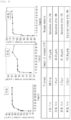
- the degree of decomposition of the multi-layer film which was not subjected to the cross-linking was 30% or less, but the degree of decomposition of the multi-layer film which was subjected to the cross-linking was 10% or less, and thus the decomposition of the multi-layer film was reduced by the cross-linking ( FIG. 3 ). This may mean that the effect of the multi-layer film may be maintained for a long period of time, particularly during the process of preparing cultured meat.
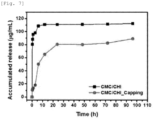
- the portion in which C-PC can be incorporated not only increases, but also the formation of small-sized pores in the multi-layer thin film may be promoted by cross-linking, thereby increasing the final amount of C-PC released. Since the increase in the film thickness promotes the formation of small pores in the film, the rate of increase in release was measured to be higher than the rate of increase in thickness. There was a significant difference in the tendency of C-PC released according to a precursor layer/core layer/out-layer of the multi-layer film.
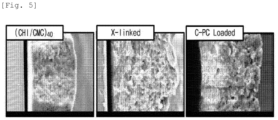
- the internal shape of the multi-layer film Due to the chain reassembly by the cross-linking, the internal shape of the multi-layer film has an increase in porosity and exhibits rough characteristics, and thus the area in which C-PC can be incorporated inside the multi-layer film is increased, thereby increasing the loading amount.
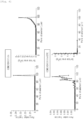
- the cross-linked (CMC/CHI) 40 film has an apparent pore structure and has a porosity of about 18% with respect to the whole, and the total porosity was reduced to about 5.8% after loading C-PC into the pores ( FIGS. 6 and Table 1 ).
- the C-PC incorporated multi-layer film sample was prepared according to the method described in Example 1, by preparing a 40 BL multi-layer film using an OHP film as a substrate, and then incorporating C-PC. It was observed that the color of the film was also blue due to the incorporation of the blue-colored C-PC ( FIG. 8 ).
- C2C12 cells were cultured for 7 days in control groups and an experimental groups, respectively.
- C2C12 myoblasts (Passage 6) was seeded into each well of a 24 well-plate at 3.5 ⁇ 10 3 each.
- the culture was performed using a culture medium in which 1% penicillin/streptomycin antibiotic (Gibco ® Life Technologies) and 10% or 5% FBS (WELGENE) are contained in Dulbecco's Modified Eagle Medium (DMEM, Gibco ® Life Technologies).
- DMEM Dulbecco's Modified Eagle Medium
- Control group 1 was cultured using a culture medium (FBS 10%) containing 10% FBS
- Control group 2 was cultured using a culture medium (FBS 5%) containing 5% FBS
- Experimental group 1 was cultured using a culture medium (Film_CPC) prepared by adding a multi-layer film, in which C-PC was incorporated, to a culture medium containing 5% FBS
- Experimental group 2 was cultured using a culture medium (Capping_CPC) prepared by adding a multi-layer film, in which C-PC was incorporated and to which an agarose capping layer was applied, to a culture medium containing 5% FBS
- Experimental group 3 was cultured using a culture medium (Exo_CPC) in which C-PC was added to a 5% FBS culture medium at a concentration of 100 ⁇ g/mL.
- the Film_CPC group showed a cell proliferation degree that was almost similar to that of the FBS 10% group, and it was observed that the Capping_CPC group to which the agarose capping layer was applied had a cell proliferation degree higher than the FBS 10% group ( FIG. 9 ).
- FBS can be reduced by the multi-layer film of the present application. It is thought that these resulted from that the agarose, which is a saccharide component, improves the thermal stability of C-PC and at the same time inhibits the burst release from the multi-layer film.
Landscapes
- Health & Medical Sciences (AREA)
- Life Sciences & Earth Sciences (AREA)
- Engineering & Computer Science (AREA)
- Chemical & Material Sciences (AREA)
- Bioinformatics & Cheminformatics (AREA)
- Organic Chemistry (AREA)
- Wood Science & Technology (AREA)
- Zoology (AREA)
- Genetics & Genomics (AREA)
- Biomedical Technology (AREA)
- Biotechnology (AREA)
- General Health & Medical Sciences (AREA)
- General Engineering & Computer Science (AREA)
- Microbiology (AREA)
- Biochemistry (AREA)
- Cell Biology (AREA)
- Sustainable Development (AREA)
- Rheumatology (AREA)
- Immunology (AREA)
- Molecular Biology (AREA)
- Clinical Laboratory Science (AREA)
- Food Science & Technology (AREA)
- Polymers & Plastics (AREA)
- Nutrition Science (AREA)
- Medicinal Chemistry (AREA)
- Mycology (AREA)
- Micro-Organisms Or Cultivation Processes Thereof (AREA)
- Apparatus Associated With Microorganisms And Enzymes (AREA)
Abstract
Description
- The present application relates to a multi-layer film including a nutrient material for cell culture, a method for preparing same, and a use of same.
- Cultured meat is artificial meat prepared through mass culture of cells without slaughter of livestock, and is prepared through an ethical and eco-friendly process, unlike actual meat that requires a process of breeding and slaughtering livestocks and a use of antibiotics. The process for preparing cultured meat is performed through the following process: First, muscle satellite cells are isolated from livestock, and then the isolated cells are mass-proliferated in a culture medium containing amino acids, vitamins, sugars, inorganic salts, minerals, and various growth factors in a bioreactor. The prepared cells are transferred to a specific support or differentiated into muscle tissues in the differentiated culture medium through self-assembly between cells.
- Although many companies around the world are challenging the cultured meat industry, it is difficult to commercialize the cultured meat due to the complex production process and high production costs. Since the cost of the culture medium used in the mass proliferation process of muscle cells isolated from livestock accounts for at least 70% of the total production cost of cultured meat, research for reducing the cost of the culture medium is an indispensable factor. The conventional culture used for cell proliferation includes fetal bovine serum (FBS) containing various growth factors, cytokines, proteins, and the like essential for cell growth. However, since the use of animal-derived components is not suitable for the original purpose of cultured meat, there is a demand for developing a technology capable of excluding or reducing FBS.
- Molecular Pharmaceutics 2017, 14, 3322-3330.
-
Korean Patent Laid-open Publication No. 10-2014-0100671 - The present inventors have made efforts to develop a nutrient delivery platform capable of replacing or reducing animal-derived serum during cell culture for preparing cultured meat. As a result, the present inventors have proved experimentally that a cell proliferation effect superior to that of the serum-using culture medium can be achieved through the release of the nutrient materials by preparing a multi-layer film having pores from a polymer-derived material, incorporating nutrient materials in the pores of the prepared multi-layer film, and applying the resultant film in a cell culture medium, thereby completing the present application.
- Therefore, an aspect of the present application provides a multi-layer film for delivering nutrient materials during cell culture.
- In addition, another aspect of the present application provides a composition for cell culture including a multi-layer film.
- In addition, further another aspect of the present application provides an apparatus for cell culture including a multi-layer film.
- In addition, still another aspect of the present application provides a method for preparing cultured meat, the method including bringing a multi-layer film into contact with a cell culture medium containing cells.
- In addition, yet another aspect of the present application provides a method for reducing serum components in a cell culture medium, the method including bringing a multi-layer film into contact with a cell culture medium containing cells.
- In addition, still yet another aspect of the present application provides a method for preparing a multi-layer film for delivering nutrient materials during cell culture.
- In order to accomplish the object of the invention,
according to an aspect of the present application, there is provided a multi-layer film for cell culture including a substrate, and a multi-layer structure formed on the substrate. - According to another aspect of the present application, there is provided a composition for cell culture including the multi-layer film.
- According to further another aspect of the present application, there is provided an apparatus for cell culture including the multi-layer film.
- According to still another aspect of the present application, there is provided a method for preparing cultured meat, the method including bringing a multi-layer film into contact with a cell culture medium containing cells.
- According to yet another aspect of the present application, there is provided a method for reducing serum components in a cell culture medium, the method including bringing a multi-layer film into contact with a cell culture medium containing cells.
- According to still yet another aspect of the present application, there is provided a method for preparing a multi-layer film for cell culture.
- Hereinafter, the present application will be described in detail.
- According to an aspect, the present application provides a multi-layer film for cell culture including: (a) a substrate; and (b) a multi-layer structure which is formed by alternately stacking, on the substrate, a cationic material having an amine group in the side chain thereof, and an anionic material having a carboxyl group in the side chain thereof, and contains pores, and in which the cationic material and the anionic material are cross-linked to each other.
- The substrate which may be used in the present application may be used without limitation in the case where the substrate has supporting characteristics and at the same time, an anionic material having a carboxyl group in the side chain thereof or a cationic material having an amine group in the side chain thereof can be bonded to be stacked on the substrate.
- Materials that may be used as the substrate may be polymers, plastics (e.g., polystyrene, polyethylene, polypropylene, etc.), metals, metal oxides, silicone, ceramics, Si/SiO2 wafers, glass, carbon, carbon nanotubes, or biodegradable polymers, but are not limited thereto.
- The substrate may be surface-treated to facilitate bonding with a cationic material or an anionic material, which will be described later.
- The shape of the substrate is not particularly limited, but may be in the form of an incubator, a culture dish, a plate, a flask, a chamber slide, a tube, a cell factory, a roller bottle, a spinner flask, hollow fibers, a micro-carrier, beads, a fragment, and the like, considering that the multi-layer film of the present application is applied to cell culture.
- The multi-layer structure herein is formed by alternately stacking an anionic material having a carboxyl group in the side chain thereof and a cationic material having an amine group in the side chain thereof on the substrate.
- The anionic material may be attached to the surface of the positively charged substrate, and the cationic material may be attached to the surface of the negatively charged substrate. Accordingly, when the substrate is negatively charged, the cationic material may form a first layer, and when the substrate is positively charged, the anionic material may form a first layer.
- In the present application, the cationic material having an amine group in the side chain thereof may be bonded to the substrate to form a first layer.
- In an embodiment, the cationic material having an amine group in the side chain thereof may be dissolved in a solution to be contact with the surface of the substrate, thereby forming the first layer. The degree of ionization of the cationic material, that is, the degree of protonation may be controlled by adjusting the pH of the solution to a predetermined range. When the pH of the solution is adjusted to a range of 3-5, at least 50%, at least 60%, at least 70%, at least 80%, or at least 90% of the amine group of the cationic material may be protonated. The protonated amine group (-NH3+) may be bonded to a deprotonated carboxyl group (-COO-) of the anionic material having a carboxyl group in the side chain thereof by electrostatic attraction. A multi-layer structure may be formed by electrostatic attraction between the cationic material and the anionic material.
- The cationic material having an amine group in the side chain thereof may be any one selected from the group consisting of chitosan, gelatin, collagen, fibrinogen, silk fibroin, casein, elastin, laminin, fibronectin, polydopamine, polyethyleneimine, poly-l-lysine, poly(vinylamine)hydrochloride, and poly(amino acid).
- In the present application, the cationic material having an amine group in the side chain thereof may be chitosan.
- In the present application, the anionic material having a carboxyl group in the side chain thereof may be bonded on the first layer to form a second layer.
- In an embodiment, the anionic material having a carboxyl group in the side chain thereof may be dissolved in a solution to be contact with the surface of the first layer of the cationic material to form a second layer.
- The degree of ionization of the anionic material, that is, the degree of deprotonation may be controlled by adjusting the pH of the solution to a predetermined range. When the pH of the solution is adjusted to a range of 3-5, at least 50%, at least 60%, at least 70%, at least 80%, or at least 90% of the carboxyl group may be deprotonated (-COO-).
- As described above, the deprotonated carboxyl group (-COO-) of the anionic material may be bonded to the protonated amine group (-NH3+) of the cationic material by electrostatic attraction, and the layer of the anionic material and the layer of the cationic material may be alternately stacked by the electrostatic attraction.
- The anionic material having a carboxyl group in the side chain thereof may be, for example, any one selected from the group consisting of hyaluronic acid, poly-l-lactic acid, alginic acid, dextran sulfate, lignin, tannic acid, chondroitin sulfate, cellulose-based polymers, fucoidan, and heparin, and the cellulose-based polymer may be carboxymethylcellulose.
- In the present application, the anionic material having a carboxyl group in the side chain thereof may be carboxymethylcellulose.
- In the present application, when the cationic material having an amine group in the side chain thereof is chitosan, the anionic material having a carboxyl group in the side chain thereof may be carboxymethylcellulose.
- When a process of stacking the first layer of the cationic material and the second layer of the anionic material is referred to as one cycle of stack process, the one cycle of stack process may be repeated twice or more to form a multi-layer structure.
- Meanwhile, when the substrate is positively charged, an anionic material may be stacked as a first layer on the substrate, a cationic material may be coated on the surface of the first layer to be stacked as a second layer, and in a similar manner, when a process of stacking the first layer of the anionic material and the second layer of the cationic material is referred to as one cycle of stack process, the one cycle of stack process may be repeated twice or more to form a multi-layer structure.
- In the present application, a layer including the first layer of the cationic material and the second layer of the anionic material, or the first layer of the anionic material and the second layer of the cationic material may be referred to as "1 bilayer (BL)" as one unit.
- The thickness of the multi-layer structure may be controlled by adjusting the number of repetitions of the 1 BL stack process, and a person skilled in the art may appropriately adjust the number of repetitions of the stack process according to application conditions of the multi-layer film.
- In the present application, one cycle of stack process forming 1 BL may be performed, for example, in the range of 10-70 times, 12-68 times, 14-66 times, 16-64 times, 18-62 times, 20-60 times, 22-58 times, 24-56 times, 26-54 times, 28-52 times, 30-50 times, 32-48 times, 34-46 times, or 36-44 times.
- In the present application, the thickness of the multi-layer structure may also be expressed as the number of the BL, and for example, when the stack process is repeated 10-70 times, a multi-layer structure having a thickness of 10-70 BLs may be formed.
- In an embodiment, the thickness of the multi-layer structure may be 10-70 BLs, 12-68 BLs, 14-66 BLs, 16-64 BLs, 18-62 BLs, 20-60 BLs, 22-58 BLs, 24-56 BLs, 26-54 BLs, 28-52 BLs, 30-50 BLs, 32-48 BLs, 34-46 BLs, or 36-44 BLs.
- In the present application, the cationic material and the anionic material may be cross-linked to each other.
- In the present application, the cationic material and the anionic material forming the multi-layer structure can form an amide bond by reacting a non-protonated amine group (-NH2) and a non-deprotonated free carboxyl group (-COOH), in each of the cationic and anionic materials, with each other, and the cationic material layer and the anionic material layer can be cross-linked by the amide bond.
- The cross-linking may be performed in the presence of a cross-linking agent, and for example, the cross-linking may be performed by sequentially supporting a first cross-linking agent including 1-ethyl-3-(3-(dimethylamino)propyl)carbodiimide hydrochloride (EDC) and N-hydroxysulfosuccinimide (NHS), and a second cross-linking agent including glutaraldehyde.
- Pores may be formed in the multi-layer structure by the cross-linking.
- The size, roughness or porosity of pores formed in the multi-layer structure may be controlled by adjusting the concentration of the cross-linking agent and the reaction time of the cross-linking reaction during the cross-linking.
- In addition, the porosity of pores may be controlled by adjusting not only the cross-linking reaction but also the thickness of the multi-layer structure.
- In an embodiment, the multi-layer structure after the cross-linking may have a porosity in a range of 10-26%, 11-25%, 12-24%, 13-23%, 14-22%, 15-21%, or 16-20%. In an embodiment, the multi-layer structure after the cross-linking may have a degree of cross-linking of 50-80%, 52-78%, 54-76%, 56-74%, 58-72%, or 60-70%.
- In an embodiment, the multi-layer structure after the cross-linking may have a degree of degradation of 10% or less in the physiological artificial saliva environment. This may maintain the effect of the multi-layer film for a long period of time in the process for preparing cultured meat.
- In an embodiment, for the pore size of the multi-layer structure, the average size of the pores on the surface of the multi-layer structure is greater than the average size of the pores inside the multi-layer structure.
- In the present application, nutrient materials for cell culture may be incorporated into the pores of the multi-layer structure. Accordingly, the multi-layer film for cell culture of the present application may further include the nutrient materials for cell culture incorporated in the multi-layer structure.
- The incorporation of the nutrient materials into the pores may be performed, for example, by bringing the solution containing nutrient materials into contact with the multi-layer structure.
- Since the nutrient materials for cell culture are incorporated into the pores of the multi-layer structure, the nutrient materials may have a molecular weight of 30 kDa or less in consideration of the size of the pores.
- The nutrient materials for cell culture include hormones, growth factors, amino acids, or vitamins, and may be, for example, C-phycocyanin; growth factors selected from the group consisting of IGF-1, BMP-2, and FGF-1; amino acids; or ascorbic acid, but are not limited thereto.
- The nutrient materials may be sufficiently incorporated into the pores on the surface of the multi-layer structure as well as the pores inside the multi-layer structure.
- In an embodiment, a capping layer may be further formed on the above-described multi-layer structure. The capping layer may be formed on the outermost layer of the multi-layer structure.
- The capping layer may be formed, for example, by bringing a solution containing a material capable of constituting the capping layer into contact with the multi-layer structure in which nutrient materials are incorporated.
- The capping layer stabilizes the nutrient materials for cell culture incorporated into the pores, inhibits decomposition, and inhibits burst release.
- The capping layer may be formed of polysaccharides, which may be, for example, selected from the group consisting of agarose, carageenan, fucoidan, laminaran, cellulose, hemicellulose, and lignan.
- In the present application, when the nutrient material for cell culture is C-phycocyanin, the capping layer may be a capping layer of agarose.
- In the present application, the thickness of the multi-layer film may be 0.1-10 um, more specifically 0.2-9 um, 0.3-8.5 um, 0.5-8.5 um, 0.8-8.5 µm, 1.0-8.0 µm, 1.2-8.0 um, 2.0-8.0 µm, 2.5-7.5 µm, 2.5-7.0 um, 2.5-6.5 µm, 2.7-6.0 um, or 3.0-6.0 um.
- In an embodiment, the multi-layer film of the present application may be used for cell culture purposes.
- According to another aspect, the present application provides a composition for cell culture, the composition containing the above-described multi-layer film and serum components.
- In an embodiment, the serum component content may be less than 10 wt% in the composition for cell culture, and specifically less than 9 wt%, less than 8 wt%, less than 7 wt%, less than 6 wt%, less than 5 wt%, or less than 4 wt%.
- The lower limit of the serum component content may be 0.001 wt%, 0.01 wt%, or 0.1 wt% in the composition for cell culture. In an embodiment, the composition for cell culture may be, for example, a medium for cell culture containing the above-described multi-layer film.
- In an embodiment, the serum component content may be less than 10 wt%, more specifically less than 9 wt%, less than 8 wt%, less than 7 wt%, less than 6 wt%, less than 5 wt%, or less than 4 wt% in the medium for cell culture.
- The lower limit of the serum component content may be 0.001 wt%, 0.01 wt%, or 0.1 wt% in the medium for cell culture.
- In another embodiment, the serum component may be fetal bovine serum, and the fetal bovine serum content may be less than 10 wt%, more specifically less than 9 wt%, less than 8 wt%, less than 7 wt%, less than 6 wt%, less than 5 wt%, and less than 4 wt% in the medium for cell culture, and the lower limit of the fetal bovine serum content may be 0.001 wt%, 0.01 wt%, or 0.1 wt% in the medium for cell culture.
- Even through the composition of the present application contains the serum component having a content lower than 10 wt%, which is the content of serum components (e.g., fetal bovine serum) contained in a conventional cell culture medium, when the composition contains the above-described multi-layer film of the present application, cell proliferation, more specifically, equal or higher level of proliferation in muscle cell proliferation, is possible.
- In another embodiment, the cells may be cells for preparing cultured meat, and specifically, may be animal-derived muscle cells, and the muscle cells may include myoblast, muscle satellite cells, myotube cells, myotubes, myofibers, or mature myofibers.
- According to further another aspect, the present application provides an apparatus for cell culture including the above-described multi-layer film.
- In an embodiment, the apparatus for cell culture may be a cell culture dish provided with a multi-layer film, a cell culture plate, a cell culture container, or a cell incubator, but is not limited thereto. In another embodiment, the cells may be cells for preparing cultured meat, and specifically, may be animal-derived muscle cells, and the muscle cells may include myoblast, muscle satellite cells, myotube cells, myotubes, myofibers, or mature myofibers.
- According to still another aspect, the present application provides a method for preparing cultured meat, the method including bringing the above-described multi-layer film into contact with a cell culture solution containing cells.
- In an embodiment, the cells may be cells for preparing cultured meat, and specifically, may be animal-derived muscle cells, and the muscle cells may include myoblast, muscle satellite cells, myotube cells, myotubes, myofibers, or mature myofibers.
- According to yet another aspect, the present application provides a method for reducing serum components in a cell culture medium, the method including bringing the above-described multi-layer film into contact with a cell culture medium containing cells.
- In an embodiment, the serum component may be fetal bovine serum.
- In an embodiment, the serum component may be less than 10 wt%, more specifically less than 9 wt%, less than 8 wt%, less than 7 wt%, less than 6 wt%, less than 5 wt%, or less than 4 wt% in the cell culture medium.
- The lower limit of the serum component content may be 0.001 wt%, 0.01 wt%, or 0.1 wt% in the cell culture medium. Even through the composition of the present application contains the serum component having a content lower than 10 wt%, which is the content of serum components (e.g., fetal bovine serum) contained in a conventional cell culture medium, when the composition contains the above-described multi-layer film of the present application, cell proliferation, more specifically, equal or higher level of proliferation in muscle cell proliferation, is possible.
- In an embodiment, the cells may be cells for preparing cultured meat, and specifically, may be animal-derived muscle cells, and the muscle cells may include myoblast, muscle satellite cells, myotube cells, myotubes, myofibers, or mature myofibers.
- The description of the multi-layer film in the composition for cell culture, the apparatus for cell culture, the method for preparing cultured meat, and the method for reducing serum components are the same as those described in the multi-layer film, which is another aspect of the present application, and thus is not described in duplicate.
- According to still yet another aspect, the present application provides a method for preparing a multi-layer film for cell culture, the method including the following steps of:
- (a) preparing a first solution by adjusting the pH of a solution containing a cationic material having an amine group in the side chain thereof to a predetermined range, and preparing a second solution by adjusting the pH of a solution containing an anionic material having a carboxyl group in the side chain thereof to a predetermined range;
- (b) alternately contacting the first solution and the second solution on a substrate to alternately stack a layer of cationic material and a layer of anionic material to form a multi-layer structure; and
- (c) cross-linking cationic material and anionic material in the multi-layer structure.
- In an embodiment, the method may further include, after step (c), (d) a step of incorporating nutrient materials for cell culture in the pores formed by the cross-linking.
- In an embodiment, the first solution and the second solution may have a pH of 3-5.
- In another embodiment, the method may further include, after step (d), (e) a step of forming a capping layer on the multi-layer structure.
- In the method for preparing a multi-layer film for cell culture of the present application, the description of the multi-layer film is the same as that described in the multi-layer film, which is another aspect of the present application, and thus is not described in duplicate.
- According to the multi-layer film of the present application, nutrient materials necessary for cell culture can be delivered stably.
- According to the multi-layer film of the present application, the problems of ethics, high costs, and causing diseases can be solved due to the use of nutrient materials which can replace animal-derived serum.
- The size, roughness, or porosity of pores inside the multi-layer structure of the multi-layer film of the present application can be easily adjusted, thereby controlling the amount of nutrient materials incorporated, the amount of nutrient materials released, and the speed of nutrient materials released.
- By providing the capping layer on the outermost layer of the multi-layer structure of the multi-layer film in the present application, the initial burst release of the incorporated nutrient materials can be controlled, and the stabilization of the nutrient materials can be improved.
- However, the effects of the present application are not limited to the above-mentioned effects and other effects not mentioned will be clearly understood from the following description by a person skilled in the art.
-
-
FIG. 1 shows a process of preparing a multi-layer film based on chitosan (CHI) and carboxymethylcellulose (CMC) by a layer-by-layer assembly (LbL assembly). -
FIG. 2 is a graph showing that the thickness of a multi-layer film increases according to the number of stacking CHI/CMC bilayer in the LbL assembly. -
FIG. 3 is a graph showing a decrease in the thickness of a multi-layer thin film according to exposure time in a physiological saliva environment. -
FIG. 4 shows the result that there is a difference in the released amount and release behavior of C-PC according to the thickness of the multi-layer film. -
FIG. 5 is an SEM observation image of a multi-layer film (CHI/CMC)40 sample before cross-linking, a multi-layer film (X-linked) sample after cross-linking, and a multi-layer film (C-PC Loaded) sample after C-PC incorporation. -
FIG. 6 is a graph showing the results of analyzing a change in porosity in a thin film after C-PC is incorporated inside a cross-linked multi-layer film. -
FIG. 7 is a graph showing the results of analyzing the C-PC release behavior of the film before and after the formation of the capping layer in the cross-linked multi-layer film. -
FIG. 8 is a photograph of a C-PC incorporated multi-layer film sample coated on an OHP film. -
FIG. 9 shows improvement in the proliferation of C2C12 cells (left graph) by a multi-layer film for C-PC delivery and cell counting results (right graph) by Cell Counting Kit-8 (CCK-8) analysis. - Hereinafter, the present application will be described in detail with reference to examples. However, the following examples specifically illustrate the present application, and the contents of the present application are not limited by the following examples.
- A polysaccharide-based multi-layer film was prepared by a layer-by-layer assembly (LbL assembly) using mutual attraction between materials constituting the layers (
FIG. 1 ). - First, an aqueous solution of chitosan (CHI, Sigma-Aldrich) having a concentration of 1 mg/mL and an aqueous solution of carboxymethylcellulose (CMC, Sigma-Aldrich) having a concentration of 1 mg/mL were prepared, and the pH of the aqueous solutions was adjusted to 4 using 1M NaOH and 1M HCl (step 1). Chitosan and carboxymethylcellulose are present in the pH 4 aqueous solution with at least 80% thereof ionized. Subsequently, an oxygen plasma-treated substrate (Si-wafer) was prepared, supported on an aqueous solution of chitosan positively charged for 15 minutes, and then washed twice in tertiary distilled water (step 2). Subsequently, the substrate was supported in an aqueous solution of carboxymethylcellulose negatively charged for 10 minutes, and then washed twice in tertiary distilled water (step 3).
- The CHI/CMC layer was formed by electrostatic attraction between chitosan and carboxymethylcellulose in the above-described steps 2 and 3, and the above-described steps 2 and 3 were repeated to prepare a CHI/CMC multi-layer film. The film prepared by repeating one cycle of the steps 2 and 3 is referred to as a 1 bilayer (BL) film, and as the number of repeating cycles increases, a film having a higher number of BLs was formed (
FIG. 2 ). As shown inFIG. 2 , an increase in the thickness of the film from 3 BLs to 19 BLs was confirmed, and a relatively linear growth pattern was observed between the number of stacks and the thickness of the multi-layer thin film, and the thickness of 19 BLs was measured to be about 1.8 µm. - In order to incorporate C-phycocyanin (C-PC), which is a nutrient material, in the prepared multi-layer film, cross-linking was introduced to the multi-layer film to impart porosity. The substrate coated with the multi-layer film was allowed to stand in a cross-linking solution containing 0.2 M of 1-ethyl-3-(3-dimethylaminopropyl)carbodiimide hydrochloride (EDC) and 5 mM of N-hydroxysuccinimide (NHS) in 0.05 M of a 2-(N-morpholino)ethanesulfonic acid (MES) buffer solution for 30 minutes to perform primary cross-linking and then washed with 1X PBS (step 4). Subsequently, the primarily cross-linked multi-layer film was further rinsed with distilled water and left in a 2.5% glutaraldehyde (Sigma-Aldrich) solution for 45 minutes without a drying process to perform secondary cross-linking (step 5). After the cross-linked multi-layer film was added to 2 mg/mL of an aqueous C-PC (Sigma-Aldrich) solution, incubation was performed in a dark environment for 12 hours to induce incorporation of C-PC into the porous multi-layer film (step 6).
- After the incorporation of C-PC, in order to prevent the initial burst release of C-PC, an agarose solution (0.25 w/v%) was applied on the surface of the multi-layer film to form a capping layer (step 7).
- An analysis of the multi-layer characteristics was performed as follows: The change in mass per unit area was measured by measuring changes in frequency of a quartz crystal microbalance (QCM) device in the process of preparing the coating using an electrode for QCM as a coating substrate by means of the QCM, and the total mass of each material forming the multi-layer film was calculated from the measured change in mass per unit area. The thickness of the multi-layer film was measured using a profilometer, and the porosity, pore size, and volume of the multi-layer film were analyzed using a porosimeter. SEM was used to observe the roughness and porous fine shape of the multi-layer film. The release analysis of nutrient materials was performed by detecting C-PC released from the multi-layer film with photoluminescence spectroscopy (PL) to quantify the release amount over time and analyze the release behavior. C-PC released from the multi-layer film was detected through a micro reader, the release amount over time was quantified and the release behavior was analyzed.
- The effect of inhibiting the decomposition of the multi-layer film by cross-linking in the multi-layer film was confirmed by measuring the thickness reduction rate. In the physiological artificial saliva environment, the degree of decomposition of the multi-layer film which was not subjected to the cross-linking was 30% or less, but the degree of decomposition of the multi-layer film which was subjected to the cross-linking was 10% or less, and thus the decomposition of the multi-layer film was reduced by the cross-linking (
FIG. 3 ). This may mean that the effect of the multi-layer film may be maintained for a long period of time, particularly during the process of preparing cultured meat. - As the thickness of the multi-layer thin film increases, the portion in which C-PC can be incorporated not only increases, but also the formation of small-sized pores in the multi-layer thin film may be promoted by cross-linking, thereby increasing the final amount of C-PC released. Since the increase in the film thickness promotes the formation of small pores in the film, the rate of increase in release was measured to be higher than the rate of increase in thickness. There was a significant difference in the tendency of C-PC released according to a precursor layer/core layer/out-layer of the multi-layer film. That is, as a result of observing the release behavior of C-PC, a burst release due to the diffusion of C-PC from the surface was initially shown, followed by the release due to the C-PC diffusion from the small pores inside the film, which is smaller than the pore size of the film surface. At least 100 ug/mL of C-PC was released from the 40 BL film, and this release amount was identified as the most effective concentration for long-term proliferation and differentiation of C2C12 cells (
FIG. 4 ). - Due to the chain reassembly by the cross-linking, the internal shape of the multi-layer film has an increase in porosity and exhibits rough characteristics, and thus the area in which C-PC can be incorporated inside the multi-layer film is increased, thereby increasing the loading amount. After loading C-PC on the cross-linked multi-layer film, it was observed that pores inside the film were covered by C-PC (
FIG. 5 ). The cross-linked (CMC/CHI)40 film has an apparent pore structure and has a porosity of about 18% with respect to the whole, and the total porosity was reduced to about 5.8% after loading C-PC into the pores (FIGS. 6 and Table 1). A sharp decrease in the intra-particle porosity (%) indicates that C-PC has been incorporated up to the inside of the film.[Table 1] Total interparticle porosity (%) Total intraparticle porosity (%) Total porosity (%) (CMC/CHI) film 8.6018 8.4423 18.0442 (CMC/CHI) film/CPC 5.5061 1.3827 5.887 - It can be confirmed that the burst release of C-PC was inhibited by the capping layer, and continuous release of C-PC occurred until 96 hours (
FIG. 7 ). Therefore, it has been suggested that a method of physically inhibiting the release using the capping layer may be effective in order to prevent the burst release that occurs initially. - Cell proliferation effects were evaluated by applying the C-PC incorporated multi-layer film to cell culture. The C-PC incorporated multi-layer film sample was prepared according to the method described in Example 1, by preparing a 40 BL multi-layer film using an OHP film as a substrate, and then incorporating C-PC. It was observed that the color of the film was also blue due to the incorporation of the blue-colored C-PC (
FIG. 8 ). - In order to confirm the effect of enhancing the proliferation of C2C12 myoblasts by the multi-layer film for C-PC delivery, C2C12 cells were cultured for 7 days in control groups and an experimental groups, respectively. C2C12 myoblasts (Passage 6) was seeded into each well of a 24 well-plate at 3.5 × 10³ each. The culture was performed using a culture medium in which 1% penicillin/streptomycin antibiotic (Gibco® Life Technologies) and 10% or 5% FBS (WELGENE) are contained in Dulbecco's Modified Eagle Medium (DMEM, Gibco® Life Technologies).
-
Control group 1 was cultured using a culture medium (FBS 10%) containing 10% FBS, Control group 2 was cultured using a culture medium (FBS 5%) containing 5% FBS,Experimental group 1 was cultured using a culture medium (Film_CPC) prepared by adding a multi-layer film, in which C-PC was incorporated, to a culture medium containing 5% FBS, Experimental group 2 was cultured using a culture medium (Capping_CPC) prepared by adding a multi-layer film, in which C-PC was incorporated and to which an agarose capping layer was applied, to a culture medium containing 5% FBS, and Experimental group 3 was cultured using a culture medium (Exo_CPC) in which C-PC was added to a 5% FBS culture medium at a concentration of 100 µg/mL. As a result of the experiments, the Film_CPC group showed a cell proliferation degree that was almost similar to that of theFBS 10% group, and it was observed that the Capping_CPC group to which the agarose capping layer was applied had a cell proliferation degree higher than theFBS 10% group (FIG. 9 ). Through this, it may be confirmed that FBS can be reduced by the multi-layer film of the present application. It is thought that these resulted from that the agarose, which is a saccharide component, improves the thermal stability of C-PC and at the same time inhibits the burst release from the multi-layer film. - Although the representative embodiments of the present application have been exemplarily described, the scope of the present application is not limited to the specific embodiments as described above, and a person skilled in the art can change the present application within the scope described in the claims of the present application.
Claims (22)
- A multi-layer film for cell culture comprising:(a) a substrate; and(b) a multi-layer structure which is formed by alternately stacking, on the substrate, a cationic material having an amine group in the side chain thereof, and an anionic material having a carboxyl group in the side chain thereof, and contains pores, and in which the cationic material and the anionic material are cross-linked to each other.
- The multi-layer film of claim 1, further comprising nutrient materials for cell culture which are incorporated into the pores of the multi-layer structure.
- The multi-layer film of claim 1, wherein the cationic material having an amine group in the side chain thereof is one selected from the group consisting of chitosan, gelatin, collagen, fibrinogen, silk fibroin, casein, elastin, laminin, fibronectin, polydopamine, polyethyleneimine, poly-l-lysine, poly(vinylamine)hydrochloride, and poly(amino acid).
- The multi-layer film of claim 1, wherein the anionic material having a carboxyl group in the side chain thereof is one selected from the group consisting of hyaluronic acid, poly-l-lactic acid, alginic acid, dextran sulfate, lignin, tannic acid, chondroitin sulfate, cellulose-based polymers, fucoidan, and heparin.
- The multi-layer film of claim 1, further comprising a capping layer formed on the multi-layer structure.
- The multi-layer film of claim 5, wherein the capping layer is prepared by polysaccarides.
- The multi-layer film of claim 6, wherein the polysaccarides is selected from the group consisting of agarose, carageenan, fucoidan, laminaran, cellulose, hemicellulose, and lignan.
- The multi-layer film of claim 2, wherein the nutrient material for cell culture is C-phycocyanin; growth factors selected from the group consisting of IGF-1, BMP-2, and FGF-1; amino acids; or ascorbic acid.
- The multi-layer film of claim 1, wherein the multi-layer film has a thickness of 0.1-10 µm.
- The multi-layer film of claim 1, wherein the multi-layer structure has a bilayer (BL), which is a stack unit comprising a layer of cationic material and a layer of anionic material, and the BL is in the range of 10-70 BLs.
- The multi-layer film of claim 1, wherein the multi-layer structure has a porosity of 10-26%.
- The multi-layer film of claim 1, wherein the multi-layer structure has a degree of cross-linking of 50-80%.
- A composition for cell culture comprising:(i) the multi-layer film of any one of claims 1 to 12; and(ii) serum components.
- The composition of claim 13, wherein the serum component content is less than 10 wt% in the composition for cell culture.
- An apparatus for cell culture comprising the multi-layer film of any one of claims 1 to 12.
- A method for preparing cultured meat comprising bringing the multi-layer film of any one of claims 1 to 12 into contact with a cell medium containing cells.
- The method of claim 16, wherein the cells are animal-derived muscle cells.
- A method for reducing serum components in a cell culture medium, the method comprising bringing the multi-layer film of any one of claims 1 to 12 into contact with the cell culture medium containing cells.
- A method for preparing a multi-layer film for cell culture comprising the steps of:(a) preparing a first solution by adjusting the pH of a solution containing a cationic material having an amine group in the side chain thereof to a predetermined range, and preparing a second solution by adjusting the pH of a solution containing an anionic material having a carboxyl group in the side chain thereof to a predetermined range;(b) alternately contacting the first solution and the second solution on a substrate to alternately stack a layer of cationic material and a layer of anionic material to form a multi-layer structure; and(c) cross-linking cationic material and anionic material in the multi-layer structure.
- The method of claim 19, further comprising, after step (c), (d) a step of incorporating nutrient materials for cell culture in the pores formed by the cross-linking.
- The method of claim 19, wherein the first solution and the second solution have a pH of 3-5.
- The method of claim 20, further comprising, after step (d), (e) a step of forming a capping layer on the multi-layer structure.
Applications Claiming Priority (2)
| Application Number | Priority Date | Filing Date | Title |
|---|---|---|---|
| KR1020200131409A KR102456325B1 (en) | 2020-10-12 | 2020-10-12 | Multi-Layered Film Containing Nutrient Materials for Cell Culture, Preparing Mehtod and Uses Thereof |
| PCT/KR2021/014023 WO2022080821A1 (en) | 2020-10-12 | 2021-10-12 | Multi-layer film comprising nutrient material for cell culture, method for preparing same, and use of same |
Publications (2)
| Publication Number | Publication Date |
|---|---|
| EP4227397A1 true EP4227397A1 (en) | 2023-08-16 |
| EP4227397A4 EP4227397A4 (en) | 2025-02-12 |
Family
ID=81208489
Family Applications (1)
| Application Number | Title | Priority Date | Filing Date |
|---|---|---|---|
| EP21880468.0A Pending EP4227397A4 (en) | 2020-10-12 | 2021-10-12 | MULTILAYER FILM COMPRISING NUTRIENT MATERIAL FOR CELL CULTURE, PREPARATION METHOD THEREFOR AND USE THEREOF |
Country Status (7)
| Country | Link |
|---|---|
| US (1) | US20230383260A1 (en) |
| EP (1) | EP4227397A4 (en) |
| JP (1) | JP7614346B2 (en) |
| KR (1) | KR102456325B1 (en) |
| CN (1) | CN116323900A (en) |
| IL (1) | IL301924A (en) |
| WO (1) | WO2022080821A1 (en) |
Cited By (1)
| Publication number | Priority date | Publication date | Assignee | Title |
|---|---|---|---|---|
| WO2025052161A1 (en) * | 2023-09-06 | 2025-03-13 | Iamfluidics Holding B.V. | Substrate and method |
Families Citing this family (3)
| Publication number | Priority date | Publication date | Assignee | Title |
|---|---|---|---|---|
| WO2025028927A1 (en) * | 2023-07-28 | 2025-02-06 | 한국화학연구원 | Cell scaffold for producing cultured meat and production method therefor |
| KR102850828B1 (en) | 2023-12-19 | 2025-08-25 | 경상국립대학교산학협력단 | Mass cell culture device of spinner flask |
| CN121136822A (en) * | 2025-11-19 | 2025-12-16 | 华中科技大学同济医学院附属同济医院 | A thin-film delayed-release glucose slow-release structure at the bottom of a culture dish and its usage method |
Family Cites Families (10)
| Publication number | Priority date | Publication date | Assignee | Title |
|---|---|---|---|---|
| JPS62278979A (en) * | 1986-05-28 | 1987-12-03 | Toa Nenryo Kogyo Kk | Culture of animal cell |
| JP2004189724A (en) * | 2002-11-29 | 2004-07-08 | Toray Ind Inc | Material containing physiologically active substance and method for producing the same |
| JP4084275B2 (en) * | 2003-10-06 | 2008-04-30 | 富士フイルム株式会社 | Cell culture carrier |
| JP2007215519A (en) * | 2006-02-20 | 2007-08-30 | Fujifilm Corp | Cell culture carrier |
| EP2679669A1 (en) * | 2012-06-26 | 2014-01-01 | ETH Zurich | Fabrication of three-dimensional hydrogel objects |
| KR101454299B1 (en) | 2013-02-07 | 2014-10-27 | 한국전기연구원 | Control Method of Stand-alone Microgrid using Inverter for ESS |
| CN107208025A (en) * | 2014-11-25 | 2017-09-26 | 康宁股份有限公司 | Continue the material and method of cell culture medium |
| US20200131472A1 (en) * | 2018-10-29 | 2020-04-30 | Mcmaster University | Constructs and methods for engineering complex cell systems |
| KR102173013B1 (en) * | 2018-11-08 | 2020-11-02 | 연세대학교 산학협력단 | A multi-layer film and a method for manufacturing the same |
| US20220071233A1 (en) * | 2018-12-21 | 2022-03-10 | Trustees Of Tufts College | In vitro insect muscle as a nutrition source |
-
2020
- 2020-10-12 KR KR1020200131409A patent/KR102456325B1/en active Active
-
2021
- 2021-10-12 IL IL301924A patent/IL301924A/en unknown
- 2021-10-12 JP JP2023522515A patent/JP7614346B2/en active Active
- 2021-10-12 US US18/031,415 patent/US20230383260A1/en active Pending
- 2021-10-12 WO PCT/KR2021/014023 patent/WO2022080821A1/en not_active Ceased
- 2021-10-12 EP EP21880468.0A patent/EP4227397A4/en active Pending
- 2021-10-12 CN CN202180069401.0A patent/CN116323900A/en active Pending
Cited By (1)
| Publication number | Priority date | Publication date | Assignee | Title |
|---|---|---|---|---|
| WO2025052161A1 (en) * | 2023-09-06 | 2025-03-13 | Iamfluidics Holding B.V. | Substrate and method |
Also Published As
| Publication number | Publication date |
|---|---|
| IL301924A (en) | 2023-06-01 |
| KR20220048352A (en) | 2022-04-19 |
| CN116323900A (en) | 2023-06-23 |
| KR102456325B1 (en) | 2022-10-20 |
| EP4227397A4 (en) | 2025-02-12 |
| US20230383260A1 (en) | 2023-11-30 |
| JP2023546394A (en) | 2023-11-02 |
| WO2022080821A1 (en) | 2022-04-21 |
| JP7614346B2 (en) | 2025-01-15 |
Similar Documents
| Publication | Publication Date | Title |
|---|---|---|
| US20230383260A1 (en) | Multi-Layer Film Comprising Nutrient Material for Cell Culture, Method for Preparing Same, and Use of Same | |
| Freier et al. | Chitin-based tubes for tissue engineering in the nervous system | |
| Yamanlar et al. | Surface functionalization of hyaluronic acid hydrogels by polyelectrolyte multilayer films | |
| Zahn et al. | Ion-induced cell sheet detachment from standard cell culture surfaces coated with polyelectrolytes | |
| Chen et al. | Surface modification of electrospun PLLA nanofibers by plasma treatment and cationized gelatin immobilization for cartilage tissue engineering | |
| Sadeghi et al. | Surface modification of electrospun PLGA scaffold with collagen for bioengineered skin substitutes | |
| Vllasaliu et al. | Tight junction modulation by chitosan nanoparticles: comparison with chitosan solution | |
| US8354501B2 (en) | Methods for stepwise deposition of silk fibroin coatings | |
| Kwok et al. | Self‐assembled molecular structures as ultrasonically‐responsive barrier membranes for pulsatile drug delivery | |
| Mandal et al. | Silk fibroin/gelatin multilayered films as a model system for controlled drug release | |
| da Câmara et al. | Novel cationic tannin/glycosaminoglycan-based polyelectrolyte multilayers promote stem cells adhesion and proliferation | |
| Reed et al. | Biological and mechanical characterization of chitosan‐alginate scaffolds for growth factor delivery and chondrogenesis | |
| US20140363890A1 (en) | Three-dimensional structures for cell or tissue culture | |
| US20250230277A1 (en) | Biological function composite porous polyester microspheres and preparation method therefor | |
| Bakaic et al. | Injectable and degradable poly (oligoethylene glycol methacrylate) hydrogels with tunable charge densities as adhesive peptide-free cell scaffolds | |
| Arnaldi et al. | Assembly of chitosan-graphite oxide nanoplatelets core shell microparticles for advanced 3D scaffolds supporting neuronal networks growth | |
| Ferreira et al. | Bioinspired porous membranes containing polymer nanoparticles for wound healing | |
| Naves et al. | Layer-by-Layer assembled growth factor reservoirs for steering the response of 3T3-cells | |
| KR102051983B1 (en) | Implant for inhibiting fibrosis and method for preparing thereof | |
| US10443034B2 (en) | Stem cells having thin multilayer structure | |
| Kim et al. | Collagen Immobilization on Ultra-thin Nanofiber Membrane to Promote In Vitro Endothelial Monolayer Formation | |
| Adala et al. | Mixed polymer and bioconjugate core/shell electrospun fibres for biphasic protein release | |
| Chen et al. | Synthesis of novel chitosan/sodium hyaluronate/iridium hydrogel nanocomposite for wound healing application | |
| EP3993843A1 (en) | Multi-layered cell capsules and uses thereof | |
| Liu et al. | Layer‐by‐layer assembly of biomacromolecules on poly (ethylene terephthalate) films and fiber fabrics to promote endothelial cell growth |
Legal Events
| Date | Code | Title | Description |
|---|---|---|---|
| STAA | Information on the status of an ep patent application or granted ep patent |
Free format text: STATUS: THE INTERNATIONAL PUBLICATION HAS BEEN MADE |
|
| PUAI | Public reference made under article 153(3) epc to a published international application that has entered the european phase |
Free format text: ORIGINAL CODE: 0009012 |
|
| STAA | Information on the status of an ep patent application or granted ep patent |
Free format text: STATUS: REQUEST FOR EXAMINATION WAS MADE |
|
| 17P | Request for examination filed |
Effective date: 20230407 |
|
| AK | Designated contracting states |
Kind code of ref document: A1 Designated state(s): AL AT BE BG CH CY CZ DE DK EE ES FI FR GB GR HR HU IE IS IT LI LT LU LV MC MK MT NL NO PL PT RO RS SE SI SK SM TR |
|
| P01 | Opt-out of the competence of the unified patent court (upc) registered |
Effective date: 20230824 |
|
| DAV | Request for validation of the european patent (deleted) | ||
| DAX | Request for extension of the european patent (deleted) | ||
| A4 | Supplementary search report drawn up and despatched |
Effective date: 20250113 |
|
| RIC1 | Information provided on ipc code assigned before grant |
Ipc: A23L 33/10 20160101ALI20250107BHEP Ipc: A23L 13/00 20160101ALI20250107BHEP Ipc: C12N 11/12 20060101ALI20250107BHEP Ipc: C12N 11/10 20060101ALI20250107BHEP Ipc: C12N 5/077 20100101ALI20250107BHEP Ipc: C12N 5/00 20060101ALI20250107BHEP Ipc: C12M 1/00 20060101ALI20250107BHEP Ipc: C12M 1/12 20060101AFI20250107BHEP |