EP4227270A1 - Cathode active material for lithium secondary battery and lithium secondary battery including the same - Google Patents
Cathode active material for lithium secondary battery and lithium secondary battery including the same Download PDFInfo
- Publication number
- EP4227270A1 EP4227270A1 EP23154268.9A EP23154268A EP4227270A1 EP 4227270 A1 EP4227270 A1 EP 4227270A1 EP 23154268 A EP23154268 A EP 23154268A EP 4227270 A1 EP4227270 A1 EP 4227270A1
- Authority
- EP
- European Patent Office
- Prior art keywords
- doping element
- active material
- secondary battery
- lithium secondary
- cathode active
- Prior art date
- Legal status (The legal status is an assumption and is not a legal conclusion. Google has not performed a legal analysis and makes no representation as to the accuracy of the status listed.)
- Pending
Links
Images

Classifications
-
- H—ELECTRICITY
- H01—ELECTRIC ELEMENTS
- H01M—PROCESSES OR MEANS, e.g. BATTERIES, FOR THE DIRECT CONVERSION OF CHEMICAL ENERGY INTO ELECTRICAL ENERGY
- H01M4/00—Electrodes
- H01M4/02—Electrodes composed of, or comprising, active material
- H01M4/36—Selection of substances as active materials, active masses, active liquids
- H01M4/48—Selection of substances as active materials, active masses, active liquids of inorganic oxides or hydroxides
- H01M4/52—Selection of substances as active materials, active masses, active liquids of inorganic oxides or hydroxides of nickel, cobalt or iron
- H01M4/525—Selection of substances as active materials, active masses, active liquids of inorganic oxides or hydroxides of nickel, cobalt or iron of mixed oxides or hydroxides containing iron, cobalt or nickel for inserting or intercalating light metals, e.g. LiNiO2, LiCoO2 or LiCoOxFy
-
- C—CHEMISTRY; METALLURGY
- C01—INORGANIC CHEMISTRY
- C01G—COMPOUNDS CONTAINING METALS NOT COVERED BY SUBCLASSES C01D OR C01F
- C01G53/00—Compounds of nickel
- C01G53/40—Complex oxides containing nickel and at least one other metal element
- C01G53/42—Complex oxides containing nickel and at least one other metal element containing alkali metals, e.g. LiNiO2
- C01G53/44—Complex oxides containing nickel and at least one other metal element containing alkali metals, e.g. LiNiO2 containing manganese
- C01G53/50—Complex oxides containing nickel and at least one other metal element containing alkali metals, e.g. LiNiO2 containing manganese of the type (MnO2)n-, e.g. Li(NixMn1-x)O2 or Li(MyNixMn1-x-y)O2
-
- C—CHEMISTRY; METALLURGY
- C01—INORGANIC CHEMISTRY
- C01G—COMPOUNDS CONTAINING METALS NOT COVERED BY SUBCLASSES C01D OR C01F
- C01G51/00—Compounds of cobalt
- C01G51/40—Complex oxides containing cobalt and at least one other metal element
- C01G51/42—Complex oxides containing cobalt and at least one other metal element containing alkali metals, e.g. LiCoO2
- C01G51/44—Complex oxides containing cobalt and at least one other metal element containing alkali metals, e.g. LiCoO2 containing manganese
-
- C—CHEMISTRY; METALLURGY
- C01—INORGANIC CHEMISTRY
- C01G—COMPOUNDS CONTAINING METALS NOT COVERED BY SUBCLASSES C01D OR C01F
- C01G53/00—Compounds of nickel
- C01G53/40—Complex oxides containing nickel and at least one other metal element
- C01G53/42—Complex oxides containing nickel and at least one other metal element containing alkali metals, e.g. LiNiO2
- C01G53/44—Complex oxides containing nickel and at least one other metal element containing alkali metals, e.g. LiNiO2 containing manganese
-
- H—ELECTRICITY
- H01—ELECTRIC ELEMENTS
- H01M—PROCESSES OR MEANS, e.g. BATTERIES, FOR THE DIRECT CONVERSION OF CHEMICAL ENERGY INTO ELECTRICAL ENERGY
- H01M10/00—Secondary cells; Manufacture thereof
- H01M10/05—Accumulators with non-aqueous electrolyte
- H01M10/052—Li-accumulators
-
- H—ELECTRICITY
- H01—ELECTRIC ELEMENTS
- H01M—PROCESSES OR MEANS, e.g. BATTERIES, FOR THE DIRECT CONVERSION OF CHEMICAL ENERGY INTO ELECTRICAL ENERGY
- H01M10/00—Secondary cells; Manufacture thereof
- H01M10/05—Accumulators with non-aqueous electrolyte
- H01M10/052—Li-accumulators
- H01M10/0525—Rocking-chair batteries, i.e. batteries with lithium insertion or intercalation in both electrodes; Lithium-ion batteries
-
- H—ELECTRICITY
- H01—ELECTRIC ELEMENTS
- H01M—PROCESSES OR MEANS, e.g. BATTERIES, FOR THE DIRECT CONVERSION OF CHEMICAL ENERGY INTO ELECTRICAL ENERGY
- H01M4/00—Electrodes
- H01M4/02—Electrodes composed of, or comprising, active material
- H01M4/13—Electrodes for accumulators with non-aqueous electrolyte, e.g. for lithium-accumulators; Processes of manufacture thereof
- H01M4/131—Electrodes based on mixed oxides or hydroxides, or on mixtures of oxides or hydroxides, e.g. LiCoOx
-
- H—ELECTRICITY
- H01—ELECTRIC ELEMENTS
- H01M—PROCESSES OR MEANS, e.g. BATTERIES, FOR THE DIRECT CONVERSION OF CHEMICAL ENERGY INTO ELECTRICAL ENERGY
- H01M4/00—Electrodes
- H01M4/02—Electrodes composed of, or comprising, active material
- H01M4/36—Selection of substances as active materials, active masses, active liquids
- H01M4/48—Selection of substances as active materials, active masses, active liquids of inorganic oxides or hydroxides
- H01M4/50—Selection of substances as active materials, active masses, active liquids of inorganic oxides or hydroxides of manganese
- H01M4/505—Selection of substances as active materials, active masses, active liquids of inorganic oxides or hydroxides of manganese of mixed oxides or hydroxides containing manganese for inserting or intercalating light metals, e.g. LiMn2O4 or LiMn2OxFy
-
- H—ELECTRICITY
- H01—ELECTRIC ELEMENTS
- H01M—PROCESSES OR MEANS, e.g. BATTERIES, FOR THE DIRECT CONVERSION OF CHEMICAL ENERGY INTO ELECTRICAL ENERGY
- H01M4/00—Electrodes
- H01M4/02—Electrodes composed of, or comprising, active material
- H01M4/62—Selection of inactive substances as ingredients for active masses, e.g. binders, fillers
- H01M4/628—Inhibitors, e.g. gassing inhibitors, corrosion inhibitors
-
- C—CHEMISTRY; METALLURGY
- C01—INORGANIC CHEMISTRY
- C01P—INDEXING SCHEME RELATING TO STRUCTURAL AND PHYSICAL ASPECTS OF SOLID INORGANIC COMPOUNDS
- C01P2002/00—Crystal-structural characteristics
- C01P2002/50—Solid solutions
- C01P2002/52—Solid solutions containing elements as dopants
-
- C—CHEMISTRY; METALLURGY
- C01—INORGANIC CHEMISTRY
- C01P—INDEXING SCHEME RELATING TO STRUCTURAL AND PHYSICAL ASPECTS OF SOLID INORGANIC COMPOUNDS
- C01P2006/00—Physical properties of inorganic compounds
- C01P2006/40—Electric properties
-
- H—ELECTRICITY
- H01—ELECTRIC ELEMENTS
- H01M—PROCESSES OR MEANS, e.g. BATTERIES, FOR THE DIRECT CONVERSION OF CHEMICAL ENERGY INTO ELECTRICAL ENERGY
- H01M4/00—Electrodes
- H01M4/02—Electrodes composed of, or comprising, active material
- H01M2004/021—Physical characteristics, e.g. porosity, surface area
-
- H—ELECTRICITY
- H01—ELECTRIC ELEMENTS
- H01M—PROCESSES OR MEANS, e.g. BATTERIES, FOR THE DIRECT CONVERSION OF CHEMICAL ENERGY INTO ELECTRICAL ENERGY
- H01M4/00—Electrodes
- H01M4/02—Electrodes composed of, or comprising, active material
- H01M2004/026—Electrodes composed of, or comprising, active material characterised by the polarity
- H01M2004/028—Positive electrodes
-
- Y—GENERAL TAGGING OF NEW TECHNOLOGICAL DEVELOPMENTS; GENERAL TAGGING OF CROSS-SECTIONAL TECHNOLOGIES SPANNING OVER SEVERAL SECTIONS OF THE IPC; TECHNICAL SUBJECTS COVERED BY FORMER USPC CROSS-REFERENCE ART COLLECTIONS [XRACs] AND DIGESTS
- Y02—TECHNOLOGIES OR APPLICATIONS FOR MITIGATION OR ADAPTATION AGAINST CLIMATE CHANGE
- Y02E—REDUCTION OF GREENHOUSE GAS [GHG] EMISSIONS, RELATED TO ENERGY GENERATION, TRANSMISSION OR DISTRIBUTION
- Y02E60/00—Enabling technologies; Technologies with a potential or indirect contribution to GHG emissions mitigation
- Y02E60/10—Energy storage using batteries
Definitions
- the present invention relates to a cathode active material for a lithium secondary battery and a lithium secondary battery including the same. More particularly, the present invention relates to a cathode active material containing lithium and nickel, and a lithium secondary battery including the same.
- a secondary battery which can be charged and discharged repeatedly has been widely employed as a power source of a mobile electronic device such as a camcorder, a mobile phone, a laptop computer, etc., according to developments of information and display technologies. Recently, a battery pack including the secondary battery is being developed and applied as an eco-friendly power source of an electric automobile, a hybrid vehicle, etc.
- the secondary battery includes, e.g., a lithium secondary battery, a nickelcadmium battery, a nickel-hydrogen battery, etc.
- the lithium secondary battery is highlighted due to high operational voltage and energy density per unit weight, a high charging rate, a compact dimension, etc.
- the lithium secondary battery may include an electrode assembly including a cathode, an anode and a separation layer (separator), and an electrolyte immersing the electrode assembly.
- the lithium secondary battery may further include an outer case having, e.g., a pouch shape for accommodating the electrode assembly and the electrolyte.
- a high-nickel (High-Ni)-based lithium oxide having an increased nickel content is used as a cathode active material for obtaining high capacity of the lithium secondary battery.
- the life-span and operation stability of the lithium secondary battery may be deteriorated due to a side reaction of the High-Ni-based lithium oxide with the electrolyte, a cation disorder caused when nickel ions are present at lithium ion sites, etc.
- Korean Registered Patent Publication No. 10-0821523 discloses a cathode active material including a high nickel-based lithium composite oxide, which may not provide sufficient life-span and operational stability.
- a cathode active material for a lithium secondary battery having improved operational stability and electrical property.
- a lithium secondary battery having improved operational stability and electrical property.
- a cathode active material for a lithium secondary battery includes a lithium-nickel composite metal oxide in which an oxidation number of nickel is 2.8 or more.
- the lithium-nickel composite metal oxide includes a first doping element having an oxidation number of +2 and a second doping element having an oxidation number of +4.
- a ratio of a molar ratio of the second doping element relative to a molar ratio of the first doping element is greater than 1 and less than 5.
- the first doping element may include at least one selected from the group consisting of Mg, Ca, Sr, Ba and Ra.
- the second doping element includes Ti or Zr.
- the lithium-nickel composite metal oxide may further include at least one additional doping element selected from the group consisting of B, Al, P, Si, V, Mo, Re, Sn and W.
- the lithium-nickel composite metal oxide may have a chemical structure represented by Chemical Formula 1 below.
- Chemical Formula 1 Li a Ni x Co y Mn z M2 d M4 e M' f O 2+b
- M2 represents the first doping element
- M4 represents the second doping element
- M' represents an additional doping element other than M2 and M4.
- Chemical Formula 1 0.0005 ⁇ d ⁇ 0.003 and 0.001 ⁇ e ⁇ 0.005.
- Chemical Formula 1 0 ⁇ d ⁇ 1.7((2x+3(x-z))z)/100.
- Chemical Formula 1 0 ⁇ e ⁇ 0.12((2x+3(x-z))/x)/100.
- Chemical Formula 1 0.05((2x+3(x-z))/x)/100 ⁇ e ⁇ 0.12((2x+3(x-z))/x)/100.
- the ratio of the molar ratio of the second doping element relative to the molar ratio of the first doping element may be in a range from 1.2 to 4.8.
- the ratio of the molar ratio of the second doping element relative to the molar ratio of the first doping element may be greater than 1, and less than or equal to 2 within a range of the oxidation number of nickel from 2.8 to 2.95.
- the ratio of the molar ratio of the second doping element relative to the molar ratio of the first doping element may be greater than 2 and less than 5, provided that the oxidation number of nickel exceeds 2.95.
- the ratio the molar ratio of the second doping element relative to the molar ratio of the first doping element may be greater than 2 and less than 3.5, provided that the oxidation number of nickel is greater than 2.95, and less than or equal to 2.98.
- the ratio of the molar ratio of the second doping element relative to the molar ratio of the first doping element may be greater than or equal to 3.5 and less than 5, provided that the oxidation number of nickel exceeds 2.98.
- the first doping element may include Sr.
- the first doping element may further include at least one element selected from among Mg, Ca, Ba and Ra.
- a molar ratio of Sr in the first doping element may be greater than or equal to a molar ratio of the at least one element in the first doping element.
- a lithium secondary battery includes a cathode including a cathode active material layer that includes the cathode active material for a lithium secondary battery according to the above-described embodiments, and an anode facing the cathode.
- a cathode active material for a lithium secondary battery according to embodiments of the present invention may have a high-nickel composition and include a doping element in a predetermined ratio. Mixing of nickel cations may be suppressed by the doping element, and chemical stability of the cathode active material at high temperature may be enhanced. Accordingly, high-capacity properties of the lithium secondary battery may be stably maintained at high temperature for a long period.
- the doping element may include a first doping element having a +2 valence and a second doping element having a +4 valence.
- the first doping element and the second doping element may be present together in a predetermined molar ratio, and structural stability and high-temperature capacity retention of the cathode active material may be improved without hindering a capacity improvement through the high-nickel composition.
- FIGS. 1 and 2 are a schematic plan view and a schematic cross-sectional view, respectively, illustrating a lithium secondary battery in accordance with exemplary embodiments.
- a cathode active material for a lithium secondary battery including a lithium-nickel composite metal oxide particle that has a high-nickel composition and contains a hetero-element other than nickel. Further, a lithium secondary battery including the cathode active material is provided.
- excess amount refers to being included in the largest content or molar ratio among metals other than lithium.
- content or “concentration” used herein may refer to a molar ratio or a mole fraction in lithium metal oxide.
- a cathode active material for a lithium secondary battery includes a lithium-nickel composite metal oxide containing lithium and nickel.
- the lithium-nickel composite metal oxide may further include an active material element other than nickel.
- the lithium-nickel composite metal oxide may contain nickel in the highest content among elements other than lithium.
- a molar ratio (or a mole fraction) of nickel relative to the total number of moles of elements other than lithium and oxygen may be 0.8 or more.
- the molar ratio of nickel may be 0.8 to 0.98, more preferably 0.83 to 0.98.
- the molar ratio of nickel may be 0.83 to 0.95.
- the active material element may include Co and/or Mn.
- Ni may be provided as a metal related to a capacity of the lithium secondary battery. Therefore, as described above, a high-Ni composition may be adopted to a lithium-nickel composite metal oxide particle as the cathode active material, so that the cathode and the lithium secondary battery providing high-capacity may be implemented, and a power may also be increased.
- Co may be included as an element of the active material, so that conductivity of the lithium-nickel composite metal oxide particle may be improved, and the power may be enhanced.
- Mn may be included as an element of the active material, so that chemical and thermal stability of the lithium-nickel composite metal oxide particle may be improved.
- the cathode active material may include particles including the lithium-nickel composite metal oxide.
- the amount of the particles based on a total weight of the cathode active material may be 50% by weight or more.
- the amount of the particles may be 60 wt% or more, 70 wt% or more, 80 wt% or more, or 90 wt% or more based on the total weight of the cathode active material
- the cathode active material may substantially consist of the particles.
- the cathode active material or the lithium-nickel composite metal oxide may include a first doping element having a +2 oxidation number and a second doping element having a +4 oxidation number.
- the first doping element may include at least one of Mg, Ca, Sr, Ba and Ra.
- the second doping element may include at least one of Ti and Zr.
- the cathode active material or the lithium-nickel composite metal oxide may further include an additional doping element other than the first doping element and the second doping element.
- the additional doping element may include B, Al, P, Si, V, Mo, Re, Sn or W. These may be used alone or in combination of two or more.
- the lithium-nickel composite metal oxide may include a layered structure or a chemical structure represented by Chemical Formula 1 below.
- Chemical Formula 1 Li a Ni x Co y Mn z M2 d M4 e M' f O 2+b
- M2 represents the first doping element of +2 oxidation number
- M4 represents the second doping element of +4 oxidation number
- M' represents the additional doping element.
- M2 may include at least one of Mg, Ca, Sr, Ba and Ra.
- M4 may include at least one of Ti and Zr.
- M' may include at least one of B, Al, P, Si, V, Mo, Re, Sn and W.
- Chemical Formula 1 0.0005 ⁇ d ⁇ 0.003, and 0.001 ⁇ e ⁇ 0.005.
- molar ratios (mole fractions) of M2 and M4 may be adjusted in a relation with molar ratios of Ni and Mn.
- the molar ratio (d) of the first doping element may be adjusted within a range defined in Equation 1 below. 0 ⁇ d ⁇ 1.7 2 x + 3 x ⁇ z z / 100
- the first doping element may be introduced within the range of Equation 1, so that deterioration due to an excessive doping of the first doping element as described later may be prevented.
- the molar ratio (d) of the first doping element may be adjusted within the range defined by Equation 1-1 below. 0.5 2 x + 3 x ⁇ z z / 100 ⁇ d ⁇ 1.7 2 x + 3 x ⁇ z z / 100 .
- the molar ratio (e) of the second doping element may be adjusted within the range defined by Equation 2 below. 0 ⁇ e ⁇ 0.12 2 x + 3 x ⁇ z / x / 100
- the second doping element may be introduced within the range of Equation 2, so that deterioration due to an excessive doping of the second doping element as described later may be prevented.
- the molar ratio (e) of the second doping element may be adjusted within the range defined by Equation 2-1 below. 0.05 2 x + 3 x ⁇ z / x / 100 ⁇ e ⁇ 0.12 2 x + 3 x ⁇ z / x / 100
- an oxidation number of nickel in the lithium-nickel composite metal oxide may be 2.8 or more.
- the oxidation number of nickel may be changed according to the molar ratios of nickel and manganese.
- the oxidation number of nickel may be expressed as (2z+3(x-z))/x
- the oxidation number of nickel close to +2 may be advantageous to a structural stability of the cathode active material, but may be disadvantageous for implementing a high capacity.
- the oxidation number of nickel in the lithium-nickel composite metal oxide according to exemplary embodiments may be 2.8 or more, preferably 2.88 or more, more preferably 2.9 or more. As the oxidation number of nickel approaches 3, structural and chemical defects of the active material may be easily caused, resulting in high-temperature instability.
- the first doping element having oxidation number of +2 may be inserted into a lithium layer of the cathode active material having a layered structure to suppress the cation mixing of nickel and stabilize the lithium layer.
- the second doping element having an oxidation number of +4 may be inserted into a transition metal layer of the cathode active material to improve structural stability. Further, an oxidation reaction in which some Ni +3 ions are transferred to Ni +4 ions during charging and discharging (lithium insertion/desorption) may be replaced with an oxidation reaction in which Ni +2 is converted to Ni +4 via Ni +3 to increase the capacity.
- an amount of lithium in the lithium layer in the cathode active material may be reduced or the insertion and desorption of lithium may be inhibited, thereby increasing a resistance of the cathode active material and reducing capacity.
- Ni +2 ions may form an irreversible structure in the form of NiO, or a cation mixing of Ni +2 ions into the lithium layer may occur.
- the molar ratios of M2 and M4 is adjusted in consideration of the molar ratios of Ni and Mn or the oxidation number, thereby improving the structural stability of the cathode active material without hindering the capacity improvement through the high-nickel composition.
- a ratio of the molar ratio of M4 to the molar ratio of M2 (hereinafter, may be abbreviated as M4/M2) may be greater than 1 and less than 5.
- the molar ratio of M4 may be adjusted to be higher than that of M2, so that structural stability of the transition metal layer may be further improved as described above, and thus high-temperature capacity stability may be efficiently achieved. Additionally, excessive increase of the molar ratio of M4 compared to that of M2 may be suppressed, thereby preventing structural instability/capacity reduction due to generation of the irreversible form of Ni ions.
- M4/M2 may be in a range from 1.2 to 4.8, or preferably from 1.2 to 4.7, more preferably from 1.2 to 4.
- the value of M4/M2 may also be adjusted as being relatively large.
- M4/M2 in the range of the oxidation number of nickel from 2.8 to 2.95, M4/M2 may be greater than 1 and less than or equal to 2.
- M4/M2 may be in a range from 1.2 to 2.0, more preferably from 1.2 to 1.9.
- M4/M2 may be greater than 2, and less than 5.
- M4/M2 may be in a range from 2.1 to 4.7, more preferably from 2.1 to 4, or from 2.1 to 3.5.
- M4/M2 may be greater than 2, and less than 3.5 when the oxidation number of nickel is greater than 2.95, and less than or equal to 2.98, and may be, e.g., in a range from 2.1 to 3.5.
- M4/M2 when the oxidation number of nickel exceeds 2.98, M4/M2 may be 3.5 or more, and less than 5, or in a range from 3.5 to 4.7.
- the doping amount of M4 may be relatively increased within the above-mentioned range to suppress or reduce the capacity reduction due to the doping while sufficiently achieving structural stability of the active material.
- M2 may include two or more different elements. As +2 valence elements of different ionic radii may be included, prevention of the cation mixing may be more effectively suppressed, and structural stability may be enhanced.
- M2 may include strontium (Sr).
- M2 may include Sr, and may further include at least one of Mg, Ca, Ba and Ra.
- M2 includes Sr and may include any one of Mg, Ca, Ba and Ra.
- a Group 2 element such as Mg, Ca, Sr, Ba, etc. may be doped into the cathode material and positioned in the lithium layer (Li slab).
- Sr has an ionic radius smaller than that of Mg and Ca, but greater than that of Ba.
- Sr having a relatively large ionic radius may be located on the surface of a particle or on a periphery of primary particles around a grain boundary without being deeply doped to an inside of the particle.
- deterioration of the cathode active material particles may be initiated from the surface.
- structures of the surface and the grain boundary may be further stabilized by doping Sr, and improved high-temperature stability may be provided.
- some of Sr components not doped into the cathode active material particles may remain at the grain boundary to serve as a binder, so that cracks between primary particles may be suppressed.
- a molar ratio of Sr in a total molar ratio of M2 may be greater than or equal to a molar ratio of elements other than Sr (e.g., Mg, Ca, Ba or Ra).
- active material metal sources may be prepared.
- the active material metal sources may include a nickel source, may preferably include a nickel source, a manganese source and a cobalt source.
- nickel source examples include nickel sulfate (NiSO 4 ), nickel hydroxide (Ni(OH) 2 ), nickel nitrate (Ni(NO 3 ) 2 ), nickel acetate (Ni(CH 3 CO 2 ) 2 , a hydrate thereof, etc.
- manganese source examples include manganese sulfate (MnSO 4 ), manganese hydroxide (Mn(OH) 2 ), manganese nitrate (Mn(NO 3 ) 2 ), manganese acetate (Mn(CH 3 CO) 2 ), a hydrate thereof, etc.
- cobalt source examples include cobalt sulfate (CoSO 4 ), cobalt hydroxide (Co(OH) 2 ), cobalt nitrate (Co(NO 3 ) 2 ), cobalt carbonate (CoCOs), a hydrate thereof, etc.
- nickel sulfate, manganese sulfate and cobalt sulfate may be used as the nickel source, manganese source and cobalt source, respectively.
- a salt e.g., a hydroxide
- an oxide of B, Al, Si, Ti, V, Fe, Cu, Zn, Zr, Mo and W may be used together.
- an active material precursor may be obtained by mixing and reacting the above-described active material metal sources through, e.g., a co-precipitation method.
- the active material precursor may be prepared in the form of a nickel-manganese-cobalt hydroxide.
- a precipitating agent and/or a chelating agent may be used to promote the coprecipitation reaction.
- the precipitating agent may include an alkaline compound such as sodium hydroxide (NaOH) or sodium carbonate (Na 2 CO 3 ).
- the chelating agent may include, e.g., ammonia water (e.g., NH 3 ⁇ H 2 O), ammonium carbonate (e.g., NH 3 HCO 3 ), etc.
- the active material precursor may be mixed and reacted with a first doping element (M2) source, a second doping element (M4) source, and a lithium source, and then a heat treatment may be performed to obtain a cathode active material including the above-described lithium-nickel composite metal oxide.
- a hydroxide or carbonate of Mg, Ca, Sr, Ba or Ra may be used as the first doping element (M2) source.
- An oxide or a hydroxide of Ti or Zr may be used as the second doping element (M4) source.
- Lithium carbonate (Li 2 CO 3 ), lithium nitrate (LiNO 3 ), lithium acetate (CH 3 COOLi), lithium oxide (Li 2 O), lithium hydroxide (LiOH), etc. may be used as the lithium source. These may be used alone or in combination thereof. Preferably, lithium hydroxide may be used as the lithium source.
- a preliminary cathode active material may be formed by mixing/reacting the active material precursor with the first doping element source, the second doping element source, and the lithium source as described above.
- Lithium-nickel composite metal oxide particles as a cathode active material may be prepared by heat-treating the preliminary cathode active material. For example, a temperature of the heat treatment may be in a range from about 650 °C to 800°C.
- impurities such as LiOH and Li 2 CO 3 may remain on a surface of the lithium-nickel composite metal oxide particle.
- the impurities may be removed by washing with an aqueous or organic solvent.
- a lithium secondary battery including a cathode including the cathode active material for a lithium secondary battery as described above is provided.
- FIGS. 1 and 2 are a schematic plan view and a cross-sectional view, respectively, illustrating a lithium secondary battery in accordance with exemplary embodiments.
- FIG. 2 is a cross-sectional view taken along a line I-I' of FIG. 1 in a thickness.
- the lithium secondary battery may include a cathode 100 including a cathode active material layer including the above-described cathode active material for a lithium secondary battery and an anode 130 facing the cathode.
- the cathode 100 may include a cathode active material layer 110 formed by coating the above-described cathode active material on a cathode current collector 105.
- a slurry may be prepared by mixing and stirring the above-described cathode active material with a binder, a conductive material and/or a dispersive agent in a solvent.
- the slurry may be coated on the cathode current collector 105, and then dried and pressed to form the cathode.
- the cathode current collector 105 may include stainless-steel, nickel, aluminum, titanium, copper or an alloy thereof. Preferably, aluminum or an alloy thereof may be used.
- the binder may include an organic based binder such as a polyvinylidene fluoride-hexafluoropropylene copolymer (PVDF-co-HFP), polyvinylidenefluoride (PVDF), polyacrylonitrile, polymethylmethacrylate, etc., or an aqueous based binder such as styrene-butadiene rubber (SBR) that may be used with a thickener such as carboxymethyl cellulose (CMC).
- organic based binder such as a polyvinylidene fluoride-hexafluoropropylene copolymer (PVDF-co-HFP), polyvinylidenefluoride (PVDF), polyacrylonitrile, polymethylmethacrylate, etc.
- an aqueous based binder such as styrene-butadiene rubber (SBR) that may be used with a thickener such as carboxymethyl cellulose (CMC).
- SBR
- a PVDF-based binder may be used as a cathode binder.
- an amount of the binder for forming the cathode active material layer 110 may be reduced, and an amount of the cathode active material may be relatively increased.
- capacity and power of the lithium secondary battery may be further improved.
- the conductive material may be added to facilitate electron mobility between active material particles.
- the conductive material may include a carbon-based material such as graphite, carbon black, graphene, carbon nanotube, etc., and/or a metal-based material such as tin, tin oxide, titanium oxide, a perovskite material such as LaSrCoO 3 or LaSrMnO 3 , etc.
- the anode 130 may include an anode current collector 125 and an anode active material layer 120 formed by coating an anode active material on a surface of the anode current collector 125.
- the anode active material may include a material commonly used in the related art which may be capable of adsorbing and ejecting lithium ions.
- a carbon-based material such as a crystalline carbon, an amorphous carbon, a carbon complex or a carbon fiber, a lithium alloy, silicon, tin, etc., may be used.
- the amorphous carbon may include a hard carbon, cokes, a mesocarbon microbead (MCMB) fired at a temperature of 1,500°C or less, a mesophase pitch-based carbon fiber (MPCF), etc.
- the crystalline carbon may include a graphite-based material such as natural graphite, graphitized cokes, graphitized MCMB, graphitized MPCF, etc.
- the lithium alloy may further include aluminum, zinc, bismuth, cadmium, antimony, silicon, lead, tin, gallium, indium, etc.
- the anode current collector 125 may include, e.g., gold, stainless steel, nickel, aluminum, titanium, copper, or an alloy thereof, and preferably may include copper or a copper alloy.
- a slurry may be prepared by mixing and stirring the anode active material with a binder, a conductive material and/or a dispersive agent in a solvent.
- the slurry may be coated on the anode current collector, and then dried and pressed to form the anode 130.
- the binder and the conductive material substantially the same as or similar to those used for the cathode active material layer 110 may be used in the anode 130.
- the binder for forming the anode 130 may include an aqueous binder such as styrene-butadiene rubber (SBR), and carboxymethyl cellulose (CMC) may also be used as a thickener.
- SBR styrene-butadiene rubber
- CMC carboxymethyl cellulose
- a separation layer 140 may be interposed between the cathode 100 and the anode 130.
- the separation layer 140 may include a porous polymer film prepared from, e.g., a polyolefin-based polymer such as an ethylene homopolymer, a propylene homopolymer, an ethylene/butene copolymer, an ethylene/hexene copolymer, an ethylene/methacrylate copolymer, or the like.
- the separation layer 140 may also include a non-woven fabric formed from a glass fiber with a high melting point, a polyethylene terephthalate fiber, or the like.
- an electrode cell may be defined by the cathode 100, the anode 130 and the separation layer 140, and a plurality of the electrode cells may be stacked to form an electrode assembly 150 that may have e.g., a jelly roll shape.
- the electrode assembly 150 may be formed by winding, laminating or folding of the separation layer 140.
- the electrode assembly 150 may be accommodated together with an electrolyte in a case 160 to define the lithium secondary battery.
- an electrolyte in a case 160 to define the lithium secondary battery.
- a non-aqueous electrolyte may be used as the electrolyte.
- the non-aqueous electrolyte may include a lithium salt and an organic solvent.
- the lithium salt may be represented by Li + X - , and an anion of the lithium salt X - may include, e.g., F - , Cl - , Br - , I - , NO 3 - , N(CN) 2 - , BF 4 - , ClO 4 - , PF 6 - , (CF 3 ) 2 PF 4 - , (CF 3 ) 3 PF 3 - , (CF 3 ) 4 PF 2 - , (CF 3 ) 5 PF - , (CF 3 ) 6 P - , CF 3 SO 3 - , CF 3 CF 2 SO 3 - , (CF 3 SO 2 ) 2 N - , (FSO 2 ) 2 N, CF 3 CF 2 (CF 3 ) 2 CO - , (CF 3 SO 2 ) 2 CH - , (SF 5
- the organic solvent may include, e.g., propylene carbonate (PC), ethylene carbonate (EC), diethyl carbonate (DEC), dimethyl carbonate (DMC), ethylmethyl carbonate (EMC), methylpropyl carbonate, dipropyl carbonate, dimethyl sulfoxide, acetonitrile, dimethoxy ethane, diethoxy ethane, vinylene carbonate, sulfolane, gamma-butyrolactone, propylene sulfite, tetrahydrofuran, etc. These may be used alone or in a combination of two or more therefrom.
- PC propylene carbonate
- EC ethylene carbonate
- DEC diethyl carbonate
- DMC dimethyl carbonate
- EMC ethylmethyl carbonate
- methylpropyl carbonate dipropyl carbonate
- dimethyl sulfoxide acetonitrile
- dimethoxy ethane diethoxy
- electrode tabs may protrude from the cathode current collector 105 and the anode current collector 125 included in each electrode cell to one side of the case 160.
- the electrode tabs may be welded together with the one side of the case 160 to be connected to an electrode lead (a cathode lead 107 and an anode lead 127) that may be extended or exposed to an outside of the case 160.
- the lithium secondary battery may be manufactured in, e.g., a cylindrical shape using a can, a square shape, a pouch shape or a coin shape.
- the cathode active material including a high amount of nickel and a +2-valence doping element and a +4-valence doping element in a predetermined content and ratio may be used. Accordingly, the lithium secondary battery having improved high-temperature stability and long-term stability while achieving improved initial capacity may be implemented.
- NiSO 4 , CoSO 4 and MnSO 4 were mixed according to compositions (molar ratios of Ni, Co and Mn) as shown in Table 1 using distilled water from which dissolved oxygen was removed by bubbling with N 2 for 24 hours. The solution was put into a reactor at 50°C, and a co-precipitation was performed for 48 hours using NaOH and NH 3 H 2 O as a precipitating agent and a chelating agent, respectively, to prepare an active material precursor.
- a hydroxide of Mg Sr and/or Ba as a source of the first doping element (M2), TiO 2 or ZrO 2 as a source of the second doping element (M4), and LiOH as a lithium source were further mixed to have compositions shown in Table 1 below. Thereafter, the mixture was heat-treated in an oxygen atmosphere at a temperature range of 680°C to 750°C in a firing furnace for 10 hours, washed with water and dried to obtain a cathode active material including lithium-nickel composite metal oxide particles. The compositions of the cathode active material are shown in Table 1 below.
- a cathode mixture was prepared by mixing each cathode active material of Examples and Comparative Examples as shown in Table 1, Denka Black as a conductive material, and PVDF as a binder in a mass ratio of 94:3:3, respectively.
- the cathode mixture was coated on an aluminum current collector, dried and pressed to prepare a cathode.
- An electrode density of the cathode was adjusted to 3.5 g/cc or more after the pressing
- 93 wt% of natural graphite as an anode active material 5 wt% of KS6 as a flake type conductive material, 1 wt% of styrene-butadiene rubber (SBR) as a binder, and 1 wt% of carboxymethyl cellulose (CMC) as a thickener were mixed to form an anode slurry.
- the anode slurry was coated on a copper substrate, dried and pressed to prepare an anode.
- the cathode and the anode prepared as described above were each notched by a predetermined size, and stacked with a separator (polyethylene, thickness: 25 ⁇ m) interposed therebetween to form an electrode cell.
- a separator polyethylene, thickness: 25 ⁇ m
- Each tab portion of the cathode and the anode was welded.
- the welded cathode/separator/anode assembly was inserted in a pouch, and three sides of the pouch except for an electrolyte injection side were sealed.
- the tab portions were also included in sealed portions.
- An electrolyte was injected through the electrolyte injection side, and then the electrolyte injection side was also sealed. Subsequently, the above structure was impregnated for more than 12 hours.
- the electrolyte was prepared by forming 1M LiPF 6 solution in a mixed solvent of ethylene carbonate (EC)/ethyl methyl carbonate (EMC)/diethylene carbonate (DEC) (25/45/30; volume ratio), and then adding 1 wt% of vinylene carbonate. [Table 1] No.
- Example 1 0.83 (2.928) 0.11 0.06 Sr 0.0029 Zr 0.0035 1.207
- Example 2 0.83 (2.928) 0.11 0.06 Sr 0.0009 Zr 0.0015 1.667
- Example 3 0.83 (2.928) 0.11 0.06 Mg, Sr 0.001, 0.0019 Zr 0.0035 1.207
- Example 4 0.83 (2.928) 0.11 0.06 Mg, Sr 0.0003, 0.0005 Zr 0.0015 1.875
- the lithium secondary battery prepared according to each of Examples and Comparative Examples was stored in a chamber at 65 °C for 2 weeks, and then charging and discharging were performed under the same conditions as those in the initial capacity measurement to measure a discharge capacity.
- a high-temperature storage property was evaluated by calculating a ratio of the measured discharge capacity relative to the initial charge capacity as a percentage.
Landscapes
- Chemical & Material Sciences (AREA)
- Chemical Kinetics & Catalysis (AREA)
- Electrochemistry (AREA)
- General Chemical & Material Sciences (AREA)
- Inorganic Chemistry (AREA)
- Organic Chemistry (AREA)
- Engineering & Computer Science (AREA)
- Manufacturing & Machinery (AREA)
- Materials Engineering (AREA)
- Battery Electrode And Active Subsutance (AREA)
Abstract
A cathode active material for a lithium secondary battery according to an embodiment of the present invention includes a lithium-nickel composite metal oxide in which an oxidation number of nickel is 2.8 or more. The lithium-nickel composite metal oxide includes a first doping element having an oxidation number of +2 and a second doping element having an oxidation number of +4. A ratio of a molar ratio of the second doping element relative to a molar ratio of the first doping element is greater than 1 and less than 5.
Description
- The present invention relates to a cathode active material for a lithium secondary battery and a lithium secondary battery including the same. More particularly, the present invention relates to a cathode active material containing lithium and nickel, and a lithium secondary battery including the same.
- A secondary battery which can be charged and discharged repeatedly has been widely employed as a power source of a mobile electronic device such as a camcorder, a mobile phone, a laptop computer, etc., according to developments of information and display technologies. Recently, a battery pack including the secondary battery is being developed and applied as an eco-friendly power source of an electric automobile, a hybrid vehicle, etc.
- The secondary battery includes, e.g., a lithium secondary battery, a nickelcadmium battery, a nickel-hydrogen battery, etc. The lithium secondary battery is highlighted due to high operational voltage and energy density per unit weight, a high charging rate, a compact dimension, etc.
- For example, the lithium secondary battery may include an electrode assembly including a cathode, an anode and a separation layer (separator), and an electrolyte immersing the electrode assembly. The lithium secondary battery may further include an outer case having, e.g., a pouch shape for accommodating the electrode assembly and the electrolyte.
- As an application range of the lithium secondary batteries is extended to large devices such as the electric vehicle, a high-nickel (High-Ni)-based lithium oxide having an increased nickel content is used as a cathode active material for obtaining high capacity of the lithium secondary battery.
- However, the life-span and operation stability of the lithium secondary battery may be deteriorated due to a side reaction of the High-Ni-based lithium oxide with the electrolyte, a cation disorder caused when nickel ions are present at lithium ion sites, etc.
- For example,
Korean Registered Patent Publication No. 10-0821523 - According to an aspect of the present invention, there is provided a cathode active material for a lithium secondary battery having improved operational stability and electrical property.
- According to an aspect of the present invention, there is provided a lithium secondary battery having improved operational stability and electrical property.
- A cathode active material for a lithium secondary battery includes a lithium-nickel composite metal oxide in which an oxidation number of nickel is 2.8 or more. The lithium-nickel composite metal oxide includes a first doping element having an oxidation number of +2 and a second doping element having an oxidation number of +4. A ratio of a molar ratio of the second doping element relative to a molar ratio of the first doping element is greater than 1 and less than 5.
- In some embodiments, the first doping element may include at least one selected from the group consisting of Mg, Ca, Sr, Ba and Ra.
- In some embodiments, the second doping element includes Ti or Zr.
- In some embodiments, the lithium-nickel composite metal oxide may further include at least one additional doping element selected from the group consisting of B, Al, P, Si, V, Mo, Re, Sn and W.
- In some embodiments, the lithium-nickel composite metal oxide may have a chemical structure represented by Chemical Formula 1 below.
[Chemical Formula 1] LiaNixCoyMnzM2dM4eM'fO2+b
- In Chemical Formula 1, M2 represents the first doping element, M4 represents the second doping element, and M' represents an additional doping element other than M2 and M4. Herein, 0.9≤a≤1.2, 0.8≤x≤0.99, 0.01≤y+z≤0.2, 0<d<0.05, 0<e<0.05, 0≤f<0.05, and -0.1≤b≤0.1.
- In some embodiments, in Chemical Formula 1, 0.0005<d<0.003 and 0.001<e<0.005.
- In some embodiments, in Chemical Formula 1, 0<d<1.7((2x+3(x-z))z)/100.
- In some embodiments, 0.5((2x+3(x-z))z)/100 < d < 1.7((2x+3(x-z))z)/100.
- In some embodiments, in Chemical Formula 1, 0<e<0.12((2x+3(x-z))/x)/100.
- In some embodiments, in Chemical Formula 1, 0.05((2x+3(x-z))/x)/100<e<0.12((2x+3(x-z))/x)/100.
- In some embodiments, the ratio of the molar ratio of the second doping element relative to the molar ratio of the first doping element may be in a range from 1.2 to 4.8.
- In some embodiments, the ratio of the molar ratio of the second doping element relative to the molar ratio of the first doping element may be greater than 1, and less than or equal to 2 within a range of the oxidation number of nickel from 2.8 to 2.95.
- In some embodiments, the ratio of the molar ratio of the second doping element relative to the molar ratio of the first doping element may be greater than 2 and less than 5, provided that the oxidation number of nickel exceeds 2.95.
- In some embodiments, the ratio the molar ratio of the second doping element relative to the molar ratio of the first doping element may be greater than 2 and less than 3.5, provided that the oxidation number of nickel is greater than 2.95, and less than or equal to 2.98.
- In some embodiments, the ratio of the molar ratio of the second doping element relative to the molar ratio of the first doping element may be greater than or equal to 3.5 and less than 5, provided that the oxidation number of nickel exceeds 2.98.
- In some embodiments, the first doping element may include Sr.
- In some embodiments, the first doping element may further include at least one element selected from among Mg, Ca, Ba and Ra.
- In some embodiments, a molar ratio of Sr in the first doping element may be greater than or equal to a molar ratio of the at least one element in the first doping element.
- A lithium secondary battery includes a cathode including a cathode active material layer that includes the cathode active material for a lithium secondary battery according to the above-described embodiments, and an anode facing the cathode.
- A cathode active material for a lithium secondary battery according to embodiments of the present invention may have a high-nickel composition and include a doping element in a predetermined ratio. Mixing of nickel cations may be suppressed by the doping element, and chemical stability of the cathode active material at high temperature may be enhanced. Accordingly, high-capacity properties of the lithium secondary battery may be stably maintained at high temperature for a long period.
- In exemplary embodiments, the doping element may include a first doping element having a +2 valence and a second doping element having a +4 valence. The first doping element and the second doping element may be present together in a predetermined molar ratio, and structural stability and high-temperature capacity retention of the cathode active material may be improved without hindering a capacity improvement through the high-nickel composition.
-
FIGS. 1 and 2 are a schematic plan view and a schematic cross-sectional view, respectively, illustrating a lithium secondary battery in accordance with exemplary embodiments. - According to embodiments of the present invention, a cathode active material for a lithium secondary battery including a lithium-nickel composite metal oxide particle that has a high-nickel composition and contains a hetero-element other than nickel. Further, a lithium secondary battery including the cathode active material is provided.
- The term "excess amount" used herein refers to being included in the largest content or molar ratio among metals other than lithium. The terms "content" or "concentration" used herein may refer to a molar ratio or a mole fraction in lithium metal oxide.
- In exemplary embodiments, a cathode active material for a lithium secondary battery (hereinafter, abbreviated as a cathode active material) includes a lithium-nickel composite metal oxide containing lithium and nickel. In some embodiments, the lithium-nickel composite metal oxide may further include an active material element other than nickel.
- In exemplary embodiments, the lithium-nickel composite metal oxide may contain nickel in the highest content among elements other than lithium. For example, a molar ratio (or a mole fraction) of nickel relative to the total number of moles of elements other than lithium and oxygen may be 0.8 or more. Preferably, the molar ratio of nickel may be 0.8 to 0.98, more preferably 0.83 to 0.98. In an embodiment, the molar ratio of nickel may be 0.83 to 0.95.
- Preferably, the active material element may include Co and/or Mn.
- For example, Ni may be provided as a metal related to a capacity of the lithium secondary battery. Therefore, as described above, a high-Ni composition may be adopted to a lithium-nickel composite metal oxide particle as the cathode active material, so that the cathode and the lithium secondary battery providing high-capacity may be implemented, and a power may also be increased.
- For example, Co may be included as an element of the active material, so that conductivity of the lithium-nickel composite metal oxide particle may be improved, and the power may be enhanced. Mn may be included as an element of the active material, so that chemical and thermal stability of the lithium-nickel composite metal oxide particle may be improved.
- The cathode active material may include particles including the lithium-nickel composite metal oxide. For example, the amount of the particles based on a total weight of the cathode active material may be 50% by weight or more. Preferably, the amount of the particles may be 60 wt% or more, 70 wt% or more, 80 wt% or more, or 90 wt% or more based on the total weight of the cathode active material
- In an embodiment, the cathode active material may substantially consist of the particles.
- In exemplary embodiments, the cathode active material or the lithium-nickel composite metal oxide may include a first doping element having a +2 oxidation number and a second doping element having a +4 oxidation number.
- In some embodiments, the first doping element may include at least one of Mg, Ca, Sr, Ba and Ra. The second doping element may include at least one of Ti and Zr.
- In some embodiments, the cathode active material or the lithium-nickel composite metal oxide may further include an additional doping element other than the first doping element and the second doping element. The additional doping element may include B, Al, P, Si, V, Mo, Re, Sn or W. These may be used alone or in combination of two or more.
- For example, the lithium-nickel composite metal oxide may include a layered structure or a chemical structure represented by Chemical Formula 1 below.
[Chemical Formula 1] LiaNixCoyMnzM2dM4eM'fO2+b
- In Chemical Formula 1, M2 represents the first doping element of +2 oxidation number, and M4 represents the second doping element of +4 oxidation number. M' represents the additional doping element. As described above, M2 may include at least one of Mg, Ca, Sr, Ba and Ra. M4 may include at least one of Ti and Zr. M' may include at least one of B, Al, P, Si, V, Mo, Re, Sn and W.
- In Chemical Formula 1, 0.9<a<1.2, 0.8≤x≤0.99, 0.01≤y+z≤0.2, 0<d<0.05, 0<e<0.05, 0<f<0.05, and -0.1≤b≤0.1.
- Preferably, in Chemical Formula 1, 0.0005<d<0.003, and 0.001<e<0.005.
- In some embodiments, molar ratios (mole fractions) of M2 and M4 may be adjusted in a relation with molar ratios of Ni and Mn.
- In an embodiment, the molar ratio (d) of the first doping element may be adjusted within a range defined in Equation 1 below.

- The first doping element may be introduced within the range of Equation 1, so that deterioration due to an excessive doping of the first doping element as described later may be prevented.
- In an embodiment, the molar ratio (d) of the first doping element may be adjusted within the range defined by Equation 1-1 below.

- In an embodiment, the molar ratio (e) of the second doping element may be adjusted within the range defined by Equation 2 below.
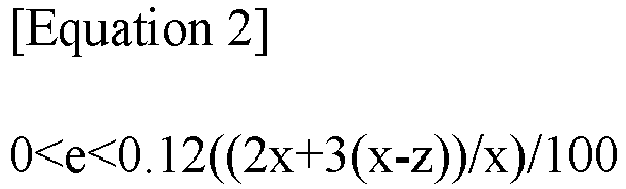
- The second doping element may be introduced within the range of Equation 2, so that deterioration due to an excessive doping of the second doping element as described later may be prevented.
- In an embodiment, the molar ratio (e) of the second doping element may be adjusted within the range defined by Equation 2-1 below.

- In exemplary embodiments, an oxidation number of nickel in the lithium-nickel composite metal oxide may be 2.8 or more.
- The oxidation number of nickel may be changed according to the molar ratios of nickel and manganese. For example, the oxidation number of nickel may be expressed as (2z+3(x-z))/x
- The oxidation number of nickel close to +2 may be advantageous to a structural stability of the cathode active material, but may be disadvantageous for implementing a high capacity. The oxidation number of nickel in the lithium-nickel composite metal oxide according to exemplary embodiments may be 2.8 or more, preferably 2.88 or more, more preferably 2.9 or more. As the oxidation number of nickel approaches 3, structural and chemical defects of the active material may be easily caused, resulting in high-temperature instability.
- For example, as the content of Ni increases, possibility of a cation disorder or a cation mixing that Ni ions are present at Li ion positions or transferred to the Li ion positions may be increased, thereby degrading the life-span and operation stability of the lithium secondary battery deteriorate.
- However, according to embodiments of the present invention, the first doping element having oxidation number of +2 may be inserted into a lithium layer of the cathode active material having a layered structure to suppress the cation mixing of nickel and stabilize the lithium layer.
- The second doping element having an oxidation number of +4 may be inserted into a transition metal layer of the cathode active material to improve structural stability. Further, an oxidation reaction in which some Ni+3 ions are transferred to Ni+4 ions during charging and discharging (lithium insertion/desorption) may be replaced with an oxidation reaction in which Ni+2 is converted to Ni+4 via Ni+3 to increase the capacity.
- For example, if the content of the first doping element is excessively increased, an amount of lithium in the lithium layer in the cathode active material may be reduced or the insertion and desorption of lithium may be inhibited, thereby increasing a resistance of the cathode active material and reducing capacity.
- If the content of the second doping element is excessively increased, Ni+2 ions may form an irreversible structure in the form of NiO, or a cation mixing of Ni+2 ions into the lithium layer may occur.
- Accordingly, according to the above-described exemplary embodiments, the molar ratios of M2 and M4 is adjusted in consideration of the molar ratios of Ni and Mn or the oxidation number, thereby improving the structural stability of the cathode active material without hindering the capacity improvement through the high-nickel composition.
- In exemplary embodiments, a ratio of the molar ratio of M4 to the molar ratio of M2 (hereinafter, may be abbreviated as M4/M2) may be greater than 1 and less than 5.
- For example, the molar ratio of M4 may be adjusted to be higher than that of M2, so that structural stability of the transition metal layer may be further improved as described above, and thus high-temperature capacity stability may be efficiently achieved. Additionally, excessive increase of the molar ratio of M4 compared to that of M2 may be suppressed, thereby preventing structural instability/capacity reduction due to generation of the irreversible form of Ni ions.
- Preferably, M4/M2 may be in a range from 1.2 to 4.8, or preferably from 1.2 to 4.7, more preferably from 1.2 to 4.
- In some embodiments, if the content or oxidation number of nickel in the lithium-nickel composite metal oxide is increased, the value of M4/M2 may also be adjusted as being relatively large.
- In an embodiment, in the range of the oxidation number of nickel from 2.8 to 2.95, M4/M2 may be greater than 1 and less than or equal to 2. Preferably, M4/M2 may be in a range from 1.2 to 2.0, more preferably from 1.2 to 1.9.
- In an embodiment, if the oxidation number of nickel exceeds 2.95, M4/M2 may be greater than 2, and less than 5. Preferably, M4/M2 may be in a range from 2.1 to 4.7, more preferably from 2.1 to 4, or from 2.1 to 3.5.
- In a preferable embodiment, M4/M2 may be greater than 2, and less than 3.5 when the oxidation number of nickel is greater than 2.95, and less than or equal to 2.98, and may be, e.g., in a range from 2.1 to 3.5.
- In a preferable embodiment, when the oxidation number of nickel exceeds 2.98, M4/M2 may be 3.5 or more, and less than 5, or in a range from 3.5 to 4.7.
- For example, as the oxidation number of nickel increases or as the content (molar ratio) of nickel increases, capacity may be decreased due to M2. Accordingly, the doping amount of M4 may be relatively increased within the above-mentioned range to suppress or reduce the capacity reduction due to the doping while sufficiently achieving structural stability of the active material.
- In some embodiments, M2 may include two or more different elements. As +2 valence elements of different ionic radii may be included, prevention of the cation mixing may be more effectively suppressed, and structural stability may be enhanced.
- In an embodiment, M2 may include strontium (Sr). In a preferable embodiment, M2 may include Sr, and may further include at least one of Mg, Ca, Ba and Ra. For example, M2 includes Sr and may include any one of Mg, Ca, Ba and Ra.
- A Group 2 element such as Mg, Ca, Sr, Ba, etc., may be doped into the cathode material and positioned in the lithium layer (Li slab). Sr has an ionic radius smaller than that of Mg and Ca, but greater than that of Ba. Sr having a relatively large ionic radius may be located on the surface of a particle or on a periphery of primary particles around a grain boundary without being deeply doped to an inside of the particle.
- As charging and discharging are repeated, deterioration of the cathode active material particles may be initiated from the surface. In exemplary embodiments, structures of the surface and the grain boundary may be further stabilized by doping Sr, and improved high-temperature stability may be provided.
- Additionally, some of Sr components not doped into the cathode active material particles may remain at the grain boundary to serve as a binder, so that cracks between primary particles may be suppressed.
- In an embodiment, a molar ratio of Sr in a total molar ratio of M2 may be greater than or equal to a molar ratio of elements other than Sr (e.g., Mg, Ca, Ba or Ra).
- Hereinafter, a method for preparing the cathode active material according to the above-described embodiments of the present invention is provided.
- In exemplary embodiments, active material metal sources may be prepared. The active material metal sources may include a nickel source, may preferably include a nickel source, a manganese source and a cobalt source.
- Examples of the nickel source include nickel sulfate (NiSO4), nickel hydroxide (Ni(OH)2), nickel nitrate (Ni(NO3)2), nickel acetate (Ni(CH3CO2)2, a hydrate thereof, etc.
- Examples of the manganese source include manganese sulfate (MnSO4), manganese hydroxide (Mn(OH)2), manganese nitrate (Mn(NO3)2), manganese acetate (Mn(CH3CO)2), a hydrate thereof, etc.
- Examples of the cobalt source include cobalt sulfate (CoSO4), cobalt hydroxide (Co(OH)2), cobalt nitrate (Co(NO3)2), cobalt carbonate (CoCOs), a hydrate thereof, etc.
- In a preferable embodiment, nickel sulfate, manganese sulfate and cobalt sulfate may be used as the nickel source, manganese source and cobalt source, respectively.
- In some embodiments, a salt (e.g., a hydroxide) or an oxide of B, Al, Si, Ti, V, Fe, Cu, Zn, Zr, Mo and W may be used together.
- In exemplary embodiments, an active material precursor may be obtained by mixing and reacting the above-described active material metal sources through, e.g., a co-precipitation method. For example, the active material precursor may be prepared in the form of a nickel-manganese-cobalt hydroxide.
- A precipitating agent and/or a chelating agent may be used to promote the coprecipitation reaction. The precipitating agent may include an alkaline compound such as sodium hydroxide (NaOH) or sodium carbonate (Na2CO3). The chelating agent may include, e.g., ammonia water (e.g., NH3·H2O), ammonium carbonate (e.g., NH3HCO3), etc.
- The active material precursor may be mixed and reacted with a first doping element (M2) source, a second doping element (M4) source, and a lithium source, and then a heat treatment may be performed to obtain a cathode active material including the above-described lithium-nickel composite metal oxide.
- In exemplary embodiments, a hydroxide or carbonate of Mg, Ca, Sr, Ba or Ra may be used as the first doping element (M2) source. An oxide or a hydroxide of Ti or Zr may be used as the second doping element (M4) source.
- Lithium carbonate (Li2CO3), lithium nitrate (LiNO3), lithium acetate (CH3COOLi), lithium oxide (Li2O), lithium hydroxide (LiOH), etc., may be used as the lithium source. These may be used alone or in combination thereof. Preferably, lithium hydroxide may be used as the lithium source.
- A preliminary cathode active material may be formed by mixing/reacting the active material precursor with the first doping element source, the second doping element source, and the lithium source as described above. Lithium-nickel composite metal oxide particles as a cathode active material may be prepared by heat-treating the preliminary cathode active material. For example, a temperature of the heat treatment may be in a range from about 650 °C to 800°C.
- In some embodiments, impurities such as LiOH and Li2CO3 may remain on a surface of the lithium-nickel composite metal oxide particle. The impurities may be removed by washing with an aqueous or organic solvent.
- According to embodiments of the present invention, a lithium secondary battery including a cathode including the cathode active material for a lithium secondary battery as described above is provided.
-
FIGS. 1 and 2 are a schematic plan view and a cross-sectional view, respectively, illustrating a lithium secondary battery in accordance with exemplary embodiments.FIG. 2 is a cross-sectional view taken along a line I-I' ofFIG. 1 in a thickness. - Referring to
FIGS. 1 and 2 , the lithium secondary battery may include acathode 100 including a cathode active material layer including the above-described cathode active material for a lithium secondary battery and ananode 130 facing the cathode. - The
cathode 100 may include a cathodeactive material layer 110 formed by coating the above-described cathode active material on a cathodecurrent collector 105. - For example, a slurry may be prepared by mixing and stirring the above-described cathode active material with a binder, a conductive material and/or a dispersive agent in a solvent. The slurry may be coated on the cathode
current collector 105, and then dried and pressed to form the cathode. - The cathode
current collector 105 may include stainless-steel, nickel, aluminum, titanium, copper or an alloy thereof. Preferably, aluminum or an alloy thereof may be used. - The binder may include an organic based binder such as a polyvinylidene fluoride-hexafluoropropylene copolymer (PVDF-co-HFP), polyvinylidenefluoride (PVDF), polyacrylonitrile, polymethylmethacrylate, etc., or an aqueous based binder such as styrene-butadiene rubber (SBR) that may be used with a thickener such as carboxymethyl cellulose (CMC).
- For example, a PVDF-based binder may be used as a cathode binder. In this case, an amount of the binder for forming the cathode
active material layer 110 may be reduced, and an amount of the cathode active material may be relatively increased. Thus, capacity and power of the lithium secondary battery may be further improved. - The conductive material may be added to facilitate electron mobility between active material particles. For example, the conductive material may include a carbon-based material such as graphite, carbon black, graphene, carbon nanotube, etc., and/or a metal-based material such as tin, tin oxide, titanium oxide, a perovskite material such as LaSrCoO3 or LaSrMnO3, etc.
- The
anode 130 may include an anodecurrent collector 125 and an anodeactive material layer 120 formed by coating an anode active material on a surface of the anodecurrent collector 125. - The anode active material may include a material commonly used in the related art which may be capable of adsorbing and ejecting lithium ions. For example, a carbon-based material such as a crystalline carbon, an amorphous carbon, a carbon complex or a carbon fiber, a lithium alloy, silicon, tin, etc., may be used.
- The amorphous carbon may include a hard carbon, cokes, a mesocarbon microbead (MCMB) fired at a temperature of 1,500°C or less, a mesophase pitch-based carbon fiber (MPCF), etc. The crystalline carbon may include a graphite-based material such as natural graphite, graphitized cokes, graphitized MCMB, graphitized MPCF, etc.
- The lithium alloy may further include aluminum, zinc, bismuth, cadmium, antimony, silicon, lead, tin, gallium, indium, etc.
- The anode
current collector 125 may include, e.g., gold, stainless steel, nickel, aluminum, titanium, copper, or an alloy thereof, and preferably may include copper or a copper alloy. - In some embodiments, a slurry may be prepared by mixing and stirring the anode active material with a binder, a conductive material and/or a dispersive agent in a solvent. The slurry may be coated on the anode current collector, and then dried and pressed to form the
anode 130. - The binder and the conductive material substantially the same as or similar to those used for the cathode
active material layer 110 may be used in theanode 130. In some embodiments, the binder for forming theanode 130 may include an aqueous binder such as styrene-butadiene rubber (SBR), and carboxymethyl cellulose (CMC) may also be used as a thickener. - A
separation layer 140 may be interposed between thecathode 100 and theanode 130. Theseparation layer 140 may include a porous polymer film prepared from, e.g., a polyolefin-based polymer such as an ethylene homopolymer, a propylene homopolymer, an ethylene/butene copolymer, an ethylene/hexene copolymer, an ethylene/methacrylate copolymer, or the like. Theseparation layer 140 may also include a non-woven fabric formed from a glass fiber with a high melting point, a polyethylene terephthalate fiber, or the like. - In exemplary embodiments, an electrode cell may be defined by the
cathode 100, theanode 130 and theseparation layer 140, and a plurality of the electrode cells may be stacked to form anelectrode assembly 150 that may have e.g., a jelly roll shape. For example, theelectrode assembly 150 may be formed by winding, laminating or folding of theseparation layer 140. - The
electrode assembly 150 may be accommodated together with an electrolyte in acase 160 to define the lithium secondary battery. In exemplary embodiments, a non-aqueous electrolyte may be used as the electrolyte. - The non-aqueous electrolyte may include a lithium salt and an organic solvent. The lithium salt may be represented by Li+X- , and an anion of the lithium salt X- may include, e.g., F-, Cl-, Br-, I-, NO3 -, N(CN)2 -, BF4 -, ClO4 -, PF6 -, (CF3)2PF4 -, (CF3)3PF3 -, (CF3)4PF2 -, (CF3)5PF-, (CF3)6P-, CF3SO3 -, CF3CF2SO3 -, (CF3SO2)2N-, (FSO2)2N, CF3CF2(CF3)2CO-, (CF3SO2)2CH-, (SF5)3C-, (CF3SO2)3C-, CF3(CF2)7SO3 -, CF3CO2 -, CH3CO2 -, SCN-, (CF3CF2SO2)2N-, etc.
- The organic solvent may include, e.g., propylene carbonate (PC), ethylene carbonate (EC), diethyl carbonate (DEC), dimethyl carbonate (DMC), ethylmethyl carbonate (EMC), methylpropyl carbonate, dipropyl carbonate, dimethyl sulfoxide, acetonitrile, dimethoxy ethane, diethoxy ethane, vinylene carbonate, sulfolane, gamma-butyrolactone, propylene sulfite, tetrahydrofuran, etc. These may be used alone or in a combination of two or more therefrom.
- As illustrated in
FIG. 1 , electrode tabs (a cathode tab and an anode tab) may protrude from the cathodecurrent collector 105 and the anodecurrent collector 125 included in each electrode cell to one side of thecase 160. The electrode tabs may be welded together with the one side of thecase 160 to be connected to an electrode lead (acathode lead 107 and an anode lead 127) that may be extended or exposed to an outside of thecase 160. - The lithium secondary battery may be manufactured in, e.g., a cylindrical shape using a can, a square shape, a pouch shape or a coin shape.
- According to exemplary embodiments, the cathode active material including a high amount of nickel and a +2-valence doping element and a +4-valence doping element in a predetermined content and ratio may be used. Accordingly, the lithium secondary battery having improved high-temperature stability and long-term stability while achieving improved initial capacity may be implemented.
- Hereinafter, exemplary experimental examples are provided to more concretely describe the present invention.
- NiSO4, CoSO4 and MnSO4 were mixed according to compositions (molar ratios of Ni, Co and Mn) as shown in Table 1 using distilled water from which dissolved oxygen was removed by bubbling with N2 for 24 hours. The solution was put into a reactor at 50°C, and a co-precipitation was performed for 48 hours using NaOH and NH3H2O as a precipitating agent and a chelating agent, respectively, to prepare an active material precursor.
- A hydroxide of Mg Sr and/or Ba as a source of the first doping element (M2), TiO2 or ZrO2 as a source of the second doping element (M4), and LiOH as a lithium source were further mixed to have compositions shown in Table 1 below. Thereafter, the mixture was heat-treated in an oxygen atmosphere at a temperature range of 680°C to 750°C in a firing furnace for 10 hours, washed with water and dried to obtain a cathode active material including lithium-nickel composite metal oxide particles. The compositions of the cathode active material are shown in Table 1 below.
- A cathode mixture was prepared by mixing each cathode active material of Examples and Comparative Examples as shown in Table 1, Denka Black as a conductive material, and PVDF as a binder in a mass ratio of 94:3:3, respectively. The cathode mixture was coated on an aluminum current collector, dried and pressed to prepare a cathode. An electrode density of the cathode was adjusted to 3.5 g/cc or more after the pressing
- 93 wt% of natural graphite as an anode active material, 5 wt% of KS6 as a flake type conductive material, 1 wt% of styrene-butadiene rubber (SBR) as a binder, and 1 wt% of carboxymethyl cellulose (CMC) as a thickener were mixed to form an anode slurry. The anode slurry was coated on a copper substrate, dried and pressed to prepare an anode.
- The cathode and the anode prepared as described above were each notched by a predetermined size, and stacked with a separator (polyethylene, thickness: 25µm) interposed therebetween to form an electrode cell. Each tab portion of the cathode and the anode was welded. The welded cathode/separator/anode assembly was inserted in a pouch, and three sides of the pouch except for an electrolyte injection side were sealed. The tab portions were also included in sealed portions. An electrolyte was injected through the electrolyte injection side, and then the electrolyte injection side was also sealed. Subsequently, the above structure was impregnated for more than 12 hours.
- The electrolyte was prepared by forming 1M LiPF6 solution in a mixed solvent of ethylene carbonate (EC)/ethyl methyl carbonate (EMC)/diethylene carbonate (DEC) (25/45/30; volume ratio), and then adding 1 wt% of vinylene carbonate.
[Table 1] No. Ni Co Mn first doping element second doping element M4/M2 dopant molar ratio (M2) dopant molar ratio (M4) molar ratio (x) (oxidation number) molar ratio (y) molar ratio (z) Example 1 0.83 (2.928) 0.11 0.06 Sr 0.0029 Zr 0.0035 1.207 Example 2 0.83 (2.928) 0.11 0.06 Sr 0.0009 Zr 0.0015 1.667 Example 3 0.83 (2.928) 0.11 0.06 Mg, Sr 0.001, 0.0019 Zr 0.0035 1.207 Example 4 0.83 (2.928) 0.11 0.06 Mg, Sr 0.0003, 0.0005 Zr 0.0015 1.875 Example 5 0.83 (2.928) 0.11 0.06 Mg, Sr 0.0005, 0.0015 Zr 0.003 1.500 Comparative Example 1 0.83 (2.928) 0.11 0.06 - 0 - 0 - Comparative Example 2 0.83 (2.928) 0.11 0.06 Mg, Sr 0.002, 0.002 Zr 0.004 1.000 Example 6 0.88 (2.966) 0.09 0.03 Sr 0.0015 Ti 0.0035 2.333 Example 7 0.88 (2.966) 0.09 0.03 Sr 0.0006 Ti 0.0015 2.500 Example 8 0.88 (2.966) 0.09 0.03 Sr, Ba 0.0006, 0.0004 Ti 0.0032 3.200 Example 9 0.88 0.09 0.03 Sr, Ba 0.0010, 0.0005 Ti 0.0032 2.133 (2.966) Example 10 0.88 (2.966) 0.09 0.03 Sr, Ba 0.0006, 0.0004 Ti 0.0015 1.500 Example 11 0.88 (2.966) 0.09 0.03 Sr, Ba 0.0015, 0.0010 Ti 0.004 1.600 Comparative Example 3 0.88 (2.966) 0.09 0.03 - 0 - 0 - Example 12 0.94 (2.989) 0.05 0.01 Sr 0.001 Ti 0.0035 3.500 Example 13 0.94 (2.989) 0.05 0.01 Sr 0.0003 Ti 0.0014 4.667 Example 14 0.94 (2.989) 0.05 0.01 Sr, Ba 0.0005, 0.0002 Ti 0.0032 4.571 Example 15 0.94 (2.989) 0.05 0.01 Sr, Ba 0.0005, 0.0005 Ti 0.0032 3.200 Example 16 0.94 (2.989) 0.05 0.01 Sr, Ba 0.0005, 0.0002 Ti 0.0015 2.143 Example 17 0.94 (2.989) 0.05 0.01 Sr, Ba 0.0007, 0.0005 Ti 0.004 3.333 Comparative Example 4 0.94 (2.989) 0.05 0.01 Sr 0.0015 Ti 0.008 5.333 Comparative Example 5 0.94 (2.989) 0.05 0.01 - 0 - 0 - - After charging (CC-CV 0.1C 4.3V 0.005C CUT-OFF) the lithium secondary battery prepared according to each of Examples and Comparative Examples in a 25 °C chamber, a battery capacity (initial charge capacity) was measured. Thereafter, the battery was discharged again (CC 0.1C 3.0V CUT-OFF), and then a battery capacity (initial discharge capacity) was measured. An initial efficiency was evaluated by calculating a ratio of the initial discharge capacity relative to the initial charge capacity as a percentage.
- 200 cycles of charging (CC/CV 0.5C 4.3V 0.05C CUT-OFF) and discharging (CC 1.0C 3.0V CUT-OFF) the lithium secondary batteries according to Examples and Comparative Examples were performed at 45 °C. A high-temperature capacity retention was evaluated as a percentage of a discharge capacity at the 200th cycle relative to a discharge capacity at the 1st cycle.
- The lithium secondary battery prepared according to each of Examples and Comparative Examples was stored in a chamber at 65 °C for 2 weeks, and then charging and discharging were performed under the same conditions as those in the initial capacity measurement to measure a discharge capacity. A high-temperature storage property was evaluated by calculating a ratio of the measured discharge capacity relative to the initial charge capacity as a percentage.
- The evaluation results are shown in Table 2 below.
[Table 2] No. initial capacity property high-temperature capacity retention (%) high-temperature storage (%) initial charge capacity (mAh/g) initial discharge capacity (mAh/g) initial efficiency (%) Example 1 228 206 90.4% 75 83 Example 2 229 207 90.4% 73 85 Example 3 228 205 89.9% 80 88 Example 4 231 207 89.6% 79 83 Example 5 229 207 90.4% 83 91 Comparative Example 1 232 206 88.8% 50 75 Comparative Example 2 227 203 89.4% 69 79 Example 6 239 213 89.1% 73 80 Example 7 240 215 89.6% 71 78 Example 8 239 214 89.5% 81 87 Example 9 238 213 89.5% 76 85 Example 10 240 215 89.6% 74 81 Example 11 236 210 89.0% 66 74 Comparative Example 3 242 214 88.4% 45 70 Example 12 255 228 89.4% 75 79 Example 13 256 229 89.5% 72 77 Example 14 255 228 89.4% 78 83 Example 15 254 226 89.0% 77 81 Example 16 256 227 88.7% 73 75 Example 17 253 223 88.1% 61 68 Comparative Example 4 245 218 88.9% 65 67 Comparative Example 5 258 228 88.4% 40 66 - Referring to Table 2, the improved initial efficiency, life-span stability and high-temperature storage properties were provided in Examples containing nickel having an oxidation number of 2.8 or more and containing both the first doping element and the second doping element.
- In Comparative Example 2 where M4/M2 did not exceed 1, the high-temperature life-span and storage properties were deteriorated compared to those from Examples.
- In Examples 11 and 17 where the molar ratio of the first doping element was slightly increased, the initial efficiency, life-span stability and high-temperature storage properties were slightly lowered.
- In Comparative Example 4 where M4/M2 exceeded 5 due to an increase of the molar ratio of the second doping element, the initial capacity, life-span stability and high-temperature storage properties were deteriorated due to an increase of +4 valence doping.
- Embodiments:
- 1. A cathode active material for a lithium secondary battery comprising a lithium-nickel composite metal oxide in which an oxidation number of nickel is 2.8 or more,
- wherein the lithium-nickel composite metal oxide comprises a first doping element having an oxidation number of +2 and a second doping element having an oxidation number of +4, and
- a ratio of a molar ratio of the second doping element relative to a molar ratio of the first doping element is greater than 1 and less than 5.
- 2. The cathode active material for a lithium secondary battery according to embodiment 1, wherein the first doping element comprises at least one selected from the group consisting of Mg, Ca, Sr, Ba and Ra.
- 3. The cathode active material for a lithium secondary battery according to any one of embodiments 1 and 2, wherein the second doping element comprises Ti or Zr.
- 4. The cathode active material for a lithium secondary battery according to any one of embodiments 1 to 3, wherein the lithium-nickel composite metal oxide further comprises at least one additional doping element selected from the group consisting of B, Al, P, Si, V, Mo, Re, Sn and W.
- 5. The cathode active material for a lithium secondary battery according to embodiment 1, wherein the lithium-nickel composite metal oxide has a chemical structure represented by Chemical Formula 1 below:
[Chemical Formula 1] LiaNixCoyMnzM2dM4eM'fO2+b
- wherein, in Chemical Formula 1, M2 represents the first doping element, M4 represents the second doping element, M' represents an additional doping element other than M2 and M4, and
- 0.9<a<1.2, 0.8≤x≤0.99, 0.01<y+z<0.2, 0<d<0.05, 0<e<0.05, 0≤f<0.05, and - 0.1≤b≤0.1.
- 6. The cathode active material for a lithium secondary battery according to embodiment 5, wherein, in Chemical Formula 1, 0<d<1.7((2x+3(x-z))z)/100.
- 7. The cathode active material for a lithium secondary battery according to embodiment 5, wherein, in Chemical Formula 1, 0<e<0.12((2x+3(x-z))/x)/100.
- 8. The cathode active material for a lithium secondary battery according to embodiment 1, wherein the ratio of the molar ratio of the second doping element relative to the molar ratio of the first doping element is in a range from 1.2 to 4.8.
- 9. The cathode active material for a lithium secondary battery according to embodiment 1, wherein the ratio of the molar ratio of the second doping element relative to the molar ratio of the first doping element is greater than 1, and less than or equal to 2 within a range of the oxidation number of nickel from 2.8 to 2.95.
- 10. The cathode active material for a lithium secondary battery according to embodiment 1, wherein the ratio of the molar ratio of the second doping element relative to the molar ratio of the first doping element is greater than 2 and less than 5, provided that the oxidation number of nickel exceeds 2.95.
- 11. The cathode active material for a lithium secondary battery according to embodiment 10, wherein the ratio the molar ratio of the second doping element relative to the molar ratio of the first doping element is greater than 2 and less than 3.5, provided that the oxidation number of nickel is greater than 2.95, and less than or equal to 2.98.
- 12. The cathode active material for a lithium secondary battery according to embodiment 10, wherein the ratio of the molar ratio of the second doping element relative to the molar ratio of the first doping element is greater than or equal to 3.5 and less than 5, provided that the oxidation number of nickel exceeds 2.98.
- 13. The cathode active material for a lithium secondary battery according to embodiment 1, wherein the first doping element comprises Sr and further comprises at least one element selected from among Mg, Ca, Ba and Ra.
- 14. The cathode active material for a lithium secondary battery according to embodiment 13, wherein a molar ratio of Sr in the first doping element is greater than or equal to a molar ratio of the at least one element in the first doping element.
- 15. A lithium secondary battery, comprising:
- a cathode comprising a cathode active material layer that comprises the cathode active material for a lithium secondary battery according to any one of embodiments 1 to 14; and
- an anode facing the cathode.
Claims (15)
- A cathode active material for a lithium secondary battery comprising a lithium-nickel composite metal oxide in which an oxidation number of nickel is 2.8 or more,wherein the lithium-nickel composite metal oxide comprises a first doping element having an oxidation number of +2 and a second doping element having an oxidation number of +4, anda ratio of a molar ratio of the second doping element relative to a molar ratio of the first doping element is greater than 1 and less than 5.
- The cathode active material for a lithium secondary battery according to claim 1, wherein the first doping element comprises at least one selected from the group consisting of Mg, Ca, Sr, Ba and Ra.
- The cathode active material for a lithium secondary battery according to any one of claims 1 and 2, wherein the second doping element comprises Ti or Zr.
- The cathode active material for a lithium secondary battery according to any one of claims 1 to 3, wherein the lithium-nickel composite metal oxide further comprises at least one additional doping element selected from the group consisting of B, Al, P, Si, V, Mo, Re, Sn and W.
- The cathode active material for a lithium secondary battery according to any one of claims 1 to 4, wherein the lithium-nickel composite metal oxide has a chemical structure represented by Chemical Formula 1 below:
[Chemical Formula 1] LiaNixCoyMnzM2dM4eM'fO2+b
wherein, in Chemical Formula 1, M2 represents the first doping element, M4 represents the second doping element, M' represents an additional doping element other than M2 and M4, and0.9<a<1.2, 0.8≤x≤0.99, 0.01<y+z<0.2, 0<d<0.05, 0<e<0.05, 0≤f<0.05, and - 0.1≤b≤0.1. - The cathode active material for a lithium secondary battery according to claim 5, wherein, in Chemical Formula 1, 0<d<1.7((2x+3(x-z))z)/100.
- The cathode active material for a lithium secondary battery according to any one of claims 5 or 6, wherein, in Chemical Formula 1, 0<e<0.12((2x+3(x-z))/x)/100.
- The cathode active material for a lithium secondary battery according to any one of claims 1 to 7, wherein the ratio of the molar ratio of the second doping element relative to the molar ratio of the first doping element is in a range from 1.2 to 4.8.
- The cathode active material for a lithium secondary battery according to any one of claims 1 to 7, wherein the ratio of the molar ratio of the second doping element relative to the molar ratio of the first doping element is greater than 1, and less than or equal to 2 within a range of the oxidation number of nickel from 2.8 to 2.95.
- The cathode active material for a lithium secondary battery according to any one of claims 1 to 7, or 9, wherein the ratio of the molar ratio of the second doping element relative to the molar ratio of the first doping element is greater than 2 and less than 5, provided that the oxidation number of nickel exceeds 2.95.
- The cathode active material for a lithium secondary battery according to claim 10, wherein the ratio of the molar ratio of the second doping element relative to the molar ratio of the first doping element is greater than 2 and less than 3.5, provided that the oxidation number of nickel is greater than 2.95, and less than or equal to 2.98.
- The cathode active material for a lithium secondary battery according to any one of claims 10 or 11, wherein the ratio of the molar ratio of the second doping element relative to the molar ratio of the first doping element is greater than or equal to 3.5 and less than 5, provided that the oxidation number of nickel exceeds 2.98.
- The cathode active material for a lithium secondary battery according to any one of claims 1 to 12, wherein the first doping element comprises Sr and further comprises at least one element selected from among Mg, Ca, Ba and Ra.
- The cathode active material for a lithium secondary battery according to claim 13, wherein a molar ratio of Sr in the first doping element is greater than or equal to a molar ratio of the at least one element in the first doping element.
- A lithium secondary battery, comprising:a cathode comprising a cathode active material layer that comprises the cathode active material for a lithium secondary battery according to any one of claims 1 to 14; andan anode facing the cathode.
Applications Claiming Priority (1)
| Application Number | Priority Date | Filing Date | Title |
|---|---|---|---|
| KR1020220014017A KR20230117818A (en) | 2022-02-03 | 2022-02-03 | Cathode active material for lithium secondary battery and lithium secondary battery including the same |
Publications (1)
| Publication Number | Publication Date |
|---|---|
| EP4227270A1 true EP4227270A1 (en) | 2023-08-16 |
Family
ID=85150373
Family Applications (1)
| Application Number | Title | Priority Date | Filing Date |
|---|---|---|---|
| EP23154268.9A Pending EP4227270A1 (en) | 2022-02-03 | 2023-01-31 | Cathode active material for lithium secondary battery and lithium secondary battery including the same |
Country Status (4)
| Country | Link |
|---|---|
| US (1) | US20230246181A1 (en) |
| EP (1) | EP4227270A1 (en) |
| KR (1) | KR20230117818A (en) |
| CN (1) | CN116544407A (en) |
Citations (4)
| Publication number | Priority date | Publication date | Assignee | Title |
|---|---|---|---|---|
| KR100821523B1 (en) | 2006-08-30 | 2008-04-14 | 주식회사 엘 앤 에프 | Cathode active material for lithium secondary battery, preparation method thereof, and lithium secondary battery comprising same |
| KR101746187B1 (en) * | 2014-10-15 | 2017-06-12 | 주식회사 포스코 | Positive electrode active material for rechargable lithium battery, and rechargable lithium battery including the same |
| US20190131624A1 (en) * | 2016-03-09 | 2019-05-02 | L&F Co., Ltd. | Positive electrode active material for lithium secondary battery, method for preparing same and lithium secondary battery comprising same |
| EP3680968A1 (en) * | 2017-11-22 | 2020-07-15 | LG Chem, Ltd. | Positive electrode active material for lithium secondary battery and manufacturing method therefor |
Family Cites Families (3)
| Publication number | Priority date | Publication date | Assignee | Title |
|---|---|---|---|---|
| KR102402388B1 (en) * | 2017-04-28 | 2022-05-26 | 삼성에스디아이 주식회사 | Positive active material, lithium secondary battery containing the material, and method of manufacturing the material |
| WO2019132080A1 (en) * | 2017-12-29 | 2019-07-04 | 주식회사 엘 앤 에프 | Cathode active material for lithium secondary battery, and lithium secondary battery comprising same |
| CN112103496B (en) * | 2020-11-10 | 2021-01-29 | 湖南长远锂科股份有限公司 | High-nickel ternary cathode material and preparation method thereof |
-
2022
- 2022-02-03 KR KR1020220014017A patent/KR20230117818A/en active Pending
-
2023
- 2023-01-29 CN CN202310043489.XA patent/CN116544407A/en active Pending
- 2023-01-31 EP EP23154268.9A patent/EP4227270A1/en active Pending
- 2023-02-02 US US18/104,799 patent/US20230246181A1/en active Pending
Patent Citations (4)
| Publication number | Priority date | Publication date | Assignee | Title |
|---|---|---|---|---|
| KR100821523B1 (en) | 2006-08-30 | 2008-04-14 | 주식회사 엘 앤 에프 | Cathode active material for lithium secondary battery, preparation method thereof, and lithium secondary battery comprising same |
| KR101746187B1 (en) * | 2014-10-15 | 2017-06-12 | 주식회사 포스코 | Positive electrode active material for rechargable lithium battery, and rechargable lithium battery including the same |
| US20190131624A1 (en) * | 2016-03-09 | 2019-05-02 | L&F Co., Ltd. | Positive electrode active material for lithium secondary battery, method for preparing same and lithium secondary battery comprising same |
| EP3680968A1 (en) * | 2017-11-22 | 2020-07-15 | LG Chem, Ltd. | Positive electrode active material for lithium secondary battery and manufacturing method therefor |
Non-Patent Citations (1)
| Title |
|---|
| SHIN HYUNJOON ET AL: "Local oxidation states of Ni, Co, and Mn atoms within pristine and charged LixNi0.88Co0.08Mn0.04O2 primary particles", JOURNAL OF PHYSICS AND CHEMISTRY OF SOLIDS, PERGAMON PRESS, LONDON, GB, vol. 148, 29 August 2020 (2020-08-29), XP086332275, ISSN: 0022-3697, [retrieved on 20200829], DOI: 10.1016/J.JPCS.2020.109732 * |
Also Published As
| Publication number | Publication date |
|---|---|
| CN116544407A (en) | 2023-08-04 |
| US20230246181A1 (en) | 2023-08-03 |
| KR20230117818A (en) | 2023-08-10 |
Similar Documents
| Publication | Publication Date | Title |
|---|---|---|
| KR102583699B1 (en) | Lithium secondary battery and method of manufacturing the same | |
| EP3641024B1 (en) | Lithium secondary battery | |
| US12597598B2 (en) | Cathode active material for lithium secondary battery and lithium secondary battery including the same | |
| US12482813B2 (en) | Cathode for lithium secondary battery and lithium secondary battery including the same | |
| EP3840089A1 (en) | Positive electrode active material for lithium secondary battery, method for manufacturing same, and lithium secondary battery including same | |
| EP3919445A1 (en) | Cathode active material for lithium secondary battery and lithium secondary battery | |
| EP3974391A1 (en) | Cathode active material for lithium secondary battery and method of manufacturing the same | |
| EP3944366A1 (en) | Cathode for lithium secondary battery and lithium secondary battery including the same | |
| EP4064390A1 (en) | Cathode for lithium secondary battery and lithium secondary battery including the same | |
| KR20200120521A (en) | Lithium secondary battery | |
| EP4067311A1 (en) | Cathode active material for lithium secondary battery and lithium secondary battery including the same | |
| EP3995455A1 (en) | Cathode active material for lithium secondary battery and lithium secondary battery including the same | |
| EP4194408A2 (en) | Cathode active material for lithium secondary battery and lithium secondary battery including the same | |
| US20240356002A1 (en) | Cathode active material for lithium secondary battery, method of preparing the same and lithium secondary battery including the same | |
| KR20230127189A (en) | Lithium secondary battery | |
| EP4063328A1 (en) | Cathode active material for lithium secondary battery and lithium secondary battery including the same | |
| EP4382488A1 (en) | Cathode active material for lithium secondary battery and lithium secondary battery including the same | |
| EP4187630A1 (en) | Cathode for lithium secondary battery and lithium secondary battery including the same | |
| US11962006B2 (en) | Cathode active material for lithium secondary battery and lithium secondary battery including the same | |
| US20230246181A1 (en) | Cathode active material for lithium secondary battery and lithium secondary battery including the same | |
| EP4063329A1 (en) | Cathode active material for lithium secondary battery and lithium secondary battery including the same | |
| US12562372B2 (en) | Lithium secondary battery and method of manufacturing the same | |
| EP4276074A1 (en) | Cathode active material for lithium secondary battery and lithium secondary battery including the same | |
| EP4057381A1 (en) | Lithium secondary battery | |
| US20240194860A1 (en) | Cathode active material for lithium secondary battery and lithium secondary battery including the same |
Legal Events
| Date | Code | Title | Description |
|---|---|---|---|
| PUAI | Public reference made under article 153(3) epc to a published international application that has entered the european phase |
Free format text: ORIGINAL CODE: 0009012 |
|
| STAA | Information on the status of an ep patent application or granted ep patent |
Free format text: STATUS: REQUEST FOR EXAMINATION WAS MADE |
|
| 17P | Request for examination filed |
Effective date: 20230131 |
|
| AK | Designated contracting states |
Kind code of ref document: A1 Designated state(s): AL AT BE BG CH CY CZ DE DK EE ES FI FR GB GR HR HU IE IS IT LI LT LU LV MC ME MK MT NL NO PL PT RO RS SE SI SK SM TR |