EP4227115B1 - Fahrzeugluftreifen - Google Patents
Fahrzeugluftreifen Download PDFInfo
- Publication number
- EP4227115B1 EP4227115B1 EP23150662.7A EP23150662A EP4227115B1 EP 4227115 B1 EP4227115 B1 EP 4227115B1 EP 23150662 A EP23150662 A EP 23150662A EP 4227115 B1 EP4227115 B1 EP 4227115B1
- Authority
- EP
- European Patent Office
- Prior art keywords
- groove
- tread
- recess
- section
- rib
- Prior art date
- Legal status (The legal status is an assumption and is not a legal conclusion. Google has not performed a legal analysis and makes no representation as to the accuracy of the status listed.)
- Active
Links
Images

Classifications
-
- B—PERFORMING OPERATIONS; TRANSPORTING
- B60—VEHICLES IN GENERAL
- B60C—VEHICLE TYRES; TYRE INFLATION; TYRE CHANGING; CONNECTING VALVES TO INFLATABLE ELASTIC BODIES IN GENERAL; DEVICES OR ARRANGEMENTS RELATED TO TYRES
- B60C11/00—Tyre tread bands; Tread patterns; Anti-skid inserts
- B60C11/03—Tread patterns
- B60C11/04—Tread patterns in which the raised area of the pattern consists only of continuous circumferential ribs, e.g. zig-zag
-
- B—PERFORMING OPERATIONS; TRANSPORTING
- B60—VEHICLES IN GENERAL
- B60C—VEHICLE TYRES; TYRE INFLATION; TYRE CHANGING; CONNECTING VALVES TO INFLATABLE ELASTIC BODIES IN GENERAL; DEVICES OR ARRANGEMENTS RELATED TO TYRES
- B60C11/00—Tyre tread bands; Tread patterns; Anti-skid inserts
- B60C11/03—Tread patterns
- B60C11/13—Tread patterns characterised by the groove cross-section, e.g. for buttressing or preventing stone-trapping
- B60C11/1307—Tread patterns characterised by the groove cross-section, e.g. for buttressing or preventing stone-trapping with special features of the groove walls
-
- B—PERFORMING OPERATIONS; TRANSPORTING
- B60—VEHICLES IN GENERAL
- B60C—VEHICLE TYRES; TYRE INFLATION; TYRE CHANGING; CONNECTING VALVES TO INFLATABLE ELASTIC BODIES IN GENERAL; DEVICES OR ARRANGEMENTS RELATED TO TYRES
- B60C11/00—Tyre tread bands; Tread patterns; Anti-skid inserts
- B60C11/03—Tread patterns
- B60C11/13—Tread patterns characterised by the groove cross-section, e.g. for buttressing or preventing stone-trapping
- B60C11/1376—Three dimensional block surfaces departing from the enveloping tread contour
- B60C11/1392—Three dimensional block surfaces departing from the enveloping tread contour with chamfered block edges
-
- B—PERFORMING OPERATIONS; TRANSPORTING
- B60—VEHICLES IN GENERAL
- B60C—VEHICLE TYRES; TYRE INFLATION; TYRE CHANGING; CONNECTING VALVES TO INFLATABLE ELASTIC BODIES IN GENERAL; DEVICES OR ARRANGEMENTS RELATED TO TYRES
- B60C11/00—Tyre tread bands; Tread patterns; Anti-skid inserts
- B60C11/03—Tread patterns
- B60C2011/0337—Tread patterns characterised by particular design features of the pattern
- B60C2011/0339—Grooves
- B60C2011/0358—Lateral grooves, i.e. having an angle of 45 to 90 degees to the equatorial plane
-
- B—PERFORMING OPERATIONS; TRANSPORTING
- B60—VEHICLES IN GENERAL
- B60C—VEHICLE TYRES; TYRE INFLATION; TYRE CHANGING; CONNECTING VALVES TO INFLATABLE ELASTIC BODIES IN GENERAL; DEVICES OR ARRANGEMENTS RELATED TO TYRES
- B60C11/00—Tyre tread bands; Tread patterns; Anti-skid inserts
- B60C11/03—Tread patterns
- B60C2011/0337—Tread patterns characterised by particular design features of the pattern
- B60C2011/0339—Grooves
- B60C2011/0358—Lateral grooves, i.e. having an angle of 45 to 90 degees to the equatorial plane
- B60C2011/0367—Lateral grooves, i.e. having an angle of 45 to 90 degees to the equatorial plane characterised by depth
- B60C2011/0369—Lateral grooves, i.e. having an angle of 45 to 90 degees to the equatorial plane characterised by depth with varying depth of the groove
-
- B—PERFORMING OPERATIONS; TRANSPORTING
- B60—VEHICLES IN GENERAL
- B60C—VEHICLE TYRES; TYRE INFLATION; TYRE CHANGING; CONNECTING VALVES TO INFLATABLE ELASTIC BODIES IN GENERAL; DEVICES OR ARRANGEMENTS RELATED TO TYRES
- B60C11/00—Tyre tread bands; Tread patterns; Anti-skid inserts
- B60C11/03—Tread patterns
- B60C2011/0337—Tread patterns characterised by particular design features of the pattern
- B60C2011/0339—Grooves
- B60C2011/0381—Blind or isolated grooves
Definitions
- the invention relates to a pneumatic vehicle tire with a tread with at least one shoulder-side profile rib delimited by a circumferential groove with an inner rib section running within the ground contact surface, an outer rib section running outside the ground contact surface and with transverse grooves ending at a distance in front of the shoulder-side circumferential groove with a maximum groove width of 2.0 mm to 6.0 mm determined in the inner rib section in the circumferential direction, wherein each transverse groove has two opposing groove walls, two groove edges and a surface recess adjacent to one groove wall, formed at least in sections in the outer rib section and reaching at least to the lateral edge of the ground contact surface, elongated triangular in the direction of extension of the transverse groove.
- Such a pneumatic vehicle tire is known, for example, from EP 3 628 510 A1 known.
- the tire has a tread with a shoulder-side profile rib with transverse grooves ending within the shoulder-side profile rib.
- the transverse grooves have a maximum width of 4.0 mm to 11.0 mm in the inner rib section, on the tread periphery, determined perpendicular to the groove center line.
- the transverse groove is made up of a main groove section that runs in sections in the inner rib section and in sections in the outer rib section, a groove run-out section on the inside of the tread that is narrower than the main groove section, and a groove shoulder section.
- the transverse groove has an elongated triangular-shaped, surface recess on the groove wall that continues in the groove outlet section, which is formed in sections in the outer rib section and in sections in the inner rib section in the direction of extension of the transverse groove, which is intended to further improve the drainage effect of the transverse groove.
- the transverse grooves in the shoulder-side tread ribs are designed as optimally as possible both in terms of grip and drainage.
- the transverse grooves have an empty volume that is advantageous for drainage, but on the other hand they reduce the net contact area of the tread, which reduces grip, especially when cornering at high speed. In this respect, further improvement is desirable.
- the invention is therefore based on the object of managing the conflicting objectives between the drainage properties and the road grip, in particular the road grip when cornering at high speed, in a pneumatic vehicle tire of the type mentioned at the outset, better than before.
- the surface recess is formed at least for the most part in the outer section of the rib and is delimited by a side surface starting from the groove edge and an elongated triangular base that continuously narrows towards the inside of the tread and has a base edge lying on the groove wall and/or on the groove base, wherein the recess has a depth determined along the base edge perpendicular to the level of the tread periphery and decreasing towards the outside of the tread.
- the geometric design of the surface recess is particularly advantageously adapted to the desired driving conditions.
- the changing position of the footprint depends in particular on the individual vehicle load, which depends for example on the vehicle load, as well as on the track and camber settings of the wheel.
- this is located outside the footprint during normal driving or extends slightly into the footprint, whereby the recess provides an additional water reservoir that is advantageous for drainage.
- the footprint in the corresponding tire shoulder shifts towards the outside of the tread, whereby the area of the shoulder-side tread rib, which is particularly stiff due to the decreasing depth of the recess, comes into contact with the subsurface, which is particularly advantageous for traction.
- the increasing width of the base towards the outside of the tread is advantageous for the drainage effect of the recess, since in this respect a certain compensation is achieved for the decreasing depth of the recess.
- the depth of the recess at the tread-inside end of the bottom edge has a maximum value of at least 2.0 mm and at most 60% of the maximum depth of the transverse groove. This is advantageous for the drainage effect of the recess, while the rigidity of the tread rib in the area adjacent to the recess is hardly affected, which is favorable for grip when cornering at high speed.
- An advantageous variant of the preferred embodiment is that the maximum value of the depth of the recess at the end of the bottom edge on the inside of the tread is 45% to 55% of the maximum depth of the transverse groove. This variant enables a particularly advantageous balanced solution to the conflicting objectives between the drainage properties and the grip on the ground.
- the bottom of the recess merges tangentially into the outer surface of the outer rib section at its outer end. This further optimizes the flow behavior of water flowing over the bottom of the recess towards the edge of the tread, so that it flows through the recess towards the outside of the tread in a low-turbulence manner. This embodiment therefore contributes to further improving the drainage properties.
- the bottom of the recess viewed in the circumferential cross-section, runs parallel to the tread periphery.
- the bottom of the recess has a width of 1.5 mm to 4.0 mm, in particular 2.5 mm to 3.5 mm, at its end on the outside of the tread, which is advantageous for drainage.
- a further advantageous embodiment is characterized in that the recess in the inner rib section ends at a distance of at least 3.0 mm from the lateral edge of the ground contact area in the axial direction.
- the recess therefore extends into the footprint even during normal driving, which is an additional advantage, especially for drainage, while maintaining good ground adhesion.
- the recess in the rib outer section ends at a distance of up to 10.0 mm, in particular up to 3.5 mm, determined at the level of the tread periphery, transverse to the circumferential direction, before the end of the transverse groove.
- the side surface viewed in the circumferential cross-section, extends at an angle of 2° to 6° to the radial direction.
- Pneumatic vehicle tires designed according to the invention are tires for motor vehicles, in particular for multi-track motor vehicles, and preferably tires of radial design for passenger cars, vans or light trucks (small vans with GVW ⁇ 3.5 t, light trucks with GVW ⁇ 7.5 t).
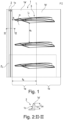
- Fig. 1 shows a plan view of a circumferential section of a shoulder-side profile rib 1 of a tread of a pneumatic vehicle tire.
- the lateral edge of the ground contact area of the tread is in Fig. 1 by a dashed line L, wherein the ground contact area corresponds to the statically determined footprint according to ETRTO standards (load at 70% of the maximum load capacity at an internal pressure of 85% according to ETRTO standard).
- the tread tire has in its second shoulder, not shown, a further shoulder-side profile rib, the design of which preferably differs from that of the shoulder-side profile rib 1, so that the tread has an asymmetrical shape with respect to the tire equatorial plane.
- Such a pneumatic vehicle tire is preferably mounted on the axle of a vehicle, for example a car, in such a way that the shoulder-side profile rib 1 faces the vehicle interior FI.
- the shoulder-side profile rib 1 is delimited on the inside of the tread by a shoulder-side circumferential groove 2 which, in the embodiment shown, runs straight in plan view and which is tapered in the radial direction to the respective intended profile depth T UR ( Fig. 2 ), whereby the tread depth T UR for the preferred tyre type is usually 6.5 mm to 13.0 mm, in particular up to 10.0 mm.
- the shoulder-side profile rib 1 has an inner rib section 1a located within the ground contact surface with an outer surface 1a' located in the tread periphery, an outer rib section 1b located outside the ground contact surface, running to the side wall (not shown), with an outer surface 1b' located in the tread periphery and is shoulder-side circumferential groove 2 is limited by a rib flank 1c.
- the rib inner section 1a has a width b a determined at the level of the outer surface 1a' in the axial direction.
- the rib flank 1c has a radially outer transition rounding 1c', which, viewed in the cross-section aligned in axial direction in plan view (cf. position of line II-II in Fig. 1 ), tangentially ("kink-free”) into the outer surface 1a'.
- the shoulder-side profile rib 1 is provided over its circumferential extent with a plurality of transverse grooves 3 ending within the shoulder-side profile rib 1, which each run in sections in the inner rib section 1a and in sections in the outer rib section 1b, give the shoulder-side profile rib 1 a block-like structure, end in front of the shoulder-side circumferential groove 2 at a distance a 1 determined on the outer surface 1a' in the axial direction of preferably 2.0 mm from 15.0 mm, in particular from 4.0 mm to 10.0 mm, and - viewed in plan view and based on straight lines L 1 aligned along the largest groove length in each case - run at an angle ⁇ to the axial direction of 0° to 20°, in particular of up to 15°, particularly preferably of up to 7°, and preferably parallel to one another.
- Transverse grooves 3 which follow one another directly in the circumferential direction have distances a 2 of preferably 15.0 mm of 35.0 mm, determined as the smallest
- transverse grooves 3 The further design of the transverse grooves 3 is explained below using a single transverse groove 3.
- the transverse groove 3 has a length c QR ( Fig. 3 ) and in the radial direction a maximum depth t QRmax (depth at the deepest point, Fig. 4 ) from 70% to 100% of the tread depth T UR ( Fig. 2 ), whereby the transverse groove 3, starting from the deepest point, becomes continuously shallower in a particularly known manner towards its end on the outside of the tread and at the tread outer end a minimum depth t QRmin ( Fig. 4 ) of at most 1.0 mm, in particular of at most 0.5 mm.
- the transverse groove 3 can be on the outside of the tread to the outer surface 1b' ( Fig. 3 ) expire.
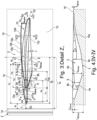
- the transverse groove 3 has a groove base 4, two groove walls 5, 6, an end flank 7 at its inner tread end, an end flank 8 adjacent to the groove wall 5, both in the inner rib section 1a ( Fig. 3 ) as well as in the outer rib section 1b ( Fig. 3 ) formed, in plan view in the direction of extension of the transverse groove 3, elongated triangular, chamfer-like extension 8, a groove wall 6 delimited in the rib inner section 1a ( Fig.
- transverse groove 3 located, locally narrowing the transverse groove 3, in plan view in the direction of extension of the transverse groove 3 elongated triangular, overall wedge-shaped projection 9 and a projection adjacent to the groove wall 6, mostly in the rib outer section 1b ( Fig. 3 ) and in the inner rib section 1a ( Fig. 3 ) and, in plan view in the direction of extension of the transverse groove 3, is elongated triangular-shaped, superficial recess 10.
- the transverse groove 3 is delimited on the tread periphery by a double-bent groove edge 11, on which the bevel-like extension 8 is formed, and a groove edge 12, along which the projection 9 and the recess 10 are formed.
- the following explanations regarding the groove edges 11, 12 refer to the top view.
- the groove edge 11 is composed of an inner edge section 11a located on the outer surface 1a', a middle edge section 11c located on the outer surface 1a' and an outer edge section 11b located in sections on the outer surface 1a' and in sections on the outer surface 1b'.
- the inner edge section 11a has a length c 1 projected in the axial direction of 25% to 40%, in particular of up to 35%, of the length c QR and runs straight and to the axial direction at an angle ⁇ of up to ⁇ 2°, in particular of 0°.
- the middle edge section 11c has a length c 2 projected in the axial direction of 25% to 40%, in particular of at least 30%, of the length c QR , runs straight and at an angle ⁇ of 10° to 20° to the axial direction and forms an obtuse angle ⁇ with the inner edge section 11a on the side facing away from the transverse groove 3.
- the outer edge section 11b runs, in particular due to the curved outer contour of the tire, at least in sections slightly curved and on the outer surface 1a' to the axial direction at an angle ⁇ of 0° to 10°, in particular of up to 5°, is preferably inclined in the opposite direction to the middle edge section 11c with respect to the axial direction and forms an obtuse angle ⁇ ( Fig. 3 ).
- the obtuse angles ⁇ , ⁇ ' are preferably 150° to 170° each.
- the groove edge 12 is composed of an inner edge section 12a located on the outer surface 1a' and running in a slightly curved manner with a length c 3 projected in the axial direction of 80% to 90% of the length c QR and an outer edge section 12b located in sections on the outer surface 1a' and in sections on the outer surface 1b' and running in a slightly curved manner, which ends on the outside of the tread at a distance a 3 of up to 10.0 mm, in particular up to 3.5 mm, determined transversely to the circumferential direction at the level of the outer surface 1b', before the end of the transverse groove 3.
- the mentioned length c 3 of the inner edge portion 12a and the mentioned distance a 1 are preferably coordinated with one another such that the edge portions 12a, 12b have a distance a 4 of at least 3.0 mm in the axial direction at their mutual connection to the lateral edge of the ground contact surface.
- the transverse groove 3 has a maximum width b QRmax of 5.0 mm to 9.0 mm, in particular 6.5 mm to 7.0 mm, determined on the outer surface 1a' in the circumferential direction, the location of the maximum width b QRmax in the embodiment shown being at the mutual connection of the edge section 11b to the edge section 11c.
- the maximum width b QRmax is therefore in The exact position of the maximum width b QRmax may deviate from the position mentioned and the maximum width b QRmax may also be determined via a Fig. 3 unmarked section of the transverse groove 3 may be present.
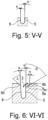
- Fig. 5 to Fig. 7 show, the groove walls 5, 6, viewed in the cross-section aligned in the circumferential direction in plan view (cf. position of the lines VV, VI-VI, VII-VII in Fig. 3 ), to the radial direction at an angle ⁇ of 0° to 6°, in particular of up to 5°, wherein the angle ⁇ is constant or can have different sizes in different regions of the transverse groove 3.
- the size of the angle ⁇ of the groove wall 6 in the region of the projection 9 can deviate from the size of the angle ⁇ of the groove wall 6 in the region outside the projection 9.
- the transverse groove 3 in the rib inner section 1a has a maximum groove width b QRmax ' of 2.0 mm to 6.0 mm, in particular of 2.5 mm to 5.5 mm (cf. position of line VII-VII in Fig. 3 ), which is determined as the smallest possible distance between two lines L 2 running in the radial direction through the radially outer ends of the groove walls 5, 6.
- b QRmax ' the maximum groove width b QRmax '
- the extension 8 the projection 9 and the recess 10 are therefore not taken into account.
- Fig. 4 The groove base 4, viewed in longitudinal section through the transverse groove 3 (cf. position of line IV-IV in Fig. 3 ), of a base section 4a on the inside of the tread and a base section 4b on the outside of the tread.
- the base section 4a on the inside of the tread runs, viewed in the longitudinal section mentioned, to the radial direction at a constant angle ⁇ of 60° to 80°, whereby it is inclined in such a way that the depth of the transverse groove 3 in the area of the base section 4a to the end flank 7 ( Fig. 3 ) continuously decreases.
- the base section 4a ends on the inside of the tread at a depth t GAmin determined in the radial direction (in Fig.
- a bevel-like extension 8 is formed along the outer edge section 11b and the middle edge section 11c, has a triangular base (longest side of the triangle) lying on the transverse groove 3 and is delimited in the radial direction by an inclined surface 8a extending from the outer edge section 11b and reaching to the groove wall 5 and also by a side surface 8b extending from the middle edge section 11c and reaching to the groove wall 5.
- the side surface 8b runs, viewed in the cross-section oriented in the circumferential direction in plan view, to the radial direction at an angle ⁇ ( Fig. 6 , compare position of line VI-VI in Fig. 3 ) of 2° to 6°, in particular of 3° to 5°.
- the inclined surface 8a is continued on the outside along the groove base 4, has a radially inner boundary edge 8a' lying on the groove wall 5, also continued along the groove base 4, and runs, viewed in the cross-section oriented in the circumferential direction in plan view, to the radial direction at an angle ⁇ ( Fig. 6 to Fig. 8 , compare position of lines VI-VI, VII-VII and VIII-VIII in Fig. 3 ) of 20° to 40°, in particular of 25° to 35°, wherein the angle ⁇ is constant or varies over the extent of the inclined surface 8a by up to 2°, and furthermore has, viewed in the mentioned cross-section, a width b SF1 ( Fig. 6 to Fig.
- the inclined surface 8a at the tread-side end of the radially inner boundary edge 8a' located on the side surface 11c extends to a radially determined depth t SF1max of preferably 1.0 mm to 2.0 mm.
- the wedge-shaped projection 9, which is delimited by the groove wall 6, is spaced from the end flank 7 and from the lateral edge of the ground contact surface (line L), the projection 9 - as in particular Fig. 3 in combination with Fig. 11 shows - in radial direction by a plan view ( Fig. 3 ) in the direction of extension of the transverse groove 3 elongated, triangular inclined surface 9d with a base located on the inner edge portion 12a and further by wall portions 6a, 6b of the groove wall 6 running to the groove bottom 4 (cf. Fig. 4 ), whereby the wall section 6b of the end flank 7 ( Fig. 3 ) and the wall section 6a to the lateral edge of the ground contact surface ( Fig.
- the triangular inclined surface 9d extends from a section part 12a' of the outer edge section 12a which directly adjoins the inner edge section 12b and forms the base of the triangle, the section part 12a', viewed in plan view, having a length c 4 projected in the axial direction of 50% to 70%, in particular 55% to 65%, of the length c QR .
- the length c 4 is therefore the length of the inclined surface 9d on the outer surface 1a'.
- the inclined surface 9d viewed in the cross-section oriented in the circumferential direction in plan view, runs at an angle ⁇ ( Fig. 6 , compare position of section line VI-VI in Fig.
- the projection 9 has a projection edge 9a at the mutual connection of the inclined surface 9d and the wall section 6a, a projection edge 9b at the mutual connection of the inclined surface 9d and the wall section 6b and a projection edge 9c at the mutual connection of the wall sections 6a, 6b.
- the projection edge 9a has, viewed in plan view, a length c 5 projected in the axial direction ( Fig. 3 ) of 70% to 90%, in particular of at least 80%, of the mentioned length c 4.
- the inclined surface 9d extends deepest into the transverse groove 3 at the mutual connection of the projection edges 9a, 9b in the radial direction, whereby the mutual connection of the projection edges 9a, 9b lies at a depth t SF2max of 0.7 mm to 1.5 mm determined in the radial direction.
- the design of the projection 9 is further such that that the transverse groove 3 at the projection edge 9c has a width b QRmin ( Fig. 3 ) of 1.0 mm to 4.0 mm, in particular of 1.5 mm to 3.0 mm.
- the width b QRmin is adjusted to the width b QRmax ' ( Fig.
- the recess 10 adjacent to the groove wall 6 is formed by a side surface 10b, which extends from the inner edge section 12b, and a bottom 10a which is elongated in the axial direction in plan view and which, at its outer area closer to the side wall (not shown), extends to the groove bottom 4 ( Fig. 11 ) and in its inner area to the groove wall 6 ( Fig. 4 ) runs.
- the base 10a becomes continuously narrower towards the inside of the tread and runs out at the wall section 6a.
- the base 10a viewed in longitudinal section through the transverse groove 3, merges tangentially (without kinks) at its outer end into the outer surface 1b' ( Fig.
- the recess 10 has a depth t A determined along the bottom edge 10a' perpendicular to the level of the outer surface 1a' or 1b', which decreases continuously in the direction of the tread outside and has a maximum value t Amax of at least 2.0 mm and at most 60% of the maximum depth t QRmax ( Fig. 4 ) of the transverse groove 3.
- the maximum value t Amax is 45% to 55% of the maximum depth t QRmax ( Fig. 4 ) of the transverse groove 3.
- the side surface 10b is an elongated triangular surface in the axial direction, which runs in the opposite direction to the bottom 10a, therefore in It becomes continuously narrower towards the outside of the tread and, viewed in the circumferential cross-section, runs at an angle ⁇ of 2° to 6° to the radial direction ( Fig. 8 , compare position of line VIII-VIII in Fig. 3 ).
- the recess 10 ends in the inner rib section 1a at the already mentioned distance a 4 ( Fig.
- the surface recess 10 can extend to the end of the transverse groove on the outside of the tread.
- the groove base 4 can have a shape that differs from the described shape both when viewed in the longitudinal section through the transverse groove 3 and when viewed in the cross section through the transverse groove 3.
- the bottom edge 10a ⁇ of the bottom 10a of the recess 10 can, depending on the design of the transverse groove 3, lie exclusively on the groove base 4, exclusively on the groove wall 6, or both on the groove base 4 and on the groove wall 6.
Landscapes
- Engineering & Computer Science (AREA)
- Mechanical Engineering (AREA)
- Tires In General (AREA)
Description
- Die Erfindung betrifft einen Fahrzeugluftreifen mit einem Laufstreifen mit zumindest einer durch eine Umfangsrille begrenzten schulterseitigen Profilrippe mit einem innerhalb der Bodenaufstandsfläche verlaufenden Rippeninnenabschnitt, einem außerhalb der Bodenaufstandsfläche verlaufenden Rippenaußenabschnitt und mit in einem Abstand vor der schulterseitigen Umfangsrille endenden Querrillen mit einer im Rippeninnenabschnitt in Umfangsrichtung ermittelten maximalen Rillenbreite von 2,0 mm bis 6,0 mm, wobei jede Querrille zwei einander gegenüberliegende Rillenwände, zwei Rillenkanten und eine an die eine Rillenwand angrenzende, zumindest abschnittsweise im Rippenaußenabschnitt ausgebildete und zumindest bis zum seitlichen Rand der Bodenaufstandsfläche reichende, in Erstreckungsrichtung der Querrille langgestreckt dreieckförmige, oberflächliche Ausnehmung aufweist.
- Ein derartiger Fahrzeugluftreifen ist beispielsweise aus der
EP 3 628 510 A1 bekannt. Der Reifen weist einen Laufstreifen mit einer schulterseitigen Profilrippe mit innerhalb der schulterseitigen Profilrippe endenden Querrillen auf. Die Querrillen weisen im Rippeninnenabschnitt, an der Laufstreifenperipherie, eine senkrecht zur Rillenmittellinie ermittelte maximale Breite von 4,0 mm bis 11,0 mm auf. Beim beschriebenen Ausführungsbeispiel setzt sich die Querrille aus einem abschnittsweise im Rippeninnenabschnitt und abschnittsweise im Rippenaußenabschnitt verlaufenden Rillenhauptabschnitt, einem gegenüber dem Rillenhauptabschnitt schmäler ausgeführten, laufstreifeninnenseitigen Rillenauslaufabschnitt und einem Rillenschulterabschnitt zusammen. Die eine Rillenwand endet am Rillenauslaufabschnitt und die andere Rillenwand ist im Rillenauslaufabschnitt fortgeführt, wobei der Rillenauslaufabschnitt der fortgeführten Rillenwand gegenüberliegend durch eine Flanke begrenzt ist, welche abschnittsweise zur Laufstreifenperipherie angefast ist und daher eine Schrägfläche (Fase) aufweist. Diese Rillenmerkmale sollen unter Aufrechterhaltung guter Wasserableiteigenschaften das Abrollgeräusch reduzieren. Der Querrille weist an der im Rillenauslaufabschnitt fortgeführten Rillenwand eine abschnittsweise im Rippenaußenabschnitt und abschnittsweise im Rippeninnenabschnitt ausgebildete, in Erstreckungsrichtung der Querrille langgestreckt dreieckförmige, oberflächliche Ausnehmung auf, wodurch die Entwässerungswirkung der Querrille weiter verbessert werden soll. - Bei Fahrzeugluftreifen der eingangs genannte Art ist es von Bedeutung, die in den schulterseitigen Profilrippen befindlichen Querrillen sowohl im Hinblick auf die Bodenhaftung als auch im Hinblick auf die Entwässerung möglichst optimal auszulegen. Die Querrillen weisen einerseits ein für die Entwässerung vorteilhaftes Leervolumen auf, reduzieren aber anderseits die Nettokontaktfläche des Laufstreifens, was die Bodenhaftung, insbesondere beim Fahren von Kurven mit hoher Geschwindigkeit, reduziert. In dieser Hinsicht ist eine weitere Verbesserung wünschenswert.
- Der Erfindung liegt daher die Aufgabe zugrunde, bei einem Fahrzeugluftreifen der eingangs genannte Art den zwischen den Entwässerungseigenschaften und der Bodenhaftung, insbesondere der Bodenhaftung beim Fahren von Kurven mit hoher Geschwindigkeit, bestehenden Zielkonflikt besser als bisher zu bewältigen.
- Gelöst wird die gestellte Aufgabe erfindungsgemäß dadurch, dass die oberflächliche Ausnehmung zumindest Großteils im Rippenaußenabschnitt ausgebildet ist und durch eine von der Rillenkante ausgehende Seitenfläche sowie einen langgezogen dreieckförmigen, in Richtung Laufstreifeninnseite kontinuierlich schmäler werdenden, auslaufenden Boden mit einer an der Rillenwand und/oder am Rillengrund liegenden Bodenkante begrenzt ist, wobei die Ausnehmung eine entlang der Bodenkante senkrecht gegenüber dem Niveau der Laufstreifenperiphere ermittelte, in Richtung Laufstreifenaußenseite abnehmende Tiefe aufweist.
- Wie nachfolgend erläutert, ist die geometrische Ausgestaltung der oberflächlichen Ausnehmung auf die gewünschten Fahrbedingungen besonders vorteilhaft angepasst. Im Fahrbetrieb ist die sich ändernde Lage des Footprints insbesondere von der individuellen, beispielsweise von der Beladung des Fahrzeuges abhängigen, Fahrzeuglast sowie von den Spur- und Sturzeinstellung des Rades abhängig. Je nach Ausgestaltung der oberflächlichen Ausnehmung befindet sich diese im üblichen Fahrbetrieb außerhalb des Footprints oder reicht geringfügig in den Footprint hinein, wobei die Ausnehmung ein für die Entwässerung vorteilhaftes, zusätzliches Wasserreservoir zur Verfügung stellt. Unter dem beim Fahren von Kurven auftretenden Lastwechsel verlagert sich der Footprint in der entsprechenden Reifenschulter in Richtung Laufstreifenaußenseite, wodurch der aufgrund der abnehmenden Tiefe der Ausnehmung besonders steife Bereich der schulterseitigen Profilrippe mit den Unterfund in Kontakt tritt, was für die Bodenhaftung besonders vorteilhaft ist. Die in Richtung Laufstreifenaußenseite zunehmende Breite des Bodens ist für den Entwässerungseffekt der Ausnehmung vorteilhaft, da in dieser Hinsicht ein gewisser Ausgleich zur abnehmenden Tiefe der Ausnehmung erzielt wird.
- Gemäß einer bevorzugten Ausführung weist die Tiefe der Ausnehmung am laufstreifeninnseitigen Ende der Bodenkante einen maximalen Wert von mindestens 2,0 mm und höchstens 60% der maximalen Tiefe der Querrille auf. Dies ist für die Entwässerungswirkung der Ausnehmung von Vorteil, wobei die Steifigkeit der Profilrippe im an die Ausnehmung angrenzenden Bereich kaum beeinflusst wird, was für die Bodenhaftung beim Fahren von Kurven mit hoher Geschwindigkeit günstig ist.
- Eine vorteilhafte Variante der bevorzugten Ausführung besteht darin, dass der maximale Wert der Tiefe der Ausnehmung am laufstreifeninnseitigen Ende der Bodenkante 45% bis 55% der maximalen Tiefe der Querrille beträgt. Diese Variante ermöglicht eine besonders vorteilhaft ausbalancierte Lösung des zwischen den Entwässerungseigenschaften und der Bodenhaftung bestehenden Zielkonfliktes.
- Gemäß einer weiteren bevorzugten Ausführung geht der Boden der Ausnehmung, im Längsschnitt durch die Querrillen betrachtet, an seinem außenseitigen Ende tangential in Außenfläche des Rippenaußenabschnittes über. Dadurch ist das Strömungsverhalten von über den Boden der Ausnehmung in Richtung Laufstreifenrand fließendem Wasser zusätzlich optimiert, sodass dieses auf verwirbelungsarme Weise über die Ausnehmung in Richtung Laufstreifenaußenseite abfließt. Diese Ausführung trägt somit zur weiteren Verbesserung der Entwässerungseigenschaften bei.
- Ferner ist es günstig, wenn der Boden der Ausnehmung, im in Umfangsrichtung ausgerichteten Querschnitt betrachtet, parallel zur Laufstreifenperipherie verläuft.
- Bevorzugt weist der Boden der Ausnehmung an seinem laufstreifenaußenseitigen Ende eine Breite von 1,5 mm bis 4,0 mm, insbesondere von 2,5 mm bis 3,5 mm, auf, was für die Entwässerung vorteilhaft ist.
- Eine weitere vorteilhafte Ausführung ist dadurch gekennzeichnet, dass die Ausnehmung im Rippeninnenabschnitt in einem vom seitlichen Rand der Bodenaufstandsfläche in axialer Richtung ermittelten Abstand von zumindest 3,0 mm endet. Die Ausnehmung reicht somit auch im üblichen Fahrbetreib in den Footprint hinein, was vor allem für die Entwässerung von zusätzlichem Vorteil ist, wobei eine gute Bodenhaftung erhalten bleibt.
- Gemäß einer weiter bevorzugten Ausführung endet die Ausnehmung im Rippenaußenabschnitt in einem am Niveau der Laufstreifenperipherie, quer zur Umfangsrichtung ermittelten Abstand von bis zu 10,0 mm, insbesondere von bis zu 3,5 mm, vor dem Ende der Querrille.
- Bevorzugter Weise verläuft die Seitenfläche, im in Umfangsrichtung verlaufenden Querschnitt betrachtet, zur radialen Richtung unter einem Winkel von 2° bis 6°.
- Weitere Merkmale, Vorteile und Einzelheiten der Erfindung werden nun anhand der Zeichnung, die schematisch ein Ausführungsbeispiel der Erfindung zeigt, näher beschrieben. Dabei zeigen
-
Fig. 1 eine Draufsicht auf einen Umfangsabschnitt einer schulterseitigen Profilrippe eines in die Ebene abgewickelten Laufstreifens eines Fahrzeugluftreifens mit einer Ausführungsvariante der Erfindung, -
Fig. 2 einen Schnitt entlang der Linie II-II derFig. 1 , -
Fig. 3 eine vergrößerte Draufsicht auf das Detail Z3 derFig. 1 , -
Fig. 4 einen Schnitt entlang der Linie IV-IV derFig. 3 , -
Fig. 5 einen Schnitt entlang der Linie V-V derFig. 3 , -
Fig. 6 einen Schnitt entlang der Linie VI-VI derFig. 3 , -
Fig. 7 einen Schnitt entlang der Linie VII-VII derFig. 3 , -
Fig. 8 einen Schnitt entlang der Linie VIII-VIII derFig. 3 , -
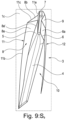
Fig. 9 eine Ansicht gemäß der inFig. 3 durch den Pfeil S9 angedeuteten Sichtrichtung unter Berücksichtigung der Reifenkrümmung, -
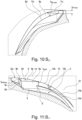
Fig. 10 eine Ansicht gemäß der inFig. 3 durch den Pfeil S10 angedeuteten Sichtrichtung unter Berücksichtigung der Reifenkrümmung, wobei die Profilrippe aufgeschnitten ist und -
Fig. 11 eine Ansicht gemäß der inFig. 3 durch den Pfeil S11 angedeuteten Sichtrichtung unter Berücksichtigung der Reifenkrümmung, wobei die Profilrippe aufgeschnitten ist. - Gemäß der Erfindung ausgeführte Fahrzeugluftreifen sind Reifen für Kraftfahrzeuge, insbesondere für mehrspurige Kraftfahrzeuge, sowie vorzugsweise Reifen in Radialbauart für Personenkraftwagen, Vans oder Light-Trucks (Kleintransporter mit zGM ≤ 3,5 t, Leichte LKWs mit zGM ≤ 7,5 t).
-
Fig. 1 zeigt eine Draufsicht auf einen Umfangsabschnitt einer schulterseitigen Profilrippe 1 eines Laufstreifens eines Fahrzeugluftreifens. Der seitliche Rand der Bodenaufstandsfläche des Laufstreifens ist inFig. 1 durch eine gestrichelte Linie L gekennzeichnet, wobei die Bodenaufstandsfläche dem statisch ermittelten Footprint gemäß E.T.R.T.O.-Standards entspricht (Last bei 70 % der maximalen Tragfähigkeit bei einem Innendruck von 85 % nach E.T.R.T.O.-Norm). Der Laustreifen weist in seiner zweiten, nicht gezeigten Schulter eine weitere schulterseitige Profilrippe auf, deren Ausgestaltung von jener der schulterseitigen Profilrippe 1 vorzugsweise abweicht, sodass der Laufstreifen bezüglich der Reifenäquatorialebene eine asymmetrische Gestalt aufweist. Ein solcher Fahrzeugluftreifen wird bevorzugt derart auf der Achse eines Fahrzeuges, etwa einem PKW, montiert, dass die schulterseitige Profilrippe 1 der Fahrzeuginnenseite FI zugewandt ist. - Die schulterseitige Profilrippe 1 ist laufstreifeninnenseitig von einer beim gezeigten Ausführungsbeispiel in Draufsicht gerade verlaufenden, schulterseitigen Umfangsrille 2 begrenzt, welche in radialer Richtung auf die jeweils vorgesehene Profiltiefe TUR (
Fig. 2 ) ausgeführt ist, wobei die Profiltiefe TUR für den bevorzugten Reifentyp üblicherweise 6,5 mm bis 13,0 mm, insbesondere bis zu 10,0 mm, beträgt. - Die schulterseitige Profilrippe 1 weist einen innerhalb der Bodenaufstandsfläche befindlichen Rippeninnenabschnitt 1a mit einer in der Laufstreifenperipherie liegenden Außenfläche 1a', einen außerhalb der Bodenaufstandsfläche befindlichen, zur nicht gezeigten Seitenwand verlaufenden Rippenaußenabschnitt 1b mit einer in der Laufstreifenperipherie liegenden Außenfläche 1b' auf und ist zur schulterseitigen Umfangsrille 2 durch eine Rippenflanke 1c begrenzt. Der Rippeninnenabschnitt 1a weist eine am Niveau der Außenfläche 1a' in axialer Richtung ermittelte Breite ba auf. Gemäß
Fig. 2 weist die Rippenflanke 1c beim gezeigten Ausführungsbeispiel eine radial äußere Übergangsrundung 1c' auf, welche, im in Draufsicht in axialer Richtung ausgerichteten Querschnitt betrachtet (vergl. Lage der Linie II-II inFig. 1 ), tangential ("knickfrei") in die Außenfläche 1a' übergeht. - Gemäß
Fig. 1 ist die schulterseitige Profilrippe 1 über ihre Umfangserstreckung mit einer Vielzahl von innerhalb der schulterseitigen Profilrippe 1 endenden Querrillen 3 versehen, welche jeweils abschnittsweise im Rippeninnenabschnitt 1a und abschnittsweise im Rippenaußenabschnitt 1b verlaufen, der schulterseitigen Profilrippe 1 eine blockartige Struktur verleihen, vor der schulterseitigen Umfangsrille 2 in einem an der Außenfläche 1a' in axialer Richtung ermittelten Abstand a1 von vorzugsweise 2,0 mm von 15,0 mm, insbesondere von 4,0 mm bis 10,0 mm, enden und - in Draufsicht betrachtet sowie bezogen auf entlang der jeweils größten Rillenlänge ausgerichtete, gerade verlaufende Linien L1 - zur axialen Richtung unter einem Winkel α von 0° bis 20°, insbesondere von bis zu 15°, besonders bevorzugt von bis zu 7°, sowie vorzugsweise parallel zueinander verlaufen. In Umfangsrichtung unmittelbar aufeinanderfolgende Querrillen 3 weisen voneinander an der Außenfläche 1a' in Umfangsrichtung als kleinstmögliche Abstände ermittelte Abstände a2 von vorzugsweise 15,0 mm von 35,0 mm auf. - Die weitere Ausgestaltung der Querrillen 3 wird nachfolgend anhand einer einzelnen Querrille 3 erläutert.
- Die Querrille 3 weist eine am Niveau der Außenfläche 1a` ermittelte, vom erwähnten Abstand a1 abhängige, in die axiale Richtung projizierte Länge cQR (
Fig. 3 ) und in radialer Richtung eine maximale Tiefe tQRmax (Tiefe an der tiefsten Stelle,Fig. 4 ) von 70% bis 100% der Profiltiefe TUR (Fig. 2 ) auf, wobei die Querrille 3 ausgehend von der tiefsten Stelle in insbesondere bekannter Weise zu ihrem laufstreifenaußenseitigen Ende kontinuierlich seichter wird und am laufstreifenaußenseitigen Ende eine minimale Tiefe tQRmin (Fig. 4 ) von höchstens 1,0 mm, insbesondere von höchstens 0,5 mm, aufweist. Alternativ kann die Querrille 3 laufstreifenaußenseitig zur Außenfläche 1b' (Fig. 3 ) auslaufen. - Wie
Fig. 3 undFig. 9 zeigen, weist die Querrille 3 einen Rillengrund 4, zwei Rillenwände 5, 6, an ihrem laufstreifeninnenseitigen Ende eine Endflanke 7, eine an die Rillenwand 5 angrenzende, sowohl im Rippeninnenabschnitt 1a (Fig. 3 ) als auch im Rippenaußenabschnitt 1b (Fig. 3 ) ausgebildete, in Draufsicht in Erstreckungsrichtung der Querrille 3 langgestreckt dreieckförmige, fasenartige Erweiterung 8, einen von der Rillenwand 6 mitbegrenzten, im Rippeninnenabschnitt 1a (Fig. 3 ) befindlichen, die Querrille 3 lokal verengenden, in Draufsicht in Erstreckungsrichtung der Querrille 3 langgestreckt dreieckförmig, insgesamt keilförmigen Vorsprung 9 und eine an die Rillenwand 6 angrenzende, Großteils im Rippenaußenabschnitt 1b (Fig. 3 ) ausgebildete und in den Rippeninnenabschnitt 1a (Fig. 3 ) reichende, in Draufsicht in Erstreckungsrichtung der Querrille 3 langgestreckt dreieckförmige, oberflächliche Ausnehmung 10 auf. - Die Querrille 3 ist an der Laufstreifenperipherie durch eine zweifach geknickte Rillenkante 11, an welcher die fasenartige Erweiterung 8 ausgebildet ist, und eine Rillenkante 12, entlang welcher der Vorsprung 9 und die Ausnehmung 10 ausgebildet sind, begrenzt. Die nachfolgenden Ausführungen zu den Rillenkanten 11, 12 beziehen sich auf die Draufsicht.
- Gemäß
Fig. 3 setzt sich die Rillenkante 11 aus einem an der Außenfläche 1a' befindlichen, innenseitigen Kantenabschnitt 11a, einem an der Außenfläche 1a' befindlichen, mittleren Kantenabschnitt 11c und einem abschnittsweise an der Außenfläche 1a' und abschnittsweise an der Außenfläche 1b' befindlichen, außenseitigen Kantenabschnitt 11b zusammen. Der innenseitige Kantenabschnitt 11a weist eine in die axiale Richtung projizierte Länge c1 von 25% bis 40%, insbesondere von bis zu 35%, der Länge cQR auf und verläuft gerade sowie zur axialen Richtung unter einem Winkel β von bis zu ± 2°, insbesondere von 0°. Der mittlere Kantenabschnitt 11c weist eine in die axiale Richtung projizierte Länge c2 von 25% bis 40%, insbesondere von zumindest 30%, der Länge cQR auf, verläuft gerade sowie zur axialen Richtung unter einem Winkel γ von 10° bis 20° und schließt mit dem innenseitigen Kantenabschnitt 11a an der der Querrille 3 abgewandten Seite einen stumpfen Winkel δ ein. Der außenseitige Kantenabschnitt 11b verläuft, insbesondere bedingt durch die gekrümmte Reifenaußenkontur, zumindest abschnittsweise leicht bogenförmig sowie an der Außenfläche 1a' zur axialen Richtung unter einem Winkel ε von 0° bis 10°, insbesondere von bis zu 5°, ist zum mittleren Kantenabschnitt 11c bezüglich der axialen Richtung vorzugsweise gegensinnig geneigt und schließt mit dem mittleren Kantenabschnitt 11c an der der Querrille 3 zugewandten Seite einen stumpfen Winkel δ` (Fig. 3 ) ein. Die stumpfen Winkel δ, δ' betragen vorzugsweise jeweils 150° bis 170°. - Die Rillenkante 12 setzt sich aus einem an der Außenfläche 1a' befindlichen, leicht bogenförmig verlaufenden, innenseitigen Kantenabschnitt 12a mit einer in die axiale Richtung projizierten Länge c3 von 80% bis 90% der Länge cQR und einem abschnittsweise an der Außenfläche 1a' und abschnittsweise an der Außenfläche 1b' befindlichen, leicht bogenförmig verlaufenden, außenseitigen Kantenabschnitt 12b, welcher laufstreifenaußenseitig in einem quer zur Umfangsrichtung am Niveau der Außenfläche 1b' ermittelten Abstand a3 von bis zu 10,0 mm, insbesondere von bis zu 3,5 mm, vor dem Ende der Querrille 3 endet, zusammen. Die erwähnte Länge c3 des innenseitigen Kantenabschnittes 12a und der erwähnte Abstand a1 sind vorzugsweise derart aufeinander abgestimmt, dass die Kantenabschnitte 12a, 12b an ihrem gegenseitigen Anschluss zum seitlichen Rand der Bodenaufstandsfläche in axialer Richtung einen Abstand a4 von zumindest 3,0 mm aufweisen.
- Die Querrille 3 weist eine an der Außenfläche 1a', in Umfangsrichtung ermittelte maximale Breite bQRmax von 5,0 mm bis 9,0 mm, insbesondere von 6,5 mm bis 7,0 mm, auf, wobei die Stelle der maximalen Breite bQRmax beim gezeigten Ausführungsbeispiel am gegenseitigen Anschluss des Kantenabschnittes 11b an den Kantenabschnitt 11c vorliegt. Die maximale Breite bQRmax ist daher im Rippeninnenabschnitt 1a sowie an der Laufstreifenperipherie ermittelt, wobei die genaue Lage der maximalen Breite bQRmax von der erwähnten Lage abweichen kann und wobei die maximale Breite bQRmax auch über einen in
Fig. 3 nicht bezeichneten Abschnitt der Querrille 3 vorhanden sein kann. - Wie
Fig. 5 bis Fig. 7 zeigen, verlaufen die Rillenwände 5, 6, im in Draufsicht in Umfangsrichtung ausgerichteten Querschnitt betrachtet (vergl. Lage der Linien V-V, VI-VI, VII-VII inFig. 3 ), zur radialen Richtung unter einem Winkel κ von 0° bis 6°, insbesondere von bis zu 5°, wobei der Winkel κ konstant ist oder in verschiedenen Bereichen der Querrille 3 unterschiedliche Größen aufweisen kann. Beispielsweise kann die Größe des Winkels κ der Rillenwand 6 im Bereich des Vorsprunges 9 von der Größe des Winkels κ der Rillenwand 6 im Bereich außerhalb des Vorsprunges 9 abweichen. - Wie
Fig. 7 zeigt, weist die Querrille 3 im Rippeninnenabschnitt 1a, im in Draufsicht in Umfangsrichtung ausgerichteten Querschnitt betrachtet, eine maximale Rillenbreite bQRmax' von 2,0 mm bis 6,0 mm, insbesondere von 2,5 mm bis 5,5 mm, auf (vergl. Lage der Linie VII-VII inFig. 3 ), welche als kleinstmöglicher Abstand zwischen zwei in radialer Richtung durch die radial äußeren Enden der Rillenwände 5, 6 verlaufenden Linien L2 ermittelt ist. Bei der Ermittlung der maximale Rillenbreite bQRmax' bleiben daher die Erweiterung 8, der Vorsprung 9 und die Ausnehmung 10 unberücksichtigt. - Gemäß
Fig. 4 setzt sich der Rillengrund 4, im Längsschnitt durch die Querrille 3 betrachtet (vergl. Lage der Linie IV-IV inFig. 3 ), aus einem laufstreifeninnenseitigen Grundabschnitt 4a und einem laufstreifenaußenseitigen Grundabschnitt 4b zusammen. Der laufstreifeninnenseitige Grundabschnitt 4a verläuft, im erwähnten Längsschnitt betrachtet, zur radialen Richtung unter einem konstanten Winkel π von 60° bis 80°, wobei er derart geneigt ist, dass die Tiefe der Querrille 3 im Bereich des Grundabschnittes 4a zur Endflanke 7 (Fig. 3 ) kontinuierlich abnimmt. Der Grundabschnitt 4a schließt laufstreifeninnenseitig in einer in radialer Richtung ermittelten Tiefe tGAmin (inFig. 4 angedeutet) von 0,8 mm bis 1,5 mm an die Endflanke 7 (Fig. 3 ) an, endet laufstreifenaußenseitig im Bereich des Vorsprunges 9 sowie in einer in radialer Richtung ermitteln Tiefe tGAmax und weist, in Draufsicht betrachtet, eine in die axiale Richtung projizierte Länge c6 (Fig. 3 ) 40% bis 60% der Länge cQR auf. Der Winkel π, die Länge c6 und die Tiefe tGAmin sind bevorzugt derart aufeinander abgestimmt, dass die Tiefe tGAmax der um 0,5 mm bis 1,5 mm verringerten maximalen Tiefe tQRmax der Querrille 3 beträgt. - Gemäß
Fig. 9 ist fasenartige Erweiterung 8 entlang des außenseitigen Kantenabschnittes 11b und des mittleren Kantenabschnittes 11c ausgebildet, weist eine an der Querrille 3 liegende Dreieckbasis (längste Seite des Dreieckes) auf und ist in radialer Richtung durch eine vom außenseitigen Kantenabschnitt 11b ausgehende, zur Rillenwand 5 reichende Schrägfläche 8a sowie ferner durch eine vom mittleren Kantenabschnitt 11c ausgehende, zur Rillenwand 5 reichende Seitenfläche 8b begrenzt. Die Seitenfläche 8b verläuft, im in Draufsicht in Umfangsrichtung ausgerichteten Querschnitt betrachtet, zur radialen Richtung unter einem Winkel η (Fig. 6 , vergl. Lage der Linie VI-VI inFig. 3 ) von 2° bis 6°, insbesondere von 3° bis 5°. Die Schrägfläche 8a ist außenseitig entlang des Rillengrundes 4 fortgeführt, weist eine an der Rillenwand 5 liegende, ebenfalls entlang des Rillengrundes 4 fortgeführte, radial innere Begrenzungskante 8a' auf, verläuft, im in Draufsicht in Umfangsrichtung ausgerichteten Querschnitt betrachtet, zur radialen Richtung unter einem Winkel θ (Fig. 6 bis Fig. 8 , vergl. Lage der Linien VI-VI, VII-VII und VIII-VIII inFig. 3 ) von 20° bis 40°, insbesondere von 25° bis 35°, wobei der Winkel θ konstant ist oder über die Erstreckung der Schrägfläche 8a um bis zu 2° variiert, und weist ferner, im erwähnten Querschnitt betrachtet, eine Breite bSF1 (Fig. 6 bis Fig. 8 ) auf, welche am gegenseitigen Anschluss des außenseitigen Kantenabschnittes 11b und des mittleren Kantenabschnittes 11c ihren größten Wert bSF1max (andeutet inFig. 10 ) von 1,5 mm bis 3,0 mm, insbesondere von 2,0 mm bis 2,5 mm, aufweist. GemäßFig. 10 reicht die Schrägfläche 8a am an der Seitenfläche 11c liegenden laufstreifeninnenseitigen Ende der radial inneren Begrenzungskante 8a' in eine in radialer ermittelte Tiefe tSF1max von vorzugsweise 1,0 mm bis 2,0 mm. - Gemäß
Fig. 3 ist der von der Rillenwand 6 mitbegrenzte, keilförmige Vorsprung 9 von der Endflanke 7 und vom seitlichen Rand der Bodenaufstandsfläche (Linie L) beabstandet, wobei der Vorsprung 9 - wie insbesondereFig. 3 in Kombination mitFig. 11 zeigt - in radialer Richtung durch eine in Draufsicht (Fig. 3 ) in Erstreckungsrichtung der Querrille 3 langgestreckte, dreieckförmige Schrägfläche 9d mit einer am innenseitigen Kantenabschnitt 12a liegende Basis und ferner durch zum Rillengrund 4 verlaufende Wandabschnitte 6a, 6b der Rillenwand 6 (vergl.Fig. 4 ) begrenzt ist, wobei der Wandabschnitt 6b der Endflanke 7 (Fig. 3 ) und der Wandabschnitt 6a dem seitlichen Rand der Bodenaufstandsfläche (Fig. 3 : Linie L) zugewandt ist. GemäßFig. 3 geht die dreieckförmige Schrägfläche 9d von einem unmittelbar an den innenseitigen Kantenabschnitt 12b anschließenden, die Basis des Dreieckes bildenden Abschnittteil 12a' des außenseitigen Kantenabschnittes 12a aus, wobei der Abschnittteil 12a', jeweils in Draufsicht betrachtet, eine in die axiale Richtung projizierte Länge c4 von 50% bis 70%, insbesondere von 55% bis 65%, der Länge cQR aufweist. Die Länge c4 ist daher die Länge der Schrägfläche 9d an der Außenfläche 1a'. Die Schrägfläche 9d verläuft, im in Draufsicht in Umfangsrichtung ausgerichteten Querschnitt betrachtet, zur radialen Richtung unter einem Winkel λ (Fig. 6 , vergl. Lage der Schnittlinie VI-VI inFig. 3 ) von 40° bis 50°, wobei der Winkel λ konstant ist oder über die Erstreckung der Schrägfläche 9d um bis zu 3° variiert. GemäßFig. 11 weist der Vorsprung 9 am gegenseitigen Anschluss der Schrägfläche 9d und des Wandabschnittes 6a eine Vorsprungkante 9a, am gegenseitigen Anschluss der Schrägfläche 9d und des Wandabschnittes 6b eine Vorsprungkante 9b und am gegenseitigen Anschluss der Wandabschnitte 6a, 6b eine Vorsprungkante 9c auf. Die Vorsprungkante 9a weist, in Draufsicht betrachtet, eine in die axiale Richtung projizierte Länge c5 (Fig. 3 ) von 70% bis 90%, insbesondere von zumindest 80%, der erwähnten Länge c4 auf. Die Vorsprungkanten 9a, 9b schließen, in Draufsicht betrachtet, miteinander einen Winkel µ (Fig. 3 ) von 150° bis 160° ein. Die Schrägfläche 9d reicht am gegenseitigen Anschluss der Vorsprungkanten 9a, 9b in radialer Richtung am tiefsten in Querrille 3 hinein, wobei der gegenseitigen Anschluss der Vorsprungkanten 9a, 9b in einer in radialer Richtung ermittelten Tiefe tSF2max von 0,7 mm bis 1,5 mm liegt. Die Ausgestaltung des Vorsprunges 9 ist ferner derart, dass die Querrille 3 an der Vorsprungkante 9c eine zwischen den Rillenwänden 5, 6 in Umfangsrichtung als kleinstmöglichen Abstand ermittelte Breite bQRmin (Fig. 3 ) von 1,0 mm bis 4,0 mm, insbesondere von 1,5 mm bis 3,0 mm, aufweist. Bevorzugt ist die Breite bQRmin derart auf die Breite bQRmax' (Fig. 7 ) abgestimmt, dass die Breite bQRmin maximal 50% der Breite bQRmax' beträgt. Die Neigung der Vorsprungkante 9c relativ zur radialen Richtung ergibt sich aus dem bereits erwähnten Winkel κ (Fig. 5 bis Fig. 8 ) der Rillenwand 6 und der damit verbundenen etwaigen Neigung der Wandabschnitte 6a, 6b. - Gemäß
Fig. 3 undFig. 11 ist die an die Rillenwand 6 angrenzende Ausnehmung 10 durch eine Seitenfläche 10b, welche von innenseitigen Kantenabschnitt 12b ausgeht, und einen in Draufsicht in axialer Richtung langgezogen dreieckförmigen Boden 10a, welcher an seinem der nicht gezeigten Seitenwand näher befindlichen außenseitigen Bereich zum Rillengrund 4 (Fig. 11 ) und in seinem innenseitigen Bereich zur Rillenwand 6 (Fig. 4 ) verläuft, begrenzt. Der Boden 10a wird in Richtung Laufstreifeninnseite kontinuierlich schmäler und läuft am Wandabschnitt 6a aus. Der Boden 10a geht, im Längsschnitt durch die Querrille 3 betrachtet, an seinem außenseitigen Ende tangential (knickfrei) in die Außenfläche 1b' über (Fig. 4 ), verläuft, im in Umfangsrichtung verlaufenden Querschnitt betrachtet, parallel zur jeweiligen Außenfläche 1a', 1b' (Fig. 8 , vergl. Lage der Linie VIII-VIII inFig. 3 ) und weist an seinem laufstreifenaußenseitigen Ende eine in Umfangsrichtung ermittelte Breite bBmax (Fig. 3 ) von 1,5 mm bis 4,0 mm, insbesondere von 2,5 mm bis 3,5 mm, sowie an der Rillenwand 6, eine außenseitig entlang des Rillengrundes 4 fortgeführte Bodenkante 10a` auf. GemäßFig. 11 weist die Ausnehmung 10 eine entlang der Bodenkante 10a' senkrecht gegenüber dem Niveau der Außenfläche 1a' bzw. 1b' ermittelte Tiefe tA auf, welche in Richtung Laufstreifenaußenseite kontinuierlich abnimmt und am laufstreifeninnenseitigen Ende einen maximalen Wert tAmax von mindestens 2,0 mm und höchstens 60% der maximalen Tiefe tQRmax (Fig. 4 ) der Querrille 3 aufweist. Bevorzugt beträgt der maximale Wert tAmax 45% bis 55% der maximalen Tiefe tQRmax (Fig. 4 ) der Querrille 3. Die Seitenfläche 10b ist eine in axialer Richtung langgezogen dreieckförmige Fläche, welche in entgegengesetzter Richtung zum Boden 10a ausläuft, daher in Richtung Laufstreifenaußenseite kontinuierlicher schmäler wird, und, im in Umfangsrichtung verlaufenden Querschnitt betrachtet, zur radialen Richtung unter einem Winkel ρ von 2° bis 6° verläuft (Fig. 8 , vergl. Lage der Linie VIII-VIII inFig. 3 ). Entsprechend der beschriebenen Ausgestaltung der Rillenkante 12 endet die Ausnehmung 10 im Rippeninnenabschnitt 1a im bereits erwähnten Abstand a4 (Fig. 3 ) vom seitlichen Rand der Bodenaufstandsfläche (Linie L) und im Rippenaußenabschnitt 1b im bereits erwähnten, quer zur Umfangsrichtung am Niveau der Außenfläche 1b' ermittelten Abstand a3 vor dem Ende der Querrille 3. - Die Erfindung ist auf das beschriebene Ausführungsbeispiel nicht beschränkt.
- Insbesondere sind der Vorsprung 9 und die fasenartige Erweiterung 8 optional. Die oberflächliche Ausnehmung 10 kann bis zum laufstreifenaußenseitigen Ende der Querrille reichen. Der Rillengrund 4 kann sowohl im Längsschnitt durch die Querrille 3 betrachtet als im Querschnitt durch die Querrille 3 betrachtet eine von der beschriebenen Gestalt abweichende Gestalt aufweisen. Die Bodenkante 10a` des Bodes 10a der Ausnehmung 10 kann je nach Ausgestaltung der Querrille 3 ausschließlich am Rillengrund 4, ausschließlich an der Rillenwand 6 oder sowohl am Rillengrund 4 als auch an der Rillenwand 6 liegen.
-
- 1
- schulterseitige Profilrippe
- 1a
- Rippeninnenabschnitt
- 1a'
- Außenfläche
- 1b
- Rippenaußenabschnitt
- 1b'
- Außenfläche
- 1c
- Rippenflanke
- 1c'
- radial äußere Übergangsrundung
- 2
- schulterseitigeUmfangsrille
- 3
- Querrille
- 4
- Rillengrund
- 4a
- laufstreifeninnenseitiger Grundabschnitt
- 4b
- laufstreifenaußenseitiger Grundabschnitt
- 5
- Rillenwand
- 6
- Rillenwand
- 6a
- Wandabschnitt
- 6b
- Wandabschnitt
- 7
- Endflanke
- 8
- fasenartige Erweiterung
- 8a
- Schrägfläche
- 8a'
- radial innere Begrenzungskante
- 8b
- Seitenfläche
- 9
- Vorsprung
- 9a, 9b, 9c
- Vorsprungkante
- 9d
- Schrägfläche
- 10
- oberflächliche Ausnehmung
- 10a
- Boden
- 10a'
- Bodenkante
- 10b
- Seitenfläche
- 11
- Rillenkante
- 11a
- innenseitiger Kantenabschnitt
- 11b
- außenseitiger Kantenabschnitt
- 11c
- mittlerer Kantenabschnitt
- 12
- Rillenkante
- 12a
- innenseitiger Kantenabschnitt
- 12a`
- Abschnittteil
- 12b
- außenseitiger Kantenabschnitt
- a1, a2, a3, a4
- Abstand
- ba, bSF1
- Breite
- bBmax
- Breite
- bQRmin
- Breite
- bQRmax
- maximale Breite
- bQRmax'
- maximale Rillenbreite
- bSF1max
- größter Wert
- cA, cQR, C1, c2, c3, c4, c5, c6
- Länge
- FI
- Fahrzeuginnenseite
- L
- Linie (seitlicher Rand der Bodenaufstandsfläche)
- L1, L2
- Linie
- S9, S10, S11
- Pfeil (Sichtrichtung)
- tA
- Tiefe
- tAmax
- maximaler Wert
- tGAmin, tGAmax
- Tiefe
- tQRmax
- maximale Tiefe
- tQRmin
- minimale Tiefe
- tSF1max, tSF2max
- Tiefe
- TUR
- Profiltiefe
- Z3
- Detail
- α, β, γ, ε, η, θ, κ, λ, µ, π, ρ
- Winkel
- δ, δ'
- stumpfer Winkel
Claims (9)
- Fahrzeugluftreifen mit einem Laufstreifen mit zumindest einer durch eine Umfangsrille (2) begrenzten schulterseitigen Profilrippe (1) mit einem innerhalb der Bodenaufstandsfläche verlaufenden Rippeninnenabschnitt (1a), einem außerhalb der Bodenaufstandsfläche verlaufenden Rippenaußenabschnitt (1b) und mit in einem Abstand (a1) vor der schulterseitigen Umfangsrille (2) endenden Querrillen (3) mit einer im Rippeninnenabschnitt (1a) in Umfangsrichtung ermittelten maximalen Rillenbreite (bQRmax') von 2,0 mm bis 6,0 mm, wobei jede Querrille (3) zwei einander gegenüberliegende Rillenwände (5, 6), zwei Rillenkanten (11, 12) und eine an die eine Rillenwand (6) angrenzende, zumindest abschnittsweise im Rippenaußenabschnitt (1b) ausgebildete und zumindest bis zum seitlichen Rand der Bodenaufstandsfläche (Linie L) reichende, in Erstreckungsrichtung der Querrille (3) langgestreckt dreieckförmige, oberflächliche Ausnehmung (10) aufweist,
dadurch gekennzeichnet,
dass die oberflächliche Ausnehmung (10) zumindest Großteils im Rippenaußenabschnitt (1b) ausgebildet ist und durch eine von der Rillenkante (12) ausgehende Seitenfläche (10b) sowie einen langgezogen dreieckförmigen, in Richtung Laufstreifeninnseite kontinuierlich schmäler werdenden, auslaufenden Boden (10a) mit einer an der Rillenwand (6) und/oder am Rillengrund (4) liegenden Bodenkante (10a') begrenzt ist, wobei die Ausnehmung (10) eine entlang der Bodenkante (10a') senkrecht gegenüber dem Niveau der Laufstreifenperiphere ermittelte, in Richtung Laufstreifenaußenseite abnehmende Tiefe (tA) aufweist. - Fahrzeugluftreifen nach Anspruch 1, dadurch gekennzeichnet, dass die Tiefe (tA) der Ausnehmung (10) am laufstreifeninnseitigen Ende der Bodenkante (10a') einen maximalen Wert (tAmax) von mindestens 2,0 mm und höchstens 60% der maximalen Tiefe (tQRmax) der Querrille (3) aufweist.
- Fahrzeugluftreifen nach Anspruch 2, dadurch gekennzeichnet, dass der maximale Wert (tAmax) der Tiefe (tA) der Ausnehmung (10) am laufstreifeninnseitigen Ende der Bodenkante (10a') 45% bis 55% der maximalen Tiefe (tQRmax) der Querrille (3) beträgt.
- Fahrzeugluftreifen nach einem der Ansprüche 1 bis 3, dadurch gekennzeichnet, dass der Boden (10a) der Ausnehmung (10), im Längsschnitt durch die Querrille (3) betrachtet, an seinem außenseitigen Ende tangential in Außenfläche (1b') des Rippenaußenabschnittes (1b) übergeht.
- Fahrzeugluftreifen nach einem der Ansprüche 1 bis 4, dadurch gekennzeichnet, dass der Boden (10a) der Ausnehmung (10), im in Umfangsrichtung ausgerichteten Querschnitt betrachtet, parallel zur Laufstreifenperipherie verläuft.
- Fahrzeugluftreifen nach einem der Ansprüche 1 bis 5, dadurch gekennzeichnet, dass der Boden (10a) der Ausnehmung (10) an seinem laufstreifenaußenseitigen Ende eine Breite (bBmax) von 1,5 mm bis 4,0 mm, insbesondere von 2,5 mm bis 3,5 mm, aufweist.
- Fahrzeugluftreifen nach einem der Ansprüche 1 bis 6, dadurch gekennzeichnet, dass die Ausnehmung (10) im Rippeninnenabschnitt (1a) in einem vom seitlichen Rand der Bodenaufstandsfläche (Linie L) in axialer Richtung ermittelten Abstand (a4) von zumindest 3,0 mm endet.
- Fahrzeugluftreifen nach einem der Ansprüche 1 bis 7, dadurch gekennzeichnet, dass die Ausnehmung (10) im Rippenaußenabschnitt (1b) in einem am Niveau der Laufstreifenperipherie, quer zur Umfangsrichtung ermittelten Abstand (a3) von bis zu 10,0 mm, insbesondere von bis zu 3,5 mm, vor dem Ende der Querrille (3) endet.
- Fahrzeugluftreifen nach einem der Ansprüche 1 bis 8, dadurch gekennzeichnet, dass die Seitenfläche (10b), im in Umfangsrichtung verlaufenden Querschnitt betrachtet, zur radialen Richtung unter einem Winkel (ρ) von 2° bis 6° verläuft.
Applications Claiming Priority (1)
| Application Number | Priority Date | Filing Date | Title |
|---|---|---|---|
| DE102022201497.9A DE102022201497A1 (de) | 2022-02-14 | 2022-02-14 | Fahrzeugluftreifen |
Publications (2)
| Publication Number | Publication Date |
|---|---|
| EP4227115A1 EP4227115A1 (de) | 2023-08-16 |
| EP4227115B1 true EP4227115B1 (de) | 2024-10-23 |
Family
ID=84888569
Family Applications (1)
| Application Number | Title | Priority Date | Filing Date |
|---|---|---|---|
| EP23150662.7A Active EP4227115B1 (de) | 2022-02-14 | 2023-01-09 | Fahrzeugluftreifen |
Country Status (2)
| Country | Link |
|---|---|
| EP (1) | EP4227115B1 (de) |
| DE (1) | DE102022201497A1 (de) |
Family Cites Families (6)
| Publication number | Priority date | Publication date | Assignee | Title |
|---|---|---|---|---|
| DE102015225939A1 (de) * | 2015-12-18 | 2017-06-22 | Continental Reifen Deutschland Gmbh | Fahrzeugluftreifen |
| JP6841079B2 (ja) * | 2017-02-22 | 2021-03-10 | 横浜ゴム株式会社 | 空気入りタイヤ |
| DE102017206383A1 (de) * | 2017-04-13 | 2018-10-18 | Continental Reifen Deutschland Gmbh | Fahrzeugluftreifen |
| JP7074561B2 (ja) * | 2018-05-17 | 2022-05-24 | Toyo Tire株式会社 | 空気入りタイヤ |
| DE102018216556A1 (de) | 2018-09-27 | 2020-04-02 | Continental Reifen Deutschland Gmbh | Fahrzeugluftreifen |
| DE102019206654A1 (de) * | 2019-05-08 | 2020-11-12 | Continental Reifen Deutschland Gmbh | Fahrzeugluftreifen |
-
2022
- 2022-02-14 DE DE102022201497.9A patent/DE102022201497A1/de active Pending
-
2023
- 2023-01-09 EP EP23150662.7A patent/EP4227115B1/de active Active
Also Published As
| Publication number | Publication date |
|---|---|
| EP4227115A1 (de) | 2023-08-16 |
| DE102022201497A1 (de) | 2023-08-17 |
Similar Documents
| Publication | Publication Date | Title |
|---|---|---|
| EP3589500B1 (de) | Fahrzeugluftreifen | |
| EP3388256B1 (de) | Fahrzeugluftreifen | |
| DE102019213044A1 (de) | Fahrzeugluftreifen | |
| EP4244079B1 (de) | Fahrzeugluftreifen | |
| EP3628511B1 (de) | Fahrzeugluftreifen | |
| EP3628510B1 (de) | Fahrzeugluftreifen | |
| EP3750723A1 (de) | Fahrzeugluftreifen | |
| EP4227116B1 (de) | Fahrzeugluftreifen | |
| EP4144542B1 (de) | Fahrzeugluftreifen | |
| WO2024200185A1 (de) | Fahrzeugluftreifen | |
| EP4227115A1 (de) | Fahrzeugluftreifen | |
| EP4347276B1 (de) | Fahrzeugluftreifen | |
| WO2023036375A1 (de) | Fahrzeugluftreifen | |
| EP4363243B1 (de) | Fahrzeugluftreifen | |
| EP4227117B1 (de) | Fahrzeugluftreifen | |
| EP4301609B1 (de) | Fahrzeugluftreifen | |
| EP4234273B1 (de) | Fahrzeugluftreifen | |
| EP4197816B1 (de) | Fahrzeugluftreifen | |
| EP4360913B1 (de) | Fahrzeugluftreifen | |
| EP4140776B1 (de) | Fahrzeugluftreifen | |
| DE102024107982A1 (de) | Nutzfahrzeugreifen | |
| DE102023206026A1 (de) | Fahrzeugluftreifen | |
| DE102024205994A1 (de) | Fahrzeugreifen | |
| EP3130484B1 (de) | Fahrzeugluftreifen | |
| DE102024207446A1 (de) | Fahrzeugreifen |
Legal Events
| Date | Code | Title | Description |
|---|---|---|---|
| PUAI | Public reference made under article 153(3) epc to a published international application that has entered the european phase |
Free format text: ORIGINAL CODE: 0009012 |
|
| STAA | Information on the status of an ep patent application or granted ep patent |
Free format text: STATUS: THE APPLICATION HAS BEEN PUBLISHED |
|
| AK | Designated contracting states |
Kind code of ref document: A1 Designated state(s): AL AT BE BG CH CY CZ DE DK EE ES FI FR GB GR HR HU IE IS IT LI LT LU LV MC ME MK MT NL NO PL PT RO RS SE SI SK SM TR |
|
| STAA | Information on the status of an ep patent application or granted ep patent |
Free format text: STATUS: REQUEST FOR EXAMINATION WAS MADE |
|
| RAP3 | Party data changed (applicant data changed or rights of an application transferred) |
Owner name: CONTINENTAL REIFEN DEUTSCHLAND GMBH |
|
| 17P | Request for examination filed |
Effective date: 20240216 |
|
| RBV | Designated contracting states (corrected) |
Designated state(s): AL AT BE BG CH CY CZ DE DK EE ES FI FR GB GR HR HU IE IS IT LI LT LU LV MC ME MK MT NL NO PL PT RO RS SE SI SK SM TR |
|
| GRAP | Despatch of communication of intention to grant a patent |
Free format text: ORIGINAL CODE: EPIDOSNIGR1 |
|
| STAA | Information on the status of an ep patent application or granted ep patent |
Free format text: STATUS: GRANT OF PATENT IS INTENDED |
|
| RIC1 | Information provided on ipc code assigned before grant |
Ipc: B60C 11/03 20060101ALI20240612BHEP Ipc: B60C 11/13 20060101ALI20240612BHEP Ipc: B60C 11/04 20060101AFI20240612BHEP |
|
| INTG | Intention to grant announced |
Effective date: 20240702 |
|
| GRAS | Grant fee paid |
Free format text: ORIGINAL CODE: EPIDOSNIGR3 |
|
| GRAA | (expected) grant |
Free format text: ORIGINAL CODE: 0009210 |
|
| STAA | Information on the status of an ep patent application or granted ep patent |
Free format text: STATUS: THE PATENT HAS BEEN GRANTED |
|
| AK | Designated contracting states |
Kind code of ref document: B1 Designated state(s): AL AT BE BG CH CY CZ DE DK EE ES FI FR GB GR HR HU IE IS IT LI LT LU LV MC ME MK MT NL NO PL PT RO RS SE SI SK SM TR |
|
| P01 | Opt-out of the competence of the unified patent court (upc) registered |
Free format text: CASE NUMBER: APP_51517/2024 Effective date: 20240912 |
|
| REG | Reference to a national code |
Ref country code: GB Ref legal event code: FG4D Free format text: NOT ENGLISH |
|
| REG | Reference to a national code |
Ref country code: CH Ref legal event code: EP |
|
| REG | Reference to a national code |
Ref country code: DE Ref legal event code: R096 Ref document number: 502023000220 Country of ref document: DE |
|
| REG | Reference to a national code |
Ref country code: IE Ref legal event code: FG4D Free format text: LANGUAGE OF EP DOCUMENT: GERMAN |
|
| REG | Reference to a national code |
Ref country code: NL Ref legal event code: FP |
|
| REG | Reference to a national code |
Ref country code: LT Ref legal event code: MG9D |
|
| PG25 | Lapsed in a contracting state [announced via postgrant information from national office to epo] |
Ref country code: IS Free format text: LAPSE BECAUSE OF FAILURE TO SUBMIT A TRANSLATION OF THE DESCRIPTION OR TO PAY THE FEE WITHIN THE PRESCRIBED TIME-LIMIT Effective date: 20250223 Ref country code: HR Free format text: LAPSE BECAUSE OF FAILURE TO SUBMIT A TRANSLATION OF THE DESCRIPTION OR TO PAY THE FEE WITHIN THE PRESCRIBED TIME-LIMIT Effective date: 20241023 Ref country code: PT Free format text: LAPSE BECAUSE OF FAILURE TO SUBMIT A TRANSLATION OF THE DESCRIPTION OR TO PAY THE FEE WITHIN THE PRESCRIBED TIME-LIMIT Effective date: 20250224 |
|
| PG25 | Lapsed in a contracting state [announced via postgrant information from national office to epo] |
Ref country code: FI Free format text: LAPSE BECAUSE OF FAILURE TO SUBMIT A TRANSLATION OF THE DESCRIPTION OR TO PAY THE FEE WITHIN THE PRESCRIBED TIME-LIMIT Effective date: 20241023 |
|
| PG25 | Lapsed in a contracting state [announced via postgrant information from national office to epo] |
Ref country code: BG Free format text: LAPSE BECAUSE OF FAILURE TO SUBMIT A TRANSLATION OF THE DESCRIPTION OR TO PAY THE FEE WITHIN THE PRESCRIBED TIME-LIMIT Effective date: 20241023 |
|
| PG25 | Lapsed in a contracting state [announced via postgrant information from national office to epo] |
Ref country code: ES Free format text: LAPSE BECAUSE OF FAILURE TO SUBMIT A TRANSLATION OF THE DESCRIPTION OR TO PAY THE FEE WITHIN THE PRESCRIBED TIME-LIMIT Effective date: 20241023 |
|
| PG25 | Lapsed in a contracting state [announced via postgrant information from national office to epo] |
Ref country code: NO Free format text: LAPSE BECAUSE OF FAILURE TO SUBMIT A TRANSLATION OF THE DESCRIPTION OR TO PAY THE FEE WITHIN THE PRESCRIBED TIME-LIMIT Effective date: 20250123 |
|
| PG25 | Lapsed in a contracting state [announced via postgrant information from national office to epo] |
Ref country code: LV Free format text: LAPSE BECAUSE OF FAILURE TO SUBMIT A TRANSLATION OF THE DESCRIPTION OR TO PAY THE FEE WITHIN THE PRESCRIBED TIME-LIMIT Effective date: 20241023 Ref country code: GR Free format text: LAPSE BECAUSE OF FAILURE TO SUBMIT A TRANSLATION OF THE DESCRIPTION OR TO PAY THE FEE WITHIN THE PRESCRIBED TIME-LIMIT Effective date: 20250124 |
|
| PG25 | Lapsed in a contracting state [announced via postgrant information from national office to epo] |
Ref country code: PL Free format text: LAPSE BECAUSE OF FAILURE TO SUBMIT A TRANSLATION OF THE DESCRIPTION OR TO PAY THE FEE WITHIN THE PRESCRIBED TIME-LIMIT Effective date: 20241023 |
|
| PG25 | Lapsed in a contracting state [announced via postgrant information from national office to epo] |
Ref country code: RS Free format text: LAPSE BECAUSE OF FAILURE TO SUBMIT A TRANSLATION OF THE DESCRIPTION OR TO PAY THE FEE WITHIN THE PRESCRIBED TIME-LIMIT Effective date: 20250123 |
|
| PG25 | Lapsed in a contracting state [announced via postgrant information from national office to epo] |
Ref country code: SM Free format text: LAPSE BECAUSE OF FAILURE TO SUBMIT A TRANSLATION OF THE DESCRIPTION OR TO PAY THE FEE WITHIN THE PRESCRIBED TIME-LIMIT Effective date: 20241023 |
|
| PG25 | Lapsed in a contracting state [announced via postgrant information from national office to epo] |
Ref country code: DK Free format text: LAPSE BECAUSE OF FAILURE TO SUBMIT A TRANSLATION OF THE DESCRIPTION OR TO PAY THE FEE WITHIN THE PRESCRIBED TIME-LIMIT Effective date: 20241023 |
|
| PG25 | Lapsed in a contracting state [announced via postgrant information from national office to epo] |
Ref country code: EE Free format text: LAPSE BECAUSE OF FAILURE TO SUBMIT A TRANSLATION OF THE DESCRIPTION OR TO PAY THE FEE WITHIN THE PRESCRIBED TIME-LIMIT Effective date: 20241023 |
|
| PG25 | Lapsed in a contracting state [announced via postgrant information from national office to epo] |
Ref country code: RO Free format text: LAPSE BECAUSE OF FAILURE TO SUBMIT A TRANSLATION OF THE DESCRIPTION OR TO PAY THE FEE WITHIN THE PRESCRIBED TIME-LIMIT Effective date: 20241023 |
|
| REG | Reference to a national code |
Ref country code: DE Ref legal event code: R097 Ref document number: 502023000220 Country of ref document: DE |
|
| PG25 | Lapsed in a contracting state [announced via postgrant information from national office to epo] |
Ref country code: SK Free format text: LAPSE BECAUSE OF FAILURE TO SUBMIT A TRANSLATION OF THE DESCRIPTION OR TO PAY THE FEE WITHIN THE PRESCRIBED TIME-LIMIT Effective date: 20241023 |
|
| PG25 | Lapsed in a contracting state [announced via postgrant information from national office to epo] |
Ref country code: CZ Free format text: LAPSE BECAUSE OF FAILURE TO SUBMIT A TRANSLATION OF THE DESCRIPTION OR TO PAY THE FEE WITHIN THE PRESCRIBED TIME-LIMIT Effective date: 20241023 |
|
| PG25 | Lapsed in a contracting state [announced via postgrant information from national office to epo] |
Ref country code: IT Free format text: LAPSE BECAUSE OF FAILURE TO SUBMIT A TRANSLATION OF THE DESCRIPTION OR TO PAY THE FEE WITHIN THE PRESCRIBED TIME-LIMIT Effective date: 20241023 |
|
| PLBE | No opposition filed within time limit |
Free format text: ORIGINAL CODE: 0009261 |
|
| STAA | Information on the status of an ep patent application or granted ep patent |
Free format text: STATUS: NO OPPOSITION FILED WITHIN TIME LIMIT |
|
| PG25 | Lapsed in a contracting state [announced via postgrant information from national office to epo] |
Ref country code: SE Free format text: LAPSE BECAUSE OF FAILURE TO SUBMIT A TRANSLATION OF THE DESCRIPTION OR TO PAY THE FEE WITHIN THE PRESCRIBED TIME-LIMIT Effective date: 20241023 |
|
| PG25 | Lapsed in a contracting state [announced via postgrant information from national office to epo] |
Ref country code: LU Free format text: LAPSE BECAUSE OF NON-PAYMENT OF DUE FEES Effective date: 20250109 Ref country code: MC Free format text: LAPSE BECAUSE OF FAILURE TO SUBMIT A TRANSLATION OF THE DESCRIPTION OR TO PAY THE FEE WITHIN THE PRESCRIBED TIME-LIMIT Effective date: 20241023 |
|
| 26N | No opposition filed |
Effective date: 20250724 |
|
| PG25 | Lapsed in a contracting state [announced via postgrant information from national office to epo] |
Ref country code: BE Free format text: LAPSE BECAUSE OF NON-PAYMENT OF DUE FEES Effective date: 20250131 |
|
| REG | Reference to a national code |
Ref country code: BE Ref legal event code: MM Effective date: 20250131 |
|
| PG25 | Lapsed in a contracting state [announced via postgrant information from national office to epo] |
Ref country code: IE Free format text: LAPSE BECAUSE OF NON-PAYMENT OF DUE FEES Effective date: 20250109 |
|
| PGFP | Annual fee paid to national office [announced via postgrant information from national office to epo] |
Ref country code: NL Payment date: 20260121 Year of fee payment: 4 |
|
| PGFP | Annual fee paid to national office [announced via postgrant information from national office to epo] |
Ref country code: DE Payment date: 20260131 Year of fee payment: 4 |
|
| PGFP | Annual fee paid to national office [announced via postgrant information from national office to epo] |
Ref country code: AT Payment date: 20260301 Year of fee payment: 4 |
|
| PGFP | Annual fee paid to national office [announced via postgrant information from national office to epo] |
Ref country code: FR Payment date: 20260123 Year of fee payment: 4 |
|
| PG25 | Lapsed in a contracting state [announced via postgrant information from national office to epo] |
Ref country code: CY Free format text: LAPSE BECAUSE OF FAILURE TO SUBMIT A TRANSLATION OF THE DESCRIPTION OR TO PAY THE FEE WITHIN THE PRESCRIBED TIME-LIMIT Effective date: 20241023 |
|
| PG25 | Lapsed in a contracting state [announced via postgrant information from national office to epo] |
Ref country code: TR Free format text: LAPSE BECAUSE OF FAILURE TO SUBMIT A TRANSLATION OF THE DESCRIPTION OR TO PAY THE FEE WITHIN THE PRESCRIBED TIME-LIMIT Effective date: 20241023 |
|
| PG25 | Lapsed in a contracting state [announced via postgrant information from national office to epo] |
Ref country code: LT Free format text: LAPSE BECAUSE OF FAILURE TO SUBMIT A TRANSLATION OF THE DESCRIPTION OR TO PAY THE FEE WITHIN THE PRESCRIBED TIME-LIMIT Effective date: 20241023 |