EP4226575B1 - Dezentralisierte verschlüsselung auf der basis von attributen mehrerer autoritäten - Google Patents
Dezentralisierte verschlüsselung auf der basis von attributen mehrerer autoritäten Download PDFInfo
- Publication number
- EP4226575B1 EP4226575B1 EP21878308.2A EP21878308A EP4226575B1 EP 4226575 B1 EP4226575 B1 EP 4226575B1 EP 21878308 A EP21878308 A EP 21878308A EP 4226575 B1 EP4226575 B1 EP 4226575B1
- Authority
- EP
- European Patent Office
- Prior art keywords
- message
- authority
- attributes
- lwe
- matrix
- Prior art date
- Legal status (The legal status is an assumption and is not a legal conclusion. Google has not performed a legal analysis and makes no representation as to the accuracy of the status listed.)
- Active
Links
Images



Classifications
-
- H—ELECTRICITY
- H04—ELECTRIC COMMUNICATION TECHNIQUE
- H04L—TRANSMISSION OF DIGITAL INFORMATION, e.g. TELEGRAPHIC COMMUNICATION
- H04L9/00—Cryptographic mechanisms or cryptographic arrangements for secret or secure communications; Network security protocols
- H04L9/30—Public key, i.e. encryption algorithm being computationally infeasible to invert or user's encryption keys not requiring secrecy
- H04L9/3093—Public key, i.e. encryption algorithm being computationally infeasible to invert or user's encryption keys not requiring secrecy involving Lattices or polynomial equations, e.g. NTRU scheme
-
- H—ELECTRICITY
- H04—ELECTRIC COMMUNICATION TECHNIQUE
- H04L—TRANSMISSION OF DIGITAL INFORMATION, e.g. TELEGRAPHIC COMMUNICATION
- H04L9/00—Cryptographic mechanisms or cryptographic arrangements for secret or secure communications; Network security protocols
- H04L9/08—Key distribution or management, e.g. generation, sharing or updating, of cryptographic keys or passwords
- H04L9/0861—Generation of secret information including derivation or calculation of cryptographic keys or passwords
- H04L9/0869—Generation of secret information including derivation or calculation of cryptographic keys or passwords involving random numbers or seeds
-
- H—ELECTRICITY
- H04—ELECTRIC COMMUNICATION TECHNIQUE
- H04L—TRANSMISSION OF DIGITAL INFORMATION, e.g. TELEGRAPHIC COMMUNICATION
- H04L9/00—Cryptographic mechanisms or cryptographic arrangements for secret or secure communications; Network security protocols
- H04L9/32—Cryptographic mechanisms or cryptographic arrangements for secret or secure communications; Network security protocols including means for verifying the identity or authority of a user of the system or for message authentication, e.g. authorization, entity authentication, data integrity or data verification, non-repudiation, key authentication or verification of credentials
- H04L9/3236—Cryptographic mechanisms or cryptographic arrangements for secret or secure communications; Network security protocols including means for verifying the identity or authority of a user of the system or for message authentication, e.g. authorization, entity authentication, data integrity or data verification, non-repudiation, key authentication or verification of credentials using cryptographic hash functions
Definitions
- the present disclosure relates to decentralized multi-authority attribute-based encryption (MA - ABE) schemes for a non-trivial class of access policies whose security is based (in the random oracle model) solely on the Learning With Errors (LWE) assumption.
- MA - ABE decentralized multi-authority attribute-based encryption
- Attribute-based encryption is a generalization of traditional public-key encryption that offers fine-grained access control over encrypted data based on the credentials (or attributes) of the recipients.
- ABE comes in two avatars: ciphertext-policy and key-policy.
- ciphertext-policy ABE CP - ABE
- KP - ABE key-policy ABE
- the roles of the attribute sets and the access policies are swapped, i.e., ciphertexts are associated with attributes and keys are associated with access policies. In both cases, decryption is possible only when the attributes satisfy the access policy.
- the size of a ciphertext generated with respect to some access policy f will be
- Other embodiments of the invention include systems, methods, network devices, and machine-readable media for decrypting a message according to a multi-authority attribute-based encryption scheme, including: storing a message in a computerized storage media comprising bits representing c 1 ?? c n and c 1' ,...c n' and m 1* ,...m n* , the message having been encrypted according to an attribute-based encryption scheme; computing a random identifier vector t for a user by applying a cryptographic hash function on a unique identifier; retrieving a secret key k from the computerized storage media; executing a decryption algorithm, wherein: to decrypt the j th bit of the message: computing a linear combination of c i * k+c (1, t ); computing the most significant bit of the result XOR m i *; and storing the decrypted message in the computerized storage media.
- keys can only be generated and issued by a central authority.
- MA - ABE multi-authority ABE
- a user possessing a set of attributes satisfying the access policy can decrypt the ciphertext by pulling the individual secret keys it obtained from the various authorities controlling those attributes.
- the security requires the usual collusion resistance against unauthorized users with the important difference that now some of the attribute authorities may be corrupted and therefore may collude with the adversarial users.
- MA - ABE decentralized multi-authority attribute-based encryption
- LWE Learning With Errors
- the supported access policies are ones described by Disjunctive Normal Form (DNF) formulas. All previous constructions of MA - ABE schemes supporting any non-trivial class of access policies were proven secure (in the random oracle model) assuming various assumptions on bilinear maps.
- DNF Disjunctive Normal Form
- any party can become an authority and there is no requirement for any global coordination other than the creation of an initial set of common reference parameters.
- a party can simply act as a standard ABE authority by creating a public key and issuing private keys to different users that reflect their attributes.
- a user can encrypt data in terms of any DNF formulas over attributes issued from any chosen set of authorities.
- the system does not require any central authority. In terms of efficiency, when instantiating the scheme with a global bound s on the size of access policies, the sizes of public keys, secret keys, and ciphertexts, all grow with s.
- CP - ABE ciphertext-policy ABE
- LWE ciphertext-policy ABE
- Also disclosed herein is a new MA - ABE scheme supporting an unbounded number of attribute authorities for access policies captured by DNF formulas.
- the scheme is proven secure in the random oracle model and relies on the hardness of the LWE problem.
- Embodiments include a decentralized MA - ABE scheme for access policies captured by DNF formulas under the LWE assumption.
- the scheme is (statically) secure against an arbitrary collusion of parties in the random oracle model and assuming the LWE assumption with subexponential modulus-to-noise ratio.
- any party can become an authority at any point of time and there is no bound on the number of attribute authorities that can join the system or need for any global coordination other than the creation of an initial set of common reference parameters created during a trusted setup.
- CP - ABE Disclosed here in a provably secure direct CP - ABE construction which avoids the generic universal-circuit-based key-policy to ciphertext-policy transformation.
- the disclosed approach deviates from previous LWE-based expressive ABE constructions that are in turn based on techniques inspired by fully homomorphic encryption.
- the disclosed CP - ABE is based on useful properties of linear secret sharing schemes and can be viewed as the LWE analog of the CP - ABE scheme of Waters which relies on the decisional bilinear Diffie-Hellman assumption.
- Embodiments also include a CP - ABE scheme supporting all access policies in NC 1 .
- the scheme is selectively secure assuming the LWE assumption with subexponential modulus-to-noise ratio.
- the CP - ABE scheme achieves the standard selective security where the adversary must disclose its ciphertext query before the master public key is published but is allowed to make secret key queries adaptively throughout the security experiment.
- Embodiments of the CP - ABE construction further include an LWE-based direct construction of CP - ABE, including a CP - ABE scheme for all NC 1 assuming the LWE assumption.
- the CP - ABE scheme is amenable for extension to the multi-authority setting.
- ⁇ is a function that maps between row indices of M and attributes, that is, ⁇ ( i ) is the attribute associated with the i th row in M.
- the MA - ABE scheme is a generalization of the above scheme.
- N ⁇ R is negligible if it is asymptotically smaller than any inverse-polynomial function, namely, for every constant c > 0 there exists an integer N c such that negl( ⁇ ) ⁇ ⁇ -c for all ⁇ > N c .
- [n] ⁇ 1, ..., n ⁇ .
- Z q denote the ring of integers modulo q .
- Z q as integers in the range (- q /2, q /2].
- An m -dimensional lattice is a discrete additive subgroup of R m .
- ⁇ ⁇ ( ) ⁇ ⁇ ( x ).
- D ⁇ Z m , ⁇ The truncated discrete Gaussian distribution over Z m with parameter ⁇ , denoted by D ⁇ Z m , ⁇ , is the same as the discrete Gaussian distribution D Z m , ⁇ except that it outputs 0 whenever the l ⁇ norm exceeds m ⁇ . Note that, by definition, D ⁇ Z m , ⁇ is m ⁇ -bounded.
- Lattices with trapdoors are lattices that are indistinguishable from randomly chosen lattices, but have certain "trapdoors” that allow efficient solutions to hard lattice problems.
- the lattice generation algorithm is a randomized algorithm that takes as input the matrix dimensions n, m, modulus q, and outputs a matrix A A ⁇ Z q n ⁇ m together with a trapdoor T A .
- LT (TrapGen, SamplePre) be a trapdoor lattice sampler satisfying the q -well-sampledness of matrix and ( q, ⁇ )-well-sampledness of preimage properties.
- EnLT (EnTrapGen, EnSamplePre).
- a 2 ) and sets the associated trapdoor T A to be the combined trapdoor information T A , ( T A 1 , T A 2 ).
- Setup 1 ⁇ U ⁇ PK MSK The setup algorithm takes in the security parameter ⁇ in unary and attribute universe description , and outputs public parameters PK and a master secret key MSK. We assume that PK includes the description of the attribute universe .
- KeyGen(MSK, U ) ⁇ SK The key generation algorithm takes as input the master secret key MSK and a set of attributes U ⁇ U , and outputs a private key SK. We assume that the secret key implicity contains the attribute set U .
- Enc(PK, msg, ( M, ⁇ )) ⁇ CT The encryption algorithm takes in the public parameters PK, a message msg, and an LSSS access policy ( M, ⁇ ) such that M is a matrix over Z q and ⁇ is a row-labeling function that assigns to each row of M an attribute in .
- the algorithm outputs a ciphertext CT. We assume that the ciphertext implicitly contains ( M , ⁇ ).
- GlobalSetup(1 ⁇ ) ⁇ GP The global setup algorithm takes in the security parameter ⁇ in unary and outputs the global public parameters GP for the system.
- GP includes the descriptions of the universe of attribute authorities and universe of the global identifiers of the users .
- AuthSetup(GP, u) ⁇ (PK u , SK u ) The authority u ⁇ calls the authority setup algorithm during its initialization with the global parameters GP as input and receives back its public and secret key pair PK u , SK u .
- Enc(GP, msg, ( M, ⁇ ), ⁇ PK u ⁇ ) ⁇ CT The encryption algorithm takes in the global parameters GP, a message msg, an LSSS access policy ( M, ⁇ ) such that M is a matrix over Z q and ⁇ is a row-labeling function that assigns to each row of M an attribute/authority in AU, and the set ⁇ PK u ⁇ of public keys for all the authorities in the range of ⁇ . It outputs a ciphertext CT.
- the ciphertext implicitly contains ( M , ⁇ ).
- Dec(GP, CT, ⁇ SK GID, u ⁇ ) ⁇ msg' The decryption algorithm takes in the global parameters GP, a ciphertext CT generated with respect to some LSSS access policy ( M, ⁇ ), and a collection of keys ⁇ SK GID, u ⁇ corresponding to user ID-attribute pairs (GID, U ) possessed by a user with global identifier GID.
- a secret sharing scheme consists of a dealer who holds a secret and a set of n parties. Informally, the dealer "splits" the secret into “shares” and distributes them among the parties. Subsets of parties which are “authorized” should be able to jointly recover the secret while others should not. The description of the set of authorized sets is called the access structure.
- An access structure on n parties associated with numbers in [ n ] is a set A ⁇ 2 n ⁇ ⁇ of non-empty subsets of parties.
- the sets in are called the authorized sets and the sets not in are called the unauthorized sets.
- An access structure is called monotone if VB, C E 2 [n] if B ⁇ A and B ⁇ C, then C ⁇ A .
- a secret sharing scheme for a monotone access structure A is a randomized algorithm that on input a secret z outputs n shares sh 1 , ... , sh n such that for any A ⁇ A the shares ⁇ sh i ⁇ i ⁇ A determine z and other sets are independent of z (as random variables).
- non-monotone secret sharing scheme for an access structure is a randomized algorithm that on input a secret z outputs 2 n shares viewed as n pairs (sh 1,0 , sh 1,1 ), ..., (sh n ,0 , sh n ,1 ) such that for any A ⁇ A the shares ⁇ sh i ,1 ⁇ i ⁇ A U ⁇ sh i ,0 ⁇ i ⁇ A determine z and other sets are independent of z.
- linear secret sharing schemes A subset of all (non-monotone) secret sharing schemes where the reconstruction procedure is a linear function of the shares are known as linear (non-monotone) secret sharing schemes.
- Correctness means that if S ⁇ [ n ] is authorized, the vector 1 0 , ... , 0 ⁇ d ⁇ 1 ⁇ Z q d is in the span of the rows of M ⁇ .
- Security means that if S ⁇ [ n ] is unauthorized, the vector (1,0, ...,0) is not in the span of the rows of M ⁇ .
- the ciphertext-policy ABE (CP - ABE) scheme supporting access structures represented by NC 1 circuits is described below.
- the encryption and decryption algorithms could instead take in the circuit representation of the access policy and deterministically compute its LSSS representation. This is because, without the circuit description of an access policy, the decryption algorithm may not be able to efficiently determine the ⁇ 0,1 ⁇ reconstruction coefficients needed for a successful decryption.
- the function ⁇ associates rows of M to attributes in .
- ⁇ is an injective function.
- the procedure samples vectors s ⁇ Z q n and v j j ⁇ 2 , ... , s max ⁇ Z q m .
- H GID ⁇ Z ⁇ ⁇ B ⁇ , B ⁇ m ⁇ 1 mapping strings GID ⁇ to random ( m - 1)-dimensional vectors of integers in the interval [- B ⁇ , B ⁇ ].
- H will be modeled as a random oracle in the security proof.
- GP n m q s max ⁇ lwe ⁇ 1 ⁇ 2 ⁇ big B 1 .
- the function p associates rows of M to authorities (recall that we assume that each authority controls a single attribute). We assume that ⁇ is an injective function.
- the procedure samples vectors s ⁇ Z q n , v j j ⁇ 2 , ... , s max ⁇ Z q m and x i i ⁇ l ⁇ Z q n . It additionally samples vectors e i i ⁇ l ⁇ ⁇ lwe m and e ⁇ i i ⁇ l ⁇ ⁇ big m .
- Decryption takes as input the global parameters GP, the hash function H, a ciphertext CT generated with respect to an LSSS access policy ( M, ⁇ ) generated by the Lewko-Waters transformation, a user identity GID, and the secret keys ⁇ SK GID, ⁇ ( i ) ⁇ i ⁇ I corresponding to a subset I of row indices of the access matrix M possessed by that user. If (1,0, ... ,0) is not in the span of the rows of M having indices in the set I, then decryption fails.
- FIG. 1 an example system architecture for a decentralized multi-authority attribute-based encryption scheme is illustrated.
- the Owner 105 of a message can encrypt the message as described herein and store the resulting ciphertext in a Cloud Storage 110.
- Another user illustrated as Accessor 115, may retrieve this ciphertext from Cloud Storage 110.
- Multiple Authorities 120 may be instantiated for managing public and secret keys.
- the authorities 120 may distribute private key to data Owner 105, and secret keys to Accessor 115.
- the user can only decrypt the ciphertext if the user has at least the predetermined number of attributes from the requisite authorities.
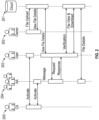
- Arbitrary data may be stored in Cloud 201.
- Data Owner 202 may have caused the data to be uploaded to the cloud.
- User 203 may wish to obtain the data from the Cloud 201.
- User 203 may initially view file details and request a key from Authority 204. While only a single Authority 204 is illustrated here, multiple authorities can be instantiated and the user may be in communication with multiple of the authorities.
- Figs. 3 and 4 depict example computer systems useful for implementing various embodiments described in the present disclosure.
- Various embodiments may be implemented, for example, using one or more computer systems, such as computer system 500 shown in Fig. 3 .
- One or more computer system(s) 500 may be used, for example, to implement any of the embodiments discussed herein, as well as combinations and subcombinations thereof.
- Computer system 500 may include one or more processors (also called central processing units, processing devices, or CPUs), such as a processor 504.
- processors also called central processing units, processing devices, or CPUs
- Processor 504 may be connected to a communication infrastructure 506 (e.g., such as a bus).
- Computer system 500 may also include user input/output device(s) 503, such as monitors, keyboards, pointing devices, etc., which may communicate with communication infrastructure 506 through user input/output interface(s) 502.
- processors 504 may be a graphics processing unit (GPU).
- a GPU may be a processor that is a specialized electronic circuit designed to process mathematically intensive applications.
- the GPU may have a parallel structure that is efficient for parallel processing of large blocks of data, such as mathematically intensive data common to computer graphics applications, images, videos, etc.
- Computer system 500 may also include a main memory 508, such as random-access memory (RAM).
- Main memory 508 may include one or more levels of cache. Main memory 508 may have stored therein control logic (i.e., computer software, instructions, etc.) and/or data.
- Computer system 500 may also include one or more secondary storage devices or secondary memory 510. Secondary memory 510 may include, for example, a hard disk drive 512 and/or a removable storage device or removable storage drive 514.
- Removable storage drive 514 may interact with a removable storage unit 518.
- Removable storage unit 518 may include a computer-usable or readable storage device having stored thereon computer software (control logic) and/or data. Removable storage drive 514 may read from and/or write to removable storage unit 518.
- Secondary memory 510 may include other means, devices, components, instrumentalities, or other approaches for allowing computer programs and/or other instructions and/or data to be accessed by computer system 500.
- Such means, devices, components, instrumentalities, or other approaches may include, for example, a removable storage unit 522 and an interface 520.
- Examples of the removable storage unit 522 and the interface 520 may include a program cartridge and cartridge interface, a removable memory chip (such as an EPROM or PROM) and associated socket, a memory stick and USB port, a memory card and associated memory card slot, and/or any other removable storage unit and associated interface.
- Computer system 500 may further include communications interface 524 (e.g., network interface).
- Communications interface 524 may enable computer system 500 to communicate and interact with any combination of external devices, external networks, external entities, etc. (individually and collectively referenced as remote device(s), network(s), entity(ies) 528).
- communications interface 524 may allow computer system 500 to communicate with external or remote device(s), network(s), entity(ies) 528 over communications path 526, which may be wired and/or wireless (or a combination thereof), and which may include any combination of LANs, WANs, the Internet, etc. Control logic and/or data may be transmitted to and from computer system 500 via communications path 526.
- Computer system 500 may also be any of a personal digital assistant (PDA), desktop workstation, laptop or notebook computer, netbook, tablet, smartphone, smartwatch or other wearable devices, appliance, part of the Internet-of-Things, and/or embedded system, to name a few non-limiting examples, or any combination thereof.
- PDA personal digital assistant
- desktop workstation laptop or notebook computer
- netbook tablet
- smartphone smartwatch or other wearable devices
- appliance part of the Internet-of-Things
- embedded system embedded system
- Computer system 500 may be a client or server computing device, accessing or hosting any applications and/or data through any delivery paradigm, including but not limited to remote or distributed cloud computing solutions; local or on-premises software ("on-premise” cloud-based solutions); "as a service” models (e.g., content as a service (CaaS), digital content as a service (DCaaS), software as a service (SaaS), managed software as a service (MSaaS), platform as a service (PaaS), desktop as a service (DaaS), framework as a service (FaaS), backend as a service (BaaS), mobile backend as a service (MBaaS), infrastructure as a service (laaS), etc.); and/or a hybrid model including any combination of the foregoing examples or other services or delivery paradigms.
- as a service” models e.g., content as a service (CaaS), digital content as a service (DCaaS), software as
- Fig. 4 illustrates an example machine of a computer system 900 within which a set of instructions, for causing the machine to perform any one or more of the operations discussed herein, may be executed.
- the machine may be connected (e.g., networked) to other machines in a LAN, an intranet, an extranet, and/or the Internet.
- the machine may operate in the capacity of a server or a client machine in a client-server network environment, as a peer machine in a peer-to-peer (or distributed) network environment, or as a server or a client machine in a cloud computing infrastructure or environment.
- the machine may be a personal computer (PC), a tablet PC, a set-top box (STB), a Personal Digital Assistant (PDA), a cellular telephone, a web appliance, a server, a network router, a switch or bridge, a specialized application or network security appliance or device, or any machine capable of executing a set of instructions (sequential or otherwise) that specify actions to be taken by that machine.
- PC personal computer
- PDA Personal Digital Assistant
- STB set-top box
- a cellular telephone a web appliance
- server a network router, a switch or bridge, a specialized application or network security appliance or device, or any machine capable of executing a set of instructions (sequential or otherwise) that specify actions to be taken by that machine.
- the term "machine” shall also be taken to include any collection of machines that individually or jointly execute a set (or multiple sets) of instructions to perform any one or more of the methodologies discussed herein.
- the example computer system 900 includes a processing device 902, a main memory 904 (e.g., read-only memory (ROM), flash memory, dynamic random-access memory (DRAM) such as synchronous DRAM (SDRAM), etc.), a static memory 906 (e.g., flash memory, static random-access memory (SRAM), etc.), and a data storage device 918, which communicate with each other via a bus 930.
- main memory 904 e.g., read-only memory (ROM), flash memory, dynamic random-access memory (DRAM) such as synchronous DRAM (SDRAM), etc.
- DRAM dynamic random-access memory
- SDRAM synchronous DRAM
- static memory 906 e.g., flash memory, static random-access memory (SRAM), etc.
- SRAM static random-access memory
- Processing device 902 represents one or more processing devices such as a microprocessor, a central processing unit, or the like. More particularly, the processing device may be complex instruction set computing (CISC) microprocessor, reduced instruction set computing (RISC) microprocessor, very long instruction word (VLIW) microprocessor, or processor implementing other instruction sets, or processors implementing a combination of instruction sets. Processing device 902 may also be one or more special-purpose processing devices such as an application-specific integrated circuit (ASIC), a field-programmable gate array (FPGA), a digital signal processor (DSP), network processor, or the like. The processing device 902 is configured to execute instructions 926 for performing the operations and steps discussed herein.
- CISC complex instruction set computing
- RISC reduced instruction set computing
- VLIW very long instruction word
- ASIC application-specific integrated circuit
- FPGA field-programmable gate array
- DSP digital signal processor
- network processor or the like.
- the computer system 900 may further include a network interface device 908 to communicate over the network 920.
- the computer system 900 also may include a video display unit 910, an alphanumeric input device 912 (e.g., a keyboard), a cursor control device 914 (e.g., a mouse), a graphics processing unit 922, a signal generation device 916 (e.g., a speaker), graphics processing unit 922, video processing unit 928, and audio processing unit 932.
- a video display unit 910 an alphanumeric input device 912 (e.g., a keyboard), a cursor control device 914 (e.g., a mouse), a graphics processing unit 922, a signal generation device 916 (e.g., a speaker), graphics processing unit 922, video processing unit 928, and audio processing unit 932.
- an alphanumeric input device 912 e.g., a keyboard
- a cursor control device 914 e.g., a mouse
- the data storage device 918 may include a machine-readable medium 924 (also known as a computer-readable storage medium) on which is stored one or more sets of instructions 926 (e.g., software instructions) embodying any one or more of the operations described herein.
- the instructions 926 may also reside, completely or at least partially, within the main memory 904 and/or within the processing device 902 during execution thereof by the computer system 900, where the main memory 904 and the processing device 902 also constitute machine-readable storage media.
- the instructions 926 include instructions to implement operations and functionality corresponding to the disclosed subject matter. While the machine-readable storage medium 924 is shown in an example implementation to be a single medium, the term “machine-readable storage medium” should be taken to include a single medium or multiple media (e.g., a centralized or distributed database, and/or associated caches and servers) that store the one or more sets of instructions 926. The term “machine-readable storage medium” shall also be taken to include any medium that is capable of storing or encoding a set of instructions 926 for execution by the machine and that cause the machine to perform any one or more of the operations of the present disclosure. The term “machine-readable storage medium” shall accordingly be taken to include, but not be limited to, solid-state memories, optical media, and magnetic media.
- the present disclosure also relates to an apparatus for performing the operations herein.
- This apparatus may be specially constructed for the intended purposes, or it may comprise a computer selectively activated or reconfigured by a computer program stored in the computer.
- a computer program may be stored in a computer-readable storage medium, such as but not limited to, any type of disk including floppy disks, optical disks, CD-ROMs, and magnetic-optical disks, read-only memories (ROMs), random access memories (RAMs), EPROMs, EEPROMs, magnetic or optical cards, or any type of media suitable for storing electronic instructions, each coupled to a computer system bus.
- the present disclosure may be provided as a computer program product, or software, that may include a machine-readable medium having stored thereon instructions, which may be used to program a computer system (or other electronic devices) to perform a process according to the present disclosure.
- a machine-readable medium includes any mechanism for storing information in a form readable by a machine (e.g., a computer).
- a machine-readable (e.g., computer-readable) medium includes a machine (e.g., a computer) readable storage medium such as read-only memory (“ROM”), random access memory (“RAM”), magnetic disk storage media, optical storage media, flash memory devices, etc.
- a tangible, non-transitory apparatus or article of manufacture comprising a tangible, non-transitory computer useable or readable medium having control logic (software) stored thereon may also be referred to herein as a computer program product or program storage device.
- control logic software stored thereon
- control logic when executed by one or more data processing devices (such as computer system 500), may cause such data processing devices to operate as described herein.
- references herein to "one embodiment,” “an embodiment,” “an example embodiment,” or similar phrases, indicate that the embodiment described can include a particular feature, structure, or characteristic, but every embodiment may not necessarily include the particular feature, structure, or characteristic. Moreover, such phrases are not necessarily referring to the same embodiment. Further, when a particular feature, structure, or characteristic is described in connection with an embodiment, it would be within the knowledge of persons skilled in the relevant art(s) to incorporate such feature, structure, or characteristic into other embodiments whether or not explicitly mentioned or described herein. Additionally, some embodiments can be described using the expression “coupled” and “connected” along with their derivatives. These terms are not necessarily intended as synonyms for each other.
- Coupled can also mean that two or more elements are not in direct contact with each other, but yet still co-operate or interact with each other.
Landscapes
- Engineering & Computer Science (AREA)
- Computer Security & Cryptography (AREA)
- Computer Networks & Wireless Communication (AREA)
- Signal Processing (AREA)
- Physics & Mathematics (AREA)
- Algebra (AREA)
- General Physics & Mathematics (AREA)
- Mathematical Analysis (AREA)
- Mathematical Optimization (AREA)
- Mathematical Physics (AREA)
- Pure & Applied Mathematics (AREA)
- Computing Systems (AREA)
- Theoretical Computer Science (AREA)
- Storage Device Security (AREA)
Claims (14)
- Computergestütztes Verfahren zum Verschlüsseln einer Mitteilung gemäß einem Verschlüsselungsschema auf der Basis von Attributen mehrerer Autoritäten, wobei das Verfahren umfasst:Speichern einer elektronischen Mitteilung m, welche mi Bits zur Verschlüsselung umfasst, in einem computergestützten Speichermedium;Ausführen eines globalen Einrichtungsalgorithmus zum Erzeugen globaler Parameter durch:Auswählen von LWE-Parametern und einer Rauschverteilung;Erzeugen einer Matrix B mit einer ersten Spalte von Daten y von Zufallselementen und dem Rest als Nullen eingestellt, mit Ausnahme der Diagonalen, die als 1 eingestellt ist;Ausführen eines Autoritätseinrichtungsalgorithmus zum Erzeugen eines Paars aus einem öffentlichen und einem geheimen Schlüssel durch:Erzeugen einer ersten LWE-Matrix A;Erzeugen einer zweiten LWE-Matrix H;Einstellen des öffentlichen Schlüssels der Autorität auf (A, H) und des geheimen Schlüssels auf TA;Ausführen eines Schlüsselerzeugungsalgorithmus durch:Berechnen eines zufälligen Kennungsvektors t für einen Benutzer durch Anwenden einer kryptographischen Hash-Funktion auf eine eindeutige Kennung;Berechnen eines Vektors k derart, dass k*A=(1, t)*H;Ausgeben des Vektors k als den geheimen Schlüssel;Ausführen eines Verschlüsselungsalgorithmus für die Mitteilung m durch:
für jedes Bit mi der Mitteilung m:Erzeugen einer Matrix X und eines Vektors s und einer Matrix V, deren erste Spalte s ist;Erzeugen eines LWE-Samples ci mit der LWE-Matrix A und dem geheimen X;Erzeugen eines LWE-Samples ci' mit der LWE-Matrix H und dem geheimen X und Addieren von M*V*B;Berechnen von mi' als höchstwertiges Bit von s*y;Berechnen von (ci,ci' ) und mi XOR mi' ; undSpeichern einer verschlüsselten Mitteilung in einem computergestützten Speichermedium, wobei die verschlüsselte Mitteilung für jedes Bit mi (ci,ci' ) und mi*=mi XOR mi' umfasst. - Verfahren nach Anspruch 1, ferner umfassend Verteilen des geheimen Schlüssels über ein Kommunikationsnetzwerk durch nur eine Autorität.
- Verfahren nach Anspruch 1, wobei jeder Benutzer durch einen Satz von Attributen identifiziert wird und eine Verschlüsselungsfähigkeit für jede verschlüsselte Mitteilung auf einer Funktion der Attribute basiert und das Verfahren vorzugsweise ferner Verteilen des geheimen Schlüssels k über ein Kommunikationsnetzwerk durch eine beliebige polynomiale Anzahl an unabhängigen Autoritäten umfasst,
und das Verfahren ferner ein Auswählen einer vorgegebenen Anzahl und eines Satzes von Attributen für jede unabhängige Autorität umfasst, wodurch der Benutzer die Mitteilung m nur entschlüsseln kann, wenn der Benutzer mindestens die vorgegebene Anzahl an Attributen von jeder Autorität besitzt. - Computergestütztes Verfahren zum Verschlüsseln einer Mitteilung gemäß einem Verschlüsselungsschema auf der Basis von Attributen mehrerer Autoritäten, wobei das Verfahren umfasst:Speichern einer Mitteilung in einem computergestützten Speichermedium, welches Bits umfasst, die c1,...cn und c1', ...cn' und m1* ,...mn* , repräsentieren, wobei die Mitteilung gemäß einem Verschlüsselungsschema auf der Basis von Attributen verschlüsselt worden ist;Berechnen eines zufälligen Kennungsvektors t für einen Benutzer durch Anwenden einer kryptographischen Hash-Funktion auf eine eindeutige Kennung;Abrufen eines geheimen Schlüssels k von dem computergestützten Speichermedium;Ausführen eines Verschlüsselungsalgorithmus, wobei:
zum Verschlüsseln des i-ten Bits der Mitteilung:eine Linearkombination ci*k+ci' (1,t) berechnet wird;das höchstwertige Bit des Ergebnisses XOR mi* berechnet wird; undSpeichern der entschlüsselten Mitteilung in dem computergestützten Speichermedium. - Verfahren nach Anspruch 4, ferner umfassend Verteilen des geheimen Schlüssels k über ein Kommunikationsnetzwerk durch nur eine Autorität.
- Verfahren nach Anspruch 5, wobei jeder Benutzer durch einen Satz von Attributen identifiziert wird und eine Entschlüsselungsfähigkeit für jede verschlüsselte Mitteilung auf einer Funktion der Attribute basiert.
- Verfahren nach Anspruch 6, ferner umfassend Verteilen des geheimen Schlüssels k über ein Kommunikationsnetzwerk durch eine beliebige polynomiale Anzahl an unabhängigen Autoritäten,
und wobei das Verfahren vorzugsweise ferner Auswählen einer vorgegebenen Anzahl und eines Satzes von Attributen für jede unabhängige Autorität umfasst, wodurch der Benutzer die Mitteilung m nur entschlüsseln kann, wenn der Benutzer mindestens die vorgegebene Anzahl an Attributen von jeder Autorität besitzt. - Computergestütztes System zum Verschlüsseln einer Mitteilung gemäß einem Verschlüsselungsschema auf der Basis von Attributen mehrerer Autoritäten, wobei das System umfasst:ein computergestütztes Speichermedium zum Speichern einer elektronischen Mitteilung m, welche mi Bits zur Verschlüsselung umfasst;einen computergestützten Prozessor, konfiguriert zum:Ausführen eines globalen Einrichtungsalgorithmus zum Erzeugen globaler Parameter durch:Auswählen von LWE-Parametern und einer Rauschverteilung;Erzeugen einer Matrix B mit einer ersten Spalte von Daten y von Zufallselementen und dem Rest als Nullen eingestellt, mit Ausnahme der Diagonalen, die als 1 eingestellt ist;Ausführen eines Autoritätseinrichtungsalgorithmus zum Erzeugen eines Paars aus einem öffentlichen und einem geheimen Schlüssel durch:Erzeugen einer ersten LWE-Matrix A;Erzeugen einer zweiten LWE-Matrix H;Einstellen des öffentlichen Schlüssels der Autorität auf (A, H) und des geheimen Schlüssels auf TA;Ausführen eines Schlüsselerzeugungsalgorithmus durch:Berechnen eines zufälligen Kennungsvektors t für einen Benutzer durch Anwenden einer kryptographischen Hash-Funktion auf eine eindeutige Kennung;Berechnen eines Vektors k derart, dass k*A=(1, t)*H;Ausgeben des Vektors k als den geheimen Schlüssel;Ausführen eines Verschlüsselungsalgorithmus für die Mitteilung m durch:
für jedes Bit mi der Mitteilung m:Erzeugen einer Matrix X und eines Vektors s und einer Matrix V, deren erste Spalte s ist;Erzeugen eines LWE-Samples ci mit der LWE-Matrix A und dem geheimen X;Erzeugen eines LWE-Samples ci mit der LWE-Matrix H und dem geheimen X und Addieren von M*V*B;Berechnen von mi' als höchstwertiges Bit von s*y;Berechnen von (ci,ci' ) und mi XOR mi'; undwobei das computergestützte Speichermedium ferner konfiguriert ist zum Speichern einer verschlüsselten Mitteilung in einem computergestützten Speichermedium, wobei die verschlüsselte Mitteilung für jedes Bit mi (ci,ci ) und mi*=mi XOR mi' umfasst. - System nach Anspruch 8, wobei der computergestützte Prozessor ferner konfiguriert ist zum Verteilen des geheimen Schlüssels über ein Kommunikationsnetzwerk durch nur eine Autorität.
- System nach Anspruch 8, wobei jeder Benutzer durch einen Satz von Attributen identifiziert wird und eine Verschlüsselungsfähigkeit für jede verschlüsselte Mitteilung auf einer Funktion dieser Attribute basiert, undwobei der computergestützte Prozessor vorzugsweise ferner konfiguriert ist zum Verteilen des geheimen Schlüssels über ein Kommunikationsnetzwerk durch eine beliebige polynomiale Anzahl an unabhängigen Autoritäten, undwobei der computergestützte Prozessor ferner konfiguriert ist zum Auswählen einer vorgegebenen Anzahl und eines Satzes von Attributen für jede unabhängige Autorität, wodurch der Benutzer die Mitteilung m nur entschlüsseln kann, wenn der Benutzer mindestens die vorgegebene Anzahl an Attributen von jeder Autorität besitzt.
- Computergestütztes System zum Verschlüsseln einer Mitteilung gemäß einem Verschlüsselungsschema auf der Basis von Attributen mehrerer Autoritäten, wobei das System umfasst:ein computergestütztes Speichermedium, konfiguriert zum Speichern einer Mitteilung in einem computergestützten Speichermedium, welches Bits umfasst, die c1,...cn und c1',...cn' und m1* ,...mn* repräsentieren, wobei die Mitteilung gemäß einem Verschlüsselungsschema auf der Basis von Attributen verschlüsselt worden ist;einen computergestützten Prozessor, konfiguriert zum:Berechnen eines zufälligen Kennungsvektors t für einen Benutzer durch Anwenden einer kryptographischen Hash-Funktion auf eine eindeutige Kennung;Abrufen eines geheimen Schlüssels k von einem computerlesbaren Speichermedium;Ausführen eines Verschlüsselungsalgorithmus, wobei:
zum Verschlüsseln des i-ten Bits der Mitteilung:eine Linearkombination ci*k+c i'(1,t) berechnet wird;das höchstwertige Bit des Ergebnisses XOR mi* berechnet wird; unddas computergestützte Speichermedium ferner konfiguriert ist zum Speichern der entschlüsselten Mitteilung in dem computergestützten Speichermedium. - System nach Anspruch 11, wobei der computergestützte Prozessor ferner konfiguriert ist zum Verteilen des geheimen Schlüssels über ein Kommunikationsnetzwerk durch nur eine Autorität.
- System nach Anspruch 12, wobei jeder Benutzer durch einen Satz von Attributen identifiziert wird und eine Verschlüsselungsfähigkeit für jede verschlüsselte Mitteilung auf einer Funktion dieser Attribute basiert.
- System nach Anspruch 13, wobei der computergestützte Prozessor ferner konfiguriert ist zum Verteilen des geheimen Schlüssels über ein Kommunikationsnetzwerk durch eine beliebige polynomiale Anzahl an unabhängigen Autoritäten, und
wobei der computergestützte Prozessor vorzugsweise ferner konfiguriert ist zum Auswählen einer vorgegebenen Anzahl und eines Satzes von Attributen für jede unabhängige Autorität, wodurch der Benutzer die Mitteilung m nur entschlüsseln kann, wenn der Benutzer mindestens die vorgegebene Anzahl an Attributen von jeder Autorität besitzt.
Applications Claiming Priority (2)
| Application Number | Priority Date | Filing Date | Title |
|---|---|---|---|
| US202063087866P | 2020-10-05 | 2020-10-05 | |
| PCT/US2021/053415 WO2022076327A1 (en) | 2020-10-05 | 2021-10-04 | Decentralized multi-authority attribute-based encryption |
Publications (4)
| Publication Number | Publication Date |
|---|---|
| EP4226575A1 EP4226575A1 (de) | 2023-08-16 |
| EP4226575A4 EP4226575A4 (de) | 2024-04-03 |
| EP4226575C0 EP4226575C0 (de) | 2025-04-30 |
| EP4226575B1 true EP4226575B1 (de) | 2025-04-30 |
Family
ID=81125442
Family Applications (1)
| Application Number | Title | Priority Date | Filing Date |
|---|---|---|---|
| EP21878308.2A Active EP4226575B1 (de) | 2020-10-05 | 2021-10-04 | Dezentralisierte verschlüsselung auf der basis von attributen mehrerer autoritäten |
Country Status (4)
| Country | Link |
|---|---|
| US (1) | US12238212B2 (de) |
| EP (1) | EP4226575B1 (de) |
| JP (1) | JP7700851B2 (de) |
| WO (1) | WO2022076327A1 (de) |
Families Citing this family (6)
| Publication number | Priority date | Publication date | Assignee | Title |
|---|---|---|---|---|
| US20230016859A1 (en) * | 2020-07-13 | 2023-01-19 | Inpher, Inc. | Multi-Pivot Partial Quicksort and Oblivious Comparisons of Secret Shared Arithmetic Values in a Multi-Party Computing Setting |
| US12375286B2 (en) * | 2021-01-06 | 2025-07-29 | Ntt Research, Inc. | Decentralized multi-authority attribute-based encryption from bilinear diffie-hellman assumptions |
| JP7691400B2 (ja) * | 2022-09-28 | 2025-06-11 | Kddi株式会社 | 暗号化装置、暗号化方法及び暗号化プログラム |
| WO2025212723A1 (en) * | 2024-04-02 | 2025-10-09 | Ntt Research, Inc. | Reduced-size ciphertext compatible with pre-existing attribute-based encryption schemes |
| CN119519962A (zh) * | 2024-11-18 | 2025-02-25 | 中国移动紫金(江苏)创新研究院有限公司 | 跨链数据传输方法及系统 |
| CN119652608B (zh) * | 2024-12-06 | 2025-10-10 | 东南大学 | 具有非单调访问控制结构的多客户端求交函数加密方法、存储介质及设备 |
Family Cites Families (4)
| Publication number | Priority date | Publication date | Assignee | Title |
|---|---|---|---|---|
| US20100185861A1 (en) * | 2009-01-19 | 2010-07-22 | Microsoft Corporation | Anonymous key issuing for attribute-based encryption |
| WO2016162941A1 (ja) * | 2015-04-07 | 2016-10-13 | 三菱電機株式会社 | 暗号システム及び鍵生成装置 |
| JP6700797B2 (ja) * | 2016-01-13 | 2020-05-27 | 日本放送協会 | 鍵生成装置、中間暗号化装置、委託暗号化装置、復号装置およびそれらのプログラム、ならびに、個人情報保護システム |
| US11140141B2 (en) * | 2017-09-18 | 2021-10-05 | Fiske Software Llc | Multiparty key exchange |
-
2021
- 2021-10-04 EP EP21878308.2A patent/EP4226575B1/de active Active
- 2021-10-04 JP JP2023521063A patent/JP7700851B2/ja active Active
- 2021-10-04 WO PCT/US2021/053415 patent/WO2022076327A1/en not_active Ceased
- 2021-10-04 US US18/030,436 patent/US12238212B2/en active Active
Also Published As
| Publication number | Publication date |
|---|---|
| US20230379153A1 (en) | 2023-11-23 |
| US12238212B2 (en) | 2025-02-25 |
| JP2023544198A (ja) | 2023-10-20 |
| EP4226575C0 (de) | 2025-04-30 |
| EP4226575A1 (de) | 2023-08-16 |
| EP4226575A4 (de) | 2024-04-03 |
| WO2022076327A1 (en) | 2022-04-14 |
| JP7700851B2 (ja) | 2025-07-01 |
Similar Documents
| Publication | Publication Date | Title |
|---|---|---|
| EP4226575B1 (de) | Dezentralisierte verschlüsselung auf der basis von attributen mehrerer autoritäten | |
| US12489627B2 (en) | Decentralized multi-authority attribute-based encryption with fully adaptive security | |
| Dong et al. | Server‐aided revocable attribute‐based encryption from lattices | |
| Li et al. | Multi-key FHE for multi-bit messages | |
| Peev et al. | A novel protocol-authentication algorithm ruling out a man-in-the middle attack in quantum cryptography | |
| Yang et al. | An efficient identity-based encryption with equality test in cloud computing | |
| US12375286B2 (en) | Decentralized multi-authority attribute-based encryption from bilinear diffie-hellman assumptions | |
| CN116722977B (zh) | 基于国密sm9的条件代理重加密方法 | |
| US12512984B2 (en) | Cryptographic data message expansion for increasing adversarial storage requirements | |
| CN112398646A (zh) | 理想格上具有短公共参数的身份基加密方法及系统 | |
| Ma et al. | Lattice-based identity-based homomorphic conditional proxy re-encryption for secure big data computing in cloud environment | |
| Zhao et al. | Efficient GSW‐Style Fully Homomorphic Encryption over the Integers | |
| Shen et al. | Compressible Multikey and Multi‐Identity Fully Homomorphic Encryption | |
| Liu et al. | Quantum‐resistant anonymous identity‐based encryption with trable identities | |
| Wang et al. | Lattice-based revocable IBEET scheme for mobile cloud computing | |
| Yang et al. | Identity‐Based Unidirectional Collusion‐Resistant Proxy Re‐Encryption from U‐LWE | |
| Li et al. | Efficient Multi-Authority ABE from Learning With Errors Over Rings | |
| CN119995876B (zh) | 一种具有前向安全且可抵抗量子攻击的可更新属性条件代理重加密方法 | |
| Yin et al. | Delegation of decryption rights with revocability from learning with errors | |
| CN119766480B (zh) | 一种基于格基代理重加密的云计算服务平台 | |
| US12316611B2 (en) | Enhanced security for existing public key infrastructure | |
| Lin et al. | Efficient Updatable Private Information Retrieval From Simulatable Homomorphic Ciphertexts | |
| Song et al. | A Hybrid Attribute-Based Encryption Scheme for Cloud Storage: Integrating Lattice-based Cryptography and Symmetric Block Ciphers | |
| Cheng et al. | Lattice‐based obfuscation for re‐encryption functions | |
| Luo et al. | Chosen-Ciphertext Secure Proxy Re-Encryption for Bounded Linear Functions |
Legal Events
| Date | Code | Title | Description |
|---|---|---|---|
| STAA | Information on the status of an ep patent application or granted ep patent |
Free format text: STATUS: THE INTERNATIONAL PUBLICATION HAS BEEN MADE |
|
| PUAI | Public reference made under article 153(3) epc to a published international application that has entered the european phase |
Free format text: ORIGINAL CODE: 0009012 |
|
| STAA | Information on the status of an ep patent application or granted ep patent |
Free format text: STATUS: REQUEST FOR EXAMINATION WAS MADE |
|
| 17P | Request for examination filed |
Effective date: 20230504 |
|
| AK | Designated contracting states |
Kind code of ref document: A1 Designated state(s): AL AT BE BG CH CY CZ DE DK EE ES FI FR GB GR HR HU IE IS IT LI LT LU LV MC MK MT NL NO PL PT RO RS SE SI SK SM TR |
|
| DAV | Request for validation of the european patent (deleted) | ||
| DAX | Request for extension of the european patent (deleted) | ||
| REG | Reference to a national code |
Ref country code: DE Ref legal event code: R079 Free format text: PREVIOUS MAIN CLASS: H04L0009320000 Ipc: H04L0009300000 Ref document number: 602021030164 Country of ref document: DE |
|
| A4 | Supplementary search report drawn up and despatched |
Effective date: 20240301 |
|
| RIC1 | Information provided on ipc code assigned before grant |
Ipc: H04L 9/30 20060101AFI20240226BHEP |
|
| GRAP | Despatch of communication of intention to grant a patent |
Free format text: ORIGINAL CODE: EPIDOSNIGR1 |
|
| STAA | Information on the status of an ep patent application or granted ep patent |
Free format text: STATUS: GRANT OF PATENT IS INTENDED |
|
| RIC1 | Information provided on ipc code assigned before grant |
Ipc: H04L 9/30 20060101AFI20241114BHEP |
|
| INTG | Intention to grant announced |
Effective date: 20241125 |
|
| GRAS | Grant fee paid |
Free format text: ORIGINAL CODE: EPIDOSNIGR3 |
|
| GRAA | (expected) grant |
Free format text: ORIGINAL CODE: 0009210 |
|
| STAA | Information on the status of an ep patent application or granted ep patent |
Free format text: STATUS: THE PATENT HAS BEEN GRANTED |
|
| AK | Designated contracting states |
Kind code of ref document: B1 Designated state(s): AL AT BE BG CH CY CZ DE DK EE ES FI FR GB GR HR HU IE IS IT LI LT LU LV MC MK MT NL NO PL PT RO RS SE SI SK SM TR |
|
| REG | Reference to a national code |
Ref country code: CH Ref legal event code: EP Ref country code: GB Ref legal event code: FG4D |
|
| REG | Reference to a national code |
Ref country code: DE Ref legal event code: R096 Ref document number: 602021030164 Country of ref document: DE |
|
| REG | Reference to a national code |
Ref country code: IE Ref legal event code: FG4D |
|
| U01 | Request for unitary effect filed |
Effective date: 20250430 |
|
| U07 | Unitary effect registered |
Designated state(s): AT BE BG DE DK EE FI FR IT LT LU LV MT NL PT RO SE SI Effective date: 20250508 |
|
| PG25 | Lapsed in a contracting state [announced via postgrant information from national office to epo] |
Ref country code: ES Free format text: LAPSE BECAUSE OF FAILURE TO SUBMIT A TRANSLATION OF THE DESCRIPTION OR TO PAY THE FEE WITHIN THE PRESCRIBED TIME-LIMIT Effective date: 20250430 |
|
| PG25 | Lapsed in a contracting state [announced via postgrant information from national office to epo] |
Ref country code: NO Free format text: LAPSE BECAUSE OF FAILURE TO SUBMIT A TRANSLATION OF THE DESCRIPTION OR TO PAY THE FEE WITHIN THE PRESCRIBED TIME-LIMIT Effective date: 20250730 Ref country code: GR Free format text: LAPSE BECAUSE OF FAILURE TO SUBMIT A TRANSLATION OF THE DESCRIPTION OR TO PAY THE FEE WITHIN THE PRESCRIBED TIME-LIMIT Effective date: 20250731 |
|
| PG25 | Lapsed in a contracting state [announced via postgrant information from national office to epo] |
Ref country code: PL Free format text: LAPSE BECAUSE OF FAILURE TO SUBMIT A TRANSLATION OF THE DESCRIPTION OR TO PAY THE FEE WITHIN THE PRESCRIBED TIME-LIMIT Effective date: 20250430 |
|
| PG25 | Lapsed in a contracting state [announced via postgrant information from national office to epo] |
Ref country code: HR Free format text: LAPSE BECAUSE OF FAILURE TO SUBMIT A TRANSLATION OF THE DESCRIPTION OR TO PAY THE FEE WITHIN THE PRESCRIBED TIME-LIMIT Effective date: 20250430 |
|
| PG25 | Lapsed in a contracting state [announced via postgrant information from national office to epo] |
Ref country code: RS Free format text: LAPSE BECAUSE OF FAILURE TO SUBMIT A TRANSLATION OF THE DESCRIPTION OR TO PAY THE FEE WITHIN THE PRESCRIBED TIME-LIMIT Effective date: 20250731 |
|
| PG25 | Lapsed in a contracting state [announced via postgrant information from national office to epo] |
Ref country code: IS Free format text: LAPSE BECAUSE OF FAILURE TO SUBMIT A TRANSLATION OF THE DESCRIPTION OR TO PAY THE FEE WITHIN THE PRESCRIBED TIME-LIMIT Effective date: 20250830 |
|
| U20 | Renewal fee for the european patent with unitary effect paid |
Year of fee payment: 5 Effective date: 20251027 |
|
| PG25 | Lapsed in a contracting state [announced via postgrant information from national office to epo] |
Ref country code: SM Free format text: LAPSE BECAUSE OF FAILURE TO SUBMIT A TRANSLATION OF THE DESCRIPTION OR TO PAY THE FEE WITHIN THE PRESCRIBED TIME-LIMIT Effective date: 20250430 |
|
| PG25 | Lapsed in a contracting state [announced via postgrant information from national office to epo] |
Ref country code: CZ Free format text: LAPSE BECAUSE OF FAILURE TO SUBMIT A TRANSLATION OF THE DESCRIPTION OR TO PAY THE FEE WITHIN THE PRESCRIBED TIME-LIMIT Effective date: 20250430 |
|
| PG25 | Lapsed in a contracting state [announced via postgrant information from national office to epo] |
Ref country code: SK Free format text: LAPSE BECAUSE OF FAILURE TO SUBMIT A TRANSLATION OF THE DESCRIPTION OR TO PAY THE FEE WITHIN THE PRESCRIBED TIME-LIMIT Effective date: 20250430 |