EP4224902B1 - Communication control method - Google Patents
Communication control method Download PDFInfo
- Publication number
- EP4224902B1 EP4224902B1 EP21882837.4A EP21882837A EP4224902B1 EP 4224902 B1 EP4224902 B1 EP 4224902B1 EP 21882837 A EP21882837 A EP 21882837A EP 4224902 B1 EP4224902 B1 EP 4224902B1
- Authority
- EP
- European Patent Office
- Prior art keywords
- iab
- node
- indication
- iab node
- type
- Prior art date
- Legal status (The legal status is an assumption and is not a legal conclusion. Google has not performed a legal analysis and makes no representation as to the accuracy of the status listed.)
- Active
Links
Images




Classifications
-
- H—ELECTRICITY
- H04—ELECTRIC COMMUNICATION TECHNIQUE
- H04W—WIRELESS COMMUNICATION NETWORKS
- H04W40/00—Communication routing or communication path finding
- H04W40/34—Modification of an existing route
-
- H—ELECTRICITY
- H04—ELECTRIC COMMUNICATION TECHNIQUE
- H04L—TRANSMISSION OF DIGITAL INFORMATION, e.g. TELEGRAPHIC COMMUNICATION
- H04L45/00—Routing or path finding of packets in data switching networks
- H04L45/22—Alternate routing
-
- H—ELECTRICITY
- H04—ELECTRIC COMMUNICATION TECHNIQUE
- H04L—TRANSMISSION OF DIGITAL INFORMATION, e.g. TELEGRAPHIC COMMUNICATION
- H04L45/00—Routing or path finding of packets in data switching networks
- H04L45/28—Routing or path finding of packets in data switching networks using route fault recovery
-
- H—ELECTRICITY
- H04—ELECTRIC COMMUNICATION TECHNIQUE
- H04W—WIRELESS COMMUNICATION NETWORKS
- H04W24/00—Supervisory, monitoring or testing arrangements
- H04W24/04—Arrangements for maintaining operational condition
-
- H—ELECTRICITY
- H04—ELECTRIC COMMUNICATION TECHNIQUE
- H04W—WIRELESS COMMUNICATION NETWORKS
- H04W36/00—Hand-off or reselection arrangements
- H04W36/0005—Control or signalling for completing the hand-off
- H04W36/0083—Determination of parameters used for hand-off, e.g. generation or modification of neighbour cell lists
- H04W36/00837—Determination of triggering parameters for hand-off
-
- H—ELECTRICITY
- H04—ELECTRIC COMMUNICATION TECHNIQUE
- H04W—WIRELESS COMMUNICATION NETWORKS
- H04W36/00—Hand-off or reselection arrangements
- H04W36/34—Reselection control
- H04W36/36—Reselection control by user or terminal equipment
- H04W36/362—Conditional handover
-
- H—ELECTRICITY
- H04—ELECTRIC COMMUNICATION TECHNIQUE
- H04W—WIRELESS COMMUNICATION NETWORKS
- H04W88/00—Devices specially adapted for wireless communication networks, e.g. terminals, base stations or access point devices
- H04W88/02—Terminal devices
- H04W88/04—Terminal devices adapted for relaying to or from another terminal or user
Definitions
- the present invention relates to a communication control method used in a cellular communication system, to an apparatus configured to control a second relay node, a second relay node, a computer program, and a cellular communication system.
- a cellular communication system 1 is a 3GPP 5G system.
- a radio access scheme in the cellular communication system 1 is New Radio (NR) being a radio access scheme of the 5G.
- NR New Radio
- LTE Long Term Evolution
- 6G future cellular communication system such as 6G may be applied as the cellular communication system 1.
- FIG. 1 is a diagram illustrating a configuration example of a cellular communication system 1 according to an embodiment.
- the cellular communication system 1 includes a 5G core network (5GC) 10, a User Equipment (UE) 100, base station apparatuses (hereinafter, may be referred to as "base stations") 200-1 and 200-2, and IAB nodes 300-1 and 300-2.
- Each base station 200 may be referred to as a gNB.
- each base station 200 is an NR base station; however, the base station 200 may be an LTE base station (i.e., an eNB).
- LTE base station i.e., an eNB
- the base stations 200-1 and 200-2 may be referred to as the gNB 200 (or the base station 200), and the IAB nodes 300-1 and 300-2 may be referred to as the IAB node 300.
- Each gNB 200 may be divided into a Central Unit (CU) and a Distributed Unit (DU).
- the CU and the DU are interconnected via an interface referred to as an F1 interface.
- the F1 protocol is a communication protocol between the CU and the DU and includes an F1-C protocol corresponding to a protocol for a control plane and an F1-U protocol corresponding to a protocol for a user plane.
- the cellular communication system 1 supports an IAB that uses NR for the backhaul to enable wireless relay of NR access.
- the donor gNB 200-1 is a donor base station corresponding to a terminal node of the NR backhaul on the network end and including additional functions that support the IAB.
- the backhaul can implement multi-hop via a plurality of hops (i.e., a plurality of IAB nodes 300).
- the UE 100 is a mobile wireless communication apparatus that performs wireless communication with cells.
- the UE 100 may be any type of apparatus as long as the UE 100 is an apparatus that performs wireless communication with the gNB 200 or the IAB node 300.
- the UE 100 is a mobile phone terminal, a tablet terminal, a laptop PC, a sensor or an apparatus that is provided in the sensor, a vehicle or an apparatus that is provided in the vehicle, or a flight vehicle or an apparatus that is provided in the flight vehicle.
- the UE 100 is wirelessly connected to the IAB node 300 or the gNB 200 via an access link.
- FIG. 1 illustrates an example in which the UE 100 is wirelessly connected to the IAB node 300-2.
- the UE 100 indirectly communicates with the donor gNB 200-1 via the IAB node 300-2 and the IAB node 300-1.
- FIG. 2 is a diagram illustrating the relationship between the IAB node 300, the Parent nodes, and the Child nodes.
- each IAB node 300 includes an IAB-DU corresponding to a base station function unit and an IAB-Mobile Termination (MT) corresponding to a user equipment function unit.
- IAB-DU corresponding to a base station function unit
- IAB-Mobile Termination (MT) corresponding to a user equipment function unit.
- Type 1/2 Indication includes forwarding availability information.
- Type 1/2 Indication includes forward hop count information.
- the upper limit value of the number of forward hops may be configured by the CU of the donor node for the IAB-DU (or the IAB-MT) of each IAB node 300 through signaling.
- the IAB-DU of each IAB node 300 compares the forward hop count information included in each received Indication with the upper limit value, and forwards or does not forward the received Indication according to the comparison result. For example, if the forward hop count information is the same as the upper limit value, the IAB-DU of the IAB node 300 does not forward the received Indication, whereas if the number of forward hops is smaller than the upper limit value, the IAB-DU forwards the received Indication.
- step S113 the cellular communication system 1 ends a series of processing operations.
- the Indication when the Indication such as the Type 1 Indication is forwarded, the Indication includes the forwarding availability information.
- the notification instructing the execution of a conditional handover as described in the first embodiment may be forwarded instead of each Indication such as the Type 1 Indication.
- the IAB node 300-T may transmit the notification including the forwarding availability information or including the forward hop count information.
- FIG. 13 is a diagram illustrating an example of the cellular communication system 1 according to a fourth embodiment.
- the IAB node 300-T is an upper node and the IAB node 300-C is a lower node. Further lower nodes of the lower node 300-C include a plurality of IAB nodes 300-R1, 300-R2, ..., and 300-D. In this case, on the lower side of the lower node 300-C, route #1 from the IAB node 300-R1 to the IAB node 300-D exists. On the lower side of the lower node 300-C, route #2 from the IAB node 300-R2 to the IAB node 300-D exists.
- the highest priority may be assigned to a route having the smallest number of hops. Note that such priorities can be configured by the CU of the donor node through signaling to the IAB-DU of each IAB node 300.
- the lower node 300-C upon receiving, for example, the Type 1/2 Indication from the upper node 300-T, the lower node 300-C changes the route priority configured for each route, and subsequently upon receiving the Type 3 Indication, the lower node 300-C turns the route priority back to the state before the change.
- the first relay node transmits, to the second relay node, a first request requesting a change in route priority.
- the second relay node changes, in response to receiving the first request, the priority of the first route from the second relay node to a fourth relay node via a third relay node and/or the priority of the second route from the second relay node to the fourth relay node via a fifth relay node.
- the second relay node transmits the packet in accordance with the changed priority of the first route and/or the changed priority of the second route.
- FIG. 14 is a diagram illustrating an operation example of the fourth embodiment.
- step S120 the cellular communication system 1 starts processing.
- the upper node 300-T detects an RLF in the BH link #1.
- the upper node 300-T may detect a failure in recovery from the RLF in the BH link #1.
- the upper node 300-T may receive the Type 1/2 Indication transmitted from a further upper IAB node 300.
- the upper node 300-T may receive the Type 4 Indication transmitted from the further upper IAB node 300.
- the Type 4 Indication may include an indicator indicating whether to change the route priority.
- the upper node 300-T may transmit, to the lower node 300-C, the Type 1/2 Indication or Type 4 Indication received from a further upper IAB node 300.
- the Type 1/2 Indication or the Type 4 Indication itself may indicate a request to change the route priority, or each Indication may include an indicator indicating whether to change the route priority.
- the notification indicating the request to change the route priority may be transmitted using a BAP Control PDU, an SIB1, a MAC CE, or the like.
- step S123 the lower node 300-C changes the route priority.
- An example of changing the route priority is as follows.
- the lower node 300-C may change not only the priorities of some of the routes but also the priorities of all of the routes, for example, by combining any of 1) to 4) described above.
- the lower node 300-C executes routing processing on packets in accordance with the changed route priorities. For example, in the example of FIG. 13 , the IAB-MT of the lower node 300-C transmits the packet addressed to the IAB node 300-D to the IAB node 300-R2 on route #2 rather than to the IAB node 300-R1 on route #1.
- the upper node 300-T transmits, to the lower node 300-C, a notification indicating that the route priority is to be turned back to the state before the change.
- the notification may be the Type 3 Indication itself.
- the Type 3 Indication itself may be a notification indicating that the route priority is turned back to the original state before the change.
- the Type 3 Indication may include an indicator indicating that the route priority is turned back to the state before the change.
- the lower node 300-C executes processing for turning the route priority back to the original state before the change.
- the IAB-DU (or IAB-MT) of the lower node 300-C may change the route priority configured in step S123 to the priority configured by the donor node.
- the IAB-DU of the lower node 300-C may request the CU of the donor node to turn the route priority back to the state before the change.
- the CU of the donor node may transmit again, to the IAB-DU of the lower node 300-C, a routing configuration transmitted before the change in route priority, leading to reconfiguration of the route priority before the change.
- step S1208 the cellular communication system 1 ends a series of processing operations.
- NR eIAB NR Enhancements to Integrated Access AND Backhaul
- TR states the following: "Radio backhaul links are vulnerable to obstructions caused by a moving object such as a vehicle, change of seasons (leaves), change of infrastructure (new buildings), and the like. Such vulnerabilities also apply to physically stationary IAB nodes.” Thus, as has been captured in TR, various problems caused by multi-hop/radio backhaul and potential solutions for the problems were researched.
- the IAB nodes are motionless, that is, "stationary IAB nodes". Accordingly, the backhaul (BH) was sufficiently stable in appropriately designed deployment even in a case of a backhaul link via millimeter waves and/or a local area IAB node that may be deployed with an unmanaged method. Thus, only a recovery procedure combined with basic functions of the BH RLF was defined.
- the basic functions are existing functions such as BH RLF indication (also known as Type 4 that is "Recovery failure") and RRC reestablishment, MCG/SCG failure indication, and/or a conditional handover.
- one intended use case is a "mobile IAB node", which may be a part of “inter-donor IAB-node migration” even if not explicitly described in WID.
- secondary purposes in WID such as “enhancements for reducing service interruptions due to IAB-node migration and BH RLF recovery” and “enhancements for topology redundancy” clearly intend that the BH link becomes unstable, for example, due to obstruction by millimeter waves, and the migration and BH RLFs frequently occur in the scenario of Rel-17 deployment. Therefore, according to the discussion of Rel-17, first, RAN2 should have common understanding about assumption of the BH link.
- Proposal 3 When Proposal 2 can be agreed on, RAN2 should study whether to introduce an explicit BH RLF indication, that is, "BH link recovered” corresponding to Type 3, the indication being provided when the BH RLF is no longer present.
- Proposal 4 RAN2 should agree with that the IAB-MT, who has received the Type 2 Indication and then reduced/stopped the scheduling request, resumes the scheduling request when the BH RLF is no longer present in the parent node.
- Local re-routing is expected to be used for congestion mitigation, load balancing, etc., but may also be used for service continuity even in the case of an upstream BH RLF in the parent node or the like.
- an IAB node can perform local re-routing upon receiving the Type 2 Indication, but in a routing configuration such as in Rel-16, the IAB node returns to the normal routing upon being notified of successful recovery from an upstream BH RLF by reception of the Type 3 Indication, or the like.
- a new IAB-MT operation is available that is associated with the Rel-17 functionality, and the operation may be performed upon receipt of the Type 2 Indication. Therefore, in addition to Proposal 4, RAN2 should study other IAB-MT operations performed when the parent node is attempting to recover from the BH RLF.
- Proposal 5 RAN2 should have discussions when other IAB-MT operations such as local re-routing are available that are performed while the parent node is attempting to recover the BH link.
- the IAB-DU which transmits an indication
- the IAB-DU which transmits an indication
- an indication is transmitted, and thus a case of the BH of single connection is easy.
- a case of the BH with duplex connectivity is more complicated. For example, upon detecting an RLF in the MCG, the IAB node initiates an MCG failure information procedure, but the SCG continues to function as a BH link, and thus the Type 2 Indication need not be transmitted at this time.
- the IAB-MT initiates RRC reestablishment, and therefore at this time, the Type 2 Indication is transmitted.
- the Type 2 Indication is transmitted when RRC reestablishment is initiated, not when the MCG/SCG failure information is triggered.
- this concerns operation of the IAB-DU whether to capture this in a specification/how to capture this should be carefully studied. That is, whether to add notes in stage 2 or stage 3 or nothing needs to be captured should be studied.
- CHO Conditional Handover
- CHO is performed when the corresponding CHO event (A3/A5) is satisfied or when a selected cell is a CHO candidate as a result of cell selection for RRC reestablishment.
- These trigger conditions can be satisfied when the IAB node experiences a BH RLF on the BH link.
- the trigger conditions cannot be satisfied under an IAB-specific RLF, such as an RLF due to reception of the BH RLF indication (Type 4), because the BH link owned by the IAB node is in a good radio state.
- one desirable operation is to perform CHO when the IAB node receives the BH RLF indication.
- Proposal 8 RAN2 needs to study whether any additional trigger condition is defined for the CHO, i.e., study at least the case where the IAB node receives the BH RLF indication (Type 4). If introduced, further study is needed to see if is applicable to Type 2.
- the IAB-MT In an RRC reestablishment procedure, the IAB-MT first executes a cell selection procedure in order to find an appropriate cell. In the cell selection procedure, potential problems were pointed out in Rel-16, such as one that the IAB-MT may select its descendant node. Thus, this was discussed in email discussion.
- Finding 4 In Rel-16, when the IAB node attempts an RRC reestablishment request to the descendant node, the IAB node needs to wait for a failure of the attempt, and finally go to an idle state.
- the IAB-MT is provided with a type of either a whitelist or a blacklist for the purpose of cell selection.
- a whitelist for the purpose of cell selection.
- the whitelist and the blacklist have advantages and disadvantages depending on the topology and the positions of the IAB nodes.
- the blacklist may be more suitable because the blacklist includes only downstream IAB nodes of the IAB node to be concerned and in some cases includes only a small number of child IAB nodes, thus reducing overhead.
- the list may need to include candidate IAB nodes belonging to different/adjacent IAB topologies, and may thus have an increased size.
- downstream IAB nodes of course belong to the same IAB topology, and thus there are no such concerns about the blacklist.
- Finding 5 The whitelist and the blacklist have advantages and disadvantages depending on the topology and the positions of the IAB nodes.
- the IAB donor when information is provided to the child IAB node for the purpose of cell selection, the IAB donor (or the parent IAB node) may be desirably able to select the use of either the whitelist or the blacklist. Note that study should be also conducted on whether the reuse of this information for the purpose of cell reselection is beneficial.
- Proposal 10 RAN2 should agree to provide the whitelist or the blacklist (i.e., selection structure) to the IAB-MT for the purpose of cell selection in order to avoid reestablishment to a descendant node. Whether these lists can also be used for a cell reselection procedure requires further study.
- Proposal 10 can be agreed on, how to provide the information (that is, the whitelist or the blacklist) should be further studied.
- Option 1 assumes CHO configuration, and some enhancements may be required.
- Option 2 assumes additional indications, for example, the BH RLF indication of Type 2.
- Option 3 assumes provision of information of the overall topology, which is not present in the existing configuration.
- Option 5 assumes OAM-based configuration; however, this is questionable as the rapporteur pointed out.
- Proposal 11 RAN2 should agree that the parent IAB node or the IAB donor dynamically provides the whitelist/blacklist each time the topology is changed. The details thereof require further study.
- the BAP layer may implement the second solution on the assumption that "data buffering in a transmission part of a BAP entity until an RLC-AM entity receives an acknowledgment response is implementation dependent, for example".
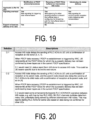
- These BAP implementations were considered in order to avoid packet loss in "most" of the cases of the Rel-16 deployment scenario, that is, the cases where stationary IAB nodes are used. However, the implementations were not perfect as illustrated in FIG. 19 , for example.
- RAN2 should discuss an enhancement mechanism for guaranteeing lossless delivery in an L2 multi-hop network, in addition to the results captured in TR.
- Rel-17 should assume dynamic topology change that causes UL packet loss
- the enhancements of Rel-17 shall support C-2 as a standard support function. At least in the specification of stage 2, an overall mechanism based on C-2 should be described. Otherwise, in the 3GPP standard, lossless delivery is not guaranteed during the handover of the IAB node. In stage 3, although minor changes such as those of the RLC and/or the BAP are expected, these are regarded as internal operations of the IAB node, and thus details thereof may not be defined.
- Case 1 When the parent is first migrated, the RRC signaling path between the child and the source donor is released. Therefore, how the child node can be migrated is unknown.
- Case 2 When the child is first migrated, the RRC signaling path to the target donor via the parent node has yet to be established. Accordingly, how the child node accesses the target donor (i.e., how to complete and transmit the RRC reconfiguration to the target donor) is unknown.
- the child is considered to wait to send an RRC reconfiguration to the target donor, e.g., until the parent node is migrated.
- an option may be that the child node is first released and that reintegration is then performed by using the Rel-16 procedure. This; however, may not be expected to be a solution in Rel-17, considering critical service interruption.
- RAN3 has been discussing the general procedure of the inter-donor IAB-node migration
- RAN2 needs to study the impact of RAN2 on how to reconfigure a plurality of IAB nodes in a multi-hop network.
- Proposal 14 RAN2 needs to study how to reconfigure multi-hop IAB nodes for the inter-donor IAB-node migration.
Landscapes
- Engineering & Computer Science (AREA)
- Computer Networks & Wireless Communication (AREA)
- Signal Processing (AREA)
- Mobile Radio Communication Systems (AREA)
- Radio Relay Systems (AREA)
Applications Claiming Priority (2)
| Application Number | Priority Date | Filing Date | Title |
|---|---|---|---|
| US202063094428P | 2020-10-21 | 2020-10-21 | |
| PCT/JP2021/038658 WO2022085696A1 (ja) | 2020-10-21 | 2021-10-19 | 通信制御方法 |
Publications (3)
| Publication Number | Publication Date |
|---|---|
| EP4224902A1 EP4224902A1 (en) | 2023-08-09 |
| EP4224902A4 EP4224902A4 (en) | 2024-05-29 |
| EP4224902B1 true EP4224902B1 (en) | 2025-07-02 |
Family
ID=81290542
Family Applications (1)
| Application Number | Title | Priority Date | Filing Date |
|---|---|---|---|
| EP21882837.4A Active EP4224902B1 (en) | 2020-10-21 | 2021-10-19 | Communication control method |
Country Status (5)
| Country | Link |
|---|---|
| US (1) | US20230328629A1 (https=) |
| EP (1) | EP4224902B1 (https=) |
| JP (2) | JP7618689B2 (https=) |
| CN (1) | CN116671149B (https=) |
| WO (1) | WO2022085696A1 (https=) |
Families Citing this family (4)
| Publication number | Priority date | Publication date | Assignee | Title |
|---|---|---|---|---|
| EP4233378A4 (en) * | 2020-10-22 | 2024-07-31 | Lenovo (Beijing) Limited | METHOD AND APPARATUS FOR MULTICAST/BROADCAST SERVICES |
| US12574826B2 (en) * | 2022-06-10 | 2026-03-10 | Qualcomm Incorporated | F1 connection options in integrated access and backhaul handover scenarios |
| WO2024073204A1 (en) * | 2022-09-29 | 2024-04-04 | Qualcomm Incorporated | User equipment handover |
| US20240114417A1 (en) * | 2022-09-29 | 2024-04-04 | Qualcomm Incorporated | User equipment handover |
Family Cites Families (14)
| Publication number | Priority date | Publication date | Assignee | Title |
|---|---|---|---|---|
| CN102281598A (zh) * | 2010-06-08 | 2011-12-14 | 常州碳石通信技术有限公司 | Lte-a中加入中继后避免切换请求被拒绝的方法 |
| JP5514154B2 (ja) | 2011-05-19 | 2014-06-04 | 株式会社東芝 | 通信システムとその基地局および通信制御方法 |
| CN107613507A (zh) * | 2016-07-12 | 2018-01-19 | 中兴通讯股份有限公司 | 一种链路失效的处理方法、设备和系统 |
| CN110636583B (zh) | 2018-06-21 | 2021-08-13 | 华为技术有限公司 | 路径变更方法及装置 |
| EP3854146A1 (en) * | 2018-09-21 | 2021-07-28 | Sharp Kabushiki Kaisha | Systems, devices, and methods for connection reestablishment via alternative routes in integrated access and backhaul due to radio link failures |
| EP3858092A1 (en) * | 2018-09-27 | 2021-08-04 | Sharp Kabushiki Kaisha | Systems, devices, and methods for handling radio link monitoring and radio link failures in wireless relay networks |
| CN112740761B (zh) * | 2018-09-28 | 2025-02-21 | 苹果公司 | 多跳中继网络中的路由适配 |
| WO2020090988A1 (en) * | 2018-10-31 | 2020-05-07 | Sharp Kabushiki Kaisha | Methods and apparatus for using conditional handovers for wireless backhaul |
| CN110536350A (zh) | 2019-02-14 | 2019-12-03 | 中兴通讯股份有限公司 | Iab链路控制方法、通信单元、计算机可读存储介质 |
| WO2020166621A1 (ja) * | 2019-02-14 | 2020-08-20 | 京セラ株式会社 | 通信制御方法 |
| US12193094B2 (en) * | 2019-02-14 | 2025-01-07 | Lg Electronics Inc. | Method and apparatus for failure notification on backhaul link in wireless communication system |
| CN113645010B (zh) * | 2019-02-14 | 2022-07-29 | 华为技术有限公司 | 触发无线链路失败的方法及设备 |
| WO2020196124A1 (ja) * | 2019-03-25 | 2020-10-01 | 京セラ株式会社 | ハンドオーバ制御方法 |
| WO2020196201A1 (ja) * | 2019-03-28 | 2020-10-01 | 京セラ株式会社 | 通信制御方法 |
-
2021
- 2021-10-19 JP JP2022557567A patent/JP7618689B2/ja active Active
- 2021-10-19 EP EP21882837.4A patent/EP4224902B1/en active Active
- 2021-10-19 CN CN202180086330.5A patent/CN116671149B/zh active Active
- 2021-10-19 WO PCT/JP2021/038658 patent/WO2022085696A1/ja not_active Ceased
-
2023
- 2023-04-20 US US18/303,808 patent/US20230328629A1/en active Pending
-
2024
- 2024-03-25 JP JP2024048615A patent/JP7658003B2/ja active Active
Also Published As
| Publication number | Publication date |
|---|---|
| JP7658003B2 (ja) | 2025-04-07 |
| US20230328629A1 (en) | 2023-10-12 |
| EP4224902A4 (en) | 2024-05-29 |
| EP4224902A1 (en) | 2023-08-09 |
| WO2022085696A1 (ja) | 2022-04-28 |
| CN116671149B (zh) | 2026-01-27 |
| CN116671149A (zh) | 2023-08-29 |
| JP2024079777A (ja) | 2024-06-11 |
| JP7618689B2 (ja) | 2025-01-21 |
| JPWO2022085696A1 (https=) | 2022-04-28 |
Similar Documents
| Publication | Publication Date | Title |
|---|---|---|
| JP7814477B2 (ja) | 通信制御方法、第1ドナー基地局、及びシステム | |
| EP4224902B1 (en) | Communication control method | |
| JP7770528B2 (ja) | 通信制御方法、第1ドナーネットワークノード及びセルラ通信システム | |
| US20240073736A1 (en) | Communication control method | |
| JP2024156993A (ja) | 通信制御方法、中継ノード、プロセッサ、プログラム及びシステム | |
| US20240032129A1 (en) | Communication control method | |
| JP7592143B2 (ja) | 通信制御方法、中継ノード及びプロセッサ | |
| EP4325798A1 (en) | Communication method and apparatus | |
| JP7818111B2 (ja) | 通信制御方法、中継ノード、セルラ通信システム、プログラム及びチップセット | |
| US20240267969A1 (en) | Communication control method | |
| US20230354139A1 (en) | Communication control method | |
| JP2026071305A (ja) | Iabノード、iabノードのチップセット、通信制御方法、第1ドナー基地局、第2ドナー基地局、通信システム及びプログラム | |
| WO2024029521A1 (ja) | 通信制御方法 |
Legal Events
| Date | Code | Title | Description |
|---|---|---|---|
| STAA | Information on the status of an ep patent application or granted ep patent |
Free format text: STATUS: THE INTERNATIONAL PUBLICATION HAS BEEN MADE |
|
| PUAI | Public reference made under article 153(3) epc to a published international application that has entered the european phase |
Free format text: ORIGINAL CODE: 0009012 |
|
| STAA | Information on the status of an ep patent application or granted ep patent |
Free format text: STATUS: REQUEST FOR EXAMINATION WAS MADE |
|
| 17P | Request for examination filed |
Effective date: 20230420 |
|
| AK | Designated contracting states |
Kind code of ref document: A1 Designated state(s): AL AT BE BG CH CY CZ DE DK EE ES FI FR GB GR HR HU IE IS IT LI LT LU LV MC MK MT NL NO PL PT RO RS SE SI SK SM TR |
|
| DAV | Request for validation of the european patent (deleted) | ||
| DAX | Request for extension of the european patent (deleted) | ||
| A4 | Supplementary search report drawn up and despatched |
Effective date: 20240425 |
|
| RIC1 | Information provided on ipc code assigned before grant |
Ipc: H04W 24/04 20090101ALI20240419BHEP Ipc: H04W 16/26 20090101AFI20240419BHEP |
|
| GRAP | Despatch of communication of intention to grant a patent |
Free format text: ORIGINAL CODE: EPIDOSNIGR1 |
|
| STAA | Information on the status of an ep patent application or granted ep patent |
Free format text: STATUS: GRANT OF PATENT IS INTENDED |
|
| INTG | Intention to grant announced |
Effective date: 20250124 |
|
| GRAS | Grant fee paid |
Free format text: ORIGINAL CODE: EPIDOSNIGR3 |
|
| GRAA | (expected) grant |
Free format text: ORIGINAL CODE: 0009210 |
|
| STAA | Information on the status of an ep patent application or granted ep patent |
Free format text: STATUS: THE PATENT HAS BEEN GRANTED |
|
| AK | Designated contracting states |
Kind code of ref document: B1 Designated state(s): AL AT BE BG CH CY CZ DE DK EE ES FI FR GB GR HR HU IE IS IT LI LT LU LV MC MK MT NL NO PL PT RO RS SE SI SK SM TR |
|
| REG | Reference to a national code |
Ref country code: GB Ref legal event code: FG4D |
|
| REG | Reference to a national code |
Ref country code: CH Ref legal event code: EP |
|
| REG | Reference to a national code |
Ref country code: DE Ref legal event code: R096 Ref document number: 602021033573 Country of ref document: DE |
|
| REG | Reference to a national code |
Ref country code: IE Ref legal event code: FG4D |
|
| REG | Reference to a national code |
Ref country code: NL Ref legal event code: FP |
|
| PGFP | Annual fee paid to national office [announced via postgrant information from national office to epo] |
Ref country code: NL Payment date: 20250912 Year of fee payment: 5 |
|
| PGFP | Annual fee paid to national office [announced via postgrant information from national office to epo] |
Ref country code: FR Payment date: 20250908 Year of fee payment: 5 |
|
| PG25 | Lapsed in a contracting state [announced via postgrant information from national office to epo] |
Ref country code: PT Free format text: LAPSE BECAUSE OF FAILURE TO SUBMIT A TRANSLATION OF THE DESCRIPTION OR TO PAY THE FEE WITHIN THE PRESCRIBED TIME-LIMIT Effective date: 20251103 |
|
| REG | Reference to a national code |
Ref country code: AT Ref legal event code: MK05 Ref document number: 1810709 Country of ref document: AT Kind code of ref document: T Effective date: 20250702 |
|
| PG25 | Lapsed in a contracting state [announced via postgrant information from national office to epo] |
Ref country code: IS Free format text: LAPSE BECAUSE OF FAILURE TO SUBMIT A TRANSLATION OF THE DESCRIPTION OR TO PAY THE FEE WITHIN THE PRESCRIBED TIME-LIMIT Effective date: 20251102 |
|
| PGFP | Annual fee paid to national office [announced via postgrant information from national office to epo] |
Ref country code: DE Payment date: 20250902 Year of fee payment: 5 |
|
| PG25 | Lapsed in a contracting state [announced via postgrant information from national office to epo] |
Ref country code: NO Free format text: LAPSE BECAUSE OF FAILURE TO SUBMIT A TRANSLATION OF THE DESCRIPTION OR TO PAY THE FEE WITHIN THE PRESCRIBED TIME-LIMIT Effective date: 20251002 |
|
| REG | Reference to a national code |
Ref country code: LT Ref legal event code: MG9D |
|
| PG25 | Lapsed in a contracting state [announced via postgrant information from national office to epo] |
Ref country code: AT Free format text: LAPSE BECAUSE OF FAILURE TO SUBMIT A TRANSLATION OF THE DESCRIPTION OR TO PAY THE FEE WITHIN THE PRESCRIBED TIME-LIMIT Effective date: 20250702 |
|
| PG25 | Lapsed in a contracting state [announced via postgrant information from national office to epo] |
Ref country code: FI Free format text: LAPSE BECAUSE OF FAILURE TO SUBMIT A TRANSLATION OF THE DESCRIPTION OR TO PAY THE FEE WITHIN THE PRESCRIBED TIME-LIMIT Effective date: 20250702 |
|
| PG25 | Lapsed in a contracting state [announced via postgrant information from national office to epo] |
Ref country code: HR Free format text: LAPSE BECAUSE OF FAILURE TO SUBMIT A TRANSLATION OF THE DESCRIPTION OR TO PAY THE FEE WITHIN THE PRESCRIBED TIME-LIMIT Effective date: 20250702 |
|
| PG25 | Lapsed in a contracting state [announced via postgrant information from national office to epo] |
Ref country code: GR Free format text: LAPSE BECAUSE OF FAILURE TO SUBMIT A TRANSLATION OF THE DESCRIPTION OR TO PAY THE FEE WITHIN THE PRESCRIBED TIME-LIMIT Effective date: 20251003 |
|
| PG25 | Lapsed in a contracting state [announced via postgrant information from national office to epo] |
Ref country code: CZ Free format text: LAPSE BECAUSE OF FAILURE TO SUBMIT A TRANSLATION OF THE DESCRIPTION OR TO PAY THE FEE WITHIN THE PRESCRIBED TIME-LIMIT Effective date: 20250702 Ref country code: SE Free format text: LAPSE BECAUSE OF FAILURE TO SUBMIT A TRANSLATION OF THE DESCRIPTION OR TO PAY THE FEE WITHIN THE PRESCRIBED TIME-LIMIT Effective date: 20250702 |
|
| PG25 | Lapsed in a contracting state [announced via postgrant information from national office to epo] |
Ref country code: LV Free format text: LAPSE BECAUSE OF FAILURE TO SUBMIT A TRANSLATION OF THE DESCRIPTION OR TO PAY THE FEE WITHIN THE PRESCRIBED TIME-LIMIT Effective date: 20250702 |
|
| PG25 | Lapsed in a contracting state [announced via postgrant information from national office to epo] |
Ref country code: PL Free format text: LAPSE BECAUSE OF FAILURE TO SUBMIT A TRANSLATION OF THE DESCRIPTION OR TO PAY THE FEE WITHIN THE PRESCRIBED TIME-LIMIT Effective date: 20250702 Ref country code: BG Free format text: LAPSE BECAUSE OF FAILURE TO SUBMIT A TRANSLATION OF THE DESCRIPTION OR TO PAY THE FEE WITHIN THE PRESCRIBED TIME-LIMIT Effective date: 20250702 |
|
| PG25 | Lapsed in a contracting state [announced via postgrant information from national office to epo] |
Ref country code: RS Free format text: LAPSE BECAUSE OF FAILURE TO SUBMIT A TRANSLATION OF THE DESCRIPTION OR TO PAY THE FEE WITHIN THE PRESCRIBED TIME-LIMIT Effective date: 20251002 |
|
| PG25 | Lapsed in a contracting state [announced via postgrant information from national office to epo] |
Ref country code: ES Free format text: LAPSE BECAUSE OF FAILURE TO SUBMIT A TRANSLATION OF THE DESCRIPTION OR TO PAY THE FEE WITHIN THE PRESCRIBED TIME-LIMIT Effective date: 20250702 |
|
| PG25 | Lapsed in a contracting state [announced via postgrant information from national office to epo] |
Ref country code: RO Free format text: LAPSE BECAUSE OF FAILURE TO SUBMIT A TRANSLATION OF THE DESCRIPTION OR TO PAY THE FEE WITHIN THE PRESCRIBED TIME-LIMIT Effective date: 20250702 |
|
| PG25 | Lapsed in a contracting state [announced via postgrant information from national office to epo] |
Ref country code: SM Free format text: LAPSE BECAUSE OF FAILURE TO SUBMIT A TRANSLATION OF THE DESCRIPTION OR TO PAY THE FEE WITHIN THE PRESCRIBED TIME-LIMIT Effective date: 20250702 |
|
| PG25 | Lapsed in a contracting state [announced via postgrant information from national office to epo] |
Ref country code: DK Free format text: LAPSE BECAUSE OF FAILURE TO SUBMIT A TRANSLATION OF THE DESCRIPTION OR TO PAY THE FEE WITHIN THE PRESCRIBED TIME-LIMIT Effective date: 20250702 |
|
| PG25 | Lapsed in a contracting state [announced via postgrant information from national office to epo] |
Ref country code: IT Free format text: LAPSE BECAUSE OF FAILURE TO SUBMIT A TRANSLATION OF THE DESCRIPTION OR TO PAY THE FEE WITHIN THE PRESCRIBED TIME-LIMIT Effective date: 20250702 |